

Ever since Xi launched his anti-corruption drive in 2012, scandals have occupied news headlines daily. Corrupt officials are falling by the droves, revealing lurid details: piles of cash stashed away in multiple properties, vacant mansions stocked with illicit gifts (in one case, a gold boat, a gold wash basin, and a gold statute of Mao),Footnote 1 ghost accounts in a mother’s name, public offices for sale, hired thugs, sex tapes, mistresses, even murder.
In China’s Crony Capitalism, which draws on 260 corruption scandals reported in the media, Pei paints a dire picture. According to him, market reform under one-party rule has produced “a rapacious form of crony capitalism,” a gigantic apparatus of officials “who can with great ease convert their public authority into illicit instruments,” and a political economy marked by “looting, debauchery, and utter lawlessness.”Footnote 2
But there are some things that the news doesn’t cover. In reality, many corrupt Chinese officials were once political stars, workaholics famed for their ability to deliver results, who were genuinely appreciated by local residents.Footnote 3 The best-known example is Bo Xilai, Chongqing’s former Party chief, who became a notorious symbol of corruption and Machiavellian intrigue. Before his fall, however, Bo was in the running for China’s top leadership. His heavy-handed yet resolute style of leadership dramatically transformed the Southwestern backwater of Chongqing within five years, spurring its economy, distributing benefits to the poor, and reviving Maoist fervor all at once. At the height of his political career, Bo’s “Chongqing model” seized national and even global attention.Footnote 4
All over the country and at all levels of government, there are many other officials like Bo: ruthless and charming, at times fearsome, at times pitiful. To caricature all of them as sleazy crooks is to miss a core feature of China’s political system: growth promotion and self-enrichment often go hand-in-hand.
This chapter serves three objectives. First, instead of repeating the salacious details of corruption scandals, I flesh out the entire career paths of two fallen officials: Bo Xilai (provincial party secretary of Chongqing) and Ji Jianye (city mayor of Nanjing). This exercise reveals that notoriously corrupt officials can be simultaneously growth-promoting. Second, consistently with Chapters 2 and 3, my accounts will show that corruption among Chinese political elites and local leaders primarily took the form of access money – elite exchanges of power and wealth – rather than theft or extortion. Third, I pinpoint the structural distortions and risks brought about by access money, even though this form of corruption can stimulate commerce and investment in the short term.
With case studies, my purpose is not to make generalizations, but rather to highlight mechanisms. I also hope to provide a counter-narrative to the deluge of corruption scandals churned out by the press and used in some studies as primary or even sole evidence. No doubt, corruption is endemic in China, but that’s only one side of the story. For a full understanding, we must examine the two faces of Chinese officialdom.
Before and After
Public esteem is capricious. When politicians are on the rise, the people and media are full of praise. But as soon as they fall, stars become pariahs overnight. Before diving into the case studies, it is useful to compare Chinese media portrayals of Bo Xilai and Ji Jianye – the two protagonists of this chapter – before and after their fall from grace.
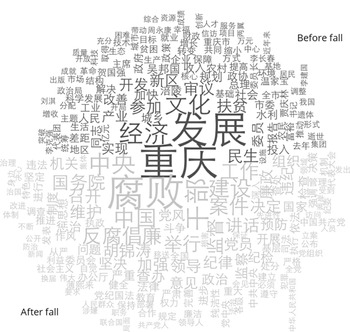
For this comparison, I conduct a word cloud analysis of media coverage in the People’s Daily and Xinhua, two official press outlets. A word cloud is a method of visualizing word frequency in a corpus of texts, where the size of the words represents the frequency of mentions, and the most dominant words are placed at the center. Word clouds help to identify the focus or priorities of a given set of discourse. In this instance, they reveal how the two politicians were perceived and portrayed before and after they fell.Footnote 5
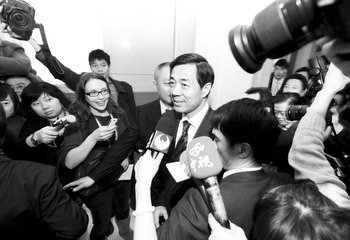
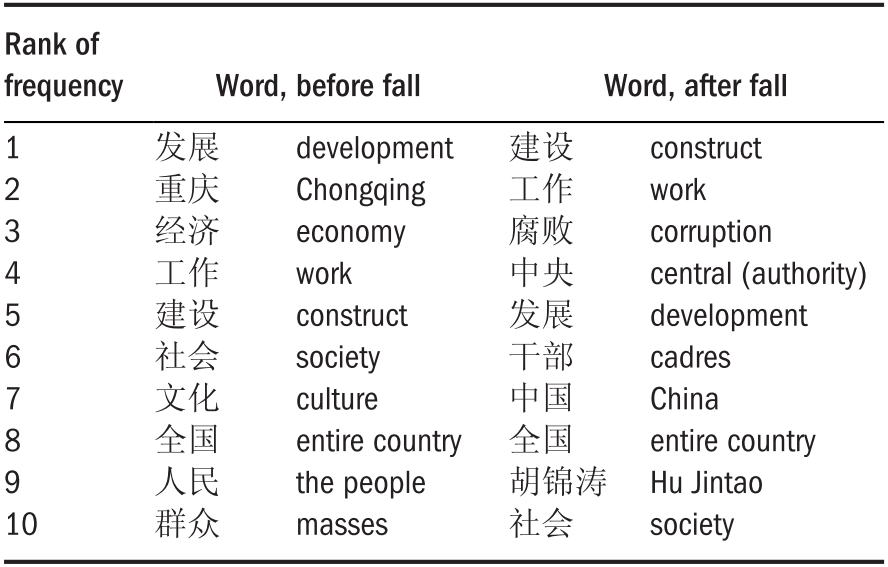
First, consider Bo Xilai, who became the poster man of Chinese corruption in 2012. Figure 5.1 visualizes media coverage of Bo: the top half shows the most frequently used words a year prior to his fall and the bottom half presents the period after his fall.Footnote 6 Table 5.1 lists the top 10 words in each period. Before Bo fell, Chinese media coverage touted his accomplishments. “Development” (fazhan) was the most frequently used term. In addition to spotlighting his work on the “economy” (#3) specifically in Chongqing (#2), the media profiled non-economic parts of his portfolio: “society” (#6) and “culture” (#7). Reflecting his populist appeal, Bo was described in connection to “the people” (#9) and “masses” (#10). Other words that frequently appeared with him include “livelihoods,” “poverty alleviation,” “industries,” “audit,” “new zones,” “speed up,” and “participate.” Altogether, the portrait emerges of a dynamic leader who got many things done at once.
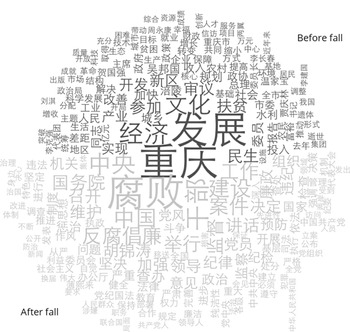
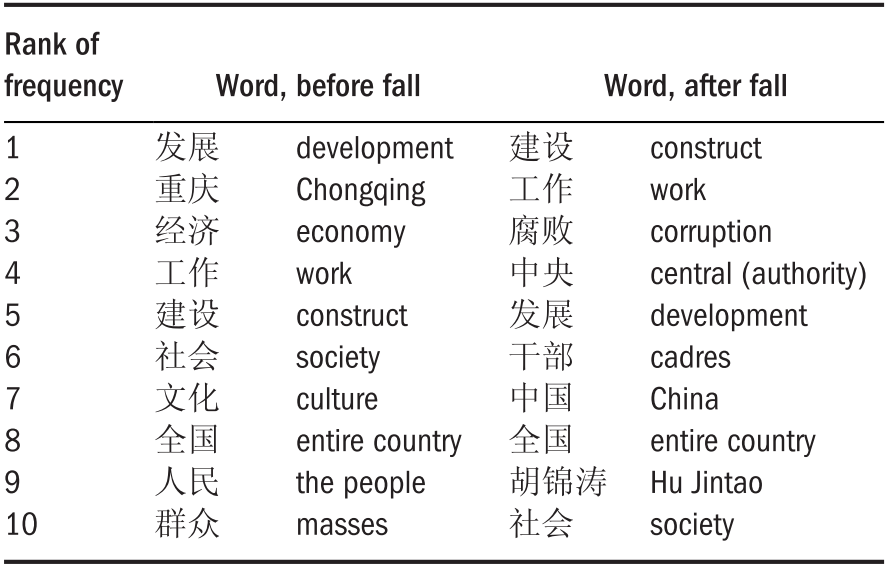
After he fell in March 2012, however, public discourse of Bo turned sharply toward corruption and his political stand-off with the leadership, President Hu Jintao and Premier Wen Jiabao. The words “Chongqing,” “economy,” “culture,” “citizens,” and “masses” dropped off the top-10 list, being replaced by “corruption,” “central authority,” “cadres,” “China,” and “Hu Jintao.” The replacement of “Chongqing” by “China” signaled that events surrounding Bo were no longer just local politics but a national crisis. Other prominent words include “inspect,” “anti-corruption,” “promote clean government,” “resolute,” and “strengthen,” indicating that media coverage after the exposure of Bo’s infractions focused on central authorities’ attempts to place him in cuffs.
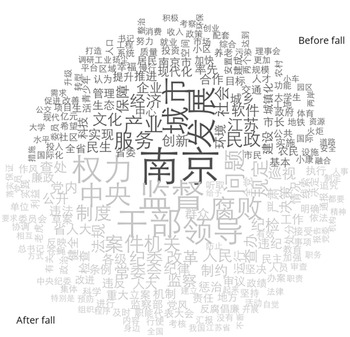
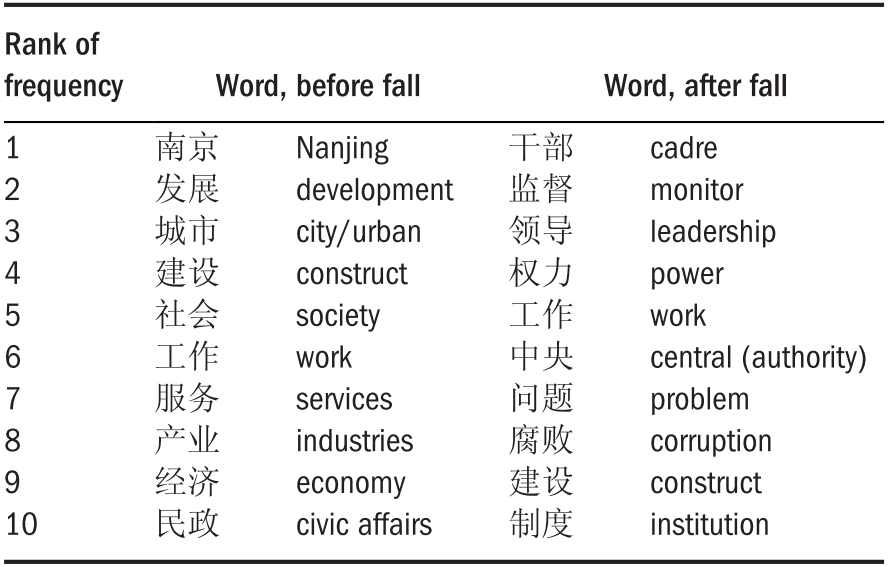
Whereas Bo was a Politburo member and provincial chief, Ji Jianye, former city mayor of Nanjing, was a sub-provincial official of lower (vice-ministerial) rank. Nevertheless, in Figure 5.2 and Table 5.2 we see a similarly sharp reversal of media coverage of Ji before and after his fall.Footnote 7 Prior to being investigated for corruption, Ji was famous in Jiangsu province and even nationally as a competent but heavy-handed leader. Before he fell, the top three words describing Ji in the media were “Nanjing,” “development,” and “city/urban.” Like Bo, his accomplishments went beyond growing the economy and extended into provision of social welfare and public services, as indicated by these words on the top-10 list: “society” (#5), “services” (#7), “civic affairs” (#10). Other common terms project the image of ambitious, well-rounded leadership: “happiness,” “globalize,” “ecology,” “investment,” “employment,” “pensions,” “subway,” and “technology.”
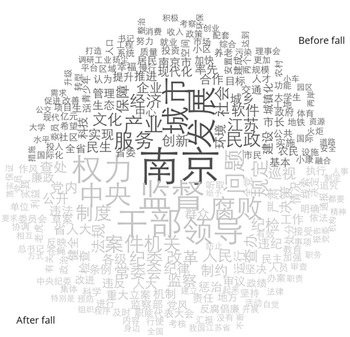
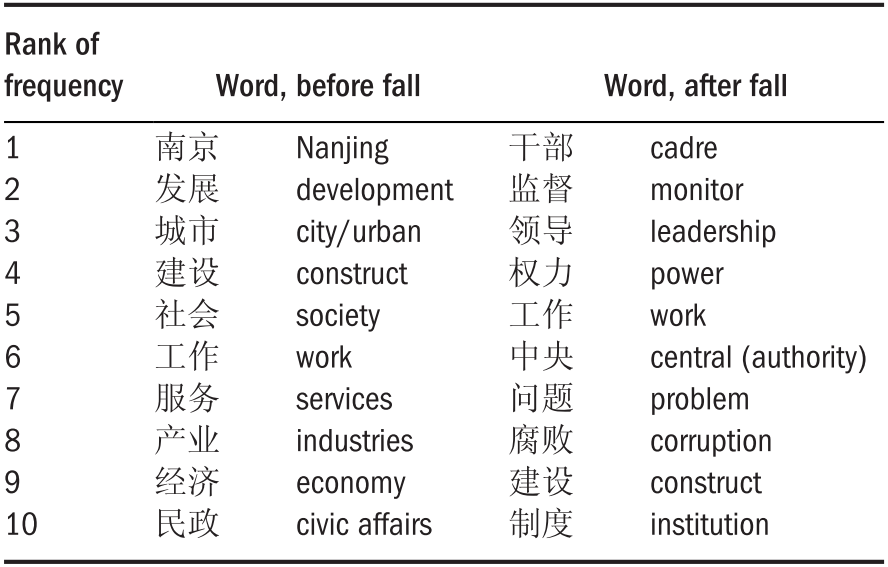
But soon after Ji’s investigation was announced, the media stopped mentioning his development-promoting leadership. Indeed, media mentions of Ji plummeted, as he wasn’t a national celebrity-and-villain like Bo, who continued to attract attention until the end of his criminal trials. The few times that Ji was mentioned, his crimes and punishments dominated media coverage: “inspect” (#2), “power” (#4), “problem” (#7), and “corrupt” (#8). References to his achievements as mayor all but vanished.
To sum up, a simple text analysis shows that it is misleading to draw conclusions about the Chinese political system solely on the basis of media reports of corruption. Once officials fall from grace, stories of their crimes and vices eclipse their past contributions to development. As Bachman incisively asks in his review of China’s Crony Capitalism, “Corruption may be endemic, but is it the whole story or even the most important part of the story?”Footnote 8 The word clouds in Figures 5.1 and 5.2 visualize my answer to Bachman’s question: no – it’s only the bottom half of the story.
Bo Xilai: A Fallen Princeling
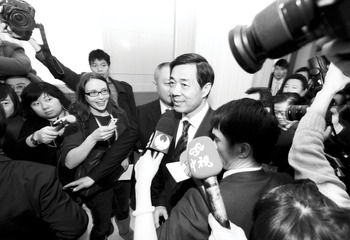
Bo Xilai (Figure 5.3) was a princeling, the son of one of the Party’s revered pioneers, Bo Yibo. In other words, he was a second-generation aristocrat in modern capitalist China. During the Cultural Revolution (1965–1975), Bo’s family was purged and forced to live in miserable conditions. But when Deng took over the helm of the Party, he resuscitated Bo Yibo’s career, enlisting him as Vice Premier to help steer the opening of markets and global trade.
Bo Xilai is surrounded by reporters when arriving at the 11th National People’s Congress in Beijing in 2010.
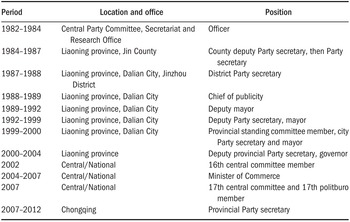
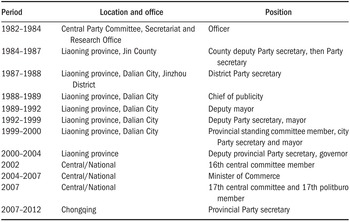
As scion of a revolutionary clan, Bo Xilai catapulted through the political ranks. Table 5.3 lists the milestones in his career path. Unlike regular officials who typically climb their way up from bottom rungs, Bo was parachuted into Liaoning, a Northeastern province, as a county deputy Party secretary at the age of 36. Later, he was promoted to mayor of Dalian, a port city, before ascending to the next rung as Minister of Commerce in 2004. Shortly after, in 2007, Bo was inducted into the Politburo, an elite committee of national leaders, which signaled his potential to seek top posts in the next leadership contest. Yet, in the same year, he was transferred to Chongqing, a moderately poor municipality in the Southwest, where he would serve as provincial Party secretary until his dramatic fall in 2012.
Vaunted by the media as “tall, handsome, and charismatic,”Footnote 9 Bo was a natural publicist who frequently seized news headlines. The BBC once called him “the nearest thing China has to a Western-style politician.”Footnote 10 Bo’s ambition and charm, however, may have rattled the leadership in Beijing, who transferred him to Chongqing to remove him from the spotlight. But, instead of lying low, Bo stirred up even more attention and controversy.
Bo’s Big Splash
Chongqing is a municipality ranked administratively as a province, like Shanghai and Beijing, with a population of about 10 million, twice that of Singapore. But, unlike Shanghai, Chongqing had long been starved of economic growth because its landlocked geography prevented it from replicating the coastal development strategy of export-oriented industrialization. In the past decades, Chongqing ranked among the poorer provinces,Footnote 11 providing a vast supply of low-wage, rural migrant labor to coastal factories yet benefiting far less from global capitalism than the Eastern provinces. When Bo came to office in 2007, however, he rapidly – and forcefully – turned the situation around.
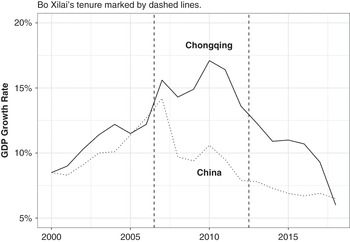
Within six years, Bo narrowed the economic gap between Chongqing and the national average. In 2007, Chongqing’s GDP per capita was only 82 percent of China’s average; by 2012, this figure was nearly on a par with the national average of 40,000 Yuan.Footnote 12 Prior to Bo’s arrival, from 2000 to 2006, Chongqing’s mean annual growth rate was 10.7 percent. Impressively, during the six years of his tenure, Chongqing pulled off a double-digit annual growth rate of 15.3 percent, even as the rest of the country suffered from the 2008 financial crisis, as Figure 5.4 shows. After he left, average growth fell back to 10 percent between 2012 and 2018.
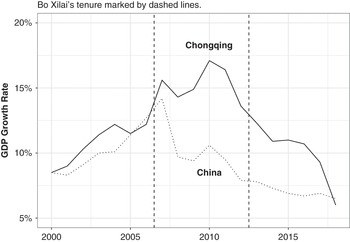
In terms of provincial rank in GDP growth rate, the reversal was especially stark. In 2006, Chongqing ranked 26th out of 31 provinces in GDP growth. The year that Bo took office, it jumped to third in rank, reaching first in 2011. This high rank was sustained for several years after Bo’s departure, until 2018, when Chongqing suddenly dropped to 28th place.
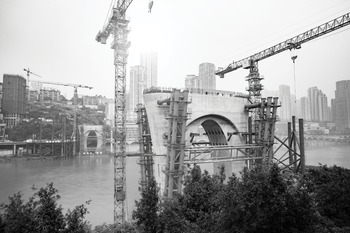
During Bo’s tenure, Chongqing’s government revenue more than tripled. Foreign direct investment (FDI) jumped more than 10 times to US$10.5 billion by 2012. The volume of external trade increased seven-fold, while domestic trade more than doubled. Rapid economic growth appeared to directly benefit Chongqing’s residents: urban residential income grew 1.7 times and rural income doubled. The ratio of urban to rural income narrowed from 420 percent in 2007 to 340 percent by 2012. Urbanization spread briskly too (Figure 5.5), with the share of urban residents growing from 48 to 57 percent during this period.Footnote 13
During Bo’s tenure, Chongqing saw a rapid construction boom.
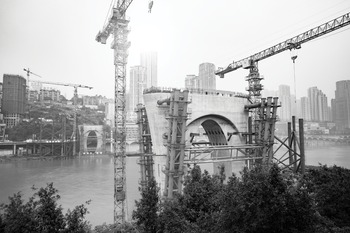
How did Bo and his team pull off this economic turnaround? They adopted a highly statist approach, pumping in large amounts of state-financed infrastructure projects, strategically branding Chongqing as a low-wage industrial hub and a portal to the inland domestic market, and offering tax incentives and services to entice investors. Infrastructure projects were critical for overcoming geographic limitations and reducing transportation costs, for example, the construction of a new direct railway connecting Chongqing to Germany via Kazakhstan, Russia, and Poland cemented Chongqing’s strategic position as the logistics magnet of inland China. To create a civil aviation hub, the municipal government established a network of four airports and increased the carrying capacity of Chongqing’s international airport from 7 million to 25 million passengers a year by 2012.Footnote 14 This combination of infrastructure, business-friendly policies, and low wages succeeded in attracting foreign investment, including multinationals like Ford, Hyundai, Foxconn, Acer, Sony, and Goodyear. In 2008 Hewlett-Packard opened a sprawling factory to produce desktop and notebook PCs. By 2013, one in four laptops in the world, or 55 million of them, were made in Chongqing.Footnote 15
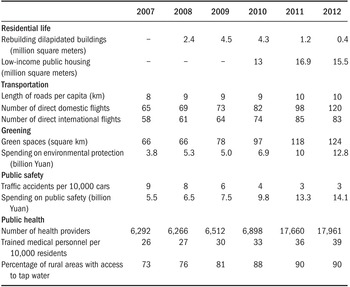
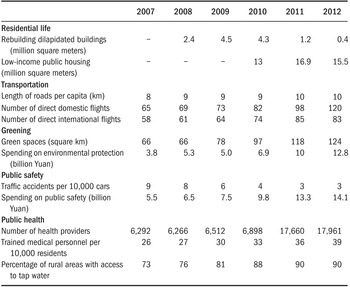
Bo’s leadership delivered more than just economic growth. In his campaign branded “Five Chongqing,” he set goals across five areas of social welfare: residential life, transportation, public safety, greening, and public health.Footnote 16 Impressively, as summarized in Table 5.4, Bo delivered concrete results across all of them. Not only did the economy and employment grow, but also the residents of Chongqing enjoyed more roads, direct flights, green spaces, health care providers, and access to running water. Particularly noteworthy are Bo’s pro-poor policies, including the construction of 45 million square meters of public housing for low-income residents within three years. His team also introduced policy innovations, the most famous of which was allowing farmers to sell their land-use rights on the market, landmarked by the establishment of China’s first rural land exchange agency in 2008.Footnote 17
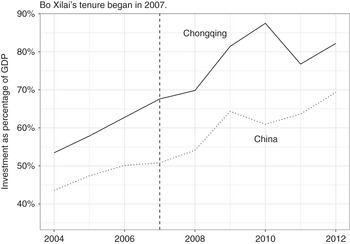
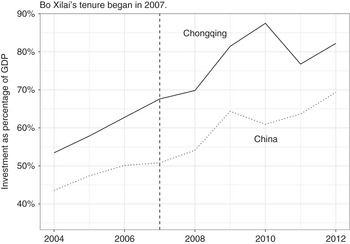
Chongqing’s development model was heavily driven by investment and construction. Between 2007 and 2012, the municipality’s total fixed asset investment expanded three-fold, reaching 87 percent of GDP in 2010, compared with 68 percent in 2007 and only 41 percent in 2001.Footnote 18 Although other provinces also increased investment, Chongqing’s investment to GDP ratio was consistently higher than the national average (see Figure 5.6).
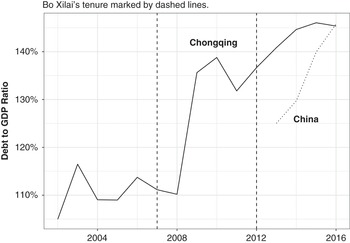
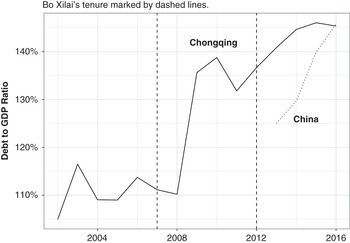
But a construction spree doesn’t come free. Chongqing’s infrastructure projects were financed partly by government spending and even more by loans, typically using land as collateral. During Bo’s six-year tenure, outstanding bank loans tripled to a total of 1.6 trillion Yuan by 2012. Simultaneously, land proceeds grew five-fold, rising from 52 percent of budgetary revenue in 2006 to 77 percent in 2012. Chongqing’s rising debt was especially evident in its debt-to-GDP ratio, which was 105 percent in 2002, then dramatically spurted from 110 percent in 2008 to 136 percent in 2009. After Bo’s expulsion in 2012, this ratio continued to grow, peaking at 146 percent in 2018 (Figure 5.7). Comparable statistics for the whole country, which are available only from 2013 onward, indicate a clear trend of rising debt across China and a narrowing gap between Chongqing and the rest.Footnote 19
More controversial than Bo’s economic and social welfare policies was his dual campaign to “celebrate red and smash black” (changhong dahei) – that is, to revive mass singing of Mao-era patriotic songs and fight organized crime. Although hardcore Maoists and members of the so-called “new left” enthusiastically embraced his policies, others worried that Bo was rekindling Maoist nostalgia to win popularity. His crackdown on crime brazenly flouted the legal process, exacting beatings, torture, and forced confessions on thugs and innocent victims alike, including private businessmen deemed to be in cahoots with Bo’s political rivals.Footnote 20
The Chongqing model’s heavy reliance on government-built infrastructure and debt raised concerns about economic sustainability and financial risks. An economic downturn – such as the one that is happening now across China – could undermine the city’s ability to pay its debts and spark a downward spiral, as several observers warned.Footnote 21 Indeed, by 2018, Chongqing’s GDP growth had fallen to its lowest since 2000 (see Figure 5.4). Bo’s favoritism toward state investment and attacks on private entrepreneurs had weakened the private sector, which now hobbles the city’s ability to rebound.Footnote 22
Compare Bo’s approach in Chongqing with classic models of state-directed development. In the 1970s to 1990s, analysts characterized the East Asian economies such as South Korea and Taiwan as “developmental states,” where national governments accelerated industrial catch-up through extensive state planning and investment.Footnote 23 More recent literature has called for social developmental states that promote social welfare on top of economic growth.Footnote 24 By these criteria, Chongqing under Bo may be described as a local variant of social developmental states – but on steroids and armed with a sledgehammer. Not only did the charismatic princeling turn around the economic fortunes of a landlocked municipality, but also he delivered social welfare and policy innovations, branding himself as a trailblazing populist, or, as Cheng Li puts it, “a guy who gets things done.”Footnote 25
The Biggest Scandal
Nobody could have predicted that Bo’s ascendant career would eventually end in what The New York Times dubs “the biggest scandal facing China’s leadership in a generation.”Footnote 26 One fateful day, 6 February 2012, Wang Lijun, Chongqing’s police chief and Bo’s long-time henchman, fled to the US embassy in Chengdu, pleading for asylum. Before a group of startled American diplomats, he frantically explained that he possessed incriminating evidence about Bo’s intrigue and his wife’s murder of a British businessman.Footnote 27 Soon after, Wang was taken away by national security authorities to Beijing.
From there, the edifice of Bo’s power began to crumble, fast. On 14 March, Premier Wen Jiabao rebuked him publicly, stating that the Chongqing leadership “must reflect seriously and learn from the Wang Lijun incident.” The next day, Bo was formally stripped of his position and seized by investigators. Party leaders issued a statement that denounced him for “grave violations of party discipline.” In August, the Party held a public trial, which lasted five days. Although Bo remained defiant, he was sentenced to life imprisonment on charges of bribery, abuse of power, and embezzlement. His wife was given a suspended death sentence for murder and Wang Lijun was sentenced to 15 years in prison.Footnote 28
Grave Violations
Bo’s show trial gave the Chinese public a rare peek into the secretive world of state–business collusion and lavish consumption among super elites. According to the court’s indictment, Bo accepted a total of 22 million Yuan in bribes over the course of his career. Prosecutors traced Bo’s history of bribe-taking back to his early days as Dalian’s mayor and city Party secretary. During this time, he allegedly took 11 million Yuan in bribes from Tang Xiaolin, general manager of Dalian International Group, in exchange for helping him purchase a land parcel and obtain preferential quotas to import cars. At his trial, Bo flatly denied these charges, calling Tang a “crazy dog” who “sold his soul.”
But Bo could not dismiss his connections with a second businessman, Xu Ming, founder and chairman of the conglomerate Dalian Shide Group. Court records indicate that, between 2001 and 2012, Xu plied Bo’s wife and son with numerous gifts and received lucrative privileges in exchange, including construction projects contracted by Dalian’s government and favorable regulations from the Ministry of Commerce while Bo was Minister. Bo’s son, Bo Guagua, attended expensive private schools in England from the age of 12.Footnote 29 Even before his father’s fall, Bo junior’s fondness for flamboyant parties, sports cars, and equestrian sports had raised questions about how his parents could afford such luxury on their modest official salary. In court, Xu testified that he had paid for the family’s extravagant purchases, including a $3.2 million villa in France, private jet trips to Africa, luxury bikes, and credit card bills, totaling 21 million Yuan in value. While Bo denied knowledge of these gifts, he could not deny his cozy relations with Xu.
Bo was also charged with abuse of power. Court proceedings revealed that Bo’s wife, Gu Kailai, poisoned British businessman Neil Heywood over an alleged financial dispute. When Bo was Dalian’s mayor, Heywood cozied up to the family, offering his services as fixer and intermediary. Through his connections, he placed Bo Guagua in the prestigious Harrow School in England, making him the first Chinese to enroll.Footnote 30 In 2012, Heywood died mysteriously in a hotel in Chongqing, which the government hushed up as a case of over-intoxication. When police chief Wang Lijun began to suspect that Gu had murdered him, Bo furiously tried to cover up his wife’s crime, prompting Wang to flee for his life. Summing up the entire drama, an editor at Wall Street Journal quipped, “It’s like a Hollywood movie.”Footnote 31
Ultimately, Bo was found guilty of all charges, notwithstanding his feisty defense. But, although Bo undoubtedly broke laws and exploited his power for material gain, the formal charges against him should not be taken at face value. Beijing had to strike a delicate balance between ruining Bo’s reputation and extinguishing lingering support for him while still maintaining the Party’s legitimacy. It’s worth noting that the sum of Bo’s bribery – 22 million Yuan – though large for ordinary people, is nowhere near as massive as what one imagines a nationally ranked leader could fetch. Indeed, many lesser officials have taken far larger bribes.Footnote 32 Equally perplexing is that Bo was not charged with any corrupt action during his tenure as Chongqing’s provincial party secretary, when he wielded far greater power than in his earlier position as a city leader of Dalian. This could be because the leadership did not want to sully the Party’s image by revealing the full extent of his corrupt takings.Footnote 33 Or maybe Bo lusted more for power than for money.
Ji Jianye: Mayor Bulldozer
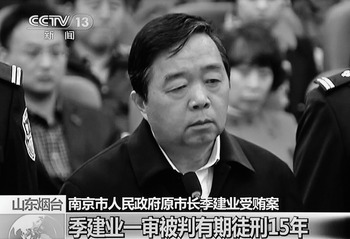
As a princeling and nationally ranked leader, Bo Xilai’s status may be exceptional. But among lower-rank officials, there are many similar figures, who are neither complete villains nor heroes. Ji Jianye (Figure 5.8), whose name means “to build,” is an especially illustrative case.
In this screenshot, Ji Jianye stands trial at a court for taking bribes.
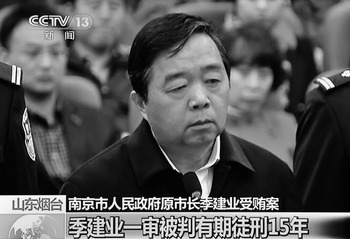
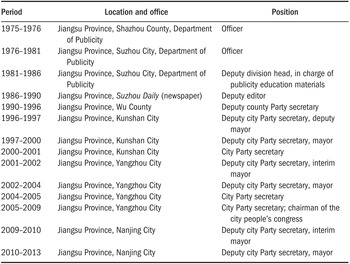
Born into a poor family, Ji worked his way up a 39-year career in his native province of Jiangsu, a wealthy industrial powerhouse adjacent to Shanghai (see Table 5.5). Unlike Bo, who was parachuted into high office, Ji started at the bottom rung of the bureaucracy as a publicity officer in Shazhou County, then Suzhou City, and later as a newspaper editor. It was not until 1990, 16 years into his civil service career, that he took his first leadership post as deputy Party secretary in Wu County. Afterward, he was laterally transferred within Jiangsu to govern the cities of Kunshan, Yangzhou, and Nanjing. In 2013, while serving as Mayor of Nanjing, Ji was seized for corruption, making him the 10th vice-ministerial-level official to fall in Xi’s crackdown on corruption.
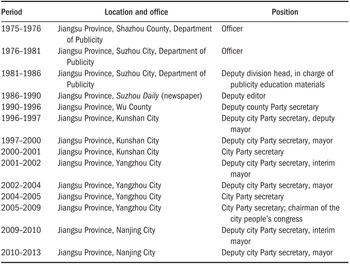
From Kunshan to Yangzhou
Over the course of his career, Ji built a reputation for competence, resolve, and authoritarianism. In Kunshan, he oversaw the establishment of the city’s first special economic zone for export processing in 2000, which attracted more than 20 tech companies that invested over US$1 billion in the first year of operation alone. This zone also became one of the first cities in China to allow wholly foreign-owned enterprises.Footnote 34
In 2002, Ji was transferred to Yangzhou, located in the central part of Jiangsu, which is less industrialized and prosperous than Kunshan. According to local media, within three months of taking office, Ji “turned the whole of Yangzhou into a massive construction site.”Footnote 35 He refurbished 130 streets, rezoned and reconstructed areas around the city’s river, and undertook a city-wide greening campaign, which “laid the foundation for Yangzhou’s urban map until this day,” Caixin reports. His sweeping demolition schemes earned him the nickname Mayor Bulldozer. Local residents even coined a rhyme to capture his style of development: “To demolish, he stamps his feet; to topple, he points.”Footnote 36
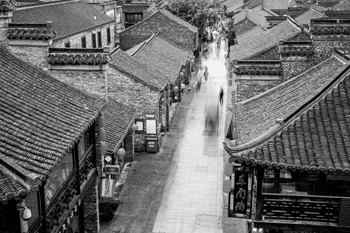
In fact, Ji did more than bulldoze. Branding Yangzhou as “a famous city blending ancient culture and modern civilization,” he also invested heavily in the restoration of historic sites. The leader did so not because he was a conservationist, but because he saw a commercial opportunity in preserving history. In 2006, Yangzhou won the United Nations Habitat Award. From then on, tourism flourished (Figure 5.9). The number of visitors rose by one-third between 2007 and 2009, the year Ji left Yangzhou. This boom persisted after his departure, and, by 2012, Yangzhou had nearly twice the number of tourists it had welcomed in 2007.Footnote 37
Ji Jianye strategically branded Yangzhou as a blend of ancient city and modern civilization.
Yet Ji’s real forte was industrial policy. In 2002, long before other parts of the country thought about industrial upgrading, Ji proposed a plan to promote a cluster of three new industries in Yangzhou: energy, lighting, and construction materials. Taking lessons from his experience in industrial planning in Kunshan, he strategized, “Attracting investment requires selectivity and complementarities. We must create a complete industrial supply chain.” To achieve this vision, Ji persuaded the China Science Academy and Nanjing University to establish research centers for industrial upgrading. In 2005, Yangzhou’s GDP surpassed the average in Jiangsu Province for the first time.
According to Nanfang Weekend, a Guangdong-based newspaper known for investigative journalism and piercing commentary, “In Yangzhou, most people agree that Ji is the leader who has made the greatest contributions to the city since 1949.”Footnote 38 Not only was Ji fiercely pro-growth, but also he had strategic vision and demonstrated localized, adaptive governance. Ji once said, “We cannot blindly replicate the Southern Jiangsu model of development and copy Kunshan. Instead, we must forge a development path compatible with our conditions [in Yangzhou] and select industries suitable for us.”Footnote 39
Hitting a Snag in Nanjing
But when Ji moved to Nanjing in 2009, his habit of bulldozing through decisions without public consultation hit a snag. As the capital city of several previous dynasties and the Republican government, Nanjing prided itself on its historical and cultural heritage. Dear to the heart of its residents are the numerous plane (wutong) trees that line the city’s streets, offering shade during searing summers. Cui Manli, a best-selling author and native of Nanjing, expressed impassionedly, “When you see these gigantic trees, you know that this is history, civilization, the passing of time, a source of great pride.”Footnote 40
Mayor Bulldozer had little taste for sentimentality, however. Repeating his past campaigns, he launched into a massive infrastructural overhaul, replacing roads in three major routes, demolishing old buildings in 1,400 streets, undertaking an 18 billion Yuan scheme to separate rainwater from wastewater, and constructing new subway lines all at once. Within a year, his “Operation Iron Wrist,” as the local press dubbed it,Footnote 41 razed an astonishing 10 million square meters of unlicensed buildings, equivalent to 66 Forbidden Cities, making it the largest scale of demolition in Nanjing’s history. Quoting Ji, China Daily (the Party’s English-language newspaper) reported, “[Ji] reiterated that no compromise will be made … no compensation will be given to owners of houses with limited property rights.”Footnote 42
For Nanjing’s residents, the government’s announcement that more than 1,000 wutong trees would be uprooted to make way for a new subway was the last straw. Organizing spontaneously through social media, hundreds gathered at a library in formal protest against the decision. Stunned by this public outrage, city officials promised to spare some of the trees. The chastened mayor underestimated Nanjing citizens’ emotional attachment to trees.Footnote 43
Graft Exposed
Ultimately, however, Ji’s undoing came not from public protests but from his own corrupt dealings. In October 2013, disciplinary authorities seized him in connection with parallel probes of several businessmen close to him. A few months later, in 2014, Ji was prosecuted on charges of “using public office to help others advance personal gain, accepting massive wealth personally and through family members, and moral corruption.”Footnote 44 A year later, Ji pleaded guilty to taking bribes and was sentenced to 15 years in prison.
According to court records, Ji was indicted on seven counts of corruption, adding up to 11 million Yuan over the course of his career.Footnote 45 The largest sum of his bribes came from private businessman and long-time crony Xu Dongming, who gave his political patron nearly 8 million Yuan in bribes to secure government procurement contracts. Second in line was Zhu Tianxiao, a real estate developer, who channeled 2.4 million Yuan in gifts and bribes through Ji’s wife, daughter, and brother, including cash, artwork, a luxury car, and a discount of 540,000 Yuan on a condominium unit.Footnote 46 The remaining five of his official charges were conspicuously trivial sums, as little as 45,000 Yuan in cash and gift cards from another real estate developer, Zhou Kexing, from Hong Kong.
Like Bo, his real takings may be understated. If we believe the court’s indictments, 11 million Yuan in bribes over Ji’s entire career is minuscule compared with the earnings produced under his charge. For example, in Kunshan, the economic zone that he oversaw brought in on average US$10 million ($83 million Yuan) in FDI every day, which is equivalent to 20 percent the amount of FDI that Cambodia attracted in one year.Footnote 47 Chinese reports beyond the official press suggest other streams of rents. Ji’s trusted middle-person, a hotel manager named Zhu Mei, a “god-daughter” of the leader’s mother, periodically arranged for deal-buyers to offer bribes in exchange for various favors. In Nanjing, Ji rarely worked in the government building, as he used a premium hotel suite as his office, though it was unclear who paid for it.Footnote 48 Court indictments also did not mention his string of mistresses, several of whom worked under him and were promoted after their affair, including Yangzhou’s head of the environmental protection bureau and deputy chief of the city’s planning commission.Footnote 49
Sludging the Wheels
What we should take away from Bo’s and Ji’s sagas is not merely feelings of shock and disgust, but rather insights into the Chinese political system. One clear commonality between Bo and Ji is that their corruption primarily took the form of access money – elite exchanges of power and wealth – rather than extortion or embezzlement.Footnote 50 Such corruption went far beyond “greasing the wheels,” which implies paying bribes to overcome delays or red-tape. Rather, the more appropriate analogy should be “sludging the wheels,” as corrupt capitalists derived windfall deals from their political patrons.
In Bo’s case, virtually all his bribes were supplied by a mogul named Xu Ming, a Chinese version of the robber barons of America’s Gilded Age. A native of Dalian, Xu graduated from college in 1990, when China was on the verge of transitioning to an accelerated phase of market opening (Chapter 3). Xu cleverly capitalized on the lack of clear property rights at the time. In 1992, he convinced county government officials in Dalian to establish Shide Private Limited through a state-owned subsidiary where he worked. Then in 1999, all of the shares from Shide were mysteriously transferred from the county government to Xu, his brother, and two other associates, giving Xu control of his privatized company.Footnote 51 When Bo arrived in Dalian, Xu immediately ingratiated himself with the new leader and his family, and soon became the princeling’s favorite associate.
In exchange for his loyal clientage and connections to Bo, Xu received access to lucrative business opportunities and massive loans from state banks, as Caixin reports:Footnote 52
Xu’s first pot of gold came from construction projects in Dalian … According to Xu’s press interviews, his company [Shide] won a bid to construct the Victory Plaza [a large shopping and entertainment mall]. Xu further urged the government to use the soil and sand dug out from the construction of Victory Plaza to reclaim Xinhai Bay and construct Xinhai Square, thereby killing two birds with one stone. Xu Ming’s construction methods were innovative, and it earned him 30 million Yuan. In the years after, Xu Ming continued to build up Shide … expanding into construction materials, cultural and sports industries, finance, real estate, ultimately turning his company into a massive conglomerate.
As Bo moved up the political ladder, Xu’s wealth rose with him. Xinhai Square is one of Bo’s signature projects. Converted from a gigantic dumping site, it is the world’s largest city square, larger than New York City’s Times Square. Xu profited handsomely from constructing the square and simultaneously helped Bo score a political victory. In 2005, Xu reached the height of his fortunes: Forbes named him the eighth-richest person in China.
But Xu could not escape the so-called “Forbes curse” – that tycoons on the list eventually fall into trouble. When Bo fell, Xu was detained with him and eventually sentenced to prison. Just months before his scheduled release, Xu mysteriously died. He Weifang, a professor at Peking University, summed up this robber baron’s life in 12 Chinese characters on Weibo: “A flamboyant life, a bizarre sentence, a mysterious death.”Footnote 53
Similarly, Ji the mayor used his position to award lucrative contracts and deals to a trusted “circle of friends,” who colluded for over two decades. Among them were Zhu Xinliang, Director of Golden Mantis Conglomerate, also known as the “richest man in Suzhou,” and Xu Dongming, a shareholder of Golden Mantis and Ji’s former subordinate in the Kunshan city government. Golden Mantis, a privately owned listed company, became a primary conduit through which rents were generated and shared within this circle.
During his tenure as leader of Yangzhou, Ji ensured that Golden Mantis received an abundant stream of government procurement projects. The company first entered Yangzhou in 2002 as an advertisement company. As soon as Ji was appointed interim mayor, Golden Mantis won a hefty contract to supply 10 years’ worth of bus advertisements for the city. According to a Chinese report, Ji “personally greeted the bus company,” meaning he hinted to whom the contract should be awarded. But later on, as his power grew, Ji dispensed with subtleties and directly awarded construction projects to Golden Mantis without any bidding process, in brazen violation of procurement rules.Footnote 54
In 2003, Golden Mantis made its initial public offering (IPO) on the stock market, and shortly after, its share price rose more than 10-fold. Zhu and Xu “shared the fragrance” (Suzhou dialect for sharing the spoils) by funneling 0.2 percent of their company’s shares to the mayor through his wife’s shell company,Footnote 55 valued at approximately 9.9 million Yuan, far exceeding the value of his cash bribes. The politician entrusted his equity with Xu, his crony and financial manager, who used it to extend loans on the market, generating interest payments that were handed to Ji’s wife.
To sum it up, Chinese politicians and capitalists share a relationship of “mutual prosperity,” as Beijing News describes in Ji’s context:Footnote 56
The businessmen “trailed behind” Ji throughout his political career. Their projects stretched from Yangzhou to Nanjing. All the contracts they secured bore tracks of Ji’s manipulation and participation. Ji’s wife and chauffeur grabbed many construction projects for themselves, particularly in greening and landscaping. From Yangzhou to Nanjing, as Ji bulldozed and built, his political fortunes soared.
But when entrepreneurs hitch their fates to those of their political patrons, it comes with danger – they perish together. Xi’s anti-corruption campaign brought down the whole gang.
The Indirect Harm of Access Money
What were the effects of Bo’s and Ji’s style of corruption on the economy? Access money functions like the steroids of capitalism – it stimulates growth but distorts by misallocating resources, breeding systemic risks, and exacerbating inequality. As my qualitative accounts show, corruption in the manner of access money is not a tax but rather an investment. This calls for a revision of the conventional focus in the political economy literature on corruption as only a “tax” on business.Footnote 57 Clearly, the capitalists who extended graft to Bo and Ji all got terrific deals, including this list of perks.
▪ Major construction contracts: Xu Ming’s construction of the Xinhai Square and Victory Plaza, both part of Bo’s development plan in Dalian, were his “first pot of gold,” earning him 30 million Yuan that financed a rapid expansion of his business into a conglomerate.Footnote 58
▪ Monopoly privileges: When Ji was in charge of Yangzhou, his client Golden Mantis monopolized renovation projects in the city’s residences, hotels, and hospitals.Footnote 59 Within only six years of his tenure, the company’s profits multiplied 15-fold,Footnote 60 catapulting it into being the first Chinese listed company specializing in renovation.
▪ Access to credit: Shortly after Xu Ming had famously acquired Dalian’s soccer team to ingratiate himself with Bo, who was an avid soccer fan, he received his first major loan from the China Construction Bank. Loans extended to his company subsequently ballooned to as much as 1.6 billion Yuan.Footnote 61
▪ Access to land: Developers are required to bid for land, which is scarce and in high demand. As Nanjing’s Mayor, Ji helped Dehao Corporation acquire two of six land parcels available at the time, even though the company had been established only shortly before the bid.Footnote 62
▪ Regulatory exemptions: In Yangzhou, Ji helped Zhu Tiaoxiao, another real estate magnate, to skip approval processes and to flout land use and construction restrictions, and even aided his company’s demolition work, which frequently entailed state coercion and thuggery.Footnote 63
Evidently, when corruption takes the dominant form of access money, it can enrich some private companies and even hoist them onto stock markets and Forbes’ list of billionaires. It also stimulates construction and investment, all of which translates into GDP growth.
Yet this does not mean that access money is “good” for the economy – on the contrary, its harm is indirect but deep. Such corruption channels excessive investment into real estate, a sector offering unmatched windfalls for the politically connected. In China all land is state-controlled, meaning that it can be leased through a bidding process but not sold. Even though Beijing limits the amount of land for lease and restricts local governments from changing designated land use categories (agriculture, industry, or commerce), local authorities can still find numerous ways of manipulating land sales and use for private gain.Footnote 64 Powerful officials can help developers acquire valuable land parcels at bargain prices, which they can either turn into pricey properties or resell for colossal profit. Therefore, real estate is described in Chinese as a “super rents” (baoli) sector.
One long-term structural risk is that Chinese investors face distorted incentives to abandon productive economic activities for real estate investment, a trend termed qishixiangxu.Footnote 65 Since market opening, manufacturing has been the foundation of China’s “real economy” (shiti jingji) – meaning the production of essential goods and services – which drove massive job and wealth creation. But, facing rising labor costs and trade frictions with the United States, manufacturing’s appeal has drastically weakened. The rush of investment toward real estate exposes the economy to speculative bubbles and over-construction, as is evident from the hordes of empty apartments across China. One study estimates that about 22 percent of Chinese urban housing is unoccupied even though the units are sold, which amounts to over 50 million homes.Footnote 66 This situation is dangerous, as an article in Bloomberg explains: “The nightmare scenario for policy makers is that owners of unoccupied dwellings rush to sell if cracks start appearing in the property market, causing prices to spiral.”Footnote 67 Adding to the risky brew are rising local government debts, which have financed infrastructure projects such as the ones Bo and Ji commissioned.
A capitalist machine fueled by access money also exacerbates inequality, both within society and between politically connected and non-connected firms. Xu Ming’s staggering loans from state banks stand in marked contrast to private companies that are denied credit and forced to borrow at usurious rates from informal “shadow banking” institutions.Footnote 68 Cronies can easily secure government contracts and race ahead of their competitors. In society, over-investment in real estate and soaring prices have put urban housing out of reach for many regular citizens, inspiring the drama series “Humble Dwellings” (Woju), whose plot was so realistic that censorship authorities banned its broadcast.Footnote 69 The super-rich, meanwhile, snap up strings of luxury apartments, waiting to resell them at higher prices. The tragic consequence is that the majority of Chinese people who need homes can’t afford them while the minority who own homes don’t live in them.
Last but not least, access money generates strong vested interests which block economic reforms and distort the allocation of resources. Local governments have few incentives to provide affordable public housing, as propping up demand for private residential properties produces rents. (Bo Xilai’s low-income housing scheme in Chongqing is exceptional, as his ambition was to win popular support for a seat in Beijing.) Investment continues to pour into some money-losing industries because “these firms’ involvement in large numbers of construction projects, no-bid contracts, and related party transactions creates ample opportunities for leaders at all levels to obtain private benefits,” Rawski writes. Similarly, Walder argues that top political elites who control key sectors of the economy, from finance, to electricity, to oil, have “enormous vested interests in a status quo from which their families have greatly benefited in recent decades,” forcing Xi to use the anti-corruption campaign to break them up (more details are given in Chapter 6).Footnote 70
To sum it up, it is imperative to think beyond the simplistic binary of whether corruption is “good” or “bad” for economic growth. As my analysis shows, while some forms of corruption are unambiguously harmful or taxing – corruption with theft and speed money – access money can stimulate growth yet produce serious side effects. Although its risks and distortions affect all Chinese citizens, the impact is impossible to quantify.
How Chinese Crony Capitalism Really Works
My analysis revises our understanding of how crony capitalism really works in China. Pei portrays the system as one “in which capitalists gain valuable rents from politicians,” leading to “the decay of the CCP.” I fully agree with the problems that Pei sees in crony capitalism, particularly “the enrichment of a small minority and high levels of inequality.”Footnote 71 Yet his portrayal ignores the other side of the coin: corrupt officials are often also competent and development-promoting. Thus Pei falls completely silent on why crony capitalism, if it is so corrosive, has accompanied four decades of economic boom.
I highlight four takeaways from my analysis. First, Chinese politicians are corrupt, but they also promote economic development and even deliver social welfare. Indeed, from the portraits of Bo and Ji, we learn that the strategies for growth promotion among the most competent leaders have advanced far beyond merely bulldozing and building empty “ghost cities.” Rather, both Bo and Ji strategically positioned and branded their locales. Bo and his lieutenants effectively forged the brand “Chongqing model,” leveraging Chongqing’s advantage as a gateway into central China. Ji knew that Yangzhou could not compete in export manufacturing with Kunshan (a city he had previously governed), so instead he branded Yangzhou as a heritage site. To accomplish this, he refurbished the historic Guyun Canal that runs through the city, thereby attracting both tourists and developers of luxury properties. As a former newspaper editor, Ji was also shrewd at harnessing the media to his advantage. In Yangzhou, he organized a marathon by city leaders along the refurbished canal, which was broadcast on TV. Through this publicity stunt, he showed off the impressive landscape and won the support of local residents.Footnote 72 A sole focus on his later scandals would obscure these development strategies.
Second, the more Chinese politicians promote development, the more rents they can generate for their clients and themselves. This constitutes a system of elite profit-sharing, which parallels but is different from profit-sharing among rank-and-file bureaucrats (Chapter 4), whose performance is rewarded through fringe compensation. For political elites, their rewards come in the form of massive bribes and even company shares. In Ji’s case, he literally shared the profits of Golden Mantis by holding the company’s stock. By successfully revamping Yangzhou into a modern city with historic appeal, he raised not simply economic growth but rather the value of land and real estate – thereby vastly increasing the stock of rents. This “profit-sharing” style of corruption distinguishes it from Pei’s repeated emphasis on “looting,” which sometimes occurs in China but is not the dominant or preferred style of corruption (also see Chapter 2).
Third, cronyism is not just for personal enrichment but also helps ambitious politicians get things done. Xu Ming’s relationship with Bo Xilai is a case in point. Bo accepted Xu as his favorite not simply because he gave bribes (as numerous capitalists would queue up to do the same), I surmise, but because Xu was competent and proved he could deliver. In constructing Xinhai Square and Victory Plaza, both Bo’s pet projects, Xu cleverly used discarded sand from one site to construct the other site, a method that even Caixin commended as “innovative.”Footnote 73 For political elites whose formal pay is abysmally low (Chapter 4), wealthy cronies not only finance their personal wealth and lavish consumption but also help them achieve development targets, which is necessary for career advancement. Crony capitalists donate to public works,Footnote 74 mobilize their business networks to participate in and execute state-led schemes, and help politicians deliver their signature projects, which improve both a city’s physical image and the leader’s personal track record. Thus understood, Bell’s praise of the Chinese political system as a meritocracy that selects officials by “ability and virtue” misses a crucial reality: it is difficult for politicians to perform without political patrons and corporate clients.Footnote 75
Fourth, Chinese crony capitalism is competitive. As a princeling, Bo was exceptional in the power and influence he wielded. Other leaders, however, must demonstrate ambition and ability to draw capitalist cronies, who otherwise will not want to hitch themselves to weaklings or losers. One example is Hengyang city Party secretary Tong Mingqian (see Appendix: Chapter 5), who was perceived as timid and mediocre; “even county leaders don’t take him seriously,” local media reported. Businessmen were known to barge into his office, demanding responses, rather than to curry his favor.
Another manifestation of competition lies in local governments’ provision of “preferential policies” (youhui zhengce), including tax and fee exemptions, worker training, subsidies, and so forth, for attracting investors. They are similar to incentive packages that state and city governments in the United States offer to entice companies, except that in China they tend to be tainted with graft.Footnote 76 As numerous locales all vie for businesses, local governments enter into a “vicious competition” to offer ever better deals. As one Chinese article reports, “Before enterprises decide on their investment destination, they will visit multiple sites, using one local government’s deal to extract better deals from other local governments.”Footnote 77 Preferential policies used to be publicized by local governments on their websites, in brochures, and at investment recruitment events, but, since the launch of Xi’s anti-corruption campaign, the topic has become taboo because of its association with corruption and special deals extended by leaders to selected investors. As one official cautioned in an interview, “Nowadays, don’t ever mention ‘preferential policies.’ In the past, you could use the term, but now you can’t … It will get people into trouble.”Footnote 78 In sum, despite the absence of electoral contests, Chinese political elites compete intensely both for economic growth and for corporate clientele for themselves.
Conclusion
Chinese crony capitalism is a story of impressive growth accompanied by financial risks and sharp inequality. Officials who are both competent and corrupt, exemplified by Bo and Ji, are the protagonists behind China’s paradox of prosperity and corruption.Footnote 79 By detailing their portraits, we can avoid gross simplifications and begin to grasp the contradictions built into China’s political economy. Importantly, this chapter showed that growth promotion and graft do not merely coexist – rather they feed off each other.
For students of corruption, it is high time to challenge the simplistic belief that all corruption deters investment and growth. In China access money spurs politically connected capitalists to feverishly invest and build, while enabling politicians to achieve their development targets and ascend career ladders. Yet, functioning like steroids, this corruption also produces serious but indirect harm. Its effects on the economy are likely to be punctuated (building up to an eruption) rather than linear (hampering annual growth).
The leadership under President Xi is painfully aware that it must deal with the festering ills of crony capitalism over the past decades. Will Xi succeed in curbing corruption and bring about a Chinese-style Progressive Era? Or will his campaign produce unintended new problems? I turn to these questions in the next chapter.

 Open access