

Introduction
Over the past 15 years, academic institutions have gradually been transformed from knowledge communities into knowledge enterprises, mainly because of the introduction of market mechanisms. In recent years, the emphasis has been on the logic of business rather than on that of scholarship proper. Concepts such as the ‘managerial university’ and ‘academic capitalism’ are used to characterize the current situation of changing academia.Reference Kogan and Teichler1 As a result, the balance between the academic and the business side has changed to the extent that it has caused deep conflicts within an academic profession seeking scholarly and societal development.
Japanese academics already pointed out a few of the effects of the menace presented by academic bureaucracy in the 1992 Carnegie International Survey on the Academic Profession, but even more effects were identified, to a degree equivalent to that found in the West, in the 2007 Changing Academic Profession survey.Reference Arimoto and Ehara2–Reference Fujimura4 I have addressed these problems in a series of international conferences: in Hiroshima (2008/9) and Jacksonville (2008).5–Reference Arimoto8
The present article deals with the following issues: (1) the role of knowledge and how the academic profession sees itself; (2) decision making; (3) the role of institutional missions and profiles; (4) the impact of incentives and sanctions; (5) supervisory mechanisms; and (6) cooperation. It is based on two sets of data, namely those of the 1992 Carnegie survey and those of the 2007 CAP survey. As Table 1 shows, 17 countries (including one region of Hong Kong) participated in the latter, nine countries of which had also participated in the former. Table 1 also identifies 24,859 as the total sample provided by the participating countries in 2007, as well as the proportion of the sample by individual countries (e.g. Japan’s share is 5.7%). Five countries used a paper questionnaire; seven countries used an online questionnaire; five more countries used both. (The response ratio in the different countries is too complicated to express in the table and is not presented here.)
Seventeen samples in the 2007 CAP survey

Note: *countries participated in the 1992 Carnegie survey.
The role of knowledge
The academic profession, for which knowledge plays a significant role, is substantially involved in creative academic work and academic productivity.Reference Shinbori9–Reference Arimoto14 Knowledge comprises such activities as discovery, dissemination, application and control, activities that can be identified with the functions of research, namely teaching, service, and administration and management, respectively. Among these functions, research and teaching are the main responsibilities of universities and colleges.Reference Clark15, Reference Arimoto16 It is important to pay attention to the role of the academic discipline in the advancement of knowledge by knowledge creation and export. The importance of academic productivity cannot be overstated, and productivity in research and teaching, the two main domains of academia, are therefore highly important. Creativity in these domains is correctly identified as very valuable because it opens up new horizons and leads to innovation.
As indicated in Figure 1, academics who specialize in specific academic disciplines face the social control of the scientific ethos and norms related to the disciplines in which they specialize. They gradually form their own social identities in the environments intrinsic to their respective disciplines. These identities accompany the manifest and latent functions of the disciplines and add to their formal and tacit knowledge. Some effects are evident in processes such as the selection of themes, the attainment of research technology, doctoral supervision, various kinds of material resources including scholarships and grants, human resources including researchers inside and outside academia, research environments including culture, climate, and the research styles of the natural and social sciences and the humanities, etc.Reference Parry17
Knowledge functions

As Becher and Parry pointed out, there are cognitive and social dimensions to the academic discipline.Reference Becher and Parry18 As regards the former, every discipline has its own methodology regarding inquiry and research and a specific scientific horizon: every discipline has its own research community, culture, and climate, and in this context, the activities to enhance academic productivity are conducted both manifestly and latently.
In academia, management derives from knowledge control and its support for academic work (which consists of research and teaching). It plays an important role in enhancing the vision of the academic profession: coordinating and integrating the scholarly and business aspects of academic work are necessary to increase academic productivity, both quantitatively and (and most importantly) qualitatively. Nevertheless, the emerging ‘managerial university’ does not necessarily play an adequate role in contributing to academic productivity.
Decision making
In the CAP and Carnegie surveys, respondents were asked to identify which actor they considered to have primary influence on a number of decisions. The actors identified in the answers fall into six categories: government or external stakeholders, institutional managers, academic unit managers, faculty committee/boards, individual faculty members, and students. In this study, faculty committee/boards and individual faculty will represent the level of faculty. In 2007, the average response in these two categories for the eight areas of academic decisions for all 16 countries was 33%; in 1992, it was 27% for six countries (see Table 2). The average increase has been only 6%. Japanese staff, on the other hand, record the highest percentage (60%) among all countries in 2007 and also the highest (40%) in 1992, which is an increase of 20% in a period of 15 years.
Institutional decision making. Proportion of CAP respondents rating faculty level as primary

Note: ‘Proportions of respondents indicating primary influence of faculty or faculty board’.
Comparison of the responses to each of the eight areas by all the other countries and Japan yields the following results: selecting key administrators (other countries 19%; Japan 41%); choosing new faculty (48%; 84%); making faculty promotion and tenure decisions (44%; 77%); determining budget priorities (18%; 36%); determining the overall teaching load of faculty (33%; 69%); setting admission standards for undergraduate students (36%; 69%); approving new academic programmes (38%; 65%); evaluating teaching (30%; 38%). In all items, the response from Japan is higher than the average for all other countries. This is likely to mean that in Japan, both academic autonomy and academic freedom still rate comparatively high compared with the rest of the world.
Nevertheless, the responses related to governance and management present a wholly different picture. Decision making is changed from a bottom-up structure (in which faculty meetings have much power) to a top-down structure (with strong institutional managers, e.g. the trustee committee and the president). This shift can be illustrated by a case study of four countries, based on the responses in the two surveys. Responses to the statement that in their institution ‘top-level administrators are providing competent leadership’ show that while Japan now has accepted a level of leadership similar to that of the other three countries, only in Japan is their level of competence considered to have improved (the results for 1992 and 2007 respectively: Germany 3.41/3.00, Japan 2.36/2.59, the UK 3.47/3.30, US 3.13/2.94). Responses to a second statement (see Table 3) confirm the fact that the promotion of bureaucratization in Japan between 1992 and 2007 has reached a level similar to that in the other countries considered. The number of positive responses to the statement that a ‘lack of faculty involvement is a real problem’ has increased only in Japan (Germany: 2.41 in 1992, 2.73 in 2007; Japan: 2.99, 2.71; the UK: 2.66, 2.65; US: 2.76, 3.07).
Responses to the statement ‘lack of faculty involvement is a real problem’*

Notes: * (on a 5-point scale, from ‘Strongly agree’ = 1 to ‘Strongly disagree’); ** p < 0.001; n.s. = statistically not significant.
Responses to the CAP and Carnegie surveys on a wide range of management issues are shown in Table 4. The table presents the proportions of positive responses. The proportion for all countries indicating agreement has slightly shrunk, from 43% in 1992 to 41% in 2007. For Japan, the overall average proportion has slightly shrunk from 45% to 43%. In all countries, agreement with the statement that the administration supports academic freedom has shrunk from 52% to 48%, but in Japan the decrease is more drastic (71% to 56%), which differs notably from, for example, the much smaller decreases in the US and the UK. This shift appears to reflect the impact of the administrative reform from a bottom-up structure to a top-down structure in academia in these years and especially in the national universities in Japan since 2004. But even so, with a response of 56%, Japanese academics indicate that they still enjoy fairly strong support for academic freedom, at a level almost equivalent to that in Hong Kong (54%), although lower than the levels in Mexico (76%), Argentina (63%), Canada (61%) and the US (60%).
Management issues. Positive responses to the statements listed in the Carnegie and CAP surveys* (percentage)

Note: Responses on 5-point scale from ‘Strongly agree’ = 1 to ‘Strongly disagree’ = 5; proportion of respondents indicating ‘Strongly agree’ or ‘Agree’.
Incidentally, in Japan, negative response is highest in the case of non-research universities (national research universities 1.89 (in 1992)/2.17 (in 2007), national non-research universities 2.02/2.47, private research universities 1.79/2.03, private non-research universities 2.07/2.55). This is probably due to the fact that research universities and the non-research universities address the ongoing process of changing resource allocation systems differently (Table 5).
Responses to the statement ‘The administration supports academic freedom’

Note: *α 0.05, **α 0.01, ***α 0.001; responses on 5-point scale from ‘Strongly agree’ = 1 to ‘Strongly disagree’ = 5.
Among the three academic sectors in Japan (i.e. national, local public, and private universities and colleges) the private sector has a trustee committee system similar to the American system and has adopted top-down administration and management. The national and local public sectors used to have bottom-up administration and management similar to that of the European continental system, in which the faculty meeting has much power. In this picture, a rapid change of the public sector to a quasi-private one has been realized to a considerable degree since 2004, when the public sector was fitted out with administrative and management systems similar to those in the private sector.Reference Amano19 As a result, academics in the public sector have changed their attitude towards administration and management, but they have done so in different ways: the responses from academic staff working at public research universities (with their fairly high levels of administration and management) differ from those working at public non-research universities (where administrative and managerial pressure is lower).Reference Fujimura4
It is important to recognize that these differences are closely related to the changing resource allocation systems in higher education institutions, which has been transformed from a system in which basic funding was made available to academic institutions to one in which competitive funding is granted on the basis of competition among researchers – resulting in a third system, a combination of the two previous systems.Reference Arimoto3, Reference Asonuma20 This transformation reflects the competition between universities that have many competitive researchers and those that have only few. Inevitably, a resource allocation system of this type is infected by the ‘Matthew effect’, which lies at the root of the differences between research universities and non-research universities.
The role of institutional missions and profiles
The introduction of market mechanisms in Japan has affected not only the public sector but also the relationship between the public and the private sector. National public l universities are regarded as having a higher status, although their number is small; conversely, private universities have a lower status, but their number is large. Local public universities occupy an intermediate position. These differences are reflected in various indicators. First, the private sector occupies the greater share of the academic marketplace. As of 2008, the total number of institutions (765) is divided between the individual sectors as follows: the national public sector 86 (11.2%), the local public sector 90 (11.8%), and the private sector 589 (77.0%). The distribution of the total number of students (2,836,127) is as follows: the national sector 623,811 (22.0%), the local sector 131,970 (4.5%), and the private sector 2,080,346 (73.4%).21 In quantitative terms, the private sector thus is dominant.
The qualitative situation, however, is quite different, and it reflects the higher prestige of the national sector. If we consider the research capacity of the two principal sectors, the national sector (especially national research universities) has received support from various national budgets, including the 21st century COE programme and the Global COE programme.Reference Arimoto22 The national sector is also superior to the private sector in terms of research productivity and ratings in the Science Citation Index (SCI) for publications in international academic journals. International university rankings also show the national sector’s superiority, as for example in the data of the London Times, Shanghai Jeotong University, and US World Report and News. In the (London) Times Higher Education ranking, more national universities are ranked within the top 300 than private universities.23 The numbers of PhD students and graduates conform to the same pattern. Among the institutions in the national sector, research universities take the lead in both categories.
The reasons why these differences have developed are related to historical circumstances. The national government continually provided advantageous resources to the national sector (especially to the former imperial universities) from the pre-war through the post-war period.Reference Amano24 The national sector has responded well to the elitist orientation of this national higher education policy, while private universities have focused on massification. Elitism has a tight connection with research universities, which constitute 5% of all institutions, whereas non-elitism is connected to non-research universities, which comprise 95% of all institutions.
In addition to these factors, the introduction of market mechanisms stimulated competition between institutions. As a result, the national sector (especially the research universities, which have accumulated many advantages over the years) has been able to increase its power and hegemony.
Impact of incentives and sanctions
As mentioned above, higher education policy introduced a market mechanism that promoted competitive funding, a principle linked with managerialism. Corresponding to this trend, top-down funding, which was promoted by both the president and the trustee committee, has led to a divided academia in which the ‘Matthew effect’ is at work. This deepened the divide between the haves and have-nots: between faculties, departments, chairs, and also between individual academics. Until 2004, the year in which the national sector saw the advent of university corporations, funding in the national sector was made directly from the government to researchers, whereas after 2004, funding has been made indirectly from the government to the researchers via the institutional administration (which is based on the president’s leadership). The introduction of such an allocation system inside academia has encouraged competition among academics, because, in the new system, academics’ achievements in research, teaching and service are also considered. It is natural that differentiation has now occurred in the form of strong and weak faculties, strong departments and weak departments, etc.Reference Arimoto8
The deepening of this division within academia has been accelerated by a national accreditation system institutionalized by law as a third party evaluation system in 2005. This system requires that every seven years the amount of budget to be allocated to the individual institution is to be decided on the basis of its achievements in research, teaching and service. Reward and sanction thus proceed on the basis of assessment and evaluation.
In 2008, the Ministry of Finance ran a simulation of a resource allocation system based on research productivity, the results of which indicated that 74 of the 86 national universities would have to face a decrease in annual funding.Reference Arimoto3 Only 12 institutions, including the University of Tokyo and the former imperial universities, would qualify for a funding increase. In the same year, the Ministry of Education, Culture, Sports, and Technology (MEXT) ran a similar simulation. It generated results indicating that 47 national institutions would have to face budgetary cuts. It is inevitable that if the principle of competitive resource allocation were to be applied in this way, many institutions would be forced to accept a funding decrease. These two cases provide grim examples of the consequences of such sanctions even within the national sector, in which research productivity is still higher than in the private sector. If this principle were to be applied to the private sector, it is evident that even more institutions would be forced to accept budget cuts and ultimately, in some cases, closure. The outcome of the system of competitive resource allocation appears to lead inevitably to the end of many higher education institutions.
A policy of institutional empowerment from the bottom up seems a necessary alternative to the pursuit of a funding policy tied to an overriding market principle. This is the first matter to be resolved following the vital increase of Japan’s expenditures on higher education from the current 0.5% of GDP to 1.0%, comparable to that in the EU and the US.Reference Arimoto12
Supervisory mechanisms
Supervision is exercised both at the national level and at the level of individual institutions. In the last 15 years, the former has moved to a policy of deregulation by the introduction of market principles, which has facilitated the establishment of a large number of institutions. However, as a result of such deregulation, it is undeniable that the quality assurance of academic research and teaching functions has declined to a significant extent. Recent proposals made by the Central Council of Education to increase the control of institutions have just started to come to grips with the past trend of quality decline. The proposals pointed out that post factum evaluations of institutional achievement in academic work are weak and must be improved.25 The Science Council of Japan is now approaching this problem by establishing an ad hoc committee.
If we proceed to the supervision at the institutional level, over these 15 years we can observe a transformation from a bottom-up to a top-down administration and management system, as has been described above. Regulation as a form of supervision has tightened its grip on academia, in contrast to the deregulation at the level of the national system. Generally speaking, the number of complaints about the emerging top-down system has increased, especially at national non-research universities. The collapse of the bottom-up system has also weakened the frameworks for research and teaching, as indicated by the decreasing affiliation academics feel for their institutions (63%) and departments (69%), although affiliation to their academic disciplines remains high (93%) (see Table 6). The decline of academic staff’s identification with their institutions seems to be a strong reaction to the impact of strengthened supervision.
Academic affiliation. Responses indicating the importance of affiliation to the listed structures* (percentage)

Note: *Responses on 5-point scale from ‘Very important’ = 1 to ‘Not at all important’ = 5; proportion indicating ‘Very important’ or ‘Important’.
Cooperation
The increasing conflicts between competition and cooperation bespeak the effects of social changes such as globalization and marketization. Increasing competition promotes both intra- and inter-institutional differentiation and segmentation. The increasing competition between institutions for funding has produced a division between haves and have-nots. Within institutions, the division has been deepened not only between the executive (trustee committee and president) and faculty members, but also among faculties, departments and individual academics. Just as in enterprises, which are deeply dependent on market forces, competition in recent years has inevitably manifested itself in academia pursuant to its change from a knowledge community to an enterprise community, exemplified by the managerial university.
Various types of pressure lie at the root of this trend, which has led to a disintegration of the knowledge community, the development of which is retarded by the closer integration between the administration and faculty members. Many academics are increasingly involved in administrative and management activities, as a result of which there is ever less time for conducting research. In 2007, time used for administration and management has significantly increased since 1992, and more in Japan than in the other three countries (average hours per week spent on administration (1992/2007): Germany 5.43/7.35, Japan 5.84/7.65, the UK 9.87/10.45, US 7.04/8.20).
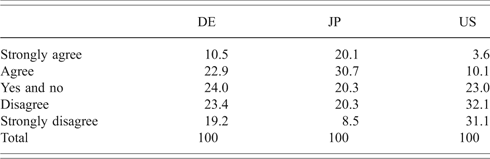
Apart from the trend that more time is spent on administration and less on research, disintegration of research and teaching is also promoted among academics, whose belief in the Humboldtian ideal that in modern higher education these activities should be integrated is declining.Reference Clark26, Reference Ushiogi27 The proportion of academics in Japan who think that integrating teaching and research is difficult is higher than in Germany and the US (Table 7). This is probably related to the fact that recent government policy on faculty development focuses on teaching orientation rather than on integrating teaching and research, while Japanese academics, just as the academics in many other countries who participated in the 2007 survey, persist in their research orientation. In Japan, there is a wide gap between the national government policy urging academics’ conformity to a teaching orientation and academic staff’s insistence on conformity to a research orientation.
Respondents answers to the question whether integrating research and teaching is difficult (percentage)
The segmentation of academic staff and non-academic staff is strengthening the separation of staff development for academics and non-academics into two components, namely faculty development for academics and staff development for non-academics. Such pressures affect academics’ attitudes to the extent that they lose their willingness to identify with their academic institutions. Compared with disciplines, chairs and departments, institutions have become the least popular element in the academic structure.
However, this waning identification with the institution is but one symptom of academia’s disorganization. Responses to the survey question ‘Since you started your career, have the overall conditions in higher education and research institutes improved or declined?’ fall into two groups: countries where conditions have improved and countries where they have declined (Table 8). The majority of academic staff in, for example, the US, China, Malaysia, Korea, Argentina, Portugal and Brazil identify improvements, whereas academics in Germany, Japan, the UK and other countries see a worsening of the conditions, or at least do not see any improvement.
Working conditions. Responses indicating improvement in working conditions in higher education since respondents started work* (percentage)

Note: *Responses on 5-point scale from ‘Very much improved’ = 1 to ‘Very much deteriorated’ = 5; proportion indicating ‘Very much improved’ or ‘Improved’.
As regards the level of support for academic work, respondents were asked to indicate the levels achieved in their institutions with respect to the facilities, resources and personnel listed in Table 9. Academics in many countries supplied positive answers, but the responses from academic staff in Japan were negative and indicated less improvement in their academic environments.
Support for academic work. Proportion for responses evaluating institutional support for the facilities, resources and personnel listed * (percentage)

Note: *Responses on 5-point scale from ‘Very high’ = 1 to ‘Very low’ = 5; proportion indicating ‘Very’ or ‘Fairly high’.
Strangely enough, responses to the question ‘How would you rate your overall satisfaction with your current job?’ indicate that job satisfaction is increasing in all countries, including Japan (Figure 2). It is an interesting fact that the academic profession is still attractive despite the fact that academia as a whole is becoming less so.
Satisfaction with current job

Also surprising are the responses to the survey question ‘How many of the following scholarly contributions have you completed in the past three years?’, which show that Japan has the highest score in academic productivity, particularly in research (Table 10). In the past three years, academic staff produced on average the following outputs: scholarly books, authored or co-authored (0.7); scholarly books, edited or co-edited (0.5); articles published in an academic book or journal (6.9).
Publications. Responses to the question ‘How many scholarly contributions have you completed in the past 3 years’

The top five in the total ranking of 17 countries are (1) Japan, (2) Germany, (3) Korea, (4) Portugal and (5) Hong Kong. Japan was also ranked first in the 1992 Carnegie survey, which means that it has managed to retain its leading position over the 15-year period, although overall working conditions have declined.
Concluding remarks
This report’s focus has been on the following topics: the role of knowledge and academic vision, decision making, the role of institutional missions and profiles, the impact of incentives and sanctions, supervisory mechanisms, and cooperation.
First, the relationship between the role of knowledge and academic vision has been discussed. As has been argued, in academia management derives from knowledge control and its support for academic work. Coordinating and integrating the scholarly and business aspects of academic work are necessary to increase academic productivity, both quantitatively and (and most importantly) qualitatively. Nevertheless, the emerging ‘managerial university’ does not necessarily play an adequate role in contributing to academic productivity.
Second, by international standards, Japanese academics still enjoy a considerable degree of academic freedom and autonomy. However, the form of decision making has changed from a bottom-up system, in which the faculty meeting had much power, to a top-down system with a strong executive (e.g. the trustee committee and the president). Since 2004, when national corporations were established with administration and management systems similar to those of the private sector, the national sector has rapidly changed into a quasi-private sector. Widening differences between institutions can be observed in the national sector, a trend that was already apparent in the last 15 years, but especially since 2004, in addition to the existing differentiation between the national and the private sector.
Third, although their numbers are relatively small, national universities enjoy high prestige, whereas the many private universities have a lower status. Local public universities have an intermediate status. In the national higher education system, the private sector is dominant due to its quantitatively large scale. Qualitatively, the situation is quite different because of the output and high prestige of the national sector. A clear divide runs through Japan’s academia.
Fourth, governmental policy on higher education is based on market forces, which promote a system of competitive funding in combination with an extension of managerialism. This further widens inter-sectoral differences and extends them to individual academic institutions. In conformity with this trend, a top-down funding system (in which the ‘Matthew effect’ is in play), promoted under the initiative of the executive, also divides academia, as does the new national accreditation system, which was introduced as a third party evaluation system in 2005 and has now been institutionalized in the national higher education system by law.
In this light, a policy of institutional empowerment from the bottom up becomes a necessary alternative to a funding policy tied to an overriding market principle. This new policy is the first matter to be resolved after a vital extension of Japan’s expenditures on higher education from the current 0.5% of GDP to 1.0%, a level comparable to that in other advanced countries.
Fifth, intra-institutional supervision has drastically changed in the past 15 years again, from a bottom-up to a top-down system. Generally speaking, complaints about the emerging top-down system have increased considerably, especially at national non-research universities.
Sixth, this increasing competition gradually leads to both intra- and inter-institutional differentiation and segmentation. The increasing competition between institutions for funding has produced a division between haves and have-nots. Within institutions, the differences between the executive (trustee committee and president) and faculty members have been deepened, as have the differences between faculties, departments, and individual academics.
Finally, and despite these trends, academic productivity in Japan remains fairly high in an international perspective, perhaps due to the individual efforts of academics rather than systemic changes. However, over time, it must be expected that changes in governance and management in the managerial university will entail more negative – or at least less positive – effects on academic productivity, through changes in academic freedom as well as a decrease in academic autonomy. Consequently, in view of the evidence of academia’s disorganization due to differentiation and segmentation, substantial efforts to (re)integrate the academic organization are required.
Acknowledgement
The authors acknowledge the support of the Fondazione Compagnia di San Paolo.
Akira Arimoto is Director at the Research Institute for Higher Education (RIHE) at Hijiyama University, and Professor Emeritus at Hiroshima University. Currently, he also is an associate member of the Japan Council of Science, President of the National Association of Research Institutes for Higher Education, member of UNESCO’s Global Scientific Committee (Chair, Asian and Pacific Region), and member of the editorial board of Springer’s Higher Education Dynamic Series. His research focuses on the sociology of education and the sociology of science. He has held appointments at Osaka University of Education, the Research Institute for Higher Education at Hiroshima University, Yale University, the Max Planck Institute for Education, and Lancaster University, and was a Nitobe Fellow. He is a past president of the Japan Society of Educational Sociology (JSES; 2003–5) and the Japanese Association of Higher Education Research (JAHER; 2001–3). He has authored many books and articles, including The Changing Academic Profession in Japan (2008) and Academic Profession and Faculty Development (2005).


 Open access

