

Introduction
Who manages large corporations? The question might seem overly narrow, arcane, or less relevant than examining the relative authority of shareholders and corporate boards, or the business strategies adopted by corporate management—topics that have received more attention from business scholars. However, current trends demonstrate its salience, as corporate management looms large in public awareness: A small number of extremely large corporations dominate their fields and attract anti-monopoly critique; top levels of corporate management collect ever-larger shares of national wealth; founder-tycoons wield extraordinary influence in their corporations, in the economy, and in society; and management and business majors attract more than twice as many undergraduates as the second most popular college major in the United States.Footnote 1 These trends were not entirely unfamiliar in the late nineteenth and early twentieth centuries, when the growth of large corporate entities produced a managerial revolution at a moment of extraordinary technological change.
Business historians have emphasized how a newly professionalized managerial elite took charge of corporate operations in that era in order to rationalize and manage ever more complex technology, production, and distribution systems. From CEOs to vast ranks of middle managers, expanding hierarchical bureaucracies of salaried professionals embodied the so-called managerial revolution. As large, multiunit corporations built internal management capacities, they turned away from the invisible hand of the market and worked to internalize market operations with multiunit structures and holdings, strategies of horizontal and vertical integration, and the development of in-house research and development facilities. Within corporations, salaried, professional managers provided the visible hand that substituted for market forces, and that strategically directed the allocation of resources in finance, acquisition, production, innovation, marketing, and distribution.Footnote 2
This conventional narrative, however, focuses on the function of managers rather than who they were, and the capabilities they possessed. It does not fully explain how increasingly large, modernizing firms navigated periods of rapid technological change, such as swept many sectors of the U.S. economy between the 1870s and the 1910s, nor does it fully account for the substantial anecdotal evidence on the presence of professional engineers in management and leadership positions during the early rise of the modern corporation and since. The conventional narrative implicitly assumes that managerial and technical expertise are embodied in separate actors, that the more interesting history resides in managerial functions and the strategic work of the professional manager. In contrast, it often assumes, technical expertise exists as a capacity readily hired in the market, in discrete, impersonal units labeled “engineers,” “technicians,” or “scientists.” Unlike business professionals, engineers’ historical role has been relatively understudied by scholars, with technical capacity often taken as an exogenous factor in corporate histories. Technical expertise, embodied in engineers, is often relegated to merely that—a technical input hired by managers in the market and internalized within the firm, employed across divisions—and has been relatively invisible in histories of the modern corporation and the rise of corporate management. Consequently, engineers’ role in management history remains poorly understood.Footnote 3
This paper argues that professional engineers constituted the critical source of managerial expertise in the managerial revolution of circa 1870–1930, using a new data set of nearly 50,000 engineers and their employment record in the global mining and metallurgical sector. Typically treated as subordinate to professional management, as “corporate men buried within organizations somewhere between labor and management,” engineers tend to be overlooked in the corporate structure.Footnote 4 Histories of large firms in the mining sector suggest that engineers played an early and ongoing role in planning, designing, and directing large corporations, although we note that little systematic empirical evidence had been brought to the question.Footnote 5 Although engineers have largely been invisible relative to the greater attention given to financial tycoons and industrialists, innovating entrepreneurs, upper management, labor, and issues of corporate governance, it was frequently engineers who filled leadership positions in the early years of the managerial revolution and who have continued to play a major role in organizational management, corporate design, and strategic planning through the twentieth century. Business historians as different as Alfred Chandler and David Noble long ago recognized at least the first part of this statement. Chandler’s work on the Du Pont company, for example, notes that many of its managers “were trained engineers who knew firsthand the most advanced administrative practices on the railroads and in the steel, electrical, and machinery industries.”Footnote 6 This paper examines engineers’ role in management across a substantially larger data set, longer time horizon, and global landscape. We argue that explaining the rise of the modern corporation and the historical dynamics of corporate strategies requires a better understanding of technical expertise in management.
Mining and metallurgy provides a useful, unexpected, and revisionist window on the managerial revolution. Chandler (and many others) focus nearly entirely on manufacturing firms; indeed, Chandler dismissed the mining sector as not needing “a complex organization to coordinate the flow of goods,” and thus not a participant in the managerial revolution.Footnote 7 In contrast, we point out, the mining and metallurgical sector was one of the first to establish national and multinational models of multiunit corporate enterprise. Corporate growth in the sector involved extensive investments in both vertical and horizontal integration. By 1917, mining and metallic firms exceeded the value of firms in food, rubber, petroleum, gas, coal, and transportation combined, placing seven on the list of the twenty most valuable U.S. firms.Footnote 8 At the same time, engineering acquired the hallmarks of a modern profession: the American Institute of Mining and Metallurgical Engineers (AIME) was the first to formally break from the longstanding field of civil engineering in 1871; the Engineering and Mining Journal (est. 1866) predated both the Wall Street Journal (est. 1889) and the Financial Times (est. 1888); and dozens of new engineering degree programs were established in universities between 1870 and 1910. The mining sector had several other characteristics that make it more comparable to other sectors. By the 1890s, professional engineers had largely replaced practically trained miners. Many, furthermore, had close connections with financiers (not coincidentally, the leading mining journals were published in those cities that hosted mining finance: San Francisco, New York, and London).Footnote 9 We argue that the relationship between technical expertise and managerial capacity in the sector provides an important and instructive case for the study of engineers in corporate management generally, and we will return to this issue at the end of the paper. Moreover, we suggest that the role of technical experts in corporate management is more of a global story than nationally bounded histories that highlight American corporate and managerial exceptionalism tend to admit.
We use an original database of over forty-eight thousand unique individuals, identified as professional engineers, who worked in mining and metallurgy between roughly 1870 and 1930, extracted from engineering school alumni lists, AIME membership lists, and several business directories. The database includes a nearly exhaustive list of the mining engineering programs in U.S. universities, all members of the AIME, and a smaller sample of graduates of major European university programs in mining engineering (it includes, for instance, all who attended Freiberg’s famous mine engineering school for the full period of study).Footnote 10 Many listings include information on individuals’ careers: school attendance, job positions, and employing firm and location. Three criteria qualify individuals for inclusion as a “professional engineer”: (1) student or alumni status in a formal, university-based engineering program; (2) membership in the AIME; and (3) a job position in mining or metallurgy with “engineer,” “metallurgist,” or “chemist” in the job title, as listed in one of two major corporate directories of mining and metallurgical companies published in repeated editions before the 1920s. We will refer to the two directories as the “American Mining Manual” (published in Denver and then Chicago, even though its title at one point was the “International Mining Manual”), and the “Mining Year Book” (or “Skinner’s Mining Manual,” published in London). The data appendix to this paper provides a detailed description of our sources and methods, and how to access the open-source data set.
Although predominately based in the metropolitan centers of mining finance, these two directories offer a global view of mining and metallurgical activity and make engineers visible in corporate leadership. Ninety-one percent of the firms in the Mining Year Book had headquarters in four countries (UK, United States, Canada, and Australia), with 60 percent of the firms based in the UK. In contrast, 82 percent of firms listed in the American Mining Manual had headquarters in the United States, with 8.7 percent in Canada, 4.8 percent in the UK, and 3.2 percent in Mexico. In spite of the relative concentration of corporate headquarters, these firms’ physical operations were spread across seventy-nine different countries, with those listed in the Mining Year Book predominately located within the British imperial orbit, and those listed in the American Mining Manual spread across the Americas, although significant numbers in both directories operated well beyond those two spheres. The database captures the Anglo-American mining world and identifies firms and engineers working in most of the world’s major mining regions of that era. It does not capture, however, most mining firms financed and established outside the Anglo-American orbit (most notably, perhaps, German firms). The data offer two ways to examine the presence of engineers in managerial roles: first, by the career employment positions of the engineers listed in the alumni and association records between 1870 and the 1920s, and second, by crossmatching that data with the names of upper management personnel listed in the two corporate directories. Our evidence shows that newly professionalized engineers led firms’ strategic efforts to navigate competitive pressures during historical periods of rapid technological change. Their role diminished, however, in times of relative technological quiescence, when firms more often pursued noncompetitive strategies to maintain market share.Footnote 11 Although historians have noted the presence of technically trained engineers in corporate management, our data permit an industry-wide study of patterns and trends across global mining districts that has not heretofore been possible.
Engineers and the Managerial Revolution
By the 1920s, large, hierarchical, and bureaucratic organizations characterized not only big business but also government agencies, professional associations, universities, labor organizations, reform movements, and even religious groups.Footnote 12 Management professionals, from the upper levels down through layers of middle managers, developed systems to plan, monitor, coordinate, and control the operations of these organizations. Historians and historical sociologists have tended to focus on the structure and bureaucracy of large organizations in a Weberian tradition—on organizational capabilities and bureaucratic practice—rather than on the identity and professional capacities of those who held managerial positions.Footnote 13 Indeed, managerial bureaucracies are by definition impersonal. The nameless, bureaucratic face of the large organization diverted attention from the nature of expertise held by the managers themselves, even as the managerial hierarchy was charged with resolving organizational problems with increasingly specialized knowledge.Footnote 14
It was engineers, among others, who innovated, established, described, and promoted new management practices at the birth of the modern firm. Early advocates of “managerial science” presented papers at meetings of the American Society of Mechanical Engineers (the ASME, est. 1880) and published in professional engineering journals. Frederick Taylor and his followers delivered their first papers on scientific management at the meetings of the ASME and published in its Transactions, in Engineering News, or in Engineering Magazine or the American Engineer.
In the late nineteenth century, engineers were uniquely prepared to address the organizational and technical challenges of newly capital-intensive, energy-intensive, and cost-sensitive large-scale operations during an era of rapid technological and organizational change. They developed new management practices to standardize and systematize the organization of production, to reduce uncertainties and irregularities in relation to both technology and labor, and to enhance communication and accountability across the production process, all the while cutting costs at every turn. Much of the new management practices centered around cost accounting, which took the form of new bookkeeping systems, work vouchers, invoices, work orders, and balance sheets, and occupied countless new staff positions of salaried accountants. Cost accounting was founded on the work of engineers: first, to study and understand the production process and make it legible and quantifiable, and second, to design the flow of materials, of labor, and their costs through the production process, developing and managing ways to account for the costs of labor, materials, and machines at each stage in order to maximize their use and minimize their idleness.Footnote 15 Managerial hierarchies arose because the increasing technological complexity and consequent scale and scope of production operations, coupled with market pressures, required systematic oversight, monitoring, coordination, and control.
In mining as in manufacturing, engineer-managers undertook this technical work of management. They also sought to enhance their own status and authority within the industry through their professional associations and claims of indispensability. Mining histories amply illustrate the factors that drove a managerial revolution in that sector: the technology-driven imperatives of realizing economies of scale, owners’ interest in controlling labor costs and uncertainties, and the social aspirations of engineers and their associations. Engineers, geologists, chemists, and other technical experts did not simply offer their expertise and work as invisible actors within the firm; they were typically, we argue, the central actors in the construction, design, and management of new corporate Leviathans.Footnote 16
One reason engineers have been largely ignored in histories of corporate management is that, as most historians and business scholars assert, they were eventually replaced by professionalized but nontechnical graduates of U.S. business schools. In the first decades of the twentieth century, “management science” moved away from engineering forums to establish its own identity and its own institutions and venues.Footnote 17 University courses in accounting grew from 12 to 116, and half a dozen newly established business schools preceded the founding of the Harvard Business School in 1908.Footnote 18 The management profession reached maturity by the 1920s, with its institutional components of university-based training, professional associations, meetings, and journal publications. Men with degrees in management, accounting, finance, and marketing rather than in technical fields had by then become—it appears—the “salaried, career managers … who had taken charge of the large multi-unit enterprises dominating critical sectors of the American economy.”Footnote 19 The public face of large corporations shifted from images of the founder-tycoon to a more anonymous bureaucratic facade.Footnote 20 Nevertheless, technical authority was a foundational element in the formation of managerial authority in the public sphere. Managers followed the steps of professions like engineering to cement their place in society, and the most vocal voices inside the profession used the language of science and technology.Footnote 21
Several historians have examined the presence of engineers in managerial positions beyond firm-level case studies. Using a sample of 163 graduates from the Colorado School of Mines between 1900 and 1940, Kathleen Ochs finds that 54 percent pursued careers primarily in management, whereas another 19 percent served in managerial positions at some point in their career. In Pennsylvania coal mines between 1900 and 1914, Michael Rubens shows that mining companies that employed university-trained engineers in management positions were more likely to adopt new, productivity-enhancing technology than those that did not. Duncan Money examines the careers of 301 members of the Mining and Metallurgical Society of America and highlights their roles as general superintendents, general managers, and consultants in the copper sector.Footnote 22 Although each suggests the important presence of engineers in managerial positions, these studies are bounded by school, local, and organizational limits, in contrast to our data on tens of thousands of engineers working globally, across hundreds of firms.
In sum, the scholarly literature on the early history of modern management exhibits two main blinders. First, it assumes that business schools supplied the lion’s share of managerial talent beginning in the early twentieth century, rarely interrogating questions of technical expertise and the presence of engineers in managerial ranks. Second, its overwhelming focus on corporate governance tends to highlight the dispersion of firm ownership, the role of corporate boards relative to owners, and the relationship of ownership with management rather than the identity and capabilities of managers themselves.Footnote 23 The spotlight is typically on the function of management, and it generally does not ask who managers were. We know relatively little, at an aggregate level, about their educational background and how they accessed or embodied technical expertise.
We suspect that engineers’ contributions to corporate management extended well beyond the early, pre-1900 pioneering role noted by Chandler and Noble, and well beyond the relatively small ranks of the exceptional, big names like Pierre S. du Pont or Alfred P. Sloan, or, in mining, the independent consulting engineers who gained outsized attention. Our data suggest that corporate management in mining and metallurgy drew directly and heavily from the ranks of thousands of more anonymous engineers who held roles of supervisors, managers, and directors, and who were largely responsible for the continued planning, design, coordination, and direction of large firms. The following section examines our data on mining and metallurgical engineers, working globally, in the emergence of modern management.
The Evidence
We frame this investigation around three questions: (1) How prevalent were professional mining engineers in managerial positions during this period? (2) Was there any change over time in the managerial role played by engineers in mining and metallurgical establishments? (3) Was there any correlation between engineers’ managerial roles and the characteristics of firms, and what might this tell us about the nature and growth of the large corporation over its first half century or so? In the discussion section we present a revised account of management in the history of corporate enterprise in which engineers played a significant, ongoing, and understudied role.
Engineers in Managerial Positions
Local and firm-level mining histories have documented how engineers often played leadership roles in establishing the largest mining and metallurgical corporations during the last decades of the nineteenth century and the first decades of the twentieth. These engineers provided the expertise to navigate rapid technological change within large organizations during this phase of rapid growth. In 1903, for example, Victor C. Clement and Daniel C. Jackling, trained as mining engineers at the University of California and the Missouri School of Mines respectively, founded the Utah Copper Company to exploit copper deposits in Bingham Canyon. It was the first time copper was extracted from low-grade porphyry ore in large quantities, and the Utah Copper Company soon became one of the two biggest copper producers in the world. In 1904, William Burford Braden, an MIT engineer, organized the Braden Copper Company in Maine in order to develop the El Teniente mine in the north of Chile. In 1911, Stephen Birch, a mining engineer from the Columbia School of Mines, organized and served as president of the Alaska Syndicate Company that mined copper from the Kennecott deposits in the far north. All three companies—Utah Copper, Braden Copper, and the Alaska Syndicate—consolidated some years later into the Kennecott Copper Company, the main component of the sprawling Guggenheim mining empire.Footnote 24 The formation of the Guggenheim empire, nonetheless, was not unique, as other large corporations were able to compete with its dominance. In 1899, Albert F. Holden, a Harvard and MIT-trained engineer, had formed the United States Mining Company, the result of decades of consolidation of small mines in Utah’s Bingham Canyon, first producing silver but later focusing on the extraction of copper and lead. The “U.S. Company” became the single biggest silver producer worldwide by the 1930s.Footnote 25 Were these exceptional cases, or do they illustrate broader patterns of engineers in the founding, management, and leadership of large mining corporations?
Our data indicate that in the decades before 1920, large numbers of professional engineers held managerial positions in mining and metallurgical firms. We define management positions by the job titles used in our sources, ranging from upper management or corporate leadership positions, including directorships (common in the UK listings), firm presidents and vice presidents (common in the U.S. sources), and managing directors, to a range of general or middle management positions (including general managers, mine and mill managers and variations thereof, and mine and mill superintendents). In addition to managerial positions, the corporate directories also list positions that were more purely technical in nature, including a variety of engineering jobs, along with metallurgists, chemists, assayers, and the like.
The database provides three windows on engineers’ prevalence in managerial positions, presented in Table 1. First, of 2,667 alumni from mining engineering university programs for whom we have an employment position at some point subsequent to their schooling, 39.7 percent listed a managerial position as their primary assignment at the moment of survey. Of the 3,142 members of the AIME for whom an employment position is specified in one of its published membership lists, 40.1 percent listed a managerial position as their primary assignment. Finally, the 1907 edition of the American Mining Manual included a 160-page list of mining and metallurgical engineers employed in the industry (primarily but not exclusively in the western hemisphere), totaling nearly 6,000 individuals with data on current and sometimes past employment and schooling. Among 6,612 position titles listed (including multiple postings for some individuals), 36.3 percent were managerial. In each of these sources, the vast majority of the nonmanagerial positions were technical in nature, with much smaller numbers distributed among consulting, government employment, and academic positions. Across all three sources, the level is remarkably consistent: Of 12,421 individual position listings for professional engineers, 38.0 percent were managerial in nature. The consistency is surprising given the multiplicity of institutions involved, and the different incentives to report employment to a university, a professional organization, and a corporate catalog. We are especially struck by the coincident levels between the school alumni and the AIME membership, given that the association did not require a university degree for membership.
Prevalence of Managerial Positions in Engineers’ Job Titles, 1867–1929
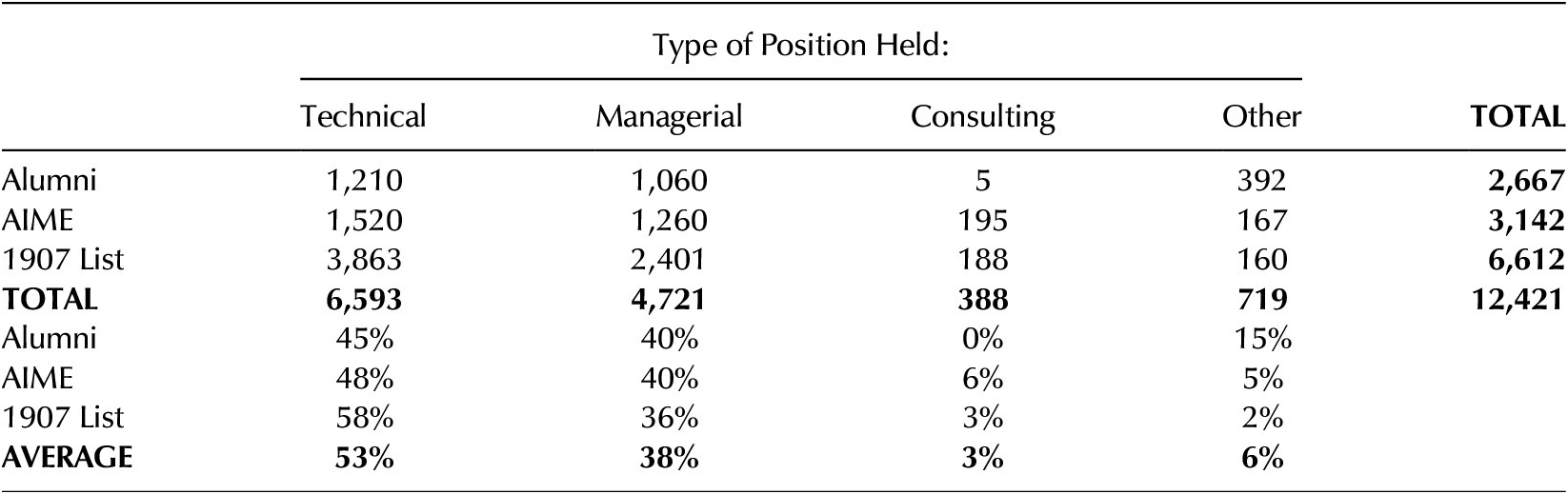
Notes: See the data appendix for sources; the 1907 list is published in the Western Mining Directory Company, International Mining Manual, Embracing the Principal Operating Metal Mines, Mills, Smelting & Refining Plants of the United States, Mexico and Canada and Coal Mines of the Western States, Mexico and Canada, ed. A. R. Dunbar (Denver: Western Mining Directory Co., 1907).
We can also use the personnel listed by firms in the two corporate directories to examine the presence of professional engineers in upper managerial or leadership positions. Both directories include personnel listings for most of the companies. The entries in the American Mining Manual typically include upper managerial positions (e.g., company president, and/or some variation of general manager, mine or mill manager, or superintendent) and only occasionally listed a purely technical position (e.g., chief engineer, mining engineer, chemist, etc.). The Mining Year Book typically included the names of several firm directors (typically major stockholders sitting on the corporate board in a system that did not separate ownership and management to the degree increasingly common in large U.S. firms), usually noting the board chair, sometimes including a single general manager or similar position, and occasionally including superintendents or technical personnel. In both directories, the listing criteria was heavily biased toward the upper levels of corporate management. By crossmatching these lists of managerial personnel against names in the alumni and association data, we can examine the prevalence of professional engineers in upper management within the sector.
Company listings in the editions of the American Mining Manual include over 28,000 managerial positions, of which just under 33 percent were held by professional engineers. Their job titles are indicated in Table 2, which includes only those listings held by someone we can positively identify as a professional engineer. Of these 9,300 engineers, nearly 70 percent held positions in upper-level management or supervisory positions. Meanwhile, the editions of the British-based Mining Year Book include over 63,500 position listings, of which 19 percent were occupied by professional engineers. Across both directories, we can identify just over 21,000 professional engineers who held upper management positions. Of these, 64 percent were directors of their companies.
Job Titles of Engineers in Upper Management Positions
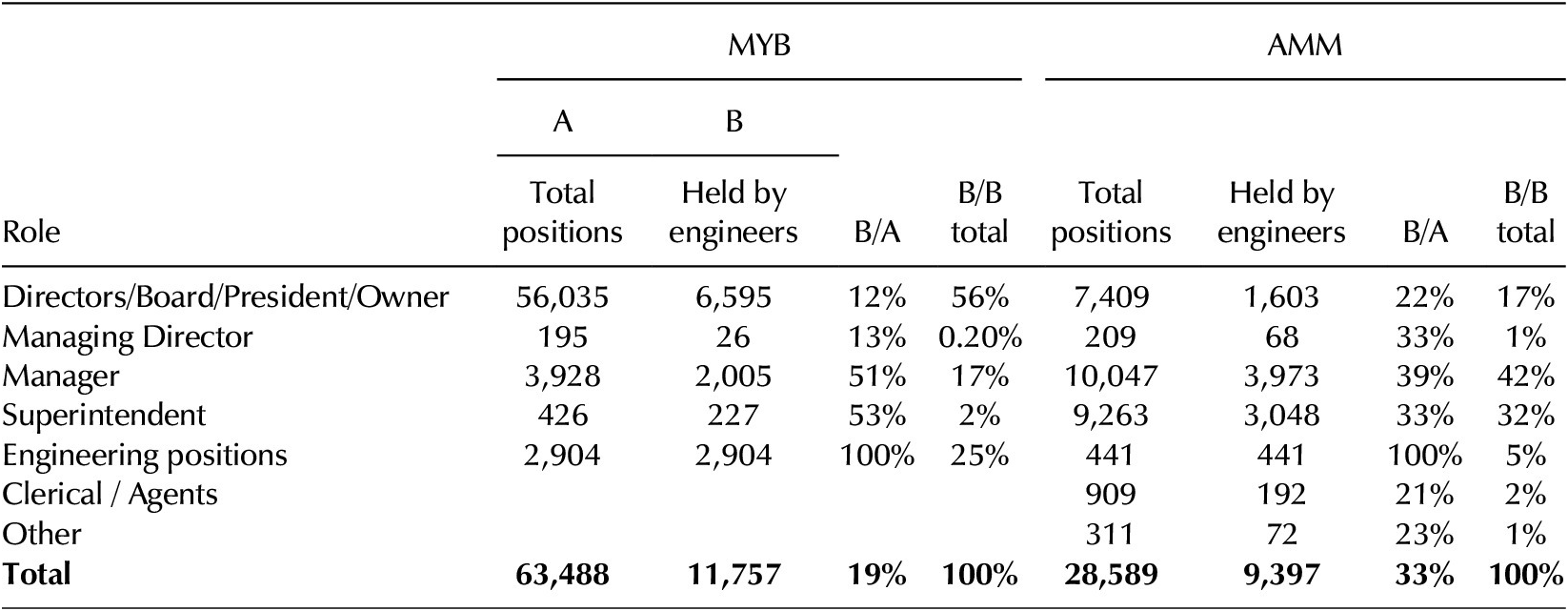
Notes: See the data appendix for sources and temporal coverage. This table identifies all “professional engineers” among the total personnel listings in the annual volumes of the two directories (MYB and AMM), according to our criteria discussed in the text.
Engineers in upper management positions are significantly more prevalent in the American than in the British directory (33 percent vs. 19 percent), but this should not be surprising, given the latter’s focus on firm “directors” rather than on resident mine or mill managers or supervisors. It also likely reflects the lower prevalence of university training in the British engineering profession, which persisted well into the early decades of the twentieth century.Footnote 26 Further, it is not surprising that these numbers are below the roughly 40 percent of all engineers holding managerial positions in our alumni and AIME lists (Table 1), as the corporate directories focus primarily on the uppermost tiers of ownership and management. In fact, given this listing bias, we are surprised by the still-significant presence of professional engineers in upper-level management.
These results confirm the firm-level evidence on the leadership roles of engineers in the formation of large-scale mining and metallurgical firms during this era of rapid growth: Engineers played an active role in management, including in company leadership positions, in which they were responsible for the design, planning, and in some cases the very formation of large corporations. How, then, did this presence change over time, during a historical moment of dramatic changes in the technology and scale of production as well as in the organization of the firm?
Variance across Time
According to our data, roughly 38 percent of job positions held by thousands of mining and metallurgical engineers were managerial in nature through the 1870–1930 period (see Table 1), and among these, professional engineers held a significant percentage of upper managerial positions (roughly 20–30 percent, depending on listing conventions and national cultures; see Table 2). However, histories of mining and metallurgy, and of big business generally, suggest that although engineers may have played a significant role in the management of large corporations in their early years, they were increasing displaced by nontechnical management professionals in the second and third decades of the twentieth century, becoming more invisible to historians in the process.
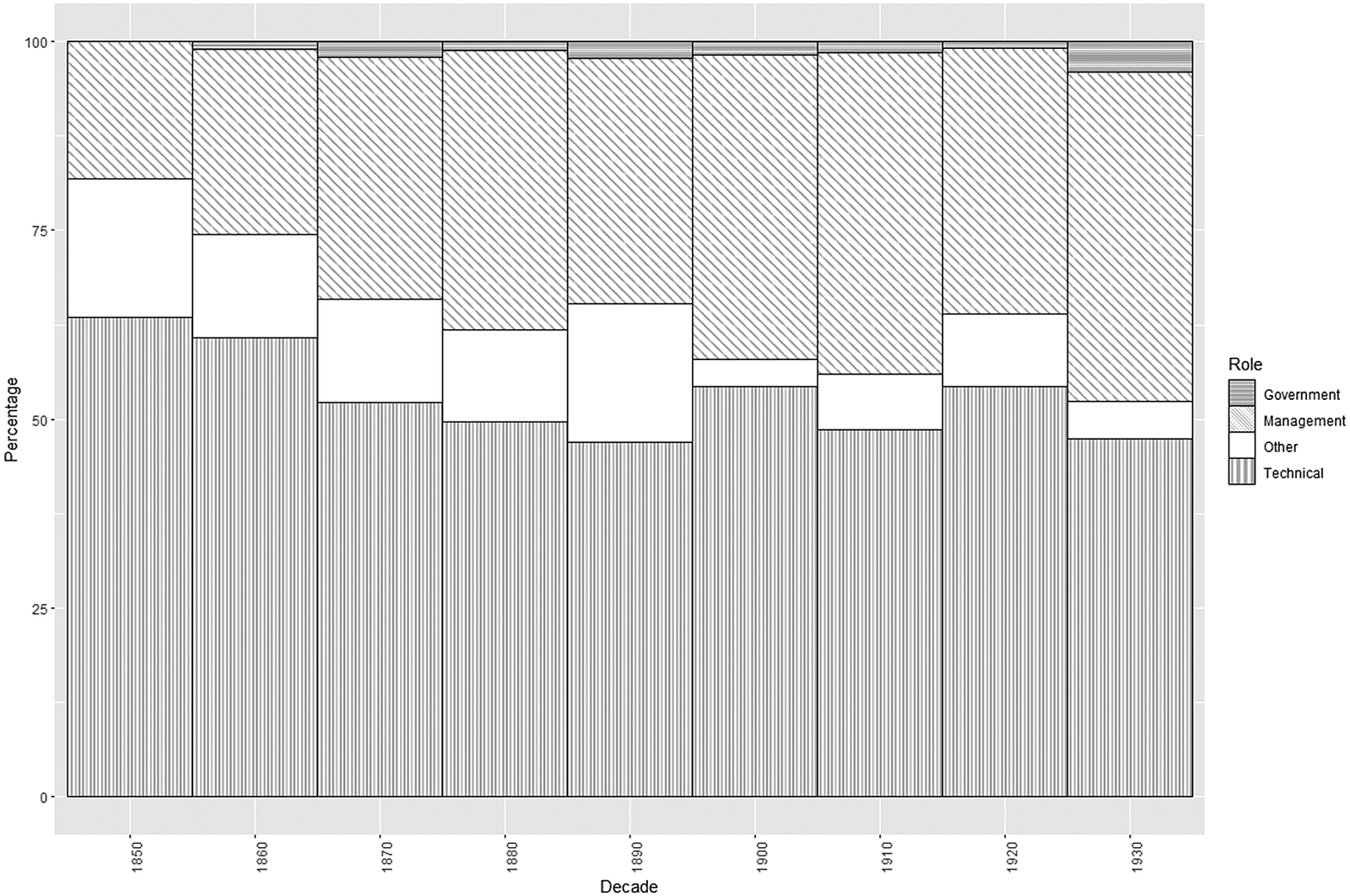
University alumni records, collected and compiled periodically and thus including employment information across a range of degree dates, allow us to test this assertion. Figure 1 illustrates the prevalence of job categories listed for school alumni in each decade from the 1850s to the 1930s. The figure shows a clear and secular increase in engineers’ propensity to hold managerial positions, rising from just over 20 percent of all positions listed for postgraduates in the decades before 1900 to an average of about 45 percent of all positions in the first decades of the twentieth century.Footnote 27 Position listings for AIME members show more modest growth in the number of members holding managerial positions, from under 20 percent before 1890, to a variation in the 25–40 percent range thereafter.
Employment of Engineers from the Alumni Lists.
Notes: See the data appendix for sources and methods. We manually classified 353 different position titles in the alumni lists, spread among 16,539 individuals, into five categories: technical (225 job titles), management (135), other (135), government (44), and NA (14). We excluded the NA observations in the analysis.
If we shift our focus from an aggregate to an individual level, we can also observe patterns in career trajectories that involved managerial positions. Successive editions of the Mining Year Book, for example, identify seven thousand job changes for individuals, with nearly four hundred visible among the fewer editions of the American Mining Manual. Engineers, like many professionals, often built careers that moved progressively up a conventional ladder of responsibility, from more narrowly defined, technically oriented positions following graduation into positions of greater responsibility, administration, and management, while moving within or between firms. Kathleen Ochs’s study of graduates from the Colorado School of Mines, for instance, indicated that the majority of CSM graduates moved from technical to managerial positions through their careers.Footnote 28
Evidence from the two mining directories support accounts of a conventional career ladder. Graduating cohorts from the 1880s and 1890s were more likely to hold managerial positions by the 1910s than more recent graduates. They were also more likely to move directly into managerial positions earlier in their careers, an indication of the still-scarce supply of university-trained engineers and the absence of business school graduates before 1900. However, because both directories focus overwhelmingly on upper management positions, the data tend to show a circulatory movement among positions rather than a ladderlike progression up a corporate hierarchy. For example, 65 percent of job changes in the British directory involve rotation among directorships and chair positions on the boards of firms, whereas roughly 40 percent in the American listings involve rotation between president and top manager positions, with the direction of movement nearly symmetrical in both sources.
In 1929, the Society for the Promotion of Engineering Education (SPEE) conducted a broad survey of working engineers, across all engineering fields, which gathered data on job positions across cohorts who had graduated since the 1880s. Their survey data illustrate a strong career tendency to move from technical positions into more administrative or managerial positions, or even into firm ownership (Table 3).Footnote 29 Although 60 percent of 1920s graduates held technical positions and 16 percent worked in administrative or managerial positions in 1928–1929, the ratios for those who had graduated in the early 1900s, and who were twenty years or so into their careers, were nearly reversed: 17 percent in technical positions and 70 percent in administrative, management, or ownership positions. The oldest cohorts surveyed—those who had graduated in the 1880s and 1890s—are also the reverse of the most recent graduates (e.g., 30–60 percent and 25–67 percent respectively). Their higher presence in technical positions than the 1900s graduates is explained by significantly higher numbers working as consulting engineers (18.8 percent and 10.2 percent, compared to 6.5 percent for the 1900 cohort). Similarly, their relatively lower presence in managerial positions derives from a lower presence in superintendent and sales positions than the cohorts after 1900.
Types of Positions for Engineering School Alumni, by Cohort 1880–1929
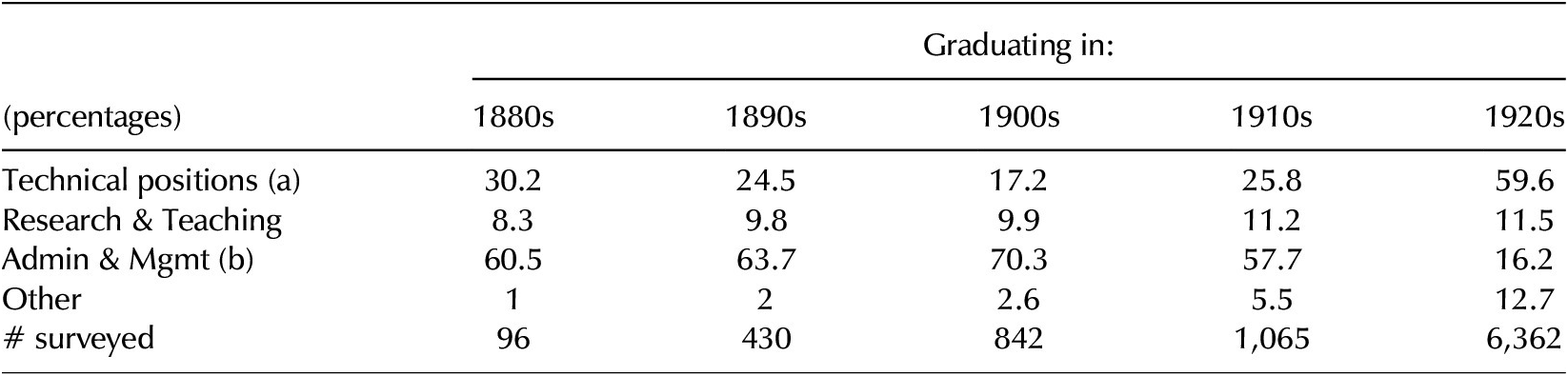
Notes: (a) includes consulting, design, estimating, drafting, operations and maintenance, testing and inspection; (b) includes owner or proprietor for cohorts before 1900.
Source: derived from Society for the Promotion of Engineering Education, Report of the Investigation of Engineering Education, 1923–1929, vol. 1 (Pittsburgh: University of Pittsburgh Press, 1930).
The positions held by engineers, however, were not only a function of their time on the career ladder but also varied with changes in firm characteristics. Mining and metallurgical corporations differed widely in their organizational structures, chiefly reflected in the scale and scope of operations, which in turn shaped the role of engineers in the management of those firms over time.
Variance across Firm Characteristics
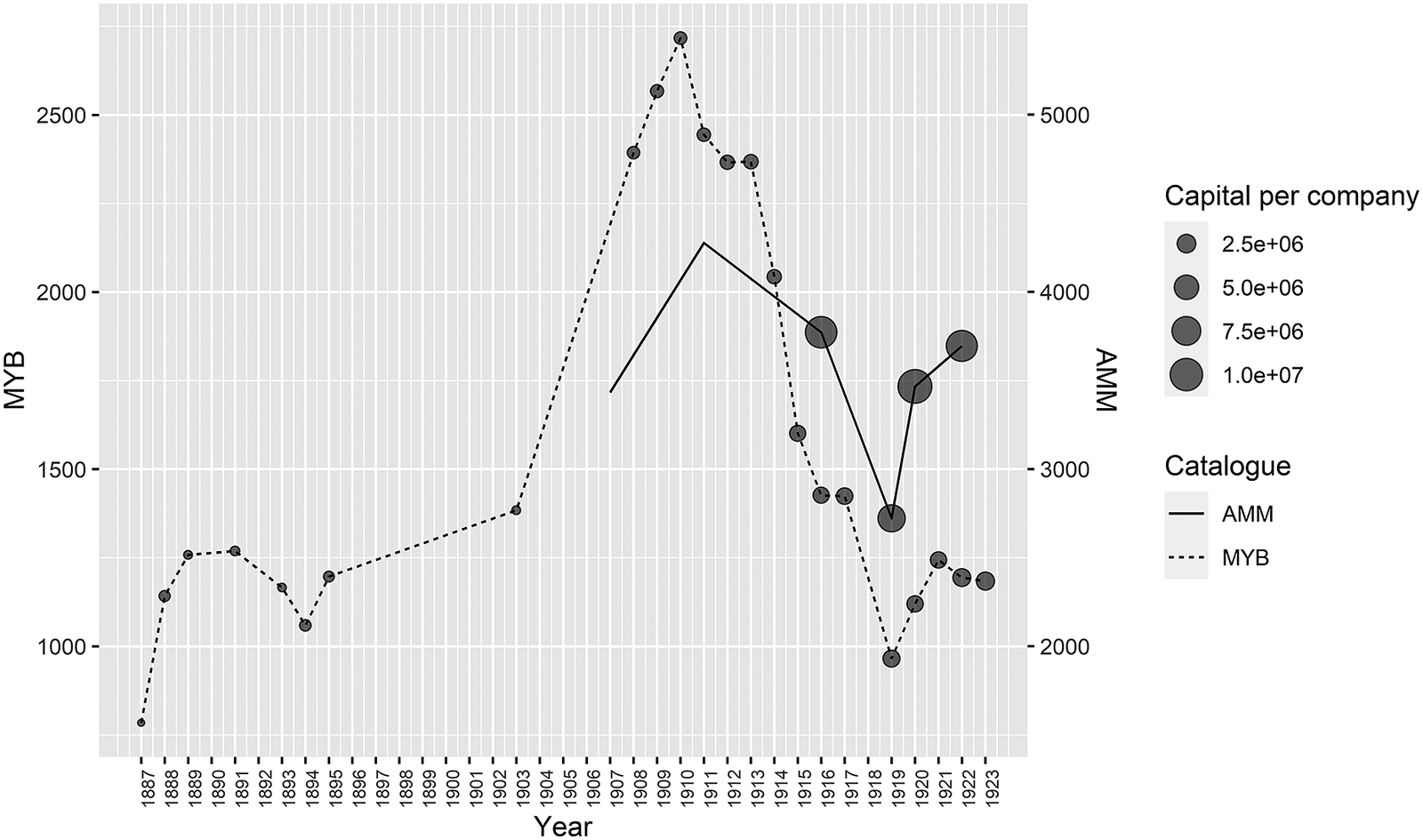
From the 1880s to the 1920s, the technical and organizational nature of mining and metallurgy changed dramatically, and so did the structure of the dominant firms. The secondary literature on these changes is voluminous. As demand for metals expanded rapidly in the world market, investors in London, New York, Boston, and elsewhere placed increasing amounts of capital into mining and metallurgical operations as technology-driven economies of scale encouraged the growth of ever-larger corporations. The influx of capital to large firms was accompanied by a major merger movement in the 1910s, yielding an increasingly concentrated industrial structure. By the 1920s, the average amount of capital per firm listed in the Mining Year Book was over $2 million, and the combined values of a sample of firms in the catalogues was almost $8 billion. These were not small mines working with hand tools, but corporate Leviathans, and global production of all minerals had grown nearly fivefold.Footnote 30 Figure 2 illustrates changes in the number and average size (proxied by capitalization) of firms listed in successive editions of each of the two directories.
Change in Number and Size of Mining & Milling Companies.
Notes: Annual volumes of the American Mining Manual and the Mining Year Book; vertical axes indicates number of firms. See data appendix for full citations and the repository for the methods of analysis.
What did these industry- and firm-level changes mean for the employment of engineers in managerial positions? The literature on the emergence of managerial capitalism suggests that technical expertise in management might be positively correlated with scale of operations.Footnote 31 Smaller firms would be less likely to need, and less able to afford, the expense of full-time staff engineers. Larger firms would be more likely to hire professional engineers into managerial positions, given the technical and organizational challenges presented by adopting new, cutting-edge technologies and coordinating large-scale production systems. Figure 3 shows two complementary plots (A-B) that examine this relationship for several thousand firms listed in the Mining Year Book. The American Mining Manual data draw from a smaller pool of firms, across fewer years, but illustrate similar trends. In plot A, we observe a positive relationship between the capitalization of firms, divided in deciles by size, and the mean number of engineers per firm for each size decile. In plot B, we observe a negative relationship between the capitalization of firms and the mean percentage of engineers in upper management positions.
Engineers, Management, and Firm Size.
Notes: The correlation for the number of engineers and capital: 0.1077327; the correlation for the percentage of engineers and capital: -0.04731403. Sourced from the Mining Year Book volumes; see data appendix for methods.
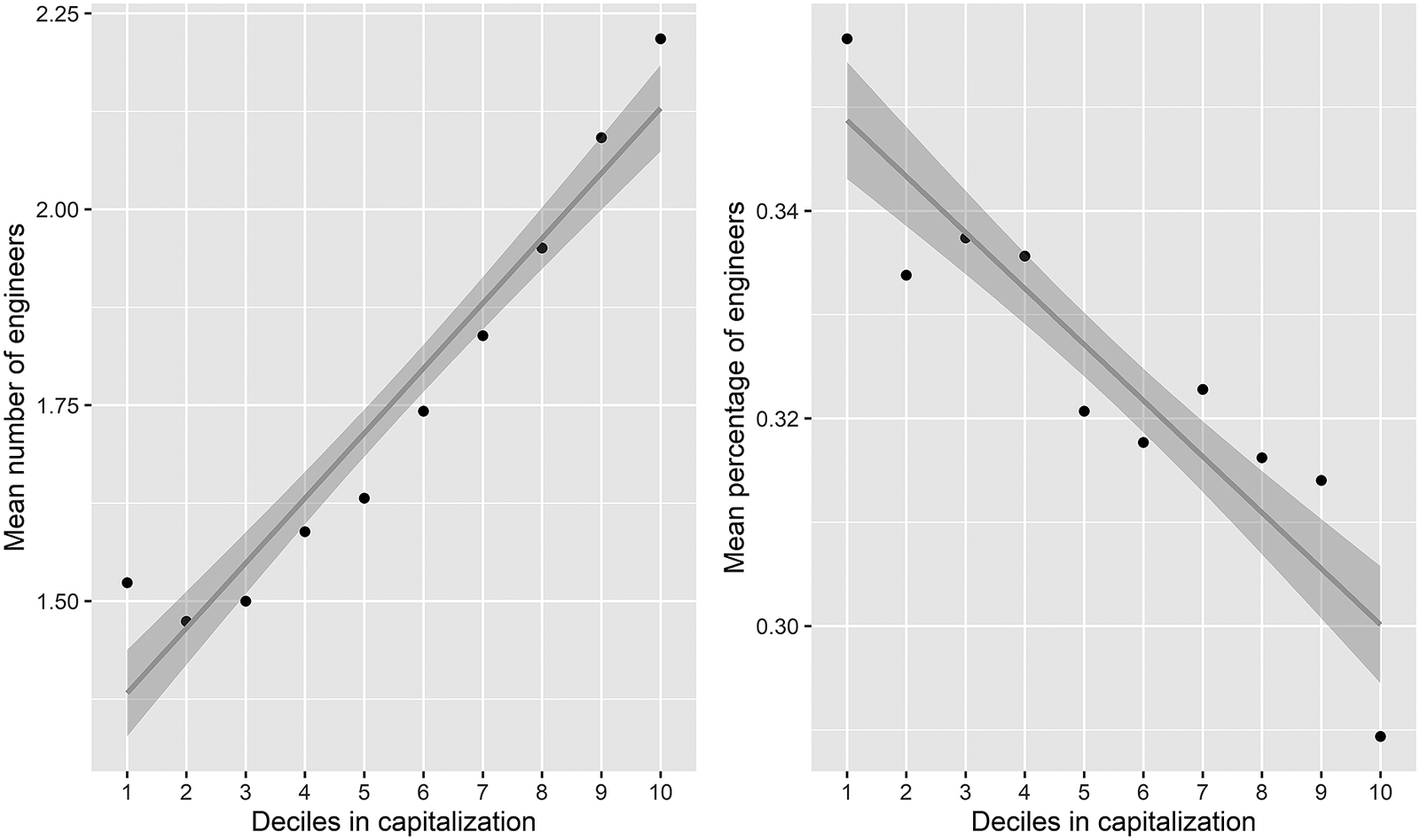
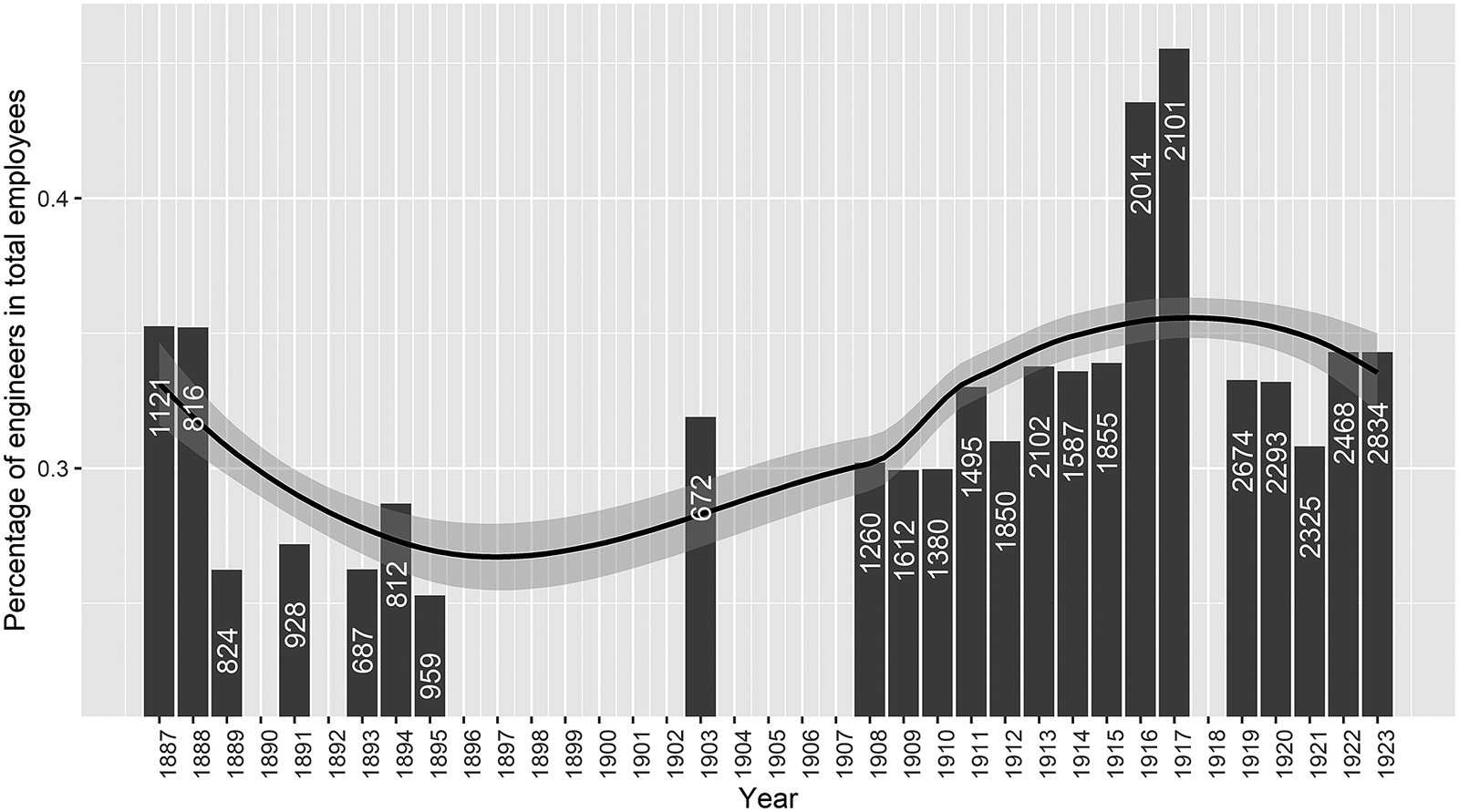
Moving in opposite directions, the two trends suggest a single story. Larger firms did indeed employ more engineers in upper managerial positions, but this was largely a function of their scale of operations and the quantum size of their managerial cohort. These corporate Leviathans required more technologically adept managers to plan, coordinate, and direct internally diverse operations. At the same time, however, engineers constituted a relatively smaller percentage of total management in these larger firms, compared to companies of more modest size. Larger firms, in other words, were more likely to employ nontechnical managers than smaller firms, and this tendency is confirmed when we add a time trend. Figure 4 illustrates the chronology across our time period for firms listed in the Mining Year Book, charting the percentage of engineers employed in upper management positions through successive editions, and noting the average level of capitalization for each observation. The data suggest a cyclical time trend, with the percentage of engineers in management declining in the early years of the period before rising steadily from the mid-1890s to the mid-1910s and then falling again to somewhat lower levels in the 1920s.
Engineers Among Upper Management Positions, 1885–1923 (percentage).
Notes: Mining Year Book volumes; see data appendix for details.
Discussion
What story do these results suggest? First, and as others have noted, we affirm that engineers had a significant and ongoing presence in managerial positions since at least the 1870s. Second, their prevalence in management grew in the last decades of the nineteenth and first decade of the twentieth century, although we observe a relative decline in their participation by the 1920s. Third, this temporal path coincided with broad changes in firm size and organization, where the largest firms tended to employ more engineers, but engineer’s relative presence in managerial positions tended to decrease in the larger, more consolidated firms relative to the presence of nontechnical managers. By situating our results alongside contemporary changes in the industry, and placing both in the broader economic context of industrial and economic change in the Atlantic World during the 1880–1930 period, our case study of the mining and metallurgical sector argues for a revised narrative of the role of technical expertise in the rise of the large industrial corporation and the managerial revolution.
In the mining and milling sector, large corporations emerged over two distinct phases, identified in Table 4 by the periods before and after about 1910, with the transition moment captured in the 1908–1912 average. The table presents data on several thousand firms drawn from the Mining Year Book to illustrate broad trends (data from the American Mining Manual is more restricted temporally, but exhibits similar trends). Recall that together the two directories cover virtually all global mining districts, privileging Anglo-American firms capitalized in Britain and the United States but operating across North and South America, Europe, Africa, and Asia.
Companies and Capital in the Mining Sector, 1880s–1920s
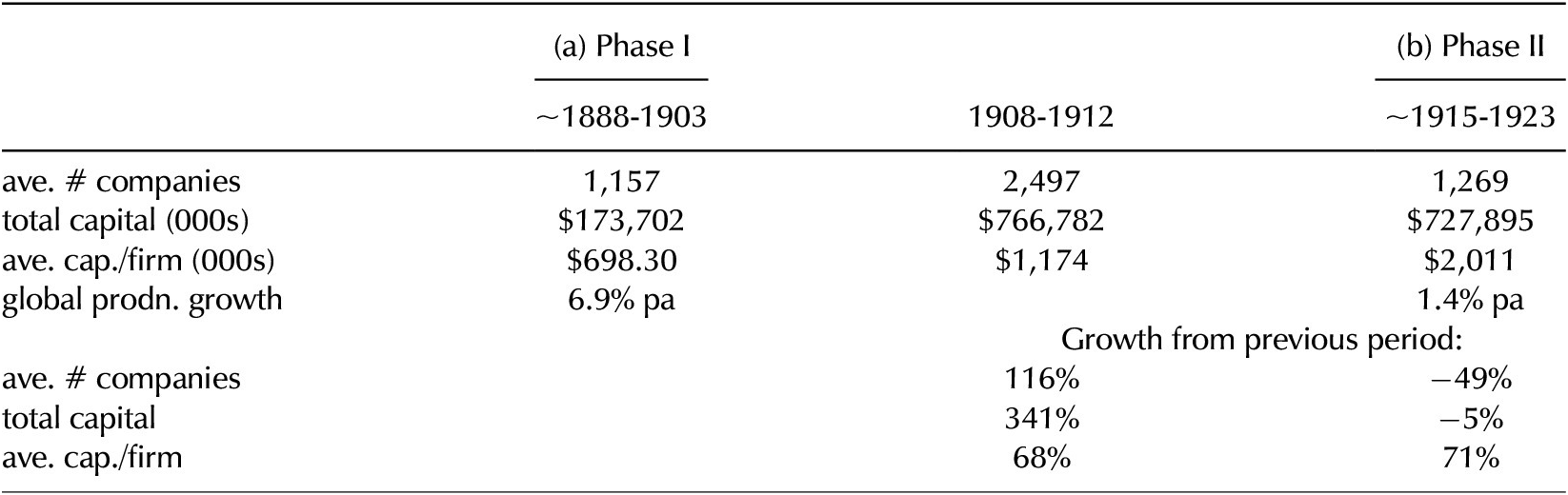
Notes: Derived from listings of mining and metallurgical companies in the Mining Year Book (London, various years 1888–1923; see also Figure 2 above). Global mineral production derived from B. R. Mitchell, International Historical Statistics (Basingstoke, UK: Palgrave Macmillan, 2013). Values in current U.S. dollars. Not all firms reported their capital, thus the average capital only uses firms that do report.
Our narrative begins in the 1870s, at a critical moment in the history of mining, of the engineering profession, of corporate expansion across the Atlantic World, and of global capitalism generally. Falling transportation costs, imperialist ambitions, and rising consumer demand in Europe and the United States pushed international trade on a forty-year run of nearly uninterrupted growth. However, and in spite of rising demand, both precious and industrial metal producers faced significant challenges. In precious metals, the end of high-uncertainty but high-yield bonanza mining of oxidized ores left investors around the world scrambling to locate and process metal-bearing rock that were more deeply buried, yielded lower metal values, and were ever more recalcitrant to conventional refining techniques.Footnote 32 For industrial metals, rapid demand growth and low-grade ores put similar pressures on production. Copper, for example, saw its production center shift in North America from the Great Lakes to the more complex and lower value pyritic ores of the mountain West, and globally to Chile, Central Africa, and Australia.Footnote 33 Across the mining sector, constraints lay on the supply side, given strong demand for metals from the highly competitive imperial scramble for resources to fuel industrialization and the expansion of economic and military power in Western Europe and the United States. The critical questions facing miners around the world were technological and organizational: how to extract and refine low-grade, complex ores, profitably. The search for solutions to this challenge generated a wave of new technologies, most introduced and adopted in the 1890s and early 1900s. Both extraction and refining operations saw revolutionary change in production technologies with the development and application of new machines and processes, including pneumatic drills and dynamite on the extraction side, the introduction of novel reduction mills and especially the cyanidation and flotation processes on the refining side, and the introduction of electrical power in pumping, ventilating, lighting, and hauling, as well as in mineral reduction and processing operations.
This wave of technological innovation largely relieved the supply-side constraint and opened mining to a new wave of investment from the financial markets of Boston, London, and New York. Between the 1870s and the early 1900s, new investment created many dozens of new mining firms, and listings in the two directories more than doubled (Table 4). At the same time, firm size grew nearly 70 percent, measured by capitalization. Many of the new technologies adopted by these large firms represented entirely new production systems that drew on applied science in metallurgy, chemistry, electricity, and physics and prioritized scale economies to make low-grade ores pay over high fixed investment costs. This was especially the case on the refining side of operations. Firms that were already large, or those with better access to financial markets, were able to make the technological transition and separate themselves from the larger number of small and midsize operations. Global metals production grew at a remarkable average annual rate of 6.9 percent over the thirty years 1880–1909.
As firms sought to adopt new mining and milling technologies, they also increasingly sought university-trained engineers to select, install, and manage the new technologies and production systems. Although early adopting firms initially turned to European-trained engineers at a time when U.S. experts were still scarce in the 1860s and 1870s, the supply of U.S.-trained engineers expanded quickly as several dozen universities responded to rising demand and the incentives provided by the 1862 Morrill Land Grant Act to create new engineering degree programs. As a result, the number of students enrolled in U.S. engineering degree programs rose rapidly from the low hundreds to over twelve thousand by 1900.Footnote 34 Mining and metallurgical firms were increasingly able to employ university-trained engineers in management positions, and we see the result in the nearly 40 percent of engineers in our database who held some kind of managerial position at some point in their careers. Because few of the technological innovations were, in fact, discrete techniques, but constituted parts of entirely new production systems, engineers’ role quickly encompassed new approaches to manage and direct large-scale operations: to plan, design, coordinate, monitor, and control the flow of materials, energy, and labor in the context of technologically novel and complex (that is, industrial) production processes. As we have seen, engineers served as managers across the full managerial hierarchy: from work supervisors to underground mine and shop floor managers to positions in upper management and firm leadership. Mining and metallurgical textbooks of the era—revised, extended, and reprinted on almost an annual basis during the 1890–1910 period of rapid technological change—abound with flowcharts and mine and mill descriptions that vividly illustrate the integrated and cross firm scope of engineers’ mandate in their managerial positions.Footnote 35
In other words, our data suggest that before about 1910, firms’ dominant business strategy typically focused on increasing their competitive advantage by adopting new production capabilities. These were embodied both in the technologies themselves as well as in the minds and bodies of university-trained engineers who were increasingly hired into both technical and management positions to oversee design and management operations in a period of rapid technological change. Michael Ruben’s study of the employment of university-trained engineers in Pennsylvania coal mines is consistent with this observation: Firms that employed engineers were more likely to adopt new technologies that yielded productivity gains for adopting firms. Engineer-led firms pursued competitive strategies in order to realize economies of scale and achieve profitability, and to survive in a highly competitive, low-margin environment.Footnote 36
After about 1910, however, we see these trends sharply reverse in a very different set of contextual circumstances (Table 4, column B). Most importantly, new technologies that revolutionized productive processes in extraction and refining had, by and large, already been developed, adopted, and diffused across much of the industry worldwide. Technological change in the mining and metallurgical sector would be far more sporadic and incremental over the following decades, compared to the dramatic wave of macro-innovations in mining and metallurgy introduced between 1880 and 1910. Mining and refining firms that survived to 1910 and that were poised for growth thereafter were those relative few that had been able to adopt new technologies in order to address the continuing challenges of low-grade, recalcitrant ores and the imperative of cutting costs across large volumes.
In column (b) of Table 4, we see a sharp decline in the rate of investment growth after about 1910, and global mineral production fell from an annual average growth of 6.9 percent to just 1.4 percent per year. The overall number of firms operating in the mining and milling sector declined to almost a third of 1910 levels by 1919, before leveling out into the 1920s. At the same time, however, average firm capitalization moved in exactly the opposite direction, expanding by about 70 percent. We see, in other words, a dramatic concentration in the structure of the industry—the era of a “great merger movement” for the mining and metallurgical sector—as large firms and holding companies bought up smaller mining and milling operations, merged with competitors, and invested in the vertical integration of raw material production, processing and refining operations, intermediate input, fuel, and transport systems, and sales and communications divisions.Footnote 37 Whereas efforts at consolidation and vertical integration had roots in earlier decades (e.g., the Colorado smelting mergers of the 1880s or the consolidation of copper operations in Montana in the 1890s), the creation of new firms had outpaced corporate consolidation before 1910, after which a massive, global, and industry-wide merger movement swept the sector.Footnote 38
What we observe, in other words, is a distinct and generalized shift in the business strategy pursued by firms. Rather than pursuing competitive advantage through technology adoption and attendant economies of scale, after about 1910 firms sought to secure market share and profits by pursuing what we might think of as anticompetitive strategies. Instead of enhancing productive efficiency through innovation, firm strategies more often included investments in horizontal and vertical integration through mergers and acquisitions, the creation of pricing agreements, cartels, holding companies, and the acquisition of patents and creation of patent pools. All such efforts sought to reduce the competitive position of rival firms.
Accounts from firm-level studies suggest that mining and metallurgical companies pursued both strategies during each phase. However, the divergent trends in our data are distinct and striking. They align, moreover, with two very different technology and knowledge contexts: rapid technological change and widespread demand for university-trained engineers in managerial positions in the decades before 1910; and relatively stable technologies and a trend toward nontechnical upper-level managers after. In fact, engineering degree programs in mining and metallurgy began a sustained decline in enrollment after peaking just before the onset of World War I. We note that this trend reverses what we know about the manufacturing sector, in which the anticompetitive merger movement (in the 1890s and 1900s) preceded large corporate investment in science-based research and development units.Footnote 39
During the post-1910 era of industrial concentration, firms sought to supplant the uncertainties of the market with the controlled, planned, standardized, and systematized coordination and monitoring of materials, labor, and processes within the firm, led by salaried managers. These were trends begun in the 1880s, but not fully realized until after 1910. Firms with access to the capital necessary to pursue these strategies continued to invest in expanding managerial capacity, and engineers continued entering managerial positions in large numbers. However, the technical capacities of managers become somewhat less important in the second phase relative to organizational and strategic capacities, at least at the upper leadership levels of corporations.
An important part of the managerial revolution was thus also a technological revolution. Scholars have described the former as the employment by large corporations of increasing numbers of salaried, professional managers who oversaw the operations of large, multiunit firms at every level, using standardized systems to coordinate, monitor, and control the production process.Footnote 40 This revolution in big business, our narrative suggests, was the result of both phases we describe above: the competition-enhancing efforts of firms to adopt new technologies and build technical knowledge capacity, as well as the competition-discouraging efforts to expand market share through mergers, integration, and other means. As the strategic options available to competing firms shifted, largely depending on the relative presence or absence of technological change, owners sought a different skill set in managers.
Conclusions
As with any large-N data study, this one serves to establish broad empirical parameters for the participation of engineers in management, to identify general patterns and trends across time and across firm types, and to suggest interpretive hypotheses that will need to be tested using more fine-grained quantitative, qualitative, and case-study research. With millions of data points across firms and individuals, we have argued—counter to much of the historiography—that engineers played a significant and enduring role in the managerial revolution, and that fluctuations in engineers’ roles correlate with firm strategy regarding technological innovation. The preceding sections have outlined trends indicated by our data; here we offer three observations on the broader significance of our research. Each observation deserves further examination.
First, evidence suggests that the patterns and tendencies we observe in our data on mining and metallurgical engineers likely held across other engineering fields, as well as in other business sectors. The American Society of Mechanical Engineers (the largest of the fields) noted retrospectively in 1930 that “more than two-thirds of the graduates of engineering colleges eventually find themselves in executive and administrative positions.”Footnote 41 Likewise, a survey conducted by the Society for the Promotion of Engineering Education in 1929, of nearly seven thousand engineers across all fields (Table 3 above), found that between 50 and 70 percent worked in administrative or managerial positions once individuals moved into the second decade of their careers.Footnote 42 Mechanical, chemical, and electrical engineers were, apparently, no less likely to pursue management positions, and firms were no less eager to hire managers with engineering capabilities. Mining may have been more “engineering intensive” than other sectors, given the challenges of standardization in an environment in which every mine faced varying complexity and composition of ore and local conditions, but anecdotal evidence suggests that although the levels may have varied, the trends were similar.Footnote 43 This observation calls for further research, and the methods we have used here should be replicable for mechanical, civil, electrical, and chemical engineers (for example), and their managerial presence in other sectors.
Second and relatedly, engineers continued to occupy both middle management and leadership positions throughout the twentieth century. In mining, engineers continued to fill the vast majority of middle management and many general management positions.Footnote 44 Across all engineering fields, a 1940 survey found that 60 percent worked in management at some point in their careers, and that the prevalence of engineers in top management positions had increased from one in eight to one in five over the first half of the century.Footnote 45 In the 1960s, more than 25 percent of top executives in the six hundred largest U.S. corporations had engineering degrees.Footnote 46 Engineers’ prominence at the managerial apex of the modern corporation after midcentury was nothing new, as we have demonstrated. Engineers’ prevalence at both upper and middle management levels has characterized the large corporate enterprise since its genesis in the late nineteenth century, and it has survived in spite of the rapid growth of business schools and management professionals since the 1910s. That many (though not all) engineers aspire to managerial positions has long been a commonplace of the profession, with one historian noting that “many of the most successful engineers have gone into management work.”Footnote 47 Another notes that admissions committees at the Harvard Business School viewed an undergraduate engineering degree as the ideal preparation for an MBA.Footnote 48 And the latest generation of corporate Leviathans in the twenty-first century, built around digital technologies, have frequently been founded, designed, planned, and managed by engineers.
Third, our evidence suggests that the managerial revolution was not a uniquely or even initially an “American” phenomenon, but it was common across globally situated Anglo-American enterprises. Our data encompass mining and metallurgical engineers and firms in both the U.S. and British orbits, working across most of the world’s major mining districts. Although U.S.-trained engineers predominate in our database, our firm-level data lean toward companies capitalized in Britain (see data appendix). Together, we capture engineers and firms in the world’s two largest concentrations of mining finance, with firms and subsidiaries operating on every continent, responsible for the major share of global mineral production. The growth of large corporations, the development of managerial hierarchies, and the prevalence of engineers working at every level of those hierarchies occurred across our two large U.S- and U.K.-based samples. It remains to be seen whether the trends noted here hold in mining and metallurgical firms outside the Anglo-American orbit, including (for example) in the large German mining sector or in firms based in the extractive economies of countries like China or Mexico.
The emergence of professional engineering preceded the professionalization of management, and owners found the expertise to build and manage large corporations among the ranks of the technically trained. It is no surprise that many engineers pursued management careers from the earliest years of the modern profession. Mining and metallurgical firms across the globe sought their expertise, and at the same time, new engineering associations sought to increase their status and touted the indispensable technical and leadership role of the disinterested professional engineer.Footnote 49 The timing and explanation for firms changing reliance on engineers versus nontechnical managers is less well understood. Our evidence illustrates how, after the 1910s, the calculus shifted in the mining sector. The increasing consolidation of large firms in an era of technological stability led to a rising presence of business school graduates relative to engineers, whose careers became somewhat more restricted to middle management. Whereas technical expertise designed the scale of the new behemoths, their coordination apparently required an increasingly professionalized team that included both nontechnical managers and technically trained engineers. This corporate life cycle of technically oriented growth and management-oriented consolidation characterized a large proportion of firms across a globalized and increasingly oligopolistic market in the mining and metallurgical sector between 1880 and 1930. Although more research is needed to examine these issues in other sectors, our evidence suggests that conventional accounts of managerial revolution led by nontechnical professional managers and largely confined to the manufacturing sector needs significant adjustment.
Data Appendix: Sources and Methods
This paper is based on analysis of a novel database that includes over one hundred thousand individual engineers and information on their schooling and career employment. We extract this data from two types of sources: published lists of alumni from twenty-four university degree-granting programs in mining and metallurgical engineering between the 1860s and 1930s (eighteen in the United States, five in Europe, and one in Mexico), totaling 1,980,712 cells; and published lists of memberships in the American Institute of Mining Engineers between 1873 and 1912, totaling 289,548 cells. This database is complemented by a second database that focuses on mining and metallurgical firms, drawn from the two most prominent directories of firms in the sector and published in several editions between the 1880s and the 1920s, totaling 15,141,420 cells. The list of schools includes all major mining and metallurgical engineering programs in the United States with nearly comprehensive coverage from 1870 to 1915, as well as several major school programs in Mexico, England, Germany, and France. The two corporate directories include all significant mining and metallurgical firms in the Anglo-American sphere, operating in mining districts around the world. A detailed list of these sources and description of our methods for extracting, cleaning, classifying, name parsing, and validating the data is available at https://github.com/solaresig/Blueprint-for-Modernity. The database itself will soon be available for open access through our website at engineeringhistoryproject.org.
The data set centered on individuals contains 315,137 observations of 15 variables, corresponding to 124,451 unique individuals. The data set centered around organizations contains 116,780 observations of 16 variables, corresponding to 52,206 unique organizations. Both data sets can be described as unbalanced data panels, with a long or stacked structure. The voluntary reporting, the transformations of corporate names and government agencies, and the sole existence of new actors (individuals, universities, and corporations, among others) appearing in the mining world make the construction of a complete data set impossible. Nevertheless, we have no reason to suspect that the missing observations are nonrandom, as incentives to report did not change during the period. We can identify 242,629 geolocations on the individual-centered data set, corresponding to 23,644 different locations for 98,501 different individuals, distributed in nearly every part of the world. We can identify 563,693 geolocations on the organization-centered data set, corresponding to 3,105 locations for 21,063 different organizations.
Acknowledgements
Research for this project is supported by NSF award # 2020926 and the Kellogg Institute for International Studies at the University of Notre Dame. We are immensely grateful to the anonymous reviewers of this journal for their suggestions.
Supplementary Materials
To view supplementary material for this article, please visit http://doi.org/10.1017/eso.2022.57.


 Open access

