

Introduction
Despite increased attention from policy-makers, journalists and the public over the past two decades, conflict-related sexual violence (CRSV) against civilians continues to occur in conflicts around the world – and in some places, on a massive scale. For instance, several United Nations (UN) reports have documented cases of CRSV in Ethiopia, Ukraine and Israel/Palestine.Footnote 1 The 2026 report of the UN Special Representative of the Secretary-General on Sexual Violence in Conflict lists seventy-seven parties to current armed conflicts, including State security forces as well as non-State armed groups, that the UN documented as having engaged in CRSV during 2025. The report also notes that over 65% of the parties listed are persistent offenders: they have been listed “for five or more years without taking remedial or corrective action”.Footnote 2
Research on CRSV has grown remarkably in recent years,Footnote 3 and several excellent peer-reviewed reviews of this expanding body of social science literature have been published in the past decade. These reviews all take note of the sharp increase in the number of studies and the advances that have been made in cultivating a more systematic understanding of the causes of CRSV, moving away from treating CRSV as “inevitable, ubiquitous, and either opportunistic or strategic”Footnote 4 and toward a more nuanced analysis, especially regarding individual motivations and intra-group dynamics.Footnote 5 At the same time, the review articles identify gaps and topics that have advanced more gradually, including issues of data and measurement,Footnote 6 the role of State actors as perpetrators of CRSV,Footnote 7 the social and political consequences of CRSVFootnote 8 and what policy interventions may actually be effective,Footnote 9 especially given enduring structures of gender inequality and their consequences for violence.Footnote 10
This article first reviews eight important advances in the field, including the widespread recognition of variation in CRSV, the power of mapping the complete pattern of violence (defined as the repertoire, targeting and estimated frequency of violence) including different forms of CRSV, and the importance of distinguishing between CRSV that occurs as a policy (either a military strategy or a policy for non-military purposes, often the management of the sexual and reproductive lives of combatants) and CRSV that occurs as a practice (in which sexual violence is driven by social dynamics among combatants and is tolerated by commanders). It then highlights emergent themes, including intersectional approaches to studying victimized communities as well as perpetrators, and ongoing debates, including how gender hierarchies and norms shape CRSV. The article next identifies persistent gaps in academic understandings of the causes and consequences of CRSV, along with opportunities for deepening that understanding. After discussing the implications for policy to address CRSV, the article concludes by laying out some lingering questions for future research.
Advances in the documentation and analysis of CRSV
It has become a common refrain in scholarly and policy circles to hear that CRSV is “not inevitable”, which is itself a great success in reframing this form of violence as more than a consequence of war – the first advance. It is now generally accepted that CRSV is a form of preventable violence that is subject to policy intervention. More broadly, there are fewer widely shared misconceptions today than were initially identified in a 2013 policy brief:Footnote 11 for example, the incorrect assumptions that CRSV is exclusively a form of violence committed by men against women, that CRSV is concentrated in African conflicts, and that rebel forces are more likely to engage in CRSV than State actors are now well addressed in the literature and, for the most part, in policy and practitioner spaces. (Some experts have noted that non-State actors remain the focus of policy attention despite being systematically less likely to engage in CRSV.Footnote 12)
The idea of CRSV being “not inevitable” is based on an important move in the scholarly literature, initiated nearly two decades ago,Footnote 13 that documented the fact that CRSV varies across armed organizations – the second advance. Not all armed organizations engage in rape or other forms of sexual violence, and there is significant variation across armed organizations that do. Armed organizations that engage in CRSV vary in their forms of sexual violence (e.g., rape, sexual slavery, enforced prostitution, forced pregnancy, enforced sterilization, sexual mutilation and/or sexual torture) and in their targeting (of particular social groups or more broadly), as well as in the frequency of their sexual violence.
The significantly stronger quantitative and qualitative data sources that are now available after something of a data revolution in the study of CRSV – the third advance – confirm that CRSV is not, as many continue to claim, ubiquitous: an increasing range of evidence demonstrates that some armed groups perpetrate some form of CRSV and others rarely do, even within the context of the same war. This basic fact of variation across armed groups has enabled rigorous and systematic research on the causes of CRSV and has led to a wealth of creative thinking regarding mitigation and prevention. Concerns about data bias and limitations remain,Footnote 14 but multi-method research and new statistical techniques hold promise for how to address these issues, as we discuss below.
A fourth important advance is the notion of a pattern of violence, defined as the repertoire, targeting, frequency and techniques of violence used by armed groups during conflict.Footnote 15 Expanding conceptualizations and measures of violence beyond numbers of victims or counts of incidents has allowed scholars of CRSV to understand more nuanced variation in how armed organizations engage in particular forms against specific social groups, and the conditions under which CRSV occurs alongside other violence. For example, lethal violence and CRSV, while they may both be reported to occur during the course of the same war, are not closely correlated in terms of timing and location in some conflict contexts.Footnote 16
The fifth advance is that to understand variation in CRSV, scholars have built on, and contributed to, the literature that analyzes violence as a “principal-agent problem”. Commanders (principals) seek to motivate but also control violence, at least to the extent that they themselves, their families and their communities are not targeted. Combatants (agents) may prefer forms of violence other than those chosen by their commanders (or none at all), and against different targets. In addition, commanders may not know exactly what combatants do on the ground. The asymmetry in information and difference in preferences between principals and agents may result in violence that is not authorized by commanders.Footnote 17 Armed organizations build institutions for recruitment, socialization and discipline of combatants so that they can deploy combatants to wield violence that is effective for the realization of their goals. When such violence is ordered or authorized, it is organizational policy, the purposeful adoption of a particular pattern of violence for organizational goals. An armed organization may adopt a particular pattern of CRSV as a policy for military strategic purposes such as in some cases of ethnic cleansing, or as a policy for non-military purposes such as sexual slavery, to manage the sexual and reproductive lives of combatants,Footnote 18 a point returned to below. There is now a welcome sophistication to the discussion of the conditions under which – and the variation in where, when, by whom and against whom – CRSV occurs as an organizational policy.
In a sixth advance, scholars of CRSV (and other forms of political violence) have analyzed the extent to which the armed organization’s ideologyFootnote 19 prescribes certain forms and targeting of CRSV and prohibits others through the building of effective institutions. A consistent finding is that leftist insurgencies engage in less frequent rape and other forms of sexual violence against civilians than other types of rebel organizations, a result achieved through, inter alia, the inculcation of norms of restraint in violence toward civilians.Footnote 20
To develop a general theory of the adoption of CRSV as organizational policy, Wood and RevkinFootnote 21 argue that in the case of an organization which engages in CRSV as a policy, its ideology may mandate (or authorize) specific forms of CRSV against particular groups. They analyze the case of the so-called Islamic State of Iraq and Syria (ISIS), showing that the group targeted particular forms of sexual violence against specific social groups: ISIS sexually enslaved Yazidis but not Sunni Muslims, and engaged in child marriage of Sunni Muslims but no other groups.Footnote 22 It is only through focusing on ideology that we can understand the organization’s combination of repertoire and targeting. Based on religious literalism, theocratic authoritarianism, patriarchy and takfir (violence against apostates), ISIS ideology authorized sexual slavery against polytheist peoples (primarily the Yazidis) but strictly prohibited it against Sunni Muslims, while also authorizing child marriage of Sunni Muslim girls.Footnote 23 In some settings, an ideology of ethnic exclusion drives CRSV as part of an organizational policy in the form of a military strategy of genocide or ethnic cleansing.
The seventh development is the concept of CRSV as a practice,Footnote 24 in which CRSV is not directly ordered or authorized from the top as a part of a clearly defined military strategy (or other type of policy, such as sexual slavery); rather, leaders and commanders tolerate it or simply fail to punish it because they do not want to expend the organizational resources necessary to control it, are not concerned about the consequences of unauthorized violence, dismiss the suffering of those who are victimized, or some other reason. In contrast, the framing of CRSV as a “weapon of war” often assumes that CRSV is ordered from the top down, which restricts the types of harms acknowledged by the international community to those perceived to be part of a military strategy as opposed those that are, for example, committed by civilians or as a result of indiscipline.Footnote 25
Distinct from the traditional way of understanding CRSV as either opportunistic or strategic, the development of the third category of practice has opened new avenues of analysis and helped to resolve long-standing puzzles about the use of CRSV; for instance, why CRSV sometimes occurs on a large scale in the absence of orders or authorization from commanders.Footnote 26 Further research has refined the distinction between a policy and a practice to address the challenging issue of when sustained patterns of CRSV should be seen as implicit policy even if there is no evidence of orders.
An eighth promising advance in recent research is the application of sophisticated statistical techniques to identify the sources of variation in rape and CRSV across armed organizations, despite persistent concerns about under-reporting. A recent analysis by Changwook JuFootnote 27 addresses a fundamental problem in datasets that compile observations about the extent of CRSV by an armed actor: namely, the difficulty of distinguishing under-reporting from a true absence of CRSV. In these datasets, values of zero comprise more than 85% of entries,Footnote 28 lumping together “true” zeros for armed organizations that did not engage in CRSV and “inflated” zeros that represent the absence of reports of CRSV from the sources even though CRSV had in fact occurred. Ju’s re-analysis modelling the two types of zeros (using all of the controls in each original analysis) confirms some but not all statistical findings in the previous literature. Among the findings that are confirmed are: forced recruitment by State and insurgent forces is associated with high levels of rape;Footnote 29 rebel organizations with female combatants engage in lower levels of sexual violence;Footnote 30 rebel groups with fair and inclusive processes for selecting leadership engage in lower levels of sexual violence;Footnote 31 and secessionist rebel groups are less likely to engage in CRSV than other rebel groups.Footnote 32 The analysis does not confirm other recent findings, such as the supposed positive relationships between rebel territorial control and CRSV, and between natural resources and CRSV. These statistical techniques may resolve some of the concerns about under-reporting of CRSV in quantitative datasets, especially from feminist critics.
Emergent themes and ongoing debates
New scholarship on CRSV reveals numerous exciting and novel emerging areas of research. Several of these new topics are noted here, along with ongoing debates, with some reflections on additional issues that each of them raises for the future study of, and policy-making about, CRSV. The final section of this paper discusses ideas for future research.
A fundamental, ongoing theme is whether the definition of CRSV should be broadened to include more forms, victims, perpetrators and time periods. What is “conflict-related” and what forms of violence are “sexual violence” have long been subjects of debate, with some scholars using narrow definitions both in terms of perpetrators and timing (e.g., CRSV is only that perpetrated by armed groups during armed conflict, not civilians, even if the civilian violence likely took place because of the chaos of war) and form (e.g., sexual violence may be defined as a limited set of acts of physical violence or more broadly to include threats of rape, shaving of women’s heads, forms of sexual humiliation, or gender-based violence more generally).
Some recent interventions by expertsFootnote 33 and human rights observersFootnote 34 in the field seek to expand these definitions even further, to include the often devastating consequences of conflict-related disruptions to obstetric care and the long-term consequences of war-related stress for fetuses into childhood. Including these types of conflict-related reproductive, obstetric and maternal health consequences may be important from a policy and practice perspective, generating increased attention to overlooked gendered harms that women in conflict-affected areas may face – and that, depending on the context, may be occurring on a far greater scale than sexual violence.
While these types of harms are undoubtedly forms of gender-based violence, however, it is not clear whether they ought to be considered CRSV. What is gained from a legal and policy perspective in terms of ensuring the protections guaranteed to women under international humanitarian law (IHL) may also make scholarship – especially empirical scholarship that depends on clear definitions – too diffuse to allow the development of appropriate research designs and therefore the identification of causal patterns. A broad definition can be critical to advocacy, but may also undermine the necessary focus of empirical scholarship on clear and consistent definitions and concepts that enable fruitful research design.
A second – and perhaps the most apparent – emergent theme resulting from the exchange of ideas between academia, policy and practice over the past decade is the move toward greater survivor-centeredness in all stages of research and policy-making, including the intensive focus on ethical engagement with affected communities. A key example is the 2022 release of the Global Code of Conduct for Gathering and Using Information about Systematic and Conflict-Related Sexual Violence, or Murad Code,Footnote 35 a global initiative by CRSV survivor organizations laying out survivors’ rights and standards of engagement that furthered discussions among academics about ethical standards in research on CRSV, and political violence more broadly. Scholars of CRSV were among the first movers in developing guidance about how to conduct ethical scholarly research on sensitive topics and with vulnerable people.Footnote 36 Centring survivors in CRSV policy means that all such interventions should “start and end” with survivors, as the former UN Special Representative of the Secretary-General on Sexual Violence in Conflict, Margot Wallström, has said.Footnote 37 However, while the goals of centring survivors are noble, important and necessary for ethical research and engagement on this topic, as scholars have recently emphasized,Footnote 38 the study of perpetrators, as noted in the following section, remains a critical area of scholarly focus.
A third emerging theme is the intersectional approach to the study of CRSV, with scholars providing a more richly detailed, more systematic perspective on who suffers CRSV and how, as well as who perpetrates CRSV. In addition to the traditional focus on ethnic targeting, and partially in response to earlier critiques,Footnote 39 scholars are now considering gender roles (conceptions of what is appropriate for individuals given their gender presentation; for example, femininity and masculinity), gender identities (including non-binary and transgender identities) and sex (physiological characteristics; for example, male and female) more seriously and more precisely in concept and measurement.Footnote 40 The result is tangible progress in our collective knowledge about the victimization of gender and sexual minoritiesFootnote 41 – a long-hidden survivor population – and a growing understanding of how intersecting identities, including race, ethnicity, age, disability, migration status and sexual orientation, are affected by CRSV. The population of survivors is now known to include previously overlooked and under-studied groups like men and boys,Footnote 42 people with disabilities,Footnote 43 and LGBTQIA+ individuals and communities.Footnote 44 This intersectional approach also illuminates the intergenerational consequences of CRSV, including children born of war,Footnote 45 and the social and political consequences of CRSV for individuals and communities.Footnote 46
There is also an increasing recognition of the full range of CRSV perpetrators, from child soldiersFootnote 47 to women combatants,Footnote 48 as well as perpetrating groups that are less often studied by social scientists, including State military forces,Footnote 49 police, other members of the State security sector (such as pro-government militiasFootnote 50), and peacekeepers.Footnote 51
A final important and related turn in the literature is a careful consideration of how CRSV is shaped by masculinities and femininities. A wealth of scholarship on masculinity and CRSVFootnote 52 has enabled sophisticated theorizing about what a gender lens can reveal with regard to why violence becomes sexualized, against whom such violence is perpetrated, under what conditions it is deployed as a policy or emerges as a practice, and how it is treated as a policy problem.Footnote 53 Insights about the relevant gender hierarchy – the gendered social order in which some masculinities dominate other masculinities as well as femininities – are increasingly combined with the patterns of violence approach to explore which intersectional identities are targeted by particular forms of CRSV by some armed organizations, and why.
One way in which scholars – especially feminist scholars – have approached this topic is through theorizing CRSV along a continuum of sexual violence that occurs before, during and after periods of war.Footnote 54 For example, Boesten argues that “much of the scale and cruelty of [the CRSV during the Guatemalan civil war] was certainly exceptional and strongly conflict related, [but] the script for these acts – immersed in racism and sexism … – predated the conflict”.Footnote 55 In contrast, a focus on CRSV in the policy realm as primarily an issue of protection from harms during war has hampered efforts to address the fundamental root causes of the issue.Footnote 56 A shift in thinking is needed about CRSV, transitioning away from viewing it as a moment of acute crisis and toward a recognition of CRSV as part of a deeper and more persistent problem of values and norms about sex, gender and sexuality in a given society – one that may be attenuated or deepened by the socialization of combatants by the armed organization. The policy interventions that follow from this perspective, such as efforts to alter gender hierarchies and norms, attract far less policy attention and are arguably much more difficult to achieve.
It is undeniable that CRSV is inextricably tied to gender hierarchies, but whether and how sexual violence that occurs before the onset of war (or women’s social, political and economic status more generally) is causally related to sexual violence by armed actors during conflict – and if and how wartime violence shapes post-war violence – are empirical questions. As we have written elsewhere,Footnote 57 the patterns and purposes of CRSV are often quite different from the sexual violence that occurs during peacetime: in short, they are a rupture, not a continuum. For example, CRSV takes different forms (in particular, reports of gang rape increase dramatically during wartime), is more brutal (for example, rape with weapons or objects) and has different purposes (humiliation, sexualized torture, forced impregnation, the spread of disease) than peacetime sexual violence. Moreover, societal-level explanations for CRSV fail to account for variation in CRSV across time and space – and across the armed actors in the conflict.Footnote 58 In other words, patriarchy is too commonplace to explain why CRSV occurs in some conflicts – and by some armed groups – but not in others. It is our view that patriarchy is best understood as a critical background factor, a necessary but not sufficient condition for CRSV. However, the “continuum debate” remains one of the most contested areas of disagreement among scholars of CRSV.Footnote 59
Gaps in the field – and promising opportunities
There is a great deal of exciting and cutting-edge work in the study of CRSV. Nonetheless, there remain open questions, and we emphasize several major opportunities for further advancing scholarly understanding of CRSV: (1) more systematic accumulation of findings on the structural causes of CRSV, particularly gender hierarchies; (2) further efforts to address under-reporting on CRSV, including updating datasets and leveraging new technologies; (3) additional assessment of organizational ideology as an explanation for sexual violence that occurs as a policy; (4) deeper investigation of sexual violence that occurs as a social practice; and (5) the value of embedding analysis of an organization’s pattern of CRSV in its overarching pattern of violence.
Scholars have written about the role of the gender hierarchy and its consequences for CRSV in particular settings, how it is related to issues of security and development more generally,Footnote 60 and the connections between patriarchal beliefs, on the one hand, and armed political violenceFootnote 61 and support for the use of military force, on the other.Footnote 62 However, there is little systematic empirical cross-case analysis about gender hierarchies and CRSV, and a resulting lack of generalizable findings. One exception is a 2023 study by Guarnieri and Tur-Prats that develops a measure of male dominance at the level of the ethnic group, finding that armed groups with male-dominant ethnic norms are more likely to perpetrate CRSV.Footnote 63 More explicit comparison of gender hierarchies and norms across armed organizations, as well as of their patterns of CRSV, could help resolve the debate about the conditions under which CRSV occurs on a continuum or as a rupture with peacetime patterns.
While the past decade has seen important advances in the collection and analysis of CRSV data, efforts should be made to broaden and deepen existing data and to further innovate methods of analysis. The dominant dataset, the Sexual Violence in Armed Conflict Dataset,Footnote 64 is updated periodically by human coders; artificial intelligence could potentially be deployed to update the dataset and perhaps broaden the underlying sources. Relatedly, the Repertoires of Sexual Violence in Armed ConflictFootnote 65 dataset could also be updated to include qualitative analysis of repertoires of CRSV across actors and over time.
We have noted above the increasing emphasis on assessing the extent to which organizational ideology accounts for CRSV that occurs as organizational policy, either as military strategy or to manage the reproductive and sexual lives of combatants. Armed groups may differ in the extent to which their ideologies are explicit about authorizing specific repertoires of CRSV against specific targets, yet there are not many systematic comparisons of ideologies across armed organizations aimed at assessing the extent to which they account for variation in CRSV, aside from the well-confirmed finding that CRSV against civilians by leftist organizations tends to be more limited. Further exploration of the relationship between ideology and patterns of CRSV, with particular attention to the gender hierarchies and norms prescribed by organizational ideology, would contribute to scholarly understanding of the generalizability and limits of the asserted relationship.
Further analysis of patterns of CRSV by particular armed organizations to determine which forms and targeting occur as organizational policy, as a practice or as opportunism on the part of individual combatants is important, though challenging. The example of CRSV during the Sierra Leone Civil War (1991–2002) is instructive; all three logics are apparent in the CRSV perpetrated by the Revolutionary United Front (RUF), the main rebel group. Scholars, observers and human rights organizations have argued that CRSV in the form of rape of civilians was opportunistic, perpetrated by rebel fighters as a form of payment alongside looting; that CRSV was part of an organizational policy by the RUF rebels, both in the form of organized systems of sexual slavery and forced marriage, and in the rape of civilians to intimidate local communities, alongside other forms of symbolic violence such as the amputation of arms and fingers; and that CRSV – especially the gang rape of civilians, which was widespread during the conflict – was perpetrated as a practice, tolerated but not punished by rebel commanders and used as a tool for building social cohesion within the ranks.Footnote 66 The broader point is that the three are not mutually exclusive, and that evidence may exist for the co-occurrence of all three, even by the same armed group.
Implications and principles for policy
Conflict-related sexual violence has been the focus of increasing attention by policy-makers since the massive sexual abuses that occurred during the conflict in the former Yugoslavia and the Rwandan genocide. Policy achievements include several separate UN Security Council resolutions; yearly reports from the UN Special Representative of the Secretary-General for Sexual Violence in Conflict; the explicit criminalization in the Rome Statute of the International Criminal Court (ICC) of sexual violence as war crimes, and in some conditions as crimes against humanity and genocide; the prosecution of sexual violence crimes both in the ICC and other international courts and in some national courts; and bilateral and multilateral initiatives in a variety of settings.Footnote 67 However, although a new ethos of centring survivors increasingly informs implementation, including protocols for the investigation of potential crimes, the provision of services, and the participation of survivors and their communities, many such initiatives are poorly funded and receive only weak or intermittent attention at the level of implementation.Footnote 68
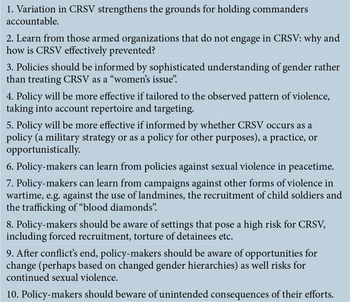
Based on our reading of the literature a decade ago, we identified ten principles to guide policy efforts, as summarized in Table 1.Footnote 69 Some appear to have been incorporated into policy frameworks (though often not adequately implemented): for example, principles 1 – that because CRSV varies across armed organizations, it is not inevitable and therefore commanders can be held responsible for it – and 8 – monitoring for conditions that present high risk of CRSV – are both now widely recognized as important principles.
Ten policy principles for addressing CRSV, as of 2015

Table 1 Long description
The principles emphasize how social science findings can guide policy to hold perpetrators accountable and to understand why and how conflict-related sexual violence can be effectively prevented. The principles emphasize the need for sophisticated gender analysis, tailoring policy to the observed pattern of violence, taking into account whether it occurs as a policy or a social practice, learning from campaigns to abolish other forms of violence, and other implications of social science research.
Source: Elisabeth Jean Wood, “Conflict-Related Sexual Violence and the Policy Implications of Recent Research”, International Review of the Red Cross, Vol. 96, No. 894, 2015.
Some of the other principles remain quite relevant today. Lessons can still be distilled from analyses of successful campaigns against other forms of wartime violence such as the use of landmines and the recruitment of child soldiers (principle 7), as well as from assessments of what types of interventions are effective in addressing sexual violence during peacetime (principle 6), including policies to address sexual assault on university campuses.Footnote 70 Policies will also be more effective if informed by a sophisticated understanding of wartime gender identities and hierarchies (and their relation to identities and hierarchies before the conflict) (principle 3), as well as the way in which targeting intersects with other identities such as age, disability, and vulnerability due to migration status. Further research on why some armed organizations prohibit CRSV and how they do so effectively (principle 2) may provide insight into other policy approaches toward curtailing such violence.
Policies for addressing CRSV will also be more effective if informed by whether such violence occurs as a policy (either a military strategy or for other reasons), as a tolerated practice or as opportunism by individual combatants (principle 5). Classifying incidents of CRSV in terms of whether they are driven by opportunistic motivations, occur as organizational policy or occur as a practice is more than just an academic sorting exercise. Illuminating the logics of CRSV in a particular conflict can help scholars and policy-makers understand, explain and predict the motivations of perpetrators, the variation in types of CRSV and against whom they are used and how often, and the possible interventions that might be effective in a particular case. If a form of CRSV is adopted as a policy by an organization, efforts should include targeted sanctions, as well as a focus on persuading leaders and commanders that such a policy is not consistent with their interests and/or their ideology. If CRSV is being used as a practice or is the result of opportunism, strengthening the incentives (and possibly the norms) of mid-level commanders to cease their tolerance may be helpful. We discuss some efforts along these lines below, but note that an established practice can be very difficult to eradicate, as shown for the case of ongoing, unsuccessful efforts to end sexual assault within the ranks of the US military.Footnote 71
Many policy interventions listed above and emphasized in the literature, even those pitched as prevention efforts, are often after the fact (e.g., reporting practices and improved documentation); few prevention efforts address the root causes of CRSV. Apparent in the prevention literature is an implicit hope that documentation, naming and shaming, and punishment of previous perpetrators will deter future CRSV. However, there is weak evidence to suggest that these are effective prevention or mitigation tools, and still much to be learned about the conditions under which they might become so.
What would prevention of CRSV really look like? While there are a host of policy ideas to counteract CRSV, and some of these have been tried, the evidence for whether any works well is decidedly mixed. “Closing the impunity gap” and using prosecutions as a preventative tool has been a main focus of policy actions in recent years, but analyses show that ICC trials do not deter future CRSV,Footnote 72 and the limited analyses of State trials generally show no effect – in fact, under some conditions, trials are associated with increased reports of CRSV.Footnote 73 On the other hand, there is evidence that trials reduce the occurrence of human rights violations more broadly.Footnote 74 What are the conditions under which trials – and what types of trials – might serve as a CRSV deterrent? Does justice serve a role for survivors, even if prosecutions are not preventative? Evidence on this too is somewhat mixed, with some studies showing that participating in justice processes is harmful for survivors,Footnote 75 so there is also an open question regarding what types of repairs are best for a particular survivor population.
Beyond prosecutions, experts have advocated for the use of targeted sanctions against leaders of armed groups known to perpetrate CRSV, such as freezing assets and banning travel.Footnote 76 In November 2022, then-US president Joe Biden issued a new directive authorizing the use of targeted sanctions against known perpetrators of CRSV. The Trump administration has taken some actions in line with the directive, such as sanctions against individuals and companies associated with armed groups that have perpetrated human rights abuses in the eastern Democratic Republic of the Congo.Footnote 77 Recent research shows, however, that sanctions against States (as opposed to individuals or armed groups) that perpetrate CRSV may have a counterproductive result; UN sanctions may make State-perpetrated sexual violence more likely in the context of civil wars.Footnote 78 This finding fits within a broader literature on the negative downstream consequences of sanctions against States, including increased reports of human rights violations.Footnote 79 A core question for future research is: what types of sanctions, and against whom, are likely to be the most effective in the fight against CRSV?
Efforts to resocialize armed groups are another under-studied area in the discussion of perpetrator-related policy efforts to combat CRSV that would likely hold promise if expanded. There has been very little scholarly attention paid to innovative efforts by international non-governmental organizations (NGOs) making direct appeals to non-State armed groups about their use of CRSV. Geneva Call, an NGO committed to educating non-State armed groups about IHL, for example, uses Deeds of Commitment (DoCs) that it establishes with non-State armed groups. These DoCs, which are effectively the equivalent of treaties with States, are documents in which armed groups agree to comply with IHL around specific issue areas, including CRSV. Geneva Call then assists armed groups with monitoring and implementation, reserving the options to publicize compliance and to name and shame non-compliance.Footnote 80 To date, twenty-five non-State armed groups have signed the DoC prohibiting CRSV.Footnote 81
While direct engagement with armed groups is promising, whether and how well this may work is uncertain, particularly if CRSV is entrenched as a long-standing practice.Footnote 82 Armed groups must opt in to volunteer to sign a DoC, which may limit the effectiveness of this tool, especially given that a strong majority of those who perpetrate CRSV have done so persistently for years, as documented in the yearly reports by the UN Special Representative of the Secretary-General for Sexual Violence in Conflict. That said, previous research shows that naming and shaming can be effective in curbing lethal violence, particularly when leveraged against actors who are concerned about their international reputations.Footnote 83 Direct engagement with armed actors also presents a variety of political and ethical challenges, such as unwittingly legitimizing non-State armed groups. Nonetheless, it remains an under-explored policy avenue for CRSV prevention, and an area that would benefit a great deal from systematic scholarly research.
The example of Geneva Call also points to the important and less understood role of civil society actors involved in CRSV research, policy and practice. Civil society includes the wide range of non-governmental actors working in the CRSV space – advocacy groups, educational institutions and religious organizations – that provide information, documentation, support services and advocacy. These actors have emerged as important players in policy for addressing CRSV in some settings. Some of their efforts are focused on the root causes of CRSV, such as promoting increased gender equality, but gender norms and gendered behaviours are extremely challenging to change through policy interventions.Footnote 84 Our nascent understanding of how civil society may affect change has yet to fully account for the challenges and opportunities of addressing CRSV through multisectoral and multidimensional efforts in a holistic approach.
Finally, while advocates sometimes lament the inconsistent attention given to CRSV, calling it “one of history’s greatest silences”,Footnote 85 this form of violence has garnered far more attention than other critical issues. One concern in this regard is that prioritizing CRSV has crowded out other gendered issues and feminist policy priorities. Karen Engle, in her provocative book The Grip of Sexual Violence in Conflict,Footnote 86 provides an accounting of issues that she argues have been displaced by CRSV over the past few decades, including the anti-war efforts of the women’s peace movement, the economic and social policy priorities of feminists in the global South, and the goals of sex-positive feminist movements, including those related to sex work and pornography. Further, sexual violence – even during periods of war – is far more frequently perpetrated by intimate partners than by armed fighters,Footnote 87 but such violence by intimate partners has not risen to the level of CRSV as an international policy priority. The long-term consequences of conflict-related sexual and gender-based violence for reproductive, maternal and child health also merit more attention.
Beyond shifting policy priorities, an intensive focus on CRSV can also have unintended consequences for the decisions and actions of a range of actors. Intensive international attention and resources focused on sexual violence have distorted the incentives of perpetrators,Footnote 88 advocacy groupsFootnote 89 and war-affected communities.Footnote 90 These issues bring to the fore a core challenge for those dedicated to working on CRSV: how to keep the issue on the agenda and continue to make progress while also recognizing that CRSV is just one form of suffering in a constellation of many forms of gendered harm, some of which are much more widespread and even more severe.
Lingering questions and implications
While there has been tremendous progress in understanding the causes and consequences of CRSV, this article has identified a number of lingering questions and open debates that we anticipate will be relevant for the next generation of CRSV scholars. In this section we summarize those questions, debates and lessons that we find most promising for future inquiry.
First, we return to a fundamental question that has long been a source of debate and discussion in this field: how exactly should CRSV be defined? What are the benefits – conceptually, empirically, politically, legally – to further expanding what is understood as CRSV (what is conflict-related, what is sexual, what is violence, and against whom is CRSV committed)?
Second, the mapping of the entire pattern of violence by an armed organization – including but not limited to CRSV, and noting the absence of particular forms of violence toward specific social groups – is important for descriptive inference, defined as the characterization of the organization’s pattern of violence (what type of violence, against what social groups, and with what estimated (perhaps very roughly) frequency?). While violence scholars have tended to work in silos, with the study of CRSV separated from that focused on lethal violence, child soldiering, forced displacement, genocide etc., the pattern of violence approach requires scholars to avoid researching in a vacuum and to draw connections between and among a wide array of forms of violence. Scholars have noted the promise that focusing on multiple forms of violence holds for understanding armed group dynamics and the recurrence of war (e.g., Robert U. Nagel, who studies rebel CRSV and killing in tandem).Footnote 91
Third, mapping the entire pattern of violence is also important for advancing causal inference of wartime violence, defined as the demonstration that a particular factor at least partly caused that pattern through the identification of a causal mechanism (or mechanisms) or the measurement of a causal effect.Footnote 92 The literature on CRSV illustrates how to construct plausible explanations in terms of ideology, commander tolerance, and policy imperatives including but not limited to military strategies. Moreover, causal analysis may be furthered by greater scholarly precision about whether a particular pattern (or sub-pattern) of violence occurs as organizational policy (strategic or non-strategic), as a tolerated practice, or opportunistically. As the literature moves beyond the conventional dichotomy of viewing CRSV as either opportunistic or strategic, alongside better data and improved and expanded methods, there exist increasing opportunities for nuanced and sophisticated analyses – a gap that is already being filled by a new generation of scholars.
Fourth, the move toward survivor-centred approaches and intersectional analysis within CRSV research can serve as a model for the broader political violence subfield. The study of political violence has already seen enormous growth on this front, moving from an almost exclusive focus on lethal violence (and an incorrect assumption that lethal violence is correlated with non-lethal violence) toward a recognition that there is variation in forms of violence and who is affected. The broader field initially focused on territorial control,Footnote 93 ethnicityFootnote 94 and gender,Footnote 95 but the next phase of research can usefully follow – and in some cases, already has followedFootnote 96 – the CRSV field in order to analyze other identities and statuses. Doing so will provide a more complete picture of who suffers from political violence, as well as a more accurate understanding of perpetrators’ motivations for violence.
Finally, CRSV researchers have been leaders in both ethics and methods of research, in part because data limitations have created opportunities for scholars to be innovative and enterprising. Because of the nature of the topic, CRSV scholars were early leaders both in developing notions of ethical engagement on sensitive topics and with vulnerable populations,Footnote 97 and in research methods, including qualitative methods like focus groups on sensitive topicsFootnote 98 and experimental survey methods to study under-reported experiences. The latter methods have included list experiments,Footnote 99 new cross-national datasets to fill gaps in the quantitative conflict data (which had previously focused exclusively on lethal violenceFootnote 100), and more recently, the use of cutting-edge statistical techniques to account for problems of observability of under-reported violence.Footnote 101
The next era of CRSV research should continue to embrace this spirit of innovation in order to expand our collective thinking about collecting new data and developing methods to be used in ethical ways that continue to deepen our understanding of CRSV, with implications for the study of political violence more generally, and related policy-relevant topics.

 Open access

