




Impact statement
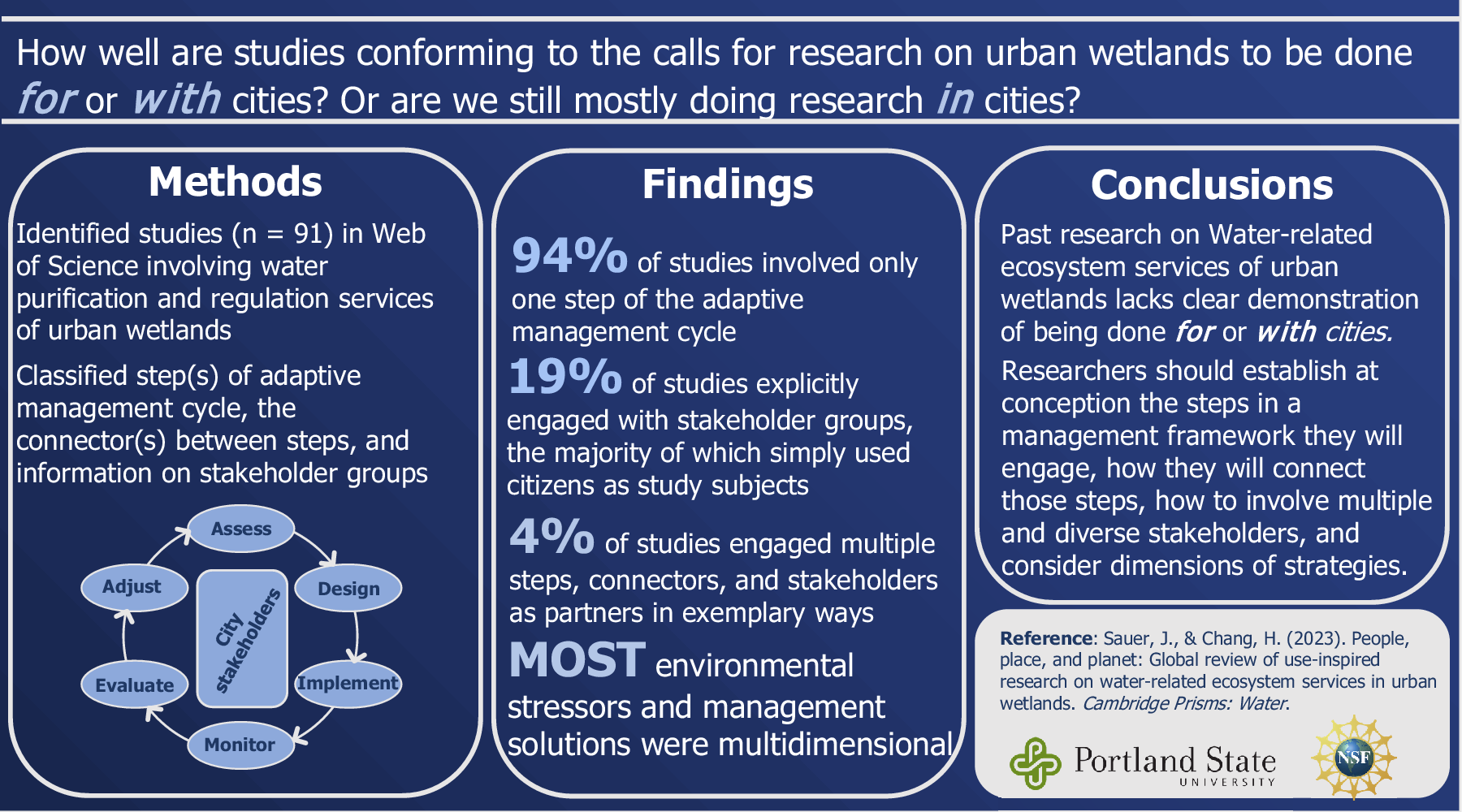
For several decades, there have been calls for scientists studying urban areas to generate research for and with cities, as opposed to in cities, thus that it may be more directly useful to city residents and professionals. We reviewed studies on water quality and water regulation services of urban wetlands to quantify and qualify if and how these studies were used. We also identified the social, ecological, or technological nature of the problems and solutions identified by study authors. We found that the majority of studies had recorded either limited or no utility by city residents or professionals. We also found that the system stressors and proposed solutions were multidimensional in nature. Additionally, we provided a heuristic for conceptualizing the ways in which urban wetland research may be made more useful and highlighted several exemplary cases of studies recording diverse ways in which the contained research efforts were made useful. Researchers may use the conceptual framework we provided, and the multidimensional solutions identified by study authors, for conducting research for and with city stakeholders.
Introduction
There have been consistent calls in academic literature for an ecology for cities rather than simply an ecology done in cities since Pickett et al. (Reference Pickett, Burch, Dalton and Foresman1997). An ecology for cities seeks to understand cities as ecosystems in their own rights rather than to apply the same lenses and conceptual frameworks that ecologists had applied in nonurban systems, to explore differences among city ecologies, and, critically, to make the results and process of such work actually useful and beneficial for citizens (Grimm et al., Reference Grimm, Faeth, Golubiewski, Redman, Wu, Bai and Briggs2008; McPhearson et al., Reference McPhearson, Pickett, Grimm, Niemelä, Alberti, Elmqvist, Weber, Haase, Breuste and Qureshi2016).
More recently, Byrne (Reference Byrne2022) has called for an ecology with cities, that emphasizes research practice that includes stakeholder involvement at multiple steps of research, out of the recognition that while ecology for cities may purport to be use-inspired (NSF, 2023), such research may not actually be useful for or used by city stakeholders. An ecology with cities emphasizes the importance of research designed, refined, and executed by or with stakeholder input in order for the salient issues of cities to be identified, for the results to be useful, and for the gained understanding of cities from such research to be disseminated to the populations to whom it may be relevant (Figure 1; Williams et al., Reference Williams, Szaro and Shapiro2009). The goals of ecology with cities align with translational (Enquist et al., Reference Enquist, Jackson, Garfin, Davis, Gerber, Littell, Tank, Terando, Wall, Halpern, Hiers, Morelli, McNie, Stephenson, Williamson, Woodhouse, Yung, Brunson, Hall, Hallett, Lawson, Moritz, Nydick, Pairis, Ray, Regan, Safford, Schwartz and Shaw2017) and action-oriented (White et al., Reference White, Sutton, Salguero-Gómez, Bray, Campbell, Cieraad, Geekiyanage, Gherardi, Hughes, Jørgensen, Poisot, DeSoto and Zimmerman2015) urban ecology, and may be accomplished through reforms like democratizing the very assessment of urban ecology (McHale et al., Reference McHale, Beck, Pickett, Childers, Cadenasso, Rivers, Swemmer, Ebersohn, Twine and Bunn2018) among others (Byrne, Reference Byrne2022). An ecology with cities seeks to ensure utility of research among various stakeholder groups as much by the research process as by the salience of its findings. This framework for research is in-line with use-inspired research where scientific outcomes are informed by various practitioner needs (NRC, Reference Ingram and Stern2008) and thus lead to “foreseeable benefits to society” (NSF, 2023).
An expanded adaptive management cycle, adapted from Williams et al. (Reference Williams, Szaro and Shapiro2009). Use-inspired research on urban wetlands may occur at any step in the cycle, and may as well involve at each step stakeholder involvement via the execution of the step (skill dissemination) or via outreach with the results of research (knowledge dissemination). Consideration and construction of the connectors between each step in the cycle are essential for use-oriented research in order to ensure that it is used. Knowledge/skill dissemination may occur at any step in the ACM but is illustrated here occurring only at the monitor step for simplicity. Relevant stakeholder groups participate in the steps and connectors of the AMC and may be the targets of knowledge/skill dissemination.

While the intentions of urban ecology for or with cities may be easy to grasp, accomplishing them may be difficult. Conducting ecology with cities may mean the involvement in the research process of various government regulatory bodies at municipal, state, and national levels; community organizations; private construction or management companies; and others (Williams et al., Reference Williams, Szaro and Shapiro2009). Additionally, urban landscape elements are usually managed under an explicit framework of management. They are commonly managed under a regime of so-called adaptive management (Chaffin et al., Reference Chaffin, Shuster, Garmestani, Furio, Albro, Gardiner, Spring and Green2016; Hychka and Druschke, Reference Hychka and Druschke2017; Fernández-Álvarez and Fernández-Nava, Reference Fernández-Álvarez and Fernández-Nava2020; Yilin et al., Reference Yilin, Sheppard, Sun, Hao, Jin, Bai, Bian and Wang2022), which is a cyclical process consisting of six steps and their connections for managing landscape features given the many factors that alter their state and function—past management efforts included (Figure 1; Williams et al., Reference Williams, Szaro and Shapiro2009). The adaptive management cycle (AMC) also places high importance on stakeholder input and inclusion at all steps (Williams et al., Reference Williams, Szaro and Shapiro2009). There is a clear argument for an ecology for or with cities to engage with AMC processes and principles in cities and to reflect which step in the AMC that such efforts represent as well as the iteration it is becoming involved (Figure 1): the AMC is the process through which knowledge is gained and used in cities; thus, ecologists must engage with it to ensure that their research is used.
Urban wetlands are a landscape element of increasing interest and utility in cities and are often managed via the AMC. Urban wetlands provide cities with multiple water-related ecosystem services (WES) such as flow regulation and water purification (Costanza et al., Reference Costanza, d’Arge, de Groot, Farber, Grasso, Hannon, Limburg, Naeem, O’Neill, Paruelo, Raskin, Sutton and van den Belt1997; MA, 2005). Urban wetlands are of particular interest to cities struggling with changing flood risk (Maxwell et al., Reference Maxwell, Julius, Grambsch, Kosmal, Larson, Sonti, Reidmiller, Avery, Easterling, Kunkel, Lewis, Maycock and Steward2018). They are also appealing for providing additional ecosystem services like habitat (genetic resources in the language of the MA) and recreation that are not provided by traditional gray infrastructure (Costanza et al., Reference Costanza, d’Arge, de Groot, Farber, Grasso, Hannon, Limburg, Naeem, O’Neill, Paruelo, Raskin, Sutton and van den Belt1997; MA, 2005). The construction, restoration, incorporation, and management of urban wetlands may also help national and transnational efforts to reverse the global trend of wetland loss since the 20th century, much of which has resulted from expanding urban land cover (Fluet-Chouinard et al., Reference Fluet-Chouinard, Stocker, Zhang, Malhotra, Melton, Poulter, Kaplan, Goldewijk, Siebert, Minayeva, Hugelius, Joosten, Barthelmes, Prigent, Aires, Hoyt, Davidson, Finlayson, Lehner, Jackson and McIntyre2023). Further, as urban landscape features whose form and function change over time and affect multiple stakeholder groups, urban wetlands have a clear need to be adaptively managed.
Urban areas are complex social, ecological, and technological systems (SETs; Chang et al., Reference Chang, Pallathadka, Sauer, Grimm, Zimmerman, Cheng, Iwaniec, Kim, Lloyd, McPhearson, Rosenzweig, Troxler, Welty, Brenner and Herreros-Cantis2021; Chang and Pallathadka, Reference Chang, Pallathadka and Warf2023), and the stressors that affect water quality and water regulation services also exhibit SETs dimensions. Water quality in urban areas, and urban wetlands in particular, may be affected by social factors such as pollution permitting, environmental factors such as plant biodiversity, and technological factors such as upstream retention ponds. Water regulation in urban areas in turn may be affected by social factors such as overdrawing of water for personal use, environmental factors such as changing patterns of precipitation, and technological factors, such as the proliferation of upstream dams. Even when an environmental stressor lies in one dimension, such as social, the possible management strategies to relieve that stress may lie in other dimensions, such as ecological and/or technological. While studies exist that identify the SETs dimensions of stressors (Chang et al., Reference Chang, Pallathadka, Sauer, Grimm, Zimmerman, Cheng, Iwaniec, Kim, Lloyd, McPhearson, Rosenzweig, Troxler, Welty, Brenner and Herreros-Cantis2021; Pallathadka et al., Reference Pallathadka, Chang and Ajibade2023) or management solutions (Branny et al., Reference Branny, Møller, Korpilo, McPhearson, Gulsrud, Olafsson, Raymond and Andersson2022), we identify no studies that have examined the SETs dimensions of the management solutions or compared them with the SETs dimensions of stressors. Researchers and city stakeholders seeking to use the findings of research may improve their management strategies by considering the multidimensional nature of stressors or tailor their strategies to one or more dimensions as is feasible and desirable by stakeholders.
We conceive that urban ecological studies on urban wetlands that are truly for or with cities—that is, research that is useful, usable, and used—must represent one or more steps in the AMC, consider or construct connections between the research conducted and multiple phases in the adaptive cycle, engage with multiple types of stakeholders, promote knowledge/skill dissemination, and address the SETs nature of cities. In this article, we reviewed and synthesized studies on WES (specifically, water regulation and water purification) provided by urban wetlands. We asked the following questions:
-
1) What step(s) and connector(s) of the AMC has research on the water purification and regulation WES of urban wetlands targeted?
-
2) Who are the stakeholders, if any, involved in such research and how are they involved?
-
3) What were the social, ecological, and/or technological systems (SETs) dimension(s) of the environmental stressors and proposed management strategies identified by the studies?
We examined studies for where the selected studies would be situated within the AMC and for which connections between cycle steps they have considered or actively constructed. We recognize that researchers may not have explicitly conceived of their studies within the cycle, and that the AMC is not the only form of management under which urban wetlands may be managed, but we find that most studies are approximately situated somewhere in the AMC, which indicates study use, usability, or how it was used. Further, we identified in studies which stakeholders, if any, were included. Previous reviews on urban wetlands have tended to be for researcher audiences and have not analyzed whether and how such research has been used, may be useful, or may be used, or who such research has engaged (Darrah et al., Reference Darrah, Shennan-Farpón, Loh, Davidson, Finlayson, Gardner and Walpole2019; Ingrao et al., Reference Ingrao, Failla and Arcidiacono2020; Alikhani et al., Reference Alikhani, Nummi and Ojala2021; Delle Grazie and Gill, Reference Delle Grazie and Gill2022). Finally, we assigned SETs dimensions to environmental stressors and management strategies according to a multi-step coding process.
Methods
We used the Web of Science search engine by Clarivate to search for peer-reviewed studies on wetland ecosystem services pertaining to the water purification and regulation services of urban wetlands. The Millennium Ecosystem Assessment (MA) (2005) broadly classified all ecosystem services as fitting into one of four classes of services: provisioning services, regulating services, cultural services, or supporting services. The ecosystem service of water regulation (accordingly in the class of regulating services) captures the ways in which ecosystems may alter the timing and magnitude of runoff and flooding, while the ecosystem service of water purification captures the ways in which ecosystems may filter or decompose nutrients and organic wastes (MA, 2005). We used the MA’s classification of ecosystem services because it has become the dominant classification system among most countries. Other classification systems, such as those found in Xie et al. (Reference Xie, Lu, Leng, Zheng and Li2003) have served as country- or region-specific classification systems for years or decades, but these systems have largely converged on those formalized in the MA (2005) and Xie et al. (Reference Xie, Zhang, Zhen and Zhang2017). When studies used terms for ecosystem services from other classification systems that were clear analogs to what the MA (2005) described as water purification and water regulation services, we classified them accordingly
Specifically, we used the query “(TS=(wetland*) AND TS=(‘ecosystem service*’) AND TS=(urban) AND TS=(water)) OR (TS=(wetland*) AND TS=(‘ecosystem service*’) AND TS=(urban) AND TS=(hydr*)).” We added the query for hydrology and hydraulics because we found that many modern papers used the terms “hydrology” and “hydraulics” to appeal to specialist audiences. We excluded papers that Web of Science categorized as reviews, early access, from proceedings, or editorial material. This yielded 329 papers for more in-depth content review as of January 13, 2023. From these, we culled an additional 237 papers for reasons such as not being original research (e.g., reviews, policy papers), not being in an urban setting, for not being in English, for not focusing on wetlands, or for not considering water regulation or purification services.
Additionally, we analyzed studies for the stakeholder groups that researchers engaged regarding their opinions about the WES of urban wetlands or that were involved in or contributed to the research process in other ways. To be a subject of the research, opinion in the form of a survey or interview response might be collected by researchers and the results of analysis of these responses would constitute part or all of the results of the study. To contribute to the research process, stakeholders might be part of the study conception, design, execution, and/or be apprised of study findings in the discussion or conclusion sections. Stakeholder groups may be government practitioners (e.g., public works administration employees, regional wetland managers); nongovernmental organization practitioners (e.g., Nature Conservancy); private sector practitioners (e.g., construction companies, constructed treatment wetland managers); and unaffiliated citizens (e.g., homeowners, park visitors).
Furthermore, we assessed each study for which step(s) in the AMC the research would most likely fit as well as for the connectors involved between steps (Figure 1). Studies on urban wetland WES usually did not include the author(s)’s conception of the step(s) of work the study represents, or the connectors between phases that the study might involve, according to the AMC or any other common framework describing steps of project development and management. But as nearly all studies include statements as to how the findings may be useful, used, or have been used, and because urban wetlands are managed either directly or indirectly in urban contexts, we found that we were able to categorize studies within the adaptive management framework with only minor difficulty. As general rules, studies that occurred with no previous collaboration or not following any particular event affecting wetlands such as the construction of a wetland or the change in a policy affecting wetlands were categorized as the “assess problem” step of the AMC (Figure 1). Studies occurring after an event like wetland construction or a policy change were categorized as the “monitor” step in the AMC. Studies that assessed a problem and made recommendations for policy change or wetland design change that did not also feature the A–D connector were considered “assess problem.” Similarly, studies that monitored wetland function and synthesized lessons from monitoring but did not feature an M–E connector were considered only part of the “monitor” step (Figure 1).
Finally, we analyzed the included studies for the environmental stressors on their study sites and the management strategies that the authors recommended to address their provided stressors. In the first round of analysis, we coded environmental stressors and management recommendations to approximately represent the author’s description (Appendix A; Appendix B). In the case that authors identified more than one environmental stressor or management strategy, all were included. In the second round of analysis, we grouped the first-round codes that described similar underlying phenomena and/or effects. Further, we assigned social (S), ecological (E), and/or technological (T) dimensions to the categorical codes based on the dimensions of the underlying original codes and, when clarification was needed, the specific language of the literature examined. Where environmental stressors and management strategies had multiple underlying dimensions, all were included (Appendix A; Appendix B). We emphasize that while there are prominent papers in SETs theory of urban areas (Chang et al., Reference Chang, Pallathadka, Sauer, Grimm, Zimmerman, Cheng, Iwaniec, Kim, Lloyd, McPhearson, Rosenzweig, Troxler, Welty, Brenner and Herreros-Cantis2021), our experience is that opinions may differ as to the SETs dimensions which environmental stressors or management strategies may exhibit. Nonetheless, we tabulated the incidence counts and rates of environmental stressors and management strategies as we identified them for all included studies.
Results
Characteristics of studies
Our search yielded 92 studies on WES of urban wetlands from 26 targeted countries, three that were globally focused, and two from papers that spanned cities in multiple regions (Figure 2). Cities in Asia, and in particular China, have been the sites of the most urban wetland studies, while Australia and Oceania have been the sites of the fewest. Studies on these WES in urban wetlands were identified as early as 2007, 2 years after the ME formalized the language of ecosystem services, and have increased in number since 2010, particularly since 2016 (Figure 2).
Geography and year of publication of included studies. Countries included in the map and table were specific study delimitations that did not span multiple regions. Three studies investigated WES in cities across the globe, one across Latin American cities, and another in five cities on multiple continents, and are tabulated as global/multi-regional studies. Wetland cover in map derived from the World Wildlife Foundation’s Global Lakes and Wetlands Database (WWF, n.d.).The included studies represented all phases of the AMC, with problem assessment (n = 67) and monitoring (n = 24) being by far the most common steps and implementation (n = 1) and adjustment (n = 7) being the least common steps (Table 1). Studies generally involved only a single step in the AMC (87 studies; typically the “assess problem” step) and rarely considered or constructed a connector between steps (n = 6; Table 1). Several studies at the assessment step made recommendations for design, but none except two clarified included descriptions of how the study would be engaging with or had engaged with stakeholder groups involved in urban wetland design and management. Of the stakeholder groups involved in studies, citizens were the most common (n = 15), while the private sector was the least common (n = 2). Government stakeholders were most often engaged for expert opinion on WES value or overall constructed wetland value (e.g., Liquete et al., Reference Liquete, Udias, Conte, Grizzetti and Masi2016). NGOs were most often engaged for expert opinion on WES value or overall constructed wetland value, but in one instance, several local NGO practitioners were trained to carry out the study (McInnes and Everard, Reference McInnes and Everard2017). Citizen stakeholders were most often only engaged as study subjects (e.g., citizens were surveyed or involved in focus groups) to provide data as part of the monitoring step (e.g., Wong et al., Reference Wong, Jiang, Kinzig and Ouyang2018).

Relationship between included studies and steps of adaptive management cycle, connectors between steps, and stakeholder engagement (N = 92)

We identified 17 categories of environmental stressors in the included studies (Table 2). Among the stressors, urbanization and inflow water pollution were the most common, representing 34.7% (n = 50) and 20.1% (n = 29) of the identified stressors across all studies. The most common environmental stressors were grouped into categories that were revealed to exhibit all three SETs dimensions (81.0% of incidences, n = 116), while 91.7% (n = 131) of environmental stressors were grouped into categories with a social dimension and 84.7% (n = 122) were grouped into categories with a technological dimension. Overwhelmingly, categories represented more than one SETs dimension (86.8%, n = 125; Table 2).
Incidence of the environmental stressors in the included studies and the social, ecological, and/or technological systems (SETs) dimension(s) that the stressors represented

We identified 20 categories of management strategies in the included studies (Table 3). Among the management strategies, creating or enhancing wetland services and reducing the rate of wetland conversion were the most common, representing 24.7% (n = 54) and 17.4% (n = 38) of the identified management strategies across all studies. The most common management strategies were grouped into categories that were revealed to have SETs dimensions (50.0% of incidences, n = 109), while 97.7% (n = 214) of management strategies were grouped into categories with a social dimension, 53.8% (n = 118) of management strategies were grouped into categories with an environmental dimension and 57.5% (n = 126) were grouped into categories with a technological dimension. The majority of categories exhibited more than one SETs dimension (59.3%, n = 130), but many (40.6%, n = 89) also only exhibited a single dimension: social (Table 3).
Incidence of management strategies in the included studies and the social, ecological, and/or technological systems (SETs) dimension(s) that the strategies represented

Notable studies involving multiple steps, connectors, stakeholder groups, and/or knowledge/expertise dissemination
While the majority of papers represented only a single step in the AMC, a few noteworthy papers involved several and/or involved one or more connector and stakeholder groups in novel ways. In their study of WES provided by a constructed wetland park, Wong et al. (Reference Wong, Jiang, Kinzig and Ouyang2018) involved the monitor, evaluate, and adjust steps, involved M–E and E–A connectors, included government practitioners (park managers) and citizens (park visitors and nearby residents) in the study design (selecting the particular WES to monitor, including water purification and regulation), engaged citizens (park visitors and local residents) as study subjects, worked alongside government stakeholders in the evaluation of the results monitoring program, and the findings of the evaluation were ultimately used by the Beijing regional government in their Five-Year Water Resources Sustainable Use Plan (2016–2020). Also of note, this study (Wong et al., Reference Wong, Jiang, Kinzig and Ouyang2018) was the only one to mention adaptive management in its title. The authors also identified multiple stressors and recommended multiple management strategies that spanned all three dimensions. Because the authors worked with critical stakeholders through the process, they were able to counter multidimensional problems with multidimensional strategies.
McInnes and Everard (Reference McInnes and Everard2017) produced a study on a hybrid natural, constructed, and modified urban wetland system in Colombo, Sri Lanka, involving only the assess step but their work was unique for its training of NGO stakeholders to conduct the assessment. The study authors trained local NGO stakeholders explicitly in order to include traditional ecological knowledge and understanding (Gagnon and Berteau, Reference Gagnon and Berteau2009) into WES valuation, and also to “…embed knowledge in local communities and stakeholders… (p. 91).” The authors identified a multidimensional environmental stressor, urbanization (SET), and appropriately proposed management strategies that spanned all dimensions, but because of the stakeholders involved, it is unclear if the strategies were used.
One study (Olguin et al., Reference Olguin, Sánchez-Galvan, Melo, Hernández and González-Portela2017) did not involve any stakeholder groups but nonetheless spanned four steps of the AMC (design, implement, monitor, and evaluate) and the three connectors between steps (D–I, I–M, and M–E). Researchers accomplished this through a self-contained process where they designed a low-cost artificial wetland consisting of a string of plastic planters filled with wetland plants to be deployed in a small pond, deployed it themselves, monitored the WES effects (specifically water purification) within the pond, and evaluated its success among the authors in terms of achieving their water purification goals. This study (Olguin et al., Reference Olguin, Sánchez-Galvan, Melo, Hernández and González-Portela2017) was the only one that included the design and implementation steps or had D–I or I–M connectors. The study authors identified a stressor that was multidimensional, inflow pollution (SET), and proposed a management solution that was multidimensional, wetland construction (SET). At the spatial and temporal scale of the study, the management strategy was successful, but for broader and more-permanent results, the authors would likely need to engage with stakeholder groups such as the municipal government and neighborhoods where such constructed wetlands would be installed.
A study by Verma and Negandhi (Reference Verma and Negandhi2011) represented the ongoing work of one author (Verma et al., Reference Verma, Bakshi and Nair2001, Reference Verma2008; Reference Verma, Kumar, Wood and Negandhi2009a, Reference Verma, Bajpai and Dwivedi2009b) on the Bhoj Wetland in Madhya Pradesh, India, and as such it was difficult for us to neatly classify this study within the ACM. The study authors used the results of focus groups with government stakeholders and a survey of approximately 1500 households to inform a model (STELLA 5.2) of the WES of the Bhoj Wetland given historical trends and changes to policy—with which the previous work of the authors had been involved. Because author involvement with practitioners had already affected the management of the Bhoj Wetland, and because the study authors had already been involved in monitoring, evaluation, and adjustment steps, we classified this study as an assessment in at least the second iteration of the ACM cycle. The authors made design recommendations for wetland management strategies, and we inferred from previous work that the authors have established the A–D connector to continue work with stakeholder management groups, though descriptions of that connection or the stakeholder groups involved in it appear to be beyond the scope of the immediate study. The authors identified five primary stressors on the wetlands and proposed many management strategies, spanning all SETs dimensions. The abundance and diversity of recommended management strategies may have been the result of long-term investment with these stakeholder groups, with some more feasible under certain conditions or among certain groups.
Discussion and conclusions
It has been some time since the first calls for an ecology for cities (Pickett et al., Reference Pickett, Burch, Dalton and Foresman1997), that is, an ecology that would be useful for the practitioners and inhabitants of the city being studied, rather than simply in cities; yet we find that studies on urban WES are largely engaged in the latter rather than the former. Specifically, we found that most studies on urban WES represented single steps of the AMC cycle, assessed a problem or monitored effects of wetland construction or wetland management policy changes, considered and constructed no connectors between steps, involved no stakeholders, and did not actively disseminate knowledge/skills to stakeholders. This lack of holistic consideration of cities indicates limited planned or realized utility to anyone beyond the authors involved in the research relative to studies representing multiple steps and connectors along the AMC or involving stakeholder groups. It is our experience that under some circumstances, researchers may become motivated to reach out and collaborate with cities, particularly on design and evaluate steps, once findings have been finalized and/or once the study has been published. However, follow-through is not guaranteed to happen or to ultimately be useful and represents a limited conception of the possible utility of research (Byrne, Reference Byrne2022). Research toward an ecology for or with cities should establish at the outset where it envisions itself within the AMC, the stakeholder groups it should involve, and the ways in which it will disseminate knowledge and skills beyond academic publishing. In the case that city stakeholders are using or prefer to use another management framework, researchers should work with stakeholders to identify what their study represents and how they may disseminate knowledge and skills to relevant stakeholders.
Several useful methods exist in urban ecology that involve multiple steps in the AMC and stakeholder groups. Iwaniec et al. (Reference Iwaniec, Cook, Davidson, Berbés-Blázquez, Georgescu, Krayenhoff, Middel, Sampson and Grimm2020) used so-called scenario workshops to bring together various stakeholders (e.g., government practitioners, community leaders, local NGOs) into collaboratively envision positive futures for cities (problem assessment and design), evaluate the results of those visions once researchers have implemented them through modeling exercises, adjust vision objectives to better meet goals or to reset overall goals given model outputs, and to iterate through the cycle again. While the methods used by Iwaniec et al. (Reference Iwaniec, Cook, Davidson, Berbés-Blázquez, Georgescu, Krayenhoff, Middel, Sampson and Grimm2020) do not explicitly reference the AMC, there are parallels with the AMC in their structure and iterative nature; they involve various stakeholder groups and disseminate knowledge/skills to stakeholders in the process. Their methods are appropriate for the AMC of urban wetlands (McPhillips et al., Reference McPhillips, Wu, Rojas, Rosenzweig, Sauer, Winfrey, McPhearson, Kabisch and Fratzeskaki2023), which must meet the evolving expectations of multiple stakeholder groups as preliminary modeling or monitoring data are obtained, local climate and development patterns change, and the effects of the last round of management decisions are realized in the wetland and surrounding system. The management of urban wetlands must be repeatedly reevaluated and adjusted.
For successful implementation of the AMC, continuous formal and informal communication between the network of scientists and practitioners are key. Knowledge-to-action systems represent a dynamic network between scientific producers and consumers (Cash et al., Reference Cash, Clark, Alcock, Dickson, Eckley, Guston, Jäger and Mitchell2003), and the idea has been implemented in urban flood risk management in New Castle, UK (via a so-called “Learning and Action Alliance framework” (O’Donnell et al., Reference O’Donnell, Lamond and Thorne2018). Given the complex nature of urban wetlands that span ecological, social, and technological dimensions (Markolf et al., Reference Markolf, Chester, Eisenberg, Iwaniec, Davidson, Zimmerman, Miller, Ruddell and Chang2018; Chang et al., Reference Chang, Pallathadka, Sauer, Grimm, Zimmerman, Cheng, Iwaniec, Kim, Lloyd, McPhearson, Rosenzweig, Troxler, Welty, Brenner and Herreros-Cantis2021), sustaining urban wetland WES and devising associated solutions require deep integration among many disciplines and stakeholders, moving beyond traditional approaches and institutional arrangements. Thus, a knowledge-to-action network should include diverse disciplines of scientists and multiple stakeholders at various levels. Additionally, deep integration at all steps of AMC is needed to identify transformative solutions (Iwaniec et al., Reference Iwaniec, Cook, Davidson, Berbés-Blázquez, Georgescu, Krayenhoff, Middel, Sampson and Grimm2020).
As cities are complex social, ecological, and technological systems (Chang et al., Reference Chang, Pallathadka, Sauer, Grimm, Zimmerman, Cheng, Iwaniec, Kim, Lloyd, McPhearson, Rosenzweig, Troxler, Welty, Brenner and Herreros-Cantis2021; Branny et al., Reference Branny, Møller, Korpilo, McPhearson, Gulsrud, Olafsson, Raymond and Andersson2022), it is perhaps not surprising that the environmental stressors and management strategies identified in the included studies were largely multidimensional and involved all three SETs dimensions. Urban wetlands, and their water purification and regulation services, were affected by stressors in one or more SETs dimension in the included studies, and the majority of the solutions also exhibited multiple SETs dimensions. As both the stressors and strategies had social dimensions, we underline the need for future research to engage with city stakeholders at one or more steps in the AMC. Furthermore, as both the stressors and strategies were multidimensional, we underline the need for involvement of diverse stakeholders: technical experts, environmental management organizations, neighborhood committees, and homeowners associations (HOAs), among others. Finally, we emphasize the practical utility of researchers and stakeholder partners in pursuing management strategies that are multidimensional rather than unidimensional. When factors like political will or a city’s budget limit the use of particular strategies in one dimension, the same strategy may be pursued along its other dimension(s). On the other hand, where the desired result may be achieved by multiple strategies, researchers and stakeholders may want to pursue strategies that are in the dimension where support is the strongest or resistance is the least, rather than choosing one that is multidimensional. For example, creating or restoring wetlands in urban areas, while it was the most popular strategy identified in studies, may involve engagement along all three dimensions, which can be logistically daunting or lack support among key stakeholder groups. However, constructing gray infrastructure in the upstream watershed may prove more feasible or have more support among stakeholders. Regardless, without engaging with stakeholders in the research process, researchers and practitioners will not be able to derive appropriate and actionable management strategies. Thus, for studies to increase the likelihood of their utility, we recommend that researchers engage with a management framework like the AMC, engage with diverse stakeholders at the inception of the project in diverse ways, and consider the SETs dimensionality of their environmental stressors and management strategies.
Open peer review
To view the open peer review materials for this article, please visit http://doi.org/10.1017/wat.2023.19.
Data availability statement
The tables included in this publication and a supplemental table of information about the included studies are available at https://dataverse.harvard.edu/dataset.xhtml?persistentId=doi:10.7910/DVN/WPQKFY. No other new data were generated for this study.
Author contribution
J.S. and H.C. designed the research, J.S. and H.C. collected the literature, J.S. executed the data analysis, J.S. wrote the initial draft, and H.C. reviewed and edited the M.S. All authors read and approved the final manuscript.
Financial support
This study was funded by the U.S. National Science Foundation’s EAR Postdoctoral Fellowship program (NSF ID#2204589) and the Tualatin Soil and Water Conservation District’s Tualatin River Environmental Enhancement (TREE) Grant.
Competing interest
The authors do not declare any conflict of interest.
Appendix A
Codes for environmental stressors for selected studies

Appendix B
Codes for management strategies for selected studies


 Open access


Comments
No accompanying comment.