





1 Introduction
Let $E/\mathbb {Q}$
be an imaginary quadratic number field and p an odd prime which splits in this extension. Let f be a cuspidal newform of level
$E/\mathbb {Q}$
be an imaginary quadratic number field and p an odd prime which splits in this extension. Let f be a cuspidal newform of level $\Gamma _0(N)$
and (even) weight
$\Gamma _0(N)$
and (even) weight $k \geq 2$
, where N is coprime to p and divisible only by primes which split in
$k \geq 2$
, where N is coprime to p and divisible only by primes which split in $E/\mathbb {Q}$
. In [Reference Bertolini, Darmon and PrasannaBDP13, Reference Castella and HsiehCH18], the authors construct an anticyclotomic p-adic L-function which p-adically interpolates the square root central critical L-values of the Rankin L-series
$E/\mathbb {Q}$
. In [Reference Bertolini, Darmon and PrasannaBDP13, Reference Castella and HsiehCH18], the authors construct an anticyclotomic p-adic L-function which p-adically interpolates the square root central critical L-values of the Rankin L-series $L(f, \chi , s)$
as
$L(f, \chi , s)$
as $\chi $
runs through a certain range of anticyclotomic Hecke characters of E. To be more precise, let
$\chi $
runs through a certain range of anticyclotomic Hecke characters of E. To be more precise, let $E_{\infty }/E$
denote the anticyclotomic
$E_{\infty }/E$
denote the anticyclotomic $\mathbb {Z}_p$
-extension. Then the authors construct a p-adic measure
$\mathbb {Z}_p$
-extension. Then the authors construct a p-adic measure $\mathscr {L}_p(f, -) \in \overline {\mathbb {Z}}_p[\![ \operatorname {\mathrm {Gal}}(E_{\infty }/E) ]\!]$
such that
$\mathscr {L}_p(f, -) \in \overline {\mathbb {Z}}_p[\![ \operatorname {\mathrm {Gal}}(E_{\infty }/E) ]\!]$
such that
 $$\begin{align*}\mathscr{L}_p(f, \hat{\chi})^2 = (\star) \cdot L(f, \chi, k/2) \end{align*}$$
for any anticyclotomic character $\chi \colon E^{\times } \backslash \mathbb {A}_E^{\times } \to \mathbb {C}^{\times }$
of p-power conductor and infinity-type
$\chi \colon E^{\times } \backslash \mathbb {A}_E^{\times } \to \mathbb {C}^{\times }$
of p-power conductor and infinity-type $(j, -j)$
with
$(j, -j)$
with $j \geq k/2$
, where
$j \geq k/2$
, where $\hat {\chi } \colon \operatorname {\mathrm {Gal}}(E_{\infty }/E) \to \overline {\mathbb {Q}}_p^{\times }$
denotes the associated p-adic character via class field theory.Footnote
1
This p-adic L-function plays an important role in the study of the Bloch–Kato conjecture for anticyclotomic twists of the p-adic Galois representation associated with f, due to the striking relation between
$\hat {\chi } \colon \operatorname {\mathrm {Gal}}(E_{\infty }/E) \to \overline {\mathbb {Q}}_p^{\times }$
denotes the associated p-adic character via class field theory.Footnote
1
This p-adic L-function plays an important role in the study of the Bloch–Kato conjecture for anticyclotomic twists of the p-adic Galois representation associated with f, due to the striking relation between $\mathscr {L}_p(f, -)$
and generalised Heegner cycles outside the above region of interpolation. For example, one can exploit this property to establish results towards the Bloch–Kato conjecture in analytic rank zero (see [Reference Castella and HsiehCH18, Theorem A]).
$\mathscr {L}_p(f, -)$
and generalised Heegner cycles outside the above region of interpolation. For example, one can exploit this property to establish results towards the Bloch–Kato conjecture in analytic rank zero (see [Reference Castella and HsiehCH18, Theorem A]).
The key input in the construction of $\mathscr {L}_p(f, -)$
is an integral formula (Waldspurger’s formula) for the central critical L-values in terms of a toric period involving the character
$\mathscr {L}_p(f, -)$
is an integral formula (Waldspurger’s formula) for the central critical L-values in terms of a toric period involving the character $\chi $
and the nearly holomorphic modular form
$\chi $
and the nearly holomorphic modular form $\delta ^{j-k/2} f$
, where
$\delta ^{j-k/2} f$
, where $\delta $
denotes the Maass–Shimura differential operator. This toric period can be interpreted algebraically by taking a
$\delta $
denotes the Maass–Shimura differential operator. This toric period can be interpreted algebraically by taking a $\chi $
-weighted sum of values of the coherent cohomology class
$\chi $
-weighted sum of values of the coherent cohomology class
 $$\begin{align*}\delta^{j-k/2} \eta_{f} \in \operatorname{H}^0\left( X_1(N), \omega^{j+k/2} \otimes \operatorname{Sym}^{j-k/2} \mathcal{H} \right) \end{align*}$$
associated with $\delta ^{j-k/2} f$
at a certain collection of CM points
$\delta ^{j-k/2} f$
at a certain collection of CM points $\operatorname {CM}_E$
inside the modular curve
$\operatorname {CM}_E$
inside the modular curve $X_1(N)$
(here
$X_1(N)$
(here $\mathcal {H}$
denotes the first relative de Rham cohomology of the universal elliptic curve over
$\mathcal {H}$
denotes the first relative de Rham cohomology of the universal elliptic curve over $X_1(N)$
). The idea for constructing the p-adic L-function is to then p-adically interpolate this weighted sum, and in particular, p-adically interpolate powers of the Maass–Shimura operator
$X_1(N)$
). The idea for constructing the p-adic L-function is to then p-adically interpolate this weighted sum, and in particular, p-adically interpolate powers of the Maass–Shimura operator $\delta $
. Since p splits in
$\delta $
. Since p splits in $E/\mathbb {Q}$
, the collection of CM points
$E/\mathbb {Q}$
, the collection of CM points $\operatorname {CM}_E$
lie in the ordinary locus
$\operatorname {CM}_E$
lie in the ordinary locus $X_1(N)^{\operatorname {ord}} \subset X_1(N)$
, and since
$X_1(N)^{\operatorname {ord}} \subset X_1(N)$
, and since $\delta ^{j-k/2} \eta _{f}$
is a coherent cohomology class in degree zero, one can first restrict this class to a section over the ordinary locus (irrespective of any p-adic slope condition on f) before evaluating at CM points. Therefore it suffices to p-adically interpolate
$\delta ^{j-k/2} \eta _{f}$
is a coherent cohomology class in degree zero, one can first restrict this class to a section over the ordinary locus (irrespective of any p-adic slope condition on f) before evaluating at CM points. Therefore it suffices to p-adically interpolate $\delta $
on the space of p-adic modular forms, and using the unit root splitting, this amounts to studying the p-adic properties of the (simpler) Atkin–Serre operator
$\delta $
on the space of p-adic modular forms, and using the unit root splitting, this amounts to studying the p-adic properties of the (simpler) Atkin–Serre operator $\Theta = q \frac {d}{dq}$
. Furthermore, one of the key properties used in establishing the interpolation property is that one has a canonical splitting of the Hodge filtration over
$\Theta = q \frac {d}{dq}$
. Furthermore, one of the key properties used in establishing the interpolation property is that one has a canonical splitting of the Hodge filtration over $\operatorname {CM}_E$
which coincides with both the unit root splitting and the real-analytic splitting.
$\operatorname {CM}_E$
which coincides with both the unit root splitting and the real-analytic splitting.
This method has been generalised to allow the variation of the modular form in Hida/Coleman families [Reference CastellaCas20, Reference Jetchev, Loeffler and ZerbesJLZ21], and to the setting of Hilbert modular forms [Reference HsiehHsi14]. In this paper, we consider a different kind of generalisation. To describe this, we first introduce some notation. Let $F^+$
be a totally real number field of degree
$F^+$
be a totally real number field of degree $>1$
, and consider the compositum
$>1$
, and consider the compositum $F = E F^+$
(so
$F = E F^+$
(so $F/F^+$
is a degree two, totally imaginary extension). Let
$F/F^+$
is a degree two, totally imaginary extension). Let $n \geq 2$
be an integer, and let W denote a
$n \geq 2$
be an integer, and let W denote a $2n$
-dimensional Hermitian space over F with signatures at the infinite places of the form
$2n$
-dimensional Hermitian space over F with signatures at the infinite places of the form
 $$\begin{align*}\{ (1, 2n-1), (0, 2n), \dots, (0, 2n) \}. \end{align*}$$
Suppose that $W_1 \subset W$
is an n-dimensional Hermitian subspace, with signatures at the infinite places given by
$W_1 \subset W$
is an n-dimensional Hermitian subspace, with signatures at the infinite places given by $\{(1, n-1),(0, n), \dots , (0, n)\}$
. Assume that p splits completely in
$\{(1, n-1),(0, n), \dots , (0, n)\}$
. Assume that p splits completely in $F/\mathbb {Q}$
, and let
$F/\mathbb {Q}$
, and let $\mathbf {G}_0$
denote the unitary group associated with the Hermitian space W. We let
$\mathbf {G}_0$
denote the unitary group associated with the Hermitian space W. We let $\mathbf {H}_0 \subset \mathbf {G}_0$
denote the subgroup preserving the decomposition
$\mathbf {H}_0 \subset \mathbf {G}_0$
denote the subgroup preserving the decomposition  . Let
. Let $\pi $
be a cuspidal automorphic representation of
$\pi $
be a cuspidal automorphic representation of $\mathbf {G}_0(\mathbb {A})$
, and for an anticyclotomic character of F, let
$\mathbf {G}_0(\mathbb {A})$
, and for an anticyclotomic character of F, let $L(\pi , \chi , s)$
denote the L-function attached to the twist of the (standard) Galois representation associated with
$L(\pi , \chi , s)$
denote the L-function attached to the twist of the (standard) Galois representation associated with $\pi $
by
$\pi $
by $\hat {\chi }$
. We are interested in constructing a p-adic L-function interpolating the (square roots of the) central critical L-values of
$\hat {\chi }$
. We are interested in constructing a p-adic L-function interpolating the (square roots of the) central critical L-values of $L(\pi , \chi , s)$
as
$L(\pi , \chi , s)$
as $\chi $
runs through a certain range of anticyclotomic characters.
$\chi $
runs through a certain range of anticyclotomic characters.
The strategy for producing such a p-adic L-function is to generalise the method above to the setting of unitary groups. In this case, the toric periods are replaced with unitary Friedberg–Jacquet periods (see (1.1.1) below) whose inputs involve higher dimensional analogues of the Maass–Shimura operator. These automorphic periods are a variant of the linear periods studied by Friedberg–Jacquet [Reference Friedberg and JacquetFJ93].
Using work of Harris [Reference HarrisHar90b] and Su [Reference SuSu24], it turns out these automorphic periods can be interpreted algebraically via the coherent cohomology of the pair of unitary Shimura varieties associated with (the similitude versions of) the groups $\mathbf {H}_0 \subset \mathbf {G}_0$
(which is a higher dimensional analogue of
$\mathbf {H}_0 \subset \mathbf {G}_0$
(which is a higher dimensional analogue of $\operatorname {CM}_E \subset X_1(N)$
). One can then hope to p-adically interpolate this algebraic reinterpretation, following a similar strategy as in [Reference Loeffler, Pilloni, Skinner and ZerbesLPSZ21, Reference Loeffler and ZerbesLZ21]. However, there are several key differences between this setting and the case of modular forms when
$\operatorname {CM}_E \subset X_1(N)$
). One can then hope to p-adically interpolate this algebraic reinterpretation, following a similar strategy as in [Reference Loeffler, Pilloni, Skinner and ZerbesLPSZ21, Reference Loeffler and ZerbesLZ21]. However, there are several key differences between this setting and the case of modular forms when $n \geq 2$
:
$n \geq 2$
:
-
• The Shimura variety associated with $\mathbf {H}_0$
no longer lies inside the ordinary locus of the Shimura variety associated with
$\mathbf {G}_0$
and we are therefore forced to consider p-adic iterations of Maass–Shimura operators on a suitable space of nearly overconvergent automorphic forms.
$\mathbf {H}_0$
no longer lies inside the ordinary locus of the Shimura variety associated with
$\mathbf {G}_0$
and we are therefore forced to consider p-adic iterations of Maass–Shimura operators on a suitable space of nearly overconvergent automorphic forms. -
• The coherent cohomology class, which is the higher-dimensional analogue of
$\delta ^{j-k/2} \eta _{f}$
, is a coherent cohomology class in degree
$n-1$
, so we also need a version of nearly overconvergent automorphic forms in higher degrees of coherent cohomology. -
• One no longer has a canonical splitting of the Hodge filtration over the Shimura variety associated with
$\mathbf {H}_0$
which coincides with a real-analytic or p-adic splitting, so an extra argument is required to show that the pullback of the cohomology class is overconvergent.


The construction of this p-adic L-function was initiated in [Reference GrahamGra24] by establishing functoriality of Boxer–Pilloni’s higher Coleman theory [Reference Boxer and PilloniBP21] for unitary groups, however there was a restriction on the weight of $\pi $
and infinity-type of
$\pi $
and infinity-type of $\chi $
due to the absence of Maass–Shimura differential operators. In this article, we extend the construction in [Reference GrahamGra24] to include the p-adic variation of these differential operators using a generalisation of the results in [Reference Graham, Pilloni and JacintoGPR25]. In particular, we extend [Reference Graham, Pilloni and JacintoGPR25] in two different ways: we construct spaces of nearly overconvergent automorphic forms in higher degrees of coherent cohomology (op.cit. is only for
$\chi $
due to the absence of Maass–Shimura differential operators. In this article, we extend the construction in [Reference GrahamGra24] to include the p-adic variation of these differential operators using a generalisation of the results in [Reference Graham, Pilloni and JacintoGPR25]. In particular, we extend [Reference Graham, Pilloni and JacintoGPR25] in two different ways: we construct spaces of nearly overconvergent automorphic forms in higher degrees of coherent cohomology (op.cit. is only for $\operatorname {H}^0$
); and we p-adically interpolate Maass–Shimura differential operators on higher-dimensional Shimura varieties (op.cit. is only for modular curves). Both of these aspects enable us to overcome the higher-dimensional issues highlighted above.
$\operatorname {H}^0$
); and we p-adically interpolate Maass–Shimura differential operators on higher-dimensional Shimura varieties (op.cit. is only for modular curves). Both of these aspects enable us to overcome the higher-dimensional issues highlighted above.
In addition to this, this extra variable allows one to consider values of this p-adic L-function in a certain region of twists (disjoint from the region of interpolation) where Euler system classes exist for the associated Galois representation (see [Reference Graham and ShahGS23] for the construction of this Euler system when F is imaginary quadratic). It is expected that one can prove an explicit reciprocity law relating the image of these Euler system classes under a p-adic Abel–Jacobi map and values of this p-adic L-function – generalising the results in [Reference Bertolini, Darmon and PrasannaBDP13] – which would lead to new cases of the Bloch–Kato conjecture for anticyclotomic twists of $\pi $
(see §1.1.2).
$\pi $
(see §1.1.2).
We note that the p-adic L-function in this article interpolates unitary Friedberg–Jacquet periods, and the precise connection between these periods and values of the L-function needed for this p-adic L-function is still conditional on forthcoming work of Leslie–Xiao–Zhang [Reference Leslie, Xiao and ZhangLXZ]. However, there is an overwhelming amount of evidence towards this (see [Reference Chen and GanCG21, Reference Pollack, Wan and ZydorPWZ21, Reference LeslieLXZ25a, Reference LeslieLXZ25b]). Furthermore, there are also alternative constructions of p-adic L-functions for automorphic representations of unitary groups, such as in [Reference Eischen, Harris, Li and SkinnerEHLS20, Reference Disegni and LiuDL24] where one obtains both cyclotomic and anticyclotomic variables, however the regions of interpolation for these p-adic L-functions differ from the region of interpolation in this article (in analogy with the triple product setting, one could refer to the p-adic L-function in this paper as ‘unbalanced’, whereas the p-adic L-functions in [Reference Eischen, Harris, Li and SkinnerEHLS20, Reference Disegni and LiuDL24] are ‘balanced’).
Remark 1.0.1. We note that the construction in [Reference Eischen, Harris, Li and SkinnerEHLS20] similarly uses the p-adic interpolation of Maass–Shimura differential operators on unitary Shimura varieties, however there are two key differences between op.cit. and this article. Firstly, the authors work with p-adic automorphic forms (not nearly overconvergent forms), which simplifies the p-adic interpolation, but requires an ordinarity assumption at p on the automorphic representations. Secondly, the authors only need to work with coherent cohomology in $\operatorname {H}^0$
(and implicitly, top-degree cohomology via Serre duality); hence they do not need to p-adically interpolate Maass–Shimura operators in higher degrees of coherent cohomology. It seems likely that one can relax the ordinarity assumption in op.cit. by extending [Reference Graham, Pilloni and JacintoGPR25] to unitary Shimura varieties of signatures
$\operatorname {H}^0$
(and implicitly, top-degree cohomology via Serre duality); hence they do not need to p-adically interpolate Maass–Shimura operators in higher degrees of coherent cohomology. It seems likely that one can relax the ordinarity assumption in op.cit. by extending [Reference Graham, Pilloni and JacintoGPR25] to unitary Shimura varieties of signatures $(n, n)$
at all places (following a similar strategy as in this article, which extends [Reference Graham, Pilloni and JacintoGPR25] to unitary Shimura varieties of signatures
$(n, n)$
at all places (following a similar strategy as in this article, which extends [Reference Graham, Pilloni and JacintoGPR25] to unitary Shimura varieties of signatures $(1, 2n-1)$
,
$(1, 2n-1)$
, $(0, 2n)$
,
$(0, 2n)$
, $\dots $
,
$\dots $
, $(0, 2n)$
).
$(0, 2n)$
).
1.1 Statement of the main results
We now give a more detailed description of the main results of this article. For simplicity, we explain this in the setting of unitary groups without similitude (whereas in the main body of this article we work with unitary similitude groups and PEL Shimura varieties). With notation as above, fix a CM type $\Psi $
of F and let
$\Psi $
of F and let $\tau _0 \in \Psi $
denote the place where W has signature
$\tau _0 \in \Psi $
denote the place where W has signature $(1, 2n-1)$
. Let p be an odd prime which splits completely in
$(1, 2n-1)$
. Let p be an odd prime which splits completely in $F/\mathbb {Q}$
and fix an identification
$F/\mathbb {Q}$
and fix an identification $\iota _p \colon \mathbb {C} \cong \overline {\mathbb {Q}}_p$
. For any
$\iota _p \colon \mathbb {C} \cong \overline {\mathbb {Q}}_p$
. For any $\tau \in \Psi $
, let
$\tau \in \Psi $
, let $\mathfrak {p}_{\tau }$
denote the prime of F lying above p determined by embedding
$\mathfrak {p}_{\tau }$
denote the prime of F lying above p determined by embedding $\iota _p \circ \tau $
, and let
$\iota _p \circ \tau $
, and let $\mathfrak {p}_{\bar {\tau }}$
denote its complex conjugate. Since p splits completely, we have an identification
$\mathfrak {p}_{\bar {\tau }}$
denote its complex conjugate. Since p splits completely, we have an identification $\mathbf {G}_{0, \mathbb {Q}_p} = \prod _{\tau \in \Psi } \operatorname {GL}_{2n}$
.
$\mathbf {G}_{0, \mathbb {Q}_p} = \prod _{\tau \in \Psi } \operatorname {GL}_{2n}$
.
Let $\pi $
be a cuspidal automorphic representation of
$\pi $
be a cuspidal automorphic representation of $\mathbf {G}_0(\mathbb {A})$
such that its component
$\mathbf {G}_0(\mathbb {A})$
such that its component $\pi _{\infty }$
at the infinite place lies in the discrete series L-packet parameterised by a self-dual dominant character
$\pi _{\infty }$
at the infinite place lies in the discrete series L-packet parameterised by a self-dual dominant character $\lambda \in X^*(T)^+$
. More precisely, if
$\lambda \in X^*(T)^+$
. More precisely, if $T \subset \mathbf {G}_{0, \mathbb {C}} = \prod _{\tau \in \Psi } \operatorname {GL}_{2n}$
denotes the standard diagonal torus, then
$T \subset \mathbf {G}_{0, \mathbb {C}} = \prod _{\tau \in \Psi } \operatorname {GL}_{2n}$
denotes the standard diagonal torus, then $\lambda $
can be described as a tuple of integers
$\lambda $
can be described as a tuple of integers $(\lambda _{1, \tau }, \dots , \lambda _{2n, \tau })$
with
$(\lambda _{1, \tau }, \dots , \lambda _{2n, \tau })$
with $\lambda _{1, \tau } \geq \lambda _{2, \tau } \geq \cdots \geq \lambda _{2n, \tau }$
and
$\lambda _{1, \tau } \geq \lambda _{2, \tau } \geq \cdots \geq \lambda _{2n, \tau }$
and $\lambda _{i, \tau } = -\lambda _{2n+1-i, \tau }$
for all
$\lambda _{i, \tau } = -\lambda _{2n+1-i, \tau }$
for all $i=1, \dots , 2n$
and
$i=1, \dots , 2n$
and $\tau \in \Psi $
. Consider the Levi subgroup
$\tau \in \Psi $
. Consider the Levi subgroup $M = \left (\operatorname {GL}_1 \times \operatorname {GL}_{2n-1}\right ) \times \prod _{\tau \neq \tau _0} \operatorname {GL}_{2n} \subset \mathbf {G}_{0, \mathbb {C}}$
and let
$M = \left (\operatorname {GL}_1 \times \operatorname {GL}_{2n-1}\right ) \times \prod _{\tau \neq \tau _0} \operatorname {GL}_{2n} \subset \mathbf {G}_{0, \mathbb {C}}$
and let ${^MW}$
denote the set of minimal length representatives of the quotient
${^MW}$
denote the set of minimal length representatives of the quotient $W_{M}\backslash W_{\mathbf {G}_0}$
of Weyl groups. We assume that the Harish-Chandra parameter of
$W_{M}\backslash W_{\mathbf {G}_0}$
of Weyl groups. We assume that the Harish-Chandra parameter of $\pi _{\infty }$
is of the form
$\pi _{\infty }$
is of the form $w_n \cdot (\lambda + \rho )$
, where
$w_n \cdot (\lambda + \rho )$
, where $\rho $
is the half-sum of the positive roots (with respect to the upper-triangular Borel) in
$\rho $
is the half-sum of the positive roots (with respect to the upper-triangular Borel) in $\mathbf {G}_{0, \mathbb {C}}$
, and
$\mathbf {G}_{0, \mathbb {C}}$
, and $w_n$
is the unique element in
$w_n$
is the unique element in ${^MW}$
of length n. Finally, we assume that
${^MW}$
of length n. Finally, we assume that $\pi $
is unramified at p and we fix a set S containing
$\pi $
is unramified at p and we fix a set S containing $\infty $
and all primes where
$\infty $
and all primes where $\pi $
is ramified (the primes where there does not exist a maximal special subgroup with nontrivial fixed points on the corresponding local component of
$\pi $
is ramified (the primes where there does not exist a maximal special subgroup with nontrivial fixed points on the corresponding local component of $\pi $
).
$\pi $
).
The main objects of study in this article are the following unitary Friedberg–Jacquet periods, namely, for any anticyclotomic algebraic Hecke character $\chi \colon F^{\times } \mathbb {A}_{F^+}^{\times } \backslash \mathbb {A}_F^{\times } \to \mathbb {C}^{\times }$
we set
$\chi \colon F^{\times } \mathbb {A}_{F^+}^{\times } \backslash \mathbb {A}_F^{\times } \to \mathbb {C}^{\times }$
we set

where $\chi ' \colon \operatorname {Res}_{F^+/\mathbb {Q}}\operatorname {U}(1)(\mathbb {A}) \to \mathbb {C}^{\times }$
is the unique character satisfying
$\chi ' \colon \operatorname {Res}_{F^+/\mathbb {Q}}\operatorname {U}(1)(\mathbb {A}) \to \mathbb {C}^{\times }$
is the unique character satisfying $\chi (z) = \chi '(\bar {z}/z)$
for any
$\chi (z) = \chi '(\bar {z}/z)$
for any $z \in \mathbb {A}_F^{\times }$
. Here
$z \in \mathbb {A}_F^{\times }$
. Here $h_1$
(resp.
$h_1$
(resp. $h_2$
) denotes the component of h lying in the unitary group for
$h_2$
) denotes the component of h lying in the unitary group for $W_1$
(resp.
$W_1$
(resp. $W_2=W_1^{\perp }$
), and
$W_2=W_1^{\perp }$
), and $dh$
denotes the Tamagawa measure. These periods are conjectured to be related to central values of the (standard) L-function
$dh$
denotes the Tamagawa measure. These periods are conjectured to be related to central values of the (standard) L-function $L(\Pi \otimes \chi , s)$
, where
$L(\Pi \otimes \chi , s)$
, where $\Pi $
denotes the base-change of
$\Pi $
denotes the base-change of $\pi $
to an automorphic representation of
$\pi $
to an automorphic representation of $\operatorname {GL}_{2n}(\mathbb {A}_F)$
. More precisely, one expects that
$\operatorname {GL}_{2n}(\mathbb {A}_F)$
. More precisely, one expects that $\mathscr {P}_{\pi , \chi } \neq 0$
if and only if
$\mathscr {P}_{\pi , \chi } \neq 0$
if and only if $\Pi $
is of symplectic type,
$\Pi $
is of symplectic type, $\operatorname {Hom}_{\mathbf {H}_0(\mathbb {A}_f)}(\pi _f, \chi ' \boxtimes (\chi ')^{-1}) \neq 0$
, and
$\operatorname {Hom}_{\mathbf {H}_0(\mathbb {A}_f)}(\pi _f, \chi ' \boxtimes (\chi ')^{-1}) \neq 0$
, and $L(\Pi \otimes \chi , 1/2) \neq 0$
(see [Reference Chen and GanCG21, Conjecture 7.4]). Given this conjecture, it is therefore natural to study the periods
$L(\Pi \otimes \chi , 1/2) \neq 0$
(see [Reference Chen and GanCG21, Conjecture 7.4]). Given this conjecture, it is therefore natural to study the periods $\mathscr {P}_{\pi , \chi }(\phi )$
(for suitable choices of test data
$\mathscr {P}_{\pi , \chi }(\phi )$
(for suitable choices of test data $\phi \in \pi $
) in lieu of the central L-values
$\phi \in \pi $
) in lieu of the central L-values $L(\Pi \otimes \chi , 1/2)$
.
$L(\Pi \otimes \chi , 1/2)$
.
Firstly, we introduce the set of anticyclotomic characters over which we intend p-adically interpolate the unitary Friedberg–Jacquet periods. Let $\Sigma _{\pi }$
denote the set of anticyclotomic algebraic Hecke characters
$\Sigma _{\pi }$
denote the set of anticyclotomic algebraic Hecke characters $\chi \colon F^{\times } \mathbb {A}_{F^+}^{\times } \backslash \mathbb {A}_F^{\times } \to \mathbb {C}^{\times }$
such that:
$\chi \colon F^{\times } \mathbb {A}_{F^+}^{\times } \backslash \mathbb {A}_F^{\times } \to \mathbb {C}^{\times }$
such that:
-
• The
$\infty $
-type of
$\chi $
is equal to
$(\lambda _{n, \tau _0} + 1 + j_{\tau _0}, -(\lambda _{n, \tau _0} + 1 + j_{\tau _0}))$
at the place
$\tau _0$
, and equal to
$(j_{\tau }, -j_{\tau })$
at any place
$\tau \neq \tau _0$
, for some tuple of integers
$j = (j_{\tau }) \in \prod _{\tau \in \Psi } \mathbb {Z}$
satisfying
$$\begin{align*}0 \leq j_{\tau_0} \leq \lambda_{n-1, \tau_0} - \lambda_{n, \tau_0}, \quad \quad 0 \leq j_{\tau} \leq \lambda_{n, \tau} \; \; (\tau \neq \tau_0). \end{align*}$$
-
• The conductor of
$\chi $
is of the form
$\prod _{\tau \in \Psi } (\mathfrak {p}_{\tau } \mathfrak {p}_{\bar {\tau }})^{c_{\tau }}$
with
$c_{\tau _0} \geq 1$
. We let
$e = (e_{\tau }) \in \prod _{\tau \in \Psi } \mathbb {Z}_{\geq 1}$
denote the tuple of integers given by
$e_{\tau } = \operatorname {max}(1, c_{\tau })$
.


Let $F_{p^{\infty }} / F$
denote the maximal anticyclotomic abelian extension which is unramified away from p. For any
$F_{p^{\infty }} / F$
denote the maximal anticyclotomic abelian extension which is unramified away from p. For any $\chi \in \Sigma _{\pi }$
, we let
$\chi \in \Sigma _{\pi }$
, we let $\hat {\chi } \colon \operatorname {\mathrm {Gal}}(F_{p^{\infty }}/F) \to \overline {\mathbb {Q}}_p^{\times }$
denote the corresponding continuous character via class field theory.
$\hat {\chi } \colon \operatorname {\mathrm {Gal}}(F_{p^{\infty }}/F) \to \overline {\mathbb {Q}}_p^{\times }$
denote the corresponding continuous character via class field theory.
The test data we consider in this article is of the following form:
-
• Let
$K_{\infty } \subset \mathbf {G}_0(\mathbb {A})$
denote the maximal compact subgroup whose complexification equals
$M(\mathbb {C})$
. We fix
$\phi _{\infty } \in \pi _{\infty }$
a (nonzero) element in the minimal
$K_{\infty }$
-type of
$\pi _{\infty }$
which is an eigenvector under the action of
$K_{\infty } \cap \mathbf {H}_0(\mathbb {A})$
. -
• Let
$K \subset \mathbf {G}_0(\mathbb {A}_f)$
be a compact open subgroup of the form
$K = K_S \cdot \prod _{\ell \not \in S} K_\ell $
, where such that
$$\begin{align*}K_S \subset \prod_{\substack{\ell \in S \\ \text{ finite }}} \mathbf{G}_0(\mathbb{Q}_{\ell}), \quad \quad K_{\ell} \subset \mathbf{G}_0(\mathbb{Q}_{\ell}) \text{ maximal special, } \end{align*}$$
$\pi _f^K \neq 0$
. We fix nonzero vectors
$\phi _S \in \pi _{f, S}^{K_S}$
, and
$\phi _{\ell } \in \pi _{\ell }^{K_{\ell }}$
for
$\ell \notin S \cup \{ p \}$
, where
$\pi _{f,S} = \bigotimes _{\substack {\ell \in S \\ \text { finite }}} \pi _{\ell }$
.
-
• For any
$\tau \in \Psi $
and
$i =1, \dots , 2n$
, let
$t_{p, i, \tau } \in \mathbf {G}_0(\mathbb {Q}_p)$
denote the diagonal matrix which is the identity outside the
$\tau $
-component, and in the
$\tau $
-component is given by
$\operatorname {diag}(p, \dots , p, 1, \dots , 1)$
with i lots of p. We fix a p-stabilisation
$\phi _p \in \pi _p$
, that is, an Iwahori-fixed vector which is an eigenvector for the action of the
$U_p$
-Hecke operators associated with
$t_{p, i, \tau }$
. Explicitly,
$\phi _p$
is fixed by the standard upper-triangular Iwahori subgroup
$\operatorname {Iw} \subset \mathbf {G}_0(\mathbb {Q}_p)$
, and there are (necessarily nonzero) complex numbers
$\alpha _{i, \tau } \in \mathbb {C}^{\times }$
such that where
$$\begin{align*}[ \operatorname{Iw} \cdot t_{p, i, \tau} \cdot \operatorname{Iw}] \cdot \phi_p = \alpha_{i, \tau} \phi_p \end{align*}$$
$[ \operatorname {Iw} \cdot t_{p, i, \tau } \cdot \operatorname {Iw}]$
is the Hecke operator associated with
$t_{p, i, \tau }$
. We assume that this eigensystem is small slope, that is, for any
$\tau \in \Psi $
and
$i = 1, \dots , 2n-1$
one has where
$v_p$
denotes the p-adic valuation normalised such that
$v_p(p) = 1$
.








For any $\chi \in \Sigma _{\pi }$
, we let
$\chi \in \Sigma _{\pi }$
, we let $\phi ^{[j]}_e \in \pi $
denote the automorphic form given by
$\phi ^{[j]}_e \in \pi $
denote the automorphic form given by
 $$\begin{align*}\phi^{[j]}_e = (\Delta^{[j]}_{\kappa} \cdot \phi_{\infty}) \otimes \phi_S \otimes \bigotimes_{\ell \not\in S \cup \{p\}} \phi_{\ell} \otimes (u_{\operatorname{sph}} t_p^e \cdot \phi_p) \end{align*}$$
where $\Delta ^{[j]}_{\kappa } \in \mathcal {U}(\mathfrak {g}_{\mathbb {C}})$
is a certain differential operator depending on the tuple j and the weight
$\Delta ^{[j]}_{\kappa } \in \mathcal {U}(\mathfrak {g}_{\mathbb {C}})$
is a certain differential operator depending on the tuple j and the weight ${\kappa = -w_M^{\operatorname {max}} [ w_n (\lambda + \rho ) - \rho ]}$
(see Definition A.1.5),
${\kappa = -w_M^{\operatorname {max}} [ w_n (\lambda + \rho ) - \rho ]}$
(see Definition A.1.5), $u_{\operatorname {sph}} \in \mathbf {G}_0(\mathbb {Q}_p)$
is a certain representative of the open orbit of the lower-triangular Borel subgroup of
$u_{\operatorname {sph}} \in \mathbf {G}_0(\mathbb {Q}_p)$
is a certain representative of the open orbit of the lower-triangular Borel subgroup of $\mathbf {G}_0(\mathbb {Q}_p)$
acting on
$\mathbf {G}_0(\mathbb {Q}_p)$
acting on $\mathbf {H}_0(\mathbb {Q}_p) \backslash \mathbf {G}_0(\mathbb {Q}_p)$
, and
$\mathbf {H}_0(\mathbb {Q}_p) \backslash \mathbf {G}_0(\mathbb {Q}_p)$
, and $t_p^e \in \mathbf {G}_0(\mathbb {Q}_p)$
denotes the diagonal matrix which in the
$t_p^e \in \mathbf {G}_0(\mathbb {Q}_p)$
denotes the diagonal matrix which in the $\tau $
-component is given by
$\tau $
-component is given by $\operatorname {diag}(p^{e_{\tau }(2n-1)}, p^{e_{\tau }(2n-2)}, \dots , p^{e_{\tau }}, 1)$
. Here
$\operatorname {diag}(p^{e_{\tau }(2n-1)}, p^{e_{\tau }(2n-2)}, \dots , p^{e_{\tau }}, 1)$
. Here $w_M^{\operatorname {max}} \in W_M$
denotes the longest Weyl element. One should view the operator
$w_M^{\operatorname {max}} \in W_M$
denotes the longest Weyl element. One should view the operator $\Delta _{\kappa }^{[j]}$
as a higher-dimensional analogue of a certain power of the Maass–Shimura differential operator – indeed, if we identify
$\Delta _{\kappa }^{[j]}$
as a higher-dimensional analogue of a certain power of the Maass–Shimura differential operator – indeed, if we identify $\mathfrak {g}_{\mathbb {C}} = \bigoplus _{\tau \in \Psi } \mathfrak {gl}_{2n}$
, then up to a nonzero rational number the operator
$\mathfrak {g}_{\mathbb {C}} = \bigoplus _{\tau \in \Psi } \mathfrak {gl}_{2n}$
, then up to a nonzero rational number the operator $\Delta _{\kappa }^{[j]}$
in the
$\Delta _{\kappa }^{[j]}$
in the $\tau $
-component is given by the
$\tau $
-component is given by the $j_{\tau }$
-th power of the determinant operator
$j_{\tau }$
-th power of the determinant operator
 $$\begin{align*}\operatorname{det}_{\tau} = \sum_{\sigma \in S_n} \operatorname{sgn}(\sigma) \prod_{i=1}^n E_{i, n+\sigma(i)} \; \in \; \mathcal{U}(\mathfrak{gl}_{2n}) \end{align*}$$
where $E_{a, b} \in \mathfrak {gl}_{2n}$
denotes the elementary matrix with
$E_{a, b} \in \mathfrak {gl}_{2n}$
denotes the elementary matrix with $1$
in the
$1$
in the $(a, b)$
-th place. Furthermore, the local component
$(a, b)$
-th place. Furthermore, the local component $u_{\operatorname {sph}} t_p^e \cdot \phi _p$
is precisely the same element which appears in the study of twisted local zeta integrals associated with Shalika models (see [Reference Salazar, Dimitrov, Graham, Jorza and WilliamsBDG+22, Reference Salazar, Graham and WilliamsBGW25]).
$u_{\operatorname {sph}} t_p^e \cdot \phi _p$
is precisely the same element which appears in the study of twisted local zeta integrals associated with Shalika models (see [Reference Salazar, Dimitrov, Graham, Jorza and WilliamsBDG+22, Reference Salazar, Graham and WilliamsBGW25]).
We now state the first main result of this article.
Theorem A. There exists a locally analytic distribution $\mathscr {L}_{p, \phi }(\pi , -) \in \mathscr {D}^{\operatorname {la}}(\operatorname {\mathrm {Gal}}(F_{p^{\infty }}/F), L)$
such that for any
$\mathscr {L}_{p, \phi }(\pi , -) \in \mathscr {D}^{\operatorname {la}}(\operatorname {\mathrm {Gal}}(F_{p^{\infty }}/F), L)$
such that for any $\chi \in \Sigma _{\pi }$
 $$\begin{align*}\mathscr{L}_{p, \phi}(\pi, \hat{\chi}) = (\star) \cdot (2\pi i)^{-(n-1)} \cdot \mathscr{E}_p(\pi, \chi) \cdot \mathscr{P}_{\pi, \chi}(\phi_e^{[j]}) \end{align*}$$
where:
-
•
$L/\mathbb {Q}_p$
is a sufficiently large finite extension and
$(\star )$
is a nonzero rational number independent of
$\pi $
and
$\chi $
; -
• the factor
$\mathscr {E}_p(\pi , \chi )$
is given by where
$$\begin{align*}\mathscr{E}_p(\pi, \chi) = p^{-e_{\tau_0}} \left( \frac{\alpha_{n, \tau_0}}{\alpha_{n-1, \tau_0}} \right)^{e_{\tau_0}} \chi_{\mathfrak{p}_{\bar{\tau}_0}}(-1) \chi_{\mathfrak{p}_{\bar{\tau}_0}}(p)^{-e_{\tau_0}} \mathscr{G}(\chi_{\mathfrak{p}_{\bar{\tau}_0}}) \left( \prod_{\tau \in \Psi} \chi_{\mathfrak{p}_{\bar{\tau}}}(-1)^n \right) (\alpha_p^e \delta_B(t_p^e))^{-1} \end{align*}$$
$\alpha _p^e$
is the eigenvalue corresponding to the action of
$[\operatorname {Iw} \cdot t_p^e \cdot \operatorname {Iw}]$
on
$\phi _p$
,
$\delta _B$
denotes the modulus function associated with the upper-triangular Borel subgroup of
$\mathbf {G}_0(\mathbb {Q}_p)$
,
$\chi _{\mathfrak {p}_{\bar {\tau }}}$
denotes the restriction of
$\chi $
to
$F_{\mathfrak {p}_{\bar {\tau }}}^{\times } \cong \mathbb {Q}_p^{\times }$
, and
$\mathscr {G}(\chi _{\mathfrak {p}_{\bar {\tau }_0}})$
is the Gauss sum associated with the character
$\chi _{\mathfrak {p}_{\bar {\tau }_0}}$
.


Before describing the ingredients that go into the construction of $\mathscr {L}_{p, \phi }(\pi , -)$
, let us first make a few remarks.
$\mathscr {L}_{p, \phi }(\pi , -)$
, let us first make a few remarks.
Remark 1.1.2. One can extend the result in Theorem A to include characters with additional tame ramification depending on the compact open subgroup $K_S$
.
$K_S$
.
Remark 1.1.3. The appearance of the factor $\mathscr {E}_p(\pi , \chi )$
is due to the fact that, in order to p-adically interpolate the differential operators
$\mathscr {E}_p(\pi , \chi )$
is due to the fact that, in order to p-adically interpolate the differential operators $\Delta ^{[j]}_{\kappa }$
, one must first perform a certain ‘p-depletion’ to the class
$\Delta ^{[j]}_{\kappa }$
, one must first perform a certain ‘p-depletion’ to the class $\phi $
. The analysis of this p-depletion operator seems to be significantly easier if one assumes the character
$\phi $
. The analysis of this p-depletion operator seems to be significantly easier if one assumes the character $\chi _{\mathfrak {p}_{\bar {\tau _0}}}$
is ramified, and is the reason why the condition
$\chi _{\mathfrak {p}_{\bar {\tau _0}}}$
is ramified, and is the reason why the condition $c_{\tau _0} \geq 1$
appears in the definition of
$c_{\tau _0} \geq 1$
appears in the definition of $\Sigma _{\pi }$
. However, we expect that with more work one can prove an interpolation property for unramified characters too.
$\Sigma _{\pi }$
. However, we expect that with more work one can prove an interpolation property for unramified characters too.
Remark 1.1.4. The restrictions on the infinity-types of characters in $\Sigma _{\pi }$
are a generalisation of the conditions appearing in [Reference Bertolini, Darmon and PrasannaBDP13]. However, one key difference (when
$\Sigma _{\pi }$
are a generalisation of the conditions appearing in [Reference Bertolini, Darmon and PrasannaBDP13]. However, one key difference (when $n \geq 2$
) is that this interpolation set is not Zariski dense in the weight space of continuous characters of
$n \geq 2$
) is that this interpolation set is not Zariski dense in the weight space of continuous characters of $\operatorname {\mathrm {Gal}}(F_{p^{\infty }}/F)$
(so the locally analytic distribution
$\operatorname {\mathrm {Gal}}(F_{p^{\infty }}/F)$
(so the locally analytic distribution $\mathscr {L}_{p, \phi }(\pi , -)$
is not uniquely determined by this interpolation property).
$\mathscr {L}_{p, \phi }(\pi , -)$
is not uniquely determined by this interpolation property).
Remark 1.1.5. For the locally analytic distribution $\mathscr {L}_{p, \phi }(\pi , -)$
to have a (potentially) nontrivial interpolation property, one should at the very least impose the additional conditions that
$\mathscr {L}_{p, \phi }(\pi , -)$
to have a (potentially) nontrivial interpolation property, one should at the very least impose the additional conditions that $\Pi $
is of symplectic type,
$\Pi $
is of symplectic type, $\operatorname {Hom}_{\mathbf {H}_0(\mathbb {A}_f)}(\pi _f, \mathbb {C}) \neq 0$
, the Satake parameters for
$\operatorname {Hom}_{\mathbf {H}_0(\mathbb {A}_f)}(\pi _f, \mathbb {C}) \neq 0$
, the Satake parameters for $\pi _p$
are distinct in each component indexed by
$\pi _p$
are distinct in each component indexed by $\Psi $
, and the choice of p-stablisation
$\Psi $
, and the choice of p-stablisation $\phi _p$
is spin (see [Reference Salazar, Dimitrov, Graham, Jorza and WilliamsBDG+22, §6]). Assuming these conditions hold, write
$\phi _p$
is spin (see [Reference Salazar, Dimitrov, Graham, Jorza and WilliamsBDG+22, §6]). Assuming these conditions hold, write
 $$\begin{align*}\pi_p = \bigotimes_{\tau \in \Psi} \operatorname{Ind}(\theta_{\tau}) \end{align*}$$
where $\operatorname {Ind}(\theta _{\tau })$
denotes the smooth irreducible representation of
$\operatorname {Ind}(\theta _{\tau })$
denotes the smooth irreducible representation of $\operatorname {GL}_{2n}(\mathbb {Q}_p)$
obtained as the normalised induction of a smooth unramified character
$\operatorname {GL}_{2n}(\mathbb {Q}_p)$
obtained as the normalised induction of a smooth unramified character $\theta _{\tau } \colon (\mathbb {Q}_p^{\times })^{\oplus 2n} \to \mathbb {C}^{\times }$
. For any
$\theta _{\tau } \colon (\mathbb {Q}_p^{\times })^{\oplus 2n} \to \mathbb {C}^{\times }$
. For any $i=1, \dots , 2n$
, let
$i=1, \dots , 2n$
, let ${\theta _{i, \tau } \colon \mathbb {Q}_p^{\times } \to \mathbb {C}^{\times }}$
denote the i-th component of
${\theta _{i, \tau } \colon \mathbb {Q}_p^{\times } \to \mathbb {C}^{\times }}$
denote the i-th component of $\theta _{\tau }$
. We may assume that
$\theta _{\tau }$
. We may assume that $\theta _{i, \tau } = \theta _{2n+1-i, \tau }^{-1}$
and that
$\theta _{i, \tau } = \theta _{2n+1-i, \tau }^{-1}$
and that
 $$\begin{align*}\alpha_{i, \tau} = \prod_{j=1}^i p^{n-j+\frac{1}{2}} \theta_{j, \tau}(p). \end{align*}$$
Similar to Waldspurger’s formula, it is expected that $|\mathscr {P}_{\pi , \chi }(\psi )|^2$
should decompose as a product of local zeta integrals for the automorphic representation
$|\mathscr {P}_{\pi , \chi }(\psi )|^2$
should decompose as a product of local zeta integrals for the automorphic representation $\Pi $
depending on the input vector
$\Pi $
depending on the input vector $\psi $
. More precisely, one expects a decomposition of the following shape:
$\psi $
. More precisely, one expects a decomposition of the following shape:
 $$\begin{align*}\mathscr{L}_{p, \phi}(\pi, \hat{\chi})^2 = (\star) \cdot \mathscr{E}_p(\pi, \chi)^2 \cdot \left( \prod_{\tau \in \Psi} \zeta(\psi_{\tau}, \chi_{\mathfrak{p}_{\bar{\tau}}}^{-1}, 1/2) \cdot \zeta(\psi_{\tau}, \chi_{\mathfrak{p}_{\bar{\tau}}}, 1/2) \right) \cdot C^{(p)} \cdot L^{(p)}(\Pi \otimes \chi, 1/2) \end{align*}$$
where $\psi = \phi _{e}^{[j]}$
,
$\psi = \phi _{e}^{[j]}$
, $\psi _{\tau } \in \operatorname {Ind}(\theta _{\tau })$
denotes the component at p indexed by
$\psi _{\tau } \in \operatorname {Ind}(\theta _{\tau })$
denotes the component at p indexed by $\tau $
,
$\tau $
, $\zeta (\cdots )$
is the twisted local zeta integral associated with a Shalika model for a smooth representation of
$\zeta (\cdots )$
is the twisted local zeta integral associated with a Shalika model for a smooth representation of $\operatorname {GL}_{2n}(\mathbb {Q}_p)$
,
$\operatorname {GL}_{2n}(\mathbb {Q}_p)$
, $C^{(p)}$
is a product of factors depending on
$C^{(p)}$
is a product of factors depending on $\Pi $
away from p, and
$\Pi $
away from p, and $L^{(p)}(\Pi \otimes \chi , 1/2)$
denotes the value of the L-function with Euler factors at p removed. Suppose that
$L^{(p)}(\Pi \otimes \chi , 1/2)$
denotes the value of the L-function with Euler factors at p removed. Suppose that $c_{\tau } \geq 1$
for all
$c_{\tau } \geq 1$
for all $\tau \in \Psi $
for simplicity. Then the calculations in [Reference Salazar, Dimitrov, Graham, Jorza and WilliamsBDG+22, §5] show that
$\tau \in \Psi $
for simplicity. Then the calculations in [Reference Salazar, Dimitrov, Graham, Jorza and WilliamsBDG+22, §5] show that
 $$\begin{align*}\mathscr{E}_p(\pi, \chi)^2 \cdot \left( \prod_{\tau \in \Psi} \zeta(\psi_{\tau}, \chi_{\mathfrak{p}_{\bar{\tau}}}^{-1}, 1/2) \cdot \zeta(\psi_{\tau}, \chi_{\mathfrak{p}_{\bar{\tau}}}, 1/2) \right) \end{align*}$$
is (up to a constant only depending on the parity of $\chi _{\mathfrak {p}_{\bar {\tau }_0}}$
) equal to
$\chi _{\mathfrak {p}_{\bar {\tau }_0}}$
) equal to
 $$ \begin{align} \varepsilon(\theta_{n, \tau_0}\chi_{\mathfrak{p}_{\bar{\tau}_0}}^{-1}, 1/2) \varepsilon(\theta_{n+1, \tau_0}\chi_{\mathfrak{p}_{\bar{\tau}_0}}, 1/2)^{-1} \prod_{\tau \in \Psi} \prod_{i=1}^n \varepsilon(\theta_{i, \tau}\chi_{\mathfrak{p}_{\bar{\tau}}}^{-1}, 1/2)^{-1} \varepsilon(\theta_{i, \tau}\chi_{\mathfrak{p}_{\bar{\tau}}}, 1/2)^{-1} \end{align} $$
where $\varepsilon (\eta , s) = \mathscr {G}(\eta ^{-1}) \cdot \eta (-p^c) p^{-cs}$
denotes the Langlands–Deligne local factor associated with any smooth character
$\varepsilon (\eta , s) = \mathscr {G}(\eta ^{-1}) \cdot \eta (-p^c) p^{-cs}$
denotes the Langlands–Deligne local factor associated with any smooth character $\eta \colon \mathbb {Q}_p^{\times } \to \mathbb {C}^{\times }$
of conductor
$\eta \colon \mathbb {Q}_p^{\times } \to \mathbb {C}^{\times }$
of conductor $p^c$
(see, e.g., [Reference Castella and HsiehCH18, p. 572]). Here we have used the calculation
$p^c$
(see, e.g., [Reference Castella and HsiehCH18, p. 572]). Here we have used the calculation
 $$ \begin{align*} \mathscr{E}_p(\pi, \chi) &= \varepsilon(\theta_{n, \tau_0} \chi_{\mathfrak{p}_{\bar{\tau}_0}}^{-1}, 1/2) \cdot \left( \prod_{\tau \in \Psi} \chi_{\mathfrak{p}_{\bar{\tau}}}(-1)^n \right) (\alpha_p^e \delta_B(t_p^e))^{-1} \\ &= \chi_{\mathfrak{p}_{\bar{\tau}_0}}(-1) \cdot \varepsilon(\theta_{n+1, \tau_0} \chi_{\mathfrak{p}_{\bar{\tau}_0}}, 1/2)^{-1} \cdot \left( \prod_{\tau \in \Psi} \chi_{\mathfrak{p}_{\bar{\tau}}}(-1)^n \right) (\alpha_p^e \delta_B(t_p^e))^{-1}. \end{align*} $$
The expression (1.1.6) is precisely of the shape predicted by Coates–Perrin-Riou [Reference Coates and Perrin-RiouCPR89, Reference CoatesCoa89] (note that $L(\eta , s) = 1$
when
$L(\eta , s) = 1$
when $\eta $
is ramified). In particular, we expect that the locally analytic distribution
$\eta $
is ramified). In particular, we expect that the locally analytic distribution $\mathscr {L}_{p, \phi }(\pi , -)$
should be tempered, and a p-adic measure if
$\mathscr {L}_{p, \phi }(\pi , -)$
should be tempered, and a p-adic measure if $\phi _p$
is Borel-ordinary (i.e.,
$\phi _p$
is Borel-ordinary (i.e., $v_p(\alpha _{i, \tau }^{\circ }) = 0$
for all
$v_p(\alpha _{i, \tau }^{\circ }) = 0$
for all $\tau \in \Psi $
and
$\tau \in \Psi $
and $i=1, \dots , 2n-1$
).Footnote
2
$i=1, \dots , 2n-1$
).Footnote
2
1.1.1 Results in families
We also construct a p-adic L-function (with the maximal amount of variation) as $\pi $
varies in a Coleman family. For this, we make the additional assumptions that the finite primes in S split in
$\pi $
varies in a Coleman family. For this, we make the additional assumptions that the finite primes in S split in $E/\mathbb {Q}$
, and that
$E/\mathbb {Q}$
, and that $\operatorname {dim}_{\mathbb {C}}\pi _{f,S}^{K_S} = 1$
. We also assume p-regularity, namely that the generalised eigenspace in
$\operatorname {dim}_{\mathbb {C}}\pi _{f,S}^{K_S} = 1$
. We also assume p-regularity, namely that the generalised eigenspace in $\pi _p^{\operatorname {Iw}}$
with eigensystem
$\pi _p^{\operatorname {Iw}}$
with eigensystem $\{ \alpha _{i, \tau } \}$
is one-dimensional. In other words,
$\{ \alpha _{i, \tau } \}$
is one-dimensional. In other words, $\phi _p$
is a p-regular p-stabilisation which is new away from p. When
$\phi _p$
is a p-regular p-stabilisation which is new away from p. When $\pi $
satisfies these assumptions, we simply write
$\pi $
satisfies these assumptions, we simply write $\mathscr {L}_{p}(\pi , -)$
for the locally analytic distribution in Theorem A (associated with this p-regular p-stabilisation which is new away from p). Under these assumptions, we prove the following theorem.
$\mathscr {L}_{p}(\pi , -)$
for the locally analytic distribution in Theorem A (associated with this p-regular p-stabilisation which is new away from p). Under these assumptions, we prove the following theorem.
Theorem B. Let $\pi $
be as in §1.1 which additionally satisfies the assumptions at the start of §1.1.1. Let
$\pi $
be as in §1.1 which additionally satisfies the assumptions at the start of §1.1.1. Let $\mathcal {W}$
denote the
$\mathcal {W}$
denote the $n[F^+:\mathbb {Q}]$
-dimensional weight space over
$n[F^+:\mathbb {Q}]$
-dimensional weight space over $\mathbb {Q}_p$
parameterising self-dual continuous characters of
$\mathbb {Q}_p$
parameterising self-dual continuous characters of $T(\mathbb {Z}_p)$
. Then there exists a sufficiently large finite extension
$T(\mathbb {Z}_p)$
. Then there exists a sufficiently large finite extension $L/\mathbb {Q}_p$
and an open affinoid neighbourhood
$L/\mathbb {Q}_p$
and an open affinoid neighbourhood  containing $\lambda $
such that:
$\lambda $
such that:
-
1. There exists a family
$\underline {\pi }$
of automorphic representations over
$\Omega $
passing through
$\pi $
, that is, there exists an
$\mathscr {O}_{\Omega }$
-valued Hecke eigensystem (for the
$U_p$
-Hecke operators and the Hecke operators away from
$S \cup \{p\}$
) and a Zariski dense subset
$\Upsilon \subset \Omega (\mathbb {C}_p)$
of classical weights containing
$\lambda $
such that:-
• the specialisation of this Hecke eigensystem at any point
$x \in \Upsilon $
is the Hecke eigensystem associated with a (unique) automorphic representation
$\underline {\pi }_x$
of
$\mathbf {G}_0(\mathbb {A})$
satisfying the assumptions in §1.1 and the start of §1.1.1; -
• the specialisation of this Hecke eigensystem at
$\lambda $
coincides with the Hecke eigensystem associated with
$\pi $
.
In particular, such a family
$\underline {\pi }$
determines (up to scalar) a p-regular p-stabilisation in
$\underline {\pi }_x$
for any
$x \in \Upsilon $
which is new away from p. -
-
2. There exists a locally analytic distribution
$\mathscr {L}_p(\underline {\pi }, -) \in \mathscr {D}^{\operatorname {la}}(\operatorname {\mathrm {Gal}}(F_{p^{\infty }}/F), \mathscr {O}_{\Omega })$
such that for any
$x \in \Upsilon $
: where
$$\begin{align*}\operatorname{sp}_x \mathscr{L}_p(\underline{\pi}, -) = \mathscr{L}_p(\underline{\pi}_x, -) \end{align*}$$
$\operatorname {sp}_x$
denotes the specialisation at the point x and
$\mathscr {L}_p(\underline {\pi }_x, -)$
is the locally distribution in Theorem A (associated with the appropriately normalised p-regular p-stabilisation in
$\underline {\pi }_x$
which is new away from p).
-
3. The set
is Zariski dense in the fibre product of
$\Omega $
with the weight space of continuous characters of
$\operatorname {\mathrm {Gal}}(F_{p^{\infty }}/F)$
, hence
$\mathscr {L}_p(\underline {\pi }, -)$
is uniquely determined by its interpolation property at points in
$\Sigma _{\underline {\pi }}$
.


 is Zariski dense in the fibre product of


1.1.2 Expected relation with Euler systems
In analogy with the Heegner cycle setting, one expects that the p-adic L-functions in Theorems A and B should be related to Euler system classes outside the regions of interpolation. More precisely, suppose that $\pi $
is a cuspidal automorphic representation of
$\pi $
is a cuspidal automorphic representation of $\mathbf {G}_0(\mathbb {A})$
satisfying the conditions in §1.1 including those in Remark 1.1.5. Furthermore, suppose that the sign of the functional equation of
$\mathbf {G}_0(\mathbb {A})$
satisfying the conditions in §1.1 including those in Remark 1.1.5. Furthermore, suppose that the sign of the functional equation of $L(\Pi , s)$
is
$L(\Pi , s)$
is $-1$
, and for simplicity, suppose that
$-1$
, and for simplicity, suppose that $\Pi $
is cuspidal and the eigensystem
$\Pi $
is cuspidal and the eigensystem $\{ \alpha _{i, \tau } \}$
is Borel-ordinary. Let
$\{ \alpha _{i, \tau } \}$
is Borel-ordinary. Let  denote the square of the p-adic L-function in Theorem A with respect to a suitable choice of test data. Let $\rho _{\Pi } \colon \operatorname {\mathrm {Gal}}(\overline {F}/F) \to \operatorname {GL}_{2n}(L)$
denote the p-adic semisimple Galois representation associated with
$\rho _{\Pi } \colon \operatorname {\mathrm {Gal}}(\overline {F}/F) \to \operatorname {GL}_{2n}(L)$
denote the p-adic semisimple Galois representation associated with $\Pi $
, as constructed by Chenevier–Harris [Reference Chenevier and HarrisCH13].
$\Pi $
, as constructed by Chenevier–Harris [Reference Chenevier and HarrisCH13].
Then, continuing with Remark 1.1.5, one expects that $L_p(\Pi , -; \Sigma _{\tau _0,+}^{\operatorname {an}})$
is a p-adic measure on
$L_p(\Pi , -; \Sigma _{\tau _0,+}^{\operatorname {an}})$
is a p-adic measure on $\operatorname {\mathrm {Gal}}(F_{p^{\infty }}/F)$
which interpolates the central critical L-values
$\operatorname {\mathrm {Gal}}(F_{p^{\infty }}/F)$
which interpolates the central critical L-values $L(\Pi \otimes \chi , 1/2) = L(\rho _{\Pi }(n) \otimes \hat {\chi }, 0)$
as
$L(\Pi \otimes \chi , 1/2) = L(\rho _{\Pi }(n) \otimes \hat {\chi }, 0)$
as $\chi $
runs through the interpolating set:
$\chi $
runs through the interpolating set:

Here we have changed notation slightly, and this interpolating set is larger than $\Sigma _{\pi }$
to include unramified characters and also the condition
$\Sigma _{\pi }$
to include unramified characters and also the condition $-\lambda _{n, \tau } \leq j_{\tau } \leq 0$
for
$-\lambda _{n, \tau } \leq j_{\tau } \leq 0$
for $\tau \neq \tau _0$
. By our assumptions, the sign of the functional equation for
$\tau \neq \tau _0$
. By our assumptions, the sign of the functional equation for $L(\rho _{\Pi }(n) \otimes \hat {\chi }, s)$
is
$L(\rho _{\Pi }(n) \otimes \hat {\chi }, s)$
is $+1$
for
$+1$
for $\chi \in \Sigma _{\tau _0, +}^{\operatorname {an}}$
.
$\chi \in \Sigma _{\tau _0, +}^{\operatorname {an}}$
.
On the other hand, one can also consider the behaviour of the Galois representation $\rho _{\Pi }(n) \otimes \hat {\chi }$
for
$\rho _{\Pi }(n) \otimes \hat {\chi }$
for $\chi $
lying in a different ‘geometric’ region of twists
$\chi $
lying in a different ‘geometric’ region of twists

which is disjoint from $\Sigma _{\tau _0, +}^{\operatorname {an}}$
. In this region, the sign of the functional equation is
$\Sigma _{\tau _0, +}^{\operatorname {an}}$
. In this region, the sign of the functional equation is $-1$
, and by generalising the construction in [Reference Graham and ShahGS23], one can construct split anticyclotomic Euler systems for
$-1$
, and by generalising the construction in [Reference Graham and ShahGS23], one can construct split anticyclotomic Euler systems for $\rho _{\Pi }(n) \otimes \hat {\chi }$
with
$\rho _{\Pi }(n) \otimes \hat {\chi }$
with $\chi \in \Sigma ^{\operatorname {geom}}$
. The idea behind this construction is to consider the (p-adic) étale regulators of cycles arising from the pair of unitary Shimura varieties associated with
$\chi \in \Sigma ^{\operatorname {geom}}$
. The idea behind this construction is to consider the (p-adic) étale regulators of cycles arising from the pair of unitary Shimura varieties associated with $\mathbf {G}_0$
and
$\mathbf {G}_0$
and $\mathbf {H}_0$
with appropriately chosen level subgroups. One can then extend this construction to all anticyclotomic characters by Soulé twisting. Let
$\mathbf {H}_0$
with appropriately chosen level subgroups. One can then extend this construction to all anticyclotomic characters by Soulé twisting. Let $z_{\chi } \in \operatorname {H}^1(F, \rho _{\Pi }(n) \otimes \hat {\chi })$
denote the bottom class of the Euler system (after inverting p); this class lies in the Bloch–Kato Selmer group if
$z_{\chi } \in \operatorname {H}^1(F, \rho _{\Pi }(n) \otimes \hat {\chi })$
denote the bottom class of the Euler system (after inverting p); this class lies in the Bloch–Kato Selmer group if $\chi \in \Sigma ^{\operatorname {geom}}$
.
$\chi \in \Sigma ^{\operatorname {geom}}$
.
In this situation, one expects to be able to prove two kinds of explicit reciprocity laws:
-
• If
$\chi \in \Sigma ^{\operatorname {geom}}$
, then generalising [Reference Bertolini, Darmon and PrasannaBDP13, Theorem 5.13]. Here
$$\begin{align*}L_p(\Pi, \hat{\chi}; \Sigma_{\tau_0, +}^{\operatorname{an}}) = (\star)_{\chi} \cdot \operatorname{log}_{\operatorname{BK}, \eta}(\operatorname{loc}_{\mathfrak{p}_{\tau_0}}(z_{\chi}))^2 , \end{align*}$$
$\operatorname {log}_{\operatorname {BK}, \eta }$
is a certain linear functional on
${\operatorname {H}^1_f(F_{\mathfrak {p}_{\tau _0}}, \rho _{\Pi }(n) \otimes \hat {\chi })}$
constructed from the Bloch–Kato logarithm and a fixed choice
$\eta \in \operatorname {Fil}^0\mathbf {D}_{\operatorname {dR}}(\rho _{\Pi }^*(1-n)|_{G_{F_{\mathfrak {p}_{\tau _0}}}})$
, and
$(\star )_{\chi }$
is an explicit factor (involving the
$\gamma $
-factors for
$\theta _{n, \tau _0} \chi _{\mathfrak {p}_{\bar {\tau }_0}}^{-1}$
and
$\theta _{n+1, \tau _0} \chi _{\mathfrak {p}_{\bar {\tau }_0}}$
).
-
• If
$\chi \in \Sigma _{\tau _0, +}^{\operatorname {an}}$
, then generalising [Reference Castella and HsiehCH18, Corollary 5.8]. Here
$$\begin{align*}L_p(\Pi, \hat{\chi}; \Sigma_{\tau_0, +}^{\operatorname{an}}) = (\star)_{\chi} \cdot \operatorname{exp}^*_{\operatorname{BK}, \eta}(\operatorname{loc}_{\mathfrak{p}_{\tau_0}}(z_{\chi}))^2 , \end{align*}$$
$(\star )_{\chi }$
and
$\eta $
are as in the previous bullet point, and
$\operatorname {exp}^*_{\operatorname {BK}, \eta }$
is a certain linear functional on
$\operatorname {H}^1(F_{\mathfrak {p}_{\tau _0}}, \rho _{\Pi }(n) \otimes \hat {\chi })$
built from the Bloch–Kato dual exponential map.






The key strategy for the first explicit reciprocity law will be to analyse the syntomic regulators of the cycles associated with the above pair of Shimura varieties (c.f., [Reference Loeffler and ZerbesLZ20] for an instance where this strategy is carried out for automorphic representations of $\operatorname {GSp}_4$
). One will then be able to use p-adic deformation arguments to obtain the second explicit reciprocity law. For this latter step, the fact that the p-adic L-functions interpolate as one varies
$\operatorname {GSp}_4$
). One will then be able to use p-adic deformation arguments to obtain the second explicit reciprocity law. For this latter step, the fact that the p-adic L-functions interpolate as one varies $\pi $
in a Coleman family (Theorem B) will be an important ingredient.
$\pi $
in a Coleman family (Theorem B) will be an important ingredient.
The benefit of establishing such explicit reciprocity laws is that one can obtain results towards the Bloch–Kato conjectures for anticyclotomic twists of $\rho _{\Pi }(n)$
. More precisely, using forthcoming work of Jetchev–Nekovář–Skinner [Reference Jetchev, Nekovář and SkinnerJNS]Footnote
3
(and the forthcoming work of Leslie–Xiao–Zhang [Reference Leslie, Xiao and ZhangLXZ]), and under the usual ‘big image’ assumptions on
$\rho _{\Pi }(n)$
. More precisely, using forthcoming work of Jetchev–Nekovář–Skinner [Reference Jetchev, Nekovář and SkinnerJNS]Footnote
3
(and the forthcoming work of Leslie–Xiao–Zhang [Reference Leslie, Xiao and ZhangLXZ]), and under the usual ‘big image’ assumptions on $\rho _{\Pi }(n)$
(see [Reference Alonso, Castella and RiveroACR23, §8.1]), one will be able to deduce that:
$\rho _{\Pi }(n)$
(see [Reference Alonso, Castella and RiveroACR23, §8.1]), one will be able to deduce that:
-
• If
$\chi \in \Sigma ^{\operatorname {geom}}$
and
$L_p(\Pi , \hat {\chi }; \Sigma _{\tau _0, +}^{\operatorname {an}}) \neq 0$
, then the Bloch–Kato Selmer group is one-dimensional and generated by the class
$$\begin{align*}\operatorname{H}^1_f\left( F, \rho_{\Pi}(n) \otimes \hat{\chi} \right) \end{align*}$$
$z_{\chi }$
.
-
• If
$\chi \in \Sigma ^{\operatorname {an}}_{\tau _0, +}$
and the L-value
$L(\rho _{\Pi }(n) \otimes \hat {\chi }, 0)$
is nonzero, then the Bloch–Kato Selmer group vanishes.
$$\begin{align*}\operatorname{H}^1_f\left( F, \rho_{\Pi}(n) \otimes \hat{\chi} \right) \end{align*}$$


Indeed, for the first bullet point, the condition $L_p(\Pi , \hat {\chi }; \Sigma _{\tau _0, +}^{\operatorname {an}}) \neq 0$
and the first explicit reciprocity law implies that
$L_p(\Pi , \hat {\chi }; \Sigma _{\tau _0, +}^{\operatorname {an}}) \neq 0$
and the first explicit reciprocity law implies that $z_{\chi } \neq 0$
; hence [Reference Alonso, Castella and RiveroACR23, Theorem 8.3] implies that
$z_{\chi } \neq 0$
; hence [Reference Alonso, Castella and RiveroACR23, Theorem 8.3] implies that $\operatorname {H}^1_f\left ( F, \rho _{\Pi }(n) \otimes \hat {\chi } \right )$
is generated by
$\operatorname {H}^1_f\left ( F, \rho _{\Pi }(n) \otimes \hat {\chi } \right )$
is generated by $z_{\chi }$
. For the second bullet point, if
$z_{\chi }$
. For the second bullet point, if $L(\rho _{\Pi }(n) \otimes \hat {\chi }, 0)$
is non zero, then the relation between unitary Friedberg–Jacquet periods and L-values, in combination with the interpolation property of the p-adic L-function, implies that
$L(\rho _{\Pi }(n) \otimes \hat {\chi }, 0)$
is non zero, then the relation between unitary Friedberg–Jacquet periods and L-values, in combination with the interpolation property of the p-adic L-function, implies that $L_p(\Pi , \hat {\chi }; \Sigma _{\tau _0, +}^{\operatorname {an}}) \neq 0$
. Hence, the second explicit reciprocity law implies that
$L_p(\Pi , \hat {\chi }; \Sigma _{\tau _0, +}^{\operatorname {an}}) \neq 0$
. Hence, the second explicit reciprocity law implies that $z_{\chi } \neq 0$
, and [Reference Alonso, Castella and RiveroACR23, Theorem 8.3] implies that a certain Selmer group
$z_{\chi } \neq 0$
, and [Reference Alonso, Castella and RiveroACR23, Theorem 8.3] implies that a certain Selmer group $\operatorname {Sel}_{\operatorname {Gr}}(F, \rho _{\Pi }(n) \otimes \hat {\chi })$
(different from the Bloch–Kato Selmer group) is one-dimensional. One can then deduce that
$\operatorname {Sel}_{\operatorname {Gr}}(F, \rho _{\Pi }(n) \otimes \hat {\chi })$
(different from the Bloch–Kato Selmer group) is one-dimensional. One can then deduce that $\operatorname {H}^1_f\left ( F, \rho _{\Pi }(n) \otimes \hat {\chi } \right )$
vanishes from an argument involving the Poitou–Tate long exact sequence (c.f., [Reference Castella and HsiehCH18, Theorem 7.9] or [Reference Alonso, Castella and RiveroACR23, §9.2]).
$\operatorname {H}^1_f\left ( F, \rho _{\Pi }(n) \otimes \hat {\chi } \right )$
vanishes from an argument involving the Poitou–Tate long exact sequence (c.f., [Reference Castella and HsiehCH18, Theorem 7.9] or [Reference Alonso, Castella and RiveroACR23, §9.2]).
We note that there is also some extra symmetry involved in the construction of the p-adic L-function in Theorem A. To be more precise, one could repeat the whole construction in this article to produce a p-adic L-function $L_p(\Pi , -; \Sigma _{\tau _0, -}^{\operatorname {an}})$
which interpolates the L-values
$L_p(\Pi , -; \Sigma _{\tau _0, -}^{\operatorname {an}})$
which interpolates the L-values $L(\rho _{\Pi }(n) \otimes \hat {\chi }, 0)$
for
$L(\rho _{\Pi }(n) \otimes \hat {\chi }, 0)$
for $\chi $
in the region
$\chi $
in the region

Furthermore, if we write $\Psi = \{ \tau _0, \dots , \tau _{d-1}\}$
with
$\Psi = \{ \tau _0, \dots , \tau _{d-1}\}$
with $d = [F^+:\mathbb {Q}]$
, then there is no reason to choose
$d = [F^+:\mathbb {Q}]$
, then there is no reason to choose $\tau _0$
as the privileged place where the Hermitian space has signature
$\tau _0$
as the privileged place where the Hermitian space has signature $(1, 2n-1)$
; one could also repeat the same construction to produce p-adic L-functions
$(1, 2n-1)$
; one could also repeat the same construction to produce p-adic L-functions $L_p(\Pi , -; \Sigma _{\tau _i, \pm }^{\operatorname {an}})$
interpolating the L-values
$L_p(\Pi , -; \Sigma _{\tau _i, \pm }^{\operatorname {an}})$
interpolating the L-values $L(\rho _{\Pi }(n) \otimes \hat {\chi }, 0)$
for
$L(\rho _{\Pi }(n) \otimes \hat {\chi }, 0)$
for $\chi $
in the regions
$\chi $
in the regions

(note that, by switching the behaviour of the signatures at the places in $\Psi $
, the Hermitian space changes but the Galois representation
$\Psi $
, the Hermitian space changes but the Galois representation $\rho _{\Pi }$
does not). With exactly the same methods, one should be able to prove explicit reciprocity laws for these extra p-adic L-functions and obtain similar applications to the Bloch–Kato conjecture. For example, when
$\rho _{\Pi }$
does not). With exactly the same methods, one should be able to prove explicit reciprocity laws for these extra p-adic L-functions and obtain similar applications to the Bloch–Kato conjecture. For example, when $d=2$
, one can produce p-adic L-functions in the four regions adjacent (horizontally and vertically) to
$d=2$
, one can produce p-adic L-functions in the four regions adjacent (horizontally and vertically) to $\Sigma ^{\operatorname {geom}}$
in Figure 1, and all of these should be related to Euler systems classes in
$\Sigma ^{\operatorname {geom}}$
in Figure 1, and all of these should be related to Euler systems classes in $\Sigma ^{\operatorname {geom}}$
via an explicit reciprocity law.
$\Sigma ^{\operatorname {geom}}$
via an explicit reciprocity law.
Regions of twists when $[F^+:\mathbb {Q}] = 2$
.
$[F^+:\mathbb {Q}] = 2$
.

Of course, there are many other regions of twists disjoint from $\Sigma ^{\operatorname {geom}}$
and
$\Sigma ^{\operatorname {geom}}$
and $\Sigma _{\tau , \pm }^{\operatorname {an}}$
one could consider (depending on how the infinity-type of
$\Sigma _{\tau , \pm }^{\operatorname {an}}$
one could consider (depending on how the infinity-type of $\chi $
intertwines with the Hodge–Tate weights of
$\chi $
intertwines with the Hodge–Tate weights of $\rho _{\Pi }(n)$
) – for example, the four regions in the corners of Figure 1. It would also be interesting to understand the behaviour of the Galois representation in these regions and whether one can construct Euler systems/p-adic L-functions for these twists.
$\rho _{\Pi }(n)$
) – for example, the four regions in the corners of Figure 1. It would also be interesting to understand the behaviour of the Galois representation in these regions and whether one can construct Euler systems/p-adic L-functions for these twists.
Remark 1.1.7. One could also ask what happens when one instead imposes the condition that the sign of the functional equation for $L(\Pi , s)$
is
$L(\Pi , s)$
is $+1$
. In this setting, one expects to be able to produce a p-adic L-function which interpolates the values
$+1$
. In this setting, one expects to be able to produce a p-adic L-function which interpolates the values $L(\rho _{\Pi }(n) \otimes \hat {\chi }, 0)$
for
$L(\rho _{\Pi }(n) \otimes \hat {\chi }, 0)$
for $\chi \in \Sigma ^{\operatorname {geom}}$
by considering the p-adic variation of unitary Friedberg–Jacquet periods for a pair of definite unitary groups. This situation is more closely aligned with the formalism of bipartite Euler systems (generalising the strategy in [Reference Bertolini and DarmonBD05]) and will be studied in forthcoming work of Murilo Corato-Zanarella [Reference Corato-ZanarellaCor].
$\chi \in \Sigma ^{\operatorname {geom}}$
by considering the p-adic variation of unitary Friedberg–Jacquet periods for a pair of definite unitary groups. This situation is more closely aligned with the formalism of bipartite Euler systems (generalising the strategy in [Reference Bertolini and DarmonBD05]) and will be studied in forthcoming work of Murilo Corato-Zanarella [Reference Corato-ZanarellaCor].
1.2 Method of proof
We now describe the main ingredients that go into the proofs of Theorem A and Theorem B. The first step is to reinterpret the unitary Friedberg–Jacquet periods as a pairing in the coherent cohomology of unitary Shimura varieties. For this, we work with the corresponding unitary similitude groups, since these give rise to PEL-type Shimura varieties. Let $\mathbf {G}$
denote the unitary similitude group associated with the Hermitian space W (with similitude in
$\mathbf {G}$
denote the unitary similitude group associated with the Hermitian space W (with similitude in $\mathbb {G}_m$
), and let
$\mathbb {G}_m$
), and let $\mathbf {H} \subset \mathbf {G}$
denote the subgroup preserving the decomposition
$\mathbf {H} \subset \mathbf {G}$
denote the subgroup preserving the decomposition $W = W_1 \oplus W_2$
.
$W = W_1 \oplus W_2$
.
Let $\pi $
denote a cuspidal automorphic representation of
$\pi $
denote a cuspidal automorphic representation of $\mathbf {G}(\mathbb {A})$
satisfying the analogous hypotheses as in §1.1 (this is made precise in §9.1). It is also convenient to work with eigenvectors for the transpose
$\mathbf {G}(\mathbb {A})$
satisfying the analogous hypotheses as in §1.1 (this is made precise in §9.1). It is also convenient to work with eigenvectors for the transpose $U_p$
-Hecke operators. More precisely, for an integer
$U_p$
-Hecke operators. More precisely, for an integer $\beta \geq 1$
, let
$\beta \geq 1$
, let $K^G_{\operatorname {Iw}}(p^{\beta }) \subset \mathbf {G}(\mathbb {Q}_p) = \mathbb {Q}_p^{\times } \times \prod _{\tau \in \Psi } \operatorname {GL}_{2n}(\mathbb {Q}_p)$
denote the upper-triangular modulo
$K^G_{\operatorname {Iw}}(p^{\beta }) \subset \mathbf {G}(\mathbb {Q}_p) = \mathbb {Q}_p^{\times } \times \prod _{\tau \in \Psi } \operatorname {GL}_{2n}(\mathbb {Q}_p)$
denote the upper-triangular modulo $p^{\beta }$
Iwahori subgroup. Then associated with the p-stabilisation
$p^{\beta }$
Iwahori subgroup. Then associated with the p-stabilisation $\phi _p$
, we can define eigenvectors
$\phi _p$
, we can define eigenvectors $\psi _{p, \beta } \in \pi _p^{K^G_{\operatorname {Iw}}(p^{\beta })}$
satisfying the property:
$\psi _{p, \beta } \in \pi _p^{K^G_{\operatorname {Iw}}(p^{\beta })}$
satisfying the property:
 $$\begin{align*}[K^G_{\operatorname{Iw}}(p^{\beta}) \cdot s_{p, i, \tau} \cdot K^G_{\operatorname{Iw}}(p^{\beta})] \cdot \psi_{p, \beta} = \alpha_{i, \tau} \psi_{p, \beta} \end{align*}$$
where $s_{p, i, \tau }$
denotes the conjugate of
$s_{p, i, \tau }$
denotes the conjugate of $t_{p, i, \tau }$
by the longest Weyl element of
$t_{p, i, \tau }$
by the longest Weyl element of $\mathbf {G}(\mathbb {Q}_p)$
. Let
$\mathbf {G}(\mathbb {Q}_p)$
. Let $\psi _{\beta }^{[j]} = (\Delta ^{[j]}_{\kappa } \cdot \phi _{\infty }) \otimes \phi _S \otimes \bigotimes _{\ell \not \in S \cup \{p\}} \phi _{\ell } \otimes \hat {\gamma } \psi _{p, \beta } \in \pi $
, where
$\psi _{\beta }^{[j]} = (\Delta ^{[j]}_{\kappa } \cdot \phi _{\infty }) \otimes \phi _S \otimes \bigotimes _{\ell \not \in S \cup \{p\}} \phi _{\ell } \otimes \hat {\gamma } \psi _{p, \beta } \in \pi $
, where $\hat {\gamma }$
is a certain representative of the Zariski open orbit of the upper-triangular Borel subgroup acting on
$\hat {\gamma }$
is a certain representative of the Zariski open orbit of the upper-triangular Borel subgroup acting on $\mathbf {H}(\mathbb {Q}_p) \backslash \mathbf {G}(\mathbb {Q}_p)$
(see Definition 2.1.2). Then, up to an explicit nonzero rational number, the period
$\mathbf {H}(\mathbb {Q}_p) \backslash \mathbf {G}(\mathbb {Q}_p)$
(see Definition 2.1.2). Then, up to an explicit nonzero rational number, the period $\mathscr {P}_{\pi , \chi }(\phi ^{[j]}_e)$
is equal to
$\mathscr {P}_{\pi , \chi }(\phi ^{[j]}_e)$
is equal to $\mathscr {P}_{\pi , \chi }(\psi ^{[j]}_{\beta })$
, provided that
$\mathscr {P}_{\pi , \chi }(\psi ^{[j]}_{\beta })$
, provided that $\beta \geq \operatorname {max}_{\tau }(e_{\tau })$
. Therefore, it suffices to analyse these latter periods.
$\beta \geq \operatorname {max}_{\tau }(e_{\tau })$
. Therefore, it suffices to analyse these latter periods.
Let $S_{\mathbf {G}, \operatorname {Iw}}(p^{\beta })$
(resp.
$S_{\mathbf {G}, \operatorname {Iw}}(p^{\beta })$
(resp. $S_{\mathbf {H}, \diamondsuit }(p^{\beta })$
) denote the Shimura variety associated with
$S_{\mathbf {H}, \diamondsuit }(p^{\beta })$
) denote the Shimura variety associated with $\mathbf {G}$
(resp.
$\mathbf {G}$
(resp. $\mathbf {H}$
) of level
$\mathbf {H}$
) of level $K^p K^G_{\operatorname {Iw}}(p^{\beta })$
(resp.
$K^p K^G_{\operatorname {Iw}}(p^{\beta })$
(resp. $(K^p \cap \mathbf {H}(\mathbb {A}_f^p)) (\hat {\gamma } K^G_{\operatorname {Iw}}(p^{\beta }) \hat {\gamma }^{-1} \cap \mathbf {H}(\mathbb {Q}_p))$
). There is a natural finite unramified morphism
$(K^p \cap \mathbf {H}(\mathbb {A}_f^p)) (\hat {\gamma } K^G_{\operatorname {Iw}}(p^{\beta }) \hat {\gamma }^{-1} \cap \mathbf {H}(\mathbb {Q}_p))$
). There is a natural finite unramified morphism
 $$\begin{align*}\hat{\iota} \colon S_{\mathbf{H}, \diamondsuit}(p^{\beta}) \to S_{\mathbf{G}, \operatorname{Iw}}(p^{\beta}) \end{align*}$$
induced from right-translation by $\hat {\gamma }$
. By the work of Su [Reference SuSu24], the test data
$\hat {\gamma }$
. By the work of Su [Reference SuSu24], the test data $\psi _{\beta }^{[0]}$
can be encoded as a coherent cohomology class
$\psi _{\beta }^{[0]}$
can be encoded as a coherent cohomology class
 $$\begin{align*}\eta_{\beta} \in \operatorname{H}^{n-1}\left( S_{\mathbf{G}, \operatorname{Iw}}(p^{\beta})(\mathbb{C}), \mathscr{M}_{G,\kappa^*} \right) \end{align*}$$
where $\mathscr {M}_{G, \kappa ^*}$
denotes the automorphic vector bundle with highest weight
$\mathscr {M}_{G, \kappa ^*}$
denotes the automorphic vector bundle with highest weight $\kappa ^* = w_n \cdot (\lambda + \rho ) - \rho $
. After possibly rescaling this test data, this cohomology class is defined over a finite extension of the reflex field of
$\kappa ^* = w_n \cdot (\lambda + \rho ) - \rho $
. After possibly rescaling this test data, this cohomology class is defined over a finite extension of the reflex field of $S_{\mathbf {G}, \operatorname {Iw}}(p^{\beta })$
.
$S_{\mathbf {G}, \operatorname {Iw}}(p^{\beta })$
.
In general, to view the test data $\psi ^{[j]}_{\beta }$
as coherent cohomology classes, one needs to enlarge the automorphic vector bundle
$\psi ^{[j]}_{\beta }$
as coherent cohomology classes, one needs to enlarge the automorphic vector bundle $\mathscr {M}_{G, \kappa ^*}$
to a sheaf of ‘nearly holomorphic forms’. More precisely, let
$\mathscr {M}_{G, \kappa ^*}$
to a sheaf of ‘nearly holomorphic forms’. More precisely, let $P_{\mathbf {G}}^{\operatorname {std}} \subset \operatorname {GL}_1 \times \prod _{\tau \in \Psi } \operatorname {GL}_{2n}$
denote the standard lower-triangular parabolic subgroup with Levi
$P_{\mathbf {G}}^{\operatorname {std}} \subset \operatorname {GL}_1 \times \prod _{\tau \in \Psi } \operatorname {GL}_{2n}$
denote the standard lower-triangular parabolic subgroup with Levi $M_{\mathbf {G}} = \operatorname {GL}_1 \times (\operatorname {GL}_{1} \times \operatorname {GL}_{2n-1}) \times \prod _{\tau \neq \tau _0} \operatorname {GL}_{2n}$
. Then there exists a
$M_{\mathbf {G}} = \operatorname {GL}_1 \times (\operatorname {GL}_{1} \times \operatorname {GL}_{2n-1}) \times \prod _{\tau \neq \tau _0} \operatorname {GL}_{2n}$
. Then there exists a $P_{\mathbf {G}}^{\operatorname {std}}$
-torsor
$P_{\mathbf {G}}^{\operatorname {std}}$
-torsor
 $$\begin{align*}\pi \colon P_{\mathbf{G}, \operatorname{dR}} \to S_{\mathbf{G}, \operatorname{Iw}}(p^{\beta}) \end{align*}$$
such that automorphic vector bundles arise as the associated sheaves of this torsor. Let  and
and $\mathscr {N}_{G, \kappa ^*} = \left (\mathscr {N}_G \otimes V_{\kappa }^*\right )^{M_{\mathbf {G}}}$
, where
$\mathscr {N}_{G, \kappa ^*} = \left (\mathscr {N}_G \otimes V_{\kappa }^*\right )^{M_{\mathbf {G}}}$
, where $V_{\kappa }^*$
denotes the algebraic representation of
$V_{\kappa }^*$
denotes the algebraic representation of $M_{\mathbf {G}}$
with highest weight
$M_{\mathbf {G}}$
with highest weight $\kappa ^*$
. Then we have an embedding
$\kappa ^*$
. Then we have an embedding $\mathscr {M}_{G,\kappa ^*} \subset \mathscr {N}_{G, \kappa ^*}$
which identifies with the subspace of elements killed by the action of the Lie algebra of the unipotent radical of
$\mathscr {M}_{G,\kappa ^*} \subset \mathscr {N}_{G, \kappa ^*}$
which identifies with the subspace of elements killed by the action of the Lie algebra of the unipotent radical of $P_{\mathbf {G}}^{\operatorname {std}}$
(obtained by differentiating the torsor structure). As explained in §5.2, the quasi-coherent sheaf
$P_{\mathbf {G}}^{\operatorname {std}}$
(obtained by differentiating the torsor structure). As explained in §5.2, the quasi-coherent sheaf $\mathscr {N}_G$
is in fact a
$\mathscr {N}_G$
is in fact a $\mathcal {D}$
-module on
$\mathcal {D}$
-module on $S_{\mathbf {G}, \operatorname {Iw}}(p^{\beta })$
, and carries an action of
$S_{\mathbf {G}, \operatorname {Iw}}(p^{\beta })$
, and carries an action of $(2n-1)$
commuting derivations
$(2n-1)$
commuting derivations $\{ \nabla _1, \dots , \nabla _{2n-1} \}$
which are algebraic interpretations of the Maass–Shimura differential operators on
$\{ \nabla _1, \dots , \nabla _{2n-1} \}$
which are algebraic interpretations of the Maass–Shimura differential operators on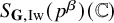 $S_{\mathbf {G}, \operatorname {Iw}}(p^{\beta })(\mathbb {C})$
. Furthermore, we can package these operators together into an
$S_{\mathbf {G}, \operatorname {Iw}}(p^{\beta })(\mathbb {C})$
. Furthermore, we can package these operators together into an $M_{\mathbf {G}}$
-equivariant algebra action
$M_{\mathbf {G}}$
-equivariant algebra action
 $$ \begin{align} C^{\operatorname{pol}}(\mathbb{G}_a^{\oplus 2n-1}, \mathbb{G}_a) \otimes \mathscr{N}_G \to \mathscr{N}_G \end{align} $$
of polynomial functions, such that the projection to the i-th component acts through the operator $\nabla _i$
. The action of
$\nabla _i$
. The action of $M_{\mathbf {G}}$
on
$M_{\mathbf {G}}$
on $C^{\operatorname {pol}}(\mathbb {G}_a^{\oplus 2n-1}, \mathbb {G}_a)$
is given by the adjoint action on the argument, by identifying
$C^{\operatorname {pol}}(\mathbb {G}_a^{\oplus 2n-1}, \mathbb {G}_a)$
is given by the adjoint action on the argument, by identifying $\mathbb {G}_a^{\oplus 2n-1}$
with the unipotent radical of
$\mathbb {G}_a^{\oplus 2n-1}$
with the unipotent radical of $P_{\mathbf {G}}^{\operatorname {std}}$
. One can make similar definitions for the group
$P_{\mathbf {G}}^{\operatorname {std}}$
. One can make similar definitions for the group $\mathbf {H}$
and there is an analogous
$\mathbf {H}$
and there is an analogous $M_{\mathbf {H}}$
-equivariant action of polynomial functions on
$M_{\mathbf {H}}$
-equivariant action of polynomial functions on $\mathscr {N}_{H}$
.
$\mathscr {N}_{H}$
.
With this formalism of sheaves of ‘nearly holomorphic forms’, we can reinterpret the period $\mathscr {P}_{\pi , \chi }(\psi _{\beta }^{[j]})$
algebraically as follows. Given
$\mathscr {P}_{\pi , \chi }(\psi _{\beta }^{[j]})$
algebraically as follows. Given $\chi \in \Sigma _{\pi }$
, one can construct a certain nonzero vector
$\chi \in \Sigma _{\pi }$
, one can construct a certain nonzero vector
 $$\begin{align*}\delta_{\kappa, j} \in V_{\kappa} \otimes C^{\operatorname{pol}}(\mathbb{G}_a^{\oplus 2n-1}, \mathbb{G}_a) \end{align*}$$
which is an eigenvector for the action of $M_{\mathbf {H}}$
with eigencharacter given by a certain character
$M_{\mathbf {H}}$
with eigencharacter given by a certain character $\sigma _{\kappa }^{[j], -1} \colon M_{\mathbf {H}} \to \mathbb {G}_m$
(see §2.2 for its definition) which, up to a shift by the sum of the positive roots of
$\sigma _{\kappa }^{[j], -1} \colon M_{\mathbf {H}} \to \mathbb {G}_m$
(see §2.2 for its definition) which, up to a shift by the sum of the positive roots of $\mathbf {H}$
not lying in
$\mathbf {H}$
not lying in $M_{\mathbf {H}}$
, encodes the infinity-type of
$M_{\mathbf {H}}$
, encodes the infinity-type of $\chi $
. If we write
$\chi $
. If we write $\delta _{\kappa , j} = \sum _{l} v_l \otimes p_l$
as a sum of pure tensors, then we can build a map
$\delta _{\kappa , j} = \sum _{l} v_l \otimes p_l$
as a sum of pure tensors, then we can build a map
 $$ \begin{align*} \mathscr{N}_{G, \kappa^*} = \operatorname{Hom}_{M_{\mathbf{G}}}(V_{\kappa}, \mathscr{N}_G) &\xrightarrow{\vartheta_{\kappa, j, \beta}} \operatorname{Hom}_{M_{\mathbf{H}}}(\sigma_{\kappa}^{[j], -1}, \hat{\iota}_*\mathscr{N}_H) = \hat{\iota}_*\mathscr{N}_{H, \sigma_{\kappa}^{[j]}} \\ F &\mapsto \left( 1 \mapsto \sum_l \hat{\iota}^*(p_l \star F(v_l)) \right) \end{align*} $$
where $\star $
denotes the action in (1.2.1) and
$\star $
denotes the action in (1.2.1) and $\hat {\iota }^*$
denotes the natural pullback map
$\hat {\iota }^*$
denotes the natural pullback map $\mathscr {N}_G \to \hat {\iota }_* \mathscr {N}_H$
. By analysing the representation theory and relevant branching laws for the pair of groups
$\mathscr {N}_G \to \hat {\iota }_* \mathscr {N}_H$
. By analysing the representation theory and relevant branching laws for the pair of groups $(M_{\mathbf {G}}, M_{\mathbf {H}})$
, one can show that this morphism takes ‘holomorphic forms’ for
$(M_{\mathbf {G}}, M_{\mathbf {H}})$
, one can show that this morphism takes ‘holomorphic forms’ for $\mathbf {G}$
to ‘holomorphic forms’ for
$\mathbf {G}$
to ‘holomorphic forms’ for $\mathbf {H}$
, that is, one obtains an induced morphism
$\mathbf {H}$
, that is, one obtains an induced morphism $\vartheta _{\kappa , j, \beta } \colon \mathscr {M}_{G, \kappa ^*} \to \hat {\iota }_* \mathscr {M}_{H, \sigma _{\kappa }^{[j]}}$
. Finally, by Shimura reciprocity, the character
$\vartheta _{\kappa , j, \beta } \colon \mathscr {M}_{G, \kappa ^*} \to \hat {\iota }_* \mathscr {M}_{H, \sigma _{\kappa }^{[j]}}$
. Finally, by Shimura reciprocity, the character $\chi $
can be interpreted as a cohomology class
$\chi $
can be interpreted as a cohomology class $[\chi ] \in \operatorname {H}^0\left ( S_{\mathbf {H}, \diamondsuit }(p^{\beta }), \mathscr {M}_{H, \sigma _{\kappa }^{[j]}}^{\vee } \right )$
, where
$[\chi ] \in \operatorname {H}^0\left ( S_{\mathbf {H}, \diamondsuit }(p^{\beta }), \mathscr {M}_{H, \sigma _{\kappa }^{[j]}}^{\vee } \right )$
, where $(-)^{\vee }$
denotes the Serre dual of a vector bundle. Therefore, for a sufficiently large finite extension
$(-)^{\vee }$
denotes the Serre dual of a vector bundle. Therefore, for a sufficiently large finite extension $L/F$
, we can define an ‘evaluation map’:
$L/F$
, we can define an ‘evaluation map’:
 $$ \begin{align*} \operatorname{Ev}_{\kappa, j, \chi, \beta} \colon \operatorname{H}^{n-1}\left( S_{\mathbf{G}, \operatorname{Iw}}(p^{\beta}), \mathscr{M}_{G, \kappa^*} \right) &\to L \\ \eta &\mapsto \langle \vartheta_{\kappa, j, \beta}(\eta), [\chi] \rangle. \end{align*} $$
Up to explicit nonzero factors, the automorphic period $\mathscr {P}_{\pi , \chi }(\psi _{\beta }^{[j]})$
is equal to the image of
$\mathscr {P}_{\pi , \chi }(\psi _{\beta }^{[j]})$
is equal to the image of $\eta _{\beta }$
under the evaluation map
$\eta _{\beta }$
under the evaluation map $\operatorname {Ev}_{\kappa , j, \chi , \beta }$
, which is the desired algebraic interpretation of the unitary Friedberg–Jacquet periods.
$\operatorname {Ev}_{\kappa , j, \chi , \beta }$
, which is the desired algebraic interpretation of the unitary Friedberg–Jacquet periods.
The benefit of this reinterpretation is that we can study the p-adic behaviour of these evaluation maps, and hence the unitary Friedberg–Jacquet periods. In particular, if we (abusively) let $L/\mathbb {Q}_p$
denote the finite extension obtained as the completion of
$L/\mathbb {Q}_p$
denote the finite extension obtained as the completion of $\iota _p(L)$
and let
$\iota _p(L)$
and let $\mathcal {S}_{G, \operatorname {Iw}}(p^{\beta })$
denote the corresponding adic Shimura variety over L, then by rigid GAGA we can view
$\mathcal {S}_{G, \operatorname {Iw}}(p^{\beta })$
denote the corresponding adic Shimura variety over L, then by rigid GAGA we can view $\eta _{\beta }$
(resp.
$\eta _{\beta }$
(resp. $\operatorname {Ev}_{\kappa , j, \chi , \beta }$
) as a cohomology class in (resp. linear form on) the cohomology group
$\operatorname {Ev}_{\kappa , j, \chi , \beta }$
) as a cohomology class in (resp. linear form on) the cohomology group $\operatorname {H}^{n-1}\left ( \mathcal {S}_{G, \operatorname {Iw}}(p^{\beta }), \mathscr {M}_{G,\kappa ^*} \right )$
. Using the recently developed higher Coleman theory of Boxer–Pilloni [Reference Boxer and PilloniBP21], one can p-adically interpolate these cohomology groups and cohomology classes, so the strategy for p-adically interpolating
$\operatorname {H}^{n-1}\left ( \mathcal {S}_{G, \operatorname {Iw}}(p^{\beta }), \mathscr {M}_{G,\kappa ^*} \right )$
. Using the recently developed higher Coleman theory of Boxer–Pilloni [Reference Boxer and PilloniBP21], one can p-adically interpolate these cohomology groups and cohomology classes, so the strategy for p-adically interpolating $\operatorname {Ev}_{\kappa , j, \chi , \beta }$
is:
$\operatorname {Ev}_{\kappa , j, \chi , \beta }$
is:
-
1. to define overconvergent versions of
$\mathscr {N}_G$
and
$\mathscr {N}_H$
with actions of differential operators which can be p-adically iterated; -
2. construct a p-adic version of the map
$\vartheta _{\kappa , j, \beta }$
by p-adically interpolating the eigenvectors
$\delta _{\kappa , j}$
.


For (1), we generalise the results of [Reference Graham, Pilloni and JacintoGPR25] to the setting of unitary Shimura varieties, and for (2), we generalise the p-adic interpolation of branching laws appearing in [Reference GrahamGra24, Appendix A]. One then builds an overconvergent version of the morphism $\vartheta _{\kappa , j, \beta }$
in a similar way as above. This method can be described rather abstractly and we explain how to accomplish this in §2.3. To be able to p-adically interpolate the eigenvectors
$\vartheta _{\kappa , j, \beta }$
in a similar way as above. This method can be described rather abstractly and we explain how to accomplish this in §2.3. To be able to p-adically interpolate the eigenvectors $\delta _{\kappa , j}$
one must first perform a certain ‘p-depletion’, and in §8.5 we explain how this is related to the appearance of the factor
$\delta _{\kappa , j}$
one must first perform a certain ‘p-depletion’, and in §8.5 we explain how this is related to the appearance of the factor $\mathscr {E}_p(\pi , \chi )$
in the interpolation property in Theorem A. Additionally, this whole strategy can be extended to the setting where we allow the automorphic representation
$\mathscr {E}_p(\pi , \chi )$
in the interpolation property in Theorem A. Additionally, this whole strategy can be extended to the setting where we allow the automorphic representation $\pi $
to vary in Coleman families, which leads to the construction of the p-adic L-function in Theorem B.
$\pi $
to vary in Coleman families, which leads to the construction of the p-adic L-function in Theorem B.
1.3 Structure of the article
This article comprises roughly of three parts. The material in §2–§4 is mostly preliminary and lays the foundations for the constructions of the evaluation maps. More precisely, in §2 we describe the abstract results from representation theory which generalise [Reference GrahamGra24, Appendix A], and give an overview for constructing the (p-adic versions of the) morphisms $\vartheta _{\kappa , j, \beta }$
. In §3, we summarise (and adapt to our setting) the main results on continuous operators on Banach spaces appearing in [Reference Graham, Pilloni and JacintoGPR25]. In §4, we describe a minor generalisation of the theory of Hecke operators and cohomology with support appearing in [Reference Boxer and PilloniBP21, Reference Boxer and PilloniBP], which is necessary for the (slightly more general) version of higher Coleman theory needed in this article.
$\vartheta _{\kappa , j, \beta }$
. In §3, we summarise (and adapt to our setting) the main results on continuous operators on Banach spaces appearing in [Reference Graham, Pilloni and JacintoGPR25]. In §4, we describe a minor generalisation of the theory of Hecke operators and cohomology with support appearing in [Reference Boxer and PilloniBP21, Reference Boxer and PilloniBP], which is necessary for the (slightly more general) version of higher Coleman theory needed in this article.
The second part of this article (§5–§7) involves the study of the geometry and cohomology of unitary Shimura varieties and the construction of the (p-adic) evaluation maps. In §5, we introduce the Shimura varieties (and the associated moduli spaces of abelian varieties with extra structure), the sheaves of ‘nearly holomorphic forms’, and the evaluation maps $\operatorname {Ev}_{\kappa , j, \beta }$
(and their relation to unitary Friedberg–Jacquet periods). We then study the p-adic versions of the sheaves (the sheaves of ‘nearly overconvergent forms’) and the p-adic geometry of the adic Shimura varieties in §6, and describe how to p-adically interpolate the differential operators on these sheaves in §7. We end §7 by giving the construction of p-adic versions of the evaluation maps in families.
$\operatorname {Ev}_{\kappa , j, \beta }$
(and their relation to unitary Friedberg–Jacquet periods). We then study the p-adic versions of the sheaves (the sheaves of ‘nearly overconvergent forms’) and the p-adic geometry of the adic Shimura varieties in §6, and describe how to p-adically interpolate the differential operators on these sheaves in §7. We end §7 by giving the construction of p-adic versions of the evaluation maps in families.
Finally, the third part of this article (§8–§9) describes the construction of the p-adic L-functions in Theorem A and Theorem B. More precisely, in §8 we introduce the action of Hecke operators on the cohomology groups appearing in higher Coleman theory, prove an interpolation property for the p-adic evaluation maps, and develop the abstract machinery for producing the p-adic L-function. In §9, we apply this general machinery to the relevant automorphic representations and prove Theorem A and Theorem B. To obtain the final interpolation formula, one also needs to incorporate some miscellaneous representation theoretic results on branching laws for general linear groups which we provide in Appendix A and Appendix B.
1.4 Notation and conventions
We fix the following notation and conventions throughout the article.
-
• We let
$F/F^+$
be a CM extension with maximal totally real subfield
$F^+ \neq \mathbb {Q}$
. We assume that F contains an imaginary quadratic extension
$E/\mathbb {Q}$
. We fix a CM type
$\Psi $
of F and a distinguished place
$\tau _0 \in \Psi $
(i.e., an embedding
$\tau _0 \colon F \hookrightarrow \mathbb {C}$
). We let
$F^{\operatorname {cl}}$
denote the Galois closure of F in
$\mathbb {C}$
via the embedding
$\tau _0$
. -
• We fix an odd prime p which splits completely in
$F/\mathbb {Q}$
and doesn’t divide the discriminant of
$F/\mathbb {Q}$
. We will also impose Assumption 5.1.1 throughout the majority of the article. -
• We fix an identification
$\iota _p \colon \mathbb {C} \cong \overline {\mathbb {Q}}_p$
, and for any embedding
$\sigma \colon F \hookrightarrow \mathbb {C}$
we let
$\mathfrak {p}_{\sigma }$
denote the prime of F lying above p determined by the embedding
$\iota _p \circ \sigma \colon F \hookrightarrow \overline {\mathbb {Q}}_p$
. -
• We fix an integer
$n \geq 1$
throughout the article (which will be half the dimension of the Hermitian space W). For convenience we assume that
$n \geq 2$
, but note that, with suitable modifications, one can also adapt the methods in this article to treat the case
$n=1$
. -
• For any number field
$\Phi $
, we let
$\mathbb {A}_{\Phi }$
(resp.
$\mathbb {A}_{\Phi }^{\times }$
) denote the adèles (resp. idèles) of
$\Phi $
. If
$\Phi = \mathbb {Q}$
, we will often omit this from the notation. If S is a finite set of places of
$\Phi $
, we let
$\mathbb {A}_{\Phi }^S$
(resp.
$\mathbb {A}_{\Phi , S}$
) denote the adèles away from S (resp. at S). We let
$\mathbb {A}_{\Phi , f}$
denote the adèles at finite places. -
• Unless specified otherwise, we will use additive notation for the multiplication of characters. For a character
$\kappa $
, we will often write . -
• By a ‘Tate affinoid algebra’
$(R, R^+)$
we mean a complete uniform Huber pair
$(R, R^+)$
over
$(\mathbb {Q}_p, \mathbb {Z}_p)$
. We will always assume that
$(R, R^+)$
is sheafy, that is,
$\operatorname {Spa}(R, R^+)$
is an adic space. -
• For a category
$\mathcal {C}$
, let
$\operatorname {Ind}\mathcal {C}$
denote the ind-category of
$\mathcal {C}$
, that is, the category whose objects (which we refer to as ind-systems) are small filtered inductive systems
$X = (X_i)_{i \in I}$
, and whose morphisms are where
$Y = (Y_j)_{j \in J}$
and the transition maps are the obvious ones induced from pre-/postcomposition. By a representative of a morphism
$f \in \operatorname {Hom}(X, Y)$
, we mean the data of a map
$\alpha \colon I \to J$
, and morphisms
$f_i \in \operatorname {Hom}(X_i, Y_{\alpha (i)})$
such that
$f = (f_i)_{i \in I}$
(so in particular, for any
$i' \geq i$
there exists
$j \geq \alpha (i), \alpha (i')$
such that the morphisms
$X_i \xrightarrow {f_i} Y_{\alpha (i)} \to Y_{j}$
and
$X_i \to X_{i'} \xrightarrow {f_{i'}} Y_{\alpha (i')} \to Y_j$
coincide). If
$F \colon \mathcal {C} \to \mathcal {D}$
is a functor, then we will also use the notation
$F \colon \operatorname {Ind}\mathcal {C} \to \operatorname {Ind}\mathcal {D}$
to denote the natural functor given by . Whenever we say that a morphism
$f \in \operatorname {Hom}(X, Y)$
satisfies an additional property (such as equivariance with respect to a group action) we mean that f has a representative
$\{ f_i \}$
where each
$f_i$
satisfy this property.
-
• For a split reductive group G over a characteristic zero field, we let
$w_G^{\operatorname {max}}$
denote the longest element of the Weyl group of G. If
$G = \operatorname {GL}_d$
, we will usually take
$w_{\operatorname {GL}_d}^{\operatorname {max}}$
to be the antidiagonal
$(d \times d)$
-matrix with
$1$
s along the antidiagonal. -
• We fix once and for all a choice
$i = \sqrt {-1} \in \mathbb {C}$
. This determines a canonical choice of p-th power roots of unity
$e^{2 \pi i/p^h} \in \mathbb {C}$
for
$h \geq 0$
, and hence a system of p-th power roots of unity
$\iota _p(e^{2 \pi i/p^h}) \in \overline {\mathbb {Q}}_p$
. Any construction depending on a choice of p-th power roots of unity will be with respect to this canonical choice (e.g., when defining Gauss sums associated with finite order characters of p-th power conductor). -
• If
$s \geq 1$
is an integer,
$(R, R^+)$
is a Tate affinoid algebra, and X is a p-adic manifold (that is, isomorphic to an open subset of
$\mathbb {Q}_p^{r}$
for some
$r \geq 1$
), then we say that a continuous function
$f \colon X \to R$
is s-analytic if: for every
$\underline {a} = (a_1, \dots , a_r) \in X$
there exists
$\alpha _{n_1, \dots , n_r} \in R$
with the property that
$p^{s(n_1+ \cdots + n_r)} \alpha _{n_1, \dots , n_r} \to 0$
as
$n_1+\cdots + n_r \to + \infty $
such that, for every
$(x_1, \dots , x_r) \in X \cap B(\underline {a}, p^{-s})$
, one has (c.f., [Reference UrbanUrb11, §3.2.1]). Here
$$\begin{align*}f(x_1, \dots, x_r) = \sum_{n_1, \dots, n_r \geq 0} \alpha_{n_1, \dots, n_r} (x_1 - a_1)^{n_1} \cdots (x_r - a_r)^{n_r} \end{align*}$$
$B(\underline {a}, p^{-s}) \subset \mathbb {Q}_p^r$
denotes the ball of radius
$p^{-s}$
with centre
$\underline {a}$
. This is independent of the choice of identification of X with an open subset of
$\mathbb {Q}_p^r$
.


 .
.


 . Whenever we say that a morphism





2 Abstract computations
2.1 Recap on the groups and notation
In this section, we recall some notation for the groups and representations appearing in [Reference GrahamGra24].
2.1.1 Algebraic and analytic groups
Let G denote the algebraic group over $\mathbb {Q}_p$
given by
$\mathbb {Q}_p$
given by $G = \operatorname {GL}_1 \times \prod _{\tau \in \Psi } \operatorname {GL}_{2n}$
and let
$G = \operatorname {GL}_1 \times \prod _{\tau \in \Psi } \operatorname {GL}_{2n}$
and let $H \subset G$
denote the subgroup
$H \subset G$
denote the subgroup $H = \operatorname {GL}_1 \times \prod _{\tau \in \Psi } \left (\operatorname {GL}_n \times \operatorname {GL}_n \right )$
embedded block diagonally. If
$H = \operatorname {GL}_1 \times \prod _{\tau \in \Psi } \left (\operatorname {GL}_n \times \operatorname {GL}_n \right )$
embedded block diagonally. If $A \subset G$
(resp.
$A \subset G$
(resp. $A \subset H$
) is any subgroup and
$A \subset H$
) is any subgroup and $\tau \in \Psi $
, then we will call the projection of A to the
$\tau \in \Psi $
, then we will call the projection of A to the $\operatorname {GL}_{2n}$
-factor (resp.
$\operatorname {GL}_{2n}$
-factor (resp. $(\operatorname {GL}_n \times \operatorname {GL}_n)$
-factor) indexed by
$(\operatorname {GL}_n \times \operatorname {GL}_n)$
-factor) indexed by $\tau $
the
$\tau $
the $\tau $
-factor (or
$\tau $
-factor (or $\tau $
-component) of A. We will also call the projection of A to the first
$\tau $
-component) of A. We will also call the projection of A to the first $\operatorname {GL}_1$
-factor the similitude factor of A. If
$\operatorname {GL}_1$
-factor the similitude factor of A. If $d \geq 1$
is an integer and
$d \geq 1$
is an integer and $a_1 + \cdots + a_l = d$
is a partition of d, then we say that
$a_1 + \cdots + a_l = d$
is a partition of d, then we say that $A \subset \operatorname {GL}_d$
is the standard upper-triangular (resp. lower-triangular) parabolic with Levi
$A \subset \operatorname {GL}_d$
is the standard upper-triangular (resp. lower-triangular) parabolic with Levi $\operatorname {GL}_{a_1} \times \cdots \times \operatorname {GL}_{a_l}$
if A has the following block matrix description:
$\operatorname {GL}_{a_1} \times \cdots \times \operatorname {GL}_{a_l}$
if A has the following block matrix description:

In this case, we will also occasionally call A the standard upper-triangular (resp. lower-triangular) parabolic of type $(a_1, \dots , a_l)$
. This definition extends to the groups H and G by specifying the similitude and
$(a_1, \dots , a_l)$
. This definition extends to the groups H and G by specifying the similitude and $\tau $
-factors of the parabolic subgroup as above. If
$\tau $
-factors of the parabolic subgroup as above. If $a_1 = \cdots = a_l = 1$
, then we say A is the standard upper-triangular (lower-triangular) Borel subgroup, and call its Levi subgroup the standard diagonal torus. Finally, if B is an algebraic group satisfying
$a_1 = \cdots = a_l = 1$
, then we say A is the standard upper-triangular (lower-triangular) Borel subgroup, and call its Levi subgroup the standard diagonal torus. Finally, if B is an algebraic group satisfying $\operatorname {GL}_{a_1} \times \cdots \times \operatorname {GL}_{a_l} \subset B \subset \operatorname {GL}_d$
, then we call a parabolic subgroup
$\operatorname {GL}_{a_1} \times \cdots \times \operatorname {GL}_{a_l} \subset B \subset \operatorname {GL}_d$
, then we call a parabolic subgroup $A \subset B$
the standard upper-triangular (lower-triangular) parabolic with Levi
$A \subset B$
the standard upper-triangular (lower-triangular) parabolic with Levi $\operatorname {GL}_{a_1} \times \cdots \times \operatorname {GL}_{a_l}$
if it is the intersection of B with the block subgroup as in (2.1.1).
$\operatorname {GL}_{a_1} \times \cdots \times \operatorname {GL}_{a_l}$
if it is the intersection of B with the block subgroup as in (2.1.1).
Let $P_G \subset G$
denote the upper-triangular parabolic subgroup with Levi subgroup given by
$P_G \subset G$
denote the upper-triangular parabolic subgroup with Levi subgroup given by
 $$\begin{align*}M_G = \operatorname{GL}_1 \times \left( \operatorname{GL}_1 \times \operatorname{GL}_{2n-1} \right) \times \prod_{\tau \neq \tau_0} \operatorname{GL}_{2n} \end{align*}$$
and we set $P_H = P_G \cap H$
and
$P_H = P_G \cap H$
and $M_H = M_G \cap H$
. Let
$M_H = M_G \cap H$
. Let $Q_{M_H}$
denote the standard upper-triangular parabolic of
$Q_{M_H}$
denote the standard upper-triangular parabolic of $M_H$
, which in the
$M_H$
, which in the $\tau _0$
-factor has Levi subgroup
$\tau _0$
-factor has Levi subgroup
 $$\begin{align*}\operatorname{GL}_1 \times \operatorname{GL}_{n-1} \times \operatorname{GL}_1 \times \operatorname{GL}_{n-1}, \end{align*}$$
and in the $\tau $
-factor has Levi subgroup equal to
$\tau $
-factor has Levi subgroup equal to $\operatorname {GL}_n \times \operatorname {GL}_n$
, for
$\operatorname {GL}_n \times \operatorname {GL}_n$
, for $\tau \neq \tau _0$
. All of these groups have obvious integral models over
$\tau \neq \tau _0$
. All of these groups have obvious integral models over $\mathbb {Z}_p$
which we will denote by the same letters.
$\mathbb {Z}_p$
which we will denote by the same letters.
We recall some special elements that appear in [Reference GrahamGra24, §2.4], however note that our definition of $\gamma $
below is slightly different from that in loc.cit.. The reason for this change is that the definition below is more suitable for describing the functoriality between the Igusa towers appearing in §6.1. As seen in Lemma 2.1.3 below, all of the properties in [Reference GrahamGra24] that hold for the old definition of
$\gamma $
below is slightly different from that in loc.cit.. The reason for this change is that the definition below is more suitable for describing the functoriality between the Igusa towers appearing in §6.1. As seen in Lemma 2.1.3 below, all of the properties in [Reference GrahamGra24] that hold for the old definition of $\gamma $
(such as being an open orbit representative for the spherical pair
$\gamma $
(such as being an open orbit representative for the spherical pair $(G, H)$
) are still satisfied for the new definition of
$(G, H)$
) are still satisfied for the new definition of $\gamma $
in this article. Let
$\gamma $
in this article. Let $W_?$
denote the Weyl group of a reductive group
$W_?$
denote the Weyl group of a reductive group $?$
.
$?$
.
Definition 2.1.2. Let $w_n$
denote the unique minimal length representative for
$w_n$
denote the unique minimal length representative for $W_{M_G} \backslash W_G$
of length n. We view
$W_{M_G} \backslash W_G$
of length n. We view $w_n \in G(\mathbb {Z}_p)$
via the explicit matrix in [Reference GrahamGra24, Definition 2.4.1].
$w_n \in G(\mathbb {Z}_p)$
via the explicit matrix in [Reference GrahamGra24, Definition 2.4.1].
-
1. Let
$u \in M_G(\mathbb {Z}_p)$
denote the element as defined in [Reference GrahamGra24, Definition 2.4.2]. -
2. Let
$\gamma = 1 \times \prod _{\tau } \gamma _{\tau } \in P_G(\mathbb {Z}_p)$
denote the element given by where
$x_{\tau _0}$
is the
$1 \times (2n-1)$
-matrix with
$1$
in the n-th place and
$0$
elsewhere. Here is a block matrix with diagonal block sizes
$1 \times 1$
and
$(2n-1) \times (2n-1)$
. We set
$\hat {\gamma } = \gamma \cdot w_n \in G(\mathbb {Z}_p)$
.
-
3. Let
$v \in M_H(\mathbb {Z}_p)$
be the element which is the identity outside the
$\tau _0$
-component, and in the
$\tau _0$
-component is equal to where the last matrix has upper-left block size
$1 \times 1$
, the bottom-right block has size
$(n-1) \times (n-1)$
, and y is the column vector with
$1$
as every entry.


 is a block matrix with diagonal block sizes


The following lemma is the analogue of [Reference GrahamGra24, Lemma 2.4.3].
Lemma 2.1.3.
-
1. Let
$B_G$
denote the standard upper-triangular Borel subgroup of G. Then the subset
$H \cdot \hat {\gamma } \cdot B_G$
is Zariski open and dense in G (over
$\operatorname {Spec}\mathbb {Z}_p$
). -
2. Let
$B_{M_G}$
denote the standard upper-triangular Borel subgroup of
$M_G$
. Then the subset with
$$\begin{align*}M_H \cdot (u, v) \cdot \left( B_{M_G} \times Q_{M_H} \right) \subset M_{G} \times M_H \end{align*}$$
$M_H \subset M_G \times M_H$
diagonally, is Zariski open and dense in
$M_G$
(over
$\operatorname {Spec}\mathbb {Z}_p$
).


Proof. The proof of (1) is identical to [Reference GrahamGra24, Lemma 2.4.3(2)] but instead we have a similar decomposition

as in loc.cit. with $X w_{\operatorname {GL}_n}^{\operatorname {max}} = 1 \times w_{\operatorname {GL}_{n-1}}^{\operatorname {max}}$
. Part (2) is very similar to [Reference GrahamGra24, Lemma 2.4.3(1)]. More precisely, it is enough to establish this for each
$X w_{\operatorname {GL}_n}^{\operatorname {max}} = 1 \times w_{\operatorname {GL}_{n-1}}^{\operatorname {max}}$
. Part (2) is very similar to [Reference GrahamGra24, Lemma 2.4.3(1)]. More precisely, it is enough to establish this for each $\tau $
-factor with
$\tau $
-factor with $\tau \in \Psi $
. For
$\tau \in \Psi $
. For $\tau \neq \tau _0$
this follows immediately from loc.cit.. For
$\tau \neq \tau _0$
this follows immediately from loc.cit.. For $\tau = \tau _0$
, one can explicitly calculate the stabiliser
$\tau = \tau _0$
, one can explicitly calculate the stabiliser $M_H \cap (u, v) (B_{M_G} \times Q_{M_H}) (u, v)^{-1}$
in the
$M_H \cap (u, v) (B_{M_G} \times Q_{M_H}) (u, v)^{-1}$
in the $\tau _0$
-component; namely it is equal to all diagonal matrices of the form
$\tau _0$
-component; namely it is equal to all diagonal matrices of the form
 $$\begin{align*}\operatorname{diag}(x, y, \dots, y) \subset \operatorname{GL}_1 \times \operatorname{GL}_{n-1} \times \operatorname{GL}_n. \end{align*}$$
This stabiliser has the minimal possible dimension, which forces the subset to be Zariski open and dense.
We now introduce the relevant p-adic analytic groups. Let $\beta \geq 1$
be an integer. We let
$\beta \geq 1$
be an integer. We let $M^G_{\operatorname {Iw}}(p^{\beta })$
denote the upper-triangular depth
$M^G_{\operatorname {Iw}}(p^{\beta })$
denote the upper-triangular depth $p^{\beta }$
Iwahori subgroup in
$p^{\beta }$
Iwahori subgroup in $M_G(\mathbb {Z}_p)$
(i.e., all elements which lie in
$M_G(\mathbb {Z}_p)$
(i.e., all elements which lie in $B_{M_G}$
modulo
$B_{M_G}$
modulo $p^\beta $
). Let T denote the standard diagonal torus in G. We denote by
$p^\beta $
). Let T denote the standard diagonal torus in G. We denote by $(x; y_{1, \tau }, \dots , y_{2n, \tau })$
the element of T given by
$(x; y_{1, \tau }, \dots , y_{2n, \tau })$
the element of T given by
 $$\begin{align*}x \times \prod_{\tau \in \Psi} \operatorname{diag}(y_{1, \tau}, \dots, y_{2n, \tau}). \end{align*}$$
Let $T^{\diamondsuit } \subset T$
denote the subtorus of elements which satisfy
$T^{\diamondsuit } \subset T$
denote the subtorus of elements which satisfy $y_{1, \tau _0} = y_{n+1, \tau _0}$
,
$y_{1, \tau _0} = y_{n+1, \tau _0}$
, $y_{i, \tau _0} = y_{2n+2-i, \tau _0}$
for
$y_{i, \tau _0} = y_{2n+2-i, \tau _0}$
for $i=2, \dots , n$
, and
$i=2, \dots , n$
, and $y_{i, \tau } = y_{2n+1-i, \tau }$
for
$y_{i, \tau } = y_{2n+1-i, \tau }$
for $i=1, \dots , n$
and
$i=1, \dots , n$
and $\tau \neq \tau _0$
. We let
$\tau \neq \tau _0$
. We let $M^H_{\diamondsuit }(p^{\beta }) \subset M_H(\mathbb {Z}_p)$
denote the subgroup of elements which land in
$M^H_{\diamondsuit }(p^{\beta }) \subset M_H(\mathbb {Z}_p)$
denote the subgroup of elements which land in $T^{\diamondsuit }$
modulo
$T^{\diamondsuit }$
modulo $p^{\beta }$
. Note that
$p^{\beta }$
. Note that $u^{-1} M^H_{\diamondsuit }(p^{\beta }) u \subset M^G_{\operatorname {Iw}}(p^{\beta })$
.
$u^{-1} M^H_{\diamondsuit }(p^{\beta }) u \subset M^G_{\operatorname {Iw}}(p^{\beta })$
.
2.1.2 Algebraic and locally analytic weights
Let $X^*(T)$
denote the group of algebraic characters
$X^*(T)$
denote the group of algebraic characters $T \to \mathbb {G}_m$
. Any such character
$T \to \mathbb {G}_m$
. Any such character $\kappa \in X^*(T)$
can be described as a tuple of integers
$\kappa \in X^*(T)$
can be described as a tuple of integers $(\kappa _0; \kappa _{1, \tau }, \dots , \kappa _{2n, \tau })$
such that
$(\kappa _0; \kappa _{1, \tau }, \dots , \kappa _{2n, \tau })$
such that
 $$\begin{align*}\kappa( x; y_{1, \tau}, \dots, y_{2n, \tau} ) = x^{\kappa_0} \prod_{\tau \in \Psi} \prod_{i=1}^{2n} y_{i, \tau}^{\kappa_{i, \tau}}. \end{align*}$$
Let $S = \prod _{\tau \in \Psi } \mathbb {G}_m$
, so that any element
$S = \prod _{\tau \in \Psi } \mathbb {G}_m$
, so that any element $j \in X^*(S)$
is described as a tuple of integers
$j \in X^*(S)$
is described as a tuple of integers $j = (j_{\tau })_{\tau \in \Psi }$
. In this article we will consider the following cone of algebraic weights.
$j = (j_{\tau })_{\tau \in \Psi }$
. In this article we will consider the following cone of algebraic weights.
Definition 2.1.4. Let $\mathcal {E} \subset X^*(T \times S)$
denote the submonoid of algebraic characters
$\mathcal {E} \subset X^*(T \times S)$
denote the submonoid of algebraic characters $(\kappa , j)$
with
$(\kappa , j)$
with $\kappa \in X^*(T)$
and
$\kappa \in X^*(T)$
and $j \in X^*(S)$
, satisfying the following properties:
$j \in X^*(S)$
, satisfying the following properties:
-
•
$\kappa $
is
$M_G$
-dominant, that is,
$\kappa _{2, \tau _0} \geq \cdots \geq \kappa _{2n, \tau _0}$
and
$\kappa _{1, \tau } \geq \cdots \geq \kappa _{2n, \tau }$
for all
$\tau \neq \tau _0$
. -
• There exists an integer
$w \in \mathbb {Z}_{\leq 0}$
such that for all
$$\begin{align*}\kappa_{i, \tau_0} + \kappa_{2n+2-i, \tau_0} = w \end{align*}$$
$i=2, \dots , n$
, and
$\kappa _{n+1, \tau _0} \leq w$
.
-
• For all
$\tau \neq \tau _0$
and
$i=1, \dots , n$
, we have
$$\begin{align*}\kappa_{i, \tau} + \kappa_{2n+1-i, \tau} = 0. \end{align*}$$
-
• The tuple
$j = (j_{\tau })$
satisfies
$0 \leq j_{\tau _0} \leq \kappa _{n+1, \tau _0} - \kappa _{n+2, \tau _0}$
and for all
$$\begin{align*}0 \leq j_{\tau} \leq \kappa_{n, \tau} \end{align*}$$
$\tau \neq \tau _0$
.





Let
 $$\begin{align*}\{\mu_0, \mu_w \} \cup \{ \mu_{i, \tau_0} : i=1, \dots, n+1 \} \cup \{ \mu_{i, \tau} : i=1, \dots, n \text{ and } \tau \neq \tau_0 \} \subset X^*(T) \end{align*}$$
denote the collection of characters given by
-
•
$\mu _0(x; y_{1, \tau }, \dots , y_{2n, \tau }) = x$
and
$\mu _w(x; y_{1, \tau }, \dots , y_{2n, \tau }) = \prod _{i=n+1}^{2n} y_{i, \tau _0}^{-1}$
. -
•
$\mu _{1, \tau _0}(x; y_{1, \tau }, \dots , y_{2n, \tau }) = y_{1, \tau _0}$
. -
• For all
$i=2, \dots , n$
, one has
$\mu _{i, \tau _0}(x; y_{1, \tau }, \dots , y_{2n, \tau }) = \prod _{j=2}^{i} y_{j, \tau _0} y_{2n+2-j, \tau _0}^{-1}$
. -
•
$\mu _{n+1, \tau _0}(x; y_{1, \tau }, \dots , y_{2n, \tau }) = y_{n+1, \tau _0}^{-1} \prod _{j=2}^{n} y_{j, \tau _0} y_{2n+2-j, \tau _0}^{-1}$
. -
• For all
$i=1, \dots , n$
and
$\tau \neq \tau _0$
,
$\mu _{i, \tau }(x; y_{1, \tau }, \dots , y_{2n, \tau }) = \prod _{j=1}^{i} y_{j, \tau } y_{2n+1-j, \tau }^{-1}$
.


For any $\tau \in \Psi $
, let
$\tau \in \Psi $
, let $1_{\tau } \in X^*(S)$
denote the character given by
$1_{\tau } \in X^*(S)$
denote the character given by $1_{\tau } = (0, \dots , 0, 1, 0, \dots , 0)$
where
$1_{\tau } = (0, \dots , 0, 1, 0, \dots , 0)$
where $1$
is in the
$1$
is in the $\tau $
-component. This collection of characters provides an explicit generating set of
$\tau $
-component. This collection of characters provides an explicit generating set of $\mathcal {E}$
, as explained in the following lemma:
$\mathcal {E}$
, as explained in the following lemma:
Lemma 2.1.5. For any $(\kappa , j) \in \mathcal {E}$
, there exist unique integers
$(\kappa , j) \in \mathcal {E}$
, there exist unique integers $a_0, a_{1, \tau _0} \in \mathbb {Z}$
,
$a_0, a_{1, \tau _0} \in \mathbb {Z}$
, $a_w, a_{i, \tau } \in \mathbb {Z}_{\geq 0}$
for
$a_w, a_{i, \tau } \in \mathbb {Z}_{\geq 0}$
for $(i, \tau ) \neq (1, \tau _0)$
, and
$(i, \tau ) \neq (1, \tau _0)$
, and $b_{\tau } \in \mathbb {Z}_{\geq 0}$
such that
$b_{\tau } \in \mathbb {Z}_{\geq 0}$
such that
 $$\begin{align*}(\kappa, j) = a_0 (\mu_0, 0) + a_w (\mu_w, 0) + a_{n+1, \tau_0}(\mu_{n+1, \tau_0}, 0) + \sum_{i=1}^n \sum_{\tau \in \Psi} a_{i, \tau}(\mu_{i, \tau}, 0) + \sum_{\tau \in \Psi} b_{\tau} (\mu_{n, \tau}, 1_{\tau}). \end{align*}$$
Proof. We can take $a_0 = \kappa _0$
,
$a_0 = \kappa _0$
, $a_w = -(\kappa _{n, \tau _0} + \kappa _{n+2, \tau _0})$
,
$a_w = -(\kappa _{n, \tau _0} + \kappa _{n+2, \tau _0})$
, $a_{n+1, \tau _0} = \kappa _{n, \tau _0} - \kappa _{n+1, \tau _0} + \kappa _{n+2, \tau _0}$
,
$a_{n+1, \tau _0} = \kappa _{n, \tau _0} - \kappa _{n+1, \tau _0} + \kappa _{n+2, \tau _0}$
, $a_{1, \tau _0} = \kappa _{1, \tau _0}$
,
$a_{1, \tau _0} = \kappa _{1, \tau _0}$
, $a_{i, \tau _0} = \kappa _{i, \tau _0} - \kappa _{i+1, \tau _0}$
(
$a_{i, \tau _0} = \kappa _{i, \tau _0} - \kappa _{i+1, \tau _0}$
( $i \in \{2, \dots , n-1\}$
),
$i \in \{2, \dots , n-1\}$
), $a_{n, \tau _0} = \kappa _{n+1, \tau _0} - \kappa _{n+2, \tau _0} - j_{\tau _0}$
,
$a_{n, \tau _0} = \kappa _{n+1, \tau _0} - \kappa _{n+2, \tau _0} - j_{\tau _0}$
, $a_{i, \tau } = \kappa _{i, \tau } - \kappa _{i+1, \tau }$
(
$a_{i, \tau } = \kappa _{i, \tau } - \kappa _{i+1, \tau }$
( $i \in \{1, \dots , n-1 \}$
,
$i \in \{1, \dots , n-1 \}$
, $\tau \neq \tau _0$
),
$\tau \neq \tau _0$
), $a_{n, \tau } = \kappa _{n, \tau } - j_{\tau }$
(
$a_{n, \tau } = \kappa _{n, \tau } - j_{\tau }$
( $\tau \neq \tau _0$
), and
$\tau \neq \tau _0$
), and $b_{\tau } = j_{\tau }$
(
$b_{\tau } = j_{\tau }$
( $\tau \in \Psi $
). This is the only possible choice that works. See also, [Reference GrahamGra24, p.1175].
$\tau \in \Psi $
). This is the only possible choice that works. See also, [Reference GrahamGra24, p.1175].
We now introduce the p-adic weights that will appear in this article. Let $(R, R^+)$
denote a complete Tate affinoid algebra over
$(R, R^+)$
denote a complete Tate affinoid algebra over $(\mathbb {Q}_p, \mathbb {Z}_p)$
. Let
$(\mathbb {Q}_p, \mathbb {Z}_p)$
. Let $s \geq 1$
be an integer. We say that a continuous character on
$s \geq 1$
be an integer. We say that a continuous character on $\mathbb {Z}_p^{\times }$
(or several copies of
$\mathbb {Z}_p^{\times }$
(or several copies of $\mathbb {Z}_p^{\times }$
) is s-analytic if it is s-analytic as a continuous function (as in §1.4).
$\mathbb {Z}_p^{\times }$
) is s-analytic if it is s-analytic as a continuous function (as in §1.4).
Definition 2.1.6. Let $s \geq 1$
be an integer. We let
$s \geq 1$
be an integer. We let $\mathcal {X}_{R, s}$
denote the group of s-analytic characters
$\mathcal {X}_{R, s}$
denote the group of s-analytic characters $(\kappa , j) \colon T(\mathbb {Z}_p) \times S(\mathbb {Z}_p) \to (R^+)^{\times }$
which satisfy:
$(\kappa , j) \colon T(\mathbb {Z}_p) \times S(\mathbb {Z}_p) \to (R^+)^{\times }$
which satisfy:
-
• There exists an s-analytic character
$w \colon \mathbb {Z}_p^{\times } \to (R^+)^{\times }$
such that for all
$$\begin{align*}\kappa_{i, \tau_0} + \kappa_{2n+2-i,\tau_0} = w \end{align*}$$
$i=2, \dots , n$
.
-
• For all
$i=1, \dots , n$
and
$\tau \neq \tau _0$
, we have
$$\begin{align*}\kappa_{i, \tau} + \kappa_{2n+1 - i, \tau} = 0. \end{align*}$$


We let $\mathcal {X}_R = \cup _{s \geq 1} \mathcal {X}_{R, s}$
denote the corresponding space of locally analytic characters.
$\mathcal {X}_R = \cup _{s \geq 1} \mathcal {X}_{R, s}$
denote the corresponding space of locally analytic characters.
Remark 2.1.7. As in Lemma 2.1.5, for any $(\kappa , j) \in \mathcal {X}_{R, s}$
, we can write
$(\kappa , j) \in \mathcal {X}_{R, s}$
, we can write
 $$ \begin{align*} (\kappa, j) = a_0 \circ (\mu_0, 0) + a_w \circ (\mu_w, 0) &+ a_{n+1, \tau_0} \circ (\mu_{n+1, \tau_0}, 0) \\ &+ \sum_{i=1}^n \sum_{\tau \in \Psi} a_{i, \tau} \circ (\mu_{i, \tau}, 0) + \sum_{\tau \in \Psi} b_{\tau} \circ (\mu_{n, \tau}, 1_{\tau}) \end{align*} $$
for unique s-analytic characters $a_0, a_w, a_{i, \tau }, b_{\tau } \colon \mathbb {Z}_p^{\times } \to (R^+)^{\times }$
.
$a_0, a_w, a_{i, \tau }, b_{\tau } \colon \mathbb {Z}_p^{\times } \to (R^+)^{\times }$
.
2.2 Branching laws
In this section, we extend the branching laws in [Reference GrahamGra24, Appendix A] to cover more general anticyclotomic twists. To be more precise, if we take $j_{\tau _0} = 0$
(i.e.,
$j_{\tau _0} = 0$
(i.e., $j_{\tau _0}$
is the trivial character) in Proposition 2.2.14 below, then we recover [Reference GrahamGra24, Theorem A.5.10]. The key point of this section is to incorporate nontrivial
$j_{\tau _0}$
is the trivial character) in Proposition 2.2.14 below, then we recover [Reference GrahamGra24, Theorem A.5.10]. The key point of this section is to incorporate nontrivial $j_{\tau _0}$
into the branching laws; for the applications to p-adic L-functions, this will allow us to vary the infinity-type of the anticyclotomic twist freely (without the restriction in [Reference GrahamGra24, §8.1]).
$j_{\tau _0}$
into the branching laws; for the applications to p-adic L-functions, this will allow us to vary the infinity-type of the anticyclotomic twist freely (without the restriction in [Reference GrahamGra24, §8.1]).
2.2.1 Classical branching laws
Before discussing the classical branching law in this situation, we first recall a classical branching result for algebraic representations of general linear groups known as Pieri’s rule (or more generally, the Littlewood–Richardson rule).
Lemma 2.2.1. Let $d \geq 1$
be an integer, and
$d \geq 1$
be an integer, and $\kappa $
a dominant weight for the diagonal torus inside
$\kappa $
a dominant weight for the diagonal torus inside $\operatorname {GL}_d$
, which we describe as a tuple of integers
$\operatorname {GL}_d$
, which we describe as a tuple of integers $(\kappa _1, \dots , \kappa _d)$
in the usual way. Let
$(\kappa _1, \dots , \kappa _d)$
in the usual way. Let $V_{\kappa }$
be the algebraic representation of
$V_{\kappa }$
be the algebraic representation of $\operatorname {GL}_d$
of highest weight
$\operatorname {GL}_d$
of highest weight $\kappa $
, and for
$\kappa $
, and for $j \geq 0$
, let
$j \geq 0$
, let $W_{-j}$
denote the algebraic representation of
$W_{-j}$
denote the algebraic representation of $\operatorname {GL}_d$
of highest weight
$\operatorname {GL}_d$
of highest weight $(0, \dots , 0, -j)$
.
$(0, \dots , 0, -j)$
.
-
1. One has a
$\operatorname {GL}_d$
-equivariant decomposition where the sum is over all dominant
$$\begin{align*}V_{\kappa} \otimes W_{-j} = \bigoplus_{\kappa'} V_{\kappa'} \end{align*}$$
$\kappa ' = (\kappa _1 - t_1, \dots , \kappa _d - t_d)$
with
$t_i \geq 0$
for all i,
$\sum _{i=1}^d t_i = j$
, and
$t_{i} \leq \kappa _i - \kappa _{i+1}$
for all
$i=1, \dots , d-1$
.
-
2. Suppose that
$d = 2c -1$
is odd and consider the subgroup
$\operatorname {GL}_{c-1} \times \operatorname {GL}_c \subset \operatorname {GL}_d$
embedded block diagonally. Let
$S_{-j}$
denote the algebraic representation of
$\operatorname {GL}_c$
of highest weight
$(0, \dots , 0, -j)$
. Then (2.2.2)implies that
$$ \begin{align} \left( V_{\kappa}|_{1 \times \operatorname{GL}_c} \otimes S_{-j} \otimes \operatorname{det}^k \right)^{1 \times \operatorname{GL}_c} \neq 0, \quad \quad \quad \text{ for some } k \in \mathbb{Z}, \end{align} $$
$0 \leq k + \kappa _c \leq j$
.


Proof. Part (1) follows from Pieri’s rule (see [Reference Goodman and WallachGW09, Corollary 9.2.4]). For part (2), we know that if (2.2.2) holds then we have
 $$\begin{align*}\left( V_{\kappa} \otimes W_{-j} \otimes \operatorname{det}^k \right)^{1 \times \operatorname{GL}_c} \neq 0. \end{align*}$$
By part (1), this implies $(V_{\kappa '} \otimes \operatorname {det}^k )^{1 \times \operatorname {GL}_c} \neq 0$
for some
$(V_{\kappa '} \otimes \operatorname {det}^k )^{1 \times \operatorname {GL}_c} \neq 0$
for some $\kappa '$
as in part (1). But by [Reference KnappKna01, Theorem 2.1], this implies that
$\kappa '$
as in part (1). But by [Reference KnappKna01, Theorem 2.1], this implies that $k + \kappa ^{\prime }_c = k + \kappa _c - t_c = 0$
as required.
$k + \kappa ^{\prime }_c = k + \kappa _c - t_c = 0$
as required.
Recall the definition of $\mathcal {E}$
from Definition 2.1.4. For any
$\mathcal {E}$
from Definition 2.1.4. For any $(\kappa , j) \in \mathcal {E}$
, we let
$(\kappa , j) \in \mathcal {E}$
, we let $\sigma _{\kappa }^{[j]} \colon M_H \to \mathbb {G}_m$
denote the character given by sending a general element
$\sigma _{\kappa }^{[j]} \colon M_H \to \mathbb {G}_m$
denote the character given by sending a general element $(x; y_1, y_2, y_3; z_{1, \tau }, z_{2, \tau })_{\tau \neq \tau _0}$
to
$(x; y_1, y_2, y_3; z_{1, \tau }, z_{2, \tau })_{\tau \neq \tau _0}$
to
 $$ \begin{align} x^{-\kappa_0} y_1^{-\kappa_{1, \tau_0} - j_{\tau_0}} \operatorname{det}y_2^{\kappa_{n+1, \tau_0} - j_{\tau_0} - w} \operatorname{det}y_3^{-\kappa_{n+1, \tau_0} + j_{\tau_0}} \prod_{\tau \neq \tau_0} \operatorname{det} z_{1, \tau}^{-j_{\tau}} \operatorname{det}z_{2, \tau}^{j_{\tau}}. \end{align} $$
Theorem 2.2.4. Let $(\kappa , j) \in \mathcal {E}$
, and let
$(\kappa , j) \in \mathcal {E}$
, and let $S_{-j}$
denote the algebraic representation of
$S_{-j}$
denote the algebraic representation of $M_H$
with highest weight trivial outside the
$M_H$
with highest weight trivial outside the $\tau _0$
-component, and
$\tau _0$
-component, and $(j_{\tau _0},0, \dots , 0, -j_{\tau _0})$
at
$(j_{\tau _0},0, \dots , 0, -j_{\tau _0})$
at $\tau _0$
. Let
$\tau _0$
. Let $V_{\kappa }$
denote the algebraic representation of
$V_{\kappa }$
denote the algebraic representation of $M_G$
with highest weight
$M_G$
with highest weight $\kappa $
. We equip
$\kappa $
. We equip $V_{\kappa } \otimes S_{-j}$
with the action
$V_{\kappa } \otimes S_{-j}$
with the action $\star $
of
$\star $
of $u^{-1}M_Hu$
given on pure tensors by
$u^{-1}M_Hu$
given on pure tensors by

Then there exists a unique vector $x_{\kappa }^{[j]} \in V_{\kappa } \otimes S_{-j}$
with the following properties:
$x_{\kappa }^{[j]} \in V_{\kappa } \otimes S_{-j}$
with the following properties:
-
1.
$x_{\kappa }^{[j]}$
is an eigenvector for the action of
$u^{-1}M_Hu$
via
$\star $
, with eigencharacter given by the inverse of the character
$\sigma _{\kappa }^{[j]}$
, that is, we have for all
$$\begin{align*}(u^{-1}m u) \star x_{\kappa}^{[j]} = \sigma_{\kappa}^{[j]}(m)^{-1} x_{\kappa}^{[j]} \end{align*}$$
$m \in M_H$
.
-
2. If we identify
$V_{\kappa } \otimes S_{-j}$
with the space of all algebraic functions
$f \colon M_G \times M_H \to \mathbb {A}^1$
satisfying the following transformation property: where
$$\begin{align*}f((m_1, m_2) \cdot (b, q)) = w_{M_G}^{\operatorname{max}} \kappa(b^{-1}) \cdot q_1^{-j_{\tau_0}} q_3^{j_{\tau_0}} \cdot f(m_1, m_2) \end{align*}$$
$(b, q) \in B_{M_G} \times Q_{M_H}$
and the projection of q to the
$\tau _0$
-component of the Levi is
$(q_1, q_2, q_3, q_4)$
, then we have Here the
$$\begin{align*}x_{\kappa}^{[j]}(1, v) = 1. \end{align*}$$
$M_G \times M_H$
action is via
$[(g, h) \cdot f](m_1, m_2) = f(g^{-1}m_1, h^{-1}m_2)$
.


Proof. Let $W_{-j}$
denote the algebraic representation of
$W_{-j}$
denote the algebraic representation of $M_G$
with the same highest weight as
$M_G$
with the same highest weight as $S_{-j}$
. Then Lemma 2.2.1(1) implies that
$S_{-j}$
. Then Lemma 2.2.1(1) implies that $V_{\kappa '}$
appears in
$V_{\kappa '}$
appears in $V_{\kappa } \otimes W_{-j}$
with multiplicity one, where
$V_{\kappa } \otimes W_{-j}$
with multiplicity one, where $\kappa '$
is the weight equal to
$\kappa '$
is the weight equal to $\kappa $
except for
$\kappa $
except for $\kappa _{1, \tau _0}' = \kappa _{1, \tau _0}+j_{\tau _0}$
and
$\kappa _{1, \tau _0}' = \kappa _{1, \tau _0}+j_{\tau _0}$
and $\kappa _{n+1, \tau _0}' = \kappa _{n+1, \tau _0} - j_{\tau _0}$
. It is shown in [Reference GrahamGra24, Theorem A.5.4] that there exists a (nonzero) vector
$\kappa _{n+1, \tau _0}' = \kappa _{n+1, \tau _0} - j_{\tau _0}$
. It is shown in [Reference GrahamGra24, Theorem A.5.4] that there exists a (nonzero) vector $v_{\kappa }^{[j]} \in V_{\kappa '}$
with multiplicity one on which
$v_{\kappa }^{[j]} \in V_{\kappa '}$
with multiplicity one on which $M_H$
acts through the inverse of the character
$M_H$
acts through the inverse of the character $\sigma _{\kappa }^{[j]}$
. In fact it has multiplicity one in
$\sigma _{\kappa }^{[j]}$
. In fact it has multiplicity one in $V_{\kappa } \otimes W_{-j}$
(by Lemma 2.2.1(1),
$V_{\kappa } \otimes W_{-j}$
(by Lemma 2.2.1(1), $\kappa '$
is the unique weight appearing in the decomposition with
$\kappa '$
is the unique weight appearing in the decomposition with $\kappa _{n+1, \tau _0}' = \kappa _{n+1, \tau _0} - j_{\tau _0}$
).
$\kappa _{n+1, \tau _0}' = \kappa _{n+1, \tau _0} - j_{\tau _0}$
).
Decompose $W_{-1}|_{M_H} = T_{-1} \oplus S_{-1}$
, where
$W_{-1}|_{M_H} = T_{-1} \oplus S_{-1}$
, where $T_{-1}$
is the algebraic representation of
$T_{-1}$
is the algebraic representation of $M_H$
with highest weight in the
$M_H$
with highest weight in the $\tau _0$
-component given by
$\tau _0$
-component given by $(1, 0, \dots ,0, -1, 0, \dots , 0)$
(where the
$(1, 0, \dots ,0, -1, 0, \dots , 0)$
(where the $-1$
is in the n-th place). We have the following decomposition
$-1$
is in the n-th place). We have the following decomposition
 $$\begin{align*}W_{-j}|_{M_H} = \bigoplus_{i=0}^{j_{\tau_0}} \operatorname{Sym}^i(T_{-1}) \otimes \operatorname{Sym}^{j_{\tau_0}-i} (S_{-1}) = \bigoplus_{i=0}^{j_{\tau_0}} \operatorname{Sym}^i(T_{-1}) \otimes S_{-(j-i)} \end{align*}$$
where $S_{-(j-i)}$
has highest weight trivial outside the
$S_{-(j-i)}$
has highest weight trivial outside the $\tau _0$
-component, and
$\tau _0$
-component, and $(j_{\tau _0} - i, 0, \dots , 0, -(j_{\tau _0} - i))$
in the
$(j_{\tau _0} - i, 0, \dots , 0, -(j_{\tau _0} - i))$
in the $\tau _0$
-component. Then we must have that
$\tau _0$
-component. Then we must have that $v_{\kappa }^{[j]}$
appears in
$v_{\kappa }^{[j]}$
appears in $V_{\kappa } \otimes \operatorname {Sym}^i(T_{-1}) \otimes S_{-(j-i)}$
for some
$V_{\kappa } \otimes \operatorname {Sym}^i(T_{-1}) \otimes S_{-(j-i)}$
for some $0 \leq i \leq j_{\tau _0}$
, which implies that
$0 \leq i \leq j_{\tau _0}$
, which implies that
 $$\begin{align*}\left( V_{\kappa}|_{M_H} \otimes S_{-(j-i)} \otimes \operatorname{det}_{\tau_0}^{-\kappa_{n+1, \tau_0} + j_{\tau_0}} \right)^{M'} \neq 0. \end{align*}$$
where $M' \subset M_H$
denotes the subgroup which in the
$M' \subset M_H$
denotes the subgroup which in the $\tau _0$
-component is equal to
$\tau _0$
-component is equal to $\operatorname {GL}_1 \times \{1\} \times \operatorname {GL}_n$
, and is trivial outside the
$\operatorname {GL}_1 \times \{1\} \times \operatorname {GL}_n$
, and is trivial outside the $\tau _0$
-component. Here
$\tau _0$
-component. Here $\operatorname {det}_{\tau _0}$
denotes the determinant character in the
$\operatorname {det}_{\tau _0}$
denotes the determinant character in the $\tau _0$
-component. By Lemma 2.2.1(2), this implies that
$\tau _0$
-component. By Lemma 2.2.1(2), this implies that $0 \leq j_{\tau _0} \leq j_{\tau _0}-i$
, hence
$0 \leq j_{\tau _0} \leq j_{\tau _0}-i$
, hence $i = 0$
. We now define
$i = 0$
. We now define $x_{\kappa }^{[j]}$
as
$x_{\kappa }^{[j]}$
as $(u^{-1}, 1) \cdot v_{\kappa }^{[j]}$
and the rest of the theorem follows from Lemma 2.1.3.
$(u^{-1}, 1) \cdot v_{\kappa }^{[j]}$
and the rest of the theorem follows from Lemma 2.1.3.
We note the following crucial property of the vectors in the above theorem. Let $\overline {N}_{M_G}$
and
$\overline {N}_{M_G}$
and $\overline {N}_{M_H}$
denote the opposite unipotent radicals of
$\overline {N}_{M_H}$
denote the opposite unipotent radicals of $B_{M_G}$
and
$B_{M_G}$
and $Q_{M_H}$
respectively. For an integer
$Q_{M_H}$
respectively. For an integer $\beta \geq 1$
, let
$\beta \geq 1$
, let $\overline {N}_{M_G, \beta }^1 \subset \overline {N}_{M_G}(\mathbb {Z}_p)$
denote the subgroup of elements which are congruent to the identity modulo
$\overline {N}_{M_G, \beta }^1 \subset \overline {N}_{M_G}(\mathbb {Z}_p)$
denote the subgroup of elements which are congruent to the identity modulo $p^{\beta }$
.
$p^{\beta }$
.
Corollary 2.2.5. Let $\beta \geq 1$
. Consider the
$\beta \geq 1$
. Consider the $B_{M_G} \times M_H$
-equivariant map
$B_{M_G} \times M_H$
-equivariant map $V_{\kappa } \otimes S_{-j} \to w_{M_G}^{\operatorname {max}}\kappa \otimes S_{-j}$
given by restricting an algebraic function on
$V_{\kappa } \otimes S_{-j} \to w_{M_G}^{\operatorname {max}}\kappa \otimes S_{-j}$
given by restricting an algebraic function on $M_G \times M_H$
to
$M_G \times M_H$
to $1 \times M_H$
. Then the image of
$1 \times M_H$
. Then the image of $x_{\kappa }^{[j]}$
under this map is a lowest weight vector. Furthermore, this implies that
$x_{\kappa }^{[j]}$
under this map is a lowest weight vector. Furthermore, this implies that
 $$\begin{align*}x_{\kappa}^{[j]}(n, m) \in 1 + p^{\beta} \mathbb{Z}_p \subset \mathbb{Z}_p^{\times} \end{align*}$$
for $(n, m) \in \overline {N}_{M_G, \beta }^1 \times \overline {N}_{M_H}(\mathbb {Z}_p)$
.
$(n, m) \in \overline {N}_{M_G, \beta }^1 \times \overline {N}_{M_H}(\mathbb {Z}_p)$
.
Proof. Let $T^{\clubsuit } \subset T$
denote the subtorus of elements of the form
$T^{\clubsuit } \subset T$
denote the subtorus of elements of the form $(t_0; t_{1, \tau }, \dots , t_{2n, \tau })$
with the condition that
$(t_0; t_{1, \tau }, \dots , t_{2n, \tau })$
with the condition that $t_{i, \tau _0} = t_{2n+2-i, \tau _0}$
for
$t_{i, \tau _0} = t_{2n+2-i, \tau _0}$
for $i=2, \dots , n$
and
$i=2, \dots , n$
and $t_{i, \tau } = t_{2n+1 - i, \tau }$
for all
$t_{i, \tau } = t_{2n+1 - i, \tau }$
for all $\tau \neq \tau _0$
and
$\tau \neq \tau _0$
and $i=1, \dots , n$
. Let
$i=1, \dots , n$
. Let $\xi $
denote the highest weight of
$\xi $
denote the highest weight of $S_{-j}$
.
$S_{-j}$
.
We first claim that the eigenspace $S_{-j}[T^{\clubsuit } = w_{M_H}^{\operatorname {max}}\xi ] \subset S_{-j}$
where
$S_{-j}[T^{\clubsuit } = w_{M_H}^{\operatorname {max}}\xi ] \subset S_{-j}$
where $T^{\clubsuit }$
acts through the character
$T^{\clubsuit }$
acts through the character $w_{M_H}^{\operatorname {max}}\xi $
is the lowest weight subspace. Indeed, the action of
$w_{M_H}^{\operatorname {max}}\xi $
is the lowest weight subspace. Indeed, the action of $M_H$
factors through the projection
$M_H$
factors through the projection $M_H \twoheadrightarrow M'$
, where
$M_H \twoheadrightarrow M'$
, where $M'$
is as in the proof of Theorem 2.2.4, and the image of
$M'$
is as in the proof of Theorem 2.2.4, and the image of $T^{\clubsuit }$
under this projection is the maximal torus.
$T^{\clubsuit }$
under this projection is the maximal torus.
Now we note that $\sigma ^{[j], -1}_{\kappa }(t) = w_{M_G}^{\operatorname {max}}\kappa (t) w_{M_H}^{\operatorname {max}}\xi (t)$
for all
$\sigma ^{[j], -1}_{\kappa }(t) = w_{M_G}^{\operatorname {max}}\kappa (t) w_{M_H}^{\operatorname {max}}\xi (t)$
for all $t \in T^{\clubsuit }$
. Furthermore, for any
$t \in T^{\clubsuit }$
. Furthermore, for any $t \in T^{\clubsuit }$
, we have
$t \in T^{\clubsuit }$
, we have $u^{-1} t u = t$
, hence we see that
$u^{-1} t u = t$
, hence we see that $x_{\kappa }^{[j]}$
maps to a lowest weight vector. It is nonzero because
$x_{\kappa }^{[j]}$
maps to a lowest weight vector. It is nonzero because $x_{\kappa }^{[j]}(1, v) = 1$
.
$x_{\kappa }^{[j]}(1, v) = 1$
.
Finally, we claim that $x_{\kappa }^{[j]}$
extends to an algebraic function
$x_{\kappa }^{[j]}$
extends to an algebraic function $M_{G, \mathbb {Z}_p} \times M_{H, \mathbb {Z}_p} \to \mathbb {A}^1_{\mathbb {Z}_p}$
. This follows the same argument as in [Reference Loeffler, Rockwood and ZerbesLRZ21, Proposition 3.2.6], namely the function
$M_{G, \mathbb {Z}_p} \times M_{H, \mathbb {Z}_p} \to \mathbb {A}^1_{\mathbb {Z}_p}$
. This follows the same argument as in [Reference Loeffler, Rockwood and ZerbesLRZ21, Proposition 3.2.6], namely the function $x_{\kappa }^{[j]}$
is regular on the union of
$x_{\kappa }^{[j]}$
is regular on the union of $M_{G, \mathbb {Q}_p} \times M_{H, \mathbb {Q}_p}$
and the spherical cell
$M_{G, \mathbb {Q}_p} \times M_{H, \mathbb {Q}_p}$
and the spherical cell $[(u^{-1}M_{H, \mathbb {Z}_p} u) \times M_{H, \mathbb {Z}_p}] \cdot (1, v) \cdot [B_{M_{G}, \mathbb {Z}_p} \times Q_{M_{H}, \mathbb {Z}_p}]$
, and the complement of this union has codimension
$[(u^{-1}M_{H, \mathbb {Z}_p} u) \times M_{H, \mathbb {Z}_p}] \cdot (1, v) \cdot [B_{M_{G}, \mathbb {Z}_p} \times Q_{M_{H}, \mathbb {Z}_p}]$
, and the complement of this union has codimension $\geq 2$
in
$\geq 2$
in $M_{G, \mathbb {Z}_p} \times M_{H, \mathbb {Z}_p}$
by Lemma 2.1.3. Hence
$M_{G, \mathbb {Z}_p} \times M_{H, \mathbb {Z}_p}$
by Lemma 2.1.3. Hence $x_{\kappa }^{[j]}$
extends to a regular function on
$x_{\kappa }^{[j]}$
extends to a regular function on $M_{G, \mathbb {Z}_p} \times M_{H, \mathbb {Z}_p}$
by Hartogs’ lemma. We therefore see that the vector
$M_{G, \mathbb {Z}_p} \times M_{H, \mathbb {Z}_p}$
by Hartogs’ lemma. We therefore see that the vector
 $$\begin{align*}x_{\kappa}^{[j]}|_{\overline{N}_{M_G}(\mathbb{Z}_p) \times \overline{N}_{M_H}(\mathbb{Z}_p)} \end{align*}$$
is a polynomial with $\mathbb {Z}_p$
-coefficients in the coordinates corresponding to the opposite unipotents, and
$\mathbb {Z}_p$
-coefficients in the coordinates corresponding to the opposite unipotents, and $x_{\kappa }^{[j]}|_{1 \times \overline {N}_{M_H}(\mathbb {Z}_p)}$
is identically equal to
$x_{\kappa }^{[j]}|_{1 \times \overline {N}_{M_H}(\mathbb {Z}_p)}$
is identically equal to $1$
, by our normalisations and the fact that it is a lowest weight vector. The result follows.
$1$
, by our normalisations and the fact that it is a lowest weight vector. The result follows.
2.2.2 Differential operators
In this section, we introduce certain locally analytic functions which will act on the space of nearly holomorphic/overconvergent automorphic forms (defined in §5.3 and §6.4) through differential operators. We construct these functions by p-adically interpolating the branching law in the previous section. Throughout this section, we fix an integer $\beta \geq 1$
.
$\beta \geq 1$
.
We first discuss the classical case. Let $C^{\operatorname {pol}}(\mathbb {Q}_p^{2n-1}, \mathbb {Q}_p)$
denote the
$C^{\operatorname {pol}}(\mathbb {Q}_p^{2n-1}, \mathbb {Q}_p)$
denote the $\mathbb {Q}_p$
-algebra of polynomial functions
$\mathbb {Q}_p$
-algebra of polynomial functions $\mathbb {Q}_p^{2n-1} \to \mathbb {Q}_p$
. This naturally carries an action of
$\mathbb {Q}_p^{2n-1} \to \mathbb {Q}_p$
. This naturally carries an action of $M_G(\mathbb {Q}_p)$
as follows. We can view a (row) vector
$M_G(\mathbb {Q}_p)$
as follows. We can view a (row) vector $a \in \mathbb {Q}_p^{2n-1}$
as a lower triangular block matrix
$a \in \mathbb {Q}_p^{2n-1}$
as a lower triangular block matrix  in (the $\tau _0$
-component of)
$\tau _0$
-component of) $\overline {U}_G$
, where
$\overline {U}_G$
, where $U_G$
denotes the unipotent radical of
$U_G$
denotes the unipotent radical of $P_G$
. The action is then given by
$P_G$
. The action is then given by

Remark 2.2.7. With this action, $C^{\operatorname {pol}}(\mathbb {Q}_p^{2n-1}, \mathbb {Q}_p)$
is naturally isomorphic to the universal enveloping algebra of
$C^{\operatorname {pol}}(\mathbb {Q}_p^{2n-1}, \mathbb {Q}_p)$
is naturally isomorphic to the universal enveloping algebra of $\mathfrak {u}_G =\operatorname {Lie}U_G$
(equipped with the adjoint action).
$\mathfrak {u}_G =\operatorname {Lie}U_G$
(equipped with the adjoint action).
Given a partition $\sum _{i=n+1}^{2n} t_i = j_{\tau _0}$
with
$\sum _{i=n+1}^{2n} t_i = j_{\tau _0}$
with $t_i \geq 0$
, we can consider the polynomial function
$t_i \geq 0$
, we can consider the polynomial function
 $$\begin{align*}(a_2, \dots, a_{2n}) \mapsto \prod_{i=n+1}^{2n} a_i^{t_i} \in C^{\operatorname{pol}}(\mathbb{Q}_p^{2n-1}, \mathbb{Q}_p). \end{align*}$$
The subspace spanned by these functions is stable under $M_H(\mathbb {Q}_p) \subset M_G(\mathbb {Q}_p)$
and is isomorphic to the representation
$M_H(\mathbb {Q}_p) \subset M_G(\mathbb {Q}_p)$
and is isomorphic to the representation $S_{-j}$
. When
$S_{-j}$
. When $t_{n+1} = j_{\tau _0}$
(and
$t_{n+1} = j_{\tau _0}$
(and $t_i = 0$
for
$t_i = 0$
for $i> n+1$
), this is a lowest weight vector in this representation.
$i> n+1$
), this is a lowest weight vector in this representation.
Recall that we view $S_{-j}$
as the space of algebraic functions
$S_{-j}$
as the space of algebraic functions $f \colon M_H \to \mathbb {A}^1$
satisfying the transformation property:
$f \colon M_H \to \mathbb {A}^1$
satisfying the transformation property:
 $$\begin{align*}f(m q) = q_1^{-j_{\tau_0}} q_3^{j_{\tau_0}} f(m) \end{align*}$$
for all $m \in M_H$
,
$m \in M_H$
, $q \in Q_{M_H}$
, where
$q \in Q_{M_H}$
, where $(q_1, q_2, q_3, q_4)$
denotes the projection of q to the
$(q_1, q_2, q_3, q_4)$
denotes the projection of q to the $\tau _0$
-component of the Levi of
$\tau _0$
-component of the Levi of $Q_{M_H}$
. We let
$Q_{M_H}$
. We let $v^{\operatorname {can}} \in S_{-j}$
denote the lowest weight vector which satisfies
$v^{\operatorname {can}} \in S_{-j}$
denote the lowest weight vector which satisfies $v^{\operatorname {can}}(1) = 1$
.
$v^{\operatorname {can}}(1) = 1$
.
Convention 2.2.8. We normalise the $M_H$
-equivariant map
$M_H$
-equivariant map $S_{-j} \subset C^{\operatorname {pol}}(\mathbb {Q}_p^{2n-1}, \mathbb {Q}_p)$
described above by sending the lowest weight vector
$S_{-j} \subset C^{\operatorname {pol}}(\mathbb {Q}_p^{2n-1}, \mathbb {Q}_p)$
described above by sending the lowest weight vector $v^{\operatorname {can}}$
to the function
$v^{\operatorname {can}}$
to the function
 $$\begin{align*}(a_2, \dots, a_{2n}) \mapsto a_{n+1}^{j_{\tau_0}} \end{align*}$$
and we denote the resulting embedding by $\Phi \colon S_{-j} \to C^{\operatorname {pol}}(\mathbb {Q}_p^{2n-1}, \mathbb {Q}_p)$
. In particular, if
$\Phi \colon S_{-j} \to C^{\operatorname {pol}}(\mathbb {Q}_p^{2n-1}, \mathbb {Q}_p)$
. In particular, if $f \in S_{-j}$
is an algebraic function and
$f \in S_{-j}$
is an algebraic function and $\Phi (f) \in C^{\operatorname {pol}}(\mathbb {Q}_p^{2n-1}, \mathbb {Q}_p)$
denotes its image under this embedding, then we have
$\Phi (f) \in C^{\operatorname {pol}}(\mathbb {Q}_p^{2n-1}, \mathbb {Q}_p)$
denotes its image under this embedding, then we have
 $$\begin{align*}(m^{-1} \cdot \Phi(f))((0, \dots,0, 1, 0, \dots, 0)) = f(m), \quad \quad m \in M_H(\mathbb{Q}_p) \end{align*}$$
where $1$
is in the n-th place (i.e.,
$1$
is in the n-th place (i.e., $a_{n+1} = 1$
).
$a_{n+1} = 1$
).
We make the following definition:
Definition 2.2.9. Let $(\kappa , j) \in \mathcal {E}$
. We let
$(\kappa , j) \in \mathcal {E}$
. We let $\delta _{\kappa , j} \in V_{\kappa } \otimes C^{\operatorname {pol}}(\mathbb {Q}_p^{2n-1}, \mathbb {Q}_p)$
denote the image of
$\delta _{\kappa , j} \in V_{\kappa } \otimes C^{\operatorname {pol}}(\mathbb {Q}_p^{2n-1}, \mathbb {Q}_p)$
denote the image of $v_{\kappa }^{[j]}$
under the map
$v_{\kappa }^{[j]}$
under the map
 $$\begin{align*}1 \times \Phi \colon V_{\kappa} \otimes S_{-j} \to V_{\kappa} \otimes C^{\operatorname{pol}}(\mathbb{Q}_p^{2n-1}, \mathbb{Q}_p). \end{align*}$$
Note that $\delta _{\kappa , j}$
is an eigenvector for the diagonal action of
$\delta _{\kappa , j}$
is an eigenvector for the diagonal action of $M_{H}(\mathbb {Q}_p)$
with eigencharacter
$M_{H}(\mathbb {Q}_p)$
with eigencharacter $\sigma _{\kappa }^{[j], -1}$
.
$\sigma _{\kappa }^{[j], -1}$
.
We now discuss the p-adic analogue of these polynomial functions. Recall that $M^G_{\operatorname {Iw}}(p^{\beta })$
denotes the depth
$M^G_{\operatorname {Iw}}(p^{\beta })$
denotes the depth $p^{\beta }$
upper-triangular Iwahori subgroup in
$p^{\beta }$
upper-triangular Iwahori subgroup in $M_G(\mathbb {Z}_p)$
.
$M_G(\mathbb {Z}_p)$
.
Definition 2.2.10. We let $U_{G, \beta } = p^{-\beta } \mathbb {Z}_p^{\oplus n} \oplus \mathbb {Z}_p^{\oplus n-1} \subset \mathbb {Q}_p^{\oplus 2n-1}$
, and we let
$U_{G, \beta } = p^{-\beta } \mathbb {Z}_p^{\oplus n} \oplus \mathbb {Z}_p^{\oplus n-1} \subset \mathbb {Q}_p^{\oplus 2n-1}$
, and we let
 $$\begin{align*}U_{G, \beta}^{\circ} = \mathbb{Z}_p^{\oplus n-1} \oplus \mathbb{Z}_p^{\times} \oplus (p\mathbb{Z}_p)^{\oplus n-1} \subset U_{G, \beta}. \end{align*}$$
Note that both $U_{G, \beta }$
and
$U_{G, \beta }$
and $U_{G, \beta }^{\circ }$
are stable under the conjugation action of
$U_{G, \beta }^{\circ }$
are stable under the conjugation action of $M^G_{\operatorname {Iw}}(p^{\beta })$
.
$M^G_{\operatorname {Iw}}(p^{\beta })$
.
We have the following important lemma, which allows us to p-adically interpolate the polynomial functions above.
Lemma 2.2.11. If we view $\delta _{\kappa , j}$
as a polynomial function on
$\delta _{\kappa , j}$
as a polynomial function on $M_G(\mathbb {Q}_p) \times \mathbb {Q}_p^{\oplus 2n-1}$
satisfying the transformation property
$M_G(\mathbb {Q}_p) \times \mathbb {Q}_p^{\oplus 2n-1}$
satisfying the transformation property $\delta _{\kappa , j}(mb, a) = (w_{M_G}^{\operatorname {max}}\kappa )(b^{-1}) \delta _{\kappa , j}(m, a)$
for all
$\delta _{\kappa , j}(mb, a) = (w_{M_G}^{\operatorname {max}}\kappa )(b^{-1}) \delta _{\kappa , j}(m, a)$
for all $b \in B_{M_G}$
, then
$b \in B_{M_G}$
, then
 $$\begin{align*}[(u^{-1}, u^{-1}) \cdot \delta_{\kappa, j}] (M^G_{\operatorname{Iw}}(p^{\beta}) \times U_{G, \beta}^{\circ}) \subset \mathbb{Z}_p^{\times}. \end{align*}$$
Proof. Let $b = (a_2, \dots , a_n, a_{n+1}, a_{n+2}, \dots , a_{2n}) \in U^{\circ }_{G, \beta }$
(so
$b = (a_2, \dots , a_n, a_{n+1}, a_{n+2}, \dots , a_{2n}) \in U^{\circ }_{G, \beta }$
(so $a_i \in \mathbb {Z}_p$
,
$a_i \in \mathbb {Z}_p$
, $a_{n+1} \in \mathbb {Z}_p^{\times }$
and
$a_{n+1} \in \mathbb {Z}_p^{\times }$
and $a_{n+2}, \dots , a_{2n} \in p\mathbb {Z}_p$
). Consider the element
$a_{n+2}, \dots , a_{2n} \in p\mathbb {Z}_p$
). Consider the element $z \in \overline {Q}_{M_H}(\mathbb {Z}_p)$
which is the identity outside the
$z \in \overline {Q}_{M_H}(\mathbb {Z}_p)$
which is the identity outside the $\tau _0$
-component, and in the
$\tau _0$
-component, and in the $\tau _0$
-component is given by
$\tau _0$
-component is given by

where  is the $n \times n$
-matrix block matrix with
$n \times n$
-matrix block matrix with $1 \times 1$
upper left block and
$1 \times 1$
upper left block and $(n-1) \times (n-1)$
-lower block, with
$(n-1) \times (n-1)$
-lower block, with $c = (a_{n} + a_{n+2}, a_{n-1} + a_{n+3}, \dots , a_2 + a_{2n})^t$
.
$c = (a_{n} + a_{n+2}, a_{n-1} + a_{n+3}, \dots , a_2 + a_{2n})^t$
.
By Convention 2.2.8 and the definition of $x_{\kappa }^{[j]}$
, we see that for all
$x_{\kappa }^{[j]}$
, we see that for all $i \in M^G_{\operatorname {Iw}}(p^{\beta })$
 $$ \begin{align*} [(u^{-1}, u^{-1}) \cdot \delta_{\kappa, j}](i, b) &= (1 \times \Phi)(x_{\kappa}^{[j]})(i, (a_2, \dots, a_{n+1}, a_n + a_{n+2}, \dots, a_2 + a_{2n})) \\ &= (1 \times \Phi)(x_{\kappa}^{[j]})(i, (0, \dots,0, a_{n+1}, a_n + a_{n+2}, \dots, a_2 + a_{2n})) \\ &= (1 \times z^{-1}) \cdot (1 \times \Phi)(x_{\kappa}^{[j]})(i, (0, \dots,0, 1, 0, \dots, 0)) \\ &= x_{\kappa}^{[j]}(i, z). \end{align*} $$
This is an element of $\mathbb {Z}_p^{\times }$
by Corollary 2.2.5.
$\mathbb {Z}_p^{\times }$
by Corollary 2.2.5.
We make the following definition:
Definition 2.2.12. For $(\kappa , j) \in \mathcal {E}$
, let
$(\kappa , j) \in \mathcal {E}$
, let $\delta ^{\dagger }_{\kappa , j, \beta } \in V_{\kappa } \otimes C^{\operatorname {pol}}(U_{G, \beta }, \mathbb {Q}_p)$
denote the restriction of
$\delta ^{\dagger }_{\kappa , j, \beta } \in V_{\kappa } \otimes C^{\operatorname {pol}}(U_{G, \beta }, \mathbb {Q}_p)$
denote the restriction of $(u^{-1}, u^{-1}) \cdot \delta _{\kappa , j}$
to
$(u^{-1}, u^{-1}) \cdot \delta _{\kappa , j}$
to $M_G(\mathbb {Q}_p) \times U_{G, \beta }$
.
$M_G(\mathbb {Q}_p) \times U_{G, \beta }$
.
Let $s \geq 1$
be an integer and
$s \geq 1$
be an integer and $(R, R^+)$
a complete Tate affinoid algebra over
$(R, R^+)$
a complete Tate affinoid algebra over $(\mathbb {Q}_p, \mathbb {Z}_p)$
. For any
$(\mathbb {Q}_p, \mathbb {Z}_p)$
. For any $(\kappa , j) \in \mathcal {X}_{R, s}$
, we let
$(\kappa , j) \in \mathcal {X}_{R, s}$
, we let $\sigma _{\kappa }^{[j]} \colon M_H(\mathbb {Z}_p) \to R^{\times }$
denote the corresponding s-analytic character defined by the same formula as in (2.2.3). Let
$\sigma _{\kappa }^{[j]} \colon M_H(\mathbb {Z}_p) \to R^{\times }$
denote the corresponding s-analytic character defined by the same formula as in (2.2.3). Let $C^{s\operatorname {-an}}(U_{G, \beta }, R)$
denote the R-algebra of s-analytic functions
$C^{s\operatorname {-an}}(U_{G, \beta }, R)$
denote the R-algebra of s-analytic functions $U_{G, \beta } \to R$
, which comes equipped with an action of
$U_{G, \beta } \to R$
, which comes equipped with an action of $M^G_{\operatorname {Iw}}(p^{\beta })$
via the same formula as in (2.2.6). We can p-adically interpolate the vectors in Definition 2.2.12 by following the same strategy in [Reference GrahamGra24, Appendix A]. More precisely, let
$M^G_{\operatorname {Iw}}(p^{\beta })$
via the same formula as in (2.2.6). We can p-adically interpolate the vectors in Definition 2.2.12 by following the same strategy in [Reference GrahamGra24, Appendix A]. More precisely, let $V^{s\operatorname {-an}}_{\kappa }$
denote the s-analytic induction
$V^{s\operatorname {-an}}_{\kappa }$
denote the s-analytic induction
 $$\begin{align*}V_{\kappa}^{s\operatorname{-an}} = \left\{ f \colon M^G_{\operatorname{Iw}}(p^{\beta}) \to \mathbb{Q}_p : \begin{array}{c} f \text{ is } s\text{-analytic } \\ f(- \cdot b) = (w_{M_G}^{\operatorname{max}} \kappa)(b^{-1}) f(-) \text{ for all } b \in B_{M_G}(\mathbb{Q}_p) \cap M^G_{\operatorname{Iw}}(p^{\beta}) \end{array} \right\} \end{align*}$$
which carries an action of $m \in M^G_{\operatorname {Iw}}(p^{\beta })$
via the formula
$m \in M^G_{\operatorname {Iw}}(p^{\beta })$
via the formula $m \cdot f(-) = f(m^{-1}\cdot -)$
.
$m \cdot f(-) = f(m^{-1}\cdot -)$
.
Definition 2.2.13. Let $(\kappa , j) \in \mathcal {X}_{R, s}$
and write
$(\kappa , j) \in \mathcal {X}_{R, s}$
and write
 $$ \begin{align*} (\kappa, j) = a_0 \circ (\mu_0, 0) + a_w \circ (\mu_w, 0) &+ a_{n+1, \tau_0} \circ (\mu_{n+1, \tau_0}, 0) \\ &+ \sum_{i=1}^n \sum_{\tau \in \Psi} a_{i, \tau} \circ (\mu_{i, \tau}, 0) + \sum_{\tau \in \Psi} b_{\tau} \circ (\mu_{n, \tau}, 1_{\tau}) \end{align*} $$
for unique s-analytic characters $a_0, a_w, a_{i, \tau }, b_{\tau } \colon \mathbb {Z}_p^{\times } \to (R^+)^{\times }$
(see Remark 2.1.7). Then we define
$a_0, a_w, a_{i, \tau }, b_{\tau } \colon \mathbb {Z}_p^{\times } \to (R^+)^{\times }$
(see Remark 2.1.7). Then we define $\delta ^{\dagger , s\operatorname {-an}}_{\kappa , j, \beta } \colon M^G_{\operatorname {Iw}}(p^{\beta }) \times U_{G, \beta } \to R$
as the extension-by-zero of the function supported on
$\delta ^{\dagger , s\operatorname {-an}}_{\kappa , j, \beta } \colon M^G_{\operatorname {Iw}}(p^{\beta }) \times U_{G, \beta } \to R$
as the extension-by-zero of the function supported on $M^G_{\operatorname {Iw}}(p^{\beta }) \times U_{G, \beta }^{\circ }$
given by
$M^G_{\operatorname {Iw}}(p^{\beta }) \times U_{G, \beta }^{\circ }$
given by
 $$\begin{align*}(\delta^{\dagger}_{\mu_0, 0, \beta})^{a_0} \cdot (\delta^{\dagger}_{\mu_w,0, \beta})^{a_w} \cdot (\delta^{\dagger}_{\mu_{n+1, \tau_0},0, \beta})^{a_{n+1, \tau_0}} \cdot \prod_{\substack{i=1, \dots, n \\ \tau \in \Psi}} (\delta^{\dagger}_{\mu_{i, \tau},0, \beta})^{a_{i, \tau}} \cdot \prod_{\tau \in \Psi} (\delta^{\dagger}_{\mu_{n, \tau},1_{\tau}, \beta})^{b_{\tau}} \end{align*}$$
which is well-defined by Lemma 2.2.11. This function defines an element $\delta ^{\dagger , s\operatorname {-an}}_{\kappa , j, \beta } \in V_{\kappa }^{s\operatorname {-an}} \hat {\otimes } C^{s\operatorname {-an}}(U_{G, \beta }, R)$
, and note that
$\delta ^{\dagger , s\operatorname {-an}}_{\kappa , j, \beta } \in V_{\kappa }^{s\operatorname {-an}} \hat {\otimes } C^{s\operatorname {-an}}(U_{G, \beta }, R)$
, and note that $\delta ^{\dagger , s\operatorname {-an}}_{\kappa , j, \beta } \in V_{\kappa } \otimes C^{s\operatorname {-an}}(U_{G, \beta }, \mathbb {Q}_p)$
whenever
$\delta ^{\dagger , s\operatorname {-an}}_{\kappa , j, \beta } \in V_{\kappa } \otimes C^{s\operatorname {-an}}(U_{G, \beta }, \mathbb {Q}_p)$
whenever $(\kappa , j) \in \mathcal {E}$
.
$(\kappa , j) \in \mathcal {E}$
.
These vectors satisfy the following properties:
Proposition 2.2.14. We have the following:
-
1. The element
$\delta ^{\dagger , s\operatorname {-an}}_{\kappa , j, \beta }$
is an eigenvector for the action of
$u^{-1}M^H_{\diamondsuit }(p^{\beta })u \subset M^G_{\operatorname {Iw}}(p^{\beta })$
with eigencharacter
$\sigma _{\kappa }^{[j], -1}$
. -
2. The construction of
$\delta ^{\dagger , s\operatorname {-an}}_{\kappa , j, \beta }$
is compatible with changing the Tate affinoid algebra
$(R, R^+)$
and the radius s of analyticity (in the obvious way). -
3. Let
$(\kappa , j) \in \mathcal {E}$
and let
$\chi = (\chi _{\tau }) \colon \prod _{\tau \in \Psi } \mathbb {Z}_p^{\times } \to L^{\times }$
be a finite order character, for some finite extension
$L/\mathbb {Q}_p$
. Let
$\beta \geq 1$
be any integer such that
$\chi _{\tau }$
is trivial on
$1 + p^{\beta }\mathbb {Z}_p$
for all
$\tau \in \Psi $
. Let
$1_{U_{G, \beta }^{\circ }, \chi }$
denote the weighted indicator function given by with
$s \geq 1$
sufficiently large. Then
$\delta _{\kappa , j+\chi , \beta }^{\dagger , s\operatorname {-an}} = 1_{U_{G, \beta }^{\circ }, \chi } \cdot \delta _{\kappa , j, \beta }^{\dagger }$
.
-
4. Let
$\beta ' \geq \beta $
. Then the vector
$\delta ^{\dagger , s\operatorname {-an}}_{\kappa , j, \beta '}$
is equal to the image of
$\delta ^{\dagger , s\operatorname {-an}}_{\kappa , j, \beta }$
under the map induced from restricting a function on
$M^G_{\operatorname {Iw}}(p^{\beta }) \times U_{G, \beta }$
to
$M^G_{\operatorname {Iw}}(p^{\beta '}) \times U_{G, \beta }$
and then extending by zero to
$M^G_{\operatorname {Iw}}(p^{\beta '}) \times U_{G, \beta '}$
.







Proof. For part (1), note that for $(\kappa , j) \in \mathcal {E}$
, the element
$(\kappa , j) \in \mathcal {E}$
, the element $\delta ^{\dagger }_{\kappa , j, \beta }$
is an eigenvector for the action of
$\delta ^{\dagger }_{\kappa , j, \beta }$
is an eigenvector for the action of $u^{-1}M^H_{\diamondsuit }(p^{\beta })u$
with eigencharacter
$u^{-1}M^H_{\diamondsuit }(p^{\beta })u$
with eigencharacter $\sigma _{\kappa }^{[j], -1} \colon M^H_{\diamondsuit }(p^{\beta }) \to \mathbb {Z}_p^{\times }$
. Hence, for
$\sigma _{\kappa }^{[j], -1} \colon M^H_{\diamondsuit }(p^{\beta }) \to \mathbb {Z}_p^{\times }$
. Hence, for $(\kappa , j) \in \mathcal {X}_{R, s}$
, the element
$(\kappa , j) \in \mathcal {X}_{R, s}$
, the element $\delta ^{\dagger , s\operatorname {-an}}_{\kappa , j, \beta }$
is an eigenvector for the action of
$\delta ^{\dagger , s\operatorname {-an}}_{\kappa , j, \beta }$
is an eigenvector for the action of $u^{-1}M^H_{\diamondsuit }(p^{\beta })u$
with eigencharacter
$u^{-1}M^H_{\diamondsuit }(p^{\beta })u$
with eigencharacter
 $$\begin{align*}\sigma_{\mu_0}^{[0],-a_0} \cdot \sigma_{\mu_w}^{[0], -a_w} \cdot \sigma_{\mu_{n+1, \tau_0}}^{[0], -a_{n+1, \tau_0}} \cdot \prod_{\substack{i=1, \dots, n \\ \tau \in \Psi}} \sigma_{\mu_{i, \tau}}^{[0], -a_{i, \tau}} \cdot \prod_{\tau \in \Psi} \sigma_{\mu_{n, \tau}}^{[1_{\tau}], -b_{\tau}} = \sigma_{\kappa}^{[j], -1}. \end{align*}$$
Parts (2) and (4) follow from the analogous compatibilities for $\delta ^{\dagger }_{\kappa , j, \beta }$
with
$\delta ^{\dagger }_{\kappa , j, \beta }$
with $(\kappa , j) \in \mathcal {E}$
(recall that
$(\kappa , j) \in \mathcal {E}$
(recall that $\delta ^{\dagger }_{\kappa , j, \beta }$
is just the restriction of the algebraic function
$\delta ^{\dagger }_{\kappa , j, \beta }$
is just the restriction of the algebraic function $(u^{-1}, u^{-1}) \cdot \delta _{\kappa , j}$
to
$(u^{-1}, u^{-1}) \cdot \delta _{\kappa , j}$
to $M_G(\mathbb {Q}_p) \times U_{G, \beta }$
, and
$M_G(\mathbb {Q}_p) \times U_{G, \beta }$
, and $U^{\circ }_{G, \beta }$
is independent of
$U^{\circ }_{G, \beta }$
is independent of $\beta $
).
$\beta $
).
For part (3), the claim is clear when $\chi _{\tau _0}$
is trivial, so without loss of generality we may assume that
$\chi _{\tau _0}$
is trivial, so without loss of generality we may assume that $\chi _{\tau }$
is trivial for
$\chi _{\tau }$
is trivial for $\tau \neq \tau _0$
. It is enough to show that
$\tau \neq \tau _0$
. It is enough to show that $\delta ^{\dagger , s\operatorname {-an}}_{0, \chi , \beta }(i, -) \in C^{s\operatorname {-an}}(U_{G, \beta }, L)$
is equal to
$\delta ^{\dagger , s\operatorname {-an}}_{0, \chi , \beta }(i, -) \in C^{s\operatorname {-an}}(U_{G, \beta }, L)$
is equal to $1_{U_{G, \beta }^{\circ }, \chi }$
for any
$1_{U_{G, \beta }^{\circ }, \chi }$
for any $i \in \overline {N}^1_{M_G, \beta }$
. Clearly
$i \in \overline {N}^1_{M_G, \beta }$
. Clearly $\delta ^{\dagger , s\operatorname {-an}}_{0, \chi , \beta }(i,-)$
is supported on
$\delta ^{\dagger , s\operatorname {-an}}_{0, \chi , \beta }(i,-)$
is supported on $U_{G, \beta }^{\circ }$
. Let
$U_{G, \beta }^{\circ }$
. Let $\underline {a} = (a_2, \dots , a_{2n}) \in U_{G, \beta }^{\circ }$
. Then, by construction, we have
$\underline {a} = (a_2, \dots , a_{2n}) \in U_{G, \beta }^{\circ }$
. Then, by construction, we have
 $$\begin{align*}\delta^{\dagger, s\operatorname{-an}}_{0, \chi, \beta}(i,\underline{a}) = \chi_{\tau_0}\left( \delta^{\dagger}_{\mu_{n, \tau_0}, 1_{\tau_0}, \beta}(i, \underline{a}) \cdot \delta^{\dagger}_{\mu_{n, \tau_0}, 0, \beta}(i, \underline{a})^{-1} \right) \end{align*}$$
where we view $\delta ^{\dagger }_{\mu _{n, \tau _0}, 0, \beta }$
and
$\delta ^{\dagger }_{\mu _{n, \tau _0}, 0, \beta }$
and $\delta ^{\dagger }_{\mu _{n, \tau _0}, 1_{\tau _0}, \beta }$
as functions on
$\delta ^{\dagger }_{\mu _{n, \tau _0}, 1_{\tau _0}, \beta }$
as functions on $M_G(\mathbb {Q}_p) \times U_{G, \beta }$
. Let
$M_G(\mathbb {Q}_p) \times U_{G, \beta }$
. Let $z(\underline {a}) \in \overline {Q}_{M_H}(\mathbb {Z}_p)$
denote the element which is the identity outside the
$z(\underline {a}) \in \overline {Q}_{M_H}(\mathbb {Z}_p)$
denote the element which is the identity outside the $\tau _0$
-component, and in the
$\tau _0$
-component, and in the $\tau _0$
-component is equal to the block matrix
$\tau _0$
-component is equal to the block matrix

with $c = (a_n + a_{n+2}, a_{n-1}+ a_{n+3}, \dots , a_2 + a_{2n})^t$
. From the proof of Lemma 2.2.11 and Corollary 2.2.5, we see that
$c = (a_n + a_{n+2}, a_{n-1}+ a_{n+3}, \dots , a_2 + a_{2n})^t$
. From the proof of Lemma 2.2.11 and Corollary 2.2.5, we see that $\delta ^{\dagger }_{\mu _{n, \tau _0}, 0, \beta }(i, \underline {a}) = x_{\mu _{n, \tau _0}}^{[0]}(i, z(\underline {a})) \in 1+p^{\beta }\mathbb {Z}_p$
and
$\delta ^{\dagger }_{\mu _{n, \tau _0}, 0, \beta }(i, \underline {a}) = x_{\mu _{n, \tau _0}}^{[0]}(i, z(\underline {a})) \in 1+p^{\beta }\mathbb {Z}_p$
and
 $$\begin{align*}\delta^{\dagger}_{\mu_{n, \tau_0}, 1_{\tau_0}, \beta}(i, \underline{a}) = x_{\mu_{n, \tau_0}}^{[1_{\tau_0}]}(i, z(\underline{a})) \quad \in \quad a_{n+1} + p^{\beta}\mathbb{Z}_p \end{align*}$$
where the containment uses the transformation properties of the vector $x_{\mu _{n, \tau _0}}^{[1_{\tau _0}]}$
under right-translation by
$x_{\mu _{n, \tau _0}}^{[1_{\tau _0}]}$
under right-translation by $Q_{M_H}$
. The result follows.
$Q_{M_H}$
. The result follows.
Remark 2.2.15. If j is the trivial character on the $\tau _0$
-component and
$\tau _0$
-component and $j' \colon \prod _{\tau \neq \tau _0} \mathbb {Z}_p^{\times } \to (R^+)^{\times }$
is the character away from
$j' \colon \prod _{\tau \neq \tau _0} \mathbb {Z}_p^{\times } \to (R^+)^{\times }$
is the character away from $\tau _0$
, then
$\tau _0$
, then $\delta _{\kappa ,j, \beta }^{\dagger , s\operatorname {-an}} = x_{\kappa }^{[j']} \otimes 1_{U_{G, \beta }^{\circ }}$
where
$\delta _{\kappa ,j, \beta }^{\dagger , s\operatorname {-an}} = x_{\kappa }^{[j']} \otimes 1_{U_{G, \beta }^{\circ }}$
where $x_{\kappa }^{[j']} \in V_{\kappa }^{s\operatorname {-an}}$
is the vector constructed in [Reference GrahamGra24, Theorem A.5.10] (in the notation of loc.cit.).
$x_{\kappa }^{[j']} \in V_{\kappa }^{s\operatorname {-an}}$
is the vector constructed in [Reference GrahamGra24, Theorem A.5.10] (in the notation of loc.cit.).
2.3 The main construction
We now describe the key construction that will be used in the definition of the ‘evaluation maps’ (which, in turn, will give rise to the p-adic L-functions). This abstract construction will be applied in §5.3.2, §7.4.2 and can be skipped on first reading. As in the previous subsection, we fix an integer $\beta \geq 1$
which we will often omit from the notation. We also allow ourselves to work over a fixed finite extension
$\beta \geq 1$
which we will often omit from the notation. We also allow ourselves to work over a fixed finite extension $L/\mathbb {Q}_p$
.
$L/\mathbb {Q}_p$
.
2.3.1 Nearly holomorphic forms
Suppose that we have a topological L-module $\mathcal {N}_G$
which comes equipped with an L-algebra action
$\mathcal {N}_G$
which comes equipped with an L-algebra action
 $$ \begin{align} C^{\operatorname{pol}}(\mathbb{Q}_p^{\oplus 2n-1}, L) \otimes \mathcal{N}_G \to \mathcal{N}_G. \end{align} $$
We assume that $\mathcal {N}_G$
has a left action of
$\mathcal {N}_G$
has a left action of $M_G(\mathbb {Q}_p)$
and the action map (2.3.1) is equivariant for the diagonal action of
$M_G(\mathbb {Q}_p)$
and the action map (2.3.1) is equivariant for the diagonal action of $M_G(\mathbb {Q}_p)$
. Suppose that we have a topological L-module
$M_G(\mathbb {Q}_p)$
. Suppose that we have a topological L-module $\mathcal {N}_H$
with a left action of
$\mathcal {N}_H$
with a left action of $M_H(\mathbb {Q}_p)$
, and a continuous
$M_H(\mathbb {Q}_p)$
, and a continuous $M_H(\mathbb {Q}_p)$
-equivariant map
$M_H(\mathbb {Q}_p)$
-equivariant map $p \colon \mathcal {N}_G \to \mathcal {N}_H$
. These spaces mimic the properties of (the sheaves of) nearly holomorphic modular forms appearing in §5.3.1.
$p \colon \mathcal {N}_G \to \mathcal {N}_H$
. These spaces mimic the properties of (the sheaves of) nearly holomorphic modular forms appearing in §5.3.1.
We consider the following construction.
Definition 2.3.2. Let $(\kappa , j) \in \mathcal {E}$
. Set
$(\kappa , j) \in \mathcal {E}$
. Set $\mathcal {N}_{G, \kappa ^*} = \left (\mathcal {N}_G \otimes V_{\kappa }^* \right )^{M_G(\mathbb {Q}_p)}$
and
$\mathcal {N}_{G, \kappa ^*} = \left (\mathcal {N}_G \otimes V_{\kappa }^* \right )^{M_G(\mathbb {Q}_p)}$
and $\mathcal {N}_{H, \sigma _{\kappa }^{[j]}} = \left ( \mathcal {N}_H \otimes \sigma _{\kappa }^{[j]} \right )^{M_H(\mathbb {Q}_p)}$
. Then we define an L-linear map
$\mathcal {N}_{H, \sigma _{\kappa }^{[j]}} = \left ( \mathcal {N}_H \otimes \sigma _{\kappa }^{[j]} \right )^{M_H(\mathbb {Q}_p)}$
. Then we define an L-linear map
 $$\begin{align*}\vartheta_{\kappa, j, \beta} \colon \mathcal{N}_{G, \kappa^*} \to \mathcal{N}_{H, \sigma_{\kappa}^{[j]}} \end{align*}$$
induced from passing to $M_H(\mathbb {Q}_p)$
-invariants of the map
$M_H(\mathbb {Q}_p)$
-invariants of the map
 $$ \begin{align} \sigma_{\kappa}^{[j], -1} \otimes \mathcal{N}_G \otimes V_{\kappa}^* \to \mathcal{N}_H \end{align} $$
which is the composition of the following $M_{H}(\mathbb {Q}_p)$
-equivariant maps:
$M_{H}(\mathbb {Q}_p)$
-equivariant maps:
-
• The morphism
$\sigma _{\kappa }^{[j], -1} \otimes \mathcal {N}_G \otimes V_{\kappa }^* \to V_{\kappa } \otimes C^{\operatorname {pol}}(\mathbb {Q}_p^{\oplus 2n-1}, L) \otimes \mathcal {N}_G \otimes V_{\kappa }^*$
induced from sending the first factor to
$\delta _{\kappa , j}$
. -
• The morphism
$V_{\kappa } \otimes C^{\operatorname {pol}}(\mathbb {Q}_p^{\oplus 2n-1}, L) \otimes \mathcal {N}_G \otimes V_{\kappa }^* \to V_{\kappa } \otimes \mathcal {N}_G \otimes V_{\kappa }^*$
induced from the action map in (2.3.1). -
• The morphism
$V_{\kappa } \otimes \mathcal {N}_G \otimes V_{\kappa }^* \to \mathcal {N}_G$
induced from the natural map
$V_{\kappa } \otimes V^*_{\kappa } \to L$
. -
• The morphism
$p \colon \mathcal {N}_G \to \mathcal {N}_H$
.


2.3.2 Nearly overconvergent forms of classical weight
We now suppose that we have an ind-system $\mathcal {N}^{\dagger }_G$
of topological L-modules which are equipped with a left action of
$\mathcal {N}^{\dagger }_G$
of topological L-modules which are equipped with a left action of $M^G_{\operatorname {Iw}}(p^{\beta })$
. We suppose that we have an L-algebra action
$M^G_{\operatorname {Iw}}(p^{\beta })$
. We suppose that we have an L-algebra action
 $$ \begin{align} C^{\operatorname{pol}}(U_{G, \beta}, L) \otimes \mathcal{N}^{\dagger}_G \to \mathcal{N}^{\dagger}_G \end{align} $$
equivariant for the diagonal action of $M^G_{\operatorname {Iw}}(p^{\beta })$
(i.e., (2.3.4) is a morphism in the ind-category of topological L-modules equipped with a continuous action of
$M^G_{\operatorname {Iw}}(p^{\beta })$
(i.e., (2.3.4) is a morphism in the ind-category of topological L-modules equipped with a continuous action of $M^G_{\operatorname {Iw}}(p^{\beta })$
). We also suppose that we have an ind-system
$M^G_{\operatorname {Iw}}(p^{\beta })$
). We also suppose that we have an ind-system $\mathcal {N}^{\dagger }_H$
of topological L-modules which are equipped with a left action of
$\mathcal {N}^{\dagger }_H$
of topological L-modules which are equipped with a left action of $M^H_{\diamondsuit }(p^{\beta })$
, and a continuous L-linear morphism
$M^H_{\diamondsuit }(p^{\beta })$
, and a continuous L-linear morphism $p^{\dagger } \colon \mathcal {N}^{\dagger }_G \to \mathcal {N}^{\dagger }_H$
which is equivariant for the action of
$p^{\dagger } \colon \mathcal {N}^{\dagger }_G \to \mathcal {N}^{\dagger }_H$
which is equivariant for the action of $M^H_{\diamondsuit }(p^{\beta })$
, where
$M^H_{\diamondsuit }(p^{\beta })$
, where $M^H_{\diamondsuit }(p^{\beta })$
acts on
$M^H_{\diamondsuit }(p^{\beta })$
acts on $\mathcal {N}^{\dagger }_G$
through the inclusion
$\mathcal {N}^{\dagger }_G$
through the inclusion $u^{-1}M^H_{\diamondsuit }(p^{\beta })u \subset M^G_{\operatorname {Iw}}(p^{\beta })$
. These spaces mimic (the ind-sheaves of) nearly overconvergent forms that appear in §6.4. We will always view
$u^{-1}M^H_{\diamondsuit }(p^{\beta })u \subset M^G_{\operatorname {Iw}}(p^{\beta })$
. These spaces mimic (the ind-sheaves of) nearly overconvergent forms that appear in §6.4. We will always view $M^H_{\diamondsuit }(p^{\beta })$
as acting on
$M^H_{\diamondsuit }(p^{\beta })$
as acting on $\mathcal {N}^{\dagger }_{G}$
or any representation of
$\mathcal {N}^{\dagger }_{G}$
or any representation of $M^G_{\operatorname {Iw}}(p^{\beta })$
through the inclusion
$M^G_{\operatorname {Iw}}(p^{\beta })$
through the inclusion $u^{-1}M^H_{\diamondsuit }(p^{\beta })u \subset M^G_{\operatorname {Iw}}(p^{\beta })$
.
$u^{-1}M^H_{\diamondsuit }(p^{\beta })u \subset M^G_{\operatorname {Iw}}(p^{\beta })$
.
We consider the following construction:
Definition 2.3.5. Let $(\kappa , j) \in \mathcal {E}$
. Set
$(\kappa , j) \in \mathcal {E}$
. Set $\mathcal {N}^{\dagger }_{G, \kappa ^*} = \left (\mathcal {N}^{\dagger }_G \otimes V_{\kappa }^* \right )^{ M^G_{\operatorname {Iw}}(p^{\beta })}$
and
$\mathcal {N}^{\dagger }_{G, \kappa ^*} = \left (\mathcal {N}^{\dagger }_G \otimes V_{\kappa }^* \right )^{ M^G_{\operatorname {Iw}}(p^{\beta })}$
and $\mathcal {N}^{\dagger }_{H, \sigma _{\kappa }^{[j]}} = \left ( \mathcal {N}^{\dagger }_H \otimes \sigma _{\kappa }^{[j]} \right )^{M^H_{\diamondsuit }(p^{\beta })}$
. Then we define an L-linear map
$\mathcal {N}^{\dagger }_{H, \sigma _{\kappa }^{[j]}} = \left ( \mathcal {N}^{\dagger }_H \otimes \sigma _{\kappa }^{[j]} \right )^{M^H_{\diamondsuit }(p^{\beta })}$
. Then we define an L-linear map
 $$\begin{align*}\vartheta^{\dagger}_{\kappa, j, \beta} \colon \mathcal{N}^{\dagger}_{G, \kappa^*} \to \mathcal{N}^{\dagger}_{H, \sigma_{\kappa}^{[j]}} \end{align*}$$
induced by taking $M^H_{\diamondsuit }(p^{\beta })$
-invariants of the map
$M^H_{\diamondsuit }(p^{\beta })$
-invariants of the map
 $$\begin{align*}\sigma_{\kappa}^{[j], -1} \otimes \mathcal{N}^{\dagger}_G \otimes V_{\kappa}^* \to \mathcal{N}^{\dagger}_H \end{align*}$$
which is the composition of the following $M^H_{\diamondsuit }(p^{\beta })$
-equivariant maps:
$M^H_{\diamondsuit }(p^{\beta })$
-equivariant maps:
-
• The morphism
$\sigma _{\kappa }^{[j], -1} \otimes \mathcal {N}^{\dagger }_G \otimes V_{\kappa }^* \to V_{\kappa } \otimes C^{\operatorname {pol}}(U_{G, \beta }, L) \otimes \mathcal {N}^{\dagger }_G \otimes V_{\kappa }^*$
induced from sending the first factor to
$\delta ^{\dagger }_{\kappa , j, \beta }$
(this is indeed
$M^H_{\diamondsuit }(p^{\beta })$
-equivariant by our conventions above and Proposition 2.2.14). -
• The morphism
$V_{\kappa } \otimes C^{\operatorname {pol}}(U_{G, \beta }, L) \otimes \mathcal {N}^{\dagger }_G \otimes V_{\kappa }^* \to V_{\kappa } \otimes \mathcal {N}^{\dagger }_G \otimes V_{\kappa }^*$
induced from the action map in (2.3.4). -
• The morphism
$V_{\kappa } \otimes \mathcal {N}^{\dagger }_G \otimes V_{\kappa }^* \to \mathcal {N}^{\dagger }_G$
induced from the natural map
$V_{\kappa } \otimes V^*_{\kappa } \to L$
. -
• The morphism
$p^{\dagger } \colon \mathcal {N}^{\dagger }_G \to \mathcal {N}^{\dagger }_H$
.


The operators $\vartheta _{\kappa , j, \beta }$
and
$\vartheta _{\kappa , j, \beta }$
and $\vartheta _{\kappa , j, \beta }^{\dagger }$
will be compatible in the following way. Suppose that we have a commutative diagram of continuous L-linear maps
$\vartheta _{\kappa , j, \beta }^{\dagger }$
will be compatible in the following way. Suppose that we have a commutative diagram of continuous L-linear maps

where the vertical maps are equivariant for the actions of $M^G_{\operatorname {Iw}}(p^{\beta })$
and
$M^G_{\operatorname {Iw}}(p^{\beta })$
and $M^H_{\diamondsuit }(p^{\beta })$
respectively. In particular, the maps
$M^H_{\diamondsuit }(p^{\beta })$
respectively. In particular, the maps $\iota _{\bullet }$
induce morphisms on isotypic pieces for the actions of these groups. We also assume that
$\iota _{\bullet }$
induce morphisms on isotypic pieces for the actions of these groups. We also assume that $\iota _G$
intertwines the actions (2.3.1) and (2.3.4) via the natural restriction map
$\iota _G$
intertwines the actions (2.3.1) and (2.3.4) via the natural restriction map $C^{\operatorname {pol}}(\mathbb {Q}_p^{\oplus 2n-1}, L) \to C^{\operatorname {pol}}(U_{G, \beta }, L)$
.
$C^{\operatorname {pol}}(\mathbb {Q}_p^{\oplus 2n-1}, L) \to C^{\operatorname {pol}}(U_{G, \beta }, L)$
.
Proposition 2.3.6. We have the following relation $\vartheta ^{\dagger }_{\kappa , j, \beta } \circ \iota _G = \iota _H \circ \vartheta _{\kappa , j, \beta }$
.
$\vartheta ^{\dagger }_{\kappa , j, \beta } \circ \iota _G = \iota _H \circ \vartheta _{\kappa , j, \beta }$
.
Proof. To prove this, we will show that we can reinterpret $\vartheta _{\kappa , j, \beta }$
using the map
$\vartheta _{\kappa , j, \beta }$
using the map $p \circ u$
instead of p. More precisely, by replacing the first bullet point in Definition 2.3.2 with the map induced from
$p \circ u$
instead of p. More precisely, by replacing the first bullet point in Definition 2.3.2 with the map induced from $(u^{-1}, u^{-1}) \cdot \delta _{\kappa , j}$
and replacing the last bullet point in Definition 2.3.2 with
$(u^{-1}, u^{-1}) \cdot \delta _{\kappa , j}$
and replacing the last bullet point in Definition 2.3.2 with $p \circ u$
, we obtain an induced map
$p \circ u$
, we obtain an induced map
 $$ \begin{align} \sigma_{\kappa}^{[j], -1} \otimes \mathcal{N}_G \otimes V_{\kappa}^* \to \mathcal{N}_H \end{align} $$
and one can verify that (2.3.7) $(a \otimes u^{-1}b \otimes u^{-1}c) =$
(2.3.3)
$(a \otimes u^{-1}b \otimes u^{-1}c) =$
(2.3.3) $(a \otimes b \otimes c)$
. Thus
$(a \otimes b \otimes c)$
. Thus $\vartheta _{\kappa , j, \beta }$
is induced from passing to
$\vartheta _{\kappa , j, \beta }$
is induced from passing to $M_H(\mathbb {Q}_p)$
-invariants of the map (2.3.7). The proposition follows, because
$M_H(\mathbb {Q}_p)$
-invariants of the map (2.3.7). The proposition follows, because $\delta ^{\dagger }_{\kappa , j, \beta }$
is just the restriction of
$\delta ^{\dagger }_{\kappa , j, \beta }$
is just the restriction of $(u^{-1}, u^{-1}) \cdot \delta _{\kappa , j}$
to
$(u^{-1}, u^{-1}) \cdot \delta _{\kappa , j}$
to $U_{G, \beta }$
(and the map
$U_{G, \beta }$
(and the map $\iota _G$
is equivariant for the actions (2.3.1) and (2.3.4)).
$\iota _G$
is equivariant for the actions (2.3.1) and (2.3.4)).
2.3.3 Nearly overconvergent forms of p-adic weight
Continuing with the same notation and conventions as above, we now suppose that $\mathcal {N}^{\dagger }_G$
is an ind-system of Fréchet spaces over L. We also suppose that (2.3.4) extends to a continuous L-algebra action
$\mathcal {N}^{\dagger }_G$
is an ind-system of Fréchet spaces over L. We also suppose that (2.3.4) extends to a continuous L-algebra action
 $$ \begin{align} C^{s\operatorname{-an}}(U_{G, \beta}, L) \; \hat{\otimes} \; \mathcal{N}^{\dagger}_G \to \mathcal{N}^{\dagger}_G \end{align} $$
which is equivariant for the diagonal action of $M^G_{\operatorname {Iw}}(p^{\beta })$
, for some integer
$M^G_{\operatorname {Iw}}(p^{\beta })$
, for some integer $s \geq 1$
(recall our conventions on functors between ind-categories in §1.4). For an s-analytic character
$s \geq 1$
(recall our conventions on functors between ind-categories in §1.4). For an s-analytic character $\kappa \colon T(\mathbb {Z}_p) \to R^{\times }$
, let
$\kappa \colon T(\mathbb {Z}_p) \to R^{\times }$
, let $D^{s\operatorname {-an}}_{\kappa ^*}$
denote the continuous R-dual of
$D^{s\operatorname {-an}}_{\kappa ^*}$
denote the continuous R-dual of

We consider the following construction:
Definition 2.3.9. Let $(R, R^+)$
be a complete Tate affinoid algebra over
$(R, R^+)$
be a complete Tate affinoid algebra over $(L, \mathcal {O}_L)$
, and let
$(L, \mathcal {O}_L)$
, and let $(\kappa , j) \in \mathcal {X}_{R, s}$
. Set
$(\kappa , j) \in \mathcal {X}_{R, s}$
. Set $\mathcal {N}^{\dagger , s\operatorname {-an}}_{G, \kappa ^*} = \left (\mathcal {N}^{\dagger }_G \hat {\otimes } D^{s\operatorname {-an}}_{\kappa ^*} \right )^{M^G_{\operatorname {Iw}}(p^{\beta })}$
and
$\mathcal {N}^{\dagger , s\operatorname {-an}}_{G, \kappa ^*} = \left (\mathcal {N}^{\dagger }_G \hat {\otimes } D^{s\operatorname {-an}}_{\kappa ^*} \right )^{M^G_{\operatorname {Iw}}(p^{\beta })}$
and $\mathcal {N}^{\dagger , \operatorname {an}}_{H, \sigma _{\kappa }^{[j]}} = \left ( \mathcal {N}^{\dagger }_H \hat {\otimes } \sigma _{\kappa }^{[j]} \right )^{M^H_{\diamondsuit }(p^{\beta })}$
. Then we define an R-linear map
$\mathcal {N}^{\dagger , \operatorname {an}}_{H, \sigma _{\kappa }^{[j]}} = \left ( \mathcal {N}^{\dagger }_H \hat {\otimes } \sigma _{\kappa }^{[j]} \right )^{M^H_{\diamondsuit }(p^{\beta })}$
. Then we define an R-linear map
 $$\begin{align*}\vartheta^{\dagger, s\operatorname{-an}}_{\kappa,j, \beta} \colon \mathcal{N}^{\dagger, s\operatorname{-an}}_{G, \kappa^*} \to \mathcal{N}^{\dagger, \operatorname{an}}_{H, \sigma_{\kappa}^{[j]}} \end{align*}$$
induced by taking $M^H_{\diamondsuit }(p^{\beta })$
-invariants of the map
$M^H_{\diamondsuit }(p^{\beta })$
-invariants of the map
 $$\begin{align*}\sigma_{\kappa}^{[j], -1} \; \hat{\otimes} \; \mathcal{N}^{\dagger}_G \; \hat{\otimes} \; D^{s\operatorname{-an}}_{\kappa^*} \to \mathcal{N}^{\dagger}_H \end{align*}$$
which is the composition of the following $M^H_{\diamondsuit }(p^{\beta })$
-equivariant maps:
$M^H_{\diamondsuit }(p^{\beta })$
-equivariant maps:
-
• The morphism
$\sigma _{\kappa }^{[j], -1} \hat {\otimes } \mathcal {N}^{\dagger }_G \hat {\otimes } D^{s\operatorname {-an}}_{\kappa ^*} \to V_{\kappa }^{s\operatorname {-an}} \hat {\otimes } C^{s\operatorname {-an}}(U_{G, \beta }, R) \hat {\otimes } \mathcal {N}^{\dagger }_G \hat {\otimes } D^{s\operatorname {-an}}_{\kappa ^*}$
induced from sending the first factor to
$\delta ^{\dagger , s\operatorname {-an}}_{\kappa , j, \beta }$
. -
• The morphism
$V_{\kappa }^{s\operatorname {-an}} \hat {\otimes } C^{s\operatorname {-an}}(U_{G, \beta }, R) \hat {\otimes } \mathcal {N}^{\dagger }_G \hat {\otimes } D^{s\operatorname {-an}}_{\kappa ^*} \to V_{\kappa }^{s\operatorname {-an}} \hat {\otimes } \mathcal {N}^{\dagger }_G \hat {\otimes } D^{s\operatorname {-an}}_{\kappa ^*}$
induced from the action map in (2.3.4). -
• The morphism
$V_{\kappa }^{s\operatorname {-an}} \hat {\otimes } \mathcal {N}^{\dagger }_G \hat {\otimes } D^{s\operatorname {-an}}_{\kappa ^*} \to \mathcal {N}^{\dagger }_G$
induced from the natural map
$V_{\kappa }^{s\operatorname {-an}} \hat {\otimes } D^{s\operatorname {-an}}_{\kappa ^*} \to R$
. -
• The morphism
$p^{\dagger } \colon \mathcal {N}^{\dagger }_G \to \mathcal {N}^{\dagger }_H$
.


We will also need a version for locally algebraic characters.
Definition 2.3.10. Let $(\kappa , j) \in \mathcal {E}$
and let
$(\kappa , j) \in \mathcal {E}$
and let $\chi = (\chi _{\tau }) \colon \prod _{\tau \in \Psi } \mathbb {Z}_p^{\times } \to L^{\times }$
be a finite-order character such that
$\chi = (\chi _{\tau }) \colon \prod _{\tau \in \Psi } \mathbb {Z}_p^{\times } \to L^{\times }$
be a finite-order character such that $\chi _{\tau }$
is trivial on
$\chi _{\tau }$
is trivial on $1 + p^{\beta }\mathbb {Z}_p$
for all
$1 + p^{\beta }\mathbb {Z}_p$
for all $\tau \in \Psi $
. Then we define an L-linear map
$\tau \in \Psi $
. Then we define an L-linear map
 $$\begin{align*}\vartheta_{\kappa, j+\chi, \beta}^{\dagger, \circ} \colon \mathcal{N}^{\dagger}_{G, \kappa^*} \to \mathcal{N}^{\dagger}_{H, \sigma_{\kappa}^{[j]}} = \mathcal{N}^{\dagger}_{H, \sigma_{\kappa}^{[j+\chi]}} \end{align*}$$
by taking the $M^H_{\diamondsuit }(p^{\beta })$
-invariants of the map
$M^H_{\diamondsuit }(p^{\beta })$
-invariants of the map $\sigma _{\kappa }^{[j+\chi ], -1} \; \hat {\otimes } \; \mathcal {N}^{\dagger }_G \; \hat {\otimes } \; V_{\kappa }^* \to \mathcal {N}^{\dagger }_H$
defined in exactly the same way as in Definition 2.3.9 (note that
$\sigma _{\kappa }^{[j+\chi ], -1} \; \hat {\otimes } \; \mathcal {N}^{\dagger }_G \; \hat {\otimes } \; V_{\kappa }^* \to \mathcal {N}^{\dagger }_H$
defined in exactly the same way as in Definition 2.3.9 (note that $\delta ^{\dagger , s\operatorname {-an}}_{\kappa , j+\chi , \beta } \in V_{\kappa } \hat {\otimes } C^{s\operatorname {-an}}(U_{G, \beta }, L)$
by Proposition 2.2.14(3)). If
$\delta ^{\dagger , s\operatorname {-an}}_{\kappa , j+\chi , \beta } \in V_{\kappa } \hat {\otimes } C^{s\operatorname {-an}}(U_{G, \beta }, L)$
by Proposition 2.2.14(3)). If $\chi $
is the trivial character, we will denote this morphism by
$\chi $
is the trivial character, we will denote this morphism by $\vartheta ^{\dagger , \circ }_{\kappa , j, \beta }$
.
$\vartheta ^{\dagger , \circ }_{\kappa , j, \beta }$
.
As in the previous section, there exist relations between $\vartheta ^{\dagger , s\operatorname {-an}}_{\kappa , j, \beta }$
,
$\vartheta ^{\dagger , s\operatorname {-an}}_{\kappa , j, \beta }$
, $\vartheta ^{\dagger , \circ }_{\kappa , j+\chi , \beta }$
, and
$\vartheta ^{\dagger , \circ }_{\kappa , j+\chi , \beta }$
, and $\vartheta ^{\dagger }_{\kappa , j, \beta }$
, and also compatibility as the Tate affinoid algebra
$\vartheta ^{\dagger }_{\kappa , j, \beta }$
, and also compatibility as the Tate affinoid algebra $(R, R^+)$
varies.
$(R, R^+)$
varies.
Proposition 2.3.11. We have the following:
-
1. Let
$(R, R^+) \to (R', (R')^+)$
be a morphism of complete Tate affinoid algebras over
$(L, \mathcal {O}_L)$
, and
$s' \geq s \geq 1$
integers. Let
$(\kappa , j) \in \mathcal {X}_{R, s}$
and let
$(\kappa ', j') \in \mathcal {X}_{R', s'}$
denote its image under the natural map
$\mathcal {X}_{R, s} \to \mathcal {X}_{R', s'}$
. Then we have a commutative diagram where the unlabelled arrows are the natural ones. -
2. Let
$(\kappa , j) \in \mathcal {E}$
and let
$\chi = (\chi _{\tau }) \colon \prod _{\tau \in \Psi } \mathbb {Z}_p^{\times } \to L^{\times }$
be a finite-order character such that
$\chi _{\tau }$
is trivial on
$1 + p^{\beta }\mathbb {Z}_p$
for all
$\tau \in \Psi $
. Let
$s \geq 1$
be a sufficiently large integer such that
$\chi $
is s-analytic. Then via the natural maps
$$\begin{align*}\vartheta^{\dagger, s\operatorname{-an}}_{\kappa, j+\chi, \beta} = \vartheta^{\dagger, \circ}_{\kappa, j+\chi, \beta} \end{align*}$$
$\mathcal {N}^{\dagger , s\operatorname {-an}}_{G, \kappa ^*} \to \mathcal {N}^{\dagger }_{G, \kappa ^*}$
and
$\mathcal {N}^{\dagger , \operatorname {an}}_{H, \sigma _{\kappa }^{[j]}} = \mathcal {N}^{\dagger }_{H, \sigma _{\kappa }^{[j]}}$
. If
$\chi $
is the trivial character, then where
$$\begin{align*}\vartheta^{\dagger, \circ}_{\kappa, j, \beta} = \vartheta^{\dagger}_{\kappa, j, \beta} \circ 1_{U_{G, \beta}^{\circ}} \end{align*}$$
$1_{U_{G, \beta }^{\circ }} \colon \mathcal {N}^{\dagger }_{G, \kappa ^*} \to \mathcal {N}^{\dagger }_{G, \kappa ^*}$
denotes the action of the indicator function of
$U_{G,\beta }^{\circ }$
(which preserves the weight).


Proof. The first part just follows from the fact that the vectors $\delta ^{\dagger , s\operatorname {-an}}_{\kappa , j, \beta }$
are compatible with changing the Tate affinoid algebra and the radius of analyticity (see Proposition 2.2.14). Indeed, we have the following commutative diagram:
$\delta ^{\dagger , s\operatorname {-an}}_{\kappa , j, \beta }$
are compatible with changing the Tate affinoid algebra and the radius of analyticity (see Proposition 2.2.14). Indeed, we have the following commutative diagram:

where the compositions of the horizontal maps in the top, second, and bottom row describe $\vartheta ^{\dagger , s'\operatorname {-an}}_{\kappa ', j', \beta }$
,
$\vartheta ^{\dagger , s'\operatorname {-an}}_{\kappa ', j', \beta }$
, $\vartheta ^{\dagger , s'\operatorname {-an}}_{\kappa , j, \beta }$
, and
$\vartheta ^{\dagger , s'\operatorname {-an}}_{\kappa , j, \beta }$
, and $\vartheta ^{\dagger , s\operatorname {-an}}_{\kappa , j, \beta }$
respectively. Here the leftmost horizontal map is the first bullet point in Definition 2.3.9, the middle horizontal map is the second bullet point, and the rightmost horizontal map is the composition of the third and fourth bullet points. The top, middle, and bottom left squares commute by the compatibility properties in Proposition 2.2.14, and the remaining squares commute by the compatibility in s of the action maps (2.3.8) as well as the natural pairings between s-analytic functions and distributions.
$\vartheta ^{\dagger , s\operatorname {-an}}_{\kappa , j, \beta }$
respectively. Here the leftmost horizontal map is the first bullet point in Definition 2.3.9, the middle horizontal map is the second bullet point, and the rightmost horizontal map is the composition of the third and fourth bullet points. The top, middle, and bottom left squares commute by the compatibility properties in Proposition 2.2.14, and the remaining squares commute by the compatibility in s of the action maps (2.3.8) as well as the natural pairings between s-analytic functions and distributions.
For the second part, this follows from the fact that $\delta ^{\dagger , s\operatorname {-an}}_{\kappa , j+\chi , \beta } = 1_{U_{G, \beta }^{\circ }, \chi } \cdot \delta ^{\dagger }_{\kappa , j, \beta }$
. Indeed, we have the following commutative diagram:
$\delta ^{\dagger , s\operatorname {-an}}_{\kappa , j+\chi , \beta } = 1_{U_{G, \beta }^{\circ }, \chi } \cdot \delta ^{\dagger }_{\kappa , j, \beta }$
. Indeed, we have the following commutative diagram:

where the compositions of the horizontal maps in the top, third, and bottom rows describe $\vartheta ^{\dagger , s\operatorname {-an}}_{\kappa , j+\chi , \beta }$
,
$\vartheta ^{\dagger , s\operatorname {-an}}_{\kappa , j+\chi , \beta }$
, $\vartheta ^{\dagger , \circ }_{\kappa , j+\chi , \beta }$
, and
$\vartheta ^{\dagger , \circ }_{\kappa , j+\chi , \beta }$
, and $\vartheta ^{\dagger }_{\kappa , j, \beta }$
respectively. Here the dotted equals sign in the bottom left means we only consider this when
$\vartheta ^{\dagger }_{\kappa , j, \beta }$
respectively. Here the dotted equals sign in the bottom left means we only consider this when $\chi $
is trivial, and the labelled arrow is induced from the natural map
$\chi $
is trivial, and the labelled arrow is induced from the natural map $C^{\operatorname {pol}}(U_{G, \beta }, L) \to C^{s\operatorname {-an}}(U_{G, \beta }, L)$
given by multiplication by
$C^{\operatorname {pol}}(U_{G, \beta }, L) \to C^{s\operatorname {-an}}(U_{G, \beta }, L)$
given by multiplication by $1_{U_{G, \beta }^{\circ }, \chi }$
.
$1_{U_{G, \beta }^{\circ }, \chi }$
.
Remark 2.3.12. One should view the action of $1_{U_{G, \beta }^{\circ }}$
as a kind of ‘p-depletion’ which is necessary for p-adically interpolating the maps
$1_{U_{G, \beta }^{\circ }}$
as a kind of ‘p-depletion’ which is necessary for p-adically interpolating the maps $\vartheta ^{\dagger }_{\kappa , j, \beta }$
. This will be made more precise in §8.5.
$\vartheta ^{\dagger }_{\kappa , j, \beta }$
. This will be made more precise in §8.5.
3 Continuous operators on Banach spaces
In this section we establish the abstract results on locally analytic actions needed to p-adically interpolate the Gauss–Manin connection (see §7.1–7.3). This section is essentially an adaptation of [Reference Graham, Pilloni and JacintoGPR25, §4] to the setting of this article.
3.1 Function spaces
Let $L/\mathbb {Q}_p$
be a finite extension with ring of integers
$L/\mathbb {Q}_p$
be a finite extension with ring of integers $\mathcal {O}_L$
, equipped with the p-adic norm
$\mathcal {O}_L$
, equipped with the p-adic norm $| \cdot |$
such that
$| \cdot |$
such that $|p| = p^{-1}$
. We let
$|p| = p^{-1}$
. We let $C_{\operatorname {cont}}(\mathbb {Z}_p, \mathcal {O}_L)$
(resp.
$C_{\operatorname {cont}}(\mathbb {Z}_p, \mathcal {O}_L)$
(resp. $C_{\operatorname {cont}}(\mathbb {Z}_p, L)$
) denote the
$C_{\operatorname {cont}}(\mathbb {Z}_p, L)$
) denote the $\mathcal {O}_L$
-algebra (resp. L-algebra) of continuous functions
$\mathcal {O}_L$
-algebra (resp. L-algebra) of continuous functions $\mathbb {Z}_p \to \mathcal {O}_L$
(resp.
$\mathbb {Z}_p \to \mathcal {O}_L$
(resp. $\mathbb {Z}_p \to L$
). For an integer
$\mathbb {Z}_p \to L$
). For an integer $k \geq 0$
, consider the continuous function
$k \geq 0$
, consider the continuous function

Then it is well-known that the collection  forms an orthonormal basis for $C_{\operatorname {cont}}(\mathbb {Z}_p, L)$
(see [Reference ColmezCol10, Corollaire I.2.4] for example).
$C_{\operatorname {cont}}(\mathbb {Z}_p, L)$
(see [Reference ColmezCol10, Corollaire I.2.4] for example).
For an integer $h \geq 0$
, let
$h \geq 0$
, let $C^{h\operatorname {-an}}(\mathbb {Z}_p, L) \subset C_{\operatorname {cont}}(\mathbb {Z}_p, L)$
denote the subspace of functions which are analytic on discs of radius
$C^{h\operatorname {-an}}(\mathbb {Z}_p, L) \subset C_{\operatorname {cont}}(\mathbb {Z}_p, L)$
denote the subspace of functions which are analytic on discs of radius $p^{-h}$
, and let
$p^{-h}$
, and let $C^{\operatorname {la}}(\mathbb {Z}_p, L) = \varinjlim _{h \geq 0} C^{h\operatorname {-an}}(\mathbb {Z}_p, L)$
denote the space of locally analytic functions equipped with the direct limit topology. In terms of the orthonormal basis above,
$C^{\operatorname {la}}(\mathbb {Z}_p, L) = \varinjlim _{h \geq 0} C^{h\operatorname {-an}}(\mathbb {Z}_p, L)$
denote the space of locally analytic functions equipped with the direct limit topology. In terms of the orthonormal basis above, $C^{\operatorname {la}}(\mathbb {Z}_p, L)$
is the subspace of functions
$C^{\operatorname {la}}(\mathbb {Z}_p, L)$
is the subspace of functions

such that $p^{k \varepsilon } |a_k| \to 0$
as
$p^{k \varepsilon } |a_k| \to 0$
as $k \to +\infty $
for some
$k \to +\infty $
for some $\varepsilon> 0$
.
$\varepsilon> 0$
.
Definition 3.1.2. For $\varepsilon> 0$
, let
$\varepsilon> 0$
, let $C_{\varepsilon }(\mathbb {Z}_p, L) \subset C_{\operatorname {cont}}(\mathbb {Z}_p, L)$
denote the subspace of functions as in (3.1.1) satisfying the condition that
$C_{\varepsilon }(\mathbb {Z}_p, L) \subset C_{\operatorname {cont}}(\mathbb {Z}_p, L)$
denote the subspace of functions as in (3.1.1) satisfying the condition that $p^{k \varepsilon } |a_k| \to 0$
as
$p^{k \varepsilon } |a_k| \to 0$
as $k \to +\infty $
. This is an L-Banach algebra with norm given by
$k \to +\infty $
. This is an L-Banach algebra with norm given by
 $$\begin{align*}|\! | f | \! | = \operatorname{sup}\{ p^{k \varepsilon}|a_k| : k \geq 0 \}. \end{align*}$$
We introduce the following terminology:
Definition 3.1.3. Let W be a topological L-vector space and $T \in \operatorname {End}_L(W)$
a continuous operator. We say that T extends to a continuous (resp. locally analytic, resp.
$T \in \operatorname {End}_L(W)$
a continuous operator. We say that T extends to a continuous (resp. locally analytic, resp. $\varepsilon $
-analytic) action if there exists a continuous L-bilinear map
$\varepsilon $
-analytic) action if there exists a continuous L-bilinear map
 $$\begin{align*}C \times W \to W, \quad C = C_{\operatorname{cont}}(\mathbb{Z}_p, L) \text{ (resp. } C = C^{\operatorname{la}}(\mathbb{Z}_p, L)\text{, resp. } C = C_{\varepsilon}(\mathbb{Z}_p, L) \text{ )} \end{align*}$$
such that
-
• the induced map
$C \to \operatorname {End}_L(W)$
is a morphism of L-algebras -
• the structural map
$\mathbb {Z}_p \hookrightarrow L$
acts as T.


Here $C \times W$
is equipped with the product topology.
$C \times W$
is equipped with the product topology.
3.2 A pertubation lemma
We will need the following lemma which describes the convergence properties of two operators which are congruent modulo a power of p.
Lemma 3.2.1. Let V be an L-Banach space and $T_1, T_2 \in \operatorname {End}_L(V)$
two continuous operators. Suppose that
$T_1, T_2 \in \operatorname {End}_L(V)$
two continuous operators. Suppose that $T_1$
extends to a locally analytic action and
$T_1$
extends to a locally analytic action and $|\!| T_2 | \!| \leq 1$
(i.e.,
$|\!| T_2 | \!| \leq 1$
(i.e., $T_2$
preserves the unit ball in V). Then for any
$T_2$
preserves the unit ball in V). Then for any $\varepsilon> 0$
, there exists an integer
$\varepsilon> 0$
, there exists an integer $n(\varepsilon ) \geq 1$
(depending on
$n(\varepsilon ) \geq 1$
(depending on $T_1$
only) such that for all
$T_1$
only) such that for all $n \geq n(\varepsilon )$
, the operator
$n \geq n(\varepsilon )$
, the operator $T_1 + p^n T_2$
extends to an
$T_1 + p^n T_2$
extends to an $\varepsilon $
-analytic action on V (as in Definition 3.1.3).
$\varepsilon $
-analytic action on V (as in Definition 3.1.3).
Proof. This is [Reference Graham, Pilloni and JacintoGPR25, Proposition 4.2.4].
3.3 Nilpotent operators
Let $S^+$
be an admissible
$S^+$
be an admissible $\mathcal {O}_L$
-algebra, and set
$\mathcal {O}_L$
-algebra, and set $S = S^+[1/p]$
. Let
$S = S^+[1/p]$
. Let $|\!|\cdot |\!|$
denote the Banach norm on S such that
$|\!|\cdot |\!|$
denote the Banach norm on S such that $S^+$
is the unit ball. Consider the following two-variable Tate algebra
$S^+$
is the unit ball. Consider the following two-variable Tate algebra $V^+ = S^+\langle X, Y \rangle $
and set
$V^+ = S^+\langle X, Y \rangle $
and set $V = V^+[1/p]$
. Equip V with the Banach norm such that
$V = V^+[1/p]$
. Equip V with the Banach norm such that $V^+$
is the unit ball, that is, equip V with the Banach norm
$V^+$
is the unit ball, that is, equip V with the Banach norm
 $$\begin{align*}| \! | f | \! | = \operatorname{sup}\{ |\!| s_{a, b} |\!| : a, b \geq 0 \} \end{align*}$$
where $f(X, Y) = \sum _{a, b \geq 0} s_{a, b} X^a Y^b$
.
$f(X, Y) = \sum _{a, b \geq 0} s_{a, b} X^a Y^b$
.
Suppose that we have an $\mathcal {O}_L$
-linear derivation
$\mathcal {O}_L$
-linear derivation $D \colon S^+ \to S^+$
. Fix an element
$D \colon S^+ \to S^+$
. Fix an element $\lambda \in \mathcal {O}_L$
and consider the
$\lambda \in \mathcal {O}_L$
and consider the $\mathcal {O}_L$
-linear derivation
$\mathcal {O}_L$
-linear derivation $T_D = T_{D, \lambda } \colon V^+ \to V^+$
uniquely determined by the following properties:
$T_D = T_{D, \lambda } \colon V^+ \to V^+$
uniquely determined by the following properties:
-
•
$T_D(s) = D(s)$
for any
$s \in S^+$
-
•
$T_D(X) = \lambda Y$
-
•
$T_D(Y) = 0$
.


Concretely, the derivation $T_D$
is given by:
$T_D$
is given by:

which is well-defined because $V^+ = S^+\langle X, Y \rangle $
is a Tate algebra. It is uniquely determined by the above three properties because
$V^+ = S^+\langle X, Y \rangle $
is a Tate algebra. It is uniquely determined by the above three properties because $T_D$
is uniquely determined by its values on
$T_D$
is uniquely determined by its values on $s_{a, b}X^aY^b$
(by
$s_{a, b}X^aY^b$
(by $\mathcal {O}_L$
-linearity) and hence its values on
$\mathcal {O}_L$
-linearity) and hence its values on $s_{a, b}$
, X, and Y (by the Leibniz rule).
$s_{a, b}$
, X, and Y (by the Leibniz rule).
Proposition 3.3.1. Suppose that D extends to a locally analytic action on S. Then $T_D$
extends to a locally analytic action on V.
$T_D$
extends to a locally analytic action on V.
Proof. We first introduce some polynomial functions that will be useful in the proof of this proposition. For any integers $k \geq 1$
and
$k \geq 1$
and $0 \leq r \leq k$
, let
$0 \leq r \leq k$
, let $\Sigma _{k, r}$
denote the set of subsets of
$\Sigma _{k, r}$
denote the set of subsets of $\{0, \dots , k-1 \}$
of size r. For any nonempty
$\{0, \dots , k-1 \}$
of size r. For any nonempty $I \in \Sigma _{k, r}$
, let
$I \in \Sigma _{k, r}$
, let $k_1, \dots , k_{\ell }$
be the lengths of the largest blocks of consecutive integers in I, so that
$k_1, \dots , k_{\ell }$
be the lengths of the largest blocks of consecutive integers in I, so that $\sum _{i=1}^\ell k_i = r$
. In other words, I can be written as
$\sum _{i=1}^\ell k_i = r$
. In other words, I can be written as
 $$\begin{align*}I = \bigcup_{1 \leq j \leq \ell} \{ i_j, i_j +1, \dots, i_j + k_j - 1 \} = \bigcup_{1 \leq j \leq \ell} I_j \end{align*}$$
with no adjacent intervals (i.e., $i_j> i_{j-1} + k_{j-1}$
for all
$i_j> i_{j-1} + k_{j-1}$
for all $2 \leq j \leq \ell $
). For any
$2 \leq j \leq \ell $
). For any $I \in \Sigma _{k, r}$
, consider the following polynomial function
$I \in \Sigma _{k, r}$
, consider the following polynomial function $f_I \colon \mathbb {Z}_p \to \mathcal {O}_L$
given by the formula
$f_I \colon \mathbb {Z}_p \to \mathcal {O}_L$
given by the formula
 $$\begin{align*}f_I(x) = \prod_{1 \leq j \leq \ell} \frac{1}{k_j!} \prod_{i \in I_j} (x-i), \quad \quad x \in \mathbb{Z}_p \end{align*}$$
with the convention that $f_{\varnothing } = 1$
. We also set
$f_{\varnothing } = 1$
. We also set $f_k = f_{\{0, \dots , k-1\}}$
. Then, by a simple induction argument on k (see [Reference Graham, Pilloni and JacintoGPR25, Lemma 4.3.2]), we have the following formula:
$f_k = f_{\{0, \dots , k-1\}}$
. Then, by a simple induction argument on k (see [Reference Graham, Pilloni and JacintoGPR25, Lemma 4.3.2]), we have the following formula:

for $s \in S$
and
$s \in S$
and $a, b \geq 0$
.
$a, b \geq 0$
.
Let $\varepsilon> 0$
. To show that
$\varepsilon> 0$
. To show that $T_D$
extends to a locally analytic action, it suffices to show that there exists a constant
$T_D$
extends to a locally analytic action, it suffices to show that there exists a constant $C_{\varepsilon } \in \mathbb {R}_{>0}$
such that for all
$C_{\varepsilon } \in \mathbb {R}_{>0}$
such that for all $k \geq 0$
,
$k \geq 0$
, $s \in S$
and
$s \in S$
and $a, b \geq 0$
, we have
$a, b \geq 0$
, we have
 $$\begin{align*}p^{-k \varepsilon} | \! | f_k(T_D)(sX^aY^b) | \! | \leq C_{\varepsilon} | \! | s X^a Y^b | \! | = C_{\varepsilon} |\!| s |\!|. \end{align*}$$
Indeed, this implies that the operator norm satisfies $| \! | f_k(T_D) |\! | \leq p^{k \varepsilon } C_{\varepsilon }$
, and hence any expression
$| \! | f_k(T_D) |\! | \leq p^{k \varepsilon } C_{\varepsilon }$
, and hence any expression $\sum _{k \geq 0} a_k f_k(T_D)$
, with
$\sum _{k \geq 0} a_k f_k(T_D)$
, with $p^{k \varepsilon }|a_k| \to 0$
as
$p^{k \varepsilon }|a_k| \to 0$
as $k \to +\infty $
, converges (under the operator norm) to a well-defined operator on V.
$k \to +\infty $
, converges (under the operator norm) to a well-defined operator on V.
By the formula in (3.3.2), it suffices to show that for each $0 \leq r \leq \operatorname {min}(k, a)$
and
$0 \leq r \leq \operatorname {min}(k, a)$
and $I \in \Sigma _{k, k-r}$
, we have
$I \in \Sigma _{k, k-r}$
, we have

Since D extends to a locally analytic action on S and $f_I(-)$
is valued in
$f_I(-)$
is valued in $\mathcal {O}_L$
, there exists a constant
$\mathcal {O}_L$
, there exists a constant $C_{\varepsilon /2}'$
such that
$C_{\varepsilon /2}'$
such that $p^{-k\varepsilon /2}|\!|f_I(D)(s)|\!| \leq C_{\varepsilon /2}' |\!|s|\!|$
for all
$p^{-k\varepsilon /2}|\!|f_I(D)(s)|\!| \leq C_{\varepsilon /2}' |\!|s|\!|$
for all $s \in S$
and
$s \in S$
and $k \geq 0$
. Therefore, we have
$k \geq 0$
. Therefore, we have

Since $\varepsilon> 0$
, we have
$\varepsilon> 0$
, we have $-k\varepsilon /2 + \operatorname {log}_p(k-r) + \operatorname {log}_p(k) \to -\infty $
as
$-k\varepsilon /2 + \operatorname {log}_p(k-r) + \operatorname {log}_p(k) \to -\infty $
as $k \to +\infty $
, hence we can find a constant
$k \to +\infty $
, hence we can find a constant $C_{\varepsilon }$
, independent of
$C_{\varepsilon }$
, independent of $k, s, a, b$
, such that
$k, s, a, b$
, such that
 $$\begin{align*}p^{-k\varepsilon/2 + \operatorname{log}_p(k-r) + \operatorname{log}_p(k)} C^{\prime}_{\varepsilon/2} \leq C_{\varepsilon} \end{align*}$$
as required.
3.4 Overconvergence
To conclude this section, we discuss a result which will allow us to extend $\varepsilon $
-actions to ‘overconvergent neighbourhoods’ (see Remark 3.4.3). Suppose that we have a sequence of L-Banach spaces
$\varepsilon $
-actions to ‘overconvergent neighbourhoods’ (see Remark 3.4.3). Suppose that we have a sequence of L-Banach spaces
 $$\begin{align*}V_0 \to V_1 \to \cdots \to V_{\infty} \end{align*}$$
and denote the Banach norm on $V_r$
by
$V_r$
by $|\!| \cdot |\!|_r$
. By abuse of notation, if
$|\!| \cdot |\!|_r$
. By abuse of notation, if $v \in V_r$
, then for any
$v \in V_r$
, then for any $r \leq s \leq \infty $
we write
$r \leq s \leq \infty $
we write $|\!|v|\!|_s$
for the Banach norm of the image of v under the map
$|\!|v|\!|_s$
for the Banach norm of the image of v under the map $V_r \to V_s$
. Finally, suppose that we have continuous operators
$V_r \to V_s$
. Finally, suppose that we have continuous operators $T = T_r \colon V_r \to V_r$
which are all compatible with each other under the maps above. We assume that
$T = T_r \colon V_r \to V_r$
which are all compatible with each other under the maps above. We assume that $|\!| v |\!|_s \leq |\!| v |\!|_r$
for all
$|\!| v |\!|_s \leq |\!| v |\!|_r$
for all $v \in V_r$
and
$v \in V_r$
and $r \leq s \leq \infty $
.
$r \leq s \leq \infty $
.
Proposition 3.4.1. Assume that the following property holds: for any $0 < \delta < 1$
and
$0 < \delta < 1$
and $r \in \mathbb {N}$
, there exists
$r \in \mathbb {N}$
, there exists $s = s(\delta ) \geq r$
such that, for all
$s = s(\delta ) \geq r$
such that, for all $c \in \mathbb {Q}$
,
$c \in \mathbb {Q}$
, $h \in \mathbb {N}$
and
$h \in \mathbb {N}$
and $v \in V_r$
we have
$v \in V_r$
we have
 $$ \begin{align} |\!|v|\!|_r \leq p^c \text{ and } |\!|v|\!|_{\infty} \leq p^{c - h} \implies |\!|v|\!|_s \leq p^{c -\delta h}. \end{align} $$
Assume that, for some $\varepsilon> 0$
, the operator T extends to an
$\varepsilon> 0$
, the operator T extends to an $\varepsilon $
-analytic action on
$\varepsilon $
-analytic action on $V_\infty $
(as in Definition 3.1.3). Then, for any
$V_\infty $
(as in Definition 3.1.3). Then, for any $\gamma> \varepsilon $
, there exists
$\gamma> \varepsilon $
, there exists $s \in \mathbb {N}$
(depending only on
$s \in \mathbb {N}$
(depending only on $\varepsilon $
,
$\varepsilon $
, $\gamma $
and the operator norm
$\gamma $
and the operator norm $|\!|T|\!|_r$
) such that, for any
$|\!|T|\!|_r$
) such that, for any $v\in V_r$
,
$v\in V_r$
,
 $$\begin{align*}p^{-k \gamma} |\!|f_k(\nabla)(v)|\!|_s \to 0 \text{ as } k \to +\infty. \end{align*}$$
Proof. This is [Reference Graham, Pilloni and JacintoGPR25, Proposition 4.4.1, Remark 4.4.4].
Remark 3.4.3. Let us briefly describe the rationale behind Proposition 3.4.1. Suppose that $\mathcal {X}$
is a qcqs adic space over
$\mathcal {X}$
is a qcqs adic space over $\operatorname {Spa}(L, \mathcal {O}_L)$
, and suppose that
$\operatorname {Spa}(L, \mathcal {O}_L)$
, and suppose that $h \in \operatorname {H}^0(\mathcal {X}, \mathcal {L})$
is a nonzero section of an invertible sheaf
$h \in \operatorname {H}^0(\mathcal {X}, \mathcal {L})$
is a nonzero section of an invertible sheaf $\mathcal {L}$
of
$\mathcal {L}$
of $\mathcal {O}_{\mathcal {X}}^+$
-modules. Let
$\mathcal {O}_{\mathcal {X}}^+$
-modules. Let $\mathcal {U}_{\infty } \subset \mathcal {X}$
denote the open locus where
$\mathcal {U}_{\infty } \subset \mathcal {X}$
denote the open locus where $|h| = 1$
. Then we can define a system of ‘overconvergent neighbourhoods’ of
$|h| = 1$
. Then we can define a system of ‘overconvergent neighbourhoods’ of $\mathcal {U}_{\infty }$
:
$\mathcal {U}_{\infty }$
:
 $$\begin{align*}\mathcal{U}_{\infty} \subset \cdots \subset \mathcal{U}_r \subset \cdots \subset \mathcal{U}_{1} \subset \mathcal{U}_0 \subset \mathcal{X} \end{align*}$$
where $\mathcal {U}_r \subset \mathcal {X}$
is the open locus where
$\mathcal {U}_r \subset \mathcal {X}$
is the open locus where $|h|^{p^{r+1}} \geq |p|$
. One has the property that
$|h|^{p^{r+1}} \geq |p|$
. One has the property that $\mathcal {U}_r$
contains the closure of
$\mathcal {U}_r$
contains the closure of $\mathcal {U}_{s}$
(in
$\mathcal {U}_{s}$
(in $\mathcal {X}$
) for
$\mathcal {X}$
) for $r < s \leq \infty $
. If we let
$r < s \leq \infty $
. If we let $V_r = \operatorname {H}^0(\mathcal {U}_r, \mathcal {O}_{\mathcal {U}_r})$
, then we obtain a sequence of L-Banach spaces
$V_r = \operatorname {H}^0(\mathcal {U}_r, \mathcal {O}_{\mathcal {U}_r})$
, then we obtain a sequence of L-Banach spaces $V_0 \to V_1 \to \cdots \to V_{\infty }$
which satisfies the assumptions of Proposition 3.4.1. Hence if we have compatible continuous operators
$V_0 \to V_1 \to \cdots \to V_{\infty }$
which satisfies the assumptions of Proposition 3.4.1. Hence if we have compatible continuous operators $T \colon V_r \to V_r$
such that T extends to an
$T \colon V_r \to V_r$
such that T extends to an $\varepsilon $
-analytic action on
$\varepsilon $
-analytic action on $V_{\infty }$
, then the conclusion of Proposition 3.4.1 implies this action ‘overconverges’ to a
$V_{\infty }$
, then the conclusion of Proposition 3.4.1 implies this action ‘overconverges’ to a $\gamma $
-analytic action on
$\gamma $
-analytic action on $\varinjlim _{r < \infty } V_r$
for any
$\varinjlim _{r < \infty } V_r$
for any $\gamma> \varepsilon $
. In practice (see §7.1–7.3), the space
$\gamma> \varepsilon $
. In practice (see §7.1–7.3), the space $\mathcal {X}$
will be a Shimura variety,
$\mathcal {X}$
will be a Shimura variety, $\{\mathcal {U}_r\}_{r < \infty }$
will be overconvergent neighbourhoods of a component of the ordinary locus in
$\{\mathcal {U}_r\}_{r < \infty }$
will be overconvergent neighbourhoods of a component of the ordinary locus in $\mathcal {X}$
, and we will take T to be the Gauss–Manin connection.
$\mathcal {X}$
, and we will take T to be the Gauss–Manin connection.
4 Cohomology and correspondences
In §8, we will describe the action of certain Hecke correspondences on the cohomology of unitary Shimura varieties with partial compact support. In particular, we will summarise the main results from higher Coleman theory [Reference Boxer and PilloniBP21] that we will need for the construction of the p-adic L-function. Unfortunately, the support conditions we need to consider for these Hecke correspondence are slightly different from those in op.cit., and it will therefore be useful to have a slight generalisation of this theory.
Consider the following correspondence of smooth adic spaces (over a finite extension of $\mathbb {Q}_p$
)
$\mathbb {Q}_p$
)

where $p_1$
and
$p_1$
and $p_2$
are finite flat. For any subset
$p_2$
are finite flat. For any subset $\mathcal {Y} \subset \mathcal {X}$
, we set
$\mathcal {Y} \subset \mathcal {X}$
, we set $T(\mathcal {Y}) = p_2 p_1^{-1}(\mathcal {Y})$
and
$T(\mathcal {Y}) = p_2 p_1^{-1}(\mathcal {Y})$
and $T^t(\mathcal {Y}) = p_1 p_2^{-1}(\mathcal {Y})$
. By our assumptions, T and
$T^t(\mathcal {Y}) = p_1 p_2^{-1}(\mathcal {Y})$
. By our assumptions, T and $T^t$
take (quasi-compact) open subsets to (quasi-compact) open subsets, and closed subsets to closed subsets. We now introduce a version of support conditions suitable for our purposes.
$T^t$
take (quasi-compact) open subsets to (quasi-compact) open subsets, and closed subsets to closed subsets. We now introduce a version of support conditions suitable for our purposes.
Definition 4.0.1. A system of support conditions for the above correspondence is a collection of open subsets $\{ \mathcal {U}_k \}_{k \in \mathbb {N}}$
and closed subsets
$\{ \mathcal {U}_k \}_{k \in \mathbb {N}}$
and closed subsets $\{ \mathcal {Z}_m \}_{m \in \mathbb {N}}$
of
$\{ \mathcal {Z}_m \}_{m \in \mathbb {N}}$
of $\mathcal {X}$
such that:
$\mathcal {X}$
such that:
-
1.
$\{ \mathcal {U}_k \}_{k \in \mathbb {N}}$
and
$\{ \mathcal {Z}_m \}_{m \in \mathbb {N}}$
are nested (i.e.,
$\mathcal {U}_{k+1} \subset \mathcal {U}_k$
and
$\mathcal {Z}_{m+1} \subset \mathcal {Z}_m$
for all
$k, m \in \mathbb {N}$
). -
2. For any
$k,m \in \mathbb {N}$
, both
$\mathcal {U}_k$
and the complement of
$\mathcal {Z}_m$
are finite unions of quasi-SteinFootnote
4
open subspaces. -
3. For any integer
$k \in \mathbb {N}$
, there exist integers
$k', m \in \mathbb {N}$
such that
$$\begin{align*}T(\mathcal{U}_{k'}) \cap \mathcal{Z}_m \subset \mathcal{U}_k. \end{align*}$$
-
4. For any
$m \in \mathbb {N}$
, we have
$T^t(\mathcal {Z}_m) \subset \mathcal {Z}_m$
.


For any locally projective Banach sheaf $\mathscr {F}$
on
$\mathscr {F}$
on $\mathcal {U}_1$
, we set
$\mathcal {U}_1$
, we set

where the direct limit is with respect to the natural restriction maps and the (derived) inverse limit is with respect to the natural corestriction maps.
Suppose that we have a system of support conditions and a locally projective Banach sheaf $\mathscr {F}$
as in Definition 4.0.1. Fix integers
$\mathscr {F}$
as in Definition 4.0.1. Fix integers $a, b \in \mathbb {N}$
such that
$a, b \in \mathbb {N}$
such that $T(\mathcal {U}_a) \cap \mathcal {Z}_b \subset \mathcal {U}_1$
and suppose that we have a continuous morphism
$T(\mathcal {U}_a) \cap \mathcal {Z}_b \subset \mathcal {U}_1$
and suppose that we have a continuous morphism $\phi \colon p_2^* \mathscr {F} \to p_1^* \mathscr {F}$
defined on a open neighbourhood
$\phi \colon p_2^* \mathscr {F} \to p_1^* \mathscr {F}$
defined on a open neighbourhood $p_1^{-1}(\mathcal {U}_a) \cap p_2^{-1}(\mathcal {Z}_b) \subset \mathcal {V} \subset p_1^{-1}(\mathcal {U}_a) \cap p_2^{-1}(\mathcal {U}_1)$
. Then, for any integer
$p_1^{-1}(\mathcal {U}_a) \cap p_2^{-1}(\mathcal {Z}_b) \subset \mathcal {V} \subset p_1^{-1}(\mathcal {U}_a) \cap p_2^{-1}(\mathcal {U}_1)$
. Then, for any integer $k \in \mathbb {N}$
and integers
$k \in \mathbb {N}$
and integers $k' \geq a$
,
$k' \geq a$
, $m \geq b$
such that
$m \geq b$
such that $T(\mathcal {U}_{k'}) \cap \mathcal {Z}_m \subset \mathcal {U}_k$
, we obtain an operator T defined by the following composition:
$T(\mathcal {U}_{k'}) \cap \mathcal {Z}_m \subset \mathcal {U}_k$
, we obtain an operator T defined by the following composition:
 $$ \begin{align*} R \Gamma_{\mathcal{U}_k \cap \mathcal{Z}_m}(\mathcal{U}_k, \mathscr{F}) &\xrightarrow{p_2^*} R\Gamma_{p_2^{-1}(\mathcal{U}_k) \cap p_2^{-1}(\mathcal{Z}_m)}(p_2^{-1}(\mathcal{U}_k), p_2^*\mathscr{F}) \\ &\xrightarrow{\operatorname{res}} R\Gamma_{p_1^{-1}(\mathcal{U}_{k'}) \cap p_2^{-1}(\mathcal{Z}_m)}(p_2^{-1}(\mathcal{U}_k) \cap p_1^{-1}(\mathcal{U}_{k'}) \cap \mathcal{V}, p_2^*\mathscr{F}) \\ &\xrightarrow{\phi} R\Gamma_{p_1^{-1}(\mathcal{U}_{k'}) \cap p_2^{-1}(\mathcal{Z}_m)}(p_2^{-1}(\mathcal{U}_k) \cap p_1^{-1}(\mathcal{U}_{k'}) \cap \mathcal{V}, p_1^*\mathscr{F}) \\ &= R\Gamma_{p_1^{-1}(\mathcal{U}_{k'}) \cap p_2^{-1}(\mathcal{Z}_m)}(p_1^{-1}(\mathcal{U}_{k'}), p_1^*\mathscr{F}) \\ &\xrightarrow{\operatorname{Tr}_{p_1}} R\Gamma_{\mathcal{U}_{k'} \cap T^t(\mathcal{Z}_m)}(\mathcal{U}_{k'}, \mathscr{F}) \\ &\xrightarrow{\operatorname{cores}} R\Gamma_{\mathcal{U}_{k'} \cap \mathcal{Z}_m}(\mathcal{U}_{k'}, \mathscr{F}) \end{align*} $$
where:
-
• ‘
$\operatorname {res}$
’ denotes the restriction map from
$p_2^{-1}(\mathcal {U}_k)$
with support in
$p_2^{-1}(\mathcal {U}_k) \cap p_2^{-1}(\mathcal {Z}_m)$
to
$p_2^{-1}(\mathcal {U}_k) \cap p_1^{-1}(\mathcal {U}_{k'}) \cap \mathcal {V}$
with support in (4.0.3)where this equality follows from
$$ \begin{align} p_2^{-1}(\mathcal{U}_k) \cap p_2^{-1}(\mathcal{Z}_m) \cap p_2^{-1}(\mathcal{U}_k) \cap p_1^{-1}(\mathcal{U}_{k'}) \cap \mathcal{V} = p_1^{-1}(\mathcal{U}_{k'}) \cap p_2^{-1}(\mathcal{Z}_m), \end{align} $$
$T(\mathcal {U}_{k'}) \cap \mathcal {Z}_m \subset \mathcal {U}_k$
and
$p_1^{-1}(\mathcal {U}_{k'}) \cap p_2^{-1}(\mathcal {Z}_m) \subset \mathcal {V}$
(because
$k' \geq a$
and
$m \geq b$
);
-
• the equality is the excision isomorphism using the fact that
$p_1^{-1}(\mathcal {U}_{k'}) \cap p_2^{-1}(\mathcal {Z}_m)$
is closed in both
$p_2^{-1}(\mathcal {U}_k) \cap p_1^{-1}(\mathcal {U}_{k'}) \cap \mathcal {V}$
and
$p_1^{-1}(\mathcal {U}_{k'})$
(by (4.0.3)); -
• the trace map
$\operatorname {Tr}_{p_1}$
in the one constructed in [Reference Boxer and PilloniBP21, Lemma 2.1.2]; -
• ‘
$\operatorname {cores}$
’ denotes corestriction from cohomology with support in
$\mathcal {U}_{k'} \cap T^t(\mathcal {Z}_m)$
to cohomology with support in
$\mathcal {U}_{k'} \cap \mathcal {Z}_m$
(which makes sense by Definition 4.0.1(4)).


We have the following compatibility with changing $(k, k', m, a, b)$
:
$(k, k', m, a, b)$
:
Lemma 4.0.4. For any $(k, k', m, a, b)$
as above, we have commutative diagrams:
$(k, k', m, a, b)$
as above, we have commutative diagrams:

where, for the right-hand diagram, we assume that $T(\mathcal {U}_{k'}) \cap \mathcal {Z}_m \subset \mathcal {U}_{k+1}$
. As a consequence, we obtain a well-defined operator
$T(\mathcal {U}_{k'}) \cap \mathcal {Z}_m \subset \mathcal {U}_{k+1}$
. As a consequence, we obtain a well-defined operator
 $$\begin{align*}T \colon R\Gamma(\mathcal{U}_{\bullet}, \mathcal{Z}_{\bullet}; \mathscr{F}) \to R\Gamma(\mathcal{U}_{\bullet}, \mathcal{Z}_{\bullet}; \mathscr{F}). \end{align*}$$
This operator is independent of the choice of $a, b$
and
$a, b$
and $\mathcal {V}$
.
$\mathcal {V}$
.
Proof. This follows from the various compatibilities of each of the maps in the definition of T, which we now explain.
-
• The map
$p_2^*$
is compatible with changing k because pullback commutes with the restriction maps with respect to the embeddings
$\mathcal {U}_{k+1} \subset \mathcal {U}_k$
and
$p_2^{-1}(\mathcal {U}_{k+1}) \subset p_2^{-1}(\mathcal {U}_k)$
. Furthermore,
$p_2^*$
commutes with the corestriction maps with respect to
$\mathcal {U}_k \cap \mathcal {Z}_{m+1} \subset \mathcal {U}_k \cap \mathcal {Z}_{m}$
and
$p_2^{-1}(\mathcal {U}_k) \cap p_2^{-1}(\mathcal {Z}_{m+1}) \subset p_2^{-1}(\mathcal {U}_k) \cap p_2^{-1}(\mathcal {Z}_{m})$
because the pullback of
$(\mathcal {U}_k \cap \mathcal {Z}_m) - (\mathcal {U}_k \cap \mathcal {Z}_{m+1})$
under
$p_2$
is just
$(p_2^{-1}(\mathcal {U}_k) \cap p_2^{-1}(\mathcal {Z}_m)) - (p_2^{-1}(\mathcal {U}_k) \cap p_2^{-1}(\mathcal {Z}_{m+1}))$
. -
• The restriction map clearly commutes with restriction along
$p_2^{-1}(\mathcal {U}_{k+1}) \subset p_2^{-1}(\mathcal {U}_{k})$
and
$p_2^{-1}(\mathcal {U}_{k+1}) \cap p_1^{-1}(\mathcal {U}_{k'}) \cap \mathcal {V} \subset p_2^{-1}(\mathcal {U}_{k}) \cap p_1^{-1}(\mathcal {U}_{k'}) \cap \mathcal {V}$
, and commutes with corestriction induced from
$\mathcal {Z}_{m+1} \subset \mathcal {Z}_m$
for similar reasons as in the bullet point above. -
• The compatibility for
$\phi $
is clear, and the compatibility for the excision map is for the same reasons as in the preceding bullet point (the excision map is induced from a restriction map). -
• The map
$\operatorname {Tr}_{p_1}$
is compatible with the corestriction maps with respect to
$p_1^{-1}(\mathcal {U}_{k'}) \cap p_2^{-1}(\mathcal {Z}_{m+1}) \subset p_1^{-1}(\mathcal {U}_{k'}) \cap p_2^{-1}(\mathcal {Z}_{m})$
and
$\mathcal {U}_{k'} \cap T^t(\mathcal {Z}_{m+1}) \subset \mathcal {U}_{k'} \cap T^t(\mathcal {Z}_{m})$
because pushforwards commute with corestriction maps. -
• The compatibility of the corestriction map with the corestriction maps induced from
$\mathcal {Z}_{m+1} \subset \mathcal {Z}_m$
follows from the same reasons as in the preceding bullet point.


Putting this all together, we see that the diagrams in the statement of the lemma are commutative. The independence in $a, b, \mathcal {V}$
is immediate.
$a, b, \mathcal {V}$
is immediate.
We now compare two choices of support conditions.
Definition 4.0.5. We say that two systems of support conditions $(\mathcal {U}_{\bullet }, \mathcal {Z}_{\bullet })$
and
$(\mathcal {U}_{\bullet }, \mathcal {Z}_{\bullet })$
and $(\mathcal {U}_{\bullet }', \mathcal {Z}_{\bullet }')$
are intertwined if:
$(\mathcal {U}_{\bullet }', \mathcal {Z}_{\bullet }')$
are intertwined if:
-
• For any pair of integers
$k_1, m_1 \in \mathbb {N}$
, there exist a pair of integers
$k_2, m_2 \in \mathbb {N}$
such that
$$\begin{align*}\mathcal{U}^{\prime}_{k_2} \cap \mathcal{Z}^{\prime}_{m_2} \subset \mathcal{U}_{k_1} \cap \mathcal{Z}_{m_1}. \end{align*}$$
-
• For any pair of integers
$k_1, m_1 \in \mathbb {N}$
, there exist a pair of integers
$k_2, m_2 \in \mathbb {N}$
such that
$$\begin{align*}\mathcal{U}_{k_2} \cap \mathcal{Z}_{m_2} \subset \mathcal{U}^{\prime}_{k_1} \cap \mathcal{Z}^{\prime}_{m_1}. \end{align*}$$


In particular, we have $\bigcap _{k, m} \left (\mathcal {U}_k \cap \mathcal {Z}_m \right ) = \bigcap _{k, m} \left (\mathcal {U}^{\prime }_k \cap \mathcal {Z}^{\prime }_m \right )$
.
$\bigcap _{k, m} \left (\mathcal {U}_k \cap \mathcal {Z}_m \right ) = \bigcap _{k, m} \left (\mathcal {U}^{\prime }_k \cap \mathcal {Z}^{\prime }_m \right )$
.
Lemma 4.0.6. Suppose that $(\mathcal {U}_{\bullet }, \mathcal {Z}_{\bullet })$
and
$(\mathcal {U}_{\bullet }, \mathcal {Z}_{\bullet })$
and $(\mathcal {U}_{\bullet }', \mathcal {Z}_{\bullet }')$
are two systems of support conditions which are intertwined, and suppose that
$(\mathcal {U}_{\bullet }', \mathcal {Z}_{\bullet }')$
are two systems of support conditions which are intertwined, and suppose that $\mathscr {F}$
is a locally projective Banach sheaf on
$\mathscr {F}$
is a locally projective Banach sheaf on $\mathcal {U}_1 \cup \mathcal {U}_1'$
. Then there is a natural quasi-isomorphism
$\mathcal {U}_1 \cup \mathcal {U}_1'$
. Then there is a natural quasi-isomorphism
 $$ \begin{align} R\Gamma( \mathcal{U}_{\bullet}, \mathcal{Z}_{\bullet}; \mathscr{F} ) \xrightarrow{\sim} R\Gamma( \mathcal{U}^{\prime}_{\bullet}, \mathcal{Z}^{\prime}_{\bullet}; \mathscr{F} ). \end{align} $$
functorial in $\mathscr {F}$
. If
$\mathscr {F}$
. If $\mathcal {V}$
and
$\mathcal {V}$
and $\mathcal {V}'$
are open neighbourhoods as above (for the systems
$\mathcal {V}'$
are open neighbourhoods as above (for the systems $(\mathcal {U}_{\bullet }, \mathcal {Z}_{\bullet })$
and
$(\mathcal {U}_{\bullet }, \mathcal {Z}_{\bullet })$
and $(\mathcal {U}_{\bullet }', \mathcal {Z}_{\bullet }')$
respectively) and
$(\mathcal {U}_{\bullet }', \mathcal {Z}_{\bullet }')$
respectively) and $\phi \colon p_2^* \mathscr {F} \to p_1^*\mathscr {F}$
is continuous morphism defined on
$\phi \colon p_2^* \mathscr {F} \to p_1^*\mathscr {F}$
is continuous morphism defined on $\mathcal {V} \cup \mathcal {V}'$
, then (4.0.7) is T-equivariant.
$\mathcal {V} \cup \mathcal {V}'$
, then (4.0.7) is T-equivariant.
Proof. Let $\mathcal {U}^{\prime \prime }_k = \mathcal {U}_k \cap \mathcal {U}^{\prime }_k$
and
$\mathcal {U}^{\prime \prime }_k = \mathcal {U}_k \cap \mathcal {U}^{\prime }_k$
and $\mathcal {Z}^{\prime \prime }_m = \mathcal {Z}_m \cap \mathcal {Z}_m'$
, then the two systems
$\mathcal {Z}^{\prime \prime }_m = \mathcal {Z}_m \cap \mathcal {Z}_m'$
, then the two systems $(\mathcal {U}_{\bullet }, \mathcal {Z}_{\bullet })$
and
$(\mathcal {U}_{\bullet }, \mathcal {Z}_{\bullet })$
and $(\mathcal {U}_{\bullet }", \mathcal {Z}_{\bullet }")$
are intertwined and we are reduced to proving the statement for these two systems (with the morphism
$(\mathcal {U}_{\bullet }", \mathcal {Z}_{\bullet }")$
are intertwined and we are reduced to proving the statement for these two systems (with the morphism $\phi $
restricted to
$\phi $
restricted to $\mathcal {V}$
). Furthermore, we can reduce this two further simpler cases:
$\mathcal {V}$
). Furthermore, we can reduce this two further simpler cases:
-
1. The statement for the systems
$(\mathcal {U}_{\bullet }, \mathcal {Z}_{\bullet })$
and
$(\mathcal {U}_{\bullet }", \mathcal {Z}_{\bullet })$
-
2. The statement for the systems
$(\mathcal {U}_{\bullet }", \mathcal {Z}_{\bullet })$
and
$(\mathcal {U}_{\bullet }", \mathcal {Z}_{\bullet }")$
.


Suppose we are in case (1). Then one can show that the restriction maps $R\Gamma _{\mathcal {U}_k \cap \mathcal {Z}_m}\left ( \mathcal {U}_k, \mathscr {F} \right ) \to R\Gamma _{\mathcal {U}_k" \cap \mathcal {Z}_m}\left ( \mathcal {U}_k", \mathscr {F} \right )$
are compatible as one varies
$R\Gamma _{\mathcal {U}_k \cap \mathcal {Z}_m}\left ( \mathcal {U}_k, \mathscr {F} \right ) \to R\Gamma _{\mathcal {U}_k" \cap \mathcal {Z}_m}\left ( \mathcal {U}_k", \mathscr {F} \right )$
are compatible as one varies $k, m$
and induce a T-equivariant map
$k, m$
and induce a T-equivariant map
 $$ \begin{align} R\Gamma(\mathcal{U}_{\bullet}, \mathcal{Z}_{\bullet}; \mathscr{F}) \xrightarrow{\operatorname{res}} R\Gamma(\mathcal{U}^{\prime\prime}_{\bullet}, \mathcal{Z}_{\bullet}; \mathscr{F}). \end{align} $$
We claim that this is a quasi-isomorphism. Let $k_1, m \in \mathbb {N}$
be integers, and
$k_1, m \in \mathbb {N}$
be integers, and $k_2 \geq k_1$
such that
$k_2 \geq k_1$
such that
 $$\begin{align*}\mathcal{U}_{k_2} \cap \mathcal{Z}_{m} \subset \mathcal{U}^{\prime\prime}_{k_1} \cap \mathcal{Z}_m \subset \mathcal{U}_{k_1} \cap \mathcal{Z}_m. \end{align*}$$
Then we have a commutative diagram:

where all the maps are induced from restriction. The right-hand vertical arrow is an isomorphism by excision. This implies that we have factorisations
 $$\begin{align*}R\Gamma_{\mathcal{U}_{k_1}\cap\mathcal{Z}_m}(\mathcal{U}_{k_1}, \mathscr{F}) \to R\Gamma_{\mathcal{U}^{\prime\prime}_{k_1}\cap\mathcal{Z}_m}(\mathcal{U}^{\prime\prime}_{k_1}, \mathscr{F}) \to R\Gamma_{\mathcal{U}_{k_2}\cap\mathcal{Z}_m}(\mathcal{U}_{k_2}, \mathscr{F}) \to R\Gamma_{\mathcal{U}^{\prime\prime}_{k_2}\cap\mathcal{Z}_m}(\mathcal{U}^{\prime\prime}_{k_2}, \mathscr{F}) \to \cdots \end{align*}$$
functorial in m, which implies that the map (4.0.8) is a quasi-isomorphism.
For case (2), the proof of the statement is very similar to (1), but now the quasi-isomorphism
 $$\begin{align*}R\Gamma(\mathcal{U}_{\bullet}", \mathcal{Z}_{\bullet}"; \mathscr{F}) \xrightarrow{\operatorname{cores}} R\Gamma(\mathcal{U}_{\bullet}", \mathcal{Z}_{\bullet}; \mathscr{F}) \end{align*}$$
is built up from corestriction maps. We leave the details to the reader. Finally, we now see that the map (4.0.7) is the following composition
 $$\begin{align*}R\Gamma(\mathcal{U}_{\bullet}, \mathcal{Z}_{\bullet}; \mathscr{F}) \xrightarrow{\sim} R\Gamma(\mathcal{U}_{\bullet}", \mathcal{Z}_{\bullet}; \mathscr{F}) \xleftarrow{\sim} R\Gamma(\mathcal{U}_{\bullet}", \mathcal{Z}_{\bullet}"; \mathscr{F}) \xrightarrow{\sim} R\Gamma(\mathcal{U}_{\bullet}", \mathcal{Z}_{\bullet}'; \mathscr{F}) \xleftarrow{\sim} R\Gamma(\mathcal{U}_{\bullet}', \mathcal{Z}_{\bullet}'; \mathscr{F}) \end{align*}$$
which is T-equivariant.
Example 4.0.9. Suppose that $(\mathcal {U}, \mathcal {Z})$
is an open/closed support condition for the correspondence
$(\mathcal {U}, \mathcal {Z})$
is an open/closed support condition for the correspondence $\mathcal {C}$
as in [Reference Boxer and PilloniBP, Definition 6.1.3]. Then the collection
$\mathcal {C}$
as in [Reference Boxer and PilloniBP, Definition 6.1.3]. Then the collection  ,
,  is a system of support conditions as in Definition 4.0.1.
5 Nearly holomorphic automorphic forms
In this section we introduce the unitary Shimura varieties that will be used throughout this article. We will also describe the space of nearly holomorphic automorphic forms equipped with an action of differential operators, and construct classical ‘evaluation maps’ which are closely related to unitary Friedberg–Jacquet periods.
5.1 PEL data and torsors
In this section we describe the abelian varieties with extra structure that will feature in our moduli problems. Suppose $E = \mathbb {Q}(\sqrt {-d})$
for a fixed choice of square root
$E = \mathbb {Q}(\sqrt {-d})$
for a fixed choice of square root $\sqrt {-d}$
.
$\sqrt {-d}$
.
5.1.1 The PEL data
Let $n \geq 2$
be an integer and, as in [Reference GrahamGra24, §2], we fix a
$n \geq 2$
be an integer and, as in [Reference GrahamGra24, §2], we fix a $2n$
-dimensional Hermitian space W over F with signature given by the generalised CM-type of rank
$2n$
-dimensional Hermitian space W over F with signature given by the generalised CM-type of rank $2n$
$2n$
 $$\begin{align*}\boldsymbol\Psi = \tau_0 + (2n-1)\tau_0^c + \sum_{\tau \in \Psi - \{\tau_0\}} 2n \tau^c. \end{align*}$$
Let $\langle \cdot , \cdot \rangle _W$
denote the Hermitian pairing on W, and let
$\langle \cdot , \cdot \rangle _W$
denote the Hermitian pairing on W, and let $\langle \cdot , \cdot \rangle \colon W \times W \to \mathbb {Q}$
denote the induced alternating bilinear pairing given by
$\langle \cdot , \cdot \rangle \colon W \times W \to \mathbb {Q}$
denote the induced alternating bilinear pairing given by $\operatorname {tr}_{F^+/\mathbb {Q}} \circ \operatorname {Im}_{\sqrt {-d}} \langle \cdot , \cdot \rangle _W$
, where
$\operatorname {tr}_{F^+/\mathbb {Q}} \circ \operatorname {Im}_{\sqrt {-d}} \langle \cdot , \cdot \rangle _W$
, where $\operatorname {Im}_{\sqrt {-d}} \colon F \to F^+$
is the map given by
$\operatorname {Im}_{\sqrt {-d}} \colon F \to F^+$
is the map given by ${x \mapsto (2 \sqrt {-d})^{-1} (x + \bar {x})}$
, and
${x \mapsto (2 \sqrt {-d})^{-1} (x + \bar {x})}$
, and $\operatorname {tr}_{F^+} \colon F^+ \to \mathbb {Q}$
is the trace map.
$\operatorname {tr}_{F^+} \colon F^+ \to \mathbb {Q}$
is the trace map.
Let $\mathbf {G}$
be the unitary similitude group associated with W as in [Reference GrahamGra24, Definition 2.0.1] (note that we can replace
$\mathbf {G}$
be the unitary similitude group associated with W as in [Reference GrahamGra24, Definition 2.0.1] (note that we can replace $\langle \cdot , \cdot \rangle _W$
with
$\langle \cdot , \cdot \rangle _W$
with $\langle \cdot , \cdot \rangle $
in the definition). We suppose that we have a decomposition
$\langle \cdot , \cdot \rangle $
in the definition). We suppose that we have a decomposition $W = W_1 \oplus W_2$
into the direct sum of n-dimensional Hermitian spaces, with respective generalised CM-types
$W = W_1 \oplus W_2$
into the direct sum of n-dimensional Hermitian spaces, with respective generalised CM-types
 $$\begin{align*}\boldsymbol\Psi_1 = \tau_0 + (n-1)\tau_0^c + \sum_{\tau \in \Psi - \{\tau_0\}} n \tau^c, \quad \quad \boldsymbol\Psi_2 = \sum_{\tau \in \Psi} n \tau^c , \end{align*}$$
and we let $\mathbf {H} \subset \mathbf {G}$
denote the subgroup preserving this decomposition.
$\mathbf {H} \subset \mathbf {G}$
denote the subgroup preserving this decomposition.
Recall we have a decomposition $W \otimes _{\mathbb {Q}} \mathbb {R} = W^+ \oplus W^-$
into maximal subspaces where the Hermitian pairing is
$W \otimes _{\mathbb {Q}} \mathbb {R} = W^+ \oplus W^-$
into maximal subspaces where the Hermitian pairing is $\pm $
-definite (we may assume they are orthogonal to each other). We let
$\pm $
-definite (we may assume they are orthogonal to each other). We let
 $$\begin{align*}h_{\mathbf{G}} \colon \mathbb{C} \to \operatorname{End}_{\mathbb{R}}(W \otimes_{\mathbb{Q}} \mathbb{R}) \end{align*}$$
be the map sending $h_{\mathbf {G}}(z)$
to the element which acts as scalar multiplication by z (resp.
$h_{\mathbf {G}}(z)$
to the element which acts as scalar multiplication by z (resp. $\bar {z}$
) on
$\bar {z}$
) on $W^+$
(resp.
$W^+$
(resp. $W^-$
). Then (with the convention that the Hermitian form is antilinear in the first variable) the conditions in [Reference LanLan13, Definition 1.2.1.2] are satisfied. Similarly, we obtain a morphism
$W^-$
). Then (with the convention that the Hermitian form is antilinear in the first variable) the conditions in [Reference LanLan13, Definition 1.2.1.2] are satisfied. Similarly, we obtain a morphism
 $$\begin{align*}h_{\mathbf{H}} \colon \mathbb{C} \to \operatorname{End}_{\mathbb{R}}(W_1 \otimes_{\mathbb{Q}} \mathbb{R}) \oplus \operatorname{End}_{\mathbb{R}}(W_2 \otimes_{\mathbb{Q}} \mathbb{R}) \end{align*}$$
satisfying the conditions in [Reference LanLan13, Definition 1.2.1.2]. Without loss of generality, we may assume that $h_{\mathbf {G}}$
is the composition of
$h_{\mathbf {G}}$
is the composition of $h_{\mathbf {H}}$
with the natural inclusion
$h_{\mathbf {H}}$
with the natural inclusion $\operatorname {End}_{\mathbb {R}}(W_1 \otimes \mathbb {R}) \oplus \operatorname {End}_{\mathbb {R}}(W_2 \otimes \mathbb {R}) \subset \operatorname {End}_{\mathbb {R}}(W \otimes \mathbb {R})$
.
$\operatorname {End}_{\mathbb {R}}(W_1 \otimes \mathbb {R}) \oplus \operatorname {End}_{\mathbb {R}}(W_2 \otimes \mathbb {R}) \subset \operatorname {End}_{\mathbb {R}}(W \otimes \mathbb {R})$
.
Finally, we fix $\mathcal {O}_F$
-lattices
$\mathcal {O}_F$
-lattices $L_i \subset W_i$
(
$L_i \subset W_i$
( $i=1, 2$
) and set
$i=1, 2$
) and set $L = L_1 \oplus L_2 \subset W$
. We let
$L = L_1 \oplus L_2 \subset W$
. We let $L^{\#}$
denote the dual lattice under the pairing
$L^{\#}$
denote the dual lattice under the pairing $\langle \cdot , \cdot \rangle $
above.
$\langle \cdot , \cdot \rangle $
above.
Assumption 5.1.1. Fix an odd prime p not dividing $\operatorname {Disc}_{\mathcal {O}_F/\mathbb {Z}} [L^{\#} : L ]$
that splits completely in
$\operatorname {Disc}_{\mathcal {O}_F/\mathbb {Z}} [L^{\#} : L ]$
that splits completely in $F/\mathbb {Q}$
.
$F/\mathbb {Q}$
.
Remark 5.1.2. The pairs $(\mathbf {G}, h_{\mathbf {G}})$
and
$(\mathbf {G}, h_{\mathbf {G}})$
and $(\mathbf {H}, h_{\mathbf {H}})$
are precisely the PEL Shimura–Deligne data considered in [Reference GrahamGra24]. In op.cit. we worked with the Shimura–Deligne varieties associated with these data, however in this article it seems more natural to work with the associated PEL moduli problems since these moduli problems have natural integral models. For
$(\mathbf {H}, h_{\mathbf {H}})$
are precisely the PEL Shimura–Deligne data considered in [Reference GrahamGra24]. In op.cit. we worked with the Shimura–Deligne varieties associated with these data, however in this article it seems more natural to work with the associated PEL moduli problems since these moduli problems have natural integral models. For $\mathbf {G}$
these two spaces are the same, but they can be different for
$\mathbf {G}$
these two spaces are the same, but they can be different for $\mathbf {H}$
due to the potential failure of the Hasse principle. This is harmless in practice however, since the Shimura–Deligne variety for
$\mathbf {H}$
due to the potential failure of the Hasse principle. This is harmless in practice however, since the Shimura–Deligne variety for $\mathbf {H}$
is a connected component of the PEL moduli space (see Lemma 5.1.8 below).
$\mathbf {H}$
is a connected component of the PEL moduli space (see Lemma 5.1.8 below).
We introduce some useful notation:
Notation 5.1.3. Let G denote the reductive group over $\mathbb {Z}_p$
of symplectic
$\mathbb {Z}_p$
of symplectic $\mathcal {O}_F \otimes _{\mathbb {Z}} \mathbb {Z}_p$
-equivariant similitudes of
$\mathcal {O}_F \otimes _{\mathbb {Z}} \mathbb {Z}_p$
-equivariant similitudes of $L \otimes _{\mathbb {Z}} \mathbb {Z}_p$
, and
$L \otimes _{\mathbb {Z}} \mathbb {Z}_p$
, and $H \subset G$
the reductive subgroup preserving the decomposition
$H \subset G$
the reductive subgroup preserving the decomposition
 $$\begin{align*}L \otimes_{\mathbb{Z}} \mathbb{Z}_p = (L_1 \otimes_{\mathbb{Z}} \mathbb{Z}_p) \oplus (L_2 \otimes_{\mathbb{Z}} \mathbb{Z}_p ). \end{align*}$$
We can and do identify
 $$\begin{align*}H = \operatorname{GL}_1 \times \prod_{\tau \in \Psi} (\operatorname{GL}_n \times \operatorname{GL}_n) \subset \operatorname{GL}_1 \times \prod_{\tau \in \Psi} \operatorname{GL}_{2n} = G \end{align*}$$
with the embedding being the block diagonal one described in [Reference GrahamGra24, Remark 2.0.2].
5.1.2 Unitary abelian varieties
We now introduce unitary abelian varieties. Recall that $F^{\operatorname {cl}}$
denotes the Galois closure of F.
$F^{\operatorname {cl}}$
denotes the Galois closure of F.
Definition 5.1.4. Let S be a locally Noetherian scheme over $\operatorname {Spec}\mathcal {O}_{F^{\operatorname {cl}}, (p)}$
. We say that a tuple
$\operatorname {Spec}\mathcal {O}_{F^{\operatorname {cl}}, (p)}$
. We say that a tuple $(A, \lambda , i)$
is a unitary abelian scheme of signature
$(A, \lambda , i)$
is a unitary abelian scheme of signature $\boldsymbol \Psi $
(resp.
$\boldsymbol \Psi $
(resp. $\boldsymbol \Psi _1$
, resp.
$\boldsymbol \Psi _1$
, resp. $\boldsymbol \Psi _2$
) if:
$\boldsymbol \Psi _2$
) if:
-
1. A is an abelian scheme over S
-
2.
$\lambda \colon A \to A^{\vee }$
is a
$\mathbb {Z}_{(p)}^{\times }$
-polarisation -
3.
$i \colon \mathcal {O}_F \otimes _{\mathbb {Z}} \mathbb {Z}_{(p)} \to \operatorname {End}_S(A) \otimes _{\mathbb {Z}} (\mathbb {Z}_{(p)})_S$
is a ring homomorphism such that the restriction of the Rosati involution to
$\mathcal {O}_F \otimes _{\mathbb {Z}} \mathbb {Z}_{(p)}$
coincides with complex conjugation -
4. The characteristic polynomial of
$i(a)$
for
$a \in \mathcal {O}_F$
on
$\operatorname {Lie}_{A/S}$
is given by
$$ \begin{align*} &(T - \tau_0(a))(T-\tau_0^c(a))^{2n-1} \prod_{\tau \in \Psi - \{\tau_0\}} (T - \tau^c(a))^{2n} \\ ( \text{ resp. } &(T - \tau_0(a))(T-\tau_0^c(a))^{n-1} \prod_{\tau \in \Psi - \{\tau_0\}} (T - \tau^c(a))^n ,\text{ resp. } \prod_{\tau \in \Psi} (T - \tau^c(a))^n ). \end{align*} $$


Note that condition (4) implies that $A/S$
has relative dimension
$A/S$
has relative dimension $2n [F^+ \colon \mathbb {Q}]$
(resp.
$2n [F^+ \colon \mathbb {Q}]$
(resp. $n[F^+ : \mathbb {Q}]$
). For brevity, we will often simply say A is a
$n[F^+ : \mathbb {Q}]$
). For brevity, we will often simply say A is a $\boldsymbol \Psi $
-unitary (resp.
$\boldsymbol \Psi $
-unitary (resp. $\boldsymbol \Psi _1$
-unitary, resp.
$\boldsymbol \Psi _1$
-unitary, resp. $\boldsymbol \Psi _2$
-unitary) abelian scheme (over S).
$\boldsymbol \Psi _2$
-unitary) abelian scheme (over S).
We also introduce prime-to-p level structures.
Definition 5.1.5. Let $K^p \subset \mathbf {G}(\mathbb {A}_f^p)$
be a neat compact open subgroup and
$K^p \subset \mathbf {G}(\mathbb {A}_f^p)$
be a neat compact open subgroup and $(A, \lambda , i)$
a
$(A, \lambda , i)$
a $\boldsymbol \Psi $
-unitary abelian scheme over S. Then a
$\boldsymbol \Psi $
-unitary abelian scheme over S. Then a $K^p$
-level structure
$K^p$
-level structure $\eta ^p$
for A is the data of a
$\eta ^p$
for A is the data of a $\pi _1(S, s)$
-invariant
$\pi _1(S, s)$
-invariant $K^p$
-orbit of
$K^p$
-orbit of $F \otimes _{\mathbb {Q}} \mathbb {A}_f^p$
-equivariant symplectic isomorphisms
$F \otimes _{\mathbb {Q}} \mathbb {A}_f^p$
-equivariant symplectic isomorphisms
 $$\begin{align*}\eta^p_s \colon W \otimes_{\mathbb{Q}} \mathbb{A}_f^p \xrightarrow{\sim} V^p A_s \end{align*}$$
for each geometric point $s \in S$
, which are compatible in changing s (see [Reference LanLan13, Definition 1.3.8.7] for more details).
$s \in S$
, which are compatible in changing s (see [Reference LanLan13, Definition 1.3.8.7] for more details).
Similarly, let $U^p \subset \mathbf {H}(\mathbb {A}_f^p)$
be a neat compact open subgroup and let
$U^p \subset \mathbf {H}(\mathbb {A}_f^p)$
be a neat compact open subgroup and let $(A_1, \lambda _1, i_1)$
and
$(A_1, \lambda _1, i_1)$
and $(A_2, \lambda _2, i_2)$
be
$(A_2, \lambda _2, i_2)$
be $\boldsymbol \Psi _1$
-unitary and
$\boldsymbol \Psi _1$
-unitary and $\boldsymbol \Psi _2$
-unitary abelian schemes over S respectively. Set
$\boldsymbol \Psi _2$
-unitary abelian schemes over S respectively. Set
 $$\begin{align*}(A = A_1 \oplus A_2, \lambda = \lambda_1 \oplus \lambda_2, i = i_1 + i_2) \end{align*}$$
which is a $\boldsymbol \Psi $
-unitary abelian scheme over S. Then a
$\boldsymbol \Psi $
-unitary abelian scheme over S. Then a $U^p$
-level structure
$U^p$
-level structure $\eta ^p$
is the data of a
$\eta ^p$
is the data of a $\pi _1(S, s)$
-invariant
$\pi _1(S, s)$
-invariant $U^p$
-orbit of
$U^p$
-orbit of $F \otimes _{\mathbb {Q}} \mathbb {A}_f^p$
-equivariant symplectic isomorphisms
$F \otimes _{\mathbb {Q}} \mathbb {A}_f^p$
-equivariant symplectic isomorphisms
 $$\begin{align*}\eta^p_s \colon (W_1 \otimes_{\mathbb{Q}} \mathbb{A}_f^p) \oplus (W_2 \otimes_{\mathbb{Q}} \mathbb{A}_f^p) \xrightarrow{\sim} V^p (A_1)_s \oplus V^p (A_2)_s \end{align*}$$
for each geometric point $s \in S$
, which are compatible in changing s and respect the decompositions on both sides.
$s \in S$
, which are compatible in changing s and respect the decompositions on both sides.
We now introduce the moduli of these unitary abelian schemes.
Definition 5.1.6. Let $K^p \subset \mathbf {G}(\mathbb {A}_f^p)$
(resp.
$K^p \subset \mathbf {G}(\mathbb {A}_f^p)$
(resp. $U^p \subset \mathbf {H}(\mathbb {A}_f^p)$
) be a neat compact open subgroup. We let
$U^p \subset \mathbf {H}(\mathbb {A}_f^p)$
) be a neat compact open subgroup. We let $X_{\mathbf {G}}$
(resp.
$X_{\mathbf {G}}$
(resp. $X_{\mathbf {H}}$
) denote the functor taking a locally Noetherian scheme S over
$X_{\mathbf {H}}$
) denote the functor taking a locally Noetherian scheme S over $\operatorname {Spec}\mathcal {O}_{F^{\operatorname {cl}}, (p)}$
to the set of
$\operatorname {Spec}\mathcal {O}_{F^{\operatorname {cl}}, (p)}$
to the set of $\boldsymbol \Psi $
-unitary abelian schemes (resp. pairs of
$\boldsymbol \Psi $
-unitary abelian schemes (resp. pairs of $\boldsymbol \Psi _1$
-unitary and
$\boldsymbol \Psi _1$
-unitary and $\boldsymbol \Psi _2$
-unitary abelian schemes) over S equipped with a
$\boldsymbol \Psi _2$
-unitary abelian schemes) over S equipped with a $K^p$
(resp
$K^p$
(resp $U^p$
) level structure, up to equivalence (as in [Reference LanLan13, §1.4.2]). This is representable by a smooth projective scheme over
$U^p$
) level structure, up to equivalence (as in [Reference LanLan13, §1.4.2]). This is representable by a smooth projective scheme over $\operatorname {Spec}\mathcal {O}_{F^{\operatorname {cl}}, (p)}$
of dimension
$\operatorname {Spec}\mathcal {O}_{F^{\operatorname {cl}}, (p)}$
of dimension $2n-1$
(resp.
$2n-1$
(resp. $n-1$
).
$n-1$
).
If $U^p \subset K^p$
, we let
$U^p \subset K^p$
, we let $\iota \colon X_{\mathbf {H}} \to X_{\mathbf {G}}$
denote the natural finite unramified morphism sending
$\iota \colon X_{\mathbf {H}} \to X_{\mathbf {G}}$
denote the natural finite unramified morphism sending $(A_1, \lambda _1, i_1, A_2, \lambda _2, i_2, \eta ^p)$
to
$(A_1, \lambda _1, i_1, A_2, \lambda _2, i_2, \eta ^p)$
to $(A_1 \oplus A_2, \lambda _1 \oplus \lambda _2, i_1 + i_2, \eta ^p K^p)$
.
$(A_1 \oplus A_2, \lambda _1 \oplus \lambda _2, i_1 + i_2, \eta ^p K^p)$
.
5.1.3 Deeper level at p
We now introduce some additional level structure at the prime p. Let S be a locally Noetherian scheme over $\operatorname {Spec}F^{\operatorname {cl}}$
. Let
$\operatorname {Spec}F^{\operatorname {cl}}$
. Let $\beta \geq 1$
be an integer. Since
$\beta \geq 1$
be an integer. Since $p \nmid [L^{\#} : L]$
, we have an induced symplectic pairing on
$p \nmid [L^{\#} : L]$
, we have an induced symplectic pairing on $L/p^{\beta }L$
which we will continue to denote by
$L/p^{\beta }L$
which we will continue to denote by $\langle \cdot , \cdot \rangle $
. Since p splits completely in
$\langle \cdot , \cdot \rangle $
. Since p splits completely in $F/\mathbb {Q}$
, we have a decomposition
$F/\mathbb {Q}$
, we have a decomposition
 $$\begin{align*}L/p^{\beta}L = \bigoplus_{\tau \in \Psi} \left( L/\mathfrak{p}_{\tau}^{\beta}L \oplus L/\mathfrak{p}_{\bar{\tau}}^{\beta}L \right) \end{align*}$$
and similarly for $L_1$
and
$L_1$
and $L_2$
. Each factor is a symplectic space with pairing induced from
$L_2$
. Each factor is a symplectic space with pairing induced from $\langle \cdot , \cdot \rangle $
, and both
$\langle \cdot , \cdot \rangle $
, and both $L/\mathfrak {p}_{\tau }^{\beta }L$
and
$L/\mathfrak {p}_{\tau }^{\beta }L$
and $L/\mathfrak {p}_{\bar {\tau }}^{\beta }L$
are free of rank
$L/\mathfrak {p}_{\bar {\tau }}^{\beta }L$
are free of rank $2n$
over
$2n$
over $\mathbb {Z}/p^{\beta }\mathbb {Z}$
. The decomposition
$\mathbb {Z}/p^{\beta }\mathbb {Z}$
. The decomposition $L/\mathfrak {p}_{\tau }^{\beta }L \oplus L/\mathfrak {p}_{\bar {\tau }}^{\beta }L$
is a decomposition into maximal isotropic subspaces for the symplectic pairing, in particular
$L/\mathfrak {p}_{\tau }^{\beta }L \oplus L/\mathfrak {p}_{\bar {\tau }}^{\beta }L$
is a decomposition into maximal isotropic subspaces for the symplectic pairing, in particular $L/\mathfrak {p}_{\bar {\tau }}^{\beta }L$
is in perfect duality with
$L/\mathfrak {p}_{\bar {\tau }}^{\beta }L$
is in perfect duality with $L/\mathfrak {p}_{\tau }^{\beta }L$
via
$L/\mathfrak {p}_{\tau }^{\beta }L$
via $\langle \cdot , \cdot \rangle $
.
$\langle \cdot , \cdot \rangle $
.
Let $A/S$
be a
$A/S$
be a $\boldsymbol \Psi $
-unitary abelian scheme. Then the polarisation and endomorphism structure (and the fact that p is invertible in
$\boldsymbol \Psi $
-unitary abelian scheme. Then the polarisation and endomorphism structure (and the fact that p is invertible in $F^{\operatorname {cl}}$
) imply that
$F^{\operatorname {cl}}$
) imply that
 $$\begin{align*}A[p^{\beta}] = \bigoplus_{\tau \in \Psi} \left( A[\mathfrak{p}_{\tau}^{\beta}] \oplus A[\mathfrak{p}_{\bar{\tau}}^{\beta}] \right) \end{align*}$$
is an étale rank $2n[F^+ : \mathbb {Q}]$
symplectic
$2n[F^+ : \mathbb {Q}]$
symplectic $\mathcal {O}_F/p^{\beta }\mathcal {O}_F$
group scheme over S. Hence it must be étale locally isomorphic to
$\mathcal {O}_F/p^{\beta }\mathcal {O}_F$
group scheme over S. Hence it must be étale locally isomorphic to $\left ( L/p^{\beta }L \right )_S$
(since p splits completely in
$\left ( L/p^{\beta }L \right )_S$
(since p splits completely in $F/\mathbb {Q}$
). Similar isomorphisms exist for
$F/\mathbb {Q}$
). Similar isomorphisms exist for $\boldsymbol \Psi _i$
-unitary schemes (
$\boldsymbol \Psi _i$
-unitary schemes ( $i=1,2$
).
$i=1,2$
).
Definition 5.1.7. Let $\beta \geq 1$
be an integer and let
$\beta \geq 1$
be an integer and let $\hat {\gamma } = \gamma w_n \in G(\mathbb {Z}_p)$
denote the element introduced in Definition 2.1.2.
$\hat {\gamma } = \gamma w_n \in G(\mathbb {Z}_p)$
denote the element introduced in Definition 2.1.2.
-
1. Let
$X_{\mathbf {G}, \operatorname {Iw}, F^{\operatorname {cl}}}(p^{\beta }) \to X_{\mathbf {G}, F^{\operatorname {cl}}}$
denote the finite étale cover which, for a given point
$(A, \lambda , i, \eta ^p) \in X_{\mathbf {G}, F^{\operatorname {cl}}}(S)$
, parameterises flags where
$$\begin{align*}0 = C_{0, \tau} \subset C_{1, \tau} \subset \cdots \subset C_{2n, \tau} = A[\mathfrak{p}^{\beta}_{\tau}], \quad \quad \tau \in \Psi \end{align*}$$
$C_{i, \tau }$
is a finite flat (étale) subgroup scheme of rank
$p^{i\beta }$
, and
$C_{i, \tau }/C_{i-1, \tau }$
is étale locally isomorphic to
$(\mathbb {Z}/p^{\beta }\mathbb {Z})_S$
(for all
$i=1, \dots , 2n$
). Equivalently, it parameterises
$B_G(\mathbb {Z}/p^{\beta }\mathbb {Z})$
-orbits of symplectic
$\mathcal {O}_F/p^{\beta }\mathcal {O}_F$
-equivariant isomorphisms
$\left ( L/p^{\beta } L \right )_S \cong A[p^{\beta }]$
. Here
$B_G \subset \mathbf {G}_{\mathbb {Q}_p}$
denotes the upper-triangular Borel subgroup.
-
2. Let
$X_{\mathbf {H}, \diamondsuit , F^{\operatorname {cl}}}(p^{\beta }) \to X_{\mathbf {H}, F^{\operatorname {cl}}}$
denote the finite étale cover which, for a given point
$(A_1, A_2, \eta ^p) \in X_{\mathbf {H}, F^{\operatorname {cl}}}(S)$
, parameterises
$\hat {\gamma } B_G(\mathbb {Z}/p^{\beta }\mathbb {Z}) \hat {\gamma }^{-1} \cap H(\mathbb {Z}/p^{\beta }\mathbb {Z})$
-orbits of symplectic
$\mathcal {O}_F/p^{\beta }\mathcal {O}_F$
-equivariant isomorphisms respecting the decomposition on both sides.
$$\begin{align*}\left( L_1/p^{\beta} L_1 \right)_S \oplus \left( L_2/p^{\beta} L_2 \right)_S \cong A_1[p^{\beta}] \oplus A_2[p^{\beta}] \end{align*}$$


We have a natural finite unramified map $\hat {\iota } \colon X_{\mathbf {H}, \diamondsuit , F^{\operatorname {cl}}}(p^{\beta }) \to X_{\mathbf {G}, \operatorname {Iw}, F^{\operatorname {cl}}}(p^{\beta })$
given by sending a
$\hat {\iota } \colon X_{\mathbf {H}, \diamondsuit , F^{\operatorname {cl}}}(p^{\beta }) \to X_{\mathbf {G}, \operatorname {Iw}, F^{\operatorname {cl}}}(p^{\beta })$
given by sending a $\hat {\gamma } B_G(\mathbb {Z}/p^{\beta }\mathbb {Z}) \hat {\gamma }^{-1} \cap H(\mathbb {Z}/p^{\beta }\mathbb {Z})$
-orbit of symplectic
$\hat {\gamma } B_G(\mathbb {Z}/p^{\beta }\mathbb {Z}) \hat {\gamma }^{-1} \cap H(\mathbb {Z}/p^{\beta }\mathbb {Z})$
-orbit of symplectic $\mathcal {O}_F/p^{\beta }\mathcal {O}_F$
-equivariant isomorphisms
$\mathcal {O}_F/p^{\beta }\mathcal {O}_F$
-equivariant isomorphisms
 $$\begin{align*}\alpha \colon \left( L_1/p^{\beta} L_1 \right)_S \oplus \left( L_2/p^{\beta} L_2 \right)_S \xrightarrow{\sim} A_1[p^{\beta}] \oplus A_2[p^{\beta}] \end{align*}$$
to the orbit of isomorphisms $[\alpha \circ \hat {\gamma }]$
(for the unitary abelian scheme
$[\alpha \circ \hat {\gamma }]$
(for the unitary abelian scheme $A = A_1 \oplus A_2$
). In particular, we have a commutative diagram:
$A = A_1 \oplus A_2$
). In particular, we have a commutative diagram:

for any $\beta \geq 1$
. The top square is Cartesian (see [Reference GrahamGra24, Lemma 2.5.3]).
$\beta \geq 1$
. The top square is Cartesian (see [Reference GrahamGra24, Lemma 2.5.3]).
5.1.4 Relation to Shimura–Deligne varieties
The moduli spaces considered above are closely related to the Shimura–Deligne varieties associated with $\mathbf {G}$
and
$\mathbf {G}$
and $\mathbf {H}$
. More precisely, let
$\mathbf {H}$
. More precisely, let $G(\mathbb {Z}_p) \subset \mathbf {G}(\mathbb {Q}_p)$
(resp.
$G(\mathbb {Z}_p) \subset \mathbf {G}(\mathbb {Q}_p)$
(resp. $H(\mathbb {Z}_p) \subset \mathbf {H}(\mathbb {Q}_p)$
) denote the subgroup of similitudes which preserve the lattice
$H(\mathbb {Z}_p) \subset \mathbf {H}(\mathbb {Q}_p)$
) denote the subgroup of similitudes which preserve the lattice $L = L_1 \oplus L_2$
. These are hyperspecial subgroups. We let
$L = L_1 \oplus L_2$
. These are hyperspecial subgroups. We let $S_{\mathbf {G}}$
(resp.
$S_{\mathbf {G}}$
(resp. $S_{\mathbf {H}}$
) denote the Shimura–Deligne variety over
$S_{\mathbf {H}}$
) denote the Shimura–Deligne variety over $F^{\operatorname {cl}}$
associated with the datum
$F^{\operatorname {cl}}$
associated with the datum $(\mathbf {G}, h_{\mathbf {G}})$
(resp.
$(\mathbf {G}, h_{\mathbf {G}})$
(resp. $(\mathbf {H}, h_{\mathbf {H}})$
) of level
$(\mathbf {H}, h_{\mathbf {H}})$
) of level $K^p G(\mathbb {Z}_p)$
(resp.
$K^p G(\mathbb {Z}_p)$
(resp. $U^p H(\mathbb {Z}_p)$
) for some neat compact open subgroup
$U^p H(\mathbb {Z}_p)$
) for some neat compact open subgroup $K^p \subset \mathbf {G}(\mathbb {A}_f^p)$
(resp.
$K^p \subset \mathbf {G}(\mathbb {A}_f^p)$
(resp. $U^p \subset \mathbf {H}(\mathbb {A}_f^p)$
).
$U^p \subset \mathbf {H}(\mathbb {A}_f^p)$
).
For an integer $\beta \geq 1$
, let
$\beta \geq 1$
, let $K^G_{\operatorname {Iw}}(p^{\beta }) \subset G(\mathbb {Z}_p)$
and
$K^G_{\operatorname {Iw}}(p^{\beta }) \subset G(\mathbb {Z}_p)$
and $K^H_{\diamondsuit }(p^{\beta }) \subset H(\mathbb {Z}_p)$
denote the compact open subgroups defined in [Reference GrahamGra24, Definition 2.5.2]. We let
$K^H_{\diamondsuit }(p^{\beta }) \subset H(\mathbb {Z}_p)$
denote the compact open subgroups defined in [Reference GrahamGra24, Definition 2.5.2]. We let $S_{\mathbf {G}, \operatorname {Iw}}(p^\beta )$
(resp.
$S_{\mathbf {G}, \operatorname {Iw}}(p^\beta )$
(resp. $S_{\mathbf {H}, \diamondsuit }(p^{\beta })$
) denote the Shimura–Deligne variety of level
$S_{\mathbf {H}, \diamondsuit }(p^{\beta })$
) denote the Shimura–Deligne variety of level $K^p K^G_{\operatorname {Iw}}(p^{\beta })$
(resp.
$K^p K^G_{\operatorname {Iw}}(p^{\beta })$
(resp. $U^p K_{\diamondsuit }^H(p^{\beta })$
).
$U^p K_{\diamondsuit }^H(p^{\beta })$
).
Lemma 5.1.8. There exist Cartesian diagrams:

where the horizontal arrows are open and closed embeddings. Furthermore, the morphisms
 $$\begin{align*}\hat{\iota} \colon X_{\mathbf{H}, \diamondsuit, F^{\operatorname{cl}}}(p^{\beta}) \to X_{\mathbf{G}, \operatorname{Iw}, F^{\operatorname{cl}}}(p^{\beta}), \quad \quad \hat{\iota} \colon S_{\mathbf{H}, \diamondsuit}(p^{\beta}) \to S_{\mathbf{G}, \operatorname{Iw}}(p^{\beta}) \end{align*}$$
(the latter given by right-translation by $\hat {\gamma }$
) are compatible under these embeddings.
$\hat {\gamma }$
) are compatible under these embeddings.
Proof. Since p splits completely in $F/\mathbb {Q}$
, there exists a unique (up to isomorphism)
$F/\mathbb {Q}$
, there exists a unique (up to isomorphism) $\mathcal {O}_F \otimes _{\mathbb {Z}} \mathbb {Z}_p$
-Hermitian space of a given dimension. In particular, this implies that (over any locally Noetherian scheme
$\mathcal {O}_F \otimes _{\mathbb {Z}} \mathbb {Z}_p$
-Hermitian space of a given dimension. In particular, this implies that (over any locally Noetherian scheme ${S \to \operatorname {Spec}F^{\operatorname {cl}}}$
) a prime-to-p level structure can be lifted to an orbit of trivialisations of the Tate module at all finite places. Hence all the moduli problems in this lemma can be replaced with the versions which include level stucture at p.
${S \to \operatorname {Spec}F^{\operatorname {cl}}}$
) a prime-to-p level structure can be lifted to an orbit of trivialisations of the Tate module at all finite places. Hence all the moduli problems in this lemma can be replaced with the versions which include level stucture at p.
The commutative diagrams then follow from [Reference LanLan12, §2.5] – they are Cartesian because the vertical maps are finite étale covers and have the same degree. Finally, we note that the horizontal arrows in the diagram for $\mathbf {G}$
are isomorphisms. Indeed, the moduli spaces for
$\mathbf {G}$
are isomorphisms. Indeed, the moduli spaces for $\mathbf {G}$
are a disjoint union of Shimura varieties for unitary similitude groups associated with Hermitian spaces which are locally isomorphic (up to similitude) to W at all places. By the Hasse principle for even-dimensional unitary groups (see [Reference KottwitzKot92, §7]), there is only one such Hermitian space (up to similitude), namely W.
$\mathbf {G}$
are a disjoint union of Shimura varieties for unitary similitude groups associated with Hermitian spaces which are locally isomorphic (up to similitude) to W at all places. By the Hasse principle for even-dimensional unitary groups (see [Reference KottwitzKot92, §7]), there is only one such Hermitian space (up to similitude), namely W.
5.1.5 Torsors
We now describe the de Rham torsor that will play an important role in the discussion of nearly holomorphic/overconvergent automorphic forms. Let $P_{\mathbf {G}} \subset \mathbf {G}_{F^{\operatorname {cl}}}$
denote the parabolic subgroup associated with the Shimura–Deligne datum for
$P_{\mathbf {G}} \subset \mathbf {G}_{F^{\operatorname {cl}}}$
denote the parabolic subgroup associated with the Shimura–Deligne datum for $\mathbf {G}$
, as defined in [Reference GrahamGra24, §2]. Let
$\mathbf {G}$
, as defined in [Reference GrahamGra24, §2]. Let $M_{\mathbf {G}}$
denote its Levi subgroup. We let
$M_{\mathbf {G}}$
denote its Levi subgroup. We let $P_{\mathbf {H}} = P_{\mathbf {G}} \cap \mathbf {H}_{F^{\operatorname {cl}}}$
and
$P_{\mathbf {H}} = P_{\mathbf {G}} \cap \mathbf {H}_{F^{\operatorname {cl}}}$
and $M_{\mathbf {H}}$
its Levi subgroup. Recall that we have identifications
$M_{\mathbf {H}}$
its Levi subgroup. Recall that we have identifications
 $$ \begin{align*} M_{\mathbf{G}} &= \operatorname{GL}_1 \times (\operatorname{GL}_1 \times \operatorname{GL}_{2n-1}) \times \prod_{\tau \in \Psi - \{ \tau_0 \}} \operatorname{GL}_{2n} \\ M_{\mathbf{H}} &= \operatorname{GL}_1 \times (\operatorname{GL}_1 \times \operatorname{GL}_{n-1} \times \operatorname{GL}_n) \times \prod_{\tau \in \Psi - \{\tau_0 \}} ( \operatorname{GL}_n \times \operatorname{GL}_n ). \end{align*} $$
We let $P_{\mathbf {G}}^{\operatorname {std}}$
and
$P_{\mathbf {G}}^{\operatorname {std}}$
and $P_{\mathbf {H}}^{\operatorname {std}}$
denote the opposite parabolic subgroups with respect to the standard upper-triangular Borel subgroups of
$P_{\mathbf {H}}^{\operatorname {std}}$
denote the opposite parabolic subgroups with respect to the standard upper-triangular Borel subgroups of $\mathbf {G}$
and
$\mathbf {G}$
and $\mathbf {H}$
respectively.
$\mathbf {H}$
respectively.
Notation 5.1.9. For a $\boldsymbol \Psi $
-unitary abelian scheme A over a locally Noetherian scheme
$\boldsymbol \Psi $
-unitary abelian scheme A over a locally Noetherian scheme $S \to \operatorname {Spec}\mathcal {O}_{F^{\operatorname {cl}}, (p)}$
, let
$S \to \operatorname {Spec}\mathcal {O}_{F^{\operatorname {cl}}, (p)}$
, let  denote the first relative de Rham homology of $A/S$
. This is a vector bundle of rank
$A/S$
. This is a vector bundle of rank $4n [F^+ : \mathbb {Q}]$
and comes equipped with the Hodge filtration
$4n [F^+ : \mathbb {Q}]$
and comes equipped with the Hodge filtration
 $$ \begin{align} 0 \to \omega_{A^D} \to \mathcal{H}_A \to \operatorname{Lie}(A/S) \to 0 \end{align} $$
where $\omega _{A^D} = \pi _* \Omega ^1_{A^D/S}$
denotes the Hodge bundle (with
$\omega _{A^D} = \pi _* \Omega ^1_{A^D/S}$
denotes the Hodge bundle (with $\pi \colon A^D \to S$
) and
$\pi \colon A^D \to S$
) and $\operatorname {Lie}(A/S)$
denotes the Lie algebra of
$\operatorname {Lie}(A/S)$
denotes the Lie algebra of $A/S$
.
$A/S$
.
The $\mathcal {O}_F$
-endomorphism action induces a decomposition
$\mathcal {O}_F$
-endomorphism action induces a decomposition
 $$\begin{align*}\mathcal{H}_A = \bigoplus_{\tau \in \Psi} (\mathcal{H}_{A, \tau} \oplus \mathcal{H}_{A, \bar{\tau}} ) \end{align*}$$
into isotypic pieces (where on each piece, $\mathcal {O}_F$
acts through scalar multiplication via the corresponding embedding). One has a similar exact sequence to (5.1.10) on isotypic pieces. The same discussion applies to
$\mathcal {O}_F$
acts through scalar multiplication via the corresponding embedding). One has a similar exact sequence to (5.1.10) on isotypic pieces. The same discussion applies to $\boldsymbol \Psi _i$
-unitary abelian schemes (
$\boldsymbol \Psi _i$
-unitary abelian schemes ( $i=1, 2$
) and we will use similar notation for the de Rham homology and Hodge bundles.
$i=1, 2$
) and we will use similar notation for the de Rham homology and Hodge bundles.
We now introduce the de Rham torsors.
Definition 5.1.11. Let $\beta \geq 1$
be an integer.
$\beta \geq 1$
be an integer.
-
1. Let
$G_{\operatorname {dR}} \to X_{\mathbf {G}, \operatorname {Iw}, F^{\operatorname {cl}}}(p^{\beta })$
denote the right
$\mathbf {G}_{F^{\operatorname {cl}}}$
-torsor parameterising isomorphisms which respect the symplectic and endomorphism structures on both sides. Similarly, let
$$\begin{align*}\mathcal{O}_S \otimes_{\mathbb{Q}} W \xrightarrow{\sim} \mathcal{H}_A, \quad \quad A \in X_{\mathbf{G}, \operatorname{Iw}, F^{\operatorname{cl}}}(p^{\beta})(S) \end{align*}$$
$H_{\operatorname {dR}} \to X_{\mathbf {H}, \diamondsuit , F^{\operatorname {cl}}}(p^{\beta })$
denote the right
$\mathbf {H}_{F^{\operatorname {cl}}}$
-torsor parameterising isomorphisms respecting the symplectic, endomorphism structures and the decompositions on both sides.
$$\begin{align*}(\mathcal{O}_S \otimes_{\mathbb{Q}} W_1) \otimes_{\mathcal{O}_S} (\mathcal{O}_S \otimes_{\mathbb{Q}} W_2) \xrightarrow{\sim} \mathcal{H}_{A_1} \oplus \mathcal{H}_{A_2}, \quad \quad (A_1, A_2) \in X_{\mathbf{H}, \diamondsuit, F^{\operatorname{cl}}}(p^{\beta})(S) \end{align*}$$
-
2. Let
$P_{G, \operatorname {dR}} \to X_{\mathbf {G}, \operatorname {Iw}, F^{\operatorname {cl}}}(p^{\beta })$
and
$P_{H, \operatorname {dR}} \to X_{\mathbf {H}, \diamondsuit , F^{\operatorname {cl}}}(p^{\beta })$
denote the
$P_{\mathbf {G}}^{\operatorname {std}}$
and
$P_{\mathbf {H}}^{\operatorname {std}}$
reductions of
$G_{\operatorname {dR}}$
and
$H_{\operatorname {dR}}$
respectively, given by trivialisations which respect the Hodge filtration. -
3. Let
$M_{G, \operatorname {dR}} \to X_{\mathbf {G}, \operatorname {Iw}, F^{\operatorname {cl}}}(p^{\beta })$
and
$M_{H, \operatorname {dR}} \to X_{\mathbf {H}, \diamondsuit , F^{\operatorname {cl}}}(p^{\beta })$
denote the pushouts of
$P_{G, \operatorname {dR}}$
and
$P_{H, \operatorname {dR}}$
along the projection maps
$P_{\mathbf {G}}^{\operatorname {std}} \to M_{\mathbf {G}}$
and
$P_{\mathbf {H}}^{\operatorname {std}} \to M_{\mathbf {H}}$
respectively.


Note that $G_{\operatorname {dR}}$
(resp. the pullback of
$G_{\operatorname {dR}}$
(resp. the pullback of $H_{\operatorname {dR}}$
along the open and closed embedding
$H_{\operatorname {dR}}$
along the open and closed embedding $S_{\mathbf {H}, \diamondsuit }(p^{\beta }) \hookrightarrow X_{\mathbf {H}, \diamondsuit , F^{\operatorname {cl}}}(p^{\beta })$
from Lemma 5.1.8) coincides with the standard principal bundle in [Reference MilneMil90, §III.3]. Furthermore,
$S_{\mathbf {H}, \diamondsuit }(p^{\beta }) \hookrightarrow X_{\mathbf {H}, \diamondsuit , F^{\operatorname {cl}}}(p^{\beta })$
from Lemma 5.1.8) coincides with the standard principal bundle in [Reference MilneMil90, §III.3]. Furthermore, $P_{G, \operatorname {dR}}$
and
$P_{G, \operatorname {dR}}$
and $P_{H, \operatorname {dR}}$
are the usual reductions of structure appearing in the theory of automorphic vector bundles (see [Reference Caraiani and ScholzeCS17, §2] for example).
$P_{H, \operatorname {dR}}$
are the usual reductions of structure appearing in the theory of automorphic vector bundles (see [Reference Caraiani and ScholzeCS17, §2] for example).
5.2 D-modules on flag varieties
In this section, we describe the construction of $\mathcal {D}$
-modules on flag varieties from
$\mathcal {D}$
-modules on flag varieties from $(\mathfrak {g}, P_{\mathbf {G}}^{\operatorname {std}})$
or
$(\mathfrak {g}, P_{\mathbf {G}}^{\operatorname {std}})$
or $(\mathfrak {h}, P_{\mathbf {H}}^{\operatorname {std}})$
representations. We will then explain how to transport these modules to
$(\mathfrak {h}, P_{\mathbf {H}}^{\operatorname {std}})$
representations. We will then explain how to transport these modules to $\mathcal {D}$
-modules on Shimura varieties, and prove a key result (Corollary 5.2.17) which will be used throughout the rest of this section. To ease notation, we will only describe the construction for
$\mathcal {D}$
-modules on Shimura varieties, and prove a key result (Corollary 5.2.17) which will be used throughout the rest of this section. To ease notation, we will only describe the construction for $\mathbf {G}$
– the construction for
$\mathbf {G}$
– the construction for $\mathbf {H}$
(or indeed any well-behaved Shimura variety) follows exactly the same arguments.
$\mathbf {H}$
(or indeed any well-behaved Shimura variety) follows exactly the same arguments.
5.2.1 Running notation
In this subsection, we fix some notation that will be used in the rest of this section. Since we will only consider the setting for $\mathbf {G}$
, we will drop the group from the notation for almost all objects in this section.
$\mathbf {G}$
, we will drop the group from the notation for almost all objects in this section.
Throughout, we will let $k = F^{\operatorname {cl}}$
. We let
$k = F^{\operatorname {cl}}$
. We let $\operatorname {FL} = \operatorname {FL}_{\mathbf {G}}^{\operatorname {std}} = \mathbf {G}_k/P_{\mathbf {G}}^{\operatorname {std}}$
denote the partial flag variety over
$\operatorname {FL} = \operatorname {FL}_{\mathbf {G}}^{\operatorname {std}} = \mathbf {G}_k/P_{\mathbf {G}}^{\operatorname {std}}$
denote the partial flag variety over $\operatorname {Spec}(k)$
. Also, to simplify notation, we will write
$\operatorname {Spec}(k)$
. Also, to simplify notation, we will write $G = \mathbf {G}_k$
,
$G = \mathbf {G}_k$
, $P = P_{\mathbf {G}}$
,
$P = P_{\mathbf {G}}$
, $\overline {P} = P_{\mathbf {G}}^{\operatorname {std}}$
, and
$\overline {P} = P_{\mathbf {G}}^{\operatorname {std}}$
, and $M = M_{\mathbf {G}}$
. We will denote the Lie algebra of
$M = M_{\mathbf {G}}$
. We will denote the Lie algebra of $\mathbf {G}$
(resp. P, resp.
$\mathbf {G}$
(resp. P, resp. $\overline {P}$
) by
$\overline {P}$
) by $\mathfrak {g}$
(resp.
$\mathfrak {g}$
(resp. $\mathfrak {p}$
, resp.
$\mathfrak {p}$
, resp. $\overline {\mathfrak {p}}$
), and let
$\overline {\mathfrak {p}}$
), and let $\mathfrak {u}$
denote the (upper-triangular) nilpotent part of
$\mathfrak {u}$
denote the (upper-triangular) nilpotent part of $\mathfrak {p}$
. The adjoint action of a group on its Lie algebra will be denoted by
$\mathfrak {p}$
. The adjoint action of a group on its Lie algebra will be denoted by $\operatorname {Ad}$
.
$\operatorname {Ad}$
.
Definition 5.2.1. Let $\operatorname {Rep}_k(\mathfrak {g}, \overline {P})$
denote the category of
$\operatorname {Rep}_k(\mathfrak {g}, \overline {P})$
denote the category of $(\mathfrak {g}, \overline {P})$
-representations, that is, algebraic representations V of
$(\mathfrak {g}, \overline {P})$
-representations, that is, algebraic representations V of $\overline {P}$
which come equipped with an action of
$\overline {P}$
which come equipped with an action of $\mathfrak {g}$
satisfying the following properties:
$\mathfrak {g}$
satisfying the following properties:
-
1. For any
$p \in \overline {P}$
,
$X \in \mathfrak {g}$
and
$v \in V$
, one has
$$\begin{align*}p \cdot (X \cdot v) = (\operatorname{Ad}(p)X) \cdot (p \cdot v). \end{align*}$$
-
2. For any
$X \in \overline {\mathfrak {p}}$
and
$v \in V$
, one has
$$\begin{align*}X \cdot v = \left. \left( \frac{d}{dt} \operatorname{exp}(tX) \cdot v \right) \right|_{t=0}. \end{align*}$$


For any scheme Y over $\operatorname {Spec}(k)$
, we let
$\operatorname {Spec}(k)$
, we let $\mathcal {T}_Y$
denote its tangent bundle and
$\mathcal {T}_Y$
denote its tangent bundle and $\mathcal {D}_Y$
the sheaf of differential operators. If
$\mathcal {D}_Y$
the sheaf of differential operators. If $\mathcal {A}$
is a sheaf of
$\mathcal {A}$
is a sheaf of $\mathcal {O}_Y$
-algebras, then we let
$\mathcal {O}_Y$
-algebras, then we let $\operatorname {Der}_k(\mathcal {A}, \mathcal {A})$
denote the k-module of k-linear derivations
$\operatorname {Der}_k(\mathcal {A}, \mathcal {A})$
denote the k-module of k-linear derivations $\mathcal {A} \to \mathcal {A}$
. Finally, we fix an integer
$\mathcal {A} \to \mathcal {A}$
. Finally, we fix an integer $\beta \geq 1$
and set
$\beta \geq 1$
and set $X = X_{\mathbf {G}, \operatorname {Iw}, F^{\operatorname {cl}}}(p^{\beta })$
.
$X = X_{\mathbf {G}, \operatorname {Iw}, F^{\operatorname {cl}}}(p^{\beta })$
.
5.2.2 Actions on the flag variety
We will consider the following sheaves of Lie algebras on the flag variety $\operatorname {FL}$
.
$\operatorname {FL}$
.
Definition 5.2.2. Set $\mathfrak {g}^0 = \mathcal {O}_{\operatorname {FL}} \otimes _k \mathfrak {g}$
. We denote by
$\mathfrak {g}^0 = \mathcal {O}_{\operatorname {FL}} \otimes _k \mathfrak {g}$
. We denote by $\overline {\mathfrak {p}}^0$
the vector bundle on
$\overline {\mathfrak {p}}^0$
the vector bundle on $\operatorname {FL}$
which on any open
$\operatorname {FL}$
which on any open $U \subset \operatorname {FL}$
is given by
$U \subset \operatorname {FL}$
is given by
 $$\begin{align*}\overline{\mathfrak{p}}^0(U) = \{ f \colon U \to \mathfrak{g} : f(x) \in \overline{\mathfrak{p}}_x \text{ for all } x \in U \} \end{align*}$$
where $\overline {\mathfrak {p}}_x$
denotes the Lie algebra of the parabolic corresponding to the point
$\overline {\mathfrak {p}}_x$
denotes the Lie algebra of the parabolic corresponding to the point $x \in U \subset \operatorname {FL}$
. The tangent bundle of
$x \in U \subset \operatorname {FL}$
. The tangent bundle of $\operatorname {FL}$
then coincides with
$\operatorname {FL}$
then coincides with $\mathcal {T}_{\operatorname {FL}} = \mathfrak {g}^0 / \overline {\mathfrak {p}}^0$
.
$\mathcal {T}_{\operatorname {FL}} = \mathfrak {g}^0 / \overline {\mathfrak {p}}^0$
.
Let $\pi \colon G \to \operatorname {FL}$
be the natural right
$\pi \colon G \to \operatorname {FL}$
be the natural right $\overline {P}$
-torsor. Then, as explained in [Reference Graham, Pilloni and JacintoGPR25, Appendix A], to any
$\overline {P}$
-torsor. Then, as explained in [Reference Graham, Pilloni and JacintoGPR25, Appendix A], to any $(\mathfrak {g}, \overline {P})$
-representation V one has a natural action of
$(\mathfrak {g}, \overline {P})$
-representation V one has a natural action of $\mathfrak {g}^0$
on
$\mathfrak {g}^0$
on $\mathcal {V} = \left (\pi _*\mathcal {O}_G \otimes _k V \right )^{\overline {P}}$
(denoted
$\mathcal {V} = \left (\pi _*\mathcal {O}_G \otimes _k V \right )^{\overline {P}}$
(denoted $\star _{\mathcal {D}}$
) factoring through
$\star _{\mathcal {D}}$
) factoring through $\mathcal {T}_{\operatorname {FL}}$
. Let us recall how this action is constructed.
$\mathcal {T}_{\operatorname {FL}}$
. Let us recall how this action is constructed.
Definition 5.2.3. Let $\mathcal {V}$
be as above. Then we define an action of
$\mathcal {V}$
be as above. Then we define an action of $\mathfrak {g}^0$
on
$\mathfrak {g}^0$
on $\mathcal {V}$
by the following formula: for
$\mathcal {V}$
by the following formula: for $\lambda \in \mathfrak {g}^0(U)$
viewed as a function
$\lambda \in \mathfrak {g}^0(U)$
viewed as a function $U \to \mathfrak {g}$
, and
$U \to \mathfrak {g}$
, and $F \in \mathcal {V}(U)$
viewed as a function
$F \in \mathcal {V}(U)$
viewed as a function $F \colon \pi ^{-1}(U) \to V$
, we set
$F \colon \pi ^{-1}(U) \to V$
, we set
 $$\begin{align*}(\lambda \star_{\mathcal{D}} F)(g) = (\lambda(g) \star_1 F)(g) - (\operatorname{Ad}(g^{-1})\lambda(g) \star_2 F)(g) \end{align*}$$
where $\star _1$
denotes the action of
$\star _1$
denotes the action of $\mathfrak {g}$
induced from differentiating the G-equivariant structure
$\mathfrak {g}$
induced from differentiating the G-equivariant structure $(h \cdot F)(-) = F(h^{-1}\cdot -)$
(
$(h \cdot F)(-) = F(h^{-1}\cdot -)$
( $h \in G$
), and
$h \in G$
), and $\star _2$
denotes the
$\star _2$
denotes the $\mathfrak {g}$
-action on V.
$\mathfrak {g}$
-action on V.
We explain how to construct a ‘horizontal action’ out of this for a specific choice of V.
Definition 5.2.4. Let $k[\overline {P}]$
denote the k-algebra of algebraic functions on
$k[\overline {P}]$
denote the k-algebra of algebraic functions on $\overline {P}$
. This comes equipped with two actions of
$\overline {P}$
. This comes equipped with two actions of $\overline {P}$
, namely for
$\overline {P}$
, namely for $p \in \overline {P}$
we set
$p \in \overline {P}$
we set
 $$\begin{align*}(p \star_l f)(-) = f(p^{-1}\cdot -), \quad (p \star_r f)(-) = f(- \cdot p), \quad f \in k[\overline{P}]. \end{align*}$$
The $\star _l$
-action can be enhanced to a
$\star _l$
-action can be enhanced to a $(\mathfrak {g}, \overline {P})$
-action, by considering the open immersion
$(\mathfrak {g}, \overline {P})$
-action, by considering the open immersion $\overline {P} \hookrightarrow G/U$
, where U is the unipotent radical of P, and differentiating the G-action on
$\overline {P} \hookrightarrow G/U$
, where U is the unipotent radical of P, and differentiating the G-action on $G/U$
. This representation comes with some additional structure, namely the action of
$G/U$
. This representation comes with some additional structure, namely the action of $\mathfrak {g}$
(resp.
$\mathfrak {g}$
(resp. $\overline {P}$
) is through derivations (resp. algebra automorphisms).
$\overline {P}$
) is through derivations (resp. algebra automorphisms).
Remark 5.2.5. Let $\kappa \in X^*(T)$
and let
$\kappa \in X^*(T)$
and let $W_{\kappa }$
denote the algebraic representation of M of highest weight
$W_{\kappa }$
denote the algebraic representation of M of highest weight $\kappa $
. Then the (relative) Verma module of weight
$\kappa $
. Then the (relative) Verma module of weight $\kappa $
is given by
$\kappa $
is given by $\mathcal {U}(\mathfrak {g}) \otimes _{\mathcal {U}(\overline {\mathfrak {p}})} W_{\kappa }$
and the dual of this representation in the Bernstein–Gelfand–Gelfand category
$\mathcal {U}(\mathfrak {g}) \otimes _{\mathcal {U}(\overline {\mathfrak {p}})} W_{\kappa }$
and the dual of this representation in the Bernstein–Gelfand–Gelfand category $\mathcal {O}$
coincides with the representation
$\mathcal {O}$
coincides with the representation $(k[\overline {P}] \otimes _k W_{\kappa } )^{(M, \star _r)}$
(invariants of the action of M under
$(k[\overline {P}] \otimes _k W_{\kappa } )^{(M, \star _r)}$
(invariants of the action of M under $\star _r \otimes \cdot $
).
$\star _r \otimes \cdot $
).
We now construct the desired action.
Lemma 5.2.6. Let $V = k[\overline {P}]$
. Then the action of
$V = k[\overline {P}]$
. Then the action of $\mathfrak {g}^0$
on
$\mathfrak {g}^0$
on $\mathcal {V}$
can be extended to an action of
$\mathcal {V}$
can be extended to an action of $\pi _{*}\mathcal {O}_G \otimes _{\mathcal {O}_{\operatorname {FL}}} \mathfrak {g}^0$
factoring through the quotient
$\pi _{*}\mathcal {O}_G \otimes _{\mathcal {O}_{\operatorname {FL}}} \mathfrak {g}^0$
factoring through the quotient $(\pi _*\mathcal {O}_G \otimes _{\mathcal {O}_{\operatorname {FL}}} \mathfrak {g}^0) / (\pi _*\mathcal {O}_G \otimes _{\mathcal {O}_{\operatorname {FL}}} \overline {\mathfrak {p}}^0) = \pi _*\mathcal {O}_G \otimes _{\mathcal {O}_{\operatorname {FL}}} \mathcal {T}_{\operatorname {FL}}$
. In particular, we obtain an induced Lie algebra homomorphism
$(\pi _*\mathcal {O}_G \otimes _{\mathcal {O}_{\operatorname {FL}}} \mathfrak {g}^0) / (\pi _*\mathcal {O}_G \otimes _{\mathcal {O}_{\operatorname {FL}}} \overline {\mathfrak {p}}^0) = \pi _*\mathcal {O}_G \otimes _{\mathcal {O}_{\operatorname {FL}}} \mathcal {T}_{\operatorname {FL}}$
. In particular, we obtain an induced Lie algebra homomorphism
 $$ \begin{align} \mathfrak{u} \to \operatorname{Der}_k(\mathcal{V}, \mathcal{V}) \end{align} $$
where $\mathfrak {u}$
denotes the Lie algebra of the unipotent radical of P.
$\mathfrak {u}$
denotes the Lie algebra of the unipotent radical of P.
Proof. Let $\star _{\mathcal {D}}$
denote the action of
$\star _{\mathcal {D}}$
denote the action of $\mathfrak {g}^0$
on
$\mathfrak {g}^0$
on $\mathcal {V}$
. Note that we have
$\mathcal {V}$
. Note that we have
 $$ \begin{align*} \mathcal{V}(U) &= \{ f \colon \pi^{-1}(U) \to k[\overline{P}] : f(-\cdot p) = p^{-1} \star_l f(-) \text{ for all } p \in \overline{P} \} \\ &= \{ F \colon \pi^{-1}(U) \times \overline{P} \to k : F(- \cdot p, -) = F(-, p \cdot -) \text{ for all } p \in \overline{P} \} \\ &= \pi_* \mathcal{O}_G(U) \end{align*} $$
so we get an action of $\pi _*\mathcal {O}_G \otimes _{\mathcal {O}_{\operatorname {FL}}} \mathfrak {g}^0$
by using the multiplication structure on
$\pi _*\mathcal {O}_G \otimes _{\mathcal {O}_{\operatorname {FL}}} \mathfrak {g}^0$
by using the multiplication structure on $\mathcal {V} = \pi _*\mathcal {O}_G$
(i.e.,
$\mathcal {V} = \pi _*\mathcal {O}_G$
(i.e., $x \otimes y$
acts as
$x \otimes y$
acts as $x \cdot (y \star _{\mathcal {D}} -)$
). Clearly this action factors through
$x \cdot (y \star _{\mathcal {D}} -)$
). Clearly this action factors through $\pi _*\mathcal {O}_G \otimes _{\mathcal {O}_{\operatorname {FL}}} \mathcal {T}_{\operatorname {FL}}$
.
$\pi _*\mathcal {O}_G \otimes _{\mathcal {O}_{\operatorname {FL}}} \mathcal {T}_{\operatorname {FL}}$
.
Alternatively, one can view an element $\lambda \in \pi _*\mathcal {O}_G \otimes _{\mathcal {O}_{\operatorname {FL}}} \mathfrak {g}^0$
as a function
$\lambda \in \pi _*\mathcal {O}_G \otimes _{\mathcal {O}_{\operatorname {FL}}} \mathfrak {g}^0$
as a function $\lambda \colon \pi ^{-1}(U) \to \mathfrak {g}$
and define the action as
$\lambda \colon \pi ^{-1}(U) \to \mathfrak {g}$
and define the action as

where $\star _1$
is the
$\star _1$
is the $\mathfrak {g}$
-action induced from left-translation on the first variable, and
$\mathfrak {g}$
-action induced from left-translation on the first variable, and $\star _2$
arises from the
$\star _2$
arises from the $\mathfrak {g}$
-action on
$\mathfrak {g}$
-action on $k[\overline {P}]$
. Now the action in (5.2.7) is given as follows. For
$k[\overline {P}]$
. Now the action in (5.2.7) is given as follows. For $X \in \mathfrak {u}$
, we consider the function
$X \in \mathfrak {u}$
, we consider the function $\lambda _X \colon \pi ^{-1}(U) \to \mathfrak {g}$
given by
$\lambda _X \colon \pi ^{-1}(U) \to \mathfrak {g}$
given by $\lambda _X(g) = -\operatorname {Ad}(g)X$
. The action of X is then given by the action of
$\lambda _X(g) = -\operatorname {Ad}(g)X$
. The action of X is then given by the action of $\lambda _X$
. Explicitly, we have
$\lambda _X$
. Explicitly, we have
 $$ \begin{align} (\lambda_X \; \tilde{\star}_{\mathcal{D}} \; F)(g, p) = (-\operatorname{Ad}(gp)X \star_1 F)(g, p) + (\operatorname{Ad}(p)X \star_2 F)(g, p). \end{align} $$
Note that the second term in (5.2.8) vanishes because $X \in \mathfrak {u}$
, and we can rewrite the action in (5.2.8) as
$X \in \mathfrak {u}$
, and we can rewrite the action in (5.2.8) as
 $$\begin{align*}\lambda_X \; \tilde{\star}_{\mathcal{D}} \; F = X \star_r F, \quad \quad \quad F \in \pi_*\mathcal{O}_G(U) = \mathcal{O}_G(\pi^{-1}U), \end{align*}$$
where $\star _r$
denotes the action of
$\star _r$
denotes the action of $\mathfrak {g}$
on
$\mathfrak {g}$
on $\mathcal {O}_G$
given by differentiating the action of G given by right-translation of the argument. This automatically implies that
$\mathcal {O}_G$
given by differentiating the action of G given by right-translation of the argument. This automatically implies that $X \mapsto \lambda _{X} \tilde {\star }_{\mathcal {D}} -$
is a Lie algebra homomorphism (i.e., the actions of
$X \mapsto \lambda _{X} \tilde {\star }_{\mathcal {D}} -$
is a Lie algebra homomorphism (i.e., the actions of $\lambda _X$
and
$\lambda _X$
and $\lambda _Y$
commute for
$\lambda _Y$
commute for $X, Y \in \mathfrak {u}$
).
$X, Y \in \mathfrak {u}$
).
Note that $\mathcal {V} = \pi _*\mathcal {O}_G$
comes with an additional action of
$\mathcal {V} = \pi _*\mathcal {O}_G$
comes with an additional action of $\overline {\mathfrak {p}}$
given by differentiating
$\overline {\mathfrak {p}}$
given by differentiating $\star _r$
on
$\star _r$
on $k[\overline {P}]$
(which coincides with the action of
$k[\overline {P}]$
(which coincides with the action of $\star _r$
on
$\star _r$
on $\mathcal {O}_G$
above). We will denote this action by
$\mathcal {O}_G$
above). We will denote this action by $\star _{\overline {P}}$
. We have the following key relation:
$\star _{\overline {P}}$
. We have the following key relation:
Proposition 5.2.9. Let $\mathcal {V} = \pi _*\mathcal {O}_G$
. Let
$\mathcal {V} = \pi _*\mathcal {O}_G$
. Let $X \in \overline {\mathfrak {p}}$
,
$X \in \overline {\mathfrak {p}}$
, $Y \in \mathfrak {u}$
, and let
$Y \in \mathfrak {u}$
, and let $[X, Y] \in \mathfrak {g}$
denote the Lie bracket as elements of
$[X, Y] \in \mathfrak {g}$
denote the Lie bracket as elements of $\mathfrak {g}$
. Suppose that
$\mathfrak {g}$
. Suppose that $[X, Y] \in \overline {\mathfrak {p}}$
. Then for any
$[X, Y] \in \overline {\mathfrak {p}}$
. Then for any $F \in \mathcal {V}$
, we have the relation
$F \in \mathcal {V}$
, we have the relation
 $$\begin{align*}X \star_{\overline{P}} (Y \star_{\mathfrak{u}} F) = Y \star_{\mathfrak{u}} (X \star_{\overline{P}} F) + [X, Y] \star_{\overline{P}} F \end{align*}$$
where $\star _{\mathfrak {u}}$
denotes the action of
$\star _{\mathfrak {u}}$
denotes the action of $\mathfrak {u}$
constructed in Lemma 5.2.6.
$\mathfrak {u}$
constructed in Lemma 5.2.6.
Proof. This follows immediately from the fact that $\star _{\mathfrak {u}}$
and
$\star _{\mathfrak {u}}$
and $\star _{\overline {P}}$
are both induced from the action of
$\star _{\overline {P}}$
are both induced from the action of $\mathfrak {g}$
on
$\mathfrak {g}$
on $\mathcal {O}_G$
via
$\mathcal {O}_G$
via $\star _r$
.
$\star _r$
.
5.2.3 Passage to Shimura varieties
In this section we describe the relation between the tangent bundles of Shimura varieties and flag varieties. The main references we follow for this are [Reference HarrisHar85, §3.4.2] and [Reference HörmannHö24, §3.1], although note that our situation is significantly simpler than the latter because our Shimura varieties are compact (so we do not need to consider toroidal compactifications and log differentials).
Recall that $X = X_{\mathbf {G}, \operatorname {Iw}, F^{\operatorname {cl}}}(p^{\beta })$
denotes the Shimura–Deligne variety associated with
$X = X_{\mathbf {G}, \operatorname {Iw}, F^{\operatorname {cl}}}(p^{\beta })$
denotes the Shimura–Deligne variety associated with $\mathbf {G}$
of level
$\mathbf {G}$
of level $K^pK^G_{\operatorname {Iw}}(p^{\beta })$
. Consider the following diagram
$K^pK^G_{\operatorname {Iw}}(p^{\beta })$
. Consider the following diagram

where $G_{\operatorname {dR}}$
denotes the right G-torsor (the standard principal bundle) parameterising frames of the first de Rham homology respecting PE-structures (see Definition 5.1.11). Here p denotes the natural map, and q denotes the map measuring the position of the Hodge filtration with respect to such a frame. The map q is G-equivariant, that is,
$G_{\operatorname {dR}}$
denotes the right G-torsor (the standard principal bundle) parameterising frames of the first de Rham homology respecting PE-structures (see Definition 5.1.11). Here p denotes the natural map, and q denotes the map measuring the position of the Hodge filtration with respect to such a frame. The map q is G-equivariant, that is, $q(x g) = g^{-1} q(x)$
.
$q(x g) = g^{-1} q(x)$
.
Since $G_{\operatorname {dR}} \to X$
is a principal G-torsor, we have a G-equivariant short exact sequence
$G_{\operatorname {dR}} \to X$
is a principal G-torsor, we have a G-equivariant short exact sequence
 $$ \begin{align} 0 \to \mathcal{T}_{G_{\operatorname{dR}}}^{p\text{-vert}} \to \mathcal{T}_{G_{\operatorname{dR}}} \xrightarrow{dp} p^*\mathcal{T}_{X} \to 0 \end{align} $$
where $\mathcal {T}_{G_{\operatorname {dR}}}^{p\text {-vert}} = \mathcal {O}_{G_{\operatorname {dR}}} \otimes _k \mathfrak {g}$
with the G-equivariant structure given by the diagonal action (i.e., the G-equivariant structure on
$\mathcal {T}_{G_{\operatorname {dR}}}^{p\text {-vert}} = \mathcal {O}_{G_{\operatorname {dR}}} \otimes _k \mathfrak {g}$
with the G-equivariant structure given by the diagonal action (i.e., the G-equivariant structure on $\mathcal {O}_{G_{\operatorname {dR}}}$
and the adjoint action on
$\mathcal {O}_{G_{\operatorname {dR}}}$
and the adjoint action on $\mathfrak {g}$
). Since the relative de Rham homology comes equipped with a connection (the Gauss–Manin connection), we obtain a G-equivariant splitting
$\mathfrak {g}$
). Since the relative de Rham homology comes equipped with a connection (the Gauss–Manin connection), we obtain a G-equivariant splitting $s_X \colon p^*\mathcal {T}_X \to \mathcal {T}_{G_{\operatorname {dR}}}$
of (5.2.10) whose image we denote by
$s_X \colon p^*\mathcal {T}_X \to \mathcal {T}_{G_{\operatorname {dR}}}$
of (5.2.10) whose image we denote by $\mathcal {T}_{G_{\operatorname {dR}}}^{\operatorname {horz}}$
. Since the connection is integrable, the subbundle
$\mathcal {T}_{G_{\operatorname {dR}}}^{\operatorname {horz}}$
. Since the connection is integrable, the subbundle $\mathcal {T}_{G_{\operatorname {dR}}}^{\operatorname {horz}}$
is closed under the G-equivariant Lie bracket on
$\mathcal {T}_{G_{\operatorname {dR}}}^{\operatorname {horz}}$
is closed under the G-equivariant Lie bracket on $\mathcal {T}_{G_{\operatorname {dR}}}$
(this is ‘axiom (F)’ in [Reference HörmannHö24, §3.1.4]). In particular, the section
$\mathcal {T}_{G_{\operatorname {dR}}}$
(this is ‘axiom (F)’ in [Reference HörmannHö24, §3.1.4]). In particular, the section $s_X$
induces a G-equivariant Lie bracket structure
$s_X$
induces a G-equivariant Lie bracket structure $[\cdot , \cdot ]_X$
on
$[\cdot , \cdot ]_X$
on $p^*\mathcal {T}_X$
– concretely this is described on pure tensors as
$p^*\mathcal {T}_X$
– concretely this is described on pure tensors as
 $$\begin{align*}[f \otimes v, f' \otimes v']_X = s_X(f \otimes v) f' \otimes v' - s_X(f' \otimes v') f \otimes v + f f' \otimes [v, v']_X \end{align*}$$
for $f \otimes v$
and
$f \otimes v$
and $f' \otimes v'$
elements of
$f' \otimes v'$
elements of $\mathcal {O}_{G_{\operatorname {dR}}} \otimes _{p^{-1}\mathcal {O}_X} p^{-1}\mathcal {T}_X$
(and we also use the notation
$\mathcal {O}_{G_{\operatorname {dR}}} \otimes _{p^{-1}\mathcal {O}_X} p^{-1}\mathcal {T}_X$
(and we also use the notation $[\cdot , \cdot ]_X$
to denote the Lie bracket on
$[\cdot , \cdot ]_X$
to denote the Lie bracket on $\mathcal {T}_X$
). As seen from this description, this Lie bracket extends the one on
$\mathcal {T}_X$
). As seen from this description, this Lie bracket extends the one on $\mathcal {T}_X$
, so the notation is justified.
$\mathcal {T}_X$
, so the notation is justified.
On the other hand, let $\mathcal {T}_{G_{\operatorname {dR}}}^{q\text {-vert}}$
denote the kernel of the G-equivariant map
$\mathcal {T}_{G_{\operatorname {dR}}}^{q\text {-vert}}$
denote the kernel of the G-equivariant map $dq \colon \mathcal {T}_{G_{\operatorname {dR}}} \to q^* \mathcal {T}_{\operatorname {FL}}$
. The morphism
$dq \colon \mathcal {T}_{G_{\operatorname {dR}}} \to q^* \mathcal {T}_{\operatorname {FL}}$
. The morphism $dq$
is surjective and we have a G-equivariant short exact sequence
$dq$
is surjective and we have a G-equivariant short exact sequence
 $$ \begin{align} 0 \to \mathcal{T}_{G_{\operatorname{dR}}}^{q\text{-vert}} \to \mathcal{T}_{G_{\operatorname{dR}}} \xrightarrow{dq} q^*\mathcal{T}_{\operatorname{FL}} \to 0 \end{align} $$
We have the following result:
Proposition 5.2.12. One has an isomorphism $dq \colon \mathcal {T}_{G_{\operatorname {dR}}}^{\operatorname {horz}} \xrightarrow {\sim } q^*\mathcal {T}_{\operatorname {FL}}$
. In particular, we obtain a G-equivariant splitting
$dq \colon \mathcal {T}_{G_{\operatorname {dR}}}^{\operatorname {horz}} \xrightarrow {\sim } q^*\mathcal {T}_{\operatorname {FL}}$
. In particular, we obtain a G-equivariant splitting $s_{\operatorname {FL}} \colon q^*\mathcal {T}_{\operatorname {FL}} \to \mathcal {T}_{G_{\operatorname {dR}}}$
of (5.2.11).
$s_{\operatorname {FL}} \colon q^*\mathcal {T}_{\operatorname {FL}} \to \mathcal {T}_{G_{\operatorname {dR}}}$
of (5.2.11).
Proof. This is proved in [Reference HarrisHar85]. The result is first established over $\mathbb {C}$
(as complex manifolds) and then is shown to be algebraic and descends to
$\mathbb {C}$
(as complex manifolds) and then is shown to be algebraic and descends to $F^{\operatorname {cl}}$
. This result corresponds to the ‘Torelli axiom (T)’ in [Reference HörmannHö24, §3.1.9].
$F^{\operatorname {cl}}$
. This result corresponds to the ‘Torelli axiom (T)’ in [Reference HörmannHö24, §3.1.9].
As a consequence of the splitting $s_{\operatorname {FL}}$
, we obtain a G-equivariant Lie bracket on
$s_{\operatorname {FL}}$
, we obtain a G-equivariant Lie bracket on $q^*\mathcal {T}_{\operatorname {FL}}$
which extends the bracket on
$q^*\mathcal {T}_{\operatorname {FL}}$
which extends the bracket on $\mathcal {T}_{\operatorname {FL}}$
. We have an induced G-equivariant Lie algebra isomorphism
$\mathcal {T}_{\operatorname {FL}}$
. We have an induced G-equivariant Lie algebra isomorphism $p^*\mathcal {T}_{X} \xrightarrow {s_X} \mathcal {T}_{G_{\operatorname {dR}}}^{\operatorname {horz}} \xrightarrow {dq} q^*\mathcal {T}_{\operatorname {FL}}$
, which encodes the Kodaira–Spencer isomorphism (see [Reference VoisinVoi02, Theorem 10.4]).
$p^*\mathcal {T}_{X} \xrightarrow {s_X} \mathcal {T}_{G_{\operatorname {dR}}}^{\operatorname {horz}} \xrightarrow {dq} q^*\mathcal {T}_{\operatorname {FL}}$
, which encodes the Kodaira–Spencer isomorphism (see [Reference VoisinVoi02, Theorem 10.4]).
We now recall how one passes from $\mathcal {D}_{\operatorname {FL}}$
-modules on
$\mathcal {D}_{\operatorname {FL}}$
-modules on $\operatorname {FL}$
to
$\operatorname {FL}$
to $\mathcal {D}_X$
-modules on X.
$\mathcal {D}_X$
-modules on X.
Definition 5.2.13. Let $\mathcal {V}$
be a quasi-coherent G-equivariant sheaf on
$\mathcal {V}$
be a quasi-coherent G-equivariant sheaf on $\operatorname {FL}$
. We set
$\operatorname {FL}$
. We set  , which defines a quasi-coherent sheaf on X.
Example 5.2.14. As seen from Proposition 5.2.12, one has $\mathcal {T}_X \cong [\mathcal {T}_{\operatorname {FL}}]$
.
$\mathcal {T}_X \cong [\mathcal {T}_{\operatorname {FL}}]$
.
Suppose that $\mathcal {V}$
is a quasi-coherent G-equivariant sheaf on
$\mathcal {V}$
is a quasi-coherent G-equivariant sheaf on $\operatorname {FL}$
equipped with a G-equivariant Lie algebra action of
$\operatorname {FL}$
equipped with a G-equivariant Lie algebra action of $\mathcal {T}_{\operatorname {FL}}$
, that is, a G-equivariant Lie algebra morphism
$\mathcal {T}_{\operatorname {FL}}$
, that is, a G-equivariant Lie algebra morphism
 $$\begin{align*}\mathcal{T}_{\operatorname{FL}} \to \underline{\operatorname{End}}_k(\mathcal{V}) \end{align*}$$
where the latter is equipped with the commutator bracket. Then we obtain a G-equivariant Lie algebra action of $q^*\mathcal {T}_{\operatorname {FL}}$
on
$q^*\mathcal {T}_{\operatorname {FL}}$
on $q^*\mathcal {V}$
. Explicitly, given
$q^*\mathcal {V}$
. Explicitly, given $f \otimes v \in \mathcal {O}_{G_{\operatorname {dR}}} \otimes _{q^{-1}\mathcal {O}_{\operatorname {FL}}} q^{-1}\mathcal {T}_{\operatorname {FL}}$
and
$f \otimes v \in \mathcal {O}_{G_{\operatorname {dR}}} \otimes _{q^{-1}\mathcal {O}_{\operatorname {FL}}} q^{-1}\mathcal {T}_{\operatorname {FL}}$
and $\lambda \otimes \gamma \in \mathcal {O}_{G_{\operatorname {dR}}} \otimes _{q^{-1}\mathcal {O}_{\operatorname {FL}}} q^{-1}\mathcal {V}$
, the action is given by
$\lambda \otimes \gamma \in \mathcal {O}_{G_{\operatorname {dR}}} \otimes _{q^{-1}\mathcal {O}_{\operatorname {FL}}} q^{-1}\mathcal {V}$
, the action is given by
 $$\begin{align*}(f \otimes v) \cdot (\lambda \otimes \gamma) = s_{\operatorname{FL}}(f \otimes v)(\lambda) \otimes \gamma + f \lambda \otimes v \cdot \gamma. \end{align*}$$
This induces a G-equivariant Lie algebra action of $p^*\mathcal {T}_X \cong q^*\mathcal {T}_{\operatorname {FL}}$
on
$p^*\mathcal {T}_X \cong q^*\mathcal {T}_{\operatorname {FL}}$
on $q^*\mathcal {V}$
, and by passing to G-invariants, we obtain a Lie algebra action of
$q^*\mathcal {V}$
, and by passing to G-invariants, we obtain a Lie algebra action of $\mathcal {T}_X$
on
$\mathcal {T}_X$
on $[\mathcal {V}]$
.
$[\mathcal {V}]$
.
Example 5.2.15. Let $\pi \colon G \to \operatorname {FL}$
be the natural (right)
$\pi \colon G \to \operatorname {FL}$
be the natural (right) $\overline {P}$
-torsor, and let
$\overline {P}$
-torsor, and let $\mathcal {V}$
denote the G-equivariant sheaf on
$\mathcal {V}$
denote the G-equivariant sheaf on $\operatorname {FL}$
given by the bundle associated with the standard representation of
$\operatorname {FL}$
given by the bundle associated with the standard representation of $\overline {P}$
(via this torsor). This carries an action of
$\overline {P}$
(via this torsor). This carries an action of $\mathcal {T}_{\operatorname {FL}}$
(see §5.2.2) and the induced action of
$\mathcal {T}_{\operatorname {FL}}$
(see §5.2.2) and the induced action of $\mathcal {T}_X$
on
$\mathcal {T}_X$
on $[\mathcal {V}]$
simply corresponds to the Gauss–Manin connection on the first de Rham homology.
$[\mathcal {V}]$
simply corresponds to the Gauss–Manin connection on the first de Rham homology.
We will analyse this construction further for a specific choice of $\mathcal {V}$
. For the rest of this subsection let
$\mathcal {V}$
. For the rest of this subsection let $\mathcal {V} = \pi _*\mathcal {O}_G$
, where
$\mathcal {V} = \pi _*\mathcal {O}_G$
, where $\pi \colon G \to \operatorname {FL}$
is the natural
$\pi \colon G \to \operatorname {FL}$
is the natural $\overline {P}$
-torsor. This comes equipped with a G-equivariant Lie algebra action of
$\overline {P}$
-torsor. This comes equipped with a G-equivariant Lie algebra action of $\mathcal {T}_{\operatorname {FL}}$
(as explained in §5.2.2). We consider the following G-equivariant sheaves of Lie algebras:
$\mathcal {T}_{\operatorname {FL}}$
(as explained in §5.2.2). We consider the following G-equivariant sheaves of Lie algebras:
-
•
$\mathcal {V} \otimes _{\mathcal {O}_{\operatorname {FL}}} \mathcal {T}_{\operatorname {FL}}$
with G-equivariant Lie bracket induced by the Leibniz rule, that is, for
$f \otimes v$
and
$f' \otimes v'$
elements of
$\mathcal {V} \otimes \mathcal {T}_{\operatorname {FL}}$
the bracket is given As indicated by the notation, this bracket is induced from a similar bracket
$$\begin{align*}[f \otimes v, f' \otimes v']_{\mathcal{D}} = f (v\cdot f') \otimes v' - (v' \cdot f)f' \otimes v + f f' \otimes [v, v']_{\operatorname{FL}}. \end{align*}$$
$[\cdot , \cdot ]_{\mathcal {D}}$
on
$\pi _*\mathcal {O}_G \otimes \mathfrak {g}^0$
via the constructions in §5.2.2.
-
•
$q^*(\mathcal {V} \otimes \mathcal {T}_{\operatorname {FL}}) = q^*\mathcal {V} \otimes _{\mathcal {O}_{G_{\operatorname {dR}}}} q^*\mathcal {T}_{\operatorname {FL}} \cong q^*\mathcal {V} \otimes _{\mathcal {O}_{G_{\operatorname {dR}}}} p^*\mathcal {T}_{X}$
with G-equivariant Lie bracket defined similarly. -
•
$[\mathcal {V}] \otimes _{\mathcal {O}_X} \mathcal {T}_X$
with Lie bracket induced from taking G-invariants of the Lie bracket in the above bullet point.


We have a natural action of $\mathcal {V} \otimes \mathcal {T}_{\operatorname {FL}}$
on
$\mathcal {V} \otimes \mathcal {T}_{\operatorname {FL}}$
on $\mathcal {V}$
given by
$\mathcal {V}$
given by $(f \otimes v) \cdot x = f(v\cdot x)$
for
$(f \otimes v) \cdot x = f(v\cdot x)$
for $f \otimes v \in \mathcal {V} \otimes \mathcal {T}_{\operatorname {FL}}$
, which is a G-equivariant Lie algebra action. By pulling back along q and taking G-invariants, we obtain a Lie algebra action of
$f \otimes v \in \mathcal {V} \otimes \mathcal {T}_{\operatorname {FL}}$
, which is a G-equivariant Lie algebra action. By pulling back along q and taking G-invariants, we obtain a Lie algebra action of $[\mathcal {V}]\otimes \mathcal {T}_{X}$
on
$[\mathcal {V}]\otimes \mathcal {T}_{X}$
on $[\mathcal {V}]$
extending the action of
$[\mathcal {V}]$
extending the action of $\mathcal {T}_X$
.
$\mathcal {T}_X$
.
We recall that we are in the following situation. Let $\mathfrak {u}$
denote the Lie algebra of the unipotent radical of
$\mathfrak {u}$
denote the Lie algebra of the unipotent radical of $P_{\mathbf {G}}$
, which comes equipped with the trivial Lie bracket and the trivial action of G. Then, as explained in the proof of Lemma 5.2.6, we have a G-equivariant map of Lie algebras:
$P_{\mathbf {G}}$
, which comes equipped with the trivial Lie bracket and the trivial action of G. Then, as explained in the proof of Lemma 5.2.6, we have a G-equivariant map of Lie algebras:
 $$\begin{align*}\mathfrak{u} \to \left( \mathcal{V} \otimes_{\mathcal{O}_{\operatorname{FL}}} \mathcal{T}_{\operatorname{FL}} \right)(\operatorname{FL}), \end{align*}$$
that is, commuting G-invariant global sections of $\mathcal {V} \otimes _{\mathcal {O}_{\operatorname {FL}}} \mathcal {T}_{\operatorname {FL}}$
. Then, by pulling back under q and taking G-invariants, we obtain a Lie algebra morphism
$\mathcal {V} \otimes _{\mathcal {O}_{\operatorname {FL}}} \mathcal {T}_{\operatorname {FL}}$
. Then, by pulling back under q and taking G-invariants, we obtain a Lie algebra morphism $\mathfrak {u} \to \left ( [\mathcal {V}] \otimes \mathcal {T}_X \right )$
, and hence a Lie algebra action
$\mathfrak {u} \to \left ( [\mathcal {V}] \otimes \mathcal {T}_X \right )$
, and hence a Lie algebra action
 $$\begin{align*}\mathfrak{u} \to \operatorname{End}_k([\mathcal{V}]). \end{align*}$$
In fact this action map factors through $\operatorname {Der}_k([\mathcal {V}])$
(the space of derivations
$\operatorname {Der}_k([\mathcal {V}])$
(the space of derivations $[\mathcal {V}] \to [\mathcal {V}]$
), which makes sense because
$[\mathcal {V}] \to [\mathcal {V}]$
), which makes sense because $[\mathcal {V}]$
carries an algebra structure. One can easily show that
$[\mathcal {V}]$
carries an algebra structure. One can easily show that $[\mathcal {V}] \cong \pi _* \mathcal {O}_{P_{\operatorname {dR}}}$
, where
$[\mathcal {V}] \cong \pi _* \mathcal {O}_{P_{\operatorname {dR}}}$
, where $\pi \colon P_{\operatorname {dR}} \to X$
denotes the
$\pi \colon P_{\operatorname {dR}} \to X$
denotes the $\overline {P}$
-reduction of
$\overline {P}$
-reduction of $G_{\operatorname {dR}}$
(frames of the first relative de Rham homology preserving the Hodge filtration – see Definition 5.1.11). We denote this action by
$G_{\operatorname {dR}}$
(frames of the first relative de Rham homology preserving the Hodge filtration – see Definition 5.1.11). We denote this action by $\star _{\mathfrak {u}}$
.
$\star _{\mathfrak {u}}$
.
Recall $\overline {\mathfrak {p}}$
denotes the Lie algebra of
$\overline {\mathfrak {p}}$
denotes the Lie algebra of $\overline {P}$
. Then
$\overline {P}$
. Then $[\mathcal {V}]$
has an
$[\mathcal {V}]$
has an $\mathcal {O}_{X}$
-linear action of
$\mathcal {O}_{X}$
-linear action of $\overline {\mathfrak {p}}$
given by differentiating the torsor structure, which we denote by
$\overline {\mathfrak {p}}$
given by differentiating the torsor structure, which we denote by $\star _{\overline {P}}$
. We have the following analogue of Proposition 5.2.9.
$\star _{\overline {P}}$
. We have the following analogue of Proposition 5.2.9.
Proposition 5.2.16. Let $\gamma \in \overline {\mathfrak {p}}$
,
$\gamma \in \overline {\mathfrak {p}}$
, $\delta \in \mathfrak {u}$
and let
$\delta \in \mathfrak {u}$
and let $[\gamma , \delta ] \in \mathfrak {g}$
denote the Lie bracket of
$[\gamma , \delta ] \in \mathfrak {g}$
denote the Lie bracket of $\gamma $
and
$\gamma $
and $\delta $
viewed as elements of
$\delta $
viewed as elements of $\mathfrak {g}$
. Suppose
$\mathfrak {g}$
. Suppose $[\gamma , \delta ] \in \overline {\mathfrak {p}}$
. Then for any
$[\gamma , \delta ] \in \overline {\mathfrak {p}}$
. Then for any $F \in [\mathcal {V}]$
, we have the relation
$F \in [\mathcal {V}]$
, we have the relation
 $$\begin{align*}\gamma \star_{\overline{P}} ( \delta \star_{\mathfrak{u}} F ) = \delta \star_{\mathfrak{u}} ( \gamma \star_{\overline{P}} F ) + [\gamma, \delta] \star_{\overline{P}} F. \end{align*}$$
Proof. By Proposition 5.2.9, the analogous relation holds for $\mathcal {V} = \pi _*\mathcal {O}_G$
. Since the action of
$\mathcal {V} = \pi _*\mathcal {O}_G$
. Since the action of $\overline {\mathfrak {p}}$
on
$\overline {\mathfrak {p}}$
on $\mathcal {V}$
is G-equivariant and
$\mathcal {V}$
is G-equivariant and $\mathcal {O}_{\operatorname {FL}}$
-linear, the result therefore follows by pulling back under q and passing to G-invariants.
$\mathcal {O}_{\operatorname {FL}}$
-linear, the result therefore follows by pulling back under q and passing to G-invariants.
It will be useful to iterate this relation.
Corollary 5.2.17. For $i, j \in \{ 1, \dots , 2n \}$
, let
$i, j \in \{ 1, \dots , 2n \}$
, let $E_{ij} \in \mathfrak {g}$
denote the elementary matrix with
$E_{ij} \in \mathfrak {g}$
denote the elementary matrix with $1$
in the
$1$
in the $(i, j)$
-th place in the
$(i, j)$
-th place in the $\tau _0$
-component, and
$\tau _0$
-component, and $0$
outside the
$0$
outside the $\tau _0$
-component. For
$\tau _0$
-component. For $j \in \{n+1, \dots , 2n \}$
, let
$j \in \{n+1, \dots , 2n \}$
, let $x_j \colon [\mathcal {V}] \to [\mathcal {V}]$
denote the endomorphism given by
$x_j \colon [\mathcal {V}] \to [\mathcal {V}]$
denote the endomorphism given by $E_{1, j} \star _{\mathfrak {u}} -$
. Then for any polynomial
$E_{1, j} \star _{\mathfrak {u}} -$
. Then for any polynomial $p \in k[x_{n+1}, \dots , x_{2n}]$
and any
$p \in k[x_{n+1}, \dots , x_{2n}]$
and any $i \in \{2, \dots , n \}$
, one has
$i \in \{2, \dots , n \}$
, one has
 $$\begin{align*}E_{i, 1} \star_{\overline{P}} ( p \cdot F ) = p \cdot ( E_{i, 1} \star_{\overline{P}} F ) + \sum_{j = n+1}^{2n} \frac{\partial p}{\partial x_j} \cdot ( E_{i, j} \star_{\overline{P}} F ) \end{align*}$$
for any $F \in [\mathcal {V}]$
.
$F \in [\mathcal {V}]$
.
Proof. By linearity, it is enough to prove this when p is a monomial. Note that $[E_{i,1}, E_{1, j}] = E_{i, j}$
and
$[E_{i,1}, E_{1, j}] = E_{i, j}$
and $[E_{i, j}, E_{1, j'}] = 0$
for any
$[E_{i, j}, E_{1, j'}] = 0$
for any $i \in \{2, \dots , n \}$
,
$i \in \{2, \dots , n \}$
, $j, j' \in \{n+1, \dots , 2n \}$
. The result then follows from Proposition 5.2.16 and a simple induction argument on the degree of p, using the Leibniz rule.
$j, j' \in \{n+1, \dots , 2n \}$
. The result then follows from Proposition 5.2.16 and a simple induction argument on the degree of p, using the Leibniz rule.
5.3 Classical nearly holomorphic forms
In this section we introduce the sheaves of nearly holomorphic forms for G and H, and describe a classical ‘evaluation map’ on the cohomology of these sheaves which encodes the twisted unitary Friedberg–Jacquet periods.
5.3.1 Nearly holomorphic forms
Recall from Definition 5.1.11 that we have torsors
 $$\begin{align*}\pi_G \colon P_{G, \operatorname{dR}} \to X_{\mathbf{G}, \operatorname{Iw}, F^{\operatorname{cl}}}(p^{\beta}) \quad \text{ and } \quad \pi_H \colon P_{H, \operatorname{dR}} \to X_{\mathbf{H}, \diamondsuit, F^{\operatorname{cl}}}(p^{\beta}). \end{align*}$$
We introduce the following notation:
Notation 5.3.1. Let  and
and  , which we refer to as the sheaves of nearly holomorphic forms for G and H respectively. Given an algebraic representation V of $M_{\mathbf {G}}$
of highest weight
$M_{\mathbf {G}}$
of highest weight $\kappa $
, we let
$\kappa $
, we let $\mathscr {N}_{G, \kappa } = (\mathscr {N}_G \otimes V)^{M_{\mathbf {G}}}$
where the invariants are with respect to the natural diagonal action of
$\mathscr {N}_{G, \kappa } = (\mathscr {N}_G \otimes V)^{M_{\mathbf {G}}}$
where the invariants are with respect to the natural diagonal action of $M_{\mathbf {G}} \subset P_{\mathbf {G}}^{\operatorname {std}}$
. We use similar notation for
$M_{\mathbf {G}} \subset P_{\mathbf {G}}^{\operatorname {std}}$
. We use similar notation for $\mathscr {N}_H$
with respect to algebraic representations of
$\mathscr {N}_H$
with respect to algebraic representations of $M_{\mathbf {H}}$
.
$M_{\mathbf {H}}$
.
Remark 5.3.2. The sheaf $\mathscr {N}_{G, \kappa }$
is the quasi-coherent sheaf on
$\mathscr {N}_{G, \kappa }$
is the quasi-coherent sheaf on $X_{\mathbf {G}, \operatorname {Iw}, F^{\operatorname {cl}}}(p^{\beta })$
associated with the dual Verma module of weight
$X_{\mathbf {G}, \operatorname {Iw}, F^{\operatorname {cl}}}(p^{\beta })$
associated with the dual Verma module of weight $\kappa $
, via the construction in §5.2.3. A similar assertion is true for H.
$\kappa $
, via the construction in §5.2.3. A similar assertion is true for H.
The sheaf $\mathscr {N}_G$
(resp.
$\mathscr {N}_G$
(resp. $\mathscr {N}_H$
) comes equipped with an action of
$\mathscr {N}_H$
) comes equipped with an action of $\overline {\mathfrak {p}}_G = \operatorname {Lie}P_{\mathbf {G}}^{\operatorname {std}}$
(resp.
$\overline {\mathfrak {p}}_G = \operatorname {Lie}P_{\mathbf {G}}^{\operatorname {std}}$
(resp. $\overline {\mathfrak {p}}_H = \operatorname {Lie}P_{\mathbf {H}}^{\operatorname {std}}$
) given by differentiating the torsor structure. We let
$\overline {\mathfrak {p}}_H = \operatorname {Lie}P_{\mathbf {H}}^{\operatorname {std}}$
) given by differentiating the torsor structure. We let $\mathscr {M}_G \subset \mathscr {N}_G$
(resp.
$\mathscr {M}_G \subset \mathscr {N}_G$
(resp. $\mathscr {M}_H \subset \mathscr {N}_H$
) denote the subsheaf of elements killed by the action of the nilpotent subalgebra
$\mathscr {M}_H \subset \mathscr {N}_H$
) denote the subsheaf of elements killed by the action of the nilpotent subalgebra $\overline {\mathfrak {u}}_G \subset \overline {\mathfrak {p}}_G$
(resp.
$\overline {\mathfrak {u}}_G \subset \overline {\mathfrak {p}}_G$
(resp. $\overline {\mathfrak {u}}_H \subset \overline {\mathfrak {p}}_H$
) – these are the sheaves of holomorphic forms for G and H respectively. We have identifications
$\overline {\mathfrak {u}}_H \subset \overline {\mathfrak {p}}_H$
) – these are the sheaves of holomorphic forms for G and H respectively. We have identifications $\mathscr {M}_G = (\pi ^{\prime }_G)_* \mathcal {O}_{M_{G, \operatorname {dR}}}$
and
$\mathscr {M}_G = (\pi ^{\prime }_G)_* \mathcal {O}_{M_{G, \operatorname {dR}}}$
and $\mathscr {M}_H = (\pi ^{\prime }_H)_* \mathcal {O}_{M_{H, \operatorname {dR}}}$
where
$\mathscr {M}_H = (\pi ^{\prime }_H)_* \mathcal {O}_{M_{H, \operatorname {dR}}}$
where $\pi ^{\prime }_G \colon M_{G, \operatorname {dR}} \to X_{\mathbf {G}, \operatorname {Iw}, F^{\operatorname {cl}}}(p^{\beta })$
and
$\pi ^{\prime }_G \colon M_{G, \operatorname {dR}} \to X_{\mathbf {G}, \operatorname {Iw}, F^{\operatorname {cl}}}(p^{\beta })$
and $\pi ^{\prime }_H \colon M_{H, \operatorname {dR}} \to X_{\mathbf {H}, \diamondsuit , F^{\operatorname {cl}}}(p^{\beta })$
denote the torsors in Definition 5.1.11. We will also use the notation
$\pi ^{\prime }_H \colon M_{H, \operatorname {dR}} \to X_{\mathbf {H}, \diamondsuit , F^{\operatorname {cl}}}(p^{\beta })$
denote the torsors in Definition 5.1.11. We will also use the notation $\mathscr {M}_{G, \kappa }$
if we wish to specify the weight, and similarly for H.
$\mathscr {M}_{G, \kappa }$
if we wish to specify the weight, and similarly for H.
As explained in §5.2, the sheaf $\mathscr {N}_G$
is in fact a
$\mathscr {N}_G$
is in fact a $\mathcal {D}_{X_{\mathbf {G}, \operatorname {Iw}, F^{\operatorname {cl}}}(p^{\beta })}$
-module on
$\mathcal {D}_{X_{\mathbf {G}, \operatorname {Iw}, F^{\operatorname {cl}}}(p^{\beta })}$
-module on $X_{\mathbf {G}, \operatorname {Iw}, F^{\operatorname {cl}}}(p^{\beta })$
and we have an action of
$X_{\mathbf {G}, \operatorname {Iw}, F^{\operatorname {cl}}}(p^{\beta })$
and we have an action of $\mathfrak {u}_G$
(the Lie algebra of the unipotent of
$\mathfrak {u}_G$
(the Lie algebra of the unipotent of $P_{\mathbf {G}}$
) on
$P_{\mathbf {G}}$
) on $\mathscr {N}_G$
through derivations. Recall that
$\mathscr {N}_G$
through derivations. Recall that $\mathfrak {u}_G \cong \mathbb {G}_a^{\oplus 2n-1}$
corresponding to the Lie algebra of the unipotent of the standard
$\mathfrak {u}_G \cong \mathbb {G}_a^{\oplus 2n-1}$
corresponding to the Lie algebra of the unipotent of the standard $(1, 2n-1)$
-parabolic in
$(1, 2n-1)$
-parabolic in $\operatorname {GL}_{2n}$
(using the identification of
$\operatorname {GL}_{2n}$
(using the identification of $\mathbf {G}_{F^{\operatorname {cl}}}$
as a product of general linear groups). Here is a more concrete description of this action:
$\mathbf {G}_{F^{\operatorname {cl}}}$
as a product of general linear groups). Here is a more concrete description of this action:
Lemma 5.3.3. For $i=1, \dots , 2n-1$
, let
$i=1, \dots , 2n-1$
, let
 $$\begin{align*}\nabla_i \colon \mathscr{N}_G \to \mathscr{N}_G \end{align*}$$
denote the derivation given by the action of the element $(0, \dots , 0, 1, 0, \dots , 0)$
of
$(0, \dots , 0, 1, 0, \dots , 0)$
of $\mathfrak {u}_G = \mathbb {G}_a^{\oplus 2n-1}$
with
$\mathfrak {u}_G = \mathbb {G}_a^{\oplus 2n-1}$
with $1$
in the i-th place. Then
$1$
in the i-th place. Then $\nabla _i$
can be described as the composition of:
$\nabla _i$
can be described as the composition of:
-
• The
$\mathcal {D}$
-module structure
$\mathscr {N}_G \to \mathscr {N}_G \otimes _{\mathcal {O}_{X_{\mathbf {G}, \operatorname {Iw}, F^{\operatorname {cl}}}(p^\beta )}} \Omega ^1_{X_{\mathbf {G}, \operatorname {Iw}, F^{\operatorname {cl}}}(p^\beta )}$
-
• The inverse of the Kodaira–Spencer map
$\omega _{A^D, \tau _0} \otimes \omega _{A, \tau _0} \xrightarrow {\sim } \Omega ^1_{X_{\mathbf {G}, \operatorname {Iw}, F^{\operatorname {cl}}}(p^\beta )}$
, where
$A \to X_{\mathbf {G}, \operatorname {Iw}, F^{\operatorname {cl}}}(p^\beta )$
denotes the universal
$\boldsymbol \Psi $
-unitary abelian scheme, and
$A^D$
its dual -
• The adjoint map
$\omega _{A^D, \tau _0} \otimes \omega _{A, \tau _0} \to \mathscr {N}_G$
to the morphism which is obtained as follows. Over
$$\begin{align*}\pi_G^* \left( \omega_{A^D, \tau_0} \otimes \omega_{A, \tau_0} \right) \to \mathcal{O}_{P_{G, \operatorname{dR}}} \end{align*}$$
$P_{G,\operatorname {dR}}$
, we have universal trivialisations
$\psi _1 \colon \mathcal {O}_{P_{G, \operatorname {dR}}} \xrightarrow {\sim } \pi _G^* (\omega _{A, \tau _0}^{\vee })$
and
$\psi _2 \colon \mathcal {O}_{P_{G, \operatorname {dR}}}^{\oplus 2n-1} \xrightarrow {\sim } \pi _G^*(\omega _{A^D, \tau _0})$
. Let
$\pi _G^*( \omega _{A^D, \tau _0}) \otimes \pi _G^* (\omega _{A, \tau _0}) \to \mathcal {O}_{P_{G, \operatorname {dR}}}$
denote the map
$\operatorname {pr}_i \circ \; \psi _2^{-1} \otimes \psi _1^{\vee }$
, where
$\operatorname {pr}_i \colon \mathcal {O}_{P_{G, \operatorname {dR}}}^{\oplus 2n-1} \to \mathcal {O}_{P_{G, \operatorname {dR}}}$
denotes projection to the i-th component.
-
• The multiplication map
$\mathscr {N}_G \otimes \mathscr {N}_G \to \mathscr {N}_G$
.


We have a similar description for the $\mathfrak {u}_H$
action on
$\mathfrak {u}_H$
action on $\mathscr {N}_H$
; in particular we will use the notation
$\mathscr {N}_H$
; in particular we will use the notation $\nabla _i \colon \mathscr {N}_H \to \mathscr {N}_H$
(
$\nabla _i \colon \mathscr {N}_H \to \mathscr {N}_H$
( $i=1, \dots , n-1$
) for the derivations coming from the standard basis vectors of
$i=1, \dots , n-1$
) for the derivations coming from the standard basis vectors of $\mathfrak {u}_H = \mathbb {G}_a^{\oplus n-1} \subset \mathfrak {u}_G$
.
$\mathfrak {u}_H = \mathbb {G}_a^{\oplus n-1} \subset \mathfrak {u}_G$
.
Proof. It will be enough to prove this on the level of flag varieties. Let $V = V_0 \boxplus (\boxplus _{\tau \in \Psi } V_{\tau })$
denote the standard representation of
$V = V_0 \boxplus (\boxplus _{\tau \in \Psi } V_{\tau })$
denote the standard representation of $G = \operatorname {GL}_1 \times \prod _{\tau } \operatorname {GL}_n$
, and let
$G = \operatorname {GL}_1 \times \prod _{\tau } \operatorname {GL}_n$
, and let $e_0$
,
$e_0$
, $\{ e_{\tau , 1}, \dots , e_{\tau , 2n} \}$
denote the standard bases of
$\{ e_{\tau , 1}, \dots , e_{\tau , 2n} \}$
denote the standard bases of $V_0$
,
$V_0$
, $V_{\tau }$
respectively. Let
$V_{\tau }$
respectively. Let $L_{\tau _{0}} = \langle e_{\tau _0, 2}, \dots , e_{\tau _0, 2n}\rangle \subset V_{\tau _0}$
and
$L_{\tau _{0}} = \langle e_{\tau _0, 2}, \dots , e_{\tau _0, 2n}\rangle \subset V_{\tau _0}$
and $L_{\tau _0}' = V_{\tau _0}/L_{\tau _0}$
, both of which are representations of
$L_{\tau _0}' = V_{\tau _0}/L_{\tau _0}$
, both of which are representations of $\overline {P}_G$
(through the projection to the
$\overline {P}_G$
(through the projection to the $\tau _0$
-component). Let G act on
$\tau _0$
-component). Let G act on $V_{\tau _0}$
through its projection to the
$V_{\tau _0}$
through its projection to the $\tau _0$
-component. Let
$\tau _0$
-component. Let $\mathcal {V}_{\tau _0}$
,
$\mathcal {V}_{\tau _0}$
, $\mathcal {L}_{\tau _0}$
, and
$\mathcal {L}_{\tau _0}$
, and $\mathcal {L}_{\tau _0}'$
denote the corresponding G-equivariant bundles on
$\mathcal {L}_{\tau _0}'$
denote the corresponding G-equivariant bundles on $\operatorname {FL}$
. Note that
$\operatorname {FL}$
. Note that $\Omega ^1_{\operatorname {FL}}$
is the G-equivariant bundle associated with the
$\Omega ^1_{\operatorname {FL}}$
is the G-equivariant bundle associated with the $\overline {P}_G$
-representation
$\overline {P}_G$
-representation $\left ( \mathfrak {g}/\overline {\mathfrak {p}}_G \right )^{\vee }$
.
$\left ( \mathfrak {g}/\overline {\mathfrak {p}}_G \right )^{\vee }$
.
Let $\{ E_0 \}$
,
$\{ E_0 \}$
, $\{ E_{\tau , i, j} : i,j =1, \dots , 2n \}$
denote the standard bases of the similitude and
$\{ E_{\tau , i, j} : i,j =1, \dots , 2n \}$
denote the standard bases of the similitude and $\tau $
-factors of
$\tau $
-factors of $\mathfrak {g}$
respectively. Let
$\mathfrak {g}$
respectively. Let $U \subset \operatorname {FL}$
be an open such that we have a section
$U \subset \operatorname {FL}$
be an open such that we have a section $s \colon U \to \pi ^{-1}U$
of the natural torsor
$s \colon U \to \pi ^{-1}U$
of the natural torsor $\pi \colon G \to \operatorname {FL}$
. Let
$\pi \colon G \to \operatorname {FL}$
. Let $i \in \{1, \dots , 2n-1\}$
, and consider the following function:
$i \in \{1, \dots , 2n-1\}$
, and consider the following function:
 $$ \begin{align*} \mu_i \colon \pi^{-1}U &\to \mathfrak{g}^{\vee} \\ g &\mapsto \left( X \mapsto - E_{\tau_0, 1, i+1}^*(\operatorname{Ad}(g^{-1})X) \right) , \end{align*} $$
where $E_{\tau _0, 1, i+1}^*$
denotes the dual basis element. Note that
$E_{\tau _0, 1, i+1}^*$
denotes the dual basis element. Note that $\mu _i(g)$
is trivial on
$\mu _i(g)$
is trivial on $\operatorname {Ad}(g)(\overline {\mathfrak {p}}_G)$
. Let
$\operatorname {Ad}(g)(\overline {\mathfrak {p}}_G)$
. Let ${\nu _i \colon \pi ^{-1}U \to \mathfrak {g}^{\vee }}$
denote the function
${\nu _i \colon \pi ^{-1}U \to \mathfrak {g}^{\vee }}$
denote the function $\nu _i(g) = g^{-1} \cdot \mu _i(s(\pi (g)))$
. Then
$\nu _i(g) = g^{-1} \cdot \mu _i(s(\pi (g)))$
. Then $\nu _i(g)$
is trivial on
$\nu _i(g)$
is trivial on $\overline {\mathfrak {p}}_G$
, and defines a function
$\overline {\mathfrak {p}}_G$
, and defines a function $\nu _i \colon \pi ^{-1}U \to \left ( \mathfrak {g}/\overline {\mathfrak {p}}_G \right )^{\vee }$
which satisfies
$\nu _i \colon \pi ^{-1}U \to \left ( \mathfrak {g}/\overline {\mathfrak {p}}_G \right )^{\vee }$
which satisfies $\nu _i(- \cdot p) = p^{-1} \nu _i(-)$
for
$\nu _i(- \cdot p) = p^{-1} \nu _i(-)$
for $p \in \overline {P}_G$
(so
$p \in \overline {P}_G$
(so $\nu _i \in \Omega ^1_{\operatorname {FL}}(U)$
). One can show that
$\nu _i \in \Omega ^1_{\operatorname {FL}}(U)$
). One can show that $\{ \nu _i : i=1, \dots , 2n-1 \}$
is a basis of
$\{ \nu _i : i=1, \dots , 2n-1 \}$
is a basis of $\Omega ^{1}_{\operatorname {FL}}(U)$
. Let
$\Omega ^{1}_{\operatorname {FL}}(U)$
. Let $\lambda _i \colon \pi ^{-1}U \to \mathfrak {g}$
denote the function
$\lambda _i \colon \pi ^{-1}U \to \mathfrak {g}$
denote the function $\lambda _i(g) = -\operatorname {Ad}(g) E_{\tau _0, 1, i+1}$
, and let
$\lambda _i(g) = -\operatorname {Ad}(g) E_{\tau _0, 1, i+1}$
, and let $\partial _i \colon \pi ^{-1}U \to \mathfrak {g}/\overline {\mathfrak {p}}_G$
denote the function where
$\partial _i \colon \pi ^{-1}U \to \mathfrak {g}/\overline {\mathfrak {p}}_G$
denote the function where $\partial _i(g)$
denotes the image of
$\partial _i(g)$
denotes the image of $g^{-1} \cdot \lambda _i(s(\pi (g)))$
in the quotient
$g^{-1} \cdot \lambda _i(s(\pi (g)))$
in the quotient $\mathfrak {g}/\overline {\mathfrak {p}}_G$
. Then
$\mathfrak {g}/\overline {\mathfrak {p}}_G$
. Then $\{ \partial _i : i=1, \dots , 2n-1\}$
forms a basis of
$\{ \partial _i : i=1, \dots , 2n-1\}$
forms a basis of $\mathcal {T}_{\operatorname {FL}}(U)$
which is dual to the basis
$\mathcal {T}_{\operatorname {FL}}(U)$
which is dual to the basis $\nu _i$
.
$\nu _i$
.
As explained in Definition 5.2.3, one has a connection $\nabla $
on
$\nabla $
on $\mathcal {V}_{\tau _0}$
, which induces an isomorphism:
$\mathcal {V}_{\tau _0}$
, which induces an isomorphism:
 $$ \begin{align} \mathcal{L}_{\tau_0} \otimes (\mathcal{L}^{\prime}_{\tau_0})^{\vee} \xrightarrow{\sim} \Omega^1_{\operatorname{FL}} \end{align} $$
given by $f \otimes z \mapsto (z \otimes 1)(\overline {\nabla (f)})$
, where
$f \otimes z \mapsto (z \otimes 1)(\overline {\nabla (f)})$
, where $\overline {\nabla (f)}$
denotes the image of
$\overline {\nabla (f)}$
denotes the image of $\nabla (f)$
in
$\nabla (f)$
in $\mathcal {L}^{\prime }_{\tau _0} \otimes \Omega ^1_{\operatorname {FL}}$
. This is the Kodaira–Spencer isomorphism on the level of flag varieties. Let
$\mathcal {L}^{\prime }_{\tau _0} \otimes \Omega ^1_{\operatorname {FL}}$
. This is the Kodaira–Spencer isomorphism on the level of flag varieties. Let $\epsilon _{\tau _0, i} \colon \pi ^{-1}U \to V_{\tau _0}$
denote the function given by
$\epsilon _{\tau _0, i} \colon \pi ^{-1}U \to V_{\tau _0}$
denote the function given by $\epsilon _{\tau _0, i}(g) = g^{-1} s(\pi (g)) \cdot e_{\tau _0, i}$
(so
$\epsilon _{\tau _0, i}(g) = g^{-1} s(\pi (g)) \cdot e_{\tau _0, i}$
(so $\{\epsilon _{\tau _0, 2}, \dots , \epsilon _{\tau _0, 2n} \}$
is a basis of
$\{\epsilon _{\tau _0, 2}, \dots , \epsilon _{\tau _0, 2n} \}$
is a basis of $\mathcal {L}_{\tau _0}(U)$
and
$\mathcal {L}_{\tau _0}(U)$
and $\epsilon _{\tau _0, 1}$
gives a basis of
$\epsilon _{\tau _0, 1}$
gives a basis of $\mathcal {L}_{\tau _0}'$
). Then, for
$\mathcal {L}_{\tau _0}'$
). Then, for $j \in \{2, \dots , 2n\}$
,
$j \in \{2, \dots , 2n\}$
,
 $$ \begin{align*} ((\lambda_i \circ s) \star_{\mathcal{D}} \epsilon_{\tau_0, j})(s(\pi(g))) &\equiv E_{\tau_0, 1, i+1} \star_2 \epsilon_{\tau_0, j}(s\pi(g)) \\ &= E_{\tau_0, 1, i+1} \star_2 e_{\tau_0, j} \\ &= \left\{ \begin{array}{cc} e_{\tau_0, 1} & \text{ if } j=i+1 \\ 0 & \text{ otherwise} \end{array} \right. \end{align*} $$
modulo $L_{\tau _0}$
. Hence
$L_{\tau _0}$
. Hence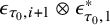 $\epsilon _{\tau _0, i+1} \otimes \epsilon _{\tau _0, 1}^*$
is sent to
$\epsilon _{\tau _0, i+1} \otimes \epsilon _{\tau _0, 1}^*$
is sent to $\nu _i$
under the isomorphism (5.3.4). This implies that the composition of the second and third bullet points in the statement of the lemma (on the level of flag varieties) is the morphism
$\nu _i$
under the isomorphism (5.3.4). This implies that the composition of the second and third bullet points in the statement of the lemma (on the level of flag varieties) is the morphism
 $$\begin{align*}\Omega^{1}_{\operatorname{FL}}(U) \to \mathcal{O}_G(\pi^{-1}U) \end{align*}$$
which sends $\nu _i$
to
$\nu _i$
to $1$
and
$1$
and $\nu _j$
to zero if
$\nu _j$
to zero if $j \neq i$
.
$j \neq i$
.
This implies that the composition $\mathscr {N}_G \to \mathscr {N}_G$
of all of the bullet points in the statement of the lemma is identified, on the level of flag varieties and over U, with the map
$\mathscr {N}_G \to \mathscr {N}_G$
of all of the bullet points in the statement of the lemma is identified, on the level of flag varieties and over U, with the map
 $$\begin{align*}\lambda_i \tilde{\star}_{\mathcal{D}} - \colon \pi_*\mathcal{O}_G \to \pi_*\mathcal{O}_G \end{align*}$$
which is precisely $\nabla _i$
(on the level of flag varieties) by definition.
$\nabla _i$
(on the level of flag varieties) by definition.
Let $k = F^{\operatorname {cl}}$
and let
$k = F^{\operatorname {cl}}$
and let $C^{\operatorname {pol}}(k^{\oplus 2n-1}, k)$
denote the space of polynomial functions
$C^{\operatorname {pol}}(k^{\oplus 2n-1}, k)$
denote the space of polynomial functions $k^{\oplus 2n-1} \to k$
, which we equip with an action of
$k^{\oplus 2n-1} \to k$
, which we equip with an action of $M_{\mathbf {G}}$
via the formula:
$M_{\mathbf {G}}$
via the formula:

Here we view the row vector $a \in k^{\oplus 2n-1}$
as a lower triangular matrix
$a \in k^{\oplus 2n-1}$
as a lower triangular matrix  in the lower triangular unipotent of the $(1, 2n-1)$
-parabolic of
$(1, 2n-1)$
-parabolic of $\operatorname {GL}_{2n}$
, and
$\operatorname {GL}_{2n}$
, and $m_{\tau _0}$
is the projection of m to the
$m_{\tau _0}$
is the projection of m to the $\tau _0$
-component of
$\tau _0$
-component of $M_{\mathbf {G}}$
. Note that
$M_{\mathbf {G}}$
. Note that $C^{\operatorname {pol}}(k^{\oplus 2n-1}, k)$
is naturally isomorphic to the universal enveloping algebra of
$C^{\operatorname {pol}}(k^{\oplus 2n-1}, k)$
is naturally isomorphic to the universal enveloping algebra of $\mathfrak {u}_G$
equipped with the adjoint action of
$\mathfrak {u}_G$
equipped with the adjoint action of $M_{\mathbf {G}}$
. We therefore obtain an action map
$M_{\mathbf {G}}$
. We therefore obtain an action map
 $$ \begin{align} C^{\operatorname{pol}}(k^{\oplus 2n-1}, k) \otimes \mathscr{N}_G \to \mathscr{N}_G \end{align} $$
which one can verify is $M_{\mathbf {G}}$
-equivariant by the explicit description of the action of
$M_{\mathbf {G}}$
-equivariant by the explicit description of the action of $\mathfrak {u}_G$
in §5.2.
$\mathfrak {u}_G$
in §5.2.
5.3.2 Classical evaluations maps
Let $k = F^{\operatorname {cl}}$
for ease of notation. We now describe the construction of a linear functional on the cohomology of
$k = F^{\operatorname {cl}}$
for ease of notation. We now describe the construction of a linear functional on the cohomology of $X_{\mathbf {G}, \operatorname {Iw}, k}(p^{\beta })$
which will be shown to recover unitary Friedberg–Jacquet periods in the following subsection.
$X_{\mathbf {G}, \operatorname {Iw}, k}(p^{\beta })$
which will be shown to recover unitary Friedberg–Jacquet periods in the following subsection.
The first step is to apply the general branching law construction in §2.3 to construct a map of sheaves from nearly holomorphic forms for $\mathbf {G}$
to nearly holomorphic forms for
$\mathbf {G}$
to nearly holomorphic forms for $\mathbf {H}$
incorporating the action of certain differential operators. Recall from §5.1.3 that we have a finite unramified morphism:
$\mathbf {H}$
incorporating the action of certain differential operators. Recall from §5.1.3 that we have a finite unramified morphism:
 $$\begin{align*}\hat{\iota} \colon X_{\mathbf{H}, \diamondsuit, k}(p^{\beta}) \to X_{\mathbf{G}, \operatorname{Iw}, k}(p^{\beta}). \end{align*}$$
Lemma 5.3.7. The natural $P_{\mathbf {H}}^{\operatorname {std}}$
-equivariant map
$P_{\mathbf {H}}^{\operatorname {std}}$
-equivariant map $P_{H, \operatorname {dR}} \to P_{G, \operatorname {dR}}$
given by sending a trivialisation of
$P_{H, \operatorname {dR}} \to P_{G, \operatorname {dR}}$
given by sending a trivialisation of $\mathcal {H}_{A_1} \oplus \mathcal {H}_{A_2}$
to the induced trivialisation of
$\mathcal {H}_{A_1} \oplus \mathcal {H}_{A_2}$
to the induced trivialisation of $\mathcal {H}_{A_1 \oplus A_2}$
gives a reduction of structure
$\mathcal {H}_{A_1 \oplus A_2}$
gives a reduction of structure
 $$\begin{align*}\hat{\iota}^* P_{G, \operatorname{dR}} = P_{H, \operatorname{dR}} \times^{P_{\mathbf{H}}^{\operatorname{std}}} P_{\mathbf{G}}^{\operatorname{std}}. \end{align*}$$
Hence we obtain a natural $P_{\mathbf {H}}^{\operatorname {std}}$
-equivariant map of sheaves
$P_{\mathbf {H}}^{\operatorname {std}}$
-equivariant map of sheaves $\mathscr {N}_G \to \hat {\iota }_* \mathscr {N}_H$
.
$\mathscr {N}_G \to \hat {\iota }_* \mathscr {N}_H$
.
Proof. Immediate from the definitions.
We now construct the aforementioned map of sheaves. Recall the definition of $\mathcal {E}$
from §2.2.1, that is, pairs
$\mathcal {E}$
from §2.2.1, that is, pairs $(\kappa , j)$
where
$(\kappa , j)$
where $\kappa \in X^*(T)$
is a
$\kappa \in X^*(T)$
is a $M_{\mathbf {G}}$
-dominant weight that is ‘pure of nonpositive weight’ and
$M_{\mathbf {G}}$
-dominant weight that is ‘pure of nonpositive weight’ and $j = (j_{\tau })_{\tau \in \Psi }$
is a tuple of integers, such that
$j = (j_{\tau })_{\tau \in \Psi }$
is a tuple of integers, such that $\kappa $
and j satisfy a certain intertwining property. For
$\kappa $
and j satisfy a certain intertwining property. For $(\kappa , j) \in \mathcal {E}$
, let
$(\kappa , j) \in \mathcal {E}$
, let $V_{\kappa }$
denote the algebraic representation of
$V_{\kappa }$
denote the algebraic representation of $M_{\mathbf {G}}$
of highest weight
$M_{\mathbf {G}}$
of highest weight $\kappa $
, and recall that we have an eigenvector
$\kappa $
, and recall that we have an eigenvector $\delta _{\kappa , j} \in V_{\kappa } \otimes _k C^{\operatorname {pol}}(k^{\oplus 2n-1}, k)$
for the diagonal action of
$\delta _{\kappa , j} \in V_{\kappa } \otimes _k C^{\operatorname {pol}}(k^{\oplus 2n-1}, k)$
for the diagonal action of $M_{\mathbf {H}}$
with eigencharacter
$M_{\mathbf {H}}$
with eigencharacter $\sigma _{\kappa }^{[j], -1}$
(see Definition 2.2.9).
$\sigma _{\kappa }^{[j], -1}$
(see Definition 2.2.9).
Definition 5.3.8. Let $(\kappa , j) \in \mathcal {E}$
and
$(\kappa , j) \in \mathcal {E}$
and $\beta \geq 1$
. Then we define a k-linear map
$\beta \geq 1$
. Then we define a k-linear map
 $$\begin{align*}\vartheta_{\kappa, j, \beta} \colon \mathscr{N}_{G, \kappa^*} \to \hat{\iota}_* \mathscr{N}_{H, \sigma_{\kappa}^{[j]}} \end{align*}$$
of abelian sheaves over $X_{\mathbf {G}, \operatorname {Iw}, k}(p^{\beta })$
as the
$X_{\mathbf {G}, \operatorname {Iw}, k}(p^{\beta })$
as the $M_{\mathbf {H}}$
-invariants of the map
$M_{\mathbf {H}}$
-invariants of the map
 $$\begin{align*}\sigma_{\kappa}^{[j], -1} \otimes \mathscr{N}_G \otimes V_{\kappa}^* \to \hat{\iota}_* \mathscr{N}_H \end{align*}$$
arising as the composition of the following $M_{\mathbf {H}}$
-equivariant maps:
$M_{\mathbf {H}}$
-equivariant maps:
-
• The morphism
$\sigma _{\kappa }^{[j], -1} \otimes \mathscr {N}_G \otimes V_{\kappa }^* \to V_{\kappa } \otimes C^{\operatorname {pol}}(k^{\oplus 2n-1}, k) \otimes \mathscr {N}_G \otimes V_{\kappa }^*$
induced from sending the first factor to
$\delta _{\kappa , j}$
. -
• The morphism
$V_{\kappa } \otimes C^{\operatorname {pol}}(k^{\oplus 2n-1}, k) \otimes \mathscr {N}_G \otimes V_{\kappa }^* \to V_{\kappa } \otimes \mathscr {N}_G \otimes V_{\kappa }^*$
induced from the action map in (5.3.6). -
• The morphism
$V_{\kappa } \otimes \mathscr {N}_G \otimes V_{\kappa }^* \to \mathscr {N}_G$
induced from the natural map
$V_{\kappa } \otimes V^*_{\kappa } \to k$
. -
• The morphism
$\mathscr {N}_G \to \hat {\iota }_*\mathscr {N}_H$
.


We have the following result which crucially uses the property in Corollary 5.2.17.
Proposition 5.3.9. Let $(\kappa , j) \in \mathcal {E}$
and
$(\kappa , j) \in \mathcal {E}$
and $\beta \geq 1$
. Then the morphism
$\beta \geq 1$
. Then the morphism $\vartheta _{\kappa , j, \beta }$
induces a morphism
$\vartheta _{\kappa , j, \beta }$
induces a morphism
 $$\begin{align*}\vartheta_{\kappa, j, \beta} \colon \mathscr{M}_{G, \kappa^*} \to \hat{\iota}_* \mathscr{M}_{H, \sigma_{\kappa}^{[j]}} , \end{align*}$$
that is, the morphism takes holomorphic forms for $\mathbf {G}$
to holomorphic forms for
$\mathbf {G}$
to holomorphic forms for $\mathbf {H}$
.
$\mathbf {H}$
.
Proof. We can (and do) assume that $j_{\tau _0}> 0$
, otherwise there is nothing to prove. We first note the following property. Let
$j_{\tau _0}> 0$
, otherwise there is nothing to prove. We first note the following property. Let $E_{i,k} \in \mathfrak {gl}_{2n}$
denote the elementary matrix with
$E_{i,k} \in \mathfrak {gl}_{2n}$
denote the elementary matrix with $1$
in the
$1$
in the $(i, k)$
-th position and
$(i, k)$
-th position and $0$
elsewhere. We can view
$0$
elsewhere. We can view $E_{i, k} \in \mathfrak {g}$
as elements only concentrated in the
$E_{i, k} \in \mathfrak {g}$
as elements only concentrated in the $\tau _0$
-component.
$\tau _0$
-component.
If $x_i \in C^{\operatorname {pol}}(k^{\oplus 2n-1}, k)$
is the polynomial function sending
$x_i \in C^{\operatorname {pol}}(k^{\oplus 2n-1}, k)$
is the polynomial function sending $(a_2, \dots , a_{2n}) \mapsto a_i$
, then the action of
$(a_2, \dots , a_{2n}) \mapsto a_i$
, then the action of $x_i$
on
$x_i$
on $\mathscr {N}_G$
corresponds to the action of
$\mathscr {N}_G$
corresponds to the action of $E_{1, i} \in \mathfrak {u}_G$
under
$E_{1, i} \in \mathfrak {u}_G$
under $\star _{\mathfrak {u}}$
. Note that we have
$\star _{\mathfrak {u}}$
. Note that we have $E_{i, 1} \in \overline {\mathfrak {u}}_H$
for
$E_{i, 1} \in \overline {\mathfrak {u}}_H$
for $i=2, \dots , n$
. We have the commutator relations
$i=2, \dots , n$
. We have the commutator relations
 $$\begin{align*}[E_{i, 1}, E_{1, k}] = E_{i, k} \in \operatorname{Lie}M_{\mathbf{G}} \quad \quad \text{ for } i \in \{2, \dots, n\} \text{ and } k \in \{ n+1, \dots, 2n \} \end{align*}$$
and
 $$\begin{align*}[E_{i, k}, E_{1, k'}] = 0 \quad \quad \text{ for } i \in \{ 2, \dots, n \} \text{ and } k, k' \in \{ n+1, \dots, 2n \}. \end{align*}$$
Therefore, by Corollary 5.2.17, we find that for any polynomial $p \in C^{\operatorname {pol}}(k^{\oplus 2n-1}, k)$
in the coordinates
$p \in C^{\operatorname {pol}}(k^{\oplus 2n-1}, k)$
in the coordinates $x_{n+1}, \dots , x_{2n}$
, any
$x_{n+1}, \dots , x_{2n}$
, any $i=2, \dots , n$
and any
$i=2, \dots , n$
and any $F \in \mathscr {N}_G$
, we have
$F \in \mathscr {N}_G$
, we have
 $$ \begin{align} E_{i, 1} \star_{\overline{P}} (p \star_{\mathfrak{u}} F) = p \star_{\mathfrak{u}} ( E_{i, 1} \star_{\overline{P}} F) + \sum_{k = n+1}^{2n} \frac{\partial p}{\partial x_k} \star_{\mathfrak{u}} (E_{i, k} \star_{\overline{P}} F) \end{align} $$
where we have also used the notation $\star _{\mathfrak {u}}$
to denote the action map in (5.3.6).
$\star _{\mathfrak {u}}$
to denote the action map in (5.3.6).
Now suppose that we have an element $F \in (\mathscr {M}_{G} \otimes V_{\kappa }^* )^{M_{\mathbf {G}}} \subset (\mathscr {N}_{G} \otimes V_{\kappa }^* )^{M_{\mathbf {G}}}$
. We can also view this as a
$F \in (\mathscr {M}_{G} \otimes V_{\kappa }^* )^{M_{\mathbf {G}}} \subset (\mathscr {N}_{G} \otimes V_{\kappa }^* )^{M_{\mathbf {G}}}$
. We can also view this as a $M_{\mathbf {G}}$
-equivariant map
$M_{\mathbf {G}}$
-equivariant map $\tilde {F} \colon V_{\kappa } \to \mathscr {N}_G$
. For any finite multiset
$\tilde {F} \colon V_{\kappa } \to \mathscr {N}_G$
. For any finite multiset $T \subset \{ 2, \dots , 2n \}$
, we let
$T \subset \{ 2, \dots , 2n \}$
, we let $x^T = \prod _{i \in T} x_i \in C^{\operatorname {pol}}(k^{\oplus 2n-1}, k)$
. These form a k-basis of
$x^T = \prod _{i \in T} x_i \in C^{\operatorname {pol}}(k^{\oplus 2n-1}, k)$
. These form a k-basis of $C^{\operatorname {pol}}(k^{\oplus 2n-1}, k)$
. Let
$C^{\operatorname {pol}}(k^{\oplus 2n-1}, k)$
. Let $\{ v_l \}$
denote a fixed basis for
$\{ v_l \}$
denote a fixed basis for $V_{\kappa }$
and
$V_{\kappa }$
and $\{ v_l^* \} \subset V_{\kappa }^*$
the dual basis. We note that
$\{ v_l^* \} \subset V_{\kappa }^*$
the dual basis. We note that $\delta _{\kappa , j}$
can be expressed as a linear combination
$\delta _{\kappa , j}$
can be expressed as a linear combination
 $$\begin{align*}\delta_{\kappa, j} = \sum_l \sum_{\substack{T \subset \{n+1, \dots, 2n\} \\ \#T = j_{\tau_0}}} \lambda_{l, T} (v_l \otimes x^T) \end{align*}$$
for some $\lambda _{l, T} \in k$
.
$\lambda _{l, T} \in k$
.
Let $\vartheta _{\kappa , j, \beta }' \colon \mathscr {N}_G \otimes V_{\kappa }^* \to \mathscr {N}_G$
denote the composition of the maps in Definition 5.3.8, except for the final bullet point (we omit the notation for the character
$\vartheta _{\kappa , j, \beta }' \colon \mathscr {N}_G \otimes V_{\kappa }^* \to \mathscr {N}_G$
denote the composition of the maps in Definition 5.3.8, except for the final bullet point (we omit the notation for the character $\sigma _{\kappa }^{[j], -1}$
). Then we have
$\sigma _{\kappa }^{[j], -1}$
). Then we have $h \cdot \vartheta _{\kappa , j, \beta }'(F) = \sigma _{\kappa }^{[j], -1}(h) \vartheta _{\kappa , j, \beta }'(F)$
for all
$h \cdot \vartheta _{\kappa , j, \beta }'(F) = \sigma _{\kappa }^{[j], -1}(h) \vartheta _{\kappa , j, \beta }'(F)$
for all $h \in M_{\mathbf {H}}$
. Since the map
$h \in M_{\mathbf {H}}$
. Since the map $\mathscr {N}_G \to \hat {\iota }_* \mathscr {N}_H$
is
$\mathscr {N}_G \to \hat {\iota }_* \mathscr {N}_H$
is $P_{\mathbf {H}}^{\operatorname {std}}$
-equivariant, it is enough to show that
$P_{\mathbf {H}}^{\operatorname {std}}$
-equivariant, it is enough to show that $E_{i, 1} \star _{\overline {P}} \vartheta ^{\prime }_{\kappa , j, \beta }(F) = 0$
for all
$E_{i, 1} \star _{\overline {P}} \vartheta ^{\prime }_{\kappa , j, \beta }(F) = 0$
for all $i \in \{2, \dots , n \}$
.
$i \in \{2, \dots , n \}$
.
Now if we write $F = \sum _l F_l \otimes v_l^*$
for some (unique)
$F = \sum _l F_l \otimes v_l^*$
for some (unique) $F_l \in \mathscr {M}_G \subset \mathscr {N}_G$
(i.e.,
$F_l \in \mathscr {M}_G \subset \mathscr {N}_G$
(i.e., $F_l = \tilde {F}(v_l)$
), then we have the formulae:
$F_l = \tilde {F}(v_l)$
), then we have the formulae:
 $$ \begin{align*} \vartheta_{\kappa, j, \beta}'(F) &= \sum_l \sum_{\substack{T \subset \{n+1, \dots, 2n\} \\ \# T = j_{\tau_0}}} \lambda_{l, T} ( x^T \star_{\mathfrak{u}} F_l ) \\ E_{i, 1} \star_{\overline{P}} \vartheta^{\prime}_{\kappa, j, \beta}(F) &= \sum_l \sum_{\substack{T \subset \{n+1, \dots, 2n\} \\ \# T = j_{\tau_0}}} \lambda_{l, T} \left( \sum_{k=n+1}^{2n} \frac{\partial x^T}{\partial x_k} \star_{\mathfrak{u}} (E_{i, k} \star_{\overline{P}} F_l ) \right) \end{align*} $$
using the fact that $E_{i, 1} \star _{\overline {P}} F_l = 0$
because
$E_{i, 1} \star _{\overline {P}} F_l = 0$
because $F_l \in \mathscr {M}_G$
.
$F_l \in \mathscr {M}_G$
.
With notation as in Theorem 2.2.4 and Convention 2.2.8, we have a $M_{\mathbf {H}}$
-equivariant map
$M_{\mathbf {H}}$
-equivariant map
 $$\begin{align*}g \colon S_{-(j-1)} \otimes V_{\kappa} \to \mathscr{N}_G \end{align*}$$
given by $g( y \otimes z) = \Phi (y) \star _{\mathfrak {u}} \tilde {F}(z)$
on pure tensors. Since
$g( y \otimes z) = \Phi (y) \star _{\mathfrak {u}} \tilde {F}(z)$
on pure tensors. Since $\frac {\partial x^T}{\partial x_k}$
is either zero or a monomial of degree
$\frac {\partial x^T}{\partial x_k}$
is either zero or a monomial of degree $j_{\tau _0} - 1$
, there exist unique elements
$j_{\tau _0} - 1$
, there exist unique elements $w_{k, T} \in S_{-(j-1)}$
such that
$w_{k, T} \in S_{-(j-1)}$
such that $\Phi (w_{k, T}) = \frac {\partial x^T}{\partial x_k}$
. We consider the elements
$\Phi (w_{k, T}) = \frac {\partial x^T}{\partial x_k}$
. We consider the elements $A_i \in S_{-(j-1)} \otimes V_{\kappa }$
given by
$A_i \in S_{-(j-1)} \otimes V_{\kappa }$
given by
 $$\begin{align*}A_i = \sum_l \sum_{\substack{T \subset \{n+1, \dots, 2n\} \\ \# T = j_{\tau_0}}} \lambda_{l, T} \left( \sum_{k=n+1}^{2n} w_{k, T} \otimes (E_{i, k} \star_{\mathfrak{m}_G} v_l ) \right) \end{align*}$$
and we see that $g(A_i) = E_{i, 1} \star _{\overline {P}} \vartheta ^{\prime }_{\kappa , j, \beta }(F)$
(because
$g(A_i) = E_{i, 1} \star _{\overline {P}} \vartheta ^{\prime }_{\kappa , j, \beta }(F)$
(because $E_{i, k} \in \mathfrak {m}_G = \operatorname {Lie}M_{\mathbf {G}}$
and
$E_{i, k} \in \mathfrak {m}_G = \operatorname {Lie}M_{\mathbf {G}}$
and $\tilde {F}$
is
$\tilde {F}$
is $M_{\mathbf {G}}$
-equivariant).
$M_{\mathbf {G}}$
-equivariant).
On the other hand, let W denote the algebraic representation of $M_{\mathbf {H}}$
with trivial highest weight outside the
$M_{\mathbf {H}}$
with trivial highest weight outside the $\tau _0$
-component, and weight
$\tau _0$
-component, and weight $(-1, 1, 0, \dots , 0 )$
in the
$(-1, 1, 0, \dots , 0 )$
in the $\tau _0$
-component. If
$\tau _0$
-component. If $\{ e_1, \dots , e_{2n} \}$
denotes the standard basis of the standard representation of
$\{ e_1, \dots , e_{2n} \}$
denotes the standard basis of the standard representation of $\operatorname {GL}_{2n}$
(seen as the
$\operatorname {GL}_{2n}$
(seen as the $\tau _0$
-component of
$\tau _0$
-component of $\mathbf {G}$
), we have a
$\mathbf {G}$
), we have a $M_{\mathbf {H}}$
-equivariant map
$M_{\mathbf {H}}$
-equivariant map
 $$ \begin{align*} h \colon W \otimes \sigma_{\kappa}^{[j], -1} &\to \mathscr{N}_G \\ e_1^* e_i &\mapsto E_{i, 1} \star_{\overline{P}} \vartheta^{\prime}_{\kappa, j, \beta}(F). \end{align*} $$
We define a k-linear map $q \colon W \otimes \sigma _{\kappa }^{[j], -1} \to S_{-(j-1)} \otimes V_{\kappa }$
sending
$q \colon W \otimes \sigma _{\kappa }^{[j], -1} \to S_{-(j-1)} \otimes V_{\kappa }$
sending $e_1^* e_i$
to
$e_1^* e_i$
to $A_i$
. Then clearly we have
$A_i$
. Then clearly we have $g \circ q = h$
and the induced map
$g \circ q = h$
and the induced map
 $$\begin{align*}\bar{q} \colon W \otimes \sigma_{\kappa}^{[j], -1} \to (S_{-(j-1)} \otimes V_{\kappa}) / \operatorname{ker}(g) \end{align*}$$
is $M_{\mathbf {H}}$
-equivariant. Since the category of algebraic representations of
$M_{\mathbf {H}}$
-equivariant. Since the category of algebraic representations of $M_{\mathbf {H}}$
is semisimple (as the group is reductive), this gives rise to a
$M_{\mathbf {H}}$
is semisimple (as the group is reductive), this gives rise to a $M_{\mathbf {H}}$
-equivariant morphism
$M_{\mathbf {H}}$
-equivariant morphism $W \otimes \sigma _{\kappa }^{[j], -1} \to S_{-(j-1)} \otimes V_{\kappa }$
– if we show that any such morphism has to be zero, this will imply that
$W \otimes \sigma _{\kappa }^{[j], -1} \to S_{-(j-1)} \otimes V_{\kappa }$
– if we show that any such morphism has to be zero, this will imply that $E_{i, 1} \star _{\overline {P}} \vartheta ^{\prime }_{\kappa , j, \beta }(F) = 0$
, as required.
$E_{i, 1} \star _{\overline {P}} \vartheta ^{\prime }_{\kappa , j, \beta }(F) = 0$
, as required.
Restricting to the $\tau _0$
-component and considering the subgroup
$\tau _0$
-component and considering the subgroup $1 \times 1 \times \operatorname {GL}_n \subset (M_{\mathbf {H}})_{\tau _0}$
, it is enough to show that
$1 \times 1 \times \operatorname {GL}_n \subset (M_{\mathbf {H}})_{\tau _0}$
, it is enough to show that
 $$\begin{align*}\operatorname{Hom}_{1 \times 1 \times \operatorname{GL}_n} ( \sigma_{\kappa}^{[j], -1}, S_{-(j-1)} \otimes V_{\kappa} ) = 0 \end{align*}$$
since W is the trivial representation when restricted to this group. But we have already shown this in the proof of Theorem 2.2.4.
By passing to cohomology and restricting along the open and closed embeddings in Lemma 5.1.8, we obtain a k-linear map
 $$\begin{align*}\vartheta_{\kappa, j, \beta} \colon \operatorname{H}^{n-1}\left( S_{\mathbf{G}, \operatorname{Iw}}(p^{\beta}), \mathscr{M}_{G, \kappa^*} \right) \to \operatorname{H}^{n-1}\left( S_{\mathbf{H}, \diamondsuit}(p^{\beta}), \mathscr{M}_{H, \sigma_{\kappa}^{[j]}} \right). \end{align*}$$
The following proposition describes the compatibility of these maps as one varies $\beta $
. For any
$\beta $
. For any $\beta \geq 1$
, let
$\beta \geq 1$
, let $p_{G, \beta } \colon S_{\mathbf {G}, \operatorname {Iw}}(p^{\beta +1}) \to S_{\mathbf {G}, \operatorname {Iw}}(p^{\beta })$
and
$p_{G, \beta } \colon S_{\mathbf {G}, \operatorname {Iw}}(p^{\beta +1}) \to S_{\mathbf {G}, \operatorname {Iw}}(p^{\beta })$
and $p_{H, \beta } \colon S_{\mathbf {H}, \diamondsuit }(p^{\beta +1}) \to S_{\mathbf {H}, \diamondsuit }(p^{\beta })$
denote the natural finite étale maps.
$p_{H, \beta } \colon S_{\mathbf {H}, \diamondsuit }(p^{\beta +1}) \to S_{\mathbf {H}, \diamondsuit }(p^{\beta })$
denote the natural finite étale maps.
Proposition 5.3.11. Let $(\kappa , j) \in \mathcal {E}$
. Then we have a commutative diagram:
$(\kappa , j) \in \mathcal {E}$
. Then we have a commutative diagram:

where $\operatorname {Tr}_{\bullet }$
denotes the trace maps associated with the corresponding finite étale morphisms.
$\operatorname {Tr}_{\bullet }$
denotes the trace maps associated with the corresponding finite étale morphisms.
Proof. In this proof only, we will add the subscript $\beta $
or
$\beta $
or $\beta + 1$
to the objects to indicate which level we are working at. Note that
$\beta + 1$
to the objects to indicate which level we are working at. Note that $p_{G, \beta }^* \mathscr {N}_{G, \beta } = \mathscr {N}_{G, \beta }$
and similarly for
$p_{G, \beta }^* \mathscr {N}_{G, \beta } = \mathscr {N}_{G, \beta }$
and similarly for $\mathbf {H}$
, so the trace maps in the statement of the proposition do indeed exist. Furthermore, it is enough to prove the statements over the varieties
$\mathbf {H}$
, so the trace maps in the statement of the proposition do indeed exist. Furthermore, it is enough to prove the statements over the varieties $X_{\mathbf {G}, \operatorname {Iw}, F^{\operatorname {cl}}}(p^{\beta })$
and
$X_{\mathbf {G}, \operatorname {Iw}, F^{\operatorname {cl}}}(p^{\beta })$
and $X_{\mathbf {H}, \diamondsuit , F^{\operatorname {cl}}}(p^{\beta })$
(we will continue to use the notation
$X_{\mathbf {H}, \diamondsuit , F^{\operatorname {cl}}}(p^{\beta })$
(we will continue to use the notation $p_{G, \beta }$
and
$p_{G, \beta }$
and $p_{H, \beta }$
for the natural maps. Recall that the diagram
$p_{H, \beta }$
for the natural maps. Recall that the diagram

is Cartesian because $p_{H, \beta }$
and
$p_{H, \beta }$
and $p_{G, \beta }$
have the same degree – see [Reference GrahamGra24, Lemma 2.5.3].
$p_{G, \beta }$
have the same degree – see [Reference GrahamGra24, Lemma 2.5.3].
The claim in the proposition is a local one. Let $U \subset X_{\mathbf {G}, \operatorname {Iw}, k}(p^{\beta })$
be an open, and let
$U \subset X_{\mathbf {G}, \operatorname {Iw}, k}(p^{\beta })$
be an open, and let $V = p_{H, \beta }^{-1} \hat {\iota }_{\beta }^{-1} U = \hat {\iota }_{\beta + 1}^{-1} p_{G, \beta }^{-1} U$
. We first note that the following diagram is commutative because the above square is Cartesian:
$V = p_{H, \beta }^{-1} \hat {\iota }_{\beta }^{-1} U = \hat {\iota }_{\beta + 1}^{-1} p_{G, \beta }^{-1} U$
. We first note that the following diagram is commutative because the above square is Cartesian:

Furthermore, we claim that for any $\phi \in C^{\operatorname {pol}}(k^{\oplus 2n-1}, k)$
, the following diagram is commutative:
$\phi \in C^{\operatorname {pol}}(k^{\oplus 2n-1}, k)$
, the following diagram is commutative:

Indeed, it is enough to check this statement after pulling back to $G_{\operatorname {dR}}$
, and then the claim follows from the description of
$G_{\operatorname {dR}}$
, and then the claim follows from the description of $\nabla _i$
in Lemma 5.3.3, the fact that the morphisms
$\nabla _i$
in Lemma 5.3.3, the fact that the morphisms $p_{G, \beta }$
and
$p_{G, \beta }$
and $p_{H, \beta }$
are finite étale, and the fact that the sheaves
$p_{H, \beta }$
are finite étale, and the fact that the sheaves $\mathscr {N}_{G, \bullet }$
arise from the same G-equivariant sheaf over the flag variety. The remainder of the proposition now follows from unwinding the definition of
$\mathscr {N}_{G, \bullet }$
arise from the same G-equivariant sheaf over the flag variety. The remainder of the proposition now follows from unwinding the definition of $\vartheta _{\kappa , j, \beta }$
in Definition 5.3.8.
$\vartheta _{\kappa , j, \beta }$
in Definition 5.3.8.
We are now in a position to define the classical evaluation maps. We first recall, from [Reference GrahamGra24, §7], how to associate cohomology classes to anticyclotomic algebraic Hecke characters. Let $\operatorname {Res}_{F^+/\mathbb {Q}} \operatorname {U}(1)$
denote the unitary group associated with the one-dimensional Hermitian space over F. Then we have a morphism
$\operatorname {Res}_{F^+/\mathbb {Q}} \operatorname {U}(1)$
denote the unitary group associated with the one-dimensional Hermitian space over F. Then we have a morphism
 $$ \begin{align*} \nu \colon \mathbf{H} &\to \operatorname{Res}_{F^+/\mathbb{Q}} \operatorname{U}(1) \\ (h_1, h_2) &\mapsto \operatorname{det}h_2/\operatorname{det}h_1 \end{align*} $$
which is open and surjective on $\mathbb {A}_f$
-points. We also have a natural map
$\mathbb {A}_f$
-points. We also have a natural map $\mathcal {N} \colon \operatorname {Res}_{F/\mathbb {Q}} \mathbb {G}_m \to \operatorname {Res}_{F^+/\mathbb {Q}} \operatorname {U}(1)$
given by
$\mathcal {N} \colon \operatorname {Res}_{F/\mathbb {Q}} \mathbb {G}_m \to \operatorname {Res}_{F^+/\mathbb {Q}} \operatorname {U}(1)$
given by $\mathcal {N}(z) = \bar {z}/z$
.
$\mathcal {N}(z) = \bar {z}/z$
.
Definition 5.3.12. Let $K_{\beta } \subset \mathbf {H}(\mathbb {A}_f)$
denote the level of the Shimura–Deligne variety
$K_{\beta } \subset \mathbf {H}(\mathbb {A}_f)$
denote the level of the Shimura–Deligne variety $S_{\mathbf {H}, \diamondsuit }(p^{\beta })$
. We let
$S_{\mathbf {H}, \diamondsuit }(p^{\beta })$
. We let $\mathfrak {N}_{\beta }$
denote the smallest ideal of
$\mathfrak {N}_{\beta }$
denote the smallest ideal of $\mathcal {O}_F$
such that
$\mathcal {O}_F$
such that $\nu (K_{\beta }) \subset \mathcal {N}((\widehat {\mathcal {O}}_{F^+} + \mathfrak {N}_{\beta }\widehat {\mathcal {O}}_F)^{\times })$
. Note that
$\nu (K_{\beta }) \subset \mathcal {N}((\widehat {\mathcal {O}}_{F^+} + \mathfrak {N}_{\beta }\widehat {\mathcal {O}}_F)^{\times })$
. Note that $\mathfrak {N}_{\beta } = \mathfrak {N}p^{\beta }$
for some ideal
$\mathfrak {N}_{\beta } = \mathfrak {N}p^{\beta }$
for some ideal $\mathfrak {N} \subset \mathcal {O}_{F^+}$
prime to p.
$\mathfrak {N} \subset \mathcal {O}_{F^+}$
prime to p.
We now introduce the space of anticyclotomic characters that we are interested in. For this, we need to make an additional assumption on the pair of weights $(\kappa , j)$
.
$(\kappa , j)$
.
Assumption 5.3.13. Let $(\kappa , j) \in \mathcal {E}$
. We assume that
$(\kappa , j) \in \mathcal {E}$
. We assume that $\kappa _0 = 0$
,
$\kappa _0 = 0$
, $\kappa _{1, \tau _0} + \kappa _{n+1, \tau _0} = n-1$
, and
$\kappa _{1, \tau _0} + \kappa _{n+1, \tau _0} = n-1$
, and  .
.
For any $(\kappa , j) \in \mathcal {E}$
satisfying Assumption 5.3.13, let
$(\kappa , j) \in \mathcal {E}$
satisfying Assumption 5.3.13, let $\sigma _{\kappa }^{[j], \vee } = - w_{M_H}^{\operatorname {max}}\sigma _{\kappa }^{[j]} - 2\rho _{H, \operatorname {nc}}$
denote the Serre dual of
$\sigma _{\kappa }^{[j], \vee } = - w_{M_H}^{\operatorname {max}}\sigma _{\kappa }^{[j]} - 2\rho _{H, \operatorname {nc}}$
denote the Serre dual of $\sigma _{\kappa }^{[j]}$
. By Assumption 5.3.13,
$\sigma _{\kappa }^{[j]}$
. By Assumption 5.3.13, $\sigma _{\kappa }^{[j], \vee }$
extends to a character of
$\sigma _{\kappa }^{[j], \vee }$
extends to a character of $\mathbf {H}$
.
$\mathbf {H}$
.
Definition 5.3.14. Let $(\kappa , j) \in \mathcal {E}$
satisfying Assumption 5.3.13. We let
$(\kappa , j) \in \mathcal {E}$
satisfying Assumption 5.3.13. We let $\Sigma _{\kappa , j}(\mathfrak {N}_{\beta })$
denote the set of algebraic Hecke characters
$\Sigma _{\kappa , j}(\mathfrak {N}_{\beta })$
denote the set of algebraic Hecke characters $\chi \colon \mathbb {A}_F^{\times }/F^{\times } \to \mathbb {C}^{\times }$
satisfying:
$\chi \colon \mathbb {A}_F^{\times }/F^{\times } \to \mathbb {C}^{\times }$
satisfying:
-
1.
$\chi $
is anticyclotomic, that is,
$\chi $
is trivial on
$\mathbb {A}^{\times }_{F^+}$
. -
2. The infinity-type of
$\chi $
is
$(j_{\tau _0} - \kappa _{n+1, \tau _0}, -(j_{\tau _0} - \kappa _{n+1, \tau _0}))$
in the
$\tau _0$
-component and
$(j_{\tau }, -j_{\tau })$
for
$\tau \neq \tau _0$
, that is, for all
$$\begin{align*}\chi( z ) = z_{\tau_0}^{\kappa_{n+1, \tau_0} - j_{\tau_0}} \bar{z}_{\tau_0}^{j_{\tau_0} - \kappa_{n+1, \tau_0}} \cdot \prod_{\tau \in \Psi - \{\tau_0\}} z_{\tau}^{-j_{\tau}} \bar{z}_{\tau}^{j_{\tau}} \end{align*}$$
$z = (z_{\tau }) \in (\mathbb {R} \otimes _{\mathbb {Q}} F)^{\times } = \prod _{\tau \in \Psi } \mathbb {C}^{\times }$
.
-
3. The conductor of
$\chi $
divides
$\mathfrak {N}_{\beta }$
.


We let $\chi ' \colon (\operatorname {Res}_{F^+/\mathbb {Q}}\operatorname {U}(1))(\mathbb {Q}) \backslash (\operatorname {Res}_{F^+/\mathbb {Q}}\operatorname {U}(1))(\mathbb {A}) \to \mathbb {C}^{\times }$
denote unique character such that
$\chi ' \colon (\operatorname {Res}_{F^+/\mathbb {Q}}\operatorname {U}(1))(\mathbb {Q}) \backslash (\operatorname {Res}_{F^+/\mathbb {Q}}\operatorname {U}(1))(\mathbb {A}) \to \mathbb {C}^{\times }$
denote unique character such that ${\chi = \chi ' \circ \mathcal {N}}$
.
${\chi = \chi ' \circ \mathcal {N}}$
.
For any $\chi \in \Sigma _{\kappa , j}(\mathfrak {N}_{\beta })$
let
$\chi \in \Sigma _{\kappa , j}(\mathfrak {N}_{\beta })$
let $F^{\operatorname {cl}}(\chi )$
denote the smallest number field containing
$F^{\operatorname {cl}}(\chi )$
denote the smallest number field containing $F^{\operatorname {cl}}$
and over which the finite part of
$F^{\operatorname {cl}}$
and over which the finite part of $\chi $
is defined. Then, by the discussion in [Reference GrahamGra24, §7], one can associate a cohomology class
$\chi $
is defined. Then, by the discussion in [Reference GrahamGra24, §7], one can associate a cohomology class
 $$\begin{align*}[\chi] \in \operatorname{H}^0\left( S_{\mathbf{H}, \diamondsuit}(p^{\beta})_{F^{\operatorname{cl}}(\chi)}, \mathscr{M}_{H, \sigma_{\kappa}^{[j], \vee}} \right) \end{align*}$$
which, after base-changing to $\mathbb {C}$
, coincides with the function
$\mathbb {C}$
, coincides with the function
 $$ \begin{align*} H_{\operatorname{dR}}(\mathbb{C}) = \mathbf{H}(\mathbb{Q}) \backslash X \times \mathbf{H}(\mathbb{C}) \times \mathbf{H}(\mathbb{A}_f)/K_{\beta} &\to \mathbb{C} \\ [x, h, h'] &\mapsto \xi^{[j]}_{\kappa}(h) \chi'(\nu(h')) \end{align*} $$
where X denotes the Hermitian space associated with the Shimura–Deligne datum $(\mathbf {H}, h_{\mathbf {H}})$
, and
$(\mathbf {H}, h_{\mathbf {H}})$
, and $\xi _{\kappa }^{[j]} \colon \mathbf {H}(\mathbb {C}) = \mathbb {C}^{\times } \times \prod _{\tau \in \Psi } \left ( \operatorname {GL}_n(\mathbb {C}) \times \operatorname {GL}_n(\mathbb {C}) \right ) \to \mathbb {C}^{\times }$
denotes the character
$\xi _{\kappa }^{[j]} \colon \mathbf {H}(\mathbb {C}) = \mathbb {C}^{\times } \times \prod _{\tau \in \Psi } \left ( \operatorname {GL}_n(\mathbb {C}) \times \operatorname {GL}_n(\mathbb {C}) \right ) \to \mathbb {C}^{\times }$
denotes the character
 $$\begin{align*}(h_0; h_{1, \tau}, h_{2, \tau}) \mapsto (\operatorname{det}h_{2, \tau_0}/\operatorname{det}h_{1, \tau_0})^{j_{\tau_0} - \kappa_{n+1, \tau_0}}\prod_{\tau \neq \tau_0}(\operatorname{det}h_{2, \tau}/\operatorname{det}h_{1, \tau})^{j_{\tau}}. \end{align*}$$
Definition 5.3.15. Let $(\kappa , j) \in \mathcal {E}$
satisfying Assumption 5.3.13, and suppose that
$(\kappa , j) \in \mathcal {E}$
satisfying Assumption 5.3.13, and suppose that $\chi \in \Sigma _{\kappa , j}(\mathfrak {N}_{\beta })$
. For any field extension
$\chi \in \Sigma _{\kappa , j}(\mathfrak {N}_{\beta })$
. For any field extension $L/F^{\operatorname {cl}}$
contained in
$L/F^{\operatorname {cl}}$
contained in $\mathbb {C}$
(resp.
$\mathbb {C}$
(resp. $\overline {\mathbb {Q}}_p$
), let
$\overline {\mathbb {Q}}_p$
), let
 $$\begin{align*}\operatorname{Ev}_{\kappa, j, \chi, \beta} \colon \operatorname{H}^{n-1}\left( S_{\mathbf{G}, \operatorname{Iw}}(p^{\beta})_L, \mathscr{M}_{G, \kappa^*} \right) \to L(\chi) \end{align*}$$
denote the L-linear morphism given by $\operatorname {Ev}_{\kappa , j, \chi , \beta }(\eta ) = \langle \vartheta _{\kappa , j, \beta }(\eta ), [\chi ] \rangle $
, where
$\operatorname {Ev}_{\kappa , j, \chi , \beta }(\eta ) = \langle \vartheta _{\kappa , j, \beta }(\eta ), [\chi ] \rangle $
, where $L(\chi )$
denotes the compositum of L and
$L(\chi )$
denotes the compositum of L and $F^{\operatorname {cl}}(\chi )$
in
$F^{\operatorname {cl}}(\chi )$
in $\mathbb {C}$
(resp. in
$\mathbb {C}$
(resp. in $\overline {\mathbb {Q}}_p$
) and
$\overline {\mathbb {Q}}_p$
) and $\langle \cdot , \cdot \rangle $
denotes the pairing given by Serre duality.
$\langle \cdot , \cdot \rangle $
denotes the pairing given by Serre duality.
We have the following compatibility with varying $\beta $
.
$\beta $
.
Proposition 5.3.16. With notation as in Definition 5.3.15 (and $\chi \in \Sigma _{\kappa , j}(\mathfrak {N}_{\beta })$
), we have
$\chi \in \Sigma _{\kappa , j}(\mathfrak {N}_{\beta })$
), we have $\operatorname {Ev}_{\kappa , j, \chi , \beta +1} = \operatorname {Ev}_{\kappa , j, \chi , \beta } \circ \operatorname {Tr}_{p_{G, \beta }}$
.
$\operatorname {Ev}_{\kappa , j, \chi , \beta +1} = \operatorname {Ev}_{\kappa , j, \chi , \beta } \circ \operatorname {Tr}_{p_{G, \beta }}$
.
Proof. Since $\chi $
has conductor dividing
$\chi $
has conductor dividing $\mathfrak {N}_{\beta }$
, we see that
$\mathfrak {N}_{\beta }$
, we see that $[\chi ] \in \operatorname {H}^0\left ( S_{\mathbf {H}, \diamondsuit }(p^{\beta +1})_{F^{\operatorname {cl}}(\chi )}, \mathscr {M}_{H, \sigma _{\kappa }^{[j], \vee }} \right )$
is the image of the class at level
$[\chi ] \in \operatorname {H}^0\left ( S_{\mathbf {H}, \diamondsuit }(p^{\beta +1})_{F^{\operatorname {cl}}(\chi )}, \mathscr {M}_{H, \sigma _{\kappa }^{[j], \vee }} \right )$
is the image of the class at level $\beta $
under
$\beta $
under $p_{H, \beta }^*$
. The claim now follows from Proposition 5.3.11.
$p_{H, \beta }^*$
. The claim now follows from Proposition 5.3.11.
5.3.3 Relation with unitary Friedberg–Jacquet periods
In this section, we relate the algebraic construction of the morphisms $\vartheta _{\kappa , j, \beta }$
in the previous section with an analytic construction over
$\vartheta _{\kappa , j, \beta }$
in the previous section with an analytic construction over $\mathbb {C}$
(Lemma 5.3.17). In particular, this will allow us to reinterpret the maps
$\mathbb {C}$
(Lemma 5.3.17). In particular, this will allow us to reinterpret the maps $\vartheta _{\kappa , j, \beta }$
on cohomology (over
$\vartheta _{\kappa , j, \beta }$
on cohomology (over $\mathbb {C}$
) in terms of Lie algebra cohomology (Lemma 5.3.18), and hence relate the evaluation maps in Definition 5.3.15 (over
$\mathbb {C}$
) in terms of Lie algebra cohomology (Lemma 5.3.18), and hence relate the evaluation maps in Definition 5.3.15 (over $\mathbb {C}$
) with automorphic periods for the groups
$\mathbb {C}$
) with automorphic periods for the groups $\mathbf {H} \subset \mathbf {G}$
(Proposition 5.3.19). The key input for this is the description of the coherent cohomology of Shimura varieties in terms of automorphic representations, following [Reference HarrisHar90b] and [Reference SuSu24].
$\mathbf {H} \subset \mathbf {G}$
(Proposition 5.3.19). The key input for this is the description of the coherent cohomology of Shimura varieties in terms of automorphic representations, following [Reference HarrisHar90b] and [Reference SuSu24].
For the rest of this section, we work over $L = \mathbb {C}$
, but will often omit this from the notation. In particular, gothic letters will denote the complexification of the Lie algebra of the corresponding group, unless specified otherwise.
$L = \mathbb {C}$
, but will often omit this from the notation. In particular, gothic letters will denote the complexification of the Lie algebra of the corresponding group, unless specified otherwise.
Let $K_{\infty } \subset \mathbf {G}(\mathbb {R})$
denote the maximal compact-mod-centre subgroup whose complexification is equal to
$K_{\infty } \subset \mathbf {G}(\mathbb {R})$
denote the maximal compact-mod-centre subgroup whose complexification is equal to $M_{\mathbf {G}}(\mathbb {C})$
. Let
$M_{\mathbf {G}}(\mathbb {C})$
. Let $K_{\circ } \subset K_{\infty }$
denote the maximal compact subgroup, and let
$K_{\circ } \subset K_{\infty }$
denote the maximal compact subgroup, and let $A_{\mathbf {G}}$
denote the maximal
$A_{\mathbf {G}}$
denote the maximal $\mathbb {Q}$
-split torus in the centre of
$\mathbb {Q}$
-split torus in the centre of $\mathbf {G}$
. Then one can verify that
$\mathbf {G}$
. Then one can verify that $K_{\infty } = K_{\circ } A_{\mathbf {G}}(\mathbb {R})^{\circ }$
, where
$K_{\infty } = K_{\circ } A_{\mathbf {G}}(\mathbb {R})^{\circ }$
, where $A_{\mathbf {G}}(\mathbb {R})^{\circ } \subset A_{\mathbf {G}}(\mathbb {R})$
denotes the connected component of the identity. Let
$A_{\mathbf {G}}(\mathbb {R})^{\circ } \subset A_{\mathbf {G}}(\mathbb {R})$
denotes the connected component of the identity. Let $\overline {\mathfrak {p}}_G$
(resp.
$\overline {\mathfrak {p}}_G$
(resp. $\mathfrak {a}_G$
) denote the Lie algebra of
$\mathfrak {a}_G$
) denote the Lie algebra of $P_{\mathbf {G}}^{\operatorname {std}}$
(resp.
$P_{\mathbf {G}}^{\operatorname {std}}$
(resp. $A_{\mathbf {G}}$
), and set
$A_{\mathbf {G}}$
), and set  . Then one has $\overline {\mathfrak {p}}_G = \overline {\mathfrak {p}}_{\circ } \oplus \mathfrak {a}_G$
.
$\overline {\mathfrak {p}}_G = \overline {\mathfrak {p}}_{\circ } \oplus \mathfrak {a}_G$
.
Let  , and let $K = K^p K^G_{\operatorname {Iw}}(p^{\beta }) \subset \mathbf {G}(\mathbb {A}_f)$
denote the level subgroup for
$K = K^p K^G_{\operatorname {Iw}}(p^{\beta }) \subset \mathbf {G}(\mathbb {A}_f)$
denote the level subgroup for $S_{\mathbf {G}, \operatorname {Iw}}(p^{\beta })$
. Following [Reference SuSu24], consider the following (right)
$S_{\mathbf {G}, \operatorname {Iw}}(p^{\beta })$
. Following [Reference SuSu24], consider the following (right) $K_{\circ }$
-torsor
$K_{\circ }$
-torsor
 $$\begin{align*}\pi_{\circ} \colon [\mathbf{G}]/K \to S_{\mathbf{G}, \operatorname{Iw}}(p^{\beta})(\mathbb{C}). \end{align*}$$
Let V be an algebraic representation of $P_{\mathbf {G}}^{\operatorname {std}}(\mathbb {C})$
on which
$P_{\mathbf {G}}^{\operatorname {std}}(\mathbb {C})$
on which $A_{\mathbf {G}}(\mathbb {C})$
acts trivially. Then the automorphic sheaf
$A_{\mathbf {G}}(\mathbb {C})$
acts trivially. Then the automorphic sheaf $\mathcal {V}$
on
$\mathcal {V}$
on $S_{\mathbf {G}, \operatorname {Iw}}(p^{\beta })(\mathbb {C})$
associated with V satisfies
$S_{\mathbf {G}, \operatorname {Iw}}(p^{\beta })(\mathbb {C})$
associated with V satisfies
 $$\begin{align*}\mathcal{V}(U) \cong \left( C^{\operatorname{\infty}}(\pi_{\circ}^{-1}U) \otimes V \right)^{(\overline{\mathfrak{p}}_{\circ}, K_{\circ})} \end{align*}$$
where the isomorphism also respects equivariant structures. Here $C^{\operatorname {\infty }}(-)$
denotes the space of complex-valued smooth functions on a real-analytic manifold, and
$C^{\operatorname {\infty }}(-)$
denotes the space of complex-valued smooth functions on a real-analytic manifold, and $U \subset S_{\mathbf {G}, \operatorname {Iw}}(p^{\beta })(\mathbb {C})$
is an open subspace. We have a similar description for automorphic vector bundles on
$U \subset S_{\mathbf {G}, \operatorname {Iw}}(p^{\beta })(\mathbb {C})$
is an open subspace. We have a similar description for automorphic vector bundles on $S_{\mathbf {H}, \diamondsuit }(p^{\beta })(\mathbb {C})$
. In particular, if W is an algebraic representation of
$S_{\mathbf {H}, \diamondsuit }(p^{\beta })(\mathbb {C})$
. In particular, if W is an algebraic representation of $P_{\mathbf {H}}^{\operatorname {std}}$
on which
$P_{\mathbf {H}}^{\operatorname {std}}$
on which $A_{\mathbf {H}}(\mathbb {C}) = A_{\mathbf {G}}(\mathbb {C})$
acts trivially, and
$A_{\mathbf {H}}(\mathbb {C}) = A_{\mathbf {G}}(\mathbb {C})$
acts trivially, and $\mathcal {W}$
denotes the associated sheaf on
$\mathcal {W}$
denotes the associated sheaf on $S_{\mathbf {H}, \diamondsuit }(p^{\beta })$
, then
$S_{\mathbf {H}, \diamondsuit }(p^{\beta })$
, then
 $$\begin{align*}\hat{\iota}_*\mathcal{W}(U) \cong \left( C^{\operatorname{\infty}}(\hat{\iota}^{-1}\pi_{\circ}^{-1}U) \otimes W \right)^{(\overline{\mathfrak{p}}_{\circ} \cap \mathfrak{h}, K_{\circ} \cap \mathbf{H}(\mathbb{R}))} \end{align*}$$
where $\hat {\iota } \colon [H]/(\hat {\gamma } K \hat {\gamma }^{-1} \cap \mathbf {H}(\mathbb {A}_f)) \to [G]/K$
is the natural map induced from right-translation by
$\hat {\iota } \colon [H]/(\hat {\gamma } K \hat {\gamma }^{-1} \cap \mathbf {H}(\mathbb {A}_f)) \to [G]/K$
is the natural map induced from right-translation by $\hat {\gamma }$
.
$\hat {\gamma }$
.
We equip the sheaf $U \mapsto C^{\infty }(\pi _{\circ }^{-1}U)$
with an action of
$U \mapsto C^{\infty }(\pi _{\circ }^{-1}U)$
with an action of $\mathfrak {g}$
in the following way. For any
$\mathfrak {g}$
in the following way. For any $X \in \operatorname {Lie}\mathbf {G}(\mathbb {R})$
and
$X \in \operatorname {Lie}\mathbf {G}(\mathbb {R})$
and $f \in C^{\infty }(\pi _{\circ }^{-1}U)$
, we define
$f \in C^{\infty }(\pi _{\circ }^{-1}U)$
, we define

where $\operatorname {exp}(tX) \in \mathbf {G}(\mathbb {R})$
denotes the exponential of
$\operatorname {exp}(tX) \in \mathbf {G}(\mathbb {R})$
denotes the exponential of $tX$
. We then extend this linearly to an action of
$tX$
. We then extend this linearly to an action of $\mathfrak {g} = \operatorname {Lie}\mathbf {G}(\mathbb {C})$
. This induces an action of
$\mathfrak {g} = \operatorname {Lie}\mathbf {G}(\mathbb {C})$
. This induces an action of $\mathcal {U}(\mathfrak {u}_G) \cong C^{\operatorname {pol}}(\mathbb {C}^{\oplus 2n-1}, \mathbb {C})$
such that the action map is equivariant for
$\mathcal {U}(\mathfrak {u}_G) \cong C^{\operatorname {pol}}(\mathbb {C}^{\oplus 2n-1}, \mathbb {C})$
such that the action map is equivariant for $K_{\circ }$
(via the action in (5.3.5)).
$K_{\circ }$
(via the action in (5.3.5)).
Lemma 5.3.17. Let $(\kappa , j) \in \mathcal {E}$
. Consider the following
$(\kappa , j) \in \mathcal {E}$
. Consider the following $\mathbb {C}$
-linear morphism
$\mathbb {C}$
-linear morphism
 $$\begin{align*}\vartheta_{\kappa, j, \beta} \colon C^{\operatorname{\infty}}(\pi_{\circ}^{-1}U) \otimes V_{\kappa}^* \to C^{\operatorname{\infty}}(\hat{\iota}^{-1}\pi_{\circ}^{-1}U) \otimes \sigma_{\kappa}^{[j]} \end{align*}$$
defined on pure tensors as:
 $$\begin{align*}\vartheta_{\kappa, j, \beta}( f \otimes \lambda ) = \left. \left[ \lambda(\delta_{\kappa, j}) \star f \right] \right|_{\hat{\iota}^{-1}\pi_{\circ}^{-1}U} \end{align*}$$
where $f \in C^{\operatorname {\infty }}(\pi _{\circ }^{-1}U)$
,
$f \in C^{\operatorname {\infty }}(\pi _{\circ }^{-1}U)$
, $\lambda \in V_{\kappa }^*$
, and
$\lambda \in V_{\kappa }^*$
, and $\delta _{\kappa , j}$
is defined in Definition 2.2.9. Then:
$\delta _{\kappa , j}$
is defined in Definition 2.2.9. Then:
-
1. The morphism
$\vartheta _{\kappa , j, \beta }$
is
$K_{\circ } \cap \mathbf {H}(\mathbb {R})$
-equivariant. -
2. For any
$m \geq 0$
, the following diagram commutes where
$\alpha _i$
satisfies and
$$\begin{align*}\langle \alpha_i(f \otimes \lambda \otimes \gamma), X \rangle = (X \star f) \otimes \lambda \otimes \gamma \text{ for } \left\{ \begin{array}{cc} f \in C^{\operatorname{\infty}}(\pi_{\circ}^{-1}U), \lambda \in V_{\kappa}^*, \gamma \in \bigwedge^m \overline{\mathfrak{u}}_G^*, X \in \overline{\mathfrak{u}}_H & \text{ if } i=1 \\ f \in C^{\operatorname{\infty}}(\hat{\iota}^{-1}\pi_{\circ}^{-1}U), \lambda \in \sigma_{\kappa}^{[j]}, \gamma \in \bigwedge^m \overline{\mathfrak{u}}_H^*, X \in \overline{\mathfrak{u}}_H & \text{ if } i=2 \end{array} \right. \end{align*}$$
$\operatorname {pr} \colon \bigwedge ^m \overline {\mathfrak {u}}_G^* \to \bigwedge ^m \overline {\mathfrak {u}}_H^*$
is the map induced from the dual of the inclusion
$\overline {\mathfrak {u}}_H \hookrightarrow \overline {\mathfrak {u}}_G$
.
-
3. The morphism
$\vartheta _{\kappa , j, \beta }$
induces a morphism which coincides with the morphism in Proposition 5.3.9.
$$\begin{align*}\mathscr{M}_{G, \kappa^*}(U) \cong \left( C^{\operatorname{\infty}}(\pi_{\circ}^{-1}U) \otimes V_{\kappa}^* \right)^{(\overline{\mathfrak{p}}_{\circ}, K_{\circ})} \to \left( C^{\operatorname{\infty}}(\hat{\iota}^{-1}\pi_{\circ}^{-1}U) \otimes \sigma_{\kappa}^{[j]} \right)^{(\overline{\mathfrak{p}}_{\circ} \cap \mathfrak{h}, K_{\circ} \cap \mathbf{H}(\mathbb{R}))} \cong \hat{\iota}_* \mathscr{M}_{H, \sigma_{\kappa}^{[j]}}(U) \end{align*}$$


Proof. The $K_{\circ } \cap \mathbf {H}(\mathbb {R})$
-equivariance is clear. We claim that part (2) follows from the same argument as in the proof of Proposition 5.3.9. Indeed, let
$K_{\circ } \cap \mathbf {H}(\mathbb {R})$
-equivariance is clear. We claim that part (2) follows from the same argument as in the proof of Proposition 5.3.9. Indeed, let $F \in {\left ( C^{\operatorname {\infty }}(\pi _{\circ }^{-1}U) \otimes V_{\kappa }^* \otimes \bigwedge ^m \overline {\mathfrak {u}}_G^* \right )^{K_{\circ }}}$
and consider the element:
$F \in {\left ( C^{\operatorname {\infty }}(\pi _{\circ }^{-1}U) \otimes V_{\kappa }^* \otimes \bigwedge ^m \overline {\mathfrak {u}}_G^* \right )^{K_{\circ }}}$
and consider the element:

which is fixed by the action of $K_{\circ } \cap \mathbf {H}(\mathbb {R})$
. This is therefore equivalent to a
$K_{\circ } \cap \mathbf {H}(\mathbb {R})$
. This is therefore equivalent to a $K_{\circ } \cap \mathbf {H}(\mathbb {R})$
-equivariant morphism:
$K_{\circ } \cap \mathbf {H}(\mathbb {R})$
-equivariant morphism:
 $$\begin{align*}F' \colon \sigma_{\kappa}^{[j], -1} \otimes \bigwedge^m \overline{\mathfrak{u}}_H \otimes \overline{\mathfrak{u}}_H \to C^{\operatorname{\infty}}(\hat{\iota}^{-1}\pi_{\circ}^{-1}U) \end{align*}$$
which we wish to show is zero. Consider the elementary matrices $E_{i, 1} \in \overline {\mathfrak {u}}_H$
with
$E_{i, 1} \in \overline {\mathfrak {u}}_H$
with $i \in \{2, \dots , n \}$
, which form a basis of this Lie algebra. For any such elementary matrix
$i \in \{2, \dots , n \}$
, which form a basis of this Lie algebra. For any such elementary matrix $E_{i, 1}$
(with
$E_{i, 1}$
(with $i \in \{2, \dots , n \}$
) and any polynomial
$i \in \{2, \dots , n \}$
) and any polynomial $Q \in C^{\operatorname {pol}}(\mathbb {C}^{\oplus 2n-1}, \mathbb {C})$
in the last n coordinates
$Q \in C^{\operatorname {pol}}(\mathbb {C}^{\oplus 2n-1}, \mathbb {C})$
in the last n coordinates $X_{n+1}, \dots , X_{2n}$
of
$X_{n+1}, \dots , X_{2n}$
of $\mathbb {C}^{\oplus 2n-1}$
, we have
$\mathbb {C}^{\oplus 2n-1}$
, we have
 $$\begin{align*}E_{i, 1} \star ( Q \star f ) = Q \star (E_{i, 1} \star f) + \sum_{j=n+1}^{2n} \frac{\partial Q}{\partial X_j} \star (E_{i, j} \star f) \end{align*}$$
for any $f \in C^{\operatorname {\infty }}(\pi _{\circ }^{-1}U)$
. Fix a basis
$f \in C^{\operatorname {\infty }}(\pi _{\circ }^{-1}U)$
. Fix a basis $\{ v_l \}$
of
$\{ v_l \}$
of $V_{\kappa }$
and let
$V_{\kappa }$
and let $\{v_l^*\}$
denote the dual basis. By viewing F as a
$\{v_l^*\}$
denote the dual basis. By viewing F as a $K_{\circ }$
-equivariant morphism
$K_{\circ }$
-equivariant morphism $V_{\kappa } \otimes \bigwedge ^m \overline {\mathfrak {u}}_G \to C^{\operatorname {\infty }}(\pi _{\circ }^{-1}U)$
, we see that the morphism
$V_{\kappa } \otimes \bigwedge ^m \overline {\mathfrak {u}}_G \to C^{\operatorname {\infty }}(\pi _{\circ }^{-1}U)$
, we see that the morphism $F'$
satisfies
$F'$
satisfies
 $$ \begin{align*} F'(1 \otimes \gamma \otimes E_{i, 1}) &= \sum_{l} \left. \left[E_{i, 1} \star v_l^*(\delta_{\kappa, j}) \star F(v_l \otimes \gamma) - v_l^*(\delta_{\kappa, j}) \star E_{i, 1} \star F(v_l \otimes \gamma) \right] \right|_{\hat{\iota}^{-1}\pi_{\circ}^{-1}U} \\ &= \sum_l \sum_{j=n+1}^{2n} \frac{\partial v_l^*(\delta_{\kappa, j})}{\partial X_j} \star ( E_{i, j} \star F(v_l \otimes \gamma) )|_{\hat{\iota}^{-1}\pi_{\circ}^{-1}U} \end{align*} $$
where $\gamma \in \bigwedge ^m \overline {\mathfrak {u}}_H$
(note that
$\gamma \in \bigwedge ^m \overline {\mathfrak {u}}_H$
(note that $\gamma $
is killed by
$\gamma $
is killed by $E_{i, j}$
for
$E_{i, j}$
for $i \in \{2, \dots , n\}$
and
$i \in \{2, \dots , n\}$
and $j \in \{n+1, \dots , 2n\}$
). We can define a
$j \in \{n+1, \dots , 2n\}$
). We can define a $K_{\circ } \cap \mathbf {H}(\mathbb {R})$
-equivariant map
$K_{\circ } \cap \mathbf {H}(\mathbb {R})$
-equivariant map
 $$\begin{align*}F" \colon V_{\kappa} \otimes \bigwedge^m \overline{\mathfrak{u}}_H \otimes S_{-(j-1)} \to C^{\operatorname{\infty}}(\hat{\iota}^{-1}\pi_{\circ}^{-1}U) \end{align*}$$
such that the image of $F'$
is contained in the image of
$F'$
is contained in the image of $F"$
. Then, by the same argument as in Proposition 5.3.9, one can then show that the obstruction to inducing a morphism
$F"$
. Then, by the same argument as in Proposition 5.3.9, one can then show that the obstruction to inducing a morphism $\mathscr {M}_{G, \kappa ^*} \to \hat {\iota }_* \mathscr {M}_{H, \sigma _{\kappa }^{[j]}}$
is given by an element in
$\mathscr {M}_{G, \kappa ^*} \to \hat {\iota }_* \mathscr {M}_{H, \sigma _{\kappa }^{[j]}}$
is given by an element in
 $$\begin{align*}\operatorname{Hom}_{K_{\circ} \cap \mathbf{H}(\mathbb{R})}\left( \sigma_{\kappa}^{[j], -1} \otimes \overline{\mathfrak{u}}_H, V_{\kappa} \otimes S_{-(j-1)} \right). \end{align*}$$
But this hom-space is trivial for the same reasons as in Proposition 5.3.9. This also implies that the morphism $F'$
is zero, and hence completes the proof of part (2).
$F'$
is zero, and hence completes the proof of part (2).
It remains to show that the induced morphism in part (3) coincides with the one in Proposition 5.3.9. But by the calculations in §5.2, the action of $C^{\operatorname {pol}}(\mathbb {C}^{\oplus 2n-1}, \mathbb {C})$
is induced from the action of
$C^{\operatorname {pol}}(\mathbb {C}^{\oplus 2n-1}, \mathbb {C})$
is induced from the action of $\mathfrak {u}_G$
in Lemma 5.2.6 (denoted
$\mathfrak {u}_G$
in Lemma 5.2.6 (denoted $\tilde {\star }_{\mathcal {D}}$
). Indeed, let
$\tilde {\star }_{\mathcal {D}}$
). Indeed, let $\pi _{\mathbb {C}} \colon \mathbf {G}(\mathbb {C}) \to \mathbf {G}(\mathbb {C})/P_{\mathbf {G}}^{\operatorname {std}}(\mathbb {C})$
denote the natural
$\pi _{\mathbb {C}} \colon \mathbf {G}(\mathbb {C}) \to \mathbf {G}(\mathbb {C})/P_{\mathbf {G}}^{\operatorname {std}}(\mathbb {C})$
denote the natural $P_{\mathbf {G}}^{\operatorname {std}}(\mathbb {C})$
-torsor. Then, from Lemma 5.2.6, the action of
$P_{\mathbf {G}}^{\operatorname {std}}(\mathbb {C})$
-torsor. Then, from Lemma 5.2.6, the action of $\mathfrak {u}_G$
on
$\mathfrak {u}_G$
on $\pi _{\mathbb {C}, *}\mathcal {O}_{\mathbf {G}(\mathbb {C})}$
satisfies
$\pi _{\mathbb {C}, *}\mathcal {O}_{\mathbf {G}(\mathbb {C})}$
satisfies $X \tilde {\star }_{\mathcal {D}} f = X \star _r f$
(with
$X \tilde {\star }_{\mathcal {D}} f = X \star _r f$
(with $X \in \mathfrak {u}_G$
and
$X \in \mathfrak {u}_G$
and $f \in \pi _{\mathbb {C}, *}\mathcal {O}_{\mathbf {G}(\mathbb {C})}$
), where
$f \in \pi _{\mathbb {C}, *}\mathcal {O}_{\mathbf {G}(\mathbb {C})}$
), where $\star _r$
denotes the action induced from right-translation of the argument. One then sees that the action of
$\star _r$
denotes the action induced from right-translation of the argument. One then sees that the action of $\mathfrak {u}_G$
on
$\mathfrak {u}_G$
on $\pi _{\circ , *}C^{\infty }(-)$
(defined just before this lemma) extends
$\pi _{\circ , *}C^{\infty }(-)$
(defined just before this lemma) extends $\tilde {\star }_{\mathcal {D}}$
. The compatibility between the two morphisms now follows.
$\tilde {\star }_{\mathcal {D}}$
. The compatibility between the two morphisms now follows.
For any $m \geq 0$
, let
$m \geq 0$
, let $\iota \colon \bigwedge ^{m} \overline {\mathfrak {u}}_H \hookrightarrow \bigwedge ^{m} \overline {\mathfrak {u}}_G$
denote the natural map induced from
$\iota \colon \bigwedge ^{m} \overline {\mathfrak {u}}_H \hookrightarrow \bigwedge ^{m} \overline {\mathfrak {u}}_G$
denote the natural map induced from $\mathbf {H} \hookrightarrow \mathbf {G}$
.
$\mathbf {H} \hookrightarrow \mathbf {G}$
.
Lemma 5.3.18. Let $(\kappa , j) \in \mathcal {E}$
. Then
$(\kappa , j) \in \mathcal {E}$
. Then $\vartheta _{\kappa , j, \beta }$
induces a morphism of Chevalley-Eilenberg complexes:
$\vartheta _{\kappa , j, \beta }$
induces a morphism of Chevalley-Eilenberg complexes:
 $$ \begin{align*} \operatorname{Hom}_{K_{\circ}}\left( \wedge^{\bullet}\overline{\mathfrak{u}}_G, C^{\infty}(\pi_{\circ}^{-1}-) \otimes V_{\kappa}^* \right) &\to \operatorname{Hom}_{K_{\circ} \cap \mathbf{H}(\mathbb{R})}\left( \wedge^{\bullet}\overline{\mathfrak{u}}_H, C^{\infty}(\hat{\iota}^{-1}\pi_{\circ}^{-1}-) \otimes \sigma_{\kappa}^{[j]} \right) \\ f &\mapsto \vartheta_{\kappa, j, \beta} \circ f \circ \iota \end{align*} $$
and, after passing to cohomology, coincides with the map
 $$\begin{align*}\vartheta_{\kappa, j, \beta} \colon \operatorname{H}^{n-1}\left( S_{\mathbf{G}, \operatorname{Iw}}(p^{\beta}), \mathscr{M}_{G, \kappa^*} \right) \to \operatorname{H}^{n-1}\left( S_{\mathbf{H}, \diamondsuit}(p^{\beta}), \mathscr{M}_{H, \sigma_{\kappa}^{[j]}} \right) \end{align*}$$
from §5.3.2 via the identifications in [Reference SuSu24, §1.1].
Proof. Noting that $\overline {\mathfrak {u}}_G$
and
$\overline {\mathfrak {u}}_G$
and $\overline {\mathfrak {u}}_H$
are abelian, this follows from Lemma 5.3.17.
$\overline {\mathfrak {u}}_H$
are abelian, this follows from Lemma 5.3.17.
Finally, we can relate the evaluation maps above to unitary Friedberg–Jacquet periods. Set  (note that $A_{\mathbf {G}} \subset \mathbf {H}$
). Let
$A_{\mathbf {G}} \subset \mathbf {H}$
). Let $dh$
denote the Tamagawa measure on
$dh$
denote the Tamagawa measure on $[\mathbf {H}]$
. Fix bases
$[\mathbf {H}]$
. Fix bases $\alpha _{+}$
and
$\alpha _{+}$
and $\alpha _{-}$
of
$\alpha _{-}$
of $\bigwedge ^{n-1} \mathfrak {u}_H$
and
$\bigwedge ^{n-1} \mathfrak {u}_H$
and $\bigwedge ^{n-1} \overline {\mathfrak {u}}_H$
respectively, and recall the definition of
$\bigwedge ^{n-1} \overline {\mathfrak {u}}_H$
respectively, and recall the definition of $\Delta _{\kappa }^{[j]} \in \mathcal {U}(\mathfrak {g})$
from Definition A.1.5.
$\Delta _{\kappa }^{[j]} \in \mathcal {U}(\mathfrak {g})$
from Definition A.1.5.
Proposition 5.3.19. Let $(\kappa , j) \in \mathcal {E}$
and
$(\kappa , j) \in \mathcal {E}$
and $\chi \in \Sigma _{\kappa , j}(\mathfrak {N}_{\beta })$
. Let
$\chi \in \Sigma _{\kappa , j}(\mathfrak {N}_{\beta })$
. Let $\eta \in \operatorname {H}^{n-1}\left ( S_{\mathbf {G}, \operatorname {Iw}}(p^{\beta }), \mathscr {M}_{G, \kappa ^*} \right )$
, which we view as a
$\eta \in \operatorname {H}^{n-1}\left ( S_{\mathbf {G}, \operatorname {Iw}}(p^{\beta }), \mathscr {M}_{G, \kappa ^*} \right )$
, which we view as a $K_{\circ }$
-equivariant morphism
$K_{\circ }$
-equivariant morphism $F \colon \bigwedge ^{n-1}\overline {\mathfrak {u}}_G \otimes V_{\kappa } \to C^{\infty }([\mathbf {G}]/K)$
. Set
$F \colon \bigwedge ^{n-1}\overline {\mathfrak {u}}_G \otimes V_{\kappa } \to C^{\infty }([\mathbf {G}]/K)$
. Set $\phi = F(\iota (\alpha _{-}) \otimes v_{\kappa }^{[0]})$
. Then
$\phi = F(\iota (\alpha _{-}) \otimes v_{\kappa }^{[0]})$
. Then
 $$\begin{align*}\operatorname{Ev}_{\kappa, j, \chi, \beta}(\eta) = (2 \pi i)^{-(n-1)} \operatorname{Vol}(K_{H, \beta}; dh)^{-1} \int_{[\mathbf{H}]} \left(\Delta_{\kappa}^{[j]} \cdot \phi \right)(h \hat{\gamma}) \chi'\left( \frac{\operatorname{det}h_2}{\operatorname{det}h_1} \right) dh \end{align*}$$
where we write $h = (h_1, h_2)$
for the components preserving the corresponding factor in the decomposition
$h = (h_1, h_2)$
for the components preserving the corresponding factor in the decomposition $W = W_1 \oplus W_2$
, we set
$W = W_1 \oplus W_2$
, we set  , and we view $\hat {\gamma } \in \mathbf {G}(\mathbb {Q}_p) \subset \mathbf {G}(\mathbb {A}_f)$
.
$\hat {\gamma } \in \mathbf {G}(\mathbb {Q}_p) \subset \mathbf {G}(\mathbb {A}_f)$
.
Proof. By Lemma 5.3.17, Lemma 5.3.18, and the definition of $\Delta _{\kappa }^{[j]}$
, we have
$\Delta _{\kappa }^{[j]}$
, we have
 $$\begin{align*}\vartheta_{\kappa, j, \beta}(F)(\alpha_{-}) = \left. \left[ \Delta^{[j]}_{\kappa} \cdot F(\iota(\alpha_{-}) \otimes v_{\kappa}^{[0]}) \right] \right|_{[\mathbf{H}]/(\hat{\gamma} K \hat{\gamma}^{-1} \cap \mathbf{H}(\mathbb{A}_f))} \end{align*}$$
where the restriction is via the map $\hat {\iota }$
. Here we have used the fact that
$\hat {\iota }$
. Here we have used the fact that $\iota (\alpha _{-})$
is killed by any
$\iota (\alpha _{-})$
is killed by any $E_{1, k, \tau _0}$
for
$E_{1, k, \tau _0}$
for $k \in \{n+1, \dots , 2n\}$
. Similarly, we can view
$k \in \{n+1, \dots , 2n\}$
. Similarly, we can view $[\chi ]$
as a homomorphism
$[\chi ]$
as a homomorphism
 $$\begin{align*}[\chi] \colon \sigma_{\kappa}^{[j]} \otimes \bigwedge^{n-1} \mathfrak{u}_H \to C^{\infty}([\mathbf{H}]/(\hat{\gamma} K \hat{\gamma}^{-1} \cap \mathbf{H}(\mathbb{A}_f))) \end{align*}$$
which satisfies $[\chi ](\alpha _+)(h) = \chi '(\operatorname {det}h_2/\operatorname {det}h_1)$
. The cup product
$[\chi ](\alpha _+)(h) = \chi '(\operatorname {det}h_2/\operatorname {det}h_1)$
. The cup product $\vartheta _{\kappa , j, \beta }(F) \smile [\chi ]$
then corresponds to the
$\vartheta _{\kappa , j, \beta }(F) \smile [\chi ]$
then corresponds to the $K_{H, \beta }$
-invariant volume form
$K_{H, \beta }$
-invariant volume form
 $$\begin{align*}h \mapsto \left(\Delta_{\kappa}^{[j]} \cdot \phi \right)(h \hat{\gamma}) \chi' \left( \frac{\operatorname{det}h_2}{\operatorname{det}h_1} \right) \alpha_{+}^* \wedge \alpha_{-}^*. \end{align*}$$
The result now follows from [Reference HarrisHar90b, Proposition 3.8].
6 The p-adic theory
In the section we describe the p-adic analogue of the previous section. Recall we have fixed a prime p which splits completely in $F/\mathbb {Q}$
(see Assumption 5.1.1).
$F/\mathbb {Q}$
(see Assumption 5.1.1).
6.1 Igusa varieties
To be able to define the appropriate ordinary strata in the Shimura–Deligne varieties we consider, we need to introduce certain Igusa varieties. Let $\mathcal {X}_{G}$
and
$\mathcal {X}_{G}$
and $\mathcal {X}_{H}$
denote the adic spaces over
$\mathcal {X}_{H}$
denote the adic spaces over $\mathbb {Q}_p$
associated with
$\mathbb {Q}_p$
associated with $X_{\mathbf {G}, \mathbb {Q}_p}$
and
$X_{\mathbf {G}, \mathbb {Q}_p}$
and $X_{\mathbf {H}, \mathbb {Q}_p}$
, where we have base-changed along the morphism
$X_{\mathbf {H}, \mathbb {Q}_p}$
, where we have base-changed along the morphism $\mathcal {O}_{F^{\operatorname {cl}}, (p)} \to \mathbb {Q}_p$
induced from the fixed embedding
$\mathcal {O}_{F^{\operatorname {cl}}, (p)} \to \mathbb {Q}_p$
induced from the fixed embedding $F \hookrightarrow \overline {\mathbb {Q}}_p$
induced by
$F \hookrightarrow \overline {\mathbb {Q}}_p$
induced by $\tau _0$
. Let
$\tau _0$
. Let $\mathfrak {X}_G$
and
$\mathfrak {X}_G$
and $\mathfrak {X}_G$
denote the formal completions of
$\mathfrak {X}_G$
denote the formal completions of $X_{\mathbf {G}, \mathbb {Z}_p}$
and
$X_{\mathbf {G}, \mathbb {Z}_p}$
and $X_{\mathbf {H}, \mathbb {Z}_p}$
respectively along the special fibre, where we have base-changed along the morphism
$X_{\mathbf {H}, \mathbb {Z}_p}$
respectively along the special fibre, where we have base-changed along the morphism $\mathcal {O}_{F^{\operatorname {cl}}, (p)} \to \mathbb {Z}_p$
induced by
$\mathcal {O}_{F^{\operatorname {cl}}, (p)} \to \mathbb {Z}_p$
induced by $\tau _0$
. Since
$\tau _0$
. Since $X_{\mathbf {G}}$
and
$X_{\mathbf {G}}$
and $X_{\mathbf {H}}$
are proper, the adic generic fibres of
$X_{\mathbf {H}}$
are proper, the adic generic fibres of $\mathfrak {X}_G$
and
$\mathfrak {X}_G$
and $\mathfrak {X}_H$
are precisely
$\mathfrak {X}_H$
are precisely $\mathcal {X}_G$
and
$\mathcal {X}_G$
and $\mathcal {X}_H$
.
$\mathcal {X}_H$
.
6.1.1 Caraiani–Scholze Igusa varieties
We now introduce the Igusa varieties considered in [Reference Caraiani and ScholzeCS17, §4.3]. For $\tau \in \Psi $
, consider the following p-divisible group over
$\tau \in \Psi $
, consider the following p-divisible group over $\operatorname {Spf}\mathbb {Z}_p$
:
$\operatorname {Spf}\mathbb {Z}_p$
:
 $$\begin{align*}\mathbb{X}_{\operatorname{ord}, \tau} = \left\{ \begin{array}{cc} \mu_{p^{\infty}} \oplus (\mathbb{Q}_p/\mathbb{Z}_p)^{\oplus 2n-1} & \tau = \tau_0 \\ (\mathbb{Q}_p/\mathbb{Z}_p)^{\oplus 2n} & \tau \neq \tau_0 \end{array} \right. \end{align*}$$
For any $\tau \in \Psi $
, we have a decomposition
$\tau \in \Psi $
, we have a decomposition $\mathbb {X}_{\operatorname {ord}, \tau } = \mathbb {X}_{1, \tau } \oplus \mathbb {X}_{2, \tau }$
, where
$\mathbb {X}_{\operatorname {ord}, \tau } = \mathbb {X}_{1, \tau } \oplus \mathbb {X}_{2, \tau }$
, where $\mathbb {X}_{1, \tau _0} = \mu _{p^{\infty }} \oplus (\mathbb {Q}_p/\mathbb {Z}_p)^{\oplus n-1}$
and
$\mathbb {X}_{1, \tau _0} = \mu _{p^{\infty }} \oplus (\mathbb {Q}_p/\mathbb {Z}_p)^{\oplus n-1}$
and $\mathbb {X}_{i, \tau } = (\mathbb {Q}_p/\mathbb {Z}_p)^{\oplus n}$
for either
$\mathbb {X}_{i, \tau } = (\mathbb {Q}_p/\mathbb {Z}_p)^{\oplus n}$
for either $\tau \neq \tau _0$
and
$\tau \neq \tau _0$
and $i = 1, 2$
, or
$i = 1, 2$
, or $(i, \tau ) = (2, \tau _0)$
. We also let
$(i, \tau ) = (2, \tau _0)$
. We also let $\tilde {\mathbb {X}}_{\operatorname {ord}, \tau } = \varprojlim _{\times p} \mathbb {X}_{\operatorname {ord}, \tau }$
and
$\tilde {\mathbb {X}}_{\operatorname {ord}, \tau } = \varprojlim _{\times p} \mathbb {X}_{\operatorname {ord}, \tau }$
and $\tilde {\mathbb {X}}_{i, \tau } = \varprojlim _{\times p} \mathbb {X}_{i, \tau }$
denote the universal covers, where the inverse limit is over multiplication by p. Let
$\tilde {\mathbb {X}}_{i, \tau } = \varprojlim _{\times p} \mathbb {X}_{i, \tau }$
denote the universal covers, where the inverse limit is over multiplication by p. Let $\operatorname {Nilp}_{\mathbb {Z}_p}$
denote the category of
$\operatorname {Nilp}_{\mathbb {Z}_p}$
denote the category of $\mathbb {Z}_p$
-algebras on which p is nilpotent. In what follows, if M is a locally profinite group, we let
$\mathbb {Z}_p$
-algebras on which p is nilpotent. In what follows, if M is a locally profinite group, we let $\underline {M}$
denote the fpqc sheafFootnote
5
on
$\underline {M}$
denote the fpqc sheafFootnote
5
on $\operatorname {Nilp}^{\operatorname {op}}_{\mathbb {Z}_p}$
given by
$\operatorname {Nilp}^{\operatorname {op}}_{\mathbb {Z}_p}$
given by $\underline {M}(R) = \operatorname {Cont}(\operatorname {Spec}R, M)$
(continuous maps
$\underline {M}(R) = \operatorname {Cont}(\operatorname {Spec}R, M)$
(continuous maps $\operatorname {Spec}R \to M$
for the Zariski topology and locally profinite topology on the source and target respectively). This is consistent with the notation in [Reference HoweHow20, §4.1.1] for example.
$\operatorname {Spec}R \to M$
for the Zariski topology and locally profinite topology on the source and target respectively). This is consistent with the notation in [Reference HoweHow20, §4.1.1] for example.
Definition 6.1.1. For $\tau \in \Psi $
, let
$\tau \in \Psi $
, let $J_{G, \operatorname {ord}, \tau }$
and
$J_{G, \operatorname {ord}, \tau }$
and $J^+_{G, \operatorname {ord}, \tau }$
denote the fpqc sheaves on
$J^+_{G, \operatorname {ord}, \tau }$
denote the fpqc sheaves on $\operatorname {Nilp}_{\mathbb {Z}_p}^{\operatorname {op}}$
given by
$\operatorname {Nilp}_{\mathbb {Z}_p}^{\operatorname {op}}$
given by
 $$\begin{align*}J_{G, \operatorname{ord}, \tau}(R) = \operatorname{Aut}( \tilde{\mathbb{X}}_{\operatorname{ord}, \tau, R} ), \quad \quad J^+_{G, \operatorname{ord}, \tau}(R) = \operatorname{Aut}( \mathbb{X}_{\operatorname{ord}, \tau, R} ). \end{align*}$$
We set $J_{G, \operatorname {ord}} = \underline {\mathbb {Q}_p^{\times }} \times \prod _{\tau \in \Psi } J_{G, \operatorname {ord}, \tau }$
and
$J_{G, \operatorname {ord}} = \underline {\mathbb {Q}_p^{\times }} \times \prod _{\tau \in \Psi } J_{G, \operatorname {ord}, \tau }$
and $J^+_{G, \operatorname {ord}} = \underline {\mathbb {Z}_p^{\times }} \times \prod _{\tau \in \Psi } J^+_{G, \operatorname {ord}, \tau }$
. Let
$J^+_{G, \operatorname {ord}} = \underline {\mathbb {Z}_p^{\times }} \times \prod _{\tau \in \Psi } J^+_{G, \operatorname {ord}, \tau }$
. Let $J_{H, \operatorname {ord}, \tau } \subset J_{G, \operatorname {ord}, \tau }$
(resp.
$J_{H, \operatorname {ord}, \tau } \subset J_{G, \operatorname {ord}, \tau }$
(resp. $J^+_{H, \operatorname {ord}, \tau } \subset J^+_{G, \operatorname {ord}, \tau }$
) denote the subsheaves preserving the decomposition
$J^+_{H, \operatorname {ord}, \tau } \subset J^+_{G, \operatorname {ord}, \tau }$
) denote the subsheaves preserving the decomposition $\tilde {\mathbb {X}}_{\operatorname {ord}, \tau } = \tilde {\mathbb {X}}_{1, \tau } \oplus \tilde {\mathbb {X}}_{2, \tau }$
(resp.
$\tilde {\mathbb {X}}_{\operatorname {ord}, \tau } = \tilde {\mathbb {X}}_{1, \tau } \oplus \tilde {\mathbb {X}}_{2, \tau }$
(resp. $\mathbb {X}_{\operatorname {ord}, \tau } = \mathbb {X}_{1, \tau } \oplus \mathbb {X}_{2, \tau }$
). We set
$\mathbb {X}_{\operatorname {ord}, \tau } = \mathbb {X}_{1, \tau } \oplus \mathbb {X}_{2, \tau }$
). We set $J_{H, \operatorname {ord}} = \underline {\mathbb {Q}_p^{\times }} \times \prod _{\tau \in \Psi } J_{H, \operatorname {ord}, \tau }$
and
$J_{H, \operatorname {ord}} = \underline {\mathbb {Q}_p^{\times }} \times \prod _{\tau \in \Psi } J_{H, \operatorname {ord}, \tau }$
and $J^+_{H, \operatorname {ord}} = \underline {\mathbb {Z}_p^{\times }} \times \prod _{\tau \in \Psi } J^+_{H, \operatorname {ord}, \tau }$
.
$J^+_{H, \operatorname {ord}} = \underline {\mathbb {Z}_p^{\times }} \times \prod _{\tau \in \Psi } J^+_{H, \operatorname {ord}, \tau }$
.
Remark 6.1.2. Concretely, we have the following descriptions

and

where $T_p\mu _{p^{\infty }}$
denotes the Tate module. The first factor will correspond to the similitude factor (see Definition 6.1.3 and Remark 6.1.4).
$T_p\mu _{p^{\infty }}$
denotes the Tate module. The first factor will correspond to the similitude factor (see Definition 6.1.3 and Remark 6.1.4).
Let $\mathfrak {X}_G^{\operatorname {ord}}$
and
$\mathfrak {X}_G^{\operatorname {ord}}$
and $\mathfrak {X}_H^{\operatorname {ord}}$
denote the ordinary loci in
$\mathfrak {X}_H^{\operatorname {ord}}$
denote the ordinary loci in $\mathfrak {X}_G$
and
$\mathfrak {X}_G$
and $\mathfrak {X}_H$
respectively. We now introduce the Igusa varieties:
$\mathfrak {X}_H$
respectively. We now introduce the Igusa varieties:
Definition 6.1.3. Let $\mathfrak {IG}_G \to \mathfrak {X}_G^{\operatorname {ord}}$
denote the functor on
$\mathfrak {IG}_G \to \mathfrak {X}_G^{\operatorname {ord}}$
denote the functor on $\operatorname {Nilp}_{\mathbb {Z}_p}^{\operatorname {op}}$
given by
$\operatorname {Nilp}_{\mathbb {Z}_p}^{\operatorname {op}}$
given by
 $$\begin{align*}\mathfrak{IG}_G(R) = \left\{ (A, \lambda, i, \eta^p, s, f_{\tau}) : \begin{array}{c} (A, \lambda, i, \eta^p) \in \mathfrak{X}_G^{\operatorname{ord}}(R), s \in \underline{\mathbb{Z}_p^{\times}}(R), \\ f_{\tau} \colon \mathbb{X}_{\operatorname{ord}, \tau, R} \xrightarrow{\sim} A[\mathfrak{p}_{\tau}^{\infty}] \end{array} \right\}. \end{align*}$$
Similarly, we let $\mathfrak {IG}_H \to \mathfrak {X}_H^{\operatorname {ord}}$
denote the functor on
$\mathfrak {IG}_H \to \mathfrak {X}_H^{\operatorname {ord}}$
denote the functor on $\operatorname {Nilp}^{\operatorname {op}}_{\mathbb {Z}_p}$
such that
$\operatorname {Nilp}^{\operatorname {op}}_{\mathbb {Z}_p}$
such that $\mathfrak {IG}_H(R)$
consists of tuples
$\mathfrak {IG}_H(R)$
consists of tuples $(A_1, A_2, \lambda , i, \eta ^p, s, f_{\tau })$
with
$(A_1, A_2, \lambda , i, \eta ^p, s, f_{\tau })$
with $(A_1, A_2, \lambda , i, \eta ^p) \in \mathfrak {X}_H^{\operatorname {ord}}(R)$
,
$(A_1, A_2, \lambda , i, \eta ^p) \in \mathfrak {X}_H^{\operatorname {ord}}(R)$
, $s \in \underline {\mathbb {Z}_p^{\times }}(R)$
, and
$s \in \underline {\mathbb {Z}_p^{\times }}(R)$
, and $f_{\tau } \colon \mathbb {X}_{\operatorname {ord}, \tau , R} \xrightarrow {\sim } A[\mathfrak {p}_{\tau }^{\infty }]$
are isomorphisms preserving the decompositions
$f_{\tau } \colon \mathbb {X}_{\operatorname {ord}, \tau , R} \xrightarrow {\sim } A[\mathfrak {p}_{\tau }^{\infty }]$
are isomorphisms preserving the decompositions $\mathbb {X}_{\operatorname {ord}, \tau } = \mathbb {X}_{1, \tau } \oplus \mathbb {X}_{2, \tau }$
and
$\mathbb {X}_{\operatorname {ord}, \tau } = \mathbb {X}_{1, \tau } \oplus \mathbb {X}_{2, \tau }$
and $A[\mathfrak {p}_{\tau }^{\infty }] = A_1[\mathfrak {p}_{\tau }^{\infty }] \oplus A_2[\mathfrak {p}_{\tau }^{\infty }]$
.
$A[\mathfrak {p}_{\tau }^{\infty }] = A_1[\mathfrak {p}_{\tau }^{\infty }] \oplus A_2[\mathfrak {p}_{\tau }^{\infty }]$
.
Remark 6.1.4. Set $\mathbb {X}_{\operatorname {ord}} = \bigoplus _{\tau \in \Psi } (\mathbb {X}_{\operatorname {ord}, \tau } \oplus \mathbb {X}_{\operatorname {ord}, \tau }^D)$
, where
$\mathbb {X}_{\operatorname {ord}} = \bigoplus _{\tau \in \Psi } (\mathbb {X}_{\operatorname {ord}, \tau } \oplus \mathbb {X}_{\operatorname {ord}, \tau }^D)$
, where $(-)^D$
denotes the dual p-divisible group. Then there is a natural symplectic pairing on
$(-)^D$
denotes the dual p-divisible group. Then there is a natural symplectic pairing on $\mathbb {X}_{\operatorname {ord}}$
given by
$\mathbb {X}_{\operatorname {ord}}$
given by
 $$\begin{align*}\langle \sum_{\tau} x_{\tau}+y_{\tau}, \sum_{\tau} x^{\prime}_{\tau} + y_{\tau}' \rangle_{\operatorname{std}} = \sum_{\tau} \langle x_{\tau}, y^{\prime}_{\tau} \rangle - \langle y_{\tau}, x^{\prime}_{\tau} \rangle \end{align*}$$
where $x_{\tau }, x_{\tau }' \in \mathbb {X}_{\operatorname {ord}, \tau }$
,
$x_{\tau }, x_{\tau }' \in \mathbb {X}_{\operatorname {ord}, \tau }$
, $y_{\tau }, y_{\tau }' \in \mathbb {X}_{\operatorname {ord}, \tau }^D$
, and the pairings
$y_{\tau }, y_{\tau }' \in \mathbb {X}_{\operatorname {ord}, \tau }^D$
, and the pairings $\langle -, - \rangle $
on the right-hand side denote the natural ones. It also has a natural endomorphism structure via the identification
$\langle -, - \rangle $
on the right-hand side denote the natural ones. It also has a natural endomorphism structure via the identification $\mathcal {O}_F \otimes _{\mathbb {Z}} \mathbb {Z}_p = \bigoplus _{\tau \in \Psi } (\mathbb {Z}_p \oplus \mathbb {Z}_p)$
. Given a tuple
$\mathcal {O}_F \otimes _{\mathbb {Z}} \mathbb {Z}_p = \bigoplus _{\tau \in \Psi } (\mathbb {Z}_p \oplus \mathbb {Z}_p)$
. Given a tuple $(A, \lambda , i, \eta ^p, s, f_{\tau }) \in \mathfrak {IG}_G(R)$
, we therefore obtain a trivialisation
$(A, \lambda , i, \eta ^p, s, f_{\tau }) \in \mathfrak {IG}_G(R)$
, we therefore obtain a trivialisation
 $$ \begin{align} \mathbb{X}_{\operatorname{ord}} = \bigoplus_{\tau \in \Psi} (\mathbb{X}_{\operatorname{ord}, \tau} \oplus \mathbb{X}_{\operatorname{ord}, \tau}^D) \xrightarrow{\sim} \bigoplus_{\tau \in \Psi} (A[\mathfrak{p}_{\tau}^{\infty}] \oplus A[\mathfrak{p}_{\tau^c}^{\infty}]) = A[p^{\infty}] \end{align} $$
given by $\bigoplus _{\tau } (f_{\tau } \; \oplus \; s (f_{\tau }^D)^{-1})$
, where we are identifying
$\bigoplus _{\tau } (f_{\tau } \; \oplus \; s (f_{\tau }^D)^{-1})$
, where we are identifying $A[\mathfrak {p}_{\tau ^c}^{\infty }]$
with
$A[\mathfrak {p}_{\tau ^c}^{\infty }]$
with $A[\mathfrak {p}_{\tau }^{\infty }]^D$
via the Weil pairing on A. By design, the trivialisation in (6.1.5) respects the endomorphism and symplectic structures up to the similitude s; hence the moduli problem
$A[\mathfrak {p}_{\tau }^{\infty }]^D$
via the Weil pairing on A. By design, the trivialisation in (6.1.5) respects the endomorphism and symplectic structures up to the similitude s; hence the moduli problem $\mathfrak {IG}_G$
is equivalent to (the formal version of) the one in [Reference Caraiani and ScholzeCS17, Definition 4.3.1] parameterising trivialisations of
$\mathfrak {IG}_G$
is equivalent to (the formal version of) the one in [Reference Caraiani and ScholzeCS17, Definition 4.3.1] parameterising trivialisations of $A[p^{\infty }]$
respecting the endomorphism and symplectic structure up to similitude. The same is true for
$A[p^{\infty }]$
respecting the endomorphism and symplectic structure up to similitude. The same is true for $\mathfrak {IG}_H$
.
$\mathfrak {IG}_H$
.
We have the following properties of these functors.
Proposition 6.1.6. We have:
-
1.
$\mathfrak {IG}_G$
and
$\mathfrak {IG}_H$
are representable by flat affine p-adic formal schemes over
$\mathbb {Z}_p$
. -
2.
$\mathfrak {IG}_G \to \mathfrak {X}_G^{\operatorname {ord}}$
and
$\mathfrak {IG}_H \to \mathfrak {X}_H^{\operatorname {ord}}$
are fpqc torsors under the groups
$J^+_{G, \operatorname {ord}}$
and
$J^+_{H, \operatorname {ord}}$
respectively. -
3. The action of
$J^+_{G, \operatorname {ord}}$
(resp.
$J^+_{H, \operatorname {ord}}$
) on
$\mathfrak {IG}_G$
(resp.
$\mathfrak {IG}_H$
) extends to an action of
$J_{G, \operatorname {ord}}$
(resp.
$J_{H, \operatorname {ord}}$
).


Proof. Parts (1) and (3) follow from [Reference Caraiani and ScholzeCS17, p.718] and [Reference Caraiani and ScholzeCS17, Corollary 4.3.5] respectively. Part (2) follows from the same proof as in [Reference HoweHow20, Lemma 5.1.1] (the cover $\mathfrak {IG}_{\bullet } \to \mathfrak {X}_{\bullet }^{\operatorname {ord}}$
is pro-finite-flat, hence fpqc).
$\mathfrak {IG}_{\bullet } \to \mathfrak {X}_{\bullet }^{\operatorname {ord}}$
is pro-finite-flat, hence fpqc).
6.1.2 Quotients of Igusa varieties
We recall some notation from [Reference GrahamGra24]. Let $P^G_{\operatorname {Iw}}(p^{\beta }) = w_n K^G_{\operatorname {Iw}}(p^{\beta }) w_n^{-1} \cap P_G(\mathbb {Q}_p)$
and let
$P^G_{\operatorname {Iw}}(p^{\beta }) = w_n K^G_{\operatorname {Iw}}(p^{\beta }) w_n^{-1} \cap P_G(\mathbb {Q}_p)$
and let $M^G_{\operatorname {Iw}}(p^{\beta })$
denote its image under the map
$M^G_{\operatorname {Iw}}(p^{\beta })$
denote its image under the map $P_G(\mathbb {Q}_p) \to M_G(\mathbb {Q}_p)$
. Let
$P_G(\mathbb {Q}_p) \to M_G(\mathbb {Q}_p)$
. Let $N^G_{\operatorname {Iw}}(p^{\beta }) \subset J^+_{G, \operatorname {ord}}$
denote the sub fpqc sheaf given by
$N^G_{\operatorname {Iw}}(p^{\beta }) \subset J^+_{G, \operatorname {ord}}$
denote the sub fpqc sheaf given by

and set $J^G_{\operatorname {Iw}}(p^{\beta }) = N^G_{\operatorname {Iw}}(p^{\beta }) \rtimes \underline {M^G_{\operatorname {Iw}}(p^{\beta })} \subset J^+_{G, \operatorname {ord}}$
. Here
$J^G_{\operatorname {Iw}}(p^{\beta }) = N^G_{\operatorname {Iw}}(p^{\beta }) \rtimes \underline {M^G_{\operatorname {Iw}}(p^{\beta })} \subset J^+_{G, \operatorname {ord}}$
. Here $\{1 \}$
denotes the trivial group. Also, set
$\{1 \}$
denotes the trivial group. Also, set $P^H_{\diamondsuit }(p^{\beta }) = K^H_{\diamondsuit }(p^{\beta }) \cap P_H(\mathbb {Q}_p)$
and
$P^H_{\diamondsuit }(p^{\beta }) = K^H_{\diamondsuit }(p^{\beta }) \cap P_H(\mathbb {Q}_p)$
and $M^H_{\diamondsuit }(p^{\beta })$
its image under the map
$M^H_{\diamondsuit }(p^{\beta })$
its image under the map $P_H(\mathbb {Q}_p) \to M_H(p^{\beta })$
. Let
$P_H(\mathbb {Q}_p) \to M_H(p^{\beta })$
. Let $N^H_{\diamondsuit }(p^{\beta }) = N^G_{\operatorname {Iw}}(p^{\beta }) \cap J^+_{H, \operatorname {ord}}$
and
$N^H_{\diamondsuit }(p^{\beta }) = N^G_{\operatorname {Iw}}(p^{\beta }) \cap J^+_{H, \operatorname {ord}}$
and $J^H_{\diamondsuit }(p^{\beta }) = N^H_{\diamondsuit }(p^{\beta }) \rtimes \underline {M^H_{\diamondsuit }(p^{\beta })} \subset J^+_{H, \operatorname {ord}}$
.
$J^H_{\diamondsuit }(p^{\beta }) = N^H_{\diamondsuit }(p^{\beta }) \rtimes \underline {M^H_{\diamondsuit }(p^{\beta })} \subset J^+_{H, \operatorname {ord}}$
.
Definition 6.1.7. We introduce the following quotients:
-
1. Let
$\mathfrak {IG}_{G, w_n}(p^{\beta })$
(resp.
$\mathfrak {X}_{G, w_n}(p^{\beta })$
) denote the flat p-adic formal scheme obtained as the quotient of
$\mathfrak {IG}_G$
by
$N^G_{\operatorname {Iw}}(p^{\beta })$
(resp.
$J^G_{\operatorname {Iw}}(p^{\beta })$
). The map
$\mathfrak {IG}_{G, w_n}(p^{\beta }) \to \mathfrak {X}_{G, w_n}(p^{\beta })$
is a proétale
$M^G_{\operatorname {Iw}}(p^{\beta })$
-torsor. -
2. Let
$\mathfrak {IG}_{H, \operatorname {id}}(p^{\beta })$
(resp.
$\mathfrak {X}_{H, \operatorname {id}}(p^{\beta })$
) denote the flat p-adic formal scheme obtained as the quotient of
$\mathfrak {IG}_H$
by
$N^H_{\diamondsuit }(p^{\beta })$
(resp.
$J^H_{\diamondsuit }(p^{\beta })$
). The map
$\mathfrak {IG}_{H, \operatorname {id}}(p^{\beta }) \to \mathfrak {X}_{H, \operatorname {id}}(p^{\beta })$
is a proétale
$M^H_{\diamondsuit }(p^{\beta })$
-torsor.


We have the following important properties of these quotients.
Proposition 6.1.8. Let $\beta \geq 1$
.
$\beta \geq 1$
.
-
1. The natural maps
$\mathfrak {X}_{G, w_n}(p^{\beta }) \to \mathfrak {X}_G^{\operatorname {ord}}$
and
$\mathfrak {X}_{H, \operatorname {id}}(p^{\beta }) \to \mathfrak {X}_H^{\operatorname {ord}}$
are finite flat. -
2.
$\mathfrak {X}_{G, w_n}(p^{\beta })$
and
$\mathfrak {X}_{H, \operatorname {id}}(p^{\beta })$
are smooth p-adic formal schemes over
$\operatorname {Spf}\mathbb {Z}_p$
. -
3. If we let
$\mathcal {X}_{G, w_n}(p^{\beta })$
and
$\mathcal {X}_{H, \operatorname {id}}(p^{\beta })$
denote the adic generic fibres of
$\mathfrak {X}_{G, w_n}(p^{\beta })$
and
$\mathfrak {X}_{H, \operatorname {id}}(p^{\beta })$
, then
$\mathfrak {X}_{G, w_n}(p^{\beta })$
and
$\mathfrak {X}_{H, \operatorname {id}}(p^{\beta })$
are integrally closed in
$\mathcal {X}_{G, w_n}(p^{\beta })$
and
$\mathcal {X}_{H, \operatorname {id}}(p^{\beta })$
respectively, in the sense of [Reference Pilloni and StrohPS16, §1.1].


Proof. Part (1) is clear because $\mathfrak {IG}_{\bullet } \to \mathfrak {X}_{\bullet }^{\operatorname {ord}}$
are pro-finite-flat torsors. Part (3) follows from part (2). Indeed, suppose that
$\mathfrak {IG}_{\bullet } \to \mathfrak {X}_{\bullet }^{\operatorname {ord}}$
are pro-finite-flat torsors. Part (3) follows from part (2). Indeed, suppose that $\mathfrak {X}_{G, w_n}(p^{\beta }) \to \operatorname {Spf}\mathbb {Z}_p$
is smooth. Then
$\mathfrak {X}_{G, w_n}(p^{\beta }) \to \operatorname {Spf}\mathbb {Z}_p$
is smooth. Then $\mathcal {X}_{G, w_n}(p^{\beta })$
is reduced, hence we are in the setting of [Reference Pilloni and StrohPS16, §1.1]. Suppose that
$\mathcal {X}_{G, w_n}(p^{\beta })$
is reduced, hence we are in the setting of [Reference Pilloni and StrohPS16, §1.1]. Suppose that $\mathfrak {U} = \operatorname {Spf}R \subset \mathfrak {X}_{G, w_n}(p^{\beta })$
is an open affine subspace with R a smooth
$\mathfrak {U} = \operatorname {Spf}R \subset \mathfrak {X}_{G, w_n}(p^{\beta })$
is an open affine subspace with R a smooth $\mathbb {Z}_p$
-algebra. Note that R is p-torsion free. We want to show that R is integrally closed in
$\mathbb {Z}_p$
-algebra. Note that R is p-torsion free. We want to show that R is integrally closed in $R[1/p]$
. It suffices to check this after localising at open primes ideals of R, that is, if
$R[1/p]$
. It suffices to check this after localising at open primes ideals of R, that is, if $\mathfrak {p} \subset R$
is a prime ideal containing p, then we need to show that
$\mathfrak {p} \subset R$
is a prime ideal containing p, then we need to show that $R_{\mathfrak {p}}$
is integrally closed in
$R_{\mathfrak {p}}$
is integrally closed in $R_{\mathfrak {p}}[1/p]$
. But since
$R_{\mathfrak {p}}[1/p]$
. But since $R/p$
is a smooth
$R/p$
is a smooth $\mathbb {F}_p$
-algebra,
$\mathbb {F}_p$
-algebra, $R_{\mathfrak {p}}/p$
is regular, and since
$R_{\mathfrak {p}}/p$
is regular, and since $R_{\mathfrak {p}}$
is p-torsion free,
$R_{\mathfrak {p}}$
is p-torsion free, $R_{\mathfrak {p}}$
is regular and hence normal. Here we have used the fact that
$R_{\mathfrak {p}}$
is regular and hence normal. Here we have used the fact that $R_{\mathfrak {p}}$
is a flat
$R_{\mathfrak {p}}$
is a flat $\mathbb {Z}_p$
-algebra, hence
$\mathbb {Z}_p$
-algebra, hence $\operatorname {dim}R_{\mathfrak {p}} = 1 + \operatorname {dim}(R_{\mathfrak {p}}/p)$
. This implies that
$\operatorname {dim}R_{\mathfrak {p}} = 1 + \operatorname {dim}(R_{\mathfrak {p}}/p)$
. This implies that $R_{\mathfrak {p}}$
is integrally closed in
$R_{\mathfrak {p}}$
is integrally closed in $R_{\mathfrak {p}}[1/p]$
. Therefore it remains to prove part (2).
$R_{\mathfrak {p}}[1/p]$
. Therefore it remains to prove part (2).
Let us begin by describing the method for proving part (2). The first attempt would be to show that the morphism $\mathfrak {X}_{G, w_n}(p^{\beta }) \to \mathfrak {X}_{G}^{\operatorname {ord}}$
is smooth (which would imply the claim because
$\mathfrak {X}_{G, w_n}(p^{\beta }) \to \mathfrak {X}_{G}^{\operatorname {ord}}$
is smooth (which would imply the claim because $\mathfrak {X}_{G}^{\operatorname {ord}}$
is smooth over
$\mathfrak {X}_{G}^{\operatorname {ord}}$
is smooth over $\mathbb {Z}_p$
). Unfortunately this is false; so we have to modify this strategy. The idea is to factorise the map
$\mathbb {Z}_p$
). Unfortunately this is false; so we have to modify this strategy. The idea is to factorise the map $\mathfrak {X}_{G, w_n}(p^{\beta }) \to \mathfrak {X}_{G}^{\operatorname {ord}}$
as
$\mathfrak {X}_{G, w_n}(p^{\beta }) \to \mathfrak {X}_{G}^{\operatorname {ord}}$
as
 $$\begin{align*}\mathfrak{X}_{G, w_n}(p^{\beta}) \to \mathfrak{Y} \to \mathfrak{X}_{G}^{\operatorname{ord}}, \end{align*}$$
and show two properties: the space $\mathfrak {Y}$
is smooth over
$\mathfrak {Y}$
is smooth over $\mathbb {Z}_p$
and the morphism
$\mathbb {Z}_p$
and the morphism $\mathfrak {X}_{G, w_n}(p^{\beta }) \to \mathfrak {Y}$
is finite étale (and hence smooth). The key idea for the first property is to construct a second map
$\mathfrak {X}_{G, w_n}(p^{\beta }) \to \mathfrak {Y}$
is finite étale (and hence smooth). The key idea for the first property is to construct a second map $\mathfrak {Y} \xrightarrow {q} \mathfrak {X}_{G}^{\operatorname {ord}}$
which is smooth, hence one can deduce that
$\mathfrak {Y} \xrightarrow {q} \mathfrak {X}_{G}^{\operatorname {ord}}$
which is smooth, hence one can deduce that $\mathfrak {Y}$
is smooth over
$\mathfrak {Y}$
is smooth over $\mathbb {Z}_p$
from the fact that
$\mathbb {Z}_p$
from the fact that $\mathfrak {X}_{G}^{\operatorname {ord}}$
is smooth over
$\mathfrak {X}_{G}^{\operatorname {ord}}$
is smooth over $\mathbb {Z}_p$
.Footnote
6
For the second property, we will show that
$\mathbb {Z}_p$
.Footnote
6
For the second property, we will show that $\mathfrak {X}_{G, w_n}(p^{\beta })$
and
$\mathfrak {X}_{G, w_n}(p^{\beta })$
and $\mathfrak {Y}$
are both suitable quotients of the pro-étale torsor
$\mathfrak {Y}$
are both suitable quotients of the pro-étale torsor $\mathfrak {IG}_{G, w_n}(p^{\beta })$
, which will automatically imply the map
$\mathfrak {IG}_{G, w_n}(p^{\beta })$
, which will automatically imply the map $\mathfrak {X}_{G, w_n}(p^{\beta }) \to \mathfrak {Y}$
is finite étale.
$\mathfrak {X}_{G, w_n}(p^{\beta }) \to \mathfrak {Y}$
is finite étale.
Step 1: (The construction of $\mathfrak {Y}$
and q)
$\mathfrak {Y}$
and q)
Let $\mathfrak {Y} \to \mathfrak {X}_G^{\operatorname {ord}}$
denote the moduli space parameterising subgroup schemes
$\mathfrak {Y} \to \mathfrak {X}_G^{\operatorname {ord}}$
denote the moduli space parameterising subgroup schemes $C \subset A[\mathfrak {p}_{\tau _0}^{\beta }]$
which are étale locally isomorphic to
$C \subset A[\mathfrak {p}_{\tau _0}^{\beta }]$
which are étale locally isomorphic to $\left (\mathbb {Z}/p^{\beta }\mathbb {Z} \right )^{\oplus n}$
. For any such subgroup C, let
$\left (\mathbb {Z}/p^{\beta }\mathbb {Z} \right )^{\oplus n}$
. For any such subgroup C, let $C' = C \oplus C^{\perp } \subset A[p^{\beta }]$
where
$C' = C \oplus C^{\perp } \subset A[p^{\beta }]$
where $C^{\perp }$
is the orthogonal complement of C under the symplectic pairing
$C^{\perp }$
is the orthogonal complement of C under the symplectic pairing $A[\mathfrak {p}_{\tau _0}^{\beta }] \times A[\mathfrak {p}_{\tau _0^c}^{\beta }] \to \mu _{p^{\beta }}$
induced from the polarisation and Weil pairing. Then
$A[\mathfrak {p}_{\tau _0}^{\beta }] \times A[\mathfrak {p}_{\tau _0^c}^{\beta }] \to \mu _{p^{\beta }}$
induced from the polarisation and Weil pairing. Then $C'$
is an
$C'$
is an $\mathcal {O}_F$
-stable totally isotropic finite flat subgroup, hence
$\mathcal {O}_F$
-stable totally isotropic finite flat subgroup, hence $A/C'$
is naturally a
$A/C'$
is naturally a $\boldsymbol \Psi $
-unitary abelian scheme with an induced prime-to-p level structure. Note that the natural map
$\boldsymbol \Psi $
-unitary abelian scheme with an induced prime-to-p level structure. Note that the natural map $\mathfrak {Y} \to \mathfrak {X}_G^{\operatorname {ord}}$
is just given by forgetting C. As described above, in order to show
$\mathfrak {Y} \to \mathfrak {X}_G^{\operatorname {ord}}$
is just given by forgetting C. As described above, in order to show $\mathfrak {Y}$
is a smooth p-adic formal scheme over
$\mathfrak {Y}$
is a smooth p-adic formal scheme over $\operatorname {Spf}\mathbb {Z}_p$
, it is enough to construct a different morphism
$\operatorname {Spf}\mathbb {Z}_p$
, it is enough to construct a different morphism $q \colon \mathfrak {Y} \to \mathfrak {X}_G^{\operatorname {ord}}$
and show this is smooth. The candidate morphism we will consider is the finite flat map
$q \colon \mathfrak {Y} \to \mathfrak {X}_G^{\operatorname {ord}}$
and show this is smooth. The candidate morphism we will consider is the finite flat map $q \colon \mathfrak {Y} \to \mathfrak {X}_G^{\operatorname {ord}}$
given by
$q \colon \mathfrak {Y} \to \mathfrak {X}_G^{\operatorname {ord}}$
given by $q(A, C) = A/C'$
.
$q(A, C) = A/C'$
.
Step 2: (Showing q is smooth)
To show that q is smooth, it is enough to prove it is formally smooth, that is, we need to show for any commutative diagram

the dotted arrow exists, where $T = \operatorname {Spec}A$
is an affine scheme with A a
$T = \operatorname {Spec}A$
is an affine scheme with A a $\mathbb {Z}/p^r\mathbb {Z}$
-algebra (for any
$\mathbb {Z}/p^r\mathbb {Z}$
-algebra (for any $r \geq 1$
),
$r \geq 1$
), $J \subset A$
is a square-zero ideal, and
$J \subset A$
is a square-zero ideal, and $T_0 = \operatorname {Spec}A/J$
. Rephrasing, we need to show that for any point
$T_0 = \operatorname {Spec}A/J$
. Rephrasing, we need to show that for any point $(A, C) \in \mathfrak {Y}(T_0)$
and any deformation
$(A, C) \in \mathfrak {Y}(T_0)$
and any deformation $B \in \mathfrak {X}_{G}^{\operatorname {ord}}(T)$
such that
$B \in \mathfrak {X}_{G}^{\operatorname {ord}}(T)$
such that $B|_{T_0} = A/C'$
, there exists a point
$B|_{T_0} = A/C'$
, there exists a point $(\tilde {B}, \tilde {C}) \in \mathfrak {Y}(T)$
such that
$(\tilde {B}, \tilde {C}) \in \mathfrak {Y}(T)$
such that $\tilde {B}/\tilde {C}' = B$
.
$\tilde {B}/\tilde {C}' = B$
.
Let $K = \overline {A[\mathfrak {p}_{\tau _0}^{\beta }]}$
denote the image of
$K = \overline {A[\mathfrak {p}_{\tau _0}^{\beta }]}$
denote the image of $A[\mathfrak {p}_{\tau _0}^{\beta }]$
in
$A[\mathfrak {p}_{\tau _0}^{\beta }]$
in $A/C'$
(which is a finite flat group scheme étale locally isomorphic to
$A/C'$
(which is a finite flat group scheme étale locally isomorphic to $\mu _{p^{\beta }} \oplus \left (\mathbb {Z}/p^{\beta }\mathbb {Z}\right )^{\oplus n-1}$
). Then we have a short exact sequence
$\mu _{p^{\beta }} \oplus \left (\mathbb {Z}/p^{\beta }\mathbb {Z}\right )^{\oplus n-1}$
). Then we have a short exact sequence
 $$ \begin{align} 0 \to K \to (A/C')[\mathfrak{p}_{\tau_0}^{\beta}] \to L \to 0 \end{align} $$
where L is finite flat étale locally isomorphic to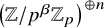 $\left (\mathbb {Z}/p^{\beta }\mathbb {Z}_p\right )^{\oplus n}$
. By Illusie’s deformation theory [Reference IllusieIll71] and since étale group schemes deform uniquely, there exists a finite flat group scheme
$\left (\mathbb {Z}/p^{\beta }\mathbb {Z}_p\right )^{\oplus n}$
. By Illusie’s deformation theory [Reference IllusieIll71] and since étale group schemes deform uniquely, there exists a finite flat group scheme $\mathcal {L}$
, étale locally isomorphic to
$\mathcal {L}$
, étale locally isomorphic to $\left (\mathbb {Z}/p^{\beta }\mathbb {Z}\right )^{\oplus n}$
, such that
$\left (\mathbb {Z}/p^{\beta }\mathbb {Z}\right )^{\oplus n}$
, such that $\mathcal {L}|_{T_0} = L$
, and a morphism
$\mathcal {L}|_{T_0} = L$
, and a morphism $B[\mathfrak {p}_{\tau _0}] \twoheadrightarrow \mathcal {L}$
deforming the right-hand map in (6.1.9). Let
$B[\mathfrak {p}_{\tau _0}] \twoheadrightarrow \mathcal {L}$
deforming the right-hand map in (6.1.9). Let $\mathcal {K}$
denote the kernel of the map
$\mathcal {K}$
denote the kernel of the map $B[\mathfrak {p}_{\tau _0}] \twoheadrightarrow \mathcal {L}$
. Then the required point is given by
$B[\mathfrak {p}_{\tau _0}] \twoheadrightarrow \mathcal {L}$
. Then the required point is given by $\tilde {B} = B/\mathcal {K}'$
and
$\tilde {B} = B/\mathcal {K}'$
and $\tilde {C}$
is the image of
$\tilde {C}$
is the image of $B[\mathfrak {p}_{\tau _0}^{\beta }]$
under
$B[\mathfrak {p}_{\tau _0}^{\beta }]$
under $B \to \tilde {B}$
. This proves that q and hence
$B \to \tilde {B}$
. This proves that q and hence $\mathfrak {Y}$
is smooth.
$\mathfrak {Y}$
is smooth.
Step 3: (Constructing a finite étale map $\mathfrak {X}_{G, w_n}(p^{\beta }) \to \mathfrak {Y}$
)
$\mathfrak {X}_{G, w_n}(p^{\beta }) \to \mathfrak {Y}$
)
For $i=2, \dots , n+1$
, let
$i=2, \dots , n+1$
, let $e_i \in \mathbb {X}_{\operatorname {ord}, \tau _0}[p^{\beta }] = \mu _{p^{\beta }} \oplus \left (\mathbb {Z}/p^{\beta }\mathbb {Z} \right )^{\oplus 2n-1}$
denote the basis vector of the
$e_i \in \mathbb {X}_{\operatorname {ord}, \tau _0}[p^{\beta }] = \mu _{p^{\beta }} \oplus \left (\mathbb {Z}/p^{\beta }\mathbb {Z} \right )^{\oplus 2n-1}$
denote the basis vector of the $\mathbb {Z}/p^{\beta }\mathbb {Z}$
-factor in the i-th place. Let
$\mathbb {Z}/p^{\beta }\mathbb {Z}$
-factor in the i-th place. Let $C_{\operatorname {std}} \subset \mathbb {X}_{\operatorname {ord}, \tau _0}[p^{\beta }]$
denote the finite flat subgroup scheme generated by
$C_{\operatorname {std}} \subset \mathbb {X}_{\operatorname {ord}, \tau _0}[p^{\beta }]$
denote the finite flat subgroup scheme generated by $\{ e_i : i=2, \dots , n+1 \}$
. We have a natural map
$\{ e_i : i=2, \dots , n+1 \}$
. We have a natural map $\mathfrak {IG}_G \to \mathfrak {Y}$
given by sending
$\mathfrak {IG}_G \to \mathfrak {Y}$
given by sending $(A, \lambda , i, \eta ^p, s, f_{\tau })$
to
$(A, \lambda , i, \eta ^p, s, f_{\tau })$
to $(A, C)$
(which the induced extra structure) where
$(A, C)$
(which the induced extra structure) where $C = f_{\tau _0}(C_{\operatorname {std}})$
. This is a fpqc torsor for a subgroup of the form
$C = f_{\tau _0}(C_{\operatorname {std}})$
. This is a fpqc torsor for a subgroup of the form $N^G_{\operatorname {Iw}}(p^{\beta }) \rtimes \underline {M} \subset J^+_{G, \operatorname {ord}}$
, for some pro-étale subgroup scheme
$N^G_{\operatorname {Iw}}(p^{\beta }) \rtimes \underline {M} \subset J^+_{G, \operatorname {ord}}$
, for some pro-étale subgroup scheme $\underline {M} \subset J^+_{G, \operatorname {ord}}$
which contains
$\underline {M} \subset J^+_{G, \operatorname {ord}}$
which contains $\underline {M^G_{\operatorname {Iw}}(p^{\beta })}$
. We have a factorisation
$\underline {M^G_{\operatorname {Iw}}(p^{\beta })}$
. We have a factorisation
 $$\begin{align*}\mathfrak{IG}_G \to \mathfrak{IG}_{G, w_n}(p^{\beta}) \to \mathfrak{X}_{G, w_n}(p^{\beta}) \to \mathfrak{Y}. \end{align*}$$
Since the map $\mathfrak {IG}_{G, w_n} \to \mathfrak {Y}$
is a pro-étale M-torsor, we see that
$\mathfrak {IG}_{G, w_n} \to \mathfrak {Y}$
is a pro-étale M-torsor, we see that $\mathfrak {X}_{G, w_n}(p^{\beta }) \to \mathfrak {Y}$
is finite étale. Since we have already shown
$\mathfrak {X}_{G, w_n}(p^{\beta }) \to \mathfrak {Y}$
is finite étale. Since we have already shown $\mathfrak {Y}$
is smooth, this implies that
$\mathfrak {Y}$
is smooth, this implies that $\mathfrak {X}_{G, w_n}(p^{\beta })$
is smooth.
$\mathfrak {X}_{G, w_n}(p^{\beta })$
is smooth.
The proof for $\mathfrak {X}_{H, \operatorname {id}}(p^{\beta })$
is very similar, using the moduli space
$\mathfrak {X}_{H, \operatorname {id}}(p^{\beta })$
is very similar, using the moduli space $\mathfrak {Y} \to \mathfrak {X}_{H}^{\operatorname {ord}}$
parameterising finite flat subgroup schemes
$\mathfrak {Y} \to \mathfrak {X}_{H}^{\operatorname {ord}}$
parameterising finite flat subgroup schemes $C \subset A_1[\mathfrak {p}_{\tau _0}^{\beta }]$
which are étale locally isomorphic to
$C \subset A_1[\mathfrak {p}_{\tau _0}^{\beta }]$
which are étale locally isomorphic to $\left (\mathbb {Z}/p^{\beta }\mathbb {Z}\right )^{\oplus n-1}$
.
$\left (\mathbb {Z}/p^{\beta }\mathbb {Z}\right )^{\oplus n-1}$
.
Let $\mathbb {Q}_p^{\operatorname {cycl}}$
denote the p-adic completion of
$\mathbb {Q}_p^{\operatorname {cycl}}$
denote the p-adic completion of $\mathbb {Q}_p(\mu _{p^{\infty }})$
with ring of integers
$\mathbb {Q}_p(\mu _{p^{\infty }})$
with ring of integers $\mathbb {Z}_p^{\operatorname {cycl}}$
, and fix a basis
$\mathbb {Z}_p^{\operatorname {cycl}}$
, and fix a basis $\varepsilon \in T_p\mu _{p^{\infty }}(\mathbb {Z}_p^{\operatorname {cycl}})$
. Let
$\varepsilon \in T_p\mu _{p^{\infty }}(\mathbb {Z}_p^{\operatorname {cycl}})$
. Let $u \in M_{\mathbf {G}}(\mathbb {Z}_p)$
denote the element in [Reference GrahamGra24, Definition 2.4.2]. Then we consider the following element
$u \in M_{\mathbf {G}}(\mathbb {Z}_p)$
denote the element in [Reference GrahamGra24, Definition 2.4.2]. Then we consider the following element $\gamma = 1 \times \prod _{\tau \in \Psi } \gamma _{\tau } \in J_{G, \operatorname {ord}}^+(\mathbb {Z}_p^{\operatorname {cycl}})$
, where
$\gamma = 1 \times \prod _{\tau \in \Psi } \gamma _{\tau } \in J_{G, \operatorname {ord}}^+(\mathbb {Z}_p^{\operatorname {cycl}})$
, where $\gamma _{\tau } = u_{\tau }$
for
$\gamma _{\tau } = u_{\tau }$
for $\tau \neq \tau _0$
and
$\tau \neq \tau _0$
and

where $x_{\tau _0} \in (T_p\mu _{p^{\infty }}(\mathbb {Z}_p^{\operatorname {cycl}}))^{\oplus 2n-1}$
is the
$x_{\tau _0} \in (T_p\mu _{p^{\infty }}(\mathbb {Z}_p^{\operatorname {cycl}}))^{\oplus 2n-1}$
is the $(1 \times 2n-1)$
-matrix whose n-th entry is
$(1 \times 2n-1)$
-matrix whose n-th entry is $\varepsilon \in T_p\mu _{p^{\infty }}(\mathbb {Z}_p^{\operatorname {cycl}})$
and the rest are
$\varepsilon \in T_p\mu _{p^{\infty }}(\mathbb {Z}_p^{\operatorname {cycl}})$
and the rest are $1 \in T_p\mu _{p^{\infty }}(\mathbb {Z}_p^{\operatorname {cycl}})$
. Then we have a morphism
$1 \in T_p\mu _{p^{\infty }}(\mathbb {Z}_p^{\operatorname {cycl}})$
. Then we have a morphism
 $$\begin{align*}\mathfrak{IG}_{H, \mathbb{Z}_p^{\operatorname{cycl}}} \xrightarrow{\cdot \gamma} \mathfrak{IG}_{G, \mathbb{Z}_p^{\operatorname{cycl}}} \end{align*}$$
given by right-translation by $\gamma $
. If we let
$\gamma $
. If we let $\operatorname {Unip}(J_{H, \operatorname {ord}}) \cong \tilde {\mu _{p^{\infty }}}^{\oplus n-1}$
denote the unipotent part of
$\operatorname {Unip}(J_{H, \operatorname {ord}}) \cong \tilde {\mu _{p^{\infty }}}^{\oplus n-1}$
denote the unipotent part of $J_{H, \operatorname {ord}}$
, then this morphism is equivariant for the actions of
$J_{H, \operatorname {ord}}$
, then this morphism is equivariant for the actions of $\operatorname {Unip}(J_{H, \operatorname {ord}})$
on both sides. Furthermore, we have
$\operatorname {Unip}(J_{H, \operatorname {ord}})$
on both sides. Furthermore, we have $N_{\diamondsuit }^H(p^{\beta }) = \gamma N^G_{\operatorname {Iw}}(p^{\beta }) \gamma ^{-1} \cap J_{H, \operatorname {ord}}^+$
and
$N_{\diamondsuit }^H(p^{\beta }) = \gamma N^G_{\operatorname {Iw}}(p^{\beta }) \gamma ^{-1} \cap J_{H, \operatorname {ord}}^+$
and $J_{\diamondsuit }^H(p^{\beta }) = \gamma J_{\operatorname {Iw}}^G(p^{\beta }) \gamma ^{-1} \cap J_{H, \operatorname {ord}}^+$
, so we obtain induced morphisms
$J_{\diamondsuit }^H(p^{\beta }) = \gamma J_{\operatorname {Iw}}^G(p^{\beta }) \gamma ^{-1} \cap J_{H, \operatorname {ord}}^+$
, so we obtain induced morphisms
 $$\begin{align*}\hat{\iota} \colon \mathfrak{IG}_{H, \operatorname{id}}(p^{\beta}) \to \mathfrak{IG}_{G, w_n}(p^{\beta}), \quad \quad \hat{\iota} \colon \mathfrak{X}_{H, \operatorname{id}}(p^{\beta}) \to \mathfrak{X}_{G, w_n}(p^{\beta}) \end{align*}$$
Both of these morphisms only depend on the image of $\varepsilon $
in
$\varepsilon $
in $\mu _{p^{\beta }}$
, hence descend to morphisms over
$\mu _{p^{\beta }}$
, hence descend to morphisms over $\mathbb {Z}_p[\mu _{p^{\beta }}]$
. The reason for the notation
$\mathbb {Z}_p[\mu _{p^{\beta }}]$
. The reason for the notation $\hat {\iota }$
will be explained in Proposition 6.2.13.
$\hat {\iota }$
will be explained in Proposition 6.2.13.
6.1.3 Differential operators
We now explain how one obtains a unipotent action on the Igusa towers $\mathfrak {IG}_{G, w_n}(p^{\beta })$
and
$\mathfrak {IG}_{G, w_n}(p^{\beta })$
and $\mathfrak {IG}_{H, \operatorname {id}}(p^{\beta })$
following the strategy in [Reference HoweHow20].
$\mathfrak {IG}_{H, \operatorname {id}}(p^{\beta })$
following the strategy in [Reference HoweHow20].
Let $\operatorname {Unip}(J_{G, \operatorname {ord}})$
(resp.
$\operatorname {Unip}(J_{G, \operatorname {ord}})$
(resp. $\operatorname {Unip}(J_{H, \operatorname {ord}})$
) denote the unipotent subgroup of
$\operatorname {Unip}(J_{H, \operatorname {ord}})$
) denote the unipotent subgroup of $J_{G, \operatorname {ord}}$
(resp.
$J_{G, \operatorname {ord}}$
(resp. $J_{H, \operatorname {ord}}$
). Then we have
$J_{H, \operatorname {ord}}$
). Then we have
 $$\begin{align*}\operatorname{Unip}(J_{G, \operatorname{ord}})/N_{\operatorname{Iw}}^G(p^{\beta}) \cong \left( \tilde{\mu_{p^{\infty}}}/p^{\beta}T_p\mu_{p^{\infty}} \right)^{\oplus n} \oplus \left( \tilde{\mu_{p^{\infty}}}/T_p\mu_{p^{\infty}} \right)^{\oplus n-1} \end{align*}$$
and
 $$\begin{align*}\operatorname{Unip}(J_{H, \operatorname{ord}})/N_{\diamondsuit}^H(p^{\beta}) \cong \left( \tilde{\mu_{p^{\infty}}}/p^{\beta}T_p\mu_{p^{\infty}} \right)^{\oplus n-1} \end{align*}$$
both of which are isomorphic to copies of the formal torus $\widehat {\mathbb {G}}_m$
.
$\widehat {\mathbb {G}}_m$
.
Definition 6.1.10. Let $U_{G, \beta } = (p^{-\beta } \mathbb {Z}_p)^{\oplus n} \oplus \mathbb {Z}_p^{\oplus n-1}$
and
$U_{G, \beta } = (p^{-\beta } \mathbb {Z}_p)^{\oplus n} \oplus \mathbb {Z}_p^{\oplus n-1}$
and $U_{H, \beta } = (p^{-\beta } \mathbb {Z}_p)^{\oplus n-1}$
. We view
$U_{H, \beta } = (p^{-\beta } \mathbb {Z}_p)^{\oplus n-1}$
. We view $U_{H, \beta } \subset U_{G, \beta }$
by including in the first
$U_{H, \beta } \subset U_{G, \beta }$
by including in the first $n-1$
factors. Let
$n-1$
factors. Let $C_{\operatorname {cont}}(U_{\bullet , \beta }, \mathbb {Z}_p)$
denote the algebra of continuous functions
$C_{\operatorname {cont}}(U_{\bullet , \beta }, \mathbb {Z}_p)$
denote the algebra of continuous functions $U_{\bullet , \beta } \to \mathbb {Z}_p$
.
$U_{\bullet , \beta } \to \mathbb {Z}_p$
.
By p-adic Fourier theory, we have identifications of $\mathbb {Z}_p$
-algebras
$\mathbb {Z}_p$
-algebras
 $$ \begin{align*} C_{\operatorname{cont}}(U_{G, \beta}, \mathbb{Z}_p) &= \operatorname{Hom}_{\mathbb{Z}_p}(\mathcal{O}(\operatorname{Unip}(J_{G, \operatorname{ord}})/N_{\operatorname{Iw}}^G(p^{\beta})), \mathbb{Z}_p) \\ C_{\operatorname{cont}}(U_{H, \beta}, \mathbb{Z}_p) &= \operatorname{Hom}_{\mathbb{Z}_p}(\mathcal{O}(\operatorname{Unip}(J_{H, \operatorname{ord}})/N_{\diamondsuit}^H(p^{\beta})), \mathbb{Z}_p) \end{align*} $$
where the algebra action on the right-hand side is induced from the co-algebra structure on $\mathcal {O}(\cdots )$
. Indeed, by a change of coordinates these identifications are induced from the identification
$\mathcal {O}(\cdots )$
. Indeed, by a change of coordinates these identifications are induced from the identification $C_{\operatorname {cont}}(\mathbb {Z}_p, \mathbb {Z}_p) = \operatorname {Hom}_{\mathbb {Z}_p}(\mathcal {O}(\widehat {\mathbb {G}}_m), \mathbb {Z}_p)$
, which in turn arises from the Amice transform identifying sections
$C_{\operatorname {cont}}(\mathbb {Z}_p, \mathbb {Z}_p) = \operatorname {Hom}_{\mathbb {Z}_p}(\mathcal {O}(\widehat {\mathbb {G}}_m), \mathbb {Z}_p)$
, which in turn arises from the Amice transform identifying sections $\mathcal {O}(\widehat {\mathbb {G}}_m) \cong \mathbb {Z}_p[\![T]\!]$
with measures on
$\mathcal {O}(\widehat {\mathbb {G}}_m) \cong \mathbb {Z}_p[\![T]\!]$
with measures on $\mathbb {Z}_p$
(see [Reference ColmezCol10, Corollaire I.2.4]; or for a more general result for families of p-divisible groups stated in a similar form as above, see [Reference Graham, van Hoften and HoweGvHH25, §7]).
$\mathbb {Z}_p$
(see [Reference ColmezCol10, Corollaire I.2.4]; or for a more general result for families of p-divisible groups stated in a similar form as above, see [Reference Graham, van Hoften and HoweGvHH25, §7]).
Suppose that R is p-adically complete and separated $\mathbb {Z}_p$
-algebra and let
$\mathbb {Z}_p$
-algebra and let $\tilde {\zeta } = (\tilde {\zeta }_i) \in \tilde {\mu _{p^{\infty }}}^{\oplus 2n-1}(R)$
. We can view
$\tilde {\zeta } = (\tilde {\zeta }_i) \in \tilde {\mu _{p^{\infty }}}^{\oplus 2n-1}(R)$
. We can view $\tilde {\zeta }_i = (\zeta _{i, k})_{k \geq 0} \in \varprojlim _{\times p} \mu _{p^{\infty }}(R)$
where
$\tilde {\zeta }_i = (\zeta _{i, k})_{k \geq 0} \in \varprojlim _{\times p} \mu _{p^{\infty }}(R)$
where $\zeta _{i, k} \in \mu _{p^{\infty }}(R)$
and
$\zeta _{i, k} \in \mu _{p^{\infty }}(R)$
and $\zeta _{i, k+1}^p = \zeta _{i, k}$
.Footnote
7
Consider the continuous function
$\zeta _{i, k+1}^p = \zeta _{i, k}$
.Footnote
7
Consider the continuous function $\chi _{\tilde {\zeta }} \colon U_{G, \beta } \to R$
given by
$\chi _{\tilde {\zeta }} \colon U_{G, \beta } \to R$
given by
 $$\begin{align*}\chi_{\tilde{\zeta}}( \frac{a_1}{p^{\beta}}, \dots, \frac{a_n}{p^{\beta}}, a_{n+1}, \dots, a_{2n-1}) = \zeta_{1, \beta}^{a_1} \cdots \zeta_{n, \beta}^{a_n} \cdot \zeta_{n+1, 0}^{a_{n+1}} \cdots \zeta_{2n-1, 0}^{a_{2n-1}} \end{align*}$$
which only depends on the image of $\tilde {\zeta }$
in
$\tilde {\zeta }$
in $\operatorname {Unip}(J_{G, \operatorname {ord}})/N_{\operatorname {Iw}}^G(p^{\beta })$
. Then the above identifications are normalised so that
$\operatorname {Unip}(J_{G, \operatorname {ord}})/N_{\operatorname {Iw}}^G(p^{\beta })$
. Then the above identifications are normalised so that $\chi _{\tilde {\zeta }}$
corresponds to the homomorphism
$\chi _{\tilde {\zeta }}$
corresponds to the homomorphism $\mathcal {O}(\operatorname {Unip}(J_{G, \operatorname {ord}})/N_{\operatorname {Iw}}^G(p^{\beta })) \to R$
given by evaluating a section on
$\mathcal {O}(\operatorname {Unip}(J_{G, \operatorname {ord}})/N_{\operatorname {Iw}}^G(p^{\beta })) \to R$
given by evaluating a section on $\tilde {\zeta }$
. We have a similar description for H.
$\tilde {\zeta }$
. We have a similar description for H.
Since $J_{\bullet , \operatorname {ord}}$
acts on
$J_{\bullet , \operatorname {ord}}$
acts on $\mathfrak {IG}_{\bullet }$
, we obtain right actions
$\mathfrak {IG}_{\bullet }$
, we obtain right actions
 $$ \begin{align*} \operatorname{Unip}(J_{G, \operatorname{ord}})/N_{\operatorname{Iw}}^G(p^{\beta}) \times \mathfrak{IG}_{G, w_n}(p^{\beta}) &\to \mathfrak{IG}_{G, w_n}(p^{\beta}) \\ \operatorname{Unip}(J_{H, \operatorname{ord}})/N_{\diamondsuit}^H(p^{\beta}) \times \mathfrak{IG}_{H, \operatorname{id}}(p^{\beta}) &\to \mathfrak{IG}_{H, \operatorname{id}}(p^{\beta}). \end{align*} $$
Therefore, by passing to the associated co-actions and using the identifications above, we obtain $\mathbb {Z}_p$
-algebra actions
$\mathbb {Z}_p$
-algebra actions
 $$ \begin{align*} C_{\operatorname{cont}}(U_{G, \beta}, \mathbb{Z}_p) \times \mathcal{O}_{\mathfrak{IG}_{G, w_n}(p^{\beta})} &\to \mathcal{O}_{\mathfrak{IG}_{G, w_n}(p^{\beta})} \\ C_{\operatorname{cont}}(U_{H, \beta}, \mathbb{Z}_p) \times \mathcal{O}_{\mathfrak{IG}_{H, \operatorname{id}}(p^{\beta})} &\to \mathcal{O}_{\mathfrak{IG}_{H, \operatorname{id}}(p^{\beta})}. \end{align*} $$
In particular, the action of $\chi _{\tilde {\zeta }}$
corresponds right-translation of a section by
$\chi _{\tilde {\zeta }}$
corresponds right-translation of a section by $\tilde {\zeta }$
.
$\tilde {\zeta }$
.
Finally, we note that the pullback map $\mathcal {O}_{\mathfrak {IG}_{G, w_n}(p^{\beta })} \to \hat {\iota }_* \mathcal {O}_{\mathfrak {IG}_{H, \operatorname {id}}(p^{\beta })}$
is equivariant for the action of
$\mathcal {O}_{\mathfrak {IG}_{G, w_n}(p^{\beta })} \to \hat {\iota }_* \mathcal {O}_{\mathfrak {IG}_{H, \operatorname {id}}(p^{\beta })}$
is equivariant for the action of $C_{\operatorname {cont}}(U_{H, \beta }, \mathbb {Z}_p)$
, where we view
$C_{\operatorname {cont}}(U_{H, \beta }, \mathbb {Z}_p)$
, where we view $C_{\operatorname {cont}}(U_{H, \beta }, \mathbb {Z}_p) \subset C_{\operatorname {cont}}(U_{G, \beta }, \mathbb {Z}_p)$
in the natural way (via the split inclusion
$C_{\operatorname {cont}}(U_{H, \beta }, \mathbb {Z}_p) \subset C_{\operatorname {cont}}(U_{G, \beta }, \mathbb {Z}_p)$
in the natural way (via the split inclusion $U_{H, \beta } \subset U_{G, \beta }$
).
$U_{H, \beta } \subset U_{G, \beta }$
).
6.2 Integral models and overconvergent neighbourhoods
Let $\mathcal {X}_{G, \operatorname {Iw}}(p^{\beta })$
and
$\mathcal {X}_{G, \operatorname {Iw}}(p^{\beta })$
and $\mathcal {X}_{H, \diamondsuit }(p^{\beta })$
denote the smooth proper adic spaces over
$\mathcal {X}_{H, \diamondsuit }(p^{\beta })$
denote the smooth proper adic spaces over $\mathbb {Q}_p$
associated with
$\mathbb {Q}_p$
associated with $X_{\mathbf {G}, \operatorname {Iw}, \mathbb {Q}_p}(p^{\beta })$
and
$X_{\mathbf {G}, \operatorname {Iw}, \mathbb {Q}_p}(p^{\beta })$
and $X_{\mathbf {H}, \diamondsuit , \mathbb {Q}_p}(p^{\beta })$
respectively. In this section we will construct certain integral models for these adic spaces, via normalisation, which will be useful in the p-adic interpolation of differential operators (see §7). Furthermore, we will explain how
$X_{\mathbf {H}, \diamondsuit , \mathbb {Q}_p}(p^{\beta })$
respectively. In this section we will construct certain integral models for these adic spaces, via normalisation, which will be useful in the p-adic interpolation of differential operators (see §7). Furthermore, we will explain how $\mathfrak {X}_{G, w_n}(p^{\beta })$
and
$\mathfrak {X}_{G, w_n}(p^{\beta })$
and $\mathfrak {X}_{H, \operatorname {id}}(p^{\beta })$
appear as ordinary strata inside these formal models. To be able to do this for H, it will be necessary to work over a finite extension
$\mathfrak {X}_{H, \operatorname {id}}(p^{\beta })$
appear as ordinary strata inside these formal models. To be able to do this for H, it will be necessary to work over a finite extension $L/\mathbb {Q}_p$
which contains
$L/\mathbb {Q}_p$
which contains $\mu _{p^{\beta }}$
. We therefore assume that all of the spaces we consider in this section have been base-changed to L or
$\mu _{p^{\beta }}$
. We therefore assume that all of the spaces we consider in this section have been base-changed to L or $\mathcal {O}_L$
, however we will omit this from the notation.
$\mathcal {O}_L$
, however we will omit this from the notation.
6.2.1 Integral models for G
Fix $\beta \geq 1$
(and
$\beta \geq 1$
(and $L/\mathbb {Q}_p$
as above). Recall from Definition 5.1.7 that
$L/\mathbb {Q}_p$
as above). Recall from Definition 5.1.7 that $\mathcal {X}_{G, \operatorname {Iw}}(p^{\beta })$
parameterises flags
$\mathcal {X}_{G, \operatorname {Iw}}(p^{\beta })$
parameterises flags
 $$ \begin{align} 0 = C_{0, \tau} \subset C_{1, \tau} \subset \cdots \subset C_{2n, \tau} = A[\mathfrak{p}_{\tau}^{\beta}] \end{align} $$
of finite flat group schemes $C_{i, \tau }$
of order
$C_{i, \tau }$
of order $p^{i \beta }$
, such that each graded piece
$p^{i \beta }$
, such that each graded piece $C_{i, \tau }/C_{i-1, \tau }$
is cyclic (of order
$C_{i, \tau }/C_{i-1, \tau }$
is cyclic (of order $p^{\beta }$
). From the moduli description of
$p^{\beta }$
). From the moduli description of $\mathfrak {IG}_G$
, we also see that
$\mathfrak {IG}_G$
, we also see that $\mathfrak {X}_{G, w_n}(p^{\beta })$
parameterises ordinary
$\mathfrak {X}_{G, w_n}(p^{\beta })$
parameterises ordinary $\boldsymbol \Psi $
-abelian schemes A (with extra structure) and flags of finite flat subgroups as in (6.2.1), with
$\boldsymbol \Psi $
-abelian schemes A (with extra structure) and flags of finite flat subgroups as in (6.2.1), with
-
•
$C_{i, \tau }/C_{i-1, \tau }$
is étale locally isomorphic to
$\mathbb {Z}/p^{\beta }\mathbb {Z}$
for
$(i, \tau ) \neq (n+1, \tau _0)$
-
•
$C_{n+1, \tau _0}/C_{n, \tau _0}$
is étale locally isomorphic to
$\mu _{p^{\beta }}$
.


We therefore clearly have a morphism $\mathcal {X}_{G, w_n}(p^{\beta }) \to \mathcal {X}_{G, \operatorname {Iw}}(p^{\beta })$
. We claim that this is an open immersion and can be identified with the locus where a certain invertible
$\mathcal {X}_{G, w_n}(p^{\beta }) \to \mathcal {X}_{G, \operatorname {Iw}}(p^{\beta })$
. We claim that this is an open immersion and can be identified with the locus where a certain invertible $\mathcal {O}_{\mathcal {X}_{G, \operatorname {Iw}}(p^{\beta })}^+$
-module coincides with the structural sheaf
$\mathcal {O}_{\mathcal {X}_{G, \operatorname {Iw}}(p^{\beta })}^+$
-module coincides with the structural sheaf $\mathcal {O}_{\mathcal {X}_{G, \operatorname {Iw}}(p^{\beta })}^+$
. This will allow us to explicitly describe overconvergent neighbourhoods of
$\mathcal {O}_{\mathcal {X}_{G, \operatorname {Iw}}(p^{\beta })}^+$
. This will allow us to explicitly describe overconvergent neighbourhoods of $\mathcal {X}_{G, w_n}(p^{\beta })$
in
$\mathcal {X}_{G, w_n}(p^{\beta })$
in $\mathcal {X}_{G, \operatorname {Iw}}(p^{\beta })$
(see Lemma 6.2.9 and Definition 6.2.10).
$\mathcal {X}_{G, \operatorname {Iw}}(p^{\beta })$
(see Lemma 6.2.9 and Definition 6.2.10).
To prove this, we need to consider the following morphisms:
Definition 6.2.2. For any $(i, \tau )$
, let
$(i, \tau )$
, let  , where $C_{i, \tau }' = C_{i, \tau } \oplus C_{i, \tau }^{\perp } \subset A[p^{\beta }]$
with
$C_{i, \tau }' = C_{i, \tau } \oplus C_{i, \tau }^{\perp } \subset A[p^{\beta }]$
with $C_{i, \tau }^{\perp } \subset A[\mathfrak {p}_{\tau ^c}^{\beta }]$
the orthogonal complement of
$C_{i, \tau }^{\perp } \subset A[\mathfrak {p}_{\tau ^c}^{\beta }]$
the orthogonal complement of $C_{i, \tau }$
under the Weil pairing. Note that the extra structure on A naturally descends to
$C_{i, \tau }$
under the Weil pairing. Note that the extra structure on A naturally descends to $A_{i, \tau }$
. We therefore obtain a finite morphism
$A_{i, \tau }$
. We therefore obtain a finite morphism
 $$ \begin{align*} q_{i, \tau} \colon \mathcal{X}_{G, \operatorname{Iw}}(p^{\beta}) &\to \mathcal{X}_G \\ (A, C_{\bullet, \bullet}) &\mapsto A_{i, \tau}. \end{align*} $$
Let $q \colon \mathcal {X}_{G, \operatorname {Iw}}(p^{\beta }) \to \mathcal {X}_G \times \prod _{(i, \tau )} \mathcal {X}_G$
denote the induced finite morphism, where the map to the first factor is the forgetful map and
$q \colon \mathcal {X}_{G, \operatorname {Iw}}(p^{\beta }) \to \mathcal {X}_G \times \prod _{(i, \tau )} \mathcal {X}_G$
denote the induced finite morphism, where the map to the first factor is the forgetful map and $\operatorname {pr}_{i, \tau } \circ q = q_{i, \tau }$
, where
$\operatorname {pr}_{i, \tau } \circ q = q_{i, \tau }$
, where $\operatorname {pr}_{i, \tau }$
denotes projection to the
$\operatorname {pr}_{i, \tau }$
denotes projection to the $(i, \tau )$
-factor.
$(i, \tau )$
-factor.
We define $\mathfrak {X}_{G, \operatorname {Iw}}(p^{\beta })$
to be the normalisation of
$\mathfrak {X}_{G, \operatorname {Iw}}(p^{\beta })$
to be the normalisation of $\mathfrak {X}_G \times \prod _{(i, \tau )} \mathfrak {X}_G$
under the morphism
$\mathfrak {X}_G \times \prod _{(i, \tau )} \mathfrak {X}_G$
under the morphism $q \colon \mathcal {X}_{G, \operatorname {Iw}}(p^{\beta }) \to \mathcal {X}_G \times \prod _{(i, \tau )} \mathcal {X}_G$
.
$q \colon \mathcal {X}_{G, \operatorname {Iw}}(p^{\beta }) \to \mathcal {X}_G \times \prod _{(i, \tau )} \mathcal {X}_G$
.
We have the following lemma which says that the universal flags of finite flat subgroup schemes over $\mathcal {X}_{G, \operatorname {Iw}}(p^{\beta })$
extend to the normalisation.
$\mathcal {X}_{G, \operatorname {Iw}}(p^{\beta })$
extend to the normalisation.
Lemma 6.2.3. Let $\mathcal {A}$
denote the pullback of the universal
$\mathcal {A}$
denote the pullback of the universal $\boldsymbol \Psi $
-unitary abelian scheme under the map
$\boldsymbol \Psi $
-unitary abelian scheme under the map $\mathfrak {X}_{G, \operatorname {Iw}}(p^{\beta }) \to \mathfrak {X}_G \times \prod _{(i, \tau )} \mathfrak {X}_G \to \mathfrak {X}_G$
, where the second map is projection to the first component. Then there exist flags
$\mathfrak {X}_{G, \operatorname {Iw}}(p^{\beta }) \to \mathfrak {X}_G \times \prod _{(i, \tau )} \mathfrak {X}_G \to \mathfrak {X}_G$
, where the second map is projection to the first component. Then there exist flags
 $$\begin{align*}0 = \mathcal{C}_{0, \tau} \subset \mathcal{C}_{1, \tau} \subset \cdots \subset \mathcal{C}_{2n, \tau} = \mathcal{A}[\mathfrak{p}_{\tau}^{\beta}] \end{align*}$$
of finite flat subgroup schemes $\mathcal {C}_{i, \tau }$
of order
$\mathcal {C}_{i, \tau }$
of order $p^{i \beta }$
which agree with the universal flags (as in (6.2.1)) on the adic generic fibre.
$p^{i \beta }$
which agree with the universal flags (as in (6.2.1)) on the adic generic fibre.
Proof. Let $\mathcal {A}_{i, \tau }$
denote the pullback of the universal
$\mathcal {A}_{i, \tau }$
denote the pullback of the universal $\boldsymbol \Psi $
-unitary abelian scheme under the morphism
$\boldsymbol \Psi $
-unitary abelian scheme under the morphism
 $$\begin{align*}\mathfrak{X}_{G, \operatorname{Iw}}(p^{\beta}) \to \mathfrak{X}_G \times \prod_{(i, \tau)} \mathfrak{X}_G \xrightarrow{\operatorname{pr}_{i, \tau}} \mathfrak{X}_G \end{align*}$$
where the second map is projection to the $(i, \tau )$
-component. This agrees with the abelian scheme
$(i, \tau )$
-component. This agrees with the abelian scheme $A_{i, \tau }$
on the adic generic fibre. We claim that the isogeny
$A_{i, \tau }$
on the adic generic fibre. We claim that the isogeny $A \to A_{i, \tau }$
extends to an isogeny
$A \to A_{i, \tau }$
extends to an isogeny $\mathcal {A}[p^{\infty }] \to \mathcal {A}_{i, \tau }[p^{\infty }]$
of p-divisible groups. If we show this, then we can define the finite flat subgroup scheme
$\mathcal {A}[p^{\infty }] \to \mathcal {A}_{i, \tau }[p^{\infty }]$
of p-divisible groups. If we show this, then we can define the finite flat subgroup scheme $\mathcal {C}_{i, \tau }$
to be the kernel of the induced isogeny
$\mathcal {C}_{i, \tau }$
to be the kernel of the induced isogeny $\mathcal {A}[\mathfrak {p}_{\tau }^{\infty }] \to \mathcal {A}_{i, \tau }[\mathfrak {p}_{\tau }^{\infty }]$
of p-divisible groups.
$\mathcal {A}[\mathfrak {p}_{\tau }^{\infty }] \to \mathcal {A}_{i, \tau }[\mathfrak {p}_{\tau }^{\infty }]$
of p-divisible groups.
Let $\beta ' \geq \beta $
be an integer and let
$\beta ' \geq \beta $
be an integer and let $L \subset A[p^{\beta '}] \oplus A_{i, \tau }[p^{\beta '}]$
denote the graph of the morphism induced from the isogeny
$L \subset A[p^{\beta '}] \oplus A_{i, \tau }[p^{\beta '}]$
denote the graph of the morphism induced from the isogeny $A \to A_{i, \tau }$
. Note that projection to the first factor induces an isomorphism
$A \to A_{i, \tau }$
. Note that projection to the first factor induces an isomorphism $L \xrightarrow {\sim } A[p^{\beta '}]$
. Let
$L \xrightarrow {\sim } A[p^{\beta '}]$
. Let $\mathcal {L} \subset \mathcal {A}[p^{\beta '}] \oplus \mathcal {A}_{i, \tau }[p^{\beta '}]$
denote the Zariski closure of L in
$\mathcal {L} \subset \mathcal {A}[p^{\beta '}] \oplus \mathcal {A}_{i, \tau }[p^{\beta '}]$
denote the Zariski closure of L in $\mathcal {A}[p^{\beta '}] \oplus \mathcal {A}_{i, \tau }[p^{\beta '}]$
, which is a closed subscheme. Consider the induced morphism
$\mathcal {A}[p^{\beta '}] \oplus \mathcal {A}_{i, \tau }[p^{\beta '}]$
, which is a closed subscheme. Consider the induced morphism $\mathcal {L} \to \mathcal {A}[p^{\beta '}]$
given by projecting to the first factor. Since this an isomorphism on generic fibres, the induced map
$\mathcal {L} \to \mathcal {A}[p^{\beta '}]$
given by projecting to the first factor. Since this an isomorphism on generic fibres, the induced map $\mathcal {O}_{\mathcal {A}[p^{\beta '}]} \to \mathcal {O}_{\mathcal {L}}$
is injective. We wish to show this map is surjective, hence an isomorphism. By Nakayama’s lemma, it is enough to check this after specialising at rank one points.
$\mathcal {O}_{\mathcal {A}[p^{\beta '}]} \to \mathcal {O}_{\mathcal {L}}$
is injective. We wish to show this map is surjective, hence an isomorphism. By Nakayama’s lemma, it is enough to check this after specialising at rank one points.
Let $x \colon \operatorname {Spa}(K, \mathcal {O}_K) \to \mathcal {X}_{G, \operatorname {Iw}}(p^{\beta })$
be a rank one point inducing a morphism
$x \colon \operatorname {Spa}(K, \mathcal {O}_K) \to \mathcal {X}_{G, \operatorname {Iw}}(p^{\beta })$
be a rank one point inducing a morphism $\mathcal {O}_K \to \mathfrak {X}_{G, \operatorname {Iw}}(p^{\beta })$
. We will denote base-change along this morphism by adding a subscript x to the object. Then
$\mathcal {O}_K \to \mathfrak {X}_{G, \operatorname {Iw}}(p^{\beta })$
. We will denote base-change along this morphism by adding a subscript x to the object. Then $\mathcal {L}_x \subset \mathcal {A}_x[p^{\beta '}] \oplus \mathcal {A}_{i, \tau , x}[p^{\beta '}]$
is finite flat and equal to the Zariski closure of the graph of the morphism
$\mathcal {L}_x \subset \mathcal {A}_x[p^{\beta '}] \oplus \mathcal {A}_{i, \tau , x}[p^{\beta '}]$
is finite flat and equal to the Zariski closure of the graph of the morphism $A_x[p^{\beta '}] \to A_{i, \tau , x}[p^{\beta '}]$
. Let
$A_x[p^{\beta '}] \to A_{i, \tau , x}[p^{\beta '}]$
. Let $\operatorname {deg}(-)$
denote the degree of a finite flat subgroup scheme over
$\operatorname {deg}(-)$
denote the degree of a finite flat subgroup scheme over $\mathcal {O}_K$
as defined in [Reference FarguesFar10]. The morphism
$\mathcal {O}_K$
as defined in [Reference FarguesFar10]. The morphism $\mathcal {L}_x \to \mathcal {A}_x[p^{\beta '}]$
is an isomorphism on generic fibres, hence we must have
$\mathcal {L}_x \to \mathcal {A}_x[p^{\beta '}]$
is an isomorphism on generic fibres, hence we must have
 $$ \begin{align} \operatorname{deg}(\mathcal{L}_x) \leq \operatorname{deg}(\mathcal{A}_x[p^{\beta'}]). \end{align} $$
On the other hand, let N denote the kernel of the isogeny $A_x \to A_{i, \tau , x}$
and let
$A_x \to A_{i, \tau , x}$
and let $\mathcal {N} \subset A_x[p^{\beta }]$
denote its Zariski closure, which is a finite flat subgroup scheme. Then
$\mathcal {N} \subset A_x[p^{\beta }]$
denote its Zariski closure, which is a finite flat subgroup scheme. Then $\mathcal {A}_x/\mathcal {N}$
is an integral model for
$\mathcal {A}_x/\mathcal {N}$
is an integral model for $A_x/N \cong A_{i, \tau , x}$
over
$A_x/N \cong A_{i, \tau , x}$
over $\mathcal {O}_K$
. By the valuative criterion of properness for
$\mathcal {O}_K$
. By the valuative criterion of properness for $\mathfrak {X}_{G, \operatorname {Iw}}(p^{\beta })$
, we must have
$\mathfrak {X}_{G, \operatorname {Iw}}(p^{\beta })$
, we must have $\mathcal {A}_x/ \mathcal {N} \cong \mathcal {A}_{i, \tau , x}$
, hence the isogeny
$\mathcal {A}_x/ \mathcal {N} \cong \mathcal {A}_{i, \tau , x}$
, hence the isogeny $A_x \to A_{i, \tau , x}$
extends to an isogeny
$A_x \to A_{i, \tau , x}$
extends to an isogeny $f \colon \mathcal {A}_x \to \mathcal {A}_{i, \tau , x}$
. We obtain an induced morphism
$f \colon \mathcal {A}_x \to \mathcal {A}_{i, \tau , x}$
. We obtain an induced morphism
 $$\begin{align*}\left(\mathcal{A}_x[p^{\beta'}] \oplus \mathcal{A}_{i, \tau, x}[p^{\beta'}] \right)/\mathcal{L}_x \xrightarrow{f - \operatorname{id}} \mathcal{A}_{i, \tau, x}[p^{\beta'}] \end{align*}$$
which is an isomorphism on generic fibres. This implies that (6.2.4) is in fact an equality, and so the map $\mathcal {L}_x \to \mathcal {A}_x[p^{\beta '}]$
(and hence
$\mathcal {L}_x \to \mathcal {A}_x[p^{\beta '}]$
(and hence $\mathcal {L} \to \mathcal {A}[p^{\beta '}]$
) is an isomorphism.
$\mathcal {L} \to \mathcal {A}[p^{\beta '}]$
) is an isomorphism.
Finally, for any $\beta '$
we obtain an induced morphism
$\beta '$
we obtain an induced morphism
 $$\begin{align*}\mathcal{A}[p^{\beta'}] \xleftarrow{\sim} \mathcal{L} \to \mathcal{A}[p^{\beta'}] \oplus \mathcal{A}_{i, \tau}[p^{\beta'}] \to \mathcal{A}_{i, \tau}[p^{\beta'}] \end{align*}$$
where the last map is projection to the second component. These maps are compatible as $\beta '$
varies, hence we obtain an induced isogeny
$\beta '$
varies, hence we obtain an induced isogeny $\mathcal {A}[p^{\infty }] \to \mathcal {A}_{i, \tau }[p^{\infty }]$
as required.
$\mathcal {A}[p^{\infty }] \to \mathcal {A}_{i, \tau }[p^{\infty }]$
as required.
We can use the previous lemma to define certain invertible $\mathcal {O}_{\mathfrak {X}_{G, \operatorname {Iw}}(p^{\beta })}$
-modules which cut out
$\mathcal {O}_{\mathfrak {X}_{G, \operatorname {Iw}}(p^{\beta })}$
-modules which cut out $\mathfrak {X}_{G, w_n}(p^{\beta })$
. With notation as in the proof of Lemma 6.2.3, we set
$\mathfrak {X}_{G, w_n}(p^{\beta })$
. With notation as in the proof of Lemma 6.2.3, we set  and
and  , which are both p-divisible groups of height $2n$
and dimension
$2n$
and dimension $1$
(resp.
$1$
(resp. $0$
) if
$0$
) if $\tau = \tau _0$
(resp.
$\tau = \tau _0$
(resp. $\tau \neq \tau _0$
) by the signature condition. Note that
$\tau \neq \tau _0$
) by the signature condition. Note that $\mathcal {C}_{i, \tau }$
was constructed as the kernel of an isogeny
$\mathcal {C}_{i, \tau }$
was constructed as the kernel of an isogeny $G_{\tau } \to G_{i, \tau }$
. We also note that we have factorisations:
$G_{\tau } \to G_{i, \tau }$
. We also note that we have factorisations:
 $$ \begin{align} G_{\tau} = G_{0, \tau} \to G_{1, \tau} \to G_{2, \tau} \to \dots \to G_{2n-1, \tau} \to G_{\tau} = G_{2n, \tau} \end{align} $$
where the total composition is multiplication by $p^{\beta }$
(so has kernel
$p^{\beta }$
(so has kernel $G_{\tau }[p^{\beta }] = \mathcal {A}[\mathfrak {p}_{\tau }^{\beta }]$
).
$G_{\tau }[p^{\beta }] = \mathcal {A}[\mathfrak {p}_{\tau }^{\beta }]$
).
Definition 6.2.6. For $i=1, \dots , 2n$
, let
$i=1, \dots , 2n$
, let
 $$ \begin{align} \mathcal{O}_{\mathfrak{X}_{G, \operatorname{Iw}}(p^{\beta})} \to \operatorname{det}\omega_{G_{i-1, \tau_0}} \otimes \operatorname{det}\omega_{G_{i, \tau_0}}^{\vee} \end{align} $$
denote the morphism arising from the determinant of the map $\omega _{G_{i, \tau _0}} \to \omega _{G_{i-1, \tau _0}}$
induced from the isogeny
$\omega _{G_{i, \tau _0}} \to \omega _{G_{i-1, \tau _0}}$
induced from the isogeny $G_{i-1, \tau _0} \to G_{i, \tau _0}$
. Let
$G_{i-1, \tau _0} \to G_{i, \tau _0}$
. Let $\delta _{G, i} \subset \mathcal {O}_{\mathfrak {X}_{G, \operatorname {Iw}}(p^{\beta })}$
denote the annihilator of the cokernel of (6.2.7), which is an invertible ideal.
$\delta _{G, i} \subset \mathcal {O}_{\mathfrak {X}_{G, \operatorname {Iw}}(p^{\beta })}$
denote the annihilator of the cokernel of (6.2.7), which is an invertible ideal.
These ideals satisfy the following properties.
Lemma 6.2.8. We have:
-
1.
$\prod _{i=1}^{2n} \delta _{G, i} = p^{\beta } \mathcal {O}_{\mathfrak {X}_{G, \operatorname {Iw}}(p^{\beta })}$
-
2. For any rank one point
$x \colon \operatorname {Spa}(K, \mathcal {O}_K) \to \mathcal {X}_{G, \operatorname {Iw}}(p^{\beta })$
, we have
$|\delta _{G, i}|_x = 1$
if and only if
$\mathcal {C}_{i, \tau _0, x}/\mathcal {C}_{i-1, \tau _0, x}$
is étale locally isomorphic to
$\mathbb {Z}/p^{\beta }\mathbb {Z}$
-
3. For any rank one point
$x \colon \operatorname {Spa}(K, \mathcal {O}_K) \to \mathcal {X}_{G, \operatorname {Iw}}(p^{\beta })$
, we have
$|\delta _{G, i}|_x = |p^{\beta }|_x$
if and only if
$\mathcal {C}_{i, \tau _0, x}/\mathcal {C}_{i-1, \tau _0, x}$
is étale locally isomorphic to
$\mu _{p^{\beta }}$
.


Proof. Part (1) follows from the fact that the composition of maps in (6.2.5) is equal to multiplication by $p^{\beta }$
. For parts (2) and (3), we may normalise so that
$p^{\beta }$
. For parts (2) and (3), we may normalise so that $|p|_x = p^{-1}$
. Then the degree of
$|p|_x = p^{-1}$
. Then the degree of $\mathcal {C}_{i, \tau _0,x}/\mathcal {C}_{i-1, \tau _0,x}$
satisfies
$\mathcal {C}_{i, \tau _0,x}/\mathcal {C}_{i-1, \tau _0,x}$
satisfies
 $$\begin{align*}p^{-\operatorname{deg}(\mathcal{C}_{i, \tau_0,x}/\mathcal{C}_{i-1, \tau_0,x})} = |\delta_{G, i}|_x. \end{align*}$$
In particular, $|\delta _{G, i}|_x = 1$
(resp.
$|\delta _{G, i}|_x = 1$
(resp. $|\delta _{G, i}|_x = p^{-\beta }$
) if and only if
$|\delta _{G, i}|_x = p^{-\beta }$
) if and only if $\mathcal {C}_{i, \tau _0,x}/\mathcal {C}_{i-1, \tau _0,x}$
is étale (resp. multiplicative), since the height of
$\mathcal {C}_{i, \tau _0,x}/\mathcal {C}_{i-1, \tau _0,x}$
is étale (resp. multiplicative), since the height of $\mathcal {C}_{i, \tau _0,x}/\mathcal {C}_{i-1, \tau _0,x}$
is
$\mathcal {C}_{i, \tau _0,x}/\mathcal {C}_{i-1, \tau _0,x}$
is $\beta $
(see [Reference FarguesFar10, §3, Exemple 2]). We obtain the claim about cyclicity because, on the generic fibre,
$\beta $
(see [Reference FarguesFar10, §3, Exemple 2]). We obtain the claim about cyclicity because, on the generic fibre, $C_{i, \tau _0, x}/C_{i-1, \tau _0, x}$
is étale locally isomorphic to
$C_{i, \tau _0, x}/C_{i-1, \tau _0, x}$
is étale locally isomorphic to $\mathbb {Z}/p^{\beta }\mathbb {Z}$
.
$\mathbb {Z}/p^{\beta }\mathbb {Z}$
.
Set $\hat {\delta }_{G, n+1} = \prod _{i \neq n+1} \delta _{G, i}$
.
$\hat {\delta }_{G, n+1} = \prod _{i \neq n+1} \delta _{G, i}$
.
Lemma 6.2.9. The morphism $\mathcal {X}_{G, w_n}(p^{\beta }) \to \mathcal {X}_{G, \operatorname {Iw}}(p^{\beta })$
extends to an open immersion
$\mathcal {X}_{G, w_n}(p^{\beta }) \to \mathcal {X}_{G, \operatorname {Iw}}(p^{\beta })$
extends to an open immersion $\mathfrak {X}_{G, w_n}(p^{\beta }) \hookrightarrow \mathfrak {X}_{G, \operatorname {Iw}}(p^{\beta })$
whose image is identified with the open subscheme
$\mathfrak {X}_{G, w_n}(p^{\beta }) \hookrightarrow \mathfrak {X}_{G, \operatorname {Iw}}(p^{\beta })$
whose image is identified with the open subscheme $V \subset \mathfrak {X}_{G, \operatorname {Iw}}(p^{\beta })$
where
$V \subset \mathfrak {X}_{G, \operatorname {Iw}}(p^{\beta })$
where $\hat {\delta }_{G, n+1}|_V = \mathcal {O}_V$
. In particular, the morphism
$\hat {\delta }_{G, n+1}|_V = \mathcal {O}_V$
. In particular, the morphism $\mathcal {X}_{G, w_n}(p^{\beta }) \to \mathcal {X}_{G, \operatorname {Iw}}(p^{\beta })$
is an open immersion.
$\mathcal {X}_{G, w_n}(p^{\beta }) \to \mathcal {X}_{G, \operatorname {Iw}}(p^{\beta })$
is an open immersion.
Proof. Consider the chain of isogenies
 $$\begin{align*}G_{0, \tau_0} \to G_{1, \tau_0} \to \cdots \to G_{2n, \tau_0} \end{align*}$$
over $\mathcal {X}_{G, \operatorname {Iw}}(p^{\beta })$
, where
$\mathcal {X}_{G, \operatorname {Iw}}(p^{\beta })$
, where $G_{i, \tau _0} = A_{i, \tau _0}[\mathfrak {p}_{\tau _0}^{\infty }]$
. We can define an analytic version of the ideals in Definition 6.2.6 as follows. Consider the induced morphism
$G_{i, \tau _0} = A_{i, \tau _0}[\mathfrak {p}_{\tau _0}^{\infty }]$
. We can define an analytic version of the ideals in Definition 6.2.6 as follows. Consider the induced morphism $\omega _{G_{i, \tau _0}}^+ \to \omega _{G_{i-1, \tau _0}}^+$
on integral invariant differentials, and let
$\omega _{G_{i, \tau _0}}^+ \to \omega _{G_{i-1, \tau _0}}^+$
on integral invariant differentials, and let $\mathcal {O}^+_{\mathcal {X}_{G, \operatorname {Iw}}(p^{\beta })} \to \operatorname {det}\omega _{G_{i-1, \tau _0}}^+ \otimes \operatorname {det}\omega _{G_{i, \tau _0}}^{+, \vee }$
denote the morphism induced from its determinant. Let
$\mathcal {O}^+_{\mathcal {X}_{G, \operatorname {Iw}}(p^{\beta })} \to \operatorname {det}\omega _{G_{i-1, \tau _0}}^+ \otimes \operatorname {det}\omega _{G_{i, \tau _0}}^{+, \vee }$
denote the morphism induced from its determinant. Let $\delta ^+_{G, i} \subset \mathcal {O}^+_{\mathcal {X}_{G, \operatorname {Iw}}(p^{\beta })}$
denote the annihilator of the cokernel of this morphism, which is an invertible ideal. We set
$\delta ^+_{G, i} \subset \mathcal {O}^+_{\mathcal {X}_{G, \operatorname {Iw}}(p^{\beta })}$
denote the annihilator of the cokernel of this morphism, which is an invertible ideal. We set $\hat {\delta }^+_{G, n+1} = \prod _{i \neq n+1} \delta ^+_{G, i}$
.
$\hat {\delta }^+_{G, n+1} = \prod _{i \neq n+1} \delta ^+_{G, i}$
.
Let $V_{\eta }$
denote the adic generic fibre of V. Then
$V_{\eta }$
denote the adic generic fibre of V. Then $V_{\eta } \subset \mathcal {X}_{G, \operatorname {Iw}}(p^{\beta })$
is identified with the quasi-compact open subspace where
$V_{\eta } \subset \mathcal {X}_{G, \operatorname {Iw}}(p^{\beta })$
is identified with the quasi-compact open subspace where $\hat {\delta }^+_{G, n+1}|_{V_{\eta }} = \mathcal {O}_{V_{\eta }}^+$
. Consider the morphism
$\hat {\delta }^+_{G, n+1}|_{V_{\eta }} = \mathcal {O}_{V_{\eta }}^+$
. Consider the morphism $f \colon \mathcal {X}_{G, w_n}(p^{\beta }) \to \mathcal {X}_{G, \operatorname {Iw}}(p^{\beta })$
. Then, from the moduli description of
$f \colon \mathcal {X}_{G, w_n}(p^{\beta }) \to \mathcal {X}_{G, \operatorname {Iw}}(p^{\beta })$
. Then, from the moduli description of $\mathfrak {X}_{G, w_n}(p^{\beta })$
and Lemma 6.2.8, we see that
$\mathfrak {X}_{G, w_n}(p^{\beta })$
and Lemma 6.2.8, we see that $f^* \hat {\delta }_{G, n+1}^+ = \mathcal {O}_{\mathcal {X}_{G, w_n}(p^{\beta })}^+$
, hence f factors through the inclusion
$f^* \hat {\delta }_{G, n+1}^+ = \mathcal {O}_{\mathcal {X}_{G, w_n}(p^{\beta })}^+$
, hence f factors through the inclusion $V_{\eta } \subset \mathcal {X}_{G, \operatorname {Iw}}(p^{\beta })$
.
$V_{\eta } \subset \mathcal {X}_{G, \operatorname {Iw}}(p^{\beta })$
.
On the other hand, the pullback $\mathcal {C}_{n+1, \tau _0}/\mathcal {C}_{n, \tau _0}|_V$
must be étale locally isomorphic to
$\mathcal {C}_{n+1, \tau _0}/\mathcal {C}_{n, \tau _0}|_V$
must be étale locally isomorphic to $\mu _{p^{\beta }}$
, which implies that
$\mu _{p^{\beta }}$
, which implies that $\mathcal {A}|_{V}$
is ordinary and the inclusion
$\mathcal {A}|_{V}$
is ordinary and the inclusion $V_{\eta } \subset \mathcal {X}_{G, \operatorname {Iw}}(p^{\beta })$
factors as
$V_{\eta } \subset \mathcal {X}_{G, \operatorname {Iw}}(p^{\beta })$
factors as
 $$\begin{align*}V_{\eta} \xrightarrow{g} \mathcal{X}_{G, w_n}(p^{\beta}) \xrightarrow{f} \mathcal{X}_{G, \operatorname{Iw}}(p^{\beta}). \end{align*}$$
This implies that $f \colon \mathcal {X}_{G, w_n}(p^{\beta }) \to \mathcal {X}_{G, \operatorname {Iw}}(p^{\beta })$
is identified with the open immersion
$f \colon \mathcal {X}_{G, w_n}(p^{\beta }) \to \mathcal {X}_{G, \operatorname {Iw}}(p^{\beta })$
is identified with the open immersion $V_{\eta } \subset \mathcal {X}_{G, \operatorname {Iw}}(p^{\beta })$
. Note that the morphism g extends to a morphism
$V_{\eta } \subset \mathcal {X}_{G, \operatorname {Iw}}(p^{\beta })$
. Note that the morphism g extends to a morphism $V \xrightarrow {g} \mathfrak {X}_{G, w_n}(p^{\beta })$
.
$V \xrightarrow {g} \mathfrak {X}_{G, w_n}(p^{\beta })$
.
We have a natural map $V_{\eta } \cong \mathcal {X}_{G, w_n}(p^{\beta }) \to \mathcal {X}_{G}^{\operatorname {ord}} \times \prod _{(i, \tau )} \mathcal {X}_{G}^{\operatorname {ord}}$
, and V is identified with the normalisation of
$V_{\eta } \cong \mathcal {X}_{G, w_n}(p^{\beta }) \to \mathcal {X}_{G}^{\operatorname {ord}} \times \prod _{(i, \tau )} \mathcal {X}_{G}^{\operatorname {ord}}$
, and V is identified with the normalisation of $\mathfrak {X}_{G}^{\operatorname {ord}} \times \prod _{(i, \tau )}\mathfrak {X}_{G}^{\operatorname {ord}}$
under this map. Since the resulting map
$\mathfrak {X}_{G}^{\operatorname {ord}} \times \prod _{(i, \tau )}\mathfrak {X}_{G}^{\operatorname {ord}}$
under this map. Since the resulting map $V \to \mathfrak {X}_{G}^{\operatorname {ord}} \times \prod _{(i, \tau )}\mathfrak {X}_{G}^{\operatorname {ord}}$
factors as
$V \to \mathfrak {X}_{G}^{\operatorname {ord}} \times \prod _{(i, \tau )}\mathfrak {X}_{G}^{\operatorname {ord}}$
factors as
 $$\begin{align*}V \xrightarrow{g} \mathfrak{X}_{G, w_n}(p^{\beta}) \to \mathfrak{X}_{G}^{\operatorname{ord}} \times \prod_{(i, \tau)}\mathfrak{X}_{G}^{\operatorname{ord}} \end{align*}$$
and $\mathfrak {X}_{G, w_n}(p^{\beta })$
is integrally closed in its generic fibre (see Proposition 6.1.8), the map
$\mathfrak {X}_{G, w_n}(p^{\beta })$
is integrally closed in its generic fibre (see Proposition 6.1.8), the map $g \colon V \to \mathfrak {X}_{G, w_n}(p^{\beta })$
must be an isomorphism. This completes the proof.
$g \colon V \to \mathfrak {X}_{G, w_n}(p^{\beta })$
must be an isomorphism. This completes the proof.
As a consequence of this lemma, we can define overconvergent neighbourhoods of $\mathcal {X}_{G, w_n}(p^{\beta })$
inside
$\mathcal {X}_{G, w_n}(p^{\beta })$
inside $\mathcal {X}_{G, \operatorname {Iw}}(p^{\beta })$
. We will also need a certain closed subset of
$\mathcal {X}_{G, \operatorname {Iw}}(p^{\beta })$
. We will also need a certain closed subset of $\mathcal {X}_{G, \operatorname {Iw}}(p^{\beta })$
containing
$\mathcal {X}_{G, \operatorname {Iw}}(p^{\beta })$
containing $\mathcal {X}_{G, w_n}(p^{\beta })$
to define the support conditions for coherent cohomology. We summarise this in the following definition.
$\mathcal {X}_{G, w_n}(p^{\beta })$
to define the support conditions for coherent cohomology. We summarise this in the following definition.
Definition 6.2.10. Let $r \geq 1$
be an integer.
$r \geq 1$
be an integer.
-
1. With notation as in the proof of Lemma 6.2.9, let
$\mathcal {X}_{G, w_n}(p^{\beta })_r \subset \mathcal {X}_{G, \operatorname {Iw}}(p^{\beta })$
denote the quasi-compact open rational subset defined by the inequality
$|\hat {\delta }_{G, n+1}^+|^{p^{r+1}} \geq |p|$
. This is a strict neighbourhood of
$\mathcal {X}_{G, w_n}(p^{\beta })$
, that is, it contains the closure of
$\mathcal {X}_{G, w_n}(p^{\beta })$
in
$\mathcal {X}_{G, \operatorname {Iw}}(p^{\beta })$
. -
2. Let
$\delta _{G,> n+1}^+ = \prod _{i > n+1} \delta ^+_{G, i}$
. Let
$\mathcal {Z}_{G,>n+1}(p^{\beta }) \subset \mathcal {X}_{G, \operatorname {Iw}}(p^{\beta })$
denote the closure of the quasi-compact open subset defined by the condition
$|\delta _{G,> n+1}^+| = 1$
. Clearly we have
$\mathcal {X}_{G, w_n}(p^{\beta }) \subset \mathcal {Z}_{G,> n+1}(p^{\beta })$
.


Remark 6.2.11. The open $\mathcal {X}_{G, w_n}(p^{\beta })_r$
has an integral model
$\mathcal {X}_{G, w_n}(p^{\beta })_r$
has an integral model $\mathfrak {X}_{G, w_n}(p^{\beta })_r$
given by an open in the formal admissible blow-up of
$\mathfrak {X}_{G, w_n}(p^{\beta })_r$
given by an open in the formal admissible blow-up of $\mathfrak {X}_{G, \operatorname {Iw}}(p^{\beta })$
along the ideal
$\mathfrak {X}_{G, \operatorname {Iw}}(p^{\beta })$
along the ideal $\hat {\delta }_{G, n+1}^{p^{r+1}} + (p)$
, where the open is defined by the condition that the pullback of
$\hat {\delta }_{G, n+1}^{p^{r+1}} + (p)$
, where the open is defined by the condition that the pullback of $\hat {\delta }_{G, n+1}^{p^{r+1}} + (p)$
is generated by the pullback of
$\hat {\delta }_{G, n+1}^{p^{r+1}} + (p)$
is generated by the pullback of $\hat {\delta }_{G, n+1}^{p^{r+1}}$
(see [Reference BoschBos14, §8.2, Proposition 7]). Furthermore, the subset
$\hat {\delta }_{G, n+1}^{p^{r+1}}$
(see [Reference BoschBos14, §8.2, Proposition 7]). Furthermore, the subset $\mathcal {Z}_{G,> n+1}(p^{\beta })$
should be thought of as the closure of the locus where
$\mathcal {Z}_{G,> n+1}(p^{\beta })$
should be thought of as the closure of the locus where $A_x[\mathfrak {p}_{\tau _0}^{\beta }]/C_{n+1, \tau _0, x}$
extends to an étale group scheme over
$A_x[\mathfrak {p}_{\tau _0}^{\beta }]/C_{n+1, \tau _0, x}$
extends to an étale group scheme over $\mathcal {O}_K$
, for any rank one point
$\mathcal {O}_K$
, for any rank one point $x \colon \operatorname {Spa}(K, \mathcal {O}_K) \to \mathcal {X}_{G, \operatorname {Iw}}(p^{\beta })$
.
$x \colon \operatorname {Spa}(K, \mathcal {O}_K) \to \mathcal {X}_{G, \operatorname {Iw}}(p^{\beta })$
.
6.2.2 Integral models for H
We now define an integral model for $\mathcal {X}_{H, \diamondsuit }(p^{\beta })$
for which
$\mathcal {X}_{H, \diamondsuit }(p^{\beta })$
for which $\mathfrak {X}_{H, \operatorname {id}}(p^{\beta })$
is an open subspace cut out by a certain invertible
$\mathfrak {X}_{H, \operatorname {id}}(p^{\beta })$
is an open subspace cut out by a certain invertible $\mathcal {O}_{\mathfrak {X}_{H, \diamondsuit }(p^{\beta })}$
-module. We remind the reader that we are working over a finite extension
$\mathcal {O}_{\mathfrak {X}_{H, \diamondsuit }(p^{\beta })}$
-module. We remind the reader that we are working over a finite extension $L/\mathbb {Q}_p$
containing
$L/\mathbb {Q}_p$
containing $\mu _{p^{\beta }}$
.
$\mu _{p^{\beta }}$
.
Definition 6.2.12. We define $\mathfrak {X}_{H, \diamondsuit }(p^{\beta })$
to be the normalisation of
$\mathfrak {X}_{H, \diamondsuit }(p^{\beta })$
to be the normalisation of $\mathfrak {X}_{G, \operatorname {Iw}}(p^{\beta })$
under the finite map
$\mathfrak {X}_{G, \operatorname {Iw}}(p^{\beta })$
under the finite map $\hat {\iota } \colon \mathcal {X}_{H, \diamondsuit }(p^{\beta }) \to \mathcal {X}_{G, \operatorname {Iw}}(p^{\beta })$
. We also denote the resulting finite map
$\hat {\iota } \colon \mathcal {X}_{H, \diamondsuit }(p^{\beta }) \to \mathcal {X}_{G, \operatorname {Iw}}(p^{\beta })$
. We also denote the resulting finite map $\mathfrak {X}_{H, \diamondsuit }(p^{\beta }) \to \mathfrak {X}_{G, \operatorname {Iw}}(p^{\beta })$
by
$\mathfrak {X}_{H, \diamondsuit }(p^{\beta }) \to \mathfrak {X}_{G, \operatorname {Iw}}(p^{\beta })$
by $\hat {\iota }$
.
$\hat {\iota }$
.
Proposition 6.2.13. Let $\delta _{H, i} = \hat {\iota }^* \delta _{G, i} \subset \mathcal {O}_{\mathfrak {X}_{H, \diamondsuit }(p^{\beta })}$
and
$\delta _{H, i} = \hat {\iota }^* \delta _{G, i} \subset \mathcal {O}_{\mathfrak {X}_{H, \diamondsuit }(p^{\beta })}$
and $\delta _{H, i}^+ = \hat {\iota }^* \delta _{G, i}^+ \subset \mathcal {O}_{\mathcal {X}_{H, \diamondsuit }(p^{\beta })}^+$
.
$\delta _{H, i}^+ = \hat {\iota }^* \delta _{G, i}^+ \subset \mathcal {O}_{\mathcal {X}_{H, \diamondsuit }(p^{\beta })}^+$
.
-
1. For any
$1 \leq i \leq n$
, we have
$\delta _{H, i} = \mathcal {O}_{\mathfrak {X}_{H, \diamondsuit }(p^{\beta })}$
and
$\delta _{H, i}^+ = \mathcal {O}^+_{\mathcal {X}_{H, \diamondsuit }(p^{\beta })}$
. -
2. We have a Cartesian diagram
where the top map is defined at the end of §6.1.2. In particular,
$\mathcal {X}_{H, \operatorname {id}}(p^{\beta })$
is identified with the quasi-compact open in
$\mathcal {X}_{H, \diamondsuit }(p^{\beta })$
defined by the condition
$|\hat {\delta }_{H, n+1}^+| = 1$
(here
$\hat {\delta }_{H, n+1}^+ = \prod _{i \neq n+1} \delta _{H, i}^+ = \prod _{i> n+1} \delta _{H, i}^+$
).
-
3. The Cartesian diagram in (2) extends to a Cartesian diagram
on formal models, where the top map is defined at the end of §6.1.2. In particular,
$\mathfrak {X}_{H, \operatorname {id}}(p^{\beta })$
is identified with the open in
$\mathfrak {X}_{H, \diamondsuit }(p^{\beta })$
where
$\hat {\delta }_{H, n+1} = \prod _{i \neq n+1} \delta _{H, i} = \prod _{i> n+1} \delta _{H, i}$
equals the structure sheaf.


Proof. Let $p \colon \mathfrak {X}_{G, \operatorname {Iw}}(p^{\beta }) \to \mathfrak {X}_G \times \prod _{(i, \tau )} \mathfrak {X}_G \to \mathfrak {X}_G$
denote the forgetful map, where the second map is projection to the first factor. We use similar notation for the map on adic generic fibres. Then, since
$p \colon \mathfrak {X}_{G, \operatorname {Iw}}(p^{\beta }) \to \mathfrak {X}_G \times \prod _{(i, \tau )} \mathfrak {X}_G \to \mathfrak {X}_G$
denote the forgetful map, where the second map is projection to the first factor. We use similar notation for the map on adic generic fibres. Then, since $\mathfrak {X}_{G, \operatorname {Iw}}(p^{\beta })$
maps to normalisation of
$\mathfrak {X}_{G, \operatorname {Iw}}(p^{\beta })$
maps to normalisation of $\mathfrak {X}_G$
under
$\mathfrak {X}_G$
under $p \colon \mathcal {X}_{G, \operatorname {Iw}}(p^{\beta }) \to \mathcal {X}_G$
, the commutative diagram
$p \colon \mathcal {X}_{G, \operatorname {Iw}}(p^{\beta }) \to \mathcal {X}_G$
, the commutative diagram

extends to a commutative diagram on formal integral models. In particular, the pullback of $\mathcal {A}$
along
$\mathcal {A}$
along $\hat {\iota } \colon \mathfrak {X}_{H, \diamondsuit }(p^{\beta }) \to \mathfrak {X}_{G, \operatorname {Iw}}(p^{\beta })$
coincides with the pullback of
$\hat {\iota } \colon \mathfrak {X}_{H, \diamondsuit }(p^{\beta }) \to \mathfrak {X}_{G, \operatorname {Iw}}(p^{\beta })$
coincides with the pullback of $\mathcal {A}_1 \oplus \mathcal {A}_2$
under the map
$\mathcal {A}_1 \oplus \mathcal {A}_2$
under the map $\mathfrak {X}_{H, \diamondsuit }(p^{\beta }) \to \mathfrak {X}_H$
, where
$\mathfrak {X}_{H, \diamondsuit }(p^{\beta }) \to \mathfrak {X}_H$
, where $\mathcal {A}_1$
(resp.
$\mathcal {A}_1$
(resp. $\mathcal {A}_2$
) denotes the universal
$\mathcal {A}_2$
) denotes the universal $\boldsymbol \Psi _1$
-unitary (resp.
$\boldsymbol \Psi _1$
-unitary (resp. $\boldsymbol \Psi _2$
-unitary) abelian scheme over
$\boldsymbol \Psi _2$
-unitary) abelian scheme over $\mathfrak {X}_H$
.
$\mathfrak {X}_H$
.
For part (1), it is enough to prove this for the $+$
-sheaves at rank one points. Let
$+$
-sheaves at rank one points. Let $x \colon \operatorname {Spa}(K, \mathcal {O}_K) \to \mathcal {X}_{H, \diamondsuit }(p^{\beta })$
be a rank one point and let
$x \colon \operatorname {Spa}(K, \mathcal {O}_K) \to \mathcal {X}_{H, \diamondsuit }(p^{\beta })$
be a rank one point and let $y = \hat {\iota } \circ x$
. Consider the corresponding filtration determined by the point y:
$y = \hat {\iota } \circ x$
. Consider the corresponding filtration determined by the point y:
 $$\begin{align*}0 = C_{0, \tau_0, y} \subset C_{1, \tau_0, y} \subset \cdots \subset C_{2n, \tau_0, y} = A_{1, x}[\mathfrak{p}_{\tau_0}^{\beta}] \oplus A_{2, x}[\mathfrak{p}_{\tau_0}^{\beta}] = A_y[\mathfrak{p}_{\tau_0}^{\beta}]. \end{align*}$$
Consider the étale group scheme $\left (\mathbb {Z}/p^{\beta }\mathbb {Z} \right )^{\oplus n} \oplus \left (\mathbb {Z}/p^{\beta }\mathbb {Z} \right )^{\oplus n}$
with standard basis denoted
$\left (\mathbb {Z}/p^{\beta }\mathbb {Z} \right )^{\oplus n} \oplus \left (\mathbb {Z}/p^{\beta }\mathbb {Z} \right )^{\oplus n}$
with standard basis denoted $e_1, \dots , e_{2n}$
. The point x gives rise to a certain orbit of isomorphisms
$e_1, \dots , e_{2n}$
. The point x gives rise to a certain orbit of isomorphisms
 $$\begin{align*}\phi \colon \left(\mathbb{Z}/p^{\beta}\mathbb{Z} \right)^{\oplus n} \oplus \left(\mathbb{Z}/p^{\beta}\mathbb{Z} \right)^{\oplus n} \cong A_{1, x}[\mathfrak{p}_{\tau_0}^{\beta}] \oplus A_{2, x}[\mathfrak{p}_{\tau_0}^{\beta}] \end{align*}$$
under the $\tau _0$
-component of the group
$\tau _0$
-component of the group $T^{\diamondsuit }(\mathbb {Z}/p^{\beta }\mathbb {Z}) = \hat {\gamma } B_G(\mathbb {Z}/p^{\beta }\mathbb {Z}) \hat {\gamma }^{-1} \cap H(\mathbb {Z}/p^{\beta }\mathbb {Z})$
. In particular, by using the explicit description of
$T^{\diamondsuit }(\mathbb {Z}/p^{\beta }\mathbb {Z}) = \hat {\gamma } B_G(\mathbb {Z}/p^{\beta }\mathbb {Z}) \hat {\gamma }^{-1} \cap H(\mathbb {Z}/p^{\beta }\mathbb {Z})$
. In particular, by using the explicit description of $\hat {\gamma }$
in Definition 2.1.2, we see that
$\hat {\gamma }$
in Definition 2.1.2, we see that $C_{n, \tau _0, y}$
is the subgroup generated by the elements:
$C_{n, \tau _0, y}$
is the subgroup generated by the elements:
 $$\begin{align*}\{ \phi(e_i) + \phi(e_{2n+2-i}) : i=2, \dots, n \} \cup \{ \phi(e_1) + \phi(e_{n+1}) \}. \end{align*}$$
In particular, we see that the induced maps
 $$\begin{align*}r_i \colon C_{n, \tau_0, y} \subset A_{1, x}[\mathfrak{p}_{\tau_0}^{\beta}] \oplus A_{2, x}[\mathfrak{p}_{\tau_0}^{\beta}] \twoheadrightarrow A_{i, x}[\mathfrak{p}_{\tau_0}^{\beta}], \quad \quad i=1, 2 \end{align*}$$
are isomorphisms, so by Goursat’s lemma for étale group schemes in characteristic zero, we see that $C_{n, \tau _0, y}$
is the graph of an isomorphism
$C_{n, \tau _0, y}$
is the graph of an isomorphism $\alpha \colon A_{2, x}[\mathfrak {p}_{\tau _0}^{\beta }] \xrightarrow {\sim } A_{1, x}[\mathfrak {p}_{\tau _0}^{\beta }]$
. Since
$\alpha \colon A_{2, x}[\mathfrak {p}_{\tau _0}^{\beta }] \xrightarrow {\sim } A_{1, x}[\mathfrak {p}_{\tau _0}^{\beta }]$
. Since $\mathcal {A}_{2, x}[\mathfrak {p}_{\tau _0}^{\beta }]$
is étale (by the signature condition), after possibly replacing
$\mathcal {A}_{2, x}[\mathfrak {p}_{\tau _0}^{\beta }]$
is étale (by the signature condition), after possibly replacing $(K, \mathcal {O}_K)$
with a finite étale extension, the morphism
$(K, \mathcal {O}_K)$
with a finite étale extension, the morphism $\alpha $
extends to a morphism
$\alpha $
extends to a morphism $\boldsymbol \alpha \colon \mathcal {A}_{2, x}[\mathfrak {p}_{\tau _0}^{\beta }] \to \mathcal {A}_{1, x}[\mathfrak {p}_{\tau _0}^{\beta }]$
. The Zariski closure of
$\boldsymbol \alpha \colon \mathcal {A}_{2, x}[\mathfrak {p}_{\tau _0}^{\beta }] \to \mathcal {A}_{1, x}[\mathfrak {p}_{\tau _0}^{\beta }]$
. The Zariski closure of $C_{n, \tau _0, y}$
in
$C_{n, \tau _0, y}$
in $\mathcal {A}_{1, x}[\mathfrak {p}_{\tau _0}^{\beta }] \oplus \mathcal {A}_{2, x}[\mathfrak {p}_{\tau _0}^{\beta }]$
, denoted
$\mathcal {A}_{1, x}[\mathfrak {p}_{\tau _0}^{\beta }] \oplus \mathcal {A}_{2, x}[\mathfrak {p}_{\tau _0}^{\beta }]$
, denoted $\mathcal {C}_{n, \tau _0, y}$
, is therefore equal to the graph of
$\mathcal {C}_{n, \tau _0, y}$
, is therefore equal to the graph of $\boldsymbol \alpha $
. But this implies that
$\boldsymbol \alpha $
. But this implies that $\operatorname {deg}(\mathcal {C}_{n, \tau _0, y}) \leq \operatorname {deg}(\mathcal {A}_{2, x}[\mathfrak {p}_{\tau _0}^{\beta }]) = 0$
, hence
$\operatorname {deg}(\mathcal {C}_{n, \tau _0, y}) \leq \operatorname {deg}(\mathcal {A}_{2, x}[\mathfrak {p}_{\tau _0}^{\beta }]) = 0$
, hence $\mathcal {C}_{n, \tau _0, y}$
is an étale group scheme, as required.
$\mathcal {C}_{n, \tau _0, y}$
is an étale group scheme, as required.
We now prove part (2). Let $W \subset \mathfrak {X}_{H, \diamondsuit }(p^{\beta })$
denote the open subspace where
$W \subset \mathfrak {X}_{H, \diamondsuit }(p^{\beta })$
denote the open subspace where $\hat {\delta }_{H, n+1}|_W = \mathcal {O}_W$
, and let
$\hat {\delta }_{H, n+1}|_W = \mathcal {O}_W$
, and let $W_{\eta } \subset \mathcal {X}_{H, \diamondsuit }(p^{\beta })$
denote its adic generic fibre (which is the locus where
$W_{\eta } \subset \mathcal {X}_{H, \diamondsuit }(p^{\beta })$
denote its adic generic fibre (which is the locus where $|\hat {\delta }_{H, n+1}^+| = 1$
). Recall that
$|\hat {\delta }_{H, n+1}^+| = 1$
). Recall that $\mathfrak {X}_{H, \operatorname {id}}(p^{\beta }) \to \mathfrak {X}_{H}^{\operatorname {ord}}$
parameterises
$\mathfrak {X}_{H, \operatorname {id}}(p^{\beta }) \to \mathfrak {X}_{H}^{\operatorname {ord}}$
parameterises $\underline {T^{\diamondsuit }(\mathbb {Z}/p^{\beta }\mathbb {Z})}$
-orbits of isomorphisms
$\underline {T^{\diamondsuit }(\mathbb {Z}/p^{\beta }\mathbb {Z})}$
-orbits of isomorphisms
 $$ \begin{align} \upsilon_{\tau} \colon \mathbb{X}_{1, \tau}[p^{\beta}] \oplus \mathbb{X}_{2, \tau}[p^{\beta}] \xrightarrow{\sim} A_1[\mathfrak{p}_{\tau}^{\beta}] \oplus A_2[\mathfrak{p}_{\tau}^{\beta}] \end{align} $$
respecting the decompositions on both sides (and a similitude factor $s \in \underline {\left (\mathbb {Z}/p^{\beta }\mathbb {Z}\right )^{\times }}$
). By passing to generic fibres and fixing a
$s \in \underline {\left (\mathbb {Z}/p^{\beta }\mathbb {Z}\right )^{\times }}$
). By passing to generic fibres and fixing a $p^{\beta }$
-root of unity
$p^{\beta }$
-root of unity $\varepsilon \in \mu _{p^{\beta }}$
, we have an isomorphism
$\varepsilon \in \mu _{p^{\beta }}$
, we have an isomorphism $\left (\mathbb {Z}/p^{\beta }\mathbb {Z}\right )^{\oplus n} \cong \mathbb {X}_{1, \tau _0}^{\eta }[p^{\beta }]$
, hence we obtain a morphism
$\left (\mathbb {Z}/p^{\beta }\mathbb {Z}\right )^{\oplus n} \cong \mathbb {X}_{1, \tau _0}^{\eta }[p^{\beta }]$
, hence we obtain a morphism $\mathcal {X}_{H, \operatorname {id}}(p^{\beta }) \to \mathcal {X}_{H, \diamondsuit }(p^{\beta })$
.
$\mathcal {X}_{H, \operatorname {id}}(p^{\beta }) \to \mathcal {X}_{H, \diamondsuit }(p^{\beta })$
.
On the other hand, consider the morphism $\hat {\iota } \colon \mathfrak {X}_{H, \operatorname {id}}(p^{\beta }) \to \mathfrak {X}_{G, w_n}(p^{\beta })$
as at the end of §6.1.2, defined with respect to the same choice
$\hat {\iota } \colon \mathfrak {X}_{H, \operatorname {id}}(p^{\beta }) \to \mathfrak {X}_{G, w_n}(p^{\beta })$
as at the end of §6.1.2, defined with respect to the same choice $\varepsilon \in \mu _{p^{\beta }}$
. It is straightforward to verify that one has a commutative diagram
$\varepsilon \in \mu _{p^{\beta }}$
. It is straightforward to verify that one has a commutative diagram

hence there exists a morphism $\mathcal {X}_{H, \operatorname {id}}(p^{\beta }) \to W_{\eta }$
(as
$\mathcal {X}_{H, \operatorname {id}}(p^{\beta }) \to W_{\eta }$
(as $W_{\eta }$
is the pullback of
$W_{\eta }$
is the pullback of $\mathcal {X}_{G, w_n}(p^{\beta })$
along
$\mathcal {X}_{G, w_n}(p^{\beta })$
along $\hat {\iota } \colon \mathcal {X}_{H, \diamondsuit }(p^{\beta }) \to \mathcal {X}_{G, \operatorname {Iw}}(p^{\beta })$
, using Lemma 6.2.9).
$\hat {\iota } \colon \mathcal {X}_{H, \diamondsuit }(p^{\beta }) \to \mathcal {X}_{G, \operatorname {Iw}}(p^{\beta })$
, using Lemma 6.2.9).
Consider the moduli space $W' \to W$
parameterising isomorphisms
$W' \to W$
parameterising isomorphisms $(v_{\tau })_{\tau \in \Psi }$
as in (6.2.14) and a similitude
$(v_{\tau })_{\tau \in \Psi }$
as in (6.2.14) and a similitude $s \in \underline {\left (\mathbb {Z}/p^{\beta }\mathbb {Z}\right )^{\times }}$
such that the flags determined by
$s \in \underline {\left (\mathbb {Z}/p^{\beta }\mathbb {Z}\right )^{\times }}$
such that the flags determined by $(v_{\tau } \circ \gamma _{\tau })_{\tau \in \Psi }$
coincide with the pullback of the flags
$(v_{\tau } \circ \gamma _{\tau })_{\tau \in \Psi }$
coincide with the pullback of the flags $\mathcal {C}_{\bullet , \tau }$
from Lemma 6.2.3 to W. We claim this is a finite flat
$\mathcal {C}_{\bullet , \tau }$
from Lemma 6.2.3 to W. We claim this is a finite flat $\underline {T^{\diamondsuit }(\mathbb {Z}/p^{\beta }\mathbb {Z} )}$
-torsor. Indeed, let
$\underline {T^{\diamondsuit }(\mathbb {Z}/p^{\beta }\mathbb {Z} )}$
-torsor. Indeed, let $S \to W$
be a finite flat cover over which the group schemes
$S \to W$
be a finite flat cover over which the group schemes $\mathcal {A}_i[\mathfrak {p}_{\tau }^{\beta }]$
trivialise. We can find isomorphisms
$\mathcal {A}_i[\mathfrak {p}_{\tau }^{\beta }]$
trivialise. We can find isomorphisms $f_{\tau } \colon \mathbb {X}_{\operatorname {ord}, \tau }[p^{\beta }] \cong \mathcal {A}[\mathfrak {p}_{\tau }^{\beta }]$
lifting the filtrations
$f_{\tau } \colon \mathbb {X}_{\operatorname {ord}, \tau }[p^{\beta }] \cong \mathcal {A}[\mathfrak {p}_{\tau }^{\beta }]$
lifting the filtrations $\mathcal {C}_{\bullet , \tau }$
, and we know on the generic fibre that
$\mathcal {C}_{\bullet , \tau }$
, and we know on the generic fibre that $f_{\tau } \circ \gamma _{\tau }^{-1}$
preserves the decompositions
$f_{\tau } \circ \gamma _{\tau }^{-1}$
preserves the decompositions
 $$\begin{align*}\mathbb{X}_{\operatorname{ord}, \tau}^{\eta}[p^{\beta}] = \mathbb{X}_{1, \tau}^{\eta}[p^{\beta}] \oplus \mathbb{X}_{2, \tau}^{\eta}[p^{\beta}] \text{ and } A[\mathfrak{p}_{\tau}^{\beta}] = A_1[\mathfrak{p}_{\tau}^{\beta}] \oplus A_2[\mathfrak{p}_{\tau}^{\beta}]. \end{align*}$$
Hence $f_{\tau } \circ \gamma _{\tau }^{-1}$
must also preserve the decomposition integrally and
$f_{\tau } \circ \gamma _{\tau }^{-1}$
must also preserve the decomposition integrally and $W' \to W$
has a section over S. Furthermore, one can easily see that the fibre of
$W' \to W$
has a section over S. Furthermore, one can easily see that the fibre of $W' \to W$
over S is a principal homogeneous space for
$W' \to W$
over S is a principal homogeneous space for $T^{\diamondsuit }(\mathbb {Z}/p^{\beta }\mathbb {Z})$
. This implies we have a map
$T^{\diamondsuit }(\mathbb {Z}/p^{\beta }\mathbb {Z})$
. This implies we have a map $g \colon W \to \mathfrak {X}_{H, \operatorname {id}}(p^{\beta })$
giving a factorisation
$g \colon W \to \mathfrak {X}_{H, \operatorname {id}}(p^{\beta })$
giving a factorisation
 $$\begin{align*}W \xrightarrow{g} \mathfrak{X}_{H, \operatorname{id}}(p^{\beta}) \to \mathfrak{X}_{G, w_n}(p^{\beta}) \end{align*}$$
of the natural map $W \to \mathfrak {X}_{G, w_n}(p^{\beta })$
. Hence, on generic fibres, the map
$W \to \mathfrak {X}_{G, w_n}(p^{\beta })$
. Hence, on generic fibres, the map $g \colon W_{\eta } \to \mathcal {X}_{H, \operatorname {id}}(p^{\beta })$
must factor the inclusion
$g \colon W_{\eta } \to \mathcal {X}_{H, \operatorname {id}}(p^{\beta })$
must factor the inclusion $W_{\eta } \subset \mathcal {X}_{H, \diamondsuit }(p^{\beta })$
, which proves part (2).
$W_{\eta } \subset \mathcal {X}_{H, \diamondsuit }(p^{\beta })$
, which proves part (2).
To conclude the proof, we note that W is identified with the normalisation of $\mathfrak {X}_{G, w_n}(p^{\beta })$
under the map
$\mathfrak {X}_{G, w_n}(p^{\beta })$
under the map $W_{\eta } \cong \mathcal {X}_{H, \operatorname {id}}(p^{\beta }) \to \mathcal {X}_{G, w_n}(p^{\beta })$
, and
$W_{\eta } \cong \mathcal {X}_{H, \operatorname {id}}(p^{\beta }) \to \mathcal {X}_{G, w_n}(p^{\beta })$
, and $\mathfrak {X}_{H, \operatorname {id}}(p^{\beta })$
is already integrally closed in its generic fibre (see Proposition 6.1.8), so the map
$\mathfrak {X}_{H, \operatorname {id}}(p^{\beta })$
is already integrally closed in its generic fibre (see Proposition 6.1.8), so the map $g \colon W \to \mathfrak {X}_{H, \operatorname {id}}(p^{\beta })$
must be an isomorphism. This gives part (3).
$g \colon W \to \mathfrak {X}_{H, \operatorname {id}}(p^{\beta })$
must be an isomorphism. This gives part (3).
We introduce the following overconvergent neighbourhoods.
Definition 6.2.15. For $r \geq 1$
, let
$r \geq 1$
, let $\mathcal {X}_{H, \operatorname {id}}(p^{\beta })_r \subset \mathcal {X}_{H, \operatorname {id}}(p^{\beta })$
denote the quasi-compact open rational subset defined by the inequality
$\mathcal {X}_{H, \operatorname {id}}(p^{\beta })_r \subset \mathcal {X}_{H, \operatorname {id}}(p^{\beta })$
denote the quasi-compact open rational subset defined by the inequality $|\hat {\delta }_{H, n+1}^+|^{p^{r+1}} \geq |p|$
. It has a formal integral model
$|\hat {\delta }_{H, n+1}^+|^{p^{r+1}} \geq |p|$
. It has a formal integral model $\mathfrak {X}_{H, \operatorname {id}}(p^{\beta })_r$
given by an open in the formal admissible blow-up of
$\mathfrak {X}_{H, \operatorname {id}}(p^{\beta })_r$
given by an open in the formal admissible blow-up of $\mathfrak {X}_{H, \diamondsuit }(p^{\beta })$
along the ideal
$\mathfrak {X}_{H, \diamondsuit }(p^{\beta })$
along the ideal $\hat {\delta }_{H, n+1}^{p^{r+1}} + (p)$
, where the open is the locus where the pullback of
$\hat {\delta }_{H, n+1}^{p^{r+1}} + (p)$
, where the open is the locus where the pullback of $\hat {\delta }_{H, n+1}^{p^{r+1}} + (p)$
is equal to the pullback of
$\hat {\delta }_{H, n+1}^{p^{r+1}} + (p)$
is equal to the pullback of $\hat {\delta }_{H, n+1}^{p^{r+1}}$
(see [Reference BoschBos14, §8.2, Proposition 7]). We also let
$\hat {\delta }_{H, n+1}^{p^{r+1}}$
(see [Reference BoschBos14, §8.2, Proposition 7]). We also let $\mathcal {Z}_{H, \operatorname {id}}(p^{\beta }) \subset \mathcal {X}_{H, \diamondsuit }(p^{\beta })$
denote the closure of
$\mathcal {Z}_{H, \operatorname {id}}(p^{\beta }) \subset \mathcal {X}_{H, \diamondsuit }(p^{\beta })$
denote the closure of $\mathcal {X}_{H, \operatorname {id}}(p^{\beta })$
.
$\mathcal {X}_{H, \operatorname {id}}(p^{\beta })$
.
6.2.3 Some special open subspaces
We now introduce certain collections of open subspaces which will be useful in §7. Let $P_{G, \operatorname {dR}}^{\operatorname {an}} \to \mathcal {X}_{G, \operatorname {Iw}}(p^{\beta })$
and
$P_{G, \operatorname {dR}}^{\operatorname {an}} \to \mathcal {X}_{G, \operatorname {Iw}}(p^{\beta })$
and $M_{G, \operatorname {dR}}^{\operatorname {an}} \to \mathcal {X}_{G, \operatorname {Iw}}(p^{\beta })$
denote the analytifications of the torsors
$M_{G, \operatorname {dR}}^{\operatorname {an}} \to \mathcal {X}_{G, \operatorname {Iw}}(p^{\beta })$
denote the analytifications of the torsors $P_{G, \operatorname {dR}}$
and
$P_{G, \operatorname {dR}}$
and $M_{G, \operatorname {dR}}$
defined in Definition 5.1.11. Similarly, let
$M_{G, \operatorname {dR}}$
defined in Definition 5.1.11. Similarly, let $P_{H, \operatorname {dR}}^{\operatorname {an}} \to \mathcal {X}_{H, \diamondsuit }(p^{\beta })$
and
$P_{H, \operatorname {dR}}^{\operatorname {an}} \to \mathcal {X}_{H, \diamondsuit }(p^{\beta })$
and $M_{H, \operatorname {dR}}^{\operatorname {an}} \to \mathcal {X}_{H, \diamondsuit }(p^{\beta })$
denote the analytifications of the torsors
$M_{H, \operatorname {dR}}^{\operatorname {an}} \to \mathcal {X}_{H, \diamondsuit }(p^{\beta })$
denote the analytifications of the torsors $P_{H, \operatorname {dR}}$
and
$P_{H, \operatorname {dR}}$
and $M_{H, \operatorname {dR}}$
.
$M_{H, \operatorname {dR}}$
.
Definition 6.2.16. Let
-
1.
$\mathcal {C}_G$
denote the collection of quasi-compact open affinoid subspaces
$\operatorname {Spa}(A, A^+) \subset \mathcal {X}_{G, \operatorname {Iw}}(p^{\beta })$
such that is the adic generic fibre of an open affine subspace
$\operatorname {Spf}A_{\operatorname {ord}}^+ \subset \mathfrak {X}_{G, w_n}(p^{\beta })$
. We also impose the condition that the ideals
$\delta _{G, i}^+$
(
$i=1, \dots , 2n$
) and the
$+$
-versions of
$\mathcal {H}_A$
and the graded pieces of its Hodge filtration trivialise over any
$\operatorname {Spa}(A, A^+) \in \mathcal {C}_G$
. In particular, this implies that the torsors
$P_{G, \operatorname {dR}}^{\operatorname {an}}$
,
$M_{G, \operatorname {dR}}^{\operatorname {an}}$
trivialise over any
$\operatorname {Spa}(A, A^+) \in \mathcal {C}_G$
. -
2.
$\mathcal {C}_H$
denote the collection of quasi-compact open affinoid subspaces
$\operatorname {Spa}(A, A^+) \subset \mathcal {X}_{H, \diamondsuit }(p^{\beta })$
such that is the adic generic fibre of an open affine subspace
$\operatorname {Spf}A_{\operatorname {ord}}^+ \subset \mathfrak {X}_{H, \operatorname {id}}(p^{\beta })$
. We also impose the condition that the ideals
$\delta _{H, i}^+$
(
$i=1, \dots , 2n$
) and the
$+$
-versions of
$\mathcal {H}_{A_1}$
,
$\mathcal {H}_{A_2}$
and the graded pieces of their Hodge filtrations trivialise over any
$\operatorname {Spa}(A, A^+) \in \mathcal {C}_H$
. In particular, the torsors
$P_{H, \operatorname {dR}}^{\operatorname {an}}$
,
$M_{H, \operatorname {dR}}^{\operatorname {an}}$
trivialise over any
$\operatorname {Spa}(A, A^+) \in \mathcal {C}_H$
. -
3. Let
$\mathcal {C}_{G, H}$
denote the collection of all
$U \in \mathcal {C}_G$
such that the pullback of U along the finite unramified morphism is contained in
$$\begin{align*}\hat{\iota} \colon \mathcal{X}_{H, \diamondsuit}(p^{\beta}) \to \mathcal{X}_{G, \operatorname{Iw}}(p^{\beta}) \end{align*}$$
$\mathcal {C}_H$
.


 is the adic generic fibre of an open affine subspace




 is the adic generic fibre of an open affine subspace


Remark 6.2.17. Note that there exists a finite cover of $\mathcal {X}_{G, \operatorname {Iw}}(p^{\beta })$
(resp.
$\mathcal {X}_{G, \operatorname {Iw}}(p^{\beta })$
(resp. $\mathcal {X}_{H, \diamondsuit }(p^{\beta })$
) by elements of
$\mathcal {X}_{H, \diamondsuit }(p^{\beta })$
) by elements of $\mathcal {C}_G$
(resp.
$\mathcal {C}_G$
(resp. $\mathcal {C}_H$
), because we can always choose
$\mathcal {C}_H$
), because we can always choose $\operatorname {Spa}(A, A^+)$
to be the adic generic fibre of an open in
$\operatorname {Spa}(A, A^+)$
to be the adic generic fibre of an open in $\mathfrak {X}_{G, \operatorname {Iw}}(p^{\beta })$
(resp.
$\mathfrak {X}_{G, \operatorname {Iw}}(p^{\beta })$
(resp. $\mathfrak {X}_{H, \diamondsuit }(p^{\beta })$
).
$\mathfrak {X}_{H, \diamondsuit }(p^{\beta })$
).
Lemma 6.2.18. There exists a finite cover of $\mathcal {X}_{G, \operatorname {Iw}}(p^{\beta })$
by elements of
$\mathcal {X}_{G, \operatorname {Iw}}(p^{\beta })$
by elements of $\mathcal {C}_{G, H}$
.
$\mathcal {C}_{G, H}$
.
Proof. We start with the following basic result in commutative algebra.
Claim. Let $\phi \colon A \to B$
be a finite morphism of commutative rings, and let M be a finite projective B-module of constant rank d. Then there exists a finite collection of elements
$\phi \colon A \to B$
be a finite morphism of commutative rings, and let M be a finite projective B-module of constant rank d. Then there exists a finite collection of elements $f_1, \dots , f_r \in A$
which generate the unit ideal (in A) such that:
$f_1, \dots , f_r \in A$
which generate the unit ideal (in A) such that: $M \otimes _B B[\phi (f_i)^{-1}]$
is free of rank d over
$M \otimes _B B[\phi (f_i)^{-1}]$
is free of rank d over $B[\phi (f_i)^{-1}]$
for all
$B[\phi (f_i)^{-1}]$
for all $i=1, \dots , r$
.
$i=1, \dots , r$
.
Proof of claim.
Let $\mathfrak {m} \subset A$
be a maximal ideal. Then, because the map
$\mathfrak {m} \subset A$
be a maximal ideal. Then, because the map $\phi $
is finite, there are finitely many maximal ideals
$\phi $
is finite, there are finitely many maximal ideals $\mathfrak {n}_1, \dots , \mathfrak {n}_s$
of B which lie above
$\mathfrak {n}_1, \dots , \mathfrak {n}_s$
of B which lie above $\mathfrak {m}$
(i.e.,
$\mathfrak {m}$
(i.e.,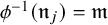 $\phi ^{-1}(\mathfrak {n}_j) = \mathfrak {m}$
for all
$\phi ^{-1}(\mathfrak {n}_j) = \mathfrak {m}$
for all $j=1, \dots , s$
). Let
$j=1, \dots , s$
). Let $S = A - \mathfrak {m}$
and
$S = A - \mathfrak {m}$
and $T = \cap _{j=1}^s (B - \mathfrak {n}_j)$
. Then
$T = \cap _{j=1}^s (B - \mathfrak {n}_j)$
. Then $\phi (S) \subset T$
,
$\phi (S) \subset T$
, $\phi ^{-1}(T) = S$
, and
$\phi ^{-1}(T) = S$
, and $T^{-1}B$
is a semi-local ring. Since finite projective modules of constant rank over (commutative) semi-local rings are free (see, e.g., [Reference HinoharaHin62]), we see that
$T^{-1}B$
is a semi-local ring. Since finite projective modules of constant rank over (commutative) semi-local rings are free (see, e.g., [Reference HinoharaHin62]), we see that $M \otimes _B T^{-1}B$
is free of rank d over
$M \otimes _B T^{-1}B$
is free of rank d over $T^{-1}B$
. Furthermore, we have
$T^{-1}B$
. Furthermore, we have $\phi (S)^{-1}B = T^{-1}B$
because T is contained in the saturation of
$\phi (S)^{-1}B = T^{-1}B$
because T is contained in the saturation of $\phi (S)$
in B (the saturation of
$\phi (S)$
in B (the saturation of $\phi (S)$
is necessarily the complement of a union of prime ideals [Reference KaplanskyKap74, p. 2, Theorem 2], and any prime ideal
$\phi (S)$
is necessarily the complement of a union of prime ideals [Reference KaplanskyKap74, p. 2, Theorem 2], and any prime ideal $\mathfrak {p}$
which intersects
$\mathfrak {p}$
which intersects $\phi (S)$
trivially must be contained in some
$\phi (S)$
trivially must be contained in some $\mathfrak {n}_i$
by the ‘going up’ property [Reference KaplanskyKap74, p. 29, Theorem 44]). Since M is finitely generated, we can therefore find
$\mathfrak {n}_i$
by the ‘going up’ property [Reference KaplanskyKap74, p. 29, Theorem 44]). Since M is finitely generated, we can therefore find $f_{\mathfrak {m}} \in S$
such that
$f_{\mathfrak {m}} \in S$
such that $M \otimes _B B[\phi (f_{\mathfrak {m}})^{-1}]$
is free of rank d over
$M \otimes _B B[\phi (f_{\mathfrak {m}})^{-1}]$
is free of rank d over $B[\phi (f_{\mathfrak {m}})^{-1}]$
. Repeating this for every maximal ideal
$B[\phi (f_{\mathfrak {m}})^{-1}]$
. Repeating this for every maximal ideal $\mathfrak {m}$
, we obtain a collection of elements
$\mathfrak {m}$
, we obtain a collection of elements $\{ f_{\mathfrak {m}} \}$
and we can clearly pick out a finite collection
$\{ f_{\mathfrak {m}} \}$
and we can clearly pick out a finite collection $f_1, \dots , f_r$
satisfying the statement of the claim.
$f_1, \dots , f_r$
satisfying the statement of the claim.
We note the important consequence of this claim, namely: if $\phi \colon X \to Y$
is a finite morphism of schemes with Y quasi-compact, and
$\phi \colon X \to Y$
is a finite morphism of schemes with Y quasi-compact, and $\mathcal {M}_1, \dots , \mathcal {M}_t$
is a finite collection of locally free
$\mathcal {M}_1, \dots , \mathcal {M}_t$
is a finite collection of locally free $\mathcal {O}_X$
-modules of (finite) constant rank, then there exists a finite open affine cover
$\mathcal {O}_X$
-modules of (finite) constant rank, then there exists a finite open affine cover $Y = \bigcup _{i=1}^r U_i$
such that
$Y = \bigcup _{i=1}^r U_i$
such that $\mathcal {M}_{j}$
is free over
$\mathcal {M}_{j}$
is free over $\phi ^{-1}U_i$
for all
$\phi ^{-1}U_i$
for all $i=1, \dots , r$
and
$i=1, \dots , r$
and $j=1, \dots , t$
.
$j=1, \dots , t$
.
We now return to the proof of the lemma. Consider the finite morphism $\iota \colon X_{\mathbf {H}} \to X_{\mathbf {G}}$
over
$\iota \colon X_{\mathbf {H}} \to X_{\mathbf {G}}$
over $\operatorname {Spec}\mathcal {O}_L$
from Definition 5.1.6. Then the consequence of the above claim implies that we can find a finite open affine cover
$\operatorname {Spec}\mathcal {O}_L$
from Definition 5.1.6. Then the consequence of the above claim implies that we can find a finite open affine cover $X_{\mathbf {G}} = \bigcup _{i \in I} U_i$
such that
$X_{\mathbf {G}} = \bigcup _{i \in I} U_i$
such that $\operatorname {H}_1^{\operatorname {dR}}(A_1/X_{\mathbf {H}})$
,
$\operatorname {H}_1^{\operatorname {dR}}(A_1/X_{\mathbf {H}})$
, $\operatorname {H}_1^{\operatorname {dR}}(A_2/X_{\mathbf {H}})$
and the graded pieces of their Hodge filtrations become free over the cover
$\operatorname {H}_1^{\operatorname {dR}}(A_2/X_{\mathbf {H}})$
and the graded pieces of their Hodge filtrations become free over the cover $\{ \iota ^{-1}(U_i) \}_{i \in I}$
. By refining
$\{ \iota ^{-1}(U_i) \}_{i \in I}$
. By refining $\{ U_i \}_{i \in I}$
we may assume, without loss of generality, that
$\{ U_i \}_{i \in I}$
we may assume, without loss of generality, that $\operatorname {H}_1^{\operatorname {dR}}(A/X_{\mathbf {G}})$
and the graded pieces of its Hodge filtration become free over the cover
$\operatorname {H}_1^{\operatorname {dR}}(A/X_{\mathbf {G}})$
and the graded pieces of its Hodge filtration become free over the cover $\{ U_i \}_{i \in I}$
.
$\{ U_i \}_{i \in I}$
.
Let $\varpi $
be a uniformiser of
$\varpi $
be a uniformiser of $\mathcal {O}_L$
. Let
$\mathcal {O}_L$
. Let $\mathfrak {X}_{H}$
,
$\mathfrak {X}_{H}$
, $\mathfrak {X}_G$
and
$\mathfrak {X}_G$
and $\mathfrak {U}_i$
denote the
$\mathfrak {U}_i$
denote the $\varpi $
-adic completions of
$\varpi $
-adic completions of $X_{\mathbf {H}}$
,
$X_{\mathbf {H}}$
, $X_{\mathbf {G}}$
,
$X_{\mathbf {G}}$
, $U_i$
respectively, which are formal schemes over
$U_i$
respectively, which are formal schemes over $\operatorname {Spf}\mathcal {O}_L$
(and
$\operatorname {Spf}\mathcal {O}_L$
(and $\{ \mathfrak {U}_i \}_{i \in I}$
is a finite open affine cover of
$\{ \mathfrak {U}_i \}_{i \in I}$
is a finite open affine cover of $\mathfrak {X}_G$
). Note all the formal schemes have the
$\mathfrak {X}_G$
). Note all the formal schemes have the $\varpi $
-adic topology. Recall from the proof of Proposition 6.2.13 that we have a commutative diagram
$\varpi $
-adic topology. Recall from the proof of Proposition 6.2.13 that we have a commutative diagram

where the vertical arrows are the forgetful maps. Let $p^{-1}\mathfrak {U}_i$
denote the pullback of
$p^{-1}\mathfrak {U}_i$
denote the pullback of $\mathfrak {U}_i$
under the right-hand vertical map. Recall
$\mathfrak {U}_i$
under the right-hand vertical map. Recall $\mathfrak {X}_{G, \operatorname {Iw}}(p^{\beta })$
is quasi-compact. Then, we can find a finite open affine refinement
$\mathfrak {X}_{G, \operatorname {Iw}}(p^{\beta })$
is quasi-compact. Then, we can find a finite open affine refinement $\{ \mathfrak {U}_i' \}_{i \in I'}$
of the cover
$\{ \mathfrak {U}_i' \}_{i \in I'}$
of the cover $\{ p^{-1}\mathfrak {U}_i \}_{i \in I}$
such that
$\{ p^{-1}\mathfrak {U}_i \}_{i \in I}$
such that $\mathcal {H}_A$
and the graded pieces of its Hodge filtration are free over
$\mathcal {H}_A$
and the graded pieces of its Hodge filtration are free over $\{ \mathfrak {U}_i' \}_{i \in I'}$
and
$\{ \mathfrak {U}_i' \}_{i \in I'}$
and $\mathcal {H}_{A_1}$
,
$\mathcal {H}_{A_1}$
, $\mathcal {H}_{A_2}$
, and the graded pieces of their Hodge filtrations are free over
$\mathcal {H}_{A_2}$
, and the graded pieces of their Hodge filtrations are free over $\{ \hat {\iota }^{-1}(\mathfrak {U}_i') \}_{i \in I'}$
. By refining the cover
$\{ \hat {\iota }^{-1}(\mathfrak {U}_i') \}_{i \in I'}$
. By refining the cover $\{ \mathfrak {U}^{\prime }_i \}_{i \in I'}$
further, we may also assume, without loss of generality, that the ideals
$\{ \mathfrak {U}^{\prime }_i \}_{i \in I'}$
further, we may also assume, without loss of generality, that the ideals $\{ \delta _{G, i}^+ : i=1, \dots , 2n \}$
are free over
$\{ \delta _{G, i}^+ : i=1, \dots , 2n \}$
are free over $\{ \mathfrak {U}_i' \}_{i \in I'}$
. Since
$\{ \mathfrak {U}_i' \}_{i \in I'}$
. Since $\delta _{H, i} = \hat {\iota }^* \delta _{G, i}$
, we immediately see that the ideals
$\delta _{H, i} = \hat {\iota }^* \delta _{G, i}$
, we immediately see that the ideals $\{ \delta _{H, i} : i=1, \dots , 2n \}$
are free over the affine cover
$\{ \delta _{H, i} : i=1, \dots , 2n \}$
are free over the affine cover $\{ \hat {\iota }^{-1}(\mathfrak {U}_i')\}_{i \in I'}$
. The desired cover of
$\{ \hat {\iota }^{-1}(\mathfrak {U}_i')\}_{i \in I'}$
. The desired cover of $\mathcal {X}_{G, \operatorname {Iw}}(p^{\beta })$
is then
$\mathcal {X}_{G, \operatorname {Iw}}(p^{\beta })$
is then $\{ \mathcal {U}_i' \}_{i \in I'}$
, where
$\{ \mathcal {U}_i' \}_{i \in I'}$
, where $\mathcal {U}_i'$
is the adic generic fibre of
$\mathcal {U}_i'$
is the adic generic fibre of $\mathfrak {U}_i'$
.
$\mathfrak {U}_i'$
.
6.3 Comparison between the Gauss–Manin connection and Atkin–Serre operators
We now compare the operators $\nabla _i$
in Lemma 5.3.3 to the actions of
$\nabla _i$
in Lemma 5.3.3 to the actions of $C_{\operatorname {cont}}(U_{\bullet , \beta }, \mathbb {Z}_p)$
constructed in §6.1.3. We continue to adopt the same conventions as in §6.2. First we note the following:
$C_{\operatorname {cont}}(U_{\bullet , \beta }, \mathbb {Z}_p)$
constructed in §6.1.3. We continue to adopt the same conventions as in §6.2. First we note the following:
Lemma 6.3.1. One has commutative diagrams

where the top diagonal and horizontal maps are $M^G_{\operatorname {Iw}}(p^{\beta })$
-equivariant and
$M^G_{\operatorname {Iw}}(p^{\beta })$
-equivariant and $M^H_{\diamondsuit }(p^{\beta })$
-equivariant respectively, and the top horizontal maps provide reductions of structure of
$M^H_{\diamondsuit }(p^{\beta })$
-equivariant respectively, and the top horizontal maps provide reductions of structure of $M_{G, \operatorname {dR}}^{\operatorname {an}} \times _{\mathcal {X}_{G, \operatorname {Iw}}(p^{\beta })} \mathcal {X}_{G, w_n}(p^{\beta })$
and
$M_{G, \operatorname {dR}}^{\operatorname {an}} \times _{\mathcal {X}_{G, \operatorname {Iw}}(p^{\beta })} \mathcal {X}_{G, w_n}(p^{\beta })$
and $M_{H, \operatorname {dR}}^{\operatorname {an}} \times _{\mathcal {X}_{H, \diamondsuit }(p^{\beta })} \mathcal {X}_{H, \operatorname {id}}(p^{\beta })$
.
$M_{H, \operatorname {dR}}^{\operatorname {an}} \times _{\mathcal {X}_{H, \diamondsuit }(p^{\beta })} \mathcal {X}_{H, \operatorname {id}}(p^{\beta })$
.
Proof. The Igusa tower $\mathcal {IG}_{G, w_n}(p^{\beta })$
parameterises points
$\mathcal {IG}_{G, w_n}(p^{\beta })$
parameterises points $(A, \mathcal {C}_{\bullet , \bullet }) \in \mathcal {X}_{G, w_n}(p^{\beta })$
and trivialisations of (the graded pieces of) the canonical filtration on
$(A, \mathcal {C}_{\bullet , \bullet }) \in \mathcal {X}_{G, w_n}(p^{\beta })$
and trivialisations of (the graded pieces of) the canonical filtration on $A[p^{\infty }]$
which are compatible with the filtrations
$A[p^{\infty }]$
which are compatible with the filtrations $\mathcal {C}_{\bullet , \bullet }$
. One then obtains a trivialisation of
$\mathcal {C}_{\bullet , \bullet }$
. One then obtains a trivialisation of $\mathcal {H}_A$
respecting the Hodge filtration in the usual way, namely by considering the ‘dlog’ morphisms for each graded piece of the canonical filtration (to obtain a map to
$\mathcal {H}_A$
respecting the Hodge filtration in the usual way, namely by considering the ‘dlog’ morphisms for each graded piece of the canonical filtration (to obtain a map to $M_{G,\operatorname {dR}}^{\operatorname {an}}$
), and using the unit root splitting (to extend this to a map to
$M_{G,\operatorname {dR}}^{\operatorname {an}}$
), and using the unit root splitting (to extend this to a map to $P_{G,\operatorname {dR}}^{\operatorname {an}}$
).
$P_{G,\operatorname {dR}}^{\operatorname {an}}$
).
Similarly, the Igusa tower $\mathcal {IG}_{H, \operatorname {id}}(p^{\beta })$
parameterises tuples
$\mathcal {IG}_{H, \operatorname {id}}(p^{\beta })$
parameterises tuples $(A_1, A_2, \lambda , i, \eta ^p, s, [f_{\tau }])$
with
$(A_1, A_2, \lambda , i, \eta ^p, s, [f_{\tau }])$
with $(A_1, A_2, \lambda , i, \eta ^p) \in \mathfrak {X}_H^{\operatorname {ord}}$
,
$(A_1, A_2, \lambda , i, \eta ^p) \in \mathfrak {X}_H^{\operatorname {ord}}$
, $s \in \underline {\mathbb {Z}_p^{\times }}$
and
$s \in \underline {\mathbb {Z}_p^{\times }}$
and $[f_{\tau }]$
is an
$[f_{\tau }]$
is an $N^H_{\diamondsuit }(p^{\beta })$
-orbit of isomorphisms
$N^H_{\diamondsuit }(p^{\beta })$
-orbit of isomorphisms $f_{\tau } \colon \mathbb {X}_{\operatorname {ord}, \tau } \xrightarrow {\sim } A[\mathfrak {p}_{\tau }^{\infty }]$
respecting the decompositions
$f_{\tau } \colon \mathbb {X}_{\operatorname {ord}, \tau } \xrightarrow {\sim } A[\mathfrak {p}_{\tau }^{\infty }]$
respecting the decompositions $\mathbb {X}_{\operatorname {ord}, \tau } = \mathbb {X}_{1, \tau } \oplus \mathbb {X}_{2, \tau }$
and
$\mathbb {X}_{\operatorname {ord}, \tau } = \mathbb {X}_{1, \tau } \oplus \mathbb {X}_{2, \tau }$
and $A[\mathfrak {p}_{\tau }^{\infty }] = A_1[\mathfrak {p}_{\tau }^{\infty }] \oplus A_2[\mathfrak {p}_{\tau }^{\infty }]$
. Given such a point
$A[\mathfrak {p}_{\tau }^{\infty }] = A_1[\mathfrak {p}_{\tau }^{\infty }] \oplus A_2[\mathfrak {p}_{\tau }^{\infty }]$
. Given such a point $(A_1, A_2, \lambda , i, \eta ^p, s, [f_{\tau }])$
we can: obtain trivialisations of the Hodge filtrations on
$(A_1, A_2, \lambda , i, \eta ^p, s, [f_{\tau }])$
we can: obtain trivialisations of the Hodge filtrations on $\mathcal {H}_{A_1}$
and
$\mathcal {H}_{A_1}$
and $\mathcal {H}_{A_2}$
using the ‘dlog’ morphisms and the trivialisations of the graded pieces of the canonical filtration induced from
$\mathcal {H}_{A_2}$
using the ‘dlog’ morphisms and the trivialisations of the graded pieces of the canonical filtration induced from $f_{\tau }$
(this is independent of the choice of representatives of the orbits
$f_{\tau }$
(this is independent of the choice of representatives of the orbits $[f_{\tau }]$
); obtain a
$[f_{\tau }]$
); obtain a $(\hat {\gamma } B_G(\mathbb {Z}/p^{\beta }\mathbb {Z}) \hat {\gamma }^{-1} \cap H(\mathbb {Z}/p^{\beta }\mathbb {Z}))$
-orbit of isomorphisms
$(\hat {\gamma } B_G(\mathbb {Z}/p^{\beta }\mathbb {Z}) \hat {\gamma }^{-1} \cap H(\mathbb {Z}/p^{\beta }\mathbb {Z}))$
-orbit of isomorphisms
 $$\begin{align*}(\underline{\mathbb{Z}/p^{\beta}\mathbb{Z}})^{\oplus n} \oplus (\underline{\mathbb{Z}/p^{\beta}\mathbb{Z}})^{\oplus n} \cong \mathbb{X}_{1, \tau}[p^{\beta}] \oplus \mathbb{X}_{2, \tau}[p^{\beta}] \xrightarrow{f_{\tau}[p^{\beta}]} A_1[\mathfrak{p}_{\tau}^{\beta}] \oplus A_2[\mathfrak{p}_{\tau}^{\beta}] \end{align*}$$
respecting the decompositions on both sides (note that we have an isomorphism $\mu _{p^{\beta }} \cong \underline {\mathbb {Z}/p^{\beta }\mathbb {Z}}$
of group schemes over L because we are assuming L contains the
$\mu _{p^{\beta }} \cong \underline {\mathbb {Z}/p^{\beta }\mathbb {Z}}$
of group schemes over L because we are assuming L contains the $p^{\beta }$
-roots of unity; in particular
$p^{\beta }$
-roots of unity; in particular $\hat {\gamma } B_G(\mathbb {Z}/p^{\beta }\mathbb {Z}) \hat {\gamma }^{-1} \cap H(\mathbb {Z}/p^{\beta }\mathbb {Z})$
is identified with
$\hat {\gamma } B_G(\mathbb {Z}/p^{\beta }\mathbb {Z}) \hat {\gamma }^{-1} \cap H(\mathbb {Z}/p^{\beta }\mathbb {Z})$
is identified with $J^H_{\diamondsuit }(p^{\beta })$
modulo the subgroup of
$J^H_{\diamondsuit }(p^{\beta })$
modulo the subgroup of $J^+_{H, \operatorname {ord}}$
consisting of elements congruent to the identity modulo
$J^+_{H, \operatorname {ord}}$
consisting of elements congruent to the identity modulo $p^{\beta }$
). This describes the desired map
$p^{\beta }$
). This describes the desired map $\mathcal {IG}_{H, \operatorname {id}}(p^{\beta }) \to M_{H, \operatorname {dR}}^{\operatorname {an}}$
. We then extend this to a map to
$\mathcal {IG}_{H, \operatorname {id}}(p^{\beta }) \to M_{H, \operatorname {dR}}^{\operatorname {an}}$
. We then extend this to a map to $P_{H, \operatorname {dR}}^{\operatorname {an}}$
using the unit root splittings of the Hodge filtrations on
$P_{H, \operatorname {dR}}^{\operatorname {an}}$
using the unit root splittings of the Hodge filtrations on $\mathcal {H}_{A_1}$
and
$\mathcal {H}_{A_1}$
and $\mathcal {H}_{A_2}$
.
$\mathcal {H}_{A_2}$
.
Let $\mathscr {O}_{P_{G,\operatorname {dR}}^{\operatorname {an}}}$
and
$\mathscr {O}_{P_{G,\operatorname {dR}}^{\operatorname {an}}}$
and $\mathscr {O}_{\mathcal {IG}_{G, w_n}(p^{\beta })}$
denote the pushforwards of the structure sheaves of
$\mathscr {O}_{\mathcal {IG}_{G, w_n}(p^{\beta })}$
denote the pushforwards of the structure sheaves of $P_{G, \operatorname {dR}}^{\operatorname {an}}$
and
$P_{G, \operatorname {dR}}^{\operatorname {an}}$
and $\mathcal {IG}_{G, w_n}(p^{\beta })$
respectively to
$\mathcal {IG}_{G, w_n}(p^{\beta })$
respectively to $\mathcal {X}_{G, \operatorname {Iw}}(p^{\beta })$
. We define
$\mathcal {X}_{G, \operatorname {Iw}}(p^{\beta })$
. We define $\mathscr {O}_{P_{H,\operatorname {dR}}^{\operatorname {an}}}$
and
$\mathscr {O}_{P_{H,\operatorname {dR}}^{\operatorname {an}}}$
and $\mathscr {O}_{\mathcal {IG}_{H, \operatorname {id}}(p^{\beta })}$
similarly (by pushing forward to
$\mathscr {O}_{\mathcal {IG}_{H, \operatorname {id}}(p^{\beta })}$
similarly (by pushing forward to $\mathcal {X}_{H, \diamondsuit }(p^{\beta })$
). Lemma 6.3.1 implies that we have natural restriction maps
$\mathcal {X}_{H, \diamondsuit }(p^{\beta })$
). Lemma 6.3.1 implies that we have natural restriction maps $\mathscr {O}_{P_{G,\operatorname {dR}}^{\operatorname {an}}} \to \mathscr {O}_{\mathcal {IG}_{G, w_n}(p^{\beta })}$
and
$\mathscr {O}_{P_{G,\operatorname {dR}}^{\operatorname {an}}} \to \mathscr {O}_{\mathcal {IG}_{G, w_n}(p^{\beta })}$
and $\mathscr {O}_{P_{H,\operatorname {dR}}^{\operatorname {an}}} \to \mathscr {O}_{\mathcal {IG}_{H, \operatorname {id}}(p^{\beta })}$
. Note that for any
$\mathscr {O}_{P_{H,\operatorname {dR}}^{\operatorname {an}}} \to \mathscr {O}_{\mathcal {IG}_{H, \operatorname {id}}(p^{\beta })}$
. Note that for any $U = \operatorname {Spa}(A, A^+) \in \mathcal {C}_G$
, we have an action
$U = \operatorname {Spa}(A, A^+) \in \mathcal {C}_G$
, we have an action
 $$\begin{align*}C_{\operatorname{cont}}(U_{G, \beta}, L) \times \mathscr{O}_{\mathcal{IG}_{G, w_n}(p^{\beta})}(U) \to \mathscr{O}_{\mathcal{IG}_{G, w_n}(p^{\beta})}(U) \end{align*}$$
which is functorial in U. The same is true for H.
Proposition 6.3.2. For $i=1, \dots , 2n-1$
and
$i=1, \dots , 2n-1$
and $U \in \mathcal {C}_G$
, let
$U \in \mathcal {C}_G$
, let $\theta _i \colon \mathscr {O}_{\mathcal {IG}_{G, w_n}(p^{\beta })}(U) \to \mathscr {O}_{\mathcal {IG}_{G, w_n}(p^{\beta })}(U)$
denote the morphism given by the action of the continuous map
$\theta _i \colon \mathscr {O}_{\mathcal {IG}_{G, w_n}(p^{\beta })}(U) \to \mathscr {O}_{\mathcal {IG}_{G, w_n}(p^{\beta })}(U)$
denote the morphism given by the action of the continuous map
 $$\begin{align*}(a_1, \dots, a_{2n-1}) \mapsto a_i \quad \in \quad C_{\operatorname{cont}}(U_{G, \beta}, L). \end{align*}$$
For $i=1, \dots , n-1$
and
$i=1, \dots , n-1$
and $U \in \mathcal {C}_H$
, we also use the notation
$U \in \mathcal {C}_H$
, we also use the notation $\theta _i \colon \mathscr {O}_{\mathcal {IG}_{H, \operatorname {id}}(p^{\beta })}(U) \to \mathscr {O}_{\mathcal {IG}_{H, \operatorname {id}}(p^{\beta })}(U)$
to denote the morphism constructed analogously.
$\theta _i \colon \mathscr {O}_{\mathcal {IG}_{H, \operatorname {id}}(p^{\beta })}(U) \to \mathscr {O}_{\mathcal {IG}_{H, \operatorname {id}}(p^{\beta })}(U)$
to denote the morphism constructed analogously.
-
1. For any
$U \in \mathcal {C}_G$
and
$i=1, \dots , 2n-1$
, one has a commutative diagram -
2. For any
$U \in \mathcal {C}_H$
and
$i=1, \dots , n-1$
, one has a commutative diagram


Proof. Let $\mathcal {A}$
denote the universal
$\mathcal {A}$
denote the universal $\boldsymbol \Psi $
-unitary abelian scheme over
$\boldsymbol \Psi $
-unitary abelian scheme over $\mathfrak {IG}_{G, w_n}(p^{\beta })$
. Then (using the universal trivialisations of the graded pieces) the canonical filtration for
$\mathfrak {IG}_{G, w_n}(p^{\beta })$
. Then (using the universal trivialisations of the graded pieces) the canonical filtration for $\mathcal {A}[\mathfrak {p}_{\tau _0}^{\infty }]$
is of the form
$\mathcal {A}[\mathfrak {p}_{\tau _0}^{\infty }]$
is of the form
 $$\begin{align*}0 \to \mu_{p^{\infty}} \to \mathcal{A}[\mathfrak{p}_{\tau_0}^{\infty}] \to \left(\mathbb{Q}_p/\mathbb{Z}_p \right)^{\oplus 2n-1} \to 0. \end{align*}$$
Let $\mathbb {E}(\mathcal {A}[\mathfrak {p}_{\tau _0}^{\infty }])$
denote the universal vector extension of
$\mathbb {E}(\mathcal {A}[\mathfrak {p}_{\tau _0}^{\infty }])$
denote the universal vector extension of $\mathcal {A}[\mathfrak {p}_{\tau _0}^{\infty }]$
. Then
$\mathcal {A}[\mathfrak {p}_{\tau _0}^{\infty }]$
. Then $\operatorname {Lie}\mathbb {E}(\mathcal {A}[\mathfrak {p}_{\tau _0}^{\infty }])$
is identified with the first relative de Rham homology of
$\operatorname {Lie}\mathbb {E}(\mathcal {A}[\mathfrak {p}_{\tau _0}^{\infty }])$
is identified with the first relative de Rham homology of $\mathcal {A}[\mathfrak {p}_{\tau _0}^{\infty }]$
, and the Hodge filtration is given by the exact sequence:
$\mathcal {A}[\mathfrak {p}_{\tau _0}^{\infty }]$
, and the Hodge filtration is given by the exact sequence:
 $$\begin{align*}0 \to \omega_{\mathcal{A}[\mathfrak{p}_{\tau_0}^{\infty}]^D} \to \operatorname{Lie}\mathbb{E}(\mathcal{A}[\mathfrak{p}_{\tau_0}^{\infty}]) \to \operatorname{Lie} \mathcal{A}[\mathfrak{p}_{\tau_0}^{\infty}] \to 0. \end{align*}$$
The ‘dlog’ map for $T_p\mathcal {A}[\mathfrak {p}_{\tau _0}^{\infty }]$
induces an isomorphism
$T_p\mathcal {A}[\mathfrak {p}_{\tau _0}^{\infty }]$
induces an isomorphism
 $$\begin{align*}T_p\mathcal{A}[\mathfrak{p}_{\tau_0}^{\infty}]^{\mathrm{\acute{e}t}} \otimes_{\mathbb{Z}_p} \mathcal{O}_{\mathfrak{IG}_{G, w_n}(p^{\beta})} \cong \mathcal{O}_{\mathfrak{IG}_{G, w_n}(p^{\beta})}^{\oplus 2n-1} \xrightarrow{\sim} \omega_{\mathcal{A}[\mathfrak{p}_{\tau_0}^{\infty}]^D} \end{align*}$$
where the first isomorphism arises from the universal trivialisation of the étale part of the canonical filtration. In particular, we obtain a basis $\{ \omega _{\operatorname {can}, i} : i = 1, \dots , 2n-1 \}$
of
$\{ \omega _{\operatorname {can}, i} : i = 1, \dots , 2n-1 \}$
of $\omega _{\mathcal {A}[\mathfrak {p}_{\tau _0}^{\infty }]^D}$
by considering the image of the i-th basis vector of
$\omega _{\mathcal {A}[\mathfrak {p}_{\tau _0}^{\infty }]^D}$
by considering the image of the i-th basis vector of $\mathcal {O}_{\mathfrak {IG}_{G, w_n}(p^{\beta })}^{\oplus 2n-1}$
.
$\mathcal {O}_{\mathfrak {IG}_{G, w_n}(p^{\beta })}^{\oplus 2n-1}$
.
On the other hand, the inclusion $\mu _{p^{\infty }} \hookrightarrow \mathcal {A}[\mathfrak {p}_{\tau _0}^{\infty }]$
induces an injective map
$\mu _{p^{\infty }} \hookrightarrow \mathcal {A}[\mathfrak {p}_{\tau _0}^{\infty }]$
induces an injective map
 $$\begin{align*}\operatorname{Lie} \mu_{p^{\infty}} = \operatorname{Lie} \mathbb{E}(\mu_{p^{\infty}}) \hookrightarrow \operatorname{Lie}\mathbb{E}(\mathcal{A}[\mathfrak{p}_{\tau_0}^{\infty}]) \end{align*}$$
which splits the Hodge filtration (it is the ‘unit root splitting’). Let $u_{\operatorname {can}} \in \operatorname {Lie}\mathbb {E}(\mathcal {A}[\mathfrak {p}_{\tau _0}^{\infty }])$
denote the image of the canonical tangent vector
$u_{\operatorname {can}} \in \operatorname {Lie}\mathbb {E}(\mathcal {A}[\mathfrak {p}_{\tau _0}^{\infty }])$
denote the image of the canonical tangent vector $t \partial _t \in \operatorname {Lie}\mu _{p^{\infty }}$
under this map.
$t \partial _t \in \operatorname {Lie}\mu _{p^{\infty }}$
under this map.
As explained in [Reference HoweHow20, §2.4], we have a crystalline connection $\nabla _{\operatorname {cris}}$
on
$\nabla _{\operatorname {cris}}$
on $\operatorname {Lie}\mathbb {E}(\mathcal {A}[\mathfrak {p}_{\tau _0}^{\infty }])$
which is block upper nilpotent in the basis
$\operatorname {Lie}\mathbb {E}(\mathcal {A}[\mathfrak {p}_{\tau _0}^{\infty }])$
which is block upper nilpotent in the basis $\{ u_{\operatorname {can}}, \omega _{\operatorname {can}, 1}, \dots , \omega _{\operatorname {can}, 2n-1} \}$
. Let
$\{ u_{\operatorname {can}}, \omega _{\operatorname {can}, 1}, \dots , \omega _{\operatorname {can}, 2n-1} \}$
. Let $\mathcal {K}_i \in \Omega ^1_{\mathfrak {IG}_{G, w_n}(p^{\beta })}$
denote the unique differential such that
$\mathcal {K}_i \in \Omega ^1_{\mathfrak {IG}_{G, w_n}(p^{\beta })}$
denote the unique differential such that $\nabla _{\operatorname {cris}}(\omega _{\operatorname {can}, i}) = u_{\operatorname {can}} \otimes \mathcal {K}_i$
. Let
$\nabla _{\operatorname {cris}}(\omega _{\operatorname {can}, i}) = u_{\operatorname {can}} \otimes \mathcal {K}_i$
. Let $\theta ^{\operatorname {cris}}_i \colon \mathcal {O}_{\mathcal {IG}_{G, w_n}(p^{\beta })} \to \mathcal {O}_{\mathcal {IG}_{G, w_n}(p^{\beta })}$
denote the (unique) derivation such that
$\theta ^{\operatorname {cris}}_i \colon \mathcal {O}_{\mathcal {IG}_{G, w_n}(p^{\beta })} \to \mathcal {O}_{\mathcal {IG}_{G, w_n}(p^{\beta })}$
denote the (unique) derivation such that
 $$\begin{align*}\langle \mathcal{K}_i, \theta^{\operatorname{cris}}_i \rangle = 1 \quad \text{ and } \quad \langle \mathcal{K}_j, \theta^{\operatorname{cris}}_i \rangle = 0 \text{ for } j \neq i. \end{align*}$$
Since the crystalline and Gauss–Manin connections coincide (see [Reference HoweHow20, Theorem 2.6.1]), one sees from the description in Lemma 5.3.3 that $\nabla _i$
and
$\nabla _i$
and $\theta ^{\operatorname {cris}}_i$
are compatible under the map
$\theta ^{\operatorname {cris}}_i$
are compatible under the map $\mathscr {O}_{P_{G, \operatorname {dR}}^{\operatorname {an}}} \to \mathscr {O}_{\mathcal {IG}_{G, w_n}(p^{\beta })}$
. Therefore, it is enough to show that
$\mathscr {O}_{P_{G, \operatorname {dR}}^{\operatorname {an}}} \to \mathscr {O}_{\mathcal {IG}_{G, w_n}(p^{\beta })}$
. Therefore, it is enough to show that $\theta ^{\operatorname {cris}}_i = \theta _i$
on
$\theta ^{\operatorname {cris}}_i = \theta _i$
on $\mathscr {O}_{\mathcal {IG}_{G, w_n}(p^{\beta })}(U)$
.
$\mathscr {O}_{\mathcal {IG}_{G, w_n}(p^{\beta })}(U)$
.
For $i=1, \dots , 2n-1$
, let
$i=1, \dots , 2n-1$
, let
 $$\begin{align*}\beta_i = \left\{ \begin{array}{cc} \beta & \text{ if } i=1, \dots, n \\ 0 & \text{ if } i=n+1, \dots, 2n-1 \end{array} \right. \end{align*}$$
so that $U_{G, \beta } = \prod _{i=1}^{2n-1} p^{-\beta _i}\mathbb {Z}_p$
. Let
$U_{G, \beta } = \prod _{i=1}^{2n-1} p^{-\beta _i}\mathbb {Z}_p$
. Let  , then we have an isomorphism
 $$\begin{align*}L_i \xrightarrow{\sim} \mu_{p^{\infty}}, \quad (\zeta_{k})_{k \geq 0} \mapsto \zeta_{\beta_i} \end{align*}$$
hence we have a natural map $D = \operatorname {Spf}\mathbb {Z}_p[\epsilon ]/\epsilon ^2 \to L_i$
which, when composed with this isomorphism, corresponds to the point
$D = \operatorname {Spf}\mathbb {Z}_p[\epsilon ]/\epsilon ^2 \to L_i$
which, when composed with this isomorphism, corresponds to the point $1+\epsilon \in \mu _{p^{\infty }}(\mathbb {Z}_p[\epsilon ]/\epsilon ^2)$
. We therefore obtain a vector field
$1+\epsilon \in \mu _{p^{\infty }}(\mathbb {Z}_p[\epsilon ]/\epsilon ^2)$
. We therefore obtain a vector field
 $$\begin{align*}t_i \colon D \times \mathfrak{IG}_{G, w_n}(p^{\beta}) \to L_i \times \mathfrak{IG}_{G, w_n}(p^{\beta}) \to \mathfrak{IG}_{G, w_n}(p^{\beta}) \end{align*}$$
where the second map is the action map. Then
-
• The derivation
$\mathcal {O}_{\mathfrak {IG}_{G, w_n}(p^{\beta })} \to \mathcal {O}_{\mathfrak {IG}_{G, w_n}(p^{\beta })}$
corresponding to the vector field
$t_i$
is given by the action of hence is equal to
$$\begin{align*}\left. \frac{d}{d\epsilon} \right|_{\epsilon = 0} [ ( \frac{a_j}{p^{\beta_j}} ) \mapsto (1+ \epsilon)^{a_i} ] = [ ( \frac{a_j}{p^{\beta_j}} ) \mapsto a_i ] \in C_{\operatorname{cont}}(U_{G, \beta}, \mathbb{Z}_p) \end{align*}$$
$p^{\beta _i} \theta _i$
.
-
• By the same proof as in [Reference HoweHow20, Theorem 5.3.1], one can show that the crystalline connection induces an isomorphism
which satisfies
$$\begin{align*}\nabla_{\operatorname{cris}, t_i} \colon t_i^* \operatorname{Lie}\mathbb{E}(\mathcal{A}[\mathfrak{p}_{\tau_0}^{\infty}]) \xrightarrow{\sim} 0^* \operatorname{Lie}\mathbb{E}(\mathcal{A}[\mathfrak{p}_{\tau_0}^{\infty}]) \end{align*}$$
This implies that
$$\begin{align*}\nabla_{\operatorname{cris}, t_i}(\omega_{\operatorname{can}, j}) = \left\{ \begin{array}{cc} \omega_{\operatorname{can}, i} + p^{\beta_i} \epsilon u_{\operatorname{can}} & \text{ if } j=i \\ \omega_{\operatorname{can}, j} & \text{ otherwise } \end{array} \right.. \end{align*}$$
$\langle \mathcal {K}_j, t_i \rangle $
equals
$p^{\beta _i}$
if
$j=i$
, and is equal to zero otherwise. Hence, the derivation induced from the vector field
$t_i$
is equal to
$p^{\beta _i} \theta ^{\operatorname {cris}}_i$
.


Combining these bullet points, we see that $\theta _i = \theta _i^{\operatorname {cris}}$
as required. The proof of part (2) is identical.
$\theta _i = \theta _i^{\operatorname {cris}}$
as required. The proof of part (2) is identical.
6.4 Nearly overconvergent automorphic forms
We now introduce the ind-sheaves of nearly overconvergent automorphic forms and their extra structures. In §7, we will explain how one can ‘overconverge’ the operators $\theta _i$
to these ind-sheaves. As in §6.2, we continue to work over a finite extension
$\theta _i$
to these ind-sheaves. As in §6.2, we continue to work over a finite extension $L/\mathbb {Q}_p$
containing
$L/\mathbb {Q}_p$
containing $\mu _{p^{\beta }}$
, but omit this from the notation. We fix an integer
$\mu _{p^{\beta }}$
, but omit this from the notation. We fix an integer $\beta \geq 1$
throughout.
$\beta \geq 1$
throughout.
Definition 6.4.1. For any open subspace $U \subset P_{G, \operatorname {dR}}^{\operatorname {an}}$
or
$U \subset P_{G, \operatorname {dR}}^{\operatorname {an}}$
or $U \subset M_{G, \operatorname {dR}}^{\operatorname {an}}$
(resp.
$U \subset M_{G, \operatorname {dR}}^{\operatorname {an}}$
(resp. $U \subset P_{H, \operatorname {dR}}^{\operatorname {an}}$
or
$U \subset P_{H, \operatorname {dR}}^{\operatorname {an}}$
or $U \subset M_{H, \operatorname {dR}}^{\operatorname {an}}$
) we let
$U \subset M_{H, \operatorname {dR}}^{\operatorname {an}}$
) we let $\mathscr {O}_U$
denote the pushforward of the structure sheaf of U along the natural map to
$\mathscr {O}_U$
denote the pushforward of the structure sheaf of U along the natural map to $\mathcal {X}_{G, \operatorname {Iw}}(p^{\beta })$
(resp.
$\mathcal {X}_{G, \operatorname {Iw}}(p^{\beta })$
(resp. $\mathcal {X}_{H, \diamondsuit }(p^{\beta })$
).
$\mathcal {X}_{H, \diamondsuit }(p^{\beta })$
).
-
1. We define the ind-sheaf of nearly overconvergent forms on G (resp. H) to be
where the inductive system is over all quasi-compact open subspaces of
$P_{G, \operatorname {dR}}^{\operatorname {an}}$
(resp.
$P_{G, \operatorname {dR}}^{\operatorname {an}}$
) containing the closure of
$\mathcal {IG}_{G, w_n}(p^{\beta })$
(resp.
$\mathcal {IG}_{H, \operatorname {id}}(p^{\beta })$
), ordered by inclusion (so the transition maps in the inductive systems are given by restriction).
-
2. We define the ind-sheaf of overconvergent forms on G (resp. H) to be
where the inductive system is over all quasi-compact open subspaces of
$M_{G, \operatorname {dR}}^{\operatorname {an}}$
(resp.
$M_{G, \operatorname {dR}}^{\operatorname {an}}$
) containing the closure of
$\mathcal {IG}_{G, w_n}(p^{\beta })$
(resp.
$\mathcal {IG}_{H, \operatorname {id}}(p^{\beta })$
), ordered by inclusion (so the transition maps in the inductive system are given by restriction).


We have the following relation with the torsors appearing in higher Coleman theory [Reference Boxer and PilloniBP21]. Let $\mathcal {M}_G$
and
$\mathcal {M}_G$
and $\mathcal {M}_H$
denote the completions of
$\mathcal {M}_H$
denote the completions of $M_G$
and
$M_G$
and $M_H$
along the special fibre.
$M_H$
along the special fibre.
Lemma 6.4.2. For any integer $k \geq 1$
, let
$k \geq 1$
, let $\mathcal {M}^1_{G, k} \subset \mathcal {M}_G$
denote the affinoid subgroup of elements which reduce to the identity modulo
$\mathcal {M}^1_{G, k} \subset \mathcal {M}_G$
denote the affinoid subgroup of elements which reduce to the identity modulo $p^k$
. Set
$p^k$
. Set $\mathcal {M}^{\square }_{G, k} = \mathcal {M}^1_{G, k} \cdot M^G_{\operatorname {Iw}}(p^{\beta })$
. Similarly, let
$\mathcal {M}^{\square }_{G, k} = \mathcal {M}^1_{G, k} \cdot M^G_{\operatorname {Iw}}(p^{\beta })$
. Similarly, let $\mathcal {M}^1_{H, k} \subset \mathcal {M}_H$
denote the affinoid subgroup of elements which reduce to the identity modulo
$\mathcal {M}^1_{H, k} \subset \mathcal {M}_H$
denote the affinoid subgroup of elements which reduce to the identity modulo $p^k$
, and set
$p^k$
, and set $\mathcal {M}^{\diamondsuit }_{H, k} = \mathcal {M}^1_{H, k} \cdot M^H_{\diamondsuit }(p^{\beta })$
.
$\mathcal {M}^{\diamondsuit }_{H, k} = \mathcal {M}^1_{H, k} \cdot M^H_{\diamondsuit }(p^{\beta })$
.
-
1. For any integer
$k \geq 1$
, there exists an integer
$r \geq 1$
(depending on k) such that
$M_{G, \operatorname {dR}}^{\operatorname {an}} \times _{\mathcal {X}_{G, \operatorname {Iw}}(p^{\beta })} \mathcal {X}_{G, w_n}(p^{\beta })_{r}$
has a reduction of structure to an étale
$\mathcal {M}^{\square }_{G, k}$
-torsor, denoted
${^\mu \mathcal {M}_{G, \operatorname {HT}, k}}$
. Furthermore the torsors
${^\mu \mathcal {M}_{G, \operatorname {HT}, k}} \subset M_{G, \operatorname {dR}}^{\operatorname {an}}$
form a cofinal system of quasi-compact open subspaces containing the closure of
$\mathcal {IG}_{G, w_n}(p^{\beta })$
, so where the inductive system is over all possible
$r, k$
with transition maps given by restriction.
-
2. For any integer
$k \geq 1$
, there exists an integer
$r \geq 1$
(depending on k) such that
$M_{H, \operatorname {dR}}^{\operatorname {an}} \times _{\mathcal {X}_{H, \diamondsuit }(p^{\beta })} \mathcal {X}_{H, \operatorname {id}}(p^{\beta })_r$
has a reduction of structure to an étale
$\mathcal {M}^{\diamondsuit }_{H, k}$
-torsor, denoted
${^\mu \mathcal {M}_{H, \operatorname {HT}, k}}$
. Furthermore the torsors
${^\mu \mathcal {M}_{H, \operatorname {HT}, k}} \subset M_{H, \operatorname {dR}}^{\operatorname {an}}$
form a cofinal system of quasi-compact open subspaces containing the closure of
$\mathcal {IG}_{H, \operatorname {id}}(p^{\beta })$
, so where the inductive system is over all possible
$r, k$
with transition maps given by restriction.


Proof. The proof of this lemma is very similar to the constructions in [Reference GrahamGra24, §5], although the torsors are for slightly different groups and strata in the Shimura–Deligne varieties. More precisely, the torsor ${^\mu \mathcal {M}_{G, \operatorname {HT}, k}}$
is the twist along the central Hodge cocharacter
${^\mu \mathcal {M}_{G, \operatorname {HT}, k}}$
is the twist along the central Hodge cocharacter $\mu \colon \mathbb {Z}_p^{\times } \to \mathcal {M}_{G, k}^{\square }$
of the pullback of a torsor over the flag variety
$\mu \colon \mathbb {Z}_p^{\times } \to \mathcal {M}_{G, k}^{\square }$
of the pullback of a torsor over the flag variety $\mathcal {P}_G \backslash \mathcal {G}$
under the (truncated) Hodge–Tate period morphism.
$\mathcal {P}_G \backslash \mathcal {G}$
under the (truncated) Hodge–Tate period morphism.
For the torsor ${^\mu \mathcal {M}_{H, \operatorname {HT}, k}}$
, the construction is similar, however we must twist the proétale torsor
${^\mu \mathcal {M}_{H, \operatorname {HT}, k}}$
, the construction is similar, however we must twist the proétale torsor $\mathcal {M}_{H, \operatorname {HT}, k}$
along the restriction of the Hodge cocharacter to
$\mathcal {M}_{H, \operatorname {HT}, k}$
along the restriction of the Hodge cocharacter to $1 + p^{\beta } \mathbb {Z}_p$
, that is, we define
$1 + p^{\beta } \mathbb {Z}_p$
, that is, we define
 $$\begin{align*}{^\mu \mathcal{M}_{H, \operatorname{HT}, k}} = \mathcal{M}_{H, \operatorname{HT}, k} \times^{[1 + p^{\beta}\mathbb{Z}_p, \mu]} \mathcal{T}^{\times}_{\beta} \end{align*}$$
where $\mathcal {T}^{\times }_{\beta } \subset \mathcal {T}^{\times } = \underline {\operatorname {Isom}}(\mathbb {Z}_p, \mathbb {Z}_p(1))$
is the sub-
$\mathcal {T}^{\times }_{\beta } \subset \mathcal {T}^{\times } = \underline {\operatorname {Isom}}(\mathbb {Z}_p, \mathbb {Z}_p(1))$
is the sub- $(1+p^{\beta }\mathbb {Z}_p)$
-torsor of isomorphisms which map
$(1+p^{\beta }\mathbb {Z}_p)$
-torsor of isomorphisms which map $1$
to a fixed
$1$
to a fixed $p^{\beta }$
-root of unity modulo
$p^{\beta }$
-root of unity modulo $p^{\beta }$
(and the twist is along the central homomorphism
$p^{\beta }$
(and the twist is along the central homomorphism $\mu \colon 1 + p^{\beta }\mathbb {Z}_p \to \mathcal {M}^{\diamondsuit }_{H, k}$
). We refer the reader to [Reference GrahamGra24, §4.2] for more details on this twisting construction.
$\mu \colon 1 + p^{\beta }\mathbb {Z}_p \to \mathcal {M}^{\diamondsuit }_{H, k}$
). We refer the reader to [Reference GrahamGra24, §4.2] for more details on this twisting construction.
It will be useful to extend the above lemma to reductions of structure of $P_{\bullet , \operatorname {dR}}^{\operatorname {an}}$
. Let
$P_{\bullet , \operatorname {dR}}^{\operatorname {an}}$
. Let $\overline {\mathcal {P}}_G$
(resp.
$\overline {\mathcal {P}}_G$
(resp. $\overline {\mathcal {P}}_H$
) denote the formal completion of
$\overline {\mathcal {P}}_H$
) denote the formal completion of $\overline {P}_G$
(resp.
$\overline {P}_G$
(resp. $\overline {P}_H$
) along its special fibre. For any integer
$\overline {P}_H$
) along its special fibre. For any integer $k \geq 1$
, let
$k \geq 1$
, let $\overline {\mathcal {P}}^1_{G, k} \subset \overline {\mathcal {P}}_G$
(resp.
$\overline {\mathcal {P}}^1_{G, k} \subset \overline {\mathcal {P}}_G$
(resp. $\overline {\mathcal {P}}^1_{H, k} \subset \overline {\mathcal {P}}_H$
) denote the affinoid subgroup of elements which reduce to the identity modulo
$\overline {\mathcal {P}}^1_{H, k} \subset \overline {\mathcal {P}}_H$
) denote the affinoid subgroup of elements which reduce to the identity modulo $p^k$
. Set
$p^k$
. Set $\overline {P}^{\square }_{G, k} = \overline {\mathcal {P}}^1_{G, k} \cdot M^G_{\operatorname {Iw}}(p^{\beta })$
and
$\overline {P}^{\square }_{G, k} = \overline {\mathcal {P}}^1_{G, k} \cdot M^G_{\operatorname {Iw}}(p^{\beta })$
and $\overline {P}^{\diamondsuit }_{H, k} = \overline {\mathcal {P}}^1_{H, k} \cdot M^H_{\diamondsuit }(p^{\beta })$
.
$\overline {P}^{\diamondsuit }_{H, k} = \overline {\mathcal {P}}^1_{H, k} \cdot M^H_{\diamondsuit }(p^{\beta })$
.
Proposition 6.4.3. For any integer $k \geq 1$
, there exists an integer
$k \geq 1$
, there exists an integer $r \geq 1$
(depending on k) such that:
$r \geq 1$
(depending on k) such that:
-
1.
$P_{G, \operatorname {dR}}^{\operatorname {an}} \times _{\mathcal {X}_{G, \operatorname {Iw}}(p^{\beta })} \mathcal {X}_{G, w_n}(p^{\beta })_r$
(resp.
$P_{H, \operatorname {dR}}^{\operatorname {an}} \times _{\mathcal {X}_{H, \diamondsuit }(p^{\beta })} \mathcal {X}_{H, \operatorname {id}}(p^{\beta })_r$
) has a reduction of structure to an étale
$\overline {P}^{\square }_{G, k}$
-torsor (resp.
$\overline {P}^{\diamondsuit }_{H, k}$
-torsor) which is denoted
$\mathcal {P}_{G, \operatorname {dR}, k}$
(resp.
$\mathcal {P}_{H,\operatorname {dR},k}$
). Furthermore,
$\mathcal {IG}_{G, w_n}(p^{\beta })$
(resp.
$\mathcal {IG}_{H, \operatorname {id}}(p^{\beta })$
) provides a reduction of structure of
$\mathcal {P}_{G, \operatorname {dR}, k}$
(resp.
$\mathcal {P}_{H,\operatorname {dR},k}$
) over
$\mathcal {X}_{G, w_n}(p^{\beta })$
(resp.
$\mathcal {X}_{H, \operatorname {id}}(p^{\beta })$
). -
2. One has
$\mathcal {P}_{G,\operatorname {dR},k} \times ^{\overline {\mathcal {P}}^{\square }_{G, k}} \mathcal {M}^{\square }_{G, k} = {^\mu \mathcal {M}_{G, \operatorname {HT}, k} }$
and
$\mathcal {P}_{H,\operatorname {dR},k} \times ^{\overline {\mathcal {P}}^{\diamondsuit }_{H, k}} \mathcal {M}^{\diamondsuit }_{H, k} = {^\mu \mathcal {M}_{H, \operatorname {HT}, k}}$
.


In particular, if $\mathscr {F} \to \mathcal {X}_{G, w_n}(p^{\beta })_r$
and
$\mathscr {F} \to \mathcal {X}_{G, w_n}(p^{\beta })_r$
and $\mathscr {F}' \to \mathcal {X}_{G, w_n}(p^{\beta })_{r'}$
(resp.
$\mathscr {F}' \to \mathcal {X}_{G, w_n}(p^{\beta })_{r'}$
(resp. $\mathscr {F} \to \mathcal {X}_{H, \operatorname {id}}(p^{\beta })_r$
and
$\mathscr {F} \to \mathcal {X}_{H, \operatorname {id}}(p^{\beta })_r$
and $\mathscr {F}' \to \mathcal {X}_{H, \operatorname {id}}(p^{\beta })_{r'}$
) are two étale torsors satisfying (1), then there exists an integer
$\mathscr {F}' \to \mathcal {X}_{H, \operatorname {id}}(p^{\beta })_{r'}$
) are two étale torsors satisfying (1), then there exists an integer $r" \geq \operatorname {max}(r, r')$
such that
$r" \geq \operatorname {max}(r, r')$
such that
 $$ \begin{align*} \mathscr{F} \times_{\mathcal{X}_{G, w_n}(p^{\beta})_r} \mathcal{X}_{G, w_n}(p^{\beta})_{r"} &= \mathscr{F}' \times_{\mathcal{X}_{G, w_n}(p^{\beta})_{r'}} \mathcal{X}_{G, w_n}(p^{\beta})_{r"} \\ \text{(resp. } \mathscr{F} \times_{\mathcal{X}_{H, \operatorname{id}}(p^{\beta})_r} \mathcal{X}_{H, \operatorname{id}}(p^{\beta})_{r"} &= \mathscr{F}' \times_{\mathcal{X}_{H, \operatorname{id}}(p^{\beta})_{r'}} \mathcal{X}_{H, \operatorname{id}}(p^{\beta})_{r"} \text{ )} \end{align*} $$
viewed as subsets of $P_{G, \operatorname {dR}}^{\operatorname {an}}$
(resp.
$P_{G, \operatorname {dR}}^{\operatorname {an}}$
(resp. $P_{H, \operatorname {dR}}^{\operatorname {an}}$
).
$P_{H, \operatorname {dR}}^{\operatorname {an}}$
).
The collection of such torsors form a cofinal system of quasi-compact open subspaces containing the closure of the Igusa tower, which implies that
 $$\begin{align*}\mathscr{N}^{\dagger}_G \cong (\mathscr{N}^{(r, k)}_{G})_{r, k}, \quad \quad \mathscr{N}^{\dagger}_H \cong (\mathscr{N}^{(r, k)}_{H})_{r, k}, \end{align*}$$
where  ,
,  , and the transition maps in the inductive systems (running over all possible $r, k$
) are induced from restriction.
$r, k$
) are induced from restriction.
Proof. In this proof only, let $\mathscr {G}_{k}$
denote the image of
$\mathscr {G}_{k}$
denote the image of $M^G_{\operatorname {Iw}}(p^{\beta })$
(resp.
$M^G_{\operatorname {Iw}}(p^{\beta })$
(resp. $M^H_{\diamondsuit }(p^{\beta })$
) in
$M^H_{\diamondsuit }(p^{\beta })$
) in $M_G(\mathbb {Z}/p^{k}\mathbb {Z})$
(resp.
$M_G(\mathbb {Z}/p^{k}\mathbb {Z})$
(resp. $M_H(\mathbb {Z}/p^{k}\mathbb {Z})$
). Let
$M_H(\mathbb {Z}/p^{k}\mathbb {Z})$
). Let $\mathcal {IG}_{k, \infty }$
denote the quotient of
$\mathcal {IG}_{k, \infty }$
denote the quotient of $\mathcal {IG}_{G, w_n}(p^{\beta })$
(resp.
$\mathcal {IG}_{G, w_n}(p^{\beta })$
(resp. $\mathcal {IG}_{H, \operatorname {id}}(p^{\beta })$
) by the kernel of the map
$\mathcal {IG}_{H, \operatorname {id}}(p^{\beta })$
) by the kernel of the map $M^G_{\operatorname {Iw}}(p^{\beta }) \to M_G(\mathbb {Z}/p^{k}\mathbb {Z})$
(resp.
$M^G_{\operatorname {Iw}}(p^{\beta }) \to M_G(\mathbb {Z}/p^{k}\mathbb {Z})$
(resp. $M^H_{\diamondsuit }(p^{\beta }) \to M_H(\mathbb {Z}/p^{k}\mathbb {Z})$
); so in particular,
$M^H_{\diamondsuit }(p^{\beta }) \to M_H(\mathbb {Z}/p^{k}\mathbb {Z})$
); so in particular, $\mathcal {IG}_{k, \infty }$
is a finite étale
$\mathcal {IG}_{k, \infty }$
is a finite étale $\mathscr {G}_{k}$
-torsor over
$\mathscr {G}_{k}$
-torsor over $\mathcal {X}_{G, w_n}(p^{\beta })$
(resp.
$\mathcal {X}_{G, w_n}(p^{\beta })$
(resp. $\mathcal {X}_{H, \operatorname {id}}(p^{\beta })$
). Set
$\mathcal {X}_{H, \operatorname {id}}(p^{\beta })$
). Set $\mathcal {X}_{\infty } = \mathcal {X}_{G, w_n}(p^{\beta })$
and
$\mathcal {X}_{\infty } = \mathcal {X}_{G, w_n}(p^{\beta })$
and $\mathcal {X}_r = \mathcal {X}_{G, w_n}(p^{\beta })_r$
(resp.
$\mathcal {X}_r = \mathcal {X}_{G, w_n}(p^{\beta })_r$
(resp. $\mathcal {X}_{\infty } = \mathcal {X}_{H, \operatorname {id}}(p^{\beta })$
and
$\mathcal {X}_{\infty } = \mathcal {X}_{H, \operatorname {id}}(p^{\beta })$
and $\mathcal {X}_r = \mathcal {X}_{H, \operatorname {id}}(p^{\beta })_r$
). For r sufficiently large, we have a Cartesian diagram:
$\mathcal {X}_r = \mathcal {X}_{H, \operatorname {id}}(p^{\beta })_r$
). For r sufficiently large, we have a Cartesian diagram:

where $\mathcal {IG}_{k, r}$
denotes the quotient of
$\mathcal {IG}_{k, r}$
denotes the quotient of ${^\mu \mathcal {M}_{\bullet , \operatorname {HT}, k}}$
by
${^\mu \mathcal {M}_{\bullet , \operatorname {HT}, k}}$
by $\mathcal {M}^1_{\bullet , k}$
. In particular,
$\mathcal {M}^1_{\bullet , k}$
. In particular, ${^\mu \mathcal {M}_{\bullet , \operatorname {HT}, k}}$
has sections locally on
${^\mu \mathcal {M}_{\bullet , \operatorname {HT}, k}}$
has sections locally on $\mathcal {IG}_{k, r}$
. The rest of the proof is now identical to [Reference Graham, Pilloni and JacintoGPR25, Proposition 6.2.1], exploiting the fact that
$\mathcal {IG}_{k, r}$
. The rest of the proof is now identical to [Reference Graham, Pilloni and JacintoGPR25, Proposition 6.2.1], exploiting the fact that $\mathcal {X}_{\infty }$
is the locus in
$\mathcal {X}_{\infty }$
is the locus in $\mathcal {X}_r$
where
$\mathcal {X}_r$
where $|\hat {\delta }_{\bullet , n+1}^+| = 1$
(a local generator of the ideal
$|\hat {\delta }_{\bullet , n+1}^+| = 1$
(a local generator of the ideal $\hat {\delta }_{\bullet , n+1}^+$
plays the role of the element ‘h’ in loc.cit.).
$\hat {\delta }_{\bullet , n+1}^+$
plays the role of the element ‘h’ in loc.cit.).
Note that $\mathscr {N}^{\dagger }_{\bullet }$
and
$\mathscr {N}^{\dagger }_{\bullet }$
and $\mathscr {M}^{\dagger }_{\bullet }$
are ind-sheaves of Banach spaces, so the terms in the inductive systems have a natural topology. Furthermore, Lemma 6.4.2 and Proposition 6.4.3 allow us to view
$\mathscr {M}^{\dagger }_{\bullet }$
are ind-sheaves of Banach spaces, so the terms in the inductive systems have a natural topology. Furthermore, Lemma 6.4.2 and Proposition 6.4.3 allow us to view $\mathscr {N}^{\dagger }_G$
,
$\mathscr {N}^{\dagger }_G$
, $\mathscr {M}^{\dagger }_G$
and
$\mathscr {M}^{\dagger }_G$
and $\mathscr {N}^{\dagger }_H$
,
$\mathscr {N}^{\dagger }_H$
, $\mathscr {M}^{\dagger }_{H}$
as ind-sheaves of Banach spaces equipped with continuous actions of
$\mathscr {M}^{\dagger }_{H}$
as ind-sheaves of Banach spaces equipped with continuous actions of $M^G_{\operatorname {Iw}}(p^{\beta })$
and
$M^G_{\operatorname {Iw}}(p^{\beta })$
and $M^H_{\diamondsuit }(p^{\beta })$
respectively. We can also differentiate the torsor structures on
$M^H_{\diamondsuit }(p^{\beta })$
respectively. We can also differentiate the torsor structures on $\mathcal {P}_{\bullet , \operatorname {dR}, k}$
, to obtain actions of
$\mathcal {P}_{\bullet , \operatorname {dR}, k}$
, to obtain actions of $\overline {\mathfrak {p}}_G = \operatorname {Lie}\overline {P}_G$
and
$\overline {\mathfrak {p}}_G = \operatorname {Lie}\overline {P}_G$
and $\overline {\mathfrak {p}}_H = \operatorname {Lie}\overline {P}_H$
on
$\overline {\mathfrak {p}}_H = \operatorname {Lie}\overline {P}_H$
on $\mathscr {N}^{\dagger }_G$
and
$\mathscr {N}^{\dagger }_G$
and $\mathscr {N}^{\dagger }_H$
respectively. If we let
$\mathscr {N}^{\dagger }_H$
respectively. If we let $\overline {\mathfrak {u}}_{\bullet }$
denote the nilpotent part of
$\overline {\mathfrak {u}}_{\bullet }$
denote the nilpotent part of $\overline {\mathfrak {p}}_{\bullet }$
, then the sub-ind-sheaf of
$\overline {\mathfrak {p}}_{\bullet }$
, then the sub-ind-sheaf of $\mathscr {N}^{\dagger }_{\bullet }$
consisting of elements killed by
$\mathscr {N}^{\dagger }_{\bullet }$
consisting of elements killed by $\overline {\mathfrak {u}}_{\bullet }$
is precisely the ind-sheaf of overconvergent forms
$\overline {\mathfrak {u}}_{\bullet }$
is precisely the ind-sheaf of overconvergent forms $\mathscr {M}^{\dagger }_{\bullet }$
.
$\mathscr {M}^{\dagger }_{\bullet }$
.
In the following definition, we introduce the ind-sheaves of nearly overconvergent and overconvergent automorphic forms for G and H with a fixed weight given by either an algebraic or locally analytic representation of $M^G_{\operatorname {Iw}}(p^{\beta })$
or
$M^G_{\operatorname {Iw}}(p^{\beta })$
or $M^H_{\diamondsuit }(p^{\beta })$
. The cohomology (with partial compact support) of the ind-sheaves of overconvergent forms will recover the spaces of overconvergent forms considered in higher Coleman theory [Reference Boxer and PilloniBP21]; the cohomology of the nearly overconvergent ind-sheaves will provide an extension of op.cit. which incorporates the action of Maass–Shimura differential operators.
$M^H_{\diamondsuit }(p^{\beta })$
. The cohomology (with partial compact support) of the ind-sheaves of overconvergent forms will recover the spaces of overconvergent forms considered in higher Coleman theory [Reference Boxer and PilloniBP21]; the cohomology of the nearly overconvergent ind-sheaves will provide an extension of op.cit. which incorporates the action of Maass–Shimura differential operators.
Definition 6.4.4.
-
1. Let
$V_{\kappa }$
be an algebraic representation of
$M_G$
(resp.
$M_H$
) of highest weight
$\kappa \in X^*(T)$
. We define to be the ind-sheaves of nearly overconvergent and overconvergent forms respectively, where the invariants are with respect to the diagonal action. -
2. Let
$(R, R^+)$
be a Tate affinoid algebra over
$(L, \mathcal {O}_L)$
and suppose that
$\kappa \colon T(\mathbb {Z}_p) \to (R^+)^{\times }$
is an s-analytic character, for some
$s \geq 1$
. Let
$V^{\circ , s\operatorname {-an}}_{G, \kappa }$
denote the s-analytic induction as in [Reference Boxer and PilloniBP21, §6.2.20], and let
$D^{s\operatorname {-an}}_{G, \kappa ^*}$
denote its continuous R-linear dual. We set -
3. Let
$(R, R^+)$
be a Tate affinoid algebra over
$(L, \mathcal {O}_L)$
and suppose that
$\sigma \colon M^H_{\diamondsuit }(p^{\beta }) \to (R^+)^{\times }$
is an s-analytic character, for some
$s \geq 1$
. We set both of which are independent of s (up to isomorphism in the ind-category).


6.4.1 Acyclicity
We will need the following acyclicity lemma.
Lemma 6.4.5. Let $\mathscr {F}^{(r, k)} \in \{ \mathscr {M}^{(r, k)}_{G, \kappa }, \hat {\iota }_* \mathscr {M}^{(r, k)}_{H, \kappa }, \mathscr {M}^{(r, k), s\operatorname {-an}}_{G, \kappa ^*}, \hat {\iota }_*\mathscr {M}^{(r, k), \operatorname {an}}_{H, \sigma } \}$
, where the sheaves are as in Definition 6.4.4 and
$\mathscr {F}^{(r, k)} \in \{ \mathscr {M}^{(r, k)}_{G, \kappa }, \hat {\iota }_* \mathscr {M}^{(r, k)}_{H, \kappa }, \mathscr {M}^{(r, k), s\operatorname {-an}}_{G, \kappa ^*}, \hat {\iota }_*\mathscr {M}^{(r, k), \operatorname {an}}_{H, \sigma } \}$
, where the sheaves are as in Definition 6.4.4 and $\hat {\iota } \colon \mathcal {X}_{H, \diamondsuit }(p^{\beta }) \to \mathcal {X}_{G, \operatorname {Iw}}(p^{\beta })$
is the (analytification of the) morphism from §5.1.3. Then, after possibly increasing r, there exists a finite open affinoid cover
$\hat {\iota } \colon \mathcal {X}_{H, \diamondsuit }(p^{\beta }) \to \mathcal {X}_{G, \operatorname {Iw}}(p^{\beta })$
is the (analytification of the) morphism from §5.1.3. Then, after possibly increasing r, there exists a finite open affinoid cover $\mathfrak {U} = \{ U_i \}_{i \in I}$
of
$\mathfrak {U} = \{ U_i \}_{i \in I}$
of $\mathcal {X}_{G, \operatorname {Iw}}(p^{\beta })$
such that:
$\mathcal {X}_{G, \operatorname {Iw}}(p^{\beta })$
such that:
-
•
$U_i \in \mathcal {C}_{G, H}$
for all
$i \in I$
-
• For any subset
$J \subset I$
, with , we have for any
$$\begin{align*}R^j \Gamma(U_J, \mathscr{F}^{(r, k)}) = 0 \quad \text{ for all } \quad j \neq 0 \end{align*}$$
$(r, k)$
such that
$\mathscr {F}^{(r, k)}$
is well-defined.
-
• For any subset
$J \subset I$
, we have for any
$$\begin{align*}R^j \Gamma(V_J, \mathscr{F}^{(r,k)}) = 0 \quad \text{ for all } \quad j \neq 0 \end{align*}$$
$(r, k)$
such that
$\mathscr {F}^{(r, k)}$
is well-defined, where .


 , we have


 .
.
Proof. Let $\mathscr {F}^{(r, k)} \in \{ \mathscr {M}^{(r, k)}_{G, \kappa }, \mathscr {M}^{(r, k), s\operatorname {-an}}_{G, \kappa ^*} \}$
. Let
$\mathscr {F}^{(r, k)} \in \{ \mathscr {M}^{(r, k)}_{G, \kappa }, \mathscr {M}^{(r, k), s\operatorname {-an}}_{G, \kappa ^*} \}$
. Let ${^\mu \mathcal {M}_{G, \operatorname {HT}, k}} \to \mathcal {X}_{G, w_n}(p^{\beta })_r$
and
${^\mu \mathcal {M}_{G, \operatorname {HT}, k}} \to \mathcal {X}_{G, w_n}(p^{\beta })_r$
and ${^\mu \mathcal {M}_{G, \operatorname {HT}, k+1}} \to \mathcal {X}_{G, w_n}(p^{\beta })_{r'}$
be the torsors from Lemma 6.4.2, for some
${^\mu \mathcal {M}_{G, \operatorname {HT}, k+1}} \to \mathcal {X}_{G, w_n}(p^{\beta })_{r'}$
be the torsors from Lemma 6.4.2, for some $r' \geq r$
. Let
$r' \geq r$
. Let $\mathcal {IG}_{r', k+1} \to \mathcal {X}_{G, w_n}(p^{\beta })_{r'}$
denote the pushout of
$\mathcal {IG}_{r', k+1} \to \mathcal {X}_{G, w_n}(p^{\beta })_{r'}$
denote the pushout of ${^\mu \mathcal {M}_{G, \operatorname {HT}, k+1}}$
along the map
${^\mu \mathcal {M}_{G, \operatorname {HT}, k+1}}$
along the map $\mathcal {M}^{\square }_{G, k+1} \twoheadrightarrow \mathcal {M}^{\square }_{G, k+1}/\mathcal {M}^1_{G, k+1} =: \mathscr {G}_{k+1}$
. Let
$\mathcal {M}^{\square }_{G, k+1} \twoheadrightarrow \mathcal {M}^{\square }_{G, k+1}/\mathcal {M}^1_{G, k+1} =: \mathscr {G}_{k+1}$
. Let $\mathcal {IG}_{\operatorname {ord}, k+1} = \mathcal {IG}_{r', k+1} \times _{\mathcal {X}_{G, w_n}(p^{\beta })_{r'}} \mathcal {X}_{G, w_n}(p^{\beta })$
.
$\mathcal {IG}_{\operatorname {ord}, k+1} = \mathcal {IG}_{r', k+1} \times _{\mathcal {X}_{G, w_n}(p^{\beta })_{r'}} \mathcal {X}_{G, w_n}(p^{\beta })$
.
Let $\mathfrak {U} = \{ U_i \}_{i \in I}$
be any finite open affinoid cover of
$\mathfrak {U} = \{ U_i \}_{i \in I}$
be any finite open affinoid cover of $\mathcal {X}_{G, \operatorname {Iw}}(p^{\beta })$
as in Lemma 6.2.18, which gives rise to sections
$\mathcal {X}_{G, \operatorname {Iw}}(p^{\beta })$
as in Lemma 6.2.18, which gives rise to sections $s_i \colon U_i \to P_{G,\operatorname {dR}}^{\operatorname {an}}$
. In particular, the
$s_i \colon U_i \to P_{G,\operatorname {dR}}^{\operatorname {an}}$
. In particular, the $+$
-versions of
$+$
-versions of $\mathcal {H}_A$
and its Hodge filtration trivialise over
$\mathcal {H}_A$
and its Hodge filtration trivialise over $U_i$
. Then, since
$U_i$
. Then, since ${^\mu \mathcal {M}_{G, \operatorname {HT}, k+1}} \times _{\mathcal {X}_{G, w_n}(p^{\beta })_{r'}} \mathcal {X}_{G, w_n}(p^{\beta })$
has an explicit moduli description (locally it is the pushout to the Levi of the torsors
${^\mu \mathcal {M}_{G, \operatorname {HT}, k+1}} \times _{\mathcal {X}_{G, w_n}(p^{\beta })_{r'}} \mathcal {X}_{G, w_n}(p^{\beta })$
has an explicit moduli description (locally it is the pushout to the Levi of the torsors $\mathcal {U}_{\operatorname {HT}, k+1}$
in §7.1.2), one can find sections
$\mathcal {U}_{\operatorname {HT}, k+1}$
in §7.1.2), one can find sections
 $$\begin{align*}t_i \colon U_i \times_{\mathcal{X}_{G, \operatorname{Iw}}(p^{\beta})} \mathcal{IG}_{\operatorname{ord}, k+1} \to {^\mu \mathcal{M}_{G, \operatorname{HT}, k+1}} \times_{\mathcal{X}_{G, w_n}(p^{\beta})_{r'}} \mathcal{X}_{G, w_n}(p^{\beta}). \end{align*}$$
Since ${^\mu \mathcal {M}_{G, \operatorname {HT}, k}}$
is a strict neighbourhood of
${^\mu \mathcal {M}_{G, \operatorname {HT}, k}}$
is a strict neighbourhood of ${^\mu \mathcal {M}_{G, \operatorname {HT}, k+1}} \times _{\mathcal {X}_{G, w_n}(p^{\beta })_{r'}} \mathcal {X}_{G, w_n}(p^{\beta })$
inside
${^\mu \mathcal {M}_{G, \operatorname {HT}, k+1}} \times _{\mathcal {X}_{G, w_n}(p^{\beta })_{r'}} \mathcal {X}_{G, w_n}(p^{\beta })$
inside $M_{G, \operatorname {dR}}^{\operatorname {an}}$
and the cover
$M_{G, \operatorname {dR}}^{\operatorname {an}}$
and the cover $\mathfrak {U}$
is finite, we can find a sufficiently large integer
$\mathfrak {U}$
is finite, we can find a sufficiently large integer $r" \geq r'$
such that
$r" \geq r'$
such that $t_i$
extend to sections
$t_i$
extend to sections
 $$\begin{align*}t_i \colon U_i" \to {^\mu \mathcal{M}_{G, \operatorname{HT}, k}} \times_{\mathcal{X}_{G, w_n}(p^{\beta})_r} \mathcal{X}_{G, w_n}(p^{\beta})_{r"} \end{align*}$$
where  . Set
. Set $U_i' = U_i \times _{\mathcal {X}_{G, \operatorname {Iw}}(p^{\beta })} \mathcal {X}_{G, w_n}(p^{\beta })_{r"}$
. Then
$U_i' = U_i \times _{\mathcal {X}_{G, \operatorname {Iw}}(p^{\beta })} \mathcal {X}_{G, w_n}(p^{\beta })_{r"}$
. Then $U_i" \to U_i'$
is a finite étale Galois cover with Galois group
$U_i" \to U_i'$
is a finite étale Galois cover with Galois group $\mathscr {G}_{k+1}$
. By the proof of [Reference Boxer and PilloniBP21, Proposition 6.3.3], this implies that
$\mathscr {G}_{k+1}$
. By the proof of [Reference Boxer and PilloniBP21, Proposition 6.3.3], this implies that $\mathscr {F}^{(r",k)}|_{U_i'} = \mathscr {F}^{(r",k)}(U_i') \hat {\otimes }_{\mathcal {O}(U_i')} \mathcal {O}_{U_i'}$
with
$\mathscr {F}^{(r",k)}|_{U_i'} = \mathscr {F}^{(r",k)}(U_i') \hat {\otimes }_{\mathcal {O}(U_i')} \mathcal {O}_{U_i'}$
with $\mathscr {F}^{(r",k)}(U_i')$
a projective Banach
$\mathscr {F}^{(r",k)}(U_i')$
a projective Banach $\mathcal {O}(U_i')$
-module. In particular, since
$\mathcal {O}(U_i')$
-module. In particular, since $U_i$
is finite-type, Proposition 2.5.17 in op.cit. implies that
$U_i$
is finite-type, Proposition 2.5.17 in op.cit. implies that $R^j \Gamma ( V, \mathscr {F}^{(r",k)} ) = 0$
for all
$R^j \Gamma ( V, \mathscr {F}^{(r",k)} ) = 0$
for all $j \neq 0$
for any quasi-Stein open subspace
$j \neq 0$
for any quasi-Stein open subspace $V \subset U_i'$
. The result now follows for
$V \subset U_i'$
. The result now follows for $\mathscr {F}^{(r", k)}$
(note that both
$\mathscr {F}^{(r", k)}$
(note that both $V_J$
and
$V_J$
and $U_J$
are quasi-Stein and the morphism
$U_J$
are quasi-Stein and the morphism $\mathcal {X}_{G, w_n}(p^{\beta })_{r"} \to \mathcal {X}_{G, \operatorname {Iw}}(p^{\beta })$
is affinoid).
$\mathcal {X}_{G, w_n}(p^{\beta })_{r"} \to \mathcal {X}_{G, \operatorname {Iw}}(p^{\beta })$
is affinoid).
The proof for $\mathscr {F}^{(r, k)} \in \{ \hat {\iota }_* \mathscr {M}^{(r, k)}_{H, \kappa }, \hat {\iota }_*\mathscr {M}^{(r, k), \operatorname {an}}_{H, \sigma } \}$
follows a similar argument on the space
$\mathscr {F}^{(r, k)} \in \{ \hat {\iota }_* \mathscr {M}^{(r, k)}_{H, \kappa }, \hat {\iota }_*\mathscr {M}^{(r, k), \operatorname {an}}_{H, \sigma } \}$
follows a similar argument on the space $\mathcal {X}_{H, \diamondsuit }(p^{\beta })$
by using the fact that
$\mathcal {X}_{H, \diamondsuit }(p^{\beta })$
by using the fact that $\hat {\iota }_*$
is an exact functor (as the morphism is finite) and that
$\hat {\iota }_*$
is an exact functor (as the morphism is finite) and that $\hat {\iota }^{-1}\mathfrak {U}$
is a cover consisting of elements in
$\hat {\iota }^{-1}\mathfrak {U}$
is a cover consisting of elements in $\mathcal {C}_H$
.
$\mathcal {C}_H$
.
6.4.2 Overconvergent cohomologies
We now define the overconvergent cohomologies that will appear in this article. To ease notation, set $\mathcal {Z}_{G,>n+1}(p^{\beta })^c = \mathcal {X}_{G, \operatorname {Iw}}(p^{\beta }) - \mathcal {Z}_{G, >n+1}(p^{\beta })$
and
$\mathcal {Z}_{G,>n+1}(p^{\beta })^c = \mathcal {X}_{G, \operatorname {Iw}}(p^{\beta }) - \mathcal {Z}_{G, >n+1}(p^{\beta })$
and $\mathcal {Z}_{H, \operatorname {id}}(p^{\beta })^c = \mathcal {X}_{H, \diamondsuit }(p^{\beta }) - \mathcal {Z}_{H, \operatorname {id}}(p^{\beta })$
.
$\mathcal {Z}_{H, \operatorname {id}}(p^{\beta })^c = \mathcal {X}_{H, \diamondsuit }(p^{\beta }) - \mathcal {Z}_{H, \operatorname {id}}(p^{\beta })$
.
Definition 6.4.6. With notation as in Definition 6.4.4, we define:
 $$ \begin{align} R\Gamma_{w_n}^G(\kappa; \beta)^{(-, \dagger)} &= \varinjlim_{r,k} R\Gamma_{\mathcal{Z}_{G,>n+1}(p^{\beta})}( \mathcal{X}_{G, \operatorname{Iw}}(p^{\beta}), \mathscr{M}^{(r,k)}_{G, \kappa} ) \nonumber \\ R\Gamma_{w_n, s\operatorname{-an}}^G(\kappa^*; \beta)^{(-, \dagger)} &= \varinjlim_{r,k} R\Gamma_{\mathcal{Z}_{G, >n+1}(p^{\beta})}( \mathcal{X}_{G, \operatorname{Iw}}(p^{\beta}), \mathscr{M}^{(r,k), s\operatorname{-an}}_{G, \kappa^*} ) \nonumber \\ R\Gamma_{\operatorname{id}}^H(\kappa; \beta)^{(-, \dagger)} &= \varinjlim_{r,k} R\Gamma_{\mathcal{Z}_{H, \operatorname{id}}(p^{\beta})}(\mathcal{X}_{H, \diamondsuit}(p^{\beta}), \mathscr{M}^{(r,k)}_{H, \kappa}) = R\Gamma_{\mathcal{Z}_{H, \operatorname{id}}(p^{\beta})}(\mathcal{X}_{H, \diamondsuit}(p^{\beta}), \mathscr{M}_{H, \kappa}) \nonumber\\ R\Gamma_{\operatorname{id}, \operatorname{an}}^H(\sigma; \beta)^{(-, \dagger)} &= \varinjlim_{r, k} R\Gamma_{\mathcal{Z}_{H, \operatorname{id}}(p^{\beta})}(\mathcal{X}_{H, \diamondsuit}(p^{\beta}), \mathscr{M}^{(r,k), \operatorname{an}}_{H, \sigma}) \end{align} $$
where the last equality in (6.4.7) follows from excision. The last two cohomology complexes should be thought of as the compactly supported cohomology of the dagger space associated with $\mathcal {X}_{H, \operatorname {id}}(p^{\beta })$
, whereas the first two cohomology complexes should be thought of as the cohomology of the dagger space associated with
$\mathcal {X}_{H, \operatorname {id}}(p^{\beta })$
, whereas the first two cohomology complexes should be thought of as the cohomology of the dagger space associated with $\mathcal {X}_{G, w_n}(p^{\beta })$
with partial compact support.
$\mathcal {X}_{G, w_n}(p^{\beta })$
with partial compact support.
We also set $R\Gamma ^H_{\operatorname {id}, \operatorname {an}}( \mathcal {S}_{H, \diamondsuit }(p^{\beta }), \sigma )^{(-. \dagger )}$
to be the cohomology complex defined in [Reference GrahamGra24, §5.4] – in the notation of loc.cit., but replacing t with
$R\Gamma ^H_{\operatorname {id}, \operatorname {an}}( \mathcal {S}_{H, \diamondsuit }(p^{\beta }), \sigma )^{(-. \dagger )}$
to be the cohomology complex defined in [Reference GrahamGra24, §5.4] – in the notation of loc.cit., but replacing t with $\beta $
and
$\beta $
and $\sigma $
with
$\sigma $
with $\sigma _n^{[\beta ]}(\underline {\lambda })$
, this is given by
$\sigma _n^{[\beta ]}(\underline {\lambda })$
, this is given by
 $$\begin{align*}\varprojlim_m R \Gamma_{\mathcal{Z}^H_m(p^{\beta})}( \mathcal{U}_k^H(p^{\beta}), [\sigma] ). \end{align*}$$
This is simply the analogue of $R\Gamma _{\operatorname {id}, \operatorname {an}}^H(\sigma; \beta )^{(-, \dagger )}$
defined using the Shimura–Deligne variety
$R\Gamma _{\operatorname {id}, \operatorname {an}}^H(\sigma; \beta )^{(-, \dagger )}$
defined using the Shimura–Deligne variety $\mathcal {S}_{H, \diamondsuit }(p^{\beta })$
instead of
$\mathcal {S}_{H, \diamondsuit }(p^{\beta })$
instead of $\mathcal {X}_{H, \diamondsuit }(p^{\beta })$
, and we have a natural map
$\mathcal {X}_{H, \diamondsuit }(p^{\beta })$
, and we have a natural map
 $$\begin{align*}R\Gamma_{\operatorname{id}, \operatorname{an}}^H(\sigma; \beta)^{(-, \dagger)} \to R\Gamma^H_{\operatorname{id}, \operatorname{an}}( \mathcal{S}_{H, \diamondsuit}(p^{\beta}), \sigma)^{(-. \dagger)} \end{align*}$$
induced from pullback along the open and closed embedding in Lemma 5.1.8.
Remark 6.4.8. Let $\mathscr {F}^{(r, k)} \in \{ \mathscr {M}^{(r, k)}_{G, \kappa }, \hat {\iota }_* \mathscr {M}^{(r, k)}_{H, \kappa }, \mathscr {M}^{(r, k), s\operatorname {-an}}_{G, \kappa ^*}, \hat {\iota }_*\mathscr {M}^{(r, k), \operatorname {an}}_{H, \sigma } \}$
and let
$\mathscr {F}^{(r, k)} \in \{ \mathscr {M}^{(r, k)}_{G, \kappa }, \hat {\iota }_* \mathscr {M}^{(r, k)}_{H, \kappa }, \mathscr {M}^{(r, k), s\operatorname {-an}}_{G, \kappa ^*}, \hat {\iota }_*\mathscr {M}^{(r, k), \operatorname {an}}_{H, \sigma } \}$
and let $\mathfrak {U} = (U_i)_{i \in I}$
be an open cover of
$\mathfrak {U} = (U_i)_{i \in I}$
be an open cover of $\mathcal {X}_{G, \operatorname {Iw}}(p^{\beta })$
as in Lemma 6.4.5. Let
$\mathcal {X}_{G, \operatorname {Iw}}(p^{\beta })$
as in Lemma 6.4.5. Let $\mathfrak {V} = (V_i)_{i \in I}$
be the induced cover of
$\mathfrak {V} = (V_i)_{i \in I}$
be the induced cover of $\mathcal {Z}_{G,>n+1}(p^{\beta })^c$
(i.e.,
$\mathcal {Z}_{G,>n+1}(p^{\beta })^c$
(i.e., $V_i = U_i \cap \mathcal {Z}_{G,>n+1}(p^{\beta })^c$
). Let
$V_i = U_i \cap \mathcal {Z}_{G,>n+1}(p^{\beta })^c$
). Let $\operatorname {Cech}(\mathscr {F}^{(r, k)};\mathfrak {U})$
and
$\operatorname {Cech}(\mathscr {F}^{(r, k)};\mathfrak {U})$
and $\operatorname {Cech}(\mathscr {F}^{(r,k)}; \mathfrak {V})$
denote the Čech complexes representing
$\operatorname {Cech}(\mathscr {F}^{(r,k)}; \mathfrak {V})$
denote the Čech complexes representing $R\Gamma (\mathcal {X}_{G, \operatorname {Iw}}(p^{\beta }), \mathscr {F}^{(r, k)} )$
and
$R\Gamma (\mathcal {X}_{G, \operatorname {Iw}}(p^{\beta }), \mathscr {F}^{(r, k)} )$
and $R\Gamma (\mathcal {Z}_{G,>n+1}(p^{\beta })^c, \mathscr {F}^{(r,k)})$
respectively, which makes sense by Lemma 6.4.5. Then each of the cohomology complexes in Definition 6.4.6 can be computed as
$R\Gamma (\mathcal {Z}_{G,>n+1}(p^{\beta })^c, \mathscr {F}^{(r,k)})$
respectively, which makes sense by Lemma 6.4.5. Then each of the cohomology complexes in Definition 6.4.6 can be computed as
 $$\begin{align*}\operatorname{Cone}\left( \varinjlim_{r, k}\operatorname{Cech}(\mathscr{F}^{(r, k)};\mathfrak{U}) \to \varinjlim_{r, k} \operatorname{Cech}(\mathscr{F}^{(r,k)}; \mathfrak{V}) \right)[-1]. \end{align*}$$
Indeed, the claim for G is clear, using the exact triangle for cohomology with support in a closed subspace and the fact that passing to the inductive limit is exact. For H, the proof of the claim is similar, however one must use the additional fact that
 $$\begin{align*}R\Gamma(\mathcal{X}_{G, \operatorname{Iw}}(p^{\beta}), \hat{\iota}_*\mathscr{G} ) = R\Gamma(\mathcal{X}_{H, \diamondsuit}(p^{\beta}), \mathscr{G}), \quad R\Gamma(\mathcal{Z}_{G,> n+1}(p^{\beta})^c, \hat{\iota}_*\mathscr{G} ) = R\Gamma(\mathcal{Z}_{H, \operatorname{id}}(p^{\beta})^c, \mathscr{G}) \end{align*}$$
for a sheaf $\mathscr {G}$
. The latter follows from the fact that
$\mathscr {G}$
. The latter follows from the fact that $\hat {\iota }^{-1}(\mathcal {Z}_{G,> n+1}(p^{\beta })^c) = \mathcal {Z}_{H, \operatorname {id}}(p^{\beta })^c$
by Proposition 6.2.13(1).
$\hat {\iota }^{-1}(\mathcal {Z}_{G,> n+1}(p^{\beta })^c) = \mathcal {Z}_{H, \operatorname {id}}(p^{\beta })^c$
by Proposition 6.2.13(1).
Remark 6.4.9. Let $k \geq 1$
and
$k \geq 1$
and $r' \gg r_k$
(where
$r' \gg r_k$
(where $r=r_k$
is as in Lemma 6.4.2). Let
$r=r_k$
is as in Lemma 6.4.2). Let $\mathcal {Z}_{G,> n+1}(p^{\beta })_{r'}$
denote the closure of the locus where
$\mathcal {Z}_{G,> n+1}(p^{\beta })_{r'}$
denote the closure of the locus where $|\delta ^+_{G,>n+1}|^{p^{r'+1}} \geq |p|$
. Then we can write
$|\delta ^+_{G,>n+1}|^{p^{r'+1}} \geq |p|$
. Then we can write
 $$\begin{align*}R\Gamma_{w_n}^G(\kappa; \beta)^{(-, \dagger)} = \varinjlim_k \varprojlim_{r'} R\Gamma_{\mathcal{Z}_{G,>n+1}(p^{\beta})_{r'} \cap \mathcal{X}_{G, w_n}(p^{\beta})_{r_k}}( \mathcal{X}_{G, w_n}(p^{\beta})_{r_k}, \mathscr{M}_{G, \kappa} ) \end{align*}$$
where the inverse limit is (a priori) derived. In fact, by the Mittag–Leffler property for the Čech complexes representing $R\Gamma _{\mathcal {Z}_{G,>n+1}(p^{\beta })_{r'} \cap \mathcal {X}_{G, w_n}(p^{\beta })_{r_k}}( \mathcal {X}_{G, w_n}(p^{\beta })_{r_k}, \mathscr {M}_{G, \kappa } )$
as
$R\Gamma _{\mathcal {Z}_{G,>n+1}(p^{\beta })_{r'} \cap \mathcal {X}_{G, w_n}(p^{\beta })_{r_k}}( \mathcal {X}_{G, w_n}(p^{\beta })_{r_k}, \mathscr {M}_{G, \kappa } )$
as $r'$
varies, we see that
$r'$
varies, we see that
 $$\begin{align*}\operatorname{H}^i_{w_n}(\kappa; \beta)^{(-, \dagger)} = \varinjlim_k \varprojlim_{r'} \operatorname{H}^i_{\mathcal{Z}_{G,>n+1}(p^{\beta})_{r'} \cap \mathcal{X}_{G, w_n}(p^{\beta})_{r_k}}( \mathcal{X}_{G, w_n}(p^{\beta})_{r_k}, \mathscr{M}_{G, \kappa} ) \end{align*}$$
where the left-hand side denotes the cohomology of $R\Gamma _{w_n}^G(\kappa; \beta )^{(-, \dagger )}$
(i.e., the inverse limit has vanishing higher derived functors on these complexes). This expresses the overconvergent cohomologies
$R\Gamma _{w_n}^G(\kappa; \beta )^{(-, \dagger )}$
(i.e., the inverse limit has vanishing higher derived functors on these complexes). This expresses the overconvergent cohomologies $\operatorname {H}^i_{w_n}(\kappa; \beta )^{(-, \dagger )}$
as the colimit of a limit of overconvergent cohomology groups with fixed radii of overconvergence, which is more in spirit with the cohomology groups considered in [Reference Boxer and PilloniBP21]. Similar descriptions can be obtained for the other complexes in Definition 6.4.6.
$\operatorname {H}^i_{w_n}(\kappa; \beta )^{(-, \dagger )}$
as the colimit of a limit of overconvergent cohomology groups with fixed radii of overconvergence, which is more in spirit with the cohomology groups considered in [Reference Boxer and PilloniBP21]. Similar descriptions can be obtained for the other complexes in Definition 6.4.6.
6.4.3 The Gauss–Manin connection
Recall from Lemma 5.3.3 that we have commuting derivations
 $$\begin{align*}\nabla_i \colon (\pi_G)_* \mathcal{O}_{P_{G, \operatorname{dR}}} \to (\pi_G)_* \mathcal{O}_{P_{G, \operatorname{dR}}}. \end{align*}$$
Since the map $\pi _G$
is affine, these induce derivations
$\pi _G$
is affine, these induce derivations $\nabla _i \colon \mathcal {O}_{P_{G, \operatorname {dR}}} \to \mathcal {O}_{P_{G, \operatorname {dR}}}$
, and hence their analytifications immediately induce commuting continuous derivations
$\nabla _i \colon \mathcal {O}_{P_{G, \operatorname {dR}}} \to \mathcal {O}_{P_{G, \operatorname {dR}}}$
, and hence their analytifications immediately induce commuting continuous derivations $\nabla _i \colon \mathscr {N}^{\dagger }_G \to \mathscr {N}^{\dagger }_G$
. We have similar operators on
$\nabla _i \colon \mathscr {N}^{\dagger }_G \to \mathscr {N}^{\dagger }_G$
. We have similar operators on $\mathscr {N}^{\dagger }_H$
. We summarise the properties of these derivations in the following lemma:
$\mathscr {N}^{\dagger }_H$
. We summarise the properties of these derivations in the following lemma:
Lemma 6.4.10. With notation as above:
-
1. We have actions of
$C^{\operatorname {pol}}(\mathbb {Q}_p^{\oplus 2n-1}, L)$
and
$C^{\operatorname {pol}}(\mathbb {Q}_p^{\oplus n-1}, L)$
on
$\mathscr {N}^{\dagger }_G$
and
$\mathscr {N}^{\dagger }_{H}$
respectively, such that action of is given by
$$\begin{align*}(a_1, \dots, a_{2n-1}) \mapsto a_i \in C^{\operatorname{pol}}(\mathbb{Q}_p^{\oplus 2n-1}, L) \quad \quad \text{ (resp. } (a_1, \dots, a_{n-1}) \mapsto a_i \in C^{\operatorname{pol}}(\mathbb{Q}_p^{\oplus n-1}, L) \text{ )} \end{align*}$$
$\nabla _i$
on
$\mathscr {N}^{\dagger }_G$
(resp.
$\mathscr {N}^{\dagger }_H$
).
-
2. The action maps
$C^{\operatorname {pol}}(\mathbb {Q}_p^{\oplus 2n-1}, L) \times \mathscr {N}^{\dagger }_G \to \mathscr {N}^{\dagger }_G$
and
$C^{\operatorname {pol}}(\mathbb {Q}_p^{\oplus n-1}, L) \times \mathscr {N}^{\dagger }_H \to \mathscr {N}^{\dagger }_H$
are
$M^G_{\operatorname {Iw}}(p^{\beta })$
and
$M^H_{\diamondsuit }(p^{\beta })$
equivariant respectively, where the action on polynomial functions is given in §5.3.1.


Proof. Part (1) is immediate, and part (2) follows from the fact that $\mathscr {O}_{P_{\bullet , \operatorname {dR}}^{\operatorname {an}}}$
is dense in
$\mathscr {O}_{P_{\bullet , \operatorname {dR}}^{\operatorname {an}}}$
is dense in $\mathscr {N}^{\dagger }_{\bullet }$
.
$\mathscr {N}^{\dagger }_{\bullet }$
.
6.4.4 Functoriality
We also note that we have the following functoriality results between nearly overconvergent forms for G and H. We fix a choice of $p^{\beta }$
-root of unity in L.
$p^{\beta }$
-root of unity in L.
Lemma 6.4.11. We have the following commutative cube:

with the bottom square Cartesian. Here $\hat {\iota } \colon \mathcal {IG}_{H, \operatorname {id}}(p^{\beta }) \to \mathcal {IG}_{G, w_n}(p^{\beta })$
is the morphism defined at the end of §6.1.2, and
$\hat {\iota } \colon \mathcal {IG}_{H, \operatorname {id}}(p^{\beta }) \to \mathcal {IG}_{G, w_n}(p^{\beta })$
is the morphism defined at the end of §6.1.2, and $\hat {\iota } \colon P_{H, \operatorname {dR}}^{\operatorname {an}} \to P_{G, \operatorname {dR}}^{\operatorname {an}}$
is the composition
$\hat {\iota } \colon P_{H, \operatorname {dR}}^{\operatorname {an}} \to P_{G, \operatorname {dR}}^{\operatorname {an}}$
is the composition
 $$\begin{align*}P_{H, \operatorname{dR}}^{\operatorname{an}} \to P_{G, \operatorname{dR}}^{\operatorname{an}} \xrightarrow{u} P_{G, \operatorname{dR}}^{\operatorname{an}} \end{align*}$$
where the first map is the natural one and the second map is the action of $u \in \overline {P}_G^{\operatorname {an}}$
through the torsor structure. The front and back squares provide reduction of structures, that is
$u \in \overline {P}_G^{\operatorname {an}}$
through the torsor structure. The front and back squares provide reduction of structures, that is
 $$\begin{align*}\hat{\iota}^*\mathcal{IG}_{G, w_n}(p^{\beta}) = \mathcal{IG}_{H, \operatorname{id}}(p^{\beta}) \times^{[M^H_{\diamondsuit}(p^{\beta}), u]} M^G_{\operatorname{Iw}}(p^{\beta}), \quad \hat{\iota}^* P_{G, \operatorname{dR}}^{\operatorname{an}} = P_{H, \operatorname{dR}}^{\operatorname{an}} \times^{[\overline{P}_H^{\operatorname{an}}, u]} \overline{P}_{G}^{\operatorname{an}} \end{align*}$$
using the inclusions $u^{-1}M^H_{\diamondsuit }(p^{\beta }) u \subset M^G_{\operatorname {Iw}}(p^{\beta })$
and
$u^{-1}M^H_{\diamondsuit }(p^{\beta }) u \subset M^G_{\operatorname {Iw}}(p^{\beta })$
and $u^{-1} \overline {P}_H^{\operatorname {an}} u \subset \overline {P}_{G}^{\operatorname {an}}$
. We have a similar cube replacing
$u^{-1} \overline {P}_H^{\operatorname {an}} u \subset \overline {P}_{G}^{\operatorname {an}}$
. We have a similar cube replacing $P_{\bullet , \operatorname {dR}}^{\operatorname {an}}$
with
$P_{\bullet , \operatorname {dR}}^{\operatorname {an}}$
with $M_{\bullet , \operatorname {dR}}^{\operatorname {an}}$
.
$M_{\bullet , \operatorname {dR}}^{\operatorname {an}}$
.
Proof. This follows immediately from the definitions.
The above lemma implies that we have natural maps of ind-sheaves $\mathscr {N}^{\dagger }_G \to \hat {\iota }_*\mathscr {N}^{\dagger }_H$
and
$\mathscr {N}^{\dagger }_G \to \hat {\iota }_*\mathscr {N}^{\dagger }_H$
and $\mathscr {M}^{\dagger }_{G} \to \hat {\iota }_* \mathscr {M}^{\dagger }_H$
both of which are
$\mathscr {M}^{\dagger }_{G} \to \hat {\iota }_* \mathscr {M}^{\dagger }_H$
both of which are $M^H_{\diamondsuit }(p^{\beta })$
-equivariant via the inclusion
$M^H_{\diamondsuit }(p^{\beta })$
-equivariant via the inclusion $u^{-1} M^H_{\diamondsuit }(p^{\beta }) u \subset M^G_{\operatorname {Iw}}(p^{\beta })$
. Note that we have a commutative diagram
$u^{-1} M^H_{\diamondsuit }(p^{\beta }) u \subset M^G_{\operatorname {Iw}}(p^{\beta })$
. Note that we have a commutative diagram

where the top map is the action of u followed by the natural map $\mathscr {N}_G \to \hat {\iota }_*\mathscr {N}_H$
in Lemma 5.3.7. Furthemore, the map
$\mathscr {N}_G \to \hat {\iota }_*\mathscr {N}_H$
in Lemma 5.3.7. Furthemore, the map $\mathscr {N}^{\dagger }_G \to \hat {\iota }_*\mathscr {N}^{\dagger }_H$
is equivariant for the action of
$\mathscr {N}^{\dagger }_G \to \hat {\iota }_*\mathscr {N}^{\dagger }_H$
is equivariant for the action of $\overline {\mathfrak {p}}_H$
through the inclusion
$\overline {\mathfrak {p}}_H$
through the inclusion ${\operatorname {Ad}(u^{-1}) \overline {\mathfrak {p}}_H \subset \overline {\mathfrak {p}}_G}$
. Finally, we note that the map
${\operatorname {Ad}(u^{-1}) \overline {\mathfrak {p}}_H \subset \overline {\mathfrak {p}}_G}$
. Finally, we note that the map $\mathscr {N}^{\dagger }_G \to \hat {\iota }_*\mathscr {N}^{\dagger }_H$
is equivariant for the action of
$\mathscr {N}^{\dagger }_G \to \hat {\iota }_*\mathscr {N}^{\dagger }_H$
is equivariant for the action of $C^{\operatorname {pol}}(\mathbb {Q}_p^{\oplus n-1}, L) \subset C^{\operatorname {pol}}(\mathbb {Q}_p^{\oplus 2n-1}, L)$
because this subspace of polynomial functions is fixed (pointwise) by the action of u.
$C^{\operatorname {pol}}(\mathbb {Q}_p^{\oplus n-1}, L) \subset C^{\operatorname {pol}}(\mathbb {Q}_p^{\oplus 2n-1}, L)$
because this subspace of polynomial functions is fixed (pointwise) by the action of u.
7 p-adic iteration of differential operators
The first goal of this section is to show that the actions of differential operators on $\mathscr {N}^{\dagger }_G$
and
$\mathscr {N}^{\dagger }_G$
and $\mathscr {N}^{\dagger }_H$
can be p-adically iterated. This will provide an extension of [Reference Graham, Pilloni and JacintoGPR25] (which covers the
$\mathscr {N}^{\dagger }_H$
can be p-adically iterated. This will provide an extension of [Reference Graham, Pilloni and JacintoGPR25] (which covers the $\operatorname {GL}_2$
-case) to the setting of unitary Shimura varieties. The method is very similar to op.cit., albeit with significantly more cumbersome notation. After this we will describe the construction of the p-adic evaluation maps (which will ultimately give rise to the p-adic L-function), extending the construction in [Reference GrahamGra24] to cover more general anticyclotomic twists.
$\operatorname {GL}_2$
-case) to the setting of unitary Shimura varieties. The method is very similar to op.cit., albeit with significantly more cumbersome notation. After this we will describe the construction of the p-adic evaluation maps (which will ultimately give rise to the p-adic L-function), extending the construction in [Reference GrahamGra24] to cover more general anticyclotomic twists.
We continue to keep the same conventions as in the previous section. In particular, we fix an integer $\beta \geq 1$
and work over a finite extension
$\beta \geq 1$
and work over a finite extension $L/\mathbb {Q}_p$
containing
$L/\mathbb {Q}_p$
containing $\mu _{p^{\beta }}$
. Recall the definitions of
$\mu _{p^{\beta }}$
. Recall the definitions of $U_{G, \beta }$
and
$U_{G, \beta }$
and $U_{H, \beta }$
from Definition 6.1.10. We let
$U_{H, \beta }$
from Definition 6.1.10. We let $C^{\operatorname {la}}(U_{\bullet , \beta }, L)$
denote the L-algebra of locally analytic functions
$C^{\operatorname {la}}(U_{\bullet , \beta }, L)$
denote the L-algebra of locally analytic functions $U_{\bullet , \beta } \to L$
. For a real number
$U_{\bullet , \beta } \to L$
. For a real number $\varepsilon> 0$
, let
$\varepsilon> 0$
, let $C_{\varepsilon }(U_{G, \beta }, L) \subset C_{\operatorname {cont}}(U_{G, \beta }, L)$
denote the subalgebra of continuous functions
$C_{\varepsilon }(U_{G, \beta }, L) \subset C_{\operatorname {cont}}(U_{G, \beta }, L)$
denote the subalgebra of continuous functions

which satisfy $p^{(k_1+\cdots + k_{2n-1})\varepsilon }|a_{\underline {k}}| \to 0$
as
$p^{(k_1+\cdots + k_{2n-1})\varepsilon }|a_{\underline {k}}| \to 0$
as $k_1 + \cdots + k_{2n-1} \to +\infty $
, where the sum runs over all tuples of integers
$k_1 + \cdots + k_{2n-1} \to +\infty $
, where the sum runs over all tuples of integers $\underline {k} = (k_1, \dots , k_{2n-1})$
with
$\underline {k} = (k_1, \dots , k_{2n-1})$
with $k_i \geq 0$
for all
$k_i \geq 0$
for all $i=1, \dots , 2n-1$
. Here (7.0.1) is the multivariable Mahler expansion of a continuous function
$i=1, \dots , 2n-1$
. Here (7.0.1) is the multivariable Mahler expansion of a continuous function $U_{G, \beta } \to L$
. Note that, via the product map, we can view
$U_{G, \beta } \to L$
. Note that, via the product map, we can view
 $$\begin{align*}C_{\varepsilon}(p^{-\beta_1}\mathbb{Z}_p, L) \otimes_L \cdots \otimes_L C_{\varepsilon}(p^{-\beta_{2n-1}}\mathbb{Z}_p, L) \subset C_{\varepsilon}(U_{G, \beta}, L) \end{align*}$$
and this subspace is dense. We define $C_{\varepsilon }(U_{H, \beta }, L)$
similarly.
$C_{\varepsilon }(U_{H, \beta }, L)$
similarly.
The main theorem that we wish to prove is the following:
Theorem 7.0.2. Recall the definitions of $\mathcal {C}_G$
,
$\mathcal {C}_G$
, $\mathcal {C}_H$
, and
$\mathcal {C}_H$
, and $\mathcal {C}_{G, H}$
from Definition 6.2.16. Let
$\mathcal {C}_{G, H}$
from Definition 6.2.16. Let $\varepsilon> 0$
.
$\varepsilon> 0$
.
-
1. If
$U \in \mathcal {C}_G$
, then there exists a continuous L-algebra action uniquely extending the action of
$$\begin{align*}C_{\varepsilon}(U_{G, \beta}, L) \times \mathscr{N}^{\dagger}_G(U) \to \mathscr{N}^{\dagger}_G(U) \end{align*}$$
$C^{\operatorname {pol}}(\mathbb {Q}_p^{\oplus 2n-1}, L)$
. This action map is equivariant for the action of
$M^G_{\operatorname {Iw}}(p^{\beta })$
, where the action of
$M^G_{\operatorname {Iw}}(p^{\beta })$
on
$C_{\varepsilon }(U_{G, \beta }, L)$
is given by the same formula as in (5.3.5). This action is functorial in U and
$\varepsilon $
.
-
2. If
$U \in \mathcal {C}_H$
, then there exists a continuous L-algebra action uniquely extending the action of
$$\begin{align*}C_{\varepsilon}(U_{H, \beta}, L) \times \mathscr{N}^{\dagger}_H(U) \to \mathscr{N}^{\dagger}_H(U) \end{align*}$$
$C^{\operatorname {pol}}(\mathbb {Q}_p^{\oplus n-1}, L)$
. This action map is equivariant for the action of
$M^H_{\diamondsuit }(p^{\beta })$
. This action is functorial in U and
$\varepsilon $
.
-
3. If
$U \in \mathcal {C}_{G, H}$
, the pullback map
$\mathscr {N}^{\dagger }_G(U) \to \mathscr {N}^{\dagger }_H(\hat {\iota }^{-1}U)$
is equivariant for the action of
$C_{\varepsilon }(U_{H, \beta }, L) \subset C_{\varepsilon }(U_{G, \beta }, L)$
(note that
$\hat {\iota }^{-1}U \in \mathcal {C}_H$
).


The proof of this theorem will occupy §7.1–7.3 following the strategy in [Reference Graham, Pilloni and JacintoGPR25] (supplemented with the results in §3).
7.1 Ordinary explicit strict neighbourhoods for G
In this section, we fix $\operatorname {Spa}(A, A^+) \in \mathcal {C}_G$
. To ease notation, for any integer
$\operatorname {Spa}(A, A^+) \in \mathcal {C}_G$
. To ease notation, for any integer $k \geq 1$
, we let
$k \geq 1$
, we let $\mathscr {G}_k$
denote the image of
$\mathscr {G}_k$
denote the image of $M^G_{\operatorname {Iw}}(p^{\beta })$
under the map
$M^G_{\operatorname {Iw}}(p^{\beta })$
under the map $M_G(\mathbb {Z}_p) \to M_G(\mathbb {Z}/p^{k}\mathbb {Z})$
. We have a decomposition
$M_G(\mathbb {Z}_p) \to M_G(\mathbb {Z}/p^{k}\mathbb {Z})$
. We have a decomposition $\mathscr {G}_{k} = \mathscr {G}_{k, \operatorname {sim}} \times \prod _{\tau \in \Psi } \mathscr {G}_{k, \tau }$
(where ‘
$\mathscr {G}_{k} = \mathscr {G}_{k, \operatorname {sim}} \times \prod _{\tau \in \Psi } \mathscr {G}_{k, \tau }$
(where ‘ $\operatorname {sim}$
’ stands for similitude), where
$\operatorname {sim}$
’ stands for similitude), where
 $$\begin{align*}\mathscr{G}_{k, \operatorname{sim}} = \left(\mathbb{Z}/p^k\mathbb{Z}\right)^{\times}, \quad \mathscr{G}_{k, \tau_0} = \left(\mathbb{Z}/p^{k}\mathbb{Z}\right)^{\times} \times \operatorname{Iw}_{\operatorname{GL}_{2n-1}}(p^{\beta})_{\operatorname{mod} p^k}, \quad \mathscr{G}_{k, \tau} = \operatorname{Iw}_{\operatorname{GL}_{2n}}(p^{\beta})_{\operatorname{mod} p^k} \; \; \; (\tau \neq \tau_0). \end{align*}$$
Here $\operatorname {Iw}_{\operatorname {GL}_d}(p^{\beta })_{\operatorname {mod} p^k}$
denotes the image of the depth
$\operatorname {Iw}_{\operatorname {GL}_d}(p^{\beta })_{\operatorname {mod} p^k}$
denotes the image of the depth $p^{\beta }$
upper-triangular Iwahori subgroup of
$p^{\beta }$
upper-triangular Iwahori subgroup of $\operatorname {GL}_d$
under the map
$\operatorname {GL}_d$
under the map $\operatorname {GL}_d(\mathbb {Z}_p) \to \operatorname {GL}_d(\mathbb {Z}/p^k\mathbb {Z})$
, and recall that
$\operatorname {GL}_d(\mathbb {Z}_p) \to \operatorname {GL}_d(\mathbb {Z}/p^k\mathbb {Z})$
, and recall that $M_G = \operatorname {GL}_1 \times \left ( \operatorname {GL}_1 \times \operatorname {GL}_{2n-1} \right ) \times \prod _{\tau \neq \tau _0} \operatorname {GL}_{2n}$
.
$M_G = \operatorname {GL}_1 \times \left ( \operatorname {GL}_1 \times \operatorname {GL}_{2n-1} \right ) \times \prod _{\tau \neq \tau _0} \operatorname {GL}_{2n}$
.
We have a tower of finite étale torsors
 $$\begin{align*}\cdots \to \mathfrak{IG}_{G, w_n}(p^{\beta})_k \to \cdots \to \mathfrak{IG}_{G, w_n}(p^{\beta})_1 \to \mathfrak{X}_{G, w_n}(p^{\beta}) \end{align*}$$
where $\mathfrak {IG}_{G, w_n}(p^\beta )_k \to \mathfrak {X}_{G, w_n}(p^{\beta })$
is a torsor for the group
$\mathfrak {IG}_{G, w_n}(p^\beta )_k \to \mathfrak {X}_{G, w_n}(p^{\beta })$
is a torsor for the group $\mathscr {G}_k$
and
$\mathscr {G}_k$
and  .
.
Notation 7.1.1. We let $\operatorname {Spa}(A_{\operatorname {ord}}, A^+_{\operatorname {ord}})$
denote the pullback of
$\operatorname {Spa}(A_{\operatorname {ord}}, A^+_{\operatorname {ord}})$
denote the pullback of $\operatorname {Spa}(A, A^+) \subset \mathcal {X}_{G, \operatorname {Iw}}(p^{\beta })$
to
$\operatorname {Spa}(A, A^+) \subset \mathcal {X}_{G, \operatorname {Iw}}(p^{\beta })$
to $\mathcal {X}_{G, w_n}(p^{\beta })$
, which is the adic generic fibre of an open
$\mathcal {X}_{G, w_n}(p^{\beta })$
, which is the adic generic fibre of an open $\operatorname {Spf}(A^+_{\operatorname {ord}}) \subset \mathfrak {X}_{G, w_n}(p^{\beta })$
by assumption. We let
$\operatorname {Spf}(A^+_{\operatorname {ord}}) \subset \mathfrak {X}_{G, w_n}(p^{\beta })$
by assumption. We let $\operatorname {Spf}(A^+_{\operatorname {ord}, k})$
and
$\operatorname {Spf}(A^+_{\operatorname {ord}, k})$
and $\operatorname {Spf}(A^+_{\operatorname {ord}, \infty })$
denote the pullbacks of
$\operatorname {Spf}(A^+_{\operatorname {ord}, \infty })$
denote the pullbacks of $\operatorname {Spf}(A^+_{\operatorname {ord}})$
to
$\operatorname {Spf}(A^+_{\operatorname {ord}})$
to $\mathfrak {IG}_{G, w_n}(p^{\beta })_k$
and
$\mathfrak {IG}_{G, w_n}(p^{\beta })_k$
and $\mathfrak {IG}_{G, w_n}(p^{\beta })$
respectively.
$\mathfrak {IG}_{G, w_n}(p^{\beta })$
respectively.
We fix a generator h of $\hat {\delta }^+_{G, n+1}$
over
$\hat {\delta }^+_{G, n+1}$
over $\operatorname {Spa}(A, A^+)$
, so in particular
$\operatorname {Spa}(A, A^+)$
, so in particular $A^+_{\operatorname {ord}} = A^+\langle 1/h \rangle $
. We also have that
$A^+_{\operatorname {ord}} = A^+\langle 1/h \rangle $
. We also have that $A^+_{\operatorname {ord}, \infty }$
is the p-adic completion of
$A^+_{\operatorname {ord}, \infty }$
is the p-adic completion of $\varinjlim _k A^+_{\operatorname {ord}, k}$
.
$\varinjlim _k A^+_{\operatorname {ord}, k}$
.
We set $A_{\operatorname {ord}, k} = A^+_{\operatorname {ord}, k}[1/p]$
(
$A_{\operatorname {ord}, k} = A^+_{\operatorname {ord}, k}[1/p]$
( $k \leq +\infty $
) so in particular
$k \leq +\infty $
) so in particular $\operatorname {Spa}(A_{\operatorname {ord}, k}, A_{\operatorname {ord}, k}^+)$
is the pullback of
$\operatorname {Spa}(A_{\operatorname {ord}, k}, A_{\operatorname {ord}, k}^+)$
is the pullback of $\operatorname {Spa}(A, A^+) \subset \mathcal {X}_{G, \operatorname {Iw}}(p^{\beta })$
to
$\operatorname {Spa}(A, A^+) \subset \mathcal {X}_{G, \operatorname {Iw}}(p^{\beta })$
to $\mathcal {IG}_{G, w_n}(p^{\beta })_k$
.
$\mathcal {IG}_{G, w_n}(p^{\beta })_k$
.
7.1.1 Canonical bases
We now fix several bases of the relative de Rham homology of the universal $\boldsymbol \Psi $
-unitary abelian scheme, respecting the Hodge filtration.
$\boldsymbol \Psi $
-unitary abelian scheme, respecting the Hodge filtration.
Notation 7.1.2. For $\tau \in \Psi $
, fix bases
$\tau \in \Psi $
, fix bases $\{ e_{1, \tau }, \dots , e_{2n, \tau } \}$
and
$\{ e_{1, \tau }, \dots , e_{2n, \tau } \}$
and $\{ e_{2n, \bar {\tau }}, \dots , e_{1, \bar {\tau }} \}$
of
$\{ e_{2n, \bar {\tau }}, \dots , e_{1, \bar {\tau }} \}$
of $\mathcal {H}_{\mathcal {A}, \tau }$
and
$\mathcal {H}_{\mathcal {A}, \tau }$
and $\mathcal {H}_{\mathcal {A}, \bar {\tau }}$
over
$\mathcal {H}_{\mathcal {A}, \bar {\tau }}$
over $\operatorname {Spf}A^+$
respectively, preserving the Hodge filtrations and satisfying the property
$\operatorname {Spf}A^+$
respectively, preserving the Hodge filtrations and satisfying the property $\langle e_{i, \tau }, e_{j, \bar {\tau }} \rangle = \delta _{i j}$
.Footnote
8
In particular, this defines a section of
$\langle e_{i, \tau }, e_{j, \bar {\tau }} \rangle = \delta _{i j}$
.Footnote
8
In particular, this defines a section of  .
.
We also have canonical bases over the layers of the Igusa tower. Indeed, let $k \geq 1$
be an integer, then from the universal object over
$k \geq 1$
be an integer, then from the universal object over $\operatorname {Spf}(A_{\operatorname {ord}, k}^+) \subset \mathfrak {IG}_{G, w_n}(p^{\beta })_k$
, we obtain the data
$\operatorname {Spf}(A_{\operatorname {ord}, k}^+) \subset \mathfrak {IG}_{G, w_n}(p^{\beta })_k$
, we obtain the data $(s, f^{(1)}_{\tau _0}, f^{(2)}_{\tau _0}, f_{\tau } \; (\tau \neq \tau _0))$
where
$(s, f^{(1)}_{\tau _0}, f^{(2)}_{\tau _0}, f_{\tau } \; (\tau \neq \tau _0))$
where $s \in \underline {\left (\mathbb {Z}/p^k \mathbb {Z} \right )^{\times }}(A_{\operatorname {ord}, k}^+)$
and we have isomorphisms
$s \in \underline {\left (\mathbb {Z}/p^k \mathbb {Z} \right )^{\times }}(A_{\operatorname {ord}, k}^+)$
and we have isomorphisms
 $$ \begin{align*} f^{(1)}_{\tau_0} \colon \mu_{p^k} &\xrightarrow{\sim} \mathcal{A}[\mathfrak{p}_{\tau_0}^k]^{\circ} \\ f^{(2)}_{\tau_0} \colon \left( \mathbb{Z}/p^{k}\mathbb{Z} \right)^{\oplus 2n-1} &\xrightarrow{\sim} \mathcal{A}[\mathfrak{p}_{\tau_0}^k]/\mathcal{A}[\mathfrak{p}_{\tau_0}^k]^{\circ} \\ f_{\tau} \colon \left( \mathbb{Z}/p^{k}\mathbb{Z} \right)^{\oplus 2n} &\xrightarrow{\sim} \mathcal{A}[\mathfrak{p}_{\tau}^k] \end{align*} $$
over $\operatorname {Spf}(A_{\operatorname {ord}, k}^+)$
, where
$\operatorname {Spf}(A_{\operatorname {ord}, k}^+)$
, where $(-)^{\circ }$
denotes the connected component of a finite flat group scheme. The isomorphisms are compatible with the flags
$(-)^{\circ }$
denotes the connected component of a finite flat group scheme. The isomorphisms are compatible with the flags $\mathcal {C}_{\bullet , \bullet }$
of finite flat groups schemes in the universal
$\mathcal {C}_{\bullet , \bullet }$
of finite flat groups schemes in the universal $\boldsymbol \Psi $
-unitary abelian scheme
$\boldsymbol \Psi $
-unitary abelian scheme $\mathcal {A}$
over
$\mathcal {A}$
over $\operatorname {Spf}(A_{\operatorname {ord}, k}^+)$
in the following sense: for
$\operatorname {Spf}(A_{\operatorname {ord}, k}^+)$
in the following sense: for $1 \leq i \leq n$
, the image of the first i standard basis elements of
$1 \leq i \leq n$
, the image of the first i standard basis elements of $\left ( p^{\operatorname {max}(0, k-\beta )}\mathbb {Z}/p^{k}\mathbb {Z} \right )^{\oplus 2n-1}$
under
$\left ( p^{\operatorname {max}(0, k-\beta )}\mathbb {Z}/p^{k}\mathbb {Z} \right )^{\oplus 2n-1}$
under $f^{(2)}_{\tau _0}$
generate
$f^{(2)}_{\tau _0}$
generate $\mathcal {C}_{i, \tau _0}$
modulo
$\mathcal {C}_{i, \tau _0}$
modulo $\mathcal {A}[\mathfrak {p}_{\tau _0}^{\operatorname {min}(k, \beta )}]^{\circ }$
; for
$\mathcal {A}[\mathfrak {p}_{\tau _0}^{\operatorname {min}(k, \beta )}]^{\circ }$
; for $n+1 \leq i \leq 2n-1$
, the image of the first i standard basis elements of
$n+1 \leq i \leq 2n-1$
, the image of the first i standard basis elements of $\left ( p^{\operatorname {max}(0, k-\beta )}\mathbb {Z}/p^{k}\mathbb {Z} \right )^{\oplus 2n-1}$
under
$\left ( p^{\operatorname {max}(0, k-\beta )}\mathbb {Z}/p^{k}\mathbb {Z} \right )^{\oplus 2n-1}$
under $f^{(2)}_{\tau _0}$
generate
$f^{(2)}_{\tau _0}$
generate $\mathcal {C}_{i+1, \tau _0}$
modulo
$\mathcal {C}_{i+1, \tau _0}$
modulo $\mathcal {A}[\mathfrak {p}_{\tau _0}^{\operatorname {min}(k, \beta )}]^{\circ }$
; and for
$\mathcal {A}[\mathfrak {p}_{\tau _0}^{\operatorname {min}(k, \beta )}]^{\circ }$
; and for $1 \leq i \leq 2n$
and
$1 \leq i \leq 2n$
and $\tau \neq \tau _0$
, the image of the first i standard basis elements of
$\tau \neq \tau _0$
, the image of the first i standard basis elements of $\left ( p^{\operatorname {max}(0, k-\beta )}\mathbb {Z}/p^{k}\mathbb {Z} \right )^{\oplus 2n}$
under
$\left ( p^{\operatorname {max}(0, k-\beta )}\mathbb {Z}/p^{k}\mathbb {Z} \right )^{\oplus 2n}$
under $f_{\tau }$
generate
$f_{\tau }$
generate $\mathcal {C}_{i, \tau }$
modulo
$\mathcal {C}_{i, \tau }$
modulo $\mathcal {A}[\mathfrak {p}_{\tau }^{\operatorname {min}(k, \beta )}]^{\circ }$
. The reason for this is because the pullback of the universal flags
$\mathcal {A}[\mathfrak {p}_{\tau }^{\operatorname {min}(k, \beta )}]^{\circ }$
. The reason for this is because the pullback of the universal flags $\mathcal {C}_{\bullet , \bullet }$
under the natural map
$\mathcal {C}_{\bullet , \bullet }$
under the natural map $\mathfrak {IG}_G \to \mathfrak {X}_{G, w_n}(p^{\beta })$
satisfies
$\mathfrak {IG}_G \to \mathfrak {X}_{G, w_n}(p^{\beta })$
satisfies
 $$\begin{align*}\mathcal{C}_{i, \tau} = \left\{ \begin{array}{cc} f_{\tau_0}(\{1\} \oplus (p^{-\beta}\mathbb{Z}_p/\mathbb{Z}_p)^{\oplus i} \oplus \{0\}^{\oplus 2n-1-i}) & \text{ if } 1 \leq i \leq n, \tau = \tau_0 \\ f_{\tau_0}(\mu_{p^{\beta}} \oplus (p^{-\beta}\mathbb{Z}_p/\mathbb{Z}_p)^{\oplus i-1} \oplus \{0\}^{\oplus 2n-i}) & n+1 \leq i \leq 2n, \tau = \tau_0 \\ f_{\tau}((p^{-\beta}\mathbb{Z}_p/\mathbb{Z}_p)^{\oplus i} \oplus \{0\}^{\oplus 2n-i}) & 1 \leq i \leq 2n, \tau \neq \tau_0 \end{array} \right. \end{align*}$$
where $f_{\tau } \colon \mathbb {X}_{\operatorname {ord}, \tau } \xrightarrow {\sim } \mathcal {A}[\mathfrak {p}_{\tau }^{\infty }]$
denotes the universal trivialisations in Definition 6.1.3.
$f_{\tau } \colon \mathbb {X}_{\operatorname {ord}, \tau } \xrightarrow {\sim } \mathcal {A}[\mathfrak {p}_{\tau }^{\infty }]$
denotes the universal trivialisations in Definition 6.1.3.
We introduce the following basis elements:
-
• Let
$e_{1, \tau _0, k}^{\operatorname {can}} \in \mathcal {H}_{\mathcal {A}, \tau _0}/p^k$
denote the image of under the unit root splitting, where
$$\begin{align*}\operatorname{Lie}(f_{\tau_0}^{(1)})(t \partial_t ) \in \operatorname{Lie}(\mathcal{A}[\mathfrak{p}_{\tau_0}^k]^{\circ}) = \operatorname{Lie}(\mathcal{A})_{\tau_0}/p^k \end{align*}$$
$t \partial _t \in \operatorname {Lie}\mu _{p^k}$
denotes the canonical tangent vector.
-
• For
$i=2, \dots , 2n$
, let
$e_{i, \tau _0, k}^{\operatorname {can}} \in \mathcal {H}_{\mathcal {A}, \tau _0}$
denote the element where
$$\begin{align*}\operatorname{dlog} \circ f^{(2)}_{\tau_0}(0, \dots, 0, 1, 0, \dots, 0) \in \omega_{\mathcal{A}^D, \tau_0}/p^k \subset \mathcal{H}_{\mathcal{A}, \tau_0}/p^k \end{align*}$$
$1$
is in the
$(i-1)$
-th place.
-
• For
$\tau \neq \tau _0$
and
$i=1, \dots , 2n$
, let
$e_{i, \tau , k}^{\operatorname {can}}$
denote the element where the
$$\begin{align*}\operatorname{dlog} \circ f_{\tau}(0, \dots, 0, 1, 0, \dots, 0) \in \omega_{\mathcal{A}^D, \tau}/p^k = \mathcal{H}_{\mathcal{A}, \tau}/p^k \end{align*}$$
$1$
is in the i-th place.
-
• For any
$i=1, \dots , 2n$
and
$\tau \in \Psi $
, let
$e_{i, \bar {\tau }, k}^{\operatorname {can}} \in \mathcal {H}_{\mathcal {A}, \bar {\tau }}$
denote the unique element such that
$\langle e_{i, \tau , k}^{\operatorname {can}}, e_{j, \bar {\tau }, k}^{\operatorname {can}} \rangle = s \delta _{ij}$
.


Definition 7.1.3. Let $\mathfrak {B}^{\operatorname {can}}_k$
denote the basis of
$\mathfrak {B}^{\operatorname {can}}_k$
denote the basis of $\mathcal {H}_{\mathcal {A}}/p^k$
over
$\mathcal {H}_{\mathcal {A}}/p^k$
over $\operatorname {Spf}A_{\operatorname {ord}, k}^+$
given by
$\operatorname {Spf}A_{\operatorname {ord}, k}^+$
given by
 $$\begin{align*}\bigcup_{\tau \in \Psi} \{ e_{1, \tau, k}^{\operatorname{can}}, \dots, e_{2n, \tau, k}^{\operatorname{can}} \} \cup \{ e_{2n, \bar{\tau}, k}^{\operatorname{can}}, \dots, e_{1, \bar{\tau}, k}^{\operatorname{can}} \}. \end{align*}$$
This respects the Hodge filtration and symplectic structure. If $k = +\infty $
, then we can define a basis
$k = +\infty $
, then we can define a basis
 $$\begin{align*}\mathfrak{B}^{\operatorname{can}}_{\infty} = \bigcup_{\tau \in \Psi} \{ e_{1, \tau, \infty}^{\operatorname{can}}, \dots, e_{2n, \tau, \infty}^{\operatorname{can}} \} \cup \{ e_{2n, \bar{\tau}, \infty}^{\operatorname{can}}, \dots, e_{1, \bar{\tau}, \infty}^{\operatorname{can}} \} \end{align*}$$
of $\mathcal {H}_{\mathcal {A}}$
over
$\mathcal {H}_{\mathcal {A}}$
over $\operatorname {Spf}A_{\operatorname {ord}, \infty }^+$
in a similar way as above, by replacing the finite flat groups schemes by their respective p-divisible groups.
$\operatorname {Spf}A_{\operatorname {ord}, \infty }^+$
in a similar way as above, by replacing the finite flat groups schemes by their respective p-divisible groups.
7.1.2 Reductions of structure over the ordinary locus
We now construct certain reductions of structure of $P_{G, \operatorname {dR}}^{\operatorname {an}}$
over
$P_{G, \operatorname {dR}}^{\operatorname {an}}$
over $\mathcal {X}_{G, w_n}(p^{\beta })$
. Let
$\mathcal {X}_{G, w_n}(p^{\beta })$
. Let $\overline {\mathcal {P}}^1_{G, k} \subset \overline {P}_G$
denote the formal subgroup scheme of elements which are congruent to the identity modulo
$\overline {\mathcal {P}}^1_{G, k} \subset \overline {P}_G$
denote the formal subgroup scheme of elements which are congruent to the identity modulo $p^k$
. By abuse of notation, we will also denote its adic generic fibre by
$p^k$
. By abuse of notation, we will also denote its adic generic fibre by $\overline {\mathcal {P}}^1_{G, k}$
.
$\overline {\mathcal {P}}^1_{G, k}$
.
Definition 7.1.4. Let $k \geq 1$
be an integer. Let
$k \geq 1$
be an integer. Let $\mathfrak {U}_{\operatorname {HT}, k} \to \operatorname {Spf}A_{\operatorname {ord}, k}^+$
denote the functor
$\mathfrak {U}_{\operatorname {HT}, k} \to \operatorname {Spf}A_{\operatorname {ord}, k}^+$
denote the functor
 $$\begin{align*}\mathfrak{U}_{\operatorname{HT}, k}(S \xrightarrow{f} \operatorname{Spf}A_{\operatorname{ord}, k}^+) = \left\{ \begin{array}{@{}c@{}} \text{ bases of } f^*\mathcal{H}_{\mathcal{A}} \text{ respecting the Hodge filtration and endomorphism } \\ \text{ and symplectic structure which are congruent to } \mathfrak{B}_k^{\operatorname{can}} \text{ modulo } p^k \end{array} \right\}. \end{align*}$$
This defines an analytic torsor under the group $\overline {\mathcal {P}}^1_{G, k}$
. Furthermore,
$\overline {\mathcal {P}}^1_{G, k}$
. Furthermore, $\mathfrak {U}_{\operatorname {HT}, k} \to \operatorname {Spf}A_{\operatorname {ord}}^+$
is an étale
$\mathfrak {U}_{\operatorname {HT}, k} \to \operatorname {Spf}A_{\operatorname {ord}}^+$
is an étale $\overline {\mathcal {P}}^{\square }_{G, k} = \overline {\mathcal {P}}^1_{G, k} \cdot M^G_{\operatorname {Iw}}(p^{\beta })$
-torsor. If
$\overline {\mathcal {P}}^{\square }_{G, k} = \overline {\mathcal {P}}^1_{G, k} \cdot M^G_{\operatorname {Iw}}(p^{\beta })$
-torsor. If $\mathcal {U}_{\operatorname {HT}, k} \to \operatorname {Spa}(A_{\operatorname {ord}}, A_{\operatorname {ord}}^+)$
denotes its adic generic fibre, then this defines a reduction of structure of
$\mathcal {U}_{\operatorname {HT}, k} \to \operatorname {Spa}(A_{\operatorname {ord}}, A_{\operatorname {ord}}^+)$
denotes its adic generic fibre, then this defines a reduction of structure of $P^{\operatorname {an}}_{G, \operatorname {dR}, A_{\operatorname {ord}}} = P^{\operatorname {an}}_{G, \operatorname {dR}} \times _{\mathcal {X}_{G, \operatorname {Iw}}(p^{\beta })} \operatorname {Spa}(A_{\operatorname {ord}}, A_{\operatorname {ord}}^+)$
.
$P^{\operatorname {an}}_{G, \operatorname {dR}, A_{\operatorname {ord}}} = P^{\operatorname {an}}_{G, \operatorname {dR}} \times _{\mathcal {X}_{G, \operatorname {Iw}}(p^{\beta })} \operatorname {Spa}(A_{\operatorname {ord}}, A_{\operatorname {ord}}^+)$
.
Clearly one has a natural map $\operatorname {Spf}A_{\operatorname {ord}, \infty }^+ \to \mathfrak {U}_{\operatorname {HT}, k}$
given by the canonical basis
$\operatorname {Spf}A_{\operatorname {ord}, \infty }^+ \to \mathfrak {U}_{\operatorname {HT}, k}$
given by the canonical basis $\mathfrak {B}_{\infty }^{\operatorname {can}}$
, and the collection
$\mathfrak {B}_{\infty }^{\operatorname {can}}$
, and the collection $\{ \mathcal {U}_{\operatorname {HT}, k} \}_{k \geq 1}$
defines a cofinal collection of quasi-compact open subspaces of
$\{ \mathcal {U}_{\operatorname {HT}, k} \}_{k \geq 1}$
defines a cofinal collection of quasi-compact open subspaces of $P^{\operatorname {an}}_{G, \operatorname {dR}, A_{\operatorname {ord}}}$
containing the closure of
$P^{\operatorname {an}}_{G, \operatorname {dR}, A_{\operatorname {ord}}}$
containing the closure of $\operatorname {Spa}(A_{\operatorname {ord}, \infty }, A_{\operatorname {ord}, \infty }^+)$
in
$\operatorname {Spa}(A_{\operatorname {ord}, \infty }, A_{\operatorname {ord}, \infty }^+)$
in $P^{\operatorname {an}}_{G, \operatorname {dR}, A_{\operatorname {ord}}}$
.
$P^{\operatorname {an}}_{G, \operatorname {dR}, A_{\operatorname {ord}}}$
.
Lemma 7.1.5. One has
 $$\begin{align*}\mathcal{U}_{\operatorname{HT}, k} \times_{\operatorname{Spa}(A_{\operatorname{ord}, k}, A_{\operatorname{ord}, k}^+)} \operatorname{Spa}(A_{\operatorname{ord, \infty}}, A_{\operatorname{ord}, \infty}^+) \cong \operatorname{Spa}\left( A_{\operatorname{ord}, \infty}\langle \overline{\mathcal{P}}^1_{G, k} \rangle, A_{\operatorname{ord}, \infty}^+\langle \overline{\mathcal{P}}^1_{G, k} \rangle \right) \end{align*}$$
where $A_{\operatorname {ord}, \infty }\langle \overline {\mathcal {P}}^1_{G, k}\rangle $
(resp.
$A_{\operatorname {ord}, \infty }\langle \overline {\mathcal {P}}^1_{G, k}\rangle $
(resp.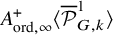 $A_{\operatorname {ord}, \infty }^+\langle \overline {\mathcal {P}}^1_{G, k} \rangle $
) denotes global sections of the group
$A_{\operatorname {ord}, \infty }^+\langle \overline {\mathcal {P}}^1_{G, k} \rangle $
) denotes global sections of the group $\overline {\mathcal {P}}^1_{G, k}$
over
$\overline {\mathcal {P}}^1_{G, k}$
over $A_{\operatorname {ord}, \infty }$
(resp.
$A_{\operatorname {ord}, \infty }$
(resp. $A_{\operatorname {ord}, \infty }^+$
), that is, convergent power series on
$A_{\operatorname {ord}, \infty }^+$
), that is, convergent power series on $\overline {\mathcal {P}}^1_{G, k}$
.
$\overline {\mathcal {P}}^1_{G, k}$
.
Proof. This simply follows from the isomorphism
 $$ \begin{align*} \overline{\mathcal{P}}^1_{G, k} \times \operatorname{Spa}(A_{\operatorname{ord, \infty}}, A_{\operatorname{ord}, \infty}^+) &\xrightarrow{\sim} \mathcal{U}_{\operatorname{HT}, k} \times_{\operatorname{Spa}(A_{\operatorname{ord}, k}, A_{\operatorname{ord}, k}^+)} \operatorname{Spa}(A_{\operatorname{ord, \infty}}, A_{\operatorname{ord}, \infty}^+) \\p &\mapsto \mathfrak{B}_{\infty}^{\operatorname{can}} \cdot p.\\[-37pt] \end{align*} $$
7.1.3 The Gauss–Manin connection (ordinary case)
Fix an integer $i=1, \dots , 2n-1$
and recall the definition of the integer
$i=1, \dots , 2n-1$
and recall the definition of the integer $\beta _i$
from the proof of Proposition 6.3.2 (i.e.,
$\beta _i$
from the proof of Proposition 6.3.2 (i.e., $\beta _i = \beta $
if
$\beta _i = \beta $
if $i=1, \dots , n$
and
$i=1, \dots , n$
and $0$
if
$0$
if $i=n+1, \dots , 2n-1$
). Recall from §6.4.3 that we have an operator
$i=n+1, \dots , 2n-1$
). Recall from §6.4.3 that we have an operator
 $$\begin{align*}\nabla_i \colon \mathcal{O}_{P_{G, \operatorname{dR}}^{\operatorname{an}}} \to \mathcal{O}_{P_{G, \operatorname{dR}}^{\operatorname{an}}}. \end{align*}$$
Let $k \geq 1$
be an integer. Since
$k \geq 1$
be an integer. Since $\mathcal {U}_{\operatorname {HT}, k}$
is open in
$\mathcal {U}_{\operatorname {HT}, k}$
is open in $P_{G, \operatorname {dR}}^{\operatorname {an}}$
, we obtain an induced operator
$P_{G, \operatorname {dR}}^{\operatorname {an}}$
, we obtain an induced operator
 $$\begin{align*}\nabla_i \colon \mathcal{O}_{\mathcal{U}_{\operatorname{HT}, k}}(\mathcal{U}_{\operatorname{HT}, k}) \to \mathcal{O}_{\mathcal{U}_{\operatorname{HT}, k}}(\mathcal{U}_{\operatorname{HT}, k}). \end{align*}$$
Furthermore, since $\operatorname {Spa}(A_{\operatorname {ord}, \infty }, A_{\operatorname {ord}, \infty }^+) \to \operatorname {Spa}(A_{\operatorname {ord}, k}, A_{\operatorname {ord}, k}^+)$
is a pro-étale torsor, this operator extends to an operator
$\operatorname {Spa}(A_{\operatorname {ord}, \infty }, A_{\operatorname {ord}, \infty }^+) \to \operatorname {Spa}(A_{\operatorname {ord}, k}, A_{\operatorname {ord}, k}^+)$
is a pro-étale torsor, this operator extends to an operator $\nabla _i \colon \mathcal {O}_{\mathcal {U}_{\operatorname {HT}, k, \infty }}(\mathcal {U}_{\operatorname {HT}, k, \infty }) \to \mathcal {O}_{\mathcal {U}_{\operatorname {HT}, k, \infty }}(\mathcal {U}_{\operatorname {HT}, k, \infty })$
, where
$\nabla _i \colon \mathcal {O}_{\mathcal {U}_{\operatorname {HT}, k, \infty }}(\mathcal {U}_{\operatorname {HT}, k, \infty }) \to \mathcal {O}_{\mathcal {U}_{\operatorname {HT}, k, \infty }}(\mathcal {U}_{\operatorname {HT}, k, \infty })$
, where
 $$\begin{align*}\mathcal{U}_{\operatorname{HT}, k, \infty} = \mathcal{U}_{\operatorname{HT}, k} \times_{\operatorname{Spa}(A_{\operatorname{ord}, k}, A_{\operatorname{ord}, k}^+)} \operatorname{Spa}(A_{\operatorname{ord}, \infty}, A_{\operatorname{ord}, \infty}^+). \end{align*}$$
The following proposition will allow us to apply the general results on continuous operators in §3.
Proposition 7.1.6. With notation as above:
-
1. The operators
are integral, that is, they preserve
$$ \begin{align*} p^{\beta_i}\nabla_i \colon \mathcal{O}_{\mathcal{U}_{\operatorname{HT}, k}}(\mathcal{U}_{\operatorname{HT}, k}) &\to \mathcal{O}_{\mathcal{U}_{\operatorname{HT}, k}}(\mathcal{U}_{\operatorname{HT}, k}) \\ p^{\beta_i}\nabla_i \colon \mathcal{O}_{\mathcal{U}_{\operatorname{HT}, k, \infty}}(\mathcal{U}_{\operatorname{HT}, k, \infty}) &\to \mathcal{O}_{\mathcal{U}_{\operatorname{HT}, k, \infty}}(\mathcal{U}_{\operatorname{HT}, k, \infty}) \end{align*} $$
$\mathcal {O}^+_{\mathcal {U}_{\operatorname {HT}, k}}(\mathcal {U}_{\operatorname {HT}, k})$
and
$\mathcal {O}^+_{\mathcal {U}_{\operatorname {HT}, k, \infty }}(\mathcal {U}_{\operatorname {HT}, k, \infty })$
respectively.
-
2. One has a continuous
$A^+_{\operatorname {ord}, \infty }$
-algebra isomorphism where
$$\begin{align*}\mathcal{O}^+_{\mathcal{U}_{\operatorname{HT}, k, \infty}}(\mathcal{U}_{\operatorname{HT}, k, \infty}) \cong A_{\operatorname{ord}, \infty}^+ \langle X_{\operatorname{sim}}, X_{a, b, \tau} \rangle \end{align*}$$
$X_{\operatorname {sim}}$
and
$X_{a, b, \tau }$
are variables,
$\tau $
runs over
$\Psi $
, and
$1 \leq a, b \leq 2n$
are integers, omitting the variables
$X_{a, b, \tau _0}$
for
$(a, b) \in \{ (1, 2), \dots , (1, 2n) \}$
.
-
3. Under the isomorphism in (2), the operator
$p^{\beta _i}\nabla _i$
satisfies the following properties:-
•
$p^{\beta _i}\nabla _i (x) \equiv p^{\beta _i}\theta _i(x)$
modulo
$p^k$
for all
$x \in A_{\operatorname {ord}, \infty }^+$
-
•
$p^{\beta _i}\nabla _i(X_{\operatorname {sim}}) \equiv 0$
and
$p^{\beta _i}\nabla _i (X_{a, b, \tau }) \equiv 0$
modulo
$p^k$
, for all
$(a, b, \tau )$
with
$\tau \neq \tau _0$
-
•
$p^{\beta _i}\nabla _i (X_{1, 1, \tau _0}) \equiv -p^{\beta _i} X_{i+1, 1, \tau _0}$
modulo
$p^k$
-
•
$p^{\beta _i}\nabla _i(X_{i+1, i+1, \tau _0}) \equiv 0$
and
$p^{\beta _i}\nabla _i(X_{a, b, \tau _0}) \equiv 0$
modulo
$p^k$
, for all
$a \geq 2$
and
$b \neq i+1$
-
•
$p^{\beta _i}\nabla _i(X_{a, i+1, \tau _0}) \equiv p^{\beta _i} X_{a, 1, \tau _0}$
modulo
$p^k$
, for all
$a \geq 2$
with
$a \neq i+1$
.
Here,
$\theta _i$
denotes the operator from Proposition 6.3.2 arising from the action of
$C_{\operatorname {cont}}(U_{G, \beta }, L)$
on
$A_{\operatorname {ord}, \infty }$
. -


Proof. Recall that we have a canonical basis $\mathfrak {B}^{\operatorname {can}}_{\infty }$
of
$\mathfrak {B}^{\operatorname {can}}_{\infty }$
of $\mathcal {H}_{\mathcal {A}}$
over
$\mathcal {H}_{\mathcal {A}}$
over $A_{\operatorname {ord}, \infty }^+$
. Then the universal basis of
$A_{\operatorname {ord}, \infty }^+$
. Then the universal basis of $\mathcal {H}_{\mathcal {A}}$
over
$\mathcal {H}_{\mathcal {A}}$
over $\mathcal {U}_{\operatorname {HT}, k, \infty }$
is given by
$\mathcal {U}_{\operatorname {HT}, k, \infty }$
is given by
 $$\begin{align*}\mathfrak{B}_{\infty}^{\operatorname{can}} \cdot \underline{X}' \end{align*}$$
where $\underline {X}' = X_{\operatorname {sim}}' \times \prod _{\tau } (X_{a, b, \tau }')_{a, b}$
is the universal element in
$\underline {X}' = X_{\operatorname {sim}}' \times \prod _{\tau } (X_{a, b, \tau }')_{a, b}$
is the universal element in $\overline {P}^{\operatorname {an}}_G$
over
$\overline {P}^{\operatorname {an}}_G$
over $\mathcal {U}_{\operatorname {HT}, k, \infty }$
. This gives coordinates for
$\mathcal {U}_{\operatorname {HT}, k, \infty }$
. This gives coordinates for $\mathcal {O}^+_{\mathcal {U}_{\operatorname {HT}, k, \infty }}(\mathcal {U}_{\operatorname {HT}, k, \infty })$
and we find that
$\mathcal {O}^+_{\mathcal {U}_{\operatorname {HT}, k, \infty }}(\mathcal {U}_{\operatorname {HT}, k, \infty })$
and we find that
 $$\begin{align*}\mathcal{O}^+_{\mathcal{U}_{\operatorname{HT}, k, \infty}}(\mathcal{U}_{\operatorname{HT}, k, \infty}) \cong A_{\operatorname{ord}, \infty}^+ \langle \frac{X_{\operatorname{sim}}' - 1}{p^k}, \frac{X_{a, b, \tau}' - \delta_{a b}}{p^k} \rangle. \end{align*}$$
Let $\underline {Y} = (\underline {X}')^{-1} = Y_{\operatorname {sim}} \times \prod _{\tau } (Y_{a, b, \tau })_{a, b}$
.
$\underline {Y} = (\underline {X}')^{-1} = Y_{\operatorname {sim}} \times \prod _{\tau } (Y_{a, b, \tau })_{a, b}$
.
Now let $\mathcal {K}_i \in \Omega ^1_{A_{\operatorname {ord}, \infty }^+/\mathcal {O}_L}$
denote the unique differential such that
$\mathcal {K}_i \in \Omega ^1_{A_{\operatorname {ord}, \infty }^+/\mathcal {O}_L}$
denote the unique differential such that
 $$\begin{align*}\nabla^{\operatorname{GM}}(e_{i+1, \tau_0, \infty}^{\operatorname{can}}) = e_{1, \tau_0, \infty} \otimes \mathcal{K}_i \end{align*}$$
and note that $\theta _i \colon A_{\operatorname {ord}, \infty } \to A_{\operatorname {ord}, \infty }$
is the continuous derivation dual to
$\theta _i \colon A_{\operatorname {ord}, \infty } \to A_{\operatorname {ord}, \infty }$
is the continuous derivation dual to $\mathcal {K}_i$
(with respect to the basis
$\mathcal {K}_i$
(with respect to the basis $\{\mathcal {K}_1, \dots , \mathcal {K}_{2n-1} \}$
of
$\{\mathcal {K}_1, \dots , \mathcal {K}_{2n-1} \}$
of $\Omega ^1_{A_{\operatorname {ord}, \infty }/L}$
– see the proof of Proposition 6.3.2). Let
$\Omega ^1_{A_{\operatorname {ord}, \infty }/L}$
– see the proof of Proposition 6.3.2). Let $E_{1, i+1} \in \mathfrak {g}$
denote the element such that
$E_{1, i+1} \in \mathfrak {g}$
denote the element such that
 $$\begin{align*}\nabla^{\operatorname{GM}}_{\theta_i}(\mathfrak{B}_{\infty}^{\operatorname{can}}) = \mathfrak{B}_{\infty}^{\operatorname{can}} \cdot E_{1, i+1}. \end{align*}$$
As explained in the proof of Proposition 6.3.2, $E_{1, i+1}$
is equal to the block upper nilpotent matrix defined in Corollary 5.2.17, hence the notation.
$E_{1, i+1}$
is equal to the block upper nilpotent matrix defined in Corollary 5.2.17, hence the notation.
By the explicit description of $\nabla _i$
in Lemma 5.3.3 and the description of the
$\nabla _i$
in Lemma 5.3.3 and the description of the $\mathcal {D}$
-module structure in §5.2, we see that for
$\mathcal {D}$
-module structure in §5.2, we see that for $F \in A_{\operatorname {ord}, \infty } \langle \frac {X_{\operatorname {sim}}' - 1}{p^k}, \frac {X_{a, b, \tau }' - \delta _{a b}}{p^k} \rangle $
, one has
$F \in A_{\operatorname {ord}, \infty } \langle \frac {X_{\operatorname {sim}}' - 1}{p^k}, \frac {X_{a, b, \tau }' - \delta _{a b}}{p^k} \rangle $
, one has
 $$ \begin{align} \nabla_i(F)(X^{\prime}_{\operatorname{sim}}, X^{\prime}_{a, b, \tau}) = \left( \theta_i \cdot F(X^{\prime}_{\operatorname{sim}}, X^{\prime}_{a, b, \tau}) + E_{1, i+1} \star_{l} F(X^{\prime}_{\operatorname{sim}}, X^{\prime}_{a, b, \tau})) \right) \cdot Y_{1, 1, \tau_0}^{-1}Y_{i+1, i+1, \tau_0} \end{align} $$
where $\theta _i \cdot F$
means act by the derivation on the coefficients,
$\theta _i \cdot F$
means act by the derivation on the coefficients, $\star _l$
is the
$\star _l$
is the $\mathfrak {g}$
-action on
$\mathfrak {g}$
-action on $\mathcal {O}(\overline {\mathcal {P}}^1_{G, k})$
viewing
$\mathcal {O}(\overline {\mathcal {P}}^1_{G, k})$
viewing $F \in A_{\operatorname {ord}, \infty } \hat {\otimes } \mathcal {O}(\overline {\mathcal {P}}^1_{G, k})$
, and the last factor arises from the final three bullet points in Lemma 5.3.3.
$F \in A_{\operatorname {ord}, \infty } \hat {\otimes } \mathcal {O}(\overline {\mathcal {P}}^1_{G, k})$
, and the last factor arises from the final three bullet points in Lemma 5.3.3.
From this description, one immediately sees that $p^{\beta _i}\nabla _i$
preserves
$p^{\beta _i}\nabla _i$
preserves $\mathcal {O}^+_{\mathcal {U}_{\operatorname {HT}, k, \infty }}(\mathcal {U}_{\operatorname {HT}, k, \infty })$
. Since
$\mathcal {O}^+_{\mathcal {U}_{\operatorname {HT}, k, \infty }}(\mathcal {U}_{\operatorname {HT}, k, \infty })$
. Since ${A_{\operatorname {ord}, k}^+ \to A_{\operatorname {ord}, \infty }^+}$
is a profinite pro-étale torsor, the induced morphism
${A_{\operatorname {ord}, k}^+ \to A_{\operatorname {ord}, \infty }^+}$
is a profinite pro-étale torsor, the induced morphism $\mathfrak {U}_{\operatorname {HT}, k, \infty } = \mathfrak {U}_{\operatorname {HT}, k} \times _{\operatorname {Spf}(A_{\operatorname {ord}, k}^+)} \operatorname {Spf}(A_{\operatorname {ord}, \infty }^+) \to \mathfrak {U}_{\operatorname {HT}, k}$
is also a profinite pro-étale torsor. This implies that the induced map
$\mathfrak {U}_{\operatorname {HT}, k, \infty } = \mathfrak {U}_{\operatorname {HT}, k} \times _{\operatorname {Spf}(A_{\operatorname {ord}, k}^+)} \operatorname {Spf}(A_{\operatorname {ord}, \infty }^+) \to \mathfrak {U}_{\operatorname {HT}, k}$
is also a profinite pro-étale torsor. This implies that the induced map $\mathcal {O}(\mathfrak {U}_{\operatorname {HT}, k})/p^{\ell } \to \mathcal {O}(\mathfrak {U}_{\operatorname {HT}, k, \infty })/p^{\ell }$
is injective for any
$\mathcal {O}(\mathfrak {U}_{\operatorname {HT}, k})/p^{\ell } \to \mathcal {O}(\mathfrak {U}_{\operatorname {HT}, k, \infty })/p^{\ell }$
is injective for any $\ell \geq 1$
(since the source is identified with the invariants of the target under the action of a profinite pro-étale group scheme). This implies that the map
$\ell \geq 1$
(since the source is identified with the invariants of the target under the action of a profinite pro-étale group scheme). This implies that the map
 $$ \begin{align} \mathcal{O}^+_{\mathcal{U}_{\operatorname{HT}, k}}(\mathcal{U}_{\operatorname{HT}, k}) \hookrightarrow \mathcal{O}^+_{\mathcal{U}_{\operatorname{HT}, k}}(\mathcal{U}_{\operatorname{HT}, k}) \hat{\otimes}_{A_{\operatorname{ord, k}}^+} A_{\operatorname{ord}, \infty}^+ = \mathcal{O}^+_{\mathcal{U}_{\operatorname{HT}, k, \infty}}(\mathcal{U}_{\operatorname{HT}, k, \infty}) \end{align} $$
is injective modulo $p^{\ell }$
for any
$p^{\ell }$
for any $\ell \geq 1$
, and hence the operator
$\ell \geq 1$
, and hence the operator $p^{\beta _i}\nabla _i$
also preserves
$p^{\beta _i}\nabla _i$
also preserves $\mathcal {O}^+_{\mathcal {U}_{\operatorname {HT}, k}}(\mathcal {U}_{\operatorname {HT}, k})$
. This proves part (1).
$\mathcal {O}^+_{\mathcal {U}_{\operatorname {HT}, k}}(\mathcal {U}_{\operatorname {HT}, k})$
. This proves part (1).
Now using the explicit formula in (7.1.7), we can compute the action of $p^{\beta _i}\nabla _i$
in terms of the coordinates
$p^{\beta _i}\nabla _i$
in terms of the coordinates $\underline {X}'$
. Note that
$\underline {X}'$
. Note that $Y_{1, 1, \tau _0}^{-1}Y_{i+1, i+1, \tau _0} \equiv 1$
modulo
$Y_{1, 1, \tau _0}^{-1}Y_{i+1, i+1, \tau _0} \equiv 1$
modulo $p^k$
. An explicit matrix calculation of the action
$p^k$
. An explicit matrix calculation of the action $E_{1, i+1} \star _l -$
shows that:
$E_{1, i+1} \star _l -$
shows that:
-
•
$p^{\beta _i}\nabla _i (x) \equiv p^{\beta _i}\theta _i(x)$
modulo
$p^k$
, for any
$x \in A_{\operatorname {ord}, \infty }^+$
-
•
$p^{\beta }\nabla _i (X^{\prime }_{\operatorname {sim}}) \equiv 0$
and
$p^{\beta _i}\nabla _i(X^{\prime }_{a, b, \tau }) \equiv 0$
modulo
$p^k$
for any
$(a, b, \tau )$
with
$\tau \neq \tau _0$
-
•
$p^{\beta _i}\nabla _i(X^{\prime }_{1, 1, \tau _0}) \equiv -p^{\beta _i} X^{\prime }_{i+1, 1, \tau _0}$
modulo
$p^k$
-
•
$p^{\beta _i}\nabla _i(X^{\prime }_{j, 1, \tau _0}) \equiv 0$
modulo
$p^k$
, for all
$2 \leq j \leq 2n$
-
•
$p^{\beta _i}\nabla _i(X^{\prime }_{a, b, \tau _0}) \equiv p^{\beta _i} X^{\prime }_{a, 1, \tau _0} (X^{\prime }_{1, 1, \tau _0})^{-1} X^{\prime }_{i+1, b, \tau _0}$
modulo
$p^k$
, for all
$2 \leq a, b \leq 2n$
.


Now consider the following change of coordinates:
-
•
$X_{\operatorname {sim}} = \frac {X^{\prime }_{\operatorname {sim}} - 1}{p^k}$
and
$X_{a, b, \tau } = \frac {X^{\prime }_{a, b, \tau } - \delta _{ab}}{p^k}$
for all
$(a, b, \tau )$
with
$\tau \neq \tau _0$
-
•
$X_{a, b, \tau _0} = \frac {X^{\prime }_{a, b, \tau _0} - \delta _{ab}}{p^k}$
for all
$(a, b)$
(except those in the set
$\{(1, 2), \dots , (1, 2n)\}$
) with
$(a, b) \neq (i+1, i+1)$
-
•
$X_{i+1, i+1, \tau _0} = X_{1, 1, \tau _0} + \frac {X_{i+1, i+1, \tau _0} - 1}{p^k}$
.


This change of coordinates gives rise to a continuous $A^+_{\operatorname {ord}, \infty }$
-algebra isomorphism
$A^+_{\operatorname {ord}, \infty }$
-algebra isomorphism
 $$\begin{align*}\mathcal{O}^+_{\mathcal{U}_{\operatorname{HT}, k, \infty}}(\mathcal{U}_{\operatorname{HT}, k, \infty}) \cong A^+_{\operatorname{ord}, \infty}\langle X_{\operatorname{sim}}, X_{a, b, \tau} \rangle \end{align*}$$
and one can easily verify that the properties in (3) are satisfied.
We now apply the general results in §3.
Proposition 7.1.9. Let $\varepsilon> 0$
. There exists an integer
$\varepsilon> 0$
. There exists an integer $k(\varepsilon ) \geq 1$
such that, for any
$k(\varepsilon ) \geq 1$
such that, for any $k \geq k(\varepsilon )$
, there exists a unique continuous L-algebra action
$k \geq k(\varepsilon )$
, there exists a unique continuous L-algebra action
 $$\begin{align*}C_{\varepsilon}(p^{-\beta_i} \mathbb{Z}_p, L) \times \mathcal{O}_{\mathcal{U}_{\operatorname{HT}, k}}(\mathcal{U}_{\operatorname{HT}, k}) \to \mathcal{O}_{\mathcal{U}_{\operatorname{HT}, k}}(\mathcal{U}_{\operatorname{HT}, k}) \end{align*}$$
such that the action of the natural inclusion $p^{-\beta _i}\mathbb {Z}_p \hookrightarrow L$
is given by
$p^{-\beta _i}\mathbb {Z}_p \hookrightarrow L$
is given by $\nabla _i$
.
$\nabla _i$
.
Proof. Note that $C_{\varepsilon }(p^{-\beta _i}\mathbb {Z}_p, L)$
is isomorphic to
$C_{\varepsilon }(p^{-\beta _i}\mathbb {Z}_p, L)$
is isomorphic to $C_{\varepsilon }(\mathbb {Z}_p, L)$
isometrically, and the function
$C_{\varepsilon }(\mathbb {Z}_p, L)$
isometrically, and the function ${p^{-\beta _i}\mathbb {Z}_p \to \mathcal {O}_L}$
given by
${p^{-\beta _i}\mathbb {Z}_p \to \mathcal {O}_L}$
given by $p^{-\beta _i}x \mapsto x$
is identified with the natural inclusion
$p^{-\beta _i}x \mapsto x$
is identified with the natural inclusion $\mathbb {Z}_p \hookrightarrow \mathcal {O}_L$
. Hence it is enough to show that there is a unique action
$\mathbb {Z}_p \hookrightarrow \mathcal {O}_L$
. Hence it is enough to show that there is a unique action
 $$\begin{align*}C_{\varepsilon}(\mathbb{Z}_p, L) \times \mathcal{O}_{\mathcal{U}_{\operatorname{HT}, k}}(\mathcal{U}_{\operatorname{HT}, k}) \to \mathcal{O}_{\mathcal{U}_{\operatorname{HT}, k}}(\mathcal{U}_{\operatorname{HT}, k}) \end{align*}$$
such that the natural map $\mathbb {Z}_p \hookrightarrow L$
corresponds to the action of
$\mathbb {Z}_p \hookrightarrow L$
corresponds to the action of $p^{\beta _i}\nabla _i$
. We first prove a similar claim for
$p^{\beta _i}\nabla _i$
. We first prove a similar claim for $\mathcal {O}_{\mathcal {U}_{\operatorname {HT}, k, \infty }}(\mathcal {U}_{\operatorname {HT}, k, \infty })$
by iterating Proposition 3.3.1.
$\mathcal {O}_{\mathcal {U}_{\operatorname {HT}, k, \infty }}(\mathcal {U}_{\operatorname {HT}, k, \infty })$
by iterating Proposition 3.3.1.
Consider the Tate algebra  from Proposition 7.1.6(2), which is independent of k. We will partition the coordinates in the following way. Let
 $$\begin{align*}\Sigma_1 = \{ X_{\operatorname{sim}}, X_{i+1, i+1, \tau_0} \} \cup \left\{ X_{a, b, \tau_0} : \begin{array}{c} 2 \leq a \leq 2n \\ b \neq 1, i+1 \end{array} \right\} \cup \left\{ X_{a, b, \tau} : \begin{array}{c} 1 \leq a, b \leq 2n \\ \tau \neq \tau_0 \end{array} \right\} \end{align*}$$
and set  and
and $S_1 = S_1^+[1/p]$
. Let
$S_1 = S_1^+[1/p]$
. Let $D_1 = p^{\beta _i}\theta _i \colon S_1^+ \to S_1^+$
denote the derivation which acts only on the coefficients in
$D_1 = p^{\beta _i}\theta _i \colon S_1^+ \to S_1^+$
denote the derivation which acts only on the coefficients in $A_{\operatorname {ord}, \infty }^+$
(i.e., the coordinates in
$A_{\operatorname {ord}, \infty }^+$
(i.e., the coordinates in $\Sigma _1$
are all horizontal). By §6.1.3, the operator
$\Sigma _1$
are all horizontal). By §6.1.3, the operator $D_1$
extends to a continuous (and hence locally analytic) action on
$D_1$
extends to a continuous (and hence locally analytic) action on $S_1$
.
$S_1$
.
Now, for $2 \leq r \leq i$
, set
$2 \leq r \leq i$
, set $S_r^+ = S_{r-1}^+\langle X_{r, i+1, \tau _0}, X_{r, 1, \tau _0} \rangle $
and
$S_r^+ = S_{r-1}^+\langle X_{r, i+1, \tau _0}, X_{r, 1, \tau _0} \rangle $
and $S_r = S_r^+[1/p]$
. Consider the derivation
$S_r = S_r^+[1/p]$
. Consider the derivation  on
on $S_r^+$
as constructed in §3.3 (i.e., it acts on
$S_r^+$
as constructed in §3.3 (i.e., it acts on $S_{r-1}^+$
as
$S_{r-1}^+$
as $D_{r-1}$
, and we have
$D_{r-1}$
, and we have ${D_r(X_{r, i+1, \tau _0}) = p^{\beta _i}X_{r, 1, \tau _0}}$
and
${D_r(X_{r, i+1, \tau _0}) = p^{\beta _i}X_{r, 1, \tau _0}}$
and $D_r(X_{r, 1, \tau _0}) = 0$
). Similarly, we set
$D_r(X_{r, 1, \tau _0}) = 0$
). Similarly, we set $S_{i+1}^+ = S_i^+\langle X_{1, 1, \tau _0}, X_{i+1, 1, \tau _0} \rangle $
,
$S_{i+1}^+ = S_i^+\langle X_{1, 1, \tau _0}, X_{i+1, 1, \tau _0} \rangle $
, $S_{i+1} = S_{i+1}^+[1/p]$
, and
$S_{i+1} = S_{i+1}^+[1/p]$
, and  acting on $S_{i+1}^+$
. Finally, for
$S_{i+1}^+$
. Finally, for $i+2 \leq r \leq 2n$
, we set
$i+2 \leq r \leq 2n$
, we set $S_r^+ = S_{r-1}^+\langle X_{r, i+1, \tau _0}, X_{r, 1, \tau _0} \rangle $
,
$S_r^+ = S_{r-1}^+\langle X_{r, i+1, \tau _0}, X_{r, 1, \tau _0} \rangle $
, $S_r = S_r^+[1/p]$
, and
$S_r = S_r^+[1/p]$
, and  acting on $S_r^+$
. Note that
$S_r^+$
. Note that $V = S_{2n}$
.
$V = S_{2n}$
.
Now iteratively applying Proposition 3.3.1 to the tuples $(S_{r-1}, D_{r-1}, S_r, D_r)$
and using the fact that
$(S_{r-1}, D_{r-1}, S_r, D_r)$
and using the fact that $D_1$
extends to a locally analytic action on
$D_1$
extends to a locally analytic action on $S_1$
, we see that
$S_1$
, we see that  extends to a locally analytic action on V. By Lemma 3.2.1, there exists an integer $k(\varepsilon ) \geq 1$
, such that for any
$k(\varepsilon ) \geq 1$
, such that for any $k \geq k(\varepsilon )$
and continuous operator
$k \geq k(\varepsilon )$
and continuous operator $T' \colon V \to V$
preserving the unit ball
$T' \colon V \to V$
preserving the unit ball $V^+ = A_{\operatorname {ord}, \infty }^+\langle X_{\operatorname {sim}}, X_{a, b, \tau } \rangle $
, the operator
$V^+ = A_{\operatorname {ord}, \infty }^+\langle X_{\operatorname {sim}}, X_{a, b, \tau } \rangle $
, the operator $T + p^k T'$
extends to an
$T + p^k T'$
extends to an $\varepsilon $
-analytic action.
$\varepsilon $
-analytic action.
Let $k \geq k(\varepsilon )$
. Then, by Proposition 7.1.6, we have an identification
$k \geq k(\varepsilon )$
. Then, by Proposition 7.1.6, we have an identification $\mathcal {O}^+_{\mathcal {U}_{\operatorname {HT}, k, \infty }}(\mathcal {U}_{\operatorname {HT}, k, \infty }) = V^+$
and the operator
$\mathcal {O}^+_{\mathcal {U}_{\operatorname {HT}, k, \infty }}(\mathcal {U}_{\operatorname {HT}, k, \infty }) = V^+$
and the operator $p^{\beta _i}\nabla _i$
is congruent to T modulo
$p^{\beta _i}\nabla _i$
is congruent to T modulo $p^k$
. Since
$p^k$
. Since $V^+$
is p-torsion free, this implies that
$V^+$
is p-torsion free, this implies that $p^{\beta _i}\nabla _i = T + p^k T'$
for some continuous operator
$p^{\beta _i}\nabla _i = T + p^k T'$
for some continuous operator $T' \colon V^+ \to V^+$
, hence
$T' \colon V^+ \to V^+$
, hence $p^{\beta _i}\nabla _i$
extends to an
$p^{\beta _i}\nabla _i$
extends to an $\varepsilon $
-analytic action on
$\varepsilon $
-analytic action on $\mathcal {O}_{\mathcal {U}_{\operatorname {HT}, k, \infty }}(\mathcal {U}_{\operatorname {HT}, k, \infty })$
.
$\mathcal {O}_{\mathcal {U}_{\operatorname {HT}, k, \infty }}(\mathcal {U}_{\operatorname {HT}, k, \infty })$
.
Finally, since $A_{\operatorname {ord}, k}^+ \to A_{\operatorname {ord}, \infty }^+$
is a pro-étale torsor, the map
$A_{\operatorname {ord}, k}^+ \to A_{\operatorname {ord}, \infty }^+$
is a pro-étale torsor, the map $\mathcal {O}_{\mathcal {U}_{\operatorname {HT}, k}}(\mathcal {U}_{\operatorname {HT}, k}) \hookrightarrow \mathcal {O}_{\mathcal {U}_{\operatorname {HT}, k, \infty }}(\mathcal {U}_{\operatorname {HT}, k, \infty })$
is an isometry, and therefore the operator
$\mathcal {O}_{\mathcal {U}_{\operatorname {HT}, k}}(\mathcal {U}_{\operatorname {HT}, k}) \hookrightarrow \mathcal {O}_{\mathcal {U}_{\operatorname {HT}, k, \infty }}(\mathcal {U}_{\operatorname {HT}, k, \infty })$
is an isometry, and therefore the operator $p^{\beta _i}\nabla _i$
extends to an
$p^{\beta _i}\nabla _i$
extends to an $\varepsilon $
-analytic action on
$\varepsilon $
-analytic action on $\mathcal {O}_{\mathcal {U}_{\operatorname {HT}, k}}(\mathcal {U}_{\operatorname {HT}, k})$
.
$\mathcal {O}_{\mathcal {U}_{\operatorname {HT}, k}}(\mathcal {U}_{\operatorname {HT}, k})$
.
7.2 Overconvergent neighbourhoods for G
In this section we will prove an analogous result to Proposition 7.1.9 for overconvergent neighbourhoods of the Igusa tower inside $P_{G,\operatorname {dR}}^{\operatorname {an}}$
. We will continue to use the notation introduced in the previous section. In particular, we will continue to work locally with respect to a choice of
$P_{G,\operatorname {dR}}^{\operatorname {an}}$
. We will continue to use the notation introduced in the previous section. In particular, we will continue to work locally with respect to a choice of $\operatorname {Spa}(A, A^+) \in \mathcal {C}_G$
.
$\operatorname {Spa}(A, A^+) \in \mathcal {C}_G$
.
7.2.1 Overconvergent extensions
Recall that h is a fixed generator of $\hat {\delta }_{G, n+1}^+$
over
$\hat {\delta }_{G, n+1}^+$
over $\operatorname {Spa}(A,A^+)$
. For an integer
$\operatorname {Spa}(A,A^+)$
. For an integer $r \geq 1$
, let
$r \geq 1$
, let $\operatorname {Spa}(A_r,A^+_r) = \operatorname {Spa}(A\langle \frac {p}{h^{p^{r+1}}} \rangle , A^+\langle \frac {p}{h^{p^{r+1}}} \rangle ) \subset \mathcal {X}_{G, w_n}(p^{\beta })_r$
denote the pullback of
$\operatorname {Spa}(A_r,A^+_r) = \operatorname {Spa}(A\langle \frac {p}{h^{p^{r+1}}} \rangle , A^+\langle \frac {p}{h^{p^{r+1}}} \rangle ) \subset \mathcal {X}_{G, w_n}(p^{\beta })_r$
denote the pullback of $\operatorname {Spa}(A,A^+)$
under the affinoid morphism
$\operatorname {Spa}(A,A^+)$
under the affinoid morphism
 $$\begin{align*}\mathcal{X}_{G, w_n}(p^{\beta})_r \to \mathcal{X}_{G, \operatorname{Iw}}(p^{\beta}) \end{align*}$$
(see Remark 6.2.11).
Definition 7.2.1. Let $k \geq 1$
be an integer. We say that a quasi-compact open affinoid subspace
$k \geq 1$
be an integer. We say that a quasi-compact open affinoid subspace ${\mathcal {U} \subset P_{G, \operatorname {dR}, A}^{\operatorname {an}}}$
is an overconvergent extension of
${\mathcal {U} \subset P_{G, \operatorname {dR}, A}^{\operatorname {an}}}$
is an overconvergent extension of $\mathcal {U}_{\operatorname {HT}, k}$
if
$\mathcal {U}_{\operatorname {HT}, k}$
if
-
• One has
$\mathcal {U} \cap P_{G, \operatorname {dR}, A_{\operatorname {ord}}}^{\operatorname {an}} = \mathcal {U}_{\operatorname {HT}, k}$
, where the intersection is taken inside
$P_{G, \operatorname {dR}, A}^{\operatorname {an}}$
-
•
$\mathcal {U}$
contains the closure of
$\operatorname {Spa}(A_{\operatorname {ord}, \infty }, A_{\operatorname {ord}, \infty }^+)$
inside
$P_{G, \operatorname {dR}, A}^{\operatorname {an}}$
.


Given an overconvergent extension $\mathcal {U}$
and an integer
$\mathcal {U}$
and an integer $r \geq 1$
, we set
$r \geq 1$
, we set  , which is again an overconvergent extension.
The following proposition shows that overconvergent extensions actually exist.
Proposition 7.2.2. For any integer $k \geq 1$
, there exists an overconvergent extension of
$k \geq 1$
, there exists an overconvergent extension of $\mathcal {U}_{\operatorname {HT}, k}$
. Moreover, the collection of all overconvergent extensions (as k varies) forms a cofinal system of quasi-compact open neighbourhoods of the closure of
$\mathcal {U}_{\operatorname {HT}, k}$
. Moreover, the collection of all overconvergent extensions (as k varies) forms a cofinal system of quasi-compact open neighbourhoods of the closure of $\operatorname {Spa}(A_{\operatorname {ord}, \infty }, A_{\operatorname {ord}, \infty }^+)$
inside
$\operatorname {Spa}(A_{\operatorname {ord}, \infty }, A_{\operatorname {ord}, \infty }^+)$
inside $P_{G, \operatorname {dR}, A}^{\operatorname {an}}$
.
$P_{G, \operatorname {dR}, A}^{\operatorname {an}}$
.
Proof. Since $\mathcal {U}_{\operatorname {HT}, k}$
is the pushout of of
$\mathcal {U}_{\operatorname {HT}, k}$
is the pushout of of $\mathcal {IG}_{G, w_n}(p^{\beta }) \times _{\mathcal {X}_{G, w_n}(p^{\beta })} \operatorname {Spa}(A_{\operatorname {ord}}, A^+_{\operatorname {ord}})$
along the natural map
$\mathcal {IG}_{G, w_n}(p^{\beta }) \times _{\mathcal {X}_{G, w_n}(p^{\beta })} \operatorname {Spa}(A_{\operatorname {ord}}, A^+_{\operatorname {ord}})$
along the natural map $M^G_{\operatorname {Iw}}(p^{\beta }) \hookrightarrow \overline {\mathcal {P}}^{\square }_{G, k}$
, the result follows from Proposition 6.4.3.
$M^G_{\operatorname {Iw}}(p^{\beta }) \hookrightarrow \overline {\mathcal {P}}^{\square }_{G, k}$
, the result follows from Proposition 6.4.3.
We now establish a key property for overconvergent extensions as we vary the radius of overconvergence. Let $k \geq 1$
be an integer and
$k \geq 1$
be an integer and $\mathcal {U}$
an overconvergent extension of
$\mathcal {U}$
an overconvergent extension of $\mathcal {U}_{\operatorname {HT}, k}$
. Then we have a chain of quasi-compact open affinoid neighbourhoods
$\mathcal {U}_{\operatorname {HT}, k}$
. Then we have a chain of quasi-compact open affinoid neighbourhoods

such that $\mathcal {U}_{\infty }$
is the locus inside
$\mathcal {U}_{\infty }$
is the locus inside $\mathcal {U}_r$
where
$\mathcal {U}_r$
where $|h| = 1$
. On sections, this chain of neighbourhoods is induced from the chain of continuous maps
$|h| = 1$
. On sections, this chain of neighbourhoods is induced from the chain of continuous maps
 $$\begin{align*}B_{1}^+ \to B_2^+ \to \cdots \to B_{\infty}^+ \end{align*}$$
where $B_r^+ = \mathcal {O}^+(\mathcal {U}_r)$
. Let
$B_r^+ = \mathcal {O}^+(\mathcal {U}_r)$
. Let $B_r = \mathcal {O}(\mathcal {U}_r) = B_r^+[1/p]$
, and let
$B_r = \mathcal {O}(\mathcal {U}_r) = B_r^+[1/p]$
, and let $|\!| \cdot |\!|_r$
denote the L-Banach norm on
$|\!| \cdot |\!|_r$
denote the L-Banach norm on $B_r$
for which
$B_r$
for which $B_r^+$
is the unit ball.
$B_r^+$
is the unit ball.
Lemma 7.2.3. Let $r \geq 1$
. For any real number
$r \geq 1$
. For any real number $0 < \delta < 1$
, there exists an integer
$0 < \delta < 1$
, there exists an integer $s= s(\delta ) \geq r$
such that: for any
$s= s(\delta ) \geq r$
such that: for any $v \in B_r$
,
$v \in B_r$
, $m \in \mathbb {N}$
and
$m \in \mathbb {N}$
and $c \in \mathbb {Q}$
, one has
$c \in \mathbb {Q}$
, one has
 $$\begin{align*}|\!| v |\!|_{\infty} \leq p^{c-m} \text{ and } |\!|v|\!|_r \leq p^c \quad \Rightarrow \quad |\!| v |\!|_s \leq p^{c- \delta m}. \end{align*}$$
Proof. Since $\mathcal {U}_r$
is an overconvergent extension, we have
$\mathcal {U}_r$
is an overconvergent extension, we have $B^+_\infty = B_r^+\langle 1/h \rangle $
, hence
$B^+_\infty = B_r^+\langle 1/h \rangle $
, hence $\left ( B^+_{\infty }/p \right ) = \left ( B_r^+/p \right )[1/h]$
. Therefore, any element in the kernel of the map
$\left ( B^+_{\infty }/p \right ) = \left ( B_r^+/p \right )[1/h]$
. Therefore, any element in the kernel of the map $B_r^+/p \to B_{\infty }^+/p$
is killed by some power of h. Since
$B_r^+/p \to B_{\infty }^+/p$
is killed by some power of h. Since $B_r^+/p$
is Noetherian, we see that there is a common power
$B_r^+/p$
is Noetherian, we see that there is a common power $h^M$
which kills any element in the kernel of the map
$h^M$
which kills any element in the kernel of the map $B_r^+/p \to B_{\infty }^+/p$
. Since
$B_r^+/p \to B_{\infty }^+/p$
. Since $B_{\infty }^+$
is p-torsion free, this implies (by a simple induction argument) that
$B_{\infty }^+$
is p-torsion free, this implies (by a simple induction argument) that $h^{m M}$
kills the kernel of
$h^{m M}$
kills the kernel of $B_r^+/p^m \to B^+_{\infty }/p^m$
for any integer
$B_r^+/p^m \to B^+_{\infty }/p^m$
for any integer $m \geq 1$
.
$m \geq 1$
.
Now, by raising v to an integral power, it is enough to prove the claim for $c \in \mathbb {Z}$
, and by rescaling, it is enough to prove the claim when
$c \in \mathbb {Z}$
, and by rescaling, it is enough to prove the claim when $c = 0$
. Therefore, we suppose we have an element
$c = 0$
. Therefore, we suppose we have an element $v \in B_r^+$
whose image lies in
$v \in B_r^+$
whose image lies in $p^m B_{\infty }^+$
. By the paragraph above, we must therefore have
$p^m B_{\infty }^+$
. By the paragraph above, we must therefore have
 $$\begin{align*}|\!| (p^{-1} h^M)^m v |\!|_s \leq |\!| (p^{-1} h^M)^m v |\!|_r \leq 1 \end{align*}$$
for any $s \geq r$
and
$s \geq r$
and $m \geq 1$
. Since
$m \geq 1$
. Since $|\!|h^{-1} |\!|_s \to 1$
as
$|\!|h^{-1} |\!|_s \to 1$
as $s \to +\infty $
, taking s large enough such that
$s \to +\infty $
, taking s large enough such that $|\!|h^{-1}|\!|_s \leq p^{\frac {(1-\delta )}{M}}$
, we obtain
$|\!|h^{-1}|\!|_s \leq p^{\frac {(1-\delta )}{M}}$
, we obtain
 $$\begin{align*}|\!| v |\!|_s \leq |\!| (p h^{-M})^m |\!|_s \leq p^{-\delta m} \end{align*}$$
as required.
7.2.2 The Gauss–Manin connection (overconvergent case)
We now prove an overconvergent analogue of Proposition 7.1.9.
Proposition 7.2.4. Let $\varepsilon> 0$
. For any quasi-compact open neighbourhood U of the closure of
$\varepsilon> 0$
. For any quasi-compact open neighbourhood U of the closure of $\operatorname {Spa}(A_{\operatorname {ord}, \infty }, A_{\operatorname {ord}, \infty }^+)$
inside
$\operatorname {Spa}(A_{\operatorname {ord}, \infty }, A_{\operatorname {ord}, \infty }^+)$
inside $P_{G, \operatorname {dR}, A}^{\operatorname {an}}$
, there exists a quasi-compact open neighbourhood V of the closure of
$P_{G, \operatorname {dR}, A}^{\operatorname {an}}$
, there exists a quasi-compact open neighbourhood V of the closure of $\operatorname {Spa}(A_{\operatorname {ord}, \infty }, A_{\operatorname {ord}, \infty }^+)$
inside
$\operatorname {Spa}(A_{\operatorname {ord}, \infty }, A_{\operatorname {ord}, \infty }^+)$
inside $P_{G, \operatorname {dR}, A}^{\operatorname {an}}$
and a unique continuous L-linear action
$P_{G, \operatorname {dR}, A}^{\operatorname {an}}$
and a unique continuous L-linear action
 $$ \begin{align} C_{\varepsilon}(U_{G, \beta}, L) \times \mathcal{O}_{P_{G, \operatorname{dR}, A}^{\operatorname{an}}}(U) \to \mathcal{O}_{P_{G, \operatorname{dR}, A}^{\operatorname{an}}}(V) \end{align} $$
extending the action of polynomial functions in $C_{\varepsilon }(U_{G, \beta }, L)$
induced from the operators
$C_{\varepsilon }(U_{G, \beta }, L)$
induced from the operators $\{ \nabla _i : i=1, \dots , 2n-1 \}$
. These actions are compatible as one varies
$\{ \nabla _i : i=1, \dots , 2n-1 \}$
. These actions are compatible as one varies $\varepsilon $
, U, and V.
$\varepsilon $
, U, and V.
Proof. Let $i \in \{1, \dots , 2n-1\}$
and let
$i \in \{1, \dots , 2n-1\}$
and let $k \geq 1$
be an integer such that
$k \geq 1$
be an integer such that $k \geq k(\varepsilon /2)$
, where
$k \geq k(\varepsilon /2)$
, where $k(\varepsilon /2)$
is the integer in Proposition 7.1.9 (depending on the integer i). Then, increasing k if necessary, there exists an overconvergent extension
$k(\varepsilon /2)$
is the integer in Proposition 7.1.9 (depending on the integer i). Then, increasing k if necessary, there exists an overconvergent extension $\mathcal {U}$
of
$\mathcal {U}$
of $\mathcal {U}_{\operatorname {HT}, k}$
with
$\mathcal {U}_{\operatorname {HT}, k}$
with $\mathcal {U} \subset U$
because overconvergent extensions are cofinal. Without loss of generality, we may assume
$\mathcal {U} \subset U$
because overconvergent extensions are cofinal. Without loss of generality, we may assume $\mathcal {U} = \mathcal {U}_1$
. Then, we consider the chain of L-Banach spaces
$\mathcal {U} = \mathcal {U}_1$
. Then, we consider the chain of L-Banach spaces
 $$\begin{align*}\mathcal{O}_{P_{G, \operatorname{dR}, A}^{\operatorname{an}}}(\mathcal{U}_1) \to \cdots \to \mathcal{O}_{P_{G, \operatorname{dR}, A}^{\operatorname{an}}}(\mathcal{U}_{\infty}) \end{align*}$$
where $\mathcal {U}_{\infty } = \mathcal {U}_{\operatorname {HT}, k}$
. By Proposition 7.1.9, the operator
$\mathcal {U}_{\infty } = \mathcal {U}_{\operatorname {HT}, k}$
. By Proposition 7.1.9, the operator $p^{\beta _i}\nabla _i$
extends to an
$p^{\beta _i}\nabla _i$
extends to an $\varepsilon /2$
-analytic action on
$\varepsilon /2$
-analytic action on $\mathcal {O}_{P_{G, \operatorname {dR}, A}^{\operatorname {an}}}(\mathcal {U}_{\infty })$
. Combining this with Lemma 7.2.3, we see that the hypotheses of Proposition 3.4.1 are satisfied, hence there exists an integer
$\mathcal {O}_{P_{G, \operatorname {dR}, A}^{\operatorname {an}}}(\mathcal {U}_{\infty })$
. Combining this with Lemma 7.2.3, we see that the hypotheses of Proposition 3.4.1 are satisfied, hence there exists an integer $r \geq 1$
such that
$r \geq 1$
such that $p^{\beta _i}\nabla _i$
extends to an
$p^{\beta _i}\nabla _i$
extends to an $\varepsilon $
-analytic action on
$\varepsilon $
-analytic action on $\mathcal {O}_{P_{G, \operatorname {dR}, A}^{\operatorname {an}}}(\mathcal {U}_{r})$
. In other words, if we set
$\mathcal {O}_{P_{G, \operatorname {dR}, A}^{\operatorname {an}}}(\mathcal {U}_{r})$
. In other words, if we set $V_i = \mathcal {U}_r$
, then there exists a continuous L-linear action
$V_i = \mathcal {U}_r$
, then there exists a continuous L-linear action
 $$\begin{align*}C_{\varepsilon}(p^{-\beta_i}\mathbb{Z}_p, L) \times \mathcal{O}_{P_{G, \operatorname{dR}, A}^{\operatorname{an}}}(U) \to \mathcal{O}_{P_{G, \operatorname{dR}, A}^{\operatorname{an}}}(V_i) \end{align*}$$
extending the action of polynomial functions in $p^{\beta _i} \nabla _i$
. This action is unique because it can be computed on Mahler expansions.
$p^{\beta _i} \nabla _i$
. This action is unique because it can be computed on Mahler expansions.
Now take $V = \cap _{i=1}^{2n-1} V_i$
. Using the fact that the operators
$V = \cap _{i=1}^{2n-1} V_i$
. Using the fact that the operators $\nabla _i$
commute with each other and the fact that
$\nabla _i$
commute with each other and the fact that
 $$\begin{align*}C_{\varepsilon}(p^{-\beta_1} \mathbb{Z}_p, L) \otimes_L \cdots \otimes_L C_{\varepsilon}(p^{-\beta_{2n-1}} \mathbb{Z}_p, L) \subset C_{\varepsilon}(U_{G, \beta}, L) \end{align*}$$
is dense, we see that there is a unique action as in (7.2.5) extending the action of polynomial functions. This action is functorial in $\varepsilon $
, U and V by unicity.
$\varepsilon $
, U and V by unicity.
We now prove the first part of Theorem 7.0.2. Let $U = \operatorname {Spa}(A, A^+) \in \mathcal {C}_G$
. Then, from the functoriality properties in Proposition 7.2.4, we obtain a continuous L-algebra action
$U = \operatorname {Spa}(A, A^+) \in \mathcal {C}_G$
. Then, from the functoriality properties in Proposition 7.2.4, we obtain a continuous L-algebra action
 $$\begin{align*}C_{\varepsilon}(U_{G, \beta}, L) \times \mathscr{N}^{\dagger}_G(U) \to \mathscr{N}^{\dagger}_G(U) \end{align*}$$
extending the action of polynomial functions. This action is functorial in $\varepsilon $
. We claim that this action is unique. Indeed, by Proposition 6.4.3, there exist integers
$\varepsilon $
. We claim that this action is unique. Indeed, by Proposition 6.4.3, there exist integers $r_1 < r_2 < \cdots $
and étale
$r_1 < r_2 < \cdots $
and étale $\overline {\mathcal {P}}^{\square }_{G, k}$
-torsors
$\overline {\mathcal {P}}^{\square }_{G, k}$
-torsors $\mathcal {U}_{r_k, k} \to \operatorname {Spa}(A_{r_k}, A_{r_k}^+)$
with
$\mathcal {U}_{r_k, k} \to \operatorname {Spa}(A_{r_k}, A_{r_k}^+)$
with $\mathcal {U}_{r_k, k}$
an overconvergent extension of
$\mathcal {U}_{r_k, k}$
an overconvergent extension of $\mathcal {U}_{\operatorname {HT}, k}$
, such that
$\mathcal {U}_{\operatorname {HT}, k}$
, such that
 $$\begin{align*}\mathcal{U}_{r_1, 1} \supset \mathcal{U}_{r_2, 2} \supset \cdots \supset \mathcal{U}_{r_k, k} \supset \cdots \supset \operatorname{Spa}(A_{\operatorname{ord}, \infty}, A_{\operatorname{ord}, \infty}^+). \end{align*}$$
Furthermore, the collection $\{ \mathcal {U}_{r_k, k} \}_{k \geq 1}$
is a cofinal system of quasi-compact open neighbourhoods of
$\{ \mathcal {U}_{r_k, k} \}_{k \geq 1}$
is a cofinal system of quasi-compact open neighbourhoods of $P_{G, \operatorname {dR}, A}^{\operatorname {an}}$
containing the closure of
$P_{G, \operatorname {dR}, A}^{\operatorname {an}}$
containing the closure of $\operatorname {Spa}(A_{\operatorname {ord}, \infty }, A_{\operatorname {ord}, \infty }^+)$
, and all of these torsors are necessarily reductions of structure of each other. This implies that
$\operatorname {Spa}(A_{\operatorname {ord}, \infty }, A_{\operatorname {ord}, \infty }^+)$
, and all of these torsors are necessarily reductions of structure of each other. This implies that
 $$ \begin{align} \mathscr{N}^{\dagger}_G(U) \cong \left( \mathcal{O}_{P_{G, \operatorname{dR}, A}^{\operatorname{an}}}(\mathcal{U}_{r_k, k}) \right)_{k \geq 1}. \end{align} $$
Suppose that $\star _1$
and
$\star _1$
and $\star _2$
are two continuous actions of
$\star _2$
are two continuous actions of $C_{\varepsilon }(U_{G, \beta }, L)$
on
$C_{\varepsilon }(U_{G, \beta }, L)$
on $\mathscr {N}^{\dagger }_G(U)$
extending the action of polynomial functions induced from the operators
$\mathscr {N}^{\dagger }_G(U)$
extending the action of polynomial functions induced from the operators $\{ \nabla _i : i=1, \dots , 2n-1 \}$
. Let
$\{ \nabla _i : i=1, \dots , 2n-1 \}$
. Let $f \in C_{\varepsilon }(U_{G, \beta }, L)$
which we can write as a limit
$f \in C_{\varepsilon }(U_{G, \beta }, L)$
which we can write as a limit $f = \lim _m f_m$
of polynomial functions, and let
$f = \lim _m f_m$
of polynomial functions, and let $x \in \mathcal {O}_{P_{G, \operatorname {dR}, A}^{\operatorname {an}}}(\mathcal {U}_{r_k, k})$
for some
$x \in \mathcal {O}_{P_{G, \operatorname {dR}, A}^{\operatorname {an}}}(\mathcal {U}_{r_k, k})$
for some $k \geq 1$
. By assumption and our definition of an action on ind-sheaves (see §1.4), there exists an integer
$k \geq 1$
. By assumption and our definition of an action on ind-sheaves (see §1.4), there exists an integer $k' \geq 1$
and continuous maps
$k' \geq 1$
and continuous maps
 $$ \begin{align} C_{\varepsilon}(U_{G, \beta}, L) \to \mathcal{O}_{P_{G, \operatorname{dR}, A}^{\operatorname{an}}}(\mathcal{U}_{r_{k'}, k'}), \quad g \mapsto g \star_j x \quad (j=1, 2). \end{align} $$
Since $\mathcal {O}_{P_{G, \operatorname {dR}, A}^{\operatorname {an}}}(\mathcal {U}_{r_{k'}, k'})$
is Hausdorff and both actions extend the same action of polynomial functions, we find that
$\mathcal {O}_{P_{G, \operatorname {dR}, A}^{\operatorname {an}}}(\mathcal {U}_{r_{k'}, k'})$
is Hausdorff and both actions extend the same action of polynomial functions, we find that
 $$\begin{align*}f \star_1 x = \lim_m f_m \star_1 x = \lim_m f_m \star_2 x = f \star_2 x \end{align*}$$
with the limit taking place in $\mathcal {O}_{P_{G, \operatorname {dR}, A}^{\operatorname {an}}}(\mathcal {U}_{r_{k'}, k'})$
. This implies that the actions
$\mathcal {O}_{P_{G, \operatorname {dR}, A}^{\operatorname {an}}}(\mathcal {U}_{r_{k'}, k'})$
. This implies that the actions $\star _1$
and
$\star _1$
and $\star _2$
coincide (as morphisms of ind-sheaves), thereby proving uniqueness.
$\star _2$
coincide (as morphisms of ind-sheaves), thereby proving uniqueness.
To conclude the proof of Theorem 7.0.2(1), we must show that the action is functorial in $U \in \mathcal {C}_G$
and equivariant for the action of
$U \in \mathcal {C}_G$
and equivariant for the action of $M^G_{\operatorname {Iw}}(p^{\beta })$
. Let
$M^G_{\operatorname {Iw}}(p^{\beta })$
. Let $U_1, U_2 \in \mathcal {C}_G$
with
$U_1, U_2 \in \mathcal {C}_G$
with $U_1 \supset U_2$
, and consider the natural (continuous) restriction map
$U_1 \supset U_2$
, and consider the natural (continuous) restriction map $\pi \colon \mathscr {N}^{\dagger }_G(U_1) \to \mathscr {N}^{\dagger }_G(U_2)$
. Let
$\pi \colon \mathscr {N}^{\dagger }_G(U_1) \to \mathscr {N}^{\dagger }_G(U_2)$
. Let $x \in \mathscr {N}^{\dagger }_G(U_1)$
and consider the following two continuous maps
$x \in \mathscr {N}^{\dagger }_G(U_1)$
and consider the following two continuous maps $C_{\varepsilon }(U_{G, \beta }, L) \to \mathscr {N}^{\dagger }_G(U_2)$
given by
$C_{\varepsilon }(U_{G, \beta }, L) \to \mathscr {N}^{\dagger }_G(U_2)$
given by
 $$ \begin{align} f &\mapsto \pi ( f \star_{U_1} x ) \end{align} $$
 $$ \begin{align} f &\mapsto f \star_{U_2} \pi(x) \end{align} $$
where $\star _{U_j}$
denotes the action of
$\star _{U_j}$
denotes the action of $C_{\varepsilon }(U_{G, \beta }, L)$
on
$C_{\varepsilon }(U_{G, \beta }, L)$
on $\mathscr {N}^{\dagger }_G(U_j)$
. By the same argument above, we can write
$\mathscr {N}^{\dagger }_G(U_j)$
. By the same argument above, we can write $\mathscr {N}^{\dagger }_G(U_2) \cong (V_k)_{k \geq 1}$
as a filtered inductive system of Banach spaces and both (7.2.8) and (7.2.9) factor through some
$\mathscr {N}^{\dagger }_G(U_2) \cong (V_k)_{k \geq 1}$
as a filtered inductive system of Banach spaces and both (7.2.8) and (7.2.9) factor through some $V_k$
(by the definition of an action on ind-sheaves). Write
$V_k$
(by the definition of an action on ind-sheaves). Write $f = \lim _m f_m$
as a limit of polynomial functions. Since we know that the action of the operators
$f = \lim _m f_m$
as a limit of polynomial functions. Since we know that the action of the operators $\{\nabla _i \}$
(and hence the action of polynomial functions) is already functorial, we have
$\{\nabla _i \}$
(and hence the action of polynomial functions) is already functorial, we have
 $$\begin{align*}\pi( f \star_{U_1} x ) = \lim_m \pi(f_m \star_{U_1} x) = \lim_m (f_m \star_{U_2} \pi(x) ) = f \star_{U_2} \pi(x) \end{align*}$$
with the limit taking place in $V_k$
. This implies that (7.2.8)
$V_k$
. This implies that (7.2.8) $=$
(7.2.9). The proof for the equivariance under the action of
$=$
(7.2.9). The proof for the equivariance under the action of $M^G_{\operatorname {Iw}}(p^{\beta })$
is very similar, and can again be deduced from the density of polynomial functions.
$M^G_{\operatorname {Iw}}(p^{\beta })$
is very similar, and can again be deduced from the density of polynomial functions.
7.3 The construction for H
In this section we finish the proof of Theorem 7.0.2. Since the construction of the action in Theorem 7.0.2(2) follows exactly the same strategy as in §7.1–7.2, we do not repeat the construction in the same amount of detail. Instead, we simply highlight the differences between the constructions for G and H and leave the details to the interested reader.
To define the analogue of the torsors $\mathcal {U}_{\operatorname {HT}, k}$
, we consider quotients of the Igusa tower
$\mathcal {U}_{\operatorname {HT}, k}$
, we consider quotients of the Igusa tower $\mathfrak {IG}_{H, \operatorname {id}}(p^{\beta })$
by the subgroup of
$\mathfrak {IG}_{H, \operatorname {id}}(p^{\beta })$
by the subgroup of $M^H_{\diamondsuit }(p^{\beta })$
consisting of elements which are congruent to the identity modulo
$M^H_{\diamondsuit }(p^{\beta })$
consisting of elements which are congruent to the identity modulo $p^k$
. Over these quotients of the Igusa tower, we again have a canonical basis of
$p^k$
. Over these quotients of the Igusa tower, we again have a canonical basis of $\mathcal {H}_{\mathcal {A}_1}/p^k \oplus \mathcal {H}_{\mathcal {A}_2}/p^k$
arising from the universal trivialisations, and we can consider the torsor parameterising bases of
$\mathcal {H}_{\mathcal {A}_1}/p^k \oplus \mathcal {H}_{\mathcal {A}_2}/p^k$
arising from the universal trivialisations, and we can consider the torsor parameterising bases of $\mathcal {H}_{\mathcal {A}_1} \oplus \mathcal {H}_{\mathcal {A}_2}$
respecting the symplectic structure and Hodge filtration which reduce to the canonical basis modulo
$\mathcal {H}_{\mathcal {A}_1} \oplus \mathcal {H}_{\mathcal {A}_2}$
respecting the symplectic structure and Hodge filtration which reduce to the canonical basis modulo $p^k$
. Working locally, one can show via the same method as in Proposition 7.2.2 that these torsors overconverge (and hence we can define overconvergent extensions in this setting). To define the system of overconvergent neighbourhoods of
$p^k$
. Working locally, one can show via the same method as in Proposition 7.2.2 that these torsors overconverge (and hence we can define overconvergent extensions in this setting). To define the system of overconvergent neighbourhoods of $\mathcal {X}_{H, \operatorname {id}}(p^{\beta })$
inside
$\mathcal {X}_{H, \operatorname {id}}(p^{\beta })$
inside $\mathcal {X}_{H, \diamondsuit }(p^{\beta })$
locally, we consider the exact same congruences but now involving a generator of
$\mathcal {X}_{H, \diamondsuit }(p^{\beta })$
locally, we consider the exact same congruences but now involving a generator of $\hat {\delta }^+_{H, n+1}$
(see Definition 6.2.15).
$\hat {\delta }^+_{H, n+1}$
(see Definition 6.2.15).
We now proceed in exactly the same way for the construction the action for H. Indeed, one can choose coordinates of $\mathcal {U}_{\operatorname {HT}, k}$
base-changed to
$\mathcal {U}_{\operatorname {HT}, k}$
base-changed to $\mathcal {IG}_{H, \operatorname {id}}(p^{\beta })$
so that the action of
$\mathcal {IG}_{H, \operatorname {id}}(p^{\beta })$
so that the action of $p^{\beta _i} \nabla _i$
(
$p^{\beta _i} \nabla _i$
( $i=1, \dots , n-1$
) is congruent modulo
$i=1, \dots , n-1$
) is congruent modulo $p^k$
to a simple operator on a Tate algebra (which is an iterated version of the construction in §3.3). One then applies the general results in §3 in the same way as in §7.1–7.2, and this results in the construction of the action in Theorem 7.0.2(2). The uniqueness and functoriality results follow the same proof as at the end of §7.2.2.
$p^k$
to a simple operator on a Tate algebra (which is an iterated version of the construction in §3.3). One then applies the general results in §3 in the same way as in §7.1–7.2, and this results in the construction of the action in Theorem 7.0.2(2). The uniqueness and functoriality results follow the same proof as at the end of §7.2.2.
To prove Theorem 7.0.2(3), we again use the same strategy as at the end of §7.2.2. More precisely, we already know from §6.4.4 that the pullback map is equivariant on polynomial functions, and we use the fact that $\mathscr {N}^{\dagger }_H(\hat {\iota }^{-1}U)$
is a filtered inductive system of Banach spaces. Hence equivariance on polynomial functions is enough to deduce equivariance for the
$\mathscr {N}^{\dagger }_H(\hat {\iota }^{-1}U)$
is a filtered inductive system of Banach spaces. Hence equivariance on polynomial functions is enough to deduce equivariance for the $\varepsilon $
-analytic actions.
$\varepsilon $
-analytic actions.
7.4 p-adic evaluation maps
We now construct the p-adic analogues of the evaluation maps in §5.3.2 following the general construction in §2.3.
7.4.1 Compatibility with support conditions
Fix $U = \operatorname {Spa}(A, A^+) \in \mathcal {C}_G$
and let
$U = \operatorname {Spa}(A, A^+) \in \mathcal {C}_G$
and let  . Before constructing the evaluation maps, one must first show that the structures on $\mathscr {N}^{\dagger }_G(U)$
extend over V. Recall the definitions of
$\mathscr {N}^{\dagger }_G(U)$
extend over V. Recall the definitions of $\mathscr {M}^{(r, k)}_{\bullet }$
and
$\mathscr {M}^{(r, k)}_{\bullet }$
and $\mathscr {N}^{(r, k)}_{\bullet }$
from Lemma 6.4.2 and Proposition 6.4.3 respectively, and also their versions with a fixed weight from Definition 6.4.4.
$\mathscr {N}^{(r, k)}_{\bullet }$
from Lemma 6.4.2 and Proposition 6.4.3 respectively, and also their versions with a fixed weight from Definition 6.4.4.
Note that $\mathscr {M}^{(r,k)}_G(U) \subset \mathscr {N}^{(r,k)}_G(U)$
(resp.
$\mathscr {M}^{(r,k)}_G(U) \subset \mathscr {N}^{(r,k)}_G(U)$
(resp. $\mathscr {M}^{(r,k)}_G(V) \subset \mathscr {N}^{(r,k)}_G(V)$
) is the subspace killed by the action of
$\mathscr {M}^{(r,k)}_G(V) \subset \mathscr {N}^{(r,k)}_G(V)$
) is the subspace killed by the action of $\overline {\mathfrak {u}}_G$
(resp.
$\overline {\mathfrak {u}}_G$
(resp. $\overline {\mathfrak {u}}_H$
) under
$\overline {\mathfrak {u}}_H$
) under $\star _{\overline {P}}$
. Furthermore,
$\star _{\overline {P}}$
. Furthermore, $\mathscr {N}^{(r,k)}_G(U)$
and
$\mathscr {N}^{(r,k)}_G(U)$
and $\mathscr {M}^{(r,k)}_G(U)$
are Banach L-algebras, and
$\mathscr {M}^{(r,k)}_G(U)$
are Banach L-algebras, and $\mathscr {N}^{(r,k)}_G(V)$
and
$\mathscr {N}^{(r,k)}_G(V)$
and $\mathscr {M}^{(r,k)}_G(V)$
are Fréchet L-algebras. Indeed, let
$\mathscr {M}^{(r,k)}_G(V)$
are Fréchet L-algebras. Indeed, let $\delta $
be a fixed generator of
$\delta $
be a fixed generator of $\delta _{G,>n+1}^+$
over U, and let
$\delta _{G,>n+1}^+$
over U, and let $\{ \gamma _i \}_{i \in \mathbb {N}}$
be a monotonically decreasing sequence of rational numbers
$\{ \gamma _i \}_{i \in \mathbb {N}}$
be a monotonically decreasing sequence of rational numbers $\gamma _i> 0$
such that
$\gamma _i> 0$
such that $\gamma _i \to 0$
as
$\gamma _i \to 0$
as $i \to +\infty $
. Let
$i \to +\infty $
. Let $V_{\gamma _i} \subset V \subset U$
denote the open affinoid subspace where
$V_{\gamma _i} \subset V \subset U$
denote the open affinoid subspace where $|\delta | \leq |p|^{\gamma _i}$
. Then
$|\delta | \leq |p|^{\gamma _i}$
. Then $\{ V_{\gamma _i} \}$
is a cover of V with compact restriction maps with dense image. We have
$\{ V_{\gamma _i} \}$
is a cover of V with compact restriction maps with dense image. We have
 $$\begin{align*}\mathscr{N}^{(r,k)}_G(V) = \varprojlim_i \mathscr{N}^{(r,k)}_G(V_{\gamma_i}), \quad \quad \mathscr{M}^{(r,k)}_G(V) = \varprojlim_i \mathscr{M}^{(r,k)}_G(V_{\gamma_i}) \end{align*}$$
where each term in the inverse limit is a Banach L-algebra and the transition maps are compact and have dense image.
Lemma 7.4.1. Let $U \in \mathcal {C}_G$
and
$U \in \mathcal {C}_G$
and  . Let
. Let $\varepsilon> 0$
. Then the action in Theorem 7.0.2(1) extends uniquely to a continuous L-algebra action
$\varepsilon> 0$
. Then the action in Theorem 7.0.2(1) extends uniquely to a continuous L-algebra action
 $$\begin{align*}C_{\varepsilon}(U_{G, \beta}, L) \times \mathscr{N}^{\dagger}_{G}(V) \to \mathscr{N}^{\dagger}_{G}(V) \end{align*}$$
which is functorial in U, $\varepsilon $
, and is
$\varepsilon $
, and is $M^G_{\operatorname {Iw}}(p^{\beta })$
-equivariant.
$M^G_{\operatorname {Iw}}(p^{\beta })$
-equivariant.
Proof. Without loss of generality, we may assume that the rational numbers above satisfy $\gamma _i = 1/i$
. Then we have
$\gamma _i = 1/i$
. Then we have
 $$\begin{align*}\mathscr{N}^{(r, k)}_{G}(V_{\gamma_i}) = \mathscr{N}^{(r, k)}_G(U) \langle \frac{\delta^i}{p} \rangle \end{align*}$$
for all $k \geq 1$
. Let
$k \geq 1$
. Let $\varepsilon> 0$
. Let
$\varepsilon> 0$
. Let $\nabla \in \{ p^{\beta _1}\nabla _1, \dots , p^{\beta _{2n-1}}\nabla _{2n-1} \}$
be one of the operators appearing at the start of §6.4.3, normalised by the power of p defined in Proposition 6.3.2. Then there exists
$\nabla \in \{ p^{\beta _1}\nabla _1, \dots , p^{\beta _{2n-1}}\nabla _{2n-1} \}$
be one of the operators appearing at the start of §6.4.3, normalised by the power of p defined in Proposition 6.3.2. Then there exists $k' \geq k$
and
$k' \geq k$
and $r' \geq r$
such that
$r' \geq r$
such that
-
• We have a continuous L-linear action
extending the action of polynomial functions. In particular, there exists a constant
$$\begin{align*}C_{\varepsilon/2}(U_{G, \beta}, L) \times \mathscr{N}^{(r, k)}_G(U) \to \mathscr{N}^{(r', k')}_G(U) \end{align*}$$
$C \in \mathbb {R}_{>0}$
such that for any
$f \in C^{\operatorname {pol}}(U_{G, \beta }, \mathcal {O}_L)$
of degree
$\leq a$
and
$y \in \mathscr {N}^{(r, k)}_G(U)$
, we have
$p^{-a\varepsilon /2}|\!|f \star y |\!|_{k'} \leq C |\!| y |\!|_{k}$
, where
$|\!| \cdot |\!|_k$
(resp.
$|\!| \cdot |\!|_{k'}$
) denotes the Banach norm on
$\mathscr {N}^{(r, k)}_G(U)$
(resp.
$\mathscr {N}^{(r', k')}_G(U)$
).
-
•
$|\!| \nabla (\delta ) \delta ^{-1} |\!|_{k'} \leq p^{\varepsilon /4}$
for any choice of
$\nabla $
. Indeed,
$\nabla $
is integral over the ordinary locus (see Proposition 7.1.6), so we can increase
$k'$
if necessary so that this is satisfied.


Let $x = \sum _{j=0}^{\infty } a_j \left ( \frac {\delta ^i}{p} \right )^j \in \mathscr {N}^{(r, k)}_{G}(V_{\gamma _i})$
, with
$x = \sum _{j=0}^{\infty } a_j \left ( \frac {\delta ^i}{p} \right )^j \in \mathscr {N}^{(r, k)}_{G}(V_{\gamma _i})$
, with $a_j \in \mathscr {N}^{(r, k)}_G(U)$
converging to zero. Then, by a similar argument as in the proof of Proposition 3.3.1, we have (for
$a_j \in \mathscr {N}^{(r, k)}_G(U)$
converging to zero. Then, by a similar argument as in the proof of Proposition 3.3.1, we have (for $a \geq 1$
)
$a \geq 1$
)

where the unlabelled sum is indexed by subsets of $\{0, \dots , a-1\}$
of size
$\{0, \dots , a-1\}$
of size $a-b$
(c.f. formula (3.3.2)). Let
$a-b$
(c.f. formula (3.3.2)). Let $|\!| \cdot |\!|_{k', i}$
denote the Banach norm on
$|\!| \cdot |\!|_{k', i}$
denote the Banach norm on $\mathscr {N}^{(r', k')}_{G}(V_{\gamma _i})$
. Then, following the proof of Proposition 3.3.1, we see that
$\mathscr {N}^{(r', k')}_{G}(V_{\gamma _i})$
. Then, following the proof of Proposition 3.3.1, we see that

 $$ \begin{align} & \leq \operatorname{max}\{ p^{2\operatorname{log}_p(a)} |\!| f \star a_j |\!|_{k'} |\!| \nabla(\delta)\delta^{-1} |\!|_{k'}^b \} \end{align} $$
 $$ \begin{align} & \leq p^{2 \operatorname{log}_p(a)}p^{a \varepsilon/2} C |\!| a_j |\!|_k p^{a \varepsilon/4} \end{align} $$
where the maxima in (7.4.2) and (7.4.3) are over $0 \leq b \leq a$
and polynomials
$0 \leq b \leq a$
and polynomials $f \in C^{\operatorname {pol}}(U_{G, \beta }, \mathcal {O}_L)$
of degree
$f \in C^{\operatorname {pol}}(U_{G, \beta }, \mathcal {O}_L)$
of degree $\leq a$
. For the inequality in (7.4.3) we have used the fact that
$\leq a$
. For the inequality in (7.4.3) we have used the fact that $\nabla (\delta ^i/p) = i \nabla (\delta ) \delta ^{-1} (\delta ^i/p)$
, and for the inequality in (7.4.4), we have used the fact that
$\nabla (\delta ^i/p) = i \nabla (\delta ) \delta ^{-1} (\delta ^i/p)$
, and for the inequality in (7.4.4), we have used the fact that $|\!| f \star a_j |\!|_{k'} \leq p^{a\varepsilon /2} C |\!| a_j |\!|_k$
(by the first bullet point above) and
$|\!| f \star a_j |\!|_{k'} \leq p^{a\varepsilon /2} C |\!| a_j |\!|_k$
(by the first bullet point above) and $|\!| \nabla (\delta )\delta ^{-1} |\!|_{k'}^b \leq p^{b \varepsilon /4} \leq p^{a \varepsilon /4}$
(by the second bullet point above). This implies that
$|\!| \nabla (\delta )\delta ^{-1} |\!|_{k'}^b \leq p^{b \varepsilon /4} \leq p^{a \varepsilon /4}$
(by the second bullet point above). This implies that

and hence the left-hand side converges to zero as $a \to +\infty $
. This implies that the action
$a \to +\infty $
. This implies that the action $C_{\varepsilon }(U_{G, \beta }, L) \times \mathscr {N}^{(r, k)}_G(U) \to \mathscr {N}^{(r', k')}_G(U)$
extends uniquely to an action
$C_{\varepsilon }(U_{G, \beta }, L) \times \mathscr {N}^{(r, k)}_G(U) \to \mathscr {N}^{(r', k')}_G(U)$
extends uniquely to an action
 $$\begin{align*}C_{\varepsilon}(U_{G, \beta}, L) \times \mathscr{N}^{(r, k)}_G(V_{\gamma_i}) \to \mathscr{N}^{(r', k')}_G(V_{\gamma_i}) \end{align*}$$
for any $\gamma _i$
, and hence induces an action
$\gamma _i$
, and hence induces an action
 $$\begin{align*}C_{\varepsilon}(U_{G, \beta}, L) \times \varprojlim_i \mathscr{N}^{(r, k)}_G(V_{\gamma_i}) \to \varprojlim_i \mathscr{N}^{(r', k')}_G(V_{\gamma_i}) \end{align*}$$
as required. The rest of the lemma follows.
Remark 7.4.5. By a similar argument as in Lemma 7.4.1 above, one can check that Theorem 7.0.2(2) extends to $\mathscr {N}^{\dagger }_H(\hat {\iota }^{-1}V)$
, and we also have an analogue of Theorem 7.0.2(3).
$\mathscr {N}^{\dagger }_H(\hat {\iota }^{-1}V)$
, and we also have an analogue of Theorem 7.0.2(3).
We will also need the following important result.
Lemma 7.4.6. Fix $U \in \mathcal {C}_G$
and set
$U \in \mathcal {C}_G$
and set  . Let
. Let
 $$\begin{align*}\mathcal{M}^{\dagger}_G \in \{ \mathscr{M}^{\dagger}_G(U), \mathscr{M}^{\dagger}_G(V) \}. \end{align*}$$
Let $f \in C^{\operatorname {la}}(U_{G, \beta }, L)$
be any locally constant function. Then for any
$f \in C^{\operatorname {la}}(U_{G, \beta }, L)$
be any locally constant function. Then for any $x \in \mathcal {M}^{\dagger }_G$
, one has
$x \in \mathcal {M}^{\dagger }_G$
, one has $f \star x \in \mathcal {M}^{\dagger }_G$
, that is, the action of the locally constant function f takes overconvergent forms to overconvergent forms. We also have an analogous statement for overconvergent forms for H.
$f \star x \in \mathcal {M}^{\dagger }_G$
, that is, the action of the locally constant function f takes overconvergent forms to overconvergent forms. We also have an analogous statement for overconvergent forms for H.
Proof. We first prove the claim for $\mathcal {M}^{\dagger }_G = \mathscr {M}^{\dagger }_G(U)$
. Fix an integer
$\mathcal {M}^{\dagger }_G = \mathscr {M}^{\dagger }_G(U)$
. Fix an integer $i=1, \dots , 2n-1$
and let
$i=1, \dots , 2n-1$
and let $\xi \in \mathbb {Z}_p$
. Let
$\xi \in \mathbb {Z}_p$
. Let $f_{i, \xi }^{(s)} \in C^{\operatorname {la}}(U_{G, \beta }, L)$
denote the indicator function of the following subset:
$f_{i, \xi }^{(s)} \in C^{\operatorname {la}}(U_{G, \beta }, L)$
denote the indicator function of the following subset:
 $$\begin{align*}p^{-\beta_1}\mathbb{Z}_p \times \cdots \times p^{-\beta_{i-1}}\mathbb{Z}_p \times p^{-\beta_i} \left( \xi + p^s\mathbb{Z}_p \right) \times p^{-\beta_{i+1}}\mathbb{Z}_p \times \cdots \times p^{-\beta_{2n-1}} \mathbb{Z}_p \subset U_{G, \beta}. \end{align*}$$
where $s \geq 0$
is an integer. It is enough to show that these indicator functions preserve overconvergent forms. We will prove this by induction on the radius of analyticity
$s \geq 0$
is an integer. It is enough to show that these indicator functions preserve overconvergent forms. We will prove this by induction on the radius of analyticity $s \geq 0$
. Note that the claim for
$s \geq 0$
. Note that the claim for $s=0$
is immediate, because
$s=0$
is immediate, because $f^{(0)}_{i, \xi } \equiv 1$
for any i,
$f^{(0)}_{i, \xi } \equiv 1$
for any i, $\xi $
.
$\xi $
.
Let $s \geq 1$
be an integer. Let
$s \geq 1$
be an integer. Let $\varepsilon> 0$
be any real number such that
$\varepsilon> 0$
be any real number such that $f_{i, \xi }^{(s')} \in C_{\varepsilon }(U_{G, \beta }, L)$
for any choice of i,
$f_{i, \xi }^{(s')} \in C_{\varepsilon }(U_{G, \beta }, L)$
for any choice of i, $\xi $
and
$\xi $
and $0 \leq s' \leq s$
. With notation as above, let k be a sufficiently large integer such that we have an action
$0 \leq s' \leq s$
. With notation as above, let k be a sufficiently large integer such that we have an action
 $$\begin{align*}C_{\varepsilon}(U_{G, \beta}, L) \times \mathscr{N}^{(r, k)}_G(U) \to \mathscr{N}^{(r', k)}_G(U) \end{align*}$$
for some integer $r' \geq r$
, and such that we have an action of
$r' \geq r$
, and such that we have an action of $C_{\varepsilon }(U_{G, \beta }, L)$
on
$C_{\varepsilon }(U_{G, \beta }, L)$
on $\mathcal {O}(\mathcal {U}_{\operatorname {HT}, k})$
where
$\mathcal {O}(\mathcal {U}_{\operatorname {HT}, k})$
where $\mathcal {U}_{\operatorname {HT}, k}$
is defined in §7.1. Since the natural restriction map
$\mathcal {U}_{\operatorname {HT}, k}$
is defined in §7.1. Since the natural restriction map
 $$\begin{align*}\mathscr{N}^{(r', k)}_G(U) \to \mathcal{O}(\mathcal{U}_{\operatorname{HT}, k}) \end{align*}$$
is injective and equivariant for the action of $\overline {\mathfrak {u}}_G$
, it suffices to show for any
$\overline {\mathfrak {u}}_G$
, it suffices to show for any $x \in \mathcal {O}(\mathcal {U}_{\operatorname {HT}, k})$
killed by
$x \in \mathcal {O}(\mathcal {U}_{\operatorname {HT}, k})$
killed by $\overline {\mathfrak {u}}_G$
, the element
$\overline {\mathfrak {u}}_G$
, the element $f_{i, \xi }^{(s)} \star x$
is also killed by
$f_{i, \xi }^{(s)} \star x$
is also killed by $\overline {\mathfrak {u}}_G$
. Furthermore, since the natural map
$\overline {\mathfrak {u}}_G$
. Furthermore, since the natural map
 $$\begin{align*}\mathcal{O}(\mathcal{U}_{\operatorname{HT}, k}) \to \mathcal{O}(\mathcal{U}_{\operatorname{HT}, k, \infty} ) \end{align*}$$
is also injective and equivariant for the action of $\overline {\mathfrak {u}}_G$
, it suffices to prove the same statement for elements of
$\overline {\mathfrak {u}}_G$
, it suffices to prove the same statement for elements of $\mathcal {O}(\mathcal {U}_{\operatorname {HT}, k, \infty })$
.
$\mathcal {O}(\mathcal {U}_{\operatorname {HT}, k, \infty })$
.
Recall from Proposition 7.1.6 that we have an identification
 $$\begin{align*}\mathcal{O}^+(\mathcal{U}_{\operatorname{HT}, k, \infty}) = A^+_{\operatorname{ord}, \infty}\langle X_{\operatorname{sim}}, X_{a, b, \tau} \rangle \end{align*}$$
and an operator  on this space. For the rest of this proof, we freely use notation from the proof of Proposition 7.1.6.
Let $\mathcal {I} \subset \mathbb {Z}_p \langle X_{\operatorname {sim}}, X_{a, b, \tau } \rangle $
denote the ideal generated by the coordinates
$\mathcal {I} \subset \mathbb {Z}_p \langle X_{\operatorname {sim}}, X_{a, b, \tau } \rangle $
denote the ideal generated by the coordinates $X_{\operatorname {sim}}, X_{a, b, \tau }$
(as
$X_{\operatorname {sim}}, X_{a, b, \tau }$
(as $a, b, \tau $
vary). Then note that
$a, b, \tau $
vary). Then note that $Y_{1, 1, \tau _0}^{-1} Y_{i+1, i+1, \tau _0} \in 1 + \mathcal {I} \subset \mathbb {Z}_p \langle X_{\operatorname {sim}}, X_{a, b, \tau } \rangle $
. Using the description of the operator in (7.1.7) and explicitly calculating
$Y_{1, 1, \tau _0}^{-1} Y_{i+1, i+1, \tau _0} \in 1 + \mathcal {I} \subset \mathbb {Z}_p \langle X_{\operatorname {sim}}, X_{a, b, \tau } \rangle $
. Using the description of the operator in (7.1.7) and explicitly calculating $\star _l$
, we see that:
$\star _l$
, we see that:
-
•
$T(X_{\operatorname {sim}}) = 0$
and
$T(X_{a, b, \tau }) = 0$
for all
$(a, b, \tau )$
with
$\tau \neq \tau _0$
. -
•
$T(X_{1, 1, \tau _0}) = -p^{\beta _i}X_{i+1, 1, \tau _0} Y_{1, 1, \tau _0}^{-1} Y_{i+1, i+1, \tau _0} \in -p^{\beta _i}X_{i+1, 1, \tau _0} + \mathcal {I}^2$
. -
•
$T(X_{a, 1, \tau _0}) = 0$
for all
$2 \leq a \leq 2n$
-
• For
$2 \leq a, b \leq 2n$
with
$b \neq i+1$
, we have
$$\begin{align*}T(X_{a, b, \tau_0}) = p^{\beta_i + k} X_{a, 1, \tau_0} (X_{1, 1, \tau_0}')^{-1} X_{i+1, b, \tau_0} Y_{1, 1, \tau_0}^{-1} Y_{i+1, i+1, \tau_0} \in \mathcal{I}^2. \end{align*}$$
-
• For
$2 \leq a \leq 2n$
with
$a \neq i+1$
, we have
$$\begin{align*}T(X_{a, i+1, \tau_0}) = p^{\beta_i} X_{a, 1, \tau_0} (X^{\prime}_{1, 1, \tau_0})^{-1} X_{i+1, i+1}' Y_{1, 1, \tau_0}^{-1} Y_{i+1, i+1, \tau_0} \in p^{\beta_i}X_{a, 1, \tau_0} + \mathcal{I}^2. \end{align*}$$
-
•
$T(X_{i+1, i+1, \tau _0}) = p^{\beta _i} X_{i+1, 1, \tau _0} ((X_{1, 1, \tau _0}')^{-1} X_{i+1, i+1, \tau _0}' - 1) Y_{1, 1, \tau _0}^{-1} Y_{i+1, i+1, \tau _0} \in \mathcal {I}^2$
.


This implies that $T^2(\mathcal {I}) \subset \mathcal {I}^2$
. By continually applying the Leibniz rule, we see that for any integer
$T^2(\mathcal {I}) \subset \mathcal {I}^2$
. By continually applying the Leibniz rule, we see that for any integer $h \geq 1$
, one has
$h \geq 1$
, one has
 $$\begin{align*}T^{h+1}(\mathcal{I}^h) \subset \mathcal{I}^{h+1}. \end{align*}$$
Let $\tilde {\star }$
denote the action of
$\tilde {\star }$
denote the action of $C_{\operatorname {cont}}(U_{G, \beta }, \mathcal {O}_L)$
on
$C_{\operatorname {cont}}(U_{G, \beta }, \mathcal {O}_L)$
on $A_{\operatorname {ord}, \infty }^+\langle X_{\operatorname {sim}}, X_{a, b, \tau } \rangle $
given by simply acting on the coefficients (via the action in §6.1.3). Let
$A_{\operatorname {ord}, \infty }^+\langle X_{\operatorname {sim}}, X_{a, b, \tau } \rangle $
given by simply acting on the coefficients (via the action in §6.1.3). Let $1 \leq s' \leq s$
. Suppose that the action of
$1 \leq s' \leq s$
. Suppose that the action of $f^{(s'-1)}_{i, \xi }$
on
$f^{(s'-1)}_{i, \xi }$
on $A_{\operatorname {ord}, \infty }\langle X_{\operatorname {sim}}, X_{a, b, \tau } \rangle $
under
$A_{\operatorname {ord}, \infty }\langle X_{\operatorname {sim}}, X_{a, b, \tau } \rangle $
under $\star $
is equal to the action of
$\star $
is equal to the action of $f^{(s'-1)}_{i, \xi }$
under
$f^{(s'-1)}_{i, \xi }$
under $\tilde {\star }$
. Let
$\tilde {\star }$
. Let $\theta \colon A_{\operatorname {ord}, \infty }^+\langle X_{\operatorname {sim}}, X_{a, b, \tau } \rangle \to A_{\operatorname {ord}, \infty }^+\langle X_{\operatorname {sim}}, X_{a, b, \tau } \rangle $
denote the derivation which acts as
$\theta \colon A_{\operatorname {ord}, \infty }^+\langle X_{\operatorname {sim}}, X_{a, b, \tau } \rangle \to A_{\operatorname {ord}, \infty }^+\langle X_{\operatorname {sim}}, X_{a, b, \tau } \rangle $
denote the derivation which acts as $p^{\beta _i}\theta _i$
on
$p^{\beta _i}\theta _i$
on $A_{\operatorname {ord}, \infty }^+$
and
$A_{\operatorname {ord}, \infty }^+$
and $\theta (X_{\operatorname {sim}}) = \theta (X_{a, b, \tau }) = 0$
. Then:
$\theta (X_{\operatorname {sim}}) = \theta (X_{a, b, \tau }) = 0$
. Then:
-
• For any
$x \in A_{\operatorname {ord}, \infty }\langle X_{\operatorname {sim}}, X_{a, b, \tau } \rangle $
converges to
$$\begin{align*}p^{-(s'-1)p^{l-1}(p-1)} (T-\xi)^{p^{l-1}(p-1)} ( f^{(s'-1)}_{i, \xi} \star x ) \end{align*}$$
$f^{(s'-1)}_{i, \xi } \star x - f^{(s')}_{i, \xi } \star x$
as
$l \to +\infty $
.
-
• For any
$x \in A_{\operatorname {ord}, \infty }^+\langle X_{\operatorname {sim}}, X_{a, b, \tau } \rangle $
converges to
$$\begin{align*}p^{-(s'-1)p^{l-1}(p-1)} (\theta-\xi)^{p^{l-1}(p-1)} ( f^{(s'-1)}_{i, \xi} \star x ) \end{align*}$$
$f^{(s'-1)}_{i, \xi } \star x - f^{(s')}_{i, \xi } \tilde {\star } x$
as
$l \to +\infty $
. In particular for any
$$\begin{align*}(\theta-\xi)^{M} ( f^{(s'-1)}_{i, \xi} \star x ) \in p^{(s'-1)M} A_{\operatorname{ord}, \infty}^+\langle X_{\operatorname{sim}}, X_{a, b, \tau} \rangle \end{align*}$$
$M \geq 1$
.
-
• The operators T and
$\theta $
commute, which implies that the idempotent operators and commute. This implies that, for any odd integer
$w \geq 1$
, one has (7.4.7)
$$ \begin{align} (F - \tilde{F})^w = F - \tilde{F}. \end{align} $$


 and
and  commute. This implies that, for any odd integer

Let $a \in A_{\operatorname {ord}, \infty }^+$
and
$a \in A_{\operatorname {ord}, \infty }^+$
and $y \in \mathcal {I}^h$
(for some
$y \in \mathcal {I}^h$
(for some $h \geq 0$
, with the convention that
$h \geq 0$
, with the convention that $\mathcal {I}^0 = \mathbb {Z}_p \langle X_{\operatorname {sim}}, X_{a, b, \tau } \rangle $
). Then we have
$\mathcal {I}^0 = \mathbb {Z}_p \langle X_{\operatorname {sim}}, X_{a, b, \tau } \rangle $
). Then we have
 $$\begin{align*}p^{-(s'-1)M}(T-\xi)^M(f^{(s'-1)}_{i, \xi} \star a y) \equiv \sum_{j=0}^{h} \binom{M}{j} \left[ p^{-(s'-1)M}(\theta - \xi)^{M-j}(f^{(s'-1)}_{i, \xi} \star a) \right] T^j(y) \end{align*}$$
modulo $\mathcal {I}^{h+1} A_{\operatorname {ord}, \infty }\langle X_{\operatorname {sim}}, X_{a, b, \tau } \rangle $
, for any
$\mathcal {I}^{h+1} A_{\operatorname {ord}, \infty }\langle X_{\operatorname {sim}}, X_{a, b, \tau } \rangle $
, for any $M \geq h$
. Here we have used that fact that
$M \geq h$
. Here we have used that fact that $Y_{1, 1, \tau _0}^{-1} Y_{i+1, i+1, \tau _0} \in 1 + \mathcal {I}$
,
$Y_{1, 1, \tau _0}^{-1} Y_{i+1, i+1, \tau _0} \in 1 + \mathcal {I}$
, $T^{h+1}(\mathcal {I}^h) \subset \mathcal {I}^{h+1}$
, and
$T^{h+1}(\mathcal {I}^h) \subset \mathcal {I}^{h+1}$
, and $T(\mathcal {I}^{h'}A_{\operatorname {ord}, \infty }^+\langle X_{\operatorname {sim}}, X_{a, b, \tau } \rangle ) \subset \mathcal {I}^{h'} A_{\operatorname {ord}, \infty }^+\langle X_{\operatorname {sim}}, X_{a, b, \tau } \rangle $
for any integer
$T(\mathcal {I}^{h'}A_{\operatorname {ord}, \infty }^+\langle X_{\operatorname {sim}}, X_{a, b, \tau } \rangle ) \subset \mathcal {I}^{h'} A_{\operatorname {ord}, \infty }^+\langle X_{\operatorname {sim}}, X_{a, b, \tau } \rangle $
for any integer $h' \geq 0$
.
$h' \geq 0$
.
For any $1 \leq j \leq h$
, we have that
$1 \leq j \leq h$
, we have that
 $$\begin{align*}\binom{p^{l-1}(p-1)}{j} \left[ p^{-(s'-1)p^{l-1}(p-1)}(\theta - \xi)^{p^{l-1}(p-1)-j}(f^{(s'-1)}_{i, \xi} \star a) \right] T^j(y) \end{align*}$$
converges to $0$
as
$0$
as $l \to + \infty $
. Since
$l \to + \infty $
. Since $\mathcal {I}^{h+1} A_{\operatorname {ord}, \infty }\langle X_{\operatorname {sim}}, X_{a, b, \tau } \rangle $
is a closed ideal, by taking
$\mathcal {I}^{h+1} A_{\operatorname {ord}, \infty }\langle X_{\operatorname {sim}}, X_{a, b, \tau } \rangle $
is a closed ideal, by taking $M = p^{l-1}(p-1)$
and passing to the limit as
$M = p^{l-1}(p-1)$
and passing to the limit as $l \to +\infty $
, this implies that
$l \to +\infty $
, this implies that
 $$\begin{align*}F(ay) - \tilde{F}(a y) \in \mathcal{I}^{h+1} A_{\operatorname{ord}, \infty}\langle X_{\operatorname{sim}}, X_{a, b, \tau} \rangle \end{align*}$$
and hence
 $$\begin{align*}(F - \tilde{F})(\mathcal{I}^{h} A_{\operatorname{ord}, \infty}\langle X_{\operatorname{sim}}, X_{a, b, \tau} \rangle) \subset \mathcal{I}^{h+1} A_{\operatorname{ord}, \infty}\langle X_{\operatorname{sim}}, X_{a, b, \tau} \rangle \end{align*}$$
for any $h \geq 0$
. By using the idempotent property in (7.4.7), we therefore see that
$h \geq 0$
. By using the idempotent property in (7.4.7), we therefore see that
 $$\begin{align*}(F - \tilde{F})(x) \in \bigcap_{h \geq 0} \mathcal{I}^{h} A_{\operatorname{ord}, \infty}\langle X_{\operatorname{sim}}, X_{a, b, \tau} \rangle = \{ 0 \} \end{align*}$$
for any $x \in A_{\operatorname {ord}, \infty }\langle X_{\operatorname {sim}}, X_{a, b, \tau } \rangle $
. Hence
$x \in A_{\operatorname {ord}, \infty }\langle X_{\operatorname {sim}}, X_{a, b, \tau } \rangle $
. Hence $F = \tilde {F}$
. Therefore, by an induction argument on
$F = \tilde {F}$
. Therefore, by an induction argument on $0 \leq s' \leq s$
, we see that
$0 \leq s' \leq s$
, we see that $f^{(s)}_{i, \xi } \star -$
is equal to
$f^{(s)}_{i, \xi } \star -$
is equal to $f^{(s)}_{i, \xi } \tilde {\star } -$
for any i,
$f^{(s)}_{i, \xi } \tilde {\star } -$
for any i, $\xi $
.
$\xi $
.
But the subspace of $A_{\operatorname {ord}, \infty }^+\langle X_{\operatorname {sim}}, X_{a, b, \tau } \rangle $
killed by the action of
$A_{\operatorname {ord}, \infty }^+\langle X_{\operatorname {sim}}, X_{a, b, \tau } \rangle $
killed by the action of $\overline {\mathfrak {u}}_G$
is identified with the subspace of power series which are constant in the variables
$\overline {\mathfrak {u}}_G$
is identified with the subspace of power series which are constant in the variables $\{ X_{a, 1, \tau _0} : 2 \leq a \leq 2n \}$
, hence we see that
$\{ X_{a, 1, \tau _0} : 2 \leq a \leq 2n \}$
, hence we see that $f^{(s)}_{i, \xi } \star - = f^{(s)}_{i, \xi } \tilde {\star } -$
preserves this subspace as required. This completes the proof of the claim when
$f^{(s)}_{i, \xi } \star - = f^{(s)}_{i, \xi } \tilde {\star } -$
preserves this subspace as required. This completes the proof of the claim when $\mathcal {M}^{\dagger }_G = \mathscr {M}^{\dagger }_G(U)$
.
$\mathcal {M}^{\dagger }_G = \mathscr {M}^{\dagger }_G(U)$
.
The claim for $\mathcal {M}^{\dagger }_G = \mathscr {M}^{\dagger }_G(V)$
now follows from the fact that
$\mathcal {M}^{\dagger }_G = \mathscr {M}^{\dagger }_G(V)$
now follows from the fact that $\mathscr {N}^{(r, k)}_G(U)$
is dense in
$\mathscr {N}^{(r, k)}_G(U)$
is dense in $\mathscr {N}^{(r, k)}_G(V_{\gamma _i})$
, and the fact that the actions of f and
$\mathscr {N}^{(r, k)}_G(V_{\gamma _i})$
, and the fact that the actions of f and $\overline {\mathfrak {u}}_G$
are continuous. Indeed, if
$\overline {\mathfrak {u}}_G$
are continuous. Indeed, if $x \in \mathscr {M}^{(r, k)}_G(V_{\gamma _i})$
and
$x \in \mathscr {M}^{(r, k)}_G(V_{\gamma _i})$
and $k' \geq k$
is such that the action of f induces a continuous operator
$k' \geq k$
is such that the action of f induces a continuous operator
 $$\begin{align*}\mathscr{N}^{(r, k)}_G(V_{\gamma_i}) \xrightarrow{f \star -} \mathscr{N}^{(r', k')}_G(V_{\gamma_i}) \end{align*}$$
then we can write $x = \lim _{l \to +\infty } x_l$
with
$x = \lim _{l \to +\infty } x_l$
with $x_l \in \mathscr {M}^{(r, k)}_G(U)$
and we see that
$x_l \in \mathscr {M}^{(r, k)}_G(U)$
and we see that
 $$\begin{align*}X \star_{\overline{P}} ( f \star x) = \lim_{l \to + \infty} X \star_{\overline{P}} ( f \star x_l) = 0 \end{align*}$$
for any $X \in \overline {\mathfrak {u}}_G$
.
$X \in \overline {\mathfrak {u}}_G$
.
The proof of the analogous claim for H follows exactly the same argument.


7.4.2 The main construction
Following §2.3, we now construct certain morphisms of sheaves of overconvergent forms needed to defined the p-adic evaluation maps. We will freely use the notation in §2.3.
Definition 7.4.9. Let $U \in \mathcal {C}_{G,H}$
and
$U \in \mathcal {C}_{G,H}$
and  . Let
. Let $s \geq 1$
be an integer.
$s \geq 1$
be an integer.
-
1. For
$(\kappa , j) \in \mathcal {E}$
, let denote the L-linear morphisms as constructed in Definition 2.3.5 (with
$$ \begin{align*} \vartheta^{\dagger}_{\kappa, j, \beta} \colon \mathscr{N}^{\dagger}_{G, \kappa^*}(U) &\to \mathscr{N}^{\dagger}_{H, \sigma_{\kappa}^{[j]}}(\hat{\iota}^{-1}U) \\ \vartheta^{\dagger}_{\kappa, j, \beta} \colon \mathscr{N}^{\dagger}_{G, \kappa^*}(V) &\to \mathscr{N}^{\dagger}_{H, \sigma_{\kappa}^{[j]}}(\hat{\iota}^{-1}V) \end{align*} $$
$\mathcal {N}^{\dagger }_{G} = \mathscr {N}^{\dagger }_G(U)$
and
$\mathcal {N}^{\dagger }_H = \mathscr {N}^{\dagger }_H(\hat {\iota }^{-1}U)$
in the former case, and
$\mathcal {N}^{\dagger }_G = \mathscr {N}^{\dagger }_{G}(V)$
and
$\mathcal {N}^{\dagger }_H = \mathscr {N}^{\dagger }_{H}(\hat {\iota }^{-1}V)$
in the latter case). These morphisms are functorial in U.
-
2. Let
$(R, R^+)$
be a Tate affinoid algebra over
$(L, \mathcal {O}_L)$
and
$(\kappa , j) \in \mathcal {X}_{R, s}$
. We let denote the R-linear morphisms, which are functorial in U, as constructed in Definition 2.3.9.
$$ \begin{align*} \vartheta^{\dagger, s\operatorname{-an}}_{\kappa, j, \beta} \colon \mathscr{N}^{\dagger, s\operatorname{-an}}_{G, \kappa^*}(U) &\to \mathscr{N}^{\dagger, \operatorname{an}}_{H, \sigma_{\kappa}^{[j]}}(\hat{\iota}^{-1}U) \\ \vartheta^{\dagger, s\operatorname{-an}}_{\kappa, j, \beta} \colon \mathscr{N}^{\dagger, s\operatorname{-an}}_{G, \kappa^*}(V) &\to \mathscr{N}^{\dagger, \operatorname{an}}_{H, \sigma_{\kappa}^{[j]}}(\hat{\iota}^{-1}V) \end{align*} $$
-
3. Let
$(\kappa , j) \in \mathcal {E}$
and let
$\chi = (\chi _{\tau }) \colon \prod _{\tau \in \Psi } \mathbb {Z}_p^{\times } \to L^{\times }$
be a finite-order character such that
$\chi _{\tau }$
is trivial on
$1 + p^{\beta }\mathbb {Z}_p$
for all
$\tau \in \Psi $
. We let denote the L-linear morphisms constructed in Definition 2.3.10, which are functorial in U.
$$ \begin{align*} \vartheta^{\dagger, \circ}_{\kappa, j+\chi, \beta} \colon \mathscr{N}^{\dagger}_{G, \kappa^*}(U) &\to \mathscr{N}^{\dagger}_{H, \sigma_{\kappa}^{[j]}}(\hat{\iota}^{-1}U) \\ \vartheta^{\dagger, \circ}_{\kappa, j+\chi, \beta} \colon \mathscr{N}^{\dagger}_{G, \kappa^*}(V) &\to \mathscr{N}^{\dagger}_{H, \sigma_{\kappa}^{[j]}}(\hat{\iota}^{-1}V) \end{align*} $$


Remark 7.4.10. Let $1_{U_{G, \beta }^{\circ }} \in C^{\operatorname {la}}(U_{G, \beta }, L)$
denote the indicator function of
$1_{U_{G, \beta }^{\circ }} \in C^{\operatorname {la}}(U_{G, \beta }, L)$
denote the indicator function of $U_{G, \beta }^{\circ } \subset U_{G, \beta }$
(see Definition 2.2.10). Then we have the following compatibility properties:
$U_{G, \beta }^{\circ } \subset U_{G, \beta }$
(see Definition 2.2.10). Then we have the following compatibility properties:
-
• Let
$(\kappa , j) \in \mathcal {E}$
and let
$\chi = (\chi _{\tau }) \colon \prod _{\tau \in \Psi } \mathbb {Z}_p^{\times } \to L^{\times }$
be a finite-order character such that
$\chi _{\tau }$
is trivial on
$1 + p^{\beta }\mathbb {Z}_p$
for all
$\tau \in \Psi $
. Then we have commutative diagrams: Furthermore, we have a commutative diagram:where
$\vartheta _{\kappa , j, \beta }$
is defined in Definition 5.3.8.
-
• If
$s' \geq s$
and
$(\kappa , j) \in \mathcal {X}_{R, s} \subset \mathcal {X}_{R, s'}$
, then we have a commutative diagram: -
• If
$(R, R^+) \to (R', (R')^+)$
is a morphism of Tate affinoid algebras over
$(L, \mathcal {O}_L)$
, and
$(\kappa ', j') \in \mathcal {X}_{R', s}$
denotes the image of
$(\kappa , j) \in \mathcal {X}_{R, s}$
under the natural map
$\mathcal {X}_{R, s} \to \mathcal {X}_{R', s}$
, then
$\vartheta ^{\dagger , s\operatorname {-an}}_{\kappa , j, \beta }$
and
$\vartheta ^{\dagger , s\operatorname {-an}}_{\kappa ', j', \beta }$
are compatible under the natural maps
$\mathscr {N}^{\dagger , s\operatorname {-an}}_{G, \kappa ^*}(U) \to \mathscr {N}^{\dagger , s\operatorname {-an}}_{G, (\kappa ')^*}(U)$
and
$\mathscr {N}^{\dagger , \operatorname {an}}_{H, \sigma _{\kappa }^{[j]}}(\hat {\iota }^{-1}U) \to \mathscr {N}^{\dagger , \operatorname {an}}_{H, \sigma _{\kappa '}^{[j']}}(\hat {\iota }^{-1}U)$
.


We have similar compatibility relations for the modules $\mathscr {N}_{G, \kappa ^*}(V)$
,
$\mathscr {N}_{G, \kappa ^*}(V)$
, $\mathscr {N}^{\dagger }_{G, \kappa ^*}(V)$
,
$\mathscr {N}^{\dagger }_{G, \kappa ^*}(V)$
, $\mathscr {N}^{\dagger , s\operatorname {-an}}_{G, \kappa ^*}(V)$
etc.
$\mathscr {N}^{\dagger , s\operatorname {-an}}_{G, \kappa ^*}(V)$
etc.
We now prove an analogous result to Proposition 5.3.9, namely that the morphisms in Definition 7.4.9 take overconvergent forms on G to overconvergent forms on H.
Proposition 7.4.11. Let $U \in \mathcal {C}_{G,H}$
and
$U \in \mathcal {C}_{G,H}$
and  .
.
-
1. Let
$(\kappa , j) \in \mathcal {E}$
. Then the morphisms
$\vartheta ^{\dagger }_{\kappa , j, \beta }$
induce L-linear morphisms
$$ \begin{align*} \vartheta^{\dagger}_{\kappa, j, \beta} \colon \mathscr{M}^{\dagger}_{G, \kappa^*}(U) &\to \mathscr{M}^{\dagger}_{H, \sigma_{\kappa}^{[j]}}(\hat{\iota}^{-1}U) \\ \vartheta^{\dagger}_{\kappa, j, \beta} \colon \mathscr{M}^{\dagger}_{G, \kappa^*}(V) &\to \mathscr{M}^{\dagger}_{H, \sigma_{\kappa}^{[j]}}(\hat{\iota}^{-1}V). \end{align*} $$
-
2. Let
$(\kappa , j) \in \mathcal {E}$
and let
$\chi = (\chi _{\tau }) \colon \prod _{\tau \in \Psi } \mathbb {Z}_p^{\times } \to L^{\times }$
be a finite-order character such that
$\chi _{\tau }$
is trivial on
$1 + p^{\beta }\mathbb {Z}_p$
for all
$\tau \in \Psi $
. Then the morphisms
$\vartheta ^{\dagger , \circ }_{\kappa , j+\chi , \beta }$
induce L-linear morphisms
$$ \begin{align*} \vartheta^{\dagger, \circ}_{\kappa, j+\chi, \beta} \colon \mathscr{M}^{\dagger}_{G, \kappa^*}(U) &\to \mathscr{M}^{\dagger}_{H, \sigma_{\kappa}^{[j]}}(\hat{\iota}^{-1}U) \\ \vartheta^{\dagger, \circ}_{\kappa, j+\chi, \beta} \colon \mathscr{M}^{\dagger}_{G, \kappa^*}(V) &\to \mathscr{M}^{\dagger}_{H, \sigma_{\kappa}^{[j]}}(\hat{\iota}^{-1}V). \end{align*} $$
-
3. Let
$(R, R^+)$
be a Tate affinoid algebra over
$(L, \mathcal {O}_L)$
and set
$\Omega = \operatorname {Spa}(R, R^+)$
. Let
$(\kappa , j) \in \mathcal {X}_{R, s}$
, and suppose that there exists a Zariski dense subset
$\Sigma \subset \Omega (\mathbb {C}_p)$
such that for any point
$x \in \Sigma $
(corresponding to a morphism
$x \colon R \to \mathbb {C}_p$
), the induced character lies in
$\mathcal {E}$
. Then the morphisms
$\vartheta ^{\dagger , s\operatorname {-an}}_{\kappa , j, \beta }$
induce R-linear morphisms
$$ \begin{align*} \vartheta^{\dagger, s\operatorname{-an}}_{\kappa, j, \beta} \colon \mathscr{M}^{\dagger, s\operatorname{-an}}_{G, \kappa^*}(U) &\to \mathscr{M}^{\dagger, \operatorname{an}}_{H, \sigma_{\kappa}^{[j]}}(\hat{\iota}^{-1}U) \\ \vartheta^{\dagger, s\operatorname{-an}}_{\kappa, j, \beta} \colon \mathscr{M}^{\dagger, s\operatorname{-an}}_{G, \kappa^*}(V) &\to \mathscr{M}^{\dagger, \operatorname{an}}_{H, \sigma_{\kappa}^{[j]}}(\hat{\iota}^{-1}V). \end{align*} $$


 lies in


Proof. Parts (1) and (2) follow the same strategy as in Proposition 5.3.9. More precisely, let
 $$\begin{align*}(\mathcal{M}^{\dagger}_G, \mathcal{N}^{\dagger}_G, \mathcal{M}^{\dagger}_{G, \kappa^*}, \mathcal{N}^{\dagger}_{G, \kappa^*}, \mathcal{N}^{\dagger}_H ) \end{align*}$$
be one of the following tuples:
 $$ \begin{align*} (\mathscr{M}^{\dagger}_G(U), \; \mathscr{N}^{\dagger}_G(U), \; &\mathscr{M}^{\dagger}_{G, \kappa^*}(U), \; \mathscr{N}^{\dagger}_{G, \kappa^*}(U), \; \mathscr{N}^{\dagger}_{H}(\hat{\iota}^{-1}U) ) \\ (\mathscr{M}^{\dagger}_G(V), \; \mathscr{N}^{\dagger}_G(V), \; &\mathscr{M}^{\dagger}_{G, \kappa^*}(V), \; \mathscr{N}^{\dagger}_{G, \kappa^*}(V), \; \mathscr{N}^{\dagger}_{H}(\hat{\iota}^{-1}V) ) \end{align*} $$
and let $(\vartheta , \xi ) \in \{ (\vartheta ^{\dagger }_{\kappa , j, \beta }, 1_{U_{G, \beta }}), (\vartheta ^{\dagger , \circ }_{\kappa , j+\chi , \beta }, 1_{U_{G, \beta }^{\circ }, \chi }) \}$
. Let
$(\vartheta , \xi ) \in \{ (\vartheta ^{\dagger }_{\kappa , j, \beta }, 1_{U_{G, \beta }}), (\vartheta ^{\dagger , \circ }_{\kappa , j+\chi , \beta }, 1_{U_{G, \beta }^{\circ }, \chi }) \}$
. Let $F \in \mathcal {M}^{\dagger }_{G, \kappa ^*} \subset \mathcal {N}^{\dagger }_{G, \kappa ^*}$
, so in particular, F is killed by the action of
$F \in \mathcal {M}^{\dagger }_{G, \kappa ^*} \subset \mathcal {N}^{\dagger }_{G, \kappa ^*}$
, so in particular, F is killed by the action of $\overline {\mathfrak {u}}_G$
under
$\overline {\mathfrak {u}}_G$
under $\star _{\overline {P}}$
. Recall from Definition 2.3.5 or Definition 2.3.10, that the morphism
$\star _{\overline {P}}$
. Recall from Definition 2.3.5 or Definition 2.3.10, that the morphism $\vartheta $
is the
$\vartheta $
is the $M^H_{\diamondsuit }(p^{\beta })$
-invariants of the composition of two maps:
$M^H_{\diamondsuit }(p^{\beta })$
-invariants of the composition of two maps:
 $$\begin{align*}\mathcal{N}^{\dagger}_{G} \otimes V_{\kappa}^* \xrightarrow{\pi_1} \mathcal{N}^{\dagger}_{G} \otimes \sigma_{\kappa}^{[j]} \xrightarrow{\pi_2} \mathcal{N}^{\dagger}_{H} \otimes \sigma_{\kappa}^{[j]} \end{align*}$$
where the first map $\pi _1$
is the composition of the first three bullet points in Definition 2.3.5 (or the analogous maps in Definition 2.3.10), and
$\pi _1$
is the composition of the first three bullet points in Definition 2.3.5 (or the analogous maps in Definition 2.3.10), and $\pi _2$
is the natural pullback map (as discussed at the end of §6.4.4). Here the action of
$\pi _2$
is the natural pullback map (as discussed at the end of §6.4.4). Here the action of $M^H_{\diamondsuit }(p^{\beta })$
on
$M^H_{\diamondsuit }(p^{\beta })$
on $\mathcal {N}^{\dagger }_G$
and
$\mathcal {N}^{\dagger }_G$
and $V_{\kappa }^*$
is through the embedding
$V_{\kappa }^*$
is through the embedding $u^{-1}M^H_{\diamondsuit }(p^{\beta }) u \subset M^G_{\operatorname {Iw}}(p^{\beta })$
, and we have twisted the maps in Definition 2.3.5 by
$u^{-1}M^H_{\diamondsuit }(p^{\beta }) u \subset M^G_{\operatorname {Iw}}(p^{\beta })$
, and we have twisted the maps in Definition 2.3.5 by $\sigma _{\kappa }^{[j]}$
.
$\sigma _{\kappa }^{[j]}$
.
With notation as in the proof of Proposition 5.3.9, we wish to show $E_{i, 1} \star _{\overline {P}} \vartheta (F) = 0$
for all
$E_{i, 1} \star _{\overline {P}} \vartheta (F) = 0$
for all $i=2, \dots , n$
. Since
$i=2, \dots , n$
. Since $\pi _2$
is equivariant for the action of
$\pi _2$
is equivariant for the action of $\overline {\mathfrak {u}}_H$
through the embedding
$\overline {\mathfrak {u}}_H$
through the embedding $\operatorname {Ad}(u^{-1})\overline {\mathfrak {u}}_H \subset \overline {\mathfrak {u}}_G$
, it suffices to prove
$\operatorname {Ad}(u^{-1})\overline {\mathfrak {u}}_H \subset \overline {\mathfrak {u}}_G$
, it suffices to prove $\operatorname {Ad}(u^{-1})E_{i, 1} \star _{\overline {P}} \pi _1(F) = 0$
.
$\operatorname {Ad}(u^{-1})E_{i, 1} \star _{\overline {P}} \pi _1(F) = 0$
.
Fix a basis $\{v_l \}$
of
$\{v_l \}$
of $V_{\kappa }$
and note that F can be viewed as a
$V_{\kappa }$
and note that F can be viewed as a $M^G_{\operatorname {Iw}}(p^{\beta })$
-equivariant map
$M^G_{\operatorname {Iw}}(p^{\beta })$
-equivariant map $\tilde {F} \colon V_{\kappa } \to \mathcal {N}^{\dagger }_G$
. Then, with notation as in Proposition 5.3.9, we have
$\tilde {F} \colon V_{\kappa } \to \mathcal {N}^{\dagger }_G$
. Then, with notation as in Proposition 5.3.9, we have
 $$\begin{align*}\pi_1(F) = \sum_l \sum_{\substack{T \subset \{n+2, \dots, 2n\} \\ \# T = j_{\tau_0}}} \lambda_{l, T} \left[ p_T \star_{\mathfrak{u}} (\xi \star_{\mathfrak{u}} \tilde{F}(u^{-1} \cdot v_l) ) \right] \end{align*}$$
where $p_T$
denotes the restriction of
$p_T$
denotes the restriction of $u^{-1} \cdot x^T$
to a polynomial on
$u^{-1} \cdot x^T$
to a polynomial on $U_{G, \beta }$
. Note that
$U_{G, \beta }$
. Note that $\frac {\partial p_T}{\partial x_k}$
is the restriction of
$\frac {\partial p_T}{\partial x_k}$
is the restriction of $u^{-1} \frac {\partial x^T}{\partial x_k}$
to
$u^{-1} \frac {\partial x^T}{\partial x_k}$
to $U_{G, \beta }$
, for all
$U_{G, \beta }$
, for all $k=n+1, \dots , 2n$
(since the change of coordinates given by the action of
$k=n+1, \dots , 2n$
(since the change of coordinates given by the action of $u^{-1}$
only shifts the coordinates by
$u^{-1}$
only shifts the coordinates by $x_i$
for
$x_i$
for $i=2, \dots , n$
). Here
$i=2, \dots , n$
). Here $\star _{\mathfrak {u}}$
denotes the action in Theorem 7.0.2 or Lemma 7.4.1. By acting on both sides of (5.3.10) by
$\star _{\mathfrak {u}}$
denotes the action in Theorem 7.0.2 or Lemma 7.4.1. By acting on both sides of (5.3.10) by $u^{-1}$
and using the density of
$u^{-1}$
and using the density of $\mathscr {N}_G(U)$
in
$\mathscr {N}_G(U)$
in $\mathcal {N}^{\dagger }_G$
, we have for any
$\mathcal {N}^{\dagger }_G$
, we have for any $F' \in \mathcal {N}^{\dagger }_G$
 $$\begin{align*}\operatorname{Ad}(u^{-1})E_{i, 1} \star_{\overline{P}} ( p_T \star_{\mathfrak{u}} F') = p_T \star_{\mathfrak{u}} ( \operatorname{Ad}(u^{-1})E_{i, 1} \star_{\overline{P}} F') + \sum_{k=n+1}^{2n} \frac{\partial p_T}{\partial x_k} \star_{\mathfrak{u}} ( \operatorname{Ad}(u^{-1})E_{i, k} \star_{\overline{P}} F'). \end{align*}$$
Then, using the fact that $\overline {\mathfrak {u}}_G$
kills
$\overline {\mathfrak {u}}_G$
kills $\xi \star _{\mathfrak {u}} \tilde {F}(u^{-1} \cdot v_l)$
(because
$\xi \star _{\mathfrak {u}} \tilde {F}(u^{-1} \cdot v_l)$
(because $F \in \mathcal {M}^{\dagger }_G$
and
$F \in \mathcal {M}^{\dagger }_G$
and $\xi $
preserves overconvergent forms – see Example 7.4.8), we have
$\xi $
preserves overconvergent forms – see Example 7.4.8), we have
 $$\begin{align*}\operatorname{Ad}(u^{-1})E_{i, 1} \star_{\overline{P}} \pi_1(F) = \sum_l \sum_{\substack{T \subset \{n+2, \dots, 2n\} \\ \# T = j_{\tau_0}}} \lambda_{l, T} \left( \sum_{k=n+1}^{2n} \frac{\partial p_T}{\partial x_k} \star_{\mathfrak{u}} \left[ \operatorname{Ad}(u^{-1})E_{i, k} \star_{\overline{P}} (\xi \star_{\mathfrak{u}} \tilde{F}(u^{-1} \cdot v_l) ) \right] \right). \end{align*}$$
Now we consider the following map
 $$\begin{align*}g \colon S_{-(j-1)} \otimes V_{\kappa} \to \mathcal{N}^{\dagger}_G \end{align*}$$
given by $g( y \otimes z) = (u^{-1} \cdot \Phi _{\beta }(y) )|_{U_{G, \beta }} \star _{\mathfrak {u}} (\xi \star _{\mathfrak {u}} \tilde {F}(u^{-1} \cdot z))$
. This is
$g( y \otimes z) = (u^{-1} \cdot \Phi _{\beta }(y) )|_{U_{G, \beta }} \star _{\mathfrak {u}} (\xi \star _{\mathfrak {u}} \tilde {F}(u^{-1} \cdot z))$
. This is $M^H_{\diamondsuit }(p^{\beta })$
-equivariant in the following sense: for any
$M^H_{\diamondsuit }(p^{\beta })$
-equivariant in the following sense: for any $h \in M^H_{\diamondsuit }(p^{\beta })$
, we have
$h \in M^H_{\diamondsuit }(p^{\beta })$
, we have
 $$\begin{align*}g( h \cdot y \otimes h \cdot z) = (u^{-1}h u) \cdot g(y \otimes z). \end{align*}$$
Here we are using the fact that $(u^{-1}hu) \cdot \xi = \sigma _0^{[\chi ]}(h)^{-1} \xi = \xi $
. Note that there are elements
$(u^{-1}hu) \cdot \xi = \sigma _0^{[\chi ]}(h)^{-1} \xi = \xi $
. Note that there are elements ${A_i \in S_{-(j-1)} \otimes V_{\kappa }}$
(
${A_i \in S_{-(j-1)} \otimes V_{\kappa }}$
( $i=2, \dots , n$
) such that
$i=2, \dots , n$
) such that $g(A_i) = \operatorname {Ad}(u^{-1})E_{i, 1} \star _{\overline {P}} \pi _1(F)$
(because
$g(A_i) = \operatorname {Ad}(u^{-1})E_{i, 1} \star _{\overline {P}} \pi _1(F)$
(because $\xi $
is killed under the action of
$\xi $
is killed under the action of $\mathfrak {m}_G$
).
$\mathfrak {m}_G$
).
On the other hand, let W be as in Proposition 5.3.9, then we define a morphism
 $$ \begin{align*} h \colon W \otimes \sigma_{\kappa}^{[j], -1} &\to \mathcal{N}^{\dagger}_{G} \\ e_1^* e_i &\mapsto \operatorname{Ad}(u^{-1})E_{i, 1} \star_{\overline{P}} \pi_1(F) \end{align*} $$
and extending linearly. This is $M^H_{\diamondsuit }(p^{\beta })$
-equivariant in the following sense: for any
$M^H_{\diamondsuit }(p^{\beta })$
-equivariant in the following sense: for any $m \in M^H_{\diamondsuit }(p^{\beta })$
and
$m \in M^H_{\diamondsuit }(p^{\beta })$
and $w \in W \otimes \sigma _{\kappa }^{[j], -1}$
, we have
$w \in W \otimes \sigma _{\kappa }^{[j], -1}$
, we have
 $$\begin{align*}h( m \cdot w ) = (u^{-1}m u) \cdot h(w). \end{align*}$$
As in Proposition 5.3.9, we therefore obtain a $M^H_{\diamondsuit }(p^{\beta })$
-equivariant morphism
$M^H_{\diamondsuit }(p^{\beta })$
-equivariant morphism
 $$\begin{align*}\bar{q} \colon W \otimes \sigma_{\kappa}^{[j],-1} \to \left( S_{-(j-1)} \otimes V_{\kappa} \right)/\operatorname{ker}(g). \end{align*}$$
We now claim that the natural map $S_{-(j-1)} \otimes V_{\kappa } \twoheadrightarrow \left ( S_{-(j-1)} \otimes V_{\kappa } \right )/\operatorname {ker}(g)$
is actually
$S_{-(j-1)} \otimes V_{\kappa } \twoheadrightarrow \left ( S_{-(j-1)} \otimes V_{\kappa } \right )/\operatorname {ker}(g)$
is actually $M_H(\mathbb {Q}_p)$
-equivariant. For this, it is enough to show that
$M_H(\mathbb {Q}_p)$
-equivariant. For this, it is enough to show that $\operatorname {ker}(g)$
is stable under
$\operatorname {ker}(g)$
is stable under $M_H(\mathbb {Q}_p)$
. Choose a basis
$M_H(\mathbb {Q}_p)$
. Choose a basis $\{ s_1, \dots , s_a \}$
of
$\{ s_1, \dots , s_a \}$
of $S_{-(j-1)} \otimes V_{\kappa }$
such that
$S_{-(j-1)} \otimes V_{\kappa }$
such that $\{ s_1, \dots , s_b \}$
is a basis of
$\{ s_1, \dots , s_b \}$
is a basis of $\operatorname {ker}(g)$
for some
$\operatorname {ker}(g)$
for some $1 \leq b \leq a$
. Let
$1 \leq b \leq a$
. Let $\mu _i \colon S_{-(j-1)} \otimes V_{\kappa } \to \mathbb {Q}_p$
denote the linear functional projecting to the coefficient of
$\mu _i \colon S_{-(j-1)} \otimes V_{\kappa } \to \mathbb {Q}_p$
denote the linear functional projecting to the coefficient of $s_i$
. Fix
$s_i$
. Fix $x \in \operatorname {ker}(g)$
and consider the map
$x \in \operatorname {ker}(g)$
and consider the map
 $$ \begin{align*} Q_i \colon M_H(\mathbb{Q}_p) &\to \mathbb{Q}_p \\ m &\mapsto \mu_i(m \cdot x ). \end{align*} $$
Since $S_{-(j-1)} \otimes V_{\kappa }$
is an algebraic representation, the maps
$S_{-(j-1)} \otimes V_{\kappa }$
is an algebraic representation, the maps $Q_i$
are algebraic (i.e., they extend to algebraic morphisms
$Q_i$
are algebraic (i.e., they extend to algebraic morphisms $M_H \to \mathbb {A}^1$
). We already know that for
$M_H \to \mathbb {A}^1$
). We already know that for $b+1 \leq i \leq a$
, the functions
$b+1 \leq i \leq a$
, the functions $Q_i$
vanish on
$Q_i$
vanish on $M^H_{\diamondsuit }(p^{\beta })$
. But this subgroup is Zariski dense in
$M^H_{\diamondsuit }(p^{\beta })$
. But this subgroup is Zariski dense in $M_H$
, hence we must have
$M_H$
, hence we must have $Q_i = 0$
for all
$Q_i = 0$
for all $i=b+1, \dots , a$
. This implies
$i=b+1, \dots , a$
. This implies $\operatorname {ker}(g)$
is stable under
$\operatorname {ker}(g)$
is stable under $M_H(\mathbb {Q}_p)$
. More generally, this argument shows that any
$M_H(\mathbb {Q}_p)$
. More generally, this argument shows that any $M^H_{\diamondsuit }(p^{\beta })$
-stable subspace of a finite-dimensional algebraic representation of
$M^H_{\diamondsuit }(p^{\beta })$
-stable subspace of a finite-dimensional algebraic representation of $M_H$
, is actually stable under
$M_H$
, is actually stable under $M_H(\mathbb {Q}_p)$
.
$M_H(\mathbb {Q}_p)$
.
A similar argument shows that $\bar {q}$
is in fact
$\bar {q}$
is in fact $M_H(\mathbb {Q}_p)$
-equivariant. Indeed, for any
$M_H(\mathbb {Q}_p)$
-equivariant. Indeed, for any $x \in W \otimes \sigma _{\kappa }^{[j],-1}$
, consider the following morphism
$x \in W \otimes \sigma _{\kappa }^{[j],-1}$
, consider the following morphism $Q_x \colon M_H(\mathbb {Q}_p) \to \mathbb {Q}_p$
given by
$Q_x \colon M_H(\mathbb {Q}_p) \to \mathbb {Q}_p$
given by $m \mapsto \bar {q}(m \cdot x) - m \cdot \bar {q}(x)$
, which makes sense because the target of
$m \mapsto \bar {q}(m \cdot x) - m \cdot \bar {q}(x)$
, which makes sense because the target of $\bar {q}$
carries an action of
$\bar {q}$
carries an action of $M_H(\mathbb {Q}_p)$
. Since
$M_H(\mathbb {Q}_p)$
. Since $\bar {q}$
is linear, and the actions of
$\bar {q}$
is linear, and the actions of $M_H(\mathbb {Q}_p)$
on both the source and target are algebraic, the morphisms
$M_H(\mathbb {Q}_p)$
on both the source and target are algebraic, the morphisms $Q_x$
are algebraic. But the morphism
$Q_x$
are algebraic. But the morphism $\bar {q}$
is
$\bar {q}$
is $M^H_{\diamondsuit }(p^{\beta })$
-equivariant, hence
$M^H_{\diamondsuit }(p^{\beta })$
-equivariant, hence $Q_x$
vanishes on
$Q_x$
vanishes on $M^H_{\diamondsuit }(p^{\beta })$
. By density, this implies that
$M^H_{\diamondsuit }(p^{\beta })$
. By density, this implies that $Q_x$
is identically zero, and since x is arbitrary, this implies that
$Q_x$
is identically zero, and since x is arbitrary, this implies that $\bar {q}$
is
$\bar {q}$
is $M_H(\mathbb {Q}_p)$
-equivariant.
$M_H(\mathbb {Q}_p)$
-equivariant.
To complete the proof of (1) and (2), we now note from the proof of Proposition 5.3.9 that the morphism $\bar {q}$
must be zero; hence the map h is zero as required.
$\bar {q}$
must be zero; hence the map h is zero as required.
We now prove part (3). Firstly note that for any $x \in \Sigma $
, any
$x \in \Sigma $
, any $i \in \{2, \dots , n\}$
, and any
$i \in \{2, \dots , n\}$
, and any $z \in \mathscr {M}^{\dagger , s\operatorname {-an}}_{G, \kappa _x^*}(U)$
or
$z \in \mathscr {M}^{\dagger , s\operatorname {-an}}_{G, \kappa _x^*}(U)$
or $\mathscr {M}^{\dagger , s\operatorname {-an}}_{G, \kappa _x^*}(V)$
 $$\begin{align*}E_{i, 1} \star_{\overline{P}} \vartheta^{\dagger, s\operatorname{-an}}_{\kappa_x, j_x, \beta}(z) = E_{i, 1} \star_{\overline{P}} \vartheta^{\dagger}_{\kappa_x, j_x, \beta}(1_{U_{G, \beta}^{\circ}} \star z) = 0 \end{align*}$$
by the compatibility relations in Remark 7.4.10 and the fact that the action of $1_{U_{G, \beta }^{\circ }}$
preserves overconvergent forms (Example 7.4.8). Furthermore, let
$1_{U_{G, \beta }^{\circ }}$
preserves overconvergent forms (Example 7.4.8). Furthermore, let $z \in \mathscr {M}^{(r, k), s\operatorname {-an}}_{G, \kappa ^*}(U)$
(resp.
$z \in \mathscr {M}^{(r, k), s\operatorname {-an}}_{G, \kappa ^*}(U)$
(resp. $z \in \mathscr {M}^{(r, k), s\operatorname {-an}}_{G, \kappa ^*}(V_{\gamma _i})$
). Then unwinding the definitions in Definition 7.4.9, we see that there exist integers
$z \in \mathscr {M}^{(r, k), s\operatorname {-an}}_{G, \kappa ^*}(V_{\gamma _i})$
). Then unwinding the definitions in Definition 7.4.9, we see that there exist integers $r', k'$
and a rational number
$r', k'$
and a rational number $\gamma> 0$
such that
$\gamma> 0$
such that
-
•
$\vartheta ^{\dagger , s\operatorname {-an}}_{\kappa , j, \beta }(z) \in \mathscr {N}^{(r', k'), \operatorname {an}}_{H, \sigma _{\kappa }^{[j]}}(\hat {\iota }^{-1}U)$
(resp.
$\vartheta ^{\dagger , s\operatorname {-an}}_{\kappa , j, \beta }(z) \in \mathscr {N}^{(r', k'), \operatorname {an}}_{H, \sigma _{\kappa }^{[j]}}(\hat {\iota }^{-1}V_{\gamma })$
). -
• For any
$X \in \overline {\mathfrak {u}}_H$
, the specialisation of
$X \star _{\overline {P}} \vartheta ^{\dagger , s\operatorname {-an}}_{\kappa , j, \beta }(z)$
at any point
$x \in \Sigma $
is zero.


By [Reference Boxer and PilloniBP21, Proposition 6.3.3], $\mathscr {N}^{(r', k'), \operatorname {an}}_{H, \sigma _{\kappa }^{[j]}}(\hat {\iota }^{-1}U)$
(resp.
$\mathscr {N}^{(r', k'), \operatorname {an}}_{H, \sigma _{\kappa }^{[j]}}(\hat {\iota }^{-1}U)$
(resp. $\mathscr {N}^{(r', k'), \operatorname {an}}_{H, \sigma _{\kappa }^{[j]}}(\hat {\iota }^{-1}V_{\gamma })$
) is a projective Banach
$\mathscr {N}^{(r', k'), \operatorname {an}}_{H, \sigma _{\kappa }^{[j]}}(\hat {\iota }^{-1}V_{\gamma })$
) is a projective Banach $C \hat {\otimes } R$
-module, where C denotes the sections of an appropriate quasi-compact open affinoid subspace of
$C \hat {\otimes } R$
-module, where C denotes the sections of an appropriate quasi-compact open affinoid subspace of $\mathcal {X}_{H, \diamondsuit }(p^{\beta })$
. This implies that
$\mathcal {X}_{H, \diamondsuit }(p^{\beta })$
. This implies that $X \star _{\overline {P}} \vartheta ^{\dagger , s\operatorname {-an}}_{\kappa , j, \beta }(z) = 0$
. Indeed, this follows from the general fact: if M is a projective Banach
$X \star _{\overline {P}} \vartheta ^{\dagger , s\operatorname {-an}}_{\kappa , j, \beta }(z) = 0$
. Indeed, this follows from the general fact: if M is a projective Banach $C \hat {\otimes } R$
-module, then any element
$C \hat {\otimes } R$
-module, then any element $m \in M$
whose specialisations satisfy
$m \in M$
whose specialisations satisfy $m_x = 0$
for any
$m_x = 0$
for any $x \in \Sigma $
must satisfy
$x \in \Sigma $
must satisfy $m=0$
. This can be proven by reducing to the case where M is orthonormalisable, and then to the setting where
$m=0$
. This can be proven by reducing to the case where M is orthonormalisable, and then to the setting where $M = C \hat {\otimes } R$
, where the claim follows from Zariski density.
$M = C \hat {\otimes } R$
, where the claim follows from Zariski density.
We now consider the induced morphisms on cohomology. We consider three cases:
-
1. Let
$(\kappa , j) \in \mathcal {E}$
. In this case, we set
$\mathscr {F}^{(r,k)} = \mathscr {M}^{(r,k)}_{G, \kappa ^*}$
and
$\mathscr {G}^{(r,k)} = \hat {\iota }_* \mathscr {M}^{(r,k)}_{H, \sigma _{\kappa }^{[j]}}$
. We also let
$\vartheta = \vartheta ^{\dagger }_{\kappa , j, \beta }$
. -
2. Let
$(R, R^+)$
be a Tate affinoid algebra over
$(L, \mathcal {O}_L)$
and
$(\kappa , j) \in \mathcal {X}_{R, s}$
satisfying the conditions in Proposition 7.4.11(2). In this case, we set
$\mathscr {F}^{(r,k)} = \mathscr {M}^{(r,k), s\operatorname {-an}}_{G, \kappa ^*}$
and
$\mathscr {G}^{(r,k)} = \hat {\iota }_* \mathscr {M}^{(r,k), \operatorname {an}}_{H, \sigma _{\kappa }^{[j]}}$
(for
$k \geq s+1$
). We also let
$\vartheta = \vartheta ^{\dagger , s\operatorname {-an}}_{\kappa , j, \beta }$
. -
3. Let
$(\kappa , j) \in \mathcal {E}$
and let
$\chi = (\chi _{\tau }) \colon \prod _{\tau \in \Psi } \mathbb {Z}_p^{\times } \to L^{\times }$
be a finite-order character such that
$\chi _{\tau }$
is trivial on
$1 + p^{\beta }\mathbb {Z}_p$
for all
$\tau \in \Psi $
. In this case, we set
$\mathscr {F}^{(r,k)} = \mathscr {M}^{(r,k)}_{G, \kappa ^*}$
and
$\mathscr {G}^{(r,k)} = \hat {\iota }_* \mathscr {M}^{(r,k)}_{H, \sigma _{\kappa }^{[j]}}$
. We also let
$\vartheta = \vartheta ^{\dagger , \circ }_{\kappa , j+\chi , \beta }$
.


Let $\mathfrak {U} = (U_i)_{i \in I}$
be an open cover of
$\mathfrak {U} = (U_i)_{i \in I}$
be an open cover of $\mathcal {X}_{G, \operatorname {Iw}}(p^{\beta })$
as in Lemma 6.4.5 (for both
$\mathcal {X}_{G, \operatorname {Iw}}(p^{\beta })$
as in Lemma 6.4.5 (for both $\mathscr {F}^{(r, k)}$
and
$\mathscr {F}^{(r, k)}$
and $\mathscr {G}^{(r, k)}$
) and let
$\mathscr {G}^{(r, k)}$
) and let $\mathfrak {V} = (V_i)_{i \in I}$
denote the induced cover of
$\mathfrak {V} = (V_i)_{i \in I}$
denote the induced cover of $\mathcal {X}_{G, \operatorname {Iw}}(p^{\beta }) - \mathcal {Z}_{G,>n+1}(p^{\beta })$
(i.e., we set
$\mathcal {X}_{G, \operatorname {Iw}}(p^{\beta }) - \mathcal {Z}_{G,>n+1}(p^{\beta })$
(i.e., we set $V_i = U_i \cap (\mathcal {X}_{G, \operatorname {Iw}}(p^{\beta }) - \mathcal {Z}_{G,>n+1}(p^{\beta }))$
). Then since the morphisms
$V_i = U_i \cap (\mathcal {X}_{G, \operatorname {Iw}}(p^{\beta }) - \mathcal {Z}_{G,>n+1}(p^{\beta }))$
). Then since the morphisms $\vartheta $
are functorial in
$\vartheta $
are functorial in $U \in \mathcal {C}_{G,H}$
and take overconvergent forms to overconvergent forms, we obtain a commutative diagram of Čech complexes
$U \in \mathcal {C}_{G,H}$
and take overconvergent forms to overconvergent forms, we obtain a commutative diagram of Čech complexes

By Remark 6.4.8, this induces morphisms:
 $$ \begin{align*} \vartheta^{\dagger}_{\kappa, j, \beta} \colon R\Gamma^G_{w_n}(\kappa^*; \beta)^{(-, \dagger)} \to R\Gamma^H_{\operatorname{id}}(\sigma_{\kappa}^{[j]}; \beta)^{(-, \dagger)} \to R\Gamma_{\mathcal{Z}_{H, \operatorname{id}}(p^{\beta})}\left( \mathcal{S}_{H, \diamondsuit}(p^{\beta}), \mathscr{M}_{H, \sigma_{\kappa}^{[j]}} \right) \\ \vartheta^{\dagger, s\operatorname{-an}}_{\kappa, j, \beta} \colon R\Gamma^G_{w_n, s\operatorname{-an}}(\kappa^*; \beta)^{(-, \dagger)} \to R\Gamma^H_{\operatorname{id}, \operatorname{an}}(\sigma_{\kappa}^{[j]}; \beta)^{(-, \dagger)} \to R\Gamma^H_{\operatorname{id}, \operatorname{an}}(\mathcal{S}_{H, \diamondsuit}(p^{\beta}), \sigma_{\kappa}^{[j]})^{(-, \dagger)} \\ \vartheta^{\dagger, \circ}_{\kappa, j+\chi, \beta} \colon R\Gamma^G_{w_n}(\kappa^*; \beta)^{(-, \dagger)} \to R\Gamma^H_{\operatorname{id}}(\sigma_{\kappa}^{[j]}; \beta)^{(-, \dagger)} \to R\Gamma_{\mathcal{Z}_{H, \operatorname{id}}(p^{\beta})}\left( \mathcal{S}_{H, \diamondsuit}(p^{\beta}), \mathscr{M}_{H, \sigma_{\kappa}^{[j]}} \right) \end{align*} $$
in cases (1), (2), and (3) respectively. In all three compositions, the first map is induced from the commutative diagram (7.4.12) and the second map is just restriction along the open and closed embedding in Lemma 5.1.8 (note we have used the excision property in (6.4.7) for the first and third map, and by abuse of notation we also use the notation $\mathcal {Z}_{H, \operatorname {id}}(p^{\beta })$
for its intersection with
$\mathcal {Z}_{H, \operatorname {id}}(p^{\beta })$
for its intersection with $\mathcal {S}_{H, \diamondsuit }(p^{\beta })$
).
$\mathcal {S}_{H, \diamondsuit }(p^{\beta })$
).
7.4.3 Overconvergent evaluation maps for classical and locally algebraic weights
For $(\kappa , j) \in \mathcal {E}$
or
$(\kappa , j) \in \mathcal {E}$
or $\mathcal {X}_{R, s}$
, let
$\mathcal {X}_{R, s}$
, let $\sigma _{\kappa }^{[j], \vee }$
denote the Serre dual of
$\sigma _{\kappa }^{[j], \vee }$
denote the Serre dual of $\sigma _{\kappa }^{[j]}$
, that is
$\sigma _{\kappa }^{[j]}$
, that is

where $\rho _{H, \operatorname {nc}}$
denotes the half-sum of positive roots of H not lying in
$\rho _{H, \operatorname {nc}}$
denotes the half-sum of positive roots of H not lying in $M_H$
.
$M_H$
.
Definition 7.4.13.
-
1. For
$(\kappa , j) \in \mathcal {E}$
, let where the colimit is over all open neighbourhoods of
$\mathcal {Z}_{H, \operatorname {id}}(p^{\beta })$
inside
$\mathcal {S}_{H, \diamondsuit }(p^{\beta })$
(with transition maps given by restriction).
-
2. Let
$(\kappa , j) \in \mathcal {X}_{R, s}$
. Then we define


Note that $R\Gamma ^H_{\operatorname {id}}( \mathcal {S}_{H, \diamondsuit }(p^{\beta }), \sigma _{\kappa }^{[j], \vee } )^{(+, \dagger )} = R\Gamma ^H_{\operatorname {id}, \operatorname {an}}( \mathcal {S}_{H, \diamondsuit }(p^{\beta }), \sigma _{\kappa }^{[j], \vee } )^{(+, \dagger )}$
when
$R\Gamma ^H_{\operatorname {id}}( \mathcal {S}_{H, \diamondsuit }(p^{\beta }), \sigma _{\kappa }^{[j], \vee } )^{(+, \dagger )} = R\Gamma ^H_{\operatorname {id}, \operatorname {an}}( \mathcal {S}_{H, \diamondsuit }(p^{\beta }), \sigma _{\kappa }^{[j], \vee } )^{(+, \dagger )}$
when $(\kappa , j) \in \mathcal {E}$
.
$(\kappa , j) \in \mathcal {E}$
.
Remark 7.4.14. As explained in [Reference GrahamGra24, §5.4], we have Serre duality pairings
 $$ \begin{align*} \operatorname{H}^{n-1-i}_{\operatorname{id}}( \mathcal{S}_{H, \diamondsuit}(p^{\beta}), \sigma_{\kappa}^{[j]} )^{(-, \dagger)} \times \operatorname{H}^{i}_{\operatorname{id}}( \mathcal{S}_{H, \diamondsuit}(p^{\beta}), \sigma_{\kappa}^{[j], \vee} )^{(+, \dagger)} &\to L \\ \operatorname{H}^{n-1-i}_{\operatorname{id}, \operatorname{an}}( \mathcal{S}_{H, \diamondsuit}(p^{\beta}), \sigma_{\kappa}^{[j]} )^{(-, \dagger)} \times \operatorname{H}^{i}_{\operatorname{id}, \operatorname{an}}( \mathcal{S}_{H, \diamondsuit}(p^{\beta}), \sigma_{\kappa}^{[j], \vee} )^{(+, \dagger)} &\to R \end{align*} $$
for $i=0, \dots , n-1$
, which are compatible with changing R.
$i=0, \dots , n-1$
, which are compatible with changing R.
Let $(\kappa , j) \in \mathcal {E}$
satisfying Assumption 5.3.13 and let
$(\kappa , j) \in \mathcal {E}$
satisfying Assumption 5.3.13 and let $\chi \in \Sigma _{\kappa , j}(\mathfrak {N}_{\beta })$
(see Definition 5.3.14). Let
$\chi \in \Sigma _{\kappa , j}(\mathfrak {N}_{\beta })$
(see Definition 5.3.14). Let $L/\mathbb {Q}_p$
be a finite extension containing
$L/\mathbb {Q}_p$
be a finite extension containing $F^{\operatorname {cl}}(\chi )$
and
$F^{\operatorname {cl}}(\chi )$
and $\mathbb {Q}_p(\mu _{p^{\beta }})$
. All constructions are made over this finite extension
$\mathbb {Q}_p(\mu _{p^{\beta }})$
. All constructions are made over this finite extension $L/\mathbb {Q}_p$
, which we will once again omit from the notation. Let
$L/\mathbb {Q}_p$
, which we will once again omit from the notation. Let $\chi _{p} = (\chi _{p, \tau }) \colon \prod _{\tau \in \Psi } \mathbb {Z}_p^{\times } \to L^{\times }$
denote the restriction of
$\chi _{p} = (\chi _{p, \tau }) \colon \prod _{\tau \in \Psi } \mathbb {Z}_p^{\times } \to L^{\times }$
denote the restriction of $\chi $
to
$\chi $
to $\prod _{\tau \in \Psi } \mathcal {O}^{\times }_{F_{\bar {\mathfrak {p}}_{\tau }}} \cong \prod _{\tau \in \Psi } \mathbb {Z}_p^{\times }$
. Note that, for any
$\prod _{\tau \in \Psi } \mathcal {O}^{\times }_{F_{\bar {\mathfrak {p}}_{\tau }}} \cong \prod _{\tau \in \Psi } \mathbb {Z}_p^{\times }$
. Note that, for any $\tau \in \Psi $
,
$\tau \in \Psi $
, $\chi _{p, \tau }$
is trivial on
$\chi _{p, \tau }$
is trivial on $1 + p^{\beta }\mathbb {Z}_p$
because the conductor of
$1 + p^{\beta }\mathbb {Z}_p$
because the conductor of $\chi $
divides
$\chi $
divides $\mathfrak {N}_{\beta } = \mathfrak {N} p^{\beta }$
.
$\mathfrak {N}_{\beta } = \mathfrak {N} p^{\beta }$
.
Recall from §5.3.2 that we have a cohomology class
 $$\begin{align*}[\chi] \in \operatorname{H}^0\left( \mathcal{S}_{H, \diamondsuit}(p^{\beta}), \mathscr{M}_{H, \sigma_{\kappa}^{[j], \vee}} \right) \end{align*}$$
associated with the anticyclotomic character $\chi $
. Let
$\chi $
. Let $\operatorname {res}[\chi ] \in \operatorname {H}^0_{\operatorname {id}}(\mathcal {S}_{H, \diamondsuit }(p^{\beta }), \sigma _{\kappa }^{[j], \vee })^{(+, \dagger )}$
denote the image of
$\operatorname {res}[\chi ] \in \operatorname {H}^0_{\operatorname {id}}(\mathcal {S}_{H, \diamondsuit }(p^{\beta }), \sigma _{\kappa }^{[j], \vee })^{(+, \dagger )}$
denote the image of $[\chi ]$
under the natural restriction map
$[\chi ]$
under the natural restriction map $\operatorname {H}^0\left ( \mathcal {S}_{H, \diamondsuit }(p^{\beta }), \mathscr {M}_{H, \sigma _{\kappa }^{[j], \vee }} \right ) \to \operatorname {H}^0_{\operatorname {id}}(\mathcal {S}_{H, \diamondsuit }(p^{\beta }), \sigma _{\kappa }^{[j], \vee })^{(+, \dagger )}$
.
$\operatorname {H}^0\left ( \mathcal {S}_{H, \diamondsuit }(p^{\beta }), \mathscr {M}_{H, \sigma _{\kappa }^{[j], \vee }} \right ) \to \operatorname {H}^0_{\operatorname {id}}(\mathcal {S}_{H, \diamondsuit }(p^{\beta }), \sigma _{\kappa }^{[j], \vee })^{(+, \dagger )}$
.
Definition 7.4.15. With notation as above, we consider the following L-linear maps:
 $$ \begin{align*} \operatorname{Ev}^{\dagger}_{\kappa, j, \chi, \beta} \colon \operatorname{H}^{n-1}_{w_n}(\kappa^*; \beta)^{(-, \dagger)} &\to L \\ \eta &\mapsto \langle \vartheta^{\dagger}_{\kappa, j, \beta}(\eta), \operatorname{res}[\chi] \rangle \\ \operatorname{Ev}^{\dagger, \circ}_{\kappa, j, \chi, \beta} \colon \operatorname{H}^{n-1}_{w_n}(\kappa^*; \beta)^{(-, \dagger)} &\to L \\ \eta &\mapsto \langle \vartheta^{\dagger, \circ}_{\kappa, j+\chi_p, \beta}(\eta), \operatorname{res}[\chi] \rangle \end{align*} $$
where, in both cases, $\langle \cdot , \cdot \rangle $
denotes the Serre duality pairing in Remark 7.4.14.
$\langle \cdot , \cdot \rangle $
denotes the Serre duality pairing in Remark 7.4.14.
7.4.4 Overconvergent evaluation maps for p-adic weights
Let $\mathcal {W}$
denote the adic space over
$\mathcal {W}$
denote the adic space over $\operatorname {Spa}(\mathbb {Q}_p, \mathbb {Z}_p)$
parameterising continuous characters of
$\operatorname {Spa}(\mathbb {Q}_p, \mathbb {Z}_p)$
parameterising continuous characters of $\prod _{\tau \in \Psi } \mathbb {Z}_p^{\times }$
. This has an increasing cover
$\prod _{\tau \in \Psi } \mathbb {Z}_p^{\times }$
. This has an increasing cover $\{ \mathcal {W}_{h} \}_{h \geq 1}$
by quasi-compact open affinoid subpaces where the universal character of
$\{ \mathcal {W}_{h} \}_{h \geq 1}$
by quasi-compact open affinoid subpaces where the universal character of $\mathcal {W}_h$
is h-analytic. We can (and do) assume that
$\mathcal {W}_h$
is h-analytic. We can (and do) assume that $\mathcal {W}_1$
contains all classical weights, that is, the characters of the form
$\mathcal {W}_1$
contains all classical weights, that is, the characters of the form
 $$ \begin{align*} \prod_{\tau \in \Psi} \mathbb{Z}_p^{\times} &\to \mathbb{Q}_p^{\times} \\ (x_{\tau})_{\tau \in \Psi} &\mapsto \prod_{\tau \in \Psi} x_{\tau}^{m_{\tau}} \end{align*} $$
where $m_{\tau }$
are integers.
$m_{\tau }$
are integers.
Let $\mathcal {W}(\mathfrak {N} p^{\infty })$
denote the adic space over
$\mathcal {W}(\mathfrak {N} p^{\infty })$
denote the adic space over $\operatorname {Spa}(\mathbb {Q}_p, \mathbb {Z}_p)$
parameterising continuous characters of
$\operatorname {Spa}(\mathbb {Q}_p, \mathbb {Z}_p)$
parameterising continuous characters of $\operatorname {\mathrm {Gal}}(F_{\mathfrak {N}p^{\infty }}/F)$
, where
$\operatorname {\mathrm {Gal}}(F_{\mathfrak {N}p^{\infty }}/F)$
, where $F_{\mathfrak {N}p^{\infty }}/F$
denotes the abelian extension corresponding to
$F_{\mathfrak {N}p^{\infty }}/F$
denotes the abelian extension corresponding to

via Artin reciprocity, where $\widehat {\mathcal {O}}_{F}^{(p)} = \prod _{\substack {v \text { finite } \\ v \nmid p}} \mathcal {O}_{F, v}$
and similarly for
$\widehat {\mathcal {O}}_{F}^{(p)} = \prod _{\substack {v \text { finite } \\ v \nmid p}} \mathcal {O}_{F, v}$
and similarly for $\widehat {\mathcal {O}}_{F^+}^{(p)}$
. Note that, in general,
$\widehat {\mathcal {O}}_{F^+}^{(p)}$
. Note that, in general, $F_{\mathfrak {N}p^{\infty }}$
can be smaller than the ring class field
$F_{\mathfrak {N}p^{\infty }}$
can be smaller than the ring class field $F[\mathfrak {N}p^{\infty }]$
. We define
$F[\mathfrak {N}p^{\infty }]$
. We define $F_{\mathfrak {N}}/F$
in the same way, but replacing
$F_{\mathfrak {N}}/F$
in the same way, but replacing $\widehat {\mathcal {O}}_{F^+}^{(p)}$
and
$\widehat {\mathcal {O}}_{F^+}^{(p)}$
and $\widehat {\mathcal {O}}_{F}^{(p)}$
with
$\widehat {\mathcal {O}}_{F}^{(p)}$
with $\widehat {\mathcal {O}}_{F^+}$
and
$\widehat {\mathcal {O}}_{F^+}$
and $\widehat {\mathcal {O}}_{F}$
respectively. We have an injective map
$\widehat {\mathcal {O}}_{F}$
respectively. We have an injective map
 $$ \begin{align} \prod_{\tau \in \Psi} \mathbb{Z}_p^{\times} \cong \prod_{\tau \in \Psi} \mathcal{O}_{F_{\bar{\mathfrak{p}}_{\tau}}}^{\times} \hookrightarrow C_{\mathfrak{N}p^{\infty}} \end{align} $$
where the second map is induced from the natural inclusion of ideles, and this subgroup is identified with $\operatorname {\mathrm {Gal}}(F_{\mathfrak {N}p^{\infty }}/F_{\mathfrak {N}})$
. One has a natural map
$\operatorname {\mathrm {Gal}}(F_{\mathfrak {N}p^{\infty }}/F_{\mathfrak {N}})$
. One has a natural map
 $$\begin{align*}\jmath \colon \mathcal{W}(\mathfrak{N}p^{\infty}) \to \mathcal{W} \end{align*}$$
given by sending a continuous character $C_{\mathfrak {N}p^{\infty }} \to R^{\times }$
to its restriction to
$C_{\mathfrak {N}p^{\infty }} \to R^{\times }$
to its restriction to $\prod _{\tau \in \Psi } \mathbb {Z}_p^{\times }$
via (7.4.16).
$\prod _{\tau \in \Psi } \mathbb {Z}_p^{\times }$
via (7.4.16).
Lemma 7.4.17. The map $\jmath $
is an étale torsor under the character group scheme
$\jmath $
is an étale torsor under the character group scheme $X^*(\operatorname {\mathrm {Gal}}(F_{\mathfrak {N}}/F))$
. In particular, the map
$X^*(\operatorname {\mathrm {Gal}}(F_{\mathfrak {N}}/F))$
. In particular, the map $\jmath $
is finite étale.
$\jmath $
is finite étale.
Proof. Recall our convention is that multiplication of characters is written additively. The action of the group scheme is given by
 $$ \begin{align*} X^*(\operatorname{\mathrm{Gal}}(F_{\mathfrak{N}}/F))(S) \times \mathcal{W}(\mathfrak{N}p^{\infty})(S) &\to \mathcal{W}(\mathfrak{N}p^{\infty})(S) \\ (\chi_1, \chi_2) \mapsto \chi_1 + \chi_2 \end{align*} $$
for an adic space $S \to \mathcal {W}$
. This is clearly free and transitive, so we just need to show the map
$S \to \mathcal {W}$
. This is clearly free and transitive, so we just need to show the map $\jmath $
has sections locally in the étale topology. Let
$\jmath $
has sections locally in the étale topology. Let $S = \operatorname {Spa}(R, R^+) \hookrightarrow \mathcal {W}$
be an open affinoid, which corresponds to a continuous character
$S = \operatorname {Spa}(R, R^+) \hookrightarrow \mathcal {W}$
be an open affinoid, which corresponds to a continuous character $\chi \colon \prod _{\tau \in \Psi } \mathbb {Z}_p^{\times } \to R^{\times }$
. Consider the short exact sequence (in category
$\chi \colon \prod _{\tau \in \Psi } \mathbb {Z}_p^{\times } \to R^{\times }$
. Consider the short exact sequence (in category $\operatorname {Ab}$
of abelian groups):
$\operatorname {Ab}$
of abelian groups):
 $$\begin{align*}0 \to \prod_{\tau \in \Psi} \mathbb{Z}_p^{\times} \to C_{\mathfrak{N}p^{\infty}} \to \operatorname{\mathrm{Gal}}(F_{\mathfrak{N}}/F) \to 0. \end{align*}$$
This gives rise to the exact sequence:
 $$ \begin{align} \operatorname{Hom}_{\operatorname{Ab}}\left( C_{\mathfrak{N}p^{\infty}}, R^{\times} \right) \to \operatorname{Hom}_{\operatorname{Ab}}\left( \prod_{\tau \in \Psi} \mathbb{Z}_p^{\times}, R^{\times} \right) \to \operatorname{Ext}^1_{\operatorname{Ab}}\left(\operatorname{\mathrm{Gal}}(F_{\mathfrak{N}}/F), R^{\times} \right) \end{align} $$
which is functorial in R. Since $\operatorname {\mathrm {Gal}}(F_{\mathfrak {N}}/F)$
is finite abelian group, there exist positive integers
$\operatorname {\mathrm {Gal}}(F_{\mathfrak {N}}/F)$
is finite abelian group, there exist positive integers $m_1, \dots , m_k$
such that
$m_1, \dots , m_k$
such that
 $$\begin{align*}\operatorname{Ext}^1_{\operatorname{Ab}}\left(\operatorname{\mathrm{Gal}}(F_{\mathfrak{N}}/F), R^{\times} \right) \cong \bigoplus_{i=1}^k R^{\times}/\left( R^{\times} \right)^{m_i} \end{align*}$$
functorially in R. The image of the continuous character $\chi $
under the second map in (7.4.18) therefore gives rise to a class
$\chi $
under the second map in (7.4.18) therefore gives rise to a class
 $$\begin{align*}\operatorname{ob}(\chi) = ( x_i ) \in \bigoplus_{i=1}^k R^{\times}/\left( R^{\times} \right)^{m_i}. \end{align*}$$
Let $T = R[X_1, \dots , X_k]/(X_1^{m_1} - x_1, \dots , X_k^{m_k} - x_k)$
, and let
$T = R[X_1, \dots , X_k]/(X_1^{m_1} - x_1, \dots , X_k^{m_k} - x_k)$
, and let $T^+ \subset T$
denote the integral closure of
$T^+ \subset T$
denote the integral closure of $R^+$
under the map
$R^+$
under the map $R \to T$
. Then
$R \to T$
. Then $\operatorname {Spa}(T, T^+) \to S$
is finite étale, and the image of
$\operatorname {Spa}(T, T^+) \to S$
is finite étale, and the image of $\operatorname {ob}(\chi )$
under the map
$\operatorname {ob}(\chi )$
under the map
 $$\begin{align*}\bigoplus_{i=1}^k R^{\times}/\left( R^{\times} \right)^{m_i} \to \bigoplus_{i=1}^k T^{\times}/\left( T^{\times} \right)^{m_i} \end{align*}$$
is zero. This implies that $\chi $
can be lifted to a homomorphism
$\chi $
can be lifted to a homomorphism $C_{\mathfrak {N}p^{\infty }} \to T^{\times }$
. It is automatically continuous because its restriction
$C_{\mathfrak {N}p^{\infty }} \to T^{\times }$
. It is automatically continuous because its restriction $\prod _{\tau \in \Psi } \mathbb {Z}_p^{\times } \to T^{\times }$
is continuous (and
$\prod _{\tau \in \Psi } \mathbb {Z}_p^{\times } \to T^{\times }$
is continuous (and $\prod _{\tau \in \Psi } \mathbb {Z}_p^{\times }$
is an open subgroup of
$\prod _{\tau \in \Psi } \mathbb {Z}_p^{\times }$
is an open subgroup of $C_{\mathfrak {N}p^{\infty }}$
). This implies that
$C_{\mathfrak {N}p^{\infty }}$
). This implies that $\jmath $
has a section over
$\jmath $
has a section over $\operatorname {Spa}(T, T^+)$
as required.
$\operatorname {Spa}(T, T^+)$
as required.
We can view the characters introduced in Definition 5.3.14 as points on the adic space $\mathcal {W}(\mathfrak {N}p^{\infty })$
. More precisely, for any
$\mathcal {W}(\mathfrak {N}p^{\infty })$
. More precisely, for any $(\kappa , j) \in \mathcal {E}$
satisfying Assumption 5.3.13, there is an injective map
$(\kappa , j) \in \mathcal {E}$
satisfying Assumption 5.3.13, there is an injective map
 $$\begin{align*}\Sigma_{\kappa, j}(\mathfrak{N}_{\beta}) \hookrightarrow \mathcal{W}(\mathfrak{N}p^{\infty})(\mathbb{C}_p), \quad \chi \mapsto \hat{\chi} \end{align*}$$
where $\hat {\chi } \colon C_{\mathfrak {N}p^{\infty }} \to \mathbb {C}_p^{\times }$
is the continuous character defined by the formula:
$\hat {\chi } \colon C_{\mathfrak {N}p^{\infty }} \to \mathbb {C}_p^{\times }$
is the continuous character defined by the formula:
 $$\begin{align*}\hat{\chi}(z) = \iota_p(\chi(z)) \cdot z_{\mathfrak{p}_{\tau_0}}^{\kappa_{n+1, \tau_0} - j_{\tau_0}} z_{\mathfrak{p}_{\bar{\tau}_0}}^{j_{\tau_0}-\kappa_{n+1, \tau_0}} \cdot \prod_{\tau \neq \tau_0} z_{\mathfrak{p}_{\tau}}^{- j_{\tau_0}} z_{\mathfrak{p}_{\bar{\tau}}}^{j_{\tau_0}}, \quad \quad z \in \mathbb{A}_{F, f}^{\times}. \end{align*}$$
Here, for an embedding $\sigma \colon F \hookrightarrow \mathbb {C}$
,
$\sigma \colon F \hookrightarrow \mathbb {C}$
, $z_{\mathfrak {p}_{\sigma }}$
denotes the component of z at the prime
$z_{\mathfrak {p}_{\sigma }}$
denotes the component of z at the prime $\mathfrak {p}_{\sigma }$
above p determined by the embedding
$\mathfrak {p}_{\sigma }$
above p determined by the embedding $F \xrightarrow {\sigma } \mathbb {C} \xrightarrow {\iota _p} \overline {\mathbb {Q}}_p$
.
$F \xrightarrow {\sigma } \mathbb {C} \xrightarrow {\iota _p} \overline {\mathbb {Q}}_p$
.
We let $\mathcal {W}(\mathfrak {N}p^{\infty })_h = \jmath ^{-1}(\mathcal {W}_h)$
which, by the above lemma, is a quasi-compact open affinoid subspace. Let
$\mathcal {W}(\mathfrak {N}p^{\infty })_h = \jmath ^{-1}(\mathcal {W}_h)$
which, by the above lemma, is a quasi-compact open affinoid subspace. Let $L/\mathbb {Q}_p$
be a finite extension containing
$L/\mathbb {Q}_p$
be a finite extension containing $\mathbb {Q}_p(\mu _{p^{\beta }})$
and
$\mathbb {Q}_p(\mu _{p^{\beta }})$
and $\iota _p(F_{\mathfrak {N}})$
, and let
$\iota _p(F_{\mathfrak {N}})$
, and let $\Omega = \operatorname {Spa}(\mathscr {O}_{\Omega }, \mathscr {O}_{\Omega }^+)$
be the adic spectrum of a Tate affinoid adic space over
$\Omega = \operatorname {Spa}(\mathscr {O}_{\Omega }, \mathscr {O}_{\Omega }^+)$
be the adic spectrum of a Tate affinoid adic space over $(L, \mathcal {O}_L)$
. For
$(L, \mathcal {O}_L)$
. For $h \geq 1$
, we set
$h \geq 1$
, we set

Let $s \geq \operatorname {max}(h, \beta )$
and let
$s \geq \operatorname {max}(h, \beta )$
and let $\kappa \colon T(\mathbb {Z}_p) \to \mathscr {O}_{\Omega }^{\times }$
be an s-analytic character satisfying Assumption 5.3.13. Let
$\kappa \colon T(\mathbb {Z}_p) \to \mathscr {O}_{\Omega }^{\times }$
be an s-analytic character satisfying Assumption 5.3.13. Let $\chi \colon \operatorname {\mathrm {Gal}}(F_{\mathfrak {N}p^{\infty }}/F) \to \mathscr {O}_{\mathcal {W}(\mathfrak {N}p^{\infty })_h}^{\times }$
denote the universal character. We let
$\chi \colon \operatorname {\mathrm {Gal}}(F_{\mathfrak {N}p^{\infty }}/F) \to \mathscr {O}_{\mathcal {W}(\mathfrak {N}p^{\infty })_h}^{\times }$
denote the universal character. We let $\tilde {\kappa }$
and
$\tilde {\kappa }$
and $\tilde {\chi }$
denote the characters
$\tilde {\chi }$
denote the characters $\kappa $
and
$\kappa $
and $\chi $
respectively, viewed as homomorphisms valued in
$\chi $
respectively, viewed as homomorphisms valued in $\mathscr {O}_{\Omega _h}^{\times }$
. Note that
$\mathscr {O}_{\Omega _h}^{\times }$
. Note that $\tilde {\kappa }$
and
$\tilde {\kappa }$
and $\jmath (\tilde {\chi })$
are both s-analytic. We let
$\jmath (\tilde {\chi })$
are both s-analytic. We let
 $$ \begin{align*} j \colon \prod_{\tau \in \Psi} \mathbb{Z}_p^{\times} &\to \mathscr{O}_{\Omega_h}^{\times} \\ (x_{\tau}) &\mapsto \tilde{\kappa}_{n+1, \tau_0}(x_{\tau_0})\prod_{\tau \in \Psi} \jmath(\tilde{\chi})(x_{\tau}) \end{align*} $$
which is s-analytic.
We introduce some notation.
Notation 7.4.19. Let $\Sigma ^{\prime }_{\beta } \subset \Omega _h(\mathbb {C}_p)$
denote a subset satisfying the following properties:
$\Sigma ^{\prime }_{\beta } \subset \Omega _h(\mathbb {C}_p)$
denote a subset satisfying the following properties:
-
1. Let
$\kappa _x \colon T(\mathbb {Z}_p) \to \mathbb {C}_p^{\times }$
and
$j_x \colon \prod _{\tau \in \Psi } \mathbb {Z}_p^{\times } \to \mathbb {C}_p^{\times }$
denote the specialisations of
$\tilde {\kappa }$
and j at
$x \in \Sigma ^{\prime }_{\beta }$
respectively. We assume that there exists a finite-order character
$\chi _{x, p} \colon \prod _{\tau \in \Psi } \mathbb {Z}_p^{\times } \to \mathbb {C}_p^{\times }$
which is trivial on
$\prod _{\tau \in \Psi } (1 + p^{\beta }\mathbb {Z}_p)$
such that
$(\kappa _x, j_x - \chi _{x, p}) \in \mathcal {E}$
. -
2. We assume that the projection of
$x \in \Sigma ^{\prime }_{\beta }$
to a point in
$\mathcal {W}(\mathfrak {N}p^{\infty })(\mathbb {C}_p)$
lies in
$\Sigma _{\kappa _x, j_x - \chi _{x, p}}(\mathfrak {N}_{\beta })$
. We let
$\chi _x$
denote the corresponding character (so that
$\hat {\chi }_x$
is equal to the specialisation of
$\chi $
at x).


We also let $\Sigma \subset \Sigma ^{\prime }_{\beta }$
denote a subset such that
$\Sigma \subset \Sigma ^{\prime }_{\beta }$
denote a subset such that $\chi _x$
has conductor dividing
$\chi _x$
has conductor dividing $\mathfrak {N}$
for any
$\mathfrak {N}$
for any $x \in \Sigma $
(which implies that
$x \in \Sigma $
(which implies that $\chi _{x, p}$
is trivial). Note that one automatically has
$\chi _{x, p}$
is trivial). Note that one automatically has $\Sigma \subset \Omega _1(\mathbb {C}_p)$
.
$\Sigma \subset \Omega _1(\mathbb {C}_p)$
.
Lemma 7.4.20. There exists a cohomology class $[\chi ] \in \operatorname {H}^0_{\operatorname {id}, \operatorname {an}}\left ( \mathcal {S}_{H, \diamondsuit }(p^{\beta }), \sigma _{\tilde {\kappa }}^{[j], \vee } \right )^{(+, \dagger )}$
such that: for any
$[\chi ] \in \operatorname {H}^0_{\operatorname {id}, \operatorname {an}}\left ( \mathcal {S}_{H, \diamondsuit }(p^{\beta }), \sigma _{\tilde {\kappa }}^{[j], \vee } \right )^{(+, \dagger )}$
such that: for any $x \in \Sigma ^{\prime }_{\beta }$
, the image of
$x \in \Sigma ^{\prime }_{\beta }$
, the image of $[\chi ]$
under the specialisation map
$[\chi ]$
under the specialisation map
 $$\begin{align*}\operatorname{H}^0_{\operatorname{id}, \operatorname{an}}\left( \mathcal{S}_{H, \diamondsuit}(p^{\beta}), \sigma_{\tilde{\kappa}}^{[j], \vee} \right)^{(+, \dagger)} \to \operatorname{H}^0_{\operatorname{id}}\left( \mathcal{S}_{H, \diamondsuit}(p^{\beta}), \sigma_{\kappa_x}^{[j_x], \vee} \right)^{(+, \dagger)} \end{align*}$$
is equal to $\operatorname {res}[\chi _x]$
. If
$\operatorname {res}[\chi _x]$
. If $\Sigma ^{\prime }_{\beta }$
is Zariski dense in
$\Sigma ^{\prime }_{\beta }$
is Zariski dense in $\Omega _h$
, then
$\Omega _h$
, then $[\chi ]$
is uniquely determined by this specialisation property.
$[\chi ]$
is uniquely determined by this specialisation property.
Proof. This follows from the construction in [Reference GrahamGra24, §7]. More precisely, let $(\mathbf {R}, h_{\mathbf {R}})$
denote the PEL Shimura datum as in §7.1 in op.cit., and let
$(\mathbf {R}, h_{\mathbf {R}})$
denote the PEL Shimura datum as in §7.1 in op.cit., and let $\mathcal {R}_s \subset R^{\operatorname {an}}$
denote the affinoid subgroup
$\mathcal {R}_s \subset R^{\operatorname {an}}$
denote the affinoid subgroup
 $$\begin{align*}\mathcal{R}_s = \mathbb{Z}_p^{\times}\left( 1 + \mathcal{B}_s \right) \times \prod_{\tau \in \Psi} \left( \mathbb{Z}_p^{\times}\left( 1 + \mathcal{B}_s \right) \times \mathbb{Z}_p^{\times}\left( 1 + \mathcal{B}_s \right) \right). \end{align*}$$
Let $\Delta $
denote the adic Shimura variety over
$\Delta $
denote the adic Shimura variety over $\mathbb {Q}_p$
associated with
$\mathbb {Q}_p$
associated with $(\mathbf {R}, h_{\mathbf {R}})$
of level
$(\mathbf {R}, h_{\mathbf {R}})$
of level  , where $U \subset \mathbf {H}(\mathbb {A}_f)$
denotes the level of
$U \subset \mathbf {H}(\mathbb {A}_f)$
denotes the level of $\mathcal {S}_{H, \diamondsuit }(p^{\beta })$
and
$\mathcal {S}_{H, \diamondsuit }(p^{\beta })$
and $\operatorname {det} \colon \mathbf {H} \to \mathbf {R}$
is determinant map in §7.1 of op.cit.. The compact open subgroup C decomposes as
$\operatorname {det} \colon \mathbf {H} \to \mathbf {R}$
is determinant map in §7.1 of op.cit.. The compact open subgroup C decomposes as $C = C^p C_p$
with
$C = C^p C_p$
with $C^p \subset \mathbf {R}(\mathbb {A}_f^p)$
and
$C^p \subset \mathbf {R}(\mathbb {A}_f^p)$
and $C_p \subset \mathbf {R}(\mathbb {Q}_p)$
. By Shimura reciprocity and the fact that L contains
$C_p \subset \mathbf {R}(\mathbb {Q}_p)$
. By Shimura reciprocity and the fact that L contains $\mathbb {Q}_p(\mu _{p^{\beta }})$
, we see that there is a finite unramified extension
$\mathbb {Q}_p(\mu _{p^{\beta }})$
, we see that there is a finite unramified extension $L' / \mathbb {Q}_p$
such that
$L' / \mathbb {Q}_p$
such that
 $$\begin{align*}\Delta_{\Phi} = \mathbf{R}(\mathbb{Q}) \backslash \mathbf{R}(\mathbb{A}_f) / C \end{align*}$$
where $\Phi = L \cdot L' \subset \overline {\mathbb {Q}}_p$
. If
$\Phi = L \cdot L' \subset \overline {\mathbb {Q}}_p$
. If $F_p \in \operatorname {\mathrm {Gal}}(\mathbb {Q}_p^{\operatorname {ab}}/\mathbb {Q}_p)$
denotes the geometric Frobenius corresponding
$F_p \in \operatorname {\mathrm {Gal}}(\mathbb {Q}_p^{\operatorname {ab}}/\mathbb {Q}_p)$
denotes the geometric Frobenius corresponding $p \in \mathbb {Q}_p^{\times }$
under the Artin reciprocity map of local class field theory, then (after choosing a lift to
$p \in \mathbb {Q}_p^{\times }$
under the Artin reciprocity map of local class field theory, then (after choosing a lift to $\operatorname {\mathrm {Gal}}(\overline {\mathbb {Q}}_p /\mathbb {Q}_p)$
) there is an integer
$\operatorname {\mathrm {Gal}}(\overline {\mathbb {Q}}_p /\mathbb {Q}_p)$
) there is an integer $m \geq 1$
such that
$m \geq 1$
such that $F^m_p$
generates the cyclic Galois group
$F^m_p$
generates the cyclic Galois group $\operatorname {\mathrm {Gal}}(\Phi / L)$
. By Shimura reciprocity, the action of
$\operatorname {\mathrm {Gal}}(\Phi / L)$
. By Shimura reciprocity, the action of $F^m_p$
on
$F^m_p$
on $[x] \in \Delta (\Phi )$
(with
$[x] \in \Delta (\Phi )$
(with $x \in \mathbf {R}(\mathbb {A}_f)$
) is given by
$x \in \mathbf {R}(\mathbb {A}_f)$
) is given by
 $$\begin{align*}F_p^m \cdot [x] = [y \cdot x] \end{align*}$$
where $y \in \mathbf {R}(\mathbb {A}_f)$
denotes the point which is trivial outside the p-component, and at the p-component is given by
$y \in \mathbf {R}(\mathbb {A}_f)$
denotes the point which is trivial outside the p-component, and at the p-component is given by $y_p =(y_0; y_{1, \tau }, y_{2, \tau })_{\tau \in \Psi }$
with
$y_p =(y_0; y_{1, \tau }, y_{2, \tau })_{\tau \in \Psi }$
with $y_0 = p^m$
,
$y_0 = p^m$
, $y_{1, \tau _0} = p^m$
,
$y_{1, \tau _0} = p^m$
, $y_{2, \tau _0} = 1$
, and
$y_{2, \tau _0} = 1$
, and $y_{i, \tau } = 1$
for all
$y_{i, \tau } = 1$
for all $i=1, 2$
and
$i=1, 2$
and $\tau \neq \tau _0$
.
$\tau \neq \tau _0$
.
The torsor $R_{\operatorname {dR}}^{\operatorname {an}}$
has a reduction of structure
$R_{\operatorname {dR}}^{\operatorname {an}}$
has a reduction of structure ${^\mu \mathcal {R}_{\operatorname {HT},s}}$
which can similarly be described as
${^\mu \mathcal {R}_{\operatorname {HT},s}}$
which can similarly be described as
 $$\begin{align*}{^\mu \mathcal{R}_{\operatorname{HT},s, \Phi}} = \left[ \mathbf{R}(\mathbb{Q}) \backslash \left( \mathbf{R}(\mathbb{A}_f^p)/C^p \times \mathbf{R}(\mathbb{Q}_p) \right) \times \mathcal{R}_{s, \Phi} \right] / C_p \end{align*}$$
where $C_p$
acts diagonally with
$C_p$
acts diagonally with $C_p$
acting on
$C_p$
acting on $\mathcal {R}_{s, \Phi }$
through the map
$\mathcal {R}_{s, \Phi }$
through the map $C_p \to \mathcal {R}_{s, \Phi }$
,
$C_p \to \mathcal {R}_{s, \Phi }$
, $z \mapsto z^{-1}$
. The action of
$z \mapsto z^{-1}$
. The action of $F_p^m$
on
$F_p^m$
on $[x, x', x"] \in {^\mu \mathcal {R}_{\operatorname {HT},s}}(\Phi )$
(with
$[x, x', x"] \in {^\mu \mathcal {R}_{\operatorname {HT},s}}(\Phi )$
(with $x \in \mathbf {R}(\mathbb {A}_f^p)$
,
$x \in \mathbf {R}(\mathbb {A}_f^p)$
, $x' \in \mathbf {R}(\mathbb {Q}_p)$
,
$x' \in \mathbf {R}(\mathbb {Q}_p)$
, $x" \in \mathcal {R}_s(\Phi )$
) is given by
$x" \in \mathcal {R}_s(\Phi )$
) is given by
 $$\begin{align*}F_p^m \cdot [x, x', x"] = [x, y_p \cdot x', F_p^m(x")] \end{align*}$$
where $F_p^m(x")$
denotes the natural Galois action.
$F_p^m(x")$
denotes the natural Galois action.
Let $\lambda \colon \mathbf {R}(\mathbb {Q})\backslash \mathbf {R}(\mathbb {A}_f) \to \mathscr {O}_{\Omega _h}^{\times }$
denote the unique character such that
$\lambda \colon \mathbf {R}(\mathbb {Q})\backslash \mathbf {R}(\mathbb {A}_f) \to \mathscr {O}_{\Omega _h}^{\times }$
denote the unique character such that $\lambda (z_1, z_2) = \tilde {\chi }'(z_2/z_1)$
, where
$\lambda (z_1, z_2) = \tilde {\chi }'(z_2/z_1)$
, where $\tilde {\chi }'$
denotes the unique p-adic Hecke character on
$\tilde {\chi }'$
denotes the unique p-adic Hecke character on $\operatorname {Res}_{F^+/\mathbb {Q}}\operatorname {U}(1)$
satisfying
$\operatorname {Res}_{F^+/\mathbb {Q}}\operatorname {U}(1)$
satisfying $\tilde {\chi } = \tilde {\chi }' \circ \mathcal {N}$
. Let
$\tilde {\chi } = \tilde {\chi }' \circ \mathcal {N}$
. Let $f \colon {^\mu \mathcal {R}_{\operatorname {HT},s, \Omega _{h,\Phi }}} \to \mathbb {A}^{1, \operatorname {an}}_{\Omega _{h,\Phi }}$
denote the (well-defined) function given by
$f \colon {^\mu \mathcal {R}_{\operatorname {HT},s, \Omega _{h,\Phi }}} \to \mathbb {A}^{1, \operatorname {an}}_{\Omega _{h,\Phi }}$
denote the (well-defined) function given by
 $$\begin{align*}f([x, x', x"]) = \lambda(x)\lambda(x')\lambda(x") \end{align*}$$
which makes sense because $\lambda $
restricted to
$\lambda $
restricted to $R(\mathbb {Z}_p)$
is s-analytic (because
$R(\mathbb {Z}_p)$
is s-analytic (because $\jmath (\chi )$
is). Then f corresponds to a class
$\jmath (\chi )$
is). Then f corresponds to a class $[\lambda ] \in \operatorname {H}^0( \Delta _{\Omega _{h, \Phi }}, \mathcal {F}_{\lambda ^{-1}} )$
, where
$[\lambda ] \in \operatorname {H}^0( \Delta _{\Omega _{h, \Phi }}, \mathcal {F}_{\lambda ^{-1}} )$
, where $\mathcal {F}_{\lambda ^{-1}}$
denotes the line bundle associated with the character
$\mathcal {F}_{\lambda ^{-1}}$
denotes the line bundle associated with the character $\lambda ^{-1} \colon \mathcal {R}_s \to \mathbb {G}_m^{\operatorname {an}}$
. Note
$\lambda ^{-1} \colon \mathcal {R}_s \to \mathbb {G}_m^{\operatorname {an}}$
. Note $\lambda (y_p) = 1$
because L contains
$\lambda (y_p) = 1$
because L contains $\iota _p(F_{\mathfrak {N}})$
and
$\iota _p(F_{\mathfrak {N}})$
and $\tilde {\chi }$
is trivial on
$\tilde {\chi }$
is trivial on $F^{\times }\mathbb {A}_{F^+, f}^{\times } (\widehat {\mathcal {O}}^{(p)}_{F^+} + \mathfrak {N} \widehat {\mathcal {O}}_F^{(p)} )^{\times }$
. By the description of the Galois actions above, we therefore see that
$F^{\times }\mathbb {A}_{F^+, f}^{\times } (\widehat {\mathcal {O}}^{(p)}_{F^+} + \mathfrak {N} \widehat {\mathcal {O}}_F^{(p)} )^{\times }$
. By the description of the Galois actions above, we therefore see that $[\lambda ]$
descends to a class
$[\lambda ]$
descends to a class $[\lambda ] \in \operatorname {H}^0( \Delta _{\Omega _{h}}, \mathcal {F}_{\lambda ^{-1}} )$
. As explained in [Reference GrahamGra24, §7.3], there is a natural map
$[\lambda ] \in \operatorname {H}^0( \Delta _{\Omega _{h}}, \mathcal {F}_{\lambda ^{-1}} )$
. As explained in [Reference GrahamGra24, §7.3], there is a natural map
 $$\begin{align*}\operatorname{det} \colon {^\mu \mathcal{M}_{H, \operatorname{HT}, s}} \to {^\mu \mathcal{R}_{\operatorname{HT}, s}} \end{align*}$$
and we define  (note that $\sigma _{\tilde {\kappa }}^{[j], \vee } = \lambda ^{-1} \circ \operatorname {det}$
). One can easily verify that this class interpolates
$\sigma _{\tilde {\kappa }}^{[j], \vee } = \lambda ^{-1} \circ \operatorname {det}$
). One can easily verify that this class interpolates $\operatorname {res}[\chi _x]$
for
$\operatorname {res}[\chi _x]$
for $x \in \Sigma ^{\prime }_{\beta }$
.
$x \in \Sigma ^{\prime }_{\beta }$
.
Recall that ${^\mu \mathcal {M}_{H, \operatorname {HT}, s}}$
is a torsor over the affinoid
${^\mu \mathcal {M}_{H, \operatorname {HT}, s}}$
is a torsor over the affinoid $\mathcal {S}_{H, \operatorname {id}}(p^{\beta })_s$
(the pullback of
$\mathcal {S}_{H, \operatorname {id}}(p^{\beta })_s$
(the pullback of $\mathcal {X}_{H, \operatorname {id}}(p^{\beta })_s$
along the open and closed embedding in Lemma 5.1.8), and note that the pullback of
$\mathcal {X}_{H, \operatorname {id}}(p^{\beta })_s$
along the open and closed embedding in Lemma 5.1.8), and note that the pullback of ${^\mu \mathcal {R}_{\operatorname {HT}, s}}$
along the map
${^\mu \mathcal {R}_{\operatorname {HT}, s}}$
along the map $\operatorname {det} \colon \mathcal {S}_{H, \operatorname {id}}(p^{\beta })_s \to \Delta $
is the pushout of
$\operatorname {det} \colon \mathcal {S}_{H, \operatorname {id}}(p^{\beta })_s \to \Delta $
is the pushout of ${^\mu \mathcal {M}_{H, \operatorname {HT}, s}}$
along
${^\mu \mathcal {M}_{H, \operatorname {HT}, s}}$
along $\operatorname {det} \colon \mathcal {M}_{H, s}^{\diamondsuit } \to \mathcal {R}_s$
. Fix a set
$\operatorname {det} \colon \mathcal {M}_{H, s}^{\diamondsuit } \to \mathcal {R}_s$
. Fix a set ${Z = \{ z \in \mathbf {R}(\mathbb {A}_f) \}}$
of representatives of
${Z = \{ z \in \mathbf {R}(\mathbb {A}_f) \}}$
of representatives of $\Delta _{\Phi }$
, and let
$\Delta _{\Phi }$
, and let $\mathcal {S}_{H, \operatorname {id}}(p^{\beta })_{s, [z]}$
denote the preimage of
$\mathcal {S}_{H, \operatorname {id}}(p^{\beta })_{s, [z]}$
denote the preimage of $[z] \in \Delta _{\Phi }$
under
$[z] \in \Delta _{\Phi }$
under $\operatorname {det} \colon \mathcal {S}_{H, \operatorname {id}}(p^{\beta })_{s, \Phi } \to \Delta _{\Phi }$
. Then we have an identification
$\operatorname {det} \colon \mathcal {S}_{H, \operatorname {id}}(p^{\beta })_{s, \Phi } \to \Delta _{\Phi }$
. Then we have an identification
 $$ \begin{align} \operatorname{H}^0( \mathcal{S}_{H, \operatorname{id}}(p^{\beta})_{s, \Omega_{h,\Phi}}, \sigma_{\tilde{\kappa}}^{[j], \vee}) &= \operatorname{H}^0(\Delta_{\Omega_{h,\Phi}}, (\operatorname{det})_*\mathcal{O}_{\mathcal{S}_{H, \operatorname{id}}(p^{\beta})_{s, \Phi}} \hat{\otimes} \mathcal{F}_{\lambda^{-1}}) \nonumber \\ &= \bigoplus_{z \in Z} \operatorname{H}^0(\mathcal{S}_{H, \operatorname{id}}(p^{\beta})_{s, [z]}, \mathcal{O}_{\mathcal{S}_{H, \operatorname{id}}(p^{\beta})_{s, [z]}}) \; \hat{\otimes}_{\Phi} \; \mathscr{O}_{\Omega_{h, \Phi}} \end{align} $$
given by evaluating a section of ${^\mu \mathcal {R}_{\operatorname {HT}, s, \Omega _{h, \Phi }}}$
at
${^\mu \mathcal {R}_{\operatorname {HT}, s, \Omega _{h, \Phi }}}$
at $[z^p, z_p, 1]$
for
$[z^p, z_p, 1]$
for $z \in Z$
(for brevity, we are writing
$z \in Z$
(for brevity, we are writing $\sigma _{\tilde {\kappa }}^{[j], \vee }$
instead of
$\sigma _{\tilde {\kappa }}^{[j], \vee }$
instead of $\mathscr {M}^{\operatorname {an}}_{H, \sigma _{\tilde {\kappa }}^{[j], \vee }}$
). Here we are using the fact that
$\mathscr {M}^{\operatorname {an}}_{H, \sigma _{\tilde {\kappa }}^{[j], \vee }}$
). Here we are using the fact that $\mathcal {S}_{H, \operatorname {id}}(p^{\beta })_s$
is affinoid. The specialisation map at some
$\mathcal {S}_{H, \operatorname {id}}(p^{\beta })_s$
is affinoid. The specialisation map at some $x \in \Sigma _{\beta }'$
is identified (via (7.4.21)) with the map
$x \in \Sigma _{\beta }'$
is identified (via (7.4.21)) with the map
 $$ \begin{align} \bigoplus_{z \in Z} \operatorname{H}^0(\mathcal{S}_{H, \operatorname{id}}(p^{\beta})_{s, [z]}, \mathcal{O}_{\mathcal{S}_{H, \operatorname{id}}(p^{\beta})_{s, [z]}}) \; \hat{\otimes}_{\Phi} \; \mathscr{O}_{\Omega_{h, \Phi}} \to \bigoplus_{z \in Z} \operatorname{H}^0(\mathcal{S}_{H, \operatorname{id}}(p^{\beta})_{s, [z]}, \mathcal{O}_{\mathcal{S}_{H, \operatorname{id}}(p^{\beta})_{s, [z]}}) \; \hat{\otimes}_{\Phi} \; \mathbb{C}_p \end{align} $$
induced from the specialisation map $\mathscr {O}_{\Omega _{h, \Phi }} \to \mathbb {C}_p$
. Since
$\mathscr {O}_{\Omega _{h, \Phi }} \to \mathbb {C}_p$
. Since $\operatorname {H}^0(\mathcal {S}_{H, \operatorname {id}}(p^{\beta })_{s, [z]}, \mathcal {O}_{\mathcal {S}_{H, \operatorname {id}}(p^{\beta })_{s, [z]}})$
is a projective Banach
$\operatorname {H}^0(\mathcal {S}_{H, \operatorname {id}}(p^{\beta })_{s, [z]}, \mathcal {O}_{\mathcal {S}_{H, \operatorname {id}}(p^{\beta })_{s, [z]}})$
is a projective Banach $\Phi $
-module, if we assume that
$\Phi $
-module, if we assume that $\Sigma _{\beta }'$
is Zariski dense, then an element of the left-hand side of (7.4.22) is uniquely determined by its specialisations at
$\Sigma _{\beta }'$
is Zariski dense, then an element of the left-hand side of (7.4.22) is uniquely determined by its specialisations at $x \in \Sigma _{\beta }'$
. Hence any section of
$x \in \Sigma _{\beta }'$
. Hence any section of $\operatorname {H}^0( \mathcal {S}_{H, \operatorname {id}}(p^{\beta })_{s, \Omega _{h,\Phi }}, \sigma _{\tilde {\kappa }}^{[j], \vee })$
is uniquely determined by its specialisations at points in
$\operatorname {H}^0( \mathcal {S}_{H, \operatorname {id}}(p^{\beta })_{s, \Omega _{h,\Phi }}, \sigma _{\tilde {\kappa }}^{[j], \vee })$
is uniquely determined by its specialisations at points in $\Sigma _{\beta }'$
, implying the uniqueness claim of the lemma.
$\Sigma _{\beta }'$
, implying the uniqueness claim of the lemma.
We now define the overconvergent evaluation map in this setting.
Definition 7.4.23. With notation as above, suppose that $\Sigma $
is Zariski dense in
$\Sigma $
is Zariski dense in $\Omega _h$
(or equivalently, Zariski dense in
$\Omega _h$
(or equivalently, Zariski dense in $\Omega _1$
). We define the following
$\Omega _1$
). We define the following $\mathscr {O}_{\Omega }$
-linear map
$\mathscr {O}_{\Omega }$
-linear map
 $$ \begin{align*} \operatorname{Ev}^{\dagger, s\operatorname{-an}}_{\kappa, h, \beta} \colon \operatorname{H}^{n-1}_{w_n, s\operatorname{-an}}\left( \kappa^*; \beta \right)^{(-, \dagger)} &\to \mathscr{O}_{\Omega_h} \\ \eta &\mapsto \langle \vartheta^{\dagger, s\operatorname{-an}}_{\tilde{\kappa}, j, \beta}(\tilde{\eta}), [\chi] \rangle \end{align*} $$
where $\tilde {\eta }$
denotes the pullback of
$\tilde {\eta }$
denotes the pullback of $\eta $
to a class in
$\eta $
to a class in $\operatorname {H}^{n-1}_{w_n, s\operatorname {-an}}\left ( \tilde {\kappa }^*; \beta \right )^{(-, \dagger )}$
and
$\operatorname {H}^{n-1}_{w_n, s\operatorname {-an}}\left ( \tilde {\kappa }^*; \beta \right )^{(-, \dagger )}$
and $[\chi ]$
denotes the class in Lemma 7.4.20. Note that the assumptions in Proposition 7.4.11(3) are satisfied.
$[\chi ]$
denotes the class in Lemma 7.4.20. Note that the assumptions in Proposition 7.4.11(3) are satisfied.
7.4.5 Compatibilities
One can easily verify that $\operatorname {Ev}^{\dagger , s\operatorname {-an}}_{\kappa , h, \beta }$
is compatible with changing s and h. In particular, by passing to the limit over s and h, one obtains an
$\operatorname {Ev}^{\dagger , s\operatorname {-an}}_{\kappa , h, \beta }$
is compatible with changing s and h. In particular, by passing to the limit over s and h, one obtains an $\mathscr {O}_{\Omega }$
-linear map
$\mathscr {O}_{\Omega }$
-linear map

where $\mathscr {D}^{\operatorname {la}}\left ( \operatorname {\mathrm {Gal}}(F_{\mathfrak {N}p^{\infty }}/F), \mathscr {O}_{\Omega } \right ) = \varprojlim _h \mathscr {O}_{\Omega _h}$
denotes the
$\mathscr {D}^{\operatorname {la}}\left ( \operatorname {\mathrm {Gal}}(F_{\mathfrak {N}p^{\infty }}/F), \mathscr {O}_{\Omega } \right ) = \varprojlim _h \mathscr {O}_{\Omega _h}$
denotes the $\mathscr {O}_{\Omega }$
-module of locally analytic distributions on
$\mathscr {O}_{\Omega }$
-module of locally analytic distributions on $\operatorname {\mathrm {Gal}}(F_{\mathfrak {N}p^{\infty }}/F)$
. Furthermore, one has the interpolation property:
$\operatorname {\mathrm {Gal}}(F_{\mathfrak {N}p^{\infty }}/F)$
. Furthermore, one has the interpolation property:
 $$\begin{align*}\operatorname{Ev}^{\dagger, s\operatorname{-an}}_{\kappa, h, \beta}(\eta)(x) = \operatorname{Ev}^{\dagger, \circ}_{\kappa_x, j_x - \chi_{x, p}, \chi_x, \beta}(\eta_x) \end{align*}$$
for any $x \in \Sigma ^{\prime }_{\beta }$
, where
$x \in \Sigma ^{\prime }_{\beta }$
, where $\eta _x$
denotes the image of
$\eta _x$
denotes the image of $\eta $
under the specialisation map
$\eta $
under the specialisation map $\operatorname {H}^{n-1}_{w_n, s\operatorname {-an}}\left ( \kappa ^*; \beta \right )^{(-, \dagger )} \to \operatorname {H}^{n-1}_{w_n}\left ( \kappa _x^*; \beta \right )^{(-, \dagger )}$
.
$\operatorname {H}^{n-1}_{w_n, s\operatorname {-an}}\left ( \kappa ^*; \beta \right )^{(-, \dagger )} \to \operatorname {H}^{n-1}_{w_n}\left ( \kappa _x^*; \beta \right )^{(-, \dagger )}$
.
8 Hecke operators and higher Coleman theory
The construction in the previous section will be used for the p-adic L-function. However to find the suitable test data and prove the interpolation property, we need to understand the action of Hecke operators on the space of overconvergent forms.
8.1 Notations for the flag variety
Consider the following flag varieties $\mathtt {FL}^G = P_G^{\operatorname {an}} \backslash G^{\operatorname {an}} = \mathcal {P}_G \backslash \mathcal {G}$
and
$\mathtt {FL}^G = P_G^{\operatorname {an}} \backslash G^{\operatorname {an}} = \mathcal {P}_G \backslash \mathcal {G}$
and $\mathtt {FL}^H = P_H^{\operatorname {an}} \backslash H^{\operatorname {an}} = \mathcal {P}_H \backslash \mathcal {H}$
which are adic spaces over
$\mathtt {FL}^H = P_H^{\operatorname {an}} \backslash H^{\operatorname {an}} = \mathcal {P}_H \backslash \mathcal {H}$
which are adic spaces over $\operatorname {Spa}(\mathbb {Q}_p, \mathbb {Z}_p)$
. Recall from Definition 5.1.6 that we have fixed neat compact open subgroups
$\operatorname {Spa}(\mathbb {Q}_p, \mathbb {Z}_p)$
. Recall from Definition 5.1.6 that we have fixed neat compact open subgroups $K^p \subset \mathbf {G}(\mathbb {A}_f^p)$
and
$K^p \subset \mathbf {G}(\mathbb {A}_f^p)$
and $U^p \subset \mathbf {H}(\mathbb {A}_f^p)$
. To simplify notation in this section, we will let
$U^p \subset \mathbf {H}(\mathbb {A}_f^p)$
. To simplify notation in this section, we will let $\mathcal {S}_{G, K_p}$
(resp.
$\mathcal {S}_{G, K_p}$
(resp. $\mathcal {S}_{H, K_p}$
) denote the adic Shimura variety for
$\mathcal {S}_{H, K_p}$
) denote the adic Shimura variety for $\mathbf {G}$
(resp.
$\mathbf {G}$
(resp. $\mathbf {H}$
) over
$\mathbf {H}$
) over $\operatorname {Spa}(\mathbb {Q}_p, \mathbb {Z}_p)$
of level
$\operatorname {Spa}(\mathbb {Q}_p, \mathbb {Z}_p)$
of level $K^pK_p \subset \mathbf {G}(\mathbb {A}_f)$
(resp.
$K^pK_p \subset \mathbf {G}(\mathbb {A}_f)$
(resp. $U^pK_p \subset \mathbf {H}(\mathbb {A}_f)$
) for any compact open subgroup
$U^pK_p \subset \mathbf {H}(\mathbb {A}_f)$
) for any compact open subgroup $K_p \subset G(\mathbb {Q}_p)$
(resp.
$K_p \subset G(\mathbb {Q}_p)$
(resp. $K_p \subset H(\mathbb {Q}_p)$
). In particular,
$K_p \subset H(\mathbb {Q}_p)$
). In particular, $\mathcal {S}_{G, \operatorname {Iw}}(p^{\beta }) = \mathcal {S}_{G, K_p}$
for
$\mathcal {S}_{G, \operatorname {Iw}}(p^{\beta }) = \mathcal {S}_{G, K_p}$
for $K_p = K^G_{\operatorname {Iw}}(p^{\beta })$
, and similarly for
$K_p = K^G_{\operatorname {Iw}}(p^{\beta })$
, and similarly for $\mathcal {S}_{H, \diamondsuit }(p^{\beta })$
.
$\mathcal {S}_{H, \diamondsuit }(p^{\beta })$
.
As usual, let $\beta \geq 1$
be an integer and
$\beta \geq 1$
be an integer and $L/\mathbb {Q}_p$
a finite extension containing
$L/\mathbb {Q}_p$
a finite extension containing $\mu _{p^{\beta }}$
. We will often consider the base-change of the above flag varieties and Shimura varieties to
$\mu _{p^{\beta }}$
. We will often consider the base-change of the above flag varieties and Shimura varieties to $\operatorname {Spa}(L, \mathcal {O}_L)$
but omit this from the notation. Recall that for any compact open
$\operatorname {Spa}(L, \mathcal {O}_L)$
but omit this from the notation. Recall that for any compact open $K_p \subset G(\mathbb {Z}_p)$
(resp.
$K_p \subset G(\mathbb {Z}_p)$
(resp. $K_p \subset H(\mathbb {Z}_p)$
) we have truncated Hodge–Tate period maps (which we simply view as maps of topological spaces):
$K_p \subset H(\mathbb {Z}_p)$
) we have truncated Hodge–Tate period maps (which we simply view as maps of topological spaces):
 $$ \begin{align*} \pi_{\operatorname{HT}, G, K_p} \colon \mathcal{S}_{G, K_p} &\to \mathtt{FL}^G/K_p \\ \text{(resp. }\pi_{\operatorname{HT}, H, K_p} \colon \mathcal{S}_{H, K_p} &\to \mathtt{FL}^H/K_p \text{ )} \end{align*} $$
which we will often denote simply by $\pi _{\operatorname {HT}, K_p}$
when the context is clear.
$\pi _{\operatorname {HT}, K_p}$
when the context is clear.
Recall from [Reference GrahamGra24, Definition 3.0.1] that $\mathtt {FL}^G \cong \mathbb {P}^{2n-1}$
and in coordinates the right-action of
$\mathtt {FL}^G \cong \mathbb {P}^{2n-1}$
and in coordinates the right-action of $g \in G^{\operatorname {an}}$
(denoted
$g \in G^{\operatorname {an}}$
(denoted $\star $
) is given by
$\star $
) is given by
 $$\begin{align*}[x_0 : x_1 : \cdots : x_{2n-1}] \star g = [x_0 : x_1 : \cdots : x_{2n-1}] \cdot {^t g_{\tau_0}^{-1}} \end{align*}$$
where the right-hand side is the usual action on row vectors and $g_{\tau _0} \in \operatorname {GL}_{2n}^{\operatorname {an}}$
denotes the
$g_{\tau _0} \in \operatorname {GL}_{2n}^{\operatorname {an}}$
denotes the $\tau _0$
-component of g. We have a similar description for
$\tau _0$
-component of g. We have a similar description for $\mathtt {FL}^H$
. Finally, we let
$\mathtt {FL}^H$
. Finally, we let $]C^?_{w}[_{m, k} \subset \mathtt {FL}^?$
(and their partially compactified versions) denote the tubes of Bruhat cells as in [Reference GrahamGra24, Definition 3.2.3].
$]C^?_{w}[_{m, k} \subset \mathtt {FL}^?$
(and their partially compactified versions) denote the tubes of Bruhat cells as in [Reference GrahamGra24, Definition 3.2.3].
Definition 8.1.1. For an integer $m \geq 1$
, let
$m \geq 1$
, let $\mathcal {Q}_m \subset \mathcal {G}$
denote the subgroup which coincides with
$\mathcal {Q}_m \subset \mathcal {G}$
denote the subgroup which coincides with $\mathcal {P}_G$
outside the
$\mathcal {P}_G$
outside the $\tau _0$
-component, and in the
$\tau _0$
-component, and in the $\tau _0$
-component is equal to the subgroup of block matrices
$\tau _0$
-component is equal to the subgroup of block matrices

with $A \in \mathcal {GL}_{n+1}$
,
$A \in \mathcal {GL}_{n+1}$
, $B \in \mathcal {M}_{(n+1) \times (n-1)}$
,
$B \in \mathcal {M}_{(n+1) \times (n-1)}$
, $C \in \mathcal {B}_m^{\circ } \mathcal {M}_{(n-1) \times (n+1)}$
and
$C \in \mathcal {B}_m^{\circ } \mathcal {M}_{(n-1) \times (n+1)}$
and $D \in \mathcal {GL}_{n-1}$
. Here
$D \in \mathcal {GL}_{n-1}$
. Here $\mathcal {M}_{r \times s}$
denotes the adic group scheme with
$\mathcal {M}_{r \times s}$
denotes the adic group scheme with $\mathcal {M}_{r \times s}(\operatorname {Spa}(A, A^+))$
equal to the group of
$\mathcal {M}_{r \times s}(\operatorname {Spa}(A, A^+))$
equal to the group of $r \times s$
-matrices with coefficients in
$r \times s$
-matrices with coefficients in $A^+$
, and
$A^+$
, and $\mathcal {B}_m^{\circ }$
is the ‘open disc’ defined in [Reference GrahamGra24, Definition 3.2.1].
$\mathcal {B}_m^{\circ }$
is the ‘open disc’ defined in [Reference GrahamGra24, Definition 3.2.1].
We have the following useful lemma.
Lemma 8.1.2. For any integer $k \geq 1$
and compact open subgroup
$k \geq 1$
and compact open subgroup $K_p \subset G(\mathbb {Z}_p)$
(resp.
$K_p \subset G(\mathbb {Z}_p)$
(resp. $K_p \subset H(\mathbb {Z}_p)$
), set
$K_p \subset H(\mathbb {Z}_p)$
), set  (resp.
  ). Then
-
1. For
$K_p = K^G_{\operatorname {Iw}}(p^{\beta })$
, we have where
$$\begin{align*}\overline{\mathcal{S}_{G, w_n}(p^{\beta})} = \bigcap_{k \geq 1} \mathcal{U}^G_{K_p, k} \end{align*}$$
$\overline {\mathcal {S}_{G, w_n}(p^{\beta })}$
denotes the closure of inside
$\mathcal {S}_{G, \operatorname {Iw}}(p^{\beta }) = \mathcal {X}_{G, \operatorname {Iw}}(p^{\beta })$
. In particular
$\{ \mathcal {U}^G_{K_p, k} \}_{k \geq 1}$
is a cofinal system of (quasi-Stein) open neighbourhoods of
$\overline {\mathcal {S}_{G, w_n}(p^{\beta })}$
.
-
2. Let
$K_p = K^H_{\diamondsuit }(p^{\beta })$
and let
$\mathcal {S}_{H, \operatorname {id}}(p^{\beta })$
denote the pullback of
$\mathcal {X}_{H, \operatorname {id}}(p^{\beta })$
along the open and closed embedding
$\mathcal {S}_{H, \diamondsuit }(p^{\beta }) \subset \mathcal {X}_{H, \diamondsuit }(p^{\beta })$
(see Lemma 5.1.8). Then where
$$\begin{align*}\overline{\mathcal{S}_{H, \operatorname{id}}(p^{\beta})} = \bigcap_{k \geq 1} \mathcal{U}^H_{K_p, k} \end{align*}$$
$\overline {\mathcal {S}_{H, \operatorname {id}}(p^{\beta })}$
denotes the closure of
$\mathcal {S}_{H, \operatorname {id}}(p^{\beta })$
inside
$\mathcal {S}_{H, \diamondsuit }(p^{\beta })$
. In particular
$\{ \mathcal {U}^H_{K_p, k} \}_{k \geq 1}$
is a cofinal system of (quasi-Stein) open neighbourhoods of
$\overline {\mathcal {S}_{H, \operatorname {id}}(p^{\beta })}$
.
-
3. Let
$K_p = K^G_{\operatorname {Iw}}(p^{\beta })$
. Then we have
$$\begin{align*}\mathcal{Z}_{G,>n+1}(p^{\beta}) = \bigcap_{m \geq 1} \pi^{-1}_{\operatorname{HT}, G, K_p}\left( \mathcal{P}_G \backslash \mathcal{P}_G \mathcal{Q}_m K_p \right). \end{align*}$$


 inside


Proof. Let $x \colon \operatorname {Spa}(F, \mathcal {O}_F) \to \mathcal {S}_{G, \operatorname {Iw}}(p^{\beta })$
be a rank one point. Then
$x \colon \operatorname {Spa}(F, \mathcal {O}_F) \to \mathcal {S}_{G, \operatorname {Iw}}(p^{\beta })$
be a rank one point. Then $\pi _{\operatorname {HT},G, K_p}(x)$
can be described as follows. The point x corresponds to a tuple
$\pi _{\operatorname {HT},G, K_p}(x)$
can be described as follows. The point x corresponds to a tuple $(A, \lambda , i, \eta ^p)$
(a
$(A, \lambda , i, \eta ^p)$
(a $\boldsymbol \Psi $
-unitary abelian scheme over F with
$\boldsymbol \Psi $
-unitary abelian scheme over F with $K^p$
-level structure) and flags
$K^p$
-level structure) and flags
 $$\begin{align*}0 = C_{0, \tau} \subset C_{1, \tau} \subset \cdots \subset C_{2n, \tau} = A[\mathfrak{p}_{\tau}^{\beta}], \quad \quad \tau \in \Psi \end{align*}$$
of finite-flat group schemes satisfying the conditions in Definition 5.1.7(1). Assume without loss of generality that $F = \widehat {F^{\operatorname {sep}}}$
is equal to the completion of its separable closure. We know that
$F = \widehat {F^{\operatorname {sep}}}$
is equal to the completion of its separable closure. We know that $(A, \lambda , i, \eta ^p)$
extends to a
$(A, \lambda , i, \eta ^p)$
extends to a $\boldsymbol \Psi $
-unitary abelian scheme
$\boldsymbol \Psi $
-unitary abelian scheme $\mathcal {A}$
over
$\mathcal {A}$
over $\mathcal {O}_F$
. Let
$\mathcal {O}_F$
. Let $\mathcal {C}_{i, \tau }$
denote the Zariski closure of
$\mathcal {C}_{i, \tau }$
denote the Zariski closure of $C_{i, \tau }$
inside
$C_{i, \tau }$
inside $\mathcal {A}[\mathfrak {p}_{\tau }^{\beta }]$
(which are finite flat). Let
$\mathcal {A}[\mathfrak {p}_{\tau }^{\beta }]$
(which are finite flat). Let $T_{\mathfrak {p}_{\tau }}(A) = T_p(A[\mathfrak {p}_{\tau }^{\infty }]) = \varprojlim _{\beta ' \geq 1}\mathcal {A}[\mathfrak {p}_{\tau }^{\beta '}](F) = \varprojlim _{\beta ' \geq 1}\mathcal {A}[\mathfrak {p}_{\tau }^{\beta '}](\mathcal {O}_F)$
denote the corresponding Tate modules, and set
$T_{\mathfrak {p}_{\tau }}(A) = T_p(A[\mathfrak {p}_{\tau }^{\infty }]) = \varprojlim _{\beta ' \geq 1}\mathcal {A}[\mathfrak {p}_{\tau }^{\beta '}](F) = \varprojlim _{\beta ' \geq 1}\mathcal {A}[\mathfrak {p}_{\tau }^{\beta '}](\mathcal {O}_F)$
denote the corresponding Tate modules, and set $V_{\mathfrak {p}_{\tau }}(A) = T_{\mathfrak {p}_{\tau }}(A) \otimes _{\mathbb {Z}_p} \mathbb {Q}_p$
. Since F is separably closed, we can choose bases
$V_{\mathfrak {p}_{\tau }}(A) = T_{\mathfrak {p}_{\tau }}(A) \otimes _{\mathbb {Z}_p} \mathbb {Q}_p$
. Since F is separably closed, we can choose bases $\{ e_{1, \tau }, \dots , e_{2n, \tau } \}$
of
$\{ e_{1, \tau }, \dots , e_{2n, \tau } \}$
of $T_{\mathfrak {p}_{\tau }}(A)$
which are compatible with the flags
$T_{\mathfrak {p}_{\tau }}(A)$
which are compatible with the flags $C_{\bullet , \tau }$
modulo
$C_{\bullet , \tau }$
modulo $p^{\beta }$
(i.e.,
$p^{\beta }$
(i.e., $e_{1, \tau }$
modulo
$e_{1, \tau }$
modulo $p^{\beta }$
generates
$p^{\beta }$
generates $C_{1, \tau }(F) = \mathcal {C}_{1, \tau }(\mathcal {O}_F)$
etc.). Any other such choice of basis differs from this one by elements of the depth
$C_{1, \tau }(F) = \mathcal {C}_{1, \tau }(\mathcal {O}_F)$
etc.). Any other such choice of basis differs from this one by elements of the depth $p^{\beta }$
upper-triangular Iwahori subgroups of
$p^{\beta }$
upper-triangular Iwahori subgroups of $\operatorname {GL}_{2n}(\mathbb {Z}_p) = \operatorname {Aut}_{\mathbb {Z}_p}(T_{\mathfrak {p}_{\tau }}(A))$
.
$\operatorname {GL}_{2n}(\mathbb {Z}_p) = \operatorname {Aut}_{\mathbb {Z}_p}(T_{\mathfrak {p}_{\tau }}(A))$
.
On the other hand, for any $\beta ' \geq 1$
, we have ‘dlog’ morphisms
$\beta ' \geq 1$
, we have ‘dlog’ morphisms
 $$\begin{align*}\operatorname{dlog}_{\beta', \tau} \colon \mathcal{A}[\mathfrak{p}_{\tau}^{\beta'}](\mathcal{O}_F) \to \omega_{\mathcal{A}^D, \tau}/p^{\beta'} \end{align*}$$
which are compatible as $\beta '$
varies. Hence, we obtain morphisms
$\beta '$
varies. Hence, we obtain morphisms $\operatorname {dlog}_{\tau } \colon T_{\mathfrak {p}_{\tau }}(A) \to \omega _{\mathcal {A}^D, \tau }$
and
$\operatorname {dlog}_{\tau } \colon T_{\mathfrak {p}_{\tau }}(A) \to \omega _{\mathcal {A}^D, \tau }$
and
 $$\begin{align*}\operatorname{HT}_{\tau} \colon V_{\mathfrak{p}_{\tau}}(A) \otimes_{\mathbb{Q}_p} F = T_{\mathfrak{p}_{\tau}}(A) \otimes_{\mathbb{Z}_p} F \xrightarrow{\operatorname{dlog}_{\tau} \otimes 1} \omega_{\mathcal{A}^D, \tau} \otimes_{\mathcal{O}_F} F = \omega_{A^D, \tau}. \end{align*}$$
The morphisms $\operatorname {HT}_{\tau }$
are surjective and F-linear, and isomorphisms when
$\operatorname {HT}_{\tau }$
are surjective and F-linear, and isomorphisms when $\tau \neq \tau _0$
by the signature condition. Let
$\tau \neq \tau _0$
by the signature condition. Let $\{ f_{1, \tau }, \dots , f_{2n, \tau } \}$
be a F-basis of
$\{ f_{1, \tau }, \dots , f_{2n, \tau } \}$
be a F-basis of $V_{\mathfrak {p}_{\tau }}(A) \otimes _{\mathbb {Q}_p} F$
respecting the filtration given by
$V_{\mathfrak {p}_{\tau }}(A) \otimes _{\mathbb {Q}_p} F$
respecting the filtration given by $\operatorname {HT}_{\tau }$
(i.e., we require that
$\operatorname {HT}_{\tau }$
(i.e., we require that $\operatorname {HT}_{\tau _0}(f_{2, \tau _0}), \dots , \operatorname {HT}_{\tau _0}(f_{2n, \tau _0})$
generate
$\operatorname {HT}_{\tau _0}(f_{2, \tau _0}), \dots , \operatorname {HT}_{\tau _0}(f_{2n, \tau _0})$
generate $\omega _{A^D, \tau _0}$
). Any other choice of basis differs by an element of
$\omega _{A^D, \tau _0}$
). Any other choice of basis differs by an element of $P_G(F)$
(ignoring the similitude factor). Then
$P_G(F)$
(ignoring the similitude factor). Then $\pi _{\operatorname {HT}, G, K_p}(x) \in \mathtt {FL}^G(F)/K_p = P_G(F) \backslash G(F) / K_p$
is represented by the element
$\pi _{\operatorname {HT}, G, K_p}(x) \in \mathtt {FL}^G(F)/K_p = P_G(F) \backslash G(F) / K_p$
is represented by the element $g = (1; g_{\tau }) \in G(F) = F^{\times } \times \prod _{\tau \in \Psi } \operatorname {GL}_{2n}(F)$
satisfying
$g = (1; g_{\tau }) \in G(F) = F^{\times } \times \prod _{\tau \in \Psi } \operatorname {GL}_{2n}(F)$
satisfying
 $$\begin{align*}(e_{1, \tau}, \dots, e_{2n, \tau}) = ( f_{1, \tau}, \dots, f_{2n, \tau} ) \cdot g_{\tau} \end{align*}$$
for all $\tau \in \Psi $
.
$\tau \in \Psi $
.
We now prove parts (1) and (3). Firstly, if $x \in \mathcal {S}_{G, w_n}(p^{\beta })$
then we can choose the bases
$x \in \mathcal {S}_{G, w_n}(p^{\beta })$
then we can choose the bases $\{ f_{i, \tau } \}$
above such that
$\{ f_{i, \tau } \}$
above such that $f_{i, \tau _0} = e_{i-1, \tau _0}$
for
$f_{i, \tau _0} = e_{i-1, \tau _0}$
for $i=2, \dots , n+1$
,
$i=2, \dots , n+1$
, $f_{1, \tau _0} = e_{n+1, \tau _0}$
and
$f_{1, \tau _0} = e_{n+1, \tau _0}$
and $f_{i, \tau _0} = e_{i, \tau _0}$
for
$f_{i, \tau _0} = e_{i, \tau _0}$
for $i=n+2, \dots , 2n$
(because
$i=n+2, \dots , 2n$
(because $\mathcal {C}_{n, \tau _0}$
is étale and
$\mathcal {C}_{n, \tau _0}$
is étale and $\mathcal {C}_{n+1, \tau _0}/\mathcal {C}_{n, \tau _0}$
is multiplicative). Hence, we see that
$\mathcal {C}_{n+1, \tau _0}/\mathcal {C}_{n, \tau _0}$
is multiplicative). Hence, we see that $\pi _{\operatorname {HT}, G, K_p}(x)$
is represented by
$\pi _{\operatorname {HT}, G, K_p}(x)$
is represented by $w_n$
. On the other hand, suppose
$w_n$
. On the other hand, suppose $\pi _{\operatorname {HT}, G, K_p}(x)$
is represented by
$\pi _{\operatorname {HT}, G, K_p}(x)$
is represented by $w_n$
; so we can find bases above such that
$w_n$
; so we can find bases above such that $g = w_n$
. This means that
$g = w_n$
. This means that $f_{i, \tau } = e_{i, \tau }$
for all
$f_{i, \tau } = e_{i, \tau }$
for all $(i, \tau )$
with
$(i, \tau )$
with $\tau \neq \tau _0$
, and
$\tau \neq \tau _0$
, and $f_{i, \tau _0} = e_{i-1, \tau _0}$
for
$f_{i, \tau _0} = e_{i-1, \tau _0}$
for $i=2, \dots , n+1$
,
$i=2, \dots , n+1$
, $f_{1, \tau _0} = e_{n+1, \tau _0}$
and
$f_{1, \tau _0} = e_{n+1, \tau _0}$
and $f_{i, \tau _0} = e_{i, \tau _0}$
for
$f_{i, \tau _0} = e_{i, \tau _0}$
for $i=n+2, \dots , 2n$
. Then we see that
$i=n+2, \dots , 2n$
. Then we see that
 $$\begin{align*}\{ \operatorname{dlog}_{\tau_0}(e_{1, \tau_0}), \dots, \operatorname{dlog}_{\tau_0}(e_{n, \tau_0}) \} \end{align*}$$
give elements of $\omega _{\mathcal {C}_{n, \tau _0}^D}$
and their image in
$\omega _{\mathcal {C}_{n, \tau _0}^D}$
and their image in $\omega _{\mathcal {A}^D, \tau _0}/p^{\beta }$
span a free
$\omega _{\mathcal {A}^D, \tau _0}/p^{\beta }$
span a free $\mathcal {O}_F/p^{\beta }$
-subspace of rank n. This can only happen if
$\mathcal {O}_F/p^{\beta }$
-subspace of rank n. This can only happen if $\operatorname {deg}(\mathcal {C}_{n, \tau _0}^D) = n \beta $
, which coincides with its rank. This implies
$\operatorname {deg}(\mathcal {C}_{n, \tau _0}^D) = n \beta $
, which coincides with its rank. This implies $\mathcal {C}_{n, \tau _0}$
is étale. Similarly, the fact that
$\mathcal {C}_{n, \tau _0}$
is étale. Similarly, the fact that $\operatorname {HT}_{\tau _0}(e_{n+1, \tau _0}) = \operatorname {HT}_{\tau _0}(f_{1, \tau _0}) = 0$
implies that
$\operatorname {HT}_{\tau _0}(e_{n+1, \tau _0}) = \operatorname {HT}_{\tau _0}(f_{1, \tau _0}) = 0$
implies that $\mathcal {C}_{n+1, \tau _0}/\mathcal {C}_{n, \tau _0}$
is multiplicative. Putting this altogether, we see that
$\mathcal {C}_{n+1, \tau _0}/\mathcal {C}_{n, \tau _0}$
is multiplicative. Putting this altogether, we see that
 $$\begin{align*}\mathcal{S}_{G, w_n}(p^{\beta})^{\operatorname{rk} 1} = \pi_{\operatorname{HT}, G, K_p}^{-1}\left( \mathcal{P}_G \backslash \mathcal{P}_G \cdot w_n \cdot K_p \right)^{\operatorname{rk} 1} = \bigcap_{k \geq 1} \left(\mathcal{U}^G_{K_p, k}\right)^{\operatorname{rk} 1}. \end{align*}$$
The claim in part (1) easily follows from this.
We now prove part (3). Suppose that $x \in \mathcal {Z}_{G,> n+1}(p^{\beta })^{\operatorname {rk} 1}$
. Then, since the p-rank of
$x \in \mathcal {Z}_{G,> n+1}(p^{\beta })^{\operatorname {rk} 1}$
. Then, since the p-rank of $\mathcal {A}[\mathfrak {p}_{\tau _0}]^D$
must be
$\mathcal {A}[\mathfrak {p}_{\tau _0}]^D$
must be $\geq n-1$
, we can find a p-divisible group
$\geq n-1$
, we can find a p-divisible group $\mathcal {D}_{n+1, \tau _0} \subset \mathcal {A}[\mathfrak {p}_{\tau _0}^{\infty }]$
with
$\mathcal {D}_{n+1, \tau _0} \subset \mathcal {A}[\mathfrak {p}_{\tau _0}^{\infty }]$
with $\mathcal {D}_{n+1, \tau _0}[p^{\beta '}] = \mathcal {C}_{n+1, \tau _0}$
and
$\mathcal {D}_{n+1, \tau _0}[p^{\beta '}] = \mathcal {C}_{n+1, \tau _0}$
and  étale. This implies that we have a quotient $\omega _{A^D, \tau _0} \twoheadrightarrow \omega _{\mathcal {E}^D} \otimes _{\mathcal {O}_F} F$
of rank
$\omega _{A^D, \tau _0} \twoheadrightarrow \omega _{\mathcal {E}^D} \otimes _{\mathcal {O}_F} F$
of rank $n-1$
, and hence we may take
$n-1$
, and hence we may take $f_{i, \tau _0} = e_{i, \tau _0}$
for
$f_{i, \tau _0} = e_{i, \tau _0}$
for $i=n+2, \dots , 2n$
. Furthermore, we may take
$i=n+2, \dots , 2n$
. Furthermore, we may take $f_{i, \tau _0}$
(
$f_{i, \tau _0}$
( $i=1, \dots , n+1$
) to be in the
$i=1, \dots , n+1$
) to be in the $\mathcal {O}_F$
-span of
$\mathcal {O}_F$
-span of $\{ e_{1, \tau _0}, \dots , e_{n+1, \tau _0} \}$
. This implies that
$\{ e_{1, \tau _0}, \dots , e_{n+1, \tau _0} \}$
. This implies that $g \in \bigcap _{m \geq 1}\mathcal {Q}_m(F)$
. On the other hand, suppose that matrix g representing
$g \in \bigcap _{m \geq 1}\mathcal {Q}_m(F)$
. On the other hand, suppose that matrix g representing $\pi _{\operatorname {HT}, G, K_p}(x)$
is in
$\pi _{\operatorname {HT}, G, K_p}(x)$
is in $\bigcap _{m \geq 1}\mathcal {Q}_m(F)$
. Then we see that
$\bigcap _{m \geq 1}\mathcal {Q}_m(F)$
. Then we see that $f_{i, \tau }$
(
$f_{i, \tau }$
( $i=1, \dots , n+1$
) is in the
$i=1, \dots , n+1$
) is in the $\mathcal {O}_F$
-span of
$\mathcal {O}_F$
-span of $\{ e_{1, \tau _0}, \dots , e_{n+1, \tau _0} \}$
. This implies that
$\{ e_{1, \tau _0}, \dots , e_{n+1, \tau _0} \}$
. This implies that $\{ \operatorname {dlog}_{\tau _0}(e_{1, \tau _0}), \dots , \operatorname {dlog}_{\tau _0}(e_{n+1, \tau _0}) \}$
generate a free submodule of
$\{ \operatorname {dlog}_{\tau _0}(e_{1, \tau _0}), \dots , \operatorname {dlog}_{\tau _0}(e_{n+1, \tau _0}) \}$
generate a free submodule of $\omega _{\mathcal {A}^D, \tau _0}/p^{\beta }$
of rank n. This forces
$\omega _{\mathcal {A}^D, \tau _0}/p^{\beta }$
of rank n. This forces $\omega _{\mathcal {C}_{n+1, \tau _0}^D}$
to have rank n and hence
$\omega _{\mathcal {C}_{n+1, \tau _0}^D}$
to have rank n and hence
 $$\begin{align*}\operatorname{deg}\left(\left(\mathcal{A}[\mathfrak{p}_{\tau_0}^{\beta}]/\mathcal{C}_{n+1, \tau_0}\right)^D \right) = (2n-1)\beta - \operatorname{deg}(\mathcal{C}^D_{n+1, \tau_0}) = (n-1)\beta. \end{align*}$$
This implies that $\mathcal {A}[\mathfrak {p}_{\tau _0}^{\beta }]/\mathcal {C}_{n+1, \tau _0}$
is étale and part (3) follows.
$\mathcal {A}[\mathfrak {p}_{\tau _0}^{\beta }]/\mathcal {C}_{n+1, \tau _0}$
is étale and part (3) follows.
For the proof of part (2), let $K_p = K^H_{\diamondsuit }(p^{\beta })$
and take any rank one point
$K_p = K^H_{\diamondsuit }(p^{\beta })$
and take any rank one point $x \colon \operatorname {Spa}(F, \mathcal {O}_F) \to \mathcal {S}_{H, \diamondsuit }(p^{\beta })$
(with F separably closed). Then, by Proposition 6.2.13(2), the condition
$x \colon \operatorname {Spa}(F, \mathcal {O}_F) \to \mathcal {S}_{H, \diamondsuit }(p^{\beta })$
(with F separably closed). Then, by Proposition 6.2.13(2), the condition $x \in \mathcal {S}_{H, \operatorname {id}}(p^{\beta })$
is equivalent to
$x \in \mathcal {S}_{H, \operatorname {id}}(p^{\beta })$
is equivalent to $\hat {\iota }(x) \in \mathcal {S}_{G, w_n}(p^{\beta })$
, which as shown above, is equivalent to
$\hat {\iota }(x) \in \mathcal {S}_{G, w_n}(p^{\beta })$
, which as shown above, is equivalent to $\pi _{\operatorname {HT}, H, K_p}(x) \hat {\gamma } \in P_G(F) \cdot w_n \cdot K^G_{\operatorname {Iw}}(p^{\beta })$
. But, using the fact that
$\pi _{\operatorname {HT}, H, K_p}(x) \hat {\gamma } \in P_G(F) \cdot w_n \cdot K^G_{\operatorname {Iw}}(p^{\beta })$
. But, using the fact that $\hat {\gamma } \in P_G(F) w_n$
and
$\hat {\gamma } \in P_G(F) w_n$
and $K_p = \hat {\gamma } K^G_{\operatorname {Iw}}(p^{\beta }) \hat {\gamma }^{-1} \cap H(\mathbb {Q}_p)$
, we have
$K_p = \hat {\gamma } K^G_{\operatorname {Iw}}(p^{\beta }) \hat {\gamma }^{-1} \cap H(\mathbb {Q}_p)$
, we have
 $$\begin{align*}P_G(F) \backslash (P_G(F) \cdot w_n \cdot K^G_{\operatorname{Iw}}(p^{\beta}))/K^G_{\operatorname{Iw}}(p^{\beta}) = P_H(F) \backslash (P_H(F) \cdot K_p) / K_p , \end{align*}$$
so $x \in \mathcal {S}_{H, \operatorname {id}}(p^{\beta })$
is equivalent to the condition that
$x \in \mathcal {S}_{H, \operatorname {id}}(p^{\beta })$
is equivalent to the condition that $\pi _{\operatorname {HT}, H, K_p}(x)$
is equal to
$\pi _{\operatorname {HT}, H, K_p}(x)$
is equal to $1 \in \mathtt {FL}^H(F)$
. Part (2) now follows.
$1 \in \mathtt {FL}^H(F)$
. Part (2) now follows.
8.2 Topological Hecke correspondences
We continue with the notation introduced in the previous section.
Definition 8.2.1. Let $T^{G,-} \subset T(\mathbb {Q}_p)$
(resp.
$T^{G,-} \subset T(\mathbb {Q}_p)$
(resp. $T^{H, -} \subset T(\mathbb {Q}_p)$
) denote the submonoid of elements
$T^{H, -} \subset T(\mathbb {Q}_p)$
) denote the submonoid of elements $t \in T(\mathbb {Q}_p)$
which satisfy
$t \in T(\mathbb {Q}_p)$
which satisfy $v_p(\alpha (t)) \leq 0$
for any positive root
$v_p(\alpha (t)) \leq 0$
for any positive root $\alpha $
of G (resp. H). For any
$\alpha $
of G (resp. H). For any $t \in T^{G,-}$
(resp.
$t \in T^{G,-}$
(resp. $t \in T^{H, -}$
) we let
$t \in T^{H, -}$
) we let
 $$ \begin{align*} \operatorname{min}_G(t) &= \operatorname{min}\{ -v_p(\alpha(t)) : \alpha \in \Phi_G^+ \} \\ \operatorname{max}_G(t) &= \operatorname{max}\{ -v_p(\alpha(t)) : \alpha \in \Phi_G^+ \} \\ \text{ ( resp. } \operatorname{min}_H(t) &= \operatorname{min}\{ -v_p(\alpha(t)) : \alpha \in \Phi_H^+ \} \\ \operatorname{max}_H(t) &= \operatorname{max}\{ -v_p(\alpha(t)) : \alpha \in \Phi_H^+ \} \text{ ) } \end{align*} $$
where $\Phi _G^+$
and
$\Phi _G^+$
and $\Phi _H^+$
denote the positive roots of G and H respectively.
$\Phi _H^+$
denote the positive roots of G and H respectively.
For brevity and to ease notation, we place ourselves in one of the following two cases:
 $$ \begin{align} (\mathscr{G}, g, K_p, \mathcal{Z}) \in \left\{ (G, w_n, K^G_{\operatorname{Iw}}(p^{\beta}), \mathcal{Z}_{G,>n+1}(p^{\beta})), (H, \operatorname{id}, K^H_{\diamondsuit}(p^{\beta}), \mathcal{Z}_{H, \operatorname{id}}(p^{\beta})) \right\} \end{align} $$
where, by abuse of notation, we write $\mathcal {Z}_{H, \operatorname {id}}(p^{\beta })$
for its intersection with
$\mathcal {Z}_{H, \operatorname {id}}(p^{\beta })$
for its intersection with $\mathcal {S}_{H, \diamondsuit }(p^{\beta })$
. For an integer
$\mathcal {S}_{H, \diamondsuit }(p^{\beta })$
. For an integer $m \geq 1$
, let
$m \geq 1$
, let $\mathcal {Z}_m$
denote the closure of
$\mathcal {Z}_m$
denote the closure of $\pi _{\operatorname {HT}, G, K_p}^{-1}(\mathcal {P}_G \backslash \mathcal {P}_G \mathcal {Q}_m K_p )$
(resp.
$\pi _{\operatorname {HT}, G, K_p}^{-1}(\mathcal {P}_G \backslash \mathcal {P}_G \mathcal {Q}_m K_p )$
(resp. $\mathcal {U}^H_{K_p, m}$
) in
$\mathcal {U}^H_{K_p, m}$
) in $\mathcal {S}_{\mathscr {G}, K_p}$
in the case
$\mathcal {S}_{\mathscr {G}, K_p}$
in the case $\mathscr {G} = G$
(resp.
$\mathscr {G} = G$
(resp. $\mathscr {G} = H$
).
$\mathscr {G} = H$
).
Let $t \in T^{\mathscr {G}, -}$
. Then we can consider the following correspondence
$t \in T^{\mathscr {G}, -}$
. Then we can consider the following correspondence

where $K_p' = t K_p t^{-1} \cap K_p$
,
$K_p' = t K_p t^{-1} \cap K_p$
, $p_1$
is the forgetful map, and
$p_1$
is the forgetful map, and $p_2$
is induced from right multiplication by t. Note that
$p_2$
is induced from right multiplication by t. Note that $p_1$
and
$p_1$
and $p_2$
are finite étale. The first property we need for (8.2.3) is compatibility with support conditions.
$p_2$
are finite étale. The first property we need for (8.2.3) is compatibility with support conditions.
Lemma 8.2.4. For any integer $m \geq 1$
, we have
$m \geq 1$
, we have $p_1p_2^{-1}(\mathcal {Z}_m) \subset \mathcal {Z}_m$
. Furthermore, we have
$p_1p_2^{-1}(\mathcal {Z}_m) \subset \mathcal {Z}_m$
. Furthermore, we have ${p_1p_2^{-1}(\mathcal {Z}) = \mathcal {Z}}$
.
${p_1p_2^{-1}(\mathcal {Z}) = \mathcal {Z}}$
.
Proof. We first consider the case $\mathscr {G} = G$
. Write
$\mathscr {G} = G$
. Write  with
with $t_1$
(resp.
$t_1$
(resp. $t_2$
) a
$t_2$
) a $(n+1) \times (n+1)$
(resp.
$(n+1) \times (n+1)$
(resp. $(n-1) \times (n-1)$
) diagonal matrix. Let
$(n-1) \times (n-1)$
) diagonal matrix. Let $m \geq 1$
be an integer. Then there exists an integer
$m \geq 1$
be an integer. Then there exists an integer $r \geq 0$
such that
$r \geq 0$
such that
 $$\begin{align*}t_2^{-1} \mathcal{B}_{m+r}^{\circ} \mathcal{M}_{(n-1) \times (n+1)} t_1 \subset \mathcal{B}_{m}^{\circ} \mathcal{M}_{(n-1) \times (n+1)}. \end{align*}$$
Furthermore, since $t \in T^{G, -}$
, we see that
$t \in T^{G, -}$
, we see that $t_2 \mathcal {B}_{m}^{\circ } \mathcal {M}_{(n-1) \times (n+1)} t_1^{-1} \subset \mathcal {B}_{m}^{\circ } \mathcal {M}_{(n-1) \times (n+1)}$
. For any
$t_2 \mathcal {B}_{m}^{\circ } \mathcal {M}_{(n-1) \times (n+1)} t_1^{-1} \subset \mathcal {B}_{m}^{\circ } \mathcal {M}_{(n-1) \times (n+1)}$
. For any  (with notation as in Definition 8.1.1), we have

for some $p \in P_G^{\operatorname {an}}$
,
$p \in P_G^{\operatorname {an}}$
, $A' \in \mathcal {GL}_{n+1}$
and
$A' \in \mathcal {GL}_{n+1}$
and $C' \in \mathcal {B}_{m}^{\circ } \mathcal {M}_{(n-1) \times (n+1)}$
. Here we have used the fact that
$C' \in \mathcal {B}_{m}^{\circ } \mathcal {M}_{(n-1) \times (n+1)}$
. Here we have used the fact that $\operatorname {GL}_{n+1}^{\operatorname {an}}$
modulo any parabolic subgroup is proper, so we may assume
$\operatorname {GL}_{n+1}^{\operatorname {an}}$
modulo any parabolic subgroup is proper, so we may assume $A' \in \mathcal {GL}_{n+1}$
. By the above inclusion and the Iwahori factorisation of
$A' \in \mathcal {GL}_{n+1}$
. By the above inclusion and the Iwahori factorisation of $\mathcal {Q}_m$
, we therefore see that
$\mathcal {Q}_m$
, we therefore see that
 $$\begin{align*}P_G^{\operatorname{an}} \mathcal{Q}_{m+r} \subset P_G^{\operatorname{an}}\mathcal{Q}_m t^{-1} \end{align*}$$
and so $P_G^{\operatorname {an}} \mathcal {Q}_{m+r} K_p \subset P_G^{\operatorname {an}}\mathcal {Q}_m K_p t^{-1} K_p$
.
$P_G^{\operatorname {an}} \mathcal {Q}_{m+r} K_p \subset P_G^{\operatorname {an}}\mathcal {Q}_m K_p t^{-1} K_p$
.
On the other hand, we also have $\mathcal {Q}_m K_p t^{-1} \subset \mathcal {Q}_m t^{-1} K_p$
because
$\mathcal {Q}_m K_p t^{-1} \subset \mathcal {Q}_m t^{-1} K_p$
because $t \in T^{G, -}$
. Indeed, by the Iwahori factorisation of
$t \in T^{G, -}$
. Indeed, by the Iwahori factorisation of $K_p$
, we may replace
$K_p$
, we may replace $K_p$
with lower-triangular matrices. This, and the inclusions above, imply that
$K_p$
with lower-triangular matrices. This, and the inclusions above, imply that
 $$\begin{align*}P_G^{\operatorname{an}} \mathcal{Q}_m K_p t^{-1} K_p \subset P_G^{\operatorname{an}} \mathcal{Q}_m t^{-1} K_p \subset P_G^{\operatorname{an}} \mathcal{Q}_m K_p. \end{align*}$$
By pulling back along $\pi _{\operatorname {HT}, G, K_p}$
and taking closures, we therefore see that
$\pi _{\operatorname {HT}, G, K_p}$
and taking closures, we therefore see that $\mathcal {Z}_{m+r} \subset p_1p_2^{-1}(\mathcal {Z}_m) \subset \mathcal {Z}_m$
, which gives the first claim. The second claim follows from taking the intersection over
$\mathcal {Z}_{m+r} \subset p_1p_2^{-1}(\mathcal {Z}_m) \subset \mathcal {Z}_m$
, which gives the first claim. The second claim follows from taking the intersection over $m \geq 1$
.
$m \geq 1$
.
The case $\mathscr {G} = H$
is even simpler. Indeed, one can easily show that
$\mathscr {G} = H$
is even simpler. Indeed, one can easily show that
 $$\begin{align*}]C^H_{\operatorname{id}}[_{k+r, k+r} K_p \subset ]C^H_{\operatorname{id}}[_{k, k} (K_p t^{-1} K_p) \subset ]C^H_{\operatorname{id}}[_{k, k} K_p \end{align*}$$
for any $r \geq \operatorname {max}_H(t)$
.
$r \geq \operatorname {max}_H(t)$
.
We now consider an overconvergent version of the above correspondence. We first note the following lemma:
Lemma 8.2.5. Let $t \in T^{\mathscr {G}, -}$
and
$t \in T^{\mathscr {G}, -}$
and $p_1, p_2$
the maps in the correspondence (8.2.3). Let
$p_1, p_2$
the maps in the correspondence (8.2.3). Let $d = \operatorname {max}_{\mathscr {G}}(t)$
and
$d = \operatorname {max}_{\mathscr {G}}(t)$
and $k \geq 1$
an integer. Then
$k \geq 1$
an integer. Then
-
1.
$p_2(\mathcal {U}^{\mathscr {G}}_{K_p', k+d}) \subset \mathcal {U}^{\mathscr {G}}_{K_p, k}$
-
2. There exists an integer
$m \geq k$
such that
$p_1^{-1}(\mathcal {U}^{\mathscr {G}}_{K_p, k}) \cap p_2^{-1}(\mathcal {Z}_m) \subset \mathcal {U}_{K_p', k}^{\mathscr {G}}$
-
3.
$\mathcal {U}_{K_p', k}^{\mathscr {G}} \subset p_1^{-1}(\mathcal {U}^{\mathscr {G}}_{K_p, k})$
is an open and closed subspace.


In particular, the induced map $p_1 \colon \mathcal {U}_{K_p', k}^{\mathscr {G}} \to \mathcal {U}^{\mathscr {G}}_{K_p, k}$
is finite étale.
$p_1 \colon \mathcal {U}_{K_p', k}^{\mathscr {G}} \to \mathcal {U}^{\mathscr {G}}_{K_p, k}$
is finite étale.
Proof. For part (1), we have
 $$\begin{align*}]C^{\mathscr{G}}_g [_{k, k} K_p' t = ]C^{\mathscr{G}}_g [_{k, k} t t^{-1} K_p' t \subset ]C^{\mathscr{G}}_g [_{k, k} t K_p, \quad \quad k \geq 1, \end{align*}$$
so it suffices to show that $]C^{\mathscr {G}}_g [_{k+d, k+d} t \subset ]C^{\mathscr {G}}_g [_{k, k}$
. But this is clear.
$]C^{\mathscr {G}}_g [_{k+d, k+d} t \subset ]C^{\mathscr {G}}_g [_{k, k}$
. But this is clear.
For part (2), we first prove the claim for $\mathscr {G} = G$
. For any integer
$\mathscr {G} = G$
. For any integer $m \geq 1$
, set
$m \geq 1$
, set  . Then it suffices to show that for $m \gg k$
, one has
$m \gg k$
, one has
 $$\begin{align*}]C^G_{w_n}[_{k, k} K_p \cap A_m K_p t^{-1} \subset ]C^G_{w_n}[_{k, k} K_p'. \end{align*}$$
Note that $A_m K_p \subset ]C^G_{w_n}[_{m, \bar {0}} K_p \bigcup \cup _{w < w_n} ]X^G_{w}[$
(with notation as in [Reference GrahamGra24, Definition 3.1.1]) and we have
$A_m K_p \subset ]C^G_{w_n}[_{m, \bar {0}} K_p \bigcup \cup _{w < w_n} ]X^G_{w}[$
(with notation as in [Reference GrahamGra24, Definition 3.1.1]) and we have $]C^G_{w_n}[_{k, k} K_p \cap ]X^G_{w}[t^{-1} \subset ]C^G_{w_n}[_{k, k} K_p \cap ]X^G_{w}[ = \varnothing $
for any
$]C^G_{w_n}[_{k, k} K_p \cap ]X^G_{w}[t^{-1} \subset ]C^G_{w_n}[_{k, k} K_p \cap ]X^G_{w}[ = \varnothing $
for any $w < w_n$
(because
$w < w_n$
(because $t \in T^{G, -}$
). In addition to this, suppose that we have
$t \in T^{G, -}$
). In addition to this, suppose that we have
 $$\begin{align*}[x_0 : \cdots : x_{2n-1}] \in ]C^G_{w_n}[_{k, k} K_p \cap ]C^G_{w_n}[_{m, \bar{0}} K_p t^{-1}. \end{align*}$$
Let $\operatorname {diag}(t_1, \dots , t_{2n})$
denote the
$\operatorname {diag}(t_1, \dots , t_{2n})$
denote the $\tau _0$
-component of t. Then there exist
$\tau _0$
-component of t. Then there exist $a_1, \dots , a_{2n}, a_1', \dots , a_{2n}' \in \mathbb {Z}_p$
with the following properties:
$a_1, \dots , a_{2n}, a_1', \dots , a_{2n}' \in \mathbb {Z}_p$
with the following properties:
-
•
$a_{n+1}, a_{n+1}' \in \mathbb {Z}_p^{\times }$
and
$a_{n+2}, \dots , a_{2n}, a_{n+2}', \dots , a_{2n}' \in p^{\beta }\mathbb {Z}_p$
-
• For
$i=1, \dots , n$
, we have
$x_{i-1} \in a_i + \mathcal {B}_k$
-
•
$x_n \in (a_{n+1} + \mathcal {B}_k^{\circ }) \cap (a_{n+1}' + \mathcal {B}_m^{\circ })$
-
• For
$i=n+2, \dots , 2n$
, we have
$x_{i-1} \in (a_i + \mathcal {B}_k^{\circ }) \cap (t_i t_{n+1}^{-1} a_i' + \mathcal {B}_m^{\circ })$
.


This implies that
 $$\begin{align*}(x_0, \cdots, x_{2n-1}) \in (a_1, \dots, a_n, a^{\prime}_{n+1}, t_{n+2}t_{n+1}^{-1} a_{n+2}', \dots, t_{2n}t_{n+1}^{-1} a_{2n}') + (\overline{\mathcal{B}}_0, \dots, \overline{\mathcal{B}}_0, \mathcal{B}^{\circ}_m, \dots, \mathcal{B}^{\circ}_m) \end{align*}$$
with n lots of $\overline {\mathcal {B}}_0$
, and hence
$\overline {\mathcal {B}}_0$
, and hence $]C^G_{w_n}[_{k, k} K_p \cap ]C^G_{w_n}[_{m, \bar {0}} K_p t^{-1} \subset ]C^G_{w_n}[_{m, \bar {0}} K_p'$
. So to prove (2) in the case
$]C^G_{w_n}[_{k, k} K_p \cap ]C^G_{w_n}[_{m, \bar {0}} K_p t^{-1} \subset ]C^G_{w_n}[_{m, \bar {0}} K_p'$
. So to prove (2) in the case $\mathscr {G} = G$
, it suffices to show that
$\mathscr {G} = G$
, it suffices to show that
 $$\begin{align*}]C^G_{w_n}[_{k, k} K_p \cap ]C^G_{w_n}[_{m, \bar{0}} \subset ]C^G_{w_n}[_{k, k} K_p'. \end{align*}$$
But, as long as we take $m \geq k + \operatorname {max}_G(t)$
, then this follows from a similar explicit calculation above (take
$m \geq k + \operatorname {max}_G(t)$
, then this follows from a similar explicit calculation above (take $a_{i}' = 0$
for
$a_{i}' = 0$
for $i \neq n+1$
). This completes the proof of (2) in the case
$i \neq n+1$
). This completes the proof of (2) in the case $\mathscr {G} = G$
. The proof of part (2) for
$\mathscr {G} = G$
. The proof of part (2) for $\mathscr {G} = H$
is simpler. Indeed, one can easily show that
$\mathscr {G} = H$
is simpler. Indeed, one can easily show that $p_2^{-1}(\mathcal {U}^H_{K_p, m}) \subset \mathcal {U}^H_{K_p', k}$
for any
$p_2^{-1}(\mathcal {U}^H_{K_p, m}) \subset \mathcal {U}^H_{K_p', k}$
for any $m \gg k$
(depending on
$m \gg k$
(depending on $\operatorname {max}_H(t)$
).
$\operatorname {max}_H(t)$
).
We now prove part (3). For $\mathscr {G} = G$
, we simply note that
$\mathscr {G} = G$
, we simply note that
 $$\begin{align*}] C^G_{w_n} [_{k, k} K_p = \bigcup_{\underline{a}} \left( \underline{a} + (\mathcal{B}_k, \dots, \mathcal{B}_k, 0, \mathcal{B}_k^{\circ}, \dots, \mathcal{B}_k^{\circ}) \right) \end{align*}$$
where the $0$
is in the
$0$
is in the $(n+1)$
-th place and the union is over tuples
$(n+1)$
-th place and the union is over tuples $(a_1, \dots , a_n, 1, a_{n+2}, \dots , a_{2n})$
, with
$(a_1, \dots , a_n, 1, a_{n+2}, \dots , a_{2n})$
, with $a_i \in \mathbb {Z}/p^k\mathbb {Z}$
(resp.
$a_i \in \mathbb {Z}/p^k\mathbb {Z}$
(resp. $a_i \in p^{\beta }\mathbb {Z}/p^{\operatorname {max}(\beta , k)}\mathbb {Z}$
) for
$a_i \in p^{\beta }\mathbb {Z}/p^{\operatorname {max}(\beta , k)}\mathbb {Z}$
) for $i \in \{1, \dots , n \}$
(resp.
$i \in \{1, \dots , n \}$
(resp. $i \in \{ n+2, \dots , 2n \}$
). Clearly there are only finitely many such tuples, and this is a disjoint union of open and closed subspaces. Furthermore, one easily sees that
$i \in \{ n+2, \dots , 2n \}$
). Clearly there are only finitely many such tuples, and this is a disjoint union of open and closed subspaces. Furthermore, one easily sees that $]C_{w_n}^G[_{k, k} K_p'$
is a union over the cosets for which
$]C_{w_n}^G[_{k, k} K_p'$
is a union over the cosets for which

for all $i \in \{n+2, \dots , 2n\}$
. This proves the claim – the proof of (3) in the case
$i \in \{n+2, \dots , 2n\}$
. This proves the claim – the proof of (3) in the case $\mathscr {G} = H$
follows an identical argument. Finally, since
$\mathscr {G} = H$
follows an identical argument. Finally, since $p_1 \colon p_1^{-1}(\mathcal {U}^{\mathscr {G}}_{K_p, k}) \to \mathcal {U}^{\mathscr {G}}_{K_p, k}$
is finite étale, the induced morphism
$p_1 \colon p_1^{-1}(\mathcal {U}^{\mathscr {G}}_{K_p, k}) \to \mathcal {U}^{\mathscr {G}}_{K_p, k}$
is finite étale, the induced morphism $p_1 \colon \mathcal {U}^{\mathscr {G}}_{K_p', k} \to \mathcal {U}^{\mathscr {G}}_{K_p, k}$
is also finite étale (by part (3)).
$p_1 \colon \mathcal {U}^{\mathscr {G}}_{K_p', k} \to \mathcal {U}^{\mathscr {G}}_{K_p, k}$
is also finite étale (by part (3)).
We now consider the overconvergent version of the Hecke correspondence. Let $t \in T^{\mathscr {G}, -}$
and
$t \in T^{\mathscr {G}, -}$
and $d = \operatorname {max}_{\mathscr {G}}(t)$
. Then for any
$d = \operatorname {max}_{\mathscr {G}}(t)$
. Then for any $k \geq 1$
, Lemma 8.2.5 implies that we have a correspondence:
$k \geq 1$
, Lemma 8.2.5 implies that we have a correspondence:

This is compatible with the correspondence in (8.2.3) in the sense that we have a commutative diagram

We note that the squares in (8.2.7) are often not Cartesian, because the horizontal maps often do not have the same degree.
Finally, we will consider a version of this correspondence over the ordinary locus. Recall from §6.1.2 that we have group schemes $J^G_{\operatorname {Iw}}(p^{\beta })$
and
$J^G_{\operatorname {Iw}}(p^{\beta })$
and $J^H_{\diamondsuit }(p^{\beta })$
, both of which we denote by
$J^H_{\diamondsuit }(p^{\beta })$
, both of which we denote by $J_p$
in cases
$J_p$
in cases $\mathscr {G} = G$
and
$\mathscr {G} = G$
and $\mathscr {G} = H$
respectively. For any
$\mathscr {G} = H$
respectively. For any $t \in T^{\mathscr {G}, -}$
we can naturally view
$t \in T^{\mathscr {G}, -}$
we can naturally view $t' = g t g^{-1} \in T(\mathbb {Q}_p) \subset J_{\mathscr {G}, \operatorname {ord}}$
, and we consider the group scheme
$t' = g t g^{-1} \in T(\mathbb {Q}_p) \subset J_{\mathscr {G}, \operatorname {ord}}$
, and we consider the group scheme  . Then we have a natural correspondence between quotients of Igusa varieties

where $q_1$
is the natural forgetful map and
$q_1$
is the natural forgetful map and $q_2$
is induced from the right-action of
$q_2$
is induced from the right-action of $t'$
. Here
$t'$
. Here $\mathcal {IG}_{\mathscr {G}}$
is the adic generic fibre of
$\mathcal {IG}_{\mathscr {G}}$
is the adic generic fibre of $\mathfrak {IG}_{\mathscr {G}}$
. Both of the morphisms
$\mathfrak {IG}_{\mathscr {G}}$
. Both of the morphisms $q_1$
and
$q_1$
and $q_2$
are finite étale. Furthermore, there exists a finite extension
$q_2$
are finite étale. Furthermore, there exists a finite extension $L' / L$
(depending on t) and a commutative diagram:
$L' / L$
(depending on t) and a commutative diagram:

where the vertical maps are open immersions induced from right-translation by g.
Remark 8.2.10. The extension $L'$
is obtained by adjoining
$L'$
is obtained by adjoining $\mu _{p^{\beta + d}}$
to L (where
$\mu _{p^{\beta + d}}$
to L (where $d=\operatorname {max}_{\mathscr {G}}(t)$
). The reason for this is similar to the discussion at the end of §6.1.2 and is due to the fact that we need to trivialise
$d=\operatorname {max}_{\mathscr {G}}(t)$
). The reason for this is similar to the discussion at the end of §6.1.2 and is due to the fact that we need to trivialise $\mu _{p^{\beta + d}}$
to compare level structures for quotients of the Igusa variety and adic Shimura varieties.
$\mu _{p^{\beta + d}}$
to compare level structures for quotients of the Igusa variety and adic Shimura varieties.
Lemma 8.2.11. If $k \geq \beta - 1$
, then the left-hand square in (8.2.9) is Cartesian.
$k \geq \beta - 1$
, then the left-hand square in (8.2.9) is Cartesian.
Proof. It suffices to check the claim on rank one points. Note that $\left ( \mathcal {IG}_{\mathscr {G}}/J_p \right )_{L'}^{\operatorname {rk} 1}$
(resp.
$\left ( \mathcal {IG}_{\mathscr {G}}/J_p \right )_{L'}^{\operatorname {rk} 1}$
(resp. $\left ( \mathcal {IG}_{\mathscr {G}}/J_p' \right )_{L'}^{\operatorname {rk} 1}$
) is identified with
$\left ( \mathcal {IG}_{\mathscr {G}}/J_p' \right )_{L'}^{\operatorname {rk} 1}$
) is identified with $\pi _{\operatorname {HT}, K_p}^{-1}\left ( \mathcal {P}_{\mathscr {G}}\backslash \mathcal {P}_{\mathscr {G}} g K_p \right )^{\operatorname {rk} 1}$
(resp.
$\pi _{\operatorname {HT}, K_p}^{-1}\left ( \mathcal {P}_{\mathscr {G}}\backslash \mathcal {P}_{\mathscr {G}} g K_p \right )^{\operatorname {rk} 1}$
(resp. $\pi _{\operatorname {HT}, K_p'}^{-1}\left ( \mathcal {P}_{\mathscr {G}}\backslash \mathcal {P}_{\mathscr {G}} g K_p' \right )^{\operatorname {rk} 1}$
). Therefore, it is enough to show that
$\pi _{\operatorname {HT}, K_p'}^{-1}\left ( \mathcal {P}_{\mathscr {G}}\backslash \mathcal {P}_{\mathscr {G}} g K_p' \right )^{\operatorname {rk} 1}$
). Therefore, it is enough to show that
 $$\begin{align*}\mathcal{P}_{\mathscr{G}}\backslash \mathcal{P}_{\mathscr{G}} g K_p \; \cap \; ]C^{\mathscr{G}}_g[_{k+d, k+d} K_p' = \mathcal{P}_{\mathscr{G}}\backslash \mathcal{P}_{\mathscr{G}} g K_p' \end{align*}$$
with the intersection taking place in $\mathtt {FL}^{\mathscr {G}}$
. In the case
$\mathtt {FL}^{\mathscr {G}}$
. In the case $\mathscr {G} = G$
, an element
$\mathscr {G} = G$
, an element
 $$\begin{align*}[x_0 : \cdots : x_{2n-1}] \in \mathcal{P}_{\mathscr{G}}\backslash \mathcal{P}_{\mathscr{G}} g K_p \; \cap \; ]C^{\mathscr{G}}_g[_{k+d, k+d} \end{align*}$$
can be described (uniquely) as a point on the flag variety satisfying:
-
• For
$i=0, \dots n-1$
, we have
$x_i \in \mathbb {Z}_p \cap \mathcal {B}_{k+d} = p^{k+d}\mathbb {Z}_p$
-
•
$x_n = 1$
-
• For
$i=n+1, \dots , 2n-1$
, we have
$x_i \in p^{\beta }\mathbb {Z}_p \cap \mathcal {B}^{\circ }_{k+d} = p^{\operatorname {max}(\beta , k+d+1)} \mathbb {Z}_p \subset p^{\beta + d}\mathbb {Z}_p$
.


We then see that $\mathcal {P}_{\mathscr {G}}\backslash \mathcal {P}_{\mathscr {G}} g K_p \; \cap \; ]C^{\mathscr {G}}_g[_{k+d, k+d} \; \subset \mathcal {P}_{\mathscr {G}}\backslash \mathcal {P}_{\mathscr {G}} g K_p'$
which is sufficient for establishing the claim. The case
$\mathcal {P}_{\mathscr {G}}\backslash \mathcal {P}_{\mathscr {G}} g K_p \; \cap \; ]C^{\mathscr {G}}_g[_{k+d, k+d} \; \subset \mathcal {P}_{\mathscr {G}}\backslash \mathcal {P}_{\mathscr {G}} g K_p'$
which is sufficient for establishing the claim. The case $\mathscr {G} = H$
is similar and left to the reader.
$\mathscr {G} = H$
is similar and left to the reader.
8.3 Cohomological correspondences
We now discuss the maps of sheaves associated with each correspondence in the previous section. We then explain how one obtains the action of Hecke operators on cohomology (with and without partial compact support). We continue with the general notation in the previous section (i.e., we deal with the cases $\mathscr {G} = G$
and
$\mathscr {G} = G$
and $\mathscr {G} = H$
simultaneously). Let
$\mathscr {G} = H$
simultaneously). Let $\langle - \rangle \colon \mathbb {Q}_p^{\times } \to \mathbb {Z}_p^{\times }$
denote the natural projection arising from the identification
$\langle - \rangle \colon \mathbb {Q}_p^{\times } \to \mathbb {Z}_p^{\times }$
denote the natural projection arising from the identification $\mathbb {Q}_p^{\times } = p^{\mathbb {Z}} \times \mathbb {Z}_p^{\times }$
. We extend this naturally to a map
$\mathbb {Q}_p^{\times } = p^{\mathbb {Z}} \times \mathbb {Z}_p^{\times }$
. We extend this naturally to a map $\langle - \rangle \colon T(\mathbb {Q}_p) \to T(\mathbb {Z}_p)$
.
$\langle - \rangle \colon T(\mathbb {Q}_p) \to T(\mathbb {Z}_p)$
.
We begin with the cohomological correspondence for classical weights. Recall that we have an $M_{\mathscr {G}}^{\operatorname {an}}$
-torsor
$M_{\mathscr {G}}^{\operatorname {an}}$
-torsor $M^{\operatorname {an}}_{\mathscr {G}, \operatorname {dR}, K_p} \to \mathcal {S}_{\mathscr {G}, K_p}$
(where we now include the level subgroup in the notation). Let
$M^{\operatorname {an}}_{\mathscr {G}, \operatorname {dR}, K_p} \to \mathcal {S}_{\mathscr {G}, K_p}$
(where we now include the level subgroup in the notation). Let $t \in T^{\mathscr {G}, -}$
and consider the correspondence in (8.2.3).
$t \in T^{\mathscr {G}, -}$
and consider the correspondence in (8.2.3).
Definition 8.3.1.
-
1. Let
$\phi _t \colon p_1^{-1} M^{\operatorname {an}}_{\mathscr {G}, \operatorname {dR}, K_p} \to p_2^{-1} M^{\operatorname {an}}_{\mathscr {G}, \operatorname {dR}, K_p}$
denote the composition of the map induced by the
$G(\mathbb {Q}_p)$
-equivariant structure on the torsors
$M^{\operatorname {an}}_{\mathscr {G}, \operatorname {dR},-}$
and the action of
$gtg^{-1} \in M_{\mathscr {G}}(\mathbb {Q}_p)$
through the torsor structure (in either order). -
2. Let
$\kappa \in X^*(T)$
be a
$M_{\mathscr {G}}$
-dominant weight, and let
$V_{\kappa }^*$
denote the linear dual of the algebraic representation of
$M_{\mathscr {G}}$
of highest weight
$\kappa $
. We let
$\phi _{t, \kappa ^*} \colon p_2^* \mathscr {M}_{\mathscr {G}, \kappa ^*} \to p_1^* \mathscr {M}_{\mathscr {G}, \kappa ^*}$
denote the morphism of
$\mathcal {O}_{\mathcal {S}_{\mathscr {G}, K_p'}}$
-modules obtained as the
$M_{\mathscr {G}}^{\operatorname {an}}$
invariants of:
$$\begin{align*}p_2^*\mathscr{M}_{\mathscr{G}} \otimes V^*_{\kappa} \xrightarrow{\phi_t^* \otimes (\kappa^*(gt^{-1}\langle t \rangle g^{-1}) gtg^{-1} \cdot -)} p_1^*\mathscr{M}_{\mathscr{G}} \otimes V_{\kappa}^*. \end{align*}$$


This induces the following operators on cohomology.
Definition 8.3.2. Let $U_t \colon R\Gamma \left ( \mathcal {S}_{\mathscr {G}, K_p}, \mathscr {M}_{\mathscr {G}, \kappa ^*} \right ) \to R\Gamma \left ( \mathcal {S}_{\mathscr {G}, K_p}, \mathscr {M}_{\mathscr {G}, \kappa ^*} \right )$
denote the Hecke correspondence defined as the composition:
$U_t \colon R\Gamma \left ( \mathcal {S}_{\mathscr {G}, K_p}, \mathscr {M}_{\mathscr {G}, \kappa ^*} \right ) \to R\Gamma \left ( \mathcal {S}_{\mathscr {G}, K_p}, \mathscr {M}_{\mathscr {G}, \kappa ^*} \right )$
denote the Hecke correspondence defined as the composition:
 $$ \begin{align*} R\Gamma\left( \mathcal{S}_{\mathscr{G}, K_p}, \mathscr{M}_{\mathscr{G}, \kappa^*} \right) &\xrightarrow{p_2^*} R\Gamma\left( \mathcal{S}_{\mathscr{G}, K_p'}, p_2^*\mathscr{M}_{\mathscr{G}, \kappa^*} \right) \\ &\xrightarrow{\phi_{t, \kappa^*}} R\Gamma\left( \mathcal{S}_{\mathscr{G}, K_p'}, p_1^*\mathscr{M}_{\mathscr{G}, \kappa^*} \right) \\ &\xrightarrow{(-g^{-1}\rho + \rho)(t\langle t \rangle^{-1})\operatorname{Tr}_{p_1}} R\Gamma\left( \mathcal{S}_{\mathscr{G}, K_p}, \mathscr{M}_{\mathscr{G}, \kappa^*} \right) \end{align*} $$
where $\rho $
is the half-sum of the positive roots in
$\rho $
is the half-sum of the positive roots in $\mathscr {G}$
and
$\mathscr {G}$
and $\operatorname {Tr}_{p_1}$
is the trace map from [Reference Boxer and PilloniBP21, Lemma 2.1.2]. Since
$\operatorname {Tr}_{p_1}$
is the trace map from [Reference Boxer and PilloniBP21, Lemma 2.1.2]. Since $p_1p_2^{-1}(\mathcal {Z}) = \mathcal {Z}$
(Lemma 8.2.4) we also obtain a Hecke correspondence
$p_1p_2^{-1}(\mathcal {Z}) = \mathcal {Z}$
(Lemma 8.2.4) we also obtain a Hecke correspondence $U_t$
on
$U_t$
on $R\Gamma _{\mathcal {Z}}\left ( \mathcal {S}_{\mathscr {G}, K_p}, \mathscr {M}_{\mathscr {G}, \kappa ^*} \right )$
in exactly the same way, and these two operators are compatible with each other under the natural corestriction map
$R\Gamma _{\mathcal {Z}}\left ( \mathcal {S}_{\mathscr {G}, K_p}, \mathscr {M}_{\mathscr {G}, \kappa ^*} \right )$
in exactly the same way, and these two operators are compatible with each other under the natural corestriction map
 $$\begin{align*}R\Gamma_{\mathcal{Z}}\left( \mathcal{S}_{\mathscr{G}, K_p}, \mathscr{M}_{\mathscr{G}, \kappa^*} \right) \to R\Gamma\left( \mathcal{S}_{\mathscr{G}, K_p}, \mathscr{M}_{\mathscr{G}, \kappa^*} \right). \end{align*}$$
Remark 8.3.3. The Hecke operator $U_t$
is optimally normalised for those weights
$U_t$
is optimally normalised for those weights $\kappa $
with
$\kappa $
with $C(\kappa ^*)^{-} = \{ g \}$
(see [Reference Boxer and PilloniBP21, §5.9]).
$C(\kappa ^*)^{-} = \{ g \}$
(see [Reference Boxer and PilloniBP21, §5.9]).
We now discuss the overconvergent version of this. Let $k \geq 1$
be an integer and recall the definition of
$k \geq 1$
be an integer and recall the definition of $\mathscr {G}^1_{k, k}$
from [Reference Boxer and PilloniBP21, §3.3.10] (i.e., the subgroup of elements in
$\mathscr {G}^1_{k, k}$
from [Reference Boxer and PilloniBP21, §3.3.10] (i.e., the subgroup of elements in $\mathscr {G}$
which land in the lower-triangular Borel unipotent modulo
$\mathscr {G}$
which land in the lower-triangular Borel unipotent modulo $p^{k}$
, and in the upper-triangular Borel unipotent modulo
$p^{k}$
, and in the upper-triangular Borel unipotent modulo $p^{k+\varepsilon }$
for some
$p^{k+\varepsilon }$
for some $\varepsilon> 0$
). Let
$\varepsilon> 0$
). Let $K_p" = t^{-1}K_p't$
. Then, for
$K_p" = t^{-1}K_p't$
. Then, for $U_p = K_p, K_p', K_p"$
we have torsors
$U_p = K_p, K_p', K_p"$
we have torsors
 $$ \begin{align*} \mathtt{M}_{\mathscr{G}, \operatorname{HT}, U_p, k} = g^{-1} g \mathscr{G}^{1}_{k, k} U_p g^{-1} / \left( \operatorname{Unip}(\mathcal{P}_{\mathscr{G}}) \cap g \mathscr{G}^{1}_{k, k} U_p g^{-1} \right) &\to ]C^{\mathscr{G}}_{g}[_{k, k} U_p \\ x &\mapsto x^{-1} \end{align*} $$
under the group $U_{p, g, k}^{\circ } \subset \mathcal {M}_{\mathscr {G}}$
obtained as the image of
$U_{p, g, k}^{\circ } \subset \mathcal {M}_{\mathscr {G}}$
obtained as the image of $g \mathscr {G}^{1}_{k, k} U_p g^{-1} \cap \mathcal {P}_{\mathscr {G}}$
under projection to the Levi. Let
$g \mathscr {G}^{1}_{k, k} U_p g^{-1} \cap \mathcal {P}_{\mathscr {G}}$
under projection to the Levi. Let $U_{p, g, k} \subset \mathcal {M}_{\mathscr {G}}$
denote the affinoid subgroup obtained as the image of
$U_{p, g, k} \subset \mathcal {M}_{\mathscr {G}}$
denote the affinoid subgroup obtained as the image of $g \mathscr {G}^{1}_{k} U_p g^{-1} \cap \mathcal {P}_{\mathscr {G}}$
under projection to the Levi, where
$g \mathscr {G}^{1}_{k} U_p g^{-1} \cap \mathcal {P}_{\mathscr {G}}$
under projection to the Levi, where $\mathscr {G}^1_k \subset \mathscr {G}$
denotes the open affinoid subgroup of elements which reduce to the identity modulo
$\mathscr {G}^1_k \subset \mathscr {G}$
denotes the open affinoid subgroup of elements which reduce to the identity modulo $p^k$
. Note that
$p^k$
. Note that $K_{p, g, k} = \mathcal {M}^{\square }_{G, k}$
(resp.
$K_{p, g, k} = \mathcal {M}^{\square }_{G, k}$
(resp. $K_{p, g, k} = \mathcal {M}^{\diamondsuit }_{H, k}$
) in the case
$K_{p, g, k} = \mathcal {M}^{\diamondsuit }_{H, k}$
) in the case $\mathscr {G} = G$
(resp.
$\mathscr {G} = G$
(resp. $\mathscr {G} = H$
).
$\mathscr {G} = H$
).
By pulling back under the Hodge–Tate period morphism, descending to finite level, twisting along the Hodge cocharacter $\mu $
(or its restriction to
$\mu $
(or its restriction to $1+p^{\beta }\mathbb {Z}_p$
in the case
$1+p^{\beta }\mathbb {Z}_p$
in the case $\mathscr {G} = H$
), and pushing out along the inclusion
$\mathscr {G} = H$
), and pushing out along the inclusion $U_{p, g, k}^{\circ } \subset U_{p, g, k}$
we obtain étale
$U_{p, g, k}^{\circ } \subset U_{p, g, k}$
we obtain étale $U_{p, g, k}$
-torsors
$U_{p, g, k}$
-torsors ${^\mu \mathcal {M}_{\mathscr {G}, \operatorname {HT}, U_p, k}} \to \mathcal {U}^{\mathscr {G}}_{U_p, k}$
. Suppose we are in the setting of (8.2.3), and let
${^\mu \mathcal {M}_{\mathscr {G}, \operatorname {HT}, U_p, k}} \to \mathcal {U}^{\mathscr {G}}_{U_p, k}$
. Suppose we are in the setting of (8.2.3), and let $t \colon \mathcal {U}^{\mathscr {G}}_{K_p',k+d} \to \mathcal {U}^{\mathscr {G}}_{K_p", k}$
denote the map induced from right-translation by t. Then we have a diagram:
$t \colon \mathcal {U}^{\mathscr {G}}_{K_p',k+d} \to \mathcal {U}^{\mathscr {G}}_{K_p", k}$
denote the map induced from right-translation by t. Then we have a diagram:

where the vertical maps are reductions of structure and $\phi _t$
is induced from the morphism
$\phi _t$
is induced from the morphism
 $$ \begin{align*} \mathtt{M}_{\mathscr{G}, \operatorname{HT}, K_p', k+d} &\to \mathtt{M}_{\mathscr{G}, \operatorname{HT}, K_p", k} \\ [x] &\mapsto [t^{-1} x (g t g^{-1})]. \end{align*} $$
As the notation suggests, the map $\phi _t$
commutes with the one in Definition 8.3.1(1). We now construct the overconvergent cohomological correspondences.
$\phi _t$
commutes with the one in Definition 8.3.1(1). We now construct the overconvergent cohomological correspondences.
Definition 8.3.4. Let $\mathscr {O}_{{^{\mu } \mathcal {M}_{\mathscr {G}, \operatorname {HT}, U_p, k}}}$
denote the pushforward of the structure sheaf of
$\mathscr {O}_{{^{\mu } \mathcal {M}_{\mathscr {G}, \operatorname {HT}, U_p, k}}}$
denote the pushforward of the structure sheaf of ${^{\mu } \mathcal {M}_{\mathscr {G}, \operatorname {HT}, U_p, k}}$
to
${^{\mu } \mathcal {M}_{\mathscr {G}, \operatorname {HT}, U_p, k}}$
to $\mathcal {U}^{\mathscr {G}}_{U_p, k}$
. Let
$\mathcal {U}^{\mathscr {G}}_{U_p, k}$
. Let $(R, R^+)$
be a complete Tate affinoid algebra over
$(R, R^+)$
be a complete Tate affinoid algebra over $(L, \mathcal {O}_L)$
. Let
$(L, \mathcal {O}_L)$
. Let $T^{M_G, -} \subset T(\mathbb {Q}_p)$
be the submonoid of elements
$T^{M_G, -} \subset T(\mathbb {Q}_p)$
be the submonoid of elements $t \in T(\mathbb {Q}_p)$
satisfying
$t \in T(\mathbb {Q}_p)$
satisfying $v_p(\alpha (t)) \leq 0$
for all positive roots
$v_p(\alpha (t)) \leq 0$
for all positive roots $\alpha \in \Phi _{M_G}^+$
.
$\alpha \in \Phi _{M_G}^+$
.
-
1. Suppose we are in case
$\mathscr {G} = G$
. Let
$\kappa \colon T(\mathbb {Z}_p) \to (R^+)^{\times }$
be an s-analytic character and let
$k \geq s+1$
. Recall that
$D_{G, \kappa ^*}^{s\operatorname {-an}}$
denotes the continuous R-dual of
$V_{G, \kappa }^{\circ , s\operatorname {-an}}$
, which comes equipped with an action of the submonoid of
$G(\mathbb {Q}_p)$
generated by
$K_{p,w_n,k}$
and
$T^{M_G, -}$
(see [Reference Boxer and PilloniBP21, §6.2.20]Footnote
9
). We set . Then we obtain a cohomological correspondence defined on
$$\begin{align*}\phi_{t, \kappa^*}^{s\operatorname{-an}} \colon p_2^*(\mathscr{M}_{G, \kappa^*}^{s\operatorname{-an}}) \to p_1^*(\mathscr{M}_{G, \kappa^*}^{s\operatorname{-an}}) \end{align*}$$
$\mathcal {U}^G_{K_p', k+d}$
, which is induced from the morphism given as the tensor product
$$\begin{align*}\left( t^* \mathscr{O}_{{^{\mu} \mathcal{M}_{G, \operatorname{HT}, K_p", k}}} \hat{\otimes} D_{G, \kappa^*}^{s\operatorname{-an}} \right)^{K^{\prime\prime}_{p, w_n, k}} \to \left( \mathscr{O}_{{^{\mu} \mathcal{M}_{G, \operatorname{HT}, K_p', k+d}}} \hat{\otimes} D_{G, \kappa^*}^{s\operatorname{-an}} \right)^{K^{\prime}_{p, w_n, k+d}} \end{align*}$$
$\phi _t^* \otimes ((w_n t w_n^{-1}) \cdot -)$
, noting that
$w_n t w_n^{-1} \in T^{M_G, -}$
.
-
2. Suppose that we are in case
$\mathscr {G} = H$
and let
$\sigma \colon M^H_{\diamondsuit }(p^{\beta }) \to (R^+)^{\times }$
be an s-analytic character which extends to a character
$T(\mathbb {Z}_p) \to (R^+)^{\times }$
(also denoted
$\sigma $
). Let
$k \geq s$
. We set . Then we obtain a cohomological correspondence defined over
$$\begin{align*}\phi_{t, \sigma}^{\operatorname{an}} \colon p_2^*(\mathscr{M}_{H, \sigma}^{\operatorname{an}}) \to p_1^*(\mathscr{M}_{H, \sigma}^{\operatorname{an}}) \end{align*}$$
$\mathcal {U}^H_{K_p', k+d}$
, which is induced from the morphism given as the tensor product
$$\begin{align*}\left( t^* \mathscr{O}_{{^{\mu} \mathcal{M}_{H, \operatorname{HT}, K_p", k}}} \hat{\otimes} \sigma \right)^{K^{\prime\prime}_{p, \operatorname{id}, k}} \to \left( \mathscr{O}_{{^{\mu} \mathcal{M}_{H, \operatorname{HT}, K_p', k+d}}} \hat{\otimes} \sigma \right)^{K^{\prime}_{p, \operatorname{id}, k+d}} \end{align*}$$
$\phi _t^* \otimes \sigma (\langle t \rangle ) $
. This is well-defined because
$\sigma (x)=\sigma (t x t^{-1})$
for any
$x \in K_{p, \operatorname {id}, k}"$
.


 . Then we obtain a cohomological correspondence


 . Then we obtain a cohomological correspondence


Remark 8.3.5. If $\kappa \in X^*(T)$
is
$\kappa \in X^*(T)$
is $M_G$
-dominant, then the morphism
$M_G$
-dominant, then the morphism $\phi _{t, \kappa ^*}^{s\operatorname {-an}}$
is compatible with the restriction of
$\phi _{t, \kappa ^*}^{s\operatorname {-an}}$
is compatible with the restriction of $\phi _{t, \kappa ^*}$
to
$\phi _{t, \kappa ^*}$
to $\mathcal {U}^G_{K_p', k+d}$
via the natural map
$\mathcal {U}^G_{K_p', k+d}$
via the natural map $\mathscr {M}_{G, \kappa ^*}^{s\operatorname {-an}} \to \mathscr {M}_{G, \kappa ^*}$
induced from the map of representations
$\mathscr {M}_{G, \kappa ^*}^{s\operatorname {-an}} \to \mathscr {M}_{G, \kappa ^*}$
induced from the map of representations $D_{G, \kappa ^*}^{s\operatorname {-an}} \to V_{\kappa }^*$
. Similarly, if
$D_{G, \kappa ^*}^{s\operatorname {-an}} \to V_{\kappa }^*$
. Similarly, if $\sigma $
is an algebraic character of
$\sigma $
is an algebraic character of $M_H$
, then the morphism
$M_H$
, then the morphism $\phi _{t, \sigma }^{\operatorname {an}}$
coincides with the restriction of
$\phi _{t, \sigma }^{\operatorname {an}}$
coincides with the restriction of $\phi _{t, \sigma }$
to
$\phi _{t, \sigma }$
to $\mathcal {U}^H_{K_p', k+d}$
.
$\mathcal {U}^H_{K_p', k+d}$
.
By Lemmas 8.2.4 and 8.2.5 the collections $\{ \mathcal {U}^{\mathscr {G}}_{K_p, k} \}_{k \geq 1}$
and
$\{ \mathcal {U}^{\mathscr {G}}_{K_p, k} \}_{k \geq 1}$
and $\{ \mathcal {Z}_m \}_{m \geq 1}$
form a system of support conditions for the correspondence (8.2.3), in the sense of Definition 4.0.1. Furthermore, note that:
$\{ \mathcal {Z}_m \}_{m \geq 1}$
form a system of support conditions for the correspondence (8.2.3), in the sense of Definition 4.0.1. Furthermore, note that:
-
•
$R\Gamma (\mathcal {U}^G_{K_p, \bullet }, \mathcal {Z}_{\bullet }; \mathscr {M}_{G, \kappa ^*}) = R\Gamma ^G_{w_n}(\kappa ^*; \beta )^{(-, \dagger )}$
-
•
$R\Gamma (\mathcal {U}^G_{K_p, \bullet }, \mathcal {Z}_{\bullet }; \mathscr {M}^{s\operatorname {-an}}_{G, \kappa ^*}) = R\Gamma ^G_{w_n, s\operatorname {-an}}(\kappa ^*; \beta )^{(-, \dagger )}$
-
•
$R\Gamma (\mathcal {U}^H_{K_p, \bullet }, \mathcal {Z}_{\bullet }; \mathscr {M}_{H, \sigma }) = R\Gamma _{\mathcal {Z}_{H, \operatorname {id}}(p^{\beta })}\left ( \mathcal {S}_{H, \diamondsuit }(p^{\beta }), \mathscr {M}_{H, \sigma } \right )$
-
•
$R\Gamma (\mathcal {U}^H_{K_p, \bullet }, \mathcal {Z}_{\bullet }; \mathscr {M}^{\operatorname {an}}_{H, \sigma }) = R\Gamma ^H_{\operatorname {id}, \operatorname {an}}(\mathcal {S}_{H, \diamondsuit }(p^{\beta }), \sigma )^{(-, \dagger )}$


because the support conditions defined by inequalities involving $\hat {\delta }_{G, n+1}^+$
,
$\hat {\delta }_{G, n+1}^+$
, $\delta _{G,>n+1}^+$
and
$\delta _{G,>n+1}^+$
and $\hat {\delta }_{H, n+1}^+$
intertwine with the support conditions
$\hat {\delta }_{H, n+1}^+$
intertwine with the support conditions $(\mathcal {U}^{\mathscr {G}}_{K_p, \bullet }, \mathcal {Z}_{\bullet })$
. By applying the general construction in §4 (and normalising the trace map by
$(\mathcal {U}^{\mathscr {G}}_{K_p, \bullet }, \mathcal {Z}_{\bullet })$
. By applying the general construction in §4 (and normalising the trace map by $(-g^{-1}\rho + \rho )(t\langle t \rangle ^{-1})$
), we therefore obtain Hecke operators on each of the above cohomologies, all of which we denote by
$(-g^{-1}\rho + \rho )(t\langle t \rangle ^{-1})$
), we therefore obtain Hecke operators on each of the above cohomologies, all of which we denote by $U_t$
.
$U_t$
.
Remark 8.3.6. By Remark 8.3.5, the natural restriction map
 $$\begin{align*}R\Gamma_{\mathcal{Z}_{G,>n+1}(p^{\beta})}\left( \mathcal{S}_{G, \operatorname{Iw}}(p^{\beta}), \mathscr{M}_{G, \kappa^*} \right) \to R\Gamma^G_{w_n}(\kappa^*; \beta)^{(-, \dagger)} \end{align*}$$
is $U_t$
-equivariant. Similarly, the Hecke operator
$U_t$
-equivariant. Similarly, the Hecke operator $U_t$
on
$U_t$
on $R\Gamma ^G_{w_n}(\kappa ^*; \beta )^{(-, \dagger )}$
can be seen as the colimit of the following operators:
$R\Gamma ^G_{w_n}(\kappa ^*; \beta )^{(-, \dagger )}$
can be seen as the colimit of the following operators:
 $$ \begin{align*} R\Gamma_{\mathcal{U}^{G}_{K_p, k} \cap \mathcal{Z}}\left( \mathcal{U}^{G}_{K_p, k}, \mathscr{M}_{G, \kappa^*} \right) &\xrightarrow{p_2^*} R\Gamma_{\mathcal{U}^{G}_{K_p', k+d} \cap p_2^{-1}\mathcal{Z}}\left( \mathcal{U}^{G}_{K_p', k+d}, p_2^*\mathscr{M}_{G, \kappa^*} \right) \\ &\xrightarrow{\phi_{t, \kappa^*}} R\Gamma_{\mathcal{U}^{G}_{K_p', k+d} \cap p_2^{-1}\mathcal{Z}}\left( \mathcal{U}^{G}_{K_p', k+d}, p_1^*\mathscr{M}_{G, \kappa^*} \right) \\ &\xrightarrow{(-g^{-1}\rho+ \rho)(t\langle t \rangle^{-1}) \tilde{\operatorname{Tr}}_{p_1}} R\Gamma_{\mathcal{U}^{G}_{K_p, k+d} \cap \mathcal{Z}}\left( \mathcal{U}^{G}_{K_p, k+d}, \mathscr{M}_{G, \kappa^*} \right) \end{align*} $$
where $\tilde {\operatorname {Tr}}_{p_1}$
denotes the trace map associated with the finite flat morphism
$\tilde {\operatorname {Tr}}_{p_1}$
denotes the trace map associated with the finite flat morphism $p_1 \colon \mathcal {U}^{G}_{K_p', k+d} \to \mathcal {U}^{G}_{K_p, k+d}$
and we have used the fact that
$p_1 \colon \mathcal {U}^{G}_{K_p', k+d} \to \mathcal {U}^{G}_{K_p, k+d}$
and we have used the fact that $p_1p_2^{-1}(\mathcal {Z}) = \mathcal {Z}$
(see [Reference Boxer and PilloniBP21, Lemma 2.1.2]). This alternative description holds because
$p_1p_2^{-1}(\mathcal {Z}) = \mathcal {Z}$
(see [Reference Boxer and PilloniBP21, Lemma 2.1.2]). This alternative description holds because $\mathcal {U}^{G}_{K_p', k+d}$
is open and closed in
$\mathcal {U}^{G}_{K_p', k+d}$
is open and closed in $p_1^{-1}(\mathcal {U}^{G}_{K_p, k+d})$
.
$p_1^{-1}(\mathcal {U}^{G}_{K_p, k+d})$
.
Remark 8.3.7. As explained in [Reference Boxer and PilloniBP21, §4.2], the operators $\{ U_t : t \in T^{\mathscr {G}, -} \}$
commute with each other after passing to the cohomology groups of the complexes above.
$\{ U_t : t \in T^{\mathscr {G}, -} \}$
commute with each other after passing to the cohomology groups of the complexes above.
8.4 Frobenius
We now discuss the Frobenius operator acting on the cohomology of the Shimura–Deligne varieties. We will continue to use the same notation as in §8.2, that is, $(\mathscr {G}, g, K_p, \mathcal {Z})$
will denote one of the tuples in (8.2.2). However in this section we will focus on a single correspondence which is not necessarily associated with an element of
$(\mathscr {G}, g, K_p, \mathcal {Z})$
will denote one of the tuples in (8.2.2). However in this section we will focus on a single correspondence which is not necessarily associated with an element of $T^{\mathscr {G}, -}$
.
$T^{\mathscr {G}, -}$
.
Let $\xi \in T(\mathbb {Q}_p)$
denote the element which is trivial outside the
$\xi \in T(\mathbb {Q}_p)$
denote the element which is trivial outside the $\tau _0$
-component, and in the
$\tau _0$
-component, and in the $\tau _0$
-component is equal to
$\tau _0$
-component is equal to
 $$\begin{align*}\xi = \operatorname{diag}(p^{-1}, 1, \dots, 1). \end{align*}$$
Note that $\xi \in T^{M_{\mathscr {G}}, -}$
. We let
$\xi \in T^{M_{\mathscr {G}}, -}$
. We let $t = g^{-1} \xi g$
and set
$t = g^{-1} \xi g$
and set $K_p' = tK_pt^{-1} \cap K_p$
and
$K_p' = tK_pt^{-1} \cap K_p$
and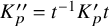 $K_p" = t^{-1}K_p' t$
. We consider the following correspondence
$K_p" = t^{-1}K_p' t$
. We consider the following correspondence

where $p_1$
is the forgetful map, and
$p_1$
is the forgetful map, and $p_2$
is induced from right-translation by t. We have the following properties:
$p_2$
is induced from right-translation by t. We have the following properties:
Lemma 8.4.2. Let $k,m \geq 1$
be integers. Then
$k,m \geq 1$
be integers. Then
-
1.
$p_1p_2^{-1}(\mathcal {Z}_m) \subset \mathcal {Z}_m$
and
$p_1 p_2^{-1}(\mathcal {Z}) = \mathcal {Z}$
. -
2.
$p_2(\mathcal {U}^{\mathscr {G}}_{K_p', k+1}) \subset \mathcal {U}^{\mathscr {G}}_{K_p, k}$
and the map
$p_2 \colon \mathcal {U}^{\mathscr {G}}_{K_p', k+1} \to \mathcal {U}^{\mathscr {G}}_{K_p, k}$
is finite étale of degree
$[K_p : K_p"]$
. -
3. The map
$p_1 \colon \mathcal {U}^{\mathscr {G}}_{K_p', k} \to \mathcal {U}^{\mathscr {G}}_{K_p, k}$
is an isomorphism. -
4. For
$m \gg k$
, we have
$p_1^{-1}(\mathcal {U}^{\mathscr {G}}_{K_p, k}) \cap p_2^{-1}(\mathcal {Z}_m) \subset \mathcal {U}^{\mathscr {G}}_{K_p', k}$
.


In particular, the collections $\{ \mathcal {U}^{\mathscr {G}}_{K_p, k} \}_{k \in \mathbb {N}}$
and
$\{ \mathcal {U}^{\mathscr {G}}_{K_p, k} \}_{k \in \mathbb {N}}$
and $\{ \mathcal {Z}_m \}_{m \in \mathbb {N}}$
form a system of support conditions for the correspondence (8.4.1) as in Definition 4.0.1.
$\{ \mathcal {Z}_m \}_{m \in \mathbb {N}}$
form a system of support conditions for the correspondence (8.4.1) as in Definition 4.0.1.
Proof. The proof is very similar to Lemmas 8.2.4 and 8.2.5 even though $t \not \in T^{\mathscr {G}, -}$
. Indeed, for part (1) in the case
$t \not \in T^{\mathscr {G}, -}$
. Indeed, for part (1) in the case $G = \mathscr {G}$
, it is enough to show that
$G = \mathscr {G}$
, it is enough to show that
 $$\begin{align*}P_G^{\operatorname{an}} \mathcal{Q}_{m+1} K_p \subset P_G^{\operatorname{an}} \mathcal{Q}_m K_p t^{-1} K_p \subset P_G^{\operatorname{an}} \mathcal{Q}_m K_p \end{align*}$$
and we just follow the same argument in Lemma 8.2.4 (noting that we only need $v_p(\alpha (t)) \leq 0$
for the positive roots
$v_p(\alpha (t)) \leq 0$
for the positive roots $\alpha $
not contained in the
$\alpha $
not contained in the $(n+1, n-1)$
-parabolic in the
$(n+1, n-1)$
-parabolic in the $\tau _0$
-component). The case
$\tau _0$
-component). The case $\mathscr {G} = H$
is similar.
$\mathscr {G} = H$
is similar.
For part (2) it is enough to show $p_2^{-1}(\mathcal {U}^{\mathscr {G}}_{K_p, k}) = \mathcal {U}^{\mathscr {G}}_{K_p', k+1}$
, but this follows from the easy calculation that
$p_2^{-1}(\mathcal {U}^{\mathscr {G}}_{K_p, k}) = \mathcal {U}^{\mathscr {G}}_{K_p', k+1}$
, but this follows from the easy calculation that
 $$\begin{align*}]C^{\mathscr{G}}_g[_{k, k}K_p t^{-1} K_p' = ]C^{\mathscr{G}}_g[_{k+1, k+1} K_p'. \end{align*}$$
For part (3), one can show that $]C^{\mathscr {G}}_g[_{k, k}K_p$
is the disjoint union of
$]C^{\mathscr {G}}_g[_{k, k}K_p$
is the disjoint union of $[K_p : K_p']$
open and closed subspaces, and one of these subspaces is equal to
$[K_p : K_p']$
open and closed subspaces, and one of these subspaces is equal to $]C^{\mathscr {G}}_g[_{k, k} K_p'$
, hence the map
$]C^{\mathscr {G}}_g[_{k, k} K_p'$
, hence the map $p_1 \colon \mathcal {U}^{\mathscr {G}}_{K_p', k} \to \mathcal {U}^{\mathscr {G}}_{K_p, k}$
must be an isomorphism.
$p_1 \colon \mathcal {U}^{\mathscr {G}}_{K_p', k} \to \mathcal {U}^{\mathscr {G}}_{K_p, k}$
must be an isomorphism.
Finally, for part (4) the case $\mathscr {G} = H$
follows from
$\mathscr {G} = H$
follows from $p_2^{-1}(\mathcal {U}^{\mathscr {G}}_{K_p, k}) = \mathcal {U}^{\mathscr {G}}_{K_p', k+1}$
, so we give the proof in the case
$p_2^{-1}(\mathcal {U}^{\mathscr {G}}_{K_p, k}) = \mathcal {U}^{\mathscr {G}}_{K_p', k+1}$
, so we give the proof in the case $\mathscr {G} = G$
. In this case, one can follow the same proof as in Lemma 8.2.5 with some minor modifications. Firstly, one can reduce to showing
$\mathscr {G} = G$
. In this case, one can follow the same proof as in Lemma 8.2.5 with some minor modifications. Firstly, one can reduce to showing
 $$\begin{align*}]C^G_{w_n}[_{k, k} K_p \cap ]C^G_{w_n}[_{m, \bar{0}} K_pt^{-1} \subset ]C^G_{w_n}[_{k, k}K_p' \end{align*}$$
because $A_mK_pt^{-1} \subset A_mK_p$
.
$A_mK_pt^{-1} \subset A_mK_p$
.
By a similar explicit calculation as in the proof of Lemma 8.2.5, one can show that: if $[x_0 : \cdots : x_{2n-1}] \in ]C^G_{w_n}[_{k, k} K_p \cap ]C^G_{w_n}[_{m, \bar {0}} K_pt^{-1}$
, then there exist
$[x_0 : \cdots : x_{2n-1}] \in ]C^G_{w_n}[_{k, k} K_p \cap ]C^G_{w_n}[_{m, \bar {0}} K_pt^{-1}$
, then there exist
 $$\begin{align*}a_1, \dots, a_n, a_1', \dots, a_n' \in \mathbb{Z}_p \; \text{ and } \; a_{n+2}, \dots, a_{2n}, a_{n+2}', \dots, a_{2n}' \in p^{\beta}\mathbb{Z}_p \end{align*}$$
such that $x_{i-1} \in (a_i + \mathcal {B}_k) \cap p(a_i' + \overline {\mathcal {B}}_0)$
for
$x_{i-1} \in (a_i + \mathcal {B}_k) \cap p(a_i' + \overline {\mathcal {B}}_0)$
for $1 \leq i \leq n$
,
$1 \leq i \leq n$
, $x_{n} \in (1+\mathcal {B}^{\circ }_k) \cap (1+\mathcal {B}_m^{\circ })$
, and
$x_{n} \in (1+\mathcal {B}^{\circ }_k) \cap (1+\mathcal {B}_m^{\circ })$
, and $x_{i-1} \in (a_i + \mathcal {B}_k^{\circ }) \cap p(a_i + \mathcal {B}_m^{\circ })$
for
$x_{i-1} \in (a_i + \mathcal {B}_k^{\circ }) \cap p(a_i + \mathcal {B}_m^{\circ })$
for $n+2 \leq i \leq 2n$
. This implies that
$n+2 \leq i \leq 2n$
. This implies that
 $$\begin{align*}]C^G_{w_n}[_{k, k} K_p \cap ]C^G_{w_n}[_{m, \bar{0}} K_pt^{-1} \subset ]C^G_{w_n}[_{m, \bar{1}} K_p'. \end{align*}$$
To complete the proof of part (4), it therefore suffices to show that $]C^G_{w_n}[_{k, k} K_p \cap ]C^G_{w_n}[_{m, \bar {1}} \subset ]C^G_{w_n}[_{k, k}K_p'$
. But this latter inclusion follows again from a similar explicit calculation as in the proof of Lemma 8.2.5, namely: if
$]C^G_{w_n}[_{k, k} K_p \cap ]C^G_{w_n}[_{m, \bar {1}} \subset ]C^G_{w_n}[_{k, k}K_p'$
. But this latter inclusion follows again from a similar explicit calculation as in the proof of Lemma 8.2.5, namely: if $[x_0 : \cdots : x_{2n-1}] \in ]C^G_{w_n}[_{k, k} K_p \cap ]C^G_{w_n}[_{m, \bar {1}}$
, then there exist
$[x_0 : \cdots : x_{2n-1}] \in ]C^G_{w_n}[_{k, k} K_p \cap ]C^G_{w_n}[_{m, \bar {1}}$
, then there exist
 $$\begin{align*}a_1, \dots, a_n \in \mathbb{Z}_p \; \text{ and } \; a_{n+2}, \dots, a_{2n} \in p^{\beta}\mathbb{Z}_p \end{align*}$$
such that $x_{i-1} \in (a_i + \mathcal {B}_k) \cap \overline {\mathcal {B}}_1$
for
$x_{i-1} \in (a_i + \mathcal {B}_k) \cap \overline {\mathcal {B}}_1$
for $1 \leq i \leq n$
,
$1 \leq i \leq n$
, $x_n \in (1+\mathcal {B}_k^{\circ }) \cap (1+\mathcal {B}_m^{\circ })$
, and
$x_n \in (1+\mathcal {B}_k^{\circ }) \cap (1+\mathcal {B}_m^{\circ })$
, and $x_{i-1} \in (a_i + \mathcal {B}_k^{\circ }) \cap \mathcal {B}_m^{\circ }$
for
$x_{i-1} \in (a_i + \mathcal {B}_k^{\circ }) \cap \mathcal {B}_m^{\circ }$
for $n+2 \leq i \leq 2n$
. Since
$n+2 \leq i \leq 2n$
. Since $\mathcal {B}_k \subset \overline {\mathcal {B}}_1$
and
$\mathcal {B}_k \subset \overline {\mathcal {B}}_1$
and $\mathbb {Z}_p \cap \overline {\mathcal {B}}_1 = p\mathbb {Z}_p$
, we find that
$\mathbb {Z}_p \cap \overline {\mathcal {B}}_1 = p\mathbb {Z}_p$
, we find that $a_i \in p\mathbb {Z}_p$
, and hence
$a_i \in p\mathbb {Z}_p$
, and hence $[x_0 : \cdots : x_{2n-1}] \in ]C^G_{w_n}[_{k, k}K_p'$
(for
$[x_0 : \cdots : x_{2n-1}] \in ]C^G_{w_n}[_{k, k}K_p'$
(for $m \gg k$
) as required.
$m \gg k$
) as required.
We now introduce the cohomological correspondences. We are only interested in such morphisms for automorphic sheaves of classical weight. Let $\kappa \in X^*(T)$
be a
$\kappa \in X^*(T)$
be a $M_{\mathscr {G}}$
-dominant weight, and let
$M_{\mathscr {G}}$
-dominant weight, and let $V_{\kappa }$
denote the algebraic representation of
$V_{\kappa }$
denote the algebraic representation of $M_{\mathscr {G}}$
with highest weight
$M_{\mathscr {G}}$
with highest weight $\kappa $
. Let
$\kappa $
. Let $\psi \colon p_1^{-1}M_{\mathscr {G}, \operatorname {dR}, K_p}^{\operatorname {an}} \to p_2^{-1}M_{\mathscr {G}, \operatorname {dR}, K_p}^{\operatorname {an}}$
denote the morphism obtained as the composition of the equivariant structure on the torsors
$\psi \colon p_1^{-1}M_{\mathscr {G}, \operatorname {dR}, K_p}^{\operatorname {an}} \to p_2^{-1}M_{\mathscr {G}, \operatorname {dR}, K_p}^{\operatorname {an}}$
denote the morphism obtained as the composition of the equivariant structure on the torsors $M_{\mathscr {G}, \operatorname {dR}, -}^{\operatorname {an}}$
and the action of
$M_{\mathscr {G}, \operatorname {dR}, -}^{\operatorname {an}}$
and the action of $\xi \in M_{\mathscr {G}}(\mathbb {Q}_p)$
through the torsor structure. Let
$\xi \in M_{\mathscr {G}}(\mathbb {Q}_p)$
through the torsor structure. Let $\pi _i \colon p_i^{-1}M_{\mathscr {G}, \operatorname {dR}, K_p}^{\operatorname {an}} \to \mathcal {S}_{\mathscr {G}, K_p'}$
denote the structural map. Then we let
$\pi _i \colon p_i^{-1}M_{\mathscr {G}, \operatorname {dR}, K_p}^{\operatorname {an}} \to \mathcal {S}_{\mathscr {G}, K_p'}$
denote the structural map. Then we let
 $$\begin{align*}\psi_{\mathscr{G}, \kappa^*} \colon p_2^*\mathscr{M}_{\mathscr{G}, \kappa^*} = \left( (\pi_2)_* \mathcal{O}_{p_2^{-1}M_{\mathscr{G}, \operatorname{dR}, K_p}^{\operatorname{an}}} \otimes V_{\kappa}^* \right)^{M_{\mathscr{G}}^{\operatorname{an}}} \to \left( (\pi_1)_* \mathcal{O}_{p_1^{-1}M_{\mathscr{G}, \operatorname{dR}, K_p}^{\operatorname{an}}} \otimes V_{\kappa}^* \right)^{M_{\mathscr{G}}^{\operatorname{an}}} = p_1^*\mathscr{M}_{\mathscr{G}, \kappa^*} \end{align*}$$
denote the morphism induced from $\psi ^* \otimes ( \kappa ^*(\xi ^{-1}) \xi \cdot -)$
. Here
$\psi ^* \otimes ( \kappa ^*(\xi ^{-1}) \xi \cdot -)$
. Here $\kappa ^* = -w_{M_{\mathscr {G}}}^{\operatorname {max}}\kappa $
. Recall that
$\kappa ^* = -w_{M_{\mathscr {G}}}^{\operatorname {max}}\kappa $
. Recall that
 $$\begin{align*}R\Gamma(\mathcal{U}^G_{K_p, \bullet}, \mathcal{Z}_{\bullet}; \mathscr{M}_{G, \kappa^*}) = R\Gamma^G_{w_n}(\kappa^*; \beta)^{(-, \dagger)} \text{ and } R\Gamma(\mathcal{U}^H_{K_p, \bullet}, \mathcal{Z}_{\bullet}; \mathscr{M}_{H, \kappa^*}) = R\Gamma_{\mathcal{Z}_{H, \operatorname{id}}(p^{\beta})}\left( \mathcal{S}_{H, \diamondsuit}(p^{\beta}), \mathscr{M}_{H, \kappa^*} \right). \end{align*}$$
Then by the general procedure in §4, we obtain Hecke operators (both of which we denote by $\varphi _{\mathscr {G}}$
) on
$\varphi _{\mathscr {G}}$
) on $R\Gamma ^G_{w_n}(\kappa ^*; \beta )^{(-, \dagger )}$
and
$R\Gamma ^G_{w_n}(\kappa ^*; \beta )^{(-, \dagger )}$
and $R\Gamma _{\mathcal {Z}_{H, \operatorname {id}}(p^{\beta })}\left ( \mathcal {S}_{H, \diamondsuit }(p^{\beta }), \mathscr {M}_{H, \kappa ^*} \right )$
associated with the correspondence (8.4.1) and cohomological correspondence
$R\Gamma _{\mathcal {Z}_{H, \operatorname {id}}(p^{\beta })}\left ( \mathcal {S}_{H, \diamondsuit }(p^{\beta }), \mathscr {M}_{H, \kappa ^*} \right )$
associated with the correspondence (8.4.1) and cohomological correspondence $\psi _{\mathscr {G}, \kappa ^*}$
. These Hecke operators only depend on the restriction of
$\psi _{\mathscr {G}, \kappa ^*}$
. These Hecke operators only depend on the restriction of $\psi _{\mathscr {G}, \kappa ^*}$
to
$\psi _{\mathscr {G}, \kappa ^*}$
to $\mathcal {U}^{\mathscr {G}}_{K_p', k}$
for any integer
$\mathcal {U}^{\mathscr {G}}_{K_p', k}$
for any integer $k \geq 1$
, therefore it will be useful to consider the following morphism
$k \geq 1$
, therefore it will be useful to consider the following morphism
 $$\begin{align*}\varphi \colon \mathcal{U}_{K_p, k+1}^{\mathscr{G}} \xrightarrow{p_1^{-1}} \mathcal{U}^{\mathscr{G}}_{K_p', k+1} \xrightarrow{p_2} \mathcal{U}^{\mathscr{G}}_{K_p, k}. \end{align*}$$
We can view the restriction of $\psi _{\mathscr {G}, \kappa ^*}$
as a morphism
$\psi _{\mathscr {G}, \kappa ^*}$
as a morphism $\varphi ^* \mathscr {M}_{\mathscr {G}, \kappa ^*}|_{\mathcal {U}^{\mathscr {G}}_{K_p, k}} \to \mathscr {M}_{\mathscr {G}, \kappa ^*}|_{\mathcal {U}^{\mathscr {G}}_{K_p, k+1}}$
, or by adjunction, as a morphism
$\varphi ^* \mathscr {M}_{\mathscr {G}, \kappa ^*}|_{\mathcal {U}^{\mathscr {G}}_{K_p, k}} \to \mathscr {M}_{\mathscr {G}, \kappa ^*}|_{\mathcal {U}^{\mathscr {G}}_{K_p, k+1}}$
, or by adjunction, as a morphism
 $$ \begin{align} \psi_{\mathscr{G}, \kappa^*} \colon \mathscr{M}_{\mathscr{G},\kappa^*}|_{\mathcal{U}^{\mathscr{G}}_{K_p, k}} \to \varphi_*\mathscr{M}_{\mathscr{G},\kappa^*}|_{\mathcal{U}^{\mathscr{G}}_{K_p, k+1}}. \end{align} $$
By Lemma 8.4.2 we have $\varphi ^{-1}(\mathcal {Z} \cap \mathcal {U}^{\mathscr {G}}_{K_p, k} ) = \mathcal {Z} \cap \mathcal {U}^{\mathscr {G}}_{K_p, k+1}$
, and the operator is simply induced from the colimit of the morphism (8.4.3) on cohomology with support in
$\varphi ^{-1}(\mathcal {Z} \cap \mathcal {U}^{\mathscr {G}}_{K_p, k} ) = \mathcal {Z} \cap \mathcal {U}^{\mathscr {G}}_{K_p, k+1}$
, and the operator is simply induced from the colimit of the morphism (8.4.3) on cohomology with support in $\mathcal {Z}$
, that is,
$\mathcal {Z}$
, that is, $\varphi _{\mathscr {G}}$
is the colimit of the maps
$\varphi _{\mathscr {G}}$
is the colimit of the maps
 $$\begin{align*}R\Gamma_{\mathcal{Z} \cap \mathcal{U}^{\mathscr{G}}_{K_p, k}}\left( \mathcal{U}^{\mathscr{G}}_{K_p, k}, \mathscr{M}_{\mathscr{G}, \kappa^*} \right) \xrightarrow{\psi_{\mathscr{G}, \kappa^*}} R\Gamma_{\mathcal{Z} \cap \mathcal{U}^{\mathscr{G}}_{K_p, k}}\left( \mathcal{U}^{\mathscr{G}}_{K_p, k}, \varphi_*\mathscr{M}_{\mathscr{G}, \kappa^*} \right) = R\Gamma_{\mathcal{Z} \cap \mathcal{U}^{\mathscr{G}}_{K_p, k+1}}\left( \mathcal{U}^{\mathscr{G}}_{K_p, k+1}, \mathscr{M}_{\mathscr{G}, \kappa^*} \right) \end{align*}$$
where the last equality uses the fact that $\varphi $
is finite.
$\varphi $
is finite.
8.4.1 A version over the ordinary locus
We now consider the Frobenius operator acting on Igusa towers. Suppose that $L/\mathbb {Q}_p$
is a sufficiently large extension containing
$L/\mathbb {Q}_p$
is a sufficiently large extension containing $\mu _{p^{\beta +1}}$
. Let
$\mu _{p^{\beta +1}}$
. Let $J_p$
be as at the end of §8.2 and set
$J_p$
be as at the end of §8.2 and set $J_p' = \xi J_p \xi ^{-1} \cap J_p$
and
$J_p' = \xi J_p \xi ^{-1} \cap J_p$
and $J_p" = \xi ^{-1} J_p' \xi $
. Then we have a correspondence
$J_p" = \xi ^{-1} J_p' \xi $
. Then we have a correspondence

where $q_1$
is the natural forgetful map and
$q_1$
is the natural forgetful map and $q_2$
is induced from right-translation by
$q_2$
is induced from right-translation by $\xi $
. One can easily check that
$\xi $
. One can easily check that $q_1$
is an isomorphism and
$q_1$
is an isomorphism and $q_2$
is finite étale of degree
$q_2$
is finite étale of degree $[J_p : J_p"] = [K_p : K_p"]$
. We let
$[J_p : J_p"] = [K_p : K_p"]$
. We let
 $$\begin{align*}\varphi \colon \mathcal{IG}_{\mathscr{G}}/J_p \xrightarrow{q_1^{-1}} \mathcal{IG}_{\mathscr{G}}/J_p' \xrightarrow{q_2} \mathcal{IG}_{\mathscr{G}}/J_p \end{align*}$$
which is finite étale of degree $[K_p : K_p"]$
. We have a Cartesian diagram
$[K_p : K_p"]$
. We have a Cartesian diagram

and the pullback $\mathscr {M}_{\mathscr {G}, \kappa ^*}|_{\mathcal {IG}_{\mathscr {G}}/J_p} \to \varphi _* \mathscr {M}_{\mathscr {G}, \kappa ^*}|_{\mathcal {IG}_{\mathscr {G}}/J_p}$
of
$\mathscr {M}_{\mathscr {G}, \kappa ^*}|_{\mathcal {IG}_{\mathscr {G}}/J_p} \to \varphi _* \mathscr {M}_{\mathscr {G}, \kappa ^*}|_{\mathcal {IG}_{\mathscr {G}}/J_p}$
of $\psi _{\mathscr {G}, \kappa ^*}$
in (8.4.3) can be described as follows. Let
$\psi _{\mathscr {G}, \kappa ^*}$
in (8.4.3) can be described as follows. Let $U(J_p) \subset J_p$
denote the unipotent part, and
$U(J_p) \subset J_p$
denote the unipotent part, and $M(J_p)$
the Levi part. Let
$M(J_p)$
the Levi part. Let $\pi \colon \mathcal {IG}_{\mathscr {G}}/U(J_p) \to \mathcal {IG}_{\mathscr {G}}/J_p$
denote the corresponding proétale
$\pi \colon \mathcal {IG}_{\mathscr {G}}/U(J_p) \to \mathcal {IG}_{\mathscr {G}}/J_p$
denote the corresponding proétale $M(J_p)$
-torsor. Then for an open
$M(J_p)$
-torsor. Then for an open $V \subset \mathcal {IG}_{\mathscr {G}}/J_p$
, we have
$V \subset \mathcal {IG}_{\mathscr {G}}/J_p$
, we have
 $$\begin{align*}\mathscr{M}_{\mathscr{G}, \kappa^*}(V) = \{ f \colon \pi^{-1}(V) \to V_{\kappa}^* : f(x \cdot m) = m^{-1} \cdot f(x) \text{ all } m \in M(J_p) \}. \end{align*}$$
The morphism $\psi _{\mathscr {G}, \kappa ^*} \colon \mathscr {M}_{\mathscr {G}, \kappa ^*}(V) \to \mathscr {M}_{\mathscr {G}, \kappa ^*}(\varphi ^{-1}(V))$
is then simply described as
$\psi _{\mathscr {G}, \kappa ^*} \colon \mathscr {M}_{\mathscr {G}, \kappa ^*}(V) \to \mathscr {M}_{\mathscr {G}, \kappa ^*}(\varphi ^{-1}(V))$
is then simply described as
 $$\begin{align*}(\psi_{\mathscr{G}, \kappa^*}f)(x) = \kappa^*(\xi^{-1}) \xi \cdot f(x \cdot \xi) \quad \quad \quad x \in \pi^{-1}(\varphi^{-1}(V)). \end{align*}$$
8.5 Properties of evaluation maps
In this section, we prove an ‘interpolation formula’ for the evaluation maps $\operatorname {Ev}_{\kappa , j, \chi , \beta }^{\dagger , \circ }$
when the conductor of
$\operatorname {Ev}_{\kappa , j, \chi , \beta }^{\dagger , \circ }$
when the conductor of $\chi $
is divisible by p. We expect one can also establish a similar formula for unramified characters, however this seems harder than the ramified case. The proofs in this section will involve studying the relations between Hecke operators, Frobenius, and the action of
$\chi $
is divisible by p. We expect one can also establish a similar formula for unramified characters, however this seems harder than the ramified case. The proofs in this section will involve studying the relations between Hecke operators, Frobenius, and the action of $C^{\operatorname {la}}(U_{G, \beta }, L)$
, and will continually make use of the following strategy. Firstly, one establishes the relation over the ordinary locus. Then one constructs an appropriate
$C^{\operatorname {la}}(U_{G, \beta }, L)$
, and will continually make use of the following strategy. Firstly, one establishes the relation over the ordinary locus. Then one constructs an appropriate $\mathscr {M}_{G, \kappa ^*}$
-acyclic (or
$\mathscr {M}_{G, \kappa ^*}$
-acyclic (or $\mathscr {M}_{H, \sigma _{\kappa }^{[j]}}$
-acyclic) cover such that the restriction map from sections over an element of this cover to sections over the ordinary locus is injective. This injectivity property allows one to establish the desired overconvergent version of the relation on the level of Čech complexes – the final result is then obtained by passing to cohomology. Although the idea is not too difficult, this section is unfortunately rather technical.
$\mathscr {M}_{H, \sigma _{\kappa }^{[j]}}$
-acyclic) cover such that the restriction map from sections over an element of this cover to sections over the ordinary locus is injective. This injectivity property allows one to establish the desired overconvergent version of the relation on the level of Čech complexes – the final result is then obtained by passing to cohomology. Although the idea is not too difficult, this section is unfortunately rather technical.
We now state the main result. Fix $(\kappa , j) \in \mathcal {E}$
satisfying Assumption 5.3.13 (i.e.,
$(\kappa , j) \in \mathcal {E}$
satisfying Assumption 5.3.13 (i.e., $\kappa _0 = 0$
,
$\kappa _0 = 0$
, $\kappa _{1, \tau _0} + \kappa _{n+1, \tau _0} = n-1$
, and
$\kappa _{1, \tau _0} + \kappa _{n+1, \tau _0} = n-1$
, and $w = \kappa _{2, \tau _0} + \kappa _{2n, \tau _0} = -1$
). Let
$w = \kappa _{2, \tau _0} + \kappa _{2n, \tau _0} = -1$
). Let $\chi \in \Sigma _{\kappa , j}(\mathfrak {N}_{\beta })$
be an anticyclotomic character. Let
$\chi \in \Sigma _{\kappa , j}(\mathfrak {N}_{\beta })$
be an anticyclotomic character. Let $\chi _{p, \bar {\tau }_0} \colon \mathbb {Z}_p^{\times } \to \mathbb {C}^{\times }$
denote the finite-order character obtained as the restriction of
$\chi _{p, \bar {\tau }_0} \colon \mathbb {Z}_p^{\times } \to \mathbb {C}^{\times }$
denote the finite-order character obtained as the restriction of $\chi $
to
$\chi $
to $\mathcal {O}_{F_{\overline {\mathfrak {p}}_{\tau _0}}}^{\times } \cong \mathbb {Z}_p^{\times }$
. We suppose that the conductor of
$\mathcal {O}_{F_{\overline {\mathfrak {p}}_{\tau _0}}}^{\times } \cong \mathbb {Z}_p^{\times }$
. We suppose that the conductor of $\chi _{p, \bar {\tau }_0}$
is
$\chi _{p, \bar {\tau }_0}$
is $p^{\beta '}$
for some
$p^{\beta '}$
for some $1 \leq \beta ' \leq \beta $
. Finally, we fix
$1 \leq \beta ' \leq \beta $
. Finally, we fix $\varepsilon = (\varepsilon _h)_{h \geq 0}$
a compatible system of p-th roots of unity in
$\varepsilon = (\varepsilon _h)_{h \geq 0}$
a compatible system of p-th roots of unity in $\overline {\mathbb {Q}}$
, that is,
$\overline {\mathbb {Q}}$
, that is, $\varepsilon _h$
is a primitive
$\varepsilon _h$
is a primitive $p^h$
-th root of unity, and
$p^h$
-th root of unity, and $\varepsilon _{h+1}^p = \varepsilon _h$
for all
$\varepsilon _{h+1}^p = \varepsilon _h$
for all $h \geq 0$
. The Gauss sum associated with
$h \geq 0$
. The Gauss sum associated with $\chi _{p, \bar {\tau }_0}$
is
$\chi _{p, \bar {\tau }_0}$
is

for any $h \geq \beta '$
(which is nonzero because
$h \geq \beta '$
(which is nonzero because $\chi _{p, \bar {\tau }_0}$
has conductor
$\chi _{p, \bar {\tau }_0}$
has conductor $p^{\beta '}$
). For
$p^{\beta '}$
). For $i=0, 1$
, let
$i=0, 1$
, let $t_i \in T^{G, -}$
be the element which is the identity outside the
$t_i \in T^{G, -}$
be the element which is the identity outside the $\tau _0$
-component, and in the
$\tau _0$
-component, and in the $\tau _0$
-component is equal to
$\tau _0$
-component is equal to $\operatorname {diag}(1, \dots , 1, p, \dots , p)$
where there are
$\operatorname {diag}(1, \dots , 1, p, \dots , p)$
where there are $n-i$
lots of p.
$n-i$
lots of p.
Theorem 8.5.1. Let $\eta \in \operatorname {H}^{n-1}_{w_n}(\kappa ^*; \beta )^{(-, \dagger )}$
and suppose that
$\eta \in \operatorname {H}^{n-1}_{w_n}(\kappa ^*; \beta )^{(-, \dagger )}$
and suppose that $U_{t_i} \cdot \eta = \alpha _i \eta $
for
$U_{t_i} \cdot \eta = \alpha _i \eta $
for $i=0, 1$
and some
$i=0, 1$
and some $\alpha _i \in L^{\times }$
. Then
$\alpha _i \in L^{\times }$
. Then
 $$\begin{align*}\operatorname{Ev}^{\dagger, \circ}_{\kappa, j, \chi, \beta}( \eta ) = \left( \frac{\alpha_0}{\alpha_1} \right)^{\beta'} p^{\beta'\kappa_{n+1, \tau_0}}(1-p^{-1}) \chi( \varpi_{\mathfrak{p}_{\bar{\tau}_0}} )^{-\beta'} \chi_{p, \bar{\tau}_0}(-1) \mathscr{G}(\chi_{p, \bar{\tau}_0}) \operatorname{Ev}^{\dagger}_{\kappa, j, \chi, \beta}(\eta) \end{align*}$$
where $\varpi _{\mathfrak {p}_{\bar {\tau }_0}} \in \mathbb {A}_F^{\times }$
denotes the image of p under the natural embedding
$\varpi _{\mathfrak {p}_{\bar {\tau }_0}} \in \mathbb {A}_F^{\times }$
denotes the image of p under the natural embedding $\mathbb {Q}_p^{\times } \cong F_{\bar {\mathfrak {p}}_{\tau _0}}^{\times } \hookrightarrow \mathbb {A}_F^{\times }$
.
$\mathbb {Q}_p^{\times } \cong F_{\bar {\mathfrak {p}}_{\tau _0}}^{\times } \hookrightarrow \mathbb {A}_F^{\times }$
.
We will prove this theorem in several steps. First, we recall and introduce some notation. Recall the definition of the weighted indicator function $1_{U_{G, \beta }^{\circ }, \chi _p} \in C^{\operatorname {la}}(U_{G, \beta }, L)$
, namely
$1_{U_{G, \beta }^{\circ }, \chi _p} \in C^{\operatorname {la}}(U_{G, \beta }, L)$
, namely
 $$\begin{align*}1_{U_{G, \beta}^{\circ}, \chi_p}(a_2, \dots, a_{2n}) = \left\{ \begin{array}{cc} \chi_{p, \bar{\tau}_0}(a_{n+1}) & \text{ if } (a_2, \dots, a_{2n}) \in U_{G, \beta}^{\circ} \\ 0 & \text{ otherwise } \end{array} \right.. \end{align*}$$
We let $f_{\chi _p} \in C^{\operatorname {la}}(U_{G, \beta }, L)$
denote the function given by
$f_{\chi _p} \in C^{\operatorname {la}}(U_{G, \beta }, L)$
denote the function given by
 $$\begin{align*}f_{\chi_p}(a_2, \dots, a_{2n}) = \left\{ \begin{array}{cc} \chi_{p, \bar{\tau}_0}(p^{\beta'}a_{n+1}) & \text{ if } a_{n+1} \in p^{-\beta'}\mathbb{Z}_p^{\times} \\ 0 & \text{ otherwise } \end{array} \right. \end{align*}$$
and let $1_{U_{H, \beta '}} \in C^{\operatorname {la}}(U_{H, \beta }, L)$
denote the indicator function of the subset
$1_{U_{H, \beta '}} \in C^{\operatorname {la}}(U_{H, \beta }, L)$
denote the indicator function of the subset $U_{H, \beta '} = \left ( p^{-\beta '} \mathbb {Z}_p \right )^{\oplus n-1} \subset U_{H, \beta }$
. We also let
$U_{H, \beta '} = \left ( p^{-\beta '} \mathbb {Z}_p \right )^{\oplus n-1} \subset U_{H, \beta }$
. We also let $1_{U_{H, \beta '}} \in C^{\operatorname {la}}(U_{G, \beta }, L)$
denote the function given by
$1_{U_{H, \beta '}} \in C^{\operatorname {la}}(U_{G, \beta }, L)$
denote the function given by $(a_2, \dots , a_{2n}) \mapsto 1_{U_{H, \beta '}}(a_2, \dots , a_n)$
. Finally, we set
$(a_2, \dots , a_{2n}) \mapsto 1_{U_{H, \beta '}}(a_2, \dots , a_n)$
. Finally, we set

8.5.1 Step 1
In this step, we describe the eigenvalues of the cohomology class $[\chi ]$
under the action of certain
$[\chi ]$
under the action of certain $U_p$
-Hecke operators. We first describe the transpose of the Hecke operators defined in §8.3 with respect to Serre duality. Let
$U_p$
-Hecke operators. We first describe the transpose of the Hecke operators defined in §8.3 with respect to Serre duality. Let $t \in T^{H, -}$
and consider the correspondence in (8.2.3) (in the case
$t \in T^{H, -}$
and consider the correspondence in (8.2.3) (in the case $\mathscr {G} = H$
). Consider the morphism
$\mathscr {G} = H$
). Consider the morphism
 $$\begin{align*}(2\rho_{H, \operatorname{nc}})(t\langle t \rangle^{-1})\phi_{t, \sigma_{\kappa}^{[j], \vee}}^{-1} \colon p_1^* \mathscr{M}_{H, \sigma_{\kappa}^{[j], \vee}} \to p_2^* \mathscr{M}_{H, \sigma_{\kappa}^{[j], \vee}} \end{align*}$$
which is well-defined because the morphism in Definition 8.3.1(2) is an isomorphism. Because $p_1p_2^{-1}(\mathcal {U}^H_{K_p, k}) \subset \mathcal {U}^H_{K_p, k}$
, we obtain a Hecke correspondence
$p_1p_2^{-1}(\mathcal {U}^H_{K_p, k}) \subset \mathcal {U}^H_{K_p, k}$
, we obtain a Hecke correspondence
 $$\begin{align*}U_{t^{-1}} \colon \operatorname{H}^0_{\operatorname{id}}(\mathcal{S}_{H, \diamondsuit}(p^{\beta}), \sigma_{\kappa}^{[j], \vee} )^{(+, \dagger)} \to \operatorname{H}^0_{\operatorname{id}}(\mathcal{S}_{H, \diamondsuit}(p^{\beta}), \sigma_{\kappa}^{[j], \vee} )^{(+, \dagger)} \end{align*}$$
as the colimit over k of following composition:
 $$ \begin{align*} \operatorname{H}^0\left( \mathcal{U}^H_{K_p, k}, \mathscr{M}_{H, \sigma_{\kappa}^{[j], \vee}} \right) \xrightarrow{\operatorname{res}} \operatorname{H}^0\left( p_1p_2^{-1}(\mathcal{U}^H_{K_p, k}), \mathscr{M}_{H, \sigma_{\kappa}^{[j], \vee}} \right) \xrightarrow{p_1^*} \operatorname{H}^0\left( p_2^{-1}(\mathcal{U}^H_{K_p, k}), p_1^*\mathscr{M}_{H, \sigma_{\kappa}^{[j], \vee}} \right) \\ \xrightarrow{(2\rho_{H, \operatorname{nc}})(t\langle t \rangle^{-1})\phi_{t, \sigma_{\kappa}^{[j], \vee}}^{-1}} \operatorname{H}^0\left( p_2^{-1}(\mathcal{U}^H_{K_p, k}), p_2^*\mathscr{M}_{H, \sigma_{\kappa}^{[j], \vee}} \right) \xrightarrow{\operatorname{Tr}_{p_2}} \operatorname{H}^0\left( \mathcal{U}^H_{K_p, k}, \mathscr{M}_{H, \sigma_{\kappa}^{[j], \vee}} \right). \end{align*} $$
Recall that we have a Serre duality pairing
 $$\begin{align*}\langle \cdot, \cdot \rangle \colon \operatorname{H}^{n-1}_{\operatorname{id}}(\mathcal{S}_{H, \diamondsuit}(p^{\beta}), \sigma_{\kappa}^{[j]} )^{(-, \dagger)} \times \operatorname{H}^0_{\operatorname{id}}(\mathcal{S}_{H, \diamondsuit}(p^{\beta}), \sigma_{\kappa}^{[j], \vee} )^{(+, \dagger)} \to L. \end{align*}$$
We have the following relation between $U_t$
and
$U_t$
and $U_{t^{-1}}$
.
$U_{t^{-1}}$
.
Lemma 8.5.2. For any $t \in T^{H, -}$
, one has
$t \in T^{H, -}$
, one has $\langle U_t \cdot -, - \rangle = \langle -, U_{t^{-1}} \cdot - \rangle $
.
$\langle U_t \cdot -, - \rangle = \langle -, U_{t^{-1}} \cdot - \rangle $
.
Proof. This follows from the duality of pullback and trace maps (note that the normalisation of $\operatorname {Tr}_{p_1}$
in the definition of
$\operatorname {Tr}_{p_1}$
in the definition of $U_t$
is trivial), and the fact that
$U_t$
is trivial), and the fact that $\sigma _{\kappa }^{[j]}(t\langle t \rangle ^{-1})\phi _{t, \sigma ^{[j]}_{\kappa }}$
corresponds to
$\sigma _{\kappa }^{[j]}(t\langle t \rangle ^{-1})\phi _{t, \sigma ^{[j]}_{\kappa }}$
corresponds to $\sigma _{\kappa }^{[j], \vee }(t^{-1}\langle t \rangle )\phi _{t, \sigma _{\kappa }^{[j], \vee }}^{-1}$
under Verdier duality (see [Reference Boxer and PilloniBP21, Proposition 4.2.9]).
$\sigma _{\kappa }^{[j], \vee }(t^{-1}\langle t \rangle )\phi _{t, \sigma _{\kappa }^{[j], \vee }}^{-1}$
under Verdier duality (see [Reference Boxer and PilloniBP21, Proposition 4.2.9]).
We have the following property for the cohomology classes associated with anticyclotomic characters.
Lemma 8.5.3. Let $t \in T^{H, -}$
be any element which is trivial outside the
$t \in T^{H, -}$
be any element which is trivial outside the $\tau _0$
-component, and in the
$\tau _0$
-component, and in the $\tau _0$
-component is given by
$\tau _0$
-component is given by $\operatorname {diag}(y, 1, \dots , 1)$
. We have
$\operatorname {diag}(y, 1, \dots , 1)$
. We have
 $$\begin{align*}U_{t^{-1}} \cdot \operatorname{res}[\chi] = \sigma_{\kappa}^{[j], \vee}(\langle t \rangle^{-1}) \hat{\chi}(z_{t^{-1}}) \cdot \operatorname{res}[\chi] \end{align*}$$
where $z_{t^{-1}}$
denotes the idele which is y in the factor corresponding to the prime
$z_{t^{-1}}$
denotes the idele which is y in the factor corresponding to the prime $\overline {\mathfrak {p}}_{\tau _0}$
(and the identity outside this prime).
$\overline {\mathfrak {p}}_{\tau _0}$
(and the identity outside this prime).
Proof. By analysing the construction of $[\chi ]$
in [Reference GrahamGra24, §7], one can see that the action of
$[\chi ]$
in [Reference GrahamGra24, §7], one can see that the action of
 $$\begin{align*}\sigma_{\kappa}^{[j], \vee}(\langle t \rangle) (2\rho_{H, \operatorname{nc}})(t\langle t \rangle^{-1})^{-1} U_{t^{-1}} \end{align*}$$
is described as follows. We will freely use notation from the proof of Lemma 7.4.20. Without loss of generality, we may also assume that $L = \mathbb {C}_p$
.
$L = \mathbb {C}_p$
.
Let $C = \operatorname {det}(U^p K_p)$
and
$C = \operatorname {det}(U^p K_p)$
and $C' = \operatorname {det}(U^p K_p')$
, which are compact open subgroups of
$C' = \operatorname {det}(U^p K_p')$
, which are compact open subgroups of $\mathbf {R}(\mathbb {A}_f)$
. One can easily see that
$\mathbf {R}(\mathbb {A}_f)$
. One can easily see that $C = C'$
because
$C = C'$
because $K_p'$
contains all elements in
$K_p'$
contains all elements in $T(\mathbb {Z}_p)$
which lie in
$T(\mathbb {Z}_p)$
which lie in $T^{\diamondsuit }$
modulo
$T^{\diamondsuit }$
modulo $p^{\beta }$
. Then we have a commutative diagram of torsors:
$p^{\beta }$
. Then we have a commutative diagram of torsors:

where the horizontal maps are induced from the determinant morphism, and the morphism f is described as
 $$ \begin{align*} \left[ \mathbf{R}(\mathbb{Q}) \backslash \left( \mathbf{R}(\mathbb{A}_f^p)/C^p \times \mathbf{R}(\mathbb{Q}_p) \right) \times R^{\operatorname{an}} \right] / C_p &\to \left[ \mathbf{R}(\mathbb{Q}) \backslash \left( \mathbf{R}(\mathbb{A}_f^p)/C^p \times \mathbf{R}(\mathbb{Q}_p) \right) \times R^{\operatorname{an}} \right] / C_p \\ [x, x', x"] &\mapsto [x, \operatorname{det}(t^{-1}) x', x"]. \end{align*} $$
Let $\widehat {\chi }'$
be the unique p-adic Hecke character on
$\widehat {\chi }'$
be the unique p-adic Hecke character on $\operatorname {Res}_{F^+/\mathbb {Q}}\operatorname {U}(1)$
such that
$\operatorname {Res}_{F^+/\mathbb {Q}}\operatorname {U}(1)$
such that $\widehat {\chi } = \widehat {\chi }' \circ \mathcal {N}$
, and let
$\widehat {\chi } = \widehat {\chi }' \circ \mathcal {N}$
, and let $\lambda \colon \mathbf {R}(\mathbb {Q}) \backslash \mathbf {R}(\mathbb {A}_f) \to L^{\times }$
denote the continuous character given by
$\lambda \colon \mathbf {R}(\mathbb {Q}) \backslash \mathbf {R}(\mathbb {A}_f) \to L^{\times }$
denote the continuous character given by $\lambda (z_1, z_2) = \widehat {\chi }'(z_2/z_1)$
. Then, since
$\lambda (z_1, z_2) = \widehat {\chi }'(z_2/z_1)$
. Then, since $\operatorname {res}[\chi ]$
is constructed as the pullback of the function
$\operatorname {res}[\chi ]$
is constructed as the pullback of the function $\xi \colon R^{\operatorname {an}}_{\operatorname {dR}, C_p} \to \mathbb {A}^{1, \operatorname {an}}$
,
$\xi \colon R^{\operatorname {an}}_{\operatorname {dR}, C_p} \to \mathbb {A}^{1, \operatorname {an}}$
,  (where $\mu $
is the unique algebraic character satisfying
$\mu $
is the unique algebraic character satisfying $\sigma _{\kappa }^{[j], \vee } = \mu ^{-1} \circ \operatorname {det}$
), it is enough to understand
$\sigma _{\kappa }^{[j], \vee } = \mu ^{-1} \circ \operatorname {det}$
), it is enough to understand $\xi \circ f$
. But clearly one has
$\xi \circ f$
. But clearly one has
 $$\begin{align*}\xi \circ f = \lambda(\operatorname{det}(t^{-1})) \xi = \hat{\chi}(z_{t^{-1}}) \xi. \end{align*}$$
Recall the morphism $p_2 \colon \mathcal {U}^H_{K_p', k+\operatorname {max}_H(t)} \to \mathcal {U}^H_{K_p, k}$
(given by right-translation by t). The above then implies that
$p_2 \colon \mathcal {U}^H_{K_p', k+\operatorname {max}_H(t)} \to \mathcal {U}^H_{K_p, k}$
(given by right-translation by t). The above then implies that
 $$\begin{align*}\sigma_{\kappa}^{[j], \vee}(\langle t \rangle)(2\rho_{H, \operatorname{nc}})(t\langle t \rangle^{-1})^{-1} U_{t^{-1}} \cdot \operatorname{res}[\chi] = \operatorname{deg}(p_2) \hat{\chi}(z_{t^{-1}}) \cdot \operatorname{res}[\chi] \end{align*}$$
by the relation $\operatorname {Tr}_{p_2} \circ \; p_2^* = \operatorname {deg}(p_2)$
.
$\operatorname {Tr}_{p_2} \circ \; p_2^* = \operatorname {deg}(p_2)$
.
The result now follows from the fact that the degree of the morphism $p_2 \colon \mathcal {U}^H_{K_p', k+\operatorname {max}_H(t)} \to \mathcal {U}^H_{K_p, k}$
is the degree of
$p_2 \colon \mathcal {U}^H_{K_p', k+\operatorname {max}_H(t)} \to \mathcal {U}^H_{K_p, k}$
is the degree of $q_2 \colon \mathcal {IG}_H/J_p' \to \mathcal {IG}/{J_p}$
(given by right-translation by t), where
$q_2 \colon \mathcal {IG}_H/J_p' \to \mathcal {IG}/{J_p}$
(given by right-translation by t), where $J_p = J^H_{\diamondsuit }(p^{\beta })$
and
$J_p = J^H_{\diamondsuit }(p^{\beta })$
and $J_p' = t J_p t^{-1} \cap J_p$
. But the degree of
$J_p' = t J_p t^{-1} \cap J_p$
. But the degree of $q_2$
is given by
$q_2$
is given by
 $$\begin{align*}[J^H_{\diamondsuit}(p^{\beta}) : t^{-1}J_p' t] = [(p^{\beta}T_p(\mu_{p^{\infty}}))^{\oplus n-1} : y^{-1} \cdot (p^{\beta}T_p(\mu_{p^{\infty}}))^{\oplus n-1}] = p^{v_p(y^{-1})(n-1)} = (2\rho_{H, \operatorname{nc}})( \langle t \rangle t^{-1} ).\end{align*}$$
8.5.2 Step 2
We now establish an intertwining property between Frobenius and the evaluation maps. We introduce the following matrices. For any $c \in \mathbb {Z}_p^{\times }$
, let
$c \in \mathbb {Z}_p^{\times }$
, let $\xi _c$
denote the diagonal matrix which is the identity outside the
$\xi _c$
denote the diagonal matrix which is the identity outside the $\tau _0$
-component, and at the
$\tau _0$
-component, and at the $\tau _0$
-component is given by
$\tau _0$
-component is given by $(c + p^{\beta '}, 1, \dots , 1)$
. We let
$(c + p^{\beta '}, 1, \dots , 1)$
. We let $t_c = w_n^{-1} \xi _c w_n$
. For notational brevity, let
$t_c = w_n^{-1} \xi _c w_n$
. For notational brevity, let $L_p = K^H_{\diamondsuit }(p^{\beta })$
and
$L_p = K^H_{\diamondsuit }(p^{\beta })$
and $K_p = K^G_{\operatorname {Iw}}(p^{\beta })$
. For any integer
$K_p = K^G_{\operatorname {Iw}}(p^{\beta })$
. For any integer $k \geq 1$
, we consider the following map
$k \geq 1$
, we consider the following map
 $$\begin{align*}B_c \colon \mathcal{U}^H_{L_p, k+\beta'} \xrightarrow{\varphi^{\beta'}} \mathcal{U}^H_{L_p, k} \xrightarrow{ \cdot \xi_c} \mathcal{U}^H_{L_p, k} \xrightarrow{\hat{\iota}} \mathcal{U}^G_{K_p, k} \xrightarrow{ \cdot t_c^{-1}} \mathcal{U}^G_{K_p, k}. \end{align*}$$
We also consider
 $$\begin{align*}A \colon \mathcal{U}^H_{L_p, k+\beta'} \xrightarrow{\hat{\iota}} \mathcal{U}^G_{K_p, k+\beta'} \xrightarrow{ \varphi^{\beta'} } \mathcal{U}^G_{K_p, k}. \end{align*}$$
Note that $B_c$
only depends on c modulo
$B_c$
only depends on c modulo $p^{\beta }$
. We will need the following lemma.
$p^{\beta }$
. We will need the following lemma.
Lemma 8.5.4. Let $c \in \mathbb {Z}_p^{\times }$
.
$c \in \mathbb {Z}_p^{\times }$
.
-
1. One has
$A^{-1}(\mathcal {Z}_{G,>n+1}(p^{\beta })) = B_c^{-1}(\mathcal {Z}_{G, >n+1}(p^{\beta })) = \mathcal {Z}_{H, \operatorname {id}}(p^{\beta })$
(where by abuse of notation,
$\mathcal {Z}_{H, \operatorname {id}}(p^{\beta })$
also denotes its intersection with
$\mathcal {S}_{H, \diamondsuit }(p^{\beta })$
). -
2. Suppose that
$U \subset \mathcal {X}_{G, w_n}(p^{\beta })$
is a quasi-compact open subset arising as the adic generic fibre of an open subspace in
$\mathfrak {X}_{G, w_n}(p^{\beta })$
. Then
$A^{-1}(U) = B_c^{-1}(U)$
.


Proof. The first part follows from Lemma 8.2.4 and Lemma 8.4.2. For the second part we may assume, without loss of generality, that L contains $\mathbb {Q}_p^{\operatorname {cycl}}$
. Then, over
$\mathbb {Q}_p^{\operatorname {cycl}}$
. Then, over $\mathcal {X}_{G, w_n}(p^{\beta })$
, the morphisms A and
$\mathcal {X}_{G, w_n}(p^{\beta })$
, the morphisms A and $B_c$
are induced from the morphisms
$B_c$
are induced from the morphisms
 $$\begin{align*}\mathcal{IG}_{H} \to \mathcal{IG}_G \end{align*}$$
given by right-translation by $\gamma \xi ^{\beta '}$
and
$\gamma \xi ^{\beta '}$
and $\xi ^{\beta '} \xi _c \gamma \xi _c^{-1}$
respectively, where
$\xi ^{\beta '} \xi _c \gamma \xi _c^{-1}$
respectively, where $\xi $
is the element of the torus in the definition of Frobenius (see §8.4) and
$\xi $
is the element of the torus in the definition of Frobenius (see §8.4) and $\gamma $
is the element introduced at the end of §6.1.2. For any
$\gamma $
is the element introduced at the end of §6.1.2. For any $c \in \mathbb {Z}_p^{\times }$
, let
$c \in \mathbb {Z}_p^{\times }$
, let
 $$\begin{align*}\omega_c = (\omega_{c, i})_{1 \leq i \leq 2n-1} \in \widetilde{\mu_{p^{\infty}}}^{\oplus 2n-1}(\mathbb{Z}_p^{\operatorname{cycl}}) \end{align*}$$
denote the element satisfying $\omega _{c, i} = 1$
if
$\omega _{c, i} = 1$
if $i \neq n$
, and
$i \neq n$
, and $\omega _{c, n} = \varepsilon ^c$
. Let
$\omega _{c, n} = \varepsilon ^c$
. Let $u_c \in J_{G,\operatorname {ord}}^+(\mathbb {Z}_p^{\operatorname {cycl}})$
denote the element which is the identity outside the
$u_c \in J_{G,\operatorname {ord}}^+(\mathbb {Z}_p^{\operatorname {cycl}})$
denote the element which is the identity outside the $\tau _0$
-component, and at the
$\tau _0$
-component, and at the $\tau _0$
-component is given by the block matrix
$\tau _0$
-component is given by the block matrix

Then an explicit calculation shows that $\xi ^{\beta '} \xi _c \gamma \xi _c^{-1} = \gamma \xi ^{\beta '} u_c$
. The claim now follows from the fact that right-translation by
$\xi ^{\beta '} \xi _c \gamma \xi _c^{-1} = \gamma \xi ^{\beta '} u_c$
. The claim now follows from the fact that right-translation by $u_c$
maps any open subscheme of
$u_c$
maps any open subscheme of $\mathfrak {IG}_{G}$
into itself.
$\mathfrak {IG}_{G}$
into itself.
We now introduce some morphisms which encode the intertwining property over the ordinary loci.
Definition 8.5.5. Let $U \subset \mathcal {X}_{G, w_n}(p^{\beta })$
be a quasi-compact open subset arising as the adic generic fibre of an open subspace of
$U \subset \mathcal {X}_{G, w_n}(p^{\beta })$
be a quasi-compact open subset arising as the adic generic fibre of an open subspace of $\mathfrak {X}_{G, w_n}(p^{\beta })$
. Set
$\mathfrak {X}_{G, w_n}(p^{\beta })$
. Set $U' = A^{-1}(U) = B_c^{-1}(U)$
(for any
$U' = A^{-1}(U) = B_c^{-1}(U)$
(for any $c \in \mathbb {Z}_p^{\times }$
).
$c \in \mathbb {Z}_p^{\times }$
).
-
1. Let
$\rho _{A, U}^{\operatorname {ord}} \colon \mathscr {M}_{G, \kappa ^*}(U) \to \mathscr {M}_{H, \sigma _{\kappa }^{[j]}}(U')$
denote the L-linear morphism given by the composition
$$\begin{align*}\mathscr{M}_{G, \kappa^*}(U) \xrightarrow{\psi_{G, \kappa^*}^{\beta'}} \mathscr{M}_{G, \kappa^*}((\varphi^{\beta'})^{-1}U) \xrightarrow{\vartheta^{\dagger, \circ}_{\kappa, j+\chi_p, \beta}} \mathscr{M}_{H, \sigma_{\kappa}^{[j]}}(U'). \end{align*}$$
-
2. Let
$\rho _{B_c, U}^{\operatorname {ord}} \colon \mathscr {M}_{G, \kappa ^*}(U) \to \mathscr {M}_{H, \sigma _{\kappa }^{[j]}}(U')$
denote the L-linear morphism obtained as the following composition: We set
$$ \begin{align*} \mathscr{M}_{G, \kappa^*}(U) &\xrightarrow{\phi_{t_c^{-1}, \kappa^*}} \mathscr{M}_{G, \kappa^*}((t_c^{-1})^{-1}U) \\ &\xrightarrow{\vartheta^{\dagger}_{\kappa, j, \beta}} \mathscr{M}_{H, \sigma_{\kappa}^{[j]}}((t_c^{-1} \circ \hat{\iota})^{-1}U) \\ &\xrightarrow{\phi_{\xi_c, \sigma_{\kappa}^{[j]}}} \mathscr{M}_{H, \sigma_{\kappa}^{[j]}}((t_c^{-1} \circ \hat{\iota} \circ \xi_c)^{-1}U) \\ &\xrightarrow{1_{U_{H, \beta'}} \star -} \mathscr{M}_{H, \sigma_{\kappa}^{[j]}}((t_c^{-1} \circ \hat{\iota} \circ \xi_c)^{-1}U) \\ &\xrightarrow{\psi_{H, \sigma_{\kappa}^{[j]}}^{\beta'}} \mathscr{M}_{H, \sigma_{\kappa}^{[j]}}(U'). \end{align*} $$
for a fixed choice of representatives of
$\left (\mathbb {Z}/p^{\beta }\mathbb {Z}\right )^{\times }$
.


The following lemma shows that these morphisms are in fact equal.
Lemma 8.5.6. We have $\rho _{A, U}^{\operatorname {ord}} = \rho _{B, U}^{\operatorname {ord}}$
.
$\rho _{A, U}^{\operatorname {ord}} = \rho _{B, U}^{\operatorname {ord}}$
.
Proof. It suffices to prove the statement after base-changing to an extension L containing $\mathbb {Q}_p^{\operatorname {cycl}}$
. Let
$\mathbb {Q}_p^{\operatorname {cycl}}$
. Let $\pi _G \colon \mathcal {IG}_{G, w_n}(p^{\beta }) \to \mathcal {X}_{G, w_n}(p^{\beta })$
and
$\pi _G \colon \mathcal {IG}_{G, w_n}(p^{\beta }) \to \mathcal {X}_{G, w_n}(p^{\beta })$
and $\pi _H \colon \mathcal {IG}_{H, \operatorname {id}}(p^{\beta }) \to \mathcal {S}_{H, \operatorname {id}}(p^{\beta })$
denote the structural maps. Let
$\pi _H \colon \mathcal {IG}_{H, \operatorname {id}}(p^{\beta }) \to \mathcal {S}_{H, \operatorname {id}}(p^{\beta })$
denote the structural maps. Let $F \in \mathscr {M}_{G, \kappa ^*}(U)$
, which we can view as a morphism
$F \in \mathscr {M}_{G, \kappa ^*}(U)$
, which we can view as a morphism $F \colon \pi _G^{-1}(U) \to V_{\kappa }^*$
satisfying
$F \colon \pi _G^{-1}(U) \to V_{\kappa }^*$
satisfying $F(- \cdot m) = m^{-1} \cdot F(-)$
for all
$F(- \cdot m) = m^{-1} \cdot F(-)$
for all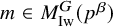 $m \in M^G_{\operatorname {Iw}}(p^{\beta })$
. Recall we have a differential operator
$m \in M^G_{\operatorname {Iw}}(p^{\beta })$
. Recall we have a differential operator $\delta _{\kappa , j} \in V_{\kappa } \otimes C^{\operatorname {pol}}(\mathbb {Q}_p^{\oplus 2n-1}, L)$
which is an eigenvector for the action of
$\delta _{\kappa , j} \in V_{\kappa } \otimes C^{\operatorname {pol}}(\mathbb {Q}_p^{\oplus 2n-1}, L)$
which is an eigenvector for the action of $M_H(\mathbb {Q}_p)$
with eigencharacter
$M_H(\mathbb {Q}_p)$
with eigencharacter $\sigma _{\kappa }^{[j], -1}$
. Fix a basis
$\sigma _{\kappa }^{[j], -1}$
. Fix a basis $\{ v_i \}_{i \in I}$
of
$\{ v_i \}_{i \in I}$
of $V_{\kappa }$
. Then we can write
$V_{\kappa }$
. Then we can write $\delta _{\kappa , j} = \sum _{i \in I} v_i \otimes \delta _i$
, for some
$\delta _{\kappa , j} = \sum _{i \in I} v_i \otimes \delta _i$
, for some $\delta _i \in C^{\operatorname {pol}}(\mathbb {Q}_p^{\oplus 2n-1}, L)$
. Recall
$\delta _i \in C^{\operatorname {pol}}(\mathbb {Q}_p^{\oplus 2n-1}, L)$
. Recall
 $$\begin{align*}\delta^{\dagger, \circ}_{\kappa, j+\chi_p, \beta} = 1_{U_{G, \beta}^{\circ}, \chi_p} \cdot \delta^{\dagger}_{\kappa, j, \beta} = \sum_{i \in I} u^{-1} \cdot v_i \otimes 1_{U_{G, \beta}^{\circ}, \chi_p} \cdot (u^{-1} \delta_i)|_{U_{G, \beta}}. \end{align*}$$
Consider the action of $\xi ^{-1}$
on
$\xi ^{-1}$
on $C^{\operatorname {la}}(U_{G, \beta }, L)$
given by
$C^{\operatorname {la}}(U_{G, \beta }, L)$
given by $(\xi ^{-1} \cdot \phi )(a_2, \dots , a_{2n}) = \phi (pa_2, \dots , pa_{2n})$
. Then one can easily verify that
$(\xi ^{-1} \cdot \phi )(a_2, \dots , a_{2n}) = \phi (pa_2, \dots , pa_{2n})$
. Then one can easily verify that
 $$\begin{align*}\xi^{\beta'} \cdot \left( (\xi^{-\beta'} \cdot \phi) \star h \right) = \phi \star (\xi^{\beta'} \cdot h) \end{align*}$$
for any $h \in \mathcal {O}(\pi _G^{-1}(U))$
and
$h \in \mathcal {O}(\pi _G^{-1}(U))$
and $\phi \in C^{\operatorname {la}}(U_{G, \beta }, L)$
.
$\phi \in C^{\operatorname {la}}(U_{G, \beta }, L)$
.
Since $\xi $
commutes with u, we have
$\xi $
commutes with u, we have $(\xi ^{-\beta '}, \xi ^{-\beta '}) \cdot \delta ^{\dagger }_{\kappa , j, \beta } = \sigma _{\kappa }^{[j]}(\xi ^{\beta '}) \delta ^{\dagger }_{\kappa , j, \beta }$
, and hence
$(\xi ^{-\beta '}, \xi ^{-\beta '}) \cdot \delta ^{\dagger }_{\kappa , j, \beta } = \sigma _{\kappa }^{[j]}(\xi ^{\beta '}) \delta ^{\dagger }_{\kappa , j, \beta }$
, and hence
 $$ \begin{align} \delta^{\dagger}_{\kappa, j, \beta} = \sigma_{\kappa}^{[j]}(\xi^{\beta'})^{-1} \sum_{i \in I} \left( \xi^{-\beta'} u^{-1} \cdot v_i \otimes (\xi^{-\beta'} u^{-1} \delta_i)|_{U_{G, \beta}} \right). \end{align} $$
We now compute $\rho ^{\operatorname {ord}}_{A, U}(F)$
. Firstly, consider the function
$\rho ^{\operatorname {ord}}_{A, U}(F)$
. Firstly, consider the function  . By the explicit description of the Frobenius morphism over the ordinary locus (see §8.4.1), we have
 $$\begin{align*}H(-) = \kappa^*(\xi^{-\beta'}) \xi^{\beta'} \cdot F(- \cdot \xi^{\beta'} ). \end{align*}$$
For any $x \in \pi _H^{-1}(U')$
, we therefore have:
$x \in \pi _H^{-1}(U')$
, we therefore have:
 $$ \begin{align*} \rho^{\operatorname{ord}}_{A, U}(F)(x) &= \vartheta^{\dagger, \circ}_{\kappa, j+\chi_p, \beta}(H)(x) \\ &= \sum_{i \in I} \left( \left[ 1_{U_{G, \beta}^{\circ}, \chi_p} \cdot (u^{-1} \delta_i)|_{U_{G, \beta}} \right] \star \langle H(-), u^{-1}v_i \rangle \right)(\hat{\iota}(x)) \\ &= \kappa^*(\xi^{-\beta'}) \sum_{i \in I} \left( \left[ 1_{U_{G, \beta}^{\circ}, \chi_p} \cdot (u^{-1} \delta_i)|_{U_{G, \beta}} \right] \star \xi^{\beta'} \cdot \langle F(-), \xi^{-\beta'}u^{-1}v_i \rangle \right)(\hat{\iota}(x)) \\ &= \kappa^*(\xi^{-\beta'}) \sum_{i \in I} \left( \left[ 1^{\spadesuit}_{U_{G, \beta}^{\circ}, \chi_p} \cdot (\xi^{-\beta'}u^{-1} \delta_i)|_{U_{G, \beta}} \right] \star \langle F(-), \xi^{-\beta'}u^{-1}v_i \rangle \right)(\hat{\iota}(x) \xi^{\beta'}) \\ &= p^{\beta' j_{\tau_0}} \sum_{i \in I} \left( \left[ 1^{\spadesuit}_{U_{G, \beta}^{\circ}, \chi_p} \cdot (u^{-1} \delta_i)|_{U_{G, \beta}} \right] \star \langle F(-), u^{-1}v_i \rangle \right)(\hat{\iota}(x) \xi^{\beta'}) \end{align*} $$
where for the fourth equality we have used the fact that $\xi ^{-\beta '} \cdot 1_{U_{G, \beta }^{\circ }, \chi _p} = 1^{\spadesuit }_{U_{G, \beta }^{\circ }, \chi _p}$
, and for the fifth equality we have used
$\xi ^{-\beta '} \cdot 1_{U_{G, \beta }^{\circ }, \chi _p} = 1^{\spadesuit }_{U_{G, \beta }^{\circ }, \chi _p}$
, and for the fifth equality we have used $\kappa ^*(\xi ^{-\beta '})\sigma _{\kappa }^{[j]}(\xi ^{\beta '}) = p^{\beta ' j_{\tau _0}}$
and (8.5.7).
$\kappa ^*(\xi ^{-\beta '})\sigma _{\kappa }^{[j]}(\xi ^{\beta '}) = p^{\beta ' j_{\tau _0}}$
and (8.5.7).
Recall the definitions of $\omega _c$
and
$\omega _c$
and $u_c$
from Lemma 8.5.4. For any tuple
$u_c$
from Lemma 8.5.4. For any tuple $\underline {d} = (d_2, \dots , d_n) \in (p^{\beta '} \mathbb {Z})^{\oplus n-1}$
, let
$\underline {d} = (d_2, \dots , d_n) \in (p^{\beta '} \mathbb {Z})^{\oplus n-1}$
, let
 $$\begin{align*}\omega_{\underline{d}} = (\omega_{\underline{d}, i})_{2 \leq i \leq 2n} \in \widetilde{\mu_{p^{\infty}}}^{\oplus 2n-1}(\mathbb{Z}_p^{\operatorname{cycl}}) \end{align*}$$
be the element which satisfies $\omega _{\underline {d}, i} = \varepsilon ^{d_i}$
if
$\omega _{\underline {d}, i} = \varepsilon ^{d_i}$
if $2 \leq i \leq n$
, and
$2 \leq i \leq n$
, and $\omega _{\underline {d}, i} = 1$
if
$\omega _{\underline {d}, i} = 1$
if $i \geq n+1$
. Let
$i \geq n+1$
. Let $v_{\underline {d}} \in J_{H, \operatorname {ord}}^+(\mathbb {Z}_p^{\operatorname {cycl}}) \subset J_{G, \operatorname {ord}}^+(\mathbb {Z}_p^{\operatorname {cycl}})$
denote the element which is the identity outside the
$v_{\underline {d}} \in J_{H, \operatorname {ord}}^+(\mathbb {Z}_p^{\operatorname {cycl}}) \subset J_{G, \operatorname {ord}}^+(\mathbb {Z}_p^{\operatorname {cycl}})$
denote the element which is the identity outside the $\tau _0$
-component, and in the
$\tau _0$
-component, and in the $\tau _0$
is given by the block matrix
$\tau _0$
is given by the block matrix

Then, with notation as in §6.1.3, we have the following relations:
-
• The function
$f_{\chi _p}$
satisfies (8.5.8)Indeed, evaluating the right-hand side of (8.5.8) at an element
$$ \begin{align} f_{\chi_p} = \frac{1}{p^{\beta-\beta'}\mathscr{G}(\chi_{p, \bar{\tau}_0}^{-1})} \sum_{c \in \left(\mathbb{Z}/p^{\beta}\mathbb{Z}\right)^{\times}} \chi_{p, \bar{\tau}_0}(c)^{-1} \chi_{\omega_c}. \end{align} $$
$(a_2, \dots , a_{2n}) \in U_{G, \beta }$
, we have
$$\begin{align*}\frac{1}{p^{\beta-\beta'}\mathscr{G}(\chi_{p, \bar{\tau}_0}^{-1})} \sum_{c \in \left(\mathbb{Z}/p^{\beta}\mathbb{Z}\right)^{\times}} \chi_{p, \bar{\tau}_0}(c)^{-1} \varepsilon_{\beta}^{c p^{\beta}a_{n+1}} = \left\{ \begin{array}{cc} 0 & \text{ if } a_{n+1} \not\in p^{-\beta'}\mathbb{Z}_p^{\times} \\ \chi_{p, \bar{\tau}_0}(p^{\beta'}a_{n+1}) & \text{ if } a_{n+1} \in p^{-\beta'}\mathbb{Z}_p^{\times} \end{array} \right. \end{align*}$$
-
• The function
$1_{U_{H, \beta '}}$
satisfies
$$\begin{align*}1_{U_{H, \beta'}} = \frac{1}{p^{(n-1)(\beta - \beta')}}\sum_{\underline{d} \in \left(p^{\beta'}\mathbb{Z}/p^{\beta}\mathbb{Z}\right)^{\oplus n-1}} \chi_{\omega_{\underline{d}}}. \end{align*}$$


Using these expressions, we see that $\rho ^{\operatorname {ord}}_{A, U}(F)(x)$
is equal to:
$\rho ^{\operatorname {ord}}_{A, U}(F)(x)$
is equal to:
 $$ \begin{align*} \frac{p^{\beta' j_{\tau_0}}}{p^{\beta-\beta'}\mathscr{G}(\chi_{p, \bar{\tau}_0}^{-1})} \sum_{c \in \left(\mathbb{Z}/p^{\beta}\mathbb{Z}\right)^{\times}} \chi_{p, \bar{\tau}_0}(c)^{-1} &\cdot \\ &\hspace{-3cm} \left( \frac{1}{p^{(n-1)(\beta - \beta')}}\sum_{\underline{d} \in \left(p^{\beta'}\mathbb{Z}/p^{\beta}\mathbb{Z}\right)^{\oplus n-1}} \sum_{i \in I} \left( (u^{-1} \delta_i)|_{U_{G, \beta}} \star \langle F(-), u^{-1}v_i \rangle \right)(\hat{\iota}(x) \xi^{\beta'} u_c v_{\underline{d}}) \right). \end{align*} $$
Now because $\hat {\iota }$
is induced from right-translation by
$\hat {\iota }$
is induced from right-translation by $\gamma $
and commutes with elements in
$\gamma $
and commutes with elements in $\operatorname {Unip}(J_{H, \operatorname {ord}})$
, we see that
$\operatorname {Unip}(J_{H, \operatorname {ord}})$
, we see that $\hat {\iota }(x) \xi ^{\beta '} u_c v_{\underline {d}} = \hat {\iota }(x \xi ^{\beta '} v_{\underline {d}} \xi _c) \xi _c^{-1}$
. Set
$\hat {\iota }(x) \xi ^{\beta '} u_c v_{\underline {d}} = \hat {\iota }(x \xi ^{\beta '} v_{\underline {d}} \xi _c) \xi _c^{-1}$
. Set  – explicitly, one has ${F'(-) = \xi _c^{-1} \cdot F(- \cdot \xi _c^{-1})}$
. Since
${F'(-) = \xi _c^{-1} \cdot F(- \cdot \xi _c^{-1})}$
. Since $(\xi _c^{-1}, \xi _c^{-1}) \cdot \delta ^{\dagger }_{\kappa , j, \beta } = \sigma _{\kappa }^{[j]}(\xi _c) \delta ^{\dagger }_{\kappa , j, \beta }$
, we see that
$(\xi _c^{-1}, \xi _c^{-1}) \cdot \delta ^{\dagger }_{\kappa , j, \beta } = \sigma _{\kappa }^{[j]}(\xi _c) \delta ^{\dagger }_{\kappa , j, \beta }$
, we see that
 $$ \begin{align*} \sum_{i \in I} \left( (u^{-1} \delta_i)|_{U_{G, \beta}} \star \langle F(-), u^{-1}v_i \rangle \right)(\hat{\iota}(x \xi^{\beta'} v_{\underline{d}} \xi_c) \xi_c^{-1}) &= \sigma_{\kappa}^{[j]}(\xi_c) \cdot \vartheta^{\dagger}_{\kappa, j, \beta}(F')( x \xi^{\beta'} v_{\underline{d}} \xi_c ) \\ &= \sigma_{\kappa}^{[j]}(\xi_c) \cdot \vartheta^{\dagger}_{\kappa, j, \beta}(F')( x \xi^{\beta'} v_{\underline{d}} \xi_c ). \end{align*} $$
Therefore, we see that
 $$\begin{align*}\rho^{\operatorname{ord}}_{A, U}(F) = \frac{p^{\beta' j_{\tau_0}}}{p^{\beta-\beta'}\mathscr{G}(\chi_{p, \bar{\tau}_0}^{-1})} \sum_{c \in \left(\mathbb{Z}/p^{\beta}\mathbb{Z}\right)^{\times}} \chi_{p, \bar{\tau}_0}(c)^{-1} \left[ \psi_{H, \sigma_{\kappa}^{[j]}}^{\beta'} \circ (1_{U_{H, \beta'}} \star - ) \circ \phi_{\xi_c, \sigma_{\kappa}^{[j]}} \right]( \vartheta^{\dagger}_{\kappa, j, \beta}(F') ). \end{align*}$$
This coincides with $\rho ^{\operatorname {ord}}_{B, U}$
as required.
$\rho ^{\operatorname {ord}}_{B, U}$
as required.
We now consider an overconvergent version of this result. We will continually use the following fact: if $f \colon \mathcal {X} \to \mathcal {Y}$
is a finite morphism of adic spaces which is of finite presentation, and
$f \colon \mathcal {X} \to \mathcal {Y}$
is a finite morphism of adic spaces which is of finite presentation, and $\mathscr {F}$
is a sheaf on
$\mathscr {F}$
is a sheaf on $\mathcal {Y}$
which is locally free of finite rank, then
$\mathcal {Y}$
which is locally free of finite rank, then $f^{-1}$
sends
$f^{-1}$
sends $\mathscr {F}$
-acyclic covers of
$\mathscr {F}$
-acyclic covers of $\mathcal {Y}$
to
$\mathcal {Y}$
to $f^*\mathscr {F}$
-acyclic covers of
$f^*\mathscr {F}$
-acyclic covers of $\mathcal {X}$
. This follows from a simple application of the projection formula. We will apply this to the setting where
$\mathcal {X}$
. This follows from a simple application of the projection formula. We will apply this to the setting where $\mathcal {X}$
and
$\mathcal {X}$
and $\mathcal {Y}$
are both open subspaces of a third space
$\mathcal {Y}$
are both open subspaces of a third space $\mathcal {C}$
,
$\mathcal {C}$
, $\mathscr {F}$
is a sheaf on
$\mathscr {F}$
is a sheaf on $\mathcal {C}$
locally free of finite rank, and f corresponds to a Hecke operator (e.g., Frobenius) satisfying the property
$\mathcal {C}$
locally free of finite rank, and f corresponds to a Hecke operator (e.g., Frobenius) satisfying the property $f^* \mathscr {F}|_{\mathcal {Y}} \cong \mathscr {F}|_{\mathcal {X}}$
. One then sees that
$f^* \mathscr {F}|_{\mathcal {Y}} \cong \mathscr {F}|_{\mathcal {X}}$
. One then sees that $f^{-1}$
sends
$f^{-1}$
sends $\mathscr {F}$
-acyclic covers of
$\mathscr {F}$
-acyclic covers of $\mathcal {Y}$
to
$\mathcal {Y}$
to $\mathscr {F}$
-acyclic covers of
$\mathscr {F}$
-acyclic covers of $\mathcal {X}$
.
$\mathcal {X}$
.
Since, in this section, we are working with Shimura varieties rather than the moduli spaces of unitary abelian varieties, we set  and
and $\mathcal {S}_{H, \operatorname {id}}(p^{\beta })_k = \mathcal {X}_{H, \operatorname {id}}(p^{\beta })_k \cap \mathcal {S}_{H, \diamondsuit }(p^{\beta })$
for any integer
$\mathcal {S}_{H, \operatorname {id}}(p^{\beta })_k = \mathcal {X}_{H, \operatorname {id}}(p^{\beta })_k \cap \mathcal {S}_{H, \diamondsuit }(p^{\beta })$
for any integer $k \geq 1$
. We will also frequently use the following notation: if
$k \geq 1$
. We will also frequently use the following notation: if $\{ U_i \}_{i \in I}$
is an open cover of an adic space
$\{ U_i \}_{i \in I}$
is an open cover of an adic space $\mathcal {X}$
, then for any subset
$\mathcal {X}$
, then for any subset $\mathbf {I} \subset I$
, we set
$\mathbf {I} \subset I$
, we set  .
.
We begin with the following proposition.
Proposition 8.5.9. Let $k \geq 1$
be an integer such that
$k \geq 1$
be an integer such that $\mathcal {S}_{G, w_n}(p^{\beta })_k \subset \mathcal {U}^G_{K_p, \beta }$
. Let
$\mathcal {S}_{G, w_n}(p^{\beta })_k \subset \mathcal {U}^G_{K_p, \beta }$
. Let $\mathfrak {U} = \{ U_i \}_{i \in I}$
be a finite
$\mathfrak {U} = \{ U_i \}_{i \in I}$
be a finite $\mathscr {M}_{G, \kappa ^*}$
-acyclic cover of
$\mathscr {M}_{G, \kappa ^*}$
-acyclic cover of $\mathcal {S}_{G, w_n}(p^{\beta })_k$
as in Lemma 6.4.5 (i.e.,
$\mathcal {S}_{G, w_n}(p^{\beta })_k$
as in Lemma 6.4.5 (i.e., $U_i \in \mathcal {C}_{G,H}$
and
$U_i \in \mathcal {C}_{G,H}$
and $\mathfrak {V} = \{ V_i \}_{i \in I} = \{ U_i - \mathcal {Z}_{G,>n+1}(p^{\beta }) \}_{i \in I}$
is an acyclic cover). Then there exists a sufficiently large integer
$\mathfrak {V} = \{ V_i \}_{i \in I} = \{ U_i - \mathcal {Z}_{G,>n+1}(p^{\beta }) \}_{i \in I}$
is an acyclic cover). Then there exists a sufficiently large integer $k' \geq k$
and a finite collection
$k' \geq k$
and a finite collection $\mathfrak {U}' = \{ U_j' \}_{j \in J}$
of quasi-compact open subspaces of
$\mathfrak {U}' = \{ U_j' \}_{j \in J}$
of quasi-compact open subspaces of $\mathcal {S}_{H, \diamondsuit }(p^{\beta })$
such that:
$\mathcal {S}_{H, \diamondsuit }(p^{\beta })$
such that:
-
1. There exists a surjective map
$q \colon J \twoheadrightarrow I$
such that for all
$j \in J$
:
$$\begin{align*}U_j' \subset A^{-1}(U_{q(j)}) \cap \bigcap_{c \in \mathbb{Z}_p^{\times}} B_c^{-1}(U_{q(j)}). \end{align*}$$
-
2.
$\mathcal {S}_{H, \operatorname {id}}(p^{\beta })_{k'} \subset \bigcup _{j \in J} U_j'$
and the covers
$\{ U_j' \cap \mathcal {S}_{H, \operatorname {id}}(p^{\beta })_{k'} \}_{j \in J}$
and
$\{ V_j' \cap \mathcal {S}_{H, \operatorname {id}}(p^{\beta })_{k'} \}_{j \in J}$
are
$\mathscr {M}_{H, \sigma _{\kappa }^{[j]}}$
-acyclic. Here . -
3. For any subset
$\mathbf {J} \subset J$
, the restriction map is injective.
$$\begin{align*}\mathscr{M}_{H, \sigma_{\kappa}^{[j]}}( U^{\prime}_{\mathbf{J}} ) \to \mathscr{M}_{H, \sigma_{\kappa}^{[j]}} ( U^{\prime}_{\mathbf{J}} \cap \mathcal{S}_{H, \operatorname{id}}(p^{\beta})) \end{align*}$$
-
4. For any subset
$\mathbf {J} \subset J$
and
$c \in \mathbb {Z}_p^{\times }$
:-
• The map
$\vartheta ^{\dagger , \circ }_{\kappa , j+\chi _p, \beta }$
of ind-systems induces well-defined maps which are functorial in
$$ \begin{align*} \vartheta^{\dagger, \circ}_{\kappa, j+\chi_p, \beta} \colon \mathscr{M}_{G, \kappa^*}\left( (\varphi^{\beta'})^{-1}(U_{q(\mathbf{J})}) \right) &\to \mathscr{M}_{H, \sigma_{\kappa}^{[j]}}(U^{\prime}_{\mathbf{J}}) \\ \vartheta^{\dagger, \circ}_{\kappa, j+\chi_p, \beta} \colon \mathscr{M}_{G, \kappa^*}\left( (\varphi^{\beta'})^{-1}(V_{q(\mathbf{J})}) \right) &\to \mathscr{M}_{H, \sigma_{\kappa}^{[j]}}(V^{\prime}_{\mathbf{J}}) \end{align*} $$
$\mathbf {J}$
(via the various restriction maps).
-
• The map
$1_{U_{H, \beta '}} \star -$
of ind-systems induces well-defined maps: which are functorial in
$$ \begin{align*} \mathscr{M}_{H, \sigma_{\kappa}^{[j]}}\left( (t_c^{-1} \circ \hat{\iota} \circ \xi_c)^{-1}(U_{q(\mathbf{J})}) \right) &\xrightarrow{1_{U_{H, \beta'}} \star -} \mathscr{M}_{H, \sigma_{\kappa}^{[j]}}\left( (t_c^{-1} \circ \hat{\iota} \circ \xi_c)^{-1}(U_{q(\mathbf{J})}) \cap \mathcal{S}_{H, \operatorname{id}}(p^{\beta})_r \right) \\ \mathscr{M}_{H, \sigma_{\kappa}^{[j]}}\left( (t_c^{-1} \circ \hat{\iota} \circ \xi_c)^{-1}(V_{q(\mathbf{J})}) \right) &\xrightarrow{1_{U_{H, \beta'}} \star -} \mathscr{M}_{H, \sigma_{\kappa}^{[j]}}\left( (t_c^{-1} \circ \hat{\iota} \circ \xi_c)^{-1}(V_{q(\mathbf{J})}) \cap \mathcal{S}_{H, \operatorname{id}}(p^{\beta})_r \right) \end{align*} $$
$\mathbf {J}$
, for some
$r \gg 0$
(not depending on c nor
$\mathbf {J}$
) satisfying
$$\begin{align*}U^{\prime}_{\mathbf{J}} \subset (\varphi^{\beta'})^{-1} \left[ (t_c^{-1} \circ \hat{\iota} \circ \xi_c)^{-1}(U_{q(\mathbf{J})}) \cap \mathcal{S}_{H, \operatorname{id}}(p^{\beta})_r \right]. \end{align*}$$
-


 .
.


Proof. Since $t_c^{-1} \circ \hat {\iota } \circ \xi _c$
only depends on c modulo
$t_c^{-1} \circ \hat {\iota } \circ \xi _c$
only depends on c modulo $p^{\beta }$
, we can certainly find an integer
$p^{\beta }$
, we can certainly find an integer $r \gg 0$
such that for any subset
$r \gg 0$
such that for any subset $\mathbf {I} \subset I$
and
$\mathbf {I} \subset I$
and $c \in \mathbb {Z}_p^{\times }$
, the maps
$c \in \mathbb {Z}_p^{\times }$
, the maps $\vartheta ^{\dagger , \circ }_{\kappa , j+\chi _p, \beta }$
and
$\vartheta ^{\dagger , \circ }_{\kappa , j+\chi _p, \beta }$
and $1_{U_{H, \beta '}} \star -$
induce morphisms:
$1_{U_{H, \beta '}} \star -$
induce morphisms:
 $$ \begin{align*} \mathscr{M}_{G, \kappa^*}\left( (\varphi^{\beta'})^{-1}(U_{\mathbf{I}}) \right) &\xrightarrow{\vartheta^{\dagger, \circ}_{\kappa, j+\chi_p, \beta}} \mathscr{M}_{H, \sigma_{\kappa}^{[j]}}\left( (\varphi^{\beta'} \circ \hat{\iota})^{-1}(U_{\mathbf{I}}) \cap \mathcal{S}_{H, \operatorname{id}}(p^{\beta})_r \right) \\ \mathscr{M}_{G, \kappa^*}\left( (\varphi^{\beta'})^{-1}(V_{\mathbf{I}}) \right) &\xrightarrow{\vartheta^{\dagger, \circ}_{\kappa, j+\chi_p, \beta}} \mathscr{M}_{H, \sigma_{\kappa}^{[j]}}\left( (\varphi^{\beta'} \circ \hat{\iota})^{-1}(V_{\mathbf{I}}) \cap \mathcal{S}_{H, \operatorname{id}}(p^{\beta})_r \right) \\ \mathscr{M}_{H, \sigma_{\kappa}^{[j]}}\left( (t_c^{-1} \circ \hat{\iota} \circ \xi_c)^{-1}(U_{\mathbf{I}}) \right) &\xrightarrow{1_{U_{H, \beta'}} \star -} \mathscr{M}_{H, \sigma_{\kappa}^{[j]}}\left( (t_c^{-1} \circ \hat{\iota} \circ \xi_c)^{-1}(U_{\mathbf{I}}) \cap \mathcal{S}_{H, \operatorname{id}}(p^{\beta})_r \right) \\ \mathscr{M}_{H, \sigma_{\kappa}^{[j]}}\left( (t_c^{-1} \circ \hat{\iota} \circ \xi_c)^{-1}(V_{\mathbf{I}}) \right) &\xrightarrow{1_{U_{H, \beta'}} \star -} \mathscr{M}_{H, \sigma_{\kappa}^{[j]}}\left( (t_c^{-1} \circ \hat{\iota} \circ \xi_c)^{-1}(V_{\mathbf{I}}) \cap \mathcal{S}_{H, \operatorname{id}}(p^{\beta})_r \right) \end{align*} $$
Note that $(\varphi ^{\beta '})^{-1}(U_{\mathbf {I}}) \in \mathcal {C}_G$
and
$(\varphi ^{\beta '})^{-1}(U_{\mathbf {I}}) \in \mathcal {C}_G$
and $(t_c^{-1} \circ \hat {\iota } \circ \xi _c)^{-1}(U_{\mathbf {I}}) \in \mathcal {C}_H$
because the morphisms under which we are pulling back the opens extend to integral models over the ordinary loci.
$(t_c^{-1} \circ \hat {\iota } \circ \xi _c)^{-1}(U_{\mathbf {I}}) \in \mathcal {C}_H$
because the morphisms under which we are pulling back the opens extend to integral models over the ordinary loci.
Set  . This is a quasi-compact open subspace which is the adic generic fibre of an open in $\mathfrak {X}_{G, w_n}(p^{\beta })$
, hence we have
$\mathfrak {X}_{G, w_n}(p^{\beta })$
, hence we have  for any $c \in \mathbb {Z}_p^{\times }$
(see Lemma 8.5.4). Choose a refinement
$c \in \mathbb {Z}_p^{\times }$
(see Lemma 8.5.4). Choose a refinement $\mathfrak {U}" = \{ U_j" \}_{j \in J}$
of the cover
$\mathfrak {U}" = \{ U_j" \}_{j \in J}$
of the cover
 $$\begin{align*}\left\{ A^{-1}(U_i) \cap \bigcap_{c \in \mathbb{Z}_p^{\times}} B_c^{-1}(U_i) \cap \mathcal{S}_{H, \operatorname{id}}(p^{\beta})_r \cap (\varphi^{\beta'})^{-1}(\mathcal{S}_{H, \operatorname{id}}(p^{\beta})_r) \right\}_{i \in I} =: \{ Y_i \}_{i \in I} \end{align*}$$
such that $\mathscr {M}_{H, \sigma _{\kappa }^{[j]}}|_{U_j"} = \mathscr {M}_{H, \sigma _{\kappa }^{[j]}}(U_j") \otimes \mathcal {O}_{U_j"}$
(for all
$\mathscr {M}_{H, \sigma _{\kappa }^{[j]}}|_{U_j"} = \mathscr {M}_{H, \sigma _{\kappa }^{[j]}}(U_j") \otimes \mathcal {O}_{U_j"}$
(for all $j \in J$
). We may assume that
$j \in J$
). We may assume that $\mathfrak {U}"$
is finite and consists of quasi-compact open subspaces. Let
$\mathfrak {U}"$
is finite and consists of quasi-compact open subspaces. Let $q \colon J \twoheadrightarrow I$
be a surjective map such that
$q \colon J \twoheadrightarrow I$
be a surjective map such that
 $$\begin{align*}U_j" \cap \mathcal{S}_{H, \operatorname{id}}(p^{\beta}) = U_j" \cap W_{q(j)} \subset U_j" \subset Y_{q(j)}. \end{align*}$$
Let $U_j'$
denote the union of all connected components of
$U_j'$
denote the union of all connected components of $U_j"$
which intersect nontrivially with
$U_j"$
which intersect nontrivially with $\mathcal {S}_{H, \operatorname {id}}(p^{\beta })$
. Then, for any subset
$\mathcal {S}_{H, \operatorname {id}}(p^{\beta })$
. Then, for any subset $\mathbf {J} \subset J$
, the map
$\mathbf {J} \subset J$
, the map $\pi _0(U_{\mathbf {J}}' \cap \mathcal {S}_{H, \operatorname {id}}(p^{\beta })) \twoheadrightarrow \pi _0(U_{\mathbf {J}}')$
is surjective. Since
$\pi _0(U_{\mathbf {J}}' \cap \mathcal {S}_{H, \operatorname {id}}(p^{\beta })) \twoheadrightarrow \pi _0(U_{\mathbf {J}}')$
is surjective. Since $U_{\mathbf {J}}'$
is an open subspace of a smooth qcqs adic space, this implies that the natural restriction map
$U_{\mathbf {J}}'$
is an open subspace of a smooth qcqs adic space, this implies that the natural restriction map $\mathcal {O}(U_{\mathbf {J}}') \to \mathcal {O}(U_{\mathbf {J}}' \cap \mathcal {S}_{H, \operatorname {id}}(p^{\beta }))$
is injective. This gives part (3) because
$\mathcal {O}(U_{\mathbf {J}}') \to \mathcal {O}(U_{\mathbf {J}}' \cap \mathcal {S}_{H, \operatorname {id}}(p^{\beta }))$
is injective. This gives part (3) because $\mathscr {M}_{H, \sigma _{\kappa }^{[j]}}$
is free over
$\mathscr {M}_{H, \sigma _{\kappa }^{[j]}}$
is free over $U_{\mathbf {J}}'$
. Furthermore,
$U_{\mathbf {J}}'$
. Furthermore, $\cup _{i \in I}Y_i = \cup _{j \in J} U_j"$
contains the closure of
$\cup _{i \in I}Y_i = \cup _{j \in J} U_j"$
contains the closure of $\mathcal {S}_{H, \operatorname {id}}(p^{\beta })$
, hence
$\mathcal {S}_{H, \operatorname {id}}(p^{\beta })$
, hence $\cup _{j \in J}U_j'$
must also contain the closure of
$\cup _{j \in J}U_j'$
must also contain the closure of $\mathcal {S}_{H, \operatorname {id}}(p^{\beta })$
. This implies that there exists an integer
$\mathcal {S}_{H, \operatorname {id}}(p^{\beta })$
. This implies that there exists an integer $k' \geq k$
such that
$k' \geq k$
such that $\mathcal {S}_{H, \operatorname {id}}(p^{\beta })_{k'} \subset \cup _{j \in J}U_j'$
. The rest of the proposition easily follows.
$\mathcal {S}_{H, \operatorname {id}}(p^{\beta })_{k'} \subset \cup _{j \in J}U_j'$
. The rest of the proposition easily follows.
We now define the overconvergent morphisms.
Definition 8.5.10. Let $\mathfrak {U}$
be a finite cover as in Proposition 8.5.9, and let
$\mathfrak {U}$
be a finite cover as in Proposition 8.5.9, and let $\mathfrak {U}'$
be the corresponding collection of quasi-compact open subspaces of
$\mathfrak {U}'$
be the corresponding collection of quasi-compact open subspaces of $\mathcal {S}_{H, \diamondsuit }(p^{\beta })$
.
$\mathcal {S}_{H, \diamondsuit }(p^{\beta })$
.
-
1. For any subset
$\mathbf {J} \subset J$
, let
$\rho ^{\dagger }_{A, \mathbf {J}} \colon \mathscr {M}_{G, \kappa ^*}(U_{q(\mathbf {J})}) \to \mathscr {M}_{H, \sigma _{\kappa }^{[j]}}(U^{\prime }_{\mathbf {J}})$
denote the continuous L-linear morphism (which is functorial in
$\mathbf {J}$
) given by the following composition: We define
$$\begin{align*}\mathscr{M}_{G, \kappa^*}(U_{q(\mathbf{J})}) \xrightarrow{\psi_{G, \kappa^*}^{\beta'}} \mathscr{M}_{G, \kappa^*}( (\varphi^{\beta'})^{-1} U_{q(\mathbf{J})} ) \xrightarrow{\vartheta^{\dagger, \circ}_{\kappa, j+\chi_p, \beta}} \mathscr{M}_{H, \sigma_{\kappa}^{[j]}}(U^{\prime}_{\mathbf{J}}). \end{align*}$$
$\rho ^{\dagger }_{A, \mathbf {J}} \colon \mathscr {M}_{G, \kappa ^*}(V_{q(\mathbf {J})}) \to \mathscr {M}_{H, \sigma _{\kappa }^{[j]}}(V^{\prime }_{\mathbf {J}})$
similarly, which is the unique continuous L-linear morphism extending
$\rho ^{\dagger }_{A, \mathbf {J}}$
.
-
2. Let
$c \in \mathbb {Z}_p^{\times }$
. For any subset
$\mathbf {J} \subset J$
, let
$\rho ^{\dagger }_{B_c, \mathbf {J}} \colon \mathscr {M}_{G, \kappa ^*}(U_{q(\mathbf {J})}) \to \mathscr {M}_{H, \sigma _{\kappa }^{[j]}}(U^{\prime }_{\mathbf {J}})$
denote the continuous L-linear morphism (which is functorial in
$\mathbf {J}$
) given by the following composition: We define
$$ \begin{align*} \mathscr{M}_{G, \kappa^*}(U_{q(\mathbf{J})}) &\xrightarrow{\phi_{t_c^{-1}, \kappa^*}} \mathscr{M}_{G, \kappa^*}((t_c^{-1})^{-1}U_{q(\mathbf{J})}) \\ &\xrightarrow{\vartheta^{\dagger}_{\kappa, j, \beta}} \mathscr{M}_{H, \sigma_{\kappa}^{[j]}}((t_c^{-1} \circ \hat{\iota})^{-1}U_{q(\mathbf{J})}) \\ &\xrightarrow{\phi_{\xi_c, \sigma_{\kappa}^{[j]}}} \mathscr{M}_{H, \sigma_{\kappa}^{[j]}}((t_c^{-1} \circ \hat{\iota} \circ \xi_c)^{-1}U_{q(\mathbf{J})}) \\ &\xrightarrow{1_{U_{H, \beta'}} \star - } \mathscr{M}_{H, \sigma_{\kappa}^{[j]}}\left( (t_c^{-1} \circ \hat{\iota} \circ \xi_c)^{-1}(U_{q(\mathbf{J})}) \cap \mathcal{S}_{H, \operatorname{id}}(p^{\beta})_r \right) \\ &\xrightarrow{\psi_{H, \sigma_{\kappa}^{[j]}}^{\beta'}} \mathscr{M}_{H, \sigma_{\kappa}^{[j]}}(U^{\prime}_{\mathbf{J}}). \end{align*} $$
$\rho ^{\dagger }_{B_c, \mathbf {J}} \colon \mathscr {M}_{G, \kappa ^*}(V_{q(\mathbf {J})}) \to \mathscr {M}_{H, \sigma _{\kappa }^{[j]}}(V^{\prime }_{\mathbf {J}})$
similarly, which is the unique continuous L-linear morphism extending
$\rho ^{\dagger }_{B_c, \mathbf {J}}$
.


We set

for a fixed set of representatives of $\left ( \mathbb {Z}/p^{\beta } \mathbb {Z} \right )^{\times }$
.
$\left ( \mathbb {Z}/p^{\beta } \mathbb {Z} \right )^{\times }$
.
Lemma 8.5.11. One has $\rho ^{\dagger }_{A, \mathbf {J}} = \rho ^{\dagger }_{B, \mathbf {J}}$
.
$\rho ^{\dagger }_{A, \mathbf {J}} = \rho ^{\dagger }_{B, \mathbf {J}}$
.
Proof. Since the morphisms $\rho ^{\dagger }_{A, \mathbf {J}}, \rho ^{\dagger }_{B, \mathbf {J}} \colon \mathscr {M}_{G, \kappa ^*}(V_{q(\mathbf {J})}) \to \mathscr {M}_{H, \sigma _{\kappa }^{[j]}}(V^{\prime }_{\mathbf {J}})$
uniquely extend
$\rho ^{\dagger }_{A, \mathbf {J}}, \rho ^{\dagger }_{B, \mathbf {J}} \colon \mathscr {M}_{G, \kappa ^*}(V_{q(\mathbf {J})}) \to \mathscr {M}_{H, \sigma _{\kappa }^{[j]}}(V^{\prime }_{\mathbf {J}})$
uniquely extend
 $$ \begin{align} \rho^{\dagger}_{A, \mathbf{J}}, \rho^{\dagger}_{B, \mathbf{J}} \colon \mathscr{M}_{G, \kappa^*}(U_{q(\mathbf{J})}) \to \mathscr{M}_{H, \sigma_{\kappa}^{[j]}}(U^{\prime}_{\mathbf{J}}) \end{align} $$
it suffices to prove the morphisms in (8.5.12) are equal. Set $U_{q(\mathbf {J})}^{\operatorname {ord}} = U_{q(\mathbf {J})} \cap \mathcal {S}_{G, w_n}(p^{\beta })$
which is a quasi-compact open subspace which is the adic generic fibre of an open in
$U_{q(\mathbf {J})}^{\operatorname {ord}} = U_{q(\mathbf {J})} \cap \mathcal {S}_{G, w_n}(p^{\beta })$
which is a quasi-compact open subspace which is the adic generic fibre of an open in $\mathfrak {X}_{G, w_n}(p^{\beta })$
. Set
$\mathfrak {X}_{G, w_n}(p^{\beta })$
. Set $(U^{\prime }_{\mathbf {J}})^{\operatorname {ord}} = U_{\mathbf {J}}' \cap \mathcal {S}_{H, \operatorname {id}}(p^{\beta })$
and note that
$(U^{\prime }_{\mathbf {J}})^{\operatorname {ord}} = U_{\mathbf {J}}' \cap \mathcal {S}_{H, \operatorname {id}}(p^{\beta })$
and note that $(U^{\prime }_{\mathbf {J}})^{\operatorname {ord}} \subset A^{-1}(U_{q(\mathbf {J})})$
. Then for
$(U^{\prime }_{\mathbf {J}})^{\operatorname {ord}} \subset A^{-1}(U_{q(\mathbf {J})})$
. Then for $\bullet = A, B$
we have a commutative diagram:
$\bullet = A, B$
we have a commutative diagram:

where the vertical arrows are given by restriction. The result now follows from Lemma 8.5.6 because the right-hand vertical map is injective (see Proposition 8.5.9).
We now consider the analogous morphisms on Čech complexes. More precisely, let $\mathfrak {U}^{\prime }_{k'} = \{ U_j' \cap \mathcal {S}_{H, \operatorname {id}}(p^{\beta })_{k'} \}_{j \in J}$
denote the
$\mathfrak {U}^{\prime }_{k'} = \{ U_j' \cap \mathcal {S}_{H, \operatorname {id}}(p^{\beta })_{k'} \}_{j \in J}$
denote the $\mathscr {M}_{H, \sigma _{\kappa }^{[j]}}$
-acyclic cover as in Proposition 8.5.9. Then, for
$\mathscr {M}_{H, \sigma _{\kappa }^{[j]}}$
-acyclic cover as in Proposition 8.5.9. Then, for $\bullet = A, B$
, we obtain a commutative diagram of Čech complexes
$\bullet = A, B$
, we obtain a commutative diagram of Čech complexes

where $\operatorname {res}$
denotes restriction from elements of
$\operatorname {res}$
denotes restriction from elements of $\mathfrak {U}'$
(resp.
$\mathfrak {U}'$
(resp. $\mathfrak {V}'$
) to
$\mathfrak {V}'$
) to $\mathfrak {U}^{\prime }_{k'}$
(resp.
$\mathfrak {U}^{\prime }_{k'}$
(resp. $\mathfrak {V}^{\prime }_{k'}$
). Here
$\mathfrak {V}^{\prime }_{k'}$
). Here $\rho ^{\dagger }_{\bullet }$
denotes the induced morphism of complexes built up from the maps
$\rho ^{\dagger }_{\bullet }$
denotes the induced morphism of complexes built up from the maps $\rho ^{\dagger }_{\bullet , \mathbf {J}}$
for different subsets
$\rho ^{\dagger }_{\bullet , \mathbf {J}}$
for different subsets $\mathbf {J} \subset J$
. By passing to cohomology of the mapping fibres of the horizontal arrows, we obtain morphisms
$\mathbf {J} \subset J$
. By passing to cohomology of the mapping fibres of the horizontal arrows, we obtain morphisms
 $$\begin{align*}\operatorname{H}^{n-1}(\rho^{\dagger}_{\bullet}) \colon \operatorname{H}^{n-1}_{\mathcal{Z}_{G,>n+1}(p^{\beta})}\left( \mathcal{S}_{G, w_n}(p^{\beta})_k, \mathscr{M}_{G, \kappa^*} \right) \to \operatorname{H}^{n-1}_{\mathcal{Z}_{H, \operatorname{id}}(p^{\beta})}\left( \mathcal{S}_{H, \operatorname{id}}(p^{\beta})_{k'}, \mathscr{M}_{H, \sigma_{\kappa}^{[j]}} \right). \end{align*}$$
By Lemma 8.5.11, one has $\operatorname {H}^{n-1}(\rho ^{\dagger }_{A}) = \operatorname {H}^{n-1}(\rho ^{\dagger }_{B})$
. On the other hand, using the acyclicity property of finite morphisms discussed just before Proposition 8.5.9:
$\operatorname {H}^{n-1}(\rho ^{\dagger }_{A}) = \operatorname {H}^{n-1}(\rho ^{\dagger }_{B})$
. On the other hand, using the acyclicity property of finite morphisms discussed just before Proposition 8.5.9:
-
• One has
$\operatorname {H}^{n-1}(\rho ^{\dagger }_{A}) = \vartheta ^{\dagger , \circ }_{\kappa , j+\chi _p, \beta } \circ \varphi _G^{\beta '}$
. -
• One has
$$\begin{align*}\operatorname{H}^{n-1}(\rho^{\dagger}_{B}) = \frac{p^{\beta' j_{\tau_0}}}{p^{\beta-\beta'}\mathscr{G}(\chi_{p, \bar{\tau}_0}^{-1})} \sum_{c \in \left(\mathbb{Z}/p^{\beta}\mathbb{Z}\right)^{\times}} \chi_{p, \bar{\tau}_0}(c)^{-1} \left( \varphi_H^{\beta'} \circ (1_{U_{H, \beta'}} \star -) \circ U_{\xi_c} \circ \vartheta_{\kappa, j, \beta}^{\dagger} \circ U_{t_c^{-1}} \right). \end{align*}$$


We therefore obtain the following corollary.
Corollary 8.5.13. For any $\eta \in \operatorname {H}^{n-1}_{w_n}(\kappa ^*; \beta )^{(-, \dagger )}$
, one has
$\eta \in \operatorname {H}^{n-1}_{w_n}(\kappa ^*; \beta )^{(-, \dagger )}$
, one has
 $$\begin{align*}\operatorname{Ev}^{\dagger, \circ}_{\kappa, j, \chi, \beta}( \varphi_G^{\beta'} \eta ) = p^{\beta'\kappa_{n+1, \tau_0} - 1}(p-1) \chi(z_{\xi^{-\beta'}}) \chi_{p, \bar{\tau}_0}(-1) \mathscr{G}(\chi_{p, \bar{\tau}_0}) \operatorname{Ev}^{\dagger}_{\kappa, j, \chi, \beta}(\eta). \end{align*}$$
Proof. We first note that $U_{t_c^{-1}}$
acts trivially on the cohomology group
$U_{t_c^{-1}}$
acts trivially on the cohomology group $\operatorname {H}^{n-1}_{w_n}(\kappa ^*; \beta )^{(-, \dagger )}$
. With notation as in §8.4, let
$\operatorname {H}^{n-1}_{w_n}(\kappa ^*; \beta )^{(-, \dagger )}$
. With notation as in §8.4, let $\varphi _H^t$
denote the colimit (after passing to cohomology) of the morphisms
$\varphi _H^t$
denote the colimit (after passing to cohomology) of the morphisms $\operatorname {deg}(\varphi )^{-1}\operatorname {Tr}_{\varphi } \circ \psi _{H, \sigma _{\kappa }^{[j]}}^{-1}$
acting on
$\operatorname {deg}(\varphi )^{-1}\operatorname {Tr}_{\varphi } \circ \psi _{H, \sigma _{\kappa }^{[j]}}^{-1}$
acting on $\operatorname {H}^{n-1}_{\operatorname {id}}(\mathcal {S}_{H, \diamondsuit }(p^{\beta }), \sigma _{\kappa }^{[j]})^{(-, \dagger )} = \varinjlim _k \operatorname {H}^{n-1}_{\mathcal {Z}}(\mathcal {U}^H_{K_p, k}, \mathscr {M}_{H, \sigma _{\kappa }^{[j]}})$
. We define:
$\operatorname {H}^{n-1}_{\operatorname {id}}(\mathcal {S}_{H, \diamondsuit }(p^{\beta }), \sigma _{\kappa }^{[j]})^{(-, \dagger )} = \varinjlim _k \operatorname {H}^{n-1}_{\mathcal {Z}}(\mathcal {U}^H_{K_p, k}, \mathscr {M}_{H, \sigma _{\kappa }^{[j]}})$
. We define:
-
•
$F_1$
to be the Hecke operator acting on
$\operatorname {H}^0_{\operatorname {id}}\left ( \mathcal {S}_{H, \diamondsuit }(p^{\beta }), \sigma _{\kappa }^{[j], \vee } \right )^{(+, \dagger )}$
given by
$U_{\xi ^{-1}}$
. Recall from Lemma 8.5.2 that
$U_{\xi ^{-1}}$
is adjoint to the operator
$U_{\xi }$
acting on
$\operatorname {H}^{n-1}_{\operatorname {id}}(\mathcal {S}_{H, \diamondsuit }(p^{\beta }), \sigma _{\kappa }^{[j]})^{(-, \dagger )}$
via the Serre duality pairing. Since
$\xi \in T^{H, -}$
, we also have
$U_{\xi } = \varphi _H$
(this can be seen by tracing through the definitions of the Hecke action coming from
$T^{H, -}$
and the Frobenius action). In particular, since pullback and pushforward are adjoint under the Serre duality pairing, we see that
$U_{\xi ^{-1}}$
is equal to the composition:
$$ \begin{align*} \varinjlim_k \operatorname{H}^0(\mathcal{U}^H_{K_p, k+1}, \mathscr{M}_{H, \sigma_{\kappa}^{[j], \vee}}) \xrightarrow{\psi_{H, \sigma_{\kappa}^{[j], \vee}}^{-1}} \varinjlim_k \operatorname{H}^0(\mathcal{U}^H_{K_p, k+1}, \varphi^*\mathscr{M}_{H, \sigma_{\kappa}^{[j], \vee}}) \xrightarrow{\operatorname{Tr}_{\varphi}} \varinjlim_k \operatorname{H}^0(\mathcal{U}^H_{K_p, k}, \mathscr{M}_{H, \sigma_{\kappa}^{[j], \vee}}). \end{align*} $$
-
•
$F_2$
to be the operator acting on
$\operatorname {H}^0_{\operatorname {id}}\left ( \mathcal {S}_{H, \diamondsuit }(p^{\beta }), \sigma _{\kappa }^{[j], \vee } \right )^{(+, \dagger )}$
given by
$\operatorname {deg}(\varphi )^{-1} \psi _{H, \sigma _{\kappa }^{[j], \vee }} \circ \varphi ^*$
. Again, since pullback and pushforward are adjoint under the Serre duality pairing, we see that
$F_2$
is adjoint to
$\varphi _H^t$
. Moreover, the relation
$\operatorname {Tr}_{\varphi } \circ \; \varphi ^* = \operatorname {deg}(\varphi )$
(the map
$\varphi $
is finite étale by Lemma 8.4.2) implies that
$F_1 \circ F_2 = \operatorname {id}$
.


For $0 \leq m \leq \beta $
, we see that
$0 \leq m \leq \beta $
, we see that $F_1^m$
and
$F_1^m$
and $F_2^m$
are adjoint under Serre duality to
$F_2^m$
are adjoint under Serre duality to $\varphi _H^{m}$
and
$\varphi _H^{m}$
and $(\varphi _H^t)^{m}$
respectively,
$(\varphi _H^t)^{m}$
respectively, $F_1^m = U_{\xi ^{-m}}$
, and
$F_1^m = U_{\xi ^{-m}}$
, and $F_1^m \circ F_2^m = \operatorname {id}$
.
$F_1^m \circ F_2^m = \operatorname {id}$
.
By Lemma 8.5.3, we therefore see that
 $$\begin{align*}F_1^m(\operatorname{res}[\chi]) = \hat{\chi}(z_{\xi^{-m}}) \operatorname{res}[\chi], \quad \quad F_2^m(\operatorname{res}[\chi]) = \hat{\chi}(z_{\xi^{-m}})^{-1} \operatorname{res}[\chi]. \end{align*}$$
Note that $\hat {\chi }(z_{\xi ^{-\beta '}}) = \chi (z_{\xi ^{-\beta '}}) p^{\beta '(\kappa _{n+1, \tau _0} - j_{\tau _0})}$
. By Remark 8.5.20, we have
$\hat {\chi }(z_{\xi ^{-\beta '}}) = \chi (z_{\xi ^{-\beta '}}) p^{\beta '(\kappa _{n+1, \tau _0} - j_{\tau _0})}$
. By Remark 8.5.20, we have
 $$\begin{align*}(\varphi^t_H)^{\beta - \beta'} \circ (1_{U_{H, \beta'}} \star -) = (\varphi^t_H)^{\beta - \beta'} \end{align*}$$
hence $\langle 1_{U_{H, \beta '}} \star x, \operatorname {res}[\chi ] \rangle = \langle x, \operatorname {res}[\chi ] \rangle $
for any
$\langle 1_{U_{H, \beta '}} \star x, \operatorname {res}[\chi ] \rangle = \langle x, \operatorname {res}[\chi ] \rangle $
for any $x \in \operatorname {H}^{n-1}_{\operatorname {id}}(\mathcal {S}_{H, \diamondsuit }(p^{\beta }), \sigma _{\kappa }^{[j]} )^{(-, \dagger )}$
. We also have
$x \in \operatorname {H}^{n-1}_{\operatorname {id}}(\mathcal {S}_{H, \diamondsuit }(p^{\beta }), \sigma _{\kappa }^{[j]} )^{(-, \dagger )}$
. We also have $U_{\xi _c^{-1}} \cdot \operatorname {res}[\chi ] = \sigma _{\kappa }^{[j], \vee }(\langle \xi _c \rangle ^{-1})\hat {\chi }(z_{\xi _c^{-1}}) \cdot \operatorname {res}[\chi ] = \chi _{p, \tau _0}(c) \cdot \operatorname {res}[\chi ]$
.
$U_{\xi _c^{-1}} \cdot \operatorname {res}[\chi ] = \sigma _{\kappa }^{[j], \vee }(\langle \xi _c \rangle ^{-1})\hat {\chi }(z_{\xi _c^{-1}}) \cdot \operatorname {res}[\chi ] = \chi _{p, \tau _0}(c) \cdot \operatorname {res}[\chi ]$
.
Putting this all together, we find that $\operatorname {Ev}^{\dagger , \circ }_{\kappa , j, \chi , \beta }( \varphi _G^{\beta '} \eta )$
is equal to
$\operatorname {Ev}^{\dagger , \circ }_{\kappa , j, \chi , \beta }( \varphi _G^{\beta '} \eta )$
is equal to
 $$ \begin{align*} \frac{p^{\beta' j_{\tau_0}}}{p^{\beta-\beta'}\mathscr{G}(\chi_{p, \bar{\tau}_0}^{-1})} &\sum_{c \in \left(\mathbb{Z}/p^{\beta}\mathbb{Z}\right)^{\times}} \chi_{p, \bar{\tau}_0}(c)^{-1} \langle \left( \varphi_H^{\beta'} \circ (1_{U_{H, \beta'}} \star -) \circ U_{\xi_c} \circ \vartheta_{\kappa, j, \beta}^{\dagger} \circ U_{t_c^{-1}} \right)(\eta), \operatorname{res}[\chi] \rangle \\ &= \frac{p^{\beta' j_{\tau_0}}}{p^{\beta-\beta'}\mathscr{G}(\chi_{p, \bar{\tau}_0}^{-1})} \sum_{c \in \left(\mathbb{Z}/p^{\beta}\mathbb{Z}\right)^{\times}} \chi(z_{\xi^{-\beta'}}) p^{\beta'(\kappa_{n+1, \tau_0} - j_{\tau_0})} \langle \vartheta^{\dagger}_{\kappa, j, \beta}(\eta), \operatorname{res}[\chi] \rangle \\ &= \frac{p^{\beta'(1+\kappa_{n+1, \tau_0})}(p-1)}{p \; \mathscr{G}(\chi_{p, \bar{\tau}_0}^{-1})} \chi(z_{\xi^{-\beta'}}) \operatorname{Ev}^{\dagger}_{\kappa, j, \chi, \beta}(\eta). \end{align*} $$
Now using the relation
 $$\begin{align*}\mathscr{G}(\chi_{p, \bar{\tau}_0}^{-1})^{-1} = \chi_{p, \bar{\tau}_0}(-1) p^{-\beta'} \mathscr{G}(\chi_{p, \bar{\tau}_0}) \end{align*}$$
the result follows.
8.5.3 Step 3
To complete the proof of Theorem 8.5.1, we need a relation between Hecke operators, Frobenius and the action of indicator functions. As above, we will establish this over the ordinary locus and then use the injectivity of certain restriction maps to deduce the overconvergent version. For $i=0, 1$
, recall that
$i=0, 1$
, recall that $t_i \in T^{G, -}$
denotes the element which is the identity outside the
$t_i \in T^{G, -}$
denotes the element which is the identity outside the $\tau _0$
-component, and in the
$\tau _0$
-component, and in the $\tau _0$
-component is equal to
$\tau _0$
-component is equal to
 $$\begin{align*}\operatorname{diag}(1, \dots, 1, p, \dots, p) \end{align*}$$
where there are $n-i$
lots of p. We will consider the Hecke operators associated with these elements as in §8.2. However to be able to establish a relation between them, we need to view them as a cohomological correspondence for the same (topological) correspondence. We first consider the correspondences over the ordinary locus. Let
$n-i$
lots of p. We will consider the Hecke operators associated with these elements as in §8.2. However to be able to establish a relation between them, we need to view them as a cohomological correspondence for the same (topological) correspondence. We first consider the correspondences over the ordinary locus. Let $t^{\prime }_i = w_n t_i w_n^{-1} \in J_{G, \operatorname {ord}}$
. With notation as in §8.2, we have a commutative diagram:
$t^{\prime }_i = w_n t_i w_n^{-1} \in J_{G, \operatorname {ord}}$
. With notation as in §8.2, we have a commutative diagram:

where $J_{p, i}^{\prime } = (t_i^{\prime })^{\beta \prime } J_p (t_i')^{-\beta \prime } \cap J_p$
and the unlabelled arrows are the natural maps. The inner square is not Cartesian in general, however
$J_{p, i}^{\prime } = (t_i^{\prime })^{\beta \prime } J_p (t_i')^{-\beta \prime } \cap J_p$
and the unlabelled arrows are the natural maps. The inner square is not Cartesian in general, however $\mathcal {IG}_G/J^{\prime }_{p, 1}$
is an open and closed subspace of the Cartesian product
$\mathcal {IG}_G/J^{\prime }_{p, 1}$
is an open and closed subspace of the Cartesian product $\mathcal {IG}_G/J_p \times _{\mathcal {IG}_G/J_p} \mathcal {IG}_G/J_{p, 0}^{\prime }$
(with respect to the maps in the bottom half of the square). We will denote the left-hand (resp. right-hand) curved arrow by
$\mathcal {IG}_G/J_p \times _{\mathcal {IG}_G/J_p} \mathcal {IG}_G/J_{p, 0}^{\prime }$
(with respect to the maps in the bottom half of the square). We will denote the left-hand (resp. right-hand) curved arrow by $q_1$
(resp.
$q_1$
(resp. $q_2$
).
$q_2$
).
We claim that we have an overconvergent version of the above diagram. To see this, consider the following compact open subgroups. Let $K_p = K^G_{\operatorname {Iw}}(p^{\beta })$
,
$K_p = K^G_{\operatorname {Iw}}(p^{\beta })$
, $K_{p, i}' = t_i^{\beta'} K_p t_i^{-\beta'} \cap K_p $
,
$K_{p, i}' = t_i^{\beta'} K_p t_i^{-\beta'} \cap K_p $
, $K_{p, \varphi^{\beta'}}' = (w_n^{-1}\xi^{\beta'} w_n) K_p (w_n^{-1}\xi^{\beta'} w_n)^{-1} \cap K_p $
, and
$K_{p, \varphi^{\beta'}}' = (w_n^{-1}\xi^{\beta'} w_n) K_p (w_n^{-1}\xi^{\beta'} w_n)^{-1} \cap K_p $
, and $K_p" = K_{p, \varphi^{\beta'}}' \cap (w_n^{-1}\xi^{\beta'} w_n) K_{p, 0}' (w_n^{-1}\xi^{\beta'} w_n)^{-1} $
. Note that
$K_p" = K_{p, \varphi^{\beta'}}' \cap (w_n^{-1}\xi^{\beta'} w_n) K_{p, 0}' (w_n^{-1}\xi^{\beta'} w_n)^{-1} $
. Note that $K_p" \subset K_{p, 1}' $
. We have a commutative diagram:
$K_p" \subset K_{p, 1}' $
. We have a commutative diagram:

and $\mathcal{S}_{G, K_p"} $
is an open and closed subspace in the Cartesian product
$\mathcal{S}_{G, K_p"} $
is an open and closed subspace in the Cartesian product $\mathcal{S}_{G, K_{p, \varphi^{\beta'}}'} \times_{\mathcal{S}_{G, K_p}} \mathcal{S}_{G, K_{p, 0}'} $
formed from the maps in the bottom half of the middle square. One can easily show that the natural map
$\mathcal{S}_{G, K_{p, \varphi^{\beta'}}'} \times_{\mathcal{S}_{G, K_p}} \mathcal{S}_{G, K_{p, 0}'} $
formed from the maps in the bottom half of the middle square. One can easily show that the natural map $\mathcal{S}_{G, K_p"} \to \mathcal{S}_{G, K_{p, 1}'} $
induces an isomorphism
$\mathcal{S}_{G, K_p"} \to \mathcal{S}_{G, K_{p, 1}'} $
induces an isomorphism $a \colon \mathcal{U}^G_{K_p", k} \xrightarrow{\sim} \mathcal{U}^G_{K_{p, 1}', k} $
. We obtain a commutative diagram:
$a \colon \mathcal{U}^G_{K_p", k} \xrightarrow{\sim} \mathcal{U}^G_{K_{p, 1}', k} $
. We obtain a commutative diagram:

where the map $(\star )$
is the composition of
$(\star )$
is the composition of $a^{-1}$
with
$a^{-1}$
with $\cdot w_n^{-1} \xi ^{\beta \prime } w_n$
. We will also denote the left-hand (resp. right-hand map) in the above diagram by
$\cdot w_n^{-1} \xi ^{\beta \prime } w_n$
. We will also denote the left-hand (resp. right-hand map) in the above diagram by $q_1$
(resp.
$q_1$
(resp. $q_2$
). We have a commutative diagram
$q_2$
). We have a commutative diagram

and the left-hand square is Cartesian for k sufficiently large (and the vertical maps are induced from right-translation by $w_n$
).
$w_n$
).
Consider the inner diamond of (8.5.15) (and identifying $\mathcal {U}^G_{K_{p, \varphi ^{\beta \prime }}, k+2\beta ^{\prime }} \cong \mathcal {U}^G_{K_p, k+2\beta ^{\prime }}$
)
$\mathcal {U}^G_{K_{p, \varphi ^{\beta \prime }}, k+2\beta ^{\prime }} \cong \mathcal {U}^G_{K_p, k+2\beta ^{\prime }}$
)

Note that all the maps in this diagram are finite étale. Let $\mathfrak {U} = \{ U_i \}_{i \in I}$
be a finite
$\mathfrak {U} = \{ U_i \}_{i \in I}$
be a finite $\mathscr {M}_{G, \kappa ^*}$
-acyclic cover of
$\mathscr {M}_{G, \kappa ^*}$
-acyclic cover of $\mathcal {X}_{G, w_n}(p^{\beta })_k \subset \mathcal {U}^G_{K_p, k_0 + \beta '}$
as in Lemma 6.4.5, where
$\mathcal {X}_{G, w_n}(p^{\beta })_k \subset \mathcal {U}^G_{K_p, k_0 + \beta '}$
as in Lemma 6.4.5, where $k_0 \geq 1$
is an auxiliary integer. Since
$k_0 \geq 1$
is an auxiliary integer. Since $\varphi ^{\beta '}$
is finite and integral over the ordinary locus, we see that
$\varphi ^{\beta '}$
is finite and integral over the ordinary locus, we see that $(\varphi ^{\beta \prime })^{-1}(U_i) \in \mathcal {C}_{G}$
and the cover
$(\varphi ^{\beta \prime })^{-1}(U_i) \in \mathcal {C}_{G}$
and the cover $\{ (\varphi ^{\beta \prime })^{-1}(U_i) \}_{i \in I}$
is
$\{ (\varphi ^{\beta \prime })^{-1}(U_i) \}_{i \in I}$
is $(\varphi ^{\beta \prime })^*\mathscr {M}_{G, \kappa ^*} \cong \mathscr {M}_{G, \kappa ^*}$
-acyclic. For any subset
$(\varphi ^{\beta \prime })^*\mathscr {M}_{G, \kappa ^*} \cong \mathscr {M}_{G, \kappa ^*}$
-acyclic. For any subset $\mathbf {I} \subset I$
, we consider the following two maps:
$\mathbf {I} \subset I$
, we consider the following two maps:
-
• The composition
$\alpha _{0, \mathbf {I}}$
given by
$$\begin{align*}\mu^*\mathscr{M}_{G, \kappa^*}(\mu^{-1}(U_{\mathbf{I}})) \xrightarrow{(-w_n^{-1}\rho + \rho)(t_0^{\beta\prime}) \operatorname{Tr}_{\mu}} \mathscr{M}_{G, \kappa^*}(U_{\mathbf{I}}) \xrightarrow{\psi^{\beta'}_{G, \kappa^*}} \mathscr{M}_{G, \kappa^*}((\varphi^{\beta'})^{-1}(U_{\mathbf{I}})). \end{align*}$$
-
• The composition
$\alpha _{1, \mathbf {I}}$
given by
$$ \begin{align*} \mu^*\mathscr{M}_{G, \kappa^*}(\mu^{-1}(U_{\mathbf{I}})) &\xrightarrow{\lambda^*} \lambda^* \mu^*\mathscr{M}_{G, \kappa^*}(\lambda^{-1} \mu^{-1}(U_{\mathbf{I}})) \\ &= q_1^* (\varphi^{\beta\prime})^* \mathscr{M}_{G, \kappa^*}(q_1^{-1}(\varphi^{\beta'})^{-1}(U_{\mathbf{I}})) \\ &\xrightarrow{(-w_n^{-1}\rho + \rho)(t_1^{\beta\prime}) \operatorname{Tr}_{q_1}} (\varphi^{\beta\prime})^* \mathscr{M}_{G, \kappa^*}((\varphi^{\beta\prime})^{-1}(U_{\mathbf{I}})) \\ &\xrightarrow{\psi^{\beta\prime}_{G, \kappa^*}} \mathscr{M}_{G, \kappa^*}((\varphi^{\beta\prime})^{-1}(U_{\mathbf{I}})). \end{align*} $$


Let $\mathbb {I}_{\beta }^{\prime } \in C^{\operatorname {la}}(U_{G, \beta }, L)$
denote the indicator function associated with the subset
$\mathbb {I}_{\beta }^{\prime } \in C^{\operatorname {la}}(U_{G, \beta }, L)$
denote the indicator function associated with the subset $(p^{\beta ' - \beta }\mathbb {Z}_p)^{\oplus n} \oplus \mathbb {Z}_p^{\oplus n-1} \subset U_{G, \beta }$
. Then, following the same strategy as in the proof of Proposition 8.5.9, there exists an integer
$(p^{\beta ' - \beta }\mathbb {Z}_p)^{\oplus n} \oplus \mathbb {Z}_p^{\oplus n-1} \subset U_{G, \beta }$
. Then, following the same strategy as in the proof of Proposition 8.5.9, there exists an integer $k' \geq k$
and a finite collection
$k' \geq k$
and a finite collection $\mathfrak {U}' = \{ U_j' \}_{j \in J}$
of quasi-compact open subspaces of
$\mathfrak {U}' = \{ U_j' \}_{j \in J}$
of quasi-compact open subspaces of $\mathcal {U}^G_{K_p, k_0 + 2\beta '}$
, with the following properties:
$\mathcal {U}^G_{K_p, k_0 + 2\beta '}$
, with the following properties:
-
• One has a surjective map
$q \colon J \twoheadrightarrow I$
such that: for any
$j \in J$
Furthermore, we have an action map
$$\begin{align*}U^{\prime}_j \subset (\varphi^{\beta'})^{-1}(U_{q(j)}). \end{align*}$$
$\mathbb {I}_{\beta '} \star - \colon \mathscr {M}_{G, \kappa ^*}((\varphi ^{\beta \prime })^{-1}(U_{q(\mathbf {J})})) \to \mathscr {M}_{G, \kappa ^*}(U^{\prime }_{\mathbf {J}})$
for any subset
$\mathbf {J} \subset J$
.
-
• We have
$\mathcal {X}_{G, w_n}(p^{\beta })_{k'} \subset \bigcup _{j \in J} U_j'$
and
$\mathfrak {U}^{\prime }_{k'} = \{ U_j' \cap \mathcal {X}_{G, w_n}(p^{\beta })_{k'}\}_{j\in J}$
is a
$\mathscr {M}_{G, \kappa ^*}$
-acyclic cover. -
• For any subset
$\mathbf {J} \subset J$
, the restriction map
$\mathscr {M}_{G, \kappa ^*}(U_{\mathbf {J}}') \to \mathscr {M}_{G, \kappa ^*}(U_{\mathbf {J}}' \cap \mathcal {X}_{G, w_n}(p^{\beta }))$
is injective.


This leads to the following lemma.
Lemma 8.5.16. For any subset $\mathbf {J} \subset J$
, we have
$\mathbf {J} \subset J$
, we have $\operatorname {res} \circ \alpha _{0, q(\mathbf {J})} = (\mathbb {I}_{\beta '} \star - ) \circ \alpha _{1, q(\mathbf {J})}$
as morphisms
$\operatorname {res} \circ \alpha _{0, q(\mathbf {J})} = (\mathbb {I}_{\beta '} \star - ) \circ \alpha _{1, q(\mathbf {J})}$
as morphisms
 $$\begin{align*}\mu^*\mathscr{M}_{G, \kappa^*}(\mu^{-1}(U_{q(\mathbf{J})})) \to \mathscr{M}_{G, \kappa^*}(U^{\prime}_{\mathbf{J}}). \end{align*}$$
Proof. Without loss of generality, we may work over $\mathbb {Q}_p^{\operatorname {cycl}}$
. We can then consider the following diagram (which is the inner diamond of (8.5.14)):
$\mathbb {Q}_p^{\operatorname {cycl}}$
. We can then consider the following diagram (which is the inner diamond of (8.5.14)):

and define ordinary analogues of the morphisms above. Indeed, for any open $U \subset \mathcal {X}_{G, w_n}(p^{\beta }) = \mathcal {IG}_G/J_p$
arising as the adic generic fibre of an open in
$U \subset \mathcal {X}_{G, w_n}(p^{\beta }) = \mathcal {IG}_G/J_p$
arising as the adic generic fibre of an open in $\mathfrak {X}_{G, w_n}(p^{\beta })$
, we define:
$\mathfrak {X}_{G, w_n}(p^{\beta })$
, we define:
-
•
, -
•
,
 ,
, ,
,both of which are morphisms $\mu ^* \mathscr {M}_{G, \kappa ^*}(\mu ^{-1}(U)) \to \mathscr {M}_{G, \kappa ^*}((\varphi ^{\beta '})^{-1}(U))$
. We then have commutative diagrams:
$\mu ^* \mathscr {M}_{G, \kappa ^*}(\mu ^{-1}(U)) \to \mathscr {M}_{G, \kappa ^*}((\varphi ^{\beta '})^{-1}(U))$
. We then have commutative diagrams:


where the vertical maps are restriction, and $\alpha ^{\operatorname {ord}}_{i, q(\mathbf {J})}$
denotes the morphism
$\alpha ^{\operatorname {ord}}_{i, q(\mathbf {J})}$
denotes the morphism $\alpha ^{\operatorname {ord}}_{i, W}$
above for
$\alpha ^{\operatorname {ord}}_{i, W}$
above for $W = U_{q(\mathbf {J})} \cap \mathcal {X}_{G, w_n}(p^{\beta })$
. Since the right-hand vertical maps are injective, it suffices to prove that
$W = U_{q(\mathbf {J})} \cap \mathcal {X}_{G, w_n}(p^{\beta })$
. Since the right-hand vertical maps are injective, it suffices to prove that $\operatorname {res} \circ \alpha ^{\operatorname {ord}}_{0, q(\mathbf {J})} = (\mathbb {I}_{\beta '} \star - ) \circ \alpha ^{\operatorname {ord}}_{1, q(\mathbf {J})}$
. We can do this for any U as above, that is, show that
$\operatorname {res} \circ \alpha ^{\operatorname {ord}}_{0, q(\mathbf {J})} = (\mathbb {I}_{\beta '} \star - ) \circ \alpha ^{\operatorname {ord}}_{1, q(\mathbf {J})}$
. We can do this for any U as above, that is, show that $\alpha _{0, U}^{\operatorname {ord}} = (\mathbb {I}_{\beta '} \star -) \circ \alpha _{1, U}^{\operatorname {ord}}$
. But this follows from an explicit calculation. Indeed, let
$\alpha _{0, U}^{\operatorname {ord}} = (\mathbb {I}_{\beta '} \star -) \circ \alpha _{1, U}^{\operatorname {ord}}$
. But this follows from an explicit calculation. Indeed, let $U(J_p)$
and
$U(J_p)$
and $M(J_p)$
denote the unipotent and Levi parts of
$M(J_p)$
denote the unipotent and Levi parts of $J_p$
respectively, so that
$J_p$
respectively, so that $J_p = U(J_p) \rtimes M(J_p)$
. We use similar notation for
$J_p = U(J_p) \rtimes M(J_p)$
. We use similar notation for $J_{p, i}'$
(
$J_{p, i}'$
( $i=0, 1$
). Let
$i=0, 1$
). Let $\pi \colon \mathcal {IG}_G/U(J_p) \to \mathcal {IG}_G/J_p$
and
$\pi \colon \mathcal {IG}_G/U(J_p) \to \mathcal {IG}_G/J_p$
and $\pi _i' \colon \mathcal {IG}_G/U(J_{p, i}') \to \mathcal {IG}_G/J_{p, i}'$
denote the natural maps, and consider the following diagram lifting the morphisms in (8.5.17)
$\pi _i' \colon \mathcal {IG}_G/U(J_{p, i}') \to \mathcal {IG}_G/J_{p, i}'$
denote the natural maps, and consider the following diagram lifting the morphisms in (8.5.17)

(i.e., $\pi ^{\prime }_0 \circ \tilde {\lambda } = \lambda \circ \pi ^{\prime }_1$
etc.). Let
$\pi ^{\prime }_0 \circ \tilde {\lambda } = \lambda \circ \pi ^{\prime }_1$
etc.). Let $F \in \mu ^* \mathscr {M}_{G, \kappa ^*}(\mu ^{-1}(U))$
, which we view as a function
$F \in \mu ^* \mathscr {M}_{G, \kappa ^*}(\mu ^{-1}(U))$
, which we view as a function
 $$\begin{align*}F \colon (\pi_0')^{-1}(\mu^{-1}U) \to V_{\kappa}^* \end{align*}$$
satisfying a certain transformation property under the action of $M(J^{\prime }_{p, 0})$
. Then for any
$M(J^{\prime }_{p, 0})$
. Then for any $x \in (\varphi ^{\beta '} \circ \pi )^{-1}(U)$
, we have
$x \in (\varphi ^{\beta '} \circ \pi )^{-1}(U)$
, we have
 $$ \begin{align*} \alpha_{0, U}^{\operatorname{ord}}(F)(x) &= (-w_n^{-1}\rho + \rho)(t_0^{\beta\prime}) \kappa^*(\xi^{-\beta'}) \sum_{m \in M(J_p)/M(J_{p, 0}')} \sum_{\substack{y \in (\pi \circ \tilde{\mu})^{-1}(U) \\ \tilde{\mu}(y) = x \xi^{\beta'} \cdot m }} \xi^{\beta'} m \cdot F(y) \\ \alpha_{1, U}^{\operatorname{ord}}(F)(x) &= (-w_n^{-1}\rho + \rho)(t_1^{\beta'}) \kappa^*(\xi^{-\beta'}) \sum_{m \in M(J_p)/M(J_{p, 1}')} \sum_{\substack{z \in (\pi \circ \varphi^{\beta'} \circ \tilde{q}_1)^{-1}(U) \\ \tilde{q}_1(z) = x \cdot m }} \xi^{\beta'}m \cdot F(\tilde{\lambda}(z)). \end{align*} $$
Note that $M(J_p)/M(J_{p, 0}') = M(J_p)/M(J_{p, 1}')$
. For
$M(J_p)/M(J_{p, 0}') = M(J_p)/M(J_{p, 1}')$
. For $m \in M(J_p)/M(J_{p, 0}')$
, consider the following sets:
$m \in M(J_p)/M(J_{p, 0}')$
, consider the following sets:

Then since $\xi $
commutes with
$\xi $
commutes with $M(J_p)$
, we clearly have
$M(J_p)$
, we clearly have $\tilde {\lambda }(X_{1, m}) \subset X_{0, m}$
. Note that
$\tilde {\lambda }(X_{1, m}) \subset X_{0, m}$
. Note that $\tilde {q}_1$
is an isomorphism and
$\tilde {q}_1$
is an isomorphism and $\tilde {\mu }$
has degree
$\tilde {\mu }$
has degree $p^{n \beta '}$
. Write
$p^{n \beta '}$
. Write $X_{1, m} = \{ x_{1, m} \}$
. Then we have
$X_{1, m} = \{ x_{1, m} \}$
. Then we have
 $$\begin{align*}X_{0, m} = \{ \tilde{\lambda}(x_{1, m}) \cdot u : u \in U(J_p)/U(J_{p, 0}') \} = \{ \tilde{\lambda}(x_{1, m} \cdot v) : v \in \mathscr{V} \} , \end{align*}$$
where $\mathscr {V} = \xi ^{\beta '} U(J_p) \xi ^{-\beta '}/(\xi ^{\beta '} U(J_{p, 0}') \xi ^{-\beta '})$
. Hence
$\mathscr {V} = \xi ^{\beta '} U(J_p) \xi ^{-\beta '}/(\xi ^{\beta '} U(J_{p, 0}') \xi ^{-\beta '})$
. Hence
 $$ \begin{align*} \alpha_{0, U}^{\operatorname{ord}}(F)(x) &= (-w_n^{-1}\rho + \rho)(t_0^{\beta'}) \kappa^*(\xi^{-\beta'}) \sum_{m \in M(J_p)/M(J_{p, 0}')} \sum_{y \in X_{0, m}} \xi^{\beta'} m \cdot F(y) \\&= (-w_n^{-1}\rho + \rho)(t_0^{\beta'}) \kappa^*(\xi^{-\beta'}) \sum_{m \in M(J_p)/M(J_{p, 1}')} \sum_{v \in \mathscr{V}} \xi^{\beta'} m \cdot F(\tilde{\lambda}(x_{1, m}\cdot v)) \\&= (-w_n^{-1}\rho + \rho)(t_0^{\beta'}) \kappa^*(\xi^{-\beta'}) \sum_{m \in M(J_p)/M(J_{p, 1}')} \sum_{v \in \mathscr{V}} \sum_{\substack{z \in (\pi \circ \varphi^{\beta'} \circ \tilde{q}_1)^{-1}(U) \\ \tilde{q}_1(z) = x \cdot (mv m^{-1}) m }} \xi^{\beta'} m \cdot F(\tilde{\lambda}(z)) \\&= \sum_{v \in \mathscr{V}} \frac{(-w_n^{-1}\rho + \rho)(t_0^{\beta'})}{(-w_n^{-1}\rho + \rho)(t_1^{\beta'})} \alpha^{\operatorname{ord}}_{1, U}(F)(x \cdot v) \\&= \frac{1}{p^{n \beta'}}\sum_{v \in \mathscr{V}} \alpha^{\operatorname{ord}}_{1, U}(F)(x \cdot v) \\& = (\mathbb{I}_{\beta'} \star \alpha_{1, U}^{\operatorname{ord}}(F))(x) \end{align*} $$
as required. Here in the fourth equality we have replaced $m v m^{-1}$
by v, since conjugation by m permutes
$m v m^{-1}$
by v, since conjugation by m permutes $\mathscr {V}$
.
$\mathscr {V}$
.
We now consider the following morphisms  and
and $\tilde {\alpha }_{1, \mathbf {J}} = \operatorname {res} \circ (\mathbb {I}_{\beta '} \star -) \circ \alpha _{1, q(\mathbf {J})}$
which induce maps of Čech complexes
$\tilde {\alpha }_{1, \mathbf {J}} = \operatorname {res} \circ (\mathbb {I}_{\beta '} \star -) \circ \alpha _{1, q(\mathbf {J})}$
which induce maps of Čech complexes
 $$\begin{align*}\tilde{\alpha}_0, \tilde{\alpha}_1 \colon \operatorname{Cech}( \mu^* \mathscr{M}_{G, \kappa^*}; \{ \mu^{-1}(U_i) \}_{i \in I}) \to \operatorname{Cech}( \mathscr{M}_{G, \kappa^*}; \{ U^{\prime}_j \cap \mathcal{X}_{G, w_n}(p^{\beta})_{k'} \}_{j \in J}). \end{align*}$$
By Lemma 8.5.16, these maps of Čech complexes coincide. After possibly increasing $k'$
, these morphisms extend uniquely to
$k'$
, these morphisms extend uniquely to
 $$\begin{align*}\tilde{\alpha}_0, \tilde{\alpha}_1 \colon \operatorname{Cech}( \mu^* \mathscr{M}_{G, \kappa^*}; \{ \mu^{-1}(V_i) \}_{i \in I}) \to \operatorname{Cech}( \mathscr{M}_{G, \kappa^*}; \{ V^{\prime}_j \cap \mathcal{X}_{G, w_n}(p^{\beta})_{k'} \}_{j \in J}) \end{align*}$$
where $V_i = U_i \cap \left ( \mathcal {X}_{G, \operatorname {Iw}}(p^{\beta }) - \mathcal {Z}_{G,> n+1}(p^{\beta }) \right )$
and
$V_i = U_i \cap \left ( \mathcal {X}_{G, \operatorname {Iw}}(p^{\beta }) - \mathcal {Z}_{G,> n+1}(p^{\beta }) \right )$
and $V^{\prime }_j = U^{\prime }_j \cap \left ( \mathcal {X}_{G, \operatorname {Iw}}(p^{\beta }) - \mathcal {Z}_{G,> n+1}(p^{\beta }) \right )$
. For ease of notation, set
$V^{\prime }_j = U^{\prime }_j \cap \left ( \mathcal {X}_{G, \operatorname {Iw}}(p^{\beta }) - \mathcal {Z}_{G,> n+1}(p^{\beta }) \right )$
. For ease of notation, set $\mathcal {Z} = \mathcal {Z}_{G,> n+1}(p^{\beta })$
and
$\mathcal {Z} = \mathcal {Z}_{G,> n+1}(p^{\beta })$
and $\mathcal {X}_k = \mathcal {X}_{G, w_n}(p^{\beta })_k$
. We therefore see that
$\mathcal {X}_k = \mathcal {X}_{G, w_n}(p^{\beta })_k$
. We therefore see that
-
•
$\tilde {\alpha }_{0}$
induces a map on cohomology which is just
$$\begin{align*}\tilde{\alpha}_{0} \colon \operatorname{H}^{\bullet}_{\mu^{-1}(\mathcal{X}_k \cap \mathcal{Z})}\left( \mu^{-1}(\mathcal{X}_k), \mu^* \mathscr{M}_{G, \kappa^*} \right) \to \operatorname{H}^{\bullet}_{\mathcal{X}_{k'} \cap \mathcal{Z}}\left( \mathcal{X}_{k'}, \mathscr{M}_{G, \kappa^*} \right) \end{align*}$$
$(-w_n^{-1}\rho + \rho )(t_0^{\beta '}) \varphi _G^{\beta '} \circ \operatorname {Tr}_{\mu }$
.
-
•
$\tilde {\alpha }_{1}$
induces a map on cohomology which is just
$$\begin{align*}\tilde{\alpha}_{1} \colon \operatorname{H}^{\bullet}_{\mu^{-1}(\mathcal{X}_k \cap \mathcal{Z})}\left( \mu^{-1}(\mathcal{X}_k), \mu^* \mathscr{M}_{G, \kappa^*} \right) \to \operatorname{H}^{\bullet}_{\mathcal{X}_{k'} \cap \mathcal{Z}}\left( \mathcal{X}_{k'}, \mathscr{M}_{G, \kappa^*} \right) \end{align*}$$
$(\mathbb {I}_{\beta '} \star -) \circ (-w_n\rho + \rho )(t_1^{\beta '}) \operatorname {Tr}_{q_1} \circ \; q_1^*(\psi ^{\beta '}_{G, \kappa ^*}) \circ \lambda ^*$
.


These two morphisms are equal.
Corollary 8.5.18. We have $\varphi _G^{\beta '} \circ U_{t_0}^{\beta '} = (\mathbb {I}_{\beta '} \star -) \circ U_{t_1}^{\beta '}$
as endomorphisms of
$\varphi _G^{\beta '} \circ U_{t_0}^{\beta '} = (\mathbb {I}_{\beta '} \star -) \circ U_{t_1}^{\beta '}$
as endomorphisms of $\operatorname {H}^{n-1}_{w_n}(\kappa ^*; \beta )^{(-, \dagger )}$
.
$\operatorname {H}^{n-1}_{w_n}(\kappa ^*; \beta )^{(-, \dagger )}$
.
Proof. Consider the right-half of the diagram in (8.5.15), that is

and consider the map
 $$ \begin{align*} \gamma_0 \colon \operatorname{H}^{\bullet}_{\mathcal{U}^G_{K_p, k_0} \cap \mathcal{Z}}\left( \mathcal{U}^G_{K_p, k_0}, \mathscr{M}_{G, \kappa^*} \right) &\xrightarrow{\sigma^*} \operatorname{H}^{\bullet}_{\mathcal{U}^G_{K_{p, 0}', k_0+\beta'} \cap \sigma^{-1}\mathcal{Z}}\left( \mathcal{U}^G_{K_{p, 0}', k_0+\beta'}, \sigma^*\mathscr{M}_{G, \kappa^*} \right) \\ &\xrightarrow{\phi_{t_0^{\beta'}, \kappa^*}} \operatorname{H}^{\bullet}_{\mathcal{U}^G_{K_{p, 0}', k_0+\beta'} \cap \sigma^{-1}\mathcal{Z}}\left( \mathcal{U}^G_{K_{p, 0}', k_0+\beta'}, \mu^*\mathscr{M}_{G, \kappa^*} \right) \\ &\xrightarrow{\operatorname{cores}} \operatorname{H}^{\bullet}_{\mathcal{U}^G_{K_{p, 0}', k_0+\beta'} \cap \mu^{-1}\mathcal{Z}}\left( \mathcal{U}^G_{K_{p, 0}', k_0+\beta'}, \mu^*\mathscr{M}_{G, \kappa^*} \right) \\ &\xrightarrow{\operatorname{res}} \operatorname{H}^{\bullet}_{\mu^{-1}(\mathcal{X}_k \cap \mathcal{Z})}\left( \mu^{-1}(\mathcal{X}_k), \mu^* \mathscr{M}_{G, \kappa^*} \right) \end{align*} $$
where the corestriction is well-defined because $\sigma ^{-1}\mathcal {Z} \subset \mu ^{-1}\mathcal {Z}$
(see Lemma 8.2.4). Also consider the map:
$\sigma ^{-1}\mathcal {Z} \subset \mu ^{-1}\mathcal {Z}$
(see Lemma 8.2.4). Also consider the map:
 $$ \begin{align*} \gamma_1 \colon \operatorname{H}^{\bullet}_{\mathcal{U}^G_{K_p, k_0} \cap \mathcal{Z}}\left( \mathcal{U}^G_{K_p, k_0}, \mathscr{M}_{G, \kappa^*} \right) &\xrightarrow{q_2^*} \operatorname{H}^{\bullet}_{\mathcal{U}^G_{K_{p,1}', k_0+2\beta'} \cap q_2^{-1}\mathcal{Z}}\left( \mathcal{U}^G_{K_{p,1}', k_0+2\beta'}, q_2^*\mathscr{M}_{G, \kappa^*} \right) \\ &\xrightarrow{\phi_{t_1^{\beta'}, \kappa^*}} \operatorname{H}^{\bullet}_{\mathcal{U}^G_{K_{p,1}', k_0+2\beta'} \cap q_2^{-1}\mathcal{Z}}\left( \mathcal{U}^G_{K_{p,1}', k_0+2\beta'}, q_1^*\mathscr{M}_{G, \kappa^*} \right) \\ &\xrightarrow{\operatorname{cores}} \operatorname{H}^{\bullet}_{\mathcal{U}^G_{K_{p,1}', k_0+2\beta'} \cap q_1^{-1}\mathcal{Z}}\left( \mathcal{U}^G_{K_{p,1}', k_0+2\beta'}, q_1^*\mathscr{M}_{G, \kappa^*} \right) \\ &\xrightarrow{\operatorname{res}} \operatorname{H}^{\bullet}_{\lambda^{-1}\mu^{-1}(\mathcal{X}_k \cap \mathcal{Z})}\left( \lambda^{-1}\mu^{-1}(\mathcal{X}_k), q_1^*\mathscr{M}_{G, \kappa^*} \right). \end{align*} $$
One can easily verify that $\gamma _1 = q_1^*(\psi ^{\beta '}_{G, \kappa ^*}) \circ \lambda ^* \circ \gamma _0$
. We then see that
$\gamma _1 = q_1^*(\psi ^{\beta '}_{G, \kappa ^*}) \circ \lambda ^* \circ \gamma _0$
. We then see that
 $$\begin{align*}(\mathbb{I}_{\beta'} \star -) \circ (-w_n\rho + \rho)(t_1^{\beta'}) \operatorname{Tr}_{q_1} \circ \gamma_1 = \tilde{\alpha}_1 \circ \gamma_0 = \tilde{\alpha}_0 \circ \gamma_0. \end{align*}$$
The left-hand side induces the operator $(\mathbb {I}_{\beta '} \star -) \circ U_{t_1}^{\beta '}$
and the right-hand side induces the operator
$(\mathbb {I}_{\beta '} \star -) \circ U_{t_1}^{\beta '}$
and the right-hand side induces the operator $\varphi _G^{\beta '} \circ U_{t_0}^{\beta '}$
(both after passing to the colimit over
$\varphi _G^{\beta '} \circ U_{t_0}^{\beta '}$
(both after passing to the colimit over $k_0$
and
$k_0$
and $k'$
). They must therefore be equal.
$k'$
). They must therefore be equal.
Remark 8.5.19. One can also show that $U_{t_0}^{\beta '} \circ \varphi _G^{\beta '} = U_{t_1}^{\beta '}$
as endomorphisms of
$U_{t_0}^{\beta '} \circ \varphi _G^{\beta '} = U_{t_1}^{\beta '}$
as endomorphisms of $\operatorname {H}^{n-1}_{w_n}(\kappa ^*; \beta )^{(-, \dagger )}$
, however we will not need this. We leave the details to the reader.
$\operatorname {H}^{n-1}_{w_n}(\kappa ^*; \beta )^{(-, \dagger )}$
, however we will not need this. We leave the details to the reader.
Remark 8.5.20. By exactly the same method (which is even simpler in this case), one can show that, for $0 \leq m \leq \beta $
,
$0 \leq m \leq \beta $
, $(\varphi _H^t)^{m} \circ \varphi _H^{m} = \operatorname {id}$
and
$(\varphi _H^t)^{m} \circ \varphi _H^{m} = \operatorname {id}$
and $(\varphi _H)^{m} \circ (\varphi _H^t)^{m} = 1_{U_{H, \beta -m}} \star -$
as endomorphisms of
$(\varphi _H)^{m} \circ (\varphi _H^t)^{m} = 1_{U_{H, \beta -m}} \star -$
as endomorphisms of $\operatorname {H}^{n-1}_{\operatorname {id}}(\mathcal {S}_{H, \diamondsuit }(p^{\beta }), \sigma _{\kappa }^{[j]})^{(-, \dagger )}$
.
$\operatorname {H}^{n-1}_{\operatorname {id}}(\mathcal {S}_{H, \diamondsuit }(p^{\beta }), \sigma _{\kappa }^{[j]})^{(-, \dagger )}$
.
8.5.4 Step 4
We now finish the proof of Theorem 8.5.1. Let $\eta \in \operatorname {H}^{n-1}_{w_n}(\kappa ^*; \beta )^{(-, \dagger )}$
and suppose that
$\eta \in \operatorname {H}^{n-1}_{w_n}(\kappa ^*; \beta )^{(-, \dagger )}$
and suppose that $U_{t_i} \cdot \eta = \alpha _i \eta $
for
$U_{t_i} \cdot \eta = \alpha _i \eta $
for $i=0, 1$
and some
$i=0, 1$
and some $\alpha _i \in L^{\times }$
. Then
$\alpha _i \in L^{\times }$
. Then
 $$\begin{align*}\varphi_G^{\beta'} \eta = \alpha_0^{-\beta'} (\varphi_G^{\beta'} \circ U_{t_0}^{\beta'}) \eta = \alpha_0^{-\beta'} \mathbb{I}_{\beta'} \star (U_{t_1}^{\beta'} \eta) = \left( \frac{\alpha_1}{\alpha_0} \right)^{\beta'} \mathbb{I}_{\beta'} \star \eta. \end{align*}$$
Furthermore, one can easily see that $\operatorname {Ev}^{\dagger , \circ }_{\kappa , j, \chi , \beta } (\mathbb {I}_{\beta '} \star -) = \operatorname {Ev}^{\dagger , \circ }_{\kappa , j, \chi , \beta } (-)$
because
$\operatorname {Ev}^{\dagger , \circ }_{\kappa , j, \chi , \beta } (\mathbb {I}_{\beta '} \star -) = \operatorname {Ev}^{\dagger , \circ }_{\kappa , j, \chi , \beta } (-)$
because $\mathbb {I}_{\beta '} \cdot 1_{U_{G, \beta }^{\circ }, \chi _p} = 1_{U_{G, \beta }^{\circ }, \chi _p}$
. Theorem 8.5.1 now follows from Corollary 8.5.13.
$\mathbb {I}_{\beta '} \cdot 1_{U_{G, \beta }^{\circ }, \chi _p} = 1_{U_{G, \beta }^{\circ }, \chi _p}$
. Theorem 8.5.1 now follows from Corollary 8.5.13.
8.6 Results from higher Coleman theory
In this section we recall the main results from [Reference Boxer and PilloniBP21] which we will use in this article. We begin by recalling the definition of ‘small slope’. Recall that $T^{G, -} \subset T(\mathbb {Q}_p)$
denotes the submonoid of elements
$T^{G, -} \subset T(\mathbb {Q}_p)$
denotes the submonoid of elements $t \in T(\mathbb {Q}_p)$
which satisfy
$t \in T(\mathbb {Q}_p)$
which satisfy $v_p(\alpha (t)) \leq 0$
for any positive root
$v_p(\alpha (t)) \leq 0$
for any positive root $\alpha $
of G. Let
$\alpha $
of G. Let $T^{G, --} \subset T^{G, -}$
denote the semigroup of elements
$T^{G, --} \subset T^{G, -}$
denote the semigroup of elements $t \in T(\mathbb {Q}_p)$
which satisfy
$t \in T(\mathbb {Q}_p)$
which satisfy $v_p(\alpha (t)) < 0$
for any positive root
$v_p(\alpha (t)) < 0$
for any positive root $\alpha $
of G.
$\alpha $
of G.
Definition 8.6.1. Let M be an L-module (or a complex of L-modules in the derived category) equipped with an action of $T^{G, -}$
, and suppose that there exists an element
$T^{G, -}$
, and suppose that there exists an element $x \in T^{G, --}$
such that for all
$x \in T^{G, --}$
such that for all $h \in \mathbb {Q}_{\geq 0}$
, the module M has a slope
$h \in \mathbb {Q}_{\geq 0}$
, the module M has a slope $\leq h$
decomposition with respect to the action of x (see [Reference Boxer and PilloniBP21, §5.1]). Let
$\leq h$
decomposition with respect to the action of x (see [Reference Boxer and PilloniBP21, §5.1]). Let $\kappa \in X^*(T)$
be a
$\kappa \in X^*(T)$
be a $M_G$
-dominant character satisfying
$M_G$
-dominant character satisfying $C(\kappa ^*)^- = \{ w_n \}$
(see [Reference Boxer and PilloniBP21, §5.10.1] for the definition of
$C(\kappa ^*)^- = \{ w_n \}$
(see [Reference Boxer and PilloniBP21, §5.10.1] for the definition of $C(\kappa ^*)^-$
; here
$C(\kappa ^*)^-$
; here $\kappa ^* = -w_{M_G}^{\operatorname {max}}\kappa $
).
$\kappa ^* = -w_{M_G}^{\operatorname {max}}\kappa $
).
-
1. We say a monoid homomorphism
$\theta \colon T^{G, -} \to L^{\times }$
satisfies the small slope condition
$(-, \operatorname {ss}^M(\kappa ^*))$
if, for every
$w \in {^MW_G} - \{ w_n \}$
, there exists an element
$y \in T^{G, -}$
such that where
$$\begin{align*}v_p(\theta(y)) < v_p( (w^{-1} \star \kappa^*)(y) ) - v_p( (w_n^{-1} \star \kappa^*)(y) ) \end{align*}$$
$w^{-1} \star \kappa ^* = w^{-1}\cdot (\kappa ^* + \rho _G) - \rho _G$
and
$\rho _G$
denotes the half-sum of positive roots of G.
-
2. We say a monoid homomorphism
$\theta \colon T^{G, -} \to L^{\times }$
satisfies the small slope condition
$(-, \operatorname {ss}_{M, w_n}(\kappa ^*))$
if, for every
$w \in W_{M_G} - \{ 1 \}$
, there exists an element
$y \in T^{G, -}$
such that
$$\begin{align*}v_p(\theta(y)) < v_p( (w_n^{-1} w \star \kappa^*)(y) ) - v_p( (w_n^{-1} \star \kappa^*)(y) ). \end{align*}$$
-
3. Let
. We say a monoid homomorphism
$\theta \colon T^{G, -} \to L^{\times }$
satisfies the small slope condition
$(-, \operatorname {ss}(\lambda ))$
if, for every
$w \in W_{G}$
with
$w \star \lambda \neq \lambda $
, there exists an element
$y \in T^{G, -}$
such that
$$\begin{align*}v_p(\theta(y)) < v_p( - w \star (w_G^{\operatorname{max}}\lambda)(y) ) - v_p( - w_G^{\operatorname{max}}\lambda(y) ). \end{align*}$$
-
4. For
$\operatorname {ss} \in \{ \operatorname {ss}^M(\kappa ^*), \operatorname {ss}_{M_{w_n}}(\kappa ^*), \operatorname {ss}(\lambda )\}$
, we let
$M^{(-,\operatorname {ss})}$
denote the sum of generalised eigenspaces of
$M^{\leq h}$
with eigencharacter given by a
$(-, \operatorname {ss})$
small slope homomorphism, for h sufficiently large. This subspace is independent of
$h \gg 0$
(and also of the choice of x above).


 . We say a monoid homomorphism


Remark 8.6.2. Note that these small slope conditions are normalised differently from those in [Reference Boxer and PilloniBP21, §5.11] because we will always view $\theta $
as an eigensystem for the optimally normalised
$\theta $
as an eigensystem for the optimally normalised $U_p$
Hecke operators. Furthermore, as explained in [Reference Boxer and PilloniBP21, Proposition 5.11.10], the small slope condition
$U_p$
Hecke operators. Furthermore, as explained in [Reference Boxer and PilloniBP21, Proposition 5.11.10], the small slope condition $(-,\operatorname {ss}(\lambda ))$
is satisfied if and only if both
$(-,\operatorname {ss}(\lambda ))$
is satisfied if and only if both $(-,\operatorname {ss}^M(\kappa ^*))$
and
$(-,\operatorname {ss}^M(\kappa ^*))$
and $(-,\operatorname {ss}_{M, w_n}(\kappa ^*))$
are satisfied. The condition
$(-,\operatorname {ss}_{M, w_n}(\kappa ^*))$
are satisfied. The condition $(-,\operatorname {ss}(\lambda ))$
is the usual one appearing in the theory of p-adic families of automorphic forms via singular cohomology, and is the condition that we will impose in §9.
$(-,\operatorname {ss}(\lambda ))$
is the usual one appearing in the theory of p-adic families of automorphic forms via singular cohomology, and is the condition that we will impose in §9.
Example 8.6.3. Let $\kappa \in X^*(T)$
be a
$\kappa \in X^*(T)$
be a $M_G$
-dominant character such that
$M_G$
-dominant character such that $C(\kappa ^*)^{-} = \{ w_n \}$
. Let
$C(\kappa ^*)^{-} = \{ w_n \}$
. Let
 $$\begin{align*}M \in \left\{ R\Gamma\left( \mathcal{S}_{G, \operatorname{Iw}}(p^{\beta}), \mathscr{M}_{G, \kappa^*} \right), R\Gamma_{\mathcal{Z}_{G,>n+1}(p^{\beta})}\left( \mathcal{S}_{G, \operatorname{Iw}}(p^{\beta}), \mathscr{M}_{G, \kappa^*} \right), R\Gamma^G_{w_n}(\kappa^*; \beta)^{(-, \dagger)} \right\}. \end{align*}$$
The M carries an action of $T^{G, -}$
via the action of the Hecke operators introduced in §8.3 (i.e., the action of
$T^{G, -}$
via the action of the Hecke operators introduced in §8.3 (i.e., the action of $t \in T^{G, -}$
is through the action of the Hecke operator
$t \in T^{G, -}$
is through the action of the Hecke operator $U_t$
). In this setting, we fix once and for all an element
$U_t$
). In this setting, we fix once and for all an element $t_{\operatorname {aux}} \in T^{G, --}$
and consider all slope decompositions on M with respect to the action of
$t_{\operatorname {aux}} \in T^{G, --}$
and consider all slope decompositions on M with respect to the action of $U_{t_{\operatorname {aux}}}$
. Any small slope part we consider will be with respect to this action.
$U_{t_{\operatorname {aux}}}$
. Any small slope part we consider will be with respect to this action.
We would like to compare these cohomology groups for varying $\beta $
. To do this we must introduce the relevant trace maps on these cohomology complexes.
$\beta $
. To do this we must introduce the relevant trace maps on these cohomology complexes.
Lemma 8.6.4. Let $\beta \geq 1$
and suppose
$\beta \geq 1$
and suppose $L \supset \mu _{p^{\beta +1}}$
. Let
$L \supset \mu _{p^{\beta +1}}$
. Let $\kappa \in X^*(T)$
be a
$\kappa \in X^*(T)$
be a $M_G$
-dominant character. Let
$M_G$
-dominant character. Let
 $$\begin{align*}M_{\beta} \in \left\{ R\Gamma\left( \mathcal{S}_{G, \operatorname{Iw}}(p^{\beta}), \mathscr{M}_{G, \kappa^*} \right), R\Gamma_{\mathcal{Z}_{G,>n+1}(p^{\beta})}\left( \mathcal{S}_{G, \operatorname{Iw}}(p^{\beta}), \mathscr{M}_{G, \kappa^*} \right), R\Gamma^G_{w_n}(\kappa^*; \beta)^{(-, \dagger)} \right\}. \end{align*}$$
-
1. One has trace maps
which are equivariant for
$$\begin{align*}\operatorname{Tr} \colon M_{\beta+1} \to M_{\beta} \end{align*}$$
$T^{G, -}$
(and the action of Hecke operators away from p).
-
2. One has a commutative diagram:
-
3. One has a factorisation:
for any
$x \in T^{G, --}$
.


Proof. The trace maps are induced from the trace map associated with the forgetful map
 $$\begin{align*}f \colon \mathcal{S}_{G, \operatorname{Iw}}(p^{\beta+1}) \to \mathcal{S}_{G, \operatorname{Iw}}(p^{\beta}) \end{align*}$$
as in [Reference Boxer and PilloniBP21, Lemma 2.1.2], using the identification $f^*\mathscr {M}_{G, \kappa ^*} = \mathscr {M}_{G, \kappa ^*}$
(note that
$f^*\mathscr {M}_{G, \kappa ^*} = \mathscr {M}_{G, \kappa ^*}$
(note that $f(\mathcal {Z}_{G,>n+1}(p^{\beta +1})) \subset \mathcal {Z}_{G, >n+1}(p^{\beta })$
). The equivariance follows from [Reference Boxer and PilloniBP21, Lemma 4.2.14]. Part (2) is clear from construction. Part (3) is also very similar to [Reference Boxer and PilloniBP21, Lemma 4.2.14]. For example, let
$f(\mathcal {Z}_{G,>n+1}(p^{\beta +1})) \subset \mathcal {Z}_{G, >n+1}(p^{\beta })$
). The equivariance follows from [Reference Boxer and PilloniBP21, Lemma 4.2.14]. Part (2) is clear from construction. Part (3) is also very similar to [Reference Boxer and PilloniBP21, Lemma 4.2.14]. For example, let
 $$\begin{align*}\mathcal{S}_{G,K_p} \xleftarrow{p_1} \mathcal{S}_{G,K_p'} \xrightarrow{p_2} \mathcal{S}_{G,K_p} \end{align*}$$
denote the correspondence associated with x as in §8.2 (with $K_p = K^G_{\operatorname {Iw}}(p^{\beta })$
). Then
$K_p = K^G_{\operatorname {Iw}}(p^{\beta })$
). Then $K_p' \subset K^G_{\operatorname {Iw}}(p^{\beta +1})$
and we have a commutative diagram:
$K_p' \subset K^G_{\operatorname {Iw}}(p^{\beta +1})$
and we have a commutative diagram:

(because for any $m \geq 1$
, we have
$m \geq 1$
, we have $\mathcal {Q}_m K_p x^{-1} \subset \mathcal {Q}_m x^{-1} K^G_{\operatorname {Iw}}(p^{\beta +1})$
– c.f. the proof of Lemma 8.2.4) which implies that the trace map
$\mathcal {Q}_m K_p x^{-1} \subset \mathcal {Q}_m x^{-1} K^G_{\operatorname {Iw}}(p^{\beta +1})$
– c.f. the proof of Lemma 8.2.4) which implies that the trace map $R\Gamma _{p_2^{-1}(\mathcal {Z}_{G,>n+1}(p^{\beta }))}(\mathcal {S}_{G,K_p'}, p_1^*\mathscr {M}_{G, \kappa ^*}) \to R\Gamma _{\mathcal {Z}_{G,>n+1}(p^{\beta })}(\mathcal {S}_{G,K_p}, \mathscr {M}_{G, \kappa ^*})$
factorises as
$R\Gamma _{p_2^{-1}(\mathcal {Z}_{G,>n+1}(p^{\beta }))}(\mathcal {S}_{G,K_p'}, p_1^*\mathscr {M}_{G, \kappa ^*}) \to R\Gamma _{\mathcal {Z}_{G,>n+1}(p^{\beta })}(\mathcal {S}_{G,K_p}, \mathscr {M}_{G, \kappa ^*})$
factorises as
 $$ \begin{align*} R\Gamma_{p_2^{-1}(\mathcal{Z}_{G,>n+1}(p^{\beta}))}(\mathcal{S}_{G,K_p'}, p_1^*\mathscr{M}_{G, \kappa^*}) &\to R\Gamma_{\mathcal{Z}_{G,>n+1}(p^{\beta+1})}(\mathcal{S}_{G, \operatorname{Iw}}(p^{\beta+1}), f^*\mathscr{M}_{G, \kappa^*}) \\ &\xrightarrow{\operatorname{Tr}} R\Gamma_{\mathcal{Z}_{G,>n+1}(p^{\beta})}(\mathcal{S}_{G,K_p}, \mathscr{M}_{G, \kappa^*}).\\[-35pt] \end{align*} $$
We have the following theorem.
Theorem 8.6.5 (Boxer–Pilloni).
Let $\kappa \in X^*(T)$
be
$\kappa \in X^*(T)$
be $M_G$
-dominant with
$M_G$
-dominant with $C(\kappa ^*)^{-} = \{w_n \}$
. Then for any
$C(\kappa ^*)^{-} = \{w_n \}$
. Then for any $h \in \mathbb {Q}_{\geq 0}$
,
$h \in \mathbb {Q}_{\geq 0}$
, $\beta \geq 1$
, and
$\beta \geq 1$
, and $L \supset \mu _{p^{\beta }}$
:
$L \supset \mu _{p^{\beta }}$
:
-
1. The cohomology complexes
admit slope
$$\begin{align*}R\Gamma\left( \mathcal{S}_{G, \operatorname{Iw}}(p^{\beta}), \mathscr{M}_{G, \kappa^*} \right), R\Gamma_{\mathcal{Z}_{G,>n+1}(p^{\beta})}\left( \mathcal{S}_{G, \operatorname{Iw}}(p^{\beta}), \mathscr{M}_{G, \kappa^*} \right), R\Gamma^G_{w_n}(\kappa^*; \beta)^{(-, \dagger)} \end{align*}$$
$\leq h$
decompositions.
-
2. The following morphisms
(8.6.6)are quasi-isomorphisms on
$$ \begin{align} R\Gamma^G_{w_n}(\kappa^*; \beta)^{(-, \dagger)} \xleftarrow{\operatorname{res}} R\Gamma_{\mathcal{Z}_{G,>n+1}(p^{\beta})}\left( \mathcal{S}_{G, \operatorname{Iw}}(p^{\beta}), \mathscr{M}_{G, \kappa^*} \right) \xrightarrow{\operatorname{cores}} R\Gamma\left( \mathcal{S}_{G, \operatorname{Iw}}(p^{\beta}), \mathscr{M}_{G, \kappa^*} \right) \end{align} $$
$(-, \operatorname {ss}^M(\kappa ^*))$
small slope parts, and
$R\Gamma \left ( \mathcal {S}_{G, \operatorname {Iw}}(p^{\beta }), \mathscr {M}_{G, \kappa ^*} \right )^{(-,\operatorname {ss}^M(\kappa ^*))}$
is concentrated in degree
$n-1$
.
-
3. Suppose
$L \supset \mu _{p^{\beta +1}}$
. Then the trace maps in Lemma 8.6.4(1) are quasi-isomorphisms on slope
$\leq h$
parts.


Proof. We first explain the proofs of (1) and (2) for $\beta = 1$
. Consider the correspondence associated with
$\beta = 1$
. Consider the correspondence associated with $t_{\operatorname {aux}}$
:
$t_{\operatorname {aux}}$
:
 $$\begin{align*}\mathcal{S}_{G,K_p} \xleftarrow{p_1} \mathcal{S}_{G,K_p'} \xrightarrow{p_2} \mathcal{S}_{G,K_p} \end{align*}$$
as in §8.2, with $K_p = K^G_{\operatorname {Iw}}(p)$
. Set
$K_p = K^G_{\operatorname {Iw}}(p)$
. Set $T(-) = p_2 p_1^{-1}(-)$
and
$T(-) = p_2 p_1^{-1}(-)$
and $T^t(-) = p_1 p_2^{-1}(-)$
, and consider the morphism
$T^t(-) = p_1 p_2^{-1}(-)$
, and consider the morphism $\phi \colon p_2^*\mathscr {M}_{G, \kappa ^*} \to p_1^*\mathscr {M}_{G, \kappa ^*}$
given by
$\phi \colon p_2^*\mathscr {M}_{G, \kappa ^*} \to p_1^*\mathscr {M}_{G, \kappa ^*}$
given by  . With notation as in [Reference GrahamGra24, §3], set

Then, as explained in [Reference Boxer and PilloniBP21, §3.5], the pair $(\mathcal {U}_1, \mathcal {Z}_1)$
forms an open/closed support condition for the correspondence above in the sense of [Reference Boxer and PilloniBP, Definition 6.1.3]. For
$(\mathcal {U}_1, \mathcal {Z}_1)$
forms an open/closed support condition for the correspondence above in the sense of [Reference Boxer and PilloniBP, Definition 6.1.3]. For $k,m \geq 1$
, set
$k,m \geq 1$
, set  and
and  . Then $\{ \mathcal {U}_k \}_{k \in \mathbb {N}}$
and
$\{ \mathcal {U}_k \}_{k \in \mathbb {N}}$
and $\{ \mathcal {Z}_m \}_{m \in \mathbb {N}}$
form a system of support conditions as in Definition 4.0.1 (see Example 4.0.9).
$\{ \mathcal {Z}_m \}_{m \in \mathbb {N}}$
form a system of support conditions as in Definition 4.0.1 (see Example 4.0.9).
Following §4, set  and
and $R\Gamma (\mathcal {U}_{\bullet }, \mathcal {Z}_{\bullet }) = \varinjlim _k \varprojlim _m R\Gamma (\mathcal {U}_k, \mathcal {Z}_m)$
. Then we obtain Hecke operators
$R\Gamma (\mathcal {U}_{\bullet }, \mathcal {Z}_{\bullet }) = \varinjlim _k \varprojlim _m R\Gamma (\mathcal {U}_k, \mathcal {Z}_m)$
. Then we obtain Hecke operators $T = U_{t_{\operatorname {aux}}}$
on
$T = U_{t_{\operatorname {aux}}}$
on $R\Gamma (\mathcal {U}_k, \mathcal {Z}_m)$
(associated with the above correspondence and
$R\Gamma (\mathcal {U}_k, \mathcal {Z}_m)$
(associated with the above correspondence and $\phi $
) which are all compatible with varying k and m. By [Reference Boxer and PilloniBP21, Lemma 2.5.25], the operator T on
$\phi $
) which are all compatible with varying k and m. By [Reference Boxer and PilloniBP21, Lemma 2.5.25], the operator T on $R\Gamma (\mathcal {U}_k, \mathcal {Z}_m)$
is potent compact, hence one has slope decompositions for any
$R\Gamma (\mathcal {U}_k, \mathcal {Z}_m)$
is potent compact, hence one has slope decompositions for any $h \in \mathbb {Q}_{\geq 0}$
. Furthermore
$h \in \mathbb {Q}_{\geq 0}$
. Furthermore $R\Gamma (\mathcal {U}_k, \mathcal {Z}_m)^{\leq h}$
is identified with
$R\Gamma (\mathcal {U}_k, \mathcal {Z}_m)^{\leq h}$
is identified with $R\Gamma (\mathcal {U}_1, \mathcal {Z}_1)^{\leq h}$
via the various restriction/corestriction maps (see [Reference Boxer and PilloniBP21, §5.3] for more details). Similarly,
$R\Gamma (\mathcal {U}_1, \mathcal {Z}_1)^{\leq h}$
via the various restriction/corestriction maps (see [Reference Boxer and PilloniBP21, §5.3] for more details). Similarly,  and
and  admit slope $\leq h$
decompositions for any
$\leq h$
decompositions for any $h \in \mathbb {Q}_{\geq 0}$
.
$h \in \mathbb {Q}_{\geq 0}$
.
As explained in the proof of [Reference GrahamGra24, Theorem 4.6.6], the morphisms
 $$\begin{align*}R\Gamma(\mathcal{U}_1, \mathcal{Z}_1) \xleftarrow{\operatorname{res}} R\Gamma(\mathcal{S}_{G, K_p}, \mathcal{Z}_1) \xrightarrow{\operatorname{cores}} R\Gamma(\mathcal{S}_{G, K_p}) \end{align*}$$
are quasi-isomorphisms on small slope partsFootnote 10 , which implies that the following morphisms
 $$ \begin{align} R\Gamma(\mathcal{U}_{\bullet}, \mathcal{Z}_{\bullet}) \xleftarrow{\operatorname{res}} \varprojlim_m R\Gamma(\mathcal{S}_{G, K_p}, \mathcal{Z}_m) \xrightarrow{\operatorname{cores}} R\Gamma(\mathcal{S}_{G, K_p}) \end{align} $$
are also quasi-isomorphisms on small slope parts. Additionally, one can show that $R\Gamma (\mathcal {S}_{G, K_p})^{(-,\operatorname {ss}^M(\kappa ^*))}$
is concentrated in degree
$R\Gamma (\mathcal {S}_{G, K_p})^{(-,\operatorname {ss}^M(\kappa ^*))}$
is concentrated in degree $n-1$
. Now the proofs of (1) and (2) for
$n-1$
. Now the proofs of (1) and (2) for $\beta =1$
follow from the fact that
$\beta =1$
follow from the fact that $\cap _{m\in \mathbb {N}} \mathcal {Z}_m = \mathcal {Z}_{G,>n+1}(p)$
and the systems of support conditions
$\cap _{m\in \mathbb {N}} \mathcal {Z}_m = \mathcal {Z}_{G,>n+1}(p)$
and the systems of support conditions
 $$\begin{align*}\{ \mathcal{U}_k \}, \{ \mathcal{Z}_m \} \text{ and } \{ \mathcal{U}^G_{K_p, k} \}, \{ \overline{\pi_{\operatorname{HT}, K_p^{-1}}(\mathcal{P}_G\backslash \mathcal{P}_G \mathcal{Q}_m K_p )} \} \end{align*}$$
are intertwined in the sense of Definition 4.0.5 (which can be checked on the level of flag varieties). Hence the diagram (8.6.7) is identified with (8.6.6).
The general case now follows from Lemma 8.6.4 (crucially using the factorisation in part (3)).
We now discuss the result for general p-adic weights. Let $(R, R^+)$
be a Tate affinoid pair over
$(R, R^+)$
be a Tate affinoid pair over $(L, \mathcal {O}_L)$
and let
$(L, \mathcal {O}_L)$
and let $\kappa _R \colon T(\mathbb {Z}_p) \to R^{\times }$
be an
$\kappa _R \colon T(\mathbb {Z}_p) \to R^{\times }$
be an $s_0$
-analytic character, for some auxiliary integer
$s_0$
-analytic character, for some auxiliary integer $s_0 \geq 1$
. For any morphism
$s_0 \geq 1$
. For any morphism $(R, R^+) \to (S, S^+)$
of Tate affinoid pairs over
$(R, R^+) \to (S, S^+)$
of Tate affinoid pairs over $(L, \mathcal {O}_L)$
, we let
$(L, \mathcal {O}_L)$
, we let $\kappa _S \colon T(\mathbb {Z}_p) \to S^{\times }$
denote the induced
$\kappa _S \colon T(\mathbb {Z}_p) \to S^{\times }$
denote the induced $s_0$
-analytic character. If
$s_0$
-analytic character. If $L'/L$
is a finite extension and
$L'/L$
is a finite extension and $z \colon (R, R^+) \to (L', \mathcal {O}_{L'})$
is a morphism over
$z \colon (R, R^+) \to (L', \mathcal {O}_{L'})$
is a morphism over $(L, \mathcal {O}_L)$
, then we will also use the notation
$(L, \mathcal {O}_L)$
, then we will also use the notation  .
.
For any $s \geq s_0$
, we have the cohomology complex
$s \geq s_0$
, we have the cohomology complex $R\Gamma ^G_{w_n, s\operatorname {-an}}(\kappa _R^*; \beta )^{(-, \dagger )}$
, and one can define a trace map
$R\Gamma ^G_{w_n, s\operatorname {-an}}(\kappa _R^*; \beta )^{(-, \dagger )}$
, and one can define a trace map
 $$ \begin{align} \operatorname{Tr} \colon R\Gamma^G_{w_n, s\operatorname{-an}}(\kappa_R^*; \beta+1)^{(-, \dagger)} \to R\Gamma^G_{w_n, s\operatorname{-an}}(\kappa_R^*; \beta)^{(-, \dagger)} \end{align} $$
which is equivariant for $T^{G, -}$
in a similar way to Lemma 8.6.4.
$T^{G, -}$
in a similar way to Lemma 8.6.4.
Theorem 8.6.9 (Boxer–Pilloni).
Fix $L/\mathbb {Q}_p$
a finite extension containing
$L/\mathbb {Q}_p$
a finite extension containing $\mu _p$
, and let
$\mu _p$
, and let $(R, R^+)$
be a Tate affinoid pair over
$(R, R^+)$
be a Tate affinoid pair over $(L, \mathcal {O}_L)$
with
$(L, \mathcal {O}_L)$
with $s_0$
-analytic character
$s_0$
-analytic character $\kappa _R$
as above. Then for any
$\kappa _R$
as above. Then for any $z_0 \colon (R, R^+) \to (L, \mathcal {O}_{L})$
and
$z_0 \colon (R, R^+) \to (L, \mathcal {O}_{L})$
and $h \in \mathbb {Q}_{\geq 0}$
, there exists an open neighbourhood
$h \in \mathbb {Q}_{\geq 0}$
, there exists an open neighbourhood $\operatorname {Spa}(S, S^+) \subset \operatorname {Spa}(R, R^+)$
containing
$\operatorname {Spa}(S, S^+) \subset \operatorname {Spa}(R, R^+)$
containing $z_0$
such that: for all
$z_0$
such that: for all $\beta \geq 1$
, for all finite extensions
$\beta \geq 1$
, for all finite extensions $L'/L$
containing
$L'/L$
containing $\mu _{p^{\beta }}$
, and for all
$\mu _{p^{\beta }}$
, and for all $s \geq s_0$
-
1. The cohomology complex
$R\Gamma ^G_{w_n, s\operatorname {-an}}(\kappa _{S'}^*; \beta )^{(-, \dagger )}$
admits a slope
$\leq h$
decomposition, where
$\operatorname {Spa}(S', (S')^+) = \operatorname {Spa}(S, S^+) \times _{\operatorname {Spa}(L, \mathcal {O}_L)} \operatorname {Spa}(L', \mathcal {O}_{L'})$
. -
2. The natural map
is a quasi-isomorphism on slope
$$\begin{align*}R\Gamma^G_{w_n, (s+1)\operatorname{-an}}(\kappa_{S'}^*; \beta)^{(-, \dagger)} \to R\Gamma^G_{w_n, s\operatorname{-an}}(\kappa_{S'}^*; \beta)^{(-, \dagger)} \end{align*}$$
$\leq h$
parts.
-
3. For any
$z \in \operatorname {Spa}(S', (S')^+)(L')$
such that
$\kappa _z \in X^*(T)$
is
$M_G$
-dominant and satisfies
$C(\kappa _z^*)^{-} = \{ w_n \}$
, the natural map (induced by the map from distributions to the algebraic representation) is a quasi-isomorphism on
$$\begin{align*}R\Gamma^G_{w_n, s\operatorname{-an}}(\kappa_{z}^*; \beta)^{(-, \dagger)} \to R\Gamma^G_{w_n}(\kappa_{z}^*; \beta)^{(-, \dagger)} \end{align*}$$
$(-, \operatorname {ss}_{M, w_n}(\kappa _z^*))$
small slope parts.
-
4. Suppose
$L'$
contains
$\mu _{p^{\beta +1}}$
. Then the trace map is a quasi-isomorphism on slope
$$\begin{align*}\operatorname{Tr} \colon R\Gamma^G_{w_n, s\operatorname{-an}}(\kappa_{S'}^*; \beta+1)^{(-, \dagger)} \to R\Gamma^G_{w_n, s\operatorname{-an}}(\kappa_{S'}^*; \beta)^{(-, \dagger)} \end{align*}$$
$\leq h$
parts.


Proof. As in Lemma 8.6.4, one can establish an analogous factorisation diagram for $U_{t_{\operatorname {aux}}}$
and the trace map in (8.6.8). Hence it suffices to prove the theorem when
$U_{t_{\operatorname {aux}}}$
and the trace map in (8.6.8). Hence it suffices to prove the theorem when $\beta = 1$
. But part (1) just follows the same strategy as in the proof of Theorem 8.6.5, by considering the system of support conditions
$\beta = 1$
. But part (1) just follows the same strategy as in the proof of Theorem 8.6.5, by considering the system of support conditions $\{ \mathcal {U}_k \}_{k \geq k_0}$
,
$\{ \mathcal {U}_k \}_{k \geq k_0}$
, $\{ \mathcal {Z}_m \}_{m \geq m_0}$
for
$\{ \mathcal {Z}_m \}_{m \geq m_0}$
for $k_0, m_0$
sufficiently large (because the locally projective Banach sheaf associated with
$k_0, m_0$
sufficiently large (because the locally projective Banach sheaf associated with $D_{G, \kappa _{S'}^*}^{s\operatorname {-an}}$
can be defined on an open neighbourhood of
$D_{G, \kappa _{S'}^*}^{s\operatorname {-an}}$
can be defined on an open neighbourhood of $p_1^{-1}(\mathcal {U}_{k_0}) \cap p_2^{-1}(\mathcal {Z}_{m_0})$
). Part (2) follows from the fact that the action of
$p_1^{-1}(\mathcal {U}_{k_0}) \cap p_2^{-1}(\mathcal {Z}_{m_0})$
). Part (2) follows from the fact that the action of $t_{\operatorname {aux}}$
on
$t_{\operatorname {aux}}$
on $D_{G, \kappa _{S'}^*}^{s\operatorname {-an}}$
factors through
$D_{G, \kappa _{S'}^*}^{s\operatorname {-an}}$
factors through $D_{G, \kappa _{S'}^*}^{(s+1)\operatorname {-an}} \to D_{G, \kappa _{S'}^*}^{s\operatorname {-an}}$
(c.f. [Reference Boxer and PilloniBP21, §6.4.4]). Part (3) follows from analysing the locally analytic BGG resolution (see [Reference Boxer and PilloniBP21, Corollary 6.8.4] – the expected slope bounds hold because the Shimura variety is compact).
$D_{G, \kappa _{S'}^*}^{(s+1)\operatorname {-an}} \to D_{G, \kappa _{S'}^*}^{s\operatorname {-an}}$
(c.f. [Reference Boxer and PilloniBP21, §6.4.4]). Part (3) follows from analysing the locally analytic BGG resolution (see [Reference Boxer and PilloniBP21, Corollary 6.8.4] – the expected slope bounds hold because the Shimura variety is compact).
8.7 Trace-compatibility of overconvergent evaluation maps
The final ingredient we need for constructing the p-adic L-function is a trace-compatibility relation between $\operatorname {Ev}^{\dagger , \circ }_{\kappa , j, \chi , \beta }$
for varying
$\operatorname {Ev}^{\dagger , \circ }_{\kappa , j, \chi , \beta }$
for varying $\beta $
.
$\beta $
.
Lemma 8.7.1. Let $(\kappa , j) \in \mathcal {E}$
satisfying Assumption 5.3.13 and let
$(\kappa , j) \in \mathcal {E}$
satisfying Assumption 5.3.13 and let $\beta \geq 1$
be an integer. Let
$\beta \geq 1$
be an integer. Let $\chi \in \Sigma _{\kappa , j}(\mathfrak {N}_{\beta })$
such that the conductor of
$\chi \in \Sigma _{\kappa , j}(\mathfrak {N}_{\beta })$
such that the conductor of $\chi $
is prime to p (i.e., divides
$\chi $
is prime to p (i.e., divides $\mathfrak {N}$
). Let
$\mathfrak {N}$
). Let $L/\mathbb {Q}_p$
be a finite extension containing
$L/\mathbb {Q}_p$
be a finite extension containing $F^{\operatorname {cl}}(\chi )$
and
$F^{\operatorname {cl}}(\chi )$
and $\mathbb {Q}_p(\mu _{p^{\beta +1}})$
. Then
$\mathbb {Q}_p(\mu _{p^{\beta +1}})$
. Then
 $$\begin{align*}\operatorname{Ev}^{\dagger, \circ}_{\kappa, j, \chi, \beta} \circ \operatorname{Tr} = \operatorname{Ev}^{\dagger, \circ}_{\kappa, j, \chi, \beta+1} \end{align*}$$
where $\operatorname {Tr} \colon \operatorname {H}^{n-1}_{w_n}(\kappa ^*; \beta +1)^{(-, \dagger )} \to \operatorname {H}^{n-1}_{w_n}(\kappa ^*; \beta )^{(-, \dagger )}$
is the trace map as in Lemma 8.6.4.
$\operatorname {Tr} \colon \operatorname {H}^{n-1}_{w_n}(\kappa ^*; \beta +1)^{(-, \dagger )} \to \operatorname {H}^{n-1}_{w_n}(\kappa ^*; \beta )^{(-, \dagger )}$
is the trace map as in Lemma 8.6.4.
Proof. Note that $\operatorname {Ev}^{\dagger , \circ }_{\kappa , j, \chi , \beta } = \operatorname {Ev}^{\dagger }_{\kappa , j, \chi , \beta } \circ (1_{U_{G, \beta }^{\circ }} \star -)$
and
$\operatorname {Ev}^{\dagger , \circ }_{\kappa , j, \chi , \beta } = \operatorname {Ev}^{\dagger }_{\kappa , j, \chi , \beta } \circ (1_{U_{G, \beta }^{\circ }} \star -)$
and $\operatorname {Ev}^{\dagger }_{\kappa , j, \chi , \beta } \circ \operatorname {Tr} = \operatorname {Ev}^{\dagger }_{\kappa , j, \chi , \beta +1}$
for the same reasons as in Proposition 5.3.11. Therefore, it suffices to show that
$\operatorname {Ev}^{\dagger }_{\kappa , j, \chi , \beta } \circ \operatorname {Tr} = \operatorname {Ev}^{\dagger }_{\kappa , j, \chi , \beta +1}$
for the same reasons as in Proposition 5.3.11. Therefore, it suffices to show that
 $$\begin{align*}(1_{U_{G, \beta}^{\circ}} \star -) \circ \operatorname{Tr} = \operatorname{Tr} \circ (1_{U_{G, \beta+1}^{\circ}} \star - ). \end{align*}$$
As in §8.5, we can reduce this to a statement over the ordinary locus, and the claim follows from the fact that $\operatorname {Tr}$
is expressed as the sum over the action of representatives of
$\operatorname {Tr}$
is expressed as the sum over the action of representatives of $M^G_{\operatorname {Iw}}(p^{\beta })/M^G_{\operatorname {Iw}}(p^{\beta +1})$
and
$M^G_{\operatorname {Iw}}(p^{\beta })/M^G_{\operatorname {Iw}}(p^{\beta +1})$
and $1_{U_{G, \beta }^{\circ }}$
is fixed under the action of
$1_{U_{G, \beta }^{\circ }}$
is fixed under the action of $M^G_{\operatorname {Iw}}(p^{\beta })$
.
$M^G_{\operatorname {Iw}}(p^{\beta })$
.
8.8 Test data for the p-adic L-function
We now describe the general recipe for constructing the p-adic L-function, which we will be used in §9. As a guide for the reader, we explain in Remark 8.8.4 what role the following objects will play in §9.
Fix $L/\mathbb {Q}_p$
a finite extension containing
$L/\mathbb {Q}_p$
a finite extension containing $\mu _p$
and
$\mu _p$
and $\iota _p(F_{\mathfrak {N}})$
. Suppose that
$\iota _p(F_{\mathfrak {N}})$
. Suppose that $(R, R^+)$
is a Tate affinoid pair over
$(R, R^+)$
is a Tate affinoid pair over $(L, \mathcal {O}_L)$
, and we have an
$(L, \mathcal {O}_L)$
, and we have an $s_0$
-analytic character
$s_0$
-analytic character $\kappa _R \colon T(\mathbb {Z}_p) \to R^{\times }$
satisfying Assumption 5.3.13. Let
$\kappa _R \colon T(\mathbb {Z}_p) \to R^{\times }$
satisfying Assumption 5.3.13. Let $z_0 \in \operatorname {Spa}(R, R^+)(L)$
such that
$z_0 \in \operatorname {Spa}(R, R^+)(L)$
such that $\kappa _{z_0} \in X^*(T)$
satisfies the conditions in Definition 2.1.4 and
$\kappa _{z_0} \in X^*(T)$
satisfies the conditions in Definition 2.1.4 and $C(\kappa _{z_0}^*)^{-} = \{ w_n \}$
. Let
$C(\kappa _{z_0}^*)^{-} = \{ w_n \}$
. Let $\lambda _R = -w_G^{\operatorname {max}}( w_n^{-1} \star \kappa _R^* )$
. Fix a rational number
$\lambda _R = -w_G^{\operatorname {max}}( w_n^{-1} \star \kappa _R^* )$
. Fix a rational number $h \in \mathbb {Q}_{\geq 0}$
.
$h \in \mathbb {Q}_{\geq 0}$
.
Let $\Omega = \operatorname {Spa}(S, S^+)$
be the neighbourhood of
$\Omega = \operatorname {Spa}(S, S^+)$
be the neighbourhood of $z_0$
as in Theorem 8.6.9. We let
$z_0$
as in Theorem 8.6.9. We let $\Upsilon \subset \Omega (\overline {\mathbb {Q}}_p)$
denote a subset of points
$\Upsilon \subset \Omega (\overline {\mathbb {Q}}_p)$
denote a subset of points $z \in \Omega (\overline {\mathbb {Q}}_p)$
such that:
$z \in \Omega (\overline {\mathbb {Q}}_p)$
such that:
-
•
$z_0 \in \Upsilon $
; -
• for any
$z \in \Upsilon $
, the character
$\kappa _z \in X^*(T)$
satisfies the conditions in Definition 2.1.4 and
$C(\kappa _z^*)^{-} = \{ w_n \}$
.


Recall the definition of $\Omega _s = \Omega \times _{\mathbb {Q}_p} \mathcal {W}(\mathfrak {N}p^{\infty })_s$
from §7.4.4. Let
$\Omega _s = \Omega \times _{\mathbb {Q}_p} \mathcal {W}(\mathfrak {N}p^{\infty })_s$
from §7.4.4. Let $\Sigma ^{\prime }_{\beta } \subset \bigcup _{s \geq 1} \Omega _{s}(\overline {\mathbb {Q}}_p)$
denote the maximal subset of points
$\Sigma ^{\prime }_{\beta } \subset \bigcup _{s \geq 1} \Omega _{s}(\overline {\mathbb {Q}}_p)$
denote the maximal subset of points $x \in \bigcup _{s \geq 1} \Omega _{s}(\overline {\mathbb {Q}}_p)$
such that its projection to
$x \in \bigcup _{s \geq 1} \Omega _{s}(\overline {\mathbb {Q}}_p)$
such that its projection to $\Omega $
lies in
$\Omega $
lies in $\Upsilon $
, and which satisfy the conditions in Notation 7.4.19. Let
$\Upsilon $
, and which satisfy the conditions in Notation 7.4.19. Let $\Sigma \subset \Sigma _{1}'$
denote the largest subset such that
$\Sigma \subset \Sigma _{1}'$
denote the largest subset such that $\chi _x$
has conductor dividing
$\chi _x$
has conductor dividing $\mathfrak {N}$
for any
$\mathfrak {N}$
for any $x \in \Sigma $
. Note that
$x \in \Sigma $
. Note that
 $$\begin{align*}\Sigma \subset \Sigma_1' \subset \Sigma_2' \subset \cdots. \end{align*}$$
We now introduce the test data.
Definition 8.8.1. With set-up as above, let $\Upsilon ^{\operatorname {int}} \subset \Upsilon $
be a subset containing
$\Upsilon ^{\operatorname {int}} \subset \Upsilon $
be a subset containing $z_0$
and let
$z_0$
and let
 $$\begin{align*}\eta \in \operatorname{H}^{n-1}_{w_n, s_0\operatorname{-an}}( \kappa_S^*; 1 )^{(-, \dagger, \leq h)} \end{align*}$$
denote a cohomology class such that:
-
• for any
$z \in \Upsilon ^{\operatorname {int}}$
, the specialisation
$\eta _{z, 1, s_0\operatorname {-an}} \in \operatorname {H}^{n-1}_{w_n, s_0\operatorname {-an}}(\kappa _{z}^*; 1)^{(-, \dagger , \leq h)}$
of
$\eta $
at the point z is an eigenvector for the action of
$T^{G, -}$
with eigencharacter
$\theta _z$
satisfying the
$(-, \operatorname {ss}(\lambda _z))$
small slope condition.


Definition 8.8.2. Let $\eta $
be as in Definition 8.8.1, and for
$\eta $
be as in Definition 8.8.1, and for $s \geq s_0$
, let
$s \geq s_0$
, let $\eta _{1, s\operatorname {-an}} \in \operatorname {H}^{n-1}_{w_n, s\operatorname {-an}}( \kappa _S^*; 1 )^{(-, \dagger , \leq h)}$
denote the unique lift of
$\eta _{1, s\operatorname {-an}} \in \operatorname {H}^{n-1}_{w_n, s\operatorname {-an}}( \kappa _S^*; 1 )^{(-, \dagger , \leq h)}$
denote the unique lift of $\eta $
under the isomorphism in Theorem 8.6.9(2). Suppose that
$\eta $
under the isomorphism in Theorem 8.6.9(2). Suppose that $\Sigma $
is Zariski dense in
$\Sigma $
is Zariski dense in $\Omega _1$
. We define:
$\Omega _1$
. We define:

(equivalently, we can view $\Xi (\eta )$
as a global section on
$\Xi (\eta )$
as a global section on $\Omega \times _{\mathbb {Q}_p} \mathcal {W}(\mathfrak {N}p^{\infty })$
).
$\Omega \times _{\mathbb {Q}_p} \mathcal {W}(\mathfrak {N}p^{\infty })$
).
We have the following interpolation property.
Theorem 8.8.3. With set-up as above, let $\eta $
and
$\eta $
and $\Upsilon ^{\operatorname {int}}$
be as in Definition 8.8.1. Suppose that
$\Upsilon ^{\operatorname {int}}$
be as in Definition 8.8.1. Suppose that $\Sigma $
is Zariski dense in
$\Sigma $
is Zariski dense in $\Omega _1$
, and let
$\Omega _1$
, and let
 $$\begin{align*}\Sigma^{\operatorname{int}} = \left\{ x \in \bigcup_{\beta \geq 1} \Sigma_{\beta}' : \begin{array}{c} \mathfrak{p}_{\tau_0} \text{ divides the conductor of } \chi_x \text{ and } \\ x \in \Upsilon^{\operatorname{int}} \times \mathcal{W}(\mathfrak{N}p^{\infty}) \end{array} \right\}. \end{align*}$$
Then, for any $x \in \Sigma ^{\operatorname {int}}$
, one has
$x \in \Sigma ^{\operatorname {int}}$
, one has
 $$\begin{align*}\Xi(\eta)(x) = (1-p^{-1}) A(x) \cdot \operatorname{Ev}_x(\eta_z^{\operatorname{cl}}) \end{align*}$$
where
-
•
$z \in \Upsilon ^{\operatorname {int}}$
denotes the projection of x to
$\Omega $
,
$p^{\beta '}$
denotes the conductor of
$\chi _{x, p, \bar {\tau }_0}$
, and with
$\varpi _{\mathfrak {p}_{\bar {\tau }_0}} \in \mathbb {A}_F^{\times }$
denoting the idele obtained as the image of p under the natural embedding
$\mathbb {Q}_p^{\times } \cong F_{\bar {\mathfrak {p}}_{\tau _0}}^{\times } \hookrightarrow \mathbb {A}_F^{\times }$
.
-
•
where
$\beta \geq 1$
is any integer such that
$x \in \Sigma _{\beta }'$
, and
$\eta _{z, \beta }^{\operatorname {cl}} \in \operatorname {H}^{n-1}\left ( \mathcal {S}_{G, \operatorname {Iw}}(p^{\beta }), \mathscr {M}_{G, \kappa _z^*} \right )^{(-,\operatorname {ss}(\lambda _z))}$
denotes the unique class whose trace down to
$\mathcal {S}_{G, \operatorname {Iw}}(p)$
uniquely corresponds to
$\eta _{z, 1, s_0\operatorname {-an}}$
via the isomorphisms in Theorem 8.6.9(3) and Theorem 8.6.5(2).


 where
where 


Proof. Note that $\operatorname {Ev}_x(\eta _z^{\operatorname {cl}})$
is indeed independent of
$\operatorname {Ev}_x(\eta _z^{\operatorname {cl}})$
is indeed independent of $\beta $
by Proposition 5.3.16. We will define an analogue of
$\beta $
by Proposition 5.3.16. We will define an analogue of $\Xi (\eta )$
for general
$\Xi (\eta )$
for general $\beta \geq 1$
. Let
$\beta \geq 1$
. Let $L_{\beta } = L(\mu _{p^{\beta }})$
, and set
$L_{\beta } = L(\mu _{p^{\beta }})$
, and set $\operatorname {Spa}(S_{\beta }, S_{\beta }^+) = \Omega _{L_{\beta }}$
. Let
$\operatorname {Spa}(S_{\beta }, S_{\beta }^+) = \Omega _{L_{\beta }}$
. Let $\eta _{\beta , s\operatorname {-an}} \in \operatorname {H}^{n-1}_{w_n, s\operatorname {-an}}( \kappa _{S_{\beta }}^*; 1 )^{(-, \dagger , \leq h)}$
denote the unique lift of
$\eta _{\beta , s\operatorname {-an}} \in \operatorname {H}^{n-1}_{w_n, s\operatorname {-an}}( \kappa _{S_{\beta }}^*; 1 )^{(-, \dagger , \leq h)}$
denote the unique lift of $\eta $
under the morphisms in Theorem 8.6.9. Then we define
$\eta $
under the morphisms in Theorem 8.6.9. Then we define $\Xi _{\beta }(\eta )$
as
$\Xi _{\beta }(\eta )$
as

We see from §7.4.5 and Theorem 8.5.1 that, for any $x \in \Sigma ^{\operatorname {int}} \cap \Sigma _{\beta }'$
, one has the interpolation property:
$x \in \Sigma ^{\operatorname {int}} \cap \Sigma _{\beta }'$
, one has the interpolation property:
 $$\begin{align*}\Xi_{\beta}(\eta)(x) = (1-p^{-1}) A(x) \cdot \operatorname{Ev}_x(\eta_z^{\operatorname{cl}}). \end{align*}$$
Note that, by tracing through the definitions and using Proposition 2.3.6, $\operatorname {Ev}_{\kappa _x, j_x - \chi _{x, p}, \chi _x, \beta }^{\dagger }$
does indeed correspond to
$\operatorname {Ev}_{\kappa _x, j_x - \chi _{x, p}, \chi _x, \beta }^{\dagger }$
does indeed correspond to $\operatorname {Ev}_{\kappa _x, j_x - \chi _{x, p}, \chi _x, \beta }$
via the classicality isomorphisms in Theorem 8.6.5(2).
$\operatorname {Ev}_{\kappa _x, j_x - \chi _{x, p}, \chi _x, \beta }$
via the classicality isomorphisms in Theorem 8.6.5(2).
In addition to this, for any $x \in \Sigma $
we have, by Lemma 8.7.1, the compatibility
$x \in \Sigma $
we have, by Lemma 8.7.1, the compatibility
 $$\begin{align*}\Xi_{\beta}(\eta)(x) = \operatorname{Ev}^{\dagger, \circ}_{\kappa_x, j_x, \chi_x, \beta}(\operatorname{sp}_x(\eta_{\beta,\operatorname{la}})) = \operatorname{Ev}^{\dagger, \circ}_{\kappa_x, j_x, \chi_x, 1}(\operatorname{sp}_x(\eta_{1,\operatorname{la}})) = \Xi(\eta)(x) \end{align*}$$
where $\operatorname {sp}_x(\eta _{\beta ,\operatorname {la}}) \in \operatorname {H}^{n-1}_{w_n}(\kappa _x^*; \beta )^{(-, \dagger )}$
denotes the specialisation of
$\operatorname {sp}_x(\eta _{\beta ,\operatorname {la}}) \in \operatorname {H}^{n-1}_{w_n}(\kappa _x^*; \beta )^{(-, \dagger )}$
denotes the specialisation of $\eta _{\beta , s\operatorname {-an}}$
(for any
$\eta _{\beta , s\operatorname {-an}}$
(for any $s \geq \operatorname {max}(s_0, \beta )$
) at the point
$s \geq \operatorname {max}(s_0, \beta )$
) at the point $x \in \Sigma $
(note that
$x \in \Sigma $
(note that $\operatorname {sp}_x(\eta _{\beta ,\operatorname {la}})$
are trace-compatible for varying
$\operatorname {sp}_x(\eta _{\beta ,\operatorname {la}})$
are trace-compatible for varying $\beta $
). Since
$\beta $
). Since $\Sigma $
is Zariski dense, this implies that the image of
$\Sigma $
is Zariski dense, this implies that the image of $\Xi (\eta )$
in
$\Xi (\eta )$
in $\mathscr {D}^{\operatorname {la}}\left ( \operatorname {\mathrm {Gal}}(F_{\mathfrak {N}p^{\infty }}/F), \mathscr {O}_{\Omega _{L_{\beta }}} \right )$
must coincide with
$\mathscr {D}^{\operatorname {la}}\left ( \operatorname {\mathrm {Gal}}(F_{\mathfrak {N}p^{\infty }}/F), \mathscr {O}_{\Omega _{L_{\beta }}} \right )$
must coincide with $\Xi _{\beta }(\eta )$
. The result follows.
$\Xi _{\beta }(\eta )$
. The result follows.
Remark 8.8.4. Let us explain the context of this abstract test data and how it will be applied in §9.
-
•
$z_0$
will correspond to a classical point in the
$n[F^+:\mathbb {Q}]$
-dimensional weight space
$\mathcal {W}_0$
which parameterises self-dual continuous characters of
$T(\mathbb {Z}_p)$
. It will correspond to the weight of the fixed automorphic representation
$\pi $
of
$\mathbf {G}(\mathbb {A})$
that we start with in the construction of the p-adic L-functions. -
•
$\Omega $
will be a sufficiently small open affinoid neighbourhood of
$z_0$
in
$\mathcal {W}_0$
. -
•
$\Upsilon $
essentially corresponds to the set of all classical weights z in
$\Omega $
such that
$\kappa _z$
satisfies the conditions needed for constructing the evaluation maps (on overconvergent cohomology of weight
$\kappa ^*_z$
).


The p-adic L-functions will be (specialisations of) global sections on the product $\Omega \times _{\mathbb {Q}_p} \mathcal {W}(\mathfrak {N}p^{\infty })$
, where the first variable concerns the variation of the weight of the automorphic representations, and the second variable concerns the variation of the anticyclotomic characters. For technical reasons though, one must construct (as above) compatible global sections on an increasing open affinoid cover
$\Omega \times _{\mathbb {Q}_p} \mathcal {W}(\mathfrak {N}p^{\infty })$
, where the first variable concerns the variation of the weight of the automorphic representations, and the second variable concerns the variation of the anticyclotomic characters. For technical reasons though, one must construct (as above) compatible global sections on an increasing open affinoid cover $\{ \Omega _{s}\}_{s \geq 1}$
of
$\{ \Omega _{s}\}_{s \geq 1}$
of $\Omega \times _{\mathbb {Q}_p} \mathcal {W}(\mathfrak {N}p^{\infty })$
.
$\Omega \times _{\mathbb {Q}_p} \mathcal {W}(\mathfrak {N}p^{\infty })$
.
The class $\eta $
gives rise to the inputs into the p-adic evaluation maps. One should view this as a family of overconvergent cohomology classes over the space
$\eta $
gives rise to the inputs into the p-adic evaluation maps. One should view this as a family of overconvergent cohomology classes over the space $\Omega $
which specialises to a small slope Hecke eigenvector at
$\Omega $
which specialises to a small slope Hecke eigenvector at $z_0$
(which in practice corresponds to
$z_0$
(which in practice corresponds to $\pi $
). We let
$\pi $
). We let $\Upsilon ^{\operatorname {int}} \subset \Upsilon $
denote a subset of weights (containing
$\Upsilon ^{\operatorname {int}} \subset \Upsilon $
denote a subset of weights (containing $z_0$
) such that the specialisation of
$z_0$
) such that the specialisation of $\eta $
at any point in
$\eta $
at any point in $\Upsilon ^{\operatorname {int}}$
is also a small slope Hecke eigenvector. If one thinks of
$\Upsilon ^{\operatorname {int}}$
is also a small slope Hecke eigenvector. If one thinks of $\eta $
as a p-adic family of overconvergent forms for
$\eta $
as a p-adic family of overconvergent forms for $\mathbf {G}$
, then the specialisation of
$\mathbf {G}$
, then the specialisation of $\eta $
at points in
$\eta $
at points in $\Upsilon ^{\operatorname {int}}$
will correspond to the ‘classical specialisations’ of the family. We note however, that in this set-up, we do not necessarily want to assume
$\Upsilon ^{\operatorname {int}}$
will correspond to the ‘classical specialisations’ of the family. We note however, that in this set-up, we do not necessarily want to assume $\eta $
is a Hecke eigenvector over
$\eta $
is a Hecke eigenvector over $\Omega $
nor that
$\Omega $
nor that $\Upsilon ^{\operatorname {int}}$
is Zariski-dense in
$\Upsilon ^{\operatorname {int}}$
is Zariski-dense in $\Omega $
(although this will be the case in §9.3).
$\Omega $
(although this will be the case in §9.3).
The p-adic L-functions will of course satisfy an interpolation property.
-
• The subset
$\Upsilon ^{\operatorname {int}}$
corresponds to the specialisations in the first variable of
$\Omega \times _{\mathbb {Q}_p} \mathcal {W}(\mathfrak {N}p^{\infty })$
that form part of the interpolation formulae. -
• We let
$\Sigma ^{\prime }_{\beta } \subset \Omega \times _{\mathbb {Q}_p} \mathcal {W}(\mathfrak {N}p^{\infty })$
denote the subset such that the second variable corresponds to an algebraic anticyclotomic Hecke character, satisfying the conditions needed to participate in the evaluation maps, and with conductor at p bounded by
$p^{\beta }$
. Let us call
$\bigcup _{\beta \geq 1} \Sigma ^{\prime }_{\beta }$
the set of ‘classical anticyclotomic characters’. -
• We let
$\Sigma ^{\operatorname {int}} \subset \Omega \times _{\mathbb {Q}_p} \mathcal {W}(\mathfrak {N}p^{\infty })$
denote the subset of points such that the first variable lies in
$\Upsilon ^{\operatorname {int}}$
and the second variable is a ‘classical anticyclotomic character’ with conductor divisible by
$\mathfrak {p}_{\tau _0}$
. This will be the interpolation region for the p-adic L-function.


We note that it should be possible with more work to remove the condition that $\mathfrak {p}_{\tau _0}$
divides the conductor of the ‘classical anticyclotomic character’; this assumption is an artifact of the methods used in the proof of Theorem 8.5.1.
$\mathfrak {p}_{\tau _0}$
divides the conductor of the ‘classical anticyclotomic character’; this assumption is an artifact of the methods used in the proof of Theorem 8.5.1.
Finally, we note that the main choice that influences the p-adic L-function is the family $\eta $
and the set of ‘classical specialisations’
$\eta $
and the set of ‘classical specialisations’ $\Upsilon ^{\operatorname {int}}$
. If we make another choice of
$\Upsilon ^{\operatorname {int}}$
. If we make another choice of $(\eta , \Upsilon ^{\operatorname {int}})$
, then we will obtain a different p-adic L-function. The construction in Theorem 9.2.2 will therefore (a priori) depend on this choice. The construction in Theorem 9.3.2 will be independent of the choice however, since the interpolation region
$(\eta , \Upsilon ^{\operatorname {int}})$
, then we will obtain a different p-adic L-function. The construction in Theorem 9.2.2 will therefore (a priori) depend on this choice. The construction in Theorem 9.3.2 will be independent of the choice however, since the interpolation region $\Sigma ^{\operatorname {int}}$
will be Zariski-dense in
$\Sigma ^{\operatorname {int}}$
will be Zariski-dense in $\Omega \times _{\mathbb {Q}_p} \mathcal {W}(\mathfrak {N}p^{\infty })$
.
$\Omega \times _{\mathbb {Q}_p} \mathcal {W}(\mathfrak {N}p^{\infty })$
.
9 Automorphic representations
In this section we introduce the relevant automorphic representations of $\mathbf {G}(\mathbb {A})$
and construct the p-adic L-functions in Theorem A and Theorem B.
$\mathbf {G}(\mathbb {A})$
and construct the p-adic L-functions in Theorem A and Theorem B.
9.1 Assumptions
Let $\pi $
be a cuspidal automorphic representation of
$\pi $
be a cuspidal automorphic representation of $\mathbf {G}(\mathbb {A})$
. Write
$\mathbf {G}(\mathbb {A})$
. Write $\pi = \otimes _{v}' \pi _v$
for its restricted tensor product decomposition over the places of
$\pi = \otimes _{v}' \pi _v$
for its restricted tensor product decomposition over the places of $\mathbb {Q}$
. By abuse of notation, we will also use the notation
$\mathbb {Q}$
. By abuse of notation, we will also use the notation $\pi _{\infty }$
to denote the underlying
$\pi _{\infty }$
to denote the underlying $(\mathfrak {g}, K_{\infty })$
-module, where
$(\mathfrak {g}, K_{\infty })$
-module, where $K_{\infty } \subset \mathbf {G}(\mathbb {R})$
is the maximal compact-mod-centre subgroup whose complexification equals
$K_{\infty } \subset \mathbf {G}(\mathbb {R})$
is the maximal compact-mod-centre subgroup whose complexification equals $M_{\mathbf {G}}(\mathbb {C})$
. We impose the following hypotheses:
$M_{\mathbf {G}}(\mathbb {C})$
. We impose the following hypotheses:
-
• (‘generic at
$\infty $
’) We suppose that
$\pi _{\infty }$
lies in the discrete series with Harish-Chandra parameter of the form
$w_n \cdot (\lambda + \rho _G)$
for some dominant
$\lambda \in X^*(T)^+$
. In particular, we set , which satisfies
$C(\kappa ^*)^{-} = \{ w_n \}$
. -
• (‘self-duality’) The character
$\lambda $
is self-dual, that is,
$\lambda = -w_G^{\operatorname {max}}\lambda $
. -
• Let S be a finite set of places of
$\mathbb {Q}$
containing
$\infty $
and all primes where
$\pi $
is ramified.Footnote
11
We let
$K \subset \mathbf {G}(\mathbb {A}_f)$
be a neat compact open subgroup such that
$\pi _f^K \neq 0$
. We suppose that K factorises as where
$$\begin{align*}K = K_S K^S, \quad \quad K_S \subset \mathbf{G}(\mathbb{A}_{f,S}), \; K^S \subset \mathbf{G}(\mathbb{A}^S), \end{align*}$$
$K^S = \prod _{\ell \not \in S} K_{\ell }$
with
$K_{\ell } \subset \mathbf {G}(\mathbb {Q}_{\ell })$
a good maximal special compact open subgroup (as in [Reference MinguezMin11, §2.1]). We assume that
$p \not \in S$
and that
$K_p$
is hyperspecial (and identifies with
$G(\mathbb {Z}_p)$
with respect to a fixed reductive integral model of
$\mathbf {G}_{\mathbb {Q}_p}$
).


 , which satisfies


We let $\mathfrak {N}$
denote the smallest ideal of
$\mathfrak {N}$
denote the smallest ideal of $\mathcal {O}_F$
such that
$\mathcal {O}_F$
such that
 $$\begin{align*}\nu(K^p \cap \mathbf{H}(\mathbb{A}_f^p)) \subset \mathcal{N}( ( \widehat{\mathcal{O}}_{F^+}^{(p)} + \mathfrak{N} \widehat{\mathcal{O}}_{F}^{(p)} )^{\times} ) \end{align*}$$
(see Definition 5.3.12).
Remark 9.1.1. Write $\lambda = (\lambda _0; \lambda _{1, \tau }, \dots , \lambda _{2n, \tau })$
and
$\lambda = (\lambda _0; \lambda _{1, \tau }, \dots , \lambda _{2n, \tau })$
and $\kappa = (\kappa _0; \kappa _{1, \tau }, \dots , \kappa _{2n, \tau })$
. Since
$\kappa = (\kappa _0; \kappa _{1, \tau }, \dots , \kappa _{2n, \tau })$
. Since $\lambda $
is self-dual, we have
$\lambda $
is self-dual, we have $\lambda _0 = 0$
and
$\lambda _0 = 0$
and $\lambda _{i, \tau } = -\lambda _{2n+1-i, \tau }$
for any
$\lambda _{i, \tau } = -\lambda _{2n+1-i, \tau }$
for any $i \in \{1, \dots , 2n\}$
and
$i \in \{1, \dots , 2n\}$
and $\tau \in \Psi $
. An explicit calculation then shows that
$\tau \in \Psi $
. An explicit calculation then shows that $\kappa _0 = 0$
and
$\kappa _0 = 0$
and
 $$ \begin{align*} (\kappa_{1, \tau_0}, \dots, \kappa_{2n, \tau}) &= (n-\lambda_{n+1, \tau_0}, -\lambda_{2n, \tau_0}, \dots, -\lambda_{n+2, \tau_0}, -(1+\lambda_{n, \tau_0}), \dots, -(1+\lambda_{1, \tau_0}) ) \\ (\kappa_{1, \tau}, \dots, \kappa_{2n, \tau}) &= (\lambda_{1, \tau}, \dots, \lambda_{2n, \tau}) \quad \quad (\tau \neq \tau_0). \end{align*} $$
We therefore see that $\kappa $
satisfies the assumptions in Definition 2.1.4 and also Assumption 5.3.13.
$\kappa $
satisfies the assumptions in Definition 2.1.4 and also Assumption 5.3.13.
9.1.1 Test data
We now describe the test data that will specify the specialisation of family $\eta $
at
$\eta $
at $z_0$
as described in Remark 8.8.4 (more accurately, it will determine the dual test data in §9.1.2 and hence the class
$z_0$
as described in Remark 8.8.4 (more accurately, it will determine the dual test data in §9.1.2 and hence the class $\eta ^{\operatorname {cl}}_{\pi , 1}$
, which corresponds to the specialisation of
$\eta ^{\operatorname {cl}}_{\pi , 1}$
, which corresponds to the specialisation of $\eta $
at
$\eta $
at $z_0$
via higher Coleman theory).
$z_0$
via higher Coleman theory).
-
• Let
$\phi _{\infty } \in \pi _{\infty }$
be a nonzero element in the lowest
$K_{\infty }$
-type which is an eigenvector for the action of
$K_{\infty } \cap \mathbf {H}(\mathbb {R})$
with eigencharacter
$\sigma _{\kappa }^{[0], \vee }$
(note the lowest
$K_{\infty }$
-type has highest weight
$\kappa - 2\rho _{H, \operatorname {nc}}$
, so there does indeed exist such an eigenvector). -
• We fix a nonzero element
$\phi _S \in \pi _{f,S}^{K_S}$
-
• For
, we fix a nonzero element
$\phi _{\ell } \in \pi _{\ell }^{K_{\ell }}$
. We let denote the corresponding Hecke eigensystem with respect to a fixed Haar measure on
$$\begin{align*}\theta^{S'}_{\pi} \colon C^{\infty}( K^{S'} \backslash \mathbf{G}(\mathbb{A}^{S'}) / K^{S'}; \mathbb{C}) \to \mathbb{C} \end{align*}$$
$\mathbf {G}(\mathbb {A}^{S'})$
, that is, for any
$f \in C^{\infty }( K^{S'} \backslash \mathbf {G}(\mathbb {A}^{S'}) / K^{S'}; \mathbb {C})$
, we have -
• We suppose that there exists a monoid homomorphism
$\theta _{\pi , p} \colon T^{G,-} \to \overline {\mathbb {Q}}_p^{\times }$
satisfying
$(-, \operatorname {ss}(\lambda ))$
and a nonzero vector
$\phi _p \in \pi _p^{K^G_{\operatorname {Iw}}(p)}$
such that for all
$$\begin{align*}\lambda(t'\langle t' \rangle^{-1}) [K^G_{\operatorname{Iw}}(p) \cdot t' \cdot K^G_{\operatorname{Iw}}(p)] \cdot \phi_p = \theta_{\pi, p}(t) \phi_p, \quad \quad t' = (w_G^{\operatorname{max}})^{-1} t w_G^{\operatorname{max}} \end{align*}$$
$t \in T^{G, -}$
. Here
$[K^G_{\operatorname {Iw}}(p) \cdot t' \cdot K^G_{\operatorname {Iw}}(p)]$
denotes the (unnormalised) Hecke operator associated with the element
$t'$
, and we are using the identification
$\iota _p \colon \mathbb {C} \cong \overline {\mathbb {Q}}_p$
.


 , we fix a nonzero element


We let  . Set
. Set
 $$\begin{align*}\mathbb{T}^{-} = C^{\infty}( K^{S'} \backslash \mathbf{G}(\mathbb{A}^{S'}) / K^{S'}; \mathbb{Q}) \otimes_{\mathbb{Q}} \mathbb{Q}[T^{G, -}] \end{align*}$$
and let $\theta _{\pi } \colon \mathbb {T}^{-}_{\mathbb {C}} \to \mathbb {C}$
denote the homomorphism given by
$\theta _{\pi } \colon \mathbb {T}^{-}_{\mathbb {C}} \to \mathbb {C}$
denote the homomorphism given by  . We note that $\theta _{\pi }$
is defined over a number field (see [Reference Shin and TemplierST14, Proposition 2.15]), so there exists a finite extension
$\theta _{\pi }$
is defined over a number field (see [Reference Shin and TemplierST14, Proposition 2.15]), so there exists a finite extension $L/\mathbb {Q}_p$
such that
$L/\mathbb {Q}_p$
such that $\theta _{\pi }$
is defined over L (again using the fixed identification
$\theta _{\pi }$
is defined over L (again using the fixed identification $\iota _p \colon \mathbb {C} \cong \overline {\mathbb {Q}}_p$
). We assume that L contains
$\iota _p \colon \mathbb {C} \cong \overline {\mathbb {Q}}_p$
). We assume that L contains $\mu _p$
and
$\mu _p$
and $\iota _p(F_{\mathfrak {N}})$
.
$\iota _p(F_{\mathfrak {N}})$
.
Definition 9.1.2. Let $u_{\operatorname {sph}} \in \mathbf {G}(\mathbb {Q}_p) = \mathbb {Q}_p^{\times } \times \prod _{\tau \in \Psi } \operatorname {GL}_{2n}(\mathbb {Q}_p)$
denote the element
$u_{\operatorname {sph}} \in \mathbf {G}(\mathbb {Q}_p) = \mathbb {Q}_p^{\times } \times \prod _{\tau \in \Psi } \operatorname {GL}_{2n}(\mathbb {Q}_p)$
denote the element $u_{\operatorname {sph}} = 1 \times \prod _{\tau } u_{\operatorname {sph}, \tau }$
where
$u_{\operatorname {sph}} = 1 \times \prod _{\tau } u_{\operatorname {sph}, \tau }$
where $u_{\operatorname {sph}, \tau }$
is the block matrix (with block size
$u_{\operatorname {sph}, \tau }$
is the block matrix (with block size $n \times n$
) given by
$n \times n$
) given by

where $w_{\operatorname {GL}_n}^{\operatorname {max}}$
denotes the antidiagonal matrix with
$w_{\operatorname {GL}_n}^{\operatorname {max}}$
denotes the antidiagonal matrix with $1$
s along the antidiagonal. For tuples
$1$
s along the antidiagonal. For tuples $j = (j_{\tau }) \in \prod _{\tau \in \Psi } \mathbb {Z}_{\geq 0}$
and
$j = (j_{\tau }) \in \prod _{\tau \in \Psi } \mathbb {Z}_{\geq 0}$
and $e = (e_{\tau }) \in \prod _{\tau \in \Psi } \mathbb {Z}_{\geq 1}$
such that
$e = (e_{\tau }) \in \prod _{\tau \in \Psi } \mathbb {Z}_{\geq 1}$
such that $(\kappa , j) \in \mathcal {E}$
, we define
$(\kappa , j) \in \mathcal {E}$
, we define

where $\Delta _{\kappa }^{[j]}$
is as in Definition A.1.5 and
$\Delta _{\kappa }^{[j]}$
is as in Definition A.1.5 and $t_p^e \in T(\mathbb {Q}_p)$
denotes the element
$t_p^e \in T(\mathbb {Q}_p)$
denotes the element
 $$\begin{align*}t_p^e = 1 \times \prod_{\tau} \operatorname{diag}(p^{e_{\tau}(2n-1)}, p^{e_{\tau}(2n-2)}, \dots, p^{e_{\tau}}, 1). \end{align*}$$
Remark 9.1.3. The automorphic forms in Definition 9.1.2 will be the input into the unitary Friedberg–Jacquet periods, and their definition is very closely related to the input data for the Friedberg–Jacquet periods for general linear groups (see [Reference Salazar, Dimitrov, Graham, Jorza and WilliamsBDG+22, Reference Salazar, Graham and WilliamsBGW25]). In fact, for the automorphic periods we consider to be nontrivial we should impose the following additional assumptions:
-
• (‘symplectic type’) The weak base-change of
$\pi $
to an automorphic representation of
$\operatorname {GL}_1(\mathbb {A}_E) \times \operatorname {GL}_{2n}(\mathbb {A}_F)$
is of symplectic type with trivial similitude character (see [Reference Chen and GanCG21, Conjecture 7.4(2)]). Furthermore,
$\operatorname {Hom}_{\mathbf {H}(\mathbb {A}_f)}(\pi _f, \mathbb {C}) \neq 0$
. -
•
$\pi _p$
is generic (i.e., isomorphic to an unramified principal series representation) with distinct Satake parameters in each
$\tau $
-component, and the choice of p-stabilisation
$\phi _p$
above is ‘spin’ (see [Reference Salazar, Dimitrov, Graham, Jorza and WilliamsBDG+22, §6] or [Reference Salazar, Graham and WilliamsBGW25, §3]) .


In the constructions below, we prefer not to make these additional assumptions because this affords us with extra flexibility when deforming $\pi $
in a Coleman family (and it is not necessary to assume [Reference Chen and GanCG21, Conjecture 7.4]).
$\pi $
in a Coleman family (and it is not necessary to assume [Reference Chen and GanCG21, Conjecture 7.4]).
For the test data for the p-adic L-function however, we need to consider ‘dual versions’ of these automorphic forms, which we introduce in the following section.
9.1.2 Dual test data
Let $\beta \geq 1$
be an integer, and set
$\beta \geq 1$
be an integer, and set
 $$\begin{align*}s_p = 1 \times \prod_{\tau \in \Psi} \operatorname{diag}(1, p, p^2, \dots, p^{2n-1}) \; \in \; T(\mathbb{Q}_p). \end{align*}$$
View $w_G^{\operatorname {max}} \in G(\mathbb {Q}_p)$
as the matrix which in the
$w_G^{\operatorname {max}} \in G(\mathbb {Q}_p)$
as the matrix which in the $\tau $
-component is given by the the antidiagonal matrix with
$\tau $
-component is given by the the antidiagonal matrix with $1$
s along the antidiagonal (for any
$1$
s along the antidiagonal (for any $\tau \in \Psi $
). We define:
$\tau \in \Psi $
). We define:

Lemma 9.1.4. The class $\psi _{p, \beta }$
satisfies
$\psi _{p, \beta }$
satisfies
 $$ \begin{align} (w_G^{\operatorname{max}}\lambda)(t \langle t \rangle^{-1}) [ K^G_{\operatorname{Iw}}(p^{\beta}) t K^G_{\operatorname{Iw}}(p^{\beta}) ] \cdot \psi_{p, \beta} = \theta_{\pi, p}(t) \psi_{p, \beta} \end{align} $$
for any $t \in T^{G, -}$
. Moreover
$t \in T^{G, -}$
. Moreover $\operatorname {tr}(\psi _{p, \beta +1}) = \psi _{p, \beta }$
, where
$\operatorname {tr}(\psi _{p, \beta +1}) = \psi _{p, \beta }$
, where $\operatorname {tr}$
denotes the (unnormalised) trace from level
$\operatorname {tr}$
denotes the (unnormalised) trace from level $K^G_{\operatorname {Iw}}(p^{\beta +1})$
to level
$K^G_{\operatorname {Iw}}(p^{\beta +1})$
to level $K^G_{\operatorname {Iw}}(p^{\beta })$
.
$K^G_{\operatorname {Iw}}(p^{\beta })$
.
Proof. Let $t \in T^{G, -}$
. Then an explicit calculation shows that
$t \in T^{G, -}$
. Then an explicit calculation shows that
 $$\begin{align*}[K^G_{\operatorname{Iw}}(p^{\beta}) t K^G_{\operatorname{Iw}}(p^{\beta})] \circ [K^G_{\operatorname{Iw}}(p^{\beta}) s_p^{\beta} w_G^{\operatorname{max}} K^G_{\operatorname{Iw}}(p) ] = [K^G_{\operatorname{Iw}}(p^{\beta}) s_p^{\beta} w_G^{\operatorname{max}} K^G_{\operatorname{Iw}}(p) ] \circ [K^G_{\operatorname{Iw}}(p) t' K^G_{\operatorname{Iw}}(p)] \end{align*}$$
where $t' = (w_G^{\operatorname {max}})^{-1} t w_G^{\operatorname {max}}$
. Indeed, set
$t' = (w_G^{\operatorname {max}})^{-1} t w_G^{\operatorname {max}}$
. Indeed, set $y = s_p^{\beta }w_G^{\operatorname {max}}$
. Then both
$y = s_p^{\beta }w_G^{\operatorname {max}}$
. Then both
 $$\begin{align*}( t^{-1} K^G_{\operatorname{Iw}}(p^{\beta}) t \cap K^G_{\operatorname{Iw}}(p^{\beta}) ) \backslash K^G_{\operatorname{Iw}}(p^{\beta}) / (y K^G_{\operatorname{Iw}}(p) y^{-1} \cap K^G_{\operatorname{Iw}}(p^{\beta}) ) \end{align*}$$
and
 $$\begin{align*}( y^{-1} K^G_{\operatorname{Iw}}(p^{\beta}) y \cap K^G_{\operatorname{Iw}}(p) ) \backslash K^G_{\operatorname{Iw}}(p) / (t' K^G_{\operatorname{Iw}}(p) (t')^{-1} \cap K^G_{\operatorname{Iw}}(p) ) \end{align*}$$
are singletons (which can easily be checked using Iwahori decompositions). This implies the transformation property in (9.1.5). Furthermore, a similar calculation shows that
 $$\begin{align*}\operatorname{tr} \circ [K^G_{\operatorname{Iw}}(p^{\beta+1}) s_p^{\beta+1} w_G^{\operatorname{max}} K^G_{\operatorname{Iw}}(p) ] = [K^G_{\operatorname{Iw}}(p^{\beta}) s_p K^G_{\operatorname{Iw}}(p^{\beta})] \circ [K^G_{\operatorname{Iw}}(p^{\beta}) s_p^{\beta} w_G^{\operatorname{max}} K^G_{\operatorname{Iw}}(p) ] \end{align*}$$
which implies the trace compatibility.
For an integer $\beta \geq 1$
and a tuple
$\beta \geq 1$
and a tuple $j = (j_{\tau }) \in \prod _{\tau \in \Psi } \mathbb {Z}_{\geq 0}$
such that
$j = (j_{\tau }) \in \prod _{\tau \in \Psi } \mathbb {Z}_{\geq 0}$
such that $(\kappa , j) \in \mathcal {E}$
, we set
$(\kappa , j) \in \mathcal {E}$
, we set

We now consider the corresponding cohomology classes. Let $V_{\kappa - 2\rho _{H, \operatorname {nc}}}$
denote the algebraic representation of
$V_{\kappa - 2\rho _{H, \operatorname {nc}}}$
denote the algebraic representation of $K_{\infty }$
with highest weight
$K_{\infty }$
with highest weight $\kappa - 2\rho _{H, \operatorname {nc}}$
. Then there exists a unique
$\kappa - 2\rho _{H, \operatorname {nc}}$
. Then there exists a unique $K_{\infty }$
-equivariant homomorphism
$K_{\infty }$
-equivariant homomorphism $F_{\infty } \in \operatorname {Hom}_{K_{\infty }}(V_{\kappa - 2\rho _{H, \operatorname {nc}}}, \pi _{\infty })$
such that
$F_{\infty } \in \operatorname {Hom}_{K_{\infty }}(V_{\kappa - 2\rho _{H, \operatorname {nc}}}, \pi _{\infty })$
such that $F_{\infty }(\alpha _{-} \odot v_{\kappa }^{[0]}) = \phi _{\infty }$
, where
$F_{\infty }(\alpha _{-} \odot v_{\kappa }^{[0]}) = \phi _{\infty }$
, where $\alpha _{-} \in V_{-2\rho _{H, \operatorname {nc}}} = \bigwedge ^{n-1}\overline {\mathfrak {u}}_G$
denotes a generator of the line
$\alpha _{-} \in V_{-2\rho _{H, \operatorname {nc}}} = \bigwedge ^{n-1}\overline {\mathfrak {u}}_G$
denotes a generator of the line $\bigwedge ^{n-1}\overline {\mathfrak {u}}_H$
and
$\bigwedge ^{n-1}\overline {\mathfrak {u}}_H$
and $\odot $
denotes the Cartan product. This extends to a
$\odot $
denotes the Cartan product. This extends to a $K_{\infty }$
-equivariant homomorphism
$K_{\infty }$
-equivariant homomorphism $F_{\infty } \in \operatorname {Hom}_{K_{\infty }}( \bigwedge ^{n-1}\overline {\mathfrak {u}}_G, \pi _{\infty } \otimes V_{\kappa }^* )$
in the obvious way. By Arthur’s multiplicity formula for unitary groups [Reference Chen and ZouCZ24], the representation
$F_{\infty } \in \operatorname {Hom}_{K_{\infty }}( \bigwedge ^{n-1}\overline {\mathfrak {u}}_G, \pi _{\infty } \otimes V_{\kappa }^* )$
in the obvious way. By Arthur’s multiplicity formula for unitary groups [Reference Chen and ZouCZ24], the representation $\pi $
appears with multiplicity one in the
$\pi $
appears with multiplicity one in the $K_{\circ }$
-finite vectors
$K_{\circ }$
-finite vectors $C^{\infty }([\mathbf {G}])^{K_{\circ }\operatorname {-fin}}$
of the smooth functions on
$C^{\infty }([\mathbf {G}])^{K_{\circ }\operatorname {-fin}}$
of the smooth functions on $[\mathbf {G}] = \mathbf {G}(\mathbb {Q})A_{\mathbf {G}}(\mathbb {R})^{\circ } \backslash \mathbf {G}(\mathbb {A})$
(see §5.3.3). We fix such an embedding and consider the induced homomorphism
$[\mathbf {G}] = \mathbf {G}(\mathbb {Q})A_{\mathbf {G}}(\mathbb {R})^{\circ } \backslash \mathbf {G}(\mathbb {A})$
(see §5.3.3). We fix such an embedding and consider the induced homomorphism
 $$\begin{align*}\operatorname{Hom}_{K_{\infty}}( \bigwedge^{n-1}\overline{\mathfrak{u}}_G, \pi_{\infty} \otimes V_{\kappa}^* ) \otimes \pi_f^{K^p K^G_{\operatorname{Iw}}(p^{\beta})} \hookrightarrow \operatorname{Hom}_{K_{\infty}}( \bigwedge^{n-1}\overline{\mathfrak{u}}_G, C^{\infty}([\mathbf{G}]/K^p K^G_{\operatorname{Iw}}(p^{\beta}))^{K_{\circ}\operatorname{-fin}} \otimes V_{\kappa}^* ). \end{align*}$$
We let $\eta ^{\operatorname {cl}}_{\pi , \beta }$
denote the image of
$\eta ^{\operatorname {cl}}_{\pi , \beta }$
denote the image of $F_{\infty } \otimes (\phi _S \otimes \phi ^{S'} \otimes \psi _{p, \beta })$
under this embedding. Since the
$F_{\infty } \otimes (\phi _S \otimes \phi ^{S'} \otimes \psi _{p, \beta })$
under this embedding. Since the $(\overline {\mathfrak {p}}_G, K_{\infty })$
-cohomology of
$(\overline {\mathfrak {p}}_G, K_{\infty })$
-cohomology of $\pi _{\infty } \otimes V_{\kappa }^*$
is one-dimensional and concentrated in degree
$\pi _{\infty } \otimes V_{\kappa }^*$
is one-dimensional and concentrated in degree $n-1$
(see [Reference Blasius, Harris and RamakrishnanBHR94, Theorem 3.2.1]), this class
$n-1$
(see [Reference Blasius, Harris and RamakrishnanBHR94, Theorem 3.2.1]), this class $\eta ^{\operatorname {cl}}_{\pi , \beta }$
must represent a cohomology class in
$\eta ^{\operatorname {cl}}_{\pi , \beta }$
must represent a cohomology class in $\operatorname {H}^{n-1}\left ( S_{\mathbf {G}, \operatorname {Iw}}(p^{\beta })(\mathbb {C}), \mathscr {M}_{G, \kappa ^*} \right )$
which we also denote by
$\operatorname {H}^{n-1}\left ( S_{\mathbf {G}, \operatorname {Iw}}(p^{\beta })(\mathbb {C}), \mathscr {M}_{G, \kappa ^*} \right )$
which we also denote by $\eta ^{\operatorname {cl}}_{\pi , \beta }$
. By Lemma 9.1.4, the classes
$\eta ^{\operatorname {cl}}_{\pi , \beta }$
. By Lemma 9.1.4, the classes $\eta ^{\operatorname {cl}}_{\pi , \beta }$
are trace-compatible as
$\eta ^{\operatorname {cl}}_{\pi , \beta }$
are trace-compatible as $\beta $
varies, and are Hecke eigenvectors – for any
$\beta $
varies, and are Hecke eigenvectors – for any $f \in C^{\infty }(K^{S'} \backslash \mathbf {G}(\mathbb {A}^{S'}) / K^{S'})$
and
$f \in C^{\infty }(K^{S'} \backslash \mathbf {G}(\mathbb {A}^{S'}) / K^{S'})$
and $t \in T^{G, -}$
we have
$t \in T^{G, -}$
we have
 $$\begin{align*}f \cdot \eta^{\operatorname{cl}}_{\pi, \beta} = \theta^{S'}_{\pi}(f) \eta^{\operatorname{cl}}_{\pi, \beta}, \quad \quad U_t \cdot \eta^{\operatorname{cl}}_{\pi, \beta} = \theta_{\pi, p}(t) \eta^{\operatorname{cl}}_{\pi, \beta}. \end{align*}$$
We can (and do) rescale $\phi = \phi _{\infty } \otimes \phi _S \otimes \phi ^{S'} \otimes \phi _{p}$
so that
$\phi = \phi _{\infty } \otimes \phi _S \otimes \phi ^{S'} \otimes \phi _{p}$
so that $\eta ^{\operatorname {cl}}_{\pi , 1}$
is defined over a number field, and hence by rigid GAGA, gives rise to a cohomology class in
$\eta ^{\operatorname {cl}}_{\pi , 1}$
is defined over a number field, and hence by rigid GAGA, gives rise to a cohomology class in $\operatorname {H}^{n-1}\left ( \mathcal {S}_{G, \operatorname {Iw}}(p^{\beta }), \mathscr {M}_{G, \kappa ^*} \right )$
, where we view
$\operatorname {H}^{n-1}\left ( \mathcal {S}_{G, \operatorname {Iw}}(p^{\beta }), \mathscr {M}_{G, \kappa ^*} \right )$
, where we view $\mathcal {S}_{G, \operatorname {Iw}}(p^{\beta })$
as an adic space over
$\mathcal {S}_{G, \operatorname {Iw}}(p^{\beta })$
as an adic space over $\operatorname {Spa}(L, \mathcal {O}_L)$
. This cohomology class lies in the
$\operatorname {Spa}(L, \mathcal {O}_L)$
. This cohomology class lies in the $(-, \operatorname {ss}(\lambda ))$
part by assumption.
$(-, \operatorname {ss}(\lambda ))$
part by assumption.
9.2 Variation in the anticyclotomic direction
We now construct the p-adic L-function appearing in Theorem A. We first introduce the interpolation set.
Definition 9.2.1. Let $\Sigma _{\pi }$
denote the set of anticyclotomic algebraic Hecke characters
$\Sigma _{\pi }$
denote the set of anticyclotomic algebraic Hecke characters
 $$\begin{align*}\chi \colon F^{\times} \mathbb{A}_{F^+}^{\times} \backslash \mathbb{A}_F^{\times} \to \mathbb{C}^{\times} \end{align*}$$
such that:
-
• The
$\infty $
-type of
$\chi $
is of the form for all
$$\begin{align*}\chi( z ) = z_{\tau_0}^{-(\lambda_{n, \tau_0} + 1 + j_{\tau_0})} \bar{z}_{\tau_0}^{\lambda_{n, \tau_0} + 1 + j_{\tau_0}} \cdot \prod_{\tau \in \Psi - \{\tau_0\}} z_{\tau}^{-j_{\tau}} \bar{z}_{\tau}^{j_{\tau}} \end{align*}$$
$z = (z_{\tau }) \in (\mathbb {R} \otimes _{\mathbb {Q}} F)^{\times } = \prod _{\tau \in \Psi } \mathbb {C}^{\times }$
, for some tuple of integers
$j = (j_{\tau }) \in \prod _{\tau \in \Psi } \mathbb {Z}_{\geq 0}$
such that
$j_{\tau _0} \leq \lambda _{n-1, \tau _0} - \lambda _{n, \tau _0}$
and
$j_{\tau } \leq \lambda _{n, \tau }$
for
$\tau \neq \tau _0$
.
-
• The conductor of
$\chi $
divides
$\mathfrak {N}p^{\infty }$
. In particular, we let
$c = c(\chi ) = (c_{\tau }) \in \prod _{\tau \in \Psi } \mathbb {Z}_{\geq 0}$
denote the tuple of integers such that the p-part of the conductor of
$\chi $
is of the form
$\prod _{\tau \in \Psi } (\mathfrak {p}_{\tau }\cdot \mathfrak {p}_{\bar {\tau }})^{c_{\tau }}$
. -
• One has
$c_{\tau _0} \geq 1$
.





For any such character satisfying these assumptions, we let $j = j(\chi )$
denote the tuple in the first bullet point, and we let
$j = j(\chi )$
denote the tuple in the first bullet point, and we let $e = e(\chi ) = (e_{\tau }) \in \prod _{\tau \in \Psi } \mathbb {Z}_{\geq 1}$
denote the tuple satisfying
$e = e(\chi ) = (e_{\tau }) \in \prod _{\tau \in \Psi } \mathbb {Z}_{\geq 1}$
denote the tuple satisfying $e_{\tau } = \operatorname {max}(c_{\tau }, 1)$
.
$e_{\tau } = \operatorname {max}(c_{\tau }, 1)$
.
For any $i=1, \dots , 2n$
and
$i=1, \dots , 2n$
and $\tau \in \Psi $
, let
$\tau \in \Psi $
, let $t_{p, i, \tau } \in \mathbf {G}(\mathbb {Q}_p)$
denote the element which is the identity outside the
$t_{p, i, \tau } \in \mathbf {G}(\mathbb {Q}_p)$
denote the element which is the identity outside the $\tau $
-component, and in the
$\tau $
-component, and in the $\tau $
-component is given by
$\tau $
-component is given by $\operatorname {diag}(p, \dots , p, 1, \dots , 1)$
where there are i lots of p. Let
$\operatorname {diag}(p, \dots , p, 1, \dots , 1)$
where there are i lots of p. Let $\alpha _{i, \tau } \in \overline {\mathbb {Q}}_p^{\times }$
and
$\alpha _{i, \tau } \in \overline {\mathbb {Q}}_p^{\times }$
and $\alpha _p^e$
denote the elements which satisfy
$\alpha _p^e$
denote the elements which satisfy
 $$\begin{align*}[K^G_{\operatorname{Iw}}(p) \cdot t_{p, i, \tau} \cdot K^G_{\operatorname{Iw}}(p)] \cdot \phi_p = \alpha_{i, \tau} \phi_p \quad \text{ and } \quad [K^G_{\operatorname{Iw}}(p) \cdot t_{p}^e \cdot K^G_{\operatorname{Iw}}(p)] \cdot \phi_p = \alpha_p^e \phi_p. \end{align*}$$
For any $\chi \in \Sigma _{\pi }$
, we let
$\chi \in \Sigma _{\pi }$
, we let $\mathscr {E}_p(\pi , \chi )$
denote the following p-adic multiplier
$\mathscr {E}_p(\pi , \chi )$
denote the following p-adic multiplier
 $$\begin{align*}\mathscr{E}_p(\pi, \chi) = p^{-e_{\tau_0}} \left( \frac{\alpha_{n, \tau_0}}{\alpha_{n-1,\tau_0}}\right)^{e_{\tau_0}} \chi_{\mathfrak{p}_{\bar{\tau}_0}}(-1) \chi_{\mathfrak{p}_{\bar{\tau}_0}}(p)^{-e_{\tau_0}} \mathscr{G}(\chi_{\mathfrak{p}_{\bar{\tau}_0}}) \left( \prod_{\tau \in \Psi} \chi_{\mathfrak{p}_{\bar{\tau}}}(-1)^n \right) (\alpha_p^e \delta_B(t_p^e))^{-1} \end{align*}$$
where $\delta _B$
denotes the modulus function associated with the upper-triangular Borel subgroup of
$\delta _B$
denotes the modulus function associated with the upper-triangular Borel subgroup of $\mathbf {G}(\mathbb {Q}_p)$
, and
$\mathbf {G}(\mathbb {Q}_p)$
, and $\chi _{\mathfrak {p}_{\bar {\tau }}}$
denotes the restriction of
$\chi _{\mathfrak {p}_{\bar {\tau }}}$
denotes the restriction of $\chi $
to
$\chi $
to $F_{\mathfrak {p}_{\bar {\tau }}}^{\times } \cong \mathbb {Q}_p^{\times }$
.
$F_{\mathfrak {p}_{\bar {\tau }}}^{\times } \cong \mathbb {Q}_p^{\times }$
.
Theorem 9.2.2. Let $\pi $
be a cuspidal automorphic representation satisfying the assumptions in §9.1 (except Remark 9.1.3). Given test data
$\pi $
be a cuspidal automorphic representation satisfying the assumptions in §9.1 (except Remark 9.1.3). Given test data $\phi $
as in §9.1, there exists a locally analytic distribution
$\phi $
as in §9.1, there exists a locally analytic distribution $\mathscr {L}_{p, \phi }(\pi , -) \in \mathscr {D}^{\operatorname {la}}(\operatorname {\mathrm {Gal}}(F_{\mathfrak {N}p^{\infty }}/F), L)$
such that
$\mathscr {L}_{p, \phi }(\pi , -) \in \mathscr {D}^{\operatorname {la}}(\operatorname {\mathrm {Gal}}(F_{\mathfrak {N}p^{\infty }}/F), L)$
such that
 $$\begin{align*}\mathscr{L}_{p, \phi}(\pi, \hat{\chi}) = (\star) \cdot (2 \pi i)^{-(n-1)} \cdot \mathscr{E}_p(\pi, \chi) \cdot \int_{[\mathbf{H}]} \phi^{[j]}_e(h) \chi'\left(\frac{\operatorname{det}h_2}{\operatorname{det}h_1} \right) dh \end{align*}$$
for any $\chi \in \Sigma _{\pi }$
, where
$\chi \in \Sigma _{\pi }$
, where $(\star )$
is a nonzero rational number independent of
$(\star )$
is a nonzero rational number independent of $\pi $
and
$\pi $
and $\chi $
.
$\chi $
.
Proof. We wish to apply the general construction in §8.8. We remind the reader that a description of the roles the objects play is given in Remark 8.8.4.
Let $\mathcal {W}_0$
denote the (
$\mathcal {W}_0$
denote the ( $n[F^+:\mathbb {Q}]$
-dimensional) weight space over
$n[F^+:\mathbb {Q}]$
-dimensional) weight space over $\operatorname {Spa}(L, \mathcal {O}_L)$
parameterising continuous characters
$\operatorname {Spa}(L, \mathcal {O}_L)$
parameterising continuous characters $\xi $
on
$\xi $
on $T(\mathbb {Z}_p)$
which satisfy
$T(\mathbb {Z}_p)$
which satisfy $\xi = -w_G^{\operatorname {max}}\xi $
. The weight
$\xi = -w_G^{\operatorname {max}}\xi $
. The weight $\lambda $
therefore corresponds to a point
$\lambda $
therefore corresponds to a point $z_0 \in \mathcal {W}_0(L)$
. Let
$z_0 \in \mathcal {W}_0(L)$
. Let $\operatorname {Spa}(R, R^+) \subset \mathcal {W}_0$
be an open affinoid neighbourhood of
$\operatorname {Spa}(R, R^+) \subset \mathcal {W}_0$
be an open affinoid neighbourhood of $z_0$
with
$z_0$
with $s_0$
-analytic universal character
$s_0$
-analytic universal character $\lambda _R \colon T(\mathbb {Z}_p) \to R^{\times }$
. Let
$\lambda _R \colon T(\mathbb {Z}_p) \to R^{\times }$
. Let $\kappa _R = -w_{M_G}^{\operatorname {max}} \cdot ( w_n \star \lambda _R)$
. This satisfies Assumption 5.3.13. Furthermore, the specialisation
$\kappa _R = -w_{M_G}^{\operatorname {max}} \cdot ( w_n \star \lambda _R)$
. This satisfies Assumption 5.3.13. Furthermore, the specialisation $\kappa _z$
of
$\kappa _z$
of $\kappa _R$
at any dominant classical weight
$\kappa _R$
at any dominant classical weight $z \in \operatorname {Spa}(R, R^+)$
satisfies the assumptions in Definition 2.1.4 and
$z \in \operatorname {Spa}(R, R^+)$
satisfies the assumptions in Definition 2.1.4 and $C(\kappa _z^*)^{-} = \{w_n \}$
. Fix a rational number
$C(\kappa _z^*)^{-} = \{w_n \}$
. Fix a rational number $h \in \mathbb {Q}_{\geq 0}$
which is larger than
$h \in \mathbb {Q}_{\geq 0}$
which is larger than $v_p(\theta _{\pi , p}(t_{\operatorname {aux}}))$
. Note that
$v_p(\theta _{\pi , p}(t_{\operatorname {aux}}))$
. Note that $\kappa _{z_0} = \kappa $
and
$\kappa _{z_0} = \kappa $
and $\lambda _{z_0} = \lambda $
.
$\lambda _{z_0} = \lambda $
.
Let $\Omega = \operatorname {Spa}(S, S^+) \subset \operatorname {Spa}(R, R^+)$
denote open neighbourhood of
$\Omega = \operatorname {Spa}(S, S^+) \subset \operatorname {Spa}(R, R^+)$
denote open neighbourhood of $z_0$
as in Theorem 8.6.9, and let
$z_0$
as in Theorem 8.6.9, and let $\Upsilon \subset \Omega (\overline {\mathbb {Q}}_p)$
denote the subset of classical dominant weights. Let
$\Upsilon \subset \Omega (\overline {\mathbb {Q}}_p)$
denote the subset of classical dominant weights. Let $\eta _{z_0, 1, s_0\operatorname {-an}} \in \operatorname {H}^{n-1}_{w_n, s_0\operatorname {-an}}(\kappa _{z_0}^*; 1)^{(-, \dagger , \operatorname {ss}(\lambda _{z_0}))}$
denote the unique class corresponding to
$\eta _{z_0, 1, s_0\operatorname {-an}} \in \operatorname {H}^{n-1}_{w_n, s_0\operatorname {-an}}(\kappa _{z_0}^*; 1)^{(-, \dagger , \operatorname {ss}(\lambda _{z_0}))}$
denote the unique class corresponding to $\eta ^{\operatorname {cl}}_{\pi , 1}$
via the classicality isomorphisms in Theorem 8.6.5 and Theorem 8.6.9. It is an eigenvector for the action of
$\eta ^{\operatorname {cl}}_{\pi , 1}$
via the classicality isomorphisms in Theorem 8.6.5 and Theorem 8.6.9. It is an eigenvector for the action of $\mathbb {T}^{-}_L$
with eigencharacter
$\mathbb {T}^{-}_L$
with eigencharacter $\theta _{\pi }$
. We claim that, after possibly shrinking
$\theta _{\pi }$
. We claim that, after possibly shrinking $\Omega $
, we can lift
$\Omega $
, we can lift $\eta _{z_0, 1, s_0\operatorname {-an}}$
to a class
$\eta _{z_0, 1, s_0\operatorname {-an}}$
to a class
 $$\begin{align*}\eta \in \operatorname{H}^{n-1}_{w_n, s_0\operatorname{-an}}(\kappa_S^*; 1)^{(-, \dagger, \leq h)}. \end{align*}$$
Indeed, let $I_{\pi }$
denote the kernel of
$I_{\pi }$
denote the kernel of $\mathbb {T}^{-}_L \xrightarrow {\theta _{\pi }} L$
and let
$\mathbb {T}^{-}_L \xrightarrow {\theta _{\pi }} L$
and let $I_{S}$
denote the kernel of the composition
$I_{S}$
denote the kernel of the composition $\mathbb {T}^{-}_S \to \mathbb {T}^{-}_L \xrightarrow {\theta _{\pi }} L$
, where the first map is induced from specialisation at
$\mathbb {T}^{-}_S \to \mathbb {T}^{-}_L \xrightarrow {\theta _{\pi }} L$
, where the first map is induced from specialisation at $z_0$
. Let
$z_0$
. Let $S_0$
denote the (rigid) localisation of S at the maximal ideal corresponding to
$S_0$
denote the (rigid) localisation of S at the maximal ideal corresponding to $z_0$
. The Tor-spectral sequence:
$z_0$
. The Tor-spectral sequence:
 $$\begin{align*}E_2^{i, j} \colon \operatorname{Tor}^{S_0}_{-i}\left( \operatorname{H}^{j}_{w_n, s_0\operatorname{-an}}(\kappa_S^*; 1)^{(-, \dagger, \leq h)}_{I_{S}}, L \right) \Rightarrow \operatorname{H}^{i+j}_{w_n, s_0\operatorname{-an}}(\kappa_{z_0}^*; 1)^{(-, \dagger, \leq h)}_{I_{\pi}} \end{align*}$$
and the vanishing/classicality results in Theorem 8.6.5 and Theorem 8.6.9 imply that
 $$\begin{align*}\operatorname{H}^{j}_{w_n, s_0\operatorname{-an}}(\kappa_S^*; 1)^{(-, \dagger, \leq h)}_{I_{S}} = 0 \quad \text{ for } j \neq n-1 \end{align*}$$
and $\operatorname {H}^{n-1}_{w_n, s_0\operatorname {-an}}(\kappa _S^*; 1)^{(-, \dagger , \leq h)}_{I_{S}}$
is free of finite rank over
$\operatorname {H}^{n-1}_{w_n, s_0\operatorname {-an}}(\kappa _S^*; 1)^{(-, \dagger , \leq h)}_{I_{S}}$
is free of finite rank over $S_0$
(here we are using the assumption that
$S_0$
(here we are using the assumption that $\theta _{\pi , p}$
is small slope, and the local criterion for flatness). Furthermore, we have
$\theta _{\pi , p}$
is small slope, and the local criterion for flatness). Furthermore, we have
 $$\begin{align*}\operatorname{H}^{n-1}_{w_n, s_0\operatorname{-an}}(\kappa_S^*; 1)^{(-, \dagger, \leq h)}_{I_{S}} \otimes_{S_0} L = \operatorname{H}^{n-1}_{w_n, s_0\operatorname{-an}}(\kappa_{z_0}^*; 1)^{(-, \dagger, \leq h)}_{I_{\pi}} \end{align*}$$
and $\operatorname {H}^{n-1}_{w_n, s_0\operatorname {-an}}(\kappa _S^*; 1)^{(-, \dagger , \leq h)}_{I_{S}}$
is a direct factor of
$\operatorname {H}^{n-1}_{w_n, s_0\operatorname {-an}}(\kappa _S^*; 1)^{(-, \dagger , \leq h)}_{I_{S}}$
is a direct factor of $\operatorname {H}^{n-1}_{w_n, s_0\operatorname {-an}}(\kappa _S^*; 1)^{(-, \dagger , \leq h)} \otimes _S S_0$
. This implies that we can shrink the neighbourhood
$\operatorname {H}^{n-1}_{w_n, s_0\operatorname {-an}}(\kappa _S^*; 1)^{(-, \dagger , \leq h)} \otimes _S S_0$
. This implies that we can shrink the neighbourhood $\Omega $
around
$\Omega $
around $z_0$
and lift
$z_0$
and lift $\eta _{z_0, 1, s_0\operatorname {-an}}$
to a class
$\eta _{z_0, 1, s_0\operatorname {-an}}$
to a class $\eta \in \operatorname {H}^{n-1}_{w_n, s_0\operatorname {-an}}(\kappa _S^*; 1)^{(-, \dagger , \leq h)}$
.
$\eta \in \operatorname {H}^{n-1}_{w_n, s_0\operatorname {-an}}(\kappa _S^*; 1)^{(-, \dagger , \leq h)}$
.
Set $\Upsilon ^{\operatorname {int}} = \{ z_0 \}$
and note that
$\Upsilon ^{\operatorname {int}} = \{ z_0 \}$
and note that $\Sigma ^{\operatorname {int}}$
in Theorem 8.8.3 is equal to
$\Sigma ^{\operatorname {int}}$
in Theorem 8.8.3 is equal to $\{ z_0 \} \times \Sigma _{\pi }$
. Furthermore, the set
$\{ z_0 \} \times \Sigma _{\pi }$
. Furthermore, the set $\Sigma $
is Zariski dense in
$\Sigma $
is Zariski dense in $\Omega _1$
(because
$\Omega _1$
(because $\lambda _{z,n-1, \tau _0} - \lambda _{z,n, \tau _0}$
and
$\lambda _{z,n-1, \tau _0} - \lambda _{z,n, \tau _0}$
and $\lambda _{z, n, \tau }$
become arbitrarily large as z runs over
$\lambda _{z, n, \tau }$
become arbitrarily large as z runs over $\Upsilon $
). We can therefore apply Theorem 8.8.3 and define
$\Upsilon $
). We can therefore apply Theorem 8.8.3 and define $\mathscr {L}_{p, \phi }(\pi , -) = \operatorname {sp}_{z_0}\Xi (\eta )$
, where
$\mathscr {L}_{p, \phi }(\pi , -) = \operatorname {sp}_{z_0}\Xi (\eta )$
, where $\operatorname {sp}_{z_0}$
denotes the specialisation at
$\operatorname {sp}_{z_0}$
denotes the specialisation at $z_0 \in \Omega $
. Let
$z_0 \in \Omega $
. Let  . Then, $\mathscr {L}_{p, \phi }(\pi , -)$
has the following interpolation property:
$\mathscr {L}_{p, \phi }(\pi , -)$
has the following interpolation property:
 $$ \begin{align*} \mathscr{L}_{p,\phi}(\pi, \hat{\chi}) &= (1-p^{-1}) \left( \frac{\theta_{\pi,p}(t_0)}{\theta_{\pi,p}(t_1)} \right)^{e_{\tau_0}} p^{e_{\tau_0}\kappa_{n+1, \tau_0}} \chi_{\mathfrak{p}_{\bar{\tau}_0}}(p)^{-e_{\tau_0}} \chi_{\mathfrak{p}_{\bar{\tau}_0}}(-1) \mathscr{G}(\chi_{\mathfrak{p}_{\bar{\tau}_0}}) \operatorname{Ev}_{\kappa, j, \chi, \beta} (\eta^{\operatorname{cl}}_{\pi, \beta}) \\ &= (1-p^{-1}) \cdot \mathscr{E}_p(\pi, \chi) \cdot \chi_{\mathfrak{p}_{\bar{\tau}_0}}(\nu_{n-1})\left( \prod_{\tau \in \Psi} \chi_{\mathfrak{p}_{\bar{\tau}}}(-1)^n \right) \alpha_p^e \delta_B(t_p^e) \cdot \operatorname{Ev}_{\kappa, j, \chi, \beta} (\eta^{\operatorname{cl}}_{\pi, \beta}) \end{align*} $$
where $\beta \geq \operatorname {max}\{ e_{\tau } : \tau \in \Psi \}$
and for the second equality we have used
$\beta \geq \operatorname {max}\{ e_{\tau } : \tau \in \Psi \}$
and for the second equality we have used $\kappa _{n+1, \tau _0} = -1-\lambda _{n, \tau _0}$
. Set
$\kappa _{n+1, \tau _0} = -1-\lambda _{n, \tau _0}$
. Set
 $$\begin{align*}\mathscr{P}_{\pi, \chi}(\psi) = \int_{[\mathbf{H}]} \psi(h) \chi'\left(\frac{\operatorname{det}h_2}{\operatorname{det}h_1} \right) dh \end{align*}$$
for any $\psi \in \pi $
. Note that this is defines an equivariant linear map
$\psi \in \pi $
. Note that this is defines an equivariant linear map $\mathscr {P}_{\pi , \chi } \in \operatorname {Hom}_{\mathbf {H}(\mathbb {A})}(\pi , (\chi ')^{-1} \circ \nu )$
. We now apply Proposition 5.3.19 and see that
$\mathscr {P}_{\pi , \chi } \in \operatorname {Hom}_{\mathbf {H}(\mathbb {A})}(\pi , (\chi ')^{-1} \circ \nu )$
. We now apply Proposition 5.3.19 and see that
 $$\begin{align*}\operatorname{Ev}_{\kappa, j, \chi, \beta} (\eta^{\operatorname{cl}}_{\pi, \beta}) = (2 \pi i)^{-(n-1)} \operatorname{Vol}(K_{H, \beta}; dh){^{-1}} \mathscr{P}_{\pi, \chi}(\psi_{\beta}^{[j]}). \end{align*}$$
Let $\psi _{p, e}$
denote the trace of
$\psi _{p, e}$
denote the trace of $\psi _{\beta }^{[j]}$
down to depth
$\psi _{\beta }^{[j]}$
down to depth $p^{e_{\tau }}$
Iwahori level in the
$p^{e_{\tau }}$
Iwahori level in the $\tau $
-component, and define
$\tau $
-component, and define $\psi _e^{[j]}$
in exactly the same way as
$\psi _e^{[j]}$
in exactly the same way as $\psi _{\beta }^{[j]}$
, replacing
$\psi _{\beta }^{[j]}$
, replacing $\psi _{p, \beta }$
with
$\psi _{p, \beta }$
with $\psi _{p, e}$
. Let
$\psi _{p, e}$
. Let $\hat {\gamma }_{\clubsuit } \in \mathbf {G}(\mathbb {Q}_p)$
denote the element which is trivial in the similitude component, and equal to the element (B.1.1) in each
$\hat {\gamma }_{\clubsuit } \in \mathbf {G}(\mathbb {Q}_p)$
denote the element which is trivial in the similitude component, and equal to the element (B.1.1) in each $\tau $
-component. With notation as in Lemma 2.1.3, we have the relation
$\tau $
-component. With notation as in Lemma 2.1.3, we have the relation
 $$\begin{align*}\hat{\gamma} \in \zeta \cdot \hat{\gamma}_{\clubsuit} \cdot B_G(\mathbb{Z}_p) \end{align*}$$
where $\zeta $
is the element which is trivial outside the
$\zeta $
is the element which is trivial outside the $\tau _0$
-component and equal to
$\tau _0$
-component and equal to $\left ( \begin {smallmatrix} X & \\ & 1\end {smallmatrix} \right )$
in the
$\left ( \begin {smallmatrix} X & \\ & 1\end {smallmatrix} \right )$
in the $\tau _0$
-component. Using the transformation properties in Appendix B, we have
$\tau _0$
-component. Using the transformation properties in Appendix B, we have
 $$ \begin{align*} \mathscr{P}_{\pi, \chi}(\psi_{\beta}^{[j]}) &= \prod_{\tau \in \Psi} p^{(e_{\tau}-\beta)n(2n-1)} \mathscr{P}_{\pi, \chi}(\psi_{e}^{[j]}) \\ &= \chi_{\mathfrak{p}_{\bar{\tau}_0}}(\operatorname{det}X) \prod_{\tau \in \Psi} p^{(e_{\tau}-\beta)n(2n-1)} \mathscr{P}_{\pi, \chi}(\zeta^{-1} \cdot \psi_{e}^{[j]}) \\ &= \chi_{\mathfrak{p}_{\bar{\tau}_0}}(\operatorname{det}X) (\alpha_p^e \delta_B(t_p^e))^{-1} \prod_{\tau \in \Psi} p^{(e_{\tau}-\beta)n(2n-1)} \chi_{\mathfrak{p}_{\bar{\tau}}}(-1)^n p^{-e_{\tau}n(2n-1)} \cdot \mathscr{P}_{\pi, \chi}(\phi_{e}^{[j]}) \\ &= \chi_{\mathfrak{p}_{\bar{\tau}_0}}(\nu_{n-1}) (\alpha_p^e \delta_B(t_p^e))^{-1} p^{-\beta [F^+:\mathbb{Q}]n(2n-1)} \prod_{\tau \in \Psi} \chi_{\mathfrak{p}_{\bar{\tau}}}(-1)^n \cdot \mathscr{P}_{\pi, \chi}(\phi_{e}^{[j]}) \end{align*} $$
where the first equality is Lemma B.2; the second equality follows from the $\mathbf {H}(\mathbb {Q}_p)$
-equivariance of
$\mathbf {H}(\mathbb {Q}_p)$
-equivariance of $\mathscr {P}_{\pi , \chi }$
; in the third equality we have used Lemma B.2.1 and the fact that
$\mathscr {P}_{\pi , \chi }$
; in the third equality we have used Lemma B.2.1 and the fact that $\zeta ^{-1} \cdot \psi _{e}^{[j]}$
is the dual eigenvector associated with
$\zeta ^{-1} \cdot \psi _{e}^{[j]}$
is the dual eigenvector associated with $\phi _p$
as in Appendix B multiplied by
$\phi _p$
as in Appendix B multiplied by $\alpha _p^{-e}$
(as well as the fact that
$\alpha _p^{-e}$
(as well as the fact that $p^{-n(2n-1)}[K_{G, 1} : K_{G, e_{\tau }}]^{-1} = p^{-e_{\tau }n(2n-1)}$
); the fourth equality uses the fact that
$p^{-n(2n-1)}[K_{G, 1} : K_{G, e_{\tau }}]^{-1} = p^{-e_{\tau }n(2n-1)}$
); the fourth equality uses the fact that $\operatorname {det}X = \nu _{n-1}$
.
$\operatorname {det}X = \nu _{n-1}$
.
We now define
 $$\begin{align*}(\star) = (1-p^{-1}) \operatorname{Vol}(K_{H, \beta})^{-1} p^{-\beta[F^+:\mathbb{Q}]n(2n-1)} \end{align*}$$
which is a nonzero rational number which is independent of $\beta $
(it only depends on n and the volume of
$\beta $
(it only depends on n and the volume of $K^p \cap \mathbf {H}(\mathbb {A}_f^p)$
). The result follows.
$K^p \cap \mathbf {H}(\mathbb {A}_f^p)$
). The result follows.
9.3 Variation in Coleman families
We continue with the notation introduced in the previous sections – in particular, let $\pi $
be a cuspidal automorphic representation of
$\pi $
be a cuspidal automorphic representation of $\mathbf {G}(\mathbb {A})$
satisfying the assumptions in §9.1 (except Remark 9.1.3). To construct p-adic families through
$\mathbf {G}(\mathbb {A})$
satisfying the assumptions in §9.1 (except Remark 9.1.3). To construct p-adic families through $\pi $
and a p-adic distribution associated with these families, we impose the following additional hypotheses:
$\pi $
and a p-adic distribution associated with these families, we impose the following additional hypotheses:
-
• We assume that the finite primes in S split in
$E/\mathbb {Q}$
. -
• (
$\phi $
is new away from p) We assume that there exists compact open subgroup
$K_S^{\operatorname {new}} \subset \mathbf {G}(\mathbb {A}_{f, S})$
such that
$\phi _S \in \pi _{f, S}^{K_S^{\operatorname {new}}}$
and
$\operatorname {dim}_{\mathbb {C}}\pi _{f, S}^{K_S^{\operatorname {new}}} = 1$
(note that, under the above assumption on S, such a compact open always exists by the local newform theory for general linear groups – see [Reference GrahamGra24, Remark 6.1.2]). We assume that
$K_S$
is a normal subgroup of
$K_S^{\operatorname {new}}$
. If we set , then we have
$\operatorname {dim}_{\mathbb {C}}\pi _f^{K^{\operatorname {new}}} = 1$
. -
• (
$\phi _p$
is a p-regular p-stabilisation) We assume that the generalised eigenspace of
$\pi _p^{K^G_{\operatorname {Iw}}(p)}$
associated with the character
$\theta _{\pi , p}$
is one-dimensional.


 , then we have


Under these assumptions, we say that $\phi $
is a p-regular p-stabilisation which is new away from p. In what follows, the Shimura varieties
$\phi $
is a p-regular p-stabilisation which is new away from p. In what follows, the Shimura varieties $S_{\mathbf {G}, \operatorname {Iw}}(p^{\beta })$
will have prime-to-p level given by
$S_{\mathbf {G}, \operatorname {Iw}}(p^{\beta })$
will have prime-to-p level given by $K^p$
. Note that the finite group
$K^p$
. Note that the finite group $K_S^{\operatorname {new}}/K_S$
acts on these Shimura varieties.
$K_S^{\operatorname {new}}/K_S$
acts on these Shimura varieties.
Proposition 9.3.1. Let $I_{\pi }$
denote the kernel of the map
$I_{\pi }$
denote the kernel of the map $\theta _{\pi } \colon \mathbb {T}_L^{-} \to L$
. Then
$\theta _{\pi } \colon \mathbb {T}_L^{-} \to L$
. Then
 $$\begin{align*}\operatorname{H}^{n-1}\left( \mathcal{S}_{G, \operatorname{Iw}}(p), \mathscr{M}_{G, \kappa^*} \right)_{I_{\pi}}^{K_S^{\operatorname{new}}/K_S} \end{align*}$$
is one-dimensional over L.
Proof. Note that it is enough to prove the analogous statement over $\mathbb {C}$
, that is, that the
$\mathbb {C}$
, that is, that the $\mathbb {C}$
-vector space
$\mathbb {C}$
-vector space

is one dimensional (where by abuse of notation, $I_{\pi }$
now denotes the kernel of the map
$I_{\pi }$
now denotes the kernel of the map $\theta _{\pi } \colon \mathbb {T}_{\mathbb {C}}^{-} \to \mathbb {C}$
). Suppose that
$\theta _{\pi } \colon \mathbb {T}_{\mathbb {C}}^{-} \to \mathbb {C}$
). Suppose that $\sigma $
is a cuspidal automorphic representation of
$\sigma $
is a cuspidal automorphic representation of $\mathbf {G}(\mathbb {A})$
such that
$\mathbf {G}(\mathbb {A})$
such that $\sigma _{\infty }$
is cohomological. Let
$\sigma _{\infty }$
is cohomological. Let $S' \supset S$
be a finite set of primes including all primes where
$S' \supset S$
be a finite set of primes including all primes where $\mathbf {G}$
and
$\mathbf {G}$
and $\sigma $
are ramified. Then there exists an automorphic representation
$\sigma $
are ramified. Then there exists an automorphic representation $\Sigma $
of
$\Sigma $
of $\operatorname {GL}_1(\mathbb {A}_E) \times \operatorname {GL}_{2n}(\mathbb {A}_F)$
such that
$\operatorname {GL}_1(\mathbb {A}_E) \times \operatorname {GL}_{2n}(\mathbb {A}_F)$
such that $\Sigma ^{S'} \cong \operatorname {BC}^{S'}(\sigma ^{S'})$
, where
$\Sigma ^{S'} \cong \operatorname {BC}^{S'}(\sigma ^{S'})$
, where $\operatorname {BC}^{S'}$
denotes the unramified base-change outside the set of places
$\operatorname {BC}^{S'}$
denotes the unramified base-change outside the set of places $S'$
(see [Reference ShinShi14]). If
$S'$
(see [Reference ShinShi14]). If $\Pi $
denotes the base-change of
$\Pi $
denotes the base-change of $\pi $
to an automorphic representation of
$\pi $
to an automorphic representation of $\operatorname {GL}_1(\mathbb {A}_E) \times \operatorname {GL}_{2n}(\mathbb {A}_F)$
, then by strong multiplicity one for automorphic representations of general linear groups (see [Reference Jacquet and ShalikaJS81, Theorem 4.4]), if
$\operatorname {GL}_1(\mathbb {A}_E) \times \operatorname {GL}_{2n}(\mathbb {A}_F)$
, then by strong multiplicity one for automorphic representations of general linear groups (see [Reference Jacquet and ShalikaJS81, Theorem 4.4]), if $\pi ^{S} \cong \sigma ^{S}$
then we must have
$\pi ^{S} \cong \sigma ^{S}$
then we must have $\Pi \cong \Sigma $
. Furthermore, since every prime in S splits in
$\Pi \cong \Sigma $
. Furthermore, since every prime in S splits in $E/\mathbb {Q}$
, this implies that
$E/\mathbb {Q}$
, this implies that $\pi _{f, S} \cong \sigma _{f, S}$
(see [Reference ShinShi14, Theorem A.1(2)]). Hence the condition
$\pi _{f, S} \cong \sigma _{f, S}$
(see [Reference ShinShi14, Theorem A.1(2)]). Hence the condition $\pi ^S \cong \sigma ^{S}$
implies that
$\pi ^S \cong \sigma ^{S}$
implies that $\pi _f \cong \sigma _f$
. The proposition now follows from the same proof as in [Reference GrahamGra24, Corollary 6.2.3] (note that we do not need to assume that
$\pi _f \cong \sigma _f$
. The proposition now follows from the same proof as in [Reference GrahamGra24, Corollary 6.2.3] (note that we do not need to assume that $\Pi $
is cuspidal).
$\Pi $
is cuspidal).
We now prove the main theorem on the existence of p-adic L-functions as $\pi $
varies in a Coleman family.
$\pi $
varies in a Coleman family.
Theorem 9.3.2. Let $\pi $
be as above and let
$\pi $
be as above and let $\mathcal {W}_0$
denote the
$\mathcal {W}_0$
denote the $n[F^+:\mathbb {Q}]$
-dimensional weight space over
$n[F^+:\mathbb {Q}]$
-dimensional weight space over $\operatorname {Spa}(L, \mathcal {O}_L)$
as in the proof of Theorem 9.2.2. Then (after possibly increasing L by a finite extension) there exists a open affinoid neighbourhood
$\operatorname {Spa}(L, \mathcal {O}_L)$
as in the proof of Theorem 9.2.2. Then (after possibly increasing L by a finite extension) there exists a open affinoid neighbourhood $\Omega = \operatorname {Spa}(\mathscr {O}_{\Omega }) \subset \mathcal {W}_0$
containing
$\Omega = \operatorname {Spa}(\mathscr {O}_{\Omega }) \subset \mathcal {W}_0$
containing  such that:
-
1. There exists a Zariski dense subset
$\Upsilon ^{\operatorname {int}} \subset \Omega (L)$
of classicalFootnote
12
weights and a morphism
$\theta _{\underline {\pi }} \colon \mathbb {T}_{\mathscr {O}_{\Omega }}^{-} \to \mathscr {O}_{\Omega }$
such that:-
• For any
$z \in \Upsilon ^{\operatorname {int}}$
, there exists a unique (up to isomorphism) cuspidal automorphic representation
$\underline {\pi }_z$
satisfying the assumptions in §9.1 and at the start of §9.3 (with respect to the same compact open subgroups K and
$K^{\operatorname {new}}$
) such that the specialisation of
$\theta _{\underline {\pi }}$
at z is equal to
$\theta _{\underline {\pi }_z}$
(and the Harish-Chandra parameter of
$(\underline {\pi }_z)_{\infty }$
is of the form
$w_n \cdot (\lambda _z + \rho _G)$
, where
$\lambda _z$
is the self-dual dominant character corresponding to z). -
• The specialisation of
$\theta _{\underline {\pi }}$
at
$\lambda _{\pi }$
is equal to
$\theta _{\pi }$
. -
• The set
is Zariski dense in
$\Omega \times \mathcal {W}(\mathfrak {N}p^{\infty })$
.
-
-
2. For any
$z \in \Upsilon ^{\operatorname {int}}$
, let
$\mathscr {L}_p(\underline {\pi }_{z}, -) \in \mathscr {D}^{\operatorname {la}}(\operatorname {\mathrm {Gal}}(F_{\mathfrak {N}p^{\infty }}/F), L)$
denote the locally analytic distribution in Theorem 9.2.2 associated with a fixed choice of p-regular p-stabilisation
$\phi _z$
for
$\underline {\pi }_z$
which is new away from p. Then there exist constants
$\{ c_z \in L^{\times } : z \in \Upsilon ^{\operatorname {int}} \}$
and a locally analytic distribution
$\mathscr {L}_p(\underline {\pi }, -) \in \mathscr {D}^{\operatorname {la}}(\operatorname {\mathrm {Gal}}(F_{\mathfrak {N}p^{\infty }}/F), \mathscr {O}_{\Omega })$
such that for any
$$\begin{align*}\operatorname{sp}_z \mathscr{L}_p(\underline{\pi}, -) = c_z \cdot \mathscr{L}_p(\underline{\pi}_z, -) \end{align*}$$
$z \in \Upsilon ^{\operatorname {int}}$
, where
$\operatorname {sp}_z$
denotes the specialisation at z.


 is Zariski dense in


Proof. Following the proof of Theorem 9.2.2, there exist an open affinoid neighbourhood $\Omega = \operatorname {Spa}(\mathscr {O}_{\Omega }) = \operatorname {Spa}(S, S^+)$
of
$\Omega = \operatorname {Spa}(\mathscr {O}_{\Omega }) = \operatorname {Spa}(S, S^+)$
of $\lambda _{\pi }$
and a cohomology class
$\lambda _{\pi }$
and a cohomology class
 $$\begin{align*}\eta \in \operatorname{H}^{n-1}_{w_n, s_0\operatorname{-an}}(\kappa_S^*; 1)^{(-, \dagger, \leq h)} \end{align*}$$
lifting $\eta _{z_0, 1, s_0\operatorname {-an}}$
(where
$\eta _{z_0, 1, s_0\operatorname {-an}}$
(where $z_0$
denotes the point corresponding to
$z_0$
denotes the point corresponding to $\lambda _{\pi }$
). By Proposition 9.3.1, we see that
$\lambda _{\pi }$
). By Proposition 9.3.1, we see that $I_{\pi }$
defines a point on the eigenvariety (over
$I_{\pi }$
defines a point on the eigenvariety (over $\mathcal {W}_0$
), and the projection to
$\mathcal {W}_0$
), and the projection to $\mathcal {W}_0$
is étale at this point. This implies that (after possibly shrinking
$\mathcal {W}_0$
is étale at this point. This implies that (after possibly shrinking $\Omega $
), there exists a morphism
$\Omega $
), there exists a morphism $\theta _{\underline {\pi }} \colon \mathbb {T}_{S}^{-} \to S$
with kernel
$\theta _{\underline {\pi }} \colon \mathbb {T}_{S}^{-} \to S$
with kernel $I_{\underline {\pi }}$
such that
$I_{\underline {\pi }}$
such that
 $$\begin{align*}\eta \in \operatorname{H}^{n-1}_{w_n, s_0\operatorname{-an}}(\kappa_S^*; 1)^{(-, \dagger, \leq h), K_S^{\operatorname{new}}/K_S}_{I_{\underline{\pi}}} \end{align*}$$
is a basis of this one-dimensional free S-module. It is also an eigenvector for the action of $\mathbb {T}_{S}^{-}$
with eigencharacter
$\mathbb {T}_{S}^{-}$
with eigencharacter $\theta _{\underline {\pi }}$
. Let
$\theta _{\underline {\pi }}$
. Let $\Upsilon \subset \Omega (L)$
be the subset of classical weights (which is Zariski dense). Then, by the same argument as in [Reference GrahamGra24, Theorem 6.2.5] and after possibly shrinking
$\Upsilon \subset \Omega (L)$
be the subset of classical weights (which is Zariski dense). Then, by the same argument as in [Reference GrahamGra24, Theorem 6.2.5] and after possibly shrinking $\Omega $
, the specialisation of
$\Omega $
, the specialisation of $\theta _{\underline {\pi }}$
at
$\theta _{\underline {\pi }}$
at $z \in \Upsilon $
determines a unique (up to isomorphism) cuspidal automorphic representation
$z \in \Upsilon $
determines a unique (up to isomorphism) cuspidal automorphic representation $\underline {\pi }_z$
of
$\underline {\pi }_z$
of $\mathbf {G}(\mathbb {A})$
such that:
$\mathbf {G}(\mathbb {A})$
such that:
-
•
$(\underline {\pi }_z)_{\infty } \otimes V_{\kappa _z}^*$
has nonvanishing
$(\overline {\mathfrak {p}}_{\circ }, K^{\circ })$
-cohomology in degree
$n-1$
; -
•
$\underline {\pi }_z$
satisfies the assumptions in §9.1 and §9.3, except
$(\underline {\pi }_z)_{\infty }$
may not lie in the discrete series.


We let $\Upsilon ^{\operatorname {int}} \subset \Upsilon $
denote the subset of classical weights z where
$\Upsilon ^{\operatorname {int}} \subset \Upsilon $
denote the subset of classical weights z where $(\underline {\pi }_z)_{\infty }$
lies in the discrete series with Harish-Chandra parameter
$(\underline {\pi }_z)_{\infty }$
lies in the discrete series with Harish-Chandra parameter $w_n \cdot (\lambda _z + \rho _G)$
. By [Reference HarrisHar90a, Theorem 3.5 & Lemma 3.6.1], we see that one can force this condition by assuming that
$w_n \cdot (\lambda _z + \rho _G)$
. By [Reference HarrisHar90a, Theorem 3.5 & Lemma 3.6.1], we see that one can force this condition by assuming that $\lambda _z$
is sufficiently regular, therefore
$\lambda _z$
is sufficiently regular, therefore $\Upsilon ^{\operatorname {int}}$
is still Zariski dense in
$\Upsilon ^{\operatorname {int}}$
is still Zariski dense in $\Omega $
.
$\Omega $
.
The rest of the theorem now follows by applying the main construction in Theorem 8.8.3 to the class $\eta $
, that is, we define
$\eta $
, that is, we define $\mathscr {L}_p(\underline {\pi }, -) = \Xi (\eta )$
. Note that
$\mathscr {L}_p(\underline {\pi }, -) = \Xi (\eta )$
. Note that $\eta $
does indeed specialise to small slope eigenvectors at points in
$\eta $
does indeed specialise to small slope eigenvectors at points in $\Upsilon ^{\operatorname {int}}$
. The constants
$\Upsilon ^{\operatorname {int}}$
. The constants $c_z$
measure the difference between the choices of p-regular p-stabilisations for
$c_z$
measure the difference between the choices of p-regular p-stabilisations for $\underline {\pi }_z$
which are new away from p and the specialisations of the cohomology class
$\underline {\pi }_z$
which are new away from p and the specialisations of the cohomology class $\eta $
.
$\eta $
.
9.4 The version for nonsimilitude groups
We finish by explaining how one can deduce the versions of Theorem 9.2.2 and Theorem 9.3.2 for nonsimilitude unitary groups given in the introduction. Firstly, we note that for any cuspidal automorphic representation of $\mathbf {G}_0(\mathbb {A})$
, we can lift this to a cuspidal automorphic representation of
$\mathbf {G}_0(\mathbb {A})$
, we can lift this to a cuspidal automorphic representation of $\mathbf {G}(\mathbb {A})$
such that
$\mathbf {G}(\mathbb {A})$
such that $A_{\mathbf {G}}(\mathbb {A})$
acts trivially (see [Reference Graham and ShahGS23, Proposition 3.11] and the references therein). Here
$A_{\mathbf {G}}(\mathbb {A})$
acts trivially (see [Reference Graham and ShahGS23, Proposition 3.11] and the references therein). Here $A_{\mathbf {G}}$
denotes the maximal
$A_{\mathbf {G}}$
denotes the maximal $\mathbb {Q}$
-split torus in the centre of
$\mathbb {Q}$
-split torus in the centre of $\mathbf {G}$
. Conversely, the irreducible constituents of a cuspidal automorphic representation of
$\mathbf {G}$
. Conversely, the irreducible constituents of a cuspidal automorphic representation of $\mathbf {G}(\mathbb {A})$
(such that
$\mathbf {G}(\mathbb {A})$
(such that $A_{\mathbf {G}}(\mathbb {A})$
acts trivially) restricted to
$A_{\mathbf {G}}(\mathbb {A})$
acts trivially) restricted to $\mathbf {G}_0(\mathbb {A})$
all lie in the same L-packet. We also have extension and restriction results for the local components of these automorphic representations. This means that:
$\mathbf {G}_0(\mathbb {A})$
all lie in the same L-packet. We also have extension and restriction results for the local components of these automorphic representations. This means that:
-
• We can lift an automorphic representation of
$\mathbf {G}_0(\mathbb {A})$
and the test data satisfying the assumptions in §1.1 (resp. §1.1 and §1.1.1) to an automorphic representation of
$\mathbf {G}(\mathbb {A})$
and test data satisfying the assumptions in §9.1 (resp. §9.1 and §9.3), with the additional property that
$A_{\mathbf {G}}(\mathbb {A})$
acts trivially. -
• For any automorphic representation of
$\mathbf {G}(\mathbb {A})$
such that
$A_{\mathbf {G}}(\mathbb {A})$
acts trivially and test data satisfying the assumptions in §9.1 (resp. §9.1 and §9.3), we can find an irreducible constituent of its restriction to
$\mathbf {G}_0(\mathbb {A})$
and test data satisfying the assumptions in §1.1 (resp. §1.1 and §1.1.1).


We can now deduce Theorem A and Theorem B from Theorem 9.2.2 and Theorem 9.3.2 respectively. Indeed, we can force the additional condition that $A_{\mathbf {G}}(\mathbb {A})$
acts trivially for the family
$A_{\mathbf {G}}(\mathbb {A})$
acts trivially for the family $\underline {\pi }$
by the same argument as in [Reference GrahamGra24, Corollary 8.2.4], and we can relate the automorphic periods by using the fact that
$\underline {\pi }$
by the same argument as in [Reference GrahamGra24, Corollary 8.2.4], and we can relate the automorphic periods by using the fact that $[\mathbf {H}]/A_{\mathbf {G}}(\mathbb {A})$
is a disjoint union of finitely many translates of
$[\mathbf {H}]/A_{\mathbf {G}}(\mathbb {A})$
is a disjoint union of finitely many translates of $[\mathbf {H}_0]$
(see [Reference GrahamGra24, Remark 8.2.8]).
$[\mathbf {H}_0]$
(see [Reference GrahamGra24, Remark 8.2.8]).
A Some representation theory
In this appendix, we record some results from the representation theory of general linear groups which are used in §5.3.3. The notation in the first part of this appendix (up until §A.1) differs from the rest of the article.
Let $1 \leq a \leq b$
be integers, and set
$1 \leq a \leq b$
be integers, and set $G = \operatorname {GL}_{a + b}$
. We let
$G = \operatorname {GL}_{a + b}$
. We let $H \subset G$
denote the subgroup
$H \subset G$
denote the subgroup $H = \operatorname {GL}_a \times \operatorname {GL}_b$
embedded block diagonally. We consider G and H as algebraic groups over
$H = \operatorname {GL}_a \times \operatorname {GL}_b$
embedded block diagonally. We consider G and H as algebraic groups over $\mathbb {Q}$
(or any field of characteristic zero). We let
$\mathbb {Q}$
(or any field of characteristic zero). We let $T \subset H \subset G$
denote the standard diagonal torus.
$T \subset H \subset G$
denote the standard diagonal torus.
Notation A.0.1. Let $R = \mathbb {Q}[T_1, \dots , T_a]/(T_1^2, \dots , T_a^2)$
and let
$R = \mathbb {Q}[T_1, \dots , T_a]/(T_1^2, \dots , T_a^2)$
and let $\mathfrak {m}_R \subset R$
denote the maximal ideal. Let
$\mathfrak {m}_R \subset R$
denote the maximal ideal. Let $t = \operatorname {diag}(t_1, \dots , t_a) \in M_{a\times a}(R)$
denote a diagonal matrix with
$t = \operatorname {diag}(t_1, \dots , t_a) \in M_{a\times a}(R)$
denote a diagonal matrix with $t_i \in \mathfrak {m}_R$
for all
$t_i \in \mathfrak {m}_R$
for all $i=1, \dots , a$
, where
$i=1, \dots , a$
, where $M_{a \times a}(R)$
denotes the space of
$M_{a \times a}(R)$
denotes the space of $(a \times a)$
-matrices with coefficients in R. For any permutation
$(a \times a)$
-matrices with coefficients in R. For any permutation $\sigma \in S_a$
(which we view as a permutation of the set
$\sigma \in S_a$
(which we view as a permutation of the set $\{1, \dots , a \}$
), we set
$\{1, \dots , a \}$
), we set

where $\operatorname {I}_{a \times a}$
is the
$\operatorname {I}_{a \times a}$
is the $(a \times a)$
identity matrix, and
$(a \times a)$
identity matrix, and $\delta _{-,-}$
denotes the Kronecker delta function.
$\delta _{-,-}$
denotes the Kronecker delta function.
We have the following useful lemma:
Lemma A.0.2. Let $t = \operatorname {diag}(t_1, \dots , t_a)$
and
$t = \operatorname {diag}(t_1, \dots , t_a)$
and $\sigma $
be as in Notation A.0.1. Let
$\sigma $
be as in Notation A.0.1. Let
 $$\begin{align*}\sigma = \sigma_1 \circ \cdots \circ \sigma_r \end{align*}$$
denote the decomposition of $\sigma $
into cycles, and let
$\sigma $
into cycles, and let  . Set
. Set  . Then:
-
1.
$X^{(a)}_{\sigma }(t)$
has an Iwahori decomposition where
$$\begin{align*}X^{(a)}_{\sigma}(t) = X^{(a)}_{\sigma}(t)^+ \cdot X^{(a)}_{\sigma}(t)^{-} \end{align*}$$
$X^{(a)}_{\sigma }(t)^+$
(resp.
$X^{(a)}_{\sigma }(t)^{-}$
) lies in the standard upper-triangular Borel subgroup (resp. lower-triangular unipotent subgroup) of
$\operatorname {GL}_a(R)$
.
-
2. The projection of
$X^{(a)}_{\sigma }(t)^+$
to the standard diagonal torus is of the form
$\operatorname {diag}(x_1, \dots , x_a)$
with where
$$\begin{align*}x_j = \left\{ \begin{array}{cc} 1 & \text{ if } j \neq m_i \text{ for any } i=1, \dots, r \\ \left( 1 + \operatorname{sgn}(\sigma_i) \prod_{k \in |\sigma_i|} t_k \right) & \text{ if } j=m_i \end{array} \right. \end{align*}$$
$\operatorname {sgn}(-)$
denotes the sign of a permutation.


Proof. Part (1) is immediate because t has coefficients in $\mathfrak {m}_R$
and R is an Artinian local ring. For part (2), we will prove this by induction on a. Clearly the claim is true when
$\mathfrak {m}_R$
and R is an Artinian local ring. For part (2), we will prove this by induction on a. Clearly the claim is true when $a = 1$
, so we suppose
$a = 1$
, so we suppose $a> 1$
.
$a> 1$
.
Suppose that $\sigma (a) = a$
. Then
$\sigma (a) = a$
. Then

where the right-hand side is a block matrix, with top left block of size $(a-1) \times (a-1)$
. The claim now follows from the induction hypothesis.
$(a-1) \times (a-1)$
. The claim now follows from the induction hypothesis.
Finally, suppose that $\sigma (a) \neq a$
(so in particular,
$\sigma (a) \neq a$
(so in particular, $\sigma (a) < a$
). Define a new permutation
$\sigma (a) < a$
). Define a new permutation $\tau \in S_{a-1}$
by removing a from its (nontrivial) cycle, that is, we define
$\tau \in S_{a-1}$
by removing a from its (nontrivial) cycle, that is, we define

for $j=1, \dots , a-1$
. Suppose, without loss of generality, that
$j=1, \dots , a-1$
. Suppose, without loss of generality, that $a \in |\sigma _1|$
. Then the decomposition of
$a \in |\sigma _1|$
. Then the decomposition of $\tau $
into cycles is of the form
$\tau $
into cycles is of the form $\tau = \tau _1 \circ \sigma _2 \circ \cdots \circ \sigma _r$
, where
$\tau = \tau _1 \circ \sigma _2 \circ \cdots \circ \sigma _r$
, where $\tau _1$
is the cycle obtained by omitting a. Note that
$\tau _1$
is the cycle obtained by omitting a. Note that $\operatorname {sgn}(\tau _1) = -\operatorname {sgn}(\sigma _1)$
. For
$\operatorname {sgn}(\tau _1) = -\operatorname {sgn}(\sigma _1)$
. For $1 < i \leq r$
, set
$1 < i \leq r$
, set $\tau _i = \sigma _i$
.
$\tau _i = \sigma _i$
.
Let Z denote the $(a \times a)$
matrix which is zero everywhere, except in the
$(a \times a)$
matrix which is zero everywhere, except in the $(a, \sigma (a))$
-entry where it is equal to
$(a, \sigma (a))$
-entry where it is equal to $-t_a$
. Then
$-t_a$
. Then

where the right-hand side is a block matrix with $U \in \operatorname {GL}_{a-1}(R)$
, and the matrix U is given by
$U \in \operatorname {GL}_{a-1}(R)$
, and the matrix U is given by
 $$\begin{align*}U = X_{\tau}^{(a-1)}(t_1, \dots, t_{\sigma^{-1}(a)-1}, - t_{\sigma^{-1}(a)} t_a, t_{\sigma^{-1}(a)+1}, \dots, t_{a-1}). \end{align*}$$
Using the induction hypothesis, we therefore see that the projection of $X^{(a)}_{\sigma }(t)^+$
to the standard diagonal torus is of the form
$X^{(a)}_{\sigma }(t)^+$
to the standard diagonal torus is of the form $\operatorname {diag}(x_1, \dots , x_{a-1}, 1)$
with
$\operatorname {diag}(x_1, \dots , x_{a-1}, 1)$
with
 $$\begin{align*}x_j = \left\{ \begin{array}{cc} 1 & \text{ if } j \neq \operatorname{min}(\tau_i) \; (= \operatorname{min}(\sigma_i)) \text{ for any } i=1, \dots, r \\ \left( 1 + \operatorname{sgn}(\sigma_i)\prod_{k \in |\sigma_i|} t_k \right) & \text{ if } j = \operatorname{min}(\sigma_i) \text{ with } i> 1 \\ \left( 1 + \operatorname{sgn}(\tau_1) \cdot (- t_{\sigma^{-1}(a)}t_a ) \cdot \prod_{\substack{k \in |\tau_1| \\ k \neq \sigma^{-1}(a)}} t_k \right) & \text{ if } j = \operatorname{min}(\sigma_1) \end{array} \right. \end{align*}$$
The claim now follows from $\operatorname {sgn}(\sigma _1) = -\operatorname {sgn}(\tau _1)$
and
$\operatorname {sgn}(\sigma _1) = -\operatorname {sgn}(\tau _1)$
and $|\tau _1| \cup \{a\} = |\sigma _1|$
.
$|\tau _1| \cup \{a\} = |\sigma _1|$
.
The above lemma will be used in the proof of the following proposition. Let $\mathbb {Q}[G]$
denote the ring of algebraic functions on G. This comes equipped with an action of G given by
$\mathbb {Q}[G]$
denote the ring of algebraic functions on G. This comes equipped with an action of G given by $(g \cdot f)(-) = f(g^{-1} - )$
(for
$(g \cdot f)(-) = f(g^{-1} - )$
(for $g \in G$
and
$g \in G$
and $f \in \mathbb {Q}[G]$
), and we can differentiate this to obtain an action of
$f \in \mathbb {Q}[G]$
), and we can differentiate this to obtain an action of $\mathfrak {g} = \operatorname {Lie}(G)$
. We will denote this action of
$\mathfrak {g} = \operatorname {Lie}(G)$
. We will denote this action of $\mathfrak {g}$
by
$\mathfrak {g}$
by $\star $
. We denote by
$\star $
. We denote by

the block matrix (with top left block of size $(a \times a)$
, and bottom right of size
$(a \times a)$
, and bottom right of size $(b \times b)$
), where
$(b \times b)$
), where $u'$
is the
$u'$
is the $(a \times b)$
-matrix given by
$(a \times b)$
-matrix given by
 $$\begin{align*}(u')_{i,j} = \delta_{b+1-i,j} , \quad \quad i \in \{1, \dots, a\}, j \in \{1, \dots, b\}. \end{align*}$$
We let $w_a \in \operatorname {GL}_a(\mathbb {Q})$
denote the antidiagonal matrix with each nonzero entry equal to
$w_a \in \operatorname {GL}_a(\mathbb {Q})$
denote the antidiagonal matrix with each nonzero entry equal to $1$
.
$1$
.
Proposition A.0.3. Let $f \in \mathbb {Q}[G]$
be an algebraic function such that
$f \in \mathbb {Q}[G]$
be an algebraic function such that
-
•
$f(h^{-1} - ) = (\operatorname {det}h_1)^{-\nu _1} (\operatorname {det}h_2)^{-\nu _2} f(-)$
for all
$h = (h_1, h_2) \in \operatorname {GL}_a \times \operatorname {GL}_b = H$
-
•
$f( - b) = \kappa (b^{-1}) f(-)$
for all b in the standard lower-triangular Borel subgroup of G


for some integers $\nu _1, \nu _2 \in \mathbb {Z}$
and algebraic character
$\nu _1, \nu _2 \in \mathbb {Z}$
and algebraic character $\kappa = (\kappa _1, \dots , \kappa _{a+b}) \in X^*(T)$
(inflated to the lower-triangular Borel subgroup). Let
$\kappa = (\kappa _1, \dots , \kappa _{a+b}) \in X^*(T)$
(inflated to the lower-triangular Borel subgroup). Let $\sigma \colon \{1, \dots , a \} \hookrightarrow \{1, \dots , b \}$
be an injective map, and set
$\sigma \colon \{1, \dots , a \} \hookrightarrow \{1, \dots , b \}$
be an injective map, and set

where $E_{i, j}$
denotes the elementary matrix with nonzero entry in the
$E_{i, j}$
denotes the elementary matrix with nonzero entry in the $(i, j)$
-th place (and the product takes place in
$(i, j)$
-th place (and the product takes place in $\mathcal {U}(\mathfrak {g})$
).
$\mathcal {U}(\mathfrak {g})$
).
-
1. If
$\operatorname {im}(\sigma ) \cap \{a+1, \dots , b \} \neq \varnothing $
then
$$\begin{align*}(\mu_{\sigma} \star f)(u) = 0. \end{align*}$$
-
2. Suppose
$\operatorname {im}(\sigma ) \cap \{a+1, \dots , b\} = \varnothing $
(so
$\sigma $
is a permutation of
$\{1, \dots , a \}$
). Set , where
$\sigma = \sigma _1 \circ \cdots \circ \sigma _r$
is the decomposition of
$\sigma $
into cycles. Then
$$\begin{align*}(\mu_{\sigma} \star f)(u) = (-1)^a \operatorname{sgn}(\sigma) \prod_{i=1}^r (\nu_1 + \kappa_{\operatorname{max}(\sigma_i)}) \cdot f(u). \end{align*}$$



 , where


Proof. Unless specified otherwise, in this proof any $(a+b) \times (a+b)$
matrix written as
$(a+b) \times (a+b)$
matrix written as $\left ( \begin {smallmatrix} * & * \\ * & * \end {smallmatrix} \right )$
means that matrix is written as a block matrix with top left block of size
$\left ( \begin {smallmatrix} * & * \\ * & * \end {smallmatrix} \right )$
means that matrix is written as a block matrix with top left block of size $(a \times a)$
(and hence the bottom right block is of size
$(a \times a)$
(and hence the bottom right block is of size $(b \times b)$
). We continue to denote
$(b \times b)$
). We continue to denote $R = \mathbb {Q}[T_1, \dots , T_a]/(T_1^2, \dots , T_a^2)$
.
$R = \mathbb {Q}[T_1, \dots , T_a]/(T_1^2, \dots , T_a^2)$
.
Let $C \in M_{a \times b}(R)$
, and let
$C \in M_{a \times b}(R)$
, and let $C' \in M_{a \times a}(R)$
denote the matrix
$C' \in M_{a \times a}(R)$
denote the matrix $(C')_{i, j} = C_{i, b-a+j}$
(i.e., the right-hand
$(C')_{i, j} = C_{i, b-a+j}$
(i.e., the right-hand $(a \times a)$
block of C). Suppose that
$(a \times a)$
block of C). Suppose that $C' \in \operatorname {GL}_a(R)$
. Then there exists a matrix
$C' \in \operatorname {GL}_a(R)$
. Then there exists a matrix $Z \in \operatorname {GL}_b(R)$
in the standard lower-triangular unipotent such that
$Z \in \operatorname {GL}_b(R)$
in the standard lower-triangular unipotent such that $C Z \in M_{a \times b}(R)$
satisfies
$C Z \in M_{a \times b}(R)$
satisfies
 $$\begin{align*}(C Z)_{i, j} = 0 \text{ if } j \in \{1, \dots, b-a \}, \text{ and } (CZ)_{i, j} = (C')_{i, j-(b-a)} \text{ if } j \in \{b-a+1, \dots, b\}. \end{align*}$$
We now prove part (1). Let $l = \sigma (n) \in \{a+1, \dots , b\}$
. Let
$l = \sigma (n) \in \{a+1, \dots , b\}$
. Let $U_{\sigma } \in M_{a \times b}(R)$
denote the matrix
$U_{\sigma } \in M_{a \times b}(R)$
denote the matrix
 $$\begin{align*}(U_{\sigma})_{i, j} = \delta_{b+1-\sigma(i),j} T_i. \end{align*}$$
Then

where one is also permitted to permute the order of differentiation freely. The power of $(-1)$
arises because
$(-1)$
arises because $\left ( \begin {smallmatrix} 1 & U_{\sigma } \\ 0 & 1 \end {smallmatrix} \right )^{-1} = \left ( \begin {smallmatrix} 1 & -U_{\sigma } \\ 0 & 1 \end {smallmatrix} \right )$
. We claim that
$\left ( \begin {smallmatrix} 1 & U_{\sigma } \\ 0 & 1 \end {smallmatrix} \right )^{-1} = \left ( \begin {smallmatrix} 1 & -U_{\sigma } \\ 0 & 1 \end {smallmatrix} \right )$
. We claim that $f\left ( \left ( \begin {smallmatrix} 1 & U_{\sigma } \\ 0 & 1 \end {smallmatrix} \right ) \cdot u \right )$
doesn’t depend on
$f\left ( \left ( \begin {smallmatrix} 1 & U_{\sigma } \\ 0 & 1 \end {smallmatrix} \right ) \cdot u \right )$
doesn’t depend on $T_n$
(where n is the element such that
$T_n$
(where n is the element such that $\sigma (n) = l$
), which will give the claim because it will be killed by
$\sigma (n) = l$
), which will give the claim because it will be killed by $\frac {\partial }{\partial T_n}$
. We have
$\frac {\partial }{\partial T_n}$
. We have

Let $C = U_{\sigma } + u'$
. Then the right-hand
$C = U_{\sigma } + u'$
. Then the right-hand $(a \times a)$
block is invertible, so by the above argument we can find a lower triangular unipotent matrix
$(a \times a)$
block is invertible, so by the above argument we can find a lower triangular unipotent matrix $Z \in \operatorname {GL}_b(R)$
such that
$Z \in \operatorname {GL}_b(R)$
such that $(C Z)_{i, j} = 0$
for
$(C Z)_{i, j} = 0$
for $j \in \{1, \dots , b-a\}$
, and
$j \in \{1, \dots , b-a\}$
, and $(CZ)_{i, j}$
doesn’t depend on
$(CZ)_{i, j}$
doesn’t depend on $T_n$
if
$T_n$
if $j \in \{b-a+1, \dots , b\}$
. By the transformation properties of f, we see that
$j \in \{b-a+1, \dots , b\}$
. By the transformation properties of f, we see that

which doesn’t depend on $T_n$
.
$T_n$
.
We now prove part (2). Set  , and
, and  . Let
. Let $U_{\sigma } \in M_{a \times b}(R)$
denote the matrix
$U_{\sigma } \in M_{a \times b}(R)$
denote the matrix
 $$\begin{align*}(U_{\sigma})_{i, j} = \delta_{b+1-\sigma(i),j} T_{a+1 - i} = \delta_{b-a + \sigma"(i), j} T_{a+1 - i}. \end{align*}$$
Then, as above, we can calculate $(\mu _{\sigma } \star f)(u)$
be the same expression in (A.0.4). Let
$(\mu _{\sigma } \star f)(u)$
be the same expression in (A.0.4). Let $C = U_{\sigma } + u'$
and
$C = U_{\sigma } + u'$
and $C' \in \operatorname {GL}_a(R)$
the right-hand
$C' \in \operatorname {GL}_a(R)$
the right-hand $(a \times a)$
block. Then
$(a \times a)$
block. Then $C_{i, j} = 0$
if
$C_{i, j} = 0$
if $j \in \{1, \dots , b-a\}$
, and
$j \in \{1, \dots , b-a\}$
, and $C' = w_a X_{\sigma '}^{(a)}(t)$
where
$C' = w_a X_{\sigma '}^{(a)}(t)$
where $t = \operatorname {diag}(T_1, \dots , T_a)$
. Let
$t = \operatorname {diag}(T_1, \dots , T_a)$
. Let
-
•
$A = w_a X_{\sigma '}^{(a)}(t)^+ w_a^{-1} \in \operatorname {GL}_a(R)$
which is lower-triangular. One has by Lemma A.0.2, where the product is over all cycles
$$\begin{align*}\operatorname{det}A = \prod_{\mathfrak{c}} \left( 1 + \operatorname{sgn}(\mathfrak{c}) \prod_{k \in |\mathfrak{c}|} T_k \right) \end{align*}$$
$\mathfrak {c}$
which appear in the decomposition of
$\sigma '$
.
-
•
$X = A^{-1}$
which is lower-triangular. By Lemma A.0.2, its projection to the diagonal torus is of the form
$(x_1, \dots , x_a)$
where
$$\begin{align*}x_j = \left\{ \begin{array}{cc} \left( 1 + \operatorname{sgn}(\mathfrak{c}) \prod_{k \in |\mathfrak{c}|} T_k \right)^{-1} & \text{ if } j = a+1-\operatorname{min}(\mathfrak{c}) \text{ for some cycle } \mathfrak{c} \\ 1 \text{ otherwise } \end{array} \right.. \end{align*}$$
-
•
$Z \in \operatorname {GL}_b(R)$
is the matrix given by
$Z_{i, j} = \delta _{i, j}$
if either i or j is not contained in
$\{b-a+1, \dots , b\}$
, and
$Z_{i, j} = (X^{(a)}_{\sigma '}(t)^{-})_{i-(b-a), j-(b-a)}$
if
$i, j \in \{b-a+1, \dots , b\}$
. This lies in the lower triangular unipotent of
$\operatorname {GL}_b(R)$
. -
•
$B = Z^{-1}$
, which satisfies
$\operatorname {det}B = 1$
.


Using the transformation properties for f, we see that:

Differentiating and setting $T_1 = \cdots = T_a = 0$
, we see that
$T_1 = \cdots = T_a = 0$
, we see that
 $$\begin{align*}(\mu_{\sigma} \star f)(u) = (-1)^a \prod_{\mathfrak{c}} \operatorname{sgn}(\mathfrak{c}) (\nu_1 + \kappa_{a+1-\operatorname{min}(\mathfrak{c})}). \end{align*}$$
To conclude, we note that $\prod _{\mathfrak {c}} \operatorname {sgn}(\mathfrak {c}) = \operatorname {sgn}(\sigma ') = \operatorname {sgn}(\sigma )$
, and the cycles appearing in the decomposition of
$\prod _{\mathfrak {c}} \operatorname {sgn}(\mathfrak {c}) = \operatorname {sgn}(\sigma ') = \operatorname {sgn}(\sigma )$
, and the cycles appearing in the decomposition of $\sigma $
are
$\sigma $
are $w_a \circ \mathfrak {c} \circ w_a$
(and we have
$w_a \circ \mathfrak {c} \circ w_a$
(and we have $\operatorname {max}(w_a \circ \mathfrak {c} \circ w_a) = a+1- \operatorname {min}(\mathfrak {c})$
). Here
$\operatorname {max}(w_a \circ \mathfrak {c} \circ w_a) = a+1- \operatorname {min}(\mathfrak {c})$
). Here $w_a$
is the permutation of
$w_a$
is the permutation of $\{1, \dots , a\}$
given by
$\{1, \dots , a\}$
given by $w_a(i) = a+1 - i$
.
$w_a(i) = a+1 - i$
.
A.1 Explicit branching operators
We now return to the setting of §2.2. It turns out that (up to a nonzero rational number depending on $(\kappa , j) \in \mathcal {E}$
), one can express
$(\kappa , j) \in \mathcal {E}$
), one can express $v_{\kappa }^{[j]}$
in terms of
$v_{\kappa }^{[j]}$
in terms of $v_{\kappa }^{[0]}$
via certain explicit elements of the universal enveloping algebras of
$v_{\kappa }^{[0]}$
via certain explicit elements of the universal enveloping algebras of $\mathfrak {g} = \operatorname {Lie}(G)$
and
$\mathfrak {g} = \operatorname {Lie}(G)$
and $\mathfrak {m}_G = \operatorname {Lie}M_G$
. More precisely, let
$\mathfrak {m}_G = \operatorname {Lie}M_G$
. More precisely, let $J \subset \{ n+1, \dots , 2n\}$
be a multiset of size
$J \subset \{ n+1, \dots , 2n\}$
be a multiset of size $j_{\tau _0}$
. Fix a basis
$j_{\tau _0}$
. Fix a basis $\{ e_J \}$
of
$\{ e_J \}$
of $S_{-j}$
(as J runs over all such multisets) such that a general torus element
$S_{-j}$
(as J runs over all such multisets) such that a general torus element $(x; y_{1, \tau }, \dots , y_{2n, \tau }) \in T$
acts on
$(x; y_{1, \tau }, \dots , y_{2n, \tau }) \in T$
acts on $e_J$
as
$e_J$
as
 $$\begin{align*}(x; y_{1, \tau}, \dots, y_{2n, \tau}) \cdot e_J = y_{1, \tau_0}^{j_{\tau_0}} \left( \prod_{i \in J} y_{i, \tau_0}^{-1} \right) e_J. \end{align*}$$
If $j_{\tau _0} = 0$
, then we identify
$j_{\tau _0} = 0$
, then we identify $S_{-j}$
with the trivial representation and the basis is a singleton
$S_{-j}$
with the trivial representation and the basis is a singleton $\{ e_{\varnothing } \}$
.
$\{ e_{\varnothing } \}$
.
For any $(i, j) \in \{1, \dots , 2n\}$
, let
$(i, j) \in \{1, \dots , 2n\}$
, let $E_{i, j, \tau } \in \mathfrak {g}$
denote the element which is zero outside the
$E_{i, j, \tau } \in \mathfrak {g}$
denote the element which is zero outside the $\tau $
-component, and in the
$\tau $
-component, and in the $\tau $
-component is equal to the elementary
$\tau $
-component is equal to the elementary $(2n \times 2n)$
-matrix with nonzero entry in the
$(2n \times 2n)$
-matrix with nonzero entry in the $(i, j)$
-th place. For any
$(i, j)$
-th place. For any $\tau \neq \tau _0$
, let
$\tau \neq \tau _0$
, let $\operatorname {det}_{\tau } \in \mathcal {U}(\mathfrak {gl}_{2n})$
denote the element obtained as the determinant of the
$\operatorname {det}_{\tau } \in \mathcal {U}(\mathfrak {gl}_{2n})$
denote the element obtained as the determinant of the $\mathcal {U}(\mathfrak {gl}_{2n})$
-valued
$\mathcal {U}(\mathfrak {gl}_{2n})$
-valued $(n \times n)$
-matrix
$(n \times n)$
-matrix $(E_{i, j+n, \tau })_{i, j}$
(where
$(E_{i, j+n, \tau })_{i, j}$
(where $i, j \in \{1, \dots , n\}$
). This is well-defined and independent of any ordering because all the elementary matrices considered commute with each other. We view
$i, j \in \{1, \dots , n\}$
). This is well-defined and independent of any ordering because all the elementary matrices considered commute with each other. We view $\operatorname {det}_{\tau }$
as elements of
$\operatorname {det}_{\tau }$
as elements of $\mathcal {U}(\mathfrak {m}_G)$
by identifying
$\mathcal {U}(\mathfrak {m}_G)$
by identifying $\mathfrak {gl}_{2n}$
with the
$\mathfrak {gl}_{2n}$
with the $\tau $
-component of
$\tau $
-component of $\mathfrak {m}_G$
.
$\mathfrak {m}_G$
.
Similarly, for any $k \in \{ n+1, \dots , 2n \}$
, we define
$k \in \{ n+1, \dots , 2n \}$
, we define $(-1)^{k-(n+1)}\operatorname {det}_{k, \tau _0} \in \mathcal {U}(\mathfrak {gl}_1 \oplus \mathfrak {gl}_{2n-1})$
as the determinant of the
$(-1)^{k-(n+1)}\operatorname {det}_{k, \tau _0} \in \mathcal {U}(\mathfrak {gl}_1 \oplus \mathfrak {gl}_{2n-1})$
as the determinant of the $\mathcal {U}(\mathfrak {gl}_1 \oplus \mathfrak {gl}_{2n-1})$
-valued
$\mathcal {U}(\mathfrak {gl}_1 \oplus \mathfrak {gl}_{2n-1})$
-valued $((n-1) \times (n-1))$
-matrix whose
$((n-1) \times (n-1))$
-matrix whose $(i, j)$
-th component is
$(i, j)$
-th component is
 $$\begin{align*}\left\{ \begin{array}{cc} E_{i+1, j+n} & \text{ if } j < k - n \\ E_{i+1, j+n+1} & \text{ if } j \geq k-n \end{array} \right. \end{align*}$$
as $i, j$
run through the set
$i, j$
run through the set $\{1, \dots , n-1\}$
. As above, this is well-defined and independent of ordering because the elementary matrices considered commute with each other. We view
$\{1, \dots , n-1\}$
. As above, this is well-defined and independent of ordering because the elementary matrices considered commute with each other. We view $\operatorname {det}_{k, \tau _0}$
as an element of
$\operatorname {det}_{k, \tau _0}$
as an element of $\mathcal {U}(\mathfrak {m}_G)$
by identifying the
$\mathcal {U}(\mathfrak {m}_G)$
by identifying the $\tau _0$
-component of
$\tau _0$
-component of $\mathfrak {m}_G$
with
$\mathfrak {m}_G$
with $\mathfrak {gl}_1 \oplus \mathfrak {gl}_{2n-1}$
. Finally, for any multiset
$\mathfrak {gl}_1 \oplus \mathfrak {gl}_{2n-1}$
. Finally, for any multiset ${J \subset \{n+1, \dots , 2n \}}$
of size
${J \subset \{n+1, \dots , 2n \}}$
of size $j_{\tau _0}$
, we define
$j_{\tau _0}$
, we define

Proposition A.1.1. Let $(\kappa , j) \in \mathcal {E}$
. Then
$(\kappa , j) \in \mathcal {E}$
. Then
 $$\begin{align*}\sum_J \operatorname{det}^{[j]}_J \cdot v_{\kappa}^{[0]} \otimes e_J \in V_{\kappa} \otimes S_{-j} \end{align*}$$
is a nonzero multiple of $v_{\kappa }^{[j]}$
, where the sum runs over all multisets
$v_{\kappa }^{[j]}$
, where the sum runs over all multisets $J \subset \{n+1, \dots , 2n\}$
of size
$J \subset \{n+1, \dots , 2n\}$
of size $j_{\tau _0}$
.
$j_{\tau _0}$
.
Proof. For $\tau \in \Psi $
, let
$\tau \in \Psi $
, let $M_{G, \tau }$
denote the
$M_{G, \tau }$
denote the $\tau $
-component of
$\tau $
-component of $M_G$
(so
$M_G$
(so $M_{G, \tau _0} = \operatorname {GL}_1 \times \operatorname {GL}_{2n-1}$
and
$M_{G, \tau _0} = \operatorname {GL}_1 \times \operatorname {GL}_{2n-1}$
and ${M_{G, \tau } = \operatorname {GL}_{2n}}$
for
${M_{G, \tau } = \operatorname {GL}_{2n}}$
for $\tau \neq \tau _0$
). We use similar notation for
$\tau \neq \tau _0$
). We use similar notation for $M_H$
. Write
$M_H$
. Write
 $$\begin{align*}V_{\kappa} = (-)^{\kappa_0} \otimes \bigotimes_{\tau \in \Psi} V_{\kappa_{\tau}} \end{align*}$$
where $V_{\kappa _{\tau }}$
is (up to isomorphism) the irreducible representation of
$V_{\kappa _{\tau }}$
is (up to isomorphism) the irreducible representation of $M_{G, \tau }$
of highest weight
$M_{G, \tau }$
of highest weight ${\kappa _{\tau } = (\kappa _{1, \tau }, \dots , \kappa _{2n, \tau })}$
, and
${\kappa _{\tau } = (\kappa _{1, \tau }, \dots , \kappa _{2n, \tau })}$
, and $(-)^{\kappa _0}$
denotes the line on which
$(-)^{\kappa _0}$
denotes the line on which $\operatorname {GL}_1$
acts through the character
$\operatorname {GL}_1$
acts through the character $x \mapsto x^{\kappa _0}$
. Similarly, we let
$x \mapsto x^{\kappa _0}$
. Similarly, we let $S_{-j, \tau _0}$
denote the irreducible representation of
$S_{-j, \tau _0}$
denote the irreducible representation of $M_{H, \tau _0}$
of highest weight
$M_{H, \tau _0}$
of highest weight $(j_{\tau _0}, \dots , -j_{\tau _0})$
.
$(j_{\tau _0}, \dots , -j_{\tau _0})$
.
In this proof only, we will use a slightly different identification of $V_{\kappa _{\tau }}$
with algebraic functions than in §2.2. More precisely, we identify
$V_{\kappa _{\tau }}$
with algebraic functions than in §2.2. More precisely, we identify $V_{\kappa _{\tau }}$
with the space of algebraic functions
$V_{\kappa _{\tau }}$
with the space of algebraic functions
 $$\begin{align*}f \colon M_{G, \tau} \to \mathbb{A}^1 \end{align*}$$
such that $f(- b) = \kappa _{\tau }(b^{-1})f(-)$
for any b in the standard lower-triangular Borel subgroup of
$f(- b) = \kappa _{\tau }(b^{-1})f(-)$
for any b in the standard lower-triangular Borel subgroup of $M_{G, \tau }$
. Then
$M_{G, \tau }$
. Then $v_{\kappa }^{[0]}$
is identified with
$v_{\kappa }^{[0]}$
is identified with
 $$\begin{align*}1 \otimes \bigotimes_{\tau \in \Psi} f_{\tau} \in (-)^{\kappa_0} \otimes \bigotimes_{\tau \in \Psi} V_{\kappa_{\tau}} \end{align*}$$
where $f_{\tau } \colon M_{G, \tau } \to \mathbb {A}^1$
are functions as above, with
$f_{\tau } \colon M_{G, \tau } \to \mathbb {A}^1$
are functions as above, with $f_{\tau }(m^{-1} -) = \sigma _{\kappa }^{[0], -1}(m) f_{\tau }(-)$
for any
$f_{\tau }(m^{-1} -) = \sigma _{\kappa }^{[0], -1}(m) f_{\tau }(-)$
for any $m \in M_{H, \tau }$
. If we let
$m \in M_{H, \tau }$
. If we let $u_{\tau }^t$
denote the transpose in
$u_{\tau }^t$
denote the transpose in $M_{G, \tau }$
of the
$M_{G, \tau }$
of the $\tau $
-component of u (see Definition 2.1.2), then
$\tau $
-component of u (see Definition 2.1.2), then $u_{\tau }^t$
is a representative for the open orbit of
$u_{\tau }^t$
is a representative for the open orbit of $M_{H, \tau }$
on the quotient of
$M_{H, \tau }$
on the quotient of $M_{G, \tau }$
by the lower-triangular Borel subgroup. Therefore, we have
$M_{G, \tau }$
by the lower-triangular Borel subgroup. Therefore, we have $f_{\tau }(u_{\tau }^t) \neq 0$
for all
$f_{\tau }(u_{\tau }^t) \neq 0$
for all $\tau \in \Psi $
.
$\tau \in \Psi $
.
It suffices to prove the claim for each individual $\tau \in \Psi $
. We first deal with the case
$\tau \in \Psi $
. We first deal with the case $\tau \neq \tau _0$
. In this setting, we have an algebraic function
$\tau \neq \tau _0$
. In this setting, we have an algebraic function
 $$\begin{align*}f_{\tau} \colon \operatorname{GL}_{2n} \to \mathbb{A}^1 \end{align*}$$
such that $f(m^{-1}-) = f(-)$
for all
$f(m^{-1}-) = f(-)$
for all $m \in M_{H, \tau }$
, and
$m \in M_{H, \tau }$
, and $f_{\tau }(- b) = \kappa _{\tau }(b^{-1}) f(-)$
for all b in the lower-triangular Borel subgroup of
$f_{\tau }(- b) = \kappa _{\tau }(b^{-1}) f(-)$
for all b in the lower-triangular Borel subgroup of $\operatorname {GL}_{2n}$
. Note that
$\operatorname {GL}_{2n}$
. Note that $\operatorname {Ad}(m)\operatorname {det}_{\tau } = \operatorname {det}m_1 \operatorname {det}m_2^{-1} \operatorname {det}_{\tau }$
for
$\operatorname {Ad}(m)\operatorname {det}_{\tau } = \operatorname {det}m_1 \operatorname {det}m_2^{-1} \operatorname {det}_{\tau }$
for $m = (m_1, m_2) \in \operatorname {GL}_n \times \operatorname {GL}_n = M_{H, \tau }$
. By iterating Proposition A.0.3, we see that
$m = (m_1, m_2) \in \operatorname {GL}_n \times \operatorname {GL}_n = M_{H, \tau }$
. By iterating Proposition A.0.3, we see that
 $$\begin{align*}(\operatorname{det}_{\tau}^{j_{\tau}} \cdot f_{\tau})(u_{\tau}^t) = \pm C \cdot f_{\tau}(u_{\tau}^t) \end{align*}$$
where C is product of terms of the form
 $$ \begin{align} \sum_{\sigma \in S_n} \prod_{i} ( \kappa_{m_i, \tau} - \nu ) \end{align} $$
where $\nu $
is an integer satisfying
$\nu $
is an integer satisfying $0 \leq \nu \leq j_{\tau }-1$
, and
$0 \leq \nu \leq j_{\tau }-1$
, and $1 \leq m_i \leq n$
are integers depending on the cycle decomposition of
$1 \leq m_i \leq n$
are integers depending on the cycle decomposition of $\sigma $
. Here, in the notation of Proposition A.0.3, we have used that
$\sigma $
. Here, in the notation of Proposition A.0.3, we have used that $\operatorname {det}_{\tau } = \pm \left ( \sum _{\sigma \in S_n} \operatorname {sgn}(\sigma ) \mu _{\sigma } \right )$
. Since
$\operatorname {det}_{\tau } = \pm \left ( \sum _{\sigma \in S_n} \operatorname {sgn}(\sigma ) \mu _{\sigma } \right )$
. Since $j_{\tau } \leq \kappa _{n, \tau } \leq \kappa _{n-1, \tau } \leq \cdots \leq \kappa _{1, \tau }$
, we see that (A.1.2) is a sum of (nonzero) positive integers, hence must be nonzero itself. This implies
$j_{\tau } \leq \kappa _{n, \tau } \leq \kappa _{n-1, \tau } \leq \cdots \leq \kappa _{1, \tau }$
, we see that (A.1.2) is a sum of (nonzero) positive integers, hence must be nonzero itself. This implies $C \neq 0$
and hence
$C \neq 0$
and hence $\operatorname {det}_{\tau }^{j_{\tau }} \cdot f_{\tau }$
is nonzero. By multiplicity one, it must therefore be a nonzero multiple of the
$\operatorname {det}_{\tau }^{j_{\tau }} \cdot f_{\tau }$
is nonzero. By multiplicity one, it must therefore be a nonzero multiple of the $\tau $
-component of
$\tau $
-component of $v_{\kappa }^{[j]}$
.
$v_{\kappa }^{[j]}$
.
We now consider the case $\tau = \tau _0$
. Let
$\tau = \tau _0$
. Let $W_{-j, \tau _0}$
denote the algebraic representation of
$W_{-j, \tau _0}$
denote the algebraic representation of $M_{G, \tau _0}$
of highest weight
$M_{G, \tau _0}$
of highest weight $(j_{\tau _0}, 0, \dots , 0, -j_{\tau _0})$
. We can naturally view
$(j_{\tau _0}, 0, \dots , 0, -j_{\tau _0})$
. We can naturally view $S_{-j, \tau _0} \subset W_{-j, \tau _0}$
, and note that the subspace
$S_{-j, \tau _0} \subset W_{-j, \tau _0}$
, and note that the subspace $S_{-j, \tau _0}$
is killed under the action of any elementary matrix
$S_{-j, \tau _0}$
is killed under the action of any elementary matrix $E_{i, j, \tau _0} \in \mathfrak {gl}_1 \oplus \mathfrak {gl}_{2n-1}$
with
$E_{i, j, \tau _0} \in \mathfrak {gl}_1 \oplus \mathfrak {gl}_{2n-1}$
with $i \in \{2, \dots , n \}$
and
$i \in \{2, \dots , n \}$
and $j \in \{n+1, \dots , 2n\}$
. Recall from the proof of Theorem 2.2.4 that
$j \in \{n+1, \dots , 2n\}$
. Recall from the proof of Theorem 2.2.4 that $V_{\kappa _{\tau _0}'}$
appears in
$V_{\kappa _{\tau _0}'}$
appears in $V_{\kappa _{\tau _0}} \otimes S_{-j, \tau _0} \subset V_{\kappa _{\tau _0}} \otimes W_{-j, \tau _0}$
with multiplicity one, where
$V_{\kappa _{\tau _0}} \otimes S_{-j, \tau _0} \subset V_{\kappa _{\tau _0}} \otimes W_{-j, \tau _0}$
with multiplicity one, where $\kappa _{\tau _0}'$
is the weight
$\kappa _{\tau _0}'$
is the weight
 $$\begin{align*}(\kappa_{1,\tau_0}+j_{\tau_0}, \kappa_{2, \tau_0}, \dots, \kappa_{n, \tau_0}, \kappa_{n+1, \tau_0} - j_{\tau_0}, \kappa_{n+2, \tau_0}, \dots, \kappa_{2n, \tau_0}). \end{align*}$$
Suppose $0 \leq j_{\tau _0} < \kappa _{n+1, \tau _0} - \kappa _{n+2, \tau _0}$
. Suppose that
$0 \leq j_{\tau _0} < \kappa _{n+1, \tau _0} - \kappa _{n+2, \tau _0}$
. Suppose that $\sum _{J} \prod _{k \in J}\operatorname {det}_{k, \tau _0} \cdot f_{\tau _0} \otimes e_{J} \in V_{\kappa _{\tau _0}} \otimes S_{-j, \tau _0} \subset V_{\kappa _{\tau _0}} \otimes W_{-j, \tau _0}$
is a nonzero multiple of the
$\sum _{J} \prod _{k \in J}\operatorname {det}_{k, \tau _0} \cdot f_{\tau _0} \otimes e_{J} \in V_{\kappa _{\tau _0}} \otimes S_{-j, \tau _0} \subset V_{\kappa _{\tau _0}} \otimes W_{-j, \tau _0}$
is a nonzero multiple of the $\tau _0$
-component of
$\tau _0$
-component of $v_{\kappa }^{[j]}$
. Then, by multiplicity one, it must correspond to a function
$v_{\kappa }^{[j]}$
. Then, by multiplicity one, it must correspond to a function $F \in V_{\kappa _{\tau _0}'}$
.
$F \in V_{\kappa _{\tau _0}'}$
.
Let  . Then the image of H under the map
 $$ \begin{align} V_{\kappa_{\tau_0}'} \otimes S_{-1, \tau_0} \to V_{\kappa_{\tau_0}} \otimes S_{-j, \tau_0} \otimes S_{-1, \tau_0} \to V_{\kappa_{\tau_0}} \otimes S_{-(j+1), \tau_0} \end{align} $$
is equal to
 $$\begin{align*}\sum_{l=n+1}^{2n} \sum_{J} \prod_{k \in J} \operatorname{det}_{l, \tau_0}\operatorname{det}_{k, \tau_0} \cdot f_{\tau_0} \otimes e_{J \cup \{l\}} = \sum_{A} \prod_{k \in A}\operatorname{det}_{k, \tau_0} \cdot f_{\tau_0} \otimes e_{A} \end{align*}$$
where A runs of all multisets in $\{ n+1, \dots , 2n \}$
of size
$\{ n+1, \dots , 2n \}$
of size $j_{\tau _0}+1$
, and the last map in (A.1.3) is the natural one using the fact that
$j_{\tau _0}+1$
, and the last map in (A.1.3) is the natural one using the fact that $S_{-j, \tau _0} = \operatorname {Sym}^{j_{\tau _0}} S_{-1, \tau _0}$
. Note that Lemma 2.2.1 implies the map (A.1.3) is injective on the
$S_{-j, \tau _0} = \operatorname {Sym}^{j_{\tau _0}} S_{-1, \tau _0}$
. Note that Lemma 2.2.1 implies the map (A.1.3) is injective on the $M_{H, \tau _0}$
-eigenspaces with eigencharacter:
$M_{H, \tau _0}$
-eigenspaces with eigencharacter:
 $$ \begin{align} M_{H, \tau_0} = \operatorname{GL}_1 \times \operatorname{GL}_{n-1} \times \operatorname{GL}_n &\to \mathbb{G}_m \nonumber \\ (m_1, m_2, m_3) &\mapsto m_1^{\kappa_{1, \tau_0} + j_{\tau_0} +1} \operatorname{det}m_2^{w + j_{\tau_0}+1-\kappa_{n+1, \tau_0}} \operatorname{det}m_3^{\kappa_{n+1, \tau_0} - (j_{\tau_0}+1)}. \end{align} $$
We will show that H is nonzero and an eigenvector under $M_{H, \tau _0}$
with eigencharacter (A.1.4), and then the general claim follows from induction on
$M_{H, \tau _0}$
with eigencharacter (A.1.4), and then the general claim follows from induction on $j_{\tau _0}$
.
$j_{\tau _0}$
.
The fact that H transforms through the character (A.1.4) under the action of $M_{H, \tau _0}$
follows from a direct calculation. To show H is nonzero, we will again apply Proposition A.0.3. It suffices to show that
$M_{H, \tau _0}$
follows from a direct calculation. To show H is nonzero, we will again apply Proposition A.0.3. It suffices to show that $(\operatorname {det}_{n+1, \tau _0} \cdot F)(u_{\tau _0}^t)$
is nonzero.Footnote
13
But in the notation of Proposition A.0.3 (with
$(\operatorname {det}_{n+1, \tau _0} \cdot F)(u_{\tau _0}^t)$
is nonzero.Footnote
13
But in the notation of Proposition A.0.3 (with $a=n-1$
,
$a=n-1$
, $b=n$
), we see that
$b=n$
), we see that $\operatorname {det}_{n+1, \tau _0} = \pm \sum _{\sigma \in S_{n-1}} \operatorname {sgn}(\sigma )\mu _{\sigma }$
, where we naturally view
$\operatorname {det}_{n+1, \tau _0} = \pm \sum _{\sigma \in S_{n-1}} \operatorname {sgn}(\sigma )\mu _{\sigma }$
, where we naturally view $\mu _{\sigma }$
in
$\mu _{\sigma }$
in $\mathcal {U}(\mathfrak {m}_G)$
via the inclusion
$\mathcal {U}(\mathfrak {m}_G)$
via the inclusion $\mathcal {U}(\mathfrak {gl}_{2n-1}) \subset \mathcal {U}(\mathfrak {m}_G)$
. But now we are in the setting of Proposition A.0.3(2), and hence
$\mathcal {U}(\mathfrak {gl}_{2n-1}) \subset \mathcal {U}(\mathfrak {m}_G)$
. But now we are in the setting of Proposition A.0.3(2), and hence $(\operatorname {det}_{n+1, \tau _0} \cdot F)(u_{\tau _0}^t) = \pm C \cdot F(u_{\tau _0}^t)$
, where C is of the form
$(\operatorname {det}_{n+1, \tau _0} \cdot F)(u_{\tau _0}^t) = \pm C \cdot F(u_{\tau _0}^t)$
, where C is of the form
 $$\begin{align*}C = \sum_{\sigma \in S_{n-1}} \prod_i ( \kappa_{n+1, \tau_0} - j_{\tau_0} - w + \kappa_{m_i, \tau_0} ) = \sum_{\sigma \in S_{n-1}} \prod_i ( \kappa_{n+1, \tau_0} - \kappa_{2n+2-m_i, \tau_0} - j_{\tau_0} ) \end{align*}$$
where $2 \leq m_i \leq n$
are certain integers. This is nonzero because
$2 \leq m_i \leq n$
are certain integers. This is nonzero because $j_{\tau _0} < \kappa _{n+1, \tau _0} - \kappa _{n+2, \tau _0}$
, and
$j_{\tau _0} < \kappa _{n+1, \tau _0} - \kappa _{n+2, \tau _0}$
, and $F(u_{\tau _0}^t)$
is nonzero by the induction hypothesis. This finishes the proof of the proposition.
$F(u_{\tau _0}^t)$
is nonzero by the induction hypothesis. This finishes the proof of the proposition.
Let $\operatorname {det}_{\tau _0} \in \mathcal {U}(\mathfrak {gl}_{2n})$
denote the determinant of the
$\operatorname {det}_{\tau _0} \in \mathcal {U}(\mathfrak {gl}_{2n})$
denote the determinant of the $\mathcal {U}(\mathfrak {gl}_{2n})$
-valued matrix
$\mathcal {U}(\mathfrak {gl}_{2n})$
-valued matrix $(E_{i, j+n, \tau _0})_{i, j}$
with
$(E_{i, j+n, \tau _0})_{i, j}$
with $i, j \in \{1, \dots , n \}$
. We view this as an element of
$i, j \in \{1, \dots , n \}$
. We view this as an element of $\mathcal {U}(\mathfrak {g})$
by identifying the
$\mathcal {U}(\mathfrak {g})$
by identifying the $\tau _0$
-component of
$\tau _0$
-component of $\mathfrak {g}$
with
$\mathfrak {g}$
with $\mathfrak {gl}_{2n}$
. We make the following definition:
$\mathfrak {gl}_{2n}$
. We make the following definition:
Definition A.1.5. Let $(\kappa , j) \in \mathcal {E}$
and recall the definition of
$(\kappa , j) \in \mathcal {E}$
and recall the definition of $\delta _{\kappa , j}$
from Definition 2.2.9 (which makes sense over any characteristic zero field). With notation as above:
$\delta _{\kappa , j}$
from Definition 2.2.9 (which makes sense over any characteristic zero field). With notation as above:
-
1. Let
$C_{\kappa , j} \in \mathbb {Q}^{\times }$
denote the unique nonzero rational number satisfying where the sum runs over all multisets
$$\begin{align*}\delta_{\kappa, j} = C_{\kappa, j} \cdot \left( \sum_J \operatorname{det}^{[j]}_J \cdot \delta_{\kappa, 0} \otimes x_J \right) \end{align*}$$
$J \subset \{n+1, \dots , 2n\}$
of size
$j_{\tau _0}$
, and
$x_J \in C^{\operatorname {pol}}(\mathbb {G}_a^{\oplus 2n-1}, \mathbb {G}_a)$
is the algebraic function satisfying
$x_J(a_2, \dots , a_{2n}) = \prod _{k \in J}a_k$
. Note that
$C_{\kappa , j}$
exists by Proposition A.1.1.
-
2. We define:
Note that
$\Delta _{\kappa }^{[j]} = \sum _J \left ( \prod _{k \in J} E_{1, k, \tau _0} \right ) \operatorname {det}^{[j]}_J$
, where the sum runs over all multisets
$J \subset \{n+1, \dots , 2n\}$
of size
$j_{\tau _0}$
.




B Equivariant linear functionals
Let $G = \operatorname {GL}_{2n}$
and
$G = \operatorname {GL}_{2n}$
and $H = \operatorname {GL}_n \times \operatorname {GL}_n$
, and consider the block diagonal embedding
$H = \operatorname {GL}_n \times \operatorname {GL}_n$
, and consider the block diagonal embedding $H \subset G$
. In this section, we record some useful transformation properties for
$H \subset G$
. In this section, we record some useful transformation properties for $H(\mathbb {Q}_p)$
-equivariant linear functionals on smooth representations of
$H(\mathbb {Q}_p)$
-equivariant linear functionals on smooth representations of $G(\mathbb {Q}_p)$
.
$G(\mathbb {Q}_p)$
.
B.1 Trace-compatibility
Let $\beta \geq 1$
be an integer and let
$\beta \geq 1$
be an integer and let $K_{G, \beta } \subset G(\mathbb {Z}_p)$
denote the depth
$K_{G, \beta } \subset G(\mathbb {Z}_p)$
denote the depth $p^{\beta }$
upper-triangular Iwahori subgroup, that is, all elements which land in the standard upper-triangular Borel subgroup modulo
$p^{\beta }$
upper-triangular Iwahori subgroup, that is, all elements which land in the standard upper-triangular Borel subgroup modulo $p^{\beta }$
. Let
$p^{\beta }$
. Let $\hat {\gamma } \in G(\mathbb {Z}_p)$
be any element such that
$\hat {\gamma } \in G(\mathbb {Z}_p)$
be any element such that $H(\mathbb {Z}_p) \cdot \hat {\gamma } \cdot B(\mathbb {Z}_p)$
is Zariski dense in
$H(\mathbb {Z}_p) \cdot \hat {\gamma } \cdot B(\mathbb {Z}_p)$
is Zariski dense in $G(\mathbb {Z}_p)$
(such an element exists because the pair
$G(\mathbb {Z}_p)$
(such an element exists because the pair $(G, H)$
is spherical). Here
$(G, H)$
is spherical). Here $B \subset G$
denotes the upper-triangular Borel subgroup.
$B \subset G$
denotes the upper-triangular Borel subgroup.
Let  . Let
. Let $\nu \colon H \to \mathbb {G}_m$
denote the morphism given by
$\nu \colon H \to \mathbb {G}_m$
denote the morphism given by $\nu (h_1, h_2) = \operatorname {det}h_2/\operatorname {det}h_1$
. Then
$\nu (h_1, h_2) = \operatorname {det}h_2/\operatorname {det}h_1$
. Then $K_{H, \beta }$
is contained in
$K_{H, \beta }$
is contained in $\nu ^{-1}(1 + p^{\beta }\mathbb {Z}_p) \subset H(\mathbb {Z}_p)$
. Indeed, it suffices to check this for a single choice of
$\nu ^{-1}(1 + p^{\beta }\mathbb {Z}_p) \subset H(\mathbb {Z}_p)$
. Indeed, it suffices to check this for a single choice of $\hat {\gamma }$
– for example the block matrix
$\hat {\gamma }$
– for example the block matrix

with block sizes $n \times n$
, where
$n \times n$
, where $w_{\operatorname {GL}_{n}}^{\operatorname {max}}$
is the antidiagonal matrix with
$w_{\operatorname {GL}_{n}}^{\operatorname {max}}$
is the antidiagonal matrix with $1$
s along the antidiagonal – and this is a simple computation. Furthermore, one can verify that
$1$
s along the antidiagonal – and this is a simple computation. Furthermore, one can verify that $\hat {\gamma }^{-1} K_{H, \beta } \hat {\gamma } \backslash K_{G, \beta } / K_{G, \beta +1}$
is a singleton and
$\hat {\gamma }^{-1} K_{H, \beta } \hat {\gamma } \backslash K_{G, \beta } / K_{G, \beta +1}$
is a singleton and $\hat {\gamma }^{-1} K_{H, \beta } \hat {\gamma } \cap K_{G, \beta +1} = \hat {\gamma }^{-1} K_{H, \beta +1} \hat {\gamma }$
(again, it suffices to check this for one example of
$\hat {\gamma }^{-1} K_{H, \beta } \hat {\gamma } \cap K_{G, \beta +1} = \hat {\gamma }^{-1} K_{H, \beta +1} \hat {\gamma }$
(again, it suffices to check this for one example of $\hat {\gamma }$
).
$\hat {\gamma }$
).
Lemma B.1.2. Let $\beta \geq 1$
and
$\beta \geq 1$
and $1 \leq e \leq \beta $
. Suppose that
$1 \leq e \leq \beta $
. Suppose that $\chi \colon \mathbb {Q}_p^{\times } \to \mathbb {C}^{\times }$
is a smooth character which is trivial on
$\chi \colon \mathbb {Q}_p^{\times } \to \mathbb {C}^{\times }$
is a smooth character which is trivial on $1 + p^e\mathbb {Z}_p$
. Let
$1 + p^e\mathbb {Z}_p$
. Let $\pi $
be a smooth representation of
$\pi $
be a smooth representation of $G(\mathbb {Q}_p)$
and let
$G(\mathbb {Q}_p)$
and let $\mathfrak {Z} \in \operatorname {Hom}_{H(\mathbb {Q}_p)}(\pi , \chi ^{-1} \circ \nu )$
. Let
$\mathfrak {Z} \in \operatorname {Hom}_{H(\mathbb {Q}_p)}(\pi , \chi ^{-1} \circ \nu )$
. Let $\phi \in \pi ^{K_{G, \beta }}$
and let
$\phi \in \pi ^{K_{G, \beta }}$
and let

Then $\mathfrak {Z}(\hat {\gamma } \cdot \operatorname {tr}(\phi )) = p^{(\beta - e)(2n-1)n} \mathfrak {Z}(\hat {\gamma } \cdot \phi )$
.
$\mathfrak {Z}(\hat {\gamma } \cdot \operatorname {tr}(\phi )) = p^{(\beta - e)(2n-1)n} \mathfrak {Z}(\hat {\gamma } \cdot \phi )$
.
Proof. By above, we have
 $$\begin{align*}\hat{\gamma} \cdot \operatorname{tr}(\phi) = \sum_{l \in K_{H, e}/K_{H, \beta}} l \cdot \hat{\gamma} \cdot \phi. \end{align*}$$
The result now follows from the H-equivariance of $\mathfrak {Z}$
, the fact that
$\mathfrak {Z}$
, the fact that $\chi ^{-1}(\nu (l)) = 1$
for any
$\chi ^{-1}(\nu (l)) = 1$
for any $l \in K_{H, e}$
, and
$l \in K_{H, e}$
, and $[K_{H, e} : K_{H, \beta }] = [K_{G, e} : K_{G, \beta }] = p^{(\beta - e)(2n-1)n}$
.
$[K_{H, e} : K_{H, \beta }] = [K_{G, e} : K_{G, \beta }] = p^{(\beta - e)(2n-1)n}$
.
B.2 Dual eigenvectors
We continue with the notation in the previous section, but we now fix $\hat {\gamma }$
to be the element in (B.1.1). Let
$\hat {\gamma }$
to be the element in (B.1.1). Let $\phi \in \pi ^{K_{G, 1}}$
and let
$\phi \in \pi ^{K_{G, 1}}$
and let $t_p, s_p \in G(\mathbb {Q}_p)$
denote the diagonal matrices
$t_p, s_p \in G(\mathbb {Q}_p)$
denote the diagonal matrices
 $$\begin{align*}t_p = \operatorname{diag}(p^{2n-1}, p^{2n-2}, \dots, p, 1), \quad \quad s_p = w_G^{\operatorname{max}} t_p w_G^{\operatorname{max}} \end{align*}$$
where $w_G^{\operatorname {max}} \in G(\mathbb {Z}_p)$
denotes the antidiagonal matrix with
$w_G^{\operatorname {max}} \in G(\mathbb {Z}_p)$
denotes the antidiagonal matrix with $1$
s along the antidiagonal. For any
$1$
s along the antidiagonal. For any $\beta \geq 1$
, set
$\beta \geq 1$
, set

Let $\delta _B \colon B(\mathbb {Q}_p) \to \mathbb {C}^{\times }$
denote the standard modulus character which satisfies:
$\delta _B \colon B(\mathbb {Q}_p) \to \mathbb {C}^{\times }$
denote the standard modulus character which satisfies:
 $$\begin{align*}\delta_B(b) = |t_1|^{2n-1} \cdot |t_2|^{2n-3} \cdots |t_{2n-1}|^{3-2n} \cdot |t_{2n}|^{1-2n}, \quad b \in B(\mathbb{Q}_p), \end{align*}$$
where $\operatorname {diag}(t_1, \dots , t_{2n})$
denotes the projection of b to the diagonal torus, and
$\operatorname {diag}(t_1, \dots , t_{2n})$
denotes the projection of b to the diagonal torus, and $|\cdot |$
is the p-adic absolute value normalised so that
$|\cdot |$
is the p-adic absolute value normalised so that $|p| = p^{-1}$
.
$|p| = p^{-1}$
.
Lemma B.2.1 Let $\chi \colon \mathbb {Q}_p^{\times } \to \mathbb {C}^{\times }$
be a smooth character which is trivial on
$\chi \colon \mathbb {Q}_p^{\times } \to \mathbb {C}^{\times }$
be a smooth character which is trivial on $1+p^{\beta }\mathbb {Z}$
, and let
$1+p^{\beta }\mathbb {Z}$
, and let $\mathfrak {Z} \in \operatorname {Hom}_{H(\mathbb {Q}_p)}(\pi , \chi ^{-1} \circ \nu )$
. Then
$\mathfrak {Z} \in \operatorname {Hom}_{H(\mathbb {Q}_p)}(\pi , \chi ^{-1} \circ \nu )$
. Then
 $$\begin{align*}\mathfrak{Z}(\hat{\gamma} \cdot \psi_{\beta}) = \delta_B(t_p)^{-\beta} p^{-n(2n-1)} [K_{G, 1} : K_{G, \beta}]^{-1} \chi(-1)^n \cdot \mathfrak{Z}( {^t\hat{\gamma}^{-1}} t_p^{\beta} \cdot \phi ). \end{align*}$$
Proof. An explicit calculation shows that
 $$\begin{align*}\hat{\gamma}^{-1}K_{H, \beta} \hat{\gamma} \backslash K_{G, \beta}/(s_p^{\beta} w_G^{\operatorname{max}}K_{G,1}w_G^{\operatorname{max}} s_p^{-\beta} \cap K_{G, \beta}) \end{align*}$$
is a singleton, hence using the transformation properties of $\mathfrak {Z}$
(and the fact that
$\mathfrak {Z}$
(and the fact that $\chi $
is trivial on
$\chi $
is trivial on $1+p^{\beta }\mathbb {Z}_p$
)
$1+p^{\beta }\mathbb {Z}_p$
)
 $$ \begin{align*} \mathfrak{Z}(\hat{\gamma} \cdot \psi_{\beta}) &= [K_{G, \beta} : (s_p^{\beta} w_G^{\operatorname{max}}K_{G,1}w_G^{\operatorname{max}} s_p^{-\beta} \cap K_{G, \beta})] \mathfrak{Z}( \hat{\gamma} s_p^{\beta} w_G^{\operatorname{max}} \cdot \phi ) \\ &= \delta_B(t_p)^{-\beta} p^{-n(2n-1)} [K_{G, 1} : K_{G, \beta}]^{-1} \mathfrak{Z}( \hat{\gamma} s_p^{\beta} w_G^{\operatorname{max}} \cdot \phi ). \end{align*} $$
Now we have

The claim now follows because $\phi $
is fixed by
$\phi $
is fixed by $K_{G, 1}$
.
$K_{G, 1}$
.
Acknowledgements
The author would like to thank Daniel Disegni and Rob Rockwood for comments on an earlier version of this article. The author would also like to thank the anonymous referee whose comments and suggestions have significantly improved this article.
Competing interests
The author has no competing interest to declare.
Funding statement
Part of this work was carried out during the author’s visits to MIT (February 2022) and MSRI/SLMath (March 2023). The author would like to thank both of these institutions for their hospitality, and also the Cecil King Memorial Foundation (London Mathematical Society) for funding the former visit. This work was (partly) funded by UK Research and Innovation grant MR/V021931/1. For the purpose of Open Access, the author has applied a CC BY public copyright licence to any Author Accepted Manuscript (AAM) version arising from this submission.
Data availability statement
Data sharing is not applicable to this article.


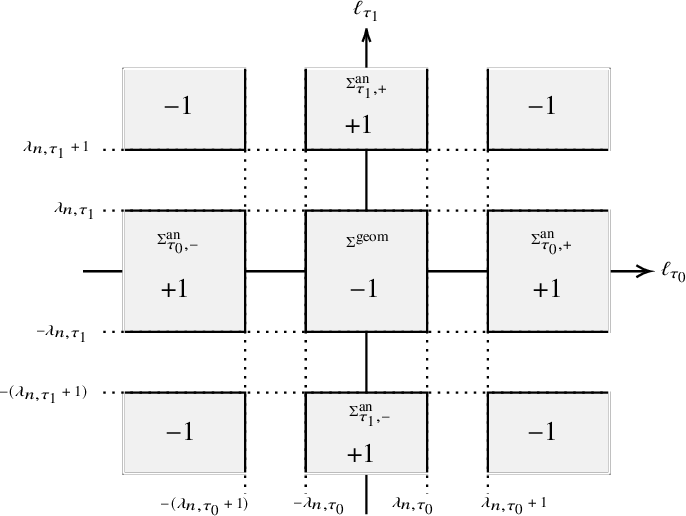


 Open access

