

Introduction
In 2024, Romania faced increased polarization and radicalization of political parties, possible foreign interference in electoral campaigns, and street protests contesting the annulment of the first round of presidential elections. Unpopular governments formed by corrupt, inefficient, and self-interested parties, and controlled by discredited gatekeepers, had difficulty maintaining credibility. Governments formed of political parties of all ideological persuasions have passed legislation favoring their supporters and allocated their budgets preferentially to counties and villages supporting them, while failing to curb corruption and favoritism (Stan & Zaharia Reference Stan and Zaharia2015, Reference Stan and Zaharia2018, Reference Stan and Zaharia2024). While the ruling PSD-PNL alliance bringing together the Social Democrat Party (PSD) and the National Liberal Party (PNL) seemed solid, popular dissatisfaction with the two ruling parties led to the rise of “sovereigntist” candidates and parties that challenge Romania's commitment to the European Union. The PSD is the leftist successor to the Communist Party, whereas the PNL is a Christian Democrat formation. Their “unholy” alliance in late 2021 may have convinced many Romanians that these parties misrepresent their ideological commitment and instead are interested in retaining power more than anything else.
The country registered one of the highest economic growth rates in the region. Wages and pensions were raised at a record high, recycling gained some popularity, and major infrastructure projects were completed. At the same time, inflation skyrocketed, the country's rating was downgraded, and the government continued to offer high pension packages to “special” groups of politicians, military, and intelligence agents.
The country was accepted in the Schengen space (effective 1 January 2025). Romania continued to support Ukraine, signing a 10-year cooperation deal in the field of security and offering Ukraine a Patriot surface-to-air missile system.
Election report
Romania organized local and European Parliament elections on 9 June, presidential elections on 24 November, and elections for the Romanian Parliament on 1 December.
In the local elections, voters elected 3180 mayors, 40,022 local councilors, 41 presidents of county councils, and 1338 county councilors (Biroul Electoral Central Website 2024b). The Social Democrats made significant strides at the expense of the Liberals, obtaining five more county council president seats, 188 more county councilor seats, 315 more mayoral seats, and 2689 more local councilor seats than in the previous elections. In a worrisome trend, voters supported the far-right Alliance for the Unity of Romanians (AUR) led by populist George Simion. The AUR obtained 11 per cent of council councilor seats, 6 per cent of mayoral seats, and 10 per cent of local councilor seats, ranking fourth in voter preferences, after the PSD, the PNL, and the Save Romania Union (USR). Voter turnout in local elections was around 49.9 per cent.
European parliamentary elections
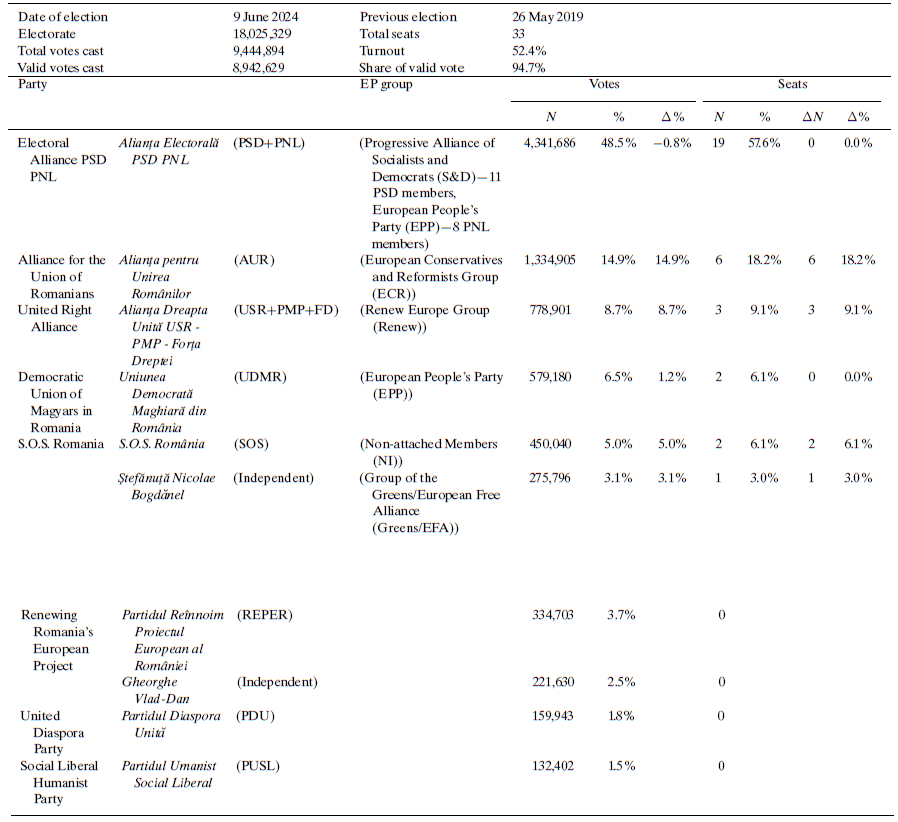
While in local elections the main two parties supported different candidates, PSD and PNL entered the elections for the European Parliament with a common list. The list won 48.5 per cent of votes, and thus PSD and PNL together obtained 19 of the 33 seats reserved for Romania (Biroul Electoral Central Website 2024c). This result was the same as in the previous elections.
Eight other seats were occupied by candidates representing far-right Euroskeptic parties (AUR and SOS), with the remainder been allocated to the USR (three seats) and the Democratic Union of Magyars in Romania, UDMR (two seats). Led by lawyer Diana Iovanovici-Șoșoacă, SOS Romania is a populist, nationalist, conservative, and irredentist far-right formation. Once sworn in as a member of the European Parliament, Șoșoacă engaged in several shouting matches meant to show her Euroskeptic credentials to supporters in Romania.
The decision to organize local elections on the same day as elections for the European Parliament was vehemently criticized by the opposition and the Venice Commission (digi24.ro 2025).
Information on elections to the European Parliament in Romania in 2024 can be found in Table 1.

Notes:
1. To win seats in the European Parliament, parties must get at least 447,131 votes (5% of all votes). Independent candidates need at least 270,988 votes (1/33 of all votes cast).
2. Nineteen PSD-PNL candidates were elected. Of them, 11 PSD members joined the Progressive Alliance of Socialists and Democrats and eight representing PNL joined the European People's Party.
3. In 2019, PSD and PNL presented separate lists. PSD obtained 22.5% of votes and nine seats, whereas PNL 27% of votes and 10 seats. The table reflects these data.
Source: Biroul Electoral Central website (2024c).
Parliamentary elections
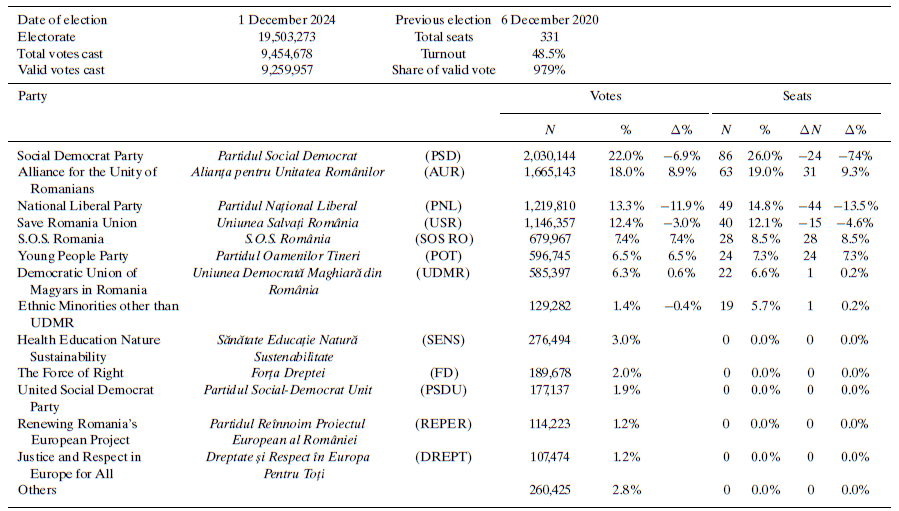
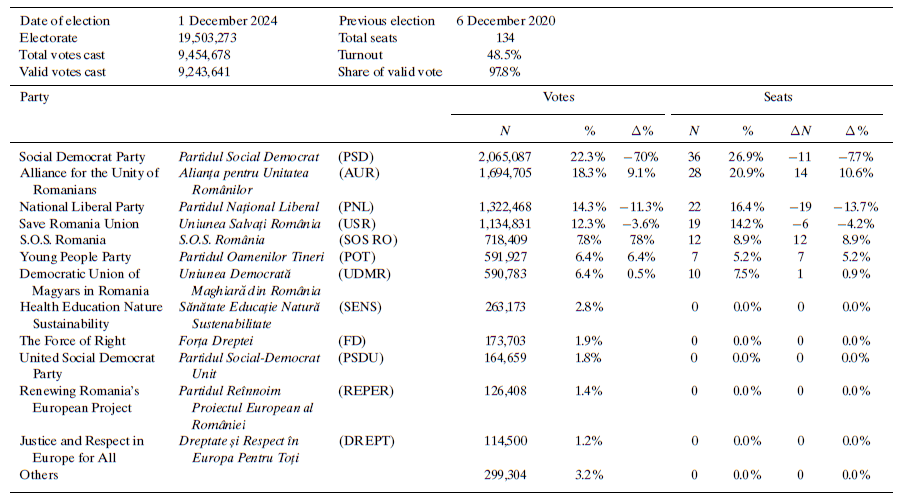
Elections for the Romanian Parliament were held on 1 December, on the weekend between the first and second rounds of the presidential elections. Accused of inefficiency, corruption, arrogance, and lack of transparency (Stan and Vancea Reference Stan and Vancea2024), the PSD and PNL lost 68 deputy and 30 senator seats, compared to 2020. Their loss represented a gain for “sovereigntist” parties, which argue that Romania bends too much to the whim of the EU and should take back decision making power to save the nation from being “diluted” by immigration and brain-drain.
Three sovereigntist formations (AUR, SOS Romania and Party of Young People, POT) won a combined 35 per cent of seats in each chamber. As such, the number of extremist legislators almost tripled in comparison to the previous legislature. The AUR doubled its seats in both chambers, whereas SOS Romania and POT together gained 18 senator and 51 deputy seats (Biroul Electoral Central Website 2024a).
Since the PSD and PNL lost their majority in both chambers, they were able to form the government only with the support of the UDMR and the 19 deputies representing minority groups.
Information on elections to the Parliament in Romania in 2024 can be found in Tables 2 and 3.

Source: Biroul Electoral Central website (2024a).

Note: UDMR and POT obtained roughly equal votes, which should have translated into roughly the same number of seats (nouă). POT has seven mandates because it had no candidates in two districts where it got votes. UDMR obtained its 10th mandate based on the electoral algorithm, by redistribution of votes from other parties.
Source: Biroul Electoral Central website (2024a).
Presidential elections
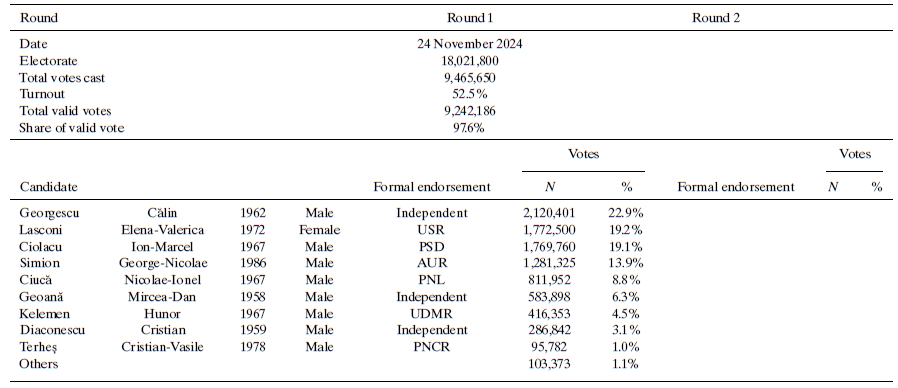
The first round of the presidential elections, held on 24 November, unfolded without a glitch. The Electoral Commission validated around a dozen contenders, raised no questions regarding campaign financing, and recorded no major incidents at the ballot or during the months-long electoral campaign that preceded the vote.
As votes were counted, Călin Georgescu, an independent candidate, emerged as the winner with over 2.1 million votes (23 per cent of all votes cast), ahead of Elena Lasconi, USR president and mayor of the Campulung Muscel town. AUR President Simion got 1.3 million votes (Table 4). The PSD and PNL candidates scored lower than Lasconi (Biroul Electoral Central Website 2024d).

It was the first time that an independent candidate came first (the top candidate conducted no campaigning through television, the press or door-to-door canvassing), a woman qualified for the second round, the candidates of large parties did not gather enough to advance to the second round, and extremist candidates (Georgescu and Simion) got more than one-third of the vote. Georgescu had quite a following among Tik Tok users, especially young voters, less educated voters, residents of villages and small towns, and Romanians part of the diaspora (Euronews Romania 2024).
After many hesitations and much blame-shifting, on 6 December, the Constitutional Court annulled the first round based on reports from information services that pointed to foreign interference with the vote, Georgescu's untransparent use of social media and AI during the campaign, and his failure to declare financial sources in full (Curtea Constitutionala 2024).
The decision was praised for blocking Georgescu, a candidate bent on turning Romania away from Europe and closer to Russia if winning the second round, a vehement critic of democracy and an admirer of interwar fascism (Higgins Reference Higgins2024). At the same time, the decision remained controversial because the evidence for the annulment was flimsy, and it looked like a Court controlled by the main parties that blocked an independent candidate critical of them. In addition, if the campaign (not the final vote) had been vitiated by bots and shady financing, it was unclear why the Constitutional Court and the Electoral Committee did not act sooner, before the vote count. The timing of the decision, two days before the second round was scheduled, but after parliamentary elections took place, it further polarized the electorate. Georgescu's remarkable success was fueled by support from POT and SOS Romania. The press suggested that in their quest to block each other's candidate from qualifying for the second round, the PSD and PNL pushed undecided voters to support a candidate they thought had no real chance of winning but was getting votes from the other party (Snoop.ro 2024; Vestea.net 2024).
Besides deciding to reschedule the entire first round of presidential elections, the Court lengthened the mandate of President Klaus Iohannis past 21 December 2024 until a new president was elected. Both Georgescu and Lasconi criticized the decision, which was also unpopular with a majority of the electorate (Mihalascu Reference Mihalascu2025). The Russian authorities denied any involvement in influencing the vote, whereas members of the US administration condemned the decision as undemocratic (The Moscow Times 2024; Reuters 2025).
Regional elections
Romania organized no regional elections.
Referendum
No referenda were organized in 2024.
Cabinet report
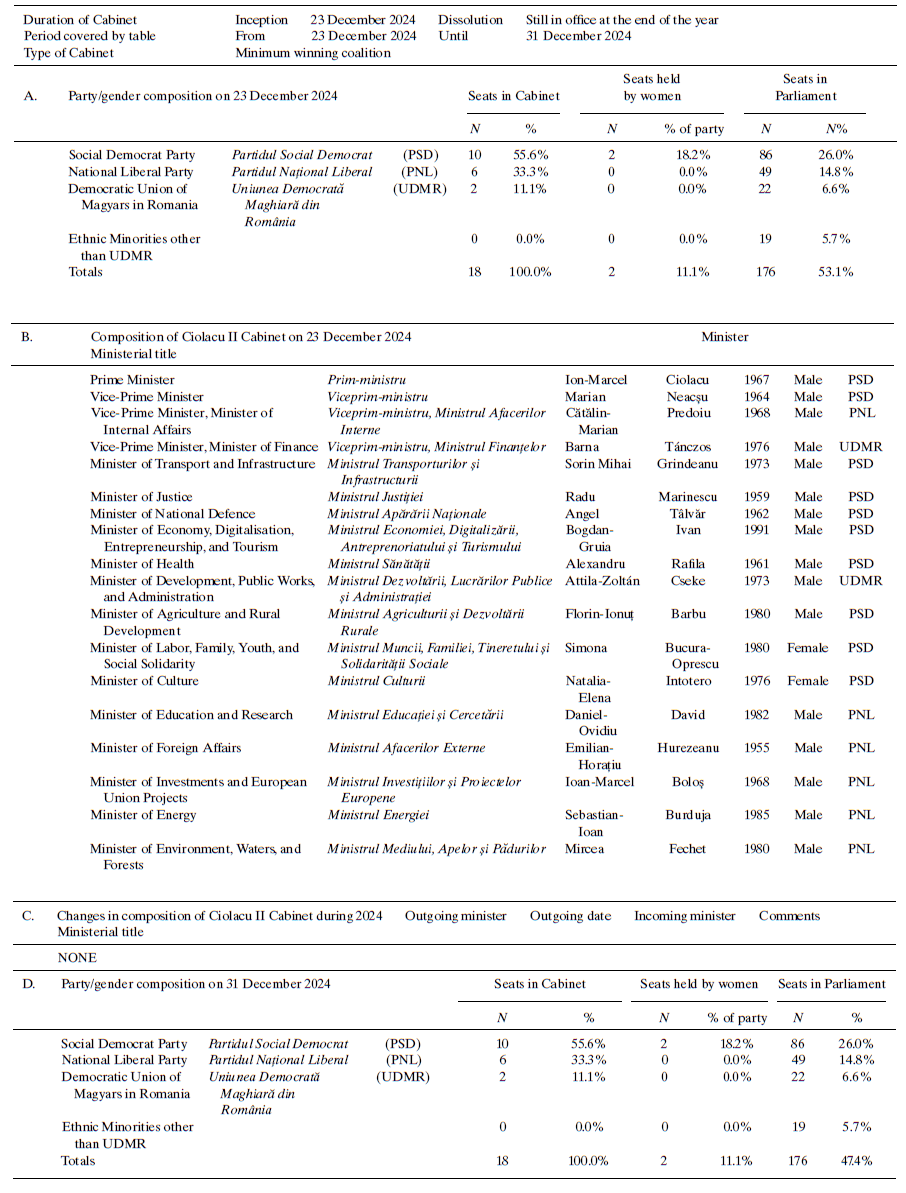
A new Cabinet was formed after the parliamentary elections. Immediately after the first round of presidential elections, the PSD and PNL leaders stated that they understood popular dissatisfaction and pledged to form a Cabinet free of corrupt politicians. However, Prime Minister Ion-Marcel Ciolacu formed a new government that included many members distrusted by the electorate (Costita Reference Costita2024).
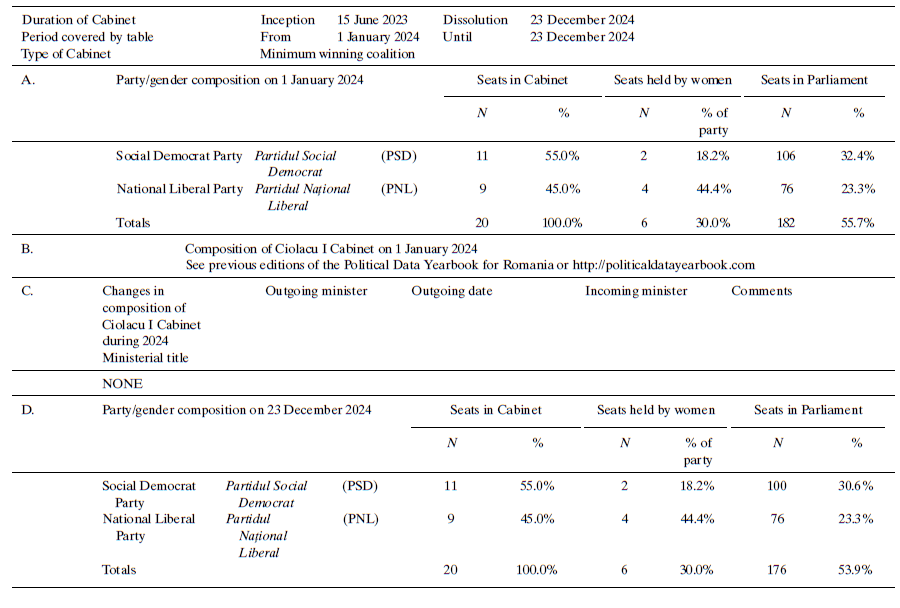
Thirteen of the 18 members of the Ciolacu II Cabinet had belonged to the Ciolacu I Cabinet. The new Cabinet includes two UDMR ministers, and none of the PNL ministers are seen as close to President Iohannis. The percentage of women decreased from 30 per cent in Ciolacu I to 11.1 per cent in Ciolacu II (Table 5).

The Ciolacu I Cabinet was replaced by a new government on 23 December. Table 5 presents the composition of Ciolacu I, whereas Table 6 presents the composition of Ciolacu II. There were no changes in the composition of Ciolacu I during 2024.

Source: Guvernul României website (2024).
Parliament report
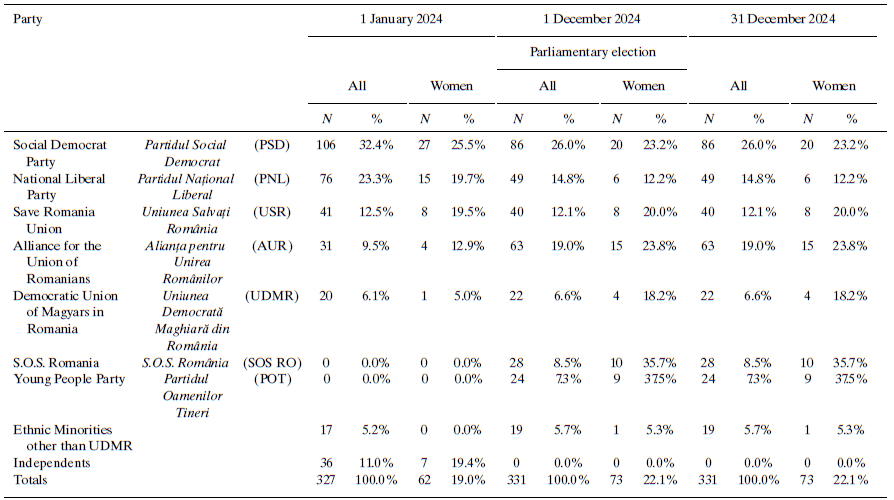
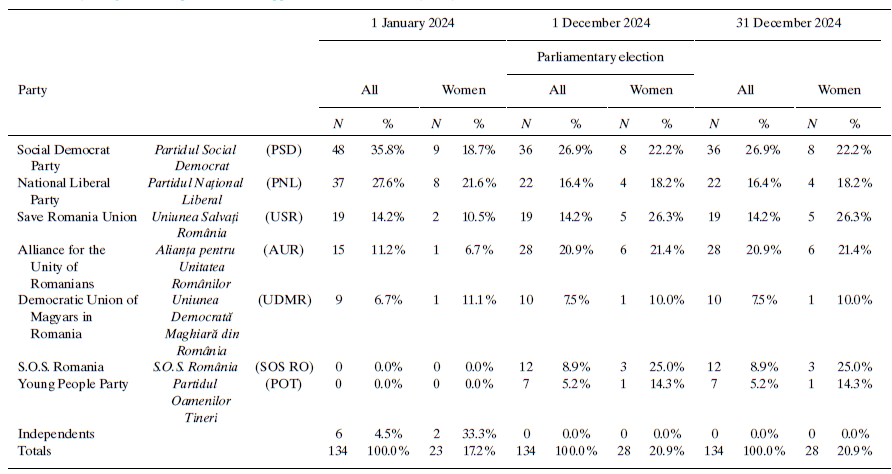
The parliamentary elections significantly changed the composition of the two chambers (see Tables 7 and 8). There is a precarious balance between the parties in government (PSD, PNL, and UDMR) and those forming the opposition (AUR, SOS, POT, and USR).


Political party report
There were no major changes in political parties. Two new sovereigntist and extremist parties, SOS Romania and POT, secured entry into Parliament. Their leaders had been AUR legislators in the previous legislature.
SOS Romania was set up in November 2021 but came to public attention only in May 2022, when Senator Diana Iovanovici-Șoșoacă (female, 1975) became its leader. This right-wing party has a nationalist, irredentist, neo-fascist, anti-European, and antisemitic platform. Iovanovici-Șoșoacă became an AUR senator in 2020 and a member of the European Parliament representing SOS Romania in 2024. On 10 February 2021, she was excluded from AUR only to join SOS on 30 May 2022. She is known for her aggressive and offensive language and behavior, a pro-Russian, anti-NATO and anti-EU stance, and support for conspiracy theories and far-right positions. Her candidature in the 2024 presidential election was invalidated by the Constitutional Court on 5 October 2024. The two SOS members in the European Parliament were not accepted by any political group and, therefore, remain independent.
POT was founded on 31 July 2023 by Anamaria Gavrilă (female, 1983), a former AUR deputy. As AUR, POT declares itself a sovereigntist, conservative, Euroskeptic, populist, anti-system party that draws on traditional, Christian values. It supported Georgescu in the presidential elections. By making use of social media (especially Tik Tok), POT managed to pass the 5 per cent electoral threshold to enter both chambers of Parliament. POT lost one senator seat in two different electoral districts because its list included only one name for each district. Its deputies and senators are not young (thus contradicting the party's name) and are related to each other (Europa liberă Romania 2024).
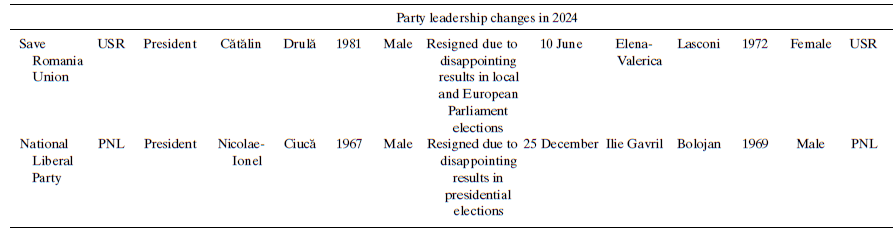
After elections, the leaders of the PNL and USR tendered their resignation because of their parties’ weak results (Table 9).

Institutional change report
No significant changes occurred in 2024.
Issues in national politics
Several party leaders and public luminaries faced charges of corruption and plagiarism. The most important corruption charge was directed against Prime Minister Ciolacu and other PSD leaders. The Nordis realtor sold apartments in advance of their construction to multiple buyers for steep prices. The Nordis general manager is the husband of Laura Vicol-Ciorbă, a PSD deputy and the head of the Judicial Committee of the Chamber of Deputies. Investigative journalists found out that in 2022 several PSD leaders (including Ciolacu, Sorin Mihai Grindeanu, Alfred-Robert Simonis), their relatives, and collaborators traveled outside of Romania on private jets hired by Nordis to attend sport events (the Formula 1 in Monaco and an UEFA Champions League game in Madrid). None of these persons could prove they paid the cost of the trip, and none mentioned the trip on their wealth declaration in 2023. Ciolacu first denied the trips, then claimed they were his gifts for his child (G4Media.ro 2024).
President Klaus Iohannis was also accused of using a private jet. In 2024, the cost of his trips abroad reached 5.7 million euros. The Presidential Office refused to show receipts or justify these expenses (HotNews.ro 2025). His decision to rebuke efforts to clarify these expenses was vehemently criticized by the press. Another controversial decision related to his bid on 12 March to secure the position of NATO Secretary General. The candidature took everyone by surprise since Mark Rutte was the frontrunner. Iohannis withdrew his candidature on 20 June.
Mircea Dan Geoană, a former PSD leader, Deputy Secretary General of NATO and presidential candidate in 2024, as well as Gabriel Vlase, the head of the External Information Service, were accused of plagiarism (Știrile ProTV 2024). These are the latest in a long series of politicians accused of obtaining academic titles by using other people's work. Over the years, some of these accusations have been proven to be correct.
Romania and Ukraine have deepened their collaboration since the Russian invasion of Ukraine in February 2022. The countries share a 650-km border. In July 2024, Romania and Ukraine signed a 10-year security agreement to allow Romania to supply military aid and train Ukrainian fighter pilots and marines (Wesolowsky Reference Wesolowsky2024). Romania facilitated the transit of Ukrainian grain and other goods toward European markets.
Romania continued to maintain strong ties with Israel, while offering humanitarian support for civilians in Gaza. In 2024, it received patients in need of urgent care and accompanying relatives (Directorate-General for Neighbourhood and Enlargement Negotiations 2024).
Economic growth stagnated in 2024 after Romania outperformed most of its neighbors for a number of years. The country attracted foreign direct investment and remained the leading electronics producer in Southeastern Europe, with competitive labor costs and one of the lowest income tax in the EU.
By far, the most important issue dividing the Romanian society was the decision to annul the results of the first round of presidential elections in December, immediately followed by investigations into Georgescu's public support for interwar Romanian fascist leaders, which if proven, would make him indictable. AUR and other supporters of Georgescu staged several protests in Bucharest and other localities in Romania and abroad to denounce the “dictatorial” decision that “canceled democracy” (Euronews 2024).

 Open access

