

Elected officials’ communication efforts are an important part of representation (Fenno Reference Fenno1977; Grimmer Reference Grimmer2013). Historically, traditional media outlets have been a major way that politicians have reached their constituents. However, traditional media outlets have demonstrated bias against women, making it harder for them to reach voters (Baitinger Reference Baitinger2015; Heldman, Carroll, and Olson Reference Heldman, Carroll and Olson2005; Kahn Reference Kahn1992, Reference Kahn1994). This poses a challenge for women in politics; they need to reach voters but face obstacles in utilizing a primary avenue, traditional media outlets, for doing so. The rise of Twitter and other social media tools represents one way that women may be able to overcome bias in media coverage by allowing politicians to circumvent traditional media and directly reach voters. In this paper, we test whether women state legislators are more likely to use Twitter. We also explore whether gender predicts how politicians communicate with the public through Twitter.
We evaluate several hypotheses to learn about the differences between men and women. Some of these hypotheses tell us about what motivates politicians when they think about their election prospects. For example, previous work has argued that female politicians have strong incentives to portray themselves as conservative in order to counteract the stereotype that they are more liberal than their male, co-partisan colleagues (Koch Reference Jeffrey2000). Another stream of research shows that women work harder in political office (Kurtz et al. Reference Kurtz, Moncrief, Niemi and Powell2006), speak more in the legislature (Pearson and Dancey Reference Pearson and Dancey2011), put more effort into their constituency service (Thomsen and Sanders Reference Thomsen and Sanders2020), and produce more legislation (Anzia and Berry Reference Anzia and Berry2011; Volden, Wiseman, and Wittmer Reference Volden, Wiseman and Wittmer2013), suggesting that gender may affect how much effort state legislators will put into the time-consuming task of social media communication.
Other hypotheses have important implications for levels of descriptive representation. Previous work has found that politicians’ communications can bias the information environment for voters. For example, Grimmer (Reference Grimmer2013) finds that politicians with more extreme preferences are more likely to communicate about policy issues and moderate politicians are more likely to discuss nonpolicy-related funding that they secure for their district. The differences in how these groups communicate allow extremist views to dominate the public policy debate. In a similar way, if men and women communicate differently, this has implications for what voters hear because women are underrepresented in office. Previous work has argued that women tend to work more on issues like education and health care (Foerstel and Foerstel Reference Foerstel and Foerstel1996; Reingold Reference Beth1992; Saint-Germain Reference Saint-Germain1989; Swers Reference Swers1998, Reference Swers2002; Thomas Reference Thomas1994; Thomas and Welch Reference Thomas and Susan1991). If women also discuss these issues more, then electing more women will lead voters to hear and learn more about these issues. We test whether gender predicts how much legislators communicate on these issues.
To build the broad dataset necessary to undertake this analysis, we harness the massive trove of communication by American politicians through Twitter. Just as it has become a highly visible mode of political discourse in national politics (Garofoli Reference Garofoli2018), social media is now one of the primary modes of political communication for state legislators. As we show, a majority of members of state lower houses have public Twitter handles, with the average lawmaker tweeting over 1,000 times. Together, the lower house state legislators we study produced over three million tweets in our period of study from October 2015 to July 2018.
This wealth of data presents both an opportunity and a challenge for state politics scholars. Lawmakers in statehouses all across the nation are speaking via the same medium, and doing so both during campaign seasons and while they are governing. Holding the medium constant, scholars can study what they have to say before, during, and after elections, whether the electoral rules under which they run affect their ideological positioning, whether citizen lawmakers speak differently from those in professional legislatures, or whether polarized statehouses produced more negative discourse. With user engagement data, scholars can determine what forms of political communication followers are most apt to like or retweet and whether this varies by state and party. But in order to answer such questions, researchers must make sense of a mountain of data (for review of prior work, see Jungherr Reference Jungherr2016; Vergeer Reference Vergeer2015).
The modern tools of machine learning can aid in the task of classifying the topics, tone, and content of the enormous amount of data that state legislators are producing every day on Twitter. Machine learning techniques for text analysis can be divided into two approaches. In the first, “unsupervised learning,” researchers mine data for attributes, such as the topics that cluster together, and then attribute meaning to the output of these algorithms. We adopt the second approach, “supervised learning,” a hybrid between qualitative and quantitative techniques that begins by applying human judgment to code texts and then uses these codings to train machine learning algorithms (see Grimmer and Stewart Reference Grimmer2013; Peterson and Spirling Reference Peterson and Spirling2018). Only after testing how precisely the algorithms can replicate human codings, and ensuring sufficient accuracy, do we move onto the stage of classifying the full set of state political tweets. This approach, which we detail below, has been used to study political tweets in gubernatorial elections by McGregor et al. (Reference McGregor, Lawrence and Cardona2016), in the Australian Parliament by Kousser (Reference Kousser2019), and for US presidential candidates by Kousser and Oklobdzija (Reference Kousser and Oklobdzija2018). Here, we apply it to state legislators, producing the largest set of classified tweets, including 3,580,727 spanning 49 distinct political systems, that we have seen in the literature.
Four main findings emerge from our analysis. First, women communicate more than men. They are more likely to have Twitter accounts and to use them. Second, in contrast to previous work, we find that female legislators’ tweets have a more positive tone than male legislators’ tweets. Third, women do discuss women’s issues more than their male counterparts, tweeting about both education policy and about health care policy more often. Fourth, gender does not appear to predict the ideological content of tweets after we control for legislators’ roll call records.
In what follows, we first draw hypotheses about gender and legislator communication from the previous literature. We then describe and validate our original dataset and use it to test the hypotheses we lay out. We summarize the findings and their implications in the conclusion.
Theories about Gender and Social Media Communication
Allocating Resources to Twitter Communication
Before politicians decide what to tweet, they must first decide whether they will tweet at all and how often they will do so. This choice is a strategic choice because committing to establishing a social media presence requires a significant investment of time. To study the “tweet styles” of Australian legislators, Kousser (Reference Kousser2019) draws upon Fenno’s (Reference Fenno1977) classic work on the home styles adopted by members of Congress in their districts. Kousser makes an analogy between Fenno’s concept of the allocation of resources that representatives devote to connecting with their districts and the allocation of effort that today’s lawmakers devote to connecting through social media.
While tweeting does not require the pecuniary investments that are necessary to set up and staff a district office or to fly home to meet with constituents, social media communication taxes a lawmaker’s most vital resource: time. According to Fenno (Reference Fenno1977, 890), “Of all the resources available to the House member, the scarcest and most precious one, which dwarfs all others in posing critical allocative dilemmas, is his time.” Tweeting consistently requires a significant investment of time and attention from lawmakers. The price of this investment is magnified because most state legislators typically author their own Twitter feeds. They must do so while still fulfilling a host of other job commitments. Kurtz et al.’s (Reference Kurtz, Moncrief, Niemi and Powell2006) survey, conducted long before social media added yet another demand to the busy lives of state legislators, demonstrates the immense time commitment required by serving in a statehouse, even one that pays a small salary and is considered a part-time body.
We argue that allocating time toward tweeting is a costly activity whether the lawmaker communicates directly or indirectly to constituents.Footnote 1 How should a lawmaker’s gender impact this allocational decision? We expect that female legislators will be more likely to establish a social media presence—both by creating a public Twitter account and by tweeting more often —than male legislators. There are a few reasons this might occur.
First, electoral discrimination might lead to “sex-based selection.”Footnote 2 Anzia and Berry (Reference Anzia and Berry2011) argue that “if voters discriminate against female candidates, only the most talented, hardest working female candidates will win elections” (478; see also Fulton Reference Fulton2012, Reference Fulton2014; Pearson and McGhee Reference Pearson and McGhee2013). Consistent with this argument, Anzia and Berry (Reference Anzia and Berry2011) find that female members of Congress in fact outperform men when it comes to securing district funding and sponsoring and co-sponsoring legislation (see also Volden et al. Reference Volden, Wiseman and Wittmer2013). If this same sex-based selection mechanism operates in state legislatures, we should expect female lawmakers to work harder when it comes to social media communication.
Second, women in state politics may be more motivated to devote time to tweeting because they are simply responding to the demands that constituents are making of them. In a field experiment conducted in collaboration with state legislators, Butler et al. (Reference Butler, Naurin and Öhberg2020) find that when men and women legislators make the same outreach to constituents, constituents are more likely to ask women legislators to do more work. Legislators are motivated by a desire to win reelection and so craft their homestyles in order to please voters. If constituents are asking more of women, women may in turn do more in order to be responsive. Although many studies show that female candidates perform very well in general elections (Burrell Reference Burrell1994; Fox Reference Fox, Carroll and Fox2006; Newman Reference Newman1994; Seltzer, Newman, and Leighton Reference Seltzer, Newman and Leighton1997), this may be because they are doing more to meet voter demands rather than because voters are not demanding more of them.
Third, traditional media outlets might be biased against women (Baitinger Reference Baitinger2015; Heldman, Carroll, and Olson Reference Heldman, Carroll and Olson2005; Kahn Reference Kahn1992, Reference Kahn1994). Women legislators might prefer to reach their constituents through traditional news outlets but prior studies reveal that they are simply not be covered at the same rates as men (Heldman, Carroll, and Olson Reference Heldman, Carroll and Olson2005; Kahn Reference Kahn1992). If they face obstacles to reaching voters through traditional news outlets, women may get around this issue by using Twitter to directly reach out to voters. Twitter thus allows them to circumvent the agenda power of media and communicate to voters on their own terms. While this is an advantage for both men and women, the gender bias in the media should make this a relatively more attractive option for women, leading to greater uptake of Twitter among female legislators.
Whatever mechanism is at work, we predict that female legislators will work harder than men to establish a social media presence. If this is true, it will be consistent with Kurtz et al.’s (Reference Kurtz, Moncrief, Niemi and Powell2006, 332) finding that women in state legislators “devote an additional 7 percent of a full-time job to their legislative work compared with men.” It will also fit with Evans and Clark’s (Reference Evans and Clark2016) finding that female candidates tweeted more often than male candidates in the 2012 congressional elections and Thomsen and Sanders’ (Reference Thomsen and Sanders2020) study showing that women put more effort into their constituency service. In the social media realm, we set forth two empirical hypotheses to test the idea that female state lawmakers put forth more effort in this realm than their male counterparts.
Hypothesis 1: Compared to men, female state lawmakers will be more likely to establish a public Twitter account.
Hypothesis 2: Compared to men, female state lawmakers will tweet with greater frequency.
Sentiment
Prior research has tested whether gender predicts how negative politicians are in their public communications (e.g., Evans and Clark Reference Evans and Clark2016). Gender stereotypes are a reason why gender might be correlated with the tone of communication. Society stereotypes women as being more helpful and kind and men as more aggressive and forceful (Fridkin and Kenny Reference Fridkin and Kenney2009; Huddy and Terkildsen Reference Leonie and Terkildsen1993). If voters hold these stereotypes, this can shape what voters expect from them and how they respond to the tone of politicians’ communications.
The effect of legislators’ tone on voter evaluations is unclear. Some scholars conclude that voters punish women when they act in ways that are counter to existing stereotypes (e.g., Kahn Reference Kim Fridkin1996). Yet others conclude that taking a more negative tone helps women because it challenges those stereotypes (Lau and Pomper Reference Lau and Pomper2004).
In looking at social media, Evans et al. (Reference Evans, Cordova and Sipole2014) and Evans and Clark (Reference Evans and Clark2016) find that women are more likely to send more negative attack tweets (cf., Parmelee and Bichard Reference Parmelee and Bichard2012). Evans and Clark (Reference Evans and Clark2016) also find that the number of negative tweets (coming from both men and women) increases with the number of women in the race. One reason that women may be negative in their tone is that they are more likely to be attacked (Lazarus and Steigerwalt Reference Lazarus and Steigerwalt2018). This may lead them to defend themselves with tweets that have a more negative tone because they are trying to deal with a more hostile political environment. On the other hand, women may feel more pressure regarding reelection (Krook Reference Krook2020), leading them to try to win over constituents using a more positive tone in their tweets. We test whether this relationship identified at other levels of office holds among state legislators.
Hypothesis 3: Compared to men, female state lawmakers’ tweets will be more likely to have a negative tone.
Issue Focus
Men and women may also differ in the policy content of their communication. At the most basic level, they might differ because they work on different issues. Previous studies have identified health, welfare, and education as “women’s issues” (Saint-Germain Reference Saint-Germain1989; Swers Reference Swers1998, Reference Swers2002). Other studies have instead focused on specific issues: for example, focusing on funding for breast cancer as opposed to all health care funding generally (Osborn Reference Osborn2012; Reingold Reference Reingold2000). We focus on the general categories, in part, because of the data. There are few tweets on any given specific issue. Indeed, there are some major categories that are rarely tweeted about. Looking at the more general categories provides greater variation for analysis. However, using general categories is a noisier measure. This is why “[s]tudies that adopt a more specific definition of women’s issues, or those issues that directly affect women, find a closer connection between women’s presence and policy outputs benefitting women” (Osborn Reference Osborn2012, 27). For this reason, our test is a harder test of gender differences in issue coverage.
Theoretically, research suggests that women may be more likely to work on these issues because they have more knowledge about these issues or simply because they personally prioritize these issues (Foerstel and Foerstel Reference Foerstel and Foerstel1996; Reingold Reference Beth1992; Thomas Reference Thomas1994; Thomas and Welch Reference Thomas and Susan1991). Either way, previous studies have found that women are more active in policy making on women’s issues.
During the committee stage, women are more likely to advocate for women’s interests (Swers Reference Swers2002). And committees with more women are more likely to produce legislation that incorporates women’s interests (Berkman and O’Connor Reference Berkman and Robert1993; Norton Reference Norton1999; Swers Reference Swers2002). Further, female legislators in both the United States (Thomas Reference Thomas1994; Thomas and Welch Reference Thomas and Susan1991) and elsewhere (Considine and Deutchman Reference Considine and Deutchman1994; Heath, Schwindt-Bayer, and Taylor-Robinson Reference Heath, Schwindt-Bayer and Taylor-Robinson2005) are more likely to serve on committees that deal with issues traditionally considered women’s issues.
Even after legislation leaves the committee, women are more active on these issues with female legislators in Congress participating more in floor debates on women’s issues (Swers Reference Swers2000; Tamerius Reference Tamerius, Duerst-Lahti and Mae Kelly1995). The focus is not simply because women have more opportunities to work on women’s issues. When men and women are given the same requests for help, female legislators are more likely to work on women’s issues than are their male counterparts (Butler Reference Butler2014).
In identifying women’s issues, we use general categories rather than specific issues. In order to classify tweets by issue areas, we follow the categorizations created by the US Policy Agendas Project Codebook (see Adler and Wilkerson Reference Adler and Wilkerson2014).Footnote 3 “Education” tweets are ones that fit the topics in 600: Education in that coding system, and include primary and higher education as well as tweets about universal pre-K. Our “Healthcare” category includes policies fitting into 300: Health, including references to Medicaid, the Affordable Care Act, Medicare for All, and prescription drug prices. We did not use a separate “Welfare” category, because tweets about this policy area were so rare. In our training dataset of 10,104 hand-coded tweets, only five used the word “welfare,” with three of these being references to corporate welfare and thus included under macroeconomic policy. After classifying all state tweets, following the machine learning process that we detail below, we test whether women are more likely than men to discuss women’s issues by comparing their rates of tweeting about education and health care.
Hypothesis 4: Compared to men, female state lawmakers’ tweets will include more content on education and health care policy.
Ideology
In this study, we look at how legislators communicate with their constituents. In order to win elections, politicians want to publicly take positions that appeal to voters. This can lead politicians to try to shape their public record to appear to be more in line with their voters’ preferences. Gender can affect this dynamic because voters think female, Republican legislators are more liberal than male, Republican legislators and they think female, Democratic legislators are more liberal than male, Democratic legislators (Koch Reference Jeffrey2000). If this leads voters to think that the voters are out-of-step with their constituents, then legislators have incentives to engage in more conservative position-taking in order to compensate for voters’ stereotypes and present themselves as in-line with their constituents.
Hypothesis 5: Controlling for their positions on roll calls, female state lawmakers’ tweets will be more conservative than male state lawmaker’s tweets.
We might see a partisan difference in how legislators take positions because of their incentives to appeal to primary voters (Brady, Han, and Pope Reference Brady, Han and Pope2007). Democratic women may not try to appear more conservative than their voting record simply because being viewed as liberal can help them in the primary election (Sides et al. Reference Sides, Tausanovitch, Vavreck and Warshaw2020). Thus, we may not see any relationship between gender and Twitter ideology among Democrats once we control for their roll call-based ideology. Republican women, by contrast, have incentives to appear more conservative in order to win their primary elections (Koch Reference Jeffrey2000). This suggests that we may only see Republicans engaging in position-taking to make themselves appear more conservative than they really are.
Hypothesis 6: Among Republicans, female state lawmakers’ tweets will be more conservative than male state lawmakers’ tweets when controlling for their roll call record.
Case Selection
We study legislators’ tweets—and focus on the states—for four reasons. First, legislators control their tweets. In contrast to coverage in traditional media, the legislators are able to control what they write. This is important because it may be that the media systematically covers female politicians differently than male politicians. If we look at the media coverage, then it is unclear if we are measuring the actions taken by the legislators, the biases of the media, or a combination of both. Because we are interested in how politicians choose to portray themselves, looking at Twitter—a communication form they control—allows us to do that (see also Pearson and Dancey Reference Pearson and Dancey2011; Pearson and McGhee Reference Pearson and McGhee2013).
Second, at least in some legislatures, women face institutional constraints that affect their ability to influence legislation or other outcomes (Hawkesworth Reference Hawkesworth2003). Twitter is a tool that is not controlled by legislative leaders or legislative institutions and therefore allows us to measure the legislators’ activity free from any biases against them or constraints placed on them.
Third, tweets are public information. We need access to what legislators say in order to measure how legislators portray themselves. Twitter has this information. Also, legislators cannot microtarget tweets. It is not the case that women can send messages only to female followers and men only to male followers. If they could, we might worry that the differences in content might reflect the specific group they were microtargeting. This is not the concern because we are getting the public tweets that they use to speak to all constituents, the media, and fellow legislators.
Fourth, social media and Twitter are an increasingly important form of communication. They are used extensively not only by American state legislators but also by politicians all around the world (Alles and Jones Reference Alles and Jones2016; Jungherr Reference Jungherr2016; Vergeer Reference Vergeer2015). Understanding how politicians communicate through a medium that they use nearly every day is critical to understanding how they choose to portray themselves—and how the public perceives them—in the modern era.
Focusing on state legislators in particular provides a strong empirical ground in which to study the impact of gender on communication styles. In our dataset, there are 1,391 female lawmakers, making up 25.7% of state legislators overall. This includes 535 Republican women and 845 Democratic women. By contrast, during the 116th Congress, only 101 women served in the House, including 88 Democrats and just 13 Republicans.Footnote 4 Compared to Congress, studying the states provides more opportunity to identify systematic patterns and to differentiate the effects of gender from those of party. And studying Twitter in state legislatures can provide a particularly unfiltered view of political communication. The scarcity of staff resources makes it more likely that state legislators send tweets themselves rather than relying upon staff, relative to members of Congress. When studying the impact of an individual attribute such as gender, this ability to observe direct personal behavior is valuable.
Data Collection
In order to combine human coding with machine learning techniques to classify the tweets of all lower house state legislators, we proceeded in four steps:
-
• Classifying and validating a “training set” of 10,104 hand-coded tweets
-
• “Pre-processing” the tweets to focus on their essential linguistic characteristics
-
• Training machine learning algorithms to replicate the hand codes, and testing their accuracy
-
• Classifying the full corpus of 3,580,727 tweets.
We began by creating a training set of tweets by American politicians over the last several years, categorized by their ideology, sentiment, whether they contained explicitly political subjects or not, the policy area that they address, and whether they constituted an opinion or a factual claim. We did so by building on the work done by Kousser and Oklobdzija (Reference Kousser and Oklobdzija2018) who had a team of multiple research assistants (RAs) hand code a random sample of 8,206 tweets by the 2016 presidential candidates and their SuperPACs. These tweets were downloaded from Twitter’s public API every week from October 2015 to July 2018.Footnote 5
We then supplemented the database from Kousser and Oklobdzjia (Reference Kousser and Oklobdzija2018) with 1,898 tweets from upper house state legislators and statewide officeholders that we coded for this project. We coded the tweets from the upper house state legislators because we wanted to make sure we included communications from those serving in a legislative context in our training dataset, but to train our algorithms on a set of tweets that was distinct from the lower house tweets in the full corpus that we later analyze. We downloaded the tweets from state legislators and state officials beginning in June 2018. We also had a group of RAs hand code the tweets using the same procedure as Kousser and Oklobdzjia (Reference Kousser and Oklobdzija2018). In particular, all RAs worked from the same codebook and met regularly but coded tweets independently and were given only the text of the tweet, with no information about who sent it.
Table 1 provides data demonstrating that these coders reliably agreed in their independent categorizations. Using a subset of 1,217 presidential tweets, which were assigned to overlapping pairs of coders, we report two measures of intercoder reliability: the rate of agreement between coders and the Cohen’s Kappa, measuring how much more likely our coders were to agree than two coders would be by random chance alone. Our rates of agreement range from 75% on our three-category sentiment measure to perfect agreement on three of our subject areas, with the Cohen’s Kappa measures ranging from “fair” to “almost perfect” agreement levels for all but one of our variables. For our measure of ideology, the coders agreed 78% of the time, with a Cohen’s kappa of 0.66, demonstrating that they could make this subjective judgment in a reliable, replicable manner.
Measures of intercoder reliability: humans agreeing with humans

Note: Based on an analysis of 1,217 tweets coded by rotating pairs of research assistants.
In Table 2, we provide examples of tweets by state politicians that fit into the key categories that we focus on in this analysis. We show what types of text would highlight to our coders that a tweet had liberal, neutral, or conservative ideological content, as well as whether it conveyed negative, neutral, or positive sentiment. We report tweets that were identified as falling into the education or health care policy realms, two types of “women’s issues” highlighted by prior research (Saint-Germain Reference Saint-Germain1989; Swers Reference Swers1998, Reference Swers2002) and following the policy categories used by the Policy Agendas Project to code federal bills by Adler and Wilkerson (Reference Adler and Wilkerson2014). For each category, we report how prevalent it was in the full corpus of state lower house tweets, according to our classifications.
Examples of variables and tweets in each category

With this training set in hand, we then pre-processed the tweets through a series of steps that are commonly used in text analysis. We made every word lower case, removed URLs as well as additional links and emails, and deleted all alphanumeric text. Depending on whether it improved prediction accuracy for individual characteristics of tweets, we also removed unnecessary stop words such as “the,” “a,” or “an,” and removed screen names.
We then used the remaining text of each tweet, along with the human codings of their characteristics, to train a set of algorithms that fit models connecting the text to the codings. The algorithms that we used in this stage of the analysis were all taken from the scikit-learn Python library.Footnote 6 To train the algorithms, we divided our training set of 10,104 tweets, using 80% of them to train, 10% to test the accuracy and select the most accurate algorithm, and 10% to use as a “final testing set,” which avoids over-fitting a model. Table 3 reports the results of these final tests. The first column shows accuracy for each variable, which is rate at which the algorithm was able to correctly replicate the human coding. The second column reports the Cohen’s kappa, which is the improvement in accuracy over what we would expect by random chance if the algorithm always placed a tweet in the most prevalent category. For the policy variables, which take on only two values, accuracy is consistently high, registering over 90% in final testing accuracy for every policy area other than environmental policy (which does not feature in our analysis). While accuracy is lower for sentiment and ideology, reflecting the increased difficulty of correctly coding a variable that takes on three values, Cohen’s kappa values fall just over or just below the “moderate” threshold (Landis and Koch Reference Landis and Koch1977, 165) for both variables.
Measures of classification accuracy: computers replicating humans
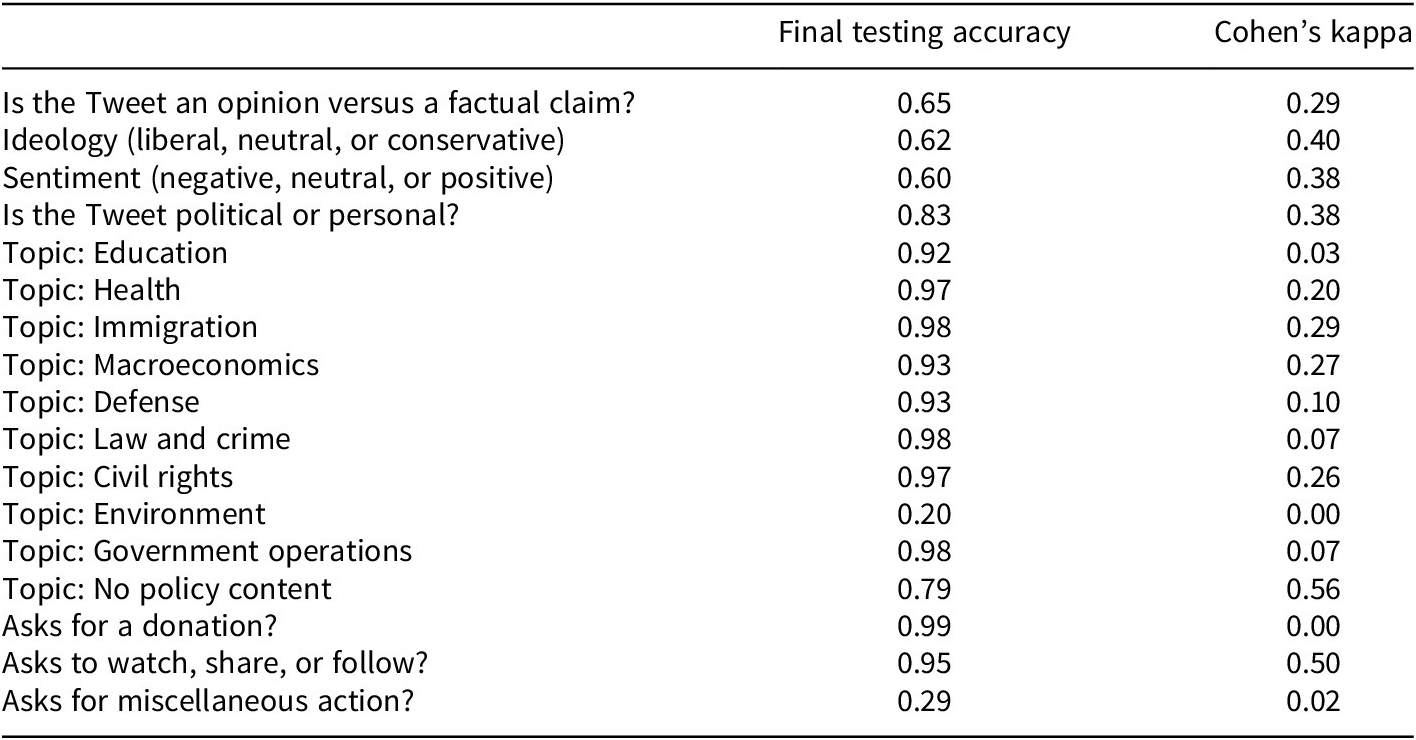
Note: Based on an analysis of a final testing set of 1,010 tweets after training on 8,084 tweets and testing on 1,010 tweets.
Finally, we used the trained algorithms to classify an original dataset of the tweets of all lower house state legislators. To collect these tweets, we began by working with undergraduate RAs to search for the Twitter handles of all legislators serving in lower houses of 49 states—excluding Nebraska’s unicameral, nonpartisan house—in the summer of 2017. The RAs generally started by first performing a search for a one of the legislators on their list. In some states, especially more professional states, the handles were sometimes publicly listed together. More often, the RAs first found the Twitter account for one legislator and then found that the other legislators in their party in the state often linked to that account.
The RAs were unable to find accounts for many legislators, even after using several variants of the legislator’s names in the search. If the RAs were unable to find an account after searching for several minutes, they moved on to the next account. RAs also limited the sample to publicly listed accounts because we are interested in how legislators portray themselves to the public. Once the RAs identified a likely match, they looked at several tweets in the accounts to confirm that they had correctly identified the legislator’s account. In a few cases, the legislator did not have an account, but accounts were set up to parody the legislator. In other cases, legislators had multiple accounts. RAs looked through these accounts and identified the account(s) that were used as the legislator’s account during the legislative session. In some cases, legislators had multiple accounts that met these criteria; in those cases, all accounts were used in the study. In many of these cases, the dates the accounts were used did not overlap, suggesting that it may simply have been a case where the legislator forgot their password and decided to simply create a new account.
The RAs also recorded the genders,Footnote 7 party affiliations, and districts represented by these 5,413 state legislators.Footnote 8 Of these lawmakers, 2,014 (37%) did not have a public Twitter handle that we could identify. For the 3,399 (63%) of state legislators who did have a social media presence, we collected all available tweets from Twitter’s public API that were available in April 2019. This produced a dataset of 3,580,727 tweets. We then classified the features of these tweets and then calculated the average rates of each type of tweet for each tweeting legislator, along with their total tweet count. We merge this dataset with our data on legislator characteristics, successfully matching 3,129 state legislators to their tweet records. Finally, we appended data ideology based on statehouse roll call voting and national survey responses for all state legislators elected before 2016, using Shor and McCarty’s (Reference Shor and McCarty2011), updated with data from all legislators elected before 2016 through their website.Footnote 9
In order to explore the validity of the classifications the algorithms produced, we can compare our tweet-based ideology score with the roll call-based measures for state legislators collected by Shor and McCarty (Reference Shor and McCarty2011). Although lawmakers may choose to vote and to communicate in slightly different ways (e.g., Hypotheses 5 and 6), there should be a strong correlation between the ideological positions that legislators take on the floor and the images that they convey on social media.
As Figure 1 shows, a legislator’s Twitter ideology scoreFootnote 10 is positively correlated with her roll call ideology score produced by Shor and McCarty (Reference Shor and McCarty2011). The scatterplot in the top panel, which includes a fit line with a 95% confidence interval, combines the data for both Democrats and Republicans and shows there is a positive relationship between the two measures. A regression of roll call ideology on Twitter ideology, reported in Supplementary Appendix Table 1, shows that this relationship is statistically significant at the 99% confidence level. Importantly, our tweet-based scores also predict roll call ideology within parties. The two scatterplots in the lower panel of Figure 1 show that this link holds within the Democratic Party and Republican Party. Regressions in Supplementary Appendix Table 1 demonstrate that these relationships are statistically significant. In fact, this relationship holds even within party for a model with state fixed effects. That means that when two legislators are in the same party and members of the lower house in the same state, the lawmaker who tweets more conservatively is also likely to vote more conservatively, an important validation of this measure.
Testing the validity of tweet-based ideology measure.
Notes: All graphs compare our measure of the average ideology of each legislator’s tweets with her roll call ideology, taken from updates to the dataset originally collected by Shor and McCarty (Reference Shor and McCarty2011). Observations are all state lower house legislators elected before 2016 with more than 10 tweets.

Analysis
In using the information on the 5,413 state legislators and their tweets to test our hypotheses, we compare the raw, bivariate differences between female and male legislators and then present full multivariate tests (see Oklobdzija, Kousser, and Butler Reference Oklobdzija, Kousser and Butler2022 for replication code and data). In these tests, we control for legislators’ party affiliation and also include state fixed effects. These fixed effects capture the impact of all measurable features of a state—its level of legislative professionalism, its political culture, the party balance in its statehouse—along with all idiosyncratic characteristics that are fixed. These multivariate models with controls for party and with state fixed effects are the focus of our main analysis. Later, we present extensions that add additional factors to probe the robustness of the impact of gender and to explore other social media dynamics, often with a subset of our cases. We look at the impact of a legislator’s racial and ethnic identity, as well as its intersection with gender, in a section of the paper devoted to this question. We explore the effects of a state’s legislative professionalism (Squire Reference Squire2017) and of how recently a lawmaker was elected in analyses reported in our Supplementary Appendix. Each of these reveals important lessons but does not alter the clear relationship between gender and social media activity and messaging. That is the central focus of our main analysis presented below.
We first test relationship between gender and a lawmaker’s allocation of time to establishing a social media presence. Hypotheses 1 and 2, respectively, predict that women will be more likely to have a Twitter handle and will tweet more frequently if they do. Regarding Hypothesis 1, 71.9% of the 1,391 female state legislators in our dataset had a public Twitter account we could identify. For the 4,022 male state legislators, this figure was only 60.0%. This significant gender gap in social media presence also holds when we estimate regressions that control for the legislator’s partisanship and state fixed effects. According to this model, reported in Table 4, women establish handles at a 10.6% higher rate, all else equal, a result that is significant at the 99% confidence level.
Does gender affect twitter activity?

Notes: Observations are all state lower house legislators in the first and third models, and all state legislators with Twitter accounts in the second model. Standard errors in parentheses, **p < 0.01, *p < 0.05. Dependent variables are a dichotomous measure of whether a legislator had an official Twitter handle (in the first column) and the count of tweets from that handle (in the second).
Conditional on establishing an account, women also appear to tweet more often, tweeting an average of 1,200 times compared to 1,032 for men over the full history of their political Twitter account. That represents a 16% increase in how much more often women tweet compared to their male counterparts. In a multivariate model of tweet frequency, conditional on having an account, we also see that women send an estimated 121 more tweets, which again is strongly significant. The final model in Table 4 ties these two aspects of social media together into a single estimation. Our assumption here is that there is a latent variable measuring each lawmaker’s “tweet effort.” For those who take on high enough values of this variable to establish an account, we can directly observe their effort through their number of tweets. For those who have no account, our observation of their effort is censored at zero tweets. This sort of censoring can be corrected for by a “Tobit” maximum likelihood model, with left-censoring at zero. The estimated impact of gender from this model, which is determined both by women’s higher rates of tweeting and the greater likelihood that they will establish a social media presence in the first place, is that female state legislators score an estimated 330 tweets higher on this scale of tweet effort.
Our test of Hypothesis 3 explores the finding of Evans et al. (Reference Evans, Cordova and Sipole2014) and Evans and Clark (Reference Evans and Clark2016) that female candidates tweet with a more negative tone than their male counterparts. At first glance in our dataset, it appears that gender has little impact on sentiment, with women registering a 48.8% in our summary measure of sentimentFootnote 11 and men a 47.1%. Yet the multivariate analysis reported in Table 5 shows that gender does have an apparent effect that is hidden, in a bivariate comparison, by its correlation with party affiliation. Women tweet an estimated 3.8 percentage points more positively, while Democrats tweet 5 percentage points more negatively. The full extent of this gender gap is only revealed when we control for party because the majority of women serving in office belong to the Democratic Party and Democrats tweet more negatively. So when we compare female legislators to their partisan counterparts, we see that women exhibit a more positive sentiment in their tweets. Even with state fixed effects, these effects are significant at the 99% confidence level. Sentiment patterns in our sample of state legislator tweets run contrary to the patterns observed in congressional campaigns by Evans et al. (Reference Evans, Cordova and Sipole2014) and Evans and Clark (Reference Evans and Clark2016); when tweeting from statehouses, it appears, female legislators strike a more positive tone than their male counterparts.
Does gender affect sentiment and attention to “women’s issues”?

Notes: Observations are all state lower house legislators with Twitter accounts. Standard errors in parentheses, **p < 0.01, *p < 0.05. Dependent variables are the percentage of tweets: (1) with a positive sentiment, (2) addressing women’s issues, (3) addressing education issues, and (4) addressing health care issues.
Table 5 also reports our tests of whether female legislators are more likely to tweet about education and health care (i.e., Hypothesis 4). These are policy realms in which they may have a great interest and expertise, and where their opportunities to claim credit for their work may be magnified if voters view them as more expert in these areas. To be sure, tweeting about these issues or indeed any specific policy realm is a rare occurrence for legislators of either gender. Over 66% of state legislative tweets have no clearly identifiable policy content, a trend that Kousser (Reference Kousser2019) also identifies among members of the Australian Parliament. Still, the rate of tweeting about education or health care does significantly vary by gender in the states. Men address these issues in 3.5% of their tweets, while women do so in 4.4% of tweets. Controlling for party and for state fixed effects, our multivariate model estimates that female lawmakers tweet about women’s issue 0.7 percentage points more often, a different that is significant at the 99% confidence level. Our models also show that this is because they tweet more about each women’s issue significantly more often. Women tweet about education 0.3 percentage points more often and about health care 0.4 percentage points more often than men.
Our final tests look at whether women communicate differently than men about their ideology. Because they may seek to counter the stereotype that they are more liberal than their co-partisans (see Koch Reference Jeffrey2000), women of both parties may take more conservative positions on Twitter than men (Hypothesis 5). Because we are interested in how the present themselves relative to their roll call positions, we control for their roll call-based ideology in these tests.
In our test of Hypothesis 6, we explore the possibility that these incentives may operate differently for Republican and Democratic women. Republican women should have consistent incentives to take positions on social media that are more conservative, because this will position them well for Republican primary elections. Democrats face a countervailing incentive to appear more liberal to improve their chances in the primary election, which may push take them to tweet more liberally than expected given their roll call behavior.
The first model in Table 6 shows no apparent relationship between gender and Twitter ideology when we hold party affiliation and roll call-based ideology constant. As Figure 1 already showed, there is a positive correlation between legislators’ twitter ideology and their roll call-based ideal points. Table 6 confirms this relationship with the positive coefficient on the roll call-based measure for legislators’ ideal points. Significantly, when we control for their roll call record, party and gender do not predict the ideological content of their tweets. When we estimate separate models for each party (see columns 2 and 3), we also see no relationship between gender and the ideological content of their tweets. In sum, once we control for the legislators’ ideal point, gender does not predict the ideological content of tweets. Women are not portraying themselves more conservatively in their tweets than they are in their roll call votes.
Does gender predict Twitter ideology?

Notes: Observations are all state lower house legislators elected before 2016 with Twitter accounts. Standard errors in parentheses, **p < 0.01, *p < 0.05. Dependent variable in all models is average ideology of each legislator’s tweets.
Race, Ethnicity, and Intersectionality
Recent studies suggest the importance of taking a broader view of identity. Looking at tweet activity by members of the Congressional Black Caucus during the 2013–2024 session, Tillery (Reference Tillery2019) finds that gender was the single most powerful predictor of how often a caucus member tweeted about racial issues, with women tweeting significantly more frequently about race. Barrett’s (Reference Barrett1995) investigation demonstrates that the policy priorities of Black women in statehouses are shaped by both aspects of their identity, and Fraga et al. (Reference Fraga, Lopez, Martinez-Ebers and Ramírez2006) find significant differences between male and female Latinx state lawmakers in the coalitions that they form and how often members of other groups seek their expertise.
Using data collected by the Reflective Democracy Campaign (2017) on the race and ethnicity of state legislators in the 2016–2017 session, we were able to record the race and ethnicity of 3,355 members of our full dataset of 5,422 state lawmakers, including 2,077 of the 3,144 lawmakers with Twitter handles. For this exploratory analysis, we initially analyzed members of each racial and ethnic group individually and found that Black and Latinx legislators were distinct from other legislators. To streamline the analysis and preserve statistical power in the analysis below, we combine the members of the nation’s two largest racial and ethnic minority groups.
An initial, descriptive analysis reveals that Black and Latinx women in state legislatures are by far the most active group, with 82.2% having a political Twitter handle, compared with 72.3% of women who are white or members of other groups. Among male state lawmakers, 71.6% of male Black or Latinx representatives tweet, compared with 63.6% of men who are white or members of other groups. Legislators from these racial and ethnic minority groups also tweet more often than their white or other counterparts of the same gender, with Black and Latinx female lawmakers sending 1,209 versus 1,149 tweets and Black and Latinx men sending 1,344 versus 1,040. The multivariate analysis of tweet activity reported in Table 7 shows that this is intertwined with partisan differences. Democratic state legislators are much more active on social media, and Black and Latinx lawmakers are much more likely to be members of the Democratic Party. Controlling for partisanship, we do not find a significant impact of race/ethnicity or its interaction with gender on tweet activity. Yet these patterns raise the question of whether the higher levels of social media engagement by Democrats in state legislatures is partly a function of the more diverse makeup of this party.
How do race, ethnicity, and gender affect Twitter activity?

Notes: Observations are all state lower house legislators with race/ethnicity data in the first and third models, and all state legislators with Twitter accounts in the second model. Standard errors in parentheses, **p < 0.01, *p < 0.05. Dependent variables are a dichotomous measure of whether a legislator had an official Twitter handle (in the first column) and the count of tweets from that handle (in the second).
Our analyses of the content of tweets, reported in Table 8, again reveal mixed findings but do show a significant effect of race and ethnicity on attention to health care issues as well as the persistent influence of gender. Just as we found in our main analysis, women are more likely to tweet with a positive sentiment and focus more on education and on health care. For the latter issue, Black and Latinx lawmakers are significantly more attentive than white legislators or members of other groups. The significant interaction between gender and race/ethnicity shows that this effect is strongest among male Black and Latinx lawmakers and demonstrates the value of taking an intersectional approach to studying Twitter behavior.
How do race, ethnicity, and gender affect sentiment and attention to “women’s issues”?

Notes: Observations are all state lower house legislators with race/ethnicity data and Twitter accounts. Standard errors in parentheses, **p < 0.01, *p < 0.05. Dependent variables are the percentage of tweets: (1) with a positive sentiment, (2) addressing women’s issues, (3) addressing education issues, and (4) addressing health care issues.
Discussion
We have looked at how state legislators use Twitter. We studied this increasingly important way to communicate because it allows us to directly learn about how legislators communicate without looking at how legislators’ efforts are filtered through media. We collected data on state legislative Twitter communication to test hypotheses in four areas.
The largest difference we observed related to the level of effort legislators put into communicating on Twitter. The data show that female legislators are more likely to have Twitter accounts and use them. Previous researchers have argued that women have to work harder in order to get elected. Consistent with that argument, prior studies have found that women put more effort into their jobs along various dimensions (Anzia and Berry Reference Anzia and Berry2011; Kurtz et al. Reference Kurtz, Moncrief, Niemi and Powell2006; Pearson and Dancey Reference Pearson and Dancey2011; Thomsen and Sanders Reference Thomsen and Sanders2020). We confirm that this pattern holds when looking at efforts to use Twitter to communicate with voters.
Our results also confirm previous work regarding how gender relates to the issues that politicians work on. Previous findings have shown that women work more than men on health, education, and other issues considered to be women’s issues (Saint-Germain Reference Saint-Germain1989; Swers Reference Swers1998, Reference Swers2002). Our data show that women also discuss health and education more on Twitter. Men discuss these issues in 3.5% of their tweets, while women do so in 4.4% of tweets. This means that women discuss these issues 26% more than men do (0.9/3.5 = 0.26).
One benefit of having more women in office is that voters learn about more issues. Politicians’ communications are an important way for voters to learn about issues and to form evaluations (Arceneaux Reference Arceneaux2006). If politicians never focus on issues like health care and education, then voters are likely to pay less attention to those issues. If politicians descriptively represent the population, they are more likely to cover a wider range of issues that allows voters to learn about a wider range of issues.
Other results from our analysis contradict previous findings. Evans et al. (Reference Evans, Cordova and Sipole2014) and Evans and Clark (Reference Evans and Clark2016) found that among candidates for Congress, women were more likely to take a negative tone in their communication. When looking at the basic comparison between men and women we see the same pattern—i.e., women are more negative in tone. However, this is confounded with party. Women are more likely to be Democrats and Democrats are more negative in tone. When we control for partisanship, we find that, among state legislators, women are more positive than men in their Twitter communication.
Also, we find that gender no longer predicts the ideological positions that politicians take after accounting for their actual position. Previous work has found that politicians had incentives to take portray themselves as more conservative in order to counter the stereotype that women are more liberal. We find no evidence for this. Controlling for the legislators’ position based on their roll call votes, gender does not predict how legislators portray themselves on Twitter. There is no evidence that women politicians are trying to counter gender stereotypes in their communication.
Future research could explore the determinants in legislators’ tone in many ways. Among other things we can think more about how majority status could affect the level of negativity. Politicians in the majority might have more reasons to be more positive. We may have found that Democrats were more negative simply because of their status in the chamber. Alternatively, it might simply have been that our dataset covers the beginning of the Trump presidency (October 2015 through July 2018). Democratic politicians may have simply been responding to Trump and this could have led to a more negative tone.
More generally, research might test whether these patterns will hold in future time periods. Again, our data come from the period when Donald Trump transformed political communication by making Twitter his central means of reaching voters and attracting media attention (Kreis Reference Kreis2017; Ott Reference Ott2017). It is also a time in which Trump was the center of attention, especially on Twitter and his sexist behavior may have influenced how women and men legislators used this communication tool (Scotto di Carlo Reference Scott di Carlo2020).
Social media is an increasingly important tool for legislators to use to communicate with voters. It also provides a fruitful opportunity for researchers to learn more about representation because the data are public and the legislators are in direct control of the content. As a result, we can directly observe what politicians want to communicate with voters. We have used this tool to study how gender relates to legislators’ use of this communication form. Future work will expand this research in many and varied directions.
Supplementary Materials
To view supplementary material for this article, please visit http://doi.org/10.1017/spq.2022.16.
Data Availability Statement
Replication materials are available on SPPQ Dataverse at https://doi.org/10.15139/S3/MHAAZV (Oklobdzija, Kousser, and Butler Reference Oklobdzija, Kousser and Butler2022).
Acknowledgments
We thank Calvin Tam, Lauryn Johnson, Mohammed Al Elew, Brittany Van Ryder, Arsham Aliaskari, Eamon Aalipour, Chris Trinh, Treya Parikh, Adarsh Parthasarathy, Emily Yeh, Zaire Bailey, Kexin Chen, and Rachel Schoner for their research assistance.
Funding Statement
The authors received no financial support for the research, authorship, and/or publication of this article.
Conflict of Interest
The authors declared no potential conflicts of interest with respect to the research, authorship, and/or publication of this article.
Author Biography
Dan Butler is a Professor of Political Science at the Washington University in St. Louis. His research focuses on understanding representation.
Thad Kousser is a Professor of Political Science at the University of California, San Diego and co-directs the Yankelovich Center for Social Science Research.
Stan Oklobdzija is a Visiting Assistant Professor of Public Policy at the University of California, Riverside where his research focuses on state/local politics, housing policy, and interest group behavior. He holds a PhD in Political Science from the University of California, San Diego and his prior research has appeared in Electoral Studies, Research & Politics, Socius, and State Politics & Policy Quarterly.


 Open access

