


Introduction
Ordinary citizens may find it difficult to deal comfortably with numbers and statistics and are seldom capable of providing accurate estimates about politically relevant facts (Paulos, Reference Paulos1988; Gigerenzer and Edwards, Reference Gigerenzer and Edwards2003; Peters, Reference Peters2006). Indeed, innumeracy applies to a wide range of issues, from estimating the size of national minority groups to gauging the share of the public budget devoted to different policies. This poses a serious threat to the basic mechanism of democratic accountability, since citizens take stances on political issues in line with figures they have in mind and decide to confirm or vote out incumbents based on the latter's perceived performance in these respects (Delli Carpini and Keeter, Reference Delli Carpini and Keeter1996; Kuklinski et al., Reference Kuklinski, Quirk, Shwieder and Rich1998; Flynn et al., Reference Flynn, Nyhan and Reifler2017).
Research has tried to explain differences in citizens' accuracy pointing at directionally motivated reasoning (Flynn et al., Reference Flynn, Nyhan and Reifler2017). In this view, people would seek out information and form their opinions according to prior policy preferences and attitudes, pursuing belief consistency rather than accurate judgements. This is to say that people would evaluate the economy or the size of a given minority group according to their pre-existing ideological views or level of concern (Bartels, Reference Bartels2002; Herda, Reference Herda2010, Reference Herda2013). Other studies, however, have explained biased estimates by referring to cognitive processes. Following this logic, people would rather infer numbers and make estimates by relying on their background knowledge and personal experience to overcome the scarcity of information. As an example, people would use their personal financial situation as a benchmark to rate their country's economic performance (Duch et al., Reference Duch, Palmer and Anderson2000), or they would estimate the percentage of foreign-born population living in the country depending on their neighbourhood contacts with immigrants or exposure to the mass media (Nadeau et al., Reference Nadeau, Niemi and Levine1993; Herda, Reference Herda2010, Reference Herda2013).
This article contributes to the literature on innumeracy by evaluating the potential link with an increasingly relevant but so far neglected factor, namely holding a conspiracy mindset or a paranoid style of thinking. Conspiracy thinkers are said to show a monological belief system, such that when they find an explanation of a certain event, they do not search for external data or factual evidence but rather resort to more general explanations, so ignoring detailed examinations of the context and appealing to secret plots perpetrated by a conspiring group of (powerful) people (McClosky and Chong, Reference McClosky and Chong1985; Moscovici, Reference Moscovici, Graumann and Moscovici1987; Goertzel, Reference Goertzel1994; Douglas et al., Reference Douglas, Uscinski, Sutton, Cichocka, Nefes, Ang and Deravi2019). The same scheme is automatically retrieved when facing new and upcoming events, with judgements achieved by intuitive rather than analytic thinking (Swami et al., Reference Swami, Voracek, Stieger, Tran and Furnham2014). A conspiracy mindset is often associated with cognitive closure and the rejection of scientific knowledge (Leman and Cinnirella, Reference Leman and Cinnirella2013; Lewandowsky et al., Reference Lewandowsky, Oberauer and Gignac2013). Then, conspiracism seems to have an emotional basis, being correlated with anxiety (Grzesiak-Feldman, Reference Grzesiak-Feldman2013) and the perception that society is under threat (Jolley et al., Reference Jolley, Douglas and Sutton2018). It is, thus, reasonable to expect a conspiracy mindset to lead people to hold unsupported beliefs about factual issues and provide incorrect estimates when facing controversial and large-scale events.
We test this expectation using survey data from an online sample of respondents collected across 10 European countries in 2017. We show that people with a higher propensity to hold a conspiracy mindset tend to overestimate the actual share of the immigrant population living in their own country. The association of innumeracy with the conspiracy thinking scale we employ holds true when accounting for country heterogeneity and other cognitive, affective and socio-demographic factors. Innumeracy about immigrants coming from outside the European Union (EU) is an interesting case that has lately attracted increasing attention of empirical research (Semyonov et al., Reference Semyonov, Rajiman, Tov and Schmit2004; Citrin and Sides, Reference Citrin and Sides2008; Herda, Reference Herda2010, Reference Herda2013; Isernia and Olmastroni, Reference Isernia, Olmastroni, Ceccorulli and Labanca2014; Duffy, Reference Duffy2018). The inflows of migrants from North Africa and the Middle East, culminated in the migration crisis of 2015, have reinforced an already widespread sense of insecurity (Börzel and Risse, Reference Börzel and Risse2018), with immigration and the refugee crisis being the object of prominent conspiracy theories that have spread in the public debate (Drochon, Reference Drochon and Uscinski2018).
Despite the limitations of any cross-sectional analysis in identifying causal paths, the article has some added values. First, it expands our understanding of the origins of innumeracy exploring how the spread of conspiracy thinking might affect opinion formation on relevant political facts, questioning an individual's capacity to make informed political choices. Second, it moves beyond traditional measures of belief in conspiracy theories, employing a scale aiming at revealing a more generalized tendency towards a conspiracy mindset. Third, it adds comparative evidence to the literature on the potential implications of conspiracy thinking, a field in which case-study research still constitutes the vast majority.
Theoretical background
Defining and explaining innumeracy
The notion of innumeracy refers to the inability to deal with notions such as risk and probability, also encompassing the tendency to under or overestimate facts and figures related to politically relevant issues (Paulos, Reference Paulos1988; Gigerenzer and Edwards, Reference Gigerenzer and Edwards2003; Peters, Reference Peters2006; Flynn et al., Reference Flynn, Nyhan and Reifler2017; Duffy, Reference Duffy2018). It has been found that people tend to misperceive the percentage of money spent on foreign aid (Scotto et al., Reference Scotto, Reifler, Hudson and van Heerde-Hudson2017) and the state of macro-economy (Duch et al., Reference Duch, Palmer and Anderson2000). Citizens also fail to provide accurate estimates of both the size of minorities in society, such as migrants (Herda, Reference Herda2010; Duffy, Reference Duffy2018), ethnic groups (Nadeau et al., Reference Nadeau, Niemi and Levine1993; Alba et al., Reference Alba, Rumbaut and Marotz2005; Citrin and Sides, Reference Citrin and Sides2008) and homosexuals (Martinez et al., Reference Martinez, Wald and Craig2008). Previous research indicates that innumeracy is a quite common characteristic in Western democracies, though variation has been observed across subgroups and national contexts in Europe and the United States.
One approach that has often been proposed to explain this variation builds on motivated reasoning (Flynn et al., Reference Flynn, Nyhan and Reifler2017), arguing that people are moved in their opinions at least by two types of motivations (Kunda, Reference Kunda1990). On the one hand, those driven by accuracy goals would put cognitive effort to evaluate contradictory evidence related to a certain issue in order to come to correct conclusions. This type of motivated reasoner would approximate the ideal of the enlightened citizen eager to reach objective evaluations. Others, on the other hand, follow directional goals so that they aim at achieving conclusions that are aligned with prior attitudes. This would shape how people select and process information helping them build the best possible case to maintain consistency in their belief system.
One common variant of the latter view, at least in political psychology, considers the role of partisan identities and ideological preferences when forming opinions (Lodge and Taber, Reference Lodge and Taber2013). Accordingly, people might have a better (or worse) evaluation of the actual state of the economy or budget allocation depending on their party identification and electoral winner–loser status (Evans and Andersen, Reference Evans and Andersen2006; Scotto et al., Reference Scotto, Reifler, Hudson and van Heerde-Hudson2017; Quaranta et al., Reference Quaranta, Mancosu and Martini2020). This implies that evaluation of performance issues is often conditional to a process of partisan and ideological rationalization rather than the result of a critical assessment of available information. Similarly, when the size of the immigrant population within a local or national community is evaluated, native-born citizens' estimates will depend on whether they feel threatened or support anti-immigrant policies and positions. In this case, they will tend to overestimate the percentage of foreign-born individuals living in their country, whereas they will underestimate it if otherwise (Herda, Reference Herda2010, Reference Herda2013).
It has to be noted that estimates of people who are moved by accuracy goals are not necessarily free from bias, due to the heuristics underlying their reasoning strategies (Kunda, Reference Kunda1990). Individuals, in fact, may resort to cognitive shortcuts to overcome the scarcity of information when taking decisions, also extending ready-to-use evidence from their personal experience to infer figures and numbers. This cognitive process, also known as ‘availability heuristic’, has been documented to lead to potentially biased conclusions (e.g., Tversky and Kahneman Reference Tversky and Kahneman1973; Taylor Reference Taylor, Kahneman, Slovic and Tversky1982). Natives, therefore, might provide estimates of immigrants that are either larger or smaller than actual numbers due to their interpersonal contacts in a more or less ethnically diverse neighbourhood. It goes without saying that mass media exposure might act as a substitute for individuals who have occasional contacts or limited information, bringing those who are exposed more frequently to news regarding minority groups to revise their assessments of immigration-related issues (Herda, Reference Herda2010, Reference Herda2013).
All in all, innumeracy may have a motivational and a cognitive basis. Yet, an additional factor might come into play when forming evaluations of political issues: the individual tendency to misperceive reality, as it happens for conspiracy thinkers.
Conspiracy thinking and (biased) opinion formation
Belief in conspiracy theories derives from an underneath conspiracy ideation, a monological belief system resulting in a connection of interrelated and self-reinforcing cognitions that shape a worldview (Moscovici, Reference Moscovici, Graumann and Moscovici1987; Goertzel, Reference Goertzel1994; Sutton and Douglas, Reference Sutton, Douglas, van Proojien and van Lange2014; Bost Reference Bost and Uscinski2018). This worldview subsumes a general orientation towards a deterministic interpretation of public events as the result of the will of unseen and hidden forces; a view that is able to reduce complexity in an underlying binary Manichean narrative, immune to the rule of evidence (Oliver and Wood, Reference Oliver and Wood2014). There is a series of reasoning biases that characterize those holding a conspiracy mindset and that have been highlighted by previous research.
First, conspiracy thinkers favour explanations which are commensurate with the implications of an event, so that the larger and more complex the consequences are, the stronger the belief about the existence of some major cause is (Leman and Cinnirella, Reference Leman and Cinnirella2007). Second, it has been noted that conspiracy thinking is also connected to cognitive closure, that is, a tendency to misinterpret or ignore upcoming evidence in order to reduce ambiguity and favour already definite explanations (Leman and Cinnirella, Reference Leman and Cinnirella2013). In other words, conspiracy thinkers are likely to behave as directionally motivated reasoners evaluating information and events in the light of their pre-existing views (Douglas et al., Reference Douglas, Uscinski, Sutton, Cichocka, Nefes, Ang and Deravi2019). Third, this rejection of analytical information is paired with the likelihood to dismiss scientific knowledge or consider traditional sources of data as not credible (Lewandowsky et al., Reference Lewandowsky, Oberauer and Gignac2013). Finally, a conspiracy mindset has been found to correlate with intuitive thinking – automatic and characterized by affective reactions – rather than analytic reasoning – neutral and based on close examination (Swami et al., Reference Swami, Voracek, Stieger, Tran and Furnham2014). This is also supported by research considering conspiracism as an emotional bias connected to anxiety and the perception that society is threatened (Jolley et al., Reference Jolley, Douglas and Sutton2018), a link that has been shown to be particularly relevant when evaluating ethnic and national groups (Grzesiak-Feldman, Reference Grzesiak-Feldman2013).
Most empirical research has focused on the factors explaining why a certain number of people believe in conspiracy theories. This considerably wide set of studies have explored the importance of personality traits (Douglas et al., Reference Douglas, Uscinski, Sutton, Cichocka, Nefes, Ang and Deravi2019), demonstrating that a conspiracy mentality is negatively related to an individual's level of agreeableness (exemplified by suspicion and antagonism) and positively related with her or his openness to experience (measured as the propensity to embrace new ideas) (Swami et al., Reference Swami, Chamorro-Premuzic and Furnham2010). Other research has focused on the role of additional psychological variables, highlighting an association with political cynicism, a more pronounced authoritarian personality, feeling of powerlessness and lower self-esteem (Abalakina-Paap et al., Reference Abalakina-Paap, Stephan, Craig and Gregory1999). Last, several studies have analysed the importance of political proclivities, showing that conspiracy believers are more represented in specific political or ideological groups (Mancosu et al., Reference Mancosu, Vassallo and Vezzoni2017; van Proojien, Reference van Proojien2017).
One drawback of this research, however, has to do with survey measurement. Researchers often ask respondents if they believe in specific conspiracy theories about a wide array of events (e.g., the appearance of new diseases, the assassination of political leaders or the alleged adverse effects of vaccination) that are often context-dependent. This raises issues of validity across countries and over time (Enders and Smallpage, Reference Enders, Smallpage and Uscinski2018). While scholars have developed more abstract scales in the attempt to gauge a more generalized tendency towards a conspiracy mindset or a paranoid style of thinking (McClosky and Chong, Reference McClosky and Chong1985; Brotherton et al., Reference Brotherton, French and Pickering2013; Bruder et al., Reference Bruder, Haffke, Neave, Nouripanah and Imhoff2013; Imhoff and Bruder, Reference Imhoff and Bruder2014), more substantial research needs to be pursued using these new survey instruments in different contexts. Indeed, another related shortcoming in the available literature is the lack of comparative evidence. Up to date, most studies are based on single case-studies (Douglas et al., Reference Douglas, Uscinski, Sutton, Cichocka, Nefes, Ang and Deravi2019), making any generalization of the observed relationships problematic.
Last, while it is quite evident that beliefs in conspiracy theories have social and political outcomes, research has mainly focused on their determinants, with remarkably less attention on their implications. Only a few studies have addressed the political consequences of conspiracy mentality, examining its effects on populist attitudes (Castanho-Silva et al., Reference Castanho-Silva, Vegetti and Littvay2017; Erisen et al., Reference Erisen, Guidi, Martini, Toprakkiran, Isernia and Littvay2021), political engagement (Jolley and Douglas, Reference Jolley and Douglas2014) and voting behaviour (Mancosu et al., Reference Mancosu, Ladini and Vassallo2021). More investigation is therefore needed to understand whether and to what extent a conspiracy mindset may influence citizens' perceptions of events and the process of opinion formation at the basis of individuals' political choices.
Conspiracy thinking and innumeracy about immigrants
We argue that a conspiracy mindset, defined as the tendency to explain unfavourable events as the result of a secret plot by a conspiring group of powerful elites (Imhoff and Bruder, Reference Imhoff and Bruder2014), may explain people's bias in estimating important social and political events, thus undermining their capacity to make sense of the political realm through numbers and quantitative knowledge. Given the above arguments, we expect a conspiracy mindset to be associated with unsupported beliefs about factual issues and the tendency to provide incorrect estimates when faced with controversial and large-scale events. The case we consider concerns immigrant population innumeracy and it is relevant for several reasons.
To begin with, a recent Eurobarometer survey finds that, in many European countries, citizens offer estimates that are far off the real share when asked about the percentage of non-EU migrants hosted in their own country: in 2017, in 19 out of the 28 Member States, the estimated proportion in the population was at least twice the actual shares (European Commission, 2018). Similarly, empirical research exploring the breadth of innumeracy about immigration in Europe has shown a more frequent tendency to overestimate than to underestimate foreign-born population by native groups (Citrin and Sides, Reference Citrin and Sides2008; Herda, Reference Herda2010, Reference Herda2013; Isernia and Olmastroni, Reference Isernia, Olmastroni, Ceccorulli and Labanca2014; Duffy, Reference Duffy2018). Coming to the explanatory factors, previous studies have focused on the role of pre-existing policy preferences or attitudes towards immigrants, hinging on motivated reasoning. In this respect, support for anti-immigrant policy, negative attitudes towards immigration and a higher perceived threat to the national community seem to be positively related to overestimation, while underestimation is more related to opposition to anti-immigrant policies and a lower perceived threat (Nadeau et al., Reference Nadeau, Niemi and Levine1993; Herda, Reference Herda2010, Reference Herda2013).Footnote 1 Counterintuitively, a more conservative ideology seems to be associated with lower levels of immigration innumeracy (Herda, Reference Herda2010).
Turning to cognitive factors, evidence is mixed. Research has found that neighbourhood contacts with foreign-born people are positively related to overestimation, but this indicator would be less efficient when discriminating those who overestimate from those who give correct estimates (Herda, Reference Herda2010, Reference Herda2013). As far as the role of the media is concerned, Blinder and Jeannet (Reference Blinder and Jeannet2017) found immigrant population estimates to be sensitive to media contents and the way issues are framed. Similarly, Herda (Reference Herda2010) noted that media exposure affects innumeracy about immigrants, with some media being more relevant than others. While watching television is associated with greater innumeracy, the time spent reading newspapers seems to reduce the bias, although these results were partially disconfirmed in a later study in which the role of newspapers was downsized (Herda, Reference Herda2013).
The issue of immigration has become increasingly relevant in the last few years as a consequence of the recent refugee crisis. Beyond contributing to the development of an increasing sense of insecurity and cultural threat among the European public, the inflows of immigrants and asylum seekers from North Africa and the Middle East have unrevealed the inability of the EU to find coordination and a fair sharing of the costs of the crisis among all its members (Bauböck, Reference Bauböck2018; Börzel and Risse, Reference Börzel and Risse2018). According to Eurobarometer data, the relevance of this issue has grown substantially among the EU public, with 39% of respondents mentioning immigration as the most important problem faced by the EU in autumn 2017 (European Commission, 2020). While the inflow of migrants has contributed to rising scepticism and dissatisfaction towards the EU (Quaranta and Martini, Reference Quaranta and Martini2019), it has been demonstrated that an overestimation of the immigrant population living in the country is negatively related to levels of support for intra-EU solidarity measures (Basile and Olmastroni, Reference Basile and Olmastroni2020).
Beyond the above-mentioned factors, the spread of conspiracy theories towards immigrants may have played an additional role in the misperceptions regarding the size of the crisis. Indeed, the migration issue has been the object of several conspiracy theories. One of the most popular claims is that a ‘Great replacement’ is taking place following a hidden plan by international elites aiming at destroying the Western civilization through the gradual substitution of the European citizenship with a non-white, Muslim population from non-European countries. This theory has reached the attention of the media also due to several prominent right-wing politicians such as Matteo Salvini in ItalyFootnote 2 and Viktor Orbàn in Hungary (Walker, Reference Walker2019), who have contributed in propagating the message more or less explicitly.Footnote 3
Amid this scenario, in 2016 more than 40% of Britons and Germans agreed with the fact that the government was deliberately hiding the truth about how many immigrants really lived in their country. Numbers were also high in other national contexts like Sweden (31%) and Italy (29%) (Drochon, Reference Drochon and Uscinski2018). More importantly, the share of citizens believing in such a plan persisted over the years (YouGov, 2018).Footnote 4 Last, belief in conspiracy theories about certain minority groups has been found to be associated with increasing xenophobic attitudes and prejudice towards their members (Jolley et al., Reference Jolley, Meleady and Douglas2020). In brief, taking into account the salience of the migration issue at the time in which the survey used in the analysis was conducted (2017), the popularity of the conspiracy narrative in this regard and the tendency of adherents to a conspiracy worldview to reasoning bias, we expect that:
Hypothesis: The higher the degree of conspiracy thinking, the more a subject will overestimate the actual size of immigrants or asylum seekers in her/his country.
Data and method
To test our hypothesis, we use data from the second wave of the EUENGAGE online panel survey,Footnote 5 conducted between 6 July and 6 October 2017. The sample includes 11,639 individuals – before list-wise deletion of missing values for the variables of interest – aged 18 or older, living in one of the 10 surveyed EU member states (Czechia, France, Germany, Greece, Italy, the Netherlands, Poland, Portugal, Spain and the United Kingdom). Respondents were approached through an opt-in online panel provided by Research Now, using a non-probability quota sampling to reflect the country's adult population with access to the Internet on gender, age-group and region (Eurostat's NUTS2 classification). With the exception of educational attainment, the sample's distribution compares quite closely with the general population (see Online Appendix A). To improve the quality of the data (Baker et al., Reference Baker, Blumberg, Brick, Couper, Courtright, Dennis, Dillman, Frankel, Garland, Groves, Kennedy, Krosnick and Lavrakas2010), we remove those respondents who completed the interview in less than 50% of the median response time. This evaluation was carried out at country level, since response times are often dependent upon the language of the questionnaire. Below, we show analysis of unweighted data, while we include results applying post-stratification weights in the Appendix.
Dependent variable
In line with previous research (e.g., Herda Reference Herda2010), we operationalize immigrant population innumeracy with a variable measuring the difference between people's estimated share (in percentage) of immigrants living in their country and the actual share resulting from official statistics. This measure offers a better estimate of citizens' innumeracy of a certain political fact, such as the share of immigrant population in a national context, as compared to questions in which respondents are asked whether they approve or disapprove a given statement (i.e., whether immigration is rising or not), thus, avoiding a conformity bias (Flynn et al., Reference Flynn, Nyhan and Reifler2017).
To build this variable, we use two versions of the same question asking respondents to estimate the percentage of immigrants living in their own country. One format refers to people born in non-EU countries, while the other refers to asylum seekers. Random assignment to one of the two question formats was implemented via a split-ballot design, allowing us to provide a more robust test of innumeracy and control for a potential group effect concerning different categorizations of migrants (De Coninck, Reference De Coninck2020).Footnote 6
Then, we compare these estimates with official figures on immigrants and asylum-seekers provided by Eurostat (2020) and UNHCR (2020). For quantifying immigrant population, we consider the ratio between the sum of residents that, as of 2016, were (a) from non-EU28 countries nor from reporting country; (b) stateless; (c) of unknown origin, and the total population. For asylum seekers, we calculate the share of asylum seekers in each country in 2016 out of the total population (see Online Appendix B). So, for each respondent, we calculate the dependent variable innumeracyimm or innumeracyas (the proxy of the error for the number of immigrants or the number of asylum seekers) as follows:


where the variables labelled “estimate” represent the respondent i's estimate (expressed in percentage) about the number of immigrants or asylum seekers in her/his country c, and the variables labelled "correct" are the actual values. We opt for excluding respondents who gave overly wrong values, which could be attributed to mis-typing, misunderstanding of the question or intentionally wrong answers. Using Tukey's (Reference Tukey1977) criterion for identifying extreme outliers, we exclude all the observations outside the range [Q 1 − 3(Q 3 − Q 1), Q 3 + 3(Q 3 − Q 1)], where Q 1 and Q 3 are the values corresponding to the first and third quartiles of the distribution. This leads us to exclude only overestimated responses, namely those higher than 62.58% in innumeracyimm (93 observations) and those higher than 36.99% in innumeracyas (375 observations) (see Online Appendix B for the distribution of the dependent variables).
Figure 1 illustrates the average difference, by country, between the respondents' estimates about the number of immigrants or asylum seekers and the actual values. As we can see, the error about immigrants tends to be larger than the one about asylum seekers. The average error by country ranges from a minimum of 5.47% (in Portugal about asylum seekers) to a maximum of 14.07% (in the Netherlands about immigrants). This difference might be explained by less media coverage and hostility experienced by refugees. News coverage about refugees is generally episodic, whereas information about migrants is much more extensive. Moreover, migrants have long been framed as taking advantage of national welfare provisions, while refugees have been accounted for the dire situations forcing them to flee from their countries of origin. Indeed, previous research has shown that people tend to hold more positive attitudes towards this group than towards immigrants (De Coninck, Reference De Coninck2020).
Average error in the estimation of immigrants and asylum seekers (extreme outliers excluded), by country. Error bars represent the 95% confidence interval.

Moreover, in line with available research (Herda, Reference Herda2010, Reference Herda2013; Duffy, Reference Duffy2018), most interviewees overestimate the percentage of migrants and asylum seekers. Only 12.7% of the respondents underestimate the number of non-EU immigrants, taking values lower than 0 on our measure, and only 2.9% underestimate the number of asylum seekers.
There is no agreement on the error threshold to be used in order to identify accuracy. If we use −1% or −2% thresholds to identify ‘underestimators’, numbers reduce substantially (7.5% and 4.5% for immigrants, 0% for asylum seekers). For this reason, we decide to treat our outcome variable in its raw form to benefit from an interpretation based on percentage points and to avoid introducing any bias (Herda, Reference Herda2010).Footnote 7 Last, we test our hypothesis with a measure of innumeracy for both groups – immigrants and asylum seekers – and with an indicator combining the two variables.
Explanatory variables
Our main explanatory variable, conspiracy thinking, is a factor score derived from a confirmatory factor analysis (CFA) run on a four-item battery developed by McClosky and Chong's (Reference McClosky and Chong1985) and assessing people's paranoid tendencies in politics or a general conspiracy thinking. This is elicited by asking respondents their level of agreement or disagreement with the following statements: (a) ‘We would be much better off now if our foreign affairs were conducted out in the open, for all to see, rather than secretly’; (b) ‘Most of the news we get from the press and the radio is deliberately slanted to mislead us’; (c) ‘I often feel that the really important matters are decided behind the scenes, by people we never even hear about’; (d) ‘The people think they govern themselves, but they really don't’. The answers were recorded on a four-point scale: 1 ‘Strongly agree’; 2 ‘Somewhat agree’; 3 ‘Somewhat disagree’; 4 ‘Strongly disagree’. We test the consistency of our measurement across countries with a multi-group CFA. The model that we choose for deriving the factor scores is a so-called ‘configural model’ – one in which loadings, intercepts and residual variances are allowed to vary in each country (details on measurement tests are reported in Online Appendix C). Overall, our analysis establishes that our items pertain to the same construct (Cronbach's α = 0.725). Consequently, we use the scores calculated from the model as a proxy of each respondent's level of ‘conspiracy thinking’. To facilitate the interpretation of our findings, the score is re-scaled to make it range from 0 to 1.
Along with our measure of a conspiracy mindset, we control for other relevant factors that have been found to affect people's propensity to misperceive political facts (Duffy, Reference Duffy2018; Flynn et al., Reference Flynn, Nyhan and Reifler2017; Herda, Reference Herda2010). Among cognitive factors, we gauge citizens' news consumption habits to ascertain whether their innumeracy levels are conditioned by the frequency they receive information from different media outlets during a normal week. This is measured on a nine-point scale ranging from ‘never’ to ‘everyday’.
Moreover, we include the level of self-confidence held by a subject with respect to a specific task. Psychology research, in fact, shows that individuals have a general tendency to hold favourable views of their abilities and that this is even truer in less competent subjects. Thus, low competence is related not only to worse performance but also to inflated self-assessment of one's own capacity (Dunning, Reference Dunning2011). This expectation has been backed by empirical evidence related to the context of innumeracy, since there seems to be a strong relationship between incorrect perceptions and confidence at the aggregate level (Duffy, Reference Duffy2018). Yet, results seem to be less certain at the individual level, with other studies showing that confidence and accuracy on political issues would not be correlated (Lee and Matsuo, Reference Lee and Matsuo2018). In the survey, after having asked respondents about their estimate of immigrants or asylum seekers over the whole country's population, a further question gauged their level of confidence about the fact that the answer they had just provided was correct. Using this indicator, we can distinguish respondents who were ‘confident’ about their estimates from those who were ‘not confident’ (reference category).
We expect innumeracy to be more pronounced among those who distrust official statistics (Holt, Reference Holt2008). Trust is an essential element for cohesive societies as it makes cooperation viable, resulting in a series of positive societal outcomes, from economic prosperity and increased trade to quality of democracy. Trust may be conceived as a three-part relationship in which the truster trusts another agent (i.e., the trustee) with respect to a certain action. As a result, trust is also defined as the belief of the other party's trustworthiness based on the expectation that the latter would not betray us because of an alignment of interests (Hardin, Reference Hardin2002). Depending on the object of trust (i.e., another person, group or institution), this comes in different guises. Lack of trust in official statistics may undermine trust in branches of government that provide them, with the former being often conceived as a precondition for other forms of trust towards representative institutions (Holt, Reference Holt2008). After all, it is possible that a conspiracy mindset would be associated with higher levels of innumeracy due to a substantial reduction in trust towards authoritative sources of information (Einstein and Glick, Reference Einstein and Glick2015). Hence, we take into account whether respondents did or did not (reference category) retain ‘trust’ in official statistics, as this might be a possible confounder in our analysis.
We also introduce controls for some affective and political factors that have been shown to influence individuals' orientations towards migrants. First, it might be expected that considering the flow of migrants to Europe as a concrete threat would foster perceptions of invasion from foreigners (Herda, Reference Herda2010). Thus, we control for whether respondents were or not (reference category) ‘concerned’ about immigration.
Then, we control for the respondent's ideological self-placement. Immigration has proved to be a very polarizing issue along ideological lines, with right-wing parties (both mainstream and extreme) ‘owning’ it consistently in the eyes of the voters (Thränhardt, Reference Thränhardt1995; Bale Reference Bale2003), albeit with contrasting evidence (Mudde, Reference Mudde1999; Alonso and Claro da Fonseca, Reference Alonso and da Fonseca S2012). So, in line with the literature, we expect right-wing voters to oppose immigration more than left-wing ones, leading the former to overestimate the threat posed by immigration, and, consequently, overestimate its size.
Finally, we control for gender, age, education, household income and area of residence (Semyonov et al., Reference Semyonov, Rajiman, Tov and Schmit2004; Herda, Reference Herda2010). Education is perhaps the most relevant sociodemographic variable, being associated with political interest and knowledge (Delli Carpini and Keeter, Reference Delli Carpini and Keeter1996). As more educated people are more likely to evaluate correctly changes in social and political phenomena, showing lower degrees of innumeracy (Herda, Reference Herda2010; Duffy, Reference Duffy2018), we control for education distinguishing respondents with ‘high education’ (‘tertiary’ education) from those with ‘low education’ (‘primary’ and ‘secondary’ education, reference category). Household income allows us to have a measure of economic vulnerability, which might increase the tendency to misperceive the size of immigration. The area of residence, instead, permits to control for the extent to which an individual is likely to come into contact with cultural differences, a factor that might influence immigration innumeracy as well. For comparability's sake, we rescale all the explanatory variables measured at the interval level into a 0–1 range, with the exception of age. Table 1 displays descriptive statistics for all the variables. (Correlation among explanatory variables seem not to be a problem, see Online Appendix D. For question wording and more information on their operationalization, see Online Appendix E.)
Descriptive statistics of the variables used in the analysis

Empirical analysis
We test our hypothesis with a linear regression model summarized by the following notation:


where y ic is the innumeracy of respondent i in country c, X ic is a matrix of explanatory variables with their respective coefficients β, $z^{\prime}_c$ is a vector of country fixed effects with their respective coefficients α, which allow capturing country-level unobserved variation, and ɛ ic is the residual error term.Footnote 8 To reduce the skewness of the dependent variables, we normalize them via Yeo-Johnson's transformation (Yeo and Johnson, Reference Yeo and Johnson2000).
The results of the regression analysis are shown in Table 2, where we present three models:Footnote 9 the first having as dependent variable the error in the estimation of non-EU immigrants; the second having as dependent variable the error in the estimation of asylum seekers; the third combining the two variables into a single one. As we can see, in all the considered models, the association between conspiracy thinking and immigration innumeracy is in line with our expectation and robust to the inclusion of different controls: a higher conspiracy mentality is associated to an overestimation of the number of both immigrants and asylum seekers, thus confirming our hypothesis.
Multiple linear regression models

Note: The dependent variable has been normalized with Yeo-Johnson's transformation. Standard errors calculated with the HC 3 covariance matrix proposed by MacKinnon and White (Reference MacKinnon and White1985), clustered by country. Country fixed effects included in all models.
Significance levels: *P < 0.05; **P < 0.01; ***P < 0.001.
As for cognitive factors, a higher level of exposure to political news on television is negatively associated with innumeracy both when the subjects to be estimated are non-EU immigrants and when the outcome variable combines estimates for immigrants and asylum seekers. These findings partially contradict previous research (Herda, Reference Herda2010, Reference Herda2013), but they fundamentally substantiate its main conclusions. It is, in fact, hard to determine a priori whether media consumption would increase or decrease innumeracy. While the sign of the coefficients would suggest a more negative effect of exposure to TV than to newspapers and social media contents on providing inaccurate estimates, news exposure may also contribute to provide a distort representation of the size of the phenomenon. Much will probably depend on the accuracy of news in itself and the valence of framing.
Considering now the two factors pertaining to self-confidence and trust in official statistics, we observe that those who are confident about their estimates of immigrants are also more likely to exhibit a bias. While the same does not occur for asylum seekers – for which, we actually observe a weak negative relationship – the coefficient is positive and significant in the third model. These results add on existing mixed findings (Duffy, Reference Duffy2018; Lee and Matsuo, Reference Lee and Matsuo2018). We have included trust in official statistics to control for a possible confounder. Interestingly, this has always a negative impact on innumeracy, meaning that people who express more trust in official statistics tend to be less wrong in their estimation.
Coming to the controls pertaining to the affective dimension, we can see that those who are more concerned about immigration tend to show an upward bias when estimating both immigrants and asylum seekers, and right-wing respondents tend to err more than left-wing ones. Our results for political ideology confirm that immigration is a polarizing issue along ideological lines (Thränhardt, Reference Thränhardt1995; Bale, Reference Bale2003) and that voters closer to the right of the ideological spectrum are more likely to overestimate the share of immigrants living in their own country. Such results confirm previous research on the role of affective variables (Herda, Reference Herda2010, Reference Herda2013), but shed new light on the relevance of ideology. Last, among the socio-demographic controls, we provide support for the role of education as a suppressor of immigrant population innumeracy (Strabac, Reference Strabac2011). While the area of residence is not associated with the degree of innumeracy, income is negatively associated with innumeracy in the second and third models, suggesting a role for economic vulnerability with respect to immigration innumeracy (Semyonov et al., Reference Semyonov, Rajiman, Tov and Schmit2004). Last, in the third model, we use a dummy variable indicating whether the respondent was asked to estimate the number of non-EU immigrants or asylum seekers (reference category) as a control for the question wording received. The positive significant effect of the dummy tells us that innumeracy is larger among respondents who had to evaluate the number of non-EU immigrants.
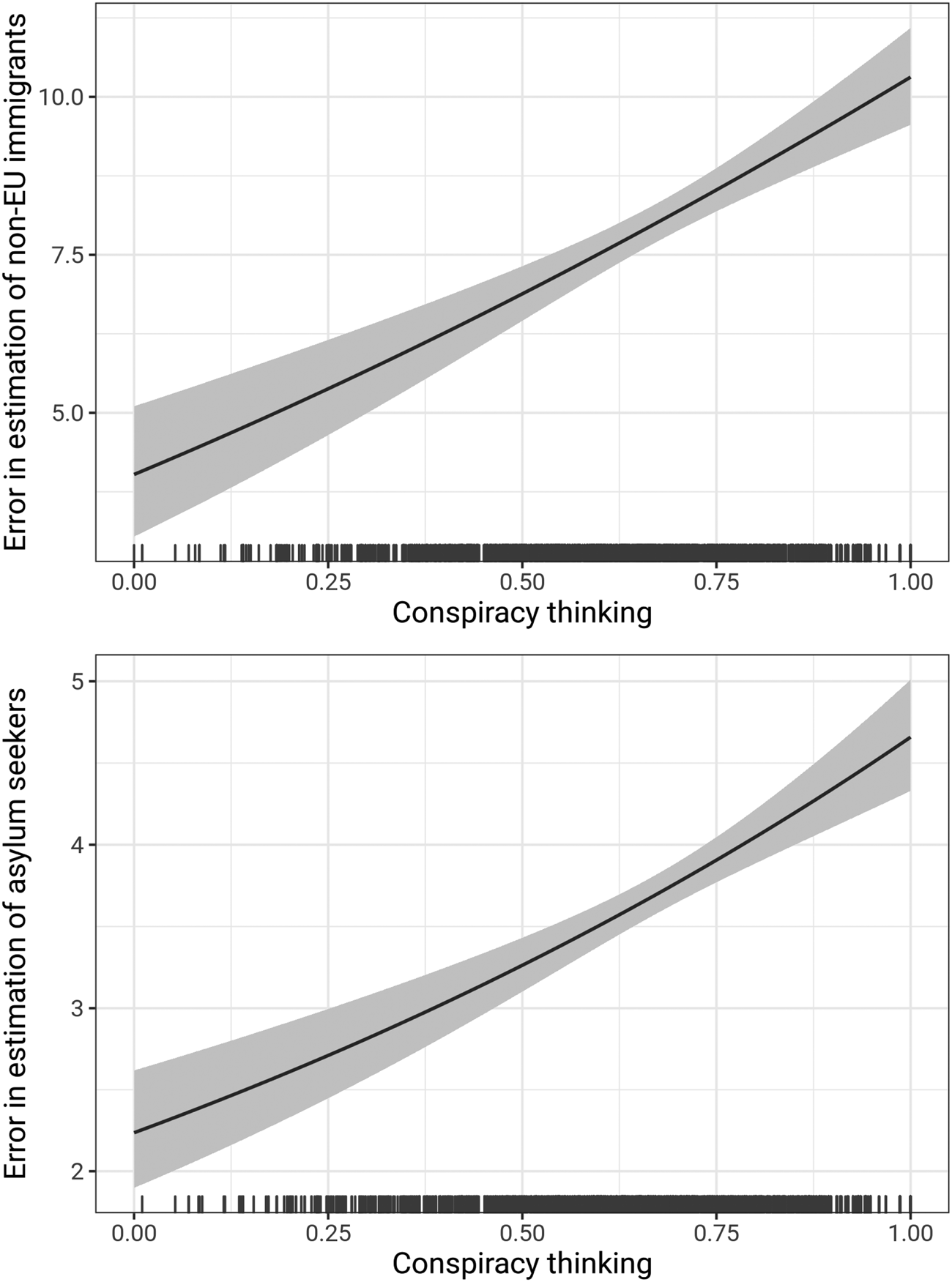
Since the dependent variables have been transformed, the interpretation of regression coefficients is not particularly informative. Therefore, it is convenient to visualize the effect of conspiracy mentality on innumeracy with the graphs in Figure 2. As for the estimation of immigrants, a respondent with the minimum score in conspiracy mentality will, on average, overestimate the actual figure by around 4.02 percentage points, while a person with the maximum score will overestimate it by around 10.31 percentage points. As regards the estimation of asylum seekers, the impact of conspiracy thinking is less pronounced: a respondent with the minimum score in conspiracy mentality will, on average, overestimate the real percentage by around 2.23%, while a person with the maximum score will exceed it by around 4.66%.
Estimated effect of conspiracy thinking on the error in estimating the number of immigrants or asylum seekers (simulation based on Models 1 and 2, Table 2). The small vertical lines at the bottom represent the probability distribution of the explanatory variable.
To conclude, we run a series of robustness checks. To test for model mis-specification, we run the Generalized Information Matrix test proposed by King and Roberts (Reference King and Roberts2015): the results indicate no evidence of mis-specification.Footnote 10 Since we have excluded extreme outliers from the responses in our dependent variables, we implement the same analysis with the full dataset: results do not seem to depend on the inclusion/exclusion of extreme outliers. We also replicate the analysis with weights to adjust our sample to the actual demographic composition of each country's adult population with access to the Internet, and, again, no substantial differences in results are found (see Online Appendix F).
Conclusions
The study of political ignorance has a prominent place in the analysis of public opinion, since the lack of knowledge about important political issues may produce detrimental effects on individuals' political behaviour (Delli Carpini and Keeter, Reference Delli Carpini and Keeter1996; Kuklinski et al., Reference Kuklinski, Quirk, Shwieder and Rich1998; Flynn et al., Reference Flynn, Nyhan and Reifler2017). More importantly, a biased perception of important social and political facts, such as innumeracy, may represent a threat to democratic accountability because of its impact on positional considerations from which we make political choices or take action.
When coming to possible explanations, this article has considered the role of a so-far overlooked factor, the tendency to hold a conspiracy mindset. Conspiracism is nothing new in human history; yet, in modern societies, this has constituted a system of thought and also a way to mobilize political action (Moscovici, Reference Moscovici, Graumann and Moscovici1987; McClosky and Chong, Reference McClosky and Chong1985; Goertzel, Reference Goertzel1994). Our argument is that because people holding a conspiracy mindset exhibit peculiar cognitive and emotional features, they are more likely to provide biased estimates about social and political events. Research shows, in fact, that conspiracy thinkers are more prone to intuitive thinking and cognitive closure. They tend to reject evidence on social and political phenomena to corroborate pre-existing beliefs about secret plots hatched by powerful elites. Hence, conspiracy thinkers would refrain from collecting and processing external information and would rather rely on alternative and suspicious explanations to account for controversial and large-scale events.
We have applied this rationale to the study of innumeracy about immigration. The issue has attracted much attention in the last few years both among academics and pundits. While studies have highlighted that Europeans tend to overestimate the size of immigrants in their own countries, factors used to explain individual variation produce mixed results (Herda, Reference Herda2010, Reference Herda2013; Duffy, Reference Duffy2018). Moreover, immigration has become one of the most relevant political issues at the EU level, and, importantly, it has been the subject of various conspiracy theories. In the light of this, a conspiracy mindset might be an additional factor to be considered so that people scoring higher on conspiracy thinking are also more likely to overestimate the percentage of immigrants living in their country.
Using data from an online sample of respondents collected across 10 EU countries in 2017, we have confirmed previous findings showing that immigrant population innumeracy is diffused and that a large share of citizens in all countries under examination tend to overestimate the size of immigrants. Results support our main hypothesis that people with a higher propensity to hold a conspiracy mindset tend to overestimate the actual share of the immigrant population living in the country. The association of innumeracy with the conspiracy thinking scale we employ is robust and it holds true when accounting for country heterogeneity and other cognitive, affective and socio-demographic factors.
Our analysis is, of course, not free from limitations. The causal ordering between the two variables of interest may in fact be uncertain and a cross-sectional analysis such as the one we propose is not able to account for possible (unobserved) omitted variables that might affect this relationship. Future research should consider the possibility to better explore the causal path via longitudinal analysis or even envisage experiments in order to address the implications of conspiracy thinking on opinion formation, and, specifically, innumeracy, also considering other issues beyond immigration.
Still, the article offers some interesting takeaways. First, it contributes to the existing literature on innumeracy bringing a new factor into the picture and proving brand new results (Herda, Reference Herda2010, Reference Herda2013; Duffy, Reference Duffy2018). The article suggests that innumeracy might be related to more profound attitudinal outlooks that influence the way people both select and process information. Second, this study speaks to the literature on conspiracism, focusing on an element so far underexplored, that is, the potential implications of conspiracy thinking (Douglas et al., Reference Douglas, Uscinski, Sutton, Cichocka, Nefes, Ang and Deravi2019). We do it by addressing two aspects. The first one pertains to survey measurement. While the vast majority of studies in the field usually employ questions tapping beliefs on specific conspiracy theories that might be context-dependent, we use a scale that has elicited latent propensity to hold a conspiracy mindset in a broad set of European countries, one of the first examples in this direction, to the best of our knowledge. The second aspect has to do with the comparative nature of the study. Previous research on conspiracy thinking is mainly based on case studies. We, instead, provide comparative evidence on the potential role of a conspiracy mindset on the individual likelihood to provide biased estimates on immigration.
Supplementary material
The supplementary material for this article can be found at https://doi.org/10.1017/ipo.2021.26.
Funding
This research received financial support from the project ‘Bridging the gap between public opinion and European leadership: Engaging a dialogue on the future path of Europe EUENGAGE’ (H2020-EURO-2014-2015/H2020-EURO-SOCIETY-2014, Grant no. 649281) funded by the European Union's Horizon 2020 research and innovation programme. For information see: www.euengage.eu. No conflict of interest.
Data
The replication dataset is available at http://thedata.harvard.edu/dvn/dv/ipsr-risp.
Acknowledgments
We thank the Editors and the two anonymous reviewers for their comments. Isernia, Basile and Olmastroni designed the study, had full access to all the data in the study and took responsibility for its integrity. Guidi, Martini and Olmastroni analysed the data and interpreted the results. Martini, Guidi, Borri, Isernia, Basile and Olmastroni drafted the manuscript. Martini, Guidi and Olmastroni critically revised the manuscript. Isernia obtained funding for the study.


 Open access

