
The relationship between the public sphere and the theatre is, in my understanding of the term, a relationship between inside and outside, between the internal dynamics of exchange between stage and auditorium, performer and spectator, and the more difficult interconnections between the generally closed realm of performance and the wider dynamics of political and social debate.
Christopher BalmeFootnote 2
This essay explores various re-enactments of the so-called ‘Arab Spring’ in selected theatrical performances from Tunisia, Egypt and Morocco. It attempts to reveal some of the disjunctions, ironies, confusions and complicities between fiction and non-fiction. Significantly enough, artistic re-enactments of the revolutionary Spring have more than ever been inflicted by ‘techno-imagination’ and its ever-evolving relationship between images and texts as ‘vital acts of transfer’. Most of us have become either spectators or citizen journalists of public dissidence, and yet we have been connected to the unprecedented upheaval by watching mediated images or implementing and re-editing incoming information for distanced audiences through the Internet, mobile phones and satellite television channels such as Al Jazeera.
Each of the three theatrical events under scrutiny brings to our attention the complexities between two different logics: performance and archive, disappearance and documentation. The archive logic explored by Jacques Derrida's Archive Fever invokes a dialectical oscillation between commencement and commandment; it combines the practice of storing and restoring.Footnote 3 Unlike museums’ tasks of ‘archiving, categorizing and indexing’, performance ‘challenges categorization, which was originally its point . . . It's not always an easy fit, but maybe what's interesting is the way in which the past is reframed in the present’.Footnote 4 Following the thread of thought of Rebecca Schneider, the three selected performances are ‘repeatedly live’ as ways of keeping memory alive. In fact, these re-enactments challenge the existing archives and their logic in organizing and reflecting memory and history. The term ‘re-enactment’ is charged with repetition and repercussion. It is the ‘practice of replaying or re-doing a precedent event, artwork, or art’; it is ‘a critical mode of remaining, as well as a mode of remaining critical’.Footnote 5 It is both an act of documentation and a challenge to disappearance. The cultural urge to document the ‘Arab Spring’ explains a great deal about the desire for re-enacting protest. Arabic re-enactments of the Spring render the pastness of the past ‘both palpable and a very present matter’.Footnote 6
Jalila Baccar and Fadhel Jaïbi from Tunisia have long fought for a citizen theatre as a tool for social and political dissent that eludes hierarchical power structures of the state in its attempt to coopt it under its umbrella. They produced Yahia Yaïch in 2010 as an exploratory study of memory, identity and power relations in post-independent Tunisia. Ironically, after the Jasmine Revolution of January 2011 and the subsequent protests for democracy sweeping across North Africa and the Middle East, the play's re-enactment took a different turn; the connections between Yahya and the runaway President Zine Al Abidine Ben Ali have become quite evident. Dalia Basiouny, founder of the Sabeel Group from Egypt, wrote and directed a multimedia performance entitled Solitaire: The First Monologue that highlights the impacts of two major events upon Arab people. The performance re-enacts some of the experiences of Arabs and Arab-Americans post-9/11, and the impact of these events on the Arab world at a larger scale. It also chronicles the journey of an Arab woman who finds herself in the middle of the genuine popular revolution at Tahrir Square that led to the overthrow of some heads of the most entrenched and allegedly secure regimes of the whole region. In Basiouny's attempt to capture ‘living archives’ and to re-create the original events in her narrative performance, a set of intense moments of the revolution are brought back to life, re-enacted, embodied and transmitted to a distant audience. Naima Zitan, founder of the Aquarium Theatre Company from Morocco stages Dially (It's Mine), an ultra-feminist play about violence against women within the context of political transition in Morocco following the Islamists’ rise to power after the elections of 2012. The company draws its strength from being political in nature, deeply committed to social theatre and to the cause of gender equality and respect for women's rights. The play is fuelled by the 20 February movement's social demands; it has garnered attention nationally and internationally and on social media, where the production has attracted a flurry of posts and manifestos.
Arab Spring and the beginning of change
In schematic terms, the combination of wealth and power in most Arab countries, among other aspects of corruption and power abuse most dramatically exposed by WikiLeaks on the eve of Arab Spring, renders institutional structures for a real public sphere mostly defective and inadequate, if not impossible. History has taught us that power is addictive and addiction is binding. The German sociologist Jürgen Habermas defines the public sphere as a ‘network for communicating information and points of view . . . the streams of communication are, in the process, filtered and synthesized in such a way that they coalesce into bundles of topically specified public opinions’.Footnote 7 The normative Habermasian model of the ‘public sphere’ generates a discursive arena of free flow of information and formation of public opinion culminating in the achievement of a pragmatic consensus.
However, the public sphere is also a discursive battleground wherein consensus ‘is no doubt necessary, but it must be accompanied by dissent’,Footnote 8 as Chantal Mouffe puts it. Some activist performers bring into play the public sphere to call attention to their political standpoints and ‘dissensus’; they deploy the politics of visibility to make statements in public without discussion. Some ‘actor-citizens of activist performances use the public sphere to call attention to their political agendas, they do not discuss and debate these agendas in public’.Footnote 9 Performance and theatre function as unfailing players in a turbulent public sphere. The Seattle giant puppets’ march against the World Trade Organization in 1999, the Occupy movements and Arab Spring protests, community theatre forums, even the phenomenon of self-immolation in public, and so on, all share the politics of impersonation as parodic political behaviours. These are ‘agonistic performances’ and political acts of dissent fuelled by an inherent performativity. In this context, Rustom Bharucha invites us to reconsider the limits of performance. His critique of overstressing the Arab Spring as performance highlights the dangers of diffusing the political by overemphasizing the performative. ‘Does performance accentuate the political?’ Bharucha rightly asks.Footnote 10 Since protest events occur against the backdrop of public life, they inherently contain performative elements. And despite the commonalities and contentions inherent in definitions of performance, the performative articulation of the political is striking in relation to the Arab Spring. My view of public-sphere theory integrates the notion of ‘agonistic performance’, and is highly informed by Nancy Fraser, Chantal Mouffe, Pia Wiegmink and Maria Pia Lara.Footnote 11
How does theatre also relate to the public sphere? Christopher Balme has eloquently answered this question in the epigraph above. The relation lies within this dialectical oscillation between the inside and the outside, insofar as there is no inside closed upon itself. Theatre has a magical capacity to implicate ‘Others’; it negotiates the differing relationships among its participants, and in the process it reformulates social legitimation and plays its part in the public sphere ‘beyond state control and moral censure’. The role of the spectators in the fulfilment of a theatrical performance is mandatory, as they are active participants and co-subjects rather than passive recipients of a finished spectacle. The agency embedded in the audience's participation is best illustrated by Erika Fischer-Lichte's ‘autopoietic feedback loop’, wherein the ‘aesthetic experience of a performance does not depend on the “work of art” but on the interaction of the participants’.Footnote 12 Once outside the theatre, audiences remain potential contributors to the discussions of the public sphere. Sometimes theatrical content stirs up heated debates in the public sphere upon the degree of its privacy and freedom to go beyond accepted ethics. Balme articulates the problematic in the following way: ‘Of more interest is the collision between two different perceptions: most theatre spectators and advocates of artistic freedom privatise theatrical space in order to enjoy this freedom, whereas the opponents declare it to be a public space, thereby being able to invoke blasphemy laws.’Footnote 13 Such collision illustrates that the theatrical public sphere is a site of ‘contestational politics’ wherein a ‘plurality of competing publics’ defy each other. (The controversy over Dyalli will illustrate this later in this essay.)
With the rise of the Arab Spring, and as protesters dig into the streets against tyranny, poetry, theatre, singing, site-specific performances and even visual arts have become tools to maintain spirits. In this context, one can also draw on the work of American studies scholar Pia Wiegmink, who defines ‘activist performance’ as a
form of political action which is located outside the political consensual realm of party politics as it is not institutionally affiliated with parties, unions, or other organizations . . . activist performance can be conceived as the (temporary) formation of a counter public which both aesthetically as well as ideologically defies prevailing, dominant political discourses.Footnote 14
New digital media outlets were utilized to achieve counterdominance of the public over the state's hegemony. Still, can we consider the Internet as a new form of public sphere? The rapid diffusion of dissident voices in the Internet allows the emergence of deterritorialized virtual public spheres, ‘where people and information intersect in virtual communities or subcultures’.Footnote 15
However, new digital technology is by no means a saviour of global politics, rather another medium where individuals can develop their political voices and perform their political selves. Still, the Internet as container and as content cannot be a factor for social change, rather ‘an extension of political life off the Net’, as Margolis and Resnick argue: ‘There is an intensive political life on the Net, but it is mostly an extension of political life off the Net.’Footnote 16 On the eve of Arab Spring, political groups were created online. As an example, the Facebook page called ‘We Are All Khaled Said’ was among the first activist groups to call for the 25 January uprising in Egypt. The page is named after a twenty-eight-year-old Egyptian who was beaten to death while in custody in Alexandria. He became the Egyptian equivalent of Tunisian vendor Mohamed Bouazizi, who immolated himself, setting in motion the Arab Spring. Meanwhile, the February 20th Movement in Morocco was born on the Internet, and has created its own website, Mamfakinch.com (‘never give up’), as a digital media outlet that circulates news, opinion, and debate outside state control and party politics. Still, if all Arabs sat by their keyboards there would have been no Arab Spring.
Tunisia: Yahia Yaïch and the drama of a fallen dictator
Yahia Yaïch, or Amnesia, is the most significant theatre piece to address the fall of the dictator just before the ‘Arab Spring’. The play has been credited with predicting the ousting of the Tunisian president Zine Al Abidine Ben Ali. It was written by Jalila Baccar and Fadhel Jaïbi, and put onstage by Familia – the most visible independent professional company in present-day Tunisia – at the Mondial Theatre at the heart of the capital, Tunis, just before the Jasmine Revolution. The play pursues many of the same social and political concerns and explorations of memory. As such, it is another exploratory study of identity and power relations in postcolonial Tunisia. It was also subject to minor revisions by what Jaïbi rightly calls the ‘censorship commission’ rather than the ‘Orientation Commission’.Footnote 17 These revisions affected even the title of the play, which was inverted from the original ‘Yaïch Yahia’. Yahia Yaïch is concerned with the state of being of a dismissed minister.Footnote 18 It is a performance which suddenly joined the spectacle of the fallen dictator. Actress Fatma Ben Saïdane rightly describes Yahia Yaïch as the play that has now the ‘role of archive. It reminds us to what extent the freedom of expression has been forfeited to us. It refreshes our memories’.Footnote 19
The play opens with eleven performers arising from the auditorium, gazing at the audience. Their lack of engagement with the audience suggests the silence of the political elite class, the media and, most importantly, the silent majority in contemporary Tunisia. Then they disappear backstage, and reappear to sit on white chairs, shaken from time to time by spasms, as if they were crossed by flashes of lucidity or repressed nightmares. Sounds of bombs and shots are heard. Yahia appears onstage, celebrating the birthday of his daughter, Dora. But he is asking about time, as if awaiting some news. Then, his wife breaks in and puts an end to the birthday party. She brings the devastating news of his dismissal from the ministry and detention at home, shouting, ‘they dismissed him’. A whole cycle of nightmarish dissent ensues.
Yahia is not charged with a crime, but is no longer allowed to leave his home, and by extension the country, because of what he knows about state secrets. His private library is burned while he is kept alive. Now Yahia in turn has become victim of new oppressors. Like most dictators, Yahia used to live in a bubble of paranoia so deep and pervasive. He makes his final exit symbolically in an armchair, facing the charges of his previous victims, and fully confronting the horror he wrought on his community in the name of duty. He unwillingly deals with his past abusive acts in a futile attempt to justify his obedience to the hierarchical power structures. But life has become a relentless hell for him after being abandoned by old friends who are not ready to compromise their positions in the name of friendship. Yahia serves unconsciously as a scapegoat, letting others off the hook. Jaïbi and Baccar illuminated the Tunisian policing regime as immune to the psychological scarring that afflicts Tunisians at various levels. The extensive use of ‘chairs’ as a ‘trouble index’ metaphorically hints at power positions as well as power abuse.
The irony of history is that one sympathizes with the fallen minister, who becomes no more than a shadow of a fallen dictator in an amnesic society. The many doctors, lawyers and businessmen around him are unmasked, showing their true faces. Before the Jasmine Revolution of 2011, most readings of the play had interpreted the situation of Yahia Yaïch as a critique of the Bourguiba era (even though Jaïbi has denied this interpretation). The play was mostly represented in the press as a trial of Bourguibian absolutism, with its lack of democracy, repression of opposition, and different forms of power abuse. When the play was first performed in Tunisia in April and May 2010, it was a call for power holders to revise their relationship with citizens. The public was so scared; Jaïbi described the fear among the audience members in an interview at the Avignon Festival in July 2011 as follows: ‘Some were constantly turning around to verify that there are no members of the secret police in the auditorium to embark everyone, actors and spectators.’Footnote 20 However, in February and March 2011 the play was re-enacted in the middle of spring, ‘and was sold-out at the Mondial, while in the adjacent streets bloody events were occurring’.Footnote 21 Karim El-Kefi, actor in the production, also reminds us of the blurring of boundaries between street protests and what was taking place inside the theatre: ‘We played in a theatre next to the Ministry of Interior, and protesters used the building as a refuge. We were inundated by teargas. Spectators could no longer distinguish between nightmare and reality.’Footnote 22 In the middle of the Tunisian revolution, Yahia Yaïch was re-enacting the drama of the fallen dictator. Revolutionary protests joined the fictive trial, crossing the borderline between the outside and the inside of theatre. Yahia's nightmare has become a reality, with slight differences between the scenarios of the two descents.
Ironically, the production continued to tour even after the Jasmine Revolution and the protests for democracy sweeping across North Africa and the Middle East; it was performed in Theatre Mohammed V in Rabat on 21 April 2011. Now the nuances between Yahia and the runaway President Ben Ali are quite evident. Once the dream of the fall of Ben Ali had become a reality, Baccar and Jaïbi refused to re-edit the play. In Rabat, after the performance, I asked Jaïbi the same question: ‘Have you re-edited or changed anything after the revolution?’ Surprisingly, his answer was, ‘not a single word’. After all, the play holds a trial of President Ben Ali and his regime of terror:
‘I did not want to do it in a metaphorical way,’ Jaïbi affirms in an interview, ‘or take an already existing text from the classical repertoire . . . I was inspired by our corrupt and decaying system that made an entire people sick and depressed’.Footnote 23
Egypt: Solitaire, an Egyptian one-woman multimedia performance
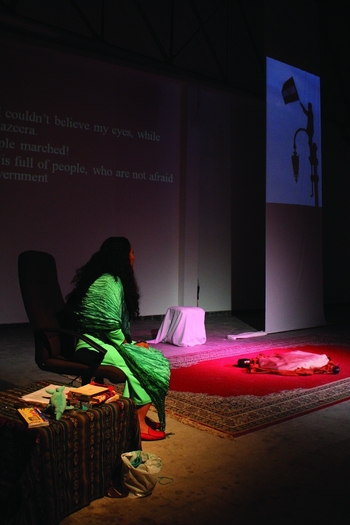
Dalia Basiouny re-enacting a scene from the Tahrir Square (Solitaire: The First Monlogue, Performing Tangier Festival, 4 June 2011). Photo by Abdelaziz Khalili.

Dalia Basiouny re-enacting a scene from the Tahrir Square (Solitaire: The First Monlogue, Performing Tangier Festival, 4 June 2011). Photo by Abdelaziz Khalili.

In Egypt, artistic re-enactment of the revolution started with the occupation of Tahrir Square. Dalia Basiouny wrote and directed a one-woman multimedia performance entitled Solitaire,Footnote 24 which highlights the impacts of two major events upon Arabs in the United States and Middle East, with a particular emphasis on the journey of Mona, an Arab mother in her early thirties:
The performance documents dramatically and visually some of the experiences of Arabs and Arab Americans post 9/11, and the impact of these events on the Arab World. It also records some of the events of the 25th of January Revolution in Egypt through the eyes of an Egyptian woman who changes and creates change throughout her journey to shape her identity in her search for peace, within herself and with the world.Footnote 25
The performance is permeated by visual material (still pictures, documentary and dramatic visual texts from the revolution).Footnote 26
In Basiouny's attempt to re-create the original events in her narrative performance, a set of intense moments of the revolution are brought to life again, re-enacted, embodied and transmitted to a distant audience. Basiouny's artistic choices are close to Rimini Protocol's docudrama and the notion of the expert/performer. Dalia Basiouny, the playwright, director and actress, was also at Tahrir Square. Other members of the Sabel Theatre Company were there too. Some of them were filming the events, and filming themselves as part of the built environment. Her monologues are based on her physical involvement in the happening in the here and now; she is the expert/performer. She remakes the events with all the tensions and sentiments engendered by the initial happenings and the here and the now. It is far from being a mimic situation or a reproduced quotation, for it entails translation and transformation:
In Rebecca Schneider's words, Dalia Basiouny attempts to ‘step into time’ and duplicate or even ‘touch’ prior historical acts and events. Basiouny, here, uses the revolutionary body at the square as the stage across which she re-enacts ‘social dramas and traumas that have arbitrated cultural differentiations between truth and illusion, reality and dream, fact and fantasy, natural and unnatural, essential and constructed’.Footnote 28
She utilizes repetition as a means to generate documentation about revolution. Even the photomontage of images from the square, which are projected in the large screen while she is deeply engaged in her narrative, is seen through her eyes. Meanwhile, her reperformance through repetitions of fragments of the original protests represents ‘messy but fruitful reappearances’ of a living archive of the revolution:
A close look at the chronology of the Egyptian revolution illustrates Basiouny's archive fever. On 2 February, armed loyalists of Mubarak's regime marched to the square using horses and camels, and protected by security forces. Several hundred protesters were killed and injured in this anti-revolutionary assault. The performance, then, functions as a form of documentation, providing a more embodied relationship with the Arab Spring. The artist uses documentation from the protests which took place at the Tahrir Square, as opposed to her performance itself, as a source for her re-enactment. From this layering of documentation of the performance a mise en abîme of the Arab Spring is realized. Rebecca Schneider often calls performances ‘repeatedly live’; the reappearance of remains is intrinsic in keeping memory alive. Mona's archive fever is enacted through her very first words: ‘On this day each year I hold a special ritual, a silent ritual. For me and my daughter. To come to terms with what happened, and to set my resolutions for the New Year. This year is different.’Footnote 30 Her silent ritual wherein she reviews past events is performed live in front of an audience who can attend to her most inner voice as she is thinking aloud. Her bodily practice is already enveloped in her ‘twice-behaved’ ritual; it is composed in repetition as ‘both the vehicle for sameness and the vehicle for difference or change’.Footnote 31
Morocco: Dially (It's Mine) and the artistic expression debate
Moroccan actresses breaking sexuality taboos onstage (Dially (It's Mine)). Photo by Alice Dufour-Feronce.

For the playwright and artistic director of Aquarium Theatre Company, Naima Zitan,Footnote 32 the Arab Spring is seen as an opportunity to redefine the role of women in a society under transition. Women participating in the February 20th Movement campaigns have, indeed, experienced the revolution in their own way as they marched in the streets with men claiming equality and dignity as part of the Arab Spring parcel.Footnote 33 A brief overview of the Moroccan Spring would certainly highlight the socio-political context underlying the production of plays such as Dially.
In the face of the mounting pressure from popular protests, King Mohammed V called for a constitutional referendum (voted on 1 July 2011). In November, parliamentary elections were held right in the middle of the Arab Spring. The party of Justice and Development (PJD) became the first Islamic party to win a majority. Such results caused the feminist movements to be on alert, for laws reinforcing gender equality need time to seep into culture. Despite the fact that the new Constitution guarantees gender equality, only one woman has been nominated as a minister in Abdelilah BenKirane's cabinet. In March 2012, the suicide of Amina Filali, a sixteen-year-old Moroccan girl who was forced to marry her rapist, ignited global outrage. The crime sparked an unprecedented outcry to break the silence of centuries-long patriarchal oppression legitimized through religious rhetoric and its sustaining phallocratic interpretations. Anti-rape demonstrations followed Amina Filali's suicide in most Moroccan cities, culminating in a sit-in in front of Parliament on 17 March 2012. An online petition has drawn many distanced supporters to stop violence against women, including repeal of Article 475 of the Penal Code. Moreover, defenders of sexual freedom in Morocco go even further, demanding the abolition of Article 490 (which considers extramarital sex a crime on both sides). A heated battle has been taking place on the Internet between conservatives and progressives. Each side accuses the other of being a misguided vehicle for dangerous ideas.Footnote 34
Actress Nouria Benbrahim (Dially (It's Mine)). Photo by Alice Dufour-Feronce.

In post-Arab Spring Morocco, some decentralized conservative networks have become more dynamic, increasingly assuming the role of ‘communities of interpretation’ in the public sphere and allowing themselves to judge theatrical performances and films from a quasi-moralistic standpoint.Footnote 35 Such hostile opinion has built underground and has eventually erupted to disturb the performance scene and film industry in a Morocco with Islamists in power. In responding to the controversy over artistic freedom and the fierce debates over women's position on the political scene, the Aquarium Theatre Company staged Dially as an enunciated critique of the deeply rooted patriarchal power structures. The performance questions how theatre can be utilized as a site for the marginalized and the subaltern both to participate in political life and to partake of existing regimes of theatrical representation. It is an act of dissent against deeply rooted conservative politics, staged in public, using the public sphere to underline feminine difference.
Dially is partially inspired by Eve Ensler's Vagina Monologues. It is about the persistent revictimization of rape victims and normative views of female sexuality in a traditional society. Driven by the same archival impulse as Ensler's, Zitan interviewed around 250 Moroccan women from different walks of life right in the middle of the spring and over a period of seven months, asking them the following questions: “What do you call your sexual organ? What is its form? Have you ever contemplated it? How does it smell? What is its suffering?” Women either filled up anonymous questionnaires or directly answered through individual meetings. As artistic director of the project and the one who conducted interviews with women, Naima Zitan is both a reader and an interpreter of other documents, re-enacting them onstage and staging her own role as a committed artist and proponent of feminist values. Hal Foster sees that archival art ‘not only draws on informal archives but produces them as well, and so in a way that underscores the nature of all archival materials as found yet constructed, factual yet fictive, public yet private’.Footnote 36Dially is composed of a series of fragmented narratives and revelations that constitute ‘informal archives’ in the form of monologues re-enacted onstage by three brave actresses: Nouria Benbrahim, Farida Elbouazaoui and Amal Benhadou:
woman 3: We don't speak about you; we don't hear anything about you until the wedding day.
woman 1: At home, we can't talk about you, and if I ever ask, I am slammed.
woman 2: and beaten with a belt.
woman 3: straighten your skirt; you don't even have underwear!
woman 2: shame
woman 3: SilenceFootnote 37
The performance voices a diverse body of different experiences, bound together not with one single narrative, but by their confluence and by the relations between womanhood and female sexuality within a deeply rooted patriarchal society. They provide a testament to the strength of female sexuality and, along with it, the power of the womb, a power no veil can ever obliterate. Some of the narratives appropriate the prevalent misogynist images of women as sex objects commodified and over-reduced into no more than procreators under the yoke of male domination:
Sometimes my mother used to tell me: ‘Jemii hammek’; and she was right. ‘Hammee, mouchkil dially’, Mine, my own problem! And not only mine, but all women's . . . At home, we used to talk about it among women's gatherings. In the public bath, all women are naked!Footnote 38
Others manifest a furious response to the ritualistic subjugation of women in the name of tradition. The magic word dially implies different meanings, most of which reveal patriarchal oppression and violence: ‘rani kharejlek sdaak, raak dially’ – ‘I have given you a dowry, so you're mine’, says Sanaa with deep sadness as she was re-enacting the moment she was being raped by her husband the first night: ‘It was him who raped me the day of the wedding. The father of my children . . . I hate him’.Footnote 39 Rape stories become the outlet, or rather the offshoot, of silent and repressed histories relating to everyday practices insofar as they encode exactly what they expose.
The first performance took place at the French Cultural Center of Rabat in June 2012 and lasted only for thirty minutes, yet was followed by an open discussion with audiences as an extension of the short monologues. Naima Zitan joined the actresses and engaged in further unmasking the so many silences veiling women's most intimate body parts. Dially is the first play in Morocco voicing out loud some thirty-two words referring to ‘vagina’ in Moroccan dialect. ‘My organ is the source of life; it is not a dirty black hole. I carry it with me all the time to the big room, the small room, the shop, the souk, the school, and even to the mosque’.Footnote 40 Through exposing the various names of the ‘vagina’ in Moroccan dialect and their underlying meanings, Dially generates a bewildering sense of immediacy which is concerned with the impossible narratives of women's most intimate world. Each monologue is a piece of text or a fragment from a living archive inscribed by a woman who ultimately assumes full responsibility for it, though she might show up only in pseudonym. Zitan enshrouds the female body and forces audiences into a position of voyeurism, inviting them to attend to women's narratives. Zitan's enterprise was able to disturb traditional systems of representation, forcing all participants to undergo a learning process as they speak beyond the age-old specular phallocentric structures.
The play is permeated by ‘colloquial speech’ and ‘dirty jargon’, which are made part of Zitan's strategy to emancipate language and free it from everyday life's confines. Thirty-two different words for ‘vagina’ pervade the text, but never in a pornographic way as Abdekrim Berrchid claims. The crudity of the monologues denounces patriarchal violence that is inscribed and institutionalized through the grammar of language, for there is no oppression without language. And since what cannot be expressed openly cannot exist performatively, and any attempt to abolish the ‘inaudible’ word ‘vagina’ becomes an attack on the female body itself – a veiled attempt in the name of ‘political correctness’ or tradition – to remove the female body from the performance space. Zitan's theatrical practice persists in reinscribing the female body within that space, reinventing a variety of new profiles for Moroccan women. Such inscription is manifestly punctuated by the tendency to spell out the body's morphology and voice its pain and suffering as well as its desire and delight. Dially deconstructs the stereotypical idea of ‘vagina’ in Moroccan culture as a site of ‘shame’ by highlighting the violence practised against it.
The performance triggered a polemic firestorm of harsh criticism beyond theatre circles. The Aquarium's art-like interventions are mainly concerned with the politics of spectatorship and the potential for unexpected transformations resulting from the theatrical encounter, which might sometimes be controversial or even disruptive. These theatre forums of the repressed create the necessity of having to listen to that which is not familiar and undergoing a learning experience in the process. It is also about learning how to learn from the subaltern (if one wishes to put it in Gayatri Spivak's terms). Unveiling taboos and silences veiling women's bodies has become an artistic, as well as a political, project for the Aquarium Theatre Company since its creation in 1994. However, Zitan's intention of creating unease and anxiety in Moroccan audiences, who are generally schooled by a conservative popular theatre form, has attracted a flurry of posts and manifestos on the Internet. The performance has garnered attention nationally, internationally and on social media. If Dially was a reaction to ongoing debates in the public sphere about women's rights, it has triggered a heated exchange and has been severely attacked in most conservative cultural and political circles.
Abdelkerim Berrchid,Footnote 41 the most furious of all, wrote a manifesto condemning the play's pornography, immorality and lack of creative imagination:
It is an animalistic and savage subject . . . If some women have problems with their vaginas, it is their problem, and not the concern of society at large . . . Those who practice pornography in the name of theatre should have enough courage to pronounce it openly.Footnote 42
Furthermore, Berrchid expressed openly his refusal of adaptations of any kind.
I am always in favor of the original instead of the imported, creativity rather than imitation, and writing rather than devising . . . Dially's dramatic text does not belong here, and so is its discourse and cause, even the theatrical location . . . I see that the real Moroccan public cannot refuse art. If he refuses today this performance, it is because it is not convincing intellectually, esthetically, and morally.Footnote 43
At this point, it must be emphasized that Berrchid pronounced his fatwa without seeing the performance, or even reading the script. Yet his manifesto, published on the Internet by the most popular electronic journal in Morocco, Hespress, was highly praised, reaching 111 positive comments and 475 likes on 8 August 2012. My deployment of the overloaded word fatwa is metaphorical. A fatwa is a religious pronouncement issued in response to questions by Muslims. In Sunni Islam, it is not binding, but not all the time. Sometimes the fatwa runs the risk of becoming more than a legal opinion, when it claims absolute truth. What Berrchid sought in his opinion about Dially amounts to a fatwa which claims truth. It perpetuates exactly what Dially denounces: silencing, judging and defining women. As such, it becomes so dangerous a call that it threatens the artistic freedom of an inspiring Moroccan feminist artist. Such a fatwa reminds us of Spivak's agonistic outcry about the subaltern's inability to speak, an outcry that is very much contested and misunderstood by many. Indeed, ‘the subaltern can't speak’, Spivak explains, ‘means that even when the subaltern makes an effort to the death to speak, she is not able to be heard, and speaking and hearing complete the speech act. That's what it had meant, and anguish marked the spot’.Footnote 44 Exchange requires reciprocity rather than a one-way communication, and this constitutes the subaltern predicament along with the inability to recover her voice. Empowering such a voice requires much of what Gramsci calls ‘optimism of the will’.
Conclusion
The game of ‘Arab Spring’ has, at best, changed the names of some autocrats, but not the totalitarian regimes, due to internal and external obstacles to real democracy and real change in the ruling elites and systems of governance. The illusion of change on the ground is actually stuck in the stasis of utopianism. However, the Spring has created a fundamental transformation in the public sphere. It has liberated Arab youth from fear and momentarily suspended the nexus of historical causality. The Spring has flourished with communal performances very much like a carnival's way of sensing the world ‘with its joy at change and its joyful relativity’.Footnote 45 Gilles Deleuze reminds us that what characterized people after the student protests of 1968 was that they were in a ‘state of becoming’, ‘a revolutionary-becoming’.Footnote 46
The mode of thinking embodied in the concept of becoming has strong implications for the present state of affairs in the Arab world, where most regimes have somehow opted for the Islamic option to calm down social unrest and evade the bottleneck. But the ‘Arab Spring’ is only the beginning of a process; it will ‘play out’ over the coming four or five decades. The three performances are linked in their re-enactments of different facets of the so-called ‘Arab Spring’. Drawing from archival ‘evidence’, the three projects strive to keep the past alive. Informed by the politics of protest, they disturb traditional Arabic systems of representation and reveal a great deal of transgression of societal rules. Theatrical re-enactments of diverse fragments of the archive are perhaps the first steps towards a long walk of reconciliation with memory.