

Introduction
Globally, the mortality in Indigenous populations exceeds that of non-Indigenous. Reference Gracey and King1,Reference Anderson, Robson and Connolly2 In Canada, Indigenous persons have a lower life expectancy at birth, 3 a trend that is also observed among Indigenous populations around the world. Reference Anderson, Robson and Connolly2,Reference Hayman, Reid, King and Tovey4 In 2016, an estimated 71% of deaths worldwide could be attributed to non-communicable diseases (NCDs). Reference Bennett, Stevens and Mathers5 Chronic conditions such as cardiovascular disease, cancer and chronic respiratory diseases account for two-thirds of all Canadian mortality. 6 This is a concern because Indigenous peoples in Canada experience higher rates of NCDs. Specifically, 61% of off-reserve First Nations people and 60% of Metis over 12 years old were diagnosed with at least one chronic condition, compared to 53% for non-Indigenous Canadians. 7 While global action towards combatting NCDs has only been strengthened in recent years, Reference Bennett, Stevens and Mathers5,8 the progress towards this goal has been found lacking. Reference Horton and Sargent9,10
Complete and adequate information regarding NCDs among Indigenous populations is generally poor, which hinders the development of meaningful policies and interventions to address these health issues. Reference Kufe, Ngufor, Mbeh and Mbanya11 Prioritization of collaborative partnerships with Indigenous communities aimed at prevention, paired with culturally sensitive interventions, is paramount in order to close this knowledge gap in Canada and elsewhere to ultimately help reduce premature deaths from NCDs. More recently, McEwen et al. Reference McEwen, Boulton and Smith12 suggested that the Developmental Origins of Health and Disease (DOHaD) hypothesis can aid in filling knowledge gaps related to Australian Indigenous health and social inequities. Importantly, they highlighted that there is a lack of DOHaD research being conducted among Indigenous communities and that the key to closing this gap is to conduct large population-based studies. Reference McEwen, Boulton and Smith12
The DOHaD hypothesis, initially proposed by Baker, Reference Barker13-Reference Barker and Osmond16 was grounded in nutritional influences, suggests that perinatal exposures such as sub-optimal growth conditions may result in the adaptive selection of a phenotype that has increased risk for developing NCDs in later stages of life. Wild Reference Wild17 expanded this hypothesis to include environmental, biological, social and physical exposures. Others have shown that these exposures have an effect across the lifespan. Reference Heindel18 Particularly, it was Wild’s description of the cumulative environmental exposures, known as a person’s exposome, that concentrated the attention of the research community on environmental influences, particularly on child health. For example, birth cohort studies have used human biomonitoring to identify detrimental effects of pesticide and flame retardant exposures in pregnancy on cognitive and behavioral outcomes. Reference Street, Angelini and Bernasconi19 Examining the contribution of environmental contaminants on disease morbidity and mortality has important health implications since an estimated 16% of all global deaths can be attributed to the various forms of environmental pollution. Reference Landrigan, Fuller and Acosta20 In Canada, we have shown that the James Bay Cree First Nations have higher body burdens of contaminants compared to non-Indigenous counterparts Reference Nieboer, Martin, Liberda, Dewailly, Robinson and Tsuji21,Reference Liberda, Tsuji and Martin22 and that these exposures are significantly associated with NCDs, such as diabetes as well as cardiovascular risk factors, among others. Reference Zuk, Tsuji, Nieboer, Martin and Liberda23-Reference Zuk, Liberda and Tsuji27 However, the contribution of these exposures to chronic disease has not been examined through a DOHaD lens.
In this article, we present how Two-Eyed Seeing can be used in community-based participatory DOHaD studies with Indigenous community partners that foster collaborative and culturally relevant interventions for health and well-being. By applying the Two-Eyed Seeing approach to a DOHaD study, research conducted with Indigenous partners could provide significant new insights and answers to research questions by the joining of new knowledge (both Indigenous and Western science) into the study design when compared with standard Western scientific practices alone. Therefore, the use of Two-Eyed Seeing among Indigenous-based DOHaD studies should be considered a research priority.
Two-Eyed Seeing and Indigenous Knowledge
As stated by the Dene Cultural Institute: ‘Traditional environmental knowledge (TEK) [also known as Indigenous knowledge (IK)] is a body of knowledge and beliefs transmitted through oral tradition and first-hand observation…TEK is both cumulative and dynamic, building upon the experience of earlier generations and adapting to the new technological and socioeconomic changes of the present.’ Reference Stevenson28 It is important to highlight that there are multiple terms for IKs which are used across the world, including but not limited to Double-Canoe (Waka-Taurua; New Zealand), Two Ways (Ganma; Australia) and Two Row Wampum (Kaswentha; Canada) (see Reid et al. Reference Reid, Eckert and Lane29 for glossary).
Our group has previously noted that when there is more than one way of knowing, all ways should be used to contribute to a more complete understanding of complex health and wellness issues under study. Reference Tsuji and Ho30 Dr Thom Alcoze, a Cherokee biologist pioneered this approach and stressed that IK system also possessed scientific principles. Reference Tsuji and Ho30 Albert Marshall, a Mi’kmaq Nation elder, popularized this idea in a variety of different fields, including health, and emphasized the need to ‘Learn…to see from one eye with the best in Indigenous ways of knowing, and from the other eye with the best in Western (or mainstream) ways of knowing…and learn to use both these eyes for the benefit of all’. Reference Marshall, Marshall and Bartlett31 He called complementary ways of knowing ‘Two-Eyed Seeing,’ or ‘Etuaptmumk.’ IK relies strongly on the oral tradition, which allows persons to connect their own experiences with those from the past, but also pass information to the next generation, thus ensuring that important historical knowledge is not forgotten. Reference Martin32 Some oral narrations have been shown to be several thousands of years old by science utilizing state-of-the-art numerical modeling, Reference Tsuji, General and Tsuji33 while other narrations may be much more recent. Reference Tsuji, Kataquapit, Katapatuk and Iannucci34 The purpose of these narrations are to inform the listener where they have been, but also help plan for the future by sharing important historical events, successes, and failures. Reference Martin32
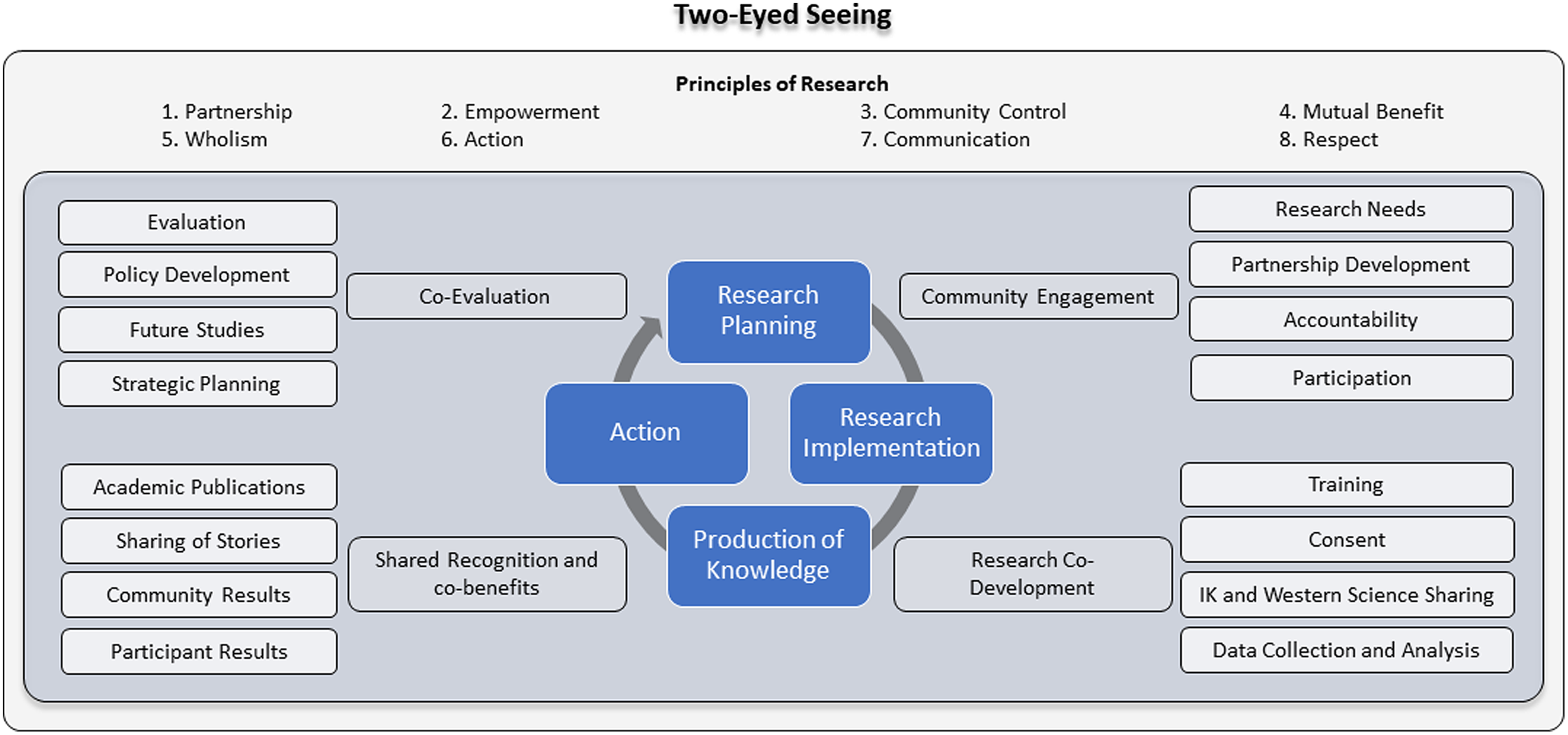
IK, historically, was considered primitive and anecdotal due to its oral nature compared to written knowledge systems. Reference Cruikshank35 This view changed in the 1970s when IK supplemented western science in the environmental impact assessment process for the Mackenzie Valley Pipeline (Berger Inquiry) project Reference Gamble36 —and with the acknowledgement of IK’s utility in the Brundtland Report, 37 the ‘Earth Summit’ 38 and the Convention on Biological Diversity, 39 the status of IK was elevated. Martin et al. Reference Martin32 explains how positivism had historically undermined IK, and how both IK and Western science should be used to complement each other to not only provide a more diverse and robust answer to the research questions at hand, but also reshape the research question itself. The Two-Eyed Seeing approach does not, and should not, ‘integrate’ IK and science, because integration infers dominance, one into the other. In fact, Briadhead and Howard Reference Broadhead and Howard40 note that Two-Eyed Seeing was a rejection of monopolistic Western claims of science. Instead, information produced from the study should be used in a complementary way. Reference Tsuji and Ho30,Reference Greer41 For example, looking for convergence Reference Tsuji, General and Tsuji33,Reference Cruikshank35 of information or how information produced in one knowledge system can fill in the gaps in information of the other. Reference Tsuji and Ho30,Reference Tsuji, Kataquapit, Katapatuk and Iannucci34 Thus, partnership development in the true sense of the term is established and can be enhanced during the tenure of the project and beyond. This participatory-based approach to research with Indigenous methodologies has been well exemplified by Jacklin and Kinoshameg, Reference Jacklin and Kinoshameg42 and further distilled by Peltier Reference Peltier43 and informed by Reid et al. Reference Reid, Eckert and Lane29 and is summarized in Fig. 1.
Two-Eyed Seeing conceptual framework (approach adapted from Peltier Reference Peltier43 and Jacklin and Kinoshameg Reference Jacklin and Kinoshameg42 and informed by Reid et al. Reference Reid, Eckert and Lane29 ).
Two-Eyed Seeing implementation
Some researchers have suggested that the Two-Eyed Seeing approach involves participation in four cores: (1) research planning, (2) implementation, (3) production of knowledge and (4) action levels Reference Peltier43,Reference Jacklin and Kinoshameg42 (Fig. 1). These core aspects drive research partnerships by addressing all parts of the study design, ranging from co-development of research questions, to community engagement, to training, to data collection, to publications and finally to the co-development of public health policy decisions and insights. Of paramount importance is the active involvement of IK holders in all aspects of research that join the Two-Eyed Seeing approach within DOHaD studies. Two-Eyed Seeing goes beyond simply incorporating IK into study design but ensures meaningful and active participation at all levels. By doing so, the implementation of Two-Eyed Seeing can ultimately identify shortcomings in the project plans, as they develop, and be used to inform community and culturally appropriate changes.
The Two-Eyed Seeing approach can be used to develop objectives that align with community identified and scientific goals. For instance, the development of culturally sensitive interventions to investigate community concerns, such as those that are based on a traditional diet (i.e., dietary interventions) or those which are land-based (e.g., hunting activities, etc.). In doing so, this will result in higher participation and broader dissemination of results as these practices include cultural aspects that the community members may wish to foster themselves, may be more familiar with, and are also developed hand-in-hand with knowledge holders. Conversely, dietary interventions based on a food guide that does not include a traditional diet (i.e., hunted wild game and meats) may have marginal dissemination and/or impact. Hence, the application of Two-Eyed-Seeing does not only address research questions at the outset of the study, but also works to ensure that the findings are taken up by the community to help drive change in policies, plans or programs stemming directly from the project results.
Although the principles of Two-Eyed Seeing have yet to be applied to DOHaD studies, here we briefly note how Two-Eyed Seeing has been applied to some of our studies involving health and well-being. Concerned about highly pathogenic avian influenza, Indigenous subsistence hunters from a remote northern Canadian community were worried about potential exposures as it is related to food security. Reference Charania, Martin, Liberda, Meldrum and Tsuji44,Reference Liberda, Meldrum, Charania, Davey and Tsuji45 We combined modern geomatics with IK to better understand bird migratory patterns Reference Isogai, McCarthy and Gardner46 and assess exposures. Reference Charania, Martin, Liberda, Meldrum and Tsuji44,Reference Liberda, Meldrum, Charania, Davey and Tsuji45 This partnership included elders and ultimately gave impetus to develop a science outreach camp for youth. Reference Karagatzides, Kozlovic and de Iuliis47 Utilizing complementary ways of knowing, we had a more fulsome understanding of which bird species were of primary concern, where breeding grounds were located and how the landscape has changed over generations—all while aiding in intergenerational knowledge transfer. By doing so, not only did we end up with a robust study design, but community uptake of results was very high—especially in children who were excited to learn more about their health and well-being, viruses, and bird migration. Using the Two-Eyed Seeing approach, we bridged quantitative biophysical measurements (avian influenza measures) with IK allowing all involved to directly impact the study by providing iterative input into what is important to them, ultimately allowing for the development of meaningful and culturally relevant study outcomes.
As Indigenous communities generate data to illustrate the importance of a traditional diet to their community members, a metabolomic-based DOHaD study (for example) can be conducted to assess the microbiome and nutritional profile of a dietary intervention. Two-Eyed Seeing is important in such a study because the way in which Indigenous persons view NCDs and their associated health outcomes will also help effective communication of the results, in addition to the parameters that are evaluated. Community concerns and knowledge about historical environmental contaminant issues can also be assessed and added into a DOHaD studies (commonly referred to as exposome-wide studies). Reference Athersuch and Keun48 When IK is accepted by non-Indigenous society as an alternative form of knowledge then IK and Western science can be used as complementary ways of knowing. Reference Tsuji and Ho30 This equal-sided collaboration shapes and improves both the research question and study design. Additionally, it achieves better understanding and solutions to complex environment and health issues Reference King, Smith and Gracey49-Reference Tam, Gough and Tsuji51 so that research questions and decisions are better informed and more appropriate actions taken. Reference Bartlett, Marshall and Marshall52 For example, the use of two knowledge systems in a DOHaD study can further inform the specific measures that would be taken throughout the study and work to help develop new research questions, or modify existing ones. As one example, ‘photovoice,’ a qualitative technique used to evaluate an individual’s well-being using photographs, can be simultaneously evaluated with quantitative health measures such as cortisol (stress) markers or participants’ metabolomes. This type of assessment, which may not have otherwise been part of a DOHaD study, results in the undertaking having more impact on the participants and the community due to the addition of cultural aspects to the study. The Two-Eyed Seeing approach has been successful in a wide variety of complex projects including fisheries management, Reference Reid, Eckert and Lane29 environmental change Reference Abu, Reed and Jardine53 and health promotion, Reference Lavallée and Lévesque54 among many other types of co-learning and research undertakings.
Partnership model
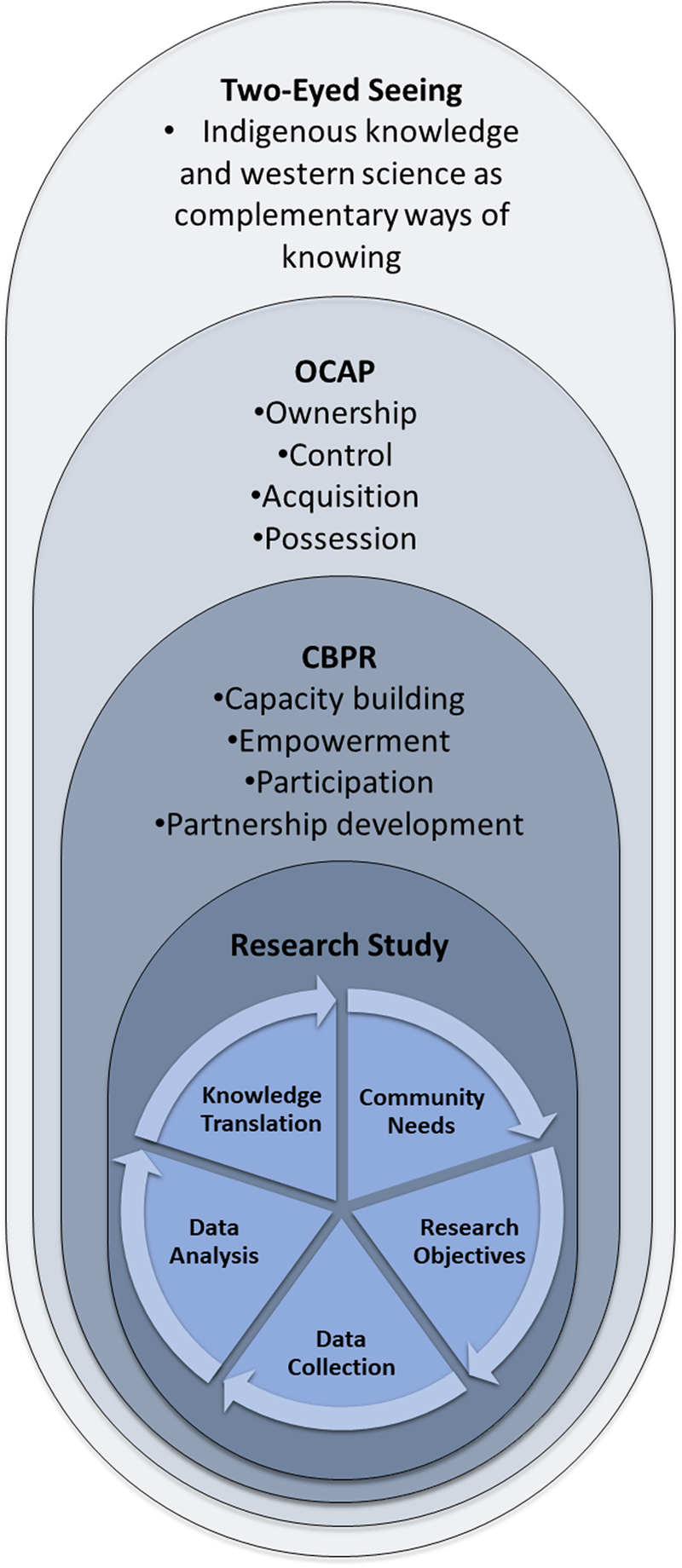
Walker et al. Reference Walker, Lovett, Kukutai, Jones and Henry55 note that principles of good governance of Indigenous data work to improve implementation of research findings by developing a sense of ownership while enriching research questions through community-based participatory research. The principles of ownership, control, access and possession (OCAP®), 56 Community-Based Participatory Research (CBPR) Reference Racadio, Rose and Kolko57,Reference Lichtveld, Kennedy and Krouse58 and Two-Eyed Seeing are examples of community-driven research. Reference Anderson and Cidro59 The framework, illustrated in Fig. 2, shows how the research study, OCAP® and CBPR principles can be nested within Two-Eyed Seeing, ultimately allowing for the establishment of infrastructure, capacity and partnerships necessary to carry out a DOHaD cohort study.
Applying the Two-Eyed Seeing approach to a theoretical Indigenous community-based participatory DOHaD study (Two-Eyed Seeing approach adapted from Peltier Reference Peltier43 and Jacklin and Kinoshameg Reference Jacklin and Kinoshameg42 ).
Two-Eyed Seeing can be an overarching approach used with DOHaD studies involving Indigenous communities and we note three essential elements used in our own partnership models, guided by Lemelin and Lickers Reference Lemelin and Lickers60 and Sistili et al. Reference Sistili, Metatawabin, Iannucci and Tsuji61 : I. Respect—special interests of the Indigenous community must be heard and considered by all parties. The IK system, including local languages, will be used (when appropriate), and acknowledgment of proper customs will be done (e.g., traditional offerings). II. Equity—sharing of resources (e.g., exchange of knowledge, personnel) is planned for, community coordinators will be Indigenous persons, and there will be community-based training opportunities. III. Empowerment—sharing of power (equality through governance), training and learning opportunities and reciprocal flow of information between the western science research team and Indigenous research team. This partnership model ensures that all voices are heard, and ultimately, captures the spirit of Two-Eyed Seeing. In Canada, research approaches should also be in alignment with the Panel on Research Ethics (TCPS 2) and the Tri-Council Policy Statement. Reference Chung, Cavoukian and Information62,63
Ownership, Control, Access and Possession
OCAP®, an acronym first used by the Steering Committee of the First Nations Regional Longitudinal Health Survey, represents a political response to historical colonial Western science-based research. Reference Schnarch64 The First Nations Information Governance Center Reference Kukutai and Taylor65 further highlight how OCAP® is a direct response to improper historical research involving Indigenous (in this case, First Nations people in Canada), ultimately paving the way for equitable information and research management. In Anderson and Cidro, Reference Anderson and Cidro59 one interviewee notes that ‘OCAP® has opened a gate, and it has allowed communities to find a voice related to research.’ Ownership refers to the community knowledge, and the people who act as stewards of the information gathered during the study (i.e., the relationship between people and their data). Reference Schnarch64 Control refers to the principle that Indigenous communities are involved in all stages of the project. Reference Schnarch64 Access assures that the community will have the ability to view and use the data as they see fit. Reference Schnarch64 Lastly, possession refers to the physical and/or digital possession of study data. Reference Schnarch64 Schnarch Reference Schnarch64 notes that capacity building goes hand-in-hand with the principles of OCAP®, and hence, easily lends itself to also incorporating the principles of CBPR in study design. Indigenous world views should help shape the research project from its inception and leadership is shared with many key members of our research team being Indigenous. The movement from theory to practice can be facilitated by the use of a thoughtfully designed governance structure. Reference Bruhn66 A governance structure that forms the basis of many of our own projects and aids in ensuring OCAP® principles are followed is depicted in Fig. 3.
Governance structure: 1. The Partnership Steering Committee (PSC) oversees the whole partnership, being concerned with operational management and the strategic orientation of the project. The PSC will seek consensus on matters, and is responsible for mid cycle and end of project reports. 2. The Policy Working Committee reports to the PSC, and supports policy development in light of better practices, i.e., knowledge translation. As this committee is comprised of knowledge users and decision makers, implementation of results of this project is another function along with dissemination of results. 3. The Technical Working Committee makes recommendations to the PSC with respect to technical/specialized knowledge issues, using a Two-Eyed Seeing approach. This is why members of all committee have specialized knowledge, both Indigenous and western-science based.

Community-Based Participatory Research
CBPR is an approach that involves conducting research that is beneficial to the community and maintains the notion of equitable power distribution between researcher and community. Reference Israel, Eng and Parker67 CBPR is itself not a method, but rather a collaborative approach to research that promotes lay involvement, encourages community development and builds partnerships. Reference Vukic, Gregory, Martin-Misener, Vukic, Gregory and Martin-Misener68 Vikic Reference Vukic, Gregory, Martin-Misener, Vukic, Gregory and Martin-Misener68 further note that both CBPR and OCAP® can be used to help integrate Two-Eyed Seeing into health research studies with Indigenous communities. Hence, when CBPR is combined with the principles of OCAP®, the Two-Eyed Seeing approach to research can easily facilitate the commonalities between the two seemingly disparate knowledge systems.
Conclusion
The need for, and expansion of, culturally relevant programs and policies for Indigenous people is needed. Reference Chatwood, Paulette and Baker69 The Two-Eyed Seeing research approach allows for the development of such services to be impactful and meaningful, and therefore more likely to have higher long-term participation. DOHaD studies offer a flexible framework for assessing a wide variety of health outcomes due to parental, pre- and post-natal exposure pathways which, when combined with Two-Eyed Seeing, support multiple ways of knowing. Most importantly, the use of Two-Eyed Seeing in DOHaD studies among Indigenous communities will expand NCD research, working towards the goal of improving healthy life trajectories. As DOHaD researchers begin to fill the gap in Indigenous health, we have outlined how the Two-Eyed Seeing approach to DOHaD studies with Indigenous communities can be employed to develop and guide these projects, resulting in a robust and participatory study.
Acknowledgements
We thank all the Indigenous communities in Canada and Australia that we have worked with over the last several decades for helping to strengthen our own studies by becoming partners in research.
Financial support
This work was partially supported by a Ryerson University FCS Seed grant to ENL. Additional funding was provided by the Institute of Indigenous Peoples’ Health, Canadian Institutes of Health Research (Grant #156396).
Conflicts of interest
None.


 Open access

