

INTRODUCTION
In the 1970s the United States federal courts affirmed the constitutional rights of people incarcerated in US prisons. Over the next few decades, hundreds of lawsuits significantly improved prison conditions and created new enforceable standards to protect prisoners’ rights. Since then, mechanisms for protecting prisoners have multiplied and spread across institutional domains, such as public interest law firms, professional accreditation organizations, prisoners’ rights organizations, and private companies. The variety of actors and institutions involved in prisoners’ rights is reflective of a broader shift toward “a plural state, where multiple interdependent actors contribute to the delivery of public services” (Osborne Reference Osborne and Osborne2010, 9). Yet, present-day conditions of confinement in the United States are as dangerous as they were prior to twentieth-century court intervention (Dolovich Reference Dolovich2022). People incarcerated in US prisons and jails today receive inadequate health care, are subjected to high rates of physical and sexual assault, and spend lengthy terms in solitary confinement (Blakinger et al. Reference Blakinger, Jamiles Lartey, Sisak and Thompson2021).
Given the success of prisoners’ rights litigation and the proliferation of mechanisms to protect prisoners’ rights, how should we understand the failure to maintain safe and healthy conditions within US prisons? Most scholarship examining this failure examines just one piece of the “prisoners’ rights ecosystem” (Schlanger Reference Schlanger2016). Legal scholars tend to focus on the changes wrought by the 1996 Prison Litigation Reform Act (PLRA) which “made prisoners’ rights cases harder to bring, win and maintain” and undermined lawyers’ financial ability to take them on (Schlanger Reference Schlanger2016, 68; Reference Schlanger2017). Other legal scholars point to the lack of adequate external oversight mechanisms to monitor prison conditions (Deitch Reference Deitch2020). A few social scientists have examined the efficacy of specific tools, such as accreditation or the Prison Rape Elimination Act (PREA) (Kubiak et al. Reference Kubiak, Deborah Bybee, Fedock, Darcy and Cummings2020; Headworth and Zaborenko Reference Headworth and Zaborenko2021; Rudes et al. Reference Rudes, Magnuson, Portillo and Hattery2021). And in a review article, Dolovich (Reference Dolovich2022) argues that regulatory failure is, in the end, a result of American society’s racialized devaluing of those labeled “criminals.”
We take a different approach and examine the larger prisoners’ rights “accountability environment” that includes bureaucratic, legal, professional and political systems (Bovens Reference Bovens2010; Overman and Schillemans Reference Overman and Schillemans2021). Accountability systems, whether they are based in constitutional law or executive authority, do not operate in isolation. They overlap, contradict, and complement each other. As one public administration scholar writes, “the … approach to public accountability in the United States has been to design solutions to accountability problems as they arise, without regard to elegance of design or redundancy. As a … scandal arises, new accountability relationships are instituted to prevent such circumstances from arising in the future” (Romzek Reference Romzek2000, 23). Thus, to understand why US systems fail to protect the rights of people who are incarcerated, or succeed at some times and not others, we examine the “web of multiple accountability relationships” that constitute the prisoners’ rights accountability environment (Romzek Reference Romzek2000, 22).
Our approach contributes to the literature on prison oversight in four ways. First, we introduce an accountability framework to conceptualize prisoners’ rights environments. Second, we detail how two states’ accountability environments work in practice in the post-PLRA period. Third, we demonstrate the hierarchical interdependent relationships that constitute the patchwork of prisoners’ rights accountability systems. Fourth, using the accountability framework and our empirical findings, we develop a novel explanation for the failure to protect prisoners’ rights in the United States today.
To do this, we compare original case studies of prison accountability environments in two states between 2000 and 2021. In both cases, the accountability systems failed to prevent patterned and persistent violence against incarcerated women by corrections officers, including sexual harassment, assaults, and rape. In both states, a combination of investigative journalism, Department of Justice (DOJ) investigations, and whistleblower disclosures brought considerable public attention to the ongoing violence. Following Rubin and Phelps (Reference Rubin and Phelps2017), we use these crises as an opportunity to identify the actors who constitute the accountability environment and analyze their conflicts. The comparison of these accountability environments and, crucially, the outcomes of the political crises demonstrate the contingent nature of prisoners’ rights protection in the United States. Specifically, we find that the patchwork of prisoners’ rights accountability systems consists of a web of hierarchical and interdependent relationships that constrain or enable accountability. We argue that the prisoners’ rights accountability environment in the early twenty-first century fails to remedy unconstitutional and inhumane US prison conditions because protecting prisoners’ rights does not align with the priorities of dominant elected officials.
LITERATURE REVIEW
Accountability and State Agencies
Scholars of public administration provide a framework for understanding accountability for state agencies (Romzek and Dubnick Reference Romzek and Dubnick1987; Romzek Reference Romzek2000). Specifically, accountability is “answerability for performance” that has the potential to result in consequences (Romzek Reference Romzek2015, 28; Bovens Reference Bovens2010). When people speak of “increasing accountability,” what they often mean is shoring up or creating a system by which one party becomes answerable to another (an accountability relationship). Conceptually, an accountability system is a means of creating accountability based on (a) the source of authority for legitimate expectations for performance; (b) an accountability standard or set of expectations for performance specific to the source; (c) accountability tools used to communicate standards, gather information, and share findings; and (d) potential consequences (Overman and Schillemans Reference Overman and Schillemans2021). Accountability tools can be proactive, as in a routine audit, or reactive, as in an investigatory committee. And consequences can be formal, as in fines or civil remedies, or informal, such as the “disintegration of public image and career as a result of the negative publicity generated by the [accountability] process” (Boven Reference Bovens2010, 952). In this framework, the people imposing accountability expectations are the account holders, those being held to account are the account givers, and the people responsible for accountability tools that provide information between the account givers and the account holders are information providers.
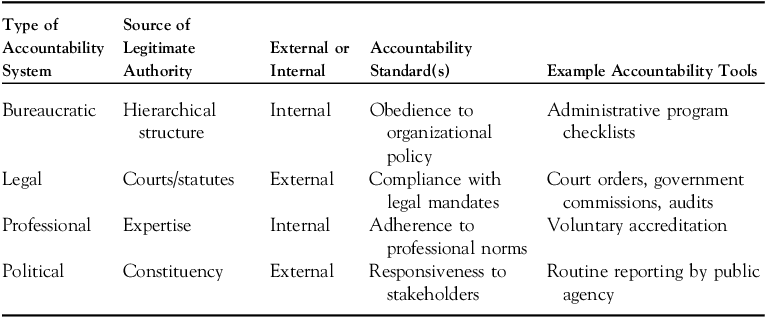
Table 1 lists four types of accountability systems with different sources of authority that are either internal or external to the public agency. Romzek and Dubnick (Reference Romzek and Dubnick1987) explain that bureaucratic accountability is based on the legitimacy of hierarchical relationships internal to the organization, where employees are held accountable to organizational rules through close supervision by supervisors. Legal accountability is external to the organization and based on constitutional or statutory law and the associated standard is compliance with a legal mandate. While federal court mandates are relevant for prison accountability because of the applicability of US constitutional law, “legal” here can mean any scrutiny by an external source of legal authority, and includes tools such as government commissions, audits, and inquiries. Professional accountability is based on the expertise of the person held to account. Public administrators are accountable to their own and their peers’ expertise and professional norms, which may be formalized in processes such as accreditation. Finally, political accountability is based on public administrators’ relationship to various “constituents” to whom they must be responsive. Appointed public administrators are most answerable to the elected executive and legislative officials that appoint and oversee them, but also to the news media and the public.
Types of Accountability Systems

Source: Adapted from Romzek and Dubnick (Reference Romzek and Dubnick1987) and Romzek (Reference Romzek2000).
In practice, most public administrators face a multitude of accountability systems that shift, overlap, and conflict. The accountability environment is this complete set of accountability systems (Overman and Schillermans Reference Overman and Schillemans2021). Key to each accountability system within the environment are the expectations of the authoritative sources. Expectations of the account holders (whether government officials or the courts) structure accountability tools, the flow of information, and the standards by which consequences are rendered. Together, these components, along with the likelihood of the accountability source to impose sanctions, impact what scholars call felt accountability or “the implicit or explicit expectation that one’s decisions or actions will be subject to evaluation by some salient audience(s)” and as a result one could “receive either rewards or sanctions” (Overman and Schillermans Reference Overman and Schillemans2021, 13–15, citing Hall and Ferris Reference Hall and Ferris2010, 134).
Accountability environments frequently fail to prevent, or even identify, public agencies’ malfeasance or neglect (Brandstrom and Kuipers Reference Brandstrom and Kuipers2003). These failures can constitute a “political crisis” when influential actors successfully frame them as violations of, or threats to, “crucial public values” in a way that “necessitates making vital decisions” by account holders (Boin, Ekengren, and Rhinard Reference Boin, Ekengren, Rhinard, Cavelty and Mauer2009, 453; Brandstrom and Kuipers Reference Brandstrom and Kuipers2003). Political crises, in turn, can trigger reactive accountability processes, which work to assign blame for the problem. As a part of this process, actors compete to frame the origins of the crisis, the appropriate response to the crisis, and the lessons to be learned from the crisis. As such, the ways in which crises evolve are good markers of both the accountability environment and the political context (Mesquita et al., Reference Mesquita, Smith, Siverson and Morrow2005).
Prison Conditions and Prisoners’ Rights Accountability in the United States
To understand the complexity of prisoners’ rights accountability environments in the United States, it is useful to know something of their development over the twentieth century. Under US federalism, each state is responsible for regulating and monitoring its own state prison system. Although state systems developed differently due to variation in states’ history, politics, and culture (Campbell Reference Campbell2018), below we highlight some federal, regional, and state processes that shaped the general development of prisoners’ rights accountability in the United States between 1900 and 2020.
In the first half of the twentieth century in the United States, many prison managers ran prisons at their own discretion with limited state oversight. In the South, the legacy of slavery and convict leasing led to fiefdoms by captains in prison camps or plantations (Yackle Reference Yackle1989; Perkinson Reference Perkinson2010). In parts of the country with progressive prison reform movements, concerns about reputation among reformers may have played a role in accountability (Rubin Reference Rubin2021). State governors and legislatures and county officials also appointed investigatory commissions—typically after the exposure of brutal prison “discipline” or other severe conditions (Rothman Reference Rothman2002). In addition, a growing network of corrections administrators in the American Correctional Association began to advocate professionalization of corrections, including propagating correctional standards (Feeley and Rubin Reference Feeley and Rubin1998). Eventually, most states began to centralize and bureaucratize their prison systems, creating new (or more robust) sources of external accountability such as annual reports to the legislature or state inspections (Walker Reference Walker1980).
Yet by 1970, prisoners in the United States regularly lived in overcrowded prisons, suffered violence at the hands of fellow prisoners and officers, worked for nothing on prison plantations, and died from inadequate nutrition and medical care (Irwin Reference Irwin1980; Yackle Reference Yackle1989; Lynch Reference Lynch2010). Responding to prisoners’ petitions and civil rights lawyers’ advocacy, federal judges across the country departed from the hands-off legal doctrine, finding that prisons and entire state prison systems (mostly in the South) violated incarcerated people’s Eighth Amendment rights (Schlanger Reference Schlanger1999, Reference Schlanger2006). Over the next twenty-five years, court orders and court-appointed monitors led to new statutory and bureaucratic systems of prison regulation, including prisoner grievance systems (Calavita and Jeness Reference Calavita and Jenness2014), internal auditors, and oversight units (Feeley and Rubin Reference Feeley and Rubin1998). During this period the court-imposed expectations became normative for corrections professionals and prisons became safer (Feeley and Rubin Reference Feeley and Rubin1998; Feeley and Swearingen Reference Feeley and Swearingen2004; Van Zyl Smit Reference Van Zyl Smit2010; although see Reiter Reference Reiter2016).
The influence of the courts on prisoners’ rights wanned the through the 1980s and 1990s as the Supreme Court (and the nation) became more conservative. Legislators, too, began to push back against federal court regulation of state prisons. In 1995, Congress passed the Prison Litigation Reform Act (PLRA), which limits state prisoners’ access to the courts, the scope of settlements, and the length of court oversight (Schlanger Reference Schlanger2016). As a result, by 2014 prisoner civil rights filings in federal court declined by over 50 percent and the percentage of incarcerated people living in facilities under a court order was cut in half (Schlanger Reference Schlanger2017). The PLRA came on the heels of a massive and continuing increase in the number of people living behind bars, which quadrupled from five hundred thousand in 1980 to over two million in 2014 (Carson Reference Carson2015).
The federal government does have some means to regulate state prison systems. The Civil Rights of Institutionalized Persons Act (CRIPA) gives the Department of Justice’s Civil Rights Division and the US Attorney’s Office authority to investigate state prisons. The Prison Rape Elimination Act (PREA), which went into effect in 2012, sets standards for state prisons around sexual assault allegations, places limits on cross-gender searches, and requires audits of state prisons’ practices. The law also requires prisons to have a PREA compliance manager who collects data on sexual assaults and makes it publicly available.
States, however, maintain the bulk of the responsibility for overseeing prisons and protecting prisoners’ rights. By 2010 when the Supreme Court once again stepped in to oversee prison conditions in California (Simon Reference Simon2014), states had a variety of accountability systems in place, but “formal and comprehensive external oversight—in the form of inspections and routine monitoring of conditions that affect the rights of prisoners—[was] truly rare” (Deitch Reference Deitch2010, 1762). As Simon (Reference Simon2018) writes: the “deliberate policy of rapidly expanding the prison population led to an accumulation of especially vulnerable prisoners in especially dangerous and degrading conditions of hyper overcrowding” (172). Today, despite monumental victories for prisoners’ rights in the last fifty years, evidence suggests that people incarcerated in state prisons regularly experience inhumane and unconstitutional conditions of confinement (Ford Reference Ford2019; The Economist 2022).
Explanations for Prisoners’ Rights Accountability Failures
Explanations for the failure to protect prisoners in the United States focus primarily on individual systems of accountability, rather than the accountability environment. Most prominently, legal scholarship points to the failure of case law to protect prisoners and the changes wrought by the PLRA (Schlanger Reference Schlanger2016, Reference Schlanger2017). Since the 1980s, the federal courts began to dilute rules protecting prisoners and increasingly deferred to prison officials’ claims (Dayan Reference Dayan2007; Reiter Reference Reiter2014; Dolovich Reference Dolovich2022). Combined with qualified immunity law, “prison officials enjoy … de facto absolute immunity” from legal consequences (Shapiro and Hogle Reference Shapiro and Hogle2018). In addition, scholars point out the limits of the courts’ procedural focus (Reiter Reference Reiter2012) and the structural limits of courts, which are not designed to maintain continuous oversight of prisons and jails (Alexander Reference Alexander2004).
Scholarship has also considered the drawbacks and problems with bureaucratic accountability. Internal monitoring tools, for example, are subject to the whims of agency directors, the capacity of monitoring staff, and “the monitoring arm’s ability to avoid capture” (Alexander Reference Alexander2004, 794; Van Zyl Smit Reference Van Zyl Smit2010). Corrections staff often view legally imposed requirements, such as PREA or grievance appeals, as “burdens” that interfere with safety (Rudes et al. Reference Rudes, Magnuson, Portillo and Hattery2021). And multiple studies find that state prison officials use bureaucratic accountability tools to comply with legal expectations without addressing rights violations (Dayan Reference Dayan2007; Calavita and Jenness Reference Calavita and Jenness2014; Struthers Munford, Hannah-Moffat, and Hunter Reference Struthers Munford, Hannah-Moffat, Hunter, Swiffen and Nichols2018; see Cliquennois and Champetier Reference Cliquennois and Champetier2013 and Armstrong Reference Armstrong2018 for similar findings in European prisons).
Finally, Deitch’s (Reference Deitch2010, Reference Deitch2020) exhaustive review finds a lack of adequate tools to ensure the accountability of prison administrators to elected officials or the public. In 2010, twenty-five states did not have any external oversight mechanism (Deitch Reference Deitch2010). By 2020, only thirteen states plus the District of Columbia had independent mechanisms for assessing and reporting on conditions of confinement and many of these lacked adequate resources, access to facilities they oversee, and/or enforcement authority (Deitch Reference Deitch2020, 153). Furthermore, external oversight of prisons creates the unique problem that when they are in the facility, external monitors need protection from the very people they are meant to “oversee” (Deitch Reference Deitch2020, 169).
The (Missing) Politics of Prisoners’ Rights
Scholarship on prison conditions very rarely considers how political power dynamics and political interests shape the prisoners’ rights accountability environment in the United States. Yet law and society scholarship on the “politics of rights” argues that legal rights are empty without political support (Scheingold [1974] Reference Scheingold2004; Stryker Reference Stryker2007). European scholarship also demonstrates that the contours of national political culture shape prisoner’s rights accountability environments (Van Zyl Smit and Snacken Reference Van Zyl Smit and Snacken2009; Christoffersen and Madsen Reference Christoffersen and Rask Madsen2011; Whitty Reference Whitty2011; Cliquennois and Snacken Reference Cliquennois and Snacken2018). Depending on the political context, both the political right and the left in Europe have politicized prisoner rights by framing them as “wins for prisoners” or as “prison rights violations,” respectively (Loader Reference Loader, Benjamin and Lazarus2007; Whitty Reference Whitty2007; Xenakis and Cheliotis Reference Xenakis and Cheliotis2018; Caputo and Ciuffoletti Reference Caputo and Ciuffoletti2018). Furthermore, numerous studies of the rise of the carceral state in the United States point to the outsized role of politics and political conflict (for a review see Beckett and Francis Reference Beckett and Ming Francis2020). Racial politics and racism in the United States establish and reinforce a generalized disregard for people convicted of crimes and for prisoners (Alexander Reference Alexander2010). On top of that foundation, lawmakers interpret and provide (or withhold) legal rights to incarcerated persons within specific and shifting political contexts (Schoenfeld Reference Schoenfeld2010; Goodman, Phelps, and Page Reference Goodman, Phelps and Page2017).
To understand how the components of the penal state (Rubin and Phelps Reference Rubin and Phelps2017) interact with the political context, scholars draw on Bourdieu’s representation of the social world as various hierarchically organized “fields” (Bourdieu and Wacquant Reference Bourdieu and Wacquant1992). Within “penal fields” actors struggle to shape penal priorities and those with more power and resources are better able to impose their vision on others (Page Reference Page2011). Penal actors strive to gain “symbolic capital” (Bourdieu Reference Bourdieu1994) or the “authority to make decisions concerning the operation and administration of the various agents and agencies within the fields” (Tennant Reference Tennant2014, 40). Research on penal change highlights how certain events or moments can bring “background” contestation to the forefront (Goodman, Phelps, and Page Reference Goodman, Phelps and Page2017). In these moments, if those with less power can turn the event into a political opportunity, they may be able to enact change. For example, Symkovych (Reference Symkovych2020) argues that European media, prisoners and NGOs have successfully used moments of “negative visibility” to create “effective pressure” to address prisoners’ rights violations. To do this, penal and political actors work to frame the problem (often through the news media) as either systematic or an “aberration” (Djerf-Pierre, Ekström, and Johansson Reference Djerf-Pierre, Ekström and Johansson2013; Boyle and Stanley Reference Boyle and Stanley2019). Below we incorporate the insights on the politics of rights and Bourdieu’s representation of the social world as overlapping hierarchically organized “fields” in our analysis of prisoner’s rights accountability environments (Bourdieu and Wacquant Reference Bourdieu and Wacquant1992; Page Reference Page, Simon and Sparks2013).
METHODS
In order to understand why prisoner’s rights accountability systems fail, we compare two case studies of accountability environments in two states over twenty years (2000–2020). The case studies are drawn from a larger project that compares state-level criminal justice reform efforts across six US states (Schoenfeld and Campbell Reference Schoenfeld and Campbell2023). One aspect of the larger project examines how prison conditions litigation interacts with attempts to reduce state prison populations. The idea for the article arose organically from the large number of lawsuits that included claims about violence by staff (more than claims about health care and solitary confinement) and the unfortunate and uncanny similarities between the stories of violence in women’s prisons in Florida and New Jersey. Unlike lawsuits challenging staff “use of force,” which is permitted in many circumstances, the law does not condone sexual assault or harassment under any circumstances. Under federal law, no incarcerated person may legally consent to sexual interactions with correctional officers or civilian staff. This allows us to “hold the legal question constant” (Nielsen Reference Nielsen2000) to corrections administrators’ “deliberate indifference” to a risk of sexual assault by guards at the facility.Footnote 1
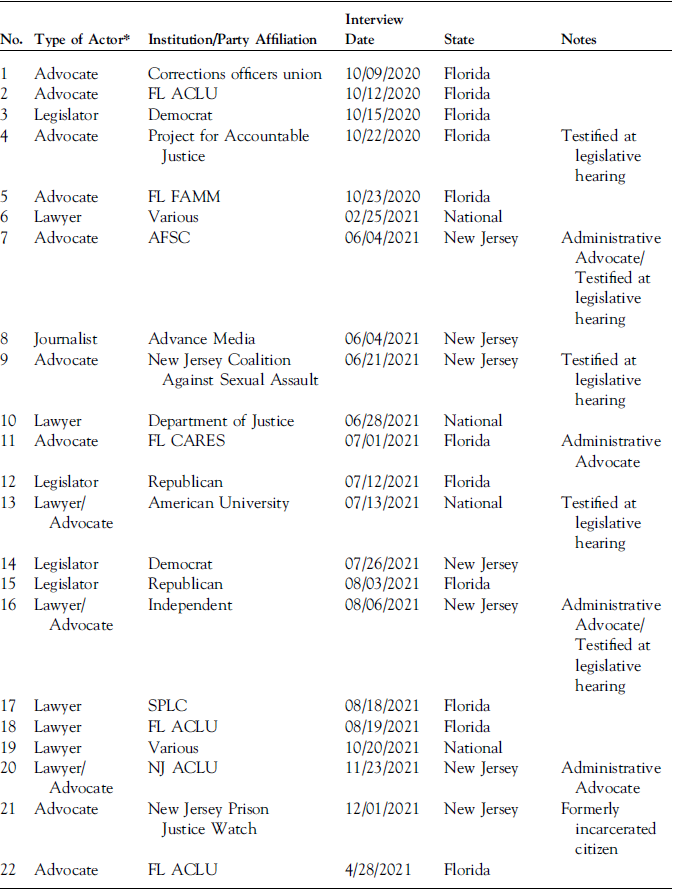
We use a “staged strategy” to construct comparable case studies where data is collected in three stages (Basseches, Campbell, and Schoenfeld Reference Basseches, Campbell and Schoenfeld2024). First, we identified eighty-nine prison conditions lawsuits that were active at some point in the six states between 2000 and 2020 by searching newspaper articles and the University of Michigan Law School Civil Rights Clearinghouse database.Footnote 2 Second, we identified and analyzed legal documents, newspaper articles, legislation, and legislative hearings and memos focusing on conditions and sexual assault in the two women’s prisons in Florida and New Jersey. Third, we used the documentary data to identify potential interviewees involved in accountability relationships. Interviewees also suggested other documents to analyze and other people to interview. We used the interviews to learn about behind-the-scenes conversations and actions, people’s motivations, and their understandings of the situation. Interviews are cited in the endnotes and the Appendix includes a list of twenty-two interviewees by position and the date of each interview. For those people who were unwilling or unable to speak with us, we relied on the documentary record. For example, former Department of Corrections administrators either refused our requests or did not respond, so we relied on their extensive testimony to legislative committees.
We use all the available data to analyze the public crises engendered by the revelations of sexual abuse to uncover and map how prison accountability environments work in practice, including who is involved, their priorities, and how they work to shape the accountability environment (Goodman, Phelps, and Page Reference Goodman, Phelps and Page2017; Rubin and Phelps Reference Rubin and Phelps2017). In addition, we unpack the divergent outcomes of these crises. In one case, the legislature enacted one of the best prison oversight laws in the country (Deitch Reference Deitch2020). In the other, advocates failed to gain support for even small legislative changes to improve oversight of the state’s prisons.
FINDINGS
In what follows, we present each case study separately in four parts. First, we provide a brief background on the prison and the accountability environment prior to 2000. Second, we discuss how the accountability environment functioned in practice such that officers could sexually abuse incarcerated women for over twenty years. Third, we describe a crisis episode of “negative visibility” prompted by media investigations and how stakeholders competed to frame the problem. Fourth, we demonstrate how the political context influenced reformers’ strategies and ultimately their ability to institute changes to the accountability environment. Table 2, which we return to in the discussion, summarizes our findings about the components of the prisoners’ rights accountability systems in both case studies.
Prisoners’ Rights Accountability Environment, New Jersey and Florida, 2000–2020
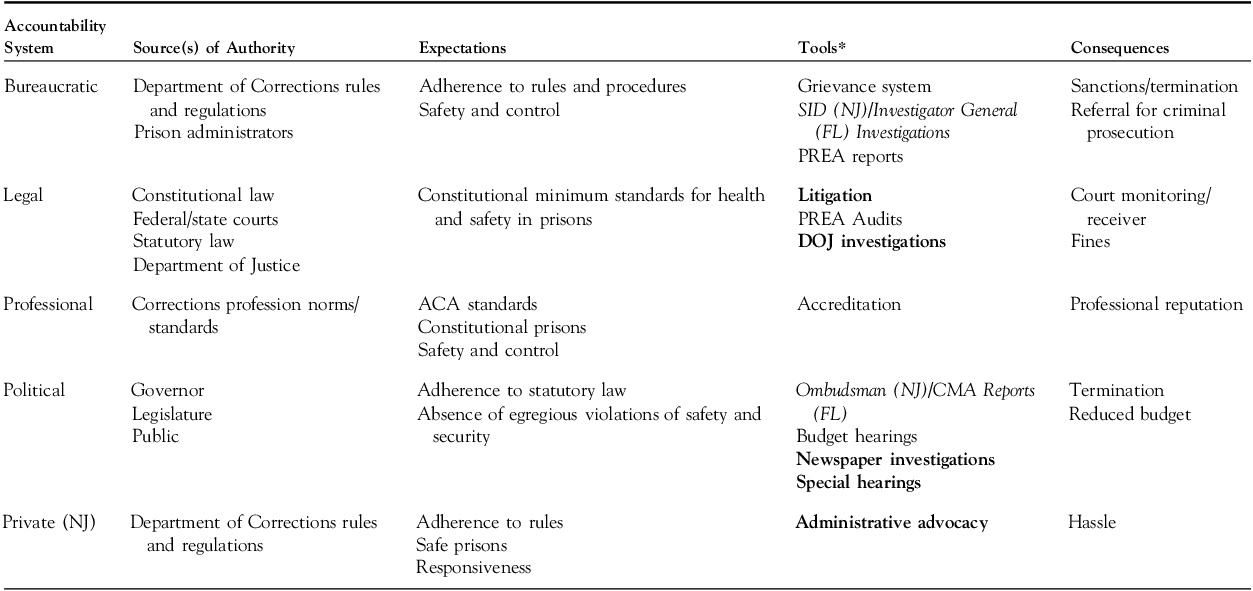
* Italicized items are contingent on adequate funding from the legislature/governor. Bolded items are discretionary.
Case #1: Edna Mahan Correctional Facility
Background
The Edna Mahan Correctional Facility (Edna Mahan or ECMF), New Jersey’s only all-female state prison, is named after the former superintendent who ran the facility from 1928 to 1968 in the spirit of an “open institution” with “student” (prisoner) governance and women housed in “cottages” (Schuman Reference Schuman2020). By the 1960s, however, overcrowding and incidents of violence by prisoners brought calls for more secure confinement (Hawkes Reference Hawkes1998). After the Rahway State Prison riots in 1971, the New Jersey governor established an Ombudsman position within the Department of Institutions and Agencies to receive and investigate complaints from state prisoners, and an Office of Inmate Advocacy in the Department of the Public Advocate, which had authority to litigate on behalf of people housed in New Jersey’s 290 state and local facilities. Just three years later, the Office of Inmate Advocacy had “ceased all involvement in State penal facilities” due to a lack of funding (State of New Jersey Office of Inmate Advocacy 1974). By the late 1990s, the female prison population at EMCF had grown by over 600 percent (US Department of Justice Civil Rights Division and United States Attorney’s Office District of New Jersey 2020).
In 1999, two women incarcerated at EMCF sued top prison administrators for “deliberate indifference” to a risk of sexual assault by guards, one of whom repeatedly raped both women between 1997 and 1999. The Third Circuit Court of Appeals, however, upheld the district court’s summary judgment for the defendants in Heggenmiller v. Edna Mahan Correctional Institution (2005). Even though fifteen current or former EMCF prisoners sued the state between 1999 and 2004 (Peet Reference Peet2004a), the circuit court found that the New Jersey Department of Corrections (NJDOC) had taken “reasonable action” in the case of this specific guard (who was criminally charged in 1999). In addition, the court concluded that EMCF’s “combination of training materials, its ‘no contact’ policy, and its demonstrated practice of investigating, firing, and referring misconduct cases for prosecution constituted a reasonable response to any risk that was observable from the prior incidents at EMCF.”Footnote 3
Accountability environment and “noncrisis” sexual abuse at Edna Mahan, 2005–2016
Over the next fifteen years, despite the court’s findings in Heggenmiller, women continued to file lawsuits against the New Jersey Department of Corrections claiming that EMCF supervisors knew about the culture of abuse and did not do enough to protect them.Footnote 4 The Department of Corrections, however, could point to a variety of bureaucratic accountability tools as evidence that they were meeting their legal responsibilities.Footnote 5 The NJDOC had a grievance system in place, even if women were too afraid of reprisals to use it.Footnote 6 They had a Special Investigations Division (SID) which purportedly investigated all complaints of sexual harassment and assault and answered directly to the Commissioner of NJDOC. In addition, the NJDOC could refer guards for criminal prosecution (Peet Reference Peet2004b). In a lawsuit involving an officer who assaulted at least sixteen women, NJDOC argued that they did the right thing, and it was the county prosecutor’s decision not to bring charges (Sullivan Reference Sullivan2017a).Footnote 7
Beginning in 2012, the facility also had a PREA compliance manager on site, issued public PREA reports, and was audited as required by law. PREA reports, however, reflected information gathered from SID. Between 2012 and 2015, they reported only three “substantiated” cases out of 142 “instances of alleged sexual abuse” (New Jersey Department of Corrections n.d.). Furthermore, prison administrators could claim that they “made a best attempt to contact” the local rape crisis center (as required by law), even though they failed to create a system by which women at EMCF could confidentially access local rape crisis counselors. Staff from the state-funded New Jersey Coalition Against Sexual Assault offered to train NJDOC officers on PREA and trauma-informed service but the NJDOC officials never followed through.Footnote 8 Despite all of this, EMCF passed a PREA audit in 2016.
In theory, when incarcerated women “failed to get satisfactory results through available institutional channels,” they could “seek redress for issues and concerns” with the Corrections Ombudsman (State of New Jersey Department of the Public Advocate 2010, 45). Advocates recall that for a few years prior to 2010, the Ombudsman Office did have some responsive staff.Footnote 9 However, in 2010 New Jersey abolished the Department of the Public Advocate, and operations of the Corrections Ombudsman reverted to NJDOC. One advocate noted that it was seen “as an arm of the DOC.”Footnote 10 Eventually, budget cuts left the office with only six staff to cover eleven prisons.Footnote 11 The office’s investigative role was “informal,” and it only had the authority to “work with administrators and inmates to offer options and facilitate resolutions” (State of New Jersey Department of the Public Advocate 2010, 45). Nor did it have a formal mechanism for reporting back to the legislature on identified problems.
With legal and formal complaint mechanisms foreclosed, incarcerated people and their families turned to a handful of (mostly female) “administrative advocates” in the state, including private lawyers, American Friends Service Committee (AFSC) staff and volunteers, and NJ ACLU lawyers. The advocates’ strategy was simply to hound the appropriate authorities to address problems.Footnote 12 At the same time, they met with legislators to advocate for “independent legal and advocacy services for imprisoned women … [and] internal and external oversight authorities.”Footnote 13 However, at that time elected officials’ priorities were to reduce the prison population and corrections expenditures, and their expectations for corrections administrators focused on correctional programming and parole release (State of New Jersey Office of the Governor 2011; Schoenfeld and Campbell Reference Schoenfeld and Campbell2023).
Exposing and framing sexual violence at Edna Mahan Correctional Facility (2017–2018)
In January 2017, NJ Advance Media reported in The Star-Ledger that the New Jersey Department of Corrections had ignored years of sexual abuse and harassment at Edna Mahan Correctional Facility. Although a variety of prison accountability tools existed at the time, legislators and Department of Justice lawyers claimed to become aware of the problems at EMCF because of the news articles.Footnote 14 Remarkably, the journalist Sean Sullivan just so happened to read a blog post claiming “there were two different lawsuits. [One] filed by five women at the state level, and then another by one woman at the federal level. It all stemmed from the behavior of this one officer.”Footnote 15 Sullivan decided to investigate what happened to the accused officer and found out that he was never charged with a crime “even though he was fired for serial sexual abuse.” After digging some more, Sullivan located an SID report from 2010 that concluded that the officer “had for years struck, groped and sexually assaulted women under his supervision” and he found sixteen women willing to go on record with their stories about the sexual abuse, assault, and intimidation at EMCF (Sullivan Reference Sullivan2017a).
The reporting triggered competing frames about who to blame. The initial stream of news articles (twenty in The Star-Ledger in 2017) focused attention on the responsibility and failures of corrections supervisors, including the commissioner, and the county prosecutor who had earlier declined to charge the officer. The NJDOC responded by framing the incidents as isolated problems that “were being caught by their own due diligence,” pointing to their “zero tolerance policy,” their PREA audit, and their practice of referring cases to the county prosecutor (Sullivan Reference Sullivan2017a, Reference Sullivan2017b).Footnote 16
The response from state politicians was initially quiet because 2017 was an election year for governor and all eighty assembly members. However, the election changed legislators’ calculation about how to address the news of abuse at Edna Mahan. As one female Democratic legislator explained,
If I was to be honest, really virginly [sic] honest … it all starts at the top. Did prior to Governor Murphy coming in, did Governor Christie want to pay attention to this? I don’t know … but I don’t think this was high on his priority list…. As we started getting a new governor, which matched the [political party of the] majority, this was the attention [we needed].Footnote 17
Before the election, State Senator Linda Greenstein, Chair of the Senate Law and Public Safety Committee and Majority leader of the Senate, responded to the news of abuse by writing a letter.Footnote 18 Just a few months later, after the election, she called a committee hearing to “address a very serious, even horrific situation that has come to light at New Jersey’s only prison for women.”Footnote 19
During the hearing in February 2018 various stakeholders sought to frame the incidents as violations of fundamental social values and as evidence of a broader problem that needed immediate action. It is clear from the testimony that the legislators themselves did not know the policies and procedures of New Jersey’s prisons or how they were monitored, even falling into laughter upon realizing that they did not know how to pronounce the name “Edna Mahan.” When asked about the sufficiency of the NJDOC management structure, Brenda Smith, a law professor and PREA expert, responded, “when you have a situation that’s like this, I mean, you know, it’s sort of the flip side: crisis and opportunity. This is a crisis, but it’s an opportunity to dig deep and to look at those kinds of things.”Footnote 20 Other advocates attempted to widen the scope of the problem: “what you’ve heard today about sexual abuse occurs to men and women in the form of physical and sexual abuse in each of our prisons every single day.” And they put the responsibility at the feet of the legislature: “we need legislative action. We can’t wait for ten years of litigation or individual suits.”Footnote 21 Union representatives for SID and the corrections officers’ union agreed that the legislature needed to act, framing the incidents as the result of a lack of resources and training: “the department’s approach … has been to keep things quiet and save money, all to the detriment of officers, inmates, civilians and taxpayers.”Footnote 22
Political crisis and changes in prison accountability systems, 2018–2020
Initially, top Democrats tried to resolve the crisis through the quiet retirement of the corrections commissioner and a “commission to study the problem of sexual abuse behind bars and recommend additional reforms.”Footnote 23 However, the shifting political field gave a small coalition a political opportunity to frame the problem as more than just “actor failure” (Brandstrom and Keuipers Reference Brandstrom and Kuipers2003). Ultimately because of a combination of political savvy and coincidence, the coalition gained support for a new legal accountability system based on strengthening the authority of the Corrections Ombuds Office.Footnote 24
First, the MeToo movement galvanized women across party lines to run for political office in part to address women’s “safety and security.”Footnote 25 One of those women was New Jersey Assemblywoman Yvonne Lopez, who prioritized replicating the recently proposed federal “Dignity for Incarcerated Women Act,” which required placing federal prisoners close to their children, prohibited shackling federal prisoners who are pregnant, and made women’s health care products available free of charge.Footnote 26 The original version of the NJ Assembly bill, which had only three sponsors and two cosponsors, included a new Ombud’s office within the NJDOC to specifically respond to the concerns of women prisoners.Footnote 27
Second, in response to news articles on Edna Mahan, in April 2018 the Civil Rights Division of the Department of Justice and the US Attorney’s Office in New Jersey notified the state that it was opening a CRIPA investigation into the ability of EMCF to protect prisoners from sexual abuse. The DOJ’s extraordinary step to launch an investigation signaled that the problem was more than “a few bad actors” and that federal law enforcement authorities did not trust the state to fix the problem itself.
Third, a coalition of advocates had recently run a successful campaign to statutorily limit the use of solitary confinement in New Jersey (New Jersey ACLU 2019). Members of this coalition had long advocated for statutorily-independent, community-based oversight of the prison system and had previously drafted sample legislation. After the announcement of the CRIPA investigation, coalition members worked with Assemblywoman Lopez to imagine and draft a new external oversight tool.Footnote 28 The resulting bill had the original title—“Dignity for Incarcerated Primary Caretaker Parents Act”—but added nine new pages of new duties and responsibilities of an Office of the Corrections Ombudsperson (OCO)—independent from the NJDOC. The OCO would conduct routine inspections (announced and unannounced), identify systemic issues, and report back to the legislature and governor at regular intervals.Footnote 29
Finally, coincidently, Governor Murphy was embroiled in another sexual assault scandal that brought him heavy criticism (Marcus and Arco Reference Marcus and Arco2019). Consequently, it became politically risky for Governor Murphy to oppose the bill.Footnote 30 As a result, in January 2020, three years after journalist Sean Sullivan broke the story of sexual abuse of incarcerated women by officers at Edna Mahan, the New Jersey governor signed one of the strongest prison oversight laws in the country (Deitch Reference Deitch2020). In a press release, however, the governor’s office emphasized the provisions to “ensure that incarcerated caretakers are given the support … they need to … maintain strong connections with their families” not the provisions that expanded prison oversight (State of New Jersey Office of the Governor 2020).
Case #2: Lowell Correctional Facility
Background
Housing just under three thousand women in 2020, Lowell Correctional Institution (Lowell) in north central Florida is much larger than Edna Mahan (population 600) and it is not the state’s only female institution. Established in 1956 during a reorganization and centralization of Florida’s prisons, Lowell did not have the same women-centered orientation as EMCF (Schoenfeld Reference Schoenfeld2014). During the 1960s and 1970s, Florida Department of Corrections (FDC) administrators built up the “rehabilitative” component of the prison, adding education, vocational training, and counseling (Schoenfeld Reference Schoenfeld2018). The state expanded the facility in the early 1990s to accommodate the increase in the prison population.
Beginning in the early 1980s Florida’s entire prison system operated under a federal consent decree aimed at addressing unconstitutional overcrowding and medical care. In 1993, as part of its agreement with prisoners’ lawyers to end the twenty-year litigation, the legislature created the Correctional Medical Authority (CMA) within the Florida Department of Health to monitor health care delivery.Footnote 31 In the 1990s and early 2000s, FDC administrators worked to maintain compliance with the courts while grappling with how to house a growing prison population caused by legislators’ constant ratcheting up of criminal punishment (Schoenfeld Reference Schoenfeld2018).
Accountability environment and “noncrisis” sexual abuse at Lowell, 2000–2013
Like the New Jersey case, in the 2000s, the felt accountability among corrections administrators in Florida began to shift from a legal to a political accountability system. The Florida Justice Institute, which had represented prisoners in lawsuits since the 1970s, continued to file suits, but with mixed results.Footnote 32 However, governors sought to tighten their relationships with top prison administrators. In the early 2000s Governor Jeb Bush appointed Florida secretaries of corrections who would be responsive to his plans for outsourcing and privatization. Disinvestment in prisons led to mismanagement, corruption, and severe reductions in programming. At different points during this time accountability tools instituted in the 1980s—the FDC Inspector General and the Correctional Medical Authority—lost funding. When incidents of corruption or abuse became public, governors replaced the FDC Secretary. As a result, the FDC had six different leaders in fifteen years, and FDC staff faced “institutional instability, a hostile work environment, and a lack of accountability” (Schoenfeld Reference Schoenfeld2018, 203). It is in this context that officers sexually assaulted, harassed, and intimidated incarcerated women at Lowell. The abuse and violence at Lowell remained officially “hidden” in part because women and other corrections officers were too scared to file complaints. In addition, like the SID in NJDOC, the FDC Inspector General’s office would investigate wrongdoing by staff, but officers were not disciplined (Brown Reference Brown2014a).
Exposing and framing sexual violence at Lowell Correctional Institution, 2014–2015
A series of investigations published by the Miami Herald in 2014 and 2015 and three whistleblowers in the FDC Inspector General’s office revealed the extent of the culture of abuse and cover-up in Florida state prisons (Klas Reference Klas2016). In the process of investigating deaths in other Florida prisons, reporter Julie K. Brown “unearthed a history of violence and abuse at Lowell, including allegations of corruption and of an almost unbridled physical, sexual and mental persecution of inmates by corrections officers and staff at the prison” (Brown Reference Brown2015). In contrast to the New Jersey case, Brown’s December 2015 “Beyond Punishment” series framed the problems at Lowell as part of a larger problem of dysfunction, staff violence, and cover-ups in the Florida prison system (Miami Herald n.d.). In fact, most stakeholders did not specifically address the problems at the women’s prison. Nor did female legislators rally to resolve the problems. Instead, a few male Republican legislators and a handful of advocates competed with FDC leadership to frame the problem.
Like New Jersey legislators who seemed surprised and, as they learned more, incredulous about the abuse at EMCF, Florida legislators claimed that the Miami Herald news articles awakened them to the problems at FDC. As they began to visit facilities and talk to administrators and advocates, they learned that almost all stakeholders agreed on at least one source of the problem—years of inadequate funding.Footnote 33 As one prison consultant said during the debate about extending the hours per shift for corrections officers, “when people are overworked, and they are tired, bad things are going to happen” (Blaskey Reference Blaskey2018). However, Governor Scott and Republican legislative leaders’ priority was to spend less on state agencies, not more. So, reform-minded legislators and advocates used the media exposure to heighten the threat to values and create a sense of urgency. Advocates called the system “horrible, medieval and un-American” and “rotten to its core” (Brown Reference Brown2014a; Dorfman Reference Dorfman2016). Legislators warned of federal court intervention and death: “inmates as well as corrections officers are being put in a situation where their life could be in jeopardy” (Klas Reference Klas2015). And corrections officers’ union representatives called the prisons “a ticking time bomb” (Romano Reference Romano2016).
In the face of the brewing political crisis during his campaign for reelection in 2014, Republican Governor Rick Scott sought to frame the problem as under control. FDC Secretary Mike Crews held a press conference where he acknowledged that the “integrity and trust of my department is at question,” and changes should be made “to ensure facilities are safe” (Klas and Brown Reference Klas and Brown2014). Then to signal external accountability, Crews reached out to the Florida Department of Law Enforcement (FDLE) to have them take over investigations into misconduct that could be criminal. By the time Crews resigned from his position in late November, he had fired twenty-four officers, created a public “inmate mortality” database, and referred more than one hundred cases to FDLE for criminal investigation (Bousquet and Brown Reference Bousquet and Brown2014). Governor Scott’s new FDC Secretary continued to announce various plans to shore up bureaucratic accountability, such as centralizing discipline for use of force, renegotiating health care contracts, and replacing the FDC Inspector General.
Political crisis and status quo prison accountability systems, 2015–2020
Former FDC Secretary Crews later told the Miami Herald that after each news article the “governor’s office went into a damage-control frenzy” (Brown and Klas Reference Brown and Klas2015). A few legislators and advocates attempted to use the crisis as a political opportunity to frame the problems as dire and systemic and enact new prison oversight tools.Footnote 34 One member of the Senate Criminal Justice Committee responded to the new Secretary’s budget requests: “We can rearrange deck chairs on the Titanic or we can change how we’re doing business fundamentally. To me, that demands an independent oversight of this agency at this point … I’m not interested in talking about budget issues … until we address some fundamental structural flaws that need to be corrected.”Footnote 35 Working with the Project on Accountable Justice, senators on the Committee developed a variety of new accountability mechanisms. Most notably, they proposed a new external prison oversight commission that would be composed of civilians, have the authority and responsibility to investigate problems, conduct announced and unannounced inspections, convene public hearings, issue subpoenas, take sworn testimony, report annually to the legislature, and make recommendations. They even proposed that the commission would review the FDCs budget requests.Footnote 36
Florida Governor Rick Scott, whom voters elected in 2010 as part of a national “anti-government” Tea Party movement, adamantly opposed the creation of an external oversight mechanism. Framing it as one more layer of bureaucracy, House Republicans stripped the proposal of any real oversight.Footnote 37 Instead, Governor Scott issued an Executive Order that stated minimal expectations for the FDC leadership, such as “ensuring that appropriate staff review staffing policies, classification and practices, as needed.” In addition, it slightly reconfigured internal accountability—breaking the state into four regions instead of three, tracking use-of-force incidents, and requiring that FDC employees sign a report under oath about their involvement in any use of physical force.Footnote 38
Given the political power dynamics in Florida, left-leaning advocacy organizations turned to the legal system. In 2014, a coalition of advocacy groups wrote a letter to the US Attorney General that urged the office to investigate Florida prisons “particularly because Florida Corrections officials have gone to such lengths to avoid an investigation that could hold someone accountable” (Brown Reference Brown2014b). Florida ACLU attorneys discussed filing a lawsuit against officials at Lowell; however, they could not find women willing to be plaintiffs and, more generally, they expressed doubt about the long-term effectiveness of litigation.Footnote 39 Instead, they urged the Office of the US Attorney for Florida’s Southern District to investigate.Footnote 40
DISCUSSION
Multiple systems and people failed the women incarcerated at Edna Mahan Correctional Facility in New Jersey and Lowell Correctional Institution in Florida. Despite lawsuits, internal grievance systems, and external monitoring bodies, those responsible for prisoners’ safety did not protect women from continued sexual abuse and intimidation by prison staff. In 2020 the Department of Justice found “reasonable cause to believe” that conditions in each facility violated the Eighth Amendment. In addition, they determined that top administrators likely knew about the sexual abuse, but “failed to take timely action to remedy the systemic problems.” Finally, they concluded that “existing systems discourage prisoners from reporting sexual abuse and fail to effectively detect and deter sexual abuse” (United States Department of Justice Civil Rights Division and United States Attorney’s Office District of New Jersey 2020; United States Department of Justice Civil Rights Division and United States Attorney’s office Middle District of Florida 2020).
To understand the failure to protect incarcerated women, it is not sufficient to examine individual accountability systems in isolation. Instead, we use case studies of the crises engendered by the revelations of sexual abuse in New Jersey and Florida’s prisons to uncover the existing prisoners’ rights accountability environments. As summarized in Table 2, despite the different state contexts, we find a common accountability environment comprised of a patchwork of accountability sources, expectations, tools, and consequences in bureaucratic, legal, professional, and political systems. In fact, we became aware of an additional “private” accountability system in New Jersey where advocates use the NJDOC’s own rules and regulations to hassle administrators until they respond to individual prisoner’s needs. In Figure 1 we use our findings to map the web of relationships that constitute prisoners’ rights accountability environments in the United States today, including the people imposing accountability expectations (“account holders”), those being held to account (“account givers”), and the people responsible for accountability tools that provide information between the account givers and the account holders (“information providers”). We use Table 2 and Figure 1 to illustrate three insights about prisoner rights’ accountability environments. We then use these insights to explain the failure to keep incarcerated people safe.
Prisoners’ Rights Accountability Relationships.

First, hierarchies of authority and power structure the prisoners’ rights accountability environments (Bourdieu and Wacquant Reference Bourdieu and Wacquant1992). The people/positions toward the top of the Figure 1 have more “symbolic capital” within the accountability environment—or the formal or informal authority to make decisions concerning the operation and administration of accountability systems. Governors and legislators are at the top of the hierarchy because, unlike the courts, they are always able to impose some type of accountability, and importantly, they have the authority to allocate resources for accountability tools. Even when the courts side with prisoners, they need elected officials’ buy-in to maintain constitutional prison conditions (Alexander Reference Alexander2004; Schoenfeld Reference Schoenfeld2010). The frustration of the civil rights attorneys we interviewed was expressed succinctly by one who said, “So you have success that we can claim on the front end, but at the end, we find ourselves right back where we started.”Footnote 41 The courts are still normatively powerful, and evidence suggests that administrators do adopt accountability tools such as grievance procedures or accreditation because of their concern about lawsuits (Calavita and Jenness Reference Calavita and Jenness2014; Headworth and Zaborenko Reference Headworth and Zaborenko2021). Professional corrections networks also establish norms for administrators, but their influence is partially determined by whether politicians and courts adopt (and act on) their accountability metrics. Likewise, prison administrators set accountability standards only when politicians and courts defer to them, as we saw in the Heggenmiller decision. At the bottom of the hierarchy, as both case studies highlight, are incarcerated women whose claims are often dismissed or ignored by staff and administrators (see also Behan and Kirkham Reference Behan and Kirkham2016).
However, the field of power within accountability environments is not static. People and organizations within the accountability environment “struggle” to shape accountability expectations, tools, and consequences to fit their goals and priorities (Goodman, Page, and Phelps Reference Goodman, Page and Phelps2015; Page Reference Page, Simon and Sparks2013). Incarcerated women want to be safe and to be compensated for their suffering. In New Jersey many women filed lawsuits to impose legal accountability. Prisoners’ rights lawyers expect prison administrators to ensure a constitutional level of care and protection. Unable to directly file lawsuits, Florida attorneys looked to the DOJ to impose legal accountability. Prison administrators aimed to shore up their professional creditability by lobbying for more resources so that they could impose their own version of bureaucratic accountability on prison wardens and staff. Bureaucrats in various monitoring/investigation units also aimed to expand their ability to carry out required tasks. And many politicians in both states wanted to keep corrections costs low. Of course, these “bodies” are not unitary; they too are sites of contention. Some legislators supported advocates’ proposals for more prison oversight, while others opposed them. Often it is incarcerated people who bear the brunt of this struggle. In both New Jersey and Florida, corrections officers assaulted and intimidated people who filed lawsuits or spoke with investigators.
Second, the people/positions responsible for imposing accountability and providing information are dependent on each other. The overlapping boxes in Figure 1 illustrate some of these interdependencies. If one tool fails to provide information, so will others. At the bottom of the hierarchy, incarcerated people and their families are desperately trying to share their experiences through lawyers, the formal grievance system, prison staff, or advocates. Yet, as both case studies highlight, if people who are incarcerated cannot provide information, then even competent internal prison investigators will miss abuse and lawyers cannot file lawsuits. If internal investigation units are “captured” by prison staff and/or not adequately funded, then PREA compliance managers will underreport assaults.
Similarly, flows of information within the accountability environment require cooperation between players with unequal amounts of power, or they are contingent and discretionary. PREA auditors, for example, depend on prison administrators who hire them. Consequently, multiple lawyers and journalists told us that they “never” trust PREA audit reports. Similarly, women’s health organizations and rape crisis centers, which in theory provide staff training, reporting options, and support services for incarcerated people, depend on the active involvement of prison administrators, who have more symbolic power within the accountability environment (not depicted in Figure 1). At the top of the hierarchy, external oversight agencies depend on political support for authority, autonomy, and funding. In both case studies, oversight agencies established under earlier legal regimes received less funding over time from elected officials, limiting their effectiveness.
The two processes that ultimately created some accountability in New Jersey and Florida—newspaper reporting and the Department of Justice’s investigation—are strikingly discretionary and contingent. Newspaper articles on prison conditions depend on newsrooms making the decision to investigate and publish their findings. Political officials and DOJ attorneys learned about the abuse from newspaper accounts that a reporter could have easily not written. Likewise, before the DOJ can investigate prison conditions and evaluate whether a constitutional violation has occurred, a long line of decisions and resources needs to fall into place. In 2020, DOJ supervisors decided to dedicate personnel to investigate prisons in New Jersey and Florida, but they did not have to.Footnote 42
Third, the case studies demonstrate that people in the accountability environment are also embedded within other fields, including the legal field, the prisoner advocacy field, the professional corrections field, and the political field (Bourdieu and Wacquant Reference Bourdieu and Wacquant1992). The norms and assumptions of these fields shape their interests and priorities, including their accountability expectations, as well as the discourses and strategies they use to assert their priorities within the accountability environment (see Xenakis and Cheliotis Reference Xenakis and Cheliotis2018; Caputo and Ciuffoletti Reference Caputo and Ciuffoletti2018). Scholars have shown, for example, that in Europe lawyers and advocates are embedded in the larger human rights field and use human rights frameworks to protect prisoners (Whitty Reference Whitty2011; Tomczak Reference Tomczak2022; see also Carlton Reference Carlton2018). The current US legal field thus shapes how prisoners’ rights lawyers make legal arguments and what remedies they can ask judges to impose. Likewise, the preference for strong independent oversight agencies by advocates in both New Jersey and Florida reflects a common understanding of the problem among lawyers that “the governmental bodies charged with ensuring that prison officials fulfill the state’s carceral burden align themselves with those same officials” (Dolovich Reference Dolovich2022). Corrections professionals have their own field norms that likely influenced New Jersey and Florida prison administrators when they pushed against elected officials’ expectations that they run safe prisons without adequate resources (for example, Klas Reference Klas2019). In addition, the corrections profession’s security and control “logics” likely contributed to administrators’ inclination to ignore or downplay abuse by prison officers (Calavita and Jenness Reference Calavita and Jenness2014). Prison staff, meanwhile, adhere to organizational norms at their specific prison (Schoenfeld and Everly Reference Schoenfeld and Everly2023). Most importantly, politicians are embedded in state- and party-specific political fields, which shape their incentives and priorities.
The hierarchical nature of the accountability environment and its embeddedness within the political field helps explain the different outcomes between the two case studies. In both states, people with less power used the revelations of abuse to frame the failure of accountability and assert their priorities for change. Advocates’ ability to gain political support for their policy proposals, however, depended on the alignment of their normative framings and the political norms and incentives in the state. In New Jersey, prisoners’ rights advocates, formerly incarcerated women, and a small group of female Democratic legislators succeeded in part because the crisis created political vulnerability for the Democratic governor (Moran Reference Moran2020). Formerly incarcerated women were a crucial part of this effort, as they drew the interest of news media, legislators, and the public (for example, Goldsmith and Sierra Reference Goldsmith and Sierra2021). Consequently, New Jersey prisoners’ rights advocates could successfully “name and shame” the Democratic governor when they felt he was not doing enough.Footnote 43 As evidence of the felt political consequences, Governor Murphy announced plans to close the Edna Mahan prison (after signing legislation to create a robust Ombuds office); and when that did not stop the public critiques, he fired the NJDOC director (Deak Reference Deak2021; Arco and Nelson Reference Arco and Nelson2021). In Florida, a small group of Republican legislators also held hearings and invited experts and activists who used the opportunity to frame the problem as systemic and nonnormative. However, their policy proposals failed. In the Republican-dominated state, proposals for more prison oversight contradicted the norms of fiscal austerity and the political priority to reduce the size of government (Bousquet Reference Bousquet2012). As a result, the Florida governor did not face the same political risks for doing next to nothing.
Taken together, the above insights provide a new way to understand the success and failure to protect incarcerated people in the United States at different times and in different states. Neither the courts, prison administrators, the public, nor politicians are solely to blame. It is more productive to conceptualize a patchwork of accountability where hierarchical relationships differentially constrain and enable account holders, account givers, and information providers to protect prisoners’ rights. In the long run, the effectiveness of prisoners’ rights accountability environments depends on whether protecting prisoners’ rights aligns with the norms and incentives of the field in which the dominant account holders are embedded.
The deterioration of prisoners’ rights protections since the 2000s supports this argument. In the 1970s and 1980s the legal field prioritized prisoners’ rights, thus elevating the authority of civil rights lawyers and the courts to set expectations and impose their preferred accountability standards on corrections administrators and politicians. At the same time, both major political parties in the United States came to believe that they needed prisons to “perform” their ability to protect public safety (Simon Reference Simon2007). Consequently, elected officials could invest resources to comply with court mandates without alienating their political constituencies. Likewise, to shore up their own authority, corrections professionals came to support the bureaucratization that helped them comply with court orders (Feeley and Swearingen Reference Feeley and Swearingen2004; Schoenfeld Reference Schoenfeld2018). As a result, for a short time in the United States protecting prisoners’ rights aligned with dominant legal, political, professional, and bureaucratic priorities.
In the post-PLRA period, power in the accountability environment has shifted, as have the norms of related fields. The ramifications of a more conservative Supreme Court and the PLRA weakened the authority of legal actors. At the same time, the politics of crime control increased the symbolic capital of law enforcement, including corrections administrators and officers (Page Reference Page2011; Campbell and Schoenfeld Reference Campbell and Schoenfeld2013). Yet, the failure to protect prisoners’ rights is not just because the courts began to defer to prison administrators whose professional norms increasingly emphasized security over prisoners’ rights. Rather, protecting prisoners’ rights no longer aligned with political priorities either. In the political field, fiscal conservatism (Aviram Reference Aviram2015) and historically low crime rates (Dagan and Teles Reference Dagan and Teles2014) undercut the political value of prisons. Political officials’ neglect of prisons constrained the authority and resources that people needed to effectively protect prisoners’ rights. As a result, people who are incarcerated in the United States are left with the patchwork accountability environment that we describe above, with low expectations and interdependent, contingent accountability tools that are inadequate for the monumental task at hand.
CONCLUSION
US law requires elected state officials and their appointed public administrators to protect incarcerated people from “known” risks of harm. Recognizing that legal accountability for prisoners’ rights is just one component of an accountability environment that is hierarchical, interdependent, and embedded in other fields suggests possible points of leverage to better protect people incarcerated in the United States. Scholarship reminds us to be wary of reforms that serve to reinforce the legitimacy of prisons, given their consistent devolution into dehumanizing and violent places despite the best intentions of reformers (Struthers Munford, Hannah-Moffat, and Hunter Reference Struthers Munford, Hannah-Moffat, Hunter, Swiffen and Nichols2018; Rubin Reference Rubin2021; Rothman Reference Rothman2002). However, independent tools to collect and disseminate information about what is happening in prisons could simultaneously help protect people who are incarcerated while also generating information that could be used in service of decarceration or prison abolition. The COVID-19 pandemic highlighted the lack of available information on conditions in US prison and jails (Armstrong Reference Armstrong2020; Lacoste et al. Reference Lacoste, Paliwal, Tyagi and Johnson2021). As a starting point then, the federal government, rather than private advocacy organizations, could develop metrics to track and report conditions across all state prisons. Tools such as body cameras are viewed as Band-Aids by many, but they expose violence that we might not learn about otherwise. In New Jersey, officers’ violent intimidation tactics against women who filed lawsuits were caught on security cameras, leading the NJDOC to place over thirty correctional officers and other staff on administrative leave and providing evidence for a dozen lawsuits (Atmonavage Reference Atmonavage2022).
In addition, we can work to elevate the status and power of information providers in the accountability environment such that they at least have more authority than those being held to account. For example, the structure of PREA auditing should change so that compliance managers and auditors are not beholden to departments of corrections. Similarly, PREA audits should evaluate incarcerated people’s actual ability to report sexual assaults independent from prison staff. Other efforts could collaborate across fields to develop noncarceral or decarceral ways of thinking about and responding to the harms perpetuated by incarceration (Dangaran Reference Dangaran2021; Schlanger Reference Schlanger2015). Again, events during the COVID-19 pandemic are instructive. Just as some jurisdictions allowed people to petition the courts for release from prison because of COVID-19-related health threats, people could be granted reprieve for other types of harm, including harm resulting from rights violations (Dangaran Reference Dangaran2021).
If, as we suggest, current political priorities circumscribe what is possible within accountability environments, then in the long term, advocates, lawyers, legislators, justice-involved people, and the public need to do more than expose prisoners’ rights violations and strengthen accountability tools. They need to challenge the political incentives that compete with protecting prisoners’ rights, or change the incentives to protect people who are incarcerated. This could include efforts to roll back state disinvestment from public goods; decriminalize poverty and substance use disorders; destigmatize criminal legal system involvement; or amplify the voices of those impacted by the criminal legal system. It could also involve connecting safe prisons with other salient values; or organizing to elect officials so that they feel responsibility to constituencies that demand safe prisons. Regardless of the specific tactics, civil rights lawyers and judges still have an important role to play because the courts influence how society collectively imagines and mobilizes around fairness, equality, and rights (McCann Reference McCann2006), even if legal recourse for prisoners’ rights violations is limited.
APPENDIX
List of Interviewees



 Open access

