

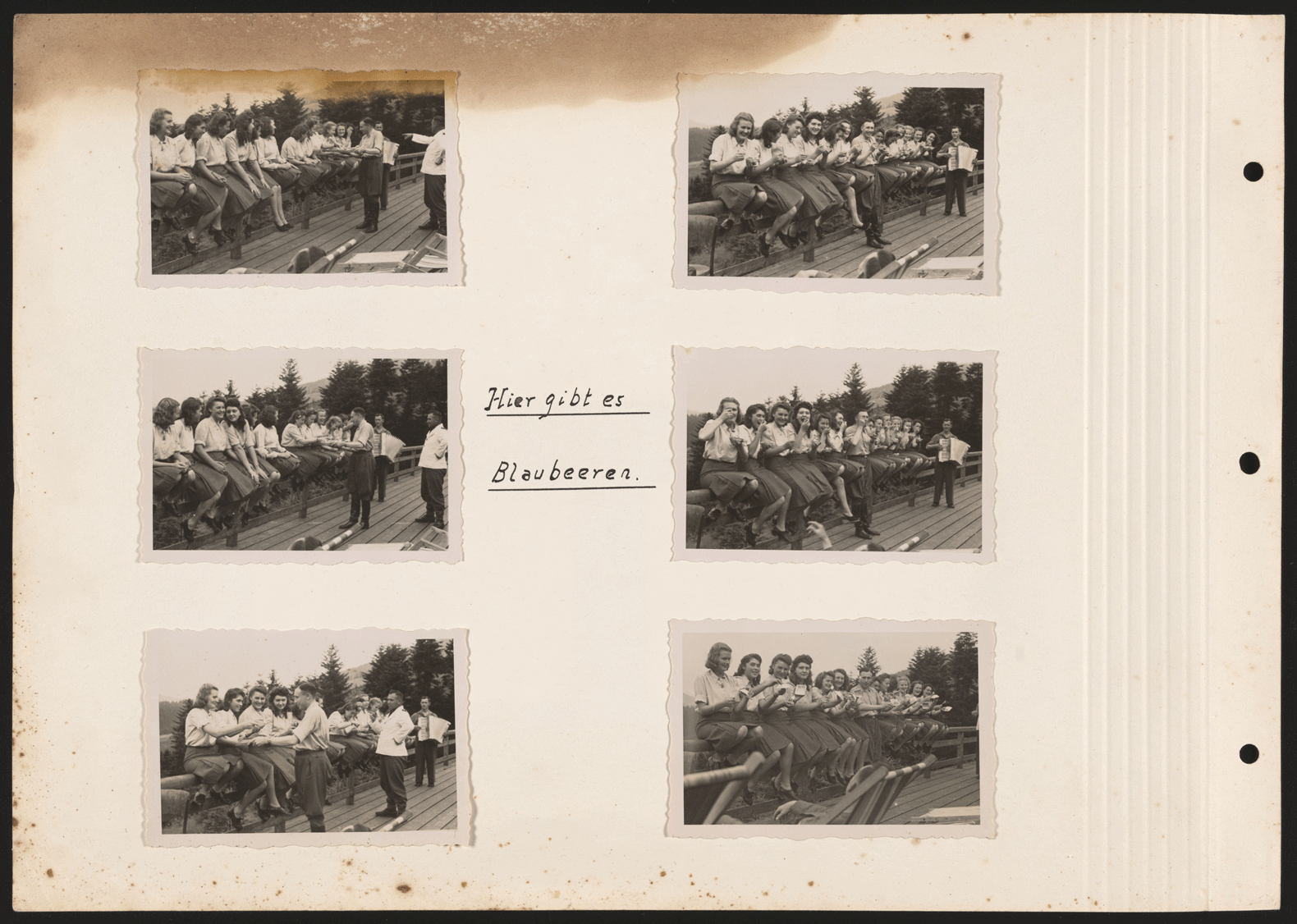
“Hier gibt es BlauBeeren,” in Karl-Friedrich Höcker’s handwriting, on a page of photos he collected in 1944. (Photo from US Holocaust Memorial Museum)
IntroductionFootnote 1
Here There Are Blueberries tells the story of an album containing rare photographs from 1944 of “ordinary life” activities near the Auschwitz concentration camp. Collected by Obersturmführer (First Lieutenant) Karl-Friedrich Höcker,Footnote 2 adjutant to camp commander SS-Sturmbannführer (Major) Richard Baer,Footnote 3 the album contains 116 photographs pasted on both sides of 16 cardboard pages. At the same time the photos in the album were taken—15 May to 9 July 1944—437,000 Jews were deported from Hungary. Of those, 420,000 were sent to Auschwitz where 330,000 were murdered upon arrival. This was the deadliest time at Auschwitz. The photos show Nazi soldiers, their families, and camp workers relaxing, socializing, singing, and eating blueberries—thus the performance’s title. Hier gibt es Blaubeeren (Here there are blueberries) was written by Höcker on a page of photos showing young women, SS-Helferinnen,Footnote 4 eating blueberries at Solahütte, an SS countryside retreat 18 miles south of Auschwitz.Footnote 5 Those luscious blueberries may have been grown in a garden next to Baer’s home, tended by his family and Auschwitz prisoners, steps away from a wall behind which millions of people were being exterminated. Not showing this horror makes the production all the more haunting.
The Höcker album was found by an American intelligence officer in Frankfurt in 1945, soon after the end of WWII. In 2007, shortly before his death, the officer donated the album to the US Holocaust Memorial Museum (USHMM) in Washington, DC. In an email responding to our questions, Rebecca Erbelding, an archivist and curator at USHMM, and a key figure in Here There Are Blueberries, explained:
The donor, who asked to remain anonymous, could not have brought it from Auschwitz because American troops didn’t liberate Auschwitz. The donor must have found the album in Germany. The donor brought the album from Germany to the US. He lived in the greater DC area. I do not know where else it might have been over the donor’s lifetime, but he mostly lived in Virginia, not far from DC, so I assume the album was there too. […]
When the Museum first received the album, it underwent conservation work, as it had been subjected to water and insect damage. Pages from the Höcker album were on display in the United States Holocaust Memorial Museum’s special exhibition, Some Were Neighbors: Collaboration and Complicity in the Holocaust, between 2013–2017, and a few pages were also loaned to the Museum of Jewish Heritage in New York City when that museum hosted the traveling exhibition Auschwitz: Not Long Ago, Not Far Away in 2018. Both exhibitions were covered extensively in the press when they opened. Otherwise, the album has been in climate-controlled storage. […S]ince the images are in great demand the Museum has done very high-resolution digital scans of the photographs and the full pages to prevent over-handling the album. (Erbelding Reference Erbelding2025)Footnote 6
We asked Erbelding when Moisés Kaufman, founding artistic director of the Tectonic Theater Project and the conceiver-director of Here There Are Blueberries, contacted her.
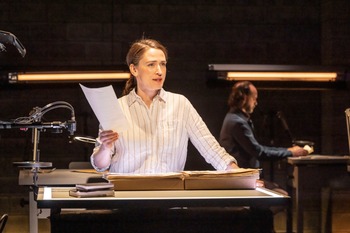
Moisés contacted me on Facebook in the fall of 2010 and in his initial message, mentioned that he thought there could be a play in the story. He came to the Museum soon after and we met for several hours. For a few years after that, he would interview me every once in a while, and then he and Amanda [Gronich, coauthor with Kaufman of Blueberries] really got serious about creating a play in 2017; there was a staged reading in Miami in 2018 and then, after massive changes, Here There Are Blueberries opened in La Jolla in 2022.Footnote 7 The Tectonic staff has kept me informed about the progress of the play throughout its life. I went into the Miami reading without having read the play (or knowing that I would be a central character in it); I believe I read the new version of the play prior to La Jolla, but reading it and seeing it are very different experiences. Since La Jolla, whenever Moisés and Amanda have made minor changes, they’ve kept me informed and sometimes involved. There have been times when they ask for help in solving a particular problem, or if they want to make sure that a line of dialogue or action feels true to me as a person, or true to the Museum’s work, down to details about what kind of archival supplies would be on the characters’ tables. The play is their creation, but they’ve also committed to honoring the work we do at the Museum, for which I’m grateful. (Erbelding Reference Erbelding2025)
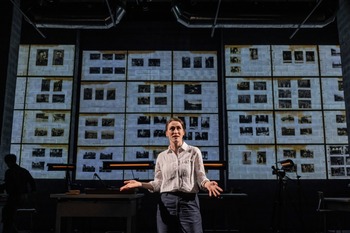
Elizabeth Stahlmann as Rebecca Erbelding in Here There Are Blueberries by Moisés Kaufman and Amanda Gronich, New York Theatre Workshop, 2024. (Photo by Matthew Murphy)
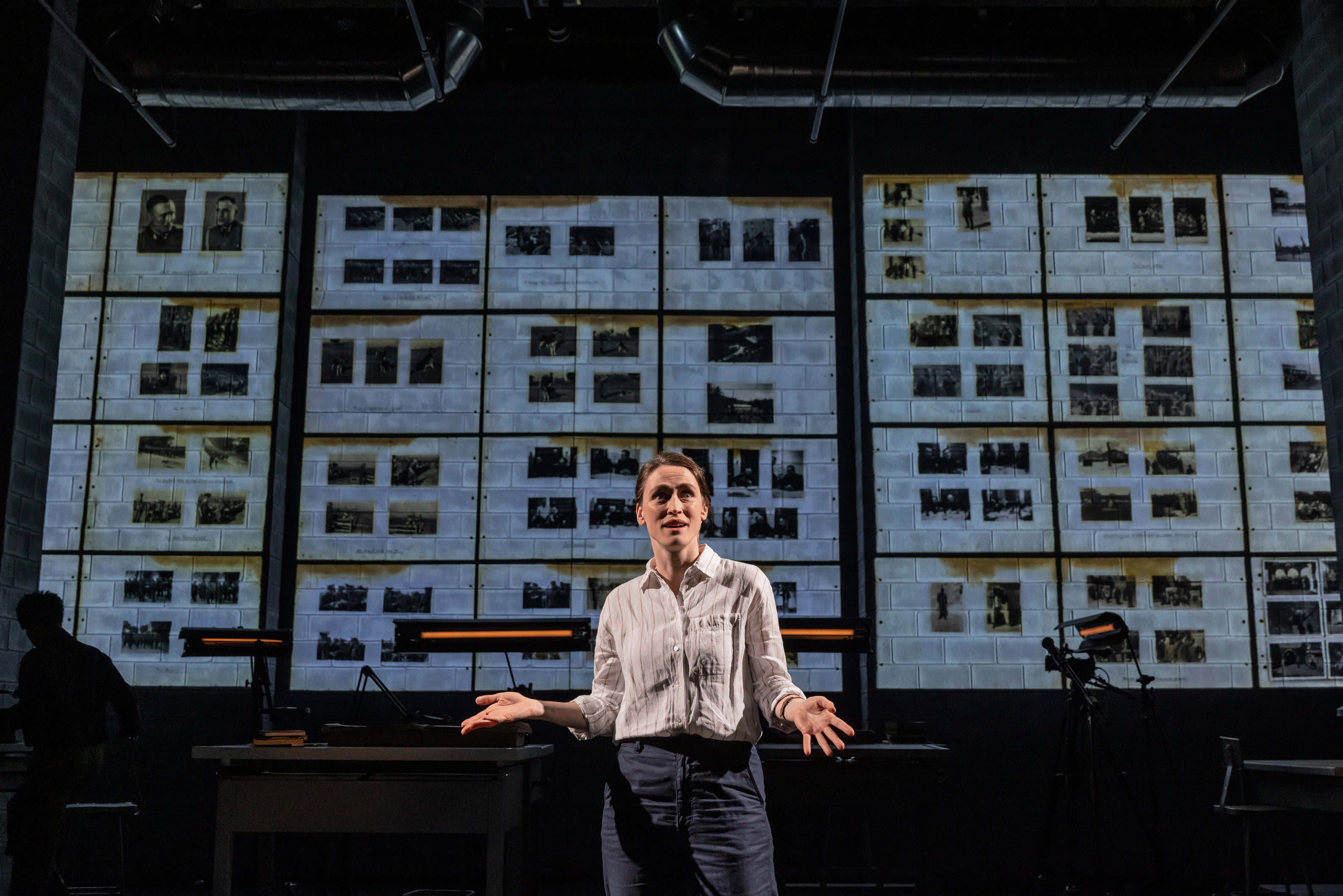
The Tectonic Theater Project, in its usual research-driven approach to production, worked closely with Erbelding as they did their own in-depth interviews, including with descendants of some of those pictured in the photographs. In creating the work, Tectonic asked, “Who is Erbelding? What work does an archivist do with this kind of material? How can Tectonic make theatre from these interlocking stories?”
Tectonic, hinging its story on Erbelding’s work on the Höcker album, makes archival research a theatrical journey. Here There Are Blueberries uses dramaturgy, text, staging, projections, hand-written notes, and a brief lecture on the emergence of take-it-yourself photography into not only compelling theatre but also an investigation of curating, memory, and historical responsibility.
MOISÉS KAUFMAN: You know what’s really interesting? Spalding Gray’s work. The recordings of his mother’s shrink. I remember thinking, you can make theatre out of that? There’s a direct line from that to Here There Are Blueberries. So let’s start there.
RICHARD SCHECHNER: You’re talking about Rumstick Road, the second piece of the Rhode Island Trilogy. Footnote 8 Spalding and Elizabeth LeCompte devised those works while they were members of The Performance Group. I was TPG’s founder in 1968 and its artistic director until 1980. What’s the connection to Here There Are Blueberries?
KAUFMAN: I come from Venezuela where I studied business administration. But after the first class, I realized that if I stayed in business administration, I was going to commit suicide. So I went downstairs to the extracurricular activity center. The first one listed was theatre. I thought, I’ve always wanted to do theatre. So I joined the theatre group and I lucked out because the director was Fernando Yvosky, who had studied Grotowski. He was one of the foremost experimental theatremakers in Venezuela. At that time, Venezuela had a very important international theatre festival, the International Theatre Festival of Caracas. There I saw the work of Grotowski, Kantor, of Pina Bausch, of Peter Brook. I was so taken by experimental work that the first time I saw a realistic play I thought it was avantgarde. “Look, a faucet opens and water actually comes out of it!” I had the same experience people had when they saw The Seagull for the first time. So I became an actor. And I would be onstage but part of me was outside of myself watching the performance. I really wanted to create the whole event, not just be one character. So I came to NYU’s Drama Department and enrolled in the Experimental Theatre Wing where I studied from 1987 to 1990. By then, I was terribly bored with America’s love affair with naturalism and realism. I felt it was a profound disservice to the theatre to not use all of the stage’s potential.
SCHECHNER: Which production had the biggest impact on you?
KAUFMAN: Kantor’s The Dead Class [Krakow 1975, New York 1976]. I thought, Oh, wow, this is part ritual, part story, part memory. Using the theatrical space to create those kinds of realities captured me immediately. It wasn’t meant to recreate ordinary reality; it created its own reality. And I watched a video of Grotowski’s Akropolis [Opole 1962, New York 1969]. Then I saw Brook’s The Mahabharata [Avignon 1985, New York 1987]. These people were really exploring the boundaries of what is theatrical. So I had to come to New York. I had family here, and I had a friend who had gone to the Experimental Theatre Wing. I knew ETW’s training was based on Grotowski with Steve Wangh and Viewpoints with Mary Overlie. That’s what I wanted. I came in as a second-year student in 1987 and graduated in 1990.
SCHECHNER: Amanda, what’s your story?
AMANDA GRONICH: I always like to joke: I was born and raised in a much grittier New York City, and I have all of the personality disorders to prove it—I go into a fight-or-flight response just to get a sandwich. At a very young age I decided I wanted to be an actor. I went to the High School of Performing Arts where I studied Stanislavsky for four years. Then, when I discovered NYU’s Experimental Theatre Wing, I was thrilled: this was something beyond the traditional curriculum, and it became another passionate four-year journey. But with all that intensive, vocational training back-to-back, by the time I graduated, I already felt like I’d been in the industry for a decade. It also started to dawn on me that if I wanted to be successful, I was going to have to become a commodity. I’d have to market myself. I greatly admire actors who have the fortitude and imagination to do this well—it’s an art unto itself. But I realized it was not my calling.
As a close friend, I was a part of Moisés’s orbit as he was forming Tectonic in 1991 with his now husband, Jeff LaHoste. But if we’re being official, I first came on board as an artist in 1997, as associate director for Gross Indecency’s productions in SF and LA.Footnote 9 This was the first bite. (I read once, there’s an insect that has to bite you twice. The first time you’re in trouble, but the second time you’re done.) Gross Indecency was the first bite for me, telling a true story onstage. The Laramie Project Footnote 10 was the second bite. At that point, I became obsessed with the idea that you could take a true story, ripped from headlines or history, and by finding its most powerful narratives—creative decisions, yes, but ones based in real, lived experiences—you could make the story come alive for audiences. I was hooked: highly specified dramatic forms could allow you to look at nonfiction stories from different angles—some of which might be contradictory, but all of which could portray something experientially “true.”
KAUFMAN: We wanted to create a laboratory. We were inspired by The Performance Group, the Ridiculous Theatrical Company, Joe Chaikin. Tectonic is the art and science of structure, form. As in architecture, architectonic. What are the forms that allow us to explore theatricality? The first three years of the company, I staged a lot of playwrights who were themselves exploring form. Beckett, Brecht, Franz Xaver Kroetz, Sophie Treadwell. We were trying to find our spiritual and artistic mentors. We did four years of that, four years where we’d clean up a church for three weeks and the church gave us three weeks of performance. Often we had more actors onstage than audience members.
SCHECHNER: I know the feeling.
KAUFMAN: Once during our 1994 production of Kroetz’s The Nest, a two-character play, we had one person come, and we did the show for that one person. But then the question became, if we’re really being rigorous about exploring theatrical form, it’s not enough to be restaging other people’s work. We have to tackle the issue of text. Because the genetic material of the theatrical form often resides in the text. I had never written a play, but I was fascinated with Oscar Wilde. I knew he was tried because he was gay. Somebody gave me a book based on the transcripts of the trial; 50% of the questions they asked him were about his art. The lawyer would stand in a court of law with a copy of The Picture of Dorian Gray and say, “You wrote this sentence,” and he would read him the sentence and ask, “Is this sentence moral or immoral?” I was doing this research right after the NEA Four and Mapplethorpe,Footnote 11 and I thought, Oscar Wilde wasn’t only tried because he was homosexual, he was tried because he was a subversive artist that was fucking with Victorian mores. I wanted to write a play about Oscar Wilde, the artist.
SCHECHNER: Gross Indecency: The Three Trials of Oscar Wilde.
KAUFMAN: The gross indecency of the writer, of the text. I thought, Wilde, the artist, in a court of law being questioned on his art is a pivotal event in the history of art of the last two centuries. I started working with the transcripts and I fell in love. I went to a yeshiva in Venezuela, and the image of the yeshiva is people pouring over books. This erudition is an incredible source of spiritual inspiration. I would pour over these transcripts, realizing that in them was a record not only of what happened at the trial, but of how Victorians thought—not only about homosexuality, but about education, about violence, about religion, about all kinds of fault lines dividing us. I thought, there might be a play here.
I gathered a group of actors around the table. By that point, I had collected several books about the trials, and I had underlined them. I gave each actor a book, and I said, okay, we’re gonna go to the first time that Oscar Wilde met Lord Alfred Douglas. Look in your books if there’s any narrative about it. Soon, they began to read out loud from the books I’d given them. One actor said, “This is from the book The Three Trials of Oscar Wilde [Hyde Reference Hyde1956], page 116.” And they would read a version of that first meeting. I’d write down, “From the book, The Three Trials of Oscar Wilde, page 116.” Another actor said, “I found this in The Autobiography of Lord Alfred Douglas [Reference Douglas1929], page 90.” And they would read a different version of that first meeting. So I wrote, “From The Autobiography of Lord Alfred Douglas, page 90.” And then all of a sudden, it hit me that that was the event of the play: a group of actors discovering in a variety of books what actually happened. Did you see Gross Indecency?
SCHECHNER: No, I did not.
KAUFMAN: The play was a group of actors around a table full of books, reading out loud what happened. And the actors reenacted what they read.
SCHECHNER: The Wooster Group used that staging.
KAUFMAN: The image came from The Wooster Group. A lot of early Tectonic aesthetics come from The Wooster Group.
Then what ended up happening was that very soon what one actor had found in one book was contradicting what another actor was quoting from their book. In my naivete, I thought, oh, when I know more about this, I’ll be able to decide who’s telling the truth. But what ended up happening was that when we were done with the research, we were left with many different, at times contradictory, versions of history. We realized there was drama in that. And that’s the form of the play—we don’t decide who’s telling the truth. The tension in the play is between this version and that version. We pose different versions and let the audience decide.
SCHECHNER: Playwrights usually take a story and retell it dramatically. The story of Gross Indecency is a trial, of The Laramie Project, a murder. The story of Here There Are Blueberries is an archive in the US Holocaust Memorial Museum, a photo album put together by Karl Höcker. How did you make that into a performance?
KAUFMAN: In September 2007, I saw a photograph on the front page of the New York Times of young women, the Helferinnen, at Auschwitz singing accompanied by an accordionist. Then I saw the picture of them eating blueberries. Helferinnen means “helpers,” the secretaries, switchboard operators, and so on at the camp.
GRONICH: Once the album was released to the press, international news outlets chose different photos to highlight. But for all who saw them, this was a kind of turning point—the Höcker album forced a collective reckoning. The world had to grapple with what these photos revealed.
KAUFMAN: I thought, there is a play here, but I don’t know how to write it. What I do in those situations is to call the person involved. I went on Facebook where I found the archivist at the United States Holocaust Memorial Museum, Rebecca Erbelding. I wrote her a note. I told her I saw the photographs. I’m a theatremaker. I think there might be a play here. Can I talk to you? And she said, Oh yes, I know The Laramie Project, I know your work, come and talk to me.
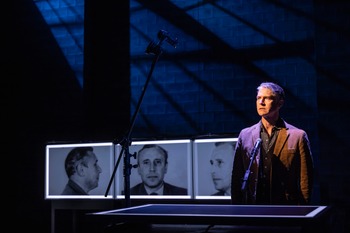
Scott Barrow as Karl-Friedrich Höcker in Here There Are Blueberries by Moisés Kaufman and Amanda Gronich, New York Theatre Workshop, 2024. (Photo by Matthew Murphy)
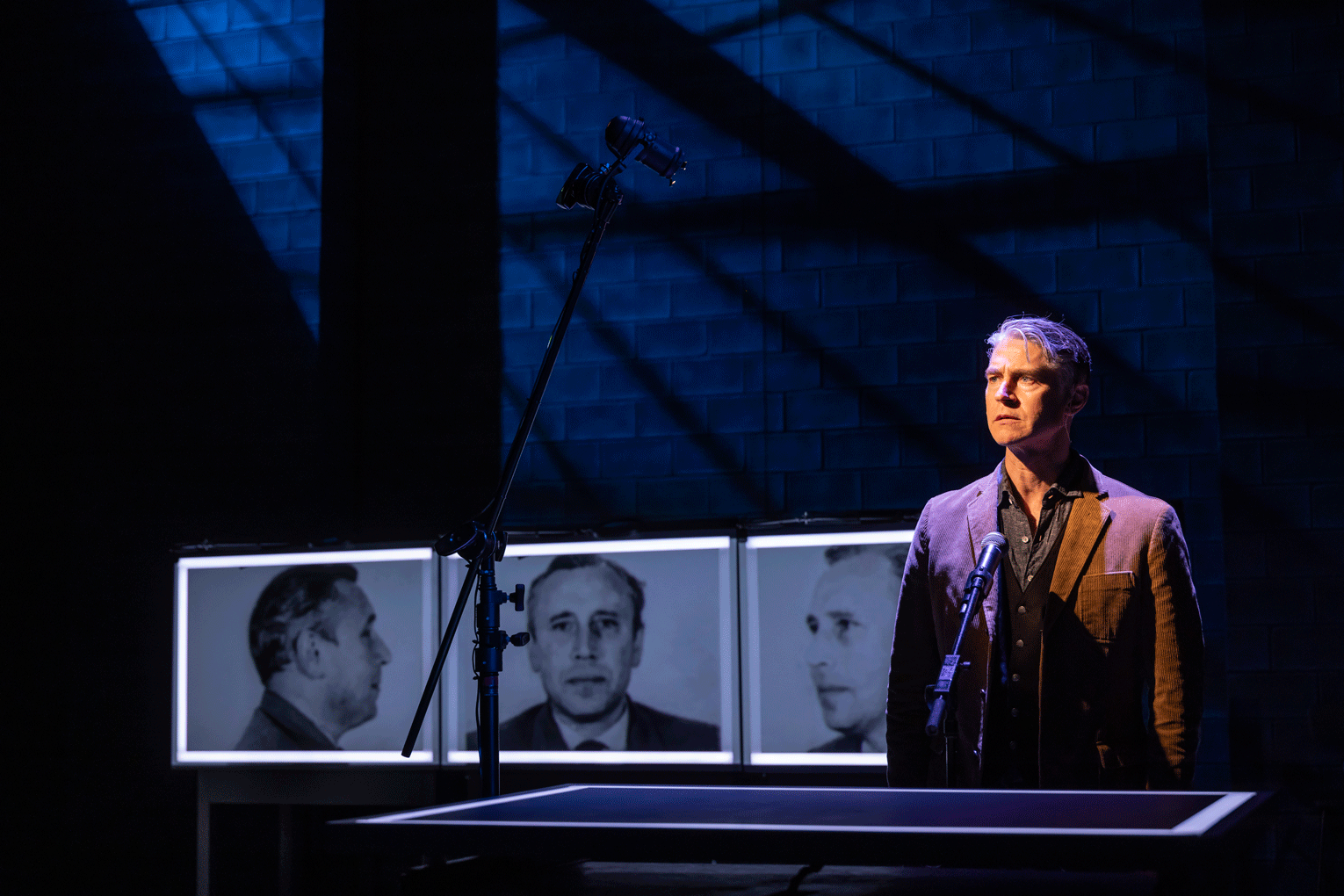
Elizabeth Stahlmann as Rebecca Erbelding in Here There Are Blueberries by Moisés Kaufman and Amanda Gronich, New York Theatre Workshop, 2024. (Photo by Matthew Murphy)
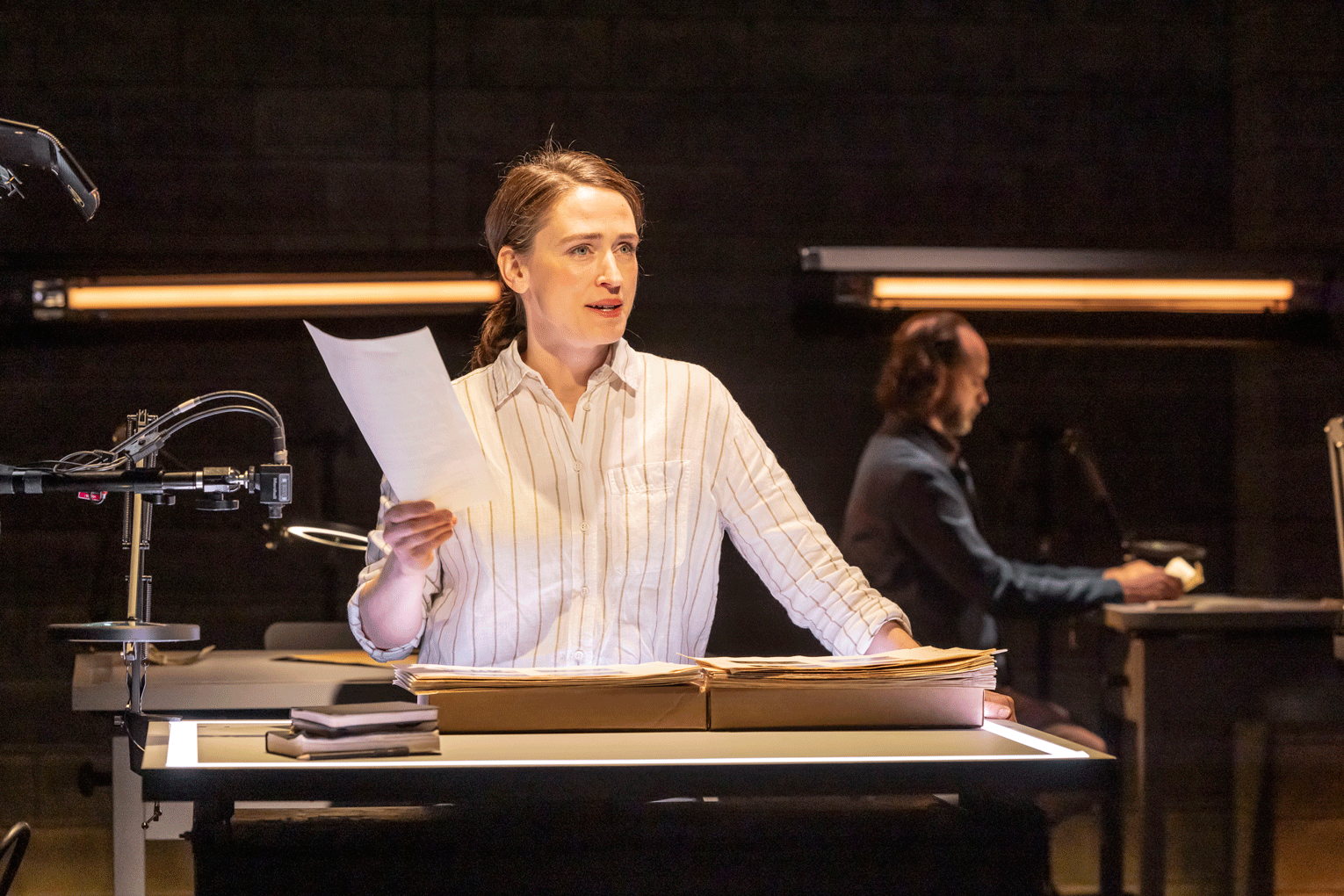
I went, and I was supposed to be with her for two hours, but when she started speaking to me, the meeting lasted three days. She walked me through how the album had been donated to the museum, how she received it and discovered Josef MengeleFootnote 12 in one of the photographs, and how she then spent two years trying to identify as many people as she could and figure out what events were recorded in the photos. Perhaps more than that, she was trying to find out what those photos could tell us about the camp that we didn’t know. It hit me. I know how to tell the story. This is a detective story. Rebecca is pursuing truth. Archives are not the sexiest of places, but for me, I find incredible nobility in what archivists do because they have the profound belief that in studying the minutiae of history they can save us. Right? I fell in love with this detective story where the archivist is trying to figure out what happened. If we can put that on the stage, the audience will follow that, will follow her passion.
GRONICH: Yes, Moisés began the interview process with Rebecca on his first trip to DC. Once we started writing together in earnest, we continued to interview Rebecca extensively and frequently. Whenever a question came up regarding a particular scene we were building, or a particular detail about her scholarship investigating the Höcker Album, or a specific aspect of the album’s history, we would seek out her input and clarification. We would also share writing prompts with her via email. This interview process continued through the entire journey of writing the play, even tweaking lines with Rebecca’s contributions and insights right up until the opening at New York Theatre Workshop.
KAUFMAN: I started writing a first draft and then I called Amanda to work with me.
GRONICH: I’m going to backtrack very briefly, to my second bite. By this point in my career, I had taken a detour from theatre and for a decade I’d worked as a nonfiction television writer. I absolutely loved the work, which allowed me to tell myriad true stories across multiple platforms. I also learned to write to picture, which served us well in Blueberries. In television, you have a picture, and while you can certainly edit a picture, any original, unretouched image offers itself as an irrefutable “thing” that carries authority. It is evidence. And if you hope to tell the story with some integrity, you strive to respect that authority.
SCHECHNER: A picture is worth a thousand words.
GRONICH: Right. And so, over those 10 years, I created, wrote and developed diverse nonfiction programming across a wide range of broadcast networks. Eventually I ended up as a series writer. A series writer works with a staff of writers who craft episode scripts. Your job is to hone universally engaged storytelling while also maintaining the “voice” of the given show. There’s consistency, but there’s also tremendous variation in each individual plot. How are you going to find a shared, recurrent uber-narrative that will excite an audience? How are you going to tell stories so that someone plunks down, tired and distracted, turns on the television, and they’re immediately captured? At one point I was working as a series writer for National Geographic’s Border Wars, which was about migrants coming across the border and the conflicts therein. What is the most urgent uber story in each episode? Of course, each migrant, each family, had a different and unique experience, and yet at the same time there was tremendous commonality.
It was about this time when Moisés contacted me and said, I think there may be something really extraordinary in these Höcker album pictures, let’s explore them together. I should add that in 1998, shortly after I returned from Toronto after directing Gross Indecency: The Three Trials of Oscar Wilde, the horrific hate crime that took Matthew Shepard’s life occurred in October. I became one of the original group of artists who traveled to Laramie, Wyoming—our collective work over the next several years culminated in The Laramie Project. My work on The Laramie Project absolutely became a catalyst. I was captivated by the process of nonfiction storytelling. I became entranced with how you can take true stories, interview the people who lived through them, conduct original research, and seek out the aspects of the story that have yet to be told. “What is something everyone gets wrong about this story?” Using investigative materials, you can compile powerful and surprising dramatic narratives. All the series and specials I worked on for documentary broadcast television followed this creative path.
So, I came back into the theatre with a chance to take on something I thought might be impossible. How do you make a play out of this album of photographs? I could see the thing itself, the evidence, so to speak. But where do you take it from there? And how do you share that journey with the audience? How do you ask of them, “These are the actual pictures—now come step inside them and see what it is like to look through the literal lens of the perpetrator.” We have a slate projected in the beginning of the play that says, “All of the images are real.” So, here we go. We’re going to take you on this journey. The physical “things” of the story launch us—they in themselves will not be reduced to something else.
SCHECHNER: Right, but what the archivist character says is not necessarily what Rebecca Erbelding said. There’s a mix here between the irrefutable thingness of the photographs and the archivist speaking. I’m assuming that the archivist’s words are not verbatim from transcripts of what Erbelding said.
KAUFMAN: They are dramatized. We interviewed her and we took all the liberties that a regular playwright takes, that a dramaturg takes. But then we checked with her to make sure we were telling it correctly.
Elizabeth Stahlmann as Rebecca Erbelding in Here There Are Blueberries by Moisés Kaufman and Amanda Gronich, New York Theatre Workshop, 2024. (Photo by Matthew Murphy)
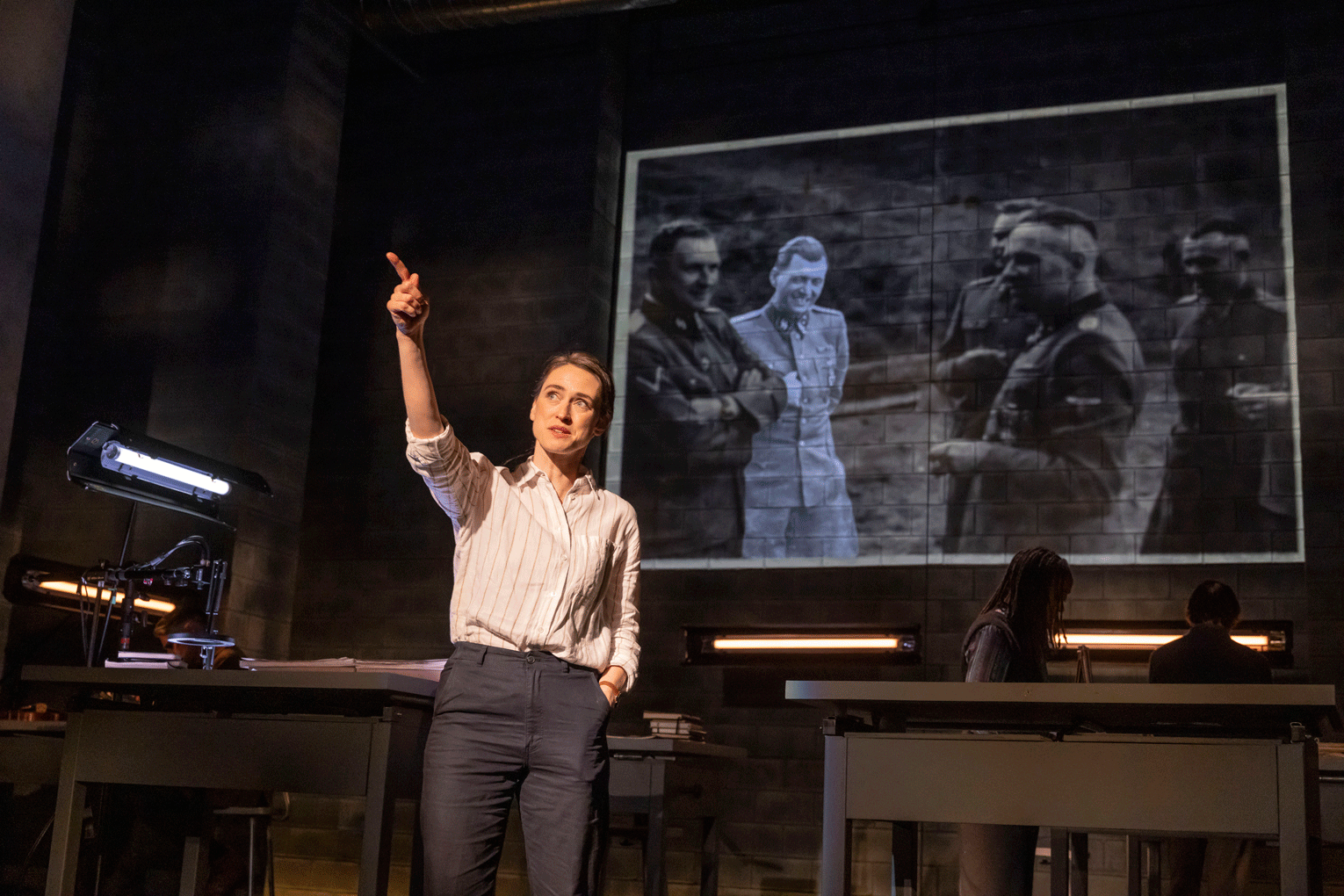
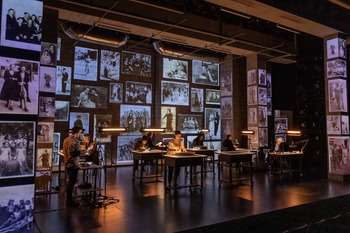
SCHECHNER: In Blueberries you have three realities. The archive and the conversation with the archivist; what you select from that archive to show and talk about; and the mise-en-scène that puts it on a stage filled with rectangles, as if boxed. The action takes place in a space that is the brain of an archive. Not unlike the “brain” that is the space at the center of the stage of Rumstick Road.
KAUFMAN: At Tectonic we’ve developed a way of writing performance as opposed to writing text. Writing text is a playwright going into a room full of cobwebs and empty vodka bottles, spending a long time there, finally coming out with a play that she gives to a director who has three weeks to rehearse, one week of tech, and the production is done. At Tectonic, we wanted to create theatre very influenced by Kantor and his theatre of objects. We wanted to work with what makes theatricality. And yes, text is an important part of what makes theatricality, but all of the other theatrical elements are also part of how we write performance. At Tectonic, we’re always asking: What is the theatrical vocabulary, the theatrical question, the formal question we are posing? In Gross Indecency, the formal question was: Can we create a play using original transcripts but let the audience discover what the history is? It’s a play about the impossibility of reconstructing history, because all of the versions are still present. In The Laramie Project, the question was: Can we write a play about a theatre company that goes somewhere, interviews the people of the town, and comes back? The company is a character in the play. In documentary work, there’s the fallacy that what is shown are the facts. No, what we show are not the facts. The moment you cut two pieces of text together, that’s a creation of the writer. In The Laramie Project we wanted the audience to treat the company members the same way that we treated the people of Laramie. We put them onstage. What you see is not what happened. It is what we saw and heard in Laramie. You can be critical of that material, you can criticize it, and you can doubt it, question it. And you can also be critical of the company of artists who crafted the play.
In Blueberries the question was: Can we do a play in which the photographs carry a large part of the narrative? I wanted the spectators to have a visceral relationship to the images. And because I am in love with archives and archival spaces—you just said something nobody has said, and it’s exactly how I spoke of it in rehearsal—this isn’t the archive, this is the brain of the archive.
SCHECHNER: An interiority working itself out physically.
KAUFMAN: In “moment work” [Tectonic’s signature process] we come into the space with the photographs, with some of the recordings, we hand these around, and people start making moments. A moment is an improvisation with the rule that you have to use the object.
SCHECHNER: And the objects are?
KAUFMAN: The photographs and the interviews. I was fascinated with the photographs and Amanda was fascinated with the women, especially the Helferinnen. All that material is Amanda’s. Amanda was also fascinated with the doctors. We started bringing material about the Helferinnen. We found their applications to the SS, which we have in the play. So an actor would project a photo on the wall of the rehearsal room showing Karl Höcker sitting with the Helferinnen in a bus. And the actor would read from Rebecca’s interview: “Rebecca: ‘I’m obsessed with Karl Höcker, like I know the fact that he’s married, and I look at this picture and I wonder: is he flirting with his secretaries?’” At that moment in the rehearsal room, another actor holds up a piece of white paper in front of the projection so that Höcker’s wedding ring is captured on the sheet of paper and isolated. It’s a wonderful theatrical moment that highlights Rebecca’s text. That’s what we do in the rehearsal room: create a technique to explore how theatre can articulate the narrative in the most theatrical way possible. There are eight actors. Five of them have been with us from the beginning. I listen to what the actor brings into the room.
CAROL MARTIN: How did you decide the staging? The photographs are great, but you can’t just show photographs. And an archive is stationary. So how did you decide on the movement, the scenes?
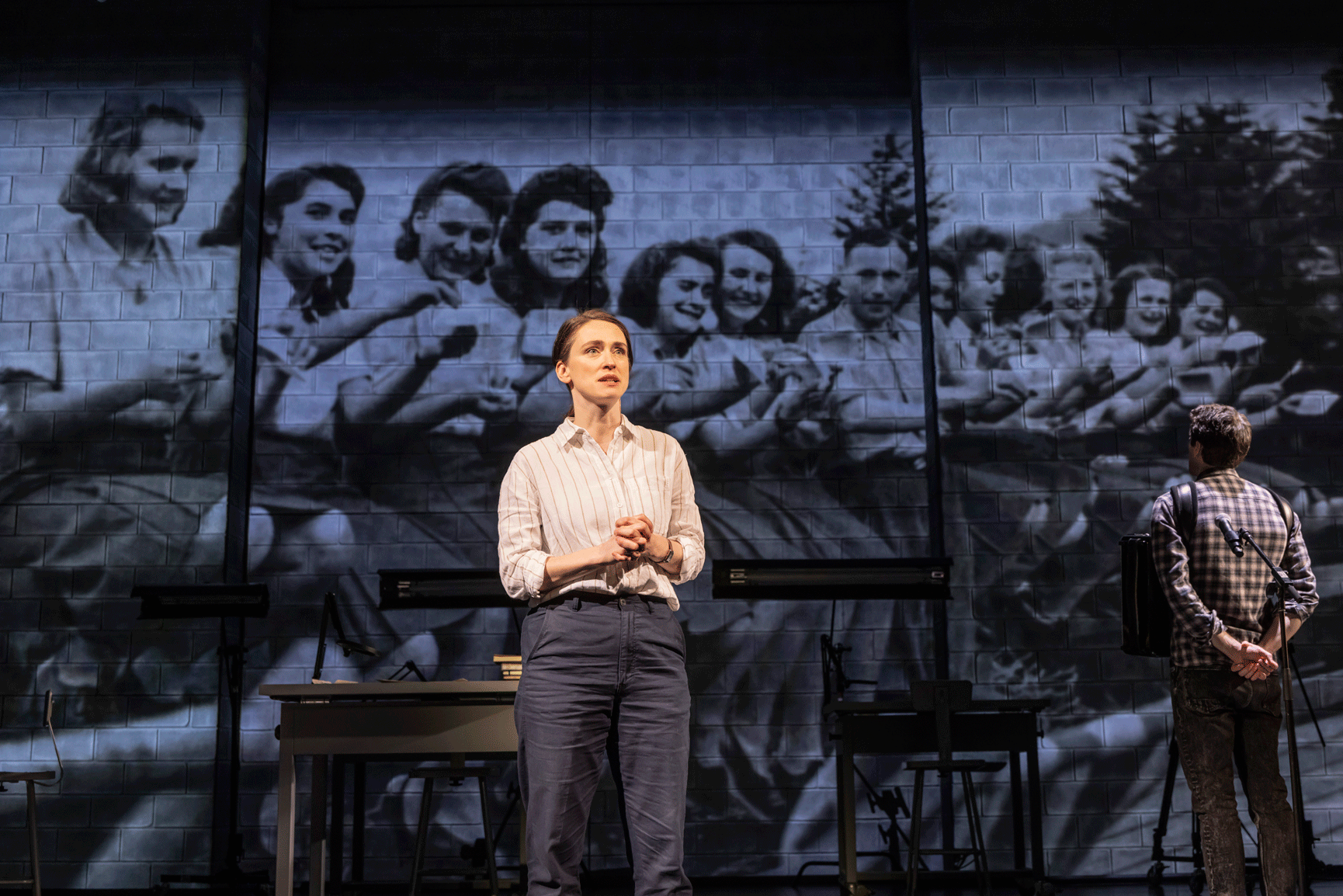
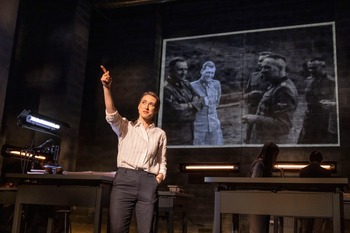
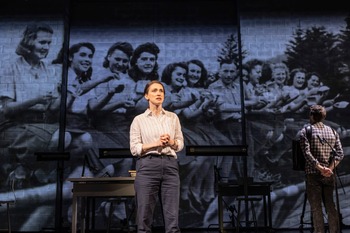
Elizabeth Stahlmann as Rebecca Erbelding in front of the photo of the Helferinnen of Auschwitz. Here There Are Blueberries by Moisés Kaufman and Amanda Gronich, New York Theatre Workshop, 2024. (Photo by Matthew Murphy)
KAUFMAN: You should come to a Moment Work workshop. We have a book about it [Kaufman and McAdams 2018].
GRONICH: You’d have such a good time.
KAUFMAN: We go into the rehearsal room and look at the Höcker photographs and I ask, “What is the spiritual life of this space with these photos?” I’m not blocking for realism. I’m blocking for how does that space viscerally inhabit the photographs. One of the earliest images I had was of many tables in an archive. And people around them looking at photographs. I knew
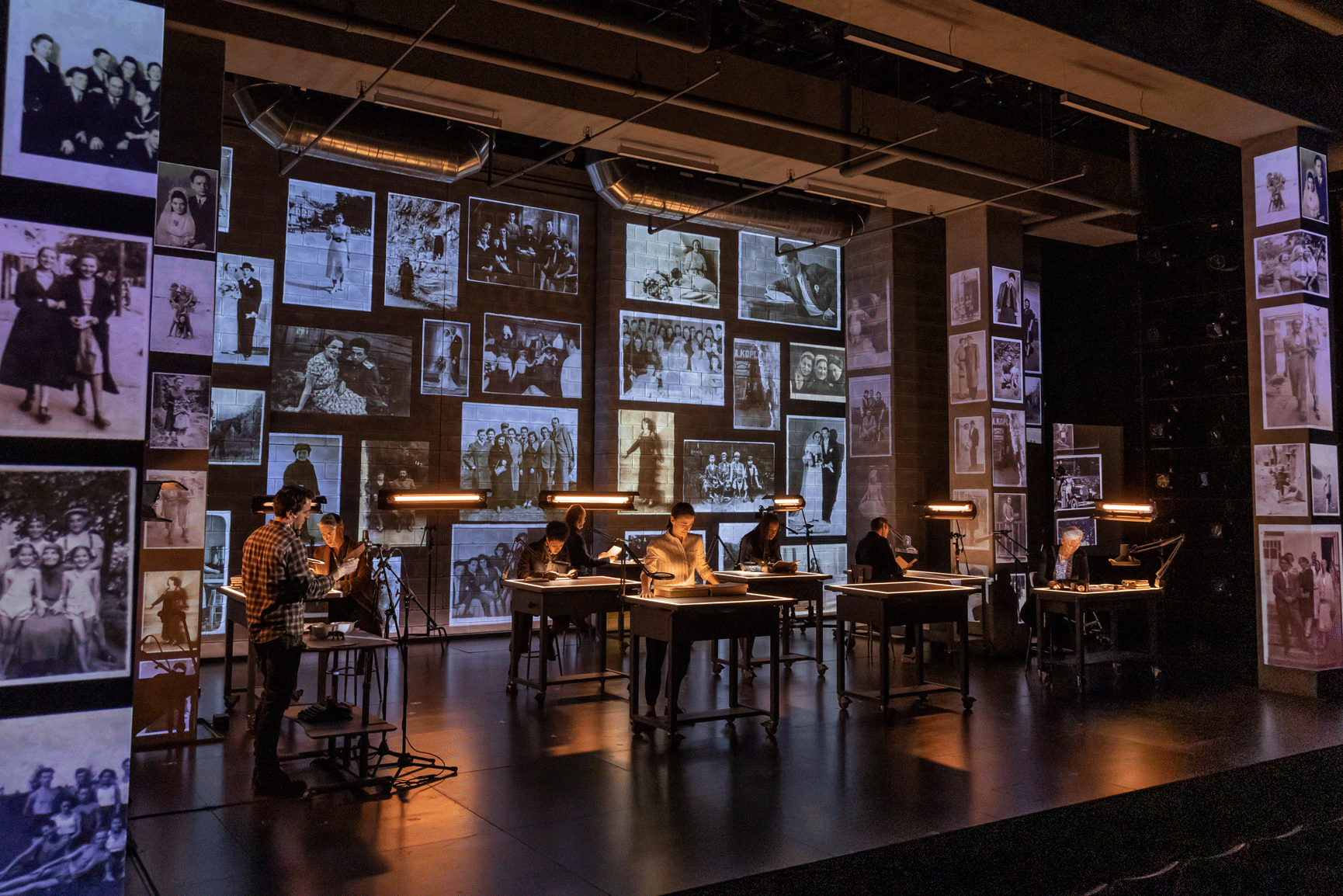
I needed to make those photographs live in three dimensions. Because the biggest formal problem I had was that I didn’t want to make it a PowerPoint presentation. But how to make the images three-dimensional? I thought, okay, let’s have many screens and many projection surfaces. That’s a beginning, a way to use the depth of the stage to bring the images to life. Then I came up with the idea of the tables flipping open and becoming projection surfaces. Having all that depth allows the audience to step into the image.
The second formal device we used was to add sound to the images. So when there’s a photograph of the Helferinnen eating blueberries we have actors doing Foley sounds with spoons and plates into microphones.Footnote 13 Like what The Wooster Group does. On another occasion, there’s a photograph of Nazis singing, so we had the actors facing the image and singing. It was another way of trying to make the images come to life.
SCHECHNER: How do you two work together as director and playwright?
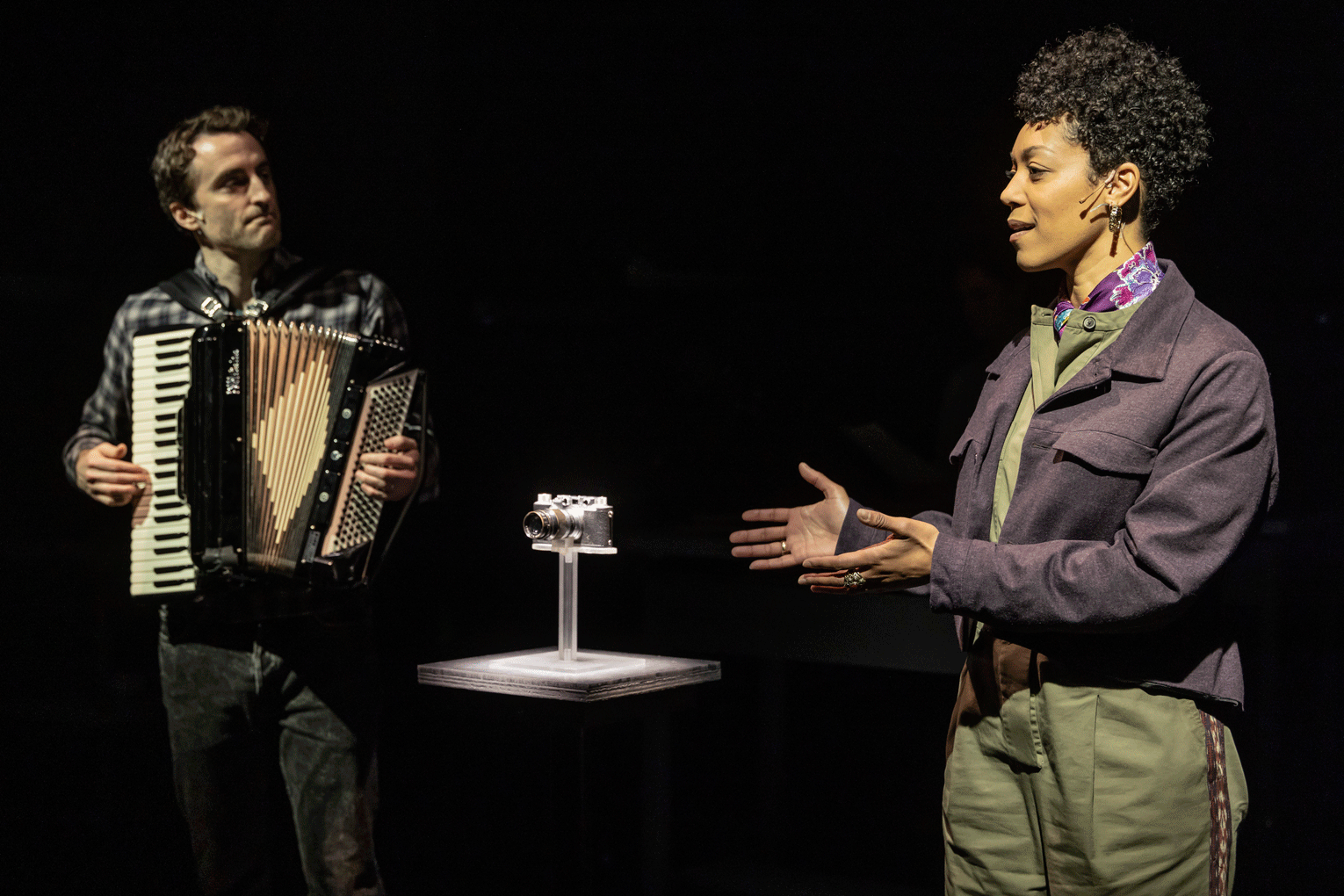
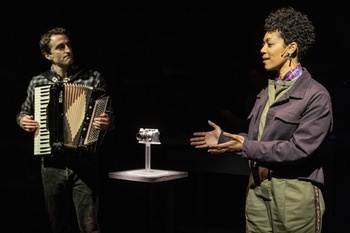
GRONICH: We were cowriters diving in together deciding what the script was going to contain. Very much a back-and-forth process. Moisés went to Washington to meet with Rebecca Erbelding. He spent three full days with her at the genesis of the project. He was so interested in how to capture that detective story, how to let it unfold theatrically and dramatically. At the same time, I was exploring the expansive world around the material. As Moisés mentioned, I got really interested in the women, in the doctors, in the Nazi descendants. Also, we were looking for what is the uber arc, the big container, the meta-story. Could it be unexpected? I love unseating the audience at the top of the play. People come in, they sit down, and they’re waiting for the barbed wire, the slow violin. Instead, we hit them with this jaunty Weimar Republic–era music and you see this 1930s Leica camera. So maybe for this play, the uber story will be different. And we tell them, in essence, “What this play is really about is the pursuit of happiness.” The story of the Nazis was, for them—if you look at it closely—the pursuit of their own happiness. It’s grotesque of course, horrifically grotesque, but the performative nature of the material is very much telling that story—that is absolutely where the Nazis were coming from. What the photographs reveal is the life the Nazis wanted and planned to live, in their own imagined future as the victors. People are surprised and disturbed by this. So immediately, we’ve unseated the audience in a way that, frankly, I believe you have to do in this kind of work. And that gets us back to the “thing,” the physical evidence we all must grapple with. What do the pictures show us that we didn’t know before? It gives the story all the more power when you subvert audience expectations, using photos as evidence.
KAUFMAN: Starting a play like this with that kind of jaunty lecture, it all seems so obvious now, but I cannot convey the terror we had in making the play. The terror the night before we had our first preview in La Jolla when I woke up with a horrible panic attack because you know how sometimes your friend goes on vacation, they come back, and you visit them in their house, and they say, oh, let me show you the photos of my vacation, and you want to shoot yourself, because it’s the most boring thing in the world? I thought, is that what we did? Are we gonna show them some pictures and they’re going to be bored to tears? And the other thought I had was, will starting with that little presentation with the accordion and the photos—like, you know, it’s basically an intellectual lecture about the uses of the camera in the middle of the century. Can you do that, or will we lose the audience?Footnote 14
GRONICH: That’s such a great example of our process. I wrote that presentation text about the small Leica camera nearly complete, in what felt like a fever dream. When I first handed it to Moisés he asked, “Where do we put that? Does it belong, does it work? Let’s try it at the beginning.” It’s this beautifully collective process, you know, and that really is…it’s so rewarding.
SCHECHNER: Well the Leica reverberated for me. To me it pointed at all the German industries that used slave labor.
GRONICH: Actually, Leica did not use slave labor. The company did a great deal to save its Jewish employees.Footnote 15
KAUFMAN: Others did not. Audi, Farber, Siemens, Deutsche Bank, BASF, Volkswagen and—many more.
Charlie Thurston with the accordion and Nemuna Ceesay in Here There Are Blueberries by Moisés Kaufman and Amanda Gronich, New York Theatre Workshop, 2024. (Photo by Matthew Murphy)
SCHECHNER: They’re all still operating in Germany and globally, making big profits.
Here There Are Blueberries was a staged reading at Miami New Drama at the Colony Theatre in 2018. Its world premiere was at the La Jolla Playhouse in August 2022. It opened at the New York Theatre Workshop in April 2024. How different were these?
KAUFMAN: Each was different than the one before. Amanda and I have been rewriting the play all the way until we opened in New York.
SCHECHNER: Do you see Blueberries getting produced by other people the way your other works have been?
KAUFMAN: I very much want that.
SCHECHNER: What advice do you give to new producing teams?
KAUFMAN: I think my biggest warning would be about how to act the play. There is a desire to judge the characters in the photographs, to take a stance of superiority to the people in the photos. And if you do that, you remove from the audience the ability for them to have their own thoughts about what they’re seeing. So, the performance style has to be very clinical. If you show your hand about what you think of those people, then it becomes an agitprop piece. So, that’s one advice. But the truth is that it happens with Laramie, it happens with all Tectonic plays. My friend Doug Wright said the job of the playwright is almost like the job of a cookbook writer.Footnote 16 You have to write the best recipe that you can, but you cannot be responsible if somebody’s soufflé falters. Because we’re trying to write performance, as opposed to writing text, when you look at our plays as published, they are always filled with staging notes. Because a ton of the narrative is happening outside the words. That’s why we try to give as much guidance as possible, with the knowledge that at the end, the person who picks up the book will do what they want.
MARTIN: Let’s go back to Amanda, the thingness of the photographs. I hear what you’re saying about indeterminacy, but you address the photographs as if they are irrefutable. They are a record of a moment. But they’re vastly open to interpretation. We can have a consensus about how to approach them, what they “really” mean. But we are also aware that someone else can read them very differently. The archive is a space very dependent on what is included and what is excluded, and for what reasons, and on how what is included is interpreted. There are so many variables.
GRONICH: Very true, and so the creative process tries to address this. Moment Work offers up as many variations as possible on a given exploration. So that then, in front of a diverse audience, everyone in the house will find an immediate way into the material. No one in the house saw the same performance of your Imagining O [East Coast Artists, 2014]. There were 11 different ways into Ophelia, right?Footnote 17 But when something sparks something for an audience member, there’s a clear, direct, and personal path for them to follow. And we try to find those clear paths as we work.
Backing up, I like to think that in Here There Are Blueberries, this mysterious album arrives in a FedEx box, and out comes this very concrete thing with the appearance of something irrefutable. As noted, these pictures are 100% real. We do not photoshop or change them. And then, slowly, over the course of the play, the album takes over the stage and the concrete begins to widen into something more lived and experienced. Spectators are invited to step inside the selfies of an SS officer and his cohort at Auschwitz. And what do we make of that, in the here and now? How is each person experiencing that for themselves? Afterward, how will audience members compare notes of how they reacted? And this also comes up directly in thinking about the descendants of Nazis. My way into the album is enormously different from Rainer Höss’s, or from Tilman Taube’s, or from Peter Wirths’s.Footnote 18 We interviewed these SS officer descendants at length. With them, we were not pointing at a picture and saying, “This is Solahütte, correct?” But rather: “That’s you or your father or grandfather at Solahütte?” Right out of the gate, they don’t have the luxury of distance that we have. Those pictures are occurring very, very differently for them. So we go back to this irrefutable thing, and yet it moves. It will forever be mercurial. Not the photograph itself, which is important to understand as physical evidence, but the response to it, the meaning imbued in it. To me, nonfiction storytelling is a balancing act. So we have to say, this all happened, right? But now what do we do with it? What I love about the contract with the audience in the telling of true stories is that, ultimately, while we may take the liberties of the dramatist, heightening and theatricalizing, ultimately, at the same time, we all know it happened. Something actually occurred in history. To me, both story angles are important.
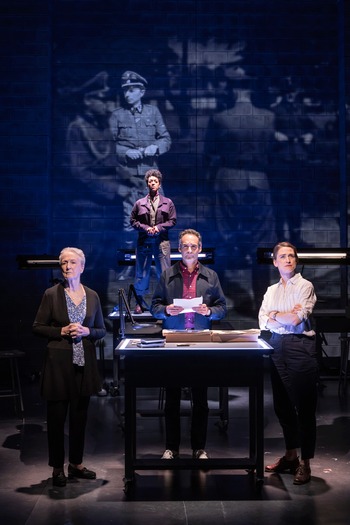
Kathleen Chalfant, Nemuna Ceesay, Jonathan Raviv, and Elizabeth Stahlmann in Here There Are Blueberries by Moisés Kaufman and Amanda Gronich, New York Theatre Workshop, 2024. (Photo by Matthew Murphy)
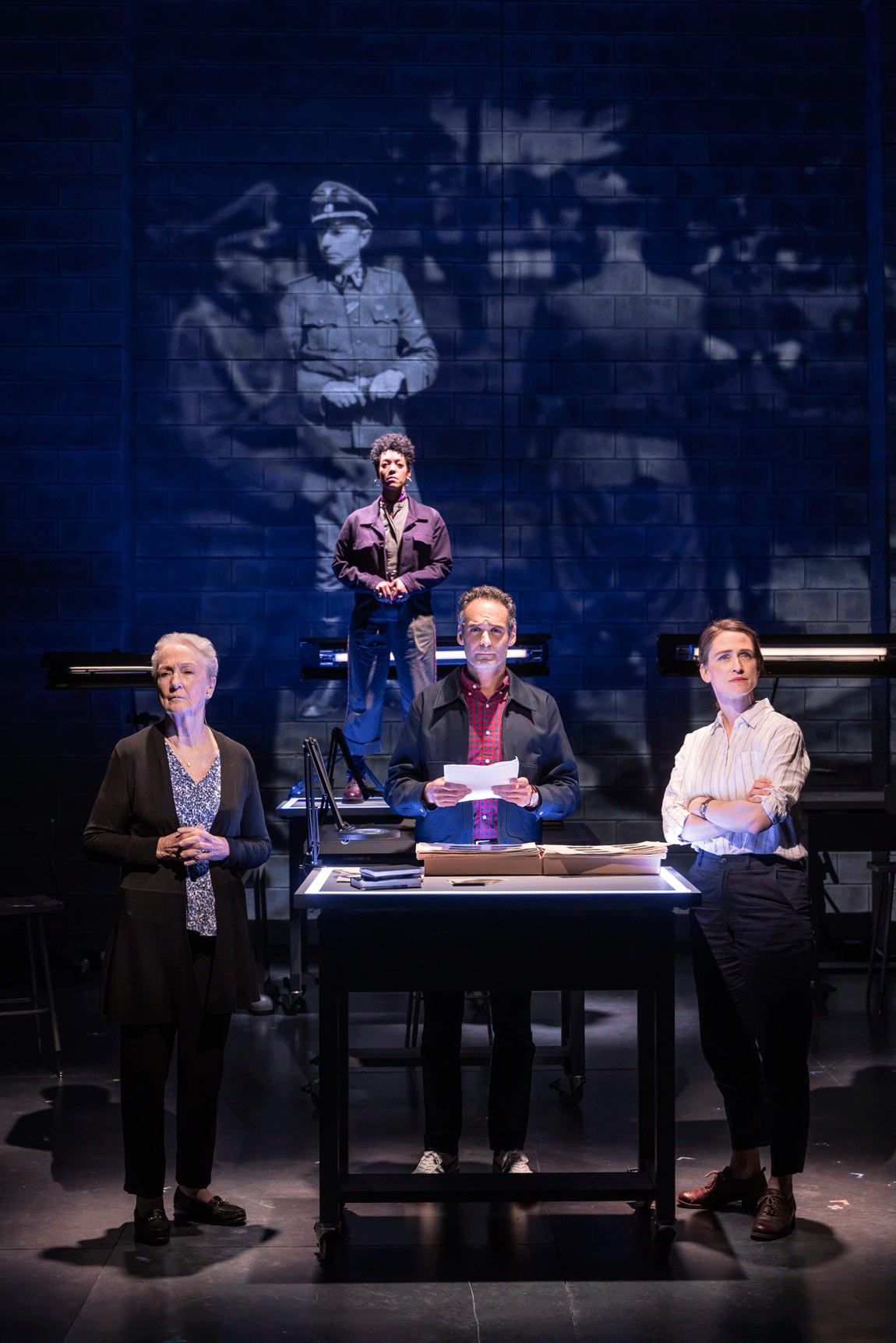
SCHECHNER: But there’s something else going on. In addition to Hannah Arendt’s “banality of evil,”Footnote 19 in Blueberries we experience the evil of banality. We know what is not represented, what is literally just off-screen, the 1.1 million people murdered in Auschwitz. If we didn’t know that was happening while the SS officers and the Helferinnen were having such a relaxed good time, what is represented would not be so awful.
KAUFMAN: It was right outside the frame.
SCHECHNER: If you performed Blueberries to people who never heard of the Holocaust, what would they say?
GRONICH: Can I speak to that for a second? We’re wrestling with the fact that 66% of American millennials don’t know what Auschwitz was. And 41% of Americans really know next to nothing. It’s just a few pages in their history books. As each generation moves forward, the subject’s irrefutability dwindles even if there are descendants of survivors and victims in the audience. These pictures are new to most people in the house—they’re really not familiar to anyone beyond a handful of scholars who first read about them in 2007. And most laypeople don’t remember the newspaper headlines anymore. So, the album still feels shocking. When the album first surfaced, Rebecca and other archivists were figuring out who is in these pictures, why was this album put together? Who did it belong to? It was completely fresh history. In the play’s performance, that history is being deciphered in front of our eyes in what feels like real time. That experience, I think, is primal for everyone in the theatre. It’s different from diving into material that has been explored many, many, many, many, many times before. And because it’s fresh for the archivists, it’s fresh for audiences. Remember, at that time, these pictures had not been seen by anyone for 60 years, so we get the feeling that we’re all doing something collectively, now—we’re looking at history through an urgent new lens.
MARTIN: What both the archivists and spectators experience is the discovery of new disturbing information about how the perpetrators saw themselves. Although the Holocaust is well-known and well-documented, it is fading from public consciousness. What Blueberries is about, in part, is the alarmingly normal world just outside the camp. The role of women in that world reveals the depth of the collective inhumanity of the atrocity.
SCHECHNER: I have a question. The Nazis were brutal to gay people. But Here There Are Blueberries, unlike Gross Indecency and The Laramie Project, is gay neutral.
KAUFMAN: We thought a lot about this. The Höcker album is from the time of the Hungarian action, which was all about Jews. It wasn’t a conscious decision to not talk about the persecution of gays. We did talk about it in the rehearsal room. When the camps were liberated gays were jailed because homosexuality was still a crime in Germany.
SCHECHNER: Oh my god.
KAUFMAN: Right from the camps into prison.
SCHECHNER: Was Here There Are Blueberries received differently in New York than in Miami or La Jolla?
KAUFMAN: No, it was the same. As soon as audiences start coming, word of mouth spreads and the show sells out. One of the questions that we pose at Tectonic is can we make work that is formally daring, rigorous, and yet popular? The Laramie Project is still one of the most performed plays in America. Gross Indecency continues its long life. Blueberries, even though it’s an intellectual mystery, had the highest ticket sales, gross amount of money, in the history of the New York Theatre Workshop.
MARTIN: Why do you think that is?
KAUFMAN: I’ve always believed that audiences want to be spoken to intelligently about things they care about. Take Leeny Sack in The Survivor and the Translator, which was incredibly influential
to us because Leeny told me her grandmother spoke broken English.Footnote 20 At first, she wanted to fix the English. Then she realized that broken English was not only the poetry of her grandmother, but the truth of her grandmother’s experience. Her grandmother couldn’t say “concentration camp.” She would say, “those camps for killing people.” The poetry of the vernacular. That was a big influence on us.
MARTIN: The Survivor and the Translator is about recovering the experience of her grandmother and Sack’s own childhood through language and translation. She has a typewriter onstage to indicate the physical effort of transcribing memories that exist somewhere between English and Polish.
SCHECHNER: The real in quotation marks, the real constructed into a theatrical artifact.
MARTIN: It’s always that way. Theatre of the real is born from a sea change in archiving brought on by digitization and the internet, the ready availability of the written word and images. The writing of history is an account of what happened seen through the lens of the author and the milieu of the time. Today many people learn history from film, television, the internet, and theatre.
GRONICH: Right. And in this case, it’s a play, and the audience is rapt. They lean forward. We all know it’s a construction. It’s very popular to say that history is told by the victors. We’re savvy in that way. But what is so compelling about the Höcker album is we’re seeing how they—the SS officers—told their own story. It’s how they saw themselves, and how they were going to tell that story when they won the war, which they assumed they would. Maiken Umbach, a professor of modern history at the University of Nottingham, studies the photography of the Third Reich, especially the photography leading up to the war. She gave us remarkable insights. The Germans were telling themselves the story of Lebensraum, “living space,” an enlarged Germany. They were encouraged to go on far-flung vacations and take pictures of themselves being at home in the world, relaxed in natural environments, getting back to the land, demonstrating the purity of the German spirit. They were preparing themselves for an empire. There’s a line in the play about how amateur photographers taking pictures everywhere become history’s most willing recorders. And then the war happens, and these people naturally just continue to take pictures. Why should they stop? The Höcker album is actually quite recognizable for many Germans of that era, many of whom kept photo albums. Of course, as with any single picture, they composed how they were telling their visual story; they chose what to leave outside the frame.
SCHECHNER: One of the reasons that audiences are so rapt is precisely because we do not go into the camp. We see in the photos an ordinary life. What’s horrific about people answering phone calls, going swimming, laughing? But something is happening out of the frame, like an unremembered dream going on in the back of my head somewhere.
KAUFMAN: Amanda did a lot of research on the Helferinnen. How they were ordinary young women.
GRONICH: Yes, because what really interested me was: what in these pictures shocks us the most and why? What lurks behind these images that we didn’t expect? More than anything, no one expected these apple-cheeked young women. No one knew that there were young women working in the concentration camps. And so, I just took this deep dive and I uncovered this unbelievably bold propaganda program that went on for years as part of the Nazi war effort. It was encouraging young women throughout Germany to become “helpers.” As you see in the play, they had already been a part of what was essentially the Nazi Girl Scouts, the Hitler Youth for girls. If they had an aptitude for secretarial skills they were encouraged to volunteer. For many of these young women, it was a chance to leave home for the very first time. Picture you’re a late teenager or in your early 20s, you’ve never left your industrial town, you’ve never left your rural farming village, you’ve never gone anywhere. If you volunteer, you’ll get to travel, maybe you’re going to meet a husband, you’re going to flirt with all these dashing SS officers, you’ll spend time with the girls you knew in the Hitler Youth. You’re going to live in nice, communal housing. Oh, and by the way, we’re going to send you off to a concentration camp. The place where you’re going is called Auschwitz. And so for many of them, they saw the whole thing as this adventure. It was this chance, as they’d think of it, to serve the Nazi cause. So, I’d discovered this portal into understanding their experience, and I wanted to re-create that for the audience. It’s a bit like having the rug pulled out from under you. There is so much about this history we didn’t grasp before these pictures. But if we have any hope of trying to prevent such atrocities, I believe we have to understand the perpetrators as they saw themselves.
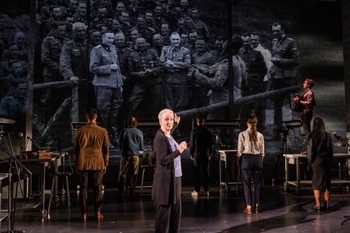
Kathleen Chalfant and cast in Here There Are Blueberries by Moisés Kaufman and Amanda Gronich, New York Theatre Workshop, 2024. (Photo by Matthew Murphy)
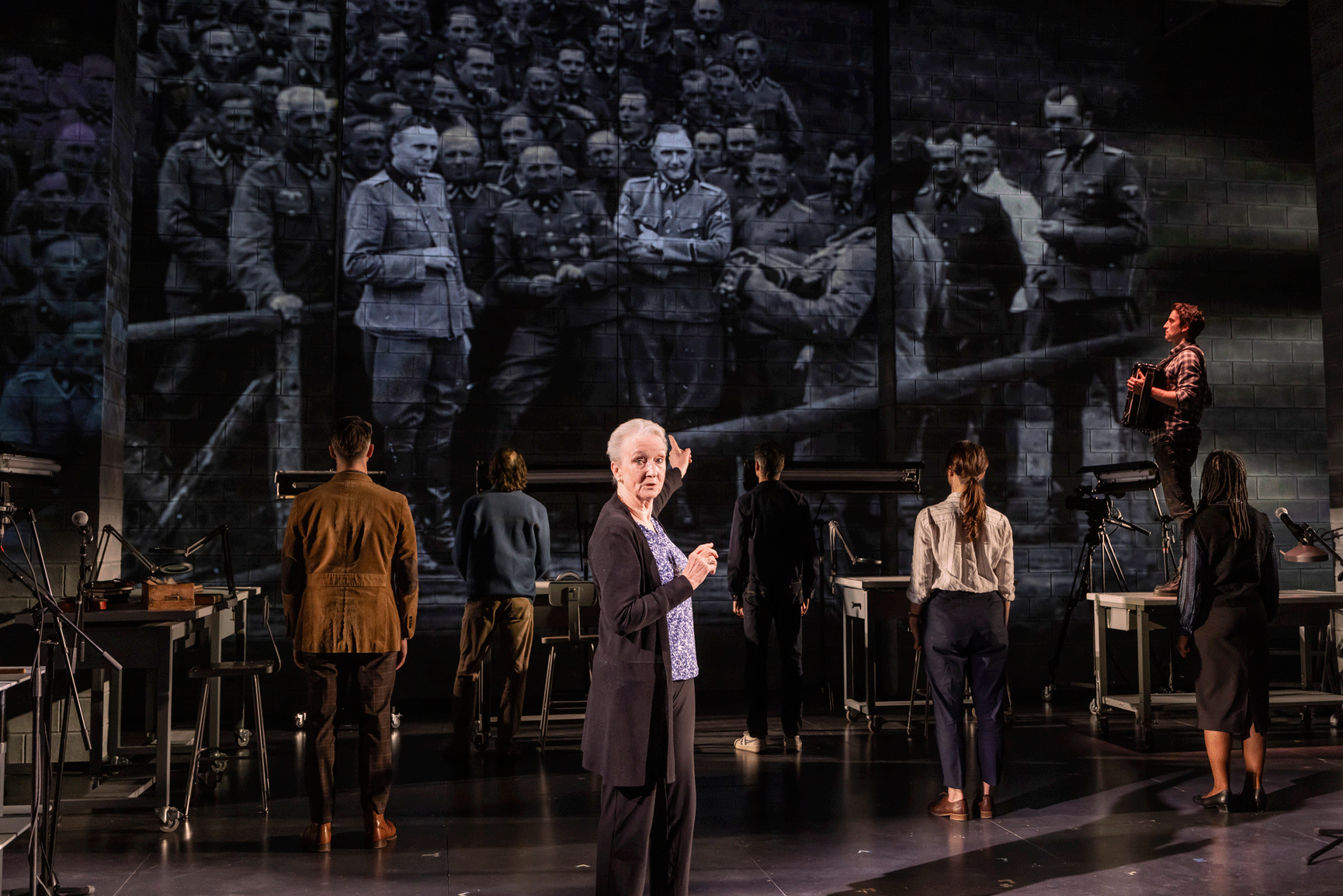
Similarly, with the doctors, I read this incredible doorstop of a book, The Nazi Doctors by Robert J. Lifton [Reference Lifton1986]. What is so extraordinary there is the axis of the personal and the political seen through a professional lens. A doctor’s entire professional mandate is to heal, right? During the Third Reich, if you became a doctor, you signed the Hippocratic Oath. But you also signed an allegiance to Hitler. How do you reconcile those two oaths? The Nazi doctors believed that the “body politic” was “sick” and its “disease” was the Jews, and so the way to cure society was to get rid of its so-called disease. Very specifically there were stories about doctors showing up at Auschwitz not wanting to go along, not willing to subvert their objections right out of the gate. So what would often happen is a junior physician would be assigned to an old pro and the old pro would say, “Look, here’s the situation, here’s what we do, here’s why we’re doing it.” And you can see on a granular, day-to-day basis in their diary entries how they allowed themselves to be indoctrinated. And these are not the rank and file, not that there’s anything particularly superior about becoming a physician, but you do need to go through an extensive process of education. So, in theory, one would imagine you show up with some sort of moral code in place and you show up steeped in this long tradition of healing. So how do you unseat that person? How do you turn that person into a systematic killer? I was really, really interested in that.
As for the research into the descendants of the Nazis, we followed trails we found in the album photographs. What else was there to uncover? The Höss family had donated their own collection of family photographs, where Rudolf Höss—the creator of Auschwitz—and his wife are depicted raising their family right next to the camp.Footnote 21 These reflect the visuals you see in the film The Zone of Interest [2023].Footnote 22 So that’s another collection that’s extremely pivotal in the study of the camp and the lives led there. Another descendant, Tilman Taube, has written in detail about the Höcker album, describing how he first recognized his grandfather and how this launched him on a personal quest to know more. In real life, Tilman does exactly what he does in the play. He goes door-to-door asking people to share artifacts and photographs of their families’ lives during the Third Reich. So, pulling all these different elements together—that formed much of the writing process.
KAUFMAN: We also went to Auschwitz, of course. We stood where the Solahütte was. We interviewed the descendants ourselves. We had to. Remember that moment in Blueberries where the actor says to the son of the doctor, “Have you forgiven your father? Do you think he had a conscience?” I was interviewing this descendant. We had a German translator. I say to her, “Ask him, ‘Do you think your father had a conscience?’” She starts getting uncomfortable, but she translates the question. The descendant answers, “Of course he had a conscience.” And I say, “So you’ve come to terms with what your father did?” The translator looks at me and says, “Do you really want me to ask him that?” I was so angry because interviewing is such a delicate process. You have to be really careful. I was like, “Yes, please just translate verbatim what I say, don’t ask me questions, just translate verbatim what I say.” Then she asks him, “So you’ve come to terms with what your father did in the camp?” And he turned red, red, red, red. And he says. “No, of course not. My father cured typhus and my father saved thousands of people. But my father also stood there at the ramp and he decided who went to the gas chamber. So what does it matter how many people he saved? He sent God knows how many people to the gas chamber.” We were looking for stories that were complex, where you would see a Nazi trying to do something moral, but at the same time, doing something horrifically immoral. I think that that was one thing that guided us.
SCHECHNER: Part of the reason people are so rapt is: “There but for the grace of God, go I,” “I could have been on the phone doing that,” “I’m just sending messages,” like the Helferinnen. It’s not exactly guilt, but it is a kind of responsibility I think everyone in the audience feels.
GRONICH: A susceptibility. And a vulnerability, in a perverse way, to indoctrination, to the release of personal culpability.
KAUFMAN: I believe people come to the theatre because they want to learn how to live in the world. They want some moral justice to prevail. They want to believe when they leave the theatre that moral justice exists.
SCHECHNER: But it doesn’t in this case.
KAUFMAN: And I was very committed to not letting them feel that it does.
SCHECHNER: Höcker got off almost scot-free.
GRONICH: In the play, there are these two simultaneous narrative arcs, which I think confront justice differently: that of the archivists uncovering literal history—who went to prison, who escaped, and who was hanged—and that of the people in the photos and their families. The grandson of Rudolf Höss, though he was born decades after the war, still carries the question of crime and punishment directly on his back; Tilman Taube does the same. It’s their lineage. They are overwhelmed by it; it is intensely personal. And I found myself banging my head against that as we were writing. How do you write a play about a problem that maybe can’t be solved because that problem is built into our very existence—the human condition. Just to add to what Moisés was saying about people wanting to leave the theatre with a neat and tidy package tied with a bow. You can’t do that with the Holocaust.
Cast of Here There Are Blueberries by Moisés Kaufman and Amanda Gronich, New York Theatre Workshop, 2024. (Photo by Matthew Murphy)
SCHECHNER: In regard to “problem plays,” how do you see yourselves in relationship to Ibsen, to Brecht?
KAUFMAN: Nobody has ever asked me that question before. I would like to think that we can locate Tectonic’s work in between the two. We are not as didactic as Brecht, and we are not as naturalistic as Ibsen. We are somewhere in between. I love to think about the way the individual enacts a role in a communal setting. And I love how theatre allows us to think about that in the communal setting of the actual space where we gather to look at ourselves as moral creatures. Not only political creatures, but moral creatures. And when you try to bring that together, something very powerful happens.
GRONICH: Where is the Ibsen lurking? Can’t you find the Ibsen inside a Brechtian narrative?
SCHECHNER: And as Jews? If you were white Anglo-Saxon Protestants, could you have made this piece?
KAUFMAN: I have a very strong feeling about that. I believe that I could have, that an Anglo-Saxon person could have done this piece.
SCHECHNER: But you, a gay man, did Gross Indecency and The Laramie Project. It can’t be an accident. I assume you’re both Jewish.
KAUFMAN: You’re right. But I also did a play about Beethoven, and I’m not deaf, I’m not a composer.
SCHECHNER: No, no, I’m not saying you couldn’t do a lot of things, but I’m asking could other people.
KAUFMAN: I want to believe that the answer is yes. I want to believe that art is the great spiritual license that allows us to inhabit other ideas and other human experiences.
SCHECHNER: True, but today in the USA we live in a highly racialized society where it would be very hard for a non–African American, a non-black person, to compose a black piece. Because of identity politics.
MARTIN: Experiential reality is not everything, it is not expertise, but it counts for something. Someone who is not Jewish would produce something very different in accord with their writing ability, research, and experiential reality.
SCHECHNER: So, in the epoch of Gaza and in the epoch of Trump and fascism on the rise around the world and all of that, how do you feel this play, and all of Tectonic’s work, addresses what’s happening?
KAUFMAN: I think one of the things that we really thought a lot about in writing this play was that there’s a continuum. At one end is culpability, Mengele. At the other end is complicity, the Helferinnen. They didn’t kill anybody. They just answered phones, sent messages. So culpability, complicity, and lastly, complacency, right? When you witness something and you say, “That’s not my problem.” All of us are on that continuum between culpability, complicity, and complacency. One of the most powerful things theatre can do is to pose that question to an audience. Where are you in that continuum? And how do you, wherever you are, make sure that your behavior is a conscious decision you’re making? Am I culpable, complicit, or complacent? What people are telling us who come see the show is that it speaks directly to what’s happening in the world right now because we’re in the middle of a very gigantic transition where so many democratic countries are electing authoritarian right-wing leaders. This is the pivotal question of our times. Where are you going to stand on that continuum?
GRONICH: We’re back to “the great tragedy is existence.” Our play speaks to a particular historical period. But it also speaks to things that will sadly likely be happening in the future. And it speaks of course to the present moment.
KAUFMAN: We’ve had that experience a lot with our plays. When we did Gross Indecency, it was because of the Mapplethorpe trial. It felt like it was addressing that. But then there’s the relationship between Oscar Wilde, who was 40, and Lord Alfred Douglas, who was 20. It was a big scandal. And right after that, Clinton and Lewinsky had an affair.Footnote 23 And all of a sudden, the play became about Clinton and Lewinsky. Because Tectonic’s plays address the intersection of the personal and the political, the plays speak to different epochs. These days The Laramie Project is about trans kids. Right? Because the hate crimes now are against trans kids.
SCHECHNER: What is your next project? What do you have in mind?
KAUFMAN: The next step is a national tour for Blueberries. We’re going to Berkeley Rep. Then to the Wallis in Los Angeles. We’re going to the McCarter in Princeton. There’s a production planned in Madrid already, in Spanish. And one in Milan. We’re hoping to do a production in Germany, England, and the Nordic countries.
Before we end, I want to say one thing, and I hope this makes it into TDR. I wanted to do this interview because a lot of the seeds that you planted in your theatrical research is the foundation of our company. Do you know the Yiddish word “nachas”? Nachas means pride. I want you to have a little nachas from what we’re doing. So many of the foundational ideas of our company come from your work.
GRONICH: Not only your work as a director, but your work as a thinker.
SCHECHNER: What you do is so powerful. If I had anything to do with it, the nachas is big in me.
Here There Are Blueberries
Production Credits
By Moisés Kaufman and Amanda Gronich
Conceived and Directed by Moisés Kaufman
Associate Director and Dramaturg Amy Marie Seidel
Devised with Scott Barrow, Amy Marie Seidel, Frances Uku, Grant James Varjas, and the Members of Tectonic Theater Project
Scenography: Derek McLane
Lights: David Lander
Costumes: Dede Ayite
Sound: Bobby McElver
Projections: David Bengali
Cast:
Karl Höcker and others: Scott Barrow
Charlotte Schünzel and others: Nemuna Ceesay
Judy Cohen and others: Kathleen Chalfant
Tilman Taube and others: Jonathan Raviv
Melita Maschmann and others: Erika Rose
Rebecca Erbelding and others: Elizabeth Stahlmann
Rainer Höss and others: Charlie Thurston
Peter Wirths and others: Grant James Varjas
Understudies:
Noah Keyishian, Anna Shafer, Sam Reeder, Will Carlyon
Production Stage Manager: Jacob Russell
Assistant Stage Manager: Gillian Lelchuk
Intimacy Coordinator and Sensitivity Specialist: Ann James
Casting: tbd casting co., Stephanie Yankwitt
Produced by New York Theatre Workshop, Patricia McGregor, Artistic Director; Jeremy Blocker, Managing Director
World Premiere:
La Jolla Playhouse, Christopher Ashley, Artistic Director; Debby Buchholz, Managing Director

 Open access

