





Impact statement
This work traces the use of system dynamics modelling (SDM) applied to integrated natural resource assessment since the early 1970s to the present day. The review shows how SDM was initially applied to global concerns about the environment and population, moving to more sectorally based foci in the 1980s and 1990s as the field matured and developed. From the 2000s to the present day, SDM studies have become increasingly integrated in response to ongoing and accelerating global crises, and as a response to the development of the water–energy–food nexus concept. The article brings together over 60 years of research in the field and lays out opportunities to further advance the use of SDM in natural resource assessment, including the complementarity of serious games to open research to a wider audience, greater stakeholder engagement, exploiting the latest machine learning technologies, integrating with agent-based modelling and Geographic Information System (GIS) capabilities, better model accessibility and usability, and critically, embedding system thinking and system dynamics in educational curricula. System dynamics has a rich history in natural resource assessment over the last 60 years. With current opportunities, the next 60 years hold much promise.
Introduction
Over the last five decades, concerns have grown about natural resource extraction, management, security and sustainability (e.g., see OECD, 2017; Circle Economy, 2023; World Economic Forum, 2024), placed within a larger context of climate change concerns, planetary boundaries and the ability of the Earth system to support humanity and the current unparalleled growth in resource demand (Steffen et al. Reference Steffen, Richardson, Rockstrom, Cornell, Fetzer, Bennett, Biggs, Carpenter, de Vries, de Wit, Folke, Gerten, Heinke, Mace, Persson, Ramanathan, Reyers and Sorlin2015a, Reference Steffen, Broadgate, Deutsch, Gaffney and Lugwigb; Richardson et al., Reference Richardson, Steffen, Lucht, Bendtsen, Cornell, Donges, Drüke, Fetzer, Bala, von Bloh, Feulner, Fiedler, Gerten, Gleeson, Hofmann, Huiskamp, Kummu, Mohan, Nogués-Bravo, Petri, Porkka, Rahmstorf, Schaphoff, Thonicke, Tobian, Virkki, Wang-Erlandsson, Weber and Rockström2023). Taking a wider perspective, natural resources form a complex system of systems, related to and supporting each other, as well as human society, development and wellbeing (cf. Odo et al. Reference Odo, Yang and Knibbs2021; Amorocho-Daza et al., Reference Amorocho-Daza, van der Zaag and Sušnik2023). This is re-emerging in the academic world as the water–energy–food (WEF) nexus (Hoff, Reference Hoff2011), although the ideas are not new per se. While the WEF nexus focuses on these three sectors, other sectors such as land, soil, climate, ecosystems and human health have been added over the past 15 years, recognising the complexity of the natural human system.
Natural resources form a complex, feedback-driven system, while also forming a sub-system within a wider socio-ecological system that is planet-wide, recalling the development of the planetary ‘Gaia’ hypothesis (Lovelock, Reference Lovelock1972). Here is where system dynamics and systems thinking have played a role in understanding complex natural resource systems, processes and behaviours. The requirement to think holistically and beyond an immediate and narrow field of study, the ability of system dynamics modelling (SDM) to cross and merge (academic) disciplines, the ability to include stakeholder perspectives, the ability to model and assess feedback and complexity, and the opportunity to be able to ask and start to understand the ‘why’ are important aspects of SDM that lend themselves to the study of complex, integrated natural resource systems.
SDM and systems thinking (Sterman, Reference Sterman2000; Ford, Reference Ford2010; Capra and Luisi, Reference Capra and Luisi2014) have a long history, going back nearly 70 years (Forrester, Reference Forrester2007), of seeking to better understand a diverse range of complex human, social, industrial, managerial and environmental systems. This is in part due to the bottom-up, unprescribed, flexible nature of SDM development, not being constrained to a particular field of study, which allows for flexibility and the ability to merge different disciplines into the same, internally consistent model. Another important aspect is the visual development environment of specialist programmes such as STELLA (https://www.iseesystems.com/), VENSIM (https://vensim.com/), Studio (www.powersim.com) and Simantics (http://sysdyn.simantics.org/). Visual environments allow for modellers to understand the structures and connections within complex systems, and are useful for non-expert/stakeholder engagement and co-creation (Argent et al., Reference Argent, Sojda, Giupponi, McIntosh, Voinov and Maier2016; Zimmerman et al., Reference Zimmerman, Lounsbury, Rosen, Kimerling, Trafton and Lindley2016; Pluchinotta et al., Reference Pluchinotta, Pagano, Vilcan, Ahilan, Kapetas, Maskrey, Krivtsov, Thorne and O’Donnell2021), which often enrich systems understanding and conceptualisation. This is important in multidisciplinary systems, such that interconnections and feedback between system elements can be understood and elucidated, allowing practitioners to answer the questions of why particular output behaviours may be observed and how they may come about. Perhaps, most importantly, the visual environments facilitate stakeholder and non-expert inclusion in model-building processes, opening SDM to a wider audience and helping ensure that deeper considerations pertaining to a system and its behaviour are captured in modelling exercises. This stakeholder interaction can promote trust in the models, modelling outcomes and recommendations stemming from such studies (Argent et al., Reference Argent, Sojda, Giupponi, McIntosh, Voinov and Maier2016; Pluchinotta et al., Reference Pluchinotta, Pagano, Vilcan, Ahilan, Kapetas, Maskrey, Krivtsov, Thorne and O’Donnell2021). It is noted that SDMs can be coded directly using languages such as R, MATLAB and Python (R Core Development Team, 2014; https://www.mathworks.com/products/matlab.html; https://pysd.readthedocs.io/en/master/), should this be desired, although this often loses the non-expert engagement advantage.
In this context of concerns about natural resource exploitation, the usefulness of SDM to model and understand such systems and the potential to co-design and communicate results with/to non-expert stakeholders, the motivation of this article is to provide a historical overview of the role and evolution of SDM and systems thinking applications in natural resource studies and assessments over the past few decades, tying this to underlying wider trends regarding environmental issues and decision/policy support, and using extensive literature to illustrate historical developments. It is not meant as a comprehensive history of system dynamics in general. The article aims to encourage practitioners to consider how their modelling studies can be enhanced and taken up by a wider group of stakeholders dealing with issues surrounding the management of natural resources. The article starts with considering early contributions to the field during the 1970s, conceptualising natural resources and the human system as part of an integrated whole, followed by consideration of the maturing of the field and wider application of SDM into the early 2000s, including the increasing role of stakeholder engagement and participatory modelling. Finally, the historical review is brought up to date, providing examples of the latest in the state-of-the-art regarding SDM applications in the natural resource management context. Opportunities and thoughts are put forward as suggestions to build upon ongoing developments to further promote the applicability of SDM in a natural resource context to an increasing portfolio of users. This is deemed essential in an increasingly complex and interconnected world, where silo-thinking must be abandoned in favour of a systems-thinking mentality. The scope of this article is to outline the historically important role that SDM has played, and continues to play, in the field of natural resource management, to emphasise this role explicitly and to help guide future applications based on recent research. Another aim is to highlight SDM’s potential role in policy and decision assistance and to make a wider audience aware of the potential that SDM holds in this field. The article is first organised chronologically, with three distinct sections. First, the early contributions of SDM in the field of natural resource management during the period from the 1970s to the 1990s are presented. Next, the maturing of the field from the 1990s into the 2000s is presented, and lastly, the article is brought up to date, showing how SDM applications have evolved recently to be more holistic. The article ends with a section on future directions and opportunities in the field.
Methodology
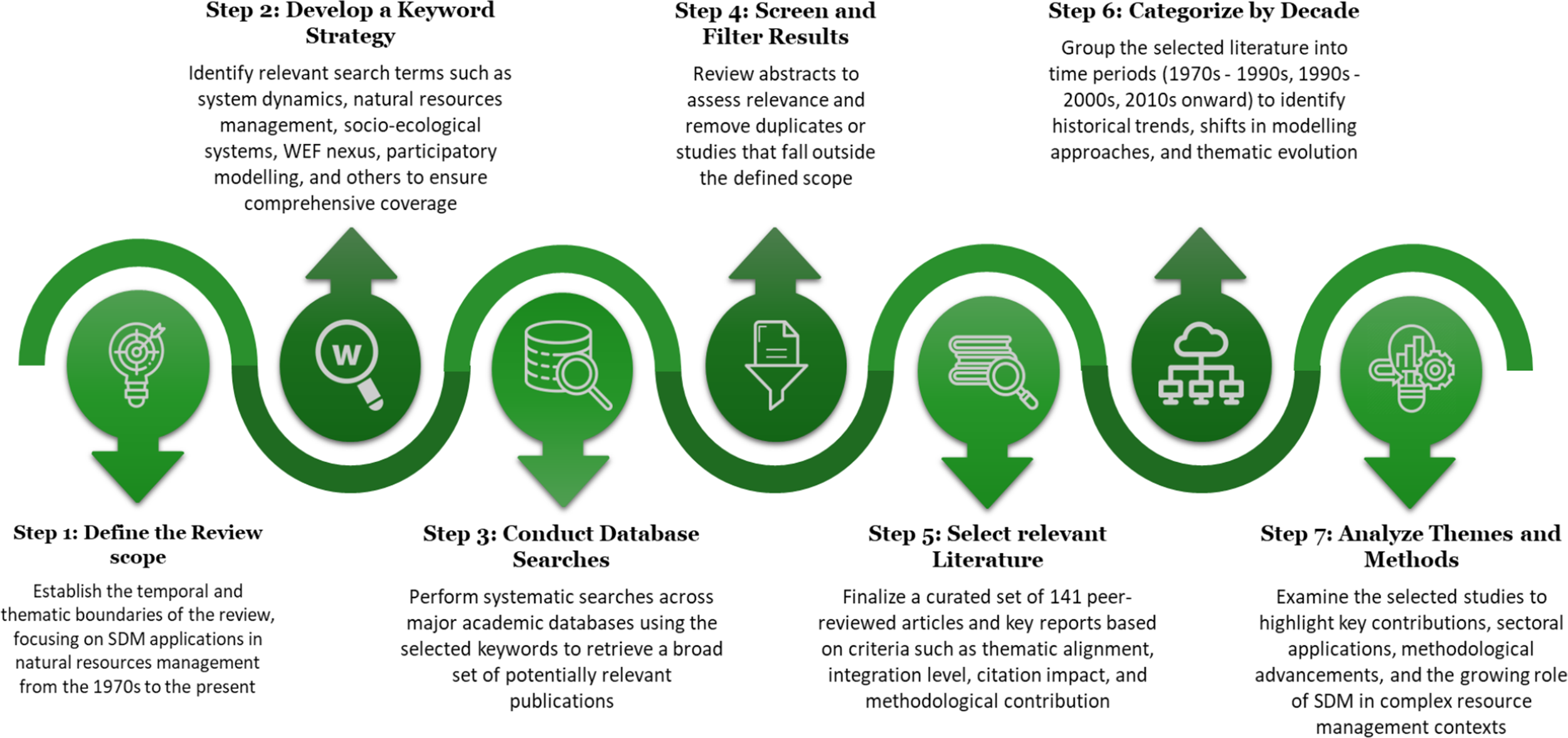
This review was conducted using a structured literature review approach to trace the evolution of SDM in the context of natural resource management from the 1970s to the present day. Relevant publications were identified through comprehensive searches across major academic databases, using targeted keywords such as system dynamics, natural resource management, resource systems modelling, socio-ecological systems, WEF nexus, environmental modelling, sustainability transitions, participatory modelling, stakeholder engagement and so forth. The initial search returned a broad set of documents, which were then screened for relevance based on their abstracts, and duplicates or articles outside the scope of this study were removed.
A final set of 141 peer-reviewed articles and influential reports was selected for in-depth analysis. Selection criteria included thematic relevance, degree of sectoral integration, methodological contribution and citation impact. To capture the evolution of SDM over time, the selected studies were categorised by decade, allowing for the identification of shifting trends, emerging themes and methodological advancements within the field. The methodological process followed in this review is summarised in Figure 1, outlining the sequential steps from scope definition to thematic and methodological analysis.
Overview of the methodological steps followed in the structured literature review, from defining the scope to analysing thematic and methodological trends in SDM applications within natural resource management.

Early contributions of SDM to natural resource management (1970s–1990s): An ecosystem focus
During this early period, environmental concerns started building as population growth and resource extraction accelerated, and as people started to recognise the impacts of human activities on the planet. Popular books such as The Population Bomb (Ehrlich, Reference Ehrlich1968) and Silent Spring (Carson, Reference Carson1962) raised environmental awareness. In 1970, the first Earth Day was celebrated, and many prominent environmental publications and conferences were held during this period (Jones, Reference Jones and Jones2008).
Within this context of growing environmental awareness, an early contribution of systems analysis was made by Hamilton et al. (Reference Hamilton, Goldstone, Milliman, Pugh, Roberts and Zellner1968). Their book considered the role of models in the social sciences and describes the application of a simulation model to the Susquehanna River Basin. A non-linear, feedback-driven model of the basin assessed potential development trajectories – a very modern perspective currently being pursued in studies globally. Another prescient feature was the integration of many resources into a single, coherent model. Following this early contribution, one of the earliest, and perhaps most controversial, SDM applications to natural resource management (Costanza et al. Reference Costanza, Leemans, Boumans, Gaddis, Costanza, Graumlich and Steffen2007), although at the time framed in the context of concerns about finite resource exploitation, the generation of pollution and the potential impacts on output and human population, is the Limits to Growth (LtG) study (Meadows et al. Reference Meadows, Meadows, Randers and Behrens1972). Just before LtG was published, Forrester (Reference Forrester1971) published ‘World Dynamics’, which explored global sustainability challenges using SDM to model relationships between population growth, industrialisation, pollution, food production and resource depletion (Forrester, Reference Forrester1971). It underscored the need for systems thinking in managing Earth’s finite resources and set the stage for the publication of LtG. LtG was instrumental in raising global awareness about the potential consequences of uncontrolled economic growth on natural resources. In a coincidence, LtG came out at the same time as the Gaia hypothesis (Lovelock, Reference Lovelock1972), which conceptualised Earth as a whole, self-governing system. LtG used SDM ideas (stemming from the work in Urban Dynamics; Forrester, Reference Forrester2007) to ask the question of what might happen to the global population and material output under different scenarios of natural resource use and exploitation, pollution generation, output yields and human capital. Much of the controversy centred on the perceived ‘simplistic’ nature of the developed systems model and its assumptions, prompting concern that a model of such relative simplicity would fail to capture the dynamics of a system as complex as the global resources–pollution–population system (Saunders, Reference Saunders1974). Other criticism focused on the relative lack of data, both for model parameterisation and subsequent validation, the level of aggregation, model completeness (i.e., not including ‘everything’), as well as the validity of policy implications (Saunders, Reference Saunders1974). The lack of absolute ‘y-axes’ on figures drew criticism as ‘unscientific’, yet the aim was to draw attention to long-term system trends, and not be drawn into discussions about absolute numbers. Another reaction was targeted at the apparent ‘doomsday’ message that the global population would crash in response to depleted resources and increasing levels of pollution. However, in LtG, there are scenarios in which population crashes are avoided through technological innovation (not specified) and sustainable use of the natural resource base. These scenarios are often ignored in criticisms, which tend to focus on results from the ‘standard run’. Studies in the intervening decades using observed data have shown that the broad trends in the LtG standard run have been tracked relatively closely (Turner Reference Turner2008), suggesting that the main message of LtG was largely accurate. This does not necessarily imply that the projections to 2100 will play out, just that the systems trends of some variables between the 1970s and the 2000s have been observed. LtG was notable for its extensive use of scenarios and sensitivity analyses, often overlooked or ignored, which demonstrated different global trajectories that could be followed under different assumptions about resource use, technological development, population growth and sustainability. Looking back, some of these scenarios qualitatively resemble the currently used shared socio-economic pathways (SSPs; O’Neill et al. Reference O’Neill, Kriegler, Ebi, Kemp-Benedict, Riahi, Rothman, van Ruijven, van Vuuren, Birkmann, Kok, Levy and Solecki2015), which describe narratives of global socio-economic development trajectories being used in projections carried out by the Intergovernmental Panel on Climate Change (IPCC) in the Assessment Reports (IPCC, Reference Lee and and Romero2023).
Following LtG, several studies used SDM to model natural resource systems, with a heavy focus on ecological systems, being inspired by the burgeoning environmental movements and concerns at the time. Gutierrez and Fey (Reference Gutierrez and Fey1980) published ‘Ecosystem Succession’, in which a dynamical model of ecosystem succession, based on the principles of internal ecosystem structures, was applied to grasslands. Climatic factors are included as exogenous altering variables that change system response and behaviour. Kitching (Reference Kitching1983) introduces the idea of ‘systems ecology’ (Jørgensen and Müller, Reference Jørgensen and Müller2000; Capra and Luisi, Reference Capra and Luisi2014), while Wolstenholme and Coyle (Reference Wolstenholme and Coyle1983) describe a general approach for systems descriptions and qualitative analysis. Grant (Reference Grant1986) summarised the state of systems analysis in wildlife and fisheries sciences, with population dynamics forming a key part of early research, building on key insights developed initially by Volterra (Reference Volterra1926). Similarly, Swart (Reference Swart1990) describes the use of SDM in predator–prey modelling in ecological systems, as do Comins and Hassell (Reference Comins and Hassell1987). Costanza et al. (Reference Costanza, Farber and Maxwell1989) applied SDM to explore the causes and consequences of wetland loss and gain in the Sacramento-San Joaquin Delta. The model’s use to evaluate different management options for restoring and preserving wetlands in the region contributed to the advancement of wetland management practices, representing a different use of SDM to include the assessment of broader management strategies on wetland behaviour. While these examples represent important steps in this use of SDM in natural/ecological settings, most deal primarily with population–prey dynamics in ecosystem settings. Despite the increase in SDM applications during the 1980s, the sometimes oversimplification of complex ecological interactions along with the inadequate inclusion of unpredictable human behavioural elements in environmental management often triggered criticism.
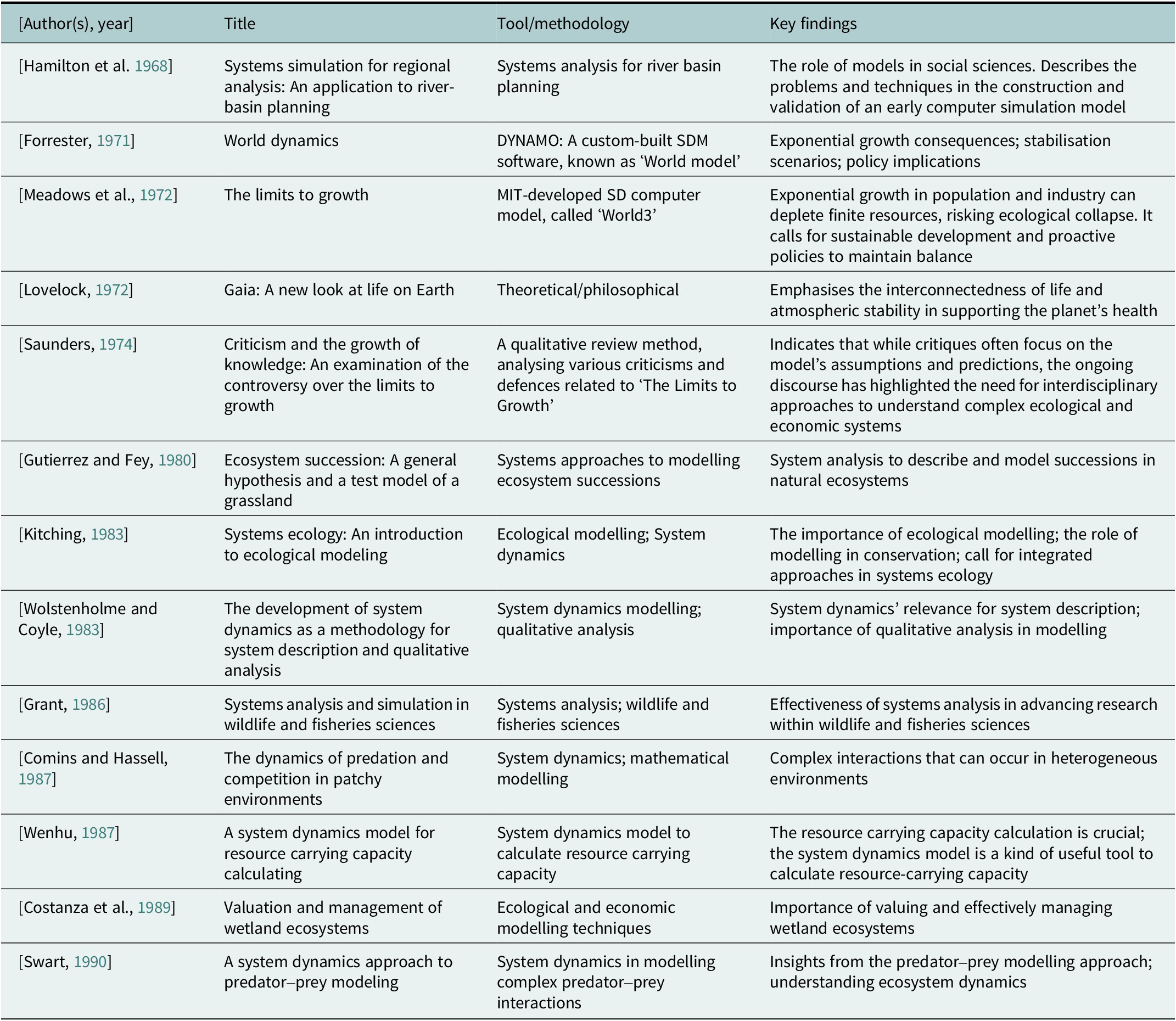
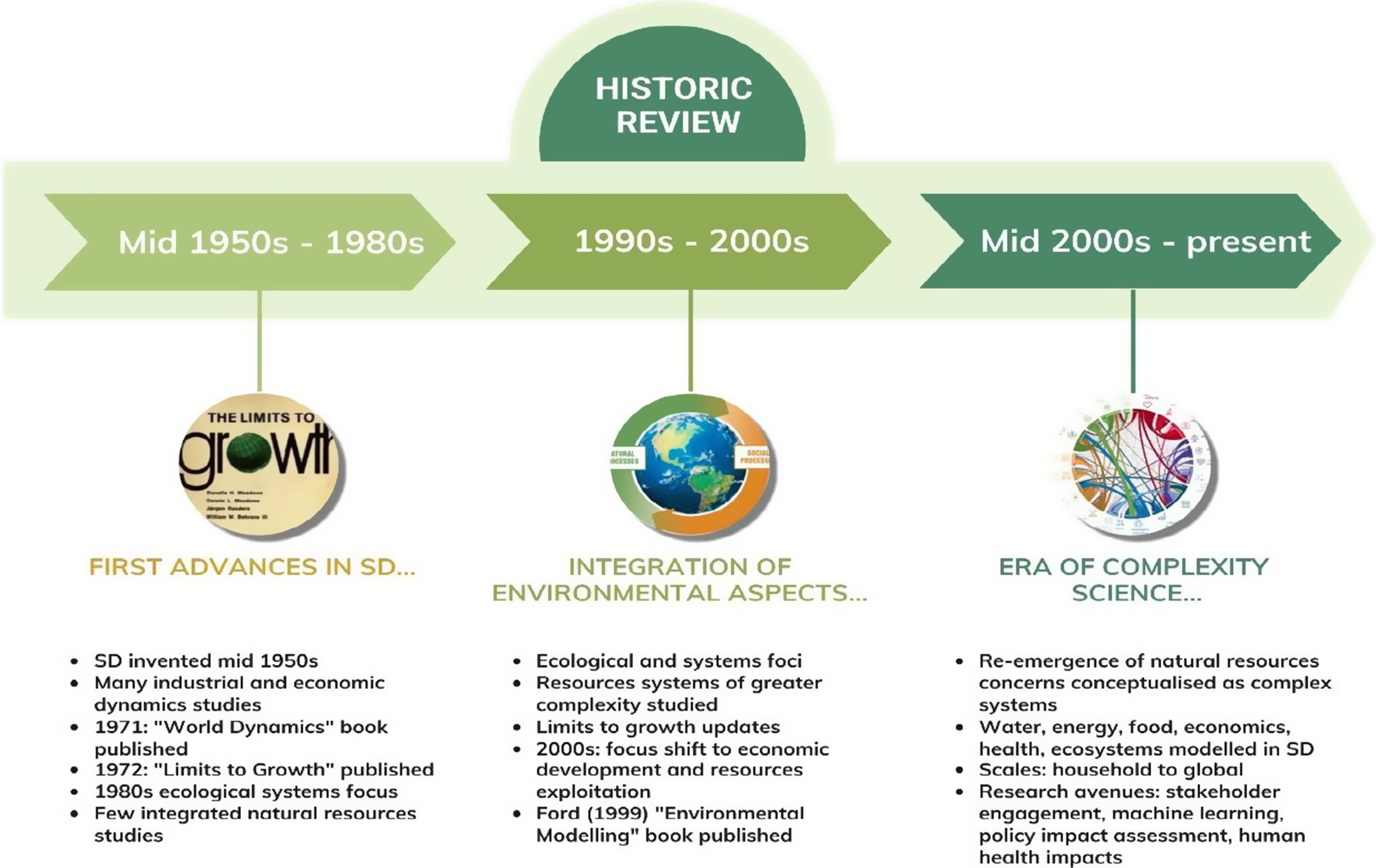
As reflected above, few studies in this time are truly ‘integrated’, not really cutting across disciplines and considering the wider implications to and from other natural resource sectors, such as water and energy, the human environment, development and society, although Rideout (Reference Rideout1981) states that such connections between society, the economy and resources should be included in (economic) models, though no modelling is undertaken. Of the few studies that are wider in scope in this period, Wenhu (Reference Wenhu1987) develops an SDM exploring the interplay between population, resources, the environment and development. Multiple sub-sectors are included, which in philosophy is closely related to LtG and ongoing research into natural resource systems. Into the early 1990s, research started to focus more on non-natural systems, such as industry, production and business (e.g., see Scott, Reference Scott1982; Forrester, Reference Forrester1987), but rarely considering the impacts to the wider environment and other resources, while natural systems studies remained focused on predator–prey dynamics and ecosystems. Interestingly, Morecroft (Reference Morecroft1988), summarising a decade of research in dynamic systems, concluded that more effort should be made in translating policymakers’ (stakeholder) knowledge into decision variables in dynamic models to better understand their behaviour, research which is today ongoing apace with the increased awareness of the importance of stakeholder and policymaker perspectives in simulation models (see later sections) for practical application and impact. Table 1 highlights selected publications of SDM applications in natural resource management in the period 1970–1990. These studies highlight foundational work and were selected for their innovative approaches, methodological significance and lasting influence on the evolution of the field. Figure 2 presents an overview timeline of SDM applications in a natural resource context, starting from the development of SDM in the 1950s to the present day. These papers are influential in the field of SDM applications in natural resource management, and are arranged chronologically.
Selected papers exploring the utility of SDM for natural resource management for the period 1970–1990

Timeline of SDM to the application of integrated natural resource modelling and assessment.

Maturing of SDM and systems thinking for natural resource modelling and assessment (1990s–2000s): Progress towards integration
In the 1990s and early 2000s, SDM started to be increasingly applied in studies that were integrated in nature, focusing on wider systems of greater complexity, although ecological and ecosystems modelling and business systems foci were still prevalent (e.g., Gallaher, Reference Gallaher1996; Sterman, Reference Sterman2000). This could be related to increasing realisation that natural resources form a complex system of systems, where individual sectors can no longer be treated separately, and that a holistic view is essential (Jones, Reference Jones and Jones2008). It is in this period that the first Conference of Parties took place (in 1995; unfccc.int/process/bodies/supreme-bodies/conference-of-the-parties-cop), and that the Millennium Development Goals, the precursor to the Sustainable Development Goals (SDGs) were starting to be discussed and clarified (www.un.org/millenniumgoals/). In the field of natural resource assessment and management, two updates to the LtG study were published: ‘Beyond the Limits to Growth’, and ‘Limits to Growth: The 30-Year Update’ (Meadows et al. Reference Meadows, Meadows and Randers1992, Reference Meadows, Randers and Meadows2004). Both books updated the simulations and compared results with the years of intervening data, yet suggested that the overall message of the 1972 book were still valid, and that should society continue along the path it appeared to be following, then irrecoverable damage to Earth’s ecosystems would follow, with concomitant impact for society, including the possibility of population collapse. Especially in Meadows et al. (Reference Meadows, Randers and Meadows2004), the issues of increasing resource use efficiency and reducing waste (e.g., in food systems and energy generation typologies) were of critical importance towards a pathway leading to sustainability, issues that are still relevant today. This started to hint at wider acknowledgement and integration of other resource sectors, such as land use, energy consumption and water demand. An independent study by Turner (Reference Turner2008) came to similar conclusions: that the overall model trends of the 1972 standard run compare well with almost 40 years of data, but not with results from the other (i.e., not the standard run) simulations.
In single-sector oriented studies, Simonovic (Reference Simonovic2002) developed an SDM, called WorldWater, to simulate the future of global water resources. Water utilisation is linked to population, agriculture, economy, non-renewable resources and pollution. The future of water resources is linked to the development of global industry, and water pollution may be a major issue going forward. Despite the very different focus of LtG, some long-term dynamics are similar, such as population trends, which can be altered through ‘technological innovation’. Indeed, some of the scenarios in Simonovic (Reference Simonovic2002) are derived from Beyond the Limits (Meadows et al. Reference Meadows, Meadows and Randers1992). Also noteworthy is that, from the standard run of WorldWater, projections of global water use for the year 2025 aligned well with independent estimates, showing that projections are reasonable when compared with those derived from very different means. SDM was likewise increasingly applied to electricity-sector problems, with a wide-ranging overview of studies summarised in Ahmad et al. (Reference Ahmad, Tahar, Muhammad-Sukki, Munir and Rahim2016) and specific case studies reported in Lowry et al. (Reference Lowry, Tidwell, Kobos, Antkowiak and Hickox2010) and Tidwell et al. (Reference Tidwell, Kobos, Malczynski, Klise, Hart and Castillo2009).
Moxnes (Reference Moxnes2000) takes a different approach to natural resource system management. Through a series of computational experiments of ecological systems (fisheries and reindeer herds), the idea that a classic ‘tragedy of the commons’ mentality regarding common-pool resource exploitation leads to mismanagement and depletion of those resources is ruled out. Instead, it is proposed that misunderstanding by policymakers of long-term dynamics between interacting stocks and flows of resources leads to resource overexploitation and mismanagement. The message is that managers and policymakers should have a better understanding of long-term system dynamics (Moxnes, Reference Moxnes2000), especially in systems in which resource sectors are often mutually interacting, as is the case in the WEF nexus.
Despite sectoral-specific models, more integrated studies and books started to emerge in this period. Costanza et al. (Reference Costanza, d Arge, de Groot, Farber, Grasso, Hannon, Limburg, Naeem, Oneill, Paruelo, Raskin, Sutton and van den Belt1997) present the Global Unified Metamodel of the Biosphere, discussing the value of global ecosystem services and highlighting the economic importance of sustainable natural resource management. One year later, Costanza and Ruth (Reference Costanza and Ruth1997) describe how SDM is useful for understanding and managing complex ecological systems. Although the focus is on ecological systems, the scope is somewhat broader, linking to economic systems and their influence on ecological systems, though other natural resources are still not integrated. In a similar vein, Woodwell (Reference Woodwell1998) developed an SDM illustrating the links between economic growth and resource depletion, a model that followed the ideas of Meadows et al. (Reference Meadows, Meadows, Randers and Behrens1972). It was hypothesised that feedback between production and physical and biological limits on availability of underlying resources limited consumption of those resources, with far-reaching planetary and human impacts. While not necessarily reflective of real-world conditions, the work did illustrate the longer-term trends of system behaviour in response to assumptions about technological development and resource exploitation, with behaviours that mimicked those in LtG (Woodwell, Reference Woodwell1998). Of particular interest to real-world applications was the note that model output behaviour was sensitive to small adjustments in certain parameters, something important in present-day considerations of resource sustainability. Xu et al. (Reference Xu, Ishidaira and Zhang2002) developed an SDM to assess the sustainability of water resources in the Yellow River Basin, China, while Fernandez and Selma (Reference Fernandez and Selma2004) used SDM to explore the impacts of water scarcity in irrigated agriculture in semi-arid areas in the south of Spain. Others, such as Harich (Reference Harich2010), use a systems thinking approach to suggest that it is ‘change resistance’ that slows or prevents sustainability efforts from being effective in environmental problems, leading to long-term detrimental system behaviours. Similarly, a number of syntheses of modelling of wider environmental issues were published, showing the growing interest in this topic from a systems thinking perspective (e.g., see Rammel et al., Reference Rammel, Stagl and Wilfing2007). Fiksel (Reference Fiksel2006) notes that a systems approach is essential to understanding global sustainability and resilience, noting SDM as a tool that can be exploited, especially in helping to understand long-term dynamic system response to external forcing. Deaton and Winebreak (Reference Deaton and Winebreak2000) introduce basic concepts in the modelling of environmental systems, predator–prey modelling, matter and nutrient cycling in ecosystems and greenhouse gases and global warming. While starting from an ecosystem perspective, the latter chapters move towards wider natural resources and environmental sustainability perspectives. At around the same time, Ford (Reference Ford1999) published a text on the modelling of the environment, since updated (Ford, Reference Ford2010). This book uses SDM as the entry point, aiming to show the diversity and flexibility of this approach in the assessment of environmental systems. Basic and intermediate systems modelling concepts are introduced, including the examination of system behaviours such as exponential growth, s-shaped growth and oscillation. Examples such as the Mono Lake Basin water level (which is gradually developed in complexity throughout the book), salmon population dynamics in the Pacific Northwest, classical cycling in predator–prey dynamics, DDT in the ocean (which includes a link to soils erosion) and greenhouses gases and feedback in the atmosphere offer a range of useful insights, and demonstrate the utility of SDM application to a wide range of integrated natural resources problems. In this way, the Ford (Reference Ford1999, Reference Ford2010) books demonstrate how system dynamics and systems thinking concepts can be applied to a wide range of topics, including many in the natural resources field.
The role of stakeholders and consensus building in the modelling cycle is increasingly applied in this maturing period, following the ideas of Morecroft (Reference Morecroft1988), a critical issue that started entering modelling studies in earnest (e.g., see Vennix, Reference Vennix2000), and that is of crucial importance in SDM of complex natural resource systems today. This importance has been exemplified particularly from the early 2000s, when the use of group model building (GMB) and other stakeholder-participatory modelling proliferated, especially in natural resource contexts (e.g., see Purwanto et al., Reference Purwanto, Sušnik, Suryadi and de Fraiture2019). Mediated modelling in an SDM context is discussed by van den Belt (Reference van den Belt2004), with an application to the integrated assessment of the Galapagos Islands being presented in van den Belt (Reference van den Belt, Wolff and Gardener2012). Videira et al. (Reference Videira, Antunes and Santos2009) detail a participatory modelling process for river basin development covering a range of resource concerns in the Baixo Guadiana river basin, while Tidwell et al. (Reference Tidwell, Passell, Conrad and Thomas2004) showcase community-based SDM development for water resources planning in the Rio Grande. More recent examples of group model building in an energy context are described in Eker et al. (Reference Eker, Zimmermann, Carnohan and Davies2018) and Carhart and Yearworth (Reference Carhart and Yearworth2010). Group model building as an approach towards co-developing SDMs in a variety of contexts and for policy support is outlined by Andersen et al. (Reference Andersen, Vennix, Richardson and Rouwette2007) and Rouwette and Vennix (Reference Rouwette, Vennix and Meyers2020), with practical applications in a natural resources context in Otto and Strube (Reference Otto and Struben2004) and, more recently, Purwanto et al. (Reference Purwanto, Sušnik, Suryadi and de Fraiture2019). GMB supporting SDM can be an effective tool for helping develop a better understanding of system complexity by engaging diverse groups of researchers, managers and decision-makers (Luna-Reyes et al., Reference Luna-Reyes, Martinez-Moyano, Pardo, Cresswell, Andersen and Richardson2006; Richardson and Andersen, Reference Richardson, Andersen, Kilgour and Eden2010; Inam et al., Reference Inam, Adamowski, Halbe and Prasher2015; Rich et al., Reference Rich, Rich and Dizyee2018). Many of the studies described here include elements on ecosystem services and environmental protection, being more integrative in nature. Such groups involved in the GMB process help to improve and refine the problem scope, with the assumption that subsequent SDM exercises will be more relevant to the problem under study, capturing interactions of importance.
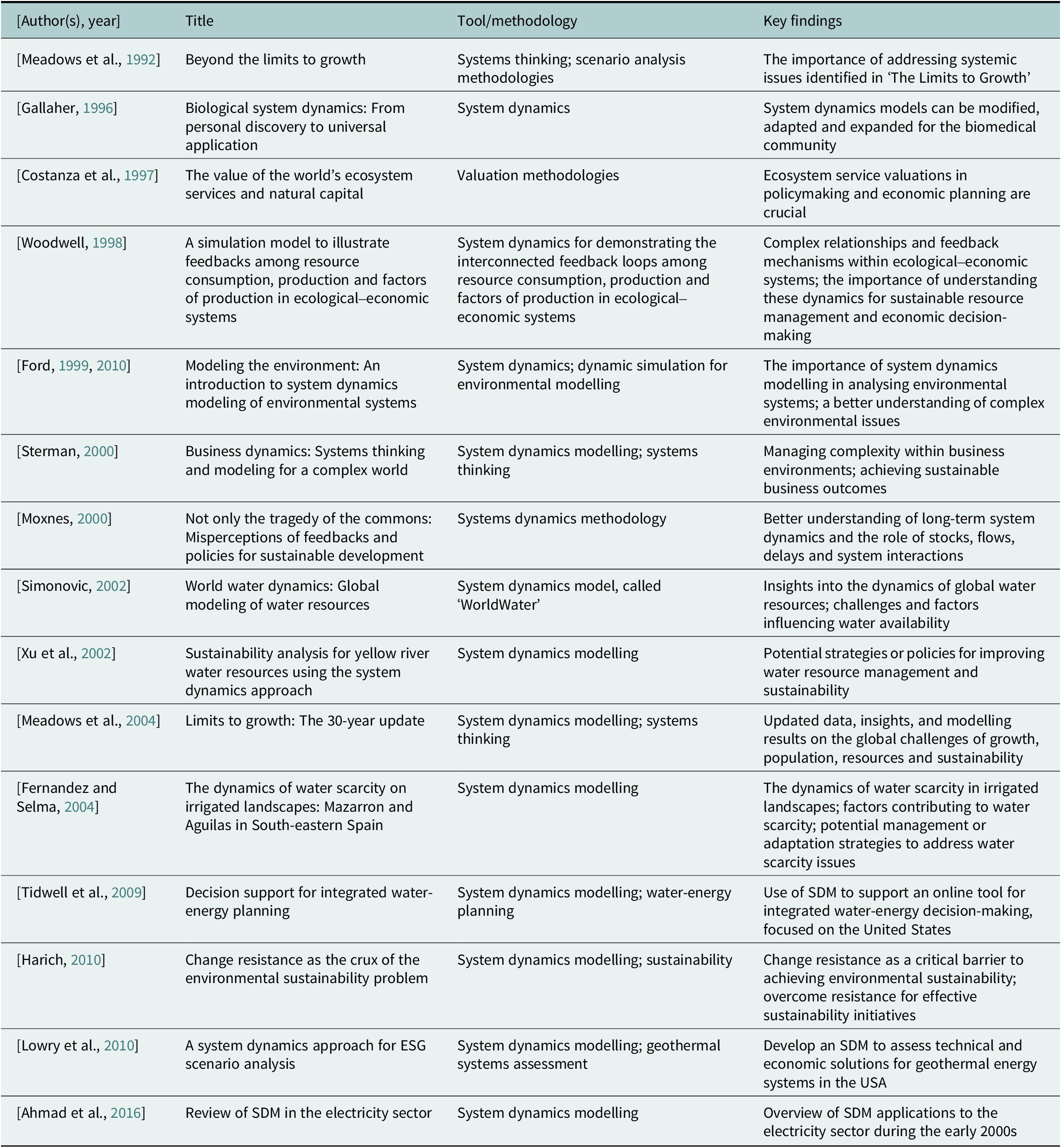
This period saw the emergence and rapid proliferation of SDM in wider natural resources and sustainability contexts, with ever-greater focus on systems of increasing complexity. By 2010, SDM had established itself as a crucial instrument in assessing and helping to understand natural resources, noted for its proficiency in deciphering complex systems and guiding sustainable management approaches. The discipline keeps progressing, propelled by technological innovations and the necessity to use the Earth’s resources with greater sustainability. In a way, this period can be thought of as ‘setting the stage’ for the current burgeoning of SDM in a natural resources context over the past 15 years. Table 2 presents representative studies from the 1990s to the 2000s, a period marked by the advancement of SDM methodologies and a growing emphasis on cross-sectoral integration. These studies were selected for their innovative contributions to model development, their influence on expanding the application of SDM beyond single-resource systems and their role in bridging disciplinary boundaries. The selection reflects a shift towards more comprehensive frameworks capable of capturing the complex interdependencies inherent in natural resource management. Figure 2 summarises the main SDM applications during this period.
Selected papers advancing the interplay between system dynamics and natural resource management, for the period 1990–2000

Recent applications of SDM in integrated natural resource management (2010s–present): Towards holistic multi-sector integration and practical guidance
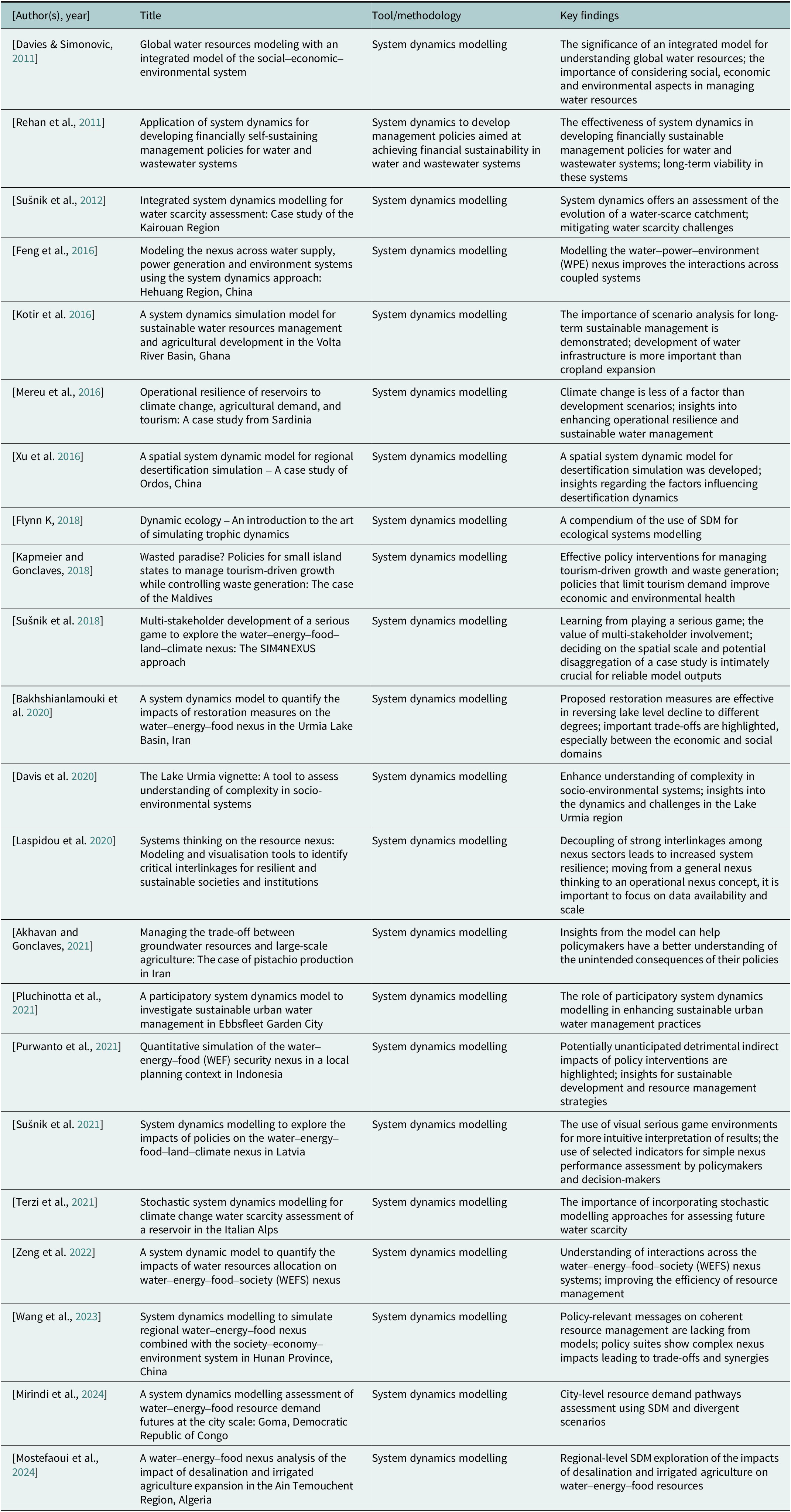
The period from the 2010s to the present has seen the proliferation of the application of SDM to the issue of natural resource management in a wide range of contexts, locations and scales, with greater levels of integration and complexity of case studies, and more focus on making results and recommendations actionable. This development reflects growing concerns and recognition of the Earth system as a singular whole in which actions have impacts far beyond their original purpose. Much of this has been in the context of the WEF nexus (Hoff, Reference Hoff2011) and/or consideration of multiple resources, which has expanded and changed focus. Simpson and Jewitt (Reference Simpson and Jewitt2019a) and Zhang et al. (Reference Zhang, Chen, Li, Ding and Fu2018) review the development of the WEF nexus concept since its inception. Sectorally specific studies are still carried out, however (e.g., see Tao et al. Reference Tao and Li2011; Ghashghaie et al. Reference Ghashghaie, Marofi and Marofi2014; Sahin et al. Reference Sahin, Siems, Stewart and Porter2014; Ahmad et al., Reference Ahmad, Tahar, Muhammad-Sukki, Munir and Rahim2016). Davies and Simonovic (Reference Davies and Simonovic2011) develop a global water resource model, extending the work of Simonovic (Reference Simonovic2002), with wider socio-economic-environmental considerations accounted for, demonstrating a shift towards a more integrated perspective on natural resource exploitation, management and sustainability. Rehan et al. (Reference Rehan, Knight, Haas and Unger2011) likewise focus on a water and wastewater system, but from the perspective of management policies, investigating how these can be developed so that the system is ‘self-sustaining’. This work may be seen as a merging of early Business Dynamics work (Sterman, Reference Sterman2000), the conclusions of Morecroft (Reference Morecroft1988) and the more recent WEF nexus focus. Phan et al. (Reference Phan, Bertone and Stewart2021) present a review of how SDM applications can be useful in water resource planning and management, showing that the use of scenarios is prominent in this field, as are structural tests of model behaviour. Ahmad et al. (Reference Ahmad, Tahar, Muhammad-Sukki, Munir and Rahim2016) describe the use of SDM to explore the global electricity (energy) system, while Lowry et al. (Reference Lowry, Tidwell, Kobos, Antkowiak and Hickox2010) and Tidwell et al. (Reference Tidwell, Kobos, Malczynski, Klise, Hart and Castillo2009) describe national-level energy applications of SDM.
Taking a wider view, Bazilian et al. (Reference Bazilian, Rogner, Howells, Hermann, Arent, Gielen, Steduto, Mueller, Komor, Tol and Yumkella2011) provide a commentary on how systems and integrated modelling can be leveraged to investigate the WEF nexus, while Sušnik et al. (Reference Sušnik, Vamvakeridou-Lyroudia, Savić and Kapelan2012) use SDM to study a coupled water-agricultural system in Tunisia. Since then, the application of SDM to study resource nexus issues has proliferated, being applied to many scales and issues, often extending beyond water, energy and food, and aiming to be more practically grounded. Integrated resource modelling studies have been carried out at the household and city levels to study the integrated dynamics of household resource consumption, and how different population and policy scenarios may impact overall WEF resource demand pressures (Hussein et al. Reference Hussein, Memon and Savić2017; Li et al., Reference Li, Zhang, Hao, Zhang, Xiong and Shi2022; Mirindi et al. Reference Mirindi, Sušnik, Masia and Jewitt2024). Pluchinotta et al. (Reference Pluchinotta, Pagano, Vilcan, Ahilan, Kapetas, Maskrey, Krivtsov, Thorne and O’Donnell2021) describe the development of a participatory SDM in Ebbsfleet Garden City, UK, to explore the impacts of sustainable urban water management strategies, and demonstrate the benefit of stakeholder engagement and participation in the development and interpretation of SDMs and their results.
At the sub-national scale (regional and provincial), river or lake basins are a popular unit of analysis (e.g., see Feng et al. Reference Feng, Liu, Li, Zhang, Liu and Xiong2016; Kotir et al. Reference Kotir, Smith, Brown, Marshall and Johnstone2016; Xu et al. Reference Xu, Song, Tong, Ren, Hu and Shao2016; Bakhshianlamouki et al. Reference Bakhshianlamouki, Masia, Karimi, van der Zaag and Sušnik2020; Davis et al. Reference Davis, Ghaffarzadegan, Grohs, Grote, Hosseinichimeh, Knight, Mahmoudi and Triantis2020; Purwanto et al., Reference Purwanto, Sušnik, Suryadi and de Fraiture2021; Terzi et al., Reference Terzi, Sušnik, Schneiderbauer, Torresan and Critto2021; Zeng et al. Reference Zeng, Liu, Guo, Xiong, Liu, Yin and Wu2022; Wang et al., Reference Wang, Dong and Sušnik2023; Mostefaoui et al. Reference Mostefaoui, Sušnik, Masia and Jewitt2024). Often, studies show how sectors within river basins are dependent on each other (e.g., how energy demand may change with increasing water demand and/or agricultural expansion, or due to building desalination plants to ensure water supply), as well as assessing the impact of policy implementation. Sub-national scales are popular as they are scales at which policies and decisions are made and/or implemented on the ground, and therefore such studies can have real-world applicability and relevance (e.g., see Purwanto et al. Reference Purwanto, Sušnik, Suryadi and de Fraiture2021).
National-level SDM studies are common, as are studies in well-defined geographic locations such as islands (e.g., see Mereu et al., Reference Mereu, Sušnik, Trabucco, Daccache, Vamvakeridou-Lyroudia, Renoldi, Virdis, Savić and Assimacopoulos2016; Kapmeier and Gonclaves, Reference Kapmeier and Gonclaves2018; Laspidou et al., Reference Laspidou, Mellios, Spyropoulou, Kofinas and Papadopoulou2020; Akhavan and Gonclaves, Reference Akhavan and Gonclaves2021; Sušnik et al., Reference Sušnik, Masia, Indriksone, Brēmere and Vamvakeridou-Lyroudia2021). Such well-defined areas are preferable as they demarcate a clear unit of analysis, and data can easily be sourced at such scales from open-source repositories, facilitating modelling. These data sets tend to also be harmonious, covering the same area, timespan and sometimes collected by governmental institutions. In this regard, the use of large datasets is increasingly integrated into SDM natural resource assessments, increasingly taking advantage of global climate and socio-economic projections using the Representative Concentration Pathways (RCPs) and SSPs, respectively (e.g., see Sušnik, Reference Sušnik2018; Terzi et al., Reference Terzi, Sušnik, Schneiderbauer, Torresan and Critto2021). Following this theme of big data, in 2019, the online, interactive En-ROADS simulator was released, co-developed with the MIT Sloan Sustainability Initiative (Rooney-Varga et al., Reference Rooney-Varga, Kapmeier, Sterman, Jones, Putko and Rath2020; https://www.climateinteractive.org/en-roads/). En-ROADS is a global climate simulator allowing users to explore the impact that policies, such as electrification of transport, various carbon pricing mechanisms and so forth, might have on variables, such as global energy prices, air temperature changes and potential sea level rise. Built in the Vensim software (www.vensim.com), En-ROADS uses systems thinking ideas to develop a globally coherent policy impact model accounting for linkages between sectors, thus being able to highlight potential synergies and trade-offs. Since its release, En-ROADS has been widely applied for practical policy advice and decision support (e.g., see Kapmeier et al., Reference Kapmeier, Greenspan, Jones and Sterman2021), with numerous examples on specific issues in the literature (e.g., see Wyatt et al., Reference Wyatt, Sullivan-Watts, Watts and Sacks2022; Khademolhosseini, Reference Khademolhosseini2023; Adun et al., Reference Adun, Ampah, Bamisile and Hu2024). The development of En-ROADS represents a major step forward in using SDM to communicate the need to integrate approaches to resource management to high-level stakeholders. The user-friendly online interface helps significantly in this end. In a similar vein, the Millennium Institute has developed the Integrated SDG (iSDG) model built on an SDM paradigm (www.millennium-institute.org/sustainable-development-simulator; Pedercini et al., Reference Pedercini, Arquitt and Chan2020). The iSDG model helps one understand the interconnectedness of policies designed to achieve the SDGs and test potential impacts. This is important as it has been shown that there are indeed interconnections, synergies and trade-offs between the SDGs themselves (Zelinka and Amadei, Reference Zelinka and Amadei2019; Pham-Truffert et al., Reference Pham-Truffert, Metz, Fischer, Rueff and Messerli2020). The iSDG model is built upon the older Threshold21 (T21) model and covers all SDGs. True to SDM principles, iSDG aims to show trends in SDG attainment to 2030, allowing the assessment of policy impact. The iSDG model has been widely used, including to assess whether degrowth can deliver social benefits within ecological limits in Sweden (Zwetsloot, Reference Zwetsloot2024) and to assess policy coherence to better achieve the SDGs (Collste et al., Reference Collste, Pedercini and Cornell2017). Both initiatives rely on data from the RCPs to project ‘baseline’ pathways of resource supply and demand, on top of which policies may be enacted to assess their relative impact.
Ensuring real-world relevance of SDM studies of natural resources is more critical than ever (cf. Simpson and Jewitt, Reference Simpson and Jewitt2019b), relying ever more on stakeholder and participatory model development. By applying studies at levels at which policy and decision-making take place, and by framing recommendations appropriately, this may lead to enhanced consideration of recommendations. As a consequence of the proliferation of WEF nexus research and SDM applications, a number of books on the topic have been published, some focused particularly on Africa and the unique challenges and opportunities that the continent presents (Bleischwitz et al., Reference Bleischwitz, Hoff, Spataru, van der Voet and VanDeveer2018; Nhamo et al., Reference Nhamo, Mabhaudi, Mpandeli, Dickens, Nhemachena, Senzanje, Naidoo, Liphadzi and Modi2020; Brouwer, Reference Brouwer2022; Mabhaudi et al. Reference Mabhaudi, Senzanje, Modi, Jewitt and Massawe2022), with increasingly more publications being African-focused (e.g., see Mabhaudi et al. Reference Mabhaudi, Senzanje, Modi, Jewitt and Massawe2022; Mirindi et al., Reference Mirindi, Sušnik, Masia and Jewitt2024; Mosefaoui et al., Reference Mostefaoui, Sušnik, Masia and Jewitt2024).
In this period, a number of conceptual works have been published, considering the role of system dynamics/systems thinking in natural resource management. Nabavi et al. (Reference Nabavi, Daniell and Najafi2017) review how SDM can support sustainability ambitions. They focus not only on the advantages of quantitative simulation tools but also on other systems thinking techniques, including system archetypes, causal loop diagrams and stock-and-flow diagrams to help understand sustainability issues and pathways. Particular attention is paid to the issue of setting boundaries and setting appropriate expectations. Participatory approaches to modelling are emphasised, especially to ensure that results are not misinterpreted. A review by Elsawah et al. (Reference Elsawah, Pierce, Hamilton, van Delden, Haase, Elmahdi and Jakeman2017) considers the role of SDM and the modelling process, focused on socio-ecological systems, and using best practice from case studies to support the review. The issues modellers face during modelling exercises, along with guidance and design for modelling studies, are put forward. A range of techniques is put forward, including causal loop diagrams, fuzzy cognitive mapping, system archetypes, as well as exploring themes relating to quantitative model development and testing in the context of complex socio-ecological/resource systems. Flynn (Reference Flynn2018) provides a foundational guide to modelling ecological systems, specifically emphasising the flows of materials between biological and abiotic components over time. It differentiates between various modelling approaches, clarifying misconceptions around statistical models compared to dynamic simulations and is grounded in plankton ecology assessments. By progressing from simple biological descriptions to more complex models, the book aims to equip readers with the skills to develop detailed ecological simulations within environmental frameworks. Martin et al. (Reference Martin, Giordano, Pagano, van der Keur and Costa2020) show how systems thinking, in particular causal loop diagrams and fuzzy cognitive maps, can be applied to assess the role of nature-based solutions to achieve SDG ambitions. These conceptual/review papers demonstrate the burgeoning field of SDM in natural resource modelling and assessment, along with its wider application. They also show the thought being put into good modelling practice, the important role of stakeholders and the potential implications of using such models. Table 3 highlights selected publications that showcase the increasing diversity, complexity and maturity of contemporary SDM applications from the 2010s onward. Together, they reflect the expanding scope and adaptability of SDM in addressing today’s complex resource management challenges. Figure 2 summarises the main SDM applications during this period. This section demonstrates how progress over the last 50–60 years is starting to converge. SDM is increasingly used in natural resource modelling and assessment in increasingly diverse contexts and scales, with the increasing use of participatory approaches to co-develop useful models and to explore the implications of policy implementation. In addition, efforts are being made to ensure that modelling outputs and recommendations are generally understandable and useful. Efforts continue to further enhance the practical utility of such models and to disseminate policy-ready messages from studies, thus moving the field towards real-world applicability and impact.
Selected papers advancing the application of system dynamics to natural resource management, for the period 2010 to present

Opportunities to advance and promote the role of SDM in natural resource assessment and management
From the above historical overview of the role of SDM in natural resource management, a few lessons and trends emerge. First is the recognition that the field of integrated/systems modelling of natural resources is nothing new, having begun in the early 1970s. An ironic narrowing in scope to sector-specific applications is then noted through the 1980s and 1990s, which is not in itself a bad thing. This allowed time for ideas, concepts and methodological approaches to mature and develop. As environmental pressures became more acute in the 2000s, SDM applications started to open up again, including ever-more varied sectors and issues. This resurgence was built on the shoulders of those who came before, picking up from where pioneers in the field left off and finding new ways to apply the concepts to a modern audience. A realisation is that while the approach is generalisable, for real-world relevance, models should be individually tailored to local scales such that they are able to address specific concerns not identifiable in coarser-grained models.
Despite the advances, there is much scope to advance and further promote SDM applications for natural resource management, especially for practically oriented advice and support. One prominent example helping to bring systems concepts to a non-expert audience is to use SDMs as the ‘back end’ to online-based ‘serious games’, in which users can explore the potential impacts of system trends by ‘playing’ a range of hypothetical but real-world grounded policies (Sušnik et al. Reference Sušnik2018; https://seriousgame.sim4nexus.eu/sim4nexus-LoginPage.html; the En-ROADS simulator: https://www.climateinteractive.org/en-roads/; the currently under-development NEXOGENESIS Nexus Policy Assessment Tool [NEPAT]: https://nepat-dev.nexogenesis.eu). Many tools already exist in this context, and this momentum should be leveraged. The advantage with games and simulators is that users can ask ‘what if’ questions, explore diverse scenarios and assess system-wide impacts in a safe environment with no real-world consequences. Findings may spur further discussion on better natural resource management options. It is important, however, to communicate that such tools are ‘just a game’, built on incomplete models of systems with many assumptions and uncertainties, and that real policy decisions would need a thorough analysis to ensure that misperceptions and misleading advice are avoided (cf. Moxnes, Reference Moxnes2023). A wide range of games and sample models useful as learning and teaching aids to explore system behaviour and model development are available on SDM websites, including examples from agriculture, water and the environment (see, e.g., the ISEE model directory: https://exchange.iseesystems.com/directory/isee or the MetaSD model library: www.mindseyecomputing.com). Such applications are starting to make their way into policy circles, bringing systems thinking and integrated management to the audience making key decisions. As decision-makers are unlikely to also be modelling experts, it is essential to ‘wrap’ SDMs in user-friendly environments to allow non-expert users to explore natural resource management pathways and implications over diverse timeframes, from months to years, and even decades. Increasing use in educational programmes is a parallel step alongside games and simulators to promote the utility and benefit that SDM can bring to the study of complex natural resource systems. This may lead the next generation of scientists, policymakers and government officials to be more aware of natural resource systems complexity, as well as the tools available on which to base decisions and policymaking. It is likely that the use of SDMs as simulator back-ends looks set to increase as calls to make models ‘actionable’ increase, and as policymakers demand robust scientific evidence on which to inform and guide decision-making processes.
A second opportunity, linking closing with the above, is to use SDM to assess the potential impact on natural resource system pathways under global change. For example, the impact of climate change on a wide range of variables (e.g., temperature, precipitation, runoff, crop yield and so forth) can be assessed using RCPs (van Vuuren et al., Reference Van Vuuren, Edmonds, Kainuma, Riahi, Thomson, Hibbard, Hurtt, Kram, Krey, Lamarque, Masui, Meinshausen, Nakincenovic, Smith and Rose2011), while socioeconomic change (e.g., population and demographic structure, resource demand and economic projections) can be assessed using data from the SSPs (O’Neill et al., Reference O’Neill, Kriegler, Ebi, Kemp-Benedict, Riahi, Rothman, van Ruijven, van Vuuren, Birkmann, Kok, Levy and Solecki2015). These datasets can be enriched, complemented and given operational relevance using local, stakeholder-derived information on policy implementation, nationally specific projections and increased levels of detail and granularity. In combination with the RCPs and SSPs, the assessment of policy implications on resource trajectories is especially interesting, particularly when framed within a natural resource perspective. Frequently, policy design is concentrated on the sectors to which it applies. By applying a systems context, the wider implications of a policy or policies on the trajectories of other sectors can be assessed. Work by Purwanto et al. (Reference Purwanto, Sušnik, Suryadi and de Fraiture2021) and Sušnik et al. (Reference Sušnik, Masia, Indriksone, Brēmere and Vamvakeridou-Lyroudia2021) demonstrated the utility of SDM in this context. By assessing policy impacts across RCP and SSP scenarios, those that can cope with a wider range of potential futures (i.e., are robust; cf. Capano and Woo, Reference Capano and Woo2018) can be identified, as can those that minimise detrimental trade-offs and exploit synergistic opportunities across resource sectors, making policy implementation more effective. As with the previous paragraph, highlighting such advances to decision-makers and policymakers, as well as to younger, emerging generations, is absolutely critical to spread the messages of systems thinking and integrated natural resources management. SDM applications, as demonstrated above, can play a key role in this education.
Linking to the policy-related opportunities above, another significant opportunity to advance SD research and applications is the complementarity that machine learning (ML) techniques offer to explore vast search spaces and to suggest optimal strategies or policy combinations when faced with multiple objectives in a multi-dimensional scenario space. For example, SDMs of resource systems containing just 10 policies across many resource sectors, which could be implemented in any possible combination, could be combined in 10!, or c. 3.6 × 10⁶ combinations (cf. Sušnik et al., Reference Sušnik, Masia, Indriksone, Brēmere and Vamvakeridou-Lyroudia2021), which grows rapidly as more combination options are added. These policy combinations might be evaluated against, for example, 10 or 12 policy objectives (or more) to achieve, while the scenario space might be multi-dimensional (e.g., two RCPs and two SSPs, for a four-dimensional scenario space in which the system response to policy implementation may differ). Such research is underway, for example, in the frame of Horizon 2020 NEXOGENESIS research project, and the use of novel technologies to enable rapid multi-objective optimisation of complex water-energy systems is reported in Basheer et al. (Reference Basheer, Nechifor, Calzadilla, Gebrechorkos, Forsythe, Gonzalez, Sheffield, Fowler and Harou2023) and Etichia et al. (Reference Etichia, Basheer, Bravo, Gutierrez, Endegnanew, Gonzalez, Hurford, Tomlinson, Martinez, Panteli and Harou2024). Here, ML offers a significant opportunity, first, to rapidly search and analyse the vast spaces. In addition, the algorithms, through repeated simulation, can ‘learn’ which policy combinations achieve the most policy objectives (i.e., give rise to appropriate system trends) under a given scenario or scenarios. The output could be suggestions of potential policy combinations to further explore to achieve a specific set of policy objectives under particular climatic and socioeconomic futures. In this way, robust policy combinations could be suggested and further explored by policy experts. The results of uncertainty assessments and model output variability can be represented visually, indicating where the most likely system trends lie, but also where the less likely, although still probable, extreme system trajectories fall. These extremes can then be analysed and accounted for. If combined with educational and outreach programmes as mentioned above, the role and utility of ML in supporting and guiding decision-making and policymaking processes is poised to play a significantly larger role in the near future.
Stakeholder engagement and co-creation of SDMs have a long history (Voinov and Bousquet, Reference Voinov and Bousquet2010; Videira et al., Reference Videira, Antunes, Santos, Gray, Paolisso, Jordan and Gray2016; Pagano et al., Reference Pagano, Pluchinotta, Pengal, Cokan and Giordano2019), and such engagement in natural resource modelling studies is accelerating, with the practice becoming an essential part of modelling studies that aim to have practical applicability. Such initiatives must continue, both to spread awareness of the power of SDM in general and to ensure studies gain practical relevance. Engagement of relevant stakeholders can lead to improved systems contextualisation, improved model structure, clarity on the problem at hand, input on data sources, policy selection and guidance and model output validation and feedback. Through the involvement of stakeholder groups, recommendations stemming from models may be more likely to be taken seriously and followed up, with the potential for impact on sustainable resource use. This facet is very closely related to the use of participatory modelling and GMB processes that started to flourish during the 2000s, as discussed above, and something that is still very much being used in recent research (Purwanto et al. Reference Purwanto, Sušnik, Suryadi and de Fraiture2019). Such engagement, if properly planned and carried out, can help increase a sense of ownership of the issues, opportunities and the wider environment, potentially paving a path towards more sustainable practices. Again, SDM applications play a key role in this.
Regarding model accessibility and usability, there is a wide range of innovative pathways towards improving broader audience engagement, with open-source platforms and user-friendly approaches playing increasingly important roles. En-ROADS and the NEXOGENESIS NEPAT are good examples of such platforms. The further development of user-friendly, intuitive, open-source system dynamics software and visualisation can make these tools accessible to a broader audience, including non-experts. The risk would be the creation of poorly formulated, calibrated and/or validated models with questionable output being implemented and used for decision support, potentially leading to detrimental outcomes. Thus, it is suggested that criteria to measure ‘good models’ are needed, especially regarding open-source models, something that is currently lacking. It is also suggested that a strong participatory process in environmental and natural resource modelling can also help ensure the development of ‘good’ models (Amorocho-Daza et al., Reference Amorocho-Daza, Sušnik, van der Zaag and Slinger2025). This democratisation of technology can spur innovative uses and applications across different sectors. Cloud-based modelling techniques offer a wide spectrum of opportunities as is the reduction of high computational costs and the facilitation of collaborative model building and scenario testing across different locations.
Another opportunity is to further incorporate GIS and GIS-like connections with SDMs to account for spatially explicit dynamics. GIS-like integration is possible through subscripted and/or arrayed models, attempting to represent interactions between geographical regions, although the spatially explicit dynamics are somewhat lost. Better would be true coupling with GIS to directly show spatial system dynamics. For example, Mazzoleni et al. (Reference Mazzoleni, Giannino, Colandrea, Nicolazzo and Massheder2003) describe the development of SIMARC, software that directly and dynamically links ArcGIS polygons to SIMILE SDM software. An SDM is run for every polygon in an ArcView map. Such software could be used to take spatially explicit temperature and water maps, use these data to model vegetation growth dynamics in the SDM and output, per polygon, a vegetation biomass map. A main drawback is the computational load, especially if the GIS layer is large and/or of very fine spatial resolution. Voinov et al. (Reference Voinov, Fitz, Boumans and Costanza2004) couple STELLA SDMs with a GIS-like setting to replicate ecosystem dynamics, such as plant growth and detritus accumulation, thereby linking the capabilities of SDM with spatially explicit analysis. More recently, Neuwirth et al. (Reference Neuwirth, Peck and Simonovic2015) couple SDMs with GIS via a Python library, allowing the handling of bidirectional and synchronised operations between the SDM and the GIS. The fictional Daisyworld is used to demonstrate the potential of the spatial system dynamics model, highlighting the importance of capturing spatial interactions. Applications in agriculture and disaster management are proposed as developments. There remains much opportunity to advance fully spatially explicit SDMs. SDMs can also be connected to agent-based models to replicate non-linear feedback behaviours in settings comprising many interacting actors. While there has been some work published (e.g., Martin and Schlüter, Reference Martin and Schlüter2015; Guerrero et al., Reference Guerrero, Schwarz and Slinger2016; Liu et al., Reference Liu, Zheng and Wang2020), research into this coupling of approaches remains very sparse despite the complementarity. SDMs in integrated natural resource management will likely increasingly rely on the integration of real-time data, including from online sources. As data collection technologies, such as IoT sensors and satellite imaging, continue to advance, future models will incorporate vast amounts of real-time information via direct linking with online servers. Coupled with continuously evolving computational power, this influx of data will significantly improve SDM capabilities, making models more dynamic and responsive to system changes in near real-time. This integration, along with the expected inclusion of near real-world complexity in future SDMs, will pave the way towards perfecting the so-called ‘Digital Twins’ concept (cf. https://destination-earth.eu/), facilitating more precise decision-making and management strategies for resource systems to a wider and more diverse audience who can explore challenges, solutions and implications over different spatial and temporal scales. Coupled with the ML advances mentioned above, decision-makers could be presented with ‘menus’ of potentially suitable pathways to follow and to investigate in more depth for a specific location/issue, and just as importantly, those options to avoid, including getting an idea of why to avoid them by highlighting trade-offs and detrimental impacts. Making results open access, online and displayed in a spatial way may help open up the ideas behind SDM and integrated resource management to an even wider audience than at present, with the potential to display the competing trade-offs inherent in resource management and development, further raising awareness of the challenges.
Ultimately, through more targeted developments and dissemination to non-expert users, there remains a significant opportunity to further promote the role of SDM in the assessment and management of natural resources, especially to support policy coherence (cf. Suda et al. Reference Suda, Sušnik, Masia and Jewitt2024) and to encourage systems thinking among a wider audience. The intricate and interlinked nature of global environmental issues demands systems thinking mindsets along with advanced tools capable of modelling dynamic systems and supporting strategic decision-making processes in practice. This review has demonstrated the long and rich history of SDM in natural resource management and put forward thoughts on opportunities to further showcase SDM in this context in the coming years.
Conclusions
System dynamics has a long history of applications in natural resource management, dating back to the 1970s with The Limits to Growth, coinciding with a burgeoning environmental movement and conceiving of the world ‘as a whole’, not as individual pieces. Bottom-up model development, the visual development environment, flexibility and non-prescriptiveness in terms of disciplines and intrinsic ability to deal with feedback and complexity make it an ideal approach to studying complex natural resource systems. Early focus on ecological systems modelling, such as lakes and predator–prey dynamics, paved the way for more diverse and wide-ranging applications connecting an increasingly diverse set of sectors and issues. Through the 1990s and into the 2000s, stakeholder engagement and participatory modelling processes gained importance, continuing to this day. Since the relatively recent emergence of the WEF nexus as a discipline in about 2010, SDM applications have proliferated. Applications cover a range of scales, with studies increasingly engaging stakeholders in natural resource management and policy, and aiming to inform and potentially influence integrated resource policy formulation. Using system dynamics models as ‘serious games’ for scenario and ‘what-if’ exploration, more sophisticated scenario analysis of resource futures, the potential to explore huge scenario and policy spaces using ML techniques and stakeholder engagement and co-creation in the modelling process are all opportunities to further promote SDM as an ideal tool to support policymaking and decision-making processes in complex, interacting natural resource systems, something increasingly needed. This article has shown how SDM has evolved from arguably a relatively niche academic exercise to an ever-more recognised and used tool in supporting real-world decisions and policy in the field of complex natural resource management, with many research strands recently converging. By tracing the historical evolution of SDM in natural resource management, it highlights both the foundational milestones and the expanding applicability of the method. Beyond offering a literature synthesis, it advocates for continued and broadened use of SDM as a decision-support tool in complex socio-environmental systems. The emergence of user-friendly online tools built on SDM principles, such as En-ROADS, is facilitating this transition, which also encourages taking a wider systems thinking attitude to resource management and policy formulation. Developments since the 1970s have had the impact of gradually transitioning SDM into a truly useful tool for supporting decision and policy in complex natural resource systems, thus leading to change outside the relatively small field, even if unconsciously. An example is the increasing use of SDM, either directly or wrapped in user-friendly interfaces, to guide and support policy decisions at a number of scales. The suggestions in this article to further promote SDM in this context will only build on this, exposing more people to its benefits and the need for systems thinking. This knowledge is necessary because of the increasingly connected nature of society and natural resources, and the realisation that changes to one resource sector will have repercussions that extend throughout the whole system, often in unexpected ways. Recognising this and starting to anticipate system response is increasingly critical, and SDM and systems thinking can support this. From a practical standpoint, the insights from this review can help guide future applications of SDM in regional and municipal planning contexts. In the short term, SDM can support operational decisions by identifying quick feedback loops and unintended consequences. Over medium and long-term horizons, it can be used to explore policy scenarios, assess sustainability trade-offs and co-develop adaptive strategies under uncertainty. By integrating stakeholder input and enabling visual, transparent exploration of system behaviour, SDM offers a valuable decision-support framework for institutions seeking to navigate complex resource challenges across temporal scales. The last 50 years have seen system dynamics flourish into a well-regarded approach for the study and investigation of natural resource systems. With the intensity of ongoing research, and the potential for near-future development and expansion, the next 50 years look bright, with practitioners encouraged to make further strides towards promoting the use of SDM and systems thinking concepts in an increasingly wide and influential field of actors.
Open peer review
To view the open peer review materials for this article, please visit http://doi.org/10.1017/wat.2025.10002.
Data availability statement
No data were used in this article. All work is fully cited in the References.
Author contribution
Janez Sušnik: conceptualisation, research, writing, editing and funding acquisition. Nikolaos Mellios: research, writing, editing and graphics.
Financial support
This article has received funding from the European Union’s Horizon 2020 research and innovation programme under Grant Agreement Number 101003881 NEXOGENESIS and from the European Union’s Horizon Europe research and innovation programme under Grant Agreement Number 101084127 ONEPlanET. This article and the content included in it do not represent the opinion of the European Union, and the European Union is not responsible for any use that might be made of its content.
Competing interests
The authors declare none.

 Open access


Comments
No accompanying comment.