

Introduction
The Covid-19 pandemic strained the balance of powers within liberal democracies. Various restrictions on fundamental freedoms and the exceptional legislative measures adopted by cabinets raised several questions about the ability of democratic institutions to maintain their fundamental oversight functions. These relationships have received considerable attention in both political science (Bolleyer and Salát, Reference Bolleyer and Salát2021; Edgell et al., Reference Edgell, Lachapelle, Lührmann and Maerz2021; Pedersen and Borghetto, Reference Pedersen and Borghetto2021; Waismel-Manor et al., Reference Waismel-Manor, Bar-Siman-Tov, Rozenberg, Levanon, Benoît and Ifergane2022; Criscitiello, Reference Criscitiello2023; Bromo et al., Reference Bromo, Gambacciani and Improta2024) and constitutional-law literature (Griglio, Reference Griglio2020; Luciani, Reference Luciani2020; Grogan, Reference Grogan2022). A specific strand of enquiry has even explored whether the Covid-19 pandemic could provide an example of executive aggrandizement (Bermeo, Reference Bermeo2016; Petrov, Reference Petrov2020).
These developments should be understood within a broader framework. Several observers have long talked about a weak legislature relegated to a marginal role. This decline has been linked also to exogenous factors such as the shift towards supranational governance (Raunio and Hix, Reference Raunio and Hix2000), the growing role of technocracy (Bertsou and Caramani, Reference Bertsou and Caramani2020), and the complexity of policy-making (Limberg et al., Reference Limberg, Knill and Steinebach2023). In this context, the pandemic crisis, therefore, only further accentuated this decline.
Generally, crises ‘represent the hour of the executive’ (Silva et al., Reference Silva, Costa and Moniz2021: 22), offering opportunities to demonstrate leadership (Boin and Hart, Reference Boin, Hart, Lodge and Wegrich2012). The emergency caused by the Covid-19 pandemic was no exception. However, the response varied significantly across Europe. Some governments chose to use existing legislative frameworks, while others created and implemented ad hoc emergency systems to address the extraordinary nature of the crisis. A clear indication of the considerable differences among countries is that not all European countries declared a state of emergency. Instead, some opted for specific restrictive laws. Between March and mid-June 2020, however, most EU Member States (nineteen) enacted either a constitutional state of emergency or a statutory emergency regime, or both. Only a minority of countries (eight) allowed governments to adopt containment measures through either special or ordinary legislation (European Parliamentary Research Service (ERPS), 2020: 1).
Italy represents a valuable case for study of the government–parliament relationship during the pandemic period for at least two reasons,Footnote 1 although, at the same time, they are reasons that make the Italian case difficult to generalise because of its specificities. First, Italy was the first European country to implement severe restrictions on fundamental freedoms – and, ultimately, some of the most stringent measures in the continent (Engler et al., Reference Engler, Brunner, Loviat, Abou-Chadi, Leemann, Glaser and Kübler2021) – during the first months of 2020 (Vicentini and Galanti, Reference Vicentini and Galanti2021). Second, the country experienced a change of both the government and supporting majority during this period without an election being held, transitioning from the government led by Giuseppe Conte to that led by Mario Draghi.
In this article, we focus on the period during which the state of emergency was in effect in Italy (February 2020–March 2022). We explore the extent to which the dominance of the executive developed during the pandemic, whether parliament recovered its prerogatives over time, and what factors may have influenced these processes. To do so, we will examine various regulations approved during the emergency period, distinguishing between their types. A raw analysis of these regulations, however, may yield an incomplete picture, as it does not capture the jurisprudential nuances that differentiate them. More importantly, these data may reveal little about the factors that influenced these processes. Indeed, the role of political negotiations, the level of influence of the prime ministers (PMs), and the acquisition of more experience with the phenomenon are difficult to operationalise with the available public data. For this reason, we will also rely on the accounts of actors who had direct knowledge of these phenomena collected by means of semi-structured interviews with members of parliament (MPs) and/or government, as well as high-ranking officials.
The study is structured as follows. In the section ‘The role of parliament in decision-making during the pandemic’, we provide a general overview of the possible role that both policy and political learning may have played during the pandemic. In the section ‘Data and methods’, we detail the data and methods employed in our analysis. The section ‘Covid-19 legislation: a general overview’ presents an analysis of the acts adopted to manage the pandemic. In the section ‘The accounts of actors involved’, we show the results of our interviews and then set out our conclusions.
The role of parliament in decision-making during the pandemic
Policy and political learning have a long history in the study of policy change, with several definitions that have attempted to delineate their content and boundaries better (Bennett and Howlett, Reference Bennett and Howlett1992; May, Reference May1992; Meseguer Reference Meseguer2005; Zaki et al., Reference Zaki, Pattyn and Wayenberg2023). In this study, we consider them as the processes that could explain policy change through the acquisition of new information and inputs from the external environment. In principle, they follow two distinct logics. Policy learning is linked to a process whereby knowledge is acquired about the main features of the problem, possible solutions for it, and cost–benefit assessments. Although definitions may vary, the core of this concept lies in the transformation of the orientations of the actors involved in policy-making (Dunlop and Radaelli, Reference Dunlop and Radaelli2013). By contrast, political learning involves the acquisition of knowledge about political constraints and opportunities to advocate and implement policy changes (May, Reference May1992).
Studying how these processes have influenced the policy cycle of pandemic management in Italy would fall outside the scope of this article. Our aim is instead to examine how policy and political learning may have affected the balance in the relations between government and parliament during the pandemic. Indeed, we expect to find that both processes influenced the level of parliamentary involvement in the overall decision-making process. During the very initial phase of the emergency, Italy was one of the first Western countries to be massively hit by the pandemic. The first weeks were characterised by a very fluid course of events, and the response by policymakers was marked by a high level of uncertainty. At that stage, it was not possible to benefit from policy learning (Mattei and Del Pino, Reference Mattei and Del Pino2021), and policy mimicking (May, Reference May1992: 333–334) was likely limited. In such a scenario, it would probably be more accurate to talk of a ‘contingent learning’ process (Kamkhaji and Radaelli, Reference Kamkhaji and Radaelli2017) whereby policy change is determined by cue–outcome associations rather than by the inferential processes typical of learning.
Given the incomplete information about the problem and the lack of recent precedents, policymakers may have initially agreed to leave most of the navigation through this uncharted territory to the government. However, as the emergency progressed, they should have reflected on their initial decisions and adapted the policy design in response to new information and experiences. This knowledge acquisition process may also have led to a broader range of opinions on the best ways to address the emergency, potentially resulting in new proposals that competed directly with those put forward by the government. In other words, as the understanding of the pandemic deepened, the urgency for rapid legislation may have given way to a more reasoned legislative process because decision-making occurred in a context that was no longer unknown. This transition should have strengthened the role of the parliament, since it is better suited to adopting more systematic and stable legislation.
One would expect greater parliamentary involvement also through a process of political learning. Accordingly, we now briefly describe the changes in the parliamentary majority in Italy during the Covid-19 emergency. From the onset of the pandemic to February 2021, the government was led by Giuseppe Conte, now the leader of the Movimento 5 Stelle (M5S, Five Star Movement), the largest party in the government coalition. The cabinet was supported by the centre-left Partito Democratico (PD, Democratic Party), the leftist parliamentary group Liberi e Uguali (LeU, Free and Equal), and the centrist-liberal Italia Viva (IV, Italy Alive). After several months of tensions, Conte resigned following the defection of IV due to disagreements over the drafting of the country’s National Recovery and Resilience Plan (Cavatorto et al., Reference Cavatorto, De Giorgi and Piccolino2021). Conte was replaced by Mario Draghi. Whereas the Conte cabinet held a majority of around 52–54% of MPs in both chambers, the Draghi cabinet enjoyed a much broader parliamentary base, which accounted for just less than 90% of the MPs. It included the same parties that had supported the Conte cabinet – except for some defections from the M5S and a small leftist party (Sinistra Italiana, Italian Left) – plus the centre-right Forza Italia (FI), Matteo Salvini's Lega (League), and other smaller centrist parties.
The sense of urgency triggered by the pandemic should have induced political forces – as well as public opinion – to unite around the government (see, among others, Silva et al., Reference Silva, Costa and Moniz2021; Visconti and Pellegata, Reference Visconti and Pellegata2021; Santana-Pereira et al., Reference Santana-Pereira, Dias and De Giorgi2024). Creating divisions within the majority and in the country during that sensitive stage could have been seen as detrimental. Moreover, avoiding parliamentary debate ensured a faster approval process for the government's measures. Such a compromise could be accepted as necessary to defend public health and save lives.
However, this dominance could have been costly over time. Complaints by parliamentarians could have grown, especially when government dominance began to jeopardise important functions such as representing stakeholder concerns. Moreover, ‘stringent policies are by nature unpopular’ (Wang, Reference Wang2023: 14). Support for restrictions could have decreased over time and the government could have found fewer justifications for its actions based on public support. In other words, as the sense of emergency decreased, MPs should have faced fewer constraints in demanding greater involvement by the government, which, in turn, would have had to consider these concerns to avoid jeopardizing management of the pandemic.
While the role of political learning during Conte's mandate may have followed this dynamic, it is less clear a priori how it might have influenced the Draghi phase. Parliamentarians’ concerns may have grown, given the long duration of the crisis. Conversely, the effect of the change in government may have been more significant.
Data and methods
The analysis is divided into three periods. The first one, from February to August 2020, covers the measures to counter the first cases of SARS-CoV-2 in Italy, the introduction of the national lockdown, and the easing of the rules during the summer of 2020. This phase served as a reference for analysing the two subsequent stages. In the second phase (September 2020–February 2021), which was also managed by the Conte cabinet, there was a resurgence of the pandemic. Several restrictive measures were re-introduced, and the vaccination campaign was launched. In the final phase, which lasted until March 2022, the Draghi cabinet continued to manage the restrictions introduced by Conte. As the epidemiological situation improved, restrictive measures were reduced, the vaccination campaign was essentially completed, and the state of emergency was lifted.
Concerning the analysis of the regulatory measures approved during the period of the state of emergency, we consider those documented in the repositories of both the Gazzetta Ufficiale – Italy's official journal – and the Ministry of Health.Footnote 2 Overall, they can be divided into two broad categories.
On the one hand, we examined the acts of parliament used during the pandemic: law (legge) and decree-law (decreto-legge, DL). These acts are approved by the parliament, albeit by means of different processes. A law – in the form of a bill – is debated, possibly amended, and then approved by the parliament. A decree-law is approved by the Council of Ministers, under specific circumstances provided for in the Constitution – extraordinary cases of necessity and urgency (Article 77). After it has been signed by the President of the Republic, it comes into effect. However, the parliament retains a fundamental role: it must approve the decree-law within sixty days by means of a law (the so-called legge di conversione, conversion law), with the option of amending any aspect of the decree or even choosing not to convert it into a regular law.
The government has a fundamental power during the legislative process. During debates on the floor of both houses, it may invoke a vote of confidence (questione di fiducia). When activated, this procedure nullifies all amendments, limiting the vote to final approval of the law or, in some cases, a comprehensive amendment submitted by the government to change the text in its entirety. With this procedure, the government exercises strong control over the parliament by setting a time limit on the debate and reducing the parliament's oversight of the bill. However, the political price to pay is potentially lethal: if the law is not approved, the government is compelled to resign.
The second category considered consists of regulations issued by the government that stand below the acts of parliament in the hierarchy of law. They can take various forms depending on the government body involved. They do not require parliamentary intervention; they are not signed by the President of the Republic; and they may introduce general norms, albeit with several limitations.Footnote 3 While these characteristics make these regulations politically cheap, they have a very limited and specific scope. They need a higher source of law that outlines their powers, and they cannot modify or conflict with higher sources of law. Furthermore, they are highly vulnerable to the judiciary, because any court may make them unenforceable, while laws can only be repealed by the Constitutional Court. We focused on three types of instruments that were widely used to face the emergency: the Decreto del Presidente del Consiglio dei Ministri (DPCM, Decree of the President of the Council of Ministers), the Decreto, and the Ordinanza del Ministro della Salute (Decree and Ordinance of the Minister of Health).
Regarding the interviews, we contacted MPs who were members of the committee on constitutional affairs of both chambers during the state of emergency. We were thus able to interview MPs with direct experience of the abovementioned legislation. Additionally, we reached out to members of the Committee on Legislation, a consultative body of the Camera at the time. We used various criteria to restrict the selection of government members who had direct experience with such legislation. However, due to the small number of persons who served in the mentioned positions, we prefer not to disclose our selection criteria to ensure their anonymity. Finally, we asked politicians to provide us with the names of high-ranking officials who had direct expertise on the matter. In the end, we were able to conduct nineteen interviews – fourteen MPs, three members of the government, and two high-ranking bureaucrats (see Supplementary Appendix A).
The interview guide comprised five questions on recollections of the three periods into which we divided our analysis, a comparison of the role of the two PMs, and the relationship between government and opposition (see Supplementary Appendix B). In line with the semi-structured nature of the interviews, further in-depth questions were asked depending on the interviewee's role at the time.
We then proceeded with a content analysis of the transcripts, coding the themes emerging from the various interviewees as factors influencing the balance of powers between government and parliament. In doing so, we generally adopted an inductive approach. An annotation guide was used to standardise the criteria for allocating each of the various lines of argumentation to given categories. We separated these themes into two macro-levels: policy-related factors, which were rooted in the nature of the pandemic phenomenon or the interventions implemented; and politics-related factors, which were linked to the interactions among the political actors involved in the process (see Supplementary Appendix C). The themes emerging from the various interviews will be at the core of the fourth section. First, it is necessary to provide a brief overview of the evolution of the legislation adopted during the pandemic.
Covid-19 legislation: a general overview
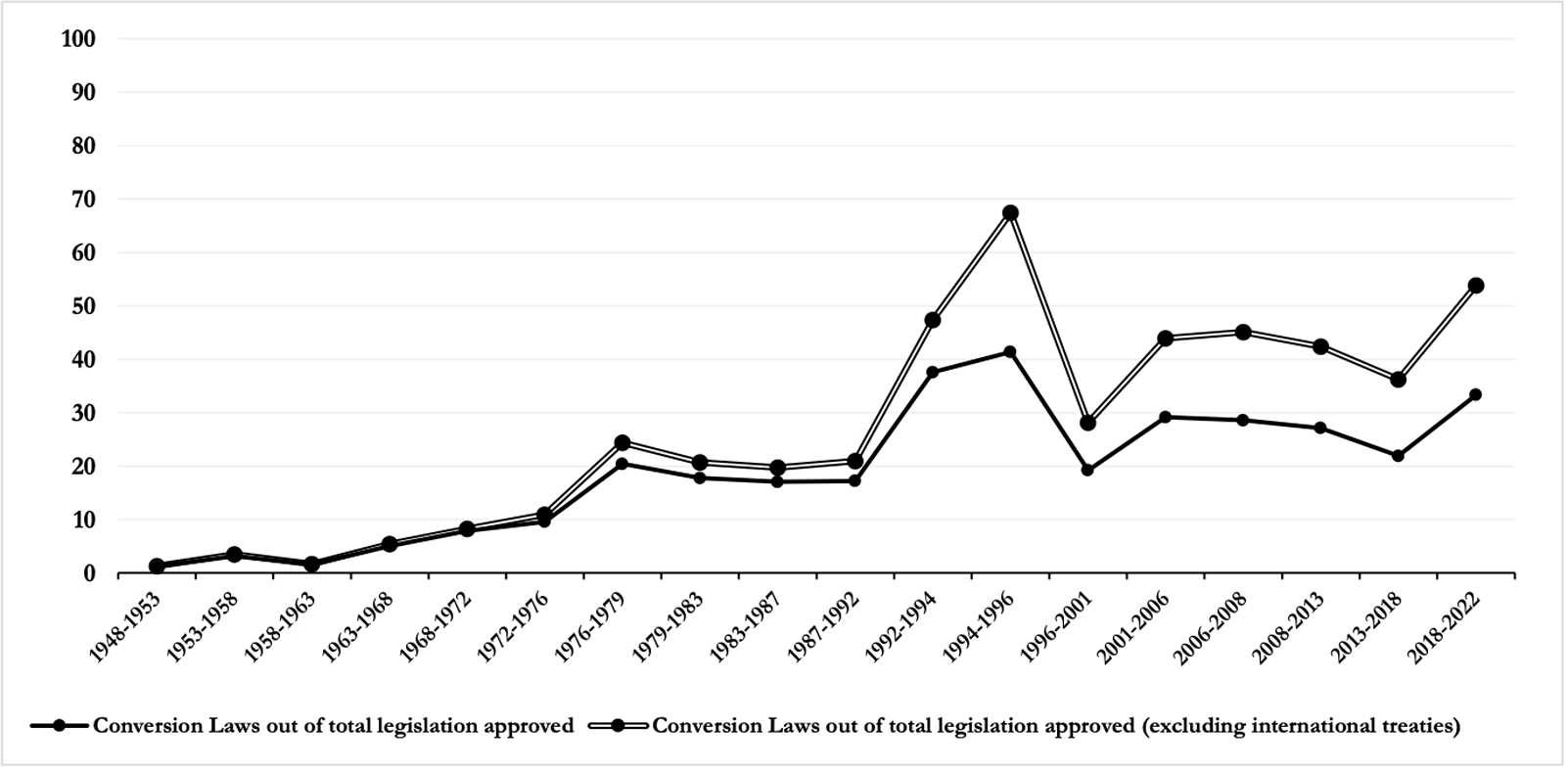
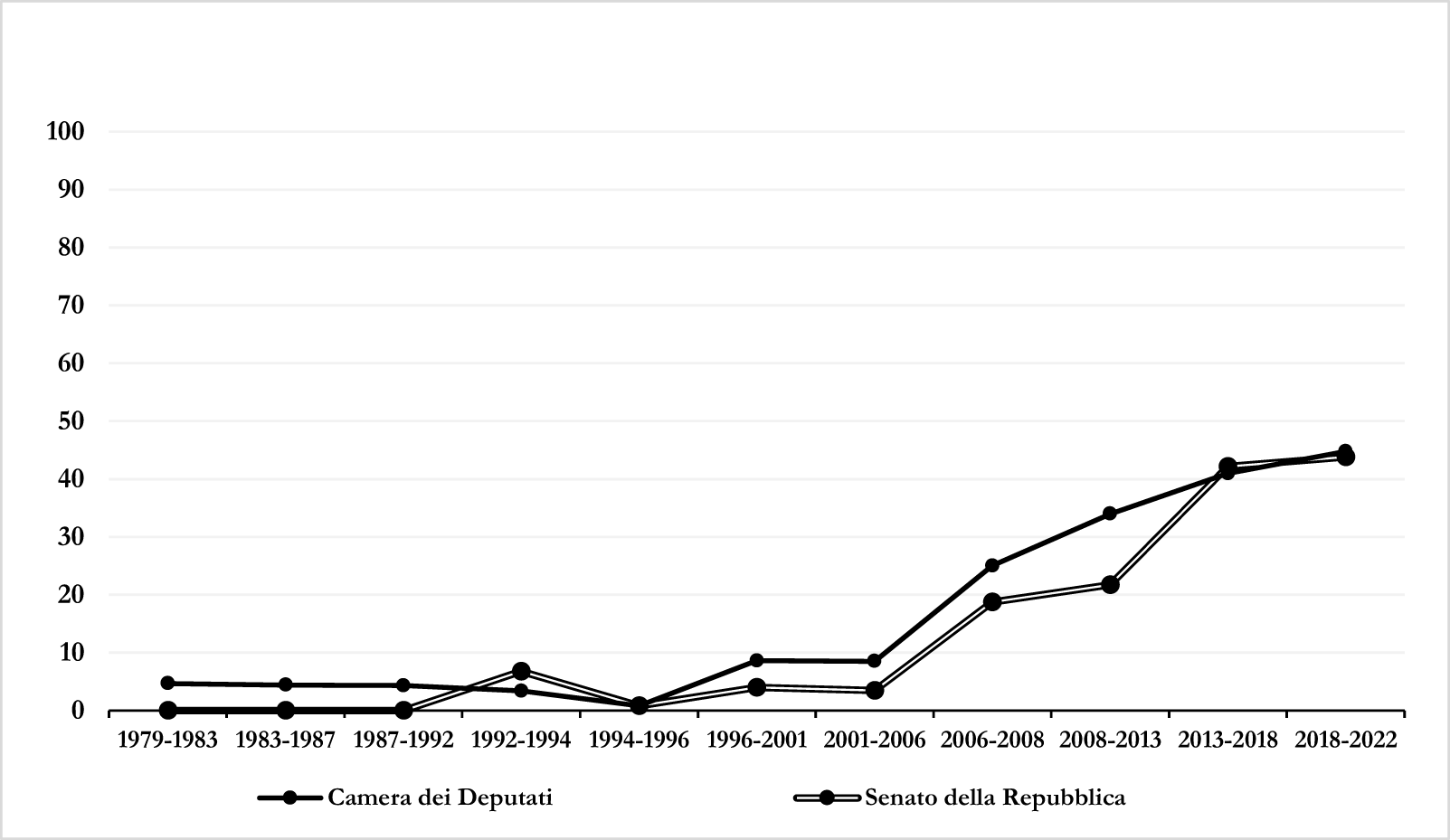
Figure 1 displays a general overview of national legislation in Italy, showing the percentage of laws converting DLs in the overall legislation approved since 1948. The legislation approved in the 2018–2022 legislature was clearly influenced by DLs. In particular, excluding ratification of international treaties, this legislature ranked second highest in terms of the incidence of such laws. The strong role of the executive emerges from other data, as shown in Figure 2. Considering all legislatures since 1979, the one in office during the pandemic recorded the highest number of conversion laws approved with at least one vote of confidence during the approval process. In both cases, it is worth noting that legislatures of the recent past have also displayed high figures for these data.
DL conversion laws on total legislation, 1948–2022 (% per parliamentay term).

Figure 1 Long description
The horizontal axis shows parliamentary terms labeled: 1948 to 1953, 1953 to 1958, 1958 to 1963, 1963 to 1968, 1968 to 1972, 1972 to 1976, 1976 to 1979, 1979 to 1983, 1983 to 1987, 1987 to 1992, 1992 to 1994, 1994 to 1996, 1996 to 2001, 2001 to 2006, 2006 to 2008, 2008 to 2013, 2013 to 2018, 2018 to 2022. The vertical axis shows values from 0 to 100. Legend text: Conversion Laws out of total legislation approved; Conversion Laws out of total legislation approved (excluding international treaties). Conversion Laws out of total legislation approved: (1948 to 1953, 1), (1953 to 1958, 4), (1958 to 1963, 2), (1963 to 1968, 6), (1968 to 1972, 9), (1972 to 1976, 11), (1976 to 1979, 25), (1979 to 1983, 21), (1983 to 1987, 20), (1987 to 1992, 21), (1992 to 1994, 48), (1994 to 1996, 67), (1996 to 2001, 28), (2001 to 2006, 44), (2006 to 2008, 45), (2008 to 2013, 43), (2013 to 2018, 37), (2018 to 2022, 54). Conversion Laws out of total legislation approved (excluding international treaties): (1948 to 1953, 1), (1953 to 1958, 4), (1958 to 1963, 2), (1963 to 1968, 6), (1968 to 1972, 9), (1972 to 1976, 10), (1976 to 1979, 21), (1979 to 1983, 18), (1983 to 1987, 17), (1987 to 1992, 17), (1992 to 1994, 38), (1994 to 1996, 42), (1996 to 2001, 20), (2001 to 2006, 29), (2006 to 2008, 29), (2008 to 2013, 28), (2013 to 2018, 22), (2018 to 2022, 34).
DL conversion laws with at least one vote of confidence, 1979–2022 (% per parliamentary term).
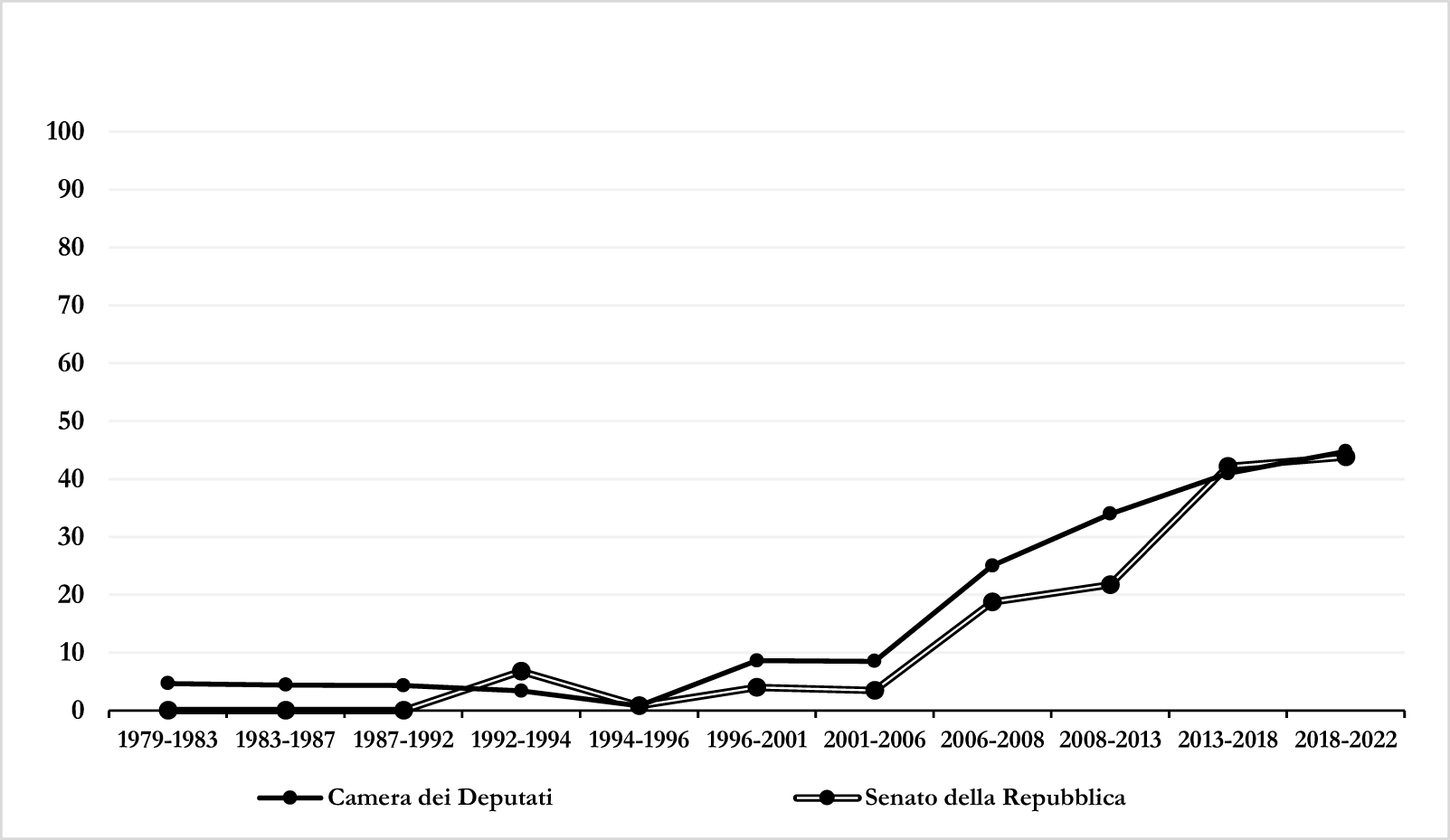
Figure 2 Long description
DL conversion laws with at least one vote of confidence, 1979–2022 (% per parliamentary term). Horizontal axis: parliamentary term labels from 1979-1983 to 2018-2022. Vertical axis: percent, labeled from 0 to 100. Legend labels: Camera dei Deputati; Senato della Repubblica. Camera dei Deputati coordinate pairs: (1979-1983, 5), (1983-1987, 5), (1987-1992, 5), (1992-1994, 4), (1994-1996, 1), (1996-2001, 9), (2001-2006, 9), (2006-2008, 25), (2008-2013, 34), (2013-2018, 41), (2018-2022, 45) Senato della Repubblica coordinate pairs: (1979-1983, 0), (1983-1987, 0), (1987-1992, 0), (1992-1994, 7), (1994-1996, 1), (1996-2001, 4), (2001-2006, 4), (2006-2008, 19), (2008-2013, 22), (2013-2018, 42), (2018-2022, 44) Lowest visible values: Senato della Repubblica at 0 in 1979-1983, 1983-1987 and 1987-1992. Highest visible values: Camera dei Deputati at 45 in 2018-2022; Senato della Repubblica at 44 in 2018-2022. Both series remain in single digits through 2001-2006, rise in 2006-2008 and reach values in the 40s in 2013-2018 and 2018-2022.
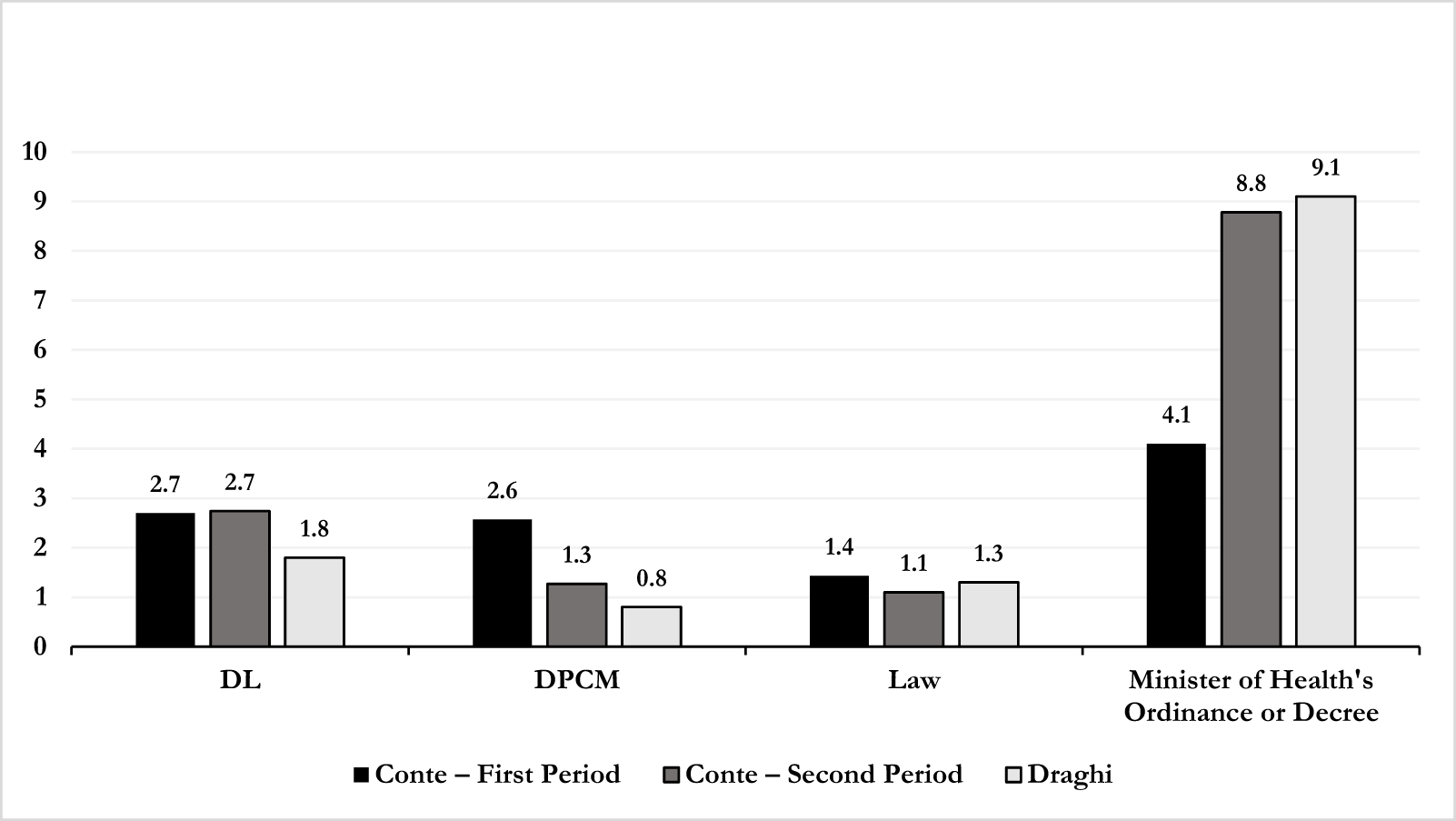
Figure 3 reports the data on legislation during the emergency period. DPCMs appear to follow a sort of trend. During the first phase managed by the Conte cabinet, an average of 2.6 DPCMs were issued per month. This number decreased to 1.3 in the second phase and further declined to 0.8 under PM Draghi. Conversely, decrees and ordinances of the Minister of Health grew over time.
Type of Covid-related legislation by period (average per month).
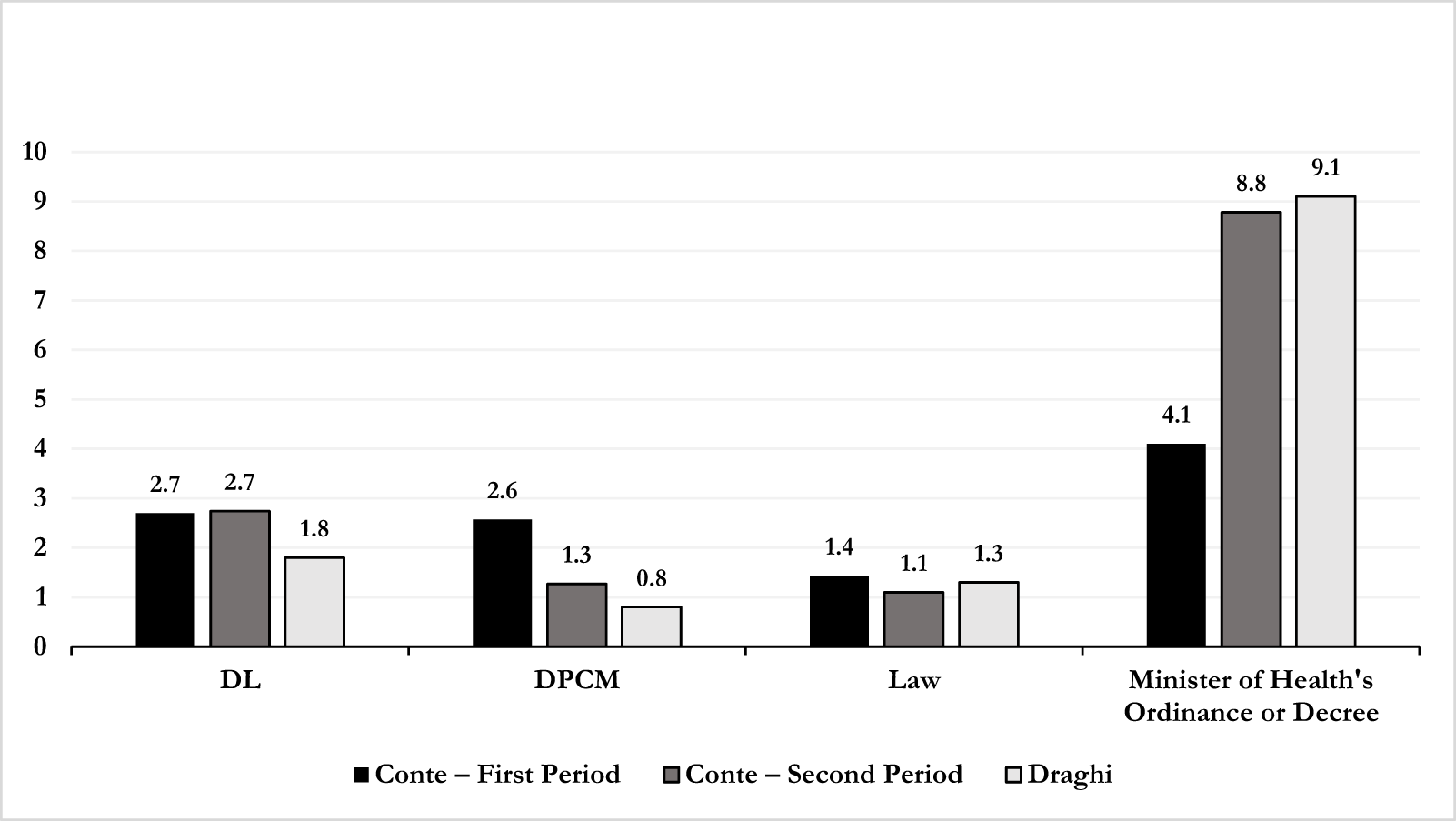
Figure 3 Long description
The grouped bar graph has four category groups labeled D L, D P C M, Law and Minister of Health apostrophe s Ordinance or Decree. A legend lists three series: Conte dash First Period, Conte dash Second Period and Draghi. The vertical axis shows tick labels from 0 to 10. Values printed above the bars are: D L: Conte dash First Period 2.7; Conte dash Second Period 2.7; Draghi 1.8. D P C M: Conte dash First Period 2.6; Conte dash Second Period 1.3; Draghi 0.8. Law: Conte dash First Period 1.4; Conte dash Second Period 1.1; Draghi 1.3. Minister of Health apostrophe s Ordinance or Decree: Conte dash First Period 4.1; Conte dash Second Period 8.8; Draghi 9.1.
DLs remained stable in the two periods managed by Conte and then declined with Draghi. However, during Draghi's tenure, fewer DLs were not eventually converted into laws, which enhanced the parliament's oversight of acts of this type. As a result, the number of laws differed to a limited extent between the two cabinets. The predominant role of the government throughout the entire duration of the crisis is even more evident when one considers that thirty-one out of thirty-three of these laws were DL conversion laws.
More detailed exploration of the data shows that eight DPCMs were issued within one month after the first one at the end of February 2020, and a total of fourteen were approved by the end of May. Subsequently, only four DPCMs were issued from June to August 2020. These decrees progressively expanded the restrictive measures provided by DLs. They initially applied to some areas in Northern Italy where the first confirmed cases of SARS-CoV-2 occurred and were then gradually extended nationwide. They thus implemented a severe national lockdown for roughly two months from early March. From late April onwards, DPCMs were used to lift several restrictive measures as well, so that the lockdown was gradually eased.
The role of the parliament during the national lockdown was limited: it converted two DLs, which outlined a general framework for addressing the pandemic. The parliament acquired a more significant role in May 2020, with the conversion of DLs issued during the national lockdown. However, at least two significant changes had already happened during the spring of 2020.
First, the very wide powers given to public authorities – and therefore the cabinet – to introduce restrictive measures were specified in more detail. Moreover, a DL issued in May abolished several restrictive measures and incorporated others contained in DPCMs, thereby subjecting them to parliamentary oversight. It also established the general principle that future measures restricting freedom of movement should be targeted at specific areas of the country, based on their epidemiological situation, rather than being applied nationwide. This calibration of policy instruments – from generalised measures applied throughout the country to targeted ones – seems to match a process of policy learning (Zaki et al., Reference Zaki, Pattyn and Wayenberg2023: 149–151).
Second, an amendment approved during the conversion of a DL resulted in the so-called ‘parliamentarisation’ of DPCMs. It introduced a new procedure whereby, when such decrees were issued, a member of the government had to illustrate their content in parliament so that MPs could discuss them and challenge their provisions by means of non-binding resolutions. In other words, although MPs could not amend DPCMs, this adjustment enabled parliamentary debate on them.
During the second phase of the emergency period, the re-introduction of restrictive measures closely followed the same procedure that had been adopted in the spring of 2020, with the DPCMs implementing regulations based on the DLs. The procedure was also adopted in the case of a new restriction introduced that autumn, which concerned the obligation to wear masks. However, during this period, the government enacted fewer DPCMs. One notable example was the DPCM issued on November 3, which gave greater stability to these new regulations by introducing a zoning system. Using criteria based on the severity of the pandemic within regions, three levels of restrictions with varying severity were initially established – with a fourth level added later – to be applied to single regions through ordinances issued by the Minister of Health. Moreover, during the Christmas holidays of 2020, the regional classification was effectively suspended, and either the highest or second-highest level of restriction severity was applied nationwide. Importantly, these measures were implemented through DLs rather than DPCMs, which gave parliament more room to debate and oversee these measures.
The zoning system was maintained during the Draghi government. However, except for the first DPCM issued in March 2021, all legislation concerning restrictions was essentially transferred to DLs, and DPCMs on these matters were discontinued. Although this dynamic had partially begun with Conte, it represented a clear discontinuity between the two cabinets.
However, the Draghi cabinet did not entirely neglect DPCMs. Notably, most of the DPCMs issued by Draghi addressed a politically sensitive issue: the so-called green pass, a mandatory certificate required for access to workplaces and services issued upon proof of vaccination or a negative Covid test.
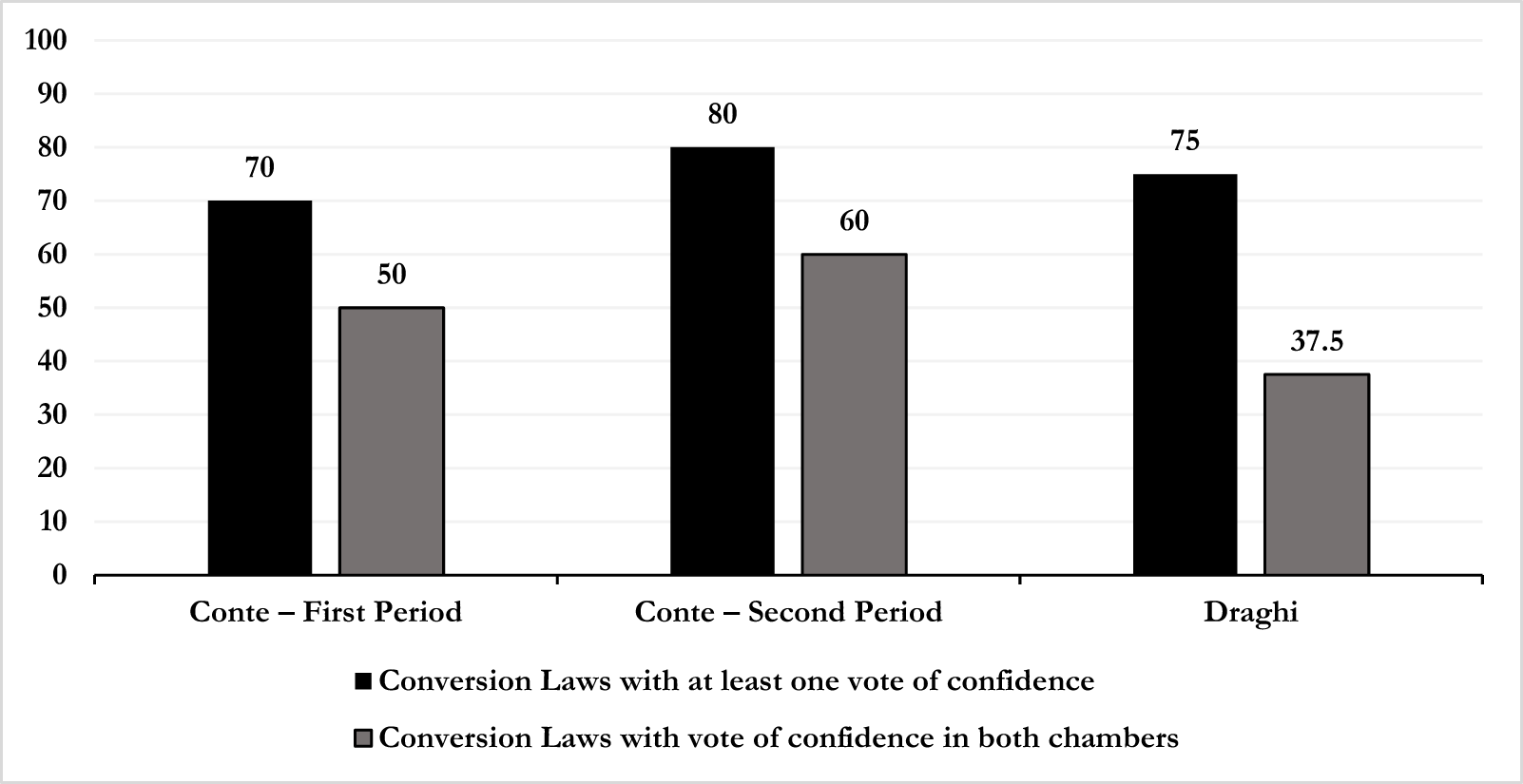
Finally, interesting insights are provided by analysis of votes of confidence on DLs (Figure 4). The proportion of laws converting a DL with at least one vote of confidence was never lower than 70% throughout all the periods considered. A reduction can be observed among the DLs converted with a vote of confidence in both chambers. During the Draghi period, they reached the (still remarkable) figure of 37.5%, which was lower than 60% of the second phase and 50% of the first phase.
Covid-related DL conversion laws with a vote of confidence (% by period).
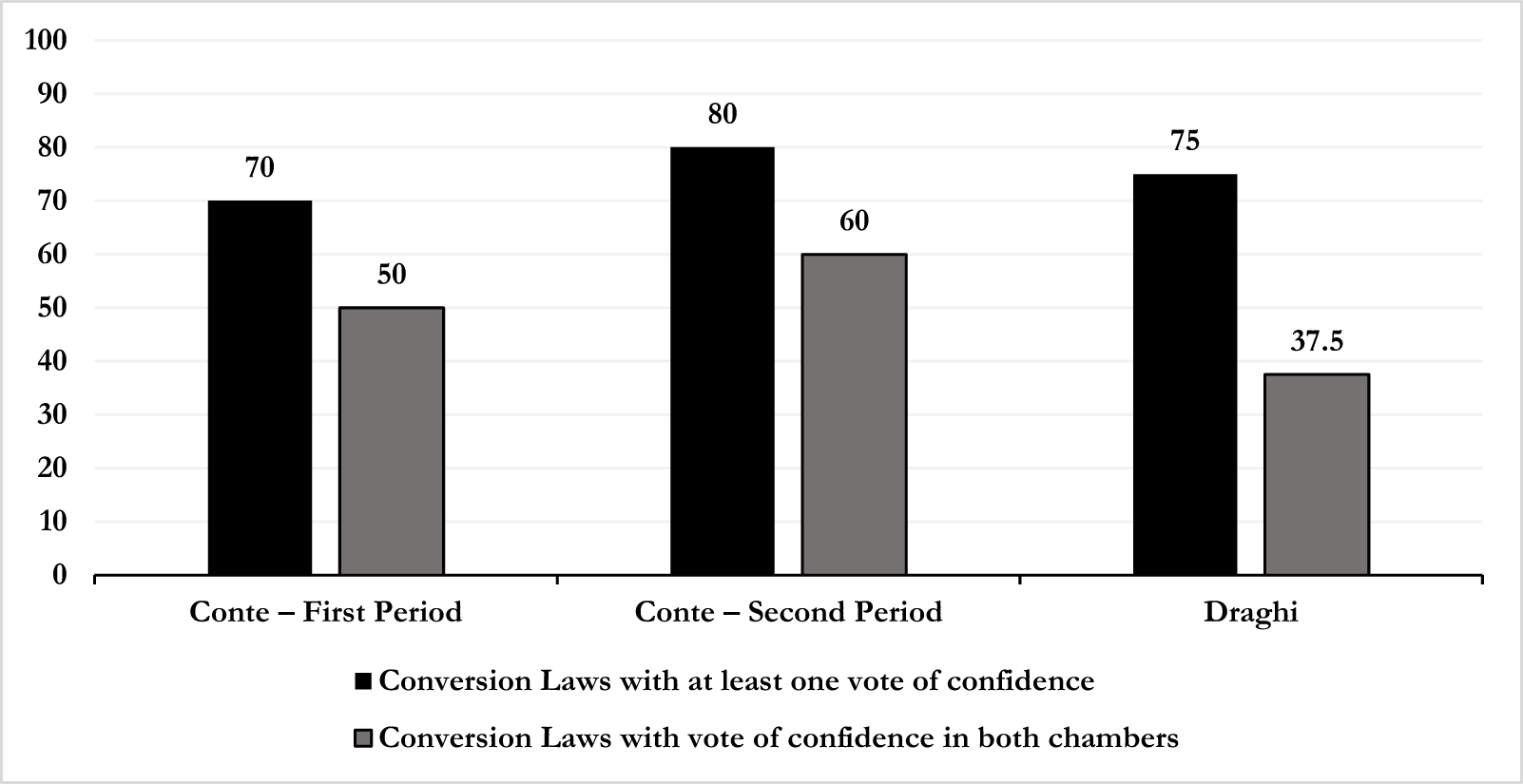
Figure 4 Long description
The bar graph title reads: Covid-related DL conversion laws with a vote of confidence (percent by period). Horizontal axis categories, left to right: Conte dash First Period; Conte dash Second Period; Draghi. Vertical axis label: percent. Vertical axis range: 0 to 100. Legend: Conversion Laws with at least one vote of confidence. Conversion Laws with vote of confidence in both chambers. Plotted values by category: Conte dash First Period: Conversion Laws with at least one vote of confidence 70; Conversion Laws with vote of confidence in both chambers 50. Conte dash Second Period: Conversion Laws with at least one vote of confidence 80; Conversion Laws with vote of confidence in both chambers 60. Draghi: Conversion Laws with at least one vote of confidence 75; Conversion Laws with vote of confidence in both chambers 37.5.
The accounts of actors involved
Level of agreement within the majority
Before beginning the analysis of the policy- and political-related factors that may have influenced the processes of interest, we provide a general overview of the level of agreement reported by the interviewees within the majority, which may have impacted the quality and fluidity of negotiations between the government and parliament.
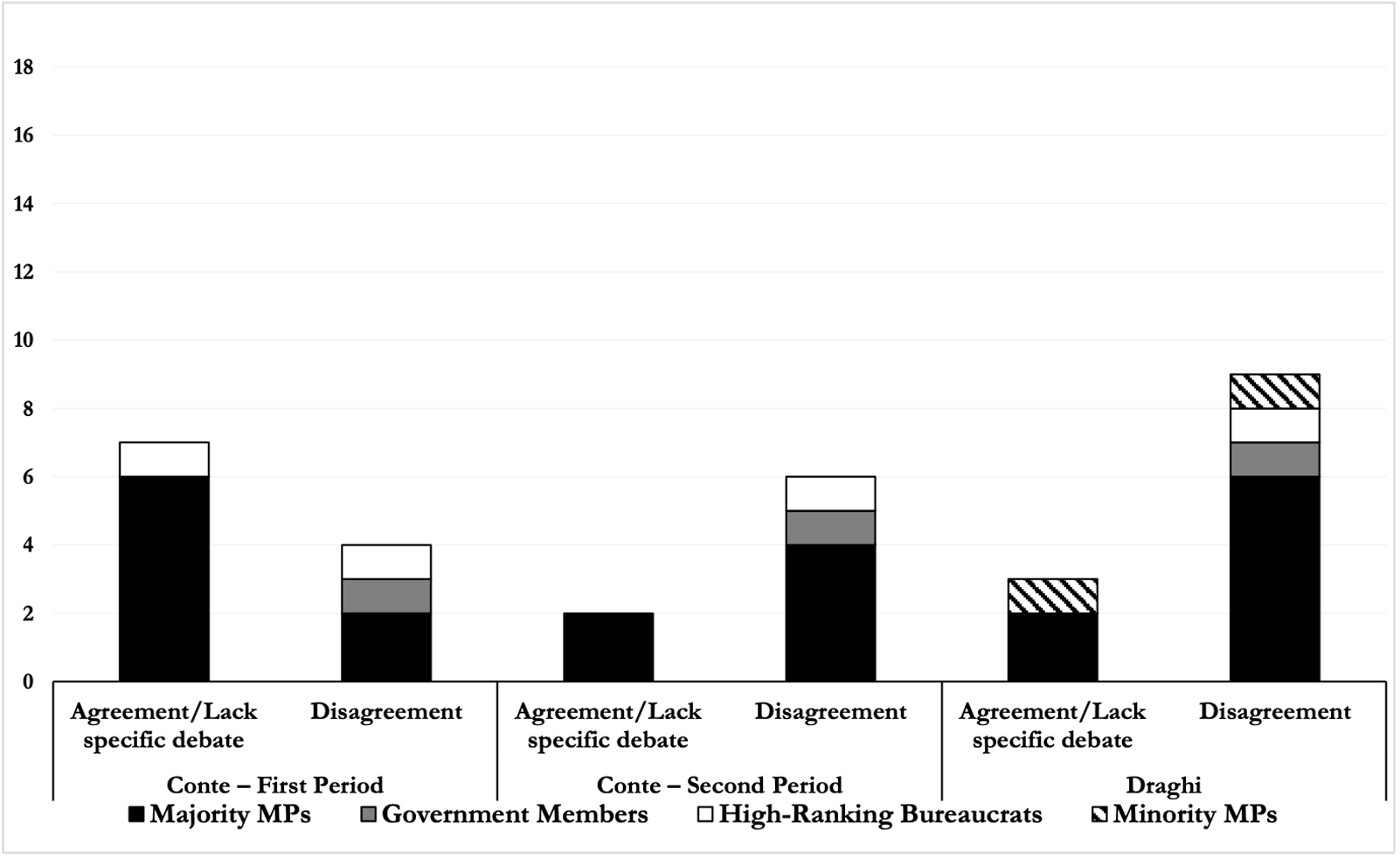
During the stages managed by Conte, accounts of agreement prevail in the first phase, while those of disagreement prevail in the second (Figure 5). However, no interviewee reported any real disagreement regarding the initial measures taken by the government, namely those that introduced the national lockdown. This was confirmed even by two MPs who would later become sceptical about these measures (MP2 and MP3). Moreover, two MPs who at the time were members of the opposition reported no strong disagreements with the government in this period (MP11 and MP14).
Events of agreement/disagreement within the majority on the policy content (number of interviews addressing the issue).
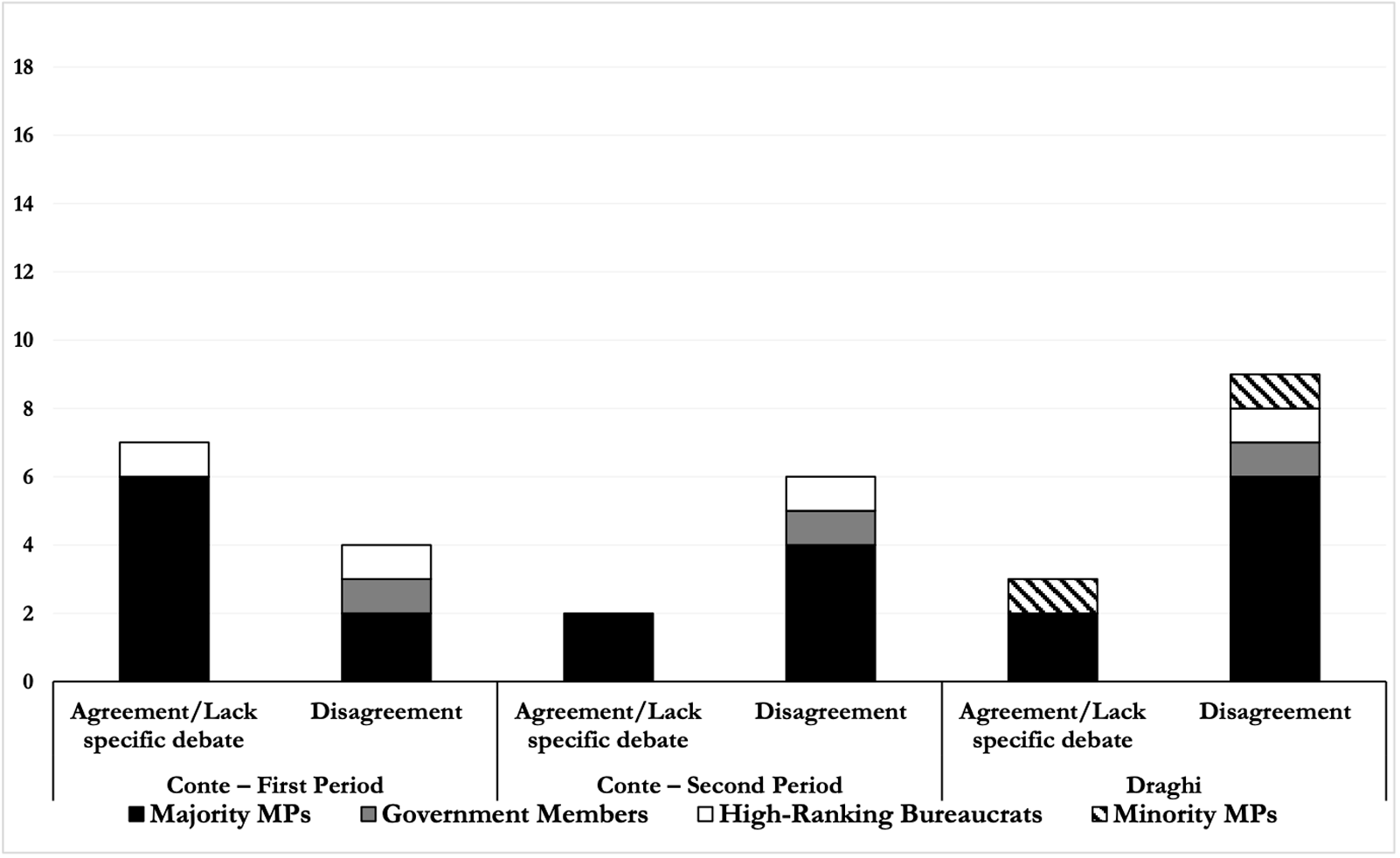
Figure 5 Long description
The stacked bar graph has six stacked bars grouped into three sections labeled Conte dash First Period, Conte dash Second Period and Draghi. Each section contains two categories: Agreement slash Lack specific debate and Disagreement. Legend categories shown: Majority MPs, Government Members, High dash Ranking Bureaucrats, Minority MPs. Y axis tick labels run from 0 to 18 in steps of 2. No y axis label text is shown. No x axis label text is shown. Conte dash First Period: Agreement slash Lack specific debate: Majority MPs 6; High dash Ranking Bureaucrats 1. Disagreement: Majority MPs 2; Government Members 1; High dash Ranking Bureaucrats 1. Conte dash Second Period: Agreement slash Lack specific debate: Majority MPs 2. Disagreement: Majority MPs 4; Government Members 1; High dash Ranking Bureaucrats 1. Draghi: Agreement slash Lack specific debate: Majority MPs 2; Minority MPs 1. Disagreement: Majority MPs 6; Government Members 1; High dash Ranking Bureaucrats 1; Minority MPs 1.
Accounts of disagreements started at a later stage in the spring, and they concerned the level of strictness of the restrictive measures, while during the autumn disagreements were reported also on crucial issues such as the reopening of schools. In the phase managed by the Draghi government, many more interviewees reported episodes of conflict within the majority. They primarily concerned the decision to adopt the so-called green pass, which divided the majority between the parties of the former majority and FI, on the one hand, and the Lega, which was largely sceptical about the measure, on the other.
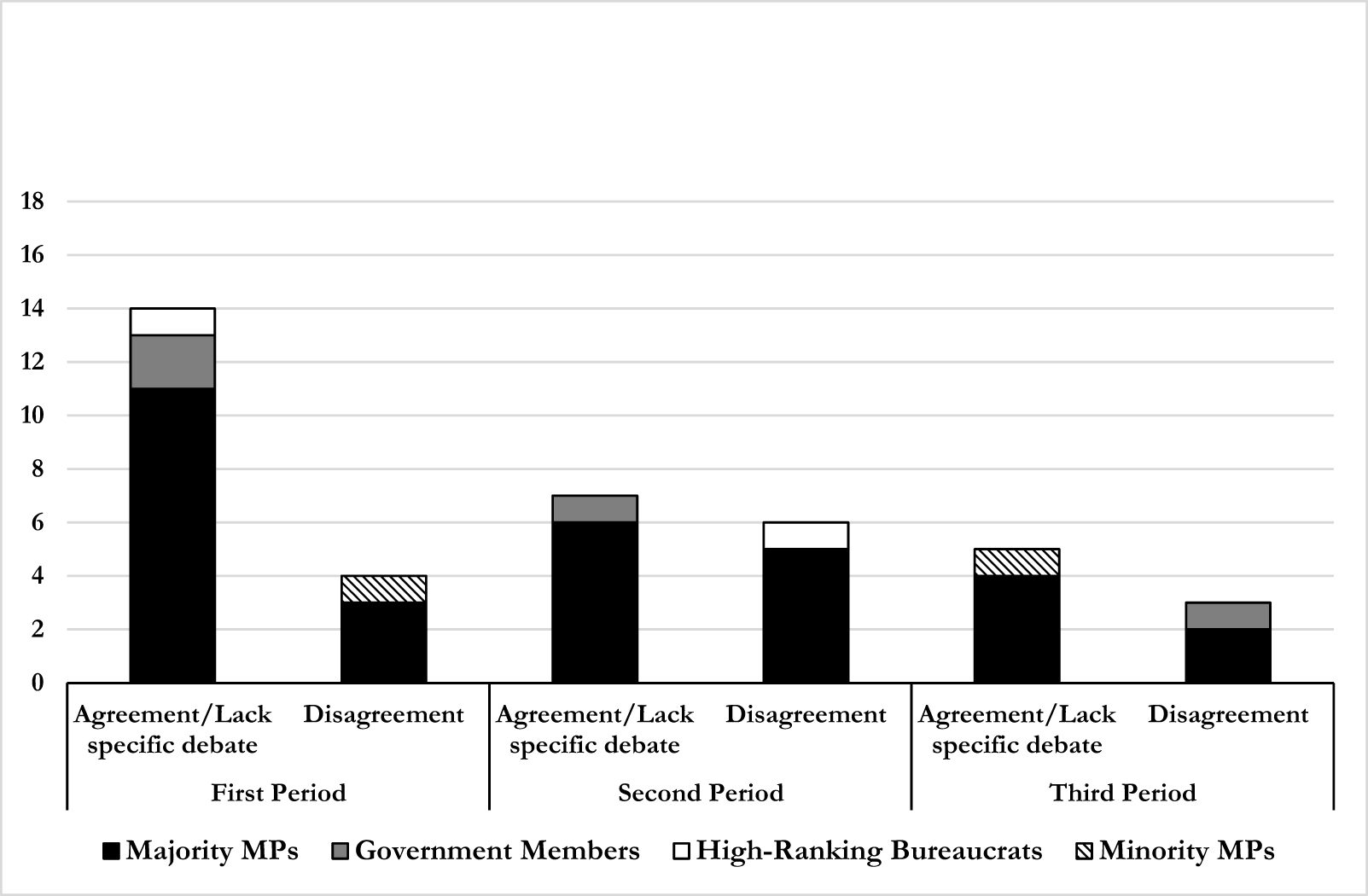
The level of agreement within the majority regarding the government's role in managing the pandemic appears to have been strong in the first stage (Figure 6). Up until the first weeks of the national lockdown, a general agreement or lack of specific debate on these issues was reported by most interviewees (fourteen). However, it should be noted that some MPs generally regarded this phase as marked by a lack of debate because of the government's reluctance to share information and explain its strategies rather than by sincere support from the majority (MP2, MP6, and MP9). In any case, episodes of disagreement – particularly for the lack of parliamentary oversight over them – were usually reported at roughly the end of the national lockdown. In subsequent stages, accounts of agreement remained the prevailing view, albeit less markedly.
Events of agreement/disagreement within the majority related to the role of the government (number of interviews addressing the issue).
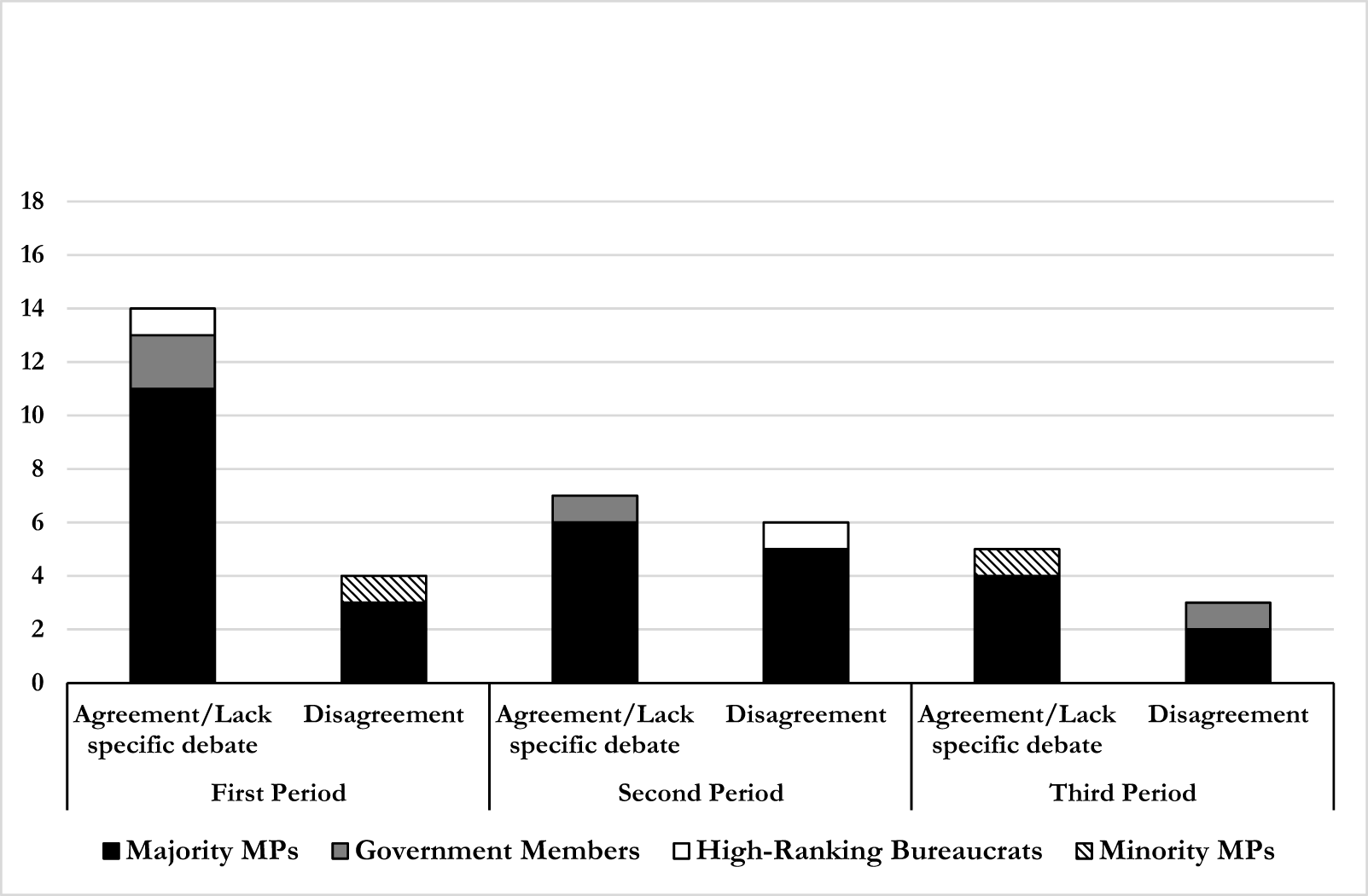
Figure 6 Long description
The stacked bar graph has six stacked bars grouped into three sections labeled First Period, Second Period and Third Period. The horizontal axis shows, in order: Agreement slash Lack specific debate, Disagreement, Agreement slash Lack specific debate, Disagreement, Agreement slash Lack specific debate, Disagreement. The vertical axis shows tick labels 0, 2, 4, 6, 8, 10, 12, 14, 16, 18. Legend labels: Majority MPs; Government Members; High-Ranking Bureaucrats; Minority MPs. First Period, Agreement slash Lack specific debate: Majority MPs 11; Government Members 2; High-Ranking Bureaucrats 1. First Period, Disagreement: Majority MPs 3; Minority MPs 1. Second Period, Agreement slash Lack specific debate: Majority MPs 6; Government Members 1. Second Period, Disagreement: Majority MPs 5; High-Ranking Bureaucrats 1. Third Period, Agreement slash Lack specific debate: Majority MPs 4; Minority MPs 1. Third Period, Disagreement: Majority MPs 2; Government Members 1.
Policy-related factors
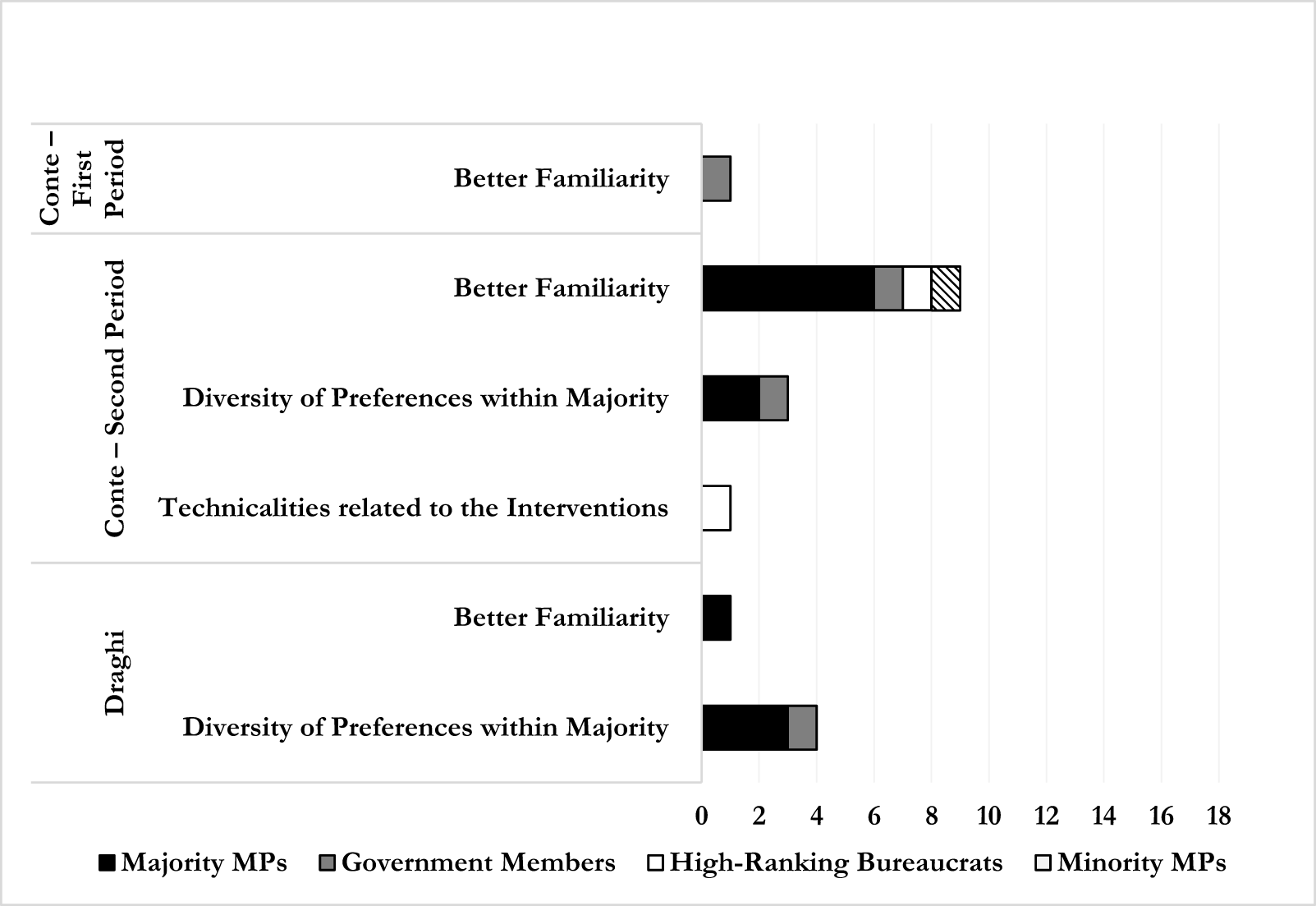
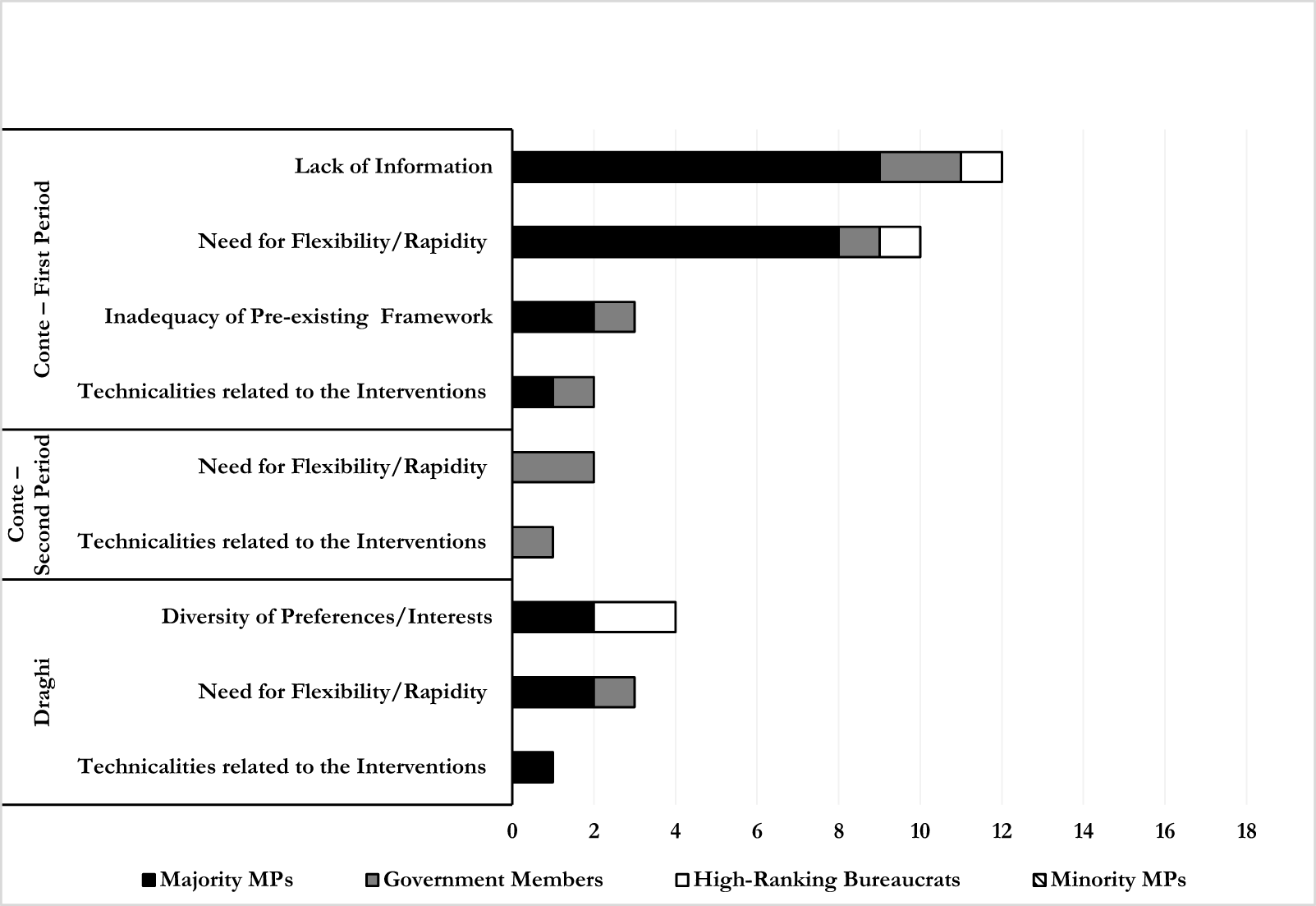
To explore the policy-driven factors in more detail (Figures 7 and 8), in the initial phase of the emergency, most interviewees agreed that the specific nature of the emergency strengthened the role of the executive. The lack of information regarding the phenomenon (twelve interviewees) and the need for quick and flexible tools (ten interviewees) were the most cited factors. However, we should also highlight two purely technical elements, which were mentioned in the interviews with government members at the time (Gov1 and Gov2). The first concerns the inadequacy of the already existing procedures for managing emergencies, which were essentially provisions to deal with natural disasters. The second aspect relates to some technicalities of the legislative framework, which would have restricted the parliament to a secondary role compared to the government's offices.
Policy-related factors contributing to the strengthening of the parliament (number of interviews addressing the theme).
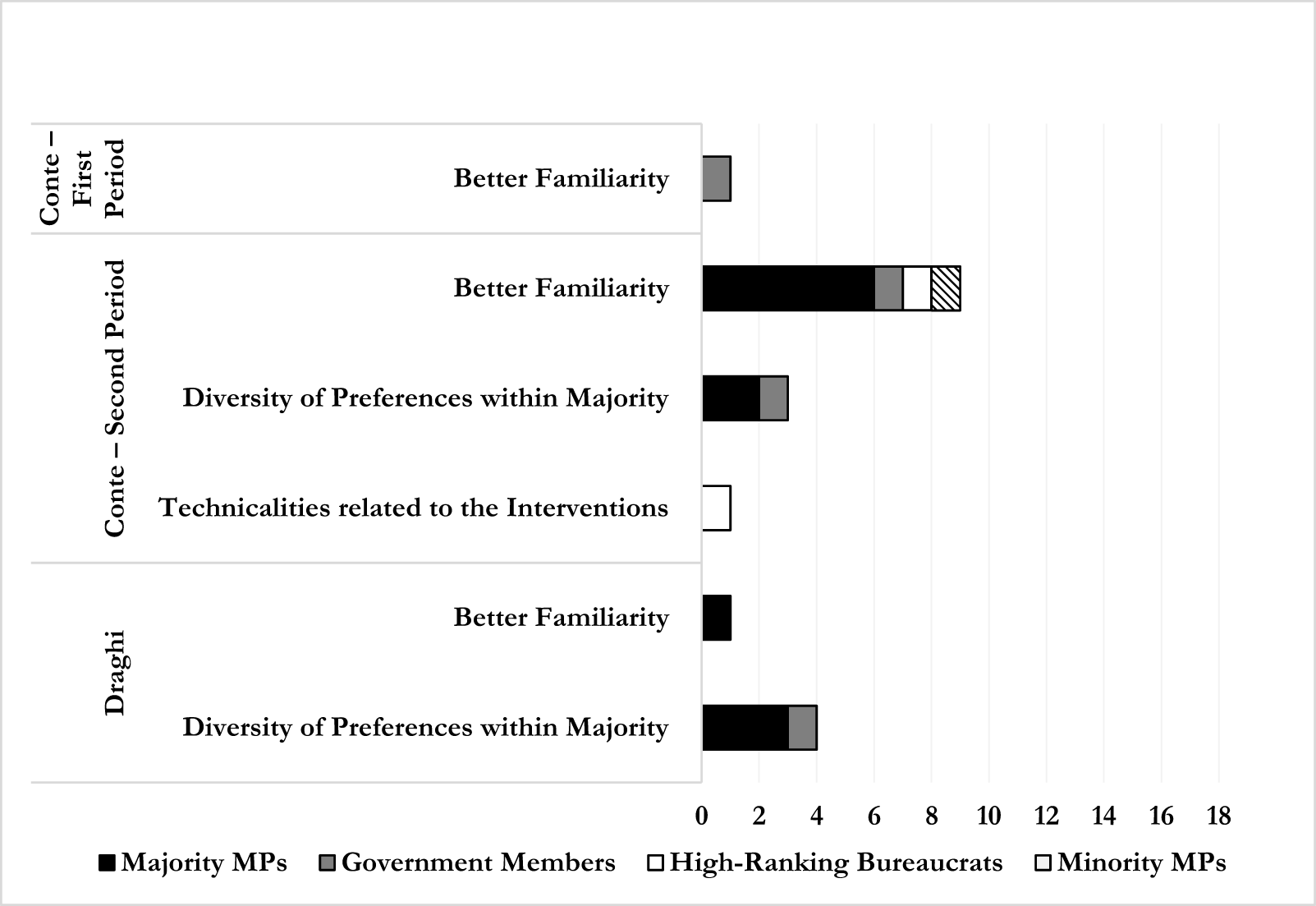
Figure 7 Long description
A stacked horizontal bar graph with three grouped sections labeled Conte minus First Period, Conte minus Second Period and Draghi. The horizontal axis shows values from 0 to 18 in steps of 2. No horizontal axis label is shown. No vertical axis label is shown. Conte minus First Period includes one row labeled Better Familiarity. The stacked bar ends at 1. Conte minus Second Period includes three rows. Row 1 is labeled Better Familiarity. The stacked bar ends at 9. Row 2 is labeled Diversity of Preferences within Majority. The stacked bar ends at 3. Row 3 is labeled Technicalities related to the Interventions. The stacked bar ends at 1. Draghi includes two rows. Row 1 is labeled Better Familiarity. The stacked bar ends at 1. Row 2 is labeled Diversity of Preferences within Majority. The stacked bar ends at 4. Legend labels: Majority MPs, Government Members, High-Ranking Bureaucrats, Minority MPs.
Policy-related factors contributing to the strengthening of the government (number of interviews addressing the theme).

Figure 8 Long description
A horizontal stacked bar graph with three grouped sections labeled Conte dash First Period, Conte dash Second Period and Draghi. Legend: Majority MPs, Government Members, High dash Ranking Bureaucrats, Minority MPs. Horizontal axis tick labels: 0, 2, 4, 6, 8, 10, 12, 14, 16, 18. Conte dash First Period. Lack of Information: Majority MPs 9; Government Members 2; High dash Ranking Bureaucrats 1. Need for Flexibility slash Rapidity: Majority MPs 8; Government Members 1; High dash Ranking Bureaucrats 1. Inadequacy of Pre dash existing Framework: Majority MPs 2; Government Members 1. Technicalities related to the Interventions: Majority MPs 1; Government Members 1. Conte dash Second Period. Need for Flexibility slash Rapidity: Government Members 2. Technicalities related to the Interventions: Government Members 1. Draghi. Diversity of Preferences slash Interests: Majority MPs 2; High dash Ranking Bureaucrats 2. Need for Flexibility slash Rapidity: Majority MPs 2; Government Members 1. Technicalities related to the Interventions: Majority MPs 1.
In the second phase managed by Conte, the policy-driven aspects were instead primarily linked to a strengthening of the role of parliament. A greater understanding of the phenomenon leading to more inclusive decision-making was indeed present in nearly half (nine) of the interviews conducted. This dynamic was well expressed by MP1, who was at the forefront of the negotiations between parliament and the government:
We began to insist that, as the situation stabilised, and the regulations were therefore no longer ‘fast-food rules’ for a week, but would last for months, we should return to the broadest possible use of DLs rather than DPCMs. We also went to speak with government offices to ask for this. […] Indeed, because the government felt confident that the implemented regulations could last for two months, it transitioned to [DLs]. (MP1)
This argumentation was also supported by one government member – who claimed that after receiving a ‘user guide’ (Gov2), in the early months of the pandemic a gradual shift from DPCMs to DLs was already decided in the spring of 2020 – and by the government official interviewed (GO).
These recollections seem to align with what might have been expected as the result of a policy learning process. Moreover, three interviewees considered that the diversity of preferences within the majority had been a factor leading to greater involvement of parliament in the second phase, which is consistent with a process of preference construction/transformation. Even though these recollections refer to preferences regarding policy aspects of the legislative measures, they can clearly overlap with purely political aspects – particularly those related to internal coalition dynamics. Therefore, they should be interpreted with caution because it is more difficult, when dealing with them, to distinguish between purely policy-related aspects and politics-related ones. For example, two MPs stressed the need for the parties to have a say on certain policies, such as economic measures, for electoral interests (MP3 and MP9). The government member recalled how the executive had sought legitimacy through the involvement of parliament. In particular, s/he referred to the issue of reopening schools, which s/he described as a sensitive topic due to the risk of not being well understood by the public (Gov2).
However, some interviewees mentioned factors that to some extent contradict the effective role of policy learning in strengthening the parliament. First, the perceived need for the government to act with rapid tools did not vanish with the shift towards the use of DLs. For example, Gov2 made explicit reference to the use in the second stage of ‘de facto unicameralism’, meaning the tactic of employing certain procedures, such as the vote of confidence, that allow only one of the two chambers – the one where the government is stronger – to modify a DL, whereas the other chamber has little more than a ratifying role. In the phase managed by Draghi, the government member considered the need to have a fast-track path for legislation related to Italy's NRRP as one of the most defining features of that stage (Gov3).
Although mentioned only in the interview with the government official, a technical element warrants further examination. Indeed, the balance between DPCMs and DLs should to some extent be attributed to the differing importance of restrictive measures over time. DPCMs are suitable for implementing and updating restrictions, but they are technically inadequate for wide-ranging matters such as economic measures or education. This would explain why, as restrictions stabilised and it became necessary to address the socio-economic consequences of the pandemic, the importance of the DLs increased compared with that of the DPCMs.
In the phase managed by Draghi, one observes a general decrease in statements by interviewees that greater familiarity with the phenomenon was a factor that helped parliament recover its prerogatives. However, it is possible that interviewees, after witnessing a routinisation of the emergency during Conte's second phase, may have taken it for granted in the Draghi phase as well.
The heterogeneity of the coalition may have had an ambivalent impact on the relationship between government and parliament under Draghi. Specifically, an equal number of interviewees (four) perceived the plurality of preferences within the majority as a factor that strengthened either the role of the executive or that of the parliament. One might have expected a different dynamic as a result of a policy learning process, i.e. an increasing importance of preference diversity within the majority in enhancing the role of parliament.
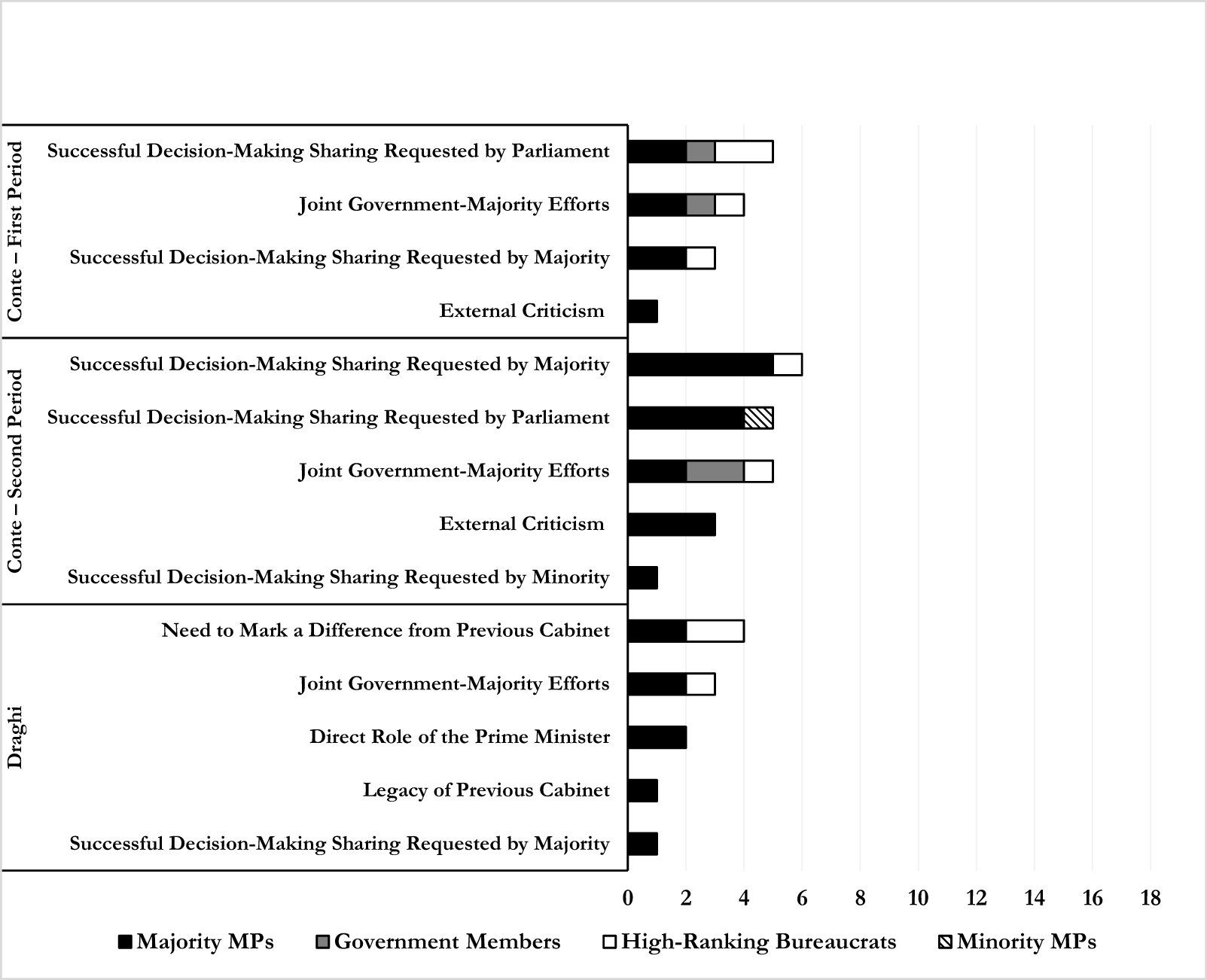
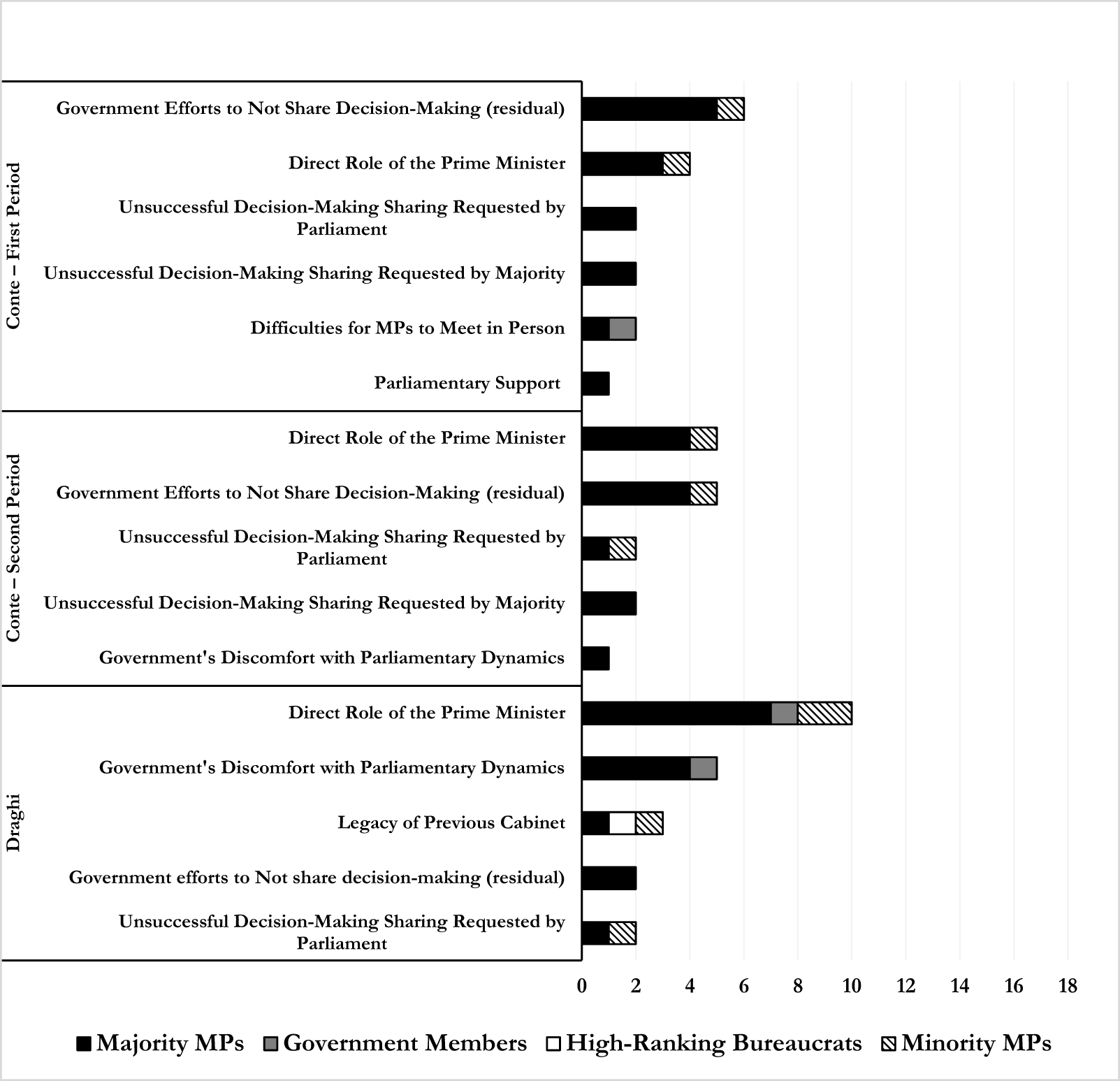
Politics-related factors
Before looking more closely at politics-driven factors (Figures 9 and 10), a preliminary note is necessary. In the phases managed by the Conte government, several patterns of agreement/disagreement seem to have been influenced by internal alignments within the (former) majority. Interviewees belonging to the alliance that would eventually cause the government's fall – IV and moderate areas of the PD – tended to depict relations between the government and the parliament as more strained compared to interviewees from other parties belonging to the majority. While this is not a perfect association, it clearly influenced these accounts.
Politics-related factors linked to a strengthening of the parliament (number of interviews addressing the theme).
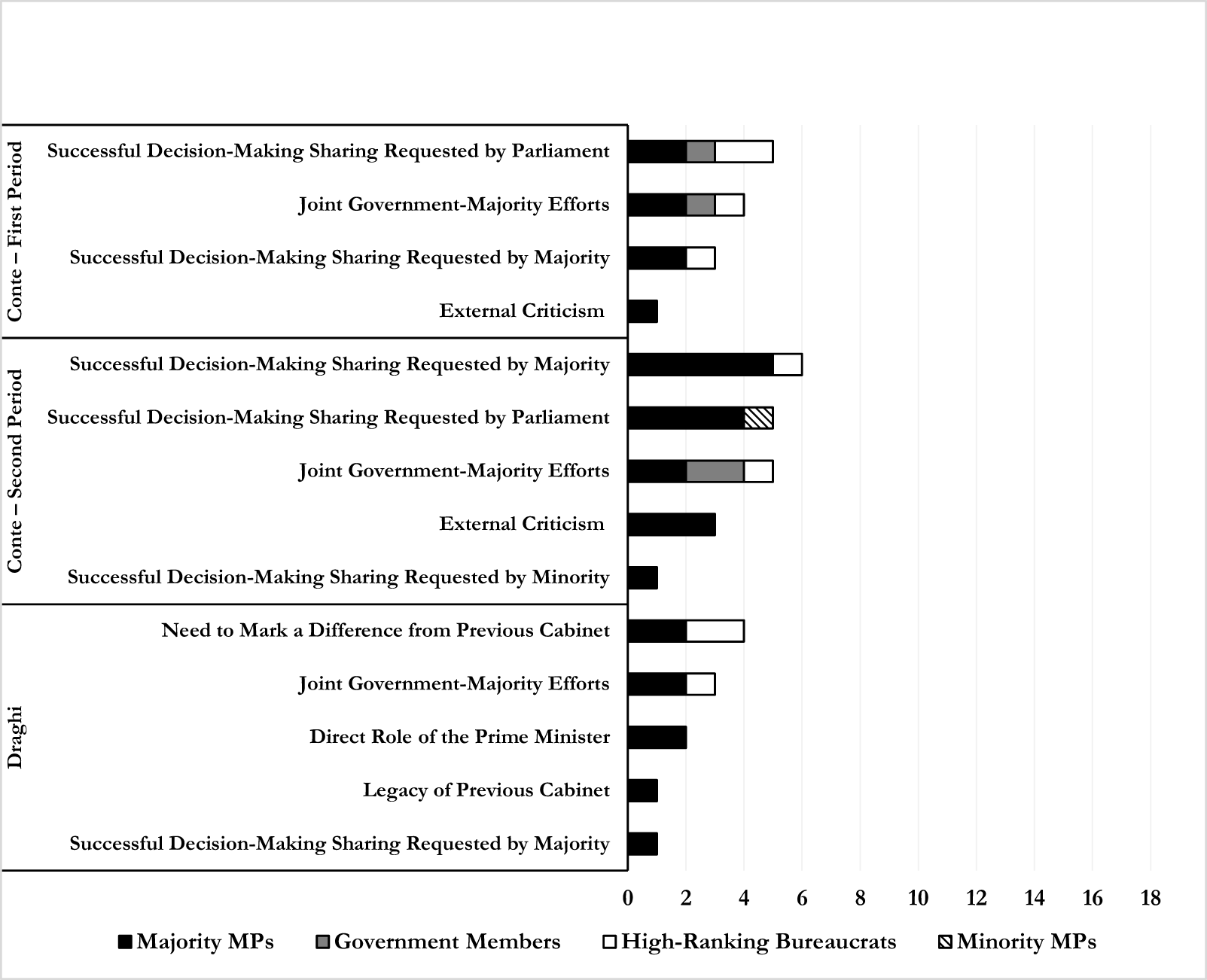
Figure 9 Long description
The horizontal stacked bar graph compares politics-related factors linked to the strengthening of the parliament across three periods: Conte first period, Conte second period and Draghi. The x-axis represents interview counts ranging from 0 to 18. The y-axis lists factors such as 'Successful Decision-Making Sharing Requested by Parliament,' 'Joint Government-Majority Efforts,' 'Successful Decision-Making Sharing Requested by Majority,' 'External Criticism,' 'Successful Decision-Making Sharing Requested by Minority,' 'Need to Mark a Difference from Previous Cabinet,' 'Direct Role of the Prime Minister,' and 'Legacy of Previous Cabinet.' The legend differentiates groups by fill patterns: Majority MPs, Government Members, High-Ranking Bureaucrats and Minority MPs. In the Conte first period, 'Successful Decision-Making Sharing Requested by Parliament' and 'Joint Government-Majority Efforts' have the highest counts. In the Conte second period, 'Successful Decision-Making Sharing Requested by Majority' and 'Successful Decision-Making Sharing Requested by Parliament' are prominent. During Draghi, 'Need to Mark a Difference from Previous Cabinet' and 'Direct Role of the Prime Minister' are significant. The graph highlights shifts in focus and influence across the periods.
Politics-related factors linked to a strengthening of the government (number of interviews addressing the theme).

Figure 10 Long description
A horizontal bar graph with three grouped sections labeled Conte dash First Period, Conte dash Second Period and Draghi. The horizontal axis shows values from 0 to 18 with tick marks at 0, 2, 4, 6, 8, 10, 12, 14, 16, 18. A legend lists Majority M P s, Government Members, High dash Ranking Bureaucrats, Minority M P s. Conte dash First Period section lists six rows. Government Efforts to Not Share Decision dash Making left parenthesis residual right parenthesis shows a stacked bar reaching 6, with a hatched segment from 5 to 6. Direct Role of the Prime Minister shows a stacked bar reaching 4, with a hatched segment from 3 to 4. Unsuccessful Decision dash Making Sharing Requested by Parliament shows a bar reaching 2. Unsuccessful Decision dash Making Sharing Requested by Majority shows a bar reaching 2. Difficulties for M P s to Meet in Person shows a stacked bar reaching 2, with a segment from 1 to 2. Parliamentary Support shows a bar reaching 1. Conte dash Second Period section lists five rows. Direct Role of the Prime Minister shows a stacked bar reaching 5, with a hatched segment from 4 to 5. Government Efforts to Not Share Decision dash Making left parenthesis residual right parenthesis shows a stacked bar reaching 5, with a hatched segment from 4 to 5. Unsuccessful Decision dash Making Sharing Requested by Parliament shows a stacked bar reaching 2, with a hatched segment from 1 to 2. Unsuccessful Decision dash Making Sharing Requested by Majority shows a bar reaching 2. Government’s Discomfort with Parliamentary Dynamics shows a bar reaching 1. Draghi section lists five rows. Direct Role of the Prime Minister shows a stacked bar reaching 10, with a segment from 8 to 9 and a hatched segment from 9 to 10. Government’s Discomfort with Parliamentary Dynamics shows a stacked bar reaching 5, with a segment from 4 to 5. Legacy of Previous Cabinet shows a stacked bar reaching 3, with a hatched segment from 2 to 3. Government efforts to Not share decision dash making left parenthesis residual right parenthesis shows a bar reaching 2. Unsuccessful Decision dash Making Sharing Requested by Parliament shows a stacked bar reaching 2, with a hatched segment from 1 to 2.
For instance, among the factors that contributed to strengthening the parliament, interviews with the members of the government and two MPs more sympathetic to the former PM evidenced the joint efforts made in the first phase by the government and the majority to share decision-making power, primarily through informal rather than formal involvement. These interviewees described how, before the adoption of the most important measures, an important role was played by the meetings held between the cabinet and the chief whips to share the decision-making procedures. The government official described intense informal contacts with MPs from each party whose stated purpose was ‘compensating – so to speak – for that lack of democratic legitimacy in the taking of those decisions’ (GO).
Conversely, among MPs who tended to view the stage managed by Conte more negatively, there were reports of clear difficulties in the relationship with the government, even concerning their informal involvement. For example, an MP described how difficult it was to obtain information to share with his constituents affected by the pandemic:
Getting an answer from a minister was difficult for any MP […] I must stress that sometimes even the ministers didn't know. I often spoke to some ministers with whom there was a certain level of familiarity, not only those from [my party]. And they told me, ‘Look: we don't know [the content of a DPCM] either. We're waiting for it’. […] The link between the ministers and their respective parties was effectively drained of any real impact, because even the ministers had no prior information. (MP11)
Interviewees were more in agreement in identifying the parties that had the most unequivocal positions on this issue. Several interviewees pointed to the role of LeU, the Health Minister's group, in defending the government’s action (MP2, MP10, and MP13; Gov3), which IV countered with a request for greater parliamentary involvement (MP4, MP10, and MP12; Gov3; GO). Recollections were more mixed regarding the role of the two major parties – PD and M5S – which were generally depicted as supportive of government action, albeit with dissenting voices within them.
After the end of the national lockdown, there are recollections of pressures by the majority and/or the parliament for greater involvement. An example is provided by the above-mentioned parliamentarisation of DPCMs, whose introduction was described by MP1 as marked by resistance from the government, while a government member saw it as a consensual action between government and majority (Gov2). These demands grew in the second phase, though not substantially. Moreover, a significant role of public opinion in these processes did not emerge, as it was rarely mentioned by the interviewees.
Moving to the stage managed by Draghi, a contextual element must be considered. Despite discontinuity in the instruments used to manage the pandemic, most interviewees – eleven versus six – expressed a general evaluation of continuity rather than discontinuity compared with the Conte government. In other words, they did not perceive an actual increase in the parliament's empowerment during the Draghi phase.
Among the factors that facilitated the role of parliament, some interviewees recalled a desire to mark a break from the past, although they were relatively few in number (four). Furthermore, specific demands for greater involvement from the majority/parliament in the government were highlighted in fewer interviews compared to previous stages.
Certain recollections suggested that the process of political learning may have operated in reverse, effectively strengthening the role of the executive. Specifically, the legacy of measures previously adopted during the Conte cabinet was linked in three interviews to a reinforcement of the government rather than the parliament. Furthermore, the two issues that characterised this phase the most were not easily connected to a learning process. They were present also in the previous stages, albeit in a smaller proportion of interviews.
The first issue concerned the impact of PM Draghi, which was mentioned in a significant number of interviews (ten). To be noted is that this theme was highlighted not only by MPs in the opposition and/or ones who judged this cabinet negatively, but also by some MPs who had a generally positive opinion of that experience or Draghi's skills as PM (MP1, MP6, MP9, and MP10). Several interviewees mentioned the overwhelming influence of the former president of the European Central Bank over parties. A good example is provided by MP6:
The effect of his intervention, his physical presence… Draghi's authority made even us a bit… I say ‘even us’ because this also happened to journalists: [they] were practically speechless in front of such a figure of global authority. And so even us, especially in the beginning, but also later on, even us as MPs, we placed so much trust in Draghi that the measures he adopted were absolutely not questioned. Even though – without comparing them to the previous ones – they undoubtedly represented an overriding of Parliament's role. (MP6)
The important role of Draghi in this stage emerges even from two interviews that instead highlighted his direct role in increasing the involvement of parliament (MP11 and MP13). Another feature highlighted by some interviewees (five) was the government's discomfort in adapting to parliamentary procedures and compromises. This aspect was often linked to the technocratic nature of Draghi or some of his collaborators and their lack of political experience. A valuable account was provided by a government member who served under Draghi, who described the challenging dialogue between the technocratic and political members of the executive:
They said: ‘We have to get everything approved within a week’. And I was telling them: ‘Look, there's no way. I mean, either we find a compromise, we reach an agreement with both the majority and the opposition so that […] everyone is on board and withdraws their amendments and we can move quickly, or, if they don't agree, they could keep us there for twenty days voting on amendment after amendment’. And it was difficult for them to understand this. They said: ‘How is that? If the majority decides to approve something, can't it just be approved?’ (Gov3)
Finally, there is a deep-rooted feature of the Italian parliamentary system that needs to be considered: the long process of weakening parliamentary prerogatives in the recent past, which we did not distinctly code as a factor influencing a given stage of the emergency since, if anything, it affected its entire duration. A relevant number of interviewees (eight) said that the balance of powers during the pandemic should be interpreted through these lenses, and in some interviews, this factor almost monopolised the discussion (MP7, MP8, and MP14). Very often, these testimonies were also linked to feelings of frustration. For example, MP9 well described how it was necessary to resort to informal involvement by MPs to maintain relevance in the legislative processes:
Unless it was something trivial, it was really difficult to advance any parliamentary initiative [during the legislative term], if not for a discussion. It became standard practice after the onset of Covid, given the proliferation of DLs, that MPs who had a law or a proposal in mind would take pieces of it and put them in the draft of DLs. That was the only way to ensure that a bill – one that we had conceived – could become law. […] This had become a practice; in the sense that it was a way to survive. (MP9)
Conclusions
In this study, we have explored the relationship between parliament and government during the Covid-19 pandemic in Italy. We have done so by addressing the factors that might have influenced the balance of powers between the two institutions. Our data on legislation paint a picture of executive dominance throughout the emergency. Parliament indeed regained some prerogatives, but it did so with two fundamental limitations: the absence of a significant role of legislative initiative and the control exercised by both governments through votes of confidence.
Our interviews provided a nuanced picture which, despite certain limitations (such as the influence of party alignments), furnished us with a novel perspective on the internal dynamics among the actors involved in these processes. There is a general consensus that the very early stages of the pandemic were marked by a strong sense of urgency and a lack of information, with broad agreement both on the measures to be adopted and on the strong role given to the government. As this initial phase came to an end, disagreements began to emerge within the ruling majority.
Policy learning seems to have contributed to an increase in the role of parliament, with several interviews linking the routinisation of the emergency to an expansion of parliament's role. Less clear is the function that political learning could have performed in this balance of powers. A certain role seems to have emerged at least during the Conte government, while during the Draghi cabinet factors more related to the power change emerged. Furthermore, a feature that should characterise political learning, i.e. the influence of public opinion, was rarely mentioned during the interviews.
The Draghi period was generally interpreted as being influenced by the role of the PM himself and his technocratic profile. Further research should explore the different relationships between technocratic and political members of the government with the parliament, by examining not only aggregate data on legislation but also informal negotiations and contacts, as we have done in this article.
Furthermore, long-term aspects should not be overlooked. We have observed this by analysing certain historical trends concerning legislation and votes of confidence. The long-term weakening of the parliament together with the increasing strengthening of the executive (Calise, Reference Calise, Pogunkte and Webb2005; Marangoni, Reference Marangoni2013; Marangoni and Verzichelli, Reference Marangoni, Verzichelli, De Giorgi and Ilonsky2018) undoubtedly manifested themselves during the pandemic. It would have been difficult for the government to achieve such dominance if the changes in the relationship between these two actors had not already been so deeply entrenched.
Funding
This work was supported by the Italian Ministry of University and Research within the framework of the PRIN 2020 Project DEMOPE [grant number D61-RPRIN22-DEGIO_01].
Data
The replication dataset is available at https://dataverse.harvard.edu/dataverse/ipsr-risp.
Supplementary material
The supplementary material for this article can be found at https://doi.org/10.1017/ipo.2025.10062.
Acknowledgements
A preliminary version of this article was presented at the 2023 conferences of the Political Science Association and the Società Italiana di Scienza Politica. The authors thank all panel participants for their feedback, and especially Stefano Camatarri and Fedra Negri for their invaluable comments. The authors are also grateful to the reviewers for their constructive suggestions, to Orlando Scarcello for his friendly advice, and to all interviewees and their staff for their generous cooperation.
Competing interests
The authors declare none.


 Open access

