


Introduction
The last decade has witnessed an exponential growth in interest in intellectual property (IP) and gender. More specifically, significant focus has been made on ‘gender gaps’, and we are almost in a glut of data showing gender disparities in registrable forms of IP.Footnote 1 The vast majority of this kind of quantitative focus has been on patenting. This is likely due to a mixture of factors, including that economists are interested in patents compared to other forms of IP, most jurisdictions do not have copyright registries, and trade mark registries reflect owners not creators. Rarer than quantitative studies are critical, feminist and socio-legal analyses of IP laws and their applications and how these might reflect gender and, thus, be biased.Footnote 2
Interestingly, an area of IP that has been almost completely ignored by both quantitative and qualitative streams of analyses is design law. This is despite the fact that it is well understood that design is gendered, because gender affects product design (whether shape, form, colour or material),Footnote 3 spaces and architecture,Footnote 4 information and communication technologies (ICT),Footnote 5 and the digital world.Footnote 6 Yet, we located only a handful of studies on how design registrations embody a gender gap,Footnote 7 and very few critical feminist or socio-legal analyses vis-à-vis design law and gender.Footnote 8 This paper starts to fill this lacuna, by examining how design law and practice in New Zealand (NZ) reflects gendered biases. More specifically, it examines how design law favours the technical rather than the aesthetic, despite being about ‘design’, and how designs are represented by abstract and static two-dimensional images, yet a core feature of successful designs is their dynamic, sensory and affective (embodied and emotive) ability. As we argue, this is gendered as the law and practice favour attributes coded masculine (the technical, abstract and authoritative) over attributes coded feminine (the aesthetic, embodied and emotive).Footnote 9
In light of this, we ask how feminist literature regarding standpoint theory and affect can help us to think about what design law is doing and what we want it to do. We use this feminist literature because standpoint theory is defined by the embodied viewpoint (that one’s specific embodiment shapes one’s perception) and affect relates to the (inherently embodied) emotional and evaluative dimensions of human experiences. We contribute to the (scant) scholarship on affect and IP. Margaret Chon has examined how affect implicates narratives around IP and ultimately judicial, policy and legal decisions.Footnote 10 Estelle Derclaye has written about reorientating the goals or purposes of IP from incentive theory, utilitarianism and progress to factor-in happiness.Footnote 11 Literature that hints at the affect of the IP itself relates to trade marks, however this is about the psychology that creates consumer relationships and goodwill. For example, Barton Beebe has written about the symbolic and semiotic in trade marks,Footnote 12 and Jessica Lai and Janine Williams have examined the psychology behind trade marks and the creation of brand/consumer loyalty.Footnote 13 In addition, Lai and Williams have explored how the gendered nature of trade marks implicates consumer relationships, whether these relationships can change, and also the value of brands.Footnote 14 While there are gender issues at play, these do not specifically relate to whether the affective aspects of trade marks are protectable. That said, arguably the protection of goodwill per se and from dilution implicitly means trade mark law does protect affect.Footnote 15 Design law is different because, as examined herein, it excludes the protection of the affective in favour of the purportedly objective, and because reducing a design to the intellectual eliminates the affective.
Section 1 of this paper sets the scene by analysing NZ design law and practice to show how it shares more with patent law (for inventions) than copyright law (for artistic works and works of artistic craftsmanship), and emphasises the protection of the technical aspects of design as represented by a technical depiction of the design. Design law and practice, thereby, ignore and thus fail to protect the embodied and affective features of designs, including the dynamic, sensory, affective and relational (the relationships that designs engender). Section 2 of this paper explains that the aspects of design that can be protected are stereotypically related to industries dominated by men, and the means of depicting designs is from engineering, which men also dominate. In contrast, the embodied and the emotional is often associated with women. The law is, thus, gendered, but thinking about the law in relation to standpoint theory and affect can help to reveal the socio-legal reality of design law. The paper concludes by calling for a reassessment of what design law protects and how it does this in relation to reassessed rationales for design protection.
1. Design law in New Zealand
(a) The legislative framework
Registered designs are protected in NZ through the Designs Act 1953.Footnote 16 NZ design law mirrors earlier law from the United Kingdom (UK), where designs and designers were largely ignored by copyright until the mid-nineteenth century due to the low social status of the designer. It was concern for English designers vis-à-vis competition from French designers that led to the Ornamental Designs Act 1842 (covering the shape or patterning of articles of manufacture) and the Utility Designs Act 1843 (protecting the shape or configuration of articles with a utility).Footnote 17 Both, but especially the latter, overlapped with patent law,Footnote 18 which protects inventions – a facet of design rights that remains. These Acts were replaced by the Patents Designs, and Trade Marks Act 1883, which was more or less replicated by NZ in its Patents Designs, and Trade-Marks Act 1889 – the first NZ statute to address design rights, which was eventually replaced by the current Designs Act 1953.Footnote 19
Rather than protecting functional characteristics (which is ostensibly the role of patents), design rights protect a design’s ‘shape, configuration, pattern, or ornament applied to an article by any industrial process or means, being features which in the finished article appeal to and are judged solely by the eye’.Footnote 20 Notably, the newer Australian Designs Act 2003 is similar, but with the qualification that ‘design’ relates to ‘visual features’ rather than features ‘judged solely by the eye’ (hereinafter ‘eye judgment’).Footnote 21 Visual appearance also continues to be central to assessing novelty and infringement in the UK.Footnote 22 These jurisdictions, thus, focus on the visual for registrability, which is also the sole means for determining infringement, a point we return to below. Though the NZ statute states that the features must ‘appeal to … the eye (hereinafter ‘eye appeal’), as with copyright’s ‘artistic work’,Footnote 23 in practice, design law is not limited to protecting only designs of a particular quality. While artistic appeal is likely to be positive for assessments of novelty and originality, there need not be ‘artistic merit’.Footnote 24 Indeed, design rights in NZ are not really about the artistic at all. As Kathy Bowrey has noted, the history of design law in England indicates design rights were meant for ‘serial objects, not for the protection of art/craft’.Footnote 25
The NZ Design Regulations 1954 specify exclusions from registration, including ‘printed matter primarily of a literary or artistic character, including book jackets, calendars, certificates, coupons, dressmaking patterns, greetings cards, leaflets, maps, plans, postcards, stamps, trade advertisements, trade forms, and cards, transfers, and the like’.Footnote 26 These exclusions were carried over from the UK Designs Rules 1949,Footnote 27 which Hugh Laddie et al have suggested were an attempt to distinguish between artistic works and designs, and to implement Littlewoods Pools Ltd’s Application – a case that held that a design for a football coupon was not registrable because the paper merely carried the literary matter and had no separate function, so was not an article.Footnote 28 In this vein, Russell-Clarke and Howe on Industrial Designs explained that an article has to have a purpose beyond merely carrying the ornament, as otherwise ‘the article is so subordinate to the ornament that it may be disregarded as such’.Footnote 29 The exclusions supposedly had the effect of excluding ‘borderline case’.Footnote 30
‘Dressmaking patterns’ are emphasised above in the legislated exclusion because it is unclear why they are either comparable to the football coupons in Littlewood or are borderline cases.Footnote 31 The medium of dressmaking patterns does have a separate function to merely carrying the design, as the paper is used in the clothing-making process. Accordingly, the paper does not appear to be significantly subordinate to the design such that it can be ‘disregarded’.Footnote 32 Furthermore, one would think that dressmaking patterns would epitomise ‘features of shape, configuration, pattern, or ornament applied to an article by any industrial process’ per the definition of design.
Regarding analogous regulations (reg 11) to earlier Australian legislation,Footnote 33 which also excluded ‘dressmaking patterns’ from registration, Kanwal Puri stated ‘reg 11 intends to take out of design registration articles which are more suited to copyright protection because they are “primarily literary or artistic in character”’.Footnote 34 However, it is difficult to understand why a dressmaking pattern is ‘primarily literary or artistic in character’ when it is used to make clothing, whereas a pattern on clothing (or on wallpaper, carpet or textile) is not so categorised.Footnote 35 Regarding wallpaper, Russell-Clarke and Howe on Industrial Design explained that these have always been registrable, ‘the justification advanced being that the wallpaper, unlike the ordinary piece of paper, has a function beyond merely carrying the ornament, its purpose being to cover the walls of a room’.Footnote 36 Arguably, a dressmaking pattern is no less functional than wallpaper, as it also has a function beyond merely carrying the ornament, its purpose being to create clothing.
Potentially, undertaken by roles perceived to be feminised (clothworkers and seamstresses),Footnote 37 the application of ‘dressmaking patterns’ to paper was not considered to be via ‘industrial processes’, which is undefined in the Act and Regulations.Footnote 38 Such designs were also possibly excluded because they are perceived to be non-technical and non-engineering based. Notably, the exclusion of ‘printed matter’ also potentially has gendered effects with respect to designs on graphical user interfaces (GUIs).Footnote 39 We return to these points below.
(b) Protecting features related to the technical
When the Ornamental Designs Act 1842 was introduced, it represented a shift in how legislation was drafted, from relating to very specific things to being more abstract.Footnote 40 According to Brad Sherman and Lionel Bently, this, compounded by issues with the patent system (such as expense and uncertainty around patentability), led to designs being filed for things considered more properly the remit of patent law. The Utility Designs Act 1843 was introduced to curb this, with the organising principle between the two Acts being beauty/utility. However, this organising principle did not delineate utility designs from patents and, together with the continuing expense and uncertainty around patentability, the overlap became between utility designs and patents.Footnote 41 Sherman and Bently note that, by the mid-nineteenth century, the overlaps were no longer seen as problematic,Footnote 42 and they continue today.
While the Designs Act 1953 specifies that designs do not protect a ‘method or principle of construction’ or features dictated solely by function,Footnote 43 design rights protect features closely related to the technical. This is clear from designs filed in NZ (see Table 1),Footnote 44 where the top five classes for filings from 1 January 2019 to 31 July 2024 were designs for: means of transport or hoisting (881); packaging and containers for the transport or handling of goods (762); household goods, not elsewhere specified (689); tools and hardware (603); and building units and construction elements (570). In contrast, textile piece goods was twenty-ninth with only 18 filings, articles of adornment was twenty-fourth with 67 filing, and articles of clothing and haberdashery was eleventh with 305 filings.
Design applications filed in New Zealand between 1 January 2019 and 31 July 2024

The close connection between design rights and technical or engineering products is also clear from cases that have reached NZ courts, which have related to patent-like subject matter:
-
• partitioned shot glass;Footnote 45
-
• plastic crates for bread loaves;Footnote 46
-
• battery display unit;Footnote 47
-
• gate gudgeon;Footnote 48
-
• z-post for fencing;Footnote 49
-
• pump;Footnote 50
-
• electronic switch panel;Footnote 51
-
• laundry tub;Footnote 52
-
• exercise machine;Footnote 53
-
• amphibious kits (retractable legs) for small boats;Footnote 54
-
• toilet;Footnote 55
-
• spa pool.Footnote 56
Only a few cases pertained to more copyright-like designs,Footnote 57 relating to:
-
• chair;Footnote 58
-
• biscotti spoon;Footnote 59
-
• water bottle;Footnote 60
-
• a mark for use on clothing labels;Footnote 61
-
• tags for a mechanical labelling gun for the timber industry.Footnote 62
Notably, the final two of these cases included arguments about whether the designs were dictated solely by function, indicating they were also not purely copyright-like. Regarding the use of a mark on the neck of clothing labels, it was argued that this was dictated solely by the function of a trade mark as indicating source to consumers.Footnote 63 As to the tags for mechanical labelling, it was argued that the tag design was dictated by the needs of the labelling gun and of the industry.Footnote 64
Nevertheless, NZ design rights are statutorily defined as copyright rather than patents (in contrast to the US).Footnote 65 However, as noted above, the history of design law shows a muddied relationship between designs and patents,Footnote 66 and the UK and NZ courts have often alluded to its in-between nature.Footnote 67 For example, regarding the novelty of chair designs, the NZ High Court in DA Lewis & Co Ltd v Trade Winds Furniture Ltd quoted and applied Halsbury’s Laws of England, which stated:
It is necessary that a design should show some new effect clearly distinguishable by the eye from what has gone before and that the change should be such that some degree of real mental activity has been needed for its production. … The eye is the sole judge of the existence of a difference between a design and what has gone before, but in judging the importance of that difference it would seem that other factors may properly be taken into account. Although increased utility is not a necessary ingredient of a novel design, it may assist in showing that the design is really new and distinct from what has gone before, for had such variation in fact been obvious and needed no mental activity the probability is that it would have been made before, and on account of its increased utility would have persisted.Footnote 68
That is, as well as artistic appeal, utility (or functionality) and an indication of ‘mental activity’ – concepts usually associated with patents for inventions rather than copyright for artistic works – are illustrative of the novelty or originality of the design.Footnote 69
Further comparisons with patentability were made vis-à-vis combining known integers:
Although the requirements for a valid combination are not as strict as in the case of patents, as a general rule there must be some artistic or other advantage from the combination besides that possessed by the parts separately, or at least the combination must have involved some artistic or mental effort….
While the court bears in mind that the law of designs exists for the purpose of protecting innovations which do not involve such invention as is necessary for the subject matter of letters patent, it rightly considers that there must be some check on the hampering of industries which would result if every unimportant alteration of shape or pattern could become the subject of a monopoly.Footnote 70
Put differently, like patents, design rights are also about innovation and industry, but protect either artistic or mental advantage. This is closer to patent law’s requirements of inventive step (non-obviousness) and utilityFootnote 71 than copyright’s requirement of originality, which requires a scintilla of ‘skill, labour and judgement’.Footnote 72 While there need not be an advantage for an inventive step (which requires that the person skilled in the art (PSA), with the common general knowledge (CGK), would find the inventive concept, when compared to the prior art, non-obvious),Footnote 73 courts use an advantage as secondary evidence.Footnote 74 Similarly, an advantage is not required to show utility, however it increases the likelihood that the invention ‘can provide a well-defined and particular benefit to the public’ and that ‘correspond[s] to a significant real-world utility’, thus satisfying the requirements that the use is specific and substantial.Footnote 75 In comparison, advantage is irrelevant for assessing originality for copyright.
Analogously, in Sutton v Bay Masonry Ltd, the NZ High Court considered a Z-post for fencing and quoted the Australian decision Conrol Pty Ltd v Meco McCallum Pty Ltd, which used patent law language stating, ‘[t]he design may be novel notwithstanding that all of its parts are old and were common general knowledge at the date of registration’, and ‘[m]ere workshop variations which a competent workman might be expected to achieve in the ordinary course of business does not cause a design to be new or original’.Footnote 76 The High Court also cited the High Court of England and Wales, in Dover Ltd v Nurnberger Celluloidwaren Fabrik Gebriider Wolff, which spoke of ‘intellectual activity’ to originate ideas.Footnote 77 The terms ‘CGK’ and ‘workshop variations’ are used in patent law to determine whether an invention constitutes an inventive step or is obvious; as noted above, patent law’s ‘reasonable person’, the PSA, knows the CGK, and ‘workshop variations’ are something the PSA could make without any inventive step.Footnote 78 Furthermore, ‘intellectual activity’ is something usually associated with patentable inventions rather than copyright artistic works. By employing patent law language, the courts require a certain degree of inventiveness (typically considered to be the realm of patents) to find a design to be new or original.
Overall, though legally defined as copyright, design rights are framed to be less about the ‘creative arts’ and are used more in the ‘technical arts’.Footnote 79 As discussed below, design rights are also more akin to patents than copyright in how they are represented in practice and that they do not protect movement, context and interaction, or the affective.
(c) Excluding dynamic, sensory and affective qualities
Consistent with the law’s requirement of ‘eye appeal/judgment’, design law generally requires static representations – images or drawings that can be clearly visually understood by courts and IP offices, and third parties.Footnote 80 These requirements were founded in the Design Registration Act 1839 (which was replaced by the 1842 and 1843 Acts noted above),Footnote 81 which created a Designs Register and the first modern (public) IP registration system.Footnote 82 Drawing ‘upon the standardisation of verbal and visual formulae’, the formal registration system became the source of protected designs.Footnote 83 Sherman and Bently state that ‘by reducing a pattern or a design to paper, to a flattened reality, it was easier for design-related knowledge to be classified, measured and communicated’.Footnote 84 They note that the shift to focusing on how ‘documents were interpreted’ meant that the register became ‘a stable reference point against which the identity of the intangible could be more readily ascertained’.Footnote 85
In the same move, the control over depictions for registration limited what could be registered and the scope of protection.Footnote 86 The NZ Designs Regulations 1954 specifies requirements for design representations, such as clear, unambiguous images printable on A4 paper.Footnote 87 These representations are two dimensional and often engineering-like, the latter of which is a reflection of the belief that design is related to engineering, and patent attorneys who specialise in engineering are typically also practitioners of design law.Footnote 88 However, certain designs are not capable of being represented this way. For example, illustrating textile-related designs in a manner acceptable to IP offices is challenging, because of the complexity of some textile items and difficulties in illustrating flowing materials.Footnote 89
Closely related to the difficulties in illustrating some designs, requiring static representations often fails to capture the full impact of designs that rely on dynamic, sensory or affective features. These are features that are typically only apparent when a design is both applied to an object (three-dimensional) and experienced. Regarding the dynamic, static representation neglects designs that embody fluidity and motion – qualities that have traditionally been coded feminine. If accepted design representations cannot illustrate movement, context and interaction – the embodied – design law will not protect these things. This issue has recently come to the fore with GUIs, which make the limitations of current design law more evident. When protection was first sought for GUIs, there were questions around whether a computer screen was akin to paper and the exclusion for ‘printed matter’ applied,Footnote 90 or whether the design on a screen was a decorative feature applied to the computer.Footnote 91 Case law suggests that there is limited ability to register digital ‘icons which appear on a machine into which they are inherently built’, but not ‘icons, trade marks, devices or characters which appear temporarily whenever a particular computer program is loaded’.Footnote 92 Protection of the temporary and that which moves is limited.
Limitations on representations vis-à-vis movement and interaction – whether in physical designs like clothing or digital designs like GUIs – arguably undermine the law’s capacity to reflect certain modern designs. Moreover, as discussed below, this gap highlights how design law and practice prioritise masculine-coded qualities like clarity and structure over feminine-coded qualities like movement and interaction. While the requirements for representations might contribute to consistency, they are constraining for designs that rely on movement, such as for watches, mechanical pencils, wheels, turbines, parts of vehicles, or convertible furniture, for example. Whether it is the flow of a dress, the precise movement of hands on a watch, or the transition of a GUI, these elements might be essential to a design’s impact. However, the current law and practice in NZ, as in many jurisdictions, does not allow for such elements. While representations can show the designs in certain configurations, they cannot fully capture the aesthetics of motion.
Notably, in 2024, European Union (EU) design law was modified to address advancing digital technology and to broaden the scope of design law to cover virtual products.Footnote 93 Since 1 May 2025, ‘design’ includes ‘lines, contours, colours, shape, texture and/or materials, of the product itself and/or of its decoration, including the movement, transition or any other sort of animation of those features’.Footnote 94 And ‘“product” means any industrial or handicraft item, other than a computer program, regardless of whether it is embodied in a physical object or materialises in a non-physical form’, including graphical works and GUIs.Footnote 95 The EU Intellectual Property Office (EUIPO) already allowed static digital designs in its Guidelines. The changes mean that animated digital designs can also be registered. However, the Guidelines state that one can use a ‘sequence of snapshots’ (a ‘short sequence of views’) to ‘show a single animated design at different specific moments in time, in a clearly understandable progression’,Footnote 96 and ‘3D computer-animated design generating motion simulation can only be considered as an additional technical means of viewing the design and does not replace conventional static views’.Footnote 97 That is, motion and animation can only be represented in the static. It remains a concern whether it is possible to represent more complicated movements/transitions that do not only relate to a single animated design, and whether such representations can capture the sensory and affective qualities of designs.
An analysis of case law reveals the confining nature of static visual representations in relation to the sensory and affective, despite the significant role they can play in the success of a design. This is exemplified by the UK Supreme Court ‘Trunki’ decision, regarding colourful ride-on animal suitcases aimed at children.Footnote 98 The design rights holder lost its infringement case because comparing the ‘overall impression’ of the design illustrations (as exemplified in Figure 1) to the alleged infringing suitcases led to the Court holding that there was no infringement.Footnote 99 Of course, greyscale drawings could not fully capture the vibrancy of the product’s colour contrasts and textures,Footnote 100 or the joy elicited from seeing and sitting on a Trunki. The temporal and interactive qualities were not captured in the registered static images, which were, thus, interpreted to exclude the design’s emotional and sensory dimensions. Yet, it was highly likely those dimensions that made Trunki so distinctive and popular, and which the alleged infringer arguably copied.
Trunki.Footnote 104

The current treatment of colour in design law is perplexing.Footnote 101 It sits in contrast to copyright law, which does take colour (and brightness and vividness) into account.Footnote 102 Indeed, colour per se cannot constitute a design.Footnote 103 To illustrate, colour and printed matter were the subject matter of concern in a 1937 case regarding ‘the combination of the arrangement, pattern, colouring, and shape of the calendar pad as shown in the representations’.Footnote 105 It was held that there was no registrable design, as arrangement was not the proper subject matter of design rights, there was otherwise no novelty in the shape, configuration, pattern or ornament applied to any of the calendar’s pages, and colour must be disregarded. Regarding the last of these, the Patents Appeal Tribunal stated that protecting colour would be impractical because either an applicant would have to file in ‘all possible combinations of colours’ or competitors would be able to use (even register) the design in other colours.Footnote 106 Note that, while EU and UK law define ‘design’ to include colour,Footnote 107 and NZ and Australian practice is that designs can include colour,Footnote 108 this does not protect colour per se. If protected, colour will only ever be one feature amongst others,Footnote 109 making it subordinate to other kinds of features.
Yet, for many designers, colour is not just an aesthetic choice but a powerful tool for communication and expression. For businesses, a product’s colour can have real commercial consequences as it can be a determining factor for consumers. This is because colour can evoke strong emotional responses and contribute to the socio-cultural resonance and significance of a design.Footnote 110 For some designs, the colour(s) might be a greater part of the appeal than the shape or ornamentation. However, a system that tends to prioritise shape and structure cannot account for this socio-legal reality. Furthermore, requirements for representation to ensure uniformity and precision mean that one would have to depict a design in every colour combination that one wishes protection for, which could be burdensome for a designer that relies on colour play, as the Trunki case illustrates.
As alluded to above, a further sensory feature that contributes to the appeal of a design is texture.Footnote 111 For instance, soft or fluffy textures of fabric, coolness of metal, or the warmth of wood, all contribute to how a person perceives an embodied design. These tactile qualities can evoke strong emotional responses, such as comfort, luxury, or security, which can be integral to a design’s impact. Yet, they are difficult to capture in two-dimensional illustrations, if they can be at all.Footnote 112 For example, the feel of a soft lambskin handbag compared to a patent leather handbag are different in real life, resulting in different emotional responses. However, in design representations, the handbags will look identical. If the texture or material can be depicted in design representations, they have to contribute to ‘eye appeal’ for ‘eye judgement’; ‘touch appeal’ is irrelevant as there is no ‘touch judgement’. This is also true in the UK and EU, where designs include the appearance resulting from texture or materials,Footnote 113 as it is the visual appearance (not the sensory and affective qualities) of the texture or materials from the drawings that contribute to the assessment of novelty and of infringement. Hence, textures and materials that contribute to a design’s tactile and emotional experience might not be captured in the legal process, which further illustrates the challenges of protecting designs that rely on sensory and affective qualities.
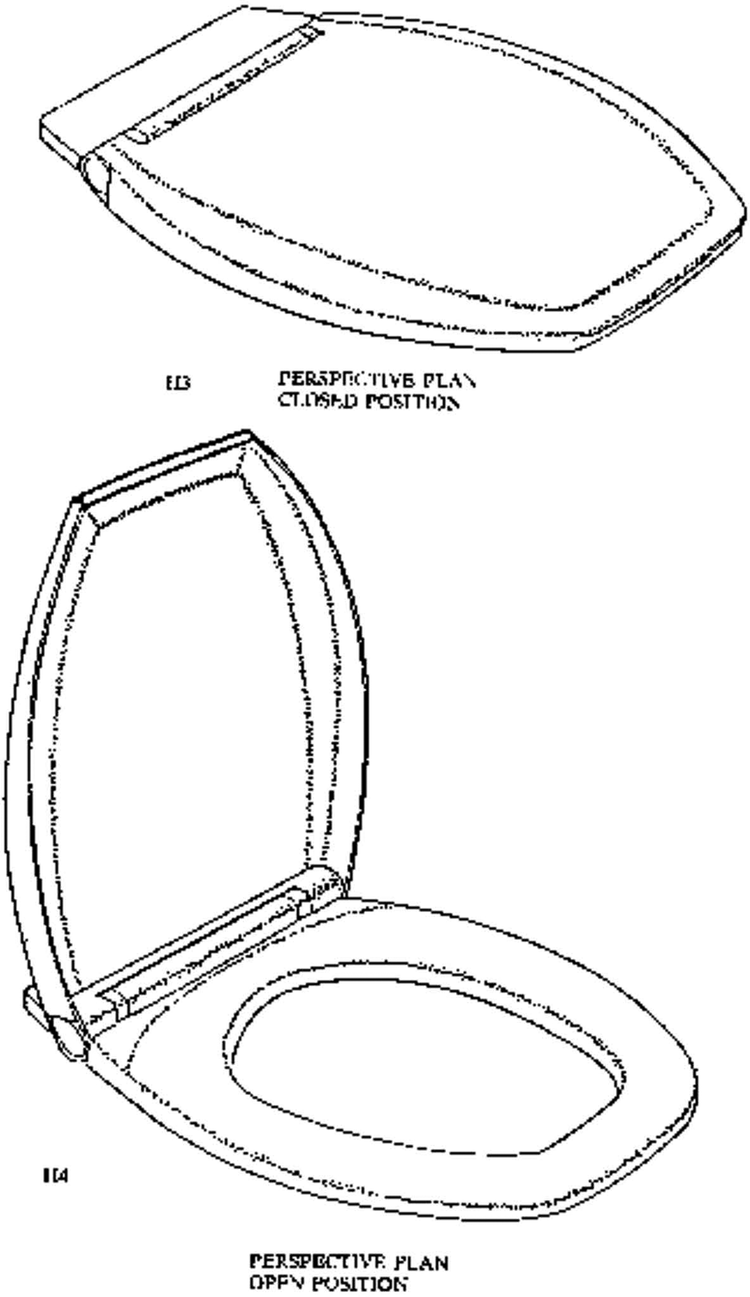
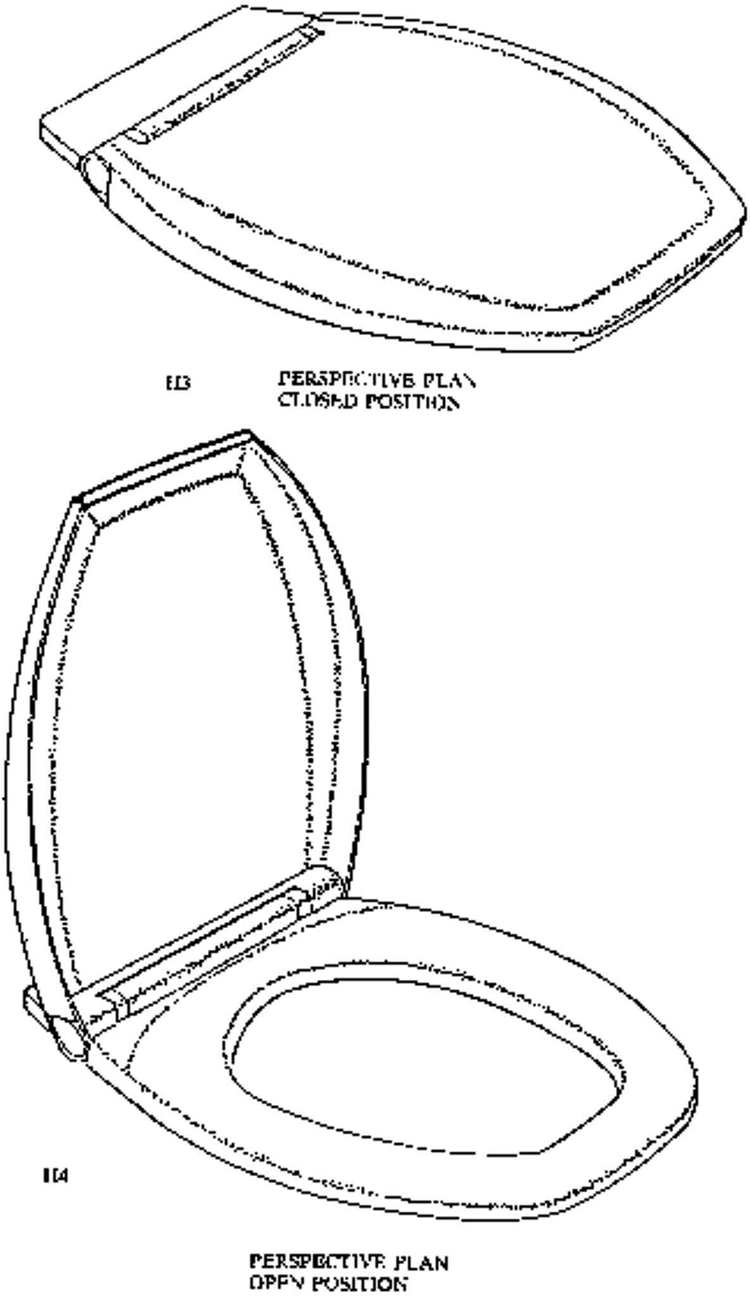
The awkward juxtaposition of static representations next to embodied sensory experiences is present in the case law. Here we discuss cases involving materials where non-visual sensory qualities were integral to the design’s appeal, which two-dimensional drawings could not capture. UPL v Dux was an NZ High Court decision about a design for lavatory seats,Footnote 114 where the plastic material used contributed significantly to the commercial success of the design. While the plastic was an important feature of the design, the inability to fully capture these material qualities in a two-dimensional representation (see Figure 2) led to a loss of the design’s affective essence when legally evaluated. This is captured by the judge’s statement ‘it is not always easy to compare a two-dimensional design with a three-dimensional object’.Footnote 115 This acknowledgment underscores the difficulty of translating the full sensory and emotional impact of a three-dimensional object into a static two-dimensional image. Furthermore, the judge’s statement suggests that, even within a legal framework that traditionally prioritises visual logic and clarity, the embodied and affective experiences can be important in design. Ultimately, a visual comparison of the registration representation with the allegedly infringing artefact led to the court holding there was no infringement because there were visual dissimilarities,Footnote 116 though it was a stated fact that the defendant introduced its lavatory seat with ‘the same items as already described in the case of [the plaintiff’s] unit’, which ‘had an immediate effect on [the plaintiff’s] sales’.Footnote 117 Arguably, like in the Trunki case, the alleged infringer was imitating features of the design that made it commercially successful, but the limitations of the representations limited the scope of protection.
UPL Toilet Seat.Footnote 118
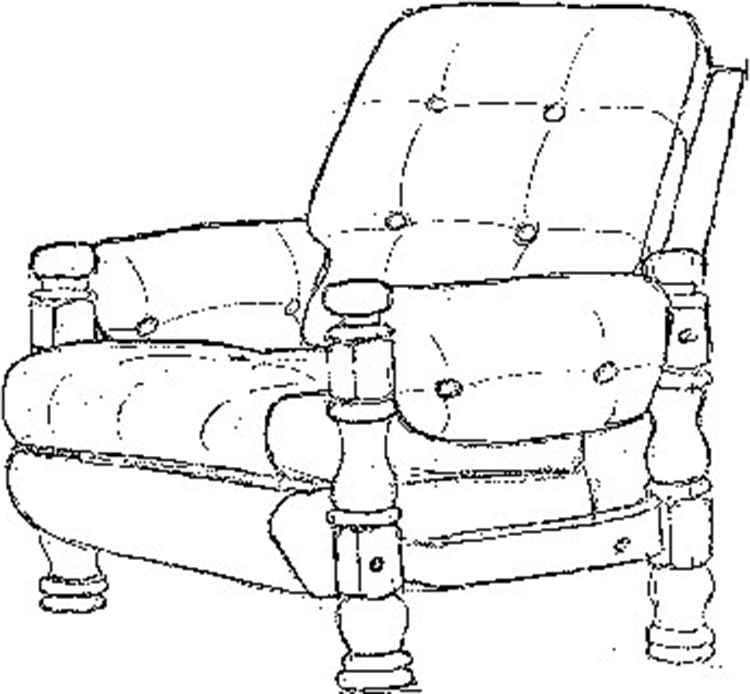
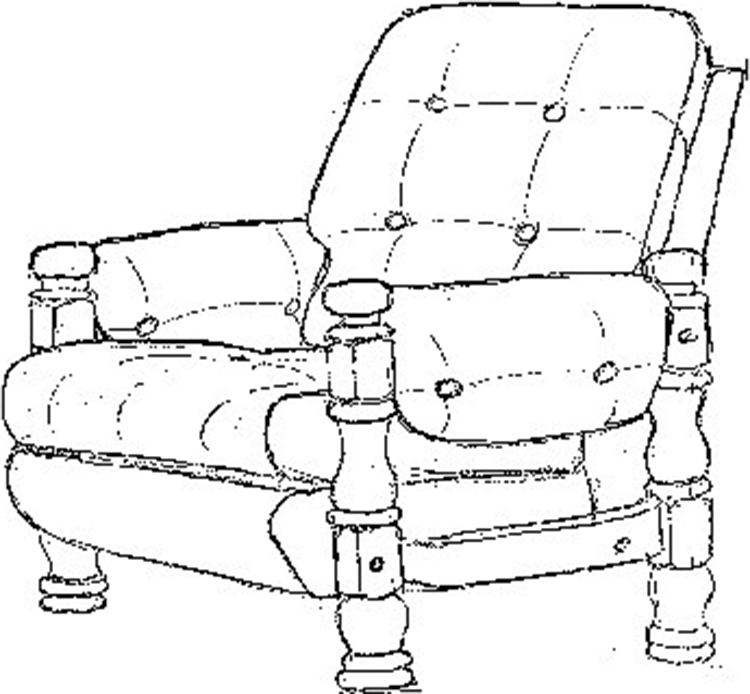
To further illustrate how the law’s focus on the visual ignores other embodied sensory experiences, we turn to DA Lewis & Co Ltd v Trade Winds Furniture Ltd,Footnote 119 a case about the design of the arms and legs of wooden chairs (see Figure 3 for one of the registered representations). The NZ High Court held that the registered design of the chair arms and legs was not new or original vis-à-vis the ‘overall impression’ of a prior design, and was invalid.Footnote 120 The court focused on visual similarities between two static representations (the registration representations and a single photograph of the prior design),Footnote 121 overlooking how these pieces of furniture might feel or interact with different environments. Yet, wooden furniture, with its natural, organic qualities, invites a sensory and affective experience beyond mere visual comparison. Variability in texture and how light interacts with the wood contribute to the furniture’s emotional appeal, which might evoke comfort, nostalgia, or a connection to nature – affective qualities that are integral to the design’s overall appeal. However, such features are challenging to capture in a traditional design representation and, thus, the focus on two-dimensional visual features might ignore the design’s materiality and interaction with its environment.
Lewis chair.Footnote 123
Finally, in line with the awkward juxtaposition between static representation versus non-static reality, using natural materials in design, such as wood, presents unique challenges for design protection. Natural materials are inherently variable – no two pieces of the same kind of wood are exactly alike – and this variability contributes to the uniqueness and appeal of the design. In DA Lewis & Co Ltd v Trade Winds Furniture Ltd,Footnote 122 the decision that the registered design was not novel or original was based on the overall shape and configuration of the furniture, not subtleties of the material and how they affected the design. This approach might fail to account for the natural irregularities and organic qualities of wood, which are integral to the design’s appeal and distinctiveness. Analogously, handmade designs often have variations difficult to capture in legal submissions. The legal system’s emphasis on standardisation and visual clarity disadvantages designs that embrace natural materials with variable characteristics, which are not easily captured in static, standardised representations, even if those characteristics are visual. To further illustrate this point, if DA Lewis & Co Ltd’s design utilised the same natural materials but differently compared to the prior design – perhaps emphasising different aspects of the wood’s texture or colour – the current legal framework might not adequately recognise these differences. This could result in natural, organic, or handmade, design elements not being fully protected, or where legal protection does not accurately reflect the design’s innovative use of natural or variable materials. Note that, while Australian, UK and EU law states that design products include that which is ‘hand made’Footnote 124 or ‘handicraft’,Footnote 125 this does not resolve issues relating to representation.
The case law analysed above highlights how the difficulty in representing dynamic, sensory and affective (embodied and emotive) qualities in legal submissions represents a significant limitation in current design law and practice. When the law focuses on clear, visual representations, this can limit the registrability and scope of protection of designs that derive value from dynamic, sensory and affective experiences. In the following section we argue for a reassessment of design law in light of this.
2. The embodied and affective
IP is ostensibly largely about the disembodied – the rational abstract thing that is applied to objects.Footnote 126 For example, the author creates the ethereal work that can be copied, a designer creates a design applied to an object, an inventor invents something that is reduced to abstraction. The creation has the air of the objective or the authoritative – it is a sculpture, model, drawing or claim reduced to an intellectual ‘master’ form that defines the contours of the IP. IP is not the irreducible, dependent on context, or the embodied. IP is also not the natural – if anything, it is the mastery of nature. IP cannot stem from amorphous or fluid communal creatorship, but only identifiable individuals.
Historically, the rational and the disembodied and the individual, have been coded masculine.Footnote 127 Men have agency, and with this they are constructed as masters of nature, capable of creating the objective or authoritative and culture.Footnote 128 In contrast, women have been constructed in the binary, as emotional and tied to bodily experiences and knowledge, intimately connected to nature and highly relational.Footnote 129 These binaries persist and women are still stereotyped and socialised to be more natural, emotional and communal. Consequently, the Western world tends to perceive forms of knowledge created in masculinised industries as being ‘science’ and ‘technology’,Footnote 130 and that created in feminised industries as being something else, often in the public domain.Footnote 131
As argued herein, this binary is present within design law and its application, with the law favouring the masculine-coded aspects of design (the disembodied and static, relating to the technical) over the feminine-coded aspects (the embodied, relating to the dynamic, sensory and affective, including through the use of the natural).Footnote 132 Yet, much design is centred around affect – it draws embodied and emotional response, whether inherent or not, physiological or cognitive.Footnote 133 It connects to people and connects people.
In light of the gendered nature of design law and practice and how they reflect the disembodied/embodied and authoritative/affective binaries, we turn now to feminist thought regarding the body and affect and now it helps us to think about design law and what it protects and how it protects it. A strong and long line of feminists have argued that it is part of the feminist project to dismantle the belief that science and scholarship finds objective truths – what Donna Haraway has described as a ‘god trick’; a view from above, free from social, political and historical contingencies.Footnote 134 Instead, they have argued that knowledge and perception are determined by one’s situated and embodied viewpoint (standpoint theory), because one’s situation and embodied self form the lenses through which one perceives and relays one’s surroundings. This might range from the fact that one’s life affects what one finds salient, to the fact that one’s knowledge basis shapes what can be perceived and ‘known’. For example, if one comes from a culture without integers, this has an impact on the way one thinks and perceives experiences.Footnote 135
If we translate the foregoing into design law and practice, designs are represented the way they are because of a history of seeing certain representations – those used in science and engineering – as embodying an abstract master truth. After all, design law has largely protected technical aspects of designs in men-dominated industries, and the Western world sees knowledge from those industries (and representations of that knowledge) as ‘objective’. However, those representations are the god trick. Moreover, those representations, in turn, form part of the lenses through which we consider designs and design protection. They obscure design in movement, in the fluid and, consequently, in digital things, as well as in the sensory and affective, to the point that we do not see protectable designs in such things.
But perhaps we should see protectable elements of design in the dynamic, sensory and affective. Affect theory suggests that a design’s emotional impact is often tied to its ambiguity or the way it stimulates the imagination.Footnote 136 Thus, when a design is reduced to a clear, static representation, some of its affective power is inevitably lost. This is exemplified by the Trunki case discussed above,Footnote 137 which involved designs that were playful and imaginative – colourful ride-on suitcases designed to appeal to children. Yet, the greyscale drawings used for registration failed to capture the full imaginative appeal of the product, leading to a legal interpretation that did not fully protect the designs’ emotional and sensory dimensions. The law’s focus on visual and structural clarity can result in decisions that overlook a design’s more intangible, affective qualities. These designs can carry significant emotional and socio-cultural value, such that we should consider the ramifications of design law and practice not protecting them because they do not fit neatly into a legal framework designed to protect industrial products.
Thus, taking affect seriously, we should acknowledge the socially constructed nature of what is protected by design law (that is, the human decisions around what to protect and how to protect it), which would open up the discourse to thinking about whether the way we represent designs could be different and it could (and whether it should) protect aspects of design that are dynamic, sensory and affective. This, in turn, begs the question of whether there is a reason why design should not protect movement, the fluid, digital things, the sensory or the affective – a question that can only be answered in relation to the rationales for design law, be they incentive based, utilitarian, or based on happiness. To illustrate, presuming that design rights do indeed serve an incentive function, what is it that we might want to incentivise? What are the economic advantages and disadvantages of design protection for movement, the fluid, digital things, the sensory or the affective? What are the affective results of design protection? And, if the scope of design right subject matter is expanded, do other aspects of design law (such as the novelty standard, exclusive rights, exceptions or protection term) need to be adjusted to ensure balance? These are all larger questions worthy of investigation. Suffice it to say that one can take neither what can be protected (and how it is protected) by design law, nor the justifications for such protection, as something inherent and free from potential gender bias.
Of course, proponents of extant design law and practice might argue that prioritising uniformity and precision in design law is necessary to maintain consistency and fairness across applications and legal disputes, and to provide the necessary balance between clarity and innovation. They might also contend that introducing more subjective elements, such as embodied sensory and emotional impact, could make legal evaluations more complex and result in unpredictable outcomes. However, while consistency is important, it should not come at the cost of failing to protect the full range of qualities that make designs meaningful and successful, unless there is a good reason for this failure. This is particularly true when one factors in the gendered nature of the current distinction between what can and cannot be protected and how this is reinforced by rules around design illustrations. Moreover, arguments to sustain the status quo in the name of ‘objectivity’ and consistency ignore the socio-legal reality that one is always dealing with designs in context, which becomes apparent when judges struggle to assess design registrations on paper compared to designs in the world. There has always been a subjective element to design that the technical illustrations for design registration have obfuscated. Acknowledging this, the law and its practice should be reassessed, and should possibly adapt to accurately reflect and protect the full (or at least a broader) range of creative expression.
Finally, it is worth noting that the NZ Designs Act 1953 has not been substantively amended since its enactment and this brings with it many problems, but not the problems we highlight in this paper. After all, the Trunki decision was from the UK Supreme Court on an EU design registration. In addition, Australian legislation is significantly newer, but design law and practice remain similar in their focus on static visual assessment and comparisons. While developments in the EU resolve some of the concerns we discuss by including movement/transition, these continue to rely on static representations. Furthermore, these EU developments have not been translated into UK law, and the NZ legislature has shown little appetite to modernise design law. That is, all the jurisdictions discussed in this paper could address the issues raised in this paper. The exact manner in which they could do so lies outside the remit of this paper. However, we tentatively propose that design law could move beyond ‘eye appeal/judgment’, and it could do so by taking advantage of developments in technology that allow more embodied and affective representations, including depictions that move, virtual reality and augmented reality. This remains an avenue for future research.
Conclusion
Design law, like other areas of IP law, is not prima facie gendered (though, due to the age of the legislation, the Designs Act 1953 still refers to ‘he’/’him’). However, while the classes that one can get design rights in are quite broad, the case law analysed in this paper shows that design law shares more requirements with patent law for inventions than copyright for artistic works, and designs are illustrated in a static two-dimensional way that favours technical features. This favouring of the technical affects how the design system is used, as exemplified by filings and cases in NZ, and implicitly means that design law ignores the dynamic, sensory and affective. Whereas men are often stereotyped as more technically inclined, women are socially cast as more fluid, sensitive and emotional. Thus, design law is incidentally gendered. It places value in designs that can be captured in technical illustrations, thereby incentivising these. However, it does not place value in or incentivise design features relating to the dynamic, sensory and affective.
The limitations of design law and practice identified in this paper should prompt a reconsideration of the scope of traditional design law. If the law and its practice inadvertently limit the ability to fully capture the dynamic, sensory and emotional dimensions of a design, which contribute to the economic and socio-cultural value of a design, there is a need to reconsider how we approach design protection. This is particularly the case when we recognise that the challenges in protecting designs that rely on dynamic, sensory and affective qualities are deeply intertwined with gendered biases that prioritise masculine-coded qualities like functionality, clarity and structure over the feminine-coded qualities of emotional resonance, sensory experience and fluidity. Unless there are good reasons for not doing so, addressing the oversight of design law and its practice is essential to ensuring that design law more fully safeguards the aesthetic and emotional aspects of design, rather than perpetuating biases that devalue feminine-coded qualities like colour, as well as texture and emotional impact.
Thus, a broader, more inclusive legal framework would be needed to value all aspects of design. While not discussed in this paper, it is worth investigating whether such a framework would benefit other marginalised groups, such as Indigenous peoples; after all, as we note, current law and practice is not only masculine, it is also Western. The counterargument to a more inclusive framework would likely be that this would introduce subjective elements into design law, which could complicate proceedings and lead to inconsistencies. However, this view overlooks the fact that designs are never merely objective or static technical objects. Designs are always socially embedded and embodied artefacts that engage with human emotions and senses, and the law and its practice should arguably reflect this socio-legal reality.



 Open access

