


1. Introduction
Engineers have a responsibility to design and develop sustainable products and systems (Reference KrumdieckKrumdieck, 2024; Reference Seager, Selinger and WiekSeager et al., 2012). Transdisciplinary (TD) engineering is a response to wicked problems by bridging disciplinary boundaries and involving non-research stakeholders to co-produce socially-relevant knowledge (Reference Wognum, Bil, Elgh, Peruzzini, Stjepandić and VerhagenWognum et al., 2019). Early approaches for multidisciplinary and participatory engineering design have focussed on product design and involved stakeholders in the definition of user needs (Reference PughPugh, 1993). Today, TD engineering is a growing field in engineering research that deals with the design and development of socially relevant, sustainable and transformational product-systems, business models or policy (Reference CooperCooper, 2023; Reference Wognum, Bil, Elgh, Peruzzini, Stjepandić and VerhagenWognum et al., 2019). The importance of TD engineering design lies in the problems that future engineers will face; while current engineers are well equipped with the skills and competencies for solving complicated problems such as designing and delivering technologies, future engineers will deal with the complex (wicked) problems such as climate change, biodiversity loss or resource depletion (Reference Hunger and AhrensHunger & Ahrens, 2025; Reference MadhavanMadhavan, 2024; Reference Seager, Selinger and WiekSeager et al., 2012). Wicked problems, caused by successful operation of engineered systems, are systems problems that involve paradoxical and path-dependent perspectives from society, ecology, policy, regulation, (geo)politics, technology, economics and business models. Wicked problems cannot be solved by the same engineering approaches that caused them in the first place (Reference KrumdieckKrumdieck, 2024; Reference Seager, Selinger and WiekSeager et al., 2012).
Transdisciplinarity is the logical response to the growing complexity and wickedness of problems (Reference Lawrence, Williams, Nanz and RennLawrence et al., 2022). If the problem space involves interdisciplinary perspectives, then any attempt to resolve these problems needs to transcend disciplinary boundaries. TD research expands existing notions of inter- and multidisciplinarity into the area of real-world research (Reference Robson and McCartanRobson & McCartan, 2016). Transdisciplinarity involves “working in a transformative manner” (Reference Lawrence, Williams, Nanz and RennLawrence et al., 2022). Participation of non-research stakeholders is a key aspect of TD research involving the convergence of multi-disciplinary research and non-research stakeholders in the process of knowledge generation and application (Reference Lang, Wiek, Bergmann, Stauffacher, Martens, Moll, Swilling and ThomasLang et al., 2012; Reference Lawrence, Williams, Nanz and RennLawrence et al., 2022).
Design for sustainability and systems transitions is a core scope of TD engineering design (Reference ErtasErtas, 2018; Reference Wognum, Bil, Elgh, Peruzzini, Stjepandić and VerhagenWognum et al., 2019). In the context of sustainability and systems transition, we consider “engineering design” to include considerations about the design process, the designed intervention, and factors and tools that influence the design process (Reference Maier, Oehmen, Vermaas, Maier, Oehmen and VermaasMaier et al., 2022). While the body of knowledge in TD engineering is growing, there is a lack of understanding of the TD quality criteria of TD engineering design (Reference CooperCooper, 2023). Cooper highlights that there is “a more tightly-bound and clearer idea of what constitutes ‘transdisciplinary’ within the [transdisciplinary research] community than there is with the [transdisciplinary engineering] community”, and the risk “that the ‘transdisciplinary’ prefix in engineering becomes a kind of ‘washing’ of engineering, implying the concerns visible in [transdisciplinary research] but not actually acting on them.” (Reference CooperCooper, 2023, p. 921). Therefore, we ask: How transdisciplinary is transdisciplinary engineering design for sustainability and systems transitions? We address this research question with a semi-systematic literature review.
The contribution of this paper is twofold: 1) a framework of qualities for TD engineering design that can methodologically support future research projects in the field; and 2) an understanding of the transdisciplinarity of current studies in TD engineering design for sustainability and systems transitions. The results are an analysis of “if and how” existing studies in the field of TD engineering design exhibit the TD engineering design qualities of stakeholder participation, the relationship between academic engineers and non-academics, the role of engineering design, the degree of inter- and multidisciplinarity and the focus on resolving real-world wicked problems in the design process.
We found that there is no unified approach for TD engineering design. The results of the literature analysis showed diverging methodologies in TD engineering design research. Our study concludes recommendations for future research in TD engineering design, specifically aspects of participatory design, reflexivity and wicked problem framing. This paper contributes to the field of engineering design for sustainability and systems transition, specifically TD engineering design, by providing a stock-take of transdisciplinarity qualities in the field. Our findings are also relevant to the wider design for sustainability community by providing impetus for new relevant practices in design for sustainability. We highlight lessons and opportunities for improving TD engineering design to further increase the impactfulness in the field of design for sustainability.
The paper is organised as follows: Section 2 explores quality criteria of TD research and TD engineering to develop a framework of quality criteria of TD engineering design; Section 3 explains the methods used in the semi-systematic literature review for addressing the research question; Section 4 lays out the results of the literature review; Section 5 concludes the results and looks out to future research.
2. Quality criteria for transdisciplinary engineering design
This background section explores quality criteria of TD research and TD engineering to develop a framework of quality criteria of TD engineering design.
2.1. Transdisciplinary research
This subsection gives background information on TD research, including an exploration of the spectrum ranging from multi-, inter- and transdisciplinarity, participatory approaches and wicked problems.
Wicked problems have been conceptualised in the late 1960s as ill-structured problems that resist the ordinary problem solving process of dividing complicated problems into analytically solvable sub problems (Reference ChurchmanChurchman, 1967; Reference Rittel and WebberRittel & Webber, 1973). Today, societies face numerous interconnected wicked problems like climate change, poverty, geopolitics, war, migration, environmental degradation or economic crises (Reference Elia and MargheritaElia & Margherita, 2018). The transcendence of disciplinary boundaries is required for addressing wicked problems, since wicked problems concern multiple societal stakeholders from different disciplines and with particular interests.
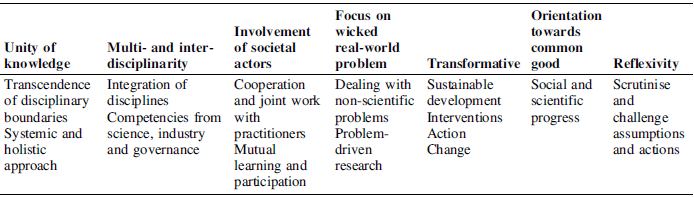
Reference Tress, Tress and FryTress, Tress and Fry (2005) distinguish multi-, inter- and transdisciplinary research as a continuum of increasing integration and involvement of different participants (academic and non-academic). In multidisciplinary research, several academic disciplines work in parallel towards a shared topic but with distinct disciplinary goals. Knowledge is accumulated rather than integrated. Interdisciplinary research, as an extension, intentionally crosses disciplinary boundaries, combining concepts, methods, and epistemologies from previously unrelated fields to co-create new theoretical frameworks and common research goals. Reference Jahn, Bergmann and KeilJahn, Bergmann and Keil (2012) define TD research as a critical and self-reflective research approach. TD research extends beyond interdisciplinarity by involving both academic and non-academic participants in the joint creation of knowledge (Reference Tress, Tress and FryTress et al., 2005). But participation alone does not make TD research. Participatory research can take the form of applied work, development or joint investigation, but not every participatory activity qualifies as TD research or academic research in general. Participation can occur within disciplinary or multidisciplinary settings, but it only becomes transdisciplinary when knowledge from science and society is integrated and contributes to the creation of new theoretical or practical understanding (Reference Tress, Tress and FryTress et al., 2005). TD research merges disciplinary integration with participatory collaboration, addressing real-world problems through the co-production of knowledge, enhancing both societal relevance and scientific robustness (Reference Jahn, Bergmann and KeilJahn et al., 2012; Reference Meijer and EttlingerMeijer & Ettlinger, 2025; Reference MobjörkMobjörk, 2010; Reference Schäpke, Stelzer, Caniglia, Bergmann, Wanner, Singer-Brodowski, Loorbach, Olsson, Baedeker and LangSchäpke et al., 2018). Participatory design (or co-design) applies participatory and democratic values in designing socially-relevant artifacts (Reference Bjögvinsson, Ehn and HillgrenBjögvinsson et al., 2012). TD research does not solely address scientific problems, but complex real-world problems involving social, economic, technological and governance perspectives. Co-design enables researchers to partner with non-research stakeholders to inclusively co-produce knowledge that is relevant to stakeholders (Nature Editorial, 2018). Table 1 shows a synthesis of properties of TD research provided by Lawrence and colleagues (Reference Lawrence, Williams, Nanz and RennLawrence et al., 2022).
Properties of TD research according to Reference Lawrence, Williams, Nanz and RennLawrence et al. (2022)

2.2. Transdisciplinary engineering
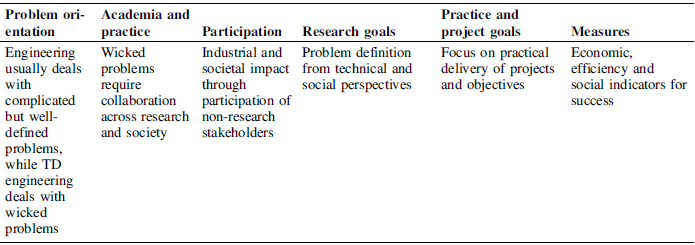
TD engineering is an evolution of engineering practice to “work across disciplines […] with a social purpose” (Reference CooperCooper, 2023, p. 912). Arguably, engineering always ought to address society’s needs by providing innovative tools and products that support daily life and enable economic development. But when problems are wicked, business-as-usual engineering practice falls short to deliver systemic values beyond optimisation and innovation for economic growth purposes (Reference KrumdieckKrumdieck, 2024; Reference MadhavanMadhavan, 2024; Reference Seager, Selinger and WiekSeager et al., 2012). Ideally, TD engineering adopts practices from TD research to design and develop transformative tools, artifacts, systems and products for society’s benefit in response to wicked problems. Table 2 describes the features of TD engineering.
Features of TD engineering according to Reference Wognum, Bil, Elgh, Peruzzini, Stjepandić and VerhagenWognum et al. (2019)

2.3. Synthesis - quality criteria for transdisciplinary engineering design
The qualities for TD engineering design are now synthesised based on the features of TD research and TD engineering. We have established six core quality criteria for TD engineering design: quality of participation, types of involved non-academic stakeholders, relationship between academic engineer and non-academic, role of engineering design, degree of multi- and interdisciplinarity, and focus on resolving wicked problems. Table 3 describes the quality criteria developed from relevant literature discussed in Sections 2.1 and 2.2. The first column describes the quality criterion, the second column explains the criterion and gives indicative questions to assess the criterion, and the third and fourth column reflect the relation of each criterion to TD research and TD engineering.
Framework of quality criteria for TD engineering design

3. Method - semi-systematic literature review
This study applies a semi-systematic literature review to understand the TD nature in TD engineering design. The aim of a semi-systematic review is to provide a representative and transparent overview of existing conceptual, theoretical and practical approaches across disciplinary boundaries rather than an exhaustive quantitative synthesis (Reference SnyderSnyder, 2019). This review seeks to provide insight into the field of TD engineering design and to identify central conceptual gaps and opportunities for advancing the TD engineering design process.
3.1. Search strategy and selection
The framework (Table 3) is derived from literature on TD research and TD engineering. The framework defines the thematic focus and evaluation categories used throughout the analysis. The main keywords used in the search for papers were grouped according to three analytical dimensions: TD engineering or wicked problem as thematic grounding, transformation as purpose and design as focus. Search strings were constructed by combining the keywords along three analytical dimensions using Boolean operators (see Figure 1). We intentionally looked for “transdisciplinary engineering” and excluded terms such as “co-design”. We are aware that TD engineering design can apply co-design but co-design does not necessarily encompass TD design (see Section 2.1).
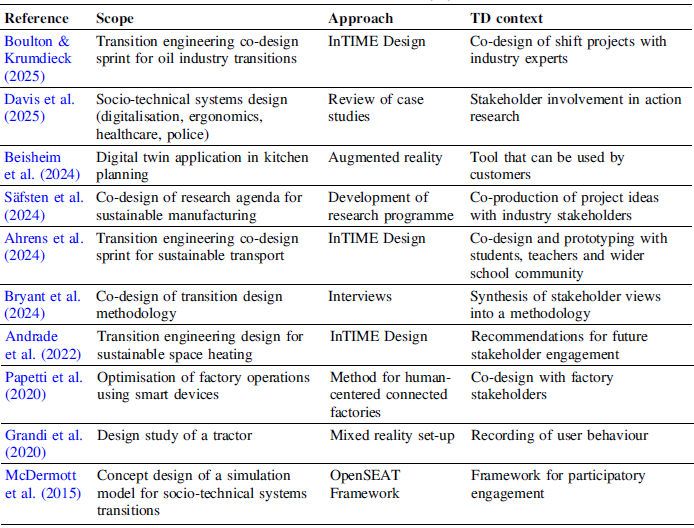
The literature search was carried out in two major databases Scopus and Web of Science which are recognized as comprehensive sources for engineering and design-related research. All inclusion and exclusion decisions were documented together with the reasons for exclusion (see Figure 1). The initial hits included 49 publications in Scopus and 31 publications in Web of Science. 57 articles were imported into a database for systematic screening and documentation after removing non-available and duplicate items. Following Reference SnyderSnyder (2019) the screening process consisted of two phases, each carried out double-blind by the first and second author. The process for searching, screening and analysis is displayed in Figure 1. Table 4 lists the reviewed papers and their context in this paper’s scope. The papers were downloaded on 28/08/2025.
Screening and analysis process in the semi-systemic review

Figure 1 Long description
The flowchart illustrates the screening and analysis process in a semi-systemic review. The process begins with a search query that includes specific keywords related to transdisciplinary engineering, wicked problems, transition engineering, and design. Results are obtained from Scopus and Web of Science, with initial counts of 49 and 31 respectively. Duplicate items are removed, resulting in 57 available items. Title and abstract screening is performed, excluding 22 items deemed not relevant. Full text screening is conducted on the remaining 35 items, excluding another 16 items for various reasons. Coding according to predefined criteria is done on 19 items, with 9 items excluded for lacking information on at least one quality criteria. The final analysis regarding predefined criteria is conducted on the remaining 10 items.
3.2. Data analysis and synthesis
Semi-systematic analysis enables a replicable yet exploratory integration of different perspectives. The framework dimensions guided the literature search, coding, and synthesis. For the analysis, the full-text articles were coded by the first and second author in a double-blind process according to the predefined quality criteria (see Table 3). The content information as results of the coding were extracted and summarised in a concept matrix (Reference Webster and WatsonWebster & Watson, 2002). The findings of the ten articles included in the full-text analysis were synthesised, and similarities, differences and gaps are presented in the following section. The synthesis highlighted whether, and to what extent, TD engineering-design approaches meet the quality criteria guided by Reference CooperCooper’s (1988) integration goals. The aim is to mark under-researched areas in relation to engineering-design approaches.
4. Results
The results section investigates “if and how” TD engineering design studies with focus on sustainability and systems transitions meet the quality criteria of stakeholder participation, the relationship between academic engineers and non-academics, the role of engineering design, the degree of inter- and multidisciplinarity and the focus on resolving real-world wicked problems in the design process.
Quality of participation
Seven out of ten studies involved participatory practices through co-X (x=design, production, creation) processes. Co-design activities involved brainstorming, mapping exercises, prototyping and definition of solutions. Specific co-design methods were sandboxing, back casting, PEST analysis, stakeholder clinics, wicked problem investigations, stakeholder juries and assemblies, and root cause analysis. Co-design had different shapes of intensity. Four studies involved stakeholder discussions at specific points in the design process such as participation of end users in the testing of a design tool, co-production of problem formulation or project ideas, or participatory design using stakeholder interviews as design input (Reference Bryant, Straker and WrigleyBryant et al., 2024; Reference Davis, Hughes, Robinson, Scales, Sankaran, Liu, Findlay and GrittDavis et al., 2025; Reference Grandi, Zanni, Peruzzini, Pellicciari and CampanellaGrandi et al., 2020; Reference Säfsten, Elgh, Johansen, Stolt, Cooper, Trigos, Stjepandić, Curran and LazarSäfsten et al., 2024). One study defined their stakeholder identification through the authors’ professional networks (Reference Boulton and KrumdieckBoulton & Krumdieck, 2025) but nine out of ten studies did not specify their stakeholder engagement model. While two studies applied co-design along the whole design process (Reference Ahrens, Boulton, Cherubini, Krumdieck, Cooper, Trigos, Stjepandić, Curran and LazarAhrens et al., 2024; Reference Boulton and KrumdieckBoulton & Krumdieck, 2025; Reference Säfsten, Elgh, Johansen, Stolt, Cooper, Trigos, Stjepandić, Curran and LazarSäfsten et al., 2024), the others only incorporated participatory design activities and stakeholder voices in selected parts of the design process.
Types of involved stakeholders
The reviewed studies reported on a broad spectrum of involved stakeholders. A case study on oil industry transitions involved four industry experts with different backgrounds in equipment, strategy, safety and finance (Reference Boulton and KrumdieckBoulton & Krumdieck, 2025). The authors acknowledged that more non-industry stakeholders should have been included in the process. Case studies in the manufacturing industry claimed to have involved “industry stakeholders” (Reference Säfsten, Elgh, Johansen, Stolt, Cooper, Trigos, Stjepandić, Curran and LazarSäfsten et al., 2024), operators and managers (Reference Papetti, Gregori, Pandolfi, Peruzzini and GermaniPapetti et al., 2020), and operators and maintenance staff (Reference Grandi, Zanni, Peruzzini, Pellicciari and CampanellaGrandi et al., 2020). Yet the individual case studies have focussed only on a small subset of stakeholders in each case. One case study in ergonomics mentions the involvement of “intra organisational stakeholders” (Reference Davis, Hughes, Robinson, Scales, Sankaran, Liu, Findlay and GrittDavis et al., 2025). A case study in education and school transport broadly covered the system both qualitatively and quantitatively by involving 300 school stakeholders (students, teachers, parents), transport bodies and local council staff (Reference Ahrens, Boulton, Cherubini, Krumdieck, Cooper, Trigos, Stjepandić, Curran and LazarAhrens et al., 2024). A study on designing an energy transition tool asked 28 experts from industry, academia and government for design input (Reference Bryant, Straker and WrigleyBryant et al., 2024).
The scale and variety of involved stakeholders differ across the reviewed studies. Three categories of stakeholder involvement emerge: expert co-design within a single industry (oil, manufacturing), expert co-design across domains (energy transition, ergonomics), and system stakeholders including experts but also non-experts (education/school transport). None of the studies gave a rationale for why they involved a certain group of stakeholders.
Relationship between academic engineers and non-academics
Three types of relations between academic engineers and non-academics were observed. First, the academic engineers facilitated and led on the co-design process but both parties were seen as equal partners in the co-design (Reference Ahrens, Boulton, Cherubini, Krumdieck, Cooper, Trigos, Stjepandić, Curran and LazarAhrens et al., 2024; Reference Boulton and KrumdieckBoulton & Krumdieck, 2025; Reference Säfsten, Elgh, Johansen, Stolt, Cooper, Trigos, Stjepandić, Curran and LazarSäfsten et al., 2024). In one study, the authors prepared each step of the design process with background research to inform the stakeholder workshops (Reference Boulton and KrumdieckBoulton & Krumdieck, 2025). The authors acknowledged that this style of “facilitated discussions” can introduce biases from all sides. In another transition engineering study, the academic engineers facilitated the design process while the non-academics led on the design process through problem formulation, decision making and testing (Reference Ahrens, Boulton, Cherubini, Krumdieck, Cooper, Trigos, Stjepandić, Curran and LazarAhrens et al., 2024). The second type involves less design involvement by non-academics. In one study, academic engineers were responsible for set up, design and analysis and non-engineers were treated as end users and informants for design iterations (Reference Grandi, Zanni, Peruzzini, Pellicciari and CampanellaGrandi et al., 2020). Another study had the academic engineers leading on the design process. They were doing the analysis but they also included stakeholder perspectives in the later part of the design process when it came to defining solutions (Reference Papetti, Gregori, Pandolfi, Peruzzini and GermaniPapetti et al., 2020). The third type separates the academic engineers from the non-academics in most of the design. In one study, academic engineers have developed a tool that was then tested with customers, demonstrating business-as-usual product design practices (Reference Beisheim, Kayapinar, Amann, Frank, Jiang, Linde, Cooper, Trigos, Stjepandić, Curran and LazarBeisheim et al., 2024). Another study developed a tool for participatory engagement but no participation, testing or validation was reported in the paper (Reference McDermott, Folds, Ender and BollwegMcDermott et al., 2015).
Role of engineering design
The reviewed papers fell into two groups: seven studies that used an engineering design process as the research method and three studies that applied an engineered/designed product or tool. Most reviewed TD engineering design studies evolved around reporting on the co-design process and less on finished products. Usually these studies did not go beyond conceptual design, however one study also reported on collaborative prototyping (Reference Ahrens, Boulton, Cherubini, Krumdieck, Cooper, Trigos, Stjepandić, Curran and LazarAhrens et al., 2024). A re-occurring design method was the Interdisciplinary Transition Innovation, Management and Engineering (InTIME) process used in transition engineering case studies (Reference Ahrens, Boulton, Cherubini, Krumdieck, Cooper, Trigos, Stjepandić, Curran and LazarAhrens et al., 2024; Reference Andrade, Land, Gallardo and KrumdieckAndrade et al., 2022; Reference Boulton and KrumdieckBoulton & Krumdieck, 2025). One study deployed engineering design on a wicked problem, but did not involve any stakeholders in the design process (Reference Andrade, Land, Gallardo and KrumdieckAndrade et al., 2022). Another study followed an engineering design process, only with participatory design validation at the end of the process (Reference Grandi, Zanni, Peruzzini, Pellicciari and CampanellaGrandi et al., 2020).
Degree of inter- and multidisciplinarity
Inter- and multidisciplinarity was not widespread in TD engineering design studies. One study claimed that multidisciplinary teams were involved in the research (one team of researchers and engineers in robotics, socio-technical systems and project management, and one research team of psychologists, ergonomists, engineers, information scientists and business professionals) (Reference Davis, Hughes, Robinson, Scales, Sankaran, Liu, Findlay and GrittDavis et al., 2025). It is unclear if multidisciplinarity was achieved or if the cooperation was interdisciplinary. Eight out of ten studies either did not report on the composition of the project team, or the studies involved only one discipline in the team. One study clearly expressed that social scientists and ergonomists were involved in the post processing of data coming out of the engineering design, making the study multidisciplinary (Reference Grandi, Zanni, Peruzzini, Pellicciari and CampanellaGrandi et al., 2020). The three transition engineering case studies claimed to be of inter- or multidisciplinary nature by combining aspects of engineering, management and social science but they did not specify how the different disciplines operate together, nor did the studies report on their team composition (Reference Ahrens, Boulton, Cherubini, Krumdieck, Cooper, Trigos, Stjepandić, Curran and LazarAhrens et al., 2024; Reference Andrade, Land, Gallardo and KrumdieckAndrade et al., 2022; Reference Boulton and KrumdieckBoulton & Krumdieck, 2025).
Focus on resolving wicked problems
The reviewed papers fell into three categories. In the first category, three papers claimed to address a wicked problem and then methodologically explored how their research problem is a wicked problem. Notably the transition engineering case studies used a dedicated wicked problem step in the design process (Reference Ahrens, Boulton, Cherubini, Krumdieck, Cooper, Trigos, Stjepandić, Curran and LazarAhrens et al., 2024; Reference Andrade, Land, Gallardo and KrumdieckAndrade et al., 2022; Reference Boulton and KrumdieckBoulton & Krumdieck, 2025). In the second category, two papers claimed to address a wicked problem but did not explain how the problem is wicked (Reference Bryant, Straker and WrigleyBryant et al., 2024; Reference Davis, Hughes, Robinson, Scales, Sankaran, Liu, Findlay and GrittDavis et al., 2025). In the third category, five papers do not claim to address wicked problems, despite reporting in the field of TD engineering.
Table 4 is a survey of the reviewed papers and gives context of the scope, approach and TD context of each paper.
Overview of reviewed papers

5. Concluding remarks and outlook
Although TD engineering was first mentioned in 1972, our review could only identify research from the last 15 years, reflecting the growing relevance of TD and participatory approaches in design for sustainability and systems transition research. Our results aim to support the consolidation of the TD engineering design process. However, our results also support Cooper’s warning that TD engineering has a less clear understanding of transdisciplinarity than TD research (Reference CooperCooper, 2023).
We found that participatory engineering design took different shapes in the reviewed studies. The reviewed literature has demonstrated that a variety of co-design and participation methods are already being applied in TD engineering design studies. Still, the field lacks a consolidated theory and “fit-for-purpose” practice for participatory design practices in TD engineering to date. However, it is unclear if there can be a unified model for participation in TD engineering design, because the rationale and manifestation of participation may differ from case to case. Future studies should embrace active deliberation on the value of co-design in different stages of the design study.
While seven out of ten studies succeeded at briefly describing the stakeholder cohort, the reviewed studies were mostly lacking a comprehensive discussion of the stakeholder cohort and context, and the rationale for stakeholder involvement. Future studies should apply stakeholder identification models like power-interest or influence-impact grid mapping to systematically cover the relevant spectrum of stakeholders and explain the rationale for involving specific stakeholders (BMI, n.d.).
We found that most studies in our research lacked reflexivity as to how academic engineers want or should involve non-academics in the engineering design process, and on biases introduced by participatory practices. Results of participatory research depend on who is invited, who actually joins and who actively participates. Similarly, eight out of ten studies have not specified the degree of inter- or multidisciplinarity. Future research should focus on developing reflexivity models for TD engineering design to reflect on the relationship between academic engineers and non-academics. For example, future studies could introduce a “TD engineering positionality statement” similar to social sciences, where the authors explain from which disciplines they come from, reflect on their potential biases and how they plan to involve non-engineering and non-academic stakeholders. Future research should also work towards defining models for inter- and multidisciplinarity in TD engineering design.
Problem definition is essential to any engineering activity. While TD engineering design studies acknowledged the relevance of wicked problems, the problem definition step was missing in five out of ten studies. Potentially this is a symptom of business-as-usual engineering practice where problems are rather complicated than complex and reflection on the paradoxical nature of a problem is not thought to be required (Reference Seager, Selinger and WiekSeager et al., 2012). Our results clearly show the need for TD engineering designers to deeply engage in the problem formulation before designing. Future studies could have a section for relating the research to a transformative topic and the resulting wicked problems. What is missing, is a common approach for framing and investigating wicked problems of sustainability and systems transitions in TD engineering design.
The limitations of this study are fourfold. First, while TD engineering is a growing field that lacks formalisation (Reference CooperCooper, 2023), a sample size of ten articles for the semi-systematic review does not allow for concluding evidence of a field. Second, our research focussed specifically on TD engineering design for sustainability and systems transitions, thus eluding from applications of TD engineering design in other domains and other co-design studies. Third, we can only analyse what scholars have reported on. Some studies were published in conference proceedings, hinting that authors did not publish the full research protocol due to intermediate results or page limitations in the proceedings. Fourth, although Reference SnyderSnyder (2019) recommends using a snowball strategy in the literature search we decided against expanding the sample to maintain a clearly defined and analytically manageable scope. Future work could analyse the reference lists and citing articles of the included studies to reveal additional relevant publications that the keyword search missed for strengthening the conclusions of the research.
In this paper, we analysed ten TD engineering design studies in the fields of sustainability and systems transitions for their TD qualities. We contributed a framework of quality criteria for TD engineering design that can be used in future studies for aligning the engineering design research with transdisciplinarity. Then, we conducted a semi-systematic literature analysis and evaluated the state-of-the art knowledge of TD engineering design for sustainability and systems transition in stakeholder participation, the relationship between academic engineers and non-academics, the role of engineering design, the degree of inter- and multidisciplinarity and the focus on resolving real-world wicked problems in the design process. We found that there is no unified approach for TD engineering design, based on the diverging results of the literature analysis. We concluded with recommendations for future research to progress the field of TD engineering design. Specifically, aspects of participatory design, reflexivity and wicked problem framing in TD engineering design show potential for exiting future research.



 Open access

