











1 Introduction
Given a family ${ \mathcal {F}}$
of r-uniform hypergraphs (in short, r-graphs), denote by
${ \mathcal {F}}$
of r-uniform hypergraphs (in short, r-graphs), denote by $\mathrm {ex}(n;{ \mathcal {F}})$
the Turán number of
$\mathrm {ex}(n;{ \mathcal {F}})$
the Turán number of ${ \mathcal {F}}$
, i.e., the maximum number of edges in an n-vertex r-graph containing no element of
${ \mathcal {F}}$
, i.e., the maximum number of edges in an n-vertex r-graph containing no element of ${ \mathcal {F}}$
as a subgraph. Turán problems for hypergraphs are notoriously difficult and we still lack an understanding of even seemingly simple instances such as when
${ \mathcal {F}}$
as a subgraph. Turán problems for hypergraphs are notoriously difficult and we still lack an understanding of even seemingly simple instances such as when ${ \mathcal {F}}$
forbids the complete
${ \mathcal {F}}$
forbids the complete $3$
-graph on
$3$
-graph on $4$
vertices. We refer the reader to the surveys [Reference Keevash19, Reference Sidorenko28] for more background. In this article, we focus on the family
$4$
vertices. We refer the reader to the surveys [Reference Keevash19, Reference Sidorenko28] for more background. In this article, we focus on the family ${ \mathcal {F}}^{(r)}(s,k)$
of all r-graphs with k edges and at most s vertices.
${ \mathcal {F}}^{(r)}(s,k)$
of all r-graphs with k edges and at most s vertices.
Brown, Erdős, and Sós [Reference Brown, Erdős and Sós4] launched the systematic study of the function
 $$ \begin{align*}f^{(r)}(n;s,k):=\mathrm{ex}(n;{\mathcal{F}}^{(r)}(s,k)). \end{align*} $$
The case $r=2$
(resp.
$r=2$
(resp. $r=3$
) of the problem was previously studied by Erdős [Reference Erdős9] (resp. Brown, Erdős, and Sós [Reference Brown, Erdős and Sós5]). Since then, the asymptotics of
$r=3$
) of the problem was previously studied by Erdős [Reference Erdős9] (resp. Brown, Erdős, and Sós [Reference Brown, Erdős and Sós5]). Since then, the asymptotics of $f^{(r)}(n;s,k)$
as
$f^{(r)}(n;s,k)$
as $n\to \infty $
have been intensively investigated for various natural choices of parameters
$n\to \infty $
have been intensively investigated for various natural choices of parameters $r,s,k$
(see, e.g., [Reference Alon and Shapira1, Reference Conlon, Gishboliner, Levanzov and Shapira6, Reference Erdős, Frankl and Rödl11, Reference Glock13, Reference Glock, Joos, Kim, Kühn, Lichev and Pikhurko15, Reference Keevash and Long18, Reference Nagle, Rödl and Schacht23, Reference Ruzsa and Szemerédi25, Reference Shangguan and Tamo27, Reference Sidorenko29]). For instance, it includes the celebrated
$r,s,k$
(see, e.g., [Reference Alon and Shapira1, Reference Conlon, Gishboliner, Levanzov and Shapira6, Reference Erdős, Frankl and Rödl11, Reference Glock13, Reference Glock, Joos, Kim, Kühn, Lichev and Pikhurko15, Reference Keevash and Long18, Reference Nagle, Rödl and Schacht23, Reference Ruzsa and Szemerédi25, Reference Shangguan and Tamo27, Reference Sidorenko29]). For instance, it includes the celebrated $(6,3)$
-theorem of Ruzsa and Szemerédi [Reference Ruzsa and Szemerédi25] (namely, when
$(6,3)$
-theorem of Ruzsa and Szemerédi [Reference Ruzsa and Szemerédi25] (namely, when $(r,s,k)=(3,6,3)$
), as well as the notoriously difficult
$(r,s,k)=(3,6,3)$
), as well as the notoriously difficult $(7,4)$
-problem (namely, when
$(7,4)$
-problem (namely, when $(r,s,k)=(3,7,4)$
). Beyond its significance of being a fundamental Turán problem, the Brown–Erdős–Sós function is closely related to problems from other areas such as additive combinatorics (see e.g., [Reference Ruzsa and Szemerédi25]), coding theory (e.g., the case
$(r,s,k)=(3,7,4)$
). Beyond its significance of being a fundamental Turán problem, the Brown–Erdős–Sós function is closely related to problems from other areas such as additive combinatorics (see e.g., [Reference Ruzsa and Szemerédi25]), coding theory (e.g., the case $k=2$
), hypergraph packing and designs (see below).
$k=2$
), hypergraph packing and designs (see below).
Brown, Erdős, and Sós [Reference Brown, Erdős and Sós4] proved that
 $$ \begin{align*}\Omega(n^{(rk-s)/(k-1)})=f^{(r)}(n;s,k)=O(n^{\lceil (rk-s)/(k-1)\rceil}). \end{align*} $$
In this article, we are interested in the case when the exponent in both the lower and the upper bound is equal to $2$
, i.e.,
$2$
, i.e., $s=rk-2k+2$
. In this setting, the natural question is whether
$s=rk-2k+2$
. In this setting, the natural question is whether $n^{-2} f^{(r)}(n;rk-2k+2,k)$
converges to a limit as
$n^{-2} f^{(r)}(n;rk-2k+2,k)$
converges to a limit as $n\to \infty $
; in fact, already Brown, Erdős, and Sós [Reference Brown, Erdős and Sós4] considered this question and conjectured that the limit exists for
$n\to \infty $
; in fact, already Brown, Erdős, and Sós [Reference Brown, Erdős and Sós4] considered this question and conjectured that the limit exists for $r=3$
. They verified their conjecture for
$r=3$
. They verified their conjecture for $k=2$
by showing that the limit is
$k=2$
by showing that the limit is $1/6$
. Glock [Reference Glock13] proved that, when
$1/6$
. Glock [Reference Glock13] proved that, when $k=3$
, the limit exists and is equal to
$k=3$
, the limit exists and is equal to $1/5$
. Recently, Glock, Joos, Kim, Kühn, Lichev, and Pikhurko [Reference Glock, Joos, Kim, Kühn, Lichev and Pikhurko15] solved the case
$1/5$
. Recently, Glock, Joos, Kim, Kühn, Lichev, and Pikhurko [Reference Glock, Joos, Kim, Kühn, Lichev and Pikhurko15] solved the case $k=4$
by showing that the limit equals to
$k=4$
by showing that the limit equals to $7/36$
.
$7/36$
.
Already the original work of Brown, Erdős, and Sós [Reference Brown, Erdős and Sós4, Reference Brown, Erdős and Sós5] pointed connections to (approximate) designs: in particular, it was observed by them that Steiner triple systems (when they exist) give extremal examples for $k=2$
. More generally, the celebrated theorem of Rödl [Reference Rödl24] which solved the Erdős–Hanani problem from 1965 on asymptotically optimal clique coverings of complete hypergraphs can be phrased as
$k=2$
. More generally, the celebrated theorem of Rödl [Reference Rödl24] which solved the Erdős–Hanani problem from 1965 on asymptotically optimal clique coverings of complete hypergraphs can be phrased as
 $$ \begin{align} \lim_{n\rightarrow \infty}n^{-t}f^{(r)}(n;2r-t,2)=\frac{(r-t)!}{r!}. \end{align} $$
Furthermore, the more recent results in [Reference Glock13, Reference Glock, Joos, Kim, Kühn, Lichev and Pikhurko15] linked the Brown–Erdős–Sós problem to almost optimal graph packings. Namely, in [Reference Glock13], F-packings of complete graphs with some special graph F are used, and in [Reference Glock, Joos, Kim, Kühn, Lichev and Pikhurko15], a significant strengthening was needed to find “high-girth” packings. These structures are related to another famous problem of Erdős in design theory, namely the existence of high-girth Steiner triple systems, which was recently resolved by Kwan, Sah, Sawhney, and Simkin [Reference Kwan, Sah, Sawhney and Simkin20].
In a recent breakthrough, Delcourt and Postle [Reference Delcourt and Postle8] proved the Brown–Erdős–Sós conjecture, namely, that for $r=3$
and any
$r=3$
and any $k\geqslant 2$
the limit exists, without determining its value. Moreover, as observed by Shangguan [Reference Shangguan26], their approach generalizes to every uniformity
$k\geqslant 2$
the limit exists, without determining its value. Moreover, as observed by Shangguan [Reference Shangguan26], their approach generalizes to every uniformity $r\geqslant 4$
. Thus the limit
$r\geqslant 4$
. Thus the limit $\lim _{n\rightarrow \infty }n^{-2}f^{(r)}(n;rk-2k+2,k)$
exists for all
$\lim _{n\rightarrow \infty }n^{-2}f^{(r)}(n;rk-2k+2,k)$
exists for all $r\geqslant 3$
and
$r\geqslant 3$
and $k\geqslant 2$
.
$k\geqslant 2$
.
While the existence of the limits is an important step forward, it would be very interesting to actually determine the limiting values, in particular in view of the fact that only few asymptotic results on degenerate hypergraph Turán problems of quadratic growth are currently known.
In this article, we determine the limit for $k=5,6,7$
and arbitrary uniformity
$k=5,6,7$
and arbitrary uniformity $r\geqslant 3$
, as given by the following four theorems. (Recall that the limit for
$r\geqslant 3$
, as given by the following four theorems. (Recall that the limit for $k=2$
is given in (1.1) while the cases
$k=2$
is given in (1.1) while the cases $k=3,4$
were settled in [Reference Glock13, Reference Glock, Joos, Kim, Kühn, Lichev and Pikhurko15, Reference Shangguan and Tamo27].)
$k=3,4$
were settled in [Reference Glock13, Reference Glock, Joos, Kim, Kühn, Lichev and Pikhurko15, Reference Shangguan and Tamo27].)
The following two results show that, for $k=5,7$
, the limiting value is the same as for
$k=5,7$
, the limiting value is the same as for $k=3$
.
$k=3$
.
Theorem 1.1 For every $r\geqslant 3$
, we have
$r\geqslant 3$
, we have $\lim _{n\rightarrow \infty }n^{-2}f^{(r)}(n;5r-8,5)=\frac {1}{r^2-r-1}$
.
$\lim _{n\rightarrow \infty }n^{-2}f^{(r)}(n;5r-8,5)=\frac {1}{r^2-r-1}$
.
Theorem 1.2 For every $r\geqslant 3$
, we have
$r\geqslant 3$
, we have $\lim _{n\rightarrow \infty }n^{-2}f^{(r)}(n;7r-12,7)=\frac {1}{r^2-r-1}$
.
$\lim _{n\rightarrow \infty }n^{-2}f^{(r)}(n;7r-12,7)=\frac {1}{r^2-r-1}$
.
However, the case $k=6$
exhibits different behavior when
$k=6$
exhibits different behavior when $r = 3$
and
$r = 3$
and $r\geqslant 4$
(which parallels the situation for
$r\geqslant 4$
(which parallels the situation for $k=4$
), as established by the following two theorems.
$k=4$
), as established by the following two theorems.
Theorem 1.3 $\lim _{n\rightarrow \infty }n^{-2}f^{(3)}(n;8,6)=\frac {61}{330}$
.
$\lim _{n\rightarrow \infty }n^{-2}f^{(3)}(n;8,6)=\frac {61}{330}$
.
Theorem 1.4 For every $r\geqslant 4$
, we have
$r\geqslant 4$
, we have $\lim _{n\rightarrow \infty }n^{-2}f^{(r)}(n;6r-10,6)=\frac {1}{r^2-r}$
.
$\lim _{n\rightarrow \infty }n^{-2}f^{(r)}(n;6r-10,6)=\frac {1}{r^2-r}$
.
Very recently, Letzter and Sgueglia [Reference Letzter and Sgueglia21] proved various results on the existence and the value of the limit $\lim _{n\to \infty } n^{-t} f^{(r)}(n,k(r-t)+t,k)$
. In particular, for
$\lim _{n\to \infty } n^{-t} f^{(r)}(n,k(r-t)+t,k)$
. In particular, for $t=2$
, they independently re-proved our upper bounds in Theorems 1.1 and 1.2 when r is sufficiently large, and showed that
$t=2$
, they independently re-proved our upper bounds in Theorems 1.1 and 1.2 when r is sufficiently large, and showed that $f^{(r)}(n; kr-2k+2,k)=(\frac {1}{r^2-r}+o(1))n^2$
when k is even and
$f^{(r)}(n; kr-2k+2,k)=(\frac {1}{r^2-r}+o(1))n^2$
when k is even and $r\geqslant r_0(k)$
is large enough.
$r\geqslant r_0(k)$
is large enough.
An application to generalized Ramsey numbers. The following generalization of Ramsey numbers was introduced by Erdős and Shelah [Reference Erdős10], and its systematic study was initiated by Erdős and Gyárfás [Reference Erdős and Gyárfás12]. Fix integers $p, q$
such that
$p, q$
such that $p \geqslant 3$
and
$p \geqslant 3$
and $2\leqslant q\leqslant \tbinom {p}{2}$
. A
$2\leqslant q\leqslant \tbinom {p}{2}$
. A $(p, q)$
-coloring of
$(p, q)$
-coloring of $K_n$
is a coloring of the edges of
$K_n$
is a coloring of the edges of $K_n$
such that every p-clique has at least q distinct colors among its edges. The generalized Ramsey number
$K_n$
such that every p-clique has at least q distinct colors among its edges. The generalized Ramsey number $\mathrm {GR}(n,p,q)$
is the minimum number of colors such that
$\mathrm {GR}(n,p,q)$
is the minimum number of colors such that $K_n$
has a
$K_n$
has a $(p, q)$
-coloring. One relation to the classical Ramsey numbers is that
$(p, q)$
-coloring. One relation to the classical Ramsey numbers is that $\mathrm {GR}(n,p,2)>t$
if and only if every t-coloring of the edges of
$\mathrm {GR}(n,p,2)>t$
if and only if every t-coloring of the edges of $K_n$
yields a monochromatic clique of order p.
$K_n$
yields a monochromatic clique of order p.
In their work, Erdős and Gyárfás [Reference Erdős and Gyárfás12] showed that, for every $p\geqslant 3$
and
$p\geqslant 3$
and $q_{\mathrm {{lin}}} := \tbinom {p}{2}-p+3$
,
$q_{\mathrm {{lin}}} := \tbinom {p}{2}-p+3$
,
 $$\begin{align*}\mathrm{GR}(n,p,q_{\mathrm{{lin}}}) = \Omega(n)\quad \text{and}\quad \mathrm{GR}(n,p,q_{\mathrm{{lin}}}-1) = o(n),\end{align*}$$
while for every $p\geqslant 3$
and
$p\geqslant 3$
and $q_{\mathrm {{quad}}} := \tbinom {p}{2}-\lfloor p/2\rfloor +2$
,
$q_{\mathrm {{quad}}} := \tbinom {p}{2}-\lfloor p/2\rfloor +2$
,
 $$\begin{align*}\mathrm{GR}(n,p,q_{\mathrm{{quad}}}) = \Omega(n^2)\quad \text{and}\quad \mathrm{GR}(n,p,q_{\mathrm{{quad}}}-1) = o(n^2).\end{align*}$$
Thus, $q_{\mathrm {{lin}}}$
and
$q_{\mathrm {{lin}}}$
and $q_{\mathrm {{quad}}}$
are the thresholds (that is, the smallest values of q) for
$q_{\mathrm {{quad}}}$
are the thresholds (that is, the smallest values of q) for $\mathrm {GR}(n,p,q)$
to be respectively linear and quadratic in n.
$\mathrm {GR}(n,p,q)$
to be respectively linear and quadratic in n.
Very recently, Bennett, Cushman, and Dudek [Reference Bennett, Cushman and Dudek2] found the following connection between generalized Ramsey numbers and the Brown–Erdős–Sós function.
Theorem 1.5 ([Reference Bennett, Cushman and Dudek2, Theorem 3])
For all even $p\geqslant 6$
, we have
$p\geqslant 6$
, we have
 $$\begin{align*}\lim_{n\to \infty} \frac{\mathrm{GR}(n,p,q_{\mathrm{{quad}}})}{n^2} = \frac{1}{2} - \lim_{n\to \infty} \frac{f^{(4)}(n;p,p/2-1)}{n^2}.\end{align*}$$
In particular, the limit on the left exists by [Reference Shangguan26].
By combining this with our results, we obtain the following new asymptotic values for the generalized Ramsey numbers at the quadratic threshold.
Theorem 1.6 The following equalities hold:
 $$ \begin{align*} \lim_{n\to \infty} \frac{\mathrm{GR}(n,12,62)}{n^2} = \frac{9}{22},\ \lim_{n\to \infty} \frac{\mathrm{GR}(n,14,86)}{n^2} = \frac{5}{12}, \ \lim_{n\to \infty} \frac{\mathrm{GR}(n,16,114)}{n^2} = \frac{9}{22}. \end{align*} $$
Bennett, Cushman, and Dudek [Reference Bennett, Cushman and Dudek2, Theorem 4] also proved that, for all $p\geqslant 3$
, it holds that
$p\geqslant 3$
, it holds that
 $$ \begin{align} \liminf_{n\to \infty} \frac{\mathrm{GR}(n,p,q_{\mathrm{{lin}}})}{n} \geqslant 1 - \lim_{n\to \infty} \frac{f^{(3)}(n;p,p-2)}{n^2}. \end{align} $$
Using our above results in the cases when $r=3$
and
$r=3$
and $k=p-2$
is in
$k=p-2$
is in $\{5,6,7\}$
, we get the following lower bounds at the linear threshold:
$\{5,6,7\}$
, we get the following lower bounds at the linear threshold:
 $$ \begin{align} \liminf_{n\to \infty} \frac{\mathrm{GR}(n,7,17)}{n}\geqslant \frac{4}{5}, \ \ \liminf_{n\to \infty} \frac{\mathrm{GR}(n,8,23)}{n} \geqslant \frac{269}{330},\ \ \liminf_{n\to \infty} \frac{\mathrm{GR}(n,9,30)}{n}\geqslant \frac{4}{5}. \end{align} $$
Note that (1.2) gives only a one-sided inequality. It happens to be tight for $p=3$
(trivially) and for
$p=3$
(trivially) and for $p=4$
by the result of Bennett, Cushman, Dudek, and Prałat [Reference Bennett, Cushman, Dudek and Pralat3] that
$p=4$
by the result of Bennett, Cushman, Dudek, and Prałat [Reference Bennett, Cushman, Dudek and Pralat3] that $\mathrm {GR}(n,4,5)=(\frac 56+o(1))n$
. However, (1.2) is not tight for
$\mathrm {GR}(n,4,5)=(\frac 56+o(1))n$
. However, (1.2) is not tight for $p=5$
: Gomez-Leos, Heath, Parker, Schwieder, and Zerbib [Reference Gomez-Leos, Heath, Parker, Schwieder and Zerbib16] showed that
$p=5$
: Gomez-Leos, Heath, Parker, Schwieder, and Zerbib [Reference Gomez-Leos, Heath, Parker, Schwieder and Zerbib16] showed that $\mathrm {GR}(n,5,8)\geqslant \frac 67(n-1)$
while
$\mathrm {GR}(n,5,8)\geqslant \frac 67(n-1)$
while $f^{(3)}(n;5,3)=(\frac 15+o(1))n^2$
, as proved in [Reference Glock13]. We do not know if the bounds in (1.3) are sharp.
$f^{(3)}(n;5,3)=(\frac 15+o(1))n^2$
, as proved in [Reference Glock13]. We do not know if the bounds in (1.3) are sharp.
Organization of the article. The remainder of this article is organized as follows. Section 2 introduces some notation. An overview of our proofs can be found in Section 3. The lower bounds are proved in Section 4, and the upper bounds are proved in Section 5. The proof of the upper bound of Theorem 1.3, while using the same general proof strategy, is rather different from the other proofs in detail, so it is postponed until the end. The final section is dedicated to some concluding remarks.
2 Notation
Throughout the article, we use the following notation and definitions. Let $\mathbb{N}$
denote the set of positive integers. For
$\mathbb{N}$
denote the set of positive integers. For $m, n\in \mathbb{N}$
, we denote by
$m, n\in \mathbb{N}$
, we denote by $[n]$
the set
$[n]$
the set $\{1,\dots ,n\}$
and by
$\{1,\dots ,n\}$
and by $[m,n]$
the set
$[m,n]$
the set $[n]\setminus [m-1]=\{m,\dots ,n\}$
. For a set X, we let
$[n]\setminus [m-1]=\{m,\dots ,n\}$
. For a set X, we let ${X\choose s}:=\{Y\subseteq X: |Y|=s\}$
be the family of all s-subsets of X. We will often write an unordered pair
${X\choose s}:=\{Y\subseteq X: |Y|=s\}$
be the family of all s-subsets of X. We will often write an unordered pair $\{x,y\}$
(resp. triple
$\{x,y\}$
(resp. triple $\{x,y,z\}$
) as
$\{x,y,z\}$
) as $xy$
(resp. as
$xy$
(resp. as $xyz$
). Moreover, for three real numbers a, b and
$xyz$
). Moreover, for three real numbers a, b and $c\geqslant 0$
, we write
$c\geqslant 0$
, we write $a = b\pm c$
to say that
$a = b\pm c$
to say that $a\in [b-c, b+c]$
. Also, we write
$a\in [b-c, b+c]$
. Also, we write $a\gg b>0$
to mean that b is a sufficiently small positive real depending on a.
$a\gg b>0$
to mean that b is a sufficiently small positive real depending on a.
Given an r-graph G, we denote by $V(G)$
the vertex set of G and by
$V(G)$
the vertex set of G and by $E(G)$
its edge set. Moreover, we define
$E(G)$
its edge set. Moreover, we define $|G|$
as the number of edges of G and
$|G|$
as the number of edges of G and $v(G)$
as the number of vertices of G. When it is notationally convenient, we may identify an r-graph with its set of edges. If we specify only the edge set
$v(G)$
as the number of vertices of G. When it is notationally convenient, we may identify an r-graph with its set of edges. If we specify only the edge set $E(G)$
, then the vertex set is assumed to be the union of these edges, that is,
$E(G)$
, then the vertex set is assumed to be the union of these edges, that is, $V(G):=\bigcup _{X\in E(G)} X$
. For r-graphs F and H, their union
$V(G):=\bigcup _{X\in E(G)} X$
. For r-graphs F and H, their union $F\cup H$
and difference
$F\cup H$
and difference $F\setminus H$
have edge sets respectively
$F\setminus H$
have edge sets respectively $E(F)\cup E(H)$
and
$E(F)\cup E(H)$
and $E(F)\setminus E(H)$
(with their vertex sets being the unions of these edges). We reserve the lowercase letter r to denote the uniformity of our hypergraphs.
$E(F)\setminus E(H)$
(with their vertex sets being the unions of these edges). We reserve the lowercase letter r to denote the uniformity of our hypergraphs.
For positive integers s and k, an $(s,k)$
-configuration is an r-graph with k edges and at most s vertices, that is, an element of
$(s,k)$
-configuration is an r-graph with k edges and at most s vertices, that is, an element of ${ \mathcal {F}}^{(r)}(s,k)$
. An r-graph is called
${ \mathcal {F}}^{(r)}(s,k)$
. An r-graph is called $(s,k)$
-free if it contains no
$(s,k)$
-free if it contains no $(s,k)$
-configuration. Let us define another r-graph family
$(s,k)$
-configuration. Let us define another r-graph family
 $$ \begin{align} {\mathcal G}^{(r)}_{k}:={\mathcal{F}}^{(r)}(rk-2k+2,k) \cup\left(\bigcup_{\ell=2}^{k-1}{\mathcal{F}}^{(r)}(r\ell-2\ell+1,\ell)\right). \end{align} $$
Thus, ${\mathcal G}^{(r)}_{k}$
includes the family
${\mathcal G}^{(r)}_{k}$
includes the family ${ \mathcal {F}}^{(r)}(rk-2k+2,k)$
, whose Turán function is the main object of study of this article, as well as all analogous r-graphs for smaller sizes that are “denser” (that is, are subject to a stronger restriction on the number of vertices). Note that the family
${ \mathcal {F}}^{(r)}(rk-2k+2,k)$
, whose Turán function is the main object of study of this article, as well as all analogous r-graphs for smaller sizes that are “denser” (that is, are subject to a stronger restriction on the number of vertices). Note that the family ${ \mathcal {F}}^{(r)}(r\ell -2\ell +1,\ell )$
that appears in the right-hand side of (2.1) for
${ \mathcal {F}}^{(r)}(r\ell -2\ell +1,\ell )$
that appears in the right-hand side of (2.1) for $\ell =2$
happens to be empty when
$\ell =2$
happens to be empty when $r=3$
(however, we include it to have a single formula that works for all pairs
$r=3$
(however, we include it to have a single formula that works for all pairs $(r,k)$
). The family
$(r,k)$
). The family ${\mathcal G}^{(r)}_{k}$
is of relevance for both the lower and the upper bounds (see Theorem 4.1 and Lemma 3.1).
${\mathcal G}^{(r)}_{k}$
is of relevance for both the lower and the upper bounds (see Theorem 4.1 and Lemma 3.1).
For an r-graph G, a pair $xy$
of distinct vertices (not necessarily in
$xy$
of distinct vertices (not necessarily in ${V(G)\choose 2}$
) and
${V(G)\choose 2}$
) and $A\subseteq \mathbb{N}\cup \{0\}$
, we say that
$A\subseteq \mathbb{N}\cup \{0\}$
, we say that $G\ A$
-claims the pair
$G\ A$
-claims the pair $xy$
if, for every
$xy$
if, for every $i\in A$
, there are i distinct edges
$i\in A$
, there are i distinct edges $X_1,\dots ,X_i\in E(G)$
such that
$X_1,\dots ,X_i\in E(G)$
such that $|\{x,y\}\cup (\bigcup _{j=1}^i X_j)|\leqslant ri-2i+2$
. If
$|\{x,y\}\cup (\bigcup _{j=1}^i X_j)|\leqslant ri-2i+2$
. If $xy\in {V(G)\choose 2}$
, this is the same as the existence of an
$xy\in {V(G)\choose 2}$
, this is the same as the existence of an $(ri-2i+2,i)$
-configuration
$(ri-2i+2,i)$
-configuration $J\subseteq G$
with
$J\subseteq G$
with $\{x,y\}\subseteq V(J)$
for every
$\{x,y\}\subseteq V(J)$
for every $i\in A$
. When
$i\in A$
. When $A=\{i\}$
is a singleton, we just say i-claims instead of
$A=\{i\}$
is a singleton, we just say i-claims instead of $\{i\}$
-claims. By definition, any r-graph
$\{i\}$
-claims. By definition, any r-graph $0$
-claims any pair (which will be notationally convenient, see e.g., Lemma 5.1). For
$0$
-claims any pair (which will be notationally convenient, see e.g., Lemma 5.1). For $i\geqslant 1$
, let
$i\geqslant 1$
, let $P_{i}(G)$
be the set of all pairs in
$P_{i}(G)$
be the set of all pairs in ${V(G)\choose 2}$
that are i-claimed by G. For example, if
${V(G)\choose 2}$
that are i-claimed by G. For example, if $i=1$
, then
$i=1$
, then $P_{1}(G)$
is the usual
$P_{1}(G)$
is the usual $2$
-shadow of G consisting of all pairs of vertices
$2$
-shadow of G consisting of all pairs of vertices $uv$
such that there exists some edge
$uv$
such that there exists some edge $X\in E(G)$
with
$X\in E(G)$
with $u,v\in X$
. Also, let
$u,v\in X$
. Also, let $C_{G}(xy)$
be the set of those
$C_{G}(xy)$
be the set of those $i\geqslant 0$
such that the pair
$i\geqslant 0$
such that the pair $xy$
is i-claimed by G, that is,
$xy$
is i-claimed by G, that is,
 $$ \begin{align} \textstyle C_{G}(xy):=\left\{ i\geqslant 0: \exists\text{ distinct } X_1,\dots,X_i\in E(G)\ \ \big|\{x,y\}\cup (\bigcup_{j=1}^i X_j)\big|\leqslant ri-2i+2\right\}. \end{align} $$
More generally, for disjoint subsets $A,B\subseteq \mathbb{N}$
, we say that
$A,B\subseteq \mathbb{N}$
, we say that  -claims a pair $xy$
if
$xy$
if $A\cap C_{G}(xy)=\emptyset $
and
$A\cap C_{G}(xy)=\emptyset $
and $B\subseteq C_{G}(xy)$
. In the special case when
$B\subseteq C_{G}(xy)$
. In the special case when $A=\{1\}$
and
$A=\{1\}$
and $B=\{i\}$
we just say
$B=\{i\}$
we just say  -claims; also, we let $P_{\,\overline {1}i}(G):=P_{i}(G)\setminus P_{1}(G)$
denote the set of pairs in
$P_{\,\overline {1}i}(G):=P_{i}(G)\setminus P_{1}(G)$
denote the set of pairs in ${V(G)\choose 2}$
that are
${V(G)\choose 2}$
that are  -claimed by G.
A diamond is an r-graph consisting of two edges that share exactly $2$
vertices. Thus, a
$2$
vertices. Thus, a $(2r-3,2)$
-free r-graph
$(2r-3,2)$
-free r-graph  -claims a pair of vertices $xy$
if and only if
$xy$
if and only if $xy\notin P_{1}(G)$
and there is a diamond
$xy\notin P_{1}(G)$
and there is a diamond $\{X_1,X_2\}\subseteq G$
such that
$\{X_1,X_2\}\subseteq G$
such that $x,y\in X_1\cup X_2$
.
$x,y\in X_1\cup X_2$
.
3 Overview of the proofs
For the lower bounds, we combine a result from [Reference Glock, Joos, Kim, Kühn, Lichev and Pikhurko15] that allows us to build relatively dense ${ \mathcal {F}}^{(r)}(rk-2k+2,k)$
-free r-graphs G from a fixed
${ \mathcal {F}}^{(r)}(rk-2k+2,k)$
-free r-graphs G from a fixed ${\mathcal G}^{(r)}_{k}$
-free r-graph F. Namely, G will be the union of many edge-disjoint copies of F and, of course, the main issue is to avoid forbidden subgraphs coming from different copies of F. In order to attain the desired lower bound on
${\mathcal G}^{(r)}_{k}$
-free r-graph F. Namely, G will be the union of many edge-disjoint copies of F and, of course, the main issue is to avoid forbidden subgraphs coming from different copies of F. In order to attain the desired lower bound on $|G|$
, the packed copies of F will be allowed to share pairs (but not triples) of vertices. Pairs inside
$|G|$
, the packed copies of F will be allowed to share pairs (but not triples) of vertices. Pairs inside $V(F)$
that will be allowed to be shared will be limited to those
$V(F)$
that will be allowed to be shared will be limited to those $uv$
for which
$uv$
for which $C_{F}(uv)$
does not contain any i with
$C_{F}(uv)$
does not contain any i with $1\leqslant i\leqslant k/2$
. This will automatically exclude forbidden subgraphs in G coming from at most 2 copies of F. Then, a result from [Reference Glock, Joos, Kim, Kühn, Lichev and Pikhurko15] will be used to eliminate any forbidden configurations whose edges come from at least 3 different copies of F.
$1\leqslant i\leqslant k/2$
. This will automatically exclude forbidden subgraphs in G coming from at most 2 copies of F. Then, a result from [Reference Glock, Joos, Kim, Kühn, Lichev and Pikhurko15] will be used to eliminate any forbidden configurations whose edges come from at least 3 different copies of F.
If $r=3$
and
$r=3$
and $k\in \{5,7\}$
, then we take for F the union of many diamonds
$k\in \{5,7\}$
, then we take for F the union of many diamonds $\{x_iy_ia, x_iy_ib\}$
sharing only the pair
$\{x_iy_ia, x_iy_ib\}$
sharing only the pair $ab$
of vertices. This is a straightforward generalization of the construction for
$ab$
of vertices. This is a straightforward generalization of the construction for $k=3$
by Glock [Reference Glock13]. However, if
$k=3$
by Glock [Reference Glock13]. However, if $r\geqslant 4$
and
$r\geqslant 4$
and $k\in \{5,7\}$
, then finding a suitable F is a new difficult challenge, not present in [Reference Glock, Joos, Kim, Kühn, Lichev and Pikhurko15]. The initial idea that eventually led to its resolution was to take two sufficiently sparse
$k\in \{5,7\}$
, then finding a suitable F is a new difficult challenge, not present in [Reference Glock, Joos, Kim, Kühn, Lichev and Pikhurko15]. The initial idea that eventually led to its resolution was to take two sufficiently sparse $(r-2)$
-graphs with edge sets
$(r-2)$
-graphs with edge sets $\{K_1^1,\dots ,K_1^t\}$
and
$\{K_1^1,\dots ,K_1^t\}$
and $\{K_2^1,\dots ,K_2^t\}$
, and let F be the union of diamonds
$\{K_2^1,\dots ,K_2^t\}$
, and let F be the union of diamonds $\{\{x_i,y_i\}\cup K_1^i,\{x_i,y_i\}\cup K_2^i\}$
,
$\{\{x_i,y_i\}\cup K_1^i,\{x_i,y_i\}\cup K_2^i\}$
, $1\leqslant i\leqslant t$
, for new vertices
$1\leqslant i\leqslant t$
, for new vertices $x_i,y_i$
. Some further ideas are needed to fix the two big issues of this construction: namely, avoiding any subgraph in
$x_i,y_i$
. Some further ideas are needed to fix the two big issues of this construction: namely, avoiding any subgraph in ${\mathcal G}^{(r)}_{k}$
and having “overhead” (like the pair
${\mathcal G}^{(r)}_{k}$
and having “overhead” (like the pair $\{a,b\}$
in the construction for
$\{a,b\}$
in the construction for $r=3$
) of size negligible compared to
$r=3$
) of size negligible compared to $|F|$
. We refer the reader to Section 4.1 for details.
$|F|$
. We refer the reader to Section 4.1 for details.
For the case $(r,k)=(3,6)$
, we provide an explicit construction of a 3-graph
$(r,k)=(3,6)$
, we provide an explicit construction of a 3-graph $F_{63}$
on
$F_{63}$
on $63$
vertices and
$63$
vertices and $61$
edges, while for
$61$
edges, while for $r\geqslant 4, k=6$
, the lower bound comes from the trivial construction when F is a single edge.
$r\geqslant 4, k=6$
, the lower bound comes from the trivial construction when F is a single edge.
Concerning the upper bounds, we will need the following result (proved for $r=3$
in [Reference Delcourt and Postle8, Theorem 1.7] and then extended to any r in [Reference Shangguan26, Lemma 5]) which allows us to get rid of smaller “denser” structures.
$r=3$
in [Reference Delcourt and Postle8, Theorem 1.7] and then extended to any r in [Reference Shangguan26, Lemma 5]) which allows us to get rid of smaller “denser” structures.
Lemma 3.1 ([Reference Shangguan26, Lemma 5])
For all fixed $r\geqslant 3$
and
$r\geqslant 3$
and $k\geqslant 3$
,
$k\geqslant 3$
,
 $$ \begin{align} \limsup_{n\rightarrow \infty}\frac{f^{(r)}(n;rk-2k+2,k)}{n^2}\leqslant \limsup_{n\rightarrow \infty}\frac{\mathrm{ex}(n,{\mathcal G}^{(r)}_{k})}{n^2}. \end{align} $$
Since ${ \mathcal {F}}^{(r)}(rk-2k+2,k)\subseteq {\mathcal G}^{(r)}_{k}$
, the opposite inequality in (3.1) trivially holds. Also, the main results of [Reference Delcourt and Postle8, Reference Shangguan26] show that both ratios in (3.1) tend to a limit (which is the same for both) as
${ \mathcal {F}}^{(r)}(rk-2k+2,k)\subseteq {\mathcal G}^{(r)}_{k}$
, the opposite inequality in (3.1) trivially holds. Also, the main results of [Reference Delcourt and Postle8, Reference Shangguan26] show that both ratios in (3.1) tend to a limit (which is the same for both) as $n\to \infty $
. By Lemma 3.1, in order to obtain an upper bound on
$n\to \infty $
. By Lemma 3.1, in order to obtain an upper bound on $f^{(r)}(n;rk-2k+2,k)$
, it is enough to consider only those r-graphs G on
$f^{(r)}(n;rk-2k+2,k)$
, it is enough to consider only those r-graphs G on $[n]$
which are
$[n]$
which are ${\mathcal G}^{(r)}_{k}$
-free. For any such r-graph G, we define a partition of the edge set
${\mathcal G}^{(r)}_{k}$
-free. For any such r-graph G, we define a partition of the edge set $E(G)$
by starting with the trivial partition into single edges and iteratively merging parts as long as possible using some merging rules (that depend on k and r). Then, we specify a set of weights that each final part (which is a subgraph
$E(G)$
by starting with the trivial partition into single edges and iteratively merging parts as long as possible using some merging rules (that depend on k and r). Then, we specify a set of weights that each final part (which is a subgraph $F\subseteq G$
) attributes to some of the pairs in
$F\subseteq G$
) attributes to some of the pairs in ${V(F)\choose 2}$
and use combinatorial arguments to show that every vertex pair receives total weight at most 1. Thus, the total weight assigned by the parts is at most
${V(F)\choose 2}$
and use combinatorial arguments to show that every vertex pair receives total weight at most 1. Thus, the total weight assigned by the parts is at most ${n\choose 2}$
which translates into an upper bound on
${n\choose 2}$
which translates into an upper bound on $|G|$
. The main difficulty lies in designing the merging and weighting rules, which have to be fine enough to detect even the extremal cases (which are quite intricate constructions) but coarse enough to be still analyzable.
$|G|$
. The main difficulty lies in designing the merging and weighting rules, which have to be fine enough to detect even the extremal cases (which are quite intricate constructions) but coarse enough to be still analyzable.
The most challenging case here is $(r,k)=(3,6)$
, where our solution uses a rather complicated weighting rule with values in
$(r,k)=(3,6)$
, where our solution uses a rather complicated weighting rule with values in $\{0,\frac 6{61},\frac {11}{61},\frac {25}{61},\frac 12,\frac {36}{61},\frac {55}{61},1\}$
. Note that any weighting rule that gives the correct limit value of
$\{0,\frac 6{61},\frac {11}{61},\frac {25}{61},\frac 12,\frac {36}{61},\frac {55}{61},1\}$
. Note that any weighting rule that gives the correct limit value of $ \frac {61}{330}$
has to be tight on optimal packings of the
$ \frac {61}{330}$
has to be tight on optimal packings of the $63$
-vertex configuration
$63$
-vertex configuration $F_{63}$
from the lower bound. Unfortunately, this seems to force any such rule to be rather complicated.
$F_{63}$
from the lower bound. Unfortunately, this seems to force any such rule to be rather complicated.
4 Lower bounds
To prove our lower bounds, we use the following result, which is derived from [Reference Glock, Joos, Kim, Kühn, Lichev and Pikhurko15].
Theorem 4.1 ([Reference Glock, Joos, Kim, Kühn, Lichev and Pikhurko15, Theorem 3.1])
Let $k\geqslant 2$
,
$k\geqslant 2$
, $r\geqslant 3$
and let F be a
$r\geqslant 3$
and let F be a ${\mathcal G}^{(r)}_{k}$
-free r-graph. Then,
${\mathcal G}^{(r)}_{k}$
-free r-graph. Then,
 $$ \begin{align*}\liminf_{n\rightarrow \infty}n^{-2}f^{(r)}(n;rk-2k+2,k)\geqslant \frac{|F|}{2\,|P_{\leqslant \lfloor k/2\rfloor}(F)|}, \end{align*} $$
where we define $P_{\leqslant t}(F):=\{xy\in {V(F)\choose 2}: C_{F}(xy)\cap [t]\not =\emptyset \}$
to consist of all pairs
$P_{\leqslant t}(F):=\{xy\in {V(F)\choose 2}: C_{F}(xy)\cap [t]\not =\emptyset \}$
to consist of all pairs $xy$
of vertices of F such that
$xy$
of vertices of F such that $C_{F}(xy)$
contains some i with
$C_{F}(xy)$
contains some i with $1\leqslant i\leqslant t$
.
$1\leqslant i\leqslant t$
.
We remark that the ${\mathcal G}^{(r)}_{k}$
-freeness captures the two conditions needed for F in [Reference Glock, Joos, Kim, Kühn, Lichev and Pikhurko15, Theorem 3.1] and that the choice of
${\mathcal G}^{(r)}_{k}$
-freeness captures the two conditions needed for F in [Reference Glock, Joos, Kim, Kühn, Lichev and Pikhurko15, Theorem 3.1] and that the choice of $J:=P_{\leqslant \lfloor k/2\rfloor }(F)$
there guarantees that J contains the
$J:=P_{\leqslant \lfloor k/2\rfloor }(F)$
there guarantees that J contains the $2$
-shadow of F and that, using the notation from [Reference Glock, Joos, Kim, Kühn, Lichev and Pikhurko15], the pair
$2$
-shadow of F and that, using the notation from [Reference Glock, Joos, Kim, Kühn, Lichev and Pikhurko15], the pair $(F,J)$
has non-edge girth greater than
$(F,J)$
has non-edge girth greater than $k/2$
.
$k/2$
.
To give the reader a little bit of motivation for this theorem, we briefly sketch where the ratio $\frac {|F|}{2\,|J|}$
comes from, where
$\frac {|F|}{2\,|J|}$
comes from, where $J=P_{\leqslant \lfloor k/2\rfloor }(F)$
. The proof goes via packing many edge-disjoint copies of the graph J and then putting a copy of F “on top” of each J. Note that the total number of edge-disjoint copies of J that we can find in
$J=P_{\leqslant \lfloor k/2\rfloor }(F)$
. The proof goes via packing many edge-disjoint copies of the graph J and then putting a copy of F “on top” of each J. Note that the total number of edge-disjoint copies of J that we can find in $K_n$
is approximately
$K_n$
is approximately $\binom {n}{2}/|J|$
, and each copy of F adds new
$\binom {n}{2}/|J|$
, and each copy of F adds new $|F|$
edges to our r-graph. Hence, in total, we will have roughly
$|F|$
edges to our r-graph. Hence, in total, we will have roughly $\frac {|F|}{2\,|J|}n^2$
edges, as desired. To ensure that the resulting r-graph remains
$\frac {|F|}{2\,|J|}n^2$
edges, as desired. To ensure that the resulting r-graph remains $(rk-2k+2,k)$
-free, the recently developed theory of conflict-free hypergraph matchings [Reference Delcourt and Postle7,Reference Glock, Joos, Kim, Kühn and Lichev14] is used, and the
$(rk-2k+2,k)$
-free, the recently developed theory of conflict-free hypergraph matchings [Reference Delcourt and Postle7,Reference Glock, Joos, Kim, Kühn and Lichev14] is used, and the ${\mathcal G}^{(r)}_{k}$
-freeness condition of Theorem 4.1 is necessary to apply this method. We also remark that Theorem 4.1 was used in [Reference Glock, Joos, Kim, Kühn, Lichev and Pikhurko15] to settle the case
${\mathcal G}^{(r)}_{k}$
-freeness condition of Theorem 4.1 is necessary to apply this method. We also remark that Theorem 4.1 was used in [Reference Glock, Joos, Kim, Kühn, Lichev and Pikhurko15] to settle the case $k=4$
, and by Delcourt and Postle [Reference Delcourt and Postle8] and by Shangguan [Reference Shangguan26] to prove the existence of the limits.
$k=4$
, and by Delcourt and Postle [Reference Delcourt and Postle8] and by Shangguan [Reference Shangguan26] to prove the existence of the limits.
4.1 Lower bounds in Theorems 1.1 and 1.2
We apply Theorem 4.1 to derive first the lower bounds in Theorems 1.1 and 1.2 (that is, when $k\in \{5,7\}$
). Note that if F is a diamond then
$k\in \{5,7\}$
). Note that if F is a diamond then
 $$ \begin{align*}\frac{|F|}{2\,|P_{1}(F)|}=\frac{2}{2(2\binom{r}{2}-1)}=\frac{1}{r^2-r-1}\end{align*} $$
is exactly the bound we are aiming for. The problem is that if $k\geqslant 4$
and we apply Theorem 4.1 for this F then
$k\geqslant 4$
and we apply Theorem 4.1 for this F then $P_{\leqslant \lfloor k/2\rfloor }(F)$
includes all pairs inside
$P_{\leqslant \lfloor k/2\rfloor }(F)$
includes all pairs inside $V(F)$
and the theorem gives a weaker bound. Thus, we essentially want F to consist of many edge-disjoint diamonds in such a way that the
$V(F)$
and the theorem gives a weaker bound. Thus, we essentially want F to consist of many edge-disjoint diamonds in such a way that the  -claimed pairs are “reused” by many different diamonds. To illustrate our approach, we start with the simpler $3$
-uniform case.
$3$
-uniform case.
Proof of the lower bounds in Theorems 1.1 and 1.2 with $r=3$
$r=3$

Recall that we forbid ${ \mathcal {F}}^{(3)}(k+2,k)$
for
${ \mathcal {F}}^{(3)}(k+2,k)$
for $k=5,7$
here. Fix a positive integer t and consider the
$k=5,7$
here. Fix a positive integer t and consider the $3$
-graph F consisting of t diamonds
$3$
-graph F consisting of t diamonds $\{x_iy_ia,x_iy_ib\}$
where the
$\{x_iy_ia,x_iy_ib\}$
where the $2t$
vertices
$2t$
vertices $x_1, \hspace {0.9pt}.\hspace {0.3pt}.\hspace {0.3pt}.\hspace {1.5pt}, x_t,y_1,\hspace {0.9pt}.\hspace {0.3pt}.\hspace {0.3pt}.\hspace {1.5pt}, y_t$
are all distinct.
$x_1, \hspace {0.9pt}.\hspace {0.3pt}.\hspace {0.3pt}.\hspace {1.5pt}, x_t,y_1,\hspace {0.9pt}.\hspace {0.3pt}.\hspace {0.3pt}.\hspace {1.5pt}, y_t$
are all distinct.
Let us show that F is ${\mathcal G}^{(3)}_{5}$
-free and
${\mathcal G}^{(3)}_{5}$
-free and ${\mathcal G}^{(3)}_{7}$
-free. Take any set
${\mathcal G}^{(3)}_{7}$
-free. Take any set $X\subseteq V(F)$
of size
$X\subseteq V(F)$
of size $\ell $
. If
$\ell $
. If $\{a,b\}\subseteq X$
then X can contain at most
$\{a,b\}\subseteq X$
then X can contain at most $\lfloor (\ell -2)/2\rfloor $
of the pairs
$\lfloor (\ell -2)/2\rfloor $
of the pairs $x_iy_i$
and thus spans at most twice as many edges in F. If X is disjoint from
$x_iy_i$
and thus spans at most twice as many edges in F. If X is disjoint from $\{a,b\}$
then X spans no edges. In the remaining case
$\{a,b\}$
then X spans no edges. In the remaining case $|X\cap \{a,b\}|=1$
, the set X contains at most
$|X\cap \{a,b\}|=1$
, the set X contains at most $\lfloor (\ell -1)/2\rfloor $
of the pairs
$\lfloor (\ell -1)/2\rfloor $
of the pairs $x_iy_i$
and thus spans at most this many edges in F. Thus, for
$x_iy_i$
and thus spans at most this many edges in F. Thus, for $\ell =4,5,6,7,9$
, we see that X spans at most
$\ell =4,5,6,7,9$
, we see that X spans at most $2,2,4,4,6$
edges, respectively. Thus, F is
$2,2,4,4,6$
edges, respectively. Thus, F is ${\mathcal G}^{(3)}_{5}$
-free and
${\mathcal G}^{(3)}_{5}$
-free and ${\mathcal G}^{(3)}_{7}$
-free, as claimed.
${\mathcal G}^{(3)}_{7}$
-free, as claimed.
The above argument gives that F is $(5,3)$
-free and that every
$(5,3)$
-free and that every $(4,2)$
-configuration in F is
$(4,2)$
-configuration in F is $\{x_iy_ia,x_iy_ib\}$
for some
$\{x_iy_ia,x_iy_ib\}$
for some $i\in [t]$
. Thus,
$i\in [t]$
. Thus, $P_{\leqslant 3}(F)\setminus P_{1}(F)$
consists only of the pair
$P_{\leqslant 3}(F)\setminus P_{1}(F)$
consists only of the pair $ab$
.
$ab$
.
As a result, Theorem 4.1 implies that, for $k=5,7$
,
$k=5,7$
,
 $$ \begin{align*}\liminf_{n\rightarrow \infty}n^{-2}f^{(3)}(n;k+2,k)\geqslant \frac{|F|}{2\,|P_{\leqslant3}(F)|}=\frac{2t}{2(5t+1)}. \end{align*} $$
By taking $t\to \infty $
, we conclude that the lim-inf is at least
$t\to \infty $
, we conclude that the lim-inf is at least $1/5$
, as desired.
$1/5$
, as desired.
Let us now informally describe how one can generalize the above construction to higher uniformity $r\geqslant 4$
. We will often use the following definition. Given an r-graph G, the girth of G is the smallest integer
$r\geqslant 4$
. We will often use the following definition. Given an r-graph G, the girth of G is the smallest integer $\ell \geqslant 2$
such that there exist edges
$\ell \geqslant 2$
such that there exist edges $X_1, \hspace {0.9pt}.\hspace {0.3pt}.\hspace {0.3pt}.\hspace {1.5pt}, X_\ell $
spanning at most
$X_1, \hspace {0.9pt}.\hspace {0.3pt}.\hspace {0.3pt}.\hspace {1.5pt}, X_\ell $
spanning at most $(r-2)\ell +2$
vertices. For example, the girth is strictly larger than
$(r-2)\ell +2$
vertices. For example, the girth is strictly larger than $2$
if and only if G is linear (that is, every two edges intersect in at most one vertex). In informal discussions, we use the phrase “high girth” to assume that the girth is at least an appropriate constant.
$2$
if and only if G is linear (that is, every two edges intersect in at most one vertex). In informal discussions, we use the phrase “high girth” to assume that the girth is at least an appropriate constant.
Similar to the above $r=3$
case, we would like to find a suitable r-graph F as the union of diamonds such that the set of
$r=3$
case, we would like to find a suitable r-graph F as the union of diamonds such that the set of $2$
- or
$2$
- or $3$
-claimed pairs not in
$3$
-claimed pairs not in $P_{1}(F)$
is much smaller than
$P_{1}(F)$
is much smaller than $|F|$
. The difficulty here is that, for example, if a pair is
$|F|$
. The difficulty here is that, for example, if a pair is  -claimed by two diamonds, then, by the $(4r-7,4)$
-freeness requirement of Theorem 4.1, these two diamonds cannot share any other vertices. In particular, we cannot simply replace a and b by two
$(4r-7,4)$
-freeness requirement of Theorem 4.1, these two diamonds cannot share any other vertices. In particular, we cannot simply replace a and b by two $(r-2)$
-sets in the above construction for
$(r-2)$
-sets in the above construction for $r=3$
. One approach would be to consider two linear
$r=3$
. One approach would be to consider two linear $(r-2)$
-graphs
$(r-2)$
-graphs ${ \mathcal {K}}_1$
and
${ \mathcal {K}}_1$
and ${ \mathcal {K}}_2$
on disjoint vertex sets
${ \mathcal {K}}_2$
on disjoint vertex sets $A_1$
and
$A_1$
and $A_2$
with
$A_2$
with $|{ \mathcal {K}}_1|=|{ \mathcal {K}}_2|$
and
$|{ \mathcal {K}}_1|=|{ \mathcal {K}}_2|$
and $m:=|A_1|=|A_2|$
. Let us pick a matching M between some edges of
$m:=|A_1|=|A_2|$
. Let us pick a matching M between some edges of ${ \mathcal {K}}_1$
and
${ \mathcal {K}}_1$
and ${ \mathcal {K}}_2$
, say consisting of the pairs
${ \mathcal {K}}_2$
, say consisting of the pairs $\{K_1^j,K_2^j\}$
for
$\{K_1^j,K_2^j\}$
for $j=1,\dots ,|M|$
. We add new vertices
$j=1,\dots ,|M|$
. We add new vertices $x_j$
and
$x_j$
and $y_j$
for each
$y_j$
for each $j=1,\dots ,|M|$
and define
$j=1,\dots ,|M|$
and define $F=F(M)$
as the r-graph with edge set
$F=F(M)$
as the r-graph with edge set
 $$ \begin{align} E(F):=\left\{K_1^j\cup \{x_j,y_j\}: j=1,\dots,|M|\right\}\bigcup \left\{K_2^j\cup \{x_j,y_j\}: j=1,\dots,|M|\right\}. \end{align} $$
Thus, F is a union of $|M|$
diamonds. It is easy to show that F is necessarily
$|M|$
diamonds. It is easy to show that F is necessarily $(4r-7,4)$
-free (see Claim 4.7) and that
$(4r-7,4)$
-free (see Claim 4.7) and that $P_{\,\overline {1}2}(F)$
is the union of
$P_{\,\overline {1}2}(F)$
is the union of $\{ab: a\in K_1^j, b\in K_2^j\}$
for
$\{ab: a\in K_1^j, b\in K_2^j\}$
for $1\leqslant j\leqslant |M|$
. Moreover, we can additionally ensure that
$1\leqslant j\leqslant |M|$
. Moreover, we can additionally ensure that ${ \mathcal {K}}_1$
and
${ \mathcal {K}}_1$
and ${ \mathcal {K}}_2$
have large girth, which follows from the recent results on conflict-free hypergraph matchings [Reference Delcourt and Postle7, Reference Glock, Joos, Kim, Kühn and Lichev14]. As a direct consequence of this high-girth assumption, we can see that we do not get any forbidden configurations in F when we use edges only from one “side” of the construction, say
${ \mathcal {K}}_2$
have large girth, which follows from the recent results on conflict-free hypergraph matchings [Reference Delcourt and Postle7, Reference Glock, Joos, Kim, Kühn and Lichev14]. As a direct consequence of this high-girth assumption, we can see that we do not get any forbidden configurations in F when we use edges only from one “side” of the construction, say ${ \mathcal {K}}_i$
. Indeed, for any
${ \mathcal {K}}_i$
. Indeed, for any $\ell \geqslant 2$
such edges, by the high-girth assumption, the union of the corresponding
$\ell \geqslant 2$
such edges, by the high-girth assumption, the union of the corresponding $(r-2)$
-sets in
$(r-2)$
-sets in ${ \mathcal {K}}_i$
has more than
${ \mathcal {K}}_i$
has more than $(r-2-2)\ell +2$
vertices, and when adding the
$(r-2-2)\ell +2$
vertices, and when adding the $2\ell $
new vertices
$2\ell $
new vertices $x_j$
and
$x_j$
and $y_j$
as above, we get more than
$y_j$
as above, we get more than $r\ell -2\ell +2$
vertices, that is, there is no
$r\ell -2\ell +2$
vertices, that is, there is no $(r\ell -2\ell +2,\ell )$
-configuration.
$(r\ell -2\ell +2,\ell )$
-configuration.
There are still two serious issues even for $k=5$
. First, we have not guaranteed that the number of
$k=5$
. First, we have not guaranteed that the number of  -claimed pairs is much smaller than the number of edges in F. Indeed, even if $|M|=\Theta (m^2)$
(which is the largest possible order of magnitude by
$|M|=\Theta (m^2)$
(which is the largest possible order of magnitude by $|M|\leqslant {m\choose 2}/{r-2\choose 2}$
), the set
$|M|\leqslant {m\choose 2}/{r-2\choose 2}$
), the set $P_{\,\overline {1}2}(F)$
may have size comparable to
$P_{\,\overline {1}2}(F)$
may have size comparable to $|F|=2\,|M|$
since potentially a positive fraction of pairs between
$|F|=2\,|M|$
since potentially a positive fraction of pairs between $A_1$
and
$A_1$
and $A_2$
could be
$A_2$
could be  -claimed. To ensure that $|P_{\,\overline {1}2}(F)|$
is much smaller than
$|P_{\,\overline {1}2}(F)|$
is much smaller than $|F|$
, we form a random bipartite graph
$|F|$
, we form a random bipartite graph $G_3$
with parts
$G_3$
with parts $A_1$
and
$A_1$
and $A_2$
where every edge is included with small probability
$A_2$
where every edge is included with small probability $\alpha $
. Then, we allow
$\alpha $
. Then, we allow $K_1^j\in { \mathcal {K}}_1$
to be matched to
$K_1^j\in { \mathcal {K}}_1$
to be matched to $K_2^j\in { \mathcal {K}}_2$
only if all pairs in
$K_2^j\in { \mathcal {K}}_2$
only if all pairs in $K_j^1\times K_j^2$
are edges of
$K_j^1\times K_j^2$
are edges of $G_3$
. This ensures that
$G_3$
. This ensures that $P_{\,\overline {1}2}(F)$
is a subgraph of
$P_{\,\overline {1}2}(F)$
is a subgraph of $G_3$
and hence
$G_3$
and hence $|P_{\,\overline {1}2}(F)|\leqslant |G_3|\approx \alpha m^2$
.
$|P_{\,\overline {1}2}(F)|\leqslant |G_3|\approx \alpha m^2$
.
The second (much more complicated) problem is that we have to avoid dense configurations when using edges from both sides of the construction, which could overlap significantly in the “middle layer” formed by the vertices $x_j,y_j$
. Hence, roughly speaking, when we have two collections of
$x_j,y_j$
. Hence, roughly speaking, when we have two collections of $(r-2)$
-sets in
$(r-2)$
-sets in ${ \mathcal {K}}_1$
and
${ \mathcal {K}}_1$
and ${ \mathcal {K}}_2$
that contain few vertices, we want to avoid matching many of these
${ \mathcal {K}}_2$
that contain few vertices, we want to avoid matching many of these $(r-2)$
-sets with each other to form diamonds. Formally, we construct an auxiliary bipartite graph H where
$(r-2)$
-sets with each other to form diamonds. Formally, we construct an auxiliary bipartite graph H where $K_1\in { \mathcal {K}}_1$
and
$K_1\in { \mathcal {K}}_1$
and $K_2\in { \mathcal {K}}_2$
are adjacent if
$K_2\in { \mathcal {K}}_2$
are adjacent if $\{\{a,b\}: a\in K_1, b\in K_2\}$
is a subset of
$\{\{a,b\}: a\in K_1, b\in K_2\}$
is a subset of $E(G_3)$
(so a diamond could be attached to
$E(G_3)$
(so a diamond could be attached to $K_1, K_2$
), and we define a family
$K_1, K_2$
), and we define a family ${ \mathcal {C}}$
of sets of disjoint edges of H such that if the matching M avoids
${ \mathcal {C}}$
of sets of disjoint edges of H such that if the matching M avoids ${ \mathcal {C}}$
, then
${ \mathcal {C}}$
, then $F(M)$
avoids all forbidden configurations. Then, the goal is to find a large matching in H which avoids each of the problematic configurations in
$F(M)$
avoids all forbidden configurations. Then, the goal is to find a large matching in H which avoids each of the problematic configurations in ${ \mathcal {C}}$
. However, this would still not be possible with the current construction. Roughly speaking, the problem is that, for every
${ \mathcal {C}}$
. However, this would still not be possible with the current construction. Roughly speaking, the problem is that, for every $u_1\in K_1^i\in { \mathcal {K}}_1$
and
$u_1\in K_1^i\in { \mathcal {K}}_1$
and $u_2\in K_2^i\in { \mathcal {K}}_2$
, being able to attach a diamond to
$u_2\in K_2^i\in { \mathcal {K}}_2$
, being able to attach a diamond to $K_1^i,K_2^i$
implies that
$K_1^i,K_2^i$
implies that $u_1u_2\in E(G_3)$
. However, the presence of
$u_1u_2\in E(G_3)$
. However, the presence of $u_1u_2$
in
$u_1u_2$
in $G_3$
increases significantly the probability that, for any fixed pair
$G_3$
increases significantly the probability that, for any fixed pair $K_1^j\in { \mathcal {K}}_1$
and
$K_1^j\in { \mathcal {K}}_1$
and $K_2^j\in { \mathcal {K}}_2$
such that
$K_2^j\in { \mathcal {K}}_2$
such that $K_1^i\cap K_1^j = \{u_1\}$
and
$K_1^i\cap K_1^j = \{u_1\}$
and $K_2^i\cap K_2^j = \{u_2\}$
, a diamond can be attached to the pair
$K_2^i\cap K_2^j = \{u_2\}$
, a diamond can be attached to the pair $K_1^i, K_2^i$
. As it turns out, the number of such pairs
$K_1^i, K_2^i$
. As it turns out, the number of such pairs $(K_1^j, K_2^j)$
happens to be too large. To fix this, we first randomly sparsify the complete graphs on
$(K_1^j, K_2^j)$
happens to be too large. To fix this, we first randomly sparsify the complete graphs on $A_1$
and
$A_1$
and $A_2$
with a well-chosen probability, and then restrict our attention to
$A_2$
with a well-chosen probability, and then restrict our attention to $(r-2)$
-sets in
$(r-2)$
-sets in $A_1, A_2$
which form cliques in the underlying random graphs. This allows better control on the number of edges
$A_1, A_2$
which form cliques in the underlying random graphs. This allows better control on the number of edges $K_1^j\in { \mathcal {K}}_1$
and
$K_1^j\in { \mathcal {K}}_1$
and $K_2^j\in { \mathcal {K}}_2$
containing a pair
$K_2^j\in { \mathcal {K}}_2$
containing a pair $u_1u_2\in E(G_3)$
.
$u_1u_2\in E(G_3)$
.
We will use the following concentration inequality for functions of independent coordinates satisfying a Lipschitz condition, which is known as the Bounded Difference Inequality or McDiarmid’s inequality; it can be also derived from the Azuma–Hoeffding inequality.
Lemma 4.2 ([Reference McDiarmid22, Lemma 1.2])
Let $X_1,X_2,\dots ,X_n$
be independent random variables with
$X_1,X_2,\dots ,X_n$
be independent random variables with $X_i$
taking values in
$X_i$
taking values in $\Lambda _i$
, and let
$\Lambda _i$
, and let $f:\Lambda _1\times \ldots \times \Lambda _n \to \mathbb R$
be a function that satisfies the following Lipschitz condition for some numbers
$f:\Lambda _1\times \ldots \times \Lambda _n \to \mathbb R$
be a function that satisfies the following Lipschitz condition for some numbers $(c_i)_{i=1}^n$
: for every
$(c_i)_{i=1}^n$
: for every $i\in [n]$
and every two vectors
$i\in [n]$
and every two vectors $x, \tilde {x}\in \Lambda _1\times \ldots \times \Lambda _n$
that differ only in the ith coordinate, it holds that
$x, \tilde {x}\in \Lambda _1\times \ldots \times \Lambda _n$
that differ only in the ith coordinate, it holds that $|f(x)-f(\tilde {x})|\leqslant c_i$
.
$|f(x)-f(\tilde {x})|\leqslant c_i$
.
Then, the random variable $Z := f(X_1, \dots , X_n)$
satisfies
$Z := f(X_1, \dots , X_n)$
satisfies
 $$ \begin{align*} \mathbb P\left[\,|Z-\mathbb{E}\left[\,Z\,\right]|>s\,\right]\leqslant 2\exp\left(-\dfrac{2s^2}{\sum_{i=1}^n c_i^2}\right). \end{align*} $$
Let us also recall the classical Chernoff bound stating that, for every binomial random variable X and every $t\geqslant 0$
,
$t\geqslant 0$
,
 $$\begin{align*}\mathbb P\left[\,|X-\mathbb E[X]|\geqslant t\,\right]\leqslant 2\exp\left(-\tfrac{t^2}{2(\mathbb E[X]+t/3)}\right),\end{align*}$$
see e.g., [Reference Janson, Łuczak and Ruciński17, Theorem 2.1].
Furthermore, we will need a simplified version of a result from [Reference Glock, Joos, Kim, Kühn and Lichev14] on the existence of approximate clique packings of high girth.
Theorem 4.3 ([Reference Glock, Joos, Kim, Kühn and Lichev14, Theorem 1.4])
For all $c_0>0$
,
$c_0>0$
, $\ell \geqslant 2$
and
$\ell \geqslant 2$
and $r\geqslant 3$
, there exists
$r\geqslant 3$
, there exists $\varepsilon _0>0$
such that, for all
$\varepsilon _0>0$
such that, for all $\varepsilon \in (0,\varepsilon _0)$
, there exists
$\varepsilon \in (0,\varepsilon _0)$
, there exists $m_0$
such that the following holds for all
$m_0$
such that the following holds for all $m\geqslant m_0$
and
$m\geqslant m_0$
and $c\geqslant c_0$
. Let G be a graph on m vertices such that every edge of G is contained in
$c\geqslant c_0$
. Let G be a graph on m vertices such that every edge of G is contained in $(1\pm m^{-\varepsilon })cm^{r-2}$
cliques of order r. Then, there exists a
$(1\pm m^{-\varepsilon })cm^{r-2}$
cliques of order r. Then, there exists a $K_r$
-packing
$K_r$
-packing ${ \mathcal {K}} $
in G of size
${ \mathcal {K}} $
in G of size $|{ \mathcal {K}}|\geqslant (1-m^{-\varepsilon ^3})|G|/\binom {r}{2}$
such that, for every
$|{ \mathcal {K}}|\geqslant (1-m^{-\varepsilon ^3})|G|/\binom {r}{2}$
such that, for every $j\in [2,\ell ]$
, any set of j elements in
$j\in [2,\ell ]$
, any set of j elements in ${ \mathcal {K}}$
spans more than
${ \mathcal {K}}$
spans more than $(r-2)j+2$
vertices.
$(r-2)j+2$
vertices.
Note that if we consider the packing ${ \mathcal {K}}$
returned by Theorem 4.3 as an r-graph, then the last requirement is precisely that the girth of
${ \mathcal {K}}$
returned by Theorem 4.3 as an r-graph, then the last requirement is precisely that the girth of ${ \mathcal {K}}$
is larger than
${ \mathcal {K}}$
is larger than $\ell $
.
$\ell $
.
Now we are ready to provide the construction which establishes the lower bounds in Theorems 1.1 and 1.2 for $r\geqslant 4$
.
$r\geqslant 4$
.
Lemma 4.4 Fix any integer $r\geqslant 4$
. Then, for a sufficiently small real
$r\geqslant 4$
. Then, for a sufficiently small real $\alpha>0$
and a sufficiently large integer m, that is, for
$\alpha>0$
and a sufficiently large integer m, that is, for $1/r\gg \alpha \gg 1/m$
, there exists an r-graph F satisfying each of the following properties:
$1/r\gg \alpha \gg 1/m$
, there exists an r-graph F satisfying each of the following properties:
-
(a) F is
$(5r-8,5)$
-free and
$(7r-12,7)$
-free, -
(b) F is
$(2r-3,2)$
-free,
$(3r-5,3)$
-free,
$(4r-7,4)$
-free and
$(6r-11,6)$
-free, -
(c)
$|F| = \Omega (\alpha ^{3/4} m^2)$
, -
(d)
$|P_{\leqslant 3}(F)|\leqslant \frac {r^2-r-1}{2}\, |F|+ 2\alpha m^2$
.


Proof Let $A_1$
be a set of size m. Sample every edge of the complete graph on
$A_1$
be a set of size m. Sample every edge of the complete graph on $A_1$
independently with probability
$A_1$
independently with probability $\beta :=\alpha ^{3/4}$
to get a random graph
$\beta :=\alpha ^{3/4}$
to get a random graph $G_1$
on
$G_1$
on $A_1$
. In the sequel, implicit constants in the
$A_1$
. In the sequel, implicit constants in the $O,\Omega ,\Theta $
-notation may depend on r but not on
$O,\Omega ,\Theta $
-notation may depend on r but not on $\alpha $
and m unless the dependence is explicitly indicated in a lower index such as
$\alpha $
and m unless the dependence is explicitly indicated in a lower index such as $O_{\alpha }$
. We say that an event holds with high probability if its probability tends to
$O_{\alpha }$
. We say that an event holds with high probability if its probability tends to $1$
as
$1$
as $m\to \infty $
.
$m\to \infty $
.
Claim 4.5 With high probability, $G_1$
satisfies the following properties.
$G_1$
satisfies the following properties.
-
(i) For every vertex
$v\in V(G_1)$
, we have
$d(v)=\Theta (\beta m).$
-
(ii) For any pair of vertices
$u,v\in V(G_1)$
, we have
$|N(u)\cap N(v)|=\Theta (\beta ^2m).$
-
(iii) If
$r\geqslant 5$
, then every edge in
$G_1$
is contained in
$(1\pm m^{-1/3}) c m^{r-4}$
cliques of size
$r-2$
, where
$c := \beta ^{{r-2\choose 2}-1}/(r-4)!$
. -
(iv) There is an
$(r-2)$
-graph
${ \mathcal {K}}_1$
of girth at least
$8$
, with vertex set
$A_1$
and edge set being a collection of edge-disjoint
$(r-2)$
-cliques in
$G_1$
such that all but
$o(m^2)$
edges of
$G_1$
belong to a clique in
${ \mathcal {K}}_1$
.


Proof of Claim 4.5
The first two properties follow easily by noting that for a vertex v (resp. a pair $u,v$
) the probability of failure is
$u,v$
) the probability of failure is ${\mathrm e}^{-\Omega _\alpha (m)}$
by Chernoff’s bound and then taking the union bound over all (polynomially many in m) choices.
${\mathrm e}^{-\Omega _\alpha (m)}$
by Chernoff’s bound and then taking the union bound over all (polynomially many in m) choices.
Let us turn to the third claim. Fix an edge $uv\in G_1$
(that is, we condition on
$uv\in G_1$
(that is, we condition on $uv$
being sampled). Let X be the number of
$uv$
being sampled). Let X be the number of $(r-2)$
-cliques in
$(r-2)$
-cliques in $G_1$
containing
$G_1$
containing $uv$
. Since each potential clique containing
$uv$
. Since each potential clique containing $uv$
has
$uv$
has $\tbinom {r-2}{2}-1$
edges other than
$\tbinom {r-2}{2}-1$
edges other than $uv$
, each of which appears independently with probability
$uv$
, each of which appears independently with probability $\beta $
, we have
$\beta $
, we have
 $$ \begin{align*}\mathbb{E}\left[\,X\,\right]=\tbinom{m-2}{r-4} \beta^{{r-2\choose 2}-1} = c m^{r-4}+O_\alpha(m^{r-5}). \end{align*} $$
Let us show that X is concentrated. We use the Bounded Difference Inequality (Lemma 4.2). Altering the state of a pair with one end vertex among $u,v$
may change the value of X by at most
$u,v$
may change the value of X by at most $m^{r-5}$
, and every other edge may change the value of X by at most
$m^{r-5}$
, and every other edge may change the value of X by at most $m^{r-6}$
. Thus, by Lemma 4.2, we have
$m^{r-6}$
. Thus, by Lemma 4.2, we have
 $$ \begin{align*} \mathbb P\left[\,X\neq (1\pm m^{-1/3}) c m^{r-4}\,\right]&\leqslant \mathbb P\left[\,|X - \mathbb{E}\left[\,X\,\right]|\geqslant cm^{r-4-1/3}/2\,\right]\\ &\leqslant\; 2\exp\left(-\frac{c^2m^{2(r-4-1/3)}/2}{2m\cdot m^{2(r-5)} + m^2\cdot m^{2(m-6)}}\right)\ =\ o(m^{-2}). \end{align*} $$
(If $r=5$
, then X is the number of triangles, which is binomially distributed, and Chernoff’s bound can be applied instead of Lemma 4.2.) The union bound over all
$r=5$
, then X is the number of triangles, which is binomially distributed, and Chernoff’s bound can be applied instead of Lemma 4.2.) The union bound over all ${m\choose 2}$
choices of
${m\choose 2}$
choices of $uv$
finishes the proof.
$uv$
finishes the proof.
Let us turn to the existence of ${ \mathcal {K}}_1$
. Note first that the case
${ \mathcal {K}}_1$
. Note first that the case $r=4$
is trivial since we can take each edge of
$r=4$
is trivial since we can take each edge of $G_1$
as a clique of order
$G_1$
as a clique of order $2$
(and any
$2$
(and any $2$
-graph has infinite girth according to our definition of girth), so we assume that
$2$
-graph has infinite girth according to our definition of girth), so we assume that $r\geqslant 5$
. Theorem 4.3 for
$r\geqslant 5$
. Theorem 4.3 for $c_0:=c$
,
$c_0:=c$
, $\ell :=8$
and
$\ell :=8$
and $r-2$
returns some
$r-2$
returns some $\varepsilon _0$
. Let
$\varepsilon _0$
. Let $m_0$
be the value returned by the theorem for
$m_0$
be the value returned by the theorem for $\varepsilon := \min (1/3,\varepsilon _0/2)$
. Since
$\varepsilon := \min (1/3,\varepsilon _0/2)$
. Since $m_0$
depends only on r and
$m_0$
depends only on r and $\alpha $
, we can assume that
$\alpha $
, we can assume that $m>m_0$
. Thus, Theorem 4.3 applies to any graph
$m>m_0$
. Thus, Theorem 4.3 applies to any graph $G_1$
satisfying Property (iii) and produces
$G_1$
satisfying Property (iii) and produces ${ \mathcal {K}}_1$
with all the stated properties.
${ \mathcal {K}}_1$
with all the stated properties.
We now fix a graph $G_1$
on the set
$G_1$
on the set $A_1$
and an
$A_1$
and an $(r-2)$
-graph
$(r-2)$
-graph ${ \mathcal {K}}_1$
satisfying Claim 4.5. Let (
${ \mathcal {K}}_1$
satisfying Claim 4.5. Let ( $A_2,G_2, { \mathcal {K}}_2$
) be a disjoint copy of (
$A_2,G_2, { \mathcal {K}}_2$
) be a disjoint copy of ( $A_1,G_1,{ \mathcal {K}}_1$
). We identify
$A_1,G_1,{ \mathcal {K}}_1$
). We identify ${ \mathcal {K}}_1$
and
${ \mathcal {K}}_1$
and ${ \mathcal {K}}_2$
with their edge sets. Let
${ \mathcal {K}}_2$
with their edge sets. Let $G_3$
be a random bipartite graph with parts
$G_3$
be a random bipartite graph with parts $A_1$
and
$A_1$
and $A_2$
where every edge between
$A_2$
where every edge between $A_1$
and
$A_1$
and $A_2$
is sampled independently with probability
$A_2$
is sampled independently with probability $\alpha $
.
$\alpha $
.
We set $t:=|{ \mathcal {K}}_1|=|{ \mathcal {K}}_2|$
and note that
$t:=|{ \mathcal {K}}_1|=|{ \mathcal {K}}_2|$
and note that $t=\Theta (\beta m^2)$
. We also define an auxiliary bipartite graph H with parts
$t=\Theta (\beta m^2)$
. We also define an auxiliary bipartite graph H with parts ${ \mathcal {K}}_1$
and
${ \mathcal {K}}_1$
and ${ \mathcal {K}}_2$
where
${ \mathcal {K}}_2$
where $K_1\in { \mathcal {K}}_1$
and
$K_1\in { \mathcal {K}}_1$
and $K_2\in { \mathcal {K}}_2$
are adjacent in H if each of the
$K_2\in { \mathcal {K}}_2$
are adjacent in H if each of the $(r-2)^2$
pairs between
$(r-2)^2$
pairs between $K_1\subseteq A_1$
and
$K_1\subseteq A_1$
and $K_2\subseteq A_2$
is an edge of
$K_2\subseteq A_2$
is an edge of $G_3$
. In particular, a pair in
$G_3$
. In particular, a pair in ${ \mathcal {K}}_1\times { \mathcal {K}}_2$
is an edge of H with probability
${ \mathcal {K}}_1\times { \mathcal {K}}_2$
is an edge of H with probability $\alpha ^{(r-2)^2}$
. Define
$\alpha ^{(r-2)^2}$
. Define
 $$ \begin{align*}d := \alpha^{(r-2)^2}t = \Theta(\beta \alpha^{(r-2)^2} m^2). \end{align*} $$
Claim 4.6 With high probability, all vertices in the graph H have degree $(1\pm m^{-1/3}) d$
.
$(1\pm m^{-1/3}) d$
.
Proof of Claim 4.6
Take any vertex K of H, that is, an edge of ${ \mathcal {K}}_i$
for
${ \mathcal {K}}_i$
for $i=1$
or
$i=1$
or $2$
. Since
$2$
. Since ${ \mathcal {K}}_1$
and
${ \mathcal {K}}_1$
and ${ \mathcal {K}}_2$
are fixed, the degree of K in H is a function of the
${ \mathcal {K}}_2$
are fixed, the degree of K in H is a function of the $(r-2)m$
independent Bernoulli variables that encode the edges of
$(r-2)m$
independent Bernoulli variables that encode the edges of $G_3$
between
$G_3$
between $K\subseteq A_i$
and the opposite side
$K\subseteq A_i$
and the opposite side $A_{3-i}$
. Furthermore, one edge in
$A_{3-i}$
. Furthermore, one edge in $G_3$
can influence the appearance of at most
$G_3$
can influence the appearance of at most $\tfrac {m-1}{r-3}\leqslant m$
edges in H containing K, since every pair of vertices in
$\tfrac {m-1}{r-3}\leqslant m$
edges in H containing K, since every pair of vertices in $A_{3-i}$
is contained in at most one clique.
$A_{3-i}$
is contained in at most one clique.
Thus, denoting the degree of K in H by $\mathrm {deg}_H(K)$
and using that its expectation is d, the Bounded Difference Inequality (Lemma 4.2) implies that
$\mathrm {deg}_H(K)$
and using that its expectation is d, the Bounded Difference Inequality (Lemma 4.2) implies that
 $$\begin{align*}\mathbb P\left[|\mathrm{deg}_H(K) - d| \geqslant \frac{d}{m^{1/3}}\right]\leqslant 2\exp\left(-\frac{2\alpha^{2(r-2)^2} t^2/m^{2/3}}{(r-2)m\cdot m^2}\right) = \exp(-\Omega_{\alpha}(m^{1/3})).\end{align*}$$
A union bound over all $O(m^2)$
edges in
$O(m^2)$
edges in ${ \mathcal {K}}_1\cup { \mathcal {K}}_2$
proves the claim.
${ \mathcal {K}}_1\cup { \mathcal {K}}_2$
proves the claim.
Our goal will be to find a matching M in H with size $\Omega (t)=\Omega (\beta m^2)$
and certain additional properties. Given M, we define the r-graph
$\Omega (t)=\Omega (\beta m^2)$
and certain additional properties. Given M, we define the r-graph $F=F(M)$
as in (4.1). Namely, we start with the edgeless hypergraph on
$F=F(M)$
as in (4.1). Namely, we start with the edgeless hypergraph on $A_1\cup A_2$
and, for every edge
$A_1\cup A_2$
and, for every edge $K_1^jK_2^j$
in the matching M, add to F new vertices
$K_1^jK_2^j$
in the matching M, add to F new vertices $x_j,y_j$
and new edges
$x_j,y_j$
and new edges $K_1^j\cup \{x_j, y_j\}$
and
$K_1^j\cup \{x_j, y_j\}$
and $K_2^j\cup \{x_j, y_j\}$
(forming a diamond).
$K_2^j\cup \{x_j, y_j\}$
(forming a diamond).
We remark that, at this point of the proof, we do not fix the choice of $G_3$
yet but view
$G_3$
yet but view $G_3$
(and hence H) as a random graph since we still want to bound the number of certain problematic subconfigurations.
$G_3$
(and hence H) as a random graph since we still want to bound the number of certain problematic subconfigurations.
We can rule out some small configurations in F without any additional assumptions on M.
Claim 4.7 The r-graph $F=F(M)$
is
$F=F(M)$
is $(4r-7,4)$
-free,
$(4r-7,4)$
-free, $(3r-4,3)$
-free and
$(3r-4,3)$
-free and $(2r-3,2)$
-free.
$(2r-3,2)$
-free.
Proof of Claim 4.7
Every triple of edges $X_1, X_2, X_3\in F$
satisfies that each of
$X_1, X_2, X_3\in F$
satisfies that each of $|X_1\cap X_2|$
,
$|X_1\cap X_2|$
, $|X_2\cap X_3|$
and
$|X_2\cap X_3|$
and $|X_3\cap X_1|$
is at most 1, or contains a diamond
$|X_3\cap X_1|$
is at most 1, or contains a diamond $(X_i, X_j)$
for some
$(X_i, X_j)$
for some $i\neq j$
with the third edge intersecting
$i\neq j$
with the third edge intersecting $X_i\cup X_j$
in at most one vertex; in either case,
$X_i\cup X_j$
in at most one vertex; in either case, $|X_1\cup X_2\cup X_2|\geqslant 3r-3$
. In particular, this gives that F is
$|X_1\cup X_2\cup X_2|\geqslant 3r-3$
. In particular, this gives that F is $(2r-3, 2)$
-free and
$(2r-3, 2)$
-free and $(3r-4,3)$
-free.
$(3r-4,3)$
-free.
Now, suppose on the contrary that F has a $(4r-7,4)$
-configuration, say coming from some
$(4r-7,4)$
-configuration, say coming from some $(r-2)$
-graphs
$(r-2)$
-graphs $F_1\subseteq { \mathcal {K}}_1$
and
$F_1\subseteq { \mathcal {K}}_1$
and $F_2\subseteq { \mathcal {K}}_2$
. For
$F_2\subseteq { \mathcal {K}}_2$
. For $i=1,2$
, let
$i=1,2$
, let $e_i:=|F_i|$
and let
$e_i:=|F_i|$
and let
 $$ \begin{align*}d_i:=(r-2)|F_i|-|\cup_{X\in F_i} X|, \end{align*} $$
calling it the defect of $F_i$
. Thus,
$F_i$
. Thus, $e_1+e_2=4$
. By symmetry, assume that
$e_1+e_2=4$
. By symmetry, assume that $e_1\geqslant e_2$
. By
$e_1\geqslant e_2$
. By $e_1\in [2,4]$
and the high-girth assumption, we obtain that
$e_1\in [2,4]$
and the high-girth assumption, we obtain that
 $$ \begin{align} d_1\leqslant e_1(r-2)-(e_1(r-2-2)+3)=2e_1-3. \end{align} $$
Let $d'\leqslant e_2$
be the number of pairs in M between
$d'\leqslant e_2$
be the number of pairs in M between $F_1$
and
$F_1$
and $F_2$
(which is exactly the number of diamonds in the hypothetical
$F_2$
(which is exactly the number of diamonds in the hypothetical $(4r-7,4)$
-configuration in F that we started with). Thus we have
$(4r-7,4)$
-configuration in F that we started with). Thus we have
 $$ \begin{align} 4r-7 \geqslant \big(e_1(r-2)-d_1\big)+\big(e_2(r-2)-d_2\big)+2(4-d')=4r-d_1-d_2-2d', \end{align} $$
that is, $d_1+d_2\geqslant 7-2d'$
.
$d_1+d_2\geqslant 7-2d'$
.
Now, it is routine to derive a contradiction. Although some of the following cases can be combined together, we prefer (here and later) to treat each possible value of $e_1$
as a separate case for clarity. If
$e_1$
as a separate case for clarity. If $e_1=4$
, then
$e_1=4$
, then $e_2=0$
,
$e_2=0$
, $d_2=0$
,
$d_2=0$
, $d'=0$
, and thus
$d'=0$
, and thus $d_1\geqslant 7$
. If
$d_1\geqslant 7$
. If $e_1=3$
, then
$e_1=3$
, then $e_2=1$
,
$e_2=1$
, $d_2=0$
,
$d_2=0$
, $d'\leqslant 1$
and thus
$d'\leqslant 1$
and thus $d_1\geqslant 5$
. If
$d_1\geqslant 5$
. If $e_1=2$
, then
$e_1=2$
, then $e_2=2$
,
$e_2=2$
, $d_2\leqslant 1$
and
$d_2\leqslant 1$
and $d'\leqslant 2$
giving
$d'\leqslant 2$
giving $d_1\geqslant 2$
. However, the obtained lower bound on
$d_1\geqslant 2$
. However, the obtained lower bound on $d_1$
contradicts (4.2) in each of the three possible cases. Thus, F contains no
$d_1$
contradicts (4.2) in each of the three possible cases. Thus, F contains no $(4r-7, 4)$
-configuration, as desired.
$(4r-7, 4)$
-configuration, as desired.
To ensure that F is $(5r-8,5)$
-free,
$(5r-8,5)$
-free, $(6r-11,6)$
-free and
$(6r-11,6)$
-free and $(7r-12,7)$
-free, we have to construct the matching M a bit more carefully. In the following, we will define some problematic configurations and show that there are only few of them with high probability. We will then be able to use a probabilistic argument to construct a matching M that avoids all problematic configurations.
$(7r-12,7)$
-free, we have to construct the matching M a bit more carefully. In the following, we will define some problematic configurations and show that there are only few of them with high probability. We will then be able to use a probabilistic argument to construct a matching M that avoids all problematic configurations.
Let us introduce some further terminology. For an $(r-2)$
-graph
$(r-2)$
-graph ${ \mathcal {K}}$
and integers
${ \mathcal {K}}$
and integers $e',d'$
, let
$e',d'$
, let  be the family of all subgraphs of ${ \mathcal {K}}$
with
${ \mathcal {K}}$
with $e'$
edges and defect
$e'$
edges and defect $d'$
. (Recall that this means that the union of these
$d'$
. (Recall that this means that the union of these $e'$
edges has exactly
$e'$
edges has exactly $e'(r-2)-d'$
vertices.) We refer the reader to Figure 1 for some special cases of this definition that will play important role in our proof. For integers
$e'(r-2)-d'$
vertices.) We refer the reader to Figure 1 for some special cases of this definition that will play important role in our proof. For integers $e_1,e_2,d_1,d_2$
with
$e_1,e_2,d_1,d_2$
with $e_1\geqslant e_2$
, let the set
$e_1\geqslant e_2$
, let the set ${\mathcal C}_{e_1,d_1;e_2,d_2}$
consist of all matchings
${\mathcal C}_{e_1,d_1;e_2,d_2}$
consist of all matchings
 $$ \begin{align} \left\{\{K_i^j,K_{3-i}^j\}: j\in [e_2]\right\} \end{align} $$
in H for some $i=1$
or
$i=1$
or $2$
such that the
$2$
such that the $(r-2)$
-graph
$(r-2)$
-graph $\{K_{3-i}^{1},\dots ,K_{3-i}^{e_2}\}$
is in
$\{K_{3-i}^{1},\dots ,K_{3-i}^{e_2}\}$
is in  while
while $\{K_i^1,\dots ,K_i^{e_2}\}$
extends to an element of
$\{K_i^1,\dots ,K_i^{e_2}\}$
extends to an element of  . (Recall that the set in (4.4) is a matching in H if, for $i=1,2$
, the
$i=1,2$
, the $(r-2)$
-sets
$(r-2)$
-sets $K_i^1,\dots ,K_i^{e_2}$
are pairwise distinct and, for every
$K_i^1,\dots ,K_i^{e_2}$
are pairwise distinct and, for every $j\in [e_2]$
, all pairs in
$j\in [e_2]$
, all pairs in $K_1^j\times K_2^j$
are edges of
$K_1^j\times K_2^j$
are edges of $G_3$
.) In other words, the set
$G_3$
.) In other words, the set ${\mathcal C}_{e_1,d_1;e_2,d_2}$
can be constructed as follows. Pick a subgraph of size
${\mathcal C}_{e_1,d_1;e_2,d_2}$
can be constructed as follows. Pick a subgraph of size $e_1$
and defect
$e_1$
and defect $d_1$
in one of
$d_1$
in one of ${ \mathcal {K}}_1$
and
${ \mathcal {K}}_1$
and ${ \mathcal {K}}_2$
, then a subgraph of size
${ \mathcal {K}}_2$
, then a subgraph of size $e_2$
and defect
$e_2$
and defect $d_2$
in the other one; viewing these as two sets of vertices in the bipartite graph H, add to
$d_2$
in the other one; viewing these as two sets of vertices in the bipartite graph H, add to ${\mathcal C}_{e_1,d_1;e_2,d_2}$
all matchings in H of size
${\mathcal C}_{e_1,d_1;e_2,d_2}$
all matchings in H of size $e_2$
(that is, fully pairing the smaller subgraph). Note that the definition of
$e_2$
(that is, fully pairing the smaller subgraph). Note that the definition of ${\mathcal C}_{e_1,d_1;e_2,d_2}$
is symmetric in
${\mathcal C}_{e_1,d_1;e_2,d_2}$
is symmetric in ${ \mathcal {K}}_1$
and
${ \mathcal {K}}_1$
and ${ \mathcal {K}}_2$
.
${ \mathcal {K}}_2$
.
The final family of conflicts that our matching M will have to avoid will consists of four families of the type ${\mathcal C}_{e_1,d_1;e_2,d_2}$
plus a related family. In order to illustrate the general proof, we will show first that forbidding
${\mathcal C}_{e_1,d_1;e_2,d_2}$
plus a related family. In order to illustrate the general proof, we will show first that forbidding ${\mathcal C}_{3,3;2,1}$
alone takes care of all undesired configurations in
${\mathcal C}_{3,3;2,1}$
alone takes care of all undesired configurations in $F=F(M)$
with at most
$F=F(M)$
with at most $6$
edges. Note that, by the high-girth assumption, every pair in
$6$
edges. Note that, by the high-girth assumption, every pair in ${\mathcal C}_{3,3;2,1}$
is a matching of a “loose
${\mathcal C}_{3,3;2,1}$
is a matching of a “loose $2$
-path” in one of
$2$
-path” in one of ${ \mathcal {K}}_1$
and
${ \mathcal {K}}_1$
and ${ \mathcal {K}}_2$
into a “loose
${ \mathcal {K}}_2$
into a “loose $3$
-cycle” in the other.
$3$
-cycle” in the other.
Claim 4.8 If M is a matching in H that avoids ${\mathcal C}_{3,3;2,1}$
, then the r-graph
${\mathcal C}_{3,3;2,1}$
, then the r-graph $F=F(M)$
, as defined in (4.1), is
$F=F(M)$
, as defined in (4.1), is $(5r-8,5)$
-free and
$(5r-8,5)$
-free and $(6r-11,6)$
-free.
$(6r-11,6)$
-free.
Proof of Claim 4.8
Suppose on the contrary that we have a $(5r-8,5)$
-configuration in F. For
$(5r-8,5)$
-configuration in F. For $i=1,2$
, let
$i=1,2$
, let $F_i$
be the
$F_i$
be the $(r-2)$
-graph consisting of the edges of
$(r-2)$
-graph consisting of the edges of ${ \mathcal {K}}_i$
involved in the configuration; also, let
${ \mathcal {K}}_i$
involved in the configuration; also, let $e_i:=|F_i|$
be the size and
$e_i:=|F_i|$
be the size and $d_i:=e_i(r-2)-v(F_i)$
be the defect of
$d_i:=e_i(r-2)-v(F_i)$
be the defect of $F_i$
. Thus,
$F_i$
. Thus, $e_1+e_2=5$
.
$e_1+e_2=5$
.
Let $d'$
be the number of edges in M between
$d'$
be the number of edges in M between $F_1$
and
$F_1$
and $F_2$
. By a calculation analogous to (4.3), we have that
$F_2$
. By a calculation analogous to (4.3), we have that
 $$ \begin{align} d_1+d_2\geqslant 8-2d'. \end{align} $$
Without loss of generality, assume that $e_1\geqslant e_2$
. Of course,
$e_1\geqslant e_2$
. Of course, $d'\leqslant e_2$
. Since
$d'\leqslant e_2$
. Since $3\leqslant e_1\leqslant 5$
, we have by the large girth assumption that (4.2) holds, that is,
$3\leqslant e_1\leqslant 5$
, we have by the large girth assumption that (4.2) holds, that is, $d_1\leqslant 2e_1-3$
.
$d_1\leqslant 2e_1-3$
.
If $e_1=5$
then
$e_1=5$
then $e_2=0$
and so
$e_2=0$
and so $d_2=d'=0$
, but then (4.2) and (4.5) give a contradiction
$d_2=d'=0$
, but then (4.2) and (4.5) give a contradiction $8\leqslant d_1\leqslant 7$
. If
$8\leqslant d_1\leqslant 7$
. If $e_1=4$
then
$e_1=4$
then $e_2=1$
and so
$e_2=1$
and so $d_2=0$
and
$d_2=0$
and $d'\leqslant 1$
; however, then (4.2) and (4.5) give
$d'\leqslant 1$
; however, then (4.2) and (4.5) give $6\leqslant d_1\leqslant 5$
, a contradiction again. Finally, suppose that
$6\leqslant d_1\leqslant 5$
, a contradiction again. Finally, suppose that $e_1=3$
. We have that
$e_1=3$
. We have that $e_2=2$
and thus,
$e_2=2$
and thus, $d_2\leqslant 1$
and
$d_2\leqslant 1$
and $d'\leqslant 2$
. Now, (4.2) and (4.5) give that
$d'\leqslant 2$
. Now, (4.2) and (4.5) give that $3\leqslant d_1\leqslant 3$
. Thus, we have equalities everywhere; in particular,
$3\leqslant d_1\leqslant 3$
. Thus, we have equalities everywhere; in particular, $d_1=3$
,
$d_1=3$
, $d_2=1$
and
$d_2=1$
and $d'=2$
. We see that the pair of edges of M coming from the two diamonds in F belongs to
$d'=2$
. We see that the pair of edges of M coming from the two diamonds in F belongs to ${\mathcal C}_{3,3;2,1}$
, a contradiction.
${\mathcal C}_{3,3;2,1}$
, a contradiction.
Examples of $\mathcal {S}_{e',d'}$
-subgraphs (that is, having size
$\mathcal {S}_{e',d'}$
-subgraphs (that is, having size $e'$
and defect
$e'$
and defect $d'$
) in the high-girth
$d'$
) in the high-girth $(r-2)$
-graph
$(r-2)$
-graph ${ \mathcal {K}}_i$
for some pairs
${ \mathcal {K}}_i$
for some pairs $(e',d')$
. Since the hypergraph
$(e',d')$
. Since the hypergraph ${ \mathcal {K}}_i$
is linear, each drawn intersection has size 1. For
${ \mathcal {K}}_i$
is linear, each drawn intersection has size 1. For $(e',d')$
in
$(e',d')$
in $\{(2,1),(3,1),(3,3)\}$
, the family
$\{(2,1),(3,1),(3,3)\}$
, the family $\mathcal {S}_{e',d'}({ \mathcal {K}}_i)$
consists of a unique
$\mathcal {S}_{e',d'}({ \mathcal {K}}_i)$
consists of a unique $(r-2)$
-graph up to isomorphism. For
$(r-2)$
-graph up to isomorphism. For $(e',d')$
in
$(e',d')$
in $\{(3,2),(4,5)\}$
, there are exactly two non-isomorphic examples. For the remaining pairs
$\{(3,2),(4,5)\}$
, there are exactly two non-isomorphic examples. For the remaining pairs $(e',d')$
, we provide a non-exhaustive list.
$(e',d')$
, we provide a non-exhaustive list.

Now, suppose on the contrary that F contains a $(6r-11,6)$
configuration. For
$(6r-11,6)$
configuration. For $i=1,2$
, let
$i=1,2$
, let $F_i$
be the
$F_i$
be the $(r-2)$
-subgraph of
$(r-2)$
-subgraph of ${ \mathcal {K}}_i$
involved in it, with
${ \mathcal {K}}_i$
involved in it, with $e_i$
and
$e_i$
and $d_i$
denoting its size and defect. Without loss of generality, assume that
$d_i$
denoting its size and defect. Without loss of generality, assume that $e_1\geqslant e_2$
. Let
$e_1\geqslant e_2$
. Let $d'$
be the number of M-edges between
$d'$
be the number of M-edges between $F_1$
and
$F_1$
and $F_2$
. By a version of (4.3), we get that
$F_2$
. By a version of (4.3), we get that
 $$ \begin{align} d_1+d_2\geqslant 11-2d', \end{align} $$
while the inequality in (4.2) remains unchanged.
If $e_1=6$
, then
$e_1=6$
, then $e_2=d_2=d'=0$
, so (4.2) and (4.6) give that
$e_2=d_2=d'=0$
, so (4.2) and (4.6) give that $11\leqslant d_1\leqslant 9$
, a contradiction. If
$11\leqslant d_1\leqslant 9$
, a contradiction. If $e_1=5$
, then
$e_1=5$
, then $e_2=1$
,
$e_2=1$
, $d_2=0$
,
$d_2=0$
, $d'\leqslant 1$
, and we get that
$d'\leqslant 1$
, and we get that $9\leqslant d_1\leqslant 7$
, a contradiction. If
$9\leqslant d_1\leqslant 7$
, a contradiction. If $e_1=4$
, then
$e_1=4$
, then $e_2=2$
,
$e_2=2$
, $d_2\leqslant 1$
,
$d_2\leqslant 1$
, $d'\leqslant 2$
, and we get that
$d'\leqslant 2$
, and we get that $6\leqslant d_1\leqslant 5$
, a contradiction.
$6\leqslant d_1\leqslant 5$
, a contradiction.
Finally, it remains to check the (slightly less straightforward) case when $e_1=3$
. Here, we have
$e_1=3$
. Here, we have $e_2=3$
,
$e_2=3$
, $d_2\leqslant 3$
and
$d_2\leqslant 3$
and $d'\leqslant 3$
. Thus, (4.2) and (4.6) give that
$d'\leqslant 3$
. Thus, (4.2) and (4.6) give that $11-2d'\leqslant d_1+d_2\leqslant 6$
. We conclude that
$11-2d'\leqslant d_1+d_2\leqslant 6$
. We conclude that $d'=3$
and thus, M fully matches
$d'=3$
and thus, M fully matches $F_1$
and
$F_1$
and $F_2$
. By symmetry, suppose that
$F_2$
. By symmetry, suppose that $d_1\geqslant d_2$
. Thus,
$d_1\geqslant d_2$
. Thus, $d_1=3$
. Since
$d_1=3$
. Since $d_2\geqslant 5-d_1\geqslant 2$
is positive, we can find
$d_2\geqslant 5-d_1\geqslant 2$
is positive, we can find $K_2^1,K_2^2\in F_2$
that intersect. The
$K_2^1,K_2^2\in F_2$
that intersect. The $(r-2)$
-graphs
$(r-2)$
-graphs  and
and  show that the edges of M containing $K_2^1$
and
$K_2^1$
and $K_2^2$
form a pair in
$K_2^2$
form a pair in ${\mathcal C}_{3,3;2,1}$
, a contradiction.
${\mathcal C}_{3,3;2,1}$
, a contradiction.
Next, we define the “exceptional” family. First, for $i=1,2$
, let
$i=1,2$
, let  consist of those $(r-2)$
-graphs in
$(r-2)$
-graphs in  that do not contain an isolated edge (equivalently, not containing an
  -subgraph). It is easy to show (see Claim 4.10) that
  consists precisely of subgraphs of ${ \mathcal {K}}_i$
whose edge set can be ordered as
${ \mathcal {K}}_i$
whose edge set can be ordered as $\{X_1,\dots ,X_4\}$
such that
$\{X_1,\dots ,X_4\}$
such that $|X_i\cap (\bigcup _{j=1}^{i-1} X_j)|=1$
for each
$|X_i\cap (\bigcup _{j=1}^{i-1} X_j)|=1$
for each $i\in [2,4]$
, that is, it consists of “loose subtrees” with 4 edges. Also, let the conflict family
$i\in [2,4]$
, that is, it consists of “loose subtrees” with 4 edges. Also, let the conflict family ${\mathcal C}_{4,3;3,3}'$
be obtained by taking full H-matchings of some element of
${\mathcal C}_{4,3;3,3}'$
be obtained by taking full H-matchings of some element of  into
into  for
for $i=1,2$
. Clearly,
$i=1,2$
. Clearly, ${\mathcal C}_{4,3;3,3}'\subseteq {\mathcal C}_{4,3;3,3}$
.
${\mathcal C}_{4,3;3,3}'\subseteq {\mathcal C}_{4,3;3,3}$
.
The final family ${ \mathcal {C}}$
of the conflicts that we are going to use is
${ \mathcal {C}}$
of the conflicts that we are going to use is
 $$ \begin{align} {\mathcal{C}}:={\mathcal C}_{3,3;2,1}\cup {\mathcal C}_{4,4;3,2}\cup {\mathcal C}_{4,5;2,1}\cup {\mathcal C}_{5,7;2,1}\cup {\mathcal C}_{4,3;3,3}'. \end{align} $$
Basically, our definition of the conflict family ${ \mathcal {C}}$
is motivated by the proof of Claim 4.9 below: for each still possible way of having a
${ \mathcal {C}}$
is motivated by the proof of Claim 4.9 below: for each still possible way of having a $(7r-12,7)$
-configuration in
$(7r-12,7)$
-configuration in $F(M)$
, we add further conflicts that rule it out. We do not try to take minimal possible conflict families, but rather the ones that are easy to describe. Note that we cannot take the full family
$F(M)$
, we add further conflicts that rule it out. We do not try to take minimal possible conflict families, but rather the ones that are easy to describe. Note that we cannot take the full family ${\mathcal C}_{4,3;3,3}$
as the upper bound of Claim 4.11 on the expected number of conflicts fails for it; fortunately, its smaller subfamily
${\mathcal C}_{4,3;3,3}$
as the upper bound of Claim 4.11 on the expected number of conflicts fails for it; fortunately, its smaller subfamily ${\mathcal C}_{4,3;3,3}'$
suffices.
${\mathcal C}_{4,3;3,3}'$
suffices.
Claim 4.9 If a matching M in H does not contain any element of ${ \mathcal {C}}$
as a subset, then the r-graph
${ \mathcal {C}}$
as a subset, then the r-graph $F=F(M)$
defined by (4.1) contains no
$F=F(M)$
defined by (4.1) contains no $(7r-12,7)$
-configuration.
$(7r-12,7)$
-configuration.
Proof of Claim 4.9
Suppose on the contrary that F contains a $(7r-12,7)$
-configuration. For
$(7r-12,7)$
-configuration. For $i=1,2$
, let
$i=1,2$
, let $F_i$
be the
$F_i$
be the $(r-2)$
-subgraph of
$(r-2)$
-subgraph of ${ \mathcal {K}}_i$
involved in it, with
${ \mathcal {K}}_i$
involved in it, with $e_i$
and
$e_i$
and $d_i$
denoting its size and defect. Thus,
$d_i$
denoting its size and defect. Thus, $e_1+e_2=7$
. Without loss of generality, assume that
$e_1+e_2=7$
. Without loss of generality, assume that $e_1\geqslant e_2$
. Let
$e_1\geqslant e_2$
. Let $d'$
be the number of the diamonds involved. By a calculation analogous to (4.3), we have
$d'$
be the number of the diamonds involved. By a calculation analogous to (4.3), we have
 $$ \begin{align} d_1+d_2\geqslant 12-2d'. \end{align} $$
First, we rule out the easy cases when $e_1\geqslant 6$
. If
$e_1\geqslant 6$
. If $e_1=7$
, then
$e_1=7$
, then $e_2=d_2=d'=0$
but (4.2) and (4.8) give that
$e_2=d_2=d'=0$
but (4.2) and (4.8) give that $12\leqslant d_1\leqslant 11$
, a contradiction. If
$12\leqslant d_1\leqslant 11$
, a contradiction. If $e_1=6$
, then
$e_1=6$
, then $e_2=1$
,
$e_2=1$
, $d_2=0$
and
$d_2=0$
and $d_1'\leqslant 1$
, so we get
$d_1'\leqslant 1$
, so we get $10\leqslant d_1\leqslant 9$
, a contradiction again.
$10\leqslant d_1\leqslant 9$
, a contradiction again.
Thus, $e_1\leqslant 5$
. Since
$e_1\leqslant 5$
. Since $e_2\geqslant 2$
, the large girth assumption gives similarly to (4.2) that
$e_2\geqslant 2$
, the large girth assumption gives similarly to (4.2) that
 $$ \begin{align} d_2\leqslant 2e_2-3. \end{align} $$
Suppose that $e_1=5$
. Then
$e_1=5$
. Then $e_2=2$
and
$e_2=2$
and $d'\leqslant 2$
. Our bounds (4.2), (4.8), and (4.9) give that
$d'\leqslant 2$
. Our bounds (4.2), (4.8), and (4.9) give that $d_1\leqslant 7$
,
$d_1\leqslant 7$
, $d_1+d_2\geqslant 8$
and
$d_1+d_2\geqslant 8$
and $d_2\leqslant 1$
, respectively. Thus, we have equalities everywhere. In particular,
$d_2\leqslant 1$
, respectively. Thus, we have equalities everywhere. In particular,  ,
,  ,
, $d'=2$
and the pair of the involved M-edges belongs to
$d'=2$
and the pair of the involved M-edges belongs to ${\mathcal C}_{5,7;2,1}$
, a contradiction.
${\mathcal C}_{5,7;2,1}$
, a contradiction.
So, assume for the rest of the proof that $e_1=4$
. Then,
$e_1=4$
. Then, $d'\leqslant e_2=3$
. By (4.2), (4.8), and (4.9), we have that
$d'\leqslant e_2=3$
. By (4.2), (4.8), and (4.9), we have that $d_1\leqslant 5$
,
$d_1\leqslant 5$
, $d_1+d_2\geqslant 12-2d'\geqslant 6$
and
$d_1+d_2\geqslant 12-2d'\geqslant 6$
and $d_2\leqslant 3$
. It follows that
$d_2\leqslant 3$
. It follows that $d'\geqslant 2$
.
$d'\geqslant 2$
.
First, suppose that $d'=2$
. Thus, we must have that
$d'=2$
. Thus, we must have that $d_1=5$
and
$d_1=5$
and $d_2=3$
. Let
$d_2=3$
. Let $K_2^1,K_2^2\in F_2$
be the two edges matched by M. Since
$K_2^1,K_2^2\in F_2$
be the two edges matched by M. Since  , we have that
  . Thus, we have a conflict from ${\mathcal C}_{4,5;2,1}$
, a contradiction.
${\mathcal C}_{4,5;2,1}$
, a contradiction.
Thus, $d'=3$
, that is,
$d'=3$
, that is, $F_2$
is fully matched into
$F_2$
is fully matched into $F_1$
by M.
$F_1$
by M.
Suppose first that $d_1+d_2=6$
. The case
$d_1+d_2=6$
. The case $(d_1,d_2)=(4,2)$
is impossible as then we get a conflict from
$(d_1,d_2)=(4,2)$
is impossible as then we get a conflict from ${\mathcal C}_{4,4;3,2}$
. Next, suppose that
${\mathcal C}_{4,4;3,2}$
. Next, suppose that $(d_1,d_2)=(3,3)$
. To avoid a conflict from
$(d_1,d_2)=(3,3)$
. To avoid a conflict from ${\mathcal C}_{4,3;3,3}'$
, it must be the case that
${\mathcal C}_{4,3;3,3}'$
, it must be the case that $F_1$
contains an
$F_1$
contains an  -subgraph, say with edges $K_1^1,K_1^2,K_1^3$
. The matching M matches at least two of these three edges, say to
$K_1^1,K_1^2,K_1^3$
. The matching M matches at least two of these three edges, say to $K_2^1,K_2^2\in F_2$
. Since every two edges of
$K_2^1,K_2^2\in F_2$
. Since every two edges of $F_2$
intersect, we have that
$F_2$
intersect, we have that  and thus M contains a conflict from ${\mathcal C}_{3,3;2,1}$
, a contradiction. The only possible remaining case
${\mathcal C}_{3,3;2,1}$
, a contradiction. The only possible remaining case $(d_1,d_2)=(5,1)$
gives that
$(d_1,d_2)=(5,1)$
gives that  is fully matched into
  by M. But the two intersecting edges $K_2^1,K_2^2\in F_2$
form an element of
$K_2^1,K_2^2\in F_2$
form an element of  fully matched into $F_1$
, that is, M contains a conflict from
$F_1$
, that is, M contains a conflict from ${\mathcal C}_{4,5;2,1}$
, a contradiction.
${\mathcal C}_{4,5;2,1}$
, a contradiction.
Thus we can assume that $d_1+d_2\geqslant 7$
. If
$d_1+d_2\geqslant 7$
. If $d_1=4$
, then
$d_1=4$
, then $d_2=3$
and
$d_2=3$
and  . Among the three M-matches of $F_2$
in
$F_2$
in $F_1$
, some two, say
$F_1$
, some two, say $K_1^1,K_1^2\in F_1$
, must intersect. (Indeed, otherwise these three edges contribute 0 to the defect of
$K_1^1,K_1^2\in F_1$
, must intersect. (Indeed, otherwise these three edges contribute 0 to the defect of $F_1$
while the remaining edge can contribute at most 3, a contradiction to
$F_1$
while the remaining edge can contribute at most 3, a contradiction to  .) But then
  and
and  give a conflict from ${\mathcal C}_{3,3;2,1}$
, a contradiction. Thus it remains to consider the case when
${\mathcal C}_{3,3;2,1}$
, a contradiction. Thus it remains to consider the case when $d_1=5$
. Note that all pairs of edges in
$d_1=5$
. Note that all pairs of edges in  except at most one pair intersect, and that $d_2\geqslant 7-d_1=2$
. Thus, out of the three M-edges between
$d_2\geqslant 7-d_1=2$
. Thus, out of the three M-edges between $F_1$
and
$F_1$
and $F_2$
, we can pick two such that their two endpoints on each side intersect. Among the two remaining edges of
$F_2$
, we can pick two such that their two endpoints on each side intersect. Among the two remaining edges of $F_1$
, at least one intersects both of these
$F_1$
, at least one intersects both of these $F_1$
-endpoints in two distinct vertices. Thus, we get two edges in M between some sets in
$F_1$
-endpoints in two distinct vertices. Thus, we get two edges in M between some sets in  and
and  , which is a conflict from ${\mathcal C}_{3,3;2,1}$
. This final contradiction proves that
${\mathcal C}_{3,3;2,1}$
. This final contradiction proves that $F=F(M)$
is indeed
$F=F(M)$
is indeed $(7r-12,7)$
-free.
$(7r-12,7)$
-free.
Next, we need to bound from above the number of choices of  for each involved pair $(e',d')$
. For this, we would like to construct each such
$(e',d')$
. For this, we would like to construct each such $F_i$
from the empty
$F_i$
from the empty $(r-2)$
-graph by iteratively adding edges or pairs of edges at each step. Let
$(r-2)$
-graph by iteratively adding edges or pairs of edges at each step. Let $F'\subseteq F_i$
be the currently constructed subgraph. A j-attachment for
$F'\subseteq F_i$
be the currently constructed subgraph. A j-attachment for $j=0,1,2$
occurs when we add one new edge that shares exactly j vertices with
$j=0,1,2$
occurs when we add one new edge that shares exactly j vertices with $V(F')$
. To make a
$V(F')$
. To make a $3$
-attachment, we add two new edges
$3$
-attachment, we add two new edges $K,K'$
such that each of the three intersections
$K,K'$
such that each of the three intersections $K\cap K'$
,
$K\cap K'$
, $K\cap V(F')$
, and
$K\cap V(F')$
, and $K'\cap V(F')$
consists of exactly one vertex and these three vertices are pairwise distinct, that is,
$K'\cap V(F')$
consists of exactly one vertex and these three vertices are pairwise distinct, that is,
 $$ \begin{align*}|K\cap K'|=|K\cap V(F')|=|K'\cap V(F')|=1\quad\text{and}\quad K\cap K'\cap V(F')=\emptyset. \end{align*} $$
If we construct $F_i$
this way, then we let
$F_i$
this way, then we let $a_j$
be the number of j-attachments for
$a_j$
be the number of j-attachments for $0\leqslant j\leqslant 3$
; note that then
$0\leqslant j\leqslant 3$
; note that then $a_0+a_1+a_2+2a_3=e'$
and
$a_0+a_1+a_2+2a_3=e'$
and $a_1+2a_2+3a_3=d'$
.
$a_1+2a_2+3a_3=d'$
.
Claim 4.10 Let $i=1$
or
$i=1$
or $2$
. Then, the following holds for every family
$2$
. Then, the following holds for every family ${ \mathcal {S}}$
listed in Table 1.
${ \mathcal {S}}$
listed in Table 1.
The values for Claim 4.10.

-
(i) Every
$F_i\in { \mathcal {S}}$
can be constructed using the above attachment operations starting from the empty graph such that the corresponding vector
$(a_0,a_1,a_2,a_3)$
is exactly as stated in Table 1. -
(ii) The size of
${ \mathcal {S}}$
is at most the expression given in the last column of the table.


Proof of Claim 4.10
Let us prove the first part for $F_i$
from a “regular” family
$F_i$
from a “regular” family  . The cases $e'\leqslant 3$
are straightforward to check, so assume that
$e'\leqslant 3$
are straightforward to check, so assume that $e'\geqslant 4$
.
$e'\geqslant 4$
.
Let $e'=4$
. Take any
$e'=4$
. Take any $F_i=\{K^1,\dots ,K^4\}$
in
$F_i=\{K^1,\dots ,K^4\}$
in  .
.
Let $d'=4$
. Suppose first that some three edges have defect
$d'=4$
. Suppose first that some three edges have defect $3$
, say
$3$
, say  . We can build this subgraph using a 0-attachment and a 3-attachment. The remaining edge $K^4$
contributes exactly 1 to the defect, so its addition is a 1-attachment, giving the desired. So suppose
$K^4$
contributes exactly 1 to the defect, so its addition is a 1-attachment, giving the desired. So suppose $F_i$
has no
$F_i$
has no  -subgraph. Add one by one some two intersecting edges, say $K^1$
and
$K^1$
and $K^2$
, doing a 0-attachment and a 1-attachment. By the
$K^2$
, doing a 0-attachment and a 1-attachment. By the  -freeness, each of the remaining edges $K^3$
and
$K^3$
and $K^4$
intersects
$K^4$
intersects $K^1\cup K^2$
in at most one vertex. The above three intersections contribute at most 3 to the total defect while
$K^1\cup K^2$
in at most one vertex. The above three intersections contribute at most 3 to the total defect while $|K^3\cap K^4|\leqslant 1$
contributes at most 1, so all these intersections are non-empty (and of size exactly 1). Thus we can add
$|K^3\cap K^4|\leqslant 1$
contributes at most 1, so all these intersections are non-empty (and of size exactly 1). Thus we can add $\{K^3,K^4\}$
as one 3-attachment.
$\{K^3,K^4\}$
as one 3-attachment.
Let $d'=5$
. Start with an intersecting pair of edges, say
$d'=5$
. Start with an intersecting pair of edges, say $K^1$
and
$K^1$
and $K^2$
. Observe that at least one of the remaining edges, say
$K^2$
. Observe that at least one of the remaining edges, say $K^3$
, intersects
$K^3$
, intersects $K^1$
and
$K^1$
and $K^2$
at two different vertices (as otherwise the defect would be at most 4 by the linearity of F). We can construct
$K^2$
at two different vertices (as otherwise the defect would be at most 4 by the linearity of F). We can construct  using a 0-attachment and a 3-attachment. The addition of the remaining edge adds $2$
to the defect and thus is a 2-attachment. This gives the vector
$2$
to the defect and thus is a 2-attachment. This gives the vector $(1,0,1,1)$
, as desired.
$(1,0,1,1)$
, as desired.
So suppose that $(e',d')=(5,7)$
. Take any
$(e',d')=(5,7)$
. Take any $F_i=\{K^1,\dots ,K^5\}$
in
$F_i=\{K^1,\dots ,K^5\}$
in  . By the linearity of F, there are at least $d'=7$
pairs of intersecting edges so, by Mantel’s theorem, there are three pairwise intersecting edges, say
$d'=7$
pairs of intersecting edges so, by Mantel’s theorem, there are three pairwise intersecting edges, say $K^1,K^2,K^3$
. These edges contribute at most 3 to the defect. The pair of the remaining two edges contributes
$K^1,K^2,K^3$
. These edges contribute at most 3 to the defect. The pair of the remaining two edges contributes $|K^4\cap K^5|\leqslant 1$
to the defect, so there are at least
$|K^4\cap K^5|\leqslant 1$
to the defect, so there are at least $d'-3-1=3$
further intersections. Thus, at least one of the edges
$d'-3-1=3$
further intersections. Thus, at least one of the edges $K^4, K^5$
, say
$K^4, K^5$
, say $K^4$
, satisfies
$K^4$
, satisfies
 $$ \begin{align} |K^4\cap (K^1\cup K^2\cup K^3)|\geqslant 2. \end{align} $$
It follows that some three of $K^1,\dots ,K^4$
have defect 3, say
$K^1,\dots ,K^4$
have defect 3, say  . By the same argument as before, we can assume that (4.10) holds. Note that we must have equality in (4.10) as otherwise the union of $K^1,\dots ,K^4$
has at most
$K^1,\dots ,K^4$
has at most $4(r-4)+2$
vertices, contradicting the high-girth assumption on
$4(r-4)+2$
vertices, contradicting the high-girth assumption on ${ \mathcal {K}}_i$
. Thus, the defect of
${ \mathcal {K}}_i$
. Thus, the defect of $\{K^1,\dots ,K^4\}$
is exactly 5 and
$\{K^1,\dots ,K^4\}$
is exactly 5 and
 $$ \begin{align*}|K^5\cap (K^1\cup\ldots\cup K^4)|=d'-5=2. \end{align*} $$
We conclude that we can build $F_i$
using a 0-attachment and a 3-attachment (to construct
$F_i$
using a 0-attachment and a 3-attachment (to construct  ) and two 2-attachments (to add $K^4$
and then
$K^4$
and then $K^5$
), as desired.
$K^5$
), as desired.
Let us turn to $F_i$
from the “exceptional” family
$F_i$
from the “exceptional” family  . We know that $F_i$
has no isolated edge. Starting with any edge
$F_i$
has no isolated edge. Starting with any edge $K^1\in F_i$
(a 0-attachment), add some edge intersecting it (a 1-attachment), say
$K^1\in F_i$
(a 0-attachment), add some edge intersecting it (a 1-attachment), say $K^2$
. At least one of the two remaining edges, say
$K^2$
. At least one of the two remaining edges, say $K^3$
, has non-empty intersection with
$K^3$
, has non-empty intersection with $K^1\cup K^2$
(as otherwise
$K^1\cup K^2$
(as otherwise $d'\leqslant 2$
, a contradiction). This intersection consists of exactly one vertex (as otherwise the defect of
$d'\leqslant 2$
, a contradiction). This intersection consists of exactly one vertex (as otherwise the defect of $\{K^1,K^2,K^3\}$
is already
$\{K^1,K^2,K^3\}$
is already $3$
, a contradiction). Again, by
$3$
, a contradiction). Again, by $d'=3$
, the remaining edge
$d'=3$
, the remaining edge $K^4$
shares exactly one vertex with
$K^4$
shares exactly one vertex with $K^1\cup K^2\cup K^3$
. So when we add
$K^1\cup K^2\cup K^3$
. So when we add $K^3$
and then
$K^3$
and then $K^4$
, we use two 1-attachments, giving
$K^4$
, we use two 1-attachments, giving $(a_0,a_1,a_2,a_3)=(1,3,0,0)$
, as desired.
$(a_0,a_1,a_2,a_3)=(1,3,0,0)$
, as desired.
Let us turn to the second part, namely bounding the number of choices of $F_i\in { \mathcal {S}}$
. We build each such
$F_i\in { \mathcal {S}}$
. We build each such $F_i$
as in Part (i). Given a partially built
$F_i$
as in Part (i). Given a partially built $F'\subseteq F_i$
, there are by Claim 4.5 at most
$F'\subseteq F_i$
, there are by Claim 4.5 at most $O(\beta m^2)$
,
$O(\beta m^2)$
, $O(\beta m)$
,
$O(\beta m)$
, $O(1)$
, and
$O(1)$
, and $O(\beta ^2m)$
ways to do a j-attachment for
$O(\beta ^2m)$
ways to do a j-attachment for $j=0,1,2,3$
respectively. For example, every 3-attachment can be obtained by taking some
$j=0,1,2,3$
respectively. For example, every 3-attachment can be obtained by taking some $u,v\in V(F')$
, having at most
$u,v\in V(F')$
, having at most ${3(r-2)\choose 2}=O(1)$
choices, then choosing some
${3(r-2)\choose 2}=O(1)$
choices, then choosing some $w\in N_{G_i}(u)\cap N_{G_i}(v)$
, having
$w\in N_{G_i}(u)\cap N_{G_i}(v)$
, having $O(\beta ^2m)$
choices, and then taking (if they exist) the unique two edges of
$O(\beta ^2m)$
choices, and then taking (if they exist) the unique two edges of ${ \mathcal {K}}_i$
that contain the pairs
${ \mathcal {K}}_i$
that contain the pairs $uw$
and
$uw$
and $vw$
. Thus, the number of
$vw$
. Thus, the number of $F_i\in { \mathcal {S}}$
that give a fixed vector
$F_i\in { \mathcal {S}}$
that give a fixed vector $(a_0,a_1,a_2,a_3)$
is at most
$(a_0,a_1,a_2,a_3)$
is at most
 $$ \begin{align} O\left((\beta m^2)^{a_0}\cdot (\beta m)^{a_1}\cdot (\beta^2m)^{a_3}\right)=O\left(\beta^{a_0+a_1+2a_3}\,m^{2a_0+a_1+a_3}\right). \end{align} $$
By the first part, this directly gives an upper bound on $|{ \mathcal {S}}|$
stated in the table.
$|{ \mathcal {S}}|$
stated in the table.
Recall that we defined $d=\alpha ^{(r-2)^2}t$
.
$d=\alpha ^{(r-2)^2}t$
.
Claim 4.11 For every quadruple $(e_1,d_1,e_2,d_2)$
such that
$(e_1,d_1,e_2,d_2)$
such that ${\mathcal C}_{e_1,d_1;e_2,d_2}$
appears in the right-hand side of (4.7), the expected value of
${\mathcal C}_{e_1,d_1;e_2,d_2}$
appears in the right-hand side of (4.7), the expected value of $|{\mathcal C}_{e_1,d_1;e_2,d_2}|$
over the random graph
$|{\mathcal C}_{e_1,d_1;e_2,d_2}|$
over the random graph $G_3$
is at most
$G_3$
is at most $O(d^{e_2}t)$
. Also, the expectation of
$O(d^{e_2}t)$
. Also, the expectation of $|{\mathcal C}_{4,3;3,3}'|$
is
$|{\mathcal C}_{4,3;3,3}'|$
is $O(d^3t)$
.
$O(d^3t)$
.
Proof of Claim 4.11
We can bound the expectation of $|{\mathcal C}_{e_1,d_1;e_2,d_2}|$
from above by
$|{\mathcal C}_{e_1,d_1;e_2,d_2}|$
from above by

where $\ell $
is the smallest number of pairs in
$\ell $
is the smallest number of pairs in $A_1\times A_2$
that are covered by a full matching of some element of
$A_1\times A_2$
that are covered by a full matching of some element of  into some element of
  . Using the upper bounds coming from Claim 4.5 and recalling that $\beta =\alpha ^{3/4}$
,
$\beta =\alpha ^{3/4}$
, $t=\Theta (\beta m^2)$
and
$t=\Theta (\beta m^2)$
and $d=\alpha ^{(r-2)^2}t$
, we obtain the following estimates:
$d=\alpha ^{(r-2)^2}t$
, we obtain the following estimates:
 $$ \begin{align*} \mathbb{E}\left[\,|{\mathcal C}_{3,3;2,1}|\,\right]&= O\left(\beta^3m^3\cdot \beta^2m^3\cdot \alpha^{2(r-2)^2-1}\right) = O(\beta^2\alpha^{-1}\cdot d^2t) = O(d^2t),\\ \mathbb{E}\left[\,|{\mathcal C}_{4,4;3,2}|\,\right]&= O\left(\beta^4m^4\cdot \beta^3m^4\cdot \alpha^{3(r-2)^2-2}\right) = O(\beta^3\alpha^{-2}\cdot d^3t)\ =\ O(d^3t),\\ \mathbb{E}\left[\,|{\mathcal C}_{4,5;2,1}|\,\right]&= O\left(\beta^3m^3\cdot \beta^2m^3\cdot \alpha^{2(r-2)^2-1}\right) = O(\beta^2\alpha^{-1}\cdot d^2t) = O(d^2t),\\ \mathbb{E}\left[\,|{\mathcal C}_{5,7;2,1}|\,\right]&= O\left(\beta^3m^3\cdot \beta^2m^3\cdot \alpha^{2(r-2)^2-1}\right) = O(\beta^2\alpha^{-1}\cdot d^2t) = O(d^2t). \end{align*} $$
Finally, the obvious adaptation of this argument to the “exceptional” family ${\mathcal C}_{4,3;3,3}'$
gives that
${\mathcal C}_{4,3;3,3}'$
gives that
 $$ \begin{align*}\mathbb{E}\left[\,|{\mathcal C}_{4,3;3,3}'|\,\right]\ =\ O\left(\beta^4m^5\cdot \beta^3m^3\cdot \alpha^{3(r-2)^2-2}\right)\ =\ O(\beta^3\alpha^{-2}\cdot d^3t)\ =\ O(d^3t). \end{align*} $$
This finishes the proof of Claim 4.11.
Fix $G_3$
such that for each of the five families from Claim 4.11 its size is at most, say, 10 times the expected value,
$G_3$
such that for each of the five families from Claim 4.11 its size is at most, say, 10 times the expected value, $|H|=\Theta (td)$
and
$|H|=\Theta (td)$
and $|G_3|\leqslant 2\alpha m^2$
. This is possible since the last two properties hold with high probability by the Bounded Difference Inequality (Lemma 4.2) and the union bound.
$|G_3|\leqslant 2\alpha m^2$
. This is possible since the last two properties hold with high probability by the Bounded Difference Inequality (Lemma 4.2) and the union bound.
Finally, let us describe how to construct a matching in H avoiding all conflicts listed in Claim 4.9. We shall use the probabilistic deletion method. Pick every edge of H randomly with probability $\mu /d$
, where
$\mu /d$
, where $\mu $
is a sufficiently small constant which depends on the implicit constants in the asymptotic notations but not on
$\mu $
is a sufficiently small constant which depends on the implicit constants in the asymptotic notations but not on $\alpha $
, that is,
$\alpha $
, that is, $1/r\gg \mu \gg \alpha $
. Clearly, the expected number of chosen edges is
$1/r\gg \mu \gg \alpha $
. Clearly, the expected number of chosen edges is $(\mu /d) |H|=\Theta (\mu t)$
and the expected number of pairs of edges which overlap is
$(\mu /d) |H|=\Theta (\mu t)$
and the expected number of pairs of edges which overlap is $O(d^2t\cdot (\mu /d)^2)= O(\mu ^2 t)$
. By Claim 4.11, the expected number of elements of
$O(d^2t\cdot (\mu /d)^2)= O(\mu ^2 t)$
. By Claim 4.11, the expected number of elements of ${ \mathcal {C}}$
all of whose edges have been chosen is at most
${ \mathcal {C}}$
all of whose edges have been chosen is at most
 $$\begin{align*}O\left(d^2t\cdot (\mu/d)^2 + d^3t\cdot (\mu/d)^3\right) = O(\mu^2 t). \end{align*}$$
Let M be obtained from the $\mu $
-random subset of
$\mu $
-random subset of $E(H)$
by removing edges which overlap with some other chosen edge or participate in a conflict from
$E(H)$
by removing edges which overlap with some other chosen edge or participate in a conflict from ${ \mathcal {C}}$
with all of its edges being chosen. By construction, M is a matching in H that avoids all conflicts. Also,
${ \mathcal {C}}$
with all of its edges being chosen. By construction, M is a matching in H that avoids all conflicts. Also,
 $$ \begin{align*}\mathbb{E}\left[\,|M|\,\right]\geqslant \Omega(\mu t)-O(\mu^2 t)=\Omega(\mu t). \end{align*} $$
Take an outcome such that $|M|$
is at least its expectation and define
$|M|$
is at least its expectation and define $F=F(M)$
by (4.1).
$F=F(M)$
by (4.1).
Let us check that the obtained r-graph F satisfies all stated properties listed in Lemma 4.4. The first two, namely Parts (a) and (c), follow from Claims 4.7, 4.8, and 4.9. Also, the size of F is $2\,|M| =\Omega _{\mu }(t) =\Omega _{\mu }(\alpha ^{3/4} m^2)$
, proving Part (c).
$2\,|M| =\Omega _{\mu }(t) =\Omega _{\mu }(\alpha ^{3/4} m^2)$
, proving Part (c).
Let us turn to Part (d). Since F consists of $|F|/2$
diamonds that do not share any pairs, we have that
$|F|/2$
diamonds that do not share any pairs, we have that $|P_{1}(F)|= (2{r\choose 2}-1)|F|/2$
. Since
$|P_{1}(F)|= (2{r\choose 2}-1)|F|/2$
. Since $|G_3|\leqslant 2\alpha m^2$
, it is enough to show that every pair
$|G_3|\leqslant 2\alpha m^2$
, it is enough to show that every pair $xy\in P_{\leqslant 3}(F)\setminus P_{1}(F)$
is an edge of
$xy\in P_{\leqslant 3}(F)\setminus P_{1}(F)$
is an edge of $G_3$
. Since F has no
$G_3$
. Since F has no $(3r-4,3)$
-configuration, we have that
$(3r-4,3)$
-configuration, we have that $xy\in P_{\,\overline {1}2}(F)$
. Since every pair of cliques in
$xy\in P_{\,\overline {1}2}(F)$
. Since every pair of cliques in ${ \mathcal {K}}_1\cup { \mathcal {K}}_2$
shares at most one vertex, some diamond coming from
${ \mathcal {K}}_1\cup { \mathcal {K}}_2$
shares at most one vertex, some diamond coming from $\{K_1,K_2\}\in M$
2-claims the pair
$\{K_1,K_2\}\in M$
2-claims the pair $xy$
. Thus
$xy$
. Thus $xy\in \{ab: a\in K_1,\ b\in K_2\}\subseteq E(G_3)$
, as desired. This finishes the proof of Lemma 4.4.
$xy\in \{ab: a\in K_1,\ b\in K_2\}\subseteq E(G_3)$
, as desired. This finishes the proof of Lemma 4.4.
Proof of the lower bounds in Theorems 1.1 and 1.2 with
$r\geqslant 4$

Let F be the r-graph given by Lemma 4.4. Thus F is ${\mathcal G}^{(r)}_{k}$
-free for
${\mathcal G}^{(r)}_{k}$
-free for $k\in \{5,7\}$
,
$k\in \{5,7\}$
, $|F|= \Omega _r(\alpha ^{3/4} m^2)$
and
$|F|= \Omega _r(\alpha ^{3/4} m^2)$
and
 $$ \begin{align*}|P_{\leqslant3}(F)|\leqslant \frac{r^2-r-1}{2}\,|F|+2\alpha m^2. \end{align*} $$
By Theorem 4.1, for each $k\in \{5,7\}$
, we have that
$k\in \{5,7\}$
, we have that
 $$ \begin{align*}\liminf_{n\rightarrow \infty}n^{-2}f^{(r)}(n;k(r-2)+2,k)\geqslant \frac{|F|}{2\,|P_{\leqslant3}(F)|}\geqslant \frac{1}{r^2-r+1+O(\alpha^{1/4})}. \end{align*} $$
The lower bound $\frac {1}{r^2-r+1}$
in Theorems 1.1 and 1.2 follows by taking
$\frac {1}{r^2-r+1}$
in Theorems 1.1 and 1.2 follows by taking $\alpha \rightarrow 0$
.
$\alpha \rightarrow 0$
.
4.2 Lower bounds in Theorems 1.3 and 1.4
Proof of the lower bound in Theorem 1.3
We define a $3$
-graph
$3$
-graph $F_{63}$
on
$F_{63}$
on $63$
vertices with
$63$
vertices with $61$
edges as follows. Let T be the
$61$
edges as follows. Let T be the $3$
-graph which is obtained from an edge
$3$
-graph which is obtained from an edge $x_1x_2x_3$
by adding, for every
$x_1x_2x_3$
by adding, for every $i\in [3]$
, two diamonds
$i\in [3]$
, two diamonds $D_i=\{a_ib_ix_s,a_ib_ix_t\}$
and
$D_i=\{a_ib_ix_s,a_ib_ix_t\}$
and $D^{\prime }_i=\{a^{\prime }_ib^{\prime }_ix_s,a^{\prime }_ib^{\prime }_ix_t\}$
where
$D^{\prime }_i=\{a^{\prime }_ib^{\prime }_ix_s,a^{\prime }_ib^{\prime }_ix_t\}$
where $\{s,t\} = [3]\setminus \{i\}$
. We say that these 6 diamonds are of level 1. Then, consider the following
$\{s,t\} = [3]\setminus \{i\}$
. We say that these 6 diamonds are of level 1. Then, consider the following $12$
pairs, which do not belong to
$12$
pairs, which do not belong to $P_{1}(T)$
, namely
$P_{1}(T)$
, namely
 $$ \begin{align} x_ia_i,x_ib_i,x_ia^{\prime}_i,x_ib^{\prime}_i,\quad \text{for } i\in [3]. \end{align} $$
Let $F_{63}$
be obtained from T by adding, for every such pair
$F_{63}$
be obtained from T by adding, for every such pair $xy$
, two vertex-disjoint diamonds
$xy$
, two vertex-disjoint diamonds $D(x, y)$
and
$D(x, y)$
and  -claiming $xy$
, calling these 24 diamonds of level 2, see Figure 2 for an illustration. Thus,
$xy$
, calling these 24 diamonds of level 2, see Figure 2 for an illustration. Thus, $F_{63}$
has
$F_{63}$
has $3+6\cdot 2+24\cdot 2=63$
vertices and
$3+6\cdot 2+24\cdot 2=63$
vertices and $1+6\cdot 2+24\cdot 2=61$
edges.
$1+6\cdot 2+24\cdot 2=61$
edges.
To show that $F_{63}$
is
$F_{63}$
is ${\mathcal G}^{(3)}_{6}$
-free, we first prove the following claim.
${\mathcal G}^{(3)}_{6}$
-free, we first prove the following claim.
Claim 4.12 For every subgraph $G\subseteq F_{63}$
, there is an integer
$G\subseteq F_{63}$
, there is an integer $t \geqslant 1$
and a sequence
$t \geqslant 1$
and a sequence $\emptyset = G_0\subseteq G_1\subseteq G_2\subseteq \hspace {0.9pt}.\hspace {0.3pt}.\hspace {0.3pt}.\hspace {1.5pt} \subseteq G_t = G$
where, for every
$\emptyset = G_0\subseteq G_1\subseteq G_2\subseteq \hspace {0.9pt}.\hspace {0.3pt}.\hspace {0.3pt}.\hspace {1.5pt} \subseteq G_t = G$
where, for every $i\in [0,t-1]$
,
$i\in [0,t-1]$
, $G_{i+1}\setminus G_i$
is either a single edge that shares at most one vertex with
$G_{i+1}\setminus G_i$
is either a single edge that shares at most one vertex with $G_i$
, or a diamond that shares at most two vertices with
$G_i$
, or a diamond that shares at most two vertices with $G_i$
so that if a pair is shared, then this pair is
$G_i$
so that if a pair is shared, then this pair is  -claimed by $G_{i+1}\setminus G_i$
.
$G_{i+1}\setminus G_i$
.
Proof of Claim 4.12
We start from G and consecutively delete single edges or diamonds with the required property, thus implicitly defining the sequence $G_1, G_2,\hspace {0.9pt}.\hspace {0.3pt}.\hspace {0.3pt}.\hspace {1.5pt}, G_t$
in the reverse order. Suppose that G contains an edge X in some diamond
$G_1, G_2,\hspace {0.9pt}.\hspace {0.3pt}.\hspace {0.3pt}.\hspace {1.5pt}, G_t$
in the reverse order. Suppose that G contains an edge X in some diamond $\{X,Y\}$
of level 2. If
$\{X,Y\}$
of level 2. If $Y\notin G$
, then
$Y\notin G$
, then $G\setminus \{X\}$
and X share at most one vertex. Otherwise,
$G\setminus \{X\}$
and X share at most one vertex. Otherwise, $\{X,Y\}$
attaches to
$\{X,Y\}$
attaches to $G\setminus \{X,Y\}$
via at most two vertices and if there are exactly two shared vertices, then this pair is
$G\setminus \{X,Y\}$
via at most two vertices and if there are exactly two shared vertices, then this pair is  -claimed by $\{X,Y\}$
. Thus, the edge X (in the first case) and the diamond
$\{X,Y\}$
. Thus, the edge X (in the first case) and the diamond $\{X,Y\}$
(in the second case) can be deleted from
$\{X,Y\}$
(in the second case) can be deleted from $G = G_t$
to obtain
$G = G_t$
to obtain $G_{t-1}$
. Repeating this step, one can delete all edges of G from diamonds of level 2. After this, all edges in G from diamonds of level 1 can be deleted in a similar way, finishing the proof.
$G_{t-1}$
. Repeating this step, one can delete all edges of G from diamonds of level 2. After this, all edges in G from diamonds of level 1 can be deleted in a similar way, finishing the proof.
Note that, for any sequence returned by Claim 4.12, the first non-empty r-graph $G_1$
contains two more vertices than edges and each new attachment cannot decrease this difference. It immediately follows that
$G_1$
contains two more vertices than edges and each new attachment cannot decrease this difference. It immediately follows that $F_{63}$
is
$F_{63}$
is $(j+1,j)$
-free for every j and, in particular, for
$(j+1,j)$
-free for every j and, in particular, for $j\in [3,5]$
. Furthermore, if there exists some subgraph
$j\in [3,5]$
. Furthermore, if there exists some subgraph $G\subseteq F_{63}$
with
$G\subseteq F_{63}$
with $6$
edges and at most
$6$
edges and at most $8$
vertices, then the sequence
$8$
vertices, then the sequence $(G_i)_{i=0}^r$
returned by Claim 4.12 satisfies by the parity of
$(G_i)_{i=0}^r$
returned by Claim 4.12 satisfies by the parity of $|G|$
that
$|G|$
that $t=3$
and that each of
$t=3$
and that each of $G_1$
,
$G_1$
, $G_2\setminus G_1$
and
$G_2\setminus G_1$
and $G_3\setminus G_2$
is a diamond. Let us argue that this is impossible. If the diamond
$G_3\setminus G_2$
is a diamond. Let us argue that this is impossible. If the diamond $G_1$
is of level 1, say
$G_1$
is of level 1, say $D_1$
, then the only possibility for the diamond
$D_1$
, then the only possibility for the diamond $G_2\setminus G_1$
is
$G_2\setminus G_1$
is $D_1'$
, but then no other diamond D of
$D_1'$
, but then no other diamond D of $F_{63}$
connects to
$F_{63}$
connects to $G_2=D_1\cup D_1'$
via a pair
$G_2=D_1\cup D_1'$
via a pair  -claimed by D, a contradiction. Similarly, if $G_1$
is of level 2, say
$G_1$
is of level 2, say $D(x_1,a_1)$
, then
$D(x_1,a_1)$
, then $G_2\setminus G_1$
must be
$G_2\setminus G_1$
must be $D'(x_1,a_1)$
and, again, there is no suitable choice for the third diamond
$D'(x_1,a_1)$
and, again, there is no suitable choice for the third diamond $G_3\setminus G_2$
. We conclude that
$G_3\setminus G_2$
. We conclude that $F_{63}$
is
$F_{63}$
is $(8,6)$
-free and thus
$(8,6)$
-free and thus ${\mathcal G}^{(3)}_{6}$
-free.
${\mathcal G}^{(3)}_{6}$
-free.
Note that the only $(4,2)$
-configurations in F are the 6 diamonds of level 1 (
$(4,2)$
-configurations in F are the 6 diamonds of level 1 ( -claiming only the pairs already 1-claimed by the central edge $x_1x_2x_3$
) and the 24 diamonds of level 2 (
$x_1x_2x_3$
) and the 24 diamonds of level 2 ( -claiming the 12 pairs in (4.12)). Also, every $(5,3)$
-configuration in
$(5,3)$
-configuration in $F_{63}$
consists of the central edge
$F_{63}$
consists of the central edge $x_1x_2x_3$
plus a diamond of level 1 (with both of its
$x_1x_2x_3$
plus a diamond of level 1 (with both of its  -claimed pairs being already
  -claimed by diamonds of level 2). It follows that $P_{\leqslant 3}(F_{63})$
consists of
$P_{\leqslant 3}(F_{63})$
consists of $P_{1}({F_{63})}$
and the
$P_{1}({F_{63})}$
and the $12$
pairs in (4.12). Thus
$12$
pairs in (4.12). Thus $|P_{\leqslant 3}(F_{63})|=3+(6+24)\cdot 5+12=165$
. Using Theorem 4.1, we derive that
$|P_{\leqslant 3}(F_{63})|=3+(6+24)\cdot 5+12=165$
. Using Theorem 4.1, we derive that
 $$ \begin{align*}\liminf_{n\rightarrow \infty}n^{-2}f^{(3)}(n;8,6)\geqslant \frac{|F_{63}|}{2\,|P_{\leqslant3}(F_{63})|}=\frac{61}{330},\end{align*} $$
as desired.
Proof of the lower bound in Theorem 1.4
For $r\geqslant 4$
, the lower bound on
$r\geqslant 4$
, the lower bound on $f^{(r)}(n;6r-10,6)$
follows by Theorem 4.1 with the r-graph F being a single edge, for which
$f^{(r)}(n;6r-10,6)$
follows by Theorem 4.1 with the r-graph F being a single edge, for which $P_{\leqslant 3}(F)=P_{1}(F)$
has size
$P_{\leqslant 3}(F)=P_{1}(F)$
has size ${r\choose 2}$
.
${r\choose 2}$
.
The figure depicts the subgraph of the 3-graph $F_{63}$
“lying” on the pair
$F_{63}$
“lying” on the pair $x_2x_3$
. The central vertex in the figure is
$x_2x_3$
. The central vertex in the figure is $x_1$
, and the two largest diamonds correspond to
$x_1$
, and the two largest diamonds correspond to $D_1$
and
$D_1$
and $D_1'$
. Copies of the same construction “lie” on the pairs
$D_1'$
. Copies of the same construction “lie” on the pairs $x_1x_2$
and
$x_1x_2$
and $x_2x_3$
in
$x_2x_3$
in $F_{63}$
.
$F_{63}$
.
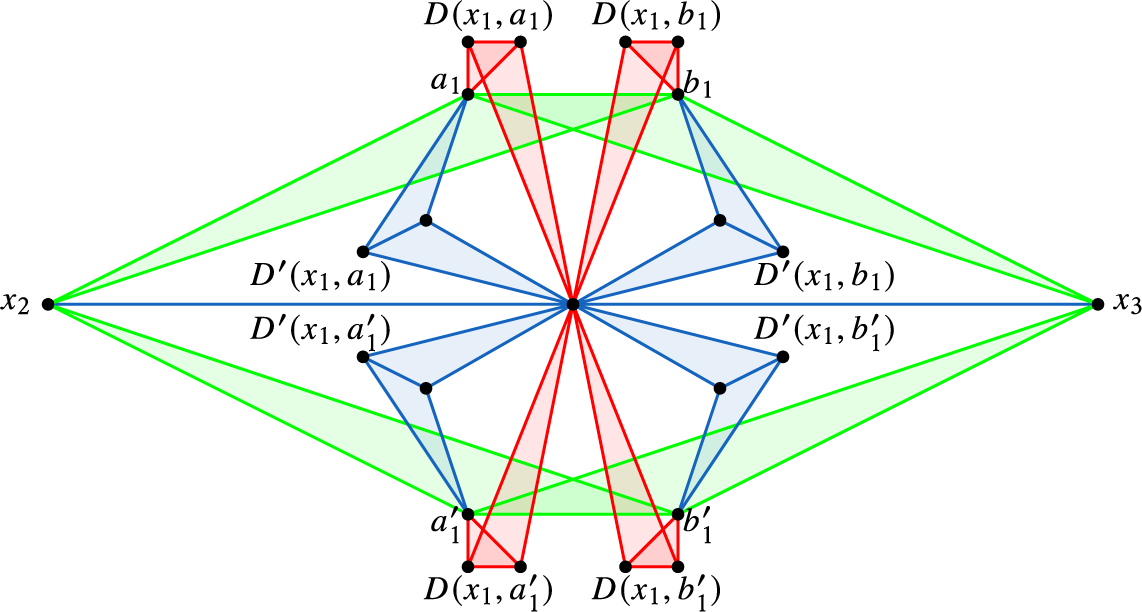
5 Upper bounds
5.1 Some common definitions and results
Recall that for an r-graph F and a pair $uv$
, the set
$uv$
, the set $C_F(uv)$
consists of all integers
$C_F(uv)$
consists of all integers $j\geqslant 0$
such that F has j edges that together with
$j\geqslant 0$
such that F has j edges that together with $uv$
include at most
$uv$
include at most $rj-2j+2$
vertices. Note that, by definition, 0 always belongs to
$rj-2j+2$
vertices. Note that, by definition, 0 always belongs to $C_{G}(uv)$
, which is notationally convenient in the statement of the following easy but very useful observation.
$C_{G}(uv)$
, which is notationally convenient in the statement of the following easy but very useful observation.
Lemma 5.1 For any ${ \mathcal {F}}^{(r)}(rk-2k+2,k)$
-free r-graph G, any
${ \mathcal {F}}^{(r)}(rk-2k+2,k)$
-free r-graph G, any $uv\in {V(G)\choose 2}$
and any edge-disjoint subgraphs
$uv\in {V(G)\choose 2}$
and any edge-disjoint subgraphs $F_1,\dots ,F_s\subseteq G$
, the sum-set
$F_1,\dots ,F_s\subseteq G$
, the sum-set
 $$ \begin{align*} \sum _{i=1}^s C_{F_i}(uv)=\left \{\sum _{i=1}^s m_i: m_i\in C_{F_i}(uv)\right \} \end{align*} $$
does not contain k.
Proof If some sequence of $m_i$
’s sums up to exactly k, then the corresponding k edges of G are all distinct and span at most
$m_i$
’s sums up to exactly k, then the corresponding k edges of G are all distinct and span at most $2+\sum _{i=1}^s (r-2)m_i = rk-2k+2$
vertices, a contradiction.
$2+\sum _{i=1}^s (r-2)m_i = rk-2k+2$
vertices, a contradiction.
As we mentioned in the introduction, our proof strategy to bound the size of an $(rk-2k+2,k)$
-free r-graph G from above is to analyze possible isomorphism types of the parts of some partition of
$(rk-2k+2,k)$
-free r-graph G from above is to analyze possible isomorphism types of the parts of some partition of $E(G)$
which is obtained from the trivial partition into single edges by iteratively applying some merging rules. Unfortunately, we did not find a single rule that works in all cases that are studied here. In fact, for every new pair
$E(G)$
which is obtained from the trivial partition into single edges by iteratively applying some merging rules. Unfortunately, we did not find a single rule that works in all cases that are studied here. In fact, for every new pair $(r,k)$
resolved in this article except for
$(r,k)$
resolved in this article except for $(3,5)$
, we build the final partition in stages (with each stage having a different merging rule) as the intermediate families are also needed in our analysis. Let us now develop some general notation and prove some basic results related to merging.
$(3,5)$
, we build the final partition in stages (with each stage having a different merging rule) as the intermediate families are also needed in our analysis. Let us now develop some general notation and prove some basic results related to merging.
Let G be an arbitrary r-graph. When dealing with a partition ${ \mathcal {P}}$
of
${ \mathcal {P}}$
of $E(G)$
, we will view each element
$E(G)$
, we will view each element $F\in { \mathcal {P}}$
as an r-graph whose vertex set is the union of the edges in F. Let
$F\in { \mathcal {P}}$
as an r-graph whose vertex set is the union of the edges in F. Let $A,B\subseteq \mathbb{N}$
be any (not necessarily disjoint) sets of positive integers. For two subgraphs
$A,B\subseteq \mathbb{N}$
be any (not necessarily disjoint) sets of positive integers. For two subgraphs $F,H\subseteq G$
, if they are edge disjoint and there is a pair
$F,H\subseteq G$
, if they are edge disjoint and there is a pair $uv$
such that
$uv$
such that $A\subseteq C_F(uv)$
and
$A\subseteq C_F(uv)$
and $B\subseteq C_H(uv)$
, then we say that F and H are
$B\subseteq C_H(uv)$
, then we say that F and H are  -mergeable (via $uv$
). Note that this relation is not symmetric in F and H: the first (resp. second) r-graph A-claims (resp. B-claims) the pair
$uv$
). Note that this relation is not symmetric in F and H: the first (resp. second) r-graph A-claims (resp. B-claims) the pair $uv$
. When the ordering of the two r-graphs does not matter, we use the shorthand
$uv$
. When the ordering of the two r-graphs does not matter, we use the shorthand  -mergeable to mean
  -mergeable or
  -mergeable. For a partition ${ \mathcal {P}}$
of
${ \mathcal {P}}$
of $E(G)$
, its
$E(G)$
, its  -merging is the partition
  of
of $E(G)$
obtained from
$E(G)$
obtained from ${ \mathcal {P}}$
by iteratively and as long as possible taking a pair of distinct
${ \mathcal {P}}$
by iteratively and as long as possible taking a pair of distinct  -mergeable parts in the current partition and replacing them by their union. Note that, if F and H are
  -mergeable via $uv$
, then
$uv$
, then
 $$ \begin{align} A\cup B \subseteq C_{F\cup H}(uv)\quad \text{and}\quad A+B\subseteq C_{F\cup H}(uv). \end{align} $$
The first inclusion implies that, in particular, the order of merging operations does not affect the partition  . Note that the final partition
  is a coarsening of ${ \mathcal {P}}$
and contains no
${ \mathcal {P}}$
and contains no  -mergeable pairs of r-graphs. When ${ \mathcal {P}}$
is clear from the context, we may refer to the elements of
${ \mathcal {P}}$
is clear from the context, we may refer to the elements of  as
as  -clusters. Likewise, a subgraph F of G that can appear as a part in some intermediate stage of the
  -merging process starting with ${ \mathcal {P}}$
is called a partial
${ \mathcal {P}}$
is called a partial  -cluster and we let
  denote the set of all partial
  -clusters. In other words,
  is the smallest family of r-graphs which contains ${ \mathcal {P}}$
as a subfamily and is closed under taking the union of
${ \mathcal {P}}$
as a subfamily and is closed under taking the union of  -mergeable elements. The monotonicity of the merging rule implies that
  is exactly the set of maximal (by inclusion) elements of
  and that the final partition
  does not depend on the order in which we merge parts.
In the frequently occurring case when $A=\{1\}$
and
$A=\{1\}$
and $B=\{j\}$
, we abbreviate
$B=\{j\}$
, we abbreviate  to
to  and
and  to
to  in the above nomenclature. Thus,
  -mergeable (resp.
  -mergeable) means
  -mergeable (resp.
  -mergeable).
As an example, let us look at the following merging rule that is actually used as the first step in each of our proofs of the upper bounds. Namely, given G, let

be the  -merging of the trivial partition ${ \mathcal {P}}_{\mathrm {trivial}}$
of G into single edges. We call the elements of
${ \mathcal {P}}_{\mathrm {trivial}}$
of G into single edges. We call the elements of  -clusters. Here is an alternative description of
  . Call a subgraph $F\subseteq G$
connected if for any two edges
$F\subseteq G$
connected if for any two edges $X,Y\in F$
there is a sequence of edges
$X,Y\in F$
there is a sequence of edges $X_1=X,X_2,\hspace {0.9pt}.\hspace {0.3pt}.\hspace {0.3pt}.\hspace {1.5pt},X_m=Y$
in F such that, for every
$X_1=X,X_2,\hspace {0.9pt}.\hspace {0.3pt}.\hspace {0.3pt}.\hspace {1.5pt},X_m=Y$
in F such that, for every $i\in [m-1]$
, we have
$i\in [m-1]$
, we have $|X_i\cap X_{i+1}|\geqslant 2$
. Then,
$|X_i\cap X_{i+1}|\geqslant 2$
. Then,  -clusters are exactly maximal connected subgraphs of G (and partial
  -clusters are exactly connected subgraphs).
We will also use (often without explicit mention) the following result, which is a generalization of the well-known fact that we can remove edges from any connected 2-graph one by one, down to any given connected subgraph, while keeping the edge set connected. The assumption (5.2) states that, roughly speaking, the merging process cannot create any new mergeable pairs.
Lemma 5.2 (Trimming lemma)
Fix an r-graph G, a partition ${ \mathcal {P}}$
of
${ \mathcal {P}}$
of $E(G)$
and sets
$E(G)$
and sets $A,B\subseteq \mathbb{N}$
.
$A,B\subseteq \mathbb{N}$
.

Then, for every partial  -cluster $F_0\subseteq F$
, there is an ordering
$F_0\subseteq F$
, there is an ordering $F_1,\dots ,F_s$
of the elements of
$F_1,\dots ,F_s$
of the elements of ${ \mathcal {P}}$
that lie inside
${ \mathcal {P}}$
that lie inside $F\setminus F_0$
such that, for every
$F\setminus F_0$
such that, for every $i\in [s]$
,
$i\in [s]$
, $\bigcup _{j=0}^{i-1} F_j$
and
$\bigcup _{j=0}^{i-1} F_j$
and $F_i$
are
$F_i$
are  -mergeable (and, in particular, $\bigcup _{j=0}^{i} F_j$
is a partial
$\bigcup _{j=0}^{i} F_j$
is a partial  -cluster for every $i\in [s]$
).
$i\in [s]$
).
Proof Suppose that the lemma is false. For every  , denote by $|H|_{{ \mathcal {P}}}$
the number of elements of
$|H|_{{ \mathcal {P}}}$
the number of elements of ${ \mathcal {P}}$
contained in H. Choose a counterexample
${ \mathcal {P}}$
contained in H. Choose a counterexample $(F_0,F)$
with
$(F_0,F)$
with $m:=|F|_{{ \mathcal {P}}}-|F_0|_{{ \mathcal {P}}}$
smallest possible. Note that
$m:=|F|_{{ \mathcal {P}}}-|F_0|_{{ \mathcal {P}}}$
smallest possible. Note that $m>0$
as otherwise
$m>0$
as otherwise $F_0=F$
and the conclusion of the lemma vacuously holds. Consider some
$F_0=F$
and the conclusion of the lemma vacuously holds. Consider some  -merging process which leads to F; let H be the first occurring partial
  -cluster that shares at least one edge with each of $F_0$
and
$F_0$
and $F\setminus F_0$
. Since the final partial
$F\setminus F_0$
. Since the final partial  -cluster F satisfies both these properties, H exists. As $F_0$
and
$F_0$
and $F\setminus F_0$
are unions of some elements of
$F\setminus F_0$
are unions of some elements of ${ \mathcal {P}}$
, we have
${ \mathcal {P}}$
, we have $H\notin { \mathcal {P}}$
. So, let the merging process for F build H as the union of
$H\notin { \mathcal {P}}$
. So, let the merging process for F build H as the union of  -mergeable partial
  -clusters $H_A,H_B\subsetneq H$
. By the definition of H, one of
$H_A,H_B\subsetneq H$
. By the definition of H, one of $H_A$
and
$H_A$
and $H_B$
, say
$H_B$
, say $H_A$
, shares an edge with
$H_A$
, shares an edge with $F_0$
but not with
$F_0$
but not with $F\setminus F_0$
while the opposite holds for
$F\setminus F_0$
while the opposite holds for $H_B$
. Then,
$H_B$
. Then, $H_A\subseteq F_0$
and
$H_A\subseteq F_0$
and $H_B\subseteq F\setminus F_0$
.
$H_B\subseteq F\setminus F_0$
.
Since the partial  -clusters $H_A$
and
$H_A$
and $H_B$
are
$H_B$
are  -mergeable, the assumption of the lemma implies that there are
  -mergeable $H^{\prime }_A\subseteq H_A$
and
$H^{\prime }_A\subseteq H_A$
and $H^{\prime }_B\subseteq H_B$
with
$H^{\prime }_B\subseteq H_B$
with $H^{\prime }_A,H^{\prime }_B\in { \mathcal {P}}$
. Then,
$H^{\prime }_A,H^{\prime }_B\in { \mathcal {P}}$
. Then, $H^{\prime }_B$
, which is edge-disjoint from
$H^{\prime }_B$
, which is edge-disjoint from $F_0$
, is
$F_0$
, is  -mergeable with $F_0\supseteq H_A$
as well. The minimality of m guarantees an ordering
$F_0\supseteq H_A$
as well. The minimality of m guarantees an ordering $F_2,\dots , F_m$
of the elements of
$F_2,\dots , F_m$
of the elements of $\mathcal {P}$
that lie inside
$\mathcal {P}$
that lie inside $F\setminus (F_0\cup H^{\prime }_B)$
satisfying the statement of the claim for the pair
$F\setminus (F_0\cup H^{\prime }_B)$
satisfying the statement of the claim for the pair $(F_0\cup H^{\prime }_B,F)$
. However, then the ordering
$(F_0\cup H^{\prime }_B,F)$
. However, then the ordering $H^{\prime }_B, F_2,\dots , F_m$
satisfies the statement of the claim for
$H^{\prime }_B, F_2,\dots , F_m$
satisfies the statement of the claim for $(F_0,F)$
, so this pair cannot be a counterexample, on the contrary to our assumption.
$(F_0,F)$
, so this pair cannot be a counterexample, on the contrary to our assumption.
In the special case $A=B=\{1\}$
(when partial clusters are just connected subgraphs), the assumption of Lemma 5.2 is vacuously true. Since we are going to use its conclusion quite often, we state it separately.
$A=B=\{1\}$
(when partial clusters are just connected subgraphs), the assumption of Lemma 5.2 is vacuously true. Since we are going to use its conclusion quite often, we state it separately.
Corollary 5.3 For every pair $F_0\subseteq F$
of connected r-graphs, there is an ordering
$F_0\subseteq F$
of connected r-graphs, there is an ordering $X_1,\dots ,X_s$
of the edges in
$X_1,\dots ,X_s$
of the edges in $F\setminus F_0$
such that, for every
$F\setminus F_0$
such that, for every $i\in [s]$
, the r-graph
$i\in [s]$
, the r-graph $F_0\cup \{X_1,\dots ,X_i\}$
is connected.
$F_0\cup \{X_1,\dots ,X_i\}$
is connected.
We say that an r-graph is a $1$
-tree if it contains only one edge. For
$1$
-tree if it contains only one edge. For $i\geqslant 2$
, we recursively define an i-tree as any r-graph that can be obtained from an
$i\geqslant 2$
, we recursively define an i-tree as any r-graph that can be obtained from an $(i-1)$
-tree T by adding a new edge that consists of a pair
$(i-1)$
-tree T by adding a new edge that consists of a pair $ab$
in the
$ab$
in the $2$
-shadow
$2$
-shadow $P_{1}(T)$
of T and
$P_{1}(T)$
of T and $r-2$
new vertices (not present in T). Clearly, every i-tree is connected. Like the usual 2-graph trees, i-trees are the “sparsest” connected r-graphs of given size. Any i-tree T satisfies
$r-2$
new vertices (not present in T). Clearly, every i-tree is connected. Like the usual 2-graph trees, i-trees are the “sparsest” connected r-graphs of given size. Any i-tree T satisfies
 $$ \begin{align} |P_{1}(T)|=i{r\choose 2}-i+1\quad\text{and}\quad |P_{\,\overline{1}2}(T)|\geqslant (i-1) (r-2)^2. \end{align} $$
(Recall that $P_{\,\overline {1}2}(T)$
is the set of pairs which are
$P_{\,\overline {1}2}(T)$
is the set of pairs which are $2$
-claimed but not
$2$
-claimed but not $1$
-claimed by T.) Note that the second inequality in (5.3) is equality if, for example, T is an i-path, that is, we can order the edges of T as
$1$
-claimed by T.) Note that the second inequality in (5.3) is equality if, for example, T is an i-path, that is, we can order the edges of T as $X_1,\dots ,X_i$
so that, for each
$X_1,\dots ,X_i$
so that, for each $j\in [i-1]$
, the intersection
$j\in [i-1]$
, the intersection $X_{j+1}\cap (\bigcup _{s=1}^j X_s)$
consists of exactly one pair of vertices and this pair belongs to
$X_{j+1}\cap (\bigcup _{s=1}^j X_s)$
consists of exactly one pair of vertices and this pair belongs to $P_{1}(X_j)\setminus P_{1}(\bigcup _{s=1}^{j-1} X_s)$
.
$P_{1}(X_j)\setminus P_{1}(\bigcup _{s=1}^{j-1} X_s)$
.
The following result shows that the  -clusters of any ${\mathcal G}^{(r)}_{k}$
-free graph have a very simple structure: namely, they are all small trees.
${\mathcal G}^{(r)}_{k}$
-free graph have a very simple structure: namely, they are all small trees.
Lemma 5.4 With the above notation, if G is ${\mathcal G}^{(r)}_{k}$
-free, then every
${\mathcal G}^{(r)}_{k}$
-free, then every  is an m-tree for some $m\in [k-1]$
.
$m\in [k-1]$
.
Proof Since F is connected, Corollary 5.3 gives an ordering $X_1,\dots ,X_m$
of its edge set such that, for each
$X_1,\dots ,X_m$
of its edge set such that, for each $i\in [2,m]$
, the ith edge
$i\in [2,m]$
, the ith edge $X_{i}$
shares at least two vertices with some earlier edge. By induction, the number of vertices spanned by
$X_{i}$
shares at least two vertices with some earlier edge. By induction, the number of vertices spanned by $\{X_1,\dots ,X_i\}$
is at most
$\{X_1,\dots ,X_i\}$
is at most $i(r-2)+2$
for each
$i(r-2)+2$
for each $i\in [m]$
. Since F is
$i\in [m]$
. Since F is $(k(r-2)+2,k)$
-free, we have
$(k(r-2)+2,k)$
-free, we have $m<k$
. Furthermore, for each
$m<k$
. Furthermore, for each $i\in [2,m]$
, the edge
$i\in [2,m]$
, the edge $X_i$
has at least
$X_i$
has at least $r-2$
vertices not present in the previous edges by the
$r-2$
vertices not present in the previous edges by the $(i(r-2)+1,i)$
-freeness of G. It follows that F is an m-tree, as desired.
$(i(r-2)+1,i)$
-freeness of G. It follows that F is an m-tree, as desired.
5.2 Upper bound for
$(r,k)= (3,5)$

We begin with the case $(r,k)= (3,5)$
, which is simpler but still embodies some key ideas that also apply to higher uniformities.
$(r,k)= (3,5)$
, which is simpler but still embodies some key ideas that also apply to higher uniformities.
Proof of the upper bound of Theorem 1.1 for
$r=3$

By Lemma 3.1, it is enough to prove that $|G|\leqslant n^2/5$
for every
$|G|\leqslant n^2/5$
for every $3$
-graph on n vertices which is
$3$
-graph on n vertices which is ${\mathcal G}^{(3)}_{5}$
-free, that is, contains no
${\mathcal G}^{(3)}_{5}$
-free, that is, contains no $(7,5)$
,
$(7,5)$
, $(5,4)$
, and
$(5,4)$
, and $(4,3)$
-configurations. Recall that
$(4,3)$
-configurations. Recall that  denotes the partition of $E(G)$
into
$E(G)$
into  -clusters. By Lemma 5.4, each
  -cluster is an i-tree with $i\leqslant 4$
edges.
$i\leqslant 4$
edges.
For an i-tree F, consider the difference $2\,|P_{1}(F)|-5\,|F|=2(2i+1)-5i=2-i$
, which is non-negative when
$2\,|P_{1}(F)|-5\,|F|=2(2i+1)-5i=2-i$
, which is non-negative when $i\in \{1,2\}$
. For
$i\in \{1,2\}$
. For $i\in \{3,4\}$
, we would like to take an extra pair (in addition to those in
$i\in \{3,4\}$
, we would like to take an extra pair (in addition to those in $P_{1}(F)$
) into account to make the difference non-negative. The following combinatorial lemma suffices for this.
$P_{1}(F)$
) into account to make the difference non-negative. The following combinatorial lemma suffices for this.
Claim 5.5 For every i-tree  with
with $i\in \{3,4\}$
, there is a pair which is
$i\in \{3,4\}$
, there is a pair which is  -claimed by F but neither $1$
-claimed nor
$1$
-claimed nor  -claimed by $G\setminus F$
.
$G\setminus F$
.
Proof of Claim 5.5
Note that no pair $xy$
can be
$xy$
can be  -claimed by both F and $G\setminus F$
, for otherwise we can find a
$G\setminus F$
, for otherwise we can find a $3$
-subtree in F (by Corollary 5.3)
$3$
-subtree in F (by Corollary 5.3)  -claiming $xy$
. This would mean that
$xy$
. This would mean that $5\in C_{G}(xy)$
by (5.1), which contradicts Lemma 5.1.
$5\in C_{G}(xy)$
by (5.1), which contradicts Lemma 5.1.
If $i=3$
, then
$i=3$
, then  -claims at least 2 pairs and at least one of them is not $1$
-claimed by
$1$
-claimed by $G\setminus F$
: indeed, if they are
$G\setminus F$
: indeed, if they are $1$
-claimed by different edges, then we get a
$1$
-claimed by different edges, then we get a $(7,5)$
-configuration, and if they are
$(7,5)$
-configuration, and if they are $1$
-claimed by the same edge, then we get a
$1$
-claimed by the same edge, then we get a $(5,4)$
-configuration, a contradiction in either case. If
$(5,4)$
-configuration, a contradiction in either case. If $i=4$
, then
$i=4$
, then  -claims at least 3 pairs and, in fact, none can be $1$
-claimed by
$1$
-claimed by $G\setminus F$
(as otherwise we would have a
$G\setminus F$
(as otherwise we would have a $(7,5)$
-configuration).
$(7,5)$
-configuration).
Now, for each i-tree  , define $P^{\prime }_1(F)$
to be
$P^{\prime }_1(F)$
to be $P_{1}(F)$
if
$P_{1}(F)$
if $i\in \{1,2\}$
, and to be
$i\in \{1,2\}$
, and to be $P_{1}(F)$
plus the pair returned by Claim 5.5 if
$P_{1}(F)$
plus the pair returned by Claim 5.5 if $i\in \{3,4\}$
.
$i\in \{3,4\}$
.
The sets $P^{\prime }_1(F)$
for
$P^{\prime }_1(F)$
for  are pairwise disjoint and satisfy $2\,|P^{\prime }_1(F)|\geqslant 5\,|F|$
. Thus,
$2\,|P^{\prime }_1(F)|\geqslant 5\,|F|$
. Thus,

giving the desired.
5.3 Upper bounds of Theorems 1.1 and 1.2
In this section, we shall prove the remaining upper bounds of Theorems 1.1 and 1.2, that is, the cases when $k=5$
and
$k=5$
and $r\geqslant 4$
, or
$r\geqslant 4$
, or $k=7$
and
$k=7$
and $r\geqslant 3$
. First, let us present some definitions and auxiliary results that are common to the proofs of both theorems.
$r\geqslant 3$
. First, let us present some definitions and auxiliary results that are common to the proofs of both theorems.
Let $k\in \{5,7\}$
and let G be an arbitrary
$k\in \{5,7\}$
and let G be an arbitrary ${\mathcal G}^{(r)}_{k}$
-free r-graph. Recall that
${\mathcal G}^{(r)}_{k}$
-free r-graph. Recall that  denotes the partition of $E(G)$
into
$E(G)$
into  -clusters.
We say that a subgraph $H\subseteq G\ 2^+$
-claims a pair
$H\subseteq G\ 2^+$
-claims a pair $uv\in {V(G)\choose 2}$
if H has a subtree T with 3 edges that
$uv\in {V(G)\choose 2}$
if H has a subtree T with 3 edges that $\{2,3\}$
-claims
$\{2,3\}$
-claims $uv$
(which, by Corollary 5.3, is equivalent to
$uv$
(which, by Corollary 5.3, is equivalent to $T\ 2$
-claiming the pair
$T\ 2$
-claiming the pair $uv$
). Let us say that two edge-disjoint subgraphs
$uv$
). Let us say that two edge-disjoint subgraphs $F,H\subseteq G$
are
$F,H\subseteq G$
are  -mergeable (via a pair $uv$
) if
$uv$
) if $uv$
is
$uv$
is $1$
-claimed by F and is
$1$
-claimed by F and is $2^+$
-claimed by H. If the order of F and H does not matter, we just say
$2^+$
-claimed by H. If the order of F and H does not matter, we just say  -mergeable. Let
  be the partition of $E(G)$
obtained from
$E(G)$
obtained from  by iteratively and as long as possible taking two
  -mergeable elements F and H and replacing them by $F\cup H$
. Let
$F\cup H$
. Let  be the smallest family of subgraphs of G that contains all
  -clusters and is closed under
  -merging. We call the elements of
  partial
  -clusters. By the monotonicity of the merging rule, the family
  consists of the maximal elements of
  and does not depend on the order of the merging steps.
Note that the relations of being  -mergeable and
  -mergeable, while having many similarities, differ in general (e.g., a subgraph with 3 edges $3$
-claiming a pair need not be a tree). As far as we see, the latter relation can also be used to prove the upper bounds for
$3$
-claiming a pair need not be a tree). As far as we see, the latter relation can also be used to prove the upper bounds for $k\in \{5,7\}$
but the former is more convenient for us to work with.
$k\in \{5,7\}$
but the former is more convenient for us to work with.
If a partial  -cluster $F\ 2^+$
-claims a pair
$F\ 2^+$
-claims a pair $uv$
as witnessed by a 3-tree
$uv$
as witnessed by a 3-tree $T\subseteq F$
, then trivially T is a subgraph of one of the
$T\subseteq F$
, then trivially T is a subgraph of one of the  -clusters in F and this
  -cluster $2^+$
-claims the pair
$2^+$
-claims the pair $uv$
. Since the analogous statement for
$uv$
. Since the analogous statement for $1$
-claimed pairs is trivial, we have the analog of Assumption (5.2) for
$1$
-claimed pairs is trivial, we have the analog of Assumption (5.2) for  -mergeability (with
  ). The proof of Lemma 5.2 with the obvious modifications works for partial
  -clusters. We will need only the following special case.
Lemma 5.6 For every  and
and  such that $T\subseteq F$
, there is an ordering
$T\subseteq F$
, there is an ordering $T_1,\dots ,T_t$
of all
$T_1,\dots ,T_t$
of all  -clusters in F such that $T_1=T$
and, for every
$T_1=T$
and, for every $i\in [t-1]$
,
$i\in [t-1]$
, $T_{i+1}$
and
$T_{i+1}$
and $\bigcup _{j=1}^{i} T_j$
are
$\bigcup _{j=1}^{i} T_j$
are  -mergeable. (In particular,
  for every $i\in [t]$
.)
$i\in [t]$
.)
We say that an r-graph  -claims a pair $uv$
if it
$uv$
if it $2^+$
-claims but not
$2^+$
-claims but not $1$
-claims
$1$
-claims $uv$
, and denote the set of all such pairs by
$uv$
, and denote the set of all such pairs by $P_{\,\overline {1}2^+}(F)$
. Note that, if we build
$P_{\,\overline {1}2^+}(F)$
. Note that, if we build  -clusters by starting with
  -clusters and merge some
  -mergeable F and H via $uv$
, then the pair
$uv$
, then the pair $uv$
is
$uv$
is  -claimed by H. An integer sequence $(e_1,\dots ,e_t)$
is called a composition of a partial
$(e_1,\dots ,e_t)$
is called a composition of a partial  -cluster
  if there is a sequence $(T_1,\dots ,T_t)$
as in Lemma 5.6 with
$(T_1,\dots ,T_t)$
as in Lemma 5.6 with $|T_i|=e_i$
for each
$|T_i|=e_i$
for each $i\in [t]$
. Of course, every two compositions of the same
$i\in [t]$
. Of course, every two compositions of the same  -cluster are permutations of each other. The (non-increasing) composition of F is the non-increasing reordering of $(e_1,\dots ,e_t)$
; in general, there need not be a sequence of iterative legal merges realizing it.
$(e_1,\dots ,e_t)$
; in general, there need not be a sequence of iterative legal merges realizing it.
Proof of the upper bound of Theorem 1.1 for
$r\geqslant 4$

By Lemma 3.1, it is enough to bound the size of any ${\mathcal G}^{(r)}_{5}$
-free r-graph G on
${\mathcal G}^{(r)}_{5}$
-free r-graph G on $[n]$
from above. As before,
$[n]$
from above. As before,  (resp.
  ) denotes the set of
  -clusters (resp.
  -clusters) of G. By Lemma 5.4, each
  -cluster is an i-tree with $i\in [4]$
.
$i\in [4]$
.
Let every  -cluster
  assign weight $1$
to every pair in
$1$
to every pair in $P_{1}(F)$
and in
$P_{1}(F)$
and in $P_{\,\overline {1}2^+}(F)$
. Note that every pair
$P_{\,\overline {1}2^+}(F)$
. Note that every pair $xy$
receives weight at most
$xy$
receives weight at most $1$
. Indeed, suppose for contradiction that
$1$
. Indeed, suppose for contradiction that $xy$
receives weight 1 from two different
$xy$
receives weight 1 from two different  -clusters F and H. Then, $xy$
must be
$xy$
must be  -claimed by both (as otherwise F and H would be merged together). However, this implies that $\{2,3\}\subseteq C_{F}(xy)\cap C_{H}(xy)$
, which contradicts Lemma 5.1.
$\{2,3\}\subseteq C_{F}(xy)\cap C_{H}(xy)$
, which contradicts Lemma 5.1.
Thus, in order to prove the theorem, it is enough to show that, for every  , we have $\lambda (F)\geqslant 0$
where
$\lambda (F)\geqslant 0$
where
 $$ \begin{align*}\lambda(F):=2\left(|P_{1}(F)|+|P_{\,\overline{1}2^+}(F)|\right)-(r^2-r-1)|F|. \end{align*} $$
Indeed, we will then have that

Claim 5.7 Every  has at most four edges.
Proof of Claim 5.7
Suppose for the sake of contradiction that $|F|\geqslant 5$
(and thus
$|F|\geqslant 5$
(and thus $|F|\geqslant 6$
since F contains at most
$|F|\geqslant 6$
since F contains at most $(r-2)|F|+2$
vertices and G is
$(r-2)|F|+2$
vertices and G is $(5r-8,5)$
-free). Let F be obtained by merging
$(5r-8,5)$
-free). Let F be obtained by merging  -clusters
  in this order as in Lemma 5.6. Let us stop the merging process when we reach a partial
  -cluster containing at least 5 (and thus at least 6) edges. Suppose that we have merged $F_1,\dots ,F_s$
until this point. By Lemma 5.4, we have
$F_1,\dots ,F_s$
until this point. By Lemma 5.4, we have $|F_s|\leqslant 4$
and thus
$|F_s|\leqslant 4$
and thus $s\geqslant 2$
.
$s\geqslant 2$
.
We claim that the last tree $F_s$
has exactly three edges. As G is
$F_s$
has exactly three edges. As G is $(5r-8,5)$
-free, it holds that
$(5r-8,5)$
-free, it holds that $|\bigcup _{i=1}^{s-1} F_i|\neq 5$
. Thus,
$|\bigcup _{i=1}^{s-1} F_i|\neq 5$
. Thus, $F_s$
has at least two edges. In fact,
$F_s$
has at least two edges. In fact, $F_s$
cannot have exactly two edges as otherwise the subgraph
$F_s$
cannot have exactly two edges as otherwise the subgraph $\bigcup _{i=1}^{s-1} F_i$
of size 4 would
$\bigcup _{i=1}^{s-1} F_i$
of size 4 would  -claim a pair in $P_{1}(F_s)$
, contradicting Lemma 5.1. Also, the tree
$P_{1}(F_s)$
, contradicting Lemma 5.1. Also, the tree $F_s$
cannot have 4 edges as otherwise any
$F_s$
cannot have 4 edges as otherwise any  -merging involving it would lead to a $(5r-8,5)$
-configuration and we would have
$(5r-8,5)$
-configuration and we would have $s=1$
, a contradiction.
$s=1$
, a contradiction.
Next, we can build the partial  -cluster $\bigcup _{i=1}^s F_i$
by starting with
$\bigcup _{i=1}^s F_i$
by starting with $H_1:=F_s$
as in Lemma 5.6; let us stop here at the first moment when the current partial
$H_1:=F_s$
as in Lemma 5.6; let us stop here at the first moment when the current partial  -cluster H, say composed of $H_1,\dots ,H_t\in \{F_1,\dots ,F_{s}\}$
in this order, has at least five edges. As before, we have that
$H_1,\dots ,H_t\in \{F_1,\dots ,F_{s}\}$
in this order, has at least five edges. As before, we have that $|H_t|= 3$
. By
$|H_t|= 3$
. By $(5r-8,5)$
-freeness, the sizes of the
$(5r-8,5)$
-freeness, the sizes of the  -clusters in H in the order of merging are either $(3,3)$
or
$(3,3)$
or $(3,1,3)$
. In the former (resp. latter) case, we can remove an edge from one (resp. each) of the 3-trees
$(3,1,3)$
. In the former (resp. latter) case, we can remove an edge from one (resp. each) of the 3-trees $H_1$
and
$H_1$
and $H_t$
so that the remaining subgraph is a diamond
$H_t$
so that the remaining subgraph is a diamond  -claiming the pair along which this tree attaches to the rest of H. This way, we can find a sequence of trees of sizes $(3,2)$
or
$(3,2)$
or $(2,1,2)$
with each one containing some 2 previously used vertices. This gives a forbidden
$(2,1,2)$
with each one containing some 2 previously used vertices. This gives a forbidden $5$
-edge configuration, proving that
$5$
-edge configuration, proving that $|F|\leqslant 4$
for every
$|F|\leqslant 4$
for every  .
.
It follows that, if  is not a tree, then F is made of a single edge and a 3-tree which must share exactly two vertices (for otherwise a $(4r-7,4)$
-configuration appears). In this case, we have that
$(4r-7,4)$
-configuration appears). In this case, we have that $|P_{1}(F)|=4{r\choose 2}-2$
and
$|P_{1}(F)|=4{r\choose 2}-2$
and $|P_{\,\overline {1}2^+}(F)|\geqslant 2(r-2)^2-1$
. Thus,
$|P_{\,\overline {1}2^+}(F)|\geqslant 2(r-2)^2-1$
. Thus,
 $$ \begin{align*}\lambda(F)\geqslant 2\left(4{r\choose 2}-2+2(r-2)^2-1\right)-(r^2-r+1)\cdot 4=4r^2-16r+6, \end{align*} $$
which is positive for $r\geqslant 4$
.
$r\geqslant 4$
.
Let  be an i-tree. If $i\geqslant 3$
, then
$i\geqslant 3$
, then $|P_{\,\overline {1}2^+}(F)|\geqslant (i-1)(r-2)^2$
and we have
$|P_{\,\overline {1}2^+}(F)|\geqslant (i-1)(r-2)^2$
and we have
 $$ \begin{align*} \lambda(F)&\geqslant 2\left(i{r\choose 2}-i+1+(i-1)(r-2)^2\right)-(r^2-r-1)i\\ &=i\left(2r^2-8r+7\right)-(2r^2-8r+6). \end{align*} $$
For $r\geqslant 4$
, this expression is monotone increasing in i and thus is at least its value when
$r\geqslant 4$
, this expression is monotone increasing in i and thus is at least its value when $i=3$
, which is
$i=3$
, which is $4r^2-16r+15\geqslant 15$
. Finally, if
$4r^2-16r+15\geqslant 15$
. Finally, if $i=1,2$
, then
$i=1,2$
, then $\lambda (F)$
is respectively
$\lambda (F)$
is respectively $2{r\choose 2}-(r^2-r-1)=1$
and
$2{r\choose 2}-(r^2-r-1)=1$
and $2\left (2{r\choose 2}-1\right )-2(r^2-r-1)=0$
.
$2\left (2{r\choose 2}-1\right )-2(r^2-r-1)=0$
.
Hence, for all  , we have that $\lambda (F)\geqslant 0$
, which finishes the proof of the theorem by (5.4).
$\lambda (F)\geqslant 0$
, which finishes the proof of the theorem by (5.4).
Proof of the upper bound of Theorem 1.2
By Lemma 3.1, it is sufficient to bound the size of any ${\mathcal G}^{(r)}_{7}$
-free r-graph G of order n from above. As before,
${\mathcal G}^{(r)}_{7}$
-free r-graph G of order n from above. As before,  (resp.
  ) is the set of all
  -clusters (resp.
  -clusters) of G. By Lemma 5.4, each element of
  is an i-tree with $i\in [6]$
.
$i\in [6]$
.
Let each  -cluster
  assign weight $1$
to each pair it
$1$
to each pair it $1$
-claims and weight
$1$
-claims and weight $1/2$
to each pair it
$1/2$
to each pair it  -claims. Let us show that every pair $xy\in \binom {V(G)}{2}$
receives weight at most
$xy\in \binom {V(G)}{2}$
receives weight at most $1$
. If a pair of vertices is
$1$
. If a pair of vertices is $1$
-claimed by some
$1$
-claimed by some  -cluster, then it cannot be $1$
-claimed or
$1$
-claimed or $2^+$
-claimed by another
$2^+$
-claimed by another  -cluster as otherwise this would violate the merging rules for
  or
or  . Furthermore, a pair of vertices $xy$
cannot be
$xy$
cannot be $\{2,3\}$
-claimed by three
$\{2,3\}$
-claimed by three  -clusters by Lemma 5.1. So $xy$
indeed receives weight at most 1.
$xy$
indeed receives weight at most 1.
Thus, in order to prove the upper bound, it is sufficient to show that each  -cluster F satisfies that
 $$ \begin{align} \lambda(F):=2w(F)- (r^2-r-1)|F|\geqslant 0, \end{align} $$
where $w(F):=|P_{1}(F)|+\frac {1}{2}|P_{\,\overline {1}2^+}(F)|$
is the total weight assigned by F to the vertex pairs. Indeed, we would then be done since
$w(F):=|P_{1}(F)|+\frac {1}{2}|P_{\,\overline {1}2^+}(F)|$
is the total weight assigned by F to the vertex pairs. Indeed, we would then be done since

To show (5.5), we first prove the following claim.
Claim 5.8 For each  , we have $|F|\leqslant 6$
.
$|F|\leqslant 6$
.
Proof of Claim 5.8
Suppose for contradiction that  has at least $7$
edges. Since F is
$7$
edges. Since F is $(7r-12,7)$
-free, we have
$(7r-12,7)$
-free, we have $|F|\geqslant 8$
. Let F be obtained by merging m distinct
$|F|\geqslant 8$
. Let F be obtained by merging m distinct  -clusters
  in this order as in Lemma 5.6.
Let $s\in [m]$
be the first index satisfying
$s\in [m]$
be the first index satisfying $|\bigcup _{i=1}^{s} T_i|\geqslant 8$
. Then,
$|\bigcup _{i=1}^{s} T_i|\geqslant 8$
. Then, $|\bigcup _{i=1}^{s-1} T_i|\leqslant 6$
as F is
$|\bigcup _{i=1}^{s-1} T_i|\leqslant 6$
as F is $(7r-12,7)$
-free. Hence,
$(7r-12,7)$
-free. Hence, $|T_s|\geqslant 2$
. It is impossible that
$|T_s|\geqslant 2$
. It is impossible that $T_s$
and
$T_s$
and $T_1\cup \hspace {0.9pt}.\hspace {0.3pt}.\hspace {0.3pt}.\hspace {1.5pt}\cup T_{s-1}$
are
$T_1\cup \hspace {0.9pt}.\hspace {0.3pt}.\hspace {0.3pt}.\hspace {1.5pt}\cup T_{s-1}$
are  -mergeable as otherwise we could trim edges from $T_s$
using Corollary 5.3 to get a
$T_s$
using Corollary 5.3 to get a $(7r-12,7)$
-configuration in F, a contradiction. Thus,
$(7r-12,7)$
-configuration in F, a contradiction. Thus, $T_s\ 2^+$
-claims some pair
$T_s\ 2^+$
-claims some pair $xy\ 1$
-claimed by
$xy\ 1$
-claimed by $\bigcup _{i=1}^{s-1} T_i$
; in particular,
$\bigcup _{i=1}^{s-1} T_i$
; in particular, $|T_s|\geqslant 3$
. Let D be the diamond in
$|T_s|\geqslant 3$
. Let D be the diamond in  -claiming $xy$
. We note that
$xy$
. We note that $|(\bigcup _{i=1}^{s-1} T_i)\cup D|\geqslant 8$
since otherwise we could trim edges in
$|(\bigcup _{i=1}^{s-1} T_i)\cup D|\geqslant 8$
since otherwise we could trim edges in $T_s\setminus D$
using Corollary 5.3 to obtain a
$T_s\setminus D$
using Corollary 5.3 to obtain a $(7r-12,7)$
-configuration. Thus,
$(7r-12,7)$
-configuration. Thus, $|\bigcup _{i=1}^{s-1} T_i|=6$
. Let
$|\bigcup _{i=1}^{s-1} T_i|=6$
. Let $T_1':=T_s$
and let
$T_1':=T_s$
and let $T_2'$
be any
$T_2'$
be any  -cluster in $\{T_1,\dots ,T_{s-1}\}$
which is
$\{T_1,\dots ,T_{s-1}\}$
which is  -mergeable with $T_1'$
. By Lemma 5.6, we can obtain the partial
$T_1'$
. By Lemma 5.6, we can obtain the partial  -cluster $\bigcup _{i=1}^{s-1} T_i$
by starting with
$\bigcup _{i=1}^{s-1} T_i$
by starting with $T_2'$
and
$T_2'$
and  -merging the remaining
  -clusters one at a time, say $T_3',\dots ,T_s'$
in this order. Let
$T_3',\dots ,T_s'$
in this order. Let $t\in [s]$
be the smallest index such that
$t\in [s]$
be the smallest index such that $T_1'\cup \ldots \cup T_t'$
has at least
$T_1'\cup \ldots \cup T_t'$
has at least $7$
edges. By the same argument as before, we derive that
$7$
edges. By the same argument as before, we derive that $|\bigcup _{i=1}^{t-1}T^{\prime }_i|=6$
and
$|\bigcup _{i=1}^{t-1}T^{\prime }_i|=6$
and $|T_t'|\geqslant 3$
. Also, we can trim edges one by one from each of the “pendant”
$|T_t'|\geqslant 3$
. Also, we can trim edges one by one from each of the “pendant”  -clusters $T_1'$
and
$T_1'$
and $T_t'$
down to a diamond so that each intermediate subgraph is always a tree that shares 2 vertices with the partial
$T_t'$
down to a diamond so that each intermediate subgraph is always a tree that shares 2 vertices with the partial  -cluster $F':=\bigcup _{i=2}^{t-1} T_i'$
. Since
$F':=\bigcup _{i=2}^{t-1} T_i'$
. Since $|F'|\leqslant 6-|T_1'|\leqslant 3$
, we must encounter a
$|F'|\leqslant 6-|T_1'|\leqslant 3$
, we must encounter a $(7r-12,7)$
-configuration inside
$(7r-12,7)$
-configuration inside $\bigcup _{i=1}^t T_i'$
in this process, a contradiction.
$\bigcup _{i=1}^t T_i'$
in this process, a contradiction.
Now, we prove (5.5) for every  -cluster
  .
.
Take any  -merging sequence $T_1,\dots ,T_m$
for F as in Lemma 5.6. For
$T_1,\dots ,T_m$
for F as in Lemma 5.6. For $i\in [m]$
, let
$i\in [m]$
, let $e_i:=|T_i|$
. Thus,
$e_i:=|T_i|$
. Thus, $(e_1,\dots ,e_m)$
is a composition of F. Then,
$(e_1,\dots ,e_m)$
is a composition of F. Then,
 $$ \begin{align*}|P_{\,\overline{1}2^+}(F)|\geqslant 1-m+\sum_{e_i\geqslant 3}(e_i-1)(r-2)^2,\end{align*} $$
since each $T_i$
shares exactly two vertices with
$T_i$
shares exactly two vertices with $\bigcup _{j=1}^{i-1}T_j$
(as otherwise there would be an
$\bigcup _{j=1}^{i-1}T_j$
(as otherwise there would be an $(r\ell -2\ell +1,\ell )$
-configuration in G for some
$(r\ell -2\ell +1,\ell )$
-configuration in G for some $\ell \in [2,6]$
). Thus, by (5.3), we have that
$\ell \in [2,6]$
). Thus, by (5.3), we have that
 $$ \begin{align} \lambda(F)&\geqslant 2\sum_{i=1}^m\left(e_i{r\choose 2}-e_i+1\right) +1-m+\sum_{e_i\geqslant 3} (e_i-1)(r-2)^2- (r^2-r-1)\sum_{i=1}^m e_i\nonumber\\ &=1+(r-2)^2\sum_{e_i\geqslant 3} (e_i-1)- \sum_{i=1}^m (e_i-1). \end{align} $$
Our goal is to show that (5.6) is non-negative. Let us denote by $x = x(F)$
the number of diamonds in the merging sequence of F, that is, the number of
$x = x(F)$
the number of diamonds in the merging sequence of F, that is, the number of $i\in [m]$
with
$i\in [m]$
with $e_i=2$
. Note that
$e_i=2$
. Note that $x\leqslant 1$
: indeed, if
$x\leqslant 1$
: indeed, if $m\geqslant 2$
, then
$m\geqslant 2$
, then $\max (e_1,e_2)\geqslant 3$
(in order for the first merging to occur) and Claim 5.8 implies that
$\max (e_1,e_2)\geqslant 3$
(in order for the first merging to occur) and Claim 5.8 implies that $x\leqslant \lfloor \tfrac {6-3}{2}\rfloor = 1$
. Since the contribution of each
$x\leqslant \lfloor \tfrac {6-3}{2}\rfloor = 1$
. Since the contribution of each $e_i\not =2$
to the right-hand side of (5.6) is non-negative, the expression there is at least
$e_i\not =2$
to the right-hand side of (5.6) is non-negative, the expression there is at least $1-x\geqslant 0$
, as desired.
$1-x\geqslant 0$
, as desired.
5.4 Upper bounds for
$k=6$

Here we set $k=6$
. We will continue using the definitions of Section 5.1 for a given
$k=6$
. We will continue using the definitions of Section 5.1 for a given ${\mathcal G}^{(r)}_{6}$
-free r-graph G. In particular, recall that
${\mathcal G}^{(r)}_{6}$
-free r-graph G. In particular, recall that  denotes the set of
  -clusters of G. However, unlike in the cases $k=5,7$
, diamonds in the final partition would have to assign some positive weight to
$k=5,7$
, diamonds in the final partition would have to assign some positive weight to  -claimed pairs as otherwise the best we could hope for would be only $|G|\leqslant (\frac 1{r^2-r-1}+o(1))n^2$
, which is strictly larger than the desired upper bound. This brings extra challenges to proving that each pair of vertices receives weight at most 1. We resolved this by using a different merging rule. Namely, in addition to the partition
$|G|\leqslant (\frac 1{r^2-r-1}+o(1))n^2$
, which is strictly larger than the desired upper bound. This brings extra challenges to proving that each pair of vertices receives weight at most 1. We resolved this by using a different merging rule. Namely, in addition to the partition  of
of $E(G)$
into
$E(G)$
into  -clusters, we will also use the partition

which is obtained from the partition  by iteratively and as long as possible combining
  -mergeable pairs, that is, two current parts such that the first 1-claims and the second 2-claims the same pair. Also, we define
  to consist of all subgraphs of G that may appear at any stage of this process, calling the elements of
  (resp.
  )
)  -clusters (resp. partial
  -clusters).
Let us observe some basic properties of (partial)  -clusters. If some two partial
  -clusters F and H are
  -mergeable via a pair $uv$
then it holds that
$uv$
then it holds that $uv\not \in P_{1}(H)$
(as otherwise
$uv\not \in P_{1}(H)$
(as otherwise  -clusters of F and $H\ 1$
-claiming the pair
$H\ 1$
-claiming the pair $uv$
would have been merged when constructing
$uv$
would have been merged when constructing  ). Likewise, if a partial
  -cluster $F\ 2$
-claims
$F\ 2$
-claims $uv$
then the pair
$uv$
then the pair $uv$
is
$uv$
is $2$
-claimed by one of the
$2$
-claimed by one of the  -clusters that make F. Thus, Assumption (5.2) of Lemma 5.2 holds and the conclusion of the lemma applies here.
For  which is made by merging
  -clusters $F_1,\dots ,F_m$
in this order as in Lemma 5.2, we call the sequences of sizes
$F_1,\dots ,F_m$
in this order as in Lemma 5.2, we call the sequences of sizes $(|F_1|,\dots ,|F_m|)$
a composition of F. Its non-increasing reordering is called the (non-increasing) composition of F.
$(|F_1|,\dots ,|F_m|)$
a composition of F. Its non-increasing reordering is called the (non-increasing) composition of F.
Also, recall that, by Lemma 5.1, it holds for any edge-disjoint subgraphs $F_1,\dots ,F_s\subseteq G$
and any
$F_1,\dots ,F_s\subseteq G$
and any $xy\in {V(G)\choose 2}$
that
$xy\in {V(G)\choose 2}$
that
 $$ \begin{align} 6\notin \sum_{i=1}^s C_{F_i}(xy). \end{align} $$
Next, in Lemma 5.9 below, we derive some combinatorial properties that every partial  -cluster has to satisfy and that will suffice for our estimates. (An exact description of all possible partial
  -clusters is possible, with some extra work.) Since the proof of the lemma does not introduce any new ideas in addition to the ones seen before, the reader may skip it in the first reading.
Lemma 5.9 Let $r\geqslant 3$
and G be an arbitrary
$r\geqslant 3$
and G be an arbitrary ${\mathcal G}^{(r)}_{6}$
-free r-graph. Let a partial
${\mathcal G}^{(r)}_{6}$
-free r-graph. Let a partial  -cluster F be obtained by merging the elements $T_1,\dots ,T_m$
of
$T_1,\dots ,T_m$
of  in this order as in Lemma 5.2. Let $(e_1,\dots ,e_m)$
be the composition of F, that is, the non-increasing reordering of
$(e_1,\dots ,e_m)$
be the composition of F, that is, the non-increasing reordering of $(|T_1|,\dots ,|T_m|)$
. Then, each of the following statements holds.
$(|T_1|,\dots ,|T_m|)$
. Then, each of the following statements holds.
-
(a) If F has at least
$7$
edges, then
$(e_1,\dots ,e_m)$
is either
$(3,2,2)$
or
$(2,\dots ,2,1)$
with at most
$r(r-1)$
entries equal to
$2$
. If, moreover,
$T_1$
is the unique -cluster of size different from
$2$
(that is,
$|T_1|=1$
or
$3$
) then, for each
$i\in [2,m]$
,
$H_i:=\bigcup _{j=1}^{i-1} T_j$
and
$T_i$
are -mergeable via some pair
$xy\in P_{\,\overline {1}2}(T_i)$
while no other pair in
$P_{\,\overline {1}2}({T_i})$
is
$1$
-claimed or
$2$
-claimed by
$H_i$
. -
(b) It holds that
$|P_{\,\overline {1}2}(F) |\geqslant 1-m+\sum _{i=1}^m (e_i-1) (r-2)^2$
. -
(c) If
$(e_1,\dots ,e_m)=(2,1,1,1)$
then no pair in
$P_{\,\overline {1}2}(F)$
is
$1$
-claimed or
$2$
-claimed by
$G\setminus F$
.


 -cluster of size different from


 -mergeable via some pair


Proof Suppose first that the partial  -cluster F has at least $7$
edges. We prove the first two claims of the lemma for this F simultaneously.
$7$
edges. We prove the first two claims of the lemma for this F simultaneously.
Let $s\in [m]$
be the first index such that
$s\in [m]$
be the first index such that $|\bigcup _{i=1}^{s} T_i|\geqslant 7$
. Then,
$|\bigcup _{i=1}^{s} T_i|\geqslant 7$
. Then, $|H_s|\leqslant 5$
as F is
$|H_s|\leqslant 5$
as F is $(6r-10,6)$
-free, and hence,
$(6r-10,6)$
-free, and hence, $|T_{s}|\geqslant 2$
. If
$|T_{s}|\geqslant 2$
. If $T_{s}$
and
$T_{s}$
and $H_s$
are
$H_s$
are  -mergeable, then by Corollary 5.3 we can remove some edges from $T_{s}$
to get a
$T_{s}$
to get a $(6r-10,6)$
-configuration inside
$(6r-10,6)$
-configuration inside $H_s\cup T_s$
, a contradiction. Hence,
$H_s\cup T_s$
, a contradiction. Hence, $T_{s}$
must
$T_{s}$
must  -claim some pair $xy\ 1$
-claimed by
$xy\ 1$
-claimed by $H_s$
. Let
$H_s$
. Let $D\subseteq T_s$
be the (unique) diamond
$D\subseteq T_s$
be the (unique) diamond  -claiming $xy$
. Note that
$xy$
. Note that $|H_s\cup D|\geqslant 7$
as otherwise Corollary 5.3 implies that we could remove some edges from
$|H_s\cup D|\geqslant 7$
as otherwise Corollary 5.3 implies that we could remove some edges from $T_{s}\setminus D$
one by one to obtain a
$T_{s}\setminus D$
one by one to obtain a $(6r-10,6)$
-configuration. Thus,
$(6r-10,6)$
-configuration. Thus, $|H_s|=5$
.
$|H_s|=5$
.
Let $T_1':=T_s$
and let
$T_1':=T_s$
and let $T_2'\in \{T_1,\dots ,T_{s-1}\}$
be a
$T_2'\in \{T_1,\dots ,T_{s-1}\}$
be a  -cluster $2$
-mergeable with
$2$
-mergeable with $T_s$
. Let
$T_s$
. Let $(T_2',\dots ,T_{s}')$
be the ordering of
$(T_2',\dots ,T_{s}')$
be the ordering of $\{T_1,\dots ,T_{s-1}\}$
returned by Lemma 5.2 for the partial
$\{T_1,\dots ,T_{s-1}\}$
returned by Lemma 5.2 for the partial  -clusters $T_2'\subseteq \bigcup _{i=1}^{s-1} T_i$
. By the choice of
$T_2'\subseteq \bigcup _{i=1}^{s-1} T_i$
. By the choice of $T_2'$
, for each
$T_2'$
, for each $i=2,\dots ,s$
the
$i=2,\dots ,s$
the  -cluster $T_i'$
is
$T_i'$
is  -mergeable with the partial
  -cluster $\bigcup _{j=1}^{i-1}T_j'$
. Let
$\bigcup _{j=1}^{i-1}T_j'$
. Let $t\in [s]$
be the first index such that
$t\in [s]$
be the first index such that $|\bigcup _{i=1}^{t} T_i'|\geqslant 7$
. Set
$|\bigcup _{i=1}^{t} T_i'|\geqslant 7$
. Set $H':=\bigcup _{i=1}^{t-1} T_i'$
. By the same argument as in the previous paragraph, we have that
$H':=\bigcup _{i=1}^{t-1} T_i'$
. By the same argument as in the previous paragraph, we have that $|H'|=5$
and there is a diamond
$|H'|=5$
and there is a diamond $D'\subseteq T_t'$
such that
$D'\subseteq T_t'$
such that $H'$
and
$H'$
and $D'$
are
$D'$
are  -mergeable.
Thus, we have a partial  -cluster $F':=\bigcup _{i=1}^{t} T_i'$
with at least
$F':=\bigcup _{i=1}^{t} T_i'$
with at least $7$
edges built via the sequence
$7$
edges built via the sequence $(T_1',T_2',\dots ,T_t')$
so that the first
$(T_1',T_2',\dots ,T_t')$
so that the first  -cluster $T_1'=T_s$
(resp. the last
$T_1'=T_s$
(resp. the last  -cluster $T_t'$
) can be merged with the rest through only one pair, which is
$T_t'$
) can be merged with the rest through only one pair, which is  -claimed by the diamond $D\subseteq T_s$
(resp.
$D\subseteq T_s$
(resp. $D'\subseteq T_t'$
). Here we have the freedom to trim one or both of these two clusters, leaving any number of edges in each except exactly 1 edge. It routinely follows that
$D'\subseteq T_t'$
). Here we have the freedom to trim one or both of these two clusters, leaving any number of edges in each except exactly 1 edge. It routinely follows that $|T_1'|=|T_t'|=2$
(that is,
$|T_1'|=|T_t'|=2$
(that is, $T_1'=D$
and
$T_1'=D$
and $T_t'=D'$
). For example, if
$T_t'=D'$
). For example, if $(|T_1'|,|T_t'|)=(3,3)$
, then we can trim exactly one edge (from
$(|T_1'|,|T_t'|)=(3,3)$
, then we can trim exactly one edge (from $T_1'$
), two edges (one from each of
$T_1'$
), two edges (one from each of $T_1'$
and
$T_1'$
and $T_t'$
) or three edges (all of
$T_t'$
) or three edges (all of $T_1'$
), with one of these operations leaving a forbidden subgraph of
$T_1'$
), with one of these operations leaving a forbidden subgraph of $F'$
with exactly 6 edges.
$F'$
with exactly 6 edges.
Thus, the  -clusters $T_i'$
with
$T_i'$
with $2\leqslant i\leqslant t-1$
contain exactly 3 edges in total. This leaves us with the following possibilities for the sequence
$2\leqslant i\leqslant t-1$
contain exactly 3 edges in total. This leaves us with the following possibilities for the sequence $(e_1',\dots ,e_t')$
of the encountered sizes
$(e_1',\dots ,e_t')$
of the encountered sizes $e_i':=|T_i'|$
.
$e_i':=|T_i'|$
.
The first case that $(e_1',\dots ,e_t')=(2,1,1,1,2)$
is in fact impossible because one of the 1-trees can be removed so that the remaining r-graph is a partial
$(e_1',\dots ,e_t')=(2,1,1,1,2)$
is in fact impossible because one of the 1-trees can be removed so that the remaining r-graph is a partial  -cluster with exactly $6$
edges, a contradiction.
$6$
edges, a contradiction.
If $(e_1',\dots ,e_t')=(2,3,2)$
then, in order to avoid a forbidden configuration, the following statements must hold:
$(e_1',\dots ,e_t')=(2,3,2)$
then, in order to avoid a forbidden configuration, the following statements must hold: $T_2'$
is a 3-path, the diamonds
$T_2'$
is a 3-path, the diamonds $T_1'$
and
$T_1'$
and  -claim pairs that are $1$
-claimed by the opposite end-edges of the
$1$
-claimed by the opposite end-edges of the $3$
-path
$3$
-path $T_2'$
but not by the middle edge,
$T_2'$
but not by the middle edge, $|V(T_1')\cap V(T_2')|=|V(T_3')\cap V(T_2')|=2$
,
$|V(T_1')\cap V(T_2')|=|V(T_3')\cap V(T_2')|=2$
, $|V(T_1')\cap V(T_3')|\leqslant 1$
, no further
$|V(T_1')\cap V(T_3')|\leqslant 1$
, no further  -cluster can be merged with $F'=T_1'\cup T_2'\cup T_3'$
(so
$F'=T_1'\cup T_2'\cup T_3'$
(so $F'=F$
by Lemma 5.2), and therefore F satisfies Part a of the lemma. Part b now easily follows.
$F'=F$
by Lemma 5.2), and therefore F satisfies Part a of the lemma. Part b now easily follows.
Finally, suppose that $(e_1',\dots ,e_t')$
is
$(e_1',\dots ,e_t')$
is $(2,1,2,2)$
or
$(2,1,2,2)$
or $(2,2,1,2)$
, with the single-edge
$(2,2,1,2)$
, with the single-edge  -cluster being $\{X\}$
. By two applications of Lemma 5.2 (for
$\{X\}$
. By two applications of Lemma 5.2 (for $\{X\}\subseteq F'$
and for
$\{X\}\subseteq F'$
and for $F'\subseteq F$
), we can additionally assume that
$F'\subseteq F$
), we can additionally assume that $F'$
is made of
$F'$
is made of $T_1=\{X\}$
and three diamonds
$T_1=\{X\}$
and three diamonds $T_2$
,
$T_2$
, $T_3$
and
$T_3$
and $T_4$
(and thus F can be obtained from
$T_4$
(and thus F can be obtained from $F'$
by iteratively merging
$F'$
by iteratively merging  -clusters $T_5,\dots , T_m$
in this order). Call a
$T_5,\dots , T_m$
in this order). Call a  -cluster $T_i$
for
$T_i$
for $i\geqslant 2$
of type
$i\geqslant 2$
of type $ab$
if the merging chain connects it to X via a pair
$ab$
if the merging chain connects it to X via a pair $\{a,b\}\subseteq X$
. (Note that the vertices
$\{a,b\}\subseteq X$
. (Note that the vertices $a,b$
are not necessarily in
$a,b$
are not necessarily in $T_i$
: for example,
$T_i$
: for example, $T_i$
can merge with a diamond 2-claiming
$T_i$
can merge with a diamond 2-claiming $ab$
.) By convention, we assume that the 1-tree
$ab$
.) By convention, we assume that the 1-tree $T_1$
is of all
$T_1$
is of all ${r\choose 2}$
types. Observe that at least two of the initial diamonds
${r\choose 2}$
types. Observe that at least two of the initial diamonds $T_2,T_3,T_4$
must be of different types (as otherwise
$T_2,T_3,T_4$
must be of different types (as otherwise $T_2\cup T_3\cup T_4$
would be a
$T_2\cup T_3\cup T_4$
would be a $(6r-10,6)$
-configuration).
$(6r-10,6)$
-configuration).
Let us continue denoting $H_i:=T_1\cup \ldots \cup T_{i-1}$
for
$H_i:=T_1\cup \ldots \cup T_{i-1}$
for $i\in [m-1]$
. In order to finish Part a, it remains to prove the following.
$i\in [m-1]$
. In order to finish Part a, it remains to prove the following.
Claim 5.10 For every $i\in [2,m]$
,
$i\in [2,m]$
, $T_i$
is a diamond that
$T_i$
is a diamond that  -claims some previously $1$
-claimed pair
$1$
-claimed pair $x_iy_i\in P_{1}(H_i)$
, and no pair in
$x_iy_i\in P_{1}(H_i)$
, and no pair in $P_{\,\overline {1}2}({T_i})\setminus \{x_iy_i\}$
is
$P_{\,\overline {1}2}({T_i})\setminus \{x_iy_i\}$
is $1$
-claimed or
$1$
-claimed or $2$
-claimed by
$2$
-claimed by $H_i$
. Also,
$H_i$
. Also, $m\leqslant 1 +2{r\choose 2}$
.
$m\leqslant 1 +2{r\choose 2}$
.
Proof of Claim 5.10
For the first part, we use induction on $i\in [m]$
. To begin with, it is easy to check that the configuration on
$i\in [m]$
. To begin with, it is easy to check that the configuration on $T_1, T_2, T_3, T_4$
satisfies the statement of the claim. Let
$T_1, T_2, T_3, T_4$
satisfies the statement of the claim. Let $i\in [5,m]$
and let the
$i\in [5,m]$
and let the  -cluster $T_i$
be of type
$T_i$
be of type $ab$
. Note that we have at most two
$ab$
. Note that we have at most two  -clusters of each type among the diamonds $T_2,\dots ,T_{i-1}$
(otherwise, the first three diamonds of any given type would form a forbidden 6-edge configuration). If some edge
$T_2,\dots ,T_{i-1}$
(otherwise, the first three diamonds of any given type would form a forbidden 6-edge configuration). If some edge $e'\in T_i\ 1$
-claims a pair
$e'\in T_i\ 1$
-claims a pair  -claimed by $H_i$
, then by keeping only the edge
$H_i$
, then by keeping only the edge $e'$
in
$e'$
in $T_i$
and removing one by one the diamonds of types different from
$T_i$
and removing one by one the diamonds of types different from $ab$
, we can reach a partial
$ab$
, we can reach a partial  -cluster with exactly 6 edges, a contradiction. So let the diamond
  -claim a pair $x_iy_i\in P_{1}({H_i})$
. We know that there is at most one previous diamond
$x_iy_i\in P_{1}({H_i})$
. We know that there is at most one previous diamond $T_j$
of the same type as
$T_j$
of the same type as $T_i$
(otherwise
$T_i$
(otherwise $D_i$
with two such diamonds would form a
$D_i$
with two such diamonds would form a $(6r-10,6)$
-configuration). It follows that
$(6r-10,6)$
-configuration). It follows that $D_i=T_i$
as otherwise a forbidden 6-edge configuration would be formed by
$D_i=T_i$
as otherwise a forbidden 6-edge configuration would be formed by $T_1$
,
$T_1$
, $D_i$
, some suitable edge of
$D_i$
, some suitable edge of $T_i\setminus D_i$
plus either the diamond
$T_i\setminus D_i$
plus either the diamond $T_j$
of type
$T_j$
of type $ab$
(if it exists) or a diamond
$ab$
(if it exists) or a diamond  -claiming a pair in $P_{1}({T_1})\setminus \{ab\}$
(such diamond exists among
$P_{1}({T_1})\setminus \{ab\}$
(such diamond exists among $T_2, T_3, T_4$
). If
$T_2, T_3, T_4$
). If $D_i$
contains some other vertex
$D_i$
contains some other vertex $z_i\not \in \{x_i,y_i\}$
from an earlier
$z_i\not \in \{x_i,y_i\}$
from an earlier  -cluster of the same type $ab$
, then some edge
$ab$
, then some edge $e'$
of
$e'$
of $D_i$
shares at least two vertices with
$D_i$
shares at least two vertices with $H_i$
, again leading to a forbidden
$H_i$
, again leading to a forbidden $6$
-vertex configuration in
$6$
-vertex configuration in $H_i\cup \{e'\}$
. Thus, we are done unless
$H_i\cup \{e'\}$
. Thus, we are done unless $P_{\,\overline {1}2}({T_i})$
contains a pair
$P_{\,\overline {1}2}({T_i})$
contains a pair $uv$
with both vertices in a
$uv$
with both vertices in a  -cluster of some different type $a'b'$
(where
$a'b'$
(where $\{u,v\}$
may possibly intersect
$\{u,v\}$
may possibly intersect $\{x_i,y_i\}$
). If each of the types
$\{x_i,y_i\}$
). If each of the types $ab$
and
$ab$
and $a'b'$
contains an earlier diamond (which then must be unique), then these two diamonds and
$a'b'$
contains an earlier diamond (which then must be unique), then these two diamonds and $T_i$
form a configuration on 6 edges and at most
$T_i$
form a configuration on 6 edges and at most $6r-10$
vertices; otherwise, we have in total at most two diamonds of Type
$6r-10$
vertices; otherwise, we have in total at most two diamonds of Type $ab$
or
$ab$
or $a'b'$
(including
$a'b'$
(including $T_i$
) and these diamonds together with
$T_i$
) and these diamonds together with $T_1$
have
$T_1$
have $5$
edges and at most
$5$
edges and at most $5(r-2)+1$
vertices, a contradiction.
$5(r-2)+1$
vertices, a contradiction.
Finally, the inequality $m\leqslant 1+2{r\choose 2}$
follows from the observation made earlier that for every type
$m\leqslant 1+2{r\choose 2}$
follows from the observation made earlier that for every type $ab\in {e\choose 2}$
there are at most 2 diamonds among
$ab\in {e\choose 2}$
there are at most 2 diamonds among $T_2,\dots ,T_m$
of this type.
$T_2,\dots ,T_m$
of this type.
Claim 5.10 implies that the addition of each new diamond gives $(r-2)^2-1$
new
$(r-2)^2-1$
new  -claimed pairs, from which Part b follows in the case $|F|\geqslant 7$
.
$|F|\geqslant 7$
.
Now, suppose that $|F|\leqslant 6$
, and thus
$|F|\leqslant 6$
, and thus $|F|\leqslant 5$
. When we construct F by merging
$|F|\leqslant 5$
. When we construct F by merging  -clusters one by one as in Lemma 5.2, each new
  -cluster shares exactly 2 vertices with the current partial
  -cluster (since G is ${\mathcal G}^{(r)}_{6}$
-free). Thus, Part b follows.
${\mathcal G}^{(r)}_{6}$
-free). Thus, Part b follows.
Finally, if $(e_1,\dots ,e_m)=(2,1,1,1)$
, then F consists of a diamond D with three single edges
$(e_1,\dots ,e_m)=(2,1,1,1)$
, then F consists of a diamond D with three single edges $X_1,X_2,X_3$
attached along some pairs
$X_1,X_2,X_3$
attached along some pairs  -claimed by D. Take any pair $xy\in P_{\,\overline {1}2}(F)$
; then,
$xy\in P_{\,\overline {1}2}(F)$
; then, $xy$
is
$xy$
is  -claimed by D but not $1$
-claimed by any
$1$
-claimed by any $X_i$
. Note that, for an edge
$X_i$
. Note that, for an edge $X\in G\setminus F\ 1$
-claiming
$X\in G\setminus F\ 1$
-claiming $xy$
(resp. a diamond
$xy$
(resp. a diamond  -claiming $xy$
),
$xy$
), $F\cup \{X\}$
(resp.
$F\cup \{X\}$
(resp. $(F\cup D')\setminus \{X_1\}$
) is a
$(F\cup D')\setminus \{X_1\}$
) is a $(6r-10,6)$
-configuration. Thus,
$(6r-10,6)$
-configuration. Thus, $G\setminus F$
neither
$G\setminus F$
neither $1$
-claims nor 2-claims
$1$
-claims nor 2-claims $xy$
, finishing the proof of Part c.
$xy$
, finishing the proof of Part c.
5.4.1 Upper bound of Theorem 1.4
Here, we deal with the case $k=6$
and
$k=6$
and $r\geqslant 4$
.
$r\geqslant 4$
.
Proof of the upper bound of Theorem 1.4
By Lemma 3.1, it is enough to upper bound the size of a ${\mathcal G}^{(r)}_{6}$
-free r-graph G with n vertices. Recall that, by Lemma 5.4, each element of
${\mathcal G}^{(r)}_{6}$
-free r-graph G with n vertices. Recall that, by Lemma 5.4, each element of  is an i-tree with $i\in [5]$
.
$i\in [5]$
.
Now, we define the weights. A  -cluster
  assigns weight $1$
to each pair in
$1$
to each pair in $P_{1}(F)$
and weight
$P_{1}(F)$
and weight $1/2$
to each pair in
$1/2$
to each pair in $P_{\,\overline {1}2}(F)$
, except if the composition of F is
$P_{\,\overline {1}2}(F)$
, except if the composition of F is $(2,1,1,1)$
in which case every pair
$(2,1,1,1)$
in which case every pair  -claimed by F receives weight $1$
(instead of
$1$
(instead of $1/2$
). Let us show that every pair
$1/2$
). Let us show that every pair $xy$
of vertices of G receives weight at most
$xy$
of vertices of G receives weight at most $1$
. This is clearly true if there is a
$1$
. This is clearly true if there is a  -cluster F with the composition $(2,1,1,1)$
such that
$(2,1,1,1)$
such that $xy\in P_{\,\overline {1}2}(F)$
: then, F gives weight
$xy\in P_{\,\overline {1}2}(F)$
: then, F gives weight $1$
to
$1$
to $xy$
and no other
$xy$
and no other  -cluster $1$
-claims or 2-claims
$1$
-claims or 2-claims $xy$
by Part c of Lemma 5.9. Suppose that
$xy$
by Part c of Lemma 5.9. Suppose that $xy$
is not
$xy$
is not  -claimed by any
  -cluster with the composition $(2,1,1,1)$
. If
$(2,1,1,1)$
. If $xy$
is
$xy$
is $1$
-claimed by some
$1$
-claimed by some  -cluster $F_1$
, then it cannot be
$F_1$
, then it cannot be $1$
-claimed or 2-claimed by another
$1$
-claimed or 2-claimed by another  -cluster $F_2$
(as otherwise
$F_2$
(as otherwise $F_1$
and
$F_1$
and $F_2$
would be merged). On the other hand, the pair
$F_2$
would be merged). On the other hand, the pair $xy$
can be
$xy$
can be  -claimed by at most two
  -clusters by (5.7). In all cases, the pair $xy$
receives weight at most 1.
$xy$
receives weight at most 1.
Let us show that for each  -cluster
  , we have
 $$ \begin{align} \lambda(F):=2 w(F)- r(r-1)|F|\geqslant 0, \end{align} $$
where $w(F)$
denotes the total weight assigned by the
$w(F)$
denotes the total weight assigned by the  -cluster F. First, consider the exceptional case when F is composed of a diamond and 3 single edges. Here, $w(F)$
does not depend on how the three edges are merged with the diamond and we have
$w(F)$
does not depend on how the three edges are merged with the diamond and we have
 $$ \begin{align*}\lambda(F)= 2\left(5{r\choose 2} + (r-2)^2-4\right)-r(r-1)\cdot 5=2((r-2)^2-4)\geqslant 0. \end{align*} $$
(Note that, if F gave weight of $1/2$
to each
$1/2$
to each  -claimed pair, then (5.8) may be false for $r=4$
, so some exceptional weight distribution is necessary.)
$r=4$
, so some exceptional weight distribution is necessary.)
So let F be any other (non-exceptional)  -cluster. For $j\in \mathbb{N}$
, let
$j\in \mathbb{N}$
, let $n_j$
denote the number of
$n_j$
denote the number of  -clusters in F with j edges. Thus, $n_j=0$
for
$n_j=0$
for $j\geqslant 6$
by Lemma 5.4. We have
$j\geqslant 6$
by Lemma 5.4. We have
 $$ \begin{align*} \begin{aligned} &\lambda(F)= 2\,|P_{1}(F)|+|P_{\,\overline{1}2}(F)|-r(r-1)|F|\\ &\geqslant 2\sum_{j=1}^5 \left(j{r\choose 2}-j+1\right)n_j + \left(1-\sum_{j=1}^5 n_j + \sum_{j=1}^5 (j-1) (r-2)^2n_j\right)-r(r-1) \sum_{j=1}^5 jn_j\\ &=1+\sum_{j=1}^5 \left((r^2-4r)(j-1)+2j-3\right)n_j, \end{aligned} \end{align*} $$
where the inequality in the middle follows from Part b of Lemma 5.9. Since $r\geqslant 4$
, the coefficient at
$r\geqslant 4$
, the coefficient at $n_j$
is at least
$n_j$
is at least $2j-3$
. This is negative only if
$2j-3$
. This is negative only if $j=1$
. Thus,
$j=1$
. Thus, $\lambda (F)\geqslant 0$
unless
$\lambda (F)\geqslant 0$
unless $n_1\geqslant 2$
. By Part a of Lemma 5.9 (and since we have already excluded the exceptional
$n_1\geqslant 2$
. By Part a of Lemma 5.9 (and since we have already excluded the exceptional $(2,1,1,1)$
-case of Part c), this is only possible if F has the composition
$(2,1,1,1)$
-case of Part c), this is only possible if F has the composition $(3,1,1)$
or
$(3,1,1)$
or $(2,1,1)$
. The corresponding sequences of
$(2,1,1)$
. The corresponding sequences of $(n_1,n_2,n_3)$
are
$(n_1,n_2,n_3)$
are $(2,0,1)$
and
$(2,0,1)$
and $(2,1,0)$
; thus, the corresponding values of
$(2,1,0)$
; thus, the corresponding values of $\lambda (F)$
are
$\lambda (F)$
are $2$
and
$2$
and $0$
. Hence,
$0$
. Hence, $\lambda (F)\geqslant 0$
for every
$\lambda (F)\geqslant 0$
for every  -cluster F, so the familiar double counting argument implies that $|G|\leqslant {r\choose 2}^{-1} {n\choose 2}$
, proving the theorem.
$|G|\leqslant {r\choose 2}^{-1} {n\choose 2}$
, proving the theorem.
5.4.2 Upper bound of Theorem 1.3
In this section, we deal with the case $(r,k)=(3,6)$
.
$(r,k)=(3,6)$
.
Proof of the upper bound of Theorem 1.3
By Lemma 3.1, it is enough to provide a uniform upper bound on the size of an arbitrary ${\mathcal G}^{(3)}_{6}$
-free
${\mathcal G}^{(3)}_{6}$
-free $3$
-graph G on
$3$
-graph G on $V:=[n]$
from above.
$V:=[n]$
from above.
As before,  (resp.
  ) denotes the partition of $E(G)$
into
$E(G)$
into  -clusters (resp.
  -clusters). Call edge-disjoint subgraphs
  -mergeable (via $uv\in {V\choose 2}$
) if they are
$uv\in {V\choose 2}$
) if they are  or
or  -mergeable via $uv$
, that is, if at least one of the following two conditions holds:
$uv$
, that is, if at least one of the following two conditions holds:
-
•
$1\in C_{F}(uv)$
and
$\{3,4\}\subseteq C_{F'}(uv)$
, or -
•
$\{1,2\}\subseteq C_{F}(uv)$
and
$3\in C_{F'}(uv)$
.


If the order of F and $F'$
does not matter, then we simply say that they are
$F'$
does not matter, then we simply say that they are  -mergeable. Let the partition $\mathcal {M}_{3^{+}}$
of
$\mathcal {M}_{3^{+}}$
of $E(G)$
be obtained by starting with
$E(G)$
be obtained by starting with  and, iteratively and as long as possible, merging any two
  -mergeable parts. Also, let $\mathcal {M}_{3^{+}}'$
be the set of
$\mathcal {M}_{3^{+}}'$
be the set of $3$
-graphs that could appear at some point of the above process. We refer to the elements of
$3$
-graphs that could appear at some point of the above process. We refer to the elements of $\mathcal {M}_{3^{+}}$
(resp.
$\mathcal {M}_{3^{+}}$
(resp. $\mathcal {M}_{3^{+}}'$
) as
$\mathcal {M}_{3^{+}}'$
) as $3^{+}$
-clusters (resp. partial
$3^{+}$
-clusters (resp. partial $3^{+}$
-clusters). By monotonicity, the partition
$3^{+}$
-clusters). By monotonicity, the partition $\mathcal {M}_{3^{+}}$
does not depend on the order in which we perform the merging steps.
$\mathcal {M}_{3^{+}}$
does not depend on the order in which we perform the merging steps.
Let us observe some basic properties of $\mathcal {M}_{3^{+}}$
.
$\mathcal {M}_{3^{+}}$
.
Lemma 5.11 Suppose that the edge-disjoint partial $3^{+}$
-clusters F and H are
$3^{+}$
-clusters F and H are  -mergeable via some pair $uv$
. Then, there are
$uv$
. Then, there are  -clusters $F'\subseteq F$
and
$F'\subseteq F$
and $H'\subseteq H$
that are
$H'\subseteq H$
that are  -mergeable via $uv$
.
$uv$
.
Proof Let $F'\subseteq F$
be the (unique)
$F'\subseteq F$
be the (unique)  -cluster that $1$
-claims the pair
$1$
-claims the pair $uv$
. Let
$uv$
. Let $H"$
be a
$H"$
be a $(5,3)$
-configuration in H that
$(5,3)$
-configuration in H that $3$
-claims the pair
$3$
-claims the pair $uv$
. Note that the pair
$uv$
. Note that the pair $uv$
is not 2-claimed by
$uv$
is not 2-claimed by $H"$
since otherwise the
$H"$
since otherwise the $2$
-cluster in
$2$
-cluster in $H"$
claiming this pair would have been merged with
$H"$
claiming this pair would have been merged with $F'$
. Since
$F'$
. Since $H"\subseteq G$
is
$H"\subseteq G$
is ${\mathcal G}^{(3)}_{6}$
-free,
${\mathcal G}^{(3)}_{6}$
-free, $H"$
is either a 3-tree or the union of a single edge and a diamond that can be
$H"$
is either a 3-tree or the union of a single edge and a diamond that can be  -merged. Thus, $H"$
lies entirely inside some
$H"$
lies entirely inside some  -cluster $H'$
. Of course,
$H'$
. Of course, $H'\subseteq H$
. Let us show that
$H'\subseteq H$
. Let us show that $F'$
and
$F'$
and $H'$
satisfy the lemma.
$H'$
satisfy the lemma.
If $\{1,2\}\subseteq C_{F}(uv)$
, as witnessed by an edge e and a diamond D in F, then e is an edge of D (as otherwise
$\{1,2\}\subseteq C_{F}(uv)$
, as witnessed by an edge e and a diamond D in F, then e is an edge of D (as otherwise $D\cup \{e\}\cup H"$
would be a forbidden 6-edge configuration) and the lemma is satisfied (since
$D\cup \{e\}\cup H"$
would be a forbidden 6-edge configuration) and the lemma is satisfied (since $F'$
must contain D as a subgraph).
$F'$
must contain D as a subgraph).
So suppose that $4\in C_{H}(uv)$
. We are done if
$4\in C_{H}(uv)$
. We are done if $4\in C_{H'}(uv)$
so suppose otherwise. This assumption implies that no pair in
$4\in C_{H'}(uv)$
so suppose otherwise. This assumption implies that no pair in $P_{\,\overline {1}2}({H"})$
can be
$P_{\,\overline {1}2}({H"})$
can be $1$
-claimed by an edge from
$1$
-claimed by an edge from $G\setminus H"$
. Furthermore, no pair in
$G\setminus H"$
. Furthermore, no pair in $P_{1}(H")$
can be
$P_{1}(H")$
can be $2$
-claimed by a diamond D in
$2$
-claimed by a diamond D in $G\setminus H"$
as otherwise
$G\setminus H"$
as otherwise $D\cup H"$
together with an edge of
$D\cup H"$
together with an edge of $F'\ 1$
-claiming the pair
$F'\ 1$
-claiming the pair $uv$
would form a
$uv$
would form a $(8,6)$
-configuration. Hence,
$(8,6)$
-configuration. Hence, $H'=H"$
. Since
$H'=H"$
. Since $C_{H}(uv)\ni 4$
is strictly larger than
$C_{H}(uv)\ni 4$
is strictly larger than $C_{H'}(uv)$
, the
$C_{H'}(uv)$
, the  -cluster $H'$
is
$H'$
is  -mergeable with some other
  -cluster $H"'$
in
$H"'$
in $H\setminus H'$
via some pair
$H\setminus H'$
via some pair $u'v'$
. Note that
$u'v'$
. Note that $3\in C_{H'}(u'v')$
since
$3\in C_{H'}(u'v')$
since $H'$
is a
$H'$
is a $(5,3)$
-configuration, so it 3-claims every pair of vertices it contains. By (5.7),
$(5,3)$
-configuration, so it 3-claims every pair of vertices it contains. By (5.7), $3\notin C_{H"'}(u'v')$
, and hence
$3\notin C_{H"'}(u'v')$
, and hence $1\in C_{H"'}(u'v')$
. It follows that
$1\in C_{H"'}(u'v')$
. It follows that $u'v'\not =uv$
as otherwise
$u'v'\not =uv$
as otherwise $uv$
is
$uv$
is $1$
-claimed by F and
$1$
-claimed by F and $H"'$
, contradicting the merging rule for
$H"'$
, contradicting the merging rule for  . As
. As $H'$
has only
$H'$
has only $3$
edges, the definition of
$3$
edges, the definition of  -mergeability gives that $2\in C_{H"'}(u'v')$
. However, in that case the union of
$2\in C_{H"'}(u'v')$
. However, in that case the union of $H'$
, a diamond D in
$H'$
, a diamond D in $H"'$
that
$H"'$
that  -claims the pair $u'v'$
, and an edge in
$u'v'$
, and an edge in $F'$
that
$F'$
that $1$
-claims the pair
$1$
-claims the pair $uv$
forms a
$uv$
forms a $(8,6)$
-configuration, a contradiction.
$(8,6)$
-configuration, a contradiction.
Lemma 5.11 provides us with an analog of Assumption (5.2) of Lemma 5.2 and the proof of Lemma 5.2 trivially adapts to  -merging. We will need only the following special case.
Claim 5.12 For every partial $3^{+}$
-cluster F and any
$3^{+}$
-cluster F and any  -cluster $F_0\subseteq F$
, there is an ordering
$F_0\subseteq F$
, there is an ordering $F_0,\dots ,F_s$
of the
$F_0,\dots ,F_s$
of the  -clusters constituting F such that, for each $i\in [s]$
, the
$i\in [s]$
, the $3$
-graphs
$3$
-graphs $F_i$
and
$F_i$
and $\bigcup _{j=0}^{i-1} F_j$
are
$\bigcup _{j=0}^{i-1} F_j$
are  -mergeable.
Now, we consider the following two functions f and h from subsets of $[5]$
to the reals. Namely, for
$[5]$
to the reals. Namely, for $A\subseteq [5]$
, we define
$A\subseteq [5]$
, we define
 $$ \begin{align*}f(A) :=\left\{\begin{array}{ll} {55}/{61} & \text{ if } A=\{1\}, \\ 1 & \text{ if } A=\{1,x\} \text{ for some } x\in \{2,3\},\\ {55}/{61} & \text{ if } A=\{1,x\} \text{ for some } x\in \{4,5\},\\ {25}/{61} & \text{ if } A=\{2\}, \\ {36}/{61} & \text{ if } A=\{2,3\}, \\ 1 & \text{ if } A=\{2,3,4\},\\ {1}/{2} & \text{ if } A=\{2,4\},\\ {6}/{61} & \text{ if } A=\{3\}, \\ {11}/{61} & \text{ if } A=\{3,5\}, \\ 1 & \text{ if } A=\{3,4\},\\ 0 & \text{ for all other sets } A\subseteq [5], \end{array}\right.\end{align*} $$
and
 $$ \begin{align*}h(A):=\max\{f(A') : A'\subseteq A \}. \end{align*} $$
Then, the function h is clearly non-decreasing and satisfies that
 $$ \begin{align} h(A)>0\ \ \Leftrightarrow\ \ A\cap \{1,2,3\}\not=\emptyset. \end{align} $$
In the sequel, we abbreviate $h(\{i_1,\dots ,i_s\})$
to
$h(\{i_1,\dots ,i_s\})$
to $h(i_1,\dots ,i_s)$
.
$h(i_1,\dots ,i_s)$
.
Define the weight attributed to a pair $uv\in {V\choose 2}$
by a subgraph
$uv\in {V\choose 2}$
by a subgraph $F\subseteq G$
to be
$F\subseteq G$
to be
 $$ \begin{align*}w_F(uv) := h([5]\cap C_F(uv)). \end{align*} $$
Moreover, we set $w(uv) :=\sum _{F\in \mathcal {M}_{3^{+}}} w_F(uv)$
to be the total weight received by a pair
$w(uv) :=\sum _{F\in \mathcal {M}_{3^{+}}} w_F(uv)$
to be the total weight received by a pair $uv$
from all
$uv$
from all $3^{+}$
-clusters.
$3^{+}$
-clusters.
Claim 5.13 For every $uv\in {V\choose 2}$
, it holds that
$uv\in {V\choose 2}$
, it holds that $w(uv)\leqslant 1$
.
$w(uv)\leqslant 1$
.
Proof of Claim 5.13
Fix $uv$
and let
$uv$
and let $F_1,\dots , F_s$
be all
$F_1,\dots , F_s$
be all $3^{+}$
-clusters with
$3^{+}$
-clusters with $w_{F_i}(uv)>0$
. We have to show that
$w_{F_i}(uv)>0$
. We have to show that $\sum _{i=1}^s w_{F_i}(uv)\leqslant 1$
. Note that each
$\sum _{i=1}^s w_{F_i}(uv)\leqslant 1$
. Note that each $C_{F_i}(uv)$
intersects
$C_{F_i}(uv)$
intersects $\{1,2,3\}$
by (5.9). If
$\{1,2,3\}$
by (5.9). If $s=1$
, then we are done (since
$s=1$
, then we are done (since $h(A)\leqslant 1$
for every
$h(A)\leqslant 1$
for every $A\subseteq [5]$
), so assume that
$A\subseteq [5]$
), so assume that $s\geqslant 2$
.
$s\geqslant 2$
.
The following cases cover all possibilities up to a permutation of $F_1,\dots ,F_s$
.
$F_1,\dots ,F_s$
.
Case 1. Assume that $C_{F_1}(uv)$
contains
$C_{F_1}(uv)$
contains $1$
.
$1$
.
Then, for every $j\in [2,s]$
, we have that
$j\in [2,s]$
, we have that $1,2\notin C_{F_j}(uv)$
(as otherwise the corresponding
$1,2\notin C_{F_j}(uv)$
(as otherwise the corresponding  -clusters of $F_1$
and
$F_1$
and $F_j$
would be merged when building
$F_j$
would be merged when building  or
or  ) and it follows from (5.9) that $3\in C_{F_j}(uv)$
. Since the subgraphs
$3\in C_{F_j}(uv)$
. Since the subgraphs $F_1,\dots ,F_s\subseteq G$
are edge-disjoint, (5.7) implies that
$F_1,\dots ,F_s\subseteq G$
are edge-disjoint, (5.7) implies that $s=2$
. Furthermore, since
$s=2$
. Furthermore, since $F_1$
and
$F_1$
and $F_2$
are not
$F_2$
are not  -mergeable, it holds that $4\notin C_{F_2}(uv)$
and
$4\notin C_{F_2}(uv)$
and $2\notin C_{F_1}(uv)$
. By (5.7),
$2\notin C_{F_1}(uv)$
. By (5.7), $5\notin C_{F_2}(uv)$
and
$5\notin C_{F_2}(uv)$
and $3\notin C_{F_1}(uv)$
. Thus,
$3\notin C_{F_1}(uv)$
. Thus,
 $$ \begin{align*}w(uv)=w_{F_1}(uv)+w_{F_2}(uv)\leqslant h(1,4,5)+h(3)= \frac{55}{61}+ \frac{6}{61}=1.\end{align*} $$
Case 2. Assume that no $C_{F_i}(uv)$
contains
$C_{F_i}(uv)$
contains $1$
but
$1$
but $C_{F_1}(uv)$
contains
$C_{F_1}(uv)$
contains $2$
.
$2$
.
Here, it is impossible to have distinct $i,j\in [2,s]$
with
$i,j\in [2,s]$
with $2\in C_{F_i}(uv)\cap C_{F_j}(uv)$
as otherwise the edge-disjoint subgraphs
$2\in C_{F_i}(uv)\cap C_{F_j}(uv)$
as otherwise the edge-disjoint subgraphs $F_1, F_i, F_j\subseteq G$
would contradict (5.7). We split this case into 2 subcases.
$F_1, F_i, F_j\subseteq G$
would contradict (5.7). We split this case into 2 subcases.
Case 2-1. Assume $2\in C_{F_2}(uv)$
.
$2\in C_{F_2}(uv)$
.
Suppose first that $s\geqslant 3$
. Then, for every
$s\geqslant 3$
. Then, for every $j\in [3,s]$
, we have
$j\in [3,s]$
, we have $2\notin C_{F_j}(uv)$
by (5.7) and thus
$2\notin C_{F_j}(uv)$
by (5.7) and thus $3\in C_{F_j}(uv)$
by (5.9). It follows from (5.7) that
$3\in C_{F_j}(uv)$
by (5.9). It follows from (5.7) that $s=3$
and, moreover,
$s=3$
and, moreover, $4\notin C_{F_3}(uv)$
and
$4\notin C_{F_3}(uv)$
and $3,4\notin C_{F_1}(uv)\cup C_{F_2}(uv)$
. Hence
$3,4\notin C_{F_1}(uv)\cup C_{F_2}(uv)$
. Hence
 $$ \begin{align*}w(uv)=w_{F_1}(uv)+w_{F_2}(uv)+w_{F_3}(uv)\leqslant 2\,h(2,5)+h(3,5)= 2\cdot \frac{25}{61} + \frac{11}{61} = 1. \end{align*} $$
If $s=2$
, then (5.7) implies that
$s=2$
, then (5.7) implies that $4\notin C_{F_1}(uv)\cup C_{F_2}(uv)$
and
$4\notin C_{F_1}(uv)\cup C_{F_2}(uv)$
and $3\notin C_{F_1}(uv)\cap C_{F_2}(uv)$
. Therefore,
$3\notin C_{F_1}(uv)\cap C_{F_2}(uv)$
. Therefore,
 $$ \begin{align*}w(uv)=w_{F_1}(uv)+w_{F_2}(uv)\leqslant h(2,5)+h(2,3,5)=\frac{25}{61} + \frac{36}{61}=1.\end{align*} $$
Case 2-2. Assume that $2\notin C_{F_j}(uv)$
for all
$2\notin C_{F_j}(uv)$
for all $j\in [2,s]$
.
$j\in [2,s]$
.
By (5.9), $C_{F_j}(uv)$
contains
$C_{F_j}(uv)$
contains $3$
for every
$3$
for every $j\in [2,s]$
. By (5.7), it holds that
$j\in [2,s]$
. By (5.7), it holds that $s=2$
and, moreover,
$s=2$
and, moreover, $3\notin C_{F_1}(uv)$
and
$3\notin C_{F_1}(uv)$
and $4\notin C_{F_2}(uv)$
. Thus, we have
$4\notin C_{F_2}(uv)$
. Thus, we have
 $$ \begin{align*}w(uv)=w_{F_1}(uv)+w_{F_2}(uv)\leqslant h(2,4,5)+h(3,5)=\frac{1}{2} + \frac{11}{61} \leqslant 1. \end{align*} $$
Case 3. Assume that no $C_{F_i}(uv)$
contains
$C_{F_i}(uv)$
contains $1$
or
$1$
or $2$
.
$2$
.
By (5.9), we have $3\in C_{F_i}(uv)$
for each
$3\in C_{F_i}(uv)$
for each $i\in [s]$
. However, our assumption that
$i\in [s]$
. However, our assumption that $s\geqslant 2$
contradicts (5.7). This finishes the case analysis and the proof.
$s\geqslant 2$
contradicts (5.7). This finishes the case analysis and the proof.
Now, let us show that, for every $F\in \mathcal {M}_{3^{+}}$
, the total weight
$F\in \mathcal {M}_{3^{+}}$
, the total weight
 $$ \begin{align*}w(F): = \sum_{uv\in \binom{V}{2}} w_{F}(uv) \end{align*} $$
assigned by F to different vertex pairs is at least $\frac {165}{61}\,|F|$
.
$\frac {165}{61}\,|F|$
.
First, we check this for the $3^{+}$
-clusters F consisting of a single
$3^{+}$
-clusters F consisting of a single  -cluster.
Claim 5.14 For all  , we have $w(F)\geqslant \frac {165}{61}\,|F|$
.
$w(F)\geqslant \frac {165}{61}\,|F|$
.
Proof of Claim 5.14
Recall that F is an i-tree with $i\leqslant 5$
by Lemma 5.4. Assume that
$i\leqslant 5$
by Lemma 5.4. Assume that $i\geqslant 2$
as otherwise
$i\geqslant 2$
as otherwise $w(F)=3h(1)=\frac {165}{61}$
and the claim holds.
$w(F)=3h(1)=\frac {165}{61}$
and the claim holds.
Every pair in $P_{1}(F)$
is
$P_{1}(F)$
is $\{1,2\}$
-claimed (in fact,
$\{1,2\}$
-claimed (in fact, $\{1,\dots ,i\}$
-claimed by Corollary 5.3) and, in particular, receives weight at least
$\{1,\dots ,i\}$
-claimed by Corollary 5.3) and, in particular, receives weight at least $h(1,2)=1$
from F. Moreover, since F is an i-tree, it
$h(1,2)=1$
from F. Moreover, since F is an i-tree, it $1$
-claims
$1$
-claims $2i+1$
pairs. Then, if
$2i+1$
pairs. Then, if $i=2$
,
$i=2$
, $w(F) = 5\,h(1,2)+h(2) =5+ \frac {25}{61} = \frac {165}{61}\cdot 2$
, as desired.
$w(F) = 5\,h(1,2)+h(2) =5+ \frac {25}{61} = \frac {165}{61}\cdot 2$
, as desired.
Now, assume that $i\geqslant 3$
. Then, each pair in
$i\geqslant 3$
. Then, each pair in $P_{\,\overline {1}2}(F)$
is
$P_{\,\overline {1}2}(F)$
is $\{2,3\}$
-claimed by Corollary 5.3 and receives weight at least
$\{2,3\}$
-claimed by Corollary 5.3 and receives weight at least $h(2,3)=\frac {36}{61}$
. Moreover,
$h(2,3)=\frac {36}{61}$
. Moreover, $|P_{\,\overline {1}2}(F)|\geqslant i-1$
, and if we exclude all pairs in
$|P_{\,\overline {1}2}(F)|\geqslant i-1$
, and if we exclude all pairs in $P_{1}(F)$
and some
$P_{1}(F)$
and some $i-1$
pairs in
$i-1$
pairs in $P_{\,\overline {1}2}(F)$
then, regardless of the structure of F, there will remain at least
$P_{\,\overline {1}2}(F)$
then, regardless of the structure of F, there will remain at least $i-2$
pairs that are
$i-2$
pairs that are $3$
-claimed. Indeed, easy induction shows that any i-tree with
$3$
-claimed. Indeed, easy induction shows that any i-tree with $i\geqslant 3$
contains at least
$i\geqslant 3$
contains at least $2i-3$
different sub-paths of length
$2i-3$
different sub-paths of length $2$
or
$2$
or $3$
such that the opposite vertices of degree 1 in these paths give distinct pairs outside of
$3$
such that the opposite vertices of degree 1 in these paths give distinct pairs outside of $P_{1}(F)$
that are
$P_{1}(F)$
that are $3$
-claimed by F. Thus,
$3$
-claimed by F. Thus,
 $$ \begin{align*} w(F)&\geqslant (2i+1)\,h(1,2)+(i-1)\,h(2,3)+(i-2)\,h(3)\\ &=(2i+1)+(i-1)\,\frac{36}{61}+(i-2)\,\frac{6}{61}\\ &= \frac{13-i}{61} + \frac{165}{61}\,i\>\ \frac{165}{61}\,|F|, \end{align*} $$
as required.
As a next step, we estimate the weight assigned by those  -clusters that consist of more than one
  -cluster.
Claim 5.15 For all  , we have $w(F)\geqslant \frac {165}{61}\,|F|$
.
$w(F)\geqslant \frac {165}{61}\,|F|$
.
Proof of Claim 5.15
Note that if $F,H\subseteq G$
are
$F,H\subseteq G$
are  -mergeable via a pair $uv$
, then
$uv$
, then $\{1\}+C_{H}(uv)\subseteq C_{F\cup H}(uv)$
and
$\{1\}+C_{H}(uv)\subseteq C_{F\cup H}(uv)$
and $\{2\}+ C_{F}(uv)\subseteq C_{F\cup H}(uv)$
holds. In particular, we conclude by (5.7) that
$\{2\}+ C_{F}(uv)\subseteq C_{F\cup H}(uv)$
holds. In particular, we conclude by (5.7) that $5\notin C_{H}(uv)$
and
$5\notin C_{H}(uv)$
and $4\notin C_{F}(uv)$
.
$4\notin C_{F}(uv)$
.
Suppose first that $|F|\geqslant 7$
. By Lemma 5.9
a, there are two cases to consider. First, let F be made from a 3-tree by
$|F|\geqslant 7$
. By Lemma 5.9
a, there are two cases to consider. First, let F be made from a 3-tree by  -merging two diamonds one by one. Note that $F \{1,2\}$
-claims all
$F \{1,2\}$
-claims all $17$
pairs in
$17$
pairs in $P_{1}(F)$
. Since each new diamond
$P_{1}(F)$
. Since each new diamond $abx, aby$
attaches to the rest via its
$abx, aby$
attaches to the rest via its  -claimed pair $xy$
, which is also
$xy$
, which is also $\{1,2\}$
-claimed by the previous edges (in particular, one of these edges is
$\{1,2\}$
-claimed by the previous edges (in particular, one of these edges is $xyz$
for some vertex
$xyz$
for some vertex $z\in V\setminus \{a,b\}$
), this gives 2 further pairs
$z\in V\setminus \{a,b\}$
), this gives 2 further pairs $\{3,4\}$
-claimed by F, namely
$\{3,4\}$
-claimed by F, namely $za$
and
$za$
and $zb$
(so 4 such pairs in total for the two diamonds). Thus,
$zb$
(so 4 such pairs in total for the two diamonds). Thus,
 $$ \begin{align*}w(F)\geqslant 17\,h(1,2)+4\,h(3,4)=17+4>\frac{165}{61}\cdot 7,\end{align*} $$
as desired. So, by Lemma 5.9
a, we can assume that F is made from a single edge e by iteratively  -merging $i\in [3,6]$
diamonds. Then, all
$i\in [3,6]$
diamonds. Then, all $5i+3$
pairs in
$5i+3$
pairs in $P_{1}(F)$
are
$P_{1}(F)$
are $\{1,3\}$
-claimed. Also,
$\{1,3\}$
-claimed. Also, $F \{3,5\}$
-claims further
$F \{3,5\}$
-claims further $2i$
pairs. Indeed, each new diamond
$2i$
pairs. Indeed, each new diamond $abx,aby 2$
-claims a pair
$abx,aby 2$
-claims a pair $xy 1$
-claimed by some previous edge
$xy 1$
-claimed by some previous edge $xyz$
, and since
$xyz$
, and since $i\geqslant 3$
, the pairs
$i\geqslant 3$
, the pairs $za$
and
$za$
and $zb$
are
$zb$
are $\{3,5\}$
-claimed by the final
$\{3,5\}$
-claimed by the final  -cluster F. Thus, we have
 $$ \begin{align*} w(F)&\geqslant (5i+3)\,h(1,3)+2i\cdot h(3,5)\ =\ (5i+3)+2i\cdot \frac{11}{61}\\ &= \frac{18-3i}{61} + \frac{165}{61}\cdot (2i+1) \ \geqslant\ \frac{165}{61}\cdot |F|. \end{align*} $$
Thus, suppose that $|F|\leqslant 6$
. By
$|F|\leqslant 6$
. By $(8,6)$
-freeness, we have that
$(8,6)$
-freeness, we have that $|F|\leqslant 5$
. First, consider the case that
$|F|\leqslant 5$
. First, consider the case that $F=F_1\cup F_2$
for
$F=F_1\cup F_2$
for  -mergeable
  via some pair $uv$
(thus
$uv$
(thus $1\in C_{F_1}(uv)\setminus C_{F_2}(uv)$
). Let
$1\in C_{F_1}(uv)\setminus C_{F_2}(uv)$
). Let $F_1$
be an i-tree and
$F_1$
be an i-tree and $F_2$
be a j-tree. Then, F has
$F_2$
be a j-tree. Then, F has $i+j$
edges and
$i+j$
edges and $1$
-claims
$1$
-claims $2i+2j+2$
pairs. Note that
$2i+2j+2$
pairs. Note that $j\geqslant 2$
as
$j\geqslant 2$
as $F_2$
has to contain a diamond. Also, since G is
$F_2$
has to contain a diamond. Also, since G is ${\mathcal G}^{(3)}_{6}$
-free, the subgraphs
${\mathcal G}^{(3)}_{6}$
-free, the subgraphs $F_1$
and
$F_1$
and $F_2$
do not share any further vertices in addition to u and v.
$F_2$
do not share any further vertices in addition to u and v.
Suppose first that $i=1$
. Every pair in
$i=1$
. Every pair in $P_{1}(F)$
is
$P_{1}(F)$
is $\{1,3\}$
-claimed by F. If
$\{1,3\}$
-claimed by F. If $j=2$
, then
$j=2$
, then $F\ 3$
-claims the remaining
$F\ 3$
-claims the remaining $2$
pairs and we have
$2$
pairs and we have
 $$ \begin{align*}w(F) =8\,h(1,3)+2\,h(3) =8 + 2\cdot \frac{6}{61} = \frac{500}{61}> \frac{165}{61}\cdot 3. \end{align*} $$
If $j\geqslant 3$
, then
$j\geqslant 3$
, then $F\ \{3,4\}$
-claims at least
$F\ \{3,4\}$
-claims at least $2$
pairs not in
$2$
pairs not in $P_{1}(F)$
. Hence,
$P_{1}(F)$
. Hence,
 $$ \begin{align*}w(F) \geqslant (2j+4)\,h(1,3)+2\,h(3,4)=(2j+4)+2 = \frac{(201- 43j)}{61} + \frac{165}{61}\, (j+1), \end{align*} $$
which is at least $\frac {165}{61}\,(j+1)$
since
$\frac {165}{61}\,(j+1)$
since $j= |F|-1\leqslant 4$
, as desired.
$j= |F|-1\leqslant 4$
, as desired.
Suppose that $i\geqslant 2$
. Then, every pair in
$i\geqslant 2$
. Then, every pair in $P_{1}(F)$
is
$P_{1}(F)$
is $\{1,2\}$
-claimed by F. Also, given an edge
$\{1,2\}$
-claimed by F. Also, given an edge $uvx$
in
$uvx$
in $F_1$
and a diamond
$F_1$
and a diamond $abu,abv$
in
$abu,abv$
in $F_2$
, the
$F_2$
, the  -cluster $F\ \{3,4\}$
-claims the pairs
$F\ \{3,4\}$
-claims the pairs $ax, bx\notin P_{1}(F)$
. Moreover, if
$ax, bx\notin P_{1}(F)$
. Moreover, if $i=2$
, then the (unique) pair in
$i=2$
, then the (unique) pair in ${V(F_1)\choose 2}\setminus P_{1}(F_1)$
is
${V(F_1)\choose 2}\setminus P_{1}(F_1)$
is $\{2,4\}$
-claimed by F; combining this with the fact that
$\{2,4\}$
-claimed by F; combining this with the fact that $j=|F|-i \leqslant 3$
yields
$j=|F|-i \leqslant 3$
yields
 $$ \begin{align*} w(F) &\geqslant (2j+6)\, h(1,2)+2\, h(3,4)+ h(2,4)\ =\ (2j+6) + 2 + \frac{1}{2}\\ &= \ \frac{377-86j}{122}+\frac{165}{61}\, (j+2)>\ \frac{165}{61}\,|F|. \end{align*} $$
If $i=3$
, then
$i=3$
, then $j=2$
. Again,
$j=2$
. Again, $F\ \{1,2\}$
-claims all 12 pairs in
$F\ \{1,2\}$
-claims all 12 pairs in $P_{1}(F)$
and
$P_{1}(F)$
and $\{3,4\}$
-claims another 2 pairs, but it also
$\{3,4\}$
-claims another 2 pairs, but it also $\{2,3\}$
-claims at least
$\{2,3\}$
-claims at least $2$
other pairs, namely the pairs 2-claimed but not
$2$
other pairs, namely the pairs 2-claimed but not $1$
-claimed by
$1$
-claimed by $F_1$
. Hence, we have
$F_1$
. Hence, we have
 $$ \begin{align*}w(F) \geqslant 12\,h(1,2)+2\,h(3,4)+2\,h(2,3)=12 + 2 + 2\cdot \frac{36}{61} = \frac{926}{61}> \frac{165}{61}\cdot 5. \end{align*} $$
Now, note that a  -cluster made of at least four
  -clusters has at least 6 edges: indeed, this
  -cluster was obtained by doing at least 3 consecutive
  -mergings, so some
  -cluster in it contains at least three edges or some two
  -clusters in it contain at least two edges each. Thus, it remains to consider the case when F is obtained by merging three trees
  . We cannot have $|F|\leqslant 4$
as then, the
$|F|\leqslant 4$
as then, the  -cluster F would be made of at least two 1-trees and at most one 2-tree, which is impossible for $3$
-graphs. Hence, we obtain that
$3$
-graphs. Hence, we obtain that $|F|=5$
with the composition
$|F|=5$
with the composition $(3,1,1)$
or
$(3,1,1)$
or $(2,2,1)$
.
$(2,2,1)$
.
If F has composition $(3,1,1)$
, then
$(3,1,1)$
, then $F \{1,3\}$
-claims all
$F \{1,3\}$
-claims all $13$
pairs in
$13$
pairs in $P_{1}(F)$
and
$P_{1}(F)$
and $\{3,4\}$
-claims at least
$\{3,4\}$
-claims at least $4$
other pairs (namely, for each 1-tree
$4$
other pairs (namely, for each 1-tree $xyz$
and the corresponding diamond
$xyz$
and the corresponding diamond $aby,abz$
inside the 3-tree, the pairs
$aby,abz$
inside the 3-tree, the pairs $ax$
and
$ax$
and $bx$
are
$bx$
are $\{3,4\}$
-claimed by F). We have that
$\{3,4\}$
-claimed by F). We have that
 $$ \begin{align*}w(F)\geqslant 13\,h(1,3)+4\,h(3,4)=13+4=\frac{1037}{61}>\frac{165}{61}\cdot 5. \end{align*} $$
Suppose that F has composition $(2,2,1)$
. Then,
$(2,2,1)$
. Then, $F\ \{1,3\}$
-claims all
$F\ \{1,3\}$
-claims all $13$
pairs in
$13$
pairs in $P_{1}(F)$
. Also, F can be built from its
$P_{1}(F)$
. Also, F can be built from its $1$
-tree by attaching each new diamond
$1$
-tree by attaching each new diamond $abx,aby$
via a previously
$abx,aby$
via a previously $1$
-claimed pair
$1$
-claimed pair $xy$
, say by
$xy$
, say by $xyz\in F$
; here each of the pairs
$xyz\in F$
; here each of the pairs $az$
and
$az$
and $bz$
is
$bz$
is $\{3,5\}$
-claimed by the final
$\{3,5\}$
-claimed by the final  -cluster F. Thus, we have that
 $$ \begin{align*}w(F)\geqslant 13\,h(1,3)+4\,h(3,5)=13+4\cdot \frac{11}{61}=\frac{837}{61}>\frac{165}{61}\cdot 5, \end{align*} $$
which finishes the case analysis and the proof.
Finally, we prove the following claim.
Claim 5.16 For all  , we have that $w(F)\geqslant \frac {165}{61}\,|F|$
.
$w(F)\geqslant \frac {165}{61}\,|F|$
.
Proof of Claim 5.16
Recall that if  are
are  -mergeable via $uv$
, then
$uv$
, then $1\in C_{F_1}(uv)$
and
$1\in C_{F_1}(uv)$
and $3 \in C_{F_2}(uv)$
and, in addition, either
$3 \in C_{F_2}(uv)$
and, in addition, either $2\in C_{F_1}(uv)$
or
$2\in C_{F_1}(uv)$
or $4\in C_{F_2}(uv)$
. In particular, we have that
$4\in C_{F_2}(uv)$
. In particular, we have that $1,2\notin C_{F_2}(uv)$
(as otherwise we would have already merged
$1,2\notin C_{F_2}(uv)$
(as otherwise we would have already merged $F_1$
and
$F_1$
and $F_2$
when constructing
$F_2$
when constructing  ); also, by (5.7) we have that $5\not \in C_{F_2}(uv)$
and
$5\not \in C_{F_2}(uv)$
and $3\not \in C_{F_1}(uv)$
.
$3\not \in C_{F_1}(uv)$
.
Configurations $P_3$
and
$P_3$
and $C_3$
.
$C_3$
.
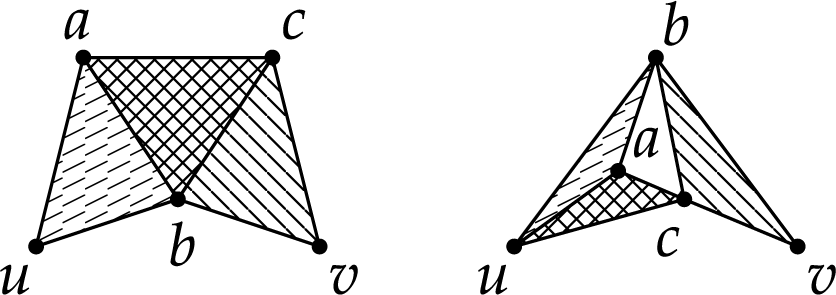
Let  be made of
  -merged in this order as in Claim 5.12. Assume without loss of generality that $F_1$
and
$F_1$
and $F_2$
are
$F_2$
are  -mergeable via some pair $uv$
. Let
$uv$
. Let $F':=F_1\cup F_2$
. As
$F':=F_1\cup F_2$
. As $1,2\notin C_{F_2}(uv)$
and
$1,2\notin C_{F_2}(uv)$
and $3\in C_{F_2}(uv)$
, we know that there is a
$3\in C_{F_2}(uv)$
, we know that there is a $(5,3)$
-configuration in
$(5,3)$
-configuration in $F_2$
containing
$F_2$
containing $uv$
which is either a
$uv$
which is either a $3$
-path
$3$
-path $P_3=\{uab,abc,bcv\}\subseteq F_2$
or a
$P_3=\{uab,abc,bcv\}\subseteq F_2$
or a  -cluster $C_3=\{aub,auc,bcv\}\subseteq F_2$
(which is the union of a
$C_3=\{aub,auc,bcv\}\subseteq F_2$
(which is the union of a $1$
-tree and a
$1$
-tree and a $2$
-tree that are
$2$
-tree that are  -mergeable), see Figure 3. Since $3\notin C_{F_1}(uv)$
by (5.7),
$3\notin C_{F_1}(uv)$
by (5.7), $F_1$
cannot be an i-tree for
$F_1$
cannot be an i-tree for $i\geqslant 3$
. We split the proof into
$i\geqslant 3$
. We split the proof into $3$
cases depending on whether
$3$
cases depending on whether $F_1$
is a
$F_1$
is a $2$
-tree, a
$2$
-tree, a $1$
-tree or an element of
$1$
-tree or an element of  .
.
Case 1. Assume that $F_1$
is a
$F_1$
is a $2$
-tree.
$2$
-tree.
Then, $1,2\in C_{F_1}(uv)$
. By (5.7), we have
$1,2\in C_{F_1}(uv)$
. By (5.7), we have $4,5\notin C_{F_2}(uv)$
, and recall that
$4,5\notin C_{F_2}(uv)$
, and recall that $F_2$
contains one of
$F_2$
contains one of $P_3$
or
$P_3$
or $C_3$
as described above. Also, the union
$C_3$
as described above. Also, the union $F":=F_1\cup P_3$
or
$F":=F_1\cup P_3$
or $F_1\cup C_3$
is a
$F_1\cup C_3$
is a $(7,5)$
-configuration, so
$(7,5)$
-configuration, so
 $$ \begin{align} \binom{V(F")}{2}\cap P_{1}(G\setminus F")=\emptyset. \end{align} $$
Moreover, since $5\notin C_{F_2}(uv)$
, no pair in
$5\notin C_{F_2}(uv)$
, no pair in $V(P_3)$
(resp.
$V(P_3)$
(resp. $V(C_3)$
) can be
$V(C_3)$
) can be $2$
-claimed by
$2$
-claimed by $G\setminus F'$
. It follows that the
$G\setminus F'$
. It follows that the  -cluster $F_2$
is equal to
$F_2$
is equal to $P_3$
or
$P_3$
or $C_3$
, and thus
$C_3$
, and thus $F"=F'$
.
$F"=F'$
.
Suppose that F consists of $s\geqslant 3$
2-clusters. Let the next
$s\geqslant 3$
2-clusters. Let the next  -merging step (of $F'$
and
$F'$
and $F_3$
) be via a pair
$F_3$
) be via a pair $u'v'$
. It follows from (5.10) (and from
$u'v'$
. It follows from (5.10) (and from $F"=F'$
) that
$F"=F'$
) that $u'v' \in P_{1}({F'})\cap P_{3}(F_3)$
. By (5.7), it holds that
$u'v' \in P_{1}({F'})\cap P_{3}(F_3)$
. By (5.7), it holds that $3\notin C_{F'}(u'v')$
. As
$3\notin C_{F'}(u'v')$
. As $F_2$
contains 3 edges, necessarily
$F_2$
contains 3 edges, necessarily $u'v'\in P_{1}({F_1})$
. Also, since
$u'v'\in P_{1}({F_1})$
. Also, since $u'v'$
is in
$u'v'$
is in $P_{1}(F_1)\subseteq P_{2}(F_1)$
, we see that
$P_{1}(F_1)\subseteq P_{2}(F_1)$
, we see that $F_1$
alone and
$F_1$
alone and $F_3$
are
$F_3$
are  -mergeable via $u'v'$
. Now, our previous argument about the structure of
$u'v'$
. Now, our previous argument about the structure of $F_2$
applies to
$F_2$
applies to $F_3$
as well and shows that
$F_3$
as well and shows that $F_3$
is isomorphic to a copy of
$F_3$
is isomorphic to a copy of $P_3$
or
$P_3$
or $C_3$
3-claiming
$C_3$
3-claiming $u'v'$
. Furthermore, the
$u'v'$
. Furthermore, the $(5,3)$
-configurations
$(5,3)$
-configurations $F_2$
and
$F_2$
and $F_3$
can share at most one vertex, so
$F_3$
can share at most one vertex, so ${V(F_2)\choose 2}\cap {V(F_3)\choose 2}=\emptyset $
. The very same reasoning applies in turn to each
${V(F_2)\choose 2}\cap {V(F_3)\choose 2}=\emptyset $
. The very same reasoning applies in turn to each $F_i$
with
$F_i$
with $i\in [4,s]$
with the analogous conclusion. Indeed, by Lemma 5.11, there is
$i\in [4,s]$
with the analogous conclusion. Indeed, by Lemma 5.11, there is $j\in [1,i-1]$
such that
$j\in [1,i-1]$
such that $F_i$
and
$F_i$
and  -merge. Together with the $(8,6)$
-freeness and the fact that
$(8,6)$
-freeness and the fact that $F_1\cup F_2, \hspace {0.9pt}.\hspace {0.3pt}.\hspace {0.3pt}.\hspace {1.5pt}, F_1\cup F_{i-1}$
form
$F_1\cup F_2, \hspace {0.9pt}.\hspace {0.3pt}.\hspace {0.3pt}.\hspace {1.5pt}, F_1\cup F_{i-1}$
form $(7,5)$
-configurations,
$(7,5)$
-configurations, $F_i$
can only
$F_i$
can only  -merge with $F_1$
. Let us bound from below the total weight assigned by F, being rather loose in our estimates. The five pairs in
$F_1$
. Let us bound from below the total weight assigned by F, being rather loose in our estimates. The five pairs in $P_{1}({F_1})$
are
$P_{1}({F_1})$
are $\{1,2\}$
-claimed (and we just ignore the remaining pair inside
$\{1,2\}$
-claimed (and we just ignore the remaining pair inside $V(F_1)$
which is
$V(F_1)$
which is $2$
-claimed). For each
$2$
-claimed). For each $i\in [2,s]$
, if
$i\in [2,s]$
, if $F_i$
is a 3-path, then it
$F_i$
is a 3-path, then it $\{1,3\}$
-claims all seven pairs in its
$\{1,3\}$
-claims all seven pairs in its $2$
-shadow
$2$
-shadow $P_{1}({F_i})$
and two further pairs inside
$P_{1}({F_i})$
and two further pairs inside $V(F_i)$
are
$V(F_i)$
are $\{2,3,4\}$
-claimed by
$\{2,3,4\}$
-claimed by $F_1\cup F_i\subseteq F$
(for example, if
$F_1\cup F_i\subseteq F$
(for example, if $i=2$
, then these are the pairs
$i=2$
, then these are the pairs $uc$
and
$uc$
and $av$
). All these pairs are unique to
$av$
). All these pairs are unique to $F_i$
and thus
$F_i$
and thus $F_i$
contributes at least
$F_i$
contributes at least $7\,h(1,3)+2\,h(2,3,4)=9$
to
$7\,h(1,3)+2\,h(2,3,4)=9$
to $w(F)$
. Also, if
$w(F)$
. Also, if $F_i$
is isomorphic to
$F_i$
is isomorphic to $C_3$
, then it
$C_3$
, then it $\{1,3\}$
-claims all 8 pairs in
$\{1,3\}$
-claims all 8 pairs in $P_{1}({F_i})$
and one further pair inside
$P_{1}({F_i})$
and one further pair inside $V(F_i)$
is
$V(F_i)$
is $\{3,4\}$
-claimed by
$\{3,4\}$
-claimed by $F_1\cup F_i$
(for example, if
$F_1\cup F_i$
(for example, if $i=2$
then it is the pair
$i=2$
then it is the pair $av$
). Thus,
$av$
). Thus, $F_i$
contributes at least
$F_i$
contributes at least $8\,h(1,3)+h(3,4)=9$
to
$8\,h(1,3)+h(3,4)=9$
to $w(F)$
. We conclude by
$w(F)$
. We conclude by $s\geqslant 2$
(which follows from
$s\geqslant 2$
(which follows from  ) that
 $$ \begin{align*} w(F) &\geqslant 5\,h(1,2)+9(s-1)\ =\ 5 +9(s-1)\\ &= \frac{ 54s -79 }{61} + \frac{165}{61}\cdot (3s-1)\>\ \frac{165}{61}\,|F|, \end{align*} $$
as desired.
Case 2. Assume that $F_1$
is a
$F_1$
is a $1$
-tree
$1$
-tree $\{uvw\}$
.
$\{uvw\}$
.
As $F_1$
and
$F_1$
and $F_2$
are
$F_2$
are  -mergeable via $uv$
, we have
$uv$
, we have $3,4\in C_{F_2}(uv)$
. Thus,
$3,4\in C_{F_2}(uv)$
. Thus, $|F_2|\geqslant 4$
and
$|F_2|\geqslant 4$
and $|F_2|\notin \{5,6\}$
(otherwise, we would get a
$|F_2|\notin \{5,6\}$
(otherwise, we would get a $(8,6)$
-configuration). Also,
$(8,6)$
-configuration). Also, $1,2\notin C_{F_2}(uv)$
since
$1,2\notin C_{F_2}(uv)$
since  are distinct. Hence, as before, $F_2$
contains a copy of
$F_2$
contains a copy of $P_3$
or
$P_3$
or $C_3$
3-claiming
$C_3$
3-claiming $uv$
.
$uv$
.
Suppose first that $|F_2|\geqslant 7$
. Then,
$|F_2|\geqslant 7$
. Then, $F_2$
has the structure given by Lemma 5.9
a, consisting of a 1-tree or 3-tree with a number of diamonds merged in one by one. A
$F_2$
has the structure given by Lemma 5.9
a, consisting of a 1-tree or 3-tree with a number of diamonds merged in one by one. A $(5,3)$
-configuration in
$(5,3)$
-configuration in $F_2$
that contains
$F_2$
that contains $uv$
involves at most two
$uv$
involves at most two  -clusters of $F_2$
, whose union
$F_2$
, whose union $F"$
has at most
$F"$
has at most $5$
edges; moreover, if
$5$
edges; moreover, if $F"$
consists of two
$F"$
consists of two  -clusters, then these
  -clusters are
  -mergeable. The proof of Lemma 5.9
a shows that, if we build
-mergeable. The proof of Lemma 5.9
a shows that, if we build  by starting with the partial
  -cluster $F"$
and attaching
$F"$
and attaching  -clusters one by one, then we reach a $(7,5)$
-configuration
$(7,5)$
-configuration $F"'$
just before the number of edges jumps over
$F"'$
just before the number of edges jumps over $6$
. However,
$6$
. However, $F_1$
shares at least
$F_1$
shares at least $2$
vertices with
$2$
vertices with $F"'\supseteq F"$
, so
$F"'\supseteq F"$
, so $F_1\cup F"'$
is a
$F_1\cup F"'$
is a $(8,6)$
-configuration. This contradiction shows that
$(8,6)$
-configuration. This contradiction shows that $|F_2|=4$
.
$|F_2|=4$
.
Now, denote the $4$
-edge hypergraph
$4$
-edge hypergraph $F_2$
by
$F_2$
by $T_4$
if
$T_4$
if $F_2$
consists of (a copy of)
$F_2$
consists of (a copy of) $P_3$
that 3-claims
$P_3$
that 3-claims $uv$
together with one more edge (thus,
$uv$
together with one more edge (thus, $T_4$
is a
$T_4$
is a $4$
-tree or a
$4$
-tree or a  -cluster made of a $3$
-tree and a
$3$
-tree and a $1$
-tree as its
$1$
-tree as its  -clusters), and denote $F_2$
by
$F_2$
by $C_4$
if
$C_4$
if $F_2$
consists of (a copy of)
$F_2$
consists of (a copy of) $C_3$
that 3-claims
$C_3$
that 3-claims $uv$
with one more edge (thus, the
$uv$
with one more edge (thus, the  -clusters of $C_4$
are two
$C_4$
are two $2$
-trees, or a
$2$
-trees, or a $3$
-tree and a
$3$
-tree and a $1$
-tree). Recall that
$1$
-tree). Recall that $F'=F_1\cup F_2$
.
$F'=F_1\cup F_2$
.
Suppose first that $s\geqslant 3$
. Let
$s\geqslant 3$
. Let $F_3$
and
$F_3$
and $F'$
be merged via a pair
$F'$
be merged via a pair $u'v'$
. The
$u'v'$
. The $3$
-graphs
$3$
-graphs $F_3$
and
$F_3$
and $F'$
cannot be
$F'$
cannot be  -mergeable via $u'v'$
as otherwise an edge in
$u'v'$
as otherwise an edge in $F_3$
containing
$F_3$
containing $u'v'$
together with
$u'v'$
together with $F'$
would be a
$F'$
would be a $(8,6)$
-configuration. So
$(8,6)$
-configuration. So $F'$
and
$F'$
and $F_3$
are
$F_3$
are  -mergeable, that is, $1\in C_{F'}(u'v')$
and
$1\in C_{F'}(u'v')$
and $3\in C_{F_3}(u'v')$
. Then,
$3\in C_{F_3}(u'v')$
. Then, $3\notin C_{F'}(u'v')$
. This greatly limits the number of possibilities for the pair
$3\notin C_{F'}(u'v')$
. This greatly limits the number of possibilities for the pair $u'v'$
inside
$u'v'$
inside $P_{1}(F')$
. If
$P_{1}(F')$
. If $F_2=T_4$
, one can easily notice that
$F_2=T_4$
, one can easily notice that $u'v'$
cannot be in
$u'v'$
cannot be in $P_{1}({F_2})\cup \{uv\}$
and thus
$P_{1}({F_2})\cup \{uv\}$
and thus $u'v'\in P_{1}({F_1})\setminus \{uv\}$
. Hence,
$u'v'\in P_{1}({F_1})\setminus \{uv\}$
. Hence, $F_1$
alone and
$F_1$
alone and $F_3$
are
$F_3$
are  -mergeable and the above analysis for $F_2$
applies to
$F_2$
applies to $F_3$
as well, showing that the
$F_3$
as well, showing that the  -cluster $F_3$
is isomorphic to a copy of
$F_3$
is isomorphic to a copy of $T_4$
or
$T_4$
or $C_4$
3-claiming
$C_4$
3-claiming $u'v'$
. If
$u'v'$
. If $F_2=C_4$
, then either
$F_2=C_4$
, then either $u'v'\in P_{1}({F_1})\setminus \{uv\}$
(and, again,
$u'v'\in P_{1}({F_1})\setminus \{uv\}$
(and, again, $F_3$
is isomorphic to
$F_3$
is isomorphic to $T_4$
or
$T_4$
or $C_4$
) or, for some vertices
$C_4$
) or, for some vertices $a,b,c,d$
, we have
$a,b,c,d$
, we have $F_2=\{aub,auc,bcv,cdv\}$
and
$F_2=\{aub,auc,bcv,cdv\}$
and $u'v'$
is
$u'v'$
is $cd$
or
$cd$
or $dv$
; also, the argument of Case
$dv$
; also, the argument of Case $1$
(with
$1$
(with $\{bcv,cdv\}$
playing the role of the 2-tree
$\{bcv,cdv\}$
playing the role of the 2-tree $F_1$
from Case
$F_1$
from Case $1$
) shows that
$1$
) shows that $F_3$
rooted at
$F_3$
rooted at $u'v'$
is isomorphic to
$u'v'$
is isomorphic to $P_3$
or
$P_3$
or $C_3$
, no other
$C_3$
, no other $F_i$
with
$F_i$
with $i\geqslant 4$
can be
$i\geqslant 4$
can be  -merged with $F_3$
, and all pairs in
$F_3$
, and all pairs in ${V(F_3)\choose 2}$
are unique to
${V(F_3)\choose 2}$
are unique to $F_3$
. Using Lemma 5.11, the same argument applies to each new
$F_3$
. Using Lemma 5.11, the same argument applies to each new $F_i$
with
$F_i$
with $i\geqslant 4$
. To summarize, we obtained that each
$i\geqslant 4$
. To summarize, we obtained that each $F_i$
for
$F_i$
for $i\geqslant 2$
is either some instance of
$i\geqslant 2$
is either some instance of $T_4$
or
$T_4$
or  -merged with the single edge $F_1$
, or an instance of
$F_1$
, or an instance of $P_3$
or
$P_3$
or  -merged with a copy of $C_4$
as specified above; also, the only pairs shared between these
$C_4$
as specified above; also, the only pairs shared between these  -clusters are the pairs along which these
  -mergings occur.
Now, assume the final F consists of one $1$
-tree, i copies
$1$
-tree, i copies $T_4$
or
$T_4$
or $C_4$
, and j copies of
$C_4$
, and j copies of $P_3$
or
$P_3$
or $C_3$
. (Although we could say more about the structure of F, e.g., that
$C_3$
. (Although we could say more about the structure of F, e.g., that $i\leqslant 3$
and
$i\leqslant 3$
and $j\leqslant 2i$
, these observations are not needed for our estimates.) Then,
$j\leqslant 2i$
, these observations are not needed for our estimates.) Then, $|F|=1+4i+3j$
. Each copy of
$|F|=1+4i+3j$
. Each copy of $T_4$
(which is a 4-tree or a 3-tree
$T_4$
(which is a 4-tree or a 3-tree  -merged with a single edge) has, in addition to the pair via which it is merged with $F_1$
, at least nine
$F_1$
, at least nine $\{1,3\}$
-claimed pairs and other two
$\{1,3\}$
-claimed pairs and other two $\{2,3,4\}$
-claimed pairs. Thus, it contributes at least
$\{2,3,4\}$
-claimed pairs. Thus, it contributes at least $9\,h(1,3)+2\,h(2,3,4)=11$
to
$9\,h(1,3)+2\,h(2,3,4)=11$
to $w(F)$
. Likewise, each copy of
$w(F)$
. Likewise, each copy of $C_4$
contributes at least
$C_4$
contributes at least $8\,h(1,3)+2\,h(1,2)+h(3,4)=11$
to
$8\,h(1,3)+2\,h(1,2)+h(3,4)=11$
to $w(F)$
. Also, as in Case 1, each copy of
$w(F)$
. Also, as in Case 1, each copy of $P_3$
or
$P_3$
or $C_3$
contributes at least
$C_3$
contributes at least $9$
to
$9$
to $w(F)$
. Additionally, we have
$w(F)$
. Additionally, we have $3$
pairs in
$3$
pairs in $P_{1}({F_1})$
which are
$P_{1}({F_1})$
which are $\{1,4\}$
-claimed by
$\{1,4\}$
-claimed by $F_1\cup F_2$
. Hence, we get the required:
$F_1\cup F_2$
. Hence, we get the required:
 $$ \begin{align*} w(F)&\geqslant 3\,h(1,4)+11i+9j \ =\ 3\cdot \frac{55}{61}+ 11i+9j\\ & =\frac{11i+54j}{61}+\frac{165}{61}\, (1+4i+3j)\>\ \frac{165}{61}\, |F|. \end{align*} $$
Case 3. Assume that  .
.
Here, $F_1$
is a
$F_1$
is a $2$
-merging of at least two
$2$
-merging of at least two  -clusters and thus has at least 3 edges. Let
  be the
  -cluster in $F_1$
1-claiming
$F_1$
1-claiming $uv$
(recall that
$uv$
(recall that $uv$
is the pair via which
$uv$
is the pair via which $F_1$
and
$F_1$
and $F_2$
are
$F_2$
are  -mergeable). The tree $T_1$
has at most 2 edges as otherwise
$T_1$
has at most 2 edges as otherwise $T_1$
together with
$T_1$
together with $F_2$
would contain an
$F_2$
would contain an $(8,6)$
-configuration, a contradiction. Also,
$(8,6)$
-configuration, a contradiction. Also, $T_1$
cannot be a
$T_1$
cannot be a $1$
-tree as otherwise
$1$
-tree as otherwise $F_1\setminus T_1$
would contain a diamond
$F_1\setminus T_1$
would contain a diamond $2$
-claiming a pair in
$2$
-claiming a pair in $P_{1}({T_1})$
(since
$P_{1}({T_1})$
(since  ), which implies that $3\in C_{F_1}(uv)$
, a contradiction. Therefore,
$3\in C_{F_1}(uv)$
, a contradiction. Therefore, $T_1$
is a
$T_1$
is a $2$
-tree. As
$2$
-tree. As  ,
, $T_1$
has to be
$T_1$
has to be $2$
-merged with some other
$2$
-merged with some other  -cluster $T_2\subseteq F_1$
. It is impossible that
$T_2\subseteq F_1$
. It is impossible that $T_2$
and
$T_2$
and $T_1$
are
$T_1$
are  -mergeable as otherwise $T_1$
plus an edge of
$T_1$
plus an edge of $T_2$
would be a
$T_2$
would be a $(5,3)$
-configuration containing
$(5,3)$
-configuration containing $uv$
in
$uv$
in $F_1$
, which contradicts
$F_1$
, which contradicts $3\notin C_{F_1}(uv)$
. Thus,
$3\notin C_{F_1}(uv)$
. Thus, $T_1$
and
$T_1$
and $T_2$
are
$T_2$
are  -mergeable. Also, $T_2$
has at most 3 edges since trees with more edges would form an
$T_2$
has at most 3 edges since trees with more edges would form an $(8,6)$
-configuration with
$(8,6)$
-configuration with $T_1$
. It is routine to check that we can assume (after swapping u and v if necessary) that, for some vertices
$T_1$
. It is routine to check that we can assume (after swapping u and v if necessary) that, for some vertices $a,b\in V$
, the 2-tree
$a,b\in V$
, the 2-tree $T_1$
is
$T_1$
is $\{avu,avb\}$
and the pair
$\{avu,avb\}$
and the pair  -claimed by $T_2$
is
$T_2$
is $ab$
or
$ab$
or $bv$
. Also, any further 2-merging involving
$bv$
. Also, any further 2-merging involving $T_1\cup T_2$
would cause an
$T_1\cup T_2$
would cause an $(8,6)$
-configuration. We conclude that
$(8,6)$
-configuration. We conclude that $F_1=T_1\cup T_2$
.
$F_1=T_1\cup T_2$
.
The same argument as in Case 1 shows that $F_2$
is given by
$F_2$
is given by $P_3$
(a 3-path) or
$P_3$
(a 3-path) or $C_3$
(a diamond and a single edge), see Figure 3. Let
$C_3$
(a diamond and a single edge), see Figure 3. Let $F':=F_1\cup F_2$
. We have
$F':=F_1\cup F_2$
. We have $2$
subcases depending on
$2$
subcases depending on $T_2$
.
$T_2$
.
Case 3-1. Assume that $|T_2|=2$
.
$|T_2|=2$
.
Suppose first that $s\geqslant 3$
. If
$s\geqslant 3$
. If $F_3$
and
$F_3$
and $F'$
are
$F'$
are  -mergeable via some pair $u'v'$
then, by
$u'v'$
then, by $(8,6)$
-freeness,
$(8,6)$
-freeness, $u'v'$
must be one of the two pairs
$u'v'$
must be one of the two pairs  -claimed by $F_1$
, and
$F_1$
, and $F_3$
is a
$F_3$
is a $1$
-tree; therefore, by Claim 5.12, we can reorder
$1$
-tree; therefore, by Claim 5.12, we can reorder  -clusters constituting F starting with $F_3$
and follow the analysis in the Case 2. Now assume that both pairs
$F_3$
and follow the analysis in the Case 2. Now assume that both pairs  -claimed by $F_1$
are not used for further
$F_1$
are not used for further  -mergings. Thus, $F'$
and
$F'$
and $F_3$
are
$F_3$
are  -mergeable via $u'v'$
. Then, since
$u'v'$
. Then, since $3\in C_{F_3}(u'v')$
,
$3\in C_{F_3}(u'v')$
, $u'v'$
must be in
$u'v'$
must be in $P_{1}({F'})\setminus P_{3}(F')=\{au\}$
(recall that
$P_{1}({F'})\setminus P_{3}(F')=\{au\}$
(recall that $3\in C_{F_2}(uv)\subseteq C_{F'}(uv)$
),
$3\in C_{F_2}(uv)\subseteq C_{F'}(uv)$
), $F_3$
rooted at
$F_3$
rooted at $u'v'=au$
is isomorphic to
$u'v'=au$
is isomorphic to $P_3$
or
$P_3$
or $C_3$
; moreover no further
$C_3$
; moreover no further  -mergings are possible and thus $s=3$
. Thus, for both
$s=3$
. Thus, for both $s=2$
and
$s=2$
and $s=3$
, we can assume that the final
$s=3$
, we can assume that the final $3^{+}$
-cluster F is made of
$3^{+}$
-cluster F is made of $F_1$
and j copies of
$F_1$
and j copies of $P_3$
or
$P_3$
or $C_3$
where
$C_3$
where $j\in \{1,2\}$
. Then,
$j\in \{1,2\}$
. Then, $|F|=4+3j$
,
$|F|=4+3j$
, $F_1$
contributes at least
$F_1$
contributes at least $8\,h(1,3)+2\,h(1,2)+2h(3,4)+h(2,4)=10+2+\frac {1}{2}=\frac {25}{2}$
to
$8\,h(1,3)+2\,h(1,2)+2h(3,4)+h(2,4)=10+2+\frac {1}{2}=\frac {25}{2}$
to $w(F)$
. Hence, we have
$w(F)$
. Hence, we have
 $$ \begin{align*} w(F)&\geqslant \frac{25}{2}+9j \ =\ \frac{108j+205}{122}+ \frac{165}{61}\, (4+3j)\>\ \frac{165}{61} \,|F|, \end{align*} $$
as desired.
Case 3-2. Assume that $T_2$
is a 3-tree.
$T_2$
is a 3-tree.
Here $C_{F_1}(uv)\supseteq \{1,2,4,5\}$
so
$C_{F_1}(uv)\supseteq \{1,2,4,5\}$
so $F_2$
has exactly 3 edges and
$F_2$
has exactly 3 edges and $F'=F_1\cup F_2$
is a
$F'=F_1\cup F_2$
is a $(10,8)$
-configuration. Suppose first that
$(10,8)$
-configuration. Suppose first that $s\geqslant 3$
. Since no
$s\geqslant 3$
. Since no $3$
-claimed pair of
$3$
-claimed pair of $F'$
can be
$F'$
can be $1$
-claimed by
$1$
-claimed by $G\setminus F'$
, the
$G\setminus F'$
, the $3$
-graphs
$3$
-graphs $F_3$
and
$F_3$
and $F'$
cannot be
$F'$
cannot be  -mergeable. So let $F'$
and
$F'$
and $F_3$
be
$F_3$
be  -mergeable via some pair $u'v'$
. Since
$u'v'$
. Since $3\in C_{F_3}(u'v')$
,
$3\in C_{F_3}(u'v')$
, $u'v'$
must be in
$u'v'$
must be in $P_{1}({F'})\setminus P_{3}(F')=\{au\}$
; furthermore,
$P_{1}({F'})\setminus P_{3}(F')=\{au\}$
; furthermore, $F_3$
rooted at
$F_3$
rooted at $u'v'=au$
is isomorphic to
$u'v'=au$
is isomorphic to $P_3$
or
$P_3$
or $C_3$
, no further
$C_3$
, no further  -mergings are possible and $s=3$
. Thus, for both
$s=3$
. Thus, for both $s=2$
and
$s=2$
and $s = 3$
, the final
$s = 3$
, the final $3^{+}$
-cluster F consists of
$3^{+}$
-cluster F consists of $F_1$
and j copies of
$F_1$
and j copies of $P_3$
or
$P_3$
or $C_3$
where
$C_3$
where $j\in \{1,2\}$
. Here,
$j\in \{1,2\}$
. Here, $|F|=5+3j$
. Note that
$|F|=5+3j$
. Note that $F_1$
contributes at least
$F_1$
contributes at least $10\,h(1,3)+2\,h(1,2)+4\,h(3,4)=12+4=16$
to the total weight. We have
$10\,h(1,3)+2\,h(1,2)+4\,h(3,4)=12+4=16$
to the total weight. We have
 $$ \begin{align*}w(F)\ \geqslant\ 16+9j\ =\ \frac{54j+151}{61}+\frac{165}{61}\,(5+3j)\>\ \frac{165}{61}\, |F|.\end{align*} $$
This finishes the proof of the claim.
Hence, by the previous claims, we conclude that
 $$ \begin{align*}|G|=\sum_{F\in \mathcal{M}_{3^{+}} } |F| \leqslant \frac{61}{165} \sum_{F\in \mathcal{M}_{3^{+}} } w(F) = \frac{61}{165} \sum_{uv\in \binom{V(H)}{2}} w(uv) \leqslant \frac{61}{165} \binom{n}{2}. \end{align*} $$
This proves Theorem 1.3.
6 Concluding remarks
In this article, we made progress on the Brown–Erdős–Sós problem (the case of 3-uniform hypergraphs) with $k\in \{5,6,7\}$
edges and its extension to r-graphs. We note that a further extension of the Brown–Erdős–Sós Problem proposed by Shangguan and Tamo [Reference Shangguan and Tamo27] asks to determine whether the limits
$k\in \{5,6,7\}$
edges and its extension to r-graphs. We note that a further extension of the Brown–Erdős–Sós Problem proposed by Shangguan and Tamo [Reference Shangguan and Tamo27] asks to determine whether the limits
 $$ \begin{align*}\lim_{n\rightarrow \infty}n^{-t}f^{(r)}(n;k(r-t)+t,k)\end{align*} $$
exist for all fixed $r,t,k$
and, if so, to find their values. (The case that we studied here corresponds to
$r,t,k$
and, if so, to find their values. (The case that we studied here corresponds to $t=2$
.)
$t=2$
.)
Let us briefly summarize what is known. The results in [Reference Brown, Erdős and Sós4, Reference Rödl24] resolve the case $k=2$
. In [Reference Glock13, Reference Glock, Joos, Kim, Kühn, Lichev and Pikhurko15, Reference Shangguan and Tamo27], this problem was completely solved when
$k=2$
. In [Reference Glock13, Reference Glock, Joos, Kim, Kühn, Lichev and Pikhurko15, Reference Shangguan and Tamo27], this problem was completely solved when $k\in \{3,4\}$
. In [Reference Delcourt and Postle8, Reference Shangguan26], the existence of the limit was proved for
$k\in \{3,4\}$
. In [Reference Delcourt and Postle8, Reference Shangguan26], the existence of the limit was proved for $t=2$
. In [Reference Letzter and Sgueglia21], the value of the limit (and thus its existence) was established for even k when
$t=2$
. In [Reference Letzter and Sgueglia21], the value of the limit (and thus its existence) was established for even k when $r\gg k,t$
is sufficiently large. Also, it was proved in [Reference Letzter and Sgueglia21] that if
$r\gg k,t$
is sufficiently large. Also, it was proved in [Reference Letzter and Sgueglia21] that if $k\in \{5,7\}$
then the limit exists for any r and t. Our results determine the limit values when
$k\in \{5,7\}$
then the limit exists for any r and t. Our results determine the limit values when $t=2$
and
$t=2$
and $k\in \{5,6,7\}$
.
$k\in \{5,6,7\}$
.
It would be interesting to study the existence of limits for the remaining sets of parameters as well as their precise values.
Acknowledgements
We thank Felix Joos and Marcus Kühn for useful discussions. In particular, some starting ideas of the present article originated from the joint work [Reference Glock, Joos, Kim, Kühn, Lichev and Pikhurko15]. Also, we thank the anonymous referee for useful comments.


 Open access

