


Introduction
In recent years, much research has focused on the implementation of social innovation (SI) by nongovernmental organisations (NGOs). These studies have emphasised NGOs’ roles in solving social problems while recognising their greater propensity (than public institutions (PIs)) to carry out nonroutine, atypical activities aimed not at achieving financial profits but at solving social issues such as unemployment, limited access to health, and cultural and educational services (Shier & Handy, Reference Shier and Handy2016; Oosterlynck etal., Reference Oosterlynck, Novy, Leubolt, Weinzierl, Oosterlynck, Novy and Kazepow2019b).
Rural residents struggle with many social problems, which are exacerbated in marginalised regions (Lombardi et al., Reference Lombardi, Lopolito, Andriano, Prosperi, Stasi and Iannuzzi2020). These problems result from, for example, limited resources in local labour markets and limited access to various types of social services. These services focus on the situation of the inhabitants in one specific village, where the problem of youth unemployment has manifested through young people leaving their place of residence, limited access to health services means that some residents have not been able to see a doctor, and the shortage in the number of crèches and kindergartens has manifested through parents having to give up or limit their professional activities to take care of their children. Local NGOs know about these problems and have attempted to remedy or minimise them by engaging in SI. Examples of SI implemented in rural areas show the multiplicity of challenges faced by organisations and institutions in implementation (Franklin et al., Reference Franklin, Kovách and Csurgó2017; Noack & Federwisch, Reference Noack and Federwisch2019; Ravazzoli et al., Reference Ravazzoli, Dalla Torre, Da Re, Marini Govigli, Secco and Górriz-Mifsud2021). Many SI initiatives have failed to be completed, and implementing them has been risky (Kluvankova et al., Reference Kluvankova, Nijnik, Spacek, Sarkki, Lukesch and Perlik2021). Moreover, not all NGOs are interested in SI (Brandsen et al., Reference Brandsen, Cattacin, Evers and Zimmer2016); instead, they have sought to achieve their goals by acting in the same way over the years (Osborne, Reference Osborne1998). Such reluctance raises the following questions: What features distinguish NGOs with experience implementing SI? This question is worth posing in a context that has not previously been examined in the literature, i.e. the activity of rural NGOs in the postcommunist countries of Central and Eastern Europe, such as Poland. These countries are characterised by a low level of social capital (Kornai & Rose-Ackerman, Reference Kornai, Rose-Ackerman, Kornai, Rothstein and Rose-Ackerman2004; Lasinska, Reference Lasinska2013; Meyer et al., Reference Meyer, Moder, Neumayr, Traxler, Vandor, Vandor, Traxler, Millner and Meyer2017), and such resources are considered essential for bottom-up action by, inter alia, NGOs (Slee & Nijnik, Reference Slee, Nijnik, Pisani, Secco and Christoforou2015). Examining the features that distinguish NGOs with experience in this area makes it possible to find ways to support local NGOs and increase their chances of implementing SI.
Factors that Enable NGOs to Implement SI
SI is a specific type of innovation (Anheier et al., Reference Anheier, Krlev, Preuss, Mildenberger, Bekkers and Mensink2014). As Shier et al. (Reference Shier, Handy and Jennings2019) indicated, “We cannot simply rely on research on the general category of innovations to determine the knowledge base for social innovation” (p. 187).
SI has many different meanings (Domanski et al., Reference Domanski, Howaldt and Kaletka2020). Definitions of SI have been developed within various disciplines and scientific subdisciplines (Ayob et al., Reference Ayob, Teasdale and Fagan2016; Morais-da-Silva et al., Reference Morais-da-Silva, Segatto and Bezerra-de-Sousa2020; van der Have & Rubalcaba, Reference Van der Have and Rubalcaba2016). Among the definitions are those indicating that such innovations serve to improve the quality of life of individuals, emphasizing their role in satisfying the needs of territorial communities or combining them with technological innovations of social importance (Rüede & Lurtz, Reference Rüede and Lurtz2012). Some definitions are so broad that they lead to any novelty that results in social change being designated a SI (Marques et al., Reference Marques, Morgan and Richardson2017).
Whether SI is intended to solve social problems or, more broadly, to meet social needs, it constitutes new social practices that foster social change (Domanski et al., Reference Domanski, Howaldt and Kaletka2020). Social change, which is the result of the implementation of SI, can occur on a local, regional, national or even global level. The goal of local SI is to solve local social problems and address local needs (Marques et al., Reference Marques, Morgan and Richardson2017). Such innovations are rarely disseminated, especially if they are locally bounded, that is, come and go at the local level due to deficits in local and nonlocal connections (Kazepov et al., Reference Kazepov, Colombo, Sarius, Oosterlynck, Novy and Kazepov2020). Better chances of diffusing SI are obtained through a ‘bottom-linked SI’ with an implementation process that involves mobilising various social actors, including local and nonlocal actors, and linking local with nonlocal (Kazepov et al., Reference Kazepov, Colombo, Sarius, Oosterlynck, Novy and Kazepov2020).
In this article, because I focus on SI implemented at a local level, SI is defined as unusual social practices that are alternative to the dominant practices in a given area and the purpose of which is to introduce changes to help solve social problems. I accept that local SI appears to be a result of the activities of NGOs seeking to change practices to solve a local social problem (Zajda & Pasikowski, Reference Zajda and Pasikowski2020; Zajda et al. Reference Zajda, Pasikowski and Kretek-Kamińska2020).
Scholars have identified the features that facilitate NGOs implementing SI. First is their cooperation with various organisations and institutions interested in solving social problems. SI might be implemented by PIs (Bekkers et al., Reference Bekkers, Tummers, Stuijfzand and Voorberg2013); social entrepreneurs (Defourny & Nyssens, Reference Defourny, Nyssens, Moulaert, MacCallum, Mehmood and Hamdouch2014); local action groups (LAGs) (Cejudo & Navarro, Reference Cejudo and Navarro2020; Furmankiewicz et al., Reference Furmankiewicz, Janc and Macken-Walsh2021; Sykała et al., Reference Sykała, Dej and Wolski2015); NGOs, which are seen as having a particular interest in implementing SI (Oosterlynck et al. Reference Oosterlynck, Novy and Kazepov2019a; Shier & Handy, Reference Shier and Handy2016); or private companies (Domanski et al., Reference Domanski, Howaldt and Kaletka2020). Collaborative relations facilitate various types of capital transfer, thereby contributing to the legitimacy, stability and survival of innovative solutions (Domanski et al., Reference Domanski, Howaldt and Kaletka2020; Gaeta et al., Reference Gaeta, Ghinoi, Silvestri and Trasciani2021; Krasnopolskaya & Meijs, Reference Krasnopolskaya and Meijs2019). Cooperation—defined as (formal or informal) actions that facilitate commonly defined objectives (Furmankiewicz et al., Reference Furmankiewicz, Macken-Walsh and Stefańska2014)—is possible among different NGOs or between an NGO and representatives of other sectors (public and economic). Cooperating organisations can be located in the same or in different areas. Cooperation with organisations and institutions located outside the specific territory covered by an NGO strengthens the potential for that NGO to acquire resources in addition to local assets, a strategy that can stimulate the implementation and diffusion of SI (Kazepov et al., Reference Kazepov, Colombo, Sarius, Oosterlynck, Novy and Kazepov2020).
Based on the literature, I formulated the first hypothesis: NGOs experienced in implementing SI were distinguished from others by higher level of cooperation with different organisations and PIs.
Second, the involvement of citizens who experience social problems can facilitate and support the implementation of SI by NGOs because the implementation process relies on these citizens’ perspective to define the social problems they face. Sometimes inhabitants of a particular area have hidden knowledge of a specific problem, and the disclosure of this knowledge is essential for the implementation of SI (Brandsen et al., Reference Brandsen, Steen, Verschuere, Brandsen, Steen and Verschuere2018; Davies & Simon, Reference Davies and Simon2012). In addition, citizens can be a source of SI. Residents familiar with local social problems and practices of solving them can propose alternative solutions (Baselice et al., Reference Baselice, Lombardi, Prosperi, Stasi and Lopolito2021; Krasnopolskaya & Meijs, Reference Krasnopolskaya and Meijs2019). According to Audretsch et al., “a participative society is crucial for the development of innovative ideas to prevailing societal problems, and the development of SIs usually involves many different stakeholders as well as those affected by the problem” (2021, p. 238). In other words, it is difficult for SI to succeed if residents experiencing social problems are not included in the SI development process and do not provide the information necessary to create unusual services or products to address their needs. Moreover, it is difficult for SI to succeed if these people are not interested in the associated services and products.
Based on the literature, I formulated the second hypothesis: NGOs experienced in implementing SI were distinguished from others by higher level of the involvement of residents in the process of solving local social problems.
Third, the implementation of SI by NGOs can be influenced by NGOs’ resources, such as human resources. Solving social problems with very limited human resources is difficult (Brandsen et al., Reference Brandsen, Cattacin, Evers and Zimmer2016). Here, it is critical to focus on the number of people involved in NGO activities, including both members and volunteers of an NGO who work for no pay and employed staff members who receive salaries for their work. It is worth noting that NGOs rooted in rural areas are exposed to rural specificity, e.g. the challenges related to counteracting depopulation. Hence, it is more difficult for these NGOs to obtain human resources, especially because the problem of access to the Internet emerges more often in rural areas than in cities, limiting, for example, the possibility of teleactivity (Ruiz-Martinez & Esparcia, Reference Ruiz-Martinez and Esparcia2020). Moreover, the implementation of SI by NGOs can be influenced by the financial resources that these NGOs have at their disposal. Audretsch et al. (Reference Audretsch, Eichler and Schwarz2022) included financial needs among the main needs of social innovators. Financial resources enable organisations to undertake activities involving paid personnel and facilitate the implementation of different initiatives. Without these resources, it is difficult for NGOs to carry out activities, especially in the long term (Krasnopolskaya & Meijs, Reference Krasnopolskaya and Meijs2019).
Based on the literature, I formulated the third hypothesis: NGOs experienced in implementing SI were distinguished from others by higher level of their human and financial resources.
Rural NGOs in Postcommunist Poland
The inhabitants of Central and Eastern Europe (the people of Poland, Hungary, the Czech Republic and Slovakia) have common experiences related to the former communist regime (Karolewski, Reference Karolewski2016), which controlled their daily lives. It prohibited or significantly limited activity in voluntary organisations while forcing membership in organisations controlled by the state (Lasinska, Reference Lasinska2013). The state worked to atomize citizens by reducing their social ties and limiting social trust to family members, neighbours and close acquaintances (Rothstein, Reference Rothstein, Kornai, Rothstein and Rose-Ackerman2004). There was a gap called the "sociological void" between the spheres of families, neighbours and state institutions (Tyszka, Reference Tyszka2009). The postcommunist citizens of these countries believed that the state, rather than they, was responsible for solving social problems (Sztompka, Reference Sztompka, Alexander, Eyerman, Giesen, Smelser and Sztompka2004).
Socioeconomic and political changes were not easy. After the collapse of the communist system, democracy began to develop despite the weakness of NGOs (1). NGOs seem to be weaker in postcommunist countries than in countries that do not share these historical experiences (Chimiak, Reference Chimiak2016; Chloupkova et al., Reference Chloupkova, Haase Svendsen and Svendsen2003; Paldam & Svendsen, Reference Paldam and Svendsen2002; Ringdal, Reference Ringdal, Ramet, Ringdal and Dośpiał-Borysiak2019). Moreover, like NGOs located outside Central and Eastern Europe, they experience problems with obtaining various types of resources (Hayman, Reference Hayman2016; Vacecová et al., Reference Vaceková, Valentinov and Nemec2017). Due to the low level of social capital in these countries, it may be more difficult for NGOs to cooperate with other organisations and PIs to accumulate resources in order to implement SI. Additionally, there is no shortage of social problems, such as unemployment, limited access to education and health services, ageing, and external migration, in rural areas (Lombardi et al., Reference Lombardi, Lopolito, Andriano, Prosperi, Stasi and Iannuzzi2020).
Poland shares the experience of other postcommunist countries in Central and Eastern Europe (2) (Lasinska, Reference Lasinska2013; Meyer et al., Reference Meyer, Moder, Neumayr, Traxler, Vandor, Vandor, Traxler, Millner and Meyer2017). In Polish rural areas—rural gminas and rural parts of urban–rural gminas (3)—different kinds of NGOs can be distinguished (4). Traditional NGOs (those that have been functioning since the nineteenth century) include rural housewife associations, some of which have turned to resolving social problems, such as unemployment among rural women or counteracting domestic violence. However, the main area of their activities is preserving local folklore. Traditional NGOs also include volunteer fire brigades. In addition to fire protection, they operate (akin to rural housewife associations) in the area of cultural heritage, helping limit the erosion of local cultures (Adamiak et al., Reference Adamiak, Charycka and Gumkowska2016).
In addition to traditional NGOs, there are novel ones, i.e. those that began amidst the changes in the 1980s. They operate primarily locally, have small budgets and typically do not run a business. Their boards comprise only a few people (Charycka et al., Reference Charycka, Gumkowska and Arczewska2020).
NGOs can cooperate with LAGs, which have taken the legal form of associations but are referred to as local development agencies. Each LAG supports an area called a territorial partnership, comprising a few to a dozen communities and including representatives of three sectors: public, social and economic. In each programming period, each LAG implements the objectives of its local development strategy, i.e. the strategy that defines the priorities for the development of the territorial partnership. LAG responsibilities include solving social problems (Furmankiewicz & Macken-Walsh, Reference Furmankiewicz and Macken-Walsh2016; Sykała et al., Reference Sykała, Dej and Wolski2015).
In addition to traditional NGOs and LAGs, novel NGOs can cooperate to solve local social problems with local PIs and social cooperatives. In Polish rural areas, the most important PIs responsible for solving local social problems are municipal offices and their subordinate social welfare centres. NGOs may cooperate with PIs under the Act of April 24, 2003, regarding public benefit activities and volunteering, which enables NGOs to provide public services. An organisation may carry out a task entrusted to it by a PI that has been planned by the institution itself, or it may participate in the creation of a task and then implement it in cooperation with that institution. The act also allows NGOs and PIs to create joint advisory and consulting teams (Zajda & Pasikowski, Reference Zajda and Pasikowski2020; Zajda et al. Reference Zajda, Pasikowski and Kretek-Kamińska2020). The aim of social cooperatives is to generate financial profits while pursuing social goals, such as solving social problems (Defourny & Nyssens, Reference Defourny, Nyssens, Moulaert, MacCallum, Mehmood and Hamdouch2014; Baglioni, Reference Baglioni2017; Macías Ruano et al., Reference Macías Ruano, Milán-García, Marruecos Rumí and De Pablo Valenciano2021). Social cooperatives are thus enterprises that foster the social and professional reintegration of their members (Praszkier et al., Reference Praszkier, Petrushak and Kacprzyk-Murawska2017). While seeking opportunities to solve social problems, they can implement SI independently or in cooperation with other entities, including NGOs (5).
Methods
Procedure
A social survey was conducted with leaders of rural NGOs. Each organisation was represented by one respondent.
The selection of the sample of NGOs was layered. The unit of the draw was a gmina (the smallest territorial unit in Poland). From a set of 1559 rural gminas, a representative sample of gminas was drawn (with a confidence coefficient of 0.95 and an assumed maximum error p = 0.05). To generate a random selection from a sample of NGOs, it was necessary to prepare a complete list of them. Data obtained from Poland’s Central Statistical Office were used. The list included only those NGOs (6) that had publicised their addresses and telephone numbers. During the four weeks preceding the survey, the relevant list was verified and the number of NGOs working to solve the social problems of residents of rural gminas was determined. Before including a given NGO in the draw list, whether (according to its representatives) its activity was related to solving social problems and whether there was another organisation in the gmina that it could potentially cooperate with were verified. The initial list included 817 units, and it was possible to obtain material from 400 organisations. Consequently, with a confidence factor of 0.95 and a fraction size of 0.5, the maximum error rate was 0.04.
Participants
The study involved 400 novel NGOs located in rural gminas that had operated for no more than 25 years (M = 8.79; SD = 4.86). Their activities and human and financial resources were discussed by respondents—the leaders of these organisations. Of the respondents, 66.67% were women and 33.33% were men, and 67.5% had a master's degree.
Variables
The study focused on whether rural NGOs implemented SI. To obtain this information, the respondents—the leaders of these organisations—were asked the following question: “To solve the problems affecting the inhabitants of the gmina, did the organisation carry out any activities that can be described as unusual, i.e. as different from those commonly carried out by other entities (located in this gmina) working to solve the same social problem?”.
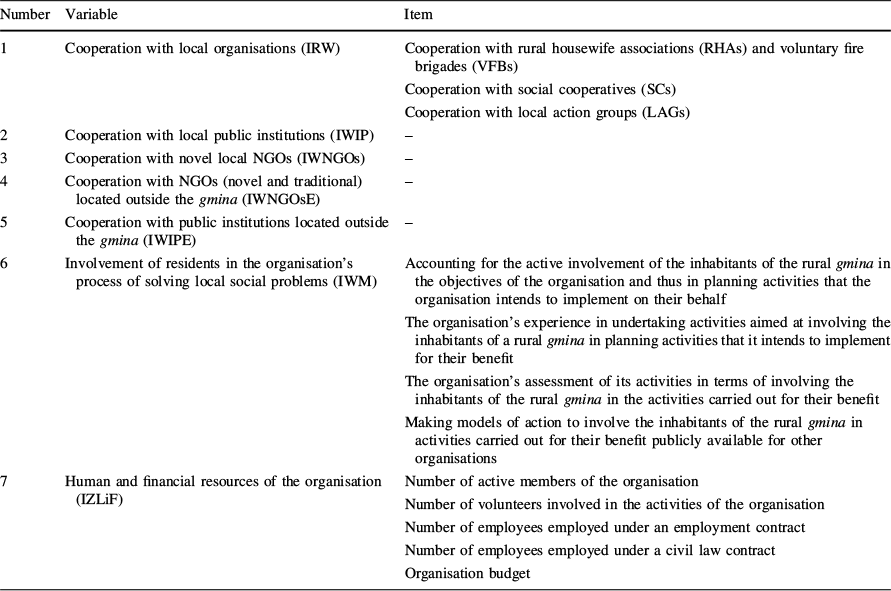
Based on the literature review, the analysis of the factors that distinguish NGOs with experience implementing SI focused on several of their distinct features (Table 1).
List of variables included in the analysis.

Number |
Variable |
Item |
|---|---|---|
1 |
Cooperation with local organisations (IRW) |
Cooperation with rural housewife associations (RHAs) and voluntary fire brigades (VFBs) |
Cooperation with social cooperatives (SCs) |
||
Cooperation with local action groups (LAGs) |
||
2 |
Cooperation with local public institutions (IWIP) |
– |
3 |
Cooperation with novel local NGOs (IWNGOs) |
– |
4 |
Cooperation with NGOs (novel and traditional) located outside the gmina (IWNGOsE) |
– |
5 |
Cooperation with public institutions located outside the gmina (IWIPE) |
– |
6 |
Involvement of residents in the organisation’s process of solving local social problems (IWM) |
Accounting for the active involvement of the inhabitants of the rural gmina in the objectives of the organisation and thus in planning activities that the organisation intends to implement on their behalf |
The organisation's experience in undertaking activities aimed at involving the inhabitants of a rural gmina in planning activities that it intends to implement for their benefit |
||
The organisation’s assessment of its activities in terms of involving the inhabitants of the rural gmina in the activities carried out for their benefit |
||
Making models of action to involve the inhabitants of the rural gmina in activities carried out for their benefit publicly available for other organisations |
||
7 |
Human and financial resources of the organisation (IZLiF) |
Number of active members of the organisation |
Number of volunteers involved in the activities of the organisation |
||
Number of employees employed under an employment contract |
||
Number of employees employed under a civil law contract |
||
Organisation budget |
Cooperation between an NGO and another organisation or PI could take three forms:
A. A creation (within the previous three years) of joint teams with an advisory and initiating character;
B. A joint provision (within the previous three years) of social services within the framework of projects created exclusively by other institutions/organisations; or.
C. A joint creation and delivery, by an NGO and different organisations or PIs (within the previous three years), of social services.
The descriptive statistics of the analysed variables are presented below (Table 2).
Descriptive statistics of the analysed variables and Cronbach’s alpha.

Variable |
n |
M |
Me |
SD |
Skewness |
Kurtosis |
Min |
Max |
α |
|---|---|---|---|---|---|---|---|---|---|
IRW |
400 |
2.88 |
1 |
4.07 |
1.76 |
2.68 |
0 |
19 |
0.86 |
IWNGOs |
400 |
1.28 |
0 |
1.88 |
1.67 |
2.69 |
0 |
9 |
0.84 |
IWIP |
400 |
1.93 |
1 |
2.23 |
0.86 |
−0.53 |
0 |
9 |
0.83 |
IWNGOsE |
400 |
0.56 |
0 |
1.27 |
2.66 |
6.92 |
0 |
6 |
0.75 |
IWIPE |
400 |
0.47 |
0 |
1.01 |
2.62 |
7.74 |
0 |
7 |
0.70 |
IWM |
400 |
2.85 |
3 |
1.38 |
−0.93 |
−0.45 |
0 |
4 |
0.78 |
IZLiF |
400 |
0.00 |
−0.10 |
0.60 |
1.20 |
1.27 |
−0.85 |
2.28 |
0.65 |
n number; M mean; Me median; SD standard deviation; Min/Max minimum/maximum; α Cronbach’s alpha
Tools
The quantitative survey method was used, which (using random sampling) made it possible to generalise the conclusions from the sample to the Polish NGO population from rural gminas. To assess the compliance of the distributions of the analysed variables—with a normal distribution—the Shapiro–Wolf statistical significance test was used, and the assumed level of statistical significance was alpha = 0.05 (Table 3).
Normality statistics of the Shapiro–Wolf test distribution of the studied variables.

W |
p |
|
|---|---|---|
Cooperation with local organisations (IRW) |
0.81 |
0.001 |
Cooperation with local NGOs (IWNGOs) |
0.75 |
0.001 |
Cooperation with local public institutions (IWIP) |
0.81 |
0.001 |
Cooperation with local NGOs located outside the gmina (IWNGOsE) |
0.65 |
0.001 |
Cooperation with public institutions located outside the gmina (IWIPE) |
0.66 |
0.001 |
Involvement of residents in the process of solving social problems by the organisation (IWM) |
0.78 |
0.001 |
Human and financial resources of the organisation (IZLiF) |
0.90 |
0.001 |
W Shapiro–Wolf statistic; p confidence factor
The Shapiro–Wolf test showed that the distribution of the tested variables was not consistent with the normal distribution. To answer the research questions, the nonparametric Mann–Whitney U test was used. The level of each constructed variable was determined by converting the raw result on a scale of 0–100 according to the following formula:

where, WP = converted result, WS = raw result, MAX = maximum score to obtain.
Each converted result was categorised according to the decile scale by dividing the result into five equal parts. It was assumed that the range of 0–20 was a very low result, 21–40 was a low result, 41–60 was a mean result, 61–80 was a high result, and 81–100 was a very high result.
Research Results
The conducted analyses show that NGOs with experience implementing SI were not distinguished from others when they included residents from the community (local inhabitants) in solving social problems affecting them. This can be explained by the specificity of NGOs, which operate at the grassroots level. They are created by the inhabitants of a given area and act on their behalf. It is therefore natural that they involve people in their activities in different ways.
NGOs with experience implementing SI were distinguished from others by the following:
• Undertaking various forms of cooperation with local organisations, including traditional rural housewife associations and voluntary fire brigades, novel NGOs, social cooperatives, PIs, and LAGs, as well as with organisations and PIs located outside the gmina.
• The human and financial resources of the organisation (Table 4).
Comparison of NGOs that implement and do not implement SI.

Social innovation implementation |
Significance of differences |
||||||
|---|---|---|---|---|---|---|---|
No (n = 267) |
Yes (n = 133) |
||||||
Medium rank |
Medium rank |
U |
Z |
Z popr |
p |
r |
|
Cooperation with local organisations (IRW) |
191.28 |
219.00 |
15295.00 |
−2.26 |
−2.37 |
0.018 |
−0.12 |
Cooperation with local NGOs (IWNGOs) |
192.50 |
216.56 |
15619.00 |
−1.96 |
−2.18 |
0.030 |
−0.11 |
Cooperation with local public institutions (IWIP) |
190.96 |
219.65 |
15208.50 |
−2.46 |
−2.48 |
0.014 |
−0.12 |
Cooperation with local NGOs located outside the gmina (IWNGOsE) |
190.13 |
221.31 |
14987.50 |
−2.54 |
−3.46 |
0.001 |
−0.17 |
Cooperation with local public institutions located outside the gmina (IWIPE) |
190.65 |
220.27 |
15125.50 |
−2.41 |
−3.18 |
0.001 |
−0.16 |
Inclusion of gmina residents in solving social problems affecting them (IWM) |
196.57 |
208.40 |
16705.00 |
−0.96 |
−1.03 |
0.305 |
−0.05 |
Human and financial resources of the organisation (IZLiF) |
190.13 |
221.32 |
14986.00 |
−2.54 |
−2.63 |
0.011 |
−0.13 |
n number, U Mann–Whitney U statistic, Z popr. Z statistics corrected for tied ranks, p confidence factor, r magnitude of the Cohen effect calculated from the value Z popr
NGOs from Polish rural areas very rarely cooperate with other organisations and PIs. Of the surveyed organisations, 90% had a low or very low level of cooperation with other novel NGOs. Specifically, it was rare for them to jointly create and implement various types of projects with other NGOs (Table 5).
Descriptive statistics of novel NGOs from the same gmina that the surveyed NGOs cooperated with in the last three years.

Form of cooperation |
n |
M |
SD |
Min |
Max |
|---|---|---|---|---|---|
A. Creation of joint teams of an advisory and initiating character |
400 |
0.55 |
1.05 |
0.00 |
8.00 |
B. Joint provision of social services within the framework of projects created exclusively by another institution/organisation |
400 |
0.53 |
0.90 |
0.00 |
5.00 |
C. Joint creation and joint delivery by organisation and other organisation or public institution of social services |
400 |
0.38 |
0.76 |
0.00 |
4.00 |
n number, M mean, SD standard deviation, Min/Max minimum/maximum
Ultimately, cooperation was still more frequent between novel NGOs than between each NGO and traditional organisations, social cooperatives or LAGs. In this case, a low or very low level of cooperation characterised 98% of the surveyed organisations. Occasional collaboration with social cooperatives can be explained by the limited number of such organisations and the fact that their presence in a given community is often quite short-term. Traditional organisations, in turn, are generally not equipped to join novel NGO initiatives. They achieve their goals by receiving funds primarily from local PIs; therefore, they do not value the need to cooperate with new organisations to, for example, jointly apply for other funds to implement jointly created activities. LAGs, on the other hand, are highly professional organisations that support local NGOs in various ways. For example, they invest in rural infrastructures by renovating rural common rooms, which can become NGO headquarters; train NGO leaders; and announce competitions that NGOs can participate in. However, NGOs very rarely cooperate with LAGs, apparently perceiving them (as well as PIs) as supporting organisations that transfer financial resources rather than cooperation partners.
If rural NGOs decided on some form of cooperation, it was primarily with local PIs, although 77.25% of them were characterised by a low or very low level of cooperation. This is because these institutions are considered sources of financing for NGO activities. Cooperation occurs mostly when an NGO provides a social service in its community and receives funds for this specific purpose from a PI: the actions are planned by the PI and the NGO implements them (form A, M = 0.71; form B, M = 0.86; form C, M = 0.64). Therefore, there is no cocreation or coproduction of social services (Brandsen et al., Reference Brandsen, Steen, Verschuere, Brandsen, Steen and Verschuere2018).
The cooperation networks of the surveyed NGOs were limited to the commune level, rarely including NGOs from outside the area—95.75% were characterised by a very low or low level of cooperation with external NGOs. They were open to working with external organisations primarily when these entities offered to cooperate with local organisations within the framework of their projects (form A, M = 0.18; form B, M = 0.23; form C, M = 0.16).
NGOs also rarely cooperated with PIs located outside the commune. A low or very low level of this cooperation characterised up to 97.5% of all NGOs. A few carried out projects with external PIs, but they did not participate in the creation of those projects (form A, M = 0.11; form B, M = 0.28; form C, M = 0.11).
NGOs that rarely cooperate with NGOs and PIs from outside their communities reduce their chances of acquiring the external resources that could facilitate the implementation of SI, i.e. external financial and human resources that would both be very useful to rural NGOs. Research has shown that almost 80.8% of rural NGOs were characterised by very low or low levels of human and financial resources. Slightly more than 42% of the organisations used the help of volunteers. A much smaller percentage had employees employed under an employment (14.75%) or civil law contract (11.5%). The average number of people showing continuous activity was 6. The surveyed NGOs most often had annual budgets below PLN 50.000 (82%), among which the largest percentage (29%) had a budget of up to PLN 5.000 (approximately EUR 1.000).
This research allowed me to verify the hypotheses. The second hypothesis was rejected. No grounds for rejecting the first and third hypotheses were found.
Discussion
Rural NGOs have experience in implementing SI, which is important because, as Baselice et al. emphasised (Reference Baselice, Lombardi, Prosperi, Stasi and Lopolito2021, p. 8454), “SI initiatives are seen as a flexible method to cope with the idiosyncrasies of rural areas and have proven their capacity to select and implement relevant and effective actions tailored to local communities’ contexts”. This research has shown how important it is for NGOs to cooperate with other entities when they undertake their activities. Meanwhile, the limitations on social activities that have existed for decades in the postcommunist countries of Central and Eastern Europe are still visible (Guasti, Reference Guasti2016). The very difficult beginning of socioeconomic change was not conducive to social activity in NGOs. The increase in the level of social inequality has supported individualistic attitudes and competition among citizens for various types of goods (Lasinska, Reference Lasinska2013; Meyer et al., Reference Meyer, Moder, Neumayr, Traxler, Vandor, Vandor, Traxler, Millner and Meyer2017). Not all governments of the postcommunist countries of Central and Eastern Europe have supported the development of civil society, of which NGOs are a part. Over the years, governmental policies towards NGOs in these countries have changed and have not been stable. This instability has prevented NGOs from increasing their participation in shaping public policies (Meyer et al., Reference Meyer, Moder, Neumayr, Traxler, Vandor, Vandor, Traxler, Millner and Meyer2017).The current Polish government, following in the footsteps of the Hungarian government, limits civil liberties (Karolewski, Reference Karolewski2016). It also criticises NGOs, which translates into citizens' distrust of them (Waniak-Michalak et al., Reference Waniak-Michalak, Perica, Leitoniene and Chojnacka2020). This distrust has not been conducive to NGOs’ activities or to their cooperation with other organisations and institutions.
This research has shown that the challenge for NGOs is to find ways to cooperate not only with PIs but also with other NGOs. The nongovernmental sector in postcommunist countries has diversified in terms of the values it promotes. In Slovakia, Hungary and Poland, many nationalist organisations have emerged in connection with the immigrant crisis. NGOs have ceased to be associated simply with the desire to help; they have also been associated with xenophobia, which can negatively affect cooperation between NGOs (Meyer et al., Reference Meyer, Moder, Neumayr, Traxler, Vandor, Vandor, Traxler, Millner and Meyer2017).
In rural areas, NGOs have been visibly diverse and have shown greater or lesser readiness to cooperate with other NGOs, although such cooperation not only promotes different values and operational goals but also can allow them access to different human and financial resources. In particular, the implementation of SI has been facilitated by the human and financial capital that is at the disposal of specific NGOs. Emerging NGOs in Central and Eastern Europe have struggled with shortages of financial and human capital (Guasti, Reference Guasti2016). Currently, there are many sources of support for NGOs, but many of these sources can be tapped only through cooperation, which is problematic. This research has shown that it has been greatly challenging for NGOs to cooperate with each other or with PIs that are located in other territorial units, although such collaborations could contribute to the acquisition of new financial resources.
Local governments can be a source of financial support for local NGOs. However, in Hungary, increasing centralisation has limited cooperation between local NGOs and local authorities. In Slovakia, the process of decentralisation is still ongoing, and the potential for cooperation between NGOs and local governments has still not been realised (Meyer et al., Reference Meyer, Moder, Neumayr, Traxler, Vandor, Vandor, Traxler, Millner and Meyer2017, p. 27). In Poland and the Czech Republic, local NGOs may receive support from local governments, but cross-sectoral relations can be difficult. This difficulty has been demonstrated through the process of creating functional LAGs with the aim of bringing together representatives of the social, economic and public sectors to cooperate with each other as partners. In practice, these organisations have been dominated by the public sector. Cooperation between the public and social sectors has been limited to selected NGOs—most often those that do not pose a threat to the local system of power (Furmankiewicz & Macken-Walsh, Reference Furmankiewicz and Macken-Walsh2016; Sykała et al., Reference Sykała, Dej and Wolski2015). Moreover, studies conducted in Poland have shown that the heads of local PIs often see rural NGOs as weak organisations that require support, primarily financial support, without which these NGOs are not able to undertake any activity. In such a situation, local NGOs are not treated as organisations with which it is worth cooperating to solve local social problems. PIs do not want to undertake long-term cooperation with such NGOs to implement SI because doing so is risky (Kretek-Kamińska & Zajda, Reference Kretek-Kamińska and Zajda2018).
In postcommunist countries, there are various barriers to NGO activities. This research has drawn attention to some of the barriers that may hinder the implementation of SI in solving local social problems. Identifying the features that distinguish NGOs with experience implementing SI is related to the practical nature of this research, in which the most important question is how to support NGOs in realising their commonly held belief that implementing more effective practices to solve both old and new social problems is possible.
Conclusion
Strengthening local NGO activities and implementation of SI means supporting community capacity (Cavaye & Ross, Reference Cavaye and Ross2019; Flora et al., Reference Flora, Flora and Gasteyer2016). Community capacity decentralises local development management (Terstriep et al., Reference Terstriep, Rehfeld and Kleverbeck2020) and creates a platform for good governance (Knieć & Goszczyński, Reference Knieć and Goszczyński2020). Strengthening local NGO activities strengthens local civil society. A weak civil society, according to Foa and Ekiert (Reference Foa and Ekiert2017), is susceptible to populist radical-right parties and disenchantment with liberal values, which causes a decline in the legitimacy of democratic institutions. In other words, supporting NGOs’ implementation of SI means much more than trying to solve local social problems.
Central and Eastern European postcommunist countries have experience, as members of the European Union, with the implementation of the Europe 2020 strategy, which takes into account the development of SI. They have used the European Social Fund and the European Union Programme for Employment and Social Innovation (von Jacobi et al., Reference von Jacobi, Edmiston and Ziegler2017). However, the shape of the SI policy is not the same in all member states. According to von Jacobi et al., the European Commission’s interpretation of SI is not common. The shape of SI policies results from the interpretation of the SI concept by cognitive frames, prevailing institutions, and actor networks; and SI itself is supported only to the extent that it is strategically and financially valued (von Jacobi et al., Reference von Jacobi, Edmiston and Ziegler2017, p. 15). The challenge is therefore to support SI at national, regional and local levels.
SI policy in Central and Eastern Europe should take into account the communist past and its consequences. On the basis of the research carried out, it can be concluded that to support the implementation of SI by NGOs, these countries should immediately seek to promote cooperation within the NGO sector and encourage cooperation among NGOs and other organisations and PIs. Such cooperation fosters the implementation of innovations other than locally bounded SI, which can disappear and does not contribute much to the long-term solution of local social problems. This requires NGOs to have individual resources, such as human and financial resources. It is advisable for NGOs to be supported financially and provided with knowledge to foster their participation in the management of rural development. This support seems to be possible in the near future. The question remains whether in these countries, the current interpretations of NGOs’ role in the development of civil society and community development of key political actors at both national and local levels will allow support for them and their activity in SI implementation.
1. The weakness of NGOs does not mean the weakness of the entire civil society, the indicator of which is informal activity and participation in boycotts, petitions and demonstrations (Foa & Ekiert, Reference Foa and Ekiert2017).
2. It was the specificity of the communist regime in Poland and the reaction of citizens to this regime that determined that the changes began here, with the consequence of regime collapse. This specificity was associated with the strong position of the independent Catholic Church strengthened by the Polish pope and the creation of the Solidarity movement (Lasinska, Reference Lasinska2013).
3. Poland is divided into 16 voivodships (provinces) and 380 powiats (districts). Each powiat consists of several to over a dozen gminas. Gminas are classified as (1) urban, i.e. one city or town; (2) urban–rural (a town and rural areas); and (3) rural (not including a town). Rural NGOs are located in rural areas, i.e. in rural gminas and rural parts of urban–rural gminas.
4. According to the Act of 24 April 2003 on Public Benefit Activity and Volunteering (Ustawa z dnia 24 kwietnia 2003 r. o działalności pożytku publicznego i o wolontariacie, Dz. U. 03.96.873), NGOs, including foundations and associations, are legal persons or organisational units without legal characteristics that do not belong to the public finance sector and do not operate for profit.
5. In the Polish literature on the subject, no information exists about cooperation between NGOs and agricultural cooperatives, the main goal of which is to support members economically by facilitating their access to the market and to agricultural services (Matyja, Reference Matyja2016). Taking this into account, in this study, the cooperation of NGOs with agricultural cooperatives was not analysed.
6. The list included only NGOs (foundations and associations) registered in the National Court Register (NGOs with legal personality).
Acknowledgements
Many thanks to the sponsor of the research project entitled ‘Local systems of social innovations in rural areas’ (Grant: 015/19/D/HS6/00690)–National Science Centre of Poland and to the reviewers for their critiques and suggestions.
Declarations
Conflict of interest
The author declares that she has no conflict of interest.
Ethics Approval
Not applicable for that section.




 Open access

