


In the late sixth century, about a century after the first Slavs settled in the Balkans, the region encountered the Byzantine Empire.Footnote 1 Although Serbian medieval states waged several wars against Byzantium, by the ninth century, the Empire’s dominance was spreading throughout the Balkan region, politically, culturally, and religiously. Byzantium played a central role in shaping Christian Orthodoxy, societies, and culture in the Balkan region. However, in 1453, with the fall of its center, Constantinople, to the Ottoman Empire, Byzantium ceased to exist. During the next 600 years, much of the Balkan region was under Ottoman rule.
As the Ottomans’ hold on the Balkans was starting to weaken in the nineteenth century, nostalgia for Byzantium was awakening in the public and cultural spheres. For the majority of the newly formed states after the fall of the Ottoman Empire – Serbia, Montenegro, Greece, Romania, and Bulgaria – Byzantium represented the national heritage of these new nations, and Christian Orthodoxy defined their national identity. At the turn of the twentieth century, artists, poets, and composers across the region drew on Byzantine tradition and practice for their artistic expression. In music, Croatian composer Josip Slavenski and Serbian composer Stevan Stojanović Mokranjac were notably inspired by the Byzantine tradition during the interwar period. Slavenski, an exemplary pan-Yugoslav composer at the time the new union of the States of Slovenes, Croats, and Serbs formed in 1918, dutifully and eagerly embraced the notion of Yugoslavia. His music is imbued with folk motives from the entire region of Yugoslavia. Some of the earliest references to Byzantium are present in his seven-movement composition Religiofonija [Religiophony] (1934), for vocalists, choir, and symphony. The first five movements are dedicated to distinct religions of Yugoslav peoples – Pagani [Pagans], Jevreji [Jews], Budisti [Buddhists], Hrišćani [Christians], Muslimani [Muslims] – while the last two movements are titled Muzika [Music] and Rad [Work]. As evident from the concept of the piece, the work is based on stereotypical clichés. The first movement starts with the sound of drum-like rhythms and offensive “pagan” tribal shouts, while pentatonic scales on xylophones characterize the “Buddhists” movement, and imitations of a call for prayer with the text “Allahu Akbar” feature in the “Muslims” movement. The work culminates in the final movement, representing the grand vision of a newly formed, unified, multicultural, multireligious, and multiethnic nation, the type of nation-building that can only be achieved through unity and hard work.
The text of each “religious” movement is sung in the language associated with the particular tradition. For instance, the fourth movement, “Christians,” features the Orthodox Christian hymn text in Greek, “Kyrie eleison / Christe eleison.” To clarify the origin of Christian heritage, Slavenski added the word “Bizantia” in the description of this movement in his manuscript.Footnote 2 However, despite the title and the text, Slavenski’s musical treatment of the material does not resemble Byzantine church music practice, but rather the Western practice of imitative polyphony. Slavenski renamed Religiofonija to Symphony of the Orient after the Second World War, with Yugoslavia’s implementation of the communist regime and the subsequent near-prohibition of any religious practice in the country.
On the other hand, Mokranjac, who grew up in the Orthodox Christian tradition and attended church as a child, was intimately familiar with Byzantine music. Byzantine church music is based on Octoechos – a book of Christian Orthodox liturgy and a collection of hymns about the resurrection of Christ.Footnote 3 The hymns are organized according to the system of eight tonoi, a system of Greek scales in various transpositions, as described by Aristoxenus and his followers.Footnote 4 The Byzantine neumatic system was transmitted orally in the region of Yugoslavia until the second half of the nineteenth century, with the first transcriptions tracing back to the Karlovci Seminary.Footnote 5 Along with Kornelije Stanković (1831–1865), Mokranjac was among the most prominent Yugoslav transcribers of Byzantine chants in Western notation and one of the first composers to inherit this tradition in his music.
Mokranjac, who was familiar with Orthodox Christian chants and their performance practice, such as ornaments, melismas, and rhythm, preserved that tradition in his transcriptions, which he first published in 1908 under the title of Српско народно црквено појање: Осмогласник [Serbian National Folk Chant: Octoechos], a collection of 328 chants.Footnote 6 While some scholars are critical of Mokranjac’s choice to preserve the practice in Western musical notation, thus “contaminating” the centuries-long Byzantine tradition,Footnote 7 his Octoechos served as one of the most significant documents for the rediscovery of traditional Byzantine practice and for reaffirming Yugoslav, and especially Serbian, musical national identity. In the first decades of the twentieth century, the composition of sacred musical works was burgeoning across Yugoslavia – Orthodox liturgy in Serbia and Catholic in Croatia and Slovenia, both in public and religious spheres. However, such artistic expression came to a sudden halt with the implementation of the communist political system in Yugoslavia after the Second World War.
Although the communist regime in postwar Yugoslavia did not formally ban religion, it was not looked upon favorably by the government, which was seeking to promote the ideals of brotherhood, unity, and nation-building. In a country with multiple ethnicities and religious practices, which made the region rife with tension, religion was viewed as an obstacle to achieving the ideological vision of the new unified state. Yet, simultaneously, there was a collective national awakening in the interest of the country’s medieval past. Mokranjac’s strong impulse to connect to the distant past arose from the nation’s need to understand the value of tradition and establish its continuity into the present time,Footnote 8 especially after a 500-year rule by the Ottomans. The awakening was triggered by the 1950 exhibition in Paris, titled L’art médiéval yougoslave,Footnote 9 which proved to play a significant role in the cultural diplomacy of the Cold War period. Because the exhibition brought positive attention to Yugoslavia from the Western nations, which was desirable following Yugoslavia’s defection from the Soviet Bloc, the Yugoslav communist government became more tolerant of sacred art in the public domain.Footnote 10
Consequently, this new lenience toward religious expression initiated not only the influx of sacred choral works in the public sphere but also a new trend among Yugoslav modernist composers: incorporating Orthodox musical elements, such as Byzantine chant and Octoechos, with other modernist techniques of the time.Footnote 11 The result was an identifiably unique avant-garde aesthetic in postwar Yugoslavia, first applied by Ljubica Marić, the first professional woman composer in the country and an early experimentalist, who during the interwar period had studied with Josef Suk and Hába at the Prague Conservatory.Footnote 12 Marić set the stage for the new modernist expression, inspiring her contemporaries and new generations of Yugoslav composers to embrace the country’s Byzantine heritage.
Ljubica Marić: Looking into the Byzantine Past to Create the Future
As the first higher institution for music studies in Yugoslavia was not established until 1937, Marić, like many of her peers during the interwar period, continued her education abroad. After completing her studies with Josip Slavenski at the Serbian Music School in 1929,Footnote 13 Marić went to the Prague Conservatory to study with Josef Suk (1874–1935). Even though Suk was a traditional composer, he was supportive of Marić’s modernist tendencies. At that time, Marić was particularly drawn to Schoenberg’s expressionism and athematicism but not toward the twelve-tone technique, which she found too systematic. For instance, she described Schoenberg’s Serenade Op. 24 as a “senseless example of l’art pour l’art” and noted that Berg merely followed Schoenberg’s (pointless) “mathematical” approach in his Chamber Concerto.Footnote 14
Only two works survive from Marić’s Prague period (and her entire interwar opus): Wind Quintet (1931) and Music for Orchestra (1932). Both works, clearly influenced by Schoenberg, are written in a free atonal and expressionist style, devoid of thematicism. However, from her correspondence, we learn that Marić experimented with and thought about other methods. Encouraged by Suk, Marić took classes with Hába, and, in her letters, she refers to her recent works that are based on quarter tones (none of which survive). It is likely that Marić also studied the twelve-tone method since some of her later works are based on some principles of quasi-serialism.
Marić was perhaps the most up-to-date modernist composer from Yugoslavia, encountering and experimenting with the newest musical trends. She lived and studied in Prague, Berlin, Strasbourg, and Paris, traveled extensively to attend music festivals around Europe, and moved within intellectual and avant-garde artistic circles. She enjoyed moderate success abroad with some notable performances, including the presentation of her Wind Quintet at the International Society for Contemporary Music (ICSM) in Amsterdam in 1931 and her Music for Orchestra in Strasbourg under the baton of Hermann Scherchen.Footnote 15
Marić returned to Yugoslavia in 1933, first to Belgrade and then to Zagreb, but after not being able to find a job in either city, she returned to Prague, with intermittent visits back to Yugoslavia and other cities around Europe. During this period, Marić became sympathetic to the communist cause and the doctrine of socialist realism. She was even arrested in 1933 at her residence in Zagreb for her ideological inclinations (along with her peers from Prague who had returned to Belgrade, Vojislav Vučković and Dragutin Čolić).Footnote 16 Not only did Marić support the notion of writing music aimed at the “masses,” evident also from her descriptions of Kurt Weill’s The Threepenny Opera as “appealing” and “fresh,” but she also ridiculed her teacher, Hába, for writing impenetrable music.Footnote 17 Marić also greatly admired the music of Bartók and Stravinsky for their use of folklore, singling out the former’s Piano Concerto No. 2 as an exemplary mastery of incorporating folk material in modernist music.Footnote 18
With the looming Second World War and the military occupation of Czechoslovakia in 1938, Marić returned permanently to Belgrade and welcomed Yugoslavia’s postwar communist political organization and the adoption of socialist realism. She wrote several neoclassical works bearing the titles of sonatas, etudes, and preludes, but also nationalist, folk, and partisan “songs for the masses.” However, this period of Marić’s compositions for the masses was short-lived, and she stopped writing music in 1950 for six years and focused on teaching. With the help of her friends, Marić was hired in 1938 as a teacher of music history and solfeggio at the Stanković Music School, and after the war, in 1945, she was hired as Assistant Professor at the Music Academy in Belgrade (now the Faculty of Music), where she remained until her retirement in 1968.
In 1956, Ljubica Marić returned to the craft of composition with her cantata Песме простора [Songs of space], written several months after attending the Venice Biennale, where she heard Stravinsky’s Canticum Sacrum conducted by Stravinsky himself. With this work, Marić resumed her modernist expression, debuting a new style in Yugoslavia – avant-garde music imbued with Byzantine and folk motives. It is not so surprising that Marić was drawn to folk motives; after all, before Prague, she studied music with Slavenski, a composer celebrated for his use of folklore. Also, Marić admired the music of Bartók and Stravinsky, whose influence is undoubtedly present in this cantata (and many of her subsequent works). However, the principal inspiration for Songs of Space came from the inscriptions on stećak tombstones from Bosnia and Herzegovina, from which Marić derived the text for her cantata.Footnote 19 Milin suggests that Marić likely attended the Zagreb exhibition on Yugoslav medieval art, where stećaks were featured artifacts, and was drawn to the messages carved in stone – not from a religious standpoint, but rather owing to their “simple” yet “philosophically tainted and laconically expressed thoughts on life and death.”Footnote 20 Marić enjoyed several notable performances of the cantata in Belgrade, Brussels, Prague, and Vienna, among other cities around Europe, as well as at the inaugural Music Biennale Zagreb in 1961.
Marić’s most significant venture into the Byzantine tradition is illustrated by her unfinished cycle Музика Октоиха [Music of the Octoechos], which she envisioned as a multigenre work comprising six compositions (Octoechos), all of which are based on the eight modes of the Octoechos as transcribed by Mokranjac in his Осмогласник. Marić completed only the first four works:
1. Октоиха 1 [Octoicha 1] for symphony orchestra (1958–1959; rev. 1998) is based on the first mode of Осмогласник.
2. Византијски концерт [Byzantine concerto] for piano and orchestra (1959), also referred to as Octoicha 2, is based on the second, third, and fourth modes of the Octoechos – one mode for each movement of the concerto.
3. Праг сна [Threshold of dreams], a chamber cantata (1961), is based on the fifth mode.
4. Ostinato super thema octoicha for chamber ensemble (1963) is also based on the fifth mode; together with Threshold of Dreams, the two works are also referred to as Octoicha 3.
However, the last two remain unfinished due to Marić’s withdrawal from public life and a twenty-year break in creativity.Footnote 21 Only the title page of the finale, Симфонија октоиха / Музика октоиха бр. 6 [Symphony of the Octoechos / Music of the Octoechos No. 6] and a handful of sketches exist, in which the composer indicated that she intended the last two pieces to be based on modes six, seven, and eight of Осмогласник.Footnote 22
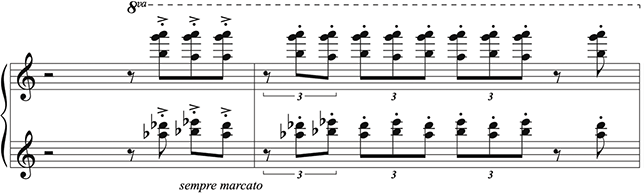
Rather than just alluding to Byzantine music as her teacher Slavenski did in his works, Marić adhered to the original transcriptions found in Mokranjac’s Осмогласник, using the various transpositions of each mode as building blocks of her work and synthesizing them together with modernist techniques for a new expression. For instance, in Octoicha 1, Marić derives the material from the third melodic pattern of the first octoecho (Example 2.1). Yet the influence of both Stravinsky and Bartók resonates throughout the cycle with the use of techniques she learned in Prague – Marić subjects Byzantine modes to segmentation, stratification, metrical displacement, and polymodality with the superimposition of various statements of Octoechos, resulting in clashing dissonances. Chord sonorities are built on fourths, seconds, and sevenths, derived from different pitch centers. The overall percussiveness of the piano is evocative of both Stravinsky and Bartók (Example 2.2).Footnote 23
Stevan Stojanović Mokranjac, Осмогласник [Octoechos], the third melodic pattern of the first mode (octoecho).
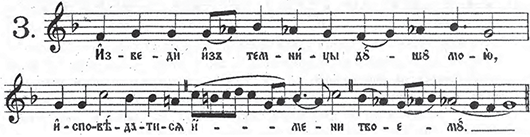
Example 2.1a Long description
This is an ametric melody in two lines, with a B flat in the key signature. The top line is one phrase long, featuring quarter notes and eighth notes in conjunct stepwise motion, and only four pitches, F, G, A flat, and B flat, with a phrase ending on a half note G. The second line has more variety. It features leaps, a wider range of rhythms. It contains two phrases, the first one centers on C with A and B, while the second phrase returns to the flattened pitches, ending on G.
Ljubica Marić, Октоиха 1 [Octoicha 1] for symphony orchestra (1958–1959), the first movement (Improvisation), the clarinet part.

Example 2.1b Long description
This excerpt shows Marić using the same pattern of the first mode, albeit starting on C, hence, the four pitches are C, D, E flat, and F, with the phrase ending on D. Marić’s excerpt is notated in three measures, each one in a different meter, 6/4, 3/4, and 5/4, showing some of her modernist traits.
Ljubica Marić, Византијски концерт [Byzantine concerto] (1959), the third movement, piano part in mm. 25–26.
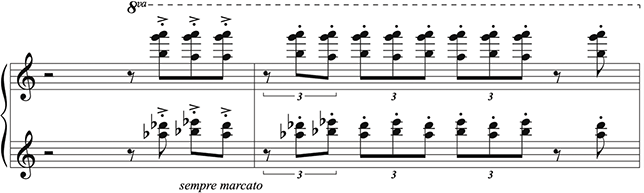
Example 2.2 Long description
This short excerpt features the two hands playing polychords: right hand alternating B flat, G, and A, and A, G, A trichords, and left hand alternating two pairs of fourths, A flat and D flat, and B flat and G flat. The repeated dissonant polychords with irregularly placed rests and accents evoke Stravinsky’s style.
Marić obtained a copy of Mokranjac’s Осмогласник in 1947, and her notes reveal that at this time she was already thinking about incorporating Byzantine modes in her music.Footnote 24 It would take Marić a decade to start this endeavor, but by the time she completed Octoicha 1, her musical language, technique, and modernist aesthetic were fully formed and showed little change for the rest of her oeuvre.
Marić enjoyed great success with her octoecho-based music across Yugoslavia, with notable performances of Octoicha 1 in Belgrade under the baton of André Cluytens and at the 1963 Music Biennale Zagreb. Her Byzantine Concerto was also performed in Dublin and across the USSR, while her Ostinato was presented at the Warsaw Autumn in 1963. Of course, writing modernist music in postwar Yugoslavia came with many obstacles. Even with an official abandonment of the doctrine of socialist realism in 1948, composers, professors, critics, and music directors continued to push for a traditional aesthetic that supported the government’s communist ideology. For instance, following the premiere of Octoicha 1 in Belgrade, composer and music critic Dragutin Gostuški described the piece as “an attempt” at reintroducing Serbian religious music in a new context with more diverse means. He continued: “Unfortunately, although worthy of attention, this idea failed to illustrate the composer’s full creative ability. Neither by its inspirational values nor by technical approaches is this work a representative of our country’s musical output, let alone did it justify engaging a conductor of Cluytens’s caliber to battle this raw sound material.”Footnote 25
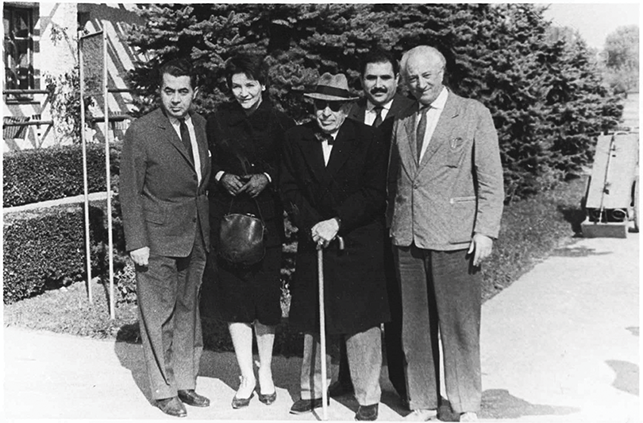
Eventually, with much struggle and lobbying by Pavle Stefanović (1901–1985), a close friend of the composer and a distinguished music critic dedicated to the promotion of avant-garde music in Yugoslavia, Marić eventually received notable awards in Yugoslavia. She also caught the attention of figures such as Stravinsky and Dmitri Shostakovich during their visits to Yugoslavia. In the fall of 1961, Marić had the opportunity to meet Stravinsky during his one-week residency in Belgrade (September 30–October 7) for the performances of his Oedipus Rex and Perséphone (Figure 2.1). On one occasion, Marić revealed to Stravinsky that whenever she is faced with a compositional dilemma, she turns to his music for a solution. With a witty retort, Stravinsky responded that he does the same, except that he seeks advice from better composers.Footnote 26 Marić also met Shostakovich in Belgrade in 1964, who later stated that one of the most wonderful impressions left on him during his visit to Yugoslavia was hearing Marić’s Songs of Space, admiring her talent for her use of the “entire arsenal of modern music” in this work, which to Shostakovich illustrated “a clear, yet persuasive expression that derives from the depth of her soul.”Footnote 27
Ljubica Marić with Igor Stravinsky, October 1961, Belgrade: (from left to right) Predrag Milošević, Ljubica Marić, Igor Stravinsky, Vojislav Kostić, Milenko Živković. Serbian Academy of Sciences and Arts Archive.
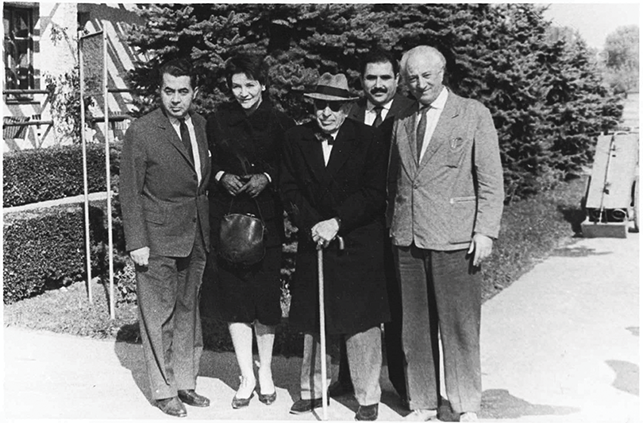
Figure 2.1 Long description
Photographed standing on the sidewalk: Predrag Milošević in a suit and tie, Ljubica Marić in a black stylish coat and holding a black purse, Igor Stravinsky in a hat, dark sunglasses, black coat over his suit, leaning on his cane, Vojislav Kostić in a suit and tie, and Milenko Živković in a suit and tie.
As the first woman composer in Yugoslavia, a professor at the Faculty of Music, and a member of the Composers’ Society, Marić opened the door for the next generation of women composers across the country. Interestingly, Marić and those who knew her claim that she never considered herself a woman composer, but just a composer who enjoyed the same privileges as her peers, who were all men, and that being a woman never imposed any professional hardships on her. Marić explains that being a woman had no bearing on the character or value of her music. For instance, she notes that many of the letters she had received while living abroad were addressed to “Mr. Marić,” which to her indicated that her creativity was seen on an equal par to her peers.Footnote 28 Pavle Stefanović regarded the composer as “a person,” “an artist,” and “a genius,” but never a woman.Footnote 29 However, this idealistic portrayal of Marić may not be entirely accurate. For one, unlike her peers, Marić was not able to secure a teaching job for several years despite her remarkable training and accolades. Further, even though she was more accomplished than most of her colleagues, Marić was not appointed a professor of composition; rather, she taught music theory, harmony, counterpoint, and solfeggio. The photograph of postwar composers at the Music Academy – both faculty and students – taken in the 1950s notably featured sixteen men and did not include Marić, nor any other woman (Figure 1.3). Nonetheless, Marić remained on faculty at the Academy of Music in Belgrade until 1968, never having taught a single class (or student) in composition, while continuing to inspire new generations of composers who incorporated Byzantine elements in their music.
Miloš Petrović: East Meets West
The trend of imbuing modernist art music with Byzantine elements continued for decades after Ljubica Marić first introduced it in her works. The movement gained momentum from the 1980s onward, as multiethnic Yugoslavia was experiencing a rise in nationalism and composers were seeking ways to assert their national identity. For the parts of the country that were once under Byzantine rule, implementing sacred Orthodox Christian elements became a desirable trait. However, the 1980s also signified an era of weakening communism and the opening of Yugoslavia toward the West. Miloš Petrović (1952–2010), a composer, pianist, harpsichordist, and writer/novelist effectively synthesized both phenomena and produced some of the most original works that blend Eastern (Byzantine) and Western (jazz) styles in his two remarkable suites, Историја Византије 1 & 2 [The history of Byzantium 1 & 2], both recorded in 1991.
Petrović first burst onto the music scene in 1972 as a jazz pianist, not typical for a student at the conservative Faculty of Music in Belgrade. A self-taught composer, he displayed an affinity for electronic and avant-garde music, first collaborating with the experimental minimalist group Ensemble for Different New Music and then taking courses with Vladan Radovanović and Paul Pignon at the Electronic Music Studio Radio Belgrade.Footnote 30 At the Studio, he realized three works, Електронска студија 4 [Electronic study 4] (1978), Lei parla italiano? [Do you speak Italian?] (1978), and Anton with/without Webern (1980); the last of these was performed at the Music Biennale Zagreb in 1981. Although none of these works survive in either written or realized form, Radovanović attests to Petrović’s versatility, talent, and innovation, referring to his oeuvre as “musical music.”Footnote 31 Radovanović further notes that Petrović had also written one of the earliest examples of multimedia work in Yugoslavia at the time – Body Music for three performers (1981–1982). Influenced by Cage’s experimentalism, performance, and conceptual art, trends that were sweeping Yugoslavia (and Eastern Europe) at the time, Petrović’s Body Music calls for the performers to move about – the action then producing the sound, either with performers changing their position in space or with their speed of change.Footnote 32
An active musician interested in any type of music he encountered, Petrović traveled within and outside Yugoslavia and attended music concerts and festivals, where he absorbed a rich variety of genres and styles. Even the composer himself notes that his opus may appear incoherent at first. He wrote experimental electroacoustic music, multimedia works, chamber operas, neo-Baroque harpsichord suites, a cycle of pop songs, and “ethno-jazz” themes and improvisations,Footnote 33 and he performed as a classically trained harpsichordist but also as a pianist in the jazz ensembles Interaction and Jazzy, and later with the Balkan Big Band Orchestra.
Petrović’s aesthetic took a sharp turn in 1990, a change musicologist Zorica Premate cynically describes as moving from “avant-garde” to “retro-grade.”Footnote 34 His first work in this new style was the First Harpsichord Suite, which he initially attributed to the “newly discovered” seventeenth-century Baroque composer Mihajlo from the town of Peć (in present-day Kosovo). Eventually, the work proved to be Petrović’s own composition that he had attributed to a fictional character he invented. Had it been true, “Mihajlo” would have been the first and only known composer in the Yugoslav region dating from the Baroque period. The truth was revealed to the great displeasure of his peers and critics, who considered this practical joke by Petrović, himself a professor at the Faculty of Music at the time, to be mocking the establishment. The suite combines the style of the seventeenth-century French school of harpsichord since “Mihajlo from Peć” supposedly studied with a renowned French composer, harpsichordist, and organist, Jean-Henri d’Anglebert. Further, the piece is infused with folk idioms from the eastern Mediterranean region, Mihajlo’s assumed native land.
From this point on, Petrović continued to compose and perform in a style that combines the Eastern (Eastern Roman, i.e., Byzantine) and Western, particularly jazz, elements. As a self-taught composer and improviser in the jazz style, Petrović realized that all aspects of his traditional and nontraditional training and interests were compatible – both Byzantine and jazz styles are based on non-Western modes, and both his harpsichord practice and jazz performance are grounded in the notion of improvisation.
Petrović’s most substantial projects in this cross-genre style, which he called “ethno-jazz,” are the two suites that he recorded in 1991 and released as two albums, the History of Byzantium 1 and 2.Footnote 35 Entirely improvisatory in nature, as are his subsequent works in this style, these suites have practically no record of music notation. All tracks bear descriptive names of Byzantine historical places, figures, or events – for instance, the first album opens with the track “Ararat! Neither God nor a Mountain” and ends with “The Last View of Tzar Konstantin XI Dragaš and the Fall of Byzantium.”Footnote 36 Each track features a mix of styles, with both traditional and standard Western instruments, and classical elements combined with jazz improvisations, folk, and pop idioms. These improvisatory and pop/folk elements often appear unexpectedly. For example, a prolonged improvisatory passage on a traditional stringed instrument, such as oud or Turkish saz, featuring modal and quarter-tonal scales, is immediately followed by a strong pop/rock beat supported by the electric bass, a drum set, and a synthesizer. Milin posits that such abrupt changes are indicators of Petrović’s fascination with the diversity of Byzantine musical traditions and their intersecting identities.Footnote 37
Petrović wrote around sixty works in different styles – electroacoustic and multimedia, neo-Baroque, art, pop, and jazz. His unique blend of all of these modes of expression, especially the progressive way of combining sacred Byzantine music with secular is one of the most original contributions to the Yugoslav avant-garde scene. Yet both Petrović and his music have been largely forgotten. There are several reasons for the lack of recognition and the absence of scholarship on Petrović, even within the region of Yugoslavia. First, the music “elite” in Belgrade did not take Petrović’s practical joke regarding his fictional alter ego lightly – while some of his peers immediately realized that the moment Petrović stepped on the stage and claimed that he was holding a breakthrough in music history in his hands he was pulling an obvious prank, many took him quite seriously. As the truth was eventually revealed, Petrović lost credibility among many in the music community. Second, Petrović’s “ethno-jazz” was a new aesthetic in Yugoslavia at the time, a style that the audiences and critics could not quite comprehend. Third, while it was not uncommon for composers to add folk and pop elements to their music, Petrović’s intercultural approach was confusing because the changes in his musical styles throughout his career were so abrupt and unusual – his practice in composition started in the domain of electroacoustic music, and then as a neo-Baroque harpsichord performer-turned-jazz improviser, he became an indefinable “world music” composer. Fourth, shortly after Petrović released his two albums, Yugoslavia was immersed in a series of conflicts that would last for a decade. Petrović and his music, along with all other artistic creativity in the country, simply vanished. Lastly, Petrović was a composer-performer-improviser, and most of his compositions/improvisations were not intended to be preserved in written form. As such, his music is difficult to reenact. Conceivably, Petrović’s music was not meant to be recreated by anyone else – he was the sole artist, creator, and executor.
Petrović was evidently drawn to the two musical styles – Byzantine and jazz – because he recognized their inherent similarities of modal structure, improvisatory nature, historic practice, and oral transmission. That is, neither music was traditionally written down in notation but was rather diffused and taught as part of one’s culture. Thus, just as a century earlier Mokranjac had transcribed Byzantine chants into notation, enabling their dispersion into modern practice, perhaps Petrović’s History of Byzantium warrants the same approach so that it can be reimagined in the new cultural context.
Conclusion
Postwar Yugoslavia underwent a drastic shift in its political organization – it traded its system of monarchy for communism, swiftly joined the Eastern Bloc, and even more quickly left it. Yugoslavia was simultaneously a communist and a socialist country, but also a “liberal” country, at least in comparison to other communist states, open and welcoming to the free-market economy. It was a multicultural and multiethnic nation that boasted unity and brotherhood, but it also allowed for “controlled” expressions of nationalism. Religion was one of those allowances; while the Communist Party did not support a public display of religion, and generally looked quite unfavorably on any mode of organized religion, artists, for instance, could depict religious elements in their works. For composers, this exception meant that they could look back into Byzantine musical practice, including its religious rites, and present it as Yugoslav national heritage – even though it was not necessarily the history or tradition for all Yugoslavs, but only those who were under the Eastern Roman Empire and identified as Orthodox Christians.
It is peculiar that Yugoslavia so acutely objected to being subjected to Ottoman rule but chose to identify so strongly with Byzantine rule. The region certainly waged numerous wars and battles to rid itself of both empires and fought for independence. Ivan Moody suggests that for Yugoslavia (and the Balkan region in general), Byzantium signified a strong sense of identity because these ancestral ties functioned as a “delineator” not only against “Western” identity but also against “Ottoman and Slavic-communist” identities.Footnote 38 While in the West the reference to Byzantium may have signified some sort of “otherness,”Footnote 39 it gave Yugoslavia an incredibly rich trove of cultural heritage material from which artists drew inspiration and creativity that was identifiably original, unique, and raw.


 Open access