

This article builds on the ontological differentiation between human (bios) and other kind of lives (zoé) (Reference Agamben, Costa and CostaAgamben 2004, 18–19) to reveal how this hierarchical distinction has an impact on the specific historical contexts of the Cuban and Venezuelan socialist regimes (1959 to the present and 1999 to the present, respectively). Although debates on biopolitics and animality in Latin America have focused mainly on capitalist societies (see, e.g., Reference Ayala MunitaAyala 2020; Reference GiorgiGiorgi 2014; Reference MacielMaciel 2016; Reference YelinYelin 2015), I show that the same ontological division between human and not human shapes dynamics of power in socialist regimes. This creates a paradox for official discourses based on emancipation from capitalism and neoliberalism. In the last part of the article, I examine imaginaries in relation to the body and the flesh through several instances of visual arts, performance, literature, and public demonstrations. These instances reveal, on the one hand, sacrificial state power over people’s bodies and, on the other, examples of self-determination that defy state power without necessarily having an ideological or programmatic agenda.
Unlike capitalist countries, where dehumanization is mediated by the market (Reference Borón, Gambina and MinsburgBorón, Gambina, and Minsburg 1999), in Cuba and Venezuela dehumanization functions to legitimize violence exercised by the state over the population’s bodies (Reference Glenney BoggsGlenney 2013, 11). Socialist regimes have often normalized practices of “consumption” of bodies by means of repressing and exterminating dissidents or “outsiders” to the revolutionary normativity. As examples, consider the Cuban Unidad Militar de Ayuda a la Producción camps to “rehabilitate” dissenters, Christians, and homosexuals from 1965 to 1968 (Reference Sierra MaderoSierra Madero 2016), or in recent years, the imprisonment of opposition politicians, some of them tortured by the political police and the military in Venezuela (United Nations 2019).
The Cuban and Bolivarian revolutions stood on a promise to bring social, political, racial, and cultural justice. According to official discourses, these revolutions represented a radical break, not only with the immediate past—the Batista dictatorship in Cuba (1952–1959) and social democracy in Venezuela (1958–1998)—but also with colonial legacies of the nineteenth century (Reference RojasRojas 2006; Reference TorresTorres 2009). However, after sixty-one and twenty-one years, respectively, those regimes have redefined political discrimination and the subjection of bodies.Footnote 1
A common form of subjection in both countries has been food control. According to Brian Fonseca and John Polga-Hecimovich (Reference Fonseca and Polga-Hecimovich2020, 13), “As in Cuba, Maduro has used consumer good scarcity and rationing as a way to control the population.” These states have tight control over the import and distribution of food; thus, most of the population depends largely on the state to feed themselves because internal or independent production is insufficient, if not prohibited. Ration cards (libretas de abastecimiento) were established in 1963 to provide Cubans with limited quantities of staple foods, whereas the Venezuelan Comité Local de Abastecimiento y Producción (CLAP) boxes, established in 2016, distribute food at irregular intervals to those holding a carnet de la patria.
According to Elzbieta Sklodowska (Reference Sklodowska2016), the libreta de abastecimiento manifests the biopolitical connection between food and power that in other contexts is concealed by the free market. State control over biological functions creates hierarchies, which are in this context concealed by an official discourse of social justice. For example, during the 1990s, a period of widespread hunger, only foreigners and Cubans with dollars had access to a sufficient quantity and variety of foods in the “diplotiendas” (Reference Birkenmaier and WhitfieldBirkenmaier and Witfield 2011, 290). In Venezuela, those who are not affiliated with the ruling party (Partido Socialista Unido de Venezuela, PSUV), cannot obtain the carnet de la patria and thus have no right to receive CLAP boxes (Provea 2019).
Jacques Derrida (Reference Derrida and Wills2009) coined the term carnophallogocentrism to refer to the sacrificial logics underlying Western modernity. Meat consumption reveals the naturalization of a violence backed by the ontological differentiation between humans and animals, which Giorgio Agamben (Reference Agamben, Costa and Castro2006) termed the anthropological machine. The distinction between humans and nature thus excludes animal life from the political order and determines human sovereignty over all living beings.Footnote 2 Also based on this constitutive divide, the anthropological machine assumes that nonhuman lives can be reduced to mere consumable bodies by humans.
As summarized by Patrick Llored (Reference Lloredn.d.) sacrifice as a manifestation of “ritual and founding institution … by which man grants himself, through violence, a subjectivity that allows him to install an insurmountable limit between himself and the animal, through an operation that denies the very act of killing” (63–64).Footnote 3 Animal death is thus made invisible or naturalized by such ontological distinction. Further, the traditional heterosexual male white model understood as paradigm of humanity imposes the sacrificial structure of carnophallogocentrism over those humans who do not fit that model, hence grouping them with the animals, transformed into mere bare life without attributes of citizenship. Animality becomes the sacrificial alterity of the modern unitary subject, an alterity defined by racial, gender, national, and even ideological markers.
As historical experiences of Western modernity, real socialist regimes did not escape the naturalization of carnophallogocentrism’s sacrificial violence. Rosi Braidotti (Reference Braidotti and Vitale2013) has underscored the necessity to take distance from the unitary subjectivity of humanism, and this is true even in its socialist manifestations. As in the positivism in Latin America (Reference BurnsBurns 1990), the teleological logics of socialist discourses have defined its paradigms of humanity in hierarchical terms to establish an inside and an outside of the political order in Venezuela and Cuba.
As early as 1965, Ernesto “Che” Guevara proposed the model of the New Man. As Adriana López-Labourdette states: “The new man, creator of and created by the Revolution, will constitute the paradigm of the human, the highest step on the evolutionary scale” (2016, 215). The futuristic dimension of the New Man had resonances in the so-called twenty-first-century socialism mentioned for the first time by Hugo Chávez in 2005 and implemented in 2007, despite the fact that this proposal was rejected in the constitutional referendum that year (Reference López Maya and LanderLópez Maya and Lander 2009, 69; Reference López Maya and PanzarelliLópez Maya and Panzarelli 2011, 58). Among guidelines of the twenty-first-century socialism, the Venezuelan regime recovered the paradigm of the New Man, based on the premise that “the new ethics [would] lead to the new man with whom we [would] overcome human prehistory and we [would] enter into the true history, that of socialism” (Reference López Maya and LanderLópez Maya and Lander 2009, 70). Those subjects who contravene the ideal of the New Man or who do not support twenty-first-century socialism are animalized like gusanos or escuálidos and excluded from human history.
In what follows, I examine some biopolitical devices grounded on sacrifice in Cuba and Venezuela, as well as different instances of contestation based on a return to animal and flesh, which serves to reveal death mechanisms underlying state power and instances of self-determined irreducibility. Fundamental to addressing this ambiguity of animal and flesh are notions of vulnerability and sovereignty, understood as dispossession and self-determination, two elements that were already problematized in an earlier, different context by the Cuban writer Virgilio Piñera.
Flesh
In 1952, Piñera published the novel La carne de René (Reference PiñeraPiñera 2000). Its main character constantly tries to avoid his bodily dimension. A terrifying choice underlies the assumption of his own body: giving in either to pleasure or to pain. To dodge the disjunctive, René shuns contact with other bodies and tries to keep his subjectivity intact. In this manner, Piñera seems to anticipate some of biopolitical debates around the binaries of immunity and community (Reference Esposito and RuizEsposito 2009) and sovereignty and vulnerability. If the immunity that René embraces determines a mechanism of closure, of self-preservation in the face of the external threat of dissolution, then collectivities imply an opening that involves some degree of dissolution in the others (Reference Esposito and RuizEsposito 2009). In this sense, sovereignty works as a dispositif of immunity, keeping at bay the risks of vulnerability and abandonment. Piñera’s novel reveals—with some humor—the extent to which we are forced to acknowledge, in spite of our resistance, the ultimate precariousness of our nature as body-flesh (Reference Castro RochaCastro Rocha 2013, 67). The assumption of a physical and sensorial materiality permeates Piñera’s works; Antón Arrufat affirmed that “the path of all flesh in Virgilio Piñera is the flesh itself. Its experience, its exploration and its final acceptance” (Reference Arrufat1999, 17). Flesh amounts to the ultimate, nonpersonal, nonteleological organic remain that escapes any ordering structure. It constitutes the end of identity fantasies, sovereignty dispositifs and official discourses. In doing so, flesh returns us to an animal ambivalence: on the one hand, a body without self-sovereignty is mere meat that feeds the carnophallogocentric structure; on the other hand, the vulnerability of this fleshy body conveys a sense of plurality, as it is alien to “to any kind of unitary organization” (Reference Esposito and MolinariEsposito 2006, 264). Flesh, once we have dispensed with the immunity frontiers of the anthropological machines, becomes a “being in common.”
In La carne de René, multiple dilemmas about corporality touch on this ambivalence, such as that between pain and pleasure and subjective reason, between victimized and victimizing bodies, unity and disintegration, sacrificeable and liberated lives. In putting in play these elements, Piñera invites the reader to a fictional universe that dispenses with the fixed limiting elements of humanism. What is at stake is the formulation of these ambivalences in dynamic and relational terms, rather than excluding ones, to underscore their lack of a moral or ideological univocal direction and the fact that they can be mutually exchangeable. The next section examines the way body and flesh reframe these tensions in revolutionary Cuba.
Foundational Sacrifices: Sovereignty and Animality
By the late 1980s and 1990s, new generations or artists and writers started to question openly the monolithic narratives of the state. It was a breath of fresh air after the so-called Quinquenio Gris that took place throughout the entire 1970s. The period is known for an extreme dogmatization of culture that led to dozens of censored books, purges in universities, and artists and writers being imprisoned or ostracized (Reference RojasRojas 2015.). During the following decade, “rectification” followed, aimed at a political reorientation more distant from Soviet models (Reference LópezLópez 2007). Two of the most renowned groups of the period were El Establo, founded by writers Raúl Aguiar and Ronaldo Menéndez, and, a bit later, Proyecto Diáspora, coordinated at its inception by Rolando Sánchez Mejía and Carlos A. Aguilera. Already in its name, El Establo (The Barn) claimed the need to attend the animal other, whereas Proyecto Diáspora, strongly influenced by poststructuralism, aimed at destabilizing a unitarian conception of humanity. A number of voices connected to both groups were particularly outspoken in their interpellation to the state from outside official discourse. The artist Tania Bruguera worked as graphic designer for the magazine of Proyecto Diáspora (1997–2002). Later, in 2015, Bruguera founded the Instituto de Artivismo Hannah Arendt as “a space of collaboration between art and activism with the intent of participating in political, economic and social change that is redefining Cuba” (Diario las Américas 2016). The artist’s interventions generally revolved around the question of the body, usually her own, pushing the limits of the unitary subject of humanism. “I’m not interested in acting, I don’t play characters. … Rather, it is a liberating process of instincts, which displaces the individual from her objective rationality to place her before a space of sensory confrontation with herself” (Reference WoodWood 2000, 35), words that reveal a closeness with Piñera’s project, as it was precisely the nonsubjective, sensorial road that the character René avoided.
In contrast to Piñera, who emphasizes the inescapable closeness of pleasure and pain, Bruguera is interested mainly in the painful dimension, which she articulates to denounce the biopolitical dynamics of the Cuban regime. This difference can be explained by the dissimilar contexts between writer and artist. Bruguera is a “daughter of the revolution” whose work was strongly marked by the Período Especial during the 1990s. With the end of the Soviet subsidies to the Cuban regime, the population was subjected to an acute shortage of food and medicine as well as the collapse of services such as electricity, water, and transportation (Reference RojasRojas 2015). The centrality of the suffering body in Bruguera’s work allows her to bypass the ordering structure that legitimizes the socialist status quo. In 1997, Bruguera conducted a performance at home after the Cuban authorities banned her participation in the Sixth Havana Biennale. In a performance titled El peso de la culpa, Bruguera explored issues of blame, sacrifice, and atonement in relation to the historical experience of the island. Covered with the bloody carcass of a goat, the artist kneeled and slowly swallowed, for an hour, soil mixed with water, which she took from a clay vase. The performance served Bruguera to engage with stories about Ciboney natives who committed suicide by eating soil to escape the Spaniards (Reference RamsdellRamsdell 2009, 201). By eating soil, Bruguera referred to an action of historical resistance to slavery that also alluded to the scarcity of food. Milica Acamovic has underscored that “comer tierra” (eating dirt) amounts to the ultimate resource when facing the need to eat (2016, 40), an expression also used in Cuba to “refer to suffering from hunger and deprivation” (Setdart 2018). While the reference to indigenous practices connects to a kind of (suicidal) agency in times of the Spanish Conquest, the second implication gestures toward the impossibility of feeding in the 1990s. In the background of her performance, Bruguera placed the work Estadística (Figure 1), an “adaptation of the Cuban flag made of human hair that the artist collected in the Island during the most difficult months of the Special Period, before the exodus of the rafters (balseros) in 1994. To make the flag, she tied small strands of hair, with blue, red and Green ribbons, and sewed them to a black cloth” (Reference RamsdellRamsdell 2009, 200).
Bruguera during the performance El peso de la culpa, with the work Estadística in the background (1997). Image courtesy of Tania Bruguera.

The sacrificial dimension of this woman-goat clearly identifies her with different periods of the island. The relationship between the goat’s skin, the natives, and human hair points to the sacrifice of the living to found and perpetuate the nationality of the island. Yet what are, in the present, the sacrifices to which Bruguera alludes?
In another performance, Sin título: Habana 2000, conducted in La Cabaña fortress in Havana and swiftly closed down by Cuban cultural authorities, Bruguera referred to the hundreds imprisoned and executed without proper trial in that very location during the first years of the revolution. Four naked bodies in shady corridors covered by fermented sugar preceded the screening of black-and-white footage of Fidel Castro. The bodies imitated the gesticulation of Castro while sounds of interrogatories and a gun loading and unloading could be heard on the background (Reference Bruguera and BrugueraBruguera n.d.; Reference RubinRubin 2010, 15). More than any other space, the fortress has embodied historical violence in the island for various centuries. A symbol of colonial domination, it was turned into a prison and execution ground in the nineteenth and twentieth centuries, during the regimes of Gerardo Machado, Fulgencio Batista, and Fidel Castro. For its part, the fermented sugarcane with which the artist covered the ground revealed another equally foundational type of violence: of the sugar plantations and slave labor.
In connecting the experience of colonialism and slavery with the dictatorial regimes of the twentieth century, Bruguera insists on the sacrificial violence that upholds the founding of the nation and the Cuban Revolution. The naked bodies in the fortress, alike the body of the goat-woman in El peso de la culpa, and the black bodies of the slaves alluded by the sugarcane, are thus transformed into the bare life that “fed” the revolutionary regime.
In La violencia y lo sagrado, René Girard (Reference Girard1972) suggests that sacrifice antecedes the formation of communities and is repeated upon every crisis. Scapegoats served to reroute the violence that threatened to destroy the social order onto a lesser kind of violence that targeted a minor actor (Reference GirardGirard 1972, 155), thus securing the necessary social cohesion. In accord with her “artivism,” Bruguera’s performances make visible the violence that confirms the sovereignty of the revolutionary state over the Cubans’ bodies. If the exterminated natives, the black slaves, and the Cuban executed prisoners allude to a foundational violence, the human hairs of her Cuban flag, collected during the Período Especial, gesture toward the dispensable victims that ensured the survival of the established order.
The anthropological machine supposes that each time a sacrifice is repeated, the erasure of its own violence is also repeated. It is for this reason that it is necessary to reduce those sacrificed to mere bare lives without attributes.Footnote 4 Such erasure is evident in the performance The Body of Silence (1997–1998), in which Bruguera covered a small room with chunks of lamb flesh, creating a sort of open organic cavity. The audience observed how the naked artist “licked,” “chewed,” and “swallowed” fragment of “corrected” and censured pages of a book on Cuban history. A sacrificeable life expresses itself in its full cruelty and carnality, whereas a historical erasure is expressed in terms of a violence imposed in the body of the artist, who swallows the paper of an official book as she swallowed soil in El peso de la culpa.Footnote 5 In contrast to the invisibilization of the anthropological machine of the state, the performance turns silence material by incorporating it over a precarious body, a bare life.
The Cuban Revolution posed as a reestablishment in which nation and revolution became an indivisible entity. Thus, those who rejected the official narrative are conceived of as unpatriotic or gusanos, animals without nation or nationality. In a brief passage of his autobiography En mi jardín pastan los héroes (Reference Padilla1981), Heberto Padilla narrates his last conversation with Fidel Castro before leaving for exile. In it, the poet refers to himself in the third person:
[Fidel says] —You’ve spoke a lot of shit, don’t deny it. And what you said about my cows, we will discuss later, at another time, when there are fewer people.
—What I have said? He repeated shyly.
Fidel approached him and put a hand on his shoulder. He spoke softly, glancing from side to side to make sure they couldn’t hear him.
—Yes; that they have tuberculosis.
—What did I say?
—You have repeated it. It is the same; but I don’t want to talk about it now. These are CIA hoaxes. I personally care about them myself and everyone knows that in ’71 the problem will be what to do with so much milk. Didn’t you see the paddocks while you were coming? What doubts do you have that it is true? Because you surely question it. What is your category: gusano, gusanoide or gusanón?
—I, Fidel … —he stammered
— Yes, which one? —Because revolutionaries don’t need to see or speak to me. They have confidence. And if you want to see me it is because you doubt. And the one who has doubts is lazy, a softie (blandengue), a gusano. (84)
Animals appear in the dialogue in two ways. First, as the opposite of the revolutionary subject, that is, the gusano-traitor, a nonhuman condition and thus sacrificeable. A gusano is constituted as the negative alterity of the Hombre Nuevo in the “bestiario pedagógico” (Reference Braidotti and VitaleBraidotti 2013, loc. 1284) of Cuban socialism. Second, “animal” is an attribute of power as an object, as property of the humans, as Castro’s cattle, which will produce more milk and better meat. In a discourse broadcasted in the 1970s, Castro even labeled himself “rancher in chief” and reified cattle as “red gold” (Reference VegaVega 1997; Reference CaraballoCaraballo 2016). As the owner of cattle, Fidel Castro was sovereign not only over the cows’ lives but also over the population that he intended to feed with the animals.Footnote 6 Here, the cattle have resonances with a regime in which individuals have lost their subjectivity and self-determination to be animalized.
The paradoxical relationship between animals and sovereignty lies in the conception of the people as foundation of sovereignty of the regime, while at the same time the people are bestialized by such sovereignty (Reference GiorgiGiorgi 2014, loc. 2146); a political ambivalence that Derrida (Reference Derrida, Peretti and Rocha2008) emphasized in the figures of the beast and the sovereign. Diego Peller (Reference Peller2011) summarizes Derrida’s approach: “On the one hand, beast and sovereign are opposed and constitute themselves in the same opposition (the reason for being of the sovereign is to protect the community from the threat of ‘wild beasts’) but, on the other, sovereign, beast and great criminals share a being outside—or above—the law, which causes them to end up resembling each other in a disturbing way.”
A troubling similarity between beast and sovereign is present in the work El gran fascista (1973) (Figure 2) by the Cuban visual artist Rafael Zarza González. In an image about Francoism, state sovereignty is evinced by the animalization of both the other and the great leader.
El gran fascista (1973) by Rafael Zarza González. Image courtesy of Rafael Zarza González.
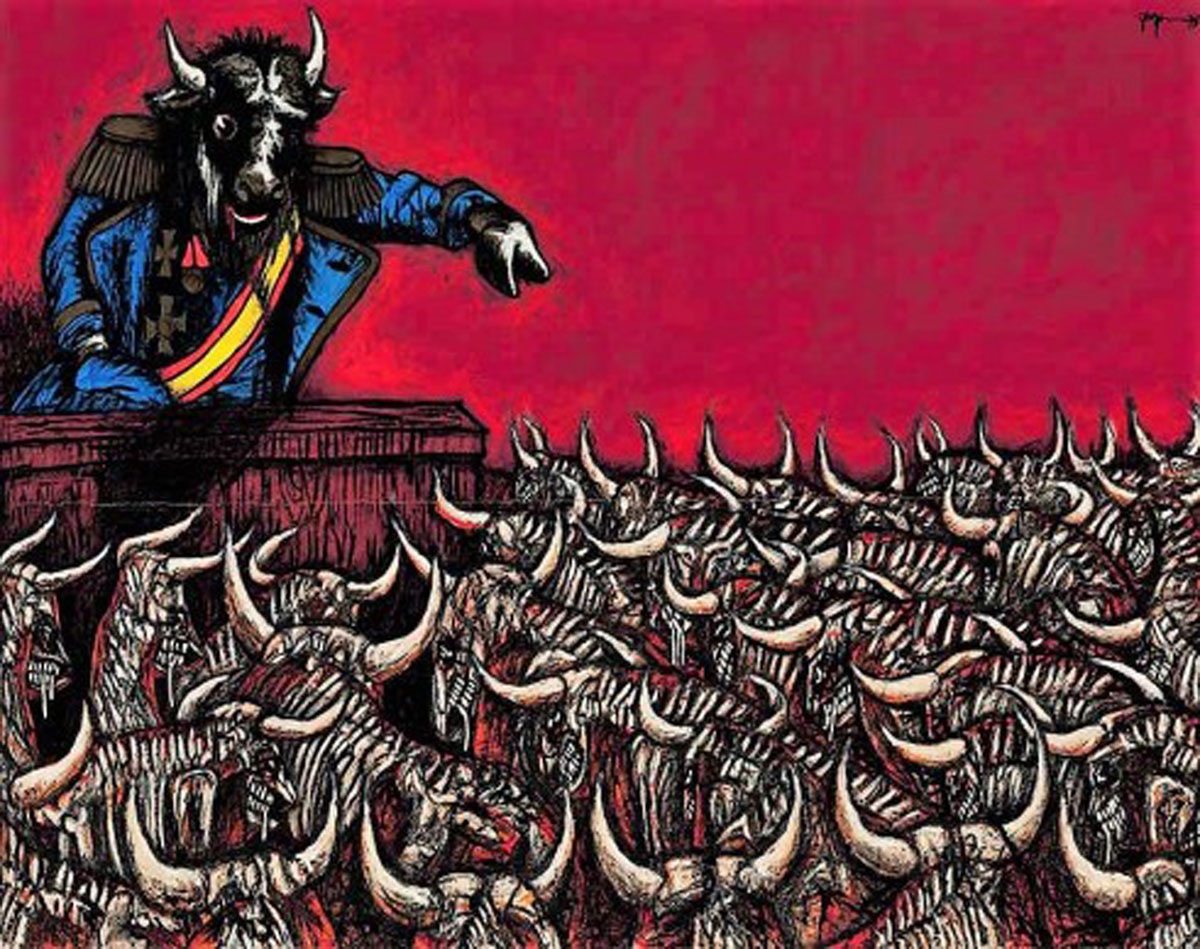
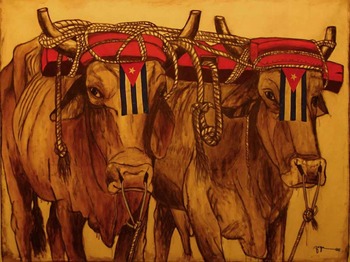
While the masses are turned into cattle, the bull leader is bestialized as a consequence of his power. The bestialization of the ruler does not imply his loss of sovereignty over the rest; rather, it is a symbolic gesture that erases the hierarchy of anthropological machine in order to question that power. Animals put on hold the oppositions (Reference YelinYelin 2015) between beast and ruler and mark an “outside” constitutive of power. To turn the people (subjects) into obedient cattle, it is necessary to sacrifice their human subjectivities, as in another of Zarza’s work, in which foreheads of yoked oxen display Cuban flags (Figure 3).
El yugo rojo (2011) by Rafael Zarza González. Image courtesy of Rafael Zarza González.

Returning to the references to slave plantations in the performance Sin título. Habana 2000, the animal is the entity that is valued simultaneously as the empowering matter of sovereignty, as in Zarza’s first lithography, and as an object reduced to a mere materiality that can be exploited, as in Zarza’s second work. Bullocks, black slaves, and the people-subjects share the same nonhuman condition. In a similar line, in the essay-manifesto by Proyecto Diáspora “Addenda, vacas y ratas,” Rolando Sánchez Mejía seems to allude to the Cuban people as “pesadas máquinas de pastar,” quantified and delimited in spatial terms by the state (Reference Sánchez Mejía1997, 88–89). Yet as any other animals, cattle also points to a potentiality. Animal flesh is vulnerability and death but also energy and life, an ambivalence clearly revealed in the following lithograph (Figure 4).
Carne de res estofada: Producto de la EXURSS (2004) by Rafael Zarza González. Image courtesy of Rafael Zarza González.

An “official” reading of this bull regards it as the appraisal to the Soviet Union’s solidarity in feeding the Cuban population with canned meat. Let us remember, though, the urban legends that held that such meat was actually made of the corpses of gulag prisoners (Reference ÁguilaÁguila 2018), a myth that effectively brought attention to the violence behind food co-optation. From an alternative interpretation, however, the image reveals the criticism of the artist on the Sovietization of Cuban culture during the Quinquenio Gris (Reference Aguilera and BermúdezAguilera and Bermúdez 1997, 270). The open body of the bull thus becomes a pseudocarcass, a bio- or necropower that implies both the living animal and the violence that turns it into amorphous matter inside the can. Body of Silence displayed, simultaneously, a cavity of inert meat and the living body of the artist. Zarza’s lithograph reproduces this duality of open and closed, living and dead, but does not offer a final resolution. This body, between the living animal and the edible carcass, serves us as the hinge for turning to the implications of flesh and meat in contemporary Venezuela.
Of Flesh and Rotten Matter
Before addressing the Chavista period, let me quickly show the implications of consumption and, in particular, meat, in the context of a social democracy that was sustained on oil income, often exorbitant. This will allow me to make the contrast with the later socialist carnophallogocentrism.
In 1962, the strident exhibition Homenaje a la necrofilia by the Venezuelan artist and writer Carlos Contramaestre, a member of the avant-garde group El Techo de la Ballena, opened in Caracas. The exhibition featured different paintings and sculptures of bloody animal remains with accompanying texts of celebration of magma, waste, and putrefaction. As implied in the title, the balleneros (the members of the group) intended a return to the animal, or more precisely, to inhabit the animal, as Jonah in the whale. The writer Salvador Garmendia outlined the purpose of Homenaje a la necrofilia as follows: “Huesos y vísceras de animales recién descuartizados cubrieron las paredes del garaje que sirvió de escondite para la consumación del sacrificio” (Reference CalzadillaCalzadilla 2008, 49–50). The sacrificial logics of necrophilia that underlay the exhibition denounced the executions and tortures of Venezuelan guerrilla fighters, who refused their integration in the beginning democracy preferring a political system like the Cuban. In a Venezuelan experimental film of the same decade, Basta! (dir. Ugo Ulive, Mérida, Venezuela, Centro de Cine Documental de la Universidad de los Andes, 1969), the viewer witnesses a collage of different sequences showing a corpse dissection, half-naked inmates in a mental asylum, and guerrilla fighters hiding in the jungle. Clearly associated with the evisceration of the corpse and the inmates’ bodies, images of modern Caracas kept appearing. This is a period in which the Venezuelan modernity project was linked to a massive circulation of oil revenues. This redistribution was quickly expressed in growing consumption capacity. The director Ugo Ulive aimed to show the emptying of urban consumerist order with allusions to the redemptive sacrifice of the rural Venezuelan guerrilla. The film ended with images of guerrilla fighters marching in the midst of the jungle while a voice-over repeated the motto: “Hay que seguir peleando” (we have to continue fighting). In contrast with the blood and organs revealed by the dissection of the corpse, the images of fighters offered an idyllic vision of death with the teleological promise of a future alternative to carnophallogocentric capitalism, which the film opposed.
Both Ulive and Contramaestre, who sympathized with the Cuban regime, were interested in denouncing a status quo they deemed unhuman. However, while the film appealed to a sort of alternative purity, embodied in the images of the guerrilla fighters in the jungle, Contramaestre’s exhibition revealed and explored the limits of an extreme materiality. Thus, in contrast to official Cuban discourse, ballenero leftists understood the worms emanating from rotten flesh as the possibility to denounce the status quo while eliciting a renovation of the politico-social order.Footnote 7 The animal element would then give rise, according to the writer Adriano González León, to a “resurrección” (Reference Piniella GrilletPiniella 2018, 60). In addition to the underlying foundational sacrifice of guerrilla fighters, the criticism of balleneros to Venezuelan democracy aimed to reveal the obscene squandering of Venezuela’s oil industry. Paraphrasing Simón Marchan, Piniella notes that they were not interested in “the appropriation of objects at the time of their consumerist glorification but rather at the time of their decline”; that is, in the moment of their putrefaction (Reference Piniella GrilletPiniella 2018, 62).
However, the climax of such putrefaction would take place decades later, in the period of the so-called Bolivarian Revolution. As Jana Morgan (Reference Morgan2011) sustains, by 2005, Hugo Chávez controlled the political system, and the two parties that had constituted the social democracy since 1958 virtually disappeared. Backed by the revenue of a new oil boom from 2004 to 2008 (Reference López Maya and LanderLópez Maya and Lander 2009, 68), Chávez launched twenty-first-century socialism in 2007. Trying to control the distribution of imported food—the regime had controlled access to international currency since 2002—in 2008 Chávez created the Productora y Distribuidora Venezolana de Alimentos (PDVAL) to sell products subsidized by the state oil company while food factories, farms, and cattle farms were expropriated gradually (Reference AzzelliniAzzellini 2009; United Nations 2019).
In 2010, the largest loss of food took place: between 130,000 and 170,000 tons of edibles stored in containers, including eggs, milk, and meat, rotted in several official food distribution locations (Reference TineoTineo 2017).
The cartoon in Figure 5 alludes to the infamous “Pudreval” scandal, a corrupt scheme involving the state company PDVAL, which imported, by means of irregular procedures that enriched different civil servants, far more food than it was capable of distributing (Reference TineoTineo 2017). The vultures and flies in Weil’s drawing point to a corrupted, putrid order of things, without the angle of renovation present in the exhibition of the balleneros. The current regime is one in which animals have displaced humans, where the major food distributor feeds flies and scavengers instead of the population; flies and vultures that, in turn, are an animal metaphor for the civil servants who profited from the scheme and the people’s hunger. Again, state sovereignty is animalized as in the case of Zarza’s bull leader as a gesture, which symbolically erases the hierarchy of anthropological machine to question that power.
This government does not hunt us … it feeds us (2010). Image courtesy of Roberto Weil.

The Pudreval scandal motivated a new generation of writers and artists to organize the 2010 exhibition Necromenaje de la containerphilia, with Contramaestre’s 1962 exhibit in mind. In a gloomy room in Caracas
more than a hundred trays of meat were arranged. … On top of each tray, a poem by Contramaestre: the poetic action consisted of reading the poem to a video camera located in front of the text projected against the wall, knowing that in a few minutes that video would be playing along with the video of others attending the poetic action on the main wall of the room. The payment for this reading was the tray of raw meat, which was packaged and presented to the reader. (Reference McKeyMcKey 2010)
In contrast to the homage to necrophilia of the exhibition of the 1960s, this necro-homage underscored the thanatical aspect of state polities, characterized by criminal restrictions rather than excessive consumption of social democracy. In addition, the implication was that so-called twenty-first-century socialism was founded precisely over the sacrifice of emaciated bodies due to scarcity. That explains that, whereas in the balleneros’ exhibition the corpse fed worms, in 2010 the meat on display was offered to human beings.
In contrast with the consumption excesses of Venezuelan democracy, under socialist carnophallogocentrism, shortages became the way to impose sacrifice. Two opposite interpretations have attempted to make sense of this situation of extreme scarcity. The first emphasizes US sanctions (Reference GrosfoguelGrosfoguel 2019). This explanation, though convenient, is unsatisfactory. David Smilde (Reference Smilde2018) and the 2019 UN human rights report on Venezuela show that scarcities and the dramatic increase in poverty preceded sanctions. Lack of investment in infrastructure and social services, including health and education, were visible after 2009. Expropriations translated into economic decline after 2011. The United States adopted sanctions against selected individuals accused of human rights violations and money laundering only in 2017, and then broader economic sanctions in 2019. Although broad sanctions have certainly not helped, they are not the cause of socialist carnophallogocentrism.
A second explanation emphasizes state agency. Iria Puyosa sustains that what happened in Venezuela after 2003 has not simply consisted of a “autocratic turn” but is “a process of implantation of biopolitical controls to dominate the population and concentrate power” (Reference Puyosa2018, Reference Puyosa2019). To demonstrate this idea, she elaborates a detailed chronology of policies implemented over time (Reference Puyosa2019). Although it is debatable whether there has been an intentional plan to subject the population to hunger—given the ineptitude and corruption of the Venezuelan government (Transparencia Venezuela 2019), such a grand plan would be implausible—state policies bear responsibility for the dramatic figures of poverty and malnutrition (Encovi 2018; United Nations 2019). Moreover, the political instrumentalization of hunger is undeniable. Revolutionary biopolitics make evident the state’s power to minimally sustain, or starve, biological bodies.
The Butcher State
Shortages and insufficiencies in food and medicines, as well as in utilities and transportation, were common in both Cuba’s Período Especial and Venezuela’s period encompassing Chávez’s final years and Maduro’s era. Both countries depend on food imports and, unlike the rest of Latin America, on almost-complete state control of food distribution. In turn, this distribution was instrumental for policies of body regulation associated with food, as I mentioned earlier with ration cards and CLAP boxes. In light of the state’s control over food, the scholar Paula Vásquez has suggested that the “people” of Chavism were not defined as citizens but as consumers (Reference Vásquez2019, 22); the need to eat state-regulated staple food would have had the outcome of annulling citizenship (Reference Vásquez2019, 22). With this in mind, I affirm that the proclaimed “food sovereignty” of Cuba and Venezuela refers, in fact, to state sovereignty over the biological bodies of the population, under a logic tinted with sacrificial echoes of carnophallogocentrism. The revolutionary state “purges” food consumption to such an extent that it obtains bodies emptied of flesh: it is estimated that in 2017, 61 percent of the Venezuelan population had lost an average of eleven kilos, and several animals kept in zoos starved or were sacrificed to feed other animals (Encovi 2018; Reference Herrero and SpeciaHerrero and Specia 2019; Reference Velasco PáezVelasco Páez 2018). The magnitude of the state’s purge of flesh reached the level of starvation, as documented by Encovi (2018) and the United Nations (2019).
Revolutionary regimes paradoxically conflict with the humanist tenets of socialist emancipation because the sacrifice of others sustains their sovereignty. The New Man is not a liberated human but a starving, defleshed one. The state is not only the bull leader of Zarza’s work but also the bull butcher that sacrifices and distributes in order to regulate the population’s flesh. Zarza’s animal (Figure 6) becomes analogous to the Venezuelan former vice president during a proselytizing session of meat distribution in 2010 (Figure 7).
El carnicero (1998) by Rafael Zarza González. Image courtesy of Rafael Zarza González.

Former vice president Elías Jagua at a government-sponsored meat distribution (2010). Photo by Latin American Herald Tribune.

The butcher state is yet another variation of the cannibal state, as the flesh that the population lacks is the one that feeds the state. In other words, state power emanates from the state’s carnivore sovereignty over the population. In 2018, on the occasion of a publicized visit of Nicolás Maduro to a luxury meat restaurant in Istanbul during the humanitarian crisis in Venezuela, the cartoon shown in Figure 8 went viral.
Image courtesy of Rayma Suprani (2018).

The trope of the cannibal monster is part of “a long tradition as a political metaphor for tyranny and against the state of insatiable appetite that eats its own children” (Reference JáureguiJáuregui 2008, 35). It is also a representational tradition particularly connected with the subject of revolution, as it foregrounds the idea that what sustains movements of liberation ends up being destroyed-consumed. In fact, the image or myth of Saturn is recurrent in Latin America to refer to the events surrounding the Cuban Revolution or, in present times, to Venezuela.Footnote 8 In both cases, the revolutionary state self-assigns its sovereignty by means of cannibal consumption and the butcher-like distribution of the social body.
Disobedience
Some forms of disobedience go back to the primariness of flesh to confront biopolitical regulations in Cuba and Venezuela as an assertion of self-sovereignty. Beyond its mere physiology, flesh emerges as political matter (Reference CohenCohen 2013). As detected in Piñera’s novel, the different ambivalences of bodies are far from unidirectional. While relationships between power and vulnerability, sovereignty and dispossession, are functional to the state’s authority, those relationships can also contest such power. Dissident corporealities are bound to reveal the sacrificial structure of revolutionary regimes. In what follows I refer to three different, and often juxtaposed forms of disobedience: the dispute over the bodies of animals, the disclosure and denunciation of the state’s carnophallogocentric structure, and the return to (or lack thereof) flesh as the enunciation of an irreducible sovereignty, which paradoxically conforms alternative ways of collectivity.
As in other countries where extreme scarcity has prompted desperate actions (Reference HalperínHalperín 2007), in Venezuela, looting and animal slaughtering on farms, streets, zoos, and cattle trucks have been constant at least since 2013. Images of those episodes circulate only in social networks, local media, and international media outlets; the mainstream national media is limited by censorship (United Nations 2019). The images expose the invasion and pillage of farms, the killing of cats, and the sale of dog meat in popular markets. Figure 9 reproduces pictures published by Noticias 24 (2013), a Venezuelan digital news source, documenting the looting of vehicles carrying living animals, which were then slaughtered and quartered on the spot.
Local residents quarter livestock in the middle of a road after truck collision in the Morón-Coro highway. Photographs by Alexander Sánchez (2013), Noticias 24.

If the abject, as proposed by Julia Kristeva (Reference Kristeva2010), signals the fragility of the limits separating an inside and an outside, the open slaughter of animals, once the concealment of commercial mechanisms is removed, alerts us of the downfall of the human-animal differentiation of the anthropological machine. With the erasure of the ontological frontier delimiting human and animal, we discover that there is no bestialized external other and that a structure of death upholds the social order. Such abrupt revelation of a thanatological regime denotes a kind of natural state, with the people disputing food sovereignty to the state. Animality in humankind emerges as that which breaks the state’s carnivorous sovereignty.
Literature has fictionalized conflicts over meat triggered by a very “animal” desire to eat in order to reveal the carnophallogocentric structural violence of socialist regimes. The short tale “ABC Diario” (Reference Menéndez2002) by Ronaldo Menéndez, founder of El Establo group, makes explicit the violence underlying ration cards and revolutionary pedagogy. In a sarcastic note, the narrator of “ABC Diario” bestows new meaning to the three first letters of the alphabet of literacy primers. A stands for his grandparents (abuelos), whom the narrator wishes dead but has to take care of to obtain the cigarettes assigned to their cards; B stands for his “inexistent banquets” (banquetes) based solely of carrots; C is for the fishing rod (caña de pescar) the narrator uses to “fish” cats on the roof, which he then stews and passes off for rabbits in family dinners. Far from the humanist paradigm of the New Man, the tale betrays a social order of little (if at all) solidarity among humans, merely driven by instinctive hunger.
For his part, the Cuban writer Ángel Santiesteban takes on the topic of meat in the tale “Lobos en la noche” (Reference Santiesteban2001), in which two friends try to dodge the authorities while conducting the risky operation of quartering cattle that have been run over by trains. As in “ABC Diario,” the tale reveals ways that hunger and the clandestine and profitable sale of meat undermines the social fabric. The community gains cohesion as neighbors and family members pressure the narrator to keep feeding them with the stolen meat—again, no room for humanist ideals. The characters’ transgression does not bring empowerment but reveals the thanatological drift of society under the exigencies of hunger.
In another of Menéndez’s tales, abjection reaches an even more extreme limit, revealing a social order that blurs the distinction between devourers and devoured, victims and victimizers. In “Carne” (Reference Menéndez2002), two friends plan to trespass on a ranch to kill a cow and take away its meat. In the dark of the night, they are discovered and detained by a weird group of ranchers who, as they discover in awe, will execute, butcher, and sell them as meat. The topic of the cannibal, a classical figure of alterity in Western culture noted before in relation to the state, is here articulated as a metaphor of the bestialization of the social order (Reference JáureguiJáuregui 2008, 14). Whereas colonial discourses featured an American or African other, now it is the cannibal within: the constitutive part of the system in which the flesh of cattle and humans becomes undistinguishable meat. Cannibalism “destabilizes … the antithesis of the inside and the outside” (Reference JáureguiJáuregui 2008, 13) of the unitary body, but these tales evince the exclusion and animalization of an inside that establishes the foundations of the anthropological machine of the Cuban order.
In the case of Venezuela, performance has been the predominant medium for denouncing the biopolitical dispositifs underlying the socialist project. These art practices have called attention to the ways people have been reduced to bodies without citizenship. In 2017, a group of art students in Universidad de los Andes conducted the action Hecho en socialismo in Mérida (Figure 10). Their naked bodies wrapped in plastic and resembling the packaged meat in Necromenaje a containerfilia pointed toward torture and the murder of dozens of demonstrators by the police (Provea 2018), but also to the starving of the population.
Students conducting the performance Hecho en socialismo (2017). Redacción Notitotal.

These naked bodies, turned into the meat of the anthropological machines of the regime, are analogous to the disposable bodies in the performances and photographs of Erika Ordosgoitti, a young Venezuelan artist who “recognizes the body as the first object of power and, at the same time, as the first vehicle of emancipation and empowerment” (Artishock 2015). This ambivalence of meaning was evinced in her exhibition La carne hecha palabra (2015), where different photographs showed nudes that disrupted monuments appropriated by Chavism. Bare life becomes the background of the public ritualization of power. Ordosgoitti conducted a series of performances in reference to the increasing number of Venezuelan people trying to find food in Caracas garbage dumps. The photograph in Figure 11, which appeared in the cover of the art magazine Arcadia, suggests continuity between the naked body of the artist and rubbish.
El arte resiste. Photograph by Jaime de Sousa. Cover of Arcadia 157 (2018).

The image aligns the naked feminine body with waste, a precariousness that translates in the sovereignty of the Maximum Leader painted in the background wall. The name of the magazine, displayed over this Chávez-as-sovereign, is an ironic detail given the contrasts between the utopian dimension and rubbish, naked body and unheard scream. Again, as in Bruguera’s El cuerpo del silencio, violence gains materiality when embodied in a precarious body. The motto “el arte resiste” effectively turns the scene into a form of resistance, pointing to the expropriation of humanity, its reduction to a mere refuse as a foundation of the so-called Bolivarian Revolution. The bodies in Hecho en socialismo and on the cover of Arcadia denounce the presence of lives “turned into targets of violence, persecution, elimination or simple abandonment” (Reference Giorgi, Rodríguez, Giorgi and RodríguezGiorgi and Rodríguez 2007, 30), not paradoxically, in a capitalist order but in that of utopian socialism.
I would like to focus on dissident corporealities not mediated by art practice that reveal biopolitics of hunger. In those, the political element lies in the erasing of the limits between life and death in the Venezuelan carnophallogocentric structure. Indeed, when facing the organic repression of the state, one of the ways of contestation has been to expose, or even elicit, the defleshing or mortification of the body as a way of self-determination.
During the massive 2017 protests, young Hans Wuerich confronted the army and police with his emaciated naked body, receiving several pellets in response to his action. Let us remember that Chavism deems its opponents “squalid” (escuálidos), instead of the Cuban gusanos, a term of the state’s “bestiario pedagógico” (Reference Braidotti and VitaleBraidotti 2013, loc. 1284) that refers to an animal (dogfish) but also to an emaciated person. Flesh is, as we have seen, property of the butcher and cannibal state.
In this iconic photograph (Figure 12), emaciation becomes a bare life, which, in voluntarily exposing itself to the shots of the National Bolivarian Police, vindicates its repressed sovereignty. The mortification of the flesh, the gesture, and the Bible held by Wuerich reappropriate, with an evident religious dimension, the sacrificial logics of the revolutionary order to denounce state violence. For Girard (Reference Girard1972), the scapegoat offered a double connotation, positive and negative. While the victim evinces the shameful violence of a community, it also liberates the community of such shame, strengthening social unity. In his painting series Crucifixiones, for example, Zarza explored the potentiality of the “symbiosis between skinned hanging cattle and sacrificed Christs,” his intention being to put center stage those who rebel, who go against the establishment, who subverted “el orden totalitario” (Reference Aguilera and BermúdezAguilera and Bermúdez 1997, 269). The Christian undertones of Zarza’s sacrificed oxen find an echo in Wuerich’s martyred body. If, with Constanza Serratore (Reference Serratoren.d.), flesh is the expropriation of the self, such expropriation is also what can make flesh collective. Wuerich’s body paradoxically indicates an autonomous subjectivity with the potential to open up, from its vulnerability, to a sense of collectivity, to a mechanism of community. His image thus escapes the logics of immunity of the unitarian subject, bringing forth a community of resistance, which continues to rebel against the biopolitical dispositifs of the state through the “martyrdom” of civil society.
Hans Wuerich during a demonstration in Caracas (2017). Photograph by Fernando Llano, Associated Press.

The most extreme example of mortification of one’s body, to the point of crossing the threshold between life and death, was conducted by the Venezuelan farmer and biologist Franklin Brito, who undertook an ecological agroforestry project for the preservation of tropical jungles (Reference VásquezVásquez 2019, 113; Reference PuyosaPuyosa 2018).Footnote 9 Brito’s project posed a sort of sustainable food sovereignty against the biopolitics of import and distribution of government, including PDVAL. In 2002, having clashed with the pesticide company financing the local Chavista mayor and after a series of invasions and disputes with the authorities, Brito had his yam farms seized. As a consequence, Brito went on a series of hunger strikes that eventually killed him while he was forcibly kept in custody in a military hospital in 2010. In addition to disputing the state’s capacity to starve him, Brito amputated one of his own fingers in front of the cameras as a form of contestation involving excarnation. By carving himself up, he denounced the thanatological structure of a biopower that regulates population as subjects of consumption rather than as citizens (Reference VásquezVásquez 2019, 103). Getting ahead of the current Venezuelan humanitarian crisis, and in contrast to the people who, in recent years, have died of starvation, torture, execution, and shortages in medicines and medical care (Amnesty International 2019b; United Nations 2019), Brito took his own life as the ultimate exercise of citizen sovereignty in front of the state. Taking dispossession and vulnerability to the extreme, the biologist appropriated the power of (the lack of) flesh, thus short-circuiting the utopian and teleological narrative of the Bolivarian Revolution. Refractory to any redemption discourse, flesh was paradoxically the ultimate stand of a subject who refused to be a mere biological body.
Brito, the natives alluded in the performance El peso de la culpa, and Wuerich all posit forms of resistance based in self-sacrifice. In Estadística, Bruguera’s flag made with human hair, the artist proposed a reading of the singular and biological body as a social body, beyond the immune dispositifs that determine the unitary official subject. That Cuban flag acquired the funerary undertones of patriotic events (Reference AcamovicAcamovic 2016, 26). Another funerary banner, in this case Venezuela’s, wrapped Brito’s coffin (Figure 13).
Funeral of Franklin Brito in Caracas (2010). Photograph by Leonardo Ramírez, El País.

Two revolutionary and nationalist projects that set out to control populations by means of the regulation of food and hunger are crossed by the tension between bios and zoé, between life and death, dispossession and sovereignty. In this article, ontological categories are problematized with specific historical referents. I exposed the paradoxically carnophallogocentric structure of the regimes in Cuba and Venezuela, as they were initially legitimized by emancipatory discourses against the social injustice of capitalist or neoliberal systems. Two flags frame the reflection of this article: one of Cuba made of human hair, and one of Venezuela turned a shroud for a defleshed body. Confronting these sacrificial logics, some artistic, political, or simply “infrapolítica,” contests the state’s sovereignty over bodies.Footnote 10 Rather than the state’s programmatic agenda, flesh itself is the path, as in Piñera’s novel; it is the irreducibility where resistance to the disciplining of revolutionary regimes rests.
Competing Interests
The LARR editor in chief recused himself from the manuscript review and decision process for this article.




 Open access

