


Introduction
In recent years, global temperatures have surged, with the 10 hottest years on record all occurring within the past decade.1 This rise in heat disrupts natural Earth cycles, altering weather patterns and intensifying atmospheric conditions, leading to more frequent and intense natural disasters such as hurricanes, wildfires, and floods.Reference Sun, Zou and Yao2 As the climate continues to change, there is an increasing pattern of successive disasters, with each event compounding the effects of the last. These events not only devastate the physical environment but also impose substantial emotional burdens on marginalized communities that have already been strained by limited resources before disasters arise.Reference Benevolenza and DeRigne3–Reference Elliott and Howell5
Recent estimates place the cost of climate-related disaster events in the United States, over the past 5 years, at nearly 200 billion dollars, with individuals often spending hundreds to thousands of dollars in out-of-pocket expenses for home repairs in the aftermath of these events.Reference Garfin, Thompson and Holman6 These costs are expected to increase, with experts predicting more frequent and severe events, exacerbating housing pressures in disaster-prone cities.Reference Harrell7, 8 Frequent storms, floods, and heatwaves can damage already aging infrastructure, leading to unsafe living conditions such as mold, leaks, and structural instability. Housing insecurity, which encompasses a lack of affordable, stable housing, and poor living conditions, is often exacerbated during these events, contributing to delayed recovery and prolonged displacement for affected communities.
While disaster events are equal opportunity events, the consequences of these occurrences disproportionately impact minoritized communities. For example, these underserved communities are often the first to lose power and the last to have power restored.Reference Ganz, Duan and Ji9 They are also less likely to know how to file a claim or appeal a denied claim. In fact, many residents of these communities report being sold homeowners’ insurance policies that offer little coverage and high deductibles that leave recovery costs to be borne by individuals.Reference Ndugga, Pillai and Published10 Deterioration of physical property following disaster events can also negatively impact physical health. Respiratory illnesses such as mold-related asthma have been linked to exposure to living in damp housing, high amounts of water damage, basement flooding, and mold or mildew on the floor. Housing crowding has also been linked to the spread of diseases such as tuberculosis, and regulated indoor temperatures from interventions such as temperature control systems and insulation have significant effects on health.
As disaster events become more common, it is critical to center the voices and lived experiences of those most affected to inform equitable disaster response and recovery strategies. However, research with this population is limited, and members of these communities are often distrustful of practitioners and researchers, which further hinders the inclusion of marginalized populations in research. This study qualitatively examines community experiences related to housing following natural disasters, focusing on damage to home infrastructure, barriers to completing repairs, and the resources needed for recovery and rebuilding. By gaining a deeper understanding of the needs of disadvantaged communities, this research can inform more targeted policies and initiatives to enhance disaster response and ensure the equitable allocation of resources. To gain the perspectives of these community members, we collaborated with community leaders who are trusted by the community.
Methods
Research Team and Reflexivity
Personal Characteristics
Focus groups were facilitated by community health workers and 4 authors (OEA, QW, CF, and DB). OEA and QW each hold PhDs; DB and CF hold bachelor’s degrees; the community health workers hold associate degrees. At the time of data collection, OEA served as a program director, QW as an associate professor, while CF and PD were research coordinators. OEA and QW identified as female; CF and PD identified as male. Two authors (QW, LRG) had formal training in qualitative methods, while the community health workers, OEA, and CF had extensive experience working within the local communities.
Relationship with Participants
Although the research team had long-standing experience working in these communities, no direct prior relationships existed with the specific participants who attended the community conversations. The researchers were intentionally dressed in casual wear and did not utilize their professional titles (e.g., Dr.) within the discussions to increase comfort and rapport with the participants. Furthermore, the researchers explicitly articulated that their role as researchers was to voice the participants’ truthful experiences. Finally, this study was conducted in partnership with community partners, consisting of community leaders that are trusted by their community. Importantly, the community partners reviewed all components of the study, inclusive of the objective, measures, and findings.
Study Design
This study employed a community-engaged qualitative study design using town hall–style focus groups and reflexive thematic analysis. Reflexive thematic analysis was used to analyze the researchers’ notes and verbatim quotes from each round table at all town halls. Aligning with recent guidelines for reflexive thematic analysis, the data were reviewed, discussed, and analyzed using an inductive approach prior to generating the final report.Reference Braun and Clarke14, Reference Lincoln and Guba15
Participant Selection
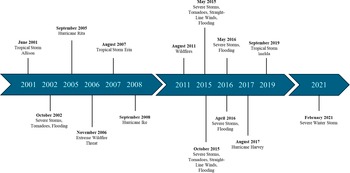
Participants included members from 3 historically underserved communities within the Houston metropolitan area: Kashmere Gardens, Fifth Ward, and Third Ward. All 3 communities were chosen because of the prominent proportions of non-Hispanic African American residents: Greater Third Ward (68%), Greater Fifth Ward (48%), and Kashmere Gardens (67%). Additionally, these 3 communities are historically well-established African American communities where the research team has previously worked. All 3 communities have Social Vulnerability Index rankings in the 80th percentile, representing the highest vulnerability to disaster events in the Houston Area.11–13 Houston is a particularly important setting to study the impact of successive disasters due to its vulnerability to hurricanes and frequent flooding. (Fig 1)
History of disasters in Greater Houston’s Three-County Area (2001-2021).

Recruitment
Participants were recruited through social media posts, word of mouth, and the research team’s participation at long-standing community events. Community partners played a central role in promoting the events and providing feedback on the recruitment approach.
Setting of Data Collection
Town hall–style community conversations were held at culturally significant local venues in each neighborhood. The community conversations started with a large group session to outline the meeting’s purpose and objectives, creating a shared understanding among attendees. After the introduction, participants transitioned into smaller roundtable focus groups to promote meaningful and engaging dialogue. Each focus group, consisting of 8-10 community members, was led by a trained facilitator. The smaller groups were all located in the same hall; however, they were spread out throughout the space, thus limiting any cross-table discussion or awareness of answers/discussions in other groups. Specifically, the distance between each table did not allow groups to overhear the discussions of others, increasing the focus of participants on the discussion within their own group, while maintaining participant comfort aligned with large group sessions. To capture the discussions accurately and ensure all perspectives were included, a trained and dedicated note-taker was assigned to each group. Each round table was facilitated as a focus group wherein the trained facilitator moderated the discussion to ensure all voices were heard and every participant was able to engage in the conversation, while the designated note-taker took detailed discussion notes and verbatim quotes. All verbatim quotes integrated throughout the results are derived from direct verbatim quotes recorded by the note-takers.
Procedures
A focus group was used to guide open-ended discussions regarding experiences related to housing during and following a natural disaster. Groups were asked each question collectively; follow-up prompts were made by the trained facilitator based on group discussions. Questions focused on the impact of natural disasters on participants’ homes (e.g., home damage), the use of or need for disaster recovery funding (e.g., federal, state, and/or local), community-level impacts, preparedness, resource needs, and city/urban planning considerations. The questions targeted participant experiences and a rich understanding of what, if anything, was needed by community members following a natural disaster related to housing.
Each conversation ranged from 60 to 87 minutes. No repeat conversations were conducted. Audio recording the discussions was critically discussed with community leaders, and the decision not to record was made to ensure the comfort of the community members in telling their stories. In other words, there was substantial concern that the use of audio/visual recording devices would result in low participation so that participants do not describe accurate and honest depictions of their experiences. Therefore, to increase participant engagement and the provision of honest experiences, we did not utilize audio or video recording. Participants were reassured that their participation was voluntary and that they were able to withdraw from the conversation at any time. Transcripts in the form of detailed notes taken by trained note-takers were not returned to participants. However, preliminary findings were shared with participants during member-checking activities.
Graphic Recording
This study further arranged for a professional graphic artist to create a graphic recording for an arts-based representation of the group discussions. Specifically, the professional artist captured the ideas, expressions, and discussion topics artistically in real-time. The artistic representation not only complements the written findings and enriches participant discussions but also gives participants a sense of ownership and validation of their contributions due to their ability to review the graphic representation at, and following, the events. Data from both the note-taker and professional graphic artist were deidentified in nature to protect participant anonymity and confidentiality.
Data Saturation
Data saturation was reached when analysis of approximately 80% of notes yielded no new perspectives or codes; the remaining dataset was analyzed to ensure completeness.
Data Analysis
Reflexive thematic analysis was used to analyze the researchers’ notes and verbatim quotes from each round table at all town hall–style events. Reflexive thematic analysis permits an inclusive story to be drawn from the detailed notes of trained group note-takers to identify the themes from the collective discussions. Aligning with recent guidelines for conducting reflexive thematic analysis, the data were reviewed, discussed, and analyzed, taking an inductive approach prior to generating the final report.Reference Braun and Clarke14, Reference Lincoln and Guba15
LRG, a dedicated postdoctoral research and a community engagement consultant conducted the primary coding. OEA, QW, and CF further coded the data following group discussions. Codes across focus groups were reviewed with all authors; there were no substantial differences in the codes generated that would support comparison across communities (See Figure 1). All codes were discussed among authors throughout code development, and discrepancies across codes were critically discussed and agreed upon to establish the final codebook. For example, the authors met throughout the analytical process to critically discuss the codes and associated data so any disagreements across authors could be reviewed. This allowed each code developed and the data assigned to the code to be reviewed across authors and consensus reached.
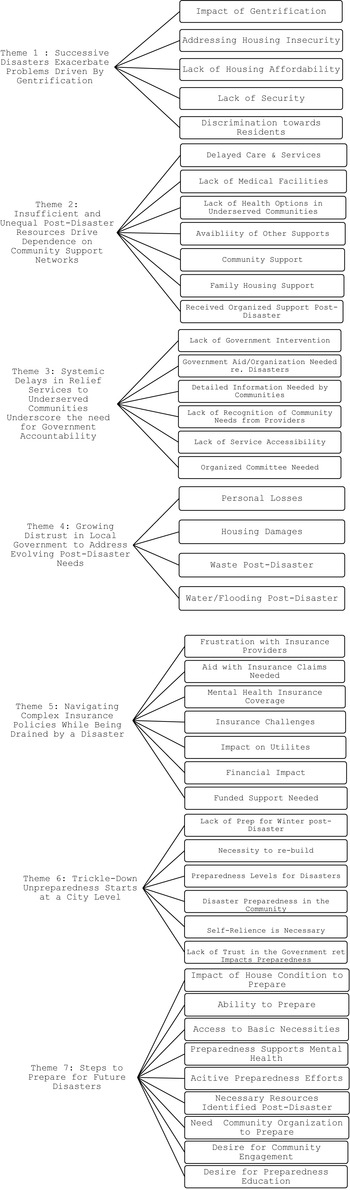
Following coding completion, codes were organized into categories, and categories were further grouped into overarching themes (Fig. 2). This organization was reviewed and discussed with all authors to establish consensus on the theme organization. Nvivo software was used to manage all data. Specifically, all notes, inclusive of descriptive notes and verbatim quotes taken by the note-takers, were uploaded to Nvivo as Word documents. Nvivo was used to code the data such that the notes and quotes were assigned codes; subsequent themes were generated based on the codes.
Condensed coding tree providing the codes associated with each theme.

Trustworthiness
Ensuring scientific rigor is critical in qualitative investigationsReference Lincoln and Guba15; as such, numerous methods of trustworthiness were employed. This study engaged in continual critical discussion and researcher triangulation from conceptualization of the project to the completion of the data analysis.Reference Stahl and King16 Member checking was further employed in which findings were presented back to the participants to review; participants were given the opportunity to provide feedback regarding the results.Reference Berger17, Reference Korstjens and Moser18 Reflexivity is recognized as critical to ensuring trustworthiness; all researchers employed reflexivity, through which experiences and preconceptions were identified, recognized, and collaboratively discussed.Reference Korstjens and Moser18 Specifically, the authors prepared positionality statements identifying possible points of bias, and life experiences and/or positions that may impact their perspectives and shape the thematic interpretation. These were discussed across authors both prior to facilitating the group discussion and during the subsequent data analysis meetings; through conscious acknowledgement and critical discussion regarding their impact, we sought to decrease the impact of bias on our findings.
This study was approved by the Independent Review Board at the University of Houston (#00004432).
Results
A total of 131 community residents participated in the town hall–style community conversations, as shown in Table 1. In Kashmere Gardens, 57.7% of participants were Black (30/52), 30.8% were Hispanic (16/52), and 11.5% were White (6/52). In Third Ward, 50.0% were Black (17/34), 32.4% were Hispanic (11/34), and 17.6% were White (6/34). In Fifth Ward, 51.1% were Black (23/45), 33.3% were Hispanic (15/45), and 15.6% were White (7/45). Females represented the majority in each neighborhood: 57.7% in Kashmere Gardens (30/52), 64.7% in Third Ward (22/34), and 68.9% in Fifth Ward (31/45).
Demographic characteristics of participants of the town hall–style community conversations.

Analysis generated seven themes related to community preparedness and the damage to infrastructure within participants’ communities following a natural disaster. Representative verbatim quotes of participants taken by note-takers are identified by quotation marks.
Theme 1: Successive Disasters Exacerbate Problems Driven by Gentrification
Participants discussed the impact of successive disasters on gentrification within the city, including within and around their community. The changes made by new developers throughout and around the communities include “new structures and buildings and changes are causing more flooding in our area” (3rd Ward—Round table 2). One participant noted how “gentrification is a fix for them, but means something worse for us. It means less flood[ing] for the people who gentrify but flow into lower income and older homes” (Kashmere Gardens—Round table 5). Participants described how, after the recent increase in development, their community and homes were now being negatively affected and flooded. Furthermore, their communities were viewed as being sacrificed to flooding, as “regulations allow opening of flood gates into 3rd and 5th Ward”. Frustration was expressed at the lack of governance over new infrastructure and the perception that “developers get tax breaks but they do not invest into the community infrastructure” (3rd Ward—Round table 2). There was a distinct lack of warmth toward gentrification and individuals perceived to contribute towards it, as was expressed by a participant who stated “gentrifiers collaborate and help each other and not […] their neighbors who have lived there longer” (5th Ward—Round table 1).
Theme 2: Insufficient and Unequal Post-Disaster Resources Drive Dependence on Community Support Networks
Participants identified numerous services that were needed at the individual and community level following climate-related disasters—most of which were not accessible or obtained. The lack of accessible medical facilities to treat injuries and care for the underserved populations was a noted oversight. One participant articulated how the “city’s response has not been adequate. Worst first needs to be prioritized” (5th Ward—Round table 1). Housing support and safe locations were identified as necessary services following climate-related disasters; however, due to limited safe housing locations, individuals often overcrowded the homes of family members or friends that were in the best shape following the disaster. Participants reported that because they couldn’t rely on the city to provide any support, they instead relied on each other and community-based organizations. Despite very few resources, the community looked after their own where possible and advocated for a critical need for city intervention in the future.
Theme 3: Systemic Delays in Relief Services to Underserved Communities Underscore the Need for Government Accountability
Discussions revealed a perceived lack of government and city involvement in supporting underserved communities, and when support was provided, there was a perceived delay in delivering services to Black and Brown communities. One participant reported that it “doesn’t matter that you report a problem, the city is bad about follow up and if they do, it’s sloppy” (5th Ward—Round table 3). Another participant described how “we’ve been fighting, but they [city officials] been fighting back” (Kashmere Gardens—Round table 1) against providing needed resources to the communities. A united front with a clear voice was identified as necessary, as one participant stated, “if we were able to address these committees as a whole and with partnerships with universities, we could stand up to the committees” (3rd Ward—Round table 2). Due to the significant reported need and lack of provided support, participants discussed how service provision changes require city officials to listen to the voices of the community.
Theme 4: Growing Distrust in Local Government to Address Evolving Post-Disaster Needs
Participants discussed personal losses (e.g., vehicles), housing damages (e.g., roof; burst pipes), and community damage that falls under the responsibility of the city (e.g., flooding and waste). Personal damages were often minimized due to a focus on more urgent concerns, such as severe housing damage impacting daily functioning and individual safety. Specifically, participants described having to find and fund alternative living spaces due to the extensive damage to their homes and the overwhelming repairs required. Housing damage was often associated with feelings of helplessness and despair and fear of additional loss;
“During [Tropical Storm] Alison, my home flooded, but flooding was worse during hurricanes. My furniture flooded. Drainage overflows contributes to worse flooding. I didn’t want to leave my home because I was afraid of people stealing the little I have” (5th Ward—Round table 1).
Participants expressed exasperation regarding city responses after disasters, stating that “recycling doesn’t get picked up, we want trash picked up – they won’t pick up trash if it’s too full, but then they will charge you if it’s not picked up” (Kashmere Gardens—Round table 1), identifying a clear disconnect between the needs of the community and response of the city pertaining to damages post-disaster.
Discussions revealed several types of damage in the communities that participants believed were the city’s responsibility, including sewage and wastewater issues in addition to flood damage. Participants highlighted concerns about the lack of city action to address these issues, with one noting, “If [the street] fills with sewage runoff, it need to be cleaned up quickly because kids play near there” (3rd Ward—Round table 3). They also pointed out how “Third Ward historically didn’t flood, but that’s changing” (3rd Ward—Round table 1), yet the city has failed to address the evolving needs for post-disaster repairs. As a result, participants stopped reporting issues like “the smells and dirty water” (5th Ward—Round table 3) to the city, as they felt their concerns were not being addressed.
Theme 5: Navigating Complex Insurance Policies While Being Drained by a Disaster
There was a clear consensus across participants in their frustration and anger toward processes associated with insurance for disaster damages. Insurance companies were viewed as intentionally taking advantage of their customers through complex contracts and unclear associated restrictions with the goal of not providing their customers with claims approvals. The difficulty associated with insurance reportedly resulted in many individuals being forced to cover their own repairs, as well as some to cease using insurance altogether; “The deductible was ridiculous, and I ended up fixing it myself. My homeowner’s insurance denied me after been with them for 10 yrs., I was asked to get another roof before they would renew me, and I couldn’t afford that and as a result they dropped me, and I currently don’t have any home insurance” (3rd Ward—Round table 2). Some participants were able to complete repairs themselves, or with the support of family and friends, while others continue to be left with ongoing damages that they are unable to afford to repair. Participants felt as though “insurance always finds a way to not pay out” (Kashmere Gardens—Round table 1) and therefore there were no benefits to paying for it.
There was a desire for education on insurance contracts, and insurance policy navigation, claims filing, and emergency disaster funding (i.e., Federal Emergency Management Agency [FEMA]) due to “people [being] unaware of their rights with insurance” (3rd Ward—Round table 2). Emergency funding from FEMA was seen as inaccessible, with participants reporting denied claims without clear justification and poor communication, forcing them to fight for any response. FEMA was perceived as discriminatory, with one participant stating, “FEMA didn’t help me or other Black people very much” (3rd Ward—Round table 3). They explained that applying for assistance was challenging, as earning slightly above the poverty line made them ineligible for benefits, despite facing rising costs.
Following the disaster participants continued to experience financial strain; participants reported a hike in living costs following disasters, particularly in electricity. Specifically, while previously participants reported they were “paying $0.09 per kw now I pay $0.13” (3rd Ward—Round table 2) indicating a “huge jump in electricity” (Kashmere Gardens—Round table 1). Electricity was no longer affordable and negatively impacted familial relationships due to conflicts over use. Electricity was estimated to have “increased 30% in Kashmere Gardens” (Kashmere Gardens—Round table 1) and participants were now forced “to live in dark houses to save on electricity” (3rd Ward—Round table 3) in order to afford other basic necessities such as food and water. The increase in electric bills was associated with “CenterPoint’s delivery fee […] increasing” (Kashmere Gardens—Round table 4). The increased cost of living was viewed as creating an uncertain and unsafe environment, which was seen as unsustainable.
Theme 6: Trickle-Down Unpreparedness Starts at a City Level
Participants expressed concerns about their community’s preparedness for future disasters. They pointed to ongoing repairs from past disasters and a lack of protective measures that could reduce future storm damage. One participant noted, “We are not prepared as a city” (3rd Ward—Round table 2). While individuals took personal steps, such as “trimming and cutting trees” (5th Ward—Round table 1) they felt that, as a city, “Houston is not ready” (3rd Ward—Round table 3). Participants acknowledged the need to prepare themselves and their families for climate-related disasters, as they did not expect external help. Although some relied on neighbors for support, there was little trust in the city to ensure the well-being of residents in these communities.
There was expressed concern regarding one’s ability to aptly prepare for a climate-related disaster in the future. Participants discussed how many individuals within their community have limited resources and are unable to get repairs done, or renovations to update housing features, to prepare for subsequent disasters, leaving them vulnerable. Participants described their homes as having “all the old pipes, and termites have destroyed so much, I need a new house” (3rd Ward—Round table 3). Additionally, a lack of financial stability prevented participants from preparing by purchasing supplies in advance (e.g., dry food) that might support their well-being during and/or following a hurricane or flood.
Theme 7: Steps to Prepare for Future Disasters
The importance of preparing for the next disaster and the implementation of resources to support community preparedness was emphasized by participants, who felt that their level of preparation was associated with their psychological well-being. Participants articulated a need for power (generator or electric), food/water supplies, tarps, lights, and organized support for the community to decrease the individual responsibility. A centralized location, e.g a resilience hub, within each community where individuals could seek shelter and resources was further identified as a needed preparatory step prior to future disasters. These hubs would have appropriate resources, such as food and water with a generator back-up, which are necessary to support residents through natural disasters. Participants noted that to prepare as a cohesive community, an organized management team with a selected leadership made up of trusted community members was needed. Relatedly, participants expressed a desire for additional education for new and existing homeowners regarding aspects of being a responsible homeowner, inclusive of costs and preparedness for disaster events.
Discussion
This study contributes to a growing body of research examining the intersection of climate-related disasters and housing insecurity in historically underserved urban communities. By centering the voices of residents from Kashmere Gardens, Fifth Ward, and Third Ward—three Houston neighborhoods with high Social Vulnerability Index scores—this qualitative analysis reveals how successive disasters compound existing structural inequities. Participants described extensive damage to home infrastructure, persistent barriers to completing repairs, and limited access to recovery resources. The seven emergent themes underscore systemic failures in disaster response, including inequitable resource distribution, delays in relief services, and growing distrust in local government.
Notably, the study found that successive disasters exacerbate gentrification pressures in vulnerable communities. Studies indicate that affordable housing and vulnerable populations are often located in flood-prone areas,Reference Qiang19, Reference Poussard, Dewals and Archambeau20 which tend to be less likely to recover after a disaster.Reference Frey and Singer21 These areas are positively correlated with the increased likelihood of gentrification.Reference van Holm and Wyczalkowski22 The rise in housing insecurity following disaster events aligns with previous findings.Reference Priest and Elliott23, 24 Participants linked these pressures to chronic underinvestment in infrastructure—such as poorly maintained sewer systems and unreliable power grids—which further deepens vulnerability and accelerates displacement.
Getting officials responsible for coordinating disaster efforts to listen was also an issue, highlighted by a lack of government intervention and recognition of community needs from providers. Despite the city of Houston making preparation advancements in the aftermath of disasters like Hurricane Harvey (e.g., updated floodplain regulations,25 increased bonds for flood prevention projects26), frustration toward a lack of effort to specifically protect underserved communities was widely expressed. These frustrations draw parallels with work by Rammah et al., where participants expressed being unheard and let down by insufficient efforts from government officials and formal sources of assistance such as FEMA after flooding.Reference Rammah, McCurdy and Bondy27, 28, 29
A desire for greater transparency and information was discussed among participants, particularly on education for new homeowners and greater transparency from city officials. Specifically, additional details on incoming disasters, preparedness efforts, and response protocols made available to the community were requested. Further, ensuring equipped resilience hubs are available within these communities, and these hubs are publicized, such as through the development of an asset map, may increase community resilience through extreme weather events. Participants also highlighted issues with insurance during the recovery period, citing frustrations with the claims process, logistical challenges, and difficulties in determining the type of insurance needed. These findings align with current literature, which emphasizes struggles related to not having or regretting the lack of homeowner’s insurance, as well as frustrations with filing claims and experiencing incompetence from FEMA.Reference Rammah, McCurdy and Bondy27, Reference Bell, Dickey and Rosemberg30
Participants discussed an overall need for disaster preparedness assistance. Prior research suggests that less than half of Americans feel their community has an adequate response plan for a disaster.31, Reference Chae, Choudhury and Franco-Castano32 This increased demand for assistance is consistent with existing literature, which shows that socioeconomically disadvantaged populations are less prepared for disasters than their higher-income counterparts. They are less likely to have essential goods (e.g., water, food, medication) and are less able to afford costly preventative measures (e.g., flood insurance, home maintenance).Reference McQueen, Charles and Staten34–Reference Fothergill36
Consequently, several of these vulnerable populations are left to rely on local community efforts to fill the gap left by inadequate resources. Participants viewed the support they received after disasters as a strength, citing community support, family housing assistance, organized relief efforts, and access to other services. These sentiments align with findings from various studies that highlight residents’ perceptions of natural disasters, where cleanup and financial support led by family, mutual aid groups (e.g., non-governmental organizations, churches), were seen as the most impactful forms of assistance.Reference Rammah, McCurdy and Bondy27, Reference Osofsky, Osofsky and Saltzman33 This success encapsulates “community resilience,”Reference Ma, Qirui and Lv37–Reference Mayer39 a rising mindset in approaching disaster efforts that highlights trust, collaboration,Reference Aldrich and Meyer40, Reference Gaillard and Mercer41 and involvement of community members in the development and execution of both pre-disaster and recovery preparation efforts.Reference Rosenberg, Errett and Eisenman42, Reference Amirzadeh and Barakpour43
Previous studies have documented strong associations between high social vulnerability and flood inundation risk, as well as between specific drivers—such as low income and racial/ethnic minority status—and disproportionate barriers to securing federal recovery assistance. Our findings echo these associations but extend the literature by grounding them in detailed, context-specific accounts from affected residents. The Social Vulnerability IndexReference Cutter, Boruff and Shirley44 has been widely adopted in both research and policy, including its integration into FEMA’s multi-hazard tools and post-disaster assessments such as those following Hurricane Harvey in Texas. However, as Blackwood and CutterReference Blackwood and Cutter45 note, its reliance on area-level data can result in a spatial mismatch that limits its ability to capture individual-level realities. Our study addresses this limitation by pairing social vulnerability-based assessments with rich qualitative insights from community participants, offering a more granular and contextually embedded understanding of vulnerability and recovery gaps. This combined approach strengthens the theoretical relevance of our findings, bridges a documented methodological gap, and enhances the framework’s applicability for both scholarly inquiry and policy development.
Limitations
This study is not without limitations. First, the findings are based on qualitative data from three historically underserved communities and may not be generalizable to other disaster-prone communities with different demographic, geographic, or socioeconomic contexts. Second, data were collected through town hall–style conversations and focus groups, which may be influenced by group dynamics or social desirability bias. Participants may have felt pressure to align with dominant community narratives or may have withheld sensitive information, potentially affecting the depth and diversity of perspectives captured. Third, to foster a safe and open environment for participants, audio and video recordings were not used during town hall–style discussions and focus groups. While this approach was preferred by community leaders and enhanced participant comfort and candor, it may have limited the precision of data capture. To mitigate this, detailed note-taking, researcher triangulation, reflexivity, and member checking were employed to ensure trustworthiness and rigor in the analysis. Finally, although participants were identified by community of residence, they were not explicitly compared against each other due to their locational and infrastructural proximity. Despite these limitations, the study offers valuable insights into the lived experiences of disaster-affected communities and highlights critical areas for policy and practice. Future conversation-based work may benefit from direct discussion of intersectionality between governmental response and assistance, housing insecurity, and successive disasters.
Conclusions
These findings highlight more than just the need for more equitable disaster response systems and resources, but also a call to action for local, state, and federal decision-makers to identify clear plans of action and support for low-income Black and Hispanic individuals and communities. Individuals expressed the belief that a systemic level of unpreparedness to aid their community in the face of increasing climate-related natural disasters, which increased their vulnerability and perceived systemic inequities and disparities. It is essential that their experiences and sentiments are considered in the development of these action systems to most accurately reflect and serve their needs.
Acknowledgments
We thank Ms. Brenda Tijerina and Mr. Ben Hirsch for their contribution to designing the town halls, facilitating focus groups, and taking detailed notes during the community events. We are also grateful to all study participants who trusted us and took time to share their lived experiences with us. We thank Dr. Laura de la Roche for her assistance with qualitative analysis, as part of her postdoctoral work with the Humana Institute. We also thanks our community engagement consultant, Dr Abidemi Okechukwu for their contribution to the primary coding. Finally, we gratefully acknowledge the National Academies Gulf Research Program for funding support of this work. The funders had no role in the study design, data collection, analysis, interpretation of the data, manuscript preparation, or the decision to publish.
Author contribution
OEA conceptualized the study, developed methods, co-wrote initial drafts, and supervised all aspects of the study. QW, CF, and LRG were responsible for analyzing the data and writing drafts of the methods section with our postdoctoral research assistant. PD wrote the initial drafts and contributed to subsequent revisions of the manuscript. OEA, QW, CF, and DB conducted focus groups. DB and LG were responsible for program design and implementation in the community. All authors read and approved the final manuscript.
Competing interests
The authors have no conflicts of interest or competing interests to declare.


 Open access

