

Introduction
On multiple dimensions, American Indian politics is about isolation from centers of institutional power.
—Evans (Reference Evans2011, 664)
Since Maine became a state in 1820, it has tried to make us disappear—and, when that didn’t happen, it chose to make us invisible.
—Loring (Reference Loring2008, 11)
Reserved seats help under-represented groups gain power in political institutions. From gender quotas to majority–minority districts and at-large seats for racial and ethnic minorities, reserved seats improve descriptive representation and also, in some cases, improve substantive representation in legislatures (Muraoka Reference Muraoka2019; Reynolds Reference Reynolds2005). Although reserved seat legislators rarely have the power to dictate the legislature’s agenda, where minority interests can be advanced or thwarted, they nevertheless change the composition of a legislature in important ways.
Studies of reserved seats tend to focus on the people holding these seats: their behavior in office, how they represent group interests, and how they compare to other legislators from the same group (Crisp et al. Reference Crisp, Demirkaya, Schwindt-Bayer and Millian2018). Less is known about how reserved seat legislators change the incentives and behavior of legislators in nonreserved seats. This article argues that while reserved seats legislators can improve the representation of group interests, their participation can also be associated with lower support for group interests among nonreserved seat legislators. To make our argument, we turn to a remarkable institution: reserved seats for Native American tribes in the Maine House of Representatives. Maine’s tribal representatives, who represent the Penobscot (since 1823), the Passamaquoddy (since 1842), and the Houlton Band of Maliseet (since 2012), serve as members of the state legislature with the right to debate, but not vote.
Unique among the fifty states, the institution of tribal representative in Maine is interesting for two reasons. First, Maine voters on tribal rolls may vote for their at-large tribal legislator and the nontribal legislator in their House district. The result is a weak form of dual representation for Native American voters in Maine: one person, two votes. Second, tribal representatives are nonvoting members of the legislature. They contribute to legislative debate without having a vote on the final outcome of legislation, similar to nonvoting representatives in other contexts.Footnote 1
Tribal representatives have served in the Maine state legislature for nearly two centuries (Starbird, Soctomah, and Wright Reference Starbird, Soctomah and Wright2016). For many years, their activity was limited to speechmaking and lobbying the nontribal legislators. Without the ability to either vote or sponsor legislation, the tribal legislators had few institutional mechanisms to advancing native interests. However, in 1995, the legislative capacity of tribal legislators changed. The state legislature enacted a rule allowing tribal representatives to sponsor bills related to Native Americans. These legislators would soon thereafter gain the ability to cosponsor legislation on any topic.
This article takes advantage of this 1995 rule change to estimate the direct and indirect impact of reserved seats on the tribes’ substantive representation. We assemble an original dataset of Maine legislation pertaining to Native American policy interests before and after the tribal representatives were allowed to sponsor bills. We also interviewed a former tribal legislator, Donna Loring, to learn more about how the tribal representatives conduct their jobs. We find that after the 1995 rule change, nontribal legislators changed their behavior, conditional on the presence of a tribal community in their district. The marginal effect of the change, however, is negated by the contributions of the tribal legislators themselves.
By turning to Maine’s tribal representatives, our study makes three contributions. First, we explore the impact that reserved seats have on representation, as well as their impact on nontribal legislators’ incentives to represent indigenous interests. Second, we provide new data and background about an unusual political institution – reserved seats – that research suggests is “much more widespread, and less idiosyncratic, than many scholars previously thought” (Reynolds Reference Reynolds2005). Finally, this study sheds light on descriptive and substantive representation of Native Americans in state legislatures, an important topic for understanding the enduring political imbalance accorded indigenous person in the US (Johnson and Witmer Reference Johnson and Witmer2020).
The historical development of Maine’s tribal representatives
The historical development of Maine’s tribal representative can help explain why tribal representatives behave differently than nonreserved seat legislators. Predating Maine’s statehood in 1820, the tribal representative’s origins are found in intertribal compacts, including the Great Council Fire, where representatives from the Wabanaki Confederacy gathered to make peace (Speck Reference Speck1940, 198–99), and in the earliest contact between native peoples and the Massachusetts colony (Kolodny Reference Kolodny2007). Maine became a state in 1820; upon statehood, its treaty obligations with the Penobscot were transferred from Massachusetts.
The earliest record of a Penobscot tribal representative is 1823, and in 1842 for the Passamaquoddy (Maine State Law Library 2017). These representatives could address the legislature but were unable to vote (Kolodny Reference Kolodny2007, 17). Little is known about how they were chosen. 1835 is the earliest record of an election for tribal representative; before then, the representative was selected based on custom (Dorr Reference Dorr1998, 41). By 1892, tribal representatives were chosen by Australian ballot system, a reform judged successful by the state agent (Rolfe Reference Rolfe1892, 7).
Formally incorporated into Maine law in 1866, tribal representatives often took an active role in legislative affairs (Maine State Legislature 1866a, 1866b). For example, Passamaquoddy Representative Lewis Mitchell delivered a famous 1887 floor speech reiterating tribal support for the Revolutionary War and expressing outrage at the state’s violation of treaty obligations (Mitchell Reference Mitchell and Senier2014, 170–2). Yet the tribal representatives were structurally disadvantaged compared to their peers. Unable to vote, they were often stymied by state Indian agents, who were appointed by the legislature to administer tribal welfare and coordinate tribal elections. These agents often exhibited marked hostility to Native peoples, deriding the tribes’ “backwardness,” and noting “the people to which this tribe belong do not possess the high order of intellect that distinguish the European race” (Purinton and Nutt Reference Purinton and Nutt1861, 10). State agents – present in Maine from 1820 to 1980 – worked to foster discord within Native communities and weaken tribal political clout (Dorr Reference Dorr1998).
By the turn of the 20th century, local newspapers covered elections for tribal representatives, such as one report that “the Penobscot Indians are not behind their white brothers on biennial elections” (Biennial Election – Penobscot Tribe 1910). Tribal representatives attended funerals for state dignitaries and provided constituency services (Old Town Locals 1937), but state oppression continued. In 1941, amid a rise in anti-Indian sentiment, the state legislature debated whether to reduce the tribal representatives’ salary. The legislature ultimately revoked the tribal representatives’ right to sit as members of the body, changing the statutory language that seated them from “to the Legislature” to “at the Legislature” (State of Maine 1941). This change had a dramatic effect: tribal delegates were now “forced to stand behind the glass partition at the back of the chamber, along with lobbyists, reporters, and other onlookers,” like a mere visitor, according to one first-hand account (Kolodny Reference Kolodny2007, 23–4). They continued to receive a salary, however, leading critics to label them as state-paid lobbyists (Clark Reference Clark2000, 9).
In 1967, Maine Indians were given the right to vote in state legislative elections in addition to tribal elections – among the last groups in the US to gain voting rights (Clark Reference Clark2000, 4 n.13; Hansen Reference Hansen1967; Loring Reference Loring2004, 28; Rollings Reference Rollings2004, 139 n.27; Shay Reference Shay1942, 12–3). Suffrage expansion in Maine coincided with the 1968 enactment of the Indian Civil Rights Act, the Red Power Movement, and the Alcatraz occupation. Buoyed by a growing public sentiment about the injustice accorded Native Mainers, the state legislature in 1975 debated reinstating tribal representatives as speaking members. Skeptical legislators asked why Native Americans alone should have a reserved seat, whether they were adequately represented by nontribal legislators, and whether a representative could be effective without speaking privilege (Maine State Legislature 1975, A65–9). After a long debate, the House voted 107–40 to approve the rules change. The tribal representatives were seated amid applause (Two Indian Tribles [sic] in Maine Voted Seats in the House 1975).
Later changes further enhanced tribal representatives’ institutional powers. In 1995, they gained the right to sponsor legislation related to “Indians and Indian land claims.” The rule change passed unanimously in both houses with little debate.Footnote 2 Another rule change in 1999 extended the right to cosponsor legislation on any topic. Today, tribal representatives serve on joint standing committees, where they can raise their hand to signify a position, but that position is not counted as a vote. The legislature created a reserved seat in 2010 for the Houlton Band of Maliseet Indians, bringing the number of tribal representatives to three, and the first Malisset representative joined the state legislature in 2012.
Tribes in Maine are separate sovereigns, removed from their land by white settlers and denied voting rights for two centuries. Gaining federal recognition late in US history, the tribes have experienced hardship at the hands of state violence, neglect, and the suppression of civil and voting rights. The legacy of this history culminates in the tribes’ modern struggle to influence public policy at the state level. The 1980 Maine Indian Claims Settlement Act settled tribal land claims but limited Maine’s recognition of tribal sovereignty. Shortly after federal recognition was extended to the Penobscot and Passamaquoddy in the late 1970s, the Settlement Act set Maine apart from other states by designating tribal reservations as “municipalities” for funding purposes, limiting tribal sovereignty over a range of policy areas in turn. The result is that Maine tribes are forced to seek redress in the state legislature to an extent unusual among federally recognized tribes. For better or worse, reserved seat legislators play a central role in that process.
Tribal-state relations have soured in recent years. In protest of then-Governor LePage’s flouting of tribal sovereignty, the Penobscot and Passamaquoddy vacated their seats in 2015, reflecting an ambivalent relationship about formal participation in Maine’s state government (Bruyneel Reference Bruyneel2004). Tribal leaders derided an executive order issued by LePage asserting state control over all tribal territory and government. Remarked Penobscot Chief Kirk Francis, “We have gotten on our knees for the last time… From here on out, we are a self-governing organization, focused on a self-determining path” (du Houx 2015). As of 2020, there is no Penobscot representative serving in the legislature for the first time since statehood, although the Passamaquoddy returned their representative to the chamber in 2016. The Houlton Band of Maliseet Indians joined the Penobscot and withdrew their representative in 2018 over a gaming law dispute. Debates over tribal sovereignty remain a core controversy in Maine state politics, and the future of the institution of tribal representative remains unclear. Noted former tribal representative Donna Loring in an interview, “as long as we have tribal representation sitting in that House, we are agreeing that the state has control over us.”Footnote 3
Reserved seats and descriptive representation for Native Americans
The institution of tribal representative in Maine begs a broader question: how does representation affect policymaking? In the half century since Hanna Pitkin published The Concept of Representation (1967), a growing body of political science research has examined the relationship between reserved seats – such as Maine’s tribal representatives – and policymaking outcomes. The bulk of this work studies gender quotas in proportional representation systems and reserved seats for ethnic and religious minorities and Indigenous people (Htun and Ossa Reference Htun and Ossa2013; King and Marian Reference King and Marian2012). There is mixed evidence that reserved seats improve substantive representation in the policymaking process (Crisp et al. Reference Crisp, Demirkaya, Schwindt-Bayer and Millian2018). Other scholars have noted the roles that political parties (Zuber Reference Zuber2015) and institutional strength (Muraoka Reference Muraoka2019) play in determining the behavior of reserved seat legislators and support for minority group interests. Reserved seat legislators are more effective when they have access to institutional power, either by being part of the government or through identity-based parties that elevate the group’s interests (Templeman Reference Templeman2018).
A second body of research explores how descriptive representation is associated with substantive representation for groups such as African-Americans (Gay Reference Gay2002; Swain Reference Swain1993; Tate Reference Tate2004), Latinos (Bratton Reference Bratton2006; Wallace Reference Wallace2014), women (Clark and Caro Reference Clark and Caro2013; Swers Reference Swers2005; Wängnerud Reference Wängnerud2009), and LGB people (Hansen and Treul Reference Hansen and Treul2015). Native Americans are featured less prominently in this literature (Williams and Schertzer Reference Williams and Schertzer2019). Extant research examines the links between Indigenous constituents, party identification, and pro-Indigenous voting in Congress, finding that a higher percentage of constituents who are Native Americans, as well as the presence of a recognized tribe, are each associated with more pro-Indigenous voting behavior. Additionally, Democratic and liberal members of Congress are more likely to support Native American legislative priorities than Republicans and conservative members, even when controlling for constituency effects (Conner Reference Conner2014; Turner Reference Turner2005).
This article connects these two research streams while acknowledging the unique status of Native American tribes. Their status as sovereign nations distinguish federally recognized tribes from Indigenous groups in other countries, which may have different political rights vis-a-vis the national government, as well as other traditionally underrepresented groups, including women and racial, ethnic, or religious minorities. Indigenous political actors have often expressed an ambivalent ‘American-ness,’ situated both within and outside the bounds of US citizenship (Bruyneel Reference Bruyneel2004, 43). Nonetheless, previous research on Indigenous reserved seats suggests these institutions are analytically comparable to reserved seats for other marginalized groups (Kroeber Reference Kroeber2018; Krook and O’Brien Reference Krook and O’Brien2010; Reynolds Reference Reynolds2005; Templeman Reference Templeman2018).
Population and geography present two obstacles for tribes seeking descriptive representation without reserved seats. Today, the total population of Mainers who identify as Native American or American Indian, including enrolled members of the four federally recognized tribes, is approximately 8,500 in a state of 1.3 million people (about 0.6%).Footnote 4 If the state selected its tribal legislators in a proportional representation system, Indigenous Mainers would hold just one House seat. Under the current electoral system, however, the tribes cannot mobilize their votes to elect an enrolled tribal member to one of Maine’s 151 lower house seats.Footnote 5 Thus, the three tribal representatives elected at-large by citizens of each tribe represent a unique opportunity for Indigenous participation. Reserved seats, in general, can help groups achieve descriptive representation when they lack the population to compete in single-member districts, and the critical mass needed for minority representation (Sarah and Mona Reference Sarah and Mona2008).
We argue that the uneven distribution of Native American constituents across districts creates incentives for some non-Native legislators to be more sensitive to Native interests than others. When an unevenly distributed minority group gains an at-large reserved seat, the nonminority legislators with constituents from that group face conflicting pressures to adjust how they represent the group’s interests. Whereas tribal legislators are elected solely by minority group members, the nontribal legislators must balance the interests of the various groups in their district. We expect the incentive to represent a group’s interest increases as the proportion of constituents in that group increases, especially in single-member plurality districts where minority group voters can be influential in a close election.
When tribal legislators can advocate for their group’s interests, nontribal legislators face a different set of incentives to legislate on the group’s behalf. Reserved seats decrease the risks and reward nontribal legislators associate with representing minority group interests, and a nontribal legislator with minority constituents might sponsor fewer bills that champion the group’s interests if she thinks those voters are less likely to punish her. A similar logic applies in multimember districts, where legislators from the same district may coordinate to represent different constituent groups (Crisp and Desposato Reference Crisp and Desposato2004). A competing explanation suggests nontribal legislators will maintain (or increase) their representation because their incentive to represent minority group interests remains unchanged (or increases) due to reserved seats. Reserved seats raise the visibility of minority group priorities in the legislature, reinforcing the nontribal legislator’s belief that they must continue advancing the group’s interests or else risk punishment for shirking. A nontribal legislator may increase her contribution because the perceived reward for acting (or the cost of failing to act) has increased. We develop our hypotheses below.
Hypotheses
To begin, a note on measuring substantive representation. Many studies rely on roll call data, although more recent research examines constituency service and legislative oversight (Lowande, Ritchie, and Lauterbach Reference Lowande, Ritchie and Lauterbach2019; Minta Reference Minta2009). In this article, we examine bill sponsorship for two reasons. First, tribal representatives cannot vote on bills; we cannot observe their revealed preferences on specific policy proposals. Bill sponsorship and cosponsorship, however, are a good alternative measure of the types of policies a legislator supports (Clark and Caro Reference Clark and Caro2013; Crisp et al. Reference Crisp, Demirkaya, Schwindt-Bayer and Millian2018; Lewallen and Sparrow Reference Lewallen and Sparrow2018; Muraoka Reference Muraoka2019; Swers Reference Swers2005; Wilson Reference Wilson2010). Additionally, tribal representatives did not always have the ability to initiate legislation but relied on nontribal legislators to sponsor bills on their behalf. By examining sponsorship patterns, we can observe the effect that empowering tribal representatives had on the volume of tribal legislation after 1995, and also test hypotheses about how nontribal legislators changed their behavior once tribal colleagues could act on their own.Footnote 6
In this article, we are interested in two related phenomena: the institutional-level contributions of different classes of legislators to minority representation and the behavioral-level factors that motivate legislators to represent minority interests. First, what impact do reserved seats have on the representation of minority group interests in the legislature as a whole? Here we calculate the contributions of three types of legislators: tribal legislators, nontribal legislators with tribal constituents, and nontribal legislators without tribal constituents. We expect the overall number of pro-tribal bills will be higher when tribal legislators are allowed to participate, expressed as H1:
H1: Institutional-level representation. The representation of minority group interests in the legislature will increase when reserved seat legislators can introduce legislation.
Second, we are interested in the factors that motivate nontribal legislators to write pro-minority bills. We argue nontribal legislators face different incentives to produce pro-tribal bills conditional on their party identity and their districts’ makeup. On average, we expect that the presence of Native American constituents in a district, as well as the representative’s partisan identity, will influence the number of pro-tribal bills a legislator will introduce or cosponsor in a legislative session. We follow the literature on the link between minority constituencies and pro-minority voting (Grose Reference Grose2005; Preuhs Reference Preuhs2006), and in particular, research on the link between Indigenous constituents and pro-Indigenous voting in the US Congress. Evidence suggests that a higher percentage of Native American constituents, as well as the presence of a recognized tribe, is associated with more pro-Indigenous voting by members of Congress (Conner Reference Conner2014; Turner Reference Turner2005). Our hypothesis about the effect of constituency on voting is H2, below.
Research suggests reserved seat legislators are successful when they cooperate together and work within political parties in government (Templeman Reference Templeman2018). Indeed, Maine tribal representative Donna Loring’s memoir, In The Shadow of the Eagle: A Tribal Representative in Maine (2008) is chock full with examples of Loring’s efforts to interface with nontribal politicians. The relationship between party, ideology, and support for Indigenous constituents might vary across contexts. There is evidence Democrats and liberal members are more likely to support the legislative priorities of Native Americans than Republicans and conservative members, even when controlling for constituency effects (Conner Reference Conner2014; Turner Reference Turner2005), and studies of party identification suggest Native American voters lean Democratic (Herrick and Mendez Reference Herrick and Mendez2018, 283). Based on these national data, we might assume Democrats are the more pro-tribal party in Maine. The state is noteworthy, however, for its tradition of independents, moderate Republicans, and a Democratic Party torn between urban and rural interests (Palmer et al. Reference Palmer, Taylor, Librizzi and Lavigne2009). The tribal representatives, for their part, are nonpartisan and do not caucus with either party.Footnote 7 Despite these concerns, we expect legislators who are more ideologically left-liberal will be more supportive of Native American policy interests than conservative members (H3). Insofar as Maine’s Democrats are more likely to be left-liberal, we expect Democratic nontribal legislators will be more likely to exhibit pro-tribal behavior than Republicans, conditional on the presence of Native American constituents in their district.
H2: Behavioral foundations of pro-tribal voting. Across all periods, nontribal legislators will be more likely to exhibit pro-tribal behavior when their district includes tribal constituents.
H3: Behavioral foundations of pro-tribal voting. Across all periods, Democratic nontribal legislators will be more likely to represent minority interests than Republican nontribal legislators.
We argue that when reserved seat legislators are present and able to sponsor bills, nonreserved seat legislators face weaker incentives to represent the interests of the minority group. When a tribal legislator can initiate her own legislation, the nontribal legislator who counts minority group members (i.e., tribal members) among her constituents might reduce her contribution to the group’s representation if there is the perception that minority voters are less likely to punish her for doing so. For example, if the amount of legislation devoted to group interests is fixed over time, the nontribal legislator will introduce fewer bills as the tribal legislators introduce more bills. The nontribal legislator operating with a fixed budget will prioritize other legislative work because someone else, the tribal legislator, is doing the work to represent that subset of her constituency. A similar logic applies in multimember districts. Legislators from the same district may cooperate to divide the work of representing different constituency groups (Crisp and Desposato Reference Crisp and Desposato2004).
A competing explanation suggests nontribal legislators will maintain (or increase) their contribution to representation because their incentive to represent minority group interests remains unchanged, or increases, due to the presence of reserved seats (expressed as H4). For example, tribal legislators may raise the visibility of the group’s interests in the legislature, reinforcing the nontribal legislator’s belief that they must continue representing the group’s interests or else be punished for shirking. A nontribal legislator who does not contribute much in the form of representation may increase their contribution because the perceived reward for acting (or the cost of failing to act) has increased.
We can think of the 1995 change to the sponsorship rules as an intervention or treatment. At the center of our theory is the impact dual representation has on how nontribal legislators, who share a constituent group with tribal legislators, respond to the treatment. Our treated group comprises the nontribal legislators from districts that include constituents from the Penobscot Nation and Passamaquoddy Tribe. The nontribal legislators who represent Maliseet and Micmac constituents are considered nontreated because they did not share a constituency with any tribal legislators in 1995. By distinguishing between tribes with and without reserved seats, we can estimate the impact of dual representation on the representation of tribal interests.Footnote 8
Our final hypothesis addresses another measure of legislative support for Indigenous interests: cosponsorship of pro-tribal bills. Muraoka (Reference Muraoka2019) performs a similar analysis of tribal and nontribal legislators in Pakistan. We expect tribal legislators will be frequent cosponsors of pro-tribal bills to promote bills that advance Indigenous interests. Although we do not test it here, it is plausible that tribal legislators cosponsor bills to signal to voters, interest groups, or other legislators. We also expect nontribal legislators with tribes in their district will more likely cosponsor pro-tribal bills than nontribal legislators without tribes in their district (H5).
Our expectations about the treatment’s impact on cosponsorship differ from our prediction about sponsorship. We conceptualize substantive representation as the legislative work of advancing a group’s interests (Pitkin Reference Pitkin1967). The act of writing a bill is a greater contribution to representation than cosponsoring another’s bill. While we expect that the rule change impacted the treated nontribal legislators’ incentives to initiate bills, it would not necessarily reduce to zero the incentives for them to support the tribes’ legislative agenda. If cosponsorship is a less costly act than sponsorship, then we expect the 1995 rule will not impact the treated nontribal legislators’ cosponsorship behavior.
H4: Change in behavior over time. After tribal legislators gain the ability to sponsor legislation, nontribal legislators with tribes located in their districts will introduce fewer pro-tribal bills compared to nontribal legislators from districts without tribes.
H5: Change in cosponsorship behavior over time. After the tribal legislators can sponsor legislation, nontribal legislators with tribes located in their districts will not change their cosponsorship behavior relative to nontribal legislators without tribes in their districts.
Findings
Data
Maine’s legislature has two chambers. The Senate has 35 members, elected in single member districts by plurality until 2016, when the state adopted rank choice voting. The House has two classes of legislators, 151 nontribal members and three tribal representatives elected at-large by enrolled members of three federally recognized tribes (one seat per tribe).Footnote 9 Legislators work part-time, and the legislative workload is shared between legislators and nonpartisan staff. Legislators submit ideas for legislation (called “bill requests”) to the nonpartisan Office of the Revisor of Statutes, where staff drafts the bill language. Draft legislation is then formally introduced to either the House or Senate, where the bill begins its journey through committees, amendments, and floor votes. According to the Maine Law Library, most, but not all‚ bills receive a committee hearing and a vote. Legislators may request to cosponsor a bill at any time.Footnote 10
We assemble a novel dataset of 394 bills, related to the four federally recognized tribes and other Native Americans living in the state, that were introduced to the Maine Legislature between 1984 (the earliest year for which bill summaries are available) and 2020. Note that only nontribal legislators introduced tribal bills from 1984–1995, per the Legislature’s rules (35 bills in total). Since there are no tribal legislators in the Senate, we exclude 46 tribal bills that originated in the upper chamber, as well as bills that did not list a primary sponsor.Footnote 11 Next, we identify the primary sponsor and cosponsors for each bill, count the number of tribal bills sponsored and cosponsored by each legislator, and collect each members’ party identification and hometown. We link this information to their respective district, along with data on the presence of tribal constituencies across districts.Footnote 12 On average, tribal bills comprised 1–2% of all the bills introduced in a given Maine House session, and the total number of bills in each session did not vary appreciably. Here we present the results based on the number of pro-tribal bills introduced.
Methods
As a simple test of our first hypothesis that the addition of tribal legislators had a positive impact on the overall representation of Native American interests (H1), we examine the total number of pro-tribal bills sponsored per session in the periods before and after the 1995 rule change. In the Supplementary Material, we discuss our method for coding “pro-tribal” bills. In short, there were no bills in our dataset that we coded as directing harm toward the tribes or Native Americans by, for example, restricting tribal sovereignty, denying access to state services, or imposing taxes and fees.
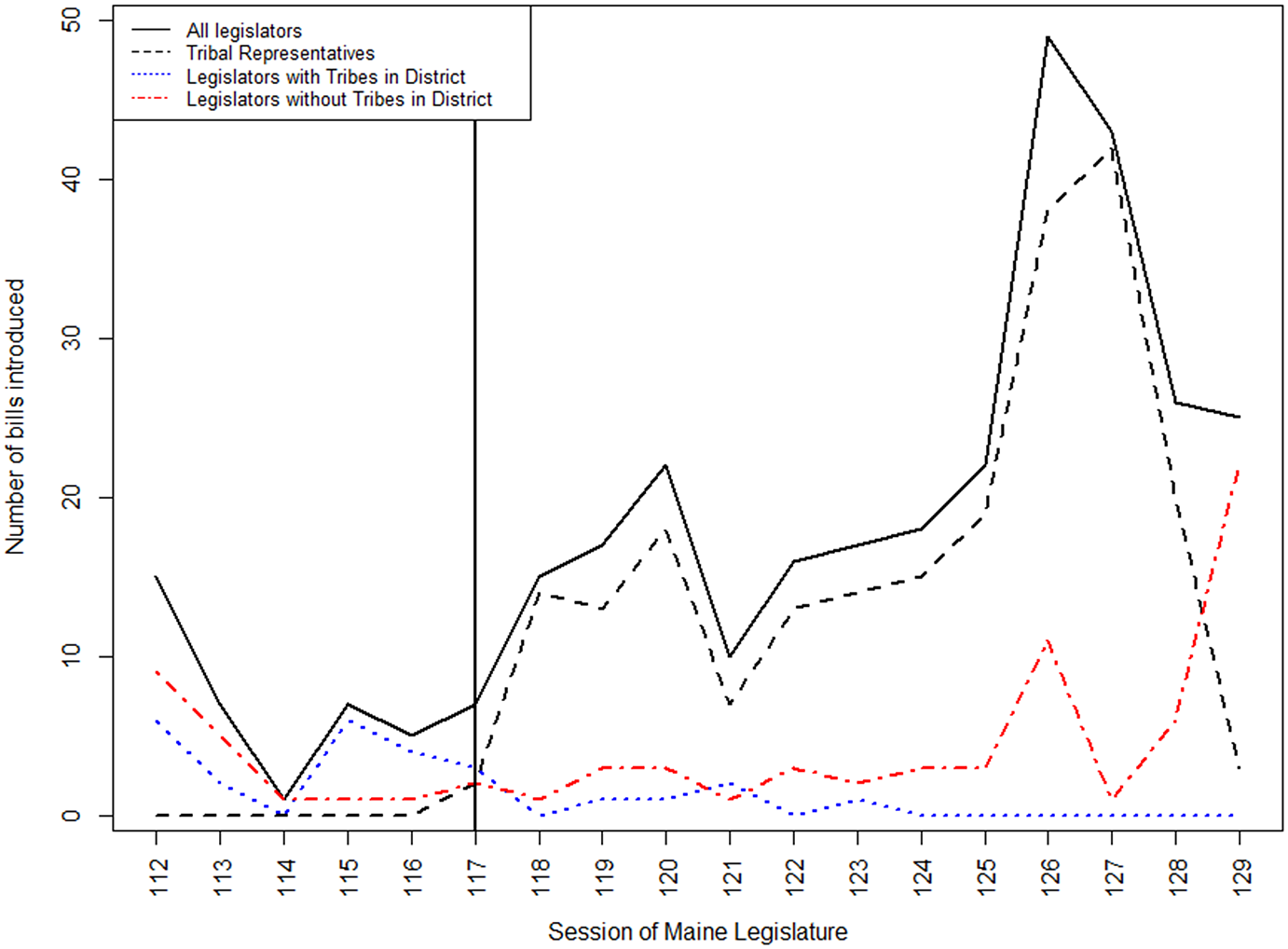
As Figure 1 shows, the number of pro-tribal bills per session rose dramatically after 1995. We cannot tell from the figure, however, the relative contributions of tribal legislators and nontribal legislators to Indigenous representation before and after the rule change. We perform additional tests of our hypotheses for the cross-sectional determinants of pro-tribal sponsorship, and a time series analysis of the impact of the 1995 rule change on the sponsorship behavior of nontribal legislators in different types of districts.
Pro-tribal bills in the Maine House by legislator type, 1984-2019.
Cross-sectional analysis
Our tests take two forms: a cross-sectional analysis of sponsorship patterns by three different types of legislators (i.e., the determinants of pro-tribal support, on average), and a difference-in-differences analysis of the change in sponsorship behavior by nontribal legislators in two types of districts. Following the literature on descriptive representation and bill sponsorship (Clark and Caro Reference Clark and Caro2013; Crisp et al. Reference Crisp, Demirkaya, Schwindt-Bayer and Millian2018; Muraoka Reference Muraoka2019; Swers Reference Swers2005; Wilson Reference Wilson2010), we use ordinary least squares regression for all tests. For each test, we also use negative binomial regression to model the sponsorship count data and we note the results alongside OLS. Tables and other details about the negative binomial analysis are found in the Supplementary Material. We provide a supplementary analysis of voting behavior on tribal bills at the end of the Results section.
First, we use OLS regression to assess our hypotheses about the determinants of pro-tribal bill sponsorship, the presence of Native American constituents in a district (H2) and party identification (H3). The unit of analysis is the legislator from a lower house district in a given two-year legislative session. The dependent variable is the number of pro-tribal bills initiated by the legislator, and the values range from 0 to 23 bills per session. We include two independent variables to measure the three types of legislators in our study. A binary variable measures whether the legislator occupies a reserved seat (i.e., whether they are a tribal representative or nontribal representative), and another variable measures whether the legislator represents a district that includes a tribal constituency (1 if the legislator’s district contains a reservation, a tribal housing community, or tribal land held in trust; 0 otherwise).
We include a measure for the party identification of the legislator in each district (1 for a Democrat and 0 for a Republican or Independent). More than half of the treated districts (85%) were represented by Democrats from 1984 to 2020 greater than the party ratio of the nontreated districts (57% Democrats). We also include a measure of the legislators’ ideology from the DIME dataset, based on campaign finance records, although these data only cover 1996 to 2018 (more in the Supplementary Material). To account for district-level differences in the number of Native American voters who do not live in reservation communities, tribal housing communities, or on tribal land held in trust, but who might otherwise seek representation from their nontribal legislator, we include a measure of the share of the population in each district that identifies as Native American, American Indian, First Nations, or a specific tribal affiliation to the US Census (see the Supplementary Material for details). Finally, we include session fixed effects to account for any session-specific variation that may affect the number of tribal bills, such as changes in the total number of bills introduced in the legislature, and other time-variant factors that might influence the overall level of Native American political engagement.
Our analysis takes the following form, where y is the number of tribal bills sponsored by a member in district i in session t, Tribal is a binary variable for whether a member is a tribal representative, Dem measures the legislator’s party, and TribeDistrict measures whether a legislator’s district contains a reservation or tribal land. Ideology measures the legislator’s CF score from approximately −1 to 1 and Constituency is a continuous variable that reflects the size of the Native American population in each legislator’s district. Session denotes the legislative session fixed effect; the error term is omitted.
 $$ {y}_{i t}\hskip0.35em =\hskip0.35em {Tribal}_i+{Dem}_{i t}+{TribeDistrict}_{i t}+{Session}_t $$
Time series analysis: Difference-in-differences
Second, we are interested in how legislators from different types of districts responded to the 1995 rule change that allowed tribal representatives to initiate bills (H4). For our identification strategy, we use difference-in-differences to compare bill sponsorship patterns of nontribal legislators in districts with tribes with comparable nontribal legislators in districts without tribes. The treatment is the 1995 rule change which gave dual representation to the tribal constituents in some districts. The treated units are legislators in districts that contain tribal constituencies (23 unique members, or 2.3%), and the nontreated units are legislators in districts that lack reservations, tribal land, and tribal housing. The number of units in the treatment group varies per session, from 3 to 6, as the House district maps are redrawn, and some tribal constituencies are consolidated into fewer districts over time. The nontreated units number around 145 to 148 per session (with fewer in earlier sessions, owing to missing administrative data on House membership). The vast majority of districts in the House do not encompass tribal land, and most legislators do not have a sizeable Native American constituency in their district.
To estimate the impact that tribal legislators gaining sponsorship rights had on the behavior of legislators in different districts, we include a variable indicating the period after the rule change and interact the indicator with the variable for the presence of a tribal constituency. We are therefore estimating the average effect of the 1995 treatment on the nontribal legislators in districts with tribal constituents. The analysis takes the following form, with an interaction term for the measure of tribe-in-district and the post-reform period. We include fixed effects for legislative session, and in the Supplementary Material, we include member fixed effects to estimate the average treatment effect on the legislators who served in the House in the periods before and after the treatment. In addition to our base model, we also include binary measures for legislators who served in leadership positions within the Maine House, such as Speaker of the House or party leader, and the Joint Standing Committee on the Judiciary, which handles bills related to tribal-state relations.
 $$ {y}_{i t}\hskip0.35em =\hskip0.35em {Tribal}_i+{Dem}_{i t}+{TribeDistrict}_i\ast {PostReform}_t+{Session}_t $$
Results
Descriptive statistics
First, we present descriptive statistics about pro-tribal bill sponsorship in the Maine legislature. Most nontribal legislators did not sponsor or cosponsor a single tribal-related bill in a given session: 51 out of 990 nontribal legislators (5.2%) sponsored at least one tribal bill. Together, nontribal legislators sponsored 104 out of 394 tribal bills (26.4%). As expected, when we decompose each group’s contribution to Indigenous representation, we find tribal representatives played a major role in the production of pro-tribal bills once the rules allowed them to participate. The twelve tribal representatives who served since 1995 introduced more than half of the pro-tribal bills in our dataset (218 bills), a remarkable statistic given their predecessors in reserved seats could not write such bills from 1984 to 1995.
The two groups of nontribal legislators contributed pro-tribal bills at a similar rate in the five sessions before the treatment, with a slight advantage to the nontreated units: 17 bills from districts with tribes versus 18 bills from districts without. In the 11 sessions following the treatment, the treated nontribal legislators contributed an average of just one tribal bill per session as a group. The nontreated nontribal legislators contributed far more bills as a group (61) and averaged 5.5 bills per session. The gulf between each group’s contributions widened after the 1995 rule change (see Figure 1). Based on these data, we argue the overall increase in the volume of pro-tribal bills was the result of three trends: a large increase in the number of bills sponsored by tribal legislators after treatment, a threefold decrease in the output of such bills by the treated nontribal legislators, and a slight increase in the contributions of nontreated units. The next sections confirm these results with regression analyses.
The tribal representatives also varied in the number of tribal bills they introduced. Some tribal legislators only introduced one bill in their career, such as Rep. Paul Bisulca of Penobscot Nation, while others introduced dozens. Representatives Donald and Madonna Soctomah, both of the Passamaquoddy Tribe, each introduced over 30 bills while in office. Rep. Henry John Bear of the Houlton Band of Maliseet introduced the most tribal bills (56), more than any other tribal or nontribal legislator. The passage rate of pro-tribal bills varied over time and across legislator type. Less than half of all tribal-related bills were enacted into law (39%) – bill passage was not appreciably different before and after the reform (37% vs 39%). Bills sponsored by nontribal legislators had a slightly higher passage rate (44%) compared to bills sponsored by tribal representatives (roughly 34%). The greatest proportion (68%) of successful tribal bills in the post-treatment period came in the 124th session (2009–2011) but fell steadily in the following years. Only 13–14% of tribal bills passed in the 127th and 128th sessions, corresponding with the acrimonious tribal-state relations under former Governor Paul LePage and the exodus of the Penobscot, Passamaquoddy, and Maliseet tribal representatives from the legislature.Footnote 13
Cross-sectional analysis
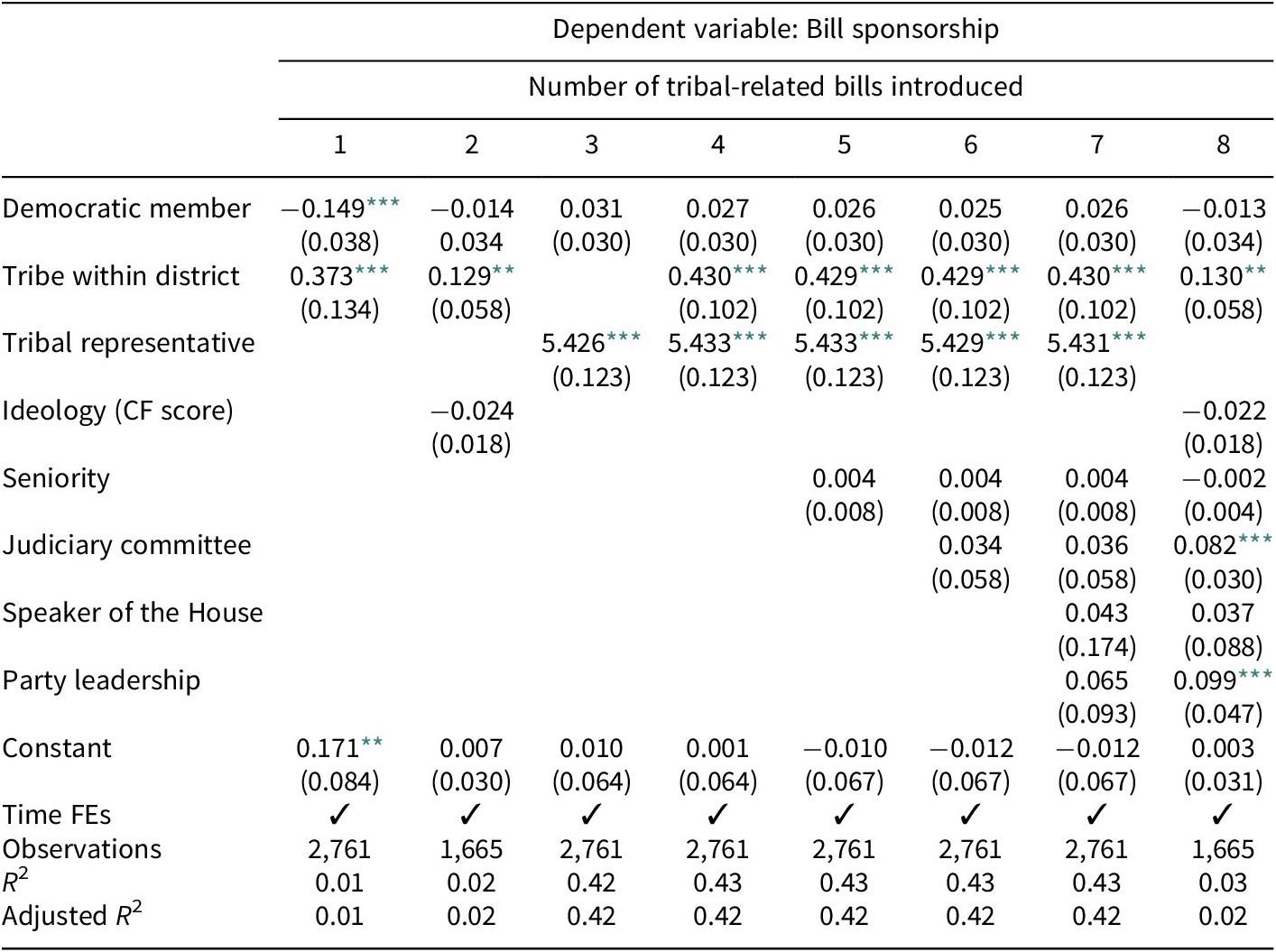
In our first set of regression tests, shown in Table 1, the dependent variable is the number of tribal bills introduced by each member in each session. Here we report the results using OLS as well as negative binomial regression, given the count-based nature and skewed distribution of the dependent variable. Both estimation strategies find strong evidence for the constituency hypothesis (H2) and mixed results for the partisan hypothesis (H3). Across the 36-year window of study, we find the presence of a tribal constituency was predictive of a nontribal legislator initiating pro-tribal bills. As expected, the tribal legislators contributed a large number of bills to advance their constituents’ interests after the rule change in 1995. Tribal representatives introduced five more such bills per session, on average, than the nontribal legislators. Across multiple specifications using OLS, partisanship is almost never a significant predictor of tribal bill sponsorship. Only in the first model, when we do not distinguish between non-Democrats and the nonpartisan tribal legislators, do we find Democratic members are less likely to introduce pro-tribal bills.
Cross-section analysis of tribal-bill sponsorship
Note. OLS regression.
* p < 0.1.
** p < 0.05.
*** p < 0.01.
Nontribal legislators from districts with tribal constituents contributed positively to Indigenous representation. Seven of eight models show support for the constituency hypothesis: the coefficient estimate for the binary variable for the presence of a tribe within the district is both positive and statistically significant. The substantive interpretation of the constituency effect, however, is quite small: nontribal legislators introduce less than one additional pro-tribal bill when there is a tribe within their district. Our results are confirmed by the negative binomial analysis. The estimated effect for nontribal legislators from districts was statistically and substantively significant; these legislators were between 11 and 29 times more likely to sponsor a tribal bill than nontribal legislators from districts without tribes.
Time series analysis
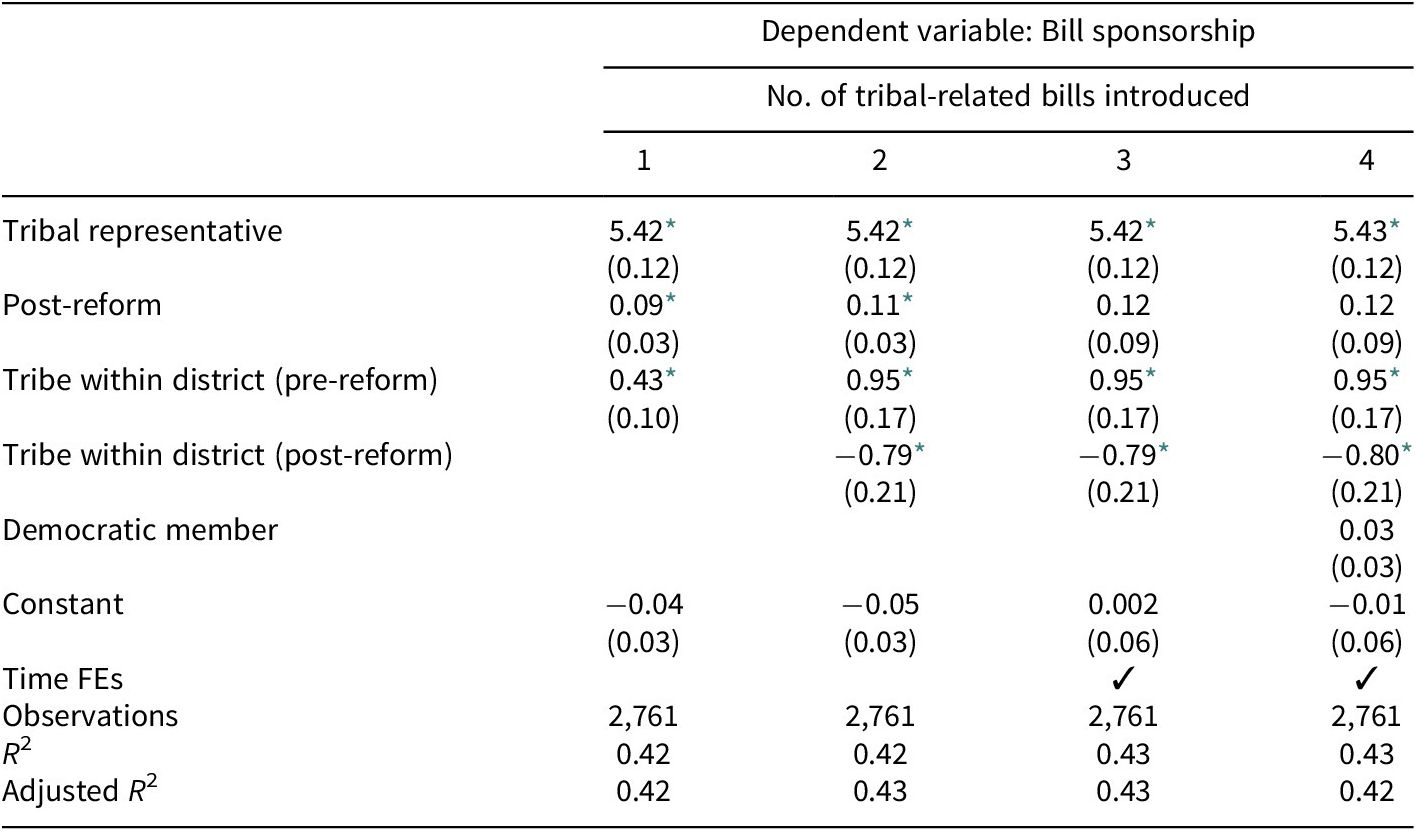
How did the 1995 reform that allowed tribal representatives to introduce their own legislation impact the pro-tribal bill sponsorship of nontribal legislators? Table 2 presents the results of our difference-in-differences analysis, and shows mixed evidence for the complement hypothesis, and some support for the substitute hypothesis. The first model tests for the effects of being a tribal representative, having a tribal constituency (pre-reform), and being in the post-treatment period. Models 2–3 include an interaction term for nontribal legislators with tribal constituents in the post-treatment period, with model 4 adding a measure for party identity. We include session fixed effects in models 3 and 4.
Time series analysis of tribal-bill sponsorship
Note. OLS regression.
* p < 0.01.
Each of the four models in Table 2 confirms nontribal legislators introduced a positive (and significant) number of tribal bills before 1995, whereas models 2–4 show they introduced fewer bills after the reform. In model 4, which includes time fixed effects and a partisanship measure, the estimate shows legislators in districts with tribes sponsored 0.8 fewer tribal bills per session after 1995, on average, or roughly one fewer bill every two sessions.
The results show that nontribal legislators with tribal constituents reduced their contribution to Indigenous representation in the form of initiating pro-tribal bills. The results may be driven by differences between the treated and nontreated groups that are unaccounted for in the model.
There are at least three assumptions that should be well-supported in order to believe the results of the difference-in-differences. First, the sponsorship behavior of nontribal legislators in the two district types should be trending in a similar direction prior to treatment. The two types of legislators should look similar before the treatment in 1995; each type should be on “parallel trends” before and after the treatment. We find each type of legislator produced a similar number of bills at the group-level, with a declining trend before 1995. The two groups produced a similar number of bills, but the mean number of sponsored bills was higher for nontribal legislators with tribal constituents. Although the trends appear parallel, we lack data on sponsorship before 1984, 10 years (five sessions) before the treatment. As a group, the treated and nontreated legislators contributed bills equally before the treatment (49% vs. 51%, respectively), but the nontreated legislators introduced a greater proportion of pro-tribal bills after the treatment (21% vs. 3%). The tribal representatives wrote the other three-fourths of the pro-tribal bills after 1995.
Second, our difference-in-differences approach meets the assumption that treatment was not correlated with another factor that also affected the number of pro-tribal bills introduced by nontribal legislators. One factor in this period that might have impacted the production of pro-tribal legislation was a task force of the Maine Indian Tribal-State Commission (MITSC), created by the Maine Settlement Act, which worked from June 1996 to January 1997 to study improving tribal-state relations. Their recommendations were submitted to the legislature in a final report in 1997. It is possible the MITSC’s impending report influenced the behavior of nontribal legislators before or after the sponsorship rule change in 1995. For example, we might worry the “treated” nontribal legislators introduced bills before the commission report, and then reduced their output when the commission issued its report and initiated its own bills.
We evaluate this theory about nontribal legislators with tribes in their districts shirking on Indigenous representation after the MITSC report by examining cosponsorship patterns. If nontribal legislators considered the issue of tribal policy largely settled by MITSC, we would expect them to reduce both their sponsorship and cosponsorship of bills that change the status quo of tribal-state relations. What is more likely, we argue, is that nontribal legislators step aside to allow the tribal legislators to speak for their own groups’ interests, and continue to cosponsor legislation to signal support for their tribal constituents. Our analysis of cosponsorship behavior, reported in the Supplementary Material, supports this view: nontribal legislators with tribes in their districts cosponsored 1.5 more tribal bills than nontribal legislators without tribes in their districts. Contrary to the results of our time series analysis of sponsorship, we find that cosponsorship behavior did not change after 1995. In the cross-section, Democrats were more likely to cosponsor tribal bills, as were members that served on the Judiciary Committee. Seniority and being in party leadership were also positively, and significantly, associated with cosponsoring more pro-tribal bills.
Third, we would like to see that the treated and nontreated units are similar on the covariates before the 1995 treatment. Again, the lack of data on Maine legislative politics limits our ability to test this assumption due to scarce covariate data on districts and individual legislators, especially in the earlier period. In terms of party identity, the treated and nontreated units appear similar before the treatment: over half of the legislators in each group were Democrats. The treated units were more often represented by Democrats (68% of treated units vs. 55% of nontreated units), although the gap was smaller in the session just before the treatment (50% of treated units were Democrats in the 116th session, compared to 59% of nontreated units). We cannot rule out that the difference in party composition between the two groups was related to the onset of the treatment.
Alternate measure of pro-tribal behavior
Given the costs associated with producing legislation, including the time and resources spent conducting research and writing bills, it is possible that some members of the Maine legislature hold pro-tribal views but do not express such views through bill sponsorship and cosponsorship. When legislators face choices about which bills they will write and champion in a busy legislative session, especially in a part-time legislature like Maine’s, it might be necessary to look elsewhere to measure legislators’ stances on the subset of issues related to the state’s tribes.
Following previous research on pro-tribal voting behavior in the US Congress (Conner Reference Conner2014; Turner Reference Turner2005), we reproduce our analysis using the subset of tribal bills that received a roll call vote (60 out of 394, 15%). The model takes the same form as before, with a new dependent variable that measures the number of pro-tribal votes each legislator took per session. The cross-sectional analysis using OLS is confirmatory: nontribal legislators with tribes in their districts cast 0.5 and 0.7 more pro-tribal votes per session than legislators without tribes in their districts. Democratic members cast one more pro-tribal vote, on average, than non-Democratic members, although this effect disappears when we include a control for ideology. Members with more liberal CF scores cast more pro-tribal votes, on average, than more conservative members. Although the time series analysis is limited by sparser data coverage in the pre-treatment period, the results suggest legislators with tribes in their district cast 0.5 more pro-tribal votes per session after tribal representatives gained the power to sponsor legislation (see the Supplementary Material for more details).
Discussion
We find the addition of reserved seats will not necessarily lead to enhanced representation of minority interests. This finding is especially true if legislators in nonreserved seats undercut the group’s interests, such as by initiating fewer bills. It is important to consider how the electoral system that selects both tribal and nontribal legislators affects their incentives to represent group interests (Crisp et al. Reference Crisp, Demirkaya, Schwindt-Bayer and Millian2018). In particular, we should be aware of how reserved seats might impact institutional-level representation when the constituencies for reserved seats and nonreserved seats overlap. Although we have examined a case with single-member districts, we expect similar results in systems with multimember districts where legislators in reserved seats are elected by voters who also cast ballots for nonreserved seats within the same district.
Likewise, our findings cohere with research finding a possible backlash to descriptive representation among nonminority legislators, including LGBT people (Haider-Markel Reference Haider-Markel2007), Latinos (Preuhs Reference Preuhs2005), and women (Cammisa and Reingold Reference Cammisa and Reingold2004; Mansbridge and Shames Reference Mansbridge and Shames2008; Sanbonmatsu Reference Sanbonmatsu2008; Yoder Reference Yoder1991). This research shows that after more members of a given minority group gain legislative seats, there can be a negative policy backlash by members of the dominant group. Descriptive representation can harden preferences of a majority which run against the policy goals of minority or women representatives. Harkening back to the Federalist, Guinier (Reference Guinier1995, 1–20) labels this as the problem of the tyranny of the majority, whereby descriptive representation of minorities alone may not unsettle the majority’s numerical power to control policymaking. Further research might explore how the relative size of the minority group within the district, the competitiveness of elections, and the salience of minority group interests in nonreserved seat elections affects how nontribal legislators respond to their colleagues in reserved seats.
One unexpected finding is that nontribal legislators in districts without tribes, on average, increased their contributions to Native American representation after the 1995 rule change, especially Democrats. One possible explanation that we do not test is that changing political conditions in Maine after 1995 gave some of these members the incentive to behave in a more overtly pro-tribal way. Partisan identity and ideology, along with electoral incentives, can be powerful motivators for legislators to advocate for tribal policy.
It is possible the parties have polarized on tribal policy over the last few decades, and that nontribal legislators without tribal constituents now have an ideological motivation for visibly supporting the interests of Native Americans, especially in the wake of the Standing Rock protests that elevated liberal support for tribal interests. Supplementary Material further evaluates the plausibility of the link between ideology and pro-tribal bill sponsorship. Using campaign finance data for state legislators between 1996–2018, we find nontribal legislators were more likely to sponsor (and cosponsor) pro-tribal bills as their DIME score became more liberal (Bonica Reference Bonica2014).
One limitation of this study is that we do not consider the outcome of legislation. Many studies of reserved seats are focused on behavior besides voting, including initiating and cosponsoring bills, the content of speeches, and the frequency with of certain topics in debate. The lack of voting rights does not limit the external validity of our study, in part, because much of the work of representation is done before legislators cast their final vote on a bill (Fenno Reference Fenno2013; Saward Reference Saward2010). Creating and promoting legislation is an important part of representing the unique interests of different groups, and the presence of reserved seats allows minority groups to promote Indigenous interests in the form of bills and amendments.
Another limitation of this study is its focus on Maine alone. Future research might compare the representation of Native American across states, to determine if the presence of reserved seats in Maine is associated with greater descriptive and substantive representation than elsewhere. Such work might follow our research design by identifying pro-tribal bills introduced in each state legislature and assessing variation in the representation of Native American interests as a function of constituency size, tribal presence, party identification, and other factors.
To what extent can this study inform our understanding of politics outside of Maine? While Maine’s tribal representative is unique, it can offer lessons for other tribes seeking representation in legislative institutions. It remains to be seen how Congress will respond to the Cherokee Nation’s invocation of treaty rights to seat a delegate, Kimberly Teehee, appointed by the tribe (Rosser Reference Rosser2005). To bring the Cherokee delegate in line with the delegates from D.C. and the territories, Congress may require the Cherokee to hold elections for the reserved seat, in which case policymakers will have to decide if Cherokee voters can cast ballots for the delegate and their local House representative concurrently. Our results suggest tribes should consider the impact that a new delegate seat in Congress will have on the incentives of other members, including House members from districts with significant Native American populations, as well as Native Americans serving in nonreserved seats.
A unique institution among state governments, the institution of tribal representative in Maine has not yet been studied by political science. In the words of the most detailed extant account, “a great deal more research must be done in regard to Indian Representation in the Maine Legislature” (Starbird, Soctomah, and Wright Reference Starbird, Soctomah and Wright2016). This is in part due to our discipline’s historically weak engagement with Indigenous politics. Forcibly removed from their land, excluded from rights and citizenship under the Constitution, and the victims of settler expansionist violence, the treatment of Indigenous people should be a central concern to scholars of American politics and government. And yet, Indigenous politics remain largely absent from political science scholarship and peripheral to our discipline’s systems of knowledge (Ferguson Reference Ferguson2016).
Over two hundred years since Maine’s statehood, it is worth considering the origin and legacy of Maine’s tribal representative, not least because political science has heretofore ignored the institution. For the first time since 1820, the Penobscot Nation has chosen not to fill their reserved seat in the House, and questions remain about the institution’s future. Beyond Maine politics, the history of Maine’s tribal representatives offers a lesson for other groups like the Cherokee who seek representation through reserved seats. This study suggests that reserved seats are not a panacea for improving minority representation, especially when members in those seats lack the power to vote.
Supplementary Material
To view supplementary material for this article, please visit https://doi.org/10.1017/spq.2023.2.
Data Availability Statement
Replication materials are available on SPPQ Dataverse at https://doi.org/10.15139/S3/UR20AA (DeHart and Mamet Reference DeHart and Mamet2023).
Acknowledgments
Thank you to Gregory Ablavsky, Austin Bussing, Thaddieus Conner, Michael Greenberger, Katelyn Mehling Ice, Alexander Kirshner, Jack Knight, Charles Nathan, Micah Pawling, Vivien Rendleman, Keith Richotte, and Jason Roberts for helpful feedback on this project, as well as Alex Burnett, Jon Clark, and the staff of the Maine State Law and Legislative Reference Library for their assistance. We gratefully acknowledge the Tobin Project’s History of American Democracy Graduate Student Fellowship, where we came up with the idea for this article. Finally, thanks to Representative Donna Loring for generously sharing her expertise with us.
Funding Statement
The authors received no financial support for the research, authorship, and/or publication of this article.
Conflict of Interest
The authors declared no potential conflicts of interest with respect to the research, authorship, and/or publication of this article.
Author Biographies
Cameron DeHart is a Lecturer in Political Science at the University of California, Merced.
Elliot Mamet recently earned his PhD in political science from Duke University.


 Open access

