





Introduction
The importance of incorporating environmental matters into classrooms has been recognised since 1972, when environmental education (EE) was introduced in the Declaration of the United Nations Conference on the Human Environment (Whang, Reference Whang2019). With five decades of efforts promoting EE, a widespread awareness of EE has emerged globally. However, the widespread attention does not necessarily align with the incorporation of EE into core science curricula for elementary and secondary schools, while science literacy can play a contributing role in identifying, analysing, and solving a range of environmental problems that we currently face (Dawson et al. Reference Dawson, Eliam, Tolppanen, Assaraf, Gokpinar, Goldman and Widdop Quinton2022; Hicks et al., Reference Hicks, Fitzsimmons and Polunin2010; Lin & Shi, Reference Lin and Shi2012). Namely, students should be equipped with the interdisciplinary skills that enable them to apply science literacy to understanding and developing problem-solving strategies for environmental matters such as climate change and sustainability (Evans & Achiam, Reference Evans and Achiam2021; You et al., Reference You, Marshall and Delgado2019). In this sense, integrating EE into core science curricula would allow students to understand the dark sides of scientific breakthroughs related to the current Anthropocene mass extinction (Cole & Malone, Reference Cole and Malone2019); further, it could help students build their emotional connections with natural environment and identify how to solve environmental degradation using scientific knowledge and methods, with the goal of improving environmental quality. Nevertheless, EE tends to take a back seat in that EE is still not a core curriculum component across countries (UNESCO, 2021).The mismatch between the rhetoric of promoting EE and the actions of adopting EE into core science curricula reflects that many influential stakeholders, such as policy makers and teachers, tend to be somewhat sceptical of taking steps towards mandating EE. Indeed, rather than how to integrate environmental matters into core science curricula, greater attention has been paid to how to prepare students for an international standardised test like PISA across countries (Dawson et al., Reference Dawson, Eliam, Tolppanen, Assaraf, Gokpinar, Goldman and Widdop Quinton2022).
Accordingly, there has been a growing interest in exploring factors associated with students’ science performance on a standardised tests. Despite the ever-increasing interest, students’ awareness level of environmental matters, which mirrors students’ exposure level of EE, has been less considered a key factor contributing to their science performance on a standardised test in the extant literature (Aikens & McKenzie, Reference Aikens and McKenzie2021). In this respect, this study focuses on investigating the relationship between students’ awareness of environmental matters and their science achievement scores on the standardised test of the Programme for International Student Assessment (PISA), after considering well-known predictors for science learning across various regions. PISA refers to the Organisation for Economic Co-operation and Development (OECD)’s Programme, which measures 15-year old students’ skills and knowledge in reading, mathematics, and science across countries.
As a criterion of region selection for this study, this study focuses on 30 regions showing at and above average science scores of OECD countries as shown in Table 1 (OECD, 2015). This study compares science learning dynamics of students’ awareness of environmental matters and science literacy on PISA’s standardised test among the 30 regions, providing evidence on whether it is important to integrate EE into core science curricula. While we are now facing the sixth mass extinction in the Anthropocene, core science curricular rarely address strategies to mitigate environmental degradation based on an understanding of how human activities contributed to the sixth mass extinction (Wallace, Bazzul, Higgins & Tolbert, Reference Wallace, Bazzul, Higgins and Tolbert2022). Given the urgent reality that the current Anthropocene mass extinction is directly related to all students’ future well-being and safety (Wagler, Reference Wagler2011; Wallace et al., Reference Wallace, Bazzul, Higgins and Tolbert2022), this study yields insights into the development of a sense of solidarity in taking active actions towards mandating EE in traditional science classrooms across the globe. Namely, a sense of urgency on environmental degradation allows us to develop a sense of solidarity in preventing the sixth mass extinction; incorporating EE into traditional science classrooms would enable students to explore environmental problems. The interdisciplinary curriculum could encourage students to engage in problem-solving activities through making emotional connections to nature, thereby allowing students to prepare for the environmental challenges and help protect the environment.
Average scores of 15-year-old students on the PISA Science Literacy Scale by education system in 2015
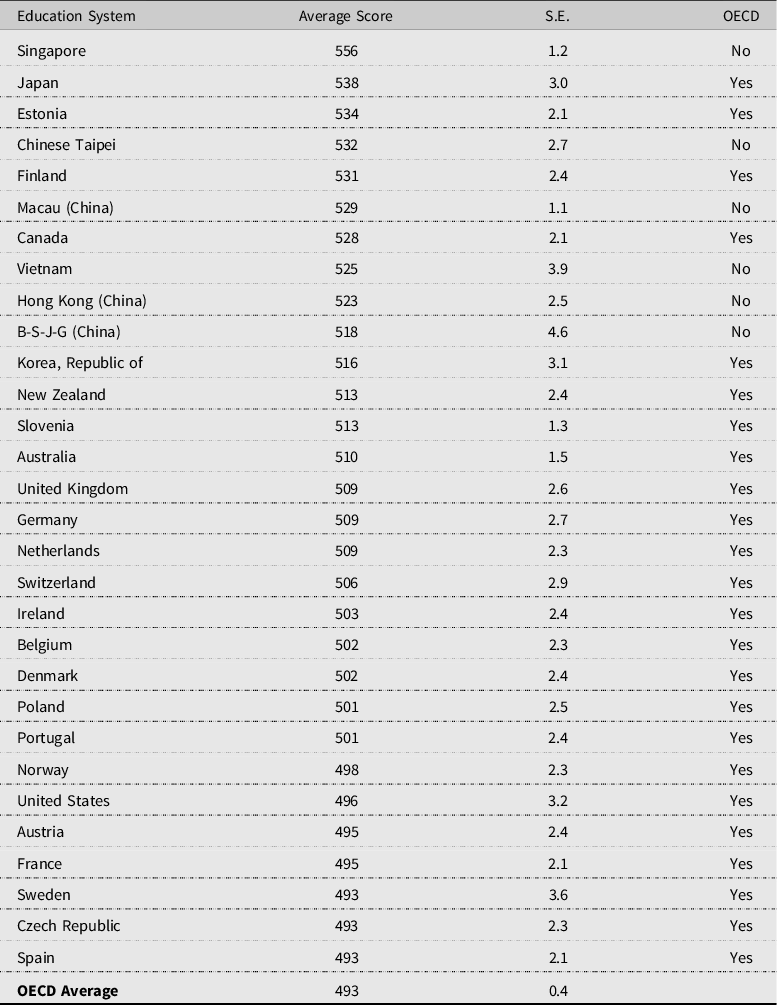
Sources: National Center for Education Statistics, Organization for Economic Co-operation and Development (OECD), Program for International Student Assessment (PISA) 2015.
Theoretical Framework
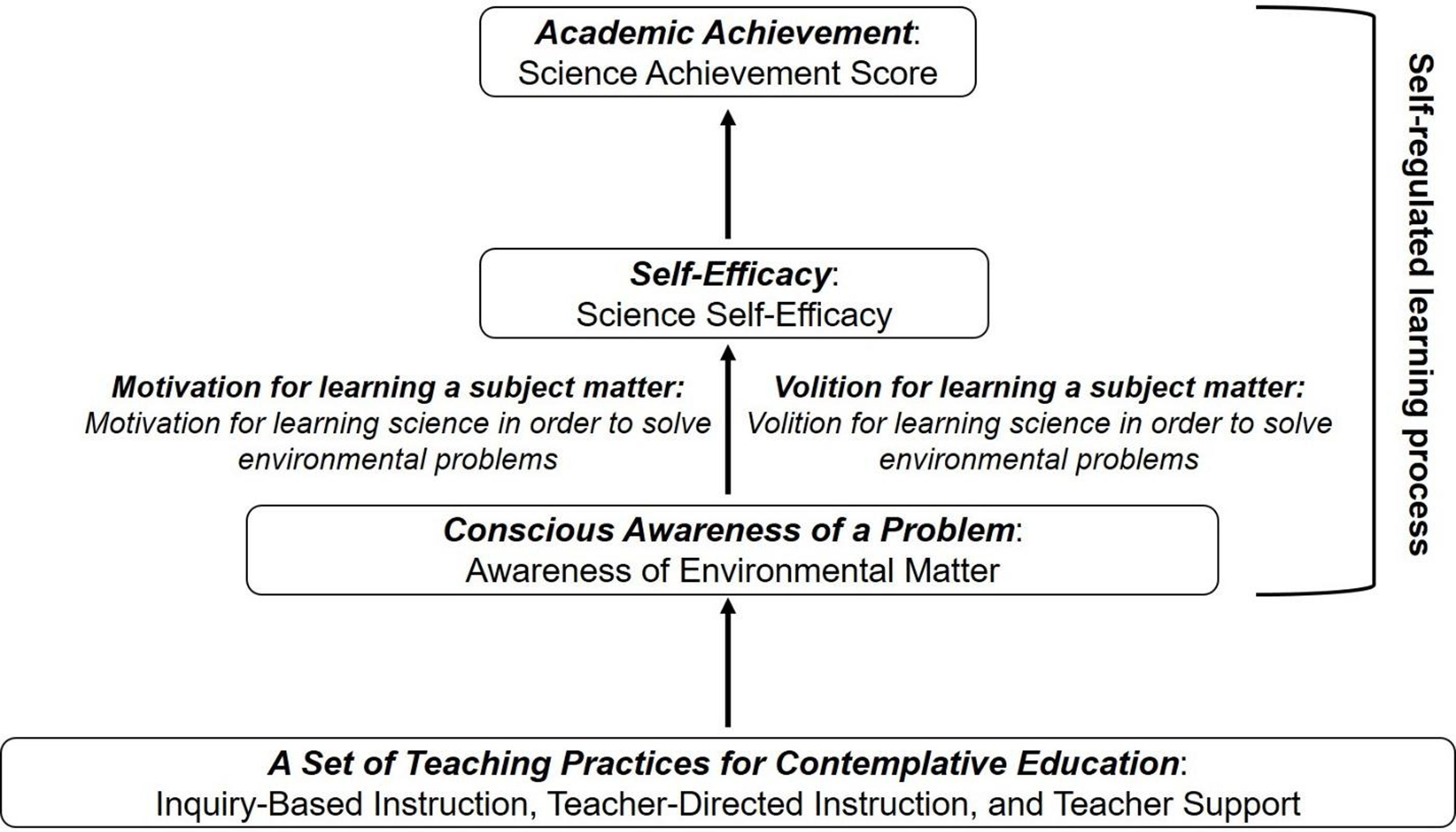
This study utilises Roeser and Peck’s (Reference Roeser and Peck2009) notion of contemplative education, which intends to cultivate conscious awareness of a problem that needs a solution for both students and others. Solving the problem is tied to student personal learning growth that has the potential to play a role in committing prosocial acts such as pro-environmental actions. Roeser and Peck conceptualise that students’ awareness of a problem could motivate them to learn a subject. With the motivation, students would increase their volition to learn the subject and then build self-efficacy related to the topic, contributing to academic achievement in that particular subject. Cultivating students’ conscious awareness towards deep learning for the subject could be carried out by teaching practices. Here, the subject is deemed a core subject that is mandatory for school-age students such that a core subject like science could incorporate real-world problems (e.g., environmental problems). Figure 1 presents Roeser and Peck’s (Reference Roeser and Peck2009) notion that posits the conceptual linkage between contemplative education and student academic achievement by cultivating conscious and wilful forms of self-regulated learning.
The study’s theoretical model based on Roeser and Peck’s (Reference Roeser and Peck2009) notion of contemplative education. Note. The constructs designated by the bolded texts represent the constructs from Roeser and Peck’s (Reference Roeser and Peck2009) notion of contemplative education; the constructs with the un-bolded texts refer to the study’s constructs.
Roeser and Peck’s (Reference Roeser and Peck2009) notion is grounded in Roeser et al.’s (2006) model of Basic Levels of Self (BLoS). BLoS posits that individuals’ self-regulated learning is sourced from their conscious awareness of how they are an integral part of certain situations or environments surrounding themselves. Here, self-regulated learning is constructed through self-efficacy beliefs for goal attainment (e.g., Bandura, Reference Bandura1997) that interplay with volition for learning (e.g., Corno, Reference Corno1993; Kuhl, Reference Kuhl, Boekaert, Pintrich and Zeidner2000; Snow et al., Reference Snow, Corno, Jackson, Berliner and Calfee1996). Notably, a set of teaching practices for contemplative education could cultivate individuals’ conscious awareness of the interrelation between themselves and external conditions. With rising awareness of a problem surrounding individuals themselves, they have freedom of thoughts in identifying problem-solving approaches through diving into deep learning for a subject matter related to the problem. The set of teaching practices should be performed well to cultivate a conscious awareness of the problem. In relation to the study’s research focus, the infusion of environmental matters in science teaching practices could raise students’ conscious awareness of how environmental problems affect their future well-being. Such raising awareness enables them to engage in deep learning for science related to environmental problems as it would motivate self-regulated learning rooted in self-efficacy beliefs. Here, self-regulated learning refers to the situation in which students control their own learning process through transforming their mental abilities into problem-solving skills to accomplish their goals (Zimmerman, Reference Zimmerman and Wright2015). In relation to this study, students’ self-regulated learning towards improvement of environmental quality could be enhanced when teaching practices promote students’ awareness of environmental matters and their emotional connections to nature.
Mirrored by Roeser and Peck’s (Reference Roeser and Peck2009) notion of contemplative education, this study hypothesises that 1) students’ awareness of environmental matters facilitates improvements in science literacy scores; 2) student science self-efficacy is linked to motivation and volition for learning, which contributes to students’ science literacy scores; and 3) a set of teaching practices including inquiry-based instruction, teacher-directed instruction, and teacher support correlated with the degree of students’ awareness of environmental matters are associated with students’ science literacy scores.
Students who are aware of environmental matters and build an emotional connection between themselves and their environments are more likely to be involved in self-regulated learning processes that enhance science self-efficacy and science literacy scores to accomplish their goals of improving environmental quality; indeed, evidence shows that when individuals’ awareness of environmental matters are developed into their emotional connections to nature, the individuals tend to take actions towards solving environmental problems (Mackay & Schmitt, Reference Mackay and Schmitt2019; Whitburn et al., Reference Whitburn, Linklater and Abrahamse2019). Cultivating students’ awareness of environmental matters towards building an emotional connection between students and their environments is attributable to the quality of teaching practices that is based on the implementation of a mixture of inquiry-based and teacher-directed instructions in a nurturing and supportive learning environment (Mackay & Schmitt, Reference Mackay and Schmitt2019). As addressed above, Roeser and Peck argue that teaching practices designed for contemplative education can foster students’ awareness of a specific problem and motivate them to learn a subject matter related to it, contributing to students’ science achievement. Thus, this study looks into how teaching practices relate to students’ awareness of environmental matters as well as science literacy scores.
Indeed, there is empirical evidence that supports the study’s proposed model as shown in Figure 1. Research shows that science self-efficacy tends to serve as an antecedent to improved student science performance (House, Reference House2008). Further, a study shows that those who are more aware of environmental matters are more likely to be involved in learning science (Littledyke, Reference Littledyke2006). In this study, students’ awareness of environmental matters refers to the extent to which students have been aware of environmental matters including greenhouse gases, genetically modified organisms, nuclear waste, and air pollution (see Table 2).

Teaching practices in the proposed model are represented by teacher instruction and support variables that include inquiry-based and teacher-directed science instruction as well as the degree of teacher support. With respect to teacher instruction variables, the study is interested in investigating the way opposing pedagogies — teacher-directed and inquiry-based instructions (i.e., student-centred) — affect student science achievement scores, given that there has been an ongoing debate about the two different instructions’ effects on student learning processes and outcomes. The constructivist approach has long advocated an inquiry-based instruction that allows students to build their own knowledge based on a range of student-centred learning activities, yet a synthesis of several studies has not provided solid evidence that such a constructivist pedagogy is more effective than is teacher-directed pedagogy (Furtak et al., Reference Furtak, Seidel, Iverson and Briggs2012; Kang & Keinonen, Reference Kang and Keinonen2017). As such, the study factors in inquiry-based and teacher-directed instructions when looking at the effects of students’ awareness of environmental matters on science achievement scores. Another teacher-related variable is the degree of teacher support, a teacher’s enthusiasm for each student’s learning, such as offering additional help and teaching until every student understands, as described in Table 2 in the Method section. Given the mixed evidence of the relationship between a teacher’s support and student learning in the classroom (Roorda et al., Reference Roorda, Koomen, Spilt and Oort2011), the study takes into account this variable in investigating the relation between students’ awareness of environmental matters and science achievement scores.
As guided by the theoretical framework described above, the following research questions guide the study.
Research Question 1. Is students’ awareness of environmental matters associated with a set of teaching practices, student science self-efficacy, and student science literacy score across regions?
Research Question 2. To what extent is students’ awareness of environmental matters associated with student science literacy score after taking into account a set of teaching practices and student science self-efficacy within school level across regions?
Research Question 3. To what extent is students’ awareness of environmental matters associated with student science literacy score after taking into account a set of teaching practices and student science self-efficacy between school level across regions?
Literature Review
This section reviews earlier studies about student environmental awareness in learning processes and outcomes. The first section reviews studies on how EE influences student awareness of environmental matters, followed by studies investigating factors associated with student awareness of environmental matters. The next section reviews the literature on the relationship between instruction types and student learning outcomes, including student awareness of environmental matters and science achievement scores. The last section includes recent studies using PISA 2015 that factored in student awareness of environmental matters and science literacy.
Student awareness of environmental matters through EE
Research has suggested that EE with a strong emphasis on environmental awareness yields positive learning outcomes in a broad range of domains that include not only environmentally related but also non-environmentally related domains, while there is a lack of research showing the direct association between EE and standardised test scores (Ardoin et al., Reference Ardoin, Bowers, Roth and Holthuis2018). Ardoin et al. conducted a systematic review of 119 peer-reviewed articles about EE across 33 countries published from 1994 to 2013. Among the 119 studies, 108 articles investigated the effect of EE programmes on a range of environmentally related outcomes. These outcomes included environmental knowledge, competencies, and disposition. One hundred and two of the 108 articles (94%) yielded positive learning outcomes as students from kindergarten through 12th grade gained knowledge, skills, and attitudes about environmental matters. Further, 41 of 119 articles investigated non-environmentally related outcomes like knowledge, competencies, and disposition from students attending EE programmes; 39 of 41 articles (95%) showed positive learning outcomes for the school-age students. Ardoin et al. suggest that EE yields positive learning outcomes for K-12 students overall. Ardoin et al.’s study reflects that it would be worthwhile to build an interdisciplinary connection between EE designed towards environmental awareness and various subjects from a curriculum design perspective. However, this synthesis study called for more research investigating how student achievement scores on a standardised test are associated with a student’s attainable environmental awareness via informal and formal learning settings.
More recent studies also supply promising evidence for the role of EE in promoting students’ awareness of environmental matters. For example, in Biber et al.’s (Reference Biber, Cankorur, Güler and Demir2022) study, 5- to 6-year-old children who attend nature-centred private kindergartens showed a significantly higher level of environmental awareness than their counterparts attending public schools in Turkey. Nature-centre kindergartens are designed to allow children to spend time outdoors and be exposed to natural environments through hands-on exploration of their environment; in nature-centre kindergartens, teaching staff should have competencies for both early childhood education and environmental education (Biber, Cankorur, Güler & Demir Reference Biber, Cankorur, Güler and Demir2022; Cordiano et al. Reference Cordiano, Lee, Wilt, Elszasz, Damour and Russ2019). On the other hand, in traditional public schools, children often lack opportunities to be exposed to natural environments and build an emotional connection to nature, while spending too much time being sedentary in classrooms (Biber et al., Reference Biber, Cankorur, Güler and Demir2022; Cordiano et al., Reference Cordiano, Lee, Wilt, Elszasz, Damour and Russ2019). Studies (Biber et al., Reference Biber, Cankorur, Güler and Demir2022; Cordiano et al., Reference Cordiano, Lee, Wilt, Elszasz, Damour and Russ2019; Gray et al., Reference Gray, Gibbons, Larouche, Sandseter, Bienenstock, Brussoni, … and Tremblay2015) suggest that children’s outdoor activities for their learning, which is the focus of nature-centre kindergartens, have positive effects on their mental and physical health well-beings; however, children today spend much less time being outdoors and being exposed to the green spaces compared to children of older generations, as they are more engaging in screen-based sedentary activities (e.g., watching TV, playing video games, using the internet) due to rapid urbanisation. Biber et al.’s (Reference Biber, Cankorur, Güler and Demir2022) findings reflect that public schools do not yet enact EE to promote environmental awareness in Turkey, meaning that many children are not fully aware of environmental matters. Further, research has shown that EE embedding awareness of environmental matters plays an influential role in promoting pro-environmental behaviours. Otto and Pensini (Reference Otto and Pensini2017) found that participants of nature-based EE were significantly more likely to exhibit robust ecological behaviours as mediated by increases in environmental knowledge and connectedness to nature. These findings are derived from a sample of 255 fourth and sixth graders in Germany, while the mediating effect of the connectedness of nature is stronger than that of environmental knowledge. Despite the stronger contribution of emotional connections to nature compared to environmental knowledge, many of today’s students have little opportunities to connect with nature as they spend much less time playing outdoors in green spaces compared to older generations.
Conversely, Lin and Shi (Reference Lin and Shi2012) found that curriculum placement of EE, which refers to whether environmental topics are taught from a particular environmental studies course or other courses in a school, did not significantly affect students’ environmental awareness and behaviours for Canadian and U.S. samples of 15-year-olds using PISA 2006. In Lin and Shi’s study, the Canadian sample had higher environmental awareness and environment-related behaviours than the U.S. sample. In comparison, the U.S. students showed a higher level of environmental optimism and concern about environmental issues than the Canadian sample. Lin and Shi noted that their finding is consistent with the previous studies showing that environmental literacy encompassing environmental awareness and knowledge was not necessarily linked with a positive outlook (optimism) or concern about environmental issues (Bybee, Reference Bybee2008; Hollweg et al. Reference Hollweg, Taylor, Bybee, Marcinkowski, McBeth and Zoido2011). This finding reflects that environmental awareness is not sufficient to drive one’s emotion to truly care for environments. As reviewed previously, students’ emotional connections to nature, which can be built through nature-based outdoor activities, is more critical to promote pro-environmental behaviours.
Beyond the children and adolescents, Jurdi-Hage et al. (Reference Jurdi-Hage, Hage and Chow2019) focused on Canadian college students investigating EE’s effect. Those who took courses addressing environmental matters for the purpose of promoting students’ awareness of environmental matters were more likely to show pro-environmental attitudes than those who did not when controlling for sociodemographic variables (e.g., age, gender, race/ethnicity, and socio-economic status) as well as intra-personal variables (e.g., internal locus of control and political orientation).
A synthesis of the studies mentioned above suggests that students benefit from EE designed for raising students’ environmental awareness in gaining a range of learning outcomes, including environmental literacy, while the effect of EE appears to vary across countries. Each country has its EE policies and practices; various educational contexts across countries might result in somewhat inconsistent learning outcomes such as environmental awareness through EE between countries. Further, the literature lacks evidence showing the role of student environmental awareness towards science literacy on standardised tests. In this respect, this study attempts to fill the gap in the literature by investigating the relationship between student awareness of environmental matters and their science literacy on the PISA science test across countries.
Influencing factors associated with student awareness of environmental matters
Prior studies have shown that students with higher socio-economic status or greater science interest and achievement scores are more likely to be aware of environmental matters compared to their lower socio-economic counterparts (Coertjens et al., Reference Coertjens, Pawu, de Maeyer and van Petegem2010; Lin & Shi, Reference Lin and Shi2012). Higher socio-economic students tend to have more opportunities and exposure to various scientific knowledge (e.g., environmental matters) that stimulate their interest in learning science and encourage them to spend time studying and achieving in the subject. Such science interest leads to an increase of students’ awareness of environmental matters; namely, those who learn about environmental matters in science classroom become interested in learning science as they may become aware of the fact that the environmental matters affect their well-being and safety (Bybee, Reference Bybee2008). Fisman (Reference Fisman2005) compared environmental knowledge and awareness improvement between students from high- and low-income communities via an urban education programme. Compared to their high-income counterparts, low-income community members were less likely to obtain environmental knowledge and awareness because they often experience a lack of personal well-being and safety in their learning process. They live in a less nurturing community where frequent violence occurs. Such a non-nurturing environment is a barrier to acquiring scientific knowledge related to environmental matters for low-income students. Namely, students from lower income backgrounds have a lack of opportunities to become (more) awareness of environmental matters in comparison to students from higher income backgrounds. The urgent issues surrounding low-income students are not linked directly to obtaining such knowledge or promoting awareness of environmental matters but rather to ensuring their basic survival needs (Fisman, Reference Fisman2005; Hadzigeorgiou & Skoumios, Reference Hadzigeorgiou and Skoumios2013). Speaking of which, some students from low-income backgrounds, who often grow up in disadvantaged areas suffering from traffic danger, domestic violence and crime, and housing densities, are likely to have less opportunities to engage in outdoor activities and be connected to nature compared to their peers from middle- and high-income backgrounds (Gill, Reference Gill2016). The disadvantages surrounding students from low-income backgrounds may act as the critical barriers to building their emotional connections to nature.
Studies have attempted to address the role of parents in shaping their children’s environmental attitudes. In a Turkish sample of 15-year-old students from PISA 2006, Erbaş et al. (Reference Erbaş, Teksoz and Tekkaya2012) found a positive linear relationship between students’ and their parents’ environmental attitudes. Specifically, students whose parents had greater environmental awareness and a sense of responsibility for environmental matters tended to show higher levels of environmental awareness and understanding of responsibility for environmental issues. Similar to Erbaş et al.’s study, some studies provide evidence that students with higher parental education levels were more likely to show a higher level of environmental literacy than their counterparts (Chu et al., Reference Chu, Lee, Ryung Ko, Hee Shin, Nam Lee, Mee Min and Hee Kang2007; Makki et al., Reference Makki, Abd-El-Khalick and BouJaoude2003). However, some other studies showed no significant relationship between parental education level and student environmental literacy (Evans et al., Reference Evans, Brauchle, Haq, Stecker, Wong and Shapiro2007; Negev et al., Reference Negev, Sagy, Garb, Salzberg and Tal2008). The mixed findings reflect that parental education level per se might not necessarily influence their children’s environmental literacy, while parents who received environmental education in their pursuit of education degrees are likely to influence their children’s environmental literacy.
As parents play a critical role in raising and educating their children, the aforementioned studies have investigated how parents’ characteristics are associated with their children’s environmental attitudes. Indeed, given that individuals’ attitudes are often established in the early childhood period when their parents are involved in their children’s various (learning) activities, the level of individuals’ awareness of environmental matters might be attributed partially to how their parents engage with their children with respect to environmental matters (Biber et al., Reference Biber, Cankorur, Güler and Demir2022). For example, parents are often the decision makers who send their children to a nature-centre kindergarten or allow their children to spend more time outdoors than indoors.
Instructional approaches, environmental awareness, and science achievement scores
Mixed findings have emerged in the relationship between instruction types and students’ environmental awareness. For example, in Lin and Shi’s (Reference Lin and Shi2012) study using PISA 2006, students’ engagement in investigations positively affects understanding of environmental matters in both the Canadian and U.S. samples of 15-year old students. Conversely, using more student interaction in science classes significantly lessen environmental awareness in the Canadian sample, while such instruction was not significantly related to environmental awareness in the U.S. sample. Of note, PISA 2006 didn't provide a full description of what student interaction means, so it would not be appropriate to determine the effects of student interaction on their environmental awareness in science classrooms. Perhaps, simply increasing student interaction without a clear learning guideline might not help students gain environmental awareness. Possibly, students may interact with each other to talk about other topics unrelated to environmental matters, if there is a lack of a teacher’s guidance. Lin and Shi further found that students’ hands-on activities were not significantly associated with students’ environmental understanding. Despite the mixed findings on environmental awareness, insufficient research evidence on this area doesn't provide a comprehensive picture of the relationship between instruction types and students’ environmental awareness. In this respect, more research in this area is needed.
Indeed, much research has been devoted to investigating the effectiveness of inquiry-based instructions in science classrooms compared to teacher-directed instructions. Although science reformists long have advocated inquiry-based instructions guided by the constructivist educational theory that posits that students build their own knowledge by engaging in a variety of student-centred learning activities, such as group work, discussion, and experimentation (Khan, Reference Khan2013), the extant literature has not confirmed yet that inquiry-based instructions are more effective than are teacher-directed instructions (Jiang & McComas, Reference Jiang and McComas2015). Jiang and McComas (Reference Jiang and McComas2015) argued that the discrepancy between inquiry-based instruction’s theoretical advantages and empirical evidence is rooted in the fact that most studies have not clearly described what inquiry-based instructions are and how effectively they are implemented in classrooms. Research shows that inquiry-based instruction leads to a positive learning outcome through teacher guidance (Aditomo & Klieme, Reference Aditomo and Klieme2020; Lau & Lam, Reference Lau and Lam2017). In relation to EE, effective teacher-student interactions can be enhanced as teachers provide their students with problem-solving tasks based on outdoor activities in green spaces and discuss possible solutions to environmental degradation with their students (Klein & Merritt, Reference Klein and Merritt1994).
Environmental awareness from PISA 2015
Using PISA 2015, a few studies included students’ awareness of environmental matters as a predictor or dependent variable. For example, a recent study investigated who are more aware of environmental matters among 15-year old students in Italy (Radišić et al., Reference Radišić, Selleri, Carugati and Baucal2021). Radišić et al. found that, in comparison to those with a less awareness of environmental matters, those with a greater awareness of environmental matters exhibit a higher level of science self-efficacy, interest, enjoyment in learning physical and natural science, instrumental motivation in learning hard science, epistemological beliefs about physical and natural science, and engagement in science activities. Another study by Lee (Reference Lee2020) provides evidence that students’ awareness of environmental matters and epistemological beliefs about science serve as significant predictors for student science literacy scores among 15-year old students in Southeast Asian countries — Indonesia, Malaysia, Thailand, and Viet Nam.
In summary, several studies provide evidence that EE, which is designed to raise students’ awareness of environmental matters, plays a positive role in improving students’ environmental knowledge as well as pro-environmental attitudes and behaviours. Further, research has documented influencing factors associated with the degree of students’ awareness of environmental matters that include parents’ environmental attitudes and education level as well as parents’ income backgrounds. Using PISA 2015, a study has shown that students’ awareness of environmental matters is positively associated with a set of cognitive factors including science self-efficacy, science interest, and enjoyment in learning physical and natural science. However, the extant literature lacks evidence of whether student awareness of environmental matter serves as a significant predictor for science literacy on a standardised test such as PISA science test across countries. With the lack of evidence, little has been said about a rationale for proposing an interdisciplinary environmental science curriculum that is designed for students to make an emotional connection to natural environment through active hands-on exploration of the natural environment and the application of science literacy in building solutions to environmental problems. Of significant note, students’ emotional connections to or with the natural environment is an essential psychological component that can transform students’ environmental awareness and knowledge into environmental behaviours (Carmi et al., Reference Carmi, Arnon and Orion2015). Indeed, as noted earlier, students’ environmental awareness and knowledge are not enough to warrant their pro-environmental behaviours (Bybee, Reference Bybee2008; Hollweg et al., Reference Hollweg, Taylor, Bybee, Marcinkowski, McBeth and Zoido2011; Lin & Shi, Reference Lin and Shi2012), while students’ emotional connections to nature has a stronger effect on the development of students’ pro-environmental behaviours compared to their environmental knowledge (Otto & Pensini, Reference Otto and Pensini2017). In this respect, the optimal goal of the interdisciplinary environmental science curriculum is to promote students’ emotional connections to nature and foster a sense of urgency towards solutions to environmental degradation.
Methods
This study developed multi-group multilevel models to investigate the effects of students’ awareness of environmental matters on science literacy scores on PISA’s standardised test among 30 regions’ education systems, as shown in Table 1. Note that for brevity, this paper uses the term “region" rather than “country,” because, as shown in Table 1, China has three different education systems in the following three regions; Macau; Hong Kong, and Beijing-Shanghai-Jiangsu-Guangdong (B-S-J-G). A total of 30 regions included in the data analysis, which means there are a total of 27 countries and 3 regions’ education systems.
Variables
Predictor variables. The study extracted the student participants’ responses from the following survey items available on the PISA 2015 Student Questionnaire, “CY6_MS_CMB_STU_QQQ.sav” (hereinafter referred to as PISA): 1) teacher support in science classrooms, “TEACHSUP” 2) inquiry-based science instruction, ‘IBTEACH’ 3) teacher-directed science instruction, “TDTEACH” 4) students’ awareness of environmental matters, “ENVAWARE” and 5) science self-efficacy, “SCIEEFF.” All of the predictor variables selected were derived variables that were scaled based on the Item Response Theory scaling model (OECD, 2017). Table 2 provides the item parameters and descriptive statistics for these four predictor variables.
Dependent variables. Student science literacy scores was the dependent variable, which is a composite science literacy score consisting of the three subscales as follows: 1) identifying scientific issues, 2) explaining phenomena scientifically, and 3) using scientific evidence. This science literacy score represents an average score of the 10 plausible values from PV1SCIE to PV10SCIE. Note that each plausible value has a degree of uncertainty in measurement within the school level (i.e., student level), which is referred to as measurement error (Wu, Reference Wu2015). Thus, the mean of the 10 plausible values in science was used for the dependent variable, students’ science literacy score.
Data analysis process
Proposed model. Figure 1 shows the proposed model. PISA 2015 data have a hierarchical structure in which students are nested within schools in each region (see details: https://www.oecd.org/pisa/data/2015database/). Accordingly, multilevel models for the 30 regions were developed to take into account the standard errors both of the within- and between-school levels and provides less biased parameter estimates using Mplus 8.3. Each of the regions’ models were compared with the full model, which pooled all student participants’ responses.
The equation for each region’s proposed model is as follows:
Level-1 (Student level or within school level)
Science Literacy Scores ij = β 0j + r ij + β 1j (TEACHSUP) ij + β 2j (IBTEACH) ij + β 3j (TDTEACH) ij + β 4j (ENVAWARE) ij + β 5j (SCIEEFF) ij
where β 1j to β 5j are the effects (slopes) of the five predictors, β 0j is the intercept, and r ij is the level-1 error term.
Note. The subscript i is the index for the level-1 units (students) and the subscript j is the index for the level-2 units (schools), suggesting that student i is nested within school j. The subscripts ij in the equation suggests that a variation of the variables in the i level-1 units (students) is being accounted for by each of the j level-2 units (schools). As such, student science literacy scores are partially attributed to schools that students attend.
Level-2 (School level or between school level)
β
0j
= γ
00 + γ
01( $\overline{\textit{TEACHSUP})}$
j
+ γ
02(
$\overline{\textit{TEACHSUP})}$
j
+ γ
02( $\overline{\textit{IBTEACH})}$
j
+ γ
03(
$\overline{\textit{IBTEACH})}$
j
+ γ
03( $\overline{\textit{TDTEACH})}$
j
+ γ
04(
$\overline{\textit{TDTEACH})}$
j
+ γ
04( $\overline{\textit{ENVAWARE})}$
j
+ γ
05(
$\overline{\textit{ENVAWARE})}$
j
+ γ
05( $\overline{\textit{SCIEEFF})}$
j
+ u
oj
$\overline{\textit{SCIEEFF})}$
j
+ u
oj
where γ 01 to γ 05 are the effects (slopes) of the five predictors, γ 00 is the mean value of the level-1 dependent variable controlling for the five level-2 predictors, and u oj is the level-2 error term.
Note. β
0j
is the level-1 intercept and the dependent variable in the level-2 unit, given that the study allows the level-1 intercept to vary across schools and hypothesises that the intercept variation across schools would be explained by the five level-2 predictors as follows: average value of teacher support ( $\overline{\textit{TEACHSUP})}$
, average value of inquiry-based science instruction (
$\overline{\textit{TEACHSUP})}$
, average value of inquiry-based science instruction ( $\overline{\textit{IBTEACH})}$
, average value of teacher-directed instruction
$\overline{\textit{IBTEACH})}$
, average value of teacher-directed instruction $(\overline{\textit{TDTEACH})}$
, average value of students’ awareness of environmental matters (
$(\overline{\textit{TDTEACH})}$
, average value of students’ awareness of environmental matters ( $\overline{\textit{ENVAWARE})}$
, and average value of science self-efficacy (
$\overline{\textit{ENVAWARE})}$
, and average value of science self-efficacy ( $\overline{\textit{SCIEEFF})}$
of each school. The each school’s average values are derived from aggregate scores of student responses from the level-1 predictors, thereby suggesting a collective commitment or perception related to the five predictors in the level-2 unit.
$\overline{\textit{SCIEEFF})}$
of each school. The each school’s average values are derived from aggregate scores of student responses from the level-1 predictors, thereby suggesting a collective commitment or perception related to the five predictors in the level-2 unit.
The combined equation for Level-1 and Level-2 is:
Science Literacy Scores
ij
= γ
00
+ γ
01( $\overline{\textit{TEACHSUP})}$
j
+ γ
02(
$\overline{\textit{TEACHSUP})}$
j
+ γ
02( $\overline{\textit{IBTEACH})}$
j
+ γ
03(
$\overline{\textit{IBTEACH})}$
j
+ γ
03( $\overline{\textit{TDTEACH})}$
j
+ γ
04(
$\overline{\textit{TDTEACH})}$
j
+ γ
04( $\overline{\textit{ENVAWARE})}$
j
+ γ
05(
$\overline{\textit{ENVAWARE})}$
j
+ γ
05( $\overline{\textit{SCIEEFF})}$
j
+ β
1j(TEACHSUP)
ij
+ β
2j(IBTEACH)
ij
+ β
3j
(TDTEACH)
ij
+ β
4j
(ENVAWARE)
ij
+ β
5j
(SCIEEFF)
ij
+ u
oj + r
ij
$\overline{\textit{SCIEEFF})}$
j
+ β
1j(TEACHSUP)
ij
+ β
2j(IBTEACH)
ij
+ β
3j
(TDTEACH)
ij
+ β
4j
(ENVAWARE)
ij
+ β
5j
(SCIEEFF)
ij
+ u
oj + r
ij
Missing values. The dataset included missing values of the variables selected, except in the science scores. The variables’ missing value percentage was as follows: 1) 14.9% in TEACHSUP; 2) 15.1% in IBTEACH; 3) 17.2% in DTEACH; 4) 6.5% in ENVAW, and 5) 8.6% in SCIEEFF. Complete data with listwise deletion, which delete all cases with a missing value, could not be considered a representative sample of population and will decrease the sample size; thus, the listwise deletion may generate biased results and loss of statistical power (Howell, Reference Howell, Outhwaite and Turner2008). As such, the Expectation-Maximisation algorithm was used to impute the missing values based on the assumption of Missing at Random (MAR) — that missing values can be predicted based on information available, the other variables’ observed values (Lu & Copas, Reference Lu and Copas2004). The assumption of MAR makes sense in the present study in that, as shown in Table 3, all the selected variables are significantly correlated to each other. SPSS v. 26 was used to impute the missing values.
Descriptive statistics of the variables and correlations between the variables across 30 regions
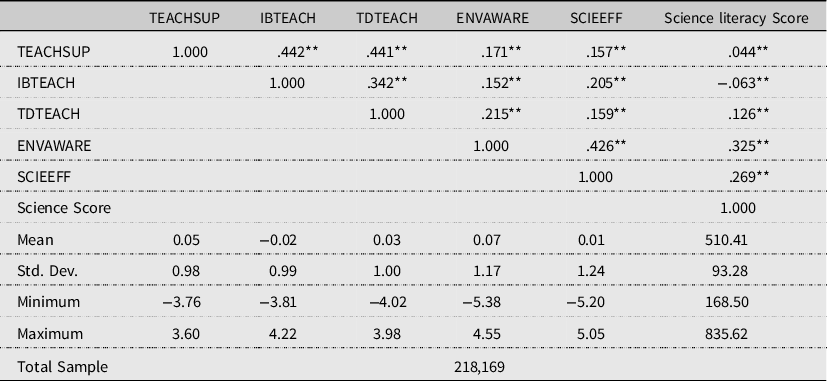
Note. **p < .001; Std. Dev. refers to standard deviation.
Results
Following the descriptive statistics and correlations between the variables shown in Tables 3 and 4, this section answers the research question proposed above. As Table 3 shows, all the selected variables are significantly correlated to each other at p < 0.001 based on the pooled data, which supports Roeser and Peck’s notion of contemplative education that theoretically frames the selected variables. Notably, other than inquiry-based science instruction (IBTEACH), all of the predictor variables are correlated positively with student science literacy scores at p < .001. Notably, students’ awareness of environmental matters (ENVAWARE) are correlated positively with not only science literacy scores but also the other predictor variables. Namely, students’ greater awareness of environmental matters are correlated with a higher level of having teacher support in science classroom (TEACHSUP), inquiry-based science instruction (IBTEACH), and teacher-directed science instruction (TDTEACH) compared to their counterparts at p < .001. Moreover, a significant positive correlation emerges between students’ awareness of environmental matter (ENVAWARE) and their science self-efficacy (SCIEEFF).
Correlations between students’ awareness of environmental matters and the other variables by regions
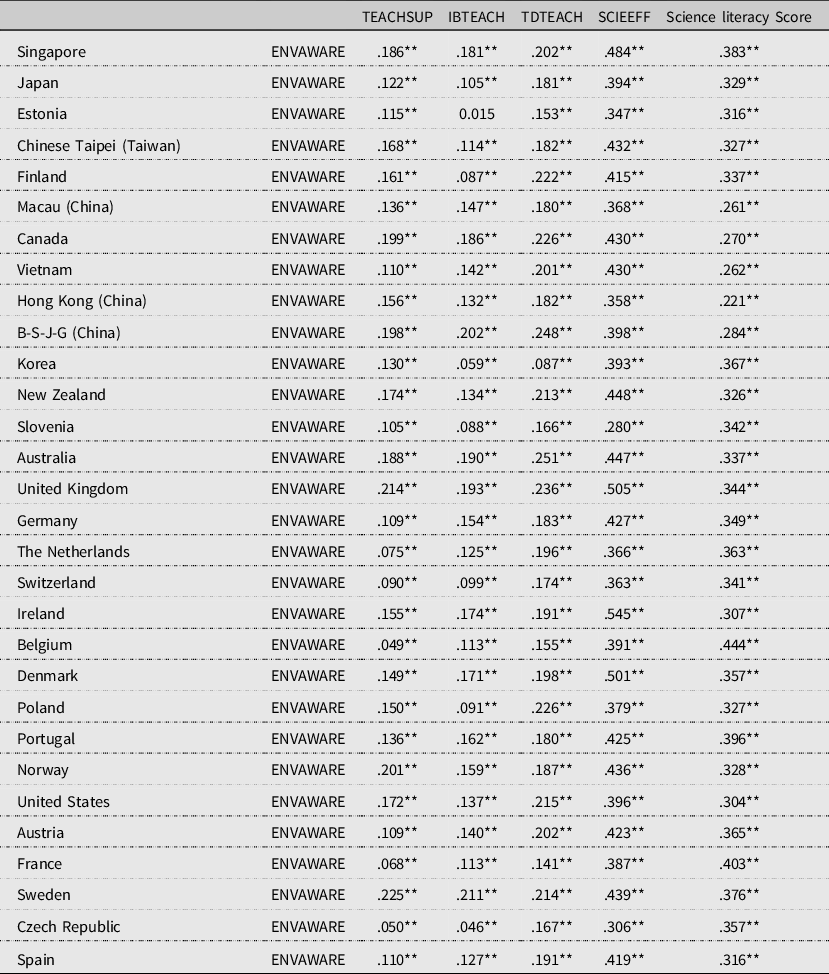
Note. **p < .001.
Answering research question 1
Given that this study focuses on students’ awareness of environmental matters, Table 4 provides correlations between students’ awareness of environmental matters and the other variables across the regions. Except for Estonia, all the regions’ data as shown in Table 4 concurred the pooled data’s correlation matrix as shown in Table 3 in that students’ awareness of environmental matters has a positive relationship with all the variables including TEACHSUP, IBTEACH, TDTEACH, and SCIEEFF at p < .001. With respect to Estonia, IBTEACH appeared to be positively associated with students’ awareness of environmental matters, albeit the non-significant correlation. Other than IBTEACH, Estonia’s data provide evidence that students’ awareness of environmental matters are significantly correlated with TEACHSUP, TDTEACH, and SCIEEFF. A synthesis of the pooled and each region’s data suggests there is a positive relationship between students’ awareness of environmental matters and a mixture of teaching practices encompassing teachers’ inquiry-based and direct science instruction as well as teacher support.
Answering research question 2
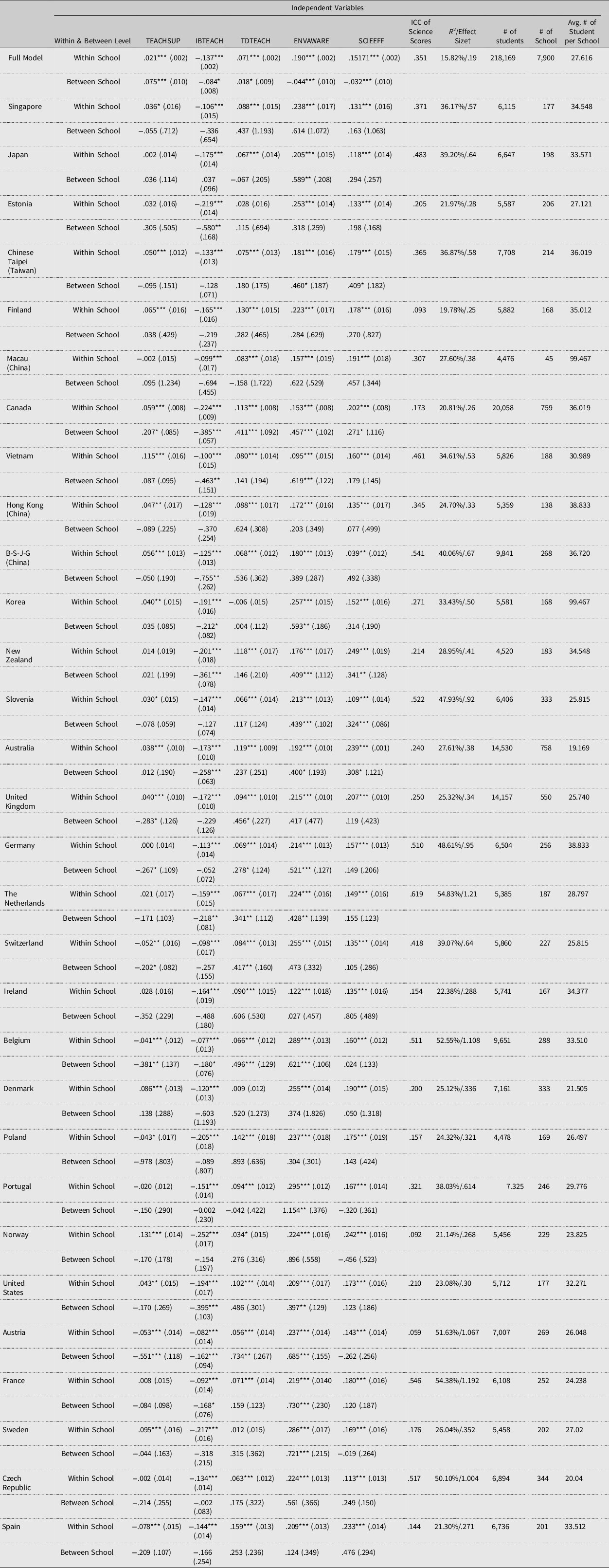
Table 5 show each predictor variable’s standardised coefficient, which suggests a relative effect of each predictor variable on the dependent variable within school level. As such, note that a negative effect of a certain predictor variable on science literacy scores does not necessarily mean that the predictor variable is detrimental to the dependent variable, science literacy scores. Rather, it should be interpreted that the predictor variable contributes relatively less to a dependent variable compared to the other predictor variables.
Standardised coefficients of multi-group multilevel model
Note. *p < .05, **p < .01, ***p < .001, standard error in parentheses.
†R
2 = 1 – $\displaystyle{\sigma _{F}^{2}+\tau _{F}^{2} \over \sigma _{E}^{2}+\tau _{E}^{2}}$
, where σ
F
2 represents the level-1 random error variance (variance of ϵij) for the full model (i.e., the model of interest); τ
F
2 represents the level-2 random error variance (variance of u0j) for the full model; σ
E
2 represents the level-1 random error variance of the empty model; and τ
E
2 represents the level-2 random error variance for the empty model (Snijders & Bosker, Reference Snijders and Bosker2012; Lorah, Reference Lorah2018, p.5).
$\displaystyle{\sigma _{F}^{2}+\tau _{F}^{2} \over \sigma _{E}^{2}+\tau _{E}^{2}}$
, where σ
F
2 represents the level-1 random error variance (variance of ϵij) for the full model (i.e., the model of interest); τ
F
2 represents the level-2 random error variance (variance of u0j) for the full model; σ
E
2 represents the level-1 random error variance of the empty model; and τ
E
2 represents the level-2 random error variance for the empty model (Snijders & Bosker, Reference Snijders and Bosker2012; Lorah, Reference Lorah2018, p.5).
†Effect Size (f
2) = $\displaystyle{R^{2} \over 1-R^{2}}$
, where 0.02 is a small effect, 0.15 is a medium effect, and 0.35 is a large effect (Cohen, Reference Cohen1992; Lorah, Reference Lorah2018, p.5).
$\displaystyle{R^{2} \over 1-R^{2}}$
, where 0.02 is a small effect, 0.15 is a medium effect, and 0.35 is a large effect (Cohen, Reference Cohen1992; Lorah, Reference Lorah2018, p.5).
As shown in Table 5, both consistent and inconsistent patterns emerged in the relationships between the predictor and dependent variables across the regions’ education system. The full model shows that science literacy scores are positively associated with a student’s awareness of environmental matters (ENVAWARE), after taking into account teacher support (TEACHSUP), inquiry-based science instruction (IBTEACH), teacher direct science instruction (TDTEACH), and a student’s science self-efficacy (SCIEEFF). Specifically, TEACHSUP, TDTEACH, and SCIEEFF are positively associated with science literacy scores, while being negatively related to IBTEACH. Consistent with the full model, the following 11 regions showed the similar pattern in the relationship between the predictor and dependent variables (Australia, Canada, Chinese Taipei, Finland, Hong Kong China, Norway, Singapore, Slovenia, United Kingdom, United States, and Vietnam).
A similar pattern emerges in the following nine regions (Czech Republic, Germany, France, Ireland, Japan, Macau China, Portugal, the Netherlands, and New Zealand). Specifically, a significant relationship does not exist between TEACHSUP and science literacy scores. Other than TEACHSUP, these nine regions have the similar pattern with the full model in the relationships between the other predictor variables and science literacy scores. Similar to these nine regions, there is no significant relationship between TEACHSUP and science literacy scores in Estonia. However, unlike these nine regions, TDTEACH does not show a significant effect on science literacy scores in Estonia.
In the following three regions (Denmark, Korea, and Sweden), no significant relationship emerges between TDTEACH and student science literacy scores. Other than TDTEACH, the three regions have the similar pattern with the full model in the relationships between the other predictor variables and dependent variable. Contrary to the full model, there is a significant negative relationship between TEACHSUP and science literacy score in the following five regions (Austria, Belgium, Poland, Spain, and Switzerland). Other than TEACHSUP, these five regions have the similar pattern with the full model in the relation between the other predictor and dependent variables.
Taken together, mixed findings emerge in the effects of TEACHSUP and TDTEACH across the regions, while all the regions show the consistent pattern in the effects of IBTEACH, ENVAWARE, and SCIEEFF. Specifically, IBTEACH is negatively associated with science literacy scores across the regions, while ENVAWARE and SCIEEFF are positively contributing to student science literacy scores.
Answering research question 3
At the between-school level, inconsistent patterns emerge in most regions’ education systems. As noted in the Methods section, each predictor variable’s effects at the between-school level reflects a collective commitment or perception across the schools with respect to the predictor variables selected. As such, at the between-school level, ENVAWARE and SCIEEFF represent the degree of students’ collective perception of environmental awareness and science self-efficacy, respectively, while TEACHSUP, IBTEACH, and TDTEACH can be interpreted as the degree of collective teacher commitment for TEACHSUP and IBTEACH, and TDTEACH. Keeping these concepts in mind, the following shows each predictor variable’s effects at the between-school level.
In the full model, the standardised coefficients of ENVAWARE, SCIEEFF, and IBTEACH suggest that the collective perceptions or commitment of these three predictors have a small but negative effect on school-level science literacy scores, while the standardised coefficients of both TEACHSUP and TDTEACH show a small but positive effect on school-level science literacy scores. However, none of the 30 regions show the similar patterns with the full model. Particularly, the collective perception of ENVAWARE is positively associated with school-level science literacy score in the following 16 regions (Australia, Austria, Belgium, Canada, Chinese Taipei, France, Germany, Japan, Korea, New Zealand, Portugal, Slovenia, Sweden, The Netherlands, United States, and Vietnam). However, the other 14 regions do not show a significant relationship between the collective perception of ENVAWARE and school-level science literacy score, while the standardised coefficients for these 14 regions are positive. In this respect, a small but negative coefficient of ENVAWARE in the full model is likely to be yielded from the computation process of merging the non-significant findings from the latter 14 regions’ data into the significant findings from the former 16 regions’ data. Literally speaking, a school with a higher level of ENVAWARE is likely to demonstrate a higher level of school-level science literacy score in all 30 regions, while a statistical significant relationship is applied to 16 regions out of the 30 regions.
There is a varied range of R 2, effect size and intraclass correlation (ICC) across the regions, as demonstrated in Table 5. R 2 ranges from 19.78% (Finland) to 54.83% (The Netherlands), suggesting that 19.78% to 54.83% of total variance in science literacy scores are explained by the selected predictor variables across the regions. The effect sizes range from .25 (Finland) to 1.21 (The Netherlands), indicating that a medium to large effect size across the regions. ICC ranges from .059 to .619 is interpreted as 5.9% to 61.9% of total variance in science achievement scores is attributable to schools that students attend across the regions.
Discussion
This study investigated the relationship between students’ awareness of environmental matters and student science literacy scores when considering students’ science self-efficacy as well as teacher instruction and support variables at both the within- and between-school levels. Data from all the regions demonstrate that students’ awareness of environmental matters (ENVAWARE) is a significant and positive contributor to science literacy scores. In contrast, science teaching and learning processes are likely to vary across the regions, as shown in the regional differences in R 2 and effect size. All 30 regions show a “medium” or “large” effect size (f 2 >=. 15) in their multilevel models, suggesting that the selected predictor variables, including students’ awareness of environmental matters, are determining factors that contribute to student science literacy scores across regions.
This study confirms Roeser and Peck’s (Reference Roeser and Peck2009) notion of contemplative education by providing evidence with medium to large effect size that students’ conscious awareness of a problem correlates with students’ achievement score. Their awareness is characterised by their understanding of environmental matters, their self-regulated learning as measured by their science self-efficacy, and teaching practices of how well teachers guide and facilitate science classrooms and engage students. Students’ awareness of environmental matters is associated with a mixture of inquiry-based and teacher-directed science instruction as well as teacher support, as evidenced by the significant positive correlations between students’ awareness of environmental matters and all the teaching-related variables; further, those with a greater awareness of environmental matters exhibit a significantly higher level of science self-efficacy (see Tables 3 and 4). In this respect, the current study’s proposed model corresponds to the linkages between the constructs in Roeser and Peck’s (Reference Roeser and Peck2009) notion of contemplative education (see Figure 1), suggesting that all the hypotheses noted in the Theoretical Framework section are supported. The findings encourage influential stakeholders including policy makers and educational leaders to support partnerships between environmental and science educators towards the design and implementation of an interdisciplinary environmental science curriculum. As an interdisciplinary environmental science curriculum, it is recommended that influential stakeholders promote an environmental science curriculum that centres on out-of-school science education institutions such as museums, science centres, zoos, and aquaria as well as nature-based outdoor activities. Such an interdisciplinary curriculum would play a critical role in enhancing students’ awareness of environmental matters and their emotional connections to nature (Biber et al., Reference Biber, Cankorur, Güler and Demir2022; Cordiano et al., Reference Cordiano, Lee, Wilt, Elszasz, Damour and Russ2019; Evans & Achiam, Reference Evans and Achiam2021; Otto & Pensini, Reference Otto and Pensini2017). Importantly, however, to effectively design and implement such an interdisciplinary environmental science curriculum, it is imperative to build intensive partnerships among influential stakeholders including environmental educators, science educators, policy makers, and scientists (Evans & Achiam, Reference Evans and Achiam2021).
The between-school level shows an irregular pattern in most regions with the non-significant effects of at least two predictor variables. This finding is inconsistent with the full model. A synthesis of the within- and between-school level’s results suggests that students’ science literacy scores associated with their awareness of environmental matters are more likely determined at the student level (or within school level) rather than at the school level (or between school level), reflecting that students’ awareness of environmental matters are likely to be gained from their own educational resources rather than schools. Accordingly, the remainder of this section discusses important implications for practice and future research based on the findings pertaining to one’s awareness of environmental matters at the within-school level (or at the student level).
All 30 regions’ models show that students who are more aware of environmental matters tend to show higher science literacy scores than their lesser-informed counterparts. This finding is consistent with earlier studies’ argument that EE can enhance students’ awareness of environmental matters, contributing to a range of positive learning processes and outcomes, such as attitudes, skills, and knowledge. Specifically, this finding addresses the gap in the literature by providing evidence that students’ environmental awareness has a positive effect on their science achievement scores on standardised test across the 30 regions’ education systems. This evidence signifies the importance of incorporating various real-world environmental problems into science curricula at the K-12 level and provides a rationale for developing interdisciplinary environmental science curricula across the globe. Such real-world problems associate directly with protecting and securing these students’ future environment and, thus, could motivate more students to be involved in science curricula. Teaching practices that embed environmental damage into the learning experience can cultivate students’ awareness of environmental matters and enable students to engage in self-learning processes that improve science literacy scores.
Contrary to the positive effects of a student’s awareness of environmental matters and science self-efficacy, all 30 regions show that IBTEACH associates negatively with student science achievement scores. Further, except for Estonia and Korea, the other 17 regions demonstrate that TDTEACH is a significant factor that favours students’ science achievement scores. This finding reflects that IBTEACH might be relatively less influential than TDTEACH in light of the enhanced student literacy scores per se. However, some items for TDTEACH as shown in Table 2 refer to classroom discussion with teacher guidance, which reflects an inquiry-based instruction. In this respect, an inquiry-based instruction with teacher guidance correlates positively with student science literacy score, which is consistent with the previous studies reviewed above (Aditomo & Klieme, Reference Aditomo and Klieme2020; Lau & Lam, Reference Lau and Lam2017). Importantly, the negative effect of IBTEACH does not mean science teachers should not adopt IBTEACH. In fact, as noted previously and shown in Tables 3 and 4, it is noteworthy that IBTEACH correlates positively with ENVAWARE and SCIEEFF, both of which contribute to enhanced science literacy scores across the 30 regions. As such, it is recommended that a mixture of both teacher-directed and inquiry-based science instruction should be adopted in cultivating students’ awareness of environmental matters together with the study’s finding that both types of instructions are positively correlated with students’ awareness of environmental matters. This recommendation is consistent with the notion that combining varied learning activities may optimise an individual’s learning outcomes (Bransford et al., Reference Bransford, Brown and Cocking1999). Indeed, Jiang and McComas (Reference Jiang and McComas2015) provide evidence that a balanced integration of teacher-directed and inquiry-based instruction could optimise students’ learning outcomes.
Mixed findings emerge in the effect of teacher support on science literacy scores across the 30 regions, which is consistent with Roorda et al.’s (Reference Roorda, Koomen, Spilt and Oort2011) meta-analysis of 99 studies. The following ten regions show no significant relationship between teacher support and student science literacy scores (Czech Republic, France, Germany, Ireland, Japan, Estonia, Macau China, Portugal, the Netherlands, and New Zealand). A significant negative effect of teacher support appears in the following five regions: Austria, Belgium, Poland, Spain, and Switzerland. The remaining 15 regions found a significant positive effect of teacher support on student science literacy scores. However, teacher support is positively associated with students’ awareness of environmental matters, as shown in Tables 3 and 4. Teacher support entails a teacher’s enthusiasm to meet each student’s needs and interests in science classrooms. In this respect, teachers’ enthusiasm about infusing EE into their science classrooms could play a critical role in cultivating students’ awareness of environmental matters and motivating students to learn science. Such enthusiasm could be attributable to teacher professional development for integrating EE into science classrooms. Indeed, research shows that teachers’ willingness to design and implement curricula for EE is shaped by school leaders’ supports for EE professional development (Almeida et al., Reference Almeida, Moore and Barnes2018).
This study has noteworthy limitations. Firstly, the findings shows correlations between predictor and science literacy scores, which doesn't warrant causation between them. Namely, the quantitative evidence cannot provide a full picture of how and why students’ awareness of environmental matters is related to their science literacy scores. In this respect, the study’s findings suggest various avenues for future research. Firstly, it would be worthwhile to conduct an experimental or quasi-experimental research in an effort to provide causal evidence on the link between students’ awareness of environmental matters and science literacy score on a standardised test. Further, using in-depth interviews with students and teachers, qualitative research could explore potential cognitive and non-cognitive mediators that can explain the relationship between students’ awareness of environmental matters and their science literacy scores. Secondly, the positive linkage between students’ awareness of environmental matters and science literacy scores does not necessarily mean that students with a better awareness of environmental matters are more likely to show pro-environmental actions. As reviewed previously, students’ emotional connections to nature is a determining factor to promote pro-environmental actions. In this respect, it would be worthwhile to conduct a longitudinal study designed to investigate the extent to which students with a greater awareness of environmental matters, a stronger emotional connection to nature, and a higher science literacy scores exhibit pro-environmental behaviours. Importantly, this longitudinal study needs to take into account well-documented predictors that might correlate with pro-environmental behaviours; as addressed in the literature review section, those predictors include students’ early exposure to EE, their environmental literacy, and their parents’ environmental attitudes. Given that the aforementioned future studies focus on students’ awareness of environmental matters, it is important for environmental educators to be involved in those potential studies as they could provide realistic issues and expert knowledge in the pursuit of teaching environmental matters.
This study attests to the importance of EE that integrates environmental matters into science classrooms where students can engage in a mixture of teacher-directed and inquiry-based science instruction and receive teacher support in the learning process. This study recommends that science curricula should promote students’ active actions to solve today’s real-world problems related to environmental matters. Of significant note, EE could drive environmental improvements in the long term, given the empirical evidence that there is an inverted U-shaped relationship between education attainment and carbon emissions/energy consumption (Shafiullah et al., Reference Shafiullah, Papavassiliou and Shahbaz2021). Shafiullah et al., interpreted the inverted U-shaped relationship as suggesting that individuals with higher education levels are more likely to earn more and purchase modern polluting technologies (e.g., cars) before learning about environmental matters. However, after exposure to EE through further education, they are likely to consume pollution-reducing technologies or eco-friendly products. Suppose children and adolescents fully engage in EE through core science curricula at the K-12 level. The inverted U-shape could turn into an inverse linear relationship between the quality of EE and carbon emissions/energy consumption, suggesting that the quality of EE could reduce environmental degradation derived from carbon emissions/energy consumption. The inverse linear relationship is not achievable solely by EE in schools, given that students gain awareness of environmental matters through a wide range of channels, including not only EE in schools but also in their social environments spanning from their family to community (Tidball & Krasny, Reference Tidball and Krasny2011). Importantly, to improve the quality of EE, students should engage with green spaces through outdoor activities and build an emotional connection to nature. Integrating such outdoor activities into science teaching could help students develop an emotional connection with nature and pro-environmental behaviours (Otto & Pensini, Reference Otto and Pensini2017). Outdoor activities for science learning would provide a dazzling opportunity for students to have a direct contact with living organisms in green spaces; this would allow students to think of how living organisms are interconnected with others and to engage in scientific inquiry about how to solve environmental problems. Of significant note, EE for promoting environmental awareness needs to span early childhood education through high school and beyond into the community. Indeed, EE during the early childhood years, which focuses on outdoor activities in green spaces, plays a critical role in enhancing one’s emotional connection to nature and developing one’s appreciation for the natural world (Ardoin & Bowers, Reference Ardoin and Bowers2020; Biber et al., Reference Biber, Cankorur, Güler and Demir2022). EE grounded in outdoor and nature-based learning needs to be expanded beyond the schools and permeate a wide range of communities surrounding schools where students are nested. The ecological EE could urge the younger generation to take active actions against environmental damages. In this vein, EE is not only significant for improving students’ science literacy achievement scores, as shown in this study, but also for improving environmental quality.
Acknowledgement
The author appreciates the constructive feedback from the anonymous reviewers, Dr Peta J. White (Editor-in-Chief in the Journal), and Dr Marianne Logan (Associate Editor in the Journal) during the review process.
Conflict of Interests
The author declares no conflicts of interest associated with this research.
Financial Support
The author received no financial support for this research.
Ethical Standards
Ethical standards are not applicable to this research, because the author used de-identified, publicly available data for this research that does not fall within the regulatory definition of research involving human subjects.
Dr. Ahlam Lee is an associate professor in the school of psychology at Xavier University located in Cincinnati, Ohio in the United States. She has published several works pertaining to STEM education, refugee issues, microaggression, and confirmation bias in leading journals and major book publishers. She is an alumna of University of Wisconsin — Madison, Columbia University in the City of New York, and Indiana University — Bloomington.
She can be reached out via e-mail at leea15@xavier.edu. Her mailing address is: School of Psychology, 3800 Victoria Parkway, Cincinnati, Ohio 45207, the United States of America.


 Open access

