




Introduction
At first blush, no one in ancient India could seem to be more manly than a heroic warrior. The battlefield is a domain in which men fight men, proving their masculinity through astonishing feats of strength. There are, however, paradoxical signs that the heroic self has a feminine side. In the fourth book of the Mahābhārata, the Virāṭaparvan, the exiled five Pāṇḍavas and their shared wife, Draupadī, live in disguise for a year at the court of Virāṭa. As they prepare to offer Virāṭa their services, each of the five brothers adopts a different identity. The most striking is the disguise chosen by Arjuna, ‘the most skillful warrior’ of the five,Footnote 1 who chooses the role of a transvestite dance teacher and spends a year teaching Virāṭa's daughters and other girls to dance and sing. Far from being an isolated phenomenon, Arjuna's feminisation has intriguing parallels in the narrative literatures of Indo-European-speaking groups far beyond India. In the Old Norse Thrymskviða, for example, the violent thunder god Thor impersonates a bride.
This article is primarily concerned with an additional Indic example—the story of Indra's punishment for intercourse with Ahalyā. I present an analysis that is based on close reading of the version as told in Padmapurāṇa 1.54, illustrating how the story reflects ancient Indian perspectives on gender and sexuality, and tension between Brahmans and kṣatriyas. I also compare the myth to similar Greek tales that are told of the heroes Achilles and Herakles, and the prophet Teiresias, which suggest that the association of heroic feminisation with sexuality (as seen in the stories in which Indra, Achilles, and Herakles are feminised) may be a shared inheritance from Proto-Indo-European times, and note how the myths of Achilles and Herakles's feminisations, like that of Indra's, are shaped by their specific cultural context.
Indra and his fluctuating fortunes
Indra, the king of the gods and the male protagonist of the myth under discussion, has a multilayered existence beyond that story. He makes his first textual appearance in the Rigveda, in which, ‘as the preeminent god’, he plays ‘a variety of roles. But first of all [he] is a warrior’.Footnote 2 Although his name lacks an agreed-upon Indo-European etymology, Indra is famed for his association with mythical material that clearly goes back to the Proto-Indo-European period. The Rigvedic Indra's most celebrated feat is his defeat of Vṛtra, a monstrous snake, in a myth that has formulaic connections with other Indo-European serpent-slaying myths.Footnote 3 This episode showcases Indra's status as supreme warrior. He destroys Vṛtra through physical force, smashing him with his vajra (mace). In Rigveda 1.32, Indra's military prowess is emphasised by his contrast with the weaker Vṛtra:
(1) ayoddhéva durmáda ā́ hí juhvé mahāvīráṃ tuvibādhám ṛjīṣám
For, like a drunken non-warrior, he [Vṛtra] challenged the hard-pressing great hero
[Indra] whose is the silvery drink [soma].Footnote 4 (Rigveda 1.32.6)
The Rigvedic Indra is a battle leader—not just a warrior. According to Oberlies, the religion of the Vedic tribes was shaped by a ‘lifestyle […] characterized by a cycle of alternating predatory raids and peaceful periods of settling’. This alternation was accompanied by an alternation between monarchic and polyarchic power structures. In times of war, ‘all was oriented around a single warrior-king, an absolute ruler’.Footnote 5 The divine equivalent of this figure is Indra, who ‘appears, or becomes important, only when it comes to battle. When his time comes, however, he alone is responsible, he is the one absolute sovereign. That is why it is Indra, and only Indra, who is the one and only king/lord over the tribes’.Footnote 6
There is more to the characterisation of Indra than his warlike ability and military leadership. He plays other roles even in the Rigveda, such as that of the priest-king, seen in action when he liberates cattle that are trapped in the cave Vala through a truth-containing song rather than physical force.Footnote 7 In the post-Rigvedic period, ‘Indra's godhead progressively declines with the onset and elaboration of Brahmanism’.Footnote 8 Indra became the object of harsh moral criticism for kin-slaying, contract violation, and sexual misconduct. His reputation as a womaniser, based on his intercourse with Ahalyā, persists in modern times.Footnote 9
Indra and Ahalyā
As detailed by Söhnen-Thieme,Footnote 10 the story of Indra and Ahalyā is related or alluded to in many Sanskrit texts. Versions differ on many details of both Indra's act and the penalties inflicted on him and Ahalyā, but several key elements appear in the earliest full narrative, told at Rāmāyaṇa 1.47–48. After Ahalyā, the wife of the Brahman sage Gautama, sleeps with Indra, Gautama curses both. Indra loses his testicles ‘and thereby, naturally, his male powers’,Footnote 11 but they are replaced by a ram's through the other gods’ intervention. Ahalyā is cursed to fast and remain invisible until the coming of Rāma, who will restore her to her former state. Alternative punishments appear in two other epic versions. At Mahābhārata 12.329.14, Indra acquires hariśmaśrutām ‘gold-beardedness’, while, in a second Rāmāyaṇa version (7.30.15–41), he is shamefully defeated in battle and Ahalyā loses her original status as the only beautiful living being in existence.
In the Purāṇic versions attested at Brahmapurāṇa 87, Brahmavaivartapurāṇa 4.47, and Padmapurāṇa 1.54, Indra's body is marked by 1,000 vulvas, but Ahalyā's punishment varies. Depending on the version, she becomes a dried-up river (in the Brahmapurāṇa), is turned into a stone (in the Brahmavaivartapurāṇa), or loses her flesh and nails, continuing to exist as a dry bag of bones and skin (in the Padmapurāṇa). In the Padmapurāṇa, in addition to the appearance of the vulvas, Indra also loses his penis and his dishonour is to be visible to gods, sages, men, siddhas, and serpents; Söhnen-Thieme connects this to the defeat in the second Rāmāyaṇa version, as both involve loss of rank.Footnote 12
Goldman observes that ‘[i]t is an almost invariable feature of curses in the Sanskrit literature that the punishment should somehow fit if not actually replicate the crime’.Footnote 13 Indra often pays for his sexual crime by losing sexual organs and/or by having his body marked with the female sexual organ, the desire of which led to his sin. His military defeat in the Rāmāyaṇa 7 version and public dishonour in Padmapurāṇa 1.54, while less overtly sexual, prejudice his masculinity by detracting from his status as warlike/royal.Footnote 14 O'Flaherty observes that ‘Indian thought tends to lump together various different forms of non-masculinity: change of sex, androgyny, castration, impotence, and the eunuch’.Footnote 15 I contend that defeat and loss of kingship can be seen as functionally equivalent to castration, making them fitting punishments for Indra's crime.Footnote 16 Meanwhile, Ahalyā's sufferings involve detraction from her visible or physical presence. As her attractiveness led to Indra's sin, here again there is a fit between punishment and ‘crime’ (although, as discussed below, it is not obvious in all versions that Ahalyā actually committed a crime).
Analysis of Padmapurāṇa 1.54
In this section, I will present an analysis based on close reading of the version of our myth as recounted in Padmapurāṇa 1.54. Many key elements of the story are found in this variant and some of my observations will also be relevant to other versions, but my primary goal is to explore and elucidate the construction of a particular textual account and the specific ways in which it reflects inter-varṇa tension and ancient Indian perspectives on gender and sexuality.
The chapter opens with a reminder of the story of Adrohaka's extraordinary sexual restraint:
(2) adrohakasya cākhyāto mahimā lokaduḥsahaḥ
ekatalpagatāṃ vāmāṃ kṣāṃtvā sarvajito ’bhavat
[…]
svabhāvād viṣamaṃ kāmaṃ jetuṃ kaḥ puruṣaḥ kṣamaḥ
adrohakam ṛte vipra sa eva bhavajit pumān
Adrohaka's greatness, unbearable to the world's inhabitants, has been related. He became all-conquering by enduring a woman lying on the same bed. […] What man other than Adrohaka is able to conquer sexual desire, difficult by its own nature? Sage, just that one [Adrohaka] is a world-conquering man.Footnote 17 (Padmapurāṇa 1.54.1–3)
Although Adrohaka plays no part in the narrative that follows, the invocation of his glory at its very beginning, several chapters after his own story was related in 1.50, is clearly thematically significant. The reader is led to expect another story that relates to the temptations of lust. The mahiman ‘greatness’ that Adrohaka displayed by resisting those temptations—chastely sharing a bed with another man's wife under his protection—is praised in the most extravagant terms. It is noteworthy that his feat is described in terms that equate it with military conquest. The root √ji ‘conquer’ appears in three different words in this short fragment (sarvajitaḥ ‘all-conquering’, jetum ‘to conquer’, and bhavajit ‘world-conquering’). The valorisation of male sexual restraint is, of course, familiar from elsewhere in the world of Sanskrit texts. In Jamison's words, the ancient Indian ‘ideal male figure is the victim of sex, never seeking it or even welcoming it when it is offered’.Footnote 18
Excerpt (2) poses a rhetorical question: kāmaṃ jetuṃ kaḥ puruṣaḥ kṣamaḥ / adrohakam ṛte ‘What man other than Adrohaka is able to conquer sexual desire?’ The implied answer, of course, is ‘no one’: Adrohaka's achievement is unique. This is immediately underlined by contrast with Indra's failure:
(3) ahalyāharaṇād eva sureśasya bhagāṃkatā
punar devyāḥ prasādāc ca sahasrākṣeti viśrutaḥ
Just due to the violation of Ahalyā, vulva-marks appeared on Sureśa's [Indra's] body. Again, thanks to the goddess's favor, he became famed as the thousand-eyed one. (Padmapurāṇa 1.54.4)
Excerpt (3) expands upon the thematic clue supplied by (2). The story of Adrohaka's triumph will now be balanced by the story of an inglorious defeat by the same enemy (the attractions of a woman). Indra, now mentioned for the first time in the chapter, appears under a strikingly androgynous guise, his body deformed by vulvas. The next clause adds a second feminine association by informing the reader that it was through the intervention of a female deity that Indra became known by the epithet sahasrākṣa ‘thousand-eyed’. This epithet for Indra is familiar from the epic period and goes back to the Rigveda, though it is there applied more often to other divine figures such as Varuṇa. Its original reference is probably to ‘the thousand spies through whom a mighty king may come to know everything that is going on in his realm’.Footnote 19
The story proper opens with the marriage of Gautama and Ahalyā. Indra becomes smitten with the bride, whom he describes as suveṣā varavarṇinī ‘well-dressed, best-complexioned’ (1.54.9). This focus on Ahalyā's appearance and adornment emphasises her femininity.
Indra seizes the opportunity to act on his illicit desire when Gautama goes to bathe (1.54.12). His wife, left alone, busies herself with domestic religiosity (1.54.13–14). Indra appears, having assumed the sage's appearance (1.54.14–15). His initial exchange of words with Ahalyā juxtaposes his lust and her chastity:
(4) pativratā patiṃ dṛṣṭvā śraddhayā parayā satī
devasthāne ca vastūnāṃ saṃcayaṃ kartum udyatā
tatas tām abravīd ārto muniveṣadharo hariḥ
pradyumnavaśago vāme dehi me cuṃbanādikam
etasminn aṃtare sā ca trapāyuktābravīd vacaḥ
devakāryādikaṃ tyaktvā vaktuṃ nārhasi me prabho
Faithful to her husband, having seen her husband, the virtuous woman laboured to perform a collection of things in the deity-room with the utmost faith. Then Hari [Indra], disturbed, bearing the sage's appearance, addressed her: ‘Wife, I am subject to the god of love. Give me a kiss and the rest.’ On this occasion, full of shame, she said a speech: ‘Lord, you should not speak to me, having abandoned the duties etc. pertaining to the gods.’ (Padmapurāṇa 1.54.15–18)
The contrast is underlined by the terms that are used to describe the two characters. While Ahalyā is pativratā ‘faithful to her husband’, satī ‘virtuous’, and trapāyuktā ‘full of shame’, Indra is ārtaḥ ‘disturbed’ and, significantly, pradyumnavaśagaḥ ‘subject to the god of love’.
Indra is not quelled by Ahalyā's piety and argues his case insistently:
(5) tatas tāṃ cārusarvāṅgīṃ dṛṣṭvā manmathapīḍitaḥ
alaṃ priye na vaktakyaṃ hṛcchayo me prajāyate
kartavyaṃ cāpy akartavyaṃ patyur vacanasaṃmatam
karoti satataṃ yā ca sā ca nārī pativratā
laṅghayed yā ca tasyājñāṃ surate ca viśeṣataḥ
puṇyaṃ tasyā bhaven naṣṭaṃ durgatiṃ cādhigacchati
Then [he spoke], oppressed by the god of love, having seen her whose limbs were all lovely: ‘Enough, dear. Don't speak. My love springs up. The one who continuously does what is to be done and what is not to be done in accordance with her husband's speech is a woman faithful to her husband. The merit of the one who should disregard his command, especially in sex, would be lost, and she undergoes ill fortune.’ (Padmapurāṇa 1.54.19–22)
Even while Indra casts himself as an authority figure, employing established gender ideology to erode Ahalyā's reluctance to sleep with her ‘husband’, linguistic indications undercut his pretensions to dominance. The description of Indra as manmathapīḍitaḥ ‘oppressed by the god of love’ re-emphasises his helplessness to resist his passion. Similarly, he himself sums up his predicament with the sentence hṛcchayo me prajāyate ‘My love springs up’. The grammatical subject is hṛcchayaḥ—a name of the god of love that literally translates as ‘lying in the heart’. Indra's integrity has been violated: love now resides within him, in the driving seat, while Indra himself is represented by the insignificant clitic pronoun me ‘my’.Footnote 20
Ultimately, Indra's assault on Ahalyā's virtue is successful. In contrast to the lengthy verbal transactions that precede and follow it, the sexual act itself is briskly disposed of:
(6) tāṃ pariṣvajya kṛtas tena manorathaḥ
Having embraced her, he fulfilled his desire. (Padmapurāṇa 1.54.24)
This brief flash of effectiveness on Indra's part is swiftly followed by further indignities for him. His crime does not go undetected:
(7) etasmin naṃtare vipra muner hṛdy āsa kalmaṣam
tato dhyānaṃ samārabhyājānād vṛttaṃ śacīpateḥ
Meanwhile, Brahman, there was darkness in the heart of the sage.Footnote 21 Then, having begun meditation, he knew the action of Śacī's husband [Indra]. (Padmapurāṇa 1.54.25–26)
The ideal of the sexually restrained male that is invoked at the beginning of the chapter in the person of Adrohaka now reappears in that of Gautama. Söhnen-Thieme, when discussing the Rāmāyaṇa 1 version, comments on the striking fact that a human wronged husband has the power to punish the king of the gods. By the epic period, she notes, the gods ‘are more and more dependent on those humans who know about the secret correspondences between the world of gods and demons on the one hand, and the world of gods and human beings on the other, about the correspondences of microcosm and macrocosm, and who can put this knowledge into effect when performing the traditional sacrifices’: the Brahmans.Footnote 22 Gautama's potency is increased by the fact that he is an ascetic as well as a Brahman. Through his restraint, he has built up formidable supernatural power, which is already evinced by his remote apprehension of Indra's misdeed. There is a clear contrast between the ascetic control of the real Gautama and the lack of control of the fake Gautama, Indra, seen in Excerpts (4) and (5).
When Gautama returns home, Indra's response is evasive:
(8) śakro muniṃ tu saṃlakṣya cautudehaṃ viveśa ha
gacchataḥ pṛṣadaṃśasya paddhatau pracacāla ha
munis tatrāvadat taṃ vai kas tvaṃ mārjārarūpadhṛt
bhayāt tasya muner agre śakraḥ prāṃjalir āśritaḥ
maghavaṃtaṃ puro dṛṣṭvā cukopa munipuṃgavaḥ
Śakra [Indra], having observed the sage, assumed a cat's shape. He moved in the course of one going with the partial incarnation of a speckled creature. The sage spoke to him there: ‘Who are you, wearing the form of a cat?’ Out of fear, Śakra stood before that sage as a suppliant, hands joined. Having seen Maghavan [Indra] in front of him, the bull among sages became enraged. (Padmapurāṇa 1.54.26–28)
Gautama's virile strength is emphasised by the description of him as a munipuṃgavaḥ ‘bull among sages’. By contrast, Indra cuts a pathetic figure (very different from that of the irresistible crusher of Vṛtra). His fear of Gautama leads him to turn into a cat—a small and sneaky creature—in the hope of escaping the sage's notice. After Gautama sees through the disguise, Indra resumes his usual anthropomorphic form, but his continued fear and humble conduct in that shape are hardly more impressive. The participle āśritaḥ ‘resorted to’, together with Indra's joined hands, indicates that he abases himself before Gautama as a suppliant. It is notable that both male characters are here associated with animals. Clearly, Indra's slinking cat does not stand a chance before Gautama's powerful bull.
Gautama proceeds to curse Indra:
(9) yat tvayā cedṛśaṃ karma bhagārthaṃ chalasāhasam
kṛtaṃ tasmāt tavāṃgeṣu sahasrabhagam uttamam
bhavatv iha tu pāpiṣṭha liṃgaṃ te nipatiṣyati
gaccha me purato mūḍha surasthānaṃ divaukasaḥ
paśyaṃti muniśārdūlā narāḥ siddhās sahoragāḥ
Since you [Indra] have done such a deceitful and rash action for the sake of a vulva, therefore let the greatest chiliad of vulvas come into being on your limbs! Most wicked one, your penis will fall here. Go from in front of me, fool, to the dwelling of the gods. Heaven-dwellers, tigers among sages, men, and siddhas see together with serpents. (Padmapurāṇa 1.54.29–31)
Goldman's discussion of epic narratives that he sees as representing the oedipal conflictFootnote 23 includes the Rāmāyaṇa 1 version of the story of Indra and Ahalyā; indeed, he goes so far as to describe this story as ‘the least disguised myth of oedipal incest and its punishment in the Sanskrit epics’,Footnote 24 although some disguise is of course present, as the three protagonists are all biologically unrelated to each other. Goldman contends that ‘brahman-kṣatriya conflict in the epic almost always stands for the tension between father and son’.Footnote 25 Apart from our myth, he covers a number of others in which oedipal conflict is played out between Brahman ‘fathers’ and kṣatriya ‘sons’, such as the story of King Viśvāmitra's conflict with the Brahman Vasiṣṭha, sparked by Viśvāmitra's attempt to steal Vasiṣṭha's wish-granting cow, ‘India's eternal mother-symbol’.Footnote 26 In the story of Ahalyā, in which Indra offends Gautama through misconduct that is directed towards a woman, not a cow, the sexual basis for the conflict is overt rather than disguised. Goldman's analysis is equally applicable to post-epic versions such as the one in Padmapurāṇa 1.54.Footnote 27
From a modern perspective, the guilt for the sexual crime is Indra's alone, as Ahalyā did not know Indra's identity and is a paragon of chastity and wifely devotion, as seen in Excerpt (4). Even our author shows some awareness of the possibility of this line of argument. He makes Ahalyā, reproached by Gautama, respond: ajñānād yat kṛtaṃ karma kṣaṃtum arhasi vai prabho ‘Lord, please forgive the deed that was done due to ignorance’ (1.54.33). Gautama, however, apparently denies the validity of this excuse, as he replies:
(10) pareṇābhigatāsi tvam amedhyā pāpacāriṇī
asthicarmasamāviṣṭā nirmāṃsā nakhavarjitā
ciraṃ sthāsyasi caikāpi tvāṃ paśyaṃtu janāḥ striyaḥ
You have been approached by another. You are impure and wrong-doing. You will remain alone for a long time, provided with bones and skin, without flesh, lacking nails. Let people and women see you. (Padmapurāṇa 1.54.29–34)
The curses that are inflicted upon Indra and Ahalyā are parallel to each other: both suffer catastrophic physical changes. Indra's physical being is both incongruously added to and subtracted from, while Ahalyā's is merely subtracted from. The seductive powers of her female beauty, including the fine dress and lovely complexion that are celebrated by Indra at 1.54.9 and the lovely limbs he ogled in Excerpt (5), have proven to be too strong. As a consequence, Gautama strips her of that beauty, leaving her desexed. A specific verbal link between the two curses is the presence of third-person plural forms, respectively indicative and imperative, built to the present stem paśya ‘see’. Just as Indra suffers the ignominy of being seen by gods, sages, men, siddhas, and serpents, Ahalyā shall be seen by people and women. The specification of the female sex of at least some of the onlookers strengthens the parallel with Indra's punishment, as men are among his observers. The contrast with individuals who have been allowed to retain their original physique, male or female, may intensify the humiliation of the emasculated Indra and the desexed Ahalyā.
Ahalyā begs for an end to her curse, and Gautama takes pity on her and decrees that she will be restored after Rāma sees her. When he hears her story, rāmo vakṣyati dharmavit / asyā doṣo na caivāsti doṣo yaṃ pākaśāne ‘Rāma, expert in justice, will say: ‘This woman bears no guilt. This guilt is in Pākāśana [Indra]’’ (1.54.40). Rāma's recognition of Ahalyā's innocence will cause her to revert to her original form, after which she will return to life with Gautama.
Thus, the text is curiously ambivalent on the issue of Ahalyā's innocence or guilt. Having rejected her plea of innocence and cursed her, Gautama himself predicts that she will be judged as innocent by the divine and dharmavit ‘expert in justice’ Rāma. The ambiguity increases when we take into account the existence of other variants of the myth in which Ahalyā is not taken in by Indra's disguise. In the earliest full account, the one told at Rāmāyaṇa 1.47–48, Ahalyā recognises Indra's true identity but agrees to sleep with him anyway, devarājakutūhalāt ‘due to curiosity about the king of the gods’ (Rāmāyaṇa 1.47.19). Indra also fails to fool Ahalyā in several Purāṇic versions.Footnote 28
Söhnen-Thieme argues that Ahalyā's collusion is an innovation, on the basis of the phenomena that accompany the end of her curse in the Rāmāyaṇa 1 version. When Rāma purifies Ahalyā, blossom falls from heaven, heavenly drums are heard, and gods, gandharvas and apsararases express satisfaction. Söhnen-Thieme comments that ‘these phenomena […] appear only at outstanding events. […] [I]t may seem strange that so much honour should be paid to the rehabilitation of an adulteress’ and suggests that ‘in a—hypothetical—original form of the story, Ahalyā was actually innocent, that is, she believed that it was her husband to whom she yielded’.Footnote 29 While this theory solves one problem, it raises another: if the original occasion for the celestial phenomena was the liberation of an innocent woman from a curse, then why was she cursed?
Doniger, who compares our myth with the similar Greek story of Zeus's intercourse with Alkmene (whose husband he impersonates), comments that:
[t]he accusation that the woman pretends to be fooled when in fact she is not fooled floats just under the surface of the long history of the myths of Alcmena and Ahalya. Thus, when women are not being blamed for being so stupid that they can be tricked, they are blamed for being too cunning to be tricked; heads she loses, tails she loses.Footnote 30
Thus, even in versions (like that of Padmapurāṇa 1.54) in which there is no overt textual indication that Ahalyā was anything other than innocent, the possibility that she was only pretending is always lurking just out of sight, making her punishment acceptable. Perhaps this was the case even in Söhnen-Thieme's original version in which Ahalyā was apparently innocent: in a deeply misogynist society like that of ancient India, suspicion that her ignorance might be fake could easily occur to male tellers and audiences. This would then lead to the actualisation of that possibility in the Rāmāyaṇa 1 version, which would subsequently influence the texts and subtexts of later versions. As Doniger also points out, even if the teller and audience accept Ahalyā's account of events, she can still be judged as blameworthy for not knowing her own husband: the dice are stacked against the woman.
Goldman draws attention to another innocently punished woman: Pāṇḍu's younger wife, Mādrī. Pāṇḍu, the human father of the Pāṇḍavas in the Mahābhārata, was unable to father his sons in the normal way due to a curse that was inflicted on him by a Brahman whom he shot while the Brahman was mating with his wife in the form of a deer. The Brahman cursed Pāṇḍu to die if he had sex in the future and also cursed his partner to join him in death. Overcome by lust, Pāṇḍu later raped Mādrī, leading to his death; she then became a satī. Goldman, for whom Pāṇḍu is another kṣatriya ‘son’ punished by a Brahman ‘father’, notes that Mādrī, ‘unless we realize the unconscious reference to the oedipal crime and her identification with the mother, must otherwise be regarded as innocent’.Footnote 31 Given the oedipal tensions at play in the story of Indra and Ahalyā, according to Goldman, the same reasoning can help to account for Ahalyā's punishment. The factors identified by Doniger and Goldman are complementary rather than contradictory.
Ahalyā's release from her curse is swiftly followed by improvement in Indra's situation, too:
(11) tato tyaṃtaṃ śuṣkarūpā tathaiva pathi saṃsthitā
rāmasya vacanād eva gautamaṃ punar āgatā
[…].
iṃdro pi trapayā yuktaḥ sthitaś cāṃtar jale ciram
sthitvā cāṃtar jale devīm astaud iṃdrākṣisaṃjñitām
saprasannā tato devī stotreṇa paritoṣitā
gatvovāca tataḥ sā ca varosmatto vigṛhyatām
tato devīm uvācedaṃ śakraḥ parapuraṃjayaḥ
tvatprasādāc ca me devi vairūpyaṃ muniśāpajam
saṃtyajya devarājyaṃ ca labdhvāhaṃ tu purā yathā
Then, exceedingly dry-formed, she remained on the path just like that. Due to Rāma's speech, she returned to Gautama. […] Indra too, full of shame, remained for a long time in the water. Remaining in the water, he praised the goddess called Indrākṣī. Then the very gracious goddess was delighted by the praise. Then, having gone over, she said: ‘Take a boon from me [lit. us].’ Then Śakra, conqueror of enemies’ cities, said this to the goddess: ‘Goddess, through your favor, having cast off my ugliness engendered by the sage's curse and got rule over the gods, may I be as before.’ (Padmapurāṇa 1.54.42–47)
Parallels between the fates of Indra and Ahalyā continue to multiply. The adverb ciram ‘for a long time’ constitutes a verbal connection between their punishments, as Gautama used the word while cursing Ahalyā in Excerpt (10). Similarly, Indra is described as trapayā yuktaḥ ‘full of shame’, which recalls the synonymous and very similar description of Ahalyā as trapāyuktā in Excerpt (4).
The terms used to describe Indra in Excerpt (11) reflect his rehabilitation. He starts out by feeling shame as he timidly hides himself, reluctant to emerge from the water (due to a condition that is far more embarrassing than an itsy bitsy teenie weenie yellow polka dot bikini). However, his praise of the goddess is the turning point that will lead to his recovery, as (as foreshadowed in Excerpt (3)) it is she who will restore him. The upswing in his fortunes is reflected linguistically by the epithet parapuraṃjayaḥ ‘conquering enemies’ cities’, which evokes his warlike character of old.
Although unable to fully reverse Indra's transformation, the goddess has an alternative solution:
(12) pāpaṃ taṃ muniśāpajam
haṃtuṃ brahmādayo devāś śaktā nāhaṃ sureśvara
kiṃ tu buddhiṃ sṛjāmy adya yena lokair na lakṣyate
yonimadhyagataṃ dṛṣṭisahasraṃ te bhaviṣyati
sahasrākṣa iti khyātas surarājyaṃ kariṣyasi
meṣāṃḍaṃ tava śiśnaṃ ca bhaviṣyati ca madvarāt
The gods beginning with Brahmā are able to destroy that misfortune born of the sage's curse. I am not, lord of the gods. Nevertheless, I produce an idea today whereby it will not be [lit. is not] observed by people. You will have a thousand eyes in the middles of the vaginas. Known as the thousand-eyed one, you will carry out the rule of the gods. And you will have a ram's scrotum and a penis thanks to my boon. (Padmapurāṇa 1.54.47–50)
The story and chapter conclude with Indra's restoration. The goddess's blessing remedies the triple damage that has been done to his masculinity: the vulvas are altered, he regains his royal role, and he gets a new set of male genitalia. It is significant that her first promise is that lokair na lakṣyate ‘it will not be [lit. is not] observed by people’. Gautama did not explicitly curse Indra with the loss of his role as king of the gods, but he did curse him to be seen by the gods and other beings in Excerpt (9). As recognised by Söhnen-Thieme, this public dishonour ‘presumably means that he cannot retain his rank’.Footnote 32
As Doniger notes, ‘this corpus of myths seems to confirm Freud's hypothesis about the connection between castration and blindness’.Footnote 33 Freud contends that die Angst um die Augen, die Angst zu erblinden, haüfig genug ein Ersatz für die Kastrationsangst ist (anxiety about the eyes, anxiety about going blind, is often enough a substitute for castration-anxiety)Footnote 34 and comments that [d]ie Schöpfung einer […] Verdopplung zur Abwehr gegen die Vernichtung hat ihr Gegenstück in einer Darstellung der Traumsprache, welche die Kastration durch Verdopplung oder Vervielfältigung des Genitalsymbols auszudrücken liebt [the creation of […] doubling for protection against annihilation has its counterpart in a representation of the dream-language, which loves to express castration through doubling or multiplication of the genital symbol].Footnote 35 Indra's acquisition of a chiliad of eyes in this myth symbolically reverses his castration: in Doniger's words, ‘[t]he eyes are not vaginas but un-vaginas or ex-vaginas or even anti-vaginas: in this sense, at least, they are penises’.Footnote 36
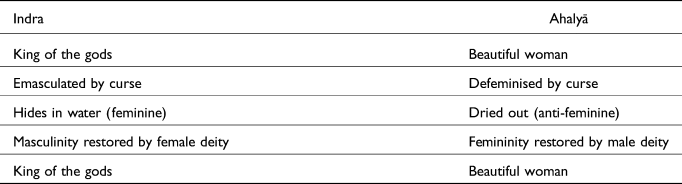
It is noteworthy that the parallelism between the fates of Indra and Ahalyā continues to the end of the story, marked by the fact that they are healed by divinities of opposite genders: Ahalyā's femininity is restored by a male god while Indra's saviour is the goddess. While Ahalyā's fate until Rāma's arrival is one of excessive dryness, Indra serves his time in the opposite element—that of water. This is an appropriate environment for a victim of feminisation, as water has feminine associations elsewhere in Sanskrit literature, going back to the Rigveda. In Rigveda 1.23, 2.35, and 10.9, the waters are characterised as maternal goddesses. Table 1 summarises the major parallels between the experiences of Indra and Ahalyā.
The partially mirrored trajectories of Indra and Ahalyā

Indra starts out as the king of the gods—that is, a stereotypically masculine figure. As seen above, Indra's kingship is a military position in origin. Manly martial virtues are further represented at the beginning of the story by Adrohaka—a figure who is invoked only as a foil for Indra. As noted above, Adrohaka's continence is represented in Excerpt (2) as a military feat. He is the kind of conqueror that Indra should be and fails to be. After Indra's sexual lapse, Gautama's curse emasculates him by stripping him of one of his natural sex characteristics—his penis—and effeminises him by giving him one belonging to the opposite sex. He is unable to function as king after his new state has been witnessed by gods and other beings. At the same time, the once lovely Ahalyā is defeminised by a curse that strips her of her womanly charms. Their punishments involve refuge in water—an element with feminine connotations—for Indra and excessive dryness—reflecting her loss of femininity—for Ahalyā. Each transformation is undone by an opposite-sex deity. (Söhnen-Thieme comments that the goddess's release of Indra ‘may seem remarkable in a Vaiṣṇava context, but is probably explained by the fact that she is the deity of the yoni’.Footnote 37 This explanation is close to mine, as I believe that the narrative structure requires a female counterpart for Rāma.) At the end of the story, both Ahalyā and Indra are back in their original states. The story thus has a chiastic (ABCBA) structure in which A is the original/final state, C is an emasculated/defeminised state, and B is a state of transition between A and C; chiasmus is frequently found in ancient Indo-European texts.Footnote 38
Despite the parallels, the trajectories that are followed by Indra and Ahalyā are not fully symmetrical. Indra is punished for a crime that he actually committed, whereas Ahalyā is (at least on the surface of the text) punished unjustly. Although both are stripped of sex characteristics, the two are affected differently by their curses. Indra is not merely emasculated, but also feminised. Ahalyā becomes sexless rather than masculine. Their restorations are asymmetrical, too. Gautama promises Ahalyā that, thanks to Rāma, she will gain a divyarūpam ‘divine form’ (1.54.41), and presumably she does. There is no reason to suppose that she ends up physically any the worse for the entire drama. Indra, by contrast, is permanently altered. As seen in Excerpt (12), the goddess is incapable of fully undoing the damage, and only brahmādayaḥ ‘the gods beginning with Brahmā’ would be able to accomplish this. Doniger writes that:
male supremacy […] rears its ugly head when the goddess acknowledges that she has less power than the male gods to alter a curse. She cannot, therefore, turn the vaginas into eyes, as Gautama often does when he modifies the curse; the best she can do is to decorate the vaginas, superficially, with eyes, ‘so that people will not notice it’.Footnote 39
In a wide-ranging cross-cultural study of bedtrick narratives (stories in which a person has sex with another under an assumed identity), Doniger notes the pervasiveness of gender asymmetry: ‘Sex is never an equal opportunity employment.’Footnote 40 This asymmetry reveals itself, for example, in ‘the far milder recriminations for men tricked into committing adultery with their own wives [masquerading under false identities], in comparison with women tricked by their own husbands’.Footnote 41 In cases in which the woman is the victim (?) of the trick, including those of Ahalyā and Alkmene, claims are made that her ignorance was false; ‘[t]his claim is seldom made against a man.’Footnote 42 In Padmapurāṇa 1.54, all the asymmetries that are noted in the previous paragraph are related to gender and, unsurprisingly, all reflect the misogyny of the source culture. As discussed above, Ahalyā is the victim of a sexist mentality that judges her as being guilty of either culpable stupidity (if Indra indeed fooled her) or adulterous duplicity (if he did not); her punishment is justified in either case. In addition to considerations of poetic justice, Indra's feminisation degrades him in a way that giving Ahalyā masculine traits would not have degraded her. Finally, Rāma, as a powerful male god, can easily fully undo Ahalyā's curse. The goddess, being female and therefore inferior, is limited to disguising the effects of Indra's.
Despite its short length, the Padmapurāṇa 1 account of Indra's intercourse with Ahalyā engages with a number of topics of deep interest to ancient Indian authors and audiences. As the opening celebration of Adrohaka (in Excerpt (2)) leads the reader to expect, it is a story about sexual temptation. Specifically, it is a cautionary tale about the dangers of succumbing to lust. The weak-willed Indra is humiliated by the continent Gautama, whose asceticism is the source of the devastating power that he unleashes against both Indra and Ahalyā. Thus, this is also a story of Brahman–kṣatriya conflict. Ascetic restraint, associated with Brahmans, is set against the unrestrained sexuality of the divine kṣatriya, Indra. Ironically, Excerpt (2) specifically represents Adrohaka's triumph as military. Despite Indra's history as an overwhelming war god, he does not have what it takes to conquer on the battlefield that really matters: against his own libido. Gautama does. As another Brahmanical nail in the coffin of Indra's reputation, the story affirms the superiority of the highest varṇa. Another hierarchy—that of gender—is also at play. Indra's fall comes about through his desire for a woman, and his painful degradation involves the acquisition of vulvas. The story reflects male suspicion of woman—Ahalyā clearly did something wrong and so must be punished—and dread of feminisation.
Other feminisations of Indra
It is interesting to note that Indra's masculinity is compromised in more than one story. Jamison, who discusses his transformation into a female hyena,Footnote 43 comments that ‘stories of Indra's transformation are legion, and in a number of them he becomes a female, though usually to work mischief’.Footnote 44 In a tangled narrative complex attested at Rigveda 1.51.13 and elsewhere and discussed by O'Flaherty,Footnote 45 Indra becomes the wife of Vṛṣaṇaśva. We learn at Maitrāyaṇī Saṃhitā 2.5.5 that this deviation from the natural order (apparently motivated by Indra's desire to seduce a female relative of Vṛṣaṇaśva) resulted in his seizure by Nirṛti (incarnate disorder), after which he saved himself through the sacrifice of a castrated animal.
Some Greek parallels
Greek myth features several well-known feminised males. These include two heroes, Achilles and Herakles (known to the Romans as Hercules), who are, like Indra, known for their outstanding manly prowess. Achilles was the greatest of the Greek heroes who fought in the Trojan War, while Herakles is famed for his extraordinary strength, demonstrated through feats such as his 12 famous labours. A third feminised male, the blind Theban prophet Teiresias, is not known for military prowess, but merits a mention here due to the association of sexual misdemeanour, sex change, and blinding in his story.
Achilles
In an attempt to save her son from having to participate in the Trojan War, the goddess Thetis, who was the mother of Achilles, concealed her young son, disguised as a maiden, on Skyros. During his time there, he raped the Skyrian princess Deidamia, who gave birth to his son Neoptolemos. Bion of Smyrna describes the mixture of male and female traits in Achilles during his cross-dressing period:
(14) εἴρια δ᾿ ἀνθ᾿ ὅπλων ἐδιδάσκετο, καὶ χερὶ λευκᾷ
παρθενικὸν κόρον εἶχεν, ἐφαίνετο δ᾿ ἠύτε κώρα.
…
θυμὸν δ᾿ ἀνέρος εἶχε καὶ ἀνέρος εἶχεν ἔρωτα.
ἐξ ἀοῦς δ᾿ ἐπὶ νύκτα παρίζετο Δηιδαμείᾳ,
καὶ ποτὲ μὲν τήνας ἐφίλει χέρα
[Achilles] learned wool instead of weapons and held a girl's broom in his white hand and looked like a girl. […] But he had a man's spirit and a man's passion; and from dawn till night he sat by Deidamia and sometimes kissed her hand.Footnote 46 (Bion of Smyrna, Wedding Song of Achilles and Deidamia, 16–23)
On the one hand, Achilles's engagement in feminine pursuits suggests womanhood—a point that is hammered home by the direct contrast of εἴρια ‘wool’ with ὅπλων ‘weapons’. His appearance, pale and girlish, is consonant with these activities. On the other hand, he preserves θυμὸν δ᾿ ἀνέρος […] καὶ ἀνέρος […] ἔρωτα ‘a man's spirit […] and a man's […] passion’, as revealed by his amorous interest in Deidamia. The same linkage of Achilles's desire with his masculinity appears elsewhere, such as in Ovid's account of Achilles's rape of Deidamia:
(15) forte erat in thalamo virgo regalis eodem;
haec illum stupro comperit esse virum.
The royal virgin happened to be in the same bedroom; through rape, she learned that he was a man. (Ovid, Ars Amatoria, 1.697–98)
Herakles
Herakles temporarily served the Lydian queen Omphale as a slave. He and Omphale are said to have had one or more children; Ovid, for example, mentions a son named Lamus (Heroides 9.54). Some classical texts state that Herakles dressed as a woman and performed women's work during this period, such as:
(16) οὔτε ἐδούλευσα ὥσπερ σὺ οὔτε ἔξαινον ἔρια ἐν Λυδίᾳ πορφυρίδα ἐνδεδυκὼς καὶ παιόμενος ὑπὸ τῆς ᾿Ομφάλης χρυσῷ σανδάλῳ
I neither was enslaved like you [Herakles] nor carded wool in Lydia, wearing a purple garment and being struck by Omphale with a golden sandal. (Lucian, Dialogues of the Gods, 15 [13])
(17) non puduit fortes auro cohibere lacertos
et solidis gemmas opposuisse toris?
[…].
non fugis, Alcide, victricem mille laborum
rasilibus calathis inposuisse manum
crassaque robusto deducis pollice fila
aequaque formosae pensa rependis erae?
[…].
se quoque nympha tuis ornavit Iardanis armis
et tulit a capto nota tropaea viro.
Did it not shame you to confine your strong upper arms with gold and place jewels against solid muscles? […] Alcides [Herakles], do you not shrink from having set your hand, the victor of a thousand labours, to polished baskets, and do you draw out thick threads with your sturdy thumb and return to your lovely mistress equal weighed-out measures by weight? […] The nymph, Iardanus's daughter [Omphale], has decorated herself with your arms, too, and carried off famous trophies from the captured man. (Ovid, Heroides, 9.59–104)
The great hero—the paragon of heroic manhood—is reduced to the powerless status of a slave, who, in Excerpt (16), must endure his mistress's blows. Excerpt (17) is noteworthy for the dense interlacing of masculine and feminine characteristics on the verbal level, which visually represents their coexistence within the cross-dressing hero. At 9.59, for example, the juxtaposition of fortes ‘strong’ and auro ‘gold’ emphasises the contrast between Hercules's manly upper arms and the jewellery that adorns them. The reversal of traditional gender roles emphasises Hercules's humiliation: while he performs women's work and sports jewellery, Omphale bears his arms and is even metaphorically represented as his military conqueror, as she has won tropaea ‘trophies’ from him.
Teiresias
Two alternative versions of Teiresias's biography, as told by Pherekydes of Athens and in the pseudo-Hesiodic Melampodia, are summarised in pseudo-Apollodorus's Library (3.6.7). According to Pherekydes, Teiresias lost his eyesight as a punishment for seeing the virgin goddess Athene bathing, but received the gift of prophecy from her in compensation. According to the Melampodia, he turned into a woman after injuring mating snakes and later turned back into a man when he watched the same snakes mating again. As he had experienced sexual intercourse as both a man and a woman, Zeus and Hera appealed to him to resolve a disagreement over which sex enjoyed it more. Displeased by his statement that women's pleasure is greater, Hera blinded him, but Zeus gave him the gift of prophecy. Both versions are retold by later authors. Athene's blinding of Teiresias is described in Callimachus's Hymn 5, while Ovid tells the sex-change story at Metamorphoses 3.314–36.
Comparative discussion
The stories of Indra and Ahalyā, Achilles and Deidamia, and Herakles and Omphale all involve bellicose male protagonists—a war god and two heroes of outstanding warlike prowess, each of whom undergoes feminisation. Additionally, all three stories involve a sexual element, and the stories that feature Indra and Achilles specifically include an element of sexual misconduct. While Indra targets a married woman, it is safe to assume that the king of Skyros would have prevented Achilles's relations with his virgin daughter if they had not been concealed by Achilles's self-presentation as another girl.Footnote 47 Indra's transformation into the wife of Vṛṣaṇaśva is also motivated by a desire for illicit sexual intercourse.
Sexual misconduct also plays a key role in the story of Teiresias, who is blinded as a punishment for voyeurism or feminised as a punishment for an injury to mating snakes. A Freudian interpretation of Teiresias's biography almost writes itself. Both blinding and becoming a woman are forms of castration. (As seen above, Indra's castration is symbolically reversed when the goddess covers him with eyes.) Like Pāṇḍu, Teiresias is cursed for his intrusion on mating animals (snakes in Teiresias's case!), who represent the parents in the oedipal triangle.
Interestingly, female impersonation and sexual misconduct are linked elsewhere in premodern Indo-European narrative literature, as discussed by Jamison.Footnote 48 A Sanskrit example appears in the Mahābhārata's Virāṭaparvan. Living at Virāṭa's court, Draupadī is sexually assaulted by Virāṭa's brother-in-law Kīcaka and avenged by her husband Bhīma. Draupadī agrees to meet Kīcaka at night, but it is Bhīma who waits for him, assuming Draupadī's identity in the darkness until the time has come to attack and kill Kīcaka. Notably, Bhīma, like Achilles and Herakles, is a hero who is famed for his prodigious strength. Jamison notes striking parallels with a narrative from a completely different area of the Indo-European world: the Germanic story of Baldr's avenger's begetting at Gesta Danorum 3.4.1–13. In this story, the god Odin knows that his slain son Baldr will be avenged by a son of Odin's who was borne by Princess Rinda. In order to bring this about, he rapes Rinda while disguised as a female physician.
As noted in the introduction, the warlike Arjuna (Indra's son) is also feminised in the Virāṭaparvan. His role as a transvestite dance teacher gives him unmediated access to King Virāṭa's daughter; however, he not only refrains from taking sexual advantage of her, but even refuses when (after his real identity is revealed) the king offers him her hand. Jamison comments that ‘the contact between the disguised transvestite and the princess plays out [very] differently in [the Indian and Germanic myths]: the horrifying rape on the Germanic side, the principled refusal of sexual contact on the Indic one’.Footnote 49 She accounts for this by arguing that, in the Virāṭaparvan, ‘the rape episode […] has been displaced’ onto Draupadī and Kīcaka.
Also from the Germanic world, the Old Norse Thrymskviða tells of Thor's impersonation of the goddess Freyja, whose hand in marriage was demanded by the giant lord Thrymr in exchange for Thor's hammer, Mjöllnir, which he had hidden. When the hammer was brought out at the wedding feast (in a context that was obviously linked to sexuality), the ‘bride’ seized it and attacked the giants; this violence must have struck the groom as misconduct, at least.Footnote 50
Another Indian story worth mentioning here is that of Śikhaṇḍin, the slayer of Bhīṣma in the Mahābhārata. In a former life, Śikhaṇḍin had been Ambā, a woman, who was unable to marry after Bhīṣma abducted her. Reborn in a second female body, she brought about a sex change in order to have her revenge on him. Although this myth differs from the others mentioned in that Śikhaṇḍin is born female and becomes male, rather than being a male who undergoes feminisation, the association of sex change and sexual crime is notable. The criminal in this case is Bhīṣma, who forcibly carries off Ambā and her sisters on behalf of his half-brother Vicitravīrya. Although the abduction is justifiable by ancient Indian standards as a rākṣasa marriage, the unfortunate fact that Ambā was already betrothed to another leads to the total ruin of her life.
The question naturally arises: to what extent are the observable similarities due to the shared Indo-European origin of these cultures, and to what extent are we merely seeing narrative reflexes of psychological universals? Assuming that oedipal tension is universal, it is possible to account for similarities between the myth of Teiresias and that of Gautama's curse of Indra without appealing to shared Indo-European inheritance (although the parallels between the stories of Teiresias and Pāṇḍu seem harder to explain away). Nonetheless, the striking recurrence of the distinctive combination of (especially aberrant) sexuality with the paradoxical figure of the feminised hyper-masculine warrior in multiple Indo-European mythologies strongly suggests to me that stories such as those of the feminisations of Indra, Achilles, and Herakles engage with inherited material, although it would be a clear exaggeration to describe the Greek myths as cognates of the Indian one.
Reconstructing Proto-Indo-European mythemes is a valuable undertaking in itself, but attested narratives are more than vehicles for inherited material. Every myth developed in and is shaped by its own cultural tradition. I have endeavoured to show how Padmapurāṇa 1.54 is shaped by its distinctively Indian context. While the universal oedipal tension may underlie Indra's conflict with Gautama, it manifests itself in the culturally specific guise of tension between Brahmans and kṣatriyas, which is linked to equally culturally specific attitudes to sexuality: sexual continence is valorised and represented by the Brahman Gautama, while the divine kṣatriya Indra is punished for his unrestrained sexuality.
Obviously, the Greek myths can be expected to reflect their somewhat different cultural context in similar ways. Notably, they reflect a very different attitude towards sexuality. In contrast to Indra, who sleeps with Ahalyā before being emasculated, Achilles and Herakles beget children while dressed as women. According to Cyrino,
[e]ach hero […] produces a boy infant, symbol of his undiminished male physical capacity. After acknowledging the instability of the landscape between the poles of power and powerlessness, these texts provide the most compelling source of pleasure for their audience by relocating the protagonists into secure positions of masculine dominance. Thus the narrative pattern seeks to portray heroes of canonical, conspicuous masculinity such as Herakles and Achilles, who are perceived as strong enough to survive the dangers of sex-role manipulation.Footnote 51
In ancient Greek culture, ‘[m]asculinity is associated with the penetrative role, regardless of the sex of the partner; the penetrated role is coded as feminine’.Footnote 52 Thus, the continuing masculinity of Achilles and Herakles is demonstrated by their penetration of women (cf. the linkage of Achilles's sexual interest in Deidamia with his manhood in Excerpts (14) and (15)). The association between feminisation and sexuality was perhaps inherited from Proto-Indo-European times and subsequently reinterpreted in accordance with the individual value system of each later culture.
Acknowledgements
John Clayton first suggested to me the idea that the myth of Indra's punishment is one of heroic feminisation. I am indebted to Kimberly Ball, Robert Goldman, Stephanie Jamison, Alex Roy, and Arjun Srirangarajan for valuable help during the gestation period of the project.
Conflicts of interest
None.

 Open access

