

During the first decade of the nineteenth century, the young Xhosa chief Ngqika abducted Thuthula, the wife of his uncle Ndlambe. In the Eastern Cape, this story is remembered for its political consequences. Ngqika’s act was widely condemned, and Ndlambe seized the chance to lead a rebellion of Ngqika’s followers. Although Ngqika survived the rebellion, his authority never fully recovered. Ngqika’s abduction of Thuthula – an act that “even today his descendants consider reprehensible” – was a scandalous contravention of the sexual mores of precolonial Xhosaland.Footnote 1
In Xhosa histories, the abduction of Thuthula is remembered as the incident that ended Ngqika’s independence. As S. E. K. Mqhayi and Jeff Peires have argued, the story has been used to explain a major political shift that probably owed more to the gradual encroachment of the colonial armed forces.Footnote 2 Yet, if the emphasis on the family drama behind Ndlambe’s rebellion obscures the culpability of the colonial state, it also overshadows the sexual politics at the heart of the episode. Most accounts of Thuthula’s story pay little attention to Thuthula herself. Did she go with Ngqika willingly, attracted perhaps by his greater political authority or by the physical beauty with which the praise-poets credit him? Did she resist, wishing to remain in her respectable position as Ndlambe’s wife? Could she even consider the possibility of voicing her own desires to the men involved?
The absence of Thuthula’s own perspective from stories of her abduction flows from the belief, widely accepted in precolonial Xhosaland, that female sexuality should be controlled by a woman’s family. According to this view, the most relevant consent to any sexual encounter was not that of the participants but rather that of the woman’s father, husband, or other male relative. Rape that happened outside of marriage was primarily an offense against a woman’s family. This understanding of sexual consent had its roots in the region’s political culture. Both familial authority and political power were justified with the language of custom (isiko). In the case of sex, customary consent emphasized the control of male household heads over the junior members of their households and specifically over sexuality of their female family members. In the case of politics, customary consent emphasized the loyalty that subjects owed to their rulers. This parallel was not just a coincidence; isiXhosa speakers understood the relationship between leaders and followers as a type of family relationship. By extension, political leaders claimed control over the sexuality of not only their own relatives but also other women in their communities.
As the colonial state extended administrative control over Xhosaland after 1847, colonial officials sought to understand local “law and custom.” The accounts that they collected – almost exclusively from men – emphasized familial authority over sexuality, and this principle emerged as one of the dominant features of colonial understandings of African culture in the Eastern Cape.Footnote 3 There was some truth to this conclusion, and this understanding of sexual consent continued to shape the expectations of isiXhosa-speaking men and women into the colonial period, as evidence from court records makes clear. These records also demonstrate, however, that custom was not the only way to understand sexual consent in colonial period – or even before colonial rule. As the next chapter shows, spiritual concerns also limited the range of acceptable human sexuality. Likewise, even many men and women who embraced the concept of custom also recognized that women had sexual desires and assumed that they would seek to fulfill those desires. Public insistence on familial control over female sexuality coexisted with tacit acceptance of a wide range of extramarital sexual activity. As a result, women were able to use the norm of customary consent to protect themselves against sexual violence and to punish men who committed sexual assaults.
Meanwhile, colonial rule itself magnified both the importance of claims to customary authority and debates within Xhosaland over the nature and content of custom. African leaders who resisted incorporation into the colonial state and those who sought to exercise power from within this new political framework all continued to make claims to authority in the language of custom. Within families, fathers and husbands began to look to the colonial state to reinforce their authority over their daughters and wives – and over other men who were making new claims to female sexuality. Eventually, the colonial administration of the Cape Colony would recognize many of these claims. The incorporation of customary norms into the colonial state, however, undermined some of the protections and freedoms that women had carved out in the precolonial era.
Custom and the Idea of the Precolonial
Historians commonly divide African history into three eras: precolonial, colonial, and postcolonial. In South Africa, the period of white rule extends past British colonialism, but the basic convention holds. Close examination, however, renders these neat divisions increasingly illusory. The political and social structures of Xhosaland were involved in long-term dynamics of change well before the advent of colonialism, some related to European expansion and others with more local roots.Footnote 4 Meanwhile, African worldviews – including ideas about politics, family life, and sexuality – did not change overnight at the moment of British conquest. The major conceptual framework that African inhabitants of the Eastern Cape used to understand nonconsensual sex was transformed during the colonial period but not replaced. It provided the starting point into which new ideas about sin, purity, and respectability were incorporated.
Precolonial conceptual categories and social institutions remained important in the colonial period in large part because of the power of the concept of “custom” (isiko). Claims based on isiko were fundamentally historical in nature; they referred to past practice as the appropriate guide for current dilemmas. Most early isiXhosa-English dictionaries defined isiko simply as “custom,” a usage that was adopted by government translators as well.Footnote 5 J. Liefeldt, who grew up in an Eastern Cape missionary family before serving as special magistrate with the Ngqika chiefs Sandile and Anta, defined the term as “expressive more of custom than our signification of the term law. Our fathers and progenitors did thus, and ruled thus, and handed down their manners and customs to us. These ancient customs are virtually unalterable, but … imperceptibly become modified, or slightly altered by mutual consent.”Footnote 6 A young man, “through attending at trials by chiefs or headmen, and information and traditions imparted by ancients of the tribe, becomes acquainted with the ‘Amasiko Amadala,’ or ‘customs of old.’”Footnote 7
Claims about the ancient roots of isiko were not always accurate. These nineteenth-century descriptions make clear that isiko did change, often at the behest of political leaders. Nonetheless, the idea of a body of custom that extended deep into the past remained central to political and familial authority. This assertion of continuity can frustrate efforts to evaluate specific claims about the precolonial past. Certainly, custom was contested even in the precolonial period, and the claims made under the rubric of custom would change more dramatically as the colonial state incorporated customary law into its administrative structures in the late nineteenth century – even as the idea of isiko remained central to popular understandings of both sexual consent and political authority.
The close link between the concept of isiko and the regulation of sexuality in nineteenth-century Xhosaland is perhaps best illustrated by one specific usage of the word. In addition to its larger meaning of custom, isiko was sometimes used to refer to the right claimed by groups of men to engage in sexual activities with unmarried women. An early isiXhosa dictionary defined isiko both as “fashion, habit, manner, custom” and, secondarily, as “a bad custom, allied to u-Pundlo, which was modified by the chief Sandile, and called isiko. It is applied also to circumcision.” The term upundlo was itself defined as “the seizure of young women by men of the most dissolute habits” with the note that “this shameful practice was established by [Ngqika] about 1810 and was afterwards prohibited by him as a crime, but resuscitated by his son Sandile under the name of i-Siko.”Footnote 8 In 1849, just after the conquest of western Xhosaland, Colonel John Maclean reported that the chief Stokwe had engaged in “the ‘Tsiko’ bringing together by coercion a number of virgins at the chief’s kraal, for distribution amongst the chief and his principal men.”Footnote 9
The use of the term isiko itself to describe this practice highlights the importance of the concept of custom in regulating sexuality in precolonial Xhosaland, as well as the relationship between sexual and political authority. When isiXhosa speakers described customary regulation of sexuality to nineteenth-century British administrators, missionaries, and travelers, they emphasized the subordination of individual sexual decision-making to familial control. These claims – which later formed the core of African intellectuals’ descriptions of custom – were tightly linked to justifications of political authority that shared a reliance on the idea of custom and also, at times, operated directly through the control of female sexuality by political leaders.
Sex, Custom, and Rape in Xhosaland, ca. 1820–1860
The British colonial army occupied western Xhosaland in 1847, marking the beginning of European rule in the region. This conquest, however, was preceded by several decades of rapid change, including the rise of market-oriented agriculture and the spread of missionary Christianity. These economic and social changes, in turn, triggered shifts in the regulation of sexuality. Helen Bradford has argued persuasively for placing tensions over gender and sexuality at the center of the history of the Cape frontier during the early nineteenth century, as ongoing warfare and new livestock epidemics disrupted the exchanges of cattle that underwrote sexual regulation.Footnote 10 Any reconstruction of a stable precolonial sexual order would be profoundly misleading; nor should we portray late precolonial Xhosaland as a blank slate, waiting to be inscribed with the sexual and political cultures of the British Empire.Footnote 11
Political turmoil had unsettled Xhosaland in the decades before colonial conquest. From the east came refugees from the mfecane, the disturbances emanating from the aggressive expansion of the Zulu state in the early 1820s. Although the mfecane may not have constituted a full-blown regional crisis, it did cause a significant population shift into Xhosaland and would later become part of the founding mythology of the Mfengu (or Fingo), an isiXhosa-speaking ethnic group.Footnote 12 From the west came intrusions from the colonial state. For most of the eighteenth century, western Xhosa communities had been able to maintain control over their lands, although Dutch commandos killed and enslaved significant numbers of Khoe in the frontier zone.Footnote 13 After the British took control of the Cape Colony, however, the balance of power began to shift decisively. By 1818, the British outpost at the Cape of Good Hope had pushed the recognized borders of the Xhosa polities – if not all of the area’s Xhosa inhabitants – east to the Fish River. When British forces crossed the Fish River to attack the army of the Rharhabe Xhosa leader Ndlambe, they were joined by men loyal to Ndlambe’s nephew Ngqika, who had formed an alliance with the British. Such was the context for the dispute over Thuthula.
British colonial forces won major wars against the Xhosa polities of the Eastern Cape in 1819, 1835, 1847, 1853, and 1878, due in large part to a willingness to pursue scorched-earth tactics to undermine their adversaries. The colonial army burned down Xhosa villages and set fire to crops in the fields. British forces shot Xhosa combatants rather than taking prisoners, and they committed repeated atrocities against civilian populations.Footnote 14 Throughout this period, however, they also had African allies. The emerging group of Mfengu isiXhosa-speakers defined themselves in large part by their loyalty to Britain, and many fought alongside British forces in the frontier wars. In King William’s Town, the Gqunukhwebe and Ntinde clans fought alongside the British in 1835. These alliances did not always last – the Gqunukhwebe split into two factions during the 1847 war, one siding with the British and the other joining the coalition led by Ngqika’s son, Sandile – but they reshaped the political landscape. In 1847, the colonial state formally claimed the territory between the Fish and Kei Rivers, a region known initially as British Kaffraria that includes East London and King William’s Town, and roughly corresponds to the apartheid-era Ciskei homeland.
Meanwhile, as settler farming spread eastward, isiXhosa-speaking men and women began to work on those farms, entering into the cash economy. African farmers in Xhosaland also began to trade their products for European manufactured goods, particularly blankets, plows, and (illegally purchased) guns.Footnote 15 Over the long term, these economic innovations would weaken the ability of older men to exert control over women and younger men.Footnote 16 In the short term, they shifted the gendered division of labor, remaking agriculture as men’s work for those who could afford to invest in a plough and enough cattle pull it. Finally, and perhaps most importantly for an understanding of the history of sexual violence, Christianity preceded colonization throughout Xhosaland. By the time that the first parts of Xhosaland came under permanent British control, missionaries had been proselytizing in the area for a quarter of a century.
All of these dynamics influenced understandings of sexual and political authority in Xhosaland. Over the long run, some of these influences – like Christianity – would provide the basis for profound shifts in the way that many isiXhosa speakers understood sexual morality. Nonetheless, it is possible to reconstruct the broad outlines of a discourse of customary authority that structured claims to sexual and political authority before 1860, by combining oral traditions, the writings of European observers, and the descriptions of African intellectuals who wrote about the precolonial era later in the nineteenth century. As the story of Thuthula’s abduction demonstrates, considerations of marriage and family relationships profoundly shaped reactions to nonconsensual sex in precolonial Xhosaland. Thuthula’s story contravened some of the most important social expectations. In the early nineteenth century, African communities in the Eastern Cape were organized around the institution of the umzi, or homestead. The economic basis of precolonial society rested on a mix of pastoral and agricultural production. In the gendered division of labor, men hunted game and cared for cattle and other stock while women grew maize, sorghum, and a variety of vegetables. Homesteads were scattered through the landscape, next to agricultural fields, with land for grazing woven between the fields and imizi.
Xhosa homesteads were organized around families. An ideal umzi was headed by a married adult man whose household included one or more wives and his unmarried children, and often stretched further to include younger brothers or other junior male relatives, and perhaps their own wives and children. In practice, women also headed imizi, particularly when their fathers or husbands were traveling for extended periods, or had died. Meanwhile, the umzi of a chief might house hundreds of followers, including close relatives, clan members, and unrelated clients.Footnote 17 In theory, each son in a household could go on to found his own homestead, although many men never acquired the material resources (primarily cattle) required to achieve this marker of success. By the 1840s, colonial expansion had placed enough pressure on grazing land that this goal became increasingly elusive for most men in Xhosaland, even as a smaller number of men – mostly Mfengu – were benefiting from the growth of agricultural markets to establish independent households.Footnote 18
Interactions between different members of a household were shaped by age, gender, and relationship. The concept of hlonipha, or respect, demanded particular forms of deference from younger people toward their elders, from women toward men, and from married men and women toward their in-laws. In the most extreme case, a newly wed daughter-in-law was expected to avoid being in the presence of her father-in-law more than necessary, looking him in the eye, or speaking his name. Jeff Peires attributes this practice to a desire to strictly regulate “relationships where sexual tension might arise.”Footnote 19 As an ongoing performance of deference, hlonipha observations emphasized women’s submission to familial control and to the older men who exercised this control.
Both men and women in precolonial Xhosaland experienced life in large part through family relationships. Women were first daughters, then wives (and, just as importantly, daughters-in-law), then mothers. Men were sons and then fathers. In discussions before a chief’s council, a male head of household represented young men and all women. The homestead head was responsible for making good any damages committed by a junior member of the household.Footnote 20 This larger kin group also claimed control of women’s sexuality and reproductive capacity. Ideally, marriages were contracted through the payment of bridewealth from a husband and his family to the wife’s household head, although not all marriages followed this path in practice. It was a basic principle of precolonial society that a woman’s family controlled her reproductive capacity; families consistently sought to prevent sex outside of marriage and to ensure that women did marry. Thuthula’s abduction has been remembered as a story about men because it was – at least to the men involved. In carrying off Thuthula, Ngqika was violating his uncle’s recognized claim to control the sexual and reproductive capacity of his own wife.
Xhosa household heads used the language of custom to assert control over the sexuality of their female family members. Families monitored the sexual lives of unmarried daughters through regular physical examinations, which were meant to ensure that the widely accepted forms of premarital sexual experimentation known as ukumetsha stopped short of penetrative intercourse.Footnote 21 European observers were shocked by the “custom called ukumetcha, which allows young men and women to come together in onanistic connection.”Footnote 22 While European commentators considered ukumetsha an “unnatural connection” that typified Xhosa sexual depravity, it also set strict limits on the forms of sexual play that unmarried young women engaged in.
Fines for men who had penetrative sex with unmarried girls enforced these limits.Footnote 23 For young men, the restriction to ukumetsha was part of a broader set of rules governing the period of life before initiation transformed them into full men, or amadoda. In the precolonial period, initiation marked a major social transition; new initiates were ceremonially “directed to lay aside the deportment of ‘children,’ and act for the future as ‘men.’ … The social standing of the youth [was] now an entirely new one. The restrictions of boyhood were at an end. They mingle with the men as equals, and are now eligible as husbands.”Footnote 24 The responsibilities of men included appropriate sexual behavior. Dashe, an Ngqika Xhosa leader, remembered that at his circumcision in the 1820s, “My father said I was not to touch another man’s wife nor to injure another man’s child, especially a girl; if it were a woman who had no husband I might have intercourse with her; I was to fear old persons, and not reply disrespectfully to them.”Footnote 25 As men, initiates were now part of a social group that claimed control over women’s sexuality, and they were warned to respect the rights of other men. Tellingly, Dashe was warned against sex with (unmarried) daughters and wives, but not with unattached women.
Meanwhile, custom accorded young men and particularly women only a limited role in choosing their spouses. In the most prestigious forms of marriage, fathers chose their daughters’ spouses. According Ludwig Alberti, who visited Xhosaland in 1807, “a matrimonial alliance is agreed upon and concluded, without the consent of the girl being required, who in this matter is simply dependent upon the wish of her parents.”Footnote 26 Young women did not always comply with these expectations; Alberti also acknowledged that “it can happen that the girl indicates her disinclination, by again driving the cattle, which the suitor brings to her parents, out of the Kraal.”Footnote 27 Evidence from the colonial period shows that young men and women could exert some control over their marriages within the constraints of customary authority. There were limits to this autonomy, however, particularly for young women from high-status families. In 1832, when a young woman from a chiefly lineage rejected the husband chosen by her father, “she was then addressed by her uncle (a Chief of considerable influence) upon the evils of disobedience to her father … and also upon the impropriety of a girl’s refusing to conform to a custom which had been handed down to them by their fathers.”Footnote 28 To reject familial authority was to reject custom itself.
After marriage, the customary claim to control a woman’s sexuality shifted from father to husband. Where fathers claimed damages for their daughters’ seduction, husbands did the same for their wives’ adultery.Footnote 29 At the extreme, this control manifested itself in punitive violence. Residents of Xhosaland told one precolonial traveler that if a “husband … should chance to detect his wife in adultery, he may legally kill her partner in guilt.”Footnote 30 Marriage was the normative site of sexual intercourse, and husbands claimed exclusive sexual access to their wives. Within marriage, both men and women had a general obligation to have sex with their partners, although sexual intercourse was considered inappropriate when women were menstruating or nursing small children. Men also claimed the right to use force to command their wives’ obedience, including the fulfillment of sexual duties – although this right was substantially limited in practice by women’s ability to seek refuge with their natal families. As a colonial observer wrote in the 1850s, “a husband may beat his wife for misconduct, but if he shall strike out her eye or a tooth or otherwise maim her, he is fined at the discretion of the Chief.”Footnote 31
Women could, and did, evade these restrictions. Wesleyan missionary Stephen Kay described the chief Hintsa’s visits to the homesteads where his wives lived: “he then approaches their huts (often at midnight) with jealous caution, expecting to surprize [sic] them in the act of illicit intercourse with strangers.”Footnote 32 The attention to procedures for claiming compensation for adultery in almost every early description of Xhosaland’s legal systems suggests that this expectation was not limited to chiefs, even as it demonstrates a broad acceptance of husbands’ rights to control their wives’ sexuality. Husbands demanded marital fidelity, but did not necessarily expect to receive it.
Some women went further than discreet affairs, and repudiated their marriages to live with their natal families, taking on a social status known as idikazi. Few, if any, restrictions were placed on the sexual lives of women who lived as amadikazi. Charles Brownlee claimed that in cases of “fornication, as with an idikazi,” there was “no fine, except [when] pregnancy is the result.”Footnote 33 John Ayliff’s 1846 dictionary translated idikazi simply as “harlot,” noting that it was “the name by which all single women are called; and, as they are all harlots, doubtless has this meaning, it being sufficient for a man to ascertain whether a woman is and umfazi [wife] or an idikazi.”Footnote 34 This description conflated African and European perceptions of idikazi status, but it does illustrate that the sexual lives of amadikazi were not governed by customary authority in the same way as those of married women.
The relative sexual freedom of amadikazi may have been exceptional, but it underscores a broader truth. While the right of fathers and husbands to control the reproductive power of their daughters and wives was widely accepted, even by women, common-sense understandings of human sexuality recognized sexual desires that exceeded the marital relationship in both men and women. J. C. Warner, a colonial agent in Thembuland, wrote that
Seduction of virgins, and cohabiting with unmarried women and widows, are not punishable by [African] law, neither does any disgrace attach to either sex by committing such acts. Indeed they have no name for virgin in their language, and when a girl arrives at puberty, the act is announced by a public festival, and which is tantamount to a declaration that the girl in question is now fit for the use of a man. This promiscuous intercourse of the sexes is, however, subject to certain rules and customs; but even when committed in a clandestine manner it is not punishable; nor … does any disgrace attach to the parties concerned.
If, however, pregnancy ensues, the father can demand a fine of one head of cattle from the father of the child.Footnote 35
This description collapses the distinction between ukumetsha experimentation and penetrative intercourse; to European eyes, both were equally reprehensible. IsiXhosa speakers differentiated more sharply between acceptable and unacceptable forms of premarital sexual activity. Yet, Warner’s observations also suggest that families in precolonial Xhosaland were more concerned about preventing premarital pregnancy – an illegitimate claim on young women’s reproductive power as well as undeniable public evidence of premarital sex – than preventing intercourse itself.
Indeed, far from being ignored or denied, young women’s sexual desire was actively shaped by older generations. Young women were not always allowed to choose their ukumetsha partners; at major events, such as female initiation (intonjane) ceremonies, an older person might take on the task of pairing up couples. Warner disliked intonjane ceremonies because “it is customary for all girls who have arrived at marriageable age to choose paramours; and if they refuse to do so – which however is seldom the case – men are selected for them by the elder women, and with whom they are forced to cohabit as long as the festival lasts.”Footnote 36 Charles Brownlee’s description is somewhat more cautious: “from time to time immemorial it has been customary among the [Xhosa], at the first appearance of menses of girls, to have feasting and dancing, at which the girls of the neighborhood voluntarily assembled to take part. They are distributed to men who lay with them, but who are fined if any carnal connection takes place.”Footnote 37 Such practices inducted of young women into socially condoned forms of sexual interaction. For young women, the experience of premarital ukumetsha relationships provided instruction in the pleasures of sexual and romantic desire.
Ukumetsha relationships also illustrate, however, the limits of sexual autonomy in the precolonial period. Female desire was recognized, and even cultivated – but in contexts that might involve coercion. Moreover, this instruction in sexual pleasure did not directly oppose the discourse of custom that granted authority over female sexuality to women’s families, as long as couples refrained from penetrative sex before marriage. Discreet extramarital affairs and idikazi status allowed women sexual autonomy, but they remained subordinate to familial authority. Husbands could still beat their wives and sue their wives’ lovers for damages, while all women were expected to marry at least once, to a husband of their father’s choosing.
This context shaped precolonial understandings of nonconsensual sex among precolonial isiXhosa speakers, who perceived rape as an offense both against the customary authority of a male household head over his female dependent’s sexuality, and against the woman herself. Despite the claims of some later colonial administrators, precolonial isiXhosa speakers did differentiate between rape and consensual seduction or adultery. Indeed, a large number of sources provide evidence for a precolonial concept that was close enough to the English concept of rape to be translated that way by contemporaries. Rape was formally complained of – and adjudicated – in precolonial Xhosaland. In 1837, Mlandu requested colonial permission to travel to Idutywa in order to search for his servant, “who had committed a rape on Cadu’s daughter,” explaining that “when he has found [the offender], he will bring a case against him.”Footnote 38 In 1856, after colonial conquest but before the colonial administration attempted to wrest judicial authority from traditional leaders, a colonial agent posted with the chief Kama observed the adjudication of a rape case.Footnote 39
The three missionaries and government agents who contributed to an 1856 administrative handbook all included rape among the crimes recognized under customary law.Footnote 40 From the earliest days of colonial rule, African men and women brought complaints about nonconsensual sex to the notice of colonial administrators. The Cape Colony temporarily annexed western Xhosaland in 1835–36. The colonial administration set up a rudimentary court, before which “Umbone of Umhala complained that Umcoiga a Fingo had committed a rape on his wife.”Footnote 41 When the territory was annexed again in 1847, chiefs initially retained their judicial powers, but African families complained to the colonial state about sexual assaults that involved colonial employees. Nohani, a domestic worker for the head of the colonial forces in western Xhosaland, told her employer in 1849 that she had been “violated” by a man who had “forced her when asleep.”Footnote 42 Likewise, the chief Tshatshu complained to the colonial administration in 1857 after a soldier in the British German Legion indecently assaulted a twelve-year-old girl.Footnote 43 Although ukudlwengula would become the standard translation for the English word “rape,” at least one of these cases described the act known in isiXhosa as ukuzuma, the sexual assault of a sleeping woman.
Fathers and husbands brought most of these cases, and claimed compensation. In 1859, Nqayo brought Bati to the newly established magistrate’s office at King William’s Town, charging him with the rape of Nqayo’s daughter. Nqayo had demanded compensation, and had turned to the colonial state for help when Bati did not meet his demands: “I have brought him here, as he has no wherewithal to make compensation for what he has done, to be imprisoned.”Footnote 44 In the case heard by Kama, Umngini “claim[ed] all of the property that the offender is possessed of in compensation for the wrong done me” – that is, the rape of his wife, Noxina. This statement explicitly described Noxina’s rape as an offense against her husband, rather than herself. This conception of sexual violence is consistent with the extensive claims that husbands and fathers made over the sexuality of their wives and daughters in the precolonial era. Where male help was not forthcoming, however, women took matters into their own hands. Nohani complained directly to her employer, and the scant information about the 1856 charge of attempted rape brought by Hannah, “a [Xhosa] woman,” makes no mention of a male representative.Footnote 45
With the possible exception of Hannah, these cases involved young girls or married woman. They do not tell us whether precolonial communities recognized widows and amadikazi as legitimate victims of rape. There are suggestions, however, that public opinion was significantly more receptive to women’s claims of rape in precolonial and early colonial Xhosaland than it was in Britain, or in the rest of the Cape Colony. African adjudicators in the precolonial Eastern Cape appear to have approached charges of rape with the assumption that women who made complaints of rape were likely to be telling the truth. This assumption was not limited to sexual assault cases; according to James Warner, “the proof of innocence rests in much greater degree with accused [in Xhosaland] than is the case with us.”Footnote 46 The Special Magistrate who observed Umngini’s complaint in Kama’s court found it suspicious, and “pointed out to Kama that the woman did not appear to have shown the amount of repugnance and resistance which might have been expected from her.”Footnote 47 In other words, he suspected that the woman had consented to the sexual encounter, even though the defendant made no such claim. This skepticism was typical of Europeans in the Cape, and of the colonial court system. Kama nonetheless awarded compensation to Umngini, although he reduced the amount after the Special Magistrate’s intervention.
Indeed, the rhetorical subordination of sexual autonomy to familial control provided important protections for women who had been raped. In most incidents of nonconsensual sex, the man accused of rape would owe compensation for seduction or adultery even if his partner had consented. A claim of consent would not save him from punishment. The effect of this overlapping culpability can be seen in African men’s defenses to charges of rape in the early colonial period. They rarely claimed that the woman who accused them of rape had consented to sex. In fact, during the early years of colonial rule, men actually confessed to rape in the majority of cases recorded. When there was strong evidence that sex had taken place, no defense was likely to be successful, and men gained nothing by claiming consent.
Sexual Control and Political Power, ca. 1820–1856
The authority of custom in precolonial and colonial Xhosaland extended beyond the regulation of sexuality. The idea of custom was one of the fundamental sources of political authority as well. Indeed, precolonial Xhosa political thought saw deep parallels between the power of household heads over their dependents and the power of chiefs over their followers. In both cases, the general authority of the father or chief manifested itself as authority over the sexuality of women.
At the level of the family, household heads laid claim to the sexuality of their female dependents by contracting marriages and accepting bridewealth. Bridewealth was described by one Xhosa convert to Christianity in the 1830s as “a custom which was established by our forefathers, and which continues to be one of our own chief sources of profit”; receiving a daughter’s bridewealth confirmed a household head’s position within his family both economically and symbolically.Footnote 48 Another man lamented to missionaries bent on ending the practice of bridewealth, “Well then, if we cannot get cattle for our daughters, what is the use of having them?”Footnote 49 One need not share the missionary’s condemnation of bridewealth payments to recognize the underlying point: to be a man was to control – and profit from – the sexuality of female dependents.
Control over female sexuality also underwrote the power of those at the apex of political hierarchies. In Xhosaland, polygyny marked wealth and political power. Long before government censuses confirmed that the majority of men only had one wife, travelers in Xhosaland reported that polygyny was the exception rather than the rule. According to an early nineteenth-century traveler, “those with the least resources, must be satisfied with one woman, others have two, and rarely more. Only the chiefs are enabled by their greater wealth, to own a greater number, and one finds some among these, who have seven to eight wives.”Footnote 50 These accounts are consistent with later census reports that show the percentage of men with multiple wives below 20 percent in 1891 and a slow but steady decline after that.Footnote 51 While not strictly limited to chiefs, polygyny was the prerogative of wealthy elites, who demonstrated their power through their claim to the sexual and reproductive power of multiple wives.
The sexual authority of political leaders extended beyond their own wives, through the governing metaphor that described chiefs as fathers of their followers. In an early period of rapprochement, the chief Phato told missionary William Shaw that “from henceforth I should be their father,” an expression of loyalty “usually employed when addressing a chief or a headman.”Footnote 52 Fatherhood carried authority; as one European observer wrote, “disobedience is punished most severely, whether it be shown by a [man] to the orders of his chief, or by the child to his parent.”Footnote 53 The severity may be overstated here – the same writer claimed that Xhosa women were “kept in complete subjection, and … cruelly beaten for every supposed offence” – but the parallel between familial and political power rings true to the late precolonial discourse of custom.Footnote 54
In their role as fathers, political leaders claimed customary rights to control female sexuality. Although Xhosaland witnessed nothing as dramatic as the mass marriages of the early nineteenth-century Zulu state, Xhosa chiefs appreciated the underlying logic of the Zulu chiefs’ actions: to the degree that a chief could exert direct control over the sexuality of young men and women, he also tightened his supremacy over the families and households that populated his kingdom.Footnote 55 When the sons of poorer families married, they often sought assistance from richer patrons. Men with large herds took on cattleless young men to help them manage their flocks. For their labor, the younger men could expect a reward in the form of cattle.Footnote 56 These transfers of cattle forged ties of political loyalty. The controversial custom of upundlo, through which chiefs in western Xhosaland claimed the right to requisition the sexual services of unmarried women among their followers, tied sex to political power even more directly. Through this practice, “women, as well as food, [were] provided for … the councilors, and any other men, who may belong to the chief’s staff … by the chief.”Footnote 57 Under rulers who sanctioned this practice – and not all did – the sexual services of women became a privilege of service to the chief.
Leaders also forged political authority through their judicial power. In precolonial Xhosaland, most interpersonal disputes could be resolved by direct negotiations between male household heads; when those negotiations failed, however, politically influential men served as judges. One precolonial missionary described the typical course of a dispute from discussions between the men of the two families involved, through a hearing at the household of the “umpakati, who has charge of the neighboring district,” and concluding if necessary with an appeal to the chief and his councilors:
Should this final step be resolved on, the appealing party proceeds to the “Great Place.” … At length, when it suits their convenience, the councillors assemble, and listen to the complainant’s statement. The opposite party, if he has not come voluntarily to confront his accusers, is summoned by authority. On his arrival the … process of statement and counter-statement are repeated, subject to the cross-examining ordeal through which old [Xhosa] lawyers know so well how to put a man. The chief … may assume the office of examiner himself. He sometimes does so, after having listened to the debates that have taken place in his presence. At other times he forms his decision upon the result of the investigation conducted by his councillors, and takes no part in the case but to pronounce judgment. On this being done … a party from the “Great Place” is sent with him to enforce the decision, and bring back the chief’s share of the fine imposed, and the affair is at an end.Footnote 58
Messengers collected and distributed any stock awarded; fees for this service formed a large part of a chief’s revenue. As this description suggests, presiding over litigation also gave substance to a chief’s claims to political power. Successful parties “rush[ed] to the feet of the chief, kiss[ed] them, and in an impassioned oration extoll[ed] the wisdom and justice of this judge to the skies.”Footnote 59 Recognition as the legitimate source of judicial authority was part of what it meant to be a chief or to hold any kind of political power in the Eastern Cape.
Chiefs also used their legal role as a form of patronage. Precolonial conceptions of law recognized a chief’s right to claim some fines in his own right. As J. C. Warner explained,
Criminal Cases will comprise such only as are prosecuted by the chiefs themselves, and the fines for which are claimed by them as their inalienable fight; and which fines are denominated “izizi” …
All other cases will come under the head of Civil Cases. These are prosecuted by the plaintiffs, and the fines, or compensation, are always awarded to, and claimed of right by them.Footnote 60
As Jeff Peires notes, in deciding these cases, chiefs extended both their political power and their sources of revenue.Footnote 61 Even in izizi cases, chiefs frequently gave part of the fine to the complainant. The chief’s prerogative over the “fine” underlined his political authority, but redistributing the reward was good politics.
Judicial authority was closely tied to sexual regulation. If the records of the early colonial era are any guide, disputes over sex and marriage formed a significant part of the business of chiefs and traditional leaders in the late precolonial period.Footnote 62 When the colonial administration attempted to stop Kama from settling disputes among his subjects, Kama’s objections centered on his ability to settle “dowry cases.”Footnote 63 In adjudicating these cases – including rape cases – chiefs and other political leaders confirmed the conceptual tie between political power and control of female sexuality. In deciding Ungini’s complaint about the rape of his wife, Kama agreed that Ungini’s claim for “all the property that the offender is possessed of” was “in accordance to [Xhosa] law.” However, he continued, “In such cases … it rests with the chief whether or not the offender gives the whole or a part of the property claimed by the defendent.”Footnote 64 Chiefs did not merely apply fixed rules but rather exercised significant discretion, both as a function of their political authority and as a means of reinforcing it.
The idea of custom bound together chiefly power and judicial authority. To make their claims, litigants in chiefly courts invoked “what is customary in past times” and “the decisions of deceased chiefs of note. … The justice of these decisions is assumed as a matter of course, no one presuming to suppose that an Amaxhosa chief, any more than an English king, can do ‘wrong.’”Footnote 65 By turning to custom to support their case, then, litigants simultaneously underwrote the foundations of chiefly power.
Xhosa leaders also used the language of custom to make more direct claims on the sexuality of women in their communities. In the 1830s, Stephen Kay lamented the power of Xhosa chiefs over the sexuality of their female subjects: “whenever the [Xhosa] monarch hears of a young woman possessing more than ordinary beauty, and at all within his reach, he unceremoniously sends for her or fetches her himself; nor does anyone dare to question the propriety of his conduct.”Footnote 66 A Methodist missionary, Kay was an unsympathetic observer of Xhosa culture and predisposed to see fornication behind every bush; his description emphasizes the licentiousness of Xhosa chiefs but misses the underlying link between chiefly power and control of female sexuality. According to Mfengu oral tradition, when refugees from Natal were absorbed into the Ngqika Xhosa kingdom under Hintsa, “our girls were forcibly taken from us”Footnote 67 and “no cattle were paid for them.” Hintsa exerted his power over his new subjects by claiming control over the sexuality of the women in their families and usurping their right to claim bridewealth from their daughter’s marriages.
The claims made by women’s own families and by political leaders sometimes came into conflict with each other. When Hintsa’s son Sarhili was himself initiated into adulthood, Hintsa warned his son to “never take away the wives of your Counsillors. … If you do this thing your greatness will die tomorrow.”Footnote 68 This warning – possibly a reference to Ngqika’s abduction of Thuthula – suggests both the link between political authority and control of female sexuality, and the tensions that could result from the collision between competing claims. The custom of upundlo, under which young men in the chief’s service “collected by force all the girls above the age of puberty,” also set claims of fathers to control their daughters’ sexuality over those of political leaders, giving rise to political dissent within Xhosaland. Charles Brownlee described active debates over upundlo in 1845, when
some young men in the Ngqika district, at an [intonjane] … sent about to the kraals in the neighborhood to bring the girls who did not attend. Many of the older men were dissatisfied, saying it was an attempt to revive upundhlo; but the young men pleaded that they were following “isiko,” or the custom, and Sandili sanctioned and approved of it; since then the custom has been extensively followed.Footnote 69
Such actions pitted the interests that fathers had in protecting their daughters’ sexuality against the claims of political leaders to control the sexual activity of young women, either for their own benefit or as a way of bolstering their support among young men.
As the British colonial state began to extend its control over the Eastern Cape, then, they encountered a political system in which control over female sexuality and political power were deeply intertwined – and both were justified in the language of custom. As Helen Bradford has argued, Xhosa communities experienced colonial conquest as a crisis in masculinity. The combination of military defeat and a devastating epidemic of lungsickness (contagious bovine pleuropneumonia, a cattle disease) threw the legitimacy of the social order into question. Older men found themselves unable to fulfill the obligations of adult masculinity, and younger men found themselves unable to gather the resources necessary for entry into full adulthood.Footnote 70 This tension shaped the millenarian movement known as the cattle-killing, when the prophecies of a teenaged girl inspired thousands of Xhosa families to slaughter their cattle and refrain from planting crops in hopes that an army of the ancestors would return to the world and drive out British forces.Footnote 71 As Bradford argues, Nongqawuse’s prophecies spoke to a world in which the material basis for a hegemonic masculinity had been eroded, and in which some men sought to reestablish masculinity by claiming an ever-greater authority over women’s labor, including their reproductive power.Footnote 72
This link between adult masculinity, female sexuality, and political power carried over in the early colonial period, and continued to spark disputes among men. Conflicts among men over social status and political power could spill over into, or be triggered by, conflicts over the control of women. In 1863, according to one court witness, a serious fight between the male residents of two villages near King William’s Town “arose from our speaking to the girls of Hempi’s village which his men resented and attacked us.”Footnote 73 In a political system in which kinship was a powerful metaphor for political allegiance, familial control of women scaled up the political hierarchy to villages, clans, and chieftaincies. Since women regularly married outside of their local area – and understandings of incest required that they marry outside their clan – the issue in these disputes was not simply the formation of irregular marriages or sexual relationships.Footnote 74 Rather, it was the fact that a threat to familial control over female sexuality also threatened the broader authority of the head of the family, clan, or polity over his followers.
Customary Authority in Colonial Xhosaland
Between 1847 and 1877, a period that spanned three major frontier wars, the Cape Colony annexed Xhosaland. Colonial expansion threatened political and social institutions based in customary authority. The chiefs and other political leaders who remained in Xhosaland had to grapple with the power of the new colonial state. Meanwhile, profound social and cultural changes accompanied these political developments. Christian missionaries had been active in Xhosaland since the 1820s, but the number of converts increased dramatically after the devastating famine that followed the cattle-killing. IsiXhosa speaking men and women began to leave rural areas in significant numbers to take jobs in East London, Port Elizabeth, Cape Town, and – after 1867 – the diamond mines near Kimberley. The wages that they earned reshaped the economic life of rural communities and, by extension, social and familial relationships. In this context, elite African men made sweeping claims for customary authority over female sexuality; colonial rule only reinforced the political stakes of such claims. Evidence from court records, however, paints a more complicated picture. As in the precolonial era, claims to customary authority coexisted with a tacit acceptance of discreet extramarital sex.
In 1860, British Kaffraria was declared a British Crown Colony, beginning the process of incorporating Xhosaland into the Cape Colony and creating an administrative structure to rule its African residents. Six years later, British Kaffraria was annexed directly to the Cape; in 1877, after yet another frontier war, eastern Xhosaland was also annexed, becoming part of the Transkeian Territories. As part of this process, Mfengu and Thembu communities were relocated to eastern Xhosaland during the 1860s, and the area’s previous inhabitants were variously expelled southward or absorbed into these political communities.Footnote 75 As Chapters 3 and 4 explore in more detail, colonial expansion led to a protracted debate over the nature of customary law and its place in the colonial state. Missionaries, settlers, and liberal colonists criticized custom as uncivilized and pointed to the supposed subjugation of African women as evidence. Colonial administrators largely agreed with this critique, but they also saw custom as a potential solution to the difficulties of ruling a substantial African population with extremely limited resources. African residents of Xhosaland participated in these debates, responding to colonial critiques but also grappling with ambiguities that had roots in the precolonial era.
As part of these debates, the colonial state sought to understand “native law and custom,” most prominently through an 1883 government commission on the subject. The commission took testimony from a range of “experts” – meaning, in practice, colonial administrators, missionaries, and a handful of white settlers and traders living in the Eastern Cape. All were men, and most were white; however, a handful of prominent African political and religious leaders did testify to the commission. The statements of isiXhosa-speaking men to the 1883 commission provide a window into the discourse of customary authority in the colonial era. These African “experts” agreed that custom allocated control over a woman’s sexuality to her family. Several witnesses asserted that precolonial custom heavily punished premarital sex. The Ngqika Xhosa headman Toto insisted, “illicit intercourse with a woman before she is married … is considered a very great offence indeed, and between tribes it might lead to war.”Footnote 76 Toto specifically ascribed premarital sexual abstinence to the fact that “if our girls were seduced we could make the man pay for her seduction according to the old custom.”Footnote 77 As ordained Presbyterian minister Elijah Makiwane told the commissioners, “it is considered a disgrace when [a young woman] has illicit intercourse with a young man.”Footnote 78 Although Makiwane was a prominent Christian, he was explicitly describing pre-Christian practice.
Witnesses explicitly linked the wrong done by premarital sex to the bridewealth payments that a family could expect to receive upon a daughter’s marriage. John Knox Bokwe, another influential Christian, explained that if a young woman was found to have engaged in premarital sex,
the whole of the stock belonging to the guilty man together with that of his relatives in the same kraal maybe summarily taken away as a fine. If the young man offers to marry the girl, than [sic] these may be returned with the exception of the dowry. If [no] offer is made, then the parents can capture the whole stock for the spoliation of their child.Footnote 79
Makiwane explained that, if a woman had premarital intercourse, “the same number of cattle is not paid for her as otherwise would have been; and it is considered a disgrace if the lobola is small.”Footnote 80 Pombani, a non-Christian headman, agreed:
according to our own laws, when a man has seduced a girl, she is depreciated in value and becomes an idikazi. The man who seduces a girl should be fined, because a father cannot get cattle for her, and he would have done so had she not been seduced. There never was a parent who allowed his daughter to be seduced. In the old time … girls were carefully looked after, and were examined frequently by older women, and if anything wrong was observed it was reported to the father, and, in consequence of this supervision, when any attempt was made by a man on a girl she at once reported it.Footnote 81
Pombani’s description assumed that young women had always lived up to the expectations placed on them, although there is evidence that young men and women violated these norms with relative impunity, at least in the colonial era. Yet his statement represents the continued power of a language of custom through which adult men claimed control over the sexuality of younger women.
In their testimonies, African witnesses also affirmed that marriage did not require women’s consent. As Ngqaba stated, a woman
is not consulted; she is called to the kraal where the men are assembled, and they say to her, “You must smear yourself with red clay today, we are going to send you to so-and-so,” meaning her intended husband. She then gets herself ready, and the bridal party leaves accordingly. Even if the girl says she does not wish to go with the man mentioned, she will be compelled to do so. If she goes to the chief, she would be ordered to obey her parents.Footnote 82
For those who continued to endorse customary authority, such practices formed part of a broader ethos of familial deference and obedience to custom. As another witness explained, “we train up our children to obedience in order that when they marry they are good and obedient wives. If we allowed them their own wills at the kraals where they were brought up, they might want to use their own wills at their husband’s kraal.”Footnote 83
Not all of the African witnesses endorsed this version of customary authority. Smith Poswa, a Christian Thembu headman, stated bluntly, “all these customs … are to us abominable.”Footnote 84 However, even many of those who rejected custom agreed about what custom meant: fathers and husbands had near-total control over the sexuality of their daughters and wives. Methodist preacher and Gqunukhwebe chief William Shaw Kama told the commission that his followers now required women’s consent for marriage, calling the change “a good one,” and described circumcision as “a custom of no use” to Christians. He agreed, however, “according to the old custom, if a girl refused to go where her father wished her, she was beaten.”Footnote 85 Likewise, according to Presbyterian minister John Knox Bokwe, “seduction of virgins according to the customs of the Amaxosa ancients, generally got one of the heaviest fines inflicted over all the other crimes.”Footnote 86 As Natasha Erlank argues, references to the antiquity of custom helped isiXhosa speakers from different ethnic groups forge new solidarities through claims to a shared past; the emphasis on customary authority over female sexuality played a particularly important role in this project.Footnote 87 African witnesses to the 1883 commission described a precolonial world in which men had unquestioned authority over their families – as did, by extension, chiefs over their subjects. In turn, this vision justified African claims to political power in the colonial era.
In broader debates among isiXhosa speakers, the political importance of claiming control over female sexuality could cut in more than one direction. In 1891, a Nqamakwe headman claimed that the practice of paying a fine for premarital sex was “a new custom which has sprang up amount the Fingoes since the Government took them over.” He insisted that when the Mfengu (Fingo) had lived among the Xhosa (that is, from the 1830s through 1865), there had been no fine for such cases.Footnote 88 This assertion may have been true, given evidence for the relative unimportance of litigating premarital sex (rather than pregnancy) in the precolonial era, but it also had a political valence. By ascribing a tightening control over female sexuality to the colonial era, this headman set the Mfengu apart from the broader community of isiXhosa speakers and emphasized their alliance with the colonial state.
Even the isiXhosa-speaking witnesses to the 1883 commission who emphasized the antiquity of custom acknowledged that customary authority had practical limits. Even if everyone agreed that fathers had the right to control their daughters’ marriages, they were not always able exercise this power. Dashe told the commission the story of “Kobini’s daughter” who “refused to marry Gwenta, and went to Maqomo about it, and Maqomo pulled out a sjambok and gave her a beating. She remained with Gwenta for years and had children by him, but she finally ran away and was never traced.”Footnote 89 As other witnesses acknowledged, such possibilities gave women a limited amount of leverage in marriage negotiations. One headman from Idutywa qualified his defense of forced marriage: “a father need not consult his daughter’s wishes, and if she would not marry the man chosen she would be beaten; if, however, she still refused, then the ikazi would be returned and the matter would be off.”Footnote 90 Widely accepted claims to customary authority did not automatically ensure compliance.
Other testimony suggests that restrictions on premarital sex may have been more flexible than most of the witnesses claimed. Ngqika headman Toto explained that “even where pregnancy does not follow, there is a case for damages” for seduction. When he resumed his testimony three days later, however, Toto first claimed, “If our girls were seduced we could make the man pay for her seduction according to the old custom” before clarifying “I mean that where a girl has had a child by a young man.”Footnote 91 While insisting on the right to sue for damages in any case of seduction, Toto’s actual complaint focused on pregnancy. It was not premarital sex that undermined familial authority but rather pregnancy – the public evidence of premarital sex.
Litigation from early colonial courts provides further evidence for this focus on pregnancy. The regime of virginity testing with which many families monitored unmarried women’s sexual behavior was far from foolproof – and virginity testing was rarely discussed in court cases alleging consensual seduction during the early colonial period. By contrast, the majority of these cases did involve pregnancies. Of the sixty-two seduction claims brought before the Fingo Agent in what would become Nqamakwe between 1865 and 1873, more than 60 percent explicitly mentioned a pregnancy.Footnote 92 A number of other cases referenced a sexually transmitted disease or the use of force in “seducing” an unmarried woman (a point I return to below), two other situations that also ruptured the social fiction of virginity. Strict “customary” constraints on premarital sex were primarily employed to punish pregnancy rather than sex.
As the next chapter explores in more detail, the large-scale conversion to Christianity that took place in the 1860s and 1870s brought new ways of thinking about sexual morality. Missionaries condemned practices such as ukumetsha, polygyny, bridewealth, circumcision ceremonies for young men, and intonjane for young women. IsiXhosa speakers responded unevenly to this critique; many devout Christian families continued to circumcise their sons and accept bridewealth for their daughters, despite missionary disapproval, but gave up intonjane ceremonies and sought to prevent their children from engaging in ukumetsha relationships.
Among traditionalists, however, ukumetsha relationships continued to allow great latitude for a wide range of sexual exploration between young men and women. Boys and girls began to experiment with ukumetsha relationships early in life. In 1881, the father of a young woman named Hletziwe sued Hliwani in the Nqamakwe magistrate’s court; the charge was seduction and causing Hletziwe’s pregnancy – which had, in turn, ended Hletziwe’s betrothal to another man. Hliwani explained that Hletziwe “ha[d] been my sweetheart since we were young children.”Footnote 93 Meanwhile, colonial efforts to stamp out the sexual experimentation that accompanied intonjane ceremonies had mixed success. In 1873, the Fingo Agent at Nqamakwe “settled a case from Mbhabi’s Location affecting the law regarding Intonjane. The girls were distributed to young men.”Footnote 94 In 1889, more than fifteen years after headmen in the region had agreed to outlaw the practice, Ncedani told a court that he had been to an intonjane where “the girls were allotted,” and explained that he had been paired up with a girl who was already “my sweetheart.”Footnote 95 At least for “red people” – a local term for those who rejected Christianity’s call for transformation and continued to cover their skin with an ointment derived from red clay – instruction in sexual pleasure was not limited to marriage.
After marriage, many Africans in colonial Xhosaland tacitly condoned extramarital sex. The demands of custom coexisted with the intuitive sense that men and women’s desires exceeded the constraints placed on them by amasiko. Indeed, as long as they publicly acknowledged the customary right of men to control the sexuality of their female dependents, women were able to exercise significant sexual autonomy. While ukumetsha usually referred to nonpenetrative sex, the term was also used by analogy to cover the relationship between a married (or divorced, or widowed) woman and her lover. Pule Phoofolo has argued that in the colonial Transkei, women commonly maintained ukumetsha relationships after their marriages.Footnote 96 Extramarital relationships did not receive the same explicit social approval as premarital ukumetsha relationships; women’s husbands were usually outraged to discover that their wives were committing adultery, and took their lovers to court to demand compensation.
Yet, although married women took care to hide such relationships from their husbands, they spoke more freely to other women – including, in some cases, female relatives. In an 1877 rape case from King William’s Town, Noyanti testified that the man who assaulted her had first “asked me what answer I had given him to the message he had sent me by his wife. … The message was to ask me to allow him to have connexion with me.”Footnote 97 In an 1881 suit for adultery in Nqamakwe – one of the first for which records of testimony exist – Haula, a married woman, told the court that the defendant had “been to our kraal and asked me to be his sweetheart but I on that day refused. The next day at the beer drink … defendant said to me come and look at the grain in the storeroom. I said to my sister-in-law do you hear what this man says – she said go with him”Footnote 98 and they began a sexual relationship. Her husband only discovered the relationship when Haula contracted syphilis from the defendant. In yet another case, a woman told the court that her lover “gave my mother 2 [shillings], he sent it by his wife” in order to win her mother’s permission for the relationship.Footnote 99 In all of these cases, and many others, female friends and relatives actively facilitated women’s extramarital relationships.
Indeed, husbands often resorted to elaborate measures to surprise their wives in the act of sleeping with a lover even when the relationship was common knowledge among female household members.Footnote 100 Husbands’ control over their wives’ sexuality was supported by the discourse of custom, but there was little broader community investment in enforcing women’s sexual fidelity. Aggrieved husbands sometimes received support from a woman’s father or brothers; the passage of bridewealth gave them a stake in the success of the marriage. Disputes over bridewealth were one of the most common sources of litigation in the early colonial period; in a significant number of these cases, the marriage had ended after a woman left her husband for another man. In part to prevent such an outcome, women’s fathers sometimes took on the task of bringing adultery complaints against their married daughters’ lovers when a husband was not available. These concerns, however, were usually restricted to male family members. Just as older women regulated and supervised premarital ukumetsha, female friends and family members facilitated the extramarital romances of married women.
These relatively permissive attitudes toward adultery shocked European officials. According to Willowvale magistrate Frank Streatfield, “the feelings of heathen women on this point [adultery] I can only compare to those of animals.”Footnote 101 Their sexual freedom stood in sharp contrast to colonial norms. Although not all African women in precolonial or colonial Xhosaland engaged in extramarital relationships, women’s sexual desires were broadly acknowledged. Husbands claimed control over their wives’ fertility, but they did not necessarily expect their wives to be faithful. And while husbands certainly objected to their wives’ extramarital relationships, sometimes inflicting physical violence upon both a wife and her lover, adultery was not a socially acceptable reason to end a marriage.
While hegemonic sexual morality insisted that women’s reproductive power – and therefore, sexual lives – should be controlled by their male family members, common-sense understandings of human sexuality simultaneously recognized female sexual desire. When witnesses to the 1883 commission asserted that custom meant familial control of women’s sexuality, they described an aspirational social order, not the reality of life in colonial Xhosaland. They sought the aid of the colonial state in asserting this control and, equally importantly, used descriptions of the ancient customs of Xhosaland to make claims to African political authority within the colonial order.
Custom and Consent in Colonial Xhosaland
The introduction of the colonial legal system to the Eastern Cape provided a new way for isiXhosa speakers to adjudicate disputes over nonconsensual sex. Rape was a crime, defined under Roman-Dutch law, and complaints of nonconsensual sex appeared among the earliest cases adjudicated by the newly established court system. Over the long run, these courts would introduce powerful new ways of understanding sexual consent; in the short term, however, most of the isiXhosa-speaking litigants who approached colonial courts brought with them understandings of nonconsensual sex that were shaped by customary authority. Although the rhetoric of custom subordinated women’s sexual autonomy to familial authority, women could also use it – in some circumstances – to protect themselves against sexual violence and hold men accountable for rape.
John Chalmers, a Presbyterian missionary, described customary procedure for adjudicating rape as follows:
The relatives of a girl go to the guilty man’s kraal and open the kraal at the lower side, and take out the cattle that belong to him … [If] there is an attempt to stop this action on the part of the relatives of the girl … then the case might go before the chief … [although] it is very likely that the case would be settled by the man paying the penalty when he saw the relatives of the girl taking the law into their own hands.Footnote 102
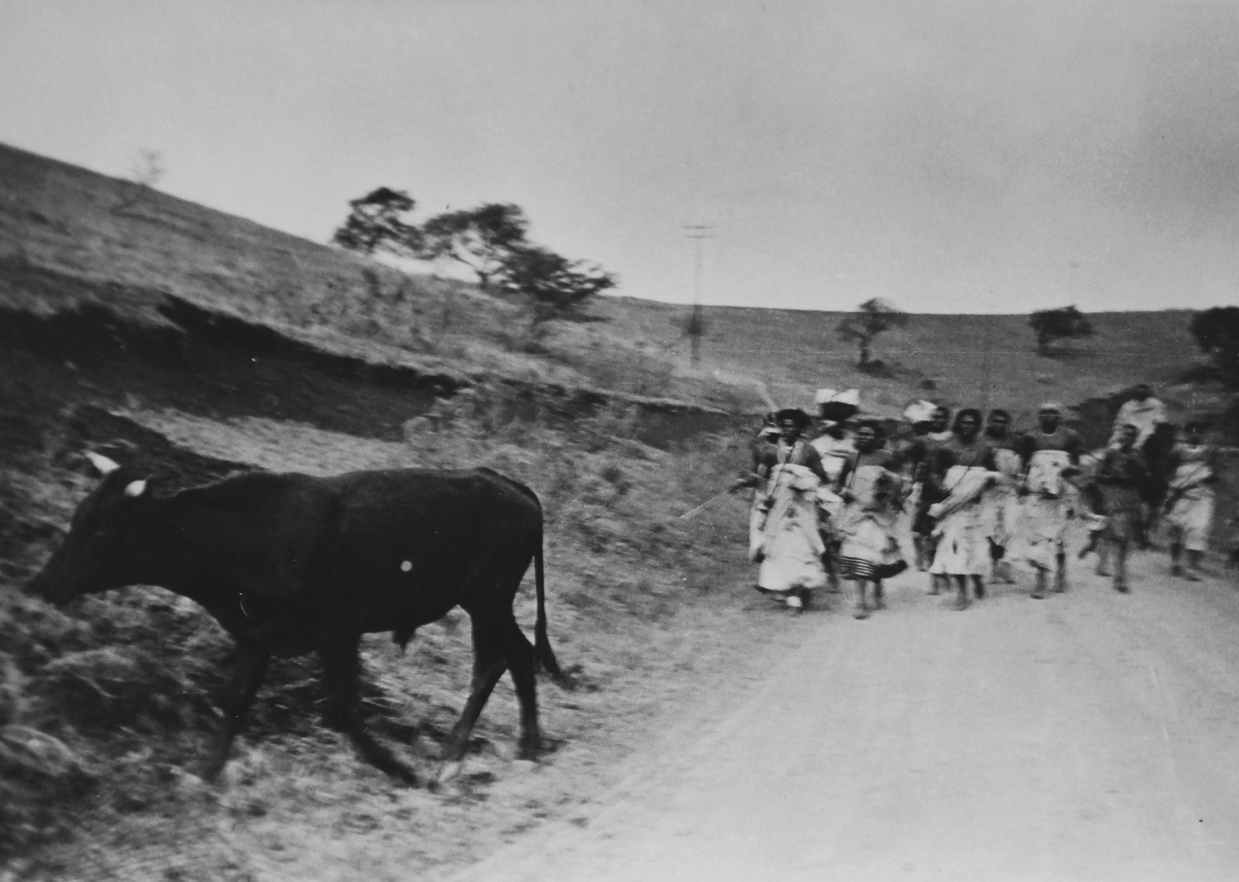
Evidence from early colonial court records shows that many isiXhosa speakers continued to follow the broad outlines of this procedure well into the colonial period, and beyond (see Figure 1.1) – and, moreover, tried to enlist the help of the colonial state in doing so.
Payment for seduction, Western Pondoland, ca. 1936. Eastern Cape families continued to seek cattle as compensation for seduction into the twentieth century.
African litigants explicitly asked colonial administrators to resolve their cases according to custom, even when official policy prohibited them from doing so. In 1866, as British Kaffraria was being annexed to the Cape, Special Magistrate at Middledrift Robert Fielding warned, “When I inform the natives that in certain cases of importance such as debt and recovery of dowry &c that I have not the power to act, they will not believe me, stating that they cannot understand how I can be their Magistrate & not have the power to render them assistance.”Footnote 103 Over time, colonial administrators found ways to accommodate customary law in civil cases, but criminal complaints remained governed by colonial law.Footnote 104 Nonetheless, some litigants attempted to use the colonial state to enforce customary remedies for rape. In 1875, Noyanti informed her husband that a neighbor had attempted to rape her the previous night. Her husband then sent a messenger to the neighbor, “to settle the matter according to [Xhosa] custom by payment of cattle. If he had paid the cattle I would have been satisfied and because I got no cattle I went and reported what had been done by the prisoner to the officer of Police.”Footnote 105 Such efforts rarely succeeded in criminal court, where colonial magistrates interpreted demands for monetary compensation as evidence that a victim’s family simply “wanted to get money out of” the accused man.Footnote 106 More accurately, they reveal attempts to bend the structures of the colonial state to the logic of customary authority.
Colonial officials were routinely skeptical of women’s complaints of rape. By contrast, African families, chiefs, and headmen appear to have generally accepted women’s claims. James Rose Innes, who rose from Resident Magistrate at King William’s Town to become the Undersecretary for Native Affairs, told the 1883 commission that “under [Xhosa] law or custom, a man has to prove his innocence, his guilt has not to be established by evidence … a man has, according to [Xhosa] custom, to prove that it was impossible he could have committed the crime with which he is charged.”Footnote 107 Indeed, in early colonial rape cases, African defendants were more likely to deny sex entirely than to claim that a woman had consented to sex. When young women were assaulted, older women who conducted virginity examinations frequently provided crucial evidence. Young women would be examined by their own relatives, and the examination might be repeated in the presence of the female relatives of the accused or women from prominent local families.Footnote 108 When these women subsequently testified in colonial courts, they described physical injuries alongside evidence that the young woman in question was no longer a virgin. Nofasi’s mother told the court that she found on examination that her daughter “was bleeding [from her vagina] and had been raped.”Footnote 109 In other words, evidence of first intercourse was evidence of rape. When Esther told her family that she had been raped, the woman who examined her “found that she had been raped. I made this statement because I found a discharge of semen upon the private parts of Esther. I did not make an internal inspection of those parts and cannot say whether penetration was effected or not.”Footnote 110 In this case, evidence of any sexual contact was sufficient to confirm Esther’s claim of rape. In such cases, the overlapping wrongs done in charges of rape and of seduction or adultery worked to women’s advantage; they did not need to prove lack of consent in order for their complaints to be believed.
More broadly, many African litigants – including women – described rape in terms that emphasized the nonmarital nature of these sexual encounters. Jesse Swaartland, assaulted in her own hut at night, testified that she woke up and “asked [her assailant] if I was his wife.”Footnote 111 Nosamunti, assaulted on a footpath, used almost identical language, also telling the court that she “asked [her assailant] if I was his wife.”Footnote 112 For these women, part of the wrong done during their rape was the usurpation of the sexual prerogatives of a husband. They invoked a discourse of customary authority that placed their sexuality under the authority of a male relative – but they did so in an attempt to protect themselves against rape. In such circumstances, custom helped women to assert their sexual autonomy.
By contrast, customary norms demanded that women assent to their husbands’ demands for sex; the concept of marital rape would not have made sense to most residents of colonial Xhosaland. In an 1879 case, when Teyana sought to recover the dowry paid for his wife, he complained to the magistrate, “she was always running away and at last refused to let me have connection with her.”Footnote 113 Refusing sex was the final rebellion of a “disobedient” wife. Early colonial court cases contain numerous examples of women seeking to dissolve court cases on grounds of abuse, including extreme forms of sexual abuse. One woman complained in court that her husband had attempted to insert a loaf of bread in her anus, while another told the court that her husband “never had connection with me once, but mauled me about in a most unmanly way.”Footnote 114 By contrast, complaints of simply being forced to have sex are conspicuously absent in these records, because most men and women in Xhosaland did not consider it a legitimate complaint. The language of custom, then, offered significant protection to women against some forms of sexual violence, but could justify others. This ambiguity reflects, in part, the divergent interests of men themselves. In disputes over female sexuality, husbands and suitors argued against fathers and guardians; women could sometimes turn these conflicts to their own advantage.Footnote 115
Negotiations over making and unmaking marriage brought these conflicts to the fore. In ideal ukushata marriages, bridewealth was paid in full before a bride was welcomed into her husband’s homestead with a ceremonial feast.Footnote 116 Not all couples, however, entered directly into ukushata marriages. Women regularly lived with their husbands before the full amount of bridewealth had been paid, or a feast held – sometimes for decades.Footnote 117 The term ishweshwe referred to a woman living with a man who had not given bridewealth, but had made a token gift to her father. Although an ishweshwe occupied a lower social status than a wife, such arrangements could mark the first step to full marriage, and provided a socially recognized framework for the relationships of couples that could not afford to marry.
Couples who wanted social recognition for their unions, however, still required parental agreement. In order to obtain it – or pressure his own family to provide bridewealth – a man might thwala his desired bride. The term ukuthwala was usually translated into English as abduction and elopement; A. H. Stanford defined it to the 1883 commission as a form of marriage in which “the girl [was] carried off by the man who wishes to marry her, usually with her own consent, though sometimes without it.”Footnote 118 Stanford believed that ukuthwala was recent innovation, but at least some isiXhosa-speaking men characterized it as a custom. The Thembu chief Matwa told the Eastern Districts Court in 1893, “the custom of ‘twala’ is after a girl is carried off by her sweetheart, the girl is followed up by her brothers, and then the marriage is arranged.”Footnote 119 By describing ukuthwala as a custom, young men gained leverage within marriage negotiations. The implicit threat that an unmarried couple might choose to live together – or at least sleep together – provided an incentive for parents to negotiate. By cooperating in ukuthwala elopements, young women were sometimes able to exert control over their marriages.
After a marriage, meanwhile, women were able to use the competing claims of custom by turning to their fathers for protection against abusive husbands. Married women had a recognized right to seek refuge with their natal families, a practice known as ukuteleka. Marriage did not sever a woman’s relationship to her parents and siblings. Before a woman’s family allowed (or, in some cases, pressured) her to return to her husband, a man could expect to pay a head of cattle to her father or household head. John Knox Bokwe defined ukuteleka as “a usage allowable to the woman by which she can regulate the conduct of her husband towards her … should the [bridewealth payments] not have been fully cleared. She runs away home if ill-used by her husband … the man is obliged to give something before he gets her again.”Footnote 120 As one woman told a colonial court in 1883, her husband had earlier “had to pay my father a beast to get me back owing to his having beaten me.”Footnote 121 Like ukuthwala, the recognition of ukuteleka as a custom set the interests of husbands against those of fathers, to the benefit of women. The protection it provided was not perfect; colonial court records make it clear that women’s parents regularly exerted pressure on women to stay in conflict-ridden marriages. In an extreme case, Tshaya Nqezito’s daughter attempted suicide “because she did not want to live with her husband” after she “was forced to go with him.”Footnote 122 However, the conflict between the interests of their natal and marital families did allow women to exert some measure of power within their own marriages.
Competing claims over female sexuality did not always help women, however. The men who described ukuthwala as a custom assumed that women were willing parties to these attempted marriages. Successfully forging a marriage in this fashion required the eventual consent of a woman’s father or guardian; prudent would-be husbands took care not to antagonize these senior men more than necessary. Yet, at least in the early colonial period, some men did use violence to force women into these marriages.Footnote 123 In doing so, they gambled that women’s fathers would accept an ukuthwala marriage once it had already been carried out and – in some cases – consummated, even over the objections of the women involved.Footnote 124
While women were sometimes able to take advantage of competing claims about custom to exert power over their own lives, then, they could also suffer when men sought to assert their masculinity by forcibly claiming women’s sexuality. The experience of Nomaheke, a young woman living in Middledrift about a decade after the area’s colonization, captures the contradictory effects of this dynamic on women. Nomaheke “did not go willingly in the first instance” when her lover of several years decided to thwala her. However, she then “made up my mind to remain with Nquru as his wife & that I would marry him myself. … I had an affection for him.”Footnote 125 Perhaps because her guardian “didn’t seem over-anxious in looking for a husband for her,” Nomaheke chose to work within the framework of ukuthwala in order to achieve marriage, even though she had been abducted against her will.
Conclusion
Precolonial African communities in Xhosaland recognized nonconsensual sex as a distinct category of wrong. However, precolonial understandings of sexual consent intersected with a number of other boundaries between licit and illicit sex. Women’s reproductive capacity had economic value, which their families sought to control. The discourse of custom granted male household heads far-reaching rights over the sexuality of the women in their households, while political leaders claimed both direct control over the sexuality of their subjects and the right to adjudicate disputes over female sexuality. The concept of custom, or isiko, linked chiefly authority to familial control of female sexuality.
As the colonial state extended its control over the Eastern Cape, the language of custom came under pressure from alternate ways of understanding both sexual consent and political authority. Missionary Christianity, colonial liberalism, and race provided competing conceptions of sex and power. However, the idea of custom remained important to many people in Xhosaland – including white administrators who incorporated it into the colonial state. The body of customary law applied in colonial courts primarily regulated marriage, inheritance, and access to land.Footnote 126 These claims about marriage “customs” involved claims about sexual consent. However, isiXhosa speakers also described as “customary” many practices and obligations that did not find their way into the body of customary law, whether because colonial officials found them “repugnant” or because they were not easy to enforce in court.
These nuances to precolonial understandings of sexuality set the stage for conflict over definitions of sexual violence in the colonial period. Incorporation of African customary norms into the colonial legal regime diminished both women’s ability to engage in wanted extramarital relationships and their ability to protect themselves against sexual assault. British missionaries and colonial officials arrived in the Eastern Cape with their own definitions of rape, which were equally linked to the colonial model of governance. As the following chapter details, Christian sexual morality subordinated the importance of consent not to family obligation but to the ideas of sin and temptation. The encounter between these differing conceptions of sexual violence set off debates about how to understand – and regulate – nonconsensual sex that remain unresolved today.

