


ADHD, many anxiety disorders, and persistent conduct problems are already well established by middle childhood. What is not clear is how early these problems begin.
Serious behavioral and emotional problems have been reported in children as young as preschool age (Lavigne et al., Reference Lavigne, LeBailly, Hopkins, Gouze and Binns2009; McDonnell & Glod, Reference McDonnell and Glod2003; Zeanah, Reference Zeanah2000). Because of the rapidity of developmental change and reorganization that takes place during their earliest years, many of the problems children manifest, such as aggression, noncompliance and anxiety, are often transitory in nature. Whether or not one uses psychopathological labels to describe problem behaviors in children less than three years of age, there is a growing consensus that a significant number of children exhibit persistent and severe behavioral problems (Keenan et al., Reference Keenan, Wackschlag, Danis, Hill, Humphries, Duax and Donald2007; Shaw et al., Reference Shaw, Hyde and Brennan2012).
Formal psychiatric diagnoses have also been reported in preschool age children. These diagnoses imply that the children's symptoms are associated with notable impairment in meeting developmentally appropriate task demands. Using varying structured instruments for diagnosing psychiatric disorders, studies have shown significant rates and high degrees of comorbidity (Egger & Angold, Reference Egger and Angold2006; Egger et al., Reference Egger, Erkanli and Keelr2006). Given the evident impact of preschool-age problems, it is important to understand how such problems arise.
Early infant temperament appears to be an important precursor of behavioral and emotional maladjustment in childhood. Early studies of reaction patterns in very young children (Thomas & Chess, Reference Thomas and Chess1977) suggest that ‘early-emerging’ temperamental traits are significant predictors of later behavioral and emotional disturbance (Bates et al., Reference Bates, Schermerhorn, Petersen, Lewis and Rudolph2014; Caspi et al., Reference Caspi, Moffit, Newman and Silva1996; Rothbart & Bates, Reference Rothbart, Bates, Eisenberg, Damon and Lerner2006). In general, studies relate the construct of difficult temperament (i.e., negative emotionality, fussiness, difficulty soothing) to a myriad of behavioral and emotional problems (Bates et al., Reference Bates, Schermerhorn, Petersen, Lewis and Rudolph2014).
Numerous studies have shown that children who are highly reactive as infants and who have difficulty in emotional and behavioral self-regulation are at risk for conduct problems, and in particular, severe and persistent conduct disturbances beginning in early childhood (DePauw & Mervielde, Reference DePauw and Mervielde2010; Saudino, Reference Saudino2005). Early unadaptability, inhibition, or withdrawal from novel stimuli, and in particular stable behavior inhibition, is specifically associated with internalizing problems (Bates et al., Reference Bates, Schermerhorn, Petersen, Lewis and Rudolph2014; Kagan et al., Reference Kagan, Snidman, Zentner and Peterson1999; Prior et al., Reference Prior, Smart, Sanson and Oberklaid2000).
Although it has been recognized that early temperamental difficulties reflect a significant liability to early behavioral and emotional disturbance, the mechanisms are not yet well understood (Goldsmith et al., Reference Goldsmith, Lemery, Essex and DiLalla2004). Using varying definitions and labeling of temperamental constructs, twin studies show a demonstrable influence of genetic factors on most infant temperament measures (Saudino, Reference Saudino2005), such as activity level, negative affect, effortful control (Gagne & Saudino, Reference Gagne and Saudino2010), distress to novelty, stranger distress (Cherny et al., Reference Cherny, Fulker, Corley, Plomin and DeFries1994), shyness (Robinson et al., Reference Robinson, Kagan, Reznick and Corley2004), anxiety (Cherny et al., Reference Cherny, Saudino, Fulker, Plomin, Corley, DeFries, Emde and Hewitt2001), and inhibitory control (Gagne & Saudino, Reference Gagne and Saudino2010).
Twin studies also underscore the importance of genetic factors in many aspects of preschool behavior (Derks et al., Reference Derks, Hudziak, van Bejisterveldt, Dolan and Boomsma2004) and patterns of comorbidity (Mikolajewski et al., Reference Mikolajewski, Allan, Hart, Lonigan and Taylor2010). Heritable influences are reported for hyperactivity (Price et al., Reference Price, Simonoff, Waldman, Asherson and Plomin2001) and nearly all forms of anxiety, particularly shyness/inhibition and obsessive-compulsive behaviors (Eley et al., Reference Eley, Bolton, O’Conner, Perrin, Smith and Plomin2003). Evidence for a shared environmental influence on disruptive behaviors has been reported, although the findings are mixed (Schmitz et al., Reference Schmitz, Cherny, Fulker and Mrazek1994; van den Oord et al., Reference van den Oord, Verhulst and Boomsma1996). However, there is strong and consistent evidence of genetic effects on early and pervasive antisocial behavior (Bates et al., Reference Bates, Schermerhorn, Petersen, Lewis and Rudolph2014; Mikolajewski et al., Reference Mikolajewski, Allan, Hart, Lonigan and Taylor2010), comparable to that found in twin studies of older children (Eaves et al., Reference Eaves, Silberg, Meyer, Maes, Simonoff, Pickles and Hewitt1997).
Given the pervasiveness of genetic effects on early infant temperament and its association with later behavioral and emotional problems, we propose that the same genes and/or environments underlying early temperament also contribute to the development of psychiatric disorders in early childhood.
The key goal of the present study is to understand the etiological mechanisms underlying early temperament and psychiatric disorders occurring in the preschool period. With longitudinal data collected on infant twins in Puerto Rico, we seek to: (1) address the extent to which genetic, shared (family) environmental and non-shared environmental factors contribute to individual differences in preschool psychiatric disorders; and (2) estimate the influence of genetic and environmental factors in the co-occurrence of infant temperament and psychopathology. Our study is unique with its focus on a minority population of young twins and rigorous prospective assessments of psychiatric disorders to study the etiological links between difficult and inhibited temperament and preschool ADHD, SAD, and ODD.
Materials and Methods
Sample
The Puerto Rican Infant Twin Study (PRINTS; Silberg et al., Reference Silberg, San Miguel, Prom, Bates, Canino, Egger and Eaves2005) comprised two waves; the first was completed from 2006 to 2007, and the second wave three years later from 2009–2010. All families with a multiple gestation pregnancy in Puerto Rico in 2006 were considered eligible. Contact information was obtained from the Puerto Rico Neonatal Twin Registry, established with the assistance of the Puerto Rico Department of Health. Of the 399 families that were eligible, 339 (85%), each with a set of twins, agreed to participate. Parents were contacted when the twins were an average of 1 year of age to assess infant temperament and basic demographics. When the children were 3-years old, 312 (92%) of the original 339 families completed the preschool psychiatric assessment using DISC-YC (Lucas et al., Reference Lucas, Fisher and Luby2000). The study had IRB approval from both the University of Puerto Rico and Virginia Commonwealth University.
Measures and Procedures
In the first wave of the study, mothers were interviewed to assess child temperament using a Spanish translation of the Infant Characteristics Questionnaire (ICQ; Bates et al., Reference Bates, Freeland and Lounsbury1979). The ICQ has good validity and test–retest reliability and correlates well with observer ratings and other rating scales assessing distress to limitations (difficultness) and fear (unadaptability).
During the second wave of the study, mothers were administered the Young Diagnostic Interview Schedule for Preschool Children (DISC-YC). The DISC-YC was translated into Spanish for use among Spanish-speaking populations (Matias-Carrelo et al., Reference Matias-Carrelo, Chavez, Negron, Canino, Agulair-Gaxiola and Hoppe2003). The most common diagnostic categories of ADHD, ODD, and SAD were analyzed for the present study. DNA microsatellite profiling was used for determining the zygosity of the twins (Hannelius et al., Reference Hannelius, Gherman, Makela, Lindstedt, Zucchelli, Lagerberg and Lindgren2007).
Data Analysis
Factor analysis of the Infant Characteristics Questionnaire
A latent factor analysis was used to explore the dimensionality of the items of the ICQ using maximum likelihood. The continuous factor scores comprising the latent temperamental factors were then used in subsequent analyses.
Prevalence of Psychiatric Diagnoses
We derived the rates for the most prevalent psychiatric disorders of ADHD, ODD, and SAD using DSM-IV criteria. Each child was given a 0 or 1 depending upon the presence or absence of the diagnosis. For the more complicated multivariate analyses (described below) subscale scores of behaviors comprising each of the three diagnoses were used.
Product moment correlations were estimated using SAS for evaluating the degree of association between the indices of temperament and the subscale scores comprising ADHD, SAD, and ODD.
Univariate and Multivariate Analyses
Standard biometrical genetic model fitting methods were used (Neale & Cardon, Reference Neale and Cardon1992) to decompose the observed variation in temperament and DSM-IV diagnoses of ADHD, ODD, and SAD in terms of additive genetic (A), shared environmental (C) and non-shared or unique environmental (E) risks. Additive gene action (A) reflects the additive or average effect of individual alleles at genetic loci influencing a trait or behavior. Common environmental effects (C) describe influences that make family members more alike compared to random pairs of individuals. Non-shared or unique environmental risks (E) capture aspects of the environment that are unique to each individual and are therefore uncorrelated between twins. Since MZ twin pairs are genetically identical, the additive genetic correlation is fixed to 1.0. The additive genetic correlation for DZ twin pairs is fixed to 0.5 because on average DZ twin pairs share only half their genes in common. Non-shared environmental effects (E) are by definition uncorrelated and also include measurement error, including short-term fluctuations of the environment.
Ordinal Data Analysis
Because the psychiatric diagnoses were coded as present or absent (0 or 1), the data for model fitting was analyzed using the raw ordinal data option in the Mx software package (Neale et al., Reference Neale, Baker, Xie and Maes2003). This approach assumes that the observed ordinal categories within each variable are an imprecise measure of an underlying latent normal liability distribution, and that this liability distribution has one or more threshold values that discriminate between the categories. Thresholds can be conceived of as cut points along a standard normal distribution, which classify individuals in terms of a probability or risk of endorsing one of two or more discrete (ordinal) categories.
Multivariate Genetic Analysis
With multivariate data, it is possible to make use of the information in the cross-twin cross-trait correlations to determine the degree of genetic and environmental overlap between early temperamental traits and the symptoms comprising DSM-IV diagnoses (Martin et al., Reference Martin, Eaves, Kearsey and Davis1978). The most commonly used multivariate method is the Cholesky decomposition (Neale & Cardon, Reference Neale and Cardon1992). The Cholesky is a method of triangular decomposition where the first variable (difficult temperament) is assumed to be caused by a latent factor (A1) that can explain the variance in the remaining variables (e.g., inhibition, unsociability, resistance to control, ODD, SAD, and ADHD). The second variable, behavioral inhibition, is assumed to be caused by a second latent factor (A2) that can explain variation in the second as well as remaining variables. This pattern continues until the final observed variable (SAD) is explained by a latent variable that is constrained from explaining the variance in any of the previous observed variables. A Cholesky decomposition is specified for each latent source of additive genetic (A), shared environmental (C), and individual specific environmental variance (E).
Individual parameters or ‘paths’ were dropped from the full model, beginning with the smallest parameters first. Initially, we sought a simplification of the shared environmental structure and then the additive genetic structure, with the goal of obtaining the most parsimonious account of the data with the least number of parameters. Each reduced model's fit was evaluated using likelihood ratio χ2 tests, in which the difference between -2 log-likelihood of two alternative models is distributed as a χ2, with degrees of freedom (df) equal to the difference in the number of parameters estimated.
Results
Sample Characteristics
Baseline characteristics of the participating families showed that of the 339 fathers, 226 (77%) had at least a high school education, and 207 (71%) were working full time; their mean age was 29.8 years (SD 7 years). Of the 339 mothers, 277 (82%) had at least a high school education, and 118 (35%) were working either full or part time; their mean age was 26.8 years (SD 6 years). Most (84%) of the 339 parental couples lived together. The number of families living below the median household income in Puerto Rico was 63%. Of the 339 families, 51% were receiving public assistance such as food stamps, government benefits, subsidized housing, and/or energy assistance.
Data Analysis
We found that the overall rates of ADHD, ODD, and SAD, using the DISC-YC, are comparable to those reported in other Hispanic samples. Lavigne et al. (Reference Lavigne, LeBailly, Hopkins, Gouze and Binns2009) reported a rate of 9.7% for ADHD compared to the PRINTS rate of 11.1% and 9.8% for ODD versus our rate of 10.8%. In the present sample, 7.9% met the criteria for SAD. There were no significant differences in the means or prevalence of the disorders between boys and girls.
The factor analysis of the 35 ICQ items showed that an oblique four-dimensional structure provided the most interpretable solution to the data with a Cronbach's alpha of 0.83. This four-factor solution was the same reported by Bates et al. (Reference Bates, Freeland and Lounsbury1979) on a non-twin, Caucasian sample. Items such as frequent fussiness and irritability, difficulty in calming down, loud crying, needing to be held, and moodiness characterized the first dimension, difficultness. The correlated second factor, inhibition, was characterized by introverted responses such as the infant's adaptation to new people and places. The third factor, sociability, included items such as how often infants smile and make happy noises. Persisting in playing/going someplace even when she/he is told not to, as well as sleep and eating irregularities, comprised the fourth factor, resistant to control.
Table 1 shows the Pearson correlations, twin correlations and genetic and environmental parameter estimates for the four temperament traits and the three psychiatric diagnoses. All the temperamental indices and psychiatric traits were highly intercorrelated. There was a significant correlation between unsociable and resistant temperament and later SAD and ODD. There was also a significant association between preschool SAD and ODD.
Phenotypic Correlations, Twin Pair Correlations, and Standardized Proportions of Variance Explained by Additive Genetic (A), Shared Environmental (C), and Non-Shared Environmental (E) Risk Factors
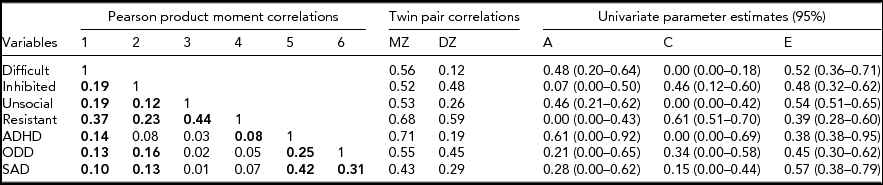
ADHD = attention deficit hyperactivity disorder, ODD = oppositional defiant disorder, SAD = separation anxiety disorder. Bold items represent significant correlations at α = 0.05.
The comparison of the MZ and DZ twin correlations reveal significant shared environmental influences on behavioral inhibition and resistant temperament. For these two temperamental traits, the DZ correlations were significantly higher than half the MZ correlation. In marked contrast, for difficult temperament, the monozygotic twin pair correlation (0.56) was significantly more than twice the dizygotic twin pair correlation (0.12), indicating non-additive genetic variation such as genetic dominance, epistasis, or gene-environment correlation.
The pattern of DZ and MZ twin pair correlations for preschool ODD and SAD suggest that a combination of both additive genetic and shared environmental factors are responsible for any observed familial aggregation. The relatively low DZ correlation of 0.19, as compared to the MZ correlation of 0.71 for ADHD, is strongly genetic, and resembles the twin correlations observed for difficult temperament.
The results in Table 1 reflect the decomposition of the total phenotypic variance of each trait into its additive genetic (A), shared environmental (C) and non-shared environmental (E) standardized variance components. Familial aggregation for the temperamental trait of difficultness is due to genetic and non-shared environmental variation, with no effect of the shared environment. In contrast, almost half of the total variance in behavioral inhibition is explained by shared environmental factors.
The results of the univariate genetic analysis for preschool psychiatric diagnoses indicate that additive genetic risks explain 21% of the variance in ODD, 28% of the variance in SAD, and 61% of the variance in ADHD. Shared environmental factors account for 34% of the variance in ODD and 15% of the variance in SAD.
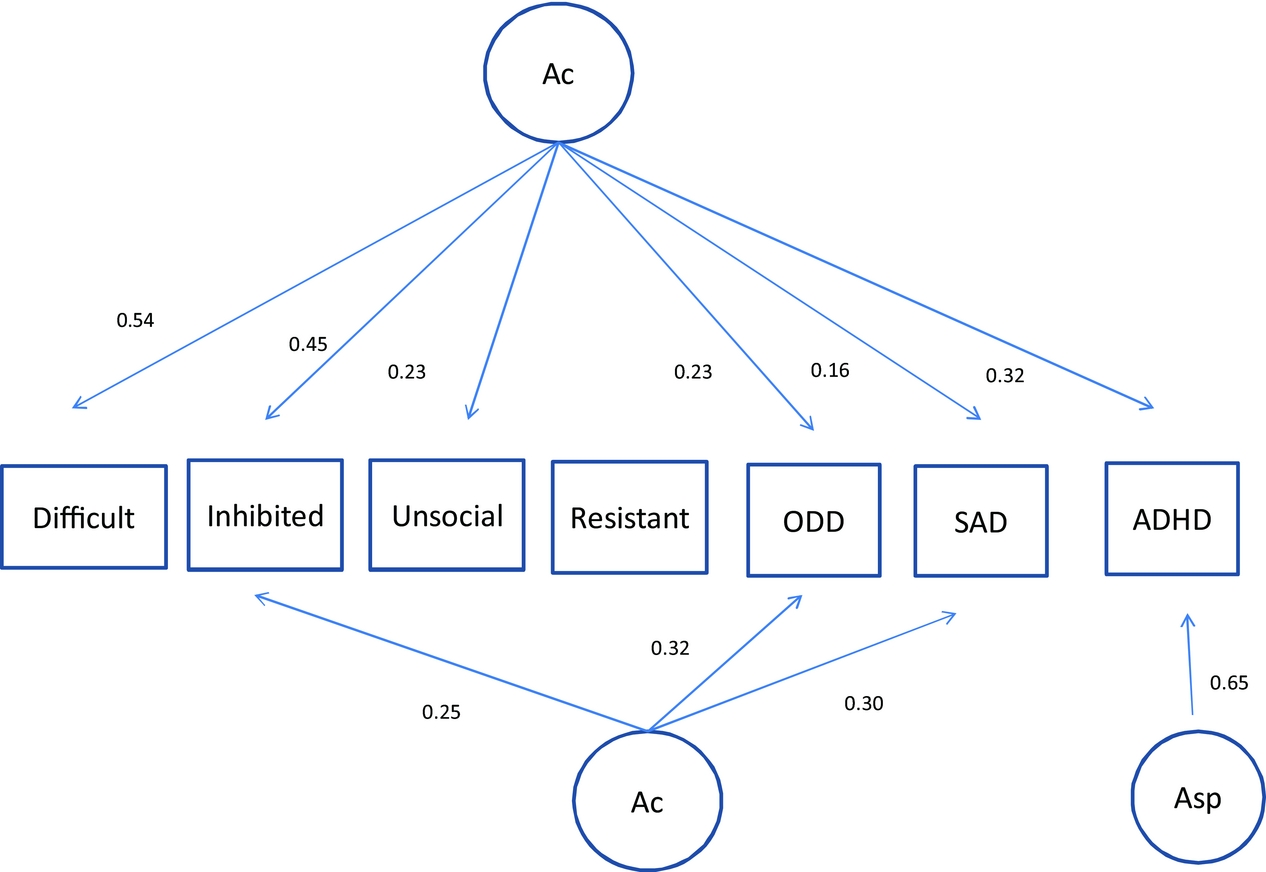
The multivariate analysis reveals a unique genetic and environmental structure underlying infant temperament and the preschool psychopathology. As shown in Figures 1 and 2, the covariation among temperament and psychopathology are attributable to both genetic and common environmental factors. A single additive genetic factor accounts for the covariation between difficult temperament and all the other traits and psychiatric diagnoses except for ‘resistance to control’, which is entirely under environmental control. An additional genetic factor reflects the association between behavioral inhibition, ODD, and SAD, and there are genetic effects specific to ADHD.
Genetic structure between early temperament and preschool ADHD, SAD, and ODD (standardized variance components). Note: Ac = Common genetic effect, Asp = Specific genetic effect, ADHD = attention deficit hyperactivity disorder, ODD = oppositional defiant disorder, SAD = separation anxiety disorder.
Shared environmental structure between early temperament and ADHD, SAD, and ODD (standardized variance components). Note: Cc = common shared environmental effect, Csp = Specific shared environmental effect, ADHD = attention deficit hyperactivity disorder, ODD = oppositional defiant disorder, SAD = separation anxiety disorder.
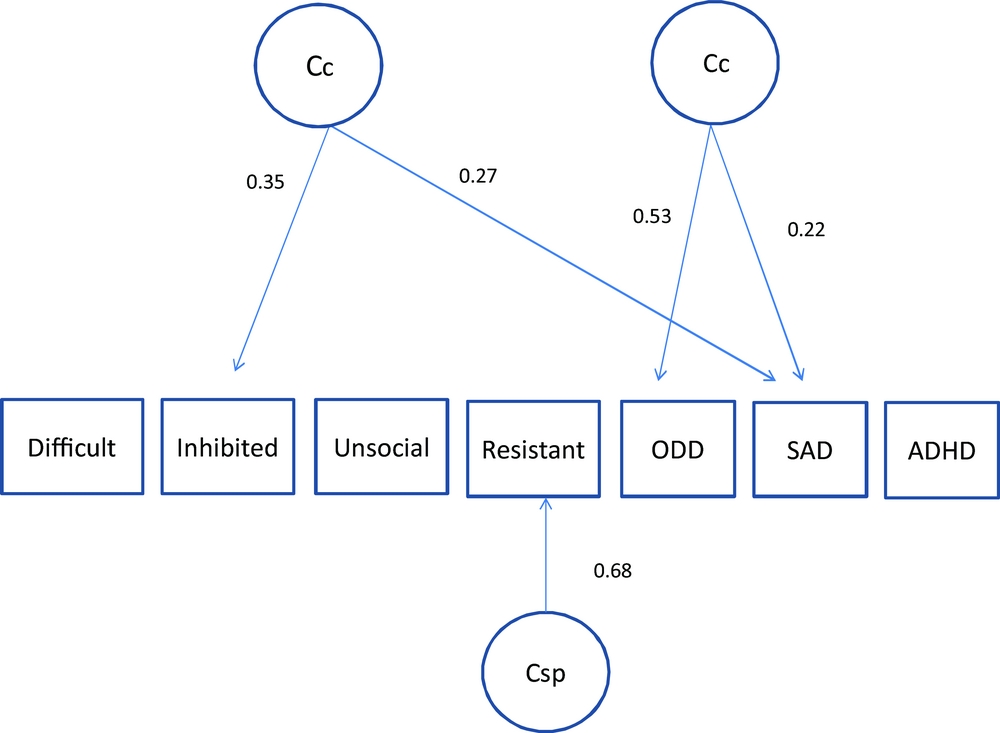
As shown in Figure 2, there is a shared environmental factor reflecting behavioral inhibition and SAD, a second shared environmental factor influencing SAD and ODD, and a shared environmental influence specific to resistant temperament. Because the effect of the individual specific environment was mostly trait specific it is not included in the figures.
Discussion
The prevalence rates in this Puerto Rican sample of 11.1%, 9.7%, and 7.2% for ADHD, ODD, and SAD respectively are comparable to those reported for other Hispanic samples using the DISC-YC (Lavigne et al., Reference Lavigne, LeBailly, Hopkins, Gouze and Binns2009). Considerable variability in rates using different instruments prevents strong assertions about prevalence. However, the coherence of the results from our genetically informed analyses suggests that the DISC-YC can make valid and meaningful diagnostic distinctions.
We found that both genetic and environmental factors influence the co-occurrence of difficult and inhibited temperament, as well as preschool ADHD, SAD, and ODD. The results from the multivariate genetic analysis reveal different patterns of genetic and environmental transmission. We found a single genetic factor reflecting difficult temperament, SAD, ODD, and ADHD. This genetic pattern is consistent with difficult temperament reflecting two different patterns of behavior: (1) a heightened sensitivity to the environment that can relate to later internalizing behaviors (e.g., SAD), and (2) frustration with a lack of stimulation that may be associated with subsequent behavioral disinhibition and externalizing behaviors (e.g., ADHD and ODD; Rothbart & Bates, Reference Rothbart, Bates, Eisenberg, Damon and Lerner2006).
We found behavioral inhibition to be an early risk factor for ODD and SAD through both genetic and environmental pathways. It has been theorized that the genetic association between ODD and SAD may result from a common underlying process reflecting emotion regulation deficiencies (Cunningham & Ollendick, Reference Cunningham and Ollendick2010). The shared environmental association between SAD and ODD may reflect parenting practices. Child anxiety disorders can involve oppositional and coercive behaviors with parents to avoid separation from caregivers. Oppositional behavior can produce unproductive conflict with caregivers that may create anxiety, especially in children who are temperamentally predisposed to anxiety (Fraire & Ollendick, Reference Fraire and Ollendick2012). Further research is needed on the specific developmental mechanisms that may be involved.
In contrast to most studies of behavioral inhibition showing marked genetic effects, the present findings on early temperament replicate previous work in the Puerto Rican population, showing a significant shared environmental influence on behavioral inhibition (Silberg et al., Reference Silberg, San Miguel, Prom, Bates, Canino, Egger and Eaves2005). This environmental effect may reflect a socialization process specific to Puerto Rico, which encourages early social interactions. It is this greater social engagement within the community that may account for the lowered risk of impairment observed in children's later development (Canino et al., Reference Canino, Shrout, Rubio-Stipec, Bird, Bravo, Ramirez and Martinez-Taboas2004).
Whether genetic or environmental, our findings underscore the continuity of behavior. Genes may affect behavior in several ways. Our multivariate analysis illustrates that some genes have a main effect on overall liability to problem behavior. Main effects of the genes likely account for early temperamental differences, self-regulation, and behavioral outcomes that emerge at key developmental phases. Difficult temperament and ADHD are examples. A second underlying mechanism, ‘heterotypic continuity’, refers to genetic or environmental factors that are associated with phenotypic differences at different phases of development (e.g., behavioral inhibition and ODD). Lastly, the link between behavioral inhibition and SAD is illustrative of ‘homotypic continuity’, in which the same genes influence a similar behavior (fear of separation) first in infancy then in the preschool period.
Limitations
Our findings must be interpreted in the context of the following limitations. Because of the very low rates of other disorders, we were limited to analyzing the three preschool diagnoses of ADHD, ODD, and SAD. However, the pattern of genetic and environmental effect is consistent with both theoretical explanations and empirical findings linking difficult temperament to both externalizing and internalizing disorders, as well as genetic and shared environmental pathways linking behavioral inhibition and SAD.
It has previously been shown that low DZ correlations (such as those for ADHD in the present study) can arise from evocative gene-environment correlation, whereby genetic effects underlying children's early reactivity evoke increased negative parental reactions (Silberg & Eaves, Reference Silberg and Eaves2005). The present study does not directly address the possibility of evocative gene-environment correlation. In addition, genetic differences in response to impaired parenting, or genotype x environment interaction was not examined. These important mechanisms that may underlie the developmental association of difficult temperament and preschool psychopathology remain to be studies in future analyses.
Acknowledgments
This work was supported by grant #R01HD049685 (PI Silberg) from the National Institute of Child Health and Development (NICHD).



