





Introduction
Each year, over 15,000 U.S. children are diagnosed with cancer, which remains the leading cause of death by disease for children (Siegel et al. Reference Siegel, Miller and Wagle2023). These families must accommodate demanding treatment schedules while managing emotional well-being during a difficult and uncertain time (Long and Marsland Reference Long and Marsland2011; Granek et al. Reference Granek, Rosenberg-Yunger and Dix2014; Wakefield et al. Reference Wakefield, McLoone and Evans2014; Molinaro and Fletcher Reference Molinaro and Fletcher2018; Peikert et al. Reference Peikert, Inhestern and Krauth2020; Hjelmstedt et al. Reference Hjelmstedt, Forinder and Lindahl Norberg2021). Advanced disease can result in more intensive therapy and greater psychological distress (Rosenberg et al. Reference Rosenberg, Dussel and Kang2013). Thus, parents may be at-risk for caregiver strain due to the emotional burden and need to balance demands from work, home, and hospital (Pai et al. Reference Pai, Greenley and Lewandowski2007; Ozdemir Koyu and Tas Arslan Reference Ozdemir Koyu and Tas Arslan2021; Chaghazardi et al. Reference Chaghazardi, Janatolmakan and Rezaeian2022).
Caregiver strain is defined as difficulties, burdens, and negative effects caregivers experience due to caring for a loved one with a health-related condition (Brannan et al. Reference Brannan, Heflinger and Bickman1997; Brannan and Heflinger Reference Brannan and Heflinger2001). According to Brannan’s double ABCX model of caregiver strain and psychological distress, caregiver strain is the result of child factors (e.g., medical symptoms), life stressors, and family context (e.g., resources, perceptions) (Brannan and Heflinger Reference Brannan and Heflinger2001). In the context of pediatric cancer, there are established associations between greater caregiver strain, more severe disease (Salvador et al. Reference Salvador, Crespo and Martins2015; Edmond et al. Reference Edmond, Graves and Whiting2016; Boztepe et al. Reference Boztepe, Çınar and Ay2019; Ozdemir Koyu and Tas Arslan Reference Ozdemir Koyu and Tas Arslan2021), and lower levels of parental social support (Ozdemir Koyu and Tas Arslan Reference Ozdemir Koyu and Tas Arslan2021). However, compared to child factors (Salvador et al. Reference Salvador, Crespo and Martins2015; Edmond et al. Reference Edmond, Graves and Whiting2016; Boztepe et al. Reference Boztepe, Çınar and Ay2019; Ozdemir Koyu and Tas Arslan Reference Ozdemir Koyu and Tas Arslan2021), associations between family context and caregiver strain have received less attention and are predominantly informed by maternal perspectives (Pai et al. Reference Pai, Greenley and Lewandowski2007; Sultan et al. Reference Sultan, Leclair and Rondeau2016). Additionally, the contribution of family roles to caregiver strain is less known (Demirtepe-Saygılı and Bozo Reference Demirtepe-Saygılı and Bozo2011; Hjelmstedt et al. Reference Hjelmstedt, Forinder and Lindahl Norberg2021).
In the context of pediatric cancer, mothers are often primary caregivers, while fathers balance work and home responsibilities (Clarke et al. Reference Clarke, McCarthy and Downie2009; Jones et al. Reference Jones, Pelletier and Decker2010; Hjelmstedt et al. Reference Hjelmstedt, Forinder and Lindahl Norberg2021). Given both roles may be challenging (Quittner et al. Reference Quittner, Espelage and Opipari1998; Jones et al. Reference Jones, Pelletier and Decker2010; Demirtepe-Saygılı and Bozo Reference Demirtepe-Saygılı and Bozo2011), understanding their contribution to caregiver strain can inform tailored support for parents. However, limited research has examined fathers, paternal perspectives, and the division of caregiving (Brannan and Heflinger Reference Brannan and Heflinger2001; Jones et al. Reference Jones, Pelletier and Decker2010; Demirtepe-Saygılı and Bozo Reference Demirtepe-Saygılı and Bozo2011; Hjelmstedt et al. Reference Hjelmstedt, Forinder and Lindahl Norberg2021; Ozdemir Koyu and Tas Arslan Reference Ozdemir Koyu and Tas Arslan2021). Although knowledge is limited regarding how unmet parental needs affect the ill child and family system (Brannan et al. Reference Brannan, Heflinger and Bickman1997; Kearney et al. Reference Kearney, Salley and Muriel2015; Brennan et al. Reference Brennan, Babinski and Waschbusch2022), it is known that parent and child distress are often linked in pediatric cancer (Bakula et al. Reference Bakula, Sharkey and Perez2019). Additionally, research within other pediatric illness groups indicates reductions in caregiver strain are associated with improvements in child psychological outcomes (Accurso et al. Reference Accurso, Garland and Haine-Schlagel2015; Schleider et al. Reference Schleider, Ginsburg and Keeton2015; Brennan et al. Reference Brennan, Babinski and Waschbusch2022). Thus, to optimally support the well-being of families affected by advanced pediatric cancer, it is critical to understand maternal and paternal perspectives of the family context and examine how family and individual factors might influence parents’ caregiver strain. Therefore, with a goal of examining the understudied family context component of Brannan’s ABCX model (Brannan and Heflinger Reference Brannan and Heflinger2001), our aim was to identify individual factors (i.e., demographic factors, stress) and family factors (i.e., family roles, social support) associated with caregiver strain in the context of advanced pediatric cancer. We expected that mothers and fathers with higher role satisfaction, greater social support, and lower general and cancer-specific stress would experience less caregiver strain. Given the lack of representation of fathers’ perspectives in existing literature (Pai et al. Reference Pai, Greenley and Lewandowski2007; Sultan et al. Reference Sultan, Leclair and Rondeau2016), we also explored contrasting paternal and maternal perspectives of family and caregiving experiences.
Methods
Procedure
Data were from a larger, IRB-approved (IRB16-00869) study examining symptom burden, quality of life, and family goals for care among children with advanced pediatric cancer and their parents. Families were identified through oncology or palliative care teams and hospital census at a large children’s hospital from 2017 to 2022. After consent/assent, families chose to complete surveys online or on paper.
Participants
Families were eligible if their child with advanced cancer was 5–25 years of age, spoke English, had at least one parent (≥18 years of age) who spoke English, and lived within 140 miles of the hospital. Advanced cancer was defined as physician-estimated prognosis for survival less than 60%, relapsed or refractory disease, or referral to end-of-life care. Children with significant developmental disabilities were excluded.
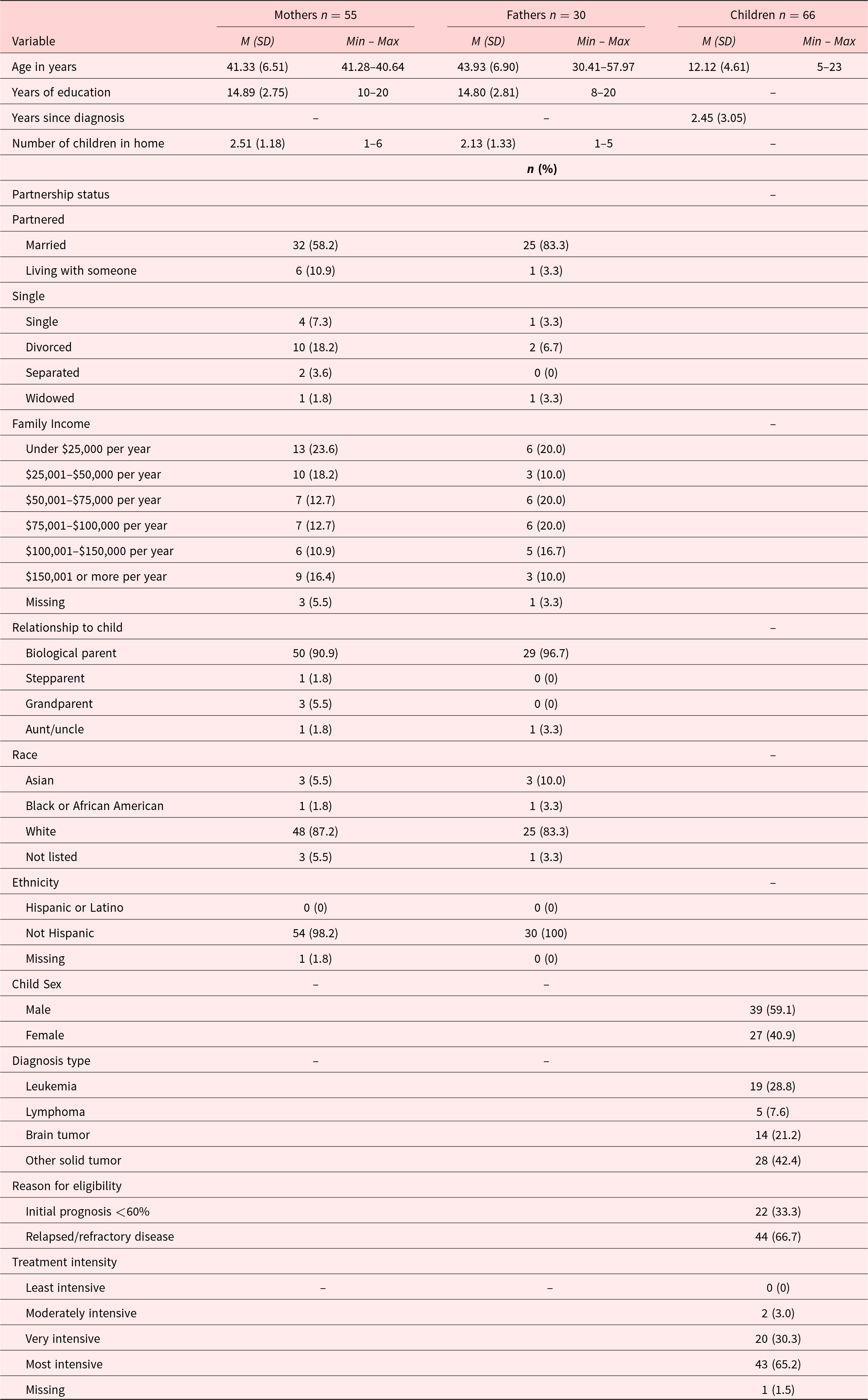
Of 149 families approached, 72 (48%) participated. Because children ≥ 18 years old could participate independently, a total of 55 mothers and 30 fathers representing 66 families had complete data and were included in this paper (Table 1). Three grandmothers, 1 aunt, 1 stepmother, and 1 uncle were included as “parents,” “mothers,” and “fathers” for analytical purposes given that they were all caregivers of their child with cancer. Of these 66 families, 35 had only the mother(s) enroll, 11 had only the father, and 20 families had both. Parents were primarily White (>80%), married (58.2% of mothers; 83.3% of fathers), non-Hispanic (>98%), of middle to upper income levels (>55% earning >$50,000 USD), biological parents (>90%) of the enrolled child, and had some college education (>75%; see Table 1). Of 20 paired parents, 17 were married, 2 were divorced, and 1 was separated and living with someone. Parents were asked to select 1 option to best describe their current partnership status: single, married, divorced, separated, remarried, widowed, or living with someone. For analyses, married or living with someone was considered “partnered,” whereas single, divorced, separated, or widowed was considered “single.”
Demographic table

The sample of children was on average 12 years old, male (59%), and 2.45 (SD = 3.05) years post-diagnosis (66.7% relapsed/refractory disease). Most children were diagnosed with a solid tumor (42.4%), and were receiving therapy rated highest in intensity (65.2%) based on the Intensity of Treatment Rating Scale (ITR-3) (Kazak et al. Reference Kazak, Hocking and Ittenbach2012).
Measures
Caregiver strain
The 20-item Caregiver Strain Questionnaire (CSQ) assessed the extent of difficulties due to caregiver roles and responsibilities on a scale of 1 (“not at all”) to 5 (“very much”) (Brannan et al. Reference Brannan, Heflinger and Bickman1997). It included 3 dimensions: objective strain (10 items; observable burden from the child’s diagnosis), subjective internalized strain (6 items; inwardly-directed negative feelings like worry, sadness, fatigue), and subjective externalized strain (4 items; child-directed negative feelings like anger or resentment). Overall caregiver strain scores were used in analyses and demonstrated good internal consistency (αmothers = .90; αfathers = .85).
Family roles questionnaire
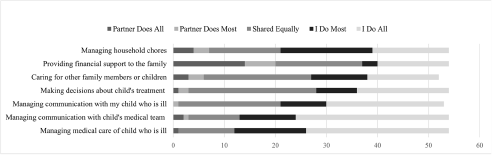
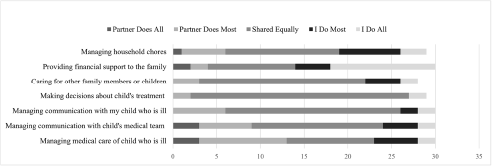
Using a measure adapted from previous work (Quittner et al. Reference Quittner, Espelage and Opipari1998), parents reported the frequency they completed 7 roles relative to their partner and their level of satisfaction with this arrangement. Four roles were hospital-related, whereas 3 were external (see Figures 1and 2). Frequency of roles were reported as: 0 – My spouse or partner usually does all of it, 1 – My spouse or partner usually does most of it, 2 – We usually share this role equally, 3 – I usually do most of it, or 4 – I usually do all of it. Satisfaction was rated on a 0 to 3 scale (“not at all satisfied” to “very satisfied”). Internal consistency was acceptable for frequency (αmothers = .84; αfathers = .80) and satisfaction (αmothers = .92; αfathers = .90).
Mother’s reports of family roles.

Father’s reports of family roles.

Cancer-specific stress
Mothers and fathers reported their cancer-specific stress using the Responses to Stress Questionnaire-Advanced Cancer (RSQ-AC) (Compas et al. Reference Compas, Beckjord and Agocha2006). Parents rated 12 items (e.g., not being able to help their child feel better, paying bills and family expenses, not knowing if the child’s illness will get better) from 1 to 4 (“not at all stressful” to “very stressful”). Internal consistency was good (αmothers = .80; αfathers = .85).
General stress
The Perceived Stress Scale (PSS) assessed mother and father general stress (Cohen et al. Reference Cohen, Kamarck and Mermelstein1983). Parents rated 10 items from 0 (“never”) to 4 (“very often”) based on how often they experienced the stressors. The PSS demonstrated good internal consistency (αmothers = .89; αfathers = .86).
Social support
The Medical Outcomes Study Social Support Survey (MOS-SSS) (Sherbourne and Stewart Reference Sherbourne and Stewart1991) assessed parents’ social support (i.e., emotional and informational support, tangible support, affectionate support, positive social interaction). Two items were added to assess financial and childcare assistance. Mothers and fathers rated items from 1 to 5 (“none of the time” to “all of the time”), indicating the degree to which they had each type of support. A mean score was calculated based on these 21 items. An additional global item assessed satisfaction with overall social support. The global item was highly correlated with the mean score, r = .87–.88, p < .001; therefore, the mean score was used in analyses. The mean score had excellent internal consistency (αmothers = .97; αfathers = .98).
Child medical characteristics
Medical chart data (e.g., diagnosis, prognosis) were abstracted, and the ITR-3 was used to classify treatment intensity from 1 to 4 (“least intensive” to “most intensive”) (Kazak et al. Reference Kazak, Hocking and Ittenbach2012).
Analysis plan
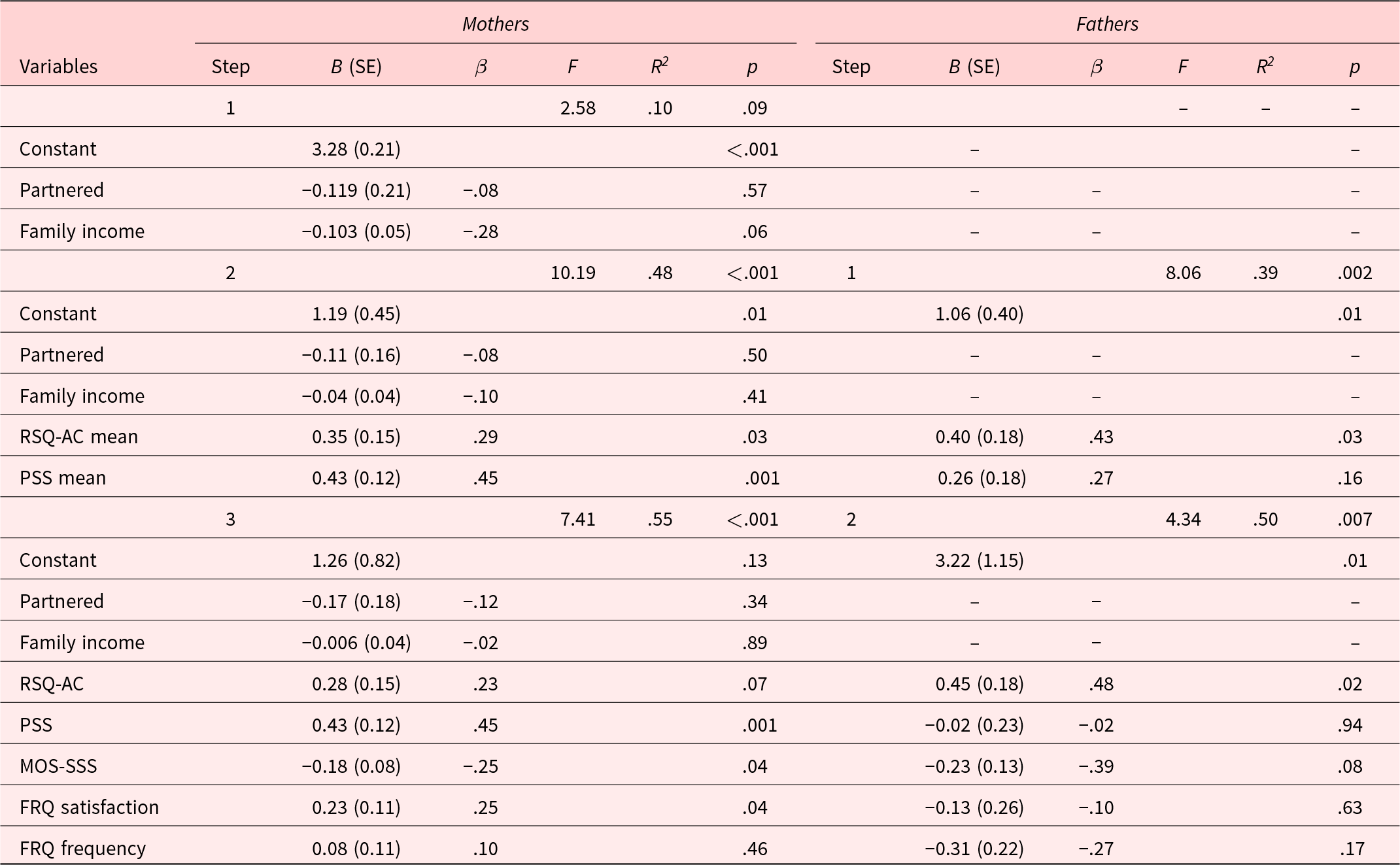
Descriptive statistics were calculated for variables of interest (i.e., caregiver strain, family roles, cancer-specific stress, general stress, social support). Pearson correlations and t-tests explored associations and differences between paired mother–father dyads’ variables of interest. Differences between single and partnered mothers’ family role frequency were also explored using independent samples t-tests. Hierarchical regressions evaluated factors associated with caregiver strain for mothers and fathers. Step 1 included demographic characteristics (i.e., partnership status, income) for mothers, but were excluded for fathers due to the small sample. Step 2 included individual factors (i.e., cancer-specific stress, general stress). The final step included family factors, (i.e., family role frequency and satisfaction, social support). Assumptions of all analyses were examined and met. Analyses were completed in IBM SPSS Statistics version 28 software (Corp Reference Corp2019). Given low levels of missingness, missing data were handled using listwise deletion.
Results
Descriptives and bivariate associations with caregiver strain
Mothers reported moderate caregiver strain (M = 2.88, SD = 0.67), general stress (M = 2.07, SD = 0.72), and cancer-specific stress (M = 2.76, SD = 0.57). However, they also reported high social support (M = 4.02, SD = 0.93) and satisfaction with family roles (M = 2.45, SD = 0.70). Mothers most frequently reported doing all hospital-related roles (i.e., day-to-day child medical care, communication with medical team and child) and sharing responsibilities with partners in medical decision making for their ill child, caring for other family or children at home, and providing financial support (Figure 1). Independent samples t-tests revealed that relative to partnered mothers, single mothers were more likely to perform the following roles all or mostly on their own: making decisions about their child, t(52) = 3.21, p = .002, d = 0.95, M single = 3.35, SD single = 0.93, M partnered = 2.46, SD partnered = 0.96; caring for other family or children at home, t(50) = 4.32, p < .001, d = 0.97, M single = 3.41, SD single = 0.80, M partnered = 2.17, SD partnered = 1.04; providing financial support to the family, t(52) = 6.42, p < .001, d = 1.14 M single = 3.41, SD single = 1.12, M partnered = 1.27, SD partnered = 1.15; and managing day-to-day chores, t(52) = 3.01, p = .003, d = 1.08, M single = 3.35, SD single = 1.17, M partnered = 2.38, SD partnered = 1.04. Among single mothers, all family roles had a mean ≥ 3.29, indicating they did all or most of all roles assessed.
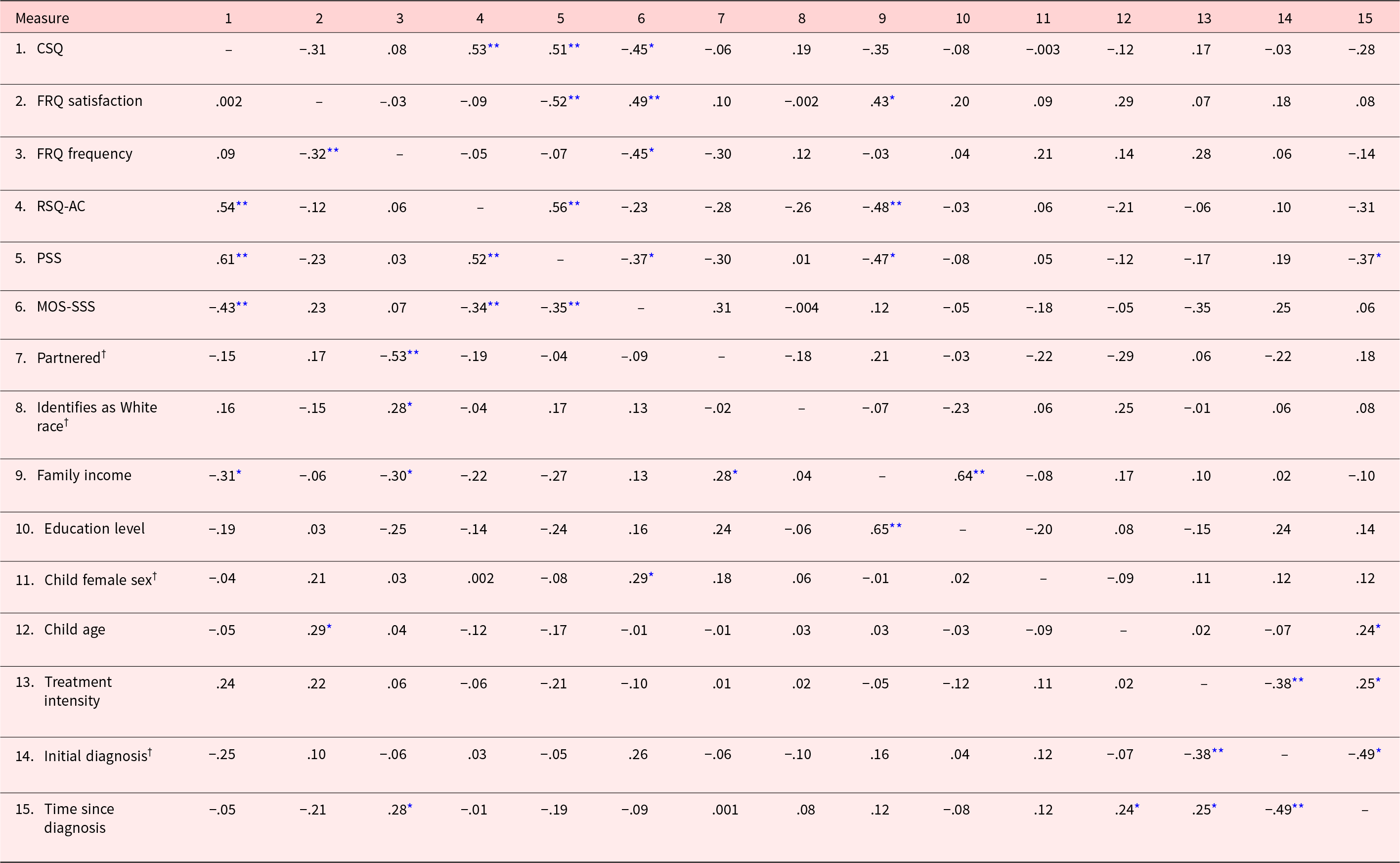
Correlations among variables of interest are displayed in Table 2. For mothers, greater caregiver strain was associated with lower income, r(51) = −.31, p = .03, and social support, r(53) = −.43, p = .001, as well as higher general stress, r(54) = .61, p < .001, and cancer-specific stress, r(54) = .54, p < .001. Notably, children’s medical characteristics (e.g., treatment intensity, relapse status) were unrelated to variables of interest, so child characteristics were omitted from regressions. As partnership status is likely a confounding variable in our aim to examine the role of family factors in caregiver strain, and was also associated with family role frequency, r(54) = −.53, p < .001, it was included in regression analyses.
Correlations

Note: Fathers’ correlations (n = 30) are presented above the diagonal; mothers’ correlations (n = 55) are presented below the diagonal. †Refers to dichotomous variables: 1 – partnered versus 0 – single; 1 – White race versus 0 – Other races; 1 – female versus 0 – male; 1 – initial poor diagnosis as reason for study entrance versus 0 – relapsed/recurrent disease.
* p<.05; **p<.01
Fathers reported moderate caregiver strain (M = 2.59, SD = 0.59), low-to-moderate general stress (M = 1.75, SD = 0.63), and moderate cancer-specific stress (M = 2.64, SD = 0.64). Fathers also reported moderate-to-high social support (M = 3.74, SD = 1.04) and high satisfaction with their family roles (M = 2.65, SD = 0.46). Fathers most frequently reported providing all financial support to the family and sharing equally with their partner on all other roles (Figure 2).
For fathers, greater caregiver strain was associated with lower social support, r(30) = −.45, p = .01, as well as greater general stress, r(30) = .51, p = .004, and cancer-specific stress, r(30) = .53, p = .003. Notably, fathers’ demographic and children’s medical characteristics (e.g., treatment intensity, relapse status) were unrelated to variables of interest (Table 2). Thus, these variables were omitted from regressions. Given that a focal study aim was to evaluate how family factors are associated with caregiver strain, family role satisfaction and frequency were included in regression analyses.
Exploratory dyadic analyses
Pearson’s correlations explored similarities in mothers’ and fathers’ reports of caregiver strain, family role frequency and satisfaction, social support, cancer-specific stress, and general stress. The number of dyads ranged from 18 to 20, due to missing data. Correlations were significant between mothers’ and fathers’ caregiver strain, r(19) = .60, p = .01, and cancer-specific stress, r(19) = .60, p = .01. For correlations between mothers’ and fathers’ family role frequency, positive correlations indicated discordance and negative correlations indicated concordance regarding who completed proportionally more of a role. There was a significant positive correlation, indicating discordance, in reports of communicating with the ill child, r(18) = .51, p = .03, such that both parents said they did some or all of this role. Significant negative correlations indicated agreement the mother did more: managing the care of their ill child, r(19) = − .62, p = .01; caring for other family and children at home, r(17) = − .69, p = .002; and managing household chores, r(18) = − .57, p = .01. Parents also agreed fathers provided more financial support, r(19) = − .68, p = .001. There were no dyadic associations between mothers’ and fathers’ family role satisfaction, social support, or general stress. Additionally, paired samples t-tests revealed no significant differences between mothers’ and fathers’ reports of caregiver strain, family role satisfaction, social support, general stress, and cancer-specific stress.
Multivariate models for caregiver strain
A hierarchical regression model examined factors associated with mothers’ caregiver strain. For detailed information on steps 1 and 2, see Table 3. The final overall model was significant and explained 55.2% of the variance in caregiver strain, F(7, 42) = 7.41, p < .001. Factors associated with greater caregiver strain included greater general stress (b = 0.43, p = .001), less social support (b = − 0.18, p = .04), and greater satisfaction with family roles (b = 0.23, p = .04).
Hierarchical linear regression results

A hierarchical regression model examined factors associated with fathers’ caregiver strain. For detailed information on step 1, see Table 3. The overall model was significant and explained 49.7% of the variance in fathers’ caregiver strain, F(5, 22) = 4.34, p = .01. The only significant factor was cancer-specific stress, b = 0.45, p = .02.
Discussion
This study enhances our knowledge of how the individual and family context influences levels of caregiver strain experienced by both mothers and fathers in the context of advanced pediatric cancer (Brannan and Heflinger Reference Brannan and Heflinger2001; Pai et al. Reference Pai, Greenley and Lewandowski2007; Jones et al. Reference Jones, Pelletier and Decker2010; Salvador et al. Reference Salvador, Crespo and Martins2015; Edmond et al. Reference Edmond, Graves and Whiting2016; Ozdemir Koyu and Tas Arslan Reference Ozdemir Koyu and Tas Arslan2021). Across the entire sample, fathers viewed most roles as shared, whereas mothers reported independent roles. Overall, mothers reported more roles relating to the ill child and home, and fathers reported more contributions as a financial provider; this was particularly true when comparing mother–father dyads. In hierarchical regression models, lower social support, higher general stress, and greater satisfaction with family roles were associated with greater strain for mothers, whereas fathers experienced greater caregiver strain in the context of greater cancer-specific stress. Findings underscore the importance of providing support for both mothers and fathers during this stressful period.
Parents experienced moderate strain and general and cancer-specific stress, yet high social support and satisfaction with family roles. Previous research with parents of children with advanced cancer found parents had elevated distress and high social support (Rosenberg et al. Reference Rosenberg, Dussel and Kang2013), which partially aligns with current findings, though parents in this sample demonstrated slightly greater functioning comparatively. Many parents in our sample were further from initial diagnosis; as research suggests parents experience greater stress and distress initially with declines to normative levels over time, it is possible our sample reflects these adjustments (Dunn et al. Reference Dunn, Rodriguez and Barnwell2012; Bakula et al. Reference Bakula, Sharkey and Perez2019). A significant bivariate correlation between lower general stress and more time since diagnosis for fathers in our sample supports this idea, though associations between time since diagnosis and stress were not significant for mothers. Interestingly, social support also generally declines over time among families of children with cancer (Hoekstra-Weebers et al. Reference Hoekstra-Weebers, Jaspers and Kamps2001; Wijnberg-Williams et al. Reference Wijnberg-Williams, Kamps and Klip2005), but high levels of social support may reflect a remobilization of support as the disease progresses.
Although mothers and fathers mostly agreed fathers contributed proportionately more to family financial support, and mothers somewhat more to the care of their ill child, there were large discrepancies. Notably, fathers viewed most roles as shared, whereas mothers viewed themselves as the main contributor. Within paired mothers and fathers, there was also disagreement regarding which parent communicated most with the ill child. Although research supports mothers assuming a caregiving role and fathers the role of financial provider (Jones et al. Reference Jones, Pelletier and Decker2010), the number of father-reported shared roles suggests that mothers, healthcare providers, and researchers underestimate fathers’ roles, or that fathers overestimate their roles. Mothers are included more frequently in pediatric cancer research (Pai et al. Reference Pai, Greenley and Lewandowski2007; Sultan et al. Reference Sultan, Leclair and Rondeau2016), and fathers have reported feeling disconnected or even unwelcome from pediatric healthcare settings (Jones et al. Reference Jones, Pelletier and Decker2010). Thus, what is known about parental roles during treatment is likely biased by mother perspectives.
For mothers, caregiver strain may be the result of broader family and social contexts. First, mothers’ general and cancer-specific stress were both related to caregiver strain. General stress involves feeling out of control and unable to keep up with life’s demands. Thus, mothers who have pre-existing stressors prior to their child’s diagnosis may have more difficulty managing care. They may also feel less available to other children or feel disconnected from home and work during the illness (Long and Marsland Reference Long and Marsland2011; Long et al. Reference Long, Lehmann and Gerhardt2018). Consistent with other research (Brannan and Heflinger Reference Brannan and Heflinger2001; Ozdemir Koyu and Tas Arslan Reference Ozdemir Koyu and Tas Arslan2021; Brennan et al. Reference Brennan, Babinski and Waschbusch2022), mothers with more social support experienced less caregiver strain. Finally, and counterintuitively, greater satisfaction with family roles was associated with greater caregiver strain for mothers. It is possible that mothers were more satisfied when more involved, as was true in associations between frequency and satisfaction with family roles. Thus, although mothers may report caregiver strain, they may appreciate being highly involved. Notably, the lack of association between child medical factors and caregiver strain was unexpected given previous work (Brannan and Heflinger Reference Brannan and Heflinger2001; Salvador et al. Reference Salvador, Crespo and Martins2015; Edmond et al. Reference Edmond, Graves and Whiting2016; Boztepe et al. Reference Boztepe, Çınar and Ay2019; Ozdemir Koyu and Tas Arslan Reference Ozdemir Koyu and Tas Arslan2021). It is possible that advanced cancer and more intensive treatment restricted variability, inhibiting the detection of expected associations (Salvador et al. Reference Salvador, Crespo and Martins2015; Edmond et al. Reference Edmond, Graves and Whiting2016; Boztepe et al. Reference Boztepe, Çınar and Ay2019; Ozdemir Koyu and Tas Arslan Reference Ozdemir Koyu and Tas Arslan2021).
For fathers, greater caregiver strain was related to lower social support and general and cancer-specific stress in bivariate analyses, but only cancer-specific stress remained significant in multivariate models. Thus, fathers may feel more strain in the context of more stressful disease and treatment. Previous literature has suggested fathers may experience informational stress and uncertainty regarding the cause and consequence of the disease (Chesler and Parry Reference Chesler and Parry2001; Clarke Reference Clarke2005; Jones et al. Reference Jones, Pelletier and Decker2010). Given fathers were proportionately less involved than mothers in medical care and often served as the financial provider (Clarke Reference Clarke2005; Clarke et al. Reference Clarke, McCarthy and Downie2009; Jones et al. Reference Jones, Pelletier and Decker2010; Hjelmstedt et al. Reference Hjelmstedt, Forinder and Lindahl Norberg2021), their cancer-specific stress may result from disconnection from their child’s day-to-day care (Jones et al. Reference Jones, Pelletier and Decker2010). Thus, fathers may benefit from more information about the disease and treatment (Chesler and Parry Reference Chesler and Parry2001; Clarke Reference Clarke2005; Jones et al. Reference Jones, Pelletier and Decker2010), and more support for managing finances (James et al. Reference James, Keegan-Wells and Hinds2002). However, although less involved relative to mothers, fathers still reported sharing most family roles. Therefore, additional psychosocial support focused on cancer-specific stress may be warranted.
Study limitations
Findings should be considered in light of several limitations. First, results are specific to families with advanced cancer. Although advanced cancer research is lacking (Berger et al. Reference Berger, Krishnasamy and Thompson2022), results may not generalize to families of children with a greater prognosis for survival. Second, our sample size limited the ability to control for fathers’ demographic characteristics in regressions and thoroughly explore dyadic associations. Associations in multivariate models may be due to common source variance. Future research should increase both the sample of secondary caregivers and dyads to better understand parent roles and caregiver strain in the context of different family constellations. This would also allow for testing of mixed-method and multi-informant models. Our sample was primarily White and non-Hispanic, which may not reflect the role sharing and burdens experienced in historically underrepresented racial and ethnic groups. Additionally, the family roles questionnaire asked parents the amount they do a task relative to their spouse or partner. Although it was intended that parents consider another caregiver of their child with cancer, single parents may not have known who to consider. Though single parents still reported that they shared some of their family roles, analyses of partnered versus single mothers revealed single mothers did more of 4 out of 7 tasks. Future research should consider more inclusive language in their measures and explicitly identifying care partners with research participants. Lastly, longitudinal data are ideal to examine predictive associations among variables within families and inform interventions.
Clinical implications
Despite these limitations, this remains one of the first studies to quantitatively examine family roles and factors associated with caregiver strain among mothers and fathers of children with advanced cancer. Medical providers should regularly refer families for interdisciplinary palliative care to help manage symptoms, support communication and advance care planning, and relieve caregiving strain for parents (Wiener et al. Reference Wiener, Kazak and Noll2015). Psychosocial providers should screen for families at-risk for negative outcomes, and address both general and cancer-specific stress, in addition to social support, especially for mothers (Wiener et al. Reference Wiener, Kazak and Noll2015). Social work may also mitigate caregiver strain through provision of financial and insurance-related resources to allow more time, particularly for fathers, to spend with their ill child. Additionally, given mothers and fathers had differing views about roles, healthcare providers might facilitate joint conversations about caregiving and ensure information is shared. Taken together, results suggest caregivers need additional support as they navigate this challenging time.
Conclusions
In conclusion, this study contributes to limited literature aiming to understand the caregiving experiences of mothers and fathers of children with advanced cancer. To optimally support parent and family well-being, results underscore the importance of considering individual stressors and family context.
Acknowledgments
The authors would like to acknowledge and thank the families who generously shared their experiences in this study.
Funding
This work was supported Alex’s Lemonade Stand Foundation, awarded to Cynthia A. Gerhardt.
Competing interests
The authors declare no potential conlict of interest.

 Open access

