


1. Introduction
The environmental impact of travel and transport needs to be reduced in light of climate change (Reference Holden, Banister, Gössling, Gilpin and LinnerudHolden et al., 2020). This can be achieved in travel with the use of three main strategies: efficiency, alteration and reduction as described by Reference Holden, Banister, Gössling, Gilpin and LinnerudHolden et al. (2020), “travel more efficiently, travel differently and/or travel less.” From 1990 to 2014 CO2 emission from traffic remained nearly constant although the traffic volume increased, which means the potential for efficiency gains has already been exhausted (Reference Ulrich, Friedrich, Weimer and SchmidUlrich et al., 2019). As a reduction of worldwide travel is unlikely, the only remaining solution to reduce the environmental impact of travel and transport is to travel differently, meaning mainly a change from motorized individual transport to public transportation (Reference Holden, Banister, Gössling, Gilpin and LinnerudHolden et al., 2020).
Two main challenges arise with changes to modes of travel for large parts of society in terms of a driver shortage (bdo, 2025) and a low attractiveness of public transportation in comparison to other modes of transport available today (Reference Hirschhorn, van de Velde, Veeneman and HeuvelhofHirschhorn et al., 2020). One possibility to solve the driver shortage is to use the promising technology of autonomous driving on a large scale in public transportation. This is especially applicable for autonomous transit buses as they can handle large traffic volumes, can be used on existing infrastructures (BMDV, 2024b) and even expand today’s public transportation network in terms of size and operation times (BMDV, 2024a). However, the automated and autonomous systems are in most cases not yet in real application which brings challenges for developers and operators (Reference Bucchiarone, Battisti, Marconi, Maldacea and PonceBucchiarone et al., 2020; Reference Diba, Gore and PulugurthaDiba et al., 2025). One of the main challenges is the interaction between the autonomous transit bus and vulnerable road users, passengers outside the bus and passengers inside the bus. The challenges of accessibility, safety and security arise when the human-human interaction is replaced by a human-machine interaction (Reference Seredynski, Nielsen, Ekman and JohanssonSeredynski et al., 2023).
Most research projects for autonomous public transportation on roads consider autonomous shuttles with only up to 12 passengers per vehicle (Reference Haque and BrakewoodHaque & Brakewood, 2020). These are Class A or Class B vehicles and have to comply to less strict regulations for accessibility than standard transit buses (Class I) (UNECE 107.9, 2024). Vehicles for transport of more than eight passengers besides the driver are dependent on maximum mass either classified as a vehicle of category M2 (max. mass not exceeding 5,000 kg) or M3 (max. mass exceeding 5,000 kg). M2 and M3 vehicles can be further categorized into vehicles which exceed 22 passengers besides the driver as Class I to III and not exceeding 22 as Class A and B. A further distinction between Class I to III is based on the ratio of seated to standing passengers. Transit buses used in city public transportation are Class I vehicles. (R.E.3, 2023)
For Class I vehicles there are already several standards, laws, regulations and guidelines which have to be complied to (or in the case of guidelines this is not compulsory), to make transit buses for passengers accessible and as defined by Reference Ryus, Connor, Corbett, Rodenstein and BlumeRyus et al. (2003) not being involved in an accident (safe) and becoming victim of a crime (secure). So far, only few standards, laws and regulations for solely autonomous transit buses exist. Reviews of regulations carried out before often focused on the regulations for vehicle approval and liability of autonomous transit buses (Reference Ainsalu, Arffman, Bellone, Ellner, Haapamäki, Haavisto, Josefson, Ismailogullari, Lee, Madland, Madžulis, Müür, Mäkinen, Nousiainen, Pilli-Sihvola, Rutanen, Sahala, Schønfeldt, Smolnicki and ÅmanAinsalu et al., 2018; Reference Azad, Hoseinzadeh, Brakewood, Cherry and HanAzad et al., 2019). However, an earlier exploratory investigation found that many requirements for partially automated transit buses, which are already in operation today, can also be applied to autonomous transit buses (Reference Faig, Tüzün, Roth, Kreimeyer, Hölzle, Kreimeyer, Roth, Maier and RiedelFaig et al., 2025). For this paper, the range and scope of standards, laws, regulations, and guidelines considered in the exploratory investigation were expanded assisted by two public transportation experts in order to identify requirements that must be addressed differently in autonomous transit buses without a bus driver.
2. Objective
Accessibility, safety and security in public transportation can be achieved through technical and organizational measures like services provided by the driver or other transport operator staff. In standards, laws, regulations and guidelines it is in most cases stated why a certain technical requirement is set in place and which passenger group it is intended to address. However, not all aspects of accessibility, safety, and security are achieved through technical measures; some are also realized as services provided by today’s bus drivers. Therefore, the review of standards, laws, regulations and guidelines is executed for this contribution with the goal to find requirements for accessibility, safety and security affected from the absence of a bus driver in autonomous transit buses. The opening design space and needed adaptions of those requirements for new solutions in autonomous transit buses will be explored. The following research questions (RQ) are the focus of the analysis of the requirements found in the review:
RQ 1: Which requirements define accessibility, security, and safety measures performed by the bus driver, and do therefore require an adaption of standards, laws, regulations and guidelines?
RQ 2: Due to the absence of a bus driver, which accessibility, safety, and security requirements call for new or adapted technologies and measures in autonomous transit buses?
RQ 3: Which technologies or measures used in partially automated transit buses – to meet accessibility, safety, and security requirements – become obsolete in autonomous transit buses due to the absence of a bus driver?
The goal of this contribution is to investigate if already existing standards, laws, regulations and guidelines for accessibility, safety and security of transit buses in Germany and Europe can also be complied to with an autonomous transit bus or if the requirements described in them need an adaption.
3. Methods
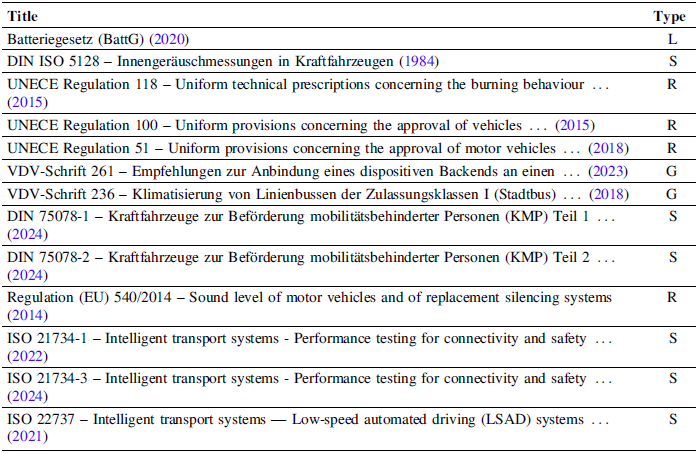
Two experts from the research project “Munich’s automated public transportation system with ride pooling, solo buses and bus platoons (MINGA)” shared 32 applicable German and European standards, laws, regulations or guidelines for accessibility, safety and security in transit buses for this review. One of the experts works in the procurement department of a bus operating company and the other is a representative for passengers with reduced mobility. In this review the vehicle category M3 – Class I in the execution as a low floor vehicle is focused, which is the typical transit bus used throughout Europe with a maximum mass over 5,000 kg and more than 22 passengers besides the driver (UNECE 107.9, 2024). Three international standards for automated transit buses were considered additionally to the from the experts shared documents for the review. Based on the research questions the following inclusion criteria were defined for the review: Descriptions of technologies or measures to increase accessibility, safety and security in transit buses making it possible or requiring for the bus driver to execute driving and non-driving tasks required in vehicle category M3 – Class I – low floor vehicles. The complete list of the 22 included standards, laws, regulations and guidelines is shown in Table 1. The 13 excluded standards, laws, regulations and guidelines are listed in Table 2 and are not included in the reference list as they are not further considered in the analysis. The three international standards for automated transit buses were excluded in case of ISO 22737 (International Organization for Standardization, 2021) due to low considered speed of less than 30 km/h (autonomous shuttle) and for ISO 21734-1 and ISO 21734-3 (International Organization for Standardization, 2022, 2024) due to wrong vehicle class (standard is not considering standing passengers). The guidelines of the “Verband Deutscher Verkehrsunternehmen (VDV)” are supposed to support public transportation companies by explaining and summarizing applicable standards, laws and regulations (VDV, 2020). Therefore, there is some overlap between the guidelines and the other three document categories.
In the 22 included standards, laws, regulations, and guidelines 198 requirements were found using the inclusion criteria. These were then evaluated, whether they describe an opening design space due to the absence of the bus driver (54 impactful requirements) and whether they describe technologies or measures to improve accessibility (AC), safety (SF) or security (SC) or general measures (GE) in transit buses. In case of an overlap of a guideline requirement with other requirement types, the requirements of the VDV-guidelines were removed from the identified impactful requirements.
Included standards (S), laws (L), regulations (R) and guidelines (G)

Table 1 Long description
A table listing 32 applicable German and European standards, laws, regulations, or guidelines for accessibility, safety, and security in transit buses. The table has 20 rows and 3 columns. The columns are labeled Title, Citation, and Type. The Type column includes the categories S for standards, L for laws, R for regulations, and G for guidelines. The rows list various titles such as Produkthaftungsgesetz, Verordnung über den Betrieb von Kraftfahrunternehmen im Personenverkehr, Straßenverkehrs-Zulassungs-Ordnung, and many others. Each row provides the corresponding citation and type for each title.
Excluded standards (S), laws (L), regulations (R) and guidelines (G)

Additionally, the 54 impactful requirements were evaluated on their impact on autonomous transit buses: If a requirement adaption is needed as it describes a task executed by the driver or a control in the driver workplace and also need a new solution (RAN), if a new solution is required but no requirement adaption (NSR), or if the requirements is obsolete and therefore needs an adaption (OBS). The following sorting criteria were applied to the 54 impactful requirements for further analysis:
-
• passenger type: all (a) or with visual (v), hearing (h), physical (p), or cognitive (c) impairment
-
• location in the bus: outside (O), inside (I), driver workplace (D), entrance area (E), boarding aid (B), gangway (G), special area (S), priority seat (P), no location (N)
-
• part of the user journey: independent (0.), at the bus stop before entry (1.), at entry (2.), securing (3.), departure (4.), while driving (5.), during exit (6.), at the bus stop after exit (7.)
The set up of the table of the found requirements was discussed in a workshop with nine experts of the public transportation field. The nine experts are working in a procurement department of a bus operating company, as a representative for passengers with reduced mobility, in a city traffic administration, in a development department of a bus manufacturer, in a consulting agency and in a transport network association. The experts therefore bring a variety of perspectives into the discussion of the table set up. The experts agreed in the workshop that the included standards, laws, regulations and guidelines are comprehensive for them and the general set up is appropriate for the review. The feedback in the workshop was included in the setup of the final requirement table with all 198 entries.
4. Results
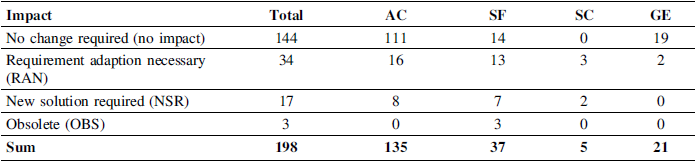
The 198 found requirements were categorized into four impact categories (Table 3). The first category consists of 144 requirements describing technologies or measures to improve accessibility (111), and safety (14) and general measures (19) not requiring a driver and therefore having no impact on autonomous transit buses. Those were excluded in the following analysis as there is no change to the state of the art. This for example includes accessibility measures like high contrast colors for passengers with visual impairment. 34 out of 54 impactful requirements need an adaption and a new solution (RAN).
Impact categories of the 198 in the review found requirements

17 require just new solutions (NSR) and 3 are obsolete and therefore the requirements need to be adapted or abolished (OBS) (Table 4). 24 out of 54 impactful requirements describe technologies or measures to improve accessibility (AC), 23 safety (SF), 5 security (SC) and 2 general tasks (GE) in transit buses. The impactful requirements are further described by the additional sorting criteria. 20 requirements describe measures for passengers with physical impairment (p), the remaining 34 describe measures related to all passengers (a). In regard to describing the location in the bus there are as follows; 15 requirements for measures inside the bus (I), 10 for the driver’s workplace (D), 4 for the entrance area(E), 16 for boarding aids (B), 2 for the special area (S), 1 for outside the bus (O) and 6 with no specific location (N). In regard to the part of the user journey (UJ) there are 35 requirements for user journey independent measures (0.), 10 for the step of entering the bus (2.), 1 for securing items or mobility aids (3.), 2 for departure from the bus stop (4.), 5 for while driving (5.), and 1 for during exit of the bus (6.).
54 impactful rated requirements on the design of autonomous transit buses (1/2)

54 impactful rated requirements on the design of autonomous transit buses (2/2)

Table 5 Long description
The table contains 25 rows and 7 columns. The columns are labeled Requirement, Citation, Paragraph, Content, Impact, Passenger, Location, and UJ. Each row lists a specific requirement for autonomous transit buses, including details such as the citation source, paragraph number, content type, impact level, passenger relevance, location, and user interface consideration. The requirements cover various aspects such as door release, emergency controls, ramp operations, driver visibility, safety equipment, ticketing facilities, and vehicle operation standards. Notable trends include multiple entries related to emergency operations and safety measures, as well as specific controls for drivers of electric buses.
5. Discussion
The impactful requirements listed in Table 4 show that the bus driver executes many non-driving tasks and is the general fallback for any technical failure, accident or hazardous situation. Removing the driver opens up a design space for other technical or organizational solutions for the same passenger service. The opening design space is visualized with a standard European transit bus in Figure 1. Only three requirements (OBS) regarding the dazzle free interior lighting (StVZO, 2024), driver´s view to the side (VDV-Schrift 234, 2020), and the padded passenger barrier to maintain driver visibility (VDV-Schrift 230, 2014) could become obsolete in autonomous transit buses if the requirements are adapted or abolished. The other 51 requirements (RAN + NSR) require different solutions to ensure the fulfilment in autonomous transit buses. 34 of those requirements (RAN) require adaptions in the standards, laws, regulations and guidelines for autonomous transit buses as they are specifically described as executed by the bus driver or controlled from the driver´s workplace. The remaining 17 requirements (NSR) require different solutions in the autonomous transit buses but no adaption of requirements. The results are further discussed in terms of the three main content areas accessibility, safety and security.
Visualization of design space due to the absence of the bus driver

Figure 1 Long description
A diagram of the design space of an autonomous transit bus without a driver. The diagram includes labels for various features and requirements. Key components include emergency equipment used by the driver, concealed emergency button, communication device, securing wheelchair free special area, dazzle-free lighting, ticket facilities, communication with other road users, driver's view to the side and padded barrier, lost property area, mandatory transport if no risk, rules of conduct, not exceeding capacity, nearby control of automatic ramp/lift and kneeling function with manual emergency control by the driver, no unauthorized use, and driver's manual deactivation, control, and reset of emergency doors, control of automatic doors. The diagram uses different colors and patterns to indicate new solutions required, obsolete solutions, accessibility, safety, and security.
5.1. Accessibility
As only 24 of the accessibility requirements of the full list in transit buses are dependent on the driver, it becomes clear that for accessibility many technologies and measures are already in place today in partially automated buses to reduce barriers (111 out of the total 135 accessibility requirements). However, the barriers still faced by people with disabilities in non-automated transit buses such as buying tickets, boarding the vehicle, navigating to the seat and alighting the vehicle will stay the same in autonomous buses (Reference Knightley, Holcombe, Gupta, Beard, HItchings, Forrest, Harris, Dawson, Ayling and CareKnightley et al., 2024). This means that so far, the bus driver reduces some of the major barriers through their service. This is also visible in Figure 1 with the striped red solutions required in the absence of a bus driver for a communication device to the driver/operator, door controls, ramp/lift and kneeling function controls, ticket facilities, securing forward facing wheelchairs, and freeing special areas for wheelchairs. 19 out of the 24 as impactful rated requirements for accessibility address passengers with physical impairment and the remaining five all passengers. 16 out of 24 impactful rated requirements for accessibility in autonomous buses are describing boarding aids. All boarding aids (ramp, lift and kneeling function) have to be operated – by today’s requirements – by the driver, either from the driver workplace – if in sight in the first door – or otherwise by nearby controls (UNECE 107.9, 2024). That means this function cannot be fully automated in today’s European regulation landscape and requires for accessible autonomous vehicles an adaption of regulations. Consequently, or because no fully automated ramps and lifts currently exist on the market, did many studies with autonomous shuttles use onboard staff to help passengers with impairments with boarding and alighting the vehicle and securing mobility devices (Reference Berg, Cregger and MachekBerg et al., 2022). However, Reference Azad, Hoseinzadeh, Brakewood, Cherry and HanAzad et al. (2019) also described as the result of their literature review that studies regarding user acceptance have shown that onboard staff is preferred by passengers. This is especially true for passengers with disability where the absence of staff is a potential barrier, but the autonomous driving system could also make it possible to provide an improved staff assistance in the bus, because they would be freed from the driving task (Reference Knightley, Holcombe, Gupta, Beard, HItchings, Forrest, Harris, Dawson, Ayling and CareKnightley et al., 2024).
5.2. Safety and security
For safety the obsolescence of previous required solutions could open up a new design space for enhancing interior lighting brightness, installing displays, or integrating other service facilities in areas that were previously required to ensure the driver’s side and frontal view. However, new technologies and measures are also necessary to meet safety and security requirements in the absence of a driver. In some cases, as accident situations requiring a first aid kit or a fire extinguisher, the task could be executed by other passengers or for technical failures through an emergency service team of the bus operator. Another approach could be to make systems more resilient or fail-safe using methods from other transport modes. That emergency situations are a major concern of potential passengers was also shown in a Swedish study with an autonomous transit bus, where 68.6% of participants said that handling of emergency situations without a driver will be more difficult (Reference Seredynski, Nielsen, Ekman and JohanssonSeredynski et al., 2023). A communication device with remote passenger support as a replacement of a communication device to the driver is suggested by BMDV (2024a), in the Swedish study 98.0% of participants agreed on this point (Reference Seredynski, Nielsen, Ekman and JohanssonSeredynski et al., 2023). As a result of their literature review, Reference Azad, Hoseinzadeh, Brakewood, Cherry and HanAzad et al. (2019) described that the presence of onboard staff is preferred by passengers not only for user acceptance of the system but also for the perceived safety and security of the autonomous transit bus. This is also shown by other services provided by the bus driver, which are difficult to replace, including the mandatory transport of passengers unless they pose potential risk to operation, safety or security or to not exceed the maximum mass or goods permitted (e.g. one wheelchair per special area) in the vehicle. To date, it remains unclear how to manage the rejection of specific passengers at a crowded bus stop in the absence of a driver, whether for security reasons or due to the system’s full capacity.
5.3. Implications
The review of today´s requirements for M3 Class I low floor vehicles in standards, laws, regulations and guidelines for application on autonomous transit buses showed that they can be categorized in four categories (Table 3). 73% (144/198) of all requirements belong to the first category of requiring no change and contain only requirements for accessibility, safety and general measures. This means most requirements for accessibility, safety and general measures of today’s partially automated buses also apply to fully autonomous buses. The other three categories contain requirements which have impact on autonomous transit buses. Only 6% (3/54) of those impactful requirements are obsolete in autonomous transit buses and could be adapted or abolished (OBS). 63% (34/54) of the impactful requirements describe tasks executed by the driver or controls at the driver workplace and therefore need an adaption for autonomous transit buses (RAN). 47% of the RAN category are accessibility and 38% safety, 9% security and 6% general requirements. This shows clearly that the driver is part of the accessibility and safety measures incorporated in today´s transit buses. The 31% (17/54) of the impactful requirements just need new solutions (NSR) and describe to 47% accessibility, 41% safety and 12% technologies and measures. Both categories of RAN and NSR requirements need new solutions to ensure autonomous transit buses comply to them and provide the same or better passenger service in the absence of a bus driver. New solutions not requiring a bus driver already exist for some of those requirements but for many new solutions need to be developed and tested in research projects or by bus manufacturers and then also have to be incorporated into standards, laws, regulations and guidelines.
Through the review of the existing standards, laws, regulations and guidelines, it becomes clear that, at this time, the driver cannot be removed from the transit bus while also comply to the listed requirements. Therefore, an adoption or inclusion of paragraphs about specific requirements for autonomous transit buses in Europe and Germany is needed. This goes beyond the regulatory changes previously discussed in the literature regarding vehicle approval and liability of autonomous transit buses.
5.4. Limitations
The 22 included standards, laws, regulations, and guidelines were reviewed in their most recent edition at the date of submission, however many of them undergo a continuous revision, so the listed requirements might have changed already by publication of the contribution and will change in the future. Therefore, a system that will keep them up to date will be required for the future.
6. Conclusion
The review of current standards, laws, regulations, and guidelines for M3 Class I low floor vehicles – transit buses showed that many requirements can also be fulfilled by autonomous transit buses with no change to the current bus design. However, 54 requirements were rated as impactful on the design of autonomous transit buses. The emerging design space by those 54 requirements on accessibility, security and safety through either necessary requirement adaptions, making new technologies and measures required or obsolete were discussed in this contribution. Without adaptions is complying to today´s regulation landscape and operation of an autonomous transit bus not possible. The rated and categorized impactful requirements will be included after an expert validation in a public guideline as one of the results of the research project MINGA. This shall make it easier for other autonomous transit bus projects to include accessibility, safety and security requirements from the start. However, the guideline shall also give recommendations for needed adaptions for autonomous transit buses with no driver or staff to politics and other organizations publishing standards, regulations and guidelines.
Acknowledgement
 This research was funded by the Federal Ministry of Transport of Germany (BMV) on the basis of a decision of the German Bundestag with roundabout 12.7 million euros as part of the project MINGA in the framework of the funding guideline “autonomous and connected driving in public transports.”



 Open access

