

Our own notion of the human person is still basically the Christian one.
—Marcel Mauss (Reference Mauss, Halls, Carriters, Collins and Lukes1985, 19)Subjectivity can be studied and comprehended not only as philosophical concept or psychological feature but also, and perhaps essentially, as semiotic construct that societies and cultures outline and shape through complex accumulations of signs. These signs, be they symbols, icons, or indexes, isolated or intertwined to compose texts or even galaxies of texts, delimit the boundaries and therefore the meaning of subjectivities and at the same time allow them to manifest themselves to become tangible objects in social arenas. Therefore, these same signs can be analyzed to retrieve the limits and identities of such subjectivities and the complicated interplay they engage and hold within a historical epoch, a social context, a cultural background and, last but not least, the features, limits, and identities of other subjectivities.Footnote 1
This essay will focus in particular on religious subjectivities, on the way in which religious cultures, animating certain religious groups and societies, instill in individuals the idea of their spiritual uniqueness, an idea that interacts, then, with self-awareness at all levels. The hypothesis that motivates the essay is that religions have played a primary role in nurturing the concept of human individuality, especially through that mighty cultural meme and figure that is “the soul.”Footnote 2 Variously denominated, articulated in its internal semantics, and represented through several devices, the idea of a spiritual principle that singles out the individual and determines its uniqueness not only in the immanent dimension but also in the transcendent one seems to characterize a vast majority of religious cultures. At the same time, the evolution of this idea closely parallels that of other principia individuationis in the secular sphere. The challenge of the semiotician who wants to understand societies through their signs is, therefore, to collect a coherent corpus of symbols, icons, indexes, and texts that manifest this idea of the soul, compare them across epochs and religious civilizations, and come up with some criteria for their typological arrangement (Reference LeoneLeone 2012a, esp. vol. 1).
There is maybe nothing that defines the core business of semioticians more deeply than the attempt to show the cultural determinations of what seems unproblematic and almost natural (Reference ParmentierParmentier 1994, 175–92). The idea of spiritual individuality is so rooted in most contemporary civilizations, be they religiously inspired or not, that it is almost impossible to imagine an epoch in which human beings did not have a soul, or rather did not conceive of themselves as bodies providing a sensorial envelope for an animating and individuating spiritual principle. The affirmation of Christianity—of its theology and imaginary—throughout the West has had a deep impact on the consolidation of such a cultural meme (Jüttemann, Sonntag, and Reference Jüttemann, Sonntag and WulfWulf 1991). Yet historical research, together with structural scrutiny, shows that the Christian idea of the soul does not spring magically from nothing but rather from a complex reelaboration of a labyrinthine amount of previous cultural materials, of signs, discourses, and texts that, shaped by preceding civilizations, were reshaped in the extraordinary cultural fabric of the new religion.
Methodological Prelude
Cultural semioticians skate on thin ice. They must establish the outline, and therefore the limits, of a civilization; single out and select some cultural artifacts as texts of such civilization; analyze these texts so as to find out whether they share a common denominator as regards a particular cultural object (in this case, the conception and the consequent representation of subjectivity); comprehend and describe the structural features of such common denominator in order to elaborate a typological scheme that might be subsequently compared with those relating to other civilizations, their texts, and their conceptions and representations of the same cultural object. In other words, they must construct a typological comparison of cultural determinations. Hence, they constantly run the risk of arbitrarily setting the limits of civilizations, single-handedly sorting out texts so as to confirm the semiotician’s initial hypotheses and prejudices in a vicious hermeneutic circle and developing typologies and comparisons that brutally force the complexity of history into reductive structural schemes.
As regards the specific topic of the present essay, is it really possible to single out, analyze, and describe, the semiotics of Greek, Jewish, and Christian subjectivities? Observing these three civilizations in greater depth, don’t their cultural frontiers, texts, conceptions, and representations explode in a pyrotechnic variety of nuances that defy any attempts at structural typing? Moreover, isn’t the notion of “subjectivity” itself, and even more that of “religious subjectivity,” unusable as the cornerstone of a comparative construction? Can religion really be adopted as a largely unproblematic framework for human representation in general? Confronted with such extremely thin ice, the semiotician has two options: (1) either give up skating and so renounce the vertiginous pleasure of gliding through civilizations and epochs in search of the essence of man, or (2) acquire suitable skates and the skill to use them.
Extending this metaphor, what are the methodological skates of semiotics when attempting a structural and typological comparison of religious cultures? The methodological contention of this essay is that such skates do not exist yet; they must be fabricated through suitable bricolage of three semiotic traditions: Lotmanian (school of Moscow-Tartu), Greimasian (structuralist semiotics), and Peircean (interpretative semiotics; Reference LeoneLeone 2012b). From Russian semiotician Lotman, cultural semiotics should borrow the idea that civilizations, including religious civilizations, can be characterized as semiospheres, that is, as semiotic macrostructures that feature both systemic coherence and unsystematic idiosyncrasies (Reference Lotman and ShukmanLotman 1990). On the one hand, systemic coherence allows the semiotician, upon thorough cultural analysis, to single out and define, at least hypothetically, what Lotman calls the “text of a culture,” that is, the typological matrix that characterizes a civilization and gives rise to the abstract core of all its manifestations across various kinds of signification (Reference Lotman and SilvestroniLotman 1992). On the other hand, unsystematic idiosyncrasies account for the fact that the limits of a semiosphere, as well as its core cultural mechanism, are never stable but are subject to continuous—sometimes dramatic—change under the pressure of such idiosyncrasies, whose presence and activity ultimately depend on the untamable creativity of human language.
The cultural semiotician should neither focus exclusively on systemic coherence, oblivious of unsystematic idiosyncrasies, nor concentrate only on the latter, neglecting the former. The cultural semiotician should always be, on the contrary, squint-eyed: looking for similarities in difference while looking for differences in similarity.
However, if Lotmanian semiotics provides an inspiring general framework for the semiotic, typological, and comparative analysis of cultures, it hardly offers specific directions on how to concretely conduct analyses of this kind. How should the semiotician set the limits of a semiosphere, single out the texts of a corpus in relation to it, develop a typological reading of this corpus, and, thereby, compare it with that extracted from the semiospheres of other epochs and civilizations?
In order to answer such questions, the cultural semiotician should rely on two specific methods. First, the structural one, as developed by Franco-Lithuanian semiotician Algirdas J. Greimas on the basis of Ferdinand de Saussure’s semiology, Louis Hjelmslev’s glossematics, and other structuralist trends; such a method is very suitable to describe and analyze the regularities of a culture, that is, culture seen in a static, systemic light. Second, the cultural semiotician should rely on the interpretative method, as developed by Umberto Eco as well as by North American semiotic anthropology on the basis of Charles S. Peirce’s philosophy of signification (Reference EcoEco 1976, Reference Eco1979; Reference SingerSinger 1984, Reference Singer1991; Reference ParmentierParmentier 1994); such a method is extremely apt to evoke and explain the metamorphoses of a culture, that is, culture seen in a dynamic, idiosyncratic light.
If Lotman’s theoretical concept of semiosphere offers an enlightening semiotic framework for the typological and comparative reading of cultures, Greimas’s analytical notion of “isotopy” contributes an operational tool for determining the cultural regularities of a semiosphere. Originally, such a notion (and tool) was not elaborated for the study of macrostructures, such as semiospheres, but for the analysis of microstructures, such as texts (literary texts, for instance; Greimas and Courtés Reference Greimas, Courtés and Crist1982, s.v. “Isotopy”). Starting from the hypothesis—a foundational one both in Hjelmslev’s glossematics (Reference Hjelmslev and WhitfieldHjelmslev 1953) and in Greimas’s generative semiotics (Reference Greimas, Perron and CollinsGreimas 1987)—that the expressive and the semantic planes of language feature isomorphic arrangements, it is presupposed that the structural analysis of the expression of language (in the case of verbal language, a hierarchic arrangement of phonemes or graphemes, decomposable along their distinctive features) offers a model for the structural analysis of its content (a hierarchic arrangement of “sememes,” decomposable in “semes”).
From this point of view, exactly as decoding the phonic chain of a verbal utterance consists in singling out and connecting its phonemes upon determining which of their traits are pertinent and which are not, so deciphering the semantic level of a text consists in singling out and connecting its sememes upon determining which of their semes are pertinent (technically, “nuclear semes”) and which are not (technically, “contextual semes”). In simpler words, according to the Greimasian perspective, interpreting a text—that is, finding out its meaning—consists in drawing the imaginary line that connects the nuclear semes of the text. The isotopy of a text is nothing but this line, the line of coherence running through its semantic plane. The Greimasian vision does not exclude that a text might be traversed by two or even multiple isotopies (technically, bi- or pluri-isotopic texts); in fact, these texts might be the rule, rather than the exception, in human communication. However, the Greimasian vision (and method) claims that there is a rational way to describe and analyze the isotopies of a text and also to determine which of them are hierarchically predominant (i.e., which ones should stand out in the interpretation of a text; Reference Greimas and PerronGreimas 1988).
The challenge that the Greimasian cultural semiotician faces stems from the methodological hazard of applying the notion (and tool) of isotopy not only to microtexts (as Greimas mostly did, although he also contributed to the foundation of sociosemiotics; Reference Greimas, Perron and Collins1990) but also to macrotexts, and specifically to cultures considered as texts, that is, in Lotman’s language, to semiospheres. Can one formulate hypotheses on the isotopies of, for instance, “the Russian civilization,” exactly as one formulates hypotheses on, for instance, the isotopies of Anna Karenina? Does not such application of a microsemiotic tool at the macrolevel run the risk of turning isotopies into stereotypes? The ice is thin, the risk evident. But if it cannot be avoided, it can at least be contained.
On the one hand, only the vastness and internal differentiation (along both synchronic and diachronic lines) of the selected semiospheric corpus can guarantee the soundness of an isotopic reading; the semiotician should not characterize the features of an entire civilization on the basis of the analysis of a single text belonging to it. At the same time, the semiotician should not aim at exhaustiveness either: a semiospheric corpus is such exactly insofar as it is the product of a pondered and careful selection, of a “semiospheric log,” methodologically and epistemologically similar to a geological log.
On the other hand, the semiotician should always present the isotopic reading of a semiosphere as a hypothesis, which can be either corroborated or falsified when other texts of the same semiosphere, not included in the corpus, are considered by different semiospheric logs. Does a semiotician characterize the Russian civilization—on the basis of a semiotic analysis of several of its literary, pictorial, cinematographic, and so on, texts—as crossed by an isotopy of paralyzing nostalgia? Does this characterization lead to the comparison with other semiospheres and their own configurations and manifestations of feelings and passions? Other scholars will be able to either corroborate such a hypothesis, showing that other texts in the same semiosphere confirm such reading, or to falsify it, arguing that different, more nuanced isotopies run through the same semiosphere and that not only one but several isotopies of nostalgia characterize the Russian civilization (to the point that one should talk about “Russian civilizations” and therefore rethink the comparison with other semiospheres entirely).
However, in this case too, the latter, objecting scholar should not simply claim that the isotopic hypothesis of the former is not correct but should instead indicate on which texts other hypotheses might and should be formulated. In other words, just as the isotopic reading of a literary text can be disputed only by showing that it neglects to single out and connect certain important sememes in the text—and by suggesting a more encompassing way of doing it—so the isotopic reading of a cultural macrotext, of a semiosphere, can be disputed only by demonstrating that it fails to single out and connect certain important cultural memes in the semiosphere—and by suggesting a more comprehensive way of doing it. This is how the process of isotopic reading of a semiosphere can be evaluated: through the indication of more texts that, in the semiosphere, confirm such reading (corroboration) or through the suggestion of different isotopies that, in the semiosphere, account for more texts (falsification and elaboration of a new hypothesis).Footnote 3
The following paragraphs will therefore propose some hypotheses about a possible isotopic reading of the cultural role of religious subjectivity in the semiospheres of the Greek, Jewish, and Christian civilizations. Such a reading will also lead to additional hypotheses about ways to connect, compare, and contrast these isotopies. Based on semiospheric logs in such civilizations and not on an impossible exhaustive knowledge of them, these hypotheses of isotopic reading will therefore be open to either corroboration or falsification, but always having as their background the firm awareness that no isotopical reading can effectively do the complexity of a civilization justice.
This is the third, and final, point that this methodological prelude will raise: Peirce’s evocation of the human signification as bound to a process of unlimited semiosis is perhaps the best antidote against any ossifying reading of cultures. Human language is a source of cultural stability just as it is a resource of cultural change, so that any structural characterization of a civilization can only stem from a painful, albeit necessary, process of culturological taxidermy.
The signs of the Christian soul will be analyzed through several steps, beginning with a concise overview of the Greek iconography—and imaginary—of psyché, dwelling in particular on a little studied figure of its representation: the mouth as a bodily fissure of communication between life and death, as a channel through which psyché can leave the body and begin its postmortem existence. Next, the same figure will be retrieved, albeit with some different features, from the Jewish imaginary of the vital breath, also in the context of narratives that depict the passage from life to death. Finally, both semiotic schemes—the Greek and the Jewish one—will be compared with each other and with the Christian semiotics of the soul, which also adopts the figure of the open mouth as frontier between the animated and the soulless body but interprets it in unprecedented ways. In sum, the essay offers a tentative first step toward an articulated semiotic typology of religious subjectivities, of religious ways of imagining the relation between matter and spirit, life and death, immanence and transcendence, individuality and indistinctiveness.
Distillation: Cesare Ripa’s Iconologia
Like most Greimasian semiotic research, this essay too will start from a dictionary analysis—not a contemporary dictionary, however, nor one based on words, but that extraordinary synthesis of Christian visual culture that Cesare Ripa (Reference Ripa1603) distilled at the dawn of modernity in his Iconologia, whose entry “Anima ragionevole e beata” (sensible and blessed souls) reads:
A very gracious damsel, she will have her visage covered with a very thin and transparent veil, a clear and luminous dress, a pair of wings on her shoulders, and a star on top of her head. Although the soul, as theologians say, is an incorporeal and immortal substance, it is nonetheless represented in such a way that humans, bound to those corporeal senses, can understand it, not in a dissimilar way from the one in which God and the Angels are usually represented, albeit they too are incorporeal substances.
It is depicted as a very gracious damsel, for it was made by the Creator—who is the source of every beauty and perfection—in his likeness.
Her visage is represented as veiled so as to denote that she is, as Saint Augustine says in the Book on the Definition of the Soul, substance that is invisible to the human eyes, and substantial form of the body, in which she is not perceptible, but can be comprehended only through certain exterior actions.
The clear and luminous dress is supposed to denote the purity, and perfection of her essence. There is a star over her head, because the Egyptians meant by the star the immortality of the soul, as Piero Valeriano reports in the 44th book of his Ieroglyphics.
The wings on the shoulders denote, thus, its agility, and spirituality, as well as its two powers of intellect and will.Footnote 4
This verbal text proposes a visual definition weaving together several Greimasian isotopies, both those rediscovered in the multiple stratifications of Christian culture and those absorbed by it from past and parallel civilizations and then reelaborated. The wood engraving (fig. 1) that accompanies the text seeks to translate this tangle of semantic characterizations into an ideal typical image. As will be seen, Ripa’s entry, as with every definition, is semiotically interesting not only because of the isotopies that it includes but also for those that it excludes. The semiotic analysis of this “distillation” of the Christian imaginary of the soul will allow the recuperation and description, at least to a certain extent, of its previous transformations.Footnote 5 As in many studies of textual semiotics, this one too starts from the end of the text: “The wings on the shoulders denote, thus, its agility, and spirituality, as well as its two powers of intellect and will.”Footnote 6
Cesare Ripa’s depiction of the “reasonable and blessed soul” (Reference Ripa1603, 22). Photograph by the author.

Volatility
In condensing several centuries of Christian images of the soul, Ripa’s Iconologia underlines its agility, a semantic characteristic that is transposed in the figure of the wings not only in the verbal text but also in the visual one that translates and accompanies it, a figure further emphasized by its plastic rhyming with the posture of the damsel’s arms and by the celestial reference to the star. This line of semantic coherence crosses the entire history of Christianity, but is not at all born with it. Both from the Greek culture and, in a different way, from the Jewish one, Christianity has inherited the idea of a principle of individualization that has the characteristics of volatility, in the sense of lightness, of agility, of longing for what is superior and ethereal, but also in the sense of a disquieting slipperiness.
Signs of the Greek Psyché
The role that the concept of psyché plays in the semantics of Greek culture is carved out differently in comparison with that of the Christian soul (Reference CollignonCollignon 1875; Reference RoscherRoscher 1909, 3, pt. 2:3201–37; Icard-Gianolio Reference Icard-Gianolio1994). Nevertheless, the latter receives from the former not only the isotopy of volatility but also some of the figures that manifest it. Above all it inherits a feature that the archetype of the triumphant soul of Ripa in a way conceals. Be it in the Greek iconography of psyché or in the Christian one of the soul, the figuration is not emblematic but narrative: the occasion of representing the vital principle of man, indeed, is not abstract but related to a story of death. It is in its visual narrative or rather in that of the passage from life to death that this iconography emerges and consolidates as a response to the disturbing mystery of a vanishing subjectivity (Icard-Gianolio Reference Icard-Gianolio1994, 584; see also especially Reference ChantraineChantraine 1980, 1294–95, s.v. “psyché”).
That explains the proliferation of figures of volatility, many of which the Greek culture too borrows from past civilizations. From the Archaic period, there appear funerary sirens, such as the Athenian ones now housed in the National Museum of Athens (fig. 2) and in the Louvre (fig. 3), both endowed with large wings and bird paws and tails (Reference SalinasSalinas 1864). The second one, a terra-cotta figurine dating from the first century BCE, presents a rather peculiar posture found also in the Archaic period statuary.Footnote 7 An abundant literature stimulated by Georg Weicker’s monograph Der Seelenvogel in der alten Literatur und Kunst (Reference Weicker1902, and see Reference Weickeralso 1895) has demonstrated that these funerary sirens do not limit themselves to immortalize the funerary crying by transfixing it but rather are Archaic period representations of psyché (Reference BaumeisterBaumeister 1889, s.v. “Seirenen,” 1642–46) Some, perhaps based on an Egyptian model, even depict it with a bird’s head, like the clay seal of Cretan origin known as the “eagle woman” (Reference HogarthHogarth 1902; see fig. 4).
Funerary siren, Archaic period, pantelic marble, 24 cm high, Athens, National Museum, inventory number (i.n.) 774 (found by Salinas in 1863). Reproduced from Reference RoscherBaumeister (1885, 1644).
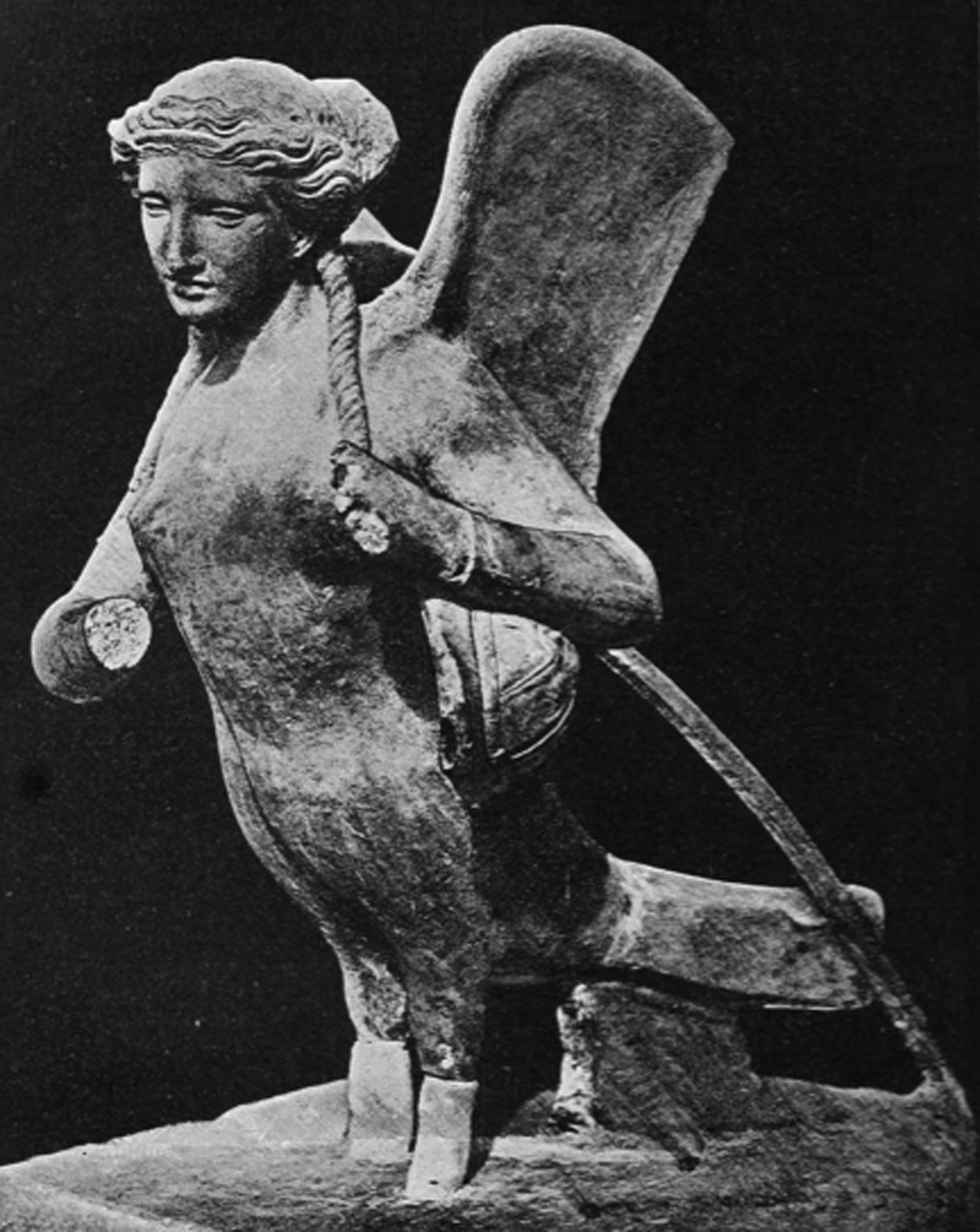
Funerary siren, first century BCE, terracotta, 22.5 cm high, Paris, Louvre, i.n. Myr 148 (found by École Française d’Athènes in 1883). Reproduced from Reference RoscherBaumeister (1885, 1645).

Clay seal, Archaic period, Mycenaean house in Kato Zakros, eastern Crete (found by the British School of Athens in 1901), in a drawing by Émile Gillieron. Reproduced from Reference HogarthHogarth (1902, 79).

In a more recent epoch, the narrative dimension of the iconography of psyché becomes prevalent. This does not limit itself to depicting, like in the artifacts examined above, the slipperiness of the soul in its mortal destiny but rather constructs around this isotopy the complex scaffolding of a story. This is certainly the case with the Attican belly-shaped amphora with black figures dating from 550–540 BCE (fig. 5). On its back there is a psyché (fig. 6) with a female head and a body entirely of a bird. The iconographic type has not changed, but the narrative setting has: the volatility of psyché is not depicted only as a potentiality but rather as an act of flying, and the topological structure of the image transforms its spatial position into a clue for the construction of a story. Almost leaning on the tip of the warrior’s lance, psyché seems to precede his advancing toward the battleground, as if to indicate that there the warrior will lose his own psyché or will tear it away from others, without possible alternatives. The gaze of the warrior, furthermore, underlined by the position of his head, and staring exactly at the point in space where psyché hovers, appears dreamy, lost before the fatality of battle.
Attican belly-shaped amphora with black figures, signed by the potter Exékias, 550–540 BCE, 44.5 × 30.5 cm, Paris, Louvre, i.n. F 53 (found in Vulci in 1883). Reprinted with the permission of the photo agency of the Réunion des Musées Nationales, Louvre, Paris.

Image on the back of the Attican belly-shaped amphora with black figures. Reproduced from Gerhard (Reference Gerhard1843, cvii).

In other subsequent representations, the theriomorphic nature of psyché is accentuated and specified: its volatility is depicted not through winged sirens but through actual birds, each with its specific range of connotations. In a lekythos now in the National Museum of Athens, for instance, a cock stands on a funerary stone (fig. 7). Weicker (Reference Weicker1905, 207) demonstrated how this bird, whose comb and spurs remind one of those of a warrior, lends itself to representing in effigy the psyché of the dead in battle. In the Greek imaginary, in fact, the slipperiness of psyché characterizes almost all of its figures—including chthonic ones, like the snake—but is specified every time according to the particular figure that is chosen and according to the narrative context into which it is inserted. Indeed, from the time of Homer, psyché was evoked as smoke, dream, bat, bee, and fly, until finally appearing, with copious iconography, in the form of nocturnal butterfly, to the point that both Aristotle and later Hesychius of Alexandria call the nocturnal butterfly “psyché.” If Homer, Aristotle, and Hesychius all link psyché with something that flies, this does not mean there has not been any transformation in the figurative isotopy of volatility running through the Greek civilization. However, fluctuations of this isotopy are never so dramatic as to challenge its essential coherence. In Homer psyché appears under the shape of a light and fleeting thing, compared to smoke or dreams in Odyssey 11.220–22 and bats in Odyssey 24.6–9 (Reference Dihle and KlausDihle 1982); in Aristotle and Hesychius a different figure is adopted to convey the same semantic feature: psyché becomes a nocturnal butterfly in Aristotle’s History of Animals (5.19.550b; Hesychius, Glossary, s.v. “ψυχή”). References to the volatility of psyché can be found in Greek popular beliefs (Reference Rohde and HillisRohde 1950, 574–85), as well as in Orphic (Aristotle, De anima 1.5.410b), Pythagorean (Diogenes Laertius, Vitae philosophorum 8.21), and neo-Pythagorean (Porphyry, De antro nympharum 23–25) philosophical doctrines, Plato (Phaedo 105 d–e, Phaedrus 245 c–e), and the Stoics (Cicero, Tusculanae disputationes 1.18.31.42–43. 77; see Reference TurcanTurcan 1959; Reference VermeuleVermeule 1979, 18–19).
Lekythos, 24 cm high, National Museum of Athens (excavations of Eretria), i.n. 1158. Reproduced from Weicker (Reference Weicker1905, 207).

It is always in relation to this volatility that another semantic feature, shared by birds and the souls of the dead, originated. If the flight of the former offered to fortune-tellers a matrix from which to extract indications about the future (Reference Manetti and RichardsonManetti 1993), the same characteristic was attributed to the volatility of psyché depicted in the form of a bird, an analogy already underlined by Schrader (Reference Schrader1907): “The mysterious unpredictability of the coming and going of birds in space, where the abode of immortals was believed to be, made them look, more than other animals, as suitable to offer allusions about the gods’ will or the obscurity of the future.”Footnote 8
The iconography of psyché as winged siren or volatile animal is too vast to be exhaustively explored here and has already been made the subject of an abundant literature. A particular configuration, however, remains to be analyzed, one which is very significant for the light it sheds on the relationship between the two different but interweaved imaginaries of the Greek psyché and the Christian soul. An amphora of Sicilian origin (fig. 8) presents on the back, at right, a scene that has been unanimously interpreted as Eos taking the corpse of his son Memnon away from the battle field, so that his killer Achilles does not defile it. On the front, there appears a scene that has been deciphered by many as representing two demons that transport the corpse of a warrior, even though on the identity of the latter, Memnon or Sarpedon, there has been no agreement.Footnote 9 Either way, what is of interest is that in both scenes, psyché abandoning the corpse of the killed warrior is depicted in the form of volatile being, a sort of dove in the first case, a figurine of warrior with lance and shield in the second. Three aspects of this eidolon must be highlighted.Footnote 10 First, it does not represent in effigy a generic idea of psyché but rather a specific psyché, namely, a warrior psyché, that maintains the individual characteristics of the body with which it was associated. Second, the posture and directionality of the figurine make it seem to leap upward, lance at rest. And third, similar to the dove in the twin scene, this warlike eidolon seems to come directly out of the open mouth of the corpse.
Amphora from the Bourguignon collection in Naples, of Sicilian origin. Reproduced from the iconographic scheme provided in Reinach (Reference Reinach1899, 347).

This configuration is not unique and can be found later, for instance, in a scene engraved on an Etruscan mirror (fig. 9). Eduard Gerhard (Reference Gerhard1867, 73, 114–15) interprets such configuration as an Entführungsscene (kidnapping scene), specifically that of Eos kidnapping Cephalus, but it is possible to decipher it as a scene of “corpse removal,” that of Eos saving Memnon’s dead body from defilement by Achilles, especially if one reads as psyché the bird represented at the bottom on the right of the mirror, here too in proximity to the mouth of the deceased.Footnote 11
Etruscan mirror, currently missing (found in Rome in 1840). Reproduced from the iconographic scheme provided in Reference GerhardGerhard (1867, pl. 361).

A further specification of this iconography of psyché is found in an image painted on a fragment of kylix (fig. 10). From the bottom border of the fragment, in the center, there emerges the profile of the head of a warrior covered by a helmet; he falls facing upward, clenching a shield with the right hand. In the adjoining area, on the right, another shield can be seen distinctly, perhaps that of the killer, the victorious warrior. Paul Hartwig (Reference Hartwig1891, 340), who has analyzed this fragment exhaustively, recognizes in it the deadly battle between Hercules and Eurytus, narrated in the Bibliotheca of pseudo-Apollodorus (3.10.5). It is necessary to underline, in this context, the presence of a male winged figurine that, hovering horizontally over the head of the dying warrior, presses his forehead with its left, while with its right seems to direct its fingers, like a forceps, toward the mouth of the dying one. Scholars are unanimous in identifying this figurine as that of an evil demon, probably a ker, who kidnaps the psyché of the warrior, tearing it out of his mouth. The impression of such an extractive effort is highlighted by the posture of the wings, which seem upturned in an attempt to imprint on the flight of the figurine an upward mobility, an élan that distances it from the near corpse. The impression is further corroborated by analogous examples. Consider, for instance, the two iconographies, analyzed by Witte (Reference de Witte1833), depicting the killing of Alcyoneus at the hand of Heracles (fig. 11). In the first case, an evil ker attacks the giant in an attempt to draw his life out of his mouth, while the unfortunate resists twisting his head. In contrast, in the second case, similar to that of the amphora (fig. 8) in the Bourguignon Collection, the winged figurine does not seem at all hostile but seems instead to accompany, if not personify, the psyché of the defeated warrior that abandons the body.
Fragment of kylix, National Museum of Palermo, i.n. 2351, in a drawing by Carmelo Giarizzo. Reproduced from Hartwig (Reference Hartwig1891, 340).

Iconographic schemes of the killing of Alcyoneus at the hand of Heracles, from depictions on vases of Nolan provenience. Reproduced from Reference de WitteWitte (1833, pl. D).

There is no way here to expand the vast field of the Greek imaginary and iconography of psyché. It is sufficient to underline that, on the basis of these few examples, a typology is delineated that, mutatis mutandis, resurfaces later in Ripa’s Christian iconography. It is up to the semiotician to describe this typology not only from a diachronic perspective but also from a structural point of view.
A distinction can be perceived, first of all, between generic representations of psyché—for instance, winged sirens and other volatiles, in which the analogical correspondence between the identity of the deceased and that of its psyché on the run is nonexistent or rather bland—to the point that there is no link whatever between the gender of the deceased and that of the effigy of its vital principle—and later depictions that, instead, are a simulacrum, in the sense that they attribute to the eidolon that abandons the body an identity that is analogous to that of the deceased.Footnote 12 Whereas in the first case the body of psyché is a so-called objective enunciation of it, in the second case it is a subjective enunciation in which somatic and functional characteristics are transmitted and maintained in the passage between life and death. As will be seen, the theology, iconography, and imaginary of Christianity are prey to the same dilemma: how much subjectivity is there in the soul after death?
Second, in the series of images presented above, another structural distinction can be perceived between a psyché conceived as an active subject, capable of autonomously escaping the dead or dying body and hovering outside of it, and a passive subject, or even an object of operations, that is, a psyché chased, seized, extracted, and moved in space and time as well as subjected to axiologically opposite forces, to quarrels between good and evil demons, as is quite evident in the iconography of the kerostasia,Footnote 13 or in that of the psychostasia.Footnote 14 This essay will dwell also on the Christian prolongations of this dichotomy.
Third, it is necessary to underline that to these structural tensions correspond several plastic, figurative, and iconic configurations, which translate the diverse conceptions of psyché into visual forms. Its depictions are, indeed, always volatile, yet according to an articulated typology of flights, each a kinetic expression of a precise imaginary.
Finally, there emerges the idea of a body wrapping outlined by precise borders, going beyond which, either autonomously or rather surrendering to the action of the demons, psyché abandons the body and determines ipso facto its status of corpse. The point of no return of this crossing between the living and the dead body is the mouth according to the Homeric indication in the ninth canto of the Iliad: “but the life of a man cannot come back, it cannot be uplifted or captured by force, once the frontier of teeth has been crossed.”Footnote 15
Signs of the Jewish Vital Principle
The other pillar of the Christian imaginary of the soul, Jerusalem, imagines the mouth as a fissure of communication between the living body and the soulless one, emphasizing the directionality of the entrance as much as that of the exit.Footnote 16 For instance, in the Babylonian Talmud, Avodah Zarah 20b reads, “It is said of the Angel of Death that he is all full of eyes. When a sick person is about to depart, he stands above his head-pillow with his sword drawn out in his hand and a drop of bile hanging on it. As the sick person beholds it, he trembles and opens his mouth [in fright]; he then drops it into his mouth. It is from this that he dies, from this that [the corpse] deteriorates, from this that his face becomes greenish.”Footnote 17
With characteristic typological verve, the Jewish categorization of ways of dying, also exposed and commented on in depth in the Talmud (Berakhot 8a),Footnote 18 amounts to 903 ways, a number calculated according to the Kabbalah.Footnote 19 The Talmud describes two of them, the most difficult and the gentlest one. Both descriptions convey not only the intention of highlighting the subjective variability of death but also the fact that such variability is translated into an extractive imaginary, in which it is depicted according to different degrees of resistance to detachment, always through that life/death channel of communication that is the mouth. The two extremes, the most difficult death and the easiest, are hence evoked with splendid extractive images: “Similarly it has been taught: Nine hundred and three species of death were created in this world. For it is said: The issues of death, and the numerical value of Toza’oth is so. The worst of them is the croup, and the easiest of them is the kiss. Croup is like a thorn in a ball of wool pulled out backwards. Some people say: It is like [pulling] a rope through the loopholes [of a ship]. [Death by a] kiss is like drawing a hair out of milk.” Also in the Talmud, Baba Batra 17a explains that “Six there were over whom the Angel of Death had no dominion, namely, Abraham, Isaac and Jacob, Moses, Aaron and Miriam. Abraham, Isaac and Jacob we know because it is written in connection with them, in all, of all, all; Moses, Aaron and Miriam because it is written in connection with them [that they died] by the mouth of the Lord.” Death by the mouth of the Lord, by a kiss of God, hence corresponds to the least degree of extractive friction that is conceded to humans in the difficult passage from life to death. While for most this occurs when the Angel of Death introduces a drop of bile into the mouth of the dying one, for those very few chosen ones who die by the mouth of the Lord, such directionality is inverted: they simply return to God, having been kissed by him, the vital breath that they had received from him.Footnote 20 Maimonides dwells with customary profoundness on the implications of this type of death in the third book of the Guide for the Perplexed, dedicated to “How God is venerated by the perfect man,” writing,
The meaning of this saying is that these three died in the midst of the pleasure derived from the knowledge of God and their great love for Him. When our Sages figuratively call the knowledge of God united with intense love for Him a kiss, they follow the well-known poetical diction, “Let him kiss me with the kisses of his mouth” (Song i. 2). This kind of death, which in truth is deliverance from death, has been ascribed by our Sages to none but to Moses, Aaron, and Miriam. The other prophets and pious men are beneath that degree: but their knowledge of God is strengthened when death approaches.Footnote 21
The Jewish culture too has produced an iconography, mostly confined in texts not meant to be used in the synagogue. In one of these, a Haggadah of Spanish origin dating from the second half of the fourteenth century, splendidly illuminated with 142 illustrations and known as the Haggadah of Sarajevo, on folio 26 recto there appears an illustration of Exodus 12:29–31 that seems to refer to the theme of the topology of the mouth as a fissure of communication between life and death (fig. 12).Footnote 22 The famous passage describes the tenth plague of Egypt, when the Lord kills all the firstborn overnight. The image, to be read from right to left, is divided into two sections of equal dimensions. In the first one, on the right, five children lie in their beds under colorful blankets, sheltered by the vaults of their homes. Here the variety of colors is due not only to the verve of the illuminator but also to the necessity of indicating that God, as the biblical passage reads, kills all the firstborns with no distinction between those of the poor and those of Pharaoh. The second part of the image, on the left, depicts Pharaoh and his dignitaries; the screams that arise from Egypt wake them in the middle of a cobalt blue night.
Haggadah of Sarajevo, depicting Exodus 12:29–31, from the second half of the fourteenth century, 228 × 162 × 37 mm, folio 26 recto. Reprinted with the permission of the National Museum of Bosnia and Herzegovina.

The element that is most interesting, however, is the thin luminous rays that, in the right part of the image, penetrate the vaults of the Egyptian houses and inexorably strike the mouths of the firstborns, tracing out garish dark signs on them. Scholars have suggested that these signs should be interpreted as depicting rats or vampires attacking the dead (Bunčić Reference Bunčić2011, 76). However, it is not improbable that the illuminator knew of the Jewish image of the Angel of Death and that, by depositing drops of dark ink on the mouths of the children in effigy, he wanted to reproduce the gesture of the Angel, who introduces drops of bile into the mouth of the dying ones.Footnote 23
Some of the structural traits singled out in the Greek imaginary of psyché seem at least comparable with those that emerge from the verbal and visual texts produced by the complex and variegated Jewish semiosphere analyzed here. These include the idea of a body wrapping that at the moment of death turns into a frontier through which the passage between life and death is manifested; the emphasis on the mouth and on the rich semantic field that surrounds it—from breath to word—as crucial fissure of such a passage; the imaginary of a subjective variability of such passage, manifested through different extractive configurations; and finally, the notion of an agency of such extraction that is normally exterior to the subject and antithetical to it, delegated to the Angel of Death and its poisonous power.
There are, nevertheless, also many differences, only some of which can be singled out here. While in Athens, the gap between life and death is dilated into an aerial space where icons of volatility proliferate, in Jerusalem such a gap seems contracted into a solid imaginary, without figures or swirls.Footnote 24 In fact, when the Mosaic description of the creation of man speaks of a spirit or breath with which he was endowed by his Creator (Gen. 2:7), such spirit is mostly conceived as inseparably connected, if not totally identified, with the lifeblood (Gen. 9:4; Lev. 17:11). And it is, instead, subsequently through contact with Persian or Greek thought that the idea of a disincarnated soul, with its own individuality, takes root in Judaism and finds its expression in later biblical texts, until being categorized by biblical literature as ruah, nefesh, and neshamah, to indicate the spirit in its primitive form, in its association with the body, and in its activity as connected to the body, respectively.Footnote 25
The second crucial difference is that, in an ideal Greimasian semiotic square, the narrative configuration of “the kiss of God” seems to emphasize, at least asymptotically, the neutral semantic axis /nonlife/-/nondeath/, on whose visual representations Calabrese (Reference Calabrese and Pezzini1991) wrote memorable pages.Footnote 26 It is not impossible for men who annihilate themselves in the knowledge of God to slip without friction out of their body, “as a hair drawn out of milk.”
Signs of the Christian Soul
Many of the elements of these imaginaries are combined and modified in the Christian semiosphere, whose theology and iconography of the soul lean on both the Greek and the Jewish pillars and simultaneously construct a peculiar thought and figurativeness, in which the gap between life and death seethes with volatile figures and at the same time continuously alludes to the possibility of a soul that, image of God, would return to him without mediations (Reference BoussetBousset 1965, 136–69).Footnote 27
Early Christian art depicts the archangel Michael and the devil competing for the soul of Moses, according to verse 9 of the Letter to Judas; moreover, verbal and visual representations of the journey of the soul among the perils of the afterworld date from as early as the fourth century. In the immense Christian theology and iconography of the soul, however, stand out those exegeses and depictions that, magisterially studied by Von Donat de Chapeaurouge, revolve around Luke 16:19–31, the parable of the rich man and Lazarus, here in the Revised Standard Version (RSV):
There was a rich man, who was clothed in purple and fine linen and who feasted sumptuously every day. And at his gate lay a poor man named Lazarus, full of sores, who desired to be fed with what fell from the rich man’s table; moreover the dogs came and licked his sores. The poor man died and was carried by the angels to Abraham’s bosom. The rich man also died and was buried; and in Hades, being in torment, he lifted up his eyes, and saw Abraham far off and Lazarus in his bosom. And he called out, ‘Father Abraham, have mercy upon me, and send Lazarus to dip the end of his finger in water and cool my tongue; for I am in anguish in this flame.” But Abraham said, “Son, remember that you in your lifetime received your good things, and Lazarus in like manner evil things; but now he is comforted here, and you are in anguish. And besides all this, between us and you a great chasm has been fixed, in order that those who would pass from here to you may not be able, and none may cross from there to us.” And he said, “Then I beg you, father, to send him to my father’s house, for I have five brothers, so that he may warn them, lest they also come into this place of torment.” But Abraham said, “They have Moses and the prophets; let them hear them.” And he said, “No, father Abraham; but if some one goes to them from the dead, they will repent.” He said to him, “If they do not hear Moses and the prophets, neither will they be convinced if someone should rise from the dead.”
Interpretations of this evangelical passage diverge since antiquity. Tertullian, in the seventh chapter of De anima, spots in it a proof of his thesis on the corporeity of the soul: “Unless the soul possesses a corporeality of its own, the image of a soul could not possibly contain a figure of the corporeal substance. … For what is incorporeal is incapable of being hold and kept in any way. … There must be a body, through which punishment and relief can be experienced.”Footnote 28 Augustine, however, disagrees, and in the twenty-first book of the City of God writes, “I would rather say that spiritual beings will burn without a body of their own, as that rich man burned in hell when he screamed: I am tortured by this flame. … In the same way was incorporeal the flame by which he was burned, the drop he asked for, as well as the images in the dream of those who sleep, or even more the incorporeal beings for those who have an intuition in ecstasy, although such beings have the appearance of a body.”Footnote 29 All Christianity has been divided for centuries over such question.
Origen follows Tertullian’s interpretation in the sixth chapter of the Epistola ad Gregorium, according to which “only of God it can be supposed that he exists without material substance and without any relation with a corporeal projection.”Footnote 30 Of the same opinion are Faustus of Riez, Hilary of Poitiers, and John Cassian.
Cassiodorus’s De anima, in the sixth century, agrees instead with the Augustinian interpretation: “The former [the rich man] has never spoken with any corporeal tongue, and the latter [the poor man] did not have any finger, from which drops could fall and relieve the fire of the squanderer.”Footnote 31 The same trend can be followed in Rabanus Maurus’s Tractatus de animae and Claudianus Mamertus’s De statu animae.Footnote 32 Among the Greek church fathers, Basil in the OMIΛIA EIΣ TO, Πρóσεχε σεαυτῴ (“understand through the incorporeal soul, which lives in you, that God is incorporeal”)Footnote 33 and Gregory of Nyssa in the De mortuis (“the spirit too is without matter, it cannot be seen; it can be understood only through belief”) manifest the same opinion.Footnote 34
The chain of references could be followed right into contemporary theology.Footnote 35 It is necessary, however, to at least mention here the way in which images depict this debate,Footnote 36 and in this the chronological perspective must yield to the structural one. Let one consider, as one example, a late medieval fresco from Denmark (fig. 13). The axiology of the parable is rendered by a bipartition—on the left, the death of the rich man and, on the right, that of Lazarus. In both cases, the Greek formula of the soul that leaves the body through the mouth is adopted (Reference BeckettBeckett 1926, 79, 361). It is not at all a unique iconography, if one considers a depiction of the martyrdom of Saint Alban (figs. 14a–14b) in the English psalter dedicated to him, in which the soul comes out of the mouth of the saint’s cut-off head, as shown in the bottom-right corner (Reference GoldschmidtGoldschmidt 1895; Pächt Reference Pächt1960);Footnote 37 or a representation of Saint Scholastica’s death (figs. 15a–15b), produced roughly two decades later, in which the soul is once again a bird that flies from the mouth of the saint toward the heavens; or a capital column in the basilica of Vézelay (fig. 16), dating from the second half of the twelfth century, in which the depiction of the parable of the rich man and Lazarus distinctly shows the soul of the former torn away from him by demons through his mouth (Salet and Adhémar Reference Salet and Adhémar1948).
Late medieval fresco in the refectory of the Carmelite convent in Elsinore, Denmark. Reproduced from Beckett (Reference Beckett1926, 362).

Saint Alban Psalter, produced before 1123. Reproduced from Pächt (Reference Pächt1960, 416, pl. 99).

Saint Alban Psalter, detail.
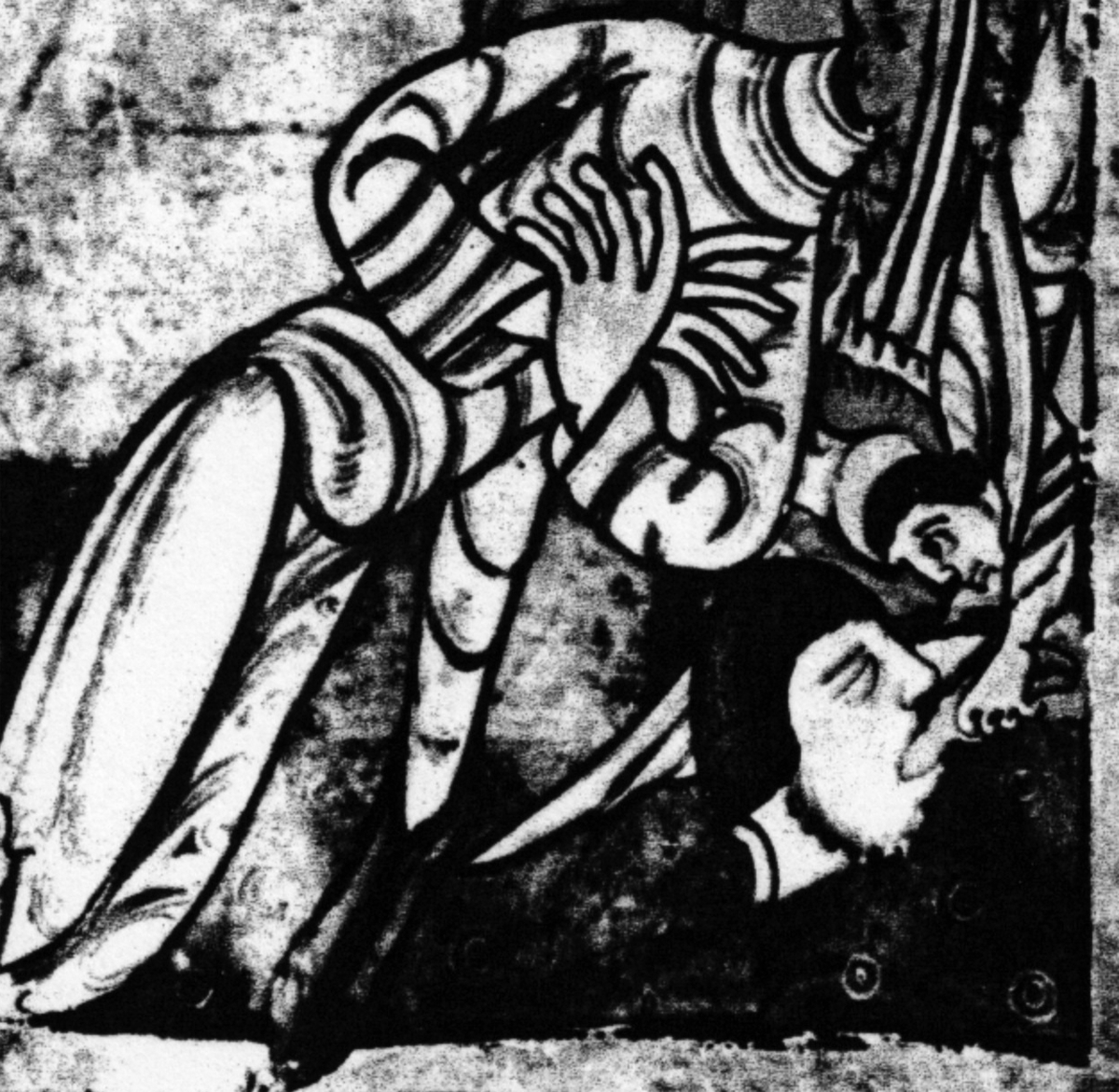
Stuttgart Psalter, ca. 1150, Cod. Hist. Fol. 415 der Württembergischen Landesbibliothek Stuttgart, fol. 25r. Reproduced from Löffler (Reference Löffler1928, 49, pl. 24).

Stuttgart Psalter, detail.

Capital of the fourth column in the south nave of the basilica of Vézelay, second half of the twelfth century. Photograph by the author.

Further emphasis on this iconographic formula is seen later in Byzantine representations, for instance, on the southern and western walls of the Saint George Chapel in the Serbian Orthodox monastery of Hilandar on Mount Athos, where a cycle of frescos from the third quarter of the fourteenth century translates into images the Canon of the Agonizing (εἰς ψυχoρραγoῦντας), attributed to the martyr and poet Andrew of Crete (fig. 17). The third scene represents the moment of the departure of the soul, mentioned in the second verse of the sixth canto. The soul of the monk, in the form of a naked figurine, flings itself upward with the help of an angel, while its right foot still remains entangled in the mouth of the deceased (Djurić Reference Djurić1964, 68).Footnote 38
Southern wall of the chapel of Saint George in the Serbian Orthodox monastery of Hilandar, Mount Athos, third scene from the Canon of the Agonizing fresco cycle, third quarter of the fourteenth century. Reproduced from Djurić (Reference Djurić1964, pl. 10).

The theme of the mouth as a fissure of communication between life and death, immanence and transcendence, is even more evident in the fresco of the Serbian Orthodox monastery of Dečani, in Kosovo, dating from 1347–48 and depicting the parable of the rich man and the poor Lazarus (fig. 18).Footnote 39 In this tripartite narrative, a couple of angels, on the left, carries the soul in arms of the poor—whose soulless body lies on a miserable mat just below—toward the skies, barely hinted at by a whitish curve in the top center of the image.Footnote 40 On a marble bed, in the center, an angel grasps the soul of the damned rich man through his mouth with a pitchfork, almost prefiguring the infinite scorching heat that he will suffer in hell, evoked in the bottom-right corner.
“The rich man and Lazarus,” fresco from the Serbian Orthodox monastery of Dečani, Kosovo, 1347–48. Photograph by the author.

Christian theology, and thus Christian iconography, is divided, at times siding with the party of the subjective corporeity of the soul and at times contorting itself into paradoxical depictions in which the immateriality of the soul is represented through the denial of any subjectivity.Footnote 41 This is the case of the splendid Dormition of the Theotokos depicted in a Macedonian fresco (fig. 19) dating from around 1299, in which the Greek formula of the passing of the soul through the mouth is associated with the willingness of denying its materiality, with the paradoxical result of subverting the correspondence of genderFootnote 42 between the Virgin and the figurine of her soul.Footnote 43
“Dormition of the Theotokos,” fresco in Saint Nicola of Prilep, Macedonia, ca. 1299. Photograph by the author.

Conclusion
This essay can only hint at the complex and fascinating textual adventures forged at the crossroad between Greek, Jewish, and Christian cultures. And only one of the isotopies offered by Ripa’s verbal and visual distillate has been unraveled, that of the volatility of the soul, and regarding this, only a handful of texts have been cherry-picked, centered on the figure of the mouth as the fissure of the vital principle.Footnote 44 Other isotopies should be perused, other texts analyzed, and each of them needs to be situated in their own context, examined in their own semantic and expressive structure (Reference LeoneLeone 2004, Reference Leone2010, Reference Leone2012a). Both historical-cultural and semiotic-typological study of the religious imaginaries of the soul are fundamental to understanding their legacy in subsequent conceptions of subjectivity, a subjectivity that existed well before that the corresponding word became a keyword in the modern and especially postmodern debate on individuality, agency, recognition, responsibility, and so on. One of the main objectives of an anthropologically oriented semiotics is to point out, through textual and contextual, synchronic and diachronic, historical and typological analysis, that the profile of the concept of subjectivity is as variable as its etymology, with many metamorphoses in its long and complex mutation. The “subject,” as some societies and cultures conceive it today, did not exist in the same form in other epochs and civilizations, not with the same boundaries, characteristics, competencies (Reference Mauss, Halls, Carriters, Collins and LukesMauss 1985). Yet, history shows no absolute fractures in the unfolding of the human predicament. Traces of the features of the current idea—and representations—of subjectivities can be detected in the past, through that slow but continuous transformation of signs, discourses, and texts through which ancient cultures are transmogrified into the modern ones, and these into contemporaneity.
In the mare magnum of these expressions that give voice to humanity and leave its fingerprints through history, the semiotician can only humbly work with the archaeologist, the historian, the anthropologist, and elaborate models that retrace the thread of such transformations with more cogent coherence by individuating the inner mechanisms, the salient passages, the leaps and gaps through which forms and concepts mutate in the passage from one civilization to another. Tracing back the mechanism that animates this concept one cannot just start with Christianity but with its roots, with Athens and Jerusalem, investigating how the Christian imaginary of the soul borrows elements from previous religious ideologies so as to construct its own articulation of the dialectics between interiority and exteriority, distinction and indistinctiveness, autonomy and dependence.
Taking as a point of departure—after the model of Greimas’s analysis of the semantics of dictionaries—Ripa’s condensed definition of the Christian iconography of the soul, one of its lines of semantic coherence (isotopies), that of volatility, was particularly examined: for the Greeks, the Jews, and then for the Christians, the principle of agency that inhabits the body is not a stable, permanent feature, but a fleeting element, and one whose slipperiness is all the more emphasized in narratives of death. It is in these narratives, indeed, seeking to represent that ineffable instant that is the passage from life to death, from existence to nonexistence, that the imaginary of the inner principle of life manifests itself with dramatic urgency. If the human body is inhabited, or even “possessed” by a principle of agency that determines the peculiarities of its existence, what happens to that body when death comes to determine its immobility and inexorable deterioration? And most importantly, what happens to the principle held by this body? How much of the individuality of human existence survives the abrupt transition between life and death? Each civilization answers these questions with different signs, representations, and narratives, which seek to propose abductions about what can neither be deduced nor induced.
The Greeks, as it was pointed out, most often depict a vital principle that lacks the gravity of its corporeal receptacle and is therefore able to fly away at the moment of death, a moment that can be euphoric or dysphoric depending on whether such ethereality is conceived as anguishing fleetingness or as liberation. In any case, the Greeks seldom renounce to give an incarnation to the bodiless principle of life that abandons the body: a variegated typology of embodiments—and depictions—of psyché derives from such imaginary, where all the signs of the Greek soul are characterized by volatility, but then vary as regards the extent to which they manifest a somatic correspondence between the dying body and its fleeting psyché. The Jews, on the contrary, do not attribute a corporeal figure to the principle of life, since such corporeal figure is, indeed, the body itself. When life ceases, the visibility of such principle through the body ceases as well, and what matters is rather to envisage the dynamics of circulation of this principle, the going into and coming out of the body at the moments of creation/birth and death, respectively. The Jewish imaginary therefore does not multiply the visible figures of the soul but rather the invisible operations to which it is subjected at the moment of creation (hence the reflection, which the Christian iconography will subsequently manifest also visually, of the “enlivenment of Adam”) and, above all, at the moment of death (hence the articulation of a typology of ways of dying, and the mystical reflection on the “kiss of God”). The meager iconography of the Jewish imaginary of death does not represent the soul departing from the body but rather the operations of a transcendent, invisible agent that gives or takes back that invisible principle that he had infused into a visible body.
As has been demonstrated, the Christians inherit from the Greeks both the idea of the extreme volatility of the soul and the obsession for its representation. They too give rise, mainly in the Christian iconography, to a various range of signs and narratives that materialize the immateriality of the soul at the moment of its departure from the body, with degrees of correspondence between the individuality of the former and the distinctiveness of the latter that vary as well. Yet, Christianity, and especially the “logocentric” discourse of its theology, remains quite wary of the legitimacy of representing the invisible principle of life that the body, when alive, shares with its invisible creator. What follows from this juggling between Greek hypericonicity and Jewish hyperaniconicity is perhaps not schizophrenia but certainly contradiction, paradox, and representative sophistication.
A semiotic anthropology of religious cultures must pinpoint the splendid variety through which human groups have imagined, signified, and communicated the sacred throughout the ages. What are, indeed, these civilizations if not conglomerates of signs clustered by a certain “family resemblance,” by a certain style and bend of the human imagination? And yet, the articulation of such variety into harmonious typologies, meant to increase our intelligibility of the abundance of signs that populate the world and its history, immediately leads to the detection of analogies, similarities, and continuities and to singling out what crosses the epochs and the civilizations and constitutes, indeed, the fundament of humanity. That our subjectivity is expressed through the signs of language, that they are able to fly in the ethereal space that separate bodies, and that they somehow linger in that space, alive, even after the body is dead, are fundamental characteristics of the modern imaginary of subjectivity, novel enactments of an ancient dream.Footnote 45



