


Introduction
The White-tailed Swallow Hirundo megaensis and Ethiopian Bush-crow Zavattariornis stresemanni are restricted to a 10,000–15,000 km2 area (Collar and Stuart Reference Collar and Stuart1985, Stattersfield et al. Reference Stattersfield, Crosby, Long and Wege1998, BirdLife International 2006a,b) of dry, bushed savanna between the towns of Yabelo, Mega and Arero in southern Ethiopia (Figures 1 and 3). They were respectively described in 1942 and 1939, and little has since been determined about their ecological requirements or sensitivity to human activities. Although concerns about habitat change within their tiny range have been expressed for some time (Collar and Stuart Reference Collar and Stuart1985, Ash and Gullick Reference Ash and Gullick1989, Hundessa Reference Hundessa1991), in recent times the situation appears to have substantially worsened owing to a rapid human population influx and the expansion of commercial agriculture around the towns of Yabelo and Mega (Bassi Reference Bassi2002, Borghesio and Giannetti Reference Borghesio and Giannetti2005, Gedeon Reference Gedeon2006). Moreover, numbers of Ethiopian Bush-crows sighted on road-counts made in 1989, 1995 and 2003 were found to have dramatically declined (Borghesio and Giannetti Reference Borghesio and Giannetti2005), causing the species's IUCN status to be changed from ‘Vulnerable’ to ‘Endangered’ (BirdLife International 2006b).

Figure 1. Map of study region showing all sightings of White-tailed Swallows, whether recorded during point counts, line transects, or opportunistically (some dots represent more than one discrete sighting).
A possible mechanism contributing to this decline was suggested by an interpretation of satellite imagery indicating that over the past two decades there has been a marked increase in density of vegetation cover within the Yabelo Sanctuary (Borghesio and Giannetti Reference Borghesio and Giannetti2005). This large, nominally protected area was originally set up to conserve savannas holding a population of the threatened Swayne's Hartebeest Alcelaphus buselaphus swaynei, but also lies in the core of both endemic bird species’ ranges. The recent vegetation changes were speculatively attributed to bush encroachment within the sanctuary owing to overgrazing by herds owned by Borana pastoralists, fire suppression on a large government-owned cattle ranch which also occupies a considerable portion of the sanctuary, and the disappearance of wild browsers (Borghesio and Giannetti Reference Borghesio and Giannetti2005). The causes of bush encroachment are controversial and highly complex (e.g. Ward Reference Ward2005): it has long been considered principally a response to overgrazing, although there appear also to be strong interactions with fire, rainfall and soil nutrients and changes in atmospheric CO2 (e.g. Oba et al. Reference Oba, Stenseth and Lusigi2000). Bush encroachment is a well established component of the widespread rangeland degradation that has occurred throughout the Borana region during the past few decades, leading to considerable concern about pastoral livelihoods as well as wildlife conservation (e.g. Coppock Reference Coppock1994, Gemedo Dalle et al. Reference Gemedo Dalle, Maass and Isselstein2006). Such changes within the Yabelo Sanctuary in particular are of great concern for the White-tailed Swallow and Ethiopian Bush-crow because it is the only designated protected area within their ranges, although it receives little or no active management and its boundaries are vague (EWNHS Reference Fishpool and Evans2001).
The degree to which such large-scale landscape changes have affected and are likely in future to affect the populations of these two species is, however, unknown, as their precise habitat requirements are obscure. It has been observed that the White-tailed Swallow's range lies above the 1,500 m altitudinal contour (Collar and Stuart Reference Collar and Stuart1985), but no environmental correlate with this elevation is known. Availability of columnar termite mounds, in which the species has been suspected to breed (Benson Reference Benson1946), may be another consideration, but the only reported breeding records come from houses and deep traditional wells (Holtam Reference Holtam1998). The Ethiopian Bush-crow, recently determined as phylogenetically closest to the Asian ground-jays Podoces (Ericson et al. Reference Ericson, Jansén, Johansson and Ekman2005), has a noticeably patchy occurrence even within its small range (Benson Reference Benson1946). This may be related to a need for deep, loosely packed soils for foraging and/or to associations with human habitation (Gedeon Reference Gedeon2006), and results in a tendency to select areas with more open terrain (Borghesio and Giannetti Reference Borghesio and Giannetti2005).
The aim of this study was to assess the distribution, abundance and habitat preferences of the two species. Specifically, we sought to (i) assess the limits of their geographical ranges, (ii) provide, using simple repeatable methodology, baseline quantitative data on their abundance, (iii) determine which broad-scale habitat types they favoured within the mosaic of different woodland types in the region, (iv) assess within habitat type which fine-scale vegetation characteristics were associated with their presence, (v) determine whether they occurred in association with termite mounds or human habitation (including buildings and livestock), and (vi) assess whether they were commoner inside or outside the Yabelo Sanctuary. We used standardised, replicable methods (point counts and line transects, following Bibby et al. Reference Bibby, Burgess, Hill and Mustoe2000), and providing two independent estimates of abundance and habitat preference that may be compared for consistency. Additionally, we conducted systematic interviews with local people to assess their knowledge of the Ethiopian Bush-crow and any changes in its abundance.
Methods
Study area
Fieldwork (see inset to Figure 1 for location of study region) was carried out between 15 July and 29 August 2005. This was during the post-breeding period of both the White-tailed Swallow (April–May, Holtam Reference Holtam1998) and the Ethiopian Bush-crow (about March–June, Benson Reference Benson1946, Collar and Stuart Reference Collar and Stuart1985). Fieldwork was conducted both inside and outside of the Yabelo Sanctuary. The sanctuary's boundaries are ill-defined, but on the advice of the warden (A.D.), in this study we took it to lie between 05°12' and 04°37' N, and 38°09' and 38°35' E. The altitude of the sanctuary varies from 1,430 m to 2,000 m, and the annual rainfall is around 700 mm, with a principal rainy season between April and May and a smaller, more variable one in October (EWNHS Reference Fishpool and Evans2001). The commonest habitat inside the Yabelo Sanctuary is savanna woodland dominated by various species of thorny acacia (Acacia tortilis, A. brevispica, A. horrida, A. drepanolobium) and Commiphora, and broadleaved Terminalia and Combretum (Borghesio and Giannetti Reference Borghesio and Giannetti2005). In addition, small patches of juniper Juniperus procera forest can be found in upland areas just outside the boundaries of the sanctuary, although grazing and logging threaten its persistence (Borghesio et al. Reference Borghesio, Giannetti, Ndang'ang'a and Shimelis2004). The dominant land use is pastoralism by the Borana people, although settled agriculture (both commercial and subsistence) has increased in recent years (EWNHS Reference Fishpool and Evans2001, Bassi Reference Bassi2002, Borghesio and Giannetti Reference Borghesio and Giannetti2005, Solomon Tefera et al. Reference Solomon Tefera, Snyman and Smit2007). Additionally, we searched for both study species farther afield along the roads to Moyale (south-east), Konso (west), Agere Mariam (north) and Arero (east) in a qualitative attempt to define their current geographical range limits. At least one day's searching was undertaken in each direction. Bush-crow nests are very conspicuous, and particular effort was made to search for these as an early indicator of the species's presence, and then to search for birds in their vicinity.
Point counts
We undertook a total of 521 systematic point counts. Locations were chosen by randomly selecting a position on a map, and then getting as close as possible to this location on available access roads and tracks. The first three point counts of each morning were taken at 500 m intervals on a bearing perpendicular to the access road, beginning 250 m away from the access track. The next two point counts were then taken at 500 m intervals on a bearing 90 degrees to the first three point counts, followed by two further point counts, if time allowed, on a bearing 90 degrees from the middle two point counts. Each point count was made by 3–6 observers, drawn from A.W., M.E., C.B., R.C., A.D., T.D., C.W., B.G., E.G. and S.M. and including at least one experienced observer. A settling period of two minutes was observed before beginning each 15-minute census period. The number of each study species identified with certainty was recorded together with whether they were sighted inside or outside (to a maximum of 250 m) a 25 m radius of the centre of each point count at first detection (Bibby et al. Reference Bibby, Burgess, Hill and Mustoe2000). In order to minimise the effect of time and weather conditions on bird detectability, point counts were undertaken only between 06h15 and 09h15, and not in unfavourable weather (strong wind or rain).
Line transects
We undertook a total of 790 line transects totalling 395 km and grouped in clusters of about 9, typically during the afternoon (11h15–18h00), with a few exceptions earlier in the morning. Location of each cluster of transects was randomly selected using the same method as for point counts. Each transect segment was 500 m long, and clusters were composed of three groups of three, forming three sides of a rectangle. The start of the first line transect of each session was 250 m away from the access road, at a bearing perpendicular to it. Three line transects were then undertaken on the same bearing. A gap of 250 m on the same bearing was then allowed, before running another three transects on a 90 degree bearing to the left. After another 250 m gap on the same bearing, a third segment of three transects was taken on a 90 degree bearing to the left of the second segment. Transects were generally carried out in mid-afternoon, and were walked at a constant rate of approximately 2.5 km/h. At every sighting of each study species, the number of individuals seen was recorded, together with the distance of each individual from the transect line at the first observation. We attempted never to record any individual twice, although inevitably this cannot be established with certainty in every case. The location and altitude of the start and finish of each 500 m transect was recorded using GPS. Each point count or line transect was made in a unique location.
Habitat assessment
Habitat variables were assessed for the area within a 25 m radius of the centre of each point count (variables 1–7), or of a point midway along each transect (variables 1–6). For line transects, we additionally noted whether houses were present within 200 m of either side of the transect line, and counted the number of termite mounds present within 5 m of either side of the transect line, along its entire length. Habitat assessments were made independently by all observers within the group (n = 3–6), and the median then used in subsequent analyses.
Habitat variables recorded at every transect and point count are listed in Table 1. In addition, we recorded time, altitude and GPS coordinates, and whether the site lay inside or outside the Yabelo Sanctuary boundaries as defined above. On the basis of the number of point counts or transects carried out in each habitat type, the sampled area comprised approximately 60% Acacia woodland, 20% Commiphora woodland, 10% Combretum–Terminalia woodland, 7% farmland and 3% villages. Finer-scale variables (2–8 in Table 1) might be intercorrelated, potentially generating problems of colinearity in multivariate analyses. Inspection of correlation matrices showed that this was only so to a small extent: sward height and proportion of bare ground were strongly negatively correlated with each other (r = −0.476), so we combined these two variables as their first principal component, which explained 74% of the variation (eigenvalue = 1.48) and loaded positively on bare earth and negatively on sward height. Tree counts in each height category were strongly correlated with canopy cover but not with one another, so were used as independent predictors and canopy cover omitted.
Table 1. Habitat variables recorded during transects and point counts.

We analysed the fine-scale potential predictors (2–8 in Table 1) in relation to incidence of each study species in Acacia and Commiphora woodland, to attempt to detect what features of their presumed original habitat were favoured. It would be inappropriate to pool all habitat types in such an analysis, because they may differ qualitatively in ways that are not related to the fine-scale measures we quantified. For example, although Combretum–Terminalia woodland is structurally similar to Acacia woodland (the three woodland types could not be distinguished on the basis of measured variables in a cluster analysis), it differs in having predominantly broad-leaved rather than thorny vegetation.
Opportunistic sightings
We also recorded all sightings of each study species outside the time spent undertaking point counts and line transects. On each occasion, we recorded the number of individuals concerned and their activity, as well as the habitat type (see above) within a 25 m radius from the location of the initial sighting, and whether or not any houses were present within a 250 m radius of the initial sighting.
Detectability across habitat types
To investigate whether any differences among habitat types could be influenced by variation in detectability, we examined the mean distance at which each species was first sighted per transect (distances were not recorded for point counts). White-tailed Swallows were sighted at distances of up to an estimated 120 m from the transect line (mean 33 m). Among the three habitats in which White-tailed Swallows were recorded (Figure 3B), there were no significant differences in the distances at which individuals were first sighted (Kruskal-Wallis test, owing to non-normal residuals:  , P = 0.76). Bush-crows were sighted at distances of up to an estimated 200 m from the transect line, but the mean distance was 50 m. Again distance did not significantly differ among the three habitats in which bush-crows were recorded (
 , P = 0.14). Results (not shown) were similar for maximum sighting distances. This suggests that variation in sighting probability among habitats is unlikely to be an artefact of detectability, at least for the three habitats in which each species was recorded during transects.
Assessment of attitudes of local people towards the bush-crow
Interviews with representatives from villages inside and outside the Yabelo Sanctuary were undertaken throughout the eight-week study period. In an effort to gather information from a broad geographical area and to avoid pseudoreplication, only one interview was undertaken in each village (n = 60). Representatives from each village were randomly selected and ranged from young females looking after their family to male village elders. After introducing ourselves and describing the background to the project, we asked for permission to conduct a brief, verbal semi-structured interview. The standardised interview consisted of a series of questions (see Results) and an invitation to give any additional comments. The interview was conducted in Borana by A.D., who then translated the answers to Amharic to an interpreter who then translated them into English.
Statistical analyses
We assumed that all point counts and line transects were statistically independent, thus ignoring any spatial clustering, but results (not given) were similar when using the means of each cluster of counts or transects as sampling units. Habitat preferences were assessed using logistic models, with binary error structure and a logit link function (Crawley Reference Crawley2002), and final model selection was based on chances in Akaike's Information Criterion (AIC). Differences in sighting distances between habitat types were tested using simple ANOVAs. Proportional cover of bare earth, scrub, and canopy were arcsine square-root transformed before analysis, and distance of sightings from the transect line were log-transformed, to ensure normality of residuals when appropriate. Differences in habitat traits inside and outside the Yabelo Sanctuary were analysed using non-parametric Wilcoxon tests owing to non-normality of residuals. Statistical analyses were carried out using the software R (R Development Core Team 2006) and JMP 5. Geographical range size was estimated as the minimum convex polygon (MCP) drawn around all of each species records during the survey, and area was calculated using ArcGIS 9.1 and the Behrmann Equal Area Projection (Environmental Systems Research Institute 1999–2004).
We did not use distance sampling methods to calculate absolute densities from the transect data owing to possible violations of certain assumptions (Buckland et al. in press), as follows: that birds were detected at their original location (swallows were typically in flight), that cluster sizes were estimated without error (group membership was not recorded for bush-crows), and that transects were representative of the entire survey region. The last-mentioned remains unknown because the vast areas of potential habitat away from access roads have not yet been investigated, which is of concern given the apparently patchy occurrence of both species within accessible areas. Therefore, we have conservatively confined abundance estimates to encounter rates within a fixed distance of the transect line, within which we assume all birds were detected. These maxima were taken as the 75% quartile of the distribution of detection distances (30 m and 50 m for swallows and bush-crows respectively). We are relatively confident that distances were accurately estimated at such close ranges (narrower for swallows that we typically sighted in flight), and that nearly all individuals should have been detected at such close range.
Results
White-tailed Swallow
Incidence, encounter rates, and geographical and altitudinal range
Geographical range limits are reported in Table 2. The estimated range as defined by an MCP around all records was 5,564 km2. The mean altitudinal range at which White-tailed Swallows were recorded was 1,523 m (SD = 67 m, range 1,319–1,763 m, n = 99 sightings with altitudinal data). This compares with a total altitudinal range of 1,438–2,191 m and 1,303–2,109 m covered during point counts and transects respectively. Transects and point counts where swallows were sighted were at significantly lower altitude than those where they were not (t-tests for unequal variances, P < 0.001), but this is probably of little biological significance as sample sizes were large (513 and 801 respectively) and proportions of variation explained very small (r 2 ≥ 0.01).
Table 2. Range limits of the White-tailed Swallow and Ethiopian Bush-crow, as recorded in this study. Neither species was seen between each of these points and (respectively) Agere Mariam, Moyale, Arero, Yabelo or along the road towards Konso, in at least one day of searching in each case.

We recorded White-tailed Swallows on 100 occasions (comprising 168 individual birds) during 43 days of fieldwork; all records are plotted in Figure 1. Of these, 25 were during point counts, 36 were during line transects (Figure 2), and 39 were opportunistic. Swallows were usually sighted singly, but occasionally in groups of up to 6 individuals (mean group size of 39 opportunistic sightings = 1.6 individuals), and all but one opportunistic sighting were of birds in flight. Along transects, 67 individual White-tailed Swallows were recorded, and of these 52 were first sighted at an estimated 30 m or less from the transect line. This generates a within-30 m encounter rate of 0.13 individuals per linear kilometre (mean birds per km per transect cluster = 0.12, SE = 0.03, n = 84 clusters).

Figure 2. Map of study region showing locations of all transect clusters (each composed of about nine 500 m individual transects, see Methods) and White-tailed Swallows incidence within them.

Figure 3. Probability of encountering a White-tailed Swallow per (A) point count or (B) line transect in different broad-scale habitat types. Error bars show 95% confidence intervals for proportions (calculated according to Zar Reference Zar1996), and numbers above each bar indicate total numbers of counts or transects in that habitat.
Habitat use
The probability of encountering at least one swallow on a given point-count or transect, according to broad-scale habitat type, is shown in Figure 3 (note that sample sizes of transects in juniper woodland and villages were too small – seven and two respectively – to allow proportions to be calculated with any accuracy). The relative rarity of sightings generates broad confidence intervals, and the distribution of records among habitat types was not distinguishable from random (point counts:  , P = 0.48; transects:
  , P = 0.12). Nonetheless, it is striking that swallows were never recorded from broad-leaved Combretum–Terminalia woodland, and only once in Juniperus woodland. Their absence from the former is unlikely to be related to the absence of termite mounds or buildings, as the number of termite mounds along transects and point counts did not differ between this woodland type and the two types of thornbush (transects: F 1,728 = 0.09, P = 0.76; point counts: F 1,389 = 0.71, P = 0.40); nor did the presence or absence of houses (transects: F 1,554 = 3.41, P = 0.065; no data for point counts). Of the 39 opportunistic sightings of White-tailed Swallows, 26 were in Acacia woodland, 6 in Commiphora woodland, 4 in villages, 2 in farmland and one over open water (thus not differing from representation in point counts in the same habitats:
  , P = 0.95), and houses were present within 250 m of 15 of 37 sightings.
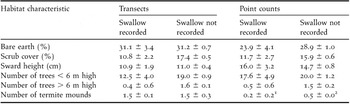
We then investigated finer-scale predictors of swallow incidence in Acacia and Commiphora woodland only (see Methods). Summary statistics for each habitat characteristic along transects and during point counts where White-tailed Swallows were sighted, and those where they were not, are given in Table 3. Multivariate models showed contrasting results for transects and point counts (Table 4), with swallow incidence being best predicted by low scrub and tall tree cover during transects, and by scarcity of termite mounts and presence of houses during point counts. Although it could not be revealed by the habitat characteristics we measured and hence remains anecdotal, in the field we had the impression that White-tailed Swallows preferred low-lying, open river valleys.
Table 3. Characteristics (means ± SE) of thornbush woodland (Acacia and Commiphora) along line transects where White-tailed Swallows were present (n = 32) or absent (n = 651), and during point counts where they were present (n = 20) or absent (n = 344).
1 Sample size was 19.
2 sample size was 332.
Table 4. Multivariate models of habitat predictors of White-tailed Swallow incidence.

Ethiopian Bush-crow
Geographical and altitudinal range, and encounter rates
Geographical range limits are reported in Table 2. The estimated range as defined by an MCP around all records was 5,257 km2. The mean altitude at which bush-crows were recorded was 1,542 m (SD = 67, range 1,303–1,784, n = 223 sightings with altitudinal data); see under White-tailed Swallow for total altitudinal range covered. The total number of bush-crow individuals recorded along transects was 512, and of these, 413 were first sighted at an estimated 50 m or less from the transect line. This generates a within-50 m encounter rate of 1.05 birds per linear kilometre (mean birds per km per transect cluster = 1.04, SE = 0.20, n = 84 clusters).
Habitat use
Ethiopian Bush-crows were observed in 116 of 521 point counts (22.3%) and 101 of 790 line transects (12.8%) (latter plotted in Figure 4). Sightings were significantly non-randomly distributed among habitat types (Figure 5; point counts:  , P < 0.001; transects:
  , P < 0.001). Most conspicuously, they were not recorded from juniper forest and very scarce in broadleaved Combretum–Terminalia woodland. Bush-crows were strongly associated with human habitation, as shown by their being recorded on three-quarters of all point counts in villages, and were also frequently seen in farmland. The lack of transect data for villages simply reflects that transects were too long to be conducted exclusively in villages; bush-crow incidence in relation to the presence of human habitation near transects is reported below.

Figure 4. Map of study region showing locations of all transect clusters (each composed of about nine 500 m individual transects, see Methods) and Ethiopian Bush-crow incidence within them.

Figure 5. Probability of encountering an Ethiopian Bush-crow per (A) point count or (B) line transect in different broad-scale habitat types. Error bars and data labels are as for Figure 2.
Summary statistics for finer-scale habitat characteristics are given in Table 5. Multivariate models (Table 6) revealed that the best predictors of bush-crow incidence in Acacia and Commiphora woodland were low scrub cover (transects and point counts), presence of houses, and the woodland being dominated by Commiphora rather than Acacia spp. (transects only).
Table 5. Characteristics (means ± SE) of thornbush woodland (Acacia and Commiphora) along line transects where Ethiopian Bush-crows were present (n = 98) or absent (n = 585), and during point counts where they were present (n = 86) or absent (n = 278).

1 Sample size was 75.
2 sample size was 276.
Table 6. Multivariate models of habitat predictors of bush-crow incidence.

Local knowledge of the Ethiopian Bush-crow
Sixty villages were visited and interviews were undertaken with a representative from each village. Permission to undertake an interview was granted by everyone who was approached. Forty-seven of the 60 respondents were able to recognise the Ethiopian Bush-crow from a choice of pictures from a field guide. This subset was then asked if its population had increased, decreased or stayed the same over the past 20 years: 66% stated the population had increased, 15% that it had decreased, 13% that it had stayed the same, and 6% had no opinion. The species's habitat was given as Acacia scrub (34% of respondents), villages and Acacia scrub (32%), farmland (11%), open and grazed areas (11%), farmland and villages (4%), open forest (2%), farmland and Acacia (2%), villages (2%) and unknown (2%). Of the 58 people who replied to the question ‘Are you aware of the limited range of the Ethiopian Bush-Crow?’ 69% stated that they were unaware, and 31% stated that they were aware.
The Yabelo Sanctuary
Differences in habitat variables in Acacia and Commiphora woodland inside and outside the Yabelo Sanctuary are reported in Table 7. This shows that sward height and all measures of tree cover were on average higher within the sanctuary than outside it, whereas proportion of bare earth was slightly lower. When protected status (inside/outside the sanctuary) was added to each of the minimal models of habitat preference, it significantly entered the models for neither species during transects (P > 0.21, ΔAIC always positive), but for both during point counts (bush-crows: sanctuary −0.62 ± 0.27, z = −2.38, P = 0.023, ΔAIC = −6.40; swallows: 1.33 ± 0.52, z = 2.55, P = 0.011, ΔAIC = −5.16). This indicates that during point counts, even after taking into account habitat differences, bush-crows were more frequently encountered inside the sanctuary, and White-tailed Swallows more frequently encountered outside it.
Table 7. Bivariate comparisons between habitat traits of Acacia and Commiphora woodland inside and outside of the Yabelo Sanctuary. P-values are for non-parametric Wilcoxon tests. Data from line transects and point counts are pooled, except for termite mound counts, which were recorded differently during each.

* n = 379 and 304, and 214 and 137 for termite mounds on line transects and point counts respectively.
Discussion
Geographical range: comparison with previous studies
The geographical limits found in this study for both species largely confirmed previous reports (Benson Reference Benson1942, Collar and Stuart Reference Collar and Stuart1985, Ash and Gullick Reference Ash and Gullick1989, Syvertsen and Dellelegn Reference Syvertsen and Dellelegn1991), although some minor differences were found. We saw no White-tailed Swallows as far north as Benson did during June–March in the early 1940s (18 km vs 50 km north of Yabelo), but we found them at a similar distance south (49 km vs 50 km south-east of Mega). The latter site was also our south-easterly limit for Ethiopian Bush-crows, which to our knowledge is an extension of about 24 km from the previously known range (Collar and Stuart Reference Collar and Stuart1985). For the swallow the estimated range was about a third of that estimated by BirdLife International (2006a), whereas for the bush-crow BirdLife International (2006b) followed the more recent findings of Borghesio and Giannetti (Reference Borghesio and Giannetti2005), with which our own broadly coincide. Since the present study, White-tailed Swallows have been sighted on several occasions in the Negele area, about 120 km north-east of the previously known range, which might reflect post-breeding dispersal (Gabremichael et al. in press); the same applies to a record of about 20 birds at Moyale on 30 June 1995 (Thouless 1996).
Habitat preference
Because this survey was conducted during the post-breeding season, the habitat preferences we detected may not apply at the most critical times of year. This is perhaps more a concern for the White-tailed Swallow, some sightings of which may have been of birds in transit between foraging areas, rather than indicating any consistent habitat choice. However, certain strong habitat preferences did emerge during the non-breeding season. The Yabelo–Mega area contains a mosaic of woodland types, with Juniperus and Combretum–Terminalia largely occurring at higher altitudes, and Acacia and Commiphora generally at lower ones, but with much interdigitation and patchiness. The incidence of both study species was similarly patchy, and depended on additional factors at a finer scale. Both species almost entirely avoided broadleaved Combretum–Terminalia woodland and Juniperus woodland/forest, and were most frequently sighted in the two thornbush woodland types (respectively dominated by Acacia and Commiphora spp.), as well as in farmland and around villages.
The possibility that differences in bird detectability between habitats generated the observed patterns can probably be excluded, because there was no difference among habitats in the distance at which swallows were sighted, at least within the three woodland habitats; this is conservative because habitats for which distances were not available (farmland and villages) were less occluded than woodland. Moreover, swallows are aerial foragers and bush-crows are gregarious and vocal, suggesting that they were unlikely to have been systematically overlooked. The reasons why both species avoid Combretum–Terminalia woodland remain unknown, although for bush-crows differences in substrate (given that they prefer loose rather than stony soil for foraging: Gedeon Reference Gedeon2006) is a possibility. Moreover, although Combretum–Terminalia was not a strikingly more occluded habitat in terms of tree number, scrub cover was higher than in the two thornbush types (mean ± SE = 25.2 ± 1.9% vs 16.7 ± 0.6 and 18.4 ± 1.0 for Acacia and Commiphora respectively), as was canopy cover (mean ± SE = 14.0 ± 1.3% vs 7.9 ± 0.4 and 4.3 ± 0.7 respectively), which might also help to account for both species’ avoidance of it.
Within the two thornbush woodland types, for both species the most consistent fine-scale predictor of their occurrence was density of scrub. White-tailed Swallows were more likely to be recorded in areas with low tree and scrub cover during transects, although these patterns were not supported by point count data (Table 4). Bush-crows were also more likely to be recorded where scrub cover was relatively low (Table 6), as well as with human habitation and Commiphora- rather than Acacia-dominated woodland, the first-mentioned lending support to the broader-scale observations of Borghesio and Giannetti (Reference Borghesio and Giannetti2005). Although one of the most distinctive features of the landscape in the Yabelo–Mega region is its abundance of tall, columnar termite mounds, the only association we found between them and either species’ incidence was that point counts records of White-tailed Swallow had fewer of them than those without (Table 4). However, it is possible that swallows may associate more strongly with them during the breeding season if, as suspected by Benson (Reference Benson1946), mounds are used as nesting sites.
A predictor of bush-crow occurrence that did not strongly emerge from these quantitative analyses was the presence of tall trees. This may be because of the fine spatial scale at which habitat was assessed, or because of seasonal effects; yet it seems difficult to deny their importance. The canopies of tall Acacia trees are used as nest sites by bush-crows, at a height of 2.5–10 m from the ground (Gedeon Reference Gedeon2006), as well as often providing shade for Borana villages; we discuss this association in more detail below.
Use of human-modified habitats
Both species were largely tolerant of, or appeared actively to prefer, partially human-modified habitats. White-tailed Swallows were most commonly observed around villages during point counts (Figure 3A), and in farmland on line transects (Figure 3B). Farmland might provide an open habitat favourable for foraging, and areas around human habitation might have higher food availability owing to the presence of flies attracted by domestic livestock (e.g. Møller Reference Møller2001). Away from villages we found no particular association between swallows and buildings, although these may turn out to be important determinants of occurrence when breeding.
Bush-crows showed an even stronger association with human habitation. They were observed during nearly 70% of point counts made in villages, and during transects in Acacia habitat there was a positive association between the presence of bush-crows and presence of houses near the transect line. Furthermore, bush-crows were observed in 18% of point counts and in 6% of line transects in farmland habitat. Here too the mechanism may be food availability, since the loose soil of ploughed areas was favoured for foraging, and another common foraging method involved lifting livestock dung to pick at larvae beneath it (Gedeon Reference Gedeon2006, all authors pers. obs.). Tall trees were also favoured as sites for villages owing to the shade they provide, as well as being favoured as nesting sites for bush-crows (nests are also used for roosting: Gedeon Reference Gedeon2006, pers. obs.); hence they may also drive the association between bush-crows and humans.
Is the Yabelo Sanctuary serving to protect either species?
White-tailed Swallows tended to be less common inside the sanctuary's nominal borders than outside, whereas the opposite was true for Ethiopian Bush-crows. This result was not consistently strong across habitats (Acacia vs Commiphora woodland) and methods (point counts vs transects), but statistically significant differences in incidence were found in two of four tests for each species. It is difficult to infer what factors might be responsible, since the same data were used to estimate each species’s habitat preference, and in the multivariate analyses we could not detect an effect of sanctuary occurrence independent of the other habitat variables investigated. One interpretation is that the vegetation changes that have differentially affected the Yabelo Sanctuary in recent years (Borghesio and Giannetti Reference Borghesio and Giannetti2005) have seemingly not had a disproportionately negative impact on bush-crows within it, although they may have affected White-tailed Swallows.
What habitat differences currently exist between the sanctuary and outlying areas? We found that tree and grass cover were generally greater inside the sanctuary than outside it (Table 7), which broadly echoes Borghesio and Giannetti's (Reference Borghesio and Giannetti2005) findings based on remotely sensed data. This was also consistent with the opinion of 75% of local Borana inhabitants interviewed, who considered that there had been a decrease in available grazing in recent years (R. J. Mellanby et al., unpubl. data). It is unclear why such differences between land inside and outside the Yabelo Sanctuary should have developed, given that there is seemingly no enforcement of sanctuary regulations, and evidence of overgrazing (such as bare earth and rill and gully erosion) was commonplace on either side of its assumed borders; Borghesio and Giannetti (Reference Borghesio and Giannetti2005) suggested that fire suppression may have played a role.
Has either species recently changed in abundance?
Population trends in the White-tailed Swallow are hard to assess given the absence of preceding surveys, although there are some qualitative indications that the population density may have decreased. During the 43 days of fieldwork involved in this study, comprising over 3,500 observer hours, White-tailed Swallows were sighted on 100 separate occasions, comprising 168 individuals or about one sighting per 35 hours of observation, in a variety of habitats within its range. Along transects, on average one bird was sighted every 7.6 km within a 30 m of the transect line. This can be compared with an assessment that the bird was “common” in 1941 (Benson Reference Benson1942), and with a report of 15–20 White-tailed Swallows per day driving along the 105 km road from Yabelo to Mega in 1971 (Collar and Stuart Reference Collar and Stuart1985), and 14 individuals along a 35 km section of this road in 1989 (Ash and Gullick Reference Ash and Gullick1989). There is hence some indication, albeit anecdotal, that the species might now be rarer than it once was. The standardised and straightforward census reported in this study could be repeated in future to allow a quantitative assessment of any population trend. However, we must emphasise that our survey took place during the non-breeding season, and local densities may differ when the species is nesting. Although we currently have no information about post-breeding dispersal, recent sightings of adults and immatures from near Negele, 120 km to the north-east of the study area (Gabremichael et al. in press) and one of birds at Moyale, 100 km to the south-east (Thouless 1996), intimate that the species might be less sedentary or range-restricted than previously thought. Future surveys need to be appropriately timed for their results to be comparable with ours.
The Ethiopian Bush-crow was recently uplisted to ‘Endangered’ (BirdLife International 2006b) on the basis of an 80% decline in density implied by roadside counts performed over a two-decade period (Borghesio and Giannetti Reference Borghesio and Giannetti2005). While habitat change in parts of its range has certainly occurred (Bassi Reference Bassi2002, Borghesio and Giannetti Reference Borghesio and Giannetti2005, Gedeon Reference Gedeon2006), any conclusions from comparing roadside counts over a period of time should be treated with caution. Roadside habitats are disproportionately vulnerable to change, particularly into farmland, but also through erosion and overgrazing as they are used to move livestock. Changes in population density along roads may therefore not be reflected over the species’s entire range (see e.g. Hanowski and Niemi Reference Hanowski and Niemi1995, Buckland et al. in press). Although qualitative, it is also interesting to note that two-thirds of local farmers and/or herders we interviewed considered that the bush-crow's population had increased, and only a minority thought it had decreased. Repeated censuses over its entire range, including away from access roads, would be very helpful to detect any change in its abundance, by comparing encounter rates, and could use rangefinders or GPS more accurately to estimate distances, so as to allow robust absolute density and hence population estimates.
Conservation prospects
The past decade has seen a considerable increase in human population and dramatic changes in land use in the Yabelo region, specifically the expansion of commercial agriculture (reviewed by Bassi Reference Bassi2002), and this trend seems likely to continue. However, we found that White-tailed Swallows, while always scarce and local, were, at worst, no less common around habitation and cultivation than outside it, suggesting that they may be tolerant of a degree of human-induced environmental change; but a survey during the breeding season is needed to determine their critical habitat requirements for nesting and foraging.
Ethiopian Bush-crows appeared actively to prefer a level of human land use. Specifically, they seem to be attracted to Borana pastoralist villages owing to the presence of tall Acacia trees and livestock, and actively feed in adjacent ploughed fields. However, this gives no grounds for optimism concerning their prospects in the face of human population increase around Yabelo, as the expansion of crop-planting (already noted to be unsustainable in this region owing to soil deterioration: Solomon Tefera et al. Reference Solomon Tefera, Snyman and Smit2007) involves the clearance of tall trees, which is currently occurring on a substantial scale (Bassi Reference Bassi2002, Gedeon Reference Gedeon2006, pers. obs.). Concomitantly, it seems probable that the dense bushlands avoided by this species will continue to increase at the expense of more open savannas, given the lack of native browsers, perturbation of historical fire regions, and intensity of cattle grazing both inside and outside the Yabelo Sanctuary. Hence, the patches of habitat favoured by the Ethiopian Bush-crow, characterised by a low density of bushes, presence of tall trees, and loosely packed soil (this study; also Gedeon Reference Gedeon2006), seem likely to diminish in the near future. Although the species’s population decline in recent years may arguably not have been as dramatic as feared by Borghesio and Giannetti (Reference Borghesio and Giannetti2005), we recommend that the species retain its current IUCN threat status of ‘Endangered’, and, like the White-tailed Swallow, continue to receive close monitoring.
Acknowledgements
We are very grateful to the BP Conservation Awards, University of Glasgow, Carnegie Trust, People's Trust for Endangered Species, Royal Geographical Society, Percy Sladen Memorial Fund, African Bird Club, Glasgow Natural History Society and Edinburgh Trust for financial support this project. NJC and CNS's contribution was supported by Julian Francis, the Bromley Trust and BirdLife International. We are also very grateful to Luca Borghesio, John Ash, Suhel Quader and Per Ole Syvertsen for their advice and guidance, to all the local guides and drivers involved in fieldwork, to Mark Balman (BirdLife International) for calculating geographical range sizes, and to Stuart Marsden, Paul Donald and an anonymous referee for very helpful comments on previous versions. The project would not have been possible without initial assistance from Yilma Dellelegn Abebe, to whom we are very grateful.



