


Introduction
Through the active engagement of diverse stakeholders, collaborative governance has emerged as a key strategy for co-producing effective conservation policies and strategies. This governance model is especially critical for managing complex landscapes, where top-down approaches often prove insufficient (Bodin Reference Bodin2017), if they are to achieve the global conservation targets set by the Kunming–Montreal Global Biodiversity Framework (CBD 2022). Collaborative arrangements involving different stakeholders are a commonly used governance mechanism, and networks are a tool to analyse them in landscape conservation (Guerrero et al. Reference Guerrero, Mcallister and Wilson2015, Scarlett & McKinney Reference Scarlett and McKinney2016, Allen et al. Reference Allen, McLean and Pessagno2022). Adopting a network perspective is crucial for understanding complex institutional arrangements (Ansell & Gash Reference Ansell and Gash2008) and stakeholders’ interactions (Bodin Reference Bodin2017, Berardo et al. Reference Berardo, Fisher and Hamilton2020, Bodin et al. Reference Bodin, Mancilla and Robins2020). Social network analysis (SNA) has the potential to map these interactions (Bodin et al. Reference Bodin, Crona and Ernstson2006, Bodin & Crona Reference Bodin and Crona2009), clarify roles, identify key brokers and reveal structural constraints, offering valuable insights for conservation planning (Bodin & Crona Reference Bodin and Crona2009, Guerrero & Wilson Reference Guerrero and Wilson2017, Sayles & Baggio Reference Sayles and Baggio2017) and actions (Guerrero & McAllister Reference Guerrero, McAllister, Corcoran and Wilson2013, Langle-Flores et al. Reference Langle-Flores, Aguilar Rodríguez, Romero-Uribe, Ros-Cuéllar and Von Thaden2020). Despite harbouring 10% of the world’s species (PNUD 2024), Mexico stands at a crossroads between economic development and the conservation of its biocultural heritage; deforestation and land-use change are significant issues. In this context, the Sierra Occidental Biocultural Landscape (SOBL) was established in 2011 as a multi-stakeholder collaborative initiative to promote forest conservation (Bezaury et al. Reference Bezaury, Graf, Barclay, de la Maza, Machado and Rodríguez2015). The SOBL possesses a biocultural heritage shaped by centuries of interaction between human communities and the environment (Paisaje Biocultural Reference Biocultural2023), with the first evidence of small human settlements and agriculture dated to 800 BCE (Mountjoy Reference Mountjoy2012). In 1608, the Indigenous population decreased considerably, and economic activities of interest to the Spanish Crown were developed, such as silver mining (Moreno-Martínez Reference Moreno-Martínez2014).
The SOBL encompasses a mosaic of cloud forests, pine–oak woodlands and riparian corridors, contributing significantly to Mexico’s biodiversity (IIEG 2019). Conservation efforts in the region have evolved considerably. In 2002, a proposal to create a mega-biosphere reserve faced social opposition, but in 2009 a watershed protection decree was revived. In this context, the SOBL initiative was launched in 2011 as a civil society organization with the support of the French Embassy. A 2023 state decree institutionalized the initiative and issued a Biocultural Landscape certificate, transferring governance to the Intermunicipal Board for the Sustainability of the Western Sierra and Coast (JISOC), an environmental agency within the state government. The SOBL is a voluntary land management initiative governed by the Territorial Charter (2019–2034). The SOBL’s mandate is to conserve the landscape through a biocultural approach that protects the region’s cultural heritage, including biodiversity, landscape and local knowledge, while achieving sustainable rural development. To reach these goals, the SOBL developed a multi-stakeholder institutional design that connects different levels of government with sectors of society. The initiative’s main governance structure is the JISOC’s Board of Directors, which includes the mayors of Mascota, Talpa de Allende, San Sebastián del Oeste and Atenguillo, thereby aligning municipal efforts with those of state and federal authorities. The SOBL initiative provides forums for public participation, such as the Citizen Participation Council and six thematic working groups: livestock and dairy products; coffee growing; tourism; timber forest use; non-timber forest products; and crafts and sweets. The SOBL’s rules, based on the Territorial Charter, promote co-responsibility, voluntary participation, consensus-based decision-making, thematic committees, accountability mechanisms and procedures for certifying productive projects through the SOBL seal. Despite its ecological and cultural richness, the SOBL faces a number of challenges that threaten its existence. Key environmental issues include inadequate forest management, land-use changes and water pollution (Paisaje Biocultural Reference Biocultural2022). Mining and agave and avocado plantations have exacerbated these problems, creating a complex social landscape that requires multi-stakeholder collaboration to balance competing interests. The novelty of the present research is its empirical assessment of the governance challenges that constrain a biocultural landscape-scale conservation initiative. This focus differs from previous research on environmental governance in the region, which has analysed governance reconfiguration following a regulatory shock in a tourism-orientated protected area (Langle-Flores et al. Reference Langle-Flores, Dueñas, Chávez-Dagostino and Aguilar-Rodríguez2025) or governance evaluations using social-ecological network analysis in a forest conservation collaborative arrangement based on economic incentives (Langle-Flores et al. Reference Langle-Flores, Aguilar Rodríguez, Romero-Uribe, Ros-Cuéllar and Von Thaden2020). We examine the SOBL’s collaborative process using Ansell and Gash’s (Reference Ansell and Gash2008) governance framework, which focuses on consensus-orientated decision-making between public agencies and non-state stakeholders. It emphasizes success factors in collaborative governance, including starting conditions (e.g., power imbalances), institutional design (e.g., inclusiveness), inclusive leadership (e.g., trust-building) and the collaborative processes (e.g., effective communication). Assessing these factors and the network structure is key to improving environmental governance. By combining SNA with qualitative interviews, we aimed to reveal underlying power structures and collaboration dynamics (Guerrero et al. Reference Guerrero, Barnes, Bodin, Chadès, Davis and Iftekhar2020, Langle-Flores et al. Reference Langle-Flores, Aguilar Rodríguez, Romero-Uribe, Ros-Cuéllar and Von Thaden2020) while gaining insights into trust-building and inclusiveness, which are key predictors of collaborative governance (Ansell & Gash Reference Ansell and Gash2008, Emerson et al. Reference Emerson, Nabatchi and Balogh2012, Langle-Flores et al. Reference Langle-Flores, Dueñas, Chávez-Dagostino and Aguilar-Rodríguez2025). Analysis of such collaborative networks in landscape-scale conservation remains limited in Latin America (Burgos & Mertens Reference Burgos and Mertens2024). We therefore assessed the SOBL network’s properties and its alignment with starting conditions, institutional design, leadership and collaborative processes, which influence the success of collaborative efforts. We gathered stakeholder perspectives on factors influencing collaborative governance in the SOBL, identifying areas for improvement, and we contribute to a deeper understanding of biocultural conservation in practice.
Methods
The SOBL is located within the Trans-Mexican Volcanic Belt and the Sierra Madre del Sur in western Mexico (Maldonado Ibarra Reference Maldonado Ibarra2022). Its 245 000 ha encompass four municipalities in the state of Jalisco (Mascota, Talpa de Allende, San Sebastián del Oeste and Atenguillo; Paisaje Biocultural Reference Biocultural2023), and it reaches an altitude of 2760 m (Fig. 1). This region has a human population of 38 710 (Gobierno del Estado de Jalisco 2020) and a high regional average Human Development Index (UNDP 2024) of 0.71 (Appendix S1 & Table S1; IIEG 2023). We employed a sequential exploratory mixed-methods design to analyse collaboration within the SOBL, tracking its transition from a civil society organization to an initiative. We collected and analysed both quantitative and qualitative data to gain deeper insights and greater validation (Creswell & Clark Reference Creswell and Clark2017), ensuring a comprehensive understanding of the network properties and stakeholder narratives in three phases: (1) SNA to map collaboration ties among stakeholders; (2) semi-structured interviews with five key stakeholders within the network; and (3) semi-structured interviews with eight local stakeholders outside the network to broaden our perspective.

Figure 1. Location of the Sierra Occidental Biocultural Landscape in Mexico (inset) in Jalisco, specifically showing the municipalities of San Sebastián del Oeste, Mascota, Talpa de Allende and Atenguillo.
Phase 1
For the SNA, we employed purposive snowball sampling (Marsden Reference Marsden1990) to explore stakeholder ties. Initial participants were selected based on recommendations from two experts, both of whom were identified as founders of the SOBL initiative. These stakeholders referred us to other participants, our aim being to include stakeholders from different sectors within the SOBL. We conducted 22 face-to-face interviews between August and September 2019, with four of them being conducted after this period due to COVID-19-related delays. Using a name generator method (Marsden Reference Marsden1990) to collect data on collaboration ties, we asked each participant: ‘With whom do you collaborate when participating in conservation activities within the SOBL initiative?’ The 22 participants were classified into six groups based on their primary economic activity as follows: tourism operators (TUR), environmentalists (ENV), public managers (GOE), municipal representatives (GOM), business owners (COM) and ranchers (RAN). To maintain anonymity, each SNA node was given a unique identifier combining its sector and organization. The label consisted of the first three letters of the sector to which they belong, a letter representing the organization and a number identifying a specific stakeholder (e.g., GOEA1; Langle-Flores et al. Reference Langle-Flores, Aguilar Rodríguez, Romero-Uribe, Ros-Cuéllar and Von Thaden2020). We constructed a 22 × 22 adjacency matrix to represent the directed collaboration network, which was then analysed and visualized using UCINET (Everett & Borgatti Reference Everett and Borgatti1999) and Gephi (Bastian et al. Reference Bastian, Heymann and Jacomy2009). We calculated global network metrics (density, centralization, reciprocity, transitivity and connectance) to assess the overall structure of collaboration. Additionally, we used a node-level metric (betweenness centrality) to identify the role of individual stakeholders in the network (Wasserman & Faust Reference Wasserman and Faust1994).
Global network metrics
For directed networks, density (D) was the ratio of the number of ties present in the network (E) to the total number of possible ties (N(N – 1)), as shown in Equation 1:
 $$D = {E \over {\left( {N\left( {N\; - \;1} \right)} \right)}}$$
where N is the number of nodes. Density ranges from 0 to 1, with higher values indicating greater interconnectedness. This is associated with higher levels of trust and social support (Wasserman & Faust Reference Wasserman and Faust1994).
Krackhardt’s connectance (C) is the proportion of node pairs that can reach each other through a path of any length. It was calculated using Equation 2 as follows:
 $$C = {{{\sum _{i \ne j}}{r_{ij}}} \over {N\left( {N\; - \;1} \right)}}$$
where N is the total number of nodes in the network and r ij is an element from the network’s reachability matrix that has a value of 1 if node j is reachable from node i and 0 otherwise. The summation ∑ i≠j r ij counts every ordered pair of distinct nodes (i,j) where a path exists from i to j. The denominator N(N – 1) represents the maximum possible number of connections between distinct nodes in a direct network; it reflects the overall cohesion of the network (Krackhardt Reference Krackhardt, Carley and Prietula1994).
Reciprocity (r), the proportion of node pairs (dyads) in a network that are mutual (i → j, j → i), was calculated using Equation 3 as follows:
 $$r = {{{\sum _{i \ne j}}{x_{ij}}{x_{ji}}} \over {{\sum _{i \ne j}}{x_{ij}}}}$$
where the numerator ∑ i≠j x ij x ji counts every tie that is part of a mutual pair, which is then divided by the denominator ∑ i≠j x ij , representing the total number of ties in the network. Reciprocity is an indicator of trust and cooperation (Wasserman & Faust Reference Wasserman and Faust1994).
Transitivity (Tr) reflects the degree of network closure, representing the probability that two stakeholders connected to a shared third party are also directly connected to one another. Based on the principle that if a path exits from i to j and from j to k, a transitive triad is closed by a path from i to k, and this was calculated using Equation 4 as follows:
 $$Tr = \;{{{\sum _{i,j,k}}{x_{ij}}{x_{jk}}{x_{ik}}} \over {{\sum _{i,j,k}}{x_{ij}}{x_{jk}}}}$$
where the numerator ∑ i,j,k x ij x jk x ik counts these closed triads, while the denominator ∑ i,j,k x ij x jk counts all of the potential triads. Transitivity indicates the degree of closure within the network (Handcock et al. Reference Handcock, Hunter, Butts, Goodreau and Morris2008).
The degree of centralization (NC x ) measures the extent to which a network is dominated by a few nodes. It compares the observed network centralization to its theoretical maximum (Everett & Borgatti Reference Everett and Borgatti1999). It was calculated using Equation 5 as follows:
 $$N{C_x} = {{\mathop \sum \nolimits_1^n = 1({C_{xmax}}\; - \;{C_{Xi}})} \over {max\mathop \sum \nolimits_{i = 1}^n ({C_{xmax}}\; - \;{C_{xi}})}}$$
where the numerator Σ(C xmax – C Xi ) represents the observed centralization by summing (Σ) the differences between the degree of centrality of the most connected node (C xmax ) and that of all other individual nodes (C Xi ). This sum is then divided by the denominator maxΣ(C xmax – C xi ), which represents the maximum possible value for the numerator, a scenario found only in a perfectly centralized ‘star’ network.
Among the nodal network metrics, betweenness centrality (Betw(k)) evaluates the extent to which a node acts as an intermediary or bridge. It is defined as the proportion of all shortest paths (geodesics) between any two nodes that pass through the focal node (k; Freeman Reference Freeman1977). It was calculated using Equation 6 as follows:
 $$Betw\left( k \right) = \mathop \sum \limits_{i \lt j,i \ne k,j \ne k} {{{{\rm{\sigma }}_{i,j}}\left( k \right)} \over {{{\rm{\sigma }}_{i,j\;}}}}$$
where i and j are all pairs of nodes other than k, σ i,j is the total number of shortest paths between node i and node j and σ i,j (k) is the number of those shortest paths that pass through node k.
Phase 2
Semi-structured interviews were conducted with five key network stakeholders, identified through the SNA based on their high betweenness centrality scores. These stakeholders represented two state governments, two municipal governments and one environmental organization. The interviews were conducted online between October and November 2024 using a questionnaire (Appendix S1) designed to explore interviewee perceptions of the factors necessary for successful collaborative governance, based on Ansell and Gash (Reference Ansell and Gash2008). All interviews were recorded, transcribed and analysed using narrative analysis, with categories derived from Ansell and Gash (Reference Ansell and Gash2008). The qualitative findings are presented as a unified text, illustrated with representative excerpts (Riessman Reference Riessman2008).
Phase 3
In February 2025, additional semi-structured interviews were conducted with eight additional non-network stakeholders who were not part of the initial SOBL network sample. These individuals were identified during the sampling process but had limited or no interaction with other network stakeholders. The objective was to include a broader range of perspectives on collaborative governance in the SOBL. Participants included representatives from the mining, tourism and coffee industries, as well as small business owners and raicilla (agave distillate) producers from San Sebastián del Oeste and Mascota. Interviews were conducted in writing and by telephone.
Results
Collaborative network
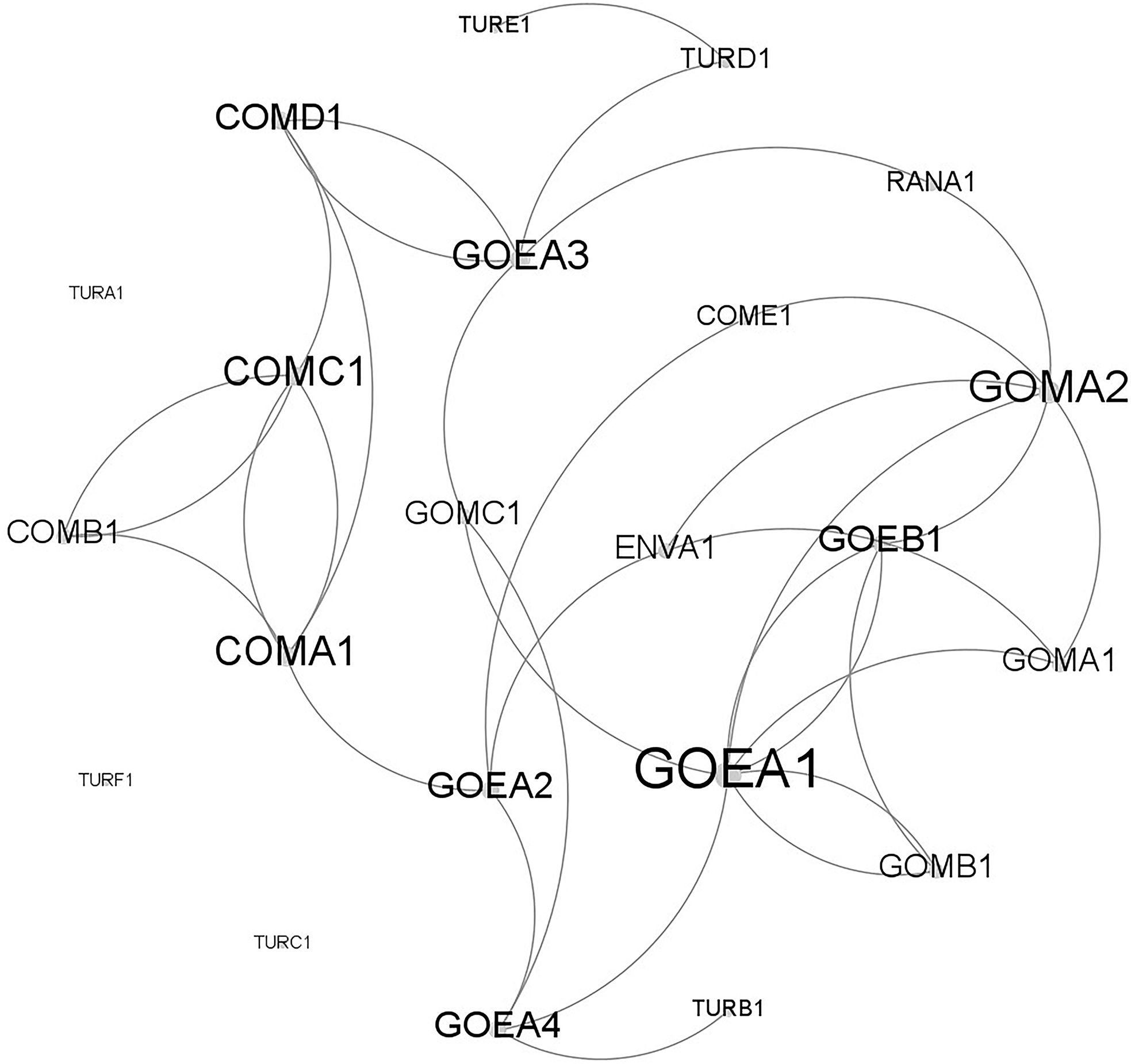
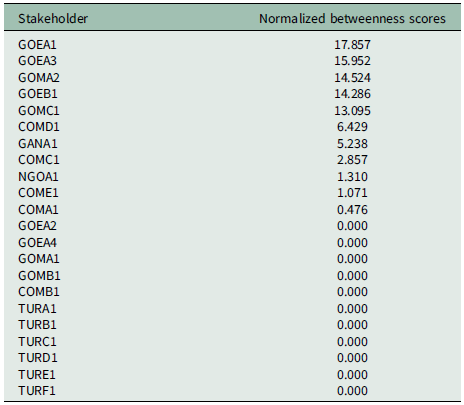
The SOBL collaboration network included 22 stakeholders from seven sectors: four public managers from the SOBL, two from the Sierra Occidental Inter-municipal Board, four municipal representatives, six tourism professionals, one environmentalist, four business owners and one rancher. The network consisted of 22 nodes with 33 ties between them, resulting in a low density of 0.071 (Table 1). This network’s degree of centralization was 0.129, and its reciprocity was 0.303, indicating that only c. 30% of the ties were mutual. The analysis also revealed a low transitivity coefficient of 0.263, suggesting weak ‘triangulation’ within the collaboration network. The network also exhibited a Krackhardt’s connectance of 0.338. The betweenness centrality reveals that public managers were the most significant connectors within the network. Nodes from the public sector (GOEA1, GOEA3, GOMA2 and GOEB1) exhibited the highest normalized betweenness centrality values, with scores of 17.857, 15.952, 14.524 and 14.286, respectively (Fig. 2 & Table 2). While key stakeholders were also present in other sectors, such as business (COMD1) and ranching (RANA1), their centrality scores were notably lower (Table 2).
Table 1. Global network metrics, overall connectivity and collaboration dynamics among the 22 stakeholders in the Sierra Occidental Biocultural Landscape collaboration network.


Figure 2. Visualization of the Sierra Occidental Biocultural Landscape collaboration network. Nodes represent the stakeholders involved, and the lines represent their collaborative ties. The size of the node represents the stakeholder’s betweenness centrality. The first three letters of the label indicate the sector to which the stakeholder belongs: tourism (TUR), environmentalists (ENV), public managers (GOE), municipal representatives (GOM), business owners (COM) and ranchers (RAN).
Table 2. The 22 stakeholders in the Sierra Occidental Biocultural Landscape collaboration network, ranked by normalized betweenness centrality, showing the central role of public managers in connecting stakeholders within the network.

Collaborative governance factors
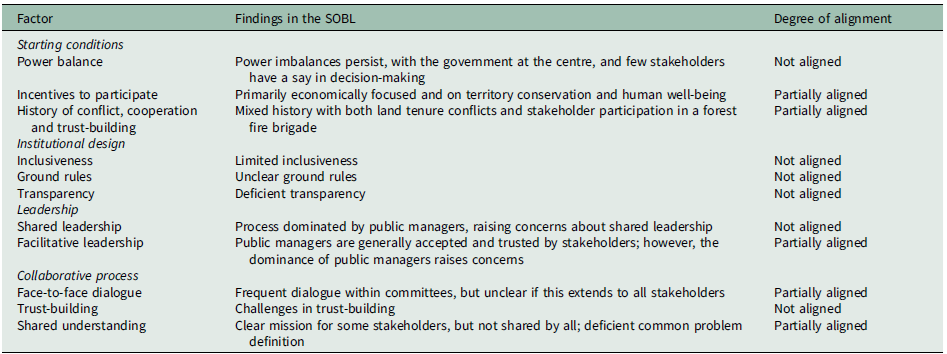
The semi-structured interviews revealed a mixed alignment of the SOBL with the principles of successful collaborative governance, with notable misalignments in key areas, including power imbalances, inclusiveness and trust-building (Tables 3 & S2). In contrast, factors such as incentives to participate, a mixed history of cooperation and partially aligned elements, such as facilitative leadership, face-to-face dialogue and shared understanding, showed greater consistency with collaborative governance principles.
Table 3. Alignments in the Sierra Occidental Biocultural Landscape (SOBL; Ansell & Gash (Reference Ansell and Gash2008) framework).

Starting conditions
Participant perceptions revealed power imbalances within the collaborative process in the SOBL, with decision-making often concentrated among public managers. These imbalances were linked to the different levels of government. For example, one stakeholder pointed out that ‘power is not balanced, it depends on the scale: federal, state or municipal government, and ejido or community’ (TURH1). In contrast, four public managers described the collaboration as balanced, although they acknowledged that some stakeholders wanted to impose their will on others. Four participants also stated that agreements were always reached, which helped to diminish imbalances. Despite these perspectives, a broader sentiment emerged that collaboration allowed stakeholder expression, but it had limited influence on decision-making. Stakeholder incentives to participate were diverse, primarily linked to economic rewards, conservation values and human well-being. Support for local entrepreneurs also served as a strong motivator. Non-economic incentives were particularly valued by two stakeholders who promoted sustainable practices. One stakeholder pointed out that the ‘SOBL initiative promotes good practices to minimize negative impacts on the territory, such as the certificate for products and services’ (GOMC1). However, social participation in the SOBL was constrained by several factors. A lack of awareness regarding the initiative was evident, with one stakeholder estimating that 80% of the population in the involved municipalities were unaware of the Biocultural Landscape concept. Furthermore, past unfulfilled expectations of direct economic or material support had shaped current attitudes and slowed broader engagement. There has been a history of conflict and cooperation, during which public managers have made efforts to build trust despite protracted land tenure conflicts. At least one participant from the private sector noted that multi-stakeholder forums provide an opportunity to resolve differences (TURH1). Historical conflicts related to land disputes, business competition and political affiliations were mentioned by four participants, contributing to a complex context for collaboration.
Institutional design
It was evident that the institutional design of the SOBL faced challenges related to inclusiveness, ground rules and transparency. Despite efforts to promote inclusiveness, stakeholders perceived there to be barriers to participation. Opportunities were often seen as favouring the tourism and production sectors, while other groups remained underrepresented. Three public managers emphasized the existence of established ground rules. However, four stakeholders from the tourism sector and ranching communities expressed confusion regarding roles and responsibilities. One stakeholder mentioned that ‘the rules are not so clear, because sometimes they invite companies to teach on topics they don’t have the credentials for’ (RAIA1). Ultimately, transparency proved to be a significant challenge. While three public managers highlighted the participatory nature of the governance structure, others noted that collaboration relied more on informal agreements than on formally established procedures, as one stakeholder stated that ‘there are no specific rules about the SOBL because the collaboration is based on a (voluntary) agreement’ (GOEA3).
Leadership
Perceptions of leadership were varied. Four respondents indicated that public managers often performed effectively and communicated openly, which helped to reduce conflicts; one stakeholder remarked that ‘there is multiple leadership, and communication is open and trusting, which minimizes stakeholder conflicts’ (GOEA1). However, three other stakeholders perceived leadership as being concentrated within specific groups, influenced by political interests. One stakeholder stated that ‘leadership is concentrated in the politicians who have shown the most appetite’ (GOMA2). Concerns were also raised about a lack of adequate representation, particularly when new stakeholders unfamiliar with the SOBL joined the process.
The collaborative process
While four stakeholders reported frequent dialogue occurring within committees, the same stakeholders observed that this dialogue did not always extend to all groups (e.g., disadvantaged communities), thereby restricting inclusion. While public managers highlighted a shared understanding among active members, others stressed the need for better information sharing beyond core groups. One stakeholder pointed out that ‘all members know the vision of the SOBL initiative and participate actively’ (GOEA3). Two public managers and one tourism operator acknowledged that trust-building efforts faced significant obstacles, including high turnover among public officials and scepticism among local stakeholders. In addition, public managers emphasized the importance of the recognizing diverse skills and perspectives among all participants. One stakeholder pointed out that ‘it is necessary to generate trust from the point of recognizing the skills of everyone on the subject’ (MINA1). Despite these difficulties, some respondents appreciated the SOBL initiative as a platform for learning and interacting to achieve common objectives. In this sense, two stakeholders mentioned the Territorial Charter and regional fire control brigade as concrete examples of intermunicipal collaboration.
Discussion
Our analysis reveals both alignments and misalignments with the established factors for successful collaborative governance (Table 3). The SOBL initiative shows tangible elements of collaborative action, including the establishment of a community fire brigade, the development of a territorial strategic plan and the certification of local products and services. These findings are consistent with Ansell and Gash’s framework (Reference Ansell and Gash2008), which emphasizes the importance of shared goals and tangible outcomes in collaborative governance. In this context, Bodin (Reference Bodin2017) highlights the value of collaborative networks for achieving conservation goals, particularly at the landscape scale, where ecosystems and human communities intersect across administrative boundaries. We revealed that this is a low-density network (0.071), suggesting a relatively weak foundation for sustained collaborative interactions, and this value is significantly lower than that found in other comparable studies. For example, a landscape-scale conservation initiative in South Africa exhibited a network density of 0.406 (McCulloch-Jones et al. Reference McCulloch-Jones, Novellie, Roux and Currie2022). In collaborative networks, higher density facilitates trust, information sharing and collective action due to direct ties among stakeholders (Bodin & Crona Reference Bodin and Crona2009). The low level of reciprocity (0.303) within the SOBL network indicates a prevalence of unidirectional ties, potentially reinforcing power imbalances, as was perceived by some stakeholders. As noted earlier, one of them stated that ‘power is not balanced, it depends on the scale: federal, state or municipal government, and ejido or community’ (TURH1). Such imbalances can hinder mutual trust and shared ownership, which are key factors for long-term success (Ansell & Gash Reference Ansell and Gash2008). The low transitivity (0.263; Table 2) further suggests limited network cohesion and a potential risk of fragmentation (Bodin & Crona Reference Bodin and Crona2009). It also suggests that stakeholders groups may develop an internally reinforced consensus, which could restrict inclusivity (Jasny et al. Reference Jasny, Waggle and Fisher2015). The quality of network ties, in terms of both density and reciprocity, is crucial for fostering trust and collaboration among diverse stakeholders; previous research has consistently emphasized the importance of building trust as a foundation for successful collaboration and conflict mitigation (Bodin et al. Reference Bodin, Crona and Ernstson2006, Bodin & Crona Reference Bodin and Crona2009, Langle-Flores et al. Reference Langle-Flores, Dueñas, Chávez-Dagostino and Aguilar-Rodríguez2025).
Public managers occupied the central nodes in the network, exhibiting the highest betweenness centrality scores (Fig. 2 & Table 2). While highly central stakeholders can act as critical connectors (Bodin et al. Reference Bodin, Crona and Ernstson2006, Bodin & Crona Reference Bodin and Crona2009), an overreliance on public managers can hinder community empowerment and reinforce power imbalances (Ansell & Gash Reference Ansell and Gash2008). One stakeholder expressed that ‘everyone has the right to share their ideas, but perhaps not always the right to make decisions’ (RAIB3), a sentiment that aligns with findings that powerful brokers can dominate institutional systems (Berardo & Lubell Reference Berardo and Lubell2016). This pattern of public-sector dominance is consistent with that observed in other environmental collaborative networks in Mexico (Langle-Flores et al. Reference Langle-Flores, Aguilar Rodríguez, Romero-Uribe, Ros-Cuéllar and Von Thaden2020, Reference Langle-Flores, Dueñas, Chávez-Dagostino and Aguilar-Rodríguez2025), as well as in Sweden’s National Forest Program, where public managers have significantly influenced both the collaborative process and policy outcomes (Johansson Reference Johansson2024). In the SOBL network, the broker role held by public managers concentrates communication and resource flows, which can limit broader participation. As one stakeholder noted, while SOBL is open, in practice there is ‘little general representation of the different sectors of the territory’ (GOMA2). When powerful brokers dominate a network, this can increase connection costs for less influential stakeholders, potentially leading to their exclusion (Emerson Reference Emerson1962, Blau Reference Blau1964). During the early stages of the SOBL, public managers’ control was beneficial for launching the initiative. However, over time such control may have reduced transparency and representation (Falaleeva & Rauschmayer Reference Falaleeva and Rauschmayer2013), potentially excluding diverse values and knowledge from decision-making and leading to less equitable conservation outcomes. The persistence of power imbalances, limited inclusiveness and a lack of transparency go against the principles of collaboration (Ansell & Gash Reference Ansell and Gash2008).
One reason as to why these issues have arisen appears to be the lack of clear and applied ground rules. According to Ansell and Gash (Reference Ansell and Gash2008), institutional design that includes clear rules for decision-making builds legitimacy and prevents process breakdown. This is supported by findings from a Marine Protected Area in Mexico, where a management crisis prompted a shift from diffuse to specific regulations – a key change for enhancing stakeholder accountability and the legitimacy of agreements (Langle-Flores et al. Reference Langle-Flores, Dueñas, Chávez-Dagostino and Aguilar-Rodríguez2025). At the same time, one stakeholder in the current research noted that the ‘challenges of the SOBL initiative are cooperation, confidence, transparency, inclusion and integration of disadvantaged groups’ (TURJ1).
Trust is a crucial mediating factor, as low levels of trust can discourage stakeholders from fully engaging in decision-making processes (Reed Reference Reed2008, Johansson Reference Johansson2024). In this sense, the network’s structural characteristics and governance misalignments could impact the SOBL’s on-the-ground conservation efforts. For example, a sparse centralized network is likely to produce fragmented responses to landscape-scale pressures such as mining or agricultural expansion. Because such a structure may inadequately reflect local needs or ecological knowledge, land management decisions may undermine the initiative’s dual goals of biodiversity conservation and sustainable development. Ultimately, if local stakeholders feel that their voices are unheard (Lawrence Reference Lawrence2006), their long-term commitment to conservation may diminish, directly impacting the SOBL’s ability to empower the stakeholders it aims to support.
Previous research has shown that sustaining long-term conservation requires tangible benefits for local stakeholders engaged in collaborative arrangements (Langle-Flores et al. Reference Langle-Flores, Aguilar Rodríguez, Romero-Uribe, Ros-Cuéllar and Von Thaden2020). The SOBL does not explicitly operate as a payment for ecosystem services programme – a conservation policy with mixed forest conservation results in Latin America (Perevochtchikova et al. Reference Perevochtchikova, Castro-Díaz, Langle-Flores and Von Thaden2021). Instead, it incorporates economic incentives through its certification seal for local products. For these alternative policies to succeed, they must be grounded in institutional trust, inclusion and genuine empowerment (Ansell & Gash Reference Ansell and Gash2008). Success depends on enabling authentic participation rather than merely advisory or consultative roles (Lawrence Reference Lawrence2006). Previous research on ecosystem services governance has shown that limited or symbolic participation can undermine ownership and long-term sustainability (Castro-Díaz et al. Reference Castro-Díaz, Delgado, Langle-Flores, Perevochtchikova and Marín2022).
The challenges identified in the SOBL case offer critical insights into the implementation of collaborative governance in Mexico’s biocultural landscapes. Applications of the Ansell and Gash (Reference Ansell and Gash2008) framework account for pre-existing institutional weakness conditions and network structures that shape such interactions. The dominance of public managers – a common feature in Mexican environmental governance (Langle-Flores et al. Reference Langle-Flores, Aguilar Rodríguez, Romero-Uribe, Ros-Cuéllar and Von Thaden2020, Reference Langle-Flores, Dueñas, Chávez-Dagostino and Aguilar-Rodríguez2025) – particularly hinders the achievement of the equitable, shared leadership envisioned by the framework. The findings of this research suggest that applying such frameworks in contexts such as the SOBL requires a stronger emphasis on actively counterbalancing power asymmetries from the outset. Our approach had inherent limitations. The restrictions imposed by the COVID-19 pandemic during phase 1 reduced the availability of interviewees. Additionally, snowball sampling may have underrepresented certain sectors, such as raicilla (agave distillate) producers, miners and forestry professionals. While this method allowed us to map the core SOBL network, it may have reinforced existing biases favouring actors with greater social capital. Future studies could address this limitation by employing purposive sampling and utilizing attendance lists from the SOBL working groups to ensure broader representation (Langle-Flores et al. Reference Langle-Flores, Dueñas, Chávez-Dagostino and Aguilar-Rodríguez2025). Furthermore, the temporal gap between the data collection phases (SNA in 2019–2021 and interviews in 2024–2025) added complexity, as stakeholder perceptions might have evolved over time (Guerrero et al. Reference Guerrero, Barnes, Bodin, Chadès, Davis and Iftekhar2020). Future research would benefit from a longitudinal design to monitor changes in network dynamics over an extended period (Langle-Flores et al. Reference Langle-Flores, Dueñas, Chávez-Dagostino and Aguilar-Rodríguez2025).
Conclusion
Our findings highlight the complexities inherent in collaborative governance and emphasize the importance of critical analysis and adaptive management in achieving equitable outcomes for all stakeholders. This research contributes to conservation science and practice by offering a clear diagnostic tool that is applicable to other landscape-scale initiatives. The study demonstrates that a sparse network may indicate underlying issues in trust and collaboration. Importantly, the findings show that stakeholder participation in numerous committees does not guarantee equitable outcomes; instead, proactive measures are needed to address power imbalances that leave local stakeholders feeling that their role is merely advisory (Lawrence Reference Lawrence2006). This research contributes to conservation science by showing that theoretical governance frameworks must be adapted to specific institutional contexts; in the Mexican case, the common dominance of public managers can hinder the emergence of shared, equitable leadership. Ultimately, our findings suggest that a fragmented network can lead to ineffective or weakened responses to environmental threats and may erode the long-term commitment of local stakeholders, thereby undermining conservation goals in biocultural landscapes. The SOBL’s challenges in power-sharing, inclusiveness and trust directly affect its capacity to achieve the Kunming–Montreal Global Biodiversity Framework’s goals, which stress the importance of collaborative and equitable governance (CBD 2022). Without genuine collaboration that empowers local stakeholders and integrates diverse forms of knowledge, achieving ambitious conservation targets will be difficult. The SOBL’s partial successes demonstrate potential, but fully realizing this potential requires a fundamental shift towards more equitable and transparent governance that actively strengthens the collaborative network. Future research should prioritize analysing longitudinal changes in the SOBL’s network structure to enable comparisons with other biocultural landscapes. Such insights into the evolving dynamics of collaborative governance can inform social efforts to meet global biodiversity targets.
Supplementary material
To view supplementary material for this article, please visit https://doi.org/10.1017/S0376892925100258.
Acknowledgements
We thank the staff of Biocultural Landscape in Talpa de Allende, Jalisco, for their collaboration and the facilities provided. We are also grateful to Christopher Malcom, Alfonso Miranda Caso Luengo and Ginette Morrisseau for their valuable comments and proofreading, which improved this manuscript. Finally, we also thank the editors and reviewers for their time and constructive feedback.
Author contributions
OAMI: Conceptualization, methodology, formal analysis, investigation, writing – original draft, writing – review and editing; AL-F: Conceptualization, methodology, formal analysis, writing – original draft, writing – review and editing, supervision, proofreading; RMC-D: Conceptualization, investigation, project administration, supervision, writing – original draft, writing – review and editing; MLB-O: writing – review and editing; AAR: conceptualization, writing – original draft, writing – review and editing.
Financial support
AL-F acknowledges the support of the SECIHTI postdoctoral fellowship.
Competing interests
The authors declare none.
Ethical standards
The authors assert that all procedures contributing to this work were conducted in accordance with the applicable ethical standards related to human subjects and were approved by the Research Ethics Committee of Centro Universitario de la Costa (protocol code: CUCPV/SAC/300/2019; date of approval: 19 May 2019).
AI contributions to research content
The authors acknowledge the use of an AI-powered language tool to assist with copyediting and to improve the readability of a previous version of this manuscript.