

Does populism threaten American democracy, and if so, what is the nature of that threat? This article draws on the extensive comparative research on populism to consider the “political opportunity structure” (Tarrow Reference Tarrow, McAdam, McCarthy and Zald1996) for populist parties and candidates in the United States. Scholars of American politics have given limited attention to populism either as a general phenomenon or its impact on US democracy. Most research on the topic has focused on the incidence of populist rhetoric in American politics over time (Bimes and Mulroy Reference Bimes and Mulroy2004; Bonikowski and Gidron Reference Bonikowski and Gidron2015; Gerring Reference Gerring1998) or the Populist mobilizations of the 1890s (Sanders Reference Sanders1999). Unlike comparativists, scholars of American politics have not analyzed how the US political system facilitates or checks populist impulses or whether populism has the potential to undermine American democracy.
As this article shows, there is much Americanists can learn from the comparative study of populism. Comparativists have developed a definition of populism that travels well and can be applied to the study of parties and candidates in the United States (Mudde and Kaltwasser Reference Mudde and Kaltwasser2017). Scholars of comparative politics have amassed a large body of work on the causes and consequences of populism that has clear relevance to conditions in the United States. Most importantly, Americanists can benefit from a closer engagement with the comparative literature that demonstrates that populist parties and leaders in power constitute a risk factor for democratic backsliding. Building on the comparative literature, this article analyzes the ways in which the US system is both vulnerable and resistant to populist-driven democratic erosion. My hope is that the synthesis offered here encourages more cross-subfield dialogue in political science and points to new avenues for research in American politics.
Compared to most other democracies, I argue that the US system offers much less opportunity for organized populist parties but far more opportunity for populist candidacies. Although the US electoral system limits prospects for populist parties, its major parties are far more porous to populist candidacies than the mainstream parties in other democracies. Indeed, the openness of major parties to populist challenge and the pervasiveness of populist rhetoric blur the distinction between populist and mainstream politics in the United States. As Reference Ware, Mény and SurelWare (2002, 119) observes, “Populism is everywhere in American politics, but nowhere in particular.”
Today’s major US parties may be more vulnerable to populist internal challenge than they were at earlier points, given (1) developments in communications technology, (2) the unpopularity of mainstream parties and party leaders, and (3) representation gaps created by an increasingly racialized party system. In light of these developments, I argue that populist insurgency threatens the inclusive norms of liberal democracy in the United States, just as it does elsewhere. However, the same features of the US system that impede its responsiveness to national popular majorities—federalism, bicameralism, and separate elections for national offices—also help insulate the United States against a would-be authoritarian leader’s centralized control. Populist insurgency may contribute to further polarization, with negative consequences for the performance of American governing institutions. Yet populism likely poses greater risks to liberal values than to formal democratic institutions and practices.
This article is organized as follows. In the first section I define populism and discuss why scholars of comparative politics see it as a threat to democracy. The next section synthesizes work documenting the receptivity of the American public to populist appeals. The third section examines the effects of rules governing party nominations and elections on the opportunities for populist parties and candidates. The fourth section goes beyond institutions to examine key factors that may have enhanced the prospects for populist insurgency in American politics. The fifth section considers the prospects for populist authoritarianism in the United States. I conclude by arguing that twenty-first-century populism seems likelier to yield a more illiberal, racially divisive party politics in the United States than an entrenched authoritarian regime.
Populism and the Threat to Democracy
The transnational rise of populism has featured prominently in global politics since the early 1990s (Judis Reference Judis2016; Moffitt Reference Moffitt2016). A worldwide “populist zeitgeist” (Mudde Reference Mudde2004) was evident long before the 2008 financial crisis, Brexit, the Syrian civil war and the surge of migration to Europe, or the US presidential election of Donald J. Trump. Populism’s global strength has generated hundreds of recent books and articles, although before the 2016 elections most such studies dealt with countries other than the United States.Footnote 1
Scholars of comparative politics generally view the rise of populist parties and leaders as a “peril” (Müller Reference Müller2016) or “challenge” (Mény and Surel Reference Mény and Surel2002), because populism “always stands in tension with democracy” (Weyland Reference Weyland2013). Although populist leaders claim the mantle of popular sovereignty, once in power they tend to degrade democracy by weakening civil liberties, the rule of law, and the fairness of electoral processes. Recent cases of democratic erosion under populist leaders include Turkey under Recep Tayyip Erdoğan, Ecuador under Rafael Correa, Venezuela under Hugo Chavez and Nicolás Maduro, Poland under the Law and Justice Party, and Hungary under Viktor Orban.
Although the concept may appear amorphous, a clear definition of populism has gained wide (albeit not universal) acceptance among scholars. Mudde and Kaltwasser (2017, 6) write,
“Populism is a thin-centered ideology that considers society to be ultimately separated into two homogeneous and antagonistic camps, ‘the pure people’ versus ‘the corrupt elite,’ and which argues that politics should be an expression of the general will of the people.” Populism is “thin-centered” in that it is “limited in ideational ambitions and scope” (Freeden Reference Freeden1998, 750). It encompasses only a few, very simple concepts that can be flexibly combined with other, more complex political ideas and ideologies, yielding populisms that range across the political spectrum from extreme left to extreme right (Hawkins and Kaltwasser Reference Hawkins and Rovira Kaltwasser.2018). There are even neoliberal populisms of the center that champion austerity and market-oriented reform (Roberts Reference Roberts1995).
Whether of the left, right, or center, populism is a moralistic discourse that turns on a Manichean dichotomy between a corrupt governing elite and a virtuous, homogeneous people (Hawkins Reference Hawkins2009). The emphasis on the homogeneity of the people makes populism fundamentally anti-pluralist (Müller Reference Müller2016). Populism’s harsh rhetoric around the corrupt elite scorns the legitimacy of political opposition: no institutional procedures or constraints should stand in the way of the people’s will. Populist conceptions of the general will thus typically envision “majority rule without minority rights” (Grzymala-Busse Reference Grzymala-Busse2017a, S1).
Populism’s intolerant attitude toward opposition tends toward authoritarianism. Although populist parties, movements, and leaders may give voice to ignored concerns and incorporate excluded societal groups (Kaltwasser Reference Kaltwasser2014), most comparativists view populism as fundamentally incompatible with liberal democracy (Rummens Reference Rummens, Kaltwasser, Taggart, Espejo and Ostiguy2017). Populists in power tend to empower executives, weaken checks and balances, restrict civil liberties, and manipulate electoral institutions to cement their power against challenge (Hawkins and Littvay Reference Hawkins and Littvay.2019; Houle and Kenny Reference Houle and Kenny2018; Huber and Schimpf Reference Huber and Schimpf2016; Kenny Reference Kenny2017; Ruth Reference Ruth2018).
These antidemocratic effects hold regardless of ideological orientation. In cross-national studies, populists of the left, right, and center in power are all on average equally associated with declines in free and fair elections, civil liberties, and constraints on executives (Hawkins and Littvay Reference Hawkins and Littvay.2019; Ruth-Lovell, Doyle, and Hawkins Reference Ruth-Lovell, Doyle and Hawkins2019). Kenny (Reference Kenny2019) finds that left-leaning populist governments tend to exercise an even more negative effect on press freedom. Populists in government do not always succeed in undermining liberal democracy (Weyland and Madrid Reference Weyland and Madrid2019), but they constitute a risk factor for democratic erosion.
Although populism’s adverse consequences for liberal democracy are well documented in the comparative literature, scholars have generally not considered it a threat to US democratic institutions. At least since the Civil War, few students of American politics have expressed any anxiety about the durability of American democratic institutions (Kammen Reference Kammen1987). So, where the comparative literature routinely describes populism as a “pathology” (Taggart Reference Taggart, Mény and Surel2002, 62) or a “degraded form” (Müller Reference Müller2016, 6) of democracy, in the American context it is usually presented in neutral (Gerring Reference Gerring1998; Kazin Reference Kazin1995) or even positive (Dzur Reference Dzur2010; Grattan Reference Grattan2016) terms. Even Hofstadter (Reference Hofstadter1955, 18)—who criticizes the nativism, antisemitism, conspiratorial thinking, and other illiberal impulses of late nineteenth- and early twentieth-century Populists—assesses populism as promoting needed reforms and yielding “substantial net value” for American democracy. Rather than a danger to democratic institutions, populism in the United States is instead seen as a rhetorical tradition operating within the confines of normal partisan (Gerring Reference Gerring1998) or presidential politics (Azari Reference Azari2017; Bimes and Mulroy Reference Bimes and Mulroy2004; Bonikowski and Gidron Reference Bonikowski and Gidron2015).
Americans’ Receptivity to Populist Rhetoric
The United States can lay some claim to having invented populism. President Andrew Jackson’s 1830s rhetoric pitting the “common man” against the “corrupt aristocracy” contains the hallmarks of populist discourse, as usually defined. The first broad populist mobilizations occurred in the United States with the People’s Party of the 1890s.
Like populism cross-nationally, US populism has manifested in right-wing, left-wing, and centrist forms (Lowndes Reference Lowndes, Kaltwasser, Taggart, Espejo and Ostiguy2017). Defining populism expansively, Kazin (Reference Kazin1995) tracks it through the original Populists, labor leader Samuel Gompers, the evangelical protestant Prohibitionists, the Catholic Father Coughlin, Sen. Joseph McCarthy, and the New Right of Alabama governor George Wallace and his successors. Gerring’s (Reference Gerring1998) study of party platforms, campaign speeches, and other electioneering documents finds that populist rhetoric was a dominant discourse for the Democratic Party between 1896 and 1948 and for the Republican Party since 1928. In recent decades, it has flourished more on the right than the left (Bimes and Mulroy Reference Bimes and Mulroy2004; Gerring Reference Gerring1998, 233–53; Kazin Reference Kazin1995, 245–66), although in the 2016 Democratic presidential primaries Sen. Bernie Sanders inveighed against a “rigged economy” that privileges the 1% over the 99%.
As history makes clear, populist appeals find a receptive audience in the United States. Long before the antiestablishment fervor of the 2016 elections, Hibbing and Theiss-Morse (Reference Hibbing and Theiss-Morse.1995) documented that many Americans embrace notions of an organic and wholesome people in contradistinction to a corrupt, out-of-touch political elite. Focus group participants in their studies repeatedly fell into talking about the wishes of the American people as if there were a single public mind in accord with populism’s anti-pluralist rhetoric. Large majorities express disdain of a “Washington system” of special interests, little understanding of the sources of disagreement in Congress, and impatience with debate and deliberation. Disgusted with the contentiousness of real-world democracy, “surprising percentages of people respond favorably to the mention of decision-making structures that are not democratic,” such as turning government over to “successful business-people” (Hibbing and Theiss-Morse Reference Hibbing and Theiss-Morse.2002, 138).
Americans’ “affinity for populist discourse seems to be quite high,” particularly among those with lower levels of education and among conservatives (Hawkins, Riding, and Mudde Reference Hawkins, Riding and Mudde2012, 12). Americans tend to agree with populist sentiments such as “politics usually boils down to a struggle between the people and the powerful” (Oliver and Rahn Reference Oliver and Rahn2016, 197) and “the power of a few special interests prevents our country from making progress” (Hawkins, Riding, and Mudde Reference Hawkins, Riding and Mudde2012, 29).
American public opinion cannot be relied on as a bulwark of liberal rights capable of resisting populism’s tendencies toward authoritarianism and anti-pluralism. The values undergirding liberal democracy are fragile at the grassroots (McClosky Reference McClosky1964). The American mass electorate demonstrates only weak understanding of and adherence to basic democratic values (Prothro and Grigg Reference Prothro and Grigg1960). Americans are often unwilling to apply the abstract civil libertarian principles they espouse to specific unpopular groups (Sullivan, Piereson, and Marcus Reference Sullivan, Piereson and Marcus1982). Authoritarian (Hetherington and Weiler Reference Hetherington and Weiler2009) and ethnocentric (Kinder and Kam Reference Kinder and Kam2009) beliefs are major drivers of public opinion.
American attitudes are hardly unique in providing a favorable terrain for populist appeals. Bartels (Reference Bartels2017), for example, finds a robust, albeit static, “reservoir” of populist sentiment across western Europe. “Populist attitudes are intrinsic to democracy,” conclude Hawkins, Riding, and Mudde (2012, 24). Because populist ideas resonate with the mass public in most democracies, what matters more is the opportunity structure in which those populist appeals are made.
Electoral Rules and US Populism
The US electoral system has long been unfavorable to insurgent or third parties, including populist parties. At the same time, however, the American system of nominations subjects the major parties to radically open internal competition through primary elections. The combined result of these electoral rules is that populists win more favorable outcomes in intraparty competition than in interparty competition.
Electoral Rules
Although scholars disagree on the importance of electoral systems for populist party success, studies show that proportional representation—particularly when there are low electoral thresholds (Ignazi Reference Ignazi2003; Norris Reference Norris2005) and more seats are allocated via upper-tier correction (Golder Reference Golder2003; Veuglelers and Magnan Reference Veuglelers and Magnan2005)—increases the likelihood that populist parties will win legislative seats. As one of the few holdouts among advanced democracies, the United States has thoroughly resisted any move toward proportional representation. With first-past-the-post electoral rules nearly universal in the United States, barriers to third-party entry are high. A party or candidate needs to be able to credibly contend for an outright plurality or risks losing strategic support because of a perception of “wasted” votes and campaign resources (Duverger Reference Duverger, Grofman and Lijphart1986; Tamas Reference Tamas2018, 146–63).
The United States is one of the only countries in the world with no uniform national ballot access law, and the regulations imposed by states can be onerous for third parties (Rosenstone, Behr, and Lazarus Reference Rosenstone, Behr and Lazarus1984). A new party seeking presidential ballot access must navigate the complexity of differing requirements and deadlines across 50 states and the District of Columbia. These barriers restrict opportunities for third parties, populist or otherwise.
The lack of majority runoff elections may also limit the opportunities for populist and other third parties in the United States.Footnote 2 Where runoffs are possible, multiple parties and long-shot candidates have greater incentive to run and may be able to draw sufficient support to move to the second round (Shugart and Carey Reference Shugart and Carey1992). The majority runoff format, for example, was a key factor in the sudden, sweeping success of outsider populist Alberto Fujimori in the 1990 Peruvian election (Schmidt Reference Schmidt1996). With many candidates running in the first round, the obscure Fujimori only needed to come in second to compete in a two-candidate contest in the next round.
Despite the multiple disincentives for third parties, US electoral rules have not fully suppressed populist parties (Tamas Reference Tamas2018). Indeed, since the Civil War, nearly all of the most successful third-party presidential bids were to a great extent populist in character, including the Populist Party itself in 1892, Theodore Roosevelt’s Bull Moose Party in 1912, Robert “Fighting Bob” La Follette’s Progressives in 1924, Ross Perot’s centrist campaign in 1992 and his Reform Party in 1996, and George Wallace’s American Independent Party in 1968. In light of the obstacles third parties face, these candidates’ electoral performance—Perot got nearly 20% of the national vote in 1992!—testifies to the resonance of populist appeals in the United States. But in the end all these candidates fared poorly in terms of Electoral College votes.
Party Primaries
Populist parties are fringe players in US politics, but populist challengers can and do compete successfully in intraparty politics. Although the trend cross-nationally has been toward increased use of primaries, caucuses, and other more “democratic” means of allocating nominations (Rosenbluth and Shapiro Reference Rosenbluth and Shapiro2018), the United States has long been and remains an outlier in terms of the radical openness of its party nomination processes (Sandri, Seddone, and Venturino Reference Sandri, Seddone and Venturino2015).
The post-1968 party reforms of the presidential nomination process opened up the major parties to almost routine internal populist challenges. In 1972, George Wallace abandoned third-party politics to compete in the Democratic presidential primaries. His populist campaign against the corrupt elite—which in his formulation included “government bureaucrats,” “pointy-head college professors,” and “unelected judges”—gained traction outside the South with disaffected working-class voters until his campaign was cut short by a nearly successful assassination attempt. Since 1972, most populist outsider presidential candidates have followed Wallace’s lead in turning from third parties to major party primaries.
Populist candidates have been a recurring feature of presidential nomination contests since the 1970s. Dark horse Georgia governor Jimmy Carter won the Democratic nomination for president in 1976 with an outsider’s campaign resonant with populist themes. Rev. Jesse Jackson’s 1988 campaign for the Democratic nomination channeled discontent with economic elites into a “gospel populism” (Hertzke Reference Hertzke1993). California governor Jerry Brown sought the Democratic nomination in 1992 vowing to “take back America from the confederacy of corruption, careerism, and campaign consulting in Washington.”Footnote 3 Pat Buchanan ran spirited campaigns for the Republican presidential nomination in 1992 and 1996, proclaiming to the party establishment that the “peasants are coming with pitchforks.” Arkansas governor Mike Huckabee ran for the Republican nomination in 2008 “regularly taking digs at Wall Street, free trade, and ‘the rich.’”Footnote 4 Sen. John Edwards (D-NC) styled himself as a populist in the 2008 contest for the Democratic presidential nomination, railing against the “moneyed interests” that have a “stranglehold on our democracy.”
In most (but by no means all) cases, the party establishment succeeded in beating back populist insurgents, when key groups in the party coalition coalesced around a mainstream favorite and starved competitors for financial support in the “invisible primary” (Cohen et al. Reference Cohen, Karol, Noel and Zaller2008). But in a system where party nominations are open to all comers and outcomes are decided in primaries and caucuses, the potential for a successful populist challenge is nothing new. Trump’s nomination and election simply realize what had been a latent possibility since the post-1968 party reforms (Cohen et al. Reference Cohen, Karol, Noel and Zaller2016).
Similarly, populist aspirants to a seat in Congress are likely to find it easier to win a major party primary than to win as a third-party candidate. Ballot access is much less of an obstacle for third parties seeking House and Senate seats than the presidency, because a new party only needs to meet whatever petition or other requirements are imposed in one state (rather than 50).Footnote 5 Populists have won congressional seats at various points in history as third-party candidates (Clanton Reference Clanton1984; Tamas and Hindman Reference Tamas and Dean Hindman2014). But third parties do not have automatic access to state ballots. Meanwhile, unlike for the presidency—where binding primaries only became the norm after 1968—primaries have been used to decide most party nominations for House and Senate seats since the progressive reforms of the early twentieth century. Thus populists have long had an open path to capture major party nominations for Congress.
There is a dearth of research on the number of candidates who have won party nominations and seats in Congress on the strength of populist appeals. However, the path by which populists get to Congress only occasionally takes the form of hard-fought battles between establishment candidates and populist outsiders, simply because congressional primaries have not seen much competition since the middle of the twentieth century (Ansolabehere et al. Reference Ansolabehere, Hansen, Hirano and Snyder2010). Since 2009, a number of Tea Party candidates have successfully challenged the party establishment in the Republican Party, sounding populist themes of “taking our country back” (Skocpol and Williamson Reference Skocpol and Williamson2016). Despite this trend, only a handful of congressional incumbents face a significant primary challenge in any given year (Boatright Reference Boatright2013).
Yet populists—or, more precisely, candidates employing populist appeals—do not necessarily have to defeat an establishment candidate. Populists seeking party nominations for Congress may instead be pushing on an open door. The leadership and campaign committees of both parties take a pragmatic attitude toward nominations inasmuch as they want to nominate someone who can win the seat (Hassell Reference Hassell2017). Given the appeal of populist ideas to the mass public, political consultants even school would-be candidates in the discourse (Kazin Reference Kazin1995, 272).
Prevalence of Populist Rhetoric
Although no one has systematically studied the use of populist rhetoric in American campaigns below the presidency, there is no doubt that populist tropes are so widespread as to be clichéd. A challenge for research on American populism is distinguishing between candidates who deploy the rhetoric, perhaps in accord with campaign consultants’ advice, and those who subscribe to a genuinely populist worldview.Footnote 6
A non-negligible share of members of Congress seek to cultivate a populist image. As one rough gauge, a text search of Congress member profiles in CQ’s Politics in America for each Congress between 2006 and 2014 describes 45 members as populist: 33 Democrats and 12 Republicans. The diversity of the group makes it clear that populism embraces a wide range of political identities. Some of the members described as populists are party loyalists or even members of party leadership (e.g., Sen. Byron Dorgan, D-ND, or Sen. Chuck Grassley, R-IA). Others are members known for bucking their party (e.g., Rep. Lincoln Davis, D-TN, Rep. Gene Taylor, D-MS). Some are on the far right (e.g., Sen. Jeff Sessions, R-AL, Sen. Jim Bunning. R-KY, Rep. Ted Yoho, R-FL), some are on the far left (e.g., Rep. Dennis Kucinich, D-OH, Sen. Bernie Sanders, I-VT), and some are centrists (Sen. Jim Webb, D-VA; Rep. Dan Lipinski, D-IL). At two points in recent congressional history (1983–94; 2009–14), there was even an organized, self-identified Populist Caucus in the House of Representatives.
In sum, electoral rules in the United States create an incentive structure that tends to divert populist impulses into the mainstream parties. The difficulty of mounting a third-party challenge deters populists from forming new parties, but the openness of the major parties themselves affords them a viable path to power. As such, the porousness of the major parties blurs boundaries between mainstream and populist politics. In the United States, populist appeals are part of mainstream party politics.
Contemporary Major Party Vulnerabilities
Comparativists often differentiate between factors affecting the supply of populist parties and candidates (meaning the extent to which voters are presented with populist alternatives) and the demand for populist parties and candidates (meaning the extent to which voters want populist alternatives; Hawkins and Kaltwasser Reference Hawkins and Rovira Kaltwasser.2017; Mudde and Kaltwasser Reference Mudde and Kaltwasser2017). Mainstream parties in the contemporary United States may be more vulnerable than at other historical points to populist internal challenge for at least three reasons. First, changes in communication technology are likely to increase the supply of populist candidates. Second, the public’s low regard for mainstream parties and leaders makes populist alternatives potentially more attractive, increasing demand. Third, the racialization of the party system may have made mainstream party leaders, who tended to abjure explicitly racialized appeals, vulnerable to populist outflanking.
Evolution in Media
New media are profoundly democratizing, a development with obvious relevance to the prospects for populist candidates and parties. The internet has drastically reduced the costs of political organizing and collective action of all kinds (Farrell Reference Farrell2012). As players who emerge to challenge a “corrupt establishment,” populists benefit from an information environment that lowers barriers to entry.
By reducing communication costs, online digital communications have increased the capacity for insurgent political actors to find an audience and disseminate their messages (Cohen et al. Reference Cohen, Karol, Noel and Zaller2016). Social media allow “even backbench members [of Congress to] gather a national following with relative ease, and at virtually no cost” (Glassman Reference Glassman2014, 104–5). Likewise, online communications and social media platforms open up new possibilities for political fundraising (Hindman Reference Hindman2005; Wilcox Reference Wilcox2008). New media facilitate the cross-national diffusion of ideas, allowing political entrepreneurs to adopt successful frames, appeals, arguments, and strategies across national boundaries (Rydgren Reference Rydgren2005).
All types of candidates, establishment and populist alike, benefit from reduced costs for communication and fundraising. However, lower barriers to entry afford greater relative value to insurgents and populists than to mainstream or establishment candidates. Just as campaign finance rules that level the playing field tend to benefit challengers more than incumbents (Gerber Reference Gerber1998), developments that reduce communication and fundraising costs make it easier for new political players to compete. Even in authoritarian regimes, the new communications environment has fueled challenges to established leaders, such as in the Iranian Green Movement, the Gezi Park protests, and the Arab Spring (Lynch Reference Lynch2011; Ruijgrok Reference Ruijgrok2017).
Changes in communications technology stand to increase the supply of populist challengers to establishment parties in the United States, just as they have benefited populists elsewhere (Engesser et al. Reference Engesser, Ernst, Frank and Büchel2017). Researchers have documented a recent proliferation of nonparty outside groups recruiting, networking, vetting, and training candidates for Congress (Rauch and La Raja Reference Rauch and La Raja2017). The Tea Party insurgency against establishment Republicans benefited from online communications and fundraising; the groups forming the “Resistance” to Donald Trump do likewise. Today’s information environment is advantageous to populist organizing, a factor that may have contributed to the increased prominence of populists in global politics generally.
Unpopular Mainstream Parties and Leaders
Researchers have focused on “representational deficiencies” in explaining when more citizens tend to become available for populist mobilization (Mair Reference Mair2013; Rahn and Lavine Reference Rahn and Lavine.2018; Roberts Reference Roberts, Kaltwasser, Taggart, Espejo and Ostiguy2017). Established parties across many democracies have lost the capacity to offer meaningful choices, mobilize voters, and command citizens’ trust (Dalton and Weldon 2006; Grzymala-Busse Reference Grzymala-Busse2017b; Kuo Reference Kuo2018; Mair Reference Mair2013; Roberts Reference Roberts2007), factors that have contributed to the rise of populist alternatives. Like their counterparts in so many other democracies, neither the major parties in the United States nor their most visible leaders are popular.
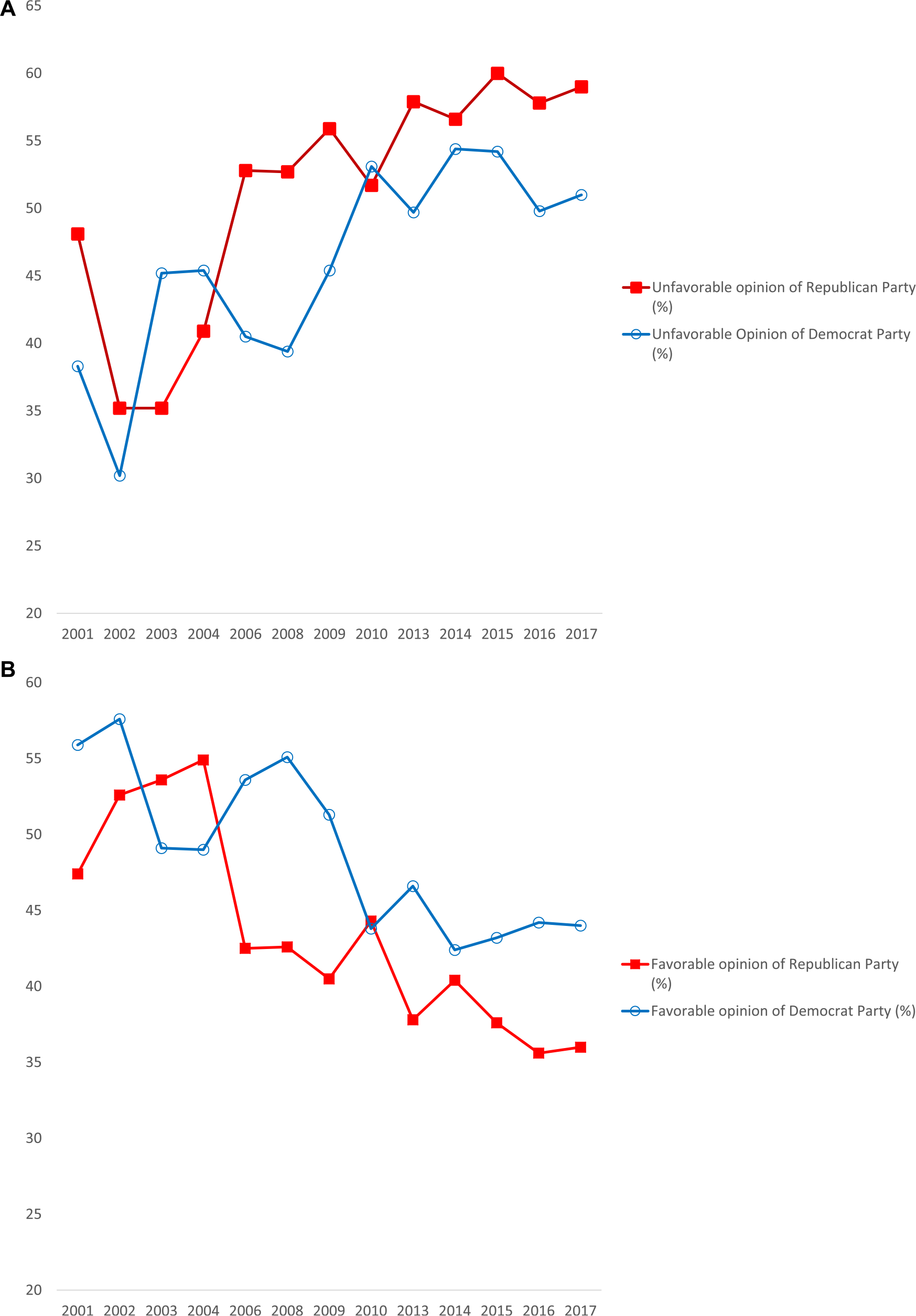
Figure 1 presents Gallup data on American attitudes toward the Democratic and Republican Parties from 2001 to 2017. The trend lines are unmistakable. For both Republicans and Democrats unfavorable attitudes have increased markedly, and favorable attitudes have declined. Neither party has garnered a favorable majority since 2009; the Republican Party has not been above 50% since 2004. Outright majorities have generally held unfavorable views of the Republican Party since 2006 and of the Democratic Party since 2010.
Public Attitudes toward the Major Parties, 2001–17
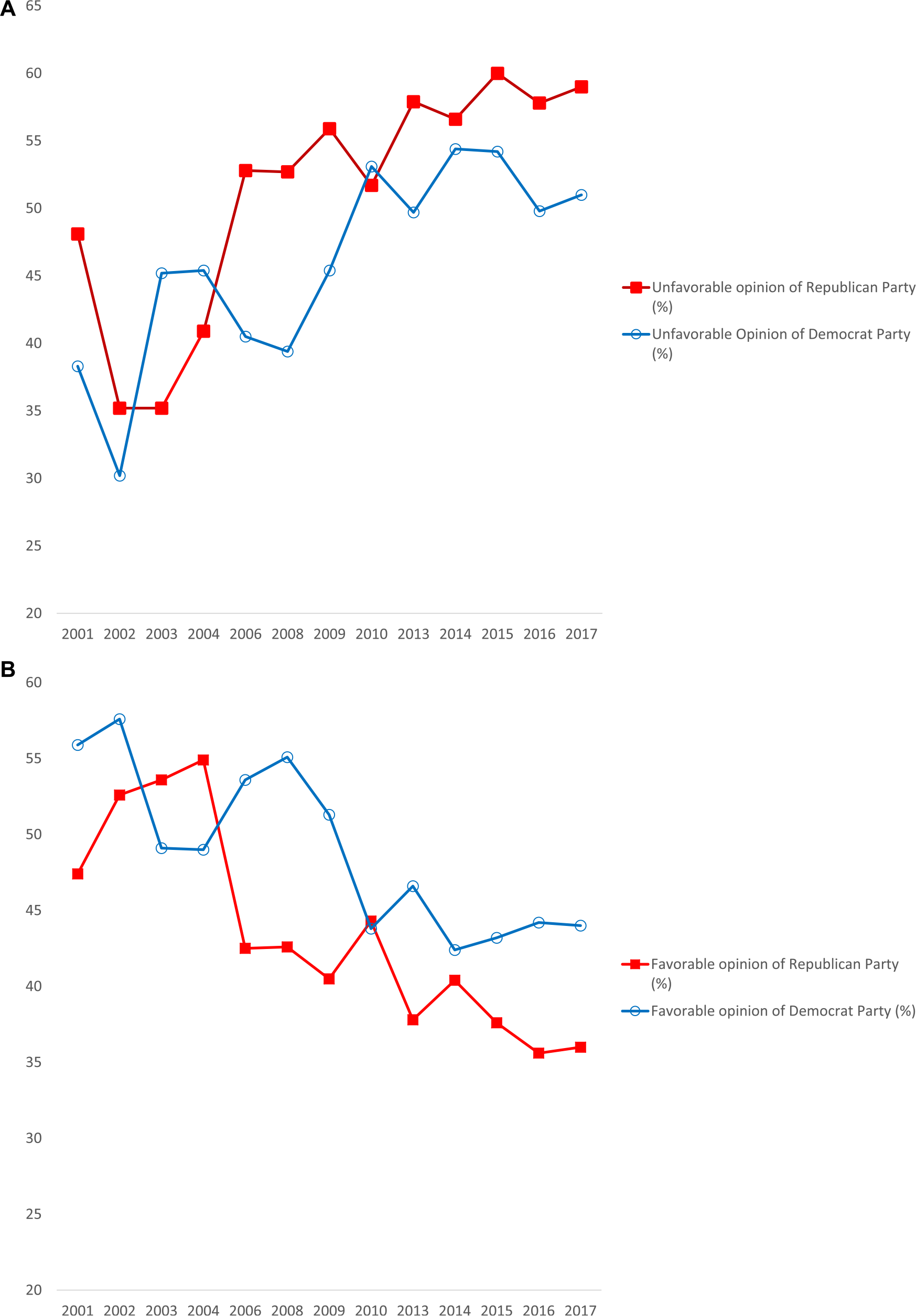
Table 1 presents data on the job approval ratings of leaders of the major parties in American politics. The leaders of both parties consistently fall short of majority approval. Since 2005, presidents have usually garnered approval ratings below 50% overall in national opinion polls; congressional leaders have fared far worse, with approval rarely reaching 40% and even sometimes falling below 25%.
Public Attitudes toward Major Party Leaders

Note: *Data not available.
Source: Gallup polling.
Looking at the parties internally, only presidents consistently garner majority approval from respondents who identify with their party. Congressional party leaders, meanwhile, are generally not well loved even by their fellow partisans. Intraparty approval of congressional leaders regularly falls below 50%.
Given the institutional obstacles that stand in the way of new parties forming and successfully contesting for office in American politics, the low approval of mainstream parties and leaders will not likely fuel the emergence of new parties, as it has in other democracies. But the weakness of US party leaders, both in the aggregate and with their own voters, offers favorable terrain for populist candidacies. Party leaders with such soft public support do not stand on strong footing when and if they seek to fend off antiestablishment challenges in nomination contests.
Major Party Convergence in a Racialized Party System
One of the most striking developments in the American party system since the 1990s has been the remarkable divergence in the racial and ethnic composition of the two parties in the mass electorate. Ironically, this demographic divergence occurred in a context in which, at least before 2016, the national leadership of the Republican and Democratic Parties had been trending toward closer convergence on policy issues relating to race and ethnicity, both in terms of party positions and rhetoric.
The comparative literature on populism often focuses on the dissatisfaction that arises when the mainstream parties “converge” on the left–right spectrum. When established parties and leaders fail to offer policy alternatives on issues citizens care about, the voters are more likely to look outside the mainstream for answers (Kaltwasser Reference Kaltwasser and de la Torre2015). When parties of the left impose austerity and market liberalization, for example, they can become vulnerable to outflanking by populist outsiders (Roberts Reference Roberts, Kaltwasser, Taggart, Espejo and Ostiguy2017, 293). Left–right convergence is a matter of perception as much as of reality. But it is clear from party platforms and congressional agendas that Republicans and Democrats have long presented distinct alternatives on questions of income tax progressivity and the overall tax burden, as well as on the role of government in the social provision of health care and education.
Racial Policy and Rhetoric. By contrast to tax and social welfare policy, the national leaders of the two major US parties had moved toward convergence on issues of race and immigration in the decades immediately preceding 2016. Although the parties were far from identical on these issues, they shared wider swaths of overlap. Racially charged issues such as crime, welfare, school busing, and affirmative action figured less prominently in twenty-first-century party politics than they had in the 1970s and 1980s. Votes on racial issues also comprised a declining share of the congressional roll-call agenda since the late 1980s (Lee Reference Lee2009, 168–70).
Some basic questions about civil rights and racial policy had seemingly been resolved. Neither Republican nor Democratic Party leaders advocated significant rollback of the landmark civil rights reforms of the 1960s. Reauthorizations of the Voting Rights Act occurred under Presidents Ronald Reagan, George H. W. Bush, and George W. Bush with strong bipartisan majorities. Analyzing substantive policy disagreements in Congress since the late nineteenth century, Bateman, Clinton, and Lapinski (Reference Bateman, Clinton and Lapinski2017) conclude that the second half of the twentieth century saw significantly reduced party polarization on race issues. Although the parties continued to diverge on policies with differential racial impact such as voter ID legislation, they no longer debated fundamental questions about African American voting rights, equal access to public accommodations, or whether there is a federal role in deterring racial discrimination.
Before 2016, the two parties also did not offer clear alternatives on immigration. The Republican Party was unquestionably more hawkish on illegal immigration, but the two parties did not offer distinct answers to the more fundamental question of the level of legal immigration. In the United States, as in several other settler societies, writes Freeman (Reference Freeman1995, 888), “there is a marked tendency to develop an interparty consensus (almost always expansionary, sometimes status quo) in order to take immigration out of politics.” Ideologically heterogeneous, bipartisan coalitions enacted the major immigration policies in place since the 1980s (Tichenor Reference Tichenor1994).
Under unified Republican control in 2006, President George W. Bush led a bipartisan push for comprehensive immigration reform, linking enhanced border security with a path to citizenship for most undocumented immigrants. A bipartisan group of senators—the “Gang of Eight”—negotiated a similar reform package in 2013, which passed the Senate by a wide margin (68–32). In the end, both the 2006 and 2013 reforms were halted by Republican opposition in the House of Representatives. The long stalemate on US immigration policy owes more to internal divisions in the Republican Party than to party polarization.
Looking beyond policy to rhetoric, major party convergence pre-2016 was even more evident. Racially divisive rhetoric had become nearly taboo in mainstream party politics. Political leaders in both parties steered clear of explicitly racial or ethnonationalist appeals (Mendelberg Reference Mendelberg2001). Haney-López (Reference Haney-López2014) points to a “convergence” between the parties during the 1990s and early 2000s: Bill Clinton emphasized his southern heritage as a means of reassuring racially conservative whites (107), while George W. Bush pursued a “strategy of toning down the racism and reaching out to nonwhites” (116). Emerging from the George W. Bush presidency, the conventional wisdom among Republican Party elites was that the party needed to do a better job competing for minority votes. In the wake of its 2012 presidential election defeat, for example, the Republican National Committee’s (2013) “Autopsy Report” advocated for a more welcoming posture toward racial minorities.Footnote 7
Racial Divergence in the Electorate. This bipartisan convergence on key racial and ethnic issues and the norm against the use of racially divisive rhetoric persisted in American national politics, even as the parties in the electorate continued to grow more distinct from one another along lines of race and ethnicity.
Drawing on data from the American National Election Study, figure 2 tracks the racial composition of each party between 1950 and 2016, benchmarked against the racial composition of the country as a whole, as gauged by the US Census.Footnote 8 The right-most panel displays the changing white proportion of the national population, as well as of respondents who align with the Democratic and Republican Parties over time. The marked drop in the white share of the population, from 90% white in 1950 to 61% white in 2016, is designated with a heavy line. As is evident here, from 1950 to 1980, the white share of the Democratic Party declined steadily in tandem with the white share of the national population. After 1980, whites began to comprise a smaller proportion of the Democratic Party than of the national population as a whole.
Party Composition by Race, 1950–2016

Meanwhile, since the late 1980s, demographic change has largely passed the Republican Party by. In 2016, 85% of Republicans were still white, just as in 1990. The increasingly stark gap between the racial composition of the Republican party and the country as a whole is also evident in the panels showing the black and Hispanic shares of the parties and the electorate. The GOP remains an overwhelmingly white party in a country that has become much more racially and ethnically diverse.
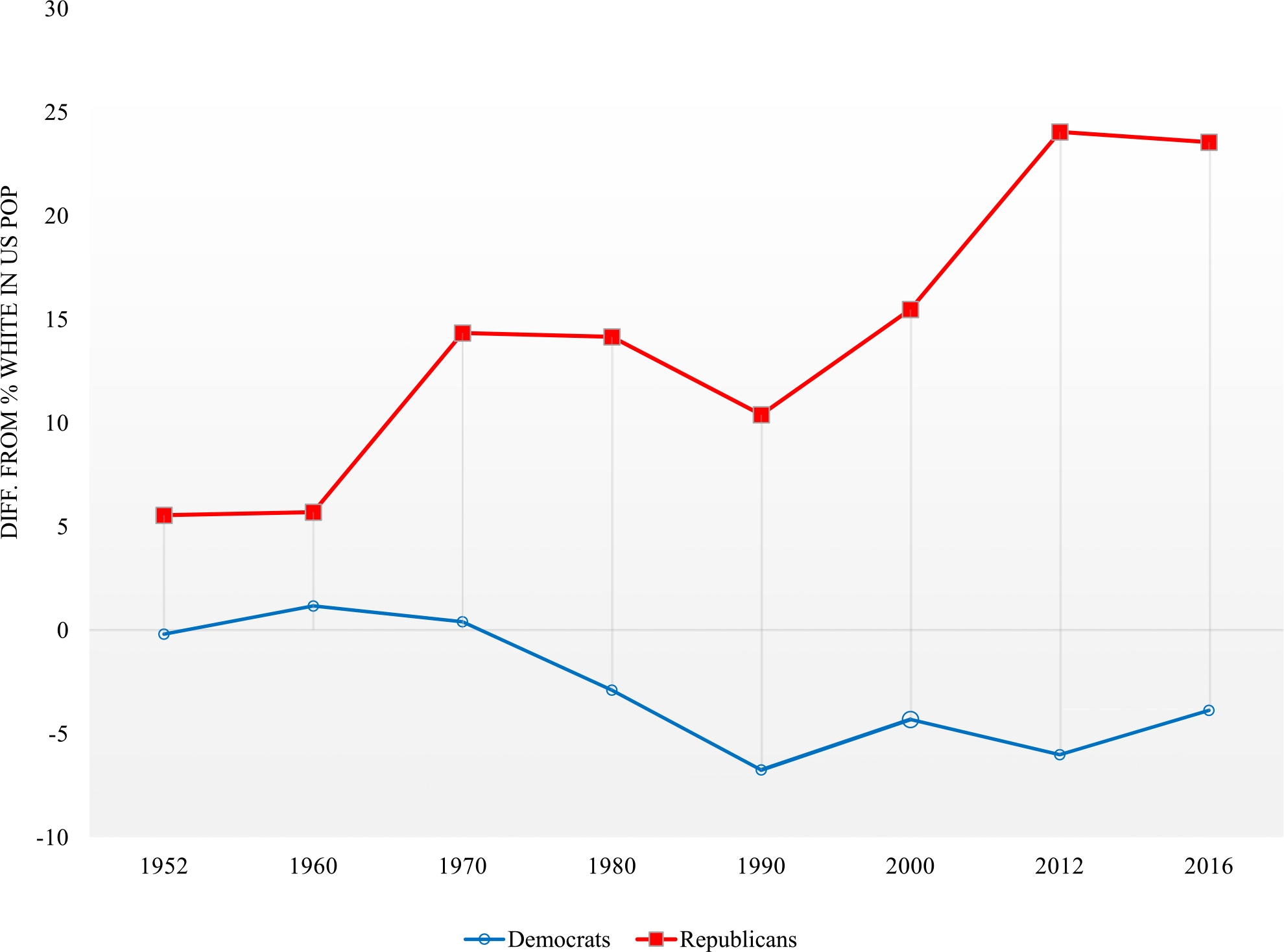
As early as 1989, Huckfeldt and Kohfield (Reference Huckfeldt and Kohfield1989, 2) wrote that race was driving out class as “the most significant factor in electoral politics.” Since 1990, the American electorate has grown progressively more racially and ethnically diverse, and the “diversity gap” between the parties has grown ever wider. Figure 3 displays the divergence between the white percentage of each party and the national population. The parties’ racial differences are also starkly reflected in Congress, where minorities make up fully 38 percent of Democratic members but a mere 5 percent of Republicans (Manning Reference Manning2019).
White Share of the Major Parties Relative to the US Population, 1952–2016

As is evident here, these shifts in the racial composition of the parties occurred gradually over decades. They were driven by both “bottom-up” activism at the parties’ grassroots and “top-down” efforts of party leaders. Dating back to Nixon’s “Southern Strategy,” Republican leaders had sought to draw racially conservative southern whites into the Republican Party (Frymer and Skrentny Reference Frymer and David Skrentny1998). To do so, candidates employed symbols, “dog whistles,” and coded appeals tapping into racial prejudice and stereotypes (Mendelberg Reference Mendelberg2001), rather than presenting stark policy alternatives on racial issues.Footnote 9 At the same time, grassroots movements both North and South mobilized in reaction to desegregation, especially against school busing (Lassiter Reference Lassiter2006). The resulting “politics of suburban secession” (Kruse Reference Kruse2005) reshaped conservative ideology itself (Crespino Reference Crespino2007; Lowndes Reference Lowndes2008). Over time, white voters’ attitudes toward race emerged as a much stronger predictor of their partisan attachments, with white racial conservatives more likely to identify as Republicans and white racial liberals more likely to identify as Democrats (Tesler Reference Tesler2016).
The upshot of these long-term demographic and ideological changes is a party system increasingly cleaved along racial lines and thus primed to express racial and ethnic policy differences. Whites and nonwhites hold different views on many political issues and priorities. On questions involving racial discrimination and inequality, for example, whites and blacks are “worlds apart” (Pew Research Center 2016). A party system in which racial minorities made up equivalent shares of both major parties would be less inclined toward conflict on issues that divide whites from nonwhites, just as the Labour and Conservative parties in the post-2016 United Kingdom—each internally divided on Brexit—long declined to present clear alternatives on the country’s membership in the European Union. Rather than suppressing racial conflict, however, a party cleavage that sorts voters by race will tend to emphasize and even exacerbate it.
Major Party Vulnerability to Outflanking. Considering the deep racial gap between the parties in terms of electoral composition and the relatively modest gap between mainstream party leaders on racial policy and the use of racialized rhetoric, it should not be surprising that the Republican establishment would be vulnerable to outflanking. Since the 1990s, Republican leaders had sought to tamp down party conflict over race and immigration while simultaneously leading a party that is overwhelmingly white and increasingly conservative on these issues. In so doing, they likely opened a “representation gap” ripe for populist exploitation. Given the radical porousness of party nomination processes in the United States, elite gatekeepers cannot veto party nominations if racist or ethnonationalist appeals successfully activate a majority of primary voters (Schlozman and Rosenfeld Reference Schlozman, Rosenfeld, Lee and McCarty2019).
The outlines of a more populist, less racially inclusive politics appeared in more than embryonic form in the 2016 elections. Even before he announced his presidential bid, Trump had long promoted the “birther” conspiracy claiming that President Obama was not born in the United States. Over the course of his campaign, Trump violated the norms of liberal democracy in numerous ways. He launched his campaign in June 2015 with a speech labeling Mexican immigrants rapists and criminals. He called for a “total and complete shutdown of Muslims entering the United States.”Footnote 10 He claimed that a judge of Mexican descent could not be fair.Footnote 11 Repeatedly at campaign rallies, he expressed nostalgia for a time when extralegal violence could be deployed against protestors.Footnote 12 In each of these controversies, Trump was denounced by mainstream opinion leaders and Republican officeholders. But giving voice to such sentiments allowed him to forge a unique bond of trust and “authenticity” with important elements in the Republican base and create favorable contrasts with establishment Republican leaders and officeholders (Sides, Tesler, and Vavreck Reference Sides, Tesler and Vavreck2018).
Considering the long-term changes in the party system evident in figures 2 and 3, it seems likely that a candidate using such “politically incorrect” appeals would have emerged eventually, even had Trump not proved successful in 2016. Willing to violate norms against the use of racialized rhetoric, Trump was able to offer primary voters a product that other Republican elites refused to supply. Those appeals strengthened his populist, anti-elite credentials and probably contributed to his success in winning the nomination.
Obstacles to Authoritarian Populism
Although it is extremely difficult for third parties to successfully challenge major parties, there is nothing about the US system that keeps populists out of office. When they get into office, however, they will normally arrive under the auspices of one of the major parties. The question, then, is how much threat they pose to American democracy.
Given how extensively the US constitutional system fragments political power, Americanists have tended to worry far more about gridlock and ungovernability than authoritarianism (e.g., Binder Reference Binder2003). Under its separation of powers, bicameralism, and strong federalism, governance in the United States requires leaders to obtain cooperation from an array of independent actors, all with their own bases of political power and formal authority. Party polarization stresses any political system that puts such a premium on negotiating across veto points (McCarty Reference McCarty, Lee and McCarty2019). Populist leaders tend to exacerbate political and societal polarization (Weyland and Madrid Reference Weyland and Madrid2019). A more populist party politics centered around racial and ethnic identity will likely deepen these challenges (Mason Reference Mason2018) and thereby degrade the performance of American governing institutions.
In the wake of the 2016 elections, scholars have been more willing to consider the possibilities for authoritarian populism (Miller, Szakonyi, and Morgenbesser Reference Miller, Szakonyi and Morgenbesser2018) and democratic erosion in the United States (Carey et al. Reference Carey, Helmke, Nyhan, Sanders and Stokes2019). In How Democracies Die, Levitsky and Ziblatt (Reference Levitsky and Ziblatt2018) envision a scenario by which an authoritarian leader, standing at the helm of a party that controls both chambers of Congress and a majority on the Supreme Court, politicizes election administration and law enforcement to entrench permanent control of the federal government. Many experts assess that the United States has seen some democratic backsliding in recent years, precisely what one would expect based on the comparative research on the effects of populist in power (Carey et al. Reference Carey, Helmke, Nyhan, Sanders and Stokes2019).
Although Levisky and Ziblatt are right to caution against complacency in a world where many democracies have deteriorated (Diamond Reference Diamond2015), the American political system still maintains formidable obstacles against authoritarianism, populist or otherwise. Albeit imperfect, these obstacles are likely to frustrate any but an overwhelmingly popular leader. It is hard to think of a political system that sets higher hurdles to single-party control than the American constitutional system. The “American Hybrid” in Dahl’s (Reference Dahl2001, 110–16) formulation requires three concurrent, separately elected majorities: majorities of the House and Senate, each resting on a distinct base of apportionment, and control of the presidency. To this list, one might add the need for a Supreme Court majority as well.
Comparative politics scholars have identified two dominant pathways for post–Cold War democratic erosion (Bermeo Reference Bermeo2016): executive aggrandizement and strategic election manipulation. Both these paths to democratic backsliding are more open at the state than at the federal level.Footnote 13 At the federal level, populist electoral success will more likely degrade governmental capacity via deeper polarization than empower an authoritarian regime.
Executive Aggrandizement
Executive aggrandizement “occurs when elected executives weaken checks on executive power one by one, undertaking a series of institutional changes that hamper the power of opposition forces to challenge executive preferences” (Bermeo Reference Bermeo2016, 10–11). Although presidential power is enhanced when Congress is gridlocked or compliant, it is hard to envision the United States embracing the transformative institutional changes that have degraded democracies to “competitive authoritarianism” (Levitsky Reference Levitsky2010).
In countries where executive aggrandizement has occurred, it has often proceeded via democratic means—through national elections, referendums, and legitimate lawmaking processes. To secure political hegemony, Erdoğan employed a 2017 popular referendum to transform Turkey from a parliamentary to a presidential system of government, with himself as elected dictator. As another example, Orban’s radical overhaul of the Hungarian system was reinforced in 2018 by a landslide reelection to a third term along with a two-thirds parliamentary majority.
The US presidency is a powerful office with vast authority over domestic regulation and foreign affairs. Recent presidents have made bold use of their unilateral powers, in some cases laying claim to a legal theory of the “unitary executive” (Howell Reference Howell2003; Rudalevidge Reference Rudalevige2006). But in comparative perspective, the US Congress is unusually strong, and the president is relatively weak (Shugart and Carey Reference Shugart and Carey1992, 148–66). The US president has very limited power to control the federal budget or set the congressional agenda and obtain votes on administration priorities. The president cannot dismiss either chamber of Congress.
It would be very difficult to substantially augment the presidency’s powers. The procedural barriers to constitutional change in the United States are extraordinarily high (Lutz Reference Lutz1994). The president is constitutionally limited to two terms. Only an overwhelmingly popular president would stand a chance at achieving a significant expansion of formal executive power, along the lines of the constitutional changes wrought in Hungary and Turkey.
But even bare majority support is outside presidents’ reach most of the time. Although a declining proportion of Americans self-identify with a major party, the American electorate is not volatile. Presidential elections are decided within a narrow range. There has not been a landslide presidential election in American politics since 1984, when Ronald Reagan won a national majority of 58.8%. As shown in Table 1, presidents spend much of their time in office near or below 50% approval in public opinion polls.
Populist leaders put executive checks to the test and often undermine horizontal constraints on their power. President Trump fits the populist mold in this respect, breaking long-standing norms in his use of executive power over trade policy and emergency decrees, among others. Not surprisingly, expert surveys during the Trump administration point to a decline of confidence in the efficacy of judicial and legislative constraints on the executive (Carey et al. Reference Carey, Helmke, Nyhan, Sanders and Stokes2019, 11–14). But Trump has not broken free of the institutional limits on presidential consolidation of power, including separate elections for national offices, bicameralism, federalism, and an independent judiciary.
Separate Elections. Members of Congress win office as individual candidates in single-member constituencies on the basis of their own campaign appeals and pledges, not as part of party teams bound to a national leader or platform. They usually run stronger in their own constituencies than do their party’s presidential candidate. Additionally, midterm elections almost always weaken the president’s party in Congress, a key reason why presidents’ political capital tends to decline over time (Light Reference Light1999). Given the close division of party support in the electorate, the US national government has been under divided party control three-quarters of the time since 1980. Unified governments do not endure long.
The Trump presidency fits the usual pattern. Trump faced significant congressional resistance to his legislative agenda even in unified government during his first two years in office (Edwards Reference Edwards2018), and congressional resistance further hardened after the 2018 midterms. The upshot is President Trump’s control over national government was weaker in 2019 than it had been in 2017, consistent with the normal decay in presidential authority over time.
Bicameralism. The bicameral Congress is not a majority-rule institution. The president’s party opposition is often able to block a president’s legislative initiatives, even in unified government. Bicameral disagreement blocked or diluted much of President Trump’s proposed legislation, including the efforts to repeal and replace Obamacare, roll back financial regulatory reforms, cut domestic discretionary spending, and impose work requirements on food stamp recipients.
Federalism. The federal system usually operates so that presidents face a substantial number of states controlled by their party opposition. Considering the degree of federal-state cooperation required in most federal policy implementation, opposed state governments have numerous tools to block or dilute national policies (Robertson Reference Robertson2011). Presidents and parties in power at the federal level routinely struggle to overcome “uncooperative federalism” as they seek to impose national policy (Bulman-Pozen and Gerken Reference Bulman-Pozen and Gerken2009, 1256). The Trump administration encountered strong political and legal opposition from Democratic-leaning states challenging administration policy on immigration, environment, and health policy.
Independent Judiciary. Presidents regularly find their laws and executive actions bogged down in judicial disputes or overturned by the federal courts. Indeed, federal courts halted or reversed an array of President Trump’s executive orders and administrative actions. Courts ended the separation of families at the border, disallowed the long-term detention of migrant families, and blocked the administration from ending Temporary Protected Status for migrants from Haiti, El Salvador, Honduras, and Sudan. A federal judge required the administration to restore the Obama-era program protecting “Dreamers” while litigation is pending. A series of adverse rulings blocked the Trump administration’s Environmental Protection Agency from rolling back several health and environmental safety regulations.
In sum, the difficulties of consolidating national power in American politics are formidable. Even Franklin Roosevelt—elected by a landslide in 1932 in the midst of national crisis, presiding over overwhelming majorities in Congress, reinforced by an anomalous midterm election in 1934 that did not deplete his party’s ranks, and triumphantly reelected by an even greater landslide in 1936—found his domestic agenda largely halted in five years’ time. Although one can imagine an even more popular leader, with broader and more enduring support, it would be outside American experience to date.
Strategic Election Manipulation
As a second form of democratic backsliding, strategic election manipulation “denotes a range of actions aimed at tilting the electoral playing field in favor of incumbents” (Bermeo Reference Bermeo2016, 13). US electoral law is hardly free of deck stacking (Issacharoff, Karlan and Pildes Reference Issacharoff, Karlan and Pildes2012). The political interests of incumbents and majority parties influence policies regarding voting (Hicks et al. Reference Hicks, McKee, Sellers and Smith2016), ballot access (Lewis-Beck and Squire Reference Lewis-Beck and Squire.1995), campaign finance (La Raja Reference La Raja2008), and legislative districting (Cox and Katz Reference Cox and Katz2002).
Nevertheless, a president or majority party in Congress cannot wield strategic election manipulation to cement political control at the federal level for the simple reason that the federal government has so little power over election administration. Voting procedures and voter registration, legislative districting, and ballot access are regulated at the state level and administered at the local level. States are jealous of their authority in this arena. When President Trump assembled a commission on election integrity that represented a potential effort at deck stacking, it failed to obtain cooperation from state election officials, including even in Republican states,Footnote 14 got bogged down in lawsuits, and was dissolved in less than a year.
Because authority over election law is so decentralized, a party with unified control of the national government cannot impose nationwide rules tilting the overall electoral playing field to its advantage. In states where one party is dominant, it may adopt electoral rules favorable to its interests. Along these lines, since 2004 Republican-controlled states have enacted a variety of “anti-voter fraud” measures that disproportionately burden poor, minority, and Democratic voters (Biggers and Hanmer Reference Biggers and Hanmer2017). These moves represent a troubling form of democratic backsliding and have contributed to downgrades in the Freedom House rating of US democracy.Footnote 15 They have alarmed voting rights advocates aware of the country’s long history of minority disfranchisement. Such moves, however, have proved to be of limited efficacy in reducing minority turnout (Grimmer et al. Reference Grimmer, Hersh, Meredith, Mummolo and Nall2018; Highton Reference Highton2017). Institutional engineering of this type often does not work as intended (Gelman and King Reference Gelman and King1994).
Even when partisan deck stacking is effective, strategic election manipulation would not suffice to entrench a party at the federal level, because parties can engineer this kind of deck stacking in states only where they are already strong and thus likely to win anyway. They have great difficulty executing these maneuvers in swing states, much less in states that lean toward the opposing party.Footnote 16 The state-by-state nature of these battles limits opportunities for a majority party or would-be authoritarian leader to entrench national power against electoral reversal. The decentralization of power over election administration undermines the quality of American democracy, but it also hampers federal efforts at strategic election manipulation.
Taking Stock of Populism’s Potential Threats
Americans are susceptible to populist appeals. Although third-party candidacies are rarely viable, populists are able to win power within the existing mainstream parties. Indeed, both the supply and demand for populism in American politics have likely increased. Short of overwhelming public support, however, it seems unlikely that a populist party or president would be able to centralize authoritarian power over American national government.
Democratic backsliding in American politics is unlikely to proceed very far, in great part because the constitutional system puts up so many obstacles in the way of democratic majorities. But those institutional constraints do not neutralize populism’s threats. Rather than a slide toward autocracy, populist perils for American democracy are more likely to entail erosion of the norms of a racially and ethnically inclusive liberalism. A more populist politics in a party system increasingly defined by race and identity menaces the interests of minorities and immigrants. But short of minority disfranchisement, American politics can become less inclusive and tolerant without loss of democratic form.
As such, populism’s challenges to American democracy likely center more on the performance of its democratic institutions than their persistence. A racialized party system in an electorate with a questionable commitment to liberal values is a troubling development. It is difficult to manage racial tensions in a democracy in any case, much less when race becomes a principal line of political cleavage (Rabushka and Shepsle Reference Rabushka and Shepsle1972). After all, the United States only became a fully multiethnic democracy with the 1965 Voting Rights Act, following a long and tortured process of democratization (Bateman Reference Bateman2018; King et al. Reference King, Lieberman, Ritter and Whitehead2009; Mickey Reference Mickey2015; Mickey, Levitsky, and Way Reference Mickey, Levitsky and Ahmad Way2017). Given this history, illiberal democracy probably has a mass constituency in the United States, as it does in Hungary, Poland, the Philippines, and elsewhere (Zakaria Reference Zakaria1997).
It seems almost certain that Trump’s astonishing success will point the way to future ambitious politicians. Yet Trump is also an unpopular president. He has never commanded anything like the domestic support of Erdoğan, Russian president Vladimir Putin, Indian prime minister Narenda Modi, or Philippine president Rodrigo Duterte. It is simply too early to say whether the politics of 2016 is a harbinger of the future. But with his truculent populism and willingness to exploit racial resentments, Trump was able to appeal to attitudes that public opinion scholars have long known were present in the American electorate but had not been courted by mainstream politicians in recent decades. Going forward, we are likelier to see a more illiberal, racially inflected party politics than an authoritarian consolidation of executive power.