

Introduction
The vaccination mandate for Australian health care workers for vaccine-preventable diseases (VPDs) is considered justified by reducing the risk of infection transmission, including the risk of health care workers infecting vulnerable patients. Before the COVID-19 pandemic, state or territory health policies required health care workers to provide evidence of vaccination or immunity (e.g., for hepatitis B, measles, or mumps) based on their work role risk level. Until recently, health professional students were required to be vaccinated against COVID-19 to undertake clinical placement throughout their study programs.
During the COVID-19 pandemic, the Australian Federal government strongly recommended vaccination against COVID-19 for health professional students entering high-risk settings, such as health facilities, but did not mandate it. This left decision-making on mandating this to state and territory governments, which, in turn, informed education provider vaccination requirement decisions. While scholarly interest in COVID-19 vaccination within health care settings and public health is growing,Reference Chen, Prichard and Mason1–Reference Castillo, Villalobos Dintrans and Maddaleno5 there is a paucity of literature addressing the experiences surrounding the implementation of the COVID-19 vaccine rollout in Australia. This paper aimed to explore the barriers and facilitators experienced by organizational stakeholders in implementing the COVID-19 vaccine rollout, especially in mandatory COVID-19 vaccination for health professional students.
Methods
Study Design
This was a qualitative study. In preparing this manuscript, we followed the consolidated criteria for reporting qualitative research guidelines (COREQ).Reference Tong, Sainsbury and Craig6 We received ethical approval from the University of the Sunshine Coast Ethics Committee (A211644).
Participants
Participants were chosen purposefully, including those with first-hand experience in the implementation and/or enforcement of the COVID-19 vaccine rollout, including mandatory vaccination requirements for health professional students in Australia. This included state/territory level senior health department staff, university clinical placement coordinators, and clinical educators in health care environments. Participants were purposively recruited via the researchers’ professional networks. All participants who were approached consented to participate in the study.
Data Collection
Interviews were conducted between November 21 and December 20, 2022, via ZOOM. An interview guide (see Supplementary Material) was developed based on our previous work,Reference Chen, Prichard and Mason1, Reference Chen, Tower and Zimmerman2 guided by the Theoretical Domains Framework (TDF).Reference Cane, O’Connor and Michie7 We piloted the interview guide with two stakeholders and made refinements accordingly. The interviewers (YC, JL, and FL) have extensive experience in qualitative research and had no prior working relationship with the participants. Member checking was performed at the conclusion of each interview, with any issues addressed immediately. Interviews continued until data saturation was achieved. All interviews were recorded via ZOOM and transcribed verbatim before being imported to NVivo software.
Data Analysis
A thematic analysis approach was utilized with data familiarization, coding, and theme identification and refinement.Reference Braun and Clarke8 The two authors (YC and MT) independently analyzed the data inductively by immersing themselves in the data before categorizing the data into codes and sub-codes. A third author resolved disagreements in the data analysis process. Following that, the first author grouped the codes thematically, and a further deductive analysis was undertaken guided by the TDF.Reference Cane, O’Connor and Michie7 Three authors (YC, MT, and FL) met three times to discuss the data analysis findings. Finally, the other authors checked all codes, sub-codes, and themes, which were discussed and finalized in multiple team meetings.
Findings
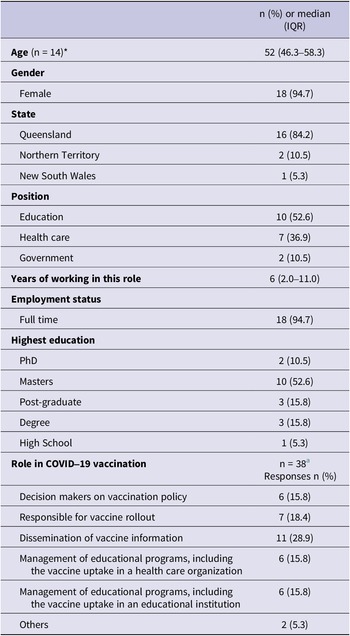
Nineteen participants were interviewed (Table 1). Interview time ranged from 11 to 35 minutes, totaling 495 minutes. Most participants were female (18, 94.7%) and resided in Queensland, Australia (16, 84.2%). Data analysis revealed 5 key domains. We present the domains and themes with supporting quotes and summarize them in Table 2.
Participant characteristics (N = 19)

Note: An asterisk * indicates the number of participants with data available.
IQR, Interquartile range.
a Please note that each participant can provide multiple responses (n = 38).
Domains and themes
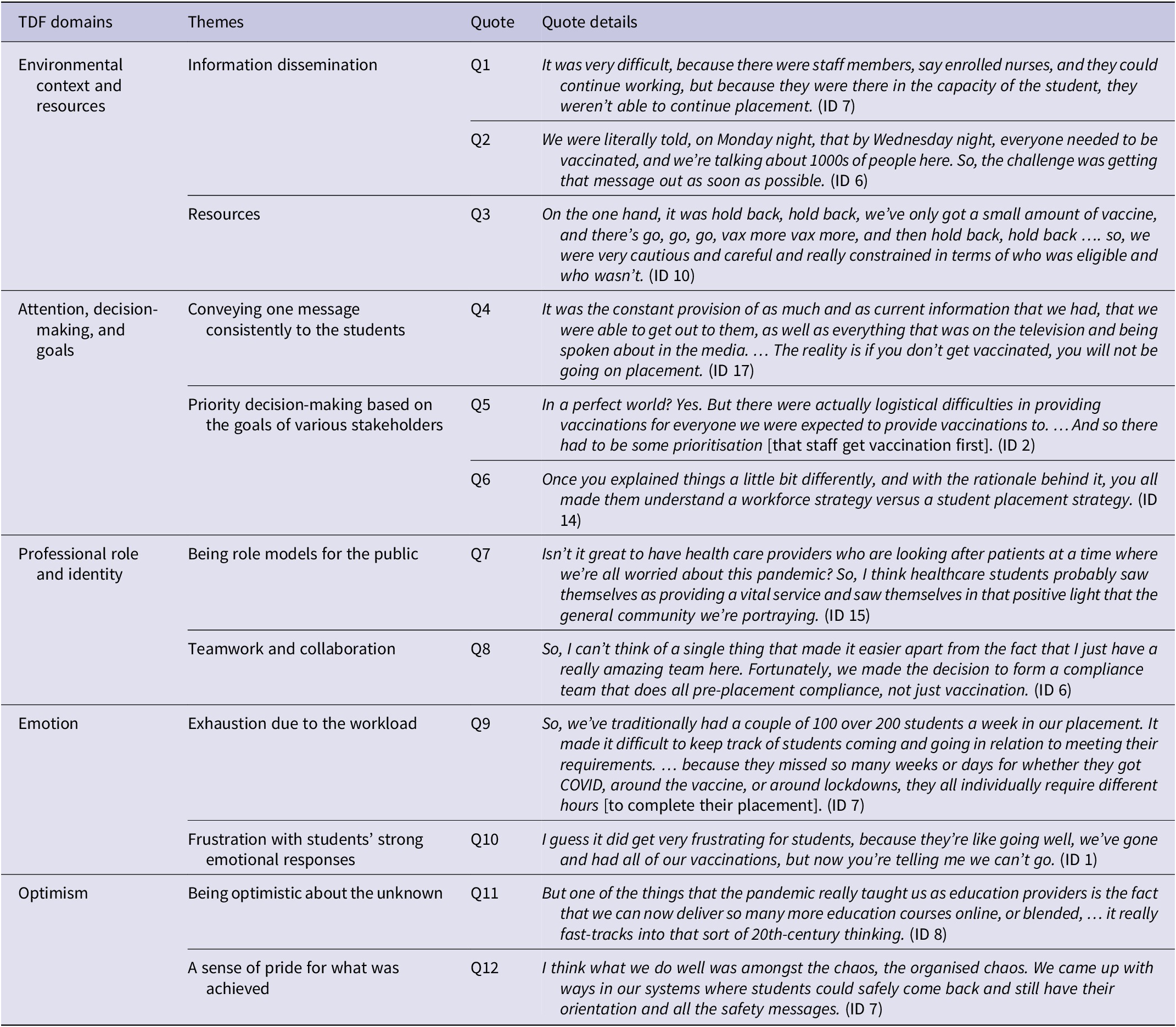
Note: TDF, Theoretical Domains Framework.
Environmental Context and Resources
Information dissemination barriers
Participants reported receiving constantly changing and confusing information during the vaccine rollout, described as “changing minute by minute” (ID 1) or “unpredictability of messaging” (ID 15). This led to the difficulty of “keeping up with all those changes” (ID 5). Hence, participants stated that having an appropriate plan in place was almost impossible. University staff also reported confusing messages from industry partners, such as health bureaucrats, that they believed were open to interpretation (Table 2, Q1).
Information was disseminated through multiple layers, which often contributed to communication delays. In universities, senior management first interpreted the health department and senior bureaucrats’ directives before releasing information to staff and students. Similarly, in health care, communication flowed from health executives to various health departments and services, and then to individuals. This multi-layered approach prolonged information filtering, leading to inconsistencies and difficulties for health care workers who needed timely updates and clarity before engaging with university staff on student clinical placements (Table 2, Q2).
Resources
Being unable to choose a preferred vaccine was an issue at the start of the vaccine rollout. Holding personal preferences for vaccine type, combined with vaccine availability, initially led to prolonged waiting times for vaccination. As a result, participants said the students had to find their own vaccination source (Table 2, Q3).
There was also a lack of sufficiently qualified staff to administer vaccinations in health care settings, insufficient vaccination sites for staff and students to get vaccinated, and inefficient booking systems. Consequently, people were unable to receive vaccinations when they were eager to do so.
Attention, Decision-making, and Goals
Conveying one message consistently to the students
Participants frequently mentioned that it was important to deliver a consistent message to students that clinical placement would be impossible without complying with vaccination requirements. This frequent, consistent messaging prompted students to decide whether they would be prepared to be vaccinated (Table 2, Q4).
Priority decision-making based on the goals of various stakeholders
Government-defined vaccination priority groups posed challenges. Participants noted that most students were aged between 18 and 24 years, who were ineligible early on because vaccines were reserved for the more at-risk, older population. This led to debate about whether students should have the same access to vaccination. Government officials responsible for the rollout opposed treating students the same as staff (Table 2, Q5).
University staff generally agreed that double standards occurred between students who were removed from their clinical placement due to not being vaccinated and staff who were able to continue regardless of the staff’s vaccination status. On the other hand, some health care staff assumed that this occurrence was attributed to insufficiency in providing supervision for health professional students and different levels of duty of care. Those who were in higher government positions saw the rationale to balance between keeping patients safe and continuing clinical placement (Table 2, Q6).
Professional Role and Identity
Being role models for the public
Participants felt a responsibility to set a good example for the public by getting vaccinated and saw themselves as future health leaders. Hence, they followed the health leaders’ directives, made decisions quickly based on the directives, and provided expert advice on infection prevention and control. Other participants also saw this role modelling amongst health professional students (Table 2, Q7):
Teamwork and collaboration being enablers
Teamwork and collaboration occurred through liaising with health care facility executives to make collaborative decisions, such as ensuring health professional students followed vaccine rollout measures. Participants acknowledged and appreciated the teamwork within their organizational unit during these unprecedented circumstances (Table 2, Q8).
Emotion
Exhaustion due to the workload
University staff often felt exhausted and frustrated during the COVID-19 vaccination rollout due to overwhelming working hours, with tasks such as constantly requiring clarity of the disseminated information, feeling behind in obtaining the updated information, tracking student placement, and managing replacing students’ missing placement time to enable them to complete their studies (Table 2, Q9).
Frustration with students’ strong emotional responses
University staff frequently reported that students were frustrated when they were not allowed to continue their clinical placement. University staff often bore the brunt of students’ frustrations, as some believed university staff were responsible for placement disruptions (Table 2, Q10).
Optimism
Being optimistic about the unknown
Participants held a positive attitude toward working in the “unknown” as part of a team. One participant described it as “flying by the seat of our pants” (ID 7) and having to manage as best they could. University staff also saw positive changes in how they worked had resulted from the pandemic (Table 2, Q11).
A sense of pride for what was achieved
Participants commonly shared that most professionals remained adaptable during the uncertain time. Hence, university staff felt a sense of pride in their achievements while working in a system that prevented business as usual. Similarly, health care workers expressed pride in ensuring staff and patient safety, preserving relationships with the university, and managing rapidly changing situations (Table 2, Q12).
Discussion
We have identified 5 key domains, including 1) environmental context and resources, 2) attention, decision-making, and goals, 3) professional role and identity, 4) emotion, and 5) optimism. Our findings provide policymakers in government, health care, and universities with our lessons learnt to better respond to future health crises.
Effective communication was essential to maintaining population cooperation and trust during the COVID-19 vaccine rollout.Reference Chen, Prichard and Mason1–Reference Basseal, Bennett and Collignon3 In future situations, communication must focus on what to say in a message, how to convey the message, and whether the message is impactful and persuasive during pandemics and beyond.Reference Vernon-Wilson, Tetui and Nanyonjo9 Overwhelming and confusing communication during the vaccine rollout led to distrust, as reported in a qualitative study on health professional students’ COVID-19 vaccination attitudes.Reference Chen, Tower and Zimmerman2 Similarly, our participants reported communication issues. Policymakers should develop, test, and routinely adopt communication strategies in non-pandemic conditions to work effectively in future pandemics.Reference Chen, Prichard and Mason1, Reference Chen, Tower and Zimmerman2, Reference Vernon-Wilson, Tetui and Nanyonjo9
Vaccine availability, accessibility, and workforce issues were reported during the COVID-19 vaccine rollout.Reference Desborough, Wright and Parkinson4, Reference Castillo, Villalobos Dintrans and Maddaleno5, Reference Oversby, Hamilton, Ratsch and Kitchener10 Our participants shared similar issues with vaccine supply and accessibility, and suboptimal booking systems that hindered the start of the vaccine rollout. As resourcing issues can lead to inconvenience,Reference Oversby, Hamilton, Ratsch and Kitchener10 vaccine hesitancy,Reference Vernon-Wilson, Tetui and Nanyonjo9 and delayed vaccine rollout, appropriate resources must be available and accessible before implementing similar large-scale health interventions or emergency responses, including but not limited to future pandemics.Reference Castillo, Villalobos Dintrans and Maddaleno5
Teamwork was essential to enable seamless coordination across multiple stakeholders during the COVID-19 vaccine rollout.Reference Castillo, Villalobos Dintrans and Maddaleno5, Reference Oversby, Hamilton, Ratsch and Kitchener10 Local governments, health care organizations, and universities should collaborate to communicate with the general public about vaccination programs.Reference Castillo, Villalobos Dintrans and Maddaleno5 Our participants shared their teamwork through collaboration between health care organizations and universities to enable COVID-19 vaccine-related decisions. Policymakers must have strategies to promote teamwork and collaboration to increase vaccine uptake in similar future pandemics.Reference Basseal, Bennett and Collignon3, Reference Desborough, Wright and Parkinson4
Our participants expressed frustrations with the vaccine rollout, citing long hours and increased stress, echoing findings in previous studies.Reference Vernon-Wilson, Tetui and Nanyonjo9, Reference Oversby, Hamilton, Ratsch and Kitchener10 In a qualitative study, vaccine providers reported increased workloads from the rollout on top of existing COVID-19-related duties.Reference Oversby, Hamilton, Ratsch and Kitchener10 Additionally, university staff felt health professional students were disadvantaged, as reflected in a qualitative study reporting “a bit double standard” perception by health professional students.Reference Chen, Tower and Zimmerman2 Furthermore, frustrations came from the resentment of health professional students who mistakenly believed university staff disrupted their clinical placement. A future rollout strategy should include promoting strong communication and developing a resilient and caring culture for all professionals involved in such events.
Despite challenges, our participants remained optimistic and proud of their achievements during the vaccine rollout. Such sentiments are not uncommon nationally and internationally, with studies reporting similar findings.Reference Vernon-Wilson, Tetui and Nanyonjo9, Reference Oversby, Hamilton, Ratsch and Kitchener10 The success of the COVID-19 vaccine rollout instils hope, strengthening future public health infrastructure and pandemic preparedness.
Strengths and Limitations
This is the first study to explore barriers and facilitators to the COVID-19 vaccine rollout in Australia using the TDF.Reference Cane, O’Connor and Michie7 While nationwide, the recruitment strategy was uneven, with most participants from Queensland, suggesting a selection bias. Social desirability bias may also have influenced responses. Despite these limitations, our findings offer valuable reflections to improve future rollout strategies.
Conclusion
Our findings add to existing literature by highlighting barriers and facilitators to the COVID-19 vaccine rollout from an organizational stakeholder perspective. Key challenges included suboptimal communication, insufficient resources, and negative emotions. Enablers were teamwork, collaboration, and adaptability. These insights can help policymakers in government, health care, and universities develop strategies for future large-scale health interventions or emergency responses.
Supplementary material
The supplementary material for this article can be found at http://doi.org/10.1017/dmp.2026.10326.
Acknowledgments
We would like to acknowledge the organizational stakeholders for their assistance in this research.
Author contribution
Y.C. and F.F.L.: Conceptualization, methodology, investigation, data curation, formal analysis, writing—original draft, writing—review and editing. M.T. and P.Z.: Conceptualization, methodology, investigation, formal analysis, writing—original draft, writing—review and editing. V.S., J.L., R.P., and M.M.: Methodology, investigation, data curation, writing—review and editing. All authors reviewed the manuscript.
Funding statement
There is no funding involved in this study.
Competing interests
There are no conflicts of interest to declare.


 Open access

