


1. Introduction
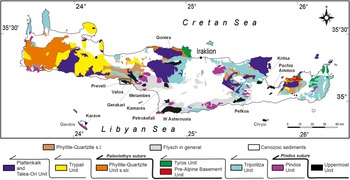
The Cretan nappe stack results from the closure of at least three former oceans, the Paleotethys (Stampfli et al. Reference Stampfli, Vavassis, De Bono, Rosselet, Matti and Bellini2003), the Pindos Ocean (Jones and Robertson, Reference Jones and Robertson1991; Smith, Reference Smith, Prichard, Alabaster, Harris and Neary1993; Degnan and Robertson, Reference Degnan and Robertson1998) and the Vardar Ocean (Majer and Mason, Reference Majer and Mason1983; Karamata, Reference Karamata1994; Brown and Robertson, Reference Brown and Robertson2004). The closure of the Paleotethys led to the Paleotethys suture (yellow line in Figure 1), which separates Gondwana derived passive-margin deposits from active-margin rocks of Eurasia (Stampfli et al. Reference Stampfli, Vavassis, De Bono, Rosselet, Matti and Bellini2003; Stampfli and Kozur, Reference Stampfli, Kozur, Gee and Stephenson2006; Zulauf et al. Reference Zulauf, Dörr, Marko and Krahl2018). The Pindos suture is situated in the upper part of the Cretan nappe pile (green line in Figure 1; e.g. Degnan and Robertson, Reference Degnan and Robertson1998, Reference Degnan, Robertson, Robertson and Mountrakis2006; Skourlis and Doutsos, Reference Skourlis and Doutsos2003; Robertson, Reference Robertson2012, Reference Robertson2022). The Paleogene Pindos flysch (Richter and Müller, Reference Richter and Müller1992; Degnan and Robertson, Reference Degnan, Robertson, Robertson and Mountrakis2006) indicates Eocene closure of the Pindos Ocean, which might have started already during the late Cretaceous as indicated by Turonian Pindos flysch (Wagreich et al. Reference Wagreich, Pavlopoulos, Faupl and Migiros1996). The lack of metamorphism in the Pindos Unit and apatite fission-track ages of the Uppermost Unit suggest that the latter was situated at brittle structural levels since at least the late Eocene/early Oligocene (Thomson et al. Reference Thomson, Stöckhert, Rauche, Brix, Van Den Haute and De Corte1998, Reference Thomson, Stöckhert and Brix1999). This holds for all nappes of the Uppermost Unit independent of their metamorphic grade (e.g. high-grade Buchan-type metamorphic rocks of the Upper Cretaceous Asteroussia crystalline complex, blueschists of the Preveli nappe or Jurassic serpentinites affected by a greenschist facies overprint). Rocks of the Uppermost Unit are exposed in central and eastern Crete, on Gavdos and Chrysi. Similar rocks, referred to as Upper Unit, are present on several Cycladic islands, such as Anafi, Donousa, Ikaria, Nikouria, Andros and Tinos (Figures 1 and 2; Bonneau, Reference Bonneau1972, Reference Bonneau1984; Seidel et al. Reference Seidel, Okrusch, Kreuzer, Raschka and Harre1976, Dürr et al. Reference Dürr, Seidel, Kreuzer and Harre1978; Seidel et al. Reference Seidel, Okrusch, Kreuzer, Raschka and Harre1981; Krahl et al. Reference Krahl, Herbart and Katzenberger1982; Reinecke et al. Reference Reinecke, Altherr, Hartung, Hatzipanagiotou, Kreuzer, Harre, Klein, Keller, Geenen and Böger1982; Dürr, Reference Dürr1985, Reference Dürr and Jacobshagen1986; Thorbecke, Reference Thorbecke1987; Altherr et al. Reference Altherr, Kreuzer, Lenz, Wendt, Harre and Dürr1994; Patzak et al. Reference Patzak, Okrusch and Kreuzer1994; Fassoulas, Reference Fassoulas1998; Langosch et al. Reference Langosch, Seidel, Stosch and Okrusch2000). Upper Jurassic ophiolites in the Uppermost Unit (Bonneau, Reference Bonneau1973; Krahl et al. Reference Krahl, Herbart and Katzenberger1982; Koepke et al. Reference Koepke, Seidel and Kreuzer2002; Liati et al. Reference Liati, Gebauer and Fanning2004) should correlate with ophiolites of the Vardar Ocean of northern Greece. Given that this assumption is true, the ophiolites of Crete reflect the closure of the Vardar Ocean (blue line in Figure 1). The structural evolution and provenance of the Uppermost Unit are still matters of debate. There are two main reasons, why many authors relate the Uppermost Unit of Crete to the Pelagonian Zone of the Internal Hellenides (e.g. Seidel et al. Reference Seidel, Okrusch, Kreuzer, Raschka and Harre1981; Bonneau, Reference Bonneau1984; Jolivet and Brun, Reference Jolivet and Brun2008; Papanikolaou, Reference Papanikolaou2009; Tortorici et al. Reference Tortorici, Catalano, Cirrincione and Tortorici2012; Martha et al. Reference Martha, Dörr, Gerdes, Petschick, Schastock, Xypolias and Zulauf2016): (1) The rocks of both the Pelagonian Zone and the Uppermost Unit rest on top of the Pindos Unit. (2) Jurassic ophiolites and evidence for Late Jurassic/Cretaceous metamorphic imprints are documented in the rocks of the Vardar Zone (that were emplaced on top of Pelagonian rocks) and in the Ophiolite nappe of the Uppermost Unit of Crete. New provenance data of detrital zircons, separated from metasedimentary rocks of the Uppermost Unit of Crete, however, suggest that the Uppermost Unit is derived from the Rhodope–Strandja domain or from the Sakarya Zone north of the Vardar–Izmir–Ankara Suture (Zulauf et al. Reference Zulauf, Dörr, Albert, Martha and Xypolias2024).
Schematic sketch of the Cretan nappe stack and map of the Aegean region (modified from Chatzaras et al. Reference Chatzaras, Dörr, Gerdes, Krahl, Xypolias and Zulauf2016) showing areas of the Attico-Cycladic Massif in dark grey. Exposures of Upper Unit of Cyclades (Dürr, Reference Dürr1985, Reference Dürr and Jacobshagen1986; Dürr et al. Reference Dürr, Seidel, Kreuzer and Harre1978; Reinecke et al. Reference Reinecke, Altherr, Hartung, Hatzipanagiotou, Kreuzer, Harre, Klein, Keller, Geenen and Böger1982; Altherr et al. Reference Altherr, Kreuzer, Lenz, Wendt, Harre and Dürr1994; Patzak et al. Reference Patzak, Okrusch and Kreuzer1994; Langosch et al. Reference Langosch, Seidel, Stosch and Okrusch2000) and Uppermost Unit of Crete (Bonneau, Reference Bonneau1972, Reference Bonneau1984; Seidel et al. Reference Seidel, Okrusch, Kreuzer, Raschka and Harre1976, Reference Seidel, Okrusch, Kreuzer, Raschka and Harre1981; Krahl et al. Reference Krahl, Herbart and Katzenberger1982; Thorbecke, Reference Thorbecke1987) are depicted in red. BFZ, Bornova Flysch Zone; LN, Lycian Nappes; MM, Menderes Massif; SZ, Sakarya Zone; SMRM, Serbomacedonian and Rhodope Massifs.

Map of Crete showing the different geological units (after Zulauf et al. Reference Zulauf, Linckens, Beranoaguirre, Gerdes, Krahl, Marschall, Millonig, Neuwirth, Petschick and Xypolias2023a, and references therein). Exposures of rocks of Uppermost Unit are emphasized. Outline of map shown in Fig. 4 is indicated by black frame.

The present study focuses on the Preveli nappe, which belongs to the lower nappes of the Uppermost Unit (Seidel et al. Reference Seidel, Schliestedt, Kreuzer and Harre1977; Krahl, Reference Krahl1982; Krahl et al. Reference Krahl1982). Glaucophane-bearing blueschists of the Preveli nappe reflect subduction and related high-pressure/low-temperature metamorphism. While the protolith age of these blueschists has been constrained as Triassic (U-Pb on garnet of skarn; Zulauf et al. Reference Zulauf, Linckens, Beranoaguirre, Gerdes, Krahl, Marschall, Millonig, Neuwirth, Petschick and Xypolias2023 a), the ages of subduction and exhumation are still unknown. In the present contribution, we present new structural and isotopic age data, which reveal for the first time Early Cretaceous (Eohellenic) subduction and metamorphism of the Preveli rocks. The new isotopic ages, coupled with trace element data, suggest that metamorphic phengite may grow multiply during a long-lasting period reflecting several stages of ductile deformation until the Turonian. An Oligocene isotopic age, obtained for the final emplacement of the Preveli nappe on top of the Pindos Unit, is consistent with the Paleogene Pindos flysch (Degnan and Robertson, Reference Degnan, Robertson, Robertson and Mountrakis2006). The new structural and isotopic age data will help to further constrain the geodynamic evolution and the provenance of the far-travelled nappes of the Uppermost Unit and of the Preveli nappe in particular.
2. Geological setting
The Uppermost Unit of Crete is attributed to the Internal Hellenides and consists of several nappes, which contain lithologies of oceanic and continental affinities (e.g. Bonneau, Reference Bonneau1972; Reference Bonneau1984; Seidel et al. Reference Seidel, Okrusch, Kreuzer, Raschka and Harre1976, Reference Seidel, Schliestedt, Kreuzer and Harre1977, Reference Seidel, Okrusch, Kreuzer, Raschka and Harre1981; Krahl et al. Reference Krahl, Herbart and Katzenberger1982). These nappes were thrust on top of the lower nappes. The lower nappes include the Plattenkalk, Trypali, Phyllite-Quartzite s.str. Unit, which are separated by a pre-Cimmerian basement from the Tyros, Tripolitza and Pindos Unit (e.g. Jolivet and Brun, Reference Jolivet and Brun2008; Robertson, Reference Robertson2012, Reference Robertson2022; Chatzaras et al. Reference Chatzaras, Dörr, Gerdes, Krahl, Xypolias and Zulauf2016; Zulauf et al. Reference Zulauf, Dörr, Marko and Krahl2018). While most parts of the lower nappes underwent Alpine (Oligocene/Miocene) deformation and metamorphism, the nappes of the Uppermost Unit were affected by Eoalpine and earlier orogenic imprints (Seidel et al. Reference Seidel, Okrusch, Kreuzer, Raschka and Harre1976, Reference Seidel, Schliestedt, Kreuzer and Harre1977, Reference Seidel, Okrusch, Kreuzer, Raschka and Harre1981).
The Maastrichtian–Paleocene Arvi Unit (Bonneau, Reference Bonneau1973) occupies the lower structural levels of the Uppermost Unit, which rests on top of the Pindos Unit. It consists of terrigeneous turbidites, prehnite-pumpellyite facies metamorphic pillow basalts and reddish marble (Robert and Bonneau, Reference Robert and Bonneau1982; Papanikolaou, Reference Papanikolaou1989), which could have been deposited in the Pindos basin (Palamakumbura et al. Reference Palamakumbura, Robertson and Dixon2013).
The Greenschist Unit on top of the Arvi rocks (Martha et al. Reference Martha, Dörr, Gerdes, Krahl, Linckens and Zulauf2017, Reference Martha, Zulauf, Dörr, Xypolias, Binck and Nowara2018) was derived from mafic volcanic rocks. Similar rocks, exposed on Anafi, have a MORB-type signature (Reinecke et al. Reference Reinecke, Altherr, Hartung, Hatzipanagiotou, Kreuzer, Harre, Klein, Keller, Geenen and Böger1982). The greenschists were overthrust by the Asterousia Crystalline Complex (ACC) consisting of low-pressure/high-temperature metamorphic rocks and metagranitoids (Bonneau, Reference Bonneau1972; Seidel et al. Reference Seidel, Okrusch, Kreuzer, Raschka and Harre1976, Reference Seidel, Okrusch, Kreuzer, Raschka and Harre1981; Krahl et al. Reference Krahl, Herbart and Katzenberger1982; Langosch et al. Reference Langosch, Seidel, Stosch and Okrusch2000; Martha et al. Reference Martha, Zulauf, Dörr, Xypolias, Binck and Nowara2018). I-type granitoids intruded the metasedimentary successions during the middle to late Campanian (78–72 Ma; U-Pb on zircon, Kneuker et al. Reference Kneuker, Dörr, Petschick and Zulauf2015; Martha et al. Reference Martha, Dörr, Gerdes, Krahl, Linckens and Zulauf2017, Reference Martha, Zulauf, Dörr, Xypolias, Binck and Nowara2018; Zulauf et al. Reference Zulauf, Dörr, Albert, Martha and Xypolias2024). There is increasing evidence that large parts of the heterogeneous high-grade metamorphic rocks may represent former forearc deposits (Zulauf et al. Reference Zulauf, Dörr, Albert, Martha and Xypolias2024; Martha et al. Reference Martha, Xypolias, Cheng, Dörr, Gerdes, Hezel, Kutzschbach, Millonig, Schmeling, Marschall, Müller and Zulauf2025). Apart from Crete, ACC-type rocks are also exposed on the Cycladic islands referred to as Upper Unit (e.g. Anafi, Donousa, Nikouria, Syros, Tinos; Dürr et al. Reference Dürr, Seidel, Kreuzer and Harre1978; Dürr, Reference Dürr1985; Reinecke et al. Reference Reinecke, Altherr, Hartung, Hatzipanagiotou, Kreuzer, Harre, Klein, Keller, Geenen and Böger1982; Altherr et al. Reference Altherr, Kreuzer, Lenz, Wendt, Harre and Dürr1994; Patzak et al. Reference Patzak, Okrusch and Kreuzer1994; Langosch et al. Reference Langosch, Seidel, Stosch and Okrusch2000; Figure 1).
The rocks of the Vatos nappe (Aubouin and Dercourt, Reference Aubouin and Dercourt1965) are similar to those of the Miamou nappe (Bonneau et al. Reference Bonneau, Beauvais and Middlemiss1974) and seem to represent equivalents of the ACC, but with a lower metamorphic grade (Zulauf et al. Reference Zulauf, Dörr, Albert, Martha and Xypolias2024). They consist of Late Jurassic to Turonian metasediments and volcanics, which include mass-flow deposits (Bonneau et al. Reference Bonneau, Angelier and Epting1977; Krahl et al. Reference Krahl, Herbart and Katzenberger1982; Koepke, Reference Koepke1986). Calcareous schists include Late Jurassic to Lower Cretaceous foraminifera (Malten, Reference Malten2019) and Upper Cretaceous fossils, such as rudists (Koepke, Reference Koepke1986; Tortorici et al. Reference Tortorici, Catalano, Cirrincione and Tortorici2012). Turonian calcareous metaconglomerates include rodingite, ophiolitic and other pebbles (Krahl et al. Reference Krahl, Herbart and Katzenberger1982). Metamorphic index minerals, such as actinolite, chlorite, albite, white mica, indicate greenschist facies metamorphism (Karakitsios, Reference Karakitzios1988; Malten, Reference Malten2019), which should be younger than the Upper Cretaceous fossils but older than the Paleogene Pindos flysch underneath.
The Preveli nappe is an additional basal nappe of the Uppermost Unit, which at least in part rests on top of the Pindos Unit (Nüchter et al. Reference Nüchter, Wassmann and Stöckhert2013). The term Preveli group was coined by Krahl et al. (Reference Krahl, Herbart and Katzenberger1982). Preveli-type rocks are exposed in the Vatos-Preveli-Spili-Gerakari areas of central Crete (Figure 2). They underwent blueschist-facies metamorphism and consist of metasiliciclastic rock, metaconglomerate, calc-phyllite, marble, metavolcanic rock and metaradiolarite, which are of mainly Permian to Triassic age (Bonneau and Lys, Reference Bonneau and Lys1978; Zulauf et al. Reference Zulauf, Linckens, Beranoaguirre, Gerdes, Krahl, Marschall, Millonig, Neuwirth, Petschick and Xypolias2023 a, Reference Zulauf, Dörr, Albert, Martha and Xypolias2024). The Preveli nappe is related either to the Internal Hellenides (Seidel et al. Reference Seidel, Schliestedt, Kreuzer and Harre1977; Krahl et al. Reference Krahl, Herbart and Katzenberger1982) or to the Pontides (Figure 1; Zulauf et al. Reference Zulauf, Linckens, Beranoaguirre, Gerdes, Krahl, Marschall, Millonig, Neuwirth, Petschick and Xypolias2023 a).
The Ophiolite nappe on top of the Vatos nappe (Bonneau et al. Reference Bonneau, Angelier and Epting1977: Figure 12) and on top of and inside the Asteroussia-type rocks (Bonneau, Reference Bonneau1972; Martha et al. Reference Martha, Dörr, Gerdes, Krahl, Linckens and Zulauf2017) consists of deformed serpentinite and metahornblendite. U-Pb SHRIMP dating of zircons of the metahornblendite, exposed west of Kerames, yielded an age of 163 ± 3 Ma, which is interpreted as the crystallization age (Liati et al. Reference Liati, Gebauer and Fanning2004). A K-Ar age of hornblende (ca. 156 Ma, Koepke et al. Reference Koepke, Seidel and Kreuzer2002) suggests rapid cooling below 500°C still during the Late Jurassic. One metahornblendite sample yielded an apatite fission-track age of 35 ± 6 Ma (Thomson et al. Reference Thomson, Stöckhert and Brix1999). In the existing literature, the serpentinites and metahornblendites were combined with the metabasites of the Korifi-Mourne nappe and referred to as Spili group (Krahl et al. Reference Krahl, Herbart and Katzenberger1982).
The Korifi-Mourne nappe forms the uppermost nappe of the Uppermost Unit. It was thrust on top of the Preveli and Ophiolite nappe. The rocks of the Korifi-Mourne nappe consist of metabasite (blueschist to retrograde epidote-amphibolite), calcite and dolomite marble, and micaschist/gneiss. Amphibole (barroisite) and phengite, that were separated from the crystalline rocks of Gavdos and Gerakari, yielded K-Ar ages of ca. 148 Ma (Seidel et al. Reference Seidel, Schliestedt, Kreuzer and Harre1977), which is compatible with the fact that the blueschists of Gavdos are unconformably overlain by Late Cretaceous (meta)sedimentary rocks (Vicente, Reference Vicente1970). These rocks were previously referred to as ‘Kalypso unit’ (Seidel et al. Reference Seidel, Schliestedt, Kreuzer and Harre1977).
3. Methods
3.a. Sampling, microscopy and X-ray powder diffraction (XRD)
Samples for isotopic dating and microfabric analyses were collected in the area between Plakias and Kerames (Figure 4a; Table S1 Supplement). The mineral phases and the deformation microfabrics were studied using a petrographic microscope. Abbreviations of mineral phases are according to Kretz (Reference Kretz1983). Constituent minerals of some very fine-grained rocks have further been determined using X-ray powder diffraction (XRD). Dry samples were pulverized in an agate mortar, and 0.5 g of each sample was measured using a Panalytical X’Pert Pro diffractometer. Evaluation of the data was performed using the software X’Pert HighScore Plus and MacDiff to obtain semi-quantitative mineral contents of the studied samples.
3.b. U-Pb dating of calcite and rutile
Two samples of metabasites and one sample of calcareous metaconglomerate were collected for U-Pb dating at the FIERCE Laboratory of the Goethe Universität Frankfurt.
Prerequisites to obtain robust U-Pb ages of calcite and rutile are (1) a closed isotopic system, (2) a homogeneous initial (‘common’) Pb composition and (3) a sufficient spread in U-Pb data points on Terra-Wasserburg concordia or on isochron plots. Due to the low U and radiogenic Pb concentrations in carbonates, a spot size of 193 µm was used during U-Pb LA-ICP-MS analysis.
Uranium-Pb ages of calcite and rutile were acquired in situ in polished thin sections using a ThermoScientific Element XR ICP-MS that is coupled to a RESOlution 193 nm ArF Excimer laser (CompexPro 102) equipped with a two-volume ablation cell (Laurin Technic, Australia). Ablation was performed in a He atmosphere (0.3 l/min) and mixed in the ablation funnel with Ar and N. The analytical protocol follows, with minor adjustments, the method described by Walter et al. (Reference Walter, Gerdes, Kleinhanns, Dunkl, von Eynatten, Kreissl and Markl2018). Analytical details are summarized in the metadata tables (Tables S2 and S3a Supplement). Data were acquired in fully automated mode overnight. The transient LA-ICP-MS signals were processed using an in-house VBA Microsoft Excel® data reduction programme (Gerdes and Zeh, Reference Gerdes and Zeh2006, Reference Gerdes and Zeh2009). This enables the systematic subtraction of gas backgrounds, correction of instrument drift, outlier rejection and the calculation of isotope ratios, element intensity ratios and the U-Pb ages via external calibration using standard reference materials (RM). The programme also includes the protocol for uncertainty propagation proposed by Horstwood et al. (Reference Horstwood, Košler, Gehrels, Jackson, McLean, Paton, Pearson, Sircombe, Sylvester, Vermeesch, Bowring, Condon and Schoene2016). NIST SRM-612/614 was used as primary RM, together with WC-1 calcite (254.2 Ma; Roberts et al. Reference Roberts, Rasbury, Parrish, Smith, Horstwood and Condon2017) and SRQ rutile (2006 Ma; Zeh et al. Reference Zeh, Gerdes, Barton and Klemd2010) for matrix matching. The U-Pb data of rutile and calcite were plotted in Tera-Wasserburg diagrams and ages reported as lower intercepts with the Concordia and uncertainties quoted at the 2σ confidence level. Tabor rutile and in-house Calgruen calcite were analysed as quality control RM, yielding ages of 336.9 ± 3.9 Ma and 20.01 ± 0.22, respectively. This is perfect agreement with previously reported ages (Janousek and Gerdes, Reference Jansousek and Gerdes2003), and for Calgruen, it matches the long-term average at FIERCE (20.20 ± 0.28 Ma).
3.c. 39 Ar- 40 Ar dating of amphibole
Fibrous ferri-winchite amphibole was manually separated from its host rock and handpicked to remove any contaminants. The separate (∼10 mg) was repeatedly washed in deionised water in an ultrasonic bath to remove any fine-grained particles and dust. After drying, the sample was wrapped in Al foil and loaded along with fluence monitors in wells of an Al disc (33 mm diameter) for irradiation, which was done for 20.87 hours in the rotational channel of the LVR-15 research reactor (Koleška et al. Reference Koleška, Lahodová, Šoltés, Viererbl, Ernest, Vinš and Stehno2015) of the Centrum Výzkumu Řež (CVŘ), Czech Republic. The thermal (<0.5 eV), fast (>1 MeV) and total neutron fluxes have been ∼3.8 × 10¹³ n/cm2s, ∼0.7 × 10¹³ n/cm2s and ∼9.2 × 10¹³ n/cm2s, respectively, at a reactor power of 9.6 MW. After irradiation, the ferri-winchite was loaded into a Mo-crucible for furnace step heating that was performed using a Createc high-temperature cell (HTC; Pfänder et al. Reference Pfänder, Sperner, Ratschbacher, Fischer, Meyer, Leistner and Schaeben2014). Gas purification was achieved by two SAES GP50 getter pumps, one at room temperature and one at 400°C. Heating and cleaning times were 10 min each per step. Argon isotope compositions were measured in static mode on a GV Instruments ARGUS noble gas mass spectrometer equipped with five Faraday cups and 1012 Ω resistors for 36Ar–39Ar and a 1011 Ω resistor for 40Ar. Typical blank levels range between 1.5 and 2.5 × 10⁻¹⁶ mol 40Ar, and 1.7 and 2.4 × 10⁻¹⁸ mol 36Ar. Measurement time was 7.5 min per temperature step acquiring 45 scans at 10 s integration time each. Mass bias was corrected assuming linear mass-dependent fractionation and using an atmospheric 40Ar/36Ar ratio of 298.6 ± 0.3 (Lee et al. Reference Lee, Marti, Severinghaus, Kawamura, Yoo, Lee and Kim2006). For raw data reduction and time-zero intercept calculation, an in-house developed Matlab® toolbox was used, and isochron, inverse isochron and plateau ages have been calculated using ISOPLOT 3.7 (Ludwig, Reference Ludwig2008). All ages were calculated relative to the in-house standard DRF1 (Drachenfels sanidine) as a fluence monitor with an age of 25.682 ± 0.030 Ma, calibrated against a Fish Canyon Tuff sanidine age of 28.305 ± 0.036 Ma (Renne et al. Reference Renne, Mundil, Balco, Min and Ludwig2010). All reported errors are 1σ.
3.d. Rb-Sr dating by LA-ICP-MS/Ms
In situ Rb-Sr dating was performed during two sessions (S1 for sample Da2PDSP6 and S2 for samples 180922 and Lefkogia 1a) at the FIERCE Laboratory of the Goethe University Frankfurt using a reaction cell laser ablation inductively coupled plasma mass spectrometry (LA-ICP-MS/MS) system. The latter comprises an Agilent 8900 spectrometer and a RESOlution-SE (Applied Spectra) equipped with a 193 nm Coherent ExciStar 500 excimer laser. A ‘squid’ (Laurin Technic) was used as a smoothing device. A mixture of He (0.30–0.35 l/min) and Ar (0.98–1.00 l/min) served as the carrier gas. To increase sensitivity, additional N2 (3.5 ml/min) was added to the aerosol/carrier gas mix before introduction to plasma. Nitrous oxide (0.193–0.214 ml/min) gas was used as a reactive cell gas to resolve the isobaric interference of 87Rb and 87Sr through measuring 86Sr, 87Sr, 88Sr as 86/87/88Sr16O (70 ms/sweep each). Rb was acquired as 85Rb (50 ms/sweep) to avoid interference of residual on-mass 87Sr with 87Rb. The formation of RbO is negligible [zero counts per second (cps) were recorded at m/z = 101]. Moreover, the following nuclides were recorded: 7Li, 23Na, 24Mg, 27Al, 28Si+32O2, 39K, 44Ca, 47Ti+16O, 55Mn, 57Fe, and additionally 11B and 43Ca (instead of 44Ca) in S2. Dwell times are listed in Table S4 Supplement. The following reference materials were used: MicaMg-NP (Hogmalm et al. Reference Hogmalm, Zack, Karlsson, Sjöqvist and Garbe-Schönberg2017, Jegal et al. Reference Jegal, Zimmermann, Reisberg, Yeghicheyan, Cloquet, Peiffert, Gerardin, Deloule and Mercadier2022), NIST 610, NIST612 (Woodhead and Hergt, Reference Woodhead and Hergt2001; Wise and Watters, Reference Wise and Watters2012 a,b), SagaB biotite, SagaB alkali feldspar, 98973 muscovite and Phalaborwa biotite (Kutzschbach and Glodny, Reference Kutzschbach and Glodny2024). More detailed information regarding the ICP-MS/MS and laser settings as well as the treatment of data and uncertainties are found in Table S4 Supplement.
4. Results
4.a. Lithology and structural inventory of the Preveli-type rocks
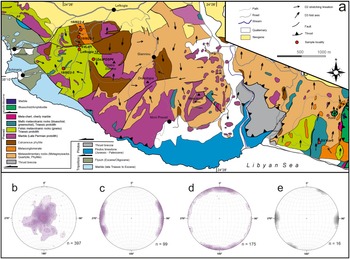
Rocks of the Preveli nappe have been mapped during the last decade along the southern coast of central Crete between the Korifi mountain and Plakias (Figure 3). The new geological map with structural data and sample localities is shown in Figure 4a. A list of contributors (Master’s and Ph.D projects, etc.) is given in the Acknowledgements. Details on the sample localities are listed in Table S1 Supplement. The nappe contact between the Preveli rocks and the Pindos Unit is defined by a black cataclastic shear zone, which is up to 30 m thick and cut by pseudotachylite (Koschel, Reference Koschel1983; Nüchter et al. Reference Nüchter, Wassmann and Stöckhert2013). Because of its large thickness, the distribution of the related cataclasites could be mapped east of Moni Preveli (Figure 4a). The black cataclastic matrix is affected by E-W trending stretching/mineral lineations and N-S trending fold axes (Figure 4e). It is heterogeneous and includes various types of porphyroclasts, which consist of serpentinite, metabasite, gneiss, micaschist, marble, phyllite, quartzite and vein-quartz (Koschel, Reference Koschel1983; Krahl et al. Reference Krahl, Herbart and Katzenberger1982; Nüchter et al. Reference Nüchter, Wassmann and Stöckhert2013). Further details about the structural and metamorphic evolution of the thrust breccia are given in Nüchter et al. (Reference Nüchter, Wassmann and Stöckhert2013).
Panorama from Korifi mountain in the E to Plakias bay in the W. View is from the road 1.5 km SW of Drimiskos. Tectonic klippe of Korifi-Mourne blueschist on top of Preveli metasedimentary rocks is emphasized by dashed orange line. N-S striking subvertical competent layers within the Preveli rocks W of Korifi largely consist of metaconglomerates. Mountain peaks indicated further to the W consist of Preveli marble.

(a) Geological map of study area with structural data and sample localities. (b–e) Equal-area lower-hemisphere stereo plots of structural data, (b) bedding and main foliation of Preveli rocks, (c) D2 stretching/mineral lineation of Preveli rocks, (d) D3 fold axes of Preveli rocks, and (e) fold axes and stretching/mineral lineation of basal black thrust breccia. Statistical analyses using the 1% area contouring method are indicated.

Because of the low temperature during the deformation of the Preveli rocks (<400°C; Koepke et al. Reference Koepke, Seidel and Stöckhert1997; Zulauf et al. Reference Zulauf, Duretz, Hezel, Krahl, Linckens, Marschall and Xypolias2023b), primary bedding is in many cases well preserved and helps unravel the structural evolution as well as to estimate the finite strain related to subduction and collision of the Preveli rocks. Bedding is characterized by lithological/compositional changes, such as from marble to calcareous phyllite or from felsic to mafic metavolcanic rock, and is particularly well defined by changes in maximum grain size of calcareous metaconglomerates and metasiliciclastic rocks.
The oldest rocks of the Preveli nappe consist of metagreywacke, quartzite, metaconglomerate and calcareous phyllite. The calcareous and siliciclastic metaconglomerates are largely matrix-supported. The maximum deposition age is constrained by the youngest detrital zircon of a siliciclastic metaconglomerate, exposed SE of Lefkogia (sample 180922-1, Figure 4a), which yielded an U-Pb age at 305 ± 6 Ma (Zulauf et al. Reference Zulauf, Dörr, Albert, Martha and Xypolias2024). As adjacent dark marble is Middle to Late Permian in age (Bonneau and Lys, Reference Bonneau and Lys1978), the deposition of the clastic Preveli rocks should have occurred during the Early/Middle Permian. The inherited deformation microfabrics of detrital feldspar and quartz of the Preveli metaconglomerate (Figure 4a in Zulauf et al. Reference Zulauf, Dörr, Albert, Martha and Xypolias2024) suggest the presence of high-grade Variscan crystalline basement in the source domain. Most pebbles of the calcareous metaconglomerates consist of limestone. Less frequent are pebbles consisting of vein-quartz and dolomite. The size of these pebbles varies significantly from a few mm to 20 cm.
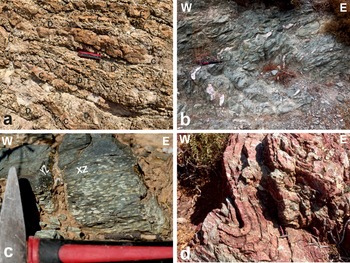
The Permian marble is largely massive and forms most of the summits in the western part of the study area (Figure 3). In cases where layers of marble are intercalated with calcareous phyllite, boudinage of the competent marble layers is common, with the main stretching lineation trending E-W (Figure 4c). Shearing of boudinaged marble in phyllitic matrix led to imbrication of the marble boudins and to E-vergent kink folds, all of which point to top-to-the E sense of shear (Figure 5a). The finite strain of calcareous metaconglomerates is largely prolate (Figure 5b), with the stretching lineation trending almost E-W (Figure 4c). Macroscopic sense-of-shear criteria, such as displaced calcite veins, also indicate a top-to-the E sense of shear (yellow arrows in Figure 5b2). Additional marble, partly with thin layers or nodules of metachert, is intercalated with felsic and mafic metavolcanic rocks, which are present in the form of gneiss, blueschist and skarn (Figure 6a in Zulauf et al. Reference Zulauf, Duretz, Hezel, Krahl, Linckens, Marschall and Xypolias2023b).
Deformation structures of rocks of the Preveli nappe. (a) East-west trending section through marble/calcareous phyllite interbedding; top-to-the E sense of shear is indicated by reverse kink bands (yellow lines) and imbrication of marble boudins (MB, lower part of figure). Sheep shelter SW of Lefkogia (N35°10′21.8″, E24°26′09.7′). (b) Metaconglomerate consisting of calcareous pebbles in calcareous-siliceous matrix. Apparent constrictional deformation is suggested by the nearly prolate shape of the pebbles as is obvious from sections perpendicular (b1) and parallel (b2) to the WNW-ESE trending stretching lineation. Top-to-the ESE sense of shear is indicated by displaced subvertical calcite veins (yellow arrows). Road cut 700 m SW of Lefkogia (sample 180922-4; N35°10′30.2″ E24°26′10.7″). (c) Upright N-S trending D3 folds and related subvertical S3 fracture cleavage in felsic metavolcanic rocks. Folded layering is S2. 600 m SW of Korifi summit (N35°09′24.5″, E24°29′16.3″). (d) Open to close fold in felsic metavolcanic rock with thin mafic interbeddings. Roadcut 1.8 km SW of Lefkogia (N35°09′59″, E24°25′45′). (e) Reddish metaradiolarite with interbeddings of metavolcanic rock (blueschist). Eastern slope of Meso Korifi (N35°09′38″, E24°28′01″).

Deformation structures of rocks of the Preveli nappe. (a) Alternating sequence of layers consisting of light pink metachert (C) and of dolomite marble (D). The dolomite marble shows a large number of fractures, whereas the metachert is almost free from fractures. Small cliff 100 m SW of Korifi summit (N35°09′32″, E24°29′35″). (b) West-vergent recumbent fold affecting boudinaged quartz veins in blueschist. Path cut 400 m SW of Korifi summit (N35° 09′28′, E24°29′26′) (c) Shape-preferred orientation of prolate clasts in mafic metavolcanic rock indicates constrictional deformation. Eastern slope of Meso Korifi (N35°09′38″, E24°28′01″). (d) West-vergent D3 fold in metaradiolarite. Note the quartz veins subperpendicular to bedding. Cliff SE of Korifi summit (N35°09′23.6′, E24°29′45.5′).

Felsic metavolcanic rocks are particularly widespread SW of Lefkogia (Figure 4a), where they consist of quartz, plagioclase and phengite; accessories are chlorite, zircon, pyrite and opaque phases (Zulauf et al. Reference Zulauf, Linckens, Beranoaguirre, Gerdes, Krahl, Marschall, Millonig, Neuwirth, Petschick and Xypolias2023 a,b). The foliation is defined by the shape-preferred orientation of quartz and feldspar and is particularly characterized by a compositional banding in the form of felsic layers consisting of quartz and plagioclase, which alternate with thin layers rich in phengite and chlorite. U-Pb dating of zircons yielded Anisian/Ladinian emplacement ages at 237.3 ± 1.8, 241.5 ± 1.2 and 242.1 ± 1.2 Ma; U-Pb garnet dating of subvolcanic skarn, related to the contact between mafic volcanic rocks (now blueschist) and chert-bearing limestone (now marble), yielded Anisian to early Norian ages (239.3 ± 2.3, 232.7 ± 1.5 and 218.0 ± 3.5 Ma, Zulauf et al. Reference Zulauf, Linckens, Beranoaguirre, Gerdes, Krahl, Marschall, Millonig, Neuwirth, Petschick and Xypolias2023 a). The stretching lineation in the felsic metavolvanic rocks trends ESE-WNW (Figure 4a,b). Asymmetric strain shadows of quartz behind rigid plagioclase porphyroclasts (Figure 8e) and S-C fabrics (Zulauf et al. Reference Zulauf, Duretz, Hezel, Krahl, Linckens, Marschall and Xypolias2023b) indicate a top-to-the ESE sense of shear. The main foliation is affected by later folding around N-S trending axes (Figure 4a,d), which partly led to a fracture cleavage (Figure 5c). Folding is particularly striking in cases where mafic and felsic metavolcanic rocks are intercalated (Figure 5d).
The upper stratigraphic levels of the Preveli nappe are dominated by mafic metavolcanic rocks (blueschists), which grade into reddish metaradiolarite (Figure 5e). Reddish to light pink metachert layers may also be intercalated with dolomite marble. The large number of fractures in the dolomite marble shows that the latter was mechanically stronger than the metachert layers (Figure 6a). The blueschists consist of glaucophane, ferri-winchite, actinolite, rutile, titanite, epidote, chlorite, phengite, albite and quartz (Koepke et al. Reference Koepke, Seidel and Stöckhert1997; Tortorici et al. Reference Tortorici, Catalano, Cirrincione and Tortorici2012; Zulauf et al. Reference Zulauf, Duretz, Hezel, Krahl, Linckens, Marschall and Xypolias2023b). Pervasive shearing produced a subhorizontal foliation with a stretching/mineral lineation trending E-W (Figure 4b,c). Early quartz veins within the blueschists, related to a first deformation stage (D1), show boudinage, related to the formation of the main foliation (S2) during a second deformation stage (D2). This boudinaged structure was affected by younger folding around N-S trending axes, which reflect a third deformation stage (D3) (Figures 4d and 6b). Rare strain markers, which are interpreted as stretched vesicles in variolitic pillow lava, indicate a prolate strain geometry (Figure 6c). The stretched vesicles are filled with albite. For further details concerning the structural evolution of the Triassic skarn and the blueschists, see Zulauf et al. (Reference Zulauf, Duretz, Hezel, Krahl, Linckens, Marschall and Xypolias2023b).
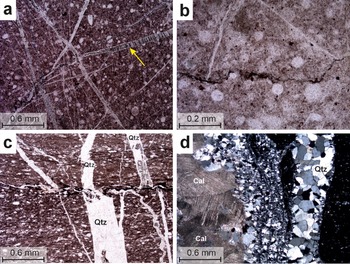
Metaradiolarite is well exposed SE of the Korifi summit along the nappe contact between the Preveli rocks in the footwall and the Korifi-Mourne crystalline rocks above (Figure 4a). Bedding in the metaradiolarite, indicated by thin clay-rich layers, shows upright or west-vergent folding (Figure 6d). There are many veins cutting through metaradiolarite, which is largely free from viscous (ductile) strain (Figure 7a,b). Some of these veins may be related to fracture cleavage and folding (Figure 6d), but most of them pre-date folding. At least three generations of mineralized veins can be distinguished (Figure 7a). Most veins are filled with fine-grained syntaxial quartz along the margins and large blocky quartz in the centre (Figure 7d). Some veins show composite mineralization consisting of quartz along the margins and calcite in the central part. In addition to brittle fracturing, strain has also been accommodated by dissolution-precipitation creep as is indicated by pressure solution seams (stylolites), which led to truncation of older veins (Figure 7b). When taking their shape into account (most of the radiolaria should have been initially globular), the radiolarites investigated so far do not show significant viscous strain. The shape of the radiolarian in thin section is largely spherical (Figure 7a,b). Viscous strain of metaradiolarite is localized and restricted to discrete domains where the radiolarian displays an elliptical shape in thin sections (Figure 7c). Cleavage in these domains (S2) is parallel to the long axes of the radiolarian ellipses and results from shearing and dissolution. Older veins were folded, cut or truncated by this pervasive S2 cleavage (Figure 7c). Thick veins, on the other hand, do not show significant crystal plastic strain. Quartz displays weak undulatory extinction, and calcite is affected by strong twinning. Some twins are bent (Figure 7d).
Deformation microfabrics of metaradiolarite of the Preveli Unit; road cut along southern coast of Crete, south of Korifi mountain (N35° 8′56.6′, E24°29′46.21′). (a) Low-strain domain of metaradiolarite is cut by at least three generations of veins filled with quartz (light) and calcite (dark); vein filled with weakly twinned calcite is indicated by arrow; plane polarizers. (b) Thin quartz veins in low-strain metaradiolarite are truncated by stylolite enriched with opaque phases; plane polarizers. (c) Veins filled with quartz (light) and calcite (dark) are cut by a stylolite, which is parallel to the main foliation in high-strain domain; foliation (horizontal in the microphotograph) is indicated by the elliptical shape of the radiolaria with the long axis of ellipses being largely horizontal, plane polarizers. (d) Veins filled with quartz and calcite in high-strain domain; most of the initial growth fabrics in veins are well preserved; calcite shows pervasive deformation twins, parts of which are bent; crossed polarizers.

4.b. Geochronological results
4.b.1. U-Pb dating of rutile and calcite
U-Pb rutile dating of two samples of blueschists (SV Lef 1 and SV Kor 5; Figure 4a, Table S1 Supplement) was carried out to constrain the approximate age of the HP-LT metamorphism of the Preveli nappe. The dated blueschists consist of epidote, relics of strongly altered plagioclase, epidote, actinolite and blue amphibole (ferri-winchite and glaucophane; for composition, see Figures 3 and 4 in Zulauf et al. Reference Zulauf, Duretz, Hezel, Krahl, Linckens, Marschall and Xypolias2023b). Apatite, rutile and opaque phases are present as accessories. Rutile is present along cleavage planes and ‘pockets’ in the form of tiny grains in domains rich in epidote and blue amphibole with a size generally <100 µm (Figure 8a,b). Rutile developed together with the blue amphiboles (ferri-winchite, glaucophane) and is partly fractured and displaced along the main foliation planes (S2, Figure 8a). Moreover, the long side of rutile is frequently aligned parallel to S2. For these reasons, rutile should have developed pre- to synkinematically with respect to the D2 deformation stage. The analysed rutiles show a low U content (0.05–1.7 ppm). Five designated sections, consisting of 118 laser spots, were disregarded as outliers and, therefore, out of consideration for age calculation. Forty-six LA-ICP-MS measurements on sample SV Lef 1 define a regression line with a lower intercept at 132 ± 12 Ma (MSWD = 1.36; Figure 9a, Table S3b Supplement). Sixty-two analyses of sample SV Kor 5 define a regression line with a lower intercept at 135 ± 10 Ma (MSWD = 1.29; Figure 9b, Table S3b Supplement).
Deformation microfabrics and spots of Laser-ICP-MS of rocks of the Preveli Unit. (a) Rutile in matrix of ferri-winchite (FW), actinolite and epidote; plane polarizers (SV Kor 5). (b) LA-ICP-MS spots in dark rutile-bearing domains of blueschist; plane polarizers (SV Lef 1). (c) Polyphase deformation in calcareous metaconglomerate. Oblique white mica S-fabric in calcite-rich domain (lower part of figure) indicates top-to-the ESE sense of shear; shear-band fabric in quartz-rich domain (upper part of figure) indicates top-to-the WNW sense of shear; crossed polarizers; (180922-4). (d) Shear-band fabric affecting older quartz fibres in calcite matrix indicates top-to-the ESE sense of shear; crossed polarizers; same rock and locality as in (c). (e) Asymmetric pressure shadows of quartz behind rigid plagioclase clast indicating top-to-the E sense of shear; shape-preferred orientation of white mica in recrystallized quartz matrix is affected by the clast; crossed polarizers; sample 180922 3-1; 1.8 km SW of Lefkogia (N35°10′17.1′, E 24°25′56.0′). (f) LA-ICP-MS spot locations in calcite of strain shadows and young foliation-parallel veins; plane polarizers, same rock type and locality as in (c).

Results of U-Pb dating plotted in Tera-Wasserburg diagrams. (a) Rutile of mafic metavolcanic rock (SV Lef 1). (b) Rutile of mafic metavolcanic rock (SV Kor 5). (c) Calcite of pressure shadows and veins in calcareous metaconglomerate (180922-4).

U-Pb dating of calcite was carried out to determine the age of the younger deformation stages of the Preveli nappe. The sample used for U-Pb calcite dating was collected from the calcareous metaconglomerate described above (sample 180922-4; Figure 5b). In sections cut parallel to the stretching lineation, we found evidence for polyphase deformation. Evidence for top-to-the ESE shearing, consistent with macroscopic evidence, is indicated by SC fabrics (Figure 8c), whereas shear-band fabrics suggest top-to-the WNW sense of shear (Figure 8c,d). The calcite strain was accommodated by twinning and dissolution-precipitation creep. Dissolution is indicated by dark stylolites within the calcite domains (Fig. S1c,d Supplement). Precipitation of calcite, on the other hand, led to large crystals in strain shadows of rigid dolomite or quartz grains (Fig. S1a Supplement) or in the form of veins aligned subparallel to the main foliation (Figs. S1b,c Supplement). Apart from calcite, quartz was also affected by dissolution-precipitation creep. Quartz precipitated in the form of fibres in strain shadows of quartz grains besides calcite (Fig. S1b Supplement). During the late deformation increments, long quartz fibres formed competent ‘strings’ that were boudinaged in the incompetent calcite-rich matrix (Fig. S1d Supplement). Most of the late calcite crystals, present in foliation-parallel veins and in strain shadows, display bent thick twins (Fig. S1a,c Supplement). We analysed fluid-derived calcite, which developed along foliation-parallel veins or in strain shadows behind rigid quartz or dolomite grains (Figure 8f, Fig. S1a,b Supplement). Eighty-one LA-ICP-MS analyses define a regression line with a lower intercept at 31 ± 9 Ma (MSWD = 0.37; Figure 9c, Table S5 Supplement).
4.b.2. 39 Ar- 40 Ar dating of ferri-winchite
39Ar-40Ar dating was carried out on blue amphibole (ferri-winchite), which developed synkinematically along a discrete shear plane cutting through rigid skarn. The respective sample 180922-5 was collected from a roadcut south of Lefkogia, where massive skarn is cut by ferri-winchite-bearing discrete shear zones (see Figures. 6–8 in Zulauf et al. Reference Zulauf, Duretz, Hezel, Krahl, Linckens, Marschall and Xypolias2023b). For dating purposes, we collected dark-bluish fibres of ferri-winchite of a shear zone, which are several cm long. For further details concerning the size, shape, composition and deformation of the dated ferri-winchite, see Zulauf et al. (Reference Zulauf, Duretz, Hezel, Krahl, Linckens, Marschall and Xypolias2023b). The step heating experiment revealed a U-shaped age spectrum (Table S6 Supplement) if an atmospheric 40Ar/36Ar (298.6 ± 0.3; Lee et al. Reference Lee, Marti, Severinghaus, Kawamura, Yoo, Lee and Kim2006) is used for age calculation, typical for the presence of excess argon. This excess component is obvious in an inverse isochron diagram (Table 6 Supplement) that displays significant scatter of the data resulting from three-component mixing during degassing. Reducing the dataset to temperature steps 4–8, that comprise 82.3% of the total released 39ArK, provides a reasonably well-defined inverse isochron with an age of 129 ± 17 Ma and an initial 40Ar/36Ar of 903 ± 155 (Figure 10, Table S6 Supplement). Taking the latter value as the best estimate for the composition of the excess component provides a recalculated age spectrum with a reasonably well-defined plateau age of 125 ± 10 Ma (Figure 10, Table S6 Supplement), which is regarded as the synkinematic formation age of the ferri-winchite. Due to the low amount of potassium in ferri-winchite (K2O = ∼0.08 wt%, Zulauf et al. Reference Zulauf, Duretz, Hezel, Krahl, Linckens, Marschall and Xypolias2023b), the overall signal intensities during isotope measurements have been low leading to a relatively large age uncertainty quoted at the 1σ confidence level.
Age spectrum (a) and inverse isochron plot (b) of ferri-winchite of D2 shear zone in Triassic skarn (sample 180922_5a). Ages have been corrected for initial Ar using a 40Ar/36Ar of 903 ± 155 as deduced from the inverse isochron calculated from temperature steps 4–8. It is assumed that this value provides a reasonable estimate for the isotopic composition of the excess Ar component that was likely imprinted to the ferri-winchite during fluid-controlled growth in the subduction zone. Low-signal intensities during measurements owing to low K-contents cause comparatively large uncertainties.

4.c.3. Rb-Sr dating
Rb-Sr dating of phengite and albite/epidote has been carried out on samples collected from felsic metavolcanic rocks (samples Lefkogia 1a-1 and Da2PDSP6) and from a fine-grained siliciclastic metaconglomerate (sample 180922-1-1). The phengites of both rock types are generally aligned parallel to the main foliation. Based on electron microprobe analyses, the Si content of phengites of the felsic metavolcanic rocks ranges from 3.45 to 3.55 pfu. (Zulauf et al. Reference Zulauf, Duretz, Hezel, Krahl, Linckens, Marschall and Xypolias2023b). Some of the phengites developed in pressure shadows behind rigid porphyroclasts, such as feldspar, but most are deflected by the rigid porphyroclasts flowing around them together with the main foliation (Figure 8e). Further microfabrics of phengites in metavolcanic rocks are depicted in Figures 12 and 15c of Zulauf et al. (Reference Zulauf, Linckens, Beranoaguirre, Gerdes, Krahl, Marschall, Millonig, Neuwirth, Petschick and Xypolias2023a) and Zulauf et al. (Reference Zulauf, Duretz, Hezel, Krahl, Linckens, Marschall and Xypolias2023b), respectively. The microfabrics of phengite of the metaconglomerate (180922-1) are depicted in Figure 4a of Zulauf et al. (Reference Zulauf, Dörr, Albert, Martha and Xypolias2024).
Rb-Sr dating of phengite, albite and epidote of the felsic metavolcanic rock (Da2PDSP6) yielded a well-defined matrix-corrected age at 100.5 ± 2.5 Ma (Figure 11a, Table S7 Supplement). Analyses of phengite and albite of the second sample of felsic metavolcanic rock (Lefkogia 1a) revealed three different clusters of matrix-corrected ages at 97.5 ± 2.8 Ma (Figure 11b, Table S7 Supplement), 107.3 ± 1.8 Ma (Figure 11c), and 117.2 ± 2.6 Ma (Figure 11d). Two age clusters have been obtained by Rb-Sr analyses of phengite and albite of the siliciclastic metaconglomerate, one at 92.4 ± 2.3 Ma (Figure 11e, Table S7 Supplement), the second at 107.7 ± 3.5 Ma (Figure 11f). One single spot (#62) of cluster 180922-1-1 yielded 130.9 ± 7.0 Ma (Figure 11e).
LA-ICP-MS Rb-Sr isochron plots for (a) phengite (wm), albite (ab) and epidote (ep) from impure quartzite (sample Da2PDSP6); (b–d) phengite (three distinct populations) and albite from felsic metavolcanic rock (sample Lefkogia 1a); and (e, f) phengite (two distinct populations) and albite from siliciclastic metaconglomerate (sample 180922-1). Results from unanchored isochrones (mica only) are shown in the lower right corner of each plot. In panel (e), the single-spot age of analysis #62 is shown and was not assigned to either phengite population. Matrix-corrected Rb-Sr ages account for Rb/Sr elemental fractionation using natural mica (Phalaborwa biotite) as a matrix-matched reference material. Uncertainties on the Rb-Sr isochron ages are reported at the 2σ level and include all internal and external sources of error. Reported values are rounded to two significant digits. See text for details.

Isochrons were fitted with and without low-Rb/Sr anchor phases (albite, epidote) to test the robustness of the obtained ages and initial 87Sr/86Sr values. In all cases, mica-only and anchored regressions yield ages and intercepts that overlap within 2σ, showing that anchoring improves precision without biasing the results. All anchored and unanchored regressions are provided in Figure 11 and in Table S7 Supplement.
To reveal changes in phengite composition with age, the Si content and the amount of fluid-sensitive elements, B and Li, were analysed from the phengite populations detected in sample Lefkogia 1a and sample 180922. When plotting the amounts of Si, B and Li vs. the age, a clear correlation is obvious in both cases. With increasing phengite age of sample Lefkogia 1a, the Si content increases from 3.507 ± 0.011 to 3.525 ± 0.006 pfu., whereas the amounts of B and Li decrease from 23.28 ± 0.75 to 20.60 ± 0.60 µg/g and from 13.86 ± 1.77 to 11.09 ± 0.70 µg/g, respectively (Figure 12, Table S8 Supplement).
With increasing phengite age of sample 180922, the Si content increases from 3.469 ± 0.010 to 3.572 ± 0.075 pfu., whereas the amounts of B and Li decrease from 38.561 ± 0.604 to 26.25 ± 10.09 µg/g, and from 9.90 ± 0.11 to 4.50 ± 0.70 µg/g, respectively (Figure 12, Table S8 Supplement).
B, Li and tetrahedral Si contents versus age for the three phengite populations identified in sample Lefkogia 1a (left panels) and the two phengite populations as well as spot analysis #62 of sample 180922 (right panels). Uncertainties are reported as standard errors at the 1σ level.

5. Discussion
5.a. Tectonometamorphic evolution of the Preveli nappe and age of deformation events
The new isotopic ages result from dating of metamorphic minerals, most of which grew synkinematically during deformation. For this reason, a detailed reconstruction of the structural evolution of the Preveli rocks is required. From the new results presented above, completed by published structural data (Zulauf et al. Reference Zulauf, Linckens, Beranoaguirre, Gerdes, Krahl, Marschall, Millonig, Neuwirth, Petschick and Xypolias2023 a,b), it was found that the Preveli rocks were affected by at least three main deformation phases (D1–D3), which pre-dated brittle high-angle normal faulting.
The oldest deformation phase (D1) was of brittle type and led to mineralized veins, which are particularly frequent in competent rocks, such as metaconglomerate, metavolcanics, skarn and metaradiolarite. Most of these veins are subperpendicular to bedding. As the minerals of these veins precipitated from a fluid phase, they reflect fluid-assisted deformation and probably elevated pore fluid pressure during D1. D1 must postdate the age of the youngest Preveli rock, which is an Upper Triassic (Norian) skarn dated at 218.0 ± 3.5 Ma (Zulauf et al. Reference Zulauf, Linckens, Beranoaguirre, Gerdes, Krahl, Marschall, Millonig, Neuwirth, Petschick and Xypolias2023 a). The protolith age of the blueschists (with a basaltic protolith) to which the skarn is related should be the same. A late Triassic sedimentation age is also likely for the metaradiolarite, which is partly intercalated with the blueschists (Figure 5e).
The second deformation phase (D2) was more pervasive and of viscous type, particularly in the calcareous and quartz-bearing rocks. In calcareous phyllites, the dominant foliation (S2) was formed during D2. D1 veins underwent folding or boudinage during D2. Apart from coaxial D2 fabrics, there is also evidence for D2 noncoaxial deformation, such as the displacement of early D1 veins in metaconglomerates, reverse kink bands and imbrication of marble layers in calcareous phyllite, all of which result from D2 top-to-the ESE shearing. The same holds for C-S fabrics and asymmetric strain shadows in metaconglomerates and in felsic metavolcanic rocks, where quartz recrystallized at differential stresses >70 MPa (Zulauf et al. Reference Zulauf, Duretz, Hezel, Krahl, Linckens, Marschall and Xypolias2023b). Fine-grained monomineralic grandite (garnet with intermediate compositional range between grossular and andradite) of the skarn was deformed at even higher differential stresses (>250 MPa) along discrete D2 shear zones along which synkinematic blue amphibole (ferri-winchite) developed (Zulauf et al. Reference Zulauf, Duretz, Hezel, Krahl, Linckens, Marschall and Xypolias2023b). The E-W trending stretching lineation in blueschists is also portrayed by glaucophane and ferri-wnichite suggesting D2 to be related to the HP-LT metamorphism, the conditions of which are constrained as T = 360 ± 40°C and P > 1.0 GPa (Figure 13). This temperature explains why quartz and calcite were deformed largely viscously, whereas plagioclase and dolomite marble underwent brittle fracturing during D2 (Figure 6a). While calcite and quartz start to recrystallize at T <320°C, dislocation creep of dolomite with a grain size >100 µm is restricted to T > 500°C (Berger et al. Reference Berger, Ebert, Ramseyer, Gnos and Decrouez2016). Deformation in a subduction-zone setting is consistent with the prolate D2 strain geometry of metaconglomerates and blueschists. L tectonites with a prolate strain geometry have been described from various HP-LT metamorphic rocks (e.g. Andersen et al. Reference Andersen, Jamtweit, Dewey and Swensson1991; Henry et al. Reference Henry, Michard and Chopin1993; Hacker et al. Reference Hacker, Ratschbacher, Webb and Shuwen1995; Zulauf, Reference Zulauf1997; Zulauf et al. Reference Zulauf, Kowalczyk, Petschick, Schwanz and Krahl2002) and could result from enhanced slab pull forces at greater depth of subduction.
Petrogenetic grid in the system CNMASH showing boundaries of very-low and low grade facies (after Willner et al. Reference Willner, Sepúlveda, Hervé, Massonne and Sudo2009, Reference Willner, Maresch, Massonne, Sandritter and Willner2016, and references therein). Pressure-temperature data for deformation during subduction of Preveli rocks (blue box) are indicated (after Zulauf et al. Reference Zulauf, Duretz, Hezel, Krahl, Linckens, Marschall and Xypolias2023b). Si values of white mica, after Massonne and Schreyer (Reference Massonne and Schreyer1987). Assumed PT path of the Preveli rocks is indicated by bold orange line.

The U-Pb ages of rutile (132 ± 12 and 135 ± 10 Ma) reflect the timing of subduction and of D2, as rutile is an index mineral for the HP-LT stage (Figure 14). Moreover, its closure temperature for the U-Pb system is > 490°C (Cherniak, Reference Cherniak2000; Kooijman et al. Reference Kooijman, Mezger and Berndt2010) and thus far above the peak temperature of the HP-LT metamorphism. The elevated uncertainty of the U-Pb rutile ages is largely based on the small size of the grains, similar to the size of the analytical spot of the laser, and on the low amount of U at elevated initial common Pb content.
Isotopic ages obtained from blueschists, felsic metavolcanic and metasedimentary rocks of the Preveli nappe. Apatite fission-track ages after Thomson (Reference Thomson, Stöckhert and Brix1999); ages of Pindos flysch after Richter and Müller (Reference Richter and Müller1992) and Wagreich et al. (Reference Wagreich, Pavlopoulos, Faupl and Migiros1996).

The closure temperature for the K-Ar isotopic system of amphibole is >500°C (von Blanckenburg and Villa, Reference von Blanckenburg and Villa1988) and thus also higher than the peak temperature of the Preveli rocks. For this reason, the new 39Ar-40Ar age of synkinematic ferri-winchite (125 ± 10 Ma) also reflects the timing of subduction. Ferri-winchite, however, is a sodic-calcic amphibole that is commonly stable at lower pressures (Brown, Reference Brown1977; Wintsch et al. Reference Wintsch, Byrne and Toriumi1999). It can develop in blueschists during decompression and exhumation (Xypolias et al. Reference Xypolias, Iliopoulos, Chatzaras and Kokkalas2012; Gerogiannis et al. Reference Gerogiannis, Xypolias, Chatzaras, Aravadinou and Papapavlou2019). Ferri-winchite in the present case, however, was formed in a particular chemical environment within grandite, where Na was probably not present in sufficient quantities to form glaucophane. The latter, however, developed in blueschists of the Preveli nappe (Tortorici et al. Reference Tortorici, Catalano, Cirrincione and Tortorici2012; Zulauf et al. Reference Zulauf, Duretz, Hezel, Krahl, Linckens, Marschall and Xypolias2023b). Thus, the new age obtained from ferri-winchite is interpreted to reflect the peak of the HP-LT metamorphism stage. The large uncertainty of the 39Ar-40Ar age results from the low amount of potassium in ferri-winchite.
Formation of ferri-whichite in almost dry grandite of skarn was fluid-assisted (Zulauf et al. Reference Zulauf, Duretz, Hezel, Krahl, Linckens, Marschall and Xypolias2023b). The presence of fluids also led to dissolution-precipitation creep in the calcareous rocks, and is also documented by stylolites in felsic metavolcanics and metaradiolarite (Figure 7b). Fluid phases also supported the growth of white mica in the metasiliciclastic and metavolcanic rocks, which have a Permian and Triassic protolith age, respectively. White mica is commonly aligned subparallel to the main foliation (S2). It is predominantly of phengite composition and occurs with similar spread in Si content in blueschists (3.49–3.51 pfu) and in felsic metavolcanic rocks (3.44–3.54 pfu) (Zulauf et al. Reference Zulauf, Duretz, Hezel, Krahl, Linckens, Marschall and Xypolias2023b). From white mica of the matrix of the basal black breccia, Si values between 3.25 and 3.50 pfu have been determined (Nüchter et al. Reference Nüchter, Wassmann and Stöckhert2013). The high Si content suggests that most of the phengite developed during the HP-LT metamorphism (Figure 13). For this reason, and because of the high closure temperature for the Rb-Sr isotopic system of white mica (ca. 550°C, von Blanckenburg et al. Reference von Blanckenburg, Villa, Baur, Morteani and Steiger1989; Glodny et al. Reference Glodny, Grauert, Fiala, Vejnar and Krohe1998), the Rb-Sr data of white mica and albite/epidote should additionally reflect the age of the HP-LT event. The new Rb-Sr ages obtained from phengite and albite/epidote, however, are heterogeneous ranging from 90 to 131 Ma. Apart from the single-spot age at 131 ± 7 Ma of sample 180922-1, which seems to reflect the HP-LT stage, the Rb-Sr ages are younger than the U-Pb rutile and 39Ar-40Ar ferri-winchite ages mentioned above (Figure 14). During this long period (90–131 Ma), phengite seems to have developed incrementally at 131 ± 7 Ma, 117.2 ± 2.6 Ma, 107.8 ± 3.5 Ma, 107.1 ± 1.8 Ma, 100.0 ± 2.0 Ma, 97.1 ± 2.5 Ma, and 92.3 ± 2.2 Ma. The ages 107.8 ± 3.5 Ma and 107.1 ± 1.8 Ma as well as 100.0 ± 2.0 Ma and 97.1 ± 2.5 Ma are similar, within uncertainties, and each couple might reflect one growth stage. As some of these age clusters occur in one and the same sample, and the uncertainties of the ages are relatively low, this sequence of phengite ages is interpreted to reflect different growth stages, which postdate the peak of HP-LT metamorphism. Although the microfabrics do not indicate different growth stages (most of the phengites are aligned subparallel to S2), the clear increase in the amount of fluid-sensitive B and Li with decreasing age reflects increasing fluid activity during the younger growth stages. Moreover, the decreasing amount of Si in phengite with decreasing age reflects slight decompression, related to tectonic or erosional denudation. The younger populations of phengites developed at slightly shallower structural levels compared to the conditions of the HP-LT stage. These different populations of phengite reflect fluid-assisted shearing along the pre-existing S2 foliation that was multiply reactivated. However, the high Si content of all phengites confirms that this reactivation occurred at still high pressure, meaning that the Preveli rocks were situated and deformed at deep structural levels for a long period ranging from the Early Cretaceous to the early Late Cretaceous (ca. 130–90 Ma; Figures 13 and 14).
D3 deformation is documented by buckle folding of bedding, early veins and of the S2 foliation. Most D3 folds are open to close and upright with axes trending N-S (Figure 4a,d). Tight to isoclinal D3 folds are restricted to the calcareous phyllites. The recumbent or overturned folds display a vergence mainly towards the west (Figure 6b,d). An axial-plane cleavage (S3) is either lacking or is present in the form of a widely spaced fracture cleavage in competent rocks (Figure 5c). Bent thick twins in late calcite of calcareous metaconglomerates and metaradiolarite suggest that the temperature during D3 was not above ca. 200°C (Burkhard, Reference Burkhard1993). Dissolution-precipitation creep was an important deformation mechanism in calcite and reflects activity of fluids during D3. For these reasons, D3 folding should have occurred at upper structural levels under brittle conditions. As W-vergent folds are also frequent in the Pindos Unit (e.g. Figure 3b in Craddock et al. Reference Craddock, Klein, Kowalczyk and Zulauf2009), and the latter is free from metamorphism (Feldhoff et al. Reference Feldhoff, Lücke and Richter1991, Reference Feldhoff, Theye and Richter1993; Klein et al. Reference Klein, Craddock and Zulauf2012), the D3 folds of the Preveli rocks are attributed to W-directed thrusting of the Preveli nappe on top of the Pindos Unit (Fassoulas, Reference Fassoulas1998). This interpretation is supported by the presence of N-S trending folds in the black cataclastic shear zone forming the nappe contact between the Preveli and the Pindos rocks (Figure 4e; Koschel, Reference Koschel1983; Nüchter et al. Reference Nüchter, Wassmann and Stöckhert2013).
The emplacement of the Preveli nappe must be younger than the second Pindos flysch. The second Pindos flysch is Paleogene in age (Richter and Müller, Reference Richter and Müller1992) and is interpreted to reflect late Eocene/Oligocene brittle thrusting of the Uppermost Unit on top of the Pindos Unit (Bonneau and Fleury, Reference Bonneau and Fleury1971; Fassoulas, Reference Fassoulas1998; Papanikolaou, Reference Papanikolaou2009). Distinct top-to-the W shear zones have not been observed in the Preveli rocks. However, in the calcareous metaconglomerate, pre-existing top-to-the E shear zones were reactivated by opposite top-to-the W movements (Figure 8c). In these rocks, fibrous calcite of veins and of pressure shadows yielded a U-Pb age at 31 ± 9 Ma, which straddles the Eocene-Oligocene boundary and is compatible with Eocene/Oligocene nappe stacking mentioned above (Figure 14). The deformation of the calcite was accommodated by twinning and dissolution-precipitation creep. As the Pindos Unit is unmetamorphosed, the temperature of the Preveli nappe during its emplacement should have been < ca. 200°C. The 100°C isotherm was passed at 30 ± 2 Ma as is indicated by apatite fission-track ages of the Preveli rocks (Thomson et al. Reference Thomson, Stöckhert and Brix1999).
5.b. Implications for the regional geology and provenance of the Uppermost Unit
The new ages of blue amphibole and rutile suggest that subduction and related HP-LT metamorphism of the Preveli rocks occurred during the Early Cretaceous. These ages are not compatible with Upper Jurassic K-Ar ages of subcalcic hornblende (mostly barroisite) and phengite, separated from blueschist/amphibolite and schist of the Korifi-Mourne nappe exposed near Gerakari (central Crete) and on Gavdos (Kalypso Unit of Seidel et al. Reference Seidel, Schliestedt, Kreuzer and Harre1977). At Korifi summit, blueschists of the Korifi-Mourne nappe form a klippen on top of Preveli rocks (Figures 3, 4a). A Lower Cretaceous age of subduction of the Preveli rocks is in line with the Late Jurassic to Late Cretaceous deposits of the Vatos nappe, which show evidence for lower greenschist facies metamorphism (Koepke, Reference Koepke1986; Karakitsios, Reference Karakitzios1988; Malten, Reference Malten2019). High-grade metamorphic equivalents of the Vatos rocks are probably present as Asteroussia Crystalline Complex (ACC), which underwent low-pressure/high-temperature metamorphism in Late Cretaceous (Campanian) times (Seidel et al. Reference Seidel, Okrusch, Kreuzer, Raschka and Harre1976, Reference Seidel, Okrusch, Kreuzer, Raschka and Harre1981; Martha et al. Reference Martha, Zulauf, Dörr, Xypolias, Binck and Nowara2018). These rocks were accreted during subduction and overprinted by HT-LP metamorphism and calcalkaline igneous intrusions in Campanian times (Zulauf et al. Reference Zulauf, Dörr, Albert, Martha and Xypolias2024; Martha et al. Reference Martha, Xypolias, Cheng, Dörr, Gerdes, Hezel, Kutzschbach, Millonig, Schmeling, Marschall, Müller and Zulauf2025).
The presence of both Upper Permian detrital zircons and Upper Cretaceous arc-type granitoids suggests that the ACC rocks were derived from the Upper Permian/Upper Cretaceous magmatic belt situated north of the Sava-Vardar-Izmir-Ankara Suture in the Strandja-Rhodope area (Zulauf et al. Reference Zulauf, Dörr, Albert, Martha and Xypolias2024). A similar provenance area should hold for the Preveli and other nappes of the Uppermost Unit. The detrital zircon age spectrum of the Preveli metaconglomerate, with a dominance of Carboniferous zircons, is similar to that of the pre-Cimmerian basement and of the Tyros Unit of the External Hellenides (Zulauf et al. Reference Zulauf, Dörr, Marko and Krahl2018, Reference Zulauf, Dörr, Albert, Martha and Xypolias2024).
Seidel et al. (Reference Seidel, Schliestedt, Kreuzer and Harre1977) related the Upper Jurassic HP-LT rocks of Gavdos and Gerakari to rocks of Greek mainland and Serbia, which is consistent with the age of Upper Jurassic blueschists in the Vardar Zone (Figure 15; Michard et al. Reference Michard, Goffe, Liati and Mountrakis1994; Most et al. Reference Most, Frisch, Dunkl, Kodosa, Bonev, Avgerinas and Kilias2001; Robertson, Reference Robertson2012). Similar Jurassic/early Cretaceous HP-LT metamorphic rocks have been described from the Circum–Rhodope Belt and from the Strandja Massif (Figure 15; e.g. Burg, Reference Burg2012; Okay and Nikishin, Reference Okay and Nikishin2015; Liati et al. Reference Liati, Theye, Fanning, Gebauer and Rayner2016). Apart from the blueschists, there are also similarities concerning the ophiolites of both areas. The Jurassic ophiolites of the Uppermost Unit of Crete are regarded as the southern continuation of the Dinaric-Hellenic ophiolitic belt (Koepke et al. Reference Koepke, Seidel and Kreuzer2002), whereas those of Karpathos and Rhodes are Upper Cretaceous in age and are similar with ophiolites in Turkey, Cyprus, Syria, and Iran (Figure 15). Moreover, similar to the rocks of the Preveli nappe, the Makrotantalon Unit of Andros contains marble that yielded Permian fossils (Papanikolaou, Reference Papanikolaou1978) and shows evidence for early Cretaceous HP-LT metamorphism (Huet et al. Reference Huet, Labrousse, Monjé, Malvoisin and Jolivet2015; Bröcker et al. Reference Bröcker, Scherer, Xypolias and Höhn2022). The Makrotantalon Unit rests on top of the Lower Unit and thus has been attributed to the Upper Unit s.l. by several authors (Dürr, Reference Dürr and Jacobshagen1986; Bröcker and Franz, Reference Bröcker and Franz2006; Huet et al. Reference Huet, Labrousse, Monjé, Malvoisin and Jolivet2015). A Pelagonian origin of the Makrotantalon Unit is possible (Gerogiannis et al. Reference Gerogiannis, Xypolias, Chatzaras, Aravadinou and Papapavlou2019; Bröcker et al. Reference Bröcker, Scherer, Xypolias and Höhn2022, and references therein). Given a correlation of the Preveli and the Makrotantalon Unit is justified, the Preveli nappe should have passed the Cyclades when travelling to its recent position on Crete.
Distinct rock types of Eastern Mediterranean, which are critical for the provenance of the Uppermost Unit of Crete: (1) Triassic volcanic rocks and granitoids (Korolay et al. Reference Koralay, Satır and Dora2001; Bröcker and Keasling Reference Bröcker and Keasling2006; Bröcker and Pidgeon Reference Bröcker and Pidgeon2007; Himmerkus et al. Reference Himmerkus, Reischmann and Kostopoulos2009; Bulle et al. Reference Bulle, Bröcker, Gärtner and Keasling2010; Akal et al. Reference Akal, Koralay, Candan, Oberhänsli and Chen2011; Chatzaras et al. Reference Chatzaras, Dörr, Finger, Xypolias and Zulauf2012; Liati et al. Reference Liati, Skarpelis and Fanning2013; Zulauf et al. Reference Zulauf, Blau, Dörr, Klein, Krahl, Kustatscher, Petschik and van de Schootbrugge2013; Bonev et al. Reference Bonev, Moritz, Borisova and Filipov2019; this study); (2) Mesozoic ophiolites (Robertson Reference Robertson2002, and references therein; Liati et al. Reference Liati, Gebauer and Fanning2004; Smith Reference Smith, Prichard, Alabaster, Harris and Neary1993, and references therein; Koglin et al. Reference Koglin, Kostopoulos and Reischmann2009a; Robertson et al. Reference Robertson2012, and references therein); (3) Late Jurassic/early Cretaceous HP-LT metamorphic rocks of the Internal Hellenides (Seidel et al. Reference Seidel, Okrusch, Kreuzer, Raschka and Harre1976, Reference Seidel, Schliestedt, Kreuzer and Harre1977; Michard et al. Reference Michard, Goffe, Liati and Mountrakis1994; Wawrzenitz and Mposkos Reference Wawrzenitz and Mposkos1997; Most et al. Reference Most, Frisch, Dunkl, Kodosa, Bonev, Avgerinas and Kilias2001; Most Reference Most2003; Kydonakis et al. Reference Kydonakis, Brun, Sokoutis and Gueydan2015; Liati et al. Reference Liati, Theye, Fanning, Gebauer and Rayner2016; Altherr et al. Reference Altherr, Hanel, Soder, Peters and Bahl2023); (4) Late Jurassic and Early Cretaceous HP-LT metamorphic rocks of the CPS (Aygül et al. Reference Aygül, Okay, Oberhänsli and Sudo2016, and references therein); (5) Late Cretaceous (arc-type) magmatic rocks (von Quadt et al. Reference von Quadt, Moritz, Peytcheva and Heinrich2005, Reference von Quadt, Peytcheva, Heinrich, Cvetkovic and Banjesevic2007, and references therein; Okay and Nikishin Reference Okay and Nikishin2015, and references therein; Kneuker et al. Reference Kneuker, Dörr, Petschick and Zulauf2015; Martha et al. Reference Martha, Dörr, Gerdes, Petschick, Schastock, Xypolias and Zulauf2016, Reference Martha, Dörr, Gerdes, Krahl, Linckens and Zulauf2017). (6) Permian igneous rocks (Reischmann Reference Reischmann1998; Liati Reference Liati2005; Koglin et al. Reference Koglin, Kostopoulos and Reischmann2009b; Tanatsiev et al. Reference Tanatsiev, Ichev and Pristavova2012; Okay and Nikishin Reference Okay and Nikishin2015, and references therein; Antic et al. Reference Antić, Peytcheva and von Quadt2015, Reference Antić, Peytcheva, von Quadt, Kounov, Trivić, Serafimovski, Tasev, Gerdjikov and Wetzel2016; Bonev et al. Reference Bonev, Moritz, Borisova and Filipov2019; Lazarova et al. Reference Lazarova, Broska, Svojtka and Naydenov2021; Sałacińska et al. Reference Sałacińska, Gerdjikov, Gumsley, Szopa, Chew, Gawęda and Kocjan2021). CPS = Central Pontides Supercomplex; DSFZ = Death Sea fault zone; EAFZ = East Anatolian fault zone; IPS = Intrapontine suture; IAES = Izmir-Ankara-Erzincan suture; NAFZ = North Anatolian fault zone; S = Samothraki ophiolite.

Although the rocks of the Vardar-Serbomacedonian-Rhodope area show clear affinities to those of the study area, a correlation is questionable because (1) the distance between the Vardar-Serbomacedonian-Rhodope area and Crete is ca. 700 km and significant parts of the tectonic nappe transport in northern Greece were accommodated by SW-directed thrusting (Burg, Reference Burg2012, Kydonakis et al. Reference Kydonakis, Brun, Sokoutis and Gueydan2015) (Figure 15), and (2) the Late Jurassic/Early Cretaceous blueschists of mainland Greece have been thrust on top of the Pelagonian Zone (Most, Reference Most2003), while the Preveli blueschists rest directly on the Pindos Unit. The large distance of 700 km between Crete and the Vardar-Serbomacedonian-Rhodope area might have been reduced by significant slab retreat since Cretaceous times (Jolivet and Brun, Reference Jolivet and Brun2008, Menant et al. Reference Menant, Jolivet and Vrielynck2016). Moreover, the lack of Pelagonian rocks on Crete could be explained by significant extension and thinning of the nappe pile. However, late Cretaceous I-type granitoids, which are widespread in the high-grade Asteroussia-type rocks, are entirely lacking in the Pelagonian and the Vardar-Serbomacedonian domains (Figure 15).
Apart from the Vardar-Serbomacedonian-Rhodope area, the Sakarya Zone of northern Turkey might constitute a further candidate for the provenance of the nappes of the Uppermost Unit of Crete (Zulauf et al. Reference Zulauf, Linckens, Beranoaguirre, Gerdes, Krahl, Marschall, Millonig, Neuwirth, Petschick and Xypolias2023 a). Early Cretaceous blueschists and eclogites are present in the Domuzdağ Complex in the northern Central Pontide Supercomplex (CPS, Altherr et al. Reference Altherr, Topuz, Marschall, Zack and Ludwig2004; Okay et al. Reference Okay, Tüysüz, Satır, Özkan–Altıner, Altıner, Sherlock and Eren2006). Possible equivalents of the Uppermost Unit of Crete, previously situated in the Sakarya Zone of NW Turkey, might have been shifted towards Crete by the westward/southwestward movement of the Anatolian block, which is related to counterclockwise block rotation and dextral strike-slip along the North Anatolian Fault Zone (NAFZ). Slices of the CPS might have been scraped off and translated towards the Pindos basin in the west since Eocene times (Zulauf et al. Reference Zulauf, Linckens, Beranoaguirre, Gerdes, Krahl, Marschall, Millonig, Neuwirth, Petschick and Xypolias2023 a, Reference Zulauf, Dörr, Albert, Martha and Xypolias2024). Parts of these slices underwent subduction in the Cyclades, where HP-LT metamorphism was initiated during the early Eocene (Altherr et al. Reference Altherr, Schliestedt, Okrusch, Seidel, Kreuzer, Harre, Lenz, Wendt and Wagner1979; Bröcker et al. Reference Bröcker, Kreuzer, Matthews and Okrusch1993) and thus during the time when dextral slip of the NAFZ started to be active (Uysal et al. Reference Uysal, Mutlu, Altunel, Karabacak and Golding2006; Okay et al. Reference Okay, Satır, Zattin, Cavazza and Topuz2008; Boles et al. Reference Boles, van der Pluijm, Mulch, Mutlu, Uysal and Warr2015; Türkoⓖlu et al. Reference Türkoⓖlu, Zulauf, Linckens and Ustaömer2016; Ottria et al. Reference Ottria, Pandolfi, Catanzariti, Da Prato, Ellero, Frassi, Göncüoğlu, Marroni, Ruffini and Sayit2017). Other slices, such as the Preveli rocks, escaped Eocene subduction and were thrust on top of the unmetamorphic Pindos nappe. Such a kinematic configuration is in line with the late Eocene/Oligocene top-to-the west emplacement of the Preveli nappe on top of the Pindos rocks revealed by Fassoulas (Reference Fassoulas1998) and in the present study.
6. Conclusions
The results of the present study have implications for the Cretaceous to Cenozoic geodynamic evolution of the Eastern Mediterranean and the provenance of the Uppermost Unit. Moreover, they shed new light on the timing of phengite growth during and after subduction. The following conclusions can be drawn:
-
• The HP-LT metamorphic rocks of the Preveli nappe resulted from Lower Cretaceous (Eohellenic) subduction. D2-Strain during subduction was accommodated by top-to-the E movements, while prolate coaxial D2 fabrics might reflect increasing slab pull during progressive subduction.
-
• La-ICP-MS Rb-Sr dating of phengite, coupled with precise trace element and Si data, is a robust tool to constrain the periods during which a subduction-zone tectonite was situated at particular structural levels during and after subduction.
-
• After subduction had ceased, the Preveli rocks were situated and deformed at still deep structural levels for more than 40 m.y.
-
• Emplacement of the Preveli nappe on top of the Pindos nappe occurred after the deposition of the Pindos flysch in late Eocene/Oligocene times.
-
• The new age data suggest a provenance of the Preveli nappe in the Sakarya Zone of northern Turkey (Pontides) where similar rocks are exposed. Due to the dextral slip along the NAFZ and coeval sinistral rotation of the Anatolian block, slices of blueschists, previously situated in this domain, may have been shifted towards the SW, where they passed the Cyclades before being finally emplaced on top of the Pindos Unit on Crete.
Supplementary materials
The supplementary materials for this article can be found at https://doi.org/10.1017/S0016756826100727.
Acknowledgements
We acknowledge the constructive reviews by A. Robertson, L. Jolivet, M. Bröcker and two anonymous referees, all of which helped to improve the quality of this paper. Blanka Sperner (TUBA Freiberg) is thanked for strong support during Ar-Ar measurements, data reduction and interpretation. Special thanks go to the team of the Reactor Services Division of the Centrum Výzkumu in Řež, Czech Republik, for performing the neutron irradiation of the sample for Ar-Ar dating. Many thanks also to Rainer Petschick for carrying out XRD analyses. The following workers contributed to the production of the new geological map shown in Figure 4a: Gerhard Alzen, Michelle Bastian, Daniela S. Böhn, Richard Brauel, Lena Burger, Sören Eitel, Serafina Endress, Laureen Engelmann, Lara Friedrichs, Laura Fuchs, Arthur Gelsinger, Sven Härter, Kerstin Hartmann, Hanna X.A. Ho, Stephanie Karl, Frederik Kirst, Melody Kofranek, Jochen Krahl, Ann-Catrin Kubitza, Linus Lenk, Svenja Lins, Monika Lüdemann, Harald Marquardt, Jan-Jakob Meermagen, Ardit Mucici, Nicolas Neuwirth, Christian Rhode, Lukas Richter, Vanessa Rose, Vivien Sauer, Sarah Scheper, Vanessa Schlidt, Alexander Schmidt, Clemens Schmitt, Michael Schumann, Katrin Schumann, Tim Stobbe and Jennifer Zech. All their efforts and help are acknowledged. The studies were supported by a grant of Deutsche Forschungsgemeinschaft (DFG Zu 73-34). This is FIERCE contribution No. 238.





 Open access

