


INTRODUCTION
From 7 to 13 June 2009, youth groups from 11 Florida counties attended a 1-week outdoor camp in North Carolina, sponsored by a national organization for boys. About 700 persons from various states attended the camp that week; most campers were boys aged between 10 and 16 years, with about 1 adult chaperon for every 4 boys. Camp officials reported widespread influenza like illness (ILI) activity during the week and multiple infections with 2009 pandemic influenza A (H1N1) in camp attendees were confirmed by the North Carolina State Laboratory of Public Health. The Florida Department of Health (FLDOH) was notified of confirmed illness in Florida residents attending the camp. Most campers from Florida, including ill and non-ill attendees, returned home after the camp ended. Given the camp attendees' separation from other family members and discrete date of return home, this situation presented an opportunity to assess secondary transmission of pandemic H1N1 to household members in Florida not attending camp, and to further specify other transmission characteristics of the novel virus. We conducted a survey of returning campers and their household members to characterize illness patterns in campers and assess transmission of pandemic H1N1 influenza virus from previously ill campers to household members upon their return.
METHODS
Following the camp attendees' return to Florida, epidemiology staff contacted adult leaders of the 11 groups from Florida that attended camp. Group leaders were asked which, if any, camp attendees from their group reported ILI symptoms during camp or after returning home. For groups with members that reported ILI, a complete list of all ill and non-ill camp attendees from the group, with contact information, was requested from the group leader. Ill camp attendees were also ascertained through self-identification when they sought information from the health department, and through interviews with other attendees. For those groups with no ILI reported in camp attendees, no further follow-up was conducted.
For groups with ILI in camp attendees, investigators attempted to contact all households of attendees known to be ill while at camp. To detect possible instances of late-onset illness, a convenience sample of camp attendees not known to be ill while at camp were also contacted, with the goal of interviewing as many households in each affected group as possible. Telephone interviews were conducted with an adult head-of-household to ascertain history of ILI during June 2009 for each household member. Once a household was contacted, information was gathered on all household members living in the household from 14 to 30 June 2009. Additional information collected for each household member included basic demographic information, status of attendance at camp, and recent antiviral use as prophylaxis or treatment for influenza.
After returning to Florida, some individuals with ILI had specimens sent at the recommendation of the FLDOH, or by their medical provider, to the Florida State Bureau of Laboratories, for diagnostic testing for 2009 pandemic influenza A (H1N1) virus. Laboratory confirmation at both the Florida and North Carolina state public health laboratories involved real-time reverse transcriptase–polymerase chain reaction (rRT–PCR), using standard primers supplied by the Centers for Disease Control and Prevention (CDC).
Survey participants were classified as ill or not ill. Ill persons included both confirmed and probable cases of influenza, with onset of symptoms during June 2009. Confirmed cases were defined as those with positive rRT–PCR test results for 2009 pandemic influenza A (H1N1) certified by a state public health laboratory. Probable cases were those that were not tested by rRT–PCR but who had subjective fever or elevated temperature and at least one of the following symptoms: cough, sore throat, headache, myalgias, or malaise. Participants were also classified using the more specific ILI case definition of subjective fever or elevated temperature (⩾37·8°C) and cough or sore throat, similar to that used by the U.S. Outpatient Influenza-like Illness Surveillance Network (ILInet). Results were compared using the two different case definitions for probable influenza. Secondary attack rates were calculated as percentages, using in the denominator all household contacts of confirmed or probable influenza cases that attended camp. Parametric and non-parametric tests of statistical significance were performed as appropriate. All data analyses were performed using SAS software version 9.2 (SAS Institute, USA).
RESULTS
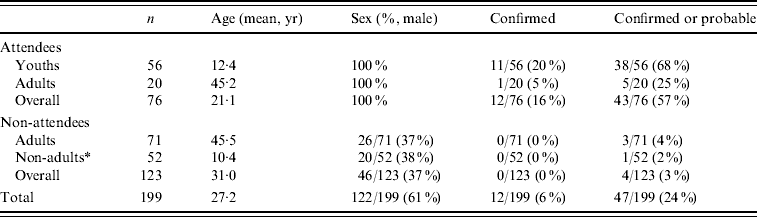
Groups from seven of 11 Florida counties with camp attendees reported at least one person with ILI in those attending camp. From these seven counties, an estimated 212 persons attended camp the week of 7 June and returned to Florida. Of these 212 attendees, about 49 were ill. Households for 43/49 (87%) attendees known to be ill while at camp were contacted and interviewed, but two laboratory-confirmed cases and about four probable cases and their household contacts could not be reached for follow-up. The 43 ill camp attendees interviewed came from 37 households; 16 additional households without a sick attendee were also interviewed. The 53 complete households interviewed included 76 (36%) of the 212 camp attendees and 123 non-attendees from the same households (Table 1).
Characteristics of camp attendees and non-attendee household members interviewed
* Non-adults or siblings of camp attendee (aged <25 years).
Of the 76 camp attendees for whom data were collected, 13 were tested by rRT–PCR for pandemic influenza; 12 had laboratory-confirmed infection with 2009 pandemic influenza A (H1N1) virus, one had an equivocal result and was classified as probable influenza along with 30 others that were not tested but who met the clinical case definition for probable influenza. Of the 123 non-attendee household members, there were no confirmed cases and four persons met the probable case definition for influenza. Of these four probable cases in household members, three lived in households with a probable case in a household member who attended camp; one individual lived in a household where the camp attendee did not have ILI.
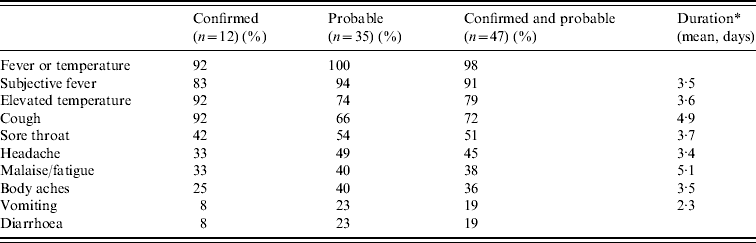
Of the 35 total people who met the probable case definition used in our study, 31 also met the more specific ILI case definition of fever and cough or sore throat, similar to that used by ILInet. The frequency and mean duration of symptoms in confirmed and probable cases in this study population are consistent with past clinical descriptions of illness due to 2009 pandemic influenza A (H1N1) virus [1]. Confirmed cases were somewhat more likely to have cough and somewhat less likely to have gastrointestinal symptoms of vomiting and diarrhoea, relative to probable cases, although these differences were not statistically significant (Table 2). One confirmed case-patient was a 67-year-old attendee with a pre-existing medical condition who was tested for influenza despite not having fever or other symptoms of ILI.
Clinical characteristics of ill individuals
* Mean duration for confirmed and probable cases (n=47).
Estimated attack rates in camp attendees are imprecise because not all camp attendees for each group could be contacted. More than half of the camp attendees interviewed met the case definition for confirmed or probable influenza. However, after accounting for those that could not be reached, the overall attack rate for camp attendees from the seven groups is estimated at 23%, ranging from 10% to 48% in each group.
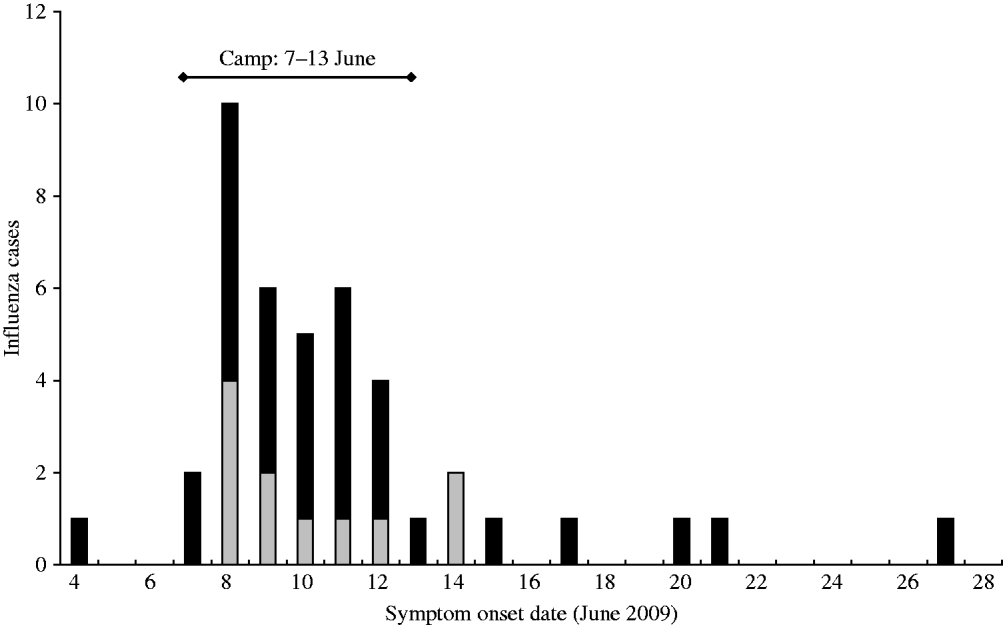
Dates of onset of ILI symptoms for each camp attendee are shown in Figure 1. Only one individual reported symptom onset prior to leaving home for the camp. Of the 41 ill camp attendees with symptom onset after 5 June, 35 (85%) had illness onset before returning home from camp and six (15%) had onset after returning home. For those with illness onset before returning home, symptom onset on average occurred 2·4 days before arriving home (median 2 days, range 0–6 days). For those with symptom onset after returning home, onset occurred 6·2 days on average after arriving home (median 5·5 days, range 1–14 days).
Epidemiological curve of confirmed ( ) and probable (▪) influenza cases in camp attendees, by date of symptom onset.
Overall, there were 87 non-attendee household contacts of confirmed or probable cases who attended camp and were included in the survey. Of these 87 household contacts, only three developed ILI meeting the probable case definition, for an overall household secondary attack rate (SAR) of 3·5%. None of the three probable cases in secondary household contacts were in the same household as a confirmed primary case. Two of these secondary cases were in the same household as one ill camp attendee who had onset of illness on 9 June and returned home early on 10 June (Table 3). The household members developed symptoms 2 days later, for a serial interval of 3 days. The other index case similarly arrived home 1 day after onset of symptoms and the household contact also developed symptoms 2 days after arrival of the index case.
Characteristics of influenza cases acquired through secondary household transmission

F, Female.
* Same household.
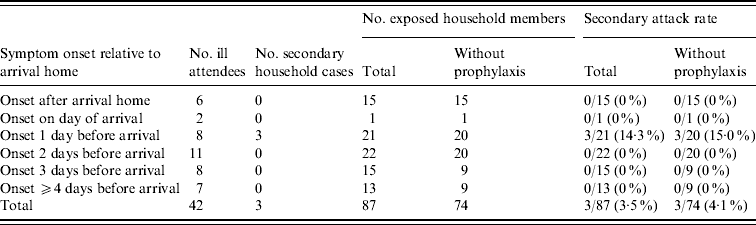
SARs in non-attendees were stratified based on the interval between symptom onset and arrival home for ill attendees (Table 4). Of 21 household contacts of index cases who arrived home 1 day after onset of symptoms, three developed ILI for a stratum-specific household SAR of 14·3%. Since there were no other secondary cases in household contacts, all other stratum-specific SARs were zero. Of camp attendees who returned home ill, one received antiviral treatment before his return. Of 87 exposed household members, 13 (15%) took prophylactic antiviral medication when the ill household member returned home. Use of antiviral prophylaxis was more common in households with ⩾2 days advance warning of ILI in a household member returning from camp. After removing household contacts with prophylactic antiviral use from the denominator, the overall household SAR was estimated at 4·1%; the SAR was 15% in households where the index case returned home 1 day after illness onset.
Secondary attack rate in household members in relation to timing of exposure to ill camp attendees
DISCUSSION
Past studies that estimate household SARs for influenza have generally been conducted in the context of community-wide outbreaks without the physical separation of family members that occurred during this outbreak. Odaira et al. recently reported a household SAR of 4·8% associated with a generalized community outbreak of 2009 pandemic H1N1 influenza virus in Japan [Reference Odaira2]. Previous studies have found household SARs for seasonal influenza ranging from 14% to 58% [Reference Fox3–Reference Thacker7]. The physical separation of camp attendees from their household members is an important characteristic of this influenza outbreak that distinguishes it from past efforts to estimate household SARs – thus our results are not directly comparable to previous findings. Overall, we observed that 3·5% of exposed household members developed ILI, with a SAR of 14·3% in households where the primary case returned home 1 day after the onset of their symptoms. Since only one camp attendee received antiviral treatment prior to returning home, and only 15% of exposed household members took antiviral prophylaxis, the low SAR we observed cannot be fully explained by antiviral use.
There are at least two reasons why the overall SAR we observed may be lower than in previous studies conducted in the context of a community-wide outbreak. First, more than half the ill camp attendees had illness onset ⩾2 days before arriving home, and were likely to be less infectious to others. Second, advance warning of ILI in children returning home may have allowed families to reduce exposure in household members not attending camp. Because the outbreak was well recognized during camp, public health professionals in North Carolina were able to provide general guidance regarding influenza prevention to camp organizers and attendees. Attendees were also able to call home prior to their return to inform household members of the situation. In addition, health department staff in at least three Florida counties interacted with some camp attendees and their families prior to their return home. Health department staff from one county met a bus carrying attendees upon their return to provide general guidance on influenza prevention, and in two other counties, health department staff provided phone consultation. However, no uniform data were systematically collected regarding which camp attendees received educational interventions. While it is not clear what precise impact these educational interventions had on preventing secondary transmission, they may have contributed to the low household SAR observed. We did not specifically assess non-pharmaceutical measures taken by households to reduce exposure in those not attending camp, but there were anecdotal reports of increased physical distancing of members within the same household.
None of the 12 laboratory-confirmed influenza cases in camp attendees interviewed are known to have infected other household members who did not attend the camp. Probable household transmission occurred from only two ill camp attendees, both of whom returned home 1 day after the onset of their symptoms. This is shorter than the mean interval between symptom onset and arrival home in households without secondary transmission. Those with symptom onset 1 day before arriving home not only provided less advanced warning for household members to take preventative measures, but also may have been more infectious to others. Recent reports have indicated that the 2009 pandemic influenza virus can be shed from some infected individuals up to 8 days following onset of illness [Reference Witkop8]. However, recovery of influenza viral RNA by RT–PCR, or influenza virus in cell culture from nasal wash specimens, does not necessarily indicate infectivity. Although derived from a small number of observations, our results are consistent with a hypothesis that transmission of the novel virus is more likely to occur closer to the time of symptom onset.
Mild infection with the novel virus may also partially account for the lower attack rate we observed compared to previous studies. To account for the possibility of variable symptom presentation, we expanded our case definition of probable influenza to allow for fever and compatible symptoms other than cough and sore throat. Others have shown that a clinical case definition of ILI that incorporates symptoms such as headache and myalgias can have greater discriminatory ability than traditional definitions of ILI that require fever and cough or sore throat [Reference Cowling9]. Nonetheless, our results did not differ substantially when using either the more or less restrictive probable case definition for ILI.
This study was limited by our inability to contact all camp attendees from each group. However, most attendees known to be ill were contacted, which allowed assessment of transmission patterns in the households of those with a sick attendee. The study was also limited by the lack of data on specific non-pharmaceutical interventions taken within households to reduce transmission. Nevertheless, these results suggest that secondary transmission may be reduced when advance warning of an ill household member is available and appropriate commonsense precautions can be taken within the household.
ACKNOWLEDGEMENTS
We gratefully acknowledge the assistance of the North Carolina Department of Health and Human Services, camp organizers, and survey participants. We also thank Barry Inman, Warren McDougle, and Sam Williamson for assistance with survey implementation and Kris Arheart for assistance with data analysis.
The findings and conclusions in this report are those of the authors and do not necessarily represent the official position of the Centers for Disease Control and Prevention or other funding agencies.
APPENDIX
Transmission Investigation Team (in alphabetical order):
L. Ball, A. Dopico, T. Harder, T. Harper, D. King, P. Mann, A. Morgan, P. Ragan, S. Rivers, K. Scoggins, L. Wansbrough (all from the Florida Department of Health).
DECLARATION OF INTEREST
None.



