




The beautiful is neither the veil nor the veiled object but rather the object in its veil.
–Walter Benjamin, “Goethe’s Elective Affinities”
Leonardo da Vinci’s The Last Supper is one of the most recognizable paintings in the world, a fact due to the numerous copies that have been made of it, first with prints, now onto coffee mugs and dorm room posters. This circulation is perhaps all the more striking given how The Last Supper is painted on the wall of a Dominican refectory in Milan, Italy, and is only accessible through its reproduction. In its exceptional reach, the painting exemplifies a trend in Western art wherein sacred imagery is reproduced, institutionally recontextualized, and ultimately removed from its original religious context.
Such were the thoughts on my mind when I first saw a hand-painted reproduction of The Last Supper in the sitting room of a Coptic household (Figure 1). During my 2017-2018 fieldwork with Coptic Christians living in the towns near the Upper Egyptian city of Asyut, I would sometimes encounter religious images in the sitting room, the prominent room near the entrance of the house where guests are typically hosted. Poorer families would use calendars and posters displaying images of Jesus, the Virgin, and other saints and holy figures to adorn their sitting rooms. Wealthier Coptic families, however, would commission local artists to paint copies of this same popular religious imagery. While status jockeying was clearly at play, these wealthier families claimed that the commissioned artwork brought baraka, or God’s blessing, to their household. Neither entirely religious nor fully secular, this artwork occupied an unclear “middle ground” that defied any easy categorization as sacred imagery or secular art.
A reproduction of da Vinci’s The Last Supper in the sitting room of a Coptic household.

This apparent restoration of spiritual power through copying presents a striking counterpoint to Walter Benjamin’s theory of how reproduction affects artistic aura. In “The Work of Art in the Age of Mechanical Reproduction” (Reference Benjamin and Arendt1985), Benjamin used “aura” to describe an intangible quality of art that fades under mechanical reproduction. Writing when photography and film were beginning to reshape mass culture, Benjamin viewed this loss of aura as a break with the past that fundamentally altered human experience. While Benjamin’s Western-centric approach to aesthetics is far from universal, Kajri Jain notes that “the terms of a provincial-yet-universalizing post-Enlightenment system of aesthetic value form part of the self-understanding of many postcolonial subjects” (Reference Jain2007, 173). The Coptic Christians I knew would recognize The Last Supper as Western and foreign, yet they would speak of this painting and its reproduction in terms that resist the detachment of aesthetic judgment from religious experience typical of secular Western art interpretation. Benjamin’s framework might therefore help us appreciate the ways that artworks change as they, and their copies, travel across differing systems of aesthetic value.
Aura, to be clear, is a slippery term. Benjamin was himself hesitant to use it, and his understanding of the term changed over time. In the third, 1939 version of his famous essay, Benjamin defined aura by comparing it to sunlight shooting beyond a mountain ridge.Footnote 1 This effervescent glow might seem to defy the rigor of semiotic analysis. Yet Benjamin argues that the “distance, however closer it may be” generated by aura signals the “uniqueness and permanence” of a work of art (Reference Benjamin and Arendt1985, 222–23). The haziness of aura, in other words, is only part of a broader enregisterment (Agha Reference Agha2007) that pairs various qualia—e.g., the thick brush strokes of a Van Gogh painting—with the metapragmatic association of values such as genuineness and authenticity. Assuming that this process of enregisterment is itself shaped by culture and history, we might ask whether Benjamin’s approach has purchase beyond the historical framework he sets for himself. Or put more bluntly, has The Last Supper, in being reproduced by hand and attributed to divine blessing, reacquired its aura? If so, by what means?
While this question itself is probably unanswerable, Benjamin’s discussion of aura draws attention to two important concerns in the study of religion and aesthetics. The first concern is the role of circulating religious images within religious traditions. In a world where technology, particularly the Internet, has accelerated and widened the circulation of religious media, we might ask how certain works of art become reappropriated, and perhaps even sacralized, in novel religious or semi-religious settings. How are these images and other forms of media manipulated and changed so that they might conform with, or disrupt, a particular religious tradition? The second concern is the divide between the use of art in cult and ritual and in its secular manifestations. Benjamin was interested in long gaps of time wherein, for instance, a Greek statue once used in ritual becomes a museum piece. But would it not be possible to see the movement of art across space as equally transformative? This point is particularly relevant for the discussion of aura, which Benjamin viewed as a property that emerges from the art object’s separation, yet not complete detachment, from its context of origin. In sum, as different forms of media circulate among religious communities and traditions, how do we conceptualize the religious or spiritual valence of images or objects that seem quasi-, unofficially, nearly sacred?
In this article, I address this question by using Benjamin’s concept of aura to analyze the ways Coptic Christians in rural Upper Egypt copy religious art in the interior space of homes. In what follows, I will provide an ethnographic account of how these artists and patrons produce, evaluate, and manipulate these images so that this artwork adheres to various standards of fidelity. Since Coptic Christians are a religious minority in Egypt, this production and display of images are necessarily discrete and largely confined to domestic and church settings. Given these restrictions, I argue that artists and their patrons engage in various strategies that align these domestic paintings with an abstracted concept of the church. These strategies that link houses and their paintings with churches, I further argue, hinge on various forms of semiotic labor directed at the content, form, and material of these images. In asking how aura might be understood in this particular case, I use Benjamin primarily as a provocative heuristic that forces us to theorize this analytic zone between the religious/secular or sacred/profane, which I call the near-sacred. But before I move into the ethnography, I wish to provide an overview of the politics that undergirds Christian approaches to aesthetics in contemporary Egypt.
The coptic aesthetic economy
Any discussion of Christianity and aesthetics in Egypt must begin with the minority status of Christians in Egypt. Comprising roughly 10 percent of the nation’s population, most Coptic Christians (or “Copts”) belong to the indigenous Coptic Orthodox Church.Footnote 2 There are also Coptic Catholic, Evangelical, and Pentecostal communities of varying sizes in the country. Studies of the social lives of contemporary Copts tend to emphasize the conflicted ways in which Copts are both visible and invisible in the Egyptian imaginary (Mahmood Reference Mahmood2016; Ibrahim Reference Ibrahim2019; Yosra and Pinfari Reference Yosra and Pinfari2020). Copts face numerous strictures, enforced by state, social, and even ecclesiological actors, that limit the extent to which religious imagery can be introduced into public spaces.Footnote 3 At the same time, a casual observer can easily encounter churches with illuminated crosses, shops owned by Copts with saint cards tapped inside the walls, and the faithful with small crosses tattooed on their wrists. This tension between display and discretion heavily influences contemporary Coptic approaches to religious imagery.
Although shaped by Egypt’s particular sectarian dynamics, this emphasis on the material and sensual dimensions of faith also characterizes Orthodox Christianity more generally (Luehrmann Reference Luehrmann and Luehrmann2017). While oversight of this aesthetic tradition can be contested (Heo Reference Heo2013), icons and other visual media can often circulate between formal, church-bound liturgies and more informal, devotional settings. A prominent example of this inherent flexibility in the Orthodox sensorium is the “icon corner”: a space within the household, typically adorned with icons of Christ and the Virgin Mary, that serves as a focal point of prayer and devotion. This tradition exists in Coptic Christianity (Makary Reference Makary2022), a fact reflected in these decorated Coptic sitting rooms. Yet the malleability of these popular pious practices, in enabling accessibility, also invites political appropriation. The Georgian Orthodox Church, for instance, has used the model of the icon corner to erect similar displays in public schools: a tactic that carefully weaves religion into an otherwise secular space (Gurchiani Reference Gurchiani2017). Coptic sitting rooms move in the opposite direction, as restrictions on public expression make domestic interiors a privileged place for balancing theological commitments, personal taste, and concerns about privacy, status, and family reputation.
When Coptic Christians speak about religious imagery, they are quick to clarify the kind of image at hand. As in Orthodox settings elsewhere, iquniat (“icons”) are hand-painted representations of Jesus, the Virgin, or the saints. These iquniat were used in collective worship and personal acts of devotion throughout my time in Upper Egypt.Footnote 4 The clergy of the Coptic Orthodox and Coptic Catholic churches—the two denominations in Upper Egypt that make use of icons—typically keep these sacred, hand-painted images on display within the church itself. People would visit the church to pray with the icon, and during the feast of the parish’s patron saint the clergy would process with the icon inside the church. The other kind of image is suwwar (“pictures”), which include prayer cards displaying the images of saints, decorated church calendars, and the many other printed images of saints that Copts use to decorate their homes, cars, and workplaces. Use of popular religious imagery cuts across all Christian denominations, and even Protestant families will commission artwork for their homes.Footnote 5
This distinction of kind reflects the theological legibility of these two distinct aesthetic regimes. While the production and use of icons has been the focus of extensive theological discourse, this broader realm of popular imagery—be it print, photography, film, or emergent digital formats—is not always as legible for theological, clerical, or other authoritative voices (Morgan Reference Morgan1998; Meyer Reference Gell2012).Footnote 6 This confusion around popular imagery is expressed in everyday discourse. Sometimes Christians in Egypt will refer to these popular images as baraka, as if the entire card or poster is charged with God’s blessing. At other times these images are explained in sectarian terms, especially when particular saints are viewed as exclusively Orthodox or Catholic. The point I wish to emphasize is that, unlike the highly-regulated use of iquniat, these popular religious images have a wide range of expressions and their interpretation by viewers is less regulated by church authority.
Despite this conceptual distinction between iquniat and popular imagery, theological interpretations of icons still inform discourse on popular religious images. The eighth-century theologian St. John Damascene provides a guiding principle in this regard: “an image is a likeness of the original with a certain difference, for it is not an exact reproduction of the original” (Reference Damascene1898, 10). This observation works at various scales, which deepens its appeal: it applies to icons and their referent, to artistic production more broadly, and even to the creation of humanity in God’s image. This indexical relationship between sacred icon and holy person, in other words, operates within a comprehensive theological framework in which the material world reflects, through patterns of similarity and difference, the unseen divine presence. This extension of theology into the broader world of image production might seem to sacralize pursuits that otherwise appear secular—another hallmark of Orthodox spirituality. But in emphasizing the inexactitude of the copy-original relationship, this theological framework also makes space for artistic liberty in the production of divine images. As Michael Herzfeld (Reference Herzfeld1990) shows in his study of icons in rural Crete, artistic creativity in the copying of holy icons is precisely what connects this religious practice with the political relationships among different families and villages.
This comprehensive theological framework is important to keep in mind because it contrasts sharply with how artists speak about their work. These artists instead focus on the limitations they face: their work requires them to copy, not create. Artists typically take the source image (often a xerox copy), layer a grid over it, and reproduce each square onto the sitting room wall. It is a tedious form of replication. Yet while the painting indexes its source image, it also indexes collectively held ideas about how images should conform with Orthodox tradition. Copying therefore involves subtle modifications of the source, but only in accord with popular understanding. Moreover, these artists take pleasure in introducing embellishments (e.g., adding texture to clothing or clouds to backgrounds) that enhance the painting overall. The indexicality of these images thus encompasses multiple referents: the source image, collective ideas about holy people’s visual appearance, the artist’s skill, and the homeowner’s wealth and piety.
This assemblage of indexical referents creates paintings less regulated than icons but still indexing their status as tokens. Each painting is interpreted as a “copy,” yet through its domestic placement and artistic flourishes, it also claims uniqueness. No two sitting room paintings were identical, even when using the same source image. This combination of similitude and difference echoes St. John Damascene’s view of imitation’s inexact nature, though here the referent is the source image rather than the holy person. More broadly, this process whereby paintings index both their token-ness and their originality echoes Benjamin’s association of aura with proximity and distance. While mechanical reproduction erodes aura by collapsing space between artwork and observer, “the painter maintains in his work a natural distance from reality” (233). For Benjamin, “distance” captures the conflicting indexical referents—presence and absence, copy and originality—that generate interpretations of authenticity. The auratic object remains distant, yet present.
As Massimo Leone and Richard Parmentier (Reference Massimo and Parmentier2014) show, the paradoxical representation of the illusive or absent in material form can be theorized as the representation of transcendence. Their account focuses on both “semiosis as the experience of transcendence” and “semiosis in entextualized discourse about transcendence” (S17), but raises questions about interpreting transcendence where such discourse is fragmented or contradictory. Such is precisely the situation with Coptic sitting room art, where various interpretive frameworks, artistic traditions, and denominational identities intersect. In response, I examine the sign processes through which Coptic artists reestablish distance between viewer and image, drawing upon fragmented metasemiotic texts that shape how Copts produce, experience, and evaluate these paintings. This fragmentation, I suggest, can be viewed as a defining characteristic of what we might recognize, following Benjamin, as a zone of activity that lies near, yet beyond, the traditional realm of ritual and cult. In this “middle ground,” discussions about the religious value of aesthetic experience will inevitably diverge, at some point, from authoritative church teachings. All the same, as we shall see, there remains a proper calibration of signs by which both artists and their patrons judge these reproductions.
Faithful copy
I first encountered this copy of The Last Supper in the town of al-‘Aziya, which is located near the Upper Egyptian city of Asyut and has roughly 55,000 residents. This town is unusual: almost all of the residents are Christian.Footnote 7 At the time of my fieldwork, at least four artists were at work in this town, and about 50 households had large-scale paintings in their interiors. One of these artists was a young Orthodox man named Mokhlis Kameel.Footnote 8 Over the course of my fieldwork, I came to know Mokhlis, and he would keep me updated on his various projects in town. Most of his commissions came from homeowners, though occasionally he would be hired by either a Catholic or Orthodox priest to paint decorative images within the church. (Mokhlis insisted that he did not produce icons.) Like virtually every Coptic Christian I met in Upper Egypt, Mokhlis considered himself religious, though he did not view his artistic labor in terms of his faith. He simply saw himself as an artist.
The dominant framework for discussing this activity, both by artists and their patrons, is that of taswir (“copy”). According to Mokhlis, the process is always the same. A homeowner would approach him with an image he wanted “copied,” be it a newspaper clipping, a printed image from a church handout, or, more recently, an image pulled from Facebook or WhatsApp. These images are exclusively religious in nature. Mokhlis, who considered himself an artist-in-training, had mixed feelings about these commissions. “They want me to do what a machine could do,” he explained. “If a machine could paint these walls, they would use the machine.” We might interpret Mokhlis’s words as a complaint about the restrictions placed on his craft. But Mokhlis was also locating himself within a complex moral field. In Egypt and elsewhere, copy and imitation raise concerns about the production of counterfeits while also serving as the basis of moral and artistic pedagogy.Footnote 9 Put differently, the labor of copying could lead one down multiple paths. Mokhlis was eager to describe these commissions as a means to advance his skills, though other artists were known to craft fake Egyptian antiquities on the side, or even to dabble in the growing local industry of online scamming, which was rumored to involve manipulating and distorting images for profit. So while Mokhlis did not view his work in religious terms, he was careful to protect his reputation.
How then are these reproductions evaluated? For the homeowners, the critical mark, as mentioned, is how closely the painting reflects the original. Homeowners tended to keep a printed version of the “original” image or have it saved on their phone. These “originals” are always themselves copies: a printed prayer card, a torn page from a religious magazine, a newspaper clipping. When discussing these paintings, they would take out the original image and point out discrepancies of color or proportion. While this emphasis on exactitude reflects Mokhlis’s own description of the priorities of his patrons, it reaffirms that these patrons also operate within a complex moral terrain where copying carries both legitimate and questionable possibilities. These paintings, while hidden from street view, will be seen by families, guests, and even visiting members of the clergy. Overt displays of public wealth tend to be viewed as garish, and in this very traditional culture, religious images could not be new or novel. Demanding an exact or faithful copy provides moral cover for these homeowners.
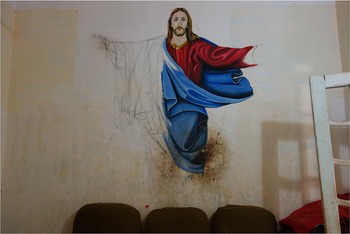
The artists have their own criteria by which they judge their art. They focus on the artistic flourishes that can be inserted into the reproduction while still respecting the need to “copy”: folds added to a cloth, or intricate clouds surrounding a figure. In ways not unlike certain early Renaissance artists, the need to adhere to traditional representation redirects creativity elsewhere. But artists will also make changes to central elements of the source image in the name of preserving the “true” image of the holy person. When they depicted Jesus Christ, to take the most prominent example, the eyes must be green, the hair blond, and there should be a dimpled chin with beard (Figure 2). “This was how some monk described Jesus,” explained Mokhlis. Other artists agreed. These qualia of visual accuracy, verified through an appeal to church authority, sometimes had little bearing on a painting. At other times, such as the copy of The Last Supper, the face of Jesus must be repositioned so that these qualia are visible.
A domestic painting in progress.

What emerges is a process in which both patrons and artists rely on various metasemiotic texts—a xeroxed copy of the “original” image, an appeal to a standardized bundling of qualia—that guide their assessment of this artwork. It is as if downshifting from mechanical reproduction to the use of the human hand invites a reassessment of the various components of a painting. The stakes of surrounding the production of this artwork—in terms of moral character, of one’s reputation, of the orthodoxy of the image itself—also added a touch of urgency to the matter. The attention directed toward these reproductions, while not exactly an expression of art appreciation, is nonetheless present in these proceedings, and is motivated by a variety of theological and non-theological concerns.
Between house and church
These sitting room paintings invite attention and scrutiny, both from artists, patrons, and (in less observable ways) the visitors who pass through these spaces. But what about the initial suggestion that these paintings are in some way re-sacralized, or might even possess aura? In this section, I locate this production of art within the broader context of Coptic social life; namely, at the intersection of houses and churches.
In the backcountry of Upper Egypt, houses and churches tend to be the two places where religious expression for Copts is most pronounced. A typical house in Upper Egypt is multistory, with grandparents on the first floor and the families of the married sons on the floor above. Church architecture varies according to denomination, though there is a recognizable type to all churches in Upper Egypt: a large gate and outdoor gathering space, a sanctuary, and a tower with an illuminated cross. The connection between houses and churches in Egypt, especially in the countryside, has a long and politically-charged history. New churches tend to start within houses. Families pool their resources, the sitting room is converted into a sanctuary, and then the house its rebuilt into a church. Given the restrictions Christians face in terms of church construction, suspicion of house-churches in majority-Muslim communities can occasionally result in tension and even violence. Yet beyond these practical and historical associations, there is also the tight connection between kinship and the founding of churches in the rural communities of Upper Egypt. Prominent families tend to play an oversized role in the management of church affairs. In the view of many, the town owns the church, and the clergy are present to serve the church and its members.
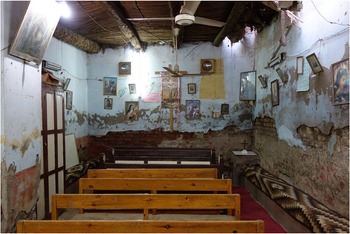
At an abstract level, houses might therefore be considered proto-churches, and churches an outgrowth of houses.Footnote 10 While this formula is too simplistic, it does hint at the ways that place and images intersect to signify the historicity and sanctity of the church. In the town of al-‘Aziya, all the non-Orthodox churches have retained their original or “antique” (athari) church. These older buildings are essentially the sitting rooms of the houses where those churches began. Now they serve as places where people can rest, pray, and enjoy some solitude. Their décor—often the same kinds of mass-produced religious imagery found in sittings rooms—betray their recent age (Figure 3). Alternatively, Orthodox churches, having much deeper roots, might not have these original house-churches. Even if there is an “antique” church, it might only be found underneath the main sanctuary. This cool, quiet room is typically used to store older icons, prayer books, crosses, and other artifacts, often contained behind protective glass. It is a place that can take on the quality of a museum, in large part because these historical items are no longer, or rarely, used for ritual purposes. The oldest Orthodox church in al-‘Aziya, for instance, keeps a nineteenth-century icon of in a similar storage space, taking it out only during important feast days.
An example of a Coptic Catholic “antique” church. It had once been the sitting room of a house.

These house-churches and these museum-like sanctuaries, in summary, are conceptually aligned in important ways. They exist at a spatial and conceptual periphery to the church itself, serving as objects of fascination, interest, and yearning for the various Christians who interact with them. Both also serve as indexical signs of the historical reach of the church community, whether Orthodox or Catholic, yet they are not entirely detached from the liturgical activities of the church, most importantly the Divine Liturgy.Footnote 11 House-churches and basement storerooms, in other words, occupy this “middle ground” wherein they retain the aura of cult or ritual while also defying clear explication via authoritative religious discourse. This point is important because the character of these peripheral places and objects is anchored in material qualities that houses and churches share: the material shell of the house that becomes a sanctuary, the storage case of holy images that puts them on display but removes them from ritual use, the decorated walls of sitting rooms. These shared material preconditions, particularly the availability of large interior surfaces and questions of how images are bounded or framed, help explain why religious imagery can move so fluidly between domestic and ecclesiastical contexts. They also illuminate how both domestic and church settings can facilitate what Benjamin described as the “distance” that generates aura, albeit through different material arrangements and social contexts. In what follows, I will examine how two such material qualities - surfaces and frames - are created and interpreted, and how this material nexus between house and church enables artists to establish new forms of distance between viewer and copied image.
Surfaces
One of the key material preconditions for producing these images is the availability of large interior surfaces. Throughout the rural communities of Upper Egypt, homes have traditionally been built with straw and mudbrick. In the 1980s, when Egyptians experienced an influx of wealth, some of these structures were torn down and replaced with concrete blocks, the walls finished with a smooth plaster coat. This new design made for higher ceilings, which also resulted in larger sitting rooms. In the town of al-‘Aziya, this kind of renovation work took off right around the time of the Arab Spring, when the town became a prominent place for reselling automobiles. New and newly-renovated churches appeared along with new homes.Footnote 12 With extra spending money and smooth walls to cover with images, families were able to hire painters like Mokhlis. The clergy of these new churches also sought to hire artists to paint their ceilings and walls, leaving work on icons to more specialized artisans. The labor itself was never that costly, but the paint and brushes are imported, which adds to the expense.
New wealth spurred demand for more sophisticated paintings, which patrons first accessed by newspapers, then by the Internet. For instance, one of the earliest reproductions in the town was of Titian’s Rest on the Flight into Egypt. The homeowner had seen a black-and-white picture of the painting in a newspaper after the artwork had been stolen in 1995. The reproduction adhered to the basic contours of the painting, but with novel coloration: the artist had selected a bright hue of orange for some of the clothing. As more homes were renovated and the demand for artists grew, the artists themselves began to take interest in Renaissance art. Mokhlis kept a collection of images of religious art by the Old Masters on his hard drive. When he married, he even decided to adorn his own sitting room with large images of Sophocles and Aristotle: a copy of Raphael’s celebrated fresco, The School of Athens. This investment in European art might be dismissed as part of Mokhlis’s personality. Yet the legibility of this art extended far beyond his studio. There were no commissions for other kinds of museum-quality paintings, nor even for religious iconography from other Orthodox traditions. It seems that these particular paintings “worked” because a) they made spectacular use of the large surfaces, allowing artists to use a wide range of colors and decorative techniques (e.g., adding texture to clothing) and b) the subjects of these paintings were unmistakably Christian.Footnote 13 If Mokhlis was obsessed with Renaissance painting, it was because this framework of interpretation allowed him to replicate these particular paintings.
A consequence of this emergent industry, which flows from available surfaces and an influx of wealth, is that people in the town came to see reproductions of European art and reproductions of generic images of various holy figures (e.g., St. George on horseback) as commensurable. In this sense, the surface became the meeting point for reproductions of art one might find in a museum and/or church (but also in circulation online). Moreover, this shared location on a domestic surface allowed both types of images to be viewed as sources of baraka. While Coptic Christians tend to talk about baraka in a rather casual way, their actions can be more precise. For instance, pilgrims who visit churches and monasteries will often touch icons to “take” baraka—a practice I never witnessed in regard to the sitting room reproductions. This immanent presence of baraka, one that merges with the surface of the building (as opposed to being a discrete object), offers an ambient blessing that might be compared to the experience, for a Copt, of stepping foot into a church. These large, flat walls, shared both by the newly-renovated homes and churches, therefore enabled a common sense a baraka, albeit one that defied any detailed or regimented theological account.
Given how this receptivity to European art coincides with larger interior spaces, we might compare these transformations to those that occurred during the Renaissance. In his classic text The Production of Space, Henri Lefebvre (Reference Lefebvre1991) examines how new developments in sixteenth-century architecture, particularly “the façade,” made certain paintings possible. Lefebvre treats the façade almost like an instrument for redefining space itself: “the notion of the façade implies right and left … and high and low” (273). The façade also functions as a disciplining device since it frames space as “organic” and ordered (272–3). Most relevant to these Coptic sitting rooms is Lefebvre’s connection between façade and face. In his account, the watching human face orders space through both design and enforced behavior:
A picture, as a painted surface, privilege one dimension, orienting itself towards the viewer and grouping its subjects, whether inanimate or living, according to the same logic. It is a sort of face and a sort of façade. A painting turns in the direction of anyone approaching it – that is, in the direction of the public. A portrait looks out before, while and after it is looked at. A canvas, or a painted wall, has a countenance, one which actively invites scrutiny. Both face and façade have something of the gift about them, something of favour and fervour. (273-4)
For Lefebvre, this face-like quality of painted surfaces demonstrates the power of images-in-place. The surface facilitates the encounter between viewer and image. Artists like Mokhlis demonstrate similar awareness of how faces painted on walls shape viewer experience. These artists consistently modify their source images, repositioning faces—particularly those of Jesus Christ with his standardized green eyes, blonde hair, and bearded chin—to meet the viewer’s gaze across the room. This manipulation, evident in the reproduction of The Last Supper, demonstrates how copying actively reconstructs the image’s relationship to its context rather than simply reproducing it.
This adjustment of the face and gaze of these holy figures aligns houses with churches in a curious way. In churches, iquniat are encompassed by a rich field of referents: icons of the 12 apostles direct attention toward the altar, while individual iquniat are paired with votive candles or reliquaries. Saintly faces invite attention only to redirect it elsewhere. Domestic surfaces, however, lack such centerpieces or supportive materials. The diegetic worlds of these sitting room paintings are self-contained, meaning that when the holy person’s gaze is adjusted outward, it makes a much stronger claim on the viewer’s attention. This effect resembles what Kajri Jain calls “the denigration of iconic frontality” in Indian calendar art, where artists must contort figures to show everyday activities while preserving their frontal gaze toward the audience (Reference Jain2007, 192).Footnote 14 Yet unlike these Indian calendars that essentially break the fourth wall, Coptic reproductions require minimal adjustment since Renaissance artists already employed frontal or near-frontal gazes. There is no “denigration” in slightly adjusting Jesus’s eyes in The Last Supper reproduction. Instead, these reproductions concentrate the dispersed field of vision associated with church imagery onto a specific domestic surface. This transformation might suggest secularization through the stripping away of art’s ritual dimension. Yet it seems that it is precisely the faint iconographic resemblance that artists detect in European paintings—echoes of a ritual past—that enables these domestic surfaces to facilitate visual encounters with Jesus, the Virgin, and the saints.
Frames
One notable aspect of these domestic paintings is that they do not have frames. In the Orthodox and Coptic Catholic churches of Upper Egypt, icons are always framed, either with glass so that it may be safely touched, or set, as mentioned, within the iconostasis. Prints of popular religious images, by being on sheets of paper or cardboard, are themselves framed in the sense that they have defined edges. Yet these domestic paintings, whether they are reproductions of European art or elaborate assemblages of popular religious imagery, tend to emerge out of a background of colors and designs. Showing me a sitting room painting of which he was particularly proud (Figure 4), Mokhlis drew my attention to the clouds and other elements of the background. When I called these things “decoration” (zina), he bristled. “It comes from the imagination,” he replied. And it was true. None of these details were found in the original image. They were parts of the painting he could call his own.
An example of clouds and sky serving as a framing device.

In connecting the peripheral designs with the imagination, Mokhlis echoed themes that appear in philosophical discussions of the frame. Sometimes referred to as parergon, or “that which is beyond the art,” the frame in this discourse acquires its importance in its boundary-setting capacity: it defines where the art object ends and its surroundings begin. But as Mokhlis suggests, the frame—or to be more precise, it’s absence—provokes certain kinds of experience for the viewer. In the Critique of Judgement, Kant (Reference Kant and Walker2009) anchors his theory of the sublime in the experience of the infinite or of boundless dynamism (e.g., a waterfall can be sublime via its endless rush of water). The frame is therefore both an artistic tool as well as a feature of human experience: an insight that allows Kant to find in the sublime a means for humans to individuate themselves from the natural world. In the referenced image, the clouds that gave Mokhlis so much pride certainly echo this dynamism, with their billowing, chaotic appearance contrasting sharply against the tokenized depiction of Jesus Christ and the Roman soldiers (itself a modified version of Paolo Veronese’s The Resurrection of Christ). It also seems appropriate that the Arabic script underneath the depiction of Christ the King it itself a scriptural reference to the infinite: “I am the Alpha and the Omega, the beginning and the end. To the thirsty I will give water as a gift from the spring of the water of life” (Revelation 21:6).Footnote 15 To my eye, however, the sublime, following Kant, is best perceived in the region where the clouds give way to pure white, which gives the impression of Christ the King emerging from the wall itself. One might even say the clouds, as an ambiguous frame, transfer something ineffable about Christ to the house itself. It gives the sitting room a hint of aura.
There is another peculiar overlap between Kant’s theory of the sublime and these sitting rooms: the use of large, “colossal” figures. For Kant, the colossal is an example how gigantic size can generate the dizzying experience of the infinite. The largest sitting rooms, with their massive smooth walls, could support the painting of these large figures. But to get at the strange appeal of these sitting room colossi, I would like to draw briefly on Derrida’s (Reference Derrida1987) playful commentary on Kant’s third Critique. Kant, as Derrida shows, tends to refer to the colossus as “almost too” (large to stand, big to see). It is a trope that Derrida extends to the point of absurdity. The colossus is essentially a body that seems to defy its own natural frame, but as Derrida shows, something that is “almost too” big for its own size is simply something which is not a thing, since it is a concept. The colossus is a concept presented in the guide of an impossible thing. It is “not presentable. Nor simply unpresentable: almost unrepresentable” (125).
Derrida, in other words, locates in the colossus a concept that disrupts Kant’s systemizing project. But it is also significant that the concept concerns the body (and for Derrida, specifically the male body). The sexual overtones that run through his discussion are intended, and they might appear irrelevant (and irreverant) to these sitting room paintings. Yet Mokhlis admitted that the only non-religious painting he was asked to do, by a wealthy and shameless local, was of a colossal nude woman—Mokhlis turned him down. Still, there are other ways in with being “almost too” large might bring about discomfort or scandal. Artists and patrons tabulated the cost of these paintings primarily in terms of the amount of paint. These colossal paintings were viewed as the costliest, the treasured display of the wealthiest home owners. Out of the various sitting room paintings, these figures, also seemed to operate as a classic Derridean aporia. They were the clearest example of the transformative power of copy, but they also threw into suspicion the professed religious motivations for commissioning such art.
This lack of frames and use of colossal figures adds an element of originality to the regimented copying the artists are otherwise asked to do. The use of large, smooth walls also allowed these paintings to be fixed in place. It would be wrong to assume that these material preconditions alone led to the “uniqueness and permanence” that Benjamin associated with auratic art (Reference Benjamin and Arendt1985, 222–3). What can be said is that the metapragmatic values the patrons and artists do associate with these paintings—that they have baraka, that they come from the imagination, that they accurately depict holy figures—are possible only because of the material dimensions of the house. Both households and churches traffic in ideas of permanence, longevity, and power. It does not seem coincidental then that this material undergirding becomes the hidden means by which families, through these artists, draw upon this wide-ranging repertoire of Christian imagery. Lefebvre notes that the Roman Church’s appeal to “organic unity” through monumental architecture appeared precisely when such unity was collapsing from within (Reference Lefebvre1991, 272), and these great works of art now copied in Coptic sitting rooms emerged during moments of religious transition. These reproductions create an indexical relation that spans from the most immediate (family) to the most distant (Christian culture), effectively constituting a zone of religious expression that operates both within and beyond the bounds of ecclesiastical authority. In line with Benjamin, it is yet another example of “distance, however close it may be” (Reference Benjamin and Arendt1985, 22–3).
The near-sacred
The concepts of distance, proximity, the ambiguity of the parergon, and aura offer a secularized, or at least theologically-neutral, means of talking about the powerful impact of art on human experience. These are not precise concepts, though the conceptual confusion might be part of the attraction. This idea is reminiscent of what Alfred Gell described as the “tacky” quality of surface decoration: “the fact that once one submits to the allure of the pattern, one is liable to become hooked, or stuck, in it” (1998, 82). Metasemiotic texts might indicate how these qualities of an image should be interpreted in the case of the liturgical use of icons. Yet the liminal zone described by Benjamin—between a ritual context and a context-neutral mechanical reproduction—is likely to be understood as a site of metasemiotic dissonance. To return to the case study of this article, Mokhlis and other artists might have a deeper appreciation for European art history, while their patrons view this artwork more in pious terms, even when the reproduced art adheres to a widely-understood oral tradition concerning the “accurate” image of the holy person. These colliding standards of evaluation, while also found within the confines of institutionalized religious practice, seem particularly alive, chaotic, and generative in this zone of interaction. In ways that transcend the distinction of the sacred and the profane (Durkheim Reference Durkheim2012) or purified modernity and its others (Latour Reference Latour2010), this zone facilitates unique expressions that cannot be explained as hybrids or lesser versions of something more legibly religious or secular. We might call this “middle ground” the near-sacred, but it could just as easily be the near-profane.
How might such a concept be put to use? In one sense, it might be used to “downshift” aspects of religion that exceed the parameters of both the realms of the secular/profane and even religion itself. For instance, Angie Heo (Reference Heo2012) provides a compelling analysis of the Marian apparitions over a church in the Cairo neighborhood of Zeitoun in 1968 through the lens of Coptic minority politics and visibility. The image was first seen by a Muslim shopkeeper from across the street, and as the apparitions continued evening after evening, groups of Muslims and Christians witnessed the same thing: a luminous outline of the Virgin, floating above the church. While one might consider apparitions to fall squarely within the domain of religious tradition, the history of apparitions in both Eastern and Western Christian traditions is complex, with the laity and clergy sometimes disagreeing over the nature of these strange events. Even for those present in Zeitoun, as Heo notes, witness accounts vary, with some seeing the Virgin move above the roof of the church, others seeing only bright lights. Viewed in light of Coptic aesthetic sensibilities, however, one senses a pattern. The image of the Virgin that was observed and captured by photograph closely resembles the image of the “Miraculous Mary” as witnessed by Catharine Labouré in Paris in 1830 (Heo Reference Heo2012, 367). This visual imitation continues to this day, as it is this depiction of the Virgin that circulates most freely among Copts. At Zeitoun and elsewhere, apparitions tend to appear above or at the periphery of the church, often framed by unexplained illumination. Hovering between church and the outside world, these vibrant copies might be fruitfully compared to the less ethereal aesthetic activity discussed in this article.
Likewise, the framework of the near-sacred might be used to upshift elements of what we might call “ambient” religion, which operates effectively because it obscures the semiotic linkage to the institutional core. In recent years, various scholars have examined how minor or low-grade elements of religious practice and identity are put to use to encourage ethical behavior (Benussi Reference Benussi2022), nudge basic pious practices (Eisenlohr Reference Eisenlohr2018), or to transmit a gentler, non-ideological presentation of organized religion to a secular culture (Engelke Reference Engelke2012). Much of this activity occurs beyond the formal bounds of institutional religion, and the elusiveness of these practices—such as non-descript angels positioning in public places, as Engelke observes—has a way of covering its own tracts. Yet as opposed to viewing this removal in merely functional terms, we might ask how these practices introduce new concepts, assemblages, or representations of the spiritual, divine, non-material, or the sacred.
Conclusion
In examining the copying of religious art, I have used Benjamin’s understanding of aura to highlight the unusual semiotic labor that occurs in this zone of conceptual, material, and spatial proximity to sacred place. Using Coptic Christianity as a test case, we can see how images might become charged beyond the official sphere of religious practice. This semiotic approach allows us to avoid tricky metaphysical questions about the status of this art, as well as universalizing appeals to psychology or phenomenology. Moreover, in focusing on the ways that mass-circulating images are anchored in place, this study complements our growing understanding of the broader economy of signs in which Christians—and members of other religions—shape their practices and traditions. As Scott MacLochlainn (Reference MacLochlainn2022) has shown, an essential feature of this large semiotic economy is the ability to shift between the generic and the specific. It is an enduring question for the Bible translators he studies (Reference MacLochlainn2015), and the same can be said for the artists and patrons who copy religious images in Egypt. These generic forms, even when pulled into the specific, often still signify their universality. For instance, MacLochlainn notes that the Bible translators associate generic forms of translation with the universal reach of Scripture. Yet this metapragmatic understanding of signs and images is not as easily found in what I have called the near-sacred. Unlike the Bible, with relies on a canonical set of texts, this economy of (potentially) sacred images is unwieldly and ever-increasing. Moreover, the methods of refashioning these images are not fully explicated by theological texts or discourses. Still, despite this confusion over how specific images should be remade—or maybe because of it—these reproductions become channels of an ambient baraka, or in Benjamin’s framework, the glow of aura.
Acknowledgements
I would like to thank Erik Mueggler, Andrew Shryock, Alaina Lemon, Paul C. Johnson, Rahul Oka, and Keith Murphy for helpful comments on earlier versions of this essay. I am also grateful for the thoughtful feedback provided by the two anonymous reviewers. Special gratitude goes to Susan Blum for her guidance and inspiration at key moments and to Chris Ball for encouraging the submission of this article to Signs and Society.



 Open access

