











1 Introduction
Let M be a mouse. We write $\mathbb {E}^M$
for the extender sequence of M, not including the active extender
$\mathbb {E}^M$
for the extender sequence of M, not including the active extender $F^M$
of M, and
$F^M$
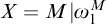
of M, and  for the initial segment of M of height $\omega _1^M$
(incorporating
$\omega _1^M$
(incorporating $\mathbb {E}^M\!\upharpoonright \!\omega _1^M$
).Footnote
1
It was shown in [Reference Schlutzenberg10, Theorem 3.11] that if M has no largest cardinal (in fact more generally than this) then
$\mathbb {E}^M\!\upharpoonright \!\omega _1^M$
).Footnote
1
It was shown in [Reference Schlutzenberg10, Theorem 3.11] that if M has no largest cardinal (in fact more generally than this) then $\mathbb {E}^M$
is definable over the universe
$\mathbb {E}^M$
is definable over the universe $\left \lfloor M\right \rfloor $
of M from the parameter
$\left \lfloor M\right \rfloor $
of M from the parameter $M|\omega _1^M$
. We consider here the following questions:
$M|\omega _1^M$
. We consider here the following questions:
-
– Is $\mathbb {E}^M$
definable over
$\left \lfloor M\right \rfloor $
from a real parameter?
$\mathbb {E}^M$
definable over
$\left \lfloor M\right \rfloor $
from a real parameter? -
– How much of the iteration strategy
for is known to M? -
– What can be said about the structure of
$\mathrm {HOD}^{\left \lfloor M\right \rfloor }$
? How close is
$\mathrm {HOD}^{\left \lfloor M\right \rfloor }$
to M?


 for
for 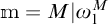 is known to M?

We will see that these questions are interrelated.
We write $\mathbb {E}_+^M=\mathbb {E}^M\ \widehat {\ }\ F^M$
. Recall that a premouse M is non-tame iff there is
$\mathbb {E}_+^M=\mathbb {E}^M\ \widehat {\ }\ F^M$
. Recall that a premouse M is non-tame iff there is $E\in \mathbb {E}_+^M$
and
$E\in \mathbb {E}_+^M$
and $\delta $
such that
$\delta $
such that $\mathrm {cr}(E)<\delta <\mathrm {lh}(E)$
and
$\mathrm {cr}(E)<\delta <\mathrm {lh}(E)$
and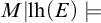 $M|\mathrm {lh}(E)\models $
“
$M|\mathrm {lh}(E)\models $
“ $\delta $
is Woodin as witnessed by
$\delta $
is Woodin as witnessed by $\mathbb {E}$
”. The power set axiom is denoted
$\mathbb {E}$
”. The power set axiom is denoted $\mathrm {PS}$
.
$\mathrm {PS}$
.
Ralf Schindler and John Steel’s paper [Reference Schindler and Steel6] is very relevant to our considerations here. There they established that tame mice do compute significant fragments of their own iteration strategy. In particular, their proof shows that if M is a tame mouse modelling ZFC, then there is $\alpha <\omega _1^M$
such that
$\alpha <\omega _1^M$
such that $M\models $
“
$M\models $
“ $M|\omega _1^M$
is above-
$M|\omega _1^M$
is above- $\alpha $
,
$\alpha $
, $(0,\omega _1)$
-iterable” (in fact they show more). Further, their research leading to that paper was “motivated by the question whether every iterable tame extender model thinks that there is a well-ordering of
$(0,\omega _1)$
-iterable” (in fact they show more). Further, their research leading to that paper was “motivated by the question whether every iterable tame extender model thinks that there is a well-ordering of $\mathbb R$
which is ordinal definable from a real parameter” (see [Reference Schindler and Steel6, p. 752, immediately following Theorem 0.2]). Although [Reference Schindler and Steel6] made significant progress toward answering this question, the question itself was left unresolved:
$\mathbb R$
which is ordinal definable from a real parameter” (see [Reference Schindler and Steel6, p. 752, immediately following Theorem 0.2]). Although [Reference Schindler and Steel6] made significant progress toward answering this question, the question itself was left unresolved: $(0,\omega _1)$
-iterability is not enough to execute the usual proof that comparisons of countable premice terminate. Our first result answers the question affirmatively. The proof owes much to the methods employed in [Reference Schindler and Steel6].
$(0,\omega _1)$
-iterability is not enough to execute the usual proof that comparisons of countable premice terminate. Our first result answers the question affirmatively. The proof owes much to the methods employed in [Reference Schindler and Steel6].
Theorem 1.1. Let M be a $(0,\omega _1+1)$
-iterable tame premouse satisfying “
$(0,\omega _1+1)$
-iterable tame premouse satisfying “ $\omega _1$
exists”. Let
$\omega _1$
exists”. Let $\delta =\omega _2^M$
and
$\delta =\omega _2^M$
and $\mathcal {H}=\mathcal {H}_{\delta }^M$
. Then
$\mathcal {H}=\mathcal {H}_{\delta }^M$
. Then  is definable over $\mathcal {H}$
from a real parameter, and in fact,
$\mathcal {H}$
from a real parameter, and in fact,  is
is $\Sigma _2^{\mathcal {H}}(\{x\})$
for some
$\Sigma _2^{\mathcal {H}}(\{x\})$
for some $x\in \mathbb R^M$
.
$x\in \mathbb R^M$
.
In the preceding theorem, if $\omega _1^M$
is the largest cardinal of M then
$\omega _1^M$
is the largest cardinal of M then $\mathcal {H}_\delta ^M$
denotes
$\mathcal {H}_\delta ^M$
denotes $\left \lfloor M\right \rfloor $
. Combining [Reference Schlutzenberg10, Theorem 1.1] and Theorem 1.1 above, we have the following corollary.
$\left \lfloor M\right \rfloor $
. Combining [Reference Schlutzenberg10, Theorem 1.1] and Theorem 1.1 above, we have the following corollary.
Corollary 1.2. Let M be a tame, $(0,\omega _1+1)$
-iterable premouse such that
$(0,\omega _1+1)$
-iterable premouse such that $\left \lfloor M\right \rfloor \models \mathrm {ZFC}$
. Then
$\left \lfloor M\right \rfloor \models \mathrm {ZFC}$
. Then $\left \lfloor M\right \rfloor \models $
“
$\left \lfloor M\right \rfloor \models $
“ $V=\mathrm {HOD}_{x}$
for some
$V=\mathrm {HOD}_{x}$
for some $x\in \mathbb R$
”.
$x\in \mathbb R$
”.
We also use a variant of the proof to yield some information regarding grounds of tame mice, relating to a question of Miedzianowski and Goldberg [Reference Schindler5] (see Theorem 4.7).
In Sections 7 and 9 we prove some facts regarding $\mathrm {HOD}^{\left \lfloor M\right \rfloor }$
, for mice M satisfying
$\mathrm {HOD}^{\left \lfloor M\right \rfloor }$
, for mice M satisfying $\mathrm {ZFC}$
. (In fact, the assumption that
$\mathrm {ZFC}$
. (In fact, the assumption that $M\models \mathrm {ZFC}$
is only stated in order that the usual definition of
$M\models \mathrm {ZFC}$
is only stated in order that the usual definition of $\mathrm {HOD}$
works. The results do not depend very strongly on this.)
$\mathrm {HOD}$
works. The results do not depend very strongly on this.)
Let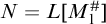 $N=L[M_1^\#]$
, which is of course tame. It is well known that
$N=L[M_1^\#]$
, which is of course tame. It is well known that $N\models $
“
$N\models $
“ $V\neq \mathrm {HOD}$
” (see Remark 3.2). Therefore
$V\neq \mathrm {HOD}$
” (see Remark 3.2). Therefore $\mathbb {E}^N$
is not definable over
$\mathbb {E}^N$
is not definable over $\left \lfloor N\right \rfloor $
without parameters. However, we will show that any tame mouse M satisfying
$\left \lfloor N\right \rfloor $
without parameters. However, we will show that any tame mouse M satisfying $\mathrm {PS}$
can almost define
$\mathrm {PS}$
can almost define $\mathbb {E}^M$
from no parameters. In the statements of the next two theorems, tractability and strong tractability are just fine structural requirements, which hold if
$\mathbb {E}^M$
from no parameters. In the statements of the next two theorems, tractability and strong tractability are just fine structural requirements, which hold if $M\models $
“
$M\models $
“ $\omega _2$
exists” (see Definition 5.9). And
$\omega _2$
exists” (see Definition 5.9). And $\mathscr {P}^M$
(see Definition 5.1) is roughly the collection of premice
$\mathscr {P}^M$
(see Definition 5.1) is roughly the collection of premice $N\in M$
such that
$N\in M$
such that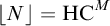 $\left \lfloor N\right \rfloor =\mathrm {HC}^M$
and N “eventually agrees” with
$\left \lfloor N\right \rfloor =\mathrm {HC}^M$
and N “eventually agrees” with $M|\omega _1^M$
.
$M|\omega _1^M$
.
Theorem 1.3. Let M be a $(0,\omega _1+1)$
-iterable tame tractable premouse satisfying “
$(0,\omega _1+1)$
-iterable tame tractable premouse satisfying “ $\omega _1$
exists” and
$\omega _1$
exists” and $\delta =\omega _2^M$
(with
$\delta =\omega _2^M$
(with $\delta =\mathrm {OR}^M$
if
$\delta =\mathrm {OR}^M$
if $\omega _1$
is the largest cardinal of M). Then:
$\omega _1$
is the largest cardinal of M). Then:
-
–
$\mathbb {E}^M\!\upharpoonright \


The results above concern tame mice. We now turn to (short-extender) mice in general with no smallness restriction. All of our results here rely on a technical hypothesis, STH ( $\star $
-translation hypothesis, see Definition 8.9), which is almost proved in [Reference Closson1], but not quite, and which should be routine to verify with basically the methods of [Reference Closson1].Footnote
2
We give the key definitions in Section 8, but a proof of STH is beyond the scope of this article. Many typical
$\star $
-translation hypothesis, see Definition 8.9), which is almost proved in [Reference Closson1], but not quite, and which should be routine to verify with basically the methods of [Reference Closson1].Footnote
2
We give the key definitions in Section 8, but a proof of STH is beyond the scope of this article. Many typical $\varphi $
-minimal mice are transcendent (see Definition 8.4), including, for example,
$\varphi $
-minimal mice are transcendent (see Definition 8.4), including, for example, $M_1^\#$
, and assuming STH,
$M_1^\#$
, and assuming STH, $M_{\mathrm {wlim}}^\#$
(the sharp for a Woodin limit of Woodins), the least mouse with an active superstrong extender (in MS-indexing, so this is not
$M_{\mathrm {wlim}}^\#$
(the sharp for a Woodin limit of Woodins), the least mouse with an active superstrong extender (in MS-indexing, so this is not $0^\#$
), and many more.
$0^\#$
), and many more.
Theorem 1.4. Assume STH. Let M be a transcendent strongly tractable $(\omega ,\omega _1+1)$
-iterable
$(\omega ,\omega _1+1)$
-iterable $\omega $
-sound premouse such that
$\omega $
-sound premouse such that $\rho _\omega ^M=\omega $
and
$\rho _\omega ^M=\omega $
and $M\models $
“
$M\models $
“ $\omega _1$
exists”. Let
$\omega _1$
exists”. Let $\delta =\omega _2^M$
. Then
$\delta =\omega _2^M$
. Then  is definable without parameters over $\mathcal {H}_\delta ^M$
. Therefore if
$\mathcal {H}_\delta ^M$
. Therefore if $N\triangleleft M$
with
$N\triangleleft M$
with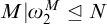 $M|\omega _2^M\trianglelefteq N$
and
$M|\omega _2^M\trianglelefteq N$
and $N\models \mathrm {PS}$
or
$N\models \mathrm {PS}$
or $N\models \mathrm {ZFC}^-$
, then
$N\models \mathrm {ZFC}^-$
, then $\mathbb {E}^N$
is definable without parameters over
$\mathbb {E}^N$
is definable without parameters over $\left \lfloor N\right \rfloor $
, so if
$\left \lfloor N\right \rfloor $
, so if $N\models \mathrm {ZFC}$
then
$N\models \mathrm {ZFC}$
then $\left \lfloor N\right \rfloor \models $
“
$\left \lfloor N\right \rfloor \models $
“ $V=\mathrm {HOD}$
”.
$V=\mathrm {HOD}$
”.
We finally consider the question of the structure of $\mathrm {HOD}^{L[\mathbb {E}]}$
. Our results here only give information “above
$\mathrm {HOD}^{L[\mathbb {E}]}$
. Our results here only give information “above $\delta $
”, where
$\delta $
”, where $\delta =\omega _2^{L[\mathbb {E}]}$
if
$\delta =\omega _2^{L[\mathbb {E}]}$
if $L[\mathbb {E}]$
is tame and
$L[\mathbb {E}]$
is tame and $\delta =\omega _3^{L[\mathbb {E}]}$
otherwise. The question of the nature of
$\delta =\omega _3^{L[\mathbb {E}]}$
otherwise. The question of the nature of $\mathrm {HOD}^{L[\mathbb {E}]}$
below
$\mathrm {HOD}^{L[\mathbb {E}]}$
below $\delta $
appears to be much more subtle and relates to the question of the nature of
$\delta $
appears to be much more subtle and relates to the question of the nature of $\mathrm {HOD}^{L[x]}$
for a cone of reals x.Footnote
3
For by considering arbitrary mice, we are including examples like
$\mathrm {HOD}^{L[x]}$
for a cone of reals x.Footnote
3
For by considering arbitrary mice, we are including examples like $L[x]=L[M_n^\#]$
.
$L[x]=L[M_n^\#]$
.
Before we state the results, we make a coarser remark. Let M be a mouse modelling $\mathrm {ZFC}$
and
$\mathrm {ZFC}$
and  . By [Reference Schlutzenberg10],
  . So letting $H=\mathrm {HOD}^{\left \lfloor M\right \rfloor }$
and
$H=\mathrm {HOD}^{\left \lfloor M\right \rfloor }$
and ${\mathbb {P}}\in H$
be Vopenka for adding subsets of
${\mathbb {P}}\in H$
be Vopenka for adding subsets of $\omega _1^M$
(as computed in M) and
$\omega _1^M$
(as computed in M) and  the generic for
  , standard facts on Vopenka forcing give

(cf. Footnote 15 for some explanation). In M, there are only $\omega _3^M$
-many subsets of
$\omega _3^M$
-many subsets of $(\mathcal {H}_{\omega _2})^M$
, so
$(\mathcal {H}_{\omega _2})^M$
, so $\operatorname {\mathrm {card}}^M({\mathbb {P}})\leq \omega _3^M$
. In fact, this Vopenka has the
$\operatorname {\mathrm {card}}^M({\mathbb {P}})\leq \omega _3^M$
. In fact, this Vopenka has the $\omega _3^M$
-cc in H, because the maximal antichains correspond in M to partitions of
$\omega _3^M$
-cc in H, because the maximal antichains correspond in M to partitions of $\mathcal {P}(\omega _1)^M$
. Therefore M and H have the same cardinals
$\mathcal {P}(\omega _1)^M$
. Therefore M and H have the same cardinals $\geq \omega _3^M$
. Therefore
$\geq \omega _3^M$
. Therefore ${\mathbb {P}}$
is in fact equivalent in H to a forcing
${\mathbb {P}}$
is in fact equivalent in H to a forcing $\subseteq \omega _3^M$
. (Actually, arguing as in the proof of Lemma 7.3, one can also prove this directly, and show that there is such a
$\subseteq \omega _3^M$
. (Actually, arguing as in the proof of Lemma 7.3, one can also prove this directly, and show that there is such a ${\mathbb {P}}\subseteq \omega _3^M$
which is definable without parameters over
${\mathbb {P}}\subseteq \omega _3^M$
which is definable without parameters over $\left \lfloor M\right \rfloor $
.) In particular, there is
$\left \lfloor M\right \rfloor $
.) In particular, there is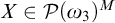 $X\in \mathcal {P}(\omega _3)^M$
such that
$X\in \mathcal {P}(\omega _3)^M$
such that $H[X]=\left \lfloor M\right \rfloor $
. One can ask whether this is optimal. In fact, it can be somewhat improved.
$H[X]=\left \lfloor M\right \rfloor $
. One can ask whether this is optimal. In fact, it can be somewhat improved.
Definition 1.5. We say that a premouse M is below a Woodin limit of Woodins iff there is no segment of M satisfying “There is a Woodin limit of Woodins”. $\mathbb B_{\mathrm {ml},\delta }$
(Definition 3.5) denotes a simple variant of the extender algebra at
$\mathbb B_{\mathrm {ml},\delta }$
(Definition 3.5) denotes a simple variant of the extender algebra at $\delta $
.
$\delta $
.
Theorem 1.6. Assume STH. Let M be a $(0,\omega _1+1)$
-iterable premouse satisfying
$(0,\omega _1+1)$
-iterable premouse satisfying $\mathrm {ZFC}$
with
$\mathrm {ZFC}$
with $H=\mathrm {HOD}^{\left \lfloor M\right \rfloor }\subsetneq M$
,
$H=\mathrm {HOD}^{\left \lfloor M\right \rfloor }\subsetneq M$
, $\delta =\omega _3^M$
and
$\delta =\omega _3^M$
and  . Then:
-
1.
$H[M|\delta ]=\left \lfloor M\right \rfloor $
, -
2. If M is below a Woodin limit of Woodins then there is
$X\subseteq \omega _2^M$
with
$H[X]=\left \lfloor M\right \rfloor $
.



Moreover, there is $W\subseteq M$
which is definable over
$W\subseteq M$
which is definable over $\left \lfloor M\right \rfloor $
without parameters, such that:
$\left \lfloor M\right \rfloor $
without parameters, such that:
-
3. W is a premouse satisfying “
$\delta $
is Woodin”,Footnote
4
-
4.
$H=\left \lfloor W\right \rfloor [t]$
where
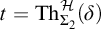
$t=\operatorname {\mathrm {Th}}_{\Sigma _2}^{\mathcal {H}}(\delta )$
and
$\mathcal {H}=\mathcal {H}_\delta ^M$
, and t is
$(W,\mathbb B_{\mathrm {ml},\delta }^W)$
-generic. -
5. If either:
-
–
$\omega _2^M<\omega _1$
and , or -
–
is
$(0,\omega _2+1)$
-iterable and
$\Sigma $
is the unique
$(0,\omega _2+1)$
-strategy for ,
then
$W|\delta $
is a segment of an iterate of via
$\Sigma $
.Footnote
5
-




 , or
, or is
is 


 ,
,
 via
via 
Assuming further that M is tame, and that M is pointwise definable for part 5, we can state a tighter relationship between M and W, $\omega _3^M$
is reduced to
$\omega _3^M$
is reduced to $\omega _2^M$
, and we get
$\omega _2^M$
, and we get  . But we defer the full statement (see Theorem 7.5).
Some of the methods developed in this article and [Reference Schlutzenberg10] have since become useful in the study of Varsovian models; in particular, related methods have been employed in [Reference Sargsyan, Schindler and Schlutzenberg4].
The author thanks the organizers of the Universität Münster set theory seminar for providing the opportunity to present Theorems 1.1, 1.3, 4.2, and 7.5 in a series of talks there in the summer semester of 2016. He thanks the organizers of the UC Irvine conference in inner model theory 2016, for the opportunity to present Theorems 1.1 and 4.2 and a summary of some other results (handwritten notes at [17]). He would also like to thank the organizers of the Leeds Logic Colloquium 2016 (slides at [Reference Schlutzenberg13]) for the opportunity to present work on the topic. However, the very last theorem presented in the latter talk (on slide 46) was overstated: the known proof only works with $\omega _3^M$
replacing
$\omega _3^M$
replacing $\omega _2^M$
, as it is stated here in Theorem 1.6. The author apologises for the oversight. (Theorems 4.7 and 1.4 were found some time later than the results just mentioned.)
$\omega _2^M$
, as it is stated here in Theorem 1.6. The author apologises for the oversight. (Theorems 4.7 and 1.4 were found some time later than the results just mentioned.)
1.1 Conventions and notation
For a summary of terminology see [Reference Schlutzenberg11, Section 1.3]. We just mention a few non-standard and key points here. We deal with premice M with Mitchell–Steel indexing and fine structure, except that we allow superstrong extenders on the extender sequence $\mathbb {E}_+^M$
and use the modifications to the fine structure explained in [Reference Schlutzenberg10, Section 5].
$\mathbb {E}_+^M$
and use the modifications to the fine structure explained in [Reference Schlutzenberg10, Section 5].
Let M be a premouse (possibly proper class). We say $M\in \mathrm {pm}_n$
iff
$M\in \mathrm {pm}_n$
iff $M\models $
“
$M\models $
“ $\omega _n$
exists”.Footnote
6
An
$\omega _n$
exists”.Footnote
6
An $\omega $
-premouse is a sound premouse N with
$\omega $
-premouse is a sound premouse N with $\rho _\omega ^N=\omega $
; an
$\rho _\omega ^N=\omega $
; an $\omega $
-mouse is an
$\omega $
-mouse is an $(\omega ,\omega _1+1)$
-iterable
$(\omega ,\omega _1+1)$
-iterable $\omega $
-premouse. The degree
$\omega $
-premouse. The degree $\deg (N)$
of an
$\deg (N)$
of an $\omega $
-premouse N is the least
$\omega $
-premouse N is the least $n<\omega $
such that
$n<\omega $
such that $\rho _{n+1}^N=\omega $
. If N is an
$\rho _{n+1}^N=\omega $
. If N is an $\omega $
-mouse, we write
$\omega $
-mouse, we write $\Sigma _N$
for the unique
$\Sigma _N$
for the unique $(\omega ,\omega _1+1)$
-strategy for N. We write
$(\omega ,\omega _1+1)$
-strategy for N. We write  for
for $M|\omega _1^M$
.
$M|\omega _1^M$
.
Suppose M is k-sound, where $k<\omega $
. We say that M satisfies
$k<\omega $
. We say that M satisfies $(k+1)$
-condensation iff it satisfies the conclusion of [Reference Schlutzenberg8, Theorem 5.2]. Let
$(k+1)$
-condensation iff it satisfies the conclusion of [Reference Schlutzenberg8, Theorem 5.2]. Let $\dot {p}\in V_\omega \backslash \omega $
be some fixed constant. Then for
$\dot {p}\in V_\omega \backslash \omega $
be some fixed constant. Then for $\rho _{k+1}^M\leq \alpha \leq \rho _k^M$
,
$\rho _{k+1}^M\leq \alpha \leq \rho _k^M$
, $t^M_{k+1}(\alpha )$
denotes the theory given by replacing
$t^M_{k+1}(\alpha )$
denotes the theory given by replacing $\vec {p}_{k+1}^M$
in
$\vec {p}_{k+1}^M$
in $\operatorname {\mathrm {Th}}_{\mathrm {r}\Sigma _{k+1}}^M(\alpha \cup \{\vec {p}_{k+1}^M\})$
with
$\operatorname {\mathrm {Th}}_{\mathrm {r}\Sigma _{k+1}}^M(\alpha \cup \{\vec {p}_{k+1}^M\})$
with $\dot {p}$
, and write
$\dot {p}$
, and write $t^M_{k+1}=t^M_{k+1}(\rho _{k+1}^M)$
.
$t^M_{k+1}=t^M_{k+1}(\rho _{k+1}^M)$
.
For a limit length iteration tree $\mathcal {T}$
on an
$\mathcal {T}$
on an $\omega $
-premouse and a
$\omega $
-premouse and a $\mathcal {T}$
-cofinal branch b,
$\mathcal {T}$
-cofinal branch b, $Q(\mathcal {T},b)$
denotes the Q-structure
$Q(\mathcal {T},b)$
denotes the Q-structure $Q\trianglelefteq M^{\mathcal {T}}_b$
for
$Q\trianglelefteq M^{\mathcal {T}}_b$
for $\delta (\mathcal {T})$
, if this exists, and otherwise
$\delta (\mathcal {T})$
, if this exists, and otherwise $Q=M^{\mathcal {T}}_b$
.
$Q=M^{\mathcal {T}}_b$
.
2 Local branch definability
Lemma 2.1. Let $\mathcal {T}$
be a limit length
$\mathcal {T}$
be a limit length $\omega $
-maximal tree on an
$\omega $
-maximal tree on an $\omega $
-premouse and b a
$\omega $
-premouse and b a $\mathcal {T}$
-cofinal branch with
$\mathcal {T}$
-cofinal branch with $M^{\mathcal {T}}_b$
being
$M^{\mathcal {T}}_b$
being $\delta (\mathcal {T})$
-wellfounded and
$\delta (\mathcal {T})$
-wellfounded and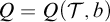 $Q=Q(\mathcal {T},b)$
wellfounded. Let
$Q=Q(\mathcal {T},b)$
wellfounded. Let $\delta =\delta (\mathcal {T})$
,
$\delta =\delta (\mathcal {T})$
,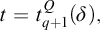 $t=t^Q_{q+1}(\delta ),$
where Q is q-sound and
$t=t^Q_{q+1}(\delta ),$
where Q is q-sound and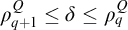 $\rho _{q+1}^Q\leq \delta \leq \rho _q^Q$
, and
$\rho _{q+1}^Q\leq \delta \leq \rho _q^Q$
, and $X$
be the transitive closure of
$X$
be the transitive closure of $\{\mathcal{T}, t\}$
. Then:
$\{\mathcal{T}, t\}$
. Then:
-
(i)
$b\in \mathcal {J}(X)$
, and -
(ii) b is
$\Sigma _1^{\mathcal {J}(X)}(\{\mathcal {T},t\})$
, uniformly in
$(\mathcal {T},t)$
.

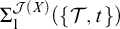

Proof. Part (i): If $Q=M^{\mathcal {T}}_b$
then we can just use standard calculations using core maps (done in the codes given by the theory t, however) to find a tail sequence of extenders used along b, and hence, find b itself, from
$Q=M^{\mathcal {T}}_b$
then we can just use standard calculations using core maps (done in the codes given by the theory t, however) to find a tail sequence of extenders used along b, and hence, find b itself, from $(\mathcal {T},Q)$
. So suppose
$(\mathcal {T},Q)$
. So suppose $Q\triangleleft M^{\mathcal {T}}_b$
, so
$Q\triangleleft M^{\mathcal {T}}_b$
, so $\rho _\omega ^Q=\delta $
and Q is fully sound.
$\rho _\omega ^Q=\delta $
and Q is fully sound.
Case 1.
Q singularizes $\delta $
.
$\delta $
.
Suppose first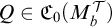 $Q\in\mathfrak{C}_0(M^\mathcal{T}_b)$
. Let
$Q\in\mathfrak{C}_0(M^\mathcal{T}_b)$
. Let $f:\theta\to\delta$
be cofinal in
$f:\theta\to\delta$
be cofinal in $\delta$
, with
$\delta$
, with 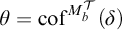 ,
, $f$
the least such which is definable over
$f$
the least such which is definable over $Q$
(without parameters). Let
$Q$
(without parameters). Let $\alpha\in b$
be such that
$\alpha\in b$
be such that $(\alpha, b]^\mathcal{T}$
does not drop,
$(\alpha, b]^\mathcal{T}$
does not drop, $\delta\in\mathrm{rg}(i^\mathcal{T}_{\alpha b})$
and
$\delta\in\mathrm{rg}(i^\mathcal{T}_{\alpha b})$
and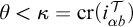 $\theta<\kappa=\mathrm{cr}(i^\mathcal{T}_{\alpha b})$
, so
$\theta<\kappa=\mathrm{cr}(i^\mathcal{T}_{\alpha b})$
, so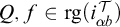 $Q,f\in\mathrm{rg}(i^\mathcal{T}_{\alpha b})$
and
$Q,f\in\mathrm{rg}(i^\mathcal{T}_{\alpha b})$
and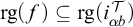 $\mathrm{rg}(f)\subseteq\mathrm{rg}(i^\mathcal{T}_{\alpha b})$
. For
$\mathrm{rg}(f)\subseteq\mathrm{rg}(i^\mathcal{T}_{\alpha b})$
. For $\gamma<\theta$
, let
$\gamma<\theta$
, let $\beta_\gamma$
be the least
$\beta_\gamma$
be the least $\beta\in[\alpha,\mathrm{lh}(\mathcal{T}))$
such that
$\beta\in[\alpha,\mathrm{lh}(\mathcal{T}))$
such that $\alpha\leq^\mathcal{T}\beta$
and
$\alpha\leq^\mathcal{T}\beta$
and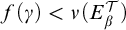 $f(\gamma)<\nu(E^\mathcal{T}_\beta)$
. Then
$f(\gamma)<\nu(E^\mathcal{T}_\beta)$
. Then $\beta_\gamma\in b$
. (Suppose not. Let
$\beta_\gamma\in b$
. (Suppose not. Let $\xi+1\in b$
be least such that
$\xi+1\in b$
be least such that $\xi\geq\beta_\gamma$
. Let
$\xi\geq\beta_\gamma$
. Let $\varepsilon=\mathrm{pred}^\mathcal{T}(\xi+1)$
. So
$\varepsilon=\mathrm{pred}^\mathcal{T}(\xi+1)$
. So $\alpha\leq^\mathcal{T}\varepsilon<\beta_\gamma\leq\xi$
, so by the minimality of
$\alpha\leq^\mathcal{T}\varepsilon<\beta_\gamma\leq\xi$
, so by the minimality of $\beta_\gamma$
,
$\beta_\gamma$
,
 $$\begin{align*}\mathrm{cr}(E^{\mathcal{T}}_\xi) =\mathrm{cr}(i^{\mathcal{T}}_{\varepsilon b})<\nu(E^{\mathcal{T}}_\varepsilon)\leq f(\gamma) <\nu(E^{\mathcal{T}}_{\beta_\gamma})\leq\nu(E^{\mathcal{T}}_\xi).\end{align*}$$
But then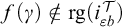 $f(\gamma )\notin \mathrm {rg}(i^{\mathcal {T}}_{{\varepsilon } b})$
, so
$f(\gamma )\notin \mathrm {rg}(i^{\mathcal {T}}_{{\varepsilon } b})$
, so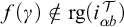 $f(\gamma )\notin \mathrm {rg}(i^{\mathcal {T}}_{\alpha b})$
, a contradiction.)
$f(\gamma )\notin \mathrm {rg}(i^{\mathcal {T}}_{\alpha b})$
, a contradiction.)
So b is appropriately computable from $(\mathcal {T},t)$
and the parameter
$(\mathcal {T},t)$
and the parameter $(\alpha, \bar{\delta})$
, where
$(\alpha, \bar{\delta})$
, where $i^\mathcal{T}_{\alpha b}(\bar{\delta})=\delta$
. But if we define another branch
$i^\mathcal{T}_{\alpha b}(\bar{\delta})=\delta$
. But if we define another branch $b'$
from
$b'$
from $(\mathcal {T},t)$
, in the same manner, but from some other parameter
$(\mathcal {T},t)$
, in the same manner, but from some other parameter $(\alpha ',\bar {\delta }')$
, with
$(\alpha ',\bar {\delta }')$
, with $b'\neq b$
, then by the Zipper Lemma [Reference Steel16, Theorem 6.10] and variants thereof,
$b'\neq b$
, then by the Zipper Lemma [Reference Steel16, Theorem 6.10] and variants thereof, $Q(\mathcal {T},b')\neq Q(\mathcal {T},b)$
, and this fact is first-order over
$Q(\mathcal {T},b')\neq Q(\mathcal {T},b)$
, and this fact is first-order over $(Q,t)$
, because we can compute the corresponding theory
$(Q,t)$
, because we can compute the corresponding theory $t'$
of
$t'$
of $Q(\mathcal {T},b')$
by consulting the theories of the models along
$Q(\mathcal {T},b')$
by consulting the theories of the models along $b'$
. So by demanding that the selected parameter results in a Q-structure whose theory agrees with t, we can actually compute the correct b from
$b'$
. So by demanding that the selected parameter results in a Q-structure whose theory agrees with t, we can actually compute the correct b from $(\mathcal {T},t)$
without the extra parameter.
$(\mathcal {T},t)$
without the extra parameter.
Suppose now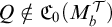 $Q\notin\mathfrak{C}_0(M^\mathcal{T}_b)$
. Then
$Q\notin\mathfrak{C}_0(M^\mathcal{T}_b)$
. Then $M^\mathcal{T}_b$
is active type 3 and
$M^\mathcal{T}_b$
is active type 3 and $\nu(F(M^\mathcal{T}_b))\leq\mathrm{OR}^Q$
,and since
$\nu(F(M^\mathcal{T}_b))\leq\mathrm{OR}^Q$
,and since $\rho_\omega^Q=\delta$
is an
$\rho_\omega^Q=\delta$
is an $M^\mathcal{T}_b$
-cardinal, it follows that
$M^\mathcal{T}_b$
-cardinal, it follows that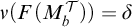 $\nu(F(M^\mathcal{T}_b))=\delta$
. The foregoing discussion does not quite work, since there is not literally any
$\nu(F(M^\mathcal{T}_b))=\delta$
. The foregoing discussion does not quite work, since there is not literally any $\alpha\in b$
with
$\alpha\in b$
with $\delta\in\mathrm{rg}(i^\mathcal{T}_{\alpha b})$
. However, everything works as above after replacing the use of the maps
$\delta\in\mathrm{rg}(i^\mathcal{T}_{\alpha b})$
. However, everything works as above after replacing the use of the maps $i^\mathcal{T}_{\alpha b}$
with the maps
$i^\mathcal{T}_{\alpha b}$
with the maps
 $$\begin{align*}j^\mathcal{T}_{\alpha b}:\mathrm{Ult}_0(M^\mathcal{T}_\alpha,F(M^\mathcal{T}_\alpha))\to\mathrm{Ult}_0(M^\mathcal{T}_b,F(M^\mathcal{T}_b))\end{align*}$$
induced by $i^\mathcal{T}_{\alpha b}$
(where these are defined).
$i^\mathcal{T}_{\alpha b}$
(where these are defined).
Case 2.
Q does not singularize $\delta $
.
$\delta $
.
Let us again first suppose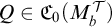 $Q\in\mathfrak{C}_0(M^\mathcal{T}_b)$
, and handle the contrary case just as we did above (without further mention). Let
$Q\in\mathfrak{C}_0(M^\mathcal{T}_b)$
, and handle the contrary case just as we did above (without further mention). Let $A\subseteq\delta$
be definable over Q without parameters, such that no
$A\subseteq\delta$
be definable over Q without parameters, such that no $\kappa <\delta $
is
$\kappa <\delta $
is ${<\delta }$
-A-reflecting. Let C be the set of all limit cardinals
${<\delta }$
-A-reflecting. Let C be the set of all limit cardinals $\lambda <\delta $
of Q such that for all
$\lambda <\delta $
of Q such that for all $\kappa <\lambda $
,
$\kappa <\lambda $
, $\kappa $
is not
$\kappa $
is not ${<\lambda }$
-A-reflecting. Then C is club in
${<\lambda }$
-A-reflecting. Then C is club in $\delta $
because Q does not singularize
$\delta $
because Q does not singularize $\delta $
. Let
$\delta $
. Let $\alpha \in b$
be such that
$\alpha \in b$
be such that $[\alpha ,b)^{\mathcal {T}}$
is non-dropping and
$[\alpha ,b)^{\mathcal {T}}$
is non-dropping and $\delta \in \mathrm {rg}(i^{\mathcal {T}}_{\alpha b})$
. Let
$\delta \in \mathrm {rg}(i^{\mathcal {T}}_{\alpha b})$
. Let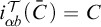 $i^{\mathcal {T}}_{\alpha b}(\bar {C})=C$
. For
$i^{\mathcal {T}}_{\alpha b}(\bar {C})=C$
. For $\gamma \in C$
, let
$\gamma \in C$
, let $\beta _\gamma $
be the least
$\beta _\gamma $
be the least $\beta \in [\alpha ,\mathrm {lh}(\mathcal {T}))$
such that
$\beta \in [\alpha ,\mathrm {lh}(\mathcal {T}))$
such that $\gamma <\mathrm {lh}(E^{\mathcal {T}}_\beta )$
. Then
$\gamma <\mathrm {lh}(E^{\mathcal {T}}_\beta )$
. Then $\beta _\gamma \in b$
. (Suppose not, and let
$\beta _\gamma \in b$
. (Suppose not, and let $\xi \geq \beta _\gamma $
be least with
$\xi \geq \beta _\gamma $
be least with $\xi +1\in b$
. Let
$\xi +1\in b$
. Let $\varepsilon =\mathrm {pred}^{\mathcal {T}}(\xi +1)$
, so
$\varepsilon =\mathrm {pred}^{\mathcal {T}}(\xi +1)$
, so $\alpha \leq ^{\mathcal {T}}\varepsilon <\beta _\gamma \leq \xi $
. So
$\alpha \leq ^{\mathcal {T}}\varepsilon <\beta _\gamma \leq \xi $
. So
 $$\begin{align*}\kappa=\mathrm{cr}(E^{\mathcal{T}}_\xi)<\mathrm{lh}(E^{\mathcal{T}}_{\varepsilon})\leq\gamma<\mathrm{lh}(E^{\mathcal{T}}_{\beta_\gamma} )\leq\mathrm{lh}(E^{\mathcal{T}}_\xi) \end{align*}$$
and $\gamma \leq \nu (E^{\mathcal {T}}_\xi )$
since
$\gamma \leq \nu (E^{\mathcal {T}}_\xi )$
since $\gamma $
is a Q-cardinal. But since
$\gamma $
is a Q-cardinal. But since $i^{\mathcal {T}}_{\alpha b}(\bar {A})=A$
, we have
$i^{\mathcal {T}}_{\alpha b}(\bar {A})=A$
, we have
 $$\begin{align*}i_{E^{\mathcal{T}}_\xi}(A\cap\kappa)\cap\gamma=A\cap\gamma, \end{align*}$$
so by the ISC, restrictions of $E^{\mathcal {T}}_\xi $
witness the fact that
$E^{\mathcal {T}}_\xi $
witness the fact that $\kappa $
is
$\kappa $
is ${<\gamma }$
-A-strong in Q, so
${<\gamma }$
-A-strong in Q, so $\gamma \notin C$
, contradiction.) So b is computable from
$\gamma \notin C$
, contradiction.) So b is computable from $(\mathcal {T},t)$
and the parameter
$(\mathcal {T},t)$
and the parameter $(\alpha ,\bar {\delta })$
, and like before, we actually therefore get a computation from
$(\alpha ,\bar {\delta })$
, and like before, we actually therefore get a computation from $(\mathcal {T},t)$
without the extra parameter.
$(\mathcal {T},t)$
without the extra parameter.
Part (ii): It seems we can’t quite uniformly tell which of the above three cases holds, nor whether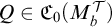 $Q\in\mathfrak{C}_0(M^\mathcal{T}_b)$
or not. But the calculations used in the case that
$Q\in\mathfrak{C}_0(M^\mathcal{T}_b)$
or not. But the calculations used in the case that $Q\triangleleft M^{\mathcal {T}}_b$
still work when
$Q\triangleleft M^{\mathcal {T}}_b$
still work when $Q=M^{\mathcal {T}}_b$
and
$Q=M^{\mathcal {T}}_b$
and $\delta $
is not
$\delta $
is not  -Woodin, but $\rho _{k+10}^Q=\delta $
. So our
$\rho _{k+10}^Q=\delta $
. So our $\Sigma _1$
formula seeks either some
$\Sigma _1$
formula seeks either some $k<\omega $
such that Q is not k-sound, and applies the procedure for when
$k<\omega $
such that Q is not k-sound, and applies the procedure for when $Q=M^{\mathcal {T}}_b$
, or some
$Q=M^{\mathcal {T}}_b$
, or some $k<\omega $
such that Q is
$k<\omega $
such that Q is $(k+10)$
-sound and
$(k+10)$
-sound and $\rho _{k+10}^Q=\delta $
, but
$\rho _{k+10}^Q=\delta $
, but $\delta $
is not
$\delta $
is not  -Woodin, and then uses the procedure for when $Q\triangleleft M^{\mathcal {T}}_b$
(with complexity say
$Q\triangleleft M^{\mathcal {T}}_b$
(with complexity say  ). We have enough information in some $\mathcal {S}_n(X)$
to verify all the relevant computations, including that Q is the correct direct limit of certain substructures appearing along the branch b. The uniqueness facts established above, along with further slight variants thereof, ensure that this process identifies the correct branch
$\mathcal {S}_n(X)$
to verify all the relevant computations, including that Q is the correct direct limit of certain substructures appearing along the branch b. The uniqueness facts established above, along with further slight variants thereof, ensure that this process identifies the correct branch $b$
. (The “slight variants” deal with details ignored above. For example, if
$b$
. (The “slight variants” deal with details ignored above. For example, if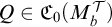 $Q\in\mathfrak{C}_0(M^\mathcal{T}_b)$
then again by a Zipper Lemma argument, our
$Q\in\mathfrak{C}_0(M^\mathcal{T}_b)$
then again by a Zipper Lemma argument, our $\Sigma_1$
formula will not yield a branch
$\Sigma_1$
formula will not yield a branch $b'\neq b$
with
$b'\neq b$
with $Q\triangleleft M^{\mathcal{T}}_{b'}$
but
$Q\triangleleft M^{\mathcal{T}}_{b'}$
but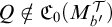 $Q\notin\mathfrak{C}_0(M^\mathcal{T}_{b'})$
, although the discussion above did not literally rule this scenario out.) This yields the desired uniform computation for (ii).
$Q\notin\mathfrak{C}_0(M^\mathcal{T}_{b'})$
, although the discussion above did not literally rule this scenario out.) This yields the desired uniform computation for (ii).
Definition 2.2. Let $\mathcal {T}$
be as above and Q be a (wellfounded) Q-structure for
$\mathcal {T}$
be as above and Q be a (wellfounded) Q-structure for $M(\mathcal {T})$
, and t as above for Q. Then
$M(\mathcal {T})$
, and t as above for Q. Then $\mathrm {branch}(\mathcal {T},Q)$
or
$\mathrm {branch}(\mathcal {T},Q)$
or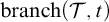 $\mathrm {branch}(\mathcal {T},t)$
is the unique
$\mathrm {branch}(\mathcal {T},t)$
is the unique $\mathcal {T}$
-cofinal branch b computed from
$\mathcal {T}$
-cofinal branch b computed from $(\mathcal {T},Q)$
as above (as the output of our
$(\mathcal {T},Q)$
as above (as the output of our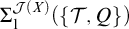 $\Sigma _1^{\mathcal {J}(X)}(\{\mathcal {T},Q\})$
procedure) if it exists, and is otherwise undefined.
$\Sigma _1^{\mathcal {J}(X)}(\{\mathcal {T},Q\})$
procedure) if it exists, and is otherwise undefined.
3 Self-iterability and definability
We begin with some basic examples which provide some context for the article.
Theorem 3.1. Let M be a proper class, $1$
-small,
$1$
-small, $(0,\omega _1+1)$
-iterable premouse. Then
$(0,\omega _1+1)$
-iterable premouse. Then $\mathbb {E}^M$
is definable over
$\mathbb {E}^M$
is definable over $\left \lfloor M\right \rfloor $
, so
$\left \lfloor M\right \rfloor $
, so $\left \lfloor M\right \rfloor \models $
“
$\left \lfloor M\right \rfloor \models $
“ $V=\mathrm {HOD}$
”.
$V=\mathrm {HOD}$
”.
Proof. By [Reference Schlutzenberg10, Theorem 3.11(b)], it suffices to see that  is definable over $\left \lfloor M\right \rfloor $
. But because M is proper class, and trees
$\left \lfloor M\right \rfloor $
. But because M is proper class, and trees $\mathcal {T}$
on
$\mathcal {T}$
on  in M are guided by Q-structures of the form $\mathcal {J}_\alpha (M(\mathcal {T}))$
, we get
$\mathcal {J}_\alpha (M(\mathcal {T}))$
, we get $M\models $
“
$M\models $
“ is
is $(\omega ,\omega _1+1)$
-iterable”, so
$(\omega ,\omega _1+1)$
-iterable”, so  is outright definable over $\left \lfloor M\right \rfloor $
, and hence so is
$\left \lfloor M\right \rfloor $
, and hence so is $\mathbb {E}^M$
.
$\mathbb {E}^M$
.
In particular $\left \lfloor M_1\right \rfloor \models"V=\mathrm{HOD}"$
, a fact first proven by Steel, via other means. On the other hand, we have the following remark.
$\left \lfloor M_1\right \rfloor \models"V=\mathrm{HOD}"$
, a fact first proven by Steel, via other means. On the other hand, we have the following remark.
Remark 3.2. Assume that $M_1^\#$
exists (and is
$M_1^\#$
exists (and is $(\omega ,\omega +1)$
-iterable) and let
$(\omega ,\omega +1)$
-iterable) and let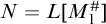 $N=L[M_1^\#]$
. Note that N is an
$N=L[M_1^\#]$
. Note that N is an $(\omega ,\omega _1+1)$
-iterable tame premouse. Standard descriptive set theoretic observations show that
$(\omega ,\omega _1+1)$
-iterable tame premouse. Standard descriptive set theoretic observations show that $\left \lfloor N\right \rfloor \models $
“
$\left \lfloor N\right \rfloor \models $
“ $V\neq \mathrm {HOD}$
”, and in fact, that
$V\neq \mathrm {HOD}$
”, and in fact, that $\omega _1^{N}$
is measurable in
$\omega _1^{N}$
is measurable in $\mathrm {HOD}^{\left \lfloor N\right \rfloor }$
. (So by Theorem 3.1, N is the least such proper class mouse.)
$\mathrm {HOD}^{\left \lfloor N\right \rfloor }$
. (So by Theorem 3.1, N is the least such proper class mouse.)
For the record, we give the proof that $\omega _1^{N}$
is measurable in
$\omega _1^{N}$
is measurable in $\mathrm {HOD}^{\left \lfloor N\right \rfloor }$
. It suffices to see that
$\mathrm {HOD}^{\left \lfloor N\right \rfloor }$
. It suffices to see that $N\models \Delta ^1_2$
-determinacy, for then
$N\models \Delta ^1_2$
-determinacy, for then $N\models \mathrm {OD}$
-determinacy (by Kechris–Solovay [Reference Koellner and Hugh Woodin2, Corollary 6.8]), and hence
$N\models \mathrm {OD}$
-determinacy (by Kechris–Solovay [Reference Koellner and Hugh Woodin2, Corollary 6.8]), and hence $\omega _1^N$
is measurable in
$\omega _1^N$
is measurable in $\mathrm {HOD}^{\left \lfloor N\right \rfloor }$
by the effective version of Solovay’s result (see [Reference Koellner and Hugh Woodin2, Theorem 2.15]). (Further,
$\mathrm {HOD}^{\left \lfloor N\right \rfloor }$
by the effective version of Solovay’s result (see [Reference Koellner and Hugh Woodin2, Theorem 2.15]). (Further, $\omega _2^N$
is Woodin in
$\omega _2^N$
is Woodin in $\mathrm {HOD}^{\left \lfloor N\right \rfloor }$
by Woodin [Reference Koellner and Hugh Woodin2, Theorem 6.10].)
$\mathrm {HOD}^{\left \lfloor N\right \rfloor }$
by Woodin [Reference Koellner and Hugh Woodin2, Theorem 6.10].)
So let $g\in N$
be
$g\in N$
be $M_1$
-generic for
$M_1$
-generic for $\mathrm {Coll}(\omega ,\delta ),$
where
$\mathrm {Coll}(\omega ,\delta ),$
where $\delta $
is Woodin in
$\delta $
is Woodin in $M_1$
(note
$M_1$
(note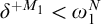 $\delta ^{+M_1}<\omega _1^N$
, so such a g exists). By Neeman [Reference Neeman, Foreman and Kanamori3, Corollary 6.12],
$\delta ^{+M_1}<\omega _1^N$
, so such a g exists). By Neeman [Reference Neeman, Foreman and Kanamori3, Corollary 6.12],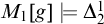 $M_1[g]\models \Delta ^1_2$
-determinacy. Let
$M_1[g]\models \Delta ^1_2$
-determinacy. Let $X\in N$
be
$X\in N$
be $\Delta ^1_2$
, and
$\Delta ^1_2$
, and $\varphi ,\psi $
be
$\varphi ,\psi $
be $\Pi ^1_2$
formulas such that
$\Pi ^1_2$
formulas such that
 $$\begin{align*}X=\{x\in\mathbb R^N\mid N\models\varphi(x)\}\text{ and }Y=\mathbb R^N\backslash X=\{x\in\mathbb R^N\mid N\models\psi(x)\}.\end{align*}$$
Let $\bar {X}=X\cap M_1[g]$
and
$\bar {X}=X\cap M_1[g]$
and $\bar {Y}=Y\cap M_1[g]$
. By absoluteness,
$\bar {Y}=Y\cap M_1[g]$
. By absoluteness,
 $$\begin{align*}\bar{X}=\{x\in \mathbb R^{M_1[g]}\mid M_1[g]\models\varphi(x)\}\text{ and } \bar{Y}=\{x\in\mathbb R^{M_1[g]}\mid M_1[g]\models\psi(x)\},\end{align*}$$
so $\bar {X}$
is
$\bar {X}$
is $\Delta ^1_2$
in
$\Delta ^1_2$
in $M_1[g]$
. Let
$M_1[g]$
. Let $\sigma \in M_1[g]$
be a winning strategy for the game
$\sigma \in M_1[g]$
be a winning strategy for the game $\mathcal {G}^{M_1[g]}_{\bar {X}}$
. The fact that
$\mathcal {G}^{M_1[g]}_{\bar {X}}$
. The fact that $\sigma $
is winning is a
$\sigma $
is winning is a $\Pi ^1_2$
assertion (for either player), so
$\Pi ^1_2$
assertion (for either player), so $\sigma $
is still winning in N. This verifies that N satisfies
$\sigma $
is still winning in N. This verifies that N satisfies $\Delta ^1_2$
-determinacy.
$\Delta ^1_2$
-determinacy.
This proof relies heavily on descriptive set theory. Is there an inner model theoretic proof that $\left \lfloor N\right \rfloor \models $
“
$\left \lfloor N\right \rfloor \models $
“ $V\neq \mathrm {HOD}$
”? There is such a proof that
$V\neq \mathrm {HOD}$
”? There is such a proof that $L[x]\models $
“
$L[x]\models $
“ $V\neq \mathrm {HOD}$
” for a cone of reals x (assuming
$V\neq \mathrm {HOD}$
” for a cone of reals x (assuming $M_1^\#$
) (see [Reference Schlutzenberg7]).
$M_1^\#$
) (see [Reference Schlutzenberg7]).
Remark 3.3. Note that we have not ruled out the possibility of set-sized mice N which model $\mathrm {ZFC}$
and are
$\mathrm {ZFC}$
and are $1$
-small, and such that
$1$
-small, and such that $N\models $
“
$N\models $
“ $V\neq \mathrm {HOD}$
”. Let M be the least mouse satisfying
$V\neq \mathrm {HOD}$
”. Let M be the least mouse satisfying $\mathrm {ZFC}$
+ “There is a Woodin cardinal”. Then M is pointwise definable and
$\mathrm {ZFC}$
+ “There is a Woodin cardinal”. Then M is pointwise definable and $\mathcal {J}(M)$
is sound,
$\mathcal {J}(M)$
is sound, $\rho _1^{\mathcal {J}(M)}=\omega $
and
$\rho _1^{\mathcal {J}(M)}=\omega $
and $p_1^{\mathcal {J}(M)}=\{\mathrm {OR}^M\}$
. Let N be the least mouse with
$p_1^{\mathcal {J}(M)}=\{\mathrm {OR}^M\}$
. Let N be the least mouse with $M\triangleleft N$
and
$M\triangleleft N$
and $N\models \mathrm {ZFC}$
; so
$N\models \mathrm {ZFC}$
; so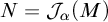 $N=\mathcal {J}_\alpha (M)$
for some
$N=\mathcal {J}_\alpha (M)$
for some $\alpha \in \mathrm {OR}$
, and
$\alpha \in \mathrm {OR}$
, and $N\triangleleft M_1$
and N is pointwise definable and
$N\triangleleft M_1$
and N is pointwise definable and $\mathcal {J}(N)$
is sound and
$\mathcal {J}(N)$
is sound and $\rho _1^{\mathcal {J}(N)}=\omega $
. Then genericity iterations can be used to show that
$\rho _1^{\mathcal {J}(N)}=\omega $
. Then genericity iterations can be used to show that $N\models $
“M is not
$N\models $
“M is not $(\omega ,\omega _1+1)$
-iterable”, and the author does not know whether
$(\omega ,\omega _1+1)$
-iterable”, and the author does not know whether $\left \lfloor N\right \rfloor \models $
“
$\left \lfloor N\right \rfloor \models $
“ $V=\mathrm {HOD}$
”.
$V=\mathrm {HOD}$
”.
Remark 3.4. Considering again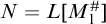 $N=L[M_1^\#]$
, clearly
$N=L[M_1^\#]$
, clearly $\left \lfloor N\right \rfloor \models $
“
$\left \lfloor N\right \rfloor \models $
“ $V=\mathrm {HOD}_x$
for some real x”. Steel and Schindler showed that if M is a tame mouse satisfying
$V=\mathrm {HOD}_x$
for some real x”. Steel and Schindler showed that if M is a tame mouse satisfying $\mathrm {ZFC}^-+$
“
$\mathrm {ZFC}^-+$
“ $\omega _1$
exists”, then there is
$\omega _1$
exists”, then there is $\alpha <\omega _1^M$
such that
$\alpha <\omega _1^M$
such that $M\models $
“
$M\models $
“ is above- $\alpha $
,
$\alpha $
, $(\omega ,\omega _1)$
-iterable”. We next show that this cannot be improved to “above
$(\omega ,\omega _1)$
-iterable”. We next show that this cannot be improved to “above $\alpha $
,
$\alpha $
, $(\omega ,\omega _1+1)$
-iterable”. So we cannot use
$(\omega ,\omega _1+1)$
-iterable”. So we cannot use $(\omega _1+1)$
-iterability to prove Theorem 1.1.
$(\omega _1+1)$
-iterability to prove Theorem 1.1.
Definition 3.5. Working in a premouse M, the meas-lim extender algebra at $\delta $
, written
$\delta $
, written $\mathbb B_{\mathrm {ml},\delta }$
, is the version of the
$\mathbb B_{\mathrm {ml},\delta }$
, is the version of the $\delta $
-generator extender algebra at
$\delta $
-generator extender algebra at $\delta $
in which we only induce axioms with extenders
$\delta $
in which we only induce axioms with extenders $E\in \mathbb {E}^M$
such that
$E\in \mathbb {E}^M$
such that $\nu _E$
is an inaccessible limit of measurable cardinals of M. And
$\nu _E$
is an inaccessible limit of measurable cardinals of M. And $\mathbb B^{\geq \alpha }_{\mathrm {ml},\delta }$
denotes the variant using only extenders E with
$\mathbb B^{\geq \alpha }_{\mathrm {ml},\delta }$
denotes the variant using only extenders E with $\mathrm {cr}(E)\geq \alpha $
.
$\mathrm {cr}(E)\geq \alpha $
.
Example 3.6. Let S be the least active mouse such that $S|\omega _1^S$
is closed under the
$S|\omega _1^S$
is closed under the $M_1^\#$
-operator and let
$M_1^\#$
-operator and let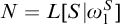 $N=L[S|\omega _1^S]$
. Note that
$N=L[S|\omega _1^S]$
. Note that $N\models $
“I am
$N\models $
“I am $\omega _1$
-iterable”, and in fact, letting
$\omega _1$
-iterable”, and in fact, letting $\Sigma $
be the correct strategy for N, then
$\Sigma $
be the correct strategy for N, then $\Sigma \!\upharpoonright \!\mathrm {HC}^N$
is definable over N. We claim that, however,
$\Sigma \!\upharpoonright \!\mathrm {HC}^N$
is definable over N. We claim that, however,

For let $P\triangleleft N|\omega _1^N$
project to
$P\triangleleft N|\omega _1^N$
project to $\omega $
. We will construct tree
$\omega $
. We will construct tree $\mathcal {T}\in N$
, on
$\mathcal {T}\in N$
, on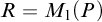 $R=M_1(P)$
, above P, of length
$R=M_1(P)$
, above P, of length $\omega _1^N$
, via the correct strategy, such that
$\omega _1^N$
, via the correct strategy, such that $\mathcal {T}$
has no cofinal branch in N. Since
$\mathcal {T}$
has no cofinal branch in N. Since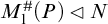 $M_1^\#(P)\triangleleft N$
and P can be taken arbitrarily high below
$M_1^\#(P)\triangleleft N$
and P can be taken arbitrarily high below $\omega _1^N$
, this suffices.
$\omega _1^N$
, this suffices.
Let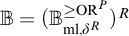 $\mathbb B=(\mathbb B^{\geq \mathrm {OR}^P}_{\mathrm {ml},\delta ^R})^R$
. We define
$\mathbb B=(\mathbb B^{\geq \mathrm {OR}^P}_{\mathrm {ml},\delta ^R})^R$
. We define $\mathcal {T}$
by
$\mathcal {T}$
by $\mathbb {E}^{N|\omega _1^N}$
-genericity iteration with respect to
$\mathbb {E}^{N|\omega _1^N}$
-genericity iteration with respect to $\mathbb B$
(and its images), interweaving short linear iterations at successor measurables, as follows. Work in N. The tree
$\mathbb B$
(and its images), interweaving short linear iterations at successor measurables, as follows. Work in N. The tree $\mathcal {T}$
will be nowhere dropping. We define a continuous sequence
$\mathcal {T}$
will be nowhere dropping. We define a continuous sequence $\left <\eta _\alpha \right\gt_{\alpha <\omega _1^N}$
, where
$\left <\eta _\alpha \right\gt_{\alpha <\omega _1^N}$
, where $\eta _\alpha $
is either
$\eta _\alpha $
is either $0$
or a limit ordinal
$0$
or a limit ordinal ${<\omega _1^N}$
, and define
${<\omega _1^N}$
, and define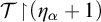 $\mathcal {T}\!\upharpoonright \!(\eta _\alpha +1)$
, by induction on
$\mathcal {T}\!\upharpoonright \!(\eta _\alpha +1)$
, by induction on $\alpha $
. Set
$\alpha $
. Set $\eta _0=0$
. Suppose we have defined
$\eta _0=0$
. Suppose we have defined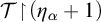 $\mathcal {T}\!\upharpoonright \!(\eta _\alpha +1)$
and it is short; so
$\mathcal {T}\!\upharpoonright \!(\eta _\alpha +1)$
and it is short; so
 $$\begin{align*}i^{\mathcal{T}}_{0\eta_\alpha}(\delta^R)>\delta=\delta(\mathcal{T}\!\upharpoonright\!\eta_\alpha)\end{align*}$$
(where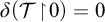 $\delta (\mathcal {T}\!\upharpoonright \! 0)=0$
). Let
$\delta (\mathcal {T}\!\upharpoonright \! 0)=0$
). Let $G=G^{\mathcal {T}}_{\eta _\alpha }$
be the least bad extender
$G=G^{\mathcal {T}}_{\eta _\alpha }$
be the least bad extender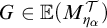 $G\in \mathbb {E}(M^{\mathcal {T}}_{\eta _\alpha })$
; that is, it induces an axiom of
$G\in \mathbb {E}(M^{\mathcal {T}}_{\eta _\alpha })$
; that is, it induces an axiom of $i^{\mathcal {T}}_{0\eta _\alpha }(\mathbb B)$
which is false for
$i^{\mathcal {T}}_{0\eta _\alpha }(\mathbb B)$
which is false for $\mathbb {E}^{N|\omega _1^N}$
(or set
$\mathbb {E}^{N|\omega _1^N}$
(or set $G^{\mathcal {T}}_{\eta _\alpha }=\emptyset $
if there is no such; in fact there will be one). By induction, we will have
$G^{\mathcal {T}}_{\eta _\alpha }=\emptyset $
if there is no such; in fact there will be one). By induction, we will have $\delta \leq \nu _G<\mathrm {lh}(G)$
(assuming G is defined). By definition of
$\delta \leq \nu _G<\mathrm {lh}(G)$
(assuming G is defined). By definition of $\mathbb B$
,
$\mathbb B$
, $\nu _G$
is a limit of
$\nu _G$
is a limit of $M^{\mathcal {T}}_{\eta _\alpha }$
-measurables.
$M^{\mathcal {T}}_{\eta _\alpha }$
-measurables.
Suppose $\nu _G>\delta $
(or G is undefined). Let
$\nu _G>\delta $
(or G is undefined). Let $\mu $
be the least
$\mu $
be the least $M^{\mathcal {T}}_{\eta _\alpha }$
-measurable with
$M^{\mathcal {T}}_{\eta _\alpha }$
-measurable with $\delta <\mu $
, and let
$\delta <\mu $
, and let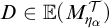 $D\in \mathbb {E}(M^{\mathcal {T}}_{\eta _\alpha })$
be the (unique) total measure on
$D\in \mathbb {E}(M^{\mathcal {T}}_{\eta _\alpha })$
be the (unique) total measure on $\mu $
. Note that
$\mu $
. Note that $\mathrm {lh}(D)<\mathrm {lh}(G)$
, if G is defined. Let
$\mathrm {lh}(D)<\mathrm {lh}(G)$
, if G is defined. Let $Q\triangleleft N$
be least such that
$Q\triangleleft N$
be least such that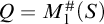 $Q=M_1^\#(S)$
for some
$Q=M_1^\#(S)$
for some $S\triangleleft N$
with
$S\triangleleft N$
with $\rho _\omega ^S=\omega $
and
$\rho _\omega ^S=\omega $
and $\mu <\mathrm {OR}^S$
. Let
$\mu <\mathrm {OR}^S$
. Let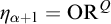 $\eta _{\alpha +1}=\mathrm {OR}^Q$
. Then
$\eta _{\alpha +1}=\mathrm {OR}^Q$
. Then $\mathcal {T}\!\upharpoonright \![\eta _\alpha ,\eta _{\alpha +1}+1]$
is given by linearly iterating with D and its images.
$\mathcal {T}\!\upharpoonright \![\eta _\alpha ,\eta _{\alpha +1}+1]$
is given by linearly iterating with D and its images.
Now suppose instead that $\nu _G=\delta $
. Then we set
$\nu _G=\delta $
. Then we set $\eta _{\alpha +1}=\eta _\alpha +\omega $
, set
$\eta _{\alpha +1}=\eta _\alpha +\omega $
, set $E^{\mathcal {T}}_{\eta _\alpha }=G$
, and letting
$E^{\mathcal {T}}_{\eta _\alpha }=G$
, and letting $\mu $
be the least
$\mu $
be the least $M^{\mathcal {T}}_{\eta _\alpha +1}$
-measurable with
$M^{\mathcal {T}}_{\eta _\alpha +1}$
-measurable with $\mu>\delta $
and
$\mu>\delta $
and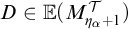 $D\in \mathbb {E}(M^{\mathcal {T}}_{\eta _\alpha +1})$
the total measure on
$D\in \mathbb {E}(M^{\mathcal {T}}_{\eta _\alpha +1})$
the total measure on $\mu $
, let
$\mu $
, let $\mathcal {T}\!\upharpoonright \![\eta _\alpha +1,\eta _{\alpha +1}+1]$
be given by linear iteration with D and its images.
$\mathcal {T}\!\upharpoonright \![\eta _\alpha +1,\eta _{\alpha +1}+1]$
be given by linear iteration with D and its images.
Note that in both cases, because $\mu $
is a successor measurable, this does not leave any bad extender algebra axioms induced by extenders
$\mu $
is a successor measurable, this does not leave any bad extender algebra axioms induced by extenders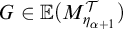 $G\in \mathbb {E}(M^{\mathcal {T}}_{\eta _{\alpha +1}})$
such that
$G\in \mathbb {E}(M^{\mathcal {T}}_{\eta _{\alpha +1}})$
such that
 $$\begin{align*}\delta<\mathrm{lh}(G)<\delta(\mathcal{T}\!\upharpoonright\!\eta_{\alpha+1}).\end{align*}$$
So it is straightforward to see that $\mathcal {T}$
is normal and is nowhere dropping. We set
$\mathcal {T}$
is normal and is nowhere dropping. We set $\mathcal {T}=\mathcal {T}\!\upharpoonright \!\eta _\alpha $
, where
$\mathcal {T}=\mathcal {T}\!\upharpoonright \!\eta _\alpha $
, where $\alpha $
is least such that either
$\alpha $
is least such that either $\alpha =\omega _1^N$
or
$\alpha =\omega _1^N$
or $\mathcal {T}\!\upharpoonright \!\eta _\alpha $
is maximal (non-short). Note that
$\mathcal {T}\!\upharpoonright \!\eta _\alpha $
is maximal (non-short). Note that $\mathcal {T}\in N$
and
$\mathcal {T}\in N$
and $\mathcal {T}$
is via the correct strategy, so it suffices to verify the following.
$\mathcal {T}$
is via the correct strategy, so it suffices to verify the following.
Claim.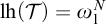 $\mathrm {lh}(\mathcal {T})=\omega _1^N$
and N has no
$\mathrm {lh}(\mathcal {T})=\omega _1^N$
and N has no $\mathcal {T}$
-cofinal branch.
$\mathcal {T}$
-cofinal branch.
Proof. Suppose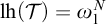 $\mathrm {lh}(\mathcal {T})=\omega _1^N$
but N has a
$\mathrm {lh}(\mathcal {T})=\omega _1^N$
but N has a $\mathcal {T}$
-cofinal branch b. Note that
$\mathcal {T}$
-cofinal branch b. Note that $\eta _\alpha $
is defined and
$\eta _\alpha $
is defined and $\eta _\alpha <\omega _1^N$
for every
$\eta _\alpha <\omega _1^N$
for every $\alpha <\omega _1^N$
. Working in N, we do the usual reflection argument, and get an elementary
$\alpha <\omega _1^N$
. Working in N, we do the usual reflection argument, and get an elementary $\pi :M\to N|\gamma $
for some countable M and large
$\pi :M\to N|\gamma $
for some countable M and large $\gamma $
, with
$\gamma $
, with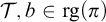 $\mathcal {T},b\in \mathrm {rg}(\pi )$
. Let
$\mathcal {T},b\in \mathrm {rg}(\pi )$
. Let $\kappa =\mathrm {cr}(\pi )$
. Let
$\kappa =\mathrm {cr}(\pi )$
. Let $\beta +1=\min (b\backslash (\kappa +1))$
. Because
$\beta +1=\min (b\backslash (\kappa +1))$
. Because $\mathcal {T}$
is normal and by the usual proof that genericity iterations terminate, it suffices to see that
$\mathcal {T}$
is normal and by the usual proof that genericity iterations terminate, it suffices to see that $E^{\mathcal {T}}_\beta =G^{\mathcal {T}}_{\eta _\alpha }$
for some
$E^{\mathcal {T}}_\beta =G^{\mathcal {T}}_{\eta _\alpha }$
for some $\alpha $
. So fix
$\alpha $
. So fix $\alpha <\omega _1^N$
such that
$\alpha <\omega _1^N$
such that $\beta \in [\eta _\alpha ,\eta _{\alpha +1})$
. Then, noting that
$\beta \in [\eta _\alpha ,\eta _{\alpha +1})$
. Then, noting that $\mathrm {cr}(E^{\mathcal {T}}_\beta )=\kappa =\eta _\kappa =\delta (\mathcal {T}\!\upharpoonright \!\eta _\kappa )$
, we have
$\mathrm {cr}(E^{\mathcal {T}}_\beta )=\kappa =\eta _\kappa =\delta (\mathcal {T}\!\upharpoonright \!\eta _\kappa )$
, we have $\alpha \geq \kappa $
. But then if
$\alpha \geq \kappa $
. But then if $E^{\mathcal {T}}_\beta \neq G^{\mathcal {T}}_{\eta _\alpha }$
, then
$E^{\mathcal {T}}_\beta \neq G^{\mathcal {T}}_{\eta _\alpha }$
, then $E^{\mathcal {T}}_\beta $
is one of the linear iterates of the order
$E^{\mathcal {T}}_\beta $
is one of the linear iterates of the order $0$
measure D from stage
$0$
measure D from stage $\alpha $
, but then
$\alpha $
, but then $\mathrm {cr}(D)=\mu>\delta (\mathcal {T}\!\upharpoonright \!\eta _\alpha )\geq \alpha \geq \kappa $
, contradiction.
$\mathrm {cr}(D)=\mu>\delta (\mathcal {T}\!\upharpoonright \!\eta _\alpha )\geq \alpha \geq \kappa $
, contradiction.
Now suppose that $\mathrm {lh}(\mathcal {T})<\omega _1$
; then
$\mathrm {lh}(\mathcal {T})<\omega _1$
; then $\mathcal {T}=\mathcal {T}\!\upharpoonright \!\eta _\alpha $
is maximal with some
$\mathcal {T}=\mathcal {T}\!\upharpoonright \!\eta _\alpha $
is maximal with some $\alpha <\omega _1^N$
. Note that
$\alpha <\omega _1^N$
. Note that $\alpha $
is a limit. Let b be the correct
$\alpha $
is a limit. Let b be the correct $\mathcal {T}$
-cofinal branch, chosen in V. So
$\mathcal {T}$
-cofinal branch, chosen in V. So
 $$\begin{align*}i^{\mathcal{T}}(\delta^R)=\delta=\delta(\mathcal{T}\!\upharpoonright\!\eta_\alpha)\text{ is Woodin in }M^{\mathcal{T}}_b,\end{align*}$$
and $\delta <\omega _1^N$
. Let Q result from linearly iterating out the sharp of
$\delta <\omega _1^N$
. Let Q result from linearly iterating out the sharp of $M^{\mathcal {T}}_b$
. Then
$M^{\mathcal {T}}_b$
. Then $N|\delta $
is Q-generic for
$N|\delta $
is Q-generic for $i^{\mathcal {T}}_b(\mathbb B)$
, and since
$i^{\mathcal {T}}_b(\mathbb B)$
, and since $\alpha $
is a limit ordinal and because of the linear iterations inserted in
$\alpha $
is a limit ordinal and because of the linear iterations inserted in $\mathcal {T}$
,
$\mathcal {T}$
, $N|\delta $
is closed under the
$N|\delta $
is closed under the $M_1^\#$
-operator. But
$M_1^\#$
-operator. But $\delta $
is regular in
$\delta $
is regular in $Q[N|\delta ]$
, hence regular in
$Q[N|\delta ]$
, hence regular in $L[N|\delta ]$
. This easily contradicts the minimality of N.
$L[N|\delta ]$
. This easily contradicts the minimality of N.
4 Ordinal-real definability in tame mice
In this section we prove some results for tame mice, including Theorem 1.1, which has the consequence that every tame mouse satisfying $\mathrm {ZFC}$
satisfies “
$\mathrm {ZFC}$
satisfies “ $V=\mathrm {HOD}_x$
for some real x”, and also that every tame mouse satisfying “
$V=\mathrm {HOD}_x$
for some real x”, and also that every tame mouse satisfying “ $\omega _1$
exists” satisfies “there is a wellorder of
$\omega _1$
exists” satisfies “there is a wellorder of $\mathbb R$
definable over
$\mathbb R$
definable over $\mathcal {H}_{\omega _2}$
from a real parameter” (the wellorder is just the canonical one of
$\mathcal {H}_{\omega _2}$
from a real parameter” (the wellorder is just the canonical one of  ). As mentioned in the introduction, this answers the (implicit) question of Schindler and Steel from [Reference Schindler and Steel6, p. 752]. The methods are, moreover, very similar to those of [Reference Schindler and Steel6].
Definition 4.1. For an $\omega $
-mouse M, or for a mouse M satisfying “
$\omega $
-mouse M, or for a mouse M satisfying “ $V=\mathrm {HC}$
”,
$V=\mathrm {HC}$
”, $\Sigma _M$
denotes the unique
$\Sigma _M$
denotes the unique $(\omega ,\omega _1+1)$
-iteration strategy for M.
$(\omega ,\omega _1+1)$
-iteration strategy for M.
Let M be a $(0,\omega _1+1)$
-iterable premouse satisfying “
$(0,\omega _1+1)$
-iterable premouse satisfying “ $\omega _1$
exists”. Let
$\omega _1$
exists”. Let  and
and $\alpha <\omega _1^M$
. Then
$\alpha <\omega _1^M$
. Then  denotes the restriction of
  to above- $\alpha $
trees in
$\alpha $
trees in  (in particular, the trees in the domain of this strategy have countable length in M).
Theorem 4.2. Let M be a tame mouse satisfying “ $\omega _1$
exists” and
$\omega _1$
exists” and  . Then there is an $\alpha <\omega _1^M$
such that:
$\alpha <\omega _1^M$
such that:
-
1.
; in fact, this strategy is definable over from parameter
$\alpha $
; -
2. for every sound tame
$\omega $
-premouse R with
$M|\alpha \trianglelefteq R\in M$
, if
$M\models $
“R is above-
$\alpha $
,
$(\omega ,\omega _1)$
-iterable” then .
 ; in fact, this strategy is definable over
  from parameter




 .
.Therefore, by [Reference Schlutzenberg10, Theorem 3.11]:
-
–
is definable over
$(\mathcal {H}_{\omega _2^M})^M$
from the parameter
$M|\alpha $
, and -
– if
$M\models \mathrm {PS}$
or
$\left \lfloor M\right \rfloor \models \mathrm {ZF}^-$
then
$\mathbb {E}^M$
is definable over
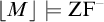
$\left \lfloor M\right \rfloor $
from
$M|\alpha $
.
 is definable over




Proof. By [Reference Schindler and Steel6, Theorem 0.2],Footnote
7
we may fix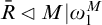 $\bar {R}\triangleleft M|\omega _1^M$
such that
$\bar {R}\triangleleft M|\omega _1^M$
such that $\rho _\omega ^{\bar {R}}=\omega $
and
$\rho _\omega ^{\bar {R}}=\omega $
and $M\models $
“
$M\models $
“ is above-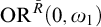 $\mathrm {OR}^{\bar {R}} (0,\omega _1)$
-iterable”, as witnessed by the restriction of the correct strategy
$\mathrm {OR}^{\bar {R}} (0,\omega _1)$
-iterable”, as witnessed by the restriction of the correct strategy  . That is,
  , where $\zeta =\mathrm {OR}^{\bar {R}}$
. Given R such that
$\zeta =\mathrm {OR}^{\bar {R}}$
. Given R such that 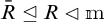 ,
, $\Sigma _R^M$
denotes the restriction of this strategy to trees on R.
$\Sigma _R^M$
denotes the restriction of this strategy to trees on R.
We say that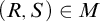 $(R,S)\in M$
is a conflicting pair iff:
$(R,S)\in M$
is a conflicting pair iff:
-
– R and S are tame
$\omega $
-premice, -
–
and
$\bar {R}\triangleleft S$
and
$R|\omega _1^{R}=S|\omega _1^{S}$
but
$R\neq S$
, and -
–
$M\models$
“
$S$
is above-
$\omega_1^S$
$(\omega,\omega_1)$
-iterable”.

 and
and 



If part 2 of the theorem fails for every $\alpha <\omega _1^M$
, then note that for every such
$\alpha <\omega _1^M$
, then note that for every such $\alpha $
there is a conflicting pair
$\alpha $
there is a conflicting pair $(R,S)$
with
$(R,S)$
with $\alpha <\omega _1^R=\omega _1^S$
. However, for the present we just assume that we have some conflicting pair and work with this, without assuming that part 2 fails for every
$\alpha <\omega _1^R=\omega _1^S$
. However, for the present we just assume that we have some conflicting pair and work with this, without assuming that part 2 fails for every $\alpha $
.
$\alpha $
.
So fix a conflicting pair $(R_0,S_0)$
. Let
$(R_0,S_0)$
. Let $\Gamma _0$
be an above-
$\Gamma _0$
be an above- $\omega_1^{S_0}$ $(\omega,\omega_1^M)$
-strategy for
$(\omega,\omega_1^M)$
-strategy for $S_0$
in M. Working in M, we attempt to compare
$S_0$
in M. Working in M, we attempt to compare $R_0,S_0$
, via
$R_0,S_0$
, via $\Sigma ^M_{R_0},\Gamma _0$
, folding in extra extenders to ensure that for every limit stage
$\Sigma ^M_{R_0},\Gamma _0$
, folding in extra extenders to ensure that for every limit stage $\lambda $
of the comparison, letting
$\lambda $
of the comparison, letting
-
–
$\delta _\lambda =\delta ((\mathcal {T},\mathcal {U})\!\upharpoonright \!\lambda ),$
and -
–
$N_\lambda =M((\mathcal {T},\mathcal {U})\!\upharpoonright \!\lambda )$
,


we have that
-
(*1)
$M|\delta _\lambda $
is generic for the meas-lim extender algebra of
$N_\lambda $
at
$\delta _\lambda $
, and -
(*2) if
$N_\lambda $
is not a Q-structure for
$\delta _\lambda $
then
$(\mathcal {T},\mathcal {U})\!\upharpoonright \!\lambda \subseteq M|\delta _\lambda $
and
$(\mathcal {T},\mathcal {U})\!\upharpoonright \!\lambda $
is definable over
$M|\delta _\lambda $
from parameters (and therefore so is
$N_\lambda $
).Footnote
8





Note, however, that there need not actually be Woodin cardinals in $R_0,S_0$
, and the trees might drop in model at points. To deal with this correctly, the folding in of extenders for genericity iteration (and other purposes) is done much as in [Reference Schlutzenberg and Steel15], and also in [Reference Schlutzenberg9, Definition 5.4]. We clarify below exactly how this is executed, along with ensuring the definability condition (*2).
$R_0,S_0$
, and the trees might drop in model at points. To deal with this correctly, the folding in of extenders for genericity iteration (and other purposes) is done much as in [Reference Schlutzenberg and Steel15], and also in [Reference Schlutzenberg9, Definition 5.4]. We clarify below exactly how this is executed, along with ensuring the definability condition (*2).
We will define the comparison $(\mathcal {T},\mathcal {U})$
in certain blocks, during some of which we fold in short linear iterations. In order to ensure the definability condition (*2) above, initially we must linearly iterate to the point in M which constructs
$(\mathcal {T},\mathcal {U})$
in certain blocks, during some of which we fold in short linear iterations. In order to ensure the definability condition (*2) above, initially we must linearly iterate to the point in M which constructs $(R_0,S_0)$
, and following certain limit stages
$(R_0,S_0)$
, and following certain limit stages $(\mathcal {T},\mathcal {U})\!\upharpoonright \!(\eta +1)$
(
$(\mathcal {T},\mathcal {U})\!\upharpoonright \!(\eta +1)$
( $\eta $
a limit ordinal) of the comparison, we will fold in a linear iteration out to a segment of M which constructs
$\eta $
a limit ordinal) of the comparison, we will fold in a linear iteration out to a segment of M which constructs $(\mathcal {T},\mathcal {U})\!\upharpoonright \!(\eta +1)$
. Overall, we will define a strictly increasing, continuous sequence
$(\mathcal {T},\mathcal {U})\!\upharpoonright \!(\eta +1)$
. Overall, we will define a strictly increasing, continuous sequence $\left <\eta _\alpha \right>_{\alpha <\omega _1^M}$
of ordinals
$\left <\eta _\alpha \right>_{\alpha <\omega _1^M}$
of ordinals $\eta _\alpha $
such that either
$\eta _\alpha $
such that either $\eta _\alpha =0$
or
$\eta _\alpha =0$
or $\eta _\alpha $
is a limit, and simultaneously define
$\eta _\alpha $
is a limit, and simultaneously define $(\mathcal {T},\mathcal {U})\!\upharpoonright \!(\eta _\alpha +1)$
.
$(\mathcal {T},\mathcal {U})\!\upharpoonright \!(\eta _\alpha +1)$
.
Also, we will define $(\mathcal {T},\mathcal {U})\!\upharpoonright \!(\eta +1)$
by induction on
$(\mathcal {T},\mathcal {U})\!\upharpoonright \!(\eta +1)$
by induction on $\eta <\omega _1^M$
(refining the recursive construction of blocks just mentioned). Given
$\eta <\omega _1^M$
(refining the recursive construction of blocks just mentioned). Given $(\mathcal {T},\mathcal {U})\!\upharpoonright \!(\eta +1)$
, if this constitutes a successful comparison (i.e.,
$(\mathcal {T},\mathcal {U})\!\upharpoonright \!(\eta +1)$
, if this constitutes a successful comparison (i.e.,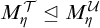 $M^{\mathcal {T}}_\eta \trianglelefteq M^{\mathcal {U}}_\eta $
or vice versa), we stop at stage
$M^{\mathcal {T}}_\eta \trianglelefteq M^{\mathcal {U}}_\eta $
or vice versa), we stop at stage $\eta $
(and will then derive a contradiction via Claim 2 below). Now suppose otherwise and let
$\eta $
(and will then derive a contradiction via Claim 2 below). Now suppose otherwise and let $F^{\mathcal {T}}_\eta ,F^{\mathcal {U}}_\eta $
be the extenders witnessing least disagreement between
$F^{\mathcal {T}}_\eta ,F^{\mathcal {U}}_\eta $
be the extenders witnessing least disagreement between $M^{\mathcal {T}}_\eta ,M^{\mathcal {U}}_\eta $
(as explained below, we might not use these extenders in
$M^{\mathcal {T}}_\eta ,M^{\mathcal {U}}_\eta $
(as explained below, we might not use these extenders in $\mathcal {T},\mathcal {U}$
, however). We have
$\mathcal {T},\mathcal {U}$
, however). We have $F^{\mathcal {T}}_\eta \neq \emptyset $
or
$F^{\mathcal {T}}_\eta \neq \emptyset $
or $F^{\mathcal {U}}_\eta \neq \emptyset $
. Let
$F^{\mathcal {U}}_\eta \neq \emptyset $
. Let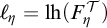 $\ell_\eta =\mathrm {lh}(F^{\mathcal {T}}_\eta )$
or
$\ell_\eta =\mathrm {lh}(F^{\mathcal {T}}_\eta )$
or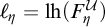 $\ell _\eta =\mathrm {lh}(F^{\mathcal {U}}_\eta )$
, whichever is defined, and
$\ell _\eta =\mathrm {lh}(F^{\mathcal {U}}_\eta )$
, whichever is defined, and $K_\eta =M^{\mathcal {T}}_\eta ||\ell _\eta =M^{\mathcal {U}}_\eta ||\ell _\eta $
. If
$K_\eta =M^{\mathcal {T}}_\eta ||\ell _\eta =M^{\mathcal {U}}_\eta ||\ell _\eta $
. If $\eta $
is a limit, let
$\eta $
is a limit, let $Q^{\mathcal {T}}_\eta $
be the Q-structure Q for
$Q^{\mathcal {T}}_\eta $
be the Q-structure Q for $\delta _\eta $
with
$\delta _\eta $
with $Q\trianglelefteq M^{\mathcal {T}}_\eta $
(so if
$Q\trianglelefteq M^{\mathcal {T}}_\eta $
(so if $\mathcal {T}\!\upharpoonright \!\eta $
is not eventually only padding, then
$\mathcal {T}\!\upharpoonright \!\eta $
is not eventually only padding, then $Q^{\mathcal {T}}_\eta =Q(\mathcal {T}\!\upharpoonright \!\eta ,[0,\eta )_{\mathcal {T}})$
), and likewise
$Q^{\mathcal {T}}_\eta =Q(\mathcal {T}\!\upharpoonright \!\eta ,[0,\eta )_{\mathcal {T}})$
), and likewise $Q^{\mathcal {U}}_\eta $
the Q-structure Q for
$Q^{\mathcal {U}}_\eta $
the Q-structure Q for $\delta _\eta $
with
$\delta _\eta $
with $Q\trianglelefteq M^{\mathcal {U}}_\eta $
.Footnote
9
These exist as
$Q\trianglelefteq M^{\mathcal {U}}_\eta $
.Footnote
9
These exist as $R_0,S_0$
project to
$R_0,S_0$
project to $\omega $
and are sound. Also let
$\omega $
and are sound. Also let $Q^{\mathcal {T}}_0=R_0$
and
$Q^{\mathcal {T}}_0=R_0$
and $Q^{\mathcal {U}}_0=S_0$
, and let
$Q^{\mathcal {U}}_0=S_0$
, and let $N_0=R_0|\omega _1^{R_0}=S_0|\omega _1^{S_0}$
.
$N_0=R_0|\omega _1^{R_0}=S_0|\omega _1^{S_0}$
.
We set $\eta _0=0$
. Suppose we have defined
$\eta _0=0$
. Suppose we have defined $(\mathcal {T},\mathcal {U})\!\upharpoonright \!(\eta _\alpha +1)$
, so
$(\mathcal {T},\mathcal {U})\!\upharpoonright \!(\eta _\alpha +1)$
, so $\eta _\alpha <\omega _1^M$
and
$\eta _\alpha <\omega _1^M$
and $\eta _\alpha =0$
or is a limit. We next define
$\eta _\alpha =0$
or is a limit. We next define $\eta _{\alpha +1}$
and
$\eta _{\alpha +1}$
and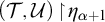 $(\mathcal {T},\mathcal {U})\!\upharpoonright \!\eta _{\alpha +1}$
, and hence
$(\mathcal {T},\mathcal {U})\!\upharpoonright \!\eta _{\alpha +1}$
, and hence $(\mathcal {T},\mathcal {U})\!\upharpoonright \!(\eta _{\alpha +1}+1)$
. In the definition we literally assume that we reach no
$(\mathcal {T},\mathcal {U})\!\upharpoonright \!(\eta _{\alpha +1}+1)$
. In the definition we literally assume that we reach no $\eta <\eta _{\alpha +1}$
such that
$\eta <\eta _{\alpha +1}$
such that $(\mathcal {T},\mathcal {U})\!\upharpoonright \!(\eta +1)$
is a successful comparison; if we do reach such an
$(\mathcal {T},\mathcal {U})\!\upharpoonright \!(\eta +1)$
is a successful comparison; if we do reach such an $\eta $
then we stop the construction there. There are three cases to consider.
$\eta $
then we stop the construction there. There are three cases to consider.
Case 1. $Q^{\mathcal {T}}_{\eta _\alpha }\neq Q^{\mathcal {U}}_{\eta _\alpha }$
(note this holds in case
$Q^{\mathcal {T}}_{\eta _\alpha }\neq Q^{\mathcal {U}}_{\eta _\alpha }$
(note this holds in case $\alpha =0$
).
$\alpha =0$
).
If $F^{\mathcal {T}}_{\eta _\alpha }$
is defined then
$F^{\mathcal {T}}_{\eta _\alpha }$
is defined then $\mathrm {lh}(F^{\mathcal {T}}_{\eta _\alpha })\leq \mathrm {OR}(Q^{\mathcal {T}}_{\eta _\alpha })$
, and likewise for
$\mathrm {lh}(F^{\mathcal {T}}_{\eta _\alpha })\leq \mathrm {OR}(Q^{\mathcal {T}}_{\eta _\alpha })$
, and likewise for $F^{\mathcal {U}}_{\eta _\alpha }$
. Note that by tameness (or otherwise if
$F^{\mathcal {U}}_{\eta _\alpha }$
. Note that by tameness (or otherwise if $\alpha =0$
),
$\alpha =0$
), $\delta _{\eta _\alpha }$
is a strong cutpoint of
$\delta _{\eta _\alpha }$
is a strong cutpoint of $Q^{\mathcal {T}}_{\eta _\alpha }$
and of
$Q^{\mathcal {T}}_{\eta _\alpha }$
and of $Q^{\mathcal {U}}_{\eta _\alpha }$
. Now
$Q^{\mathcal {U}}_{\eta _\alpha }$
. Now $\mathcal {T}\!\upharpoonright \ $Q^{\mathcal {T}}_{\eta _\alpha }$
and above
$Q^{\mathcal {T}}_{\eta _\alpha }$
and above $\delta _{\eta _\alpha }$
, and likewise
$\delta _{\eta _\alpha }$
, and likewise $\mathcal {U}\!\upharpoonright \ $Q^{\mathcal {T}}_{\eta _\alpha },Q^{\mathcal {U}}_{\eta _\alpha }$
, and hence (by (*2) and Lemma 2.1), constructs the branches
$Q^{\mathcal {T}}_{\eta _\alpha },Q^{\mathcal {U}}_{\eta _\alpha }$
, and hence (by (*2) and Lemma 2.1), constructs the branches $[0,\eta _\alpha )_{\mathcal {T}}$
and
$[0,\eta _\alpha )_{\mathcal {T}}$
and $[0,\eta _\alpha )_{\mathcal {U}}$
, if
$[0,\eta _\alpha )_{\mathcal {U}}$
, if $\alpha>0$
. Let
$\alpha>0$
. Let $\eta _{\alpha +1}$
be the least limit ordinal
$\eta _{\alpha +1}$
be the least limit ordinal $\eta <\omega _1^M$
such that
$\eta <\omega _1^M$
such that $Q^{\mathcal {T}}_{\eta _\alpha },Q^{\mathcal {U}}_{\eta _\alpha }\in M|(\eta +\omega )$
(clearly if
$Q^{\mathcal {T}}_{\eta _\alpha },Q^{\mathcal {U}}_{\eta _\alpha }\in M|(\eta +\omega )$
(clearly if $\alpha>0$
then
$\alpha>0$
then $\eta _\alpha \leq \delta _{\eta _\alpha }<\eta _{\alpha +1}$
).
$\eta _\alpha \leq \delta _{\eta _\alpha }<\eta _{\alpha +1}$
).
Now $(\mathcal {T},\mathcal {U})\!\upharpoonright \ $\eta \in [\eta _\alpha ,\eta _{\alpha +1})$
and suppose we have defined
$\eta \in [\eta _\alpha ,\eta _{\alpha +1})$
and suppose we have defined $(\mathcal {T},\mathcal {U})\!\upharpoonright \!(\eta +1)$
. Recall that
$(\mathcal {T},\mathcal {U})\!\upharpoonright \!(\eta +1)$
. Recall that $K_\eta $
was defined above. If
$K_\eta $
was defined above. If $K_\eta $
has a (
$K_\eta $
has a ( $K_\eta $
-total) measurable
$K_\eta $
-total) measurable $\mu>\delta _{\eta _\alpha }$
then letting
$\mu>\delta _{\eta _\alpha }$
then letting $\mu $
be least such,
$\mu $
be least such, $E^{\mathcal {T}}_\eta =E^{\mathcal {U}}_\eta $
is the unique normal measure on
$E^{\mathcal {T}}_\eta =E^{\mathcal {U}}_\eta $
is the unique normal measure on $\mu $
in
$\mu $
in $\mathbb {E}^{K_\eta }$
. Otherwise,
$\mathbb {E}^{K_\eta }$
. Otherwise, $E^{\mathcal {T}}_\eta =F^{\mathcal {T}}_\eta $
and
$E^{\mathcal {T}}_\eta =F^{\mathcal {T}}_\eta $
and $E^{\mathcal {U}}_\eta =F^{\mathcal {U}}_\eta $
.
$E^{\mathcal {U}}_\eta =F^{\mathcal {U}}_\eta $
.
Note that if $\alpha =0$
then
$\alpha =0$
then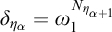 $\delta _{\eta _\alpha }=\omega _1^{N_{\eta _{\alpha +1}}}$
, and if
$\delta _{\eta _\alpha }=\omega _1^{N_{\eta _{\alpha +1}}}$
, and if $\alpha>0$
then
$\alpha>0$
then $N_{\eta _{\alpha +1}}\models $
“
$N_{\eta _{\alpha +1}}\models $
“ $\delta _{\eta _\alpha }$
is Woodin”, and in either case,
$\delta _{\eta _\alpha }$
is Woodin”, and in either case, $N_{\eta _{\alpha +1}}\models $
“there are no measurables or Woodins
$N_{\eta _{\alpha +1}}\models $
“there are no measurables or Woodins $>\delta _{\eta _\alpha }$
”. So
$>\delta _{\eta _\alpha }$
”. So $Q^{\mathcal {T}}_{\eta _{\alpha +1}}=N_{\eta _{\alpha +1}}=Q^{\mathcal {U}}_{\eta _{\alpha +1}}$
, and (by tameness)
$Q^{\mathcal {T}}_{\eta _{\alpha +1}}=N_{\eta _{\alpha +1}}=Q^{\mathcal {U}}_{\eta _{\alpha +1}}$
, and (by tameness) $N_{\eta _{\alpha +1}}$
has no extenders inducing meas-lim extender algebra axioms with index in
$N_{\eta _{\alpha +1}}$
has no extenders inducing meas-lim extender algebra axioms with index in $[\delta _{\eta _\alpha },\delta _{\eta _{\alpha +1}}]$
.
$[\delta _{\eta _\alpha },\delta _{\eta _{\alpha +1}}]$
.
Case 2. $N_{\eta _\alpha }\models $
“There is a proper class of Woodins” (so
$N_{\eta _\alpha }\models $
“There is a proper class of Woodins” (so $Q^{\mathcal {T}}_{\eta _\alpha }=N_{\eta _\alpha }=Q^{\mathcal {U}}_{\eta _\alpha }$
).
$Q^{\mathcal {T}}_{\eta _\alpha }=N_{\eta _\alpha }=Q^{\mathcal {U}}_{\eta _\alpha }$
).
By tameness, it follows that $\delta _{\eta _\alpha }$
is a cutpoint (maybe not strong cutpoint) of either
$\delta _{\eta _\alpha }$
is a cutpoint (maybe not strong cutpoint) of either $M^{\mathcal {T}}_{\eta _\alpha }$
or
$M^{\mathcal {T}}_{\eta _\alpha }$
or $M^{\mathcal {U}}_{\eta _\alpha }$
.Footnote
10
Here
$M^{\mathcal {U}}_{\eta _\alpha }$
.Footnote
10
Here $(\mathcal {T},\mathcal {U})\!\upharpoonright \ $\delta _{\eta _\alpha }$
.
$\delta _{\eta _\alpha }$
.
In this case we want to insert a short linear iteration past the point in M which constructs $(\mathcal {T},\mathcal {U})\!\upharpoonright \!\eta _\alpha $
(we will have
$(\mathcal {T},\mathcal {U})\!\upharpoonright \!\eta _\alpha $
(we will have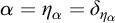 $\alpha =\eta _\alpha =\delta _{\eta _\alpha }$
and already have
$\alpha =\eta _\alpha =\delta _{\eta _\alpha }$
and already have
 $$\begin{align*}(\mathcal{T},\mathcal{U})\!\upharpoonright\!\eta\in M|\eta_\alpha \end{align*}$$
for every $\eta <\eta _\alpha $
, but it is not clear that
$\eta <\eta _\alpha $
, but it is not clear that $(\mathcal {T},\mathcal {U})\!\upharpoonright \!\eta _\alpha $
is actually definable over
$(\mathcal {T},\mathcal {U})\!\upharpoonright \!\eta _\alpha $
is actually definable over $M|\eta _\alpha $
, as it is not clear that the branch choices of
$M|\eta _\alpha $
, as it is not clear that the branch choices of $\mathcal {U}$
are appropriately definable).
$\mathcal {U}$
are appropriately definable).
So let $\eta <\omega _1^M$
be the least limit ordinal such that
$\eta <\omega _1^M$
be the least limit ordinal such that $(\mathcal {T},\mathcal {U})\!\upharpoonright \!\eta _\alpha \in M|(\eta +\omega )$
(we have
$(\mathcal {T},\mathcal {U})\!\upharpoonright \!\eta _\alpha \in M|(\eta +\omega )$
(we have $(\mathcal {T},\mathcal {U})\!\upharpoonright \!\eta _\alpha \in \mathrm {HC}^M$
by assumption). Note then that
$(\mathcal {T},\mathcal {U})\!\upharpoonright \!\eta _\alpha \in \mathrm {HC}^M$
by assumption). Note then that
 $$\begin{align*}[0,\eta_\alpha)^{\mathcal{T}},[0,\eta_\alpha)^{\mathcal{U}}\in M|(\eta+\omega) \end{align*}$$
by tameness. We set $\eta _{\alpha +1}=\max (\eta ,\eta _\alpha +\omega )$
.
$\eta _{\alpha +1}=\max (\eta ,\eta _\alpha +\omega )$
.
Now $(\mathcal {T},\mathcal {U})\!\upharpoonright \ $N_{\eta _{\alpha +1}}$
has no measurables
$N_{\eta _{\alpha +1}}$
has no measurables $>\delta _{\eta _\alpha }$
. (Maybe
$>\delta _{\eta _\alpha }$
. (Maybe $\delta _{\eta _\alpha }$
itself is measurable. In order to ensure that we get a useful comparison, it is important here that we do not iterate at
$\delta _{\eta _\alpha }$
itself is measurable. In order to ensure that we get a useful comparison, it is important here that we do not iterate at $\delta _{\eta _\alpha }$
itself during the interval
$\delta _{\eta _\alpha }$
itself during the interval $[\eta _\alpha ,\eta _{\alpha +1})$
.)
$[\eta _\alpha ,\eta _{\alpha +1})$
.)
Case 3. $Q^{\mathcal {T}}_{\eta _\alpha }=Q^{\mathcal {U}}_{\eta _\alpha }$
and
$Q^{\mathcal {T}}_{\eta _\alpha }=Q^{\mathcal {U}}_{\eta _\alpha }$
and $N_{\eta _\alpha }\models $
“There is not a proper class of Woodins”.
$N_{\eta _\alpha }\models $
“There is not a proper class of Woodins”.
We set $\eta _{\alpha +1}=\eta _\alpha +\omega $
. Let
$\eta _{\alpha +1}=\eta _\alpha +\omega $
. Let $\eta \in [\eta _{\alpha },\eta _{\alpha +1})$
and suppose we have defined
$\eta \in [\eta _{\alpha },\eta _{\alpha +1})$
and suppose we have defined $(\mathcal {T},\mathcal {U})\!\upharpoonright \!(\eta +1)$
. If
$(\mathcal {T},\mathcal {U})\!\upharpoonright \!(\eta +1)$
. If $\eta =\eta _\alpha $
(and in fact in general),
$\eta =\eta _\alpha $
(and in fact in general),
 $$ \begin{align} Q^{\mathcal{T}}_{\eta_\alpha}=Q^{\mathcal{U}}_{\eta_\alpha}\triangleleft K_\eta.\end{align} $$
If there is any $E\in \mathbb {E}^{K_\eta }$
such that
$E\in \mathbb {E}^{K_\eta }$
such that $\nu _E$
is a
$\nu _E$
is a $K_\eta $
-inaccessible limit of
$K_\eta $
-inaccessible limit of $K_\eta $
-measurables, and E induces an extender algebra axiom which is false of
$K_\eta $
-measurables, and E induces an extender algebra axiom which is false of $\mathbb {E}^M$
, then set
$\mathbb {E}^M$
, then set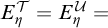 $E^{\mathcal {T}}_\eta =E^{\mathcal {U}}_\eta =$
the least such E. Otherwise set
$E^{\mathcal {T}}_\eta =E^{\mathcal {U}}_\eta =$
the least such E. Otherwise set $E^{\mathcal {T}}_\eta =F^{\mathcal {T}}_\eta $
and
$E^{\mathcal {T}}_\eta =F^{\mathcal {T}}_\eta $
and $E^{\mathcal {U}}_\eta =F^{\mathcal {U}}_\eta $
. Set
$E^{\mathcal {U}}_\eta =F^{\mathcal {U}}_\eta $
. Set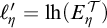 $\ell'_\eta=\mathrm{lh}(E^{\mathcal{T}}_\eta)$
or
$\ell'_\eta=\mathrm{lh}(E^{\mathcal{T}}_\eta)$
or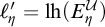 $\ell'_\eta=\mathrm{lh}(E^{\mathcal{U}}_\eta)$
, whichever is defined. We will have
$\ell'_\eta=\mathrm{lh}(E^{\mathcal{U}}_\eta)$
, whichever is defined. We will have
 $$\begin{align*}\mathrm{OR}(Q^{\mathcal{T}}_{\eta_\alpha})=\mathrm{OR}(Q^{\mathcal{U}}_{\eta_\alpha})<\ell'_\eta, \end{align*}$$
by a simple induction, Claim 1 below, line (1), tameness and since $Q^{\mathcal {T}}_{\eta _\alpha }$
projects to
$Q^{\mathcal {T}}_{\eta _\alpha }$
projects to $\delta _{\eta _\alpha }$
.Footnote
11
$\delta _{\eta _\alpha }$
.Footnote
11
This completes all cases. Of course, limit stages ${<\omega _1^M}$
are taken care of by our strategies. This completes the definition of the comparison.
${<\omega _1^M}$
are taken care of by our strategies. This completes the definition of the comparison.
Claim 1. $\mathcal {T},\mathcal {U}$
are normal, and moreover, if
$\mathcal {T},\mathcal {U}$
are normal, and moreover, if $\alpha <\beta $
and [
$\alpha <\beta $
and [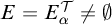 $E=E^{\mathcal {T}}_\alpha \neq \emptyset $
or
$E=E^{\mathcal {T}}_\alpha \neq \emptyset $
or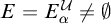 $E=E^{\mathcal {U}}_\alpha \neq \emptyset $
] and [
$E=E^{\mathcal {U}}_\alpha \neq \emptyset $
] and [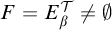 $F=E^{\mathcal {T}}_\beta \neq \emptyset $
or
$F=E^{\mathcal {T}}_\beta \neq \emptyset $
or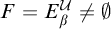 $F=E^{\mathcal {U}}_\beta \neq \emptyset $
], then
$F=E^{\mathcal {U}}_\beta \neq \emptyset $
], then $\mathrm {lh}(E)<\mathrm {lh}(F)$
.
$\mathrm {lh}(E)<\mathrm {lh}(F)$
.
Proof. This is a straightforward induction.
Claim 2. For each $\alpha <\omega _1^M$
, either
$\alpha <\omega _1^M$
, either $F^{\mathcal {T}}_\alpha $
or
$F^{\mathcal {T}}_\alpha $
or $F^{\mathcal {U}}_\alpha $
is defined, and hence, we get a comparison
$F^{\mathcal {U}}_\alpha $
is defined, and hence, we get a comparison $(\mathcal {T},\mathcal {U})$
of length
$(\mathcal {T},\mathcal {U})$
of length $\omega _1^M$
.
$\omega _1^M$
.
Proof. Suppose not and let $\alpha $
be least such. So
$\alpha $
be least such. So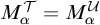 $M^{\mathcal {T}}_\alpha =M^{\mathcal {U}}_\alpha $
, since
$M^{\mathcal {T}}_\alpha =M^{\mathcal {U}}_\alpha $
, since $R_0,S_0$
are both sound and project to
$R_0,S_0$
are both sound and project to $\omega $
. So letting
$\omega $
. So letting $C=\mathfrak {C}_\omega (M^{\mathcal {T}}_\alpha )=\mathfrak {C}_\omega (M^{\mathcal {U}}_\alpha )$
, there is
$C=\mathfrak {C}_\omega (M^{\mathcal {T}}_\alpha )=\mathfrak {C}_\omega (M^{\mathcal {U}}_\alpha )$
, there is $\beta +1<\mathrm {lh}(\mathcal {T},\mathcal {U})$
such that
$\beta +1<\mathrm {lh}(\mathcal {T},\mathcal {U})$
such that $\beta <^{\mathcal {T}}\alpha $
and letting
$\beta <^{\mathcal {T}}\alpha $
and letting $\varepsilon =\mathrm {succ}^{\mathcal {T}}(\beta ,\alpha ]$
,
$\varepsilon =\mathrm {succ}^{\mathcal {T}}(\beta ,\alpha ]$
, $(\varepsilon ,\alpha ]_{\mathcal {T}}\cap \mathscr {D}^{\mathcal {T}}=\emptyset $
and
$(\varepsilon ,\alpha ]_{\mathcal {T}}\cap \mathscr {D}^{\mathcal {T}}=\emptyset $
and $C=M^{*\mathcal {T}}_\varepsilon \trianglelefteq M^{\mathcal {T}}_\beta $
, and
$C=M^{*\mathcal {T}}_\varepsilon \trianglelefteq M^{\mathcal {T}}_\beta $
, and $E^{\mathcal {T}}_\beta \in \mathbb {E}_+^C$
, and likewise there is
$E^{\mathcal {T}}_\beta \in \mathbb {E}_+^C$
, and likewise there is $\gamma +1<\mathrm {lh}(\mathcal {T},\mathcal {U})$
such that
$\gamma +1<\mathrm {lh}(\mathcal {T},\mathcal {U})$
such that $\gamma <^{\mathcal {U}}\alpha $
and letting
$\gamma <^{\mathcal {U}}\alpha $
and letting $\eta =\mathrm {succ}^{\mathcal {U}}(\gamma ,\alpha ]$
, we have
$\eta =\mathrm {succ}^{\mathcal {U}}(\gamma ,\alpha ]$
, we have $(\eta ,\alpha ]_{\mathcal {U}}\cap \mathscr {D}^{\mathcal {U}}=\emptyset $
and
$(\eta ,\alpha ]_{\mathcal {U}}\cap \mathscr {D}^{\mathcal {U}}=\emptyset $
and $C=M^{*\mathcal {U}}_\eta \trianglelefteq M^{\mathcal {U}}_\gamma $
and
$C=M^{*\mathcal {U}}_\eta \trianglelefteq M^{\mathcal {U}}_\gamma $
and $E^{\mathcal {U}}_\gamma \in \mathbb {E}_+^C$
.
$E^{\mathcal {U}}_\gamma \in \mathbb {E}_+^C$
.
Since $R_0\neq S_0$
but
$R_0\neq S_0$
but $R_0|\omega _1^{R_0}=S_0|\omega _1^{S_0}$
, we have
$R_0|\omega _1^{R_0}=S_0|\omega _1^{S_0}$
, we have $C\neq R_0$
and
$C\neq R_0$
and $C\neq S_0$
, so in fact,
$C\neq S_0$
, so in fact, $C\triangleleft M^{\mathcal {T}}_\beta $
and
$C\triangleleft M^{\mathcal {T}}_\beta $
and $C\triangleleft M^{\mathcal {U}}_\gamma $
.
$C\triangleleft M^{\mathcal {U}}_\gamma $
.
Now since $E^{\mathcal {T}}_\beta \in \mathbb {E}_+^C$
and
$E^{\mathcal {T}}_\beta \in \mathbb {E}_+^C$
and $E^{\mathcal {U}}_\gamma \in \mathbb {E}_+^C$
, but
$E^{\mathcal {U}}_\gamma \in \mathbb {E}_+^C$
, but $E^{\mathcal {T}}_\beta $
is the least disagreement between C and
$E^{\mathcal {T}}_\beta $
is the least disagreement between C and $M^{\mathcal {T}}_\alpha $
, and
$M^{\mathcal {T}}_\alpha $
, and $E^{\mathcal {U}}_\gamma $
is the least disagreement between C and
$E^{\mathcal {U}}_\gamma $
is the least disagreement between C and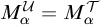 $M^{\mathcal {U}}_\alpha =M^{\mathcal {T}}_\alpha $
, we must have
$M^{\mathcal {U}}_\alpha =M^{\mathcal {T}}_\alpha $
, we must have $\beta =\gamma $
and
$\beta =\gamma $
and $E^{\mathcal {T}}_\beta =E^{\mathcal {U}}_\beta $
. Therefore
$E^{\mathcal {T}}_\beta =E^{\mathcal {U}}_\beta $
. Therefore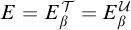 $E=E^{\mathcal {T}}_\beta =E^{\mathcal {U}}_\beta $
was chosen either for genericity iteration purposes, or for short linear iteration purposes. We have
$E=E^{\mathcal {T}}_\beta =E^{\mathcal {U}}_\beta $
was chosen either for genericity iteration purposes, or for short linear iteration purposes. We have $\beta <\alpha $
, so either
$\beta <\alpha $
, so either $F^{\mathcal {T}}_\beta $
or
$F^{\mathcal {T}}_\beta $
or $F^{\mathcal {U}}_\beta $
is defined; suppose
$F^{\mathcal {U}}_\beta $
is defined; suppose $F=F^{\mathcal {T}}_\beta $
is defined. Since this is least disagreement between
$F=F^{\mathcal {T}}_\beta $
is defined. Since this is least disagreement between $M^{\mathcal {T}}_\beta ,M^{\mathcal {U}}_\beta $
, but
$M^{\mathcal {T}}_\beta ,M^{\mathcal {U}}_\beta $
, but $C\triangleleft M^{\mathcal {T}}_\beta $
and
$C\triangleleft M^{\mathcal {T}}_\beta $
and $C\triangleleft M^{\mathcal {U}}_\beta $
, we have
$C\triangleleft M^{\mathcal {U}}_\beta $
, we have $\mathrm {OR}^C<\mathrm {lh}(F)$
. We also have
$\mathrm {OR}^C<\mathrm {lh}(F)$
. We also have $\mathrm {lh}(E)\leq \mathrm {OR}^C$
, and note that by how we chose E,
$\mathrm {lh}(E)\leq \mathrm {OR}^C$
, and note that by how we chose E, $\nu _E$
is a cardinal of
$\nu _E$
is a cardinal of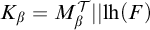 $K_\beta =M^{\mathcal {T}}_\beta ||\mathrm {lh}(F)$
. But
$K_\beta =M^{\mathcal {T}}_\beta ||\mathrm {lh}(F)$
. But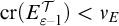 $\mathrm {cr}(E^{\mathcal {T}}_{\varepsilon -1})<\nu _E$
, and therefore
$\mathrm {cr}(E^{\mathcal {T}}_{\varepsilon -1})<\nu _E$
, and therefore $E^{\mathcal {T}}_{\varepsilon -1}$
is total over
$E^{\mathcal {T}}_{\varepsilon -1}$
is total over $K_\beta $
, so
$K_\beta $
, so
 $$\begin{align*}M^{*\mathcal{T}}_\varepsilon=C\triangleleft M^{\mathcal{T}}_\beta|\mathrm{lh}(F)\trianglelefteq M^{*\mathcal{T}}_\varepsilon,\end{align*}$$
a contradiction.
Let $N=N_{\omega _1^M}=M(\mathcal {T},\mathcal {U})$
, so
$N=N_{\omega _1^M}=M(\mathcal {T},\mathcal {U})$
, so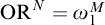 $\mathrm {OR}^N=\omega _1^M$
.
$\mathrm {OR}^N=\omega _1^M$
.
Claim 3. $N\models $
“There is not a proper class of Woodins”.
$N\models $
“There is not a proper class of Woodins”.
Proof. Suppose otherwise. By tameness, we get $\mathcal {T}$
- and
$\mathcal {T}$
- and $\mathcal {U}$
-cofinal branches
$\mathcal {U}$
-cofinal branches $b,c$
. That is, for each
$b,c$
. That is, for each $\delta <\omega _1^M$
such that
$\delta <\omega _1^M$
such that $\delta $
is Woodin in N,
$\delta $
is Woodin in N, $\delta $
is a cutpoint of
$\delta $
is a cutpoint of $(\mathcal {T},\mathcal {U})$
, meaning that there is no extender used in
$(\mathcal {T},\mathcal {U})$
, meaning that there is no extender used in $(\mathcal {T},\mathcal {U})$
which overlaps
$(\mathcal {T},\mathcal {U})$
which overlaps $\delta $
. But then letting W be the set of all such
$\delta $
. But then letting W be the set of all such $\delta $
,
$\delta $
, $b=\bigcup _{\delta \in W}[0,\delta ]^{\mathcal {T}}$
is a
$b=\bigcup _{\delta \in W}[0,\delta ]^{\mathcal {T}}$
is a $\mathcal {T}$
-cofinal branch, and likewise for
$\mathcal {T}$
-cofinal branch, and likewise for $\mathcal {U}$
.
$\mathcal {U}$
.
Now working in M, we argue much as in the usual proof of termination of comparison/genericity iteration, with one extra observation. For simplicity, let us assume that there is no $\alpha $
such that
$\alpha $
such that $\mathrm {OR}^M=\alpha +\omega $
; in the contrary case, one needs some minor refinements of the discussion to follow. We get some
$\mathrm {OR}^M=\alpha +\omega $
; in the contrary case, one needs some minor refinements of the discussion to follow. We get some $\lambda <\mathrm {OR}^M$
and some sufficiently elementary
$\lambda <\mathrm {OR}^M$
and some sufficiently elementary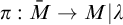 $\pi :\bar {M}\to M|\lambda $
with the relevant objects in
$\pi :\bar {M}\to M|\lambda $
with the relevant objects in $\mathrm {rg}(\pi )$
and
$\mathrm {rg}(\pi )$
and $\bar {M}$
countable.Footnote
12
Let
$\bar {M}$
countable.Footnote
12
Let $\kappa =\mathrm {cr}(\pi )$
. Then
$\kappa =\mathrm {cr}(\pi )$
. Then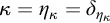 $\kappa =\eta _\kappa =\delta _{\eta _\kappa }$
. Let
$\kappa =\eta _\kappa =\delta _{\eta _\kappa }$
. Let
 $$\begin{align*}\beta+1=\mathrm{succ}^{\mathcal{T}}(\kappa,\omega_1^M)\text{ and }\gamma+1=\mathrm{succ}^{\mathcal{U}}(\kappa,\omega_1^M).\end{align*}$$
Then $E^{\mathcal {T}}_\beta ,E^{\mathcal {U}}_\gamma $
are compatible through
$E^{\mathcal {T}}_\beta ,E^{\mathcal {U}}_\gamma $
are compatible through $\min (\nu (E^{\mathcal {T}}_\beta ),\nu (E^{\mathcal {U}}_\gamma ))$
. The usual arguments for termination of comparison/genericity iteration show that
$\min (\nu (E^{\mathcal {T}}_\beta ),\nu (E^{\mathcal {U}}_\gamma ))$
. The usual arguments for termination of comparison/genericity iteration show that $\beta =\gamma =\kappa $
and
$\beta =\gamma =\kappa $
and $E=E^{\mathcal {T}}_\kappa =E^{\mathcal {U}}_\kappa $
was chosen for short linear iteration purposes, and
$E=E^{\mathcal {T}}_\kappa =E^{\mathcal {U}}_\kappa $
was chosen for short linear iteration purposes, and $\mathrm {cr}(E)=\kappa $
. Since
$\mathrm {cr}(E)=\kappa $
. Since $N\models $
“There is a proper class of Woodins”,
$N\models $
“There is a proper class of Woodins”, $N_\kappa =N|\kappa $
satisfies the same. But since
$N_\kappa =N|\kappa $
satisfies the same. But since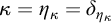 $\kappa =\eta _\kappa =\delta _{\eta _\kappa }$
and by the rules of choosing
$\kappa =\eta _\kappa =\delta _{\eta _\kappa }$
and by the rules of choosing $E^{\mathcal {T}}_\kappa $
, we therefore have
$E^{\mathcal {T}}_\kappa $
, we therefore have $\mathrm {cr}(E)>\kappa $
, contradiction.
$\mathrm {cr}(E)>\kappa $
, contradiction.
Using Claim 3 we may fix $\eta ^*<\omega _1^M$
with
$\eta ^*<\omega _1^M$
with $\eta ^*$
above all Woodins of N.
$\eta ^*$
above all Woodins of N.
Claim 4. For all limits $\lambda <\omega _1^M$
such that
$\lambda <\omega _1^M$
such that $\delta _\lambda>\eta ^*$
, we have
$\delta _\lambda>\eta ^*$
, we have $Q^{\mathcal {T}}_\lambda =Q^{\mathcal {U}}_\lambda $
and
$Q^{\mathcal {T}}_\lambda =Q^{\mathcal {U}}_\lambda $
and $Q^{\mathcal {T}}_\lambda \triangleleft M^{\mathcal {T}}_\lambda $
and
$Q^{\mathcal {T}}_\lambda \triangleleft M^{\mathcal {T}}_\lambda $
and $Q^{\mathcal {U}}_\lambda \triangleleft M^{\mathcal {U}}_\lambda $
.
$Q^{\mathcal {U}}_\lambda \triangleleft M^{\mathcal {U}}_\lambda $
.
Proof. If $Q^{\mathcal {T}}_\lambda \neq Q^{\mathcal {U}}_\lambda $
then comparison would force us to use some extender within the Q-structures, and this would mean that
$Q^{\mathcal {T}}_\lambda \neq Q^{\mathcal {U}}_\lambda $
then comparison would force us to use some extender within the Q-structures, and this would mean that $\delta _\lambda $
is Woodin in N, contradicting the choice of
$\delta _\lambda $
is Woodin in N, contradicting the choice of $\eta ^*$
. So
$\eta ^*$
. So $Q^{\mathcal {T}}_\lambda =Q^{\mathcal {U}}_\lambda $
. If say
$Q^{\mathcal {T}}_\lambda =Q^{\mathcal {U}}_\lambda $
. If say $Q^{\mathcal {T}}_\lambda =M^{\mathcal {T}}_\lambda $
then
$Q^{\mathcal {T}}_\lambda =M^{\mathcal {T}}_\lambda $
then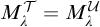 $M^{\mathcal {T}}_\lambda = M^{\mathcal {U}}_\lambda $
, contradicting Claim 2.
$M^{\mathcal {T}}_\lambda = M^{\mathcal {U}}_\lambda $
, contradicting Claim 2.
Claim 5. There is no $\mathcal {T}$
-cofinal branch
$\mathcal {T}$
-cofinal branch $b\in M$
, and no
$b\in M$
, and no $\mathcal {U}$
-cofinal branch
$\mathcal {U}$
-cofinal branch $c\in M$
.
$c\in M$
.
Proof. If both such b and c exist in M then we can reach a contradiction much as in the proof of Claim 3.
Now suppose that we have such a branch $b\in M$
, but not c. Let
$b\in M$
, but not c. Let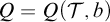 $Q=Q(\mathcal {T},b)$
. If
$Q=Q(\mathcal {T},b)$
. If $Q=M^{\mathcal {T}}_b$
then working in M, we can take a hull, and letting
$Q=M^{\mathcal {T}}_b$
then working in M, we can take a hull, and letting $\kappa $
be the resulting critical point, with
$\kappa $
be the resulting critical point, with $\eta ^*<\kappa $
, note that
$\eta ^*<\kappa $
, note that $Q^{\mathcal {T}}_\kappa =M^{\mathcal {T}}_\kappa $
, contradicting Claim 4. So
$Q^{\mathcal {T}}_\kappa =M^{\mathcal {T}}_\kappa $
, contradicting Claim 4. So $Q^{\mathcal {T}}_b\triangleleft M^{\mathcal {T}}_b$
. We claim that
$Q^{\mathcal {T}}_b\triangleleft M^{\mathcal {T}}_b$
. We claim that
 $$\begin{align*}\mathrm{branch}(\mathcal{U},Q^{\mathcal{T}}_b)\text{ yields a }\mathcal{U}\text{-cofinal branch }c\in M,\end{align*}$$
a contradiction. For assuming not, again working in M we can take a hull, and letting $\kappa $
be the resulting critical point, note that
$\kappa $
be the resulting critical point, note that
 $$\begin{align*}\mathrm{branch}(\mathcal{U}\!\upharpoonright\!\kappa,Q^{\mathcal{T}}_\kappa)\text{ does not yield a }\mathcal{U}\!\upharpoonright\!\kappa\text{-cofinal branch,}\end{align*}$$
contradicting Claim 4 and Lemma 2.1.
If instead we have $c\in M$
but no such
$c\in M$
but no such $b\in M$
, it is symmetric.
$b\in M$
, it is symmetric.
We will now give a more thorough analysis of stages of the comparison, and how they relate to the Woodins of the final common model N and segments of M which project to $\omega $
. Let
$\omega $
. Let $\left <\beta _\gamma \right>_{\gamma <\Omega }$
enumerate the Woodin cardinals of N in increasing order, and let
$\left <\beta _\gamma \right>_{\gamma <\Omega }$
enumerate the Woodin cardinals of N in increasing order, and let $\beta _\Omega =\omega _1^M$
. Let
$\beta _\Omega =\omega _1^M$
. Let
 $$\begin{align*}\alpha_\gamma=\sup_{\gamma'<\gamma}\beta_{\gamma'},\end{align*}$$
so $\alpha _\gamma <\beta _\gamma $
and either
$\alpha _\gamma <\beta _\gamma $
and either $\alpha _\gamma =0$
or
$\alpha _\gamma =0$
or $\alpha _\gamma $
is Woodin or a limit of Woodins in N, and
$\alpha _\gamma $
is Woodin or a limit of Woodins in N, and $\alpha _\Omega $
is the supremum of all Woodins of N. We will show below that for each
$\alpha _\Omega $
is the supremum of all Woodins of N. We will show below that for each $\gamma $
, we have [if
$\gamma $
, we have [if $\gamma>0$
then
$\gamma>0$
then $\alpha _\gamma =\eta _{\alpha _\gamma }=\delta _{\eta _{\alpha _\gamma }}$
], and either:
$\alpha _\gamma =\eta _{\alpha _\gamma }=\delta _{\eta _{\alpha _\gamma }}$
], and either:
-
–
$\gamma =\alpha _\gamma =0$
(and recall that Case 1 attains at stage
$0$
of the comparison) and let
$\chi _0=\eta _1$
, that is,
$\chi _0$
is the least
$\chi $
such that
$(R_0,S_0)\in M|(\chi +\omega )$
, or -
–
$\gamma $
is a successor (so
$\alpha _\gamma =\beta _{\gamma -1}$
is Woodin in N), and Case 1 attains at stage
$\alpha =\alpha _\gamma $
of the comparison, and let
$\chi _\gamma =\eta _{\alpha _\gamma +1}$
, that is,
$\chi _\gamma $
is the least
$\chi $
such that
$Q^{\mathcal {T}}_{\eta _{\alpha _\gamma }},Q^{\mathcal {U}}_{\eta _{\alpha _\gamma }}\in M|(\chi +\omega )$
, or -
–
$\gamma $
is a limit (so
$\alpha _\gamma $
is a limit of Woodins of N), and Case 2 attains at stage
$\alpha =\alpha _\gamma $
of the comparison, and let
$\chi _\gamma =\eta _{\alpha _\gamma +1}$
, that is,
$\chi _\gamma =\max (\chi ,\eta _{\alpha _\gamma }+\omega )$
, where
$\chi $
is least such that
$(\mathcal {T},\mathcal {U})\!\upharpoonright \!\eta _{\alpha _\gamma }\in M|(\chi +\omega )$
.











Claim 6. Let $\gamma \leq \Omega $
. Then we have:
$\gamma \leq \Omega $
. Then we have:
-
1.
$\alpha _\gamma =\eta _{\alpha _\gamma }$
and if
$\gamma>0$
then
$\alpha _\gamma =\delta _{\eta _{\alpha _\gamma }}$
, -
2. Case 1 or Case 2 attains at stage
$\alpha _\gamma $
of the comparison, according to the discussion above, -
3.
$M|\chi _\gamma $
projects to
$\omega $
, and if
$\gamma>0$
then
$M|\alpha _\gamma $
has largest cardinal
$\omega $
, -
4.
$\beta _\gamma =\eta _{\beta _\gamma }=\delta _{\eta _{\beta _\gamma }}$
, -
5. if
$\gamma <\Omega $
then Case 1 attains at stage
$\beta _\gamma $
of the comparison,


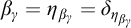


and for every limit $\zeta \in [\alpha _\gamma ,\beta _\gamma ]$
, if
$\zeta \in [\alpha _\gamma ,\beta _\gamma ]$
, if $N_\zeta $
is not a Q-structure for
$N_\zeta $
is not a Q-structure for $\delta _\zeta $
then:
$\delta _\zeta $
then:
-
6.
$\zeta =\eta _\zeta =\delta _{\eta _\zeta }$
and if
$\zeta>\alpha _\gamma $
then
$\zeta>\chi _\gamma $
, -
7.
$M|\zeta \models \mathrm {ZFC}^-$
and has largest cardinal
$\omega $
, -
8.
$(\mathcal {T},\mathcal {U})\!\upharpoonright \!\zeta \subseteq M|\zeta $
, -
9. if
$\zeta>\alpha _\gamma $
then
$x=(\mathcal {T},\mathcal {U})\!\upharpoonright \!(\alpha _\gamma +1)\in M|\zeta $
and
$(\mathcal {T},\mathcal {U})\!\upharpoonright \!\zeta $
is definable over
$M|\zeta $
from the parameter x, -
10.
$M|\zeta $
is
$N_\zeta $
-generic for the meas-lim extender algebra of
$N_\zeta $
at
$\zeta $
, -
11.
$Q^{\mathcal {T}}_\zeta $
is the output of the P-construction (see [Reference Schindler and Steel6]) of
$M|\xi $
over
$N_\zeta $
, where
$\xi $
is least such that
$\xi \geq \zeta $
and
$\rho _\omega ^{M|\xi }=\omega $
(so in fact
$\xi>\zeta $
), -
12. if
$\alpha _\gamma <\zeta <\beta _\gamma $
then
$Q^{\mathcal {T}}_\zeta =Q^{\mathcal {U}}_\zeta \triangleleft N$
, -
13. if
$\zeta =\beta _\gamma <\omega _1^M$
then
$Q^{\mathcal {T}}_\zeta \neq Q^{\mathcal {U}}_\zeta $
and
$Q^{\mathcal {T}}_\zeta ,Q^{\mathcal {U}}_\zeta \ntrianglelefteq N$
.
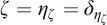









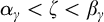
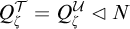
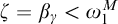

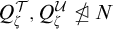
Proof. By induction on $\gamma $
, with a sub-induction on
$\gamma $
, with a sub-induction on $\zeta $
. Also note that if
$\zeta $
. Also note that if $N_\zeta $
is a Q-structure for
$N_\zeta $
is a Q-structure for $\delta _\zeta $
then
$\delta _\zeta $
then $[0,\zeta )_{\mathcal {T}}$
and
$[0,\zeta )_{\mathcal {T}}$
and $[0,\zeta )_{\mathcal {U}}$
are easily definable from
$[0,\zeta )_{\mathcal {U}}$
are easily definable from $(\mathcal {T},\mathcal {U})\!\upharpoonright \!\zeta $
.
$(\mathcal {T},\mathcal {U})\!\upharpoonright \!\zeta $
.
Note then that parts 1 and 2 follow easily by induction from parts 4 and 5 (we have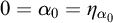 $0=\alpha _0=\eta _{\alpha _0}$
by definition, and
$0=\alpha _0=\eta _{\alpha _0}$
by definition, and $\delta _0=\omega _1^{R_0}$
). Consider part 3. If
$\delta _0=\omega _1^{R_0}$
). Consider part 3. If $\gamma =0$
this is just because
$\gamma =0$
this is just because $R_0,S_0$
are sound and project to
$R_0,S_0$
are sound and project to $\omega $
. Suppose
$\omega $
. Suppose $\gamma>0$
. Then
$\gamma>0$
. Then $M|\alpha _\gamma $
has largest cardinal
$M|\alpha _\gamma $
has largest cardinal $\omega $
by induction. Clearly
$\omega $
by induction. Clearly $\rho _\omega (M|\chi _\gamma )\leq \alpha _\gamma $
, so suppose that
$\rho _\omega (M|\chi _\gamma )\leq \alpha _\gamma $
, so suppose that $\rho _\omega (M|\chi _\gamma )=\alpha _\gamma $
. Then
$\rho _\omega (M|\chi _\gamma )=\alpha _\gamma $
. Then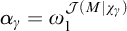 $\alpha _\gamma =\omega _1^{\mathcal {J}(M|\chi _\gamma )}$
and by Lemma 2.1 we have
$\alpha _\gamma =\omega _1^{\mathcal {J}(M|\chi _\gamma )}$
and by Lemma 2.1 we have
 $$\begin{align*}(\mathcal{T}\!\upharpoonright\!\alpha_\gamma,b),(\mathcal{U}\!\upharpoonright\!\alpha_\gamma,c)\in\mathcal{J}(M|\chi_\gamma), \end{align*}$$
where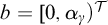 $b=[0,\alpha _\gamma )^{\mathcal {T}}$
and
$b=[0,\alpha _\gamma )^{\mathcal {T}}$
and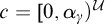 $c=[0,\alpha _\gamma )^{\mathcal {U}}$
. But then working inside
$c=[0,\alpha _\gamma )^{\mathcal {U}}$
. But then working inside $\mathcal {J}(M|\chi _\gamma )$
, we can use parts of the proofs of Claims 3 and 5 to reach a contradiction.
$\mathcal {J}(M|\chi _\gamma )$
, we can use parts of the proofs of Claims 3 and 5 to reach a contradiction.
Now it suffices to verify parts 6–13 for each limit $\zeta \in [\alpha _\gamma ,\beta _\gamma ]$
, since then parts 4 and 5 follow from parts 6 and 13.
$\zeta \in [\alpha _\gamma ,\beta _\gamma ]$
, since then parts 4 and 5 follow from parts 6 and 13.
If $\zeta =\alpha _\gamma $
then the required facts already hold by induction if
$\zeta =\alpha _\gamma $
then the required facts already hold by induction if $\gamma $
is a successor (as then
$\gamma $
is a successor (as then $\beta _{\gamma -1}=\alpha _\gamma $
), and trivially if
$\beta _{\gamma -1}=\alpha _\gamma $
), and trivially if $\gamma $
is a limit. (In the limit case,
$\gamma $
is a limit. (In the limit case, $N_\zeta \models $
“There is a proper class of Woodins”, so
$N_\zeta \models $
“There is a proper class of Woodins”, so $N_\zeta $
is a Q-structure for itself.)
$N_\zeta $
is a Q-structure for itself.)
So suppose $\zeta>\alpha _\gamma $
and that
$\zeta>\alpha _\gamma $
and that $N_\zeta $
is not a Q-structure for itself; that is,
$N_\zeta $
is not a Q-structure for itself; that is, $N_\zeta \models \mathrm {ZFC}$
and
$N_\zeta \models \mathrm {ZFC}$
and $\mathcal {J}(N_\zeta )\models $
“
$\mathcal {J}(N_\zeta )\models $
“ $\delta _\zeta =\mathrm {OR}(N_\zeta )$
is Woodin”. So
$\delta _\zeta =\mathrm {OR}(N_\zeta )$
is Woodin”. So $N_\zeta \models $
“There is a proper class of measurables”, so note
$N_\zeta \models $
“There is a proper class of measurables”, so note $\zeta =\eta _\varphi $
for some
$\zeta =\eta _\varphi $
for some $\varphi>0$
, and since we integrated genericity iteration into
$\varphi>0$
, and since we integrated genericity iteration into $(\mathcal {T},\mathcal {U})$
, part 6 (genericity of
$(\mathcal {T},\mathcal {U})$
, part 6 (genericity of $M|\delta _\zeta $
) holds, so
$M|\delta _\zeta $
) holds, so $\delta _\zeta $
is regular in
$\delta _\zeta $
is regular in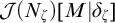 $\mathcal {J}(N_\zeta )[M|\delta _\zeta ]$
, hence regular in
$\mathcal {J}(N_\zeta )[M|\delta _\zeta ]$
, hence regular in $\mathcal {J}(M|\delta _\zeta )$
, so
$\mathcal {J}(M|\delta _\zeta )$
, so $M|\delta _\zeta \models \mathrm {ZFC}^-$
.
$M|\delta _\zeta \models \mathrm {ZFC}^-$
.
Let us verify that $(\mathcal {T},\mathcal {U})\!\upharpoonright \!\zeta \subseteq M|\delta _\zeta $
and
$(\mathcal {T},\mathcal {U})\!\upharpoonright \!\zeta \subseteq M|\delta _\zeta $
and $(\mathcal {T},\mathcal {U})\!\upharpoonright \!\zeta $
is definable over
$(\mathcal {T},\mathcal {U})\!\upharpoonright \!\zeta $
is definable over $M|\delta _\zeta $
from the parameter
$M|\delta _\zeta $
from the parameter $x=(\mathcal {T},\mathcal {U})\!\upharpoonright \!(\alpha _\gamma +1)$
. We have
$x=(\mathcal {T},\mathcal {U})\!\upharpoonright \!(\alpha _\gamma +1)$
. We have $\chi _\gamma <\delta _\zeta $
because
$\chi _\gamma <\delta _\zeta $
because $N_\zeta $
is not a Q-structure for itself. So
$N_\zeta $
is not a Q-structure for itself. So $x\in M|\delta _\zeta $
. But then working in
$x\in M|\delta _\zeta $
. But then working in $M|\delta _\zeta $
, which satisfies
$M|\delta _\zeta $
, which satisfies $\mathrm {ZFC}^-$
, we can define
$\mathrm {ZFC}^-$
, we can define $(\mathcal {T},\mathcal {U})\!\upharpoonright \!\zeta $
, because the extender selection algorithm can be executed in
$(\mathcal {T},\mathcal {U})\!\upharpoonright \!\zeta $
, because the extender selection algorithm can be executed in $M|\delta _\zeta $
, in particular since we only need to make
$M|\delta _\zeta $
, in particular since we only need to make $M|\delta _\zeta $
generic in that interval, and at non-trivial limit stages
$M|\delta _\zeta $
generic in that interval, and at non-trivial limit stages $\zeta '\in (\alpha _\gamma ,\zeta )$
(when
$\zeta '\in (\alpha _\gamma ,\zeta )$
(when $N_{\zeta '}$
is not a Q-structure for itself) we use the inductively established fact that
$N_{\zeta '}$
is not a Q-structure for itself) we use the inductively established fact that $Q^{\mathcal {T}}_{\zeta '}=Q^{\mathcal {U}}_{\zeta '}$
is computed by P-construction from some proper segment of M, and in fact some proper segment of
$Q^{\mathcal {T}}_{\zeta '}=Q^{\mathcal {U}}_{\zeta '}$
is computed by P-construction from some proper segment of M, and in fact some proper segment of $M|\delta _\zeta $
(as
$M|\delta _\zeta $
(as $Q^{\mathcal {T}}_{\zeta '}\triangleleft N$
in this case).
$Q^{\mathcal {T}}_{\zeta '}\triangleleft N$
in this case).
Now since $M|\delta _\zeta \models \mathrm {ZFC}^-$
and
$M|\delta _\zeta \models \mathrm {ZFC}^-$
and $\delta _\zeta =\delta _{\eta _\varphi }$
, it follows that
$\delta _\zeta =\delta _{\eta _\varphi }$
, it follows that $\varphi =\delta _{\eta _\varphi }=\delta _\zeta =\zeta $
. It also follows that
$\varphi =\delta _{\eta _\varphi }=\delta _\zeta =\zeta $
. It also follows that $\omega $
is the largest cardinal of
$\omega $
is the largest cardinal of $M|\zeta =M|\delta _\zeta $
, as otherwise working in
$M|\zeta =M|\delta _\zeta $
, as otherwise working in $M|\zeta $
, which then satisfies “
$M|\zeta $
, which then satisfies “ $\omega _1$
exists”, we can establish a contradiction to termination of comparison/genericity iteration much as before.
$\omega _1$
exists”, we can establish a contradiction to termination of comparison/genericity iteration much as before.
So $(\mathcal {T},\mathcal {U})\!\upharpoonright \!\zeta \subseteq M|\zeta $
and both
$(\mathcal {T},\mathcal {U})\!\upharpoonright \!\zeta \subseteq M|\zeta $
and both $(\mathcal {T},\mathcal {U})\!\upharpoonright \!\zeta $
and
$(\mathcal {T},\mathcal {U})\!\upharpoonright \!\zeta $
and $N_\zeta $
are definable from x over
$N_\zeta $
are definable from x over $M|\zeta $
, and we have extender algebra genericity as stated earlier. So we have established parts 6–10 for
$M|\zeta $
, and we have extender algebra genericity as stated earlier. So we have established parts 6–10 for $\zeta $
and are now in a position to form the P-construction of segments of M over
$\zeta $
and are now in a position to form the P-construction of segments of M over $N_\zeta $
.
$N_\zeta $
.
Let $\xi $
be least such that
$\xi $
be least such that $\xi \geq \zeta $
and
$\xi \geq \zeta $
and $\rho _\omega ^{M|\xi }=\omega $
. Given
$\rho _\omega ^{M|\xi }=\omega $
. Given $\eta \in [\zeta ,\xi ]$
let
$\eta \in [\zeta ,\xi ]$
let $P_\eta $
be the P-construction of
$P_\eta $
be the P-construction of $M|\eta $
over
$M|\eta $
over $N_\zeta $
, if it exists.
$N_\zeta $
, if it exists.
Now if $P_\xi $
exists then it must be a Q-structure for
$P_\xi $
exists then it must be a Q-structure for $\zeta $
. For otherwise, we have that
$\zeta $
. For otherwise, we have that $\zeta $
is Woodin in
$\zeta $
is Woodin in $\mathcal {J}(P_\xi )$
, and
$\mathcal {J}(P_\xi )$
, and $M|\zeta $
is generic for the meas-lim extender algebra of
$M|\zeta $
is generic for the meas-lim extender algebra of $\mathcal {J}(P_\xi )$
at
$\mathcal {J}(P_\xi )$
at $\zeta $
, so
$\zeta $
, so $\zeta $
is regular in
$\zeta $
is regular in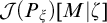 $\mathcal {J}(P_\xi )[M|\zeta ]$
, but then
$\mathcal {J}(P_\xi )[M|\zeta ]$
, but then $\zeta $
is regular in
$\zeta $
is regular in $\mathcal {J}(M|\xi )$
, contradicting that
$\mathcal {J}(M|\xi )$
, contradicting that $\rho _\omega ^{M|\xi }=\omega $
.
$\rho _\omega ^{M|\xi }=\omega $
.
Now suppose there is $\eta <\xi $
such that
$\eta <\xi $
such that $P_\eta $
exists and either projects
$P_\eta $
exists and either projects $<\zeta $
or is a Q-structure for
$<\zeta $
or is a Q-structure for $N_\zeta $
. If
$N_\zeta $
. If $P_\eta $
projects
$P_\eta $
projects $<\zeta $
then note that
$<\zeta $
then note that $P_\eta =M^{\mathcal {T}}_\zeta $
. But then working in
$P_\eta =M^{\mathcal {T}}_\zeta $
. But then working in $M|\xi $
, noting that
$M|\xi $
, noting that $\zeta =\omega _1^{M|\xi }$
, we can reach a contradiction as in the proof of Claim 5. So
$\zeta =\omega _1^{M|\xi }$
, we can reach a contradiction as in the proof of Claim 5. So $\rho _\omega ^{P_\eta }=\zeta $
and
$\rho _\omega ^{P_\eta }=\zeta $
and $P_\eta $
is a Q-structure for
$P_\eta $
is a Q-structure for $\zeta $
. But here we also reach a contradiction as in the proof of Claim 5.
$\zeta $
. But here we also reach a contradiction as in the proof of Claim 5.
It follows that $P_\xi $
exists and
$P_\xi $
exists and $P_\xi =Q^{\mathcal {T}}_\zeta $
, giving part 11 for
$P_\xi =Q^{\mathcal {T}}_\zeta $
, giving part 11 for $\zeta $
.
$\zeta $
.
Finally, if $\zeta <\beta _\gamma $
then
$\zeta <\beta _\gamma $
then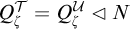 $Q^{\mathcal {T}}_\zeta =Q^{\mathcal {U}}_\zeta \triangleleft N$
, since
$Q^{\mathcal {T}}_\zeta =Q^{\mathcal {U}}_\zeta \triangleleft N$
, since $\zeta $
is not Woodin in N by assumption; and if
$\zeta $
is not Woodin in N by assumption; and if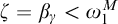 $\zeta =\beta _\gamma <\omega _1^M$
then
$\zeta =\beta _\gamma <\omega _1^M$
then $Q^{\mathcal {T}}_\zeta \neq Q^{\mathcal {U}}_\zeta $
and hence,
$Q^{\mathcal {T}}_\zeta \neq Q^{\mathcal {U}}_\zeta $
and hence, $Q^{\mathcal {T}}_\zeta \ntrianglelefteq N$
, since if
$Q^{\mathcal {T}}_\zeta \ntrianglelefteq N$
, since if $Q^{\mathcal {T}}_\zeta =Q^{\mathcal {U}}_\zeta $
then Case 3 would attain at stage
$Q^{\mathcal {T}}_\zeta =Q^{\mathcal {U}}_\zeta $
then Case 3 would attain at stage $\zeta $
(recall
$\zeta $
(recall $\alpha _\gamma <\zeta $
) and then we would have
$\alpha _\gamma <\zeta $
) and then we would have $Q^{\mathcal {T}}_\zeta \triangleleft N$
, contradicting the fact that
$Q^{\mathcal {T}}_\zeta \triangleleft N$
, contradicting the fact that $\beta _\gamma $
is Woodin in N. This establishes parts 12 and 13 for
$\beta _\gamma $
is Woodin in N. This establishes parts 12 and 13 for $\zeta $
, completing the induction.
$\zeta $
, completing the induction.
Claim 7. Let $\gamma \leq \Omega $
and
$\gamma \leq \Omega $
and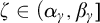 $\zeta \in (\alpha _\gamma ,\beta _\gamma ]$
be a limit. Then the following are equivalent:
$\zeta \in (\alpha _\gamma ,\beta _\gamma ]$
be a limit. Then the following are equivalent:
-
(i)
$\mathcal {J}(N_\zeta )\models $
“
$\delta _\zeta $
is Woodin” (equivalently,
$N_\zeta $
is not a Q-structure for
$\delta _\zeta $
); -
(ii)
$M|\zeta \models \mathrm {ZFC}^-\wedge \text {"}V=\mathrm {HC}$
” and
$\zeta>\chi _\gamma $
; -
(iii)
$M|\zeta \models \mathrm {ZFC}^-\wedge \text {"}V=\mathrm {HC}$
” and
$\zeta =\eta _\zeta =\delta _{\eta _\zeta }$
.





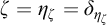
Proof. We have that (iii) implies (ii), because $\eta _{\alpha _\gamma +1}\geq \chi _\gamma $
. And (i) implies (iii) by the previous claim. So it suffices to see that (ii) implies (i).
$\eta _{\alpha _\gamma +1}\geq \chi _\gamma $
. And (i) implies (iii) by the previous claim. So it suffices to see that (ii) implies (i).
So suppose $\zeta>\chi _\gamma $
and
$\zeta>\chi _\gamma $
and $M|\zeta \models \mathrm {ZFC}^-$
, where
$M|\zeta \models \mathrm {ZFC}^-$
, where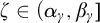 $\zeta \in (\alpha _\gamma ,\beta _\gamma ]$
. Then as in the proof of Claim 6, and because
$\zeta \in (\alpha _\gamma ,\beta _\gamma ]$
. Then as in the proof of Claim 6, and because $M|\zeta \models $
“
$M|\zeta \models $
“ $V=\mathrm {HC}$
”,
$V=\mathrm {HC}$
”, $(\mathcal {T},\mathcal {U})\!\upharpoonright \!\zeta \subseteq M|\zeta $
and
$(\mathcal {T},\mathcal {U})\!\upharpoonright \!\zeta \subseteq M|\zeta $
and $(\mathcal {T},\mathcal {U})\!\upharpoonright \!\zeta $
is definable from the parameter
$(\mathcal {T},\mathcal {U})\!\upharpoonright \!\zeta $
is definable from the parameter $(\mathcal {T},\mathcal {U})\!\upharpoonright \!(\alpha _\gamma +1)$
over
$(\mathcal {T},\mathcal {U})\!\upharpoonright \!(\alpha _\gamma +1)$
over $M|\zeta $
(the fact that
$M|\zeta $
(the fact that $M|\zeta \models $
“
$M|\zeta \models $
“ $V=\mathrm {HC}$
” ensures that at each non-trivial intermediate limit stage
$V=\mathrm {HC}$
” ensures that at each non-trivial intermediate limit stage $\zeta '$
, the P-construction computing
$\zeta '$
, the P-construction computing $Q^{\mathcal {T}}_{\zeta '}$
is performed by a proper segment of
$Q^{\mathcal {T}}_{\zeta '}$
is performed by a proper segment of $M|\zeta $
, using part 11 of Claim 6). So
$M|\zeta $
, using part 11 of Claim 6). So $\delta _\zeta =\zeta $
and
$\delta _\zeta =\zeta $
and $N_\zeta $
is a class of
$N_\zeta $
is a class of $M|\zeta $
.
$M|\zeta $
.
Now if $\mathcal {J}(N_\zeta )\models $
“
$\mathcal {J}(N_\zeta )\models $
“ $\zeta $
is not Woodin” then
$\zeta $
is not Woodin” then $[0,\zeta )_{\mathcal {T}}$
and
$[0,\zeta )_{\mathcal {T}}$
and $[0,\zeta )_{\mathcal {U}}$
are in
$[0,\zeta )_{\mathcal {U}}$
are in $M|(\zeta +\omega )$
, but
$M|(\zeta +\omega )$
, but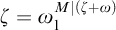 $\zeta =\omega _1^{M|(\zeta +\omega )}$
since
$\zeta =\omega _1^{M|(\zeta +\omega )}$
since $M|\zeta \models \mathrm {ZFC}^-$
, so we can again run the usual proof working in
$M|\zeta \models \mathrm {ZFC}^-$
, so we can again run the usual proof working in $M|(\zeta +\omega )$
for a contradiction.
$M|(\zeta +\omega )$
for a contradiction.
Write $\mathcal {T}_0=\mathcal {T}$
and
$\mathcal {T}_0=\mathcal {T}$
and $\mathcal {U}_0=\mathcal {U}$
. We now enter a proof by contradiction, by assuming that part 2 of the theorem fails for every
$\mathcal {U}_0=\mathcal {U}$
. We now enter a proof by contradiction, by assuming that part 2 of the theorem fails for every $\alpha <\omega _1^M$
. Then we can fix a conflicting pair
$\alpha <\omega _1^M$
. Then we can fix a conflicting pair $(R_1,S_1)$
with
$(R_1,S_1)$
with $\chi _\Omega <\zeta =_{\mathrm {def}}\omega _1^{R_1}=\omega _1^{S_1}$
. So
$\chi _\Omega <\zeta =_{\mathrm {def}}\omega _1^{R_1}=\omega _1^{S_1}$
. So $R_1\triangleleft M$
and
$R_1\triangleleft M$
and $R_1|\zeta =M|\zeta =S_1|\zeta $
. We have
$R_1|\zeta =M|\zeta =S_1|\zeta $
. We have
 $$\begin{align*}M|\zeta\models\mathrm{ZFC}^-\wedge \text{"}V=\mathrm{HC}\text{"},\end{align*}$$
so by Claim 7, $N_\zeta $
is not a Q-structure for itself, so the conclusions of Claim 6 hold for
$N_\zeta $
is not a Q-structure for itself, so the conclusions of Claim 6 hold for $\zeta $
.
$\zeta $
.
Repeat the foregoing comparison with $(R_1,S_1)$
replacing
$(R_1,S_1)$
replacing $(R_0,S_0)$
, producing trees
$(R_0,S_0)$
, producing trees $\mathcal {T}_1$
on
$\mathcal {T}_1$
on $R_1$
and
$R_1$
and $\mathcal {U}_1$
on
$\mathcal {U}_1$
on $S_1$
. Continue in this manner, producing a sequence
$S_1$
. Continue in this manner, producing a sequence
 $$\begin{align*}\left<R_n,\mathcal{T}_n,S_n,\mathcal{U}_n\right>_{n<\omega}. \end{align*}$$
(It is not relevant whether the sequence is in M.)
Now $\mathcal {T}_1$
is a tree on
$\mathcal {T}_1$
is a tree on $R_1$
, above
$R_1$
, above $\zeta =\omega _1^{R_1}$
. By Claim 6,
$\zeta =\omega _1^{R_1}$
. By Claim 6, $Q^{\mathcal {T}_0}_\zeta $
is the output of the P-construction of
$Q^{\mathcal {T}_0}_\zeta $
is the output of the P-construction of $R_1$
above
$R_1$
above $N_\zeta $
. So we can translate
$N_\zeta $
. So we can translate $\mathcal {T}_1$
into a tree
$\mathcal {T}_1$
into a tree $\mathcal {T}_1'$
on
$\mathcal {T}_1'$
on $Q^{\mathcal {T}_0}_\zeta $
; note this tree is above
$Q^{\mathcal {T}_0}_\zeta $
; note this tree is above $\zeta $
. So
$\zeta $
. So
 $$\begin{align*}\mathcal{X}_1=\mathcal{T}_0\!\upharpoonright\!(\zeta+1)\ \widehat{\ }\ \mathcal{T}_1' \end{align*}$$
is a correct normal tree on $R_0$
,
$R_0$
, $\zeta $
is a strong cutpoint of
$\zeta $
is a strong cutpoint of $\mathcal {X}_1$
, and
$\mathcal {X}_1$
, and $\mathcal {X}_1$
drops in model at
$\mathcal {X}_1$
drops in model at $\zeta +1$
, as
$\zeta +1$
, as $\mathcal {X}_1\!\upharpoonright \ $Q^{\mathcal {T}}_\zeta $
and
$Q^{\mathcal {T}}_\zeta $
and $Q^{\mathcal {T}}_\zeta \triangleleft M^{\mathcal {T}}_\zeta $
by Claim 6.
$Q^{\mathcal {T}}_\zeta \triangleleft M^{\mathcal {T}}_\zeta $
by Claim 6.
Continue recursively, defining $\left <\mathcal {X}_n\right>_{n<\omega }$
, by setting
$\left <\mathcal {X}_n\right>_{n<\omega }$
, by setting $\zeta _n=\omega _1^{R_{n+1}}$
, and translating
$\zeta _n=\omega _1^{R_{n+1}}$
, and translating $\mathcal {T}_{n+1}$
(on
$\mathcal {T}_{n+1}$
(on $R_{n+1}$
) into a tree
$R_{n+1}$
) into a tree $\mathcal {T}_{n+1}'$
on
$\mathcal {T}_{n+1}'$
on $Q(\mathcal {X}_n,[0,\zeta _n)^{\mathcal {X}_n})\triangleleft M^{\mathcal {X}_n}_{\zeta _n}$
(there is a natural finite sequence of intermediate translations between
$Q(\mathcal {X}_n,[0,\zeta _n)^{\mathcal {X}_n})\triangleleft M^{\mathcal {X}_n}_{\zeta _n}$
(there is a natural finite sequence of intermediate translations between $\mathcal {T}_{n+1}$
and
$\mathcal {T}_{n+1}$
and $\mathcal {T}_{n+1}'$
), and setting
$\mathcal {T}_{n+1}'$
), and setting
 $$\begin{align*}\mathcal{X}_{n+1}=\mathcal{X}_n\!\upharpoonright\!(\zeta_n+1)\ \widehat{\ }\ \mathcal{T}_{n+1}'.\end{align*}$$
Let $\mathcal {X}=\liminf _{n<\omega }\mathcal {X}_n$
. Then
$\mathcal {X}=\liminf _{n<\omega }\mathcal {X}_n$
. Then $\mathcal {X}$
is a correct normal tree on
$\mathcal {X}$
is a correct normal tree on $R_0$
. But it has a unique cofinal branch, which drops in model infinitely often, a contradiction. This completes the proof of the theorem.
$R_0$
. But it has a unique cofinal branch, which drops in model infinitely often, a contradiction. This completes the proof of the theorem.
Definition 4.3. Let N be a premouse, $\mathcal {T}$
a limit length iteration tree on some
$\mathcal {T}$
a limit length iteration tree on some $M\triangleleft N$
, and
$M\triangleleft N$
, and $\mathrm {OR}^M<\delta \leq \mathrm {OR}^N$
. We say that
$\mathrm {OR}^M<\delta \leq \mathrm {OR}^N$
. We say that $\mathcal {T}$
is
$\mathcal {T}$
is $N|\delta $
-optimal iff:
$N|\delta $
-optimal iff:
-
–
$\delta =\delta (\mathcal {T})$
, -
–
$\mathcal {T}\subseteq N||\delta $
and
$\mathcal {T}$
is definable from parameters over
$N||\delta $
, and -
–
$N||\delta $
is generic for the
$\delta $
-generator meas-lim extender algebra of
$M(\mathcal {T})$
.


Definition 4.4. Let N be a tame premouse satisfying $\mathrm {ZFC}^-\wedge \text {"}V=\mathrm {HC}$
”. Then
$\mathrm {ZFC}^-\wedge \text {"}V=\mathrm {HC}$
”. Then $\Lambda _{\mathrm {t}}^N$
(
$\Lambda _{\mathrm {t}}^N$
( $\mathrm {t}$
for tame) denotes the partial putative
$\mathrm {t}$
for tame) denotes the partial putative $(\omega ,\mathrm {OR}^N)$
-iteration strategy
$(\omega ,\mathrm {OR}^N)$
-iteration strategy $\Lambda $
for N, defined over N as follows. We define
$\Lambda $
for N, defined over N as follows. We define $\Lambda $
by induction on the length of trees. Let
$\Lambda $
by induction on the length of trees. Let $\mathcal {T}\in N$
. We say that
$\mathcal {T}\in N$
. We say that $\mathcal {T}$
is necessary if
$\mathcal {T}$
is necessary if $\mathcal {T}$
is an iteration tree via
$\mathcal {T}$
is an iteration tree via $\Lambda $
(hence
$\Lambda $
(hence $\omega$
-maximal), of limit length, and letting
$\omega$
-maximal), of limit length, and letting $\delta =\delta (\mathcal {T})$
, either:
$\delta =\delta (\mathcal {T})$
, either:
-
–
$M(\mathcal {T})$
is a Q-structure for itself, or -
–
$\mathcal {T}$
is
$N|\delta $
-optimal and either
$\mathrm {lgcd}(N|\delta )=\omega $
or
$\mathrm {lgcd}(N|\delta )=\omega _1^{N|\delta }$
.Footnote
13




Every $\mathcal {T}\in \mathrm {dom}(\Lambda )$
is necessary. Let
$\mathcal {T}\in \mathrm {dom}(\Lambda )$
is necessary. Let $\mathcal {T}$
be necessary and
$\mathcal {T}$
be necessary and $\delta =\delta (\mathcal {T})$
. Then
$\delta =\delta (\mathcal {T})$
. Then $\Lambda (\mathcal {T})=b$
iff
$\Lambda (\mathcal {T})=b$
iff $b\in N$
and either
$b\in N$
and either $Q(\mathcal {T},b)=M(\mathcal {T})$
or there is
$Q(\mathcal {T},b)=M(\mathcal {T})$
or there is $R\triangleleft N$
such that
$R\triangleleft N$
such that $\delta $
is a strong cutpoint of R and
$\delta $
is a strong cutpoint of R and $Q(\mathcal {T},b)$
is the output of the P-construction of R above
$Q(\mathcal {T},b)$
is the output of the P-construction of R above $M(\mathcal {T})$
.Footnote
14
$M(\mathcal {T})$
.Footnote
14
We say that N is tame-iterability-good iff all putative trees via $\Lambda ^N_{\mathrm {t}}$
have wellfounded models, and
$\Lambda ^N_{\mathrm {t}}$
have wellfounded models, and $\Lambda ^N_{\mathrm {t}}(\mathcal {T})$
is defined for all necessary
$\Lambda ^N_{\mathrm {t}}(\mathcal {T})$
is defined for all necessary $\mathcal {T}$
.
$\mathcal {T}$
.
Remark 4.5. Note that because $N\models $
“
$N\models $
“ $V=\mathrm {HC}$
”, every tree
$V=\mathrm {HC}$
”, every tree $\mathcal {T}$
on N drops immediately to some proper segment, and
$\mathcal {T}$
on N drops immediately to some proper segment, and $Q(\mathcal {T},b)$
exists for every limit length
$Q(\mathcal {T},b)$
exists for every limit length $\omega $
-maximal tree
$\omega $
-maximal tree $\mathcal {T}$
on N and
$\mathcal {T}$
on N and $\mathcal {T}$
-cofinal branch b with
$\mathcal {T}$
-cofinal branch b with $M^{\mathcal {T}}_b$
wellfounded. By Lemma 2.1 (local branch definability),
$M^{\mathcal {T}}_b$
wellfounded. By Lemma 2.1 (local branch definability),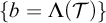 $\{b=\Lambda (\mathcal {T})\}$
is uniformly
$\{b=\Lambda (\mathcal {T})\}$
is uniformly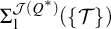 $\Sigma _1^{\mathcal {J}(Q^*)}(\{\mathcal {T}\})$
, where
$\Sigma _1^{\mathcal {J}(Q^*)}(\{\mathcal {T}\})$
, where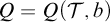 $Q=Q(\mathcal {T},b)$
and either
$Q=Q(\mathcal {T},b)$
and either $Q^*$
is the least segment of N such that
$Q^*$
is the least segment of N such that $\mathcal {T}$
is definable from parameters over
$\mathcal {T}$
is definable from parameters over $Q^*$
, when
$Q^*$
, when $Q=M(\mathcal {T})$
, or
$Q=M(\mathcal {T})$
, or $Q^*$
is the segment of N whose P-construction above
$Q^*$
is the segment of N whose P-construction above $M(\mathcal {T})$
is Q, when
$M(\mathcal {T})$
is Q, when $M(\mathcal {T})\triangleleft Q$
. In particular,
$M(\mathcal {T})\triangleleft Q$
. In particular, $\Lambda $
is
$\Lambda $
is $\Sigma _1$
-definable over N, and tame-iterability-good is expressed by a first-order formula
$\Sigma _1$
-definable over N, and tame-iterability-good is expressed by a first-order formula $\varphi $
(modulo
$\varphi $
(modulo $\mathrm {ZFC}^-$
).
$\mathrm {ZFC}^-$
).
The following lemma is proved as in [Reference Schindler and Steel6, Section1].
Lemma 4.6. Let M be a $(0,\omega _1+1)$
-iterable tame premouse satisfying either
$(0,\omega _1+1)$
-iterable tame premouse satisfying either $\mathrm {ZFC}^-$
or “
$\mathrm {ZFC}^-$
or “ $\omega _1$
exists”. Then
$\omega _1$
exists”. Then  is tame-iterability-good and
 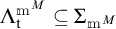 .
.
Gabriel Goldberg and Stefan Miedzianowski asked [Reference Schindler5] about the nature of grounds of mice via specific kinds of forcings, in particular $\sigma $
-closed and
$\sigma $
-closed and $\sigma $
-distributive. One result in this regard was established in [Reference Schlutzenberg11, Theorem 12.1], and we now improve this for tame mice modelling
$\sigma $
-distributive. One result in this regard was established in [Reference Schlutzenberg11, Theorem 12.1], and we now improve this for tame mice modelling $\mathrm {ZFC}$
.
$\mathrm {ZFC}$
.
Theorem 4.7. Let M be a $(0,\omega _1+1)$
-iterable tame premouse modelling
$(0,\omega _1+1)$
-iterable tame premouse modelling $\mathrm {ZFC}$
. Then M has no proper grounds W via forcings
$\mathrm {ZFC}$
. Then M has no proper grounds W via forcings ${\mathbb {P}}\in W$
with
${\mathbb {P}}\in W$
with $W\models $
“
$W\models $
“ ${\mathbb {P}}$
is strategically
${\mathbb {P}}$
is strategically $\sigma $
-closed”.
$\sigma $
-closed”.
Proof. By [Reference Schlutzenberg11, Theorem 12.1], it suffices to see that  , and of course we already have
  . So suppose
  . We will reach a contradiction via a slight variant of the construction for Theorem 4.2, so we just give a sketch. Recall that by [Reference Schindler and Steel6], we can fix $\xi <\omega _1^M$
such that
$\xi <\omega _1^M$
such that  (see also Definition 4.1 and Theorem 4.2). Also, M is the inductive condensation stack of M above
  (see [Reference Schlutzenberg10, Theorem 3.11 and Definition 3.12]). So we can fix a name
  for
for  and a name $\dot {\Sigma }\in W$
for
$\dot {\Sigma }\in W$
for  , and may assume that in W, ${\mathbb {P}}$
forces “the universe is that of a tame premouse N such that
${\mathbb {P}}$
forces “the universe is that of a tame premouse N such that  is tame-iterability-good, $\dot {\Sigma }$
is an above-
$\dot {\Sigma }$
is an above- $\check {\xi }$
-
$\check {\xi }$
- $(\omega ,\omega _1)$
-strategy for
$(\omega ,\omega _1)$
-strategy for  ,
, $\dot {\Sigma }$
is consistent with
$\dot {\Sigma }$
is consistent with  , N is the inductive condensation stack of N above
  , N satisfies various first order facts established in this article and elsewhere for tame mice, and
  ”.
”.
Recall $\mathrm {HC}^W=\mathrm {HC}^M$
. Work in W. Fix a strategy
$\mathrm {HC}^W=\mathrm {HC}^M$
. Work in W. Fix a strategy $\Psi $
witnessing that
$\Psi $
witnessing that ${\mathbb {P}}$
is strategically
${\mathbb {P}}$
is strategically $\sigma $
-closed. Pick some
$\sigma $
-closed. Pick some $(p_0,q_0)\in {\mathbb {P}}\times {\mathbb {P}}$
and some conflicting pair
$(p_0,q_0)\in {\mathbb {P}}\times {\mathbb {P}}$
and some conflicting pair $(R_0,S_0)$
such that
$(R_0,S_0)$
such that  “
“ ” and
” and  “
“ ” (where conflicting pair is defined like before, but with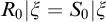 $R_0|\xi =S_0|\xi $
and
$R_0|\xi =S_0|\xi $
and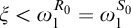 $\xi <\omega _1^{R_0}=\omega _1^{S_0}$
). Let
$\xi <\omega _1^{R_0}=\omega _1^{S_0}$
). Let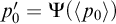 $p^{\prime }_0=\Psi (\left <p_0\right>)$
. Let
$p^{\prime }_0=\Psi (\left <p_0\right>)$
. Let $G\times H$
be
$G\times H$
be $(W,{\mathbb {P}}\times {\mathbb {P}})$
-generic with
$(W,{\mathbb {P}}\times {\mathbb {P}})$
-generic with $(p_0',q_0)\in G\times H$
. Note that
$(p_0',q_0)\in G\times H$
. Note that  “
“ $\check {{\mathbb {P}}}$
is strategically
$\check {{\mathbb {P}}}$
is strategically $\sigma $
-closed, as witnessed by
$\sigma $
-closed, as witnessed by $\check {\Psi }$
”.
$\check {\Psi }$
”.
Work in $W[G,H]$
. It follows that
$W[G,H]$
. It follows that $\mathrm {HC}^{W[G,H]}=\mathrm {HC}^{W[G]}=\mathrm {HC}^{W[H]}=\mathrm {HC}^M$
, and therefore
$\mathrm {HC}^{W[G,H]}=\mathrm {HC}^{W[G]}=\mathrm {HC}^{W[H]}=\mathrm {HC}^M$
, and therefore $\dot {\Sigma }_G,\dot {\Sigma }_H$
are above-
$\dot {\Sigma }_G,\dot {\Sigma }_H$
are above- $\xi $
-
$\xi $
- $(\omega ,\omega _1)$
-strategies in
$(\omega ,\omega _1)$
-strategies in $W[G,H]$
. Compare
$W[G,H]$
. Compare $R_0,S_0$
in the manner of the previous proof, producing trees
$R_0,S_0$
in the manner of the previous proof, producing trees $(\mathcal {T},\mathcal {U})$
, via
$(\mathcal {T},\mathcal {U})$
, via $\dot {\Sigma }_G,\dot {\Sigma }_H$
, except that we fold in
$\dot {\Sigma }_G,\dot {\Sigma }_H$
, except that we fold in  -genericity instead of
  -genericity. As before, the comparison lasts $\omega _1^M$
stages and
$\omega _1^M$
stages and $M(\mathcal {T},\mathcal {U})$
has boundedly many Woodins. Therefore there is some
$M(\mathcal {T},\mathcal {U})$
has boundedly many Woodins. Therefore there is some $\xi _1<\omega _1^M$
after which
$\xi _1<\omega _1^M$
after which $\mathcal {T},\mathcal {U}$
agree about all Q-structures, and these Q-structures are given by P-construction using proper segments of
$\mathcal {T},\mathcal {U}$
agree about all Q-structures, and these Q-structures are given by P-construction using proper segments of  . Let
. Let $\dot {\mathcal {T}}_0,\dot {\mathcal {U}}_0\in W$
be
$\dot {\mathcal {T}}_0,\dot {\mathcal {U}}_0\in W$
be ${\mathbb {P}}\times {\mathbb {P}}$
-names for
${\mathbb {P}}\times {\mathbb {P}}$
-names for $\mathcal {T},\mathcal {U}$
. For
$\mathcal {T},\mathcal {U}$
. For ${\mathbb {P}}$
-names
${\mathbb {P}}$
-names $\tau $
, let
$\tau $
, let $\tau _{\mathrm {lt}}$
and
$\tau _{\mathrm {lt}}$
and $\tau _{\mathrm {rt}}$
be the
$\tau _{\mathrm {rt}}$
be the ${\mathbb {P}}\times {\mathbb {P}}$
-names for the interpretation of
${\mathbb {P}}\times {\mathbb {P}}$
-names for the interpretation of $\tau $
with respect to the left and right projections of the generic filter, respectively.
$\tau $
with respect to the left and right projections of the generic filter, respectively.
Work in W. Let $(p_0",q_0")\leq (p_0',q_0)$
be such that
$(p_0",q_0")\leq (p_0',q_0)$
be such that 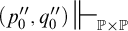 “
“ $\dot {\mathcal {T}}_0$
is a tree via
$\dot {\mathcal {T}}_0$
is a tree via $\dot {\Sigma }_{\mathrm {lt}}$
of length
$\dot {\Sigma }_{\mathrm {lt}}$
of length $\omega _1$
, and for every
$\omega _1$
, and for every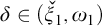 $\delta \in (\check {\xi }_1,\omega _1)$
, if
$\delta \in (\check {\xi }_1,\omega _1)$
, if  ” then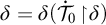 $\delta =\delta (\dot {\mathcal {T}}_0\!\upharpoonright \!\delta )$
and
$\delta =\delta (\dot {\mathcal {T}}_0\!\upharpoonright \!\delta )$
and $Q=Q(\dot {\mathcal {T}}_0\!\upharpoonright \!\delta ,[0,\delta )^{\dot {\mathcal {T}}_0})$
is given by P-construction of
$Q=Q(\dot {\mathcal {T}}_0\!\upharpoonright \!\delta ,[0,\delta )^{\dot {\mathcal {T}}_0})$
is given by P-construction of $Q'$
above
$Q'$
above $M(\dot {\mathcal {T}}_0\!\upharpoonright \!\delta )$
, where
$M(\dot {\mathcal {T}}_0\!\upharpoonright \!\delta )$
, where  is the least $\omega $
-premouse such that
$\omega $
-premouse such that $\delta \leq \mathrm {OR}^{Q'}$
, and moreover,
$\delta \leq \mathrm {OR}^{Q'}$
, and moreover, $Q\triangleleft M^{\dot {\mathcal {T}}_0}_\delta $
”. Pick some
$Q\triangleleft M^{\dot {\mathcal {T}}_0}_\delta $
”. Pick some $(p_1^-,q_1)\in {\mathbb {P}}\times {\mathbb {P}}$
and some
$(p_1^-,q_1)\in {\mathbb {P}}\times {\mathbb {P}}$
and some $(R_1,S_1)$
such that
$(R_1,S_1)$
such that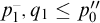 $p_1^-,q_1\leq p_0"$
, and
$p_1^-,q_1\leq p_0"$
, and $(R_1,S_1)$
is a conflicting pair with
$(R_1,S_1)$
is a conflicting pair with $R_1|\xi _1=S_1|\xi _1$
and
$R_1|\xi _1=S_1|\xi _1$
and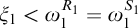 $\xi _1<\omega _1^{R_1}=\omega _1^{S_1}$
and
$\xi _1<\omega _1^{R_1}=\omega _1^{S_1}$
and  “
“ ” and
” and  “
“ ”. So
”. So 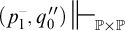 “With
“With $\delta =\omega _1^{\check {R_1}}$
, and
$\delta =\omega _1^{\check {R_1}}$
, and  as above, then $Q'=\check {R_1}$
”, and likewise
$Q'=\check {R_1}$
”, and likewise $(q_1,q_0")$
and
$(q_1,q_0")$
and $S_1$
. Let us now extend
$S_1$
. Let us now extend $p_1^-$
, so as to instantiate some of these (countable) objects in W. Let
$p_1^-$
, so as to instantiate some of these (countable) objects in W. Let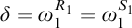 $\delta =\omega _1^{R_1}=\omega _1^{S_1}$
. Let
$\delta =\omega _1^{R_1}=\omega _1^{S_1}$
. Let $(p_1,q_0"')\leq (p_1^-, q_0")$
and
$(p_1,q_0"')\leq (p_1^-, q_0")$
and $\bar {\mathcal {T}}_0\in \mathrm {HC}^W$
be such that
$\bar {\mathcal {T}}_0\in \mathrm {HC}^W$
be such that $\bar {\mathcal {T}}_0$
is an above-
$\bar {\mathcal {T}}_0$
is an above- $\omega _1^{R_0}$
tree on
$\omega _1^{R_0}$
tree on $R_0$
of length
$R_0$
of length $\delta +1$
with
$\delta +1$
with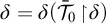 $\delta =\delta (\bar {\mathcal {T}}_0\!\upharpoonright \!\delta )$
, and
$\delta =\delta (\bar {\mathcal {T}}_0\!\upharpoonright \!\delta )$
, and 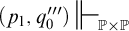 “
“ $\check {\bar {\mathcal {T}}}_0\trianglelefteq \dot {\mathcal {T}}_0$
”. Note then that
$\check {\bar {\mathcal {T}}}_0\trianglelefteq \dot {\mathcal {T}}_0$
”. Note then that $Q=Q(\bar {\mathcal {T}}_0\!\upharpoonright \!\delta ,[0,\delta )^{\bar {\mathcal {T}}_0})$
is given by the P-construction of
$Q=Q(\bar {\mathcal {T}}_0\!\upharpoonright \!\delta ,[0,\delta )^{\bar {\mathcal {T}}_0})$
is given by the P-construction of $R_1$
above
$R_1$
above $M(\bar {\mathcal {T}}_0\!\upharpoonright \!\delta )$
, and moreover,
$M(\bar {\mathcal {T}}_0\!\upharpoonright \!\delta )$
, and moreover, $Q\triangleleft M^{\bar {\mathcal {T}}_0}_\delta $
, and
$Q\triangleleft M^{\bar {\mathcal {T}}_0}_\delta $
, and  “
“ $\bar {\mathcal {T}}_0$
is via
$\bar {\mathcal {T}}_0$
is via $\dot {\Sigma }$
”. Let
$\dot {\Sigma }$
”. Let $p_1'=\Psi (p_0,p_0',p_1)$
.
$p_1'=\Psi (p_0,p_0',p_1)$
.
Carry on in this way, much as before, but also producing the sequence $\left <p_n,p_n'\right>_{n<\omega }$
via
$\left <p_n,p_n'\right>_{n<\omega }$
via $\Psi $
. We can then find
$\Psi $
. We can then find $p_\omega \in {\mathbb {P}}$
with
$p_\omega \in {\mathbb {P}}$
with $p_\omega \leq p_n$
for all
$p_\omega \leq p_n$
for all $n<\omega $
. Much as in the proof of Theorem 4.2, we can extend
$n<\omega $
. Much as in the proof of Theorem 4.2, we can extend $\bar {\mathcal {T}}_0$
to a tree
$\bar {\mathcal {T}}_0$
to a tree $\bar {\mathcal {T}}_\omega \in \mathrm {HC}^W$
such that
$\bar {\mathcal {T}}_\omega \in \mathrm {HC}^W$
such that  “
“ $\check {\bar {\mathcal {T}}}_\omega $
is via
$\check {\bar {\mathcal {T}}}_\omega $
is via $\dot {\Sigma }$
, but the only cofinal branch of
$\dot {\Sigma }$
, but the only cofinal branch of $\check {\bar {\mathcal {T}}}_\omega $
has infinitely many drops”, a contradiction.
$\check {\bar {\mathcal {T}}}_\omega $
has infinitely many drops”, a contradiction.
5 Candidates and their extensions
We now prepare for the proof of Theorem 1.3. The proof will use a combination of the methods of the previous section with those of [Reference Schlutzenberg10]. But nothing in this section requires tameness, and what we establish will also be used in Section 9.
Definition 5.1. Let $M\in \mathrm {pm}_1$
. We say that
$M\in \mathrm {pm}_1$
. We say that  is an M-candidate iff
  ,
,  is a premouse with
 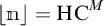 , and every initial segment of
  satisfies $(k+1)$
-condensation for every
$(k+1)$
-condensation for every $k<\omega $
. Let
$k<\omega $
. Let  be M-candidates and $\alpha <\omega _1^M$
. We say that
$\alpha <\omega _1^M$
. We say that  converges at $\alpha $
iff:
$\alpha $
iff:
-
–
(hence ), -
–
are inter-definable from parameters (i.e., is definable over from parameters and likewise over ), -
–
(and note ).
 (hence
 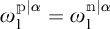 ),
), are inter-definable from parameters (i.e.,
  is definable over
  from parameters and likewise
  over
over  ),
),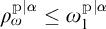 (and note
 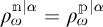 ).
).We say that  -converges at $\alpha $
iff
$\alpha $
iff  converges at $\alpha $
and
$\alpha $
and  .
.
Let  be M-candidates. We write
  iff
iff  converges at $\alpha $
and
$\alpha $
and

Let  .
.
Note that if $M\in \mathrm {pm}_1$
then
$M\in \mathrm {pm}_1$
then $\mathscr {P}^M\in M$
, and for each
$\mathscr {P}^M\in M$
, and for each $N\in \mathscr {P}^M$
, we have
$N\in \mathscr {P}^M$
, we have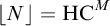 $\left \lfloor N\right \rfloor =\mathrm {HC}^M$
and N is
$\left \lfloor N\right \rfloor =\mathrm {HC}^M$
and N is $\Sigma _1$
-definable from parameters over
$\Sigma _1$
-definable from parameters over  .
.
Definition 5.2. Let $M\in \mathrm {pm}_1$
with either
$M\in \mathrm {pm}_1$
with either $\left \lfloor M\right \rfloor \models \mathrm {PS}$
or
$\left \lfloor M\right \rfloor \models \mathrm {PS}$
or $\left \lfloor M\right \rfloor \models \mathrm {ZFC}^-$
. Work in
$\left \lfloor M\right \rfloor \models \mathrm {ZFC}^-$
. Work in $\left \lfloor M\right \rfloor $
and let
$\left \lfloor M\right \rfloor $
and let  be an M-candidate. If the inductive condensation stack S above
  (see [Reference Schlutzenberg10, Definition 3.12]) has universe V, then we define
  ; otherwise
  is undefined.
Definition 5.3. A sound premouse N satisfies standard condensation iff N satisfies $(n+1)$
-condensation for every
$(n+1)$
-condensation for every $n<\omega $
.
$n<\omega $
.
Lemma 5.4. Let $M\in \mathrm {pm}_1$
be
$M\in \mathrm {pm}_1$
be $(0,\omega _1+1)$
-iterable, such that
$(0,\omega _1+1)$
-iterable, such that $\left \lfloor M\right \rfloor $
satisfies
$\left \lfloor M\right \rfloor $
satisfies $\mathrm {ZFC}^-$
or
$\mathrm {ZFC}^-$
or $\mathrm {PS}$
. Then:
$\mathrm {PS}$
. Then:
-
1. For all
, is well-defined, so has universe
$\left \lfloor M\right \rfloor $
, the proper segments of satisfy standard condensation, and . -
2.
$\mathbb {E}^M\!\upharpoonright \ ,
,  is well-defined, so has universe
 satisfy standard condensation, and
  .
.


Proof. Part 1: Let  . Work in $\left \lfloor M\right \rfloor $
.
$\left \lfloor M\right \rfloor $
.
Let $\alpha <\omega _1$
be such that
$\alpha <\omega _1$
be such that  and
and $\rho _\omega ^{M|\alpha }=\omega $
(such an
$\rho _\omega ^{M|\alpha }=\omega $
(such an $\alpha $
exists because if
$\alpha $
exists because if  then
then  for each $\alpha \in [\beta ,\omega _1)$
). So
$\alpha \in [\beta ,\omega _1)$
). So  and
and $M|\alpha $
project to
$M|\alpha $
project to $\omega $
and are inter-definable from parameters. Fix a real x coding the pair
$\omega $
and are inter-definable from parameters. Fix a real x coding the pair  , x definable over $M|\alpha $
. Let
$M|\alpha $
. Let  be the translations of
  to x-premice. Then
 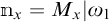 . So by the relativization to x of [Reference Schlutzenberg10, Theorem 3.11, Definition 3.12],
  is defined and has universe V. (If $\left \lfloor M\right \rfloor $
has a largest cardinal then
$\left \lfloor M\right \rfloor $
has a largest cardinal then $\left \lfloor M_x\right \rfloor \models \mathrm {ZFC}^-$
by assumption, which implies that
$\left \lfloor M_x\right \rfloor \models \mathrm {ZFC}^-$
by assumption, which implies that $M_x$
is tractable in the sense of [Reference Schlutzenberg10, Definition 3.10] (relativized to x), as it satisfies clause (vi) of that definition; note that property is coarse, just dependent on
$M_x$
is tractable in the sense of [Reference Schlutzenberg10, Definition 3.10] (relativized to x), as it satisfies clause (vi) of that definition; note that property is coarse, just dependent on $\left \lfloor M_x\right \rfloor =\left \lfloor M\right \rfloor $
, not
$\left \lfloor M_x\right \rfloor =\left \lfloor M\right \rfloor $
, not $\mathbb {E}^{M_x}$
.) In fact
$\mathbb {E}^{M_x}$
.) In fact  ,
,

and since  is iterable (as an x-mouse), its proper segments satisfy standard condensation (for x-mice).
Let  be the translation of
  to a standard premouse extending
  . So
. So  has universe V. We claim that
  . Most of the defining properties for
  (see [Reference Schlutzenberg10, 3.12]) just carry over from
  . However, some of the required properties are not quite immediate, because we can have hulls of segments of
  which do not include x in them, so do not correspond to hulls of segments of
  .
.
So let  and let $\bar {R}$
be countable and
$\bar {R}$
be countable and $\pi :\bar {R}\to R$
be elementary. We claim that there is some
$\pi :\bar {R}\to R$
be elementary. We claim that there is some  and
and $\sigma :\bar {R}\to S$
such that
$\sigma :\bar {R}\to S$
such that $\sigma $
is elementary. For we may assume that
$\sigma $
is elementary. For we may assume that $\omega _1\leq \mathrm {OR}^R$
, since otherwise
$\omega _1\leq \mathrm {OR}^R$
, since otherwise $S=R$
works. Let
$S=R$
works. Let $R_x$
be the translation of R to an x-premouse. Let
$R_x$
be the translation of R to an x-premouse. Let $\bar {R}^+_x$
be countable and
$\bar {R}^+_x$
be countable and $\pi ^+_x:\bar {R}^+_x\to R_x$
be elementary (with respect to the language of x-premice) with
$\pi ^+_x:\bar {R}^+_x\to R_x$
be elementary (with respect to the language of x-premice) with $\mathrm {rg}(\pi )\subseteq \mathrm {rg}(\pi ^+_x)$
. So there is some
$\mathrm {rg}(\pi )\subseteq \mathrm {rg}(\pi ^+_x)$
. So there is some  and
and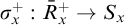 $\sigma _x^+:\bar {R}^+_x\to S_x$
which is elementary (for x-premice), and so
$\sigma _x^+:\bar {R}^+_x\to S_x$
which is elementary (for x-premice), and so $x\in \mathrm {rg}(\sigma _x^+)$
. Let
$x\in \mathrm {rg}(\sigma _x^+)$
. Let  be the translation of $S_x$
to a standard premouse. Let
$S_x$
to a standard premouse. Let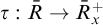 $\tau :\bar {R}\to \bar {R}^+_x$
be
$\tau :\bar {R}\to \bar {R}^+_x$
be $\tau =(\pi _x^+)^{-1}\circ \pi $
. Then
$\tau =(\pi _x^+)^{-1}\circ \pi $
. Then $\sigma ^+_x\circ \tau :\bar {R}\to S$
is elementary (with respect to the language of standard premice), as desired.
$\sigma ^+_x\circ \tau :\bar {R}\to S$
is elementary (with respect to the language of standard premice), as desired.
Standard condensation for proper segments of  (which is used both in the proof that
  , and also otherwise for part 1) now follows easily: supposing
  fails some condensation fact, let $\pi :\bar {R}\to R$
be elementary with
$\pi :\bar {R}\to R$
be elementary with $\bar {R}$
countable and
$\bar {R}$
countable and $\pi ,\bar {R}$
in M, and let
$\pi ,\bar {R}$
in M, and let  and
and  with
with $\sigma :\bar {R}\to S$
elementary. Then the failure of condensation reflects into S, contradicting our assumptions about
$\sigma :\bar {R}\to S$
elementary. Then the failure of condensation reflects into S, contradicting our assumptions about  . This completes the proof of part 1.
Part 2: This follows immediately from part 1.
By the lemma, to prove Theorem 1.3, it suffices to see that $\mathscr {P}^M$
is definable over
$\mathscr {P}^M$
is definable over $(\mathcal {H}_{\omega _2})^M$
without parameters. For this we will use a comparison argument very much like that of the proof of Theorem 1.1.
$(\mathcal {H}_{\omega _2})^M$
without parameters. For this we will use a comparison argument very much like that of the proof of Theorem 1.1.
Definition 5.5. Let $P\in \mathrm {pm}_1$
with
$P\in \mathrm {pm}_1$
with $P\models $
“
$P\models $
“ $\omega _1$
is the largest cardinal”. We say that P satisfies
$\omega _1$
is the largest cardinal”. We say that P satisfies $(1,\omega _1)$
-condensation iff for every premouse
$(1,\omega _1)$
-condensation iff for every premouse ${\bar {P}}$
with
${\bar {P}}$
with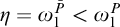 $\eta =\omega _1^{\bar {P}}<\omega _1^P$
, if
$\eta =\omega _1^{\bar {P}}<\omega _1^P$
, if ${\bar {P}}$
is
${\bar {P}}$
is $\eta $
-sound and
$\eta $
-sound and $\rho _1^{\bar {P}}\leq \eta $
and
$\rho _1^{\bar {P}}\leq \eta $
and $\pi :{\bar {P}}\to P$
is a near
$\pi :{\bar {P}}\to P$
is a near $0$
-embedding with
$0$
-embedding with $\mathrm {cr}(\pi )=\eta =\omega _1^{\bar {P}}$
(so
$\mathrm {cr}(\pi )=\eta =\omega _1^{\bar {P}}$
(so $\pi (\eta )=\omega _1^P$
) then
$\pi (\eta )=\omega _1^P$
) then ${\bar {P}}\triangleleft P$
.
${\bar {P}}\triangleleft P$
.
Definition 5.6. Let $M\in \mathrm {pm}_1$
. Work in M. Let
$M\in \mathrm {pm}_1$
. Work in M. Let  be a candidate. A Jensen extension of
  is a sound premouse
  such that:
-
–
, -
– there is
$k<\omega $
such that and
$(k+1)$
-condensation holds for , and -
– if
“
$\omega _1$
is the largest cardinal” then
$(1,\omega _1)$
-condensation holds for .
 ,
,
 and
and 
 , and
, and “
“

 .
.An $\mathcal {S}$
-Jensen extension of
$\mathcal {S}$
-Jensen extension of  is a structure of the form
  , where
  is a Jensen extension of
  and
and $m<\omega $
.
$m<\omega $
.
Lemma 5.7. Let $M\in \mathrm {pm}_1$
. Work in M. Let
$M\in \mathrm {pm}_1$
. Work in M. Let  be a candidate. Then:
-
1. For each Jensen extension S of
, all segments of S satisfy standard condensation. -
2. For all Jensen extensions
$S_0,S_1$
of , either
$S_0\trianglelefteq S_1$
or
$S_1\trianglelefteq S_0$
.
 , all segments of S satisfy standard condensation.
 , either

Proof. Part 1: All segments of  satisfy standard condensation, as
  is a candidate. But by the assumed condensation for S, we can reflect segments of S down to segments of
  , with a $\Sigma _m$
-elementary map, with
$\Sigma _m$
-elementary map, with $m<\omega $
arbitrarily high.
$m<\omega $
arbitrarily high.
Part 2: One can run Jensen’s standard proof (e.g., [Reference Schlutzenberg10, Fact 3.1]) inside M, unless $M=\mathcal {J}(M')$
for some
$M=\mathcal {J}(M')$
for some $M'$
. In the latter case, we get
$M'$
. In the latter case, we get $S_0,S_1\in \mathcal {S}_n(M')$
for some
$S_0,S_1\in \mathcal {S}_n(M')$
for some $n<\omega $
. But then for any
$n<\omega $
. But then for any $m<\omega $
, in M we can form
$m<\omega $
, in M we can form $\Sigma _m$
-elementary substructures of
$\Sigma _m$
-elementary substructures of $\mathcal {S}_n(M')$
whose transitive collapse
$\mathcal {S}_n(M')$
whose transitive collapse $\bar {\mathcal {S}}$
is in
$\bar {\mathcal {S}}$
is in $M|\omega _1^M$
, with the uncollapse map
$M|\omega _1^M$
, with the uncollapse map $\pi :\bar {\mathcal {S}}\to \mathcal {S}_n(M')$
in M, and such that
$\pi :\bar {\mathcal {S}}\to \mathcal {S}_n(M')$
in M, and such that $S_0,S_1\in \mathrm {rg}(\pi )$
and
$S_0,S_1\in \mathrm {rg}(\pi )$
and $\mathrm {rg}(\pi )\cap \omega _1^M=\alpha $
for some
$\mathrm {rg}(\pi )\cap \omega _1^M=\alpha $
for some $\alpha <\omega _1^M$
. By condensation, we get a contradiction as in Jensen’s proof.
$\alpha <\omega _1^M$
. By condensation, we get a contradiction as in Jensen’s proof.
Lemma 5.7 gives that the stack  defined below is a premouse extending
  .
.
Definition 5.8. Let $M\in \mathrm {pm}_1$
. Work in M. Let
$M\in \mathrm {pm}_1$
. Work in M. Let  be a candidate. Then
  denotes the stack of all $\mathcal {S}$
-Jensen extensions of
$\mathcal {S}$
-Jensen extensions of  . We often write
 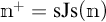 . Say
. Say  is strong if
-
(i)
has universe
$\mathcal {H}_{\omega _2}$
, and -
(ii) if
$M\models $
“
$\omega _1$
is the largest cardinal” then satisfies
$(1,\omega _1)$
-condensation.
 has universe


 satisfies
Definition 5.9. A premouse M is tractable if $M\in \mathrm {pm}_1$
, all proper segments of M satisfy standard condensation, and if
$M\in \mathrm {pm}_1$
, all proper segments of M satisfy standard condensation, and if $M\models $
“
$M\models $
“ $\omega _1$
is the largest cardinal” then
$\omega _1$
is the largest cardinal” then
-
–
$\omega <\rho _1^M$
, and -
– M satisfies
$(1,\omega _1)$
-condensation.


A premouse M is strongly tractable if it is tractable and if $M\models $
“
$M\models $
“ $\omega _1$
is the largest cardinal” then
$\omega _1$
is the largest cardinal” then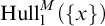 $\mathrm {Hull}_1^M(\{x\})$
is bounded in
$\mathrm {Hull}_1^M(\{x\})$
is bounded in $\mathrm {OR}^M$
for all
$\mathrm {OR}^M$
for all $x\in M$
.
$x\in M$
.
Lemma 5.10. If M is a $(0,\omega _1+1)$
-iterable tractable premouse then
$(0,\omega _1+1)$
-iterable tractable premouse then  is a strong candidate in M.
Proof. By standard condensation facts,  , which easily implies the lemma.
Definition 5.11. Let $M\in \mathrm {pm}_1$
. Let
$M\in \mathrm {pm}_1$
. Let  be candidates of M. Let $\varepsilon <\omega _1^M$
. We say
$\varepsilon <\omega _1^M$
. We say  diverges at $\varepsilon $
iff there is
$\varepsilon $
iff there is $\gamma <\varepsilon $
such that
$\gamma <\varepsilon $
such that  converges at $\gamma $
and
$\gamma $
and $\varepsilon $
is least
$\varepsilon $
is least ${>\gamma }$
such that
${>\gamma }$
such that  . We say
  -diverges at $\varepsilon $
iff
$\varepsilon $
iff  diverges at $\varepsilon $
and there is
$\varepsilon $
and there is $\gamma $
as above such that
$\gamma $
as above such that  -converges at $\gamma $
. If
$\gamma $
. If  -diverges at $\varepsilon $
then
$\varepsilon $
then  denotes
 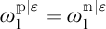 (so by $\omega $
-divergence,
$\omega $
-divergence,  ).
).
Note that if  converges at $\gamma $
then
$\gamma $
then $\gamma $
is a strong cutpoint of
$\gamma $
is a strong cutpoint of  , and if also
  , then
  and
and  are inter-definable from $\gamma $
and parameters in
$\gamma $
and parameters in  , uniformly in $\varepsilon $
in a
$\varepsilon $
in a $\Delta _1$
fashion, and likewise for
$\Delta _1$
fashion, and likewise for  if also
  . Note also that if
  diverges at $\varepsilon $
and
$\varepsilon $
and $\gamma $
is as above, then
$\gamma $
is as above, then 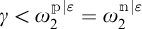 (we have
 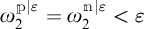 as either
  is active or
  is active).
Lemma 5.12. Let M be a $(0,\omega _1+1)$
-iterable tractable premouse. Let
$(0,\omega _1+1)$
-iterable tractable premouse. Let  be a strong candidate in M. Then
  -converges at unboundedly many $\gamma <\omega _1^M$
.
$\gamma <\omega _1^M$
.
Proof. We consider first the case that either $M\in \mathrm {pm}_2$
or there is no
$M\in \mathrm {pm}_2$
or there is no $M'\triangleleft M$
such that
$M'\triangleleft M$
such that $M=\mathcal {J}(M')$
, and then sketch the modifications needed for the other case. Write
$M=\mathcal {J}(M')$
, and then sketch the modifications needed for the other case. Write 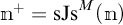 for M-candidates
  .
.
Let  and
and  . (So
. (So 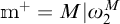 .) Given
  , let
, let  be the least
  with
with  and
and  and
and  ; and define
  symmetrically from
  . Let
. Let  be the stack of all
  , and
, and  likewise. Note that
  have the same universe U, and
  is
is  (as
(as  is the stack of all Jensen extensions of
  in U), and likewise for
  from
from  , so in particular,
  are inter-definable from parameters. Also,
 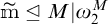 .
.
Note that 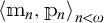 is also
  , so
, so 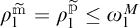 . In fact
  , for if
  then
then  “
“ $\omega _1$
is the largest cardinal”, so by tractability,
$\omega _1$
is the largest cardinal”, so by tractability, $\omega <\rho _1^M$
, a contradiction.
$\omega <\rho _1^M$
, a contradiction.
We claim that  is
is $1$
-sound. For if
$1$
-sound. For if 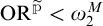 , then since
  is a strong candidate, there is a Jensen extension
  of
of  with
with  , and Jensen extensions are sound by assumption, which suffices for this. So suppose
 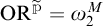 , so
, so  , which has universe that of $(\mathcal {H}_{\omega _2})^M=\left \lfloor M\right \rfloor $
under these circumstances. Since
$(\mathcal {H}_{\omega _2})^M=\left \lfloor M\right \rfloor $
under these circumstances. Since 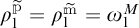 and
and  is cofinal in
  , it follows that
  . So it suffices to see that
  is
is $1$
-solid, so assume
$1$
-solid, so assume  and let
 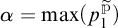 . Then $\alpha \geq \omega _1^M$
. Let
$\alpha \geq \omega _1^M$
. Let 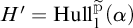 . Then
  , because otherwise note that $\alpha \in H'$
, contradicting the minimality of
$\alpha \in H'$
, contradicting the minimality of  . Finally note now that
  , since
  . So
. So  is
is $1$
-solid, as desired.
$1$
-solid, as desired.
Let $\eta _0<\omega _1^M$
be the least
$\eta _0<\omega _1^M$
be the least $\eta $
such that
$\eta $
such that

(where $w_1$
denotes the set of
$w_1$
denotes the set of $1$
-solidity witnesses). For
$1$
-solidity witnesses). For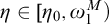 $\eta \in [\eta _0,\omega _1^M)$
, note that because of the definability of
$\eta \in [\eta _0,\omega _1^M)$
, note that because of the definability of  from
from  and
and  from
from  ,
,

Let $H_\eta ,H^{\prime }_\eta $
be the transitive collapses of these hulls, respectively,
$H_\eta ,H^{\prime }_\eta $
be the transitive collapses of these hulls, respectively, 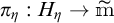 and
and 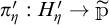 the uncollapse maps. Note that $\pi _\eta =\pi ^{\prime }_\eta $
and
$\pi _\eta =\pi ^{\prime }_\eta $
and $H_\eta ,H^{\prime }_\eta $
have the same universe and are inter-definable from parameters. Let C be the set of all
$H_\eta ,H^{\prime }_\eta $
have the same universe and are inter-definable from parameters. Let C be the set of all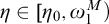 $\eta \in [\eta _0,\omega _1^M)$
with
$\eta \in [\eta _0,\omega _1^M)$
with $\eta =\omega _1^{H_\eta }=\mathrm {cr}(\pi _\eta )$
. Note that if
$\eta =\omega _1^{H_\eta }=\mathrm {cr}(\pi _\eta )$
. Note that if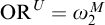 $\mathrm {OR}^U=\omega _2^M$
, i.e.,
$\mathrm {OR}^U=\omega _2^M$
, i.e.,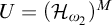 $U=(\mathcal {H}_{\omega _2})^M$
, then
$U=(\mathcal {H}_{\omega _2})^M$
, then $M\models $
“
$M\models $
“ $\omega _1$
is the largest cardinal”, so
$\omega _1$
is the largest cardinal”, so $\omega <\rho _1^M$
by tractability. So in any case, C is club in
$\omega <\rho _1^M$
by tractability. So in any case, C is club in $\omega _1^M$
(but it seems the ordertype of C might only be
$\omega _1^M$
(but it seems the ordertype of C might only be $\omega $
). Let
$\omega $
). Let $\eta \in C$
. Then
$\eta \in C$
. Then $H_\eta ,H^{\prime }_\eta $
are
$H_\eta ,H^{\prime }_\eta $
are $\eta $
-sound, so by
$\eta $
-sound, so by $(1,\omega _1)$
-condensation,
$(1,\omega _1)$
-condensation,  and
and  . So
. So  converges at $\mathrm {OR}^{H_\eta }$
. Now let
$\mathrm {OR}^{H_\eta }$
. Now let $\eta <\xi $
be consecutive elements of C. Then
$\eta <\xi $
be consecutive elements of C. Then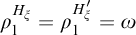 $\rho _1^{H_\xi }=\rho _1^{H^{\prime }_\xi }=\omega $
, because note that
$\rho _1^{H_\xi }=\rho _1^{H^{\prime }_\xi }=\omega $
, because note that

so $H_\xi =\mathrm {Hull}_1^{H_\xi }(\{q\})$
, where
$H_\xi =\mathrm {Hull}_1^{H_\xi }(\{q\})$
, where  , and likewise for $H_\xi '$
. So
$H_\xi '$
. So  -converges at $\xi $
. Since this holds for cofinally many
$\xi $
. Since this holds for cofinally many $\xi <\omega _1^M$
, we are done.
$\xi <\omega _1^M$
, we are done.
If instead $M\models $
“
$M\models $
“ $\omega _1$
is the largest cardinal” and
$\omega _1$
is the largest cardinal” and $M=\mathcal {J}(M')$
(so
$M=\mathcal {J}(M')$
(so $\rho _\omega ^{M'}=\omega _1^M$
) then proceed similarly, but define
$\rho _\omega ^{M'}=\omega _1^M$
) then proceed similarly, but define  with
with $k_0=\ell _0=0$
and
$k_0=\ell _0=0$
and  is the least
  such that
  and there is $k<\omega $
such that
$k<\omega $
such that 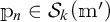 and
and $k_n,\ell _n<k$
, and then let
$k_n,\ell _n<k$
, and then let $k_{n+1}$
be the least witnessing k, and define
$k_{n+1}$
be the least witnessing k, and define  symmetrically. Define
  in the obvious manner from this sequence (and once again, they have a common universe U, and now
 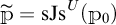 , etc.).Footnote
15
Now proceed much as before.
, etc.).Footnote
15
Now proceed much as before.
Definition 5.13. In the above context, let  denote
  and
and  denote
  .
.
6 Tail definability of
$\mathbb {E}$
in tame mice

For this section and the next, we restrict our attention to tame mice.
Definition 6.1. Let $M\in \mathrm {pm}_1$
be tame. We say that an M-candidate
$M\in \mathrm {pm}_1$
be tame. We say that an M-candidate  is tame-good iff
  is strong and tame-iterability-good (see Definitions 4.4 and 5.8) in M. We write $\mathscr {G}_{\mathrm {t}}^M$
, for the set of tame-good candidates of M. For the most part we abbreviate
$\mathscr {G}_{\mathrm {t}}^M$
, for the set of tame-good candidates of M. For the most part we abbreviate $\mathscr {G}_{\mathrm {t}}$
with
$\mathscr {G}_{\mathrm {t}}$
with $\mathscr {G}$
.
$\mathscr {G}$
.
Remark 6.2. $\mathscr {G}^M_{\mathrm {t}}$
is
$\mathscr {G}^M_{\mathrm {t}}$
is $\Pi _2^{\mathcal {H}_\delta ^M}$
, where
$\Pi _2^{\mathcal {H}_\delta ^M}$
, where $\delta ={\omega _2^M}$
(the definability is without parameters).
$\delta ={\omega _2^M}$
(the definability is without parameters).
Lemma 6.3. Let M be a $(0,\omega _1+1)$
-iterable tractable tame premouse. Then
$(0,\omega _1+1)$
-iterable tractable tame premouse. Then  . Therefore $\mathscr {P}^M$
is definable over
$\mathscr {P}^M$
is definable over $\mathcal {H}_{\omega _2^M}^M$
without parameters.
$\mathcal {H}_{\omega _2^M}^M$
without parameters.
Proof. Write $\mathscr {G}^M=\mathscr {G}_{\mathrm {t}}^M$
. The “therefore” clause follows from the rest, as given any M-candidate
$\mathscr {G}^M=\mathscr {G}_{\mathrm {t}}^M$
. The “therefore” clause follows from the rest, as given any M-candidate  , we get
  iff
iff  for some
  and some $\alpha <\omega _1^M$
. And
$\alpha <\omega _1^M$
. And  by Lemmas 4.6 and 5.10.
So let  ; we show
  . For this, we use a comparison argument very much like in the proof of Theorem 4.2 (but only its first round, which produced the trees $\mathcal {T}_0,\mathcal {U}_0$
there), so we only outline enough to explain the differences.
$\mathcal {T}_0,\mathcal {U}_0$
there), so we only outline enough to explain the differences.
It suffices to see find some $\gamma <\omega _1^M$
such that
$\gamma <\omega _1^M$
such that  -converges at $\gamma $
, and does not diverge at any
$\gamma $
, and does not diverge at any $\varepsilon>\gamma $
. So suppose we cannot, and for each
$\varepsilon>\gamma $
. So suppose we cannot, and for each $\gamma $
such that
$\gamma $
such that  -converges at $\gamma $
, let
$\gamma $
, let $\varepsilon ^{\prime }_\gamma $
be the least
$\varepsilon ^{\prime }_\gamma $
be the least $\varepsilon>\gamma $
such that
$\varepsilon>\gamma $
such that  diverges at $\varepsilon $
. Let
$\varepsilon $
. Let $C'$
be the set of all
$C'$
be the set of all $\gamma <\omega _1^M$
such that
$\gamma <\omega _1^M$
such that  -converges at $\gamma $
. By Lemma 5.12,
$\gamma $
. By Lemma 5.12, $C'$
is cofinal in
$C'$
is cofinal in $\omega _1^M$
, and clearly
$\omega _1^M$
, and clearly $0\in C'$
. Define a sequence
$0\in C'$
. Define a sequence $\left <\gamma _\alpha \right>_{\alpha <\omega _1^M}$
by
$\left <\gamma _\alpha \right>_{\alpha <\omega _1^M}$
by $\gamma _0=0$
, and given
$\gamma _0=0$
, and given $\left <\gamma _\alpha \right>_{\alpha <\lambda }$
with
$\left <\gamma _\alpha \right>_{\alpha <\lambda }$
with $\lambda <\omega _1^M$
, then
$\lambda <\omega _1^M$
, then $\gamma _{\lambda }$
is the least
$\gamma _{\lambda }$
is the least $\gamma \in C'$
with
$\gamma \in C'$
with $\gamma \geq \sup _{\alpha <\lambda }\varepsilon ^{\prime }_{\gamma _\alpha }$
. So
$\gamma \geq \sup _{\alpha <\lambda }\varepsilon ^{\prime }_{\gamma _\alpha }$
. So $\left <\gamma _\alpha \right>_{\alpha <\omega _1^M}$
is cofinal in
$\left <\gamma _\alpha \right>_{\alpha <\omega _1^M}$
is cofinal in $\omega _1^M$
. Now let
$\omega _1^M$
. Now let $\varepsilon _\alpha =\varepsilon ^{\prime }_{\gamma _\alpha }$
and
$\varepsilon _\alpha =\varepsilon ^{\prime }_{\gamma _\alpha }$
and

Let $R_\alpha $
be the least
$R_\alpha $
be the least $R\triangleleft M$
with
$R\triangleleft M$
with $M|\varepsilon _\alpha \trianglelefteq R$
and
$M|\varepsilon _\alpha \trianglelefteq R$
and $\rho _\omega ^R=\omega $
, and
$\rho _\omega ^R=\omega $
, and  likewise. So
 $$\begin{align*}\gamma_\alpha<\delta_\alpha=\omega_1^{R_\alpha}=\omega_1^{S_\alpha}<\varepsilon_\alpha\leq \mathrm{OR}^{R_\alpha},\mathrm{OR}^{S_\alpha}\leq\gamma_{\alpha+1}. \end{align*}$$
Note that $\gamma _0=0$
and
$\gamma _0=0$
and $\varepsilon _0$
indexes the least disagreement between
$\varepsilon _0$
indexes the least disagreement between  .
.
We will define a length $\omega _1^M$
comparison/genericity iteration
$\omega _1^M$
comparison/genericity iteration $(\mathcal {T},\mathcal {U})$
of
$(\mathcal {T},\mathcal {U})$
of $(R_0,S_0)$
, via
$(R_0,S_0)$
, via  , such that $\left <\delta _\alpha \right>_{0<\alpha <\omega _1^M}$
are exactly the Woodin cardinals of
$\left <\delta _\alpha \right>_{0<\alpha <\omega _1^M}$
are exactly the Woodin cardinals of $M(\mathcal {T},\mathcal {U})$
. Then as in the proof of Theorem 4.2, because
$M(\mathcal {T},\mathcal {U})$
. Then as in the proof of Theorem 4.2, because $M(\mathcal {T},\mathcal {U})$
has a proper class of Woodins and
$M(\mathcal {T},\mathcal {U})$
has a proper class of Woodins and  are tame, we will have $\mathcal {T}$
-cofinal and
$\mathcal {T}$
-cofinal and $\mathcal {U}$
-cofinal branches, and this will give a contradiction.
$\mathcal {U}$
-cofinal branches, and this will give a contradiction.
Given $(\mathcal {T},\mathcal {U})\!\upharpoonright \!(\alpha +1)$
, let
$(\mathcal {T},\mathcal {U})\!\upharpoonright \!(\alpha +1)$
, let $F^{\mathcal {T}}_\alpha ,F^{\mathcal {U}}_\alpha $
be the least disagreement between
$F^{\mathcal {T}}_\alpha ,F^{\mathcal {U}}_\alpha $
be the least disagreement between $(M^{\mathcal {T}}_\alpha ,M^{\mathcal {U}}_\alpha )$
, write
$(M^{\mathcal {T}}_\alpha ,M^{\mathcal {U}}_\alpha )$
, write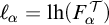 $\ell _\alpha =\mathrm {lh}(F^{\mathcal {T}}_\alpha )$
or
$\ell _\alpha =\mathrm {lh}(F^{\mathcal {T}}_\alpha )$
or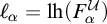 $\ell _\alpha =\mathrm {lh}(F^{\mathcal {U}}_\alpha )$
, whichever is defined, and
$\ell _\alpha =\mathrm {lh}(F^{\mathcal {U}}_\alpha )$
, whichever is defined, and $K_\alpha =M^{\mathcal {T}}_\alpha ||\ell _\alpha =M^{\mathcal {U}}_\alpha ||\ell _\alpha $
.
$K_\alpha =M^{\mathcal {T}}_\alpha ||\ell _\alpha =M^{\mathcal {U}}_\alpha ||\ell _\alpha $
.
We first define $(\mathcal {T}_1,\mathcal {U}_1)=(\mathcal {T},\mathcal {U})\!\upharpoonright \!(\delta _1+1)$
; this will yield
$(\mathcal {T}_1,\mathcal {U}_1)=(\mathcal {T},\mathcal {U})\!\upharpoonright \!(\delta _1+1)$
; this will yield $\delta ((\mathcal {T}_1,\mathcal {U}_1)\!\upharpoonright \!\delta _1)=\delta _1$
and
$\delta ((\mathcal {T}_1,\mathcal {U}_1)\!\upharpoonright \!\delta _1)=\delta _1$
and $M((\mathcal {T}_1,\mathcal {U}_1)\!\upharpoonright \!\delta _1)$
will be definable from parameters over
$M((\mathcal {T}_1,\mathcal {U}_1)\!\upharpoonright \!\delta _1)$
will be definable from parameters over $M|\delta _1$
, and equivalently, over
$M|\delta _1$
, and equivalently, over  (note that
  are inter-definable from parameters).
We have $\mathrm {OR}^{R_0},\mathrm {OR}^{S_0}\leq \gamma _1$
. We construct
$\mathrm {OR}^{R_0},\mathrm {OR}^{S_0}\leq \gamma _1$
. We construct $(\mathcal {T}_1,\mathcal {U}_1)$
by comparison subject to folding in meas-lim genericity iteration and short linear iterations, much as in the proof of Theorem 4.2. Now
$(\mathcal {T}_1,\mathcal {U}_1)$
by comparison subject to folding in meas-lim genericity iteration and short linear iterations, much as in the proof of Theorem 4.2. Now $(\mathcal {T}_1,\mathcal {U}_1)$
has two phases. In the first we fold in a short linear iteration at the least measurable of
$(\mathcal {T}_1,\mathcal {U}_1)$
has two phases. In the first we fold in a short linear iteration at the least measurable of $K_\alpha $
(i.e., if
$K_\alpha $
(i.e., if $K_\alpha $
has a least measurable cardinal
$K_\alpha $
has a least measurable cardinal $\mu $
, then we set
$\mu $
, then we set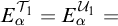 $E^{\mathcal {T}_1}_\alpha =E^{\mathcal {U}_1}_\alpha =$
the least normal measure on
$E^{\mathcal {T}_1}_\alpha =E^{\mathcal {U}_1}_\alpha =$
the least normal measure on $\mu $
, and otherwise
$\mu $
, and otherwise $E^{\mathcal {T}_1}_\alpha =F^{\mathcal {T}}_\alpha $
and
$E^{\mathcal {T}_1}_\alpha =F^{\mathcal {T}}_\alpha $
and $E^{\mathcal {U}_1}_\alpha =F^{\mathcal {U}}_\alpha $
), until we reach the least
$E^{\mathcal {U}_1}_\alpha =F^{\mathcal {U}}_\alpha $
), until we reach the least $\alpha $
such that
$\alpha $
such that $\gamma _1\leq \ell _\alpha $
. In the second phase, we fold in meas-lim extender algebra violations for making
$\gamma _1\leq \ell _\alpha $
. In the second phase, we fold in meas-lim extender algebra violations for making  generic (with the meas-lim requirements from the perspective of $K_\alpha $
, as in the proof of Theorem 4.2). We continue in this manner until producing
$K_\alpha $
, as in the proof of Theorem 4.2). We continue in this manner until producing $(\mathcal {T}_1,\mathcal {U}_1)$
of length
$(\mathcal {T}_1,\mathcal {U}_1)$
of length $\delta _1$
.
$\delta _1$
.
At limit stages of $(\mathcal {T}_1,\mathcal {U}_1)$
(and
$(\mathcal {T}_1,\mathcal {U}_1)$
(and $(\mathcal {T},\mathcal {U})$
in general) we use
$(\mathcal {T},\mathcal {U})$
in general) we use  to select branches. Thus, we need to verify that this makes sense, i.e., that the trees at those stages are necessary. Note also that $M|\delta _1$
and
$M|\delta _1$
and  satisfy $\mathrm {ZFC}^-$
, contain
$\mathrm {ZFC}^-$
, contain $R_0,S_0,\gamma _1$
, and moreover,
$R_0,S_0,\gamma _1$
, and moreover, $M|\delta _1$
and
$M|\delta _1$
and  are inter-definable from parameters, so the extender selection process just described is definable from parameters over both.
Let $\lambda \leq \delta _1$
be a limit with
$\lambda \leq \delta _1$
be a limit with $N=M((\mathcal {T},\mathcal {U})\!\upharpoonright \!\lambda )$
not a Q-structure for itself, and let
$N=M((\mathcal {T},\mathcal {U})\!\upharpoonright \!\lambda )$
not a Q-structure for itself, and let $\delta =\delta ((\mathcal {T},\mathcal {U})\!\upharpoonright \!\lambda )$
. We claim:
$\delta =\delta ((\mathcal {T},\mathcal {U})\!\upharpoonright \!\lambda )$
. We claim:
-
1.
$M|\delta $
and are meas-lim extender algebra generic over N at
$\delta $
; -
2.
$M|\delta $
and satisfy
$\mathrm {ZFC}^-+$
“
$V=\mathrm {HC}$
”; -
3.
$N\models $
“There are no Woodin cardinals”; -
4.
$\lambda =\delta $
and and
$(\mathcal {T},\mathcal {U})\!\upharpoonright \!\delta $
is definable from parameters over
$M|\delta $
and ; -
5. letting
$\gamma \geq \delta $
be least with
$\rho _\omega ^{M|\gamma }=\omega $
, the P-construction Q of
$M|\gamma $
over N is defined,
$\mathrm {OR}^Q=\gamma $
, and Q is a Q-structure for N; and likewise for and the least
$\gamma '\geq \delta $
with , which yields a Q-structure
$Q'$
for N; -
6. if
$\delta <\delta _1$
then
$Q=Q'$
, where
$Q,Q'$
are as above.

 are meas-lim extender algebra generic over N at

 satisfy


 and
and 

 ;
;


 and the least
 , which yields a Q-structure


This is by induction on $\lambda $
, and much as in the proof of Theorem 4.2. Items 1 and 2 are as there.
$\lambda $
, and much as in the proof of Theorem 4.2. Items 1 and 2 are as there.
Now suppose that N has no Woodins, and we deduce items 4–6. The parameter we need to define the trees is $(R_0,S_0)$
, which we have in the relevant segments of
$(R_0,S_0)$
, which we have in the relevant segments of  because we initially folded in linear iteration past $\gamma _1$
. As mentioned above, the extender selection process is definable from parameters over
$\gamma _1$
. As mentioned above, the extender selection process is definable from parameters over $M|\delta _1$
and
$M|\delta _1$
and  , and in fact, $(\mathcal {T},\mathcal {U})\!\upharpoonright \!\lambda $
is definable from parameters over
$(\mathcal {T},\mathcal {U})\!\upharpoonright \!\lambda $
is definable from parameters over $M|\delta $
and
$M|\delta $
and  . For because N has no Woodins, the Q-structures $Q_\xi ,Q_\xi '$
used at limit stages
$Q_\xi ,Q_\xi '$
used at limit stages $\xi <\lambda $
in
$\xi <\lambda $
in $\mathcal {T},\mathcal {U}$
to determine
$\mathcal {T},\mathcal {U}$
to determine $[0,\xi )_{\mathcal {T}}$
and
$[0,\xi )_{\mathcal {T}}$
and $[0,\xi )_{\mathcal {U}}$
, respectively, are identical and are proper segments of N. By induction, these are computed as in item 5, and the segments of
$[0,\xi )_{\mathcal {U}}$
, respectively, are identical and are proper segments of N. By induction, these are computed as in item 5, and the segments of  used to compute them have height ${<\delta }$
, so
${<\delta }$
, so  can determine them, and hence $[0,\xi )_{\mathcal {T}}$
and
$[0,\xi )_{\mathcal {T}}$
and $[0,\xi )_{\mathcal {U}}$
. So
$[0,\xi )_{\mathcal {U}}$
. So  can compute $(\mathcal {T},\mathcal {U})\!\upharpoonright \!\lambda '$
as long as
$(\mathcal {T},\mathcal {U})\!\upharpoonright \!\lambda '$
as long as  . But if this fails for some $\lambda '<\lambda $
, we contradict the fact that
$\lambda '<\lambda $
, we contradict the fact that $M|\delta $
and
$M|\delta $
and 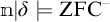 . Item 4 now follows.
It also follows that $\mathcal {T}\!\upharpoonright \!\delta $
and
$\mathcal {T}\!\upharpoonright \!\delta $
and $\mathcal {U}\!\upharpoonright \!\delta $
are necessary, so
$\mathcal {U}\!\upharpoonright \!\delta $
are necessary, so 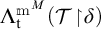 and
and  are defined, and the process continues. Let $\gamma $
be as in item 5. Let Q be the result of the P-construction of M above N (recall this stops as soon as it reaches a Q-structure or projects across
$\gamma $
be as in item 5. Let Q be the result of the P-construction of M above N (recall this stops as soon as it reaches a Q-structure or projects across $\delta $
). Because
$\delta $
). Because $\delta $
is regular in
$\delta $
is regular in $Q[M|\delta ]$
, we cannot have
$Q[M|\delta ]$
, we cannot have $M|\gamma \in Q[M|\delta ]$
, so
$M|\gamma \in Q[M|\delta ]$
, so $\mathrm {OR}^Q\leq \gamma $
. But if
$\mathrm {OR}^Q\leq \gamma $
. But if $\mathrm {OR}^Q<\gamma $
then we reach a contradiction as in the proof of Claim 5 in the proof of Theorem 4.2. So
$\mathrm {OR}^Q<\gamma $
then we reach a contradiction as in the proof of Claim 5 in the proof of Theorem 4.2. So $\mathrm {OR}^Q=\gamma $
. It is analogous for
$\mathrm {OR}^Q=\gamma $
. It is analogous for  .
.
For item 6, by item 5 and by the agreement of $M|\delta _1$
and
$M|\delta _1$
and  , if
, if $\delta <\delta _1$
then
$\delta <\delta _1$
then $Q=Q'$
. (Note here
$Q=Q'$
. (Note here $\gamma ,\gamma '<\delta _1$
, as
$\gamma ,\gamma '<\delta _1$
, as  have largest cardinal $\omega $
.)
$\omega $
.)
It remains to verify that N has no Woodins. So suppose $N\models $
“
$N\models $
“ $\eta $
is Woodin” and let
$\eta $
is Woodin” and let $\eta $
be least such. Then because we have folded in meas-lim genericity iteration,
$\eta $
be least such. Then because we have folded in meas-lim genericity iteration,  are
are $(N,\mathbb B_{\mathrm {ml},\eta }^N)$
-generic, so
$(N,\mathbb B_{\mathrm {ml},\eta }^N)$
-generic, so $M|\eta $
and
$M|\eta $
and  satisfy $\mathrm {ZFC}^-$
. Let
$\mathrm {ZFC}^-$
. Let $\lambda '<\lambda $
be least such that
$\lambda '<\lambda $
be least such that $\delta ((\mathcal {T},\mathcal {U})\!\upharpoonright \!\lambda ')\geq \eta $
. Then note that by
$\delta ((\mathcal {T},\mathcal {U})\!\upharpoonright \!\lambda ')\geq \eta $
. Then note that by $\mathrm {ZFC}^-$
and as before,
$\mathrm {ZFC}^-$
and as before, $M|\eta $
and
$M|\eta $
and  can compute $(\mathcal {T},\mathcal {U})\!\upharpoonright \!\lambda '$
, and we get
$(\mathcal {T},\mathcal {U})\!\upharpoonright \!\lambda '$
, and we get $\lambda '=\eta $
. But since
$\lambda '=\eta $
. But since $N|\eta $
has no Woodins, the preceding applies with
$N|\eta $
has no Woodins, the preceding applies with $\lambda $
replaced by
$\lambda $
replaced by $\lambda '=\eta <\lambda $
. In particular,
$\lambda '=\eta <\lambda $
. In particular, $Q_\eta =Q_\eta '$
, where these are the Q-structures determining
$Q_\eta =Q_\eta '$
, where these are the Q-structures determining $[0,\eta )_{\mathcal {T}},[0,\eta )_{\mathcal {U}}$
. Since
$[0,\eta )_{\mathcal {T}},[0,\eta )_{\mathcal {U}}$
. Since $\eta $
is Woodin in N,
$\eta $
is Woodin in N, $E^{\mathcal {T}}_\eta $
or
$E^{\mathcal {T}}_\eta $
or $E^{\mathcal {U}}_\eta $
must come from
$E^{\mathcal {U}}_\eta $
must come from $Q_\eta =Q_\eta '$
. But then
$Q_\eta =Q_\eta '$
. But then $E^{\mathcal {T}}_\eta =E^{\mathcal {U}}_\eta $
, so this extender is being used for linear iteration or genericity iteration purposes, and
$E^{\mathcal {T}}_\eta =E^{\mathcal {U}}_\eta $
, so this extender is being used for linear iteration or genericity iteration purposes, and $Q_\eta \triangleleft K_\eta $
. But
$Q_\eta \triangleleft K_\eta $
. But $\eta $
is a strong cutpoint of
$\eta $
is a strong cutpoint of $Q_\eta $
, so
$Q_\eta $
, so $E^{\mathcal {T}}_\eta $
causes a drop in model to some
$E^{\mathcal {T}}_\eta $
causes a drop in model to some $P\trianglelefteq Q_\eta $
. But then
$P\trianglelefteq Q_\eta $
. But then $E^{\mathcal {T}}_\eta $
is not
$E^{\mathcal {T}}_\eta $
is not $K_\eta $
-total, a contradiction.
$K_\eta $
-total, a contradiction.
This completes the induction, giving $(\mathcal {T},\mathcal {U})\!\upharpoonright \!(\delta _1+1)$
. Now suppose
$(\mathcal {T},\mathcal {U})\!\upharpoonright \!(\delta _1+1)$
. Now suppose $\lambda =\delta _1$
. By item 5, letting
$\lambda =\delta _1$
. By item 5, letting $b,c$
be the branches chosen in
$b,c$
be the branches chosen in $\mathcal {T},\mathcal {U}$
,
$\mathcal {T},\mathcal {U}$
, $Q(\mathcal {T},b)$
results from the P-construction of
$Q(\mathcal {T},b)$
results from the P-construction of $R_1$
above
$R_1$
above $N=M((\mathcal {T},\mathcal {U})\!\upharpoonright \!\delta _1)$
, and has height
$N=M((\mathcal {T},\mathcal {U})\!\upharpoonright \!\delta _1)$
, and has height $\mathrm {OR}^{R_1}$
, and
$\mathrm {OR}^{R_1}$
, and $Q(\mathcal {U},c)$
is that of
$Q(\mathcal {U},c)$
is that of $S_1$
above N, of height
$S_1$
above N, of height $\mathrm {OR}^{S_1}$
. But
$\mathrm {OR}^{S_1}$
. But $\varepsilon _1$
indexes the least disagreement between
$\varepsilon _1$
indexes the least disagreement between $R_1,S_1$
above
$R_1,S_1$
above $\delta _1$
. Now
$\delta _1$
. Now
 $$\begin{align*}Q(\mathcal{T},b)||\varepsilon_1=Q(\mathcal{U},c)||\varepsilon_1 \text{ but } Q(\mathcal{T},b)|\varepsilon_1\neq Q(\mathcal{U},c)|\varepsilon_1.\end{align*}$$
For if $Q(\mathcal {T},b)|\varepsilon _1=Q(\mathcal {U},c)|\varepsilon _1$
then because
$Q(\mathcal {T},b)|\varepsilon _1=Q(\mathcal {U},c)|\varepsilon _1$
then because $Q(\mathcal {T},b)[M|\delta _1]$
and
$Q(\mathcal {T},b)[M|\delta _1]$
and  have the same universe and the forcing is small relative to the active extenders, there is a unique possible extension of the extenders to the extensions, so $R_1|\varepsilon _1=S_1|\varepsilon _1$
, contradiction.
$R_1|\varepsilon _1=S_1|\varepsilon _1$
, contradiction.
So the overall comparison now reduces to a comparison of $Q(\mathcal {T},b)$
with
$Q(\mathcal {T},b)$
with $Q(\mathcal {T},c)$
, and therefore
$Q(\mathcal {T},c)$
, and therefore $\delta _1$
will be the least Woodin cardinal, and hence (by tameness, or in this case, just that
$\delta _1$
will be the least Woodin cardinal, and hence (by tameness, or in this case, just that $\delta _1$
is the least such Woodin) also a strong cutpoint of the final model.
$\delta _1$
is the least such Woodin) also a strong cutpoint of the final model.
Now suppose $\alpha>0$
and we have defined
$\alpha>0$
and we have defined $(\mathcal {T}_\alpha ,\mathcal {U}_\alpha )$
, of length
$(\mathcal {T}_\alpha ,\mathcal {U}_\alpha )$
, of length $\delta _\alpha +1$
, and the P-constructions of
$\delta _\alpha +1$
, and the P-constructions of $R_\alpha,\ S_\alpha$
yield the Q-structures
$R_\alpha,\ S_\alpha$
yield the Q-structures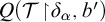 $Q(\mathcal {T}\!\upharpoonright \!\delta _\alpha ,b')$
and
$Q(\mathcal {T}\!\upharpoonright \!\delta _\alpha ,b')$
and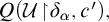 $Q(\mathcal {U}\!\upharpoonright \!\delta _\alpha ,c'),$
etc. We then define
$Q(\mathcal {U}\!\upharpoonright \!\delta _\alpha ,c'),$
etc. We then define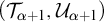 $(\mathcal {T}_{\alpha +1},\mathcal {U}_{\alpha +1})$
extending
$(\mathcal {T}_{\alpha +1},\mathcal {U}_{\alpha +1})$
extending $(\mathcal {T}_\alpha ,\mathcal {U}_\alpha )$
, above
$(\mathcal {T}_\alpha ,\mathcal {U}_\alpha )$
, above $\delta _\alpha $
, of length
$\delta _\alpha $
, of length $\delta _{\alpha +1}+1$
. Here we again have two stages. In the first we fold in linear iteration past
$\delta _{\alpha +1}+1$
. Here we again have two stages. In the first we fold in linear iteration past $\gamma _{\alpha +1}$
, at the least measurable
$\gamma _{\alpha +1}$
, at the least measurable $>\delta _\alpha $
, and in the second we fold in genericity iteration. Everything is analogous to the case
$>\delta _\alpha $
, and in the second we fold in genericity iteration. Everything is analogous to the case $\alpha =1$
(there are now Woodin cardinals in
$\alpha =1$
(there are now Woodin cardinals in $M((\mathcal {T}_{\alpha +1},\mathcal {U}_{\alpha +1})\!\upharpoonright \!\lambda )$
, but they are exactly the
$M((\mathcal {T}_{\alpha +1},\mathcal {U}_{\alpha +1})\!\upharpoonright \!\lambda )$
, but they are exactly the $\delta _\beta $
for
$\delta _\beta $
for $\beta \leq \alpha $
).
$\beta \leq \alpha $
).
Given $\left <\mathcal {T}_\alpha ,\mathcal {U}_\alpha \right>_{\alpha <\eta }$
for a limit
$\left <\mathcal {T}_\alpha ,\mathcal {U}_\alpha \right>_{\alpha <\eta }$
for a limit $\eta $
, this gives
$\eta $
, this gives $(\mathcal {T},\mathcal {U})\!\upharpoonright \!\lambda $
where
$(\mathcal {T},\mathcal {U})\!\upharpoonright \!\lambda $
where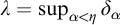 $\lambda =\sup _{\alpha <\eta }\delta _\alpha $
. Note
$\lambda =\sup _{\alpha <\eta }\delta _\alpha $
. Note $\lambda =\delta ((\mathcal {T},\mathcal {U})\!\upharpoonright \!\lambda )$
. Because
$\lambda =\delta ((\mathcal {T},\mathcal {U})\!\upharpoonright \!\lambda )$
. Because $M((\mathcal {T},\mathcal {U})\!\upharpoonright \!\lambda )$
satisfies “There is a proper class of Woodins” by induction, it is a Q-structure for itself, so
$M((\mathcal {T},\mathcal {U})\!\upharpoonright \!\lambda )$
satisfies “There is a proper class of Woodins” by induction, it is a Q-structure for itself, so $\mathcal {T}\!\upharpoonright \!\lambda $
and
$\mathcal {T}\!\upharpoonright \!\lambda $
and $\mathcal {U}\!\upharpoonright \!\lambda $
are necessary (as they are in M), and hence in the domains of the iteration strategies. This yields
$\mathcal {U}\!\upharpoonright \!\lambda $
are necessary (as they are in M), and hence in the domains of the iteration strategies. This yields $(\mathcal {T},\mathcal {U})\!\upharpoonright \!(\lambda +1)$
. We get
$(\mathcal {T},\mathcal {U})\!\upharpoonright \!(\lambda +1)$
. We get $M^{\mathcal {T}}_\lambda \ntrianglelefteq M^{\mathcal {U}}_\lambda \ntrianglelefteq M^{\mathcal {T}}_\lambda $
. Since
$M^{\mathcal {T}}_\lambda \ntrianglelefteq M^{\mathcal {U}}_\lambda \ntrianglelefteq M^{\mathcal {T}}_\lambda $
. Since $\lambda $
is a limit of strong cutpoints of
$\lambda $
is a limit of strong cutpoints of $M^{\mathcal {T}}_\lambda ,M^{\mathcal {U}}_\lambda $
, the comparison now reduces to a comparison of
$M^{\mathcal {T}}_\lambda ,M^{\mathcal {U}}_\lambda $
, the comparison now reduces to a comparison of $M^{\mathcal {T}}_\lambda ,M^{\mathcal {U}}_\lambda $
, above
$M^{\mathcal {T}}_\lambda ,M^{\mathcal {U}}_\lambda $
, above $\lambda $
. Note that
$\lambda $
. Note that $(\mathcal {T},\mathcal {U})\!\upharpoonright \!(\lambda +1)$
is definable from parameters over
$(\mathcal {T},\mathcal {U})\!\upharpoonright \!(\lambda +1)$
is definable from parameters over $M|\gamma _\eta $
, and over
$M|\gamma _\eta $
, and over  (or at least, $(\mathcal {T},\mathcal {U})\!\upharpoonright \!\lambda $
is definable from parameters over those segments, and
$(\mathcal {T},\mathcal {U})\!\upharpoonright \!\lambda $
is definable from parameters over those segments, and $[0,\lambda )_{\mathcal {T}},[0,\lambda )_{\mathcal {U}}$
are also, so the models
$[0,\lambda )_{\mathcal {T}},[0,\lambda )_{\mathcal {U}}$
are also, so the models $M^{\mathcal {T}}_\lambda ,M^{\mathcal {U}}_\lambda $
are definable “in the codes”, but might literally have ordinal height
$M^{\mathcal {T}}_\lambda ,M^{\mathcal {U}}_\lambda $
are definable “in the codes”, but might literally have ordinal height $>\gamma _\eta $
). At this stage we fold in linear iteration past
$>\gamma _\eta $
). At this stage we fold in linear iteration past $\gamma _\eta $
, at the least measurable
$\gamma _\eta $
, at the least measurable $\mu>\lambda $
, if there is such, and then genericity iteration, to produce
$\mu>\lambda $
, if there is such, and then genericity iteration, to produce $(\mathcal {T},\mathcal {U})\!\upharpoonright \!(\delta _\eta +1)$
much as before.
$(\mathcal {T},\mathcal {U})\!\upharpoonright \!(\delta _\eta +1)$
much as before.
This completes the description of the comparison. We produce trees $(\mathcal {T},\mathcal {U})$
of length
$(\mathcal {T},\mathcal {U})$
of length $\omega _1^M$
, and
$\omega _1^M$
, and $\left <\delta _\alpha \right>_{\alpha <\omega _1^M}$
enumerates the Woodins of
$\left <\delta _\alpha \right>_{\alpha <\omega _1^M}$
enumerates the Woodins of $M(\mathcal {T},\mathcal {U})$
, cofinal in
$M(\mathcal {T},\mathcal {U})$
, cofinal in $\omega _1^M$
. By tameness, we get
$\omega _1^M$
. By tameness, we get $\mathcal {T}$
-cofinal and
$\mathcal {T}$
-cofinal and $\mathcal {U}$
-cofinal branches
$\mathcal {U}$
-cofinal branches $b,c\in M$
(this doesn’t require any further iterability assumptions). One now reaches a contradiction as in the proof of Theorem 4.2.
$b,c\in M$
(this doesn’t require any further iterability assumptions). One now reaches a contradiction as in the proof of Theorem 4.2.




7 HOD in tame mice
In Theorem 7.5 we analyse $\mathrm {HOD}^{L[\mathbb {E}]}$
above
$\mathrm {HOD}^{L[\mathbb {E}]}$
above $\omega _2^{L[\mathbb {E}]}$
, for tame
$\omega _2^{L[\mathbb {E}]}$
, for tame $L[\mathbb {E}]$
. This uses Vopenka.
$L[\mathbb {E}]$
. This uses Vopenka.
Definition 7.1. Let M be a $(0,\omega _1+1)$
-iterable tame premouse satisfying
$(0,\omega _1+1)$
-iterable tame premouse satisfying $\mathrm {ZFC}$
. Write
$\mathrm {ZFC}$
. Write $\mathscr {G}=\mathscr {G}_{\mathrm {t}}$
(see Definition 7.1). Then
$\mathscr {G}=\mathscr {G}_{\mathrm {t}}$
(see Definition 7.1). Then $\mathrm {Vop}_{*\mathscr {G}}^M$
denotes the Vopenka forcing corresponding to non-empty
$\mathrm {Vop}_{*\mathscr {G}}^M$
denotes the Vopenka forcing corresponding to non-empty $\mathrm {OD}^{\left \lfloor M\right \rfloor }$
subsets of
$\mathrm {OD}^{\left \lfloor M\right \rfloor }$
subsets of $\mathscr {G}^M$
, coded in the usual manner with ordinals as conditions. (Let
$\mathscr {G}^M$
, coded in the usual manner with ordinals as conditions. (Let ${\mathbb {P}}_0$
be the forcing whose conditions are non-empty
${\mathbb {P}}_0$
be the forcing whose conditions are non-empty $\mathrm {OD}^{\left \lfloor M\right \rfloor }$
subsets of
$\mathrm {OD}^{\left \lfloor M\right \rfloor }$
subsets of $\mathscr {G}^M$
, with
$\mathscr {G}^M$
, with $A\leq B$
iff
$A\leq B$
iff $A\subseteq B$
. Then
$A\subseteq B$
. Then $\mathrm {Vop}_{*\mathscr {G}}^M$
is the natural isomorph of
$\mathrm {Vop}_{*\mathscr {G}}^M$
is the natural isomorph of ${\mathbb {P}}_0$
, using standard ordinal codes for conditions in
${\mathbb {P}}_0$
, using standard ordinal codes for conditions in ${\mathbb {P}}_0$
.)
${\mathbb {P}}_0$
.)
Remark 7.2. Note that $\mathrm {Vop}_{*\mathscr {G}}^M$
is definable over
$\mathrm {Vop}_{*\mathscr {G}}^M$
is definable over $\left \lfloor M\right \rfloor $
without parameters. Once we have proved the following lemma, we will define
$\left \lfloor M\right \rfloor $
without parameters. Once we have proved the following lemma, we will define $\mathrm {Vop}_{\mathscr {G}}^M$
as a more natural isomorph of
$\mathrm {Vop}_{\mathscr {G}}^M$
as a more natural isomorph of $\mathrm {Vop}_{*\mathscr {G}}^M$
, which is a subset of
$\mathrm {Vop}_{*\mathscr {G}}^M$
, which is a subset of $\omega _2^M$
, and is definable over
$\omega _2^M$
, and is definable over $(\mathcal {H}_{\omega _2^M})^M$
without parameters.
$(\mathcal {H}_{\omega _2^M})^M$
without parameters.
Lemma 7.3. Let M be a $(0,\omega _1+1)$
-iterable tame premouse satisfying
$(0,\omega _1+1)$
-iterable tame premouse satisfying $\mathrm {ZFC}$
. Let
$\mathrm {ZFC}$
. Let ${\mathbb {P}}=\mathrm {Vop}_{*\mathscr {G}}^M$
and
${\mathbb {P}}=\mathrm {Vop}_{*\mathscr {G}}^M$
and $\delta =\omega _2^M$
. Let
$\delta =\omega _2^M$
. Let $H=\mathrm {HOD}^{\left \lfloor M\right \rfloor }$
. Then:
$H=\mathrm {HOD}^{\left \lfloor M\right \rfloor }$
. Then:
-
1.
${\mathbb {P}}\in H$
and
$H\models $
“
${\mathbb {P}}$
is a
$\delta $
-cc complete Boolean algebra”. -
2.
${\mathbb {P}}\cong $
some
${\mathbb {P}}'\subseteq \delta $
which is
$(\Sigma _3\wedge \Pi _3)^{\mathcal {H}_{\delta }^M}$
-definable without parameters. -
3. There is G which is
$(H,{\mathbb {P}})$
-generic, with having universe
$\left \lfloor M\right \rfloor $
. -
4. For every
$p\in {\mathbb {P}}$
there is an
$(H,{\mathbb {P}})$
-generic
$G'\in M$
such that
$p\in G'$
and
$H[G']$
has universe
$\left \lfloor M\right \rfloor $
.


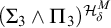

 having universe


Proof. Part 1: We have ${\mathbb {P}}\in H$
and
${\mathbb {P}}\in H$
and $H\models $
“
$H\models $
“ ${\mathbb {P}}$
is a complete Boolean algebra” by the usual proof for Vopenka forcing. We have
${\mathbb {P}}$
is a complete Boolean algebra” by the usual proof for Vopenka forcing. We have $H\models $
“
$H\models $
“ ${\mathbb {P}}$
is
${\mathbb {P}}$
is $\delta $
-cc” because by Lemma 6.3, in M,
$\delta $
-cc” because by Lemma 6.3, in M, $\mathscr {G}^M$
has cardinality
$\mathscr {G}^M$
has cardinality $\leq \omega _1^M$
, and all maximal antichains of
$\leq \omega _1^M$
, and all maximal antichains of ${\mathbb {P}}$
in H correspond to partitions of
${\mathbb {P}}$
in H correspond to partitions of $\mathscr {G}^M$
in M.
$\mathscr {G}^M$
in M.
Part 2: A nice code is a triple $(\alpha ,\beta ,\varphi )$
such that
$(\alpha ,\beta ,\varphi )$
such that $\alpha <\beta <\delta $
and
$\alpha <\beta <\delta $
and $\varphi $
is a formula. The nice code
$\varphi $
is a formula. The nice code $(\alpha ,\beta ,\varphi )$
codes the set
$(\alpha ,\beta ,\varphi )$
codes the set

Claim 1. A set $A\subseteq \mathscr {G}^M$
is
$A\subseteq \mathscr {G}^M$
is $\mathrm {OD}^{\left \lfloor M\right \rfloor }$
iff A has a nice code.
$\mathrm {OD}^{\left \lfloor M\right \rfloor }$
iff A has a nice code.
Proof. Each $A_{\alpha \beta \varphi }$
is
$A_{\alpha \beta \varphi }$
is $\mathrm {OD}^{\left \lfloor M\right \rfloor }$
since by Remark 6.2,
$\mathrm {OD}^{\left \lfloor M\right \rfloor }$
since by Remark 6.2, $\mathscr {G}^M$
and
$\mathscr {G}^M$
and  are
are $\left \lfloor M\right \rfloor $
-definable.
$\left \lfloor M\right \rfloor $
-definable.
So suppose $A\subseteq \mathscr {G}^M$
is
$A\subseteq \mathscr {G}^M$
is $\mathrm {OD}^{\left \lfloor M\right \rfloor }$
but has no nice code. Let
$\mathrm {OD}^{\left \lfloor M\right \rfloor }$
but has no nice code. Let $\lambda \in \mathrm {OR}^M$
be a limit cardinal of M and
$\lambda \in \mathrm {OR}^M$
be a limit cardinal of M and $\xi <\lambda $
and
$\xi <\lambda $
and $\varphi $
be a formula (in the language of set theory) such that
$\varphi $
be a formula (in the language of set theory) such that  iff
iff 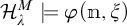 . In fact, because we are arguing by contradiction, we may assume $\xi =0$
(take the least
$\xi =0$
(take the least $\xi $
such that
$\xi $
such that $\varphi (\cdot ,\xi )$
yields a set with no nice code, and then by substituting another formula for
$\varphi (\cdot ,\xi )$
yields a set with no nice code, and then by substituting another formula for $\varphi $
, we can take
$\varphi $
, we can take $\xi =0$
).
$\xi =0$
).
Let  . Then
  is well-defined, has universe $\left \lfloor M\right \rfloor $
, and satisfies standard condensation, by Lemma 5.4. Also, as in the proof of that lemma, N can be translated into an iterable x-mouse
$\left \lfloor M\right \rfloor $
, and satisfies standard condensation, by Lemma 5.4. Also, as in the proof of that lemma, N can be translated into an iterable x-mouse $N_x$
for some
$N_x$
for some $x\in \mathbb R^M$
. Let
$x\in \mathbb R^M$
. Let

 be its transitive collapse, and
  the uncollapse. By the iterability of $N_x$
(as an x-mouse), and since
$N_x$
(as an x-mouse), and since  and
and $\lambda $
is an M-cardinal, then
$\lambda $
is an M-cardinal, then  is
is $1$
-sound with
$1$
-sound with  . So by standard condensation,
  , so in fact
 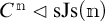 . But the elements of
  are independent of
  , because given
  ,
,  are interdefinable from parameters, so
  are also (as they have the same extender sequence above $\omega _1^M$
). So
$\omega _1^M$
). So  and
and  are also independent of
  . Let
. Let  and
and $\pi ({\bar {\lambda }})=\lambda $
. Let
$\pi ({\bar {\lambda }})=\lambda $
. Let $\psi _\varphi $
be the formula, in the language of premice, asserting
$\psi _\varphi $
be the formula, in the language of premice, asserting $\varphi (L[\mathbb {E}]|\omega _1)$
. Then
$\varphi (L[\mathbb {E}]|\omega _1)$
. Then

So $(0,{\bar {\lambda }},\psi _\varphi )$
is a nice code for A, a contradiction.
$(0,{\bar {\lambda }},\psi _\varphi )$
is a nice code for A, a contradiction.
So let ${\mathbb {P}}'$
be the coding of
${\mathbb {P}}'$
be the coding of ${\mathbb {P}}$
via nice codes (for non-empty subsets of
${\mathbb {P}}$
via nice codes (for non-empty subsets of $\mathscr {G}^M$
). Then
$\mathscr {G}^M$
). Then ${\mathbb {P}}'\subseteq \delta ^3$
and because
${\mathbb {P}}'\subseteq \delta ^3$
and because $\mathscr {G}^M$
is
$\mathscr {G}^M$
is $\Pi _2^{\mathcal {H}_{\delta }^M}$
, the set of conditions
$\Pi _2^{\mathcal {H}_{\delta }^M}$
, the set of conditions $(\alpha ,\beta ,\varphi )\in {\mathbb {P}}'$
is
$(\alpha ,\beta ,\varphi )\in {\mathbb {P}}'$
is $\Sigma _3^{\mathcal {H}_\delta ^M}$
(to assert
$\Sigma _3^{\mathcal {H}_\delta ^M}$
(to assert $A_{\alpha \beta \varphi }\neq \emptyset $
), and the ordering restricted to these conditions is
$A_{\alpha \beta \varphi }\neq \emptyset $
), and the ordering restricted to these conditions is $\Pi _3^{\mathcal {H}_\delta ^M}$
.
$\Pi _3^{\mathcal {H}_\delta ^M}$
.
Parts 3 and 4: As usual, for every  we have the generic filter

Claim 2.
 .
.
Proof.
 and
and 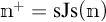 are easily inter-computable, so
  . By standard Vopenka facts, we have
  .Footnote
16
But by Lemma 5.4, we have
.Footnote
16
But by Lemma 5.4, we have  .
.
Claim 3.
 .
.
Proof. It suffices to see that  , because then
  is just the Jensen stack above
  in
in  , so
, so  also. Fix $\xi \in (\omega _1^M,\omega _2^M)$
such that
$\xi \in (\omega _1^M,\omega _2^M)$
such that  projects to $\omega _1^M$
. It suffices to see that
$\omega _1^M$
. It suffices to see that 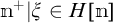 , and again via the Jensen stack, we may assume that
 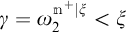 and
and 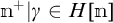 and there is some $\lambda \in (\gamma ,\xi ]$
such that
$\lambda \in (\gamma ,\xi ]$
such that  is active.
Let  . Note that $\mathbb Q$
is definable over
$\mathbb Q$
is definable over  (just as ${\mathbb {P}}'$
is defined over
${\mathbb {P}}'$
is defined over  ). We have $\mathbb Q\in H$
as
$\mathbb Q\in H$
as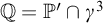 $\mathbb Q={\mathbb {P}}'\cap \gamma ^3$
. Let
$\mathbb Q={\mathbb {P}}'\cap \gamma ^3$
. Let $\lambda $
be the supremum of all
$\lambda $
be the supremum of all $\lambda '\leq \xi $
such that
$\lambda '\leq \xi $
such that  is active. So
  . So working over
  (or equivalently, $M|\lambda $
), let R be the result of the P-construction of
$M|\lambda $
), let R be the result of the P-construction of  above
above $(\gamma ^3,\mathbb Q)$
. Then
$(\gamma ^3,\mathbb Q)$
. Then $R\in H$
, because
$R\in H$
, because $\mathbb Q\in H$
, and given any
$\mathbb Q\in H$
, and given any  , the extender sequences of
  and
and  agree above $\omega _1^M$
, so
$\omega _1^M$
, so $\mathbb Q$
is definable over
$\mathbb Q$
is definable over  just as over
  (as they have the same universe), and their P-constructions yield the same output R.
As before, $R||\lambda \models $
“
$R||\lambda \models $
“ $\mathbb Q$
is a
$\mathbb Q$
is a $\gamma $
-cc complete Boolean algebra” and
$\gamma $
-cc complete Boolean algebra” and  is
is $R||\lambda $
-generic for
$R||\lambda $
-generic for $\mathbb Q$
. Therefore the P-construction of
$\mathbb Q$
. Therefore the P-construction of  yields a $(\gamma ^3,\mathbb Q)$
-premouse (which is R), and we have the usual fine structural correspondence between segments of
$(\gamma ^3,\mathbb Q)$
-premouse (which is R), and we have the usual fine structural correspondence between segments of  of height in $(\gamma ,\lambda ]$
, and the corresponding segments of R.
$(\gamma ,\lambda ]$
, and the corresponding segments of R.
Now by induction, we have 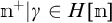 , and
, and  is inter-computable with
  . But then the extender sequence of
  above
above $\gamma $
is determined by that of
$\gamma $
is determined by that of $R|\lambda $
, as
$R|\lambda $
, as  is a small generic extension thereof. So
 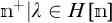 , and therefore
 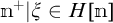 , as desired.
There is also an alternate proof of this last claim, which is actually quite different.
Sketch of alternate proof of Claim 3 .
If our mice were Jensen-indexed, we could argue as follows: Given $\alpha $
such that
$\alpha $
such that  is active, let
 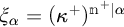 where
where 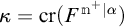 . The sequence

would be in H, because the sequence is independent of  . But
. But  determines
  , by standard arguments. (Let P be an active premouse with Jensen indexing. Let $G=F^P\!\upharpoonright \!\kappa ^{+P}$
, where
$G=F^P\!\upharpoonright \!\kappa ^{+P}$
, where $\kappa =\mathrm {cr}(F^P)$
. Then
$\kappa =\mathrm {cr}(F^P)$
. Then $G,P||\mathrm {OR}^P$
determines
$G,P||\mathrm {OR}^P$
determines $F^P$
as follows. Let
$F^P$
as follows. Let $X\subseteq \kappa $
; we want to determine
$X\subseteq \kappa $
; we want to determine $i^P_F(X)$
. Let
$i^P_F(X)$
. Let $\alpha <\kappa ^{+P}$
be such that
$\alpha <\kappa ^{+P}$
be such that $X\in P|\alpha $
and
$X\in P|\alpha $
and $P|\alpha $
projects to
$P|\alpha $
projects to $\kappa $
. Note that there is a unique elementary embedding
$\kappa $
. Note that there is a unique elementary embedding $\pi :P|\alpha \to P|G(\alpha )$
with
$\pi :P|\alpha \to P|G(\alpha )$
with $\pi \!\upharpoonright \!\kappa =\mathrm {id}$
, and
$\pi \!\upharpoonright \!\kappa =\mathrm {id}$
, and $\pi $
is determined by the first-order theory of
$\pi $
is determined by the first-order theory of $P|G(\alpha )$
. But then
$P|G(\alpha )$
. But then $\pi (X)=i^P_F(X)$
, determining the latter, as desired.)
$\pi (X)=i^P_F(X)$
, determining the latter, as desired.)
But we work with Mitchell–Steel indexing, and it is not obvious to the author how to use the preceding kind of argument directly with this indexing. So instead, we convert indexing first. Let  be the above- $\omega _1^M$
Jensen-indexed conversion of
$\omega _1^M$
Jensen-indexed conversion of  . It isn’t relevant here whether the structure we get is actually a premouse, with sound segments, etc. It only needs to code the information in
  above
above $\omega _1^M$
via a coherent sequence of Jensen-indexed extenders.Footnote
17
$\omega _1^M$
via a coherent sequence of Jensen-indexed extenders.Footnote
17
Because the extender sequence of  above
above $\omega _1^M$
is independent of
$\omega _1^M$
is independent of  , so is the extender sequence of
  above
above $\omega _1^M$
. Let
$\omega _1^M$
. Let $\widetilde {\mathscr {F}}$
be the restriction to ordinals of
$\widetilde {\mathscr {F}}$
be the restriction to ordinals of  above
above $\omega _1^M$
. By a variant of the argument in parentheses above, from
$\omega _1^M$
. By a variant of the argument in parentheses above, from  and
and $\widetilde {\mathscr {F}}$
we can compute
$\widetilde {\mathscr {F}}$
we can compute  , so
, so  . (In the argument above we used that the proper segments of premice are sound, but we don’t need this property of our Jensen-indexed structure. For if
  is active with extender F, then we first convert
  to a Mitchell–Steel indexed premouse Q, and then from Q and $F\!\upharpoonright \!\mathrm {OR}$
we can compute F much as before.) So
$F\!\upharpoonright \!\mathrm {OR}$
we can compute F much as before.) So  , but then we can (as above) invert back to Mitchell–Steel indexing, so
  .
.
Applying the above with  , we have established part 3. To complete the proof of part 4, observe that if $p\in {\mathbb {P}}'$
then there is
$p\in {\mathbb {P}}'$
then there is  with
with  (because the forcing includes only nice codes for non-empty sets) and we have just seen that
  , as desired.
Definition 7.4. $\mathrm {Vop}_{\mathscr {G}}^M$
denotes the forcing
$\mathrm {Vop}_{\mathscr {G}}^M$
denotes the forcing ${\mathbb {P}}'$
of the previous lemma.
${\mathbb {P}}'$
of the previous lemma.
We finally use similar methods as part of the proof of the following theorem.
Theorem 7.5. Let M be a $(0,\omega _1+1)$
-iterable tame premouse satisfying
$(0,\omega _1+1)$
-iterable tame premouse satisfying $\mathrm {ZFC}$
. Let
$\mathrm {ZFC}$
. Let $H=\mathrm {HOD}^{\left \lfloor M\right \rfloor }$
and suppose that
$H=\mathrm {HOD}^{\left \lfloor M\right \rfloor }$
and suppose that $H\neq \left \lfloor M\right \rfloor $
. Let
$H\neq \left \lfloor M\right \rfloor $
. Let $\delta =\omega _2^M$
and
$\delta =\omega _2^M$
and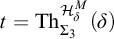 $t = \operatorname {\mathrm {Th}}_{\Sigma _3}^{\mathcal {H}_{\delta }^M}(\delta )$
. Then there are
$t = \operatorname {\mathrm {Th}}_{\Sigma _3}^{\mathcal {H}_{\delta }^M}(\delta )$
. Then there are $\mathbb {F},\mathcal {H},W$
such that:
$\mathbb {F},\mathcal {H},W$
such that:
-
–
$\mathcal {H}=(H,\mathbb {F},t)$
is a
$(0,\omega _1+1)$
-iterable
$(\delta ,t)$
-premouse with universe H and
$\mathbb {E}^{\mathcal {H}}=\mathbb {F}$
, -
– for every
$\eta <\delta $
and every
$X\in H$
with
$X\subseteq \eta $
, X is encoded into t, so
$X\in \mathcal {J}((\delta ,t))$
, -
–
$\mathbb {F}$
is the level-by-level restriction of
$\mathbb {E}^M\!\upharpoonright \![\delta ,\infty )$
to
$\mathcal{H}$
; that is,
$\mathbb{F}_\alpha=\mathbb{E}^M_\alpha\!\upharpoonright\!(\mathcal{H}||\alpha)$
for all
$\alpha\geq\delta$
, -
–
$\mathcal {H}$
is definable over
$\left \lfloor M\right \rfloor $
without parameters, -
–
$\left \lfloor M\right \rfloor $
is a generic extension of H via a poset in
$\mathcal {J}((\delta ,t))$
, -
–
, -
– W is a premouse and lightface proper class of
$\left \lfloor M\right \rfloor $
and
$W\subseteq H$
, -
–
$W\models $
“
$\delta $
is the least Woodin cardinal”, -
– t is generic for the meas-lim extender algebra of W at
$\delta $
, -
–
$\mathbb {E}^W\!\upharpoonright \![\delta ,\infty )$
is the level-by-level restriction of
$\mathbb{F}$
to W (as above), -
–
$H=\left \lfloor W\right \rfloor [t]$
, and -
– if
$M=\mathrm {Hull}^M(\emptyset )$
then
$W\trianglelefteq X$
for some correct iterate X of .Footnote
18









 ,
,





 .
.Proof. Let D be the set of all $\gamma \in (\omega _1^M,\omega _2^M)$
such that
$\gamma \in (\omega _1^M,\omega _2^M)$
such that $M|\gamma \models \mathrm {ZFC}^-+$
“
$M|\gamma \models \mathrm {ZFC}^-+$
“ $\omega _1$
is the largest cardinal”. Let
$\omega _1$
is the largest cardinal”. Let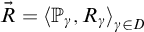 $\vec {R}=\left <{\mathbb {P}}_\gamma ,R_\gamma \right>_{\gamma \in D}$
be
$\vec {R}=\left <{\mathbb {P}}_\gamma ,R_\gamma \right>_{\gamma \in D}$
be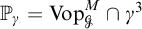 ${\mathbb {P}}_\gamma =\mathrm {Vop}_{\mathscr {G}}^M\cap \gamma ^3$
and
${\mathbb {P}}_\gamma =\mathrm {Vop}_{\mathscr {G}}^M\cap \gamma ^3$
and $R_\gamma $
is the output of the P-construction of
$R_\gamma $
is the output of the P-construction of $M|\lambda $
above
$M|\lambda $
above ${\mathbb {P}}_\gamma $
, where
${\mathbb {P}}_\gamma $
, where $\xi $
is least such that
$\xi $
is least such that $\xi>\gamma $
and
$\xi>\gamma $
and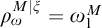 $\rho _\omega ^{M|\xi }=\omega _1^M$
and
$\rho _\omega ^{M|\xi }=\omega _1^M$
and $\lambda $
is the supremum of
$\lambda $
is the supremum of $\gamma $
and all
$\gamma $
and all $\lambda '\leq \xi $
such that
$\lambda '\leq \xi $
such that $M|\lambda '$
is active. By the proof of Lemma 7.3, D,
$M|\lambda '$
is active. By the proof of Lemma 7.3, D, $\vec {R}$
, and
$\vec {R}$
, and $\mathrm {Vop}_{\mathscr {G}}^M$
are
$\mathrm {Vop}_{\mathscr {G}}^M$
are $\Sigma _3^{(\mathcal {H}_{\omega _2})^M}$
, and hence, encoded into t. Let R be the output of the P-construction of M above
$\Sigma _3^{(\mathcal {H}_{\omega _2})^M}$
, and hence, encoded into t. Let R be the output of the P-construction of M above $(\delta ,t)$
. Also like in Lemma 7.3, R is definable without parameters over
$(\delta ,t)$
. Also like in Lemma 7.3, R is definable without parameters over $\left \lfloor M\right \rfloor $
, so
$\left \lfloor M\right \rfloor $
, so $R\subseteq H$
. We have
$R\subseteq H$
. We have $\mathrm {Vop}_{\mathscr {G}}^M\in R$
, and for each
$\mathrm {Vop}_{\mathscr {G}}^M\in R$
, and for each  ,
,  is R-generic for $\mathrm {Vop}_{\mathscr {G}}^M$
, and
$\mathrm {Vop}_{\mathscr {G}}^M$
, and  has universe $\left \lfloor M\right \rfloor $
. By Lemma 7.3, for each
$\left \lfloor M\right \rfloor $
. By Lemma 7.3, for each $p\in \mathrm {Vop}_{\mathscr {G}}^M$
we have some such
$p\in \mathrm {Vop}_{\mathscr {G}}^M$
we have some such  with
with  . It follows that $H\subseteq R$
(R computes the theory of ordinals in
$H\subseteq R$
(R computes the theory of ordinals in $\left \lfloor M\right \rfloor $
by considering what is forced by
$\left \lfloor M\right \rfloor $
by considering what is forced by $\mathrm {Vop}_{\mathscr {G}}^M$
). So
$\mathrm {Vop}_{\mathscr {G}}^M$
). So $\left \lfloor R\right \rfloor =H$
. Setting
$\left \lfloor R\right \rfloor =H$
. Setting $\mathbb {F}=\mathbb {E}^R$
, we have the desired
$\mathbb {F}=\mathbb {E}^R$
, we have the desired $\mathcal {H}=(H,\mathbb {F},t)$
.
$\mathcal {H}=(H,\mathbb {F},t)$
.
The fact that every bounded $X\subseteq \delta $
in H is encoded into t is like in the proof of Claim 1 of Lemma 7.3 part 2.
$X\subseteq \delta $
in H is encoded into t is like in the proof of Claim 1 of Lemma 7.3 part 2.
We now construct W. We get $W|\delta $
from a certain simultaneous comparison/genericity iteration of all
$W|\delta $
from a certain simultaneous comparison/genericity iteration of all  , and then $\mathbb {E}^W\!\upharpoonright \ $\mathbb {E}^M\!\upharpoonright \ , let
, let  be the tree on
  produced by the comparison. Given
 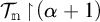 for all
  , let
, let  be the least disagreement extenders, indexed at $\ell _\alpha $
when non-empty, and
$\ell _\alpha $
when non-empty, and  . For
. For 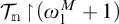 , we compare, subject to folding in linear iteration at the least measurable of $K_\alpha $
. For
$K_\alpha $
. For  , we compare, subject to folding in meas-lim genericity iteration for making
 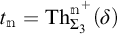 generic (recall
 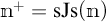 , a premouse with universe $(\mathcal {H}_{\omega _2})^M$
in this case, but the theory here can also refer to
$(\mathcal {H}_{\omega _2})^M$
in this case, but the theory here can also refer to  ). For each
  , since
  are inter-definable from parameters and the genericity iteration only begins above $\omega _1^M$
, the theories
$\omega _1^M$
, the theories  are easily inter-computable, and locally so (ordinal-by-ordinal modulo some fixed parameters $<\omega _1^M$
), so genericity iteration with respect to
$<\omega _1^M$
), so genericity iteration with respect to  is equivalent to that with respect to
  .
.
Let  be the putative extension of
  to trees $\mathcal {T}$
of length
$\mathcal {T}$
of length $<\omega _2^M$
, which satisfy the other requirements of necessity, but relative to
$<\omega _2^M$
, which satisfy the other requirements of necessity, but relative to  , and still using P-construction to compute Q-structures. Then
  is defined for all necessary trees, and yields wellfounded models, by an easy reflection argument: if not, then we can fix some
  witnessing this which projects to $\omega _1^M$
, and then use condensation to reflect to some hull
$\omega _1^M$
, and then use condensation to reflect to some hull  , and deduce that
  is defective.Footnote
19
is defective.Footnote
19
We use  to form
  . We stop the comparison if it reaches length $\omega _2^M$
. Let us verify that it in fact has length
$\omega _2^M$
. Let us verify that it in fact has length $\omega _2^M$
. As usual, it cannot terminate early, in that we cannot reach a stage
$\omega _2^M$
. As usual, it cannot terminate early, in that we cannot reach a stage $\alpha $
such that for some
$\alpha $
such that for some  , we have
 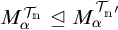 for every
  . So we just need to see that
  for every limit $\lambda \leq \omega _2^M$
. We also claim that
$\lambda \leq \omega _2^M$
. We also claim that  has no Woodin cardinals, and if
  is not a Q-structure for itself then
  and (
and ( $*$
)
$*$
) 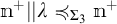 . Property ( $*$
), together with the usual fact that the earlier Q-structures are retained, ensures that
$*$
), together with the usual fact that the earlier Q-structures are retained, ensures that  (and in fact the entire comparison through length $\lambda $
) is definable over
$\lambda $
) is definable over  . This is mostly as before, but ( $*$
) is new, so we focus on its verification.
$*$
) is new, so we focus on its verification.
Let $\left <\gamma _\alpha \right>_{\alpha <\omega _2^M}$
enumerate the set C of ordinals
$\left <\gamma _\alpha \right>_{\alpha <\omega _2^M}$
enumerate the set C of ordinals $\gamma <\omega _2^M$
with
$\gamma <\omega _2^M$
with $M||\gamma \preccurlyeq _{\Sigma _3}M|\omega _2^M$
, in increasing order. Let
$M||\gamma \preccurlyeq _{\Sigma _3}M|\omega _2^M$
, in increasing order. Let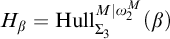 $H_\beta =\mathrm {Hull}_{\Sigma _3}^{M|\omega _2^M}(\beta )$
. Note that C is club in
$H_\beta =\mathrm {Hull}_{\Sigma _3}^{M|\omega _2^M}(\beta )$
. Note that C is club in $\omega _2^M$
and
$\omega _2^M$
and $\omega _1^M<\gamma _0$
,
$\omega _1^M<\gamma _0$
, $H_{\gamma _\alpha }=M||\gamma _\alpha $
, and if
$H_{\gamma _\alpha }=M||\gamma _\alpha $
, and if $\gamma _\alpha <\gamma <\gamma _{\alpha +1}$
then
$\gamma _\alpha <\gamma <\gamma _{\alpha +1}$
then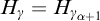 $H_\gamma =H_{\gamma _{\alpha +1}}$
. Moreover, if
$H_\gamma =H_{\gamma _{\alpha +1}}$
. Moreover, if $\gamma _\alpha <\xi \leq \gamma _{\alpha +1}$
and
$\gamma _\alpha <\xi \leq \gamma _{\alpha +1}$
and
 $$\begin{align*}t_\xi=\operatorname{\mathrm{Th}}_{\Sigma_3}^{M|\omega_2^M}(\xi), \end{align*}$$
then $t_\xi $
encodes a surjection of
$t_\xi $
encodes a surjection of $(\gamma _\alpha +1)^{<\omega }$
onto
$(\gamma _\alpha +1)^{<\omega }$
onto $\xi $
. Write
$\xi $
. Write  and
and  for the corresponding theory for other
  ; so when $\omega _1^M\leq \xi $
, there is a simple translation between
$\omega _1^M\leq \xi $
, there is a simple translation between  and
and  .
.
Now suppose that  is not a Q-structure for itself. We claim that

for some limit $\alpha $
. For suppose that
$\alpha $
. For suppose that $\gamma _\alpha <\xi \leq \gamma _{\alpha +1}$
for some
$\gamma _\alpha <\xi \leq \gamma _{\alpha +1}$
for some $\alpha $
(or it is similar if
$\alpha $
(or it is similar if $\xi \leq \gamma _0$
). Then
$\xi \leq \gamma _0$
). Then  is meas-lim extender algebra generic over $M(\mathcal {T})$
, and
$M(\mathcal {T})$
, and $\xi $
is regular in
$\xi $
is regular in  . But
. But  encodes a surjection of $(\gamma _\alpha +1)^{<\omega }$
onto
$(\gamma _\alpha +1)^{<\omega }$
onto $\xi $
, collapsing
$\xi $
, collapsing $\xi $
in
$\xi $
in  , a contradiction.
By the previous paragraph, combined with the standard arguments, we now get that $\lambda =\xi $
and
$\lambda =\xi $
and $M|\xi \preccurlyeq _{\Sigma _3}M|\omega _2^M$
and
$M|\xi \preccurlyeq _{\Sigma _3}M|\omega _2^M$
and $M|\xi \models \mathrm {ZFC}^-$
and
$M|\xi \models \mathrm {ZFC}^-$
and  is definable over $M|\xi $
. So the arguments from earlier proofs now go through.
$M|\xi $
. So the arguments from earlier proofs now go through.
So we get a comparison of length $\delta =\omega _2^M$
. Let
$\delta =\omega _2^M$
. Let $W|\delta $
be the resulting common part model. Note that
$W|\delta $
be the resulting common part model. Note that $W|\delta \in H$
, and in fact,
$W|\delta \in H$
, and in fact, $W|\delta $
is definable without parameters over
$W|\delta $
is definable without parameters over $\mathcal {H}_\delta ^M$
. It follows that
$\mathcal {H}_\delta ^M$
. It follows that $W|\delta $
is in fact definable (in the codes) over
$W|\delta $
is in fact definable (in the codes) over $(\delta ,t)$
, via consulting what is forced by
$(\delta ,t)$
, via consulting what is forced by $\mathrm {Vop}_{\mathscr {G}}^M$
. (Note here that because
$\mathrm {Vop}_{\mathscr {G}}^M$
. (Note here that because $\mathrm {Vop}_{\mathscr {G}}^M$
has the
$\mathrm {Vop}_{\mathscr {G}}^M$
has the $\delta $
-cc in H, every bounded subset of
$\delta $
-cc in H, every bounded subset of $\delta $
in M has a name in H given by some bounded
$\delta $
in M has a name in H given by some bounded $X\subseteq \delta $
, and since each such X is encoded into t,
$X\subseteq \delta $
, and since each such X is encoded into t, $\operatorname {\mathrm {Th}}_{\Sigma _n}^{\mathcal {H}_\delta ^M}$
is definable over
$\operatorname {\mathrm {Th}}_{\Sigma _n}^{\mathcal {H}_\delta ^M}$
is definable over $(\delta ,t)$
for each
$(\delta ,t)$
for each $n<\omega $
.) Also, each
$n<\omega $
.) Also, each  is meas-lim extender algebra generic over $W|\delta $
, but t is easily locally computed from any
$W|\delta $
, but t is easily locally computed from any  , and hence is also generic over $W|\delta $
. So
$W|\delta $
. So $W|\delta $
and
$W|\delta $
and $(\delta ,t)$
are generically equivalent, so we can build the P-construction of
$(\delta ,t)$
are generically equivalent, so we can build the P-construction of $\mathcal {H}$
above
$\mathcal {H}$
above $W|\delta $
, or equivalently, the P-construction of
$W|\delta $
, or equivalently, the P-construction of  above
above $W|\delta $
, for any
$W|\delta $
, for any  . Let W be the resulting model. By the construction of W, the P-construction cannot reach a Q-structure, so $W\models $
“
$W\models $
“ $\delta $
is Woodin”, and note that
$\delta $
is Woodin”, and note that $H=W[t]$
and
$H=W[t]$
and $\mathbb {F}$
is induced by
$\mathbb {F}$
is induced by $\mathbb {E}^W\!\upharpoonright \ $M=\mathrm {Hull}^M(\emptyset )$
. Then
$M=\mathrm {Hull}^M(\emptyset )$
. Then $\mathcal {J}(M)$
is an
$\mathcal {J}(M)$
is an $\omega $
-mouse. In particular, M is countable. The tree
$\omega $
-mouse. In particular, M is countable. The tree  is on
is on  , via the correct strategy, and has countable length, since M is countable. Let
 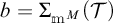 and
and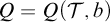 $Q=Q(\mathcal {T},b)$
. By tameness,
$Q=Q(\mathcal {T},b)$
. By tameness, $\delta $
is a strong cutpoint of Q, and it follows that
$\delta $
is a strong cutpoint of Q, and it follows that $W\trianglelefteq \mathcal {J}(W)=Q\trianglelefteq M^{\mathcal {T}}_b$
, as desired.
$W\trianglelefteq \mathcal {J}(W)=Q\trianglelefteq M^{\mathcal {T}}_b$
, as desired.
Remark 7.6. We actually now get another alternate proof of the fact that  : We have $H=W[t]$
, and note that in
$H=W[t]$
, and note that in  , we can recover the tree on
  which leads to $W|\delta $
, by comparing
$W|\delta $
, by comparing  with
with $W|\delta $
, and noting that since
$W|\delta $
, and noting that since $\delta $
is the least Woodin of W, all the Q-structures guiding this tree are available for this. But then starting from
$\delta $
is the least Woodin of W, all the Q-structures guiding this tree are available for this. But then starting from  , we can then inductively recover $M|\delta $
by translating the Q-structures over to segments of
$M|\delta $
by translating the Q-structures over to segments of $M|\delta $
extending
$M|\delta $
extending  . We will also use a variant of this later, in the non-tame context.
8
$\star $
-translation

We now prepare to deal more carefully with non-tame mice, by discussing the basics of $\star $
-translation and its inverse, the latter being the generalization of P-construction to non-tame mice. This section is essentially a summary of results from [Reference Closson1], slightly adapted.
$\star $
-translation and its inverse, the latter being the generalization of P-construction to non-tame mice. This section is essentially a summary of results from [Reference Closson1], slightly adapted.
Definition 8.1. Let N be an n-sound premouse. Fix some constant symbol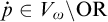 $\dot {p}\in V_\omega \backslash \mathrm {OR}$
. For
$\dot {p}\in V_\omega \backslash \mathrm {OR}$
. For $\alpha \leq \mathrm {OR}^N$
we write
$\alpha \leq \mathrm {OR}^N$
we write $t_{n+1}^N(\alpha )$
for the theory in the language of premice with constants in
$t_{n+1}^N(\alpha )$
for the theory in the language of premice with constants in $\alpha \cup \{\dot {p}\}$
, which results by modifying
$\alpha \cup \{\dot {p}\}$
, which results by modifying $\operatorname {\mathrm {Th}}_{n+1}^N(\alpha \cup \{\vec {p}_{n+1}^N\})$
by replacing
$\operatorname {\mathrm {Th}}_{n+1}^N(\alpha \cup \{\vec {p}_{n+1}^N\})$
by replacing $\vec {p}_{n+1}^N$
with
$\vec {p}_{n+1}^N$
with $\dot {p}$
. We write
$\dot {p}$
. We write $t_{n+1}^N$
for
$t_{n+1}^N$
for $t_{n+1}^N(\rho _{n+1}^N)$
.
$t_{n+1}^N(\rho _{n+1}^N)$
.
Definition 8.2. Let P be a sound premouse. We say that $\mathcal {T}$
is P-optimal iff
$\mathcal {T}$
is P-optimal iff
-
–
$\mathcal {T}$
is
$\omega $
-maximal on some
$\omega $
-premouse
$N\triangleleft P|\omega _1^P$
, -
–
$\mathcal {T}$
has limit length
$\delta =\delta (\mathcal {T})$
, -
–
$\delta $
is a successor cardinal of P, -
–
$\mathcal {J}(M(\mathcal {T}))\models $
“
$\delta $
is Woodin”, -
–
$\mathcal {T}$
is definable from parameters over P, and -
–
$\rho _\omega ^P\leq \delta $
and
$t_{k+1}^P(\delta )$
is
$\mathbb B_{\mathrm {ml},\delta }^{M(\mathcal {T})}$
-generic over
$M(\mathcal {T})$
, where k is least with
$\rho _{k+1}^P\leq \delta $
.


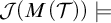


Given $M\in \mathrm {pm}_1$
, we say that
$M\in \mathrm {pm}_1$
, we say that $\mathcal {T}$
is P-optimal for M iff
$\mathcal {T}$
is P-optimal for M iff $\mathcal {T}\in M$
and
$\mathcal {T}\in M$
and $P\triangleleft M$
and
$P\triangleleft M$
and $\mathcal {T}$
is P-optimal and
$\mathcal {T}$
is P-optimal and $\delta (\mathcal {T})$
is a cutpoint (hence strong cutpoint) of M.
$\delta (\mathcal {T})$
is a cutpoint (hence strong cutpoint) of M.
Lemma 8.3. Let M be a pm. Let $\mathcal {T}$
be both P- and
$\mathcal {T}$
be both P- and $P'$
-optimal for M. Then
$P'$
-optimal for M. Then $P=P'$
.
$P=P'$
.
Proof. Suppose $P\triangleleft P'$
. Then
$P\triangleleft P'$
. Then $\rho _1^{\mathcal {J}(P)}\leq \delta =\delta (\mathcal {T})=\rho _\omega ^P$
. Let k be least with
$\rho _1^{\mathcal {J}(P)}\leq \delta =\delta (\mathcal {T})=\rho _\omega ^P$
. Let k be least with $\rho _{k+1}^{P'}\leq \delta $
. Let
$\rho _{k+1}^{P'}\leq \delta $
. Let $R=M(\mathcal {T})$
and
$R=M(\mathcal {T})$
and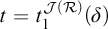 $t= t_1^{\mathcal {J}(\mathcal {R})}(\delta )$
and
$t= t_1^{\mathcal {J}(\mathcal {R})}(\delta )$
and $u= t_{k+1}^{P'}(\delta )$
. Then t is computable from
$u= t_{k+1}^{P'}(\delta )$
. Then t is computable from $t_1^{\mathcal {J}(P)}(\delta )$
(since R is P-parameter-definable), hence computable from u, since
$t_1^{\mathcal {J}(P)}(\delta )$
(since R is P-parameter-definable), hence computable from u, since $\mathcal {J}(P)\trianglelefteq P'$
. So
$\mathcal {J}(P)\trianglelefteq P'$
. So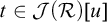 $t\in \mathcal {J}(\mathcal {R})[u]$
(recall u is
$t\in \mathcal {J}(\mathcal {R})[u]$
(recall u is $\mathbb B_{\mathrm {ml},\delta }^{R}$
-generic over
$\mathbb B_{\mathrm {ml},\delta }^{R}$
-generic over $\mathcal {J}(\mathcal {R})$
).
$\mathcal {J}(\mathcal {R})$
).
Now $\delta $
is
$\delta $
is  -regular because $\delta $
is regular in
$\delta $
is regular in $\mathcal {J}(\mathcal {R})[u]$
and
$\mathcal {J}(\mathcal {R})[u]$
and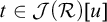 $t\in \mathcal {J}(\mathcal {R})[u]$
. We claim
$t\in \mathcal {J}(\mathcal {R})[u]$
. We claim $\rho _1^{\mathcal {J}(\mathcal {R})}=\delta $
. So suppose
$\rho _1^{\mathcal {J}(\mathcal {R})}=\delta $
. So suppose $\rho _1^{\mathcal {J}(\mathcal {R})}<\delta $
. Let
$\rho _1^{\mathcal {J}(\mathcal {R})}<\delta $
. Let
 $$\begin{align*}H=\mathrm{Hull}_1^{\mathcal{J}(\mathcal{R})}(\rho_1^{\mathcal{J}(\mathcal{R})}\cup\{p_1^{\mathcal{J}(\mathcal{R})}\}) \end{align*}$$
and $\gamma =\sup (H\cap \delta )$
. Then
$\gamma =\sup (H\cap \delta )$
. Then $\gamma <\delta $
by the
$\gamma <\delta $
by the  -regularity of $\delta $
. Let
$\delta $
. Let
 $$\begin{align*}H'=\mathrm{Hull}_1^{\mathcal{J}(\mathcal{R})}(\gamma\cup\{p_1^{\mathcal{J}(\mathcal{R})}\}). \end{align*}$$
Then $H'\cap \delta =\gamma $
by a familiar argument, but then the transitive collapse of
$H'\cap \delta =\gamma $
by a familiar argument, but then the transitive collapse of $H'$
is in R, a contradiction. (It follows that
$H'$
is in R, a contradiction. (It follows that $\rho _\omega ^{\mathcal {J}(\mathcal {R})}=\delta $
; otherwise we get an
$\rho _\omega ^{\mathcal {J}(\mathcal {R})}=\delta $
; otherwise we get an  -singularization of $\delta =\rho _n^{\mathcal {J}(\mathcal {R})}$
with some
$\delta =\rho _n^{\mathcal {J}(\mathcal {R})}$
with some $n\in [1,\omega )$
.)
$n\in [1,\omega )$
.)
Now for $n<\omega $
let
$n<\omega $
let $t_n=\{\varphi \in t\bigm |\mathcal {S}_n(R)\models \varphi \}$
, so
$t_n=\{\varphi \in t\bigm |\mathcal {S}_n(R)\models \varphi \}$
, so $t_n\in \mathcal {J}(\mathcal {R})$
and
$t_n\in \mathcal {J}(\mathcal {R})$
and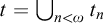 $t=\bigcup _{n<\omega }t_n$
. Let
$t=\bigcup _{n<\omega }t_n$
. Let $\tau \in \mathcal {J}(\mathcal {R})$
be a name such that
$\tau \in \mathcal {J}(\mathcal {R})$
be a name such that $\tau _G=t$
, where G is the generic filter associated with u. Let
$\tau _G=t$
, where G is the generic filter associated with u. Let $p\in \mathbb B_{\mathrm {ml},\delta }^{R}$
be the Boolean value of “
$p\in \mathbb B_{\mathrm {ml},\delta }^{R}$
be the Boolean value of “ $\tau $
is a consistent theory in parameters in
$\tau $
is a consistent theory in parameters in $\delta \cup \{\dot {p}\}$
”. For each
$\delta \cup \{\dot {p}\}$
”. For each $n<\omega $
, let
$n<\omega $
, let $p_n\in \mathbb B^R_{\mathrm {ml},\delta }$
be the conjunction of p with the Boolean value of “
$p_n\in \mathbb B^R_{\mathrm {ml},\delta }$
be the conjunction of p with the Boolean value of “ $\check {t_n}\subseteq \tau $
”. So
$\check {t_n}\subseteq \tau $
”. So $p_n\in R$
and
$p_n\in R$
and $\left <p_n\right>_{n<\omega }$
is
$\left <p_n\right>_{n<\omega }$
is  . In fact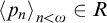 $\left <p_n\right>_{n<\omega }\in R$
, since
$\left <p_n\right>_{n<\omega }\in R$
, since $\mathcal {J}(\mathcal {R})$
does not definably singularize
$\mathcal {J}(\mathcal {R})$
does not definably singularize $\delta $
and
$\delta $
and $\rho _1^{\mathcal {J}(\mathcal {R})}=\delta $
. So
$\rho _1^{\mathcal {J}(\mathcal {R})}=\delta $
. So $q=\bigwedge _{n<\omega }p_n\in \mathbb B^R_{\mathrm {ml},\delta }$
. Now
$q=\bigwedge _{n<\omega }p_n\in \mathbb B^R_{\mathrm {ml},\delta }$
. Now $q\neq 0$
and
$q\neq 0$
and $q\in G$
, since
$q\in G$
, since $\tau _G=t=\bigcup _{n<\omega }t_n$
. But then
$\tau _G=t=\bigcup _{n<\omega }t_n$
. But then  . So
. So $t\in \mathcal {J}(\mathcal {R})$
, which is impossible.
$t\in \mathcal {J}(\mathcal {R})$
, which is impossible.
Definition 8.4. A premouse M is transcendent iff $M\in \mathrm {pm}_1$
, M is an
$M\in \mathrm {pm}_1$
, M is an $\omega $
-mouse and for all
$\omega $
-mouse and for all $\mathcal {T},P,\delta \in M$
and
$\mathcal {T},P,\delta \in M$
and $k<\omega $
, if
$k<\omega $
, if
-
–
$P\triangleleft M$
and
$\delta =\rho _\omega ^P=\rho _{k+1}^P=\omega _1^M$
, -
–
$\mathcal {T}$
is on , via , and
$\mathrm {lh}(\mathcal {T})=\delta =\delta (\mathcal {T})$
, -
–
$\mathcal {T}$
is P-optimal for M, and -
–
$\mathcal {J}(M(\mathcal {T}))\models $
“
$\delta $
is a Woodin cardinal”,



 , via
, via  , and
, and 

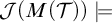

letting  , then there is $n<\omega$
such that
$n<\omega$
such that $\operatorname {\mathrm {Th}}_{\Sigma _{n+1}}^M(\emptyset )$
is not definable from parameters over
$\operatorname {\mathrm {Th}}_{\Sigma _{n+1}}^M(\emptyset )$
is not definable from parameters over $Q[t_{k+1}^P]$
. Given an
$Q[t_{k+1}^P]$
. Given an $\omega $
-mouse
$\omega $
-mouse $R\triangleleft M$
, transcendent above R is the relativization to parameter R and trees above R.
$R\triangleleft M$
, transcendent above R is the relativization to parameter R and trees above R.
Remark 8.5. Note that $M_n^\#$
is transcendent for
$M_n^\#$
is transcendent for $n\leq \omega $
. Many other such standard “minimal” mice are transcendent; for example, we will also observe in Remark 8.15 that
$n\leq \omega $
. Many other such standard “minimal” mice are transcendent; for example, we will also observe in Remark 8.15 that $M_{\mathrm {wlim}}^\#$
(the sharp for a Woodin limit of Woodins) is transcendent, as is the minimal mouse M with an active superstrong extender. But
$M_{\mathrm {wlim}}^\#$
(the sharp for a Woodin limit of Woodins) is transcendent, as is the minimal mouse M with an active superstrong extender. But $(M_1^\#)^\#$
is not transcendent, which is easily seen via genericity iteration. However,
$(M_1^\#)^\#$
is not transcendent, which is easily seen via genericity iteration. However, $(M_1^\#)^\#$
is trivially transcendent above
$(M_1^\#)^\#$
is trivially transcendent above $M_1^\#$
. But the sharp of the model S of Example 3.6 is not transcendent above any
$M_1^\#$
. But the sharp of the model S of Example 3.6 is not transcendent above any $\omega $
-mouse
$\omega $
-mouse  . For let $\mathcal {T}$
on
$\mathcal {T}$
on $M_1^\#(R)$
be as there, and note that
$M_1^\#(R)$
be as there, and note that $\mathcal {T}$
is
$\mathcal {T}$
is $S|\omega _1^S$
-optimal, but we get
$S|\omega _1^S$
-optimal, but we get $Q=M^{\mathcal {T}}_b$
is the output of the P-construction of S above
$Q=M^{\mathcal {T}}_b$
is the output of the P-construction of S above $M(\mathcal {T})$
, and
$M(\mathcal {T})$
, and $\mathrm {OR}^Q=\mathrm {OR}^S$
.
$\mathrm {OR}^Q=\mathrm {OR}^S$
.
Remark 8.6. Let $\mathcal {T}$
be P-optimal and
$\mathcal {T}$
be P-optimal and $\delta =\delta (\mathcal {T})$
. We next define the
$\delta =\delta (\mathcal {T})$
. We next define the $\star $
-translation
$\star $
-translation $Q^\star =Q^\star (\mathcal {T},P)$
of certain premice Q extending
$Q^\star =Q^\star (\mathcal {T},P)$
of certain premice Q extending $M(\mathcal {T})$
(in the right context). This is a simple variant of the procedure in [Reference Closson1]. The goal is to convert Q, which may have extenders
$M(\mathcal {T})$
(in the right context). This is a simple variant of the procedure in [Reference Closson1]. The goal is to convert Q, which may have extenders $E\in \mathbb {E}_+^Q$
with
$E\in \mathbb {E}_+^Q$
with $\mathrm {cr}(E)\leq \delta $
, into a premouse
$\mathrm {cr}(E)\leq \delta $
, into a premouse $Q^{\star }$
extending P, having
$Q^{\star }$
extending P, having $\delta $
as a strong cutpoint, but containing essentially the same information (modulo the generic object P). The overlapping extenders E are converted into ultrapower maps, which can be recovered by
$\delta $
as a strong cutpoint, but containing essentially the same information (modulo the generic object P). The overlapping extenders E are converted into ultrapower maps, which can be recovered by $Q^\star $
by computing the corresponding core maps. The differences with [Reference Closson1] are (i) we define
$Q^\star $
by computing the corresponding core maps. The differences with [Reference Closson1] are (i) we define $R^\star $
for all valid segments of
$R^\star $
for all valid segments of $R\trianglelefteq Q$
, which begins with
$R\trianglelefteq Q$
, which begins with $M(\mathcal {T})$
itself (instead of waiting for the least admissible beyond
$M(\mathcal {T})$
itself (instead of waiting for the least admissible beyond $M(\mathcal {T})$
; valid is defined presently and pertains to condition (iii) below), (ii) we set
$M(\mathcal {T})$
; valid is defined presently and pertains to condition (iii) below), (ii) we set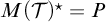 $M(\mathcal {T})^\star =P$
(so P is the starting point, instead of basically
$M(\mathcal {T})^\star =P$
(so P is the starting point, instead of basically $M|\delta $
), and (iii) we allow
$M|\delta $
), and (iii) we allow $\delta $
to be the critical point of extenders in
$\delta $
to be the critical point of extenders in $\mathbb {E}_+^Q$
. Items (i) and (ii) only involve slight fine structural changes, just at the bottom of the hierarchy, and are straightforward. To translate the extenders as in (iii), one takes ultrapowers just as for other extenders, the difference being that the ultrapower is formed of some segment of Q instead of a segment of a model of
$\mathbb {E}_+^Q$
. Items (i) and (ii) only involve slight fine structural changes, just at the bottom of the hierarchy, and are straightforward. To translate the extenders as in (iii), one takes ultrapowers just as for other extenders, the difference being that the ultrapower is formed of some segment of Q instead of a segment of a model of $\mathcal {T}$
. Otherwise things are very similar to [Reference Closson1]. We give the definition now in detail, and will then state some facts about it, but a proof of those facts is beyond the scope of the article, so we will just take them as a hypothesis throughout this section.
$\mathcal {T}$
. Otherwise things are very similar to [Reference Closson1]. We give the definition now in detail, and will then state some facts about it, but a proof of those facts is beyond the scope of the article, so we will just take them as a hypothesis throughout this section.
Definition 8.7. Let $\mathcal {T}$
be P-optimal and
$\mathcal {T}$
be P-optimal and $\delta =\delta (\mathcal {T})$
.
$\delta =\delta (\mathcal {T})$
.
Let Q be a premouse. A Q- $\delta $
-measure is a type 1 extender E such that
$\delta $
-measure is a type 1 extender E such that $\mathrm {cr}(E)=\delta $
and E is Q-total, and either:
$\mathrm {cr}(E)=\delta $
and E is Q-total, and either:
-
–
$E\in \mathbb {E}_+^Q$
, or -
– Q is active type 2 with largest cardinal
$\delta $
and
$E\in \mathbb {E}_+(\mathrm {Ult}(Q,F^Q))$
.



(Note then that if Q is active type 3 and $\delta =\nu (F^Q)$
, then
$\delta =\nu (F^Q)$
, then $\delta $
is the largest cardinal of Q, and so there is no Q-
$\delta $
is the largest cardinal of Q, and so there is no Q- $\delta $
-measure.) Let
$\delta $
-measure.) Let $\mu ^Q_\delta $
denote the least such, if it exists. Say Q is
$\mu ^Q_\delta $
denote the least such, if it exists. Say Q is $\star $
-valid iff
$\star $
-valid iff
-
(i)
$M(\mathcal {T})\trianglelefteq Q$
, -
(ii) if
$M(\mathcal {T})\triangleleft Q$
then
$Q\models $
“
$\delta $
is Woodin”, and -
(iii) if there is a Q-
$\delta $
-measure then Q is
$\delta $
-sound and there is
$q<\omega $
such that
$\rho _{q+1}^Q\leq \delta $
.


Given $\kappa <\delta $
, let
$\kappa <\delta $
, let $\beta _\kappa $
be the least
$\beta _\kappa $
be the least $\beta <\mathrm {lh}(\mathcal {T})$
such that
$\beta <\mathrm {lh}(\mathcal {T})$
such that $\kappa <\nu (E^{\mathcal {T}}_\beta )$
, let
$\kappa <\nu (E^{\mathcal {T}}_\beta )$
, let $\widetilde{M}_\kappa$
be the largest
$\widetilde{M}_\kappa$
be the largest $N\trianglelefteq M^{\mathcal{T}}_{\beta_\kappa} $
such that
$N\trianglelefteq M^{\mathcal{T}}_{\beta_\kappa} $
such that $N\cap \mathcal {P}(\kappa )\subseteq M(\mathcal {T})$
, and
$N\cap \mathcal {P}(\kappa )\subseteq M(\mathcal {T})$
, and $n_\kappa =$
the largest
$n_\kappa =$
the largest $n<\omega $
such that
$n<\omega $
such that $\kappa <\rho_n^{\widetilde{M}_\kappa}$
.
$\kappa <\rho_n^{\widetilde{M}_\kappa}$
.
Assuming R is $\star $
-valid, we (attempt to) define the
$\star $
-valid, we (attempt to) define the $\star $
-translation
$\star $
-translation $R^{\star }$
of R, by recursion as follows:
$R^{\star }$
of R, by recursion as follows:
-
1.
$M(\mathcal {T})^\star =P$
. -
2. If there is an R-
$\delta $
-measure and
$\rho _{r+1}^R\leq \delta (\mathcal {T})<\rho _r^R$
, then
$R^\star =\mathrm {Ult}_r(R,\mu ^R_\delta )^\star $
(note that if wellfounded,
$\mathrm {Ult}_r(R,\mu ^R_\delta )$
is
$\star $
-valid and there is no
$\mathrm{Ult}_r(R,\mu^R_\delta)$
-
$\delta$
-measure).
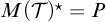



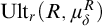

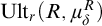

Suppose from now on that there is no R- $\delta $
-measure. Then:
$\delta $
-measure. Then:
-
3. If
$R$
is active with
$\kappa=\mathrm{crit}(F^R)<\delta$
then
$R^\star=\mathrm{Ult}_{n_\kappa}(\widetilde{M}_\kappa,F^R)^\star$
. -
4. If R is passive and
$R=\mathcal {J}(S)$
(note then S is
$\star $
-valid) then
$\mathcal {J}(R)^\star =\mathcal {J}(S^\star )$
. -
5. If R is passive of limit type then
$R^\star $
is the stack of all
$S^\star $
such that
$S\triangleleft R$
and
$S$
is
$\star$
-valid. -
6. If R is active with
$\mathrm {cr}(F^R)>\delta $
and-
(a) the universe of
$(R^{\mathrm {pv}})^\star $
is that of
$R[P]$
(a meas-lim extender algebra extension), and -
(b) the canonical extension
$F^{+}$
of
$F^R$
to the generic extension induces a premouse
$((R^{\mathrm {pv}})^\star ,F^{+})$
,
then we set
$R^\star =$
this premouse. -
-
7. Otherwise,
$R^\star $
is left undefined.








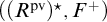


This definition proceeds by recursion along a natural linear order (we leave the details of this to the reader, but it is implicit in Remark 8.8 below). If this linear order is illfounded, then $R^\star $
is left undefined. Also, if any of the structures S arising in the recursion leading to
$R^\star $
is left undefined. Also, if any of the structures S arising in the recursion leading to $R^\star $
fails to produce a premouse
$R^\star $
fails to produce a premouse $S^{\star }$
extending P (e.g., if there is a
$S^{\star }$
extending P (e.g., if there is a $\star $
-valid S such that
$\star $
-valid S such that $S\triangleleft R$
but
$S\triangleleft R$
but $S^\star $
is not a premouse extending P, or if one of the ultrapowers arising in clauses 2 and 8.7 is illfounded), then
$S^\star $
is not a premouse extending P, or if one of the ultrapowers arising in clauses 2 and 8.7 is illfounded), then $R^\star $
is left undefined.
$R^\star $
is left undefined.
Remark 8.8. If the phalanx $\Phi (\mathcal {T})\ \widehat {\ }\ (Q,q)$
is iterable where either
$\Phi (\mathcal {T})\ \widehat {\ }\ (Q,q)$
is iterable where either $q=0$
or there is a
$q=0$
or there is a $Q$
-
$Q$
- $\delta$
-measure and
$\delta$
-measure and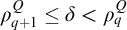 $\rho_{q+1}^Q\leq\delta<\rho_q^Q$
(where q indicates the degree associated with Q in the phalanx), then it is straightforward to see that the definition of
$\rho_{q+1}^Q\leq\delta<\rho_q^Q$
(where q indicates the degree associated with Q in the phalanx), then it is straightforward to see that the definition of $Q^\star $
is by recursion along a wellorder (consider degree-maximal trees
$Q^\star $
is by recursion along a wellorder (consider degree-maximal trees $\mathcal {U}$
on
$\mathcal {U}$
on $\Phi (\mathcal {T})\ \widehat {\ }\ (Q,q)$
such that
$\Phi (\mathcal {T})\ \widehat {\ }\ (Q,q)$
such that $\mathrm {cr}(E^{\mathcal {U}}_\alpha )\leq \delta $
for all
$\mathrm {cr}(E^{\mathcal {U}}_\alpha )\leq \delta $
for all $\alpha +1<\mathrm {lh}(\mathcal {U})$
). The fact that
$\alpha +1<\mathrm {lh}(\mathcal {U})$
). The fact that $Q^\star $
is a well-defined premouse, however, takes fine structural calculation, as in [Reference Closson1]. But there are some small issues in [Reference Closson1] which need correction; most significantly (as far as the author is aware), the description of the relationship between the standard parameters of Q and those of
$Q^\star $
is a well-defined premouse, however, takes fine structural calculation, as in [Reference Closson1]. But there are some small issues in [Reference Closson1] which need correction; most significantly (as far as the author is aware), the description of the relationship between the standard parameters of Q and those of $Q^\star $
is incorrect in some cases, which come up, for example, in [Reference Closson1, Theorem 1.2.9(d”), with
$Q^\star $
is incorrect in some cases, which come up, for example, in [Reference Closson1, Theorem 1.2.9(d”), with $j=1$
].Footnote
20
$j=1$
].Footnote
20
The author intends to write an account of this,Footnote 21 incorporating of course the modifications (i)–(iii). But this is beyond the scope of the present article, and here we will just summarize the features we need, make the assumption that these do indeed work out and complete the proofs of the current article using this assumption.
Definition 8.9. The $\star $
-translation hypothesis (STH) is the following assertion: Let
$\star $
-translation hypothesis (STH) is the following assertion: Let $\mathcal {T}$
be P-optimal,
$\mathcal {T}$
be P-optimal, $\delta =\delta (\mathcal {T})$
and Q be
$\delta =\delta (\mathcal {T})$
and Q be $\star $
-valid. Let
$\star $
-valid. Let $k<\omega $
be least such that
$k<\omega $
be least such that $\rho _{k+1}^P\leq \delta $
. Let
$\rho _{k+1}^P\leq \delta $
. Let $Q^\star =Q^\star (\mathcal {T},P)$
. Then:
$Q^\star =Q^\star (\mathcal {T},P)$
. Then:
-
1. If
$Q^\star $
is a well-defined premouse, then
$\mathcal {P}(\delta )\cap Q[t^P_{k+1}(\delta )]=\mathcal {P}(\delta )\cap Q^\star $
, and letting
$n<\omega $
and
$x\in Q^\star $
and-
(a)
$\theta =\rho _\omega ^Q$
, if Q is sound with
$\delta \leq \rho _\omega ^Q$
, or -
(b)
$\theta =\delta $
otherwise,
the theory
$\operatorname {\mathrm {Th}}_{\Sigma _{n+1}}^{Q^\star }(\theta \cup \{x\})$
is definable from parameters over
$Q[t^P_{k+1}(\delta )]$
. -
-
2. If
$\mathcal {T}$
is on an
$\omega $
-mouse N, of countable length, via
$\Sigma _N$
, and
$Q=Q(\mathcal {T},\Sigma _N(\mathcal {T}))$
, then
$Q^\star $
is a well-defined premouse, is
$\delta $
-sound and above-
$\delta $
-
$(q,\omega _1+1)$
-iterable whenever
$\delta <\rho _q(Q^\star )$
.




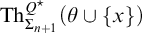





The proof of STH is almost as in [Reference Closson1], though see Remark 8.8.Footnote 22
We now invert the $\star $
-translation, also using a small modification of [Reference Closson1].
$\star $
-translation, also using a small modification of [Reference Closson1].
Definition 8.10. Let $M\in \mathrm {pm}_1$
be a premouse and
$M\in \mathrm {pm}_1$
be a premouse and $\mathcal {T}$
be P-optimal for M. Let
$\mathcal {T}$
be P-optimal for M. Let $\delta =\delta (\mathcal {T})$
. Let
$\delta =\delta (\mathcal {T})$
. Let $q<\omega $
and Q be a q-sound,
$q<\omega $
and Q be a q-sound, $(q+1)$
-universal premouse such that
$(q+1)$
-universal premouse such that $M(\mathcal {T})\trianglelefteq Q$
and
$M(\mathcal {T})\trianglelefteq Q$
and $Q\models $
“
$Q\models $
“ $\delta $
is Woodin”,
$\delta $
is Woodin”,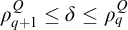 $\rho _{q+1}^Q\leq \delta \leq \rho _q^Q$
, and
$\rho _{q+1}^Q\leq \delta \leq \rho _q^Q$
, and $\mathfrak {C}_{q+1}(Q)$
is
$\mathfrak {C}_{q+1}(Q)$
is $(q+1)$
-solid.
$(q+1)$
-solid.
For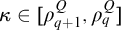 $\kappa \in [\rho _{q+1}^Q,\rho _q^Q]$
, recall that Q has the
$\kappa \in [\rho _{q+1}^Q,\rho _q^Q]$
, recall that Q has the $(q+1)$
-hull property at
$(q+1)$
-hull property at $\kappa $
iff
$\kappa $
iff
 $$\begin{align*}\mathcal{P}(\kappa)\cap Q\subseteq C_\kappa=\mathrm{cHull}_{q+1}^Q(\kappa\cup\vec{p}_{q+1}^Q).\end{align*}$$
(So Q has the $(q+1)$
-hull property at
$(q+1)$
-hull property at $\rho _{q+1}^Q$
, by
$\rho _{q+1}^Q$
, by $(q+1)$
-universality.) Let
$(q+1)$
-universality.) Let $\pi _\kappa :C_\kappa \to Q$
be the uncollapse map.
$\pi _\kappa :C_\kappa \to Q$
be the uncollapse map.
Say Q is $\star $
-
$\star $
- $\delta $
-critical iff
$\delta $
-critical iff
-
1. Q is
$(\delta +1)$
-sound but non-
$\delta $
-sound (hence
$\delta <\rho _q^Q$
and
$\mathrm {cr}(\pi _\delta )=\delta $
), -
2. Q has the
$(q+1)$
-hull property at
$\delta $
, and -
3. letting
$\mu $
be the normal measure on
$\delta $
derived from
$\pi _\delta $
, either-
(i)
$\mu \in \mathbb {E}_+^{C_\delta }$
(hence
$Q=\mathrm {Ult}_q(C_\delta ,\mu )$
and
$C_\delta ||\mathrm {lh}(\mu )=Q||\mathrm {lh}(\mu )$
and
$\mathrm {lh}(\mu )=\delta ^{++Q}$
), or -
(ii)
$C_\delta $
is active type 2 with
$\mathrm {lgcd}(C_\delta )=\delta $
and
$\mu \in \mathbb {E}^U$
, where
$U=\mathrm {Ult}(C_\delta ,F^{C_\delta })$
(hence
$q=0$
and
$Q=\mathrm {Ult}_0(C_\delta ,\mu )$
and
$U||\mathrm {lh}(\mu )=Q||\delta ^{++Q}$
and
$C_\delta ^{\mathrm {pv}}=Q||\delta ^{+Q}$
).
-












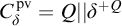
Say $Q\ \star $
-successor-projects across
$Q\ \star $
-successor-projects across $\delta $
iff
$\delta $
iff
-
1.
$\rho _{q+1}^Q<\delta <\rho _q^Q$
, -
2. there is a largest
$\kappa <\delta $
such that Q has the
$(q+1)$
-hull property at
$\kappa $
; fix this
$\kappa $
, -
3.
$C_\kappa =\widetilde{M}_\kappa $
and
$q=n_\kappa $
, -
4. letting E be the
$(\kappa ,\pi _\kappa (\kappa ))$
-extender derived from
$\pi _\kappa $
, there is
$\nu \in [\kappa ^{+Q},\pi _\kappa (\kappa )]$
such that
$E\!\upharpoonright \!\nu $
is non-type Z letting
$F$
be the trivial completion of
$E\!\upharpoonright \!\nu $
, we have:-
–
$F\notin\mathbb{E}_+^Q$
, and -
– if
$Q|\nu$
is active then
$F\notin\mathbb{E}(\mathrm{Ult}(Q|\nu,F^{Q|\nu}))$
;
$\nu $
least such, we have
$\delta \leq \nu $
and
$Q=\mathrm {Ult}_{n_\kappa }(\widetilde{M}_\kappa, E\!\upharpoonright \!\nu )$
.
-
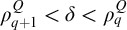






Suppose $Q\ \star $
-successor-projects across
$Q\ \star $
-successor-projects across $\delta $
and fix notation as above. The extender-core of Q is
$\delta $
and fix notation as above. The extender-core of Q is
 $$\begin{align*}N=(Q||\nu^{+Q},E'), \end{align*}$$
where $E'$
is the trivial completion of
$E'$
is the trivial completion of $E\!\upharpoonright \!\nu $
(so
$E\!\upharpoonright \!\nu $
(so $N^{\mathrm {pv}}=N||\nu ^{+N}=Q||\nu ^{+Q}\trianglelefteq Q^{\mathrm {pv}}$
). Note that Q has the
$N^{\mathrm {pv}}=N||\nu ^{+N}=Q||\nu ^{+Q}\trianglelefteq Q^{\mathrm {pv}}$
). Note that Q has the $(q+1)$
-hull property at
$(q+1)$
-hull property at $\delta $
iff
$\delta $
iff $\nu =\delta $
iff Q is
$\nu =\delta $
iff Q is $\delta $
-sound.
$\delta $
-sound.
Say Q is $\star $
-terminal iff either
$\star $
-terminal iff either
-
(i) Q is fully sound with
$\rho _\omega ^Q=\delta $
and Q is a Q-structure for
$\delta $
, or -
(ii) Q is
$\delta $
-sound and there is
$r\in [q,\omega )$
such that Q is r-sound but non-
$(r+1)$
-sound,
$\rho _{r+1}^Q<\delta \leq \rho _r^Q$
, Q is
$(r+1)$
-universal and
$\mathfrak {C}_{r+1}(Q)$
is
$(r+1)$
-solid, and there are cofinally many
$\kappa <\delta $
such that Q has the
$(r+1)$
-hull property at
$\kappa $
.Footnote
23


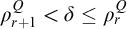


Let $R\trianglelefteq M$
with
$R\trianglelefteq M$
with $P\trianglelefteq R$
. We will (attempt to) define the black hole construction of R with respect to
$P\trianglelefteq R$
. We will (attempt to) define the black hole construction of R with respect to $\mathcal {T},P$
. It is a kind of background construction using all extenders in
$\mathcal {T},P$
. It is a kind of background construction using all extenders in $\mathbb {E}_+^R$
beyond P (as far as the construction is defined), but with a modified coring process which allows the appearance of extenders E with
$\mathbb {E}_+^R$
beyond P (as far as the construction is defined), but with a modified coring process which allows the appearance of extenders E with $\mathrm {cr}(E)\leq \delta $
. The intent is to invert the
$\mathrm {cr}(E)\leq \delta $
. The intent is to invert the $\star $
-translation.
$\star $
-translation.
For R such that $P\trianglelefteq R\trianglelefteq M$
we (attempt to) define models
$P\trianglelefteq R\trianglelefteq M$
we (attempt to) define models  , for
, for $n<\omega $
, and then
$n<\omega $
, and then  , by recursion on $(R,n)$
, as follows. Set
$(R,n)$
, as follows. Set 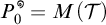 . Suppose we have defined
  . We attempt to define models
  for
for $n<\omega $
, and then set
$n<\omega $
, and then set  . Suppose we have
  . If
. If $R'$
is sound and
$R'$
is sound and $\delta \leq \rho _\omega ^{R'}$
then we define
$\delta \leq \rho _\omega ^{R'}$
then we define  for all $m\in [n,\omega )$
. Otherwise let
$m\in [n,\omega )$
. Otherwise let $q<\omega $
be least such that
$q<\omega $
be least such that $R'$
is q-sound and either
$R'$
is q-sound and either $\rho _{q+1}^{R'}<\delta $
or
$\rho _{q+1}^{R'}<\delta $
or $R'$
is non-
$R'$
is non- $(q+1)$
-sound. Let
$(q+1)$
-sound. Let $\rho =\rho _{q+1}^{R'}$
. We assume the following and proceed as follows; otherwise we give up and leave
$\rho =\rho _{q+1}^{R'}$
. We assume the following and proceed as follows; otherwise we give up and leave  undefined:
-
bh1.
$\rho \leq \delta $
and
$R'$
is non-
$(q+1)$
-sound, but
$R'$
is
$(q+1)$
-universal and
$\mathfrak {C}_{q+1}(R')$
is
$(q+1)$
-solid. -
bh2. If
$R'$
fails the
$(q+1)$
-hull property at
$\delta $
(so by q-soundness and
$(q+1)$
-universality, we have
$\rho =\rho _{q+1}^{R'}<\delta <\rho _q^{R'}$
) then
$R'\ \star $
-successor-projects across
$\delta $
, and we set the extender-core of
$R'$
. -
bh3. If
$R'$
has the
$(q+1)$
-hull property at
$\delta $
then:-
(a) If
$R'$
is non-
$\delta $
-sound (so
$\delta <\rho _q^{R'}$
, by q-soundness), then
$R'$
is
$\star $
-
$\delta $
-critical and we set the
$\delta $
-core of
$R'$
. -
(b) If
$R'$
is
$\delta $
-sound (so
$\rho =\rho _{q+1}^{R'}<\delta $
, by choice of q) then:-
(i) If there are only boundedly many
$\kappa <\delta $
such that
$R'$
has the hull property at
$\kappa $
, then
$R'\ \star $
-successor-projects across
$\delta $
, and we set the extender-core of
$R'$
. -
(ii) If there are unboundedly many
$\kappa <\delta $
such that
$R'$
has the hull property at
$\kappa $
, then
$R'$
is
$\star $
-terminal, and we set (and the construction goes no further).
-
-





 the extender-core of


 the
the 


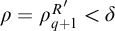


 the extender-core of


 (and the construction goes no further).
 This completes the description of  . We claim that if
  exists for all $n<\omega $
then
$n<\omega $
then  also exists, so we have defined
  . For suppose that
  and
and  exist but
  for all $n<\omega $
. Then for every
$n<\omega $
. Then for every $n<\omega $
, either
$n<\omega $
, either  is
is $\star $
-
$\star $
- $\delta $
-critical or
$\delta $
-critical or  -successor-projects across $\delta $
. Note that if
$\delta $
. Note that if  -successor-projects across $\delta $
then
$\delta $
then  and if
  then
then  is active type 2 and
  has superstrong type, so
  . It easily follows that there is $n<\omega $
such that
$n<\omega $
such that  is
is $\star $
-
$\star $
- $\delta $
-critical. Fix such an n. Then
$\delta $
-critical. Fix such an n. Then  , which is the $\delta $
-core of
$\delta $
-core of  , is
, is $\delta $
-sound. So
$\delta $
-sound. So  is not $\star $
-
$\star $
- $\delta $
-critical, so it
$\delta $
-critical, so it $\star $
-successor-projects across
$\star $
-successor-projects across $\delta $
. So letting
$\delta $
. So letting 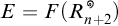 , we have
  , where $\kappa =\mathrm {cr}(E)$
and C is the
$\kappa =\mathrm {cr}(E)$
and C is the $\kappa $
-core of
$\kappa $
-core of  , and
, and  . But since
  is
is $\delta $
-sound,
$\delta $
-sound, $\nu (E)\leq \delta $
. So in fact
$\nu (E)\leq \delta $
. So in fact $\nu (E)=\delta $
and E is type 3, so
$\nu (E)=\delta $
and E is type 3, so  is active type 3 with largest cardinal $\delta $
. But then it is easy to see that
$\delta $
. But then it is easy to see that  is not $\star $
-
$\star $
- $\delta $
-critical and does not
$\delta $
-critical and does not $\star $
-successor-project across
$\star $
-successor-project across $\delta $
, a contradiction.
$\delta $
, a contradiction.
Now let $R=M||\alpha $
or
$R=M||\alpha $
or $R=M|\alpha $
for some
$R=M|\alpha $
for some $\alpha $
, and suppose we have successfully defined
$\alpha $
, and suppose we have successfully defined  for all $S\triangleleft R$
, these are sound premice, and none are
$S\triangleleft R$
, these are sound premice, and none are $\star $
-terminal. If
$\star $
-terminal. If $R=\mathcal {J}(S)$
then we set
$R=\mathcal {J}(S)$
then we set 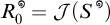 . If R is passive of limit type then
  (note that this exists, like with standard background constructions). And if R is active, hence with $\delta <\mathrm {cr}(F^R)$
, then we assume that
$\delta <\mathrm {cr}(F^R)$
, then we assume that $F^R$
restricts to an extender E such that
$F^R$
restricts to an extender E such that  is a premouse, and we set
  (and otherwise
  is undefined).
The following lemma, saying in particular that the  -construction and $\star $
-translation are inverses, is straightforward to verify by induction.
$\star $
-translation are inverses, is straightforward to verify by induction.
Lemma 8.11. Let $\mathcal {T}$
be P-optimal for M.
$\mathcal {T}$
be P-optimal for M.
Adopting the notation of Definition 8.7 ( $\star $
-translation), suppose that Q is
$\star $
-translation), suppose that Q is $\star $
-valid,
$\star $
-valid, $Q^\star =Q^\star (\mathcal {T},P)$
is a well-defined premouse, and
$Q^\star =Q^\star (\mathcal {T},P)$
is a well-defined premouse, and $Q^\star \trianglelefteq M$
. Then there is
$Q^\star \trianglelefteq M$
. Then there is $n<\omega $
such that
$n<\omega $
such that  is well-defined and
  .
.
Conversely, let R and $r<\omega $
be such that
$r<\omega $
be such that $P\trianglelefteq R\trianglelefteq M$
and
$P\trianglelefteq R\trianglelefteq M$
and  is a well-defined premouse. Then
  is
is $\star $
-valid,
$\star $
-valid,  is well-defined, and
  . Moreover, if $(P,0)\trianglelefteq (S,s)\trianglelefteq (R,r)$
then
$(P,0)\trianglelefteq (S,s)\trianglelefteq (R,r)$
then  .
.
Definition 8.12. Let $\mathcal {T}$
be P-optimal for M,
$\mathcal {T}$
be P-optimal for M, $\delta =\delta (\mathcal {T})$
and
$\delta =\delta (\mathcal {T})$
and $P\triangleleft R\trianglelefteq M$
with
$P\triangleleft R\trianglelefteq M$
with $\delta $
an R-cardinal. We say that R is just beyond
$\delta $
an R-cardinal. We say that R is just beyond $\delta $
-projection iff there is S such that
$\delta $
-projection iff there is S such that $P\trianglelefteq S\triangleleft R$
and
$P\trianglelefteq S\triangleleft R$
and $\rho _\omega ^S=\delta $
and there is no admissible
$\rho _\omega ^S=\delta $
and there is no admissible $R'$
such that
$R'$
such that $S\triangleleft R'\trianglelefteq R$
.
$S\triangleleft R'\trianglelefteq R$
.
So if R is just beyond $\delta $
-projection then
$\delta $
-projection then $\rho _1^R\leq \delta $
. The
$\rho _1^R\leq \delta $
. The  -construction is almost completely local, but it seems maybe not quite completely at the level of critical point Woodins, because of the requirement of computing cores which project to $\delta $
(if there is such a non-trivial core, then there are
$\delta $
(if there is such a non-trivial core, then there are $\delta $
-measures, hence critical point Woodins). To handle this we split into two cases in what follows, making use of the two formulas
$\delta $
-measures, hence critical point Woodins). To handle this we split into two cases in what follows, making use of the two formulas  and
and  .Footnote
24
.Footnote
24
Lemma 8.13. Assume STH.Footnote
25
Then there are formulas  and
and  of the language of premice such that for all $M\in \mathrm {pm}_1$
, all
$M\in \mathrm {pm}_1$
, all $\mathcal{T},P,R,\delta$
such that
$\mathcal{T},P,R,\delta$
such that $\mathcal{T},P\in M$
,
$\mathcal{T},P\in M$
, $\mathcal{T}$
is
$\mathcal{T}$
is $P$
-optimal for
$P$
-optimal for $M$
,
$M$
, $P\triangleleft R\trianglelefteq M$
,
$P\triangleleft R\trianglelefteq M$
, $\delta=\delta(\mathcal{T})$
is an
$\delta=\delta(\mathcal{T})$
is an $R$
-cardinal and
$R$
-cardinal and  is a well-defined premouse, we have:
-
1. R and
have the same cardinals
$\kappa \geq \delta $
, and for each such
$\kappa>\delta $
(so
$\kappa <\mathrm {OR}^R$
), we have (whereas ). -
2. If
$R\triangleleft M$
and
$\rho _\omega ^R=\mathrm {OR}^R$
then and . -
3. For each
$R$
-cardinal
$\kappa\geq\delta$
and each
$S\triangleleft R$
with
$P\trianglelefteq S$
and
$\kappa\leq\mathrm{OR}^S$
, we have and if
$\rho_\omega^S=\kappa$
then and . -
4. If R is not just beyond
$\delta $
-projection then and is defined over R by from the parameter
$\mathcal {T}$
. -
5. If R is just beyond
$\delta $
-projection then , is
$\delta $
-sound, and is defined over R by from the parameter
$\mathcal {T}$
.
 have the same cardinals


 (whereas
  ).
).

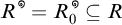 and
and  .
.


 and if
 and
and  .
.
 and
and  is defined over R by
  from the parameter

 ,
,  is
is 
 is defined over R by
  from the parameter
Proof sketch.
Let us first discuss the formulation of  and
and  . We won’t write down these formulas explicitly, but just sketch out some primary considerations. The fact that
  works correctly will depend on part 3 for proper segments of $R$
.
$R$
.
The formula  just says to perform the
  -construction through to
  , and use it to determine
  .In case $R$
is not just beyond
$R$
is not just beyond $\delta$
-projection, it is sufficiently closed that this works.The
$\delta$
-projection, it is sufficiently closed that this works.The  -construction is defined from the parameter $(\mathcal{T},P)$
, and we are given the parameter
$(\mathcal{T},P)$
, and we are given the parameter $\mathcal{T}$
. But using
$\mathcal{T}$
. But using $\mathcal{T}$
, we can identify
$\mathcal{T}$
, we can identify $P$
in a
$P$
in a $\Sigma_1$
fashion over
$\Sigma_1$
fashion over $M$
, by Lemma 8.3.
$M$
, by Lemma 8.3.
The formula  is relevant in case $R$
is just beyond
$R$
is just beyond $\delta$
-projection, so there is S such that
$\delta$
-projection, so there is S such that $P\trianglelefteq S\triangleleft R$
and
$P\trianglelefteq S\triangleleft R$
and $\rho_\omega^S=\delta$
but there is no admissible
$\rho_\omega^S=\delta$
but there is no admissible $S'$
with
$S'$
with $S\triangleleft S'\trianglelefteq R$
; let
$S\triangleleft S'\trianglelefteq R$
; let $S$
be least such. Now
$S$
be least such. Now  says to perform the
  -construction up through to
  , and then to perform a coded version of the construction after this, working with theories $\subseteq\delta$
instead of the actual models. To implement this, note that it will follow from part 3, once we have proved it, that we can take
$\subseteq\delta$
instead of the actual models. To implement this, note that it will follow from part 3, once we have proved it, that we can take $n<\omega$
least such that
$n<\omega$
least such that  is sound and
 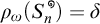 , and then
  , and note
 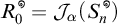 , where $R=\mathcal{J}_\alpha(S)$
. Let
$R=\mathcal{J}_\alpha(S)$
. Let $k<\omega$
be such that
$k<\omega$
be such that 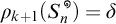 , and note that
  is definable from $\mathcal{T}$
over
$\mathcal{T}$
over $S$
. Starting from the parameter
$S$
. Starting from the parameter $t$
, it is straightforward to uniformly define
$t$
, it is straightforward to uniformly define  over
over $\mathcal{J}_\beta(S)$
, for
$\mathcal{J}_\beta(S)$
, for $\beta\in(0,\alpha]$
. So we can take
$\beta\in(0,\alpha]$
. So we can take  to first identify $S$
(via its projection to
$S$
(via its projection to $\delta$
and the lack of an admissible segment beyond it) and then describe the
$\delta$
and the lack of an admissible segment beyond it) and then describe the  -construction through
  for the least $n$
as above, followed by the coded construction of the models
$n$
as above, followed by the coded construction of the models  just described.
Part 3: The proof is by induction on $R$
, with a sub-induction on
$R$
, with a sub-induction on $(\kappa,S)$
(lexicographically). Here the proof will depend on the correctness of our formulas
$(\kappa,S)$
(lexicographically). Here the proof will depend on the correctness of our formulas  for segments of $R$
. We have
$R$
. We have $P\triangleleft R$
and
$P\triangleleft R$
and $\rho_\omega^P=\delta$
. Fix
$\rho_\omega^P=\delta$
. Fix $(\kappa,S)$
as in part 3, so
$(\kappa,S)$
as in part 3, so $S\triangleleft R$
and
$S\triangleleft R$
and $\rho_\omega^S\geq\kappa$
. Suppose
$\rho_\omega^S\geq\kappa$
. Suppose 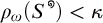 . By definition of
  , we have
 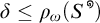 . By condensation, we can find a hull of $S$
with transitive collapse
$S$
with transitive collapse $\bar{S}\triangleleft S$
such that
$\bar{S}\triangleleft S$
such that $\rho_\omega^{\bar{S}}$
is an
$\rho_\omega^{\bar{S}}$
is an $R$
-cardinal
$R$
-cardinal $\bar{\kappa}\in[\delta,\kappa)$
, and with
$\bar{\kappa}\in[\delta,\kappa)$
, and with  and such that
  defines a set
 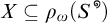 with
with  . (Note that here we have used the definability of
  -construction given through our formulas
  .) But then by induction,
  and
and  , and note that it follows that
  , a contradiction. Now suppose $\rho_\omega^S=\kappa$
. Since
$\rho_\omega^S=\kappa$
. Since  , STH part 1 implies the set $X\subseteq\kappa$
missing from
$X\subseteq\kappa$
missing from $S$
is definable from parameters over
$S$
is definable from parameters over  . But then if
 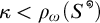 , then there is a set in
  coding the relevant forcing relation giving
  , so
, so $X\in S$
, contradiction. Note that we have shown that for all
$X\in S$
, contradiction. Note that we have shown that for all $S$
with
$S$
with $R|\kappa\trianglelefteq S\triangleleft R$
, we have
$R|\kappa\trianglelefteq S\triangleleft R$
, we have 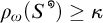 and if $\rho_\omega(S)=\kappa$
then
$\rho_\omega(S)=\kappa$
then 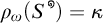 . A straightforward induction now gives that for all $S$
such that
$S$
such that $R|\kappa\trianglelefteq S$
and
$R|\kappa\trianglelefteq S$
and $\rho_\omega(S)=\kappa$
, for all
$\rho_\omega(S)=\kappa$
, for all $S',n$
with
$S',n$
with $S\triangleleft S'\triangleleft R$
and
$S\triangleleft S'\triangleleft R$
and $n<\omega$
, we have
$n<\omega$
, we have  , and therefore that
  .
.
Part 1 is a direct consequence of part 3. For part 2 use a condensation argument like that in the proof of part 3.
Finally let us observe that  is
is $\delta $
-sound in part 4. Note that
$\delta $
-sound in part 4. Note that  , where
 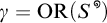 , and let $\xi $
be least such that
$\xi $
be least such that  . If
. If $\xi =0$
then we are done, so suppose
$\xi =0$
then we are done, so suppose $\xi \geq \delta $
. Then
$\xi \geq \delta $
. Then  , and note that
  , and it follows that
 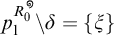 and
and  is
is $1$
-solid above
$1$
-solid above $\delta $
and is
$\delta $
and is $\delta $
-sound.
$\delta $
-sound.
A full analysis of $\star $
-translation and proof of STH needs a sharper, more extensive version of the preceding lemma.
$\star $
-translation and proof of STH needs a sharper, more extensive version of the preceding lemma.
Lemma 8.14. Assume STH. Let $\mathcal {T}$
be P-optimal for M, where M is
$\mathcal {T}$
be P-optimal for M, where M is $(0,\omega _1+1)$
-iterable. Let
$(0,\omega _1+1)$
-iterable. Let  be such that $\mathcal {T}$
is on N and via
$\mathcal {T}$
is on N and via $\Gamma $
, where
$\Gamma $
, where $\Gamma $
is an (so in fact the unique)
$\Gamma $
is an (so in fact the unique) $(\omega ,\theta +1)$
-strategy for N, where
$(\omega ,\theta +1)$
-strategy for N, where $\theta $
is some regular uncountable cardinal. Let
$\theta $
is some regular uncountable cardinal. Let $\delta =\delta (\mathcal {T})$
and
$\delta =\delta (\mathcal {T})$
and $Q=Q(\mathcal {T},\Gamma (\mathcal {T}))$
. Then:
$Q=Q(\mathcal {T},\Gamma (\mathcal {T}))$
. Then:
-
1.
$Q^{\star }$
is a well-defined,
$\delta $
-sound premouse, projects
$\leq \delta $
, with
$\delta $
a strong cutpoint, -
2. either
$Q^\star \triangleleft M$
or [
$M||\delta ^{+M}=Q^\star ||\delta ^{+M}$
and
$\delta $
is a successor cardinal in M], and -
3. if M is an
$\omega $
-mouse then
$Q^\star \trianglelefteq M$
.





Proof. We have $\delta \leq \theta $
, since
$\delta \leq \theta $
, since $\mathcal {T}$
is via
$\mathcal {T}$
is via $\Gamma $
, an
$\Gamma $
, an $(\omega ,\theta +1)$
-strategy, and
$(\omega ,\theta +1)$
-strategy, and $\delta $
is a limit ordinal. Note then that by taking a countable hull, we may assume that
$\delta $
is a limit ordinal. Note then that by taking a countable hull, we may assume that $\delta <\omega _1$
and that M is countable. (In so doing, the transitive collapse
$\delta <\omega _1$
and that M is countable. (In so doing, the transitive collapse $\bar {\mathcal {T}}$
of
$\bar {\mathcal {T}}$
of $\mathcal {T}$
is also via
$\mathcal {T}$
is also via $\Gamma $
, by the uniqueness of
$\Gamma $
, by the uniqueness of $\Gamma $
and since the uncollapse map allows us to lift the phalanx of
$\Gamma $
and since the uncollapse map allows us to lift the phalanx of $\bar {\mathcal {T}}$
to the phalanx of
$\bar {\mathcal {T}}$
to the phalanx of $\mathcal {T}\!\upharpoonright \!\xi $
for some
$\mathcal {T}\!\upharpoonright \!\xi $
for some $\xi <\theta $
.)
$\xi <\theta $
.)
Now by STH, $Q^\star $
is a
$Q^\star $
is a $\delta $
-sound premouse,
$\delta $
-sound premouse, $\delta $
is a strong cutpoint and a successor cardinal of
$\delta $
is a strong cutpoint and a successor cardinal of $Q^{\star }$
, and for each
$Q^{\star }$
, and for each $q<\omega $
, if
$q<\omega $
, if $\delta <\rho _q^{Q^{\star }}$
then
$\delta <\rho _q^{Q^{\star }}$
then $Q^{\star }$
is above-
$Q^{\star }$
is above- $\delta $
,
$\delta $
, $(q,\omega _1+1)$
-iterable. So it suffices to see that
$(q,\omega _1+1)$
-iterable. So it suffices to see that $Q^{\star }$
projects
$Q^{\star }$
projects $\leq \delta $
. (If M is an
$\leq \delta $
. (If M is an $\omega $
-mouse then we can’t have
$\omega $
-mouse then we can’t have $M\triangleleft Q^{\star }$
, since
$M\triangleleft Q^{\star }$
, since $\delta $
is a cardinal in
$\delta $
is a cardinal in $Q^{\star }$
.)
$Q^{\star }$
.)
But $\mathcal {T}$
is P-optimal for
$\mathcal {T}$
is P-optimal for $Q^{\star }$
, so by Lemma 8.11 (applied with
$Q^{\star }$
, so by Lemma 8.11 (applied with $Q^{\star }$
replacing M there), there is
$Q^{\star }$
replacing M there), there is $n<\omega $
such that
$n<\omega $
such that  , so by Lemma 8.13 (with $Q^{\star }$
replacing M),
$Q^{\star }$
replacing M), $t_{d+1}^Q(\delta )$
is definable from parameters over
$t_{d+1}^Q(\delta )$
is definable from parameters over $Q^{\star }$
, where d is such that
$Q^{\star }$
, where d is such that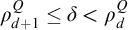 $\rho _{d+1}^Q\leq \delta <\rho _d^Q$
. So it suffices to see that
$\rho _{d+1}^Q\leq \delta <\rho _d^Q$
. So it suffices to see that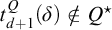 $t^Q_{d+1}(\delta )\notin Q^{\star }$
. But otherwise, by STH, we would have
$t^Q_{d+1}(\delta )\notin Q^{\star }$
. But otherwise, by STH, we would have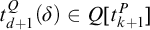 $t^Q_{d+1}(\delta )\in Q[t^P_{k+1}]$
, where k is as there (and recall
$t^Q_{d+1}(\delta )\in Q[t^P_{k+1}]$
, where k is as there (and recall $t^P_{k+1}$
is meas-lim extender algebra generic over Q at
$t^P_{k+1}$
is meas-lim extender algebra generic over Q at $\delta $
). But then we get a surjection
$\delta $
). But then we get a surjection $\pi:\delta\to\mathcal{P}(\delta)\cap Q$
with
$\pi:\delta\to\mathcal{P}(\delta)\cap Q$
with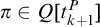 $\pi\in Q[t^P_{k+1}]$
, and hence a surjection
$\pi\in Q[t^P_{k+1}]$
, and hence a surjection $\pi':\delta\to\mathcal{P}(\delta)\cap Q[t^P_{k+1}]$
with
$\pi':\delta\to\mathcal{P}(\delta)\cap Q[t^P_{k+1}]$
with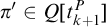 $\pi'\in Q[t^P_{k+1}]$
, which is impossible.
$\pi'\in Q[t^P_{k+1}]$
, which is impossible.
Remark 8.15. Assume STH and $M_{\mathrm {wlim}}^\#$
exists and is
$M_{\mathrm {wlim}}^\#$
exists and is $(\omega ,\omega _1+1)$
-iterable. Then
$(\omega ,\omega _1+1)$
-iterable. Then $M_{\mathrm {wlim}}^\#$
is transcendent. For suppose not, and let
$M_{\mathrm {wlim}}^\#$
is transcendent. For suppose not, and let $\mathcal {T},P\in M$
be a counterexample; so
$\mathcal {T},P\in M$
be a counterexample; so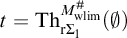 $t=\operatorname {\mathrm {Th}}_{\mathrm {r}\Sigma _1}^{M^\#_{\mathrm {wlim}}}(\emptyset )$
is in
$t=\operatorname {\mathrm {Th}}_{\mathrm {r}\Sigma _1}^{M^\#_{\mathrm {wlim}}}(\emptyset )$
is in $\mathcal {J}(Q[P])$
, where
$\mathcal {J}(Q[P])$
, where  . But then if $Q^\star \triangleleft M$
then
$Q^\star \triangleleft M$
then $Q\in M$
, so
$Q\in M$
, so $Q[P]\in M$
, so
$Q[P]\in M$
, so $t\in M$
, contradiction. So
$t\in M$
, contradiction. So $M\trianglelefteq Q^\star $
, which implies
$M\trianglelefteq Q^\star $
, which implies $M=Q^\star $
. But note then that
$M=Q^\star $
. But note then that  is produced by iterating the phalanx $\Phi (\mathcal {T})\ \widehat {\ }\ \left <Q\right>$
finitely many steps (via extenders with critical points
$\Phi (\mathcal {T})\ \widehat {\ }\ \left <Q\right>$
finitely many steps (via extenders with critical points $\leq \delta $
), so
$\leq \delta $
), so  is also an iterate of a segment of
  . But
. But  , a generic extension via the meas-lim extender algebra, has universe that of M, and the extenders in
  with critical point $>\delta $
are exactly the level-by-level restrictions of those of
$>\delta $
are exactly the level-by-level restrictions of those of $\mathbb {E}_+^M$
. So
$\mathbb {E}_+^M$
. So  inherits all the Woodin cardinals of M, and the active sharp, and this contradicts the minimality of M.
The argument for the least mouse with an active superstrong extender is very similar. And obviously there are many such variants.
9
$\mathrm {HOD}$
in non-tame mice

We can now begin our analysis of ordinal definability in non-tame mice. All the results will assume STH. Recall that Section 5 applies.
Definition 9.1. Let  be a premouse satisfying “ $\mathrm {ZFC}^-+V=\mathrm {HC}$
”. Then
$\mathrm {ZFC}^-+V=\mathrm {HC}$
”. Then  denotes the partial
  -iteration strategy $\Lambda $
for
$\Lambda $
for  , defined over
  as follows. We define $\Lambda $
by induction on the length of trees. Let
$\Lambda $
by induction on the length of trees. Let  . We say that $\mathcal {T}$
is necessary iff
$\mathcal {T}$
is necessary iff $\mathcal {T}$
is an iteration tree via
$\mathcal {T}$
is an iteration tree via $\Lambda $
, of limit length, and letting
$\Lambda $
, of limit length, and letting $\delta =\delta (\mathcal {T})$
, either
$\delta =\delta (\mathcal {T})$
, either $M(\mathcal {T})$
is a Q-structure for itself, or
$M(\mathcal {T})$
is a Q-structure for itself, or $\mathcal {T}$
is P-optimal for
$\mathcal {T}$
is P-optimal for  , with some
  . Every $\mathcal {T}\in \mathrm {dom}(\Lambda )$
is necessary. Let
$\mathcal {T}\in \mathrm {dom}(\Lambda )$
is necessary. Let $\mathcal {T}$
be necessary, and P-optimal for
$\mathcal {T}$
be necessary, and P-optimal for  if such P exists. Then $\Lambda (\mathcal {T})=b$
iff
$\Lambda (\mathcal {T})=b$
iff  and letting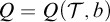 $Q=Q(\mathcal {T},b)$
, if
$Q=Q(\mathcal {T},b)$
, if $M(\mathcal {T})\triangleleft Q$
then
$M(\mathcal {T})\triangleleft Q$
then $Q^\star =Q^\star (\mathcal {T},P)$
is well-defined and
$Q^\star =Q^\star (\mathcal {T},P)$
is well-defined and  . (Note that if $\Lambda (\mathcal {T})=b$
then
$\Lambda (\mathcal {T})=b$
then $b,Q\in \mathcal {J}_\lambda (Q^\star )$
, where
$b,Q\in \mathcal {J}_\lambda (Q^\star )$
, where $\mathcal {J}_\lambda (Q^\star )$
is admissible, and the assertion that “
$\mathcal {J}_\lambda (Q^\star )$
is admissible, and the assertion that “ $\Lambda (\mathcal {T})=b$
” is uniformly
$\Lambda (\mathcal {T})=b$
” is uniformly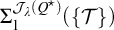 $\Sigma _1^{\mathcal {J}_\lambda (Q^\star )}(\{\mathcal {T}\})$
, by Lemmas 2.1, 8.11, and 8.13. So
$\Sigma _1^{\mathcal {J}_\lambda (Q^\star )}(\{\mathcal {T}\})$
, by Lemmas 2.1, 8.11, and 8.13. So $\Lambda $
is
$\Lambda $
is $\Sigma _1$
-definable over
$\Sigma _1$
-definable over  .Footnote
26
)
.Footnote
26
)
We say that  is iterability-good iff all trees via
  have wellfounded models, and
  is defined for all necessary $\mathcal {T}$
. (Note that iterability-good is expressed by a first-order formula
$\mathcal {T}$
. (Note that iterability-good is expressed by a first-order formula $\varphi $
(modulo
$\varphi $
(modulo $\mathrm {ZFC}^-$
).)
$\mathrm {ZFC}^-$
).)
By Lemma 8.14, we have the following.
Lemma 9.2. Assume STH. Let $M\in \mathrm {pm}_1$
be
$M\in \mathrm {pm}_1$
be $(0,\omega _1+1)$
-iterable and
$(0,\omega _1+1)$
-iterable and  . Then
  and
and  is iterability-good.
Definition 9.3. Let $M\in \mathrm {pm}_1$
. Then
$M\in \mathrm {pm}_1$
. Then $\mathscr {G}^M$
denotes the set of all strong iterability-good M-candidates
$\mathscr {G}^M$
denotes the set of all strong iterability-good M-candidates  such that for every
  , if P has no largest cardinal then $P\models $
“I am
$P\models $
“I am $\mathrm {cs}(P|\omega _1^P)$
” (see Definition 5.2).Footnote
27
$\mathrm {cs}(P|\omega _1^P)$
” (see Definition 5.2).Footnote
27
Proof of Theorem 1.4.
We are assuming STH and $M\in \mathrm {pm}_1$
is a transcendent strongly tractable
$M\in \mathrm {pm}_1$
is a transcendent strongly tractable $\omega $
-mouse, and want to see that
$\omega $
-mouse, and want to see that  is definable without parameters over $\mathcal {H}_\lambda ^M$
, where
$\mathcal {H}_\lambda ^M$
, where $\lambda =\omega _2^M$
(see Section 1.1 and Definitions 5.9, 8.4, and 8.9). We will show that
$\lambda =\omega _2^M$
(see Section 1.1 and Definitions 5.9, 8.4, and 8.9). We will show that  , which suffices. We will not use the assumption that M is an $\omega $
-premouse, nor that it is transcendent, until the very last paragraph of the proof. So what we establish prior to that point (up to Claim 1, inclusive) can and will also be used in the proof of Theorem 1.6.
$\omega $
-premouse, nor that it is transcendent, until the very last paragraph of the proof. So what we establish prior to that point (up to Claim 1, inclusive) can and will also be used in the proof of Theorem 1.6.
We know  , by Lemmas 5.10 and 9.2, so suppose
  with
with  . We will form and analyse a genericity comparison of
  with
with  to reach a contradiction. (For the proof of Theorem 1.6, we need to adapt this to a simultaneous comparison of all elements of $\mathscr {G}^M$
.)
$\mathscr {G}^M$
.)
Let  and
and  (see Definition 5.13). Recall that
  and
and  (and
(and 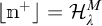 ),
),  ,
,  , and there is $\xi <\omega _1^M$
such that
$\xi <\omega _1^M$
such that 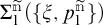 is recursively equivalent to
 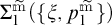 , meaning that there are recursive functions $\varphi \mapsto \varphi '$
and
$\varphi \mapsto \varphi '$
and $\varphi \mapsto \widehat {\varphi }$
such that for all
$\varphi \mapsto \widehat {\varphi }$
such that for all $x\in U$
and
$x\in U$
and $\Sigma _1$
formulas
$\Sigma _1$
formulas $\varphi $
in the passive premouse language,
$\varphi $
in the passive premouse language,

and

We may assume that the $1$
-solidity witnesses for
$1$
-solidity witnesses for  are in
 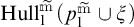 , and likewise for
  . Moreover, since M is strongly tractable, we in fact have
  , since the definition of
  and
and  gives a
  cofinal function $f:\omega \to \mathrm {OR}^U$
. So
$f:\omega \to \mathrm {OR}^U$
. So  and
and  .
.
Let  and
and  . Let
. Let $(A,B)$
be the least conflicting pair with
$(A,B)$
be the least conflicting pair with  and
and  . We construct a
  -genericity comparison $(\mathcal {T},\mathcal {U})$
of
$(\mathcal {T},\mathcal {U})$
of $(A,B)$
, via
$(A,B)$
, via  , folding in initial linear iteration past $(\xi ,A,B)$
, and linear iterations past
$(\xi ,A,B)$
, and linear iterations past $\star $
-translations of non-trivial Q-structures. We now turn to the details.
$\star $
-translations of non-trivial Q-structures. We now turn to the details.
We first set up some notation. For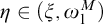 $\eta \in (\xi ,\omega _1^M)$
, let
$\eta \in (\xi ,\omega _1^M)$
, let

Note that $\mathrm {rg}(\pi _\eta )=\mathrm {rg}(\sigma _\eta )$
and
$\mathrm {rg}(\pi _\eta )=\mathrm {rg}(\sigma _\eta )$
and $\mathrm {OR}^{H_\eta }=\mathrm {OR}^{J_\eta }$
and
$\mathrm {OR}^{H_\eta }=\mathrm {OR}^{J_\eta }$
and  and
and  . Let
. Let $C\subseteq \omega _1^M$
be the club of all
$C\subseteq \omega _1^M$
be the club of all $\eta $
such that
$\eta $
such that $\eta =\mathrm {cr}(\pi _\eta )=\mathrm {cr}(\sigma _\eta )$
. So for
$\eta =\mathrm {cr}(\pi _\eta )=\mathrm {cr}(\sigma _\eta )$
. So for $\eta \in C$
, we have
$\eta \in C$
, we have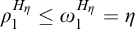 $\rho _1^{H_\eta }\leq \omega _1^{H_\eta }=\eta $
and
$\rho _1^{H_\eta }\leq \omega _1^{H_\eta }=\eta $
and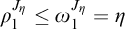 $\rho _1^{J_\eta }\leq \omega _1^{J_\eta }=\eta $
and
$\rho _1^{J_\eta }\leq \omega _1^{J_\eta }=\eta $
and $\pi _\eta (\eta )=\omega _1^M=\sigma _\eta (\eta )$
and
$\pi _\eta (\eta )=\omega _1^M=\sigma _\eta (\eta )$
and  and
and 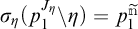 and
and

and likewise for  and
and $J_\eta $
. And given
$J_\eta $
. And given $\eta <\delta \leq \eta '$
with
$\eta <\delta \leq \eta '$
with $\eta ,\eta '\in C$
consecutive,
$\eta ,\eta '\in C$
consecutive,

If $\eta \in C$
and
$\eta \in C$
and $\rho _1^{H_\eta }<\eta $
(equivalently,
$\rho _1^{H_\eta }<\eta $
(equivalently, $\rho _1^{J_\eta }<\eta $
) then (since
$\rho _1^{J_\eta }<\eta $
) then (since $H_\eta $
is
$H_\eta $
is $1$
-sound and
$1$
-sound and  ),
),

We will construct a strictly increasing sequence $\left <\eta _\beta \right>_{\beta <\omega _1^M}$
and
$\left <\eta _\beta \right>_{\beta <\omega _1^M}$
and $(\mathcal {T},\mathcal {U})\!\upharpoonright \!(\eta _\beta +1)$
, recursively in
$(\mathcal {T},\mathcal {U})\!\upharpoonright \!(\eta _\beta +1)$
, recursively in $\beta $
. The ordinals
$\beta $
. The ordinals $\eta _\beta $
will be exactly those
$\eta _\beta $
will be exactly those $\eta $
such that
$\eta $
such that $M((\mathcal {T},\mathcal {U})\!\upharpoonright \!\eta )$
is not a Q-structure for itself (and then
$M((\mathcal {T},\mathcal {U})\!\upharpoonright \!\eta )$
is not a Q-structure for itself (and then $\eta =\delta ((\mathcal {T},\mathcal {U})\!\upharpoonright \!\eta )$
, but
$\eta =\delta ((\mathcal {T},\mathcal {U})\!\upharpoonright \!\eta )$
, but $\eta $
need not be Woodin in the eventual
$\eta $
need not be Woodin in the eventual $M(\mathcal {T},\mathcal {U})$
). We will see that each
$M(\mathcal {T},\mathcal {U})$
). We will see that each $\eta _\beta $
is a limit point of C with
$\eta _\beta $
is a limit point of C with $\rho _1^{H_{\eta _\beta }}=\eta _\beta $
.
$\rho _1^{H_{\eta _\beta }}=\eta _\beta $
.
If we have constructed $(\mathcal {T},\mathcal {U})\!\upharpoonright \!(\alpha +1)$
, where
$(\mathcal {T},\mathcal {U})\!\upharpoonright \!(\alpha +1)$
, where $\alpha <\omega _1^M$
, we let
$\alpha <\omega _1^M$
, we let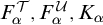 $F^{\mathcal {T}}_\alpha ,F^{\mathcal {U}}_\alpha ,K_\alpha $
be as usual, and will have
$F^{\mathcal {T}}_\alpha ,F^{\mathcal {U}}_\alpha ,K_\alpha $
be as usual, and will have $F^{\mathcal {T}}_\alpha \neq \emptyset $
or
$F^{\mathcal {T}}_\alpha \neq \emptyset $
or $F^{\mathcal {U}}_\alpha \neq \emptyset $
.
$F^{\mathcal {U}}_\alpha \neq \emptyset $
.
We now begin the construction, considering first $\beta =0$
. We construct
$\beta =0$
. We construct $(\mathcal {T},\mathcal {U})\!\upharpoonright \!\eta _0$
in two phases. In the first phase (given
$(\mathcal {T},\mathcal {U})\!\upharpoonright \!\eta _0$
in two phases. In the first phase (given $(\mathcal {T},\mathcal {U})\!\upharpoonright \!\alpha +1$
, where
$(\mathcal {T},\mathcal {U})\!\upharpoonright \!\alpha +1$
, where $\alpha <\eta _0$
), we compare, subject to linear iteration of the least measurable
$\alpha <\eta _0$
), we compare, subject to linear iteration of the least measurable $\mu $
of
$\mu $
of $K_\alpha $
, until
$K_\alpha $
, until $\mu \geq \max (\xi ,\mathrm {OR}^A,\mathrm {OR}^B)$
. In the second phase, we compare, subject to
$\mu \geq \max (\xi ,\mathrm {OR}^A,\mathrm {OR}^B)$
. In the second phase, we compare, subject to  -genericity iteration for meas-lim extender algebra axioms of $K_\alpha $
(equivalently,
$K_\alpha $
(equivalently,  -genericity). Let $\eta _0$
be the least
$\eta _0$
be the least $\eta $
such that
$\eta $
such that $M((\mathcal {T},\mathcal {U})\!\upharpoonright \!\eta )$
is not a Q-structure for itself. The iteration strategies
$M((\mathcal {T},\mathcal {U})\!\upharpoonright \!\eta )$
is not a Q-structure for itself. The iteration strategies  apply trivially prior to stage $\eta _0$
, and because
$\eta _0$
, and because  , an easy reflection argument shows that $\eta _0<\omega _1^M$
exists.
$\eta _0<\omega _1^M$
exists.
Since $R=M((\mathcal {T},\mathcal {U})\!\upharpoonright \!\eta _0)$
is not a Q-structure for itself, we need to see that
$R=M((\mathcal {T},\mathcal {U})\!\upharpoonright \!\eta _0)$
is not a Q-structure for itself, we need to see that  and
and  . Let
. Let $\delta =\delta ((\mathcal {T},\mathcal {U})\!\upharpoonright \!\eta _0)$
. So
$\delta =\delta ((\mathcal {T},\mathcal {U})\!\upharpoonright \!\eta _0)$
. So  and
and  are
are $\mathbb B_{\mathrm {ml},\delta }^{\mathcal {J}(R)}$
-generic over
$\mathbb B_{\mathrm {ml},\delta }^{\mathcal {J}(R)}$
-generic over $\mathcal {J}(R)$
, and
$\mathcal {J}(R)$
, and $\delta $
is regular in
$\delta $
is regular in 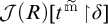 . So by line (3), it follows that $\delta $
is a limit point of C, so
$\delta $
is a limit point of C, so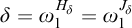 $\delta =\omega _1^{H_\delta }=\omega _1^{J_\delta }$
, and by line (4), it follows that
$\delta =\omega _1^{H_\delta }=\omega _1^{J_\delta }$
, and by line (4), it follows that $\rho _1^{H_\delta }=\delta $
, and in fact note
$\rho _1^{H_\delta }=\delta $
, and in fact note $\rho _\omega ^{H_\delta }=\delta $
(since each
$\rho _\omega ^{H_\delta }=\delta $
(since each $\mathrm {r}\Sigma _{n+1}$
theory in parameters (in the codes) can be defined from
$\mathrm {r}\Sigma _{n+1}$
theory in parameters (in the codes) can be defined from  ). Likewise,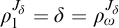 $\rho _1^{J_\delta }=\delta =\rho _\omega ^{J_\delta }$
. Note also that
$\rho _1^{J_\delta }=\delta =\rho _\omega ^{J_\delta }$
. Note also that $(\mathcal {T},\mathcal {U})\!\upharpoonright \!\eta _0\subseteq (H_\delta |\delta )\cap (J_\delta |\delta )$
and
$(\mathcal {T},\mathcal {U})\!\upharpoonright \!\eta _0\subseteq (H_\delta |\delta )\cap (J_\delta |\delta )$
and $(\mathcal {T},\mathcal {U})\!\upharpoonright \!\eta _0$
is definable from the parameter
$(\mathcal {T},\mathcal {U})\!\upharpoonright \!\eta _0$
is definable from the parameter $(A,B,\xi )$
over
$(A,B,\xi )$
over $H_\delta $
, and likewise over
$H_\delta $
, and likewise over $J_\delta $
, and so
$J_\delta $
, and so $\eta _0=\delta $
(the most complex aspect of the definition being the
$\eta _0=\delta $
(the most complex aspect of the definition being the  -genericity iteration, but this is equivalent to
  for this segment, and that is definable over $H_\delta $
and over
$H_\delta $
and over $J_\delta $
). So
$J_\delta $
). So $\eta _0$
is indeed a limit point of C and
$\eta _0$
is indeed a limit point of C and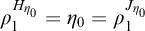 $\rho _1^{H_{\eta _0}}=\eta _0=\rho _1^{J_{\eta _0}}$
. Now it follows that
$\rho _1^{H_{\eta _0}}=\eta _0=\rho _1^{J_{\eta _0}}$
. Now it follows that  “
“ $\mathcal {T}\!\upharpoonright \!\eta _0$
is
$\mathcal {T}\!\upharpoonright \!\eta _0$
is $H_{\eta _0}$
-optimal” and
$H_{\eta _0}$
-optimal” and  “
“ $\mathcal {U}\!\upharpoonright \!\eta _0$
is
$\mathcal {U}\!\upharpoonright \!\eta _0$
is $J_{\eta _0}$
-optimal”, and hence these trees are in the domains of our strategies, as desired.
$J_{\eta _0}$
-optimal”, and hence these trees are in the domains of our strategies, as desired.
Now suppose we have constructed $(\mathcal {T},\mathcal {U})\!\upharpoonright \!(\eta _\beta +1)$
for some
$(\mathcal {T},\mathcal {U})\!\upharpoonright \!(\eta _\beta +1)$
for some $\beta $
, with
$\beta $
, with $\delta ((\mathcal {T},\mathcal {U})\!\upharpoonright \!\eta _\beta )=\eta _\beta $
. To reach
$\delta ((\mathcal {T},\mathcal {U})\!\upharpoonright \!\eta _\beta )=\eta _\beta $
. To reach $(\mathcal {T},\mathcal {U})\!\upharpoonright \!(\eta _{\beta +1}+1)$
, we first determine whether there is
$(\mathcal {T},\mathcal {U})\!\upharpoonright \!(\eta _{\beta +1}+1)$
, we first determine whether there is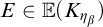 $E\in \mathbb {E}(K_{\eta _\beta })$
which induces a bad meas-lim extender algebra axiom with
$E\in \mathbb {E}(K_{\eta _\beta })$
which induces a bad meas-lim extender algebra axiom with $\nu (E)=\eta _\beta $
. If so, set
$\nu (E)=\eta _\beta $
. If so, set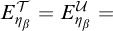 $E^{\mathcal {T}}_{\eta _\beta }=E^{\mathcal {U}}_{\eta _\beta }=$
the least such. After that, or otherwise, we proceed with comparison, again in two phases. The first phase is subject to iterating the least measurable of
$E^{\mathcal {T}}_{\eta _\beta }=E^{\mathcal {U}}_{\eta _\beta }=$
the least such. After that, or otherwise, we proceed with comparison, again in two phases. The first phase is subject to iterating the least measurable of $K_\alpha $
which is
$K_\alpha $
which is $>\eta _\beta $
, to
$>\eta _\beta $
, to $\geq \max (\mathrm {OR}((Q^{\mathcal {T}})^\star ),\mathrm {OR}((Q^{\mathcal {U}})^\star ))$
, where
$\geq \max (\mathrm {OR}((Q^{\mathcal {T}})^\star ),\mathrm {OR}((Q^{\mathcal {U}})^\star ))$
, where $Q^{\mathcal {T}}=Q(\mathcal {T}\!\upharpoonright \!\eta _\beta ,[0,\eta _\beta )_{\mathcal {T}})$
and likewise for
$Q^{\mathcal {T}}=Q(\mathcal {T}\!\upharpoonright \!\eta _\beta ,[0,\eta _\beta )_{\mathcal {T}})$
and likewise for $Q^{\mathcal {U}}$
, and the superscript-
$Q^{\mathcal {U}}$
, and the superscript- $\star $
denotes the associated
$\star $
denotes the associated $\star $
-translation (using
$\star $
-translation (using $H_{\eta _\beta }$
and
$H_{\eta _\beta }$
and $\mathcal {T}\!\upharpoonright \!\eta _\beta $
for the
$\mathcal {T}\!\upharpoonright \!\eta _\beta $
for the $\mathcal {T}$
-side, and
$\mathcal {T}$
-side, and $J_{\eta _\beta }$
and
$J_{\eta _\beta }$
and $\mathcal {U}\!\upharpoonright \!\eta _\beta $
for the
$\mathcal {U}\!\upharpoonright \!\eta _\beta $
for the $\mathcal {U}$
-side). The second phase is subject to
$\mathcal {U}$
-side). The second phase is subject to  -genericity iteration as before. By induction, $(\mathcal {T},\mathcal {U})\!\upharpoonright \!\eta _\beta $
is definable from parameters over
$(\mathcal {T},\mathcal {U})\!\upharpoonright \!\eta _\beta $
is definable from parameters over $H_{\eta _\beta }$
and over
$H_{\eta _\beta }$
and over $J_{\eta _\beta }$
, which are segments of
$J_{\eta _\beta }$
, which are segments of $(Q^{\mathcal {T}})^\star $
and
$(Q^{\mathcal {T}})^\star $
and $(Q^{\mathcal {U}})^\star $
, respectively. So from
$(Q^{\mathcal {U}})^\star $
, respectively. So from $(Q^{\mathcal {T}})^\star $
we can recover (from parameters) first
$(Q^{\mathcal {T}})^\star $
we can recover (from parameters) first $\mathcal {T}\!\upharpoonright \!\eta _\beta $
, and hence also
$\mathcal {T}\!\upharpoonright \!\eta _\beta $
, and hence also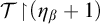 $\mathcal {T}\!\upharpoonright \!(\eta _\beta +1)$
, the last step because
$\mathcal {T}\!\upharpoonright \!(\eta _\beta +1)$
, the last step because  ; likewise $\mathcal {U}\!\upharpoonright \!(\eta _\beta +1)$
from
$\mathcal {U}\!\upharpoonright \!(\eta _\beta +1)$
from $(Q^{\mathcal {U}})^\star $
. And the definability of
$(Q^{\mathcal {U}})^\star $
. And the definability of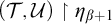 $(\mathcal{T},\mathcal{U})\upharpoonright\eta_{\beta+1}$
over
$(\mathcal{T},\mathcal{U})\upharpoonright\eta_{\beta+1}$
over $H_{\beta+1}$
from the parameter
$H_{\beta+1}$
from the parameter $(\mathcal{T},\mathcal{U})\upharpoonright(\eta_{\beta}+1)$
is like for
$(\mathcal{T},\mathcal{U})\upharpoonright(\eta_{\beta}+1)$
is like for $(\mathcal{T},\mathcal{U})\upharpoonright\eta_0$
over
$(\mathcal{T},\mathcal{U})\upharpoonright\eta_0$
over $H_{\eta_0}$
(and likwise for
$H_{\eta_0}$
(and likwise for $J_{\beta+1}$
).
$J_{\beta+1}$
).
Now suppose we have defined $(\mathcal {T},\mathcal {U})\!\upharpoonright \!\eta $
, where
$(\mathcal {T},\mathcal {U})\!\upharpoonright \!\eta $
, where $\eta =\sup _{\beta <\zeta }\eta _\beta $
and
$\eta =\sup _{\beta <\zeta }\eta _\beta $
and $\zeta $
is a limit. So
$\zeta $
is a limit. So $\eta =\delta ((\mathcal {T},\mathcal {U})\!\upharpoonright \!\eta )$
and
$\eta =\delta ((\mathcal {T},\mathcal {U})\!\upharpoonright \!\eta )$
and $\eta $
is a limit of limit points of C. Suppose first that
$\eta $
is a limit of limit points of C. Suppose first that $M((\mathcal {T},\mathcal {U})\!\upharpoonright \!\eta )$
is a Q-structure for itself (hence we will set
$M((\mathcal {T},\mathcal {U})\!\upharpoonright \!\eta )$
is a Q-structure for itself (hence we will set $\eta <\eta _\zeta $
). In this case we proceed directly with comparison subject to genericity iteration, leading to
$\eta <\eta _\zeta $
). In this case we proceed directly with comparison subject to genericity iteration, leading to $(\mathcal {T},\mathcal {U})\!\upharpoonright \!\eta _\zeta $
. We then have that
$(\mathcal {T},\mathcal {U})\!\upharpoonright \!\eta _\zeta $
. We then have that $\eta _\zeta =\delta ((\mathcal {T},\mathcal {U})\!\upharpoonright \!\eta _\zeta )$
is a limit point of C. We have
$\eta _\zeta =\delta ((\mathcal {T},\mathcal {U})\!\upharpoonright \!\eta _\zeta )$
is a limit point of C. We have  , etc., since $(\mathcal {T},\mathcal {U})\!\upharpoonright \!\eta _\zeta $
is definable from
$(\mathcal {T},\mathcal {U})\!\upharpoonright \!\eta _\zeta $
is definable from $(A,B,\xi )$
over
$(A,B,\xi )$
over $H_{\eta _\zeta }$
and over
$H_{\eta _\zeta }$
and over $J_{\eta _\zeta }$
, as these structures can compute the genericity aspect as before, and we can uniformly recover the earlier Q-structures used to guide
$J_{\eta _\zeta }$
, as these structures can compute the genericity aspect as before, and we can uniformly recover the earlier Q-structures used to guide $(\mathcal {T},\mathcal {U})\!\upharpoonright \!\eta _\zeta $
by
$(\mathcal {T},\mathcal {U})\!\upharpoonright \!\eta _\zeta $
by  -construction, since we inductively folded in iteration past their $\star $
-translations. This leads to
$\star $
-translations. This leads to $(\mathcal {T},\mathcal {U})\!\upharpoonright \!(\eta _\zeta +1)$
. Finally, if
$(\mathcal {T},\mathcal {U})\!\upharpoonright \!(\eta _\zeta +1)$
. Finally, if $M((\mathcal {T},\mathcal {U})\!\upharpoonright \!\eta )$
is not a Q-structure for itself, then
$M((\mathcal {T},\mathcal {U})\!\upharpoonright \!\eta )$
is not a Q-structure for itself, then $\eta _\zeta =\eta $
, and we can now proceed basically as in the previous case to see that
$\eta _\zeta =\eta $
, and we can now proceed basically as in the previous case to see that  , etc., leading again to $(\mathcal {T},\mathcal {U})\!\upharpoonright \!(\eta _\zeta +1)$
.
$(\mathcal {T},\mathcal {U})\!\upharpoonright \!(\eta _\zeta +1)$
.
This completes the construction of the comparison. Note that $(\mathcal {T},\mathcal {U})\!\upharpoonright \!\omega _1^M\in M$
, since it is definable from parameters over
$(\mathcal {T},\mathcal {U})\!\upharpoonright \!\omega _1^M\in M$
, since it is definable from parameters over  . So it lasts $\delta =\omega _1^M$
stages, and
$\delta =\omega _1^M$
stages, and $\eta _\beta <\omega _1^M$
for each
$\eta _\beta <\omega _1^M$
for each $\beta <\omega _1^M$
. Either
$\beta <\omega _1^M$
. Either $\mathcal {T}$
or
$\mathcal {T}$
or $\mathcal {U}$
has no cofinal branch in M, as before. Let
$\mathcal {U}$
has no cofinal branch in M, as before. Let $b=\Sigma _A(\mathcal {T})$
(the correct
$b=\Sigma _A(\mathcal {T})$
(the correct $\mathcal {T}$
-cofinal branch) and
$\mathcal {T}$
-cofinal branch) and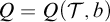 $Q=Q(\mathcal {T},b)$
. Let
$Q=Q(\mathcal {T},b)$
. Let  .
.
Claim 1.
 .
.
Proof. Suppose not. By Lemma 8.14, it follows that  . And
. And  , so by Lemmas 2.1 and 8.13, we get $b\in M$
, and hence there is no
$b\in M$
, and hence there is no $\mathcal {U}$
-cofinal branch in M. (Our assumptions seem to allow the possibility that
$\mathcal {U}$
-cofinal branch in M. (Our assumptions seem to allow the possibility that $Q\notin M$
, but still the relevant theory t coding Q is in M, so
$Q\notin M$
, but still the relevant theory t coding Q is in M, so $b\in M$
.)
$b\in M$
.)
Subclaim 1.
 is well-defined and satisfies “ $\delta $
is Woodin” (note if
$\delta $
is Woodin” (note if $M\models $
“
$M\models $
“ $\omega _2$
exists” then it follows that
$\omega _2$
exists” then it follows that 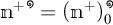 ).
).
Proof. Suppose not and let  be least such that
  and either (i)
  is ill-defined or not a premouse or (ii) it is a well-defined premouse and is a Q-structure for $M(\mathcal {U})$
or projects
$M(\mathcal {U})$
or projects $<\delta $
.
$<\delta $
.
If (i) holds then working in  , which has universe that of
  , we can use condensation to find
  and a sufficiently elementary $\pi :\bar {R}\to R$
with
$\pi :\bar {R}\to R$
with $\mathrm {cr}(\pi )=\bar {\delta }=\omega _1^{\bar {R}}$
,
$\mathrm {cr}(\pi )=\bar {\delta }=\omega _1^{\bar {R}}$
, 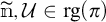 ,
,  ,
, $\pi (\bar {\mathcal {U}})=\mathcal {U}$
and hence
$\pi (\bar {\mathcal {U}})=\mathcal {U}$
and hence $\bar {\mathcal {U}}=\mathcal {U}\!\upharpoonright \!\bar {\delta }$
. Also,
$\bar {\mathcal {U}}=\mathcal {U}\!\upharpoonright \!\bar {\delta }$
. Also,  , and
, and $\bar {\mathcal {U}}$
is
$\bar {\mathcal {U}}$
is  -optimal. By Lemma 8.13, the bad behavior of
  reflects to
  , contradicting that
  is iterability-good.
So (ii) holds. But then  must determine a $\mathcal {U}$
-cofinal branch, because otherwise, we can do a similar reflection argument to get a Q-structure for some
$\mathcal {U}$
-cofinal branch, because otherwise, we can do a similar reflection argument to get a Q-structure for some $M(\bar {\mathcal {U}})$
with
$M(\bar {\mathcal {U}})$
with $\bar {\mathcal {U}}\triangleleft \mathcal {U}$
, produced by
$\bar {\mathcal {U}}\triangleleft \mathcal {U}$
, produced by  -construction, which does not yield a $\bar {\mathcal {U}}$
-cofinal branch, again contradicting that
$\bar {\mathcal {U}}$
-cofinal branch, again contradicting that  is iterability-good.
By the subclaim,  .
.
Subclaim 2. In M (hence also in  ) there is a club $C\subseteq \delta $
consisting of Woodin cardinals of
$C\subseteq \delta $
consisting of Woodin cardinals of $M(\mathcal {T},\mathcal {U})$
, hence Woodin cardinals of
$M(\mathcal {T},\mathcal {U})$
, hence Woodin cardinals of  .
.
Proof. By Lemma 8.13,  , where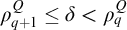 $\rho _{q+1}^Q\leq \delta <\rho _q^Q$
. Fix the least
$\rho _{q+1}^Q\leq \delta <\rho _q^Q$
. Fix the least  such that
  and
and $t\in \mathcal {J}(N)$
, so
$t\in \mathcal {J}(N)$
, so $\rho _\omega ^N=\delta $
. By STH and Lemma 8.13,
$\rho _\omega ^N=\delta $
. By STH and Lemma 8.13,  ,
, 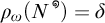 ,
,  and t is definable from parameters over
  . We claim that
  . For suppose $R\triangleleft Q$
and t is definable from parameters over
$R\triangleleft Q$
and t is definable from parameters over  . We have that
  is also generic over Q for $\mathbb B_{\mathrm {ml},\delta }^Q$
, and from t and
$\mathbb B_{\mathrm {ml},\delta }^Q$
, and from t and  one can compute the corresponding theory of
  which could be denoted
  . But that theory is not in
  by a standard diagonalization.
So  , but
, but  . And we have
  and
and  . So working in M, we can fix $P\triangleleft M$
with
$P\triangleleft M$
with $\rho _\omega ^{P}=\delta $
and these objects all in
$\rho _\omega ^{P}=\delta $
and these objects all in $\mathcal {J}(P)$
, and form a continuous, increasing chain
$\mathcal {J}(P)$
, and form a continuous, increasing chain $\left <P^{\prime }_\alpha \right>_{\alpha <\omega _1^M}$
of substructures
$\left <P^{\prime }_\alpha \right>_{\alpha <\omega _1^M}$
of substructures $P^{\prime }_\alpha \preccurlyeq _n P$
, with
$P^{\prime }_\alpha \preccurlyeq _n P$
, with $n<\omega $
sufficiently large, and all relevant objects definable from parameters in
$n<\omega $
sufficiently large, and all relevant objects definable from parameters in $P^{\prime }_0$
, and a club
$P^{\prime }_0$
, and a club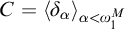 $C=\left <\delta _\alpha \right>_{\alpha <\omega _1^M}$
, such that
$C=\left <\delta _\alpha \right>_{\alpha <\omega _1^M}$
, such that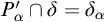 $P^{\prime }_\alpha \cap \delta =\delta _\alpha $
. Let
$P^{\prime }_\alpha \cap \delta =\delta _\alpha $
. Let $P_\alpha $
be the transitive collapse of
$P_\alpha $
be the transitive collapse of $P^{\prime }_\alpha $
and
$P^{\prime }_\alpha $
and $\pi _\alpha :P_\alpha \to P$
the uncollapse, so
$\pi _\alpha :P_\alpha \to P$
the uncollapse, so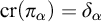 $\mathrm {cr}(\pi _\alpha )=\delta _\alpha $
and
$\mathrm {cr}(\pi _\alpha )=\delta _\alpha $
and $\pi _\alpha (\delta _\alpha )=\delta $
. By condensation, we have
$\pi _\alpha (\delta _\alpha )=\delta $
. By condensation, we have  . Let
. Let $Q_\alpha $
,
$Q_\alpha $
,  ,
, $Q^{\text {s}}_\alpha $
and
$Q^{\text {s}}_\alpha $
and $N_\alpha ^{\text {bh}}$
,
$N_\alpha ^{\text {bh}}$
,  ,
, $N_\alpha $
be the resulting “preimages” of Q,
$N_\alpha $
be the resulting “preimages” of Q,  ,
, $Q^\star $
and
$Q^\star $
and  ,
,  , N, respectively.Footnote
28
Then (because n is large enough), condensation and elementarity give that
, N, respectively.Footnote
28
Then (because n is large enough), condensation and elementarity give that  and
and  and the relevant first order properties reflect down to these models at each $\alpha $
, along with
$\alpha $
, along with $(\mathcal {T},\mathcal {U})\!\upharpoonright \!\delta _\alpha $
, which is the preimage of
$(\mathcal {T},\mathcal {U})\!\upharpoonright \!\delta _\alpha $
, which is the preimage of $(\mathcal {T},\mathcal {U})$
. It follows that the Q-structures used at stage
$(\mathcal {T},\mathcal {U})$
. It follows that the Q-structures used at stage $\delta _\alpha $
in
$\delta _\alpha $
in $\mathcal {T},\mathcal {U}$
are distinct, and therefore
$\mathcal {T},\mathcal {U}$
are distinct, and therefore $\delta _\alpha $
is Woodin in
$\delta _\alpha $
is Woodin in $M(\mathcal {T},\mathcal {U})$
. So C is a club of Woodins of
$M(\mathcal {T},\mathcal {U})$
. So C is a club of Woodins of $M(\mathcal {T},\mathcal {U})$
.
$M(\mathcal {T},\mathcal {U})$
.
We can now easily reach a contradiction. We have  . Let
. Let  be least such that $C\in \mathcal {J}(R')$
, so
$C\in \mathcal {J}(R')$
, so $\rho _\omega ^{R'}=\delta $
. Let
$\rho _\omega ^{R'}=\delta $
. Let  . So
. So $\rho _\omega ^{Q'}=\delta $
and
$\rho _\omega ^{Q'}=\delta $
and  and
and $R'=(Q')^\star $
. So C is definable from parameters over
$R'=(Q')^\star $
. So C is definable from parameters over  , so
, so 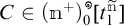 . But since $\delta $
is Woodin in
$\delta $
is Woodin in  , the forcing is $\delta $
-cc in
$\delta $
-cc in  , so there is a club $D\subseteq C$
with
$D\subseteq C$
with  . Letting $\eta $
be the least limit point of D, then
$\eta $
be the least limit point of D, then 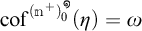 , so
, so $\eta $
is not Woodin in
$\eta $
is not Woodin in  , hence not Woodin in $M(\mathcal {T},\mathcal {U})$
, a contradiction, completing the proof of the claim.
$M(\mathcal {T},\mathcal {U})$
, a contradiction, completing the proof of the claim.
Now $Q^\star \trianglelefteq M$
, since M is an
$Q^\star \trianglelefteq M$
, since M is an $\omega $
-mouse and by Lemma 8.14(3). So
$\omega $
-mouse and by Lemma 8.14(3). So $Q^{\star }=M$
, by Claim 1 and Lemma 8.14(1). But then by STH (8.9) part 1, this contradicts the assumption that M is transcendent (8.4).
$Q^{\star }=M$
, by Claim 1 and Lemma 8.14(1). But then by STH (8.9) part 1, this contradicts the assumption that M is transcendent (8.4).
Proof of Theorem 1.6.
We are no longer assuming that M is transcendent, nor an $\omega $
-mouse. But we assume
$\omega $
-mouse. But we assume $M\models \mathrm {ZFC}$
and have
$M\models \mathrm {ZFC}$
and have $H=\mathrm {HOD}^{\left \lfloor M\right \rfloor }$
. Suppose
$H=\mathrm {HOD}^{\left \lfloor M\right \rfloor }$
. Suppose $H\neq \left \lfloor M\right \rfloor $
; we want to analyse H. The analysis is analogous to that in the tame case, Theorem 7.5. However, we will not prove that
$H\neq \left \lfloor M\right \rfloor $
; we want to analyse H. The analysis is analogous to that in the tame case, Theorem 7.5. However, we will not prove that $\mathbb {E}^W$
is the restriction of
$\mathbb {E}^W$
is the restriction of $\mathbb {E}^M$
above
$\mathbb {E}^M$
above $\omega _3^M$
(or above anywhere); we will instead get that M is a
$\omega _3^M$
(or above anywhere); we will instead get that M is a $\star $
-translation of some appropriate W.
$\star $
-translation of some appropriate W.
Let 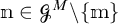 , where
  . Recall that everything in the proof of Theorem 1.4 preceding its very last paragraph applies. So we can compare
  as there, producing a comparison $(\mathcal {T},\mathcal {U})$
of length
$(\mathcal {T},\mathcal {U})$
of length $\bar {\delta }=\omega _1^M$
, and either
$\bar {\delta }=\omega _1^M$
, and either $\mathcal {T}$
or
$\mathcal {T}$
or $\mathcal {U}$
has no cofinal branch in M. (In the current proof we write
$\mathcal {U}$
has no cofinal branch in M. (In the current proof we write $\delta =\omega _3^M$
.) Let
$\delta =\omega _3^M$
.) Let $b=\Sigma _A(\mathcal {T})$
(the correct
$b=\Sigma _A(\mathcal {T})$
(the correct $\mathcal {T}$
-cofinal branch) and
$\mathcal {T}$
-cofinal branch) and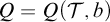 $Q=Q(\mathcal {T},b)$
. By Claim 1 of the preceding proof,
$Q=Q(\mathcal {T},b)$
. By Claim 1 of the preceding proof,  .
.
Claim 1. $\omega _1^M$
and
$\omega _1^M$
and $\omega _2^M$
have the same cardinality (in V), and so
$\omega _2^M$
have the same cardinality (in V), and so $\omega _2^M<\omega _2$
.
$\omega _2^M<\omega _2$
.
Proof. Since  , and
, and $Q^\star $
,
$Q^\star $
, $Q,$
and
$Q,$
and $\omega _1^M$
have the same cardinality (in V), and of course
$\omega _1^M$
have the same cardinality (in V), and of course $\omega _1^M\leq \omega _1$
.
$\omega _1^M\leq \omega _1$
.
Recall we are now also assuming that $M\models \mathrm {ZFC}$
, so
$M\models \mathrm {ZFC}$
, so 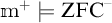 , so we can’t have
  (but it seems $Q$
might be active at
$Q$
might be active at $\omega _2^M$
). We also have
$\omega _2^M$
). We also have  is well-defined, and satisfies “ $\bar {\delta }$
is Woodin”.
$\bar {\delta }$
is Woodin”.
Claim 2.
 is well-defined and
  .
.
Proof. A reflection argument like before shows that either  is well-defined (producing a model of height $\omega _2^M$
) or it reaches a Q-structure. If it reaches a Q-structure, we can argue as above to produce a club of Woodins
$\omega _2^M$
) or it reaches a Q-structure. If it reaches a Q-structure, we can argue as above to produce a club of Woodins $\subseteq \bar {\delta }$
for a contradiction. And if it does not reach a Q-structure but
$\subseteq \bar {\delta }$
for a contradiction. And if it does not reach a Q-structure but 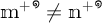 , we can again reflect a disagreement down, noting that it also produces a club $\left <\delta _\alpha \right>_{\alpha <\omega _1^M}$
with disagreement between the Q-structures at stage
$\left <\delta _\alpha \right>_{\alpha <\omega _1^M}$
with disagreement between the Q-structures at stage $\delta _\alpha $
, and hence again a club of Woodins.
$\delta _\alpha $
, and hence again a club of Woodins.
Claim 3. We have:
-
1.
is well-defined, , “
$\bar {\delta }$
is Woodin”, and is
$\star $
-valid (and hence there is no -
$\bar{\delta}$
-measure), -
2.
is well-defined, and hence is a proper class premouse N with
$\left \lfloor N\right \rfloor =\left \lfloor M\right \rfloor $
, -
3.
is well-defined, and -
4.
.
 is well-defined,
 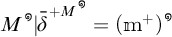 ,
,  “
“
 is
is 
 -
-
 is well-defined, and hence is a proper class premouse N with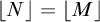
 is well-defined, and
 .
.Proof. Part 1: The well-definedness follows easily from condensation, since  is well-defined. The next two clauses are by Lemma 8.13. Finally, the $\star $
-validity of
$\star $
-validity of  is by Lemma 8.11.
Parts 2–4: Suppose not. We have $M\models \mathrm {ZFC}$
. So fix a limit cardinal
$M\models \mathrm {ZFC}$
. So fix a limit cardinal $\lambda $
of M such that either
$\lambda $
of M such that either  or
or  is not well-defined, or
  . We will again reflect the failure down to a segment of
  , and reach a contradiction. We have to be a little careful how we form the hull to do this, however.
Note that standard condensation holds for all segments of  , since otherwise by condensation in M we could reflect the failure down to a segment of
  , where we do have condensation. Let
  ; because $\lambda $
is an M-cardinal, we have
$\lambda $
is an M-cardinal, we have  and
and $\mathrm {OR}^R=\lambda +\omega $
and
$\mathrm {OR}^R=\lambda +\omega $
and $\rho _\omega ^R=\lambda $
and
$\rho _\omega ^R=\lambda $
and  . Let
. Let $\alpha <\omega _2^M$
with
$\alpha <\omega _2^M$
with  and
and $\alpha =\mathrm {cr}(\pi _\alpha )$
, where
$\alpha =\mathrm {cr}(\pi _\alpha )$
, where $\pi _\alpha :C_\alpha \to R$
is the uncollapse map for
$\pi _\alpha :C_\alpha \to R$
is the uncollapse map for $C_\alpha =\mathrm {cHull}_1^{R}(\alpha \cup \{\lambda \})$
. (Note that
$C_\alpha =\mathrm {cHull}_1^{R}(\alpha \cup \{\lambda \})$
. (Note that  also.) So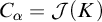 $C_\alpha =\mathcal {J}(K)$
for some K, and
$C_\alpha =\mathcal {J}(K)$
for some K, and $K\preccurlyeq _1 C_\alpha $
(as
$K\preccurlyeq _1 C_\alpha $
(as $R|\lambda \preccurlyeq _1 R$
as
$R|\lambda \preccurlyeq _1 R$
as $\lambda $
is a cardinal of R), so
$\lambda $
is a cardinal of R), so $C_\alpha $
is
$C_\alpha $
is $\alpha $
-sound, with
$\alpha $
-sound, with $\rho _1^{C_\alpha }\leq \alpha $
and
$\rho _1^{C_\alpha }\leq \alpha $
and $p_1^{C_\alpha }\backslash \alpha =\{\pi _\alpha ^{-1}(\lambda )\}$
. Therefore
$p_1^{C_\alpha }\backslash \alpha =\{\pi _\alpha ^{-1}(\lambda )\}$
. Therefore $C_\alpha \triangleleft R$
. Let
$C_\alpha \triangleleft R$
. Let
 $$\begin{align*}C=\mathrm{Hull}_1^R(\bar{\delta}\cup\{\lambda,\alpha\}) \end{align*}$$
and $\pi :C\to R$
the uncollapse. Note that
$\pi :C\to R$
the uncollapse. Note that $C_\alpha \in \mathrm {rg}(\pi )$
, since
$C_\alpha \in \mathrm {rg}(\pi )$
, since $C_\alpha \trianglelefteq D$
, where D is the least segment of R projecting to
$C_\alpha \trianglelefteq D$
, where D is the least segment of R projecting to ${\bar {\delta }}$
with
${\bar {\delta }}$
with $\alpha \leq \mathrm {OR}^D$
. Hence
$\alpha \leq \mathrm {OR}^D$
. Hence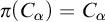 $\pi (C_\alpha )=C_\alpha $
. It easily follows that C is
$\pi (C_\alpha )=C_\alpha $
. It easily follows that C is $1$
-sound with
$1$
-sound with $\rho _1^C={\bar {\delta }}$
and
$\rho _1^C={\bar {\delta }}$
and $p_1^C=\{\pi ^{-1}(\lambda ),\alpha \}$
, and so
$p_1^C=\{\pi ^{-1}(\lambda ),\alpha \}$
, and so $C\triangleleft R$
.
$C\triangleleft R$
.
Let $C'=\mathrm {cHull}_1^{\mathcal {J}(M|\lambda )}({\bar {\delta }}\cup \{\lambda ,\alpha \})$
and
$C'=\mathrm {cHull}_1^{\mathcal {J}(M|\lambda )}({\bar {\delta }}\cup \{\lambda ,\alpha \})$
and $\pi ':C'\to \mathcal {J}(M|\lambda )$
the uncollapse. Note that
$\pi ':C'\to \mathcal {J}(M|\lambda )$
the uncollapse. Note that $\mathrm {rg}(\pi ')\cap \mathrm {OR}=\mathrm {rg}(\pi )\cap \mathrm {OR}$
, since all
$\mathrm {rg}(\pi ')\cap \mathrm {OR}=\mathrm {rg}(\pi )\cap \mathrm {OR}$
, since all $\Sigma _1$
facts true in
$\Sigma _1$
facts true in  are
are $\Sigma _1$
-forced over R and
$\Sigma _1$
-forced over R and $({\bar {\delta }}+1)\subseteq \mathrm {rg}(\pi )$
, and by Lemma 8.13,
$({\bar {\delta }}+1)\subseteq \mathrm {rg}(\pi )$
, and by Lemma 8.13, $\mathcal {J}(M|\lambda )$
is
$\mathcal {J}(M|\lambda )$
is  and, conversely, R is
  . Much as above, $C'\triangleleft M$
, and note that
$C'\triangleleft M$
, and note that  , by the the elementarity of $\pi,\pi'$
and the definability and locality properties of
$\pi,\pi'$
and the definability and locality properties of $\star$
-translation/
$\star$
-translation/ -construction given in Lemma 8.13. Since also $C$
is sound (as
$C$
is sound (as $C\triangleleft R$
), it follows that
$C\triangleleft R$
), it follows that  .
.
Now  ; the equality is by Claim 2. Let K be such that $C=\mathcal {J}(K)$
and
$C=\mathcal {J}(K)$
and $K'$
such that
$K'$
such that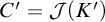 $C'=\mathcal {J}(K')$
. By the same claim and elementarity, K is
$C'=\mathcal {J}(K')$
. By the same claim and elementarity, K is $\star $
-valid with respect to
$\star $
-valid with respect to $\mathcal {T}$
, and hence also with respect to
$\mathcal {T}$
, and hence also with respect to $\mathcal {U}$
(since
$\mathcal {U}$
(since $M(\mathcal {T})=M(\mathcal {U})$
). Writing
$M(\mathcal {T})=M(\mathcal {U})$
). Writing  and
and  , we have
  and since
  and K is $\star $
-valid,
$\star $
-valid,  is well-defined and
  . Because K has no largest cardinal,
  has universe that of
  , and
, and  that of
  , but note these universes are identical. Because
  (Definition 9.3) and by an easy reflection below $\omega _1^M$
, it follows that
$\omega _1^M$
, it follows that 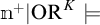 “I am
“I am  and
and  is well-defined and equals K”. But since also
  and
and $\pi ':C'\to \mathcal {J}(M|\lambda )$
is sufficiently elementary, this gives a contradiction, establishing the claim.
$\pi ':C'\to \mathcal {J}(M|\lambda )$
is sufficiently elementary, this gives a contradiction, establishing the claim.
Now we have $\operatorname {\mathrm {card}}^M(\mathscr {G}^M)\leq \omega _2^M$
andFootnote
29
$\operatorname {\mathrm {card}}^M(\mathscr {G}^M)\leq \omega _2^M$
andFootnote
29 $\delta =\omega _3^M$
. For
$\delta =\omega _3^M$
. For  , let
, let  , so
, so 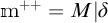 , and by Claim 3 part 2,
  has universe $\mathcal {H}_\delta ^M$
. Also let
$\mathcal {H}_\delta ^M$
. Also let 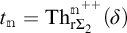 . Then for all
 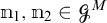 , there is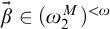 $\vec {\beta }\in (\omega _2^M)^{<\omega }$
such that for all
$\vec {\beta }\in (\omega _2^M)^{<\omega }$
such that for all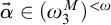 $\vec {\alpha }\in (\omega _3^M)^{<\omega }$
,
$\vec {\alpha }\in (\omega _3^M)^{<\omega }$
,

For this, just choose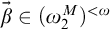 $\vec {\beta }\in (\omega _2^M)^{<\omega }$
such that
$\vec {\beta }\in (\omega _2^M)^{<\omega }$
such that  is
is  and
and  is
is  ; we can certainly do this, since
  and
and  each have universe $(\mathcal {H}_{\omega _2^M})^M$
. This suffices, since each
$(\mathcal {H}_{\omega _2^M})^M$
. This suffices, since each  has universe $\mathcal {H}_\delta ^M$
, and
$\mathcal {H}_\delta ^M$
, and  (including its extender sequence) is
  , since it is
 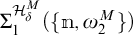 . (Using the parameters
  and
and $\omega _2^M$
,
$\omega _2^M$
, 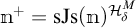 can easily be identified, and, similarly,
 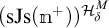 is
is 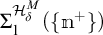 .)Footnote
30
So for extenders with critical points
.)Footnote
30
So for extenders with critical points $>\omega _2^M$
,
$>\omega _2^M$
,  -genericity iteration for some
  is equivalent to simultaneous
  -genericity iteration for all
  .
.
Now for parts 1–4 of the theorem to be proven, we may assume that M is countable, by passing to a sufficiently elementary countable hull if necessary. (Well, if M is proper class and we can only form a partially elementary hull, this doesn’t quite suffice regarding the definability of W. But the proof to follow will bound the level of complexity needed to define W, and we could anticipate this in advance when forming the hull.) And in case M is countable, our $(0,\omega _1+1)$
-strategy
$(0,\omega _1+1)$
-strategy  suffices, as usual, for the trees on
  to be considered in what follows, and in particular, in that case we have $\delta <\omega _1$
. Moreover, the definition of
$\delta <\omega _1$
. Moreover, the definition of $W$
we give can be interpreted either directly within the original
$W$
we give can be interpreted either directly within the original $M$
, or in a countable substructure
$M$
, or in a countable substructure $\bar{M}$
thereof. Under the extra assumptions of part 5 of the theorem and with
$\bar{M}$
thereof. Under the extra assumptions of part 5 of the theorem and with $\Sigma$
as there, the definition of
$\Sigma$
as there, the definition of $W$
will ensure that
$W$
will ensure that $W|\delta$
is a segment of a
$W|\delta$
is a segment of a $\Sigma$
-iterate of
$\Sigma$
-iterate of  , whether we interpret everything in $M$
or in
$M$
or in $\bar{M}$
. We will use Claim 1 to see that
$\bar{M}$
. We will use Claim 1 to see that $\Sigma$
suffices for this purpose.
$\Sigma$
suffices for this purpose.
Now consider the simultaneous comparison of all  , as above, first interweaving iteration at least measurables until passing $\omega _2^M$
, and then interweaving
$\omega _2^M$
, and then interweaving  -genericity iteration (for the meas-lim extender algebra, with details executed essentially as for the comparison of just two premice), using
  to iterate
  ; that is, the strategy defined like
  , but over
  . (Since
  , this works.) Since $H\subsetneq M$
, we must have
$H\subsetneq M$
, we must have  , so the comparison cannot succeed. Let
  be the tree on
  .
.
We can analyse the comparison like we analysed the comparison of two models earlier, and we get similar results. It lasts exactly $\omega _3^M$
steps (and we will have
$\omega _3^M$
steps (and we will have  according to $\Sigma $
and in
$\Sigma $
and in $\mathrm {dom}(\Sigma )$
, by Claim 1), and letting
$\mathrm {dom}(\Sigma )$
, by Claim 1), and letting  , then
  is a proper class premouse extending
  , satisfies “ $\delta $
is Woodin”, and is independent of
$\delta $
is Woodin”, and is independent of  . So
. So  is definable without parameters over $\left \lfloor M\right \rfloor $
, and each
$\left \lfloor M\right \rfloor $
, and each  is
is $(W,\mathbb B_{\mathrm {ml},\delta }^W)$
-generic. In particular,
$(W,\mathbb B_{\mathrm {ml},\delta }^W)$
-generic. In particular, $W\subseteq H=\mathrm {HOD}^{\left \lfloor M\right \rfloor }$
. Let
$W\subseteq H=\mathrm {HOD}^{\left \lfloor M\right \rfloor }$
. Let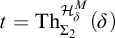 $t=\operatorname {\mathrm {Th}}_{\Sigma _2}^{\mathcal {H}_\delta ^M}(\delta )$
.
$t=\operatorname {\mathrm {Th}}_{\Sigma _2}^{\mathcal {H}_\delta ^M}(\delta )$
.
Claim 4. $H=\left \lfloor W\right \rfloor [t]$
and
$H=\left \lfloor W\right \rfloor [t]$
and  .
.
Proof. By the previous paragraph, t is $(W,\mathbb B_{\mathrm {ml},\delta }^W)$
-generic and
$(W,\mathbb B_{\mathrm {ml},\delta }^W)$
-generic and $W[t]\subseteq H$
. And letting
$W[t]\subseteq H$
. And letting $\mathbb Q\in H$
be Vopenka for adding subsets of
$\mathbb Q\in H$
be Vopenka for adding subsets of $\omega _1^M$
, then
$\omega _1^M$
, then  is
is $(H,\mathbb Q)$
-generic. We need to examine more closely the particular Vopenka needed to add
$(H,\mathbb Q)$
-generic. We need to examine more closely the particular Vopenka needed to add  .
.
Subclaim 1. Let $A\subseteq \mathscr {G}^M$
be
$A\subseteq \mathscr {G}^M$
be $\mathrm {OD}^{\left \lfloor M\right \rfloor }$
. Then A is
$\mathrm {OD}^{\left \lfloor M\right \rfloor }$
. Then A is $\Sigma _2^{\mathcal {H}_{\delta }^M}(\{\alpha \})$
for some
$\Sigma _2^{\mathcal {H}_{\delta }^M}(\{\alpha \})$
for some $\alpha <\delta $
.
$\alpha <\delta $
.
Proof. Let $\lambda $
be some limit cardinal of M such that A is
$\lambda $
be some limit cardinal of M such that A is $\mathrm {OD}$
over
$\mathrm {OD}$
over $\mathcal {H}_\lambda ^M$
. Let
$\mathcal {H}_\lambda ^M$
. Let  and choose $\alpha <\delta $
such that letting
$\alpha <\delta $
such that letting

and  be the uncollapse, then
  is sound with
  and
and  and
and  . For
. For 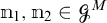 , then
  is inter-definable with
  , uniformly in parameters
  , where $\gamma =\omega _2^M$
. It follows that
$\gamma =\omega _2^M$
. It follows that  and
and  have the same universe. But then note that A is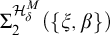 $\Sigma _2^{\mathcal {H}_{\delta }^M}(\{\xi ,\beta \})$
for some
$\Sigma _2^{\mathcal {H}_{\delta }^M}(\{\xi ,\beta \})$
for some $\beta <\xi $
, because
$\beta <\xi $
, because $\mathscr {G}^M$
is definable over
$\mathscr {G}^M$
is definable over $\mathcal {H}_{\gamma }^M$
and
$\mathcal {H}_{\gamma }^M$
and $\{\mathcal {H}_{\gamma }^M\}$
is
$\{\mathcal {H}_{\gamma }^M\}$
is $\Sigma _2^{\mathcal {H}_\delta ^M}$
, so the function
$\Sigma _2^{\mathcal {H}_\delta ^M}$
, so the function  is
is $\Sigma _2^{\mathcal {H}_\delta ^M}(\{\xi \})$
, and this suffices. This proves the subclaim.
$\Sigma _2^{\mathcal {H}_\delta ^M}(\{\xi \})$
, and this suffices. This proves the subclaim.
Let ${\mathbb {P}}\in H$
be the Vopenka corresponding to
${\mathbb {P}}\in H$
be the Vopenka corresponding to $\mathrm {OD}^M$
subsets of
$\mathrm {OD}^M$
subsets of $\mathscr {G}^M$
, taking ordinal codes
$\mathscr {G}^M$
, taking ordinal codes $<\delta $
in the natural form given by the foregoing proof, as conditions. Note then that
$<\delta $
in the natural form given by the foregoing proof, as conditions. Note then that ${\mathbb {P}}$
(with its ordering) is
${\mathbb {P}}$
(with its ordering) is $\Sigma _2^{\mathcal {H}_\delta ^M}$
, and
$\Sigma _2^{\mathcal {H}_\delta ^M}$
, and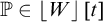 ${\mathbb {P}}\in \left \lfloor W\right \rfloor [t]$
.
${\mathbb {P}}\in \left \lfloor W\right \rfloor [t]$
.
Given  , note that
  can be computed from
  , so
, so  . Conversely, easily
  . Since
  , therefore
  . In particular,

It follows that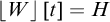 $\left \lfloor W\right \rfloor [t]=H$
, just by the general
$\left \lfloor W\right \rfloor [t]=H$
, just by the general $\mathrm {ZFC}$
fact that if
$\mathrm {ZFC}$
fact that if $N_1\subseteq N_2$
are proper class transitive models of
$N_1\subseteq N_2$
are proper class transitive models of $\mathrm {ZFC}$
and there is
$\mathrm {ZFC}$
and there is ${\mathbb {P}}\in N_1$
and G which is both
${\mathbb {P}}\in N_1$
and G which is both $(N_1,{\mathbb {P}})$
-generic and
$(N_1,{\mathbb {P}})$
-generic and $(N_2,{\mathbb {P}})$
-generic and
$(N_2,{\mathbb {P}})$
-generic and $N_1[G]=N_2[G]$
, then
$N_1[G]=N_2[G]$
, then $N_1=N_2$
. This proves Claim 4.
$N_1=N_2$
. This proves Claim 4.
We have now completed the proof except for one more fact when below a Woodin limit of Woodins.
Claim 5. Suppose M is below a Woodin limit of Woodins. Then there is $\alpha <\omega _3^M$
such that
$\alpha <\omega _3^M$
such that $\left \lfloor M\right \rfloor =H[M|\alpha ]$
, and hence some
$\left \lfloor M\right \rfloor =H[M|\alpha ]$
, and hence some $X\subseteq \omega _2^M$
with
$X\subseteq \omega _2^M$
with $\left \lfloor M\right \rfloor =H[X]$
.
$\left \lfloor M\right \rfloor =H[X]$
.
Proof. For this, let $\alpha _0$
be a proper limit stage of
$\alpha _0$
be a proper limit stage of  such that the Woodins of $W|\delta $
are bounded strictly below
$W|\delta $
are bounded strictly below $\delta (\mathcal {T}\!\upharpoonright \!\alpha _0)$
, and let
$\delta (\mathcal {T}\!\upharpoonright \!\alpha _0)$
, and let $\alpha>\delta (\mathcal {T}\!\upharpoonright \!\alpha _0)$
be such that
$\alpha>\delta (\mathcal {T}\!\upharpoonright \!\alpha _0)$
be such that $\mathcal {T}\!\upharpoonright \!(\alpha _0+1)\in M|\alpha $
. Then
$\mathcal {T}\!\upharpoonright \!(\alpha _0+1)\in M|\alpha $
. Then $M|\delta $
can be inductively recovered from
$M|\delta $
can be inductively recovered from $M|\alpha $
and
$M|\alpha $
and $W|\delta $
, by comparing
$W|\delta $
, by comparing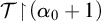 $\mathcal {T}\!\upharpoonright \!(\alpha _0+1)$
(as a phalanx) against
$\mathcal {T}\!\upharpoonright \!(\alpha _0+1)$
(as a phalanx) against $W|\delta $
, using the
$W|\delta $
, using the $\star $
-translations
$\star $
-translations $Q^\star $
of the Q-structures
$Q^\star $
of the Q-structures $Q=Q(\mathcal {T}\!\upharpoonright \!\lambda ,b)\trianglelefteq W$
to compute projecting mice
$Q=Q(\mathcal {T}\!\upharpoonright \!\lambda ,b)\trianglelefteq W$
to compute projecting mice $N\triangleleft M|\delta $
(noting that if
$N\triangleleft M|\delta $
(noting that if $Q\neq M(\mathcal {T}\!\upharpoonright \!\lambda )$
then
$Q\neq M(\mathcal {T}\!\upharpoonright \!\lambda )$
then $\rho _\omega (Q^\star )=\omega _2^M$
, because otherwise
$\rho _\omega (Q^\star )=\omega _2^M$
, because otherwise $\lambda =\omega _3^{\mathcal {J}(Q^\star )}$
, and as Q is the common Q-structure for all trees at stage
$\lambda =\omega _3^{\mathcal {J}(Q^\star )}$
, and as Q is the common Q-structure for all trees at stage $\lambda $
, working inside
$\lambda $
, working inside $\mathcal {J}(Q^\star )$
, we can compute
$\mathcal {J}(Q^\star )$
, we can compute  -cofinal branches for all
  , which contradicts comparison termination there).
This proves the theorem.
10 Questions
-
1. Let M be a
$(0,\omega _1+1)$
-iterable premouse modelling ZFC. Recall that
$\left \lfloor M\right \rfloor $
is the universe of M. Let
$H=\mathrm {HOD}^{\left \lfloor M\right \rfloor }$
.-
(a) Is there
$x\in \mathbb R^M$
such that
$H=\mathrm {HOD}^{\left \lfloor M\right \rfloor }_{\{x\}}$
?By Corollary 1.2, if M is tame, the answer is “yes”. By [Reference Schlutzenberg10, Theorem 3.11], there is
$x\in (\mathcal {P}(\omega _1^M))^M$
which satisfies the equation (but not the demand that
$x\in \mathbb R^M$
); in fact
$x=M|\omega _1^M$
does. -
(b) What is the least
$\alpha $
such that
$\left \lfloor M\right \rfloor =H[M|\alpha ]$
?By Theorem 1.6,
$\alpha \leq \omega _3^M$
, and if M is below a Woodin limit of Woodins then
$\alpha <\omega _3^M$
. By Theorem 7.5, if M is tame then
$\alpha \leq \omega _1^M$
.
-
-
2. Do the results of this article extend to long extender mice?




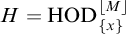


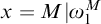




Acknowledgments
Thanks to Henri Menke for the latex code for  ; see https://www.henrimenke.de/ and https://tex.stackexchange.com/questions/231517/how-can-i-write-a-spiral-symbol.
The author would like to thank the anonymous referee for their careful reading and useful suggestions and corrections.
The author acknowledges TU Wien Bibliothek for financial support through its Open Access Funding Programme.
Funding
Work partially funded by the Deutsche Forschungsgemeinschaft (DFG, German Research Foundation) under Germany’s Excellence Strategy EXC 2044-390685587, Mathematics Münster: Dynamics-Geometry-Structure.
Editing funded by the Austrian Science Fund (FWF) [10.55776/Y1498].
For open access purposes, the author has applied a CC BY public copyright license to any author accepted manuscript version arising from this submission.










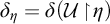

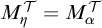









 such that
 , and let

 including x.




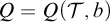
 is
is 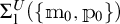 much as before, using the added observation that the soundness requirement (demanded of Jensen extensions of
  or
or  ) holds automatically for premice
 and either (i)


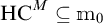 . So suppose (i) holds and





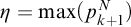



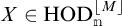 , and fix a formula

 . For
. For 
 , and noting


 .
.




















 but
but  is not sound, and
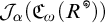 is definable from parameters over
  , the theory
  is definable from parameters over
  , for each
 . However, if
  , then we do have
 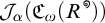 literally definable from parameters over
  .
. . Since
  “
“

 ” by just saying it is a cutpoint of some segment of
  which projects to
 and
and 
 are outputs of black-hole constructions, whereas
  ,
, 
 , and N are outputs of



 with
with  and considering the respective common
  -constructions, to translate between
  and
and  ).
).


 Open access

