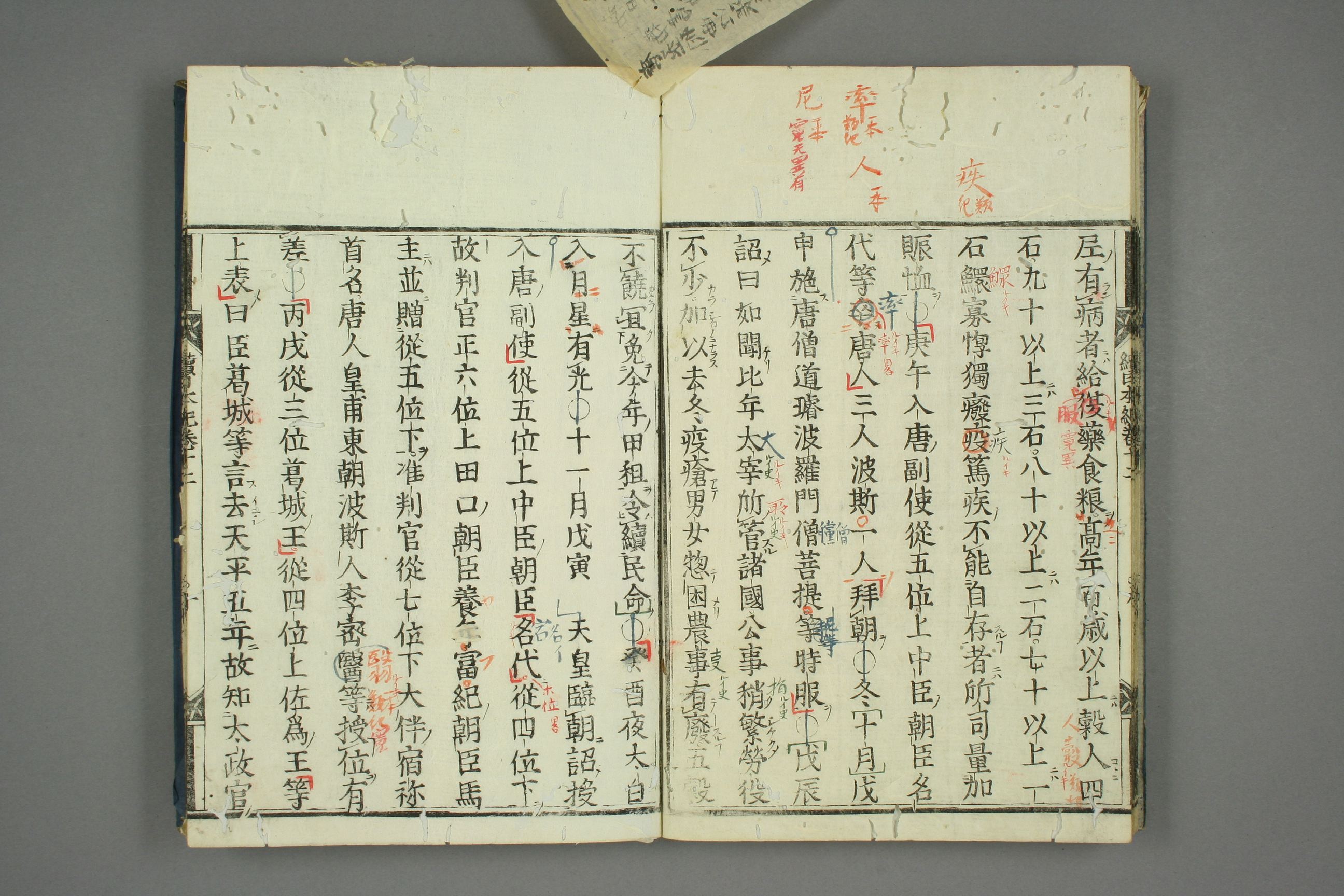


The Tenpyō 天平 Era in which Emperor Shōmu 聖武天皇 (701-756 ce) ruled Japan spanned from August 729 ce to April 749 ce.Footnote 2 Under Emperor Shōmu, Japan maintained a strong relationship with China, which had historically and contemporaneously contributed to the development of Japanese civilisation, art and religion.Footnote 3 According to the Shoku Nihongi 続日本紀 under Emperor Shōmu's rule an envoy (遣唐使 Kentōshi) to China left Japan in 733 ce (Tenpyō 5).Footnote 4 Emperor Shōmu and his wife Empress Kōmyō 光明皇后 (701-760 ce) were patrons of religion, they establishing a system of national monasteries (国分寺 Kokubunji) and convents (国分尼寺 kokubunniji),Footnote 5 and founded a number of temples and monasteries. The topic of this paper are two figures, Li-mi-i 李密翳Footnote 6 and Kōho Tōchō 皇甫東朝 (sometimes rendered as Kōfu or Kohfu),Footnote 7 who arrived at Emperor Shōmu's court in 736 ce (Tenpyō 8) on the return of part of the aforementioned envoy.Footnote 8 Several scholars have argued that Li-mi-i and Kōho were missionaries attempting to spread Jǐngjiào 景教 (J. Keikyō), the form of Christianity present in Táng 唐 dynasty China. I intend to assess this claim, arguing that the evidence to suggest the figures were missionaries or even Christians is speculative at best. I will then explore the significance of the theory, suggesting that its first incarnation in academia is best understood within the context of a modernising and imperially expanding Japan.
The Figures of Kōho and Li-mi-i, and the historicity of the claim that Christianity was present in Tenpyō Japan
Kōho is referred to by a number of scholars as ‘a believer of the Luminous Religion’ and is presumed to be, alongside Li-mi-i, a missionary of Jǐngjiào.Footnote 9 This claim is not supported by the Shoku Nihongi which makes no mention of Kōho's religion. After receiving imperial favours on his arrival to the court in 736 ce (Tenpyō 8),Footnote 10 he features several times in the account; in 766 ce (天平神護 Tenpyō-Jingo 2) he gives a musical performance with his daughter,Footnote 11 in 767 ce (神護景雲 Jingo-Keiun 1) he is placed in charge of the government office in charge of court music (雅楽寮 Utamai no Tsukasa),Footnote 12 in 769 ce (Jingo-Keiun 3) he is promoted,Footnote 13 and in 770 ce (宝亀 Hōki 1) he becomes Vice-Governor of Etchu Province (越中国 Etchū no kuni).Footnote 14 Another detail we can ascertain about Kōho from the Shoku Nihongi is that he was Chinese (唐人 Tōjin).Footnote 15 It would seem therefore that rather than a missionary, Kōho is better understood as an envoy, musician and eventually a politician. Despite this, Ken Joseph Sr. and Ken Joseph Jr. have claimed that Japanese court music (越天楽 Etenraku) has its origins in Persian Christian music, thereby suggesting that Kōho's role as a court musician was in some way linked to Jǐngjiào.Footnote 16 The commonly accepted theory explored by Laurence Picken, however, is that Etenraku came from the Táng tributary state of Khotan, and had been acculturated in China, before being transmitted to Japan.Footnote 17 Even if the Josephs’ claims were true, it would still require a stretch of the imagination to argue that Kōho was a Christian, and it does not, therefore, seem possible to link Kōho's musical pursuits with his theorised religious identity in any meaningful sense. A piece of sueki (須恵器 – Sue Ware or unglazed pottery), containing Kōho's name has been discovered in Nara (奈良市).Footnote 18 In a paper exploring the discovery Nakamura Ichiro argues that Kōho was one of the many people who were not acting as religious professionals, sent between China and Japan to work in secular roles in the Imperial Courts during the Táng period.Footnote 19 Yano Kenichi similarly views Kōho in non-Christian terms arguing that he was first brought to Japan in order to perform at the opening ceremony of the Nara Daibutsu (大仏 Daibutsu) and so that his musical expertise might be used in Japan.Footnote 20 It seems, therefore, that in the Shoku Nihongi and in archaeological finds relating to Kōho there is no support for the theory that he was a missionary and/or a Jǐngjiào adherent.
Li-mi-i is mentioned in the Shoku Nihongi account once; he arrives alongside Kōho, receiving imperial favours and is described as a Persian (波斯人 Hashibito).Footnote 21 Beyond that we have no other information about his personage, yet several scholars argue that he is a “Nestorian Christian medical missionary”.Footnote 22 Some scholars refer to him by his Japanese name, RimitsuiFootnote 23 or Rimitsuei,Footnote 24 or derivatives of this such as Rimitsu or Limitsi, whilst others incorrectly treat the characters of Li-mi-i and Rimitsui/Rimitsuei separately.Footnote 25 This fictitious separation appears to have stemmed from the entry of theories on Li-mi-i into Western scholarship when insufficient Chinese and Japanese language ability led scholars to believe that the different renderings of his name which appeared in contemporaneous scholarship indicated the existence of two different characters.Footnote 26 The argument that he is a Christian missionary seems to be based on two inconclusive passages in P. Y. Saeki's Keikyō hibun kenkyū 景教碑文研究 and its English “translation” The Nestorian Monument in China.
The arguments in Saeki's work differ in terms of content. In both texts, Saeki writes Li-mi-i using a different final character than the version of the Shoku Nihongi that I am working from, he writes 醫 (i) rather than 翳 (ei).Footnote 27 This difference in final character is present in some versions of the text.Footnote 28 The character Saeki uses (醫) refers to those involved in medical roles, and therefore he argues that Li-mi-i was a physician.Footnote 29 In Keikyō hibun kenkyū he argues that because the words Bōsī jīngjiào 波斯經教 (Persian religion of sutras/scripture), Bōsī jiào 波斯教 (Persian religion) and Bōsī sì 波斯寺 (Persian temple) all refer to Jǐngjiào or the Church in contemporaneous Chinese documents, the term Bōsīrèn 波斯人 (Persian Person) as used to describe Li-mi-i should be translated as ‘an adherent of Jǐngjiào’.Footnote 30 This link between Li-mi-i and Christianity is absent in The Nestorian Monument in China where Saeki instead states that a scribal transcription error occurred and that the reading Li-mi (李密) should have more appropriately been rendered Mili (密李).Footnote 31 He suggests that such an error occurred because Li-mi was a very common Chinese name with which the scribe would be familiar, whilst the equally common Persian name MilisFootnote 32 (密李) would have been foreign and looked erroneous to the scribe.Footnote 33 Therefore, he concludes, that Li-mi-i, should be understood to be “Milis, the physician.”Footnote 34 Saeki then poses the question, could this Milis be the same Milis mentioned on the Nestorian SteleFootnote 35 erected in the Táng capital of Cháng'ān (長安),Footnote 36 a priest and the father of Yazdbōzīd/Yazdbōzēd,Footnote 37 the Chorepiscopos, the man who erected the Nestorian Stele?Footnote 38 He leaves this question open, but later writes that the Persian physician who visited Japan is the same as the Priest Milis mentioned on the Nestorian Stele, without providing further evidence.Footnote 39
The lack of information given about either Milis the priest or Li-mi-i the physician, makes it difficult to link the figures beyond the similarity in names. Milis the priest came from Balkh,Footnote 40 where there were large Buddhist, Zoroastrian and Christian communities.Footnote 41 Persia, from whence Li-mi-i is said to have hailed, could refer to Balkh if we assume limited geographical knowledge on the part of the scribe, but Persia itself also had large Zoroastrian, Jewish, Buddhist, Christian and Manichaean communities.Footnote 42 If Persia is a reference to Balkh in the Shoku Nihongi, then the men could theoretical be one and the same. If they are separate figures, however, Persian nationality tells us little of Li-mi-i's religion. Whilst there is little doubt to the faith of Milis mentioned on the Stele, Li-mi-i's religion is not mentioned in the Shoku Nihongi,Footnote 43 nothing can be ascertained from his nationality alone, as by virtue of being Persian Li-mi-i could have been a Zoroastrian, Jew, Manichaean, Buddhist or Christian. Moreover, Saeki's argument that the term Bōsīrèn indicates membership to Jǐngjiào is problematic because it never acts in such a way in contemporaneous Chinese documents, and terms linking Persia and Jǐngjiào do so on the basis that the Chinese believed the religion to be of Persian origin.Footnote 44 Once this was realised to be erroneous the terminology shifted to reflect Syrian origin.Footnote 45
There is an obvious discrepancy in terms of the two figures’ professions, the Milis of the Stele is a priest, and the Li-mi-i of the Shoku Nihongi is possibly a physician.Footnote 46 We are aware that Jǐngjiào adherents often practiced medicine and influenced its development in East Asia,Footnote 47 so there is a possibility that the two figures are the same man acting in different roles in the two sources. Despite this, the fact that he is referred to as a physician rather than a priest or missionary (usually 僧 sō meaning “monk” or “priest,” sometimes 法師 hōshi meaning “Buddhist priest”) in the Shoku Nihongi, suggests that his role was primarily of a secular nature or was at least perceived to be as such. If they are not the same figure, we cannot ascertain a great deal about Li-mi-i's religion from his profession, although Jǐngjiào adherents did practice medicine, medicine in Táng China was also influenced and practiced by Buddhists, Manichaeans and native Chinese.Footnote 48 Previously I concluded that Kōho came to Japan in a secular role, if we are to accept Saeki's reading of the Shoku Nihongi we should also conclude that Li-mi-i visited in a secular rather than religious capacity as a physician.Footnote 49 Such a conclusion might match Yano's thoughts on Kōho by suggesting that Li-mi-i had a purpose in one of Emperor Shōmu's projects, most likely his medical reforms.Footnote 50 In regards to his possible role as a missionary or his religion, we cannot be conclusive. There is insufficient evidence in the source text to claim that he was a Christian, a missionary or the same person as Milis the priest mentioned on the Nestorian Stele. This lack of information itself, suggests that Li-mi-i was not considered important to the writers of the Shoku Nihongi, or that unlike Kōho he did not continue to play a prominent role in the court. Accepting Saeki's judgement involves several leaps of logic, and the theory can only be accepted unconditionally if more evidence is uncovered.
Other scholars have attempted to provide further evidence to suggest that Li-mi-i was a Christian. Joseph states that the Shoku Nihongi refers to figures accompanying Li-mi-i as Keijin (景人) or leaders of the Keikyō Church,Footnote 51 however I have been unable to ratify this claim in any of the versions of the Shoku Nihongi available to me. The Josephs, Samuel Lee, John Young and Mar Aprem all argue that Li-mi-i influenced Empress Kōmyō to build medical facilities and that he converted her to Christianity.Footnote 52 The main piece evidence put forward to support this claim is her social welfare work including the building of a leprosarium, which the scholars see as typical of the Church of the East and atypical of Tenpyō era Buddhism.Footnote 53 There is also reference to a legend of Empress Kōmyō sucking the poisoned wound of a patient, which it is argued, cannot be viewed outside of the context of her being Christian.Footnote 54 Furthermore, there is a legend, recounted to Ken Joseph Jr. by his father, in which Li-mi-i reads the Bible to Empress Kōmyō inspiring her to establish various medical institutions.Footnote 55 These arguments seem to be ahistorical as all of Empress Kōmyō’s religious works were linked to her strong Buddhist convictions, and her work in promoting medicine, such as building the temple Shinyakushiji (新薬師寺 – 747 ce)Footnote 56 is clearly of Buddhist rather than Christian origin. They appear to have directly evolved from comparisons formulated by Saeki's peers E. A. Gordon and Arthur Lloyd between Christianity and the Emperor Shōmu's medical reform.Footnote 57 Similarly there is no mention of a conversion to Keikyō in the Shoku Nihongi. I think it is more likely that the legend linking Empress Kōmyō and Li-mi-i to Christianity is a modern invention; it is difficult to imagine that the legend would survive the persecution of Christianity during the Edo period (江戸時代 – 1603ce-1868ce)Footnote 58 and the earliest detailed argument made to link Li-mi-i and Christianity that I have been able to discover is the work of Saeki. Furthermore, the idea supported by some scholars that the name Empress Kōmyō is somehow linked to the word Keikyō,Footnote 59 ignores the original use of the term in Buddhism within which it refers to the “light emanating from a Buddha or bodhisattva, symbolizing their wisdom and compassion”. Evidence put forward to support the claim that Li-mi-i was a missionary or a Christian by scholars developing Saeki's argument seem therefore to be false. Sufficient evidence to claim that Li-mi-i was a Christian, a missionary or Milis the priest has not been produced and the theory must therefore remain speculative and inconclusive.
The Significance of Saeki's Argument Read in Context
If there is little evidence to suggest that Li-mi-i or Kōho were Christians, why did these ideas enter the realm of scholarship? What are the theological and political significance of these claims? These questions cannot be conclusively answered; however I would like to offer some thoughts on the matter. All texts are the products of and responses to a particular context. It is my contention that Saeki's argument first published in 1916 (大正 Taishō 5), must be understood as a narrative arising in the context of a Japanese nation which was seeking to ‘extend its influence internally. . .peripherally and. . .externally.’Footnote 60 The fundamental goal of Meiji (明治) Japan (1868-1912) was ‘to create a rich state and a strong military,’Footnote 61 it did so through industrialisation and centralising its political system, a process described as Japan's turning to the West.Footnote 62 Victories and involvement in the First Sino-Japanese War (日清戦争 Nisshin Sensō - 1894–1895), the Boxer Rebellion (義和団の乱Giwadan no ran - 1899–1901), and the Russo-Japanese War (日露戦争Nichiro Sensō - 1904–1905) established Japan as a modern power capable of competing with the West.Footnote 63 In 1914 as part of the First World War, Japan seized German territory at Jiāozhōu (胶州) and the Chinese territory in the surrounding area of Shāndōng (山东).Footnote 64 The following year the Japanese government issued Twenty-One Demands (対華21ヶ条要求 Taika Nijūikkajō Yōkyū) which sought to cede much of China's power and sovereignty to Japan.Footnote 65 The demands were reduced to the number of thirteen after Chinese resistance, and were accepted.Footnote 66 By the time Saeki published his works in 1911 and 1916 respectively; Japan had modernised and begun her imperial expansion. This double context of modernisation and expansion is essential, I believe, for understanding the significance of Saeki's argument.
Modernisation led to the development of a process of rediscovering the past within academia, this primarily affected how the past related to knowledge and therefore how historical narratives were written.Footnote 67 There were criticisms of the imperial records, with particular focus on the Kojiki (古事記) and Nihon Shoki (日本書紀), which led to the debunking or lowering in status of various historical and/or ahistorical figures, and the understanding of these texts as documents.Footnote 68 The importation of Western culture helped form a Western academic tradition and scholars wrote histories to Western as well as Japanese audiences.Footnote 69 Saeki's Keikyō hibun kenkyū and The Nestorian Monument in China should be understood within this context. The latter is a text written for a Western audience,Footnote 70 and both show several features indicative of Meiji period historical narratives such as the critique of the imperial records which he offers by rereading the Shoku Nihongi. I wonder if his assertion that Japan has a long Christian history is an attempt, within the context of Japanese modernisation, to illustrate Japan's equal status as a world power with Western nations, contemporaneously and historically, by referring the readers to a common point of shared history in the deep past. Whether or not this is the case it is clear that Saeki's argument can be understood as both the product of and response to Japan's ongoing modernisation and her seeking therein to discover a history around which to build society.Footnote 71 However, the text's significance is also linked to the imperial expansion of Japan.
Saeki's Keikyō hibun kenkyū and The Nestorian Monument in China are replete with references linking his study, and the artefacts and ideas dealt with therein to Japan.Footnote 72 These references are mostly absent from his later works dealing with the same topic such as Keikyō no Kenkyū (景教の研究) published in 1935, and The Nestorian Documents and Relics in China first published in 1939.Footnote 73 This may simply illustrate that by 1935 Saeki had realised that the argument that Li-mi-i was a Christian missionary is speculative and does not stand up to strong critique, or perhaps it reflects increasing censorship in Imperial Japan. Nevertheless, the argument Saeki produced in 1916 regarding the character of Li-mi-i is significant because he directly links Japanese academia and history to sites and relics of archaeological or historical importance in China. In doing so he knowingly or unknowingly provides a justification for Japan's imperial interests there, that of discovering her history. Is the argument therefore better understood as the product of and response to Japan's imperial expansion? It is certainly interesting to note how religion and religious history were used in Japan's imperial endeavours as part of the colonial narrative. Japan ‘generated a concept of “religion” that could be utilised in the spiritual integration of the nation,’Footnote 74 by regulating, reorganising and using, Buddhism, Shintō and to some extent ChristianityFootnote 75 for the purpose of controlling its colonies.Footnote 76 Local religions were patronised in order to influence subject peoples through the use of their sacred and national symbols, for example a shamanist temple at Wūlánhàotè (乌兰浩特) was built and dedicated in 1944 for the purpose of influencing Mongol subjects.Footnote 77 Is it possible that by extending the length of Christian history in Japan, Saeki's argument acts to transforms Christianity into a “native” religion, akin to Shintō and Buddhism, which through playing a role in imperial history ought to belong to the imperial establishment, rather than the missionaries or ordinary believers?
If his theory is true, Saeki's argument is theologically volatile. If Christianity was present in Tenpyō Japan, the historical claim that the Jesuits were the first Christian missionaries to Japan is erroneous. The religion becomes, like Buddhism and Shintō, part of the religious makeup of Japan, part of her imperial history and possibly an indicator to Japanese identity. As such conversion to Christianity is destigmatised. I have suggested that this may have arisen or at least can be understood as a product of the context of Japanese modernisation and imperialism which sought to control and use religion to its own ends. However, if true it is also significant for Christians, who would be able to capitalise on Japan's extended Christian history in their missionary work. No longer would Christianity be a foreign import, rather it would be something “native” to Japan.
Conclusions
I have sought to illustrate that it is not possible to argue that the figures of Li-mi-i and Kōho who visited Japan in 736 ce (Tenpyō 8) were Christians or missionaries. Rather, they should be understood as foreign visitors who took secular roles in Tenpyō Japan. Such a conclusion must, however, be made tentatively. Although the Shoku Nihongi and archaeological finds relating to the figures do not allow us to ascertain the figures’ religious identity, Saeki's argument that Li-mi-i has been transcribed incorrectly is convincing. There is a possibility that Li-mi-i and the Milis of the Nestorian Stele are the same person, however, all available primary sources lack the necessary detail to confirm this link. Without further archaeological finds, or definitive evidence of Christian presence in Tenpyō Japan,Footnote 78 the theory that Li-mi-i and or Kōho were Christians must remain speculative and the subject of further research.
After exploring the theory that Li-mi-i and Kōho are Christians, I have attempted to contextualise Saeki's argument. I argued that Saeki's argument must be understood within the context of a Japan which was both modernising and expanding imperially. It must be read as a product of and response to this context, and understood as a text indicative of early 20th Century Japanese historical narratives. Despite this, a link between the argument and the writer's context should not be overstressed, although I believed it can be understood within the context in which it arose, I am not arguing that it was a conscious attempt to justify imperial aims or modernisation. Finally, I gave some thoughts on the theological significance of the argument, which I believe has the possibility to be paradigm shifting if proven.
This paper has focused on Saeki's argument, which is the earliest developed argument of the theory that Li-mi-i was a Christian that I have been able to locate. Whilst Li-mi-i is assumed to be a Christian prior to Saeki's publication in 1911, by Arthur Lloyd in his Shinran and His Work published in 1910,Footnote 79 this assumption is linked to Saeki in Lloyd's footnotes.Footnote 80 If Saeki wrote on the topic before his 1911 publication, this earlier instance of the theory may produce a need to question anew the significance of the argument within an earlier context, and maybe also the reasons for its genesis. Although I would argue that the context of a modernising and imperially expanding Japan is also applicable in Saeki's earlier development of this argument as a product of early 20th Century Japan. Saeki's theory was expanded upon during the late 1940s and early 1950s by a scholar called Sakae Ikeda writing for the periodical Light from the East.Footnote 81 Ikeda wrote on Li-mi-i and has been influential on the scholars who have developed the theory in the 20th Century such as Ken Joseph Jr. Ikeda admitted a need for his claims to be confirmed,Footnote 82 however, the research presented by Ken Joseph Jr. Mar Aprem, Samuel Lee, Ikuro Teshima, Michael Zomber, Arthur Lloyd and John Young, has failed to affirm the claim that Li-mi-i and Kōho were Christians. The quest for confirmation, therefore, continues.