




Introduction
Morocco is a high water-scarce country, with forecasts predicting a volume of water per capita lower than the United Nations’ ‘Absolute Water Scarcity’ level, especially in central and southern regions (Haddouch, Reference Haddouch2015). Water shortage is mainly due to climate change negative impacts and rising demand related to population growth, urbanisation, improved living conditions and implications, economic expansion (Alaoui, Reference Alaoui2013). The Souss-Massa region is one of the Moroccan areas seriously affected by the changing climate and human activities, putting more pressure on surface water and groundwater resources for social and economic needs (Bouchaou et al., Reference Bouchaou, Hirich, Seif-Ennasr, Malki, Abahous and Bouaakaz2017). Thus, the growing agriculture, industry, tourism and domestic uses lead to aquifers overexploitation (Malki et al., Reference Malki, Choukr-Allah, Bouchaou, Ait Brahim, Abdelaziz and Reichert2016; Seif-Ennasr et al., Reference Seif-Ennasr, Hirich, El Morjani, Choukr-Allah, Zaaboul, Nrhira and Beraaouz2017). Freshwater scarcity, due to limited surface water resources, resulted in an increasing deficit with time reaching the level of water crisis (Chohin-Kuper, Garzón Delvaux, & Strosser, Reference Chohin-Kuper, Garzón Delvaux and Strosser2014; Ministry EMWE, 2011). Indicators of water scarcity in the region are threatening the sustainability of many agricultural activities and farmers’ livelihoods, particularly in poor remote rural zones, raising concern regarding water availability in the area in coming years. To face water scarcity, many measures have been set for the achievement of water security. These include increasing supplies from conventional and nonconventional resources, rising water prices in consultation with water users, water economy and conservation, as well as treated wastewater reuse and seawater desalination for irrigation purposes (Ministry EMWE & World Bank, 2016). However, technical measures and regulations alone may not be effective for better water management and usage. Therefore, there is a growing interest in the educative approach uses to face major environmental and sustainability issues and challenges, including water management and security (Bhat, Reference Bhat2017; Dolnicar, Hurlimann, & Grün, Reference Dolnicar, Hurlimann and Grün2012; Hussein, Reference Hussein2017; Jorgenson, Stephens, & White, Reference Jorgenson, Stephens and White2019; Payne, Reference Payne2020; Sund, Reference Sund2016; Sund & Pashby, Reference Sund and Pashby2020). Through education, it may be possible to provide knowledge and skills, increase awareness, develop positive attitudes and change behaviours (Alkaher & Gan, Reference Alkaher and Gan2020; Briggs, Krasny, & Stedman, Reference Briggs, Krasny and Stedman2018; Jurdi-Hage, Hage, & Chow, Reference Jurdi-Hage, Hage and Chow2019; Meganck, Reference Meganck2010; Sammel, Reference Sammel2014; Surata & Vipriyanti, Reference Surata and Vipriyanti2018).
Water education topics and water issues can be addressed through different frameworks. Within the hydrological cycle framework, water is dominantly interpreted as a natural resource. The focus is on water as a chemical compound and the properties of this compound, separate from social interactions and relationships (Sammel & Hartwig, Reference Sammel and Hartwig2019). In contrast, the hydrosocial cycle perspective suggests that water-related issues cannot be addressed solely from scientific and technical expertise. This perspective provides the ability to assess and understand the social, political, economic, and cultural aspects of water issues reflecting local and global concerns (Linton & Budds, Reference Linton and Budds2014). Studies on school curricula reported a predominately science-based hydrological perspective of water education-related issues with little focus on societal influences (Sammel, Reference Sammel2014; Sammel & Hartwig, Reference Sammel and Hartwig2019).
Despite the faced water crisis, water consumption and preservation behaviours are still negative within the community (Amahmid et al., Reference Amahmid, El Guamri, Yazidi, Razoki, Kaid Rassou, Rakibi and El Ouardi2019). This is particularly relevant among youngsters at school age, as shown through surveys conducted in their own schools on the impact school life activities may have on increasing students’ awareness and setting positive attitudes and behaviours regarding water resources in the area. The survey findings and observations revealed water-wasting behaviours within schools, suggesting students’ misunderstanding of the role they can play as citizens with regards to water problems. These investigations point to the question of the potential school programmes and curricula may have in water education and the improvement of studentsʼ daily water use habits. This raised the hypothesis that school curricula do not include comprehensive standards to promote water education and water culture among students. The authors also hypothesised the existence of barriers and difficulties impeding the ability of teachers to introduce water-related concepts and curricula implementation.
For this purpose, the current study investigated the status and extent of occurrence of the main water culture and water education criteria and standards in the school curricula designed for Primary, Middle and upper Secondary school levels, used as a basis for textbooks elaboration, and teaching purposes in Morocco. These curricula as well as school life activities have been expected to promote water education and water culture, help students understanding water problems within their area, as well as their rights and duties towards water issues (Andrews, Heimlich, Farrell, Ponzio, & Warren, Reference Andrews, Heimlich, Farrell, Ponzio and Warren1995; Khalifa, Reference Khalifa2006). The study may also help to assess how clear water education-related contents are within the educational programmes and formal directives according to teachers. The curricula analysis may also provide possibilities to improve the quality of existing resources integrated into the curricula, and make suggestions to fill any identified gaps.
Materials and Methods
The main tracks offered by the Moroccan education system include the Modern track, the Technical track and the Original track. The latter emphasises Islamic disciplines and national identity. After nine years of compulsory basic education including 6 years (grades 1–6 grades) of Primary school and 3 years of Middle school education (grades 7–9). The upper Secondary school lasts for 3 years; a one-year common core curriculum (arts or science); First-year baccalaureate (options: arts and or science, mathematics), then the Second-year Baccalaureate; options: physics, Life and earth sciences, agricultural science, mathematics or technical sciences (Tawil, Cerbelle, & Alama, Reference Tawil, Cerbelle and Alama2010). Moroccan educational curricula are developed at a national level and compulsory. The contents, courses goals, and length of time devoted to curricula implementation are prescribed, as requirements. This study focused on the instructional curricula of Primary, Middle and upper Secondary School education (Ministry of National Education (MNE), 2009a, 2009b, 2009c, 2015, 2016a, 2016b).
Descriptive and analytical approaches were used to address the research topic and answer raised questions. Content analysis tools were used, starting from analysing the foundations of the curriculum building (competencies, values and so on), teaching methodologies for each subject area by analysing the topics of the prescribed programmes for the three investigated school levels. The assessed subject areas included mathematics, physical education, and physics, life and earth sciences, philosophy, geography and languages (Arabic, French, English and Tamazight). The frequency of repetition was used to assess and account for the prevalence of water education and water culture related topics and concepts, in programmes and curricula of the investigated disciplines for each of the aforementioned school levels. The research team performed a collective analysis of the contents of the school curricula. Constitution of themes was based on the frequency of repetition of topics in text and researchers’ judgment. The only retained topics, criteria and indicators were those on which researchers agreed they include explicitly or implicitly water education-related concepts, to increase data validity (Holloway & Wheeler, Reference Holloway and Wheeler2010; Ryan & Bernard, Reference Ryan and Bernard2003).
To achieve the study objectives, a content analysis grid was developed to identify 10 reference criteria and standards for concepts related to water education and water culture in educational programmes and formal guidelines contents. These include water cycles, water as a vital resource, water economy, water pollution and treatment, access to water, aesthetics of water, water law, water professions, disasters and water, water in the region. It has also been explored whether they have been explicitly or implicitly expressed, as well as their repetition frequency.
A questionnaire was designed and introduced to 95 teachers (62 male and 33 female), with a teaching experience ranging from 4 to more than 38 years. The items consisted of open-ended questions specifically focused on how teachers deal with curricula, and challenges facing content implementation. Teachers have also been investigated regarding their observations, suggestions and recommendations to address these challenges. In addition, collective semi-structured interviews were used during the animation of workshops as an additional tool to support and foster the validity and reliability of collected information. The interviews and questionnaire were administered to teachers of different subject areas in Primary, Middle and Secondary schools. They belong to four schools randomly selected within the four provincial directorates belonging to the Regional Academy for Education and Training in the Souss-Massa region (Morocco).
Findings and Discussion
Morocco faces major challenges related to water resources. In regions where water resources are very scarce, education may have a substantial role in promoting sustainable water management. This may be possible through the integration of water education and water culture topics in school curricula and programmes allowing to change the values and habits of water users (Sammel, McMartin, & Arbuthnott, Reference Sammel, McMartin and Arbuthnott2018). Thus, water culture and water education are considered as water security tools for the young generation. Schools furnish prominent opportunities to develop knowledge and raise awareness with positive attitudes and habits regarding water issues within large groups of learners, who may disseminate achievements to the neighbourhood and wider community (Bryx & Bromberg, Reference Bryx and Bromberg2009; Daniel, Reference Daniel2014). In this context, water education and water culture programmes have been integrated into educational curricula in several countries (Gruver, Smith, & Finley, Reference Gruver, Smith and Finley2009; Irvine, Seow, Leong, & Cheong, Reference Irvine, Seow, Leong and Cheong2015).
Water education and water culture in Moroccan School curricula
The exploration of the school curricula contents showed the absence of explicit texts regarding water education. However, there are many water references related to this topic in the curricula, at least implicitly. Regarding values, curricula content is designed to be delivered using values-driven approaches. They consist of the development of children’s capacity for positive participation in action at local and national scales, positive interaction with the social environment at different levels of the society, and respect for the natural environment and promote sustainable development. Concerning curricula contents, reference was made to giving more interest to local and national dimensions. In terms of competencies, it was found that some strategic competencies could be comprised of water education-related concepts. These included ‘positioning in regards to other people community institutions (family, schools and society)’, and ‘adapting to the environment, in general’.
In the same context, for the specifications field, reference was made to creating instructed students ready for integrating initiative-taking values, positive concurrence, teamwork, awareness of rights and duties, imbued with the principles of health prevention and environmental protection, and having the ability to interact with others and social environment (family, school). The presence of water education relatedtopics in school curricula was found to vary according to school levels and subject areas.
Water culture and water education-related criteria in the Primary school curriculum
To assess the prevalence of water education related concepts in Primary school programmes for all subject areas, frequencies, proportions and ranks of the approved criteria and standards were determined.
Overall, 117 standards related to water culture and education were referenced in Primary school programmes. The distribution of the criteria by grades showed the weak reference, either implicitly or explicitly, to these criteria in grades 1, 2 and 3 of the Primary school level with only 36 references, with a corresponding frequency of 31%. However, more importance has been given to these criteria in grades 4, 5 and 6, totalling 81 references and a frequency reaching 69%. However, most of the criteria (74%) were implicitly expressed, with an increased rate in grades 4, 5 and 6 of the Primary school level (Figure 1). Reference was made explicitly to these criteria, but in lower frequencies, especially in grades 1, 4, 5 and 6, while they were absent in grade 3.
Distribution of water education criteria, explicitly or implicitly expressed in Primary school curricula, by grades.

Most of the criteria and concepts were general and integrated within the framework of environmental education, language programmes (Arabic, French, Tamazight) and geography, in general themes such as ‘Child and school’, ‘Child, environment, and nature’, ‘balance nature’ and ‘Environmental protection’, ‘the world of industry’, ‘agriculture and environmental protection’, ‘natural balances and environmental education’ (Table 1).
Distribution of water education criteria by subject areas in Primary school curriculum

Students are required to describe the components of the surrounding natural environment, talk to others about the importance of the natural environment for children and human lives, and express their attitudes and positions (approval or disapproval) in regards to behaviours affecting the environment and natural balance. They are also supposed to convince friends by providing arguments showing the necessity to commit to the rules and requirements to protect the environment, locally and nationally. Other topics aim to let students know their rights and duties at school with their responsibilities towards public spaces to raise values of citizenship in students’ daily habits and practices. It also included students’ participation in activities of the community development: cleaning, planting trees, respecting property, identifying environmental problems within the area (water pollution, air pollution, solid wastes management and so on), with their impact on a specific economic activity, as well as suggesting appropriate solutions for a clean and safe environment (to keep the environment clean and safe).
For the explicitly expressed references regarding the development of water education among students, they were limited (24%) and sparse through the investigated subject areas. In scientific activity subject, they have been mentioned in themes such as ‘exploring media animals move through, or on, different types of environment: aquatic, terrestrial and aerial’. Other themes included ‘being aware of the importance of water for life with different water uses by humans’, ‘different water sources’, ‘water scarcity’, ‘recognising the importance of water to plants’, ‘water pollutants’, ‘water pollution risks and impacts on livings beings’, ‘drinking water treatment steps’, as well as ‘water use rationalisation and preservation’, ‘recognise water cycles’. Additional reference criteria have been incorporated in Islamic education (i.e., suitable water for ablution, purity of the body, clothing, place, and water rules, how to preserve plants), and in French (Weather forecast, four seasons). Similarly, the geography curriculum included several criteria of water education and water culture. These include ‘recognise and describe some components of the natural geographical area (valleys, rivers …)’, ‘recognise precipitation and heat, measure temperature and the amount of precipitation, draw a map of temperature and precipitation for Morocco’s climate’ and ‘preserve the water wealth, and learn about the impacts of climate factors on vegetation cover)’.
Water-related references were rarely incorporated in the art education subject area (general theme: child, environment and nature), but details regarding targeted specific competencies and related resources were lacking in this subject area. It is also unfortunate that the simplest indicators about water education are absent in the curricula of mathematics and physical education, despite their direct interconnection and coherence with various other subject areas’ curricula (interdisciplinary coherence).
Assessment of frequency of each of the ten reference criteria and standards adopted for the current study showed a different degree of presence through curricula and programmes at the Primary school level. As shown in Table 2, four criteria were found to be the most prevalent with a total frequency rate of 96%, consisting of ‘water-saving and conservation’ (33%), ‘water cycles’ (31%), ‘water pollution’ (19%) and ‘water as a vital resource’ (13%). However, the six remaining criteria were absent in curricula and programmes. These criteria have weights in education for water resources management and rational use. They included ‘Access to water’, ‘common right to access to water’, ‘the water law in Morocco, 1992’, the ‘aesthetic water’ (abounding all over the country) and ‘water in the region’ pointing to interest for water issues in the surrounding area as a start. The other missing criteria were ‘water and natural disasters’, with a need to deal with risks and prevent potential consequent losses and damages (Boon & Pagliano, Reference Boon and Pagliano2014); and ‘the water professions’, making the student aware that water supply and availability requires collaborative efforts and intervention of several partners dedicated to searching for water, treating, protecting, managing and delivering an essential service for human use.
Distribution of water education criteria according to prevalence in Primary school curriculum

Water education-related criteria in Middle and Secondary school curricula
The analysis of Middle school and Secondary curricula and programmes resulted in the findings summarised in Tables 3 and 4.
Distribution of water education criteria by subject areas in Middle and Secondary school curricula

Distribution of water education criteria according to prevalence in Middle and Secondary school curricula

Analysis of the Middle school curricula
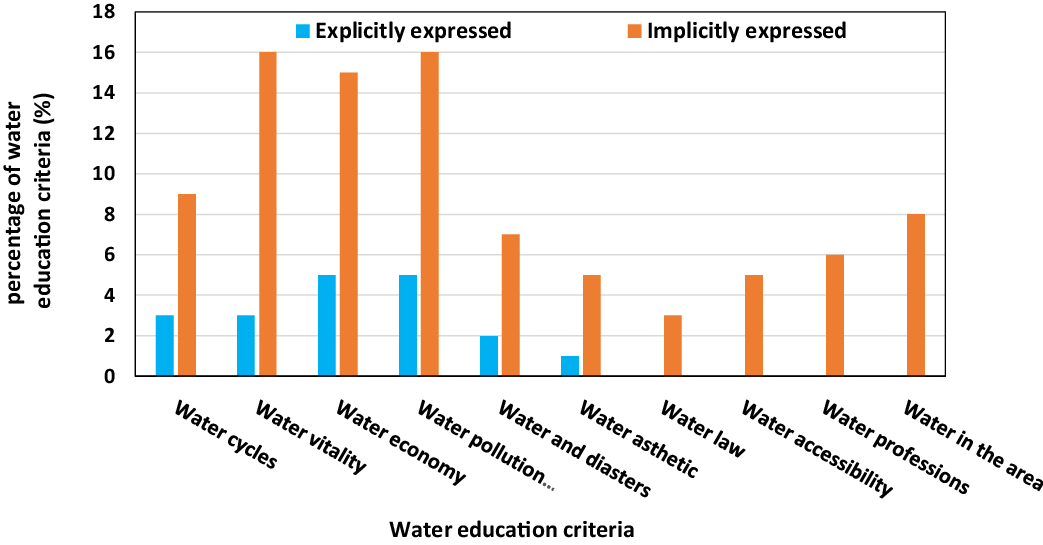
Through the analysis of school curricula and programmes for the Middle school level, it was found that most of the reference criteria for water education included in the programmes accounting for 90 (83%) repeated concepts were implicitly expressed, versus 19 (17%) explicit concepts. The explicit cases were limited to the topics: ‘water cycles’, ‘water is a vital resource’, ‘water economy and preservation’, ‘water pollution and treatment’, ‘water and natural disasters’ and ‘water aesthetic’ (Figure 2).
Distribution of water education criteria explicitly or implicitly expressed in Middle school curricula.
Based on the presence of water education-related criteria, the investigated subject areas have been subdivided into four groups. The most involved was geography with 45 concepts (41%) related to water education, followed by life and earth sciences with 22 (20%) concept repetitions. Islamic education and physics-chemistry curricula accounted for 16 references (15%) and 18 (17%) concepts, respectively. Only 4 (4%) concepts were addressed in Arabic and English languages, respectively. However, French language, mathematics and physical education programmes did not include any concept regarding water education (Table 3).
Analysis of the curricula contents and programmes of subject areas which integrated water education concepts indicates the inclusion of specific competencies making it possible for teachers to introduce these concepts, such as ‘awareness of the value of natural resources with the need to preserve them’ in geography. furthermore, Islamic education incorporated concepts including ‘representation of belief principles’, ‘values and Islamic ethics regarding the environmental (Rights, beauty and art) and put it in practice at school, family and community environment and so on’, in addition to ‘possession of an integrated and multidimensional culture’. This requires a cultural and social integration, with ‘openness to others’, ‘active citizenship (taking responsibility and initiative)’, ‘loving and seeking knowledge, developing a clear and comprehensive picture of the environment and its implications, with faced dangers’, ‘owning positive attitudes towards major issues regarding environment, health, prevention and appropriation’, raised in Physics and Chemistry curricula. Language programmes pointed to necessity of ‘adopting positive attitudes towards environmental and community issues’ (Arabic), and ‘promoting values-driven education to respect nature and the environment’ (English). In Life and Earth sciences addressed the requirement for students of ‘being aware of the need to prevent and avoid wasting natural resources’, and ‘taking responsible positions towards environmental and community issues’.
However, in the Life and earth sciences curriculum for Middle school (grade 1), there were explicit directives regarding how to address the topic of ‘water resources’, as a part of the ‘external geological phenomena’ unit. Therefore, when addressing this topic, it was recommended to focus on activities allowing learners to develop responsible and conscious attitudes towards the water, through providing appropriate knowledge required for topic understanding and comprehending (the concept of hydraulic basin, different forms of water in nature, water cycle, dangers threatening water resources, treatment and prevention measures). Preacquired knowledge on the topic (in physics course for the first semester of the same grade) should be exploited for reinforcement and enhancement from a biological point of view, making students aware of the crucial importance of preserving and rationalising the use and consumption of this threatened natural wealth.
Concerning repetition rates of the ten adopted criteria in the explored curricula in the present study, findings revealed that they varied according to the subject areas (Table 4). Four criteria were found to be the most preponderant accounting for 65%. These criteria include ‘water pollution and treatment’ (19%), ‘water economy and preservation’ (18%), ‘water as a vital resource’ (17%) and ‘water cycles’ (11%). Conversely, six criteria were detected in lower levels with a frequency ranging from 3% to 7%.
Analysis of the Secondary school curricula
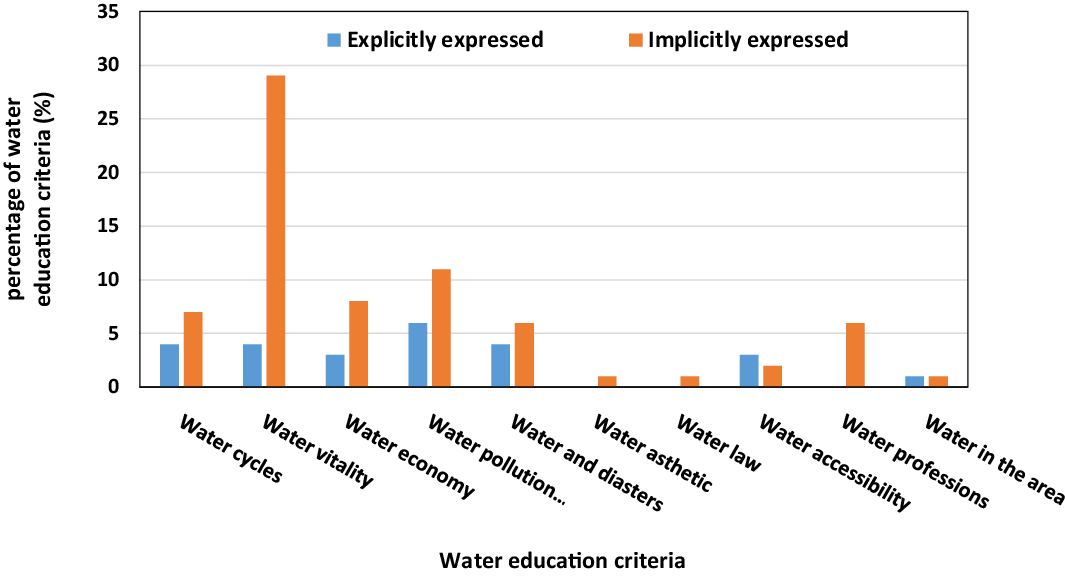
Most of the reference criteria for the concepts of water education included in the Secondary school programmes were implicitly stated with 72 repeated concepts (74.2%), against 25 explicit concepts (25.8%). These latter were limited to the following six criteria: ‘water cycles’, ‘water is a vital resource’, ‘water economy and conservation’, ‘water pollution and treatment’, ‘natural disasters and water’ and ‘access to water’ (Figure 3).
Distribution of water education criteria explicitly or implicitly expressed in Secondary school curricula.
The analysis of the curricula contents for the upper Secondary school level resulted in the enumeration of 97 concepts about water education, in varying frequencies according to academic subject areas (Tables 3 and 4). Life and Earth Sciences programmes included 33 concepts implicitly related to water education, whereas physics, chemistry and geography subject areas integrated concepts with respective numbers ranging from 26 to 31, against seven concepts for English programmes. However, the remaining programmes of the explored subject areas namely Islamic education, Arabic, French, mathematics, philosophy and physical education did not contain concepts linked to water education.
The analysis of the curricula and programmes of subject areas in which concepts related to water education were incorporated revealed the presence of specific competencies that make it possible for teachers to introduce these concepts during teaching activities. These competencies include ‘linking physics and chemistry concepts and theories to real daily life phenomena’, ‘acquiring spatial citizenship education (climate and environment, desertification, national territory management, urban development, rural development and so on). This makes it possible to integrate and adopt positive behaviours and attitudes towards the geographical surrounding area in various dimensions’ (geography), and ‘developing a clear and comprehensive picture of the environment and its implications with faced dangers’, and ‘setting positive attitudes towards major issues of the environment, health, prevention and consumption’ (English subject). In this regard, curricula of life and earth sciences include explicit qualitative competencies with an emphasis on the importance of water education. However, the targeted group is so limited, restricted to two grades and three options, namely the common core arts, original education track, and second year of baccalaureate in Agricultural Sciences.
Curricula of common core arts and original education were found to comprise water-related topics including the understanding the importance of water resources and their sources with awareness of the need for water preservation and water use rationalising; as well as familiarity with modern water treatment technologies, with methods of drinking water production and the specific standards for water quality. They also include ‘identifying possible uses depending on water quality’, ‘acquiring knowledge on natural environment pollution with consequences on natural balances and human health, and recognising non-polluting techniques to become aware of the importance of preserving natural balances, human health, and natural environment’.
The second-year baccalaureate in Agricultural Sciences included competencies such as ‘deepening knowledge on water resource management and agricultural production, raising awareness on the importance of rational management of water resources and improvement of agricultural production humans’ water needs and food security, the consciousness of threats to water resources, and agricultural products quality and safety’.
Repetition rates of the ten criteria adopted in this study varied according to subject areas and ranged from 1% to 30% (Table 4). Five criteria were found to be the most prevalent with a frequency reaching up to 84.3%, consisting of ‘Water is a vital resource’ (34%), ‘Water pollution’ (18%), ‘water cycles’ (11.3%), then ‘Water economy and preservation’ and ‘Conservation’ (11%) and ‘disasters and water’ (10%). The lowest prevalence was recorded for the criteria ‘access to water’ and ‘water professions’ with rates of 5% and 6%, respectively. In contrast, the criteria ‘water aesthetics’, ‘water law’ and ‘water in the region’ were absent from Secondary school curricula and programmes.
The current study results showed that water education and water culture-related topics and concepts were explicitly and/or implicitly incorporated in the Educational curricula of Primary, Middle and upper Secondary schools. The prevalence of occurrence of these concepts varied according to school levels, grades and subject areas. These findings are in concordance with reports from other countries (Sammel, Reference Sammel2014; Smith, Heck, & Worker, Reference Smith, Heck and Worker2012). However, in many cases, the role educational curricula can play in promoting knowledge, positive attitudes, behaviours and water use practices may be neglected (UNESCO, 2015). The current study findings showed a weak occurrence of water education-related criteria in school curricula, syllabuses and instructional guidelines, with 117 criteria for Primary school, 109 for Middle school and 97 for Secondary school level. These criteria prevalence varied according to school levels, grades, and subject areas. At the Primary school level, water education criteria were mainly discovered in syllabuses of Geography, Scientific Activity, Arabic and French languages. For the Middle school curricula, water education criteria were prominent in Life and Earth Sciences, Physics and Religious education. These findings corroborate those previously reported in the Australian curricula, with the most prominent being Sciences counting 49.6% of water references, and geography 39.1%; in line with other reports from Singapore (Smith et al., Reference Smith, Heck and Worker2012), Hong Kong (Curriculum Development Council, 2011) and Serbia (Maravic, Ivkovic, Segedinac, & Adamov, Reference Maravic, Ivkovic, Segedinac and Adamov2014).
The absence of the water theme in the curricula of some subject areas such as Mathematics may be considered as a major gap since it can offer opportunities to develop students’ skills through water-based activities using water resources data (Balaji & Anbalagan, Reference Balaji and Anbalagan2017; Curriculum Development Council, 2017; Thomson & Hartog, Reference Thomson and Hartog1993). For the Middle school curricula, water education criteria were mainly found in Life and Earth Sciences, Physics and geography programmes. However, in most cases, the criteria were implicit with levels attaining 74% in Primary school programmes, 83% for Middle school and 74.2% in Secondary school programmes. These findings corroborate those reported by Amahmid et al. (Reference Amahmid, El Guamri, Yazidi, Razoki, Kaid Rassou, Rakibi and El Ouardi2019) stating that water topics were incorporated in disciplines curricula at varying levels, with the highest prevalences in sciences and geography. Furthermore, it is noteworthy that reference was generally made to four criteria linked to water cycles and water vital role, water pollutants and water economy importance, mainly targeting the cognitive side of students. However, effective water education should focus on supplying learners with appropriate knowledge, with more emphasis on developing and promoting positive attitudes and behaviours (McCarroll & Hamann, Reference McCarroll and Hamann2020).
On the other hand, this study revealed that all of the investigated curricula for the three school levels omitted to refer to six water education criteria, which were not adopted in textbooks, or lesson planning. As a result, it may be difficult to develop the social-emotional and sensory-motor skills of students, allowing them to acquire positive behaviours and practices towards water issues. The missing criteria included:
-
‘Aesthetics of water’, may be considered as a promising concept for managing scarce water resources. It may allow the development of learners’ aesthetic awareness with the acquisition of the ability to value and enjoy water landscapes in water environments. This criterion can be incorporated in curricula of subject areas such as art education and philosophy. During the investigation of local water resources, teachers can arrange together with students a compilation of local water bodies, and then invite students to choose and conduct an aesthetic inquiry on one of them (Hurren, Reference Hurren2017). Reports indicated that environmental and water education can introduce concepts of environmental citizenship (Alkaher & Gan, Reference Alkaher and Gan2020; Jem, Reference Jem1998; Jurdi-Hage et al., Reference Jurdi-Hage, Hage and Chow2019); with the development of positive behaviours towards water resources, and respect others’ rights to enjoy the river and marine natural landscapes. They may be more effective when relocated into the local context (Postila, Reference Postila2019; Surata & Vipriyanti, Reference Surata and Vipriyanti2018).
-
‘Water access’: considered as a fundamental human right necessary for human dignity and water is public property owned and used by all the community. Effective water education affords the required means to assess water quality and raise learnersʼ awareness to ensure they play an active role in improving water resources management and sustainability (UNESCO, 2017).
-
‘Moroccan Water Law 1992’: knowledge of water rules can develop the learnersʼ sense of responsibility towards the water environment they live in, with respect of othersʼ rights to enjoy water landscapes and exploit waters. It may also allow the establishment of democratic and adequate accountability, with oversight mechanisms to combat water misuse or monopoly (Ministry EMWE, 2011).
-
‘Water in the region’, may be of great interest as competency-based approaches in teaching aim to achieve and follow openness of the school as a human social community at the outside level to a wider social environment. This can allow students to link learned concepts and theories to real-life situations, and solve real daily life issues and problems. Strengthening water education may empower students for a deep understanding of water issues in their local context, to get committed to actively participate in activities ensuring better water management and security; particularly relevant for poor communities in water-scarce areas (Postila, Reference Postila2019; World Council of Civil Engineers, UN Office in Spain, & Aqualogy Foundation, 2015). While a few allusions have been made to this concept in some curricula and programmes including those of the original common core, Art, and Social sciences (Secondary school level), the urge to use local and regional data when dealing with water issues remains limited. In fact, this may enhance learners’ involvement in solving water problems due to misuse of water resources, and preventing water-related natural disasters. Reports indicated that water-related educational programmes combined with in-depth study of environmental concerns result in long-term changes in terms of knowledge, awareness, attitudes and behaviours regarding water resources issues (Fletcher, Reference Fletcher2017; Stevenson, Reference Stevenson, Stevenson and Sergi1997).
-
‘Water professions’, addressing this topic may be of interest through rising learners’ consciousness on water production and treatment steps for human use, as well as measures for water consumption rationalisation, with learners’ openness on a variety of water professions to become much more aware of multi-sector collaboration. By the occasion, students can learn about careers for which water is important and specialised jobs that are water-related (Hydrologist, Water metre reader, Water quality expert and so on).
Survey and workshops results
Teachers have a crucial function in the implementation of water education related programmes of the official and compulsory Moroccan curricula, as they are responsible for planning courses and choosing appropriate contents, methods, materials and contexts to introduce concepts and develop the prescribed skills, attitudes and behaviours (Esa, Reference Esa2010; Karrow, Reference Karrow2020).
Through the consultative meetings with teachers of the investigated subject areas, belonging to Primary, Middle and Secondary school levels, most of them stated relying on school curricula to approach school programmes and syllabuses. Moreover, they referred to some water-related topics in contrasting degrees according to school levels and subject areas. In addition to the omission, this study revealed that the introduction of the integrated concepts was not preceded by a concise and careful analysis of educational curricula. In fact, during workshop activities, a few teachers have suggested approaches included in curricula of the taught subject areas, with confusion between classroom activities explicitly expressed in some curricula and school life activities. Some of the concepts were approached by a few of the investigated teachers using several ways. These include:
-
Tracking some learnersʼ negative behaviours, with attempts to make changes through students’ involvement and participation in suggesting solutions.
-
Placing learners in educational situations (ablution/hygiene and so on).
-
Organising extracurricular water-related activities at schools or field trips and visit to wastewater treatment plants, in the framework of hands-on environmental education (Mason, Reference Mason2020); with the implementation of solutions regarding awareness on risks and dangers threatening water resources using brochures, posters, wall charts, presentations, personal projects and so on. Previous reports revealed that water education programmes have been integrated into Moroccan curricula. However, for full benefits, they should focus not only on in-class learning to provide background knowledge; but need to include field trips and extracurricular activities as well (Amahmid et al., Reference Amahmid, El Guamri, Yazidi, Razoki, Kaid Rassou, Rakibi and El Ouardi2019; Kurtze, Morais, Platko, & Thompson, Reference Kurtze, Morais, Platko and Thompson2015). These activities are crucial for students’ involvement and consciousness of the real water issues, resulting in high learning and effective benefits, developing positive attitudes and responsible behaviours towards natural resources (Braund & Reiss, Reference Braund and Reiss2006; EPD, 2007; Higgins, Dewhurst, & Watkins, Reference Higgins, Dewhurst and Watkins2012; Olgun, Reference Olgun2018; Papavasileiou & Mavrakis, Reference Papavasileiou and Mavrakis2013). In this regard, in many countries, curriculum designers have integrated fieldwork as a teaching strategy in the school curricula of sciences and geography (Curriculum Development Council, 2011, 2017; Irvine et al., Reference Irvine, Seow, Leong and Cheong2015; MNE, 2009b).
-
Open class discussions about some water-wasting practices at school, and water challenges in the area, making students give their own opinion and suggest possible implementable solutions to face these problems.
The analysis of the teachers’ narratives suggests their resistance to the curricula implementation. Many barriers impeding the promotion water education and water culture have been raised. The main potential barriers and sources of resistance consist of curriculum overloaded, water-related programmes planned as the last unit in curricula, so may not be addressed due to shortage of time. Moreover, teachers not trained on such work, and intended issues are not a priority in the curriculum, as well as reduced teacher autonomy have been reported as potential challenging factors (Amahmid et al., Reference Amahmid, El Guamri, Yazidi, Razoki, Kaid Rassou, Rakibi and El Ouardi2019; Mawela, Reference Mawela2020; Sammel et al., Reference Sammel, McMartin and Arbuthnott2018; Tomas, Mills, & Gibson, Reference Tomas, Mills and Gibson2021; Verlie, Clark, Jarrett, & Supriyono, Reference Verlie, Clark, Jarrett and Supriyono2021). This may engender skipping or neglecting water topics and concepts resulting in weak students’ motivation and negligible changes in water education achievements. In addition, fixed and mandatory curriculum may be a constraint on teachers’ creativity, resulting in teachers’ resistance to its implementation. To remedy this issue, the curricula should be implementable, taking into consideration allocated sessions, available educational resources as well as student abilities and needs, and population traditions and ethics (Boon & Maxwell, Reference Boon and Maxwell2016). Teachers should have greater freedom to choose subjects and appropriate activities and tools to enlarge students’ knowledge and promote the development of skills and positive behaviours towards water resources (DFE, 2011). Furthermore, teachers proposed facing difficulties to persuade students to avoid wasting water, when school policies were not concerned with repairing damaged and leaking taps and maintenance of water distribution equipment.
In addition, teachers reported that field trips lacking is often due to complex administrative procedures and lack of funding and support, as well as overloaded classes and time constraints (Chakour et al., Reference Chakour, Alami, Selmaoui, Eddif, Zaki and Boughanmi2019). Furthermore, according to the teachers, poor communication between parents and school, and curricula not connected to local issues (gap between curricula and local/regional issues) may hamper water education and culture implementation. Facilitating and increasing communication between parents and school staff school is an important factor in students’ learning and ensuring a successful education. Parenting awareness programmes encouraging parents to attend regularly water-related activities may be of interest (Lhmeideh, Al Flasi, Al-Maadadi, Coughlin, & Al-Thani, Reference Lhmeideh, Al Flasi, Al-Maadadi, Coughlin and Al-Thani2020).
To overcome these difficulties and barriers, teachers have made several suggestions such as:
-
Allocation of teaching sessions within the scientific activity subject (Primary school level) devoted to water education for sensitisation and searching solutions;
-
Developing a class project plan on water education integrated into a school project, involving students, teachers, school policies and other partners;
-
Water education activities should focus more on changing behaviour, rather than providing information and concepts.
-
Integrate water education topics in the curricula of subject areas in different school levels using interdisciplinary approaches, with the provision of teachers with local and regional data on water resources and issues.
-
Close coordination between teachers of subject areas involved in water education to elaborate educational projects on the topic, to be performed by students under teachers’ supervision, supporting students in developing transversal competencies;
-
Provision of logistical means (vehicles and fuel and so on) and assistance for field trips organising;
-
Development of training programmes and activities for teachers on water education-related topics (courses, workshops, field trips, visits and so on). Poor capacitation of teachers in successfully implementing the curriculum and availability of necessary resources needed are among factors that may affect proper effective implementation of curricula (Mandukwini, Reference Mandukwini2016). Well-trained teachers are most influential in educating students about water resources conservation, through classroom and extracurricular activities creating awareness and positive behaviours towards water issues (Dada, Eames, & Calder, Reference Dada, Eames and Calder2017; Esa, Reference Esa2010; Karrow, Reference Karrow2020).
According to the teachers’ views, water education and water-related issues must not just be relegated to schools, and may not be addressed only through school curricula. This requires resources and a collaborative approach engaging, well-trained teachers, parents, water professionals, stakeholders, decision-makers, citizens, community organisations, social media and mass media and so on. The decisions to support or restrain water education activities and curricula implementation are made by politics. They usually revolve around the lack of funds and limited resources for support of related initiatives and projects. Thus, the weak progress is in this field is related to the lack of engagement at the political level, in particular (Chapman, Reference Chapman2004). Water education should permit students to connect larger social, economic and political aspects related to water issues, at both local community and national scales (Sammel, Reference Sammel2014).
Conclusion
Although the water crisis, water education and water culture related topics were in most cases unclear and poorly incorporated in instructional guidelines and Moroccan curricula for different school levels and subject areas. Thus, there is a requirement for collaborative efforts with active involvement of all the actors concerned with water sustainability, with special attention to education for the rational use of water resources. This requires well-designed and correctly implemented training activities integrated into different subject areas with high-quality criteria. In addition, water education instructions should be adapted to future challenges for an effective water education allowing learners to acquire the ability to consider problems facing water resources availability locally and nationally.
The status of water education-related themes in the investigated educational curricula and programmes for the Primary, Middle and upper Secondary school education, and methods of implementation by surveyed teachers, suggest that there is still a long way to go before reaching positive changes in learners’ attitudes and behaviour to overcome water challenges in Morocco. To reach this goal there is a requirement for school curricula review with the integration of water education-related topics and appropriate constructivist approaches, and updated data regarding water resources and issues in the area (seawater desalination project). Moreover, water education programmes need to be centred on water literacy and knowledge, with more focus on developing positive positions, and responsible behaviours. This implies the requirement for integrating water culture and education in initial teachers’ training programmes, to make them aware of water challenges and updated on scientific developments concerning water resources at the regional, national and international scales. It is also recommended to include water education topics in programmes designed to strengthen the capacities of school actors, provide support to field trips, and make information and data easily accessible. Some subject areas, restricted to a few school levels, such as Family Education, should be generalised, as it includes water education concepts about Moroccan families’ consumption habits. Supervised students’ projects on water education can be integrated as a component of continuous assessment and be explicitly stated in the educational programmes and instructional manuals. In recent years, there has been an improvement in water education, raising awareness of water security challenges. However, a successful transit from positions and attitudes to behavioural changes and action requires more incentive measures to progress towards the achievement of water resources sustainability.
Acknowledgement
None.
Financial Support
No funding sources.
Conflicts of Interest
None declared.
Fouad Khiri received his PhD in Earth sciences. At present, he is a Professor in the Regional Centre for Education and Training of Teachers CRMEF, Department of Life and Earth Sciences, Inzegane, Morocco. Fouad’s Skills and areas of expertise include pedagogy and didactics, environmental education, didactic of Life and Earth Sciences and environmental management.
Mohamed Benbrahim is a Professor in the Department of Life and Earth Sciences, in the Regional Centre for Education and Training of Teachers (CRMEF), Inzegane, Morocco. He has expertise in geology, didactic of Life and Earth Sciences, training engineering, environmental education and management and group management.
Khadija Kaid Rassou has got her PhD degree in Earth Sciences, from the University Cadi Ayyad, Marrakech, Morocco. She is currently a Professor of Earth Sciences and Didactics in the Regional Centre for Careers in Education CRMEF Marrakech-Safi, and member of the Scientific and educational research team in Geology and Didactics of Geology, Regional Centre for Education and Training of Teachers (CRMEF), Inzegane, and Laboratory LPRDEF, CRMEF Marrakech, Morocco. Her research areas include interactions between groundwater and surface water, environmental management, pedagogy and didactics and environmental education.
Omar Amahmid has a PhD from University Cadi Ayyad, Marrakech. Currently, he is a Professor in the Regional Centre for Careers in Education and Training (CRMEF) in Marrakech (Morocco), and Associate Researcher at the Laboratory of Water, Biodiversity and Climate Change, University Cadi Ayyad, Marrakesh (Morocco), and Laboratory of Natural Resources and Sustainable Development, University Ibn Tofail, Kenitra Morocco. He is involved in Life sciences Education and his research lines include educational curricula analysis, and water sciences, and environmental health.
Youness Rakibi, is a Professor of life sciences and didactics in the department of Life and Earth sciences, Regional Centre for Careers in Education and Training (CRMEF) in Marrakech (Morocco), and researcher in the laboratory LIMOME, University My Abdellah, Fez, Morocco. His research investigations focus on educational and pedagogic approaches, curricula implementation and their impact on students’ achievements.
Youssef El Guamri was awarded his PhD from the Faculty of Sciences Kenitra, University Ibn Tofail, Morocco. Currently, he is a Professor of biology and didactics in the Regional Centre for Careers in Education and Training, CRMEF Marrakech, and Associate Researcher and Laboratory of Natural Resources and Sustainable Development, University Ibn Tofail Kenitra, Morocco. Youssef’s studies cover environmental education and sustainable development, water pollution and treatment processes and environmental health.
Mohamed Itouhar is the president of the Association of Teachers of Life and Earth Sciences, AESVT Agadir. Currently, he is a Professor in the Ministry of National Education, Regional Academy of Education and Training, Department of Life and Earth Sciences, AREF Souss-Massa. He attends to promote water and natural resources preservation through education.
Najia Mrabet is a Professor in the Ministry of National Education, Regional Academy of Education and Training AREF Souss-Massa, Department of Life and Earth Sciences. She is a member of the Association of Teachers of Life and Earth Sciences AESVT, Agadir. She is interested in increasing awareness and promotion of education for water and natural resources preservation. Her areas of expertise include family education and visual arts.
Mohamed Yazidi received his PhD from the Faculty of Sciences Kenitra, University Ibn Tofail, Morocco. Currently, he is a Professor and lecturer of Earth Sciences and Didactics in the Department of Life and Earth Sciences in the Regional Centre for Careers in Education CRMEF Marrakech-Safi, and Associate Researcher in the Laboratory of Geosciences, University Ibn Tofail, Morocco. He carried out research projects on field instabilities and their environmental, social and economic impacts. He is involved in pedagogic research on Sciences education, school curricula and teaching approaches.
Bouchra Razoki has her PhD degree in Earth Sciences from the University Cadi Ayyad, Marrakech, Morocco. She is currently Professor of Earth Sciences and Didactics in the Regional Centre for Careers in Education CRMEF Marrakech-Safi, and Associate Researcher in the Laboratory of Geosciences, University Ibn Tofail Morocco. Her research lines are related to hydrology and water resources management, and educational research on issues of concern in education.
Aziz El Badri is a Professor in the Ministry of National Education, Regional Academy of Education and Training AREF Souss-Massa, department of Life and Earth Sciences. He is interested in improving awareness of the importance of education in the preservation of natural resources, in particular water.


 Open access

