


INTRODUCTION
One of the many unknowns that archaeologists grapple with is determining the function of recovered artifacts. Sometimes there are radically different interpretations that have important implications for understanding broader patterns of prehistory. This is perhaps especially true for items outside the norm or that are otherwise enigmatic. A good example of this from Mesoamerica is provided by flat, curved sticks (FCS) with shallow longitudinal grooves on both faces, artifacts that are often referred to as fending sticks or as arma curva.
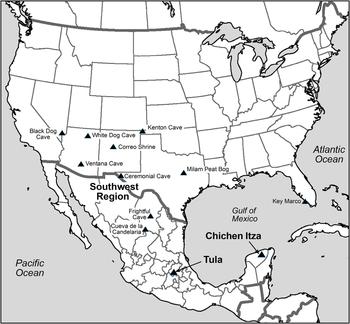
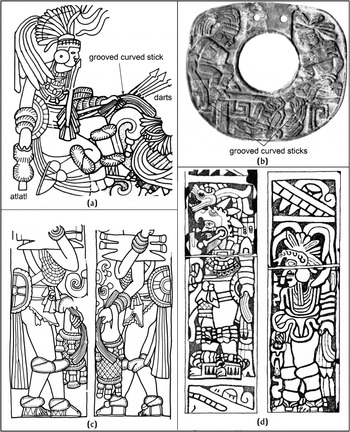
These wooden artifacts are rare in Mesoamerica because of preservation problems. The only extant published examples are fragmentary ones that Edward Thompson dredged from the Sacred Cenote at Chichen Itza (Figure 1) at the start of the 1900s (Coggins and Ladd Reference Coggins, Ladd and Coggins1992; Coggins and Shane Reference Coggins and Shane1984). Additional FCS fragments were recovered in the 1960s from the Sacred Cenote by the expeditions of the Instituto Nacional de Antropología e Historia, but no detailed information is yet published on these finds (Coggins and Ladd Reference Coggins, Ladd and Coggins1992:259). The artifacts are commonly depicted in the art of this site and at Tula (Figure 2). The sticks are characterized as one of the principal accouterments of “Toltec” warriors (Coggins Reference Coggins, Coggins and Shane1984a:49). Individuals in warrior garb often hold a grooved FCS in their left hand along with atlatl darts. Their right hand holds an atlatl that is usually fringed by feathers.
Location map showing Chichen Itza, Tula, and select sites of the Southwest region and elsewhere that have yielded grooved flat curved sticks. Map by author.
Flat curved sticks depicted in art at Chichen Itza and Tula. (a) Altar top, Upper Temple of the Jaguar (Schele Number 5041, Schele and Mathews Reference Schele and Mathews1998:241, Figure 6.38, B8). (b) Jadeite plaque from the Sacred Cenote (modified from Coggins Reference Coggins, Coggins and Shane1984a:Figure 29). (c) Pier 5, South Temple, Great Ballcourt (Schele Number 5056, Schele and Mathews Reference Schele and Mathews1998:245, Figure 6.43, C4). (d) Pillars 3 and 4, Pyramid B, Tula (from Mastache et al. Reference Mastache, Healan, Cobean, Fash and Luján2009:Figures 6 and 7).
The nature of the curved artifacts depicted in art might have been open to debate except for the Sacred Cenote specimens, which the Peabody Museum of Archaeology and Ethnography has curated since their recovery. The character of these artifacts is not in doubt, but their function is. One proposal is that the sticks were used for defense against atlatl darts by deflecting the projectiles, hence the fending label (e.g., Charlot Reference Charlot, Morris, Charlot and Morris1931:252). Hassig (Reference Hassig1992:112–114, 126–127, Reference Hassig, Evans and Webster2001:810–811) disputes this account, arguing instead that the curved sticks were short swords. Cervera Obregón (Reference Cervera Obregón2007:52–53) thinks they were simply rabbit sticks. These disparate roles have implications for our reconstructions of what happened in the past and the explanations given. An understanding of the function of FCS impacts our interpretation of weaponry and warfare in Mesoamerica. If these sticks were not short swords, then they were not the key military advantage of the “Toltecs,” as Hassig has claimed, and we must look to other factors for an explanation of the rise of centers like Tula and Chichen Itza.
While this paper does not fully resolve the functional debate, it demonstrates that the sword interpretation is unsupportable and delivers information that should be factored into future deliberations about the role of these artifacts. Having a possibility in mind can sometimes allow perception of heretofore-unappreciated patterns that can resolve ambiguity. After providing some background, I describe the specimens recovered from the Sacred Cenote at Chichen Itza. These specimens are critical to determining function. As I document below, the sticks do not qualify as swords, or even as war clubs, in any meaningful sense. I then proceed to consider the alternative fending role, first by examining the ethnographic artifacts that gave rise to the defensive interpretation in the first place—the parrying clubs of the Solomon Islands. This is an inappropriate analogue for reasons discussed below. Next, I introduce an alternative ethnographic analogue for defense against atlatl darts that discloses a plausible context within which dart deflection might have occurred: a duel between two opponents. I then briefly characterize an experiment using FCS for atlatl dart defense that shows that atlatl darts thrown from close range can be knocked aside with FCS (see also Garnett Reference Garnett2015). This activity also generated a use-wear signature that was used for interpreting use damage on prehistoric FCS. Unfortunately, the Chichen Itza artifacts cannot be analyzed for functional traces but numerous specimens from the Southwest could be and some exhibit evidence that is consistent with fending atlatl darts. The final part of this paper considers what the depiction of FCS in Mesoamerican art indicates about their use.
BACKGROUND
Thompson characterized the facially grooved FCS from the Sacred Cenote and shown in art at Chichen Itza as one of the principal accouterments of “Toltec” warriors (Coggins Reference Coggins, Coggins and Shane1984a:49), an attribution that has generally stuck, although the meaning of Toltec has shifted (e.g., Kowalski and Kristan-Graham Reference Kowalski and Kristan-Graham2007). The atlatls and darts that these warriors carry have unambiguous functions and any symbolic connotations (e.g., Slater Reference Slater2011) were doubtless rooted in their role as weapons (Finegold Reference Finegold, Finegold and Hoobler2017). This clarity of purpose is not true for the grooved FCS. Toltec warriors often carry the sticks, but for what reason? I have no information on what Thompson thought the purpose might have been. A functional label was first published in 1931, when Charlot (Reference Charlot, Morris, Charlot and Morris1931:252), an artist who worked on the Carnegie Institution Temple of the Warriors project, penned this explicit statement about stick function: “[t]he principal defensive weapon that appears is the curved stick with which darts can be batted out of their deadly course. One or two of these weapons are carried by each of the warriors, and it appears no less than seventeen times in its normal form.”
Credit or blame for the fending stick interpretation probably lies not with Charlot (Reference Charlot, Morris, Charlot and Morris1931; compare Hassig Reference Hassig1992:225, n77), but with Kidder, who served as Chairman of the Division of Historical Research of the Carnegie Institution. Guernsey and Kidder (Reference Guernsey and Kidder1921:88–89) had previously recovered similar artifacts from Basketmaker II caves in NE Arizona. They concluded that the artifacts were not rabbit sticks like those Puebloans threw to kill small game. They based this inference on a lack of appropriate use-wear. The alternative fending hypothesis appeared in a footnote, citing a Solomon Island example where “odd-shaped” sticks were used defensively to knock aside lethal spears.
Guernsey and Kidder (Reference Guernsey and Kidder1921) found support for this tentative fending hypothesis in the artifacts and art of Chichen Itza. They noted the similarities in these artifacts and that warriors were depicted holding them along with atlatls and darts (Guernsey and Kidder Reference Guernsey and Kidder1921:89). In a clear case of circular reference, the tentative fending interpretation for Basketmaker artifacts that was bolstered by the Chichen Itza evidence became enshrined in the literature of Mesoamerica as a functional label: the artifacts and their depictions became known as fending sticks (e.g., Berlo Reference Berlo, Diehl and Berlo1989; Coggins Reference Coggins, Coggins and Shane1984a; Mastache et al. Reference Mastache, Healan, Cobean, Fash and Luján2009; Tozzer Reference Tozzer1957).
Several authors have disputed the idea that the grooved curved objects held by Toltec warriors served to knock aside atlatl darts. Hassig (e.g., Reference Hassig1988:294–295, n36, Reference Hassig1992:112–114, 126–127, Reference Hassig, Evans and Webster2001:810–811) is a chief critic of the fending interpretation, arguing that Mesoamerican grooved FCS are short swords. He thinks that their true offensive role was overlooked because they were “mislabeled” as fending sticks for defensive purposes (Hassig Reference Hassig1992:231, 244, n24 and n127). He claims that the curved sticks were “inlaid with blades, most likely obsidian” (Hassig Reference Hassig1992:112), and that the continuous cutting edge provided by obsidian blades created a light weapon, about one-half meter long, that “relied on speed and sharpness for effect, rather than weight and crushing power of mass impact” (Hassig Reference Hassig, Evans and Webster2001:811). He envisions the grooved curved stick as the forerunner to the later Aztec sword, the macuahuitl. Hassig (Reference Hassig, Evans and Webster2001:810–811) sees the grooved FCS as “a primary” Toltec innovation in warfare technology after a.d. 900: the sticks provided an offensive shock weapon that “improved troop mobility” and “doubled the offensive power of the army.” This new weapon allowed “soldiers [to] throw darts with their atlatls and shift to swords for hand-to-hand combat once they closed on the enemy” (Hassig Reference Hassig, Evans and Webster2001:811).
Cervera Obregón (Reference Cervera Obregón2007:52–53) partly sides with Hassig: “[i]t has been inferred that this curved stick or defensive weapon functioned to intercept darts and arrows, which of course is quite absurd” (Se ha inferido que este palo defensivo o arma curva tuvo como función interceptar dardos y flechas, lo que por supuesto resulta bastante absurdo). Cervera Obregón does not elaborate on why he finds the idea of deflecting darts with curved sticks to be absurd, but presumably this has to do with the notion that atlatl darts can be deflected with such sticks, that this act is even possible. If the absurdity lies with the notion that the stick would be so used, rather than as another element of war, then this thought is not logically followed by his argument. Acceptance of Hassig's shock weapon interpretation would be consistent, but Cervera Obregón (Reference Cervera Obregón2007:53) considers the artifacts to be boomerang-like throwing sticks for hunting small game (i.e., rabbit sticks). Why would rabbit sticks commonly be associated with warriors and form part of the Toltec weapon assemblage? A possible reason suggested below is that the sticks were thrown to incapacitate warriors and other people for capture and subsequent sacrifice.
Apparent physical support for Hassig's argument has recently come from an analysis of injuries on the skulls of prehistoric Maya recovered from the northwest part of the Yucatan peninsula (Serafin et al. Reference Serafin, Lope and González2014). Blunt force trauma, such as that resulting from being struck by stones or wooden clubs, was found to be the principal means of violent death for the Maya in this area. Serafin et al. (Reference Serafin, Lope and González2014:148) also identified healed head wounds in five males thought “to have been inflicted by clubs with small, hafted points” and suggest that “‘fending sticks,’ which were originally interpreted as defensive weapons, are good candidates.” The authors echo Hassig's account that the curved sticks were “used in the hand-to hand combat that followed the initial volleys of projectiles” (Serafin et al. Reference Serafin, Lope and González2014:148).
I do not doubt the validity of death by blunt force trauma or the identification of healed head wounds inflicted by clubs with hafted sharp cutting edges, but the equation of these with the grooved curved sticks seen in art and recovered from the Sacred Cenote is another matter, one that requires consideration of the artifacts themselves. Did these wooden implements have cutting edges provided by hafted segments of obsidian or chert blades or bifacially flaked stone tools? Even if they lacked stone attachments, did the curved sticks have acute edges suitable for slashing opponents, as with Australian war boomerangs (Smyth Reference Smyth1878:310–314)? Or were they sufficiently heavy alone to deal a lethal blow? Answering these questions requires consideration of the only extant examples of this artifact type from Mesoamerica.
THE CHICHEN ITZA ARTIFACTS
Figure 3 shows the largest and best preserved grooved sticks from the Sacred Cenote that are in the collections at the Peabody Museum. I analyzed these specimens along with numerous examples of comparable sticks from the Southwest. By matching characteristics of wood grain, stick shape and size, and groove number and treatment, it seems evident that the total count of individual artifacts represented by the nine portions is just three (cf. Coggins Reference Coggins, Coggins and Shane1984a:49): a distal end of one (Figure 3a); the proximal, distal, and midsection portion of another, but with an unknown amount of the middle missing (Figure 3b); and a nearly complete specimen represented by five portions (Figure 3c). The latter is shown by Coggins (Reference Coggins, Coggins and Shane1984a:49, Figure 24; Coggins and Ladd Reference Coggins, Ladd and Coggins1992: Figure 8.31) in the same layout sequence; this artifact is currently mounted to an acrylic glass sheet by ties. Coggins and Ladd (Reference Coggins, Ladd and Coggins1992:256) believe that these five portions probably represent three sticks, but a single specimen seems more likely. They also believe that the three portions shown in Figure 3b represent two different sticks, but I am certain that they are all from the same artifact (Coggins and Ladd Reference Coggins, Ladd and Coggins1992:257). The layout shown in their Figure 8.32 (Coggins and Ladd Reference Coggins, Ladd and Coggins1992:258) is probably a close approximation of the stick when whole. Coggins and Ladd (Reference Coggins, Ladd and Coggins1992:258–259) describe and illustrate small portions of four additional grooved FCS from the cenote that are in the Peabody collections, bringing the total count to seven specimens. They also mention that 11 fragments are in the collections obtained by the Instituto Nacional de Antropología e Historia in the 1960s, but no information on these fragments is yet published, so the minimum number of artifacts represented remains unknown.
Flat curved sticks dredged from the Sacred Cenote at Chichen Itza, nine fragments from three separate artifacts : (a) distal end, (b) three portions representing handle, midsection and distal end, and (c) five portions representing handle and distal end plus much of the midsection. Collections of the Peabody Museum of Archaeology and Ethnography. Photographs by author.
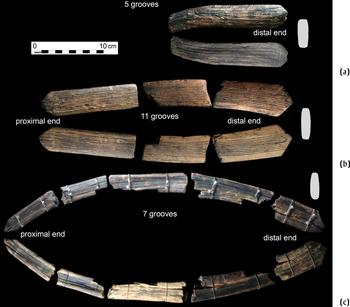
The stick represented by the distal end was made from a split limb, which is why one face is distinctly convex, with the other face flat. The other two sticks were made from limbs worked on opposing sides but centered on the pith. The paraffin-impregnated wood is variably warped, with the middle specimen of Figure 3 exhibiting the best overall preservation (see Coggins and Ladd Reference Coggins, Ladd and Coggins1992:338 for a description of the preservation technique). It is the widest and heaviest of the three specimens, measuring 4.7 cm wide by 1.3 cm thick at the distal end, and 3.7 cm wide by 1.3 cm thick at the handle. The specimen represented by five fragments is 3.8 cm wide by 1.3 cm thick at the distal end and 2.3 cm by 0.8 cm at the handle. The distal fragment alone measures 3.7 cm by 1.2 cm. The sticks have close-to-rectangular cross sections, with squared-off edges that are nearly as thick as the midline of the stick. Stick length can be estimated based on the one nearly whole specimen, which suggests that it measured about one-half meter, a distance that seems likely as well for the stick represented by the three fragments. Such a length also fits with the depictions of the size of the sticks relative to humans in artwork.
The longitudinal facial grooves are shallow, carved by a single pass or two of an engraving tool. This stands in marked contrast to many of the similar specimens from the Southwest that have grooves up to one millimeter deep (P. Geib Reference Geib2016:211–218). Groove count ranges from five to 13 for the Chichen Itza sticks, another contrast with Southwest specimens, which have three or four longitudinal grooves. Coggins (Reference Coggins, Coggins and Shane1984a:49; also Coggins and Ladd Reference Coggins, Ladd and Coggins1992:259) observes that the purpose of the grooves is unknown, but suggests that “possibly they made the wood more flexible, without weakening it.” Increased flexibility is unlikely to result from the shallow cuts on the Chichen Itza artifacts, or indeed the deeper ones that occur on most of the Southwest specimens. It is worth noting that a probable throwing stick from a pre-Roman site in France (ca. 120–80 b.c.) also has longitudinal facial grooves (n = 3; Bordes et al. Reference Bordes, Lefort and Blondel2016), so the trait appears in areas without historic connection, suggesting that it might have some functional advantage.
WERE THEY SWORDS?
To qualify as wooden swords, predecessors to the macuahuitl, FCS would need to have stone blades or bifacially flaked tools hafted to their edges. Distal ends and medial portions are where such attachments should occur and these would have been readily apparent on the specimens recovered from the cenote. None have the edge slots necessary for embedding blade segments or flaked tools and affixing them with mastic. Cross sections for the sticks from one end to the other are rectangular with squared-off edges (Figure 3). There is no evidence for attaching stone or other material: the longitudinal facial grooves are not for hafting blades, points, or anything else. These shallow engraved lines could never have been used for that purpose. Lacking stone cutting edges, or even acute wooden ones, the sticks cannot be classified as swords.
Although the curved sticks lacked stone attachments or an acute edge, perhaps they were sufficiently heavy to deal a lethal blow. The original stick weight is unknown because of rot, fragmentation, and the addition of wood preservative. Nonetheless, based on the weight of comparably sized Hopi rabbit sticks from the Southwest, it is likely that the Chichen Itza specimens weighed no more than about 350 grams (the specimen of Figure 3b), with some perhaps less than 300 grams (the specimen of Figure 3c). Potential dense hardwoods for these sticks such as sapodilla (Manilkara zapota) or black ironwood (Krugiodendron ferreum) are denser on average than the Gamble oak used for the Hopi rabbit sticks, so this was taken into consideration. If this weight was concentrated into a small distal mass, as with most war clubs, then the sticks might qualify as shock weapons, but this is not the case. There is no forward mass of any appreciable amount.
If the sticks served to crush skulls, it seems reasonable to expect that evidence of such use would be registered on the tools themselves. As discussed below, for FCS from the Southwest, use-wear and use-inclusions can inform about artifact function. Unfortunately, this cannot be done with any reliability for the cenote artifacts because of the crude recovery method. The cenote FCS exhibit scratches, gouges, and crushed areas, but water-saturated wood is easily marred and, given that the sticks were dredged up with a large steel grappling bucket with four converging teeth, considerable damage could have occurred in the dredging process (according to Coggins and Ladd [Reference Coggins, Ladd and Coggins1992:338], Thompson characterized the wood “as soft as punk, as compressible as sponges”). The paraffin wax mixture that the artifacts were subsequently soaked in prevented me from distinguishing recovery damage from any use-related damage present on the sticks at the time of deposition. Coggins and Ladd (Reference Coggins, Ladd and Coggins1992:259) claim that FCS “in the Peabody Museum collection all look well used,” and this might be true, but verification will require sticks recovered from the cenote in a careful manner.
It is worth noting that the Maya had a diversity of quality weapons for close fighting in the form of axes, clubs, and knives, such that FCS could hardly have been a revolutionary advantage, even if they had been bladed. Rivera Acosta (Reference Rivera Acosta2013) provides a thorough review of Maya armaments depicted by the artists of the time and readers can see the same on Maya vases in the Kerr Maya Vase Database (Kerr Reference Kerr2017; also see images shown in Barrales Rodríguez Reference Barrales Rodríguez2006). There are even items that seem to resemble prototypes for the macuahuitl, such as the probable bladed club shown on Stela 5 at Uaxactun (e.g., Graham Reference Graham1986; Morris et al. Reference Morris, Charlot and Morris1931:Figure 220) or those shown in the hands of a few warriors on the back wall relief of the Lower Temple of the Jaguars at Chichen Itza (Maudslay Reference Maudslay1889–1902:Plates 44 and 45). The blunt force trauma and cuts on Maya skulls reported by Serafin et al. (Reference Serafin, Lope and González2014) are likely the result of these other true offensive weapons and certainly not from FCS.
DART DEFENSE?
If not a sword or an effective battle club, what about the alternative fending interpretation? I will first consider the implements that gave rise to the dart fending scenario in the first place and then examine other ethnographic, experimental, and archaeological evidence.
Solomon Parrying Club
The “odd-shaped” clubs that Solomon Islanders used to knock aside spears are known as qauata and roromaragui on Makira and adjacent smaller islands (Evans Reference Evans, Beran and Craig2005:252–253; Mead Reference Mead1973). Starzecka and Cranstone (Reference Starzecka and Cranstone1974:15–16) report that all Solomon Islanders used clubs in hand-to-hand combat to deflect spears and deliver a coup de grâce, but that “one type of San Cristóbal [Makira Island] club had a very distinctive sickle shape and was especially well adapted to parrying spears.” These parrying clubs are made from the buttress roots of dense hard wood (Guppy Reference Guppy1887:74) and measure 1–1.5 m long with crescent-shaped distal blades that are 30–50 cm wide (Figure 4). They are differentiated on blade shape and whether or not there is a figural handle: qauata have a simple crescent blade, whereas roromaraugi have a projection or beak opposite the concave side of the crescent; qauata lack a figural handle and roromaraugi have one (a small human form).
Solomon Islander holding a parrying club or qauata, ca. 1890–1910. Qauata were formidable offensive weapons as well as providing for defense from spears by batting them aside. Photograph by Thomas Andrew, from Huetz (Reference Huetz2014).

Qauata are still used for spear defense on a small island known as Owariki (Santa Catalina) just to the south of Santa Anna. Here two phratries conduct ritual fights as part of a ceremony known as wogasia (Davenport Reference Davenport1996; Revolon Reference Revolon2003; Wasuka Reference Wasuka2013). Opposing lines of warriors face each other on the beach, 15 meters apart or less, and throw spears at one another with serious conviction. These days the spears lack lethal tips but there is still risk of injury and qauata are deployed to knock aside oncoming projectiles.
Accounts of such fights date back to well before enforced peacefulness (e.g., Fox Reference Fox1924; Guppy Reference Guppy1887:75) when warfare was “quite prominent if not endemic” (Knauft Reference Knauft1990:225). Even into the 1900s, “peace, except for short, uncertain intervals, was practically unknown. Everywhere any individual or tribe might be attacked anywhere at any time” (Hopkins Reference Hopkins1928:168). The wogasia “sham fights” (Guppy Reference Guppy1887:75) or “mock battles” (Fox Reference Fox1924) prepared young men for war by teaching them how to defend and how to kill. Qauata and roromaraugi were a key part of defense, but they were also offensive weapons—real death-dealing clubs. Guppy (Reference Guppy1887:74) learned about the “true character of the weapon” from natives and traders who had lived for years in Solomon Islands: they “spoke of them to me as war-clubs. Together with their spears, the St. Christoval natives carry them during their hostile incursions against the bushmen” [people of island interiors].
The curved shape of qauata and roromaraugi is somewhat reminiscent of FCS from the Southwest or Mesoamerica, but the comparison ends there. Hand-thrown spears have less velocity than atlatl darts, making them easier to deflect or dodge, and the parrying club has far more surface area than FCS, so better shielding capability. More importantly, qauata and roromaraugi are formidable weapons given the weight that occurs in their broad heads and their acute edges. None of the FCS from the Sacred Cenote or the Southwest are like this and they do not qualify as deadly hand-to-hand weapons because of their overall light weight and square edges. Also, FCS are an encumbrance to fighting with atlatls and darts, since two hands are needed for effective loading of atlatls. By contrast, Solomon Island parrying clubs provide defense and do not impede effective spear use, additionally complementing the offensive side of the equation as effective shock weapons. Whereas parrying clubs were high-utility additions to Solomon Islands warfare, FCS would have been an impediment in a murderous melee even if effective at batting away darts. In short, Solomon Island parrying clubs make a poor analogue for the role of FCS in Mesoamerica and the Southwest.
An Alternative Fending Analogue
Deflecting atlatl darts with a short stick might seem absurd or illogical, yet certain tribes in South America still conduct duel-like atlatl fights that involve dart deflection for defense. The Kamayurá (Camayurá) and adjacent groups of the Upper Xingu region of Brazil perform this impressive feat in a ritual known as yawarí (Oberg Reference Oberg1953:57–58) or ifagaka (Basso Reference Basso1973:152). Opponents from different villages, even different ethnic groups, take turns throwing atlatl darts at close range (approximately five meters) in an attempt to strike their foe, who defends with a bundle of poles. This duel-like contest has explicitly violent overtones of intergroup conflict, yet cultural restraints, such as rules about which body portions are legitimate targets (the thigh and buttocks) and tipping darts with beeswax bunts, ensure a non-lethal outcome.
Warriors from opposing villages are paired to face each other; one is on offense first while the other is on defense, then the roles switch. The group with the greater number of “hits” is judged the winner according to Oberg (Reference Oberg1953:58). Basso (Reference Basso1973:152) claims that “no village is considered the winner of these events, only individuals, but … winners confer prestige upon their group.” These atlatl fights, along with wrestling matches known as yoetikawa, reinforce men's esteem as great warriors while simultaneously reinforcing peaceful relationships between neighboring groups. Gregor (Reference Gregor1985:96) details how success provides a measure of a man's worth to his fellows and in the eyes of women.
Dart defense in this South American example is achieved with a more substantial obstacle than a FCS. Still, it shows that atlatl darts can be deflected or dodged, even when thrown from close range. It is key that attention is focused on single projectiles. It is within such a rule-bound, duel-like fight that use of FCS for defense against atlatl darts makes sense: a duel would be far less risky, even if lethal tips were used. The antiquity of South American atlatl dueling remains unknown but it could be considerable given the weapons involved. Prior to enforced peacefulness, the contest might have involved lethal darts with potential consequences far more severe than bruises. Perhaps a similar ritual was practiced in Mesoamerica and the Southwest but using FCS for defense. The feat of deflecting atlatl darts would seem all the more impressive using just a small stick, especially against lethally tipped darts. To assess if this might have occurred I experimented to see if it is even possible and to learn what use-wear and use-inclusions might reveal about stick function.
Experimental Dart Deflection
Experimentation in replicating and using tools and documenting the results is one way to build knowledge about the past (see Clark and Woods [Reference Clark, Woods and Shott2014] for an informed perspective on the limitations and potential of this approach). Fending lethal darts is obviously not an experiment to undertake lightly or without sufficient protection of life and limb. Moreover, it is entirely speculative whether FCS were actually used this way. This is different from some types of experimental studies where we know that an activity occurred and the goal behind the work is to determine how it might have been done.
My two main experimental goals were to determine if atlatl darts could be deflected with FCS and to document what use-wear or use-inclusions might result. An affirmative answer to whether atlatl darts can be knocked aside using FCS obviously says nothing about whether sticks were used this way in prehistory, but a negative answer would be quite defeating to the fending hypothesis. The goal of documenting use-wear is central to assessing if atlatl dart fending actually occurred in the past. This goal was admittedly difficult to fully realize without using dangerously armed darts, which was not done. Nonetheless, experimentation with nonlethal darts informed about the sorts of wear traces that develop and provided a basis for making inferences about the use damage documented on prehistoric artifacts.
Page limits do not permit a detailed presentation of this experiment but this occurs in P. Geib (Reference Geib2016) and a video posted on YouTube provides a visual synopsis (N. Geib Reference Geib2015). In brief, I had two experienced atlatlists take turns throwing darts at me. We stood 11 m apart and I used only a FCS for defense. The darts had bunt tips rather than lethal points and were covered with foam as a further protective measure. After gaining some initial experience with fending away atlatl darts, approximately three hours were spent in the duel-like activity. During this time an estimated 100 darts were thrown, although only about half of these were sufficiently on target to necessitate fending them (Figure 5).
Images captured from filmed experiment using flat curved sticks to deflect atlatl darts. (a) Geib's view of dart approaching thrown by Byl Bryce. (b) Deflection to outside (right). (c) Failed deflection with dart striking rib cage. Still images taken from video by N. Geib (Reference Geib2015).

Based on this experiment, my answer to the first question is: yes, FCS can deflect darts, even at close range. Are they great for defense? Certainly not! A shield would be far better, a conclusion also reached by Garnett (Reference Garnett2015), which is doubtless why Maya/Toltec warriors are commonly depicted with shields even if they hold FCS. I received one or two hits to the upper body that would have been potentially lethal if the darts had been tipped with stone points (see Figure 5c). Yet, superior defense might not be a consideration. If the aim was achieving status by facing inherent risk, then FCS are quite suitable: they are an improbable defensive tool, yet they work.
It could also be that atlatl duels were about pitting opponents in a death struggle that might well draw blood, the life-sustaining liquid so essential in Mesoamerica for the renewal of life and maintenance of the cosmic order (e.g., Nuttall Reference Nuttall1904; Schele and Miller Reference Schele and Miller1986). Atlatl dueling could have been a “ritualized blood sport,” gladiatorial-like fighting, of the sort that Taube and Zender (Reference Taube, Zender, Orr and Koontz2009) argue was practiced in Mesoamerica from Olmec times. As they demonstrate, gladiators were sometimes captives (Taube and Zender Reference Taube, Zender, Orr and Koontz2009:175–180), in which case a combatant might not have had a choice as to what they could use for defense against atlatl darts and FCS might have been welcome over holding nothing. Gladiatorial sacrifice as public spectacle was a documented feature of Aztec life (e.g., Carrasco Reference Carrasco1999), one where captives were committed to fight though with slim odds of escaping death, usually because of being armed with weapons far inferior to those of their opponents and being outnumbered.
It is worth noting that the fending experiment allows me to state with some confidence that using FCS for atlatl defense makes little sense in true warfare, the melee of open field combat. The timing needed to intercept an atlatl dart with an FCS requires the ability to focus on single projectiles. This is considerably different from a shield. A dyadic fight with rules attenuates the chances of death and this is one context where fending atlatl darts with FCS is a possibility. But, as just mentioned, it might also occur when the goal is less about defense per se than a combat venue for letting blood.
Fending Use-wear
By using direct analogy to ethnographic objects, FCS could be labeled as rabbit sticks (non-returning boomerangs) since they are similar to what Puebloans and other Southwest tribes threw to kill rabbits, hares, and other small game. Yet, “similarity in form does not necessarily signify identity in function” (Heizer Reference Heizer1942:41). Corroborating evidence consistent with an inferred use provides a critical link in such a knowledge claim (Wylie Reference Wylie2002:136–153). Accordingly, I characterized the wear traces, use inclusions, and breakage patterns for hundreds of prehistoric FCS from throughout the Southwest and then interpreted the data in terms of past activity (P. Geib Reference Geib2016). Unfortunately I could not do this for the Chichen Itza FCS because of the issues with recovery and wood preservative mentioned previously, but the findings from the Southwest are relevant to the overall case for or against the fending argument. I based my functional interpretations on ethnographic and experimental artifacts that allowed distinctive use traces to be linked to particular activities. A suitable frame of reference for dart deflection came from my experiment since there are no ethnographic specimens to rely on.
Use-inclusions of embedded rocks and cactus spines seem like firm indicators of having been thrown, as are certain bruising and battering on edges and ends. Since the FCS that Guernsey and Kidder (Reference Guernsey and Kidder1921:88) recovered at Basketmaker II sites in the Southwest lacked the expected throwing-related use-wear, they concluded that the artifacts were unlike Puebloan rabbit sticks. My examination showed that many of the FCS had been used for throwing, almost 70 percent of the more than 240 artifacts that were sufficiently preserved to make such a determination (P. Geib Reference Geib2016:Table 9.15). Nonetheless, some FCS exhibited no evidence in support of such a use, just like Guernsey and Kidder found. Moreover, there was a temporal pattern to the evidence, with more traces of throwing use occurring through time.
The earliest examples of FCS in the Southwest appear the least like ethnographic rabbit sticks; these examples date to between 7000 and 5000 cal. b.c. and come from the Chihuahuan and Sonoran Deserts (P. Geib Reference Geib2016). Through time the artifacts become more like ethnographic rabbit sticks and eventually they look little different. Morphological change reflecting a functional refinement toward a rabbit stick includes a shift from S-shaped to single curve, an increase in stick width and weight despite an overall decrease in stick length, and discontinuation of grip wraps, fine wood finishing, and longitudinal facial grooves. These changes seem indicative of an evolving technology as FCS became more like ethnographic rabbit sticks and more suitable for this task. Correspondingly, there is an increase in physical traces from throwing use, such as embedded rocks and spines and heavy attrition to convex edges and ends (Table 1).
Summary inference about throwing use for the radiocarbon dated prehistoric flat curved sticks from the Southwest organized into temporal intervals (radiocarbon years BP); percent yes is the proportion with damage or inclusions consistent with use as rabbit sticks (from P. Geib Reference Geib2016)

Use-damage and inclusions are also expectable outcomes of batting away atlatl darts but, unlike throwing, there are few traces that would definitively support a fending inference. An embedded dart point is an important exception, yet such an occurrence should be exceedingly rare. Indeed, just a single stick of the hundreds that I examined appears to have been so pierced, but the point was not present (Figure 6). Use-wear that is supportive or consistent with fending away atlatl darts occurs on sticks from throughout the Southwest. Some of these are the least probable candidates for throwing because they are so light and delicate and they lacked any wear or inclusions indicative of throwing use. If wooden bunts tipped atlatl duels, as among the Kamayurá, then physical traces of dart deflection would be far less apparent (such bunts occur in the Southwest). Moreover, there is no reason why a curved stick could not serve to both kill rabbits and bat away darts should the need arise. In this regard, some of the sticks with potential fending related use-wear also exhibited throwing-related use-wear or inclusions. “In Zuni and Keresan myths the rabbit stick is associated with the war gods” (Parsons Reference Parsons1918:385) and Puebloan informants from Tamaya (formerly Santa Ana Pueblo) recounted that rabbit sticks in the past were “‘war clubs,’ to be used against enemies” (Ellis and Hammack Reference Ellis and Hammack1968:34). A link to fighting seems even closer and has far greater time depth since the rabbit stick might be a modified fending stick.
Projectile-like damage to the midsection of Stick 447 (MMA 66.9.39), which is probably from Ceremonial Cave, Texas. Damage consists of an angled entry hole in the corner of the concave edge that created a large split on the opposite face (exit); the penetrating object clearly did not pass entirely through the stick. Collections of the Maxwell Museum of Anthropology. Photographs by author.

It is worth highlighting that several of the FCS with evidence consistent with having been used to deflect atlatl darts were recovered from a sinkhole-like feature west of Albuquerque, New Mexico (Geib et al. Reference Geib, Heitman and Fields2017). Over 200 FCS were recovered from this site along with thousands of portions of atlatl darts and arrows. This is a known war god shrine of the Laguna and Acoma people, as documented by Parsons (Reference Parsons1918). It remains an important Laguna shrine to this day. The shrine can be seen as a desert analogue to the Sacred Cenote in that both are portals to the underworld or previous world where Native Americans placed weapons of war as ritual offerings. It seems more than mere coincidence that prehistoric weapons occur in this inaccessible pit identified as a war god shrine, where war captains made offerings. Rather, the ethnohistoric use likely reflects a long tradition of depositing gifts to the gods for assistance in protection from other humans. Radiocarbon dates on FCS and atlatl darts reveal that ritual deposition started some 3,800 years ago; the shrine had become an important location for ceremonies related to warfare by almost 2000 b.c. (Geib et al. Reference Geib, Heitman and Fields2017). The Sacred Cenote ritual may represent the continuation and elaboration of one practiced in the Southwest a few thousand years earlier as part of a widespread underlying belief system.
A POSSIBLE YUCATEC MAYA FENDING RITUAL
The sword function for the FCS at Chichen Itza is dispelled by the nature of these artifacts and also by the mural evidence that I review next. The fending interpretation is still a possibility but only within specific, likely ritualized, contexts, not open field warfare, with staged dyadic combat a likely scenario. Given the South American example, a specific passage in Diego de Landa's account of life among the Yucatec Maya is intriguing. I grant the potentially problematic nature of his narrative (e.g., Restall and Chuchiak Reference Restall and Chuchiak2002), and also that aspects of life had doubtless been altered by the time that he made his observations. Still, this passage is worth considering. He mentions a certain ritual dance that may well involve dart deflection, something akin to the ritual atlatl fighting between the Kamayurá and other groups. The passage is repeated below from two different translations (de Landa Reference de Landa and Gates1937, Reference de Landa and Bowditch2017; also see Tozzer Reference Tozzer1941).
Two of their dances are especially virile and worth seeing; one is a game of reeds, whence they call it colomché, the word having that meaning [a ‘palisade of sticks’]. To perform it they make a large circle of dancers, whom the music accompanies, and in time with which two come into the circle; one of these dancers erect, holding a handful of reeds, while the other dancer is squatting, both keeping time around the circle. The one with the reeds throws them with all his force at the other, who with great skill catches them with a small rod. When all are thrown they return, keeping time, into the circle, and others come out to do the same (de Landa Reference de Landa and Gates1937:70, SEC. XXII).
[T]hey have especially two dances which are very manly and worth seeing. One is a game of reeds, and so they call it “Colomche,” which has that meaning. For executing it, a large circle of dancers is formed with their music, which gives them the tune, and two of them leap into the center of the wheel, one with a bundle of reeds, and he dances with these perfectly upright and on his feet; while the other dances crouching down but both keeping within the limits of the circle. And he who has the sticks flings them with all his force at the second, who by the help of a little stick, catches them with a great deal of skill. When they have finished the reeds, they retake their place in the limits of the circle, and two others go out to do the same (de Landa Reference de Landa and Bowditch2017:sequence 51).
This “dance” might have been a form of ritual warfare, one perhaps modified so that it was no longer potentially lethal. I assume that the reeds that the dancers threw with all their might were atlatl darts since reeds were commonly used to make darts in Mesoamerica, even into the historic period at Lake Patzcuaro, Michoacan (Stirling Reference Stirling1960). This accords with Juan de Torquemada's (Stirling Reference Stirling1960:268) account of the Aztec god of war Huitzilopochtli, that specifies atlatl darts being made “of cane stalks” and a record from the time of the Aztec conquest about a rain of atlatl darts: “[i]t was as if a layer of yellow canes [reeds] spread over the Spaniards” (León-Portilla Reference León-Portilla1962:77). As to the small rod or little stick that was used to “catch” the reeds, Schmidt (Reference Schmidt1990:202) readily accepts that this was a fending stick that “must have been a direct descendant” of the Chichen Itza examples.
FLAT CURVED STICKS IN ART
Two aspects of iconography can inform about the potential function of FCS in Mesoamerica: depictions showing the sticks in the hands of warriors; and those that do not, but where the sticks would be expected if they had a specified purpose. The latter is obviously a form of negative evidence, but it can be informative in this case. For example, if the sticks were short swords, then it is expected that they would occur in scenes depicting warfare, with the tool deployed offensively slashing opponents or bludgeoning them. This same argument might also be extended to the fending argument, unless such defense did not occur in the context of true warfare but rather in more controlled, ritual settings, such as among the Kamayurá.
Maya art of the earlier Classic period lacks the easily recognizable FCS. This artifact first occurs in Mesoamerican art with the appearance of so-called “Toltec” militarism and the rise of Chichen Itza as an important urban center on the Yucatan peninsula in the ninth century a.d. (Ringle Reference Ringle2017; Volta and Braswell Reference Volta, Braswell and Braswell2014). The warrior columns at Chichen Itza are great examples that are nearly duplicated at the central Mexican highlands site of Tula (dating here is more problematic but a.d. 900–1150 is the generally accepted span for when Tula was at it apogee [e.g., Mastache et al. Reference Mastache, Cobean and Healan2002; Smith Reference Smith, Kowalski and Kristan-Graham2007]). As the images of Figure 2 show, the sticks occur in the hands of individuals but they are not used in any obvious way, neither for clubbing or slashing opponents nor for batting away atlatl darts. An association with atlatls and darts is obvious and commented upon since the early 1900s, but a functional link between the two is not evident from the art itself, it is mere co-occurrence.
Another correlation that occurs is with captives and sacrificial victims. An example is the jade annular plaque, which was retrieved from the Sacred Cenote along with two similar examples (Figure 2b). All three show two individuals holding FCS. On the plaque of Figure 2b, both warriors point toward an evident elite captive bound and sitting below them. Coggins (Reference Coggins, Coggins and Shane1984a:53) thinks that this individual is likely to be a sacrificial victim because this is what the other two plaques show. The role that FCS play in this juxtaposition of warriors with their captives/victims is not obvious from the art itself.
More informative than static portrayals are the murals of warfare between massed forces on the walls of the inner chamber of the Upper Temple of the Jaguars and the structure atop the Temple of the Warriors (Coggins Reference Coggins, Coggins and Shane1984b; Finegold Reference Finegold2012:41–52, 176–193; Miller Reference Miller, Giles and Stewart1989; Morris et al. Reference Morris, Charlot and Morris1931; Ringle Reference Ringle2009). These murals appear to be narratives of different battles and the aftermaths thereof. I accept Ringle's (Reference Ringle2009; also Finegold Reference Finegold2012:176–193; Freidel et al. Reference Freidel, Schele and Parker1993:377) argument that the murals document historical or mytho-historical battles rather than being allegorical. “The main battle scenes are unique in focusing on military actions in their totality and from a bird's eye view. Here the number and variety of actors vividly suggest the tumult of hand-to-hand battle within a landscape of unparalleled complexity and specificity” (Ringle Reference Ringle2009:21). Even if allegorical, the murals still inform about the nature of warfare and weaponry since these aspects are likely to reflect what the artists knew firsthand or from verbal accounts.
Warriors are armed with atlatls and darts, spears, and, in some scenes, with shock weapons (Figure 7). They all carry shields for defense. Shields are strapped to the forearm of the hand holding spare atlatl darts and thus were not an impediment to effective atlatl use. None of the warriors carry FCS in the scenes of battling troops. If FCS functioned as a short sword, one that was so critical to close-quarter fighting, then it is nowhere in sight in the depictions of this sort of armed conflict. This same argument could be extended to the purported fending use, but only if one thinks that FCS would be useful in such frenzied warfare. This is not my position. A stick for dart deflection has little worth in such battles, whereas a shield is an asset; some figures in the murals show darts or spears protruding from shields, testimony of their defensive value. A scene depicting an atlatl duel is where FCS might be portrayed and perhaps this is what is shown on some of the columns in the sanctuary of the Chac Mool, where warriors carry FCS in both hands but no offensive weapons (see Figure 2c; also door jamb H6 of Upper Temple of the Jaguars; Ringle Reference Ringle2009:Figure 2).
Mural of war in progress, southwest panel, Upper Temple of the Jaguar, Chichen Itza (Schele and Freidel Reference Schele and Freidel1990:361, Figure 9:13).

The murals show warriors with FCS (Figure 8; scale often precludes illustration of grooves as in the monumental art), sometimes in active poises, but most of the scenes are not readily interpreted as those of actual combat. Warriors with FCS are usually shown in non-fighting scenes, either before or after battle at military camps with beehive tents or in processions to and from such camps (Ringle Reference Ringle2009:21). Finegold (Reference Finegold2012:46, 187–190) argues that the different sections of each mural reflect a temporal sequence of events relating to individual military campaigns, with the bottom rows of figures depicting the aftermath to battle since captives are usually shown. It is in these portions of the murals where FCS most commonly appear.
Flat curved sticks depicted in Chichen Itza mural, southeast panel, Upper Temple of the Jaguar (Schele Number 5069, Schele and Mathews Reference Schele and Mathews1998:33, Figure 6.31, B7B). Insert shows cropped portion of the lower right portion from the reconstructed painting by Adela Breton, archives of the City of Bristol Museum and Art Gallery (from Finegold Reference Finegold2012:Figure 45).

The aftermath of war is clearly indicated for the bottom part of Figure 9, where a sacrificial victim is bent backward across an altar with his heart being extracted. This is also true of the jade annular disks mentioned previously, where victors holding FCS discuss the fate of elite captives. One instance of an FCS included in what resembles actual warfare occurs above the sacrifice shown in Figure 9. A fighter is crouched with a shield in his left hand and an FCS in his right but not in an effective defensive or offensive position. The fact that this warrior holds an FCS but also a shield implies that the sticks have something other than a purely defensive role. Indeed, virtually all warriors with FCS also bear shields.
Flat curved sticks depicted in the Chichen Itza mural of the upper register, south panel, Upper Temple of the Jaguar (Schele Number 5060, Schele and Mathews Reference Schele and Mathews1998:239, Figure 6.37, B7H). Inset images show cropped portions from the reconstructed paintings by Adela Breton, archives of the City of Bristol Museum and Art Gallery (from Finegold Reference Finegold2012:Figure 48).

The murals show the sacking of specific towns and usually the capture of warriors and civilians. One of these images (the northwest panel) shows an FCS in use (Figure 10). Warriors subdue or dispatch the populace, men and women, using various implements such as clubs. A warrior with upright feathers and a large shield (Figure 10, Individual 23) holds an FCS up in the air in club-like fashion but not against any obvious opponent and certainly not against an armed warrior. Immediately in front of him another warrior (Figure 10, Individual 24) has seized a captive (Figure 10, Individual 25).
Sack of a city depicted in the Chichen Itza mural of the northwest panel, Upper Temple of the Jaguar. Image cropped from the reconstructed painting by Adela Breton, archives of the City of Bristol Museum and Art Gallery (from Finegold Reference Finegold2012:Figure 42).
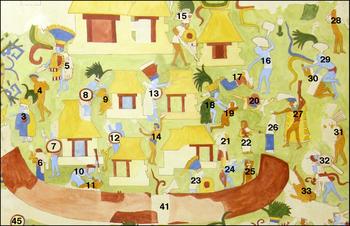
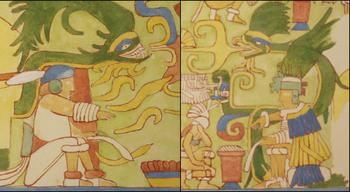
Another warrior on the left side of the scene (Figure 10, Individual 3) holds an FCS in an outstretched arm concave side down evidently gesturing along with several other warriors toward an important personage draped by a red serpent in the upper left corner of the mural. A gesturing posture like this is common for warriors with FCS when in camp scenes or more formal settings such as those of the annular disks. Figure 11 shows two examples from the bottom row of figures of the southwest mural, an evident meeting of elite warriors and retainers at a camp after battle. Ringle (Reference Ringle2009:30) identified these two warriors as specific individuals who “may reflect the highest ranks within the Itza hierarchy.” In scenes like this, the warriors with FCS usually hold nothing else; obvious weapons have been set aside, and they talk to other warriors that they face as indicated by speech scrolls of varying elaborateness. The sticks occur in either left or right hands with concave side facing down. These depictions strongly indicate that FCS served as a symbol of some authority or rank
Elite warriors and probable military leaders associated with green feathered serpent gesturing while holding flat curved sticks, lower row of figures at the bottom of mural, southwest panel, Upper Temple of the Jaguar, Chichen Itza. Image cropped from the reconstructed painting by Adela Breton, archives of the City of Bristol Museum and Art Gallery (from Finegold Reference Finegold2012:Figures 147i–147k).
The scene where FCS are used the most aggressively is shown in Figure 12. This reconstructed scene shows an evident raid on a village that resulted in the capture of warriors who were bound and led away. Morris (Reference Morris, Morris, Charlot and Morris1931:392) reports the right-hand side of the mural this way:
In and about a village standing beside a lake, a battle is in progress between the striped inhabitants and a force of black-painted warriors. The latter have the upper hand, as may be judged from events in the foreground, where, upon the broad, red-paved highway which passes both lake and village, moves a procession of the outlanders, each herding before him a leashed and naked captive.
The curved sticks held aggressively by the striped figures, poised to defend their city, are not specifically identified by Morris (Reference Morris, Morris, Charlot and Morris1931:393), who simply notes that the warriors are “armed and ready for combat.” The striped warriors (Figure 12, Individuals 1–4) brandish FCS but not against any immediately obvious combatants. Black-painted enemy warriors occur in and on adjacent thatched houses (Figure 12, Individuals 5 and 6), while the striped warriors with FCS are clearly in and on a monumental structure with “Puuc Colonnette molding” (Finegold Reference Finegold2012:54). Their holding technique, with the concave side facing forward, is how rabbit sticks are cocked back in readiness to throw. Based on this stance, it is conceivable that the warriors on the temple intended to hurl the sticks at the enemy. Once thrown, the implement can no longer serve for offense or defense. This also might have been a customary stance of readiness for defense against atlatl darts, yet each of the fighters also carries a shield, which implies that the curved stick has some role other than defense. This stance might also relate to using the stick as a club, although no enemy is close enough at hand to be struck.
Mural of war scene and its aftermath north portion of east wall, outer chamber, Temple of the Warriors, Chichen Itza. Painting by Ann Axtell Morris, modified from Morris et al. (Reference Morris, Charlot and Morris1931:Plate 139).
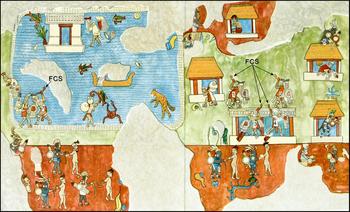
At the left of this image are additional striped warriors, one of whom (Figure 12, Individual 7) also brandishes an FCS in a similar fashion, with arm cocked back and concave side of the weapon forward. In this case there appears to be an immediate threat from enemy combatants further left, although this portion of the mural was exfoliated and not recovered or reconstructed. One of the striped warriors is depicted upside down and in an awkward position (Figure 12, Individual 8), which likely indicates death or mortal wounding at the hands of black-painted warriors just out of view (Morris Reference Morris, Morris, Charlot and Morris1931:393). If these sticks were used in close fighting as clubs, then they were evidently ineffective in this instance, for the striped group are led away as captives. Some were ultimately sacrificed, as indicated by a fresco painting in Area 19 of the Temple of the Warriors (Morris Reference Morris, Morris, Charlot and Morris1931:Plate 145, 398–400). Many of the black-painted enemy warriors also carry examples of FCS, but do not brandish them for offense or defense, even when within the town they attacked.
Coggins (Reference Coggins, Coggins and Shane1984b:164) believes that grooved FCS were symbolic of warrior titles and reserved for “Toltec officers” and that “ordinary warriors” did not have these artifacts. Ringle and Bey (Reference Ringle, Bey, Fash and Lújan2009) also support the idea of FCS as titles of office, but they indicate that there were multiple insignia, different types of military rank or title. Only some warriors had FCS, while others had different types of military and/or ritual accouterments. The depiction of defense against foes in Figure 12 seems to fit the officer insignia interpretation, in that the striped warrior elite protect the temple. The common depiction of obvious leaders holding “court” while also holding FCS certainly fits the idea of the sticks serving as a symbol of military rank (see Figure 12). Since FCS evidently played no role in active battle against enemy officers or common foot soldiers, on what grounds did these artifacts become symbolic of military prowess?
Perhaps one avenue to obtaining warrior title or status occurred with success in ritual atlatl dueling, in which FCS were used for defense. In this regard, one potentially significant aspect is the occasional depiction in monumental art of an individual holding two of the grooved sticks, one in each hand. An example occurs on Pier 5 of the South Temple at Chichen Itza, a portion of which is shown in Figure 2c, although the partial upper part is omitted. The FCS in the left hand is held down, with the distal end of the stick coming to about the knee and the concave side facing inward. The right arm is held upright across the body, with the distal end of the FCS ending higher than the head, concave side facing away from the body. Although dressed as warriors, these individuals are otherwise not armed. All four have the same pose and wear butterfly pectorals and waist shields. Symbols above two figures identify them as distinct individuals (Kan-Ek' or “Snake Star” for one; Schele and Mathews Reference Schele and Mathews1998:245). The reason for holding the FCS is not apparent, but the formal standard pose and arm raised across the body seems to indicate readiness for defense (Schele and Mathews [Reference Schele and Mathews1998:n72, 374] think that FCS were perhaps for offense rather than defense). Perhaps these depictions relate to the Maya ritual dance observed by Landa that could have involved the “catching” of forcefully hurled reeds. FCS might have relevance as symbols of military rank because of their association with atlatl duels. Deadly dyadic combat with only FCS for defense against lethal darts might have been a rite of passage for achieving certain military rank.
Another possibility, not necessarily at odds with the previous suggestion, is that FCS proved effective at subduing captives once a battle was over and the action turned from fighting to taking captives. The artifacts might have functioned in this role as throwing sticks analogous to the rabbit sticks of the ethnographic Southwest, but used to incapacitate fleeing warriors during a military rout or civilians while sacking a town. My previous rhetorical question about why rabbit sticks would form part of the Toltec weapon assemblage is answered, although not in the sense of hunting small game but for hunting people that flee like rabbits. Warrior 23 of Figure 10 might well show such an activity. In the scene of Figure 12, quite a few of the black-painted warriors with captives hold FCS. Perhaps some of the captives were brought to their knees by being struck by these sticks while in retreat. FCS could have been quite effective in this role, serving to knock people out, break bones, or otherwise end their flight in a nonlethal manner.
Callahan (Reference Callahan and Wescott1999:214) claims that “a solid 12 oz non-returning boomerang is easily capable of snapping the foreleg of a deer or comparable-sized animal at great distance.” This would be a stick that weighs 340 g, which might be about the weight of the largest and best-preserved of the Sacred Cenote FCS. Some cenote FCS were likely more comparable in weight to Hopi rabbit sticks, and Devin Pettigrew (personal communication 2017) has been studying their impact force (kinetic energy) with Garnett using high-speed digital imaging. Whittaker et al. (Reference Whittaker, Pettigrew and Grohsmeyer2017:162) graphically describe the kinetic energy of a weapon as “the amount of energetic work that the projectile does as the energy is expended in cutting tissue, breaking bone[,] and pushing tissue and bone out of the way.” With FCS there is no cutting action, but rather the mashing and displacement of tissue along with bone contusion, if not breakage. Pettigrew (personal communication 2017) has calculated that replicas of Hopi throwing sticks have a potential impact force of 60 joules when passing under a high-speed camera 10 m away. This translates into somewhere between 20 and 40 joules per square centimeter of impact force, which is potentially capable of breaking human bone or knocking someone unconsciousness (Skov Reference Skov2013:Tables 12 and 14). The impact force of these artifacts is enhanced by the rotational motion of the stick in flight, which is imparted by snapping the wrist upon release; this does not apply to wielding them as a club.
CONCLUSIONS
A functional label like short sword or fending stick is a claim on knowledge of the past. Not only about the use of the object, but about the behavioral context. The grooved, flat, and curved sticks held by warriors of Chichen Itza and other sites were not swords. These artifacts lacked a cutting edge either of stone or wood. Also, unlike most war clubs, the sticks would make a poor choice for a close-fighting weapon because of their light weight and lack of distal mass. This is probably why the artifacts are not shown in battle scenes of the Chichen Itza murals. These curved sticks had nothing to do with Chichen Itza's success in wars with neighboring polities, success that the murals suggest was considerable. The murals could be discounted as state propaganda, except that the site's monumental architecture supports a rather meteoritic rise of the polity. Success in war is a justifiable reason for ascendancy, but we must look to reasons other than an innovative sword for Chichen Itza's military prowess. The imprudence of using FCS as shock weapons in Mayan warfare is highlighted by the deadly close-fighting implements that had been in use for centuries prior to when FCS first appear in the local archaeological record.
This appearance is notable, since the similarities between the Mesoamerican artifacts and those of the Southwest cannot be easily discounted. Guernsey and Kidder (Reference Guernsey and Kidder1921:112, 115) thought that the Basketmaker II grooved clubs provided one piece of evidence that certain cultural characteristics of the Southwest originated in Mesoamerica. Given the considerable antiquity of these artifacts in the Chihuahuan and Sonoran Deserts of the Southwest, back to around 7,000 b.c. based on radiocarbon dates, the source of influence seems reversed. FCS appear to be a cultural trait from the Southwest that diffused or was carried southward, perhaps into the central highlands initially, but ultimately becoming well represented at Chichen Itza. These artifacts can be seen as perhaps another archaeological indicator of probable Nahua population movements out of northern Mexico and into central Mexico (e.g., Beekman, and Christensen Reference Beekman and Christensen2003).
Although the sword account is disproven, the functional role of FCS in Mesoamerican remains open to debate. In the painted battle murals at Chichen Itza, warriors that carry FCS also have shields, which implies that the sticks had some purpose other than defense against atlatl darts in these contexts. Experiments with deflecting atlatl darts using FCS show that this can be done but that it is highly unlikely to have occurred in warfare like that depicted in the mural battles. Dart deflection with FCS requires the ability to focus on single projectiles, an implausibility in the chaos of war.
That FCS served as symbols of warrior rank or title seems indisputable, but why should these sticks in particular have such a role if not somehow related to militarism? One plausible scenario is success with using them for atlatl defense in lethal gladiatorial-like combat. That this might have occurred in the past is supported by a ritual warrior dance that Landa observed where paired contestants fought a mock duel with probable atlatl darts. The non-lethal form of atlatl dueling that still occurs among the Kamayurá and some other tribes in South America might be the last vestige of ritual conflict that was once widespread in the Americas, duels that trained young warriors in both defense and offense. Another plausible scenario is use of the sticks as a throwing implement to disable people so that they could be captured for subsequent sacrifice. These two uses are not mutually exclusive and both could have served to elevate the status of warriors, hence their use as symbols of military rank.
RESUMEN
Palos planos y curvos con ranuras longitudinales faciales fueron dragados del Cenote Sagrado en Chichen Itza a principios del siglo XX. Son similares a los especímenes recuperados del sudoeste de América del Norte, donde una función sugerida era para la defensa contra los dardos atlatl. Al aceptar esta interpretación, los arqueólogos mesoamericanos identificaron artefactos como palos de defensa. Hassig (1992:112--114, 126--127, 2001:810--811) discute este papel, argumentando que los palos eran espadas cortas especializadas para la lucha cercana. Esta interpretación de la espada no es apoyada por mi análisis de los artefactos de Chichen Itza o la evidencia mural en ese sitio. La defensa contra los dardos atlatl es posible, pero es improbable que haya ocurrido en la guerra y, en cualquier caso, los guerreros mayas / toltecas llevaron escudos para protegerse contra dardos y otras armas. Fender dardos en peleas rituales como un duelo de atlatl es un escenario plausible, quizás para demostrar la valentía del guerrero o como un deporte gladiador en sangre. Otro uso posible es para subyugar a los cautivos después de la victoria militar: un palo lanzador para inhabilitar a los humanos para sacrificarlos más tarde.
ACKNOWLEDGMENTS
Virginia Miller and three anonymous reviewers provided valuable comments that helped to improve this paper. I appreciate the sharing of mural images by Andrew Finegold. Financial support came from the National Science Foundation (Award Number 1025643), the UNM Anthropology Department via the Hibben Trust, the UNM Graduate and Professional Student Association, and the New Mexico Archaeological Council. I appreciate the advice of Bruce Huckell, Dave Phillips, Ann Ramenofsky, Pat Lambert, Jim Boone, R.G. Matson and Steven LeBlanc during various stages of this research along with the assistance of Chuck LaRue, Byl Bryce, and Nick Geib in the fending experiment. I thank Carol Subiabre for her assistance with the Spanish resumen.



