





1. Introduction
Press relations hold a crucial position within corporate communication strategies. Indeed, the media serve as “conduits” to reach key stakeholders such as investors, customers, and employees (Cornelissen Reference Cornelissen2014: 145). They are also seen as “amplifiers” of both positive and negative information about companies (Libaert and Johannes, Reference Libaert and Johannes2010: 97), and media coverage can therefore have a significant impact on a company’s reputation (Libaert and Johannes, Reference Libaert and Johannes2010; Cornelissen, Reference Cornelissen2014).
Press releases are among the preferred tools of press relations. They serve a dual communicative function and thus belong to a “hybrid genre” (Jacobs, Reference Jacobs1999; Catenaccio, Reference Catenaccio2008): while providing information that is assumed to be “newsworthy,” their fundamental goal is promotional, as they primarily aim to secure media coverage that enhances the company’s image and reputation. According to Catenaccio (Reference Catenaccio2008: 11), this blend of promotional and informational elements has been “constitutive of the genre from its very origin” and should not simply be attributed to the trend of “commodificationFootnote 1” that characterizes modern society (cf. Fairclough, Reference Fairclough1992, cited in Catenaccio, Reference Catenaccio2008: 11).
However, the promotional objective of press releases does not appear to be without risks. According to public relation manuals (cf. Catenaccio, Reference Catenaccio2008) and best practice guides available online,Footnote 2 using overly promotional language could ultimately lead journalists to ignore the information provided, thereby undermining the goal of generating positive media attention for the company (Jacobs, Reference Jacobs1999; Catenaccio, Reference Catenaccio2008; De Cock and Granger, Reference De Cock and Granger2021). The prevailing idea seems to be that excessive promotion is counterproductive. However, Pander Maat (Reference Pander Maat2007) shows that the reception of promotional language largely depends on the type of media being targeted (see Section 3). More broadly, both press release writers and journalists share a common “discursive competence” (Bhatia, Reference Bhatia2004, cited in Catenaccio, Reference Catenaccio2008: 14). While press release writers are well aware that excessive promotional content can hinder the positive reception of the release by journalists, journalists also recognize that by publishing information derived from press releases, they become part of a promotional process themselves (Catenaccio, Reference Catenaccio2008: 14).
Interestingly, the nuanced discussion surrounding the risks of promotional language in press releases echoes debates about the socially risky nature of self-promotion, a strategy associated with impression management as described in social psychology (e.g., Peeters and Lievens, Reference Peeters and Lievens2006; Johnson et al., Reference Johnson, Griffith and Buckley2016). Self-promotion is also linked to the speech act of self-praise, as analysed in politeness theory. Traditionally, self-praise has been described as a face-threatening act (Brown and Levinson Reference Brown and Levinson1978), as it disregards the feelings of the interlocutor (Dayter, Reference Dayter2014), and thus threatens their positive face. By foregrounding the speaker’s own merits, it may implicitly create an unfavourable comparison that undermines the interlocutor’s desire to be equally valued and approved of. In addition, self-praise can exert some interactional pressure on the interlocutor to acknowledge or endorse the claim, thereby potentially impinging on their negative face by constraining their freedom to respond freely. According to Leech’s (Reference Leech1983, Reference Leech2014) Politeness Principle, self-praise violates the Modesty Principle, which requires speakers to minimize praise of self and maximize dispraise of self. However, research has also shown that the perceived inappropriateness of self-praise depends, in part, on the specific context in which it occurs. In recruitment contexts, for example, where individuals compete against one another, self-promotion is considered useful (e.g. Rudman-Rutgers, Reference Rudman-Rutgers1998) and can have a positive impact on recruiters’ decisions (e.g. Stevens and Kristof, Reference Stevens and Kristof1995). Additionally, several studies have indicated that online contexts – particularly social media – tend to impose fewer restrictions on self-praise (Dayter, Reference Dayter2018; Matley, Reference Matley2018; Rüdiger and Dayter, Reference Rüdiger and Dayter2020; Guo and Ren, Reference Guo and Ren2020; Ren and Guo, Reference Ren and Guo2020, Reference Ren and Guo2024). However, as shown in most of the aforementioned studies, despite its frequency, self-praise is often accompanied by politeness strategies, confirming that it remains a potentially risky behaviour for the face of those involved.
While corporate self-promotion is the ultimate goal of press releases, and while studies such as Pander Maat (Reference Pander Maat2007) and Jacobs (Reference Jacobs1999) offer relevant insights, particularly in relation to politeness theory (explicit in Jacobs’ case, see Section 3), to our knowledge, no research has yet examined self-praise in press releases explicitly within this theoretical framework. In addition, Discourse-pragmatic approaches to French-language press releases remain underdeveloped.
This study seeks to address these gaps by bridging insights from earlier research on press releases and work on self-praise in other discursive contexts, particularly within politeness theory. Specifically, it examines how politeness strategies are used to construct and mitigate corporate self-praise in press releases published by French and American companies. Following Tobback (Reference Tobback2019b, Reference Tobback2019c), who identified cross-cultural differences in the use of self-praise strategies in French and American LinkedIn summaries, this study adopts a contrastive perspective in order to assess whether similar patterns emerge in the genre of corporate press releases, or whether genre-specific conventions override previously observed cultural tendencies. The remainder of this article is structured as follows. Section 2 reviews relevant politeness-theoretical accounts of self-praise. Section 3 discusses previous work on point-of-view operations and promotional language in press releases, with particular attention to their relevance for politeness theory. Section 4 presents the research focus in more detail and the general methodology.Footnote 3 The results are described in sections 5 and 6: Section 5 focuses on the operationalization of self-praise markers and quantitative findings, while Section 6 examines the pragmatic strategies used to mitigate self-praise. Finally, Section 7 discusses the main findings in light of the research questions, compares them to previous studies, and reflects on their broader theoretical implications, while also acknowledging the limitations of the present study.
2. Politeness accounts of self-praise
As self-praise is considered a ‘risky’ speech act, most studies have focused on describing the strategies speakers use to address (or disregard) its potentially face-threatening character (e.g. Speer Reference Speer2012; Dayter, Reference Dayter2014, Reference Dayter2018, Reference Dayter2021; Matley Reference Matley2018; Tobback Reference Tobback2019a, Reference Tobback2019b, Reference Tobback2019c; Ren and Guo, Reference Ren and Guo2020, Reference Ren and Guo2024; Guo and Ren, Reference Guo and Ren2020; Maíz-Arévalo Reference Maíz-Arévalo2021; Itakura, Reference Itakura2022). The typologies proposed in these studies broadly reflect the general taxonomy of politeness strategies initially described by Brown and Levinson (Reference Brown and Levinson1978). They typically distinguish between explicit and implicit forms of self-praise.
Within the explicit category, a further distinction is made between unmitigated self-praise (e.g. Yes, I am an expert in that topic. [Maíz-Arévalo, Reference Maíz-Arévalo2021: 113]Footnote 4) and self-praise accompanied by modifying strategies that aim to soften the potential threat to the addressee’s positive and negative face. Common mitigating strategies include the use of disclaimers (e.g. It’s wrong for me to say, but I am really crunching hot), references to hard work or sustained efforts (e.g. It is really good, the thing is that I have put a lot of effort into it), a shift in focus or perspective (e.g. I think it tastes very good, but I have followed the recipe step by step, the result being attributed to the recipe rather than to the speaker), or the attribution of praise to a third party through reported speech (e.g. Guess what I was told the other day when they found out it was my birthday (…). They asked me whether I had turned 35 — even though the speaker is much older).
Implicit self-praise, by contrast, is generally realised through conversational implicatures. In many of the cited studies, self-praise is achieved through the expression of complaints (e.g. I’m exhausted from all the meetings that followed my presentation, so many people wanted to explore my ideas further (fictional example)), which often offer an ideal opportunity to highlight actions or qualities that cast the speaker in a positive light (e.g. Dayter, Reference Dayter2014; Maíz-Arévalo, Reference Maíz-Arévalo2021). In LinkedIn summaries, additional types of implicatures have been identified (Tobback, Reference Tobback2019a). For instance, by highlighting the importance of their clients, authors implicitly refer to their own qualities, since it can be assumed that only competent professionals attract high-profile customers. Similarly, when authors articulate their vision on certain aspects of their profession, this may serve as an indirect way of emphasizing their expertise, on the assumption that only highly competent individuals have a well-defined professional vision, clear objectives, and so on.
While most studies focus exclusively on mitigation and primarily analyse semantico-pragmatic strategies used for self-praise, Tobback (Reference Tobback2019a, Reference Tobback2019c) also examines internal modifiers in LinkedIn résumés. These include both downgrading and upgrading devices. Downgrading covers elements such as hedges (cf. Fraser, Reference Fraser, Kaltenböck, Mihatsch and Schneider2010) or verbs showing skill development (e.g. […] have allowed me to increase my sense of initiative, Tobback, Reference Tobback2019a: 659). Upgrading, on the other hand, is divided into qualitative and quantitative modifiers, following Martin and White’s (Reference Martin and White2005) work (see Section 5 for further discussion).
Most studies on self-praise have been conducted within a single linguacultural context. A few, however, have adopted a contrastive perspective, typically comparing Chinese to British or U.S. data (e.g. Wu et al., Reference Wu, Zhang and Ren2023). Ren et al. (Reference Ren, Fukushima and Guo2025) compare Chinese to Japanese self-praise on social media, while Tobback (Reference Tobback2019b, Reference Tobback2019c), identifies cross-cultural tendencies in her study of LinkedIn profiles by French and American communication professionals. French professionals appear to favor more implicit forms of self-praise, often drawing on contextual implicatures (e.g. references to academic qualifications, job titles, or notable clients) to signal competence indirectly. American professionals, by contrast, show a greater tendency to adopt explicit strategies, either by directly asserting their expertise or by referring to external validation, such as awards or client testimonials. Moreover, French users are more likely to downgrade overt self-praise, suggesting a stronger orientation toward modesty norms, whereas American profiles more frequently feature intensifying language, particularly in more direct forms of self-praise.
3. Point-of-view operations and promotional language in press releases
Jacobs (Reference Jacobs1999) identifies a series of ‘pre-formulation’ techniques that, on the one hand, bring press releases closer to the formal characteristics of press articles and, on the other, lend them a greater degree of objectivity, thereby enhancing their credibility in the eyes of journalists. The ultimate aim of these techniques is to increase the likelihood that the press release will be reproduced – ideally verbatim – in media coverage. Although Jacobs’ study does not explicitly frame its analysis within the context of politeness theory, it draws connections between certain techniques and negative politeness strategies described by Brown and Levinson (Reference Brown and Levinson1978). Certain mechanisms enable the press release to create distance between the company and its role as the agent responsible for the reported facts, by presenting the information from an alternative perspective. Consequently, these techniques produce a “point of view distancing” effect (Brown and Levinson, Reference Brown and Levinson1978: 204) between the source and the information conveyed.
The first set of strategies concerns the way in which reference is made to the company. Self-reference clearly occurs in the third person rather than the first (through the use of proper nouns, nominal anaphors, or third-person pro-forms). While this strategy allows writers of press releases to “hide their relationship to the information they provide” (Jacobs, Reference Jacobs1999: 124), other mechanisms, such as the use of the neutral pronoun ‘one’, or passive and nominal constructions, serve to avoid self-reference altogether. The final stage in this concealment of the “autobiographical character” (Jacobs, Reference Jacobs1999: 96) consists in maximally shifting reference away from the company by focusing instead on third parties, such as customers and the ways in which they may use the company’s products.
Self-quotations are another recurrent feature of press releases. Labelled “pseudo-direct speech” (Bell, Reference Bell1991, as cited in Jacobs, Reference Jacobs1999: 145) or “constructed quotations” (Jacobs Reference Jacobs1999), these formulations also create a distancing effect. The speaker appears to attribute their view to a separate instance that is, in fact, none other than themselves, yet from which they maintain a certain distance (Goffman, Reference Goffman1974, as cited in Jacobs, Reference Jacobs1999: 190).
Whereas Jacobs (Reference Jacobs1999) primarily focuses on strategies aimed at enhancing the credibility of companies in the eyes of the press, Pander Maat (Reference Pander Maat2007) highlights the extent to which Dutch (good news) press releases (issued by companies active in the aviation industry) incorporate promotional elements and the ways the press ultimately deals with these elements. Promotional elements are defined as those elements which “intensify a statement in a direction favourable to the sender [and which] can be left out without affecting the grammaticality and the interpretation of the sentence or they can easily be replaced by a weaker element” (Pander Maat, Reference Pander Maat2007: 68). The elements mentioned by the author are the following: evaluative, attitudinal or property specifying adjectives, adverbs, time and place adjuncts, numerals, connectives. The analysis reveals that promotional language is not really avoided in corporate press releases. On the other hand, the way the press handles promotional language appears to vary between national newspapers, which tend to rewrite press releases and remove overtly promotional elements, and specialized media, which, due to their more direct interest in company-provided content within their sector, are more likely to reproduce the text more faithfully, including its promotional language.
Building on the insights from prior research on self-praise (Section 2) and press releases (Section 3), Section 4 now introduces the research focus and methodology.
4. Research focus and general methodology
In this article the focus shifts from self-praise by ‘natural persons’ to self-praise strategies employed by ‘legal persons’, specifically French and U.S. companies, in press releases published on their corporate websites. Given that self-praise is frequently characterized as a potentially face-threatening act (FTA), this shift prompts the question to what extent the same applies within the institutional context of press releases, and how the notion of face might be interpreted in such a setting. While the concept of face has traditionally been applied to individual speakers and their personal face, some research has extended the notion to the professional face (e.g. Charles, Reference Charles1996) of individuals acting on behalf of an institution, that is “the professional persona […] through which the company presents itself to the public” (Harrington, Reference Harrington2018, drawing on Orthaber and Marquez Reiter, Reference Orthaber and Márquez Reiter2011: 3863). This article extends the notion of professional face to organizations themselves when engaging in institutional communication. In this perspective, companies seek to construct and manage a form of professional face, interpreted as an image of credibility and expertise linked to their institutional role. However, the use of self-praise in press releases may simultaneously threaten the professional face of another key actor in the communication chain: the journalist. When press releases are perceived as overly promotional, they may challenge the journalist’s professional autonomy (hence, their negative face) and create a sense of manipulation that threatens to undermine their role as an independent reporter, potentially leading to resistance or non-publication. At the same time, the company’s own efforts to reinforce its professional face may fail if the message is rejected. Corporate self-praise in press releases can thus be seen as a strategic, but face-sensitive form of institutional self-presentation, which invites closer examination in terms of its linguistic realization and potential variation across different lingua-cultural contexts.
To explore this phenomenon empirically, our study aims to conduct a contrastive exploratory analysis of self-praise strategies employed in press releases by two major French retailers (Auchan and Carrefour) and two major U.S. retailers (Kroger and Target). The selection of these companies was guided by pragmatic considerations: all four make their press releases publicly accessible through their corporate websites and operate within the same retail sector, which ensures broadly comparable communicative contexts.
More specifically, the corpus comprises ten press releases per company with a total word count of 21,600.Footnote 5 In terms of content scope, and in order to ensure a coherent dataset given its limited size, the selection was limited to press releases conveying positive, commercially oriented information, such as announcements related to new products, partnerships, or corporate social responsibility. Since the aim of the study was not to compare different subtypes of positive press releases, no further topic balancing was applied. Instead, within this content scope, the corpus was compiled through a time-based selection procedure: the first ten press releases published on each company’s corporate website in 2021–2022 that met the inclusion criterion were selected.
Given their inherently promotional nature (cf. Introduction), it can be argued that press releases, by definition, engage in ‘positive self-disclosure’ (Dayter, Reference Dayter2014), by communicating information intended to be positively received by the public (or the media). To ensure a methodologically consistent analysis of what qualifies as self-praise and what does not, and to enhance comparability between the two sub-corpora (FR vs. US), this article narrows its focus first to linguistically intensified forms of self-praise, that is, evaluative or quantitative elements that encode positive assessment, regardless of whether they occur in explicitly self-promotional statements or in syntactic units that are related to the company in a more implicit vain (see section 6.1.). For the purposes of this study, we will refer to these elements as “self-praise markers” (SPMs) (see Section 5 for a detailed description and the quantitative results).
As a second analytical step, we will examine the extent to which these self-praise markers tend to co-occur with pragmatic strategies that reduce their potential face-threatening character. More specifically, the focus will be on pragmatic strategies identified in previous research on self-praise (see Section 2), as well as on point-of-view operations described for press releases (see Section 3). The analysis will centre on modification strategies, including references to hard work, attribution of credit to third parties, shifts in footing (e.g., reported third-party praise), self-quotations and more implicit forms of self-praise. The criteria for annotating the corpus will be outlined in detail in Section 6, along with corpus examples and a quantitative account of the distribution of each strategy across the French and U.S. sub-corpora.
Statistical tests are applied in this study wherever the nature and size of the data lend themselves to such analysis. Chi-square tests will be used when the data are approached by means of categorical variables, and t-tests or non-parametric alternatives such as the Wilcoxon rank-sum test (independent samples) or the Wilcoxon signed-rank test (paired samples) for comparisons of continuous measures at the individual text level. However, it is important to note that the assumptions underlying these tests, particularly the assumption of independent observations, are not fully met in this dataset. The data are nested, as each corpus consists of multiple texts produced by only two companies, meaning that individual observations (e.g. SPMs or text-level results) may not be entirely independent. Despite this limitation, statistical tests are included, allowing to move beyond the identification of tendencies and patterns that emerge from the data. As noted by Levshina (Reference Levshina2015: 212, footnote 2), the independence assumption is often relaxed in corpus linguistic research, especially when the aim is exploratory rather than confirmatory. In light of this, the results of all statistical tests should be interpreted with caution, as indicative rather than definite conclusive evidence of differences between the corpora.
The first round of coding was carried out by the first author. To evaluate the reliability of the annotation procedure, the second author independently annotated a subset of the dataset for the two aspects of the analysis where researcher subjectivity was considered most likely to occur:
-
(i) determining whether and how many self-praise markers (SPMs) each sentence contains (see Section 5), and
-
(ii) assessing whether SPMs appear in a clause or sentence that implicitly presents the company in a positive light (see Section 6.1).
For both aspects, interrater agreement proved to be high to excellent.Footnote 6 Minor differences between coders were discussed and resolved, but no systematic disagreements were observed. Given the very high level of agreement, it was decided not to recode the entire dataset and to proceed with the original annotations.
Having outlined the general methodology, the following sections present the results: Section 5 addresses the operationalization of and findings on self-praise markers, while Section 6 examines the mitigation strategies employed to temper self-praise.
5. Self-praise markers: operationalization, annotation and results
5.1. Operationalization
Building on Pander Maat’s (Reference Pander Maat2007) definition of promotional elements, Kerbrat-Orecchioni’s (Reference Kerbrat-Orecchioni2009) concept of subjectivity, Footnote 7 Tobback’s (Reference Tobback2019a, Reference Tobback2019c) analysis of ‘upgraders’ (which partly relies on Martin and White’s analysis of graduation and intensification), and Liebrecht et al.’s (Reference Liebrecht, Hustinx and Van Mulken2019) definition of intensification, Footnote 8 self-praise markers (SPMs) are understood in this article as intensified subjective (evaluative) (5.1.1.) or objective (quantitative) linguistic elements (5.1.2.) that explicitly or implicitly contribute to the positive self-presentation of the company.
5.1.1. Intensified evaluative/subjective linguistic elements
Intensified evaluative or subjective linguistic elements are intensified expressions (Adjective Phrases, Noun Phrases, Verb Phrases, or Adverb Phrases) that reflect the speaker’s subjective assessment (Kerbrat-Orecchioni, Reference Kerbrat-Orecchioni2009; Tutin, Reference Tutin, Lores-Sanz, Mur-Duenas and Lafuente-Millan2010), partly in line with Hunston and Thompson’s (Reference Hunston and Thompson2000) definition of evaluation as the linguistic expression of personal attitudes, feelings, or value judgments towards a given object or situation.
Such elements may include:
-
• Affective adjectives, which express an emotional state (Tutin, Reference Tutin, Lores-Sanz, Mur-Duenas and Lafuente-Millan2010, e.g. we are delighted that…);
-
• Axiological evaluative adjectives, which express a judgment based on a system of values (Tutin, Reference Tutin, Lores-Sanz, Mur-Duenas and Lafuente-Millan2010, e.g. fantastic grocery experiences);
-
• Non-axiological evaluative adjectives, which assess something in relation to a norm (Tutin, Reference Tutin, Lores-Sanz, Mur-Duenas and Lafuente-Millan2010, e.g. giant 3D grids).
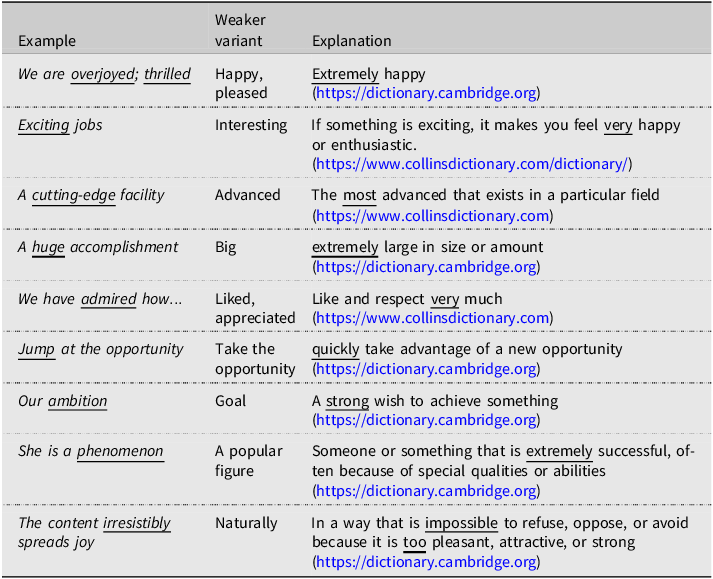
However, nouns, verbs, and adverbs can also convey intensified evaluative meaning (see Table 1).
Examples of evaluative SPMs
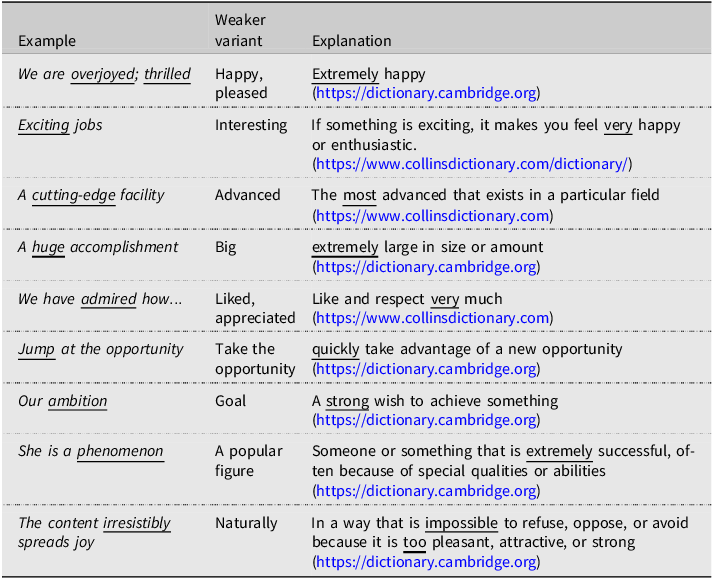
For an element to qualify as intensified, it must either contain a strengthener (such as very; see Pander Maat, Reference Pander Maat2007: 69) that can be omitted to yield a weaker evaluation, or it must be replaceable by a weaker alternative. For adjectives, an additional condition is that a weaker alternative must still retain an evaluative meaning.Footnote 9 Hence, adjectives such as creative, good, interesting are not classified as SPMs, since omitting them neutralizes the evaluation rather than weakening it (see also Van Mulken and Schellens, Reference van Mulken and Schellens2012). For nouns and verbs, this condition was relaxed, as intensification and evaluation appeared to be less clearly separable. Thus, expressions such as our ambition and jumping at the opportunity were treated as intensified forms compared to our goal and taking an opportunity.
Table 1 provides examples of evaluative SPMs, along with weaker alternatives. Dictionary definitions are included to illustrate the intensified meaning of these items, with the relevant elements highlighted for clarity.
5.1.2. Intensified quantitative-oriented expressions
Apart from evaluative expressions, SPMs also include intensified quantitative-oriented expressions that enhance the positive portrayal of the company by emphasizing magnitude, extent, or reach. These include:
-
• Strengthened numerals and indefinite quantifiers: more than 250…, hundreds of products, almost 300…, plus de…, près de…
-
(1) The retailer provides more than 1,350 spaces at over 150 locations across more than 20 states. (T06Footnote 10, 17.03.22)
-
-
• Expressions referring to large temporal or spatial extension, or broad applicability (NPs, DetPs, PronPs, AdvPs, PrepPs, ConjPs):
-
(2) Products that will bring them joy all summer and beyond (> during the summer) (T09, 16.06.22)
-
(3) Kroger is fulfilling its commitment to anything, anywhere, anytime (> many things, many places, often) (K01, 07.01.2022)
-
(4) Le déploiement de Carrefour Énergies à travers ses 5 000 points de recharge électrique disponibles d’ici 2025 pour l’ensemble des hypermarchés, des market, avec un service d’électricité 100% verte. (Deployment of Carrefour Energies with 5,000 electric recharging points available by 2025 for all hypermarkets and markets, with a 100% green electricity service.) (> for hypermarkets; a green electricity service) (C01, 16.06.2022)
-
(5) Non seulement, il concerne 100% de ses hypermarchés et supermarchés de l’Hexagone, mais il porte aussi sur 3 outils intelligents conçus par Smartway. (Not only does it cover 100% of its hypermarkets and supermarkets in France, but it also includes 3 intelligent tools designed by Smartway.) (A05, 23.03.22) (> it covers its hypermarkets … and 3 intelligent tools…)
-
These elements qualify as SPMs because they contribute to the company’s positive self-presentation by emphasizing the scope, scale, and significance of its actions.
5.2. Annotation and results
Based on the aforementioned definitions, all self-praise markers (SPMs) were annotated on a sentence-by-sentence basis and subsequently quantified. The annotation was carried out manually, following an inductive procedure in which each sentence was examined to determine whether it contained one or more SPMs. All coding was performed in Excel.
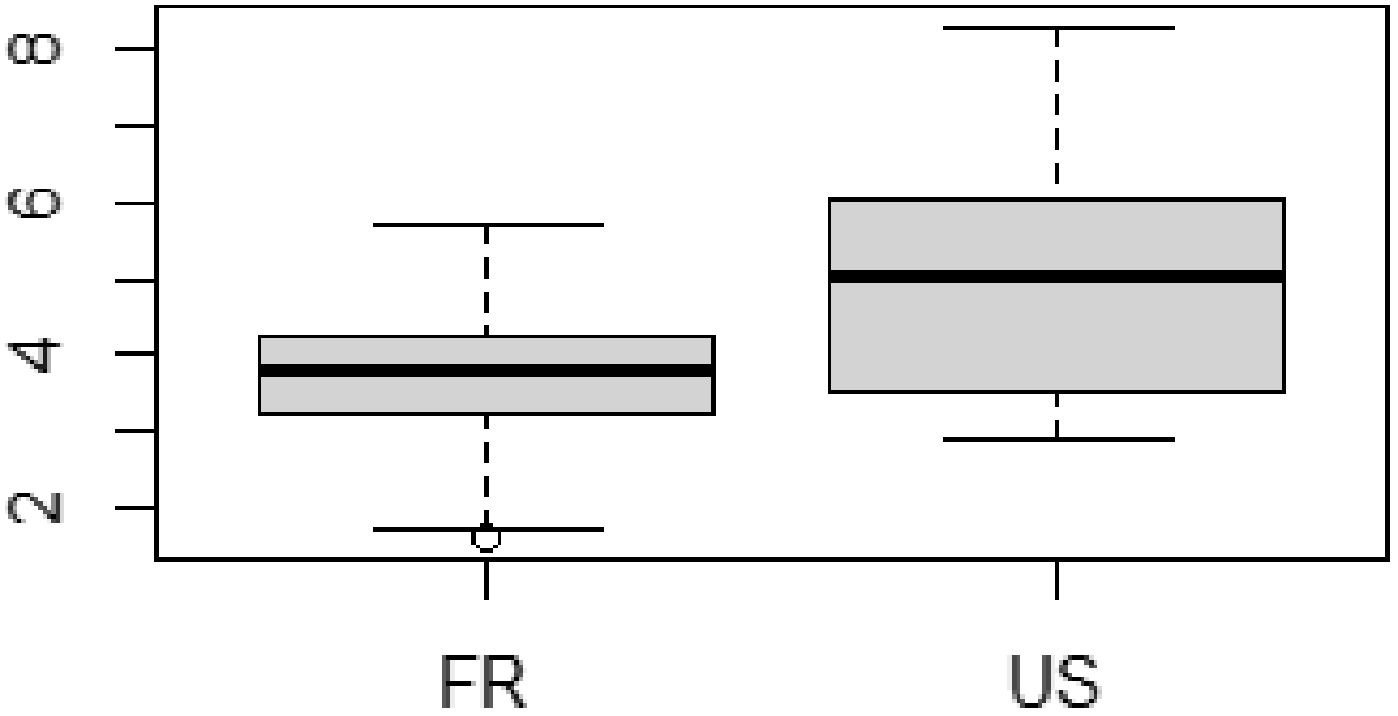
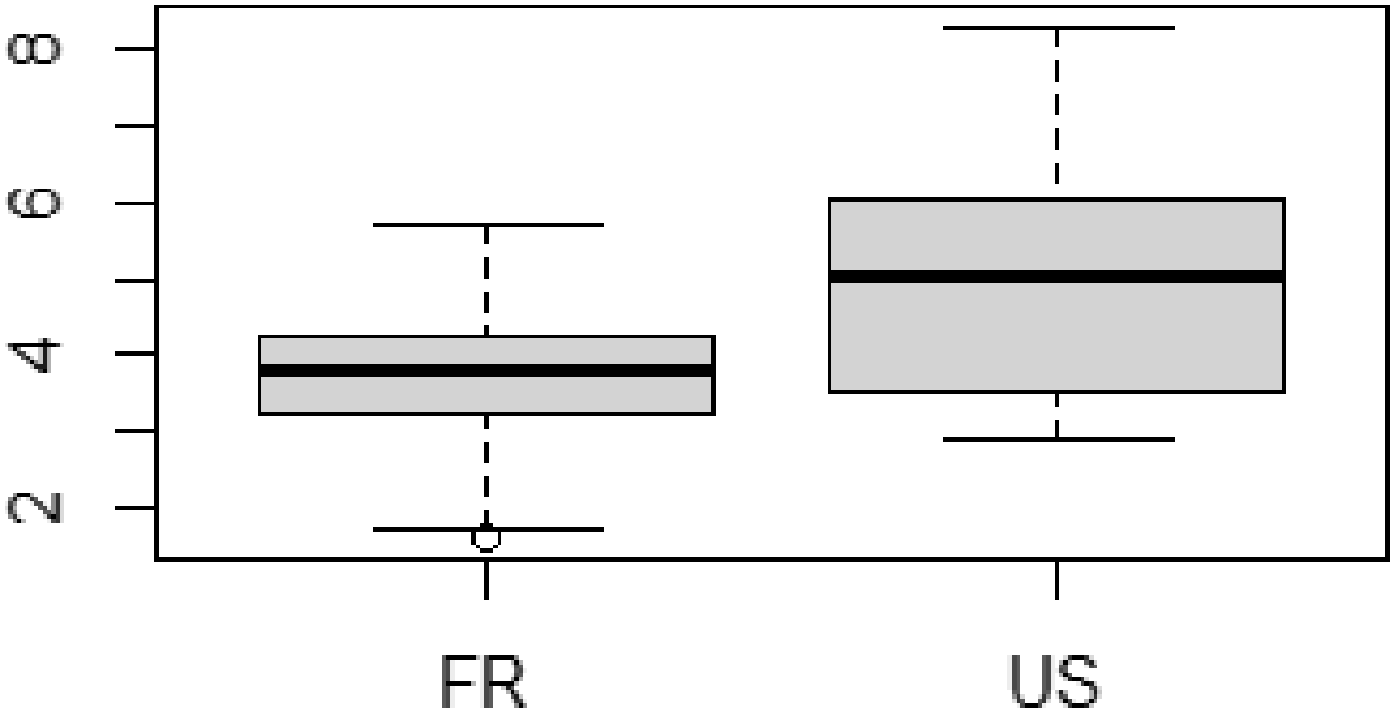
This resulted in a total of 386 SPMs in the French corpus (20 press releases; 10,338 words) and 545 SPMs in the U.S. corpus (20 press releases; 11,263 words). Because the press releases differ in length,Footnote 11 the number of SPMs in each text was divided by its total word count and multiplied by 100, yielding a normalized measure of SPMs per 100 wordsFootnote 12 for each press release. Next, we calculated the mean number of SPMs per 100 words across press releases. The mean number of SPMs per press release (normalized values) is significantly lower in the French corpus (M = 3.69, SD = 0.99) than in the U.S. corpus (M = 4.95, SD = 1.54). This difference is confirmed by a Welch Two Sample t-test (t(32.36) = −3.08, p < 0.01). The effect size is 0.933 (Cohen’s d), indicating a large effect. These results are further illustrated in the boxplot presented in Figure 1. which visually confirms the significant difference in the frequency of self-praise markers between the two corpora.
Boxplot of SPMs per 100 words in French and U.S. press releases.
6. Pragmatic strategies making self-praise potentially less face-threatening
In the previous section, we focused on the total number of self-praise markers (SPMs) in each corpus and on the average number of SPMs per press release (normalized per 100 words).
The analysis considered elements that had the potential to enhance the company’s image but did not distinguish between those that explicitly cast the company in a positive light and those that do so more implicitly. Furthermore, we did not examine whether an intensified form of self-praise was compensated by the presence of a pragmatic strategy that reduces its face-threatening potential. These aspects will be addressed in the following sections. Section 6.1 examines the distribution of SPMs across explicit and less explicit forms of self-praise. Sections 6.2 to 6.6 then deal with the following five types of mitigation strategies: 6.2 shifts in footing: third-party praise; 6.3 pseudo-shift in footing: self-quotations; 6.4 shift of credit to third parties; 6.5 point-of-view operations; and 6.6 mitigation strategies targeting the company’s actions. Finally, Section 6.7 offers a brief quantitative summary, indicating the proportion of sentences containing SPMs that are not accompanied by any of these mitigation strategies, thereby capturing the residual category of unmitigated self-praise once all mitigation types have been examined.
For each pragmatic strategy discussed in Sections 6.1 to 6.6, we will examine how it is manifested in the corpus of press releases and outline the specific annotation procedures applied for this purpose. This presentation will be followed by a quantitative examination of the findings, assessing whether, and to what extent, French and U.S. companies display similar or divergent patterns in their use of the strategy in question.
6.1. Explicit and implicit forms of self-praise
Following previous research (see Section 2), we distinguished between explicit (6.1.1.) and implicit forms of self-praise (6.1.2.) in press releases. The concrete annotation procedure and the results are discussed in section 6.1.3.
6.1.1. Explicit self-praise
Explicit self-praise arises when positive information is directly associated with the company’s own characteristics, activities or achievements or with features of its products, services, shops, etc., i.e. entities under the direct responsibility of the company. In (6), the positive attributes of the new product range serve to explicitly cast the company in a positive light:
-
(6) Moins de gaspillage et plus de pouvoir d’achat : Carrefour s’allie à NOUS anti-gaspi pour proposer une gamme de produits hors des standards, jusqu’à 20% moins chers. (Less waste and more purchasing power: Carrefour has teamed up with NOUS anti-gaspi to offer a range of exceptional products, up to 20% cheaper.) (C04, 07.07.22)
6.1.2. Implicit self-praise
For information to be analysed as implicit self-praise, it must not relate directly to the identity, characteristics or activities of entities under the direct responsibility of the company, yet it should still contribute to the construction of a positive corporate image through various kinds of implicatures. Several possible scenarios have been identified in this regard.
-
(a) The press release often presents in a positive light the identity, activities, achievements or products of third parties the company collaborates with. Example (7) illustrates this pattern, as Target praises the qualities of their partner Stoney Clover Lane:
-
(7) “Stoney Clover Lane is all about re-imagining the everyday and making it full of color and fun.” (T05, 16.03.22)
-
Thus, when the performances of partners selected by the company are commendable, it implicitly validates the company’s decision to collaborate with them. This, in turn, contributes to enhancing the company’s own positive image.
-
(b) In other cases, such as illustrated in example (8), although the company shares positive information about itself, namely introducing new car models, the qualities (unique, great) of these car models fall outside the company’s responsibility. Hence, these elements contribute to the company’s positive presentation in a more implicit manner (see also Tobback, Reference Tobback2019b).
-
(8) Carrefour Location, […] accélère le développement de son offre avec l’arrivée de nouveaux véhicules de tourisme électriques dont les modèles Tesla Model Y et Tesla Model 3 à l’expérience digitale unique et avec une grande capacité d’autonomie. (Carrefour Location, […] is stepping up the development of its offer with the arrival of new electric passenger vehicles, including the Tesla Model Y and Tesla Model 3, which offer a unique digital experience and a great range.) (C01, 16.06.22)
-
-
(c) In a slightly different vein, as seen in an example like (9), the company is responsible for the benefits provided to its customers, but its services are not explicitly described as easy or accessible. Instead, the benefits themselves are explicitly highlighted. This suggests a minimal inference: if it is easy for Target customers to “shop, save and get their deals delivered”, then Target’s services must inherently be smooth and accessible.
-
(9) It’s never been easier for Target guests to shop, save and get their deals delivered. (T09, 16.06.22)
-
-
(d) Implicit self-praise may also be grounded in the expression of the company’s emotional or cognitive stance toward its own activities or achievements.
Examples (10) and (11) demonstrate this more clearly:
-
(10) “We’ve had the pleasure of working with Tabitha for a number of years and are thrilled to take our relationship to the next level by partnering with her to introduce new limited-time collections that we know guests will love.” (T08, 17.05.22)
-
(11) “Il est primordial, dans le contexte d’inflation actuel, qu’Auchan Retail France puisse mettre en oeuvre des moyens pour que ses clients récupèrent visiblement du pouvoir d’achat”. (“In the current inflationary climate, it is essential that Auchan Retail France is able to take steps to ensure that its customers visibly regain purchasing power”.) (A07, 12.07.22)
In (10), it is the adjective thrilled which prompts a positive and therefore self-promotional reading of the statement. While this qualitative marker is directly associated to the company, a feeling of excitement or enthusiasm does not, in itself, constitute a meaningful property of the company. In this particular example, it is primarily through the expression of a positive emotional stance that the favourable nature of the partnership with actress and media personality Tabitha Brown is conveyed. The positive interpretation thus relies on an inference: if the company expresses joy and excitement regarding the new partnership, the collaboration must necessarily constitute something positive or desirable.
In (11), it is not the emotional but the cognitive attitude of the company that comes into play. The statement conveys direct positive information about the company’s actions, with their value further reinforced, albeit indirectly, through the use of the phrase il est primordial (‘it is essential’), which articulates the company’s own perspective on its operations. Additionally, by presenting themselves as having a clear and deliberate vision, the company enhances the positive image it aims to project: its praiseworthy actions are framed as the result of thoughtful, purposeful decision-making.
-
(e) A final form of (highly) implicit self-promotion involves information that reflects the company’s understanding or perspective on various social issues. For example, in the following statement, the company demonstrates its knowledge and awareness of the food waste issue prevalent in French society:
-
(12) Chaque année en France, près de 10 millions de tonnes de nourriture consommable sont gaspillées, tous secteurs confondus. (Every year in France, almost 10 million tonnes of edible food are wasted, across all sectors.) (A05, 23.03.22)
-
In the press release, this statement directly precedes the announcement of the company’s partnership with Smartway, explicitly linking the issue of food waste to the company’s initiative to address it. The quantitative elements chaque année (‘every year’) and près de 10 millions de tonnes (‘nearly 10 million tonnes’) do not directly relate to the company itself. However, insofar as the information is presented within the context of the company’s collaboration with a partner (Smartway), which is aimed at reducing this problem, the significance of the issue conveyed by these two quantitative markers implicitly suggests that the company’s decision to engage in the collaboration is all the more creditable. Consequently, statements such as (12) are interpreted as contributing, in a highly implicit manner, to the positive portrayal of the company.
6.1.3. Annotation and results
The corpus was annotated as follows: for each syntactic unit (either a full sentence or a phrase) with one or more SPMs, we identified whether the positive description directly referred to the company (or its products) (explicit self-praise), or related to the company in a more indirect way (implicit self-praise).
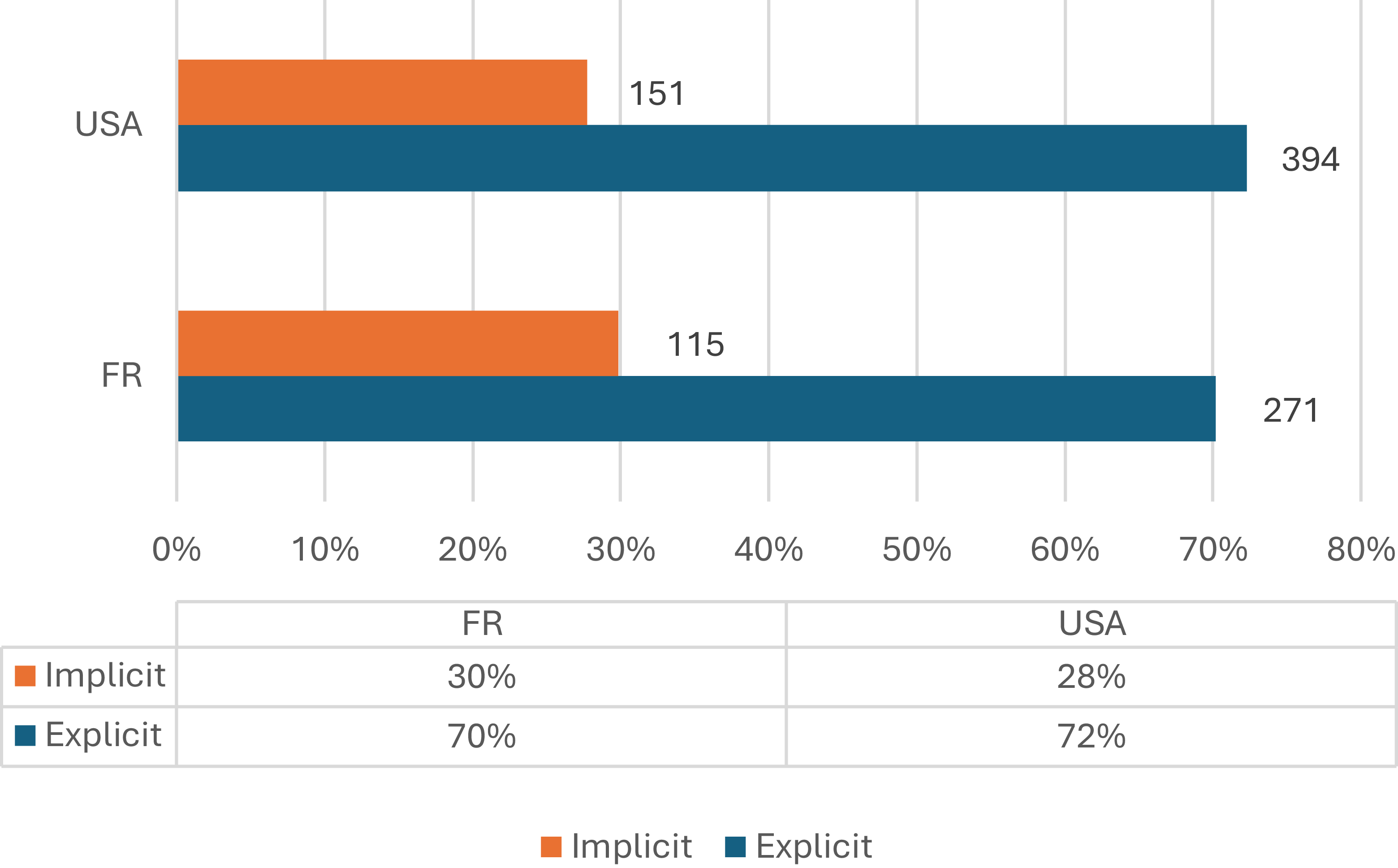
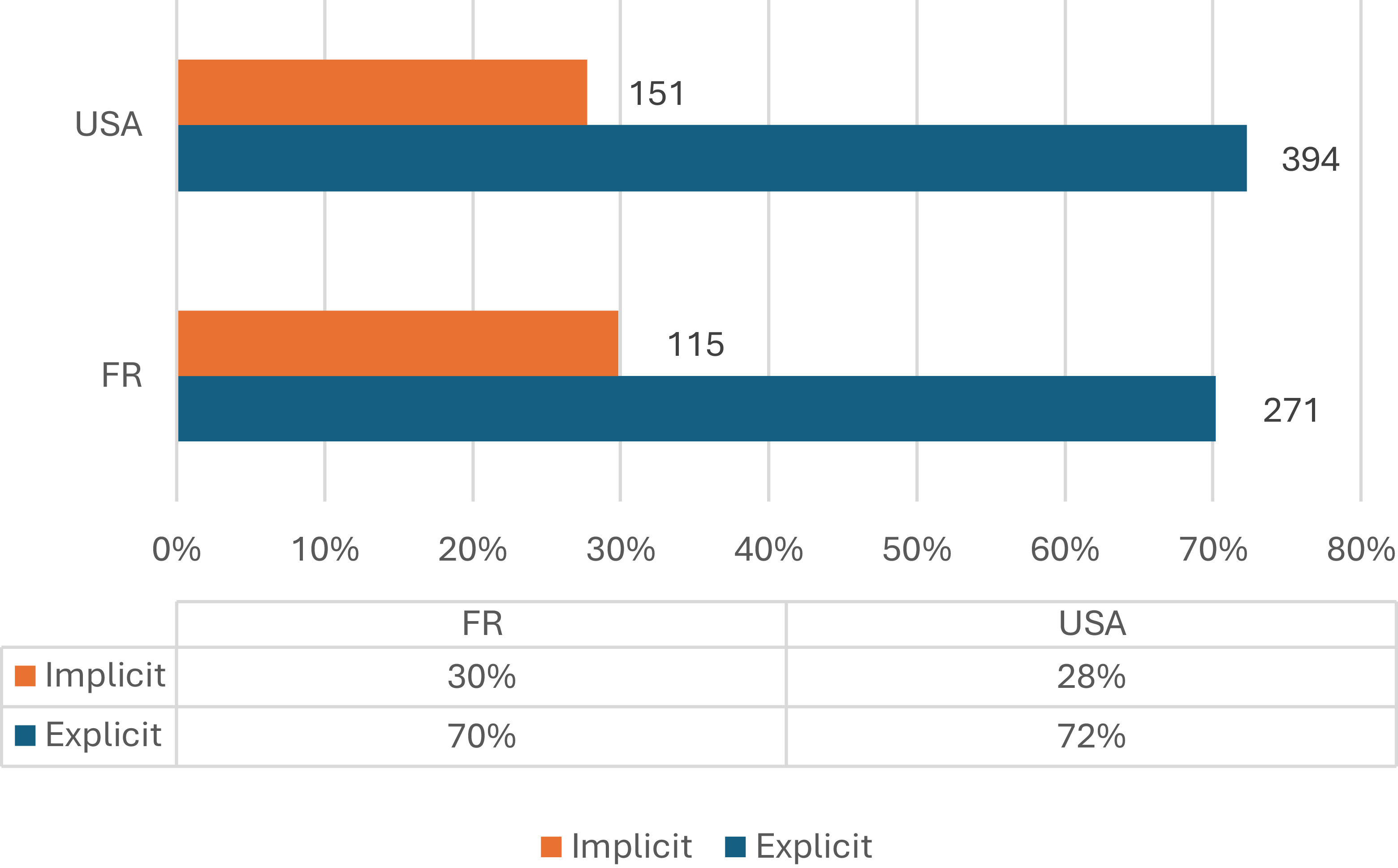
We then counted the total number of SPMs occurring in these syntactic units for each category (explicit vs. implicit self-praise). As shown in Figure (2), in both corpora, the majority of self-praise markers (SPMs) occur in syntactic units (sentences or phrases) in which the company engages in explicit self-praise: this applies to 70% of the SPMs in the French data, and 72% in the U.S. data. A chi-square test confirms that the distribution of explicit and implicit SPMs is indeed very similar across the two corpora. (χ2(1) = 0.48, p = .49).
Proportion of SPMs related to implicit vs explicit self-praise.
To further examine potential differences at the level of individual press releases, we calculated the proportion of implicit SPMs per press release.Footnote 13 The median proportionFootnote 14 of implicit SPMs was 24.90% for the French corpus and 17.90% for the U.S. corpus. A Wilcoxon rank-sum test indicated no statistically significant difference between groups (W = 216, p = .68).
Taken together, these results indicate that French and U.S. press releases do not differ significantly in how SPMs are distributed across explicit and implicit forms of self-praise.
6.2. Shifts in footing: praise by third parties
Previous research on self-praise has identified shifts in footing as a type of modification strategy: by attributing positive qualities to the speaker through a third party, the speaker merely positions themselves as a conduit, thereby avoiding the risk of being seen as excessively self-promotional.
In the corpus of press releases, shifts in footing were identified in various forms (6.2.1.) and subsequently quantified (6.2.2.).
6.2.1. Forms of shifts in footing
-
(a) By means of quotes, third parties, who are mainly partners of the company, mention positive information related to the company. These quotes may include explicit positive characteristics attributed to the company, as in (13).
-
(13) “L’arrondi solidaire mis en oeuvre pendant toute l’opération Pièces Jaunes est un formidable et puissant levier de générosité.” (223) (The charitable rounding mechanism implemented throughout the Pièces Jaunes campaign constitutes a remarkable and powerful driver of generosity.) (A03, 12.01.22)
In this example, the Managing Director of the Fondation des Hôpitaux, one of Auchan’s partners, praises the company for their contribution to ‘Opération Pièces Jaunes’, a programme designed to improve hospital conditions for children and adolescents. She recognizes their initiative as a remarkable and powerful lever for generosity.
However, positive elements that do not directly characterize the company (and even rather relate to the third party) can also indirectly benefit the company’s image. In (14) the co-founder and president of Nuro, an autonomous vehicle company, celebrates the leveraging of their new model in their partnership with Kroger, aimed at grocery delivery through self-driving vehicles. In this citation, Nuro praises their own products (most advanced). However, this also implicitly benefits Kroger’s positive image, since they are making use of these vehicles in their grocery delivery programme.
-
(14) “We look forward to leveraging our third-generation, and most advanced, autonomous vehicle to date to continue to build on the success of this program.” (K02, 12.01.22)
-
-
(b) The company states what customers (or others) report about them:
-
(15) “Our guests continue to tell us they love the ease and convenience of Drive Up, and they have been asking us to add even more of the Target experience to the service. (T01, 23.02.22)
-
-
(c) The company mentions that it has received an award or has been placed in a praiseworthy position in a particular ranking:
-
(16) Avec une note globale de 3,92/5 et un taux de recommandation à 80,5%, Auchan Retail intègre le Top 10 des entreprises de plus de 1000 stagiaires/alternants par an ! (With an overall score of 3.92/5 and a recommendation rate of 80.5%, Auchan Retail is one of the Top 10 companies with more than 1,000 trainees / alternates per year!) (A04, 14.02.22)
-
(17) Its Vista store is one of 542 Target buildings nationwide with solar installations, and the Solar Energy Industries Association (SEIA) recognizes Target as the top U.S. Corporate Onsite Installer with 255 megawatts of energy. (T06, 17.03.22)
-
6.2.2. Annotation and results
The annotation was carried out in the same way as in the previous section: for each syntactic unit (sentence of phrase) containing one or more SPMs, we identified if it featured a shift in footing. We then counted the total number of SPMs occurring in these segments. The frequencies for this strategy are very similar across both cultures: in the French corpus, 10.9% of SPMs occur in segments that feature a shift in footing (42 out of 386), compared to 9.2% in the U.S. corpus (50 out of 545). A chi-square test indicates that the observed difference is not statistically significant (χ2(1) = 0.74, p = .39).
6.3. Pseudo-shift in footing: self-quotations
6.3.1. Interpretation of self-quotations as a mitigation strategy
Self-quotations are a frequently used technique in press releases (cf. Section 3). They have been labelled ‘pseudo-direct speech’ by Bell (Reference Bell1991) and ‘constructed quotations’ by Jacobs (Reference Jacobs1999). The idea is, indeed, that these self-quotations are hardly ever direct reproductions of what has actually been said, but are instead entirely invented and fabricated by the writers of the text (Jacobs Reference Jacobs1999). Following Goffman (Reference Goffman1974), Jacobs (Reference Jacobs1999), attributes them a ‘distancing effect’ based on the following reasoning:
“[i]nstead of stating a view outright, the individual tends to attribute it to a character who happens to be himself, but one he has been careful to withdraw from in one regard or another” (Goffman Reference Goffman1974: 551, apud Jacobs Reference Jacobs1999: 190)
In this vein, self-quotations may also be interpreted as ‘pseudo-shifts in footing’: they create the impression that the self-praise is not directly voiced by the company itself, but rather attributed to a (pseudo) third party. Within the framework of politeness theory, it can thus be argued that self-quotations serve to mitigate the threat posed by self-praise. Comparable to what was observed in the case of praise by third parties (section 6.2), self-quotations can also convey either explicit (example (18)) or implicit forms of self-praise (example (19), where the company praises a partner, Stoney Clover Lane, through a quote):
-
(18) “Compte tenu de la taille de notre parc de magasins, de notre rôle au sein de notre filière, au contact de milliers de fournisseurs et de millions de clients, nous voulons participer à l’effort national et montrer que l’on peut, ensemble, par l’addition de petits et de grands gestes, en entreprise, mais aussi chez soi, faire la différence”. Alexandre Bompard, Président directeur général du Groupe Carrefour (“Given the size of our shop network and our role within the industry, in contact with thousands of suppliers and millions of customers, we want to play our part in the national effort and show that, together, we can make a difference through the addition of small and large gestures, both in the workplace and at home”.) (C06, 18.07.22)
-
(19) “We’ve admired how the brand has created such a highly recognizable aesthetic with a deeply engaged audience and know our guests will love finding Stoney Clover Lane at Target, just in time to show off their individual style for spring.” (quote by the executive vice president and chief merchandising officer at Target) (T05, 22.03.16)
6.3.2. Quantification and results
Against this theoretical backdrop, our aim is to examine whether self-quotations are employed in similar or divergent ways in the French and U.S. corpora as a strategy to mitigate the threat of self-praise. Our analysis was conducted in two phases. In the first phase (6.3.2.1.), we calculated the total number of self-praise markers (SPMs) occurring in self-quotation (SQ) and non-SQ segments across the two corpora to obtain a general overview of their distribution. However, because these figures do not account for the fact that seven out of twenty French press releases contain no self-quotations, nor for differences in the word length of SQ and non-SQ segments, we conducted a second phase based on normalized data and restricted to French releases containing SQ segments (see phase 2 (6.3.2.2.) for details).
6.3.2.1. Phase one: total numbers of SPMs – non normalized data
We first calculated the proportion of SPMs that occur within SQ segments and within non-SQ segments (Table 2). This measure reflects the extent to which each corpus relies on self-quotation as a discursive environment for self-praise.
Distribution of SPMs over SQ and non-SQ segments

The results show that the majority of SPMs occur in non-SQ segments in both corpora. The proportion of SPMs in non-SQ segments is significantly higher in the French corpus (83.7% of all SPMs) than in the U.S. corpus (74.7% of all SPMs) (χ2 = 10.81, p < 0.01, df = 1). This suggests that US press releases make more strategic use of self-quotation as a vehicle for self-praise. However, it is important to recall that 7 of the French releasesFootnote 15 do not contain any SQ segment, whereas all 20 U.S. press releases contain at least one SQ segment. This absence in the French corpus necessarily inflates the relative weight of non-SQ segments. As a matter of fact, when restricting the analysis to the 13 French press releases that contain at least one SQ segment, the proportion of SPMs occurring in SQ segments rises to 22% and differences between both corpora are no longer significant (χ2 = 1.28, p = .26, df = 1).
In the following section we turn to the analyses conducted on normalized data.
6.3.2.2. Phase two: results for normalized data and for press releases containing SQ segments
In the second phase, we focused exclusively on press releases containing SQ segments (i.e., 13 for the French and all 20 for the U.S. corpus) and calculated, for each text, normalized frequencies of SPMs per 100 words in SQ and non-SQ segments. We first examined whether (all) SPMs occur more frequently in SQ segments in both corpora and whether this pattern differs cross-culturally (1). In a next step, we investigated whether the proportion of explicit to implicit self-praise markersFootnote 16 differs between SQ and non-SQ segments, that is, whether explicit SPMs make up a larger share of all SPMs in SQ segments than in non-SQ segments. Since explicit SPMs convey more overtly threatening self-praise, they can be expected to require additional mitigation. If self-quotation serves such a mitigating function, the relative proportion of explicit SPMs should be higher within SQ segments than within non-SQ segments.
(1) Results for all SPMs
RQ1: Do SPMs occur more frequently in SQ segments than in non-SQ segments in both corpora?
To address RQ1, we compared, for each press release, the normalized frequencies of all SPMs per 100 words in SQ and non-SQ segments, and then calculated the median rates for each corpus (see Table 3). Because each press release contributes a pair of values (one SQ rate and one non-SQ rate), we used a Wilcoxon signed-rank test with a directional hypothesis (i.e., one-sided), which tests whether SPM rates tend to be significantly higher in SQ than in non-SQ segments. As an effect size, we report the Hodges-Lehmann estimate,Footnote 17 which can be interpreted as the typical increase in SPMs per 100 words when moving from non-SQ to SQ.
Median normalized frequencies of SPMs (per 100 words) in SQ and non-SQ segments

Both in the French and the U.S. corpus, the median SPM rates are higher in SQ than in non-SQ segment and for both corpora, this difference is supported by the one-sided Wilcoxon signed-rank test (V =70, p < 0.05 for French; V = 164 p < 0.05 for U.S.). The Hodges–Lehmann estimate indicates a typical increase of 1.16 SPMs per 100 words in SQ relative to non-SQ [95% CI: 0.22, ∞Footnote 18), for the French corpus, and of 2.01 SPMs per 100 words in SQ relative to non-SQ [95% CI: 0.43, ∞) for the U.S. corpus.
RQ2: Do French and U.S. companies differ in the relative frequency of SPMs occurring in SQ versus non-SQ segments?
To address RQ2, for each press release, we computed the ratio of SPMs in SQ segments to those in non-SQ segmentsFootnote 19 and then calculated the median ratio for each corpus. The median ratio is slightly higher in the U.S. corpus (1.70) than in the French corpus (1.21). However, the ratios in the French corpus were not significantly lower than those in the U.S. corpus (W = 120, p = .36).
(2) Results for proportions of explicit /vs/ implicit SMPs
RQ3: Do explicit SPMs, in relation to implicit SPMs, occur more frequently in self-quotation (SQ) segments than in non-SQ segments within each corpus?
To address RQ3, we calculated, for each press release, the proportion of explicit self-praise markers relative to all self-praise markers (i.e., explicit/[explicit + implicit]) within both SQ and non-SQ segments, thereby assessing whether explicit forms occur more frequently in SQ than in non-SQ contexts.
Table 4 shows that, in the French corpus, the median proportion of explicit SPMs relative to all SPMs is lower in SQ segments (Mdn = 0.43) than in non-SQ segments (Mdn = 0.75), but a one-sided Wilcoxon signed-rank test did not reveal a statistically significant difference (V = 24.5, p = .076). For the U.S. corpus, the median proportion of explicit SPMs is almost identical across segment types (SQ: 0.85; non-SQ: 0.84). A Wilcoxon signed-rank test confirmed that this difference was not significant (V = 84.5, p = .41). In other words, in U.S. press releases, explicit self-praise occurred with roughly the same relative frequency in self-quotation and non-quotation segments.
Median proportions of explicit SPMs relative to all self-praise markers in SQ and non-SQ segments

RQ4. Do French and U.S. companies differ in the relative prominence of explicit self-praise within self-quotation?
RQ4 examines if the ratio between the proportion of explicit SPMs in SQ and non-SQ segments is higher in one corpus than in the other (PropExplSQ_US/PropExplNonSQ_US vs. PropExplSQ_FR/PropExplNonSQ_FR)?
To operationalize this question, we computed, for each press release, the within-text difference between these proportions (delta = PropExplSQ − PropExplNonSQ) (see Table 5). Positive values indicate a higher proportion of explicit self-praise within SQ segments, whereas negative values indicate the opposite pattern.
Median within-text differences in the proportion of explicit SPMs relative to all self-praise markers

For the French corpus, the Median value of −0.21 indicates that delta values (PropExplSQ – PropExplNonSQ) are generally negative, confirming that explicit self-praise occurs proportionally less often in SQ than in non-SQ segments. In contrast, the U.S. corpus shows delta values centre around zero (Mdn = 0.00), suggesting no systematic difference between the two segment types. These results are consistent with the pattern observed for RQ3. To test whether these differences between corpora are statistically robust, we used a Wilcoxon rank-sum test. The test reveals a significant cross-cultural difference (W = 77.5, p < 0.05, one-sided). The Hodges-Lehmann estimate of −0.27 [95% CI: −∞, −0.02] shows that the typical delta in the French data is about 0.27 points lower than in the U.S. data. In other words, French press releases show, on average, a stronger reduction in explicitness between non-quoted and quoted segments than U.S. press releases.
6.3.2.3. Conclusion
The different statistical tests applied in this section allow for the following conclusions:
-
(1) In both corpora, there is a clear tendency to use self-quotations as a privileged locus for self-praise: in both the French and U.S. press releases, the normalized frequency of SPMs is higher in SQ segments than in non-SQ segments. The effect is stronger in the U.S. corpus, where the typical within-release increase amounts to roughly two SPMs per 100 words (compared to about one in the French corpus). However, although the ratio of SPMs in SQ to those in non-SQ segments was consequently higher in the U.S. data than in the French data, this cross-cultural difference did not reach statistical significance.
-
(2) The hypothesis that explicit SPMs would occur proportionally more often in SQ than in non-SQ segments was not confirmed. In the French corpus, an opposite tendency was observed (albeit not significant, p = .07): explicit SPMs tend to occur slightly more often, relative to implicit ones, in non-SQ than in SQ segments. In the U.S. corpus, by contrast, explicit SPMs occur in roughly the same proportion in SQ and non-SQ segments. The difference between the French and U.S. corpora was statistically significant. This means that self-quotation is associated with less explicit forms of self-praise in the French press releases, whereas in the U.S. corpus, the proportion of explicit self-praise remains largely stable across quoted and non-quoted segments. These results will be further interpreted in Section 7 (Discussion).
6.4. Shift of credit to third parties
6.4.1. Interpretation as a mitigation strategy and operationalization
In contrast to the previous strategies – where a third party or pseudo-third party is used to reinforce the company’s positive image – there are also instances where the company explicitly attributes (part of) the credit for positive outcomes to others. Such shifts of credit may target internal stakeholders like employees (e.g. example (20)) or external ones such as business partners (e.g. example (21)):
-
(20) “Our team is at the heart of our strategy and success, and their energy and resilience keep us at the forefront of meeting the changing needs of our guests year after year.” (T02, 28.02.22)
-
(21) “Through Boost, Kroger is uniquely positioned to be Fresh for Everyone, making grocery delivery accessible to more customers through the industry’s most affordable grocery delivery membership program.” (K09, 24.06.22)
Examples like (22), where the partnership itself is framed as the agent responsible for positive outcomes, were likewise included in this type of strategy. By making the partner the grammatical subject or the agent of the action, the company subtly redirects the praise, thereby potentially reducing its own self-promotional stance:
-
(22) Ce partenariat permet notamment de réduire significativement la distance de transport entre le lieu de production des citrons et leur lieu de commercialisation […]. (In particular, this partnership will significantly reduce the transport distance between where the lemons are produced and where they are sold […].) (C05, 08.07.22)
6.4.2. Quantification and results
Only SPMs involving explicit self-praise by the company were considered for annotation in this category (i.e., instances of implicit praise or praise by third parties were excluded). Shifts in credit may occur in either the main text or in self-quotation segments; both were examined.
Overall, this mitigation strategy is only marginally used in both corpora: 1.4% (5 out of 368) of SPMs in the French corpus and 2.9% (16 out of 545) in the U.S. corpus are embedded in utterances that involve a shift of credit to a third party. While the proportion is slightly higher in the U.S. corpus, the difference is not statistically significant (χ2 = 2.431, p = .12, df = 1).
6.5. Point-of-view operations
6.5.1. Interpretation as a mitigation strategy and operationalization
As discussed in Section 3, various strategies and mechanisms are employed by writers of press releases to “hide their relationship to the information they provide” (Jacobs, Reference Jacobs1999: 124). In addition to the use of self-quotations examined in Section 6.3., these strategies include referring to the company in the third person instead of the first, as well as the use of impersonal constructions (e.g., with one in subject position), passive voice, nominalizations, and syntactic structures that shift the focus to third parties, such as customers and their potential use of the company’s products or services.
While these strategies were not quantified in Jacobs (Reference Jacobs1999), we aim to provide a quantitative analysis of point-of-view operations in the corpus, comparing French and U.S. press releases, with a specific focus on how the company is referred to within the texts.
However, given that the third-person perspective is nearly omnipresent – with virtually no instances of first-person references – this general strategy has been excluded from the present analysis. The analysis has also been restricted to sentences containing (at least one SPM and) explicit self-praise that is clearly endorsed by the company itself. As such, instances of third-party praise (cf. Section 6.2.) have been excluded. Additionally, only sentences that contain a syntactic subject have been considered.
For annotation purposes, a distinction was made between three categories:
-
(a) No distancing. The first category includes sentences in which the syntactic subject of the main clause is the company itself or one of its key actors (e.g., the stores, employees, or management). In these cases, the company is foregrounded as the (responsible) actor behind the reported actions or claims, and no point-of-view distancing occurs:
-
(23) The Kroger Co. (…) and Nuro announced today an expanded collaboration to continue redefining the customer experience leveraging autonomous vehicles with the introduction of Nuro’s third-generation autonomous delivery vehicle. (K02, 12.01.22)
-
-
(b) Partial distancing. This category includes sentences in which the syntactic subject of the main clause is not the company itself, although the company is still referred to in another syntactic role within the sentence. In such cases, the company remains present but less prominently so than in Category 1:
-
(24) This expanded collaboration is a key part of Kroger’s seamless ecosystem. (K02, 12.01.22)
-
(25) Près de 400 métiers sont proposés en magasins […] ou dans nos services d’appui (DATA, SI, marketing…) et en logistique. (Nearly 400 jobs are on offer in shops […] or in our support services (DATA, IS, marketing, etc.) and logistics.) (A04, 14.02.22)
-
-
(c) Maximum distancing. The last category includes sentences in which there is no reference to the company whatsoever. This category represents the greatest degree of point-of-view distancing.
-
(26) La satisfaction sera, elle aussi renforcée grâce à une analyse des datas permettant une évaluation continue du service et son amélioration si besoin. (Satisfaction will also be improved by analysing data to enable ongoing evaluation of the service and improvements where necessary.) (A08, 05.09.22)
-
(27) More than 350 chargers have been implemented in areas of Arizona, California, Colorado, Georgia, Indiana, Nevada, Oregon, Texas, Utah and Wyoming, with several more chargers expected to be installed by the end of the year. (K08, 22.06.22)
-
6.5.2. Results
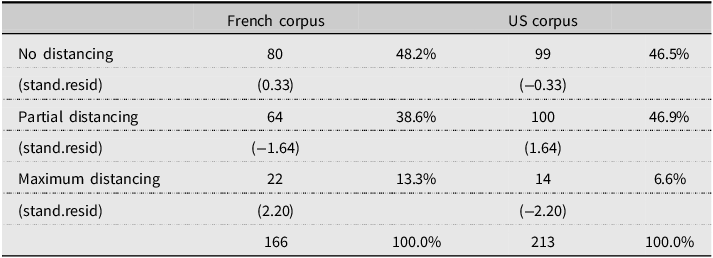
Table 6 presents the distribution of sentences (containing at least one SPM and explicit self-praise endorsed by the company, excluding praise by third parties and sentences without a syntactic subject) across the three categories for each subcorpus. It can be observed that the first two categories account for the vast majority of cases in both corpora, while the third category is much less represented. In just under half of the sentences (48.2% in the French corpus, 46.5% in the U.S. corpus), there is no point-of-view distancing: the company appears as the syntactic subject and thus occupies a prominent, agentive position in the text. Moreover, in about 90% of the cases, there is at least one explicit reference to the company, its key actors, or its products and services, whether as subject or in another syntactic role. By contrast, sentences in which there is no reference at all to the company are relatively rare: 13.3% of the French data and only 6.6% of the U.S. data fall into this category.
Comparison of point-of-view distancing across corpora (FR vs. US)
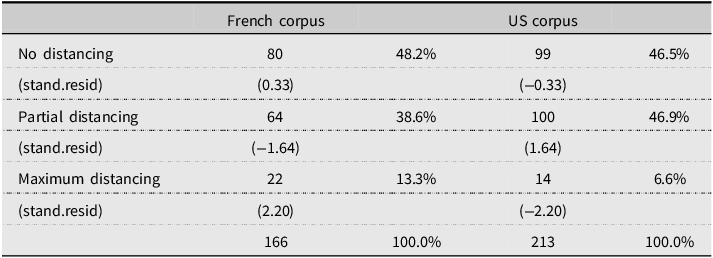
Although the overall distribution is largely similar across the two corpora, a chi-square test indicates a near-significant difference in the distribution across categories (χ2(2) = 5.96, p = .051). The effect size, as measured by Cramer’s V, is 0.125, suggesting a weak association between language-culture (French vs. U.S.) and the the choice of distancing category. An examination of the standardized residuals further clarifies this result: the third category (maximum distancing) is overrepresented in the French corpus (residuals = 2.20) and underrepresented in the U.S. corpus (residuals = −2.20), while the differences in the two other categories are minor and not statistically significant (±0.33 and ±1.64, respectively).
Taken together, these results suggest that while both corpora are overall relatively similar, maximal point-of-view distancing occurs somewhat more frequently in French press releases than in their U.S. counterparts.
6.6. Mitigation strategies targeting the company’s actions
The strategies discussed so far all involved a shift in perspective or focus. Positive information about the company was either conveyed implicitly, or expressed by others (praise by third parties) or pseudo-others (self-quotations). In other cases, credit for the praiseworthy information was attributed to parties other than the company itself (credit shift). Finally, in some instances of explicit self-praise, the company did not occupy the subject position in the sentence, or was not mentioned at all, thereby creating a more or less marked point-of-view distancing effect.
In this final section, we turn to two additional types of mitigation strategies that do not primarily involve a shift in perspective, but rather operate on the level of the action or claim itself. More specifically, these strategies attenuate the intensity of the company’s self-praise by either (1) highlighting the effort behind the achievement, or (2) reducing the certainty or completeness of the action through lexical or modal devices. For these strategies, we considered only explicit forms of self-praise endorsed by the company itself, thereby excluding praise expressed by third parties.
-
(a) The first type, observed only four times, and exclusively in the U.S. corpus, mitigates self-praise by framing success as the result of sustained investment or hard work (cf. Section 2). This narrative of effort can make corporate achievements appear more earned and less boastful, as illustrated in the following examples:
-
(28) Kroger is working to advance lasting positive changes for people, our planet and systems by 2030. (K08, 22.06.22)
-
(29) “Years of investment in our team and business have driven our sales beyond $100 billion and positioned Target to meet the needs of our guests no matter how they choose to shop,” said Michael Fiddelke, chief financial officer, Target. (T03, 01.03.22)
-
-
(b) The second type of strategy corresponds to what previous research on self-praise has referred to as internal modifiers (e.g., Tobback Reference Tobback2019c). In the present corpus, these take the form of verbs and constructions that modulate the status of the action being described. Some reflect epistemic modality, suggesting that the action is expected but not guaranteed (30); others express volitional modality, framing the action as an intention or goal rather than a completed fact (31); still others reduce the strength of the verb itself by using attenuating or supporting verbs such as help to or strive to (32-33):
-
(30) Roundel drove more than $1 billion in value in 2021, and the company expects that to grow to over $2 billion in the next few years. (T03, 01.03.22)
-
(31) Auchan entend ainsi jouer pleinement son rôle d’acteur majeur dans le développement des filières courtes… (In this way, Auchan intends to fully play its role as a major player in the development of short supply chains…) (A10, 17.10.22)
-
(32) These expanded offerings help advance key portions of the company’s Target Forward strategy… (T02, 28.02.22)
-
(33) Ultimately, we strive to be a true partner to BIPOC businesses. (T07, 10.05.22)
-
These kinds of examples reduce the assertiveness of the company’s claims. Rather than stating outright that something is the case, they shift to what is expected, intended, or in progress.
Like the effort-framing strategy, the use of internal modifiers also appears to be relatively marginal in the corpus, with only eight occurrences in the French press releases and seven in the U.S. ones.
The following section provides a brief quantitative summary of the proportion of SPM-containing sentences that are not accompanied by any of the mitigation strategies discussed above.
6.7. Residual unmitigated self-praise
In the preceding sections, we examined in detail how salient forms of self-praise are accompanied by pragmatic mitigation strategies and how frequently these occur across the two corpora. To gain an overall view of the relative importance of mitigation, we calculated the proportion of SPM-containing sentences that are not accompanied by any of the strategies identified above. This is the case for 43.7% of such sentences in the French corpus and 40.7% in the U.S. corpus. The observed difference is not statistically significant (χ2(1) = 0.38; p = .54). At the level of individual texts, the mean proportion of unmitigated SPM-containing sentences is again relatively high, with 47.6% (SD = 23.9) in the French data versus 39.1% (SD = 22.6) in the U.S. corpus (the difference is not statistically significant (Welch’s t(37.89) = 1.16, p = .25)).
Hence, roughly half of all salient self-praise remains pragmatically unmitigated in both corpora.
7. Discussion
This study set out to examine how two French and two U.S. companies engage in self-praise within the specific genre of corporate press releases. Given that press releases are inherently designed to present the company in a favourable light to journalists and their audiences, we focused on salient forms of self-praise: that is, sentences containing at least one intensified subjective (qualitative) or objective (quantitative) linguistic element. In addition, the study investigated to what extent these strong self-praise expressions are accompanied by pragmatic mitigation strategies previously described in research on press releases or on self-praise in other discursive contexts.
The discussion below first summarizes the most salient points of convergence across the French and U.S. corpus (1) and then highlights the main cross-cultural differences (2).
-
(1) Shared tendencies. The quantitative overview presented above showed that roughly half of all salient self-praise remains pragmatically unmitigated in both corpora. Beyond this overall tendency, explicit self-praise clearly dominates, accounting for approximately 70 percent of all self-praise markers (SPMs). Sentences without any reference to the company at all are relatively rare (around 10 percent), and most self-praise occurs with the company still at the centre of the message. Moreover, most mitigation strategies do not operate on the level of the action or claim itself. Only a few instances feature references to effort or hard work (four in the U.S. data), or use epistemic or volitional modality to tone down assertiveness (eight French and seven U.S. cases). Instead, mitigation often operates through shifts in perspective. This applies not only to third-party praise (about 10 percent in each corpus) and self-quotation (treated as a pseudo-shift in footing), but also to several forms of implicit praise, in particular when attention is redirected to benefits offered to third parties, to product qualities for which the company is not directly responsible, or to emotional stances (e.g., being “proud” or “honoured”), rather than to the achievement itself. In all these cases, mitigation consists mainly of adding a thin layer of rhetorical distance, with the company itself remaining (at least partly) the focus of the positive evaluation. However, these perspective shifts do not all function in the same way. In particular, implicit self-praise may involve a more substantial redirection of attention, highlighting the strengths of external partners or the social contexts in which the company operates, thereby indirectly enhancing its image. Even in such cases, however, the intensity of the self-praise itself is not toned down. This finding is consistent with Tobback (Reference Tobback2019c), who likewise observed very few downtoners in both French and U.S. LinkedIn summaries. The scarcity of downtoners in both datasets is probably related to the nature of the genres involved: like LinkedIn summaries, which present individuals positively, corporate press releases inherently intend to present organizations in a positive light. In such contexts, it is probably not surprising that mitigation tends to operate through perspective shifts rather than by weakening the positively evaluated content itself.
-
(2) Cross-cultural differences. Despite these broad similarities, several cross-cultural contrasts emerged. The most striking difference concerns the overall density of self-praise markers: U.S. press releases contain significantly higher numbers of SPMs than their French counterparts. Thus, even though salient forms of self-praise are mitigated in often comparable proportions in both corpora, U.S. companies in the sample appear more willing to promote themselves in an assertive way. This aligns with earlier findings by Tobback (Reference Tobback2019c), who likewise found a higher frequency of intensified self-praise in U.S. than in French LinkedIn summaries of individual professionals. More generally, although we must be cautious when linking fine-grained pragmatic analyses to broader cultural tendencies described in intercultural research, these contrasts may resonate with tendencies identified in Hofstede’s (Reference Hofstede2001) framework: the United States scores higher on individualism than France, which may help explain a greater tolerance for assertive self-promotion (see for instance Boucher & Maslach, Reference Boucher and Maslach2009). Interestingly, our data suggest that not only individual professionals but also U.S. companies tend to apply the modesty principle (Leech Reference Leech1983, Reference Leech2014) less restrictively than their French counterparts. In other words, the results seem to indicate that the modesty principle is not only a key notion in interpersonal facework but can also be applied to the level of professional face in institutional communication.
Differences also emerged in two particular types of mitigation strategies, namely point-of-view distancing and self-quotations. Point-of-view distancing occurred somewhat more frequently in the French corpus. Notably, sentences without any reference to the company tend to render self-praise less transparent, arguably resembling the effect of implicit self-praise.
Self-quotations, on the other hand, constitute a privileged locus for self-praise in both corpora, thereby confirming earlier findings (e.g. Jacobs Reference Jacobs1999, Catenaccio Reference Catenaccio2008, Pander Maat Reference Pander Maat2007), but their use tends to be stronger in the U.S. corpus (without reaching statistical significance). Interestingly, explicit SPMs do not occur more often in self-quotation segments than elsewhere. In the French corpus, they even tend to appear less frequently in quoted speech. Moreover, self-quotations were entirely absent from seven of the twenty French press releases. This pattern might suggest that French press release writers do not regard self-quotation as an equally appropriate form of mitigation as their American colleagues. One possible explanation is that the distancing offered by self-quotation remains largely superficial. Since the positive message is still uttered by a person rather than by the impersonal corporate voice that dominates the rest of the text, in the French context, this personalization might render self-praise, and especially explicit self-praise, more reminiscent of interpersonal boasting, and thus more face-threatening. This interpretation would again be consistent with previous research suggesting that the French communicative culture tends to attach greater value to the modesty principle (Leech Reference Leech1983, Reference Leech2014) and to more restrained forms of self-promotion (e.g., Tobback Reference Tobback2019b, Reference Tobback2019c; Wieland Reference Wieland1995).
8. Conclusion
This study contributes to our understanding of how companies engage in positive self-presentation through salient forms of self-praise in press releases. It offers, to our knowledge, the first comprehensive and quantified overview of a wide range of mitigation strategies accompanying self-praise, and the first systematic comparison of French and U.S. press releases in this respect.
The findings highlight that both French and U.S. companies engage frequently and explicitly in self-praise in their press releases, and that mitigation strategies are applied in broadly similar ways across the two corpora, with differences relating mainly to the density of self-praise markers and the use of explicit self-praise in self-quotations, results which have been related to broader cultural and pragmatic tendencies. Beyond their cross-cultural dimension, the findings also contribute to ongoing discussions on self-praise and facework by showing that the modesty principle operates not only at an individual level but also as a resource for managing professional face at the institutional level.
Given the limited size of the dataset, the results should of course be interpreted with caution. Further research based on larger corpora, involving a higher number of comparable companies, and on other types of corporate communication, such as company websites, will be needed to assess the generalizability of these tendencies.
Competing interests
The authors declare none.
Funding
No external funding applicable





 Open access

