

Introduction
In the Mansion House speech of March 2018, then British Prime Minister Theresa May spelled out institutional arrangements for the post-Brexit economic relationship between the UK and the EU that would have required the European Commission to place substantial trust in the British government. May proposed arrangements for cooperation based on the mutual recognition of standards rather than adherence to common EU regulations and intimated the UK could undertake border checks on behalf of the EU in order to smooth the transition. May’s pitch thus sought to articulate creative means of ensuring that Britain’s withdrawal from the EU would not sever long-established forms of cooperation or undermine the close economic relationship between Britain and its European partners. Since her government’s perceived mandate to ‘take back control’ from EU institutions precluded continued cooperation within the existing institutions, May instead sought to shift the relationship from one of formal legal obligations to looser arrangements based on mutual assurances, which, consequently, required a substantial amount of trust. Yet May’s proposals proved a non-starter with the Commission, which was not willing to countenance the dangers that such an arrangement would bring about, leading ultimately to their rejection and to May’s fall from power the following year.
The May government’s inability to ‘deliver’ Brexit on the desired terms highlights a paradox that haunts governments motivated by sovereigntist modes of thinking if they seek to return political decision-making to the level of the state while maintaining the benefits of deep international cooperation. Because of their aversion to supranational control, sovereigntist governments need to generate more trust than other governments to achieve comparable levels of institutionalised cooperation. However, owing to the sovereigntist politics they represent, they find it difficult to trust their partners and convince those partners that they themselves can be trusted not to defect. This brings about a trust deficit, making ongoing cooperation more difficult to achieve. Because sovereigntist governments need to generate higher levels of trust than they are able to achieve in order to sustain the same level of cooperation, these governments are forced into a difficult trade-off – either sacrifice mutually beneficial cooperation or accept levels of control at odds with their sovereigntist commitments.
This paradox is becoming increasingly evident in world politics as sovereigntist governments in both autocracies and democracies seek to challenge the institutionalised arrangements they regard as an affront to their sovereignty without disrupting underlying forms of cooperation which they continue to benefit from. The desire to continue cooperation but on less invasive terms, which we label ‘sovereigntist internationalism,’ can be seen in numerous examples of governments seeking ‘flexible’ alternatives to the institutionalised liberal international order. For example, the desire to renegotiate the existing rules-based order along lines that are less constraining of national sovereignty can be witnessed in Donald Trump’s attacks on ‘unfair’ trade agreements, the multiple challenges to the EU from members and neighbouring states, and the efforts of Latin American populist leaders to reform Mercosur along more flexible lines.Footnote 1 It is also evident in the focus on high-level summitry and interpersonal deal-making, which has come to define the foreign policies of a host of sovereigntist leaders, from Donald Trump and Narendra Modi to Xi Jinping and Vladimir Putin.
To demonstrate the paradox of sovereigntist internationalism empirically, this article examines the conduct of the Brexit negotiations by the May government following the June 2016 referendum. The Leave campaign was a sovereigntist project undertaken within a context of complex and asymmetric interdependence between Britain and the EU, such that the institutional rupture of Brexit required efforts on both sides to mitigate the consequences. As a pragmatic politician, May sought to deliver on the referendum vote and withdraw the UK from the EU in a meaningful way while minimising the resulting disruption to ongoing deep cooperation across numerous policy areas. Drawing on elite interviews and a range of supplementary sources, we show how efforts by the UK government to translate the sovereigntist concerns of the Leave campaign into a negotiating position led to the articulation of strict ‘red lines’ which precluded outcomes based on the existing institutional arrangements involving high levels of supranational control. Facing the severe consequences of rupture in the economic relationship, the UK sought to transpose cooperation into looser institutional arrangements that would have required far higher levels of trust. Yet generating this trust became increasingly difficult owing to growing Euroscepticism in the UK and rising frustration on the part of the EU Commission.
Our argument makes a theoretical contribution to debates in International Relations (IR) on institutional designFootnote 2 by demonstrating how different institutional arrangements can embody trade-offs between trust and control. It also shows how actors’ preferences for the form institutions should take are shaped at least in part by their sensitivity to political control. The argument complements existing work on trust buildingFootnote 3 (the ‘supply side’ of the trust problem) by addressing the comparatively understudied question of how the need for trust to achieve cooperation varies across different actors (the ‘demand side’). Moreover, the argument contributes to recent work on populist and new right foreign policyFootnote 4 by describing how such actors view international institutions and highlighting the specific problems they face in initiating and sustaining cooperation. Empirically, the argument helps account for various aspects of the Brexit negotiations, including the May government’s emphasis on trust-based solutions and the decision of Boris Johnson’s government to opt for a more distant relationship with the EU. In terms of policy, our findings show the importance of assessing the actor-specific level of trust needed for certain forms of institutionalised cooperation and provide lessons for how states can seek to preserve cooperative arrangements involving sovereigntist actors averse to supranational control.
Trust, control, and institutional design
In an interdependent world, states have little choice but to cooperate with one another if they want to manage the externalities of their mutual engagement and reap the benefits of coordinated action.Footnote 5 Through cooperation, they can establish productive divisions-of-labour, lower barriers to economic engagement, align their positions on issues of high importance to them, manage potentially damaging externalities, overcome collective action problems, and engage in mutually beneficial joint projects.Footnote 6 Yet cooperation comes with the possibility that the other side will defect. Actors often can gain advantages in the short-term by abrogating commitments entered into, which in turn can have highly damaging consequences for their former partners. Generally speaking, the deeper the cooperation in terms of the commitments made, the more of a problem uncertainty about the future behaviour of the other actors can become.Footnote 7 While many social situations are accompanied by high levels of uncertainty, the problem is particularly pronounced in international politics owing to the absence of a central authority to control behaviour, sanction transgressions, or even just provide a shared frame of meaning, given the heterogeneous identities and worldviews of the actors involved.Footnote 8
There are two ways actors can reduce uncertainty to achieve deep cooperation within institutions: control and trust.Footnote 9 Control reduces uncertainty by constraining what actors can do.Footnote 10 It often involves the centralisation of decision-making in institutions with mechanisms of enforcement and sanctioning, such that defectors can be punished and risks managed effectively. A related aspect of control is the collection and processing of information on the intentions, capabilities, and behaviour of actors, which can supplement – but not replace – the imposition of constraints.Footnote 11 Within the context of institutionalised cooperation, different institutional arrangements can embody higher levels of control,Footnote 12 notably if they are characterised by extensive legalisation and judicialisation,Footnote 13 significant delegation to supranational authorities,Footnote 14 the existence of majoritarian decision-rules,Footnote 15 and high levels of institutional capacity.Footnote 16 Conversely, control is low where institutions are non-legalised, delegation is absent, decision-making is consensual, and institutional capacity is low.
Another means of dealing with uncertainty is via trust, that is, the subjective commitment to act as if it were certain that others would reciprocate cooperation. As a non-calculative way of anticipating the future, trust entails the eclipsing of the possibility of defection rather than an assessment that it is unlikely to occur.Footnote 17 Trust is thus qualitatively different from a probabilistic assessment of how another actor will behave in a given situation, which would instead represent a distinct form of control. This is not to say that the process leading to trust cannot involve elements of rational calculation, only that trust itself is a state in which calculation is suspended.Footnote 18 Trust allows actors to cope with uncertainty by reducing the scope of anticipated behaviour of others, since ‘by introducing trust, certain possibilities of development can be excluded from consideration.’Footnote 19 Actors can establish and maintain deep cooperation even within less centralised institutions if they succeed in building up a substantial amount of trust. This then allows them to accept considerable vulnerability in their dealings with others because they simply take it for granted that the latter will not exploit their cooperative behaviour.Footnote 20 Whereas control addresses the problem of uncertainty objectively by making the world more predictable, trust addresses it subjectively by shaping the actor’s imagination of the world.Footnote 21
The relationship between trust, control, and institutions has been the subject of much research within the discipline of IR. The most common way of understanding the relationship has been one in which either trust or institutions embodying control are necessary for – and causally prior to – the development of the other. Trust has been identified as an important factor underlying the establishment of control through institutionalisation.Footnote 22 In return, institutions and the control they embody are seen by many institutionalist scholars as a necessary precondition for trust-building, since they foster reciprocal interaction and shared engagement.Footnote 23 The resulting difficulty of disentangling the causal relationship between trust, control, and institutions both conceptually and empirically represents an oft-noted ‘chicken and egg’ problem.Footnote 24 Generally, however, rationalist and constructivist scholars agree that once the hurdle of initiating cooperation has been overcome, trust and control can be mutually reinforcing in processes of institutionalisation, leading to strong and long-lasting cooperative arrangements.Footnote 25
While these causal links are important if we want to understand the conditions under which states can create international institutions, we are interested here in a different facet of the relationship between trust and control; namely, their partial substitutability in institutional design.Footnote 26 Trust and control embody distinct logics of interaction, yet both represent different means of approaching the same problem of uncertainty about the future behaviour of others. As such, both trust and control are partially substitutable enablers of deep cooperation within institutions, and states proposing such institutions can seek to rely on various combinations of one or the other to reduce uncertainty and align their actions.Footnote 27 Moreover, precisely because they represent distinct logics that come with distinct advantages and drawbacks, for actors designing institutions, the choice between trust and control is a highly consequential one. By treating trust and control as partially functional substitutes, we are able to comprehend how specific actor attributes – including the reticence to incur the costs of control – imply different trust needs, which in turn drive actors to seek different solutions to cooperation problems. In other words, actors with different trust needs prefer different kinds of institutional designs.
The two options of coping with uncertainty in institutional design differ in the relative costs that states encounter. Control can help to reduce uncertainty, but it is also costly, since it requires the establishment and staffing of new organisations and the ceding of control at the national level, which in turn is often met with domestic political opposition. Trust is cheaper than control as a means of reducing uncertainty, since it requires nothing more onerous than a commitment, but it is also more dangerous, given the damage incurred if others behave in unexpected ways. It is important to note here that social actors cannot fully transform the uncertainty resulting from their interdependence into calculable risk.Footnote 28 Thus, their choice between trust and control in institutional design is underdetermined. Given the perils associated with trust, we nonetheless assume that actors generally will prefer cooperation based on control when it is easily available. Actors that can tolerate institutions embodying a high level of control have a low need for trust and will therefore find it easier to accept a wider range of institutional designs. This does not mean that they would not be able to trust others or project trustworthiness, simply that their ability to cooperate does not depend on it. In other words, they have a surplus of trust. In contrast, where control is unavailable as a means to reduce uncertainty, institutions will require a lot of trust to function. As a result, states will then be able to cooperate within institutions only when a corresponding level of trust can be generated. If the demand for trust exceeds the supply, then a deficit of trust occurs and cooperation at the desired level becomes unfeasible.
The paradox of sovereigntist internationalism
What is widely termed the liberal international order has increasingly come to encroach upon the policy autonomy of national governments as constituent organisations have accrued more and more competencies and developed in ways that embody greater levels of supranational control.Footnote 29 Resulting concerns that the state was being hollowed out and the scope for political contestation unduly constrainedFootnote 30 fed a backlash which has in recent years coalesced into a profound challenge to the liberal international order from within many of those states that initially championed its creation.Footnote 31 These dynamics have been especially evident in the opposition that emerged as the EU evolved from a regional economic organisation into a highly constitutionalised political systemFootnote 32 with significant competencies across a wide range of policy domains, an internal market with common regulations,Footnote 33 and an expanded role for supranational decision-making.Footnote 34 Increasing legitimacy problems emerged in the wake of the Maastricht Treaty and the gradual demise of the ‘permissive consensus’ on which integration had theretofore proceeded.Footnote 35 Meanwhile, the resurrection of the Constitutional Treaty in the form of the Lisbon Process and the tendency for the EU to increase its competences in response to crisis pressures have exacerbated Eurosceptic sentiment.Footnote 36
The ideational underpinning of this opposition to the liberal international order is provided by what we term the ideology of sovereigntism. It is defined by a suspicion of supranational control above the state and the belief that sovereignty should be vested both legally and de facto within the boundaries of the state. Sovereigntism has taken different forms depending on the political characteristics of the actors concerned. We focus on the right-wing sovereigntism associated with the ‘new right’ as this is the most prevalent form empirically, and as this is where the trust paradox is most evident.Footnote 37 These movements have critiqued the liberal international order from an ethno-nationalist perspective, claiming its attendant organisations represent the extension of liberal managerialism into the international domain.Footnote 38 The rise of populism as a mode of political representation has also shaped the messaging of these movements in important ways, depicting international organisations as enemies of the people controlled by unaccountable elites.Footnote 39 Criticism from the left, in contrast, has emphasised the embedded neoliberal elements of the global governance regime.Footnote 40 It should be noted that sovereigntism is not the exclusive preserve of insurgent or marginal actors but is also prominent among mainstream actors: Being an ideology, it can be held by individual leaders, parties, and governments in autocratic systems as well as in democracies.
While sovereigntist actors deploy the rhetoric of independence, in practice, they often seek to reshape cooperation rather than delimit it.Footnote 41 Ideologically, these movements retain a belief in the benefits of transactional exchange between nations but seek to substitute supranational institutions with arrangements that are variously ad hoc, bilateral, and informal, and which prioritise ‘transactional deal-making and spheres of exclusive competence.’Footnote 42 Pragmatically, the reality of complex interdependence imposes high costs on unilateral departures from cooperative political and economic arrangements, and such actions can incur opposition from powerful domestic groups. Thus, prominent examples of sovereigntism – from Jair Bolsonaro’s and Javier Milei’s governments in Latin America to proponents of Brexit and ‘illiberal Europe’ within the EU – are associated not with the cessation of cooperation but rather with efforts to transpose existing cooperative relationships into institutional formats that are less constraining to sovereignty, hence the emphasis placed by these movements on ‘flexibility.’Footnote 43 We describe the desire of seeking to transpose cooperation into more flexible formats embodying lower levels of control as ‘sovereigntist internationalism.’Footnote 44 Of course, isolationism remains an alternative logical possibility, and some sovereigntist governments may be content with lower levels of cooperation as the price of re-establishing sovereign control over their foreign policy. Whether or not sovereigntist actors are also sovereigntist internationalist actors is an empirical question and cannot be established by conceptual fiat alone.
The distinct interpretation of sovereignty embraced by sovereigntist movements implies a severe reticence to incur the constraints associated with control-based mechanisms of uncertainty reduction. Yet the parallel desire of those sovereigntists who remain committed to internationalism to preserve underlying cooperative arrangements necessitates the articulation of an alternative basis for the reduction of uncertainty, which they find in trust. Trust is less costly than control in respects that sovereigntist actors are most sensitive to and is therefore a more attractive option, since relationships embodying high levels of trust require lower levels of invasive control. As long as it is honoured, trust still constrains actors through behavioural expectations. However, since compliance is achieved through obligation rather than control mechanisms, this is less problematic for sovereigntist movements. The level of trust sovereigntist actors must generate to substitute for reduced control depends on the extent of their aversion to institutional constraints. In all cases, however, the outcome for sovereigntist actors is similar in that the diminished willingness to incur the costs of control requires substitution through increased trust to maintain existing cooperation.
This increased demand for trust, resulting from the desire to minimise the level of control in cooperative institutional arrangements, could in and of itself create problems for sovereigntist internationalist governments. A stronger claim, however, can be made that such governments encounter a genuine paradox when seeking to shift the basis of cooperation owing to the unique difficulties they face in generating additional trust or even just maintaining trust at the level of the status quo. Cooperation based on trust requires that actors are both trusting and that they are perceived as trustworthy. Yet research suggests that, due to their ideological commitments, sovereigntist governments struggle with both of these. To begin with, sovereigntists have difficulties developing trust in potential cooperation partners, a disposition they share with other rightist and conservative actors.Footnote 45 The sovereigntist vision of international order naturalises both contention and inequality between sovereign states and is inherently suspicious of the legitimacy and efficacy of supranational institutions and their ability to moderate state behaviour.Footnote 46 Their worldview rejects principles of universalism and international equalityFootnote 47 and displays high levels of enmity towards stylised others, such as ‘globalists,’ foreigners, migrants, and similar personifications of dangerous ‘external forces.’Footnote 48 Such scepticism can also lead sovereigntist actors to be less susceptible to costly signals of cooperative intentions.Footnote 49
Sovereigntist governments also struggle to project an image of trustworthiness. As we have seen above, trust is not based on a situational assessment of another actor’s probable actions (in which case we would call it control). Rather, we assume that trust rests on a broader appraisal of certain of the other actor’s characteristics, that is, of their trustworthiness.Footnote 50 Trustworthiness is often broken down conceptually into three categories: benevolence, ability, and integrity.Footnote 51 Sovereigntists fare poorly in regard to all three. When it comes to benevolence, their nation-first emphasis communicates a reduced scope of moral concern, while the tendency to identify and fixate upon external enemies undermines expectations of other-regarding behaviour.Footnote 52 The ability of sovereigntist leaders to honour their international commitments is undermined both by the absence of external and domestic constraints that could enhance their credibilityFootnote 53 as well as the presence of radical factions within their own partiesFootnote 54 and the societal polarisation they often seek to foster.Footnote 55 Regarding the integrity of their beliefs and convictions over time, the association of sovereigntist leaders with post-truth worldviews and ‘common sense’ epistemologies makes it harder for them to establish credibility,Footnote 56 as does their inclination towards political spectacle and disruption.Footnote 57 Taken together, all these factors render sovereigntist governments less trustworthy cooperation partners and thus make it harder for them to win the trust of other governments.Footnote 58
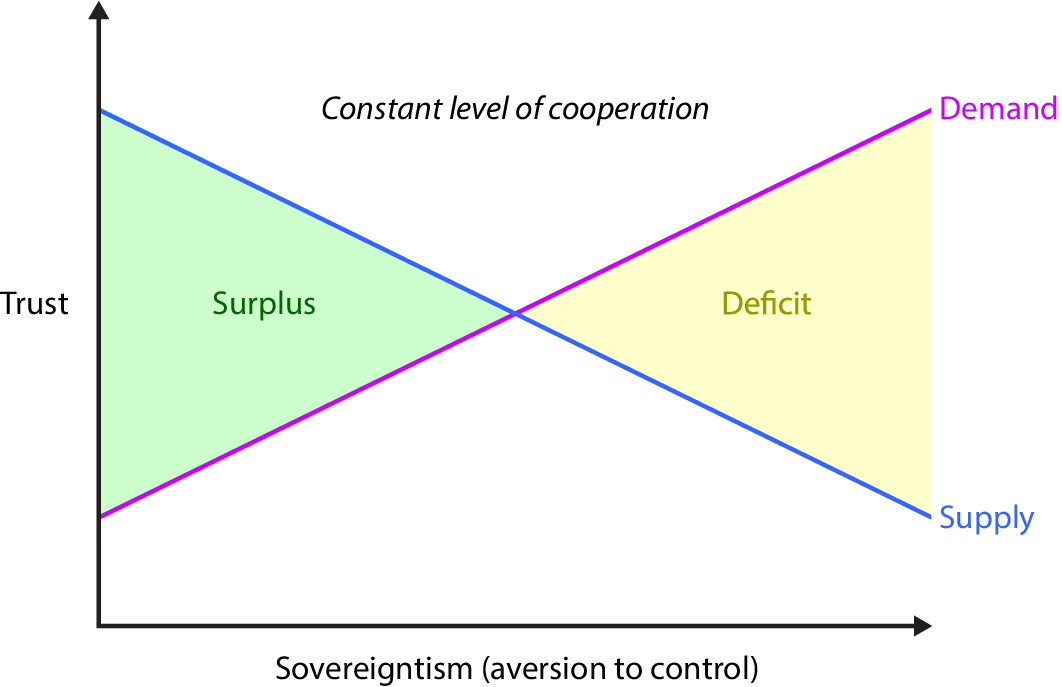
In sum, sovereigntist actors, due to their ideological commitments, need to generate higher levels of trust in order to transpose institutionalised cooperation into less restrictive formats. At the same time, they find it more difficult both to trust and to make themselves appear trustworthy, for reasons related to their ideological worldview as well as more incidental political circumstances. Taken together, these factors result in a genuine trust paradox (see Figure 1). Assuming that actors want to achieve (or sustain) a constant level of cooperation, the more sovereigntist they are, the more trust they will need, because control, the alternative means of reducing uncertainty, is not available to them. At the same time, the more sovereigntist they are, the more difficult it will be for them to generate the trust needed to achieve and sustain the desired level of cooperation. As the trust paradox kicks in, sovereigntist governments are structurally unable to generate the trust they would need to make their desired institutional arrangement work. In other words, sovereigntists want more trust but are able to obtain less of it.Footnote 59 Reckoning with this confronts sovereigntist leaders with a painful choice: either learn to live with institutions that embody a high level of control and continue to obtain the benefits of cooperation, or accept a lower level of cooperation within looser institutions and maintain ideological purity.
The trust paradox.

It is helpful to consider how the trust paradox interacts with other factors in determining institutional choice. Our claim is that sovereigntist governments will often struggle to generate sufficient trust to buttress more flexible cooperative arrangements, necessitating a trade-off between trust and control. This does not mean there are no circumstances in which such actors can generate trust, simply that their preferred institutional arrangements will require more of it, and they will face specific impediments to generating it. Still, there may be scenarios in which other factors help them escape the paradox. For example, between sovereigntist governments, it may be that forms of particularised trust and shared partisan identity can, in part, make up for the trust deficit generated by the paradox.Footnote 60 Moreover, the extent to which sovereigntist actors encounter the trust paradox will depend on a combination of their internationalist commitments (i.e., the extent to which they seek continued deep cooperation) as well as their sovereigntist commitments (how much control they seek to return to the nation). Our claims are based on the oft-observed empirical concurrence of these desires, and not their conceptual inseparability.
In addition to the trust paradox, institutional outcomes also depend on other factors that shape the trust needs of governments. Power is one important variable here, since more powerful actors are less exposed to the costs of increased uncertainty. As such, powerful sovereigntist governments may be better placed than less powerful ones to accept the cessation of deep cooperation or may be able to foist their desired institutional designs onto their partners. For instance, the Trump administration can better afford to unpick existing institutional commitments than most other governments, as seen in recent challenges to NATO and the renegotiation of NAFTA.Footnote 61 The confounding nature of power in these examples does not neutralise the logic of the trust paradox in terms of the trade-off between control and trust. Rather, it simply demonstrates that trust needs can be asymmetrical due to power differentials between actors. Yet it is necessary to caution that the trust paradox in itself cannot explain in full negotiated outcomes where other situational factors – including power – impinge on these dynamics. What we show is how the self-contradictory preferences of certain governments regarding institutional design, conceptually captured by the trust paradox, contribute to complex processes involving a number of mechanisms.
Case study: The May government and the Brexit negotiations
We demonstrate the purchase of our theoretical argument empirically by examining the efforts of Theresa May’s government to negotiate alternative institutional arrangements for cooperating with the EU following the 2016 Brexit referendum. Brexit offers a helpful case study of the trust paradox, allowing us to study how a movement rooted in the parallel ideological commitment to return control yet maintain close cooperation shaped the negotiation of alternative institutional arrangements. The case shows how a deep deficit in trust became apparent in the process and how this deficit came to significantly undermine May’s efforts to transpose cooperation into arrangements embodying a lower level of control. To escape the trust paradox, May ultimately had to accept more control than she had promised to the British public, sacrificing her ideological purity as a sovereigntist and leaving her vulnerable to challengers within her own party.
We focus on the period from July 2017 until March 2019, during which Theresa May’s government negotiated the EU-UK Withdrawal Agreement with the EU Commission and spelled out its designs for the yet-to-be-negotiated future relationship. Our data come from 38 elite interviews conducted with government officials from both sides in the negotiations, supplemented with policy documents, speeches, autobiographies, campaign materials, media reporting, and the existing secondary literature. We use these sources to help us reconstruct those aspects of the Brexit process relevant for our investigation into the trust paradox of sovereigntist internationalism. Informed consent was obtained from all participants prior to the interviews taking place, and respondents were issued a Participation Information Sheet and a Consent Form, both of which have been reviewed internally by an institutional ethical review panel.
Our argument contributes to the comprehensive literature on Brexit by shedding light on important aspects of the negotiation process.Footnote 62 First, it helps us to account for the sources of UK preferences on institutional design and why these came to focus on distinct frameworks embodying high levels of trust rather than control. Second, our argument identifies a key reason such proposals were not viable, which inheres in the concerns about the trustworthiness of the UK and a corresponding lack of trust in the EU held by pro-Brexit supporters. Third, the argument helps make sense of the resulting trade-off between trust, control, and cooperation and the ways in which subsequent governments would seek to resolve the tension (i.e., by reducing the level of anticipated cooperation).
This is not to claim that the trust paradox alone determined the course or outcome of the negotiations. Underpinning Brexit was a clash between a misplaced expectation by the UK that it could extract a bespoke deal from the EU, which would diverge from the existing balance of rights and obligations,Footnote 63 and the Commission’s determination to avoid costly precedents that could undermine the integrity of the internal market.Footnote 64 Combined with the asymmetry in power between the UK and the remaining EU membersFootnote 65 as well as the careful steering of the Brexit process by an EU in ‘survival mode,’Footnote 66 what the UK could realistically achieve was always going to be limited.Footnote 67 Moreover, the Prime Minister’s loss of her parliamentary majority in the 2017 general election made her increasingly dependent on specific hardline factions within the Conservative Party and the Democratic Unionist Party and contributed to parliamentary activism, subsequently undermining her ability to offer a take-it-or-leave-it vote on her agreement.Footnote 68
An account solely based on trust, therefore, cannot explain the outcomes of the Brexit negotiations in full, shaped as they were by a complex interplay of interests and power. But as we will show below, trust dynamics impacted the process in important ways. A satisfactory explanation of the Brexit negotiations, we contend, must take into account the trust paradox the UK government faced due to its commitment to sovereigntist internationalism.
Background to Theresa May’s Brexit policy
In the 1990s, the European Single Market programme succeeded in transposing national regulations to the European level, moving the European project away from a system based on the mutual recognition of standards towards a pan-European regulatory state. Supported initially by the Thatcher government as an extension of liberalisation, Conservatives in the UK would later become more concerned with the diminution of sovereignty entailed by the Single Market.Footnote 69 During the Conservative Party’s long spell in opposition from 1997 to 2010, Eurosceptics became increasingly worried about the threat to British sovereignty presented by moves towards further integration.Footnote 70 Within Conservative think tanks, the idea that economic cooperation could be divorced from the political aspects of integration – so-called ‘cakeism’ – came to define the dominant view of needed reforms.Footnote 71 At the same time, rising Euroscepticism fed the growing success of the UK Independence Party (UKIP), an insurgent, single-issue organisation whose blend of populism and Euroscepticism increasingly appealed to voters on both the left and the right.Footnote 72
Prime Minister David Cameron’s pledge in January 2013 to hold a referendum on whether the UK should leave the EU represented an effort to avoid Conservative divisions over Europe and stem the tide of UKIP support by renegotiating the UK’s relationship and putting the new deal to a popular vote.Footnote 73 Cameron’s renegotiation aimed to preclude moves towards further integration and to bolster the role of national parliaments in EU decision-making, but the concessions he obtained were deemed insufficient by Eurosceptics.Footnote 74 The Leave campaign portrayed the EU as a threat to British sovereignty and independence,Footnote 75 claiming that the EU was an undemocratic organisation with too much powerFootnote 76 and that the Union was heading rapidly towards a federal state.Footnote 77 But the campaign at no point foresaw the end of economic cooperation; rather, Brexit supporters argued that the EU would have an interest in maintaining the existing open trading relationship, claiming that a new basis for free trade between the UK and EU could be agreed simply and quicklyFootnote 78 and that it would be ‘perfectly possible to have access to the Single Market when we leave the EU.’Footnote 79
Theresa May inherited the difficult task of delivering Brexit when she became Prime Minister on 13 July 2016, following an internal leadership race within the Conservative Party. As a quiet Remain supporter with a track record as a tough Home Secretary, May was seen as a candidate who could maintain Conservative unity after the divisive referendum. Having committed to delivering Brexit and under pressure from her party to set out a process, May articulated her aims in the Lancaster House speech of 17 January 2017, standing astride a podium marked ‘Global Britain.’ This phrase would become a core part of the government’s branding for Brexit and aimed to channel the Leave campaign’s preoccupation that the UK could once again take up its rightful position as a major global actor if freed from the constraints of the EU.Footnote 80 The speech also introduced several ‘red lines’ that would inform the UK negotiating position: no free movement of persons, no significant contributions to the EU budget, and an end to the jurisdiction of the Court of Justice.Footnote 81 The ‘red lines’ encapsulated May’s personal interpretation of what the demands expressed by the Leave campaign had been, as well as the belief of her advisors that anything less would not fulfil the pledge made by May to the electorate.Footnote 82 In this manner, they built into the UK negotiating position in advance a rejection of the more onerous forms of control embodied in the EU’s institutional system. Moreover, they did so on the basis that this was the minimum that was required in order to fulfil the perceived mandate of the Leave vote – that is, to ‘take back control.’Footnote 83
From the government’s perspective, while the red lines provided a strong indication to the EU of what the UK was and was not willing to accept, the aim was not to preclude continued deep cooperation, but rather to obtain a bespoke deal for the UK within the contours of the red lines.Footnote 84 May’s aim was to ‘[l]eave the single market, but negotiate the greatest possible access to it through a comprehensive and ambitious free trade agreement, which might take in elements of current single market arrangements.’Footnote 85 This approach reflected the thinking of many within her party who ‘thought they could have their cake and eat it, that they could retain the benefits of frictionless trade and not be subject to common rules.’Footnote 86 In contrast, from the EU’s perspective, the ‘red lines’ axiomatically precluded any of the ‘softer’ forms of association (i.e., European Economic Area membership, a customs union, or Swiss-style bilateral arrangements) owing to the prior rejection of the obligations which came with these models.Footnote 87
Trust problems at the outset of the negotiations
In seeking to extricate itself from the EU’s institutional apparatus while negotiating arrangements that would leave cross-border commerce as unfettered as possible, the UK was seeking to switch from arrangements based on high levels of control to ones based on greater levels of trust. Indeed, the ‘red lines’ made trust integral to the UK’s proposed institutional arrangements. The May government hoped that Britain’s strong record of compliance and its high standards for environmental and labour protections would provide evidence that the UK could be trusted not abuse the proposed arrangements to access elements of the European market as a third country. The Prime Minister sought to convince the Commission that the UK could be trusted because it understood the needs of the EU to avoid competitive deregulation, because May could obtain the support of domestic constituencies for such proposals, and because future governments would commit similarly not to undercut the EU.
Yet British proposals – based as they were on efforts to find less intrusive means of achieving similar levels of cooperation in trade – ran up against the Commission’s efforts to prevent London from obtaining potentially favourable arrangements. As the Commission saw it, ‘our first priority was to preserve the internal market and the advantage that comes with being part of the internal market’Footnote 88 and ‘not to give privileged access to the UK without getting from them the obligations that normally go with it.’Footnote 89 The principles underpinning the EU’s approach, including the need to avoid ‘cherry picking,’ defend the existing balance of rights and obligations, preclude contagion, and maintain unity, were agreed among member states in the aftermath of the Brexit process and informed the EU position throughout the negotiations.Footnote 90 Moreover, the negotiations were structured so as to maintain unity and to preclude the UK from leveraging withdrawal issues for concessions on the future relationship and vice versa. The talks were sequenced, with issues pertaining to withdrawal negotiated first – including citizens’ rights, financial liabilities, and the border on the island of Ireland – with the future relationship to be negotiated only once sufficient progress had been made. The task of leading the negotiations on the EU side was given to Michel Barnier, a veteran French politician with sufficient cachet to speak openly and directly with heads of state or government and ‘a figure who was genuinely trusted by…member states.’Footnote 91
The UK struggled to win the necessary trust of the EU for the latter to agree to mechanisms that could substitute for existing forms of control. The vote to leave in 2016 had created significant bad blood in rupturing an existing relationship of trust, abrogating the renegotiated settlement, and throwing the Union into crisis, such that the UK was not seen as a benevolent actor.Footnote 92 Moreover, May lacked a majority in Parliament and was under constant threat from the pro-Brexit right, who sought to exploit every cooperative action the Prime Minister made for political gain, casting doubt on whether she had the ability to follow through on her promises. Designs on Brexit became more radical over time as political challengers on the right sought to outbid May, resulting in a poisoned atmosphere in which rivals came to advocate an increasingly distant relationship (up-to-and-including ‘no deal’) and to re-emphasise the desirability of divergence from European standards.Footnote 93 This radicalisation, in turn, called into question the integrity of the government’s commitments over time and gave rise to concerns that future governments would seek to defect from the proposed arrangements.
On the flip side, it became increasingly clear that trust in the EU was low among UK Eurosceptics. For many on the Conservative right, the Commission was viewed as a disingenuous actor that would do what it could to keep the UK tied in perpetuity to the legal trappings of European integration. As part of this, the Commission was believed by many to be misrepresenting the EU position, either by low-balling the UK with offers that did not represent the final outcome, or by unfairly prioritising existing technical rules and thereby missing the bigger picture of the overall economic relationship. Brexiteer and Trade Secretary Liam Fox is supposed to have said that the UK has ‘allies among the twenty-seven [member states], and we must make use of them. Our enemy is the Commission, which wants to be forgiven for making Cameron lose.’Footnote 94 The European Research Group’s (ERG) lack of trust in the EU extended also to those British officials perceived as overly sympathetic to Brussels, who were seen as complicit in trapping the UK in arrangements that would perpetually tie it to the bloc. Having previously channelled much of the ERG’s rhetoric, May’s desire to find a way through on Northern Ireland, and her seeming unwillingness to deploy the ‘no deal’ threat, led to concerns that Brexit should have been delivered by those who ‘truly’ believed in the task.Footnote 95 Meanwhile, May’s chief negotiator, Olly Robbins, was seen by many Brexiteers as overly sympathetic to EU interests.Footnote 96
The Florence speech and early proposals
Initially, the UK side assumed that the cost of losing access to the UK market would lead EU member states and firms to push for a bespoke deal that would maintain economic continuity while respecting the UK’s ‘red lines.’Footnote 97 But this depiction of the EU’s position proved inaccurate and failed to account for the threat Brexit posed to the integrity of the internal market itself – and the willingness of member states to do what was necessary to protect it.Footnote 98 Early UK proposals that sought sector-specific access to the single market were rebuffed by the Commission on the basis that they would afford the UK a competitive advantage and amounted to generalised ‘cherry picking’ of the benefits of the internal market.Footnote 99 In the Florence Speech, delivered on 22 September 2017, May sought to set out the contours for the future economic relationship that would acknowledge the realities of withdrawal whilst also preserving the level of cooperation she felt befitted two actors with similarly high standards. In the speech, the Prime Minister argued:
We share a commitment to high regulatory standards. People in Britain do not want shoddy goods, shoddy services, a poor environment or exploitative working practices and I can never imagine them thinking those things to be acceptable. The government I lead is committed not only to protecting high standards, but strengthening them. So I am optimistic about what we can achieve by finding a creative solution to a new economic relationship that can support prosperity for all our peoples. Now in any trading relationship, both sides have to agree on a set of rules which govern how each side behaves. So we will need to discuss with our European partners new ways of managing our interdependence and our differences, in the context of our shared values.Footnote 100
The speech represented a pitch to the EU to agree to work towards an alternative institutional basis which could guarantee a close economic relationship – one based not on EU rules but on shared values and commitments established outside the jurisdiction of the Court of Justice. In the words of her Chief of Staff, Gavin Barwell:
[May] was saying there were some areas where we were going to do things differently, and we accepted that we would have to pay a price for that in terms of market access. She was questioning whether, if we were achieving the same thing in a slightly different way – but it didn’t give our businesses a competitive advantage – it had to mean less market access. And she was hinting that, in some areas, we would be happy to carry on having the same rules as the EU – but crucially without saying whether we would make a legal commitment to staying aligned.Footnote 101
May’s pitch involved a direct appeal to trust as a foundation for this relationship, claiming that
if we can be imaginative and creative about the way we establish this new relationship, if we can proceed on the basis of trust in each other, I believe we can be optimistic about the future we can build for the United Kingdom and for the European Union.Footnote 102
Yet from the EU’s perspective, a future relationship with such contours would afford the UK a clear competitive advantage. In an otherwise positive response, which acknowledged May was making progress on the financial settlement, Barnier described the proposal for a ‘tailor-made economic partnership’ in his diary as ‘halfway between a free trade agreement and the more beneficial aspects of the internal market, but without the constraints that go with it.’Footnote 103
The Irish border question
The attempt to find arrangements that could allow for economic continuity was given additional impetus by the government’s desire to find workable solutions to the border issue on the island of Ireland. With the UK set to leave the Single Market and Customs Union, a regulatory and customs border would emerge between Northern Ireland and the Republic of Ireland, where prior mutual membership of the EU had made controls and customs processing unnecessary. The Prime Minister was thus ‘really conscious that she needed to have essentially a free, frictionless free trade agreement with the EU otherwise, somewhere either at the land border between Northern Ireland and the Republic or down the Irish Sea … there will be some frictions in the trading arrangements.’Footnote 104 In the discussions over what would become the Joint Report on 4 December 2017 in Brussels, May agreed to the ‘Backstop’ arrangements, which would keep Northern Ireland within those elements of the single market and customs union necessary to obviate border controls. Yet the backstop proved highly unpopular among both pro-Brexit Conservatives and the government’s partners in the Democratic Unionist Party (DUP), who regarded the proposed arrangements as tantamount to the ‘annexation’ of Northern Ireland by the EU and as a ‘trap’ designed to keep the UK aligned to EU rules.Footnote 105
While the Commission opposed the idea of a bespoke form of association, it also had a significant vested interest in reaching a long-term solution that would avoid a border on the island of Ireland and was willing to entertain proposals that could preclude this from happening. But May struggled to convince the Commission that the UK could be trusted under her proposals not to take advantage of opportunities to obtain competitive advantages vis-à-vis the EU. This led to a cautious approach on behalf of the Commission in which the possibility of defection was carefully calculated in a manner that made clear the underlying assumption that the UK could defect if the opportunity arose.Footnote 106 The Commission was also sceptical of commitments May sought to make on behalf of her government, both because it was not convinced that she was able to secure the support of domestic constituencies and because of the risk that a future government would not consider itself to be bound by any self-imposed limitations set by the UK.
In her Mansion House speech on 2 March 2018,Footnote 107 May set out broad parameters for the future relationship that would make the backstop redundant, noting:
Our default is that UK law may not necessarily be identical to EU law, but it should achieve the same outcomes. In some cases, Parliament might choose to pass an identical law – businesses who export to the EU tell us that it is strongly in their interest to have a single set of regulatory standards that mean they can sell into the UK and EU markets. If the Parliament of the day decided not to achieve the same outcomes as EU law, it would be in the knowledge that there may be consequences for our market access.
In conclusion, the Prime Minister asserted:
A fundamental principle in our negotiating strategy is that trade at the UK-EU border should be as frictionless as possible with no hard border between Northern Ireland and Ireland. We believe this can be achieved via a commitment to ensure that the relevant UK regulatory standards remain at least as high as the EU’s and a customs arrangement. We recognise this would constrain our ability to lower regulatory standards for industrial goods. But in practice we are unlikely to want to reduce our standards.
The speech sought to convince the EU that since Britain could be trusted to maintain standards, it should be afforded access to aspects of the single market and EU agencies. May claimed that looser arrangements should make no difference to the relationship, because the UK was not seeking to diverge from EU standards. But Brexit supporters were displeased by the promise to avoid divergence and began to complain that Brexit ‘freedoms’ were being sacrificed.Footnote 108 Meanwhile, the Commission opposed May’s proposals because they sought market access without institutional control, with Barnier responding:
[May says] that the UK will maintain high standards, for example by way of a potential alignment with EU competition and state aid rules, and will avoid any ‘race to the bottom’ in respect to workers’ rights and environmental regulation … But apart from these few concessions, it is clear that Theresa May is seeking to piece together a specific proposal and to organize a generalized cherry-picking from the Single Market.Footnote 109
Even though the Commission trusted the UK to stand by its legal obligations, and thus abide by the terms of any outcome,Footnote 110 it was not willing to countenance the design of institutions that relied on trust alone. As Barnier put it:
There is no mistrust of the UK on our part. There is not – and there never will be – a spirit of revenge or punishment. But we must understand that, in the European Union, our strength lies in the trust that exists between member states. This trust does not fall from the sky: it is based on a normative ecosystem, common rules, shared decisions, common supervision and implementation, and a common Court of Justice.Footnote 111
The Commission also sought to convey that it was not a question of trusting the government of the day, but of potential future governments, highlighting the significance of intertemporal integrity for trustworthiness. As one EU official put it:
We were negotiating with one government, but for the next twenty years or so, even if we had had a government that said we are committed to increasing standards, social, environmental and all the rest of it, we would still have to look for who comes next…and will there be divergence then.Footnote 112
The Chequers plan
Over 6–7 July 2018, May presented more detailed proposals for the future relationship – the Chequers Plan – to Cabinet colleagues at the Prime Minister’s country residence. The meeting aimed to obtain Cabinet support for the proposals, which would subsequently inform a White Paper on the future relationship.Footnote 113 The proposals envisioned UK participation in the single market for goods on the basis of a ‘common rulebook,’Footnote 114 a ‘facilitated customs arrangement’ which would see differential tariffs for goods coming into the UK depending on their destination (thereby permitting the independent trade policy much desired by Brexiteers),Footnote 115 harmonisation on state-aid and a commitment to non-regression of environmental standards, and independent forms of binding arbitration outside the scope of the Court of Justice.Footnote 116 More so than previous proposals, Chequers acknowledged the trade-off between trust and control, proposing mechanisms embodying enhanced control that lay outside the EU framework but would still constrain the UK’s future behaviour (e.g., the common rulebook and independent arbitration).
But the proposals still substituted control for trust in multiple respects, requiring faith that the UK would not exercise its ability to diverge from EU standards and that it would be trusted to act as an agent of the EU whilst outside the system. Barnier reacted negatively to the proposals since they offered the benefits of market access without the obligations of membership and the associated controls. The proposals for goods would ‘allow them to participate a la carte in the internal market, without the quid pro quo that member states have to comply with.’Footnote 117 The danger was that Britain ‘would retain the freedom to diverge on all other regulations governing factors of production of these goods, such as the labour, energy and services that go into the manufacturing process,’ affording it a competitive advantage.Footnote 118 The proposals on services, for Barnier, occasioned ‘the reappearance of the idea of mutual recognition, which is unacceptable, since it would be in direct opposition to our principle of autonomous decision-making.’Footnote 119 Essentially, the UK, he claimed, ‘wishes to retain its potential ability to diverge from EU rules with a view to increasing its competitive advantage.’Footnote 120 On the customs proposals, the Chief Negotiator noted:
[The British] seek to secure all the benefits of a customs union without accepting the counterpart of a common trade policy. This contradicts the very principle at the heart of a customs union, namely a common external tariff … it presents three risks … A competitive risk: this system would give British companies a major competitive advantage over EU companies, since they would be able to incorporate imported inputs into their products at a lower rate … A fiscal and budgetary risk: lower British tariffs would be applied to materials from the UK incorporated into goods destined for the EU market … A supervisory risk: UK customs would then act as agents of the EU – an unprecedented situation – without being subject to the EU system of governance.Footnote 121
Officials in May’s inner circle were disappointed by the Commission’s reaction, since they believed the arrangements would maintain the same regulatory standards. As one official put it:
[N]ot only do we have high standards, we have literally the same standards as them because we’re inside the same regulatory framework. So, we have the same standards. We have political commitments to raise standards, not lower them, so the idea that the EU are at risk from flooding of … cheap dangerous products is a theoretical, though in practical terms, ridiculous. It’s never going to happen.Footnote 122
Chequers marked the moment where the contradictions of the May government’s Brexit approach became evident, since the proposals pleased neither pro-Brexit constituencies (who branded them ‘Brexit in Name Only’)Footnote 123 nor the EU, which regarded them as a further exercise in ‘cherry picking.’ In the aftermath of the summit, on 9 July, May’s Brexit Secretary David Davis tendered his resignation, followed by Foreign Secretary Johnson,Footnote 124 precipitating a split between the government and the Brexiteers that would ultimately prevent May from obtaining ratification of the Withdrawal Agreement. Meanwhile, the EU formally rejected Chequers as a basis for the future relationship at the Salzburg summit on 20 September 2018, further denting May’s authority domestically and contributing to the growing political crisis in the UK.
The final Withdrawal AgreementFootnote 125 was adopted by the European Council on 25 November 2018, paving the way for ratification by the UK. But since the post-Chequers split in the party, the government could no longer rely on votes from hardline pro-Brexit MPs. Their main issue with May’s agreement was ‘that the backstop predetermined the future relationship in a way that unless we had regulation, harmonization and some form of customers arrangement that meant there was no friction, you will always be stuck in the backstop. They saw it as a trap.’Footnote 126 Delaying the vote, May sought reassurance from the Commission that the UK would ‘not be trapped in a customs union against our will,’ since there was ‘a great deal of mistrust in the UK towards the European Union,’Footnote 127 requesting a ‘time-limited’ backstop. Again, May sought to substitute a contractually tight relationship, which was unacceptable to her domestic stakeholders, with a trust-based one, exhorting the Commission to take her at her word. As with previous proposals, this was too dangerous for the Commission, which refused the proposal on the basis that it would force the EU to:
Make a choice between two equally unacceptable options: agreeing to a future relationship that would guarantee frictionless trade, in which case the British would have finally succeeded in holding the whole negotiation on the future relationship to ransom by instrumentalising the Irish question. Or setting up a physical border on the island of Ireland.Footnote 128
When the vote took place on 15 January 2019, Labour’s opposition combined with significant rebellions among Conservative Brexiteers produced a resounding defeat for the government. In light of this defeat, May sought further concessions but was rebuffed by the Commission. With no movement on the Backstop, and with Conservative Eurosceptics opposed to the agreement, May’s deal was defeated in Parliament on two subsequent occasions on 12 and 29 March 2019. With days to go before the Article 50 process pushed the UK out of the EU without a deal, May sought an extension from the European Council and – a few weeks later – offered her resignation as Prime Minister.
The experience of the Brexit negotiations shows how difficult it can be for sovereigntist internationalists to maintain deep cooperation whilst transposing relationships from control- to trust-based arrangements. May understood the injunction of the Leave campaign to ‘take back control’ as requiring the cessation of the obligations of EU membership, highly specific institutional arrangements based on common regulations, legal commitments, and institutional oversight. In order to avoid economic disruption and preclude the need for the ‘backstop’ to come into force, May sought alternative means to committing to shared rules and principles requiring higher levels of trust. Yet, in addition to the desire to prevent arrangements more favourable to the UK than to the EU members, the Commission recognised that the UK proposals came with a high level of danger to the Union, presenting insufficient guarantees that future governments would not diverge from EU standards and obtain a competitive advantage. The Commission’s trust in the UK was further undermined by clear domestic signals from Brexiteers that divergence was the ultimate aim, which undercut appeals from May’s team that the UK would seek to maintain the same standards as the EU in the future. Doubts about the viability of May’s preferred design also resulted from her inability to obtain domestic support for the proposals, which partly reflected the low levels of trust the Brexiteers had in the Commission, and their suspicion that the ultimate aim was to trap the UK in the EU’s institutions.
Conclusion
All sovereigntist internationalists face the same quandary due to their ideological commitments: they want to transform international institutions to strengthen their sovereignty and take back control while maintaining mutually beneficial cooperation. But they struggle to muster the trust necessary to achieve this feat, which in turn leads to contentious and often unsatisfactory negotiations, and ultimately to the realisation that their twin desires are not compatible. We demonstrated this paradox empirically by examining the UK government’s conduct of the Brexit negotiations, during which May sought to reconcile demands to ‘take back control’ with continued cooperation but failed to convince the EU to accept her proposal for new, less constraining institutional arrangements that relied more heavily on trust. Our claim is not that all sovereigntist or even all populist governments are internationalists, that is, that they want to maintain high levels of cooperation. We are merely claiming that, to the extent that they are, they will encounter very similar difficulties as the May government did. This is because the trust-based institutions that their ideology pushes them towards are hard for them to establish and maintain, given their inherent difficulties in generating trust.
The emerging literature on populist and new right foreign policy suggests that there may be a considerable number of such cases. One instance where we see a variant of the trust paradox at play is in the attempts of Latin American governments, most notably those of Bolsonaro in Brazil and Milei in Argentina, to achieve a greater ‘flexibilization’ of institutional rules in Mercosur, including the suspension of the common tariff and provisions relating to democracy and intervention, while remaining committed to free trade.Footnote 129 Sovereigntist movements in Europe similarly continue to pursue a more intergovernmental rendering of the EU whilst simultaneously opposing provisions aimed at countering democratic backsliding, but do not desire to leave the Union altogether nor forego the economic exchange it facilitates.Footnote 130 One might also turn to historical examples, including Charles De Gaulle’s withdrawal from the operational aspects of NATO and temporary departure from the Council of the EC in the mid-1960s, as redolent of similar designs to maintain underlying cooperation whilst satisfying sovereigntist demands.
Our articulation of the paradox of sovereigntist internationalism is able to shed light on the broader difficulties in achieving cooperation faced by sovereigntist governments beyond questions of institutional design. This includes, for instance, efforts by such leaders to engage in international summitry, which have often fallen apart rapidly after much-hyped initial meetings,Footnote 131 as well as the difficulties faced by populist European leaders in attempting to coordinate on a continent-wide strategy.Footnote 132 These efforts to foster barely institutionalised cooperation fail for a very simple reason: the leaders and their movements are neither trustworthy nor do they trust each other, but still opt for highly trust-dependent modes of working together. As the number of sovereigntist governments grows, and as the resulting crisis of multilateralism intensifies, we expect such cases to become more frequent. The trust paradox thus describes a profound challenge for cooperation in the years ahead, as a growing number of sovereigntist actors most likely will seek to take the guardrails off existing institutional arrangements and supplant them with alternatives that will require much higher levels of trust to work.
Our argument also speaks to a number of important theoretical debates. First, we contribute to the literature on trust and cooperation by demonstrating the usefulness of taking the demand-side of trust – how much of it is needed – into account. Our understanding of the conditions under which trust and control can or cannot be substituted opens up avenues for future research that may illuminate how similar actors faced with similar cooperation problems still come to display varying trust needs. Moreover, by showing how trust dynamics play out among allies in highly institutionalised settings, we contribute to an emerging literature seeking to study trust dynamics beyond the problem of initial trust building in adversarial relationships.Footnote 133 Second, we contribute to the emerging literature on sovereigntist (and populist) foreign policyFootnote 134 by illustrating the difficulties such governments have in building sufficient trust to shift deep cooperations into looser formats. As sovereigntist movements grow in strength across the world, the problem of building sufficient trust in the absence of control will increasingly occupy IR scholars in the future. Third, we contribute to institutionalist theoryFootnote 135 by showing how the design of institutional arrangements will often reflect the varying trust needs of actors, with those emphasising trust rather than control pushing for looser institutional arrangements. In doing so, we contribute to a burgeoning literature on the sources of varying institutional preferences among actors.
Our argument has implications for policymakers and diplomats, too. For one thing, it suggests the importance of assessing trust needs in situations of conflict, since they impact how much trust will have to be generated to initiate or sustain cooperation. This can help overcome stereotypical ideas about actors’ intentions: While the Commission may come across as a normatively oriented actor, its need for trust in the Brexit negotiations was far lower than that of the UK. Relatedly, while one might not expect the UK to place such a high premium on trust given its own breach of trust through the Brexit vote, this is precisely what it needed to do under the circumstances. Our argument also suggests the value for sovereigntist governments – and for other governments who need to continue cooperating with them – of confronting the trust paradox head-on, acknowledging the difficulties of substituting trust for control and either accepting lower levels of cooperation or, potentially, looking for alternative means of building trust. Managing expectations among domestic constituencies is key here, since their actions can be one significant factor in undermining trust. Finally, leaders and policymakers need to acknowledge that trust works both ways, and that being able to trust the other party is as important as conducting oneself in a trustworthy manner in sustaining cooperation. Finding creative new ways to trust and project trustworthiness will become paramount as sovereigntist actors across the world seek to challenge the various forms of control baked into the liberal international order with which they have fallen out of favour.
List of Interviews
Interview 1, Former Conservative MP, 4 pm, 21/7/21, online
Interview 2, European Parliament official, 9.30 am, 14/7/21, online
Interview 3, DExEU official, 5.30 pm, 20/07/17, London
Interview 4, Commission official, 3 pm, 1/7/21, online
Interview 5, Senior Commission official, 4 pm, 6/7/21, online
Interview 6, Senior Commission official, 9 am, 16/7/21, online
Interview 7, Senior UK official, 4.30 pm, 23/5/22, online
Interview 8, Senior Commission official, 2 pm, 6/7/21, online
Interview 9, EU official, 1.15 pm, 3/10/23, Edinburgh
Interview 10, Senior UK official, 3.30 pm, 28/7/21, online
Acknowledgements
Earlier versions of this article were presented at Goethe University Frankfurt, Harvard University, Loughborough University, Torcuato Di Tella University, and the University of St Andrews, as well as at the annual conferences of the International Studies Association 2024 in San Francisco and the British International Studies Association 2025 in Belfast. We are grateful to audience members for their many helpful questions and suggestions. We would also like to thank Senem Aydın-Düzgit, Ben Christian, Joshua Kertzer, Cristian Nitoiu, Brian Rathbun, Anette Stimmer, and Michael Zürn for their highly insightful comments on drafts of the article. Frederik Hermle provided invaluable research assistance. Both authors contributed equally to this publication.
Funding statement
The research presented was funded in part by the European Union’s Horizon 2020 research and innovation programme under grant agreement no. 962533 (‘ENGAGE’ – Envisioning a New Governance Architecture for a Global Europe) and by the Hessian Ministry of Higher Education, Research and the Arts through the research initiative ‘ConTrust: Trust in Conflict.’
Competing interests
The authors declare none.

 Open access

