





Introduction
Nongovernmental organizations (NGOs) play an important role in society (Smillie, Reference Smillie1997), given their efforts to bridge gaps in social services, advocate for critical societal issues, provide help amid disruptions such as disasters and pandemics, and/or monitor governance and serve a watchdog function (Patay et al., Reference Patay, Friel, Townsend, Baum, Collin, Cullerton, Dain, Holmes, Martin, Ralston and Westerman2022). In many cases, they work toward social transformation, facilitating significant changes in communities in terms of various social and economic factors like education, health, income, and civic participation (Visión y Compromiso, 2017). This is aligned with empowerment theory, wherein processes that facilitate participation and capacity building in communities can lead to improvement in their quality of life in a community and connections (Perkins & Zimmerman, Reference Perkins and Zimmerman1995; Zimmerman, Reference Zimmerman1995). However, a cursory review of the extant literature points to a dearth of empirical studies on the experiences of NGOs engaging in community transformation efforts, and there is a need for continuous discussions on the strengths and limitations of NGOs (Kang, Reference Kang2010). Furthermore, NGOs constantly face multiple challenges such as a lack of resources, working in difficult areas, and pressure to report outcomes in their work (Abiddin et al., Reference Abiddin, Ibrahim and Abdul Aziz2022; Ridder et al., Reference Ridder, Piening and Baluch2012).
Using a multi-case study approach, we examined the role of NGOs in community transformation. Particularly, we delved into the issues that drove the change, the enablers, challenges, strategies, as well as outcomes of community transformation efforts. Given the gaps and challenges stated above, conducting research that provides insight into the process of transformation can be helpful to scholars and practitioners in the field. The study was conducted in the Philippines, a country in the Global South. As such, it helps address the need for greater geographic diversity in the nonprofit literature (Brass et al., Reference Brass, Longhofer, Robinson and Schnable2018; Ma & Konrath, Reference Ma and Konrath2018).
The paper begins with a review of the literature on NGOs and community transformation, as well as the research context and questions. This is then followed by the methodology, which explains the multi-case study design. Finally, the results are presented and discussed in the results and discussion sections.
NGOs engaging with communities
NGOs have been defined as “self-governing, private, not-for-profit organizations that are geared to improving the quality of life of disadvantaged people” (Vakil, Reference Vakil1997, p. 2060). They can be classified in different ways, including their level of operations: international, which are often based in the Global North countries but operate internationally; regional, based in regions in the Global South; national, based in the Global South countries; and community-based, which are grassroots organizations or those operating in local communities in the Global South (Kang, Reference Kang2010; Vakil, Reference Vakil1997).
NGOs engage with communities through capacity building, relationship building, and culture building (Teng-Calleja et al., Reference Teng-Calleja, Cuyegkeng, Caringal-Go, Baquiano, Tan and Cementina-Olpoc2023). Key to their success are their strengths in using a bottom-up approach to community development that encourages participation and understanding of local context, forming partnerships, and practicing sustainable development and conservation (Kang, Reference Kang2010). This is in line with empowerment theory, which at the community level, is described as “collective action to improve the quality of life in a community and to the connections among community organizations” (Perkins & Zimmerman, Reference Perkins and Zimmerman1995, p. 571). According to Zimmerman (Reference Zimmerman1995), empowering processes allow community members to be involved in shaping, implementing, and evaluating interventions and programs that impact their lives. These empowering processes allow people to work together toward a common goal and may include opportunities for them to build their capabilities, access and manage resources, and expand their networks. Empowered outcomes such as participation and resource mobilization are the consequences of these empowerment processes and will vary depending on the specific contexts (Zimmerman, Reference Zimmerman1995). Because people in communities may have internalized feelings of low self-esteem and previous experiences of humiliation and have accepted the existing social structures and norms, NGOs must work toward emotional empowerment to help overcome these barriers (Langmann et al., Reference Langmann, Bezemer and Pick2024). This involves fostering hope and care, providing spaces to voice feelings and concerns, and translating these into positive action (Langmann et al., Reference Langmann, Bezemer and Pick2024).
In their research on “outsiders” who engage in community development in Iran, Naficy et al. (Reference Naficy, Bergh, Akhavan Alavi, Maleki and Mirehei2021) suggest that NGOs serve important roles that help address challenges to development, such as lack of self-confidence, cooperation, and access among communities. These roles include increasing readiness on the ground, creating and/or strengthening the community members’ capacity to take responsibility for change, and bolstering connections between the community and outside actors who may have resources. Interventions related to these roles include building trust and communication, finding initial financial solutions, providing training and consultations, making the case for establishing community-based organizations, and building relationships among the community, government, international organizations, and potential markets.
NGOs also face a myriad of challenges as they engage with communities and work toward advocacies. Examples of internal challenges are poor governance and difficulty obtaining and sustaining funding (Abiddin et al., Reference Abiddin, Ibrahim and Abdul Aziz2022). External challenges include ineffective communication and networking, working in dangerous and conflict-prone communities, and difficulties in their efforts to promote development ownership in communities (Abiddin et al., Reference Abiddin, Ibrahim and Abdul Aziz2022; Islam, Reference Islam2014). To shed more light on the impact of NGOs’ efforts toward social change despite these challenges, we examine the experiences of NGOs as they contribute toward community transformation.
Bringing about community transformation
Community transformation is defined as a “significant change in a community in terms of human health, social justice, income, employment, educational attainment, environmental quality, population retention, business environment, access to capital, entrepreneurial activity, accountable governance, and/or civic participation” (Visión y Compromiso, 2017, p. 3). Aside from this definition, the scant literature on community transformation emphasizes the importance of integrating community organizing and community development (Capraro, Reference Capraro2004). According to Capraro (Reference Capraro2004), this approach to developing and implementing a change agenda ensures engagement of community members not just in transforming physical/tangible aspects of the community but the local relationships among various sectors and political forces.
Many NGOs have demonstrated leadership in advancing community transformations (Brass et al., Reference Brass, Longhofer, Robinson and Schnable2018). However, community transformation is not a straightforward endeavor. Rather, it is a gradual and nonlinear process in which methodologies and plans may evolve amid implementation (Sulistyowati & Nurhasana, Reference Sulistyowati, Nurhasana, Künkel and Ragnarsdottir2022). Enabling positive change in communities entails nurturing trust and openness to change, as well as empowering residents and building on their strengths (Brown & Baker, Reference Brown and Baker2019). Moreover, a sense of community, cohesion, engagement, and collective action are also crucial (Brown & Baker, Reference Brown and Baker2019). For example, Marston et al. (Reference Marston, Hinton, Kean, Baral, Ahuja, Costello and Portela2016) point to the importance of participative approaches in bringing about transformative action in the area of health. This involves improving the capabilities of individuals and groups, creating people-centered services, and fostering social accountability. Additionally, having a network of people who share the vision helps enable transformation initiatives (Sulistyowati & Nurhasana, Reference Sulistyowati, Nurhasana, Künkel and Ragnarsdottir2022).
Unfortunately, given the various pressures NGOs face, such as political restrictions and accountability to donors, it has been noted that NGOs have become more proficient at service delivery rather than promoting deep social transformation (Banks et al., Reference Banks, Hulme and Edwards2015). Power differentials between NGO professionals, who may be viewed as “experts,” and the communities they serve also exist; or, in their lack of understanding of local contexts, NGO professionals may inadvertently reinforce existing inequalities (Magara, Reference Magara2025).
Research context and research questions
There is considerable pressure among NGOs to provide evidence of impact (Ridder et al., Reference Ridder, Piening and Baluch2012), especially in contexts outside of the Global North. This may pose challenges in some areas in Asia where there is weak research infrastructure and limited research funding for the third sector (Hasan, Reference Hasan2015). Given how NGOs face changing environments and needs, Kang (Reference Kang2010) highlighted the need for continuous discussions on the strengths and limitations of NGOs. This research thus responds to their call that “Successful experiences should be accumulated and circulated within the NGO community….” (p. 234). Moreover, given that community transformation entails adopting concepts and methodologies toward the local milieu (Sulistyowati & Nurhasana, Reference Sulistyowati, Nurhasana, Künkel and Ragnarsdottir2022), there is value in carrying out contextually nuanced studies.
This study was conducted in the Philippines, a developing country in the Southeast Asian region. NGOs in the country provide essential services to help people through persistent challenges such as poverty (Hirai & Hiyane, Reference Hirai and Hiyane2022) and disaster preparedness/mitigation (Luna, Reference Luna2001). As they engage with different stakeholders like partner communities, government, and the private sector, these NGOs take on important roles in building capacities, managing conflict, mobilizing resources, networking and coordinating, and bridging partnerships (Aldaba, Reference Aldaba2002).
The influence of civil society in the country was quite evident in the 1970s and 1980s, when “people power” movements led to the removal of Ferdinand Marcos, Sr., and the installation of Corazon Aquino as president (Asian Development Bank [ADB], 2023). The 1987 Constitution emphasized the importance of people’s participation in socioeconomic and political endeavors and promoted the development and expansion of NGOs (ADB, 2023). However, despite enabling mechanisms for NGOs from the government after the 1986 People Power Revolution, it was observed that NGOs in the country still faced challenges in terms of legitimacy, effectiveness, and funding (Cariño, Reference Cariño1999). Similarly, in describing the civil society landscape in the country, ADB noted a contrast, wherein “there is consensus that the civil society sector is large and vibrant by developing country standards, even though most of the large number of organizations are small, struggle financially, and have weak capacity” (2007, p. 4). In recent years, NGOs weakened during the Duterte administration, given attacks on civil society and decisions that led to some foreign aid funding being cut off (Arugay & Baquisal, Reference Arugay and Baquisal2023). As such, public trust in NGOs was observed to decline, decreasing from 59% in 2017 to 37% in 2019, although it increased to 70% in 2021 because of NGOs’ efforts in bringing social relief during the pandemic (Arugay & Baquisal, Reference Arugay and Baquisal2023).
Although not specifically about NGOs, civil society organizations (CSOs) in the country vary in their capacity—larger organizations may have paid employees and established internal systems, and they are able to implement large projects funded by donors or act as intermediaries between the government and other associations, whereas smaller organizations may rely on volunteers and umbrella organizations for support (ADB, 2023). The differences in capacities were evident during the COVID-19 crisis, wherein larger organizations were able to deliver much-needed services to many communities, while many smaller organizations were forced to suspend their operations given the lack of resources and difficulties adapting to digital work environments (ADB, 2023).
There appears to be a lack of studies that explore effective practices in community transformation efforts of local/national NGOs in the Philippines. While previous research has surfaced transformation experiences of local government units (LGUs) and the communities under their jurisdiction (Teng-Calleja et al., Reference Teng-Calleja, Hechanova, Alampay, Canoy, Franco and Alampay2016) as well as the transformative leadership that enabled change (Teng-Calleja et al., Reference Teng-Calleja, Hechanova, Alampay, Franco, Hechanova, Teng-Calleja and Franco2017), there seems to be limited knowledge on how these are similarly observed in NGOs. To contribute to the literature, this study sought to examine experiences of NGOs in the Philippines as they engaged with communities and worked toward positive change. More specifically, we asked, How do NGOs achieve community transformation? In the process of answering this question, we looked into the issues that drove the change and the enablers, challenges, strategies, as well as outcomes of the community transformation efforts.
Method
This study is part of a larger research project of a university-based center focusing on organizational development. Given the objectives of the study, it is crucial to have an understanding of the factors that contributed to the success of the community transformation and the context in which the change occurred. Thus, we utilized a multi-case study design (Yin, Reference Yin2018) in conducting this research and Shields’ (Reference Shields2010) backward mapping strategy in selecting the NGOs and their community partners.
Selection of cases
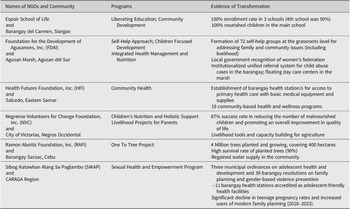
Six NGOs that were finalists/recipients of the 2023 Galing Pook Citizenship Awards (GPCA; https://www.galingpook.org/blog/2023-galing-pook-citizenship-awards/) and their respective partner communities were chosen as cases for the study. The GPCA recognizes organizations and individuals who have consistently made a positive impact in their local communities, addressing the challenges and complexities brought about by poverty and inequality (Galing Pook, 2023). The award recipients were selected based on how they: (1) promoted inclusive policies and practices, as well as mobilized community members to engage in local governance processes; (2) achieved organizational goals and its direct/indirect benefits to the community; (3) used new approaches in solving adaptive challenges, stakeholder engagements, and implementation of solutions; and (4) developed mechanisms for sustaining the outcomes and impacts, and the possibility of replicating its success in other community. Table 1 presents the selected cases and highlights some of their transformative programs/evidence of transformation. More comprehensive information can be found in Appendix A.
Summary of cases

Table 1. Long description
The table consists of three columns: Names of N G O s and Community, Programs, and Evidence of Transformation.
* Row 1: Espoir School of Life and Barangay del Carmen, Siargao. Programs: Liberating Education and Community Development. Evidence: 100% enrollment rate in 3 schools (90% in the 4th) and 100% nourished children in the main school.
* Row 2: Foundation for the Development of Agusanons, Inc. (F D A I) and Agusan Marsh, Agusan del Sur. Programs: Self-Help Approach, Children Focused Development, and Integrated Health Management and Nutrition. Evidence: Formation of 72 self-help groups, local government recognition of women’s federation, and institutionalized referral systems for child abuse.
* Row 3: Health Futures Foundation, Inc. (H F I) and Salcedo, Eastern Samar. Programs: Community Health. Evidence: Establishment of barangay health stations with medical equipment and 19 community-based health and wellness programs.
* Row 4: Negrense Volunteers for Change Foundation, Inc. (N V C) and City of Victorias, Negros Occidental. Programs: Children’s Nutrition and Holistic Support, and Livelihood Projects for Parents. Evidence: 87% success rate in reducing malnutrition and provision of livelihood tools for agriculture.
* Row 5: Ramon Aboitiz Foundation, Inc. (R A F I) and Barangay Sacsac, Cebu. Programs: One To Tree Project. Evidence: 4 million trees planted over 400 hectares with a 90% survival rate and regained water supply.
* Row 6: Sibog Katawhan Alang Sa Paglambo (S I K A P) and C A R A G A Region. Programs: Sexual Health and Empowerment Program. Evidence: Three municipal ordinances and 39 barangay resolutions passed, 11 adolescent-friendly health facilities accredited, and a significant decline in teenage pregnancy.
Identification and selection of participants
A series of interviews and focus group discussions (FGDs) were conducted among the 13 NGO leaders, 26 NGO staff, and 122 community members and leaders (e.g., barangay officials—barangay is the Philippines’ smallest government administrative unit; officers of people’s organizations; see Appendix B for the detailed information). The number of interviews and FGDs conducted per case ranged from four to eight and was based on the preference and availability of the community members and NGOs. Participants were selected based on their contribution to and role in the programs (i.e., had been involved in the program for at least one year), with priority given to those involved at the onset of the program.
The actual number of participants depended on the availability of community members during the data-gathering process. While participation was encouraged through open invitations, the research team ensured that each NGO was represented by more than one FGD and interview to capture diverse stakeholder perspectives. This approach aligns with Guest et al. (Reference Guest, Bunce and Johnson2006), who argue that while the idea of data saturation is useful, it offers limited practical guidance for participant sampling and representation. Consequently, the research team adopted a locally responsive strategy to ensure adequate stakeholder representation.
Data collection instruments and procedures
The research team reached out to Galing Pook after acquiring ethics approval from the university. Communications with the eligible NGOs ensued upon the endorsement of Galing Pook to determine their willingness to participate in the research and to seek authorization to collect data from them and their community partners. After acquiring the necessary approvals, the research team began scheduling key informant interviews and FGDs in person. The first interview with the NGO leader was done online and before the research team went to the area to conduct the in-person interviews and FGDs. This was done to ensure proper endorsement and arrangements for the data-gathering activities before traveling to the community. Prior to conducting any interview or FGD, we sought and gained informed consent. The informed consent form contains the study’s purpose, procedures, promise of confidentiality/anonymity, and the voluntary nature of their participation. Only the names of the NGOs were identified as these were also made public by Galing Pook.
The number of interviews and FGDs was as recommended and agreed upon by the NGO leaders and community leaders. The questions pertain to the following three main areas: (a) background information on the organization or community, (b) the nature of the transformation initiatives carried out by the NGO with their community partner, and (c) the outcomes of the transformation. Data collection was carried out onsite between February and April 2024 in the provinces where the NGOs’ community partners and transformation efforts were implemented. The interviews and FGD sessions lasted an hour to an hour and a half on average. The Consolidated Criteria for Reporting Qualitative Studies (COREQ) checklist (Tong et al., Reference Tong, Sainsbury and Craig2007; Appendix C) further describes how we have conducted the data gathering and analysis.
Data analysis
Transcriptions were generated by the team before conducting thematic analysis using the approach suggested by Braun and Clarke (Reference Braun and Clarke2022). The analysis encompassed multiple steps, including immersing oneself in the data by reading and rereading the transcripts to uncover underlying meanings and patterns, generating initial codes to categorize meaningful data items, defining units of analysis or themes, and assigning labels to these themes. These themes were extracted from relevant experiences that aligned with the research questions. This was done through an intercoding process where two members of the team initially analyzed the data per NGO (please see Appendix D for the template used in the analysis). After coding independently, they proceeded with the intercoding and finalization of the themes. Translations and back-translations of the text to English were done as needed. After analyzing the data for each case, the researchers undertook a cross-case synthesis (Yin, Reference Yin2018). Cross-case synthesis is different from the usual variable-based research synthesis. It aims to “retain the integrity of the entire case and then to compare or synthesize any within-case patterns across the cases” (Yin, Reference Yin2018, p. 246). In this particular phase of the study, several cross-case analysis meetings (with all the research team members present and using tools such as Jamboard; see Appendix E for the output) were conducted to consolidate the final themes and quotes per theme. The research team reviewed the themes, pointing out similarities and contextual peculiarities, as well as generated and labeled higher-order themes in the process of identifying both convergent and divergent patterns. Divergent themes were not dismissed but were contextualized and unpacked (examining their origins, stakeholder perspectives, and relevance to the research questions). This iterative dialogue allowed the team to: (a) see thematic overlaps and tensions using visual tools (Jamboard clustering and spreadsheet matrices); (b) refine theme definitions by revisiting raw data excerpts and stakeholder narratives; and (c) integrate insights into higher-order categories that preserved case-specific nuances while contributing to overarching thematic coherence.
Moreover, we did not calculate statistical measures of agreement (intercoding reliability). Instead, the reflexive approach still ensures analytic rigor through collaborative discussions among research team members, particularly during cross-case analysis, where divergent interpretations were explored and negotiated to enrich theme development. This dialogic process aligns with Braun and Clarke’s (Reference Braun and Clarke2022) emphasis on transparency, reflexivity, and theoretical coherence, rather than quantification of coder agreement.
Results
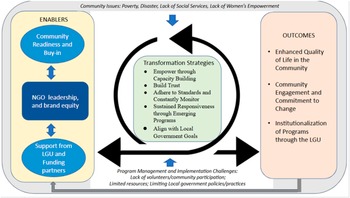
The interviews and FGDs surfaced community issues that motivated the NGOs to work with their partner communities. Given the many areas and sectors in the country that need assistance, there were enablers of transformation that led to the prioritization of these communities by the NGOs (see Figure 1). Most of these enablers were the NGOs’ critical community selection factors as these increase the transformation efforts’ chances of success. Upon the NGOs’ engagement with the community, they encountered program management and implementation challenges. The discussion of the findings below describes these challenges as well as the strategies employed to address them and achieve the desired outcomes. The looped arrow in Figure 1 emphasizes how the effectiveness of the strategies was shaped by the presence of the enablers. The outcomes are also proposed to loop back as factors that may eventually improve the enablers of transformation, which may help in future change efforts in the partner communities and enhance the NGOs’ leadership and brand equity.
Proposed model for engendering community transformation through NGO and community partnership.

Fig. 1. Long description
The diagram is contained within a large rounded rectangle. At the very top, a text label identifies Community Issues: Poverty, Disaster, Lack of Social Services, Lack of Women’s Empowerment. A blue arrow points down from this label into a central circular flow.
On the left, a yellow vertical box titled ENABLERS contains three stacked shapes connected by double-headed blue arrows:
- Top: A light blue oval labeled Community Readiness and Buy-in.
- Middle: A dark blue rectangle labeled N G O leadership, and brand equity.
- Bottom: A light blue oval labeled Support from L G U and Funding partners.
In the center, a large black circular arrow rotates clockwise around a green box titled Transformation Strategies. The strategies listed are:
- Empower through Capacity Building.
- Build Trust.
- Adhere to Standards and Constantly Monitor.
- Sustained Responsiveness through Emerging Programs.
- Align with Local Government Goals.
On the right, a peach-colored vertical box titled OUTCOMES lists:
- Enhanced Quality of Life in the Community.
- Community Engagement and Commitment to Change.
- Institutionalization of Programs through the L G U.
At the bottom, a blue arrow points upward into the central cycle from a text label identifying Program Management and Implementation Challenges: Lack of volunteers or community participation, Limited resources, and Limiting Local government policies or practices. A grey feedback arrow connects the bottom of the Outcomes box back to the Enablers box.
Community issues that drove the transformation
As seen in Figure 1, the changes were motivated by several issues faced by the community. Primary among these issues are poverty and the high prevalence of malnutrition among children, disasters and other environmental challenges, inaccessibility of social services, as well as lack of women’s empowerment.
Poverty
Poverty and malnutrition among children were the primary issues that drove Foundation for the Development of Agusanons, Inc. (FDAI) and Negrense Volunteers for Change Foundation, Inc. (NVC) to initiate the programs in their respective communities. Interviewees from both NGOs and the community leaders noted having underweight and stunted children at the onset of the program. Similar instances were seen by Espoir. A school teacher in Espoir shared about how the children would “ask for additional food so they can share it with their younger siblings…who are too young to enroll (to Espoir’s school and) have nothing to eat.” Poverty seems to stem from the lack of livelihood. An FGD participant from NVC narrated that many of the parents “work in the sugarcane field, they earn very, very, little which can’t support their children, especially in big families.”
Disasters
In recent years, the Philippines has encountered frequent flooding every time a typhoon hits the country. Although there are many factors leading to this, deforestation is considered a major cause. As noted by a staff in Ramon Aboitiz Foundation, Inc. (RAFI): “We know that there is a depleting forest cover…the community rely on these natural reserves…to have a livelihood. So, they cut trees, they sell them.”
In addition, a participant from Health Futures Foundation, Inc. (HFI) saw the community’s vulnerability during natural disasters such as Typhoon Yolanda, which badly hit their province. This disaster resulted in many casualties and devastated many houses and structures in the area. A community leader from Espoir also shared how their school facilities became the go-to place during disasters such as Typhoon Odette in 2021, a category-five typhoon that caused many deaths and destroyed thousands of homes in Siargao.
Lack of social services
Another driver of community transformation initiatives is the inaccessibility of social services. A community leader from HFI noted how “the community is deficient in health literacy.” FDAI also witnessed the people’s lack of awareness of the importance of education, insufficient supplies of medicines from the government, and lack of sanitary sources of drinking water. In addition, Espoir reported the lack of access to education due to distant housing locations and the lack of government presence in the remote areas. A community leader also mentioned that “far-flung communities…access to clean water, power, decent housing, and employment of parents is a problem.”
Lack of women’s empowerment
One of FDAI’s community partners described how “women did not have a group yet, not organized…they were on their own and women did not participate in the community.” A community leader in Sibog Katawhan Alang Sa Paglambo (SIKAP) also shared that “in the past, various kinds of abuse happened.” The women in the community did not know their rights, and lacked education and the “courage to speak of their women’s rights.”
Enablers of community transformation
Effective partnerships rely on the trust and mutual understanding between the NGO and community. Change is likewise facilitated by the NGO’s leadership and brand equity that helped enable access to support from LGUs and funding partners. The findings show how the readiness of the community and the openness of the LGU for partnership were important criteria for the NGOs’ selection of partner communities.
Community readiness and buy-in
Determining the community’s interest and engagement is important before the implementation of the project. One of the staff in RAFI emphasized that “the farmers or the POs (people’s organizations) must have their buy-in rather than assume or force them to do what we want. It is their land.” An NGO leader in RAFI also noted that “The farmers have their organization. So that’s our strategy. When we go into the community, we work with the POs because that’s part of our sustainability. We know that the trees have a higher survival rate when it’s being planted and taken care of by the POs.” Espoir likewise acknowledged that before their presence in the community, there had already been initiatives to educate the children through some volunteers. The NGO presence further ignited the passion of these volunteers who eventually became their active collaborators.
NGO leadership and brand equity
As mentioned by a leader in RAFI’s partner community, NGOs must be nonpartisan and apolitical to maintain objectivity in all their activities and operations. Moreover, the leadership quality of the NGO leaders plays an important role in the transformation process. One critical skill of leaders is effective communication, which helps people understand the vision and move them to participate toward achieving one common goal. The NGO leaders’ thrust to empower the community members rather than promote dependency is also key to the transformational process. Providing them with capacity-building opportunities helps community members develop their leadership capabilities. In the case of FDAI, a community leader shared that,
For example, they…will be part of the Barangay Council for the Protection of Children, Barangay Disaster Risk Reduction Management Team…we will implement rotational leadership. Meaning, like 15 self-help group members, one woman will be the leader for two months. She’ll be able to practice her political knowledge and skills. Then, it will rotate to other members after two months so they can exchange roles as leaders.
Immersion in the community is critical to ensuring that programs are strategically aligned with their needs to ensure impact. As mentioned by an NGO leader in Espoir, “Many programs can be offered but some are not relevant. So, we ensure that we pick programs that are significant to their needs.”
To establish trust, the NGOs must have a good reputation and brand equity. Intangible values are what the communities associate with the NGOs’ effectiveness. This is seen in the quote from one of the leaders in RAFI:
Reputation comes also with our accountability and integrity…when we say we’ll do this, we do it. Part of our social capital is also when we implement projects or programs at the community level…They deserve excellent service. That’s respecting their dignity. So, I think that has also built our reputation. That’s why, I mentioned earlier that they know when RAFI says “we will partner with you”, they know that RAFI delivers…we are consistent and we respond to their needs.
Support from local government and funding partners
Support from the local government enables the NGOs to implement and even sustain their initiatives. One leader from HFI noted that,
One enabling factor is the political will of the barangay and local government leaders. In the successful communities, the mayor and the barangay captain had the initiative to start the program and even maintain it. We require the barangay captains to maintain the (health) facilities.
A community leader from NVC explained the importance of having a partnership with the local government: “It’s not just the mayor who is invested in this, but it comes down from the mayor to the staff. It is between the NVC, LGU, and volunteers.” An NGO leader in Espoir also attested that “Government support is the number one enabler. Because it wouldn’t be easy for us if we didn’t have the support of the government, especially the mayor.”
Aside from the support of the LGU, the NGO leaders and staff expressed the need for funding partners. The founders of Espoir conduct regular “fundraising” and continuously look for “sponsors” for the schools. One community leader from Espoir also shared that “projects would not move if there is no budget.” NGO leaders from NVC and HFI also affirmed that financial support from donors is very important in order for them to sustain their projects.
Program management and implementation challenges
Issues still arose in the process of implementing the change. Engendering participation from the community and encouraging some of them to volunteer for the project was a major challenge, especially at the onset of program implementation. Having inadequate resources and limiting policies and practices of the local government were also persistent problems.
Lack of volunteers/community participation
Community members expressed resistance and a lack of support for the NGOs’ initiatives at the onset of the engagement. Espoir reported issues among parents who showed disinterest in sending their children to school. There were also those who shared wrong information and gossiped about the NGO. Some parents also did not want to participate in the school’s Sweat Equity Program, but would want their children to benefit from the free education. Similar challenges were noted by an NGO leader in NVC: “Some mothers are too lazy to bring their kids to the assemblies…Sometimes there are absentees so we cannot make an assessment of the child and we cannot determine if the child has improved or not.” A community member in FDAI also shared that “some women think participating (in activities) is a waste of time.” Similar experiences were mentioned by the participants from SIKAP:
The participation of our women in the community is also a barrier, especially because their priority is their livelihood, to earn…we have to find strategies to convince them to participate. Especially among men…because mostly, men are the ones who find a living, so it is difficult to conduct activities on gender-based violence where the (target) participants are men…there are only a few men (who get to attend), so this is one of the challenges that we encounter in the community.
Limited resources
Many respondents reported that the lack of resources has been a challenge in their implementation. Resources could mean a lot of things. In the case of Espoir, it refers to a lack of personnel, volunteers, and teachers who would teach the children, the issue of constant blackout that affects the classes, lack of funding for training and development of teachers, internet problems, and lack of capital to sustain their livelihood programs.
Limiting local government policies and practices
The support from local authorities has been a crucial enabler in the NGOs’ implementation of their advocacies. However, it was also reported that there are cases wherein their LGUs serve as challenges. One Espoir leader reported that,
Although the government is supportive, politics is different. When we say politics…it’s like…if it’s not benefitting for you, then why should you do it? Also, the land of Espoir is owned by the local government. So, even if we offer good projects if they are from the other political party, they may not agree with what you’re doing. Because it is their land. So, I don’t know what will happen after the change of administration.
This constant change in leadership and administration especially after the election threatens the NGOs. A participant from HFI noted that “Every time that officials are changing, there is a threat that these initiatives will not be accepted by the new (local) leaders.”
NVC’s community partners also experienced challenges among barangay leaders who have other priorities (e.g., prioritizing infrastructure projects over nutrition). It has happened that they already have trained Barangay Nutrition Scholars, but they were not supported because of the shift in focus (e.g., to infrastructure projects) of the barangay leadership. Similarly, there were local government leaders who were not supportive of SIKAP’s family planning programs due to the belief that the community needs to grow its population as not doing so will mean a reduction in the LGU’s budget (internal revenue allocation).
Transformation strategies
The NGOs needed to address community issues while navigating the abovementioned program management and implementation challenges. Thus, contextualized strategies were employed to achieve the change. As will be gleaned from the discussions of the strategies, the enabling factors at the onset of the partnership between the NGO and community played a role in the successful execution of the strategies. For example, the NGO leaders’ emphasis on community empowerment and the NGO’s brand equity naturally translated to capacity-building initiatives and facilitated trust-building efforts. Similarly, the support from the LGUs, as one of the enabling factors at the beginning of the transformation journey, allowed for alignment of change initiatives with the plans of the LGUs.
Empower through capacity building
As articulated by an FGD participant from RAFI, the NGO leaders and staff know that they “will not stay (in the community) forever.” With this in mind, all of the NGOs engaged in efforts to empower community leaders and members through capacity building. This was seen in how SIKAP trained women in the community to become peer educators. As recounted by a community leader,
Empowerment, that’s what my Barangay Kagawad (Councilor) colleague said… they have been transformed, they are being educated because there is training… They were also capacitated, (to) become Peer Educators in the women’s sector…they are empowered…Their husbands cannot beat them or use them because they know their rights when it comes to sexual relations…SIKAP has helped a lot through the project SHE
(Sexual Health and Empowerment).The NGOs conducted training, seminars, and quality circles among others. In the process of capacitating the community partners, the staff of FDAI noted how people in the community eventually led the program implementation: “they themselves already have the initiative…they themselves inform their members…If capacitated, (and) empowered, partnerships will happen immediately. It is not too heavy for a community worker to implement the program.” The NGOs were clear that empowerment through capacity building needs to happen since they would like the community to eventually sustain the initiatives. Enhancing the community members’ knowledge, skills, abilities, and attitudes is an essential aspect of the transformation strategies and was designed based on the specific needs of the people and the type of program. For example, in SIKAP, capacitating the peer educators within the community is essential to continue the program on sexual health and empowerment against gender-based violence, which are deemed private and sensitive issues.
Build trust
The NVC staff emphasized how “trust is very important, if (the community) is doubting you… or if you break their trust… you will not be able to do anything.” According to an NGO leader from Espoir, trust emanates from
…simple interactions…just talk to them. For someone who grew up in the city and has a language barrier…the very first thing is to really go with them. If the mothers are tending their garden, or cooking, join them…If they are engaging in gossip, be there… until they start trusting you and they will no longer be uncomfortable or shy…Little by little, they will open up about their problems and issues…Then you will have a clear picture of the needs of the community and how you can make the program work- what do you need to stop or change based on their experiences.
As seen in the quote, trust building was essential not just in ensuring the successful implementation of current interventions but in further improving and exploring ways of enhancing community support.
Adhere to standards and constantly monitor
A leader in Espoir emphasized the need to “keep high standards to be sustainable…So, when we’re hiring people, we need to make sure that they’re onboard with us.” Espoir hires “local para-teachers.” Some of them are mothers who did not complete their education so the NGO made sure that they complete courses in the Alternative Learning System program.
The NGOs also constantly monitor what is happening to the community. For example, NVC directly communicates with the mother and asks them to share photos of the food that they prepare for their children. They also gamified the monitoring process to make this more engaging.
Sustained responsiveness through emerging programs
The NGOs consistently gathered feedback and ensured that they are immersed in the daily life of the communities. This deliberate and deep engagement with community members allowed them to identify areas for improvement to enable the transformation. Such were observed in how Espoir eventually embarked on a feeding program upon realizing that hunger is the cause of the children’s slow “learning capabilities and academic performance.” They also started “tutoring the mothers” so they will be able to support the learning of their children.
Realizing the need to help families (especially of stunted children) attain more sustainable sources of income, NVC engaged in livelihood programs on top of their feeding program. The NVC staff shared that they now have Project Joseph “named after St. Joseph, the worker, where we give…tools for people who are in need. So, they are going to be identified, and then verified, and then they will be given the tools. We will also have monitoring for them as well. The next is Peter Project which is also named after Saint Peter, the Apostle where we give out boats to beneficiaries.”
Align with local government goals
A critical strategy employed by the NGOs is to align their plans with the LGU. As expressed by the staff of RAFI,
…even if you have the community buy-in, if the LGU says we will sell this area, this land will be converted or developed…the community cannot do anything. So, I think that’s why at the beginning we really aligned ourselves to the land use plan of the local government.
Leaders in FDAI’s partner community also noted observations on how the NGO always consults the Barangay Captain and collaborates with the barangay officials on the programs that they bring to the area to ensure alignment.
A leader in SIKAP also shared the importance of working with the LGU and the offices within it that focus on sexual health and empowerment. Their partnership even includes national government agencies that have similar programs: “when we started, we had a project orientation so they could see where we align…then we engaged them in where we can collaborate because this is also their mandate…we are not there with a separate agenda, we are the same.”
The above strategies were mentioned as key not just in the efficient management and implementation of the programs but in the sustainability of the transformation. The NGO leaders and staff were deliberate in their capacity building, empowerment efforts, monitoring, adherence to standards, responsiveness, and alignment with local government programs to make sure that the positive changes in the community will remain and even flourish after their engagement.
Outcomes of the community transformation
The transformation that happened in the communities was primarily reflected in the enhanced quality of life among community members. The evaluation of the programs based on the shared goals set at the start of the initiatives also highlights the positive outcomes of the transformation. Due to the effectiveness of the NGO’s programs, many of these were adopted by the local government. More importantly, community members demonstrated engagement and expressed their commitment to sustain the change.
Enhanced quality of life in the community
Accounts of community leaders and members gathered through interviews and FGDs reflect the impact of the NGOs’ engagement with the communities (see Table 1 and Appendix A for specific evidence/indicators of transformation). Community partners of NVC, Espoir, RAFI, and FDAI shared the “significant decrease in the number of malnourished children,” “school children who experience hunger,” and those who are “unable to go to school due to lack of school supplies and materials.” RAFI’s “primary healthcare program” and HFI’s “Barangay Health Station or Barangay Health Center” and “community-based health and wellness program” enabled access to “quality and equitable healthcare.” Enhanced awareness on the issue of climate change also helps mitigate its impact on the communities that RAFI and FDAI are working with. Women’s and youth empowerment were evident in the sharing of SIKAP’s community partners. Community members also felt empowered and gained greater self-confidence:
My learnings are quite a lot…As a woman and as a parent, at first our role is only confined at home…I started joining these (FDAI programs and), it seems that I was learning something…I felt confident…I’m 32…I have four kids who are studying but I wondered if I should go to school…(Now) I’m in my third year of college…I am also a Federation President, and the Women’s President…I have learned a lot and …I can say that I am in the right place.
It is important to note that the goals were collectively crafted by the NGOs and their community partners at the beginning of their engagement. The outcomes indicate considerable progress on these goals. For example, RAFI’s One to Tree project has planted more than 3 million seedlings from 2020 to 2023. The success rate of NVC’s nutrition program with their partner community was at 87%, which is 4% higher than their previous community engagements. The Women’s Federation in FDAI’s partner community successfully completed their registration with the government’s Securities and Exchange Commission (SEC) while HFI noted the regular attendance at meetings and active delivery of services to the community by the Barangay Health Workers (BHWs), similarly seen in how the parents in Espoir have actively participated in the school’s feeding program and initiatives.
Community engagement and commitment to change
The lack of community participation and having a few volunteers were highlighted as program management and implementation challenges. Based on the sharing of the NGO and community members, it appears that the transformation strategies (e.g., empowerment through capacity building, building trust, and sustained responsiveness) enhanced engagement and commitment within the community. This is a critical success factor given the desire of the NGO to empower its community partners to sustain the initiatives after their engagement.
The community partners of NVC recounted how they pass on to their friends the learnings that they get from the program: “from what was taught to us, we share with them what not to feed our children…we share our learnings with others.” The women, parents, health workers, and youth adopt an advocate, rather than just a beneficiary, mindset. Interviewees from Espoir noted how the parents are now participating in the program “giving sweat equity” when they saw its benefits to their children. More importantly, it is now the mothers in the community who train other mothers in their program expansion areas. As mentioned by one of the NGO leaders, “we want them to feel that they are part of program implementation- that mothers are teaching other mothers.” Community partners of SIKAP likewise expressed that “we want to be a peer educator, Ma’am (NGO staff) always reminds us why we need to follow our purpose, our goal, why we became peer educators.” They likewise added that:
We also know that the project will end. Our effort will be wasted if we just stop…We as Peer Ed also, we are also looking for a way to stand on our own, we are also privileged and we are lucky because we have the full support of the LGU.
Institutionalization of programs through the LGU
Another evidence of program effectiveness can be seen in the LGUs’ adoption of the programs. The institutionalization of these initiatives will ensure continuity, if not greater reach. For example, SIKAP’s SHE Project, “Usapang Lalaki” (Man Talk), and “Usapang Barkadahan” (Talk with Friends) are now integrated into the programs of the public schools and local health boards (as mandated by the LGU). There is now a unified referral system for child abuse cases in the barangays (the smallest LGU) in communities where FDAI operates. Similarly, HFI was able to shape the implementation of local legislations, indicating the need for the local government to provide resources that will sustain the Barangay Health Stations/Centers as well as the Barangay Health Workers. The Local Government Health Officer shared that they “created Barangay Health Board(s)” to ensure program sustainability.
As noted in Figure 1, the abovementioned outcomes strengthened the communities’ capacity for change and can serve as enabling factors in future transformation efforts. The community’s engagement and commitment to change will facilitate the success of consequent change efforts, and the LGU’s adoption of the program is a clear manifestation of the supporting relationship between the LGU and the community. The enhanced quality of life in the community was seen as a critical outcome, but constant adaptation to disruptions (natural or man-made) is needed for the sustainability of the change and further improvements.
Discussion
In this study, we aimed to examine how NGOs in the Philippines worked to help transform communities. Aligned with the definition of community transformation by Visión y Compromiso (2017), these transformations have occurred in various aspects of community life, such as human health, social justice (including gender justice), income, employment, educational attainment, environmental quality, entrepreneurial activity, and/or community participation (Visión y Compromiso, 2017). Not only did we accomplish this, as shown in our findings, but we also developed a model for community transformation, as illustrated in Figure 1. Common social issues such as poverty, disasters, insufficient social services, and the disempowerment of marginalized groups typically motivate NGO initiatives. Significant social change that addresses these issues can be achieved when community members, LGUs, and NGOs collaborate. In this stakeholder partnership, NGOs play a key role in securing cooperation toward the shared goal of change. Along with the synergy fostered by NGOs, several key elements are essential for successful community transformation programs. These include strong, effective leadership and meaningful ways for NGOs to create and demonstrate their value to community partners. Strategies that help achieve desired outcomes involve aligning NGO goals with those of LGUs, tailoring programs to meet community needs, adhering to established standards, monitoring community progress, empowering residents to take on leadership roles in NGO-led programs, and fostering trust within the community. Consistent with existing studies, the model also demonstrates that transformation is nonlinear (Sulistyowati & Nurhasana, Reference Sulistyowati, Nurhasana, Künkel and Ragnarsdottir2022) and success as well as sustainability hinges on building a sense of empowerment among community members (Perkins & Zimmerman, Reference Perkins and Zimmerman1995; Zimmerman, Reference Zimmerman1995). Over time, the effects of change can alter the community environment, potentially introducing new challenges and leading to the need for innovative transformation strategies.
Implications for NGOs and community transformation
The results of our study highlight three important roles that NGOs play in community transformation: enabler, partner, and social mobilizer. These three roles advance our understanding of empowerment theory (Perkins & Zimmerman, Reference Perkins and Zimmerman1995; Zimmerman, Reference Zimmerman1995), as applied to how NGOs and community members work together to achieve meaningful community transformation. As enablers of positive social change, NGOs empower their community partners, build on their strengths, and nurture trust (Brown & Baker, Reference Brown and Baker2019). The NGOs in our study demonstrate the importance of empowering communities by equipping them with skills not only to be self-managing (Venus-Maslang, Reference Venus-Maslang2013; Walker, Reference Walker1988) but also to be increasingly able to enact sustainable social transformations through their own efforts (Pearce, Reference Pearce2006; Zimmerman, Reference Zimmerman1995). In enabling this (co)ownership, NGOs facilitate a more participatory approach to development (Ulleberg, Reference Ulleberg2009). They are able to leverage existing strengths and build the capacities of their stakeholders, giving communities coauthorship of the collective transformation. The stories of each NGO in our study also highlight the fundamental role of trust as a catalyst for community transformation. Establishing authentic relationships through open communication and responsiveness to feedback ensures that community members feel understood and respected, which facilitates their active involvement. This, in turn, informs the development of more effective, insight-driven programs that allow for relevant and impactful interventions. As emphasized by Brown and Baker (Reference Brown and Baker2019), community empowerment, engagement, trust, and the inclusion of community voices are essential for meaningful and sustainable community change processes. Low trust levels frequently result in disorganization, which hampers progress.
NGOs are often seen as service providers (Young & Dhanda, Reference Young and Dhanda2013), especially in areas such as education, infrastructure, health, and livelihood support. However, our research underscores the role they play as partners in driving change. Each case study highlights the importance of NGOs working closely with community members to identify needs, plan projects, and utilize feedback to drive improvements. Collaborating with LGUs is also a crucial part of community transformation. It not only enhances outreach and program effectiveness (Gallegos, Reference Gallegos2025) but also adheres to the constitutional mandate and the Caucus of Development NGO Networks covenant on Philippine development (CODE-NGO Covenant on Philippine Development, 2022) to build NGO–LGU partnerships aimed at promoting the nation’s welfare. Their experiences emphasize the significance of aligning goals and sharing resources with community leaders (both people’s organizations and local government), not only for implementing changes but also for ensuring their long-term success. Our findings also reinforce earlier studies indicating that community readiness and competence drive community-based interventions (Castañeda et al., Reference Castañeda, Holscher, Mumman, Salgado, Keir, Foster-Fishman and Talavera2012). Participatory approaches are likely to fail unless the community partners are prepared and willing to embrace and execute changes (Kehl et al., Reference Kehl, Brew-Sam, Strobl, Tittlbach and Loss2021). The NGOs in our study likewise identified community readiness as a critical factor in determining which communities to engage with. Seeking feedback and staying attuned to the needs of the community helped NGOs adapt and innovate their initiatives. As community transformation is not a straightforward endeavor, NGOs work jointly with their partner communities in fine-tuning their strategies and approaches to ensure responsiveness to the community needs, effective transformation, and achievement of their shared goals (Sulistyowati & Nurhasana, Reference Sulistyowati, Nurhasana, Künkel and Ragnarsdottir2022). This also proved helpful in empowering community members and winning their trust, which lessened concerns of nonparticipation.
Transformation is an action. Our research emphasizes the role of NGOs as social mobilizers, inspiring and coordinating collective action to create an environment conducive to social change. NGOs are able to cultivate greater agency among relevant stakeholders in the efforts to improve the conditions of their communities. As one of our participants said, “We let them shine,” illustrating how NGOs minimize, if not eradicate, the power differential between them and the community members described by Magara (Reference Magara2025). Leadership style and advocacy are the evident drivers of this impact in our case studies. The literature shows that one of the hallmarks of successful NGO leadership involves balancing competing demands and employing strategies to navigate complex external environments (Hailey, Reference Hailey2006). NGO leaders in our study exhibited not only critical thinking skills and foresight but also resilience and flexibility; not only systems thinking but also context sensitivity, genuine care, and the heart to serve. Furthermore, our case studies indicate that sustaining community transformation efforts requires NGOs to adhere to standards and continuously monitor progress, emphasizing the importance of accountability and maintaining program quality. The role NGOs play is also critical in advocating for the provision of welfare services and the development of key policies (Unerman & O’Dwyer, Reference Unerman and O’Dwyer2006). Advocating for the people and for the institutionalization of the various community transformation initiatives ensures that their interventions continue to benefit local populations in the long term, and positive changes persist even after direct NGO involvement has concluded.
Limitations and implications for future research
Using an exploratory multi-case study approach, the study was able to systematically develop and propose a contextually nuanced community transformation framework for NGOs and their partner communities (see Figure 1). One limitation of the study was that the period of data gathering happened after project implementation for many of the NGOs. Thus, the sharing during the interviews and FGDs may have been limited by memory and influenced by recall biases. Although the research team also looked into the documents submitted to Galing Pook, doing a case study that longitudinally captures end-to-end project implementation could have provided more robust data. The use of other data-gathering methodologies such as surveys and unobtrusive observations on top of FGDs and interviews can also address social desirability in data collection. Furthermore, future studies could explore stories of community transformation through a social constructivist lens, such as a narrative approach, to better understand stakeholders’ storied experiences and the cocreation of community transformation narratives. It would likewise be valuable to capture accounts primarily from the perspectives of the NGOs’ community partners. In particular, it would be worth exploring how factors such as power dynamics (e.g., NGO/community leaders vis-à-vis community members) or macrolevel influences like the region’s political climate may influence the implementation and outcomes of community transformation efforts. Since the current study presents exemplar NGOs and stories of successful community transformation in the Philippines, it may not fully represent the diversity of NGOs and their varied experiences or levels of success. Succeeding studies may consider a broader set of NGOs to capture shared and nuanced experiences across varying contexts and cultures.
Conclusion
In this study, we aimed to explore how NGOs contribute to community transformation. Existing literature suggests that the effectiveness of NGOs relies on strengths in community development, emphasizing a bottom-up approach that fosters local empowerment (Brown & Baker, Reference Brown and Baker2019), collaboration, contextual understanding, and the implementation of sustainable development principles (Kang, Reference Kang2010). Through a multi-case study approach, we investigated the experiences of NGOs in the Philippines as they interact with communities to promote positive change. We identified the key drivers, enablers, challenges, strategies, and outcomes that constitute community transformation. Our findings offer valuable theoretical insights through a model of community transformation that emphasizes the importance of strong partnerships, the fluidity of social change, and the need for continuous innovation to adapt to changing dynamics. We established three crucial roles that NGOs assume in evolving community transformation: enabler, partner, and social mobilizer. As enablers, they empower communities by building on their strengths; as partners, they collaborate in planning and implementing changes; and as social mobilizers, they inspire collective action to create an environment conducive to social change. Pointing out these roles underlines not only the pivotal role of NGOs but also how partnerships among NGOs, communities, and local governments critically shape community transformation. Our findings not only add geographic diversity to the nonprofit literature but also reveal effective practices for community transformation in the Global South, including transformative leadership and adherence to established standards, as well as insights into navigating the barriers and drivers that influence initiatives. Our analysis calls for NGO partners, including local governments, to strengthen and expand their collaborations with NGOs, recognizing their vital role in national development. It also urges legislators to formulate policies that foster a conducive environment for these partnerships to flourish and ensure proper infrastructure to support NGOs, particularly small-scale ones, thereby further promoting public welfare.
Supplementary Material
The supplementary material for this article can be found at http://doi.org/10.1017/S0957876526000252.
Data availability statement
Data are available on request from the authors.
Acknowledgements
The authors would like to thank the University Research Council (URC) of the Ateneo de Manila University for providing a research grant to this project. We would also like to thank the Ateneo Center for Organization Research and Development (Ateneo CORD) for the administrative support. Our sincerest gratitude to Galing Pook and the Caucus of Development NGO Networks (CODE-NGO), the six NGOs (Espoir School of Life, FDAI, HFI, NVC, RAFI, and SIKAP), and their community partners who agreed to participate in the research. Special thanks to our research assistants and the rest of the research and data-gathering and analysis team (aside from the coauthors): Josephine P. Perez, Christina Marie Ysabel Cruz, Shanise Geri Villanueva, Yayen Gallardo, Marie Jane Pauig, Chona Sandoval-Pagsanghan, Ervina Espina, and Raymond Edmidio Ramos.
Author contribution
The first three authors and the last author conceptualized the study. All authors contributed to the implementation of the research, analysis of the results, and writing of the manuscript.
Funding statement
This work was supported by a research grant from the University Research Council (URC) of the Ateneo de Manila University.
Competing interests
The authors have no conflicts of interest to declare that are relevant to the content of this article.
Ethical standard
All subjects gave their informed consent for inclusion before they participated in the study. The research protocol was approved by the Ethics Committee of the Ateneo de Manila University (Project identification code AdMUREC_22_112).


 Open access

