




I heard Paganini. … [W]hat a staccato! No other violinist can play polished notes more quickly or clearly than he can staccato! Harmonic double stops (violinists cannot grasp how he brings them out), also entire passages in harmonics; variations in which one note is always played with the bow while the others are pizzicato, and everything with the greatest velocity. Then he plays variations without accompaniment, in which he himself accompanies, so that one believes he is hearing a violin and a guitar at the same time.Footnote 1
With this report Herr Jacques Rosenhain, identified in the Signale für die musikalische Welt as a ‘famous pianist and composer’ from Baden-Baden, described some of the most impressive virtuosic inventions of the nineteenth century. For instance, Paganini created illusions of more than one person playing – here, in the critic's imagination, a violinist and a guitarist. Had the critic perused the score, he would have seen that even the notation had more than one line of music, ostensibly requiring multiple hands to execute and suggesting a degree of complexity that arguably bordered on the miraculous, even if credible from the technical standpoint. In addition to the melody, which already required two hands (one stopping the notes and one drawing the bow) a second line was to be played pizzicato, thus creating the effect of three hands at work. Similarly, in the so-called three-hand technique in piano music, the expansion of registers and strategically placed melodic lines in the middle of the texture suggested that three instead of two hands were at work.
Paganini's Legacy
Techniques such as these were audience favourites during the Golden Age of Virtuosity, which, according to Hanslick, climaxed in the 1830s and ended around 1848.Footnote 2 In the wake of Paganini Joseph Joachim grew up during this age, when the expansion of violin technique imitated innovations in other parts of society with a ‘craze for the unusual’. As has recently been discussed,Footnote 3 Joachim's repertoire of the 1840s favoured types of pieces after Paganini such as airs variés, caprices, operatic fantasies and other dazzling bonbons incorporating technical tours de force such as up- and down-bow staccato, flying staccato, chromatic octaves, glissandi, single- and double harmonics, and pizzicato acrobatics, among others. Judging from the repertory the greatest European violin virtuosos of the 1840s produced – musicians such as Niccolò Paganini (1782–1840), Ole Bull (1810–1880), Heinrich Wilhelm Ernst (1812–1865), Prosper Sainton (1813–1890), Camillo Sivori (1815–1894), Henri Vieuxtemps (1820–1881), Apollinaire de Kontski (1824–1879), Henryk Wieniawski (1835–1880) and Joseph Joachim (1831–1907) – Paganini's virtuosic legacy was still alive and relevant in the 1840s.
By this time the demanding prestidigitations of the 24 Caprices had generated quite an interest in Virtuosentum. Thus, in an article titled ‘Great Technicians and their Tricks’, Arthur Elson wrote in 1912: ‘Fifty years ago the proverb might have run, “Be a virtuoso and you will be happy”; one might even have claimed that virtuosity was its own reward. But now one may advise the student not to indulge in too many tricks.’Footnote 4 Indeed, as the nineteenth century reached its midpoint, the ‘growing authority of the “work” concept’ gained considerable significance, and concepts of virtuosity, as well as related practices such as improvisation, fell out of favour. Performative techniques that registered as being technical, mechanical, or simply unusual began attracting harsh criticism as serving mere means without ends,Footnote 5 while the pursuit of higher ‘art’ true to Austro-German canonic traditions (Werktreue) – a pursuit represented above all by Joachim and Clara Schumann – attracted more and more followers.Footnote 6 During the 1840s, however, virtuosity was still considered its own reward.
One particularly alluring Paganinian technique, left-hand pizzicato, kept puzzling listeners. Left-hand pizzicato serves the purpose of producing a pizzicato sound with the left instead of the right hand, as in normal pizzicato, in order to retain the bow for its standard function.Footnote 7 After Paganini, who had standardized left-hand pizzicato, the technique started appearing in many violin treatises, and even some orchestral ones as well, ranging from Baillot (1834) to de Bériot (1858), and from Berlioz (1844) to the Dresden Franz Schubert (1865), in addition to many encyclopedia entries.
According to some sources, the use of standard pizzicato goes back to Monteverdi's Il combattimento de Tancredi e Clorinda (1624). The first to mention left-hand pizzicato, typically notated with a + sign, was John Playford, who noted its use ‘mainly for convenience in situations where a right-hand pizzicato would be a very difficult maneuver’.Footnote 8 Not until the 1840s, though, did left-hand pizzicato begin to broaden its impact on the violin repertory. Berlioz claimed in his Grand traité d'instrumentation et d'orchestration modernes (1844) that pizzicato technique was still not completely developed, and its execution often flawed:
In the future one will know, beyond doubt, how to achieve still much more original and attractive effects with the pizzicato than is presently the case. Violinists accustomed to regarding the pizzicato as not at all an essential component of the art of violin playing have still so far made no studies of it. At the most they assiduously practice the pizzicato with the thumb and forefinger, which means they can produce neither passages nor arpeggios faster than semiquavers in a very moderate tempo in 4/4 time’.Footnote 9
By specifying the thumb and index finger, Berlioz criticized the limitations of traditional pizzicato and implied that left-hand pizzicato could remedy the limitations in tempo and fluency of right-hand pizzicato.
We can distinguish two subtypes of the left-hand pizzicato. First, the pizzicato occurs simultaneously with bowed notes; second, pizzicato and bowed notes alternate very rapidly. The former was particularly compelling in its power to invoke multiple musicians. The latter subtype, on the other hand, was sometimes called ‘pizzi-arco’, and characterized as mere ‘Spielerei’ (‘gimmickry’).Footnote 10 Thus, a review of the Polish virtuoso Apollinaire de Kontski noted his ability to simulate ‘several Kontskis’: ‘While namely the right hand lets the bow gallivant around the strings in the most difficult types of strokes, he adds yet another, complete pizzicato part for long, extended passages, and it occasionally sounds as if several Kontskis are playing’.Footnote 11 This special effect also intrigued another reviewer, who wrote for the Neue Zeitschrift für Musik: ‘Often the result is a simultaneous sounding of both named types [arco and pizz.], so that the effect is roughly like that of a violin playing with an accompanying keyboard instrument’.Footnote 12 The left-hand pizzicato technique even prompted the sanguine prediction that it would ‘doubtless become, in the course of time, familiar to every violinist, and then [would] be available in compositions at large’.Footnote 13
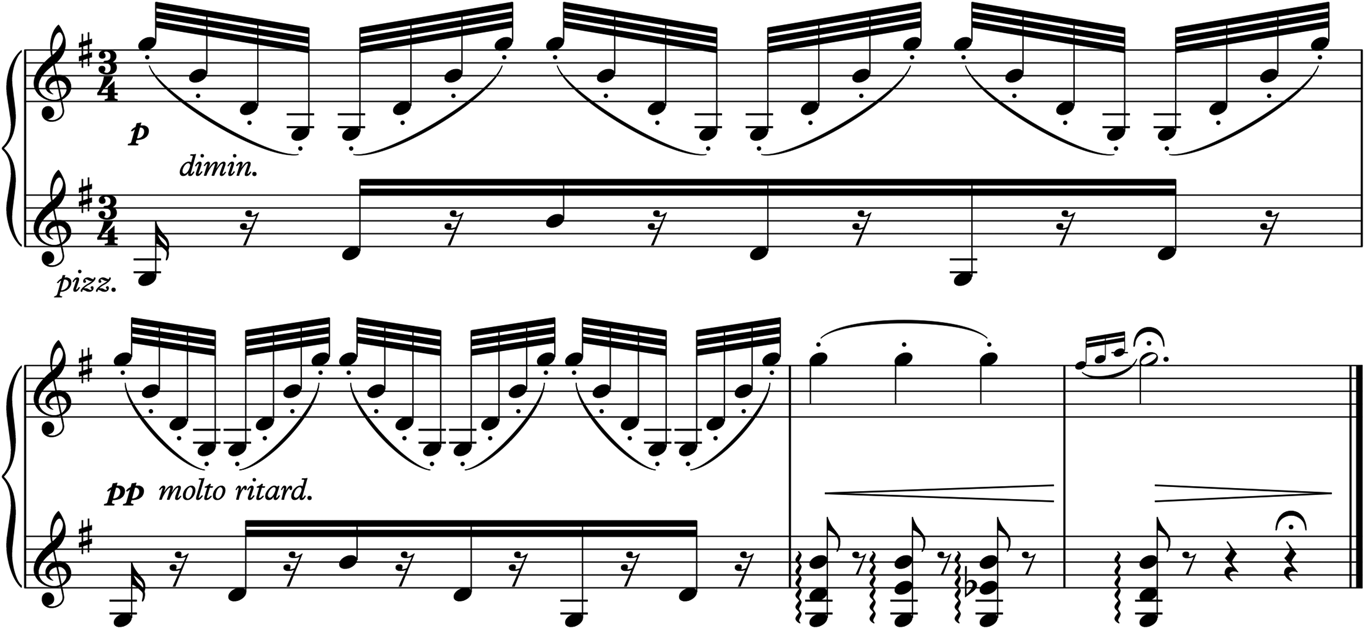
Before considering how the young Joachim applied the device, we might briefly discuss two examples from Paganini and perhaps his most fervent emulator, Heinrich Wilhelm Ernst. Hailed as ‘Paganini's greatest successor’, Ernst had mounted a determined clandestine surveillance of the Italian maestro while he was on tour, in a bid to discover his secret fingerings. Ernst uncovered some of them, and also two of Paganini's most radical virtuosic inventions: double-stop harmonics and left-hand pizzicato. When, in 1864, Ernst published Six Polyphonic Studies, composed several years earlier and dedicated to six violin virtuosi – Laub, Sainton, Joachim, Vieuxtemps, Hellmesberger and Bazzini – he made sure to include an example of left-hand pizzicato. In the sixth study, a series of variations on The Last Rose of Summer, the fourth employs the device as a bass line notated separately beneath the standard line (Ex. 1). The pizzicato appears predominately on open strings, except for the third bar, where the first finger plucks the pitches E and E-flat, while the second finger stops the bowed note, G.
Heinrich Wilhelm Ernst, Six Polyphonic Studies, No. 6, Var. 4 (end)
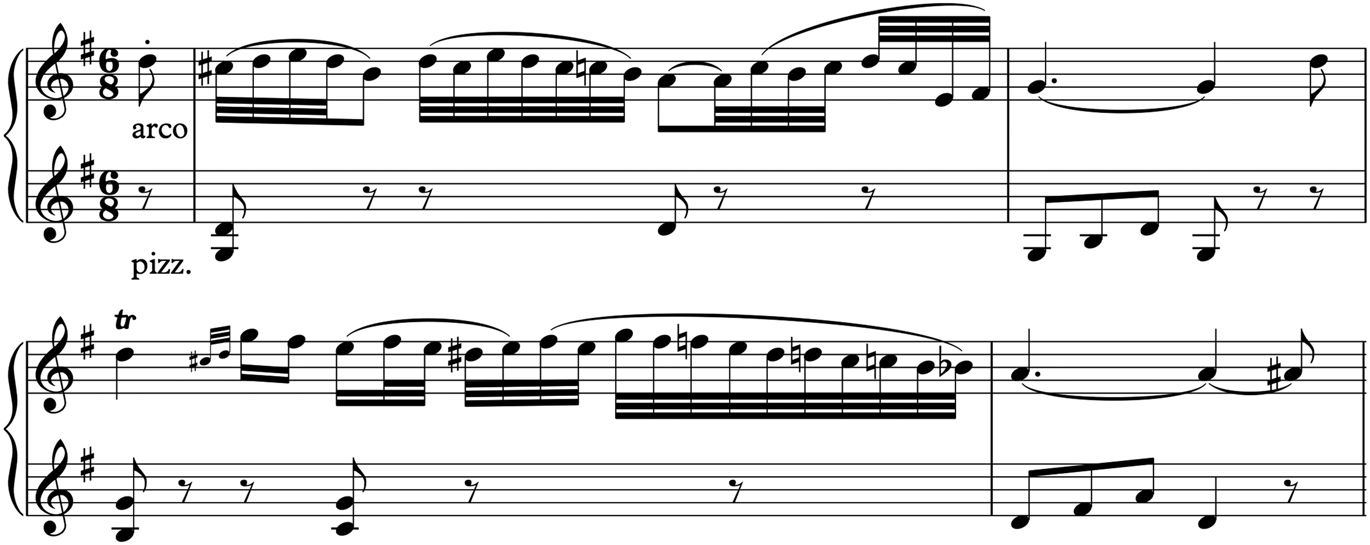
The technique was not new. Paganini had posed a greater challenge (Ex. 2) with the pizzicato that requires the second and third fingers to pluck pitches on the G and D-strings, far more demanding to execute than on the higher strings.
Niccolò Paganini, Introduction et Variations sur le Thème ‘Nel cor più non mi sento’.
How do these two examples compare with Joachim's applications of the device? As Katharina Uhde has discussed,Footnote 14 he used left-hand pizzicato in some cadenzas he wrote for Beethoven's Violin Concerto, the work he performed to great acclaim on his London debut at the Philharmonic under Mendelssohn in 1844. Like Ernst and Paganini, Joachim took advantage of a passage in G major to accommodate most of the pizzicati on open strings. Ex. 3 offers an excerpt from a recently rediscovered Beethoven cadenza by Joachim, titled and dated ‘Dublin am 25. Mai [1852]’ and centred on G major.Footnote 15 Here Joachim assigned pizzicati as a bass line to accompany the secondary theme of the first movement of Beethoven's Op. 61, presented in double stops.
Joseph Joachim, Cadenza to Beethoven's Violin Concerto Op. 61, First Movement (‘Dublin, am 25. Mai [1852]’)
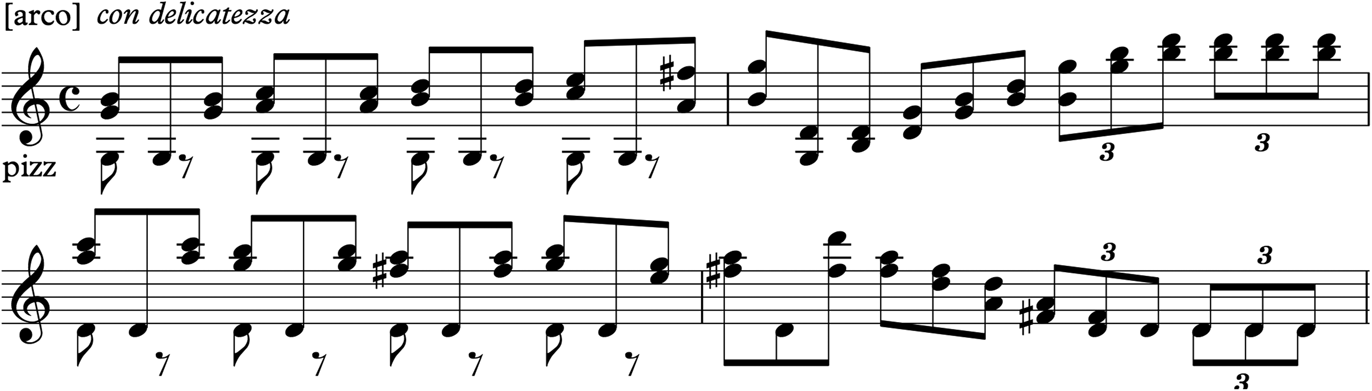
Joachim, Cadenza Fragment (1844) for the First Movement of Beethoven's Violin Concerto, Op. 61, Albumblatt for Walter Macfarren. From Uhde, ‘An Unknown Beethoven Cadenza’
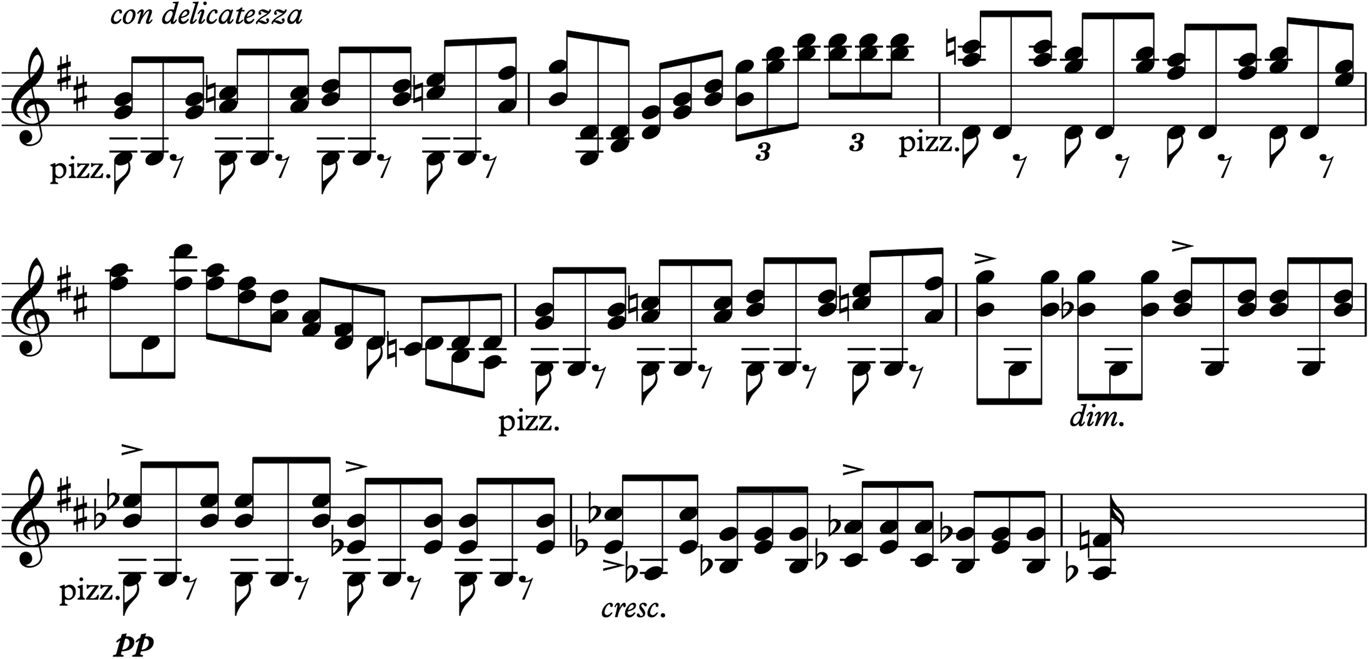
Uhde describes another, earlier, Beethoven cadenza, notated in 1844 as an album leaf for Walter Macfarren (Ex. 4).Footnote 16 There, Joachim had continued the pizzicato line even longer while preserving the marking ‘con delicatezza’, the ascending and descending thirds (bars 1, 3, 5), and mixed double-stops arpeggios (bars 2 and 4). The earlier draft included an unexpected turn as well to the minor (bar 6), which initiates a modulation to A flat minor (bar 8), a key not at all used in Beethoven's first movement.
Both cadenzas necessarily called for left-hand pizzicato, although the pizzicato appears on open strings rather than fingered notes. The bass line cannot be rendered with the traditional right-hand pizzicato, which in Joachim's time carried no connotations of trickery or charlatanry for its effect. In short, these two cadenzas reveal a connection to virtuosity of the 1830s and 40s, and rub against the classical veneer of Joachim's carte de visite concerto. Thus, the left-hand pizzicato as an outwardly dazzling technique accords with Joachim's virtuoso compositions from the 1840s.
One feature that promotes the illusion of multiple executors in Paganini's and Ernst's examples is their notation. Because the violinist's music expands to two systems rather than one, it no longer visually registers as intended for a single melodic instrument but rather begins to resemble the appearance of an ensemble piece for two melody instruments, or even of keyboard music. To be sure, left-hand pizzicato was not linked explicitly to its celebrated pianistic counterpart, the so-called three-hand technique. Still, both contrivances clearly followed the same goal: to combine a fascination for ‘virtuosity … [as] its own reward’ with an expansion of technique. The result was a technique with a nod to extra- or paranormal apparitions or appearances popular at that time, pushing virtuosity to a new frontier where the real and magical overlapped. Practitioners of these techniques, including Apollinaire de Kontski (violin) and Sigismond Thalberg (piano), were often mentioned in the same sentence, as in the Russian Oulibicheff's polarizing monograph Beethoven, ses critiques et ses glossateurs, which Joachim read in 1857, just months before writing his ‘Absagebrief’ and decisively breaking with the Weimar Kapellmeister, Franz LisztFootnote 17:
An analogous difference can be perceived in instrumental music, which divides into two genres, the symphonic and concertant. But these genres are not incompatible, just because they have nothing in common. After having heard a Beethoven symphony, one could listen with pleasure and completely clear conscience to the tremolo of Bériot, the cascade and pizzi-arco of Kontsky, the airs variés of Servais, the fantasies of Thalberg and even the original compositions of Franz Liszt’.Footnote 18
Virtuosos Thalberg and Kontski are here set against the more serious musician-composer Beethoven. When Joachim read this passage, he reacted this way in a letter to his (still) beloved Gisela von Arnim:
I've read Oulibicheff's book on Beethoven. It contains several useful, pointed attacks against Beethoven's false imitators and arrogant interpreters who ascribe their own vanity to the sacred life of the sublime man – but of Beethoven's greatness, of the glowing godliness that streams throughout all the torments of the proud, secluded penitent, and that makes of him one of the most touching of martyrs whom Providence has sent for the edification of the human race, of all of this the Russian has no idea.Footnote 19
In this private book review for Gisela von Arnim, Joachim, already far removed from his earlier virtuosic flirtations and adventures, solemnly accepts Beethoven as the true one, and identifies a path forward for his own career. At the same time musicians such as Thalberg and Kontski, whom the Neue Zeitschrift für Musik in 1848 was still proclaiming to be great artists and not mere virtuosos,Footnote 20 were clearly grouped with their own kind in Oulibicheff's tome, including Servais and Liszt.Footnote 21 For Joachim, to remain even remotely associated with Liszt carried too great a risk of being allied with the wrong camp.
As a virtuoso Joachim was not alone in first embracing virtuosity, including its more ostentatious effects, only then to redefine his relationship to the phenomenon, so that it became a means to an end, not the end in itself. In this regard, his approach to his instrument was not unlike that of several members of his circle to the piano, including, as we shall now see, Mendelssohn, Fanny Hensel, and the Schumanns.
Pianistic Three-hand Illusions: Mendelssohn, Thalberg, and Liszt
On March 17, 1840, an elegantly attired figure, ‘lithe and slender as a tom-cat’, glided onto the stage of the Leipzig Gewandhaus, and took his place at a piano beneath the Wahlspruch emblazoned overhead Res severa verum gaudium (‘True joy is a serious matter’), a timeless adage borrowed from Seneca the Younger. ‘There's a novel apparition, the virtuoso of the nineteenth century’, a member of the audience, Felix Mendelssohn Bartholdy, commented to his companion, the composer Ferdinand Hiller,Footnote 22 as they prepared to experience Franz Liszt's mesmerizing rendition of Schubert's Erlkönig. Hiller reported that half the audience stood on their chairs so as to have unobstructed views of the keyboard acrobatics. But despite Liszt's much vaunted, recent triumphs in Vienna and Prague, Leipzigers chose not to succumb that evening to what Heinrich Heine in 1844 would fully recognize as Lisztomanie, the irrational hysteria that spread like a contagion with every new escapade of the celebrity. Though Liszt was widely regarded as primus inter pares of the peripatetic piano virtuosi then plying their wares across Europe, Leipzigers were not at all amused when his concert manager hyperinflated the usual ticket prices. Nor were all convinced when Liszt chose to perform his own keyboard transcription of the last three movements of Beethoven's Pastoral Symphony, as if to insist that the modern piano could adequately replicate all manner of orchestral colours – perhaps the heterophonic effects in Beethoven's scherzo, the gathering storm mimetically recreated in the penultimate movement, and the blurry bitonal drones in the finale – before an audience accustomed to enjoying instead Mendelssohn's readings of the genuine article with the Gewandhaus Orchestra.Footnote 23
What he regarded as a ‘novel apparition’, the cultish emergence of the virtuoso, precipitated a debate that one way or another would directly affect the careers of many nineteenth-century composers and performers, including Mendelssohn, Joachim, and members of their circle. For Liszt, whose artistry depended heavily on improvisation, and whose compositions of the early 1840s depended heavily as well on the arts of transcription and arranging, virtuosity was a ‘necessary element of music’,Footnote 24 promoted by the accelerating technological evolution of the modern piano. On the other hand, for Mendelssohn, whose conservative training in Berlin under C. F. Zelter, a former student of C. F. C. Fasch, was grounded upon traditional ideas of inventing and developing themes, virtuosity played at best a supporting role; it might offer a means to an end, but should never unduly challenge the compositional end itself. Mendelssohn would likely have agreed with Heinrich Heine, who decried the annual descent of virtuosi upon Parisian musical culture, like a plague of grasshoppers,Footnote 25 consuming everything in their path with gaudy antics, but not producing much in the way of durable, self-sufficient musical ideas.
To be sure, Mendelssohn was fully aware of the magnitude of Liszt's pianistic dexterity, but, as Mendelssohn explained at some length to another virtuoso, Ignaz Moscheles, Liszt's music was still wanting in genuinely original thematic ideas:
He has given me a very great joy through his truly masterly playing and the inner musical essence that runs through him even to his very fingertips; his velocity and agility, but above everything else his sight reading, memory, and total immersion in music are totally unique in their way, and I have never seen them surpassed. If one ignores the new French superficiality, he is a good, genuinely artistic lad that one must like even if not totally agreeing with him. What he lacks, it seems to me, is just and solely a proper talent for composition, and properly original musical ideas; the things that he played for me seem too lacking, even from the point of view he himself adopts, and which for me in and of itself is not the proper one. And so, I believe I can explain how it is that in many places … a man like Thalberg will please people more; he is so perfect and complete; he plays pieces that only he can, and well. Liszt, though, is in his entire deportment so wild, so ill considered, so unorderly as only a genius can be but then even a genius should have above all individual, original thoughts, which I miss in him.Footnote 26
Now, admittedly, Mendelssohn did not live long enough to observe Liszt's remarkable transformation into a ‘serious’ composer after his move to Weimar in 1848, the year of revolutionary fever that would shake European life to its core. By and large, what Mendelssohn actually knew of Liszt's music was mostly transcriptions and arrangements, including the rendition of Berlioz's Symphonie fantastique that so impressed Robert Schumann;Footnote 27 two dozen or so pianistic translations of Schubert Lieder; and the fantasy-like reminiscences of Bellini's I Puritani and Donizetti's Lucia di Lammermoor. One original work of 1834 that Mendelssohn did encounter, the Harmonies poétiques et religieuses, did not earn his approval, as he shared in 1835 with his elder sister, Fanny Hensel: ‘Admittedly it is unpleasant what you write about Liszt's Harmonies; I became acquainted with it already in Düsseldorf, and set it aside with indifference, since it seemed to me so silly. But if the stuff makes a stir, or finds acceptance, that's really dreadful’.Footnote 28
Mendelssohn could not have imagined that at age thirty-five, Liszt would turn his back on the fabled Glanzzeit of his glittery piano career, in order to reinvent himself as a composer intent upon producing in short order an innovative – and original – series of modern works. They would include the programmatic symphonic poems inspired in part by the Kapellmeister's activities at the Weimar Court Theatre;Footnote 29 the through-composed Piano Sonata of 1853, with its flexible exploration of multiple form; and the Faust Symphony (1854, revised 1857), with its radical opening that suspended triadic tonality in favour of acerbic clusters of augmented triads traversing the total chromatic. As for the Harmonies poétiques et religieuses, which Liszt would revise and republish in the similarly titled collection of piano pieces in 1853, Mendelssohn probably viewed the first version as something like a written-out improvisation or, perhaps, a rough draft of a composition, as suggested by its nebulous, paradoxical marking of senza tempo, its frequent recourse to formulaic recitatives, and its persistent prolongations of cliché-ridden diminished-seventh sonorities.
In his time, Mendelssohn was received as one of the most renowned virtuosi, first, perhaps, by virtue of his extraordinary ex tempore powers. He was fully capable of generating a quodlibet in which he fantasized in turn on different, preselected themes before combining them simultaneously in a culminating tour de force;Footnote 30 and in 1844, at a rehearsal of Beethoven's Fourth Piano Concerto, he improvised at the Philharmonic in London three different cadenzas for the first movement, only to reject them all in favour of a fourth spontaneously conceived during the performance itself.Footnote 31 To be sure, Mendelssohn was not celebrated for extending or revolutionizing keyboard technique, as were Chopin and Liszt. Rather, by and large Mendelssohn's virtuosity recalled the effervescent pianism of Carl Maria von Weber and limpid elegance of Johann Nepomuk Hummel, the former protégé of Mozart and one of Liszt's predecessors in Weimar.
Quite in contrast, other pianists who unabashedly extolled the new virtuosity did not always fare as well in the press. Here, for example, is one scathing verdict about the deleterious effects of virtuosity, offered by an anonymous critic who lamented from London in The Musical World on 6 February 1858:
What is called, by general consent, throughout Europe the “virtuoso” – in plain language, the thoroughly skilled performer on any instrument – has done incalculable injury to music. The “virtuoso” has either trafficked impudently with the works of the great masters, or concocted music (so called) for himself – by either process coaxing or flattering his own idiosyncratic mechanism, as if the gift of execution were anything else but a means to an end. Through such influence music has been neglected in favour of what can scarcely be called the semblance of music; and if there were not some healthy antagonistic influence, art might come to a stand-still. It would be a lamentable catastrophe were music to become the exclusive property of a tribe of quasi acrobats. Yet to such a point alone can “tend” the present rage for “virtuosity”. One Liszt is amusing enough; and one Rubinstein may be tolerated; but a swarm of Liszts and Rubinsteins, mushroom and full grown, is no more to be desired than a renewal of the plague of locusts. … Let there be “virtuosity” if you please; but let there also be music. “Virtuosity” is not essentially musical; for the most part, indeed, it leans exactly in the opposite direction, and can scarcely lay claim to a higher place than is accorded to mere arts of agility.Footnote 32
Now in view of Mendelssohn's relatively restrained approach to virtuosity, it may come as a surprise that occasionally he did indulge in fashionable technical effects, as if to acknowledge to some degree the altered landscape of contemporary piano music. Mendelssohn took a particular interest in a musical trompe-l'oeil effect, known as the three-hand technique, that gained currency during the 1830s, first in the music of Sigismond Thalberg, and then was imitated by Liszt and scores of other virtuosi, including Mendelssohn and members of his circle. In brief, the technique involved positioning a theme in the middle register of the piano and supporting it with a bass line below and florid figurations above, thereby creating the illusion that three hands were generating the swirling sonorities of the music. To accomplish this deception, the middle-register theme was often assigned to the right and left thumbs, leaving the other fingers free to dispatch their ancillary tasks.
Scholars have debated the origins of this special effect, with some crediting Thalberg for its introduction in his operatic fantasies, and others suggesting that he transferred to the piano techniques already exploited by the English harpist Parrish-Alvars.Footnote 33 Mendelssohn was acquainted with Parrish-Alvars, who concertized in Leipzig in 1842, and while there performed the harp part to Mendelssohn's music to Sophocles’ Antigone.Footnote 34 Nevertheless, Mendelssohn likely first encountered the device in the music of Thalberg, whom he had met in Vienna as early as 1830.Footnote 35 By 1835, Mendelssohn was associating Thalberg's modish music with the ‘modern and brilliant’,Footnote 36 though by 1837, he did not hesitate to express clear misgivings to his close friend and, as it happened, Thalberg's former teacher, Ignaz Moscheles: ‘Thalberg's things frankly displease me as compositions, and the nice pianistic effects contained therein seem to me to offer nothing at all of use – no soul resides behind them. I can no more play something of this music than I could decide to play a note of Kalkbrenner's.’Footnote 37
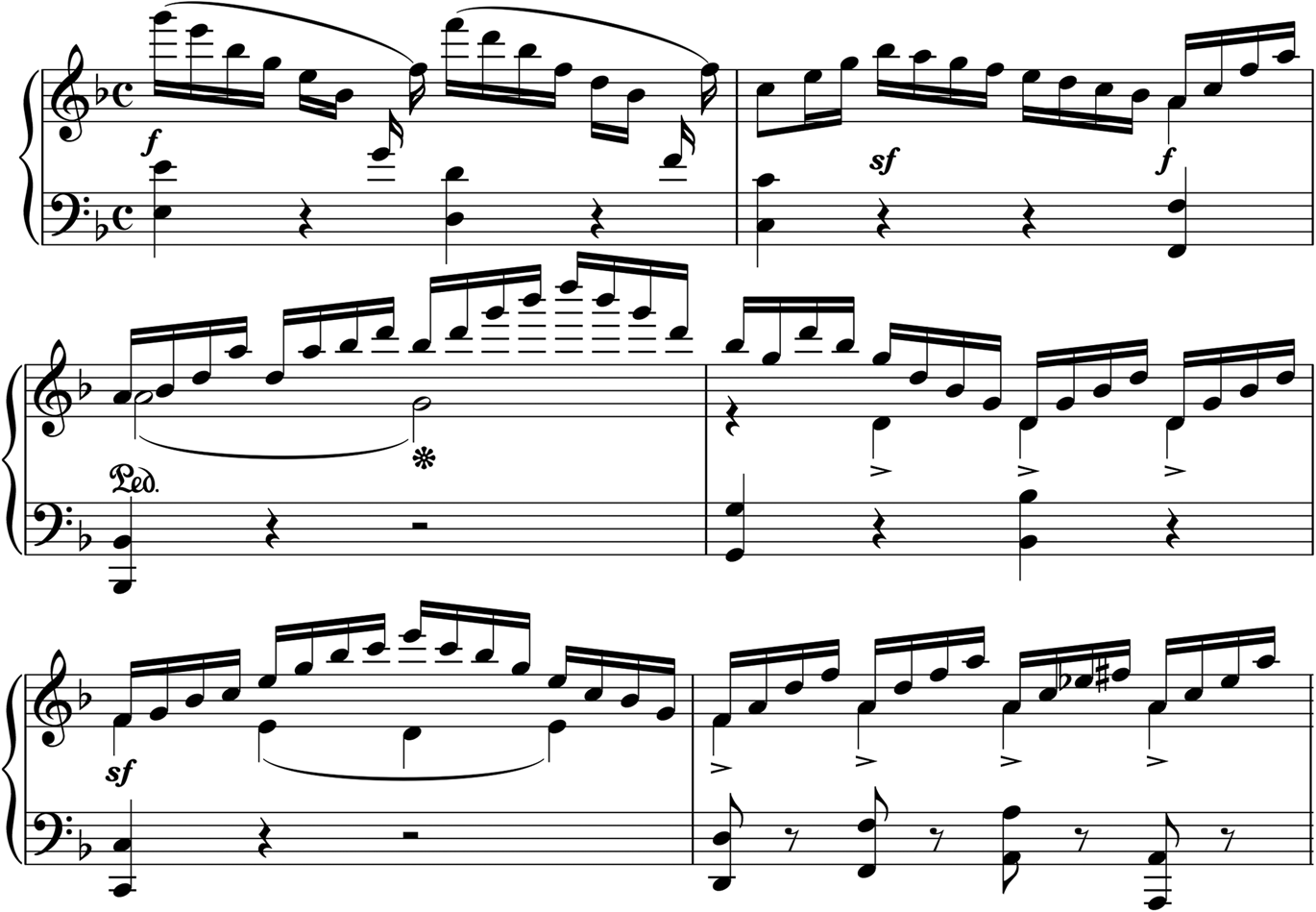
Be that as it may, by the time Mendelssohn penned these reservations, he himself had already explored the device in an Etude in B flat minor, finished on 9 June 1836, but ultimately left until 1868 for posthumous publication as Op. 104b No. 1. Here the theme appears in the middle register, with rapid arpeggiations ascending and descending above, and a simple bass line doubled in octaves below (Ex. 5).
Mendelssohn, Etude in B flat minor, Op. 104b No. 1
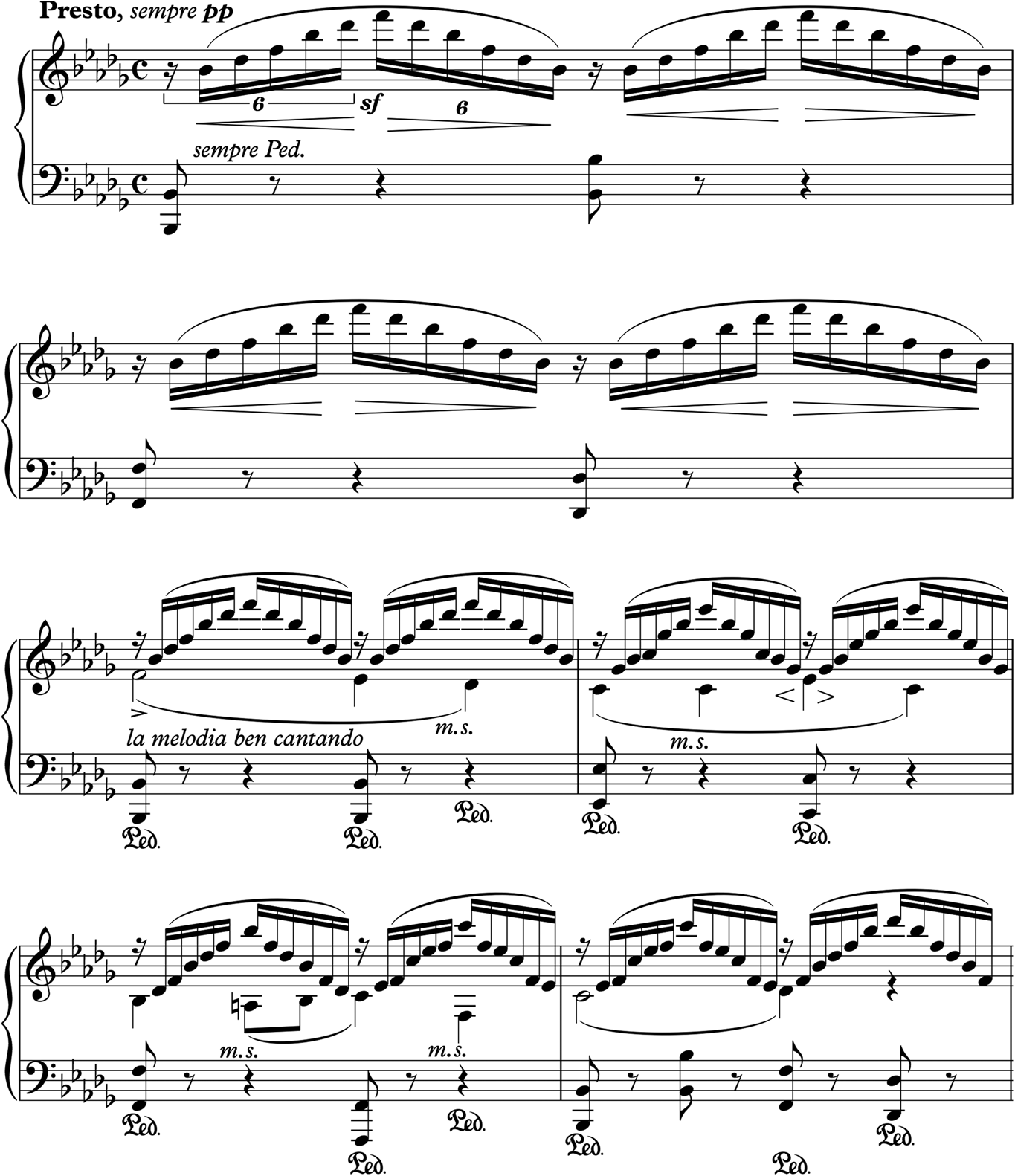
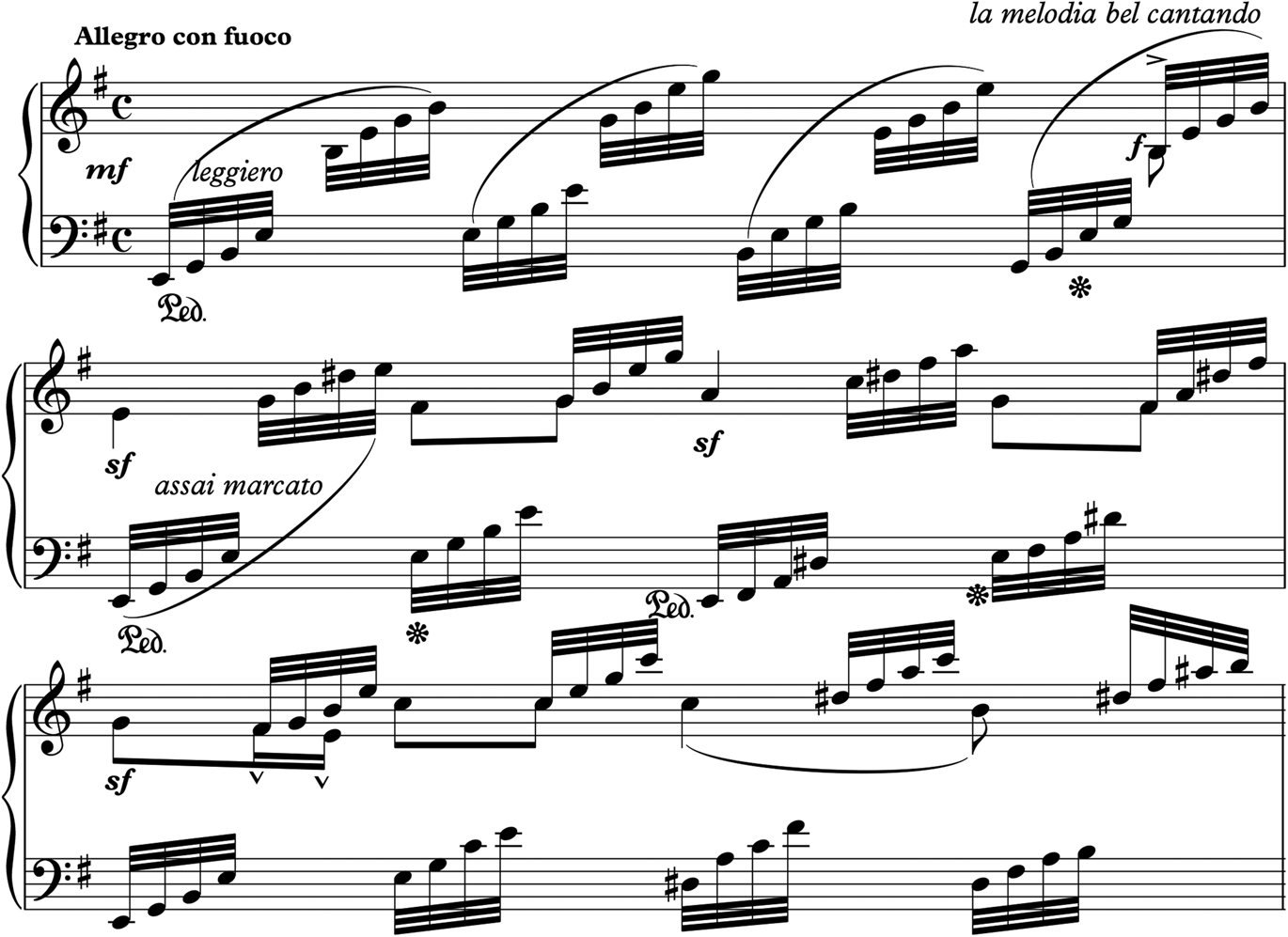
Mendelssohn enhanced the clarity of the texture by assigning different rhythmic strata to the three parts – thus, the arpeggiations course freely in rapid sextuplets, the melody sings generally at a crotchet pace, and the bass line progresses at a measured pace of two quavers per bar, punctuated by rests, to allow the melody to project all the more clearly. Most likely this etude originated as part of a plan, envisioned between January 1835 and October 1836, to compose a set of six etudes and fugues for piano, which evolved instead into the Six Preludes and Fugues, Op. 35, released in 1837 by Breitkopf & Härtel.Footnote 38 Mendelssohn's original conception would have combined technical studies reflecting contemporary trends in piano music with contrapuntal studies realized in the most august genre of the fugue, in effect juxtaposing the new with the old. Especially intriguing about the Etude in B flat minor is that its sole surviving autograph in the Berlin Mendelssohn Nachlass Footnote 39 directly precedes the beginning of a fugue in B flat minor (MWV U 118), ‘obviously conceived, in terms of its contents’, with the etude.Footnote 40 Though he neither completed the fugue nor incorporated Op. 104b No. 1 into Op. 35, he did compose a Thalbergian etude in E minor, likely also from June 1836, that he ultimately renamed as a Prelude and harnessed to an older fugue from 1827; he then pressed these paired pieces into service as the Prelude and Fugue in E minor, Op. 35 No. 1 (exs. 6a and 6b).
Mendelssohn, Prelude in E minor, Op. 35 No. 1
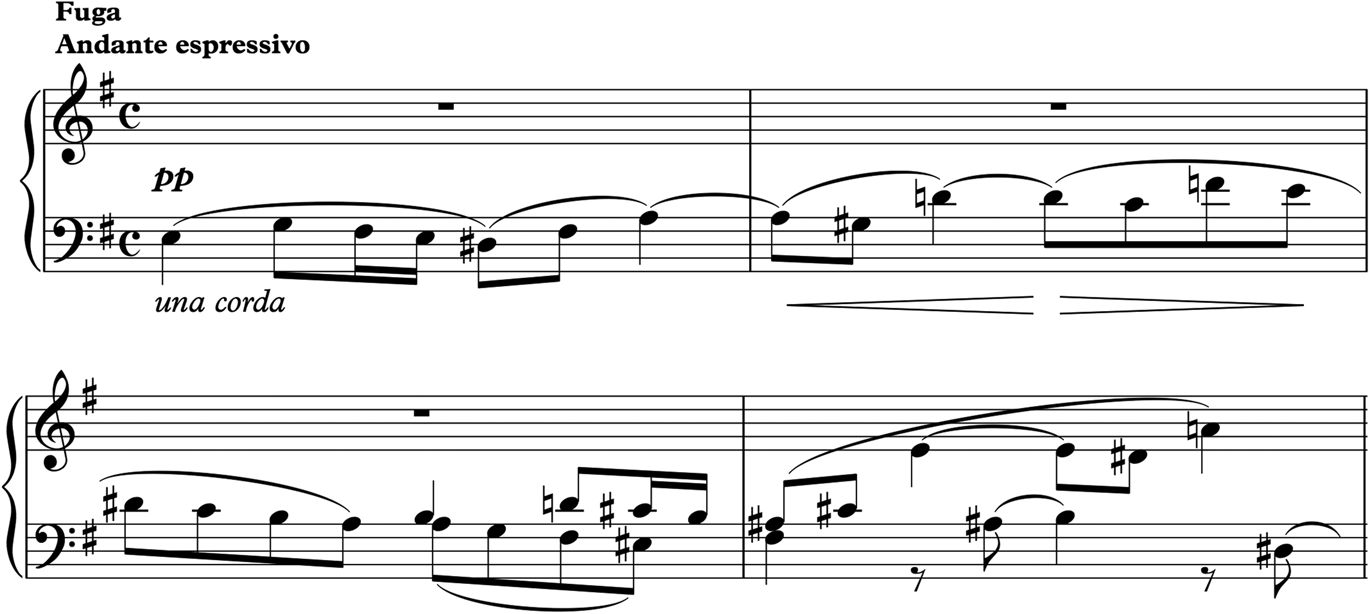
Mendelssohn, Fugue in E minor, Op. 35 No. 1
For the Prelude he adapted the three-hand illusion slightly so that the arpeggiations rose from below and swept across the theme, seamlessly woven as an inner voice into the folds of the demisemiquavers.
While the Prelude (olim Etude) offers another application of the three-hand technique, the fugue, constructed on a chromatic subject later subjected to mirror inversion before yielding to a freely composed chorale in the major mode, reflects Mendelssohn's deep study of the music of J. S. Bach. The fugal subject exposes Mendelssohn's most dissonant vein, with two prominent interlocked tritones, anticipating similar uses of the interval in three other fugal subjects (the organ Fugue in G major, Op. 37 No. 2, Organ Sonata in A major, Op. 65 No. 3, and Overture to Elijah, Op. 70). In the E-minor Fugue the unfolding tritones highlight a disjunct, compound melodic line that implies multiple voices, from which we may extract a descending tetrachordal line (E–D#–D–C–B; Ex. 6c), which, as it turns out, is also embedded into the bass line of the E-minor Prelude in its completely chromatic form (E–D#–D–C#–C–B), just one example of how Mendelssohn related the prelude to its paired fugue.Footnote 41
Tetrachordal Motive in Fugal Subject of Op. 35 No. 1

Put another way, Mendelssohn did not allow the rushing eddies of arpeggiations to displace the compositional integrity of the prelude; rather, he engineered the three-hand device to promote connections between the prelude and fugue. For example, the basic rising arpeggiation (E–G–B–E), anticipates the rising entries of the fugal subject from the bass to soprano registers (E–B–E–B). And on a larger scale, the arpeggiation determines too the basic tonal plan of the fugue (see Ex. 7), which begins in E minor, then modulates to the mediant G major and dominant B minor, where Mendelssohn introduces mirror inversion, before finally returning to the tonic minor, and brightening to E major with the introduction of the chorale.
Mendelssohn, Fugue in E minor, Op. 35 No. 1, Structural Plan

In the case of Op. 35 No. 1, Mendelssohn's priority was to relate the prelude and fugue, so that ideas sketched, as it were, in the prelude were realized with full contrapuntal rigor in the fugue, in a way recalling J. S. Bach's approach in many of the preludes and fugues of the Well-Tempered Clavier. Mendelssohn's next employment of the three-hand technique, unfurled in the first movement of the Piano Concerto No. 2 in D minor, Op. 40, allowed virtuoso display a freer rein. Premiered at the Birmingham Musical Festival of 1837, the concerto straightaway establishes the dominance of the piano, when, just a few bars into the first movement, it interrupts the opening orchestral tutti with a series of brief cadenza-like moments. The soloist interjects several comments before the orchestra reasserts its traditional authority and resumes the tutti while the piano rests. Mendelssohn's opening affords a convenient comparison to Liszt's Piano Concerto No. 1 in E flat major (1849). Here the initial, terse orchestral tutti, built upon nothing more than a scrap of a descending chromatic scale, is summarily challenged by the piano, which erupts in a dramatic octave passage. In contrast to Mendelssohn's opening, in which the piano first enters in a reflective mode, Liszt's opening unlocks the full force of the piano as a virtuosic agent, subsequently given full expression in a series of brilliant cadenzas derived from the quintessential chromatic motive. What is more, the piano continues to hold centre stage, and indeed seems to drive the narrative arc of the concerto forward, as if the orchestra has conceded much of its agency to that ‘novel apparition’, the ‘virtuoso of the nineteenth century’.
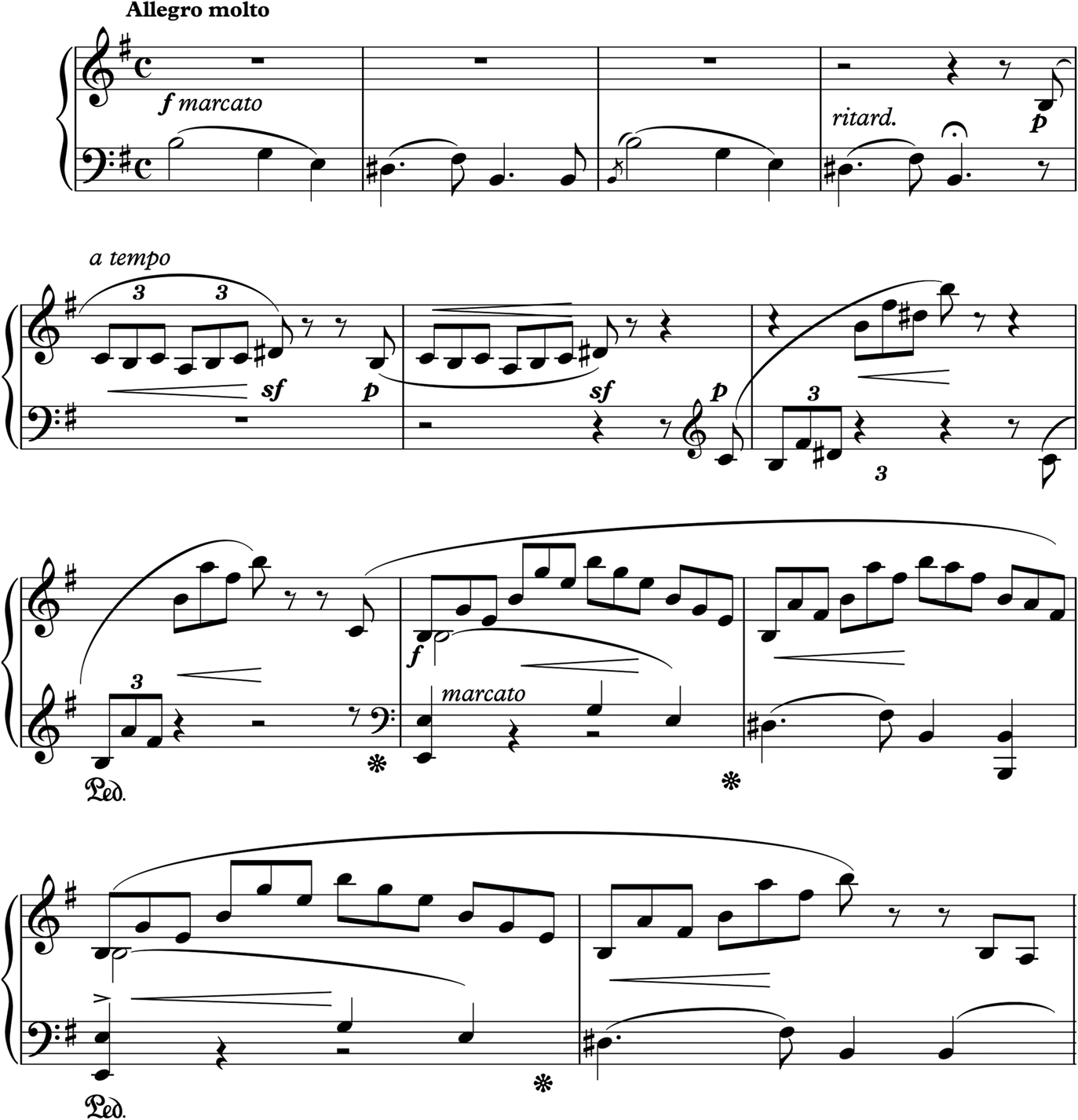
If Mendelssohn preserved a certain balance in Op. 40 between the soloist and the orchestra, Liszt decidedly tilted the balance toward the soloist, perhaps in a bid to ‘[arouse] terror and amazement’, as Clara Schumann confided to her diary.Footnote 42 Nevertheless, Mendelssohn was not completely immune to the allure of virtuoso accoutrements. And so, for the second theme of his first movement, after presenting it in a simple, unadorned guise by the piano, he chose to repeat it in a florid version outfitted with what Ignaz Moscheles described as one of his friend's ‘favorite arpeggio passages, through which the melody seems to push its way’ (Ex. 8).Footnote 43
Mendelssohn, Piano Concerto No. 2 in D minor, Op. 40, First Movement, Second Theme
This version of the three-hand technique, with the arpeggiations situated above the melody, is similar to Mendelssohn's first experiment with the practice in the Etude in B flat (cf. Ex. 5). At the time, his preferred instrument was a French Erard grand, an instrument that featured a middle register capable of sustaining well a cantabile melody, perhaps one factor in the composer's decision to explore effects à la Thalberg in the later 1830s.Footnote 44
Mendelssohn's final applications of the device occurred in two works from the summer of 1841, the Variations sérieuses, Op. 54, and the Prelude in E minor, paired with an earlier fugue from 1827 and released in the Album Notre Temps as the Prelude and Fugue in E minor (MWV U157).Footnote 45 In the case of the Prelude, he began with an unharmonized intimation of the theme by itself, and then introduced a decorative triplet pattern before combining the two and adding a discrete bass line to generate the three parts (Ex. 9). The Variations sérieuses present a more complex application of virtuosity within a composition that Mendelssohn himself deliberately described as ‘serious’. As we know, he composed the variations for the Album-Beethoven published by Mechetti in Vienna in 1841 to raise funds to defray the costs of the Beethoven statue in Bonn.Footnote 46 Ten pianists, including Mendelssohn, were enlisted to contribute ‘morceaux brillants’ – essentially an invitation from Mechetti to showcase the fashionable virtuosity of the time. But by designating his offering as ‘serious’, Mendelssohn was in effect distinguishing himself from the other virtuosi represented in the volume: Liszt, Chopin, Czerny, Theodor Döhler, Adolf Henselt, Kalkbrenner, Moscheles, Wilhelm Taubert, and Thalberg. Ironically, not every offering of these musicians celebrated Mechetti's marketing of ‘morceaux brillants’. Thus, Liszt contributed his transcription of the Funeral March from Beethoven's Eroica Symphony, while Chopin produced his hauntingly subdued, stand-alone Prelude in C sharp minor. But perhaps most anomalous of all was Thalberg's creation, a (Mendelssohnian) Romance sans paroles in G minor, Op. 41 No. 1, totally devoid of that virtuoso's trademark virtuoso effects. Perhaps then all the more surprising that Mendelssohn's seventeen serious variations accommodated two that specifically revisited the three-hand technique, perhaps impelling Louis Spohr, who heard Mendelssohn perform them in 1846, to write that ‘he played a fearsomely difficult and highly idiosyncratic composition of his own, “seventeen serious variations”, with monstrous bravura.’Footnote 47
Mendelssohn, Prelude in E minor, MWV U157
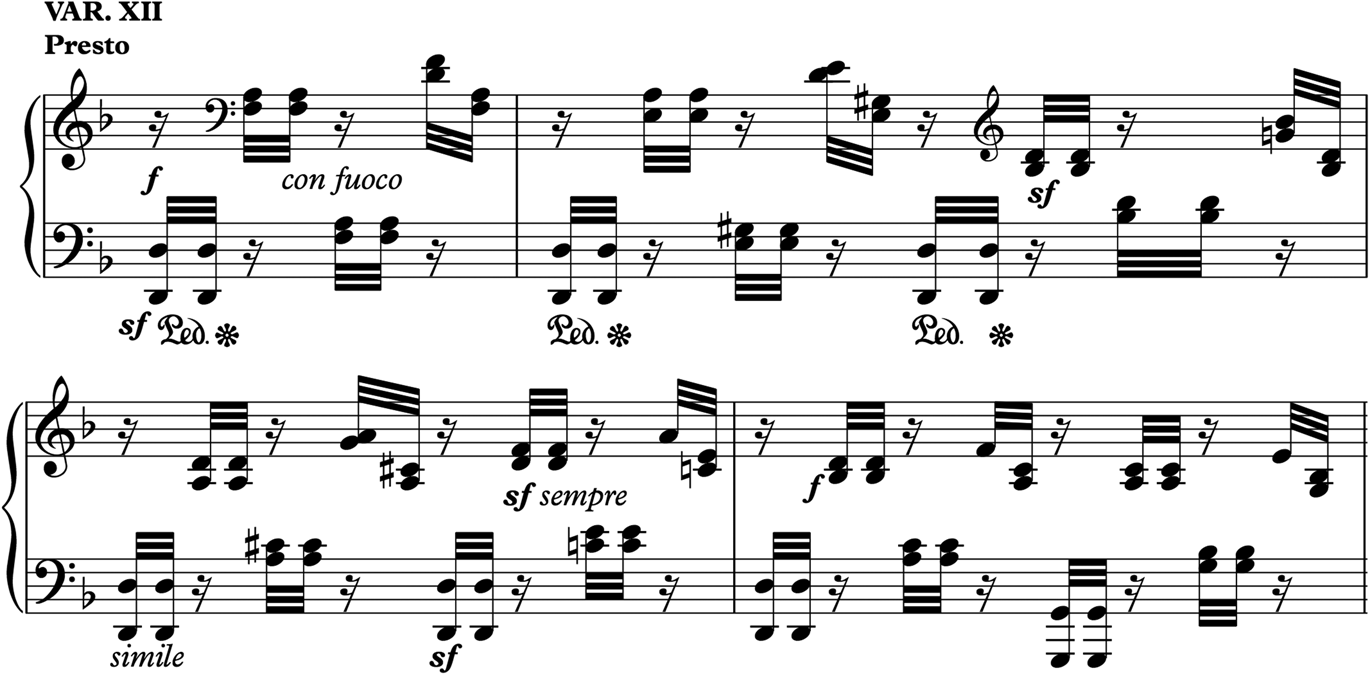
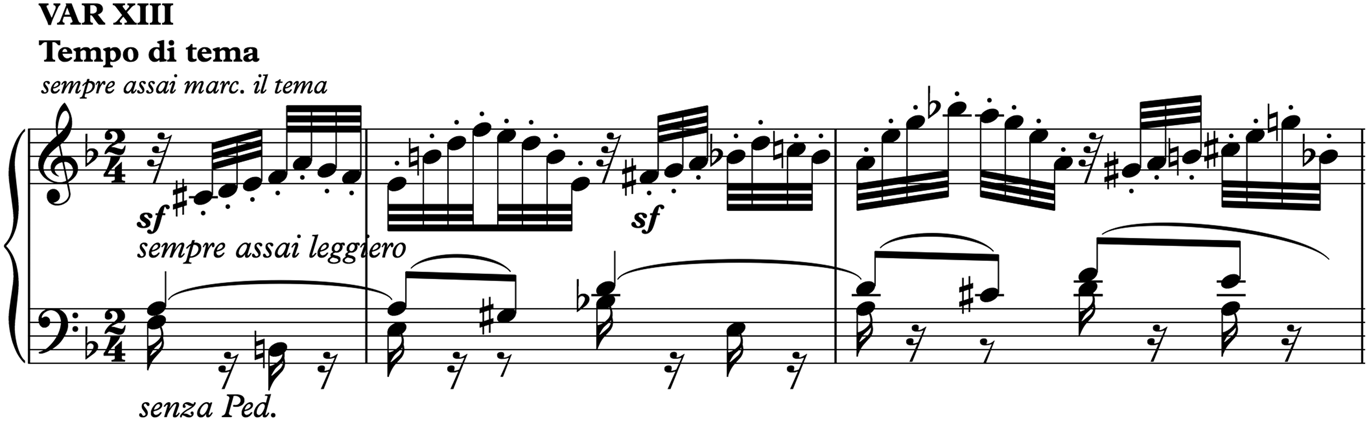
The two variations in question are the twelfth and thirteenth, positioned roughly three-fourths of the way into the composition. In No. 12, Mendelssohn actually insinuates elements of the three-hand technique into a boisterous martellato passage of rapidly repeated chords split between the two hands (Ex. 10). In each bar, the theme is lodged in the middle of the texture, thus introducing the illusion of three hands generating the sonorities accumulating above and below. Then, in No. 13, Thalberg's device emerges more clearly as the theme, still in the middle register, is accompanied by nimble demisemiquaver staccati above and a simple bass line below (Ex. 11). Admittedly, the appearances of these virtuoso devices are measured and fleeting, a momentary concession that does not detract from Mendelssohn's overall purpose, to write ‘serious’ variations worthy of their Beethovenian precedents.Footnote 48 In the end, Mendelssohn remained wary of and conflicted about the new virtuosity, which he never used just in order to compete, for example, with ‘“the greatest of musical jugglers”, as the poet Lenau called Liszt’.Footnote 49
Mendelssohn, Variations sérieuses, Op. 54
Mendelssohn, Variations sérieuses, Op. 54
Thalbergian Wizardries in the Hands of Fanny Hensel
In the case of Fanny Hensel, we encounter another pianist/composer who was conflicted about the spectre of virtuosity, and yet, like her brother, also occasionally experimented with Thalbergian effects. But unlike Mendelssohn, who enjoyed a celebrity status as ‘the second Mozart’, Hensel's musical space was largely restricted to the fortnightly concerts she presented at the stately family residence on the Leipzigerstrasse in Berlin. There, on 11 February 1844, Joachim attended the premiere of A Midsummer Night's Dream and found himself among the crème de la crème of Berlin's society, socializing not only with Fanny Hensel but with Franz Liszt, whom he was encountering for the first time.Footnote 50 While the social mores of the time permitted Clara Schumann, from a middle-class family, to be elevated as Kammervirtuosin to the Austrian emperor, Hensel, a member of the Prussian upper class by virtue of the Mendelssohns’ banking fortune, appeared in public as a pianist only on three occasions, all charity events, when she was usually announced in the press as the sister of her brother, ostensibly to guard her privacy. Nevertheless, she was a virtuoso of formidable gifts, and likely one of the first pianists to study Beethoven's Hammerklavier Sonata;Footnote 51 her concerts, by invitation only, regularly attracted upwards of one hundred guests from the upper strata of Berlin society and the foremost ranks of celebrities in the arts – including Liszt, the young Joachim, the Schumanns, and, of course, her internationally acclaimed brother.
As early as 1823 Hensel was composing technically challenging piano etudes à la Kalkbrenner teeming with octave passages, one of the trademarks of the French musician whom Heine would notoriously lampoon variously as an ossified mummy or a bonbon fallen in the mud.Footnote 52 But by 1837, at the height of the virtuoso wars, Hensel was losing confidence in her own abilities at the keyboard, as she confided to Karl Klingemann: ‘my playing seems to me quite antiquated after hearing those modern wizards and acrobats, and I shrink back more and more into my nothingness’.Footnote 53 When Mendelssohn learned of these self-deprecating sentiments, he pushed back in a letter to the siblings’ mother, Lea Mendelssohn-Bartholdy: ‘I feel rather provoked that Fanny should say the new pianoforte school outgrows her. This is far from being the case; she could cut down all these petty fellows with ease. They can execute a few variations and tours de force cleverly enough, but all this facility and coquetting with facility no longer succeeds in dazzling even the public.’Footnote 54
In 1836 Hensel may have begun simulating Thalberg's contrivances. A letter to her brother alludes to a Thalberg-inspired piano piece in C minor,Footnote 55 though unfortunately no such work survives. But by 1839, she was reassessing Thalberg as ‘honey cooked with sugar and a little drop of rum’;Footnote 56 nonetheless, even this saccharine critique did not dissuade her from applying the three-hand device in her piano music. She found two occasions to do so in arguably her most ambitious composition, Das Jahr, a musical calendar of the twelve months with postlude composed in 1841 as a Christmas gift for her husband, the painter Wilhelm Hensel, and then revised and recopied onto specially made music paper of various hues. To this Reinschrift she added epigrams drawn from Uhland, Goethe, Schiller, Eichendorff and Tieck, while Wilhelm contributed vignettes for the twelve months, painted in the blank marginal spaces created by indenting the top two staves at the beginning of each piece.Footnote 57 For instance, Juni and September (subtitled Serenade and Am Flusse, to which we return shortly), inspired from Wilhelm scenes showing respectively a woman on a balcony being serenaded by a man playing a lute below (perhaps Fanny and Wilhelm, during their Italian sojourn of 1839–1840), and a barefooted woman reposing languorously by a brook (perhaps Fanny or her sister, Rebecka). The two epigrams are taken from the Walpurgisnacht scene in Goethe's Faust, Part 1, in which Faust and Mephistopheles ascend the Brocken to attend the witches’ madcap saturnalia (lines 3883–4, ‘Hör ich Rauschen, hör ich Lieder/ Hör ich holde Liebesklage?’), and from the same poet's ode An den Mond (‘Fliesse, fliesse, lieber Fluß/ Nimmer werd ich froh’).
Just how significant Das Jahr was for Fanny Hensel's evolution as a composer is evident in the layout of this fair copy, which she had bound in an album prefaced by a formal, engraved title page that announced the pieces as Zwölf Charakterstücke, as if she imagined publishing the work.Footnote 58 In addition, she had the poetic epigrams engraved and interleaved on pages between the movements. The result was a substantial, programmatic keyboard cycle, one hour or so in duration, with multiple layers of poetic, visual, and musical meaning. Unifying the work musically was the placement of three chorales for Easter (March, ‘Christ ist erstanden’), Christmas (December, ‘Vom Himmel hoch’), and the Nachspiel (‘Das alte Jahr vergangen ist’), and a clear tonal plan to facilitate the sequence of the individual movements.Footnote 59 Of particular interest to us here, though, is that for the first version of the cycle Fanny incorporated the three-hand device into two movements – June and September – before recasting June so as to moderate its virtuoso displays.Footnote 60
In the first version of June, after a brief Largo introduction the Andante establishes a simple pattern of broken quaver chords that effectively bring to life the still image of the lute in the vignette. Next, Hensel's theme emerges in an inner voice, fitted judiciously between the accompanying chords, before spilling over into the soprano register (Ex. 12). In the final section of the movement, this intimation of a third hand yields to a fully virtuosic unleashing of the technique with nimble arpeggiated semiquaver triplets (Ex. 13), unmistakably reorienting the music toward Thalberg's wizardry. A short coda reinstates the quaver chords, returning us to the opening and bringing us full circle as the music dies away.
Hensel, Das Jahr, Juni (First Version)
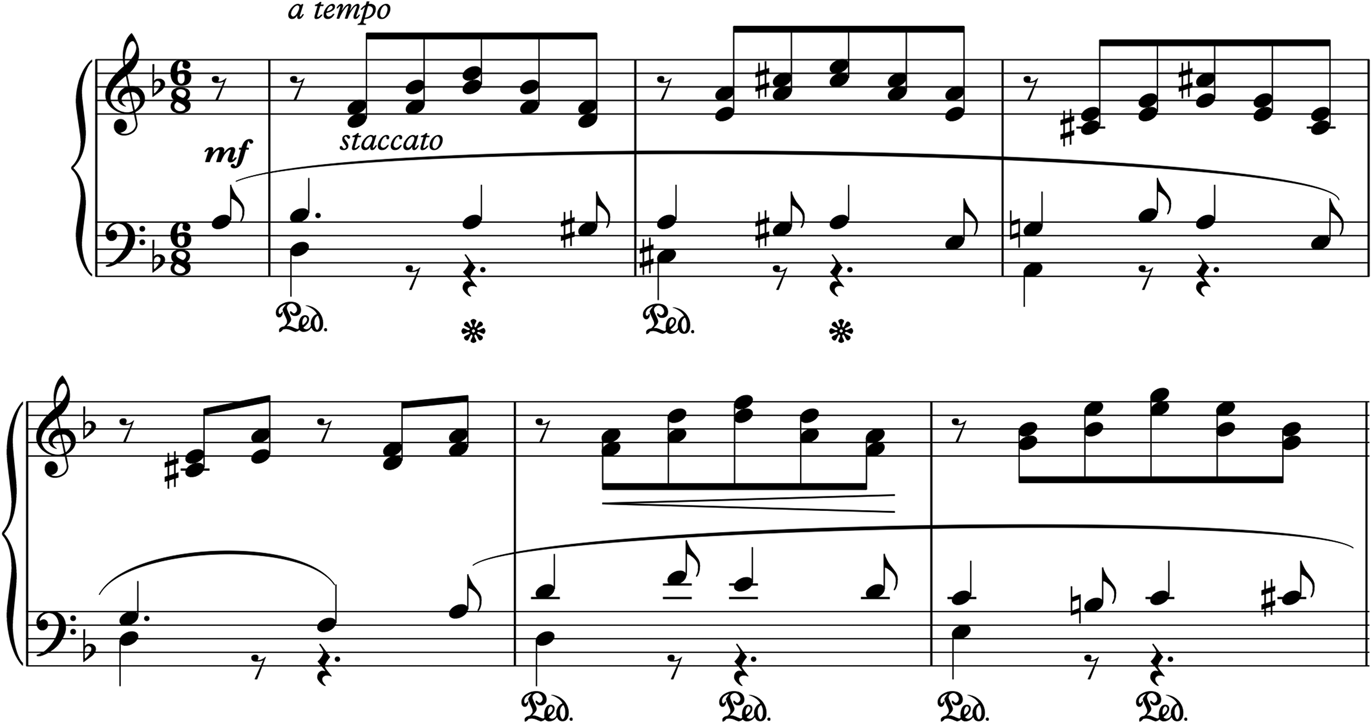
Hensel, Das Jahr, Juni (First Version)
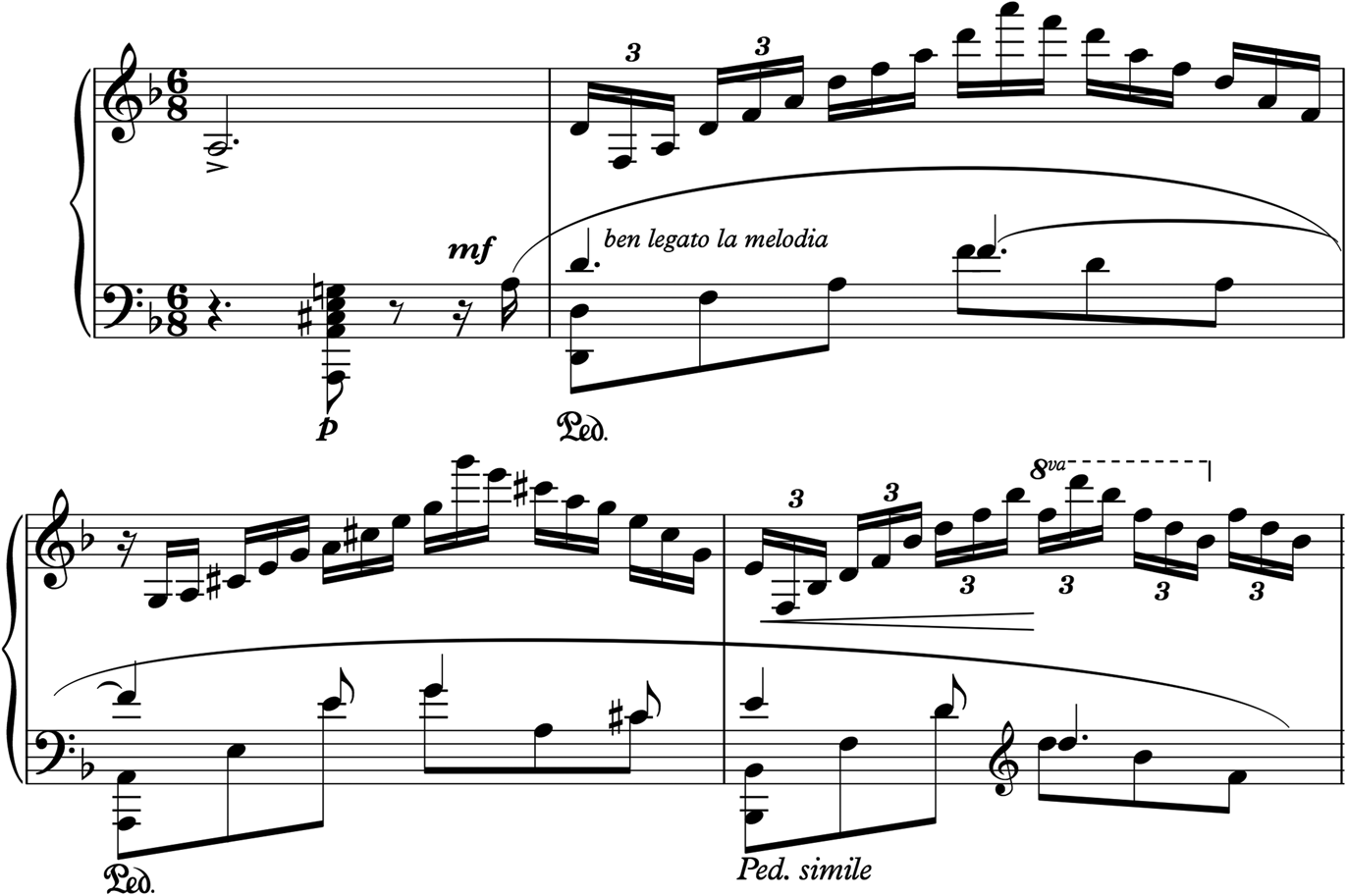
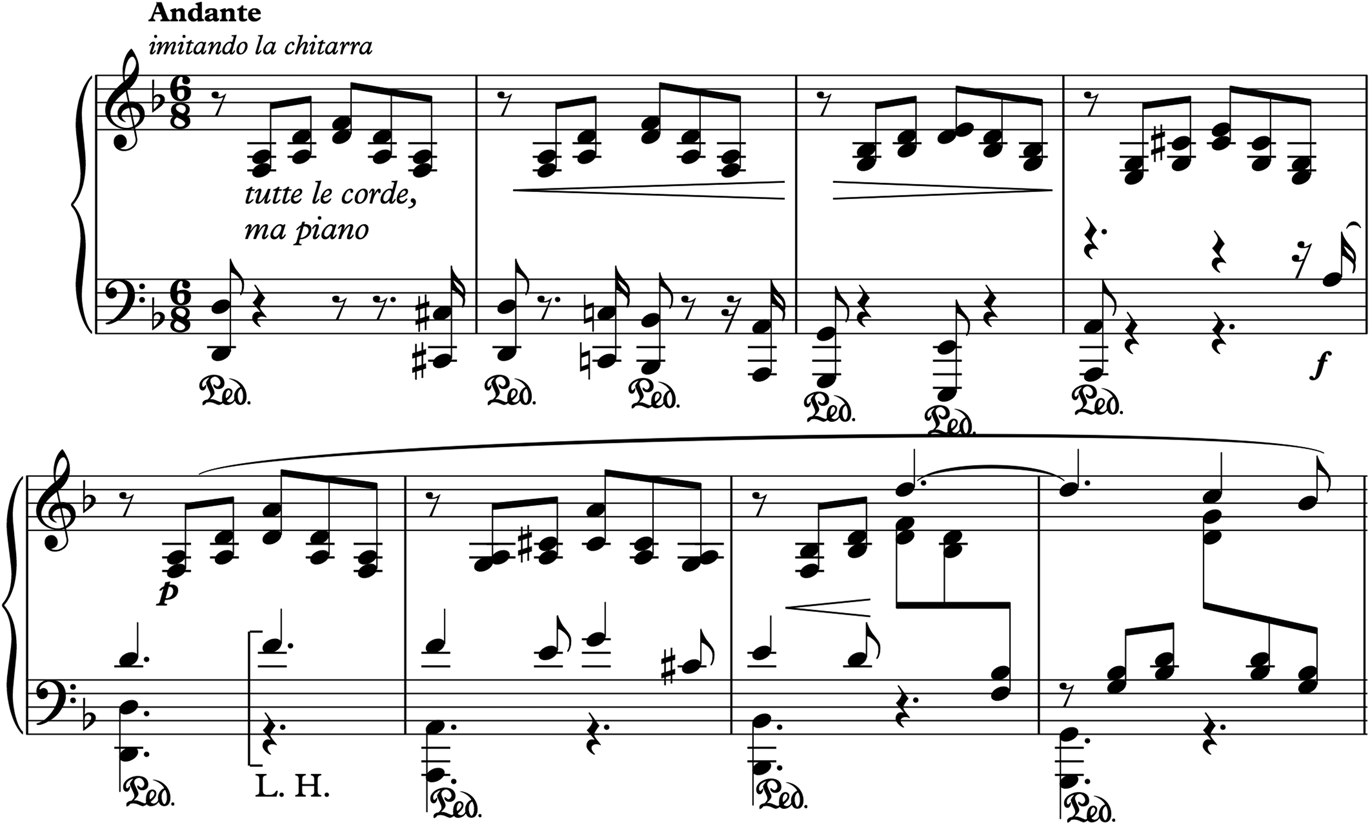
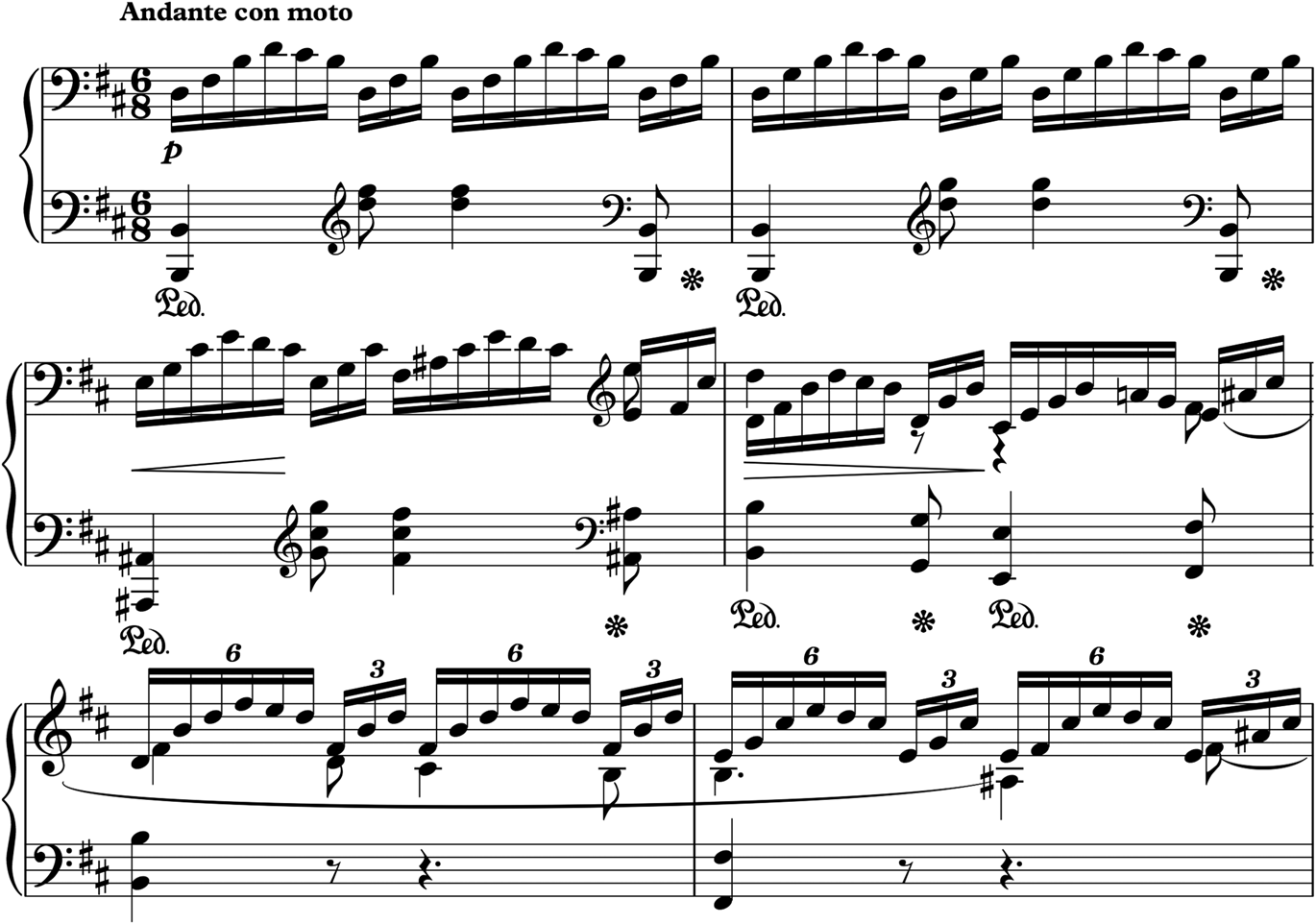
As if sensing that this unexpected, energetic release of virtuosity was incongruent with the intimate mood of her husband's vignette, Hensel completely recreated the movement for the fair copy, preserving only the key (D minor) and time signature (6/8). Like the first version of Juni, the second alludes to the genre of the barcarolle, with its lilting, dactylic and trochaic rhythms. Once again, the melody is introduced in the middle register (Ex. 14) – to suggest the male voice of the serenading figure – before it moves into the soprano. But the material of the accompanying third part remains tempered throughout the piece – rocking quaver chords replace the technically much more challenging triplets of the first version. In short, the allusion to the three-hand technique in Example 13 is used to promote musically the visual imagery of the vignette, not to indulge in virtuosity for its own sake. Much the same effect obtains in September (Ex. 15), where the decorative arpeggiations above the middle-register theme become murmuring triplets blurred by liberal pedal markings, a fluid musical counterpart for Goethe's stream of life illustrated in Wilhelm Hensel's vignette, and thus related again to the programmatic meaning. Nevertheless, the placement of the theme between the triplets above and the bass line below still betrays the origins of the texture in the illusion of three hands. Notably, in 1846, the penultimate year of her life, Hensel extracted September from Das Jahr and published it as the second of her Vier Lieder für das Pianoforte, Op. 2, though without its title, epigram, or vignette, effectively transforming a programmatic Charakterstück into an ‘absolute’ Lied ohne Worte.
Hensel, Das Jahr, Juni (Second Version)
Hensel, Das Jahr, September
Muted Three-hand Allusions and the Schumanns
A third member of Joachim's circle was Robert Schumann – first in Leipzig, then in Düsseldorf, where he collaborated with Brahms and Albert Dietrich to create for the young violinist the cipher-encrusted FAE Sonata.Footnote 61 Unlike Hensel in the first version of Juni and Mendelssohn in his Prelude, Op. 104b No. 1, Robert Schumann tended not to apply the three-hand technique in ostentatious ways, though surely not for a lack of interest in virtuosity – at the time, his larger piano works were considered at best difficult and challenging, both to perform technically and to interpret aesthetically. But Robert Schumann did record his reactions to the device in his music criticism, which found a ready outlet in the Leipzig journal he established in 1834, the Neue Zeitschrift für Musik. There, in several reviews, he lamented what he viewed as the crass commercialism of the virtuosi, and then focused in particular on the two he viewed as the best of breed, Thalberg and Liszt. Concerning the former, we read, for instance: ‘He wants to please the crowd with his glittering performances; the composition itself is a secondary concern. If in all this there were not a spark of something nobler here and there, and were there not, in individual passages, signs of a more industrious working-out, his compositions would simply have to be counted among the thousands of pieces of virtuoso hackwork that appear year in and year out, only to be forgotten immediately’.Footnote 62 With respect to three-hand gimmickry, Robert Schumann used the occasion of reviewing Thalberg's Douze Etudes, Op. 26, several of which employ the device, to comment: ‘Many of our young fantasia and etude composers have become infatuated with a texture, commonly used earlier, that has now reappeared in conjunction with the rich new effects of the modern piano. One just gives a passably broad melody to some voice and surrounds it with all sorts of arpeggios and artful figurations in the same harmony. This is perfectly all right, if it is done interestingly and with originality; but one really ought to be able to come up with something else, too’.Footnote 63
In short, Robert Schumann was concerned that the device had become a default mechanism for the display of sheer virtuosity. Experiencing Thalberg's meretricious conceits was more about marvelling at how two hands alone could seemingly produce a fully-fledged piano duet à 4 than admiring in a composition musical ideas of durable substance.Footnote 64 And so, when Robert Schumann chose to deploy the device in his Symphonic Etudes, Op. 13, published in 1837, he confined it to just one etude, the third (Ex. 16), so that for its siblings he was able ‘to come up with something else, too’. In other works, the references to three hands tend to be more muted, though no less effective. The Romanze, Op. 28 No. 2 (1839), for instance, presents the performer with a lyrical melody doubled in thirds by the thumbs, with lapping, susurrant arpeggiations above and below (Ex. 17); here, the thickness of the texture led him to notate the opening bars on three staves, a visual cue, as it were, for the reference. In other works, Robert Schumann experimented with a modification of the texture, in which the melody is either reinstated in the soprano voice, from where it spins out arpeggiations descending to the bass line, as in the fourth of the Gesänge der Frühe, Op. 133 (Ex. 18, 1853),Footnote 65 or in which the lower lying arpeggiations seem to throw off a sketch-like soprano melody, as in the first of the Drei Phantasiestücke, Op. 111 (Ex. 19, 1851). Finally, a special case obtains at the opening of the Konzertstück in G major, Op. 92 (Ex. 20, 1849). As the piano executes a series of pianissimo arpeggiations, the clarinet introduces the theme in crotchets in the middle register, engulfed by demisemiquavers above and below. The clarinet in effect substitutes for the pianist's “third hand”, yielding yet another variant of the device that contrasts timbres of two different instruments.
Robert Schumann, Symphonic Etudes, Op. 13
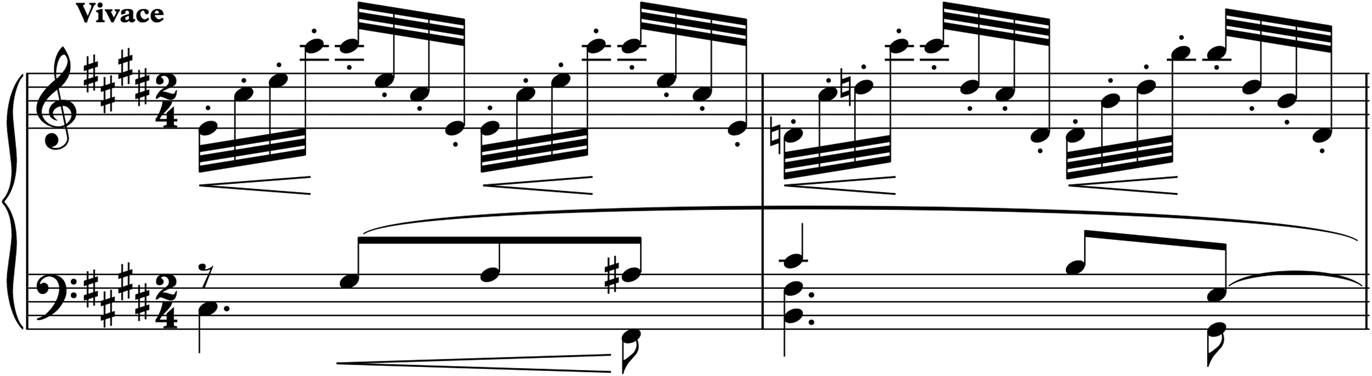
Robert Schumann, Romanze, Op. 28 No. 2

Robert Schumann, Gesänge der Frühe, Op. 133 No. 4
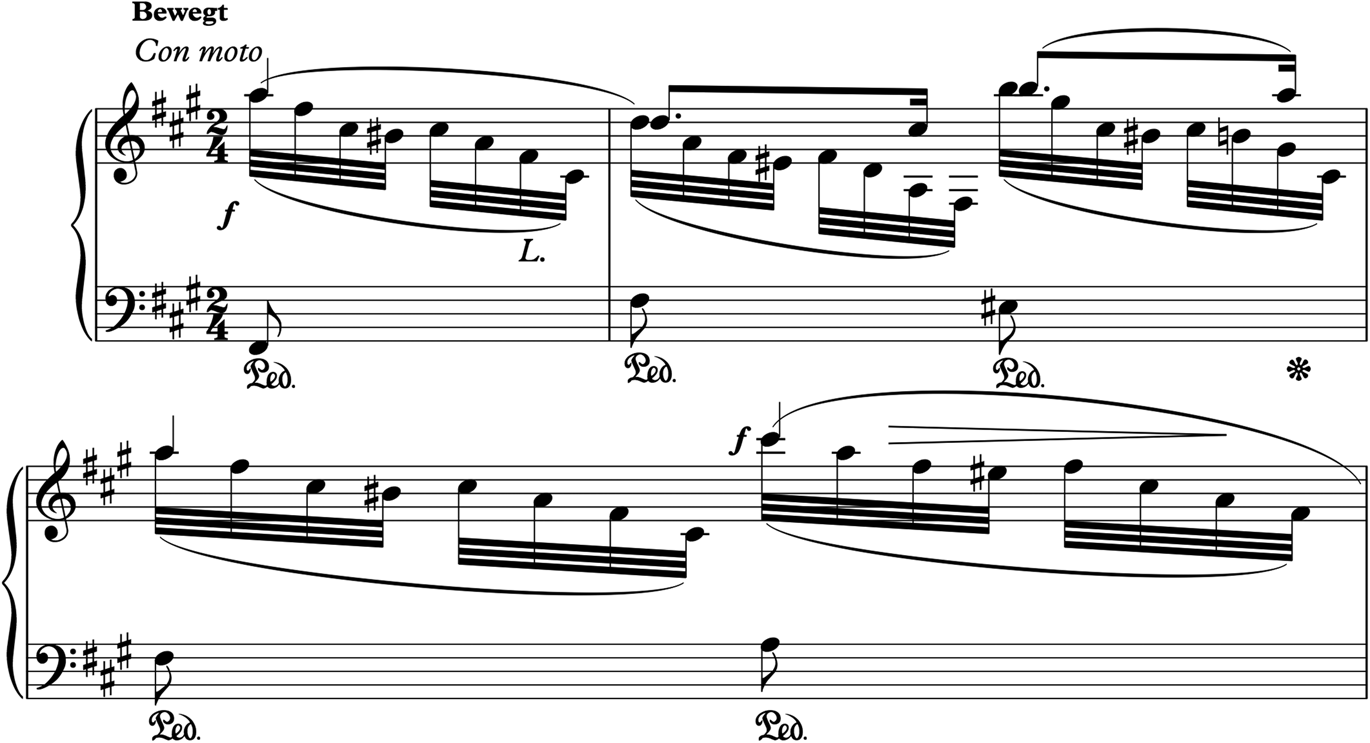
Robert Schumann, Phantasiestücke, Op. 111 No. 1
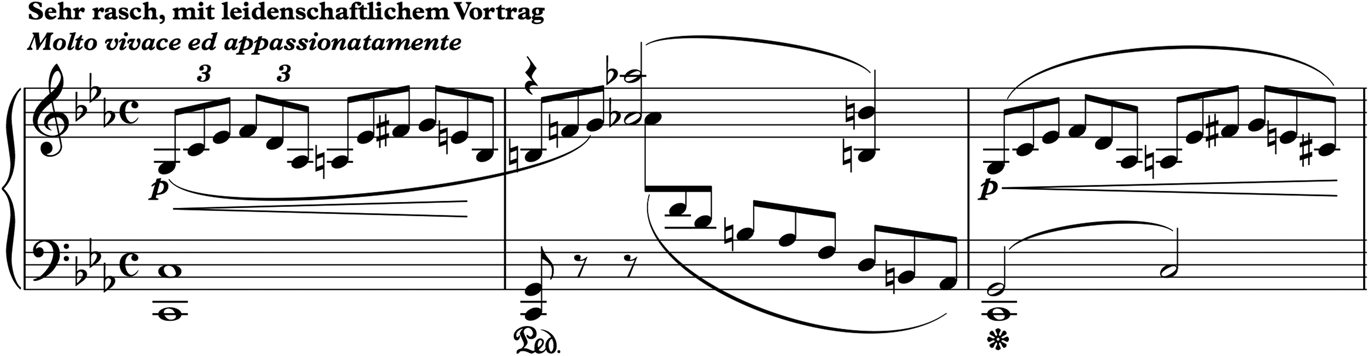
Robert Schumann, Konzertstück, Op. 92
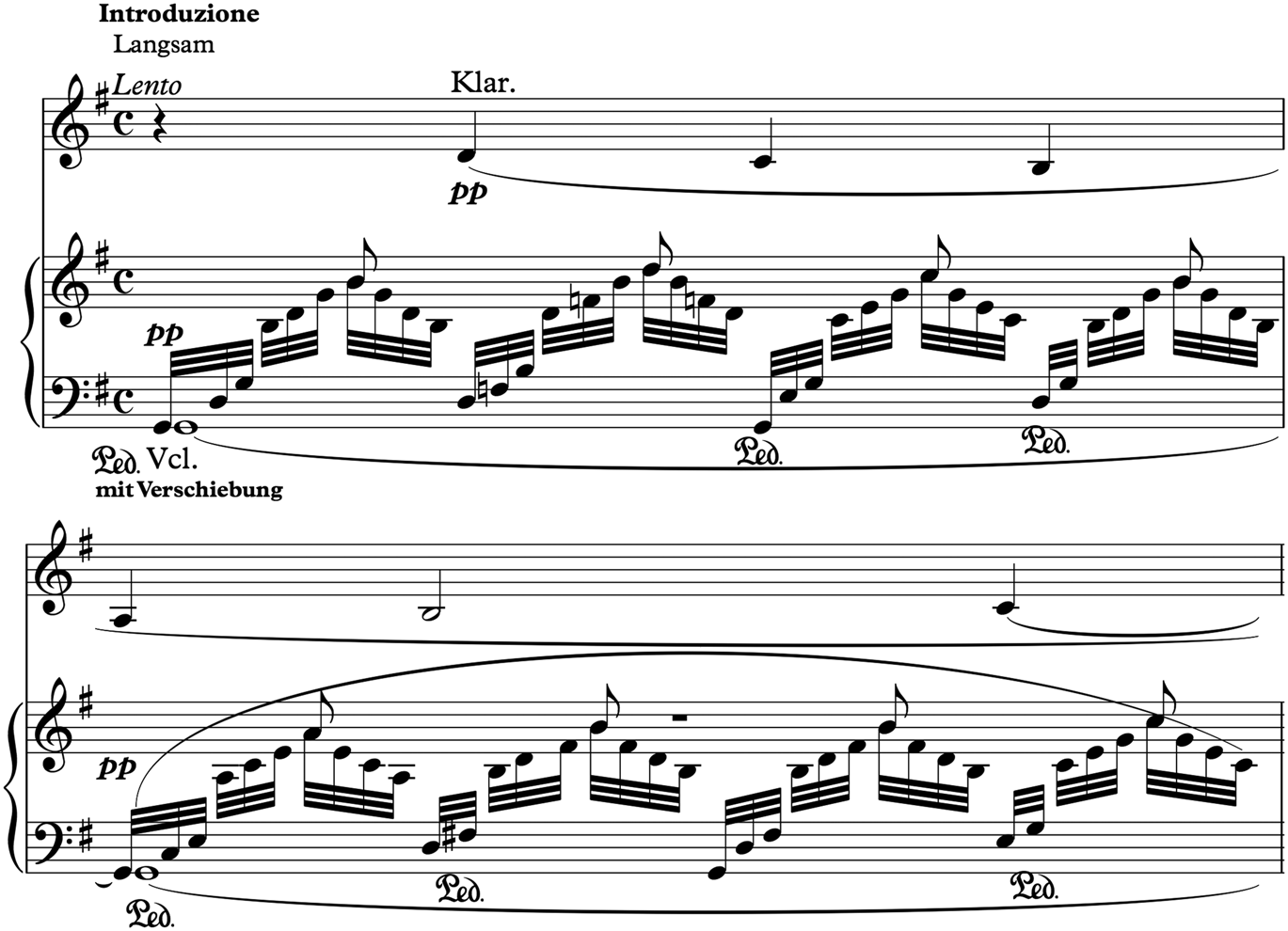
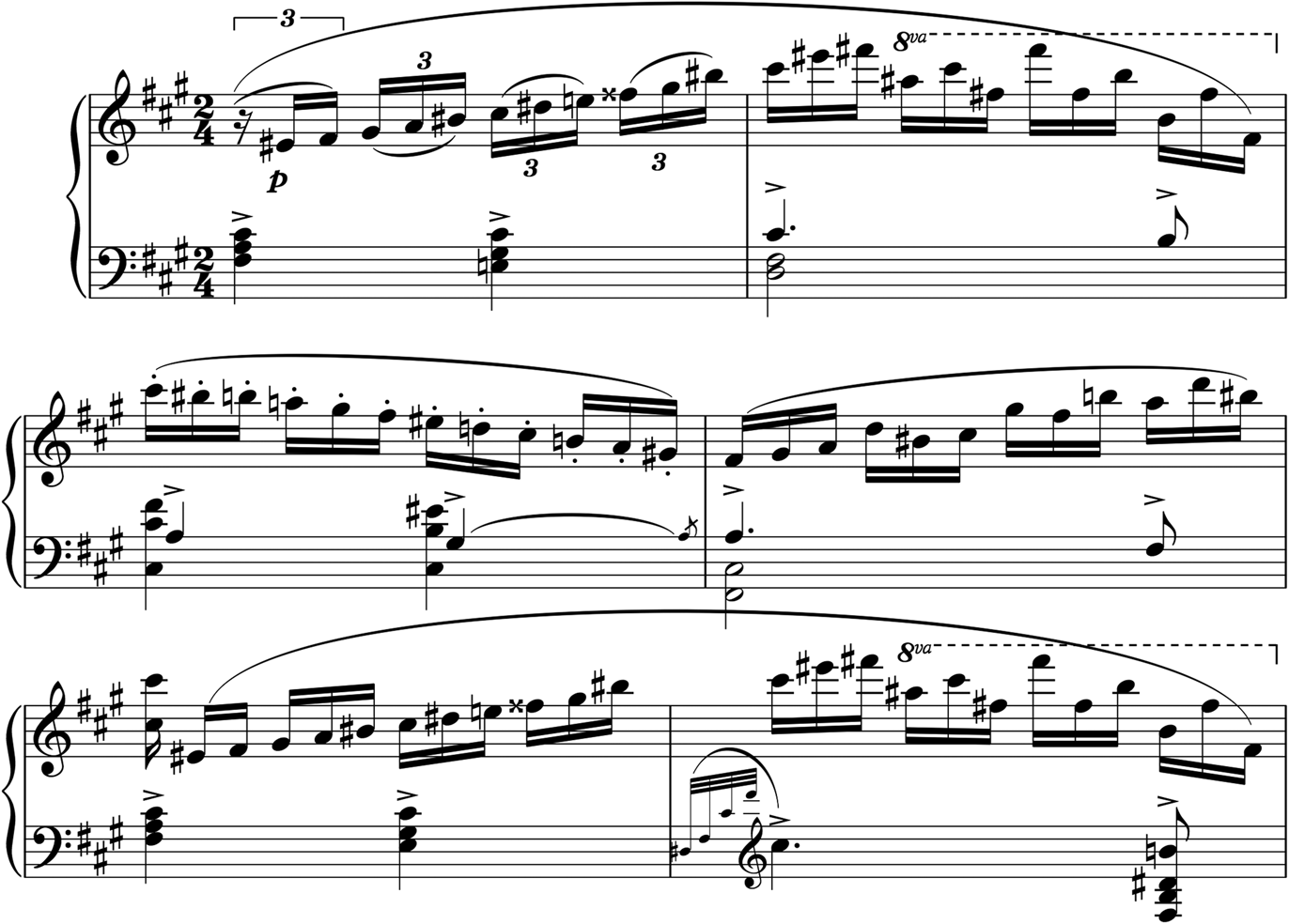
One other member of Joachim's circle, Clara Schumann, was an acclaimed virtuoso who found a special context in which to explore an enriched, three-hand texture – the fourth, or midpoint, of the Variations on a Theme by Robert Schumann, Op. 20, composed in 1853, just months before her husband's suicide attempt in February 1854. As is well known, the theme for this work, a wistful melody that wavers between F-sharp minor and A major, was drawn from his Bunte Blätter, Op. 99 (1850). At the beginning of the composition, the theme appears in the soprano, as if representing Clara Schumann's voice. But in the fourth variation (Ex. 21), it moves an octave lower, accompanied by rapidly rising triplets above (and eventually below). The symbolism seems clear enough: now Robert sings his plaintive melody, while Clara embellishes it with her added virtuoso lines. The gendered roles of the tenor and soprano ranges come to full fruition in the ultimate variation, in which Clara Schumann reassigns his melody to herself, while Robert Schumann intones an idea from her youthful Romance variée (1833), the very theme he had treated to variations in the Impromptus on a Romance of Clara Wieck, Op. 5 (1833).
Clara Schumann, Variations on a Theme by Robert Schumann, Op. 20
Performing Bodies, Technical Bodies, and the Edge of Instrumental Resistance
Though techniques alluding to three hands or multiple performing bodies diminished sharply in popularity after the mid-nineteenth century, violin and piano music from the later nineteenth and twentieth centuries remained highly virtuosic and often ‘unplayable’ in other ways. The difference between before and after the half-century mark is that later examples tended not to celebrate so overtly such special effects, because doing so would revive the no longer tenable principle of ‘virtuosity as a reward in itself’. Rather, three-hand techniques and their related sleights of hand were largely escorted off the stage and into the practice room, where they still retain pedagogical value to this day.Footnote 66
This journey through selected violin- and piano repertoire composed in the circle of Joachim and the Mendelssohn and featuring sonic illusions to multiple hands or bodies invites one concluding reflection, namely, on the function of, and ‘distribution of labour’ between, the hands or bodies. All examples manifested the allusion via notation or ‘as text’, but also ‘as sound’. The reason why so many composers of virtuoso music made use of multiple-hands allusions – and there are surely many more than discussed here – is because the device allowed composers, performers, and audiences to expand their views on what the ‘performing body’ is capable of. As Paul Craenen suggests, instrumental virtuosity always involves a physical effort and a sound result. In the discussed multiple-hands allusions, the space between physical ‘effort’ and ‘sound result’ is maximized, so to speak. The performing body adjusts itself in such a way to create the illusion of more than two hands working while the sound result responds to this effort by delivering a delineated additional voice. Indeed, the examples above are relatively balanced regarding the manifestation of that voice both on the level of ‘music-as-text’ and on that of ‘music-as-sound’. While the examples do not cross the line of what Craenen calls ‘instrumental resistance’ – given that all passages are definitely playable for any professional willing to practice – they do expand the performer's and listener's imagination by creating the illusion of an additional hand that can accommodate an additional voice.Footnote 67 The composers discussed here wrote their music for their own instruments and could ‘call to mind’ experiences of that instrument while composing, which those unfamiliar with the instrument would not be able to access.Footnote 68 The question is whether the examples alluded to ‘a technical body’ via instructions in the score, that is, a second body in addition to the ‘performing body’. A technical body is present when the score that serves as ‘notation of the musical idea’ evinces signs of an instruction manual so that one body performs the technical aspects while the other ‘performing body’ performs the music.
In several examples of multiple-hands illusions there were playing instructions needed to perform the music adequately, from the + signs in the violin part that appeared in addition to pizzicato to designate the use of the left hand (versus the right, which a violinist would use if the + sign was absent), to the instructions of pedalling and legato in several of the piano examples. These pedalling instructions (when to depress and when to lift the pedal) and legato instructions are often needed to articulate clearly that additional voice, such as when the third voice is a middle voice. (In earlier music, such as by Felix Mendelssohn, pedal markings are more the exception than the rule.) Perhaps one could say that there is an allusion to a ‘technical body’ emerging from the instructions of the score, but not enough to intervene with the nineteenth-century idea of the omnipotent virtuoso performer whose ‘manual dexterity … sensuality of the sound, and … personality in the “touch” all melt into the lyrical, metaphorical imagery with which the virtuoso musical performance was acclaimed or lambasted by early nineteenth-century journalists’.Footnote 69
The illusion of an additional hand connects, as we have seen, with the trope of the supernatural or some kind of ‘impossibility’.Footnote 70 Indeed, the performer's ‘truly miraculous … hands’ are what many audience members found most mesmerizing when listening to Franz Liszt.Footnote 71
The reaction that some of the composers themselves developed against this and other types of explicit virtuosic feats – such as Joachim and Clara Schumann – is understandable when we consider that playing a passage with multiple-hands allusions almost forced the performer to limit their attention to the ‘literalness of the notation’, which could mean taking away space for realizing expressive potential. Indeed, just doing what the literal notation demands in the discussed examples – playing the printed notes, the dynamics, the tempo instructions – required in the case of the piano examples almost a sense of splitting up the brain into three parts, one per voice to execute, whereby the two thumbs as well as the hands would have to cross into the other hand's domain, which for the performer presents a unique mental demand.
Above all, the composers investigated here all operated under a shared cultural knowledge of materiality regarding the instruments for which they wrote. As most middle-class households had a piano, and because audiences’ musical tastes and preferences were overall more homogenous than they are today – for example, most people would know that a piano is played with two hands and that a piano score contains an upper line for the right hand and a lower line for the left hand – the allusions to multiple hands would have been recognizable to both connoisseurs and amateurs. This ‘shared cultural knowledge of musical instrumentality’ provides an important foundation for these composers’ explorations of multiple-hands effects.Footnote 72
Joseph Joachim the performing violinist is not typically discussed within the context of the physical or embodied. While inside his own mind he was surely aware of his ‘performing body’; and while in his teaching of young violinists at the Hochschule he was likely cognizant of his and their instructing or ‘technical bodies’, as a public performer he maintained an illusion of the body having overall little to do with performing, as Leistra-Jones has shownFootnote 73 – hence his ability to convey an ‘electrifying sense of merging with the composer’ via ‘slippages’, be it Tartini, Mozart, Viotti, Beethoven, or Brahms, as Tekla Babyak argues in her article in this themed issue. And yet, because Joachim viewed himself and Clara Schumann (and, we might add, Brahms) as a cohort of artists seeking to reverse the tawdry display of virtuosity, it may be argued that one of his goals was to help exorcise the spectre of Paganini. Following in the footsteps of Mendelssohn, Joachim did so in the company and full collaboration of Clara Schumann.
It was precisely Joachim's acute historicist perception, solidified during the 1850s, that allowed his musical aesthetics to turn so sharply from his openness to, tolerance and acceptance of dazzling violinistic tricks in the 1840s, to their rejection in his later career. What appeared to the outside world as a sudden, inexplicable attack on Franz Liszt via the ‘Absagebrief’ was therefore more than that: it was an Absage to the Virtuosentum of the violin and piano world, including Paganinimania and Lisztomania.


 Open access

