

...a despot easily forgives his subjects for not loving him, provided they do not love each other. Alexis De Tocqueville “Democracy in America” (de Tocqueville, Reference de Tocqueville2000).
1. Introduction
Propaganda in autocracies can be crude and unconvincing, making claims that are often egregious, conspicuously false, and mutually exclusive (Paul and Matthews, Reference Paul and Matthews2016), contrary to the more conventional understanding of propaganda as persuasive, instilling pro-regime values, and indoctrinating the populace to achieve political legitimacy (Schaar, Reference Schaar1981; Brady, Reference Brady2009). False and easily disprovable claims are also increasingly a feature of democratic politics, promoted by both politicians and media platforms (Allcott and Gentzkow, Reference Allcott and Gentzkow2017; Starbird, Reference Starbird2017; Jerit and Zhao, Reference Jerit and Zhao2020; Nyhan, Reference Nyhan2020).
In this paper, we use a formal model to argue that crude and unconvincing propaganda can be effective when it exploits the audience’s inherent media cynicism. Cynicism is the negative view that the actions of others are motivated by self-interest (Neumann and Zaki, Reference Neumann and Zaki2023), as opposed to expressive motives such as values or integrity. Media cynicism, in particular, involves the uncritical attribution of self-serving motives to journalists and media outlets, and the rejection of the idea that values and professionalism could be a motive behind reporting (Markov and Min, Reference Markov and Min2022). Media cynicism has recently been characterized as a way in which audiences relate to news media (Markov and Min, Reference Markov and Min2023; Tsfati and Barnoy, Reference Tsfati and Barnoy2025) that is distinct from skepticism or distrust. A distrustful skeptic deliberates over the motivations and professionalism of a news source to allay (or prove) his suspicions that the source is self-serving. A cynic makes negative moral judgments (Neumann and Zaki, Reference Neumann and Zaki2023), resulting in sweeping, deterministic conclusions about the self-serving and instrumental motives of all media.
Our paper argues that cynicism primarily matters in situations where the audience is exposed to sharply different reports by competing media outlets. In such cases, a less cynical individual will reflect on the motivations of different media sources and put more weight on reports that appear more truthful. For a cynic, a single untruthful-looking report will cast a shadow over news reporting as such, making him less likely to update on prior beliefs when witnessing sharply divergent reports, some of which appear truthful and others do not.Footnote 1 With a cynical audience, extremely exaggerated and untruthful news reporting will become more common, as it has the added benefit of making the reporting of outlets with competing objectives less credible.
Our analysis is premised on the assumption that some audiences are inherently more cynical or disposed to ignore the possibility of idealistic, ethical, or professional motives, and are more likely to think that individuals and organizations pursue purely instrumental and material goals (Roudakova, Reference Roudakova2017; Citrin and Stoker, Reference Citrin and Stoker2018). Audiences rely on prior levels of cynicism when interpreting political information (Dancey, Reference Dancey2012), leading to spillover effects when negative information about some politicians or institutions impacts others (Lee, Reference Lee2018). Cynical beliefs are commonly formed under authoritarian practices (Walker and Orttung, Reference Walker and Orttung2014; Zhelnina, Reference Zhelnina2020; Shields, Reference Shields2021) or in a poor institutional environment (Stavrova and Ehlebracht, Reference Stavrova and Ehlebracht2019).Footnote 2 This way, we argue that crude and unconvincing propaganda can be effective in modern authoritarian regimes that are commonly characterized by political demobilization (Linz, Reference Linz2000) and the accompanying deep distrust of the media (Tsfati and Ariely, Reference Tsfati and Ariely2014), exploiting the audience’s inherent cynicism to discredit alternative news sources.
Importantly, people are more likely to make sweeping, cynical generalizations about the corrupt and self-serving nature of media outlets after witnessing malfeasance, such as conspicuously false or biased news reporting. Experimental studies note that exposure to false news triggers a mindset where all news is distrusted (Altay et al., Reference Altay, Lyons and Modirrousta-Galian2025). A similar pattern is present in observational studies (Ognyanova et al., Reference Ognyanova, Lazer, Robertson and Wilson2020), with spillovers of mistrust across different media channels (Lee et al., Reference Lee, Gil de Zúñiga and Munger2023). McKay and Tenove (Reference McKay and Tenove2021) argue that disinformation campaigns promote the distrust of media and objective knowledge acquisition as such. Because of this, cynicism has been characterized as a cognitive schema or a mental shortcut that helps an individual organize, quickly interpret, and store political information (Bartlett, Reference Bartlett1995; Shields, Reference Shields2021). In response to conspicuously false or biased reporting, the cynical view of the media (and politics in general) is brought into awareness, making one more likely to draw sweeping conclusions attributing instrumental motives to all news, and to believe that professional-looking reporting merely masks self-interest (Cappella and Jamieson, Reference Cappella and Jamieson1997).
We formalize the argument assuming two news outlets, controlled by the state and the opposition, that observe the ruler’s strength and inform the public about their observation. News outlets can be principled (invariably reporting what they observe) or self-serving, which can make false reports and maximize (or minimize, for the opposition outlet) the public’s Bayesian expectation of regime strength. A false report may be perceived as unconvincing, revealing the outlet as self-serving. Based on the observed reports and their apparent truthfulness, the public infers both the ruler’s strength and the motivations of news outlets.
The public’s degree of cynicism is operationalized by the correlation between the types of the two news outlets. This assumption captures the essential characteristics of media cynicism and its impact on how people perceive and process news. In particular, this setting is strategically equivalent to the one where the types of the media outlets are uncorrelated, but the public and the media outlets themselves perceive the correlation as positive. Higher correlations correspond to more cynical audiences: If one observes a false report from one outlet (learning that the outlet is self-serving), the individual begins to view all media with suspicion and assigns a higher probability to the event that the other outlet is also self-serving. For a non-cynical public, the correlation will be zero—learning the type of one news outlet will not, by itself, tell the public anything about the type of the other outlet.
We find that the public’s inherent cynicism increases news outlets’ incentives to make reports that are egregiously false and bend the truth to a great degree. In the eyes of a cynical audience, getting caught making a false report discredits the competing news source. Suppose there are three levels of ruler strength: Weak, Normal, and Strong. The state news outlet reports the ruler is Strong, and the opposition outlet reports the ruler is Weak. In addition, the state outlet’s report sounds false and unconvincing, while the other report looks credible. When inferring the ruler’s strength, the public must consider two possibilities. First, the ruler can be Weak, with the state outlet greatly exaggerating the ruler’s strength. Second, the ruler can be Normal, with both outlets making false reports, but only the state outlet getting caught. A more cynical public will assign greater probability to the second event. Thus, cynicism increases the incentive to make egregiously false reports—as long as an unconvincing report does not reveal any additional information about the state of the world. A key insight from our analysis is that, with a cynical audience, the risk of appearing unconvincing and untruthful does not deter news outlets from making egregiously false reports. That can happen even if egregiously false reports are sure to sound unconvincing. This way, our work resolves an empirical puzzle in authoritarian politics: the use of propaganda that is easily verifiable as false.
We describe other conditions leading to egregiously and demonstrably false reporting. First, uncertainty about the underlying state of the world should not be too great. This way, if news outlets make radically divergent reports and one of the reports sounds untrue, it is more likely due to both of them making moderately false reports rather than one of them reporting the truth and the other making a blatantly false statement. Second, the public should be confident in its ability to identify moderately false statements as false; otherwise, the public will identify any conspicuously false report as egregiously false. Finally, if the state is ex ante more likely to be strong than weak, the state media outlet will be more inclined to make egregiously false reports than the opposition outlet.
The rest of this paper is structured as follows. Section 2 describes a case study. Section 3 reviews relevant literature. Section 4 formulates and analyzes the model. Section 5 concludes.
2. Case study: Russian propaganda following the MH17 shootdown
Russian state propaganda after the shootdown of Malaysian Airlines Flight 17 is an example of how crude, unconvincing, and inconsistent reporting has been used to sow doubt and confusion, undermining public trust in the media (Paul and Matthews, Reference Paul and Matthews2016). In June 2014, pro-Russian rebels shot down the passenger aircraft over eastern Ukraine with a missile system that was supplied by the Russian state. Within hours of the disaster, Russian state media engaged in a chaotic and contradictory media campaign, amplifying multiple theories to confuse public perception. Russian officials and state media initially suggested that a Ukrainian fighter jet shot down MH17. State television broadcasts showed alleged evidence—crudely superimposed out-of-scale photos of a fighter jet and a passenger airplane on satellite imagery; this image was quickly exposed as fakeFootnote 3. The Russian Defense Ministry forwarded a different (and mutually exclusive) version involving a Ukrainian surface-to-air missile launcherFootnote 4. Other, even less credible theories emerged, such as that the plane was already filled with dead bodies before takeoff, suggesting a bizarre Western plot to discredit Russia. This type of coverage is characteristic of the Russian state media’s lack of commitment to consistency and its willingness to quickly discard discredited narratives in favor of new ones (Paul and Matthews, Reference Paul and Matthews2016). It differs from more traditional approaches that emphasize credibility and the avoidance of contradiction.
Consumers of news on the Russian state television recognize that reporting there is manipulative and untrue. In a qualitative study (Shields, Reference Shields2021), interviewed subjects were acutely aware that news broadcasts and political talk shows from Russian state television were biased and intended to “brainwash” the viewers, and often expressed disgust after watching the clips presented to them. At the same time, these experiences reinforced preexisting cynical attitudes toward politics and the general misbelief that genuine democracy and faithful news reporting are not possible anywhere. This way, rather than turning people into supporters, propaganda reduced dissent by sustaining mistrust and political disengagement (Shields, Reference Shields2021).
3. Related literature
Unconvincing propaganda in authoritarian settings is argued to inform the populace that the regime is strong (Huang, Reference Huang2015; Hassan et al., Reference Hassan, Mattingly and Nugent2022), including by affecting second-order beliefs (Huang and Cruz, Reference Huang and Cruz2022), and ultimately reducing the public’s willingness to resist the regime (Huang, Reference Huang2018). We argue that similar empirical patterns can result from a different mechanism. If the audience is cynical, hard propaganda can help maintain regime stability by reducing the credibility of independent news sources, potentially lowering the perceived value of anti-regime collective action.
Little (Reference Little2017) assumes that some people are credulous and perceive propaganda at face value. Others are sophisticated and can discern it as false, but are still affected because collective behavior requires the cooperation of the credulous part of the population. In our setting, the sophistication of the public is homogeneous, and we explicitly model the mechanism through which cynical but otherwise Bayesian rational individuals come to stop trusting the news.
Other studies examine the impact of media outlets with varying objectives on accountability and welfare. Li et al. (Reference Anqi, Raiha and Shotts2022) argue that biased alternative media can contribute to democratic breakdown, enabling propaganda outlets to persuade voters to support an aspiring autocrat. In Wolton (Reference Wolton2019), a voter updates information on the state of the world and leader type from sources with known reporting strategies. Competing news sources can interfere with each other’s messages, preventing the public from learning the truth (Minozzi, Reference Minozzi2011). In contrast, concerns about news sources’ reputations can prevent truthful reporting (Sheen, Reference Sheen2021). Our study differs from those in several essential respects. We assume that the types of news outlets are unknown to the public but correlated, so, as the public updates beliefs on both the state of the world and the types of news outlets, making visibly false and exaggerated reports can be an attractive strategy.
More broadly, our work studies how autocracies manipulate public beliefs to reduce dissent. The strategy we describe is distinct from capturing, censoring or suppressing alternative news sources (Shadmehr and Bernhardt, Reference Shadmehr and Bernhardt2015; Gläß el and Paula, Reference Gläßel and Paula2020; Kolotilin et al., Reference Kolotilin, Mylovanov and Zapechelnyuk2022; Louis-Sidois and Mougin, Reference Louis-Sidois and Mougin2023) or inducing self-censorship through the fear of reprisals (Gehlbach et al., Reference Gehlbach, Luo, Shirikov and Vorobyev2022). Kang and Sheen (Reference Kang and Sheen2024) assume that the incumbent can jam undesired signals by directly manipulating the perceived probability that a piece of news is false; we show that it can be achieved through reporting on the state of the world. In an intriguing model, Sonin (Reference Sonin2025) shows how an autocratic ruler can avoid accountability by lying about his performance and thus reducing the credibility of good performance by leaders in other countries. Our work is different in that it models two competing news outlets reporting on a domestic agenda, and an outlet can leverage media cynicism of the audience if the state of the world is unfavorable. Other works assume the possibility of voters being directly persuaded by propaganda (Horz, Reference Horz2021; Szeidl and Szucs, Reference Szeidl and Szucs2024).
Our analysis can also explain why autocracies can allow some media freedom. Earlier explanations focus on aspects such as control over the bureaucracy (Egorov et al., Reference Egorov, Guriev and Sonin2009), controlling corruption while managing social tensions (Lorentzen, Reference Lorentzen2014), avoiding incentives for censorship circumvention (Hobbs and Roberts, Reference Hobbs and Roberts2018), or making independent media appear unattractive to regime supporters (Shirikov, Reference Shirikov2024b). Our account is that the regime can utilize hard propaganda to exploit the public’s predisposition to cynicism, thereby limiting the impact of alternative information sources on political attitudes and, ultimately, on collective action. The tradeoff between repression and propaganda, argued to be central to dictatorships (Guriev and Treisman, Reference Guriev and Treisman2019, Reference Guriev and Treisman2020), can also be similarly affected.
4. The model
There are two media outlets, state  $S$ and opposition $O$. Each outlet $i\in\{S,O\}$ can be either principled ( $b_i=0$) or self-serving ( $b_i=1$) with probability $\frac{1}{2}$ each. Let the correlation between the values $b_S$ and $b_O$ be $\rho\in(-1,1)$.
We have  $P(b_S=1|b_O=1)=\frac{1+\rho}{2}$ and $P(b_S=1|b_O=0)=\frac{1-\rho}{2}$. So, if $\rho \gt 0$, then knowing that one of the sources is self-serving increases the observer’s belief that the other source is self-serving. This is what should happen if the observer, after witnessing malfeasance from one news outlet, makes generalizations about the media as a whole. In the limiting case of $\rho=1$, observing a false report from one news source leads one to immediately reach the conclusion that faithful, professional reporting is impossible, and that the other news source is invariably self-serving. For values of $\rho$ closer to 0, learning the type of one news source, by itself, does not convey any information about the type of the other: people are willing to admit that news sources are principled or self-serving for purely idiosyncratic reasons. Finally, the polar case of $\rho=-1$ corresponds to the tendency to adopt a black-and-white worldview quickly: if one outlet is self-serving, the other must be principled.
Suppose that the media outlets observe the level of ruler strength  $x\in\{0,1,2\}$, where $x=0$ denotes a weak ruler, $x=1$ denotes a normal-strength ruler, and $x=2$ denotes a strong ruler. Ex-ante, the ruler is weak, normal-strength, or strong with positive probabilities $\frac{1-\beta}{2}$, $\beta$, and $\frac{1-\beta}{2}$, respectively, with $\beta\in(0,1)$ (later, one of our results will be obtained for generic positive probabilities over $\{0,1,2\}$). The media outlets then choose their reporting tactics. A principled outlet always reports the state of the world truthfully. A self-serving outlet $i\in\{O,S\}$ observing state $x$ can report any state $y_i\in\{0,1,2\}$. We will refer to a report $y\neq x$ as false and to a report $|y-x|=2$ as egregiously false.
If a report  $y$ by outlet $i$ is false, this becomes known to the outside observer with probability $r_{|x-y|}$, with $0 \lt r_1\leq r_2=1$. In that case, the outside observer learns only that the report is false (and, hence, that the news source is self-serving) but not the actual state of the world $x$. We assume that an egregiously false report is also demonstrably false: if a news outlet makes an egregiously false claim, the public will know for sure that this claim is false, but may remain uncertain about how much the truth has been distorted.Footnote 5
The ex post beliefs  $p$ of the public about $x\in\{0,1,2\}$ are formed conditional on the reports $y_S$ and $y_O$ of the state and media outlets, and on whether any of them was observed making a false report. We do not explicitly model the public’s actions after the ex post expectations are formed. Instead, it is assumed that both media outlets (if they are self-serving) value the public’s ex-post beliefs about regime strength (and that the public is homogeneous), with the state-owned outlet seeking to portray the ruler as stronger and the opposition outlet aiming to portray the ruler as weaker.
Without loss of generality, the public’s belief that the state of the world is  $x=0$ is valued by the state outlet with weight 0, the belief that $x=1$ is valued with a unit weight, and the belief that $x=2$ (or that the regime is strong) is valued with weight $\alpha \gt 2$. The opposition outlet’s payoffs are symmetric, with a weight of 0 on the belief that $x=2$, a weight of 1 on the belief that $x=1$, and a weight of $\alpha$ on the belief that $x=0$.
Denote by  $u_S(x,y_S)$ the expected payoff of $S$ if the state of the world is $x$ and report $y_S$ is chosen. When forming payoff expectation, $S$ must consider two possibilities. First, with some probability, $O$ is principled and, in that case, invariably chooses the truthful report $y_O=x$. Second, $O$ can be self-serving; in that case, the expectation is calculated over all possible values of $y_O$, considering the possibility that the falsehood of reports will become known to the public.Footnote 6
Denote by  $q_{ix}(y)$ the probability that state $y$ is reported by outlet $i$ if the actual state is $x$ and the media outlet is self-serving, and by $q$ the profile of reporting strategies. We will use the following solution concept:
Definition 4.1. A reporting equilibrium will be reporting strategies  $q$ and public beliefs $p$ such that
(i) $q_{ix}(y)=0$ if
$u_i(x,y) \lt \max_{y'}u_i(x,y')$,
$q_{ix}(y)=0$ if
$u_i(x,y) \lt \max_{y'}u_i(x,y')$,(ii) In every information set visited with positive probability,
$p$ are derived via Bayes rule from
$q$; otherwise,
$p$ must be the limit of a sequence of beliefs derived from a sequence of totally mixed strategy profiles converging to
$q$,(iii)
$q_{Sx}(y)=q_{O2-x}(2-y)$ for
$x\in\{0,1,2\}$,(iv)
$q_{Sx}(y)=0$ if
$y \lt x$;
$q_{Ox}(y)=0$ if
$y \gt x$.


The first two conditions are standard for a sequential equilibrium in an extensive-form game (Kreps and Wilson, Reference Kreps and Wilson1982), applied to a game where observer beliefs enter directly into the utility functions of the players (Battigalli and Dufwenberg, Reference Battigalli and Dufwenberg2009). The third condition further requires any equilibrium to be symmetric. The fourth condition means no downward false reporting, when the state outlet underreports the ruler’s strength or the opposition outlet overreports it.
In an equilibrium, neither outlet will truthfully report its least desirable state of the world:
Lemma 4.2. In any equilibrium we have  $q_{S0}(0)=q_{O2}(2)=0$.
Since we assume that a news outlet does not report a state that is less favorable than the true state, reporting one’s least favorable state reveals it as the true state and results in zero payoff to the news outlet. At the same time, reporting one’s most favorable state always yields a positive payoff. It follows that any equilibrium is characterized by a pair of probabilities  $(q_1,q_2)$, where $q_1=q_{S1}(2)=q_{O1}(0)$ and $q_2=q_{S0}(2)=q_{O2}(0)$. Our next result is as follows:
Lemma 4.3. There exists an equilibrium with  $(q_1,q_2)=(0,1)$, no equilibria with $q_1=0,q_2 \lt 1$, and no equilibria with $q_2=0$.
This result implies that, while multiple equilibria are possible, we must have some egregiously false reporting. An equilibrium with no false reporting for the normal level of ruler strength requires very specific assumptions on the beliefs in an information set off the equilibrium path.Footnote 7 In this equilibrium, both outlets make egregiously false reports with probability one.
Our primary objective is to investigate the existence of equilibria where false reports are made with a positive probability in every state of the world, and to examine the comparative statics in the case where the equilibria are mixed-strategy. We have the following result.
Lemma 4.4. If  $q_1 \gt 0$ in equilibrium, then we have $q_1=1$.
Unless  $q_1=0$, we are left with equilibria where a false report is always made if the ruler is at normal strength, and an egregiously false report is made with a positive (perhaps unit) probability. Such an equilibrium is unique and characterized by the following statement:
Proposition 4.5. In any equilibrium such that  $q_1=1$, we have
 \begin{equation}
q_2=\min\left\{1,
\frac{r_1(1+\rho)(1-\beta+\beta r_1-\beta r_1\rho)}{(1-\beta)(1+r_1-\rho+r_1\rho)}\right\}.
\end{equation}
\begin{equation}
q_2=\min\left\{1,
\frac{r_1(1+\rho)(1-\beta+\beta r_1-\beta r_1\rho)}{(1-\beta)(1+r_1-\rho+r_1\rho)}\right\}.
\end{equation} The primary goal of our analysis is to study how the public’s cynicism, characterized by parameter  $\rho$, affects the probability that an egregiously false report is made in this equilibrium if the state of the world is unfavorable to that outlet (such as $x=0$ and the outlet is state-owned). Proposition 4.5 tells us that, for a range of parameter values, the equilibrium is pure-strategy, meaning that an egregiously false report is always made, even though it is guaranteed to be recognized as false. This can occur if three conditions are met— $\beta$ is sufficiently large, $r_1$ is sufficiently large relative to $\beta$, and the cynicism parameter $\rho$ is sufficiently large relative to $\beta$ and $r_1$:
Corollary 4.6. We have  $q_2=1$ if and only if the following three conditions are satisfied: $\beta \gt \frac{1}{3}$, $r_1 \gt \sqrt{\frac{1-\beta}{2\beta}}$, and $\rho\geq \frac{1-\beta}{\beta r_1^2}-1$.
We now provide an intuitive explanation for this result. Suppose the state of the world is  $x=0$. Then, the opposition outlet invariably reports $y_O=0$. Let the state outlet report $y_S=2$ and assume the report is perceived to be false. From the observer’s position, this can happen under two circumstances. First, the ruler can be weak, with the state outlet misrepresenting the truth a great deal and the opposition outlet reporting truthfully. Second, the ruler can be at normal strength, with both outlets misrepresenting the truth to some extent, but only the state outlet getting caught. This means that making an egregiously false report always has some value, because even though the public will know the report is a lie, it will still be left guessing about the true state of the world.
The payoff of reporting  $y_S=2$ depends on the probabilities that the observer assigns to these two events, conditional on observing $y_S=2$, $y_O=0$, and on the state outlet’s report being known to be false. The second probability is larger (and the first one is smaller) if the audience is cynical and believes that if one news outlet is self-serving, so is the other. For this logic to be valid, however, both $\beta$ and $r_1$ must be large enough so that the state of the world $x=1$ is plausible if $y_S=2$, $y_O=0$, and $S$’s report is observed as false.
We proceed by looking at the comparative statics of  $q_2$ in case the equilibrium is mixed-strategy. The following is true:
Corollary 4.7. Let  $q_2 \lt 1$. Then $\frac{\partial q_2}{\partial \rho} \gt 0$ and $\frac{\partial q_2}{\partial \beta} \gt 0$. Moreover, $\frac{\partial^2 q_2}{\partial\rho\partial\beta} \gt ( \lt ,=)\,0$ if $r_1 \lt ( \gt ,=)\,\left(\frac{1-\rho}{1+\rho}\right)^2$.
As the audience becomes more cynical, the probability of egregiously false reports  $q_2$ increases. For values of $\rho$ close to -1, egregiously false reports will be made rarely because being caught lying will increase the credibility of the opponent’s report. An exception is when the probability that the ruler is at a normal strength is high—in that case, two wildly divergent reports are both likely to be false.
As the extreme states of the world become less likely, the probability  $q_2$ increases as well. To see this, suppose that the outlets report $y_S=2$, $y_O=0$, and that the state outlet’s report is known to be false. This can potentially be a result of either $x=0$ or $x=1$ and both outlets making moderately false reports. The second is more likely if $\beta$ is large, so the effect of making an egregiously false report on the public’s beliefs is larger if $\beta$ is large.
Finally, Corollary 4.7 states that if the probability that a moderately false report is exposed is small, then the effects of  $\beta$ and $\rho$ discussed above are complementary: Blatantly false reporting is more sensitive to audience cynicism when the extreme states of the world become less likely.
The next result investigates the comparative statics of  $q_2$ with respect to $r_1$:
Corollary 4.8. Let  $q_2 \lt 1$. Then $\frac{\partial q_2}{\partial r_1} \gt 0$.
Potentially,  $r_1$ has several different effects on equilibrium behavior. First, an increase in $r_1$ means that the observed outcome $y_S=2$, $y_O=0$, conditional on $S$ but not $O$ getting caught making a false report, is more likely to have resulted from $x=1$. This increases the attractiveness of choosing $y_S=2$ when $x=0$. For values of $r_1 \gt \frac{1}{2}$, this effect reverses sign: if $r_1$ is close to 1 and $y_O=0$, it is unlikely that outlet $O$ will not be detected while making a false report. Second, a higher $r_1$ means a lower probability of $x=1$ (and a higher probability of $x=2$) conditional on observing $y_S=2$, $y_O=0$, and no visibly false reports; as $\alpha \gt 2$, this results in a higher payoff from choosing the egregiously false report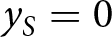 $y_S=0$ conditional on not getting caught. Third, as $r_1$ increases, the utility of reporting $y_S=1$ decreases. Hence, one may expect a nonmonotonic effect, but Corollary 4.7 shows that the combined effect is always positive, and probability $q_2$ increases with $r_1$.
In the final part of our analysis, we relax the assumption that states  $x=0$ and $x=2$ are equally likely, allowing the ruler to be ex ante strong or weak. Denote by $\beta_0\neq\beta_2$ the probabilities of these two states. In such a case, Lemma 1 is still true, but there may not exist an equilibrium where the strategies of state and opposition outlets are symmetric. Therefore, the equilibrium strategy of the state outlet will be $q_{S1}$ or $q_{S2}$, or the probability that the report $y_S=2$ will be made if $x=1$ or $x=2$. Define $q_{O1}$, and $q_{O2}$ similarly. The following result is established:
Proposition 4.9. Let  $\beta_0 \lt \beta_2$. Then $q_{S2}\geq q_{O2}$ if $q_{S1}=q_{O1}=1$.
Thus, if  $\beta_0$ is small (so the ruler is ex ante strong), then state-owned media is more inclined to make egregiously false reports than the opposition media in any equilibrium where the outlets misreport if $x=1$.
5. Conclusion
Our work argues that crude, unconvincing propaganda will be effective because it discredits competing news sources even when the audience understands that the content of propaganda messages is being manipulated, provided that the audience is sufficiently cynical.
We assume that the media outlets also believe, similarly to the audience, that there is a correlation between the types of outlets. Political and media elites themselves are often highly cynical, so the latter assumption is realistic.Footnote 8 More importantly, the equilibrium in this model does not differ from the one where the true correlation  $\rho$ between the types of media outlets is known to the fully rational media outlets, and the public is rational except that it believes that the ex ante correlation between media outlet types is some $\hat\rho$ that is not necessarily equal to $\rho$.Footnote 9
Our model can be extended in several ways. First, in the Supplemental Appendix, we consider the case where the probability that an egregiously false report is exposed is less than one. Second, the current model assumes a homogeneous audience, with no social division with regard to the regime or the leader, and a uniform level of cynicism/sophistication. Future research can consider multiple audiences that vary in ex ante beliefs, or when a part of the public is loyal or gullible, perceiving messages from regime-affiliated news sources at face value and/or enjoying holding beliefs that are consistent with one’s identity. Alternatively, general distrust in news sources can make one more likely to listen to messages that are congruent with one’s position or identity. Third, it is for future research to study why authoritarian states not only benefit from a more cynical populace, but sometimes deliberately instill cynicism and mistrust (Alyukov, Reference Alyukov2022; Rosenfeld and Wallace, Reference Rosenfeld and Wallace2024), benefiting from the political apathy of the populace (Gerschewski, Reference Gerschewski2023; Libman et al., Reference Libman, Romanov and Zakharov2024). A version of this logic was explored in Bräuninger and Marinov (Reference Bräuninger and Marinov2022), where competing elites can engage in a “war on truth,” affecting the non-Bayesian public’s perception of the quality of information that it receives from a news source; this can stop the voters from enacting policy change that the elites currently oppose, at the expense of making them less likely to support the elites in the future. Further work can examine the different persuasive mechanisms that the state uses to influence the correlation parameter  $\rho$, and how the decision to do so depends on the nature of threats faced by the regime: external, requiring the mobilization of regime supporters, or internal, requiring the suppression of anti-regime collective action.
Supplementary material
The supplementary material for this article can be found at https://doi.org/10.1017/psrm.2025.10081. To obtain replication material for this article, please visit https://doi.org/10.7910/DVN/B66HLL.
Acknowledgements
The author would like to thank Scott Gehlbach, Sergei Guriev, Zhaotian Luo, Adam Przeworski, Anton Shirikov, and Konstantin Sonin for their comments and feedback.
Definition of payoffs
Denote by  $d_i\in\{0,1\}$ whether it was revealed that outlet $i$ is self-serving, and let $\eta_{d_i}(x,y_i)$ be the probability of $d_i$ given $x$ and $y_i$; so $\eta_0(x,x)=1$, $\eta_0(x,y)=1-r_{|x-y|}$ if $x\neq y$, and $\eta_1(x,y)=1-\eta_0(x,y)$.
Denote by  $p:\{0,1,2\}^2\times\{0,1\}^2\rightarrow\Delta^2$ the belief of the public about state $x\in\{0,1,2\}$ following reports $y_S,y_O\in\{0,1,2\}$ and observations $d_S,d_O\in\{0,1\}$.Footnote 10 Denote by $q_{ix}(y)$ the probability that state $y$ is reported by outlet $i$ if the actual state is $x$ and the media outlet is self-serving.
Let  $p_x(y_S,y_O,d_S,d_O)$ be the probability assigned to state $x\in\{0,1,2\}$ by the public depending on the reports made by both news outlets and whether these reports appear as false. The payoff of outlet $S$ if it chooses report $y_S\in\{0,1,2\}$ and the state of the world is $x$ is defined by taking the expectation of $p_1+\alpha p_2$ over all possible values of $y_O$, $d_S$, and $d_O$:
 \begin{align}u_S(x,y_S)&=\frac{1-\rho}{2}\sum_{d_S}\eta_{d_S}(x,y_S)(p_1(y_S,x,d_S,0)+\alpha p_2(y_S,x,d_S,0))+\nonumber\\
&+\frac{1+\rho}{2}\sum_{y_O,d_S,d_O}q_{Ox}(y_O)\eta_{d_S}(x,y_S)\eta_{d_O}(x,y_O)(p_1(y_S,y_O,d_S,d_O)+\alpha p_2(y_S,y_O,d_S,d_O)).\end{align}
\begin{align}u_S(x,y_S)&=\frac{1-\rho}{2}\sum_{d_S}\eta_{d_S}(x,y_S)(p_1(y_S,x,d_S,0)+\alpha p_2(y_S,x,d_S,0))+\nonumber\\
&+\frac{1+\rho}{2}\sum_{y_O,d_S,d_O}q_{Ox}(y_O)\eta_{d_S}(x,y_S)\eta_{d_O}(x,y_O)(p_1(y_S,y_O,d_S,d_O)+\alpha p_2(y_S,y_O,d_S,d_O)).\end{align}The first summand of (A.1) is the expected payoff of  $S$ conditional on $O$ being principled and invariably choosing $y_O=x$, times $\frac{1-\rho}{2}$ or the probability that $O$ is principled if $S$ is self-serving. The second summand is the expected payoff of $S$ conditional on $O$ being self-serving (and, hence, choosing a $y_O$ that is potentially different from $x$), calculated over all possible realizations of $y_O$, $d_O$, and $d_S$ given $x$ and $y_S$ and multiplied by $\frac{1+\rho}{2}$ or the probability that $O$ is self-serving if $S$ is self-serving.
Define the payoff of the opposition outlet symmetrically:
 \begin{align}u_O(x,y_O)&=\frac{1-\rho}{2}\sum_{d_O}\eta_{d_O}(x,y_O)(p_1(x,y_O,0,d_O)+\alpha p_0(x,y_O,0,d_O))+\nonumber\\
&+\frac{1+\rho}{2}\sum_{y_S,d_S,d_O}q_{Sx}(y_S)\eta_{d_S}(x,y_S)\eta_{d_O}(x,y_O)(p_1(y_S,y_O,d_S,d_O)+\alpha p_0(y_S,y_O,d_S,d_O)).\end{align}
\begin{align}u_O(x,y_O)&=\frac{1-\rho}{2}\sum_{d_O}\eta_{d_O}(x,y_O)(p_1(x,y_O,0,d_O)+\alpha p_0(x,y_O,0,d_O))+\nonumber\\
&+\frac{1+\rho}{2}\sum_{y_S,d_S,d_O}q_{Sx}(y_S)\eta_{d_S}(x,y_S)\eta_{d_O}(x,y_O)(p_1(y_S,y_O,d_S,d_O)+\alpha p_0(y_S,y_O,d_S,d_O)).\end{align}Proofs of statements
Proof of Lemma 4.2
Given any equilibrium strategies, we have  $u_S(0,0)=0$. It follows that we should have $p_0=1$ if $(y_S,y_O,d_S,d_O)\in\{(1,0,0,0),(1,0,1,0),(2,0,1,0)\}$; otherwise, $S$ will not choose $y_S=0$ if $x=0$. As $p_0(1,0,0,0)=1$, it follows that we should have $q_{S1}(1)=0$ and $q_{S1}(2)=1$. This means that we observe $(y_S,y_O,d_S,d_O)=(2,0,1,0)$ with positive probability if $x=1$, which is a contradiction.
Proof of Lemma 4.3
Here, we provide a sketch of the proof; for the full derivation, please refer to the Supplemental Appendix. We first derive  $u_S(1,1)$, $u_S(1,2)$ by taking the expectations of posterior beliefs over the possible combinations of $(y_S,y_O,d_S,d_O)$. If $q_{S1}=q_{O1}=0$, then the information set $y_S=2$, $y_O=1$, $d_S=1$, $d_O=0$ is off the game path. If $q_{S2}=q_{O2}$, then for any sequence of totally mixed strategy profiles converging to $q_{S1}=q_{O1}=0$, $q_{S2}=q_{O2} \lt 1$ we should have $u_S(1,2) \gt u_S(1,1)$, unless $q_{S2}=q_{O2}=1$. We then similarly derive $u_S(0,1)$ and $u_S(0,2)$; it immediately follows that $u_S(0,1) \lt u_S(0,2)$ if $q_{S1}=q_{O1} \gt 0$ and $q_{S2}=q_{O2}=0$, ruling it out as an equilibrium.
Proof of Lemma 4.4
Assume  $r_2\in(r_1,1]$, $q_{S1}=q_{O1}=q_1$, and $q_{S2}=q_{O2}=q_2$. Put
 \begin{align}
&H_1(q_1,q_2)=u_S(1,2)-u_S(1,1)=\frac{(1-r_1)(1-\beta)(1-q_2)}{2}\frac{2(\alpha-1)+q_1(1+\rho)(2-\alpha)}{\beta q_1(2-q_1-q_1\rho)+(1-\beta)(1-q_2)}+\nonumber\\
+&\frac{1+\rho}{2}q_1(1-r_1)^2\frac{(\alpha-2) (1-\beta)q_2(1-r_2)}{\beta(1+\rho)q_1^2(1-r_1)^2+2(1-\beta)q_2(1-r_2)}+\nonumber\\
&+\frac{1+\rho}{2}q_1r_1(1-r_1)\frac{2\beta(1+\rho)q_1^2r_1(1-r_1)+\alpha(1-\beta)q_2r_2}{\beta(1+\rho)q_1^2r_1(1-r_1)+(1-\beta)q_2r_2},
\end{align}
\begin{align}
&H_1(q_1,q_2)=u_S(1,2)-u_S(1,1)=\frac{(1-r_1)(1-\beta)(1-q_2)}{2}\frac{2(\alpha-1)+q_1(1+\rho)(2-\alpha)}{\beta q_1(2-q_1-q_1\rho)+(1-\beta)(1-q_2)}+\nonumber\\
+&\frac{1+\rho}{2}q_1(1-r_1)^2\frac{(\alpha-2) (1-\beta)q_2(1-r_2)}{\beta(1+\rho)q_1^2(1-r_1)^2+2(1-\beta)q_2(1-r_2)}+\nonumber\\
&+\frac{1+\rho}{2}q_1r_1(1-r_1)\frac{2\beta(1+\rho)q_1^2r_1(1-r_1)+\alpha(1-\beta)q_2r_2}{\beta(1+\rho)q_1^2r_1(1-r_1)+(1-\beta)q_2r_2},
\end{align} \begin{align}
&H_2(q_1,q_2)=u_S(0,2)-u_S(0,1)=\frac{\beta(1+\rho)q_1^2r_1(1-r_1)r_2}{\beta(1+\rho)q_1^2r_1(1-r_1)+(1-\beta)q_2r_2}+\nonumber\\
&+\frac{\beta(1+\rho)q_1^2(1-r_1)^2(1-r_2)+\alpha(1-\beta)q_2(1-r_2)^2}{\beta(1+\rho)q_1^2(1-r_1)^2+2(1-\beta)q_2(1-r_2)}-\frac{\beta q_1(1-r_1)(2-q_1-q_1\rho)}{\beta q_1(2-q_1-q_1\rho)+(1-\beta)(1-q_2)}.
\end{align}
\begin{align}
&H_2(q_1,q_2)=u_S(0,2)-u_S(0,1)=\frac{\beta(1+\rho)q_1^2r_1(1-r_1)r_2}{\beta(1+\rho)q_1^2r_1(1-r_1)+(1-\beta)q_2r_2}+\nonumber\\
&+\frac{\beta(1+\rho)q_1^2(1-r_1)^2(1-r_2)+\alpha(1-\beta)q_2(1-r_2)^2}{\beta(1+\rho)q_1^2(1-r_1)^2+2(1-\beta)q_2(1-r_2)}-\frac{\beta q_1(1-r_1)(2-q_1-q_1\rho)}{\beta q_1(2-q_1-q_1\rho)+(1-\beta)(1-q_2)}.
\end{align} For any equilibrium  $(q_1,q_2)\neq(0,1)$, we must have $H_i=0$ if $q_i\in(0,1)$ or $H_i\geq 0$ if $q_i=1$, for $i=1,2$. If $\alpha \gt 2$, then $H_1(q_1,q_2) \gt 0$, so $q_1=1$. Now, $H_2(1,0) \gt 0$, so for some $q_2\in(0,1]$ we have $H_2(1,q_2)=0$ and/or we have $H_2(1,1) \gt 0$.
Proof of Proposition 4.5
Fix  $r_2=1$. Then $H_1(q_1,q_2) \gt 0$, so $q_1=1$. We have $u_S(0,1)$ increasing in $q_2$ and $u_S(0,2)$ is decreasing in $q_2$, with $u_S(0,1) \lt u_S(0,2)$ at $q_2=0$. So, we either have $q_2=1$, or a closed-form solution for $u_S(0,1)=u_S(0,2)$ in $q_2$ exists, given by the expression (1).
It remains to show that backward misinformation is not optimal; please refer to the Supplementary Appendix for details.
Proof of Corollary 4.6
We have  $q_2=1$ if $\beta(1+r_1^2(1+\rho))\geq 1$. The statement immediately follows.
Proof of Corollary 4.7
Assume that 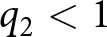 $q_2 \lt 1$. Differentiating $q_2$ by $\beta$ and $r_1$ yields positive values. Now, $\frac{\partial q_2}{\partial \rho}$ has no more than one zero on $(-1,1)$, with $q_2=0$ for $\rho=-1$ and $q_2=1$ for $\rho=1$. This means that $q_2$ is strictly increasing in $\rho$ whenever $q_2 \lt 1$.
Proof of Proposition 4.9
If  $r_2=1$ we have $u_S(0,1)\leq u_S(0,2)$ if and only if
 \begin{equation*}
\frac{(2-q_{S1}-q_{S1}\rho)}{\beta_1 q_{O1}(2-q_{S1}-q_{S1}\rho)+2\beta_0(1-q_{S2})}\leq
\frac{(1+\rho)q_{S1}r_1}{\beta_1(1+\rho)q_{S1}q_{O1}r_1(1-r_1)+2\beta_0q_{S2}}
\end{equation*}
\begin{equation*}
\frac{(2-q_{S1}-q_{S1}\rho)}{\beta_1 q_{O1}(2-q_{S1}-q_{S1}\rho)+2\beta_0(1-q_{S2})}\leq
\frac{(1+\rho)q_{S1}r_1}{\beta_1(1+\rho)q_{S1}q_{O1}r_1(1-r_1)+2\beta_0q_{S2}}
\end{equation*}so
 \begin{equation}
q_{S2}=\min\left\{1,\frac{(1+\rho)q_{S1}r_1\left(1+\frac{\beta_1}{2\beta_0}q_{O1}r_1(2-q_{S1}(1+\rho))\right)}{2-q_{S1}(1+\rho)(1-r_1)}\right\}.
\end{equation}
\begin{equation}
q_{S2}=\min\left\{1,\frac{(1+\rho)q_{S1}r_1\left(1+\frac{\beta_1}{2\beta_0}q_{O1}r_1(2-q_{S1}(1+\rho))\right)}{2-q_{S1}(1+\rho)(1-r_1)}\right\}.
\end{equation}Similarly, we have
 \begin{equation}
q_{O2}=\min\left\{1,\frac{(1+\rho)q_{O1}r_1\left(1+\frac{\beta_1}{2\beta_2}q_{S1}r_1(2-q_{O1}(1+\rho))\right)}{2-q_{O1}(1+\rho)(1-r_1)}\right\}.
\end{equation}
\begin{equation}
q_{O2}=\min\left\{1,\frac{(1+\rho)q_{O1}r_1\left(1+\frac{\beta_1}{2\beta_2}q_{S1}r_1(2-q_{O1}(1+\rho))\right)}{2-q_{O1}(1+\rho)(1-r_1)}\right\}.
\end{equation} The statement follows immediately for  $q_{S1}=s_{O1}=1$.


 Open access

