


Introduction
African swine fever (ASF) is a highly contagious foreign animal disease and deadly viral disease in pigs (USDA-APHIS 2021a).Footnote 1 ASF has never occurred in the United States, but is not a new swine disease globally.Footnote 2 ASF has proliferated rapidly across Asia after the first known outbreak in China in 2018 (FAO-EMPRES-AH 2021a), and the number of countries affected by ASF has increased in Asia, Europe, and Sub-Saharan Africa (OIE – Europe 2020). The detection of ASF virus in the Dominican Republic on July 27, 2021, and in Haiti on September 20, 2021 (Cole and Stepien Reference Cole and Stepien2021a, Reference Cole and Stepien2021b), represents the first cases in the Western Hemisphere in forty years and has further heightened concerns the disease may continue to spread into disease-free regions, including the United States. The major economic consequences of an ASF outbreak would include the cost of disease control and the loss of status for international trade (Berthe Reference Berthe2020). Adverse economic impacts of an ASF outbreak could increase exponentially if domestic consumers reduce pork consumption. For example, Paarlberg, Lee and Seitzinger (Reference Paarlberg, Lee and Seitzinger2002) estimate that if only 7% of U.S. consumers cut meat consumption during a foot and mouth disease (FMD) outbreak (i.e., in the mistaken belief that FMD is a human health concern), the national welfare losses from the outbreak would be more than double the amount of losses with no such consumer response.
ASF virus has limited host range. To date, there is no evidence of zoonotic potential and there are no indications that this might change (Blome, Franzke and Beer Reference Blome, Franzke and Beer2020; Dixon et al. Reference Dixon, Stahl, Jori, Vial and Pfeiffer2020; Fu et al. Reference Fu, Zhao, Zhang, Zhang, Li and Zhang2020). The reason why ASF is notifiable to the World Organization for Animal Health (OIE) is because of its high socioeconomic impact and the number of stakeholders involved (Blome, Franzke and Beer Reference Blome, Franzke and Beer2020). The Animal and Plant Health Inspection Service of the U.S. Department of Agriculture clearly states that ASF is not a public health threat or food safety issue (USDA-APHIS 2021a). Nonetheless, the public tends to overestimate food risks even when experts evaluate the actual risk to be low (Miles and Frewer Reference Miles and Frewer2003; Miles et al. Reference Miles, Brennan, Kuznesof, Ness, Ritson and Frewer2004). Moreover, the first occurrence of an animal disease outbreak is known to contribute to uncertainty in livestock markets and have a greater shock than recurring ones (McCullogh et al. Reference McCullough, Marsh and Huffaker2013; Houser and Karali Reference Houser and Karali2020). As ASF has never occurred in the United States, news coverage about a U.S. outbreak of the virus could influence consumers’ perceived food safety of pork products. There is limited information, however, on how many U.S. consumers are even aware of the disease.
Previous research shows impacts of food safety events on consumers, with studies mostly focusing on food recalls or contamination (Dahlgran and Fairchild Reference Dahlgran and Fairchild2002; Marsh, Schroeder and Mintert Reference Marsh, Schroeder and Mintert2004; Piggott and Marsh Reference Piggott and Marsh2004; Tonsor, Mintert and Schroeder Reference Tonsor, Mintert and Schroeder2010; Taylor, Klaiber and Kuchler Reference Taylor, Klaiber and Kuchler2016). The literature rarely discusses consumer responses associated with animal diseases that do not have human health impacts and/or food safety concerns. However, adverse meat demand impacts are possible regardless of the actual severity of food safety concerns, if any, and this can depend on how public information such as media reports or public commentary is delivered. For instance, given that an animal disease is not a food safety issue, the inclusion of a direct food safety statement in the headline or contents of a news article may help mitigate the potential adverse demand impact, compared to the case where the statement is omitted.
In this study, we utilize an online survey of U.S. pork consumers to help fill several knowledge gaps. We first evaluate respondents’ perceptions of the recent global ASF outbreak along with prior knowledge that helps to document baseline knowledge about ASF before exposure to information treatments used in the study. We then use contingent valuation experiments to examine purchasing decisions when exposed to alternative news articles where the headline and the body of the article are framed differently. Understanding possible consumer actions after exposure to differently framed and curated information can help design communication strategies to prevent or lessen demand impacts and avoid further serious economic implications for producers and the broader economy.
Literature review
Public information about food safety events has been found to have a negative but short-lived impact on consumer demand (Dahlgran and Fairchild Reference Dahlgran and Fairchild2002; Piggott and Marsh Reference Piggott and Marsh2004; Wang and De Beville Reference Wang and de Beville2017). On the other hand, Burton and Young (Reference Burton and Young1996) found the media coverage of bovine spongiform encephalopathy (BSE) had a significant long-run negative impact on beef demand in Great Britain. In the United States, Taylor, Klaiber and Kuchler (Reference Taylor, Klaiber and Kuchler2016) assert that food safety-related information has increased subsequently in the public sphere since the discovery of a cow testing positive for BSE. They find evidence that the event altered how people view and respond to recalls of ground beef and conclude the scale of influence the BSE event had on U.S. consumer behavior has been understated. Neill and Chen (Reference Neill and Chen2021) also find a prolonged or intense media response to a food scare could result in significant decreases in demand, lower prices, and lower short-term profit for producers.
When the media report on animal disease outbreaks, negative connotations typically appear in news articles (Ruth, Eubanks and Telg Reference Ruth, Eubanks and Telg2005; Shih, Wijaya and Brossard Reference Shih, Wijaya and Brossard2008). In the study of FMD, Cannon and Irani (Reference Cannon and Irani2011) investigate how major daily newspapers framed the disease during the FMD outbreak in the U.K. in 2001 and 2007 and confirm that framing of fear dominates. They caution that the use of frames in media has the potential to invoke unnecessary fear among consumers who already have limited knowledge regarding agricultural production practices. Swinnen, McCluskey and Francken (Reference Swinnen, McCluskey and Francken2005) also assert that early claims about food safety events are reported with a bias toward negative news. They note that even false claims, such as an individual being affected by FMD, were initially reported, but the correction that the symptoms were caused by another condition was presented in a comparatively short article.
The number of countries across the world reporting outbreaks of ASF has grown and, although production practices and consumption patterns differ, lessons can be learned from their experiences. A report from China mentions that a 10% to 15% drop in pork consumption after the first ASF outbreak was probably due to food safety concerns (Pan Reference Pan2019). Vietnam noted domestic pork demand was reduced owing to ASF-related health concerns (E.D. Solutions 2019), and media in the Philippines reported that consumers were avoiding pork despite the fact that ASF does not harm human health (Rivas Reference Rivas2019). One popular press article points out that confusing headlines about the ASF outbreak prompted German consumers, unfamiliar with the virus, to question the safety of pork (Shike Reference Shike2021). Moreover, the Korea Pork Producers Association issued a statement calling for media cooperation on ASF reporting. They referred to past experiences with FMD and stated that stimulating words caused damage to the farms as they invoked consumers’ anxiety about food safety and pork consumption (Korea Pork Producers Association 2019).Footnote 3 While these reports do not necessarily constitute stylized facts, they do provide cautionary tales of possible pork demand impacts.
How information is framed matters for consumers’ attitudes about food purchases. Previous research includes pro- or anti-framing, gain or loss framing, and benefit or risk framing (Fox, Hayes and Shogren Reference Fox, Hayes and Shogren2002; Hayes, Fox and Shogren Reference Hayes, Fox and Shogren2002; Lusk et al. Reference Lusk, House, Valli, Jaeger, Moore, Morrow and Traill2004; Marette et al. Reference Marette, Roosen, Blanchemanche and Verger2008; Mitchell et al. Reference Mitchell, Bakewell, Jackson and Heslin2015; Britwum and Yiannaka Reference Britwum and Yiannaka2019). Hayes, Fox and Shogren (Reference Hayes, Fox and Shogren2002) find that negative information outweighed positive information when both positive and negative information on food irradiation was offered to consumers at the same time. In this context, McCluskey and Swinnen (Reference McCluskey and Swinnen2011) propose that media companies who care about profits would offer more negative stories to meet the demand for negative news. Stronger demand for negative framing aligns with prospect theory (Kahneman and Tversky Reference Kahneman and Tversky1979), because readers’ expected value of additional information would be higher when an article dealt with a negative impact on their welfare than when it dealt with a positive impact.
Meanwhile, prior knowledge can also alter food consumers’ risk perceptions and purchase intentions (Radecki and Jaccard Reference Radecki and Jaccard1995; Verbeke Reference Verbeke2005). According to Rao and Sieben (Reference Rao and Sieben1992), consumers evaluate product quality as lower when they perceive certain information about a product is missing. Also, consumers with less prior knowledge of a product are more likely to be risk averse than more knowledgeable consumers because the perception of missing information causes uncertainty in purchase decisions. In addition, Jin and Han (Reference Jin and Han2014) find that when exposed to a differently framed news article on a food hazard with varying degrees of information, a group of individuals with less subjective knowledge of food safety issues showed a greater variation in purchase intentions.
Our research builds upon these prior studies, and adds to foreign animal disease preparation efforts, by investigating how consumers’ perceptions and the framing of information in news articles can affect their purchase decisions. A goal of risk communication during an animal disease outbreak is to protect the health of animals, people, and communities, as well as to mitigate related economic impacts, by providing information, advice, and guidance to decision makers (FAO 2020). Understanding what reactions may occur and how individual reactions may vary could facilitate public and private risk communication and policy making in animal disease management (Muringai and Goddard 2017). Resiliency of all meat industry participants, in the aftermath of a foreign animal disease outbreak, will hinge critically upon consumer demand.
Survey data
Survey instrument
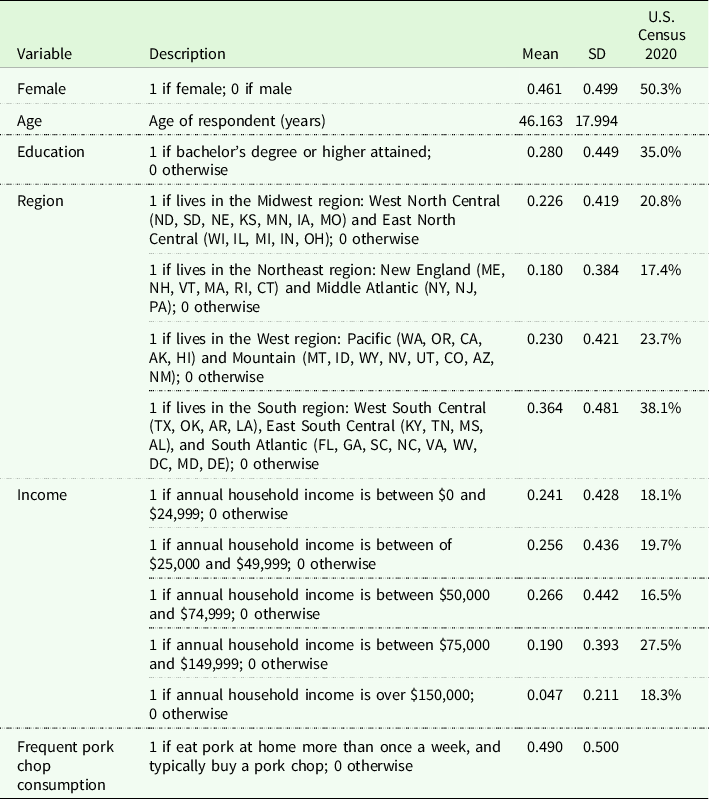
We developed an online survey collaboratively with the Center for Survey Statistics and Methodology (CSSM) at Iowa State University to collect information about U.S. pork consumers. Dynata, an international marketing company, programmed the survey instrument into a web-based format and distributed it through their database of survey panelists.Footnote 4 The survey sample was balanced for age, gender, race, income, and region of the United States according to the U.S. Census.Footnote 5 A screening question was included at the beginning of the survey to identify pork consumers. A household that does not eat pork was not included in the sample. In total, 2,107 completed responses were obtained from April 29, 2020 to May 4, 2020. Among total respondents to the survey, 1,052 participants were randomly assigned to the survey experiment designed for this study. Table 1 shows select summary statistics of survey participants compared with 2020 U.S. Census data where available. About 46% of respondents were female, mean age was 46 years with a range of 18 to 93 years, and 28% of respondents had a bachelor’s degree or higher. Annual household income was classified into five categories, and residence into four categories for region of the United States. Half of respondents eat pork at home more than once a week and selected pork chops as a pork product that they typically buy.
Summary statistics of survey participants
Prior knowledge of ASF
To our knowledge, there is little published evidence on consumer awareness and perceptions of ASF or other swine diseases. The first part of the survey consisted of questions that evaluated how much pork consumers know about various swine diseases. Specifically, three questions allowed us to infer the degree to which consumers were aware of ASF. The first question asked how much they were aware of various swine diseases, using a Likert scale. Swine diseases included swine influenza, porcine epidemic diarrhea (PED), porcine reproductive and respiratory syndrome (PRRS), ASF, classical swine fever (CSF), and FMD. Common causes of foodborne illness, such as E. coli and salmonella, were also included in the list. To account for possible order bias, we provided swine diseases in a randomized order to survey participants. Using the same list of swine diseases, the second question asked respondents to indicate which diseases, if any, they thought were a possible threat to human health. Lastly, we asked whether respondents were aware of the global ASF outbreak in China and other countries.
The observed responses to these three survey questions were used to understand consumers’ prior knowledge about ASF. It is likely that there exist latent or hidden patterns between answers to the questions, as respondents with similar answers will tend to cluster within the same latent class. Latent class analysis allows us to identify qualitatively different subgroups within populations that share certain observable characteristics (Hagenaars and McCutcheon Reference Hagenaars and McCutcheon2002). This helps us evaluate the relationship between the observable survey responses and choose a proxy for the respondent’s prior knowledge of ASF. We find that an individual’s awareness of the global ASF outbreak was a key response that determines to which latent class a respondent likely belongs and the variable is used to represent consumers’ prior knowledge of ASF. To help retain brevity of the article, Table 2 contains only the survey responses that present respondents’ prior knowledge of ASF, which are selected for use in model estimation. Appendix 1 contains details of the survey responses about relative awareness of ASF along with prior knowledge of other swine diseases and the results from the latent class analysis.
Awareness of global ASF outbreak and perceived impact of ASF on human health
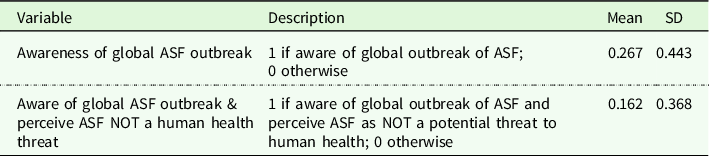
The August 2018 outbreak of ASF in China and subsequent outbreaks in other countries has dramatically changed the global epidemiological conditions of ASF and has caused concerns the disease may continue to spread into disease-free regions, including the United States (Sundberg Reference Sundberg2019). Only 27% of respondents were aware of this situation when the survey was conducted in the spring of 2020. The cross tabulation for respondents’ awareness of the recent global outbreak of ASF and their belief that ASF is not a threat to human health, shown in Table 2, indicates that only 16% of respondents were aware of ASF and believed it was not a threat to human health. This is an extremely noteworthy finding, as some consumers have strong beliefs to the contrary despite considerable efforts by several government agencies (OIE 2021a; FAO-EMPRES-AH 2021b; USDA-APHIS 2021a) and others (Pork Checkoff 2021; SPS Plan 2021) to publicize that FMD, CSF, and ASF are not public health or food safety concerns and that pork will still be safe to eat in the event of a disease outbreak.
Experimental design: Information treatments
We designed a survey experiment to assess how news reporting and the degree of information exposure about an unfamiliar animal disease outbreak can affect pork purchases. The hypothetical situation is impossible to test in a real-world setting. Without a controlled environment, it is also difficult to ensure that consumers are actually exposed to specific news items or messages. The benefit of the stated preference methodology is that we can directly compare the effect of media coverage and food safety information on consumers’ behavioral changes in pork purchases during a hypothetical outbreak of ASF while accounting for respondents’ prior knowledge.
When an ASF outbreak occurs, depending on how the outbreak is reported, some consumers may only be informed of the occurrence of the outbreak, while some consumers may learn more about the disease. Even if sensational headlines are avoided, a negative framing in the headlines can have a cognitive effect on consumers’ perceptions, resulting in them avoiding the consumption of pork. According to Ecker et al. (Reference Ecker, Lewandowsky, Chang and Pillai.2014), the information presented in news articles can be misleading without being blatantly false. They define slightly misleading headlines as those focusing on one negative aspect of the issue rather than the article’s main issue. Moreover, consumers may seek further assurances that eating pork is safe. Ortega, Wang and Olynk Widmar (Reference Ortega, Wang and Olynk Widmar2015) find that news headlines regarding food safety have a significant impact on U.S. consumer preferences and willingness to pay for enhanced safety characteristics.
The news article format in our experiment, reporting the first occurrence of ASF in the United States, serves as the information treatment. We specified in the instructions as follows:
The following article describes a HYPOTHETICAL SITUATION. The article is what you may see if there is an outbreak of African swine fever in the United States. You will be asked to respond to a hypothetical scenario. Please answer the questions as if you were actually facing the situation.
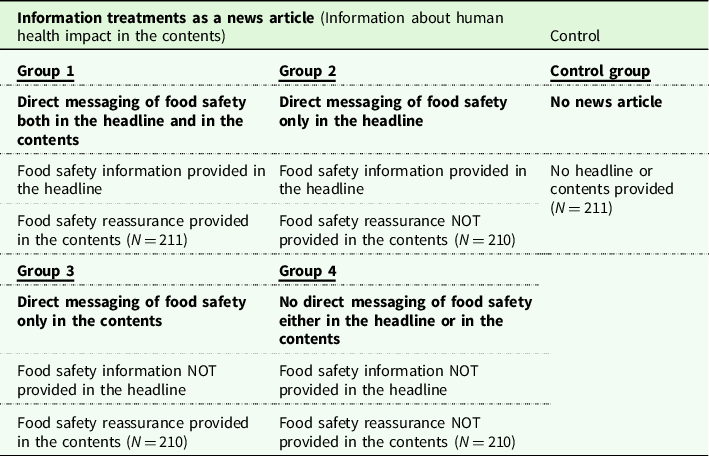
To eliminate the source of bias in treatments, each respondent was randomly assigned to one of four treatments or a control group. A control group received no headline or corresponding news article content. Four treatment groups received news articles, and we used a two-by-two factorial design to compare the relative effects of the combinations of two types of content and two types of headlines.
For the body of the news article, we prepared two different paragraphs of approximately 200 words each. General information about ASF was included, and it was explicitly stated that ASF was not a potential threat to human health. The difference between the two contents was that we included additional food safety assurance messaging in one, but not the other.
We considered two possible headlines that may be used when reporting on an ASF outbreak. One headline may be focused on food safety, stating it is “still safe to eat pork.” The other headline may state that “no vaccine is available” but does not specify to whom the vaccine was unavailable, and also does not have a direct statement about food safety. The latter headline is slightly misleading because it emphasizes one negative aspect rather than the dominant point of the accompanying content about the nonimpact on human health. Table 3 presents a summary of the experimental design based on a mix-and-match of two news article contents and two headlines. Instructions, headlines, and the news articles provided for the contingent valuation experiment are provided in Appendix 2.
Design of Information Treatments (N = 1,052)
Methodology
Double-bounded dichotomous contingent valuation methodology with a follow-up question
We used the double-bounded contingent valuation methodology (Hanemann, Loomis and Kanninen Reference Hanemann, Loomis and Kanninen1991) in the survey to determine how willingness to pay for pork chops differ by exposure to different information treatments. Boneless pork chops were used for the study because they are a familiar cut of fresh pork (USDA-AMS 2020; US-BLS 2020) and have been frequently utilized in previous studies (Sanders, Moon and Kuethe Reference Sanders, Moon and Kuethe2007; Olynk, Tonsor and Wolf Reference Olynk, Tonsor and Wolf2010; Pozo, Tonsor and Schroeder Reference Pozo, Tonsor and Schroeder2012; Lusk et al. Reference Lusk, Tonsor, Schroeder and Hayes2018). Moreover, possible changes in purchase intentions and consumer behavior are highly correlated when asking consumers about their purchases of existing products (Morwitz, Steckel and Gupta Reference Morwitz, Steckel and Gupta2007).
We provided survey participants with the average retail price of $3.35 per pound for boneless pork chops, which was based on the National Retail Report – Pork, published by USDA’s Agricultural Marketing Service, for the third week of February 2020 (USDA-AMS 2020).Footnote
6
The price served as a representative, prevailing price for normal market conditions. Then, we asked each respondent if they would buy a boneless pork chop for a lower price ( ${B_i}$
) per pound during an ASF outbreak in the United States. If a participant answered “yes” to the first question, the price was raised by $0.50 (
${B_i}$
) per pound during an ASF outbreak in the United States. If a participant answered “yes” to the first question, the price was raised by $0.50 ( $B_i^h = {B_i} + 0.5)\;$
and the question was asked again. If a participant answered “no” to the first question, the price was reduced by $0.50 (
$B_i^h = {B_i} + 0.5)\;$
and the question was asked again. If a participant answered “no” to the first question, the price was reduced by $0.50 ( $B_i^l = {B_i} - 0.5)$
and the question was asked again. We randomly assigned survey participants to three initial lower prices: $2.00, $2.35, and $2.70.
$B_i^l = {B_i} - 0.5)$
and the question was asked again. We randomly assigned survey participants to three initial lower prices: $2.00, $2.35, and $2.70.
We used initial prices lower than the reference price of $3.35 per pound. This reflects the notion that countries with confirmed cases of ASF would be subject to international trade restrictions. As a result, an outbreak of ASF in the United States would lead to a significant reduction, if not complete halt, in U.S. pork exports. This would result in immediately larger supplies of pork in the domestic market, putting downward pressure on prices throughout the pork supply chain (Carriquiry et al. Reference Carriquiry, Elobeid, Swenson and Hayes2020).
The theoretical framework in Aizaki, Nakatani and Sato (Reference Aizaki, Nakatani and Sato.2014) is adapted for this study. We assume an individual’s indirect utility function is ${U_i}\left( {{q_i},{m_i}} \right)$
, where
${U_i}\left( {{q_i},{m_i}} \right)$
, where ${q_i}$
is the perceived food safety of a pork chop, and
${q_i}$
is the perceived food safety of a pork chop, and ${m_i}$
is the individual’s income. Suppose that an individual compares the perceived food safety of a pork chop in normal conditions (
${m_i}$
is the individual’s income. Suppose that an individual compares the perceived food safety of a pork chop in normal conditions ( ${q_{0i}})$
to the perceived food safety after hearing about an ASF outbreak in the United States (
${q_{0i}})$
to the perceived food safety after hearing about an ASF outbreak in the United States ( ${q_{1i}})$
. Learning about an ASF outbreak may or may not change individuals’ perceptions of the safety of pork. If individuals think they will gain utility from purchasing pork chops at a proposed price, they would answer “yes” to the question, and we can write it as an equation:
${q_{1i}})$
. Learning about an ASF outbreak may or may not change individuals’ perceptions of the safety of pork. If individuals think they will gain utility from purchasing pork chops at a proposed price, they would answer “yes” to the question, and we can write it as an equation:
 $$\;{U_i}\left( {{q_{1i}},{m_i} - {b_i}} \right) \ge \;{U_i}\left( {{q_{0i}},{m_i}} \right)$$
where ${B_i}$
is a price which is further assumed to be
${B_i}$
is a price which is further assumed to be ${b_i} = 3.35 - {d_i}$
, and
${b_i} = 3.35 - {d_i}$
, and ${d_i}$
reflects the perceived discount in the value of the pork chop evaluated by individuals due to an ASF outbreak.
${d_i}$
reflects the perceived discount in the value of the pork chop evaluated by individuals due to an ASF outbreak.
The responses to the double-bounded valuation questions can be partitioned into four intervals. For example, if a respondent answered “yes” to both valuation questions (“yes, yes”), then the respondent’s willingness to pay is considered higher than the last price, and the willingness to pay interval is classified as $\left[ {b_i^h, + \infty } \right)$
. An interval for a (“yes, no”) answer is
$\left[ {b_i^h, + \infty } \right)$
. An interval for a (“yes, no”) answer is $\left[ {{b_i},b_i^h} \right)$
, an interval for a (“no, yes”) answer is
$\left[ {{b_i},b_i^h} \right)$
, an interval for a (“no, yes”) answer is $\left[ {b_i^l,{b_i}} \right)$
, and an interval for a (“no, no”) answer is
$\left[ {b_i^l,{b_i}} \right)$
, and an interval for a (“no, no”) answer is $\left( { - \infty ,b_i^l} \right)$
.
$\left( { - \infty ,b_i^l} \right)$
.
In this study, following the conventional design of double-bounded valuation questions, we added a question for respondents who answered “no” to the initial price and the following price with a value decreased by $0.50. Specifically, we asked “Would you buy a boneless pork chop for any price below the last suggested price?” This question allows us to further distinguish between consumers who have willingness to pay in the range of [ $b_i^l,\;0)$
or 0. Appendix 3 depicts schematically how we provided the double-bounded contingent valuation and follow-up questions.
$b_i^l,\;0)$
or 0. Appendix 3 depicts schematically how we provided the double-bounded contingent valuation and follow-up questions.
Willingness-to-pay estimation: Double-bounded discrete choice contingent valuation model
We first estimate willingness to pay using the double-bounded discrete choice contingent valuation (DBDC-CV) methodology which assumes a logistic distribution to account for both positive and negative ranges for willingness to pay. We then compare willingness to pay estimated from the spike model (Kriström Reference Kriström1997; Yoo and Kwak Reference Yoo and Kwak2002), which utilizes the answers from the follow-up question and focuses on positive willingness-to-pay values and spikes at zero willingness to pay. While considering the market good characteristics of pork chops make it reasonable to focus on the positive willingness to pay values, Bass et al. (Reference Bass, McFadden and Messer2021) points out that a market good may not always provide marginal utility if consumers are concerned about food safety. Because consumer valuations reflect consumer sentiment, the spike model that restricts willingness to pay to only positive values may overestimate the effective demand. We examine the two willingness to pay distributions estimated from the DBDC-CV model and the spike model to determine if they are significantly different. By this comparison, it is possible to gain insight into the potential impact of negative willingness to pay, which is attributable to consumers’ disutility from the introduction of animal disease that is perceived to compromise food safety.
To estimate willingness to pay using DBDC-CV, we assume an individual’s indirect utility function ( ${U_i})$
has a systematic component (
${U_i})$
has a systematic component ( ${V_i}$
) and a random component (
${V_i}$
) and a random component ( ${\varepsilon _i}$
), based on the random utility model. Therefore, equation (1) can be written as
${\varepsilon _i}$
), based on the random utility model. Therefore, equation (1) can be written as
 $${V_{1i}}\left( {{q_{1i}},{m_i} - {b_i}} \right) + {\varepsilon _{1i}} \ge \;{V_{0i}}\left( {{q_{0i}},{m_i}} \right) + {\varepsilon _{0i}}$$
We use the linear utility model ${V_i} = {\alpha _i} + {\beta _i}{m_i} + {\varepsilon _i}$
, where
${V_i} = {\alpha _i} + {\beta _i}{m_i} + {\varepsilon _i}$
, where ${b_i}$
represents the marginal utility of income. An individual’s maximum latent willingness to pay in the hypothesized situation satisfies:
${b_i}$
represents the marginal utility of income. An individual’s maximum latent willingness to pay in the hypothesized situation satisfies:
 $${\alpha _{0i}} + {\beta _i}{m_i} + {\varepsilon _{0i}} = {\alpha _{1i}} + {\beta _i}\left( {{m_i} - y_i^*} \right) + {\varepsilon _{1i}}$$
Rearranging the equation yields $y_i^*$
=
$y_i^*$
= ${{{\alpha _i} + {\varepsilon _i}} \over {{\beta _i}}}$
, where
${{{\alpha _i} + {\varepsilon _i}} \over {{\beta _i}}}$
, where ${\alpha _i} = {\alpha _{1i}} - $ ${\alpha _{0i}}\;$
and
${\alpha _{0i}}\;$
and ${\varepsilon _i} = {\varepsilon _{1i}} - $ ${\varepsilon _{0i}}.$
An individual would say “yes” to a price if the individual perceives that purchasing pork chops at the proposed price provides greater utility, such that
${\varepsilon _{0i}}.$
An individual would say “yes” to a price if the individual perceives that purchasing pork chops at the proposed price provides greater utility, such that ${V_{1i}} - {V_{0i}} = {\alpha _i} - {\beta _i}{b_i} + {\varepsilon _i} \ge 0$
. The error term
${V_{1i}} - {V_{0i}} = {\alpha _i} - {\beta _i}{b_i} + {\varepsilon _i} \ge 0$
. The error term ${\varepsilon _i}$
is a stochastic component with a standard logistic distribution.
${\varepsilon _i}$
is a stochastic component with a standard logistic distribution.
The probability that individual i answers “yes, yes” to the first and second questions is given by ${P^{yy}}$
(
${P^{yy}}$
( ${b_i},b_i^h) = Pr\;\left( {b_i^h \le y_i^*} \right)\; = 1 - F(b_i^h;\;{\alpha _i},$ ${\beta _i}$
). Similarly, the probability of answering “yes, no” is
${\beta _i}$
). Similarly, the probability of answering “yes, no” is ${P^{yn}}$
=
${P^{yn}}$
= $F\left( {b_i^h;{\alpha _i},\;{\beta _i}} \right) - F\left( {{b_i};{\alpha _i},\;{\beta _i}} \right)$
, and the probability of answering “no, yes” is
$F\left( {b_i^h;{\alpha _i},\;{\beta _i}} \right) - F\left( {{b_i};{\alpha _i},\;{\beta _i}} \right)$
, and the probability of answering “no, yes” is ${P^{ny}}$
= F
${P^{ny}}$
= F $\left( {{b_i};{\alpha _i},\;{\beta _i}} \right) - F\left( {b_i^l;{\alpha _i},\;{\beta _i}} \right)$
. Lastly, the probability of answering “no, no” is
$\left( {{b_i};{\alpha _i},\;{\beta _i}} \right) - F\left( {b_i^l;{\alpha _i},\;{\beta _i}} \right)$
. Lastly, the probability of answering “no, no” is ${P^{nn}}$
(
${P^{nn}}$
( ${b_i},b_i^h) = F(b_i^l;{\alpha _i},$ ${\beta _i}).\;$
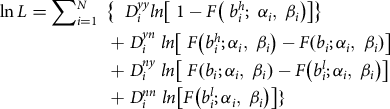
Therefore, the log-likelihood for estimation can be specified as
${\beta _i}).\;$
Therefore, the log-likelihood for estimation can be specified as
 \begin{align}\ln L = \;\sum\nolimits_{i = 1}^N \; &\left\{ {\;\;D_i^{yy}ln\left[ {\;1 - F\left( {\;b_i^h;\;{\alpha _i},\;{\beta _i}} \right)} \right]} \right\}{\rm{ }}\\
& + D_i^{yn}\;ln\left[ {\;F\left( {b_i^h;{\alpha _i},\;{\beta _i}} \right) - F\left( {{b_i};{\alpha _i},\;{\beta _i}} \right)} \right]{\rm{ }}\\
& + D_i^{ny}\;ln\left[ {\;F\left( {{b_i};{\alpha _i},\;{\beta _i}} \right) - F\left( {b_i^l;{\alpha _i},\;{\beta _i}} \right)} \right]{\rm{ }}\\
& + D_i^{nn}\;ln\left[ {F\left( {b_i^l;{\alpha _i},\;{\beta _i}} \right)} \right]\}\end{align}
\begin{align}\ln L = \;\sum\nolimits_{i = 1}^N \; &\left\{ {\;\;D_i^{yy}ln\left[ {\;1 - F\left( {\;b_i^h;\;{\alpha _i},\;{\beta _i}} \right)} \right]} \right\}{\rm{ }}\\
& + D_i^{yn}\;ln\left[ {\;F\left( {b_i^h;{\alpha _i},\;{\beta _i}} \right) - F\left( {{b_i};{\alpha _i},\;{\beta _i}} \right)} \right]{\rm{ }}\\
& + D_i^{ny}\;ln\left[ {\;F\left( {{b_i};{\alpha _i},\;{\beta _i}} \right) - F\left( {b_i^l;{\alpha _i},\;{\beta _i}} \right)} \right]{\rm{ }}\\
& + D_i^{nn}\;ln\left[ {F\left( {b_i^l;{\alpha _i},\;{\beta _i}} \right)} \right]\}\end{align}
where $D_i^{yy},\;D_i^{yn},D_i^{ny},D_i^{nn}$
are indicator variables that have a value of 1 when the respondent answers “yes, yes,” “yes, no,” “no, yes,” or “no, no,”, respectively.
$D_i^{yy},\;D_i^{yn},D_i^{ny},D_i^{nn}$
are indicator variables that have a value of 1 when the respondent answers “yes, yes,” “yes, no,” “no, yes,” or “no, no,”, respectively. ${\rm{F}}( \cdot )$
is defined as having a standard logistic distribution. Maximum likelihood is used to estimate the model.
${\rm{F}}( \cdot )$
is defined as having a standard logistic distribution. Maximum likelihood is used to estimate the model.
Willingness-to-pay estimation: Spike model
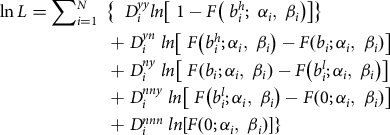
The follow-up response added to the double-bounded contingent valuation question allows us to utilize the spike model, which provides smaller standard errors of the mean willingness to pay when a high proportion of respondents are expected to express an unwillingness to pay (Yoo and Kwak Reference Yoo and Kwak2002). The spike model assumes willingness to pay is distributed as logistic on the positive axis, with a spike at zero. Considering these aspects, the log likelihood for the estimation is further expanded as
 \begin{align}\ln L = \;\sum\nolimits_{i = 1}^N \; &\left\{ {\;\;D_i^{yy}ln\left[ {\;1 - F\left( {\;b_i^h;\;{\alpha _i},\;{\beta _i}} \right)} \right]} \right\}{\rm{ }}\\
& + D_i^{yn}\;ln\left[ {\;F\left( {b_i^h;{\alpha _i},\;{\beta _i}} \right) - F\left( {{b_i};{\alpha _i},\;{\beta _i}} \right)} \right]{\rm{ }}\\
& + D_i^{ny}\;ln\left[ {\;F\left( {{b_i};{\alpha _i},\;{\beta _i}} \right) - F\left( {b_i^l;{\alpha _i},\;{\beta _i}} \right)} \right]{\rm{ }}\\
& + D_i^{nny}\;ln\left[ {\;F\left( {b_i^l;{\alpha _i},\;{\beta _i}} \right) - F\left( {0;{\alpha _i},\;{\beta _i}} \right)} \right]{\rm{ }}\\
& + D_i^{nnn}\;ln\left[ {F\left( {0;{\alpha _i},\;{\beta _i}} \right)} \right]\}\end{align}
\begin{align}\ln L = \;\sum\nolimits_{i = 1}^N \; &\left\{ {\;\;D_i^{yy}ln\left[ {\;1 - F\left( {\;b_i^h;\;{\alpha _i},\;{\beta _i}} \right)} \right]} \right\}{\rm{ }}\\
& + D_i^{yn}\;ln\left[ {\;F\left( {b_i^h;{\alpha _i},\;{\beta _i}} \right) - F\left( {{b_i};{\alpha _i},\;{\beta _i}} \right)} \right]{\rm{ }}\\
& + D_i^{ny}\;ln\left[ {\;F\left( {{b_i};{\alpha _i},\;{\beta _i}} \right) - F\left( {b_i^l;{\alpha _i},\;{\beta _i}} \right)} \right]{\rm{ }}\\
& + D_i^{nny}\;ln\left[ {\;F\left( {b_i^l;{\alpha _i},\;{\beta _i}} \right) - F\left( {0;{\alpha _i},\;{\beta _i}} \right)} \right]{\rm{ }}\\
& + D_i^{nnn}\;ln\left[ {F\left( {0;{\alpha _i},\;{\beta _i}} \right)} \right]\}\end{align}
where $D_i^{nny},D_i^{nnn}$
are responses from the follow-up questions,
$D_i^{nny},D_i^{nnn}$
are responses from the follow-up questions, $F\left( {b;\alpha ,\beta } \right) = {\left[ {1 + \exp \left( {\alpha - \beta b} \right)} \right]^{ - 1}}$
when b has positive value,
$F\left( {b;\alpha ,\beta } \right) = {\left[ {1 + \exp \left( {\alpha - \beta b} \right)} \right]^{ - 1}}$
when b has positive value, $F\left( {b;\alpha ,\beta } \right) = {\left[ {1 + \exp \left( \alpha \right)} \right]^{ - 1}}$
when b is zero, which represents the spike at zero willingness to pay, and
$F\left( {b;\alpha ,\beta } \right) = {\left[ {1 + \exp \left( \alpha \right)} \right]^{ - 1}}$
when b is zero, which represents the spike at zero willingness to pay, and $F\left( {b;\alpha ,\beta } \right) = 0$
when b has negative value.
$F\left( {b;\alpha ,\beta } \right) = 0$
when b has negative value.
Results
The distribution of responses to the contingent valuation questions is presented in Figure 1. About 36% of all respondents answered “yes, yes,” and there were a relatively small number of individuals who answered “yes, no” or “no, yes.” The result implies that once consumers answered “no” to purchase pork chops during an outbreak of ASF, the change in the price has little effect on their decisions. In addition, 46% of all respondents, who are all typically pork consumers, indicated they would not buy pork if an ASF outbreak occurred in the United States, by answering “no, no” and then “no” again to the follow-up question. This implies the potential for significant adverse demand impacts, which is also in line with a poll from the Pork Checkoff that more than half of consumers still said they would stop eating pork if ASF was found in the United States (Heslip Reference Heslip2020).
Responses to willingness to pay question by treatment group.
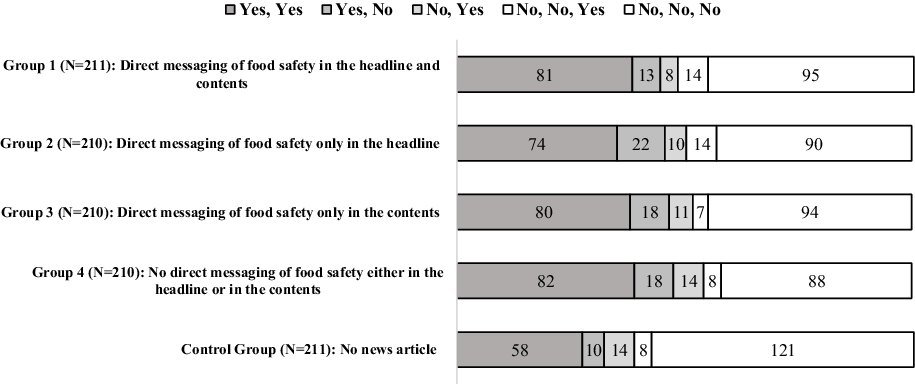
Respondents were randomly assigned to one of five groups, four of which received news articles framed differently and one group did not receive any news article. Individuals assigned to the control group were informed of the occurrence of an ASF outbreak, but their decisions were based solely on their prior knowledge. Individuals assigned news articles were commonly informed that ASF does not pose a threat to human health in the content of the article; however, there were variations in the placement of food safety message in either headlines or body of the article. A likelihood ratio test was performed first to determine whether pooling across groups is appropriate, followed by a pairwise comparison of combinations within the five groups. To assess the impacts of information treatments, we first examine whether responses from respondents in different information treatments can be pooled. We separately estimated willingness to pay using DBDC-CV and the spike models by random assignment of information treatments, and we also estimated willingness to pay from pooled data from all groups. Likelihood ratio tests examined whether it was appropriate to pool across the samples and restrict common parameters across different information treatments. Table 4 presents the results of likelihood ratio tests, which reject the null that it is appropriate to pool across the samples, for both the DBDC-CV and spike models. This indicates there is a significant difference in parameters as well as willingness to pay, depending on the group that the respondent was randomly assigned to.
Willingness to Pay of Groups with Different Information Treatments
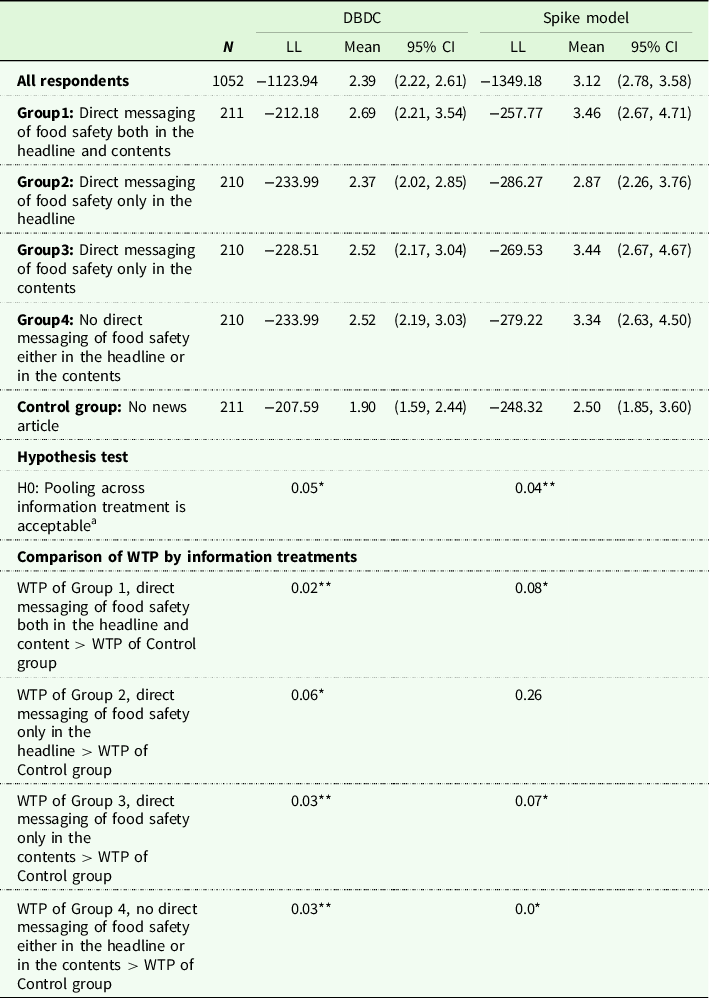
a Presented p-values report results of log-likelihood ratio tests examining if responses can be pooled from respondents receiving different information treatments.
***1%, **5%, *10% significant levels.
Willingness to pay is also estimated separately for each group and reported in Table 4, and the 95% confidence interval is calculated using bootstrapping with 1,000 draws (Krinsky and Robb Reference Krinsky and Robb1986). In order to test if the differences in the mean willingness to pay estimates are significantly different from zero, we used the complete combinatorial approach suggested by Poe, Severance-Lossin and Welsh (1994; Poe, Giraud and Loomis Reference Poe, Giraud and Loomis2005) that measures the difference of two willingness to pay distributions. We examined the difference between all pairs within the five groups, and Table 4 only presents results of the distributions that show a statistically significant difference. Respondents who received one of the four headline and news article combinations had a higher willingness to pay than the control group who were not provided with any news article that included messaging that ASF is not a threat to human health. This suggests that exposure to detailed information, as opposed to simply learning about an ASF outbreak, could help mitigate adverse demand impacts. However, we do not find any statistical difference in willingness to pay within the groups with information treatments. That is, provided that information regarding the human health impact is included in the body of the article, the omission of food safety information either in the headlines or contents does not result in a statistically significant difference from direct messaging of food safety information.
The impacts of respondents’ prior knowledge about ASF
Previous studies have indicated that consumers’ prior knowledge can influence how they respond to new information (Jin and Han Reference Jin and Han2014; Kuttschreuter et al. Reference Kuttschreuter, Rutsaert, Hilverda, Regan, Barnett and Verbeke2014). To take into account consumer heterogeneity based on prior knowledge, we further estimated models separately for respondents who were aware and unaware of the global outbreak of ASF before they completed our survey. Recall, a respondent’s probability of belonging to one of the two identified latent classes regarding prior knowledge of ASF is dependent on their response to the awareness of the global ASF outbreak question (Appendix 1). The willingness to pay estimation for groups with different information treatments based on prior knowledge is presented in Table 5, along with the results of likelihood ratio tests. A likelihood ratio test rejects the null that pooling of respondents with different levels of prior knowledge is acceptable, and adding to that, the results in Table 5 reveal that the respondents who were unaware of the global ASF outbreak were the ones impacted by the information treatments. In contrast, respondents who were aware of the global ASF outbreak did not show different responses, so it is acceptable to pool data across the groups receiving different information treatments. This result is in line with the finding of Jin and Han (Reference Jin and Han2014), who show that information framing had less influence on individuals with greater subjective knowledge. The difference between the willingness to pay of respondents who were aware and unaware of the global outbreak of ASF was about $0.77 per pound from DBDC-CV model and about $1.02 per pound from the spike model.
Willingness to Pay of Groups with Different Information Treatments by Prior Knowledge
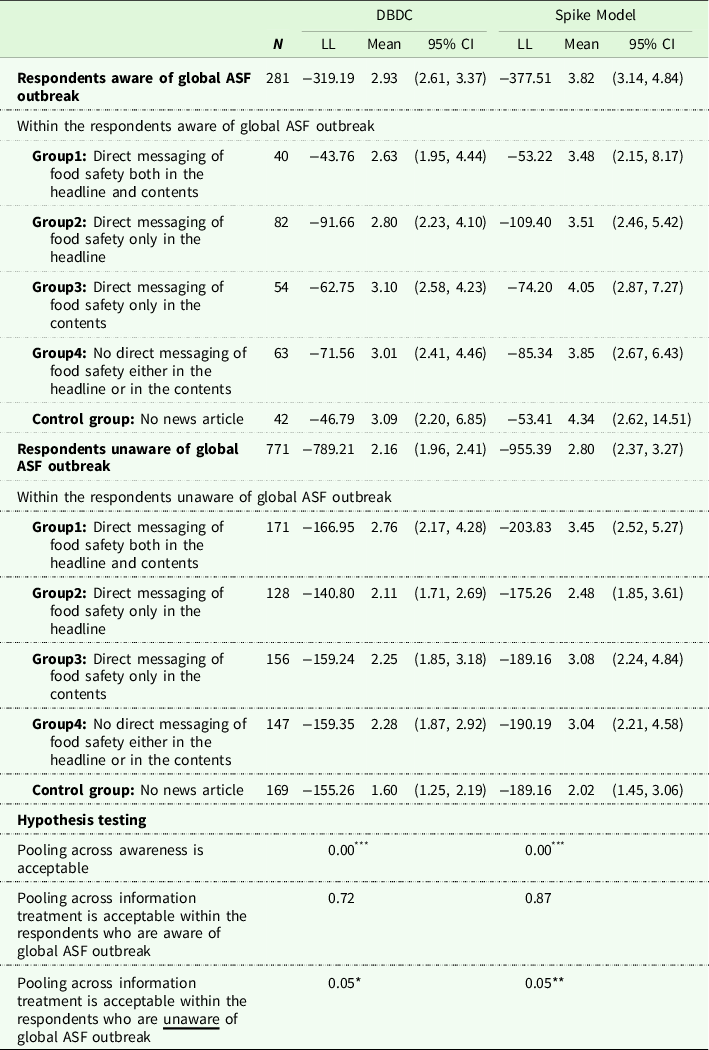
***1%, **5%, *10% significant levels.
Using a complete combinatorial test, Table 6 presents the results from a pairwise comparison of willingness to pay distribution across different information treatments and different levels of prior knowledge. Again, only the significant results are reported. As expected, there is a significant difference between the control group and each information treatment among the respondents unaware of the global ASF outbreak. Meanwhile, when we compared the effect on willingness to pay within information treatments, we found weak evidence that the group who was only provided food safety assurance information in the headline had significantly smaller willingness to pay than the group with food safety information both in the headlines and contents. The difference between the two treatments is in the news article contents that states “it is not a food safety issue.” A possible interpretation of this result is that respondents with less prior knowledge of ASF react critically to the tone of the direct messaging of food safety, which attempts to convince them that a certain risk is tolerable (McCluskey and Swinnen Reference McCluskey and Swinnen2011) by stating “still safe to eat pork,” especially when the message in the headline is not supported by the following contents in the body of the news article.
Comparison of Willingness to Pay by Information Treatment and Prior Knowledge
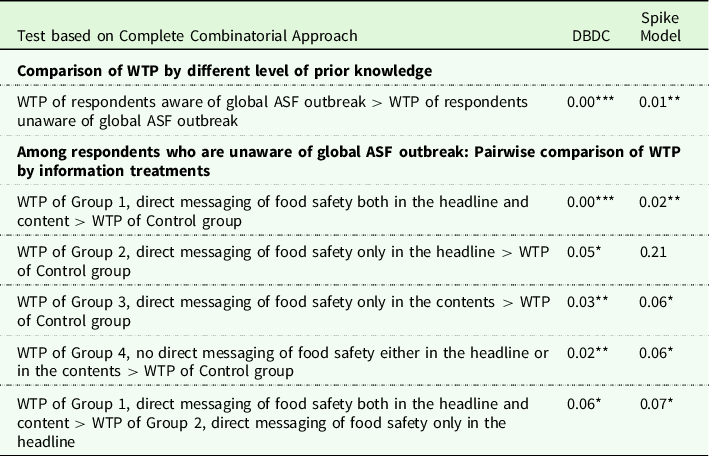
***1%, **5%, *10% significant levels. In pairwise comparison, the test results for insignificant pairs are not reported.
Willingness to pay estimation with sociodemographic characteristics
To further understand the impacts of individual heterogeneity on willingness to pay, we estimated the log-likelihood function by adding variables that represent information treatments, awareness of the global ASF outbreak, sociodemographics, and the frequency of pork consumption. Model 1 in Table 7 shows that the effect of information treatments compared to the control group and awareness of the global ASF outbreak remains statistically significant, but we could not detect statistically significant differences depending on the framing of the information treatments. Price coefficients show a statistically significant negative value, indicating that consumers are less likely to purchase pork as the price increases. The results are robust to what has been found in the previous sections.
Willingness to Pay Estimation with Sociodemographic Characteristics
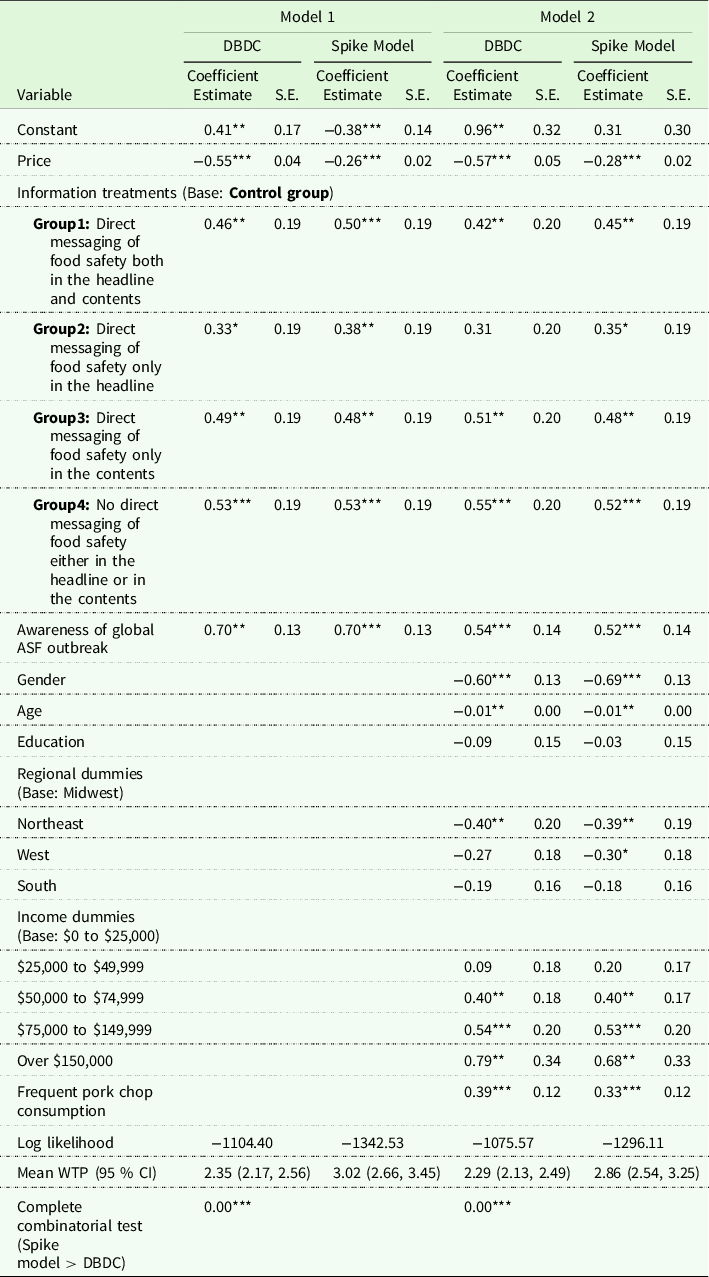
***1%, **5%, *10% significant levels.
The variables related to sociodemographics and pork consumption frequency are added in Model 2. After including these variables, the coefficient on the effect of placing the food safety message only in the headline is no longer statistically significant in the DBDC-CV model, while remains weakly statistically significant in the spike model. The results indicate that caution may be required when placing food safety messages only in the headline, as this may result in the least effective type of information framing if no supporting argument is provided in the body of the article.
With respect to demographics, females and younger individuals would be less likely to purchase pork during an ASF outbreak. This is supported by previous research that women are more concerned with food safety, or perceived food safety (McCluskey and Loureiro Reference McCluskey and Loureiro2003; Hammitt and Haninger Reference Hammitt and Haninger2007; Yu, Neal and Sirsat Reference Yu, Neal and Sirsat2018). In addition, this follows the finding of Yu, Neal and Sirsat (Reference Yu, Neal and Sirsat2018) regarding age, which shows that younger respondents are more willing to pay for a reduction in foodborne illness in fresh cut produce. Furthermore, consumers with higher annual household income or who purchase pork chops more than once a week would be more likely to purchase pork during an ASF outbreak. Education level did not have a statistically significant impact on willingness to purchase. We observed varying purchase intentions based on the region of residence. For example, consumers living in the northeast region would be less likely to purchase pork during an ASF outbreak compared to Midwestern consumers.
Meanwhile, the comparison of willingness to pay estimates using the complete combinatorial test shows that willingness to pay estimates from the DBDC-CV model which contain negative willingness to pay in the range is significantly lower than the spike model. This potentially supports Bass, McFadden and Messer (Reference Bass, McFadden and Messer2021)’s point that focusing only on the positive willingness to pay of market goods can be an oversimplification that fails to reveal consumers’ true sentiments, in this case regarding food safety concern. However, as we did not ask respondents to express a negative willingness to pay, further interpretation is beyond the scope of this study.
Conclusion
ASF has never occurred in the United States. The virus is lethal to the pig population, but there is no evidence it poses a threat to public health or food safety (USDA-APHIS 2021a). ASF virus has been detected in the western hemisphere for the first time in forty years, and due to its highly contagious nature, high mortality rate, and economic consequences of an outbreak, the swine industry has strengthened its defenses against its entry into the United States. Even so, the probability of an ASF outbreak in the United States is nonzero (Jurado et al. Reference Jurado, Mur, Pérez Aguirreburualde, Cadenas-Fernández, Martínez-López, Sánchez-Vizcaíno and Perez2019; USDA-APHIS-CEAH 2019). In the event of an ASF outbreak in the United States, it will most certainly garner widespread media attention due to the potentially devastating impact on the pork industry and related businesses. If a drop in domestic demand due to concerns about the perceived safety of pork cannot be mitigated, this will exacerbate an already desperate situation caused by disease control, loss of export, and price reductions (Carriquiry et al. Reference Carriquiry, Elobeid, Swenson and Hayes2020). Therefore, understanding potential consumer reactions is critical for any response and recovery plan.
Using an online survey of 1,052 U.S. pork consumers, we first investigated how aware consumers are of ASF. We confirmed that consumers were generally unaware of ASF in comparison with the pork production community’s enhanced attention and prevention efforts. From the survey, only about 27% were aware of the global ASF outbreak. Moreover, when we examined possible consumer responses to an ASF outbreak in the United States using a contingent valuation experiment, nearly 46% of respondents, who typically consume pork on a regular basis, stated that they would avoid purchasing pork. This particular finding indicates that there is still information asymmetry in the marketplace that should be reduced in preparation of a possible ASF outbreak.
Given that public information about food safety is typically negatively framed, consumers are likely to be fearful upon the first occurrence of the animal disease outbreak. We randomly assigned respondents to differently framed headlines and contents of news articles, whereas the control group received only information about the ASF outbreak but no news article. The respondents who received news articles were informed that ASF poses no threat to human health in the contents of the article. The difference in framing between news articles is whether the placement of the food safety message is in either the headline or body of the article. This particular assessment was conducted to determine whether consumers may still avoid consumption when certain details such as food safety assurance information are provided. Then we estimated the willingness to pay of pork chops using both the double-bounded discrete choice contingent valuation model and the spike model.
Results indicate that the groups mostly impacted in terms of pork purchase reduction are those with less prior knowledge of ASF, especially if they were never informed that ASF does not pose a threat to human health. However, given that no human health impact information is delivered in the content, omission of food safety assurance in the headline does not show a significantly different impact on willingness to pay in this study. The null finding on the effect of information framing used in the news articles suggests that slightly misleading headlines with omission of food safety information would not be a major concern as long as consumers are informed that ASF does not pose a threat to human health. This finding is in line with Marsh, Schroeder and Mintert (Reference Marsh, Schroeder and Mintert2004), who find that the U.S. Department of Agriculture Food Safety and Inspection Service issuing a meat recall significantly affects demand, while media reports do not.
Nonetheless, headlines have become more aggressive, exaggerated, and misleading with the increasing competition of the online world (Rieis et al. Reference Rieis, de Souza, de Melo, Prates, Kwak and An2015), and media companies who care about profits would offer more negative stories to attract readers’ attention to consume the news article (McCluskey and Swinnen Reference McCluskey and Swinnen2011). Moreover, Swinnen, McCluskey and Francken (Reference Swinnen, McCluskey and Francken2005) claim that mostly information is not provided by institutions whose objective is to foster public good, but by institutions whose objective is to maximize profits. They note that the institutional organization of information supply and incentive schemes in the information market have received little attention in studies.
The Food and Agriculture Organization of the United Nations notes that communication with the public needs to be in place to avoid rumors leading to food safety perceptions and consumption disruption (FAO-EMPRES-AH 2021a). In order to help persuade the voluntary supply of public information, an assurance contract, suggested by Tabarrok (Reference Tabarrok1998), could be utilized to achieve cooperation among private institutions. For example, Railey et al. (Reference Railey, Lankester, Lembo, Reeve, Shirima and Marsh2019) imposed an assurance contract to address a public good problem involving infectious livestock disease management. Suppose, for the purposes of this study, that the provision of public information could be attained if sufficient contributions are made by private institutions, but private institutions may be incentivized to deviate by providing slightly misleading information. An assurance contract could be implemented by assuring the private institutions that others will contribute to the provision, or by guaranteeing that they will receive some benefit if others do not contribute. As part of an ASF crisis plan, the government could develop the relationships needed with media institutions and professionals to provide a consistent message explaining the disease and reassuring consumers that the pork supply is safe to eat. For example, “No threat to human health” is a critical piece of information to deliver to those not aware of the global ASF outbreak and should be prioritized.
The goal of communications in the ASF response plan includes reducing potential panic and fear, as well as addressing rumors, inaccuracies, and misperceptions as quickly as possible (USDA-APHIS-VS 2020). While the current effort on public communication concentrates on the actions taken after an ASF is detected, our results emphasize the importance of getting ahead of an outbreak and increasing consumer familiarity with the disease in advance. In this context, media cooperation will be required in proactively informing the public about ASF outbreaks and highlighting the nonimpact of ASF on human health and food safety. By examining the effectiveness of different information used in news reporting, we hope to contribute to the design of a more effective public communication strategy and to reduce ambiguity in the event of an ASF outbreak.
Supplementary material
To view supplementary material for this article, please visit https://doi.org/10.1017/age.2022.23
Data availability statement
Data are not shared due to privacy restrictions.
Funding statement
This material is based upon research that was supported by the USDA National Institute of Food and Agriculture, under award number 2015-69004-23273. The contents are solely the responsibility of the authors and do not necessarily represent the official views of the USDA or NIFA.
Competing of interest
None.

 [Press Release, Media Should Refrain from Sensational Reporting of African Swine Fever].
  ’ [First African Swine Fever Case Confirmed: 100% Mortality Rate, No Vaccine Available]


 Open access

