

1. Introduction
From its very first case – The M/V ‘Saiga’ Case (1997) – to the recent Request for an Advisory Opinion submitted by the Commission of Small Island States on Climate Change and International Law (2023), a total of 846 official delegates comprising agents, counsel and advocates (referred to below as ‘counsel’), representatives, advisers, experts, observers, and support personnel have been involved in cases before the International Tribunal for the Law of the Sea (ITLOS or the Tribunal), with 330 of them delivering an oral statement. Following an empirical approach, the objective of the present study consists of identifying those appearing in cases before ITLOS (including in advisory proceedings) between 1997 and 2023, with a particular focus on oral proceedings.
To accomplish this, the dataset includes background information on the identity of the representatives. Several characteristics were coded, including the professional background, gender, nationality, and development status of the country of nationality. Overall, the aim is to ascertain who has appeared before ITLOS and what characteristics they have shared. More specifically, the study examines (i) common assumptions, such as whether the oral proceedings are male-dominated, and (ii) whether ITLOS, as a specialized tribunal, has any specificity in terms of representation.
This article begins by defining the scope of the investigation, including its methodological aspects and the quantitative data related to ITLOS cases, as well as the identities of the parties/participants. It then provides a tour d’horizon of the oral proceedings and representations of the parties/participants. The third part empirically presents the representation before ITLOS. Against this background, the last part analyses the data and offers several observations.
2. Delimiting the field of investigation
2.1 Methodology
2.1.1 Objective and hypotheses
Using an empirical approach,Footnote 1 this article seeks to ask who the party representatives are before ITLOS, and what are their common characteristics? Overall, the study does not purport to present a comprehensive statistical analysis. Instead, it aims to discern both the general patterns and the prevalent attributes exhibited by the speakers. The metadata was collected in order to explore their identity, and to test hypotheses about diversity within the international legal profession. In this respect, the study specifically makes visible those involved in the so-called ‘invisible bar’ (or ‘international bar’). Empirical research on representation before the Tribunal is still very much unchartered waters.Footnote 2 This article addresses the gap in the literature by offering a glimpse into the party representatives before ITLOS. In doing so, it considers issues such as the lack of diversity within the profession, the specialization of the international legal practice, and potential changes in the composition of the international bar, thereby contributing to a better understanding of the profession.
More specifically, empirical data are used here to test two hypotheses. First, the study will probe the common assumption that oral proceedings before the Tribunal are predominantly conducted by men from Europe and North America. In this sense, it has been stated that ‘the universe of lawyers who get to argue on behalf of states before … ITLOS … is relatively small, and almost all are older white men from Europe and North America’.Footnote 3 This observation about the gender disparity and the prevalence of representatives from developed economies seems axiomatic but has yet to be empirically tested. Secondly, further specific hypotheses will investigate whether ITLOS, as a specialized tribunal,Footnote 4 has any particularities in terms of representation. In particular, the present study aims to test the assumption of the existence of a specialized international bar, dubbed the ‘ITLOS bar’ (as defined below). In this sense, it has been noted that ‘almost every international court or tribunal is surrounded by a specialized bar of counsel, whose members master the particular subject matter and the judicial style of the institution at hand’.Footnote 5 Furthermore, it appears that one of the main drivers behind choosing ITLOS is related to its character as a specialized law of the sea adjudicator.Footnote 6 It is therefore interesting to test whether this expertise also exists on the other side of the bench. Finally, in testing the two hypotheses identified above, the study will also look closely at whether representation before the Tribunal varies according to the type of proceedings (urgent proceedings, contentious cases, and advisory proceedings).Footnote 7
2.1.2 Definitions, limitations, and data
The present study aims at mapping representation before ITLOS. Representation can be defined as ‘a legal phenomenon whereby statements made by or to one person, the representative, produce legal effects with respect to another person, the principal, such that the acts performed by the former in a representative capacity bind not the representative, but the principal’.Footnote 8 To be more specific, representation in proceedings before the Tribunal means here that an agent acts in such proceedings on behalf of a state party to the United Nations Convention on the Law of the Sea (UNCLOS or the Convention), with the legal effect ‘that commitments made by [the agent] before [the Tribunal] bind the State’.Footnote 9 An agent may be assisted before the Tribunal by counsel. For the purposes of this study, representation also includes the official representative of a state or international organization in advisory proceedings.
The dataset consists of background information on the identity of the party representatives.Footnote 10 The aggregated data are mainly extracted from the publicly available transcripts of the verbatim records, and/or from the first part of the judgments which formally list all the representatives of the parties. A number of characteristics were coded for the purposes of the study: (i) the gender of all representatives was coded using the titles (Ms, Mr, Sir) that typically precede a person’s name in the verbatim records;Footnote 11 (ii) information was collected on the professional occupation at the time of representation, as stated in the verbatim records. Although the profession is not always clearly classifiable,Footnote 12 the coding developed in this respect was grouped into five categories: (qualified) lawyer,Footnote 13 academic, government lawyer and official (including ambassador), representative of an international organization, miscellaneous (including legal consultant, non-legal expert, unspecified profession); (iii) the nationality of the party representatives appearing before the Tribunal was coded. The country of nationality was also used to code the development status of the country in question, using the list provided by the UN in World Economic Situation and Prospects (2023), which disaggregates all countries of the world into three broad categories: ‘developed economies’, ‘economies in transition’, and ‘developing economies’.Footnote 14 The lack of information regarding nationality in the verbatim transcripts leads to difficulties in tracing. This data in particular may suffer somewhat from such limitation, and it should, therefore, be taken with a grain of salt. That being said, the nationality of the members of delegations can be discerned in some instances through an examination of the verbatim transcript; the nationality of the members of the delegation is sometimes disclosed during the agent’s introduction of the delegation, or by the counsel in their oral statement. In addition, other publicly available information has been examined to obtain further data on their nationality;Footnote 15 (iv) the position within the delegation was coded: agent, counsel, adviser, or representative in advisory proceedings; (v) the language used during oral proceedings was also coded on the basis of the verbatim records, which indicate the language used as original language or interpretation; (vi) data was collected on the speaking time of the members of the delegations appearing before the Tribunal.Footnote 16 This was calculated on the basis of the number of pages in the English version of the transcripts of the pleadings. It was therefore only possible to give a very broad picture of the speaking time of the members of the delegation; and (vii) the number of times an individual appeared before the Tribunal was also coded.
The analysis is confined to representation before ITLOS. Part XV of the Convention provides a comprehensive framework for resolving disputes related to the interpretation or application of the Convention. This includes a set of compulsory and binding procedures outlined in Section 2 of Part XV. States parties have the option to select from among four fora for the settlement of their disputes: ITLOS, the International Court of Justice (ICJ or the Court), Annex VII arbitration, and Annex VIII special arbitration. Arbitration, regulated in Annex VII to the Convention, serves as the default option. References to the ICJ and arbitral tribunals under Annex VII are occasionally made below for comparison purposes.
The study focuses in particular on oral proceedings.Footnote 17 The period under examination corresponds to the first and last oral hearings before the Tribunal, namely, November 1997 to September 2023. The study examines representation in all contentious (including provisional measures and prompt release cases) and advisory proceedings involving oral hearings. The compiled data on representation before ITLOS includes information on 23 contentious cases and three advisory opinions, involving 67 parties/participants and 846 team members, 330 of whom argued during the course of 186 public sittings.
Finally, as mentioned above, the study includes data on the ‘international bar’. This is not a formal concept, which makes it difficult to pinpoint its contours. It is used here simply to refer to those who repeatedly act as agents,Footnote 18 counsel and/or representatives in cases before international courts and tribunals. In the context of the Court, it has been described as encompassing:
those international lawyers who have practiced and continue to practice as oral advocates before the Court, who represent a variety of foreign states other than their own governments, who are well-known to the Judges and Registrar of the Court, who know how things work out in practice, and who understand by experience the difficulties, pitfalls and tricks of the trade.Footnote 19
In this sense, for the purposes of this article, the term ‘ITLOS bar’ refers to a restricted group of party representatives who are familiar with the Tribunal, to a specialized ‘bar’ of representatives whose members have appeared in three or more cases before the Tribunal.Footnote 20
2.2 Quantitative data
Before embarking on an empirical study of representation before ITLOS, it is necessary to first present some raw data on the cases brought before ITLOS, and on the identity of the parties/participants appearing before it.
The list of cases of the Tribunal currently stands at 32 cases, with two of those pending at the time of writing. Most of the cases were urgent proceedings, namely requests for provisional measures or for prompt release of vessels and crews. To date, eight cases have been submitted to the Tribunal on the basis of Article 290(5) of UNCLOS.Footnote 21 Under this provision, the Tribunal has compulsory jurisdiction to prescribe provisional measures in respect of a dispute that is being submitted to an arbitral tribunal under Annex VII to the Convention. In such a situation, the said provision provides that ITLOS may prescribe provisional measures at the request of one of the parties to the dispute, provided that certain conditions are satisfied.
The Tribunal received ten applications for prompt release under Article 292 of the Convention.Footnote 22 With the exception of The M/T ‘Heroic Idun’ Case, they were all based on Article 73(2) of UNCLOS, which expressly obliges the detaining state to release a vessel arrested for alleged fishery offences upon the posting of a reasonable bond. Article 292 of the Convention provides that an application for the prompt release of a vessel and its crew may be submitted to the Tribunal in cases where the vessel of a state party and its crew have been arrested or are being detained by another state party. It is relevant to note here that the said provision also provides that the application for the prompt release of a vessel and its crew may be made by the flag state or by another person acting on its behalf.
Seven cases were decided by the Tribunal, including three requests for the prescription of provisional measures,Footnote 23 and two preliminary objections. Lastly, three requests for advisory opinions were submitted: two to the Tribunal,Footnote 24 and one to the Seabed Disputes Chamber.Footnote 25
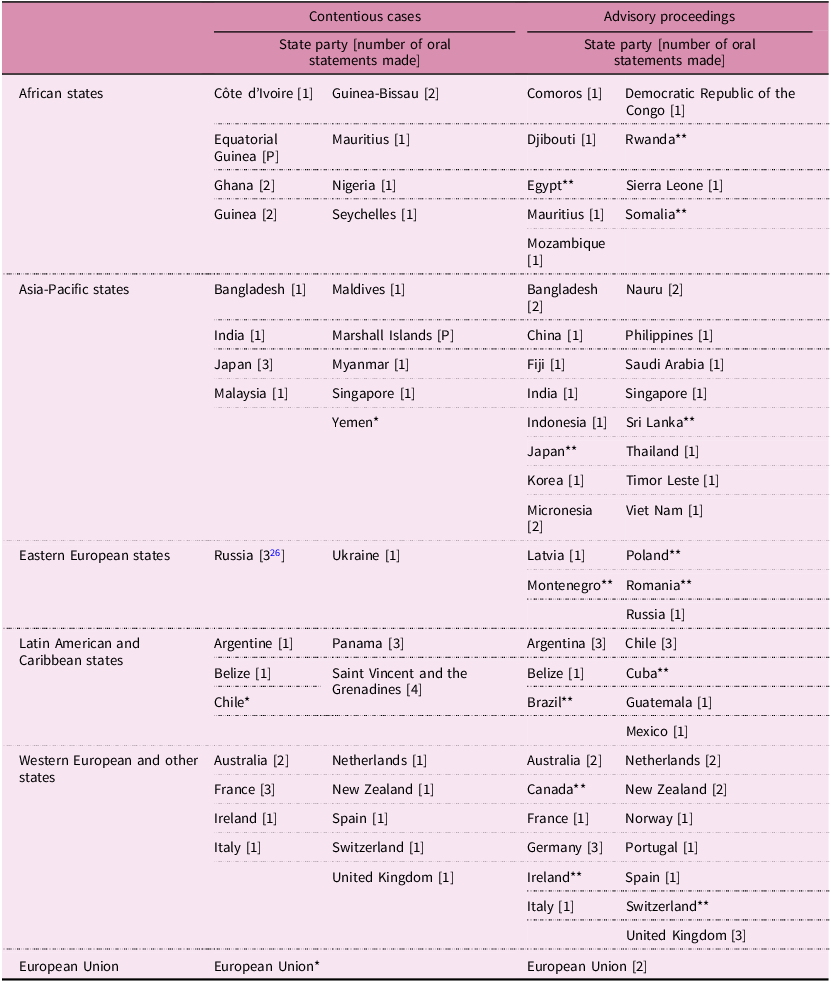
Of the 169 states parties to UNCLOS, 34 have been parties before ITLOS; the number rises to 66 if participants in advisory proceedings are taken into account (Table 1). Among them, certain states were repeat litigants before the Tribunal. For example, Saint Vincent and the Grenadines has appeared four times. The Tribunal has heard cases involving states from all over the world.More specifically, the regional distribution of the oral statements made in contentious cases on the basis of UN regional groupings is distributed as follows: seven African states on ten occasions; seven Asia-Pacific states on nine occasions; two Eastern European states on four occasions; four Latin American and Caribbean states on nine occasions; and nine Western European and other states on 12 occasions. If participation in advisory proceedings is included, the distribution is as follows: 12 African states on 16 occasions; 18 Asia-Pacific states on 26 occasions; three Eastern European states on six occasions; seven Latin American and Caribbean states on 18 occasions; 12 Western European and other states on 29 occasions; and the European Union on two occasions. When categorized by development status, developing economies were the most frequent (57 times), followed by 14 developed economies, including the European Union (35 times), and two economies in transition (five times).
States that have been parties/participants in cases, including advisory opinions, grouped according to UN regional groupings (1997–2023)
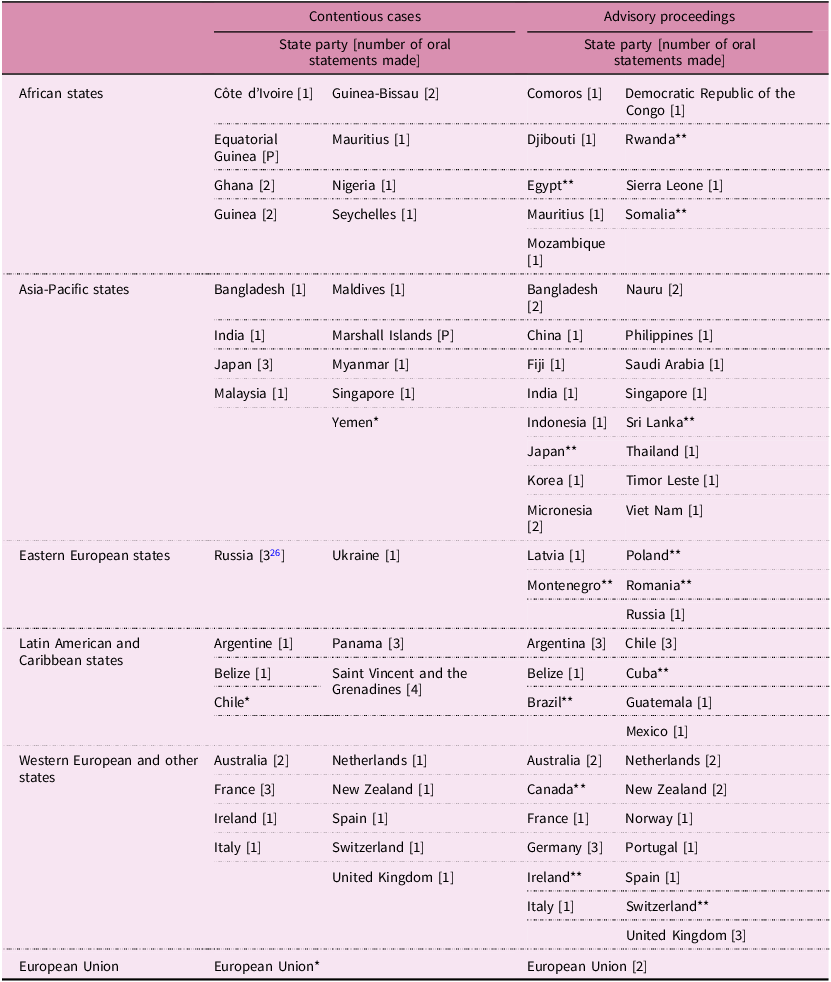
*Only in cases terminated by discontinuance.
**Only in written proceedings.
[P] The M/T ‘Heroic Idun’ (No. 2) Case is currently pending.
3. Oral proceedings and representation of the parties/participants
Proceedings are divided into written and oral stages. The written phase is followed by the oral proceedings. Oral statements are made at the hearing in one of the official languages of the Tribunal, namely English and French, with interpretation into the other official language.Footnote 27 Hearings are, in principle, public.Footnote 28 In accordance with Article 44(3) of the Rules, the oral proceedings consist of the hearing by the Tribunal of agents, counsel, witnesses, and experts. As will become evident, this list is not exhaustive.
Article 53 of the Rules deals with the representation of the parties in proceedings before the Tribunal. It reads as follows:
-
1. The parties shall be represented by agents.
-
2. The parties may have the assistance of counsel or advocates before the Tribunal.Footnote 29
The agent is the official representative appointed by a party to a contentious case before the Tribunal. They are ‘the intermediary between the State and the tribunal’, with the power to bind a sovereign state.Footnote 30 Pursuant to Article 56(1) of the Rules, ‘[a]ll steps on behalf of the parties after proceedings have been instituted shall be taken by agents.’Footnote 31 In advisory proceedings, the official representative of a state or international organization is designated as a ‘representative’, even though some individuals are also designated as such in contentious cases.Footnote 32
As regards the choice of an agent each party is given a wide margin of discretion. Indeed, the Statute and the Rules say relatively little on this point, except that ‘[n]o member of the Tribunal may act as agent, counsel or advocate in any case.’Footnote 33 In addition, the Tribunal noted in M/V ‘Norstar’ (Panama v. Italy), Preliminary Objections:
under international law, it is for each State to determine the persons, including private persons, who represent the State or are authorized to act on its behalf in its relations with other States, international organizations and international institutions, including international courts and tribunals.Footnote 34
The agent is normally a high-ranking official and sometimes, particularly in the context of prompt release proceedings, a private lawyer or a professor of international law. In addition, the practice shows that parties have frequently taken to naming ‘co-agent’ or ‘deputy agent’. Parties in the same interest may appoint separate agents or a common agent.Footnote 35
In addition, counsel may assist the parties before the Tribunal. The term ‘counsel’ has been broadly defined as any person
representing, appearing on behalf of, or providing legal advice to a party in proceedings before an international court or tribunal, however such person may be described, and whether or not the person has professional legal training or is admitted as a member of a bar association or other professional body.Footnote 36
As the agent, the choice of counsel is ultimately a matter left to discretion of the party. In practice, counsel is usually chosen from among lawyers and professors of international law. The parties sometimes specify whether the counsel is ‘lead’, ‘junior’, or ‘external’.Footnote 37 Practice further shows that an agent may also act as counsel. It is important to note that it is not necessary to belong to the bar of any state for counsel to enjoy the right to appear before the Tribunal: there are no requirements as to professional standards, formal qualifications required, or other grounds (such as nationality) that have to be fulfilled. To date, there have been no challenges to counsel appearing before the Tribunal.Footnote 38
Other members of a team may include (technical/international law/special/legal/senior) ‘advisers’, which seems to be a catch-all category where many different kinds of people who provide advice are categorized, from experts in international law (such as consultants, lawyers, academic or civil servants), to specialists in various fields as required (such as geologists, petroleum engineers, cartographers, hydrographers, members of the armed forces), to the shipowner and his ‘son’.Footnote 39 With regard to the Court, it has been said that there is a distinction in kind between ‘counsel and advocates’ and ‘advisers’, noting that ‘a person who would otherwise be an “adviser” (“conseiller”), if called upon to address the Court, would do so as “counsel” (“conseil”)’.Footnote 40 As it will be seen, in the practice of the Tribunal, a small proportion of persons designated as advisers have appeared before it.
It is also worth mentioning experts who are defined as ‘a person called at the instance of a party to a dispute or at the instance of the Tribunal to present testimony in the form of expert opinions, based on special knowledge, skills, experience or training’.Footnote 41 Experts are not listed as members of a party’s delegation, and ‘remain out of court’.Footnote 42 Despite this distinction between expert evidence and advocacy in international practice,Footnote 43 (non-legal) experts have occasionally appeared as counsel or representative.Footnote 44
The picture needs to be completed by reference to members of a party’s delegation that do not deliver oral statements, such as (i) (legal) ‘assistants’ and ‘junior counsel’, which may refer to persons who fulfil the role of assisting alongside counsel and may carry out various legal and/or administrative tasks; and (ii) ‘observers’.
4. Empirical aspects of the representation of the parties/participants
During the period under review, there were 23 contentious cases (including urgent proceedings) and three advisory opinions before ITLOS in which oral proceedings were held. A total of 846 official delegates were listed as agents, counsel, representatives, advisers, experts, observers, or support staff, some of whom were involved more than once. After eliminating duplicates, 724 individuals acted in one or more of the above capacities.
Of those 846 people listed as part of the delegations, 330 have made oral statements. In contentious cases (in particular in maritime delimitation cases), the largest team presenting oral arguments consisted of ten individuals,Footnote 45 and in advisory proceedings the largest team consisted of 20 individuals.Footnote 46 The smallest team consisted of only one person.Footnote 47 Turning to nationality, out of the 330 identified speakers, 205 were from developed economies, accounting for 75% of the total speaking time. Eight speakers were from economies in transition, and 117 were from developing economies. In terms of gender, out of the 846 party representatives, only 266 were female, representing 31.4%. Of the 330 individuals who made oral presentations, 24% were women and 76% were men. The judges at ITLOS heard approximately 83% of all oral statements (including advisory proceedings) from men. In terms of language, 268 oral pleadings were presented in English, 56 in French, and four agents delivered oral pleadings in both languages. Two agents spoke in Russian. Roughly 76% of the arguments heard by the ITLOS judges were presented in English.
Thirteen repeat speakers (excluding government lawyers and officials) acting in various capacities, including in advisory proceedings, can be identified: Philippe Sands (who appeared seven times), Sir Michael Wood (six times),Footnote 48 Vaughan Lowe (five times), Payam Akhavan (four times), James Crawford (four times), Ramón Garcia Gallardo (four times), Jean-Marc Thouvenin (four times), Hartmut von Brevern (three times), Andrew Loewenstein (three times), Cymie Payne (three times), Alain Pellet (three times), Jean-Pierre Quéneudec (three times), and Paul S Reichler (three times). These repeat speakers account for slightly less than 29% of the total speaking time, with the first three together (Sands, Wood, and Lowe) accounting for approximately 10%. It is notable that almost all recurring speakers are male, primarily English-speakers, and that all of them hail from Europe, North America, and Australia. The only woman to appear three times is Cymie Payne, as a representative of an international organization in advisory proceedings. Five women discernibly appear twice: Catherine Amirfar, Phoebe Okowa, Nilüfer Oral, Amy Sander, and Anjolie Singh. Three of them made an oral statement only in the context of advisory proceedings. The speaking time of these repeat women speakers accounted for 2.4% of the total speaking time.
4.1 Agent
It is common practice (67.7%) for a state to designate a diplomatic representative in Berlin (or Hamburg) or another European capital, or a government lawyer and official (from the ministry of foreign affairs, the attorney general’s office, or some other relevant ministry such as justice or fisheries) as an agent. A much smaller group of non-national individuals have been employed by a state to act as an agent. Out of the 62 identified (co-)agents, a non-national lawyer has been appointed as an agent on 18 occasions. In practice, only developing economies (Belize,Footnote 49 Guinea,Footnote 50 Guinea-Bissau,Footnote 51 Panama,Footnote 52 Saint-Vincent and the Grenadines,Footnote 53 and SeychellesFootnote 54 ) retain foreign lawyers as (co-)agents, mostly in prompt release proceedings. One Spanish lawyer acted as agent on three occasions.Footnote 55 In about 3% of the cases, a professor of international law was appointed as the agent. In practice, certain combinations of professionFootnote 56 or nationalityFootnote 57 are sometimes made when a party appoints a co-agent.
With regard to gender, a wide gap is noticeable, with males accounting for 82.2% of the representation. When appointed, female agents predominantly served as government lawyers and officials of the state in question.
As far as language is concerned, the majority of agents speak in English (75.9%), followed by French (16.1%), both languages (4.8%), and Russian (3.2%). During oral hearings, the agent generally introduces the delegation, opens the argument, and occasionally delivers a substantial portion of the oral argument. Translated into numbers, the speaking time of the agents varies in practice, ranging from 0.8% up to 45% of the total speaking time in a given case. Sometimes the ‘figurehead’ agent confines themselves to providing a very brief introduction of the delegation and of the case. In other instances, especially when the appointed agent is a law professor or private lawyer, the ‘working’ agent provides a substantial part of the factual background and/or the legal argument, typically ranging from 20 to 45% of the speaking time. In The ‘Monte Confurco’, the entire argumentation on behalf of the Seychelles was delivered by the two appointed agents.Footnote 58
4.2 Counsel
Out of the 250 individuals listed as counsel, 144 counsel appeared in oral proceedings, including 15 agents who also acted as counsel. The professional background of the counsel is about evenly split between academics and practitioners. Specifically, 43% were academics, of which 11% were qualified lawyers,Footnote 59 and 38.8% were lawyers (increasingly including members of law firms). Roughly 20% of the lawyers were from law firms based in the United Kingdom and the United States. Of the total, 15.9% were government lawyers and officials, who spoke for an average of 7.8% of the available time. The remaining 2.3% were classified as miscellaneous and mainly comprised legal consultants.
Of the 144 counsel who appeared before the Tribunal, 40% were nationals of the parties they represented. Eleven counsel teams were entirely composed of nationals.Footnote 60 Non-nationals accounted for 60%. A few counsel teams were exclusively made up of non-nationals.Footnote 61 It is worth noting that non-nationals tend to be nationals of developed economies, accounting for just over 50%. When recruiting non-national lawyers, 88% of them are from only four countries: the United Kingdom (40.7%), the United States (19.7%), France (17.1%), and Germany (10.5%). Together, these countries have provided 49 counsel who have argued 71 times before the Tribunal.
With respect to party composition, 60% consists of non-nationals, who account for around 27% of the speaking time. When categorized by economic development, it can be observed that merely 19% of the team members from developed economies were non-nationals,Footnote 62 with a maximum of 50% of non-national counsel.Footnote 63 On average, non-nationals spoke for approximately 10.5% of the total speaking time. However, when considering only developed economies with non-national counsel, 51% of the team was composed of non-nationals, who spoke 28% of the total speaking time. Developing economies tended to have a higher proportion of non-national counsel, with an average of 80% of non-nationals. In a particular case, non-nationals spoke for 40% of the speaking time on average.
Turning to gender, counsel are overwhelmingly male: 87% of appearances were by male counsel. The differences are even more pronounced when the contributions are measured in terms of speaking time: women accounted for only 13% of the appearances and 7.7% of the total speaking time. Within each case, the average speaking time of women is 8.1%.Footnote 64 Regarding language, the oral proceedings were predominantly conducted in English, with 79.8% in English and 20.2% in French.
Out of the 144 identified counsel, only five have pleaded in three or more cases, representing a variety of states other than their own governments: Philippe Sands (on six occasions), Sir Michael Wood (four), Vaughan Lowe (four), Paul S Reichler (three), and Alain Pellet (three). Of these, three are British, and the other two are American and French, respectively. These five individuals used a total of 15.1% of the total speaking time. Among the five counsel with the most appearances, three were academics at European universities (two of whom were also practitioners), and four pleaded exclusively in English. The woman with the most appearances, Anjolie Singh, appeared only twice.Footnote 65 Excluding (co-)agents who also acted as counsel, seven appeared twice, and 37 appeared only once for a foreign state.
4.3 Advisers
Only 2.8% of those designated as advisers made an oral statement, typically in prompt release proceedings, where they were introduced as the ‘local representative of the ship owner’,Footnote 66 or as a government lawyer or official in a specific field, such as customs service or ship registration officer.
4.4 Representatives
Out of the three advisory opinions, 316 people were listed as representatives, with 133 of them making oral presentations. The vast majority of representatives who appear in advisory proceedings are government lawyers and officials, with 52 of them having been under this category. The rest are distributed as follows: (i) 30 academics, primarily from universities in the United Kingdom and the United States, 13 of whom were listed as members of a country’s bar or as qualified counsel at the national level; (ii) 24 lawyers; (iii) 18 representatives of international organizations (three of whom had an academic background); and (iv) nine individuals classified in the miscellaneous category, including those who were undetermined, legal consultants, or non-legal experts.
Turning to nationality, 75%Footnote 67 of the representatives who made an oral presentation were nationals of the state appearing in the oral proceedings. Non-nationals accounted for just 25%. When non-national representatives appeared, 72,7% of the time they came from Europe, North America, and Australia – primarily from the United Kingdom, approximately 37,5%. As for gender, there is immediately a more balanced gender representation than in contentious proceedings: 35.3% of persons representing a state or an international organization in these proceedings were women.Footnote 68 The oral proceedings for advisory proceedings were mainly conducted in English (87.9%).
5. Some observations
5.1 Choice of the representatives: General considerations
The foregoing indicates the dominance of male academics and lawyers from Europe and North America in oral proceedings before the Tribunal. However, this conclusion has a few nuances that require some further reflection.
When selecting members of a delegation, particularly counsel, a host of criteria are considered.Footnote 69 Significant emphasis is placed on the overall expertise and experience in international litigation. Parties often tend to prioritize experienced counsel, which may come at the expense of broader systematic objectives such as diversifying the pool of counsel. Upon examining recent cases before the Court and arbitral tribunals under Annex VII, it is evident that the majority of counsel engaged by the parties have previously pleaded before international courts and tribunals, with some having done so on multiple occasions. Among them, certain counsel are ‘co-opted’, or recommended by other counsel.Footnote 70 A few initially represented their home state in inter-state disputes and appeared after their retirement to represent a variety of foreign states other than their own governments. Sir Michael Wood is an example of this, having appeared before the Tribunal seven times, with six of those appearances taking place after his retirement from the British Foreign and Commonwealth Office. Others began as junior counsel or assistant to counsel, which sometimes results from an initial supervisor/PhD student relationship in European universities. In this respect, an illustrative example is that of Alain Pellet/Alina Miron.
The selection of counsel may be based on various reasons beyond their ‘affiliation’ with the international bar. For instance, consideration can be given to the past experience of a particular state in previously working with certain counsel. An example of this is Eran Sthoeger, who represented Timor Leste in several capacities: as a junior counsel before the ICJ in Questions relating to the Seizure and Detention of Certain Documents and Data (Timor-Leste v. Australia), Provisional Measures; as counsel before the Conciliation Commission in Timor Sea Conciliation (Timor-Leste/Australia), Decision on competence of 19 September 2016; and as representative before ITLOS in Request for an Advisory Opinion submitted by the Commission of Small Island States on Climate Change and International Law.
Additionally, expertise in the subject area of the case, as well as the counsel’s nationality and language skills are also relevant. Regarding nationality, it is noticeable that some parties favour counsel (lawyers and academics) who are nationals of the state in question, albeit some of them are based in another country. For instance, the whole delegation of Italy in The M/V ‘Norstar’ Case was composed of Italian nationals, including three professors of international law from Italian universities and one lawyer. Occasionally, parties choose to appoint counsel who are nationals of the other party, in particular in cases concerning domestic compliance with international law. The ‘Monte Confurco’ Case is illustrative of this point. Jean-Jacques Morel, the deputy-agent for Seychelles, was introduced as ‘a French Attorney at the Court of St Denis, La Réunion, participating in maritime and penal law matters’.Footnote 71 Part of his oral presentation consists of discussing ‘the scope of French legislation and the interpretation that is being given by the French courts and administration of its own legislation in conformity with international law’.Footnote 72 Furthermore, it can be observed that former colonised states select counsel who are nationals of the former colonial power.Footnote 73 For instance, francophone African states frequently hire French or Belgian counsel. In this sense, three French counsel appeared on behalf of Côte d’Ivoire in Delimitation of the maritime boundary in the Atlantic Ocean, while a Belgian representative appeared before the Tribunal on behalf of the Democratic Republic of the Congo in the Request for an Advisory Opinion submitted by the Commission of Small Island States on Climate Change and International Law. Language skills, particularly in the official languages of the Tribunal but also in the national language of the state concerned, may also impact the selection process of counsel, especially those involved in oral proceedings.
All in all, the appointment of counsel is influenced by numerous factors, including financial considerations. In this respect, it should be noted that the fees for counsel are usually the chief expense of a state appearing before the Tribunal.Footnote 74
5.2 ITLOS bar
This study has identified 13 individuals (excluding government lawyers and officials) who have appeared in three or more cases, including in advisory proceedings.Footnote 75
Turning now to the existence of an ITLOS bar, given that the scope of the study is limited to ITLOS representation it must be noted first that the results presented above provide only a small piece of the puzzle of a larger landscape that makes up the profession – the ‘invisible college of international lawyers’.Footnote 76 In this sense, some members of the international bar have limited appearances before the Tribunal, but extensive representation in inter-state disputes in general. Notable examples include Alain Pellet,Footnote 77 Samuel Wordsworth,Footnote 78 and Ben Juratowitch.Footnote 79 This is also applicable to female counsel, such as Amy Sander, Clara Brillembourg,Footnote 80 and Alina Miron.Footnote 81 Second, a closer examination of the professional experience and publications of the 13 identified repeat speakers at ITLOS reveals that most of them are international law ‘generalists’ rather than specialists in the law of the sea. Third, upon closer examination of the list of agents and counsel in prompt release cases in particular, it is evident nonetheless that the establishment of a specialized tribunal has created opportunities for newcomers to the international bar.Footnote 82 Two maritime lawyers with multiple appearances before ITLOS are worth mentioning: Ramón Garcia Gallardo, a Spanish lawyer who appeared before the Tribunal four times, and acted as an agent and counsel for Malta in The Duzgit Integrity Arbitration case, and Hartmut von Brevern, a German lawyer who appeared before the Tribunal three times. Finally, albeit more anecdotal, it is interesting to note that in a 1996 article, Oxman explored the possibility of certain law firms in Hamburg specializing in ITLOS litigation. He further examined the possibility of foreign law firms opening an office in Hamburg under German law solely for the purpose of practicing public international law before the Tribunal.Footnote 83 As of today, it seems that no local law firm specializing in ITLOS litigation has been established. All in all, it is perhaps more accurate to refer to the ‘invisible college of international lawyers’, with its ‘invisible bar’, rather than a specialized bar of counsel surrounding the Tribunal, although certain counsel have appeared before the Tribunal on multiple occasions.
5.3 Gender balance
A gender gap of some magnitude is found among female and male party representatives, with only 31% of them being female. When narrowing the focus to the oral proceedings, this number drops to 24%. Although the number of female counsel is still disproportionately low, it is growing. In the first 16 cases submitted before ITLOS, there was a near-perfect gender homogeneity on both sides of the bench. There were no women on the bench, nor were there any female agents or counsel appearing before the Tribunal.Footnote 84 However, since The M/V Louisa Case (2013),Footnote 85 there has generally been at least one woman per delegation speaking during oral proceedings.Footnote 86 Overall, there has been a gradual increase in the proportion of women speaking during oral proceedings over the past decade, rising from 2% before 2013 to 25% since then. The relative scarcity of female candidates for judicial positions has been linked to the low number of female counsel.Footnote 87 The first woman to be elected to the Tribunal as a judge was Judge Elsa Kelly in 2011. There has been slow progress towards gender equality, with six women currently sitting on the bench of 21.Footnote 88 As the representative, the nomination of judges rests on the shoulders of the (nominating) states.Footnote 89 Although improving the representation of women is highly desirable, it appears that there is no conclusive empirical evidence to support the idea that having more female counsel appearing before the Tribunal would make a difference in the decision handed down in a particular case.Footnote 90 Perhaps more relevant than the gender influence is to frame the question in terms of the ‘westernizing influences’Footnote 91 or language choice.Footnote 92
This study found that a mere 13% of counsel appearing before the Tribunal were female. This situation is not necessarily unique to the Tribunal. A 2014 study revealed that out of the 205 counsel who appeared before the Court between 1999 and 2012, only 23 were women (11.2%), accounting for just 7.4% of the total speaking time for oral argument.Footnote 93 Additionally, the study found that out of the 63 counsel who appeared before the Court two or more times during the period in question, only four were women.Footnote 94 A more recent compilation has indicated similar results: 16.6% of the pleadings made to the Court between 2013 and 2022 were made by female counsel.Footnote 95 Similarly, a cursory examination of the composition of representation of Annex VII arbitral tribunals leads to similar results.Footnote 96 Out of the 139 counsel listed as members of the delegation in Annex VII arbitral tribunal cases, 20.8% of them were women.Footnote 97
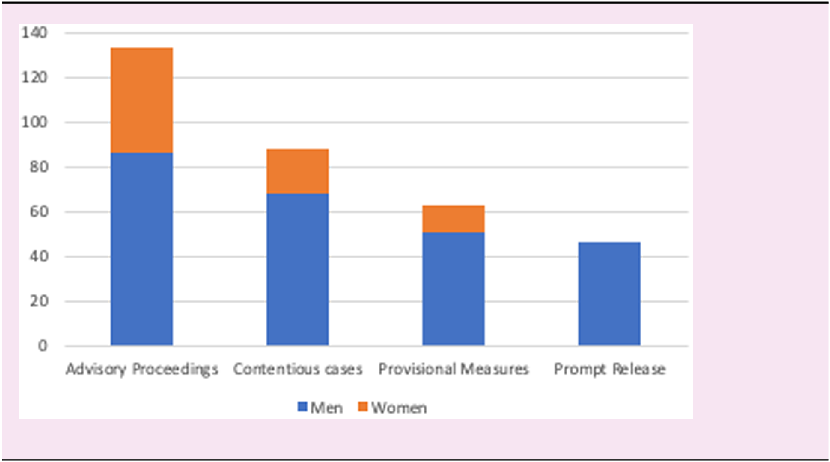
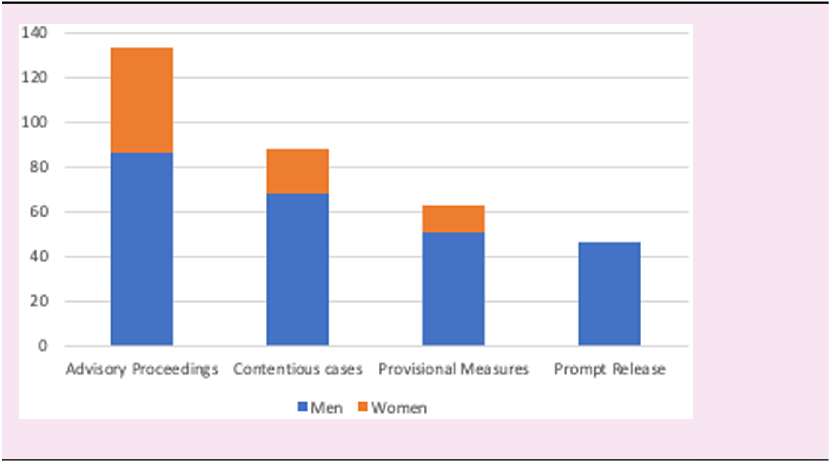
As previously mentioned, only 79 out of the 330 persons who delivered oral presentations were women. However, this figure obscures some considerable variation in the sense that the overall figures are distorted by uneven distribution depending on the nature of the proceedings (Table 2). In prompt release cases, the gender ratio is 0% female to 100% male; 19% female to 81% male in provisional measures cases; 22.7% female to 77,3% male in contentious cases (merits); and 35.3% female and 64.7% male in advisory proceedings.Footnote 98
Data on gender distribution disaggregated by the nature of the proceedings
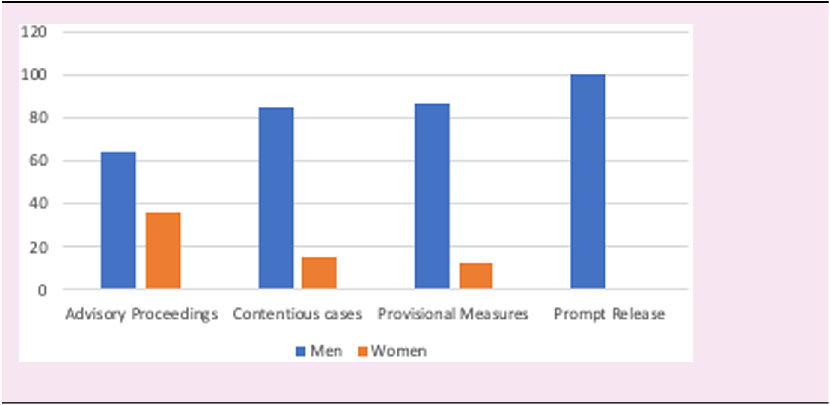
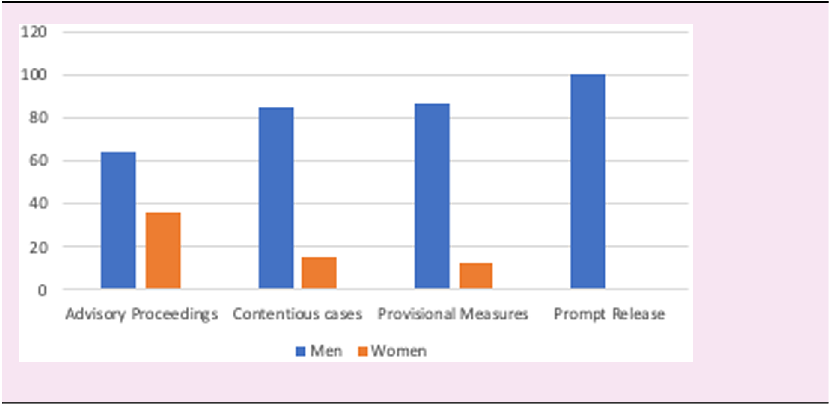
The gender distribution for speaking time per nature of the proceedings is presented in Table 3. The breakdown of gender representation in the different proceedings is as follows: 0% female to 100% male in prompt release cases; 13% female to 87% male in provisional measures cases; 15.5% female to 84.5% male in contentious cases (merits); and 36% female to 64% male in advisory proceedings.
Data on gender distribution of speaking time disaggregated by the nature of the proceedings
The complete absence of women in prompt release proceedings cannot pass unnoticed. Many early cases before the Tribunal involved prompt release proceedings, and there is a substantial gap between the recently discontinued The M/T ‘Heroic Idun’ Case and The ‘Hoshinmaru’ and The ‘Tomimaru’ cases, decided in August 2007. As has been shown, women only began appearing with greater regularity before the Tribunal from The M/V ‘Louisa’ Case (2013) onwards. In this respect, it should be noted that in The M/T ‘Heroic Idun’ Case, the appointed agent was female.
As for advisory proceedings, though men consistently outnumber women, the ratio is 35.3% female to 64.7% male. The study also shows that female repeat speakers appeared mostly in advisory proceedings. While it is difficult to formulate discrete reasons surrounding this discrepancy between contentious and advisory proceedings, two observations can be made. First, almost half of female pleaders represent international organizations, while just under 40% are (senior) government lawyers and officials, generally translating into women who have attained senior positions at the national level. Second, unlike contentious cases, advisory opinions have ‘no binding force’.Footnote 99 This divide between binding contentious cases and non-binding advisory proceedings echoes the hard/soft law dichotomy, as exposed by the feminist theory of international law. According to this theory, ‘the distinction between “hard” and “soft” law has a clear gendered character. Hard law would be “male”, opposed to soft law as “female”’.Footnote 100 In this case, the binding/non-binding dichotomy espouses the masculine/feminine divide in terms of representation.
Finally, it is interesting to take a closer look at women working behind the scenes (including those not delivering oral statements). First, out of the 846 people listed as part of the delegations, 266 were female (31.4%). However, this figure masks some variations. In advisory proceedings, although men are slightly in the majority (59%), 41% of individuals listed as representatives are women. Second, as for counsel, 21.2% are women. This figure rises to 33% if the calculation is narrowed to female counsel listed as members of delegations since The M/V Louisa Case (2013). Third, while women are in the minority among agents, counsel, advisers, and representatives, this imbalance is reversed for ‘assistant’ and ‘junior counsel’, where 64.7% are women. These observations confirm the contrast in gender distribution between contentious cases and advisory proceedings. They also link back to the earlier point concerning the overall increase in the proportion of women in oral proceedings.
5.4 Geographic diversity
5.4.1 Developing/developed economies differences
The presented statistics indicate that developed economies usually rely on their in-house government lawyers and officials when appearing before the Tribunal. On average 19% of counsel are non-nationals. In contrast, developing economies tend to employ more non-nationals, particularly from developed economies, and the few hailing from developing economies generally have links to academic institutions in Europe. Roughly 80% of counsel were non-nationals. Furthermore, those states often heavily rely on non-national representatives during the oral proceedings, sometimes even for introducing their own national judicial system.Footnote 101 The high proportion of non-national representatives in developing economy delegations is primarily due to a lack of in-house capacity.Footnote 102
This developing/developed economies’ divide in terms of national composition is not exclusive to the Tribunal. In a study of lawyers who appeared in oral proceedings in contentious cases before the ICJ from 1999 to 2012, it was revealed that 57% of the legal teams from OECD member states appearing between 1999 and 2012 were presented by nationals of those states, while 43% were conducted by non-nationals (mainly from OECD member states).Footnote 103 The study further found that only 15.1% of oral arguments presented by the legal teams from non-OECD member states were conducted by their nationals, while 84.9% were conducted by non-nationals (almost exclusively from OECD member states), who accounted for 97.1% of the speaking time.Footnote 104 A more recent compilation has confirmed this trend.Footnote 105 In relation to Annex VII arbitral tribunals, 100 counsel listed as part of delegations are from developed economies (including 32 from the United Kingdom and 29 from the United States, mainly from American law firms). Twenty-eight counsel are from economies in transition. The remaining 11 counsel are from developing economies. It is worth noting that 96.4% of counsel representing developed economies are nationals from developed economies. With regard to delegations from developing economies, 87.5% of counsel come from developed economies, and 12.5% from developing economies, mainly Bangladesh and Barbados representing their respective countries. In the case of economies in transition, 44.5% of them originate from developed economies, 50% are nationals (and/or from a Russia-based law firm), and 5.5% are from developing economies, mainly China. In the case of Russian representation, 27.5% of them originate from developed economies, 65% are nationals (and/or from a Russia-based law firm), and 7.5% are from developing economies, mainly China. The large presence of Russian nationals representing Russia can be attributed to the resignation en masse of counsel on 17 March 2022,Footnote 106 including from several members of the international bar.Footnote 107
This focus on the developed/developing divide fails to capture other factors, such as the land size of the state in question. Small states frequently appeared before the Tribunal which can impact their representation due to limited domestic resources and a shortage of international legal expertise. Examples include small developing economies such as Belize,Footnote 108 or Timor-Leste.Footnote 109 When examining other tribunals, it can be said that this remains accurate for certain small developed economies, such as LiechtensteinFootnote 110 or Malta.Footnote 111 In terms of larger states, the case of the representation of Australia is illustrative.Footnote 112 Australian representation invariably entails considerable involvement of its Solicitor-General and lawyers from the Attorney-General’s Department. In cases where the assistance of members of the international bar is deemed necessary, a discernible preference for retaining national repeat speakers can be observed, particularly in recent cases.Footnote 113 In the case of Russia, it is more nuanced. During proceedings before the Tribunal, except for The ‘Volga’ Case, the Russian team consisted solely of Russian nationals. However, before the ICJ and arbitral tribunals under Annex VII of the Convention, Russian representation was primarily selected from the small pool of international bar members, with only a minority being Russian nationals.Footnote 114 As noted above, following the resignation of counsel from the Russian team in cases before both the ICJ and the arbitral tribunal under Annex VII, the newly composed Russian teams were represented by a Russian law firm, along with counsel hailing from developing economies such as China, Türkiye, and Peru.Footnote 115 This particular situation allows certain counsel from developing economies to break into the circle of candidates for appointment.
Finally, it is worth noting the significant number of national representatives in developing economic delegations during advisory proceedings. Their participation in advisory proceedings has resulted in their preference for using their own nationals to represent them before the Tribunal. Out of the 31 teams identified from developing economies, 76% of the representatives appearing before the Tribunal were nationals of the state they represented. These representatives were mostly in-house government lawyers and officials. Another 20% were composed of national representatives along with representatives mostly from other developing economies.Footnote 116 Only 4% were primarily composed of representatives from developed economies.
5.4.2 Non-national lawyers acting as agents
When discussing non-national representation of a state, it is relevant to flag the noticeable trend of developing economies appointing non-national private lawyers to act as their agents, especially in prompt release proceedings. As a reminder, it is worth noting that Article 292 of the Convention provides that the application for release ‘may be made only by or on behalf of the flag state of the vessel’. One possible explanation for this phenomenon is that it mainly concerns developing economies, which often lack in-house legal expertise.Footnote 117 Nevertheless, Article 292 of the Convention assigns a special role for private parties and their lawyers in the context of prompt release proceedings. Along those lines, the reason behind this trend seems to be explained more by the fact that ‘lawyers [are] retained by the ship owner or charterer (from OECD countries), [rather than] by the countries whose flag the vessels were flying’.Footnote 118 In a similar vein, it has been said that ‘in recent cases before the Tribunal, including the present case [The ‘Volga’ Case], although the flag State has been represented by a State agent, the main burden of presentation of the case has been borne by private lawyers retained by the vessel’s owners’.Footnote 119
The potential effect of private lawyers representing states in cases has attracted concerns and was addressed by some judges in The ‘Grand Prince’ Case. In this case, there were doubts as to whether Belize was the flag state at the time of the detention of the vessel. The Tribunal concluded that the documentary evidence adduced by the applicant failed to establish Belize as the flag state and, therefore, the Tribunal had no jurisdiction in the case.Footnote 120 Judge ad hoc Cot commented on the reliability of the non-national practitioners representing a state:
the lawyer-agent is not necessarily in close contact with the authorities of the flag State. The credibility and reliability of the information he provides as to the legal position of the flag State may be questionable. In the present case, the Tribunal had to be satisfied with incomplete and contradictory information concerning the registration of the vessel and the position of Belize as to the nationality of the Grand Prince.Footnote 121
Judge Anderson, for his part, noted that the ‘Agent appointed by Belize is not well placed, as a non-Belizean lawyer in private practice, to explain to the Tribunal the seeming inconsistencies in the statements of different government departments and agencies in Belize.’Footnote 122 In a similar vein, in The ‘Juno Trader’ Case, Guinea-Bissau appointed a Portuguese counsel to ‘explain exactly how the legal system of Guinea-Bissau functions, how its [statutes] and its case law has addressed the different issues at hand’.Footnote 123 In this respect, it seems that there was a ‘difference between the statements concerning the law of Guinea-Bissau, as given by the Respondent before the Tribunal, and the view of the law as it emerges from the decision of the Regional Court of Bissau’.Footnote 124 Overall, a private lawyer’s legitimacy ‘is heavily dependent on his or her knowledge of the facts and the law as applicable to the State by which he or she was appointed’.Footnote 125 It is especially true in prompt release cases where matters of national law are involved.
In addition to its reliability as a representative, the agent is also ‘expected to state precisely the position of the government he is representing’.Footnote 126 In this regard, the statement made by the (national) private lawyer acting as agent for Panama in The M/V ‘Norstar’ Case is illustrative:
I am trying really hard. I am not a diplomat, I am not a public servant, I am a simple private lawyer dedicated to international law of the sea studies, who practices privately and has been hired by the Panamanian Government to defend its case here. If I were a diplomat, probably I would accept Italy’s views concerning diplomatic protection provisions.Footnote 127
6. Conclusion
This article has presented an empirical study of representation before ITLOS from November 1997 to September 2023, with a particular focus on oral proceedings.
The findings that emerge from the study are as follows. First, the study concludes that there is a preference for repeat pleaders in oral proceedings, identifying in this respect a small core group of speakers who have appeared in three or more cases before the Tribunal. Indeed, as captured by the study, the majority of the oral proceedings are conducted by English speaking male academics and lawyers hailing from Europe, North America, and Australia in general, and from a particular set of European countries (mainly from the United Kingdom and France) and the United States in particular. Second, the study sheds light on the gender disparities in oral proceedings, revealing that only 24% of individuals who participated in oral proceedings were female. While concluding that women are notably underrepresented, the study has also shown that the number of female counsel is slowly increasing. Third, the results indicate that developed economies tend to rely on their in-house government lawyers and officials, as well as their national lawyers and academics, with only 19% of counsel being non-nationals. By contrast, the study reveals that developing economies tend to have a higher proportion of non-national counsel, with an average of 80% non-nationals. Fourth, the study reveals that approximately 76% of the arguments presented to ITLOS judges were in English, noting the prevalence of English in the oral proceedings of the Tribunal. Fifth, the results of the study also point to the difference between contentious cases and advisory proceedings, both in terms of national composition and gender balance. Of the representatives who made an oral statement, 35.3% were women, and 75% were nationals of the states appearing before the Tribunal. Overall, the study indicates that the identified features did not appear to be specific to the Tribunal, as similar results have been found for the ICJ and Annex VII arbitral tribunals.
The study also asked whether ITLOS, as a specialized tribunal, had any particularities in terms of representation? Regarding the existence of an ‘ITLOS bar’, the study indicates that oral proceedings are mainly conducted by a core group of repetitive pleaders from the international bar. These pleaders also appeared before other international courts and tribunals and most appear to be international law generalists rather than experts in the law of the sea. The existence of an ‘ITLOS bar’ is not supported by the evidence. It is therefore more accurate to refer to the international bar, rather than a specialized ITLOS bar of counsel in oral proceedings before the Tribunal, even though certain counsel appear on several occasions before the Tribunal. That being said, it has been found that a hallmark of the representation before the Tribunal is the significant role of ‘private lawyers retained by the vessel’s owners’ in the context of prompt release proceedings, noting in this respect that Article 292 of the Convention establishes a special role for private parties and their lawyers in such proceedings.

 Open access

