

Introduction
The political year 2021 saw the federal parliamentary election as well as five regional elections in Baden-Württemberg, Rhineland-Palatinate, Saxony-Anhalt, Mecklenburg-Western Pomerania and Berlin. After 16 years of governing coalitions led by Angela Merkel (Christian Democratic Union/Christlich Demokratische Union – CDU), the Social Democratic Party/Sozialdemokratische Partei (SPD) won the elections by a narrow margin and formed a government with the Alliance 90/Greens/Bündnis 90/Die Grünen and the Free Democratic Party/Freie Demokratische Partei (FDP) under Chancellor Olaf Scholz (SPD).
Based on promising poll and regional election results, the Greens, for the first time in their history, ran with their own candidate for Chancellor, Annalena Baerbock. Compared with previous years, the FDP also recorded solid regional election results in 2021, while the SPD benefited from the weakness of the CDU and its lead candidate, Armin Laschet. Scholz, who had been nominated by his party already in August 2020, avoided major mistakes and presented himself as a level-headed statesperson, much like Merkel. The Alternative for Germany/Alternative für Deutschland (AfD) moved further to the right. The State Office for the Protection of the Constitution/Landesverfassungsschutz classified the AfD's branch in Thuringia as right-wing extremist in May and has monitored it since then.
German politics was dominated by the ongoing COVID-19 pandemic and the debate over restrictions on personal freedoms. The disastrous flood in Rhineland-Palatinate and North Rhine-Westphalia in July was linked to climate change and significantly affected the focus of the federal election campaign. Earlier, in April, the Federal Constitutional Court/Bundesverfassungsgericht had ruled that the 2019 Climate Protection Act lacked sufficient requirements for emissions reductions after 2030 and had to be overhauled. The Merkel coalition subsequently adopted the law, and it passed the two houses of Parliament in June 2021.
Election report
Parliamentary elections
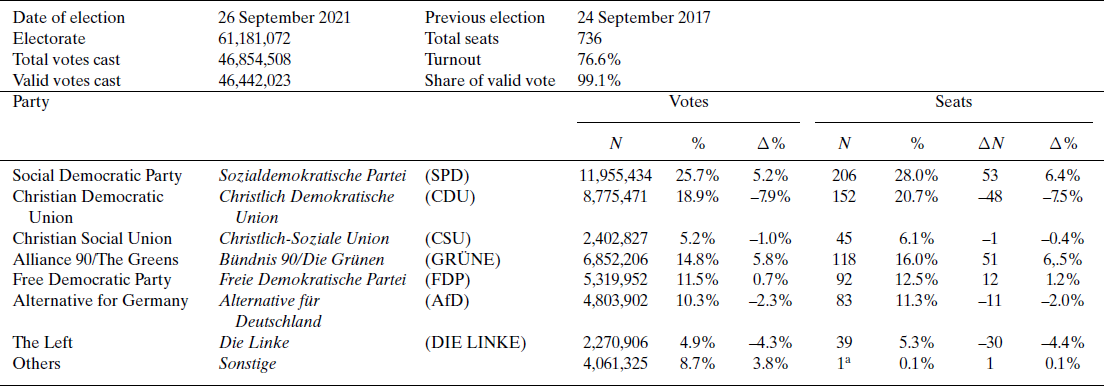
In the federal election on 26 September (Table 1), the SPD won a relative majority with 25.7 per cent of the vote, just ahead of the CDU/CSU (Christian Social Union/Christlich-Soziale Union), which achieved its worst-ever result with 24.1 per cent. The Greens improved their result by 5.8 percentage points compared with the 2017 federal election, with 14.8 per cent, and now form the third-strongest parliamentary group in the newly elected Bundestag (the lower house of Parliament). The FDP again managed to achieve a double-digit election result with 11.5 per cent. The AfD lost 2.3 percentage points and achieved 10.3 per cent. With 4.9 per cent, the Left Party/Die Linke lost 4.3 percentage points, missed the 5 per cent threshold, and is only represented in the Bundestag because it could win three constituencies directly (the so-called basic mandate clause). After the coalition negotiations between SPD, Greens and FDP, the coalition agreement of the so-called traffic light coalition was signed on 7 December and Olaf Scholz (SPD) was elected as the new Chancellor one day later. With 76.6 per cent, voter turnout was roughly on a par with the previous Bundestag election (2017 = 76.2 per cent) (Poguntke & Kinski Reference Poguntke and Kinski2018). With 736 seats, the current Bundestag is the largest in the history of the Federal Republic (Forschungsgruppe Wahlen 2021a).
Elections to the lower house of Parliament (Bundestag) in Germany in 2021

Note: aThis is a seat of the Südschleswigscher Wählerverband/South Schleswig Voters’ Association (SSW). It represents the Danish minority in Schleswig-Holstein. The centre-left party is exempt from the 5% threshold.
Sources: Forschungsgruppe Wahlen (2021a); Poguntke and Kinski (Reference Poguntke and Kinski2018).
The SPD already named its electoral leader, Olaf Scholz, in August 2020. In April 2021, the Greens nominated Annalena Baerbock as their electoral leader, and the CDU/CSU chose Armin Laschet (chair of the CDU and Prime Minister of North Rhine-Westphalia) over Markus Söder (chair of the CSU and Prime Minister of Bavaria). In the election campaign, the SPD placed social equality at the centre of its campaign and promoted a minimum wage of €12/hour, affordable rents and a constant pension level (SPD 2021a). The CDU/CSU called for tax relief for citizens, but remained vague. Furthermore, they favoured state-subsidised housing instead of an upper limit for rents (CSU 2021). The Greens proposed a speed limit on motorways, a Germany-wide rent cap, a higher tax rate for the rich and a faster phase-out of coal power (Bündnis 90/Die Grünen 2021a). The FDP pledged higher investment in education, tax cuts for citizens and businesses, a reduction in bureaucracy and a cap on CO2 emissions (FDP 2021a). The Left Party demanded a higher minimum wage of €13/hour, a nationwide rent cap and a millionaire's tax. In addition, they positioned themselves strictly against arms exports (Die Linke 2021a). The AfD called for Germany to leave the European Union (EU) and opposed COVID-19 infection control measures. The party also insisted on a faster expulsion of migrants who were not legally entitled to stay in Germany (AfD, 2021).
The flood disaster in July, which mainly affected North Rhine-Westphalia and Rhineland-Palatinate, brought the issue of climate and environmental protection more into focus in the election campaign.
Following the federal election, exploratory talks to form a coalition government began. Never before in Germany has a party succeeded in appointing the next Chancellor with such a small vote share. On 28 September, two days after the federal election, the Greens and the FDP met to identify possible avenues for exploratory talks. The meeting was quite unusual, as both parties would have been the smaller coalition partners in both a so-called Jamaica coalition, led by the CDU/CSU, and a so-called traffic light coalition, led by the SPD. On 3 October, the CDU/CSU held exploratory talks with the FDP and on 5 October with the Greens to explore the chances of a coalition.
The exploratory talks for a possible traffic light coalition of SPD, Greens and FDP started on 7 October. On 24 November, the three parties presented their coalition agreement. The SPD and FDP still had to confirm the agreement at party congresses, the Greens in a member referendum. The SPD party congress approved the coalition agreement on 4 December, the FDP party congress did so on 5 December. Most Green party members (86 per cent) also approved the coalition agreement in a ballot that lasted until 6 December (Bündnis 90/Die Grünen 2021b). All coalition partners were able to achieve important goals in the coalition agreement: The Greens succeeded in pushing through a faster CO2 phase-out, the FDP achieved the maintenance of the debt limit and the renunciation of tax increases, and the SPD pushed through a higher minimum wage and an extension and tightening of the existing rent control.
Regional elections
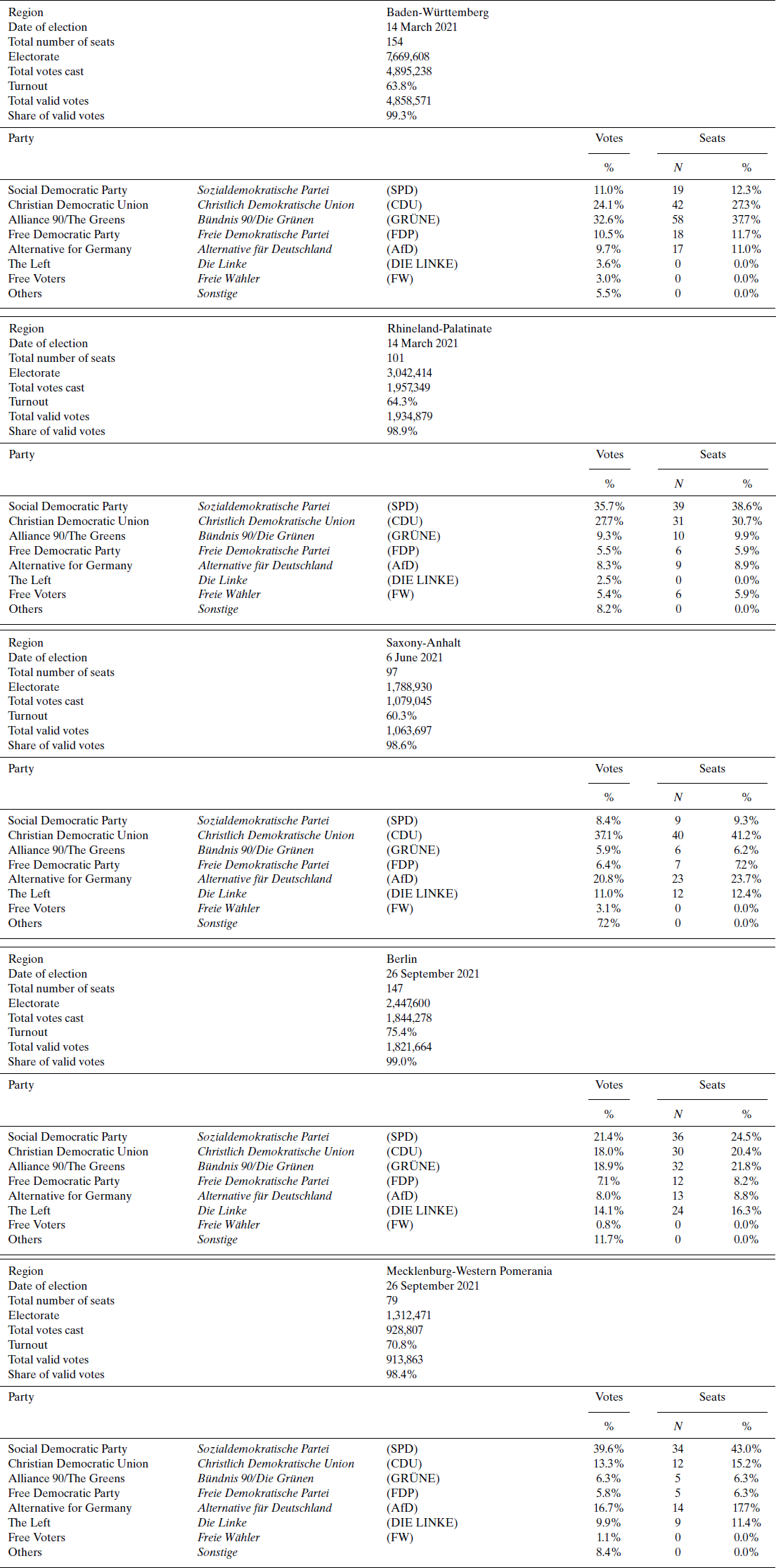
Land elections were held in Baden-Württemberg, Rhineland-Palatinate (both in March), Saxony-Anhalt (June), Mecklenburg-Western Pomerania and Berlin (both in September) (Table 2). In the state elections in Baden-Württemberg on 14 March, the Greens once again emerged as the strongest force. With 32.6 per cent (+2.3 percentage points), the party recorded a gain in state elections in Baden-Württemberg for the fourth time in a row and was thus clearly ahead of the CDU. The CDU had to accept its historically worst result in Baden-Württemberg with 24.1 per cent. As in the previous state election in 2016, the SPD lost votes and was the third strongest force with 11 per cent (–1.7 percentage points), ahead of the FDP (10.5 per cent). The AfD recorded the most significant losses compared with the previous state election in 2016, receiving 9.7 per cent (–5.4 percentage points). With 3.6 per cent, the Left Party again failed to enter the state parliament (Forschungsgruppe Wahlen 2021b). After 7 weeks of negotiations, Greens and CDU decided to renew the governing coalition and re-elected Winfried Kretschmann (Greens) as state prime minister on 12 May.

The state election in Rhineland-Palatinate on 14 March did not lead to a change of government, and the coalition of SPD, Greens and FDP re-elected Malu Dreyer (SPD) as state prime minister on 18 May. The SPD was the strongest party in the state elections for the seventh time since 1991, with 35.7 per cent. While the SPD was thus able to largely maintain its result from the 2016 state election (36.2 per cent), the CDU plummeted to 27.7 per cent (–4.1 percentage points). Thus, the CDU achieved a negative record in Rhineland-Palatinate for the second time in a row and recorded one of the worst results in state elections in a western German state since 1954. The third strongest political force was the Greens, who achieved their second-best result in Rhineland-Palatinate with 9.3 per cent and recorded the most substantial gains of all parties (+4 percentage points) compared with the 2016 election. With 5.5 per cent (–0.7 percentage points), the FDP was the weakest party in the traffic light coalition and was just ahead of the Free Voters/Freie Wähler, who entered the Rhineland-Palatinate state parliament for the first time with 5.4 per cent (+3.2 percentage points). As in Baden-Württemberg, the AfD was the biggest loser in the election, winning only 8.3 per cent of the popular vote and thus falling by 4.3 percentage points (Forschungsgruppe Wahlen 2021c).
In Saxony-Anhalt, the CDU won the state election on 6 June with 37.1 per cent. With a gain of 7.4 percentage points compared with 2016, the party achieved its third-best result ever in the state. The AfD was again the second strongest party, but lost 3.4 percentage points compared with the previous state election and ended up well behind the CDU with 20.8 per cent. Only the Left Party lost more vote share than the AfD and achieved its worst result in Saxony-Anhalt with 11 per cent (–5.3 percentage points). The SPD also faced a historic low in the state with only 8.4 per cent and as in the previous state election, again lost vote share (–2.2 percentage points). While the FDP had failed to pass the 5 per cent threshold in each of the last two state elections (2011 and 2016), the party re-entered the state parliament with 6.4 per cent and recorded the second strongest increase in votes (+1.6 percentage points) of all parties. The Greens also improved their result (+0.8 percentage points) and entered the state parliament for the third time in a row with 5.9 per cent, their historically second best result in Saxony-Anhalt (Forschungsgruppe Wahlen 2021d). Unlike in Baden-Württemberg and Rhineland-Palatinate, a new coalition of CDU, SPD and FDP formed in Saxony-Anhalt. The so-called Germany coalition (CDU, SPD, FDP) is the first in reunified Germany and replaces the so-called Kenya coalition (CDU, SPD, Greens). The CDU and SPD would have had a slight majority in the state parliament (49 out of 97 seats) but still decided to include the FDP to have an oversized majority (with the FDP: 56 seats) (Landeswahlleiterin Sachsen-Anhalt 2021). Complicated negotiations preceded the coalition formation, so the agreement was signed almost a 100 days after the election. The election of the state prime minister on 16 September was also difficult, as Reiner Haseloff (CDU) had to face the second round of voting, as he did in 2016, after falling short of the required majority in the first round.
Berlin held its state election on 26 September, in parallel with the federal election. In addition, two other elections were held in Berlin on the same day: the election for the district assembly and a referendum on the expropriation of large Berlin real estate corporations. During this ‘super election day’, irregularities occurred in 207 out of 2257 Berlin polling stations: some long queues formed in front of the polling stations, ballot papers were accidentally mixed up and some polling stations had to close for up to two hours during the election day because they ran out of ballots (Landeswahlleiterin Berlin 2021). Due to the numerous irregularities, various lawsuits were brought against the election results. The Berlin Constitutional Court is examining these lawsuits and is expected to decide in spring 2022 whether the election must be repeated entirely or at least in individual constituencies. Although, the SPD emerged as the strongest party with 21.4 per cent (–0.1 percentage points), it also achieved its historically worst result in Berlin. The Greens achieved a record result with 18.9 per cent, but fell short of their goal of becoming the strongest party. The CDU came in third with an 18 per cent vote share (+0.4 percentage points). With 14.1 per cent (–1.6 percentage points), the Left Party followed in fourth place, ahead of the AfD with 8 per cent. The AfD thus managed to enter the state parliament for the second time, but with a loss of 6.2 percentage points, it recorded the highest loss of all parties. The FDP received 7.1 per cent, an improvement of 0.5 percentage points (Forschungsgruppe Wahlen 2021e). Two months after the election, the SPD, Greens and Left Party agreed to continue their existing coalition and elected Franziska Giffey on 21 December as new Governing Mayor of Berlin.
Elections were also held in Mecklenburg-Western Pomerania on 26 September. The SPD achieved an electoral victory with 39.6 per cent and a record increase of 9 percentage points, emerging as the winner of the state election consecutively for the sixth time. The party thus achieved its second best election result in Mecklenburg-Western Pomerania after 2002. The CDU fell to an all-time low in the election, gaining only 13.3 per cent (–5.7 percentage points). With 18.7 per cent, the AfD also lost significant votes (–4.1 percentage points). However, the AfD became the second strongest force but remained well below their election results in the other eastern German states. The Left Party fell below the 10 per cent mark in an eastern German state for the first time since 1990, with 9.9 per cent (–3.2 percentage points). Apart from the SPD, only the FDP (+2.8 percentage points) and the Greens (+1.5 percentage points) recorded gains. Both parties had failed to pass the 5 per cent threshold in the 2016 state election, but entered the state parliament this time with 6.3 per cent (Greens) and 5.8 per cent (FDP) (Forschungsgruppe Wahlen 2021f). After the election, the SPD decided against continuing the grand coalition with the CDU and instead formed a coalition with the Left Party. After three weeks of negotiations, the coalition agreement was finalized, and Manuela Schwesig was re-elected as state prime minister on 15 November.
Since, the Bundesrat (upper house of Parliament) is composed of state governments, the Land elections can influence the government's voting strength in the Bundesrat. State governments only changed in Mecklenburg-Western Pomerania and Saxony-Anhalt. In the former, the previous coalition of SPD and CDU (at that time also coalition partners at the federal level) was replaced by a coalition of SPD and the Left Party. In the latter, the former coalition of CDU, SPD and Greens was replaced by a coalition of CDU, SPD and FDP. The change in government coalition in Saxony-Anhalt did not affect the government's voting strength in the Bundesrat since both Greens and FDP were in opposition at the federal level at the time. The change in state government in Mecklenburg-Western Pomerania did affect the voting strength in the Bundesrat with the state moving from a ‘government state’ (i.e., state government including only parties in federal government at the time) to a ‘mixed state’ (i.e., state government including parties in federal government and opposition at the time).
With the Bundestag election and the formation of the traffic light coalition at the federal level, the political balance in the Bundesrat shifted again. Bavaria with its coalition of CSU and Free Voters is now an ‘opposition state’ (i.e., state government including only opposition parties at the time).
Cabinet report
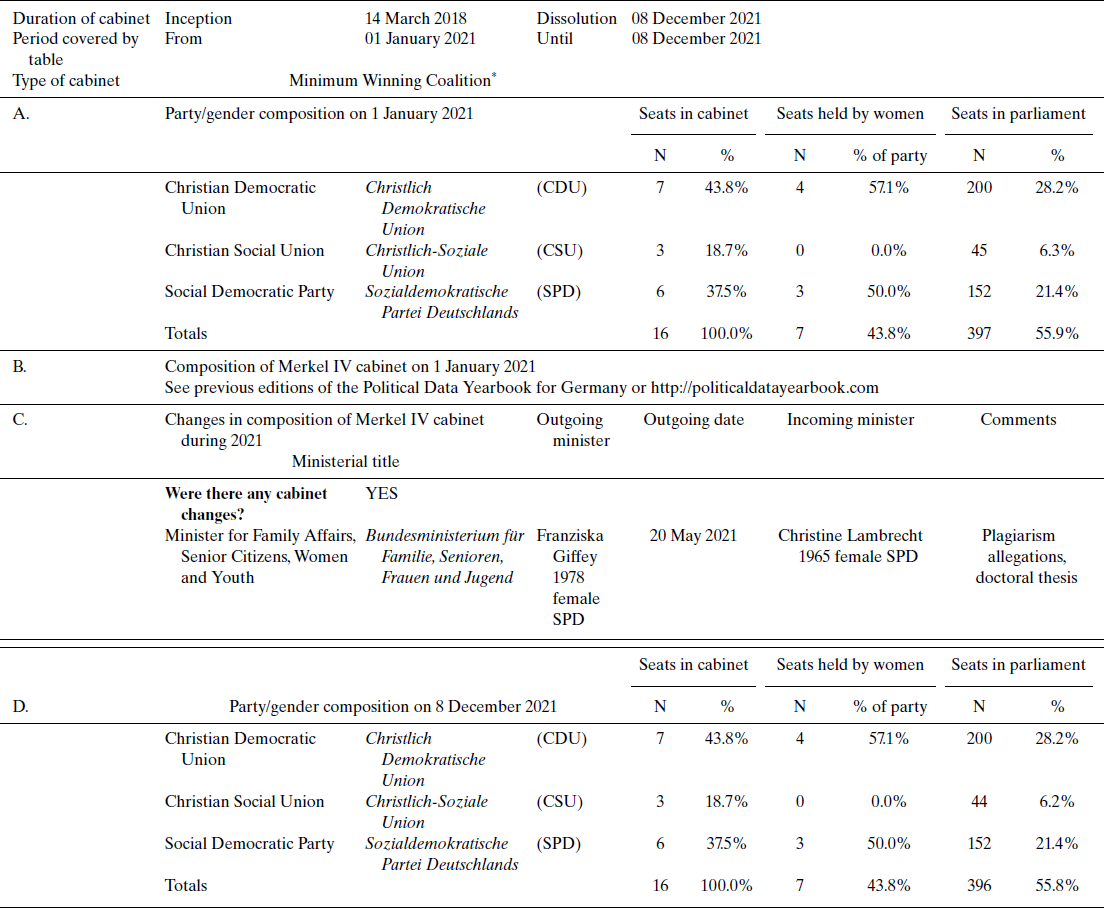
Table 3 shows the composition of the outgoing Merkel IV Cabinet. In May, Franziska Giffey (SPD) resigned from her post as Federal Minister for Family Affairs due to the ongoing allegations of plagiarism in her doctoral thesis, which eventually led to the withdrawal of her doctorate. Her ministry was temporarily headed by the Minister of Justice, Christine Lambrecht, until the federal election.
Cabinet composition of Merkel IV in Germany in 2021

* Even though outside national parliament, the CDU and CSU formally exist as two independent party organizations, the two sister parties traditionally
form a common group in the Bundestag. Therefore, regarding the determination of the coalition type, both are considered as one ‘party’.
Source: Bundestag (2022).
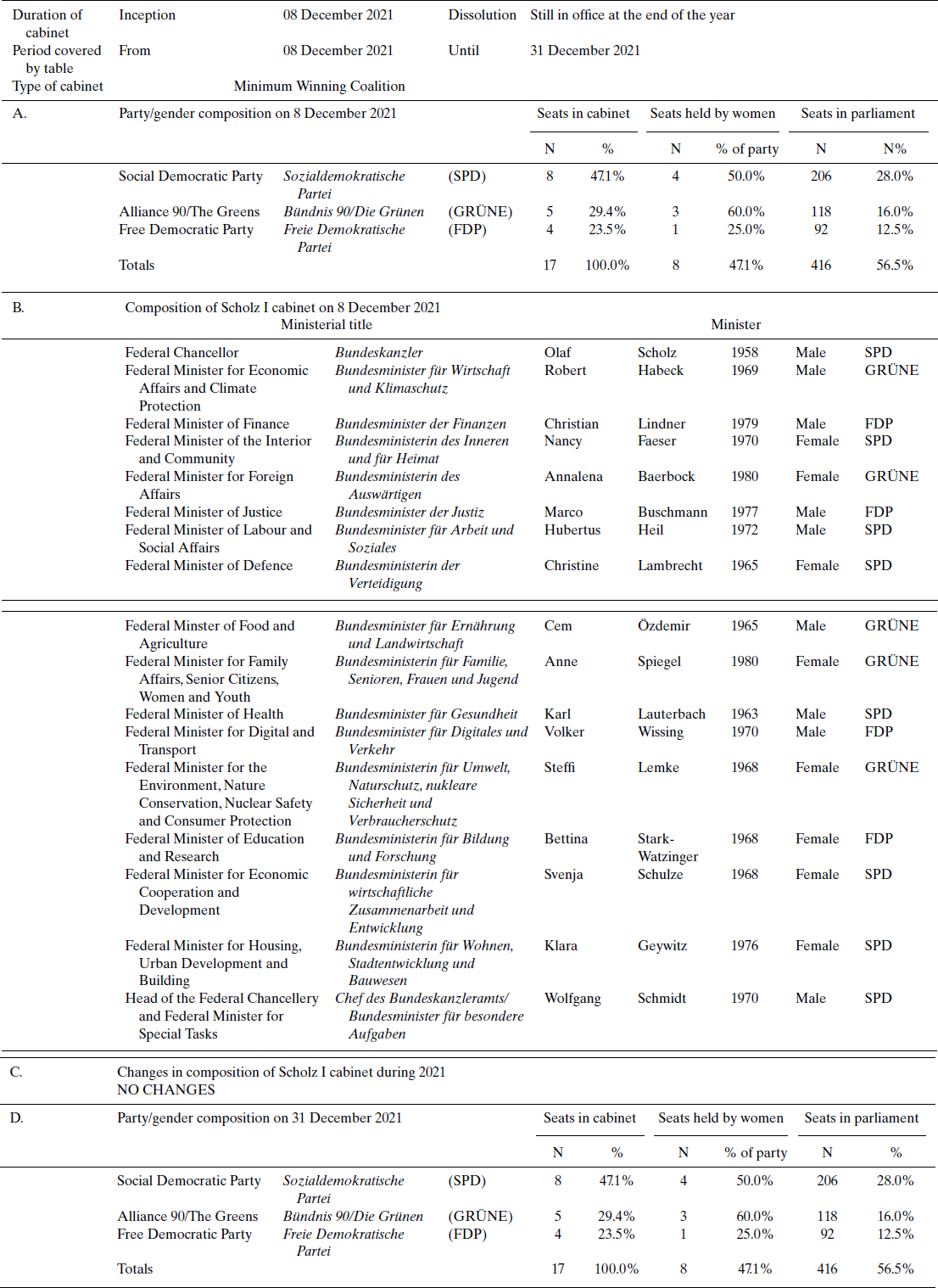
The federal elections and the government turnover resulted in a completely new Cabinet composition (Table 4). Eight positions (including the Chancellor) are held by the SPD, five by the Greens and four by the FDP.
Cabinet composition of Scholz I in Germany in 2021

Note:
1. The coalition established the new Federal Ministry for Housing, Urban Development and Building, so there is now one more ministry than under the previous government.
Source: Bundesregierung (2021).
Parliament report
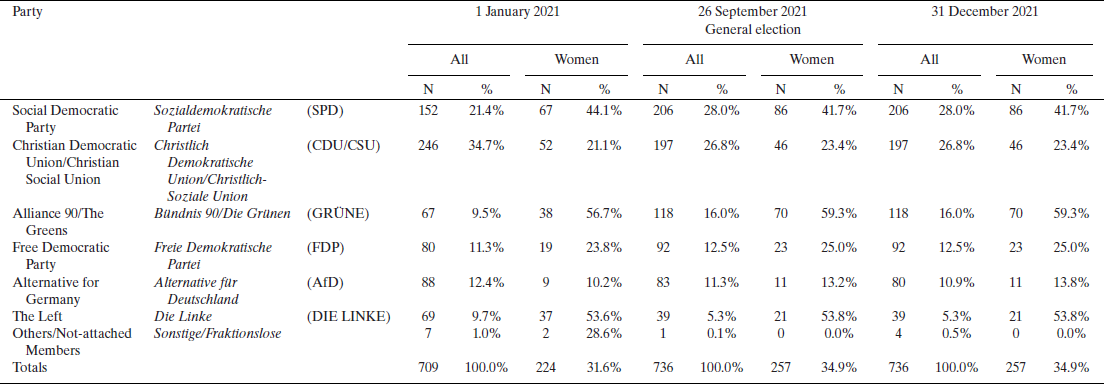
Table 5 shows the party and gender composition of the German Bundestag. With 736 members of Parliament, the 20th German Bundestag has yet again increased in size, while a comprehensive electoral reform is still lacking. The proportion of women in the German Parliament increased slightly from 32 per cent to 35 per cent. While the Greens and the Left Party have a share of women in the Bundestag of over 50 per cent, the share of women in the AfD is extremely low, with only 14 per cent (Bundestag, 2021a; Bundeswahlleiter, 2021).
Party and gender composition of the lower house of Parliament (Bundestag) in Germany in 2021

Source: Bundestag (2021b-d).
Political party report
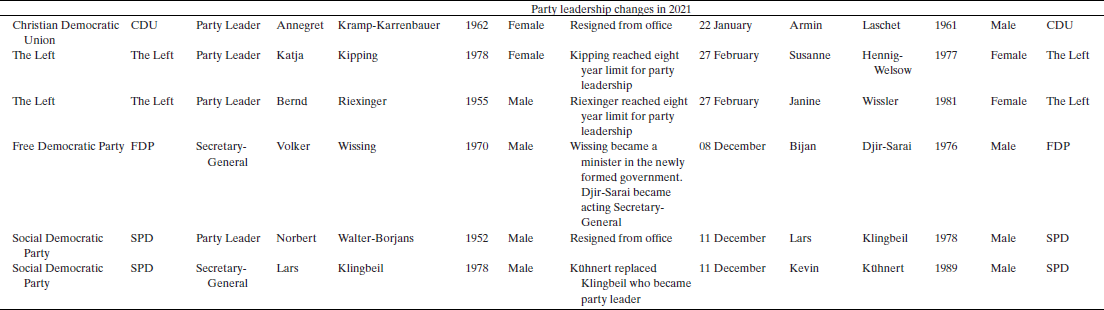
At the party congress on 6 January 2021, Armin Laschet was elected as the new CDU party chair (Table 6). In April, Laschet declared his willingness to run as the electoral leader for the CDU/CSU. Markus Söder, party chair of the CSU and Bavaria's Prime Minister, also signalled his willingness. On 19 April, the CDU's federal party executive finally elected Laschet as the electoral leader. After losing the federal election in September, Laschet resigned as party chair after less than a year. Due to internal pressure, the CDU decided that the rank-and-file party members should elect the new party chair. After Friedrich Merz had narrowly failed with his candidacy in 2018 and in January 2021, a majority of 62.1 per cent voted in favour of Merz in a member poll in the first ballot (CDU, 2021a).

Franziska Giffey ran as the SPD's electoral leader for the Governing Mayor of Berlin and won the election. On 11 December 2021, the SPD elected a new party leadership. Former general secretary Lars Klingbeil took over the co-chair from Norbert Walter-Borjans, who had previously renounced to run again, and Saskia Esken was re-elected. Kevin Kühnert, former chair of the SPD youth organization Jusos, became the new general secretary.
Jörg Meuthen announced in October that he will not run again for the position as party co-chair of the AfD (Tino Chrupalla announced his renewed candidacy). However, the party congress was cancelled, among other things, due to COVID-19 infection control measures, as many AfD members are unvaccinated.
In February, the Left Party elected Susanne Henning-Wellsow and Janine Wissler as new party leaders. Previously, Katja Kipping and Bernd Riexinger had been party leaders for nine years; neither ran again. In November, Bodo Ramelow, Prime Minister of Thuringia, was elected as chair of the Bundesrat by rotation. He is thus the first chair belonging to the Left Party.
Due to solid poll ratings, the Greens entered the federal election campaign with an electoral leader for the first time in their history. On 19 April, the co-chairs of the Green Party, Robert Habeck and Annalena Baerbock, jointly announced that Annalena Baerbock would be the Green Party's electoral leader.
Issues in national politics
The ongoing COVID-19 pandemic has led to increased protests against infection control measures. These protests can be attributed to the so-called ‘Querdenker’ movement, a crowd of conspiracy believers and right-wing extremists. Since April 2021, parts of the movement have been monitored nationwide by the Federal Office for the Protection of the Constitution/Bundesverfassungsschutz on suspicion of extremism.
In March, it became known that several members of the CDU/CSU parliamentary group in the Bundestag had enriched themselves financially by brokering deals with COVID protective masks. The Union parties came under public pressure and three MPs subsequently left the parliamentary group and the party. The remaining MPs signed a ‘declaration of honour’ in which they affirmed that they had not gained any financial benefits from deals related to the pandemic. This ‘mask affair’ damaged the CDU shortly before the state elections in Baden-Württemberg and Rhineland-Palatinate (see above).
In addition to the political issues surrounding the COVID-19 pandemic, the flood disaster in July, which mainly affected the federal states of Rhineland-Palatinate and North Rhine-Westphalia, also shaped the public debate: many people were hit by the flood without official warning, although there had been warnings by meteorologists days before, which became increasingly concrete. At least 184 people died due to the disaster; many were injured (Bundeszentrale für politische Bildung 2021). This makes the flood the worst natural disaster in Germany since the storm tide in 1962.
In April, the Federal Constitutional Court ruled that the 2019 Climate Protection Act was not far-reaching enough, as it lacked sufficient requirements for emissions reductions after 2030. The lawsuit against the act was thus partially successful. The lawsuit was initiated by young people from Germany and abroad who claimed that the 2019 Climate Protection Act restricted their constitutional rights. The legislature was obliged to amend the Climate Protection Act by the end of 2022. The federal government subsequently adapted the law to the new requirements, and it passed the two houses of Parliament in June 2021.
A significant foreign policy event in 2021 was the end of NATO's Afghanistan mission, in which the German armed forces/Bundeswehr had been involved. The last armed forces left the country at the end of June. The mission cost Germany more than €17 billion (Wissenschaftlicher Dienst des Deutschen Bundestages, 2022); several hundred million euros went to Afghanistan for humanitarian aid, development aid and reconstruction. During the mission, the Bundeswehr, the Federal Intelligence Service and the German Embassy used the services of local Afghan staff to translate or establish contacts. Much local staff hoped to be evacuated, fearing that the Taliban would punish them for their former cooperation. Although the German government promised to rescue the threatened local forces, progress was plodding. On 25 August, the Bundestag held an ex-post vote mandating the ongoing evacuation mission of German citizens and local staff by German soldiers from Afghanistan. The SPD, Greens, FDP and Union parties formed a majority in favour. Both the majority of AfD MPs and Left Party MPs abstained. Against this background, the Left Party's ability to join a future coalition government was strongly called into question.
Acknowledgements
The authors thank Nico Bodden and Benjamin Hoss for their valuable support with the data collection.
Open Access funding enabled and organized by Projekt DEAL.

 Open access

