


Assertive community treatment (ACT) was developed in the early 1970s as a means of coordinating the care of people with severe mental illness in the community. A Cochrane review of the effectiveness of ACT for the general adult population found that people receiving ACT were more likely to engage with services, and were less likely to be admitted to hospital (Reference Marshall and LockwoodMarshall & Lockwood, 2000). The National Service Framework for Mental Health (Department of Health, 1999) and the NHS Plan (Department of Health, 2000) called for a total of 220 assertive outreach teams by April 2003.
Psychiatric disorders are more prevalent in adults with learning disability than in the general population (Reference Deb, Thomas and BrightDeb et al, 2001). Despite an increased prevalence of psychiatric illness, people with learning disability are less likely to receive specialist psychiatric services than the general population (Reference GustafssonGustafsson, 1997).
There are few studies about the use of assertive outreach services in people with learning disability. Thiru et al (Reference Thiru, Hayton and Stevens2002) described a service for 15 people in Hackney and reported positive results from a user satisfaction survey. Hassiotis et al (Reference Hassiotis, Ukoumunne and Byford2001) found that intensive case management was more beneficial for patients with borderline IQ than those of normal IQ, in terms of reduction in days spent in hospital, hospital admissions, total costs and needs, and increased satisfaction. A Dutch study showed a reduction in treatment costs of people with learning disability for outreach treatment in a randomised controlled trial of hospital v. outreach treatment (Reference Vanminnen, Hoogduin and BroekmanVan Minnen et al, 1997). Meisler et al (Reference Meisler, McKay and Gold2000) described the use of ACT in a community living programme for people with learning disability and mental illness. The programme was developed following a class action lawsuit in the State of North Carolina, USA. The ACT approach was beneficial in increasing the time spent in employment, reduction in hospital days and shorter duration of admission. Costs for those in ACT fell by 15%.
The Trial of Assertive Community Treatment in Learning Disability (TACTILD) compared assertive outreach with standard community care for 30 patients in three centres, two within London (Brent and Harrow) and one from North Leicestershire. Global assessment of function (GAF) was the primary outcome measure and burden on carers and quality of life were secondary measures. No significant differences were found between the two groups (Reference Oliver, Piachaud and TyrerOliver et al, 2005) in the primary and secondary outcome measures.
There are difficulties in the definition of ACT and ‘standard treatment’ that has made the evaluation of ACT controversial. The TACTILD study measured ‘assertiveness’ in terms of frequency and types of contact rather than by team structure. Assertive treatment has been interpreted differently in the UK with various service configurations. In the London boroughs of Brent, Harrow, Barnet and Waltham Forest a ‘ team-within-team’ model involves a few chosen professionals from the larger community learning disability team working intensively with patients with challenging behaviour. Other teams adopt the distinct team model that may include a consultant psychiatrist or be led by a psychologist and other health professionals (Reference Hassiotis, Tyrer and OliverHassiotis et al, 2003).
The Oxfordshire learning disability assertive outreach team shared the components of the programme of assertive community treatment (PACT) evaluated by Stein & Test (Reference Stein and Test1980). This included assertive follow-up, delivering care in the patient's home or neighbourhood, small caseload and emphasis on engagement. It differs from the original PACT team which offered 24 h care. The intensity of contact was variable, including high-intensity contact (7 days per week), which differs from the contact frequency utilised by other assertive community teams (Reference Burns and GuestBurns & Guest, 1999).
This article describes the development and operation of the learning disability assertive outreach team in Oxfordshire. This could be used as a framework for setting up similar teams for working with people with learning disability and mental health problems. The results of an audit comparing a period of assertive outreach care with standard community care are discussed.
Setting up the assertive outreach model
In Oxfordshire, the learning disability assertive outreach team has been running since October 2001 (Reference Porter and SanghaPorter & Sangha, 2002). A multidisciplinary audit was completed in September 2001 to identify the demand for a learning disability assertive outreach team in Oxfordshire. The audit aimed to establish where potential users lived, their demographic details, the nature of their problems, why they were not engaging with mainstream services and what services were needed. The audit involved contacting all community team members and managers of in-patient services to identify patients who might benefit from an assertive outreach team. These patients utilised considerable resources from the community teams to remain out of crisis. The potential users were identified by applying the eligibility criteria described in Box 1 to all patients identified by the audit. These criteria were developed from a series of meetings of the trust's assertive outreach steering committee. They were in part drawn from the criteria used by the Sainsbury Centre for Mental Health (2001), but modified to include challenging behaviour (as these patients comprised a significant group) and exclude people who already had full-time supported living arrangements (because of resource implications).
The catchment area for the learning disability assertive outreach team is the whole of Oxfordshire, which has a population of 2100 people with learning disability known to services. The approximate set up costs were in the region of £110 000.
Referrals
Referrals may be made by the three joint community health and social services teams in Oxfordshire as well as in-patient services. The team does not accept emergency referrals for intensive support. The referral is discussed at the assertive outreach team meeting, and if considered appropriate, the referrer is invited to discuss the patient at the team meeting. The referral will need to meet a minimum of four points of the eligibility criteria (Box 1).
Once a referral is accepted, one or two members of the team visit the patient. The team aims to provide support in daily living, shopping and budgeting in the patient's chosen environment. Team members do as much as possible for the patient without delegating to other services. For example, they monitor mental health status and assist with job-hunting and gardening. The team encourages the individual to maintain family and social relationships. It also provides practical support to enable patients to access a range of community resources. Close working relationships within the team, as well as with the community teams, local housing associations, local constabularies and general practitioners have been established.
Box 1. Eligibility criteria
-
• Evidence of a severe and enduring mental disorder (including drug and alcohol misuse)
-
• High frequency and intensity of challenging behaviour
-
• History of erratic or non-engagement with health or social services
-
• Frequent (two or more) planned/unplanned admissions (in past 2 years) or referrals to in-patient services owing to deterioration in mental health
-
• Receive less than 24 h, 7 days-a-week paid support.
The care programme approach (CPA) includes risk assessment within a person-centred, multidisciplinary care planning process. All people being seen by the outreach team receive an ‘enhanced CPA’ status with reviews overseen by their care coordinator. When a patient requires in-patient care the assertive outreach team continues to support the patient and aims to reduce the length of stay by participating in discharge planning.
Structure of service
The team base is on the Oxfordshire Learning Disability Trust site where most in-patient services are also located. Staffing comprises four full-time staff; two full-time qualified staff (nurse, occupational therapist or social worker, one of whom is the team leader) and two behavioural support workers. The team receives administrative support from the trust. The team works 5 days a week from 8.00am to 5.30pm. There is one staff member working at weekends giving on-call advice if required.
The consultant psychiatrist from the referring community teams remains the responsible medical officer and attends reviews, including CPA reviews. Psychological services, occupational therapy and care management are requested from the community teams as required. The team has a case-load of 20 patients (10 patients to 1 fully qualified staff member, who is also their care coordinator. Patients using the service are seen by more than one outreach worker. Handovers are conducted at the start of each shift, when the team can discuss current management strategies and problems.
Transfer to community team
The input required by each patient is varied and generally long-term (between 2 and 5 years). The criteria for transfer is that the patient no longer meets eligibility criteria of the assertive outreach team. The patient will have improved and sustained engagement with the community team and, for example, have maintained employment or other meaningful daytime activities, or avoidance of previous patterns of police/forensic involvement. The team works with care managers and community-based teams to identify where patients will go for appropriate support following discharge.
Assertive outreach team workload from April 2003 to March 2004
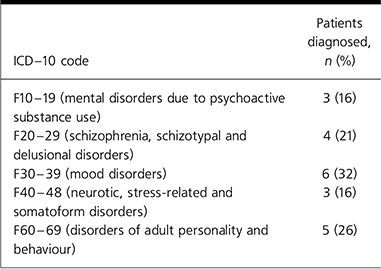
For the 12 months to the end of March 2004 a total of 19 patients received input from the team (mean age 42.4 years; 11 females). The mean time per month spent with all the patients was 291 h (s.d.=43.2); the mean number of visits per month was 222 (s.d.=41.6). All patients of the assertive outreach team have a diagnosis of mild learning disability. Table 1 shows the additional primary ICD-10 codes (World Health Organization, 1992).
ICD-10 diagnostic codes
| ICD—10 code | Patients diagnosed, n (%) |
|---|---|
| F10-19 (mental disorders due to psychoactive substance use) | 3 (16) |
| F20-29 (schizophrenia, schizotypal and delusional disorders) | 4 (21) |
| F30-39 (mood disorders) | 6 (32) |
| F40-48 (neurotic, stress-related and somatoform disorders) | 3 (16) |
| F60-69 (disorders of adult personality and behaviour) | 5 (26) |
Outcomes
A case note audit was completed in January 2004 to compare a period of assertive outreach care with a corresponding 2-year period, when the same 11 people had been receiving standard community care from a learning disability team (D. Dean, personal communication, 2004). In-patient admission rates actually rose slightly in the period after the introduction of the assertive outreach team, as one person was admitted to a learning disability in-patient unit after assertive outreach team involvement, whereas nobody had been admitted in the baseline period. This was, however, a voluntary admission of a person who had been extremely difficult to engage previously and who had experienced significant psychotic symptoms during the baseline period.
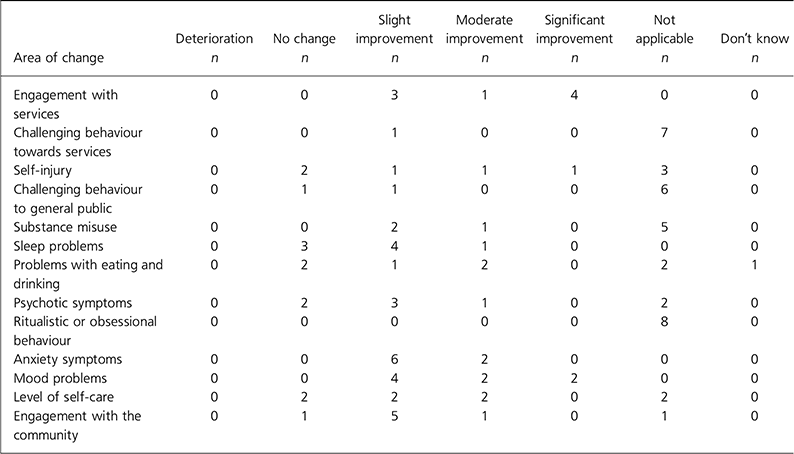
A questionnaire (available from the authors) asking about the impact of the assertive outreach team on the participant's mental health was also given to a clinician who had known the participant throughout the two periods being compared. Questions were asked regarding changes in 13 areas and clinicians were asked to rate the level of change in each area on a 7-point scale (Table 2). Questions were derived from the Psychiatric Assessment Schedule for Adults with Developmental Disabilities - Checklist (Reference Moss, Prosser and CostelloMoss et al, 1998) and the Health of the Nation Outcome Scales for People with Learning Disabilities (HoNOS-LD; Reference Roy, Mathews and CliffordRoy et al, 2002). Responses suggested that there had been improvements in level of engagement with services for all participants. The questionnaire indicated that none of the participants had deteriorated in any area, which is an important finding. In view of the small sample size no definite conclusions about statistical significance can be drawn. Comments suggest that the assertive outreach team is able to offer much more intensive input than the community teams.
Clinician questionnaire responses
| Area of change | Deterioration n | No change n | Slight improvement n | Moderate improvement n | Significant improvement n | Not applicable n | Don't know n |
|---|---|---|---|---|---|---|---|
| Engagement with services | 0 | 0 | 3 | 1 | 4 | 0 | 0 |
| Challenging behaviour towards services | 0 | 0 | 1 | 0 | 0 | 7 | 0 |
| Self-injury | 0 | 2 | 1 | 1 | 1 | 3 | 0 |
| Challenging behaviour to general public | 0 | 1 | 1 | 0 | 0 | 6 | 0 |
| Substance misuse | 0 | 0 | 2 | 1 | 0 | 5 | 0 |
| Sleep problems | 0 | 3 | 4 | 1 | 0 | 0 | 0 |
| Problems with eating and drinking | 0 | 2 | 1 | 2 | 0 | 2 | 1 |
| Psychotic symptoms | 0 | 2 | 3 | 1 | 0 | 2 | 0 |
| Ritualistic or obsessional behaviour | 0 | 0 | 0 | 0 | 0 | 8 | 0 |
| Anxiety symptoms | 0 | 0 | 6 | 2 | 0 | 0 | 0 |
| Mood problems | 0 | 0 | 4 | 2 | 2 | 0 | 0 |
| Level of self-care | 0 | 2 | 2 | 2 | 0 | 2 | 0 |
| Engagement with the community | 0 | 1 | 5 | 1 | 0 | 1 | 0 |
As this was the first time the questionnaire had been used there were no reliability and validity details available. The questionnaire is subjective and asks clinicians about a previous episode, and is therefore prone to retrospective bias. As well as retrospective bias there is also the potential bias of using clinician ratings when the clinician is still involved with the care of the patient.
Conclusion
The Oxfordshire experience of assertive outreach services for adults with learning disability has been positive. Clinicians particularly valued the improved engagement of people who were previously difficult to engage. This has not been translated into a short-term reduction in bed occupancy but none the less appears beneficial to good patient care.
All people using the service had mild learning disability and a significant minority had personality or behaviour disorders, either alone or in conjunction with another psychiatric disorder. Although 4 patients (21%) had some form of psychotic disorder, this is lower than typically seen in assertive outreach services for people without learning disability. It is likely that the group of patients without psychotic disorder might find access to generic assertive outreach services particularly difficult and the authors would argue that specific assertive outreach services for people with learning disability are likely to provide better and more appropriate care to this vulnerable group. Further evaluation is necessary and is ongoing, including an audit of patients’ satisfaction with the service. The team members function as generic mental health workers, with a behavioural support worker, for example, having to detect medication side-effects. It is hoped that further staff recruitment will expand the mix of professionals to include input from psychology and occupational therapy. This will enhance the team's ability to provide specialist intervention to more complex cases.
Providing care using the assertive outreach team approach can be problematic. Boundaries between patients and team members can blur, especially since patients are frequently visited in their own home and given help with daily living. A balance has to be struck between engagement and what could be considered harassment. Most of the team's patients do not wish to be in contact with services. Visiting them unannounced at home can appear intrusive. There is also the danger that using professionals in this way will allow reduction of expenditure by other agencies such as social services. Scarce resources may be diverted without clear cost-effectiveness. Although superficially the assertive outreach team might appear little different from the standard community team, apart from having smaller case-loads, there are significant differences. As stated earlier, the team provides a service at weekends and because of the smaller case-loads works qualitatively in a different way, which over a period of time enhances skills in engaging difficult people.
Further research is needed to evaluate assertive outreach team/learning disability services more objectively. A study that compared clients of an assertive outreach team with those on the waiting list and receiving ‘ standard care’ would be the next logical step, using a well-validated outcome measure such as the HoNOS-LD (Reference Roy, Mathews and CliffordRoy et al, 2002).
Declaration of interest
None.
Acknowledgements
We thank David Dean for permitting us to include the results of his audit.


 Open access


eLetters
No eLetters have been published for this article.